
A English
Electric Field Lines, Electric Flux and Gauss's Law Questions in English
Class 12 Physics · Electric Charges and Fields · Electric Field Lines, Electric Flux and Gauss's Law
312+
Questions
English
Language
100%
With Solutions
Showing 48 of 312 questions in English
201
DifficultMCQ
An electric field,$\overrightarrow{E} = \frac{2 \hat{i} + 6 \hat{j} + 8 \hat{k}}{\sqrt{6}} \ V/m$,passes through a surface of $4 \ m^2$ area having a unit normal vector $\hat{n} = \left( \frac{2 \hat{i} + \hat{j} + \hat{k}}{\sqrt{6}} \right)$. The electric flux through that surface is:
A
$12$
B
$13$
C
$15$
D
$16$
Solution
(A) The electric flux $\phi$ is given by the dot product of the electric field vector $\overrightarrow{E}$ and the area vector $\overrightarrow{A}$.
The area vector is defined as $\overrightarrow{A} = A \hat{n} = 4 \left( \frac{2 \hat{i} + \hat{j} + \hat{k}}{\sqrt{6}} \right) \ m^2$.
The electric flux is calculated as:
$\phi = \overrightarrow{E} \cdot \overrightarrow{A}$
$\phi = \left( \frac{2 \hat{i} + 6 \hat{j} + 8 \hat{k}}{\sqrt{6}} \right) \cdot \left( 4 \frac{2 \hat{i} + \hat{j} + \hat{k}}{\sqrt{6}} \right)$
$\phi = \frac{4}{6} \times (2 \times 2 + 6 \times 1 + 8 \times 1)$
$\phi = \frac{4}{6} \times (4 + 6 + 8)$
$\phi = \frac{4}{6} \times 18$
$\phi = 4 \times 3 = 12 \ Vm$.
The area vector is defined as $\overrightarrow{A} = A \hat{n} = 4 \left( \frac{2 \hat{i} + \hat{j} + \hat{k}}{\sqrt{6}} \right) \ m^2$.
The electric flux is calculated as:
$\phi = \overrightarrow{E} \cdot \overrightarrow{A}$
$\phi = \left( \frac{2 \hat{i} + 6 \hat{j} + 8 \hat{k}}{\sqrt{6}} \right) \cdot \left( 4 \frac{2 \hat{i} + \hat{j} + \hat{k}}{\sqrt{6}} \right)$
$\phi = \frac{4}{6} \times (2 \times 2 + 6 \times 1 + 8 \times 1)$
$\phi = \frac{4}{6} \times (4 + 6 + 8)$
$\phi = \frac{4}{6} \times 18$
$\phi = 4 \times 3 = 12 \ Vm$.
0 likes
View Solution202
DifficultMCQ
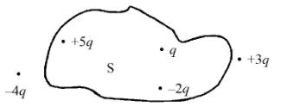
Five charges $+q, +5q, -2q, +3q$ and $-4q$ are situated as shown in the figure. The electric flux due to this configuration through the surface $S$ is
A
$\frac{5q}{\epsilon_0}$
B
$\frac{4q}{\epsilon_0}$
C
$\frac{3q}{\epsilon_0}$
D
$\frac{q}{\epsilon_0}$
Solution
(B) According to Gauss's law,the electric flux $\phi$ through a closed surface is given by $\phi = \frac{q_{\text{in}}}{\epsilon_0}$,where $q_{\text{in}}$ is the net charge enclosed by the surface.
From the figure,the charges enclosed by the surface $S$ are $+q, +5q,$ and $-2q$.
The charges $+3q$ and $-4q$ are outside the surface $S$,so they do not contribute to the electric flux through the surface.
Therefore,the net enclosed charge is $q_{\text{in}} = (+q) + (+5q) + (-2q) = 4q$.
Substituting this into Gauss's law,we get $\phi = \frac{4q}{\epsilon_0}$.
From the figure,the charges enclosed by the surface $S$ are $+q, +5q,$ and $-2q$.
The charges $+3q$ and $-4q$ are outside the surface $S$,so they do not contribute to the electric flux through the surface.
Therefore,the net enclosed charge is $q_{\text{in}} = (+q) + (+5q) + (-2q) = 4q$.
Substituting this into Gauss's law,we get $\phi = \frac{4q}{\epsilon_0}$.
0 likes
View Solution203
DifficultMCQ
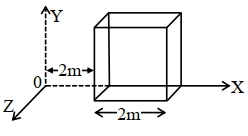
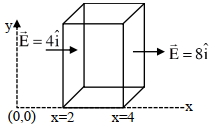
An electric field $\overrightarrow{E} = (2x\hat{i}) \text{ NC}^{-1}$ exists in space. $A$ cube of side $2 \text{ m}$ is placed in the space as per the figure given below. The electric flux through the cube is .................. $\text{Nm}^2 \text{C}^{-1}$.
A
$13$
B
$14$
C
$15$
D
$16$
Solution
(D) Given,electric field $\overrightarrow{E} = 2x\hat{i} \text{ NC}^{-1}$.
The cube is placed between $x = 2 \text{ m}$ and $x = 4 \text{ m}$. The side length of the cube is $a = 2 \text{ m}$,so the area of each face is $A = a^2 = (2)^2 = 4 \text{ m}^2$.
Electric flux is given by $\phi = \int \overrightarrow{E} \cdot d\overrightarrow{A}$.
For the left face at $x = 2 \text{ m}$,the area vector is $\overrightarrow{A}_1 = -4\hat{i} \text{ m}^2$ and $\overrightarrow{E}_1 = 2(2)\hat{i} = 4\hat{i} \text{ NC}^{-1}$.
$\phi_{\text{in}} = \overrightarrow{E}_1 \cdot \overrightarrow{A}_1 = (4\hat{i}) \cdot (-4\hat{i}) = -16 \text{ Nm}^2 \text{C}^{-1}$.
For the right face at $x = 4 \text{ m}$,the area vector is $\overrightarrow{A}_2 = 4\hat{i} \text{ m}^2$ and $\overrightarrow{E}_2 = 2(4)\hat{i} = 8\hat{i} \text{ NC}^{-1}$.
$\phi_{\text{out}} = \overrightarrow{E}_2 \cdot \overrightarrow{A}_2 = (8\hat{i}) \cdot (4\hat{i}) = 32 \text{ Nm}^2 \text{C}^{-1}$.
The net electric flux through the cube is $\phi_{\text{net}} = \phi_{\text{in}} + \phi_{\text{out}} = -16 + 32 = 16 \text{ Nm}^2 \text{C}^{-1}$.
The cube is placed between $x = 2 \text{ m}$ and $x = 4 \text{ m}$. The side length of the cube is $a = 2 \text{ m}$,so the area of each face is $A = a^2 = (2)^2 = 4 \text{ m}^2$.
Electric flux is given by $\phi = \int \overrightarrow{E} \cdot d\overrightarrow{A}$.
For the left face at $x = 2 \text{ m}$,the area vector is $\overrightarrow{A}_1 = -4\hat{i} \text{ m}^2$ and $\overrightarrow{E}_1 = 2(2)\hat{i} = 4\hat{i} \text{ NC}^{-1}$.
$\phi_{\text{in}} = \overrightarrow{E}_1 \cdot \overrightarrow{A}_1 = (4\hat{i}) \cdot (-4\hat{i}) = -16 \text{ Nm}^2 \text{C}^{-1}$.
For the right face at $x = 4 \text{ m}$,the area vector is $\overrightarrow{A}_2 = 4\hat{i} \text{ m}^2$ and $\overrightarrow{E}_2 = 2(4)\hat{i} = 8\hat{i} \text{ NC}^{-1}$.
$\phi_{\text{out}} = \overrightarrow{E}_2 \cdot \overrightarrow{A}_2 = (8\hat{i}) \cdot (4\hat{i}) = 32 \text{ Nm}^2 \text{C}^{-1}$.
The net electric flux through the cube is $\phi_{\text{net}} = \phi_{\text{in}} + \phi_{\text{out}} = -16 + 32 = 16 \text{ Nm}^2 \text{C}^{-1}$.
0 likes
View Solution204
AdvancedMCQ
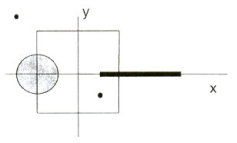
$A$ disk of radius $a/4$ having a uniformly distributed charge $6 \text{ C}$ is placed in the $x-y$ plane with its centre at $(-a/2, 0, 0)$. $A$ rod of length $a$ carrying a uniformly distributed charge $8 \text{ C}$ is placed on the $x$-axis from $x = a/4$ to $x = 5a/4$. Two point charges $-7 \text{ C}$ and $3 \text{ C}$ are placed at $(a/4, -a/4, 0)$ and $(-3a/4, 3a/4, 0)$,respectively. Consider a cubical surface formed by six surfaces $x = \pm a/2, y = \pm a/2, z = \pm a/2$. The electric flux through this cubical surface is
A
$\frac{-2 \text{ C}}{\varepsilon_0}$
B
$\frac{2 \text{ C}}{\varepsilon_0}$
C
$\frac{10 \text{ C}}{\varepsilon_0}$
D
$\frac{12 \text{ C}}{\varepsilon_0}$
Solution
(A) According to Gauss's Law,the electric flux $\phi$ through a closed surface is given by $\phi = \frac{Q_{\text{enclosed}}}{\varepsilon_0}$.
$1$. Disk: The disk has radius $a/4$ and center at $(-a/2, 0, 0)$. The cube extends from $x = -a/2$ to $x = a/2$. Since the disk is in the $x-y$ plane,only the part of the disk with $x > -a/2$ is inside the cube. The disk spans from $x = -a/2 - a/4 = -3a/4$ to $x = -a/2 + a/4 = -a/4$. The portion inside the cube is from $x = -a/2$ to $x = -a/4$. By symmetry,exactly half of the disk is inside the cube. Thus,$Q_{\text{disk, enclosed}} = 6 \text{ C} / 2 = 3 \text{ C}$.
$2$. Rod: The rod spans from $x = a/4$ to $x = 5a/4$. The cube boundary is at $x = a/2$. The portion of the rod inside the cube is from $x = a/4$ to $x = a/2$. The length of the rod inside the cube is $a/2 - a/4 = a/4$. Since the total length is $a$,the fraction of charge inside is $(a/4) / a = 1/4$. Thus,$Q_{\text{rod, enclosed}} = 8 \text{ C} \times (1/4) = 2 \text{ C}$.
$3$. Point charges: The point charge $-7 \text{ C}$ is at $(a/4, -a/4, 0)$,which is inside the cube (since $|a/4| < a/2$ and $|-a/4| < a/2$). The point charge $3 \text{ C}$ is at $(-3a/4, 3a/4, 0)$,which is outside the cube (since $|-3a/4| > a/2$).
$4$. Total enclosed charge: $Q_{\text{enclosed}} = 3 \text{ C} + 2 \text{ C} - 7 \text{ C} = -2 \text{ C}$.
Therefore,the electric flux is $\phi = \frac{-2 \text{ C}}{\varepsilon_0}$.
$1$. Disk: The disk has radius $a/4$ and center at $(-a/2, 0, 0)$. The cube extends from $x = -a/2$ to $x = a/2$. Since the disk is in the $x-y$ plane,only the part of the disk with $x > -a/2$ is inside the cube. The disk spans from $x = -a/2 - a/4 = -3a/4$ to $x = -a/2 + a/4 = -a/4$. The portion inside the cube is from $x = -a/2$ to $x = -a/4$. By symmetry,exactly half of the disk is inside the cube. Thus,$Q_{\text{disk, enclosed}} = 6 \text{ C} / 2 = 3 \text{ C}$.
$2$. Rod: The rod spans from $x = a/4$ to $x = 5a/4$. The cube boundary is at $x = a/2$. The portion of the rod inside the cube is from $x = a/4$ to $x = a/2$. The length of the rod inside the cube is $a/2 - a/4 = a/4$. Since the total length is $a$,the fraction of charge inside is $(a/4) / a = 1/4$. Thus,$Q_{\text{rod, enclosed}} = 8 \text{ C} \times (1/4) = 2 \text{ C}$.
$3$. Point charges: The point charge $-7 \text{ C}$ is at $(a/4, -a/4, 0)$,which is inside the cube (since $|a/4| < a/2$ and $|-a/4| < a/2$). The point charge $3 \text{ C}$ is at $(-3a/4, 3a/4, 0)$,which is outside the cube (since $|-3a/4| > a/2$).
$4$. Total enclosed charge: $Q_{\text{enclosed}} = 3 \text{ C} + 2 \text{ C} - 7 \text{ C} = -2 \text{ C}$.
Therefore,the electric flux is $\phi = \frac{-2 \text{ C}}{\varepsilon_0}$.
0 likes
View Solution205
AdvancedMCQ
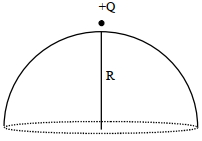
$A$ point charge $+Q$ is placed just outside an imaginary hemispherical surface of radius $R$ as shown in the figure. Which of the following statements is/are correct?
$[A]$ The electric flux passing through the curved surface of the hemisphere is $-\frac{Q}{2 \varepsilon_0}\left(1-\frac{1}{\sqrt{2}}\right)$
$[B]$ Total flux through the curved and the flat surfaces is $\frac{Q}{\varepsilon_0}$
$[C]$ The component of the electric field normal to the flat surface is constant over the surface
$[D]$ The circumference of the flat surface is an equipotential
$[A]$ The electric flux passing through the curved surface of the hemisphere is $-\frac{Q}{2 \varepsilon_0}\left(1-\frac{1}{\sqrt{2}}\right)$
$[B]$ Total flux through the curved and the flat surfaces is $\frac{Q}{\varepsilon_0}$
$[C]$ The component of the electric field normal to the flat surface is constant over the surface
$[D]$ The circumference of the flat surface is an equipotential
A
$A, C$
B
$A, B$
C
$A, C, D$
D
$A, D$
Solution
(D) The solid angle subtended by the flat circular base at the position of the charge $+Q$ is given by $\Omega = 2\pi(1 - \cos\theta)$.
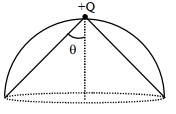
In the given geometry,the charge is at the pole of the hemisphere,so the angle $\theta$ subtended by the radius of the base at the charge is $45^{\circ}$.
Thus,$\Omega = 2\pi(1 - \cos 45^{\circ}) = 2\pi(1 - \frac{1}{\sqrt{2}})$.
The flux through the flat surface is $\Phi_{flat} = \frac{Q}{\varepsilon_0} \times \frac{\Omega}{4\pi} = \frac{Q}{2\varepsilon_0}(1 - \frac{1}{\sqrt{2}})$.
Since the charge is outside the closed hemisphere,the net flux through the entire surface is zero. Therefore,the flux through the curved surface is $\Phi_{curved} = -\Phi_{flat} = -\frac{Q}{2\varepsilon_0}(1 - \frac{1}{\sqrt{2}})$. Statement $A$ is correct.
Statement $B$ is incorrect because the total flux through a closed surface not enclosing the charge is zero.
Statement $C$ is incorrect because the electric field varies with distance from the charge.
Statement $D$ is correct because all points on the circumference of the flat base are at the same distance $R$ from the point charge $+Q$,making the potential $V = \frac{1}{4\pi\varepsilon_0} \frac{Q}{R}$ constant along the circumference.
In the given geometry,the charge is at the pole of the hemisphere,so the angle $\theta$ subtended by the radius of the base at the charge is $45^{\circ}$.
Thus,$\Omega = 2\pi(1 - \cos 45^{\circ}) = 2\pi(1 - \frac{1}{\sqrt{2}})$.
The flux through the flat surface is $\Phi_{flat} = \frac{Q}{\varepsilon_0} \times \frac{\Omega}{4\pi} = \frac{Q}{2\varepsilon_0}(1 - \frac{1}{\sqrt{2}})$.
Since the charge is outside the closed hemisphere,the net flux through the entire surface is zero. Therefore,the flux through the curved surface is $\Phi_{curved} = -\Phi_{flat} = -\frac{Q}{2\varepsilon_0}(1 - \frac{1}{\sqrt{2}})$. Statement $A$ is correct.
Statement $B$ is incorrect because the total flux through a closed surface not enclosing the charge is zero.
Statement $C$ is incorrect because the electric field varies with distance from the charge.
Statement $D$ is correct because all points on the circumference of the flat base are at the same distance $R$ from the point charge $+Q$,making the potential $V = \frac{1}{4\pi\varepsilon_0} \frac{Q}{R}$ constant along the circumference.
0 likes
View Solution206
MediumMCQ
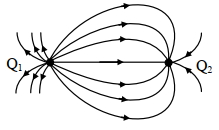
$A$ few electric field lines for a system of two charges $Q_1$ and $Q_2$ fixed at two different points on the $x$-axis are shown in the figure. These lines suggest that:
$(A)$ $|Q_1| > |Q_2|$
$(B)$ $|Q_1| < |Q_2|$
$(C)$ at a finite distance to the left of $Q_1$ the electric field is zero
$(D)$ at a finite distance to the right of $Q_2$ the electric field is zero
$(A)$ $|Q_1| > |Q_2|$
$(B)$ $|Q_1| < |Q_2|$
$(C)$ at a finite distance to the left of $Q_1$ the electric field is zero
$(D)$ at a finite distance to the right of $Q_2$ the electric field is zero
A
$(A, D)$
B
$(B, D)$
C
$(C, D)$
D
$(A, B)$
Solution
(A) $1$. The number of electric field lines originating from a charge is proportional to the magnitude of the charge. By counting the lines,we see that more lines originate from $Q_1$ than terminate at $Q_2$,which implies $|Q_1| > |Q_2|$. Thus,statement $(A)$ is correct.
$2$. Since the charges have opposite signs (lines originate from $Q_1$ and terminate at $Q_2$),the neutral point (where the electric field is zero) must lie on the line joining the charges,outside the region between them,and closer to the charge with the smaller magnitude.
$3$. Since $|Q_1| > |Q_2|$,the neutral point must be closer to $Q_2$. Therefore,the electric field is zero at a finite distance to the right of $Q_2$. Thus,statement $(D)$ is correct.
$4$. Combining these,the correct option is $(A, D)$.
$2$. Since the charges have opposite signs (lines originate from $Q_1$ and terminate at $Q_2$),the neutral point (where the electric field is zero) must lie on the line joining the charges,outside the region between them,and closer to the charge with the smaller magnitude.
$3$. Since $|Q_1| > |Q_2|$,the neutral point must be closer to $Q_2$. Therefore,the electric field is zero at a finite distance to the right of $Q_2$. Thus,statement $(D)$ is correct.
$4$. Combining these,the correct option is $(A, D)$.
0 likes
View Solution207
DifficultMCQ
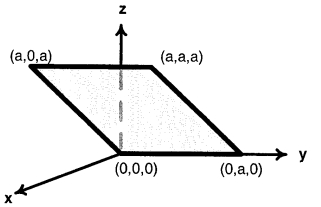
Consider an electric field $\vec{E} = E_0 \hat{i}$,where $E_0$ is a constant. The flux through the shaded area (as shown in the figure) due to this field is
A
$2 E_0 a^2$
B
$\sqrt{2} E_0 a^2$
C
$E_0 a^2$
D
$\frac{E_0 a^2}{\sqrt{2}}$
Solution
(C) The shaded area is a square in the $xz$-plane tilted at an angle of $45^{\circ}$ to the $x$-axis. The vertices of the square are $(0,0,0)$,$(0,a,0)$,$(a,a,a)$,and $(a,0,a)$.
The area vector $\vec{A}$ has a magnitude equal to the area of the square,which is $a \times a \sqrt{2} = \sqrt{2} a^2$. The direction of the area vector is perpendicular to the surface. Since the surface lies in a plane defined by $y=z$ (or $z-y=0$),the normal vector is proportional to $\hat{j} - \hat{k}$.
Alternatively,we can define the area vector by the cross product of two adjacent sides: $\vec{A} = \vec{AB} \times \vec{AD}$. Let $\vec{AB} = a\hat{j}$ and $\vec{AD} = a\hat{i} + a\hat{k}$.
Then $\vec{A} = (a\hat{j}) \times (a\hat{i} + a\hat{k}) = a^2(\hat{j} \times \hat{i}) + a^2(\hat{j} \times \hat{k}) = -a^2\hat{k} + a^2\hat{i} = a^2\hat{i} - a^2\hat{k}$.
The electric flux $\phi$ is given by $\phi = \vec{E} \cdot \vec{A}$.
Given $\vec{E} = E_0 \hat{i}$,we have:
$\phi = (E_0 \hat{i}) \cdot (a^2 \hat{i} - a^2 \hat{k})$
$\phi = E_0 a^2 (\hat{i} \cdot \hat{i}) - E_0 a^2 (\hat{i} \cdot \hat{k})$
Since $\hat{i} \cdot \hat{i} = 1$ and $\hat{i} \cdot \hat{k} = 0$,we get:
$\phi = E_0 a^2$.
The area vector $\vec{A}$ has a magnitude equal to the area of the square,which is $a \times a \sqrt{2} = \sqrt{2} a^2$. The direction of the area vector is perpendicular to the surface. Since the surface lies in a plane defined by $y=z$ (or $z-y=0$),the normal vector is proportional to $\hat{j} - \hat{k}$.
Alternatively,we can define the area vector by the cross product of two adjacent sides: $\vec{A} = \vec{AB} \times \vec{AD}$. Let $\vec{AB} = a\hat{j}$ and $\vec{AD} = a\hat{i} + a\hat{k}$.
Then $\vec{A} = (a\hat{j}) \times (a\hat{i} + a\hat{k}) = a^2(\hat{j} \times \hat{i}) + a^2(\hat{j} \times \hat{k}) = -a^2\hat{k} + a^2\hat{i} = a^2\hat{i} - a^2\hat{k}$.
The electric flux $\phi$ is given by $\phi = \vec{E} \cdot \vec{A}$.
Given $\vec{E} = E_0 \hat{i}$,we have:
$\phi = (E_0 \hat{i}) \cdot (a^2 \hat{i} - a^2 \hat{k})$
$\phi = E_0 a^2 (\hat{i} \cdot \hat{i}) - E_0 a^2 (\hat{i} \cdot \hat{k})$
Since $\hat{i} \cdot \hat{i} = 1$ and $\hat{i} \cdot \hat{k} = 0$,we get:
$\phi = E_0 a^2$.
0 likes
View Solution208
AdvancedMCQ
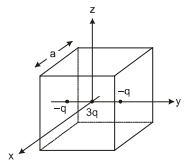
$A$ cubical region of side $a$ has its centre at the origin. It encloses three fixed point charges,$-q$ at $(0, -a/4, 0)$,$+3q$ at $(0, 0, 0)$,and $-q$ at $(0, +a/4, 0)$. Choose the correct option$(s)$.
$(A)$ The net electric flux crossing the plane $x = +a/2$ is equal to the net electric flux crossing the plane $x = -a/2$.
$(B)$ The net electric flux crossing the plane $y = +a/2$ is more than the net electric flux crossing the plane $y = -a/2$.
$(C)$ The net electric flux crossing the entire region is $\frac{q}{\varepsilon_0}$.
$(D)$ The net electric flux crossing the plane $z = +a/2$ is equal to the net electric flux crossing the plane $x = +a/2$.
$(A)$ The net electric flux crossing the plane $x = +a/2$ is equal to the net electric flux crossing the plane $x = -a/2$.
$(B)$ The net electric flux crossing the plane $y = +a/2$ is more than the net electric flux crossing the plane $y = -a/2$.
$(C)$ The net electric flux crossing the entire region is $\frac{q}{\varepsilon_0}$.
$(D)$ The net electric flux crossing the plane $z = +a/2$ is equal to the net electric flux crossing the plane $x = +a/2$.
A
$(A, B, C)$
B
$(A, B, D)$
C
$(A, C, D)$
D
$(B, C, D)$
Solution
(C) The total charge enclosed by the cube is $Q_{\text{enclosed}} = -q + 3q - q = q$.
According to Gauss's Law,the net electric flux through the entire closed surface is $\phi = \frac{Q_{\text{enclosed}}}{\varepsilon_0} = \frac{q}{\varepsilon_0}$. Thus,option $(C)$ is correct.
The charges are located on the $y$-axis at $(0, -a/4, 0)$,$(0, 0, 0)$,and $(0, a/4, 0)$.
Since the charge distribution is symmetric with respect to the $yz$-plane $(x=0)$,the flux through the plane $x = +a/2$ must be equal to the flux through the plane $x = -a/2$. Thus,option $(A)$ is correct.
The charge distribution is not symmetric with respect to the $xz$-plane $(y=0)$. The charges are located at $y = -a/4, 0, a/4$. The plane $y = +a/2$ is closer to the charge at $y = +a/4$ than the plane $y = -a/2$ is to the charge at $y = -a/4$. However,by calculating the flux,one finds the flux through $y = +a/2$ and $y = -a/2$ are actually equal due to the specific arrangement of charges. Thus,$(B)$ is incorrect.
By symmetry of the charge distribution with respect to the $xy$-plane $(z=0)$,the flux through $z = +a/2$ is equal to the flux through $z = -a/2$. Comparing this to the flux through $x = +a/2$,we find they are equal. Thus,$(D)$ is correct.
According to Gauss's Law,the net electric flux through the entire closed surface is $\phi = \frac{Q_{\text{enclosed}}}{\varepsilon_0} = \frac{q}{\varepsilon_0}$. Thus,option $(C)$ is correct.
The charges are located on the $y$-axis at $(0, -a/4, 0)$,$(0, 0, 0)$,and $(0, a/4, 0)$.
Since the charge distribution is symmetric with respect to the $yz$-plane $(x=0)$,the flux through the plane $x = +a/2$ must be equal to the flux through the plane $x = -a/2$. Thus,option $(A)$ is correct.
The charge distribution is not symmetric with respect to the $xz$-plane $(y=0)$. The charges are located at $y = -a/4, 0, a/4$. The plane $y = +a/2$ is closer to the charge at $y = +a/4$ than the plane $y = -a/2$ is to the charge at $y = -a/4$. However,by calculating the flux,one finds the flux through $y = +a/2$ and $y = -a/2$ are actually equal due to the specific arrangement of charges. Thus,$(B)$ is incorrect.
By symmetry of the charge distribution with respect to the $xy$-plane $(z=0)$,the flux through $z = +a/2$ is equal to the flux through $z = -a/2$. Comparing this to the flux through $x = +a/2$,we find they are equal. Thus,$(D)$ is correct.
0 likes
View Solution209
DifficultMCQ
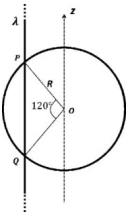
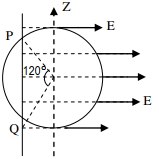
An infinitely long thin non-conducting wire is parallel to the $z$-axis and carries a uniform line charge density $\lambda$. It pierces a thin non-conducting spherical shell of radius $R$ in such a way that the arc $PQ$ subtends an angle $120^{\circ}$ at the centre $O$ of the spherical shell,as shown in the figure. The permittivity of free space is $\epsilon_0$. Which of the following statements is (are) true?
$(A)$ The electric flux through the shell is $\sqrt{3} R \lambda / \epsilon_0$
$(B)$ The $z$-component of the electric field is zero at all the points on the surface of the shell
$(C)$ The electric flux through the shell is $\sqrt{2} R \lambda / \epsilon_0$
$(D)$ The electric field is normal to the surface of the shell at all points
$(A)$ The electric flux through the shell is $\sqrt{3} R \lambda / \epsilon_0$
$(B)$ The $z$-component of the electric field is zero at all the points on the surface of the shell
$(C)$ The electric flux through the shell is $\sqrt{2} R \lambda / \epsilon_0$
$(D)$ The electric field is normal to the surface of the shell at all points
A
$A, B$
B
$A, C$
C
$A, D$
D
$B, C$
Solution
(A) According to Gauss's law,the electric flux $\phi$ through a closed surface is given by $\phi = \frac{Q_{\text{enclosed}}}{\epsilon_0}$.
The length of the wire segment $PQ$ inside the spherical shell is $L = 2R \sin(120^{\circ}/2) = 2R \sin(60^{\circ}) = 2R \times \frac{\sqrt{3}}{2} = R\sqrt{3}$.
The charge enclosed by the shell is $Q_{\text{enclosed}} = \lambda L = \lambda R \sqrt{3}$.
Therefore,the electric flux through the shell is $\phi = \frac{\lambda R \sqrt{3}}{\epsilon_0}$. Thus,statement $(A)$ is true and $(C)$ is false.
Since the wire is parallel to the $z$-axis,the electric field lines are directed radially outward from the wire in the $xy$-plane. Therefore,the electric field has no component along the $z$-axis. Thus,statement $(B)$ is true.
The electric field is only normal to the surface of the shell if the charge distribution is spherically symmetric,which is not the case here. Thus,statement $(D)$ is false.
Therefore,the correct statements are $(A)$ and $(B)$.
The length of the wire segment $PQ$ inside the spherical shell is $L = 2R \sin(120^{\circ}/2) = 2R \sin(60^{\circ}) = 2R \times \frac{\sqrt{3}}{2} = R\sqrt{3}$.
The charge enclosed by the shell is $Q_{\text{enclosed}} = \lambda L = \lambda R \sqrt{3}$.
Therefore,the electric flux through the shell is $\phi = \frac{\lambda R \sqrt{3}}{\epsilon_0}$. Thus,statement $(A)$ is true and $(C)$ is false.
Since the wire is parallel to the $z$-axis,the electric field lines are directed radially outward from the wire in the $xy$-plane. Therefore,the electric field has no component along the $z$-axis. Thus,statement $(B)$ is true.
The electric field is only normal to the surface of the shell if the charge distribution is spherically symmetric,which is not the case here. Thus,statement $(D)$ is false.
Therefore,the correct statements are $(A)$ and $(B)$.
0 likes
View Solution210
AdvancedMCQ
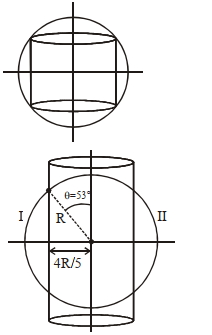
$A$ charged shell of radius $R$ carries a total charge $Q$. Let $\Phi$ be the flux of the electric field through a closed cylindrical surface of height $h$,radius $r$,with its center coinciding with that of the shell. The center of the cylinder is a point on the axis of the cylinder equidistant from its top and bottom surfaces. Which of the following option$(s)$ is/are correct? [$\epsilon_0$ is the permittivity of free space]
$(1)$ If $h > 2R$ and $r > R$,then $\Phi = \frac{Q}{\epsilon_0}$
$(2)$ If $h < \frac{8R}{5}$ and $r = \frac{3R}{5}$,then $\Phi = 0$
$(3)$ If $h > 2R$ and $r = \frac{4R}{5}$,then $\Phi = \frac{2Q}{5\epsilon_0}$
$(4)$ If $h > 2R$ and $r = \frac{3R}{5}$,then $\Phi = \frac{Q}{5\epsilon_0}$
$(1)$ If $h > 2R$ and $r > R$,then $\Phi = \frac{Q}{\epsilon_0}$
$(2)$ If $h < \frac{8R}{5}$ and $r = \frac{3R}{5}$,then $\Phi = 0$
$(3)$ If $h > 2R$ and $r = \frac{4R}{5}$,then $\Phi = \frac{2Q}{5\epsilon_0}$
$(4)$ If $h > 2R$ and $r = \frac{3R}{5}$,then $\Phi = \frac{Q}{5\epsilon_0}$
A
$1, 2, 3$
B
$1, 2, 4$
C
$1, 2$
D
$1, 3, 4$
Solution
(A-D) According to Gauss's Law,the flux $\Phi$ through a closed surface is $\frac{q_{enclosed}}{\epsilon_0}$.
$(1)$ If $h > 2R$ and $r > R$,the entire shell is enclosed by the cylinder. Thus,$q_{enclosed} = Q$ and $\Phi = \frac{Q}{\epsilon_0}$. This is correct.
$(2)$ If $h < \frac{8R}{5}$ and $r = \frac{3R}{5}$,the cylinder is entirely inside the shell. Since the electric field inside a charged shell is zero,the flux through the cylinder is $\Phi = 0$. This is correct.
$(3)$ If $h > 2R$ and $r = \frac{4R}{5}$,the cylinder intersects the shell. The flux is due to the charge on the spherical caps cut by the cylinder. The solid angle subtended by a cap is $\Omega = 2\pi(1 - \cos\theta)$,where $\sin\theta = \frac{r}{R} = \frac{4}{5}$,so $\cos\theta = \frac{3}{5}$. The flux through one cap is $\frac{Q}{4\pi\epsilon_0} \times \Omega = \frac{Q}{2\epsilon_0}(1 - \cos\theta)$. For two caps,$\Phi = \frac{Q}{\epsilon_0}(1 - \frac{3}{5}) = \frac{2Q}{5\epsilon_0}$. This is correct.
$(4)$ If $h > 2R$ and $r = \frac{3R}{5}$,then $\sin\theta = \frac{3}{5}$,so $\cos\theta = \frac{4}{5}$. The flux is $\Phi = \frac{Q}{\epsilon_0}(1 - \frac{4}{5}) = \frac{Q}{5\epsilon_0}$. This is correct.
$(1)$ If $h > 2R$ and $r > R$,the entire shell is enclosed by the cylinder. Thus,$q_{enclosed} = Q$ and $\Phi = \frac{Q}{\epsilon_0}$. This is correct.
$(2)$ If $h < \frac{8R}{5}$ and $r = \frac{3R}{5}$,the cylinder is entirely inside the shell. Since the electric field inside a charged shell is zero,the flux through the cylinder is $\Phi = 0$. This is correct.
$(3)$ If $h > 2R$ and $r = \frac{4R}{5}$,the cylinder intersects the shell. The flux is due to the charge on the spherical caps cut by the cylinder. The solid angle subtended by a cap is $\Omega = 2\pi(1 - \cos\theta)$,where $\sin\theta = \frac{r}{R} = \frac{4}{5}$,so $\cos\theta = \frac{3}{5}$. The flux through one cap is $\frac{Q}{4\pi\epsilon_0} \times \Omega = \frac{Q}{2\epsilon_0}(1 - \cos\theta)$. For two caps,$\Phi = \frac{Q}{\epsilon_0}(1 - \frac{3}{5}) = \frac{2Q}{5\epsilon_0}$. This is correct.
$(4)$ If $h > 2R$ and $r = \frac{3R}{5}$,then $\sin\theta = \frac{3}{5}$,so $\cos\theta = \frac{4}{5}$. The flux is $\Phi = \frac{Q}{\epsilon_0}(1 - \frac{4}{5}) = \frac{Q}{5\epsilon_0}$. This is correct.
0 likes
View Solution211
DifficultMCQ
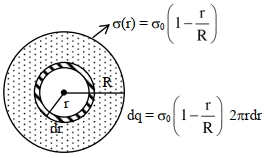
$A$ circular disc of radius $R$ carries surface charge density $\sigma(r) = \sigma_0 \left(1 - \frac{r}{R}\right)$,where $\sigma_0$ is a constant and $r$ is the distance from the center of the disc. Electric flux through a large spherical surface that encloses the charged disc completely is $\phi_0$. Electric flux through another spherical surface of radius $\frac{R}{4}$ and concentric with the disc is $\phi$. Then the ratio $\frac{\phi_0}{\phi}$ is:
A
$6.30$
B
$6.35$
C
$6.40$
D
$6.45$
Solution
(C) According to Gauss's Law,the electric flux $\phi$ through a closed surface is given by $\phi = \frac{q_{enclosed}}{\varepsilon_0}$.
The total charge $Q$ on the disc is:
$Q = \int_0^R \sigma(r) \cdot 2\pi r \, dr = \int_0^R \sigma_0 \left(1 - \frac{r}{R}\right) 2\pi r \, dr = 2\pi \sigma_0 \int_0^R \left(r - \frac{r^2}{R}\right) dr = 2\pi \sigma_0 \left[ \frac{r^2}{2} - \frac{r^3}{3R} \right]_0^R = 2\pi \sigma_0 \left( \frac{R^2}{2} - \frac{R^2}{3} \right) = 2\pi \sigma_0 \left( \frac{R^2}{6} \right) = \frac{\pi \sigma_0 R^2}{3}$.
Thus,$\phi_0 = \frac{Q}{\varepsilon_0} = \frac{\pi \sigma_0 R^2}{3\varepsilon_0}$.
The charge $q$ enclosed by a concentric spherical surface of radius $r' = \frac{R}{4}$ is the charge on the disc within that radius:
$q = \int_0^{R/4} \sigma(r) \cdot 2\pi r \, dr = 2\pi \sigma_0 \int_0^{R/4} \left(r - \frac{r^2}{R}\right) dr = 2\pi \sigma_0 \left[ \frac{r^2}{2} - \frac{r^3}{3R} \right]_0^{R/4} = 2\pi \sigma_0 \left( \frac{R^2}{32} - \frac{R^3}{3R \cdot 64} \right) = 2\pi \sigma_0 \left( \frac{R^2}{32} - \frac{R^2}{192} \right) = 2\pi \sigma_0 \left( \frac{6R^2 - R^2}{192} \right) = 2\pi \sigma_0 \left( \frac{5R^2}{192} \right) = \frac{5\pi \sigma_0 R^2}{96}$.
Thus,$\phi = \frac{q}{\varepsilon_0} = \frac{5\pi \sigma_0 R^2}{96\varepsilon_0}$.
The ratio $\frac{\phi_0}{\phi}$ is:
$\frac{\phi_0}{\phi} = \frac{\pi \sigma_0 R^2 / 3\varepsilon_0}{5\pi \sigma_0 R^2 / 96\varepsilon_0} = \frac{1}{3} \cdot \frac{96}{5} = \frac{32}{5} = 6.40$.
The total charge $Q$ on the disc is:
$Q = \int_0^R \sigma(r) \cdot 2\pi r \, dr = \int_0^R \sigma_0 \left(1 - \frac{r}{R}\right) 2\pi r \, dr = 2\pi \sigma_0 \int_0^R \left(r - \frac{r^2}{R}\right) dr = 2\pi \sigma_0 \left[ \frac{r^2}{2} - \frac{r^3}{3R} \right]_0^R = 2\pi \sigma_0 \left( \frac{R^2}{2} - \frac{R^2}{3} \right) = 2\pi \sigma_0 \left( \frac{R^2}{6} \right) = \frac{\pi \sigma_0 R^2}{3}$.
Thus,$\phi_0 = \frac{Q}{\varepsilon_0} = \frac{\pi \sigma_0 R^2}{3\varepsilon_0}$.
The charge $q$ enclosed by a concentric spherical surface of radius $r' = \frac{R}{4}$ is the charge on the disc within that radius:
$q = \int_0^{R/4} \sigma(r) \cdot 2\pi r \, dr = 2\pi \sigma_0 \int_0^{R/4} \left(r - \frac{r^2}{R}\right) dr = 2\pi \sigma_0 \left[ \frac{r^2}{2} - \frac{r^3}{3R} \right]_0^{R/4} = 2\pi \sigma_0 \left( \frac{R^2}{32} - \frac{R^3}{3R \cdot 64} \right) = 2\pi \sigma_0 \left( \frac{R^2}{32} - \frac{R^2}{192} \right) = 2\pi \sigma_0 \left( \frac{6R^2 - R^2}{192} \right) = 2\pi \sigma_0 \left( \frac{5R^2}{192} \right) = \frac{5\pi \sigma_0 R^2}{96}$.
Thus,$\phi = \frac{q}{\varepsilon_0} = \frac{5\pi \sigma_0 R^2}{96\varepsilon_0}$.
The ratio $\frac{\phi_0}{\phi}$ is:
$\frac{\phi_0}{\phi} = \frac{\pi \sigma_0 R^2 / 3\varepsilon_0}{5\pi \sigma_0 R^2 / 96\varepsilon_0} = \frac{1}{3} \cdot \frac{96}{5} = \frac{32}{5} = 6.40$.
0 likes
View Solution212
MediumMCQ
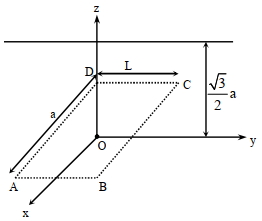
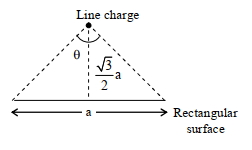
An infinitely long uniform line charge distribution of charge per unit length $\lambda$ lies parallel to the $y$-axis in the $y-z$ plane at $z=\frac{\sqrt{3}}{2} a$ (see figure). If the magnitude of the flux of the electric field through the rectangular surface $A B C D$ lying in the $x-y$ plane with its center at the origin is $\frac{\lambda L }{ n \varepsilon_0}$ (where $\varepsilon_0$ is the permittivity of free space),then the value of $n$ is
A
$4$
B
$5$
C
$6$
D
$7$
Solution
(C) The electric flux through a surface is related to the solid angle subtended by the surface at the line charge. Alternatively,we can use the concept of symmetry. The rectangular surface has a width $a$ and length $L$. The distance from the line charge to the center of the rectangle is $d = \frac{\sqrt{3}}{2} a$.
The angle $\theta$ subtended by the width $a$ at the line charge is given by $\tan(\theta/2) = \frac{a/2}{d} = \frac{a/2}{(\sqrt{3}/2)a} = \frac{1}{\sqrt{3}}$.
Thus,$\theta/2 = 30^{\circ}$,which means $\theta = 60^{\circ}$.
The total angle around the line charge is $360^{\circ}$. The number of such identical rectangular surfaces required to enclose the line charge completely is $n = \frac{360^{\circ}}{60^{\circ}} = 6$.
According to Gauss's Law,the total flux through a closed surface enclosing a charge $q_{enclosed}$ is $\frac{q_{enclosed}}{\varepsilon_0}$. For a length $L$ of the line charge,the enclosed charge is $q = \lambda L$.
Since the flux is distributed equally among the $6$ surfaces,the flux through one surface is $\phi = \frac{\lambda L}{6 \varepsilon_0}$.
Comparing this with the given expression $\frac{\lambda L}{n \varepsilon_0}$,we get $n = 6$.
The angle $\theta$ subtended by the width $a$ at the line charge is given by $\tan(\theta/2) = \frac{a/2}{d} = \frac{a/2}{(\sqrt{3}/2)a} = \frac{1}{\sqrt{3}}$.
Thus,$\theta/2 = 30^{\circ}$,which means $\theta = 60^{\circ}$.
The total angle around the line charge is $360^{\circ}$. The number of such identical rectangular surfaces required to enclose the line charge completely is $n = \frac{360^{\circ}}{60^{\circ}} = 6$.
According to Gauss's Law,the total flux through a closed surface enclosing a charge $q_{enclosed}$ is $\frac{q_{enclosed}}{\varepsilon_0}$. For a length $L$ of the line charge,the enclosed charge is $q = \lambda L$.
Since the flux is distributed equally among the $6$ surfaces,the flux through one surface is $\phi = \frac{\lambda L}{6 \varepsilon_0}$.
Comparing this with the given expression $\frac{\lambda L}{n \varepsilon_0}$,we get $n = 6$.
0 likes
View Solution213
DifficultMCQ
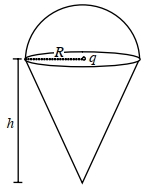
$A$ charge $q$ is placed at the center of the circular base of an inverted cone of height $h$ and base radius $R$. The cone is capped by a hemisphere of radius $R$ as shown in the figure. The electric flux through the conical surface is $\frac{n q}{6 \epsilon_0}$ (in $SI$ units). The value of $n$ is. . . .
A
$2$
B
$0$
C
$1$
D
$3$
Solution
(D) According to Gauss's Law,the total electric flux through a closed surface is $\phi_{\text{total}} = \frac{q}{\epsilon_0}$.
The closed surface consists of two parts: the hemisphere and the conical surface.
Therefore,$\phi_{\text{hemisphere}} + \phi_{\text{cone}} = \frac{q}{\epsilon_0}$.
Since the charge $q$ is placed exactly at the center of the circular base,which is the common boundary between the hemisphere and the cone,the electric field lines are distributed symmetrically.
The hemisphere covers a solid angle of $2\pi$ steradians,and the cone also covers a solid angle of $2\pi$ steradians (since the total solid angle around a point is $4\pi$ steradians).
Thus,the flux is divided equally between the two surfaces:
$\phi_{\text{hemisphere}} = \frac{1}{2} \left( \frac{q}{\epsilon_0} \right) = \frac{q}{2\epsilon_0}$
$\phi_{\text{cone}} = \frac{1}{2} \left( \frac{q}{\epsilon_0} \right) = \frac{q}{2\epsilon_0}$
We are given that the flux through the conical surface is $\frac{nq}{6\epsilon_0}$.
Equating the two expressions for the flux through the cone:
$\frac{nq}{6\epsilon_0} = \frac{q}{2\epsilon_0}$
$\frac{n}{6} = \frac{1}{2}$
$n = 3$.
The closed surface consists of two parts: the hemisphere and the conical surface.
Therefore,$\phi_{\text{hemisphere}} + \phi_{\text{cone}} = \frac{q}{\epsilon_0}$.
Since the charge $q$ is placed exactly at the center of the circular base,which is the common boundary between the hemisphere and the cone,the electric field lines are distributed symmetrically.
The hemisphere covers a solid angle of $2\pi$ steradians,and the cone also covers a solid angle of $2\pi$ steradians (since the total solid angle around a point is $4\pi$ steradians).
Thus,the flux is divided equally between the two surfaces:
$\phi_{\text{hemisphere}} = \frac{1}{2} \left( \frac{q}{\epsilon_0} \right) = \frac{q}{2\epsilon_0}$
$\phi_{\text{cone}} = \frac{1}{2} \left( \frac{q}{\epsilon_0} \right) = \frac{q}{2\epsilon_0}$
We are given that the flux through the conical surface is $\frac{nq}{6\epsilon_0}$.
Equating the two expressions for the flux through the cone:
$\frac{nq}{6\epsilon_0} = \frac{q}{2\epsilon_0}$
$\frac{n}{6} = \frac{1}{2}$
$n = 3$.
0 likes
View Solution214
AdvancedMCQ
$A$ charge is kept at the central point $P$ of a cylindrical region. The two edges subtend a half-angle $\theta$ at $P$, as shown in the figure. When $\theta=30^{\circ}$, then the electric flux through the curved surface of the cylinder is $\Phi$. If $\theta=60^{\circ}$, then the electric flux through the curved surface becomes $\Phi / \sqrt{n}$, where the value of $n$ is. . . . . . .
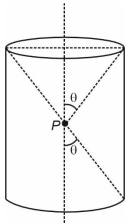
A
$4$
B
$2$
C
$3$
D
$5$
Solution
(C) The solid angle subtended by a cone of half-angle $\theta$ is given by $\Omega = 2\pi(1 - \cos \theta)$.
Since there are two such cones (top and bottom) subtending the plane surfaces of the cylinder, the total solid angle subtended by the two plane surfaces is $\Omega_{total} = 2 \times 2\pi(1 - \cos \theta) = 4\pi(1 - \cos \theta)$.
The solid angle subtended by the curved surface is the total solid angle $4\pi$ minus the solid angle of the plane surfaces:
$\Omega_{curved} = 4\pi - 4\pi(1 - \cos \theta) = 4\pi \cos \theta$.
The electric flux $\Phi$ through a surface is given by $\Phi = \frac{q \Omega}{4\pi \epsilon_0}$.
Thus, the flux through the curved surface is $\Phi(\theta) = \frac{q}{4\pi \epsilon_0} (4\pi \cos \theta) = \frac{q}{\epsilon_0} \cos \theta$.
For $\theta = 30^{\circ}$, $\Phi = \frac{q}{\epsilon_0} \cos 30^{\circ}$.
For $\theta = 60^{\circ}$, $\Phi' = \frac{q}{\epsilon_0} \cos 60^{\circ}$.
Taking the ratio: $\frac{\Phi}{\Phi'} = \frac{\cos 30^{\circ}}{\cos 60^{\circ}} = \frac{\sqrt{3}/2}{1/2} = \sqrt{3}$.
Therefore, $\Phi' = \frac{\Phi}{\sqrt{3}}$.
Comparing this with $\Phi / \sqrt{n}$, we get $n = 3$.
Since there are two such cones (top and bottom) subtending the plane surfaces of the cylinder, the total solid angle subtended by the two plane surfaces is $\Omega_{total} = 2 \times 2\pi(1 - \cos \theta) = 4\pi(1 - \cos \theta)$.
The solid angle subtended by the curved surface is the total solid angle $4\pi$ minus the solid angle of the plane surfaces:
$\Omega_{curved} = 4\pi - 4\pi(1 - \cos \theta) = 4\pi \cos \theta$.
The electric flux $\Phi$ through a surface is given by $\Phi = \frac{q \Omega}{4\pi \epsilon_0}$.
Thus, the flux through the curved surface is $\Phi(\theta) = \frac{q}{4\pi \epsilon_0} (4\pi \cos \theta) = \frac{q}{\epsilon_0} \cos \theta$.
For $\theta = 30^{\circ}$, $\Phi = \frac{q}{\epsilon_0} \cos 30^{\circ}$.
For $\theta = 60^{\circ}$, $\Phi' = \frac{q}{\epsilon_0} \cos 60^{\circ}$.
Taking the ratio: $\frac{\Phi}{\Phi'} = \frac{\cos 30^{\circ}}{\cos 60^{\circ}} = \frac{\sqrt{3}/2}{1/2} = \sqrt{3}$.
Therefore, $\Phi' = \frac{\Phi}{\sqrt{3}}$.
Comparing this with $\Phi / \sqrt{n}$, we get $n = 3$.
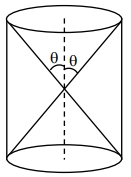
0 likes
View Solution215
DifficultMCQ
$A$ line charge of length $\frac{a}{2}$ is kept at the center of an edge $BC$ of a cube $ABCDEFGH$ having edge length $a$ as shown in the figure. If the linear charge density is $\lambda \; C/m$, then the total electric flux through all the faces of the cube will be . . . . . . . (Take $\varepsilon_0$ as the free space permittivity)
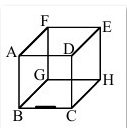
A
$\frac{\lambda a}{8 \epsilon_0}$
B
$\frac{\lambda a}{16 \epsilon_0}$
C
$\frac{\lambda a}{2 \epsilon_0}$
D
$\frac{\lambda a}{4 \epsilon_0}$
Solution
(A) The total length of the line charge is $L = \frac{a}{2}$.
The total charge $q$ of the line charge is $q = \lambda L = \lambda \left( \frac{a}{2} \right) = \frac{\lambda a}{2}$.
This line charge is placed at the center of an edge of the cube. An edge is shared by $4$ identical cubes in a symmetric arrangement.
Therefore, the fraction of the charge enclosed by the given cube is $\frac{1}{4}$ of the total charge.
Thus, the charge enclosed by the cube is $q_{in} = \frac{q}{4} = \frac{\lambda a / 2}{4} = \frac{\lambda a}{8}$.
According to Gauss's Law, the total electric flux $\phi$ through the cube is $\phi = \frac{q_{in}}{\varepsilon_0}$.
Substituting the value of $q_{in}$, we get $\phi = \frac{\lambda a}{8 \varepsilon_0}$.
The total charge $q$ of the line charge is $q = \lambda L = \lambda \left( \frac{a}{2} \right) = \frac{\lambda a}{2}$.
This line charge is placed at the center of an edge of the cube. An edge is shared by $4$ identical cubes in a symmetric arrangement.
Therefore, the fraction of the charge enclosed by the given cube is $\frac{1}{4}$ of the total charge.
Thus, the charge enclosed by the cube is $q_{in} = \frac{q}{4} = \frac{\lambda a / 2}{4} = \frac{\lambda a}{8}$.
According to Gauss's Law, the total electric flux $\phi$ through the cube is $\phi = \frac{q_{in}}{\varepsilon_0}$.
Substituting the value of $q_{in}$, we get $\phi = \frac{\lambda a}{8 \varepsilon_0}$.
0 likes
View Solution216
DifficultMCQ
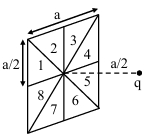
$A$ square loop of sides $a=1 \ m$ is held normally in front of a point charge $q=1 \ C$. The charge is placed at a distance of $a/2$ from the center of the square. The flux of the electric field through the shaded region is $\frac{5}{p} \times \frac{1}{\varepsilon_0} \frac{N m^2}{C}$,where the value of $p$ is . . . . . . .
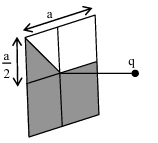
A
$48$
B
$58$
C
$62$
D
$78$
Solution
(A) The charge $q$ is placed at a distance $a/2$ from the center of the square loop of side $a$.
By symmetry,we can enclose the charge $q$ in a cube of side $a$ such that the square loop forms one of the faces of the cube.
The total electric flux through the entire cube is $\Phi_{total} = \frac{q}{\varepsilon_0}$.
Since the cube has $6$ identical faces,the flux through the square loop (which is one face) is $\Phi_{square} = \frac{1}{6} \frac{q}{\varepsilon_0}$.
The square loop can be divided into $8$ identical triangular regions by drawing lines from the center to the corners and midpoints of the sides.
Due to symmetry,the flux through each of these $8$ identical triangular regions is equal.
Therefore,the flux through each triangular region is $\Phi_{triangle} = \frac{1}{8} \Phi_{square} = \frac{1}{8} \times \frac{1}{6} \frac{q}{\varepsilon_0} = \frac{1}{48} \frac{q}{\varepsilon_0}$.
The shaded region in the figure consists of $5$ such identical triangular regions.
Thus,the flux through the shaded region is $\Phi_{shaded} = 5 \times \Phi_{triangle} = 5 \times \frac{1}{48} \frac{q}{\varepsilon_0} = \frac{5}{48} \frac{q}{\varepsilon_0}$.
Given $q = 1 \ C$,the flux is $\frac{5}{48} \frac{1}{\varepsilon_0}$.
Comparing this with $\frac{5}{p} \times \frac{1}{\varepsilon_0}$,we get $p = 48$.
By symmetry,we can enclose the charge $q$ in a cube of side $a$ such that the square loop forms one of the faces of the cube.
The total electric flux through the entire cube is $\Phi_{total} = \frac{q}{\varepsilon_0}$.
Since the cube has $6$ identical faces,the flux through the square loop (which is one face) is $\Phi_{square} = \frac{1}{6} \frac{q}{\varepsilon_0}$.
The square loop can be divided into $8$ identical triangular regions by drawing lines from the center to the corners and midpoints of the sides.
Due to symmetry,the flux through each of these $8$ identical triangular regions is equal.
Therefore,the flux through each triangular region is $\Phi_{triangle} = \frac{1}{8} \Phi_{square} = \frac{1}{8} \times \frac{1}{6} \frac{q}{\varepsilon_0} = \frac{1}{48} \frac{q}{\varepsilon_0}$.
The shaded region in the figure consists of $5$ such identical triangular regions.
Thus,the flux through the shaded region is $\Phi_{shaded} = 5 \times \Phi_{triangle} = 5 \times \frac{1}{48} \frac{q}{\varepsilon_0} = \frac{5}{48} \frac{q}{\varepsilon_0}$.
Given $q = 1 \ C$,the flux is $\frac{5}{48} \frac{1}{\varepsilon_0}$.
Comparing this with $\frac{5}{p} \times \frac{1}{\varepsilon_0}$,we get $p = 48$.
0 likes
View Solution217
MediumMCQ
$A$ point charge causes an electric flux of $-2 \times 10^4 \ Nm^2 C^{-1}$ to pass through a spherical Gaussian surface of $8.0 \ cm$ radius,centred on the charge. The value of the point charge is: (Given $\epsilon_0 = 8.85 \times 10^{-12} \ C^2 N^{-1} m^{-2}$)
A
$-17.7 \times 10^{-8} \ C$
B
$-15.7 \times 10^{-8} \ C$
C
$17.7 \times 10^{-8} \ C$
D
$15.7 \times 10^{-8} \ C$
Solution
(A) According to Gauss's Law,the electric flux $\phi$ through a closed surface is given by $\phi = \frac{q}{\epsilon_0}$,where $q$ is the enclosed charge and $\epsilon_0$ is the permittivity of free space.
Given:
$\phi = -2 \times 10^4 \ Nm^2 C^{-1}$
$\epsilon_0 = 8.85 \times 10^{-12} \ C^2 N^{-1} m^{-2}$
Rearranging the formula to find $q$:
$q = \phi \times \epsilon_0$
$q = (-2 \times 10^4) \times (8.85 \times 10^{-12})$
$q = -17.7 \times 10^{-8} \ C$
Thus,the value of the point charge is $-17.7 \times 10^{-8} \ C$.
Given:
$\phi = -2 \times 10^4 \ Nm^2 C^{-1}$
$\epsilon_0 = 8.85 \times 10^{-12} \ C^2 N^{-1} m^{-2}$
Rearranging the formula to find $q$:
$q = \phi \times \epsilon_0$
$q = (-2 \times 10^4) \times (8.85 \times 10^{-12})$
$q = -17.7 \times 10^{-8} \ C$
Thus,the value of the point charge is $-17.7 \times 10^{-8} \ C$.
0 likes
View Solution218
MediumMCQ
The electric field in a region is given by $\vec{E}=(2 \hat{i}+4 \hat{j}+6 \hat{k}) \times 10^3 \ N/C$. The flux of the field through a rectangular surface parallel to the $x-z$ plane is $6.0 \ N m^2 C^{-1}$. The area of the surface is . . . . . . $cm^2$.
A
$17$
B
$18$
C
$13$
D
$15$
Solution
(D) The electric field is given by $\vec{E} = (2 \hat{i} + 4 \hat{j} + 6 \hat{k}) \times 10^3 \ N/C$.
Since the surface is parallel to the $x-z$ plane,its area vector $\vec{A}$ must be perpendicular to the $x-z$ plane,which means it is directed along the $y$-axis. Thus,$\vec{A} = A \hat{j}$.
The electric flux $\phi$ is given by the dot product $\phi = \vec{E} \cdot \vec{A}$.
Substituting the values: $\phi = (2 \hat{i} + 4 \hat{j} + 6 \hat{k}) \times 10^3 \cdot (A \hat{j}) = 4 \times 10^3 \times A$.
Given $\phi = 6.0 \ N m^2 C^{-1}$,we have $6.0 = 4 \times 10^3 \times A$.
Solving for $A$: $A = \frac{6.0}{4 \times 10^3} = 1.5 \times 10^{-3} \ m^2$.
Converting to $cm^2$: $A = 1.5 \times 10^{-3} \times (10^2 \ cm)^2 = 1.5 \times 10^{-3} \times 10^4 \ cm^2 = 15 \ cm^2$.
Since the surface is parallel to the $x-z$ plane,its area vector $\vec{A}$ must be perpendicular to the $x-z$ plane,which means it is directed along the $y$-axis. Thus,$\vec{A} = A \hat{j}$.
The electric flux $\phi$ is given by the dot product $\phi = \vec{E} \cdot \vec{A}$.
Substituting the values: $\phi = (2 \hat{i} + 4 \hat{j} + 6 \hat{k}) \times 10^3 \cdot (A \hat{j}) = 4 \times 10^3 \times A$.
Given $\phi = 6.0 \ N m^2 C^{-1}$,we have $6.0 = 4 \times 10^3 \times A$.
Solving for $A$: $A = \frac{6.0}{4 \times 10^3} = 1.5 \times 10^{-3} \ m^2$.
Converting to $cm^2$: $A = 1.5 \times 10^{-3} \times (10^2 \ cm)^2 = 1.5 \times 10^{-3} \times 10^4 \ cm^2 = 15 \ cm^2$.
0 likes
View Solution219
MediumMCQ
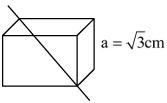
An infinitely long wire has a uniform linear charge density $\lambda = 2 \ nC/m$. The net flux through a Gaussian cube of side length $a = \sqrt{3} \ cm$, if the wire passes through any two corners of the cube that are maximally displaced from each other, would be $x \ Nm^2 C^{-1}$, where $x$ is: [Neglect any edge effects and use $\frac{1}{4 \pi \varepsilon_0} = 9 \times 10^9 \ SI$ units] (in $\pi$)
A
$0.72$
B
$1.44$
C
$6.48$
D
$2.16$
Solution
(D) According to Gauss's Law, the net electric flux $\phi$ through a closed surface is given by $\phi = \frac{q_{enc}}{\varepsilon_0}$.
The wire passes through two maximally displaced corners of the cube, which means it passes along the body diagonal of the cube.
The length of the body diagonal of a cube with side length $a$ is $L = \sqrt{3}a$.
Given $a = \sqrt{3} \ cm = \sqrt{3} \times 10^{-2} \ m$, the length of the wire inside the cube is $L = \sqrt{3} \times (\sqrt{3} \times 10^{-2} \ m) = 3 \times 10^{-2} \ m$.
The charge enclosed by the cube is $q_{enc} = \lambda \cdot L = (2 \times 10^{-9} \ C/m) \times (3 \times 10^{-2} \ m) = 6 \times 10^{-11} \ C$.
Using $\frac{1}{4 \pi \varepsilon_0} = 9 \times 10^9$, we have $\frac{1}{\varepsilon_0} = 36 \pi \times 10^9$.
Therefore, the flux $\phi = q_{enc} \cdot \frac{1}{\varepsilon_0} = (6 \times 10^{-11}) \times (36 \pi \times 10^9) = 216 \pi \times 10^{-2} = 2.16 \pi \ Nm^2 C^{-1}$.
Thus, $x = 2.16 \pi$.
The wire passes through two maximally displaced corners of the cube, which means it passes along the body diagonal of the cube.
The length of the body diagonal of a cube with side length $a$ is $L = \sqrt{3}a$.
Given $a = \sqrt{3} \ cm = \sqrt{3} \times 10^{-2} \ m$, the length of the wire inside the cube is $L = \sqrt{3} \times (\sqrt{3} \times 10^{-2} \ m) = 3 \times 10^{-2} \ m$.
The charge enclosed by the cube is $q_{enc} = \lambda \cdot L = (2 \times 10^{-9} \ C/m) \times (3 \times 10^{-2} \ m) = 6 \times 10^{-11} \ C$.
Using $\frac{1}{4 \pi \varepsilon_0} = 9 \times 10^9$, we have $\frac{1}{\varepsilon_0} = 36 \pi \times 10^9$.
Therefore, the flux $\phi = q_{enc} \cdot \frac{1}{\varepsilon_0} = (6 \times 10^{-11}) \times (36 \pi \times 10^9) = 216 \pi \times 10^{-2} = 2.16 \pi \ Nm^2 C^{-1}$.
Thus, $x = 2.16 \pi$.
0 likes
View Solution220
MediumMCQ
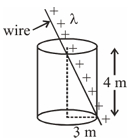
The linear charge density of a wire is $8.85 \ \mu C/m$. The radius and height of the cylinder are $3 \ m$ and $4 \ m$ respectively. Find the electric flux passing through the cylinder.
A
$10^6 \ V-m$
B
$3 \times 10^6 \ V-m$
C
$4 \times 10^6 \ V-m$
D
$5 \times 10^6 \ V-m$
Solution
(D) According to the figure,the wire passes from the center of the top circular face to a point on the circumference of the bottom circular face. The length of the wire segment inside the cylinder $(L)$ forms the hypotenuse of a right-angled triangle with height $h = 4 \ m$ and base $r = 3 \ m$.
$L = \sqrt{h^2 + r^2} = \sqrt{4^2 + 3^2} = \sqrt{16 + 9} = \sqrt{25} = 5 \ m$.
The charge enclosed by the cylinder is $q_{\text{enclosed}} = \lambda L = (8.85 \times 10^{-6} \ C/m) \times (5 \ m) = 44.25 \times 10^{-6} \ C$.
According to Gauss's Law,the electric flux $\phi$ is given by $\phi = \frac{q_{\text{enclosed}}}{\epsilon_0}$.
Given $\epsilon_0 \approx 8.85 \times 10^{-12} \ C^2/(N-m^2)$.
$\phi = \frac{44.25 \times 10^{-6}}{8.85 \times 10^{-12}} = 5 \times 10^6 \ V-m$.
$L = \sqrt{h^2 + r^2} = \sqrt{4^2 + 3^2} = \sqrt{16 + 9} = \sqrt{25} = 5 \ m$.
The charge enclosed by the cylinder is $q_{\text{enclosed}} = \lambda L = (8.85 \times 10^{-6} \ C/m) \times (5 \ m) = 44.25 \times 10^{-6} \ C$.
According to Gauss's Law,the electric flux $\phi$ is given by $\phi = \frac{q_{\text{enclosed}}}{\epsilon_0}$.
Given $\epsilon_0 \approx 8.85 \times 10^{-12} \ C^2/(N-m^2)$.
$\phi = \frac{44.25 \times 10^{-6}}{8.85 \times 10^{-12}} = 5 \times 10^6 \ V-m$.
0 likes
View Solution221
MediumMCQ
$A$ point charge '$Q$' is placed at a point inside a hollow conducting sphere. Which of the following electric field patterns is correct?
A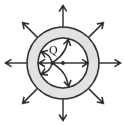
B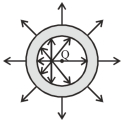
C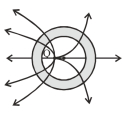
D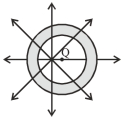
Solution
(B) When a point charge '$Q$' is placed inside a hollow conducting sphere,the following principles apply:
$1$. The electric field inside the material of the conductor must be zero in electrostatic equilibrium.
$2$. Electric field lines must originate from the positive charge '$Q$' and terminate perpendicularly on the inner surface of the conducting sphere.
$3$. Due to electrostatic induction,an equal and opposite charge '$-Q$' is induced on the inner surface,and a charge '$+Q$' is induced on the outer surface.
$4$. The electric field lines outside the sphere originate from the outer surface and extend radially outward,perpendicular to the surface.
Comparing these conditions with the given options,the pattern where lines terminate perpendicularly on the inner surface and originate perpendicularly from the outer surface,with no lines inside the conductor material,is the correct representation.
$1$. The electric field inside the material of the conductor must be zero in electrostatic equilibrium.
$2$. Electric field lines must originate from the positive charge '$Q$' and terminate perpendicularly on the inner surface of the conducting sphere.
$3$. Due to electrostatic induction,an equal and opposite charge '$-Q$' is induced on the inner surface,and a charge '$+Q$' is induced on the outer surface.
$4$. The electric field lines outside the sphere originate from the outer surface and extend radially outward,perpendicular to the surface.
Comparing these conditions with the given options,the pattern where lines terminate perpendicularly on the inner surface and originate perpendicularly from the outer surface,with no lines inside the conductor material,is the correct representation.
0 likes
View Solution222
MediumMCQ
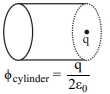
$A$ charge $q$ is placed at the centre of the open end of a cylindrical vessel. The flux of the electric field through the surface of the vessel is:
A
$0$
B
$\frac{q}{\varepsilon_0}$
C
$\frac{q}{2 \varepsilon_0}$
D
$\frac{2 q}{\varepsilon_0}$
Solution
(C) According to Gauss's Law,the total electric flux through a closed surface is $\frac{q_{enclosed}}{\varepsilon_0}$.
To calculate the flux through the cylindrical vessel,we can imagine an identical cylinder placed adjacent to the first one such that the charge $q$ is now enclosed within a larger closed cylindrical surface formed by the two vessels.
The total flux through this combined closed surface is $\Phi_{total} = \frac{q}{\varepsilon_0}$.
Since the charge $q$ is placed symmetrically at the center of the common open end,the flux is distributed equally between the two identical cylinders.
Therefore,the flux through the surface of one cylindrical vessel is $\Phi = \frac{\Phi_{total}}{2} = \frac{q}{2 \varepsilon_0}$.
To calculate the flux through the cylindrical vessel,we can imagine an identical cylinder placed adjacent to the first one such that the charge $q$ is now enclosed within a larger closed cylindrical surface formed by the two vessels.
The total flux through this combined closed surface is $\Phi_{total} = \frac{q}{\varepsilon_0}$.
Since the charge $q$ is placed symmetrically at the center of the common open end,the flux is distributed equally between the two identical cylinders.
Therefore,the flux through the surface of one cylindrical vessel is $\Phi = \frac{\Phi_{total}}{2} = \frac{q}{2 \varepsilon_0}$.
0 likes
View Solution223
MediumMCQ
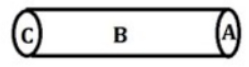
$A$ hollow cylinder has a charge $q$ at its center. If $\phi$ is the electric flux associated with the curved surface $B,$ the flux linked with the plane surface $A$ will be $:-$
A
$\frac{q}{\varepsilon_0}-\phi$
B
$\frac{1}{2}\left(\frac{q}{\varepsilon_0}-\phi\right)$
C
$\frac{q}{2 \varepsilon_0}$
D
$\frac{\phi}{3}$
Solution
(B) According to Gauss's Law,the total electric flux $\phi_{total}$ through the closed surface of the cylinder is $\frac{q}{\epsilon_0}$.
This total flux is the sum of the flux through the two plane surfaces ($A$ and $C$) and the curved surface $(B)$: $\phi_A + \phi_B + \phi_C = \frac{q}{\epsilon_0}$.
Due to the symmetry of the cylinder and the central position of the charge,the flux through the two plane surfaces is equal,i.e.,$\phi_A = \phi_C$.
Given that the flux through the curved surface $B$ is $\phi$,we have: $2\phi_A + \phi = \frac{q}{\epsilon_0}$.
Solving for $\phi_A$,we get: $\phi_A = \frac{1}{2}\left(\frac{q}{\epsilon_0} - \phi\right)$.
This total flux is the sum of the flux through the two plane surfaces ($A$ and $C$) and the curved surface $(B)$: $\phi_A + \phi_B + \phi_C = \frac{q}{\epsilon_0}$.
Due to the symmetry of the cylinder and the central position of the charge,the flux through the two plane surfaces is equal,i.e.,$\phi_A = \phi_C$.
Given that the flux through the curved surface $B$ is $\phi$,we have: $2\phi_A + \phi = \frac{q}{\epsilon_0}$.
Solving for $\phi_A$,we get: $\phi_A = \frac{1}{2}\left(\frac{q}{\epsilon_0} - \phi\right)$.
0 likes
View Solution224
AdvancedMCQ
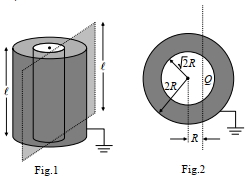
Two co-axial conducting cylinders of same length $\ell$ with radii $\sqrt{2} R$ and $2 R$ are kept,as shown in Fig. $1$. The charge on the inner cylinder is $Q$ and the outer cylinder is grounded. The annular region between the cylinders is filled with a material of dielectric constant $\kappa=5$. Consider an imaginary plane of the same length $\ell$ at a distance $R$ from the common axis of the cylinders. This plane is parallel to the axis of the cylinders. The cross-sectional view of this arrangement is shown in Fig. $2$. Ignoring edge effects,the flux of the electric field through the plane is ($\epsilon_0$ is the permittivity of free space):
A
$\frac{ Q }{30 \epsilon_0}$
B
$\frac{ Q }{60 \epsilon_0}$
C
$\frac{ Q }{15 \epsilon_0}$
D
$\frac{ Q }{120 \epsilon_0}$
Solution
(B) The electric field exists only in the region between the cylinders $(\sqrt{2}R < r < 2R)$. For $r < \sqrt{2}R$,the field is zero. For $r > 2R$,the field is zero because the outer cylinder is grounded and encloses the inner charge.
Using Gauss's Law for a cylinder of radius $r$ $(\sqrt{2}R < r < 2R)$,the electric field is $E = \frac{\lambda}{2 \pi \kappa \epsilon_0 r}$,where $\lambda = Q/\ell$.
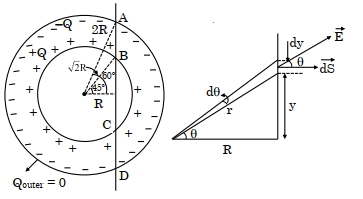
The flux through an area element $dS = \ell dy$ on the plane is $d\phi = \vec{E} \cdot d\vec{S} = E \cos \theta \ell dy$.
From the geometry,$r = R \sec \theta$ and $y = R \tan \theta$,so $dy = R \sec^2 \theta d\theta$. Also $\cos \theta = R/r$.
Substituting these,$d\phi = \frac{\lambda}{2 \pi \kappa \epsilon_0 r} \cdot \frac{R}{r} \cdot \ell \cdot R \sec^2 \theta d\theta = \frac{\lambda \ell}{2 \pi \kappa \epsilon_0} d\theta$.
The field is non-zero only for the segments $AB$ and $CD$ where $\sqrt{2}R < r < 2R$.
For $r = \sqrt{2}R$,$\cos \theta = R/(\sqrt{2}R) = 1/\sqrt{2} \Rightarrow \theta = 45^\circ = \pi/4$.
For $r = 2R$,$\cos \theta = R/(2R) = 1/2 \Rightarrow \theta = 60^\circ = \pi/3$.
The flux through one segment is $\phi_{AB} = \int_{\pi/4}^{\pi/3} \frac{\lambda \ell}{2 \pi \kappa \epsilon_0} d\theta = \frac{Q}{2 \pi \kappa \epsilon_0} (\pi/3 - \pi/4) = \frac{Q}{2 \pi \kappa \epsilon_0} (\pi/12) = \frac{Q}{24 \kappa \epsilon_0}$.
Given $\kappa = 5$,$\phi_{AB} = \frac{Q}{24 \times 5 \epsilon_0} = \frac{Q}{120 \epsilon_0}$.
Total flux through the plane is $\phi_{total} = \phi_{AB} + \phi_{CD} = 2 \times \frac{Q}{120 \epsilon_0} = \frac{Q}{60 \epsilon_0}$.
Using Gauss's Law for a cylinder of radius $r$ $(\sqrt{2}R < r < 2R)$,the electric field is $E = \frac{\lambda}{2 \pi \kappa \epsilon_0 r}$,where $\lambda = Q/\ell$.
The flux through an area element $dS = \ell dy$ on the plane is $d\phi = \vec{E} \cdot d\vec{S} = E \cos \theta \ell dy$.
From the geometry,$r = R \sec \theta$ and $y = R \tan \theta$,so $dy = R \sec^2 \theta d\theta$. Also $\cos \theta = R/r$.
Substituting these,$d\phi = \frac{\lambda}{2 \pi \kappa \epsilon_0 r} \cdot \frac{R}{r} \cdot \ell \cdot R \sec^2 \theta d\theta = \frac{\lambda \ell}{2 \pi \kappa \epsilon_0} d\theta$.
The field is non-zero only for the segments $AB$ and $CD$ where $\sqrt{2}R < r < 2R$.
For $r = \sqrt{2}R$,$\cos \theta = R/(\sqrt{2}R) = 1/\sqrt{2} \Rightarrow \theta = 45^\circ = \pi/4$.
For $r = 2R$,$\cos \theta = R/(2R) = 1/2 \Rightarrow \theta = 60^\circ = \pi/3$.
The flux through one segment is $\phi_{AB} = \int_{\pi/4}^{\pi/3} \frac{\lambda \ell}{2 \pi \kappa \epsilon_0} d\theta = \frac{Q}{2 \pi \kappa \epsilon_0} (\pi/3 - \pi/4) = \frac{Q}{2 \pi \kappa \epsilon_0} (\pi/12) = \frac{Q}{24 \kappa \epsilon_0}$.
Given $\kappa = 5$,$\phi_{AB} = \frac{Q}{24 \times 5 \epsilon_0} = \frac{Q}{120 \epsilon_0}$.
Total flux through the plane is $\phi_{total} = \phi_{AB} + \phi_{CD} = 2 \times \frac{Q}{120 \epsilon_0} = \frac{Q}{60 \epsilon_0}$.
0 likes
View Solution225
EasyMCQ
Out of the following statements,which is $NOT$ a characteristic of electric lines of force?
A
Electric lines of force originate from a positively charged object and end on a negatively charged object.
B
The electric lines of force do not intersect each other.
C
The electric lines of force pass through the conductor.
D
The electric lines of force are crowded in a region where electric intensity is large.
Solution
(C) Electric field lines are imaginary lines used to represent the electric field in a region.
$1$. They originate from positive charges and terminate on negative charges.
$2$. They never intersect each other because if they did,the electric field at the point of intersection would have two directions,which is physically impossible.
$3$. The density of field lines is proportional to the magnitude of the electric field intensity.
$4$. Electric field lines do not pass through the interior of a conductor in electrostatic equilibrium because the electric field inside a conductor is zero.
Therefore,the statement that they pass through the conductor is incorrect.
$1$. They originate from positive charges and terminate on negative charges.
$2$. They never intersect each other because if they did,the electric field at the point of intersection would have two directions,which is physically impossible.
$3$. The density of field lines is proportional to the magnitude of the electric field intensity.
$4$. Electric field lines do not pass through the interior of a conductor in electrostatic equilibrium because the electric field inside a conductor is zero.
Therefore,the statement that they pass through the conductor is incorrect.
0 likes
View Solution226
EasyMCQ
Which of the following statements is correct?
A
Electric lines of force originate from a negatively charged object and terminate on a positively charged object.
B
Electric lines of force do not pass through an insulator but can pass through a conductor.
C
Electric lines of force do not intersect each other.
D
Electric intensity is small in a region where the lines of force are crowded.
Solution
(C) Properties of electric lines of force are as follows:
$1$. Electric lines of force are imaginary lines used to represent the electric field.
$2$. They originate from a positive charge and terminate on a negative charge.
$3$. $A$ tangent drawn at any point on the line of force gives the direction of the electric field at that point.
$4$. Two electric lines of force can never intersect each other because if they did,there would be two directions of the electric field at the point of intersection,which is physically impossible.
$5$. The density of electric lines of force is directly proportional to the magnitude of the electric field intensity. Therefore,where lines are crowded,the field is strong,and where they are sparse,the field is weak.
$6$. There are no electric lines of force inside a conductor in electrostatic equilibrium.
Thus,statement $C$ is correct.
$1$. Electric lines of force are imaginary lines used to represent the electric field.
$2$. They originate from a positive charge and terminate on a negative charge.
$3$. $A$ tangent drawn at any point on the line of force gives the direction of the electric field at that point.
$4$. Two electric lines of force can never intersect each other because if they did,there would be two directions of the electric field at the point of intersection,which is physically impossible.
$5$. The density of electric lines of force is directly proportional to the magnitude of the electric field intensity. Therefore,where lines are crowded,the field is strong,and where they are sparse,the field is weak.
$6$. There are no electric lines of force inside a conductor in electrostatic equilibrium.
Thus,statement $C$ is correct.
0 likes
View Solution227
EasyMCQ
Identify the $WRONG$ statement in the case of electric field lines.
A
They do not intersect each other.
B
They do not pass through a conductor.
C
They start from a positive charge and end on a negative charge.
D
They do not pass through an insulator.
Solution
(D) Electric field lines are imaginary lines representing the electric field.
$1$. They never intersect each other because at the point of intersection,there would be two directions for the electric field,which is impossible.
$2$. They do not pass through the interior of a conductor in electrostatic equilibrium because the electric field inside a conductor is zero.
$3$. They originate from positive charges and terminate on negative charges.
$4$. Electric field lines $CAN$ pass through insulators (dielectrics),as insulators do not have free charges to cancel the field.
Therefore,the statement that they do not pass through an insulator is incorrect.
$1$. They never intersect each other because at the point of intersection,there would be two directions for the electric field,which is impossible.
$2$. They do not pass through the interior of a conductor in electrostatic equilibrium because the electric field inside a conductor is zero.
$3$. They originate from positive charges and terminate on negative charges.
$4$. Electric field lines $CAN$ pass through insulators (dielectrics),as insulators do not have free charges to cancel the field.
Therefore,the statement that they do not pass through an insulator is incorrect.
0 likes
View Solution228
MediumMCQ
$A$ uniformly charged conducting sphere of diameter $3.5 \ cm$ has a surface charge density of $20 \ \mu C \ m^{-2}$. The total electric flux leaving the surface of the sphere is nearly:
[permittivity of free space,$\epsilon_0 = 8.85 \times 10^{-12} \ SI \ unit$]
[permittivity of free space,$\epsilon_0 = 8.85 \times 10^{-12} \ SI \ unit$]
A
$7 \times 10^2 \ N \cdot m^2 / C$
B
$7.0 \times 10^3 \ N \cdot m^2 / C$
C
$8.7 \times 10^2 \ N \cdot m^2 / C$
D
$8.7 \times 10^3 \ N \cdot m^2 / C$
Solution
(D) The surface charge density $\sigma = 20 \ \mu C \ m^{-2} = 20 \times 10^{-6} \ C \ m^{-2}$.
The diameter of the sphere $d = 3.5 \ cm$,so the radius $r = 1.75 \ cm = 1.75 \times 10^{-2} \ m$.
The surface area of the sphere $A = 4 \pi r^2 = 4 \times 3.14 \times (1.75 \times 10^{-2})^2 \ m^2$.
$A = 12.56 \times 3.0625 \times 10^{-4} \approx 3.848 \times 10^{-3} \ m^2$.
The total charge $q = \sigma \times A = (20 \times 10^{-6}) \times (3.848 \times 10^{-3}) \approx 7.696 \times 10^{-8} \ C$.
According to Gauss's Law,the total electric flux $\phi = q / \epsilon_0$.
$\phi = (7.696 \times 10^{-8}) / (8.85 \times 10^{-12}) \approx 0.8696 \times 10^4 \approx 8.7 \times 10^3 \ N \cdot m^2 / C$.
The diameter of the sphere $d = 3.5 \ cm$,so the radius $r = 1.75 \ cm = 1.75 \times 10^{-2} \ m$.
The surface area of the sphere $A = 4 \pi r^2 = 4 \times 3.14 \times (1.75 \times 10^{-2})^2 \ m^2$.
$A = 12.56 \times 3.0625 \times 10^{-4} \approx 3.848 \times 10^{-3} \ m^2$.
The total charge $q = \sigma \times A = (20 \times 10^{-6}) \times (3.848 \times 10^{-3}) \approx 7.696 \times 10^{-8} \ C$.
According to Gauss's Law,the total electric flux $\phi = q / \epsilon_0$.
$\phi = (7.696 \times 10^{-8}) / (8.85 \times 10^{-12}) \approx 0.8696 \times 10^4 \approx 8.7 \times 10^3 \ N \cdot m^2 / C$.
0 likes
View Solution229
MediumMCQ
$A$ hollow cylinder has a charge of $q$ $C$ within it. If $\phi$ is the electric flux associated with the curved surface $B$,the flux linked with the plane surface $A$ will be
A
$\frac{\phi}{3}$
B
$\frac{q}{\epsilon_0}-\phi$
C
$\frac{q}{3 \epsilon_0}$
D
$\frac{1}{2}\left(\frac{q}{\epsilon_0}-\phi\right)$
Solution
(D) According to Gauss's Law,the total electric flux $\phi_{total}$ through a closed surface is given by $\phi_{total} = \frac{q}{\epsilon_0}$.
For the hollow cylinder,the total flux is the sum of the flux through the two plane surfaces ($A$ and $C$) and the curved surface $(B)$.
Let $\phi_A$,$\phi_C$,and $\phi_B$ be the flux through surfaces $A$,$C$,and $B$ respectively.
Thus,$\phi_A + \phi_C + \phi_B = \frac{q}{\epsilon_0}$.
Given that $\phi_B = \phi$,we have $\phi_A + \phi_C + \phi = \frac{q}{\epsilon_0}$.
Due to the symmetry of the cylinder,the flux through the two plane ends $A$ and $C$ must be equal,so $\phi_A = \phi_C$.
Substituting this into the equation: $2\phi_A + \phi = \frac{q}{\epsilon_0}$.
Solving for $\phi_A$: $2\phi_A = \frac{q}{\epsilon_0} - \phi$.
Therefore,$\phi_A = \frac{1}{2}\left(\frac{q}{\epsilon_0} - \phi\right)$.
For the hollow cylinder,the total flux is the sum of the flux through the two plane surfaces ($A$ and $C$) and the curved surface $(B)$.
Let $\phi_A$,$\phi_C$,and $\phi_B$ be the flux through surfaces $A$,$C$,and $B$ respectively.
Thus,$\phi_A + \phi_C + \phi_B = \frac{q}{\epsilon_0}$.
Given that $\phi_B = \phi$,we have $\phi_A + \phi_C + \phi = \frac{q}{\epsilon_0}$.
Due to the symmetry of the cylinder,the flux through the two plane ends $A$ and $C$ must be equal,so $\phi_A = \phi_C$.
Substituting this into the equation: $2\phi_A + \phi = \frac{q}{\epsilon_0}$.
Solving for $\phi_A$: $2\phi_A = \frac{q}{\epsilon_0} - \phi$.
Therefore,$\phi_A = \frac{1}{2}\left(\frac{q}{\epsilon_0} - \phi\right)$.
0 likes
View Solution230
MediumMCQ
$A$ hollow cylinder has a charge $q$ coulomb within it. If $\phi$ is the electric flux in unit of $V-m$ associated with the curved surface $C$, the flux linked with the plane surface $A$ in unit of $V-m$ will be. $[\epsilon_0 = \text{permittivity of free space}]$
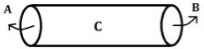
A
$\phi / 3$
B
$\left(\frac{q}{\epsilon_0}-\phi\right)$
C
$\frac{1}{2}\left(\frac{q}{\epsilon_0}-\phi\right)$
D
$\frac{q}{2 \epsilon_0}$
Solution
(C) According to Gauss's Law, the total electric flux $\phi_{total}$ through a closed surface is given by $\phi_{total} = \frac{q}{\epsilon_0}$.
For the hollow cylinder, the total flux is the sum of the flux through the two plane surfaces ($A$ and $B$) and the curved surface $(C)$: $\phi_{total} = \phi_A + \phi_B + \phi_C$.
Given that $\phi_C = \phi$ and by symmetry, the flux through the two plane surfaces is equal, i.e., $\phi_A = \phi_B$.
Substituting these into the Gauss's Law equation: $\frac{q}{\epsilon_0} = \phi_A + \phi_A + \phi$.
$\frac{q}{\epsilon_0} - \phi = 2\phi_A$.
Therefore, the flux linked with the plane surface $A$ is $\phi_A = \frac{1}{2}\left(\frac{q}{\epsilon_0} - \phi\right)$.
For the hollow cylinder, the total flux is the sum of the flux through the two plane surfaces ($A$ and $B$) and the curved surface $(C)$: $\phi_{total} = \phi_A + \phi_B + \phi_C$.
Given that $\phi_C = \phi$ and by symmetry, the flux through the two plane surfaces is equal, i.e., $\phi_A = \phi_B$.
Substituting these into the Gauss's Law equation: $\frac{q}{\epsilon_0} = \phi_A + \phi_A + \phi$.
$\frac{q}{\epsilon_0} - \phi = 2\phi_A$.
Therefore, the flux linked with the plane surface $A$ is $\phi_A = \frac{1}{2}\left(\frac{q}{\epsilon_0} - \phi\right)$.
0 likes
View Solution231
EasyMCQ
Four charges $2 \mu C, -3 \mu C, 4 \mu C, -4 \mu C$ and $-1 \mu C$ are enclosed by a Gaussian surface of radius $2 \ m$. The net outward flux through the Gaussian surface is (in $\mu V-m$):
A
$\frac{2}{\epsilon_0}$
B
zero
C
$\frac{3}{\epsilon_0}$
D
$\frac{5}{\epsilon_0}$
Solution
(A) According to Gauss's Law,the net electric flux $\phi$ through a closed surface is given by $\phi = \frac{q_{enclosed}}{\epsilon_0}$.
Here,the enclosed charges are $q_1 = 2 \mu C, q_2 = -3 \mu C, q_3 = 4 \mu C, q_4 = -4 \mu C$,and $q_5 = -1 \mu C$.
The net enclosed charge $q_{net} = q_1 + q_2 + q_3 + q_4 + q_5$.
$q_{net} = (2 - 3 + 4 - 4 - 1) \mu C = -2 \mu C$.
Therefore,the net outward flux $\phi = \frac{-2 \mu C}{\epsilon_0} = -\frac{2}{\epsilon_0} \mu V-m$.
Note: Since the question asks for the magnitude or the value based on the provided options,and the sum is $-2 \mu C$,there might be a typo in the question's provided options. However,based on the calculation,the net flux is $-\frac{2}{\epsilon_0}$.
Here,the enclosed charges are $q_1 = 2 \mu C, q_2 = -3 \mu C, q_3 = 4 \mu C, q_4 = -4 \mu C$,and $q_5 = -1 \mu C$.
The net enclosed charge $q_{net} = q_1 + q_2 + q_3 + q_4 + q_5$.
$q_{net} = (2 - 3 + 4 - 4 - 1) \mu C = -2 \mu C$.
Therefore,the net outward flux $\phi = \frac{-2 \mu C}{\epsilon_0} = -\frac{2}{\epsilon_0} \mu V-m$.
Note: Since the question asks for the magnitude or the value based on the provided options,and the sum is $-2 \mu C$,there might be a typo in the question's provided options. However,based on the calculation,the net flux is $-\frac{2}{\epsilon_0}$.
0 likes
View Solution232
EasyMCQ
$A$ charge $Q \mu C$ is placed at the centre of a cube. The flux through two opposite faces of the cube is ( $\epsilon_0=$ permittivity of free space)
A
$\frac{Q}{6 \epsilon_0}$
B
$\frac{Q}{3 \epsilon_0}$
C
$\frac{Q}{\epsilon_0}$
D
$\frac{Q}{2 \epsilon_0}$
Solution
(B) According to Gauss's Law,the total electric flux $\phi_{total}$ through a closed surface is given by $\phi_{total} = \frac{Q_{enclosed}}{\epsilon_0}$.
Since the charge $Q$ is placed at the centre of the cube,the flux is distributed equally among all $6$ faces of the cube due to symmetry.
Therefore,the flux through one face is $\phi_{face} = \frac{1}{6} \phi_{total} = \frac{Q}{6 \epsilon_0}$.
The question asks for the flux through two opposite faces.
Thus,the flux through two opposite faces is $2 \times \phi_{face} = 2 \times \frac{Q}{6 \epsilon_0} = \frac{Q}{3 \epsilon_0}$.
Since the charge $Q$ is placed at the centre of the cube,the flux is distributed equally among all $6$ faces of the cube due to symmetry.
Therefore,the flux through one face is $\phi_{face} = \frac{1}{6} \phi_{total} = \frac{Q}{6 \epsilon_0}$.
The question asks for the flux through two opposite faces.
Thus,the flux through two opposite faces is $2 \times \phi_{face} = 2 \times \frac{Q}{6 \epsilon_0} = \frac{Q}{3 \epsilon_0}$.
0 likes
View Solution233
EasyMCQ
$A$ charge is uniformly distributed on the surface of a spherical rubber balloon. As it is blown up,the total electric flux coming out of the surface
A
decreases
B
increases
C
remains unchanged
D
becomes zero
Solution
(C) According to Gauss's Law,the total electric flux $\Phi_E$ through any closed surface is given by $\Phi_E = \frac{q_{enclosed}}{\epsilon_0}$,where $q_{enclosed}$ is the total charge enclosed by the surface and $\epsilon_0$ is the permittivity of free space.
In this problem,the charge $q$ is distributed on the surface of the balloon. As the balloon is blown up,the total charge $q$ enclosed by the surface remains constant.
Since the enclosed charge $q$ does not change,the total electric flux $\Phi_E = \frac{q}{\epsilon_0}$ also remains constant.
Therefore,the electric flux remains unchanged.
In this problem,the charge $q$ is distributed on the surface of the balloon. As the balloon is blown up,the total charge $q$ enclosed by the surface remains constant.
Since the enclosed charge $q$ does not change,the total electric flux $\Phi_E = \frac{q}{\epsilon_0}$ also remains constant.
Therefore,the electric flux remains unchanged.
0 likes
View Solution234
EasyMCQ
The electric flux through the surface in the given figures is:
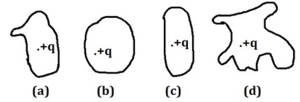
A
in figure $(c)$ is the largest
B
in figure $(b)$ is same as figure $(c)$ but is smaller than figure $(d)$
C
the same for all the figures
D
in figure $(d)$ is the least
Solution
(C) According to Gauss's Law,the total electric flux $\phi_E$ through any closed surface is equal to the net charge $q_{enclosed}$ enclosed by the surface divided by the permittivity of free space $\epsilon_0$.
Mathematically,$\phi_E = \frac{q_{enclosed}}{\epsilon_0}$.
In all four figures $(a)$,$(b)$,$(c)$,and $(d)$,the charge enclosed by the surface is the same,which is $+q$.
Since the enclosed charge is identical for all surfaces and $\epsilon_0$ is a constant,the electric flux $\phi_E$ through each surface must be equal.
Therefore,the electric flux is the same for all the figures.
Mathematically,$\phi_E = \frac{q_{enclosed}}{\epsilon_0}$.
In all four figures $(a)$,$(b)$,$(c)$,and $(d)$,the charge enclosed by the surface is the same,which is $+q$.
Since the enclosed charge is identical for all surfaces and $\epsilon_0$ is a constant,the electric flux $\phi_E$ through each surface must be equal.
Therefore,the electric flux is the same for all the figures.
0 likes
View Solution235
MediumMCQ
$A$ uniformly charged conducting sphere of diameter $14 \ cm$ has a surface charge density of $40 \ \mu C/m^2$. The total electric flux leaving the surface of the sphere is nearly (Permittivity of free space $\varepsilon_0 = 8.85 \times 10^{-12} \ C^2/N \cdot m^2$)
A
$40 \ kV \cdot m$
B
$140 \ kV \cdot m$
C
$240 \ kV \cdot m$
D
$280 \ kV \cdot m$
Solution
(D) The total electric flux $\phi$ through a closed surface is given by Gauss's Law: $\phi = \frac{q}{\varepsilon_0}$.
Since the charge is uniformly distributed on the surface,$q = \sigma \times A$,where $A = 4 \pi r^2$ is the surface area of the sphere.
Given: diameter $d = 14 \ cm$,so radius $r = 7 \ cm = 7 \times 10^{-2} \ m$.
Surface charge density $\sigma = 40 \ \mu C/m^2 = 40 \times 10^{-6} \ C/m^2$.
Substituting these values:
$\phi = \frac{4 \pi r^2 \sigma}{\varepsilon_0}$
$\phi = \frac{4 \times 3.14 \times (7 \times 10^{-2})^2 \times 40 \times 10^{-6}}{8.85 \times 10^{-12}}$
$\phi = \frac{4 \times 3.14 \times 49 \times 10^{-4} \times 40 \times 10^{-6}}{8.85 \times 10^{-12}}$
$\phi = \frac{2461.76 \times 10^{-10}}{8.85 \times 10^{-12}}$
$\phi \approx 278.16 \times 10^2 = 2.78 \times 10^4 \ V \cdot m$ (or $280 \ kV \cdot m$ approximately).
Thus,the correct option is $D$.
Since the charge is uniformly distributed on the surface,$q = \sigma \times A$,where $A = 4 \pi r^2$ is the surface area of the sphere.
Given: diameter $d = 14 \ cm$,so radius $r = 7 \ cm = 7 \times 10^{-2} \ m$.
Surface charge density $\sigma = 40 \ \mu C/m^2 = 40 \times 10^{-6} \ C/m^2$.
Substituting these values:
$\phi = \frac{4 \pi r^2 \sigma}{\varepsilon_0}$
$\phi = \frac{4 \times 3.14 \times (7 \times 10^{-2})^2 \times 40 \times 10^{-6}}{8.85 \times 10^{-12}}$
$\phi = \frac{4 \times 3.14 \times 49 \times 10^{-4} \times 40 \times 10^{-6}}{8.85 \times 10^{-12}}$
$\phi = \frac{2461.76 \times 10^{-10}}{8.85 \times 10^{-12}}$
$\phi \approx 278.16 \times 10^2 = 2.78 \times 10^4 \ V \cdot m$ (or $280 \ kV \cdot m$ approximately).
Thus,the correct option is $D$.
0 likes
View Solution236
EasyMCQ
If the electric flux entering and leaving an enclosed surface are $\phi_1$ and $\phi_2$ respectively,the electric charge inside the surface will be
A
$\frac{\phi_2-\phi_1}{\varepsilon_0}$
B
$\frac{\phi_1+\phi_2}{\varepsilon_0}$
C
$\varepsilon_0(\phi_1-\phi_2)$
D
$\varepsilon_0(\phi_2-\phi_1)$
Solution
(D) According to Gauss's law,the net electric flux $\phi_{net}$ through a closed surface is equal to the total charge $q$ enclosed by the surface divided by the permittivity of free space $\varepsilon_0$.
$\phi_{net} = \frac{q}{\varepsilon_0}$
Here,the flux entering the surface is $\phi_1$ (which is negative) and the flux leaving the surface is $\phi_2$ (which is positive).
Therefore,the net flux is $\phi_{net} = \phi_2 - \phi_1$.
Substituting this into Gauss's law:
$\phi_2 - \phi_1 = \frac{q}{\varepsilon_0}$
$q = \varepsilon_0(\phi_2 - \phi_1)$.
$\phi_{net} = \frac{q}{\varepsilon_0}$
Here,the flux entering the surface is $\phi_1$ (which is negative) and the flux leaving the surface is $\phi_2$ (which is positive).
Therefore,the net flux is $\phi_{net} = \phi_2 - \phi_1$.
Substituting this into Gauss's law:
$\phi_2 - \phi_1 = \frac{q}{\varepsilon_0}$
$q = \varepsilon_0(\phi_2 - \phi_1)$.
0 likes
View Solution237
EasyMCQ
$A$ spherical rubber balloon carries a charge,uniformly distributed over its surface. As the balloon is blown up and increases in size,the total electric flux coming out of the surface
A
becomes zero
B
decreases
C
increases
D
remains unchanged
Solution
(D) According to Gauss's law,the total electric flux $\phi$ through a closed surface is given by $\phi = \frac{q_{enclosed}}{\varepsilon_0}$.
Here,$q_{enclosed}$ is the total charge enclosed by the surface.
When the balloon is blown up,its size increases,but the total charge $q$ on the surface of the balloon remains constant.
Since the charge enclosed by the surface does not change,the total electric flux $\phi$ passing through the surface remains unchanged.
Here,$q_{enclosed}$ is the total charge enclosed by the surface.
When the balloon is blown up,its size increases,but the total charge $q$ on the surface of the balloon remains constant.
Since the charge enclosed by the surface does not change,the total electric flux $\phi$ passing through the surface remains unchanged.
0 likes
View Solution238
EasyMCQ
Two surfaces $A$ and $B$ are enclosing the charges as shown below. The total normal electric induction ($T$.$N$.$E$.$I$) through the surfaces $A$ and $B$ are respectively.
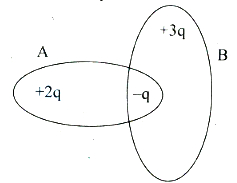
A
$+2 q$ and $+2 q$
B
$+q$ and $+3 q$
C
$+q$ and $+2 q$
D
$+2 q$ and $+3 q$
Solution
(C) The total normal electric induction ($T$.$N$.$E$.$I$.) through a closed surface is equal to the algebraic sum of the charges enclosed by that surface.
$\text{T.N.E.I.} = \sum q_{\text{enclosed}}$
For surface $A$,the enclosed charges are $+2q$ and $-q$.
$\text{T.N.E.I. for } A = (+2q) + (-q) = +q$
For surface $B$,the enclosed charges are $+3q$ and $-q$.
$\text{T.N.E.I. for } B = (+3q) + (-q) = +2q$
Therefore,the $T$.$N$.$E$.$I$. through surfaces $A$ and $B$ are $+q$ and $+2q$ respectively.
$\text{T.N.E.I.} = \sum q_{\text{enclosed}}$
For surface $A$,the enclosed charges are $+2q$ and $-q$.
$\text{T.N.E.I. for } A = (+2q) + (-q) = +q$
For surface $B$,the enclosed charges are $+3q$ and $-q$.
$\text{T.N.E.I. for } B = (+3q) + (-q) = +2q$
Therefore,the $T$.$N$.$E$.$I$. through surfaces $A$ and $B$ are $+q$ and $+2q$ respectively.
0 likes
View Solution239
EasyMCQ
If the electric flux entering and leaving an enclosed surface is $\phi_1$ and $\phi_2$ respectively, then the charge enclosed in the surface is ($\varepsilon_0 =$ permittivity of free space).
A
$\frac{\phi_2-\phi_1}{\varepsilon_0}$
B
$\frac{\phi_2+\phi_1}{\varepsilon_0}$
C
$\frac{\phi_1-\phi_2}{\varepsilon_0}$
D
$\varepsilon_0(\phi_2-\phi_1)$
Solution
(D) According to Gauss's Law, the net electric flux $\Phi_{net}$ through a closed surface is equal to the total enclosed charge $q_{in}$ divided by the permittivity of free space $\varepsilon_0$.
$\Phi_{net} = \frac{q_{in}}{\varepsilon_0}$
Here, the flux entering the surface is $\phi_1$ (taken as negative) and the flux leaving the surface is $\phi_2$ (taken as positive).
Therefore, the net flux is $\Phi_{net} = \phi_2 - \phi_1$.
Substituting this into Gauss's Law:
$\phi_2 - \phi_1 = \frac{q_{in}}{\varepsilon_0}$
$q_{in} = \varepsilon_0(\phi_2 - \phi_1)$.
Hence, option $D$ is the correct answer.
$\Phi_{net} = \frac{q_{in}}{\varepsilon_0}$
Here, the flux entering the surface is $\phi_1$ (taken as negative) and the flux leaving the surface is $\phi_2$ (taken as positive).
Therefore, the net flux is $\Phi_{net} = \phi_2 - \phi_1$.
Substituting this into Gauss's Law:
$\phi_2 - \phi_1 = \frac{q_{in}}{\varepsilon_0}$
$q_{in} = \varepsilon_0(\phi_2 - \phi_1)$.
Hence, option $D$ is the correct answer.
0 likes
View Solution240
EasyMCQ
The electric flux over a sphere of radius '$r$' is '$\phi$'. If the radius of the sphere is doubled without changing the charge,the flux will be
A
$4 \phi$
B
$2 \phi$
C
$\phi$
D
$\frac{\phi}{2}$
Solution
(C) According to Gauss's law,the total electric flux $\phi$ through a closed surface is given by $\phi = \frac{q_{enclosed}}{\varepsilon_0}$.
Here,$q_{enclosed}$ is the net charge enclosed by the Gaussian surface.
Since the charge $q$ remains unchanged and the permittivity of free space $\varepsilon_0$ is a constant,the electric flux $\phi$ depends only on the enclosed charge.
Therefore,changing the radius of the sphere does not affect the total electric flux passing through it.
Thus,the new flux remains $\phi$.
Here,$q_{enclosed}$ is the net charge enclosed by the Gaussian surface.
Since the charge $q$ remains unchanged and the permittivity of free space $\varepsilon_0$ is a constant,the electric flux $\phi$ depends only on the enclosed charge.
Therefore,changing the radius of the sphere does not affect the total electric flux passing through it.
Thus,the new flux remains $\phi$.
0 likes
View Solution241
MediumMCQ
$A$ hollow cylinder has a charge '$q$' $C$ within it. If '$\phi$' is the electric flux associated with the curved surface $B$,the flux linked with the plane surface $A$ will be
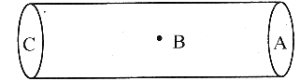
A
$\frac{1}{2}\left(\frac{q}{\varepsilon_0}-\phi\right)$
B
$\frac{q}{2 \varepsilon_0}$
C
$\frac{\phi}{3}$
D
$\frac{q}{\varepsilon_0}-\phi$
Solution
(A) According to Gauss's law,the total electric flux through a closed surface is given by $\phi_{total} = \frac{q}{\varepsilon_0}$.
For the hollow cylinder,the total flux is the sum of the flux through the two plane surfaces ($A$ and $C$) and the curved surface $(B)$: $\phi_A + \phi_C + \phi_B = \frac{q}{\varepsilon_0}$.
Due to the symmetry of the cylinder,the electric flux passing through the two plane surfaces $A$ and $C$ is equal,i.e.,$\phi_A = \phi_C$.
Given that the flux through the curved surface $B$ is $\phi_B = \phi$,we substitute this into the equation:
$2\phi_A + \phi = \frac{q}{\varepsilon_0}$.
Rearranging the equation to solve for $\phi_A$:
$2\phi_A = \frac{q}{\varepsilon_0} - \phi$.
$\phi_A = \frac{1}{2}\left(\frac{q}{\varepsilon_0} - \phi\right)$.
For the hollow cylinder,the total flux is the sum of the flux through the two plane surfaces ($A$ and $C$) and the curved surface $(B)$: $\phi_A + \phi_C + \phi_B = \frac{q}{\varepsilon_0}$.
Due to the symmetry of the cylinder,the electric flux passing through the two plane surfaces $A$ and $C$ is equal,i.e.,$\phi_A = \phi_C$.
Given that the flux through the curved surface $B$ is $\phi_B = \phi$,we substitute this into the equation:
$2\phi_A + \phi = \frac{q}{\varepsilon_0}$.
Rearranging the equation to solve for $\phi_A$:
$2\phi_A = \frac{q}{\varepsilon_0} - \phi$.
$\phi_A = \frac{1}{2}\left(\frac{q}{\varepsilon_0} - \phi\right)$.
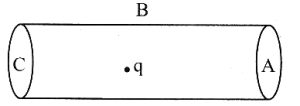
0 likes
View Solution242
MediumMCQ
$A$ hollow cylinder has a charge $q$ inside it. If $\phi$ is the electric flux associated with the curved surface $B$,the flux linked with the plane surface $A$ will be
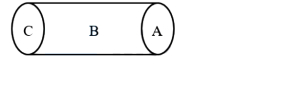
A
$\frac{\phi}{2}$
B
$\frac{\phi}{\epsilon_0}-\phi$
C
$\frac{1}{2}\left(\frac{q}{\epsilon_0}-\phi\right)$
D
$\frac{q}{2 \epsilon_0}$
Solution
(C) According to Gauss's Law,the total electric flux $\phi_{T}$ through a closed surface is given by $\phi_{T} = \frac{q}{\epsilon_0}$,where $q$ is the net charge enclosed by the surface.
For the given hollow cylinder,the total flux is the sum of the flux through the two plane surfaces ($A$ and $C$) and the curved surface $(B)$.
Let $\phi_A$,$\phi_B$,and $\phi_C$ be the fluxes through surfaces $A$,$B$,and $C$ respectively.
Given $\phi_B = \phi$. Due to the symmetry of the cylinder,the flux through the two plane ends must be equal,i.e.,$\phi_A = \phi_C$.
Therefore,$\phi_A + \phi_B + \phi_C = \frac{q}{\epsilon_0}$.
Substituting the values,we get $2\phi_A + \phi = \frac{q}{\epsilon_0}$.
Solving for $\phi_A$,we get $2\phi_A = \frac{q}{\epsilon_0} - \phi$,which implies $\phi_A = \frac{1}{2}\left(\frac{q}{\epsilon_0} - \phi\right)$.
For the given hollow cylinder,the total flux is the sum of the flux through the two plane surfaces ($A$ and $C$) and the curved surface $(B)$.
Let $\phi_A$,$\phi_B$,and $\phi_C$ be the fluxes through surfaces $A$,$B$,and $C$ respectively.
Given $\phi_B = \phi$. Due to the symmetry of the cylinder,the flux through the two plane ends must be equal,i.e.,$\phi_A = \phi_C$.
Therefore,$\phi_A + \phi_B + \phi_C = \frac{q}{\epsilon_0}$.
Substituting the values,we get $2\phi_A + \phi = \frac{q}{\epsilon_0}$.
Solving for $\phi_A$,we get $2\phi_A = \frac{q}{\epsilon_0} - \phi$,which implies $\phi_A = \frac{1}{2}\left(\frac{q}{\epsilon_0} - \phi\right)$.
0 likes
View Solution243
MediumMCQ
The electric flux linked with the closed surface in $N m^2 C^{-1}$ is given by:
$\left(\varepsilon_0 = 8.85 \times 10^{-12} C^2 N^{-1} m^{-2}\right)$
$\left(\varepsilon_0 = 8.85 \times 10^{-12} C^2 N^{-1} m^{-2}\right)$
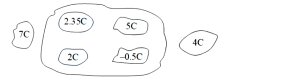
A
$10^{12}$
B
$8.85 \times 10^{-13}$
C
$10^{10}$
D
$10^{11}$
Solution
(A) According to Gauss's Law,the electric flux $\phi$ linked with a closed surface is given by $\phi = \frac{q_{enclosed}}{\varepsilon_0}$.
From the figure,the charges enclosed by the closed surface are $2.35 \ C$,$5 \ C$,$2 \ C$,and $-0.5 \ C$.
The total charge $q_{enclosed} = (2.35 + 5 + 2 - 0.5) \ C = 8.85 \ C$.
Given $\varepsilon_0 = 8.85 \times 10^{-12} \ C^2 N^{-1} m^{-2}$.
Substituting the values,we get $\phi = \frac{8.85 \ C}{8.85 \times 10^{-12} \ C^2 N^{-1} m^{-2}} = 10^{12} \ N m^2 C^{-1}$.
From the figure,the charges enclosed by the closed surface are $2.35 \ C$,$5 \ C$,$2 \ C$,and $-0.5 \ C$.
The total charge $q_{enclosed} = (2.35 + 5 + 2 - 0.5) \ C = 8.85 \ C$.
Given $\varepsilon_0 = 8.85 \times 10^{-12} \ C^2 N^{-1} m^{-2}$.
Substituting the values,we get $\phi = \frac{8.85 \ C}{8.85 \times 10^{-12} \ C^2 N^{-1} m^{-2}} = 10^{12} \ N m^2 C^{-1}$.
0 likes
View Solution244
EasyMCQ
$A$ charge $Q \ C$ is placed at the center of a cube. If $\varepsilon_0$ is the permittivity of vacuum,then the flux through one face and two opposite faces of the cube is respectively:
A
$\frac{Q}{6 \varepsilon_0}, \frac{Q}{3 \varepsilon_0}$
B
$\frac{Q}{3 \varepsilon_0}, \frac{Q}{2 \varepsilon_0}$
C
$\frac{Q}{12 \varepsilon_0}, \frac{Q}{6 \varepsilon_0}$
D
$\frac{Q}{\varepsilon_0}, \frac{Q}{2 \varepsilon_0}$
Solution
(A) According to Gauss's Law,the total electric flux $\phi_{total}$ through a closed surface enclosing a charge $Q$ is given by $\phi_{total} = \frac{Q}{\varepsilon_0}$.
Since the charge is placed at the center of the cube,the flux is distributed equally among all $6$ faces due to symmetry.
Therefore,the flux through one face is $\phi_{one} = \frac{\phi_{total}}{6} = \frac{Q}{6 \varepsilon_0}$.
The flux through two opposite faces is the sum of the flux through each of these two faces,which is $\phi_{two} = 2 \times \phi_{one} = 2 \times \frac{Q}{6 \varepsilon_0} = \frac{Q}{3 \varepsilon_0}$.
Since the charge is placed at the center of the cube,the flux is distributed equally among all $6$ faces due to symmetry.
Therefore,the flux through one face is $\phi_{one} = \frac{\phi_{total}}{6} = \frac{Q}{6 \varepsilon_0}$.
The flux through two opposite faces is the sum of the flux through each of these two faces,which is $\phi_{two} = 2 \times \phi_{one} = 2 \times \frac{Q}{6 \varepsilon_0} = \frac{Q}{3 \varepsilon_0}$.
0 likes
View Solution245
EasyMCQ
$A$ charge $Q$ is enclosed by a Gaussian surface of radius $R$. If the radius is doubled,then the outward electric flux will
A
be reduced to half
B
be doubled
C
remain the same
D
increase four times
Solution
(C) According to Gauss's law,the electric flux $\phi$ through any closed surface is given by the formula:
$\phi = \frac{Q_{\text{enclosed}}}{\varepsilon_0}$
Here,$Q_{\text{enclosed}}$ is the total charge enclosed by the Gaussian surface and $\varepsilon_0$ is the permittivity of free space.
From this expression,it is clear that the electric flux depends only on the magnitude of the charge enclosed within the surface.
It does not depend on the shape or the size (radius $R$) of the Gaussian surface.
Therefore,if the radius of the Gaussian surface is doubled,the enclosed charge $Q$ remains the same,and consequently,the outward electric flux will remain the same.
$\phi = \frac{Q_{\text{enclosed}}}{\varepsilon_0}$
Here,$Q_{\text{enclosed}}$ is the total charge enclosed by the Gaussian surface and $\varepsilon_0$ is the permittivity of free space.
From this expression,it is clear that the electric flux depends only on the magnitude of the charge enclosed within the surface.
It does not depend on the shape or the size (radius $R$) of the Gaussian surface.
Therefore,if the radius of the Gaussian surface is doubled,the enclosed charge $Q$ remains the same,and consequently,the outward electric flux will remain the same.
0 likes
View Solution246
EasyMCQ
If the radius of the spherical Gaussian surface is increased,then the electric flux due to a point charge enclosed by the surface:
A
remains unchanged
B
zero
C
increases
D
decreases
Solution
(A) According to Gauss's Law,the electric flux $\Phi_E$ through a closed surface is given by $\Phi_E = \frac{q_{enclosed}}{\epsilon_0}$.
Here,$q_{enclosed}$ is the total charge enclosed by the Gaussian surface and $\epsilon_0$ is the permittivity of free space.
Since the point charge $q$ remains the same regardless of the radius of the spherical Gaussian surface,the enclosed charge $q_{enclosed} = q$ remains constant.
Therefore,the electric flux $\Phi_E = \frac{q}{\epsilon_0}$ remains unchanged when the radius of the surface is increased.
Here,$q_{enclosed}$ is the total charge enclosed by the Gaussian surface and $\epsilon_0$ is the permittivity of free space.
Since the point charge $q$ remains the same regardless of the radius of the spherical Gaussian surface,the enclosed charge $q_{enclosed} = q$ remains constant.
Therefore,the electric flux $\Phi_E = \frac{q}{\epsilon_0}$ remains unchanged when the radius of the surface is increased.
0 likes
View Solution247
EasyMCQ
$A$ spherical rubber balloon carries a charge $q$ uniformly distributed over its surface. As the balloon is inflated,the total electric flux coming out of the surface:
A
decreases.
B
remains unchanged.
C
increases.
D
becomes zero.
Solution
(B) According to Gauss's Law,the total electric flux $\phi$ through a closed surface is given by $\phi = \frac{q_{\text{enclosed}}}{\epsilon_0}$.
Here,$q_{\text{enclosed}}$ is the total charge enclosed by the spherical balloon.
When the balloon is inflated,its radius increases,but the total charge $q$ on its surface remains constant.
Since the enclosed charge $q$ does not change,the total electric flux $\phi$ passing through the surface remains unchanged.
Here,$q_{\text{enclosed}}$ is the total charge enclosed by the spherical balloon.
When the balloon is inflated,its radius increases,but the total charge $q$ on its surface remains constant.
Since the enclosed charge $q$ does not change,the total electric flux $\phi$ passing through the surface remains unchanged.
0 likes
View Solution248
EasyMCQ
If the radius of the spherical Gaussian surface is increased,then the electric flux due to a point charge enclosed by the surface:
A
decreases.
B
remains unchanged.
C
increases.
D
is zero.
Solution
(B) According to Gauss's Law,the total electric flux $\phi$ through a closed surface is given by $\phi = \frac{q_{enc}}{\epsilon_0}$,where $q_{enc}$ is the total charge enclosed by the surface and $\epsilon_0$ is the permittivity of free space.
Since the electric flux depends only on the charge enclosed by the surface and not on the size or shape of the Gaussian surface,increasing the radius of the spherical Gaussian surface does not change the amount of charge enclosed.
Therefore,the electric flux remains unchanged.
Since the electric flux depends only on the charge enclosed by the surface and not on the size or shape of the Gaussian surface,increasing the radius of the spherical Gaussian surface does not change the amount of charge enclosed.
Therefore,the electric flux remains unchanged.
0 likes
View SolutionElectric Charges and Fields — Electric Field Lines, Electric Flux and Gauss's Law · Frequently Asked Questions
1Are these Electric Charges and Fields questions useful for JEE and NEET?
Yes. All questions in this section are mapped to JEE Main and NEET exam patterns. Previous year questions from JEE Main, NEET, GUJCET and state-level exams are included with full solutions.
2Can I switch to Hindi or Gujarati for these questions?
Yes. Use the language tabs in the hero section or the sidebar to view the same questions and solutions in English, Hindi or Gujarati.
3How do I generate a question paper from this subtopic?
Use the Vedclass Exam Paper Generator — select the chapter and subtopic, set difficulty, and generate Sets A, B, C, D automatically. First 3 chapters of every subject are free.
Vedclass Products
For Students
Vedclass Test Series
Mock tests in real JEE/NEET style with performance analysis. 5-day free trial.
Start Free TrialFor Teachers
Exam Paper Generator
Generate Set A/B/C/D papers from this chapter in 2 minutes. 3 chapters free.
Try FreeFor Institutes
Online Exam Module
Live online exams with unlimited students, 360° analytics & white-label branding.
See DemoFor Teachers & Institutes
Generate a Electric Charges and Fields Exam Paper in 2 Minutes
Select subtopic & difficulty — Sets A, B, C, D auto-generated with No Repeat logic.
First 3 chapters of every subject are free — no payment required.