
अ Hindi
Properties of ITF Questions in Hindi
Class 12 Mathematics · Inverse Trigonometric Functions · Properties of ITF
516+
Questions
Hindi
Language
100%
With Solutions
Showing 49 of 516 questions in Hindi
201
Medium
सिद्ध कीजिए कि $\tan ^{-1} \frac{63}{16}=\sin ^{-1} \frac{5}{13}+\cos ^{-1} \frac{3}{5}$
Solution
माना कि $\sin ^{-1} \frac{5}{13} = x$.
तब,$\sin x = \frac{5}{13}$,जिसका अर्थ है कि $\cos x = \sqrt{1 - (\frac{5}{13})^2} = \sqrt{1 - \frac{25}{169}} = \sqrt{\frac{144}{169}} = \frac{12}{13}$.
अतः,$\tan x = \frac{\sin x}{\cos x} = \frac{5/13}{12/13} = \frac{5}{12}$,इसलिए $x = \tan ^{-1} \frac{5}{12}$.
इस प्रकार,$\sin ^{-1} \frac{5}{13} = \tan ^{-1} \frac{5}{12}$ $\ldots (1)$.
माना कि $\cos ^{-1} \frac{3}{5} = y$.
तब,$\cos y = \frac{3}{5}$,जिसका अर्थ है कि $\sin y = \sqrt{1 - (\frac{3}{5})^2} = \sqrt{1 - \frac{9}{25}} = \sqrt{\frac{16}{25}} = \frac{4}{5}$.
अतः,$\tan y = \frac{\sin y}{\cos y} = \frac{4/5}{3/5} = \frac{4}{3}$,इसलिए $y = \tan ^{-1} \frac{4}{3}$.
इस प्रकार,$\cos ^{-1} \frac{3}{5} = \tan ^{-1} \frac{4}{3}$ $\ldots (2)$.
अब,दायां पक्ष ($R$.$H$.$S$.) पर विचार करें:
$\sin ^{-1} \frac{5}{13} + \cos ^{-1} \frac{3}{5} = \tan ^{-1} \frac{5}{12} + \tan ^{-1} \frac{4}{3}$.
सूत्र $\tan ^{-1} a + \tan ^{-1} b = \tan ^{-1} (\frac{a+b}{1-ab})$ का उपयोग करते हुए:
$= \tan ^{-1} (\frac{\frac{5}{12} + \frac{4}{3}}{1 - \frac{5}{12} \times \frac{4}{3}}) = \tan ^{-1} (\frac{\frac{15+48}{36}}{1 - \frac{20}{36}}) = \tan ^{-1} (\frac{63/36}{16/36}) = \tan ^{-1} \frac{63}{16}$.
$= L.H.S.$
अतः,सर्वसमिका सिद्ध होती है।
तब,$\sin x = \frac{5}{13}$,जिसका अर्थ है कि $\cos x = \sqrt{1 - (\frac{5}{13})^2} = \sqrt{1 - \frac{25}{169}} = \sqrt{\frac{144}{169}} = \frac{12}{13}$.
अतः,$\tan x = \frac{\sin x}{\cos x} = \frac{5/13}{12/13} = \frac{5}{12}$,इसलिए $x = \tan ^{-1} \frac{5}{12}$.
इस प्रकार,$\sin ^{-1} \frac{5}{13} = \tan ^{-1} \frac{5}{12}$ $\ldots (1)$.
माना कि $\cos ^{-1} \frac{3}{5} = y$.
तब,$\cos y = \frac{3}{5}$,जिसका अर्थ है कि $\sin y = \sqrt{1 - (\frac{3}{5})^2} = \sqrt{1 - \frac{9}{25}} = \sqrt{\frac{16}{25}} = \frac{4}{5}$.
अतः,$\tan y = \frac{\sin y}{\cos y} = \frac{4/5}{3/5} = \frac{4}{3}$,इसलिए $y = \tan ^{-1} \frac{4}{3}$.
इस प्रकार,$\cos ^{-1} \frac{3}{5} = \tan ^{-1} \frac{4}{3}$ $\ldots (2)$.
अब,दायां पक्ष ($R$.$H$.$S$.) पर विचार करें:
$\sin ^{-1} \frac{5}{13} + \cos ^{-1} \frac{3}{5} = \tan ^{-1} \frac{5}{12} + \tan ^{-1} \frac{4}{3}$.
सूत्र $\tan ^{-1} a + \tan ^{-1} b = \tan ^{-1} (\frac{a+b}{1-ab})$ का उपयोग करते हुए:
$= \tan ^{-1} (\frac{\frac{5}{12} + \frac{4}{3}}{1 - \frac{5}{12} \times \frac{4}{3}}) = \tan ^{-1} (\frac{\frac{15+48}{36}}{1 - \frac{20}{36}}) = \tan ^{-1} (\frac{63/36}{16/36}) = \tan ^{-1} \frac{63}{16}$.
$= L.H.S.$
अतः,सर्वसमिका सिद्ध होती है।
0 likes
View Solution202
Difficult
सिद्ध कीजिए कि $\tan ^{-1} \frac{1}{5}+\tan ^{-1} \frac{1}{7}+\tan ^{-1} \frac{1}{3}+\tan ^{-1} \frac{1}{8}=\frac{\pi}{4}$
Solution
(N/A) $L$.$H$.$S$ = $\tan ^{-1} \frac{1}{5}+\tan ^{-1} \frac{1}{7}+\tan ^{-1} \frac{1}{3}+\tan ^{-1} \frac{1}{8}$
सूत्र $\tan ^{-1} x + \tan ^{-1} y = \tan ^{-1} \left( \frac{x+y}{1-xy} \right)$ का उपयोग करते हुए,हम पदों को समूहित करते हैं:
$= \left( \tan ^{-1} \frac{1}{5} + \tan ^{-1} \frac{1}{7} \right) + \left( \tan ^{-1} \frac{1}{3} + \tan ^{-1} \frac{1}{8} \right)$
$= \tan ^{-1} \left( \frac{\frac{1}{5} + \frac{1}{7}}{1 - \frac{1}{5} \times \frac{1}{7}} \right) + \tan ^{-1} \left( \frac{\frac{1}{3} + \frac{1}{8}}{1 - \frac{1}{3} \times \frac{1}{8}} \right)$
$= \tan ^{-1} \left( \frac{\frac{12}{35}}{\frac{34}{35}} \right) + \tan ^{-1} \left( \frac{\frac{11}{24}}{\frac{23}{24}} \right)$
$= \tan ^{-1} \left( \frac{12}{34} \right) + \tan ^{-1} \left( \frac{11}{23} \right) = \tan ^{-1} \left( \frac{6}{17} \right) + \tan ^{-1} \left( \frac{11}{23} \right)$
$= \tan ^{-1} \left( \frac{\frac{6}{17} + \frac{11}{23}}{1 - \frac{6}{17} \times \frac{11}{23}} \right) = \tan ^{-1} \left( \frac{\frac{138 + 187}{391}}{\frac{391 - 66}{391}} \right)$
$= \tan ^{-1} \left( \frac{325}{325} \right) = \tan ^{-1} (1) = \frac{\pi}{4} = R.H.S$
सूत्र $\tan ^{-1} x + \tan ^{-1} y = \tan ^{-1} \left( \frac{x+y}{1-xy} \right)$ का उपयोग करते हुए,हम पदों को समूहित करते हैं:
$= \left( \tan ^{-1} \frac{1}{5} + \tan ^{-1} \frac{1}{7} \right) + \left( \tan ^{-1} \frac{1}{3} + \tan ^{-1} \frac{1}{8} \right)$
$= \tan ^{-1} \left( \frac{\frac{1}{5} + \frac{1}{7}}{1 - \frac{1}{5} \times \frac{1}{7}} \right) + \tan ^{-1} \left( \frac{\frac{1}{3} + \frac{1}{8}}{1 - \frac{1}{3} \times \frac{1}{8}} \right)$
$= \tan ^{-1} \left( \frac{\frac{12}{35}}{\frac{34}{35}} \right) + \tan ^{-1} \left( \frac{\frac{11}{24}}{\frac{23}{24}} \right)$
$= \tan ^{-1} \left( \frac{12}{34} \right) + \tan ^{-1} \left( \frac{11}{23} \right) = \tan ^{-1} \left( \frac{6}{17} \right) + \tan ^{-1} \left( \frac{11}{23} \right)$
$= \tan ^{-1} \left( \frac{\frac{6}{17} + \frac{11}{23}}{1 - \frac{6}{17} \times \frac{11}{23}} \right) = \tan ^{-1} \left( \frac{\frac{138 + 187}{391}}{\frac{391 - 66}{391}} \right)$
$= \tan ^{-1} \left( \frac{325}{325} \right) = \tan ^{-1} (1) = \frac{\pi}{4} = R.H.S$
0 likes
View Solution203
Medium
सिद्ध कीजिए कि $\tan ^{-1} \sqrt{x} = \frac{1}{2} \cos ^{-1} \left( \frac{1-x}{1+x} \right)$,जहाँ $x \in [0, 1]$ है।
Solution
माना $x = \tan^2 \theta$ है।
तब $\sqrt{x} = \tan \theta$,जिसका अर्थ है $\theta = \tan^{-1} \sqrt{x}$।
व्यंजक $\frac{1-x}{1+x}$ पर विचार करें। $x = \tan^2 \theta$ प्रतिस्थापित करने पर,हमें प्राप्त होता है:
$\frac{1 - \tan^2 \theta}{1 + \tan^2 \theta} = \cos(2\theta)$।
अब,दायां पक्ष $(RHS)$ पर विचार करें:
$RHS = \frac{1}{2} \cos^{-1} \left( \frac{1-x}{1+x} \right)$
$= \frac{1}{2} \cos^{-1} (\cos 2\theta)$
$= \frac{1}{2} \times 2\theta = \theta$।
चूंकि $\theta = \tan^{-1} \sqrt{x}$,इसलिए $RHS = \tan^{-1} \sqrt{x} = LHS$।
अतः,सर्वसमिका सिद्ध हुई।
तब $\sqrt{x} = \tan \theta$,जिसका अर्थ है $\theta = \tan^{-1} \sqrt{x}$।
व्यंजक $\frac{1-x}{1+x}$ पर विचार करें। $x = \tan^2 \theta$ प्रतिस्थापित करने पर,हमें प्राप्त होता है:
$\frac{1 - \tan^2 \theta}{1 + \tan^2 \theta} = \cos(2\theta)$।
अब,दायां पक्ष $(RHS)$ पर विचार करें:
$RHS = \frac{1}{2} \cos^{-1} \left( \frac{1-x}{1+x} \right)$
$= \frac{1}{2} \cos^{-1} (\cos 2\theta)$
$= \frac{1}{2} \times 2\theta = \theta$।
चूंकि $\theta = \tan^{-1} \sqrt{x}$,इसलिए $RHS = \tan^{-1} \sqrt{x} = LHS$।
अतः,सर्वसमिका सिद्ध हुई।
0 likes
View Solution204
Difficult
सिद्ध कीजिए कि $\cot ^{-1}\left(\frac{\sqrt{1+\sin x}+\sqrt{1-\sin x}}{\sqrt{1+\sin x}-\sqrt{1-\sin x}}\right)=\frac{x}{2}$,जहाँ $x \in\left(0, \frac{\pi}{4}\right)$.
Solution
माना $y = \frac{\sqrt{1+\sin x}+\sqrt{1-\sin x}}{\sqrt{1+\sin x}-\sqrt{1-\sin x}}$.
हर का परिमेयकरण करने पर,अंश और हर को $(\sqrt{1+\sin x}+\sqrt{1-\sin x})$ से गुणा करने पर:
$y = \frac{(\sqrt{1+\sin x}+\sqrt{1-\sin x})^2}{(\sqrt{1+\sin x}-\sqrt{1-\sin x})(\sqrt{1+\sin x}+\sqrt{1-\sin x})}$
$y = \frac{(1+\sin x) + (1-\sin x) + 2\sqrt{(1+\sin x)(1-\sin x)}}{(1+\sin x) - (1-\sin x)}$
$y = \frac{2 + 2\sqrt{1-\sin^2 x}}{2\sin x} = \frac{2 + 2\cos x}{2\sin x} = \frac{1+\cos x}{\sin x}$
त्रिकोणमितीय सर्वसमिकाओं $1+\cos x = 2\cos^2 \frac{x}{2}$ और $\sin x = 2\sin \frac{x}{2}\cos \frac{x}{2}$ का उपयोग करने पर:
$y = \frac{2\cos^2 \frac{x}{2}}{2\sin \frac{x}{2}\cos \frac{x}{2}} = \cot \frac{x}{2}$
अतः,$\cot^{-1}(y) = \cot^{-1}(\cot \frac{x}{2}) = \frac{x}{2}$,जो $R.H.S.$ है।
हर का परिमेयकरण करने पर,अंश और हर को $(\sqrt{1+\sin x}+\sqrt{1-\sin x})$ से गुणा करने पर:
$y = \frac{(\sqrt{1+\sin x}+\sqrt{1-\sin x})^2}{(\sqrt{1+\sin x}-\sqrt{1-\sin x})(\sqrt{1+\sin x}+\sqrt{1-\sin x})}$
$y = \frac{(1+\sin x) + (1-\sin x) + 2\sqrt{(1+\sin x)(1-\sin x)}}{(1+\sin x) - (1-\sin x)}$
$y = \frac{2 + 2\sqrt{1-\sin^2 x}}{2\sin x} = \frac{2 + 2\cos x}{2\sin x} = \frac{1+\cos x}{\sin x}$
त्रिकोणमितीय सर्वसमिकाओं $1+\cos x = 2\cos^2 \frac{x}{2}$ और $\sin x = 2\sin \frac{x}{2}\cos \frac{x}{2}$ का उपयोग करने पर:
$y = \frac{2\cos^2 \frac{x}{2}}{2\sin \frac{x}{2}\cos \frac{x}{2}} = \cot \frac{x}{2}$
अतः,$\cot^{-1}(y) = \cot^{-1}(\cot \frac{x}{2}) = \frac{x}{2}$,जो $R.H.S.$ है।
0 likes
View Solution205
Difficult
सिद्ध कीजिए कि $\tan ^{-1}\left(\frac{\sqrt{1+x}-\sqrt{1-x}}{\sqrt{1+x}+\sqrt{1-x}}\right)=\frac{\pi}{4}-\frac{1}{2} \cos ^{-1} x$,जहाँ $-\frac{1}{\sqrt{2}} \leq x \leq 1$.
Solution
(A) माना $x = \cos 2\theta$,तब $\theta = \frac{1}{2} \cos ^{-1} x$.
$L.H.S. = \tan ^{-1}\left(\frac{\sqrt{1+x}-\sqrt{1-x}}{\sqrt{1+x}+\sqrt{1-x}}\right)$
$x = \cos 2\theta$ प्रतिस्थापित करने पर:
$= \tan ^{-1}\left(\frac{\sqrt{1+\cos 2\theta}-\sqrt{1-\cos 2\theta}}{\sqrt{1+\cos 2\theta}+\sqrt{1-\cos 2\theta}}\right)$
सर्वसमिकाओं $1+\cos 2\theta = 2\cos^2 \theta$ और $1-\cos 2\theta = 2\sin^2 \theta$ का उपयोग करने पर:
$= \tan ^{-1}\left(\frac{\sqrt{2\cos^2 \theta}-\sqrt{2\sin^2 \theta}}{\sqrt{2\cos^2 \theta}+\sqrt{2\sin^2 \theta}}\right)$
$= \tan ^{-1}\left(\frac{\sqrt{2}\cos \theta - \sqrt{2}\sin \theta}{\sqrt{2}\cos \theta + \sqrt{2}\sin \theta}\right)$
अंश और हर को $\sqrt{2}\cos \theta$ से विभाजित करने पर:
$= \tan ^{-1}\left(\frac{1 - \tan \theta}{1 + \tan \theta}\right)$
सूत्र $\tan(\frac{\pi}{4} - \theta) = \frac{1 - \tan \theta}{1 + \tan \theta}$ का उपयोग करने पर:
$= \tan ^{-1}\left(\tan\left(\frac{\pi}{4} - \theta\right)\right)$
$= \frac{\pi}{4} - \theta$
$\theta = \frac{1}{2} \cos ^{-1} x$ रखने पर:
$= \frac{\pi}{4} - \frac{1}{2} \cos ^{-1} x = R.H.S.$
$L.H.S. = \tan ^{-1}\left(\frac{\sqrt{1+x}-\sqrt{1-x}}{\sqrt{1+x}+\sqrt{1-x}}\right)$
$x = \cos 2\theta$ प्रतिस्थापित करने पर:
$= \tan ^{-1}\left(\frac{\sqrt{1+\cos 2\theta}-\sqrt{1-\cos 2\theta}}{\sqrt{1+\cos 2\theta}+\sqrt{1-\cos 2\theta}}\right)$
सर्वसमिकाओं $1+\cos 2\theta = 2\cos^2 \theta$ और $1-\cos 2\theta = 2\sin^2 \theta$ का उपयोग करने पर:
$= \tan ^{-1}\left(\frac{\sqrt{2\cos^2 \theta}-\sqrt{2\sin^2 \theta}}{\sqrt{2\cos^2 \theta}+\sqrt{2\sin^2 \theta}}\right)$
$= \tan ^{-1}\left(\frac{\sqrt{2}\cos \theta - \sqrt{2}\sin \theta}{\sqrt{2}\cos \theta + \sqrt{2}\sin \theta}\right)$
अंश और हर को $\sqrt{2}\cos \theta$ से विभाजित करने पर:
$= \tan ^{-1}\left(\frac{1 - \tan \theta}{1 + \tan \theta}\right)$
सूत्र $\tan(\frac{\pi}{4} - \theta) = \frac{1 - \tan \theta}{1 + \tan \theta}$ का उपयोग करने पर:
$= \tan ^{-1}\left(\tan\left(\frac{\pi}{4} - \theta\right)\right)$
$= \frac{\pi}{4} - \theta$
$\theta = \frac{1}{2} \cos ^{-1} x$ रखने पर:
$= \frac{\pi}{4} - \frac{1}{2} \cos ^{-1} x = R.H.S.$
0 likes
View Solution206
Difficult
सिद्ध कीजिए कि $\frac{9 \pi}{8} - \frac{9}{4} \sin^{-1} \frac{1}{3} = \frac{9}{4} \sin^{-1} \frac{2 \sqrt{2}}{3}$.
Solution
(A) $L.H.S. = \frac{9 \pi}{8} - \frac{9}{4} \sin^{-1} \frac{1}{3}$ पर विचार करें।
व्यंजक से $\frac{9}{4}$ उभयनिष्ठ लेने पर:
$L.H.S. = \frac{9}{4} \left( \frac{\pi}{2} - \sin^{-1} \frac{1}{3} \right)$.
सर्वसमिका $\sin^{-1} x + \cos^{-1} x = \frac{\pi}{2}$ का उपयोग करने पर,$\frac{\pi}{2} - \sin^{-1} \frac{1}{3} = \cos^{-1} \frac{1}{3}$ प्राप्त होता है।
अतः,$L.H.S. = \frac{9}{4} \cos^{-1} \frac{1}{3}$.
माना $\cos^{-1} \frac{1}{3} = \theta$. तब $\cos \theta = \frac{1}{3}$.
चूंकि $\sin^2 \theta = 1 - \cos^2 \theta$,इसलिए $\sin^2 \theta = 1 - (\frac{1}{3})^2 = 1 - \frac{1}{9} = \frac{8}{9}$.
अतः,$\sin \theta = \sqrt{\frac{8}{9}} = \frac{2 \sqrt{2}}{3}$.
इसलिए,$\theta = \sin^{-1} \frac{2 \sqrt{2}}{3}$.
इसे वापस व्यंजक में रखने पर,$L.H.S. = \frac{9}{4} \sin^{-1} \frac{2 \sqrt{2}}{3} = R.H.S.$
व्यंजक से $\frac{9}{4}$ उभयनिष्ठ लेने पर:
$L.H.S. = \frac{9}{4} \left( \frac{\pi}{2} - \sin^{-1} \frac{1}{3} \right)$.
सर्वसमिका $\sin^{-1} x + \cos^{-1} x = \frac{\pi}{2}$ का उपयोग करने पर,$\frac{\pi}{2} - \sin^{-1} \frac{1}{3} = \cos^{-1} \frac{1}{3}$ प्राप्त होता है।
अतः,$L.H.S. = \frac{9}{4} \cos^{-1} \frac{1}{3}$.
माना $\cos^{-1} \frac{1}{3} = \theta$. तब $\cos \theta = \frac{1}{3}$.
चूंकि $\sin^2 \theta = 1 - \cos^2 \theta$,इसलिए $\sin^2 \theta = 1 - (\frac{1}{3})^2 = 1 - \frac{1}{9} = \frac{8}{9}$.
अतः,$\sin \theta = \sqrt{\frac{8}{9}} = \frac{2 \sqrt{2}}{3}$.
इसलिए,$\theta = \sin^{-1} \frac{2 \sqrt{2}}{3}$.
इसे वापस व्यंजक में रखने पर,$L.H.S. = \frac{9}{4} \sin^{-1} \frac{2 \sqrt{2}}{3} = R.H.S.$
0 likes
View Solution207
DifficultMCQ
$x > 0$ के लिए $\tan ^{-1} \frac{1-x}{1+x}=\frac{1}{2} \tan ^{-1} x$ को हल करें।
A
$x=\frac{1}{\sqrt{2}}$
B
$x=\frac{1}{\sqrt{3}}$
C
$x=\frac{1}{2}$
D
$x=\sqrt{3}$
Solution
(B) दिया गया समीकरण: $\tan ^{-1} \frac{1-x}{1+x}=\frac{1}{2} \tan ^{-1} x$
सर्वसमिका $\tan ^{-1} a - \tan ^{-1} b = \tan ^{-1} \frac{a-b}{1+ab}$ का उपयोग करते हुए,हम लिख सकते हैं $\tan ^{-1} 1 - \tan ^{-1} x = \frac{1}{2} \tan ^{-1} x$.
चूंकि $\tan ^{-1} 1 = \frac{\pi}{4}$,समीकरण $\frac{\pi}{4} - \tan ^{-1} x = \frac{1}{2} \tan ^{-1} x$ बन जाता है।
पदों को पुनर्व्यवस्थित करने पर,हमें $\frac{\pi}{4} = \tan ^{-1} x + \frac{1}{2} \tan ^{-1} x = \frac{3}{2} \tan ^{-1} x$ प्राप्त होता है।
दोनों पक्षों को $\frac{2}{3}$ से गुणा करने पर,$\tan ^{-1} x = \frac{\pi}{4} \times \frac{2}{3} = \frac{\pi}{6}$ प्राप्त होता है।
दोनों पक्षों का टेंजेंट लेने पर,$x = \tan \frac{\pi}{6}$.
अतः,$x = \frac{1}{\sqrt{3}}$।
सर्वसमिका $\tan ^{-1} a - \tan ^{-1} b = \tan ^{-1} \frac{a-b}{1+ab}$ का उपयोग करते हुए,हम लिख सकते हैं $\tan ^{-1} 1 - \tan ^{-1} x = \frac{1}{2} \tan ^{-1} x$.
चूंकि $\tan ^{-1} 1 = \frac{\pi}{4}$,समीकरण $\frac{\pi}{4} - \tan ^{-1} x = \frac{1}{2} \tan ^{-1} x$ बन जाता है।
पदों को पुनर्व्यवस्थित करने पर,हमें $\frac{\pi}{4} = \tan ^{-1} x + \frac{1}{2} \tan ^{-1} x = \frac{3}{2} \tan ^{-1} x$ प्राप्त होता है।
दोनों पक्षों को $\frac{2}{3}$ से गुणा करने पर,$\tan ^{-1} x = \frac{\pi}{4} \times \frac{2}{3} = \frac{\pi}{6}$ प्राप्त होता है।
दोनों पक्षों का टेंजेंट लेने पर,$x = \tan \frac{\pi}{6}$.
अतः,$x = \frac{1}{\sqrt{3}}$।
0 likes
View Solution208
MediumMCQ
$\tan ^{-1}\left(\frac{x}{y}\right)-\tan ^{-1} \left(\frac{x-y}{x+y}\right)$ का मान ज्ञात कीजिए।
A
$\frac{\pi}{4}$
B
$\frac{-3 \pi}{4}$
C
$\frac{\pi}{2}$
D
$\frac{\pi}{3}$
Solution
(A) हम सूत्र $\tan ^{-1} A - \tan ^{-1} B = \tan ^{-1} \left( \frac{A-B}{1+AB} \right)$ का उपयोग करेंगे।
माना $A = \frac{x}{y}$ और $B = \frac{x-y}{x+y}$ है।
$\tan ^{-1}\left(\frac{x}{y}\right)-\tan ^{-1}\left(\frac{x-y}{x+y}\right) = \tan ^{-1}\left[\frac{\frac{x}{y}-\frac{x-y}{x+y}}{1+\left(\frac{x}{y}\right)\left(\frac{x-y}{x+y}\right)}\right]$
$= \tan ^{-1}\left[\frac{\frac{x(x+y)-y(x-y)}{y(x+y)}}{\frac{y(x+y)+x(x-y)}{y(x+y)}}\right]$
$= \tan ^{-1}\left(\frac{x^{2}+xy-xy+y^{2}}{xy+y^{2}+x^{2}-xy}\right)$
$= \tan ^{-1}\left(\frac{x^{2}+y^{2}}{x^{2}+y^{2}}\right) = \tan ^{-1}(1) = \frac{\pi}{4}$.
माना $A = \frac{x}{y}$ और $B = \frac{x-y}{x+y}$ है।
$\tan ^{-1}\left(\frac{x}{y}\right)-\tan ^{-1}\left(\frac{x-y}{x+y}\right) = \tan ^{-1}\left[\frac{\frac{x}{y}-\frac{x-y}{x+y}}{1+\left(\frac{x}{y}\right)\left(\frac{x-y}{x+y}\right)}\right]$
$= \tan ^{-1}\left[\frac{\frac{x(x+y)-y(x-y)}{y(x+y)}}{\frac{y(x+y)+x(x-y)}{y(x+y)}}\right]$
$= \tan ^{-1}\left(\frac{x^{2}+xy-xy+y^{2}}{xy+y^{2}+x^{2}-xy}\right)$
$= \tan ^{-1}\left(\frac{x^{2}+y^{2}}{x^{2}+y^{2}}\right) = \tan ^{-1}(1) = \frac{\pi}{4}$.
0 likes
View Solution209
MediumMCQ
यदि $|x| < 1$ है,तो $y = \sin^{-1}\left(\frac{2x}{1+x^2}\right)$ के लिए $\frac{dy}{dx}$ ज्ञात कीजिए।
A
$\frac{2}{1+x^2}$
B
$-\frac{2}{1+x^2}$
C
$\frac{1}{1+x^2}$
D
$-\frac{1}{1+x^2}$
Solution
(A) दिया गया है $y = \sin^{-1}\left(\frac{2x}{1+x^2}\right)$.
माना $x = \tan \theta$,तो $\theta = \tan^{-1} x$.
व्यंजक में $x = \tan \theta$ प्रतिस्थापित करने पर,हमें प्राप्त होता है:
$y = \sin^{-1}\left(\frac{2 \tan \theta}{1 + \tan^2 \theta}\right)$
त्रिकोणमितीय सर्वसमिका $\sin 2\theta = \frac{2 \tan \theta}{1 + \tan^2 \theta}$ का उपयोग करने पर:
$y = \sin^{-1}(\sin 2\theta)$
चूंकि $|x| < 1$,$2\theta$ का मान $[-\frac{\pi}{2}, \frac{\pi}{2}]$ के अंतराल में है,इसलिए $y = 2\theta$.
$\theta = \tan^{-1} x$ वापस रखने पर:
$y = 2 \tan^{-1} x$
$x$ के सापेक्ष अवकलन करने पर:
$\frac{dy}{dx} = 2 \cdot \frac{d}{dx}(\tan^{-1} x)$
$\frac{dy}{dx} = 2 \cdot \frac{1}{1+x^2} = \frac{2}{1+x^2}$.
माना $x = \tan \theta$,तो $\theta = \tan^{-1} x$.
व्यंजक में $x = \tan \theta$ प्रतिस्थापित करने पर,हमें प्राप्त होता है:
$y = \sin^{-1}\left(\frac{2 \tan \theta}{1 + \tan^2 \theta}\right)$
त्रिकोणमितीय सर्वसमिका $\sin 2\theta = \frac{2 \tan \theta}{1 + \tan^2 \theta}$ का उपयोग करने पर:
$y = \sin^{-1}(\sin 2\theta)$
चूंकि $|x| < 1$,$2\theta$ का मान $[-\frac{\pi}{2}, \frac{\pi}{2}]$ के अंतराल में है,इसलिए $y = 2\theta$.
$\theta = \tan^{-1} x$ वापस रखने पर:
$y = 2 \tan^{-1} x$
$x$ के सापेक्ष अवकलन करने पर:
$\frac{dy}{dx} = 2 \cdot \frac{d}{dx}(\tan^{-1} x)$
$\frac{dy}{dx} = 2 \cdot \frac{1}{1+x^2} = \frac{2}{1+x^2}$.
0 likes
View Solution210
MediumMCQ
यदि $0 < x < 1$ है,तो $y = \cos^{-1}\left(\frac{1-x^2}{1+x^2}\right)$ के लिए $\frac{dy}{dx}$ ज्ञात कीजिए।
A
$\frac{2}{1+x^2}$
B
$\frac{1}{1+x^2}$
C
$\frac{-2}{1+x^2}$
D
$\frac{-1}{1+x^2}$
Solution
(A) दिया गया है $y = \cos^{-1}\left(\frac{1-x^2}{1+x^2}\right)$.
माना $x = \tan \theta$,जहाँ $\theta = \tan^{-1} x$ है। चूँकि $0 < x < 1$,इसलिए $0 < \theta < \frac{\pi}{4}$ है।
$x = \tan \theta$ को व्यंजक में प्रतिस्थापित करने पर:
$y = \cos^{-1}\left(\frac{1-\tan^2 \theta}{1+\tan^2 \theta}\right)$
त्रिकोणमितीय सर्वसमिका $\cos 2\theta = \frac{1-\tan^2 \theta}{1+\tan^2 \theta}$ का उपयोग करने पर:
$y = \cos^{-1}(\cos 2\theta)$
चूँकि $0 < \theta < \frac{\pi}{4}$,इसलिए $0 < 2\theta < \frac{\pi}{2}$ है।
अतः,$y = 2\theta = 2 \tan^{-1} x$.
$x$ के सापेक्ष अवकलन करने पर:
$\frac{dy}{dx} = 2 \cdot \frac{d}{dx}(\tan^{-1} x)$
$\frac{dy}{dx} = 2 \cdot \frac{1}{1+x^2} = \frac{2}{1+x^2}$.
माना $x = \tan \theta$,जहाँ $\theta = \tan^{-1} x$ है। चूँकि $0 < x < 1$,इसलिए $0 < \theta < \frac{\pi}{4}$ है।
$x = \tan \theta$ को व्यंजक में प्रतिस्थापित करने पर:
$y = \cos^{-1}\left(\frac{1-\tan^2 \theta}{1+\tan^2 \theta}\right)$
त्रिकोणमितीय सर्वसमिका $\cos 2\theta = \frac{1-\tan^2 \theta}{1+\tan^2 \theta}$ का उपयोग करने पर:
$y = \cos^{-1}(\cos 2\theta)$
चूँकि $0 < \theta < \frac{\pi}{4}$,इसलिए $0 < 2\theta < \frac{\pi}{2}$ है।
अतः,$y = 2\theta = 2 \tan^{-1} x$.
$x$ के सापेक्ष अवकलन करने पर:
$\frac{dy}{dx} = 2 \cdot \frac{d}{dx}(\tan^{-1} x)$
$\frac{dy}{dx} = 2 \cdot \frac{1}{1+x^2} = \frac{2}{1+x^2}$.
0 likes
View Solution211
MediumMCQ
यदि $y = \cos^{-1}\left(\frac{2x}{1+x^2}\right)$ है,तो $\frac{dy}{dx}$ ज्ञात कीजिए,जहाँ $-1 < x < 1$ है।
A
$\frac{-2}{1+x^2}$
B
$\frac{2}{1+x^2}$
C
$\frac{-1}{1+x^2}$
D
$\frac{1}{1+x^2}$
Solution
(A) दिया गया है $y = \cos^{-1}\left(\frac{2x}{1+x^2}\right)$.
माना $x = \tan \theta$,जहाँ $\theta = \tan^{-1} x$ है। चूँकि $-1 < x < 1$,इसलिए $-\frac{\pi}{4} < \theta < \frac{\pi}{4}$ है।
तब $\frac{2x}{1+x^2} = \frac{2 \tan \theta}{1 + \tan^2 \theta} = \sin(2\theta)$ है।
अतः,$y = \cos^{-1}(\sin(2\theta)) = \cos^{-1}(\cos(\frac{\pi}{2} - 2\theta))$ है।
चूँकि $-\frac{\pi}{4} < \theta < \frac{\pi}{4}$,इसलिए $-\frac{\pi}{2} < 2\theta < \frac{\pi}{2}$ है,जिसका अर्थ है कि $0 < \frac{\pi}{2} - 2\theta < \pi$ है।
इस प्रकार,$y = \frac{\pi}{2} - 2\theta = \frac{\pi}{2} - 2 \tan^{-1} x$ है।
$x$ के सापेक्ष अवकलन करने पर:
$\frac{dy}{dx} = 0 - 2 \cdot \frac{1}{1+x^2} = \frac{-2}{1+x^2}$.
माना $x = \tan \theta$,जहाँ $\theta = \tan^{-1} x$ है। चूँकि $-1 < x < 1$,इसलिए $-\frac{\pi}{4} < \theta < \frac{\pi}{4}$ है।
तब $\frac{2x}{1+x^2} = \frac{2 \tan \theta}{1 + \tan^2 \theta} = \sin(2\theta)$ है।
अतः,$y = \cos^{-1}(\sin(2\theta)) = \cos^{-1}(\cos(\frac{\pi}{2} - 2\theta))$ है।
चूँकि $-\frac{\pi}{4} < \theta < \frac{\pi}{4}$,इसलिए $-\frac{\pi}{2} < 2\theta < \frac{\pi}{2}$ है,जिसका अर्थ है कि $0 < \frac{\pi}{2} - 2\theta < \pi$ है।
इस प्रकार,$y = \frac{\pi}{2} - 2\theta = \frac{\pi}{2} - 2 \tan^{-1} x$ है।
$x$ के सापेक्ष अवकलन करने पर:
$\frac{dy}{dx} = 0 - 2 \cdot \frac{1}{1+x^2} = \frac{-2}{1+x^2}$.
0 likes
View Solution212
MediumMCQ
यदि $y = \sin^{-1}(2x\sqrt{1-x^2})$ है और $-\frac{1}{\sqrt{2}} < x < \frac{1}{\sqrt{2}}$ है,तो $\frac{dy}{dx}$ ज्ञात कीजिए।
A
$\frac{2}{\sqrt{1-x^2}}$
B
$-\frac{2}{\sqrt{1-x^2}}$
C
$\frac{1}{\sqrt{1-x^2}}$
D
$-\frac{1}{\sqrt{1-x^2}}$
Solution
(A) दिया गया है $y = \sin^{-1}(2x\sqrt{1-x^2})$.
माना $x = \sin \theta$,तब $\theta = \sin^{-1} x$.
चूँकि $-\frac{1}{\sqrt{2}} < x < \frac{1}{\sqrt{2}}$,इसलिए $-\frac{\pi}{4} < \theta < \frac{\pi}{4}$ है।
तब $y = \sin^{-1}(2 \sin \theta \sqrt{1-\sin^2 \theta}) = \sin^{-1}(2 \sin \theta \cos \theta) = \sin^{-1}(\sin 2\theta)$.
चूँकि $-\frac{\pi}{4} < \theta < \frac{\pi}{4}$,इसलिए $-\frac{\pi}{2} < 2\theta < \frac{\pi}{2}$ है।
अतः,$y = 2\theta = 2\sin^{-1} x$.
$x$ के सापेक्ष अवकलन करने पर:
$\frac{dy}{dx} = 2 \cdot \frac{1}{\sqrt{1-x^2}} = \frac{2}{\sqrt{1-x^2}}$.
माना $x = \sin \theta$,तब $\theta = \sin^{-1} x$.
चूँकि $-\frac{1}{\sqrt{2}} < x < \frac{1}{\sqrt{2}}$,इसलिए $-\frac{\pi}{4} < \theta < \frac{\pi}{4}$ है।
तब $y = \sin^{-1}(2 \sin \theta \sqrt{1-\sin^2 \theta}) = \sin^{-1}(2 \sin \theta \cos \theta) = \sin^{-1}(\sin 2\theta)$.
चूँकि $-\frac{\pi}{4} < \theta < \frac{\pi}{4}$,इसलिए $-\frac{\pi}{2} < 2\theta < \frac{\pi}{2}$ है।
अतः,$y = 2\theta = 2\sin^{-1} x$.
$x$ के सापेक्ष अवकलन करने पर:
$\frac{dy}{dx} = 2 \cdot \frac{1}{\sqrt{1-x^2}} = \frac{2}{\sqrt{1-x^2}}$.
0 likes
View Solution213
MediumMCQ
यदि $y = \sec^{-1}\left(\frac{1}{2x^2 - 1}\right)$ है,तो $\frac{dy}{dx}$ ज्ञात कीजिए,जहाँ $0 < x < \frac{1}{\sqrt{2}}$.
A
$\frac{2}{\sqrt{1-x^2}}$
B
$\frac{-2}{\sqrt{1-x^2}}$
C
$\frac{1}{\sqrt{1-x^2}}$
D
$\frac{-1}{\sqrt{1-x^2}}$
Solution
(B) दिया गया है $y = \sec^{-1}\left(\frac{1}{2x^2 - 1}\right)$.
सर्वसमिका $\sec^{-1}(u) = \cos^{-1}(1/u)$ का उपयोग करने पर:
$y = \cos^{-1}(2x^2 - 1)$.
माना $x = \cos \theta$,तो $2x^2 - 1 = 2\cos^2 \theta - 1 = \cos(2\theta)$.
चूंकि $0 < x < \frac{1}{\sqrt{2}}$,इसलिए $\frac{\pi}{4} < \theta < \frac{\pi}{2}$,जिससे $\frac{\pi}{2} < 2\theta < \pi$ प्राप्त होता है।
अतः,$y = \cos^{-1}(\cos 2\theta) = 2\theta = 2\cos^{-1}x$.
$x$ के सापेक्ष अवकलन करने पर:
$\frac{dy}{dx} = 2 \cdot \left(\frac{-1}{\sqrt{1-x^2}}\right) = \frac{-2}{\sqrt{1-x^2}}$.
सर्वसमिका $\sec^{-1}(u) = \cos^{-1}(1/u)$ का उपयोग करने पर:
$y = \cos^{-1}(2x^2 - 1)$.
माना $x = \cos \theta$,तो $2x^2 - 1 = 2\cos^2 \theta - 1 = \cos(2\theta)$.
चूंकि $0 < x < \frac{1}{\sqrt{2}}$,इसलिए $\frac{\pi}{4} < \theta < \frac{\pi}{2}$,जिससे $\frac{\pi}{2} < 2\theta < \pi$ प्राप्त होता है।
अतः,$y = \cos^{-1}(\cos 2\theta) = 2\theta = 2\cos^{-1}x$.
$x$ के सापेक्ष अवकलन करने पर:
$\frac{dy}{dx} = 2 \cdot \left(\frac{-1}{\sqrt{1-x^2}}\right) = \frac{-2}{\sqrt{1-x^2}}$.
0 likes
View Solution214
DifficultMCQ
यदि $y = \sin^{-1}x + \sin^{-1}\sqrt{1-x^2}$,जहाँ $-1 \le x \le 1$ है,तो $\frac{dy}{dx}$ ज्ञात कीजिए।
A
$0$
B
$1$
C
$-1$
D
$2$
Solution
(A) दिया गया है $y = \sin^{-1}x + \sin^{-1}\sqrt{1-x^2}$.
माना $x = \sin\theta$,तब $\theta = \sin^{-1}x$. चूँकि $-1 \le x \le 1$,इसलिए $-\frac{\pi}{2} \le \theta \le \frac{\pi}{2}$ है।
तब $\sqrt{1-x^2} = \sqrt{1-\sin^2\theta} = \sqrt{\cos^2\theta} = |\cos\theta|$.
चूँकि $-\frac{\pi}{2} \le \theta \le \frac{\pi}{2}$,इसलिए $\cos\theta \ge 0$,अतः $|\cos\theta| = \cos\theta$.
इस प्रकार,$y = \sin^{-1}(\sin\theta) + \sin^{-1}(\cos\theta) = \theta + \sin^{-1}(\sin(\frac{\pi}{2} - \theta))$.
जब $x \in [0, 1]$,तब $0 \le \theta \le \frac{\pi}{2}$,इसलिए $y = \theta + (\frac{\pi}{2} - \theta) = \frac{\pi}{2}$.
जब $x \in [-1, 0]$,तब $-\frac{\pi}{2} \le \theta < 0$,इसलिए $\cos\theta = \sin(\frac{\pi}{2} + \theta)$.
$y = \theta + \sin^{-1}(\sin(\frac{\pi}{2} + \theta))$. चूँकि $\frac{\pi}{2} + \theta \in [0, \pi]$,हम सर्वसमिका $\sin^{-1}(\sin A) = \pi - A$ का उपयोग करते हैं।
$y = \theta + \pi - (\frac{\pi}{2} + \theta) = \frac{\pi}{2}$.
दोनों स्थितियों में,$y = \frac{\pi}{2}$ प्राप्त होता है।
अतः,$\frac{dy}{dx} = \frac{d}{dx}(\frac{\pi}{2}) = 0$.
माना $x = \sin\theta$,तब $\theta = \sin^{-1}x$. चूँकि $-1 \le x \le 1$,इसलिए $-\frac{\pi}{2} \le \theta \le \frac{\pi}{2}$ है।
तब $\sqrt{1-x^2} = \sqrt{1-\sin^2\theta} = \sqrt{\cos^2\theta} = |\cos\theta|$.
चूँकि $-\frac{\pi}{2} \le \theta \le \frac{\pi}{2}$,इसलिए $\cos\theta \ge 0$,अतः $|\cos\theta| = \cos\theta$.
इस प्रकार,$y = \sin^{-1}(\sin\theta) + \sin^{-1}(\cos\theta) = \theta + \sin^{-1}(\sin(\frac{\pi}{2} - \theta))$.
जब $x \in [0, 1]$,तब $0 \le \theta \le \frac{\pi}{2}$,इसलिए $y = \theta + (\frac{\pi}{2} - \theta) = \frac{\pi}{2}$.
जब $x \in [-1, 0]$,तब $-\frac{\pi}{2} \le \theta < 0$,इसलिए $\cos\theta = \sin(\frac{\pi}{2} + \theta)$.
$y = \theta + \sin^{-1}(\sin(\frac{\pi}{2} + \theta))$. चूँकि $\frac{\pi}{2} + \theta \in [0, \pi]$,हम सर्वसमिका $\sin^{-1}(\sin A) = \pi - A$ का उपयोग करते हैं।
$y = \theta + \pi - (\frac{\pi}{2} + \theta) = \frac{\pi}{2}$.
दोनों स्थितियों में,$y = \frac{\pi}{2}$ प्राप्त होता है।
अतः,$\frac{dy}{dx} = \frac{d}{dx}(\frac{\pi}{2}) = 0$.
0 likes
View Solution215
AdvancedMCQ
मान लीजिए $S_{k} = \sum_{r=1}^{k} \tan^{-1}\left(\frac{6^{r}}{2^{2r+1} + 3^{2r+1}}\right)$. तो $\lim_{k \rightarrow \infty} S_{k}$ का मान ज्ञात कीजिए।
A
$\tan^{-1}\left(\frac{3}{2}\right)$
B
$\frac{\pi}{2}$
C
$\cot^{-1}\left(\frac{3}{2}\right)$
D
$\tan^{-1}(3)$
Solution
(C) हमारे पास $S_{k} = \sum_{r=1}^{k} \tan^{-1}\left(\frac{6^{r}}{2 \cdot 2^{2r} + 3 \cdot 3^{2r}}\right)$ है।
अंश और हर को $3^{2r}$ से विभाजित करने पर:
$S_{k} = \sum_{r=1}^{k} \tan^{-1}\left(\frac{(2/3)^r}{2 \cdot (2/3)^{2r} + 3}\right)$.
इस पद को $\frac{(2/3)^r - (2/3)^{r+1}}{1 + (2/3)^r \cdot (2/3)^{r+1}}$ के रूप में लिखा जा सकता है।
अतः,यह एक टेलीस्कोपिंग श्रेणी है:
$S_{k} = \sum_{r=1}^{k} \left( \tan^{-1}((2/3)^r) - \tan^{-1}((2/3)^{r+1}) \right)$.
$S_{k} = \tan^{-1}(2/3) - \tan^{-1}((2/3)^{k+1})$.
जब $k \rightarrow \infty$,तब $(2/3)^{k+1} \rightarrow 0$.
इसलिए,$S_{\infty} = \tan^{-1}(2/3) = \cot^{-1}(3/2)$.
अंश और हर को $3^{2r}$ से विभाजित करने पर:
$S_{k} = \sum_{r=1}^{k} \tan^{-1}\left(\frac{(2/3)^r}{2 \cdot (2/3)^{2r} + 3}\right)$.
इस पद को $\frac{(2/3)^r - (2/3)^{r+1}}{1 + (2/3)^r \cdot (2/3)^{r+1}}$ के रूप में लिखा जा सकता है।
अतः,यह एक टेलीस्कोपिंग श्रेणी है:
$S_{k} = \sum_{r=1}^{k} \left( \tan^{-1}((2/3)^r) - \tan^{-1}((2/3)^{r+1}) \right)$.
$S_{k} = \tan^{-1}(2/3) - \tan^{-1}((2/3)^{k+1})$.
जब $k \rightarrow \infty$,तब $(2/3)^{k+1} \rightarrow 0$.
इसलिए,$S_{\infty} = \tan^{-1}(2/3) = \cot^{-1}(3/2)$.
0 likes
View Solution216
AdvancedMCQ
यदि $\cot ^{-1}(\alpha)=\cot ^{-1} 2+\cot ^{-1} 8+\cot ^{-1} 18+\cot ^{-1} 32+\ldots$ $100$ पदों तक है,तो $\alpha$ का मान ज्ञात कीजिए।
A
$1.01$
B
$1.00$
C
$1.02$
D
$1.03$
Solution
(A) दी गई श्रेणी $\sum_{n=1}^{100} \cot^{-1}(2n^2)$ है।
सर्वसमिका $\cot^{-1}(x) = \tan^{-1}(\frac{1}{x})$ का उपयोग करने पर,हमें $\sum_{n=1}^{100} \tan^{-1}(\frac{1}{2n^2})$ प्राप्त होता है।
अंश और हर को $2$ से गुणा करने पर,$\sum_{n=1}^{100} \tan^{-1}(\frac{2}{4n^2})$ प्राप्त होता है।
इसे $\sum_{n=1}^{100} \tan^{-1}(\frac{(2n+1)-(2n-1)}{1+(2n+1)(2n-1)})$ के रूप में लिखा जा सकता है।
$\tan^{-1}(x) - \tan^{-1}(y) = \tan^{-1}(\frac{x-y}{1+xy})$ सूत्र का उपयोग करने पर,योग $\sum_{n=1}^{100} (\tan^{-1}(2n+1) - \tan^{-1}(2n-1))$ हो जाता है।
यह एक टेलीस्कोपिंग श्रेणी है: $(\tan^{-1} 3 - \tan^{-1} 1) + (\tan^{-1} 5 - \tan^{-1} 3) + \dots + (\tan^{-1} 201 - \tan^{-1} 199)$.
पदों के कटने के बाद,हमारे पास $\tan^{-1} 201 - \tan^{-1} 1$ शेष बचता है।
पुनः सूत्र का उपयोग करने पर,$\tan^{-1}(\frac{201-1}{1+201 \times 1}) = \tan^{-1}(\frac{200}{202}) = \tan^{-1}(\frac{100}{101})$.
अतः $\cot^{-1}(\alpha) = \tan^{-1}(\frac{101}{100})$,जिसका अर्थ है $\alpha = \frac{101}{100} = 1.01$।
सर्वसमिका $\cot^{-1}(x) = \tan^{-1}(\frac{1}{x})$ का उपयोग करने पर,हमें $\sum_{n=1}^{100} \tan^{-1}(\frac{1}{2n^2})$ प्राप्त होता है।
अंश और हर को $2$ से गुणा करने पर,$\sum_{n=1}^{100} \tan^{-1}(\frac{2}{4n^2})$ प्राप्त होता है।
इसे $\sum_{n=1}^{100} \tan^{-1}(\frac{(2n+1)-(2n-1)}{1+(2n+1)(2n-1)})$ के रूप में लिखा जा सकता है।
$\tan^{-1}(x) - \tan^{-1}(y) = \tan^{-1}(\frac{x-y}{1+xy})$ सूत्र का उपयोग करने पर,योग $\sum_{n=1}^{100} (\tan^{-1}(2n+1) - \tan^{-1}(2n-1))$ हो जाता है।
यह एक टेलीस्कोपिंग श्रेणी है: $(\tan^{-1} 3 - \tan^{-1} 1) + (\tan^{-1} 5 - \tan^{-1} 3) + \dots + (\tan^{-1} 201 - \tan^{-1} 199)$.
पदों के कटने के बाद,हमारे पास $\tan^{-1} 201 - \tan^{-1} 1$ शेष बचता है।
पुनः सूत्र का उपयोग करने पर,$\tan^{-1}(\frac{201-1}{1+201 \times 1}) = \tan^{-1}(\frac{200}{202}) = \tan^{-1}(\frac{100}{101})$.
अतः $\cot^{-1}(\alpha) = \tan^{-1}(\frac{101}{100})$,जिसका अर्थ है $\alpha = \frac{101}{100} = 1.01$।
0 likes
View Solution217
DifficultMCQ
$\tan ^{-1}(x+1)+\cot ^{-1}\left(\frac{1}{x-1}\right)=\tan ^{-1}\left(\frac{8}{31}\right)$ के लिए $x$ के संभावित मानों का योग क्या है?
A
$-\frac{32}{4}$
B
$-\frac{31}{4}$
C
$-\frac{30}{4}$
D
$-\frac{33}{4}$
Solution
(B) दिया गया समीकरण: $\tan ^{-1}(x+1)+\cot ^{-1}\left(\frac{1}{x-1}\right)=\tan ^{-1}\left(\frac{8}{31}\right)$.
गुणधर्म $\cot ^{-1}(u) = \tan ^{-1}\left(\frac{1}{u}\right)$ (जब $u > 0$) का उपयोग करते हुए,यदि $x > 1$ है तो $\cot ^{-1}\left(\frac{1}{x-1}\right) = \tan ^{-1}(x-1)$ होता है।
यदि $x > 1$ है,तो $\tan ^{-1}(x+1) + \tan ^{-1}(x-1) = \tan ^{-1}\left(\frac{8}{31}\right)$.
$\tan(A+B)$ सूत्र के अनुसार: $\frac{(x+1)+(x-1)}{1-(x+1)(x-1)} = \frac{8}{31} \Rightarrow \frac{2x}{2-x^2} = \frac{8}{31}$.
$4x^2 + 31x - 8 = 0$ को हल करने पर,$x = \frac{1}{4}$ या $x = -8$ प्राप्त होता है। चूँकि दोनों मान $x \leq 1$ हैं,यह धारणा गलत है।
यदि $x < 1$ है,तो $\cot ^{-1}\left(\frac{1}{x-1}\right) = \pi + \tan ^{-1}(x-1)$ होता है।
अतः $\tan ^{-1}(x+1) + \pi + \tan ^{-1}(x-1) = \tan ^{-1}\left(\frac{8}{31}\right)$.
$\tan ^{-1}\left(\frac{2x}{2-x^2}\right) = \tan ^{-1}\left(\frac{8}{31}\right) - \pi$.
दोनों तरफ $\tan$ लेने पर: $\frac{2x}{2-x^2} = \frac{8}{31}$,जिसका सरलीकरण $4x^2 + 31x - 8 = 0$ है।
जाँच करने पर,केवल $x = -8$ ही संभव है। अतः $x$ के संभावित मानों का योग $-8$ है।
गुणधर्म $\cot ^{-1}(u) = \tan ^{-1}\left(\frac{1}{u}\right)$ (जब $u > 0$) का उपयोग करते हुए,यदि $x > 1$ है तो $\cot ^{-1}\left(\frac{1}{x-1}\right) = \tan ^{-1}(x-1)$ होता है।
यदि $x > 1$ है,तो $\tan ^{-1}(x+1) + \tan ^{-1}(x-1) = \tan ^{-1}\left(\frac{8}{31}\right)$.
$\tan(A+B)$ सूत्र के अनुसार: $\frac{(x+1)+(x-1)}{1-(x+1)(x-1)} = \frac{8}{31} \Rightarrow \frac{2x}{2-x^2} = \frac{8}{31}$.
$4x^2 + 31x - 8 = 0$ को हल करने पर,$x = \frac{1}{4}$ या $x = -8$ प्राप्त होता है। चूँकि दोनों मान $x \leq 1$ हैं,यह धारणा गलत है।
यदि $x < 1$ है,तो $\cot ^{-1}\left(\frac{1}{x-1}\right) = \pi + \tan ^{-1}(x-1)$ होता है।
अतः $\tan ^{-1}(x+1) + \pi + \tan ^{-1}(x-1) = \tan ^{-1}\left(\frac{8}{31}\right)$.
$\tan ^{-1}\left(\frac{2x}{2-x^2}\right) = \tan ^{-1}\left(\frac{8}{31}\right) - \pi$.
दोनों तरफ $\tan$ लेने पर: $\frac{2x}{2-x^2} = \frac{8}{31}$,जिसका सरलीकरण $4x^2 + 31x - 8 = 0$ है।
जाँच करने पर,केवल $x = -8$ ही संभव है। अतः $x$ के संभावित मानों का योग $-8$ है।
0 likes
View Solution218
DifficultMCQ
यदि $\frac{\sin ^{-1} x}{a}=\frac{\cos ^{-1} x}{b}=\frac{\tan ^{-1} y}{c}$ और $0 < x < 1$ है,तो $\cos \left(\frac{\pi c}{a + b}\right)$ का मान ज्ञात कीजिए।
A
$\frac{1-y^{2}}{y \sqrt{y}}$
B
$1-y^{2}$
C
$\frac{1-y^{2}}{1+y^{2}}$
D
$\frac{1-y^{2}}{2 y}$
Solution
(C) दिया गया है कि $\frac{\sin ^{-1} x}{a} = \frac{\cos ^{-1} x}{b} = \frac{\tan ^{-1} y}{c} = k$ (जहाँ $k$ एक स्थिरांक है)।
तब $\sin ^{-1} x = ak$,$\cos ^{-1} x = bk$,और $\tan ^{-1} y = ck$ है।
हम जानते हैं कि $\sin ^{-1} x + \cos ^{-1} x = \frac{\pi}{2}$ होता है।
मान रखने पर,$ak + bk = \frac{\pi}{2}$,जिसका अर्थ है $k(a + b) = \frac{\pi}{2}$,या $a + b = \frac{\pi}{2k}$।
अब,हमें $\cos \left(\frac{\pi c}{a + b}\right)$ का मान ज्ञात करना है।
$a + b = \frac{\pi}{2k}$ रखने पर,हमें $\cos \left(\frac{\pi c}{\frac{\pi}{2k}}\right) = \cos (2ck)$ प्राप्त होता है।
चूंकि $\tan ^{-1} y = ck$,इसलिए $\cos (2ck) = \cos (2 \tan ^{-1} y)$।
सूत्र $\cos (2\theta) = \frac{1 - \tan^2 \theta}{1 + \tan^2 \theta}$ का उपयोग करते हुए,जहाँ $\theta = \tan ^{-1} y$,हमें $\cos (2 \tan ^{-1} y) = \frac{1 - y^2}{1 + y^2}$ प्राप्त होता है।
तब $\sin ^{-1} x = ak$,$\cos ^{-1} x = bk$,और $\tan ^{-1} y = ck$ है।
हम जानते हैं कि $\sin ^{-1} x + \cos ^{-1} x = \frac{\pi}{2}$ होता है।
मान रखने पर,$ak + bk = \frac{\pi}{2}$,जिसका अर्थ है $k(a + b) = \frac{\pi}{2}$,या $a + b = \frac{\pi}{2k}$।
अब,हमें $\cos \left(\frac{\pi c}{a + b}\right)$ का मान ज्ञात करना है।
$a + b = \frac{\pi}{2k}$ रखने पर,हमें $\cos \left(\frac{\pi c}{\frac{\pi}{2k}}\right) = \cos (2ck)$ प्राप्त होता है।
चूंकि $\tan ^{-1} y = ck$,इसलिए $\cos (2ck) = \cos (2 \tan ^{-1} y)$।
सूत्र $\cos (2\theta) = \frac{1 - \tan^2 \theta}{1 + \tan^2 \theta}$ का उपयोग करते हुए,जहाँ $\theta = \tan ^{-1} y$,हमें $\cos (2 \tan ^{-1} y) = \frac{1 - y^2}{1 + y^2}$ प्राप्त होता है।
0 likes
View Solution219
MediumMCQ
$\tan \left(\frac{1}{4} \sin ^{-1} \frac{\sqrt{63}}{8}\right)$ का एक संभावित मान है :
A
$\frac{1}{\sqrt{7}}$
B
$2 \sqrt{2}-1$
C
$\sqrt{7}-1$
D
$\frac{1}{2 \sqrt{2}}$
Solution
(A) माना कि $\frac{1}{4} \sin ^{-1} \frac{\sqrt{63}}{8} = \theta$.
तब,$\sin 4\theta = \frac{\sqrt{63}}{8}$.
चूंकि $\cos^2 4\theta = 1 - \sin^2 4\theta = 1 - \frac{63}{64} = \frac{1}{64}$,इसलिए $\cos 4\theta = \frac{1}{8}$.
सूत्र $\cos 4\theta = 2\cos^2 2\theta - 1$ का उपयोग करने पर,$2\cos^2 2\theta - 1 = \frac{1}{8}$,जिसका अर्थ है $2\cos^2 2\theta = \frac{9}{8}$,अतः $\cos^2 2\theta = \frac{9}{16}$.
इस प्रकार,$\cos 2\theta = \frac{3}{4}$.
सूत्र $\cos 2\theta = 2\cos^2 \theta - 1$ का उपयोग करने पर,$2\cos^2 \theta - 1 = \frac{3}{4}$,जिसका अर्थ है $2\cos^2 \theta = \frac{7}{4}$,अतः $\cos^2 \theta = \frac{7}{8}$.
तब $\sin^2 \theta = 1 - \cos^2 \theta = 1 - \frac{7}{8} = \frac{1}{8}$.
इसलिए,$\tan^2 \theta = \frac{\sin^2 \theta}{\cos^2 \theta} = \frac{1/8}{7/8} = \frac{1}{7}$.
अतः,$\tan \theta = \frac{1}{\sqrt{7}}$.
तब,$\sin 4\theta = \frac{\sqrt{63}}{8}$.
चूंकि $\cos^2 4\theta = 1 - \sin^2 4\theta = 1 - \frac{63}{64} = \frac{1}{64}$,इसलिए $\cos 4\theta = \frac{1}{8}$.
सूत्र $\cos 4\theta = 2\cos^2 2\theta - 1$ का उपयोग करने पर,$2\cos^2 2\theta - 1 = \frac{1}{8}$,जिसका अर्थ है $2\cos^2 2\theta = \frac{9}{8}$,अतः $\cos^2 2\theta = \frac{9}{16}$.
इस प्रकार,$\cos 2\theta = \frac{3}{4}$.
सूत्र $\cos 2\theta = 2\cos^2 \theta - 1$ का उपयोग करने पर,$2\cos^2 \theta - 1 = \frac{3}{4}$,जिसका अर्थ है $2\cos^2 \theta = \frac{7}{4}$,अतः $\cos^2 \theta = \frac{7}{8}$.
तब $\sin^2 \theta = 1 - \cos^2 \theta = 1 - \frac{7}{8} = \frac{1}{8}$.
इसलिए,$\tan^2 \theta = \frac{\sin^2 \theta}{\cos^2 \theta} = \frac{1/8}{7/8} = \frac{1}{7}$.
अतः,$\tan \theta = \frac{1}{\sqrt{7}}$.
0 likes
View Solution220
MediumMCQ
$\operatorname{cosec}\left[2 \cot ^{-1}(5)+\cos ^{-1}\left(\frac{4}{5}\right)\right]$ का मान ..... है।
A
$\frac{56}{33}$
B
$\frac{65}{56}$
C
$\frac{65}{33}$
D
$\frac{75}{56}$
Solution
(B) माना $x = 2 \cot^{-1}(5) + \cos^{-1}(\frac{4}{5})$ है।
हम जानते हैं कि $\cot^{-1}(5) = \tan^{-1}(\frac{1}{5})$ होता है।
अतः,$2 \cot^{-1}(5) = 2 \tan^{-1}(\frac{1}{5}) = \tan^{-1}(\frac{2(1/5)}{1-(1/5)^2}) = \tan^{-1}(\frac{2/5}{24/25}) = \tan^{-1}(\frac{5}{12})$।
साथ ही,$\cos^{-1}(\frac{4}{5}) = \tan^{-1}(\frac{3}{4})$ क्योंकि यदि $\cos \theta = \frac{4}{5}$,तो $\tan \theta = \frac{3}{4}$ होता है।
इस प्रकार,व्यंजक $\operatorname{cosec}[\tan^{-1}(\frac{5}{12}) + \tan^{-1}(\frac{3}{4})]$ बन जाता है।
सूत्र $\tan^{-1} A + \tan^{-1} B = \tan^{-1}(\frac{A+B}{1-AB})$ का उपयोग करने पर:
$\tan^{-1}(\frac{5/12 + 3/4}{1 - (5/12)(3/4)}) = \tan^{-1}(\frac{14/12}{33/48}) = \tan^{-1}(\frac{56}{33})$।
अंत में,$\operatorname{cosec}(\tan^{-1}(\frac{56}{33}))$। यदि $\theta = \tan^{-1}(\frac{56}{33})$,तो $\tan \theta = \frac{56}{33}$।
$\operatorname{cosec} \theta = \sqrt{1 + \cot^2 \theta} = \sqrt{1 + (33/56)^2} = \sqrt{\frac{3136 + 1089}{3136}} = \sqrt{\frac{4225}{3136}} = \frac{65}{56}$।
हम जानते हैं कि $\cot^{-1}(5) = \tan^{-1}(\frac{1}{5})$ होता है।
अतः,$2 \cot^{-1}(5) = 2 \tan^{-1}(\frac{1}{5}) = \tan^{-1}(\frac{2(1/5)}{1-(1/5)^2}) = \tan^{-1}(\frac{2/5}{24/25}) = \tan^{-1}(\frac{5}{12})$।
साथ ही,$\cos^{-1}(\frac{4}{5}) = \tan^{-1}(\frac{3}{4})$ क्योंकि यदि $\cos \theta = \frac{4}{5}$,तो $\tan \theta = \frac{3}{4}$ होता है।
इस प्रकार,व्यंजक $\operatorname{cosec}[\tan^{-1}(\frac{5}{12}) + \tan^{-1}(\frac{3}{4})]$ बन जाता है।
सूत्र $\tan^{-1} A + \tan^{-1} B = \tan^{-1}(\frac{A+B}{1-AB})$ का उपयोग करने पर:
$\tan^{-1}(\frac{5/12 + 3/4}{1 - (5/12)(3/4)}) = \tan^{-1}(\frac{14/12}{33/48}) = \tan^{-1}(\frac{56}{33})$।
अंत में,$\operatorname{cosec}(\tan^{-1}(\frac{56}{33}))$। यदि $\theta = \tan^{-1}(\frac{56}{33})$,तो $\tan \theta = \frac{56}{33}$।
$\operatorname{cosec} \theta = \sqrt{1 + \cot^2 \theta} = \sqrt{1 + (33/56)^2} = \sqrt{\frac{3136 + 1089}{3136}} = \sqrt{\frac{4225}{3136}} = \frac{65}{56}$।
0 likes
View Solution221
DifficultMCQ
यदि $(\sin ^{-1} x)^{2}-(\cos ^{-1} x)^{2}=a ; 0 < x < 1, a \neq 0$ है,तो $2 x^{2}-1$ का मान क्या है?
A
$\cos \left(\frac{4 a}{\pi}\right)$
B
$\sin \left(\frac{2 a}{\pi}\right)$
C
$\cos \left(\frac{2 a}{\pi}\right)$
D
$\sin \left(\frac{4 a}{\pi}\right)$
Solution
(B) दिया गया है $a = (\sin ^{-1} x)^{2}-(\cos ^{-1} x)^{2}$.
सर्वसमिका $A^2 - B^2 = (A+B)(A-B)$ का उपयोग करने पर:
$a = (\sin ^{-1} x + \cos ^{-1} x)(\sin ^{-1} x - \cos ^{-1} x)$.
हम जानते हैं कि $\sin ^{-1} x + \cos ^{-1} x = \frac{\pi}{2}$,इसलिए:
$a = \frac{\pi}{2}(\sin ^{-1} x - \cos ^{-1} x)$.
$\sin ^{-1} x = \frac{\pi}{2} - \cos ^{-1} x$ प्रतिस्थापित करने पर:
$a = \frac{\pi}{2}(\frac{\pi}{2} - 2 \cos ^{-1} x)$.
$\frac{2a}{\pi} = \frac{\pi}{2} - 2 \cos ^{-1} x$.
$2 \cos ^{-1} x = \frac{\pi}{2} - \frac{2a}{\pi}$.
दोनों पक्षों का कोसाइन (cosine) लेने पर:
$\cos(2 \cos ^{-1} x) = \cos(\frac{\pi}{2} - \frac{2a}{\pi})$.
सर्वसमिका $\cos(2 \theta) = 2 \cos^2 \theta - 1$ और $\cos(\frac{\pi}{2} - \theta) = \sin \theta$ का उपयोग करने पर:
$2 x^2 - 1 = \sin(\frac{2a}{\pi})$.
सर्वसमिका $A^2 - B^2 = (A+B)(A-B)$ का उपयोग करने पर:
$a = (\sin ^{-1} x + \cos ^{-1} x)(\sin ^{-1} x - \cos ^{-1} x)$.
हम जानते हैं कि $\sin ^{-1} x + \cos ^{-1} x = \frac{\pi}{2}$,इसलिए:
$a = \frac{\pi}{2}(\sin ^{-1} x - \cos ^{-1} x)$.
$\sin ^{-1} x = \frac{\pi}{2} - \cos ^{-1} x$ प्रतिस्थापित करने पर:
$a = \frac{\pi}{2}(\frac{\pi}{2} - 2 \cos ^{-1} x)$.
$\frac{2a}{\pi} = \frac{\pi}{2} - 2 \cos ^{-1} x$.
$2 \cos ^{-1} x = \frac{\pi}{2} - \frac{2a}{\pi}$.
दोनों पक्षों का कोसाइन (cosine) लेने पर:
$\cos(2 \cos ^{-1} x) = \cos(\frac{\pi}{2} - \frac{2a}{\pi})$.
सर्वसमिका $\cos(2 \theta) = 2 \cos^2 \theta - 1$ और $\cos(\frac{\pi}{2} - \theta) = \sin \theta$ का उपयोग करने पर:
$2 x^2 - 1 = \sin(\frac{2a}{\pi})$.
0 likes
View Solution222
DifficultMCQ
मान लीजिए कि $M$ और $m$ अंतराल $[0, \frac{\pi}{2}]$ में फलन $f(x) = \tan^{-1}(\sin x + \cos x)$ के अधिकतम और न्यूनतम मान हैं। तो $\tan(M - m)$ का मान ज्ञात कीजिए:
A
$2 + \sqrt{3}$
B
$2 - \sqrt{3}$
C
$3 + 2\sqrt{2}$
D
$3 - 2\sqrt{2}$
Solution
(D) मान लीजिए $g(x) = \sin x + \cos x = \sqrt{2} \sin(x + \frac{\pi}{4})$ है।
$x \in [0, \frac{\pi}{2}]$ के लिए,$(x + \frac{\pi}{4}) \in [\frac{\pi}{4}, \frac{3\pi}{4}]$ होता है।
अतः,$g(x) \in [1, \sqrt{2}]$ प्राप्त होता है।
चूंकि $f(x) = \tan^{-1}(g(x))$ एक वर्धमान फलन है,इसलिए $f(x)$ का परिसर $[\tan^{-1}(1), \tan^{-1}(\sqrt{2})] = [\frac{\pi}{4}, \tan^{-1}(\sqrt{2})]$ होगा।
इसलिए,$m = \frac{\pi}{4}$ और $M = \tan^{-1}(\sqrt{2})$ है।
हमें $\tan(M - m) = \tan(\tan^{-1}(\sqrt{2}) - \frac{\pi}{4})$ का मान ज्ञात करना है।
सूत्र $\tan(A - B) = \frac{\tan A - \tan B}{1 + \tan A \tan B}$ का उपयोग करने पर:
$\tan(M - m) = \frac{\sqrt{2} - 1}{1 + \sqrt{2}(1)} = \frac{\sqrt{2} - 1}{\sqrt{2} + 1}$ प्राप्त होता है।
हर का परिमेयकरण करने पर:
$\frac{\sqrt{2} - 1}{\sqrt{2} + 1} \times \frac{\sqrt{2} - 1}{\sqrt{2} - 1} = \frac{2 - 2\sqrt{2} + 1}{2 - 1} = 3 - 2\sqrt{2}$।
$x \in [0, \frac{\pi}{2}]$ के लिए,$(x + \frac{\pi}{4}) \in [\frac{\pi}{4}, \frac{3\pi}{4}]$ होता है।
अतः,$g(x) \in [1, \sqrt{2}]$ प्राप्त होता है।
चूंकि $f(x) = \tan^{-1}(g(x))$ एक वर्धमान फलन है,इसलिए $f(x)$ का परिसर $[\tan^{-1}(1), \tan^{-1}(\sqrt{2})] = [\frac{\pi}{4}, \tan^{-1}(\sqrt{2})]$ होगा।
इसलिए,$m = \frac{\pi}{4}$ और $M = \tan^{-1}(\sqrt{2})$ है।
हमें $\tan(M - m) = \tan(\tan^{-1}(\sqrt{2}) - \frac{\pi}{4})$ का मान ज्ञात करना है।
सूत्र $\tan(A - B) = \frac{\tan A - \tan B}{1 + \tan A \tan B}$ का उपयोग करने पर:
$\tan(M - m) = \frac{\sqrt{2} - 1}{1 + \sqrt{2}(1)} = \frac{\sqrt{2} - 1}{\sqrt{2} + 1}$ प्राप्त होता है।
हर का परिमेयकरण करने पर:
$\frac{\sqrt{2} - 1}{\sqrt{2} + 1} \times \frac{\sqrt{2} - 1}{\sqrt{2} - 1} = \frac{2 - 2\sqrt{2} + 1}{2 - 1} = 3 - 2\sqrt{2}$।
0 likes
View Solution223
MediumMCQ
$\tan \left(2 \tan ^{-1}\left(\frac{3}{5}\right)+\sin ^{-1}\left(\frac{5}{13}\right)\right)$ का मान ज्ञात कीजिए:
A
$\frac{-291}{76}$
B
$\frac{-181}{69}$
C
$\frac{151}{63}$
D
$\frac{220}{21}$
Solution
(D) माना $\alpha = \tan^{-1}\left(\frac{3}{5}\right)$ और $\beta = \sin^{-1}\left(\frac{5}{13}\right)$ है।
हमें $\tan(2\alpha + \beta)$ का मान ज्ञात करना है।
सबसे पहले,$\beta$ को $\tan^{-1}$ रूप में बदलें: चूँकि $\sin \beta = \frac{5}{13}$,इसलिए $\tan \beta = \frac{5}{\sqrt{13^2 - 5^2}} = \frac{5}{12}$। अतः,$\beta = \tan^{-1}\left(\frac{5}{12}\right)$।
अब,$2\alpha = 2\tan^{-1}\left(\frac{3}{5}\right) = \tan^{-1}\left(\frac{2 \cdot \frac{3}{5}}{1 - (\frac{3}{5})^2}\right) = \tan^{-1}\left(\frac{6/5}{1 - 9/25}\right) = \tan^{-1}\left(\frac{6/5}{16/25}\right) = \tan^{-1}\left(\frac{6}{5} \cdot \frac{25}{16}\right) = \tan^{-1}\left(\frac{15}{8}\right)$।
अब हमें $\tan(2\alpha + \beta) = \tan\left(\tan^{-1}\left(\frac{15}{8}\right) + \tan^{-1}\left(\frac{5}{12}\right)\right)$ ज्ञात करना है।
सूत्र $\tan^{-1} x + \tan^{-1} y = \tan^{-1}\left(\frac{x+y}{1-xy}\right)$ का उपयोग करते हुए:
$= \tan\left(\tan^{-1}\left(\frac{\frac{15}{8} + \frac{5}{12}}{1 - \frac{15}{8} \cdot \frac{5}{12}}\right)\right) = \frac{\frac{45+10}{24}}{1 - \frac{75}{96}} = \frac{55/24}{21/96} = \frac{55}{24} \cdot \frac{96}{21} = \frac{55 \cdot 4}{21} = \frac{220}{21}$।
हमें $\tan(2\alpha + \beta)$ का मान ज्ञात करना है।
सबसे पहले,$\beta$ को $\tan^{-1}$ रूप में बदलें: चूँकि $\sin \beta = \frac{5}{13}$,इसलिए $\tan \beta = \frac{5}{\sqrt{13^2 - 5^2}} = \frac{5}{12}$। अतः,$\beta = \tan^{-1}\left(\frac{5}{12}\right)$।
अब,$2\alpha = 2\tan^{-1}\left(\frac{3}{5}\right) = \tan^{-1}\left(\frac{2 \cdot \frac{3}{5}}{1 - (\frac{3}{5})^2}\right) = \tan^{-1}\left(\frac{6/5}{1 - 9/25}\right) = \tan^{-1}\left(\frac{6/5}{16/25}\right) = \tan^{-1}\left(\frac{6}{5} \cdot \frac{25}{16}\right) = \tan^{-1}\left(\frac{15}{8}\right)$।
अब हमें $\tan(2\alpha + \beta) = \tan\left(\tan^{-1}\left(\frac{15}{8}\right) + \tan^{-1}\left(\frac{5}{12}\right)\right)$ ज्ञात करना है।
सूत्र $\tan^{-1} x + \tan^{-1} y = \tan^{-1}\left(\frac{x+y}{1-xy}\right)$ का उपयोग करते हुए:
$= \tan\left(\tan^{-1}\left(\frac{\frac{15}{8} + \frac{5}{12}}{1 - \frac{15}{8} \cdot \frac{5}{12}}\right)\right) = \frac{\frac{45+10}{24}}{1 - \frac{75}{96}} = \frac{55/24}{21/96} = \frac{55}{24} \cdot \frac{96}{21} = \frac{55 \cdot 4}{21} = \frac{220}{21}$।
0 likes
View Solution224
DifficultMCQ
यदि $x * y = x^{2} + y^{3}$ और $(x * 1) * 1 = x * (1 * 1)$ है,तो $2 \sin^{-1}\left(\frac{x^{4} + x^{2} - 2}{x^{4} + x^{2} + 2}\right)$ का मान ज्ञात कीजिए।
A
$\frac{\pi}{4}$
B
$\frac{\pi}{3}$
C
$\frac{\pi}{2}$
D
$\frac{\pi}{6}$
Solution
(B) दी गई संक्रिया $x * y = x^{2} + y^{3}$ है।
सबसे पहले,$(x * 1) * 1 = x * (1 * 1)$ का मूल्यांकन करें:
$(x * 1) = x^{2} + 1^{3} = x^{2} + 1$.
अतः,$(x * 1) * 1 = (x^{2} + 1) * 1 = (x^{2} + 1)^{2} + 1^{3} = (x^{2} + 1)^{2} + 1$.
अब,$x * (1 * 1)$ का मूल्यांकन करें:
$(1 * 1) = 1^{2} + 1^{3} = 2$.
अतः,$x * (1 * 1) = x * 2 = x^{2} + 2^{3} = x^{2} + 8$.
दोनों पक्षों की तुलना करने पर:
$(x^{2} + 1)^{2} + 1 = x^{2} + 8$
$x^{4} + 2x^{2} + 1 + 1 = x^{2} + 8$
$x^{4} + x^{2} - 6 = 0$.
माना $t = x^{2}$,तो $t^{2} + t - 6 = 0$,जिसके गुणनखंड $(t + 3)(t - 2) = 0$ हैं।
चूँकि $x^{2} = t$ ऋणात्मक नहीं हो सकता,इसलिए $x^{2} = 2$.
अब $x^{2} = 2$ को $2 \sin^{-1}\left(\frac{x^{4} + x^{2} - 2}{x^{4} + x^{2} + 2}\right)$ में प्रतिस्थापित करें:
$x^{4} = (x^{2})^{2} = 2^{2} = 4$.
व्यंजक $= 2 \sin^{-1}\left(\frac{4 + 2 - 2}{4 + 2 + 2}\right) = 2 \sin^{-1}\left(\frac{4}{8}\right) = 2 \sin^{-1}\left(\frac{1}{2}\right)$.
चूँकि $\sin^{-1}(\frac{1}{2}) = \frac{\pi}{6}$,इसलिए मान $2 \times \frac{\pi}{6} = \frac{\pi}{3}$ है।
सबसे पहले,$(x * 1) * 1 = x * (1 * 1)$ का मूल्यांकन करें:
$(x * 1) = x^{2} + 1^{3} = x^{2} + 1$.
अतः,$(x * 1) * 1 = (x^{2} + 1) * 1 = (x^{2} + 1)^{2} + 1^{3} = (x^{2} + 1)^{2} + 1$.
अब,$x * (1 * 1)$ का मूल्यांकन करें:
$(1 * 1) = 1^{2} + 1^{3} = 2$.
अतः,$x * (1 * 1) = x * 2 = x^{2} + 2^{3} = x^{2} + 8$.
दोनों पक्षों की तुलना करने पर:
$(x^{2} + 1)^{2} + 1 = x^{2} + 8$
$x^{4} + 2x^{2} + 1 + 1 = x^{2} + 8$
$x^{4} + x^{2} - 6 = 0$.
माना $t = x^{2}$,तो $t^{2} + t - 6 = 0$,जिसके गुणनखंड $(t + 3)(t - 2) = 0$ हैं।
चूँकि $x^{2} = t$ ऋणात्मक नहीं हो सकता,इसलिए $x^{2} = 2$.
अब $x^{2} = 2$ को $2 \sin^{-1}\left(\frac{x^{4} + x^{2} - 2}{x^{4} + x^{2} + 2}\right)$ में प्रतिस्थापित करें:
$x^{4} = (x^{2})^{2} = 2^{2} = 4$.
व्यंजक $= 2 \sin^{-1}\left(\frac{4 + 2 - 2}{4 + 2 + 2}\right) = 2 \sin^{-1}\left(\frac{4}{8}\right) = 2 \sin^{-1}\left(\frac{1}{2}\right)$.
चूँकि $\sin^{-1}(\frac{1}{2}) = \frac{\pi}{6}$,इसलिए मान $2 \times \frac{\pi}{6} = \frac{\pi}{3}$ है।
0 likes
View Solution225
DifficultMCQ
यदि $y = \tan^{-1}(\sec x^3 - \tan x^3)$ और $\frac{\pi}{2} < x^3 < \frac{3\pi}{2}$ है,तो:
A
$x y'' + 2 y' = 0$
B
$x^2 y'' - 6 y + \frac{3\pi}{2} = 0$
C
$x^2 y'' - 6 y + 3\pi = 0$
D
$x y'' - 4 y' = 0$
Solution
(B) दिया गया है $y = \tan^{-1}(\sec x^3 - \tan x^3)$.
$y = \tan^{-1}\left(\frac{1 - \sin x^3}{\cos x^3}\right) = \tan^{-1}\left(\frac{1 - \cos(\frac{\pi}{2} - x^3)}{\sin(\frac{\pi}{2} - x^3)}\right)$.
अर्ध-कोण सूत्रों का उपयोग करते हुए,$1 - \cos \theta = 2 \sin^2(\frac{\theta}{2})$ और $\sin \theta = 2 \sin(\frac{\theta}{2}) \cos(\frac{\theta}{2})$,हमें प्राप्त होता है:
$y = \tan^{-1}\left(\tan(\frac{\pi}{4} - \frac{x^3}{2})\right)$.
चूंकि $\frac{\pi}{2} < x^3 < \frac{3\pi}{2}$,इसलिए $-\frac{3\pi}{4} < -\frac{x^3}{2} < -\frac{\pi}{4}$.
$\frac{\pi}{4}$ जोड़ने पर,हमें प्राप्त होता है $-\frac{\pi}{2} < \frac{\pi}{4} - \frac{x^3}{2} < 0$.
अतः,$y = \frac{\pi}{4} - \frac{x^3}{2}$.
अब,$x$ के सापेक्ष अवकलन करने पर:
$y' = -\frac{1}{2} \cdot 3x^2 = -\frac{3}{2}x^2$.
$y'' = -\frac{3}{2} \cdot 2x = -3x$.
$y = \frac{\pi}{4} - \frac{x^3}{2}$ से,हमारे पास $x^3 = \frac{\pi}{2} - 2y$ है।
साथ ही,$x^2 = -\frac{2}{3} y'$.
$y'' = -3x$ में $x^2$ का मान रखने पर,हमें प्राप्त होता है $x^2 y'' = x^2 (-3x) = -3x^3 = -3(\frac{\pi}{2} - 2y) = -\frac{3\pi}{2} + 6y$.
इसलिए,$x^2 y'' - 6y + \frac{3\pi}{2} = 0$.
$y = \tan^{-1}\left(\frac{1 - \sin x^3}{\cos x^3}\right) = \tan^{-1}\left(\frac{1 - \cos(\frac{\pi}{2} - x^3)}{\sin(\frac{\pi}{2} - x^3)}\right)$.
अर्ध-कोण सूत्रों का उपयोग करते हुए,$1 - \cos \theta = 2 \sin^2(\frac{\theta}{2})$ और $\sin \theta = 2 \sin(\frac{\theta}{2}) \cos(\frac{\theta}{2})$,हमें प्राप्त होता है:
$y = \tan^{-1}\left(\tan(\frac{\pi}{4} - \frac{x^3}{2})\right)$.
चूंकि $\frac{\pi}{2} < x^3 < \frac{3\pi}{2}$,इसलिए $-\frac{3\pi}{4} < -\frac{x^3}{2} < -\frac{\pi}{4}$.
$\frac{\pi}{4}$ जोड़ने पर,हमें प्राप्त होता है $-\frac{\pi}{2} < \frac{\pi}{4} - \frac{x^3}{2} < 0$.
अतः,$y = \frac{\pi}{4} - \frac{x^3}{2}$.
अब,$x$ के सापेक्ष अवकलन करने पर:
$y' = -\frac{1}{2} \cdot 3x^2 = -\frac{3}{2}x^2$.
$y'' = -\frac{3}{2} \cdot 2x = -3x$.
$y = \frac{\pi}{4} - \frac{x^3}{2}$ से,हमारे पास $x^3 = \frac{\pi}{2} - 2y$ है।
साथ ही,$x^2 = -\frac{2}{3} y'$.
$y'' = -3x$ में $x^2$ का मान रखने पर,हमें प्राप्त होता है $x^2 y'' = x^2 (-3x) = -3x^3 = -3(\frac{\pi}{2} - 2y) = -\frac{3\pi}{2} + 6y$.
इसलिए,$x^2 y'' - 6y + \frac{3\pi}{2} = 0$.
0 likes
View Solution226
DifficultMCQ
$k$ के उन सभी मानों का समुच्चय जिसके लिए $(\tan^{-1} x)^3 + (\cot^{-1} x)^3 = k \pi^3$,$x \in \mathbb{R}$,अंतराल है
A
$[\frac{1}{32}, \frac{7}{8})$
B
$(\frac{1}{24}, \frac{13}{16})$
C
$[\frac{1}{48}, \frac{13}{16}]$
D
$[\frac{1}{32}, \frac{9}{8})$
Solution
(A) माना $f(x) = (\tan^{-1} x)^3 + (\cot^{-1} x)^3$.
हम जानते हैं कि $\tan^{-1} x + \cot^{-1} x = \frac{\pi}{2}$.
माना $u = \tan^{-1} x$. तब $\cot^{-1} x = \frac{\pi}{2} - u$.
चूंकि $x \in \mathbb{R}$,$u \in (-\frac{\pi}{2}, \frac{\pi}{2})$.
अब,$f(x) = u^3 + (\frac{\pi}{2} - u)^3 = u^3 + \frac{\pi^3}{8} - \frac{3\pi^2}{4}u + \frac{3\pi}{2}u^2 - u^3 = \frac{3\pi}{2}u^2 - \frac{3\pi^2}{4}u + \frac{\pi^3}{8}$.
पूर्ण वर्ग बनाने पर: $f(x) = \frac{3\pi}{2}(u^2 - \frac{\pi}{2}u) + \frac{\pi^3}{8} = \frac{3\pi}{2}(u - \frac{\pi}{4})^2 - \frac{3\pi}{2}(\frac{\pi^2}{16}) + \frac{\pi^3}{8} = \frac{3\pi}{2}(u - \frac{\pi}{4})^2 + \frac{\pi^3}{32}$.
चूंकि $u \in (-\frac{\pi}{2}, \frac{\pi}{2})$,$(u - \frac{\pi}{4})^2$ का परिसर $[0, (-\frac{\pi}{2} - \frac{\pi}{4})^2) = [0, \frac{9\pi^2}{16})$ है।
अतः,$f(x)$ का परिसर $[\frac{\pi^3}{32}, \frac{3\pi}{2}(\frac{9\pi^2}{16}) + \frac{\pi^3}{32}) = [\frac{\pi^3}{32}, \frac{27\pi^3}{32} + \frac{\pi^3}{32}) = [\frac{\pi^3}{32}, \frac{28\pi^3}{32}) = [\frac{\pi^3}{32}, \frac{7\pi^3}{8})$ है।
दिया गया है कि $f(x) = k \pi^3$,इसलिए $k \in [\frac{1}{32}, \frac{7}{8})$।
हम जानते हैं कि $\tan^{-1} x + \cot^{-1} x = \frac{\pi}{2}$.
माना $u = \tan^{-1} x$. तब $\cot^{-1} x = \frac{\pi}{2} - u$.
चूंकि $x \in \mathbb{R}$,$u \in (-\frac{\pi}{2}, \frac{\pi}{2})$.
अब,$f(x) = u^3 + (\frac{\pi}{2} - u)^3 = u^3 + \frac{\pi^3}{8} - \frac{3\pi^2}{4}u + \frac{3\pi}{2}u^2 - u^3 = \frac{3\pi}{2}u^2 - \frac{3\pi^2}{4}u + \frac{\pi^3}{8}$.
पूर्ण वर्ग बनाने पर: $f(x) = \frac{3\pi}{2}(u^2 - \frac{\pi}{2}u) + \frac{\pi^3}{8} = \frac{3\pi}{2}(u - \frac{\pi}{4})^2 - \frac{3\pi}{2}(\frac{\pi^2}{16}) + \frac{\pi^3}{8} = \frac{3\pi}{2}(u - \frac{\pi}{4})^2 + \frac{\pi^3}{32}$.
चूंकि $u \in (-\frac{\pi}{2}, \frac{\pi}{2})$,$(u - \frac{\pi}{4})^2$ का परिसर $[0, (-\frac{\pi}{2} - \frac{\pi}{4})^2) = [0, \frac{9\pi^2}{16})$ है।
अतः,$f(x)$ का परिसर $[\frac{\pi^3}{32}, \frac{3\pi}{2}(\frac{9\pi^2}{16}) + \frac{\pi^3}{32}) = [\frac{\pi^3}{32}, \frac{27\pi^3}{32} + \frac{\pi^3}{32}) = [\frac{\pi^3}{32}, \frac{28\pi^3}{32}) = [\frac{\pi^3}{32}, \frac{7\pi^3}{8})$ है।
दिया गया है कि $f(x) = k \pi^3$,इसलिए $k \in [\frac{1}{32}, \frac{7}{8})$।
0 likes
View Solution227
DifficultMCQ
$\cot \left(\sum\limits_{n=1}^{50} \tan ^{-1}\left(\frac{1}{1+n+n^{2}}\right)\right)$ का मान ज्ञात कीजिए।
A
$\frac{26}{25}$
B
$\frac{25}{26}$
C
$\frac{50}{51}$
D
$\frac{52}{51}$
Solution
(A) हम जानते हैं कि $\tan ^{-1} \left(\frac{x-y}{1+xy}\right) = \tan ^{-1} x - \tan ^{-1} y$ होता है।
दिए गए पद $\tan ^{-1}\left(\frac{1}{1+n+n^{2}}\right)$ को हम इस प्रकार लिख सकते हैं:
$\tan ^{-1}\left(\frac{(n+1)-n}{1+n(n+1)}\right) = \tan ^{-1}(n+1) - \tan ^{-1} n$।
अब,योगफल पर विचार करें:
$\sum\limits_{n=1}^{50} \left(\tan ^{-1}(n+1) - \tan ^{-1} n\right) = (\tan ^{-1} 2 - \tan ^{-1} 1) + (\tan ^{-1} 3 - \tan ^{-1} 2) + \dots + (\tan ^{-1} 51 - \tan ^{-1} 50)$।
यह एक टेलीस्कोपिंग श्रेणी है,इसलिए यह सरल होकर प्राप्त होता है:
$\tan ^{-1} 51 - \tan ^{-1} 1$।
सूत्र $\tan ^{-1} x - \tan ^{-1} y = \tan ^{-1} \left(\frac{x-y}{1+xy}\right)$ का उपयोग करते हुए:
$\tan ^{-1} 51 - \tan ^{-1} 1 = \tan ^{-1} \left(\frac{51-1}{1+51 \times 1}\right) = \tan ^{-1} \left(\frac{50}{52}\right) = \tan ^{-1} \left(\frac{25}{26}\right)$।
अंत में,हमें $\cot \left(\tan ^{-1} \left(\frac{25}{26}\right)\right)$ का मान ज्ञात करना है।
चूंकि $\cot(\tan ^{-1} x) = \frac{1}{x}$ होता है,इसलिए:
$\cot \left(\tan ^{-1} \left(\frac{25}{26}\right)\right) = \frac{26}{25}$।
दिए गए पद $\tan ^{-1}\left(\frac{1}{1+n+n^{2}}\right)$ को हम इस प्रकार लिख सकते हैं:
$\tan ^{-1}\left(\frac{(n+1)-n}{1+n(n+1)}\right) = \tan ^{-1}(n+1) - \tan ^{-1} n$।
अब,योगफल पर विचार करें:
$\sum\limits_{n=1}^{50} \left(\tan ^{-1}(n+1) - \tan ^{-1} n\right) = (\tan ^{-1} 2 - \tan ^{-1} 1) + (\tan ^{-1} 3 - \tan ^{-1} 2) + \dots + (\tan ^{-1} 51 - \tan ^{-1} 50)$।
यह एक टेलीस्कोपिंग श्रेणी है,इसलिए यह सरल होकर प्राप्त होता है:
$\tan ^{-1} 51 - \tan ^{-1} 1$।
सूत्र $\tan ^{-1} x - \tan ^{-1} y = \tan ^{-1} \left(\frac{x-y}{1+xy}\right)$ का उपयोग करते हुए:
$\tan ^{-1} 51 - \tan ^{-1} 1 = \tan ^{-1} \left(\frac{51-1}{1+51 \times 1}\right) = \tan ^{-1} \left(\frac{50}{52}\right) = \tan ^{-1} \left(\frac{25}{26}\right)$।
अंत में,हमें $\cot \left(\tan ^{-1} \left(\frac{25}{26}\right)\right)$ का मान ज्ञात करना है।
चूंकि $\cot(\tan ^{-1} x) = \frac{1}{x}$ होता है,इसलिए:
$\cot \left(\tan ^{-1} \left(\frac{25}{26}\right)\right) = \frac{26}{25}$।
0 likes
View Solution228
MediumMCQ
$\sin ^{-1}\left(\sin \frac{2 \pi}{3}\right)+\cos ^{-1}\left(\cos \frac{7 \pi}{6}\right)+\tan ^{-1}\left(\tan \frac{3 \pi}{4}\right)$ का मान ज्ञात कीजिए।
A
$\frac{31 \pi}{12}$
B
$\frac{17 \pi}{12}$
C
$\frac{11 \pi}{12}$
D
$-\frac{3 \pi}{4}$
Solution
(C) हम प्रतिलोम त्रिकोणमितीय फलनों के मुख्य मानों का उपयोग करके प्रत्येक पद का मूल्यांकन करते हैं:
$1$. $\sin ^{-1}\left(\sin \frac{2 \pi}{3}\right)$ के लिए:
चूंकि $\frac{2 \pi}{3}$ मुख्य परिसर $[-\frac{\pi}{2}, \frac{\pi}{2}]$ में नहीं है,हम लिखते हैं $\sin \frac{2 \pi}{3} = \sin(\pi - \frac{\pi}{3}) = \sin \frac{\pi}{3}$.
अतः,$\sin ^{-1}\left(\sin \frac{\pi}{3}\right) = \frac{\pi}{3}$.
$2$. $\cos ^{-1}\left(\cos \frac{7 \pi}{6}\right)$ के लिए:
चूंकि $\frac{7 \pi}{6}$ मुख्य परिसर $[0, \pi]$ में नहीं है,हम लिखते हैं $\cos \frac{7 \pi}{6} = \cos(2\pi - \frac{5\pi}{6}) = \cos \frac{5 \pi}{6}$.
अतः,$\cos ^{-1}\left(\cos \frac{5 \pi}{6}\right) = \frac{5 \pi}{6}$.
$3$. $\tan ^{-1}\left(\tan \frac{3 \pi}{4}\right)$ के लिए:
चूंकि $\frac{3 \pi}{4}$ मुख्य परिसर $(-\frac{\pi}{2}, \frac{\pi}{2})$ में नहीं है,हम लिखते हैं $\tan \frac{3 \pi}{4} = \tan(\pi - \frac{\pi}{4}) = -\tan \frac{\pi}{4} = \tan(-\frac{\pi}{4})$.
अतः,$\tan ^{-1}\left(\tan(-\frac{\pi}{4})\right) = -\frac{\pi}{4}$.
इन मानों का योग करने पर:
$\frac{\pi}{3} + \frac{5 \pi}{6} - \frac{\pi}{4} = \frac{4\pi + 10\pi - 3\pi}{12} = \frac{11 \pi}{12}$.
$1$. $\sin ^{-1}\left(\sin \frac{2 \pi}{3}\right)$ के लिए:
चूंकि $\frac{2 \pi}{3}$ मुख्य परिसर $[-\frac{\pi}{2}, \frac{\pi}{2}]$ में नहीं है,हम लिखते हैं $\sin \frac{2 \pi}{3} = \sin(\pi - \frac{\pi}{3}) = \sin \frac{\pi}{3}$.
अतः,$\sin ^{-1}\left(\sin \frac{\pi}{3}\right) = \frac{\pi}{3}$.
$2$. $\cos ^{-1}\left(\cos \frac{7 \pi}{6}\right)$ के लिए:
चूंकि $\frac{7 \pi}{6}$ मुख्य परिसर $[0, \pi]$ में नहीं है,हम लिखते हैं $\cos \frac{7 \pi}{6} = \cos(2\pi - \frac{5\pi}{6}) = \cos \frac{5 \pi}{6}$.
अतः,$\cos ^{-1}\left(\cos \frac{5 \pi}{6}\right) = \frac{5 \pi}{6}$.
$3$. $\tan ^{-1}\left(\tan \frac{3 \pi}{4}\right)$ के लिए:
चूंकि $\frac{3 \pi}{4}$ मुख्य परिसर $(-\frac{\pi}{2}, \frac{\pi}{2})$ में नहीं है,हम लिखते हैं $\tan \frac{3 \pi}{4} = \tan(\pi - \frac{\pi}{4}) = -\tan \frac{\pi}{4} = \tan(-\frac{\pi}{4})$.
अतः,$\tan ^{-1}\left(\tan(-\frac{\pi}{4})\right) = -\frac{\pi}{4}$.
इन मानों का योग करने पर:
$\frac{\pi}{3} + \frac{5 \pi}{6} - \frac{\pi}{4} = \frac{4\pi + 10\pi - 3\pi}{12} = \frac{11 \pi}{12}$.
0 likes
View Solution229
DifficultMCQ
यदि $0 < x < \frac{1}{\sqrt{2}}$ और $\frac{\sin ^{-1} x}{\alpha}=\frac{\cos ^{-1} x}{\beta}$ है,तो $\sin \left(\frac{2 \pi \alpha}{\alpha+\beta}\right)$ का मान $......$ है।
A
$4 \sqrt{1-x^{2}}(1-2 x^{2})$
B
$4 x \sqrt{1-x^{2}}(1-2 x^{2})$
C
$2 x \sqrt{1-x^{2}}(1-4 x^{2})$
D
$4 \sqrt{1-x^{2}}(1-4 x^{2})$
Solution
(B) दिया गया है कि $\frac{\sin ^{-1} x}{\alpha}=\frac{\cos ^{-1} x}{\beta} = k$ है।
हम जानते हैं कि $\sin ^{-1} x + \cos ^{-1} x = \frac{\pi}{2}$ होता है।
मान रखने पर,$k \alpha + k \beta = \frac{\pi}{2}$,जिसका अर्थ है कि $k(\alpha + \beta) = \frac{\pi}{2}$,इसलिए $k = \frac{\pi}{2(\alpha + \beta)}$।
$\sin ^{-1} x = k \alpha$ से,हमें $\alpha = \frac{\sin ^{-1} x}{k} = \frac{2(\alpha + \beta) \sin ^{-1} x}{\pi}$ प्राप्त होता है।
अतः,$\frac{\alpha}{\alpha + \beta} = \frac{2 \sin ^{-1} x}{\pi}$।
हमें $\sin \left(\frac{2 \pi \alpha}{\alpha + \beta}\right)$ का मान ज्ञात करना है।
अनुपात रखने पर,$\sin \left(2 \pi \cdot \frac{2 \sin ^{-1} x}{\pi}\right) = \sin (4 \sin ^{-1} x)$।
सूत्र $\sin(4\theta) = 4 \sin \theta \cos \theta (1 - 2 \sin^2 \theta)$ का उपयोग करने पर।
माना $\theta = \sin ^{-1} x$,तो $\sin \theta = x$ और $\cos \theta = \sqrt{1 - x^2}$।
इन मानों को रखने पर,हमें $4 x \sqrt{1 - x^2} (1 - 2 x^2)$ प्राप्त होता है।
हम जानते हैं कि $\sin ^{-1} x + \cos ^{-1} x = \frac{\pi}{2}$ होता है।
मान रखने पर,$k \alpha + k \beta = \frac{\pi}{2}$,जिसका अर्थ है कि $k(\alpha + \beta) = \frac{\pi}{2}$,इसलिए $k = \frac{\pi}{2(\alpha + \beta)}$।
$\sin ^{-1} x = k \alpha$ से,हमें $\alpha = \frac{\sin ^{-1} x}{k} = \frac{2(\alpha + \beta) \sin ^{-1} x}{\pi}$ प्राप्त होता है।
अतः,$\frac{\alpha}{\alpha + \beta} = \frac{2 \sin ^{-1} x}{\pi}$।
हमें $\sin \left(\frac{2 \pi \alpha}{\alpha + \beta}\right)$ का मान ज्ञात करना है।
अनुपात रखने पर,$\sin \left(2 \pi \cdot \frac{2 \sin ^{-1} x}{\pi}\right) = \sin (4 \sin ^{-1} x)$।
सूत्र $\sin(4\theta) = 4 \sin \theta \cos \theta (1 - 2 \sin^2 \theta)$ का उपयोग करने पर।
माना $\theta = \sin ^{-1} x$,तो $\sin \theta = x$ और $\cos \theta = \sqrt{1 - x^2}$।
इन मानों को रखने पर,हमें $4 x \sqrt{1 - x^2} (1 - 2 x^2)$ प्राप्त होता है।
0 likes
View Solution230
EasyMCQ
$\tan \left(2 \tan ^{-1} \frac{1}{5} + \sec ^{-1} \frac{\sqrt{5}}{2} + 2 \tan ^{-1} \frac{1}{8}\right)$ का मान ज्ञात कीजिए।
A
$1$
B
$2$
C
$\frac{1}{4}$
D
$\frac{5}{4}$
Solution
(B) माना व्यंजक $E = \tan \left(2 \tan ^{-1} \frac{1}{5} + 2 \tan ^{-1} \frac{1}{8} + \sec ^{-1} \frac{\sqrt{5}}{2}\right)$ है।
सबसे पहले,$\sec ^{-1} \frac{\sqrt{5}}{2}$ को सरल करें। माना $\theta = \sec ^{-1} \frac{\sqrt{5}}{2}$,तो $\sec \theta = \frac{\sqrt{5}}{2}$,इसलिए $\cos \theta = \frac{2}{\sqrt{5}}$. अतः,$\tan \theta = \sqrt{(\sqrt{5}/2)^2 - 1} = \sqrt{5/4 - 1} = \sqrt{1/4} = \frac{1}{2}$. इसलिए,$\sec ^{-1} \frac{\sqrt{5}}{2} = \tan ^{-1} \frac{1}{2}$.
अब,$E = \tan \left(2 \left(\tan ^{-1} \frac{1}{5} + \tan ^{-1} \frac{1}{8}\right) + \tan ^{-1} \frac{1}{2}\right)$.
$\tan ^{-1} x + \tan ^{-1} y = \tan ^{-1} \left(\frac{x+y}{1-xy}\right)$ का उपयोग करते हुए,हमें प्राप्त होता है $\tan ^{-1} \frac{1}{5} + \tan ^{-1} \frac{1}{8} = \tan ^{-1} \left(\frac{1/5 + 1/8}{1 - 1/40}\right) = \tan ^{-1} \left(\frac{13/40}{39/40}\right) = \tan ^{-1} \frac{1}{3}$.
अतः,$E = \tan \left(2 \tan ^{-1} \frac{1}{3} + \tan ^{-1} \frac{1}{2}\right)$.
$2 \tan ^{-1} x = \tan ^{-1} \left(\frac{2x}{1-x^2}\right)$ का उपयोग करते हुए,हमें प्राप्त होता है $2 \tan ^{-1} \frac{1}{3} = \tan ^{-1} \left(\frac{2/3}{1-1/9}\right) = \tan ^{-1} \left(\frac{2/3}{8/9}\right) = \tan ^{-1} \left(\frac{2}{3} \times \frac{9}{8}\right) = \tan ^{-1} \frac{3}{4}$.
अब,$E = \tan \left(\tan ^{-1} \frac{3}{4} + \tan ^{-1} \frac{1}{2}\right) = \tan \left(\tan ^{-1} \left(\frac{3/4 + 1/2}{1 - (3/4)(1/2)}\right)\right) = \frac{5/4}{1 - 3/8} = \frac{5/4}{5/8} = \frac{5}{4} \times \frac{8}{5} = 2$.
सबसे पहले,$\sec ^{-1} \frac{\sqrt{5}}{2}$ को सरल करें। माना $\theta = \sec ^{-1} \frac{\sqrt{5}}{2}$,तो $\sec \theta = \frac{\sqrt{5}}{2}$,इसलिए $\cos \theta = \frac{2}{\sqrt{5}}$. अतः,$\tan \theta = \sqrt{(\sqrt{5}/2)^2 - 1} = \sqrt{5/4 - 1} = \sqrt{1/4} = \frac{1}{2}$. इसलिए,$\sec ^{-1} \frac{\sqrt{5}}{2} = \tan ^{-1} \frac{1}{2}$.
अब,$E = \tan \left(2 \left(\tan ^{-1} \frac{1}{5} + \tan ^{-1} \frac{1}{8}\right) + \tan ^{-1} \frac{1}{2}\right)$.
$\tan ^{-1} x + \tan ^{-1} y = \tan ^{-1} \left(\frac{x+y}{1-xy}\right)$ का उपयोग करते हुए,हमें प्राप्त होता है $\tan ^{-1} \frac{1}{5} + \tan ^{-1} \frac{1}{8} = \tan ^{-1} \left(\frac{1/5 + 1/8}{1 - 1/40}\right) = \tan ^{-1} \left(\frac{13/40}{39/40}\right) = \tan ^{-1} \frac{1}{3}$.
अतः,$E = \tan \left(2 \tan ^{-1} \frac{1}{3} + \tan ^{-1} \frac{1}{2}\right)$.
$2 \tan ^{-1} x = \tan ^{-1} \left(\frac{2x}{1-x^2}\right)$ का उपयोग करते हुए,हमें प्राप्त होता है $2 \tan ^{-1} \frac{1}{3} = \tan ^{-1} \left(\frac{2/3}{1-1/9}\right) = \tan ^{-1} \left(\frac{2/3}{8/9}\right) = \tan ^{-1} \left(\frac{2}{3} \times \frac{9}{8}\right) = \tan ^{-1} \frac{3}{4}$.
अब,$E = \tan \left(\tan ^{-1} \frac{3}{4} + \tan ^{-1} \frac{1}{2}\right) = \tan \left(\tan ^{-1} \left(\frac{3/4 + 1/2}{1 - (3/4)(1/2)}\right)\right) = \frac{5/4}{1 - 3/8} = \frac{5/4}{5/8} = \frac{5}{4} \times \frac{8}{5} = 2$.
0 likes
View Solution231
DifficultMCQ
यदि $-1 < x < 1$ और $x \neq 0$ के लिए $\tan ^{-1}\left(\frac{2 x}{1-x^2}\right)+\cot ^{-1}\left(\frac{1-x^2}{2 x}\right)=\frac{\pi}{3}$ के सभी हलों का योग $\alpha-\frac{4}{\sqrt{3}}$ है,तो $\alpha$ का मान $..........$ है।
A
$4$
B
$2$
C
$6$
D
$8$
Solution
(B) दिया गया समीकरण: $\tan ^{-1}\left(\frac{2 x}{1-x^2}\right)+\cot ^{-1}\left(\frac{1-x^2}{2 x}\right)=\frac{\pi}{3}$.
चूँकि $y > 0$ के लिए $\cot ^{-1}(y) = \tan ^{-1}(\frac{1}{y})$ होता है,इसलिए $\frac{1-x^2}{2x} > 0$ अर्थात $x(1-x^2) > 0$ के लिए $\cot ^{-1}(\frac{1-x^2}{2x}) = \tan ^{-1}(\frac{2x}{1-x^2})$ होगा।
स्थिति $I$: $x(1-x^2) > 0$. यह $x \in (-1, 0) \cup (0, 1)$ के लिए सत्य है।
यदि $x \in (0, 1)$ है,तो $\frac{2x}{1-x^2} > 0$,अतः $2 \tan ^{-1}(\frac{2x}{1-x^2}) = \frac{\pi}{3} \Rightarrow \tan ^{-1}(\frac{2x}{1-x^2}) = \frac{\pi}{6}$.
अतः $\frac{2x}{1-x^2} = \tan(\frac{\pi}{6}) = \frac{1}{\sqrt{3}} \Rightarrow x^2 + 2\sqrt{3}x - 1 = 0$. $x > 0$ के लिए हल करने पर,$x = 2 - \sqrt{3}$.
स्थिति $II$: $x(1-x^2) < 0$. यह $x \in (-1, 0)$ के लिए सत्य है।
तब $\cot ^{-1}(\frac{1-x^2}{2x}) = \pi + \tan ^{-1}(\frac{2x}{1-x^2})$ होगा।
समीकरण $2 \tan ^{-1}(\frac{2x}{1-x^2}) + \pi = \frac{\pi}{3} \Rightarrow 2 \tan ^{-1}(\frac{2x}{1-x^2}) = -\frac{2\pi}{3} \Rightarrow \tan ^{-1}(\frac{2x}{1-x^2}) = -\frac{\pi}{3}$.
अतः $\frac{2x}{1-x^2} = \tan(-\frac{\pi}{3}) = -\sqrt{3} \Rightarrow \sqrt{3}x^2 - 2x - \sqrt{3} = 0$. $x < 0$ के लिए हल करने पर,$x = -\frac{1}{\sqrt{3}}$.
हलों का योग $(2 - \sqrt{3}) + (-\frac{1}{\sqrt{3}}) = 2 - \frac{4}{\sqrt{3}}$ है।
$\alpha - \frac{4}{\sqrt{3}}$ से तुलना करने पर,$\alpha = 2$ प्राप्त होता है।
चूँकि $y > 0$ के लिए $\cot ^{-1}(y) = \tan ^{-1}(\frac{1}{y})$ होता है,इसलिए $\frac{1-x^2}{2x} > 0$ अर्थात $x(1-x^2) > 0$ के लिए $\cot ^{-1}(\frac{1-x^2}{2x}) = \tan ^{-1}(\frac{2x}{1-x^2})$ होगा।
स्थिति $I$: $x(1-x^2) > 0$. यह $x \in (-1, 0) \cup (0, 1)$ के लिए सत्य है।
यदि $x \in (0, 1)$ है,तो $\frac{2x}{1-x^2} > 0$,अतः $2 \tan ^{-1}(\frac{2x}{1-x^2}) = \frac{\pi}{3} \Rightarrow \tan ^{-1}(\frac{2x}{1-x^2}) = \frac{\pi}{6}$.
अतः $\frac{2x}{1-x^2} = \tan(\frac{\pi}{6}) = \frac{1}{\sqrt{3}} \Rightarrow x^2 + 2\sqrt{3}x - 1 = 0$. $x > 0$ के लिए हल करने पर,$x = 2 - \sqrt{3}$.
स्थिति $II$: $x(1-x^2) < 0$. यह $x \in (-1, 0)$ के लिए सत्य है।
तब $\cot ^{-1}(\frac{1-x^2}{2x}) = \pi + \tan ^{-1}(\frac{2x}{1-x^2})$ होगा।
समीकरण $2 \tan ^{-1}(\frac{2x}{1-x^2}) + \pi = \frac{\pi}{3} \Rightarrow 2 \tan ^{-1}(\frac{2x}{1-x^2}) = -\frac{2\pi}{3} \Rightarrow \tan ^{-1}(\frac{2x}{1-x^2}) = -\frac{\pi}{3}$.
अतः $\frac{2x}{1-x^2} = \tan(-\frac{\pi}{3}) = -\sqrt{3} \Rightarrow \sqrt{3}x^2 - 2x - \sqrt{3} = 0$. $x < 0$ के लिए हल करने पर,$x = -\frac{1}{\sqrt{3}}$.
हलों का योग $(2 - \sqrt{3}) + (-\frac{1}{\sqrt{3}}) = 2 - \frac{4}{\sqrt{3}}$ है।
$\alpha - \frac{4}{\sqrt{3}}$ से तुलना करने पर,$\alpha = 2$ प्राप्त होता है।
0 likes
View Solution232
DifficultMCQ
मान लीजिए कि $a_1=1, a_2, a_3, a_4, \ldots$ क्रमागत प्राकृतिक संख्याएँ हैं। तो $\tan ^{-1}\left(\frac{1}{1+ a _1 a _2}\right)+\tan ^{-1}\left(\frac{1}{1+ a _2 a _3}\right)+\ldots+\tan ^{-1}\left(\frac{1}{1+ a _{2021} a _{2022}}\right)$ का मान ज्ञात कीजिए।
A
$\frac{\pi}{4}+\cot ^{-1}(2022)$
B
$\cot ^{-1}(2022)-\frac{\pi}{4}$
C
$\tan ^{-1}(2022)-\frac{\pi}{4}$
D
$\frac{\pi}{4}-\tan ^{-1}(2022)$
Solution
(C) दिया गया है कि $a_1, a_2, \ldots, a_{2022}$ क्रमागत प्राकृतिक संख्याएँ हैं,इसलिए $a_{k+1} - a_k = 1$ सभी $k \ge 1$ के लिए।
चूंकि $a_1 = 1$,इसलिए $a_2 = 2, a_3 = 3, \ldots, a_{2022} = 2022$ है।
श्रेणी का सामान्य पद $\tan ^{-1}\left(\frac{1}{1+ a _k a _{k+1}}\right)$ है।
चूंकि $a_{k+1} - a_k = 1$,हम पद को $\tan ^{-1}\left(\frac{a_{k+1} - a_k}{1+ a _k a _{k+1}}\right)$ के रूप में लिख सकते हैं।
सर्वसमिका $\tan ^{-1} x - \tan ^{-1} y = \tan ^{-1}\left(\frac{x-y}{1+xy}\right)$ का उपयोग करते हुए,श्रेणी इस प्रकार हो जाती है:
$\sum_{k=1}^{2021} (\tan ^{-1} a_{k+1} - \tan ^{-1} a_k) = (\tan ^{-1} a_2 - \tan ^{-1} a_1) + (\tan ^{-1} a_3 - \tan ^{-1} a_2) + \ldots + (\tan ^{-1} a_{2022} - \tan ^{-1} a_{2021})$.
यह एक टेलीस्कोपिंग श्रेणी है,जो सरल होकर $\tan ^{-1} a_{2022} - \tan ^{-1} a_1$ बन जाती है।
$a_{2022} = 2022$ और $a_1 = 1$ मान रखने पर,हमें $\tan ^{-1}(2022) - \tan ^{-1}(1) = \tan ^{-1}(2022) - \frac{\pi}{4}$ प्राप्त होता है।
चूंकि $a_1 = 1$,इसलिए $a_2 = 2, a_3 = 3, \ldots, a_{2022} = 2022$ है।
श्रेणी का सामान्य पद $\tan ^{-1}\left(\frac{1}{1+ a _k a _{k+1}}\right)$ है।
चूंकि $a_{k+1} - a_k = 1$,हम पद को $\tan ^{-1}\left(\frac{a_{k+1} - a_k}{1+ a _k a _{k+1}}\right)$ के रूप में लिख सकते हैं।
सर्वसमिका $\tan ^{-1} x - \tan ^{-1} y = \tan ^{-1}\left(\frac{x-y}{1+xy}\right)$ का उपयोग करते हुए,श्रेणी इस प्रकार हो जाती है:
$\sum_{k=1}^{2021} (\tan ^{-1} a_{k+1} - \tan ^{-1} a_k) = (\tan ^{-1} a_2 - \tan ^{-1} a_1) + (\tan ^{-1} a_3 - \tan ^{-1} a_2) + \ldots + (\tan ^{-1} a_{2022} - \tan ^{-1} a_{2021})$.
यह एक टेलीस्कोपिंग श्रेणी है,जो सरल होकर $\tan ^{-1} a_{2022} - \tan ^{-1} a_1$ बन जाती है।
$a_{2022} = 2022$ और $a_1 = 1$ मान रखने पर,हमें $\tan ^{-1}(2022) - \tan ^{-1}(1) = \tan ^{-1}(2022) - \frac{\pi}{4}$ प्राप्त होता है।
0 likes
View Solution233
DifficultMCQ
मान लीजिए $(a, b) \subset (0, 2\pi)$ वह सबसे बड़ा अंतराल है जिसके लिए $\sin^{-1}(\sin \theta) - \cos^{-1}(\sin \theta) > 0, \theta \in (0, 2\pi)$ सत्य है। यदि $\alpha x^2 + \beta x + \sin^{-1}(x^2 - 6x + 10) + \cos^{-1}(x^2 - 6x + 10) = 0$ और $\alpha - \beta = b - a$ है,तो $\alpha$ का मान ज्ञात कीजिए:
A
$\frac{\pi}{48}$
B
$\frac{\pi}{16}$
C
$\frac{\pi}{8}$
D
$\frac{\pi}{12}$
Solution
(D) दिया गया है $\sin^{-1}(\sin \theta) - \cos^{-1}(\sin \theta) > 0$.
$\cos^{-1}(x) = \frac{\pi}{2} - \sin^{-1}(x)$ का उपयोग करने पर,हमें मिलता है $\sin^{-1}(\sin \theta) - (\frac{\pi}{2} - \sin^{-1}(\sin \theta)) > 0$.
$2 \sin^{-1}(\sin \theta) > \frac{\pi}{2} \Rightarrow \sin^{-1}(\sin \theta) > \frac{\pi}{4}$.
इसका अर्थ है $\sin \theta > \sin(\frac{\pi}{4}) = \frac{1}{\sqrt{2}}$.
$\theta \in (0, 2\pi)$ के लिए,$\sin \theta > \frac{1}{\sqrt{2}}$ अंतराल $\theta \in (\frac{\pi}{4}, \frac{3\pi}{4})$ में सत्य है।
अतः,$(a, b) = (\frac{\pi}{4}, \frac{3\pi}{4})$,जिससे $b - a = \frac{3\pi}{4} - \frac{\pi}{4} = \frac{\pi}{2}$.
दिया गया है $\alpha - \beta = b - a = \frac{\pi}{2}$,इसलिए $\beta = \alpha - \frac{\pi}{2}$.
समीकरण $\alpha x^2 + \beta x + \sin^{-1}((x-3)^2 + 1) + \cos^{-1}((x-3)^2 + 1) = 0$ है।
चूंकि $\sin^{-1}(y) + \cos^{-1}(y) = \frac{\pi}{2}$,इसलिए $y = (x-3)^2 + 1$ के लिए,$(x-3)^2 + 1 = 1$ होना चाहिए,जिसका अर्थ है $x = 3$.
$x = 3$ को समीकरण में रखने पर: $\alpha(3)^2 + \beta(3) + \frac{\pi}{2} = 0$.
$9\alpha + 3(\alpha - \frac{\pi}{2}) + \frac{\pi}{2} = 0$.
$12\alpha - \pi = 0 \Rightarrow \alpha = \frac{\pi}{12}$.
$\cos^{-1}(x) = \frac{\pi}{2} - \sin^{-1}(x)$ का उपयोग करने पर,हमें मिलता है $\sin^{-1}(\sin \theta) - (\frac{\pi}{2} - \sin^{-1}(\sin \theta)) > 0$.
$2 \sin^{-1}(\sin \theta) > \frac{\pi}{2} \Rightarrow \sin^{-1}(\sin \theta) > \frac{\pi}{4}$.
इसका अर्थ है $\sin \theta > \sin(\frac{\pi}{4}) = \frac{1}{\sqrt{2}}$.
$\theta \in (0, 2\pi)$ के लिए,$\sin \theta > \frac{1}{\sqrt{2}}$ अंतराल $\theta \in (\frac{\pi}{4}, \frac{3\pi}{4})$ में सत्य है।
अतः,$(a, b) = (\frac{\pi}{4}, \frac{3\pi}{4})$,जिससे $b - a = \frac{3\pi}{4} - \frac{\pi}{4} = \frac{\pi}{2}$.
दिया गया है $\alpha - \beta = b - a = \frac{\pi}{2}$,इसलिए $\beta = \alpha - \frac{\pi}{2}$.
समीकरण $\alpha x^2 + \beta x + \sin^{-1}((x-3)^2 + 1) + \cos^{-1}((x-3)^2 + 1) = 0$ है।
चूंकि $\sin^{-1}(y) + \cos^{-1}(y) = \frac{\pi}{2}$,इसलिए $y = (x-3)^2 + 1$ के लिए,$(x-3)^2 + 1 = 1$ होना चाहिए,जिसका अर्थ है $x = 3$.
$x = 3$ को समीकरण में रखने पर: $\alpha(3)^2 + \beta(3) + \frac{\pi}{2} = 0$.
$9\alpha + 3(\alpha - \frac{\pi}{2}) + \frac{\pi}{2} = 0$.
$12\alpha - \pi = 0 \Rightarrow \alpha = \frac{\pi}{12}$.
0 likes
View Solution234
DifficultMCQ
मान लीजिए कि $S$ समीकरण $\cos ^{-1}(2 x)-2 \cos ^{-1}\left(\sqrt{1-x^2}\right)=\pi$ के सभी हलों का समुच्चय है,जहाँ $x \in\left[-\frac{1}{2}, \frac{1}{2}\right]$ है। तो $\sum_{x \in S} 2 \sin ^{-1}\left(x^2-1\right)$ का मान ज्ञात कीजिए।
A
$0$
B
$-\frac{2 \pi}{3}$
C
$\pi-\sin ^{-1}\left(\frac{\sqrt{3}}{4}\right)$
D
$\pi-2 \sin ^{-1}\left(\frac{\sqrt{3}}{4}\right)$
Solution
(B) दिया गया समीकरण: $\cos ^{-1}(2 x)-2 \cos ^{-1} \sqrt{1-x^2}=\pi$.
चूंकि $x \in [-\frac{1}{2}, \frac{1}{2}]$,मान लीजिए $x = \sin \theta$,जहाँ $\theta \in [-\frac{\pi}{6}, \frac{\pi}{6}]$.
तब $\sqrt{1-x^2} = \cos \theta$. चूंकि $\theta \in [-\frac{\pi}{6}, \frac{\pi}{6}]$,$\cos \theta \geq 0$,इसलिए $\cos^{-1}(\sqrt{1-x^2}) = \cos^{-1}(\cos \theta) = |\theta|$.
स्थिति $1$: $x \geq 0 \implies \theta \in [0, \frac{\pi}{6}]$. समीकरण $\cos^{-1}(2x) - 2\theta = \pi$ बन जाता है,जो संभव नहीं है.
स्थिति $2$: $x < 0 \implies \theta \in [-\frac{\pi}{6}, 0)$. समीकरण को हल करने पर $x = \frac{1-\sqrt{3}}{2}$ प्राप्त होता है.
$x = \frac{1-\sqrt{3}}{2}$ के लिए,$x^2 - 1 = -\frac{\sqrt{3}}{2}$.
अतः,$2\sin^{-1}(x^2-1) = 2\sin^{-1}(-\frac{\sqrt{3}}{2}) = 2(-\frac{\pi}{3}) = -\frac{2\pi}{3}$.
चूंकि $x \in [-\frac{1}{2}, \frac{1}{2}]$,मान लीजिए $x = \sin \theta$,जहाँ $\theta \in [-\frac{\pi}{6}, \frac{\pi}{6}]$.
तब $\sqrt{1-x^2} = \cos \theta$. चूंकि $\theta \in [-\frac{\pi}{6}, \frac{\pi}{6}]$,$\cos \theta \geq 0$,इसलिए $\cos^{-1}(\sqrt{1-x^2}) = \cos^{-1}(\cos \theta) = |\theta|$.
स्थिति $1$: $x \geq 0 \implies \theta \in [0, \frac{\pi}{6}]$. समीकरण $\cos^{-1}(2x) - 2\theta = \pi$ बन जाता है,जो संभव नहीं है.
स्थिति $2$: $x < 0 \implies \theta \in [-\frac{\pi}{6}, 0)$. समीकरण को हल करने पर $x = \frac{1-\sqrt{3}}{2}$ प्राप्त होता है.
$x = \frac{1-\sqrt{3}}{2}$ के लिए,$x^2 - 1 = -\frac{\sqrt{3}}{2}$.
अतः,$2\sin^{-1}(x^2-1) = 2\sin^{-1}(-\frac{\sqrt{3}}{2}) = 2(-\frac{\pi}{3}) = -\frac{2\pi}{3}$.
0 likes
View Solution235
DifficultMCQ
मान लीजिए $S = \{x \in R : 0 < x < 1 \text{ और } 2 \tan^{-1}\left(\frac{1-x}{1+x}\right) = \cos^{-1}\left(\frac{1-x^2}{1+x^2}\right)\}$ है। यदि $n(S)$,$S$ में अवयवों की संख्या को दर्शाता है,तो:
A
$n(S) = 2$ और $S$ में केवल एक अवयव $\frac{1}{2}$ से कम है।
B
$n(S) = 1$ और $S$ में अवयव $\frac{1}{2}$ से अधिक है।
C
$n(S) = 1$ और $S$ में अवयव $\frac{1}{2}$ से कम है।
D
$n(S) = 0$
Solution
(C) दी गई शर्त $0 < x < 1$ है।
समीकरण $2 \tan^{-1}\left(\frac{1-x}{1+x}\right) = \cos^{-1}\left(\frac{1-x^2}{1+x^2}\right)$ है।
मान लीजिए $x = \tan \theta$ है। चूँकि $0 < x < 1$,इसलिए $0 < \theta < \frac{\pi}{4}$ प्राप्त होता है।
समीकरण में $x = \tan \theta$ रखने पर:
$2 \tan^{-1}\left(\frac{1-\tan \theta}{1+\tan \theta}\right) = \cos^{-1}\left(\frac{1-\tan^2 \theta}{1+\tan^2 \theta}\right)$.
सर्वसमिका $\tan(\frac{\pi}{4} - \theta) = \frac{1-\tan \theta}{1+\tan \theta}$ और $\cos 2\theta = \frac{1-\tan^2 \theta}{1+\tan^2 \theta}$ का उपयोग करने पर:
$2 \tan^{-1}(\tan(\frac{\pi}{4} - \theta)) = \cos^{-1}(\cos 2\theta)$.
चूँकि $0 < \theta < \frac{\pi}{4}$,इसलिए $0 < \frac{\pi}{4} - \theta < \frac{\pi}{4}$ और $0 < 2\theta < \frac{\pi}{2}$ प्राप्त होता है।
अतः,$2(\frac{\pi}{4} - \theta) = 2\theta$.
$\frac{\pi}{2} - 2\theta = 2\theta \implies 4\theta = \frac{\pi}{2} \implies \theta = \frac{\pi}{8}$.
इसलिए $x = \tan(\frac{\pi}{8}) = \sqrt{2} - 1 \approx 0.414$ है।
चूँकि $0.414 < 0.5$,इसलिए $n(S) = 1$ और अवयव $\frac{1}{2}$ से कम है।
समीकरण $2 \tan^{-1}\left(\frac{1-x}{1+x}\right) = \cos^{-1}\left(\frac{1-x^2}{1+x^2}\right)$ है।
मान लीजिए $x = \tan \theta$ है। चूँकि $0 < x < 1$,इसलिए $0 < \theta < \frac{\pi}{4}$ प्राप्त होता है।
समीकरण में $x = \tan \theta$ रखने पर:
$2 \tan^{-1}\left(\frac{1-\tan \theta}{1+\tan \theta}\right) = \cos^{-1}\left(\frac{1-\tan^2 \theta}{1+\tan^2 \theta}\right)$.
सर्वसमिका $\tan(\frac{\pi}{4} - \theta) = \frac{1-\tan \theta}{1+\tan \theta}$ और $\cos 2\theta = \frac{1-\tan^2 \theta}{1+\tan^2 \theta}$ का उपयोग करने पर:
$2 \tan^{-1}(\tan(\frac{\pi}{4} - \theta)) = \cos^{-1}(\cos 2\theta)$.
चूँकि $0 < \theta < \frac{\pi}{4}$,इसलिए $0 < \frac{\pi}{4} - \theta < \frac{\pi}{4}$ और $0 < 2\theta < \frac{\pi}{2}$ प्राप्त होता है।
अतः,$2(\frac{\pi}{4} - \theta) = 2\theta$.
$\frac{\pi}{2} - 2\theta = 2\theta \implies 4\theta = \frac{\pi}{2} \implies \theta = \frac{\pi}{8}$.
इसलिए $x = \tan(\frac{\pi}{8}) = \sqrt{2} - 1 \approx 0.414$ है।
चूँकि $0.414 < 0.5$,इसलिए $n(S) = 1$ और अवयव $\frac{1}{2}$ से कम है।
0 likes
View Solution236
AdvancedMCQ
यदि $S = \{x \in R : \sin^{-1}\left(\frac{x+1}{\sqrt{x^2+2x+2}}\right) - \sin^{-1}\left(\frac{x}{\sqrt{x^2+1}}\right) = \frac{\pi}{4}\}$,तो $\sum_{x \in S} \left(\sin\left((x^2+x+5)\frac{\pi}{2}\right) - \cos((x^2+x+5)\pi)\right)$ का मान $........$ है।
A
$3$
B
$2$
C
$4$
D
$1$
Solution
(C) माना $f(x) = \sin^{-1}\left(\frac{x+1}{\sqrt{(x+1)^2+1}}\right) - \sin^{-1}\left(\frac{x}{\sqrt{x^2+1}}\right) = \frac{\pi}{4}$.
माना $\alpha = \sin^{-1}\left(\frac{x+1}{\sqrt{(x+1)^2+1}}\right)$ और $\beta = \sin^{-1}\left(\frac{x}{\sqrt{x^2+1}}\right)$.
तब $\sin \alpha = \frac{x+1}{\sqrt{(x+1)^2+1}}$ और $\sin \beta = \frac{x}{\sqrt{x^2+1}}$.
चूँकि $\cos \alpha = \frac{1}{\sqrt{(x+1)^2+1}}$ और $\cos \beta = \frac{1}{\sqrt{x^2+1}}$,हमें प्राप्त होता है $\sin(\alpha - \beta) = \sin \alpha \cos \beta - \cos \alpha \sin \beta = \frac{1}{\sqrt{(x+1)^2+1}\sqrt{x^2+1}}$.
दिया है $\alpha - \beta = \frac{\pi}{4}$,इसलिए $\sin(\alpha - \beta) = \frac{1}{\sqrt{2}}$.
अतः,$\frac{1}{\sqrt{(x+1)^2+1}\sqrt{x^2+1}} = \frac{1}{\sqrt{2}} \implies ((x+1)^2+1)(x^2+1) = 2$.
$(x^2+2x+2)(x^2+1) = 2 \implies x^4 + 2x^3 + 3x^2 + 2x + 2 = 2 \implies x(x+1)(x^2+x+2) = 0$.
वास्तविक हल $x=0$ और $x=-1$ प्राप्त होते हैं।
$S = \{-1, 0\}$.
$x=0$ के लिए,$\sin(5\pi/2) - \cos(5\pi) = 1 - (-1) = 2$.
$x=-1$ के लिए,$\sin(5\pi/2) - \cos(5\pi) = 1 - (-1) = 2$.
योग $= 2 + 2 = 4$.
माना $\alpha = \sin^{-1}\left(\frac{x+1}{\sqrt{(x+1)^2+1}}\right)$ और $\beta = \sin^{-1}\left(\frac{x}{\sqrt{x^2+1}}\right)$.
तब $\sin \alpha = \frac{x+1}{\sqrt{(x+1)^2+1}}$ और $\sin \beta = \frac{x}{\sqrt{x^2+1}}$.
चूँकि $\cos \alpha = \frac{1}{\sqrt{(x+1)^2+1}}$ और $\cos \beta = \frac{1}{\sqrt{x^2+1}}$,हमें प्राप्त होता है $\sin(\alpha - \beta) = \sin \alpha \cos \beta - \cos \alpha \sin \beta = \frac{1}{\sqrt{(x+1)^2+1}\sqrt{x^2+1}}$.
दिया है $\alpha - \beta = \frac{\pi}{4}$,इसलिए $\sin(\alpha - \beta) = \frac{1}{\sqrt{2}}$.
अतः,$\frac{1}{\sqrt{(x+1)^2+1}\sqrt{x^2+1}} = \frac{1}{\sqrt{2}} \implies ((x+1)^2+1)(x^2+1) = 2$.
$(x^2+2x+2)(x^2+1) = 2 \implies x^4 + 2x^3 + 3x^2 + 2x + 2 = 2 \implies x(x+1)(x^2+x+2) = 0$.
वास्तविक हल $x=0$ और $x=-1$ प्राप्त होते हैं।
$S = \{-1, 0\}$.
$x=0$ के लिए,$\sin(5\pi/2) - \cos(5\pi) = 1 - (-1) = 2$.
$x=-1$ के लिए,$\sin(5\pi/2) - \cos(5\pi) = 1 - (-1) = 2$.
योग $= 2 + 2 = 4$.
0 likes
View Solution237
DifficultMCQ
प्रतिलोम त्रिकोणमितीय फलनों के मुख्य मानों को ध्यान में रखते हुए,$\tan ^{-1}(x)+\tan ^{-1}(2 x)=\frac{\pi}{4}$ को संतुष्ट करने वाले $x$ के धनात्मक वास्तविक मानों की संख्या है:
A
$2$ से अधिक
B
$1$
C
$2$
D
$0$
Solution
(B) दिया गया समीकरण: $\tan ^{-1}(x) + \tan ^{-1}(2x) = \frac{\pi}{4}$ जहाँ $x > 0$ है।
सर्वसमिका $\tan ^{-1}(A) + \tan ^{-1}(B) = \tan ^{-1}\left(\frac{A+B}{1-AB}\right)$ का उपयोग करने पर:
$\tan ^{-1}\left(\frac{x + 2x}{1 - x(2x)}\right) = \frac{\pi}{4}$
दोनों पक्षों में $\tan$ लेने पर:
$\frac{3x}{1 - 2x^2} = \tan\left(\frac{\pi}{4}\right) = 1$
$\Rightarrow 3x = 1 - 2x^2$
$\Rightarrow 2x^2 + 3x - 1 = 0$
द्विघात सूत्र $x = \frac{-b \pm \sqrt{b^2 - 4ac}}{2a}$ का उपयोग करने पर:
$x = \frac{-3 \pm \sqrt{3^2 - 4(2)(-1)}}{2(2)} = \frac{-3 \pm \sqrt{9 + 8}}{4} = \frac{-3 \pm \sqrt{17}}{4}$
चूंकि हमें $x > 0$ की आवश्यकता है,हम ऋणात्मक मूल को अस्वीकार करते हैं:
$x = \frac{-3 + \sqrt{17}}{4}$
चूंकि $\sqrt{17} > 3$,यह मान धनात्मक है। अतः,$x$ का केवल $1$ धनात्मक वास्तविक मान प्राप्त होता है।
सर्वसमिका $\tan ^{-1}(A) + \tan ^{-1}(B) = \tan ^{-1}\left(\frac{A+B}{1-AB}\right)$ का उपयोग करने पर:
$\tan ^{-1}\left(\frac{x + 2x}{1 - x(2x)}\right) = \frac{\pi}{4}$
दोनों पक्षों में $\tan$ लेने पर:
$\frac{3x}{1 - 2x^2} = \tan\left(\frac{\pi}{4}\right) = 1$
$\Rightarrow 3x = 1 - 2x^2$
$\Rightarrow 2x^2 + 3x - 1 = 0$
द्विघात सूत्र $x = \frac{-b \pm \sqrt{b^2 - 4ac}}{2a}$ का उपयोग करने पर:
$x = \frac{-3 \pm \sqrt{3^2 - 4(2)(-1)}}{2(2)} = \frac{-3 \pm \sqrt{9 + 8}}{4} = \frac{-3 \pm \sqrt{17}}{4}$
चूंकि हमें $x > 0$ की आवश्यकता है,हम ऋणात्मक मूल को अस्वीकार करते हैं:
$x = \frac{-3 + \sqrt{17}}{4}$
चूंकि $\sqrt{17} > 3$,यह मान धनात्मक है। अतः,$x$ का केवल $1$ धनात्मक वास्तविक मान प्राप्त होता है।
0 likes
View Solution238
MediumMCQ
यदि $a=\sin ^{-1}(\sin (5))$ और $b=\cos ^{-1}(\cos (5))$ है,तो $a^2+b^2$ का मान ज्ञात कीजिए।
A
$4 \pi^2+25$
B
$8 \pi^2-40 \pi+50$
C
$4 \pi^2-20 \pi+50$
D
$25$
Solution
(B) हम जानते हैं कि $\sin^{-1}(\sin x) = x - 2n\pi$ जहाँ $x \in [2n\pi - \frac{\pi}{2}, 2n\pi + \frac{\pi}{2}]$ है।
चूँकि $5$ रेडियन $[\frac{3\pi}{2}, \frac{5\pi}{2}]$ अंतराल में स्थित है,इसलिए $a = \sin^{-1}(\sin 5) = 5 - 2\pi$ होगा।
हम जानते हैं कि $\cos^{-1}(\cos x) = 2n\pi - x$ जहाँ $x \in [(2n-1)\pi, 2n\pi]$ है।
चूँकि $5$ रेडियन $[\pi, 2\pi]$ अंतराल में स्थित है,इसलिए $b = \cos^{-1}(\cos 5) = 2\pi - 5$ होगा।
अब,$a^2 + b^2$ की गणना करते हैं:
$a^2 + b^2 = (5 - 2\pi)^2 + (2\pi - 5)^2$
$= (5 - 2\pi)^2 + (5 - 2\pi)^2$
$= 2(5 - 2\pi)^2$
$= 2(25 - 20\pi + 4\pi^2)$
$= 50 - 40\pi + 8\pi^2$
$= 8\pi^2 - 40\pi + 50$.
चूँकि $5$ रेडियन $[\frac{3\pi}{2}, \frac{5\pi}{2}]$ अंतराल में स्थित है,इसलिए $a = \sin^{-1}(\sin 5) = 5 - 2\pi$ होगा।
हम जानते हैं कि $\cos^{-1}(\cos x) = 2n\pi - x$ जहाँ $x \in [(2n-1)\pi, 2n\pi]$ है।
चूँकि $5$ रेडियन $[\pi, 2\pi]$ अंतराल में स्थित है,इसलिए $b = \cos^{-1}(\cos 5) = 2\pi - 5$ होगा।
अब,$a^2 + b^2$ की गणना करते हैं:
$a^2 + b^2 = (5 - 2\pi)^2 + (2\pi - 5)^2$
$= (5 - 2\pi)^2 + (5 - 2\pi)^2$
$= 2(5 - 2\pi)^2$
$= 2(25 - 20\pi + 4\pi^2)$
$= 50 - 40\pi + 8\pi^2$
$= 8\pi^2 - 40\pi + 50$.
0 likes
View Solution239
MediumMCQ
$n \in N$ के लिए,यदि $\cot ^{-1} 3+\cot ^{-1} 4+\cot ^{-1} 5+\cot ^{-1} n=\frac{\pi}{4}$ है,तो $n$ का मान ......... है।
A
$70$
B
$56$
C
$10$
D
$47$
Solution
(D) दिया गया समीकरण: $\cot ^{-1} 3+\cot ^{-1} 4+\cot ^{-1} 5+\cot ^{-1} n=\frac{\pi}{4}$.
$x > 0$ के लिए $\cot ^{-1} x = \tan ^{-1} (1/x)$ का उपयोग करके $\tan ^{-1}$ में बदलने पर:
$\tan ^{-1} \frac{1}{3}+\tan ^{-1} \frac{1}{4}+\tan ^{-1} \frac{1}{5}+\tan ^{-1} \frac{1}{n}=\frac{\pi}{4}$.
सबसे पहले,$\tan ^{-1} \frac{1}{3}+\tan ^{-1} \frac{1}{4} = \tan ^{-1} \left(\frac{1/3+1/4}{1-(1/3)(1/4)}\right) = \tan ^{-1} \left(\frac{7/12}{11/12}\right) = \tan ^{-1} \frac{7}{11}$ प्राप्त करते हैं।
अब,$\tan ^{-1} \frac{1}{5}$ जोड़ने पर: $\tan ^{-1} \frac{7}{11}+\tan ^{-1} \frac{1}{5} = \tan ^{-1} \left(\frac{7/11+1/5}{1-(7/11)(1/5)}\right) = \tan ^{-1} \left(\frac{46/55}{48/55}\right) = \tan ^{-1} \frac{46}{48} = \tan ^{-1} \frac{23}{24}$.
अतः,$\tan ^{-1} \frac{23}{24} + \tan ^{-1} \frac{1}{n} = \frac{\pi}{4}$.
$\tan ^{-1} \frac{1}{n} = \tan ^{-1} 1 - \tan ^{-1} \frac{23}{24} = \tan ^{-1} \left(\frac{1-23/24}{1+(1)(23/24)}\right) = \tan ^{-1} \left(\frac{1/24}{47/24}\right) = \tan ^{-1} \frac{1}{47}$.
इस प्रकार,$n = 47$।
$x > 0$ के लिए $\cot ^{-1} x = \tan ^{-1} (1/x)$ का उपयोग करके $\tan ^{-1}$ में बदलने पर:
$\tan ^{-1} \frac{1}{3}+\tan ^{-1} \frac{1}{4}+\tan ^{-1} \frac{1}{5}+\tan ^{-1} \frac{1}{n}=\frac{\pi}{4}$.
सबसे पहले,$\tan ^{-1} \frac{1}{3}+\tan ^{-1} \frac{1}{4} = \tan ^{-1} \left(\frac{1/3+1/4}{1-(1/3)(1/4)}\right) = \tan ^{-1} \left(\frac{7/12}{11/12}\right) = \tan ^{-1} \frac{7}{11}$ प्राप्त करते हैं।
अब,$\tan ^{-1} \frac{1}{5}$ जोड़ने पर: $\tan ^{-1} \frac{7}{11}+\tan ^{-1} \frac{1}{5} = \tan ^{-1} \left(\frac{7/11+1/5}{1-(7/11)(1/5)}\right) = \tan ^{-1} \left(\frac{46/55}{48/55}\right) = \tan ^{-1} \frac{46}{48} = \tan ^{-1} \frac{23}{24}$.
अतः,$\tan ^{-1} \frac{23}{24} + \tan ^{-1} \frac{1}{n} = \frac{\pi}{4}$.
$\tan ^{-1} \frac{1}{n} = \tan ^{-1} 1 - \tan ^{-1} \frac{23}{24} = \tan ^{-1} \left(\frac{1-23/24}{1+(1)(23/24)}\right) = \tan ^{-1} \left(\frac{1/24}{47/24}\right) = \tan ^{-1} \frac{1}{47}$.
इस प्रकार,$n = 47$।
0 likes
View Solution240
MediumMCQ
मान लीजिए कि प्रतिलोम त्रिकोणमितीय फलन मुख्य मान लेते हैं। समीकरण $2 \sin ^{-1} x + 3 \cos ^{-1} x = \frac{2 \pi}{5}$ के वास्तविक हलों की संख्या क्या है?
A
$0$
B
$1$
C
$2$
D
$3$
Solution
(A) हमें समीकरण $2 \sin ^{-1} x + 3 \cos ^{-1} x = \frac{2 \pi}{5}$ दिया गया है।
हम जानते हैं कि $\sin ^{-1} x + \cos ^{-1} x = \frac{\pi}{2}$, जिसका अर्थ है कि $\sin ^{-1} x = \frac{\pi}{2} - \cos ^{-1} x$.
इस मान को दिए गए समीकरण में प्रतिस्थापित करने पर:
$2(\frac{\pi}{2} - \cos ^{-1} x) + 3 \cos ^{-1} x = \frac{2 \pi}{5}$
$\pi - 2 \cos ^{-1} x + 3 \cos ^{-1} x = \frac{2 \pi}{5}$
$\pi + \cos ^{-1} x = \frac{2 \pi}{5}$
$\cos ^{-1} x = \frac{2 \pi}{5} - \pi$
$\cos ^{-1} x = -\frac{3 \pi}{5}$
चूंकि $\cos ^{-1} x$ के मुख्य मान शाखा का परिसर $[0, \pi]$ है, इसलिए $-\frac{3 \pi}{5}$ इस परिसर से बाहर है।
अतः, $x$ का कोई भी वास्तविक मान नहीं है जो इस समीकरण को संतुष्ट करता हो।
इसलिए, वास्तविक हलों की संख्या $0$ है।
हम जानते हैं कि $\sin ^{-1} x + \cos ^{-1} x = \frac{\pi}{2}$, जिसका अर्थ है कि $\sin ^{-1} x = \frac{\pi}{2} - \cos ^{-1} x$.
इस मान को दिए गए समीकरण में प्रतिस्थापित करने पर:
$2(\frac{\pi}{2} - \cos ^{-1} x) + 3 \cos ^{-1} x = \frac{2 \pi}{5}$
$\pi - 2 \cos ^{-1} x + 3 \cos ^{-1} x = \frac{2 \pi}{5}$
$\pi + \cos ^{-1} x = \frac{2 \pi}{5}$
$\cos ^{-1} x = \frac{2 \pi}{5} - \pi$
$\cos ^{-1} x = -\frac{3 \pi}{5}$
चूंकि $\cos ^{-1} x$ के मुख्य मान शाखा का परिसर $[0, \pi]$ है, इसलिए $-\frac{3 \pi}{5}$ इस परिसर से बाहर है।
अतः, $x$ का कोई भी वास्तविक मान नहीं है जो इस समीकरण को संतुष्ट करता हो।
इसलिए, वास्तविक हलों की संख्या $0$ है।
0 likes
View Solution241
AdvancedMCQ
समीकरण $\sin ^{-1}\left(\sum_{i=1}^{\infty} x^{i+1}-x \sum_{i=1}^{\infty}\left(\frac{x}{2}\right)^i\right)=\frac{\pi}{2}-\cos ^{-1}\left(\sum_{i=1}^{\infty}\left(-\frac{x}{2}\right)^i-\sum_{i=1}^{\infty}(-x)^i\right)$ के अंतराल $\left(-\frac{1}{2}, \frac{1}{2}\right)$ में स्थित वास्तविक हलों की संख्या . . . . . है।
A
$0$
B
$1$
C
$2$
D
$3$
Solution
(C) अनंत गुणोत्तर श्रेणी के योग के सूत्र का उपयोग करते हुए,$\sum_{i=1}^{\infty} x^{i+1} = \frac{x^2}{1-x}$,$\sum_{i=1}^{\infty} (\frac{x}{2})^i = \frac{x}{2-x}$,$\sum_{i=1}^{\infty} (-\frac{x}{2})^i = \frac{-x}{2+x}$,और $\sum_{i=1}^{\infty} (-x)^i = \frac{-x}{1+x}$.
दिया गया समीकरण $A=B$ में परिवर्तित हो जाता है।
$\frac{x^2}{(1-x)(2-x)} = \frac{x}{(1+x)(2+x)}$
$x=0$ एक हल है। अन्य हल के लिए $x^3+2x^2+5x-2=0$ प्राप्त होता है।
$f(x) = x^3+2x^2+5x-2$ के लिए $f(0)=-2$ और $f(1/2) > 0$ है,अतः अंतराल $(0, 1/2)$ में एक हल है।
कुल $2$ हल प्राप्त होते हैं।
दिया गया समीकरण $A=B$ में परिवर्तित हो जाता है।
$\frac{x^2}{(1-x)(2-x)} = \frac{x}{(1+x)(2+x)}$
$x=0$ एक हल है। अन्य हल के लिए $x^3+2x^2+5x-2=0$ प्राप्त होता है।
$f(x) = x^3+2x^2+5x-2$ के लिए $f(0)=-2$ और $f(1/2) > 0$ है,अतः अंतराल $(0, 1/2)$ में एक हल है।
कुल $2$ हल प्राप्त होते हैं।
0 likes
View Solution242
DifficultMCQ
प्रति-त्रिकोणमितीय फलनों के मुख्य मानों को ध्यान में रखते हुए,$\frac{3}{2} \cos ^{-1} \sqrt{\frac{2}{2+\pi^2}}+\frac{1}{4} \sin ^{-1} \frac{2 \sqrt{2} \pi}{2+\pi^2}+\tan ^{-1} \frac{\sqrt{2}}{\pi}$ का मान ज्ञात कीजिए।
A
$2.35$
B
$2.40$
C
$2.45$
D
$2.50$
Solution
(A) माना $x = \frac{\pi}{\sqrt{2}}$. अतः $\tan ^{-1} x = \tan ^{-1} \frac{\pi}{\sqrt{2}}$.
दिए गए त्रिभुज से,$\cos \theta = \frac{\sqrt{2}}{\sqrt{2+\pi^2}}$,इसलिए $\cos ^{-1} \sqrt{\frac{2}{2+\pi^2}} = \tan ^{-1} \frac{\pi}{\sqrt{2}}$.
अब,$\sin ^{-1} \left( \frac{2 \sqrt{2} \pi}{2+\pi^2} \right) = \sin ^{-1} \left( \frac{2(\pi/\sqrt{2})}{1+(\pi/\sqrt{2})^2} \right)$ पर विचार करें।
चूंकि $x = \frac{\pi}{\sqrt{2}} \approx \frac{3.14}{1.414} > 1$,हम सूत्र $\sin ^{-1} \left( \frac{2x}{1+x^2} \right) = \pi - 2 \tan ^{-1} x$ का उपयोग करते हैं।
अतः,$\sin ^{-1} \left( \frac{2 \sqrt{2} \pi}{2+\pi^2} \right) = \pi - 2 \tan ^{-1} \frac{\pi}{\sqrt{2}}$.
साथ ही,$\tan ^{-1} \frac{\sqrt{2}}{\pi} = \cot ^{-1} \frac{\pi}{\sqrt{2}}$.
इन मानों को व्यंजक में रखने पर:
व्यंजक $= \frac{3}{2} \tan ^{-1} \frac{\pi}{\sqrt{2}} + \frac{1}{4} \left( \pi - 2 \tan ^{-1} \frac{\pi}{\sqrt{2}} \right) + \cot ^{-1} \frac{\pi}{\sqrt{2}}$.
$= \left( \frac{3}{2} - \frac{1}{2} \right) \tan ^{-1} \frac{\pi}{\sqrt{2}} + \frac{\pi}{4} + \cot ^{-1} \frac{\pi}{\sqrt{2}}$.
$= \tan ^{-1} \frac{\pi}{\sqrt{2}} + \cot ^{-1} \frac{\pi}{\sqrt{2}} + \frac{\pi}{4}$.
$= \frac{\pi}{2} + \frac{\pi}{4} = \frac{3\pi}{4}$.
$\pi \approx 3.14159$ लेने पर,$\frac{3 \times 3.14159}{4} \approx 2.356$. अतः,मान लगभग $2.35$ है।
दिए गए त्रिभुज से,$\cos \theta = \frac{\sqrt{2}}{\sqrt{2+\pi^2}}$,इसलिए $\cos ^{-1} \sqrt{\frac{2}{2+\pi^2}} = \tan ^{-1} \frac{\pi}{\sqrt{2}}$.
अब,$\sin ^{-1} \left( \frac{2 \sqrt{2} \pi}{2+\pi^2} \right) = \sin ^{-1} \left( \frac{2(\pi/\sqrt{2})}{1+(\pi/\sqrt{2})^2} \right)$ पर विचार करें।
चूंकि $x = \frac{\pi}{\sqrt{2}} \approx \frac{3.14}{1.414} > 1$,हम सूत्र $\sin ^{-1} \left( \frac{2x}{1+x^2} \right) = \pi - 2 \tan ^{-1} x$ का उपयोग करते हैं।
अतः,$\sin ^{-1} \left( \frac{2 \sqrt{2} \pi}{2+\pi^2} \right) = \pi - 2 \tan ^{-1} \frac{\pi}{\sqrt{2}}$.
साथ ही,$\tan ^{-1} \frac{\sqrt{2}}{\pi} = \cot ^{-1} \frac{\pi}{\sqrt{2}}$.
इन मानों को व्यंजक में रखने पर:
व्यंजक $= \frac{3}{2} \tan ^{-1} \frac{\pi}{\sqrt{2}} + \frac{1}{4} \left( \pi - 2 \tan ^{-1} \frac{\pi}{\sqrt{2}} \right) + \cot ^{-1} \frac{\pi}{\sqrt{2}}$.
$= \left( \frac{3}{2} - \frac{1}{2} \right) \tan ^{-1} \frac{\pi}{\sqrt{2}} + \frac{\pi}{4} + \cot ^{-1} \frac{\pi}{\sqrt{2}}$.
$= \tan ^{-1} \frac{\pi}{\sqrt{2}} + \cot ^{-1} \frac{\pi}{\sqrt{2}} + \frac{\pi}{4}$.
$= \frac{\pi}{2} + \frac{\pi}{4} = \frac{3\pi}{4}$.
$\pi \approx 3.14159$ लेने पर,$\frac{3 \times 3.14159}{4} \approx 2.356$. अतः,मान लगभग $2.35$ है।
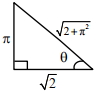
0 likes
View Solution243
EasyMCQ
यदि $\frac{\pi}{2} \leq x \leq \frac{3 \pi}{4}$ है,तो $\cos ^{-1}\left(\frac{12}{13} \cos x+\frac{5}{13} \sin x\right)$ का मान ज्ञात कीजिए।
A
$x-\tan ^{-1} \frac{4}{3}$
B
$x-\tan ^{-1} \frac{5}{12}$
C
$x+\tan ^{-1} \frac{4}{5}$
D
$x+\tan ^{-1} \frac{5}{12}$
Solution
(B) माना $\cos \alpha = \frac{12}{13}$ और $\sin \alpha = \frac{5}{13}$ है। तब $\tan \alpha = \frac{5}{12}$,अर्थात $\alpha = \tan ^{-1} \frac{5}{12}$ है।
दिया गया व्यंजक $\cos ^{-1}(\cos x \cos \alpha + \sin x \sin \alpha)$ है।
सर्वसमिका $\cos(x - \alpha) = \cos x \cos \alpha + \sin x \sin \alpha$ का उपयोग करने पर,व्यंजक $\cos ^{-1}(\cos(x - \alpha))$ हो जाता है।
चूंकि $\frac{\pi}{2} \leq x \leq \frac{3 \pi}{4}$ और $\alpha = \tan ^{-1} \frac{5}{12} \approx 22.6^\circ$ है,इसलिए $x - \alpha \in [\frac{\pi}{2} - \alpha, \frac{3 \pi}{4} - \alpha]$ प्राप्त होता है।
चूंकि $0 \leq x - \alpha \leq \pi$ है,इसलिए व्यंजक का सरलीकरण $x - \alpha$ होता है।
$\alpha$ का मान प्रतिस्थापित करने पर,हमें $x - \tan ^{-1} \frac{5}{12}$ प्राप्त होता है।
दिया गया व्यंजक $\cos ^{-1}(\cos x \cos \alpha + \sin x \sin \alpha)$ है।
सर्वसमिका $\cos(x - \alpha) = \cos x \cos \alpha + \sin x \sin \alpha$ का उपयोग करने पर,व्यंजक $\cos ^{-1}(\cos(x - \alpha))$ हो जाता है।
चूंकि $\frac{\pi}{2} \leq x \leq \frac{3 \pi}{4}$ और $\alpha = \tan ^{-1} \frac{5}{12} \approx 22.6^\circ$ है,इसलिए $x - \alpha \in [\frac{\pi}{2} - \alpha, \frac{3 \pi}{4} - \alpha]$ प्राप्त होता है।
चूंकि $0 \leq x - \alpha \leq \pi$ है,इसलिए व्यंजक का सरलीकरण $x - \alpha$ होता है।
$\alpha$ का मान प्रतिस्थापित करने पर,हमें $x - \tan ^{-1} \frac{5}{12}$ प्राप्त होता है।
0 likes
View Solution244
DifficultMCQ
यदि $\alpha > \beta > \gamma > 0$ है,तो व्यंजक $\cot ^{-1}\left\{\beta+\frac{(1+\beta^2)}{(\alpha-\beta)}\right\}+\cot ^{-1}\left\{\gamma+\frac{(1+\gamma^2)}{(\beta-\gamma)}\right\}+\cot ^{-1}\left\{\alpha+\frac{(1+\alpha^2)}{(\gamma-\alpha)}\right\}$ का मान क्या होगा?
A
$\frac{\pi}{2}-(\alpha+\beta+\gamma)$
B
$3 \pi$
C
$0$
D
$\pi$
Solution
(D) माना दिया गया व्यंजक $S = \cot ^{-1}\left\{\beta+\frac{1+\beta^2}{\alpha-\beta}\right\}+\cot ^{-1}\left\{\gamma+\frac{1+\gamma^2}{\beta-\gamma}\right\}+\cot ^{-1}\left\{\alpha+\frac{1+\alpha^2}{\gamma-\alpha}\right\}$ है।
$\cot^{-1}(x) = \tan^{-1}(1/x)$ का उपयोग करने पर:
$S = \tan^{-1}\left(\frac{\alpha-\beta}{1+\alpha\beta}\right) + \tan^{-1}\left(\frac{\beta-\gamma}{1+\beta\gamma}\right) + \tan^{-1}\left(\frac{\gamma-\alpha}{1+\gamma\alpha}\right)$.
$\tan^{-1}(x) - \tan^{-1}(y) = \tan^{-1}\left(\frac{x-y}{1+xy}\right)$ सूत्र के अनुसार:
$S = (\tan^{-1}\alpha - \tan^{-1}\beta) + (\tan^{-1}\beta - \tan^{-1}\gamma) + (\tan^{-1}\gamma - \tan^{-1}\alpha + \pi) = \pi$.
$\cot^{-1}(x) = \tan^{-1}(1/x)$ का उपयोग करने पर:
$S = \tan^{-1}\left(\frac{\alpha-\beta}{1+\alpha\beta}\right) + \tan^{-1}\left(\frac{\beta-\gamma}{1+\beta\gamma}\right) + \tan^{-1}\left(\frac{\gamma-\alpha}{1+\gamma\alpha}\right)$.
$\tan^{-1}(x) - \tan^{-1}(y) = \tan^{-1}\left(\frac{x-y}{1+xy}\right)$ सूत्र के अनुसार:
$S = (\tan^{-1}\alpha - \tan^{-1}\beta) + (\tan^{-1}\beta - \tan^{-1}\gamma) + (\tan^{-1}\gamma - \tan^{-1}\alpha + \pi) = \pi$.
0 likes
View Solution245
MediumMCQ
$\cos \left(\sin ^{-1} \frac{3}{5}+\sin ^{-1} \frac{5}{13}+\sin ^{-1} \frac{33}{65}\right) = . . . . .$
A
$1$
B
$0$
C
$\frac{33}{65}$
D
$\frac{32}{65}$
Solution
(B) माना $x = \sin^{-1} \frac{3}{5}$,$y = \sin^{-1} \frac{5}{13}$,और $z = \sin^{-1} \frac{33}{65}$ है।
$\tan^{-1}$ रूप में बदलने पर:
$x = \tan^{-1} \frac{3}{4}$,$y = \tan^{-1} \frac{5}{12}$,और $z = \tan^{-1} \frac{33}{56}$ प्राप्त होता है।
अब,$\tan^{-1} \frac{3}{4} + \tan^{-1} \frac{5}{12} = \tan^{-1} \left( \frac{\frac{3}{4} + \frac{5}{12}}{1 - \frac{3}{4} \cdot \frac{5}{12}} \right) = \tan^{-1} \left( \frac{14/12}{33/48} \right) = \tan^{-1} \frac{56}{33}$ होता है।
अतः,व्यंजक $\cos \left( \tan^{-1} \frac{56}{33} + \tan^{-1} \frac{33}{56} \right)$ बन जाता है।
चूंकि $\tan^{-1} \frac{33}{56} = \cot^{-1} \frac{56}{33}$,इसलिए $\cos \left( \tan^{-1} \frac{56}{33} + \cot^{-1} \frac{56}{33} \right)$ प्राप्त होता है।
सर्वसमिका $\tan^{-1} \theta + \cot^{-1} \theta = \frac{\pi}{2}$ का उपयोग करने पर,$\cos \left( \frac{\pi}{2} \right) = 0$ प्राप्त होता है।
$\tan^{-1}$ रूप में बदलने पर:
$x = \tan^{-1} \frac{3}{4}$,$y = \tan^{-1} \frac{5}{12}$,और $z = \tan^{-1} \frac{33}{56}$ प्राप्त होता है।
अब,$\tan^{-1} \frac{3}{4} + \tan^{-1} \frac{5}{12} = \tan^{-1} \left( \frac{\frac{3}{4} + \frac{5}{12}}{1 - \frac{3}{4} \cdot \frac{5}{12}} \right) = \tan^{-1} \left( \frac{14/12}{33/48} \right) = \tan^{-1} \frac{56}{33}$ होता है।
अतः,व्यंजक $\cos \left( \tan^{-1} \frac{56}{33} + \tan^{-1} \frac{33}{56} \right)$ बन जाता है।
चूंकि $\tan^{-1} \frac{33}{56} = \cot^{-1} \frac{56}{33}$,इसलिए $\cos \left( \tan^{-1} \frac{56}{33} + \cot^{-1} \frac{56}{33} \right)$ प्राप्त होता है।
सर्वसमिका $\tan^{-1} \theta + \cot^{-1} \theta = \frac{\pi}{2}$ का उपयोग करने पर,$\cos \left( \frac{\pi}{2} \right) = 0$ प्राप्त होता है।
0 likes
View Solution246
DifficultMCQ
प्रतिलोम त्रिकोणमितीय फलनों के मुख्य मानों को ध्यान में रखते हुए,$\sin ^{-1}\left(\frac{\sqrt{3}}{2} x+\frac{1}{2} \sqrt{1-x^2}\right)$,जहाँ $-\frac{1}{2} < x < \frac{1}{\sqrt{2}}$,किसके बराबर है?
A
$\frac{\pi}{4}+\sin ^{-1} x$
B
$\frac{\pi}{6}+\sin ^{-1} x$
C
$\frac{-5 \pi}{6}-\sin ^{-1} x$
D
$\frac{5 \pi}{6}-\sin ^{-1} x$
Solution
(B) माना $y = \sin ^{-1}\left(\frac{\sqrt{3}}{2} x+\frac{1}{2} \sqrt{1-x^2}\right)$.
दिया है $-\frac{1}{2} < x < \frac{1}{\sqrt{2}}$,माना $x = \sin \theta$. अतः $\theta = \sin ^{-1} x$.
चूँकि $-\frac{1}{2} < \sin \theta < \frac{1}{\sqrt{2}}$,इसलिए $-\frac{\pi}{6} < \theta < \frac{\pi}{4}$ प्राप्त होता है।
$x = \sin \theta$ को व्यंजक में रखने पर:
$y = \sin ^{-1}\left(\frac{\sqrt{3}}{2} \sin \theta + \frac{1}{2} \cos \theta\right)$
$y = \sin ^{-1}\left(\sin \theta \cos \frac{\pi}{6} + \cos \theta \sin \frac{\pi}{6}\right)$
$y = \sin ^{-1}\left(\sin \left(\theta + \frac{\pi}{6}\right)\right)$.
चूँकि $-\frac{\pi}{6} < \theta < \frac{\pi}{4}$,इसलिए $0 < \theta + \frac{\pi}{6} < \frac{5\pi}{12}$ प्राप्त होता है।
$\sin ^{-1}$ का परिसर $[-\frac{\pi}{2}, \frac{\pi}{2}]$ है और $0 < \theta + \frac{\pi}{6} < \frac{5\pi}{12}$ इस परिसर के भीतर है,इसलिए $\sin ^{-1}(\sin(\theta + \frac{\pi}{6})) = \theta + \frac{\pi}{6}$ होगा।
अतः,$y = \sin ^{-1} x + \frac{\pi}{6}$।
दिया है $-\frac{1}{2} < x < \frac{1}{\sqrt{2}}$,माना $x = \sin \theta$. अतः $\theta = \sin ^{-1} x$.
चूँकि $-\frac{1}{2} < \sin \theta < \frac{1}{\sqrt{2}}$,इसलिए $-\frac{\pi}{6} < \theta < \frac{\pi}{4}$ प्राप्त होता है।
$x = \sin \theta$ को व्यंजक में रखने पर:
$y = \sin ^{-1}\left(\frac{\sqrt{3}}{2} \sin \theta + \frac{1}{2} \cos \theta\right)$
$y = \sin ^{-1}\left(\sin \theta \cos \frac{\pi}{6} + \cos \theta \sin \frac{\pi}{6}\right)$
$y = \sin ^{-1}\left(\sin \left(\theta + \frac{\pi}{6}\right)\right)$.
चूँकि $-\frac{\pi}{6} < \theta < \frac{\pi}{4}$,इसलिए $0 < \theta + \frac{\pi}{6} < \frac{5\pi}{12}$ प्राप्त होता है।
$\sin ^{-1}$ का परिसर $[-\frac{\pi}{2}, \frac{\pi}{2}]$ है और $0 < \theta + \frac{\pi}{6} < \frac{5\pi}{12}$ इस परिसर के भीतर है,इसलिए $\sin ^{-1}(\sin(\theta + \frac{\pi}{6})) = \theta + \frac{\pi}{6}$ होगा।
अतः,$y = \sin ^{-1} x + \frac{\pi}{6}$।
0 likes
View Solution247
DifficultMCQ
$\cot ^{-1}\left(\frac{\sqrt{1+\tan ^2(2)}-1}{\tan (2)}\right)-\cot ^{-1}\left(\frac{\sqrt{1+\tan ^2\left(\frac{1}{2}\right)}+1}{\tan \left(\frac{1}{2}\right)}\right)$ का मान ज्ञात कीजिए।
A
$\pi-\frac{5}{4}$
B
$\pi-\frac{3}{2}$
C
$\pi+\frac{3}{2}$
D
$\pi+\frac{5}{2}$
Solution
(A) माना $f(x) = \cot ^{-1}\left(\frac{\sqrt{1+\tan ^2 x}-1}{\tan x}\right)$ है। चूँकि $2$ दूसरे चतुर्थांश में है,$\sec 2 < 0$,इसलिए $\sqrt{1+\tan^2 2} = |\sec 2| = -\sec 2$ होगा। अतः,पहला पद $\cot ^{-1}\left(\frac{-\sec 2 - 1}{\tan 2}\right) = \cot ^{-1}\left(\frac{-(1+\cos 2)}{\sin 2}\right) = \cot ^{-1}\left(-\cot 1\right) = \pi - \cot ^{-1}(\cot 1) = \pi - 1$ है।
दूसरे पद के लिए,चूँकि $1/2$ पहले चतुर्थांश में है,$\sec(1/2) > 0$,इसलिए $\sqrt{1+\tan^2(1/2)} = \sec(1/2)$ होगा। अतः,दूसरा पद $\cot ^{-1}\left(\frac{\sec(1/2) + 1}{\tan(1/2)}\right) = \cot ^{-1}\left(\frac{1+\cos(1/2)}{\sin(1/2)}\right) = \cot ^{-1}\left(\cot(1/4)\right) = 1/4$ है।
दोनों को घटाने पर,हमें $(\pi - 1) - 1/4 = \pi - 5/4$ प्राप्त होता है।
दूसरे पद के लिए,चूँकि $1/2$ पहले चतुर्थांश में है,$\sec(1/2) > 0$,इसलिए $\sqrt{1+\tan^2(1/2)} = \sec(1/2)$ होगा। अतः,दूसरा पद $\cot ^{-1}\left(\frac{\sec(1/2) + 1}{\tan(1/2)}\right) = \cot ^{-1}\left(\frac{1+\cos(1/2)}{\sin(1/2)}\right) = \cot ^{-1}\left(\cot(1/4)\right) = 1/4$ है।
दोनों को घटाने पर,हमें $(\pi - 1) - 1/4 = \pi - 5/4$ प्राप्त होता है।
0 likes
View Solution248
MediumMCQ
यदि $x \in \left(0, \frac{1}{4}\right)$ के लिए,$\tan^{-1}\left(\frac{6x\sqrt{x}}{1-9x^3}\right)$ का अवकलज $\sqrt{x} \cdot g(x)$ है,तो $g(x)$ का मान ज्ञात कीजिए।
A
$\frac{3x\sqrt{x}}{1-9x^3}$
B
$\frac{3x}{1-9x^3}$
C
$\frac{3}{1+9x^3}$
D
$\frac{9}{1+9x^3}$
Solution
(D) माना $y = \tan^{-1}\left(\frac{6x\sqrt{x}}{1-9x^3}\right)$ है।
हम $\tan^{-1}$ के तर्क को इस प्रकार लिख सकते हैं:
$y = \tan^{-1}\left(\frac{2(3x\sqrt{x})}{1-(3x\sqrt{x})^2}\right)$।
सूत्र $2\tan^{-1}(\theta) = \tan^{-1}\left(\frac{2\theta}{1-\theta^2}\right)$ का उपयोग करते हुए,जहाँ $\theta = 3x\sqrt{x} = 3x^{3/2}$,हमें प्राप्त होता है:
$y = 2\tan^{-1}(3x^{3/2})$।
$x$ के सापेक्ष अवकलन करने पर:
$\frac{dy}{dx} = 2 \cdot \frac{1}{1+(3x^{3/2})^2} \cdot \frac{d}{dx}(3x^{3/2})$।
$\frac{dy}{dx} = \frac{2}{1+9x^3} \cdot (3 \cdot \frac{3}{2} x^{1/2})$।
$\frac{dy}{dx} = \frac{2}{1+9x^3} \cdot \frac{9}{2} \sqrt{x} = \frac{9\sqrt{x}}{1+9x^3}$।
दिया गया है कि $\frac{dy}{dx} = \sqrt{x} \cdot g(x)$,इसलिए $\sqrt{x} \cdot g(x) = \frac{9\sqrt{x}}{1+9x^3}$।
अतः,$g(x) = \frac{9}{1+9x^3}$।
हम $\tan^{-1}$ के तर्क को इस प्रकार लिख सकते हैं:
$y = \tan^{-1}\left(\frac{2(3x\sqrt{x})}{1-(3x\sqrt{x})^2}\right)$।
सूत्र $2\tan^{-1}(\theta) = \tan^{-1}\left(\frac{2\theta}{1-\theta^2}\right)$ का उपयोग करते हुए,जहाँ $\theta = 3x\sqrt{x} = 3x^{3/2}$,हमें प्राप्त होता है:
$y = 2\tan^{-1}(3x^{3/2})$।
$x$ के सापेक्ष अवकलन करने पर:
$\frac{dy}{dx} = 2 \cdot \frac{1}{1+(3x^{3/2})^2} \cdot \frac{d}{dx}(3x^{3/2})$।
$\frac{dy}{dx} = \frac{2}{1+9x^3} \cdot (3 \cdot \frac{3}{2} x^{1/2})$।
$\frac{dy}{dx} = \frac{2}{1+9x^3} \cdot \frac{9}{2} \sqrt{x} = \frac{9\sqrt{x}}{1+9x^3}$।
दिया गया है कि $\frac{dy}{dx} = \sqrt{x} \cdot g(x)$,इसलिए $\sqrt{x} \cdot g(x) = \frac{9\sqrt{x}}{1+9x^3}$।
अतः,$g(x) = \frac{9}{1+9x^3}$।
0 likes
View Solution249
DifficultMCQ
यदि $y = \tan^{-1} \sqrt{\frac{1 + \cos x}{1 - \cos x}}$ है,तो $\frac{dy}{dx}$ का मान क्या है?
A
$\frac{3}{2}$
B
$\frac{-1}{2}$
C
$-1$
D
$1$
Solution
(B) दिया गया है $y = \tan^{-1} \sqrt{\frac{1 + \cos x}{1 - \cos x}}$.
त्रिकोणमितीय सर्वसमिकाओं $1 + \cos x = 2 \cos^2 \frac{x}{2}$ और $1 - \cos x = 2 \sin^2 \frac{x}{2}$ का उपयोग करने पर:
$y = \tan^{-1} \sqrt{\frac{2 \cos^2 \frac{x}{2}}{2 \sin^2 \frac{x}{2}}}$
$y = \tan^{-1} \sqrt{\cot^2 \frac{x}{2}}$
$y = \tan^{-1} \left( \cot \frac{x}{2} \right)$
चूंकि $\cot \frac{x}{2} = \tan \left( \frac{\pi}{2} - \frac{x}{2} \right)$,इसलिए:
$y = \tan^{-1} \left( \tan \left( \frac{\pi}{2} - \frac{x}{2} \right) \right)$
$y = \frac{\pi}{2} - \frac{x}{2}$
$x$ के सापेक्ष अवकलन करने पर:
$\frac{dy}{dx} = \frac{d}{dx} \left( \frac{\pi}{2} - \frac{x}{2} \right) = 0 - \frac{1}{2} = -\frac{1}{2}$.
त्रिकोणमितीय सर्वसमिकाओं $1 + \cos x = 2 \cos^2 \frac{x}{2}$ और $1 - \cos x = 2 \sin^2 \frac{x}{2}$ का उपयोग करने पर:
$y = \tan^{-1} \sqrt{\frac{2 \cos^2 \frac{x}{2}}{2 \sin^2 \frac{x}{2}}}$
$y = \tan^{-1} \sqrt{\cot^2 \frac{x}{2}}$
$y = \tan^{-1} \left( \cot \frac{x}{2} \right)$
चूंकि $\cot \frac{x}{2} = \tan \left( \frac{\pi}{2} - \frac{x}{2} \right)$,इसलिए:
$y = \tan^{-1} \left( \tan \left( \frac{\pi}{2} - \frac{x}{2} \right) \right)$
$y = \frac{\pi}{2} - \frac{x}{2}$
$x$ के सापेक्ष अवकलन करने पर:
$\frac{dy}{dx} = \frac{d}{dx} \left( \frac{\pi}{2} - \frac{x}{2} \right) = 0 - \frac{1}{2} = -\frac{1}{2}$.
0 likes
View SolutionInverse Trigonometric Functions — Properties of ITF · Frequently Asked Questions
1Are these Inverse Trigonometric Functions questions useful for JEE and NEET?
Yes. All questions in this section are mapped to JEE Main and NEET exam patterns. Previous year questions from JEE Main, NEET, GUJCET and state-level exams are included with full solutions.
2Can I switch to Hindi or Gujarati for these questions?
Yes. Use the language tabs in the hero section or the sidebar to view the same questions and solutions in English, Hindi or Gujarati.
3How do I generate a question paper from this subtopic?
Use the Vedclass Exam Paper Generator — select the chapter and subtopic, set difficulty, and generate Sets A, B, C, D automatically. First 3 chapters of every subject are free.
Vedclass Products
For Students
Vedclass Test Series
Mock tests in real JEE/NEET style with performance analysis. 5-day free trial.
Start Free TrialFor Teachers
Exam Paper Generator
Generate Set A/B/C/D papers from this chapter in 2 minutes. 3 chapters free.
Try FreeFor Institutes
Online Exam Module
Live online exams with unlimited students, 360° analytics & white-label branding.
See DemoFor Teachers & Institutes
Generate a Inverse Trigonometric Functions Exam Paper in 2 Minutes
Select subtopic & difficulty — Sets A, B, C, D auto-generated with No Repeat logic.
First 3 chapters of every subject are free — no payment required.