
अ Hindi
Mix Examples-ITF Questions in Hindi
Class 12 Mathematics · Inverse Trigonometric Functions · Mix Examples-ITF
178+
Questions
Hindi
Language
100%
With Solutions
Showing 50 of 178 questions in Hindi
1
DifficultMCQ
$\tan^{-1}\left(\frac{5i}{3}\right)$ का काल्पनिक भाग (imaginary part) क्या है?
A
$0$
B
$\infty$
C
$\log 2$
D
$\log 4$
Solution
(C) हम सूत्र $\tan^{-1}(iz) = \frac{i}{2} \log\left(\frac{1+z}{1-z}\right)$ का उपयोग करते हैं।
यहाँ,$z = \frac{5}{3}$ है।
$\tan^{-1}\left(\frac{5i}{3}\right) = \frac{i}{2} \log\left(\frac{1 + 5/3}{1 - 5/3}\right) = \frac{i}{2} \log(-4)$.
मुख्य मान लेने पर,$\log(-4) = \ln 4 + i\pi$ होता है।
अतः,$\tan^{-1}(5i/3) = \frac{i}{2} \ln 4 - \frac{\pi}{2}$.
इस प्रकार,काल्पनिक भाग $\frac{1}{2} \ln 4 = \ln 2$ है।
यहाँ,$z = \frac{5}{3}$ है।
$\tan^{-1}\left(\frac{5i}{3}\right) = \frac{i}{2} \log\left(\frac{1 + 5/3}{1 - 5/3}\right) = \frac{i}{2} \log(-4)$.
मुख्य मान लेने पर,$\log(-4) = \ln 4 + i\pi$ होता है।
अतः,$\tan^{-1}(5i/3) = \frac{i}{2} \ln 4 - \frac{\pi}{2}$.
इस प्रकार,काल्पनिक भाग $\frac{1}{2} \ln 4 = \ln 2$ है।
0 likes
View Solution2
MediumMCQ
यदि $x, y, z$ $A.P.$ में हैं और $\tan^{-1}x, \tan^{-1}y, \tan^{-1}z$ भी $A.P.$ में हैं,तो
A
$x = y = z$
B
$x = y = -z$
C
$x = 1, y = 2, z = 3$
D
$x = 2, y = 4, z = 6$
Solution
(A) दिया गया है कि $x, y, z$ $A.P.$ में हैं,इसलिए $2y = x + z$।
चूंकि $\tan^{-1}x, \tan^{-1}y, \tan^{-1}z$ $A.P.$ में हैं,इसलिए $2\tan^{-1}y = \tan^{-1}x + \tan^{-1}z$।
सूत्र $\tan^{-1}A + \tan^{-1}B = \tan^{-1}\left(\frac{A+B}{1-AB}\right)$ का उपयोग करने पर,$\tan^{-1}\left(\frac{2y}{1-y^2}\right) = \tan^{-1}\left(\frac{x+z}{1-xz}\right)$।
इससे $\frac{2y}{1-y^2} = \frac{x+z}{1-xz}$ प्राप्त होता है।
$x+z = 2y$ प्रतिस्थापित करने पर,$\frac{2y}{1-y^2} = \frac{2y}{1-xz}$।
यह समीकरण तब सत्य है यदि $2y = 0$ या $1-y^2 = 1-xz$।
यदि $2y = 0$,तो $y=0$,जिसका अर्थ है $x+z=0$ या $x=-z$।
यदि $1-y^2 = 1-xz$,तो $y^2 = xz$।
चूंकि $x, y, z$ $A.P.$ में हैं ($y^2 = xz$ का अर्थ $G.P.$ है),इसलिए संख्याओं के $A.P.$ और $G.P.$ दोनों में होने के लिए $x = y = z$ होना आवश्यक है।
चूंकि $\tan^{-1}x, \tan^{-1}y, \tan^{-1}z$ $A.P.$ में हैं,इसलिए $2\tan^{-1}y = \tan^{-1}x + \tan^{-1}z$।
सूत्र $\tan^{-1}A + \tan^{-1}B = \tan^{-1}\left(\frac{A+B}{1-AB}\right)$ का उपयोग करने पर,$\tan^{-1}\left(\frac{2y}{1-y^2}\right) = \tan^{-1}\left(\frac{x+z}{1-xz}\right)$।
इससे $\frac{2y}{1-y^2} = \frac{x+z}{1-xz}$ प्राप्त होता है।
$x+z = 2y$ प्रतिस्थापित करने पर,$\frac{2y}{1-y^2} = \frac{2y}{1-xz}$।
यह समीकरण तब सत्य है यदि $2y = 0$ या $1-y^2 = 1-xz$।
यदि $2y = 0$,तो $y=0$,जिसका अर्थ है $x+z=0$ या $x=-z$।
यदि $1-y^2 = 1-xz$,तो $y^2 = xz$।
चूंकि $x, y, z$ $A.P.$ में हैं ($y^2 = xz$ का अर्थ $G.P.$ है),इसलिए संख्याओं के $A.P.$ और $G.P.$ दोनों में होने के लिए $x = y = z$ होना आवश्यक है।
0 likes
View Solution3
EasyMCQ
यदि $p, q, r$ एक $G.P.$ में हैं और $\tan^{-1} p, \tan^{-1} q, \tan^{-1} r$ एक $A.P.$ में हैं,तो $p, q, r$ किस संबंध को संतुष्ट करते हैं?
A
$p = q = r$
B
$p \neq q \neq r$
C
$p + q = r$
D
इनमें से कोई नहीं
Solution
(A) दिया गया है कि $p, q, r$ एक $G.P.$ में हैं,इसलिए $q^2 = pr$ है।
साथ ही,$\tan^{-1} p, \tan^{-1} q, \tan^{-1} r$ एक $A.P.$ में हैं,जिसका अर्थ है $2 \tan^{-1} q = \tan^{-1} p + \tan^{-1} r$।
सूत्र $\tan^{-1} x + \tan^{-1} y = \tan^{-1} \left( \frac{x+y}{1-xy} \right)$ का उपयोग करने पर,हमें $2 \tan^{-1} q = \tan^{-1} \left( \frac{p+r}{1-pr} \right)$ प्राप्त होता है।
दोनों पक्षों में $\tan$ लेने पर,$\frac{2q}{1-q^2} = \frac{p+r}{1-pr}$।
चूंकि $q^2 = pr$,हर $1-q^2 = 1-pr$ है।
अतः,$2q = p+r$,जिसका अर्थ है कि $p, q, r$ एक $A.P.$ में हैं।
चूंकि $p, q, r$ एक $A.P.$ और $G.P.$ दोनों में हैं,इसलिए उन्हें समान होना चाहिए,अर्थात $p = q = r$।
साथ ही,$\tan^{-1} p, \tan^{-1} q, \tan^{-1} r$ एक $A.P.$ में हैं,जिसका अर्थ है $2 \tan^{-1} q = \tan^{-1} p + \tan^{-1} r$।
सूत्र $\tan^{-1} x + \tan^{-1} y = \tan^{-1} \left( \frac{x+y}{1-xy} \right)$ का उपयोग करने पर,हमें $2 \tan^{-1} q = \tan^{-1} \left( \frac{p+r}{1-pr} \right)$ प्राप्त होता है।
दोनों पक्षों में $\tan$ लेने पर,$\frac{2q}{1-q^2} = \frac{p+r}{1-pr}$।
चूंकि $q^2 = pr$,हर $1-q^2 = 1-pr$ है।
अतः,$2q = p+r$,जिसका अर्थ है कि $p, q, r$ एक $A.P.$ में हैं।
चूंकि $p, q, r$ एक $A.P.$ और $G.P.$ दोनों में हैं,इसलिए उन्हें समान होना चाहिए,अर्थात $p = q = r$।
0 likes
View Solution4
MediumMCQ
यदि $\alpha$ और $\beta$ समीकरण $6x^2 - 5x + 1 = 0$ के मूल हैं,तो $\tan^{-1}\alpha + \tan^{-1}\beta$ का मान ज्ञात कीजिए।
A
$\pi / 4$
B
$1$
C
$0$
D
$\pi / 2$
Solution
(A) दिया गया द्विघात समीकरण $6x^2 - 5x + 1 = 0$ है।
$ax^2 + bx + c = 0$ से तुलना करने पर,$a = 6, b = -5, c = 1$ प्राप्त होता है।
मूलों का योग $\alpha + \beta = -b/a = 5/6$ है।
मूलों का गुणनफल $\alpha \beta = c/a = 1/6$ है।
सूत्र $\tan^{-1}\alpha + \tan^{-1}\beta = \tan^{-1}\left(\frac{\alpha + \beta}{1 - \alpha \beta}\right)$ का उपयोग करने पर,
मान रखने पर: $\tan^{-1}\left(\frac{5/6}{1 - 1/6}\right) = \tan^{-1}\left(\frac{5/6}{5/6}\right) = \tan^{-1}(1)$।
चूंकि $\tan^{-1}(1) = \pi / 4$ है,इसलिए अंतिम मान $\pi / 4$ है।
$ax^2 + bx + c = 0$ से तुलना करने पर,$a = 6, b = -5, c = 1$ प्राप्त होता है।
मूलों का योग $\alpha + \beta = -b/a = 5/6$ है।
मूलों का गुणनफल $\alpha \beta = c/a = 1/6$ है।
सूत्र $\tan^{-1}\alpha + \tan^{-1}\beta = \tan^{-1}\left(\frac{\alpha + \beta}{1 - \alpha \beta}\right)$ का उपयोग करने पर,
मान रखने पर: $\tan^{-1}\left(\frac{5/6}{1 - 1/6}\right) = \tan^{-1}\left(\frac{5/6}{5/6}\right) = \tan^{-1}(1)$।
चूंकि $\tan^{-1}(1) = \pi / 4$ है,इसलिए अंतिम मान $\pi / 4$ है।
0 likes
View Solution5
MediumMCQ
यदि $\tan^{-1}\left(\frac{x-1}{x+1}\right) + \tan^{-1}\left(\frac{2x-1}{2x+1}\right) = \tan^{-1}\left(\frac{23}{36}\right)$ है,तो $x =$
A
$\frac{3}{4}, -\frac{3}{8}$
B
$\frac{3}{4}, \frac{3}{8}$
C
$\frac{4}{3}, \frac{3}{8}$
D
इनमें से कोई नहीं
Solution
(D) सूत्र $\tan^{-1}(A) + \tan^{-1}(B) = \tan^{-1}\left(\frac{A+B}{1-AB}\right)$ का उपयोग करते हुए:
$\tan^{-1}\left(\frac{\frac{x-1}{x+1} + \frac{2x-1}{2x+1}}{1 - \left(\frac{x-1}{x+1}\right)\left(\frac{2x-1}{2x+1}\right)}\right) = \tan^{-1}\left(\frac{23}{36}\right)$
पद का सरलीकरण करने पर:
$\frac{(x-1)(2x+1) + (2x-1)(x+1)}{(x+1)(2x+1) - (x-1)(2x-1)} = \frac{23}{36}$
$\frac{2x^2 + x - 2x - 1 + 2x^2 + 2x - x - 1}{2x^2 + x + 2x + 1 - (2x^2 - x - 2x + 1)} = \frac{23}{36}$
$\frac{4x^2 - 2}{6x} = \frac{23}{36}$
$\frac{2x^2 - 1}{3x} = \frac{23}{36}$
$24x^2 - 12 = 69x$
$24x^2 - 69x - 12 = 0$
$3$ से भाग देने पर: $8x^2 - 23x - 4 = 0$
$(8x + 1)(x - 4) = 0$
अतः,$x = 4$ या $x = -\frac{1}{8}$.
चूंकि कोई भी विकल्प मेल नहीं खाता है,सही उत्तर $(d)$ है।
$\tan^{-1}\left(\frac{\frac{x-1}{x+1} + \frac{2x-1}{2x+1}}{1 - \left(\frac{x-1}{x+1}\right)\left(\frac{2x-1}{2x+1}\right)}\right) = \tan^{-1}\left(\frac{23}{36}\right)$
पद का सरलीकरण करने पर:
$\frac{(x-1)(2x+1) + (2x-1)(x+1)}{(x+1)(2x+1) - (x-1)(2x-1)} = \frac{23}{36}$
$\frac{2x^2 + x - 2x - 1 + 2x^2 + 2x - x - 1}{2x^2 + x + 2x + 1 - (2x^2 - x - 2x + 1)} = \frac{23}{36}$
$\frac{4x^2 - 2}{6x} = \frac{23}{36}$
$\frac{2x^2 - 1}{3x} = \frac{23}{36}$
$24x^2 - 12 = 69x$
$24x^2 - 69x - 12 = 0$
$3$ से भाग देने पर: $8x^2 - 23x - 4 = 0$
$(8x + 1)(x - 4) = 0$
अतः,$x = 4$ या $x = -\frac{1}{8}$.
चूंकि कोई भी विकल्प मेल नहीं खाता है,सही उत्तर $(d)$ है।
0 likes
View Solution6
MediumMCQ
यदि ${\sin ^{ - 1}}a + {\sin ^{ - 1}}b + {\sin ^{ - 1}}c = \pi ,$ है,तो $a\sqrt {1 - {a^2}} + b\sqrt {1 - {b^2}} + c\sqrt {1 - {c^2}}$ का मान ज्ञात कीजिए।
A
$2abc$
B
$abc$
C
$\frac{1}{2}abc$
D
$\frac{1}{3}abc$
Solution
(A) माना ${\sin ^{ - 1}}a = A, {\sin ^{ - 1}}b = B, {\sin ^{ - 1}}c = C$ है।
तब $a = \sin A, b = \sin B, c = \sin C$ और $A + B + C = \pi$ होगा।
हम जानते हैं कि एक त्रिभुज में जहाँ $A + B + C = \pi$ होता है,सर्वसमिका $\sin 2A + \sin 2B + \sin 2C = 4\sin A \sin B \sin C$ सत्य है।
इसे $2\sin A \cos A + 2\sin B \cos B + 2\sin C \cos C = 4\sin A \sin B \sin C$ के रूप में लिखा जा सकता है।
दोनों पक्षों को $2$ से विभाजित करने पर,हमें $\sin A \cos A + \sin B \cos B + \sin C \cos C = 2\sin A \sin B \sin C$ प्राप्त होता है।
चूंकि $\cos A = \sqrt{1 - \sin^2 A} = \sqrt{1 - a^2}$,$\cos B = \sqrt{1 - b^2}$,और $\cos C = \sqrt{1 - c^2}$,इन मानों को प्रतिस्थापित करने पर:
$a\sqrt{1 - a^2} + b\sqrt{1 - b^2} + c\sqrt{1 - c^2} = 2abc$।
तब $a = \sin A, b = \sin B, c = \sin C$ और $A + B + C = \pi$ होगा।
हम जानते हैं कि एक त्रिभुज में जहाँ $A + B + C = \pi$ होता है,सर्वसमिका $\sin 2A + \sin 2B + \sin 2C = 4\sin A \sin B \sin C$ सत्य है।
इसे $2\sin A \cos A + 2\sin B \cos B + 2\sin C \cos C = 4\sin A \sin B \sin C$ के रूप में लिखा जा सकता है।
दोनों पक्षों को $2$ से विभाजित करने पर,हमें $\sin A \cos A + \sin B \cos B + \sin C \cos C = 2\sin A \sin B \sin C$ प्राप्त होता है।
चूंकि $\cos A = \sqrt{1 - \sin^2 A} = \sqrt{1 - a^2}$,$\cos B = \sqrt{1 - b^2}$,और $\cos C = \sqrt{1 - c^2}$,इन मानों को प्रतिस्थापित करने पर:
$a\sqrt{1 - a^2} + b\sqrt{1 - b^2} + c\sqrt{1 - c^2} = 2abc$।
0 likes
View Solution7
MediumMCQ
$\cos^{-1}(\cos 12) - \sin^{-1}(\sin 14)$ का मान ज्ञात कीजिए।
A
$4\pi - 12$
B
$14 - 4\pi$
C
$8\pi - 26$
D
$26 - 8\pi$
Solution
(C) हम जानते हैं कि यदि $x \in [2n\pi, (2n+1)\pi]$ है,तो $\cos^{-1}(\cos x) = x - 2n\pi$ होता है। $x = 12$ के लिए,चूंकि $3\pi \approx 9.42$ और $4\pi \approx 12.56$ है,इसलिए $3\pi < 12 < 4\pi$ है। अतः,$\cos^{-1}(\cos 12) = 4\pi - 12$ है।
हम जानते हैं कि यदि $x \in [2n\pi - \pi/2, 2n\pi + \pi/2]$ है,तो $\sin^{-1}(\sin x) = x - 2n\pi$ होता है। $x = 14$ के लिए,चूंकि $4\pi \approx 12.56$ और $4\pi + \pi/2 \approx 14.13$ है,इसलिए $4\pi - \pi/2 < 14 < 4\pi + \pi/2$ है। अतः,$\sin^{-1}(\sin 14) = 14 - 4\pi$ है।
अतः,$\cos^{-1}(\cos 12) - \sin^{-1}(\sin 14) = (4\pi - 12) - (14 - 4\pi) = 8\pi - 26$।
हम जानते हैं कि यदि $x \in [2n\pi - \pi/2, 2n\pi + \pi/2]$ है,तो $\sin^{-1}(\sin x) = x - 2n\pi$ होता है। $x = 14$ के लिए,चूंकि $4\pi \approx 12.56$ और $4\pi + \pi/2 \approx 14.13$ है,इसलिए $4\pi - \pi/2 < 14 < 4\pi + \pi/2$ है। अतः,$\sin^{-1}(\sin 14) = 14 - 4\pi$ है।
अतः,$\cos^{-1}(\cos 12) - \sin^{-1}(\sin 14) = (4\pi - 12) - (14 - 4\pi) = 8\pi - 26$।
0 likes
View Solution8
MediumMCQ
समीकरण $\cos^{-1} x + \cos^{-1} 2x + \pi = 0$ के लिए,वास्तविक हलों की संख्या है:
A
$1$
B
$2$
C
$0$
D
$\infty$
Solution
(C) दिया गया समीकरण: $\cos^{-1} x + \cos^{-1} 2x + \pi = 0$
$\Rightarrow \cos^{-1} x + \cos^{-1} 2x = -\pi$
चूंकि $\cos^{-1} \theta$ का परिसर $[0, \pi]$ है,इसलिए $\cos^{-1} x + \cos^{-1} 2x$ का न्यूनतम मान $0 + 0 = 0$ है।
हालाँकि,समीकरण के अनुसार योग $-\pi$ होना चाहिए।
दो गैर-ऋणात्मक मानों का योग कभी भी ऋणात्मक नहीं हो सकता है,इसलिए $x$ का कोई भी वास्तविक मान इस समीकरण को संतुष्ट नहीं करता है।
अतः,वास्तविक हलों की संख्या $0$ है।
$\Rightarrow \cos^{-1} x + \cos^{-1} 2x = -\pi$
चूंकि $\cos^{-1} \theta$ का परिसर $[0, \pi]$ है,इसलिए $\cos^{-1} x + \cos^{-1} 2x$ का न्यूनतम मान $0 + 0 = 0$ है।
हालाँकि,समीकरण के अनुसार योग $-\pi$ होना चाहिए।
दो गैर-ऋणात्मक मानों का योग कभी भी ऋणात्मक नहीं हो सकता है,इसलिए $x$ का कोई भी वास्तविक मान इस समीकरण को संतुष्ट नहीं करता है।
अतः,वास्तविक हलों की संख्या $0$ है।
0 likes
View Solution9
MediumMCQ
यदि $\tan (\cos ^{ - 1}x) = \sin (\cot ^{ - 1}\frac{1}{2})$ है,तो $x =$
A
$\pm \frac{5}{3}$
B
$\pm \frac{\sqrt{5}}{3}$
C
$\pm \frac{5}{\sqrt{3}}$
D
इनमें से कोई नहीं
Solution
(B) दिया गया है कि $\tan (\cos ^{ - 1}x) = \sin (\cot ^{ - 1}\frac{1}{2})$.
माना $\cot ^{ - 1}\frac{1}{2} = \phi$,तो $\cot \phi = \frac{1}{2}$.
हम जानते हैं कि $\sin \phi = \frac{1}{\sqrt{1 + \cot ^2 \phi}} = \frac{1}{\sqrt{1 + (1/2)^2}} = \frac{1}{\sqrt{5/4}} = \frac{2}{\sqrt{5}}$.
माना $\cos ^{ - 1}x = \theta$,तो $\cos \theta = x$.
हम जानते हैं कि $\tan \theta = \frac{\sqrt{1 - \cos ^2 \theta}}{\cos \theta} = \frac{\sqrt{1 - x^2}}{x}$.
इन मानों को मूल समीकरण में रखने पर:
$\frac{\sqrt{1 - x^2}}{x} = \frac{2}{\sqrt{5}}$.
दोनों पक्षों का वर्ग करने पर:
$\frac{1 - x^2}{x^2} = \frac{4}{5}$.
$5(1 - x^2) = 4x^2$.
$5 - 5x^2 = 4x^2$.
$9x^2 = 5$.
$x^2 = \frac{5}{9}$.
$x = \pm \frac{\sqrt{5}}{3}$.
माना $\cot ^{ - 1}\frac{1}{2} = \phi$,तो $\cot \phi = \frac{1}{2}$.
हम जानते हैं कि $\sin \phi = \frac{1}{\sqrt{1 + \cot ^2 \phi}} = \frac{1}{\sqrt{1 + (1/2)^2}} = \frac{1}{\sqrt{5/4}} = \frac{2}{\sqrt{5}}$.
माना $\cos ^{ - 1}x = \theta$,तो $\cos \theta = x$.
हम जानते हैं कि $\tan \theta = \frac{\sqrt{1 - \cos ^2 \theta}}{\cos \theta} = \frac{\sqrt{1 - x^2}}{x}$.
इन मानों को मूल समीकरण में रखने पर:
$\frac{\sqrt{1 - x^2}}{x} = \frac{2}{\sqrt{5}}$.
दोनों पक्षों का वर्ग करने पर:
$\frac{1 - x^2}{x^2} = \frac{4}{5}$.
$5(1 - x^2) = 4x^2$.
$5 - 5x^2 = 4x^2$.
$9x^2 = 5$.
$x^2 = \frac{5}{9}$.
$x = \pm \frac{\sqrt{5}}{3}$.
0 likes
View Solution10
DifficultMCQ
$\tan^{-1}\sqrt{x(x + 1)} + \sin^{-1}\sqrt{x^2 + x + 1} = \frac{\pi}{2}$ के वास्तविक हलों की संख्या है
A
$0$
B
$1$
C
$2$
D
अनंत
Solution
(C) दिया गया समीकरण $\tan^{-1}\sqrt{x(x + 1)} + \sin^{-1}\sqrt{x^2 + x + 1} = \frac{\pi}{2}$ है।
$\tan^{-1}\sqrt{x(x + 1)}$ को परिभाषित होने के लिए,हमारे पास $x(x + 1) \ge 0$ होना चाहिए।
$\sin^{-1}\sqrt{x^2 + x + 1}$ को परिभाषित होने के लिए,तर्क को $0 \le \sqrt{x^2 + x + 1} \le 1$ को संतुष्ट करना चाहिए,जिसका अर्थ है $0 \le x^2 + x + 1 \le 1$।
चूंकि $x^2 + x + 1 = (x + \frac{1}{2})^2 + \frac{3}{4}$,$x^2 + x + 1$ का न्यूनतम मान $\frac{3}{4}$ है।
इस प्रकार,शर्त $0 \le x^2 + x + 1 \le 1$ सरल होकर $\frac{3}{4} \le x^2 + x + 1 \le 1$ हो जाती है,जिसका अर्थ है $x^2 + x \le 0$।
$x(x + 1) \ge 0$ और $x(x + 1) \le 0$ को मिलाने पर,हमें $x(x + 1) = 0$ प्राप्त होता है।
इससे $x = 0$ या $x = -1$ प्राप्त होता है।
$x = 0$ की जाँच करने पर: $\tan^{-1}(0) + \sin^{-1}(1) = 0 + \frac{\pi}{2} = \frac{\pi}{2}$। यह एक हल है।
$x = -1$ की जाँच करने पर: $\tan^{-1}(0) + \sin^{-1}(1) = 0 + \frac{\pi}{2} = \frac{\pi}{2}$। यह एक हल है।
अतः,कुल $2$ वास्तविक हल हैं।
$\tan^{-1}\sqrt{x(x + 1)}$ को परिभाषित होने के लिए,हमारे पास $x(x + 1) \ge 0$ होना चाहिए।
$\sin^{-1}\sqrt{x^2 + x + 1}$ को परिभाषित होने के लिए,तर्क को $0 \le \sqrt{x^2 + x + 1} \le 1$ को संतुष्ट करना चाहिए,जिसका अर्थ है $0 \le x^2 + x + 1 \le 1$।
चूंकि $x^2 + x + 1 = (x + \frac{1}{2})^2 + \frac{3}{4}$,$x^2 + x + 1$ का न्यूनतम मान $\frac{3}{4}$ है।
इस प्रकार,शर्त $0 \le x^2 + x + 1 \le 1$ सरल होकर $\frac{3}{4} \le x^2 + x + 1 \le 1$ हो जाती है,जिसका अर्थ है $x^2 + x \le 0$।
$x(x + 1) \ge 0$ और $x(x + 1) \le 0$ को मिलाने पर,हमें $x(x + 1) = 0$ प्राप्त होता है।
इससे $x = 0$ या $x = -1$ प्राप्त होता है।
$x = 0$ की जाँच करने पर: $\tan^{-1}(0) + \sin^{-1}(1) = 0 + \frac{\pi}{2} = \frac{\pi}{2}$। यह एक हल है।
$x = -1$ की जाँच करने पर: $\tan^{-1}(0) + \sin^{-1}(1) = 0 + \frac{\pi}{2} = \frac{\pi}{2}$। यह एक हल है।
अतः,कुल $2$ वास्तविक हल हैं।
0 likes
View Solution11
MediumMCQ
$\mathop {\lim }\limits_{x \to 1} \frac{{1 - \sqrt x }}{{{{({{\cos }^{ - 1}}x)}^2}}} = $
A
$1$
B
$\frac{1}{2}$
C
$\frac{1}{4}$
D
इनमें से कोई नहीं
Solution
(C) माना ${\cos ^{ - 1}}x = y$ है। जब $x \to 1$,तब $y \to 0$ होगा। साथ ही,$x = \cos y$ है।
$\mathop {\lim }\limits_{x \to 1} \frac{{1 - \sqrt x }}{{{{({{\cos }^{ - 1}}x)}^2}}} = \mathop {\lim }\limits_{y \to 0} \frac{{1 - \sqrt {\cos y} }}{{{y^2}}}$
अंश का परिमेयकरण करने पर:
$= \mathop {\lim }\limits_{y \to 0} \frac{{(1 - \sqrt {\cos y} )(1 + \sqrt {\cos y} )}}{{{y^2}(1 + \sqrt {\cos y} )}} = \mathop {\lim }\limits_{y \to 0} \frac{{1 - \cos y}}{{{y^2}(1 + \sqrt {\cos y} )}}$
मानक सीमा $\mathop {\lim }\limits_{y \to 0} \frac{{1 - \cos y}}{{{y^2}}} = \frac{1}{2}$ का उपयोग करने पर:
$= \left( \mathop {\lim }\limits_{y \to 0} \frac{{1 - \cos y}}{{{y^2}}} \right) \times \left( \mathop {\lim }\limits_{y \to 0} \frac{1}{{1 + \sqrt {\cos y} }} \right)$
$= \frac{1}{2} \times \frac{1}{{1 + \sqrt 1 }} = \frac{1}{2} \times \frac{1}{2} = \frac{1}{4}$.
$\mathop {\lim }\limits_{x \to 1} \frac{{1 - \sqrt x }}{{{{({{\cos }^{ - 1}}x)}^2}}} = \mathop {\lim }\limits_{y \to 0} \frac{{1 - \sqrt {\cos y} }}{{{y^2}}}$
अंश का परिमेयकरण करने पर:
$= \mathop {\lim }\limits_{y \to 0} \frac{{(1 - \sqrt {\cos y} )(1 + \sqrt {\cos y} )}}{{{y^2}(1 + \sqrt {\cos y} )}} = \mathop {\lim }\limits_{y \to 0} \frac{{1 - \cos y}}{{{y^2}(1 + \sqrt {\cos y} )}}$
मानक सीमा $\mathop {\lim }\limits_{y \to 0} \frac{{1 - \cos y}}{{{y^2}}} = \frac{1}{2}$ का उपयोग करने पर:
$= \left( \mathop {\lim }\limits_{y \to 0} \frac{{1 - \cos y}}{{{y^2}}} \right) \times \left( \mathop {\lim }\limits_{y \to 0} \frac{1}{{1 + \sqrt {\cos y} }} \right)$
$= \frac{1}{2} \times \frac{1}{{1 + \sqrt 1 }} = \frac{1}{2} \times \frac{1}{2} = \frac{1}{4}$.
0 likes
View Solution12
MediumMCQ
यदि $f(x) = \cot^{-1} \left( \frac{3x - x^3}{1 - 3x^2} \right)$ और $g(x) = \cos^{-1} \left( \frac{1 - x^2}{1 + x^2} \right)$ है,तो $0 < a < \frac{1}{\sqrt{3}}$ के लिए $\lim_{x \to a} \frac{f(x) - f(a)}{g(x) - g(a)}$ का मान ज्ञात कीजिए।
A
$\frac{3}{2(1 + a^2)}$
B
$\frac{3}{2(1 + x^2)}$
C
$\frac{3}{2}$
D
$-\frac{3}{2}$
Solution
(D) दिया गया है $f(x) = \cot^{-1} \left( \frac{3x - x^3}{1 - 3x^2} \right)$ और $g(x) = \cos^{-1} \left( \frac{1 - x^2}{1 + x^2} \right)$।
माना $x = \tan \theta$। $0 < a < \frac{1}{\sqrt{3}}$ के लिए,$0 < \theta < \frac{\pi}{6}$ है।
$f(x) = \cot^{-1}(\tan 3\theta) = \cot^{-1}(\cot(\frac{\pi}{2} - 3\theta)) = \frac{\pi}{2} - 3\theta = \frac{\pi}{2} - 3\tan^{-1}x$।
अतः,$f'(x) = -\frac{3}{1 + x^2}$।
$g(x) = \cos^{-1}(\cos 2\theta) = 2\theta = 2\tan^{-1}x$।
अतः,$g'(x) = \frac{2}{1 + x^2}$।
एल'हॉस्पिटल नियम का उपयोग करने पर:
$\lim_{x \to a} \frac{f(x) - f(a)}{g(x) - g(a)} = \frac{f'(a)}{g'(a)} = \frac{-\frac{3}{1 + a^2}}{\frac{2}{1 + a^2}} = -\frac{3}{2}$।
माना $x = \tan \theta$। $0 < a < \frac{1}{\sqrt{3}}$ के लिए,$0 < \theta < \frac{\pi}{6}$ है।
$f(x) = \cot^{-1}(\tan 3\theta) = \cot^{-1}(\cot(\frac{\pi}{2} - 3\theta)) = \frac{\pi}{2} - 3\theta = \frac{\pi}{2} - 3\tan^{-1}x$।
अतः,$f'(x) = -\frac{3}{1 + x^2}$।
$g(x) = \cos^{-1}(\cos 2\theta) = 2\theta = 2\tan^{-1}x$।
अतः,$g'(x) = \frac{2}{1 + x^2}$।
एल'हॉस्पिटल नियम का उपयोग करने पर:
$\lim_{x \to a} \frac{f(x) - f(a)}{g(x) - g(a)} = \frac{f'(a)}{g'(a)} = \frac{-\frac{3}{1 + a^2}}{\frac{2}{1 + a^2}} = -\frac{3}{2}$।
0 likes
View Solution13
MediumMCQ
$x = 0$ पर $\frac{d}{dx} \tan^{-1} \left[ \frac{3a^2x - x^3}{a(a^2 - 3x^2)} \right]$ का मान ज्ञात कीजिए।
A
$\frac{1}{a}$
B
$\frac{3}{a}$
C
$3a$
D
$3$
Solution
(B) माना $y = \tan^{-1} \left[ \frac{3a^2x - x^3}{a(a^2 - 3x^2)} \right]$.
$x = a \tan \theta$ प्रतिस्थापित करने पर,जिससे $\theta = \tan^{-1}(\frac{x}{a})$.
अतः,$y = \tan^{-1} \left[ \frac{3a^3 \tan \theta - a^3 \tan^3 \theta}{a(a^2 - 3a^2 \tan^2 \theta)} \right] = \tan^{-1} \left[ \frac{a^3(3 \tan \theta - \tan^3 \theta)}{a^3(1 - 3 \tan^2 \theta)} \right]$.
त्रिकोणमितीय सर्वसमिका $\tan(3\theta) = \frac{3 \tan \theta - \tan^3 \theta}{1 - 3 \tan^2 \theta}$ का उपयोग करने पर,$y = \tan^{-1}(\tan 3\theta) = 3\theta$.
चूंकि $\theta = \tan^{-1}(\frac{x}{a})$,इसलिए $y = 3 \tan^{-1}(\frac{x}{a})$.
$x$ के सापेक्ष अवकलन करने पर:
$\frac{dy}{dx} = 3 \cdot \frac{1}{1 + (x/a)^2} \cdot \frac{1}{a} = 3 \cdot \frac{a^2}{a^2 + x^2} \cdot \frac{1}{a} = \frac{3a}{a^2 + x^2}$.
$x = 0$ पर,$\frac{dy}{dx} = \frac{3a}{a^2 + 0} = \frac{3}{a}$.
$x = a \tan \theta$ प्रतिस्थापित करने पर,जिससे $\theta = \tan^{-1}(\frac{x}{a})$.
अतः,$y = \tan^{-1} \left[ \frac{3a^3 \tan \theta - a^3 \tan^3 \theta}{a(a^2 - 3a^2 \tan^2 \theta)} \right] = \tan^{-1} \left[ \frac{a^3(3 \tan \theta - \tan^3 \theta)}{a^3(1 - 3 \tan^2 \theta)} \right]$.
त्रिकोणमितीय सर्वसमिका $\tan(3\theta) = \frac{3 \tan \theta - \tan^3 \theta}{1 - 3 \tan^2 \theta}$ का उपयोग करने पर,$y = \tan^{-1}(\tan 3\theta) = 3\theta$.
चूंकि $\theta = \tan^{-1}(\frac{x}{a})$,इसलिए $y = 3 \tan^{-1}(\frac{x}{a})$.
$x$ के सापेक्ष अवकलन करने पर:
$\frac{dy}{dx} = 3 \cdot \frac{1}{1 + (x/a)^2} \cdot \frac{1}{a} = 3 \cdot \frac{a^2}{a^2 + x^2} \cdot \frac{1}{a} = \frac{3a}{a^2 + x^2}$.
$x = 0$ पर,$\frac{dy}{dx} = \frac{3a}{a^2 + 0} = \frac{3}{a}$.
0 likes
View Solution14
MediumMCQ
यदि $u = \tan^{-1} \left( \frac{\sqrt{1 + x^2} - 1}{x} \right)$ और $v = 2 \tan^{-1} x$ है,तो $\frac{du}{dv}$ का मान ज्ञात कीजिए।
A
$4$
B
$1$
C
$1/4$
D
$-1/4$
Solution
(C) दिया गया है $u = \tan^{-1} \left( \frac{\sqrt{1 + x^2} - 1}{x} \right)$ और $v = 2 \tan^{-1} x$ है।
माना $x = \tan \theta$,इसलिए $\theta = \tan^{-1} x$ है।
$u$ में $x = \tan \theta$ रखने पर:
$u = \tan^{-1} \left( \frac{\sqrt{1 + \tan^2 \theta} - 1}{\tan \theta} \right) = \tan^{-1} \left( \frac{\sec \theta - 1}{\tan \theta} \right)$
$u = \tan^{-1} \left( \frac{1 - \cos \theta}{\sin \theta} \right) = \tan^{-1} \left( \frac{2 \sin^2(\theta/2)}{2 \sin(\theta/2) \cos(\theta/2)} \right)$
$u = \tan^{-1} (\tan(\theta/2)) = \theta/2 = \frac{1}{2} \tan^{-1} x$ है।
अब,$v = 2 \tan^{-1} x$ है।
हमें $\frac{du}{dv} = \frac{du/dx}{dv/dx}$ ज्ञात करना है।
$\frac{du}{dx} = \frac{1}{2} \cdot \frac{1}{1 + x^2}$ है।
$\frac{dv}{dx} = 2 \cdot \frac{1}{1 + x^2}$ है।
अतः,$\frac{du}{dv} = \frac{\frac{1}{2(1 + x^2)}}{\frac{2}{1 + x^2}} = \frac{1}{4}$ है।
माना $x = \tan \theta$,इसलिए $\theta = \tan^{-1} x$ है।
$u$ में $x = \tan \theta$ रखने पर:
$u = \tan^{-1} \left( \frac{\sqrt{1 + \tan^2 \theta} - 1}{\tan \theta} \right) = \tan^{-1} \left( \frac{\sec \theta - 1}{\tan \theta} \right)$
$u = \tan^{-1} \left( \frac{1 - \cos \theta}{\sin \theta} \right) = \tan^{-1} \left( \frac{2 \sin^2(\theta/2)}{2 \sin(\theta/2) \cos(\theta/2)} \right)$
$u = \tan^{-1} (\tan(\theta/2)) = \theta/2 = \frac{1}{2} \tan^{-1} x$ है।
अब,$v = 2 \tan^{-1} x$ है।
हमें $\frac{du}{dv} = \frac{du/dx}{dv/dx}$ ज्ञात करना है।
$\frac{du}{dx} = \frac{1}{2} \cdot \frac{1}{1 + x^2}$ है।
$\frac{dv}{dx} = 2 \cdot \frac{1}{1 + x^2}$ है।
अतः,$\frac{du}{dv} = \frac{\frac{1}{2(1 + x^2)}}{\frac{2}{1 + x^2}} = \frac{1}{4}$ है।
0 likes
View Solution15
EasyMCQ
${\sin ^{ - 1}}\left( {\frac{{2x}}{{1 + {x^2}}}} \right)$ का ${\cos ^{ - 1}}\left( {\frac{{1 - {x^2}}}{{1 + {x^2}}}} \right)$ के सापेक्ष अवकलज क्या है?
A
$-1$
B
$1$
C
$2$
D
$4$
Solution
(B) माना $p = {\sin ^{ - 1}}\left( {\frac{{2x}}{{1 + {x^2}}}} \right)$.
$x = \tan \theta$ प्रतिस्थापन का उपयोग करने पर,हमें $p = {\sin ^{ - 1}}(\sin 2\theta) = 2\theta = 2{\tan ^{ - 1}}x$ प्राप्त होता है।
अब,माना $q = {\cos ^{ - 1}}\left( {\frac{{1 - {x^2}}}{{1 + {x^2}}}} \right)$.
उसी प्रतिस्थापन $x = \tan \theta$ का उपयोग करने पर,हमें $q = {\cos ^{ - 1}}(\cos 2\theta) = 2\theta = 2{\tan ^{ - 1}}x$ प्राप्त होता है।
चूंकि $p = q$ है,इसलिए $p$ का $q$ के सापेक्ष अवकलज $\frac{{dp}}{{dq}} = \frac{d}{{dq}}(q) = 1$ होगा।
$x = \tan \theta$ प्रतिस्थापन का उपयोग करने पर,हमें $p = {\sin ^{ - 1}}(\sin 2\theta) = 2\theta = 2{\tan ^{ - 1}}x$ प्राप्त होता है।
अब,माना $q = {\cos ^{ - 1}}\left( {\frac{{1 - {x^2}}}{{1 + {x^2}}}} \right)$.
उसी प्रतिस्थापन $x = \tan \theta$ का उपयोग करने पर,हमें $q = {\cos ^{ - 1}}(\cos 2\theta) = 2\theta = 2{\tan ^{ - 1}}x$ प्राप्त होता है।
चूंकि $p = q$ है,इसलिए $p$ का $q$ के सापेक्ष अवकलज $\frac{{dp}}{{dq}} = \frac{d}{{dq}}(q) = 1$ होगा।
0 likes
View Solution16
DifficultMCQ
यदि $x, y, z$ समांतर श्रेणी में हैं और $\tan^{-1}x, \tan^{-1}y, \tan^{-1}z$ भी समांतर श्रेणी में हैं,तो:
A
$x = y = z$
B
$2x = 3y = 6z$
C
$6x = 3y = 2z$
D
$6x = 4y = 3z$
Solution
(A) दिया गया है कि $x, y, z$ समांतर श्रेणी में हैं,इसलिए $2y = x + z$ है।
साथ ही,$\tan^{-1}x, \tan^{-1}y, \tan^{-1}z$ भी समांतर श्रेणी में हैं,इसलिए $2\tan^{-1}y = \tan^{-1}x + \tan^{-1}z$ है।
सूत्र $\tan^{-1}A + \tan^{-1}B = \tan^{-1}\left(\frac{A+B}{1-AB}\right)$ का उपयोग करने पर,हमें $\tan^{-1}\left(\frac{2y}{1-y^2}\right) = \tan^{-1}\left(\frac{x+z}{1-xz}\right)$ प्राप्त होता है।
इसका अर्थ है $\frac{2y}{1-y^2} = \frac{x+z}{1-xz}$।
चूंकि $x+z = 2y$,इसलिए $\frac{2y}{1-y^2} = \frac{2y}{1-xz}$।
यह समीकरण तब सत्य है यदि $2y = 0$ या $1-y^2 = 1-xz$ हो।
यदि $2y = 0$,तो $y = 0$,जिसका अर्थ है $x = -z$।
यदि $1-y^2 = 1-xz$,तो $y^2 = xz$।
चूंकि $x, y, z$ समांतर श्रेणी में हैं,$y^2 = xz$ का अर्थ है $x = y = z$।
अतः,$x = y = z$ की स्थिति दी गई आवश्यकताओं को पूरा करती है।
साथ ही,$\tan^{-1}x, \tan^{-1}y, \tan^{-1}z$ भी समांतर श्रेणी में हैं,इसलिए $2\tan^{-1}y = \tan^{-1}x + \tan^{-1}z$ है।
सूत्र $\tan^{-1}A + \tan^{-1}B = \tan^{-1}\left(\frac{A+B}{1-AB}\right)$ का उपयोग करने पर,हमें $\tan^{-1}\left(\frac{2y}{1-y^2}\right) = \tan^{-1}\left(\frac{x+z}{1-xz}\right)$ प्राप्त होता है।
इसका अर्थ है $\frac{2y}{1-y^2} = \frac{x+z}{1-xz}$।
चूंकि $x+z = 2y$,इसलिए $\frac{2y}{1-y^2} = \frac{2y}{1-xz}$।
यह समीकरण तब सत्य है यदि $2y = 0$ या $1-y^2 = 1-xz$ हो।
यदि $2y = 0$,तो $y = 0$,जिसका अर्थ है $x = -z$।
यदि $1-y^2 = 1-xz$,तो $y^2 = xz$।
चूंकि $x, y, z$ समांतर श्रेणी में हैं,$y^2 = xz$ का अर्थ है $x = y = z$।
अतः,$x = y = z$ की स्थिति दी गई आवश्यकताओं को पूरा करती है।
0 likes
View Solution17
MediumMCQ
यदि $x, y, z$ $A.P.$ में हैं और $\tan^{-1} x, \tan^{-1} y, \tan^{-1} z$ भी एक अन्य $A.P.$ में हैं,तो:
A
$x = y = z$
B
$x = y = -z$
C
$x = 1, y = 2, z = 3$
D
$x = 2, y = 4, z = 6$
Solution
(A) दिया गया है कि $x, y, z$ $A.P.$ में हैं,इसलिए $2y = x + z$ ....$(1)$
चूंकि $\tan^{-1} x, \tan^{-1} y, \tan^{-1} z$ $A.P.$ में हैं,इसलिए $2 \tan^{-1} y = \tan^{-1} x + \tan^{-1} z$ होगा।
$\tan^{-1} a + \tan^{-1} b = \tan^{-1} \left( \frac{a+b}{1-ab} \right)$ सूत्र का उपयोग करने पर,हमें $2 \tan^{-1} y = \tan^{-1} \left( \frac{x+z}{1-xz} \right)$ प्राप्त होता है।
दोनों पक्षों में $\tan$ लेने पर,$\frac{2y}{1-y^2} = \frac{x+z}{1-xz}$।
$(1)$ से $x+z = 2y$ प्रतिस्थापित करने पर,हमें $\frac{2y}{1-y^2} = \frac{2y}{1-xz}$ प्राप्त होता है।
इसका अर्थ है कि या तो $2y = 0$ (जो $x=y=z=0$ की ओर ले जाता है) या $\frac{1}{1-y^2} = \frac{1}{1-xz}$,जिसका अर्थ है $y^2 = xz$।
यदि $x, y, z$ $A.P.$ और $G.P.$ दोनों में हैं,तो $x = y = z$।
चूंकि $\tan^{-1} x, \tan^{-1} y, \tan^{-1} z$ $A.P.$ में हैं,इसलिए $2 \tan^{-1} y = \tan^{-1} x + \tan^{-1} z$ होगा।
$\tan^{-1} a + \tan^{-1} b = \tan^{-1} \left( \frac{a+b}{1-ab} \right)$ सूत्र का उपयोग करने पर,हमें $2 \tan^{-1} y = \tan^{-1} \left( \frac{x+z}{1-xz} \right)$ प्राप्त होता है।
दोनों पक्षों में $\tan$ लेने पर,$\frac{2y}{1-y^2} = \frac{x+z}{1-xz}$।
$(1)$ से $x+z = 2y$ प्रतिस्थापित करने पर,हमें $\frac{2y}{1-y^2} = \frac{2y}{1-xz}$ प्राप्त होता है।
इसका अर्थ है कि या तो $2y = 0$ (जो $x=y=z=0$ की ओर ले जाता है) या $\frac{1}{1-y^2} = \frac{1}{1-xz}$,जिसका अर्थ है $y^2 = xz$।
यदि $x, y, z$ $A.P.$ और $G.P.$ दोनों में हैं,तो $x = y = z$।
1 likes
View Solution18
DifficultMCQ
यदि $a, b, c$ धनात्मक वास्तविक संख्याएँ हैं और $\theta = \tan^{-1}\sqrt{\frac{a(a+b+c)}{bc}} + \tan^{-1}\sqrt{\frac{b(a+b+c)}{ca}} + \tan^{-1}\sqrt{\frac{c(a+b+c)}{ab}}$ है,तो $\tan \theta$ का मान ज्ञात कीजिए।
A
$0$
B
$1$
C
$\frac{a+b+c}{abc}$
D
इनमें से कोई नहीं
Solution
(A) माना $s^2 = \frac{a+b+c}{abc}$ है। तब व्यंजक $\theta = \tan^{-1}\sqrt{a^2 s^2} + \tan^{-1}\sqrt{b^2 s^2} + \tan^{-1}\sqrt{c^2 s^2}$ हो जाता है।
चूंकि $a, b, c$ धनात्मक हैं,$\theta = \tan^{-1}(as) + \tan^{-1}(bs) + \tan^{-1}(cs)$।
सूत्र $\tan^{-1} x + \tan^{-1} y + \tan^{-1} z = \tan^{-1}\left(\frac{x+y+z-xyz}{1-(xy+yz+zx)}\right)$ का उपयोग करने पर:
$\tan \theta = \frac{as+bs+cs - (as)(bs)(cs)}{1 - (asbs + bscs + csas)} = \frac{s(a+b+c) - s^3(abc)}{1 - s^2(ab+bc+ca)}$।
$s^2 = \frac{a+b+c}{abc}$ प्रतिस्थापित करने पर,जिसका अर्थ है $s^2(abc) = a+b+c$:
$\tan \theta = \frac{s(a+b+c) - s(s^2 abc)}{1 - s^2(ab+bc+ca)} = \frac{s(a+b+c) - s(a+b+c)}{1 - s^2(ab+bc+ca)} = \frac{0}{1 - s^2(ab+bc+ca)} = 0$।
वैकल्पिक रूप से,$a=b=c=1$ लेने पर,$\theta = \tan^{-1}\sqrt{3} + \tan^{-1}\sqrt{3} + \tan^{-1}\sqrt{3} = 3 \times 60^\circ = 180^\circ = \pi$। अतः,$\tan \theta = \tan \pi = 0$।
चूंकि $a, b, c$ धनात्मक हैं,$\theta = \tan^{-1}(as) + \tan^{-1}(bs) + \tan^{-1}(cs)$।
सूत्र $\tan^{-1} x + \tan^{-1} y + \tan^{-1} z = \tan^{-1}\left(\frac{x+y+z-xyz}{1-(xy+yz+zx)}\right)$ का उपयोग करने पर:
$\tan \theta = \frac{as+bs+cs - (as)(bs)(cs)}{1 - (asbs + bscs + csas)} = \frac{s(a+b+c) - s^3(abc)}{1 - s^2(ab+bc+ca)}$।
$s^2 = \frac{a+b+c}{abc}$ प्रतिस्थापित करने पर,जिसका अर्थ है $s^2(abc) = a+b+c$:
$\tan \theta = \frac{s(a+b+c) - s(s^2 abc)}{1 - s^2(ab+bc+ca)} = \frac{s(a+b+c) - s(a+b+c)}{1 - s^2(ab+bc+ca)} = \frac{0}{1 - s^2(ab+bc+ca)} = 0$।
वैकल्पिक रूप से,$a=b=c=1$ लेने पर,$\theta = \tan^{-1}\sqrt{3} + \tan^{-1}\sqrt{3} + \tan^{-1}\sqrt{3} = 3 \times 60^\circ = 180^\circ = \pi$। अतः,$\tan \theta = \tan \pi = 0$।
0 likes
View Solution19
DifficultMCQ
यदि ${\tan ^{ - 1}}x + {\cos ^{ - 1}}\frac{y}{{\sqrt {1 + {y^2}} }} = {\sin ^{ - 1}}\frac{3}{{\sqrt {10} }}$ और $x$ तथा $y$ दोनों धनात्मक पूर्णांक हैं,तो $(x, y)$ के संभावित मान क्या हैं?
A
$(1, 2)$ और $(2, 7)$
B
$(1, 2)$ और $(1, 7)$
C
$(1, 7)$ और $(2, 7)$
D
$(1, 7)$ और $(2, 1)$
Solution
(A) दिया गया समीकरण: ${\tan ^{ - 1}}x + {\cos ^{ - 1}}\frac{y}{{\sqrt {1 + {y^2}} }} = {\sin ^{ - 1}}\frac{3}{{\sqrt {10} }}$
हम जानते हैं कि ${\cos ^{ - 1}}\frac{y}{{\sqrt {1 + {y^2}} }} = {\tan ^{ - 1}}\frac{1}{y}$ और ${\sin ^{ - 1}}\frac{3}{{\sqrt {10} }} = {\tan ^{ - 1}}3$.
इन मानों को प्रतिस्थापित करने पर: ${\tan ^{ - 1}}x + {\tan ^{ - 1}}\frac{1}{y} = {\tan ^{ - 1}}3$.
सूत्र ${\tan ^{ - 1}}A + {\tan ^{ - 1}}B = {\tan ^{ - 1}}\frac{A+B}{1-AB}$ का उपयोग करने पर: $\frac{x + \frac{1}{y}}{1 - \frac{x}{y}} = 3$.
सरल करने पर: $\frac{xy + 1}{y - x} = 3 \implies xy + 1 = 3y - 3x \implies xy + 3x - 3y + 1 = 0$.
दोनों पक्षों में $8$ जोड़ने पर: $x(y + 3) - 3(y + 3) + 10 = 0 \implies (x - 3)(y + 3) = -10 \implies (3 - x)(y + 3) = 10$.
चूंकि $x, y$ धनात्मक पूर्णांक हैं,$10$ के गुणनखंडों की जाँच करने पर: $(3-x)$ का मान $1$ या $2$ हो सकता है।
यदि $3 - x = 1 \implies x = 2$,तो $y + 3 = 10 \implies y = 7$.
यदि $3 - x = 2 \implies x = 1$,तो $y + 3 = 5 \implies y = 2$.
अतः,संभावित जोड़े $(1, 2)$ और $(2, 7)$ हैं।
हम जानते हैं कि ${\cos ^{ - 1}}\frac{y}{{\sqrt {1 + {y^2}} }} = {\tan ^{ - 1}}\frac{1}{y}$ और ${\sin ^{ - 1}}\frac{3}{{\sqrt {10} }} = {\tan ^{ - 1}}3$.
इन मानों को प्रतिस्थापित करने पर: ${\tan ^{ - 1}}x + {\tan ^{ - 1}}\frac{1}{y} = {\tan ^{ - 1}}3$.
सूत्र ${\tan ^{ - 1}}A + {\tan ^{ - 1}}B = {\tan ^{ - 1}}\frac{A+B}{1-AB}$ का उपयोग करने पर: $\frac{x + \frac{1}{y}}{1 - \frac{x}{y}} = 3$.
सरल करने पर: $\frac{xy + 1}{y - x} = 3 \implies xy + 1 = 3y - 3x \implies xy + 3x - 3y + 1 = 0$.
दोनों पक्षों में $8$ जोड़ने पर: $x(y + 3) - 3(y + 3) + 10 = 0 \implies (x - 3)(y + 3) = -10 \implies (3 - x)(y + 3) = 10$.
चूंकि $x, y$ धनात्मक पूर्णांक हैं,$10$ के गुणनखंडों की जाँच करने पर: $(3-x)$ का मान $1$ या $2$ हो सकता है।
यदि $3 - x = 1 \implies x = 2$,तो $y + 3 = 10 \implies y = 7$.
यदि $3 - x = 2 \implies x = 1$,तो $y + 3 = 5 \implies y = 2$.
अतः,संभावित जोड़े $(1, 2)$ और $(2, 7)$ हैं।
0 likes
View Solution20
DifficultMCQ
यदि $a_1, a_2, a_3, \dots, a_n$ एक $A.P.$ है जिसका सार्व अंतर $d$ है,तो $\tan \left[ \tan^{-1} \left( \frac{d}{1 + a_1 a_2} \right) + \tan^{-1} \left( \frac{d}{1 + a_2 a_3} \right) + \dots + \tan^{-1} \left( \frac{d}{1 + a_{n-1} a_n} \right) \right] = $
A
$\frac{(n - 1)d}{a_1 + a_n}$
B
$\frac{(n - 1)d}{1 + a_1 a_n}$
C
$\frac{nd}{1 + a_1 a_n}$
D
$\frac{a_n - a_1}{a_n + a_1}$
Solution
(B) दिया गया है कि $a_1, a_2, \dots, a_n$ एक $A.P.$ है जिसका सार्व अंतर $d$ है,अतः सभी $k = 1, 2, \dots, n-1$ के लिए $a_{k+1} - a_k = d$ है।
सर्वसमिका $\tan^{-1} x - \tan^{-1} y = \tan^{-1} \left( \frac{x - y}{1 + xy} \right)$ का उपयोग करते हुए,प्रत्येक पद को इस प्रकार लिखा जा सकता है:
$\tan^{-1} \left( \frac{d}{1 + a_k a_{k+1}} \right) = \tan^{-1} \left( \frac{a_{k+1} - a_k}{1 + a_k a_{k+1}} \right) = \tan^{-1} a_{k+1} - \tan^{-1} a_k$.
$k = 1$ से $n-1$ तक इन पदों का योग करने पर एक टेलीस्कोपिंग श्रेणी प्राप्त होती है:
$\sum_{k=1}^{n-1} (\tan^{-1} a_{k+1} - \tan^{-1} a_k) = (\tan^{-1} a_2 - \tan^{-1} a_1) + (\tan^{-1} a_3 - \tan^{-1} a_2) + \dots + (\tan^{-1} a_n - \tan^{-1} a_{n-1})$.
सभी मध्यवर्ती पद कट जाते हैं,जिससे केवल $\tan^{-1} a_n - \tan^{-1} a_1$ शेष रहता है।
अतः,व्यंजक $\tan \left( \tan^{-1} a_n - \tan^{-1} a_1 \right) = \tan \left( \tan^{-1} \left( \frac{a_n - a_1}{1 + a_n a_1} \right) \right) = \frac{a_n - a_1}{1 + a_1 a_n}$ बन जाता है।
चूंकि $a_n = a_1 + (n-1)d$,इसलिए $a_n - a_1 = (n-1)d$.
अतः,परिणाम $\frac{(n - 1)d}{1 + a_1 a_n}$ है।
सर्वसमिका $\tan^{-1} x - \tan^{-1} y = \tan^{-1} \left( \frac{x - y}{1 + xy} \right)$ का उपयोग करते हुए,प्रत्येक पद को इस प्रकार लिखा जा सकता है:
$\tan^{-1} \left( \frac{d}{1 + a_k a_{k+1}} \right) = \tan^{-1} \left( \frac{a_{k+1} - a_k}{1 + a_k a_{k+1}} \right) = \tan^{-1} a_{k+1} - \tan^{-1} a_k$.
$k = 1$ से $n-1$ तक इन पदों का योग करने पर एक टेलीस्कोपिंग श्रेणी प्राप्त होती है:
$\sum_{k=1}^{n-1} (\tan^{-1} a_{k+1} - \tan^{-1} a_k) = (\tan^{-1} a_2 - \tan^{-1} a_1) + (\tan^{-1} a_3 - \tan^{-1} a_2) + \dots + (\tan^{-1} a_n - \tan^{-1} a_{n-1})$.
सभी मध्यवर्ती पद कट जाते हैं,जिससे केवल $\tan^{-1} a_n - \tan^{-1} a_1$ शेष रहता है।
अतः,व्यंजक $\tan \left( \tan^{-1} a_n - \tan^{-1} a_1 \right) = \tan \left( \tan^{-1} \left( \frac{a_n - a_1}{1 + a_n a_1} \right) \right) = \frac{a_n - a_1}{1 + a_1 a_n}$ बन जाता है।
चूंकि $a_n = a_1 + (n-1)d$,इसलिए $a_n - a_1 = (n-1)d$.
अतः,परिणाम $\frac{(n - 1)d}{1 + a_1 a_n}$ है।
0 likes
View Solution21
MediumMCQ
यदि हम प्रतिलोम त्रिकोणमितीय फलनों के केवल मुख्य मानों पर विचार करें,तो $\tan \left( \cos^{-1} \frac{1}{5\sqrt{2}} - \sin^{-1} \frac{4}{\sqrt{17}} \right)$ का मान क्या है?
A
$\sqrt{29/3}$
B
$29/3$
C
$\sqrt{3/29}$
D
$3/29$
Solution
(D) माना $\alpha = \cos^{-1} \frac{1}{5\sqrt{2}}$. तब $\cos \alpha = \frac{1}{5\sqrt{2}}$.
चूँकि $\tan^2 \alpha = \sec^2 \alpha - 1 = (5\sqrt{2})^2 - 1 = 50 - 1 = 49$,इसलिए $\tan \alpha = 7$ है।
अतः,$\alpha = \tan^{-1} 7$.
माना $\beta = \sin^{-1} \frac{4}{\sqrt{17}}$. तब $\sin \beta = \frac{4}{\sqrt{17}}$.
चूँकि $\cos^2 \beta = 1 - \sin^2 \beta = 1 - \frac{16}{17} = \frac{1}{17}$,इसलिए $\cos \beta = \frac{1}{\sqrt{17}}$ है।
तब $\tan \beta = \frac{\sin \beta}{\cos \beta} = \frac{4/\sqrt{17}}{1/\sqrt{17}} = 4$.
अतः,$\beta = \tan^{-1} 4$.
व्यंजक $\tan(\alpha - \beta) = \tan(\tan^{-1} 7 - \tan^{-1} 4)$ बन जाता है।
सूत्र $\tan(A - B) = \frac{\tan A - \tan B}{1 + \tan A \tan B}$ का उपयोग करने पर:
$\tan(\tan^{-1} 7 - \tan^{-1} 4) = \frac{7 - 4}{1 + (7)(4)} = \frac{3}{1 + 28} = \frac{3}{29}$.
चूँकि $\tan^2 \alpha = \sec^2 \alpha - 1 = (5\sqrt{2})^2 - 1 = 50 - 1 = 49$,इसलिए $\tan \alpha = 7$ है।
अतः,$\alpha = \tan^{-1} 7$.
माना $\beta = \sin^{-1} \frac{4}{\sqrt{17}}$. तब $\sin \beta = \frac{4}{\sqrt{17}}$.
चूँकि $\cos^2 \beta = 1 - \sin^2 \beta = 1 - \frac{16}{17} = \frac{1}{17}$,इसलिए $\cos \beta = \frac{1}{\sqrt{17}}$ है।
तब $\tan \beta = \frac{\sin \beta}{\cos \beta} = \frac{4/\sqrt{17}}{1/\sqrt{17}} = 4$.
अतः,$\beta = \tan^{-1} 4$.
व्यंजक $\tan(\alpha - \beta) = \tan(\tan^{-1} 7 - \tan^{-1} 4)$ बन जाता है।
सूत्र $\tan(A - B) = \frac{\tan A - \tan B}{1 + \tan A \tan B}$ का उपयोग करने पर:
$\tan(\tan^{-1} 7 - \tan^{-1} 4) = \frac{7 - 4}{1 + (7)(4)} = \frac{3}{1 + 28} = \frac{3}{29}$.
0 likes
View Solution22
DifficultMCQ
यदि $y = \tan^{-1} \left( \frac{\ln(e/x^2)}{\ln(ex^2)} \right) + \tan^{-1} \left( \frac{3 + 2 \ln x}{1 - 6 \ln x} \right)$ है,तो $\frac{d^2y}{dx^2} =$
A
$2$
B
$1$
C
$0$
D
$-1$
Solution
(C) दिया गया है $y = \tan^{-1} \left( \frac{\ln e - \ln x^2}{\ln e + \ln x^2} \right) + \tan^{-1} \left( \frac{3 + 2 \ln x}{1 - 6 \ln x} \right)$.
चूंकि $\ln e = 1$ और $\ln x^2 = 2 \ln x$,हमारे पास $y = \tan^{-1} \left( \frac{1 - 2 \ln x}{1 + 2 \ln x} \right) + \tan^{-1} \left( \frac{3 + 2 \ln x}{1 - 6 \ln x} \right)$ है।
सूत्र $\tan^{-1} A + \tan^{-1} B = \tan^{-1} \left( \frac{A+B}{1-AB} \right)$ का उपयोग करते हुए,मान लीजिए $A = \frac{1 - 2 \ln x}{1 + 2 \ln x}$ और $B = \frac{3 + 2 \ln x}{1 - 6 \ln x}$ है।
तब $A + B = \frac{(1 - 2 \ln x)(1 - 6 \ln x) + (3 + 2 \ln x)(1 + 2 \ln x)}{(1 + 2 \ln x)(1 - 6 \ln x)} = \frac{4 + 16(\ln x)^2}{(1 + 2 \ln x)(1 - 6 \ln x)}$ है।
और $1 - AB = 1 - \frac{(1 - 2 \ln x)(3 + 2 \ln x)}{(1 + 2 \ln x)(1 - 6 \ln x)} = \frac{-2 - 8(\ln x)^2}{(1 + 2 \ln x)(1 - 6 \ln x)}$ है।
अतः,$\frac{A+B}{1-AB} = \frac{4(1 + 4(\ln x)^2)}{-2(1 + 4(\ln x)^2)} = -2$ है।
इसलिए $y = \tan^{-1}(-2)$,जो एक अचर है।
अतः,$\frac{dy}{dx} = 0$ और $\frac{d^2y}{dx^2} = 0$।
चूंकि $\ln e = 1$ और $\ln x^2 = 2 \ln x$,हमारे पास $y = \tan^{-1} \left( \frac{1 - 2 \ln x}{1 + 2 \ln x} \right) + \tan^{-1} \left( \frac{3 + 2 \ln x}{1 - 6 \ln x} \right)$ है।
सूत्र $\tan^{-1} A + \tan^{-1} B = \tan^{-1} \left( \frac{A+B}{1-AB} \right)$ का उपयोग करते हुए,मान लीजिए $A = \frac{1 - 2 \ln x}{1 + 2 \ln x}$ और $B = \frac{3 + 2 \ln x}{1 - 6 \ln x}$ है।
तब $A + B = \frac{(1 - 2 \ln x)(1 - 6 \ln x) + (3 + 2 \ln x)(1 + 2 \ln x)}{(1 + 2 \ln x)(1 - 6 \ln x)} = \frac{4 + 16(\ln x)^2}{(1 + 2 \ln x)(1 - 6 \ln x)}$ है।
और $1 - AB = 1 - \frac{(1 - 2 \ln x)(3 + 2 \ln x)}{(1 + 2 \ln x)(1 - 6 \ln x)} = \frac{-2 - 8(\ln x)^2}{(1 + 2 \ln x)(1 - 6 \ln x)}$ है।
अतः,$\frac{A+B}{1-AB} = \frac{4(1 + 4(\ln x)^2)}{-2(1 + 4(\ln x)^2)} = -2$ है।
इसलिए $y = \tan^{-1}(-2)$,जो एक अचर है।
अतः,$\frac{dy}{dx} = 0$ और $\frac{d^2y}{dx^2} = 0$।
0 likes
View Solution23
AdvancedMCQ
फलन $f(x) = \cos^{-1} \left\{ \frac{1}{\sqrt{13}} (2\cos x - 3\sin x) \right\} + \sin^{-1} \left\{ \frac{1}{\sqrt{13}} (2\cos x + 3\sin x) \right\}$ का $x = \frac{3}{4}$ पर $x$ के सापेक्ष अवकलज ज्ञात कीजिए।
A
$0$
B
$1$
C
$2$
D
$3$
Solution
(A) माना $\cos \alpha = \frac{2}{\sqrt{13}}$ और $\sin \alpha = \frac{3}{\sqrt{13}}$ है। तब $\tan \alpha = \frac{3}{2}$ होगा।
व्यंजक इस प्रकार हो जाता है:
$f(x) = \cos^{-1} (\cos \alpha \cos x - \sin \alpha \sin x) + \sin^{-1} (\cos \alpha \cos x + \sin \alpha \sin x)$
त्रिकोणमितीय सर्वसमिकाओं $\cos(A+B) = \cos A \cos B - \sin A \sin B$ और $\cos(A-B) = \cos A \cos B + \sin A \sin B$ का उपयोग करने पर:
$f(x) = \cos^{-1} (\cos(x + \alpha)) + \sin^{-1} (\cos(x - \alpha))$
चूंकि $\sin^{-1}(\cos \theta) = \frac{\pi}{2} - \cos^{-1}(\cos \theta) = \frac{\pi}{2} - \theta$ (उचित परिसर के लिए):
$f(x) = (x + \alpha) + \left( \frac{\pi}{2} - (x - \alpha) \right)$
$f(x) = x + \alpha + \frac{\pi}{2} - x + \alpha = \frac{\pi}{2} + 2\alpha$
चूंकि $\alpha$ एक स्थिरांक है,इसलिए अवकलज $f'(x) = \frac{d}{dx} (\frac{\pi}{2} + 2\alpha) = 0$ होगा।
अतः,$x = \frac{3}{4}$ पर अवकलज $0$ है।
व्यंजक इस प्रकार हो जाता है:
$f(x) = \cos^{-1} (\cos \alpha \cos x - \sin \alpha \sin x) + \sin^{-1} (\cos \alpha \cos x + \sin \alpha \sin x)$
त्रिकोणमितीय सर्वसमिकाओं $\cos(A+B) = \cos A \cos B - \sin A \sin B$ और $\cos(A-B) = \cos A \cos B + \sin A \sin B$ का उपयोग करने पर:
$f(x) = \cos^{-1} (\cos(x + \alpha)) + \sin^{-1} (\cos(x - \alpha))$
चूंकि $\sin^{-1}(\cos \theta) = \frac{\pi}{2} - \cos^{-1}(\cos \theta) = \frac{\pi}{2} - \theta$ (उचित परिसर के लिए):
$f(x) = (x + \alpha) + \left( \frac{\pi}{2} - (x - \alpha) \right)$
$f(x) = x + \alpha + \frac{\pi}{2} - x + \alpha = \frac{\pi}{2} + 2\alpha$
चूंकि $\alpha$ एक स्थिरांक है,इसलिए अवकलज $f'(x) = \frac{d}{dx} (\frac{\pi}{2} + 2\alpha) = 0$ होगा।
अतः,$x = \frac{3}{4}$ पर अवकलज $0$ है।
0 likes
View Solution24
AdvancedMCQ
यदि $f(x) = 2 \sin^{-1} \sqrt{1-x} + \sin^{-1} (2 \sqrt{x(1-x)})$ जहाँ $x \in (0, 1/2)$ है,तो $f'(x)$ का मान किसके बराबर है?
A
$\frac{2}{\sqrt{x(1-x)}}$
B
$0$
C
$-\frac{2}{\sqrt{x(1-x)}}$
D
$\pi$
Solution
(B) माना $x = \sin^2 \theta$. चूँकि $x \in (0, 1/2)$,इसलिए $\theta \in (0, \pi/4)$ है।
अतः $\sqrt{1-x} = \sqrt{1-\sin^2 \theta} = \cos \theta$.
साथ ही,$\sqrt{x(1-x)} = \sqrt{\sin^2 \theta \cos^2 \theta} = \sin \theta \cos \theta = \frac{1}{2} \sin 2\theta$.
इन मानों को $f(x)$ में प्रतिस्थापित करने पर:
$f(x) = 2 \sin^{-1}(\cos \theta) + \sin^{-1}(2 \cdot \frac{1}{2} \sin 2\theta)$
$f(x) = 2 \sin^{-1}(\sin(\pi/2 - \theta)) + \sin^{-1}(\sin 2\theta)$
चूँकि $\theta \in (0, \pi/4)$,इसलिए $(\pi/2 - \theta) \in (\pi/4, \pi/2)$ और $2\theta \in (0, \pi/2)$ है।
इस प्रकार,$f(x) = 2(\pi/2 - \theta) + 2\theta = \pi - 2\theta + 2\theta = \pi$.
चूँकि $f(x) = \pi$ एक अचर फलन है,इसलिए इसका अवकलज $f'(x) = 0$ होगा।
अतः $\sqrt{1-x} = \sqrt{1-\sin^2 \theta} = \cos \theta$.
साथ ही,$\sqrt{x(1-x)} = \sqrt{\sin^2 \theta \cos^2 \theta} = \sin \theta \cos \theta = \frac{1}{2} \sin 2\theta$.
इन मानों को $f(x)$ में प्रतिस्थापित करने पर:
$f(x) = 2 \sin^{-1}(\cos \theta) + \sin^{-1}(2 \cdot \frac{1}{2} \sin 2\theta)$
$f(x) = 2 \sin^{-1}(\sin(\pi/2 - \theta)) + \sin^{-1}(\sin 2\theta)$
चूँकि $\theta \in (0, \pi/4)$,इसलिए $(\pi/2 - \theta) \in (\pi/4, \pi/2)$ और $2\theta \in (0, \pi/2)$ है।
इस प्रकार,$f(x) = 2(\pi/2 - \theta) + 2\theta = \pi - 2\theta + 2\theta = \pi$.
चूँकि $f(x) = \pi$ एक अचर फलन है,इसलिए इसका अवकलज $f'(x) = 0$ होगा।
0 likes
View Solution25
AdvancedMCQ
$\lim_{x \to 1/\sqrt{2}} \frac{x - \cos(\sin^{-1} x)}{1 - \tan(\sin^{-1} x)}$ का मान ज्ञात कीजिए।
A
$\frac{1}{\sqrt{2}}$
B
$-\frac{1}{\sqrt{2}}$
C
$\sqrt{2}$
D
$-\sqrt{2}$
Solution
(B) माना $\sin^{-1} x = \theta$ है। जैसे $x \to 1/\sqrt{2}$,$\theta \to \pi/4$ होगा।
व्यंजक में $x = \sin \theta$ प्रतिस्थापित करने पर:
$\lim_{\theta \to \pi/4} \frac{\sin \theta - \cos \theta}{1 - \tan \theta}$
$= \lim_{\theta \to \pi/4} \frac{\sin \theta - \cos \theta}{1 - \frac{\sin \theta}{\cos \theta}}$
$= \lim_{\theta \to \pi/4} \frac{\cos \theta (\sin \theta - \cos \theta)}{\cos \theta - \sin \theta}$
$= \lim_{\theta \to \pi/4} -\cos \theta$
$= -\cos(\pi/4) = -\frac{1}{\sqrt{2}}$
व्यंजक में $x = \sin \theta$ प्रतिस्थापित करने पर:
$\lim_{\theta \to \pi/4} \frac{\sin \theta - \cos \theta}{1 - \tan \theta}$
$= \lim_{\theta \to \pi/4} \frac{\sin \theta - \cos \theta}{1 - \frac{\sin \theta}{\cos \theta}}$
$= \lim_{\theta \to \pi/4} \frac{\cos \theta (\sin \theta - \cos \theta)}{\cos \theta - \sin \theta}$
$= \lim_{\theta \to \pi/4} -\cos \theta$
$= -\cos(\pi/4) = -\frac{1}{\sqrt{2}}$
0 likes
View Solution26
AdvancedMCQ
$\mathop {Limit}\limits_{x \to \infty } \,\frac{{{{\cot }^{ - 1}}\left( {\sqrt {x + 1} \, - \,\sqrt x } \right)}}{{{{\sec }^{ - 1}}\left\{ {{{\left( {\frac{{2x + 1}}{{x - 1}}} \right)}^x}} \right\}}}$ का मान ज्ञात कीजिए।
A
$1$
B
$0$
C
$\pi /2$
D
अस्तित्वहीन
Solution
(A) सबसे पहले,अंश का मूल्यांकन करें: $\mathop {Limit}\limits_{x \to \infty } (\sqrt {x + 1} - \sqrt x) = 0$.
अतः,$\cot^{-1}(0) = \pi / 2$.
इसके बाद,हर का मूल्यांकन करें: $\mathop {Limit}\limits_{x \to \infty } (\frac{2x+1}{x-1})^x = \infty$.
अतः,$\sec^{-1}(\infty) = \pi / 2$.
इसलिए,सीमा का मान $\frac{\pi / 2}{\pi / 2} = 1$ है।
अतः,$\cot^{-1}(0) = \pi / 2$.
इसके बाद,हर का मूल्यांकन करें: $\mathop {Limit}\limits_{x \to \infty } (\frac{2x+1}{x-1})^x = \infty$.
अतः,$\sec^{-1}(\infty) = \pi / 2$.
इसलिए,सीमा का मान $\frac{\pi / 2}{\pi / 2} = 1$ है।
0 likes
View Solution27
AdvancedMCQ
फलन के उन युग्मों की पहचान करें जो समान हैं।
A
$y = \tan(\cos^{-1} x) ; y = \frac{\sqrt{1 - x^2}}{x}$
B
$y = \tan(\cot^{-1} x) ; y = \frac{1}{x}$
C
$y = \sin(\tan^{-1} x) ; y = \frac{x}{\sqrt{1 + x^2}}$
D
उपरोक्त सभी
Solution
(D) दो फलन समान होते हैं यदि उनका प्रांत (domain) और उनका मान समान हो।
$(A)$ $y = \tan(\cos^{-1} x)$ के लिए,$\cos^{-1} x$ का प्रांत $[-1, 1]$ है। चूंकि $\tan(\theta)$,$\theta = \frac{\pi}{2}$ पर अपरिभाषित है,इसलिए $\cos^{-1} x \neq \frac{\pi}{2}$ होना चाहिए,जिसका अर्थ है $x \neq 0$। अतः,प्रांत $[-1, 0) \cup (0, 1]$ है। व्यंजक $\frac{\sqrt{1-x^2}}{x}$ में सरल हो जाता है। दोनों फलन समान प्रांत और व्यंजक रखते हैं।
$(B)$ $y = \tan(\cot^{-1} x)$ के लिए,$\cot^{-1} x$ सभी $x \in \mathbb{R}$ के लिए परिभाषित है और $\cot^{-1} x \in (0, \pi)$,इसलिए $\tan(\cot^{-1} x)$ सभी $x \in \mathbb{R}$ के लिए परिभाषित है सिवाय $x = 0$ के। अतः,प्रांत $\mathbb{R} \setminus \{0\}$ है। व्यंजक $\frac{1}{x}$ में सरल हो जाता है। दोनों फलन समान हैं।
$(C)$ $y = \sin(\tan^{-1} x)$ के लिए,$\tan^{-1} x$ का प्रांत $\mathbb{R}$ है। चूंकि $\tan^{-1} x \in (-\frac{\pi}{2}, \frac{\pi}{2})$,$\sin(\tan^{-1} x)$ सभी $x \in \mathbb{R}$ के लिए परिभाषित है। व्यंजक $\frac{x}{\sqrt{1+x^2}}$ में सरल हो जाता है। दोनों फलन समान हैं।
अतः,$(A)$,$(B)$,और $(C)$ तीनों समान फलनों के युग्म हैं,इसलिए सही विकल्प $(D)$ है।
$(A)$ $y = \tan(\cos^{-1} x)$ के लिए,$\cos^{-1} x$ का प्रांत $[-1, 1]$ है। चूंकि $\tan(\theta)$,$\theta = \frac{\pi}{2}$ पर अपरिभाषित है,इसलिए $\cos^{-1} x \neq \frac{\pi}{2}$ होना चाहिए,जिसका अर्थ है $x \neq 0$। अतः,प्रांत $[-1, 0) \cup (0, 1]$ है। व्यंजक $\frac{\sqrt{1-x^2}}{x}$ में सरल हो जाता है। दोनों फलन समान प्रांत और व्यंजक रखते हैं।
$(B)$ $y = \tan(\cot^{-1} x)$ के लिए,$\cot^{-1} x$ सभी $x \in \mathbb{R}$ के लिए परिभाषित है और $\cot^{-1} x \in (0, \pi)$,इसलिए $\tan(\cot^{-1} x)$ सभी $x \in \mathbb{R}$ के लिए परिभाषित है सिवाय $x = 0$ के। अतः,प्रांत $\mathbb{R} \setminus \{0\}$ है। व्यंजक $\frac{1}{x}$ में सरल हो जाता है। दोनों फलन समान हैं।
$(C)$ $y = \sin(\tan^{-1} x)$ के लिए,$\tan^{-1} x$ का प्रांत $\mathbb{R}$ है। चूंकि $\tan^{-1} x \in (-\frac{\pi}{2}, \frac{\pi}{2})$,$\sin(\tan^{-1} x)$ सभी $x \in \mathbb{R}$ के लिए परिभाषित है। व्यंजक $\frac{x}{\sqrt{1+x^2}}$ में सरल हो जाता है। दोनों फलन समान हैं।
अतः,$(A)$,$(B)$,और $(C)$ तीनों समान फलनों के युग्म हैं,इसलिए सही विकल्प $(D)$ है।
0 likes
View Solution28
AdvancedMCQ
फलन(नों) का कौन सा युग्म समान है? (जहाँ ${x}$ और $[x]$ क्रमशः भिन्नात्मक भाग और पूर्णांक भाग फलन को दर्शाते हैं।)
A
$f(x) = \cos(2\tan^{-1} x); g(x) = \frac{1 - x^2}{1 + x^2}$
B
$f(x) = \frac{2x}{1 + x^2}; g(x) = \sin(2\cot^{-1} x)$
C
$f(x) = e^{\ln(\operatorname{sgn}(\cot^{-1} x))}; g(x) = e^{\ln[1 + \{x\}]}$
D
उपरोक्त सभी
Solution
(D) दो फलनों $f(x)$ और $g(x)$ के समान होने के लिए,उनका प्रांत समान होना चाहिए और प्रांत के प्रत्येक $x$ के लिए $f(x) = g(x)$ होना चाहिए।
विकल्प $A$ की जाँच करें: मान लीजिए $x = \tan \theta$। तो $f(x) = \cos(2\theta) = \frac{1 - \tan^2 \theta}{1 + \tan^2 \theta} = \frac{1 - x^2}{1 + x^2} = g(x)$। दोनों सभी $x \in \mathbb{R}$ के लिए परिभाषित हैं। अतः,$A$ समान है।
विकल्प $B$ की जाँच करें: मान लीजिए $x = \cot \theta$। तो $g(x) = \sin(2\theta) = \frac{2\cot \theta}{1 + \cot^2 \theta} = \frac{2x}{1 + x^2} = f(x)$। दोनों सभी $x \in \mathbb{R}$ के लिए परिभाषित हैं। अतः,$B$ समान है।
विकल्प $C$ की जाँच करें: $f(x)$ के लिए,सभी $x \in \mathbb{R}$ के लिए $\cot^{-1} x > 0$,इसलिए $\operatorname{sgn}(\cot^{-1} x) = 1$। अतः $f(x) = e^{\ln(1)} = 1$। $g(x)$ के लिए,$[1 + \{x\}] = 1$ क्योंकि $0 \le \{x\} < 1$,इसलिए $1 \le 1 + \{x\} < 2$। अतः $g(x) = e^{\ln(1)} = 1$। दोनों सभी $x \in \mathbb{R}$ के लिए परिभाषित हैं। अतः,$C$ समान है।
चूंकि सभी युग्म समान हैं,सही विकल्प $D$ है।
विकल्प $A$ की जाँच करें: मान लीजिए $x = \tan \theta$। तो $f(x) = \cos(2\theta) = \frac{1 - \tan^2 \theta}{1 + \tan^2 \theta} = \frac{1 - x^2}{1 + x^2} = g(x)$। दोनों सभी $x \in \mathbb{R}$ के लिए परिभाषित हैं। अतः,$A$ समान है।
विकल्प $B$ की जाँच करें: मान लीजिए $x = \cot \theta$। तो $g(x) = \sin(2\theta) = \frac{2\cot \theta}{1 + \cot^2 \theta} = \frac{2x}{1 + x^2} = f(x)$। दोनों सभी $x \in \mathbb{R}$ के लिए परिभाषित हैं। अतः,$B$ समान है।
विकल्प $C$ की जाँच करें: $f(x)$ के लिए,सभी $x \in \mathbb{R}$ के लिए $\cot^{-1} x > 0$,इसलिए $\operatorname{sgn}(\cot^{-1} x) = 1$। अतः $f(x) = e^{\ln(1)} = 1$। $g(x)$ के लिए,$[1 + \{x\}] = 1$ क्योंकि $0 \le \{x\} < 1$,इसलिए $1 \le 1 + \{x\} < 2$। अतः $g(x) = e^{\ln(1)} = 1$। दोनों सभी $x \in \mathbb{R}$ के लिए परिभाषित हैं। अतः,$C$ समान है।
चूंकि सभी युग्म समान हैं,सही विकल्प $D$ है।
0 likes
View Solution29
AdvancedMCQ
यदि समीकरण $\sin^{-1} \sqrt{x} + \cos^{-1} \sqrt{x^2 - 1} + \tan^{-1} (\tan y) = a$ का कम से कम एक हल है,तो $a$ के पूर्णांक मानों की संख्या क्या है?
A
$1$
B
$2$
C
$3$
D
$4$
Solution
(C) $\sin^{-1} \sqrt{x}$ को परिभाषित होने के लिए,हमारे पास $0 \leq \sqrt{x} \leq 1$ होना चाहिए,जिसका अर्थ है $x \in [0, 1]$।
$\cos^{-1} \sqrt{x^2 - 1}$ को परिभाषित होने के लिए,हमारे पास $0 \leq \sqrt{x^2 - 1} \leq 1$ होना चाहिए,जिसका अर्थ है $0 \leq x^2 - 1 \leq 1$,इसलिए $1 \leq x^2 \leq 2$। चूँकि $x \geq 0$,हमें $x \in [1, \sqrt{2}]$ प्राप्त होता है।
इन दोनों को मिलाने पर,$x$ के लिए एकमात्र संभावित मान $x = 1$ है।
समीकरण में $x = 1$ रखने पर,हमें $\sin^{-1}(1) + \cos^{-1}(0) + \tan^{-1}(\tan y) = a$ प्राप्त होता है।
यह सरल होकर $\frac{\pi}{2} + \frac{\pi}{2} + y = a$ हो जाता है,जहाँ $y$ कोई भी वास्तविक संख्या है जिसके लिए $\tan y$ परिभाषित है।
अतः,$a = \pi + y$। चूँकि $\tan^{-1}(\tan y)$ एक आवर्ती फलन है जिसका परिसर $(-\frac{\pi}{2}, \frac{\pi}{2})$ है,इसलिए $a \in (\pi - \frac{\pi}{2}, \pi + \frac{\pi}{2})$,अर्थात $a \in (\frac{\pi}{2}, \frac{3\pi}{2})$।
$\pi \approx 3.14$ का उपयोग करने पर,अंतराल $(\frac{3.14}{2}, \frac{3 \times 3.14}{2}) \approx (1.57, 4.71)$ प्राप्त होता है।
इस अंतराल में $a$ के पूर्णांक मान $2, 3, 4$ हैं।
इसलिए,कुल $3$ पूर्णांक मान हैं।
$\cos^{-1} \sqrt{x^2 - 1}$ को परिभाषित होने के लिए,हमारे पास $0 \leq \sqrt{x^2 - 1} \leq 1$ होना चाहिए,जिसका अर्थ है $0 \leq x^2 - 1 \leq 1$,इसलिए $1 \leq x^2 \leq 2$। चूँकि $x \geq 0$,हमें $x \in [1, \sqrt{2}]$ प्राप्त होता है।
इन दोनों को मिलाने पर,$x$ के लिए एकमात्र संभावित मान $x = 1$ है।
समीकरण में $x = 1$ रखने पर,हमें $\sin^{-1}(1) + \cos^{-1}(0) + \tan^{-1}(\tan y) = a$ प्राप्त होता है।
यह सरल होकर $\frac{\pi}{2} + \frac{\pi}{2} + y = a$ हो जाता है,जहाँ $y$ कोई भी वास्तविक संख्या है जिसके लिए $\tan y$ परिभाषित है।
अतः,$a = \pi + y$। चूँकि $\tan^{-1}(\tan y)$ एक आवर्ती फलन है जिसका परिसर $(-\frac{\pi}{2}, \frac{\pi}{2})$ है,इसलिए $a \in (\pi - \frac{\pi}{2}, \pi + \frac{\pi}{2})$,अर्थात $a \in (\frac{\pi}{2}, \frac{3\pi}{2})$।
$\pi \approx 3.14$ का उपयोग करने पर,अंतराल $(\frac{3.14}{2}, \frac{3 \times 3.14}{2}) \approx (1.57, 4.71)$ प्राप्त होता है।
इस अंतराल में $a$ के पूर्णांक मान $2, 3, 4$ हैं।
इसलिए,कुल $3$ पूर्णांक मान हैं।
0 likes
View Solution30
AdvancedMCQ
यदि समीकरण $\sin^{-1} \sqrt{1-x^2} = \tan^{-1} \sqrt{\frac{2}{x}-1}$ को संतुष्ट करने वाला $x$ का मान $\frac{a}{b}$ है (जहाँ $a$ और $b$ सह-अभाज्य हैं),तो $a^2 + b^2$ का मान क्या है?
A
$7$
B
$5$
C
$3$
D
$1$
Solution
(B) माना $\sin^{-1} \sqrt{1-x^2} = \theta$. तब $\sin \theta = \sqrt{1-x^2}$.
इसका अर्थ है $\cos \theta = \sqrt{1 - (1-x^2)} = \sqrt{x^2} = |x|$. चूँकि $\sqrt{\frac{2}{x}-1}$ के प्रांत के लिए $x > 0$ होना आवश्यक है,इसलिए $\cos \theta = x$.
अतः,$\tan \theta = \frac{\sin \theta}{\cos \theta} = \frac{\sqrt{1-x^2}}{x} = \sqrt{\frac{1-x^2}{x^2}} = \sqrt{\frac{1}{x^2}-1}$.
दिया गया है कि $\tan \theta = \sqrt{\frac{2}{x}-1}$,अतः दोनों व्यंजकों की तुलना करने पर:
$\sqrt{\frac{1}{x^2}-1} = \sqrt{\frac{2}{x}-1}$.
दोनों पक्षों का वर्ग करने पर: $\frac{1}{x^2} - 1 = \frac{2}{x} - 1$.
$\frac{1}{x^2} = \frac{2}{x} \implies x^2 = \frac{x}{2} \implies x(x - \frac{1}{2}) = 0$.
चूँकि $x > 0$,इसलिए $x = \frac{1}{2}$ प्राप्त होता है।
यहाँ,$a = 1$ और $b = 2$ हैं,जो सह-अभाज्य हैं।
अतः,$a^2 + b^2 = 1^2 + 2^2 = 1 + 4 = 5$.
इसका अर्थ है $\cos \theta = \sqrt{1 - (1-x^2)} = \sqrt{x^2} = |x|$. चूँकि $\sqrt{\frac{2}{x}-1}$ के प्रांत के लिए $x > 0$ होना आवश्यक है,इसलिए $\cos \theta = x$.
अतः,$\tan \theta = \frac{\sin \theta}{\cos \theta} = \frac{\sqrt{1-x^2}}{x} = \sqrt{\frac{1-x^2}{x^2}} = \sqrt{\frac{1}{x^2}-1}$.
दिया गया है कि $\tan \theta = \sqrt{\frac{2}{x}-1}$,अतः दोनों व्यंजकों की तुलना करने पर:
$\sqrt{\frac{1}{x^2}-1} = \sqrt{\frac{2}{x}-1}$.
दोनों पक्षों का वर्ग करने पर: $\frac{1}{x^2} - 1 = \frac{2}{x} - 1$.
$\frac{1}{x^2} = \frac{2}{x} \implies x^2 = \frac{x}{2} \implies x(x - \frac{1}{2}) = 0$.
चूँकि $x > 0$,इसलिए $x = \frac{1}{2}$ प्राप्त होता है।
यहाँ,$a = 1$ और $b = 2$ हैं,जो सह-अभाज्य हैं।
अतः,$a^2 + b^2 = 1^2 + 2^2 = 1 + 4 = 5$.
0 likes
View Solution31
AdvancedMCQ
माना $f(x) = \cot \left( \sin^{-1} \sqrt{\frac{2}{3 + \cos 2x}} \right)$ है। तो $f'\left( \frac{2\pi}{3} \right)$ का मान ज्ञात कीजिए।
A
$-\frac{1}{2}$
B
$-\frac{\sqrt{3}}{2}$
C
$\frac{\sqrt{3}}{2}$
D
$\frac{1}{2}$
Solution
(C) दिया गया है $f(x) = \cot \left( \sin^{-1} \sqrt{\frac{2}{3 + \cos 2x}} \right)$.
हम जानते हैं कि $\cos 2x = 2\cos^2 x - 1$,इसलिए $3 + \cos 2x = 3 + 2\cos^2 x - 1 = 2 + 2\cos^2 x = 2(1 + \cos^2 x)$.
इस मान को रखने पर,हमें प्राप्त होता है $\sqrt{\frac{2}{2(1 + \cos^2 x)}} = \frac{1}{\sqrt{1 + \cos^2 x}}$.
माना $\theta = \sin^{-1} \sqrt{\frac{2}{3 + \cos 2x}}$. तब $\sin \theta = \sqrt{\frac{2}{3 + \cos 2x}}$.
$\sin^2 \theta = \frac{2}{3 + \cos 2x} \implies \csc^2 \theta = \frac{3 + \cos 2x}{2} = \frac{3 + 2\cos^2 x - 1}{2} = 1 + \cos^2 x$.
$\cot^2 \theta = \csc^2 \theta - 1 = (1 + \cos^2 x) - 1 = \cos^2 x$.
अतः,$f(x) = \cot \theta = \sqrt{\cos^2 x} = |\cos x|$.
$x = \frac{2\pi}{3}$ पर,$\cos x = -\frac{1}{2}$,इसलिए $\frac{2\pi}{3}$ के पड़ोस में $f(x) = -\cos x$ होगा।
$f'(x) = \frac{d}{dx}(-\cos x) = \sin x$.
$f'\left( \frac{2\pi}{3} \right) = \sin \left( \frac{2\pi}{3} \right) = \frac{\sqrt{3}}{2}$.
हम जानते हैं कि $\cos 2x = 2\cos^2 x - 1$,इसलिए $3 + \cos 2x = 3 + 2\cos^2 x - 1 = 2 + 2\cos^2 x = 2(1 + \cos^2 x)$.
इस मान को रखने पर,हमें प्राप्त होता है $\sqrt{\frac{2}{2(1 + \cos^2 x)}} = \frac{1}{\sqrt{1 + \cos^2 x}}$.
माना $\theta = \sin^{-1} \sqrt{\frac{2}{3 + \cos 2x}}$. तब $\sin \theta = \sqrt{\frac{2}{3 + \cos 2x}}$.
$\sin^2 \theta = \frac{2}{3 + \cos 2x} \implies \csc^2 \theta = \frac{3 + \cos 2x}{2} = \frac{3 + 2\cos^2 x - 1}{2} = 1 + \cos^2 x$.
$\cot^2 \theta = \csc^2 \theta - 1 = (1 + \cos^2 x) - 1 = \cos^2 x$.
अतः,$f(x) = \cot \theta = \sqrt{\cos^2 x} = |\cos x|$.
$x = \frac{2\pi}{3}$ पर,$\cos x = -\frac{1}{2}$,इसलिए $\frac{2\pi}{3}$ के पड़ोस में $f(x) = -\cos x$ होगा।
$f'(x) = \frac{d}{dx}(-\cos x) = \sin x$.
$f'\left( \frac{2\pi}{3} \right) = \sin \left( \frac{2\pi}{3} \right) = \frac{\sqrt{3}}{2}$.
0 likes
View Solution32
AdvancedMCQ
मान लीजिए $f : R \to R$,$f(x) = \max\{|\tan^{-1}x|, \cot^{-1}x\}$ है। निम्नलिखित कथनों पर विचार करें:
$I.$ फलन सतत और अवकलनीय है $\forall x \in R$ के लिए।
$II.$ फलन का परिसर $\left[ \frac{\pi}{4}, \pi \right]$ है।
$III.$ $f(x)$ एक बहु-एक अंतर्क्षेपी (many-one into) फलन है।
सही विकल्प की पहचान करें।
$I.$ फलन सतत और अवकलनीय है $\forall x \in R$ के लिए।
$II.$ फलन का परिसर $\left[ \frac{\pi}{4}, \pi \right]$ है।
$III.$ $f(x)$ एक बहु-एक अंतर्क्षेपी (many-one into) फलन है।
सही विकल्प की पहचान करें।
A
तीनों कथन गलत हैं।
B
उपरोक्त कथनों में से केवल एक कथन सही है।
C
उपरोक्त कथनों में से केवल दो कथन सही हैं।
D
तीनों कथन सही हैं।
Solution
(B) मान लीजिए $g(x) = |\tan^{-1}x|$ और $h(x) = \cot^{-1}x$ है।
हमें $f(x) = \max\{g(x), h(x)\}$ ज्ञात करना है।
$x < 0$ के लिए,$g(x) = |\tan^{-1}x| = -\tan^{-1}x$ और $h(x) = \cot^{-1}x = \pi - \tan^{-1}x$ है। चूंकि $\pi - \tan^{-1}x > -\tan^{-1}x$,इसलिए $x < 0$ के लिए $f(x) = \cot^{-1}x$ है।
$x \ge 0$ के लिए,$g(x) = \tan^{-1}x$ और $h(x) = \cot^{-1}x$ है। वे वहां प्रतिच्छेद करते हैं जहाँ $\tan^{-1}x = \cot^{-1}x$,अर्थात $x = 1$ पर। $x=1$ पर,$f(1) = \frac{\pi}{4}$ है।
$x \in [0, 1]$ के लिए,$\cot^{-1}x \ge \tan^{-1}x$,इसलिए $f(x) = \cot^{-1}x$ है। $x > 1$ के लिए,$\tan^{-1}x > \cot^{-1}x$,इसलिए $f(x) = \tan^{-1}x$ है।
कथन $I$: फलन हर जगह सतत है लेकिन $x=1$ (जहाँ फलन बदलते हैं) और संभवतः $x=0$ (जहाँ $|\tan^{-1}x|$ का कोना है) पर अवकलनीय नहीं है। अतः,$I$ गलत है।
कथन $II$: परिसर $[\frac{\pi}{4}, \pi)$ है। जैसे $x \to -\infty$,$f(x) \to \pi$। जैसे $x \to \infty$,$f(x) \to \frac{\pi}{2}$। न्यूनतम मान $x=1$ पर $\frac{\pi}{4}$ है। अतः,$II$ गलत है।
कथन $III$: चूंकि फलन एकदिष्ट (monotonic) नहीं है और पूरे सह-प्रांत $R$ को कवर नहीं करता है,इसलिए यह बहु-एक अंतर्क्षेपी (many-one into) है। अतः,$III$ सही है।
केवल एक कथन सही है।
हमें $f(x) = \max\{g(x), h(x)\}$ ज्ञात करना है।
$x < 0$ के लिए,$g(x) = |\tan^{-1}x| = -\tan^{-1}x$ और $h(x) = \cot^{-1}x = \pi - \tan^{-1}x$ है। चूंकि $\pi - \tan^{-1}x > -\tan^{-1}x$,इसलिए $x < 0$ के लिए $f(x) = \cot^{-1}x$ है।
$x \ge 0$ के लिए,$g(x) = \tan^{-1}x$ और $h(x) = \cot^{-1}x$ है। वे वहां प्रतिच्छेद करते हैं जहाँ $\tan^{-1}x = \cot^{-1}x$,अर्थात $x = 1$ पर। $x=1$ पर,$f(1) = \frac{\pi}{4}$ है।
$x \in [0, 1]$ के लिए,$\cot^{-1}x \ge \tan^{-1}x$,इसलिए $f(x) = \cot^{-1}x$ है। $x > 1$ के लिए,$\tan^{-1}x > \cot^{-1}x$,इसलिए $f(x) = \tan^{-1}x$ है।
कथन $I$: फलन हर जगह सतत है लेकिन $x=1$ (जहाँ फलन बदलते हैं) और संभवतः $x=0$ (जहाँ $|\tan^{-1}x|$ का कोना है) पर अवकलनीय नहीं है। अतः,$I$ गलत है।
कथन $II$: परिसर $[\frac{\pi}{4}, \pi)$ है। जैसे $x \to -\infty$,$f(x) \to \pi$। जैसे $x \to \infty$,$f(x) \to \frac{\pi}{2}$। न्यूनतम मान $x=1$ पर $\frac{\pi}{4}$ है। अतः,$II$ गलत है।
कथन $III$: चूंकि फलन एकदिष्ट (monotonic) नहीं है और पूरे सह-प्रांत $R$ को कवर नहीं करता है,इसलिए यह बहु-एक अंतर्क्षेपी (many-one into) है। अतः,$III$ सही है।
केवल एक कथन सही है।
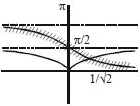
0 likes
View Solution33
AdvancedMCQ
मान लीजिए $\cos ^{-1}(x) + \cos ^{-1} (2x) + \cos ^{-1}(3x) = \pi.$ यदि $x$ त्रिघात समीकरण $ax^3 + bx^2 + cx - 1 = 0$ को संतुष्ट करता है,तो $(a + b + c)$ का मान है -
A
$24$
B
$25$
C
$26$
D
$27$
Solution
(C) दिया गया है $\cos ^{-1}(x) + \cos ^{-1}(2x) + \cos ^{-1}(3x) = \pi.$
पदों को पुनर्व्यवस्थित करने पर,हमें मिलता है $\cos ^{-1}(2x) + \cos ^{-1}(3x) = \pi - \cos ^{-1}(x).$
सर्वसमिका $\cos ^{-1}(A) + \cos ^{-1}(B) = \cos ^{-1}(AB - \sqrt{1-A^2}\sqrt{1-B^2})$ और $\pi - \cos ^{-1}(x) = \cos ^{-1}(-x)$ का उपयोग करते हुए,
$\cos ^{-1}(6x^2 - \sqrt{1-4x^2}\sqrt{1-9x^2}) = \cos ^{-1}(-x).$
तर्कों की तुलना करने पर,$6x^2 - \sqrt{1-4x^2}\sqrt{1-9x^2} = -x.$
पुनर्व्यवस्थित करने पर,$6x^2 + x = \sqrt{1-4x^2}\sqrt{1-9x^2}.$
दोनों पक्षों का वर्ग करने पर,$(6x^2 + x)^2 = (1-4x^2)(1-9x^2).$
$36x^4 + x^2 + 12x^3 = 1 - 13x^2 + 36x^4.$
सरल करने पर,$12x^3 + 14x^2 - 1 = 0.$
इसकी तुलना $ax^3 + bx^2 + cx - 1 = 0$ से करने पर,हमें $a = 12, b = 14, c = 0$ प्राप्त होता है.
अतः,$a + b + c = 12 + 14 + 0 = 26.$
पदों को पुनर्व्यवस्थित करने पर,हमें मिलता है $\cos ^{-1}(2x) + \cos ^{-1}(3x) = \pi - \cos ^{-1}(x).$
सर्वसमिका $\cos ^{-1}(A) + \cos ^{-1}(B) = \cos ^{-1}(AB - \sqrt{1-A^2}\sqrt{1-B^2})$ और $\pi - \cos ^{-1}(x) = \cos ^{-1}(-x)$ का उपयोग करते हुए,
$\cos ^{-1}(6x^2 - \sqrt{1-4x^2}\sqrt{1-9x^2}) = \cos ^{-1}(-x).$
तर्कों की तुलना करने पर,$6x^2 - \sqrt{1-4x^2}\sqrt{1-9x^2} = -x.$
पुनर्व्यवस्थित करने पर,$6x^2 + x = \sqrt{1-4x^2}\sqrt{1-9x^2}.$
दोनों पक्षों का वर्ग करने पर,$(6x^2 + x)^2 = (1-4x^2)(1-9x^2).$
$36x^4 + x^2 + 12x^3 = 1 - 13x^2 + 36x^4.$
सरल करने पर,$12x^3 + 14x^2 - 1 = 0.$
इसकी तुलना $ax^3 + bx^2 + cx - 1 = 0$ से करने पर,हमें $a = 12, b = 14, c = 0$ प्राप्त होता है.
अतः,$a + b + c = 12 + 14 + 0 = 26.$
0 likes
View Solution34
AdvancedMCQ
यदि $x = \sin \left( 2 \tan^{-1} 2 \right)$ और $y = \sin \left( \frac{1}{2} \tan^{-1} \frac{4}{3} \right)$ है,तो -
A
$x = 1 - y$
B
$x^2 = 1 - y$
C
$x^2 = 1 + y$
D
$y^2 = 1 - x$
Solution
(D) दिया गया है $x = \sin(2 \tan^{-1} 2)$। मान लीजिए $\tan^{-1} 2 = \theta$,तो $\tan \theta = 2$।
चूंकि $\tan \theta = 2$,हमें $\sin \theta = \frac{2}{\sqrt{5}}$ और $\cos \theta = \frac{1}{\sqrt{5}}$ प्राप्त होता है।
तब $x = \sin(2 \theta) = 2 \sin \theta \cos \theta = 2 \left( \frac{2}{\sqrt{5}} \right) \left( \frac{1}{\sqrt{5}} \right) = \frac{4}{5}$।
अतः,$1 - x = 1 - \frac{4}{5} = \frac{1}{5}$।
अब,दिया गया है $y = \sin \left( \frac{1}{2} \tan^{-1} \frac{4}{3} \right)$। मान लीजिए $\tan^{-1} \frac{4}{3} = \alpha$,तो $\tan \alpha = \frac{4}{3}$।
सर्वसमिका $\sin \frac{\alpha}{2} = \sqrt{\frac{1 - \cos \alpha}{2}}$ का उपयोग करते हुए,जहाँ $\cos \alpha = \frac{3}{5}$ (चूंकि $\tan \alpha = \frac{4}{3}$),हमें $y = \sqrt{\frac{1 - 3/5}{2}} = \sqrt{\frac{2/5}{2}} = \sqrt{\frac{1}{5}} = \frac{1}{\sqrt{5}}$ प्राप्त होता है।
इसलिए,$y^2 = \frac{1}{5}$।
परिणामों की तुलना करने पर,$y^2 = \frac{1}{5}$ और $1 - x = \frac{1}{5}$,अतः $y^2 = 1 - x$।
चूंकि $\tan \theta = 2$,हमें $\sin \theta = \frac{2}{\sqrt{5}}$ और $\cos \theta = \frac{1}{\sqrt{5}}$ प्राप्त होता है।
तब $x = \sin(2 \theta) = 2 \sin \theta \cos \theta = 2 \left( \frac{2}{\sqrt{5}} \right) \left( \frac{1}{\sqrt{5}} \right) = \frac{4}{5}$।
अतः,$1 - x = 1 - \frac{4}{5} = \frac{1}{5}$।
अब,दिया गया है $y = \sin \left( \frac{1}{2} \tan^{-1} \frac{4}{3} \right)$। मान लीजिए $\tan^{-1} \frac{4}{3} = \alpha$,तो $\tan \alpha = \frac{4}{3}$।
सर्वसमिका $\sin \frac{\alpha}{2} = \sqrt{\frac{1 - \cos \alpha}{2}}$ का उपयोग करते हुए,जहाँ $\cos \alpha = \frac{3}{5}$ (चूंकि $\tan \alpha = \frac{4}{3}$),हमें $y = \sqrt{\frac{1 - 3/5}{2}} = \sqrt{\frac{2/5}{2}} = \sqrt{\frac{1}{5}} = \frac{1}{\sqrt{5}}$ प्राप्त होता है।
इसलिए,$y^2 = \frac{1}{5}$।
परिणामों की तुलना करने पर,$y^2 = \frac{1}{5}$ और $1 - x = \frac{1}{5}$,अतः $y^2 = 1 - x$।
0 likes
View Solution35
AdvancedMCQ
$\sum\limits_{\lambda = 1}^{10} {{{\sin }^{ - 1}}\left( {\sin \left( {\lambda \pi - \frac{\pi }{6}} \right)} \right)} $ का मान ज्ञात कीजिए।
A
$-\frac{5\pi }{3}$
B
$\frac{\pi }{2}$
C
$0$
D
$5\pi$
Solution
(C) माना $S = \sum\limits_{\lambda = 1}^{10} {{{\sin }^{ - 1}}\left( {\sin \left( {\lambda \pi - \frac{\pi }{6}} \right)} \right)} $.
सम $\lambda = 2n$ के लिए (जहाँ $n = 1, 2, 3, 4, 5$):
$\sin(2n\pi - \frac{\pi }{6}) = \sin(-\frac{\pi }{6}) = -\frac{1}{2}$.
अतः,${{\sin }^{ - 1}}(\sin(2n\pi - \frac{\pi }{6})) = -\frac{\pi }{6}$.
ऐसे $5$ पद हैं,इसलिए योग $5 \times (-\frac{\pi }{6}) = -\frac{5\pi }{6}$ है।
विषम $\lambda = 2n-1$ के लिए (जहाँ $n = 1, 2, 3, 4, 5$):
$\sin((2n-1)\pi - \frac{\pi }{6}) = \sin(\pi - \frac{\pi }{6}) = \sin(\frac{\pi }{6}) = \frac{1}{2}$.
अतः,${{\sin }^{ - 1}}(\sin((2n-1)\pi - \frac{\pi }{6})) = \frac{\pi }{6}$.
ऐसे $5$ पद हैं,इसलिए योग $5 \times \frac{\pi }{6} = \frac{5\pi }{6}$ है।
दोनों को जोड़ने पर: $S = -\frac{5\pi }{6} + \frac{5\pi }{6} = 0$.
सम $\lambda = 2n$ के लिए (जहाँ $n = 1, 2, 3, 4, 5$):
$\sin(2n\pi - \frac{\pi }{6}) = \sin(-\frac{\pi }{6}) = -\frac{1}{2}$.
अतः,${{\sin }^{ - 1}}(\sin(2n\pi - \frac{\pi }{6})) = -\frac{\pi }{6}$.
ऐसे $5$ पद हैं,इसलिए योग $5 \times (-\frac{\pi }{6}) = -\frac{5\pi }{6}$ है।
विषम $\lambda = 2n-1$ के लिए (जहाँ $n = 1, 2, 3, 4, 5$):
$\sin((2n-1)\pi - \frac{\pi }{6}) = \sin(\pi - \frac{\pi }{6}) = \sin(\frac{\pi }{6}) = \frac{1}{2}$.
अतः,${{\sin }^{ - 1}}(\sin((2n-1)\pi - \frac{\pi }{6})) = \frac{\pi }{6}$.
ऐसे $5$ पद हैं,इसलिए योग $5 \times \frac{\pi }{6} = \frac{5\pi }{6}$ है।
दोनों को जोड़ने पर: $S = -\frac{5\pi }{6} + \frac{5\pi }{6} = 0$.
0 likes
View Solution36
AdvancedMCQ
फलन $f(x) = \cos^{-1}x + 2\cot^{-1}x - 2x^3 - 4x$ के न्यूनतम और अधिकतम मानों का योग क्या है?
A
$-3\pi$
B
$3 + 2\pi$
C
$3\pi$
D
$2 - 3\pi$
Solution
(C) फलन $f(x) = \cos^{-1}x + 2\cot^{-1}x - 2x^3 - 4x$ का प्रांत $[-1, 1]$ है।
सबसे पहले,हम $f(x)$ का अवकलन ज्ञात करते हैं:
$f'(x) = \frac{-1}{\sqrt{1-x^2}} - \frac{2}{1+x^2} - 6x^2 - 4$.
चूंकि $\frac{-1}{\sqrt{1-x^2}} < 0$,$\frac{-2}{1+x^2} < 0$,और $-6x^2 - 4 < 0$ है,इसलिए $f'(x) < 0$ है।
अतः,$f(x)$ अंतराल $[-1, 1]$ पर एक ह्रासमान फलन है।
अधिकतम मान $x = -1$ पर प्राप्त होता है:
$M = f(-1) = \cos^{-1}(-1) + 2\cot^{-1}(-1) - 2(-1)^3 - 4(-1) = \pi + 2(\frac{3\pi}{4}) + 2 + 4 = \pi + \frac{3\pi}{2} + 6 = \frac{5\pi}{2} + 6$.
न्यूनतम मान $x = 1$ पर प्राप्त होता है:
$m = f(1) = \cos^{-1}(1) + 2\cot^{-1}(1) - 2(1)^3 - 4(1) = 0 + 2(\frac{\pi}{4}) - 2 - 4 = \frac{\pi}{2} - 6$.
न्यूनतम और अधिकतम मानों का योग है:
$m + M = (\frac{\pi}{2} - 6) + (\frac{5\pi}{2} + 6) = \frac{6\pi}{2} = 3\pi$.
सबसे पहले,हम $f(x)$ का अवकलन ज्ञात करते हैं:
$f'(x) = \frac{-1}{\sqrt{1-x^2}} - \frac{2}{1+x^2} - 6x^2 - 4$.
चूंकि $\frac{-1}{\sqrt{1-x^2}} < 0$,$\frac{-2}{1+x^2} < 0$,और $-6x^2 - 4 < 0$ है,इसलिए $f'(x) < 0$ है।
अतः,$f(x)$ अंतराल $[-1, 1]$ पर एक ह्रासमान फलन है।
अधिकतम मान $x = -1$ पर प्राप्त होता है:
$M = f(-1) = \cos^{-1}(-1) + 2\cot^{-1}(-1) - 2(-1)^3 - 4(-1) = \pi + 2(\frac{3\pi}{4}) + 2 + 4 = \pi + \frac{3\pi}{2} + 6 = \frac{5\pi}{2} + 6$.
न्यूनतम मान $x = 1$ पर प्राप्त होता है:
$m = f(1) = \cos^{-1}(1) + 2\cot^{-1}(1) - 2(1)^3 - 4(1) = 0 + 2(\frac{\pi}{4}) - 2 - 4 = \frac{\pi}{2} - 6$.
न्यूनतम और अधिकतम मानों का योग है:
$m + M = (\frac{\pi}{2} - 6) + (\frac{5\pi}{2} + 6) = \frac{6\pi}{2} = 3\pi$.
0 likes
View Solution37
MediumMCQ
$\sin \left[ \cos^{-1} \left( \frac{3}{5} \right) + \tan^{-1} 2 \right] = $
A
$\frac{2}{\sqrt{5}}$
B
$\frac{-2}{\sqrt{5}}$
C
$\frac{3}{\sqrt{5}}$
D
$\frac{-3}{\sqrt{5}}$
Solution
(A) माना $\alpha = \cos^{-1} \left( \frac{3}{5} \right)$,तो $\cos \alpha = \frac{3}{5}$। चूँकि $\cos^2 \alpha + \sin^2 \alpha = 1$,इसलिए $\sin \alpha = \sqrt{1 - (\frac{3}{5})^2} = \frac{4}{5}$। अतः,$\alpha = \sin^{-1} \left( \frac{4}{5} \right)$।
माना $\beta = \tan^{-1} 2$,तो $\tan \beta = 2$। सर्वसमिका $\sin \beta = \frac{\tan \beta}{\sqrt{1 + \tan^2 \beta}}$ का उपयोग करने पर,$\sin \beta = \frac{2}{\sqrt{1 + 2^2}} = \frac{2}{\sqrt{5}}$ प्राप्त होता है। अतः,$\beta = \sin^{-1} \left( \frac{2}{\sqrt{5}} \right)$।
व्यंजक $\sin(\alpha + \beta) = \sin \alpha \cos \beta + \cos \alpha \sin \beta$ बन जाता है।
यहाँ $\sin \alpha = \frac{4}{5}$,$\cos \alpha = \frac{3}{5}$,$\sin \beta = \frac{2}{\sqrt{5}}$,और $\cos \beta = \frac{1}{\sqrt{1 + 2^2}} = \frac{1}{\sqrt{5}}$ है।
इन मानों को प्रतिस्थापित करने पर: $\sin(\alpha + \beta) = (\frac{4}{5} \times \frac{1}{\sqrt{5}}) + (\frac{3}{5} \times \frac{2}{\sqrt{5}}) = \frac{4}{5\sqrt{5}} + \frac{6}{5\sqrt{5}} = \frac{10}{5\sqrt{5}} = \frac{2}{\sqrt{5}}$।
माना $\beta = \tan^{-1} 2$,तो $\tan \beta = 2$। सर्वसमिका $\sin \beta = \frac{\tan \beta}{\sqrt{1 + \tan^2 \beta}}$ का उपयोग करने पर,$\sin \beta = \frac{2}{\sqrt{1 + 2^2}} = \frac{2}{\sqrt{5}}$ प्राप्त होता है। अतः,$\beta = \sin^{-1} \left( \frac{2}{\sqrt{5}} \right)$।
व्यंजक $\sin(\alpha + \beta) = \sin \alpha \cos \beta + \cos \alpha \sin \beta$ बन जाता है।
यहाँ $\sin \alpha = \frac{4}{5}$,$\cos \alpha = \frac{3}{5}$,$\sin \beta = \frac{2}{\sqrt{5}}$,और $\cos \beta = \frac{1}{\sqrt{1 + 2^2}} = \frac{1}{\sqrt{5}}$ है।
इन मानों को प्रतिस्थापित करने पर: $\sin(\alpha + \beta) = (\frac{4}{5} \times \frac{1}{\sqrt{5}}) + (\frac{3}{5} \times \frac{2}{\sqrt{5}}) = \frac{4}{5\sqrt{5}} + \frac{6}{5\sqrt{5}} = \frac{10}{5\sqrt{5}} = \frac{2}{\sqrt{5}}$।
0 likes
View Solution38
AdvancedMCQ
व्यंजक $\lfloor \tan^{-1} x - \tan^{-1} y \rfloor - \lfloor \sin^{-1} u - \sin^{-1} v \rfloor$ का अधिकतम मान ज्ञात कीजिए,जहाँ $\lfloor . \rfloor$ महत्तम पूर्णांक फलन को दर्शाता है और $x, y, u, v$ स्वतंत्र वास्तविक चर हैं।
A
$6$
B
$3$
C
$7$
D
$5$
Solution
(C) फलन $f(x, y) = \tan^{-1} x - \tan^{-1} y$ का परिसर $(-\pi, \pi)$ है। अतः,$\lfloor \tan^{-1} x - \tan^{-1} y \rfloor$ का अधिकतम मान $\lfloor \pi^- \rfloor = 3$ है।
फलन $g(u, v) = \sin^{-1} u - \sin^{-1} v$ का परिसर $[-\pi, \pi]$ है। अतः,$\lfloor \sin^{-1} u - \sin^{-1} v \rfloor$ का न्यूनतम मान $\lfloor -\pi \rfloor = -4$ है।
व्यंजक $\lfloor \tan^{-1} x - \tan^{-1} y \rfloor - \lfloor \sin^{-1} u - \sin^{-1} v \rfloor$ को अधिकतम करने के लिए,हम पहले पद का अधिकतम मान लेते हैं और दूसरे पद का न्यूनतम मान घटाते हैं।
अधिकतम मान $= 3 - (-4) = 7$.
फलन $g(u, v) = \sin^{-1} u - \sin^{-1} v$ का परिसर $[-\pi, \pi]$ है। अतः,$\lfloor \sin^{-1} u - \sin^{-1} v \rfloor$ का न्यूनतम मान $\lfloor -\pi \rfloor = -4$ है।
व्यंजक $\lfloor \tan^{-1} x - \tan^{-1} y \rfloor - \lfloor \sin^{-1} u - \sin^{-1} v \rfloor$ को अधिकतम करने के लिए,हम पहले पद का अधिकतम मान लेते हैं और दूसरे पद का न्यूनतम मान घटाते हैं।
अधिकतम मान $= 3 - (-4) = 7$.
0 likes
View Solution39
AdvancedMCQ
यदि $f(x) = \cos \left( {{{\tan }^{ - 1}}\left( {\sin \left( {{{\cos }^{ - 1}}x} \right)} \right)} \right) + \sin \left( {{{\cot }^{ - 1}}\left( {\cos \left( {{{\sin }^{ - 1}}x} \right)} \right)} \right)$ का परिसर $[m, M)$ है,तो समीकरण $\operatorname{sgn} (|x - 1| - 2) = \ln |x - 2|$ के हलों की संख्या ज्ञात कीजिए (जहाँ $\operatorname{sgn}$ सिग्नम फलन को दर्शाता है)।
A
$m^2+1$
B
$m^2-M$
C
$M^2+1$
D
$m^2+M$
Solution
(D) माना $f(x) = \cos (\tan ^{-1}(\sin (\cos ^{-1} x))) + \sin (\cot ^{-1}(\cos (\sin ^{-1} x)))$ है।
चूँकि $\sin (\cos ^{-1} x) = \sqrt{1-x^2}$ और $\cos (\sin ^{-1} x) = \sqrt{1-x^2}$ है,इसलिए:
$f(x) = \cos (\tan ^{-1}(\sqrt{1-x^2})) + \sin (\cot ^{-1}(\sqrt{1-x^2}))$ है।
माना $\theta = \tan ^{-1}(\sqrt{1-x^2})$,तो $\tan \theta = \sqrt{1-x^2}$ है।
तब $\cos \theta = \frac{1}{\sqrt{1+\tan^2 \theta}} = \frac{1}{\sqrt{1+(1-x^2)}} = \frac{1}{\sqrt{2-x^2}}$ है।
इसी प्रकार,माना $\phi = \cot ^{-1}(\sqrt{1-x^2})$,तो $\cot \phi = \sqrt{1-x^2}$ है।
तब $\sin \phi = \frac{1}{\sqrt{1+\cot^2 \phi}} = \frac{1}{\sqrt{1+(1-x^2)}} = \frac{1}{\sqrt{2-x^2}}$ है।
अतः,$f(x) = \frac{1}{\sqrt{2-x^2}} + \frac{1}{\sqrt{2-x^2}} = \frac{2}{\sqrt{2-x^2}}$ है।
चूँकि $x \in [-1, 1]$,$x^2 \in [0, 1]$,इसलिए $2-x^2 \in [1, 2]$ है।
अतः,$\sqrt{2-x^2} \in [1, \sqrt{2}]$,और $f(x) \in [\sqrt{2}, 2]$ है।
इसलिए $m = \sqrt{2}$ और $M = 2$ है।
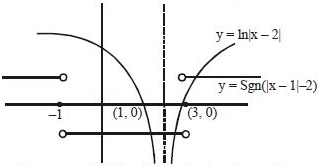
समीकरण $\operatorname{sgn} (|x - 1| - 2) = \ln |x - 2|$ है।
$y = \operatorname{sgn} (|x - 1| - 2)$ और $y = \ln |x - 2|$ के ग्राफ का विश्लेषण करने पर,हम पाते हैं कि वक्र $4$ बिंदुओं पर प्रतिच्छेद करते हैं।
चूँकि $\sin (\cos ^{-1} x) = \sqrt{1-x^2}$ और $\cos (\sin ^{-1} x) = \sqrt{1-x^2}$ है,इसलिए:
$f(x) = \cos (\tan ^{-1}(\sqrt{1-x^2})) + \sin (\cot ^{-1}(\sqrt{1-x^2}))$ है।
माना $\theta = \tan ^{-1}(\sqrt{1-x^2})$,तो $\tan \theta = \sqrt{1-x^2}$ है।
तब $\cos \theta = \frac{1}{\sqrt{1+\tan^2 \theta}} = \frac{1}{\sqrt{1+(1-x^2)}} = \frac{1}{\sqrt{2-x^2}}$ है।
इसी प्रकार,माना $\phi = \cot ^{-1}(\sqrt{1-x^2})$,तो $\cot \phi = \sqrt{1-x^2}$ है।
तब $\sin \phi = \frac{1}{\sqrt{1+\cot^2 \phi}} = \frac{1}{\sqrt{1+(1-x^2)}} = \frac{1}{\sqrt{2-x^2}}$ है।
अतः,$f(x) = \frac{1}{\sqrt{2-x^2}} + \frac{1}{\sqrt{2-x^2}} = \frac{2}{\sqrt{2-x^2}}$ है।
चूँकि $x \in [-1, 1]$,$x^2 \in [0, 1]$,इसलिए $2-x^2 \in [1, 2]$ है।
अतः,$\sqrt{2-x^2} \in [1, \sqrt{2}]$,और $f(x) \in [\sqrt{2}, 2]$ है।
इसलिए $m = \sqrt{2}$ और $M = 2$ है।
समीकरण $\operatorname{sgn} (|x - 1| - 2) = \ln |x - 2|$ है।
$y = \operatorname{sgn} (|x - 1| - 2)$ और $y = \ln |x - 2|$ के ग्राफ का विश्लेषण करने पर,हम पाते हैं कि वक्र $4$ बिंदुओं पर प्रतिच्छेद करते हैं।
0 likes
View Solution40
AdvancedMCQ
मान लीजिए $f(x) = \tan^{-1} (\cot x - 2 \cot 2x)$,तो $\left[ \sum_{r = 1}^7 f(r) \right]$ का मान ज्ञात कीजिए (जहाँ $[.]$ महत्तम पूर्णांक फलन को दर्शाता है)।
A
$-1$
B
$1$
C
$0$
D
$-2$
Solution
(A) हम जानते हैं कि $\cot x - 2 \cot 2x = \cot x - 2 \left( \frac{\cot^2 x - 1}{2 \cot x} \right) = \cot x - \frac{\cot^2 x - 1}{\cot x} = \frac{\cot^2 x - \cot^2 x + 1}{\cot x} = \frac{1}{\cot x} = \tan x$.
अतः,$f(x) = \tan^{-1}(\tan x)$.
$x \in [1, 7]$ के लिए,हम $f(r) = \tan^{-1}(\tan r)$ का मान निकालते हैं:
$f(1) = 1$ (चूंकि $1 \in (-\pi/2, \pi/2)$)
$f(2) = 2 - \pi$ (चूंकि $2 \in (\pi/2, 3\pi/2)$)
$f(3) = 3 - \pi$
$f(4) = 4 - \pi$
$f(5) = 5 - 2\pi$ (चूंकि $5 \in (3\pi/2, 5\pi/2)$)
$f(6) = 6 - 2\pi$
$f(7) = 7 - 2\pi$
इन मानों का योग करने पर: $\sum_{r=1}^7 f(r) = (1 + 2 + 3 + 4 + 5 + 6 + 7) - (3\pi + 6\pi) = 28 - 9\pi$.
चूंकि $\pi \approx 3.14159$,इसलिए $9\pi \approx 28.2743$.
अतः,$[28 - 9\pi] = [28 - 28.2743] = [-0.2743] = -1$.
अतः,$f(x) = \tan^{-1}(\tan x)$.
$x \in [1, 7]$ के लिए,हम $f(r) = \tan^{-1}(\tan r)$ का मान निकालते हैं:
$f(1) = 1$ (चूंकि $1 \in (-\pi/2, \pi/2)$)
$f(2) = 2 - \pi$ (चूंकि $2 \in (\pi/2, 3\pi/2)$)
$f(3) = 3 - \pi$
$f(4) = 4 - \pi$
$f(5) = 5 - 2\pi$ (चूंकि $5 \in (3\pi/2, 5\pi/2)$)
$f(6) = 6 - 2\pi$
$f(7) = 7 - 2\pi$
इन मानों का योग करने पर: $\sum_{r=1}^7 f(r) = (1 + 2 + 3 + 4 + 5 + 6 + 7) - (3\pi + 6\pi) = 28 - 9\pi$.
चूंकि $\pi \approx 3.14159$,इसलिए $9\pi \approx 28.2743$.
अतः,$[28 - 9\pi] = [28 - 28.2743] = [-0.2743] = -1$.
0 likes
View Solution41
AdvancedMCQ
यदि $p$ और $q$,$6x^2 + 10x + 1 = 0$ के मूल हैं,तो $[\tan^{-1} p + \tan^{-1} q]$ का मान ज्ञात कीजिए: {जहाँ $[x]$,$x$ से छोटा या उसके बराबर महत्तम पूर्णांक दर्शाता है}
A
$1$
B
$-2$
C
$0$
D
$-1$
Solution
(D) दिया गया द्विघात समीकरण $6x^2 + 10x + 1 = 0$ है।
विएटा के सूत्रों के अनुसार,मूलों का योग $p + q = -\frac{5}{3}$ और मूलों का गुणनफल $pq = \frac{1}{6}$ है।
दोनों मूल $p$ और $q$ ऋणात्मक हैं।
$\tan^{-1} p + \tan^{-1} q = -\tan^{-1} \left( \frac{p+q}{1-pq} \right) = -\tan^{-1} \left( \frac{-5/3}{1-1/6} \right) = -\tan^{-1} (2)$।
चूंकि $\frac{\pi}{4} < \tan^{-1} 2 < \frac{\pi}{3}$,इसलिए $-\frac{\pi}{3} < -\tan^{-1} 2 < -\frac{\pi}{4}$ होगा।
अतः,$[-\tan^{-1} 2] = -1$।
विएटा के सूत्रों के अनुसार,मूलों का योग $p + q = -\frac{5}{3}$ और मूलों का गुणनफल $pq = \frac{1}{6}$ है।
दोनों मूल $p$ और $q$ ऋणात्मक हैं।
$\tan^{-1} p + \tan^{-1} q = -\tan^{-1} \left( \frac{p+q}{1-pq} \right) = -\tan^{-1} \left( \frac{-5/3}{1-1/6} \right) = -\tan^{-1} (2)$।
चूंकि $\frac{\pi}{4} < \tan^{-1} 2 < \frac{\pi}{3}$,इसलिए $-\frac{\pi}{3} < -\tan^{-1} 2 < -\frac{\pi}{4}$ होगा।
अतः,$[-\tan^{-1} 2] = -1$।
0 likes
View Solution42
AdvancedMCQ
$\sin ^{-1}(\sin 100) + \cos ^{-1}(\cos 100) + \tan ^{-1}(\tan 100) + \cot ^{-1}(\cot 100)$ का मान ज्ञात कीजिए।
A
$100 - 31\pi$
B
$100 - 32\pi$
C
$200 - 63\pi$
D
$200 - 62\pi$
Solution
(D) हम जानते हैं कि $31\pi < 100 < 32\pi$ है।
$1$. $\sin ^{-1}(\sin 100) = 100 - 32\pi$
$2$. $\cos ^{-1}(\cos 100) = 32\pi - 100$
$3$. $\tan ^{-1}(\tan 100) = 100 - 31\pi$
$4$. $\cot ^{-1}(\cot 100) = 100 - 31\pi$
योग करने पर: $(100 - 32\pi) + (32\pi - 100) + (100 - 31\pi) + (100 - 31\pi) = 200 - 62\pi$.
$1$. $\sin ^{-1}(\sin 100) = 100 - 32\pi$
$2$. $\cos ^{-1}(\cos 100) = 32\pi - 100$
$3$. $\tan ^{-1}(\tan 100) = 100 - 31\pi$
$4$. $\cot ^{-1}(\cot 100) = 100 - 31\pi$
योग करने पर: $(100 - 32\pi) + (32\pi - 100) + (100 - 31\pi) + (100 - 31\pi) = 200 - 62\pi$.
0 likes
View Solution43
AdvancedMCQ
असमिका $(\sec^{-1}x - 4)(\sec^{-1}x - 1)(\sec^{-1}x - 2) \ge 0$ का पूर्ण हल समुच्चय है
A
$[\sec 2, \sec 1]$
B
$[\sec 1, \sec 2] \cup [\sec 4, \infty)$
C
$(-\infty, \sec 2] \cup [\sec 1, \infty)$
D
$(-\infty, \sec 4] \cup [\sec 2, \infty)$
Solution
(A) माना $y = \sec^{-1}x$ है। $\sec^{-1}x$ का प्रांत $(-\infty, -1] \cup [1, \infty)$ है,अतः $y \in [0, \pi/2) \cup (\pi/2, \pi]$ है।
दी गई असमिका: $(y - 4)(y - 1)(y - 2) \ge 0$ है।
चूंकि $y \in [0, \pi] \approx [0, 3.14]$ है,पद $(y - 4)$ हमेशा ऋणात्मक है।
$(y - 4)$ से भाग देने पर,असमिका उलट जाती है: $(y - 1)(y - 2) \le 0$ है।
यह $y \in [1, 2]$ के लिए सत्य है।
चूंकि $y = \sec^{-1}x$ है,इसलिए $1 \le \sec^{-1}x \le 2$ है।
सेकेंट फलन लागू करने पर,हमें $\sec 1 \le x \le \sec 2$ प्राप्त होता है।
दी गई असमिका: $(y - 4)(y - 1)(y - 2) \ge 0$ है।
चूंकि $y \in [0, \pi] \approx [0, 3.14]$ है,पद $(y - 4)$ हमेशा ऋणात्मक है।
$(y - 4)$ से भाग देने पर,असमिका उलट जाती है: $(y - 1)(y - 2) \le 0$ है।
यह $y \in [1, 2]$ के लिए सत्य है।
चूंकि $y = \sec^{-1}x$ है,इसलिए $1 \le \sec^{-1}x \le 2$ है।
सेकेंट फलन लागू करने पर,हमें $\sec 1 \le x \le \sec 2$ प्राप्त होता है।
0 likes
View Solution44
AdvancedMCQ
यदि समीकरण $\sin^{-1}(x - 1) + \cos^{-1}(x - 3) + \tan^{-1}\left(\frac{x}{-x^2 + 2}\right) = m$ सत्य है,तो $m$ का मान ज्ञात कीजिए।
A
$\frac{-3\pi}{4}$
B
$\frac{3\pi}{4}$
C
$\frac{-5\pi}{4}$
D
$\frac{5\pi}{4}$
Solution
(D) समीकरण को परिभाषित होने के लिए,प्रतिलोम त्रिकोणमितीय फलनों के प्रांत संतुष्ट होने चाहिए:
$1) -1 \leq x - 1 \leq 1 \Rightarrow 0 \leq x \leq 2$
$2) -1 \leq x - 3 \leq 1 \Rightarrow 2 \leq x \leq 4$
$3) -x^2 + 2 \neq 0 \Rightarrow x^2 \neq 2 \Rightarrow x \neq \pm\sqrt{2}$
शर्तों $(1)$ और $(2)$ का सर्वनिष्ठ लेने पर,हमें $x = 2$ प्राप्त होता है।
मूल समीकरण में $x = 2$ रखने पर:
$m = \sin^{-1}(2 - 1) + \cos^{-1}(2 - 3) + \tan^{-1}\left(\frac{2}{-2^2 + 2}\right)$
$m = \sin^{-1}(1) + \cos^{-1}(-1) + \tan^{-1}\left(\frac{2}{-2}\right)$
$m = \frac{\pi}{2} + \pi + \tan^{-1}(-1)$
$m = \frac{3\pi}{2} - \frac{\pi}{4} = \frac{6\pi - \pi}{4} = \frac{5\pi}{4}$
$1) -1 \leq x - 1 \leq 1 \Rightarrow 0 \leq x \leq 2$
$2) -1 \leq x - 3 \leq 1 \Rightarrow 2 \leq x \leq 4$
$3) -x^2 + 2 \neq 0 \Rightarrow x^2 \neq 2 \Rightarrow x \neq \pm\sqrt{2}$
शर्तों $(1)$ और $(2)$ का सर्वनिष्ठ लेने पर,हमें $x = 2$ प्राप्त होता है।
मूल समीकरण में $x = 2$ रखने पर:
$m = \sin^{-1}(2 - 1) + \cos^{-1}(2 - 3) + \tan^{-1}\left(\frac{2}{-2^2 + 2}\right)$
$m = \sin^{-1}(1) + \cos^{-1}(-1) + \tan^{-1}\left(\frac{2}{-2}\right)$
$m = \frac{\pi}{2} + \pi + \tan^{-1}(-1)$
$m = \frac{3\pi}{2} - \frac{\pi}{4} = \frac{6\pi - \pi}{4} = \frac{5\pi}{4}$
0 likes
View Solution45
AdvancedMCQ
योगफल $\sum\limits_{n = 1}^\infty {{\cot }^{ - 1}} \left( {\frac{{2\left( {\sum\limits_{k = 1}^n k } \right) - 1}}{3}} \right)$ का मान ज्ञात कीजिए।
A
$\frac{3\pi}{4} + \cot^{-1} 2$
B
$\frac{\pi}{2} + \cot^{-1} 3$
C
$\pi$
D
$\frac{\pi}{2} + \tan^{-1} 2$
Solution
(C) हम जानते हैं कि $\sum_{k=1}^n k = \frac{n(n+1)}{2}$.
इस मान को व्यंजक में रखने पर,हमें प्राप्त होता है:
$\cot^{-1} \left( \frac{2 \cdot \frac{n(n+1)}{2} - 1}{3} \right) = \cot^{-1} \left( \frac{n^2+n-1}{3} \right) = \tan^{-1} \left( \frac{3}{n^2+n-1} \right)$.
हम इस पद को $\frac{(n+2)-(n-1)}{1+(n+2)(n-1)} = \frac{3}{1+(n^2+n-2)}$ के रूप में लिख सकते हैं।
अतः,$T_n = \tan^{-1}(n+2) - \tan^{-1}(n-1)$.
योगफल $S_N = \sum_{n=1}^N (\tan^{-1}(n+2) - \tan^{-1}(n-1))$ है।
योगफल का विस्तार करने पर: $S_N = (\tan^{-1} 3 - \tan^{-1} 0) + (\tan^{-1} 4 - \tan^{-1} 1) + (\tan^{-1} 5 - \tan^{-1} 2) + \dots + (\tan^{-1}(N+2) - \tan^{-1}(N-1))$.
अधिकांश पद कट जाते हैं,और शेष बचता है $S_N = \tan^{-1}(N+2) + \tan^{-1}(N+1) - \tan^{-1} 1 - \tan^{-1} 0$.
जब $N \to \infty$,तब $S = \frac{\pi}{2} + \frac{\pi}{2} - \frac{\pi}{4} = \frac{3\pi}{4}$.
इस मान को व्यंजक में रखने पर,हमें प्राप्त होता है:
$\cot^{-1} \left( \frac{2 \cdot \frac{n(n+1)}{2} - 1}{3} \right) = \cot^{-1} \left( \frac{n^2+n-1}{3} \right) = \tan^{-1} \left( \frac{3}{n^2+n-1} \right)$.
हम इस पद को $\frac{(n+2)-(n-1)}{1+(n+2)(n-1)} = \frac{3}{1+(n^2+n-2)}$ के रूप में लिख सकते हैं।
अतः,$T_n = \tan^{-1}(n+2) - \tan^{-1}(n-1)$.
योगफल $S_N = \sum_{n=1}^N (\tan^{-1}(n+2) - \tan^{-1}(n-1))$ है।
योगफल का विस्तार करने पर: $S_N = (\tan^{-1} 3 - \tan^{-1} 0) + (\tan^{-1} 4 - \tan^{-1} 1) + (\tan^{-1} 5 - \tan^{-1} 2) + \dots + (\tan^{-1}(N+2) - \tan^{-1}(N-1))$.
अधिकांश पद कट जाते हैं,और शेष बचता है $S_N = \tan^{-1}(N+2) + \tan^{-1}(N+1) - \tan^{-1} 1 - \tan^{-1} 0$.
जब $N \to \infty$,तब $S = \frac{\pi}{2} + \frac{\pi}{2} - \frac{\pi}{4} = \frac{3\pi}{4}$.
0 likes
View Solution46
DifficultMCQ
$\sin ^{-1}(\sin 100) + \cos ^{-1}(\cos 100) + \tan ^{-1}(\tan 100) + \cot ^{-1}(\cot 100)$ का मान क्या है?
A
$100 - 31\pi$
B
$100 - 32\pi$
C
$200 - 63\pi$
D
इनमें से कोई नहीं
Solution
(C) हम जानते हैं कि मुख्य मानों की सीमाएँ: $\sin^{-1}(\sin x) = x - n\pi$ या $(n+1)\pi - x$,$\cos^{-1}(\cos x) = |x - 2n\pi|$,$\tan^{-1}(\tan x) = x - n\pi$,और $\cot^{-1}(\cot x) = x - n\pi$ हैं।
$x = 100$ के लिए,हम देखते हैं कि $31\pi \approx 97.389$ और $32\pi \approx 100.53$ है।
चूंकि $31\pi < 100 < 32\pi$:
$1$. $\sin^{-1}(\sin 100) = 100 - 32\pi$
$2$. $\cos^{-1}(\cos 100) = 32\pi - 100$
$3$. $\tan^{-1}(\tan 100) = 100 - 32\pi$
$4$. $\cot^{-1}(\cot 100) = 100 - 31\pi$
योग करने पर: $(100 - 32\pi) + (32\pi - 100) + (100 - 32\pi) + (100 - 31\pi) = 200 - 63\pi$।
$x = 100$ के लिए,हम देखते हैं कि $31\pi \approx 97.389$ और $32\pi \approx 100.53$ है।
चूंकि $31\pi < 100 < 32\pi$:
$1$. $\sin^{-1}(\sin 100) = 100 - 32\pi$
$2$. $\cos^{-1}(\cos 100) = 32\pi - 100$
$3$. $\tan^{-1}(\tan 100) = 100 - 32\pi$
$4$. $\cot^{-1}(\cot 100) = 100 - 31\pi$
योग करने पर: $(100 - 32\pi) + (32\pi - 100) + (100 - 32\pi) + (100 - 31\pi) = 200 - 63\pi$।
0 likes
View Solution47
AdvancedMCQ
अंतराल $[0, 5\pi]$ में समीकरण $2\tan^{-1}(\cos^2 x) = \tan^{-1}(2\csc^2 x)$ के हलों की संख्या $m$ है। तो निम्नलिखित में से कौन सा सत्य है?
A
$m \le 1$
B
$m \in \{2, 3, 4\}$
C
$m = 5$
D
$m > 5$
Solution
(A) दिया गया समीकरण: $2\tan^{-1}(\cos^2 x) = \tan^{-1}(2\csc^2 x)$.
सूत्र $2\tan^{-1} \theta = \tan^{-1} \left( \frac{2\theta}{1 - \theta^2} \right)$ का उपयोग करने पर:
$\tan^{-1} \left( \frac{2\cos^2 x}{1 - \cos^4 x} \right) = \tan^{-1} \left( \frac{2}{\sin^2 x} \right)$.
तर्कों की तुलना करने पर:
$\frac{2\cos^2 x}{1 - \cos^4 x} = \frac{2}{\sin^2 x}$.
चूंकि $1 - \cos^4 x = (1 - \cos^2 x)(1 + \cos^2 x) = \sin^2 x(1 + \cos^2 x)$,समीकरण इस प्रकार बनता है:
$\frac{2\cos^2 x}{\sin^2 x(1 + \cos^2 x)} = \frac{2}{\sin^2 x}$.
मान लीजिए $\sin^2 x \neq 0$,तो दोनों पक्षों से $2/\sin^2 x$ को हटाने पर:
$\frac{\cos^2 x}{1 + \cos^2 x} = 1$.
$\cos^2 x = 1 + \cos^2 x$,जिसका अर्थ है $0 = 1$,जो एक विरोधाभास है।
अतः,$x$ का कोई वास्तविक मान नहीं है जो समीकरण को संतुष्ट करे।
इसलिए,$m = 0$.
चूंकि $m = 0$,शर्त $m \le 1$ संतुष्ट होती है।
सूत्र $2\tan^{-1} \theta = \tan^{-1} \left( \frac{2\theta}{1 - \theta^2} \right)$ का उपयोग करने पर:
$\tan^{-1} \left( \frac{2\cos^2 x}{1 - \cos^4 x} \right) = \tan^{-1} \left( \frac{2}{\sin^2 x} \right)$.
तर्कों की तुलना करने पर:
$\frac{2\cos^2 x}{1 - \cos^4 x} = \frac{2}{\sin^2 x}$.
चूंकि $1 - \cos^4 x = (1 - \cos^2 x)(1 + \cos^2 x) = \sin^2 x(1 + \cos^2 x)$,समीकरण इस प्रकार बनता है:
$\frac{2\cos^2 x}{\sin^2 x(1 + \cos^2 x)} = \frac{2}{\sin^2 x}$.
मान लीजिए $\sin^2 x \neq 0$,तो दोनों पक्षों से $2/\sin^2 x$ को हटाने पर:
$\frac{\cos^2 x}{1 + \cos^2 x} = 1$.
$\cos^2 x = 1 + \cos^2 x$,जिसका अर्थ है $0 = 1$,जो एक विरोधाभास है।
अतः,$x$ का कोई वास्तविक मान नहीं है जो समीकरण को संतुष्ट करे।
इसलिए,$m = 0$.
चूंकि $m = 0$,शर्त $m \le 1$ संतुष्ट होती है।
0 likes
View Solution48
AdvancedMCQ
असमिका $(\tan^{-1} x)(\cot^{-1} x) - (\tan^{-1} x)(1 + \frac{\pi}{2}) - 2\cot^{-1} x + 2(1 + \frac{\pi}{2}) > \lim_{x \to \infty} [\sec^{-1} x - \frac{\pi}{2}]$ का हल समुच्चय ज्ञात कीजिए (जहाँ $[.]$ महत्तम पूर्णांक फलन को दर्शाता है):
A
$(\tan 1, \tan 2)$
B
$(-\cot 1, \cot 2)$
C
$(-\tan 1, \tan 2)$
D
$(-\tan 1, \infty)$
Solution
(C) माना $u = \tan^{-1} x$. तब $\cot^{-1} x = \frac{\pi}{2} - u$.
दी गई असमिका: $u(\frac{\pi}{2} - u) - u(1 + \frac{\pi}{2}) - 2(\frac{\pi}{2} - u) + 2(1 + \frac{\pi}{2}) > \lim_{x \to \infty} [\sec^{-1} x - \frac{\pi}{2}]$.
जैसे $x \to \infty$,$\sec^{-1} x \to \frac{\pi}{2}$,इसलिए सीमा $[\frac{\pi}{2} - \frac{\pi}{2}] = [0] = 0$ है।
बाएँ पक्ष को सरल करने पर: $\frac{\pi}{2}u - u^2 - u - \frac{\pi}{2}u - \pi + 2u + 2 + \pi > 0$.
$-u^2 + u + 2 > 0 \Rightarrow u^2 - u - 2 < 0$.
$(u - 2)(u + 1) < 0 \Rightarrow -1 < u < 2$.
चूँकि $u = \tan^{-1} x$,हमारे पास $-1 < \tan^{-1} x < 2$ है।
सभी पक्षों पर टेंजेंट लेने पर: $\tan(-1) < x < \tan 2$.
अतः,$-\tan 1 < x < \tan 2$.
दी गई असमिका: $u(\frac{\pi}{2} - u) - u(1 + \frac{\pi}{2}) - 2(\frac{\pi}{2} - u) + 2(1 + \frac{\pi}{2}) > \lim_{x \to \infty} [\sec^{-1} x - \frac{\pi}{2}]$.
जैसे $x \to \infty$,$\sec^{-1} x \to \frac{\pi}{2}$,इसलिए सीमा $[\frac{\pi}{2} - \frac{\pi}{2}] = [0] = 0$ है।
बाएँ पक्ष को सरल करने पर: $\frac{\pi}{2}u - u^2 - u - \frac{\pi}{2}u - \pi + 2u + 2 + \pi > 0$.
$-u^2 + u + 2 > 0 \Rightarrow u^2 - u - 2 < 0$.
$(u - 2)(u + 1) < 0 \Rightarrow -1 < u < 2$.
चूँकि $u = \tan^{-1} x$,हमारे पास $-1 < \tan^{-1} x < 2$ है।
सभी पक्षों पर टेंजेंट लेने पर: $\tan(-1) < x < \tan 2$.
अतः,$-\tan 1 < x < \tan 2$.
0 likes
View Solution49
AdvancedMCQ
यदि $\tan^{-1} (x^2 + 3|x|-4) = \tan^{-1} (4\pi + \sin^{-1}(\sin 14))$ है,तो $\cos^{-1}(\cos 3|x|)$ का मान ज्ञात कीजिए।
A
$3\pi - 9$
B
$4\pi - 9$
C
$9$
D
$9 - 2\pi$
Solution
(D) दिया गया समीकरण: $\tan^{-1} (x^2 + 3|x|-4) = \tan^{-1} (4\pi + \sin^{-1}(\sin 14))$.
चूंकि $\tan^{-1}$ एक एकैकी फलन है,इसलिए $x^2 + 3|x| - 4 = 4\pi + \sin^{-1}(\sin 14)$.
हम जानते हैं कि $\sin^{-1}(\sin 14) = 14 - 4\pi$ क्योंकि $4\pi < 14 < \frac{9\pi}{2}$ है।
समीकरण में मान रखने पर: $x^2 + 3|x| - 4 = 4\pi + (14 - 4\pi) = 14$.
अतः,$x^2 + 3|x| - 18 = 0$.
माना $t = |x|$,जहाँ $t \ge 0$. तब $t^2 + 3t - 18 = 0$.
$(t+6)(t-3) = 0$. चूँकि $t \ge 0$,इसलिए $t = 3$,अर्थात $|x| = 3$.
हमें $\cos^{-1}(\cos 3|x|) = \cos^{-1}(\cos 9)$ का मान ज्ञात करना है।
चूँकि $2\pi < 9 < 3\pi$ है,इसलिए $\cos^{-1}(\cos \theta) = \theta - 2\pi$ का उपयोग करने पर।
अतः,$\cos^{-1}(\cos 9) = 9 - 2\pi$.
चूंकि $\tan^{-1}$ एक एकैकी फलन है,इसलिए $x^2 + 3|x| - 4 = 4\pi + \sin^{-1}(\sin 14)$.
हम जानते हैं कि $\sin^{-1}(\sin 14) = 14 - 4\pi$ क्योंकि $4\pi < 14 < \frac{9\pi}{2}$ है।
समीकरण में मान रखने पर: $x^2 + 3|x| - 4 = 4\pi + (14 - 4\pi) = 14$.
अतः,$x^2 + 3|x| - 18 = 0$.
माना $t = |x|$,जहाँ $t \ge 0$. तब $t^2 + 3t - 18 = 0$.
$(t+6)(t-3) = 0$. चूँकि $t \ge 0$,इसलिए $t = 3$,अर्थात $|x| = 3$.
हमें $\cos^{-1}(\cos 3|x|) = \cos^{-1}(\cos 9)$ का मान ज्ञात करना है।
चूँकि $2\pi < 9 < 3\pi$ है,इसलिए $\cos^{-1}(\cos \theta) = \theta - 2\pi$ का उपयोग करने पर।
अतः,$\cos^{-1}(\cos 9) = 9 - 2\pi$.
0 likes
View Solution50
AdvancedMCQ
यदि $x \in [0, 1]$ है,तो समीकरण $2[\cos^{-1}x] + 6[\text{sgn}(\sin x)] = 3$ के हलों की संख्या क्या है? (जहाँ $[.]$ महत्तम पूर्णांक फलन को दर्शाता है और $\text{sgn}(x)$ $x$ के चिह्न फलन को दर्शाता है)-
A
$1$
B
$0$
C
$2$
D
$2$ से अधिक
Solution
(B) दिया गया समीकरण: $x \in [0, 1]$ के लिए $2[\cos^{-1}x] + 6[\text{sgn}(\sin x)] = 3$ है।
चरण $1$: $x \in [0, 1]$ के लिए $\cos^{-1}x$ का परिसर ज्ञात करें।
चूँकि $x \in [0, 1]$,$\cos^{-1}x \in [0, \pi/2]$ है।
अतः,$[\cos^{-1}x]$ का मान $0$ या $1$ हो सकता है (क्योंकि $\pi/2 \approx 1.57$)।
चरण $2$: $x \in [0, 1]$ के लिए $\text{sgn}(\sin x)$ का परिसर ज्ञात करें।
$x \in (0, 1]$ के लिए,$\sin x > 0$,इसलिए $\text{sgn}(\sin x) = 1$ है।
$x = 0$ के लिए,$\sin 0 = 0$,इसलिए $\text{sgn}(0) = 0$ है।
चरण $3$: स्थितियों की जाँच करें।
स्थिति $1$: यदि $x = 0$,तो $[\cos^{-1}0] = [\pi/2] = 1$ और $\text{sgn}(\sin 0) = 0$ है।
समीकरण $2(1) + 6(0) = 2 \neq 3$ हो जाता है।
स्थिति $2$: यदि $x \in (0, 1]$,तो $\text{sgn}(\sin x) = 1$,इसलिए $[\text{sgn}(\sin x)] = 1$ है।
समीकरण $2[\cos^{-1}x] + 6(1) = 3$ हो जाता है,जो $2[\cos^{-1}x] = -3$ या $[\cos^{-1}x] = -1.5$ में सरल होता है।
चूँकि महत्तम पूर्णांक फलन का मान हमेशा एक पूर्णांक होना चाहिए,इसलिए इस स्थिति में कोई हल नहीं है।
निष्कर्ष: $x$ का कोई ऐसा मान नहीं है जो समीकरण को संतुष्ट करे। अतः,हलों की संख्या $0$ है।
चरण $1$: $x \in [0, 1]$ के लिए $\cos^{-1}x$ का परिसर ज्ञात करें।
चूँकि $x \in [0, 1]$,$\cos^{-1}x \in [0, \pi/2]$ है।
अतः,$[\cos^{-1}x]$ का मान $0$ या $1$ हो सकता है (क्योंकि $\pi/2 \approx 1.57$)।
चरण $2$: $x \in [0, 1]$ के लिए $\text{sgn}(\sin x)$ का परिसर ज्ञात करें।
$x \in (0, 1]$ के लिए,$\sin x > 0$,इसलिए $\text{sgn}(\sin x) = 1$ है।
$x = 0$ के लिए,$\sin 0 = 0$,इसलिए $\text{sgn}(0) = 0$ है।
चरण $3$: स्थितियों की जाँच करें।
स्थिति $1$: यदि $x = 0$,तो $[\cos^{-1}0] = [\pi/2] = 1$ और $\text{sgn}(\sin 0) = 0$ है।
समीकरण $2(1) + 6(0) = 2 \neq 3$ हो जाता है।
स्थिति $2$: यदि $x \in (0, 1]$,तो $\text{sgn}(\sin x) = 1$,इसलिए $[\text{sgn}(\sin x)] = 1$ है।
समीकरण $2[\cos^{-1}x] + 6(1) = 3$ हो जाता है,जो $2[\cos^{-1}x] = -3$ या $[\cos^{-1}x] = -1.5$ में सरल होता है।
चूँकि महत्तम पूर्णांक फलन का मान हमेशा एक पूर्णांक होना चाहिए,इसलिए इस स्थिति में कोई हल नहीं है।
निष्कर्ष: $x$ का कोई ऐसा मान नहीं है जो समीकरण को संतुष्ट करे। अतः,हलों की संख्या $0$ है।
0 likes
View SolutionInverse Trigonometric Functions — Mix Examples-ITF · Frequently Asked Questions
1Are these Inverse Trigonometric Functions questions useful for JEE and NEET?
Yes. All questions in this section are mapped to JEE Main and NEET exam patterns. Previous year questions from JEE Main, NEET, GUJCET and state-level exams are included with full solutions.
2Can I switch to Hindi or Gujarati for these questions?
Yes. Use the language tabs in the hero section or the sidebar to view the same questions and solutions in English, Hindi or Gujarati.
3How do I generate a question paper from this subtopic?
Use the Vedclass Exam Paper Generator — select the chapter and subtopic, set difficulty, and generate Sets A, B, C, D automatically. First 3 chapters of every subject are free.
Vedclass Products
For Students
Vedclass Test Series
Mock tests in real JEE/NEET style with performance analysis. 5-day free trial.
Start Free TrialFor Teachers
Exam Paper Generator
Generate Set A/B/C/D papers from this chapter in 2 minutes. 3 chapters free.
Try FreeFor Institutes
Online Exam Module
Live online exams with unlimited students, 360° analytics & white-label branding.
See DemoFor Teachers & Institutes
Generate a Inverse Trigonometric Functions Exam Paper in 2 Minutes
Select subtopic & difficulty — Sets A, B, C, D auto-generated with No Repeat logic.
First 3 chapters of every subject are free — no payment required.