
A English
Speed of Mechanical Wave on String (Transverse wave) Questions in English
Class 11 Physics · Waves and Sound · Speed of Mechanical Wave on String (Transverse wave)
102+
Questions
English
Language
100%
With Solutions
Showing 50 of 102 questions in English
1
DifficultMCQ
The extension in a string obeying Hooke's law is $x$. The speed of sound in the stretched string is $v$. If the extension in the string is increased to $1.5x$,the speed of sound will be (in $,v$)
A
$1.22$
B
$0.61$
C
$1.50$
D
$0.75$
Solution
(A) The speed of sound in a stretched string is given by the formula $v = \sqrt{\frac{T}{\mu}}$,where $T$ is the tension in the string and $\mu$ is the mass per unit length.
According to Hooke's law,the tension $T$ in a string is directly proportional to the extension $x$,so $T \propto x$.
Substituting this into the velocity formula,we get $v \propto \sqrt{x}$.
Let the initial speed be $v_1 = v$ at extension $x_1 = x$,and the new speed be $v_2$ at extension $x_2 = 1.5x$.
Then,$\frac{v_2}{v_1} = \sqrt{\frac{x_2}{x_1}} = \sqrt{\frac{1.5x}{x}} = \sqrt{1.5}$.
Calculating the value,$\sqrt{1.5} \approx 1.22$.
Therefore,$v_2 = 1.22 \,v$.
According to Hooke's law,the tension $T$ in a string is directly proportional to the extension $x$,so $T \propto x$.
Substituting this into the velocity formula,we get $v \propto \sqrt{x}$.
Let the initial speed be $v_1 = v$ at extension $x_1 = x$,and the new speed be $v_2$ at extension $x_2 = 1.5x$.
Then,$\frac{v_2}{v_1} = \sqrt{\frac{x_2}{x_1}} = \sqrt{\frac{1.5x}{x}} = \sqrt{1.5}$.
Calculating the value,$\sqrt{1.5} \approx 1.22$.
Therefore,$v_2 = 1.22 \,v$.
0 likes
View Solution2
EasyMCQ
Which of the following is an example of a transverse wave?
A
Sound waves
B
Compressional waves in a spring
C
Vibration of a string
D
All of these
Solution
(C) transverse wave is a wave in which particles of the medium vibrate in a direction perpendicular to the direction of wave propagation.
Sound waves and compressional waves in a spring are examples of longitudinal waves,where particles vibrate parallel to the direction of wave propagation.
The vibration of a string is a classic example of a transverse wave,as the string particles move up and down while the wave travels along the length of the string.
Therefore,the correct option is $C$.
Sound waves and compressional waves in a spring are examples of longitudinal waves,where particles vibrate parallel to the direction of wave propagation.
The vibration of a string is a classic example of a transverse wave,as the string particles move up and down while the wave travels along the length of the string.
Therefore,the correct option is $C$.
0 likes
View Solution3
MediumMCQ
$A$ string is producing transverse vibration whose equation is $y = 0.021 \sin(x + 30t)$,where $x$ and $y$ are in meters and $t$ is in seconds. If the linear density of the string is $1.3 \times 10^{-4} \ kg/m$,then the tension in the string in $N$ will be:
A
$10$
B
$0.5$
C
$1$
D
$0.12$
Solution
(D) The given equation of the transverse wave is $y = 0.021 \sin(x + 30t)$.
Comparing this with the standard wave equation $y = A \sin(kx + \omega t)$,we get the angular frequency $\omega = 30 \ rad/s$ and the wave number $k = 1 \ m^{-1}$.
The wave speed $v$ is given by $v = \frac{\omega}{k} = \frac{30}{1} = 30 \ m/s$.
The speed of a transverse wave in a string is given by $v = \sqrt{\frac{T}{\mu}}$,where $T$ is the tension and $\mu$ is the linear mass density.
Given $\mu = 1.3 \times 10^{-4} \ kg/m$.
Substituting the values: $30 = \sqrt{\frac{T}{1.3 \times 10^{-4}}}$.
Squaring both sides: $900 = \frac{T}{1.3 \times 10^{-4}}$.
$T = 900 \times 1.3 \times 10^{-4} = 1170 \times 10^{-4} = 0.117 \ N$.
Rounding to two decimal places,$T \approx 0.12 \ N$.
Comparing this with the standard wave equation $y = A \sin(kx + \omega t)$,we get the angular frequency $\omega = 30 \ rad/s$ and the wave number $k = 1 \ m^{-1}$.
The wave speed $v$ is given by $v = \frac{\omega}{k} = \frac{30}{1} = 30 \ m/s$.
The speed of a transverse wave in a string is given by $v = \sqrt{\frac{T}{\mu}}$,where $T$ is the tension and $\mu$ is the linear mass density.
Given $\mu = 1.3 \times 10^{-4} \ kg/m$.
Substituting the values: $30 = \sqrt{\frac{T}{1.3 \times 10^{-4}}}$.
Squaring both sides: $900 = \frac{T}{1.3 \times 10^{-4}}$.
$T = 900 \times 1.3 \times 10^{-4} = 1170 \times 10^{-4} = 0.117 \ N$.
Rounding to two decimal places,$T \approx 0.12 \ N$.
0 likes
View Solution4
EasyMCQ
$A$ string of $7 \; m$ length has a mass of $0.035 \; kg$. If the tension in the string is $60.5 \; N$,then the speed of a wave on the string is .... $m/s$.
A
$77$
B
$102$
C
$110$
D
$165$
Solution
(C) The speed of a transverse wave on a stretched string is given by the formula $v = \sqrt{\frac{T}{\mu}}$,where $T$ is the tension and $\mu$ is the linear mass density.
Linear mass density $\mu = \frac{M}{L} = \frac{0.035 \; kg}{7 \; m} = 0.005 \; kg/m$.
Given tension $T = 60.5 \; N$.
Substituting the values into the formula:
$v = \sqrt{\frac{60.5}{0.005}}$
$v = \sqrt{12100}$
$v = 110 \; m/s$.
Linear mass density $\mu = \frac{M}{L} = \frac{0.035 \; kg}{7 \; m} = 0.005 \; kg/m$.
Given tension $T = 60.5 \; N$.
Substituting the values into the formula:
$v = \sqrt{\frac{60.5}{0.005}}$
$v = \sqrt{12100}$
$v = 110 \; m/s$.
0 likes
View Solution5
MediumMCQ
Transverse waves of the same frequency are generated in two steel wires $A$ and $B$. The diameter of $A$ is twice that of $B$,and the tension in $A$ is half that in $B$. The ratio of the velocities of the waves in $A$ and $B$ is:
A
$1 : 3\sqrt{2}$
B
$1 : 2\sqrt{2}$
C
$1 : 2$
D
$\sqrt{2} : 1$
Solution
(B) The velocity of a transverse wave in a stretched wire is given by $v = \sqrt{\frac{T}{\mu}}$,where $T$ is the tension and $\mu$ is the linear mass density.
Since $\mu = \pi r^2 \rho$ (where $r$ is the radius and $\rho$ is the density of the material),the velocity is $v = \sqrt{\frac{T}{\pi r^2 \rho}}$.
Since both wires are made of steel,$\rho$ is constant. Thus,$v \propto \frac{\sqrt{T}}{r}$.
Given: $d_A = 2d_B \implies r_A = 2r_B$ and $T_A = \frac{1}{2}T_B$.
The ratio of velocities is $\frac{v_A}{v_B} = \sqrt{\frac{T_A}{T_B}} \times \frac{r_B}{r_A}$.
Substituting the values: $\frac{v_A}{v_B} = \sqrt{\frac{1}{2}} \times \frac{1}{2} = \frac{1}{\sqrt{2}} \times \frac{1}{2} = \frac{1}{2\sqrt{2}}$.
Therefore,the ratio is $1 : 2\sqrt{2}$.
Since $\mu = \pi r^2 \rho$ (where $r$ is the radius and $\rho$ is the density of the material),the velocity is $v = \sqrt{\frac{T}{\pi r^2 \rho}}$.
Since both wires are made of steel,$\rho$ is constant. Thus,$v \propto \frac{\sqrt{T}}{r}$.
Given: $d_A = 2d_B \implies r_A = 2r_B$ and $T_A = \frac{1}{2}T_B$.
The ratio of velocities is $\frac{v_A}{v_B} = \sqrt{\frac{T_A}{T_B}} \times \frac{r_B}{r_A}$.
Substituting the values: $\frac{v_A}{v_B} = \sqrt{\frac{1}{2}} \times \frac{1}{2} = \frac{1}{\sqrt{2}} \times \frac{1}{2} = \frac{1}{2\sqrt{2}}$.
Therefore,the ratio is $1 : 2\sqrt{2}$.
0 likes
View Solution6
DifficultMCQ
$A$ string of length $0.4\, m$ and mass $10^{-2}\, kg$ is tightly clamped at its ends. The tension in the string is $1.6\, N$. Identical wave pulses are produced at one end at equal intervals of time $\Delta t$. The minimum value of $\Delta t$ which allows constructive interference between successive pulses is .... $s$
A
$0.05$
B
$0.10$
C
$0.20$
D
$0.40$
Solution
(B) The linear mass density of the string is $\mu = \frac{M}{L} = \frac{10^{-2}}{0.4} = 2.5 \times 10^{-2}\, kg/m$.
The velocity of the wave pulse in the string is $v = \sqrt{\frac{T}{\mu}} = \sqrt{\frac{1.6}{2.5 \times 10^{-2}}} = \sqrt{\frac{160}{2.5}} = \sqrt{64} = 8\, m/s$.
For constructive interference,the pulse must return to the starting point in the same phase. When a pulse reflects from a fixed end,it undergoes a phase change of $\pi$. After two reflections (traveling a total distance of $2L$),the pulse undergoes a total phase change of $2\pi$,returning to its original phase.
Therefore,the time taken for the pulse to travel $2L$ is $\Delta t_{\min} = \frac{2L}{v} = \frac{2 \times 0.4}{8} = \frac{0.8}{8} = 0.1\, s$.
The velocity of the wave pulse in the string is $v = \sqrt{\frac{T}{\mu}} = \sqrt{\frac{1.6}{2.5 \times 10^{-2}}} = \sqrt{\frac{160}{2.5}} = \sqrt{64} = 8\, m/s$.
For constructive interference,the pulse must return to the starting point in the same phase. When a pulse reflects from a fixed end,it undergoes a phase change of $\pi$. After two reflections (traveling a total distance of $2L$),the pulse undergoes a total phase change of $2\pi$,returning to its original phase.
Therefore,the time taken for the pulse to travel $2L$ is $\Delta t_{\min} = \frac{2L}{v} = \frac{2 \times 0.4}{8} = \frac{0.8}{8} = 0.1\, s$.
0 likes
View Solution7
DifficultMCQ
$A$ string of length $L$ and mass $M$ hangs freely from a fixed point. The velocity of transverse waves along the string at a distance $x$ from the free end is
A
$\sqrt {gL} $
B
$\sqrt {gx} $
C
$gL$
D
$gx$
Solution
(B) The velocity of a transverse wave on a string is given by $v = \sqrt{\frac{T}{\mu}}$,where $T$ is the tension in the string and $\mu$ is the linear mass density.
The linear mass density of the string is $\mu = \frac{M}{L}$.
At a distance $x$ from the free end,the tension $T$ in the string is equal to the weight of the portion of the string hanging below that point. The mass of this portion is $m' = \mu x = \left(\frac{M}{L}\right)x$.
Therefore,the tension at distance $x$ is $T = m'g = \left(\frac{M}{L}\right)xg$.
Substituting these values into the velocity formula:
$v = \sqrt{\frac{\left(\frac{M}{L}\right)xg}{\left(\frac{M}{L}\right)}} = \sqrt{gx}$.
The linear mass density of the string is $\mu = \frac{M}{L}$.
At a distance $x$ from the free end,the tension $T$ in the string is equal to the weight of the portion of the string hanging below that point. The mass of this portion is $m' = \mu x = \left(\frac{M}{L}\right)x$.
Therefore,the tension at distance $x$ is $T = m'g = \left(\frac{M}{L}\right)xg$.
Substituting these values into the velocity formula:
$v = \sqrt{\frac{\left(\frac{M}{L}\right)xg}{\left(\frac{M}{L}\right)}} = \sqrt{gx}$.

0 likes
View Solution8
MediumMCQ
$A$ uniform rope of length $L$ and mass $m_1$ hangs vertically from a rigid support. $A$ block of mass $m_2$ is attached to the free end of the rope. $A$ transverse pulse of wavelength $\lambda_1$ is produced at the lower end of the rope. The wavelength of the pulse when it reaches the top of the rope is $\lambda_2$. The ratio $\lambda_2 / \lambda_1$ is:
A
$\sqrt{\frac{m_1 + m_2}{m_2}}$
B
$\sqrt{\frac{m_2}{m_1}}$
C
$\sqrt{\frac{m_1 + m_2}{m_1}}$
D
$\sqrt{\frac{m_1}{m_2}}$
Solution
(A) The speed of a transverse wave on a string is given by $v = \sqrt{\frac{T}{\mu}}$,where $T$ is the tension and $\mu$ is the linear mass density.
Since the frequency $f$ of the pulse remains constant,the wavelength $\lambda = \frac{v}{f}$ is directly proportional to the velocity $v$. Therefore,$\lambda \propto \sqrt{T}$.
At the lower end of the rope (where the block $m_2$ is attached),the tension $T_1$ is due to the weight of the block: $T_1 = m_2 g$.
At the top of the rope,the tension $T_2$ is due to the weight of both the rope and the block: $T_2 = (m_1 + m_2) g$.
Thus,the ratio of the wavelengths is:
$\frac{\lambda_2}{\lambda_1} = \sqrt{\frac{T_2}{T_1}} = \sqrt{\frac{(m_1 + m_2) g}{m_2 g}} = \sqrt{\frac{m_1 + m_2}{m_2}}$.
Since the frequency $f$ of the pulse remains constant,the wavelength $\lambda = \frac{v}{f}$ is directly proportional to the velocity $v$. Therefore,$\lambda \propto \sqrt{T}$.
At the lower end of the rope (where the block $m_2$ is attached),the tension $T_1$ is due to the weight of the block: $T_1 = m_2 g$.
At the top of the rope,the tension $T_2$ is due to the weight of both the rope and the block: $T_2 = (m_1 + m_2) g$.
Thus,the ratio of the wavelengths is:
$\frac{\lambda_2}{\lambda_1} = \sqrt{\frac{T_2}{T_1}} = \sqrt{\frac{(m_1 + m_2) g}{m_2 g}} = \sqrt{\frac{m_1 + m_2}{m_2}}$.
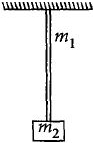
0 likes
View Solution9
MediumMCQ
$A$ block of mass $1\, kg$ is hanging vertically from a string of length $1\, m$ and mass per unit length $\mu = 0.001\, kg/m$. $A$ small pulse is generated at its lower end. The pulse reaches the top end in approximately .... $s$.

A
$0.2$
B
$0.1$
C
$0.02$
D
$0.01$
Solution
(D) The speed of a transverse wave on a string is given by the formula:
$v = \sqrt{\frac{T}{\mu}}$ ..........$(1)$
where,$T$ is the tension in the string and $\mu$ is the mass per unit length (linear density).
In this problem:
The tension in the string $(T)$ is due to the weight of the block hanging at the end:
$T = m \times g = 1\, kg \times 10\, m/s^2 = 10\, N$.
The mass per unit length is given as $\mu = 0.001\, kg/m$.
Substituting these values into formula $(1)$:
$v = \sqrt{\frac{10}{0.001}} = \sqrt{10000} = 100\, m/s$.
The time taken $(t)$ by the pulse to travel the length $(L = 1\, m)$ of the string is:
$t = \frac{L}{v} = \frac{1\, m}{100\, m/s} = 0.01\, s$.
$v = \sqrt{\frac{T}{\mu}}$ ..........$(1)$
where,$T$ is the tension in the string and $\mu$ is the mass per unit length (linear density).
In this problem:
The tension in the string $(T)$ is due to the weight of the block hanging at the end:
$T = m \times g = 1\, kg \times 10\, m/s^2 = 10\, N$.
The mass per unit length is given as $\mu = 0.001\, kg/m$.
Substituting these values into formula $(1)$:
$v = \sqrt{\frac{10}{0.001}} = \sqrt{10000} = 100\, m/s$.
The time taken $(t)$ by the pulse to travel the length $(L = 1\, m)$ of the string is:
$t = \frac{L}{v} = \frac{1\, m}{100\, m/s} = 0.01\, s$.
0 likes
View Solution10
MediumMCQ
$A$ uniform rope having some mass hangs vertically from a rigid support. $A$ transverse wave pulse is produced at the lower end. The speed $(v)$ of the wave pulse varies with height $(h)$ from the lower end as:
A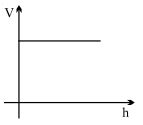
B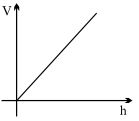
C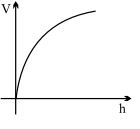
D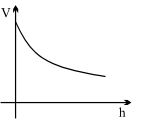
Solution
(C) The speed of a transverse wave on a string is given by $v = \sqrt{\frac{T}{\mu}}$,where $T$ is the tension and $\mu$ is the linear mass density of the rope.
At a height $h$ from the lower end,the tension $T$ in the rope is due to the weight of the portion of the rope below that point.
If the total length of the rope is $L$ and total mass is $M$,then $\mu = \frac{M}{L}$.
The mass of the portion of length $h$ is $m = \mu h$.
Therefore,the tension at height $h$ is $T = mg = \mu h g$.
Substituting this into the speed formula:
$v = \sqrt{\frac{\mu h g}{\mu}} = \sqrt{gh}$.
This shows that $v \propto \sqrt{h}$,which represents a parabolic relationship where $v$ increases with $h$. This corresponds to the curve shown in option $C$.
At a height $h$ from the lower end,the tension $T$ in the rope is due to the weight of the portion of the rope below that point.
If the total length of the rope is $L$ and total mass is $M$,then $\mu = \frac{M}{L}$.
The mass of the portion of length $h$ is $m = \mu h$.
Therefore,the tension at height $h$ is $T = mg = \mu h g$.
Substituting this into the speed formula:
$v = \sqrt{\frac{\mu h g}{\mu}} = \sqrt{gh}$.
This shows that $v \propto \sqrt{h}$,which represents a parabolic relationship where $v$ increases with $h$. This corresponds to the curve shown in option $C$.
0 likes
View Solution11
AdvancedMCQ
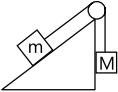
$A$ wire of linear mass density $\mu = 10^{-2} \, kg \, m^{-1}$ passes over a frictionless light pulley fixed on the top of a frictionless inclined plane which makes an angle of $30^o$ with the horizontal. Masses $m$ and $M$ are tied at two ends of the wire such that $m$ rests on the plane and $M$ hangs freely vertically downwards. The entire system is in equilibrium and a transverse wave propagates along the wire with a velocity of $100 \, m \, s^{-1}$.
A
$M = 5 \, kg$
B
$\frac{m}{M} = \frac{1}{4}$
C
$m = 20 \, kg$
D
$\frac{m}{M} = 4$
Solution
(C) The velocity of a transverse wave on a string is given by $v = \sqrt{\frac{T}{\mu}}$,where $T$ is the tension and $\mu$ is the linear mass density.
Given $v = 100 \, m \, s^{-1}$ and $\mu = 10^{-2} \, kg \, m^{-1}$.
$100 = \sqrt{\frac{T}{10^{-2}}} \implies 100^2 = \frac{T}{10^{-2}} \implies T = 10000 \times 10^{-2} = 100 \, N$.
Since the system is in equilibrium,the tension $T$ in the string is equal to the weight of the hanging mass $M$,so $T = Mg = 100 \, N$. Taking $g = 10 \, m \, s^{-2}$,we get $M = \frac{100}{10} = 10 \, kg$.
For the mass $m$ on the inclined plane,the component of gravity along the plane must balance the tension $T$,so $T = mg \sin(30^o)$.
$100 = m \times 10 \times \frac{1}{2} \implies 100 = 5m \implies m = 20 \, kg$.
Thus,$\frac{m}{M} = \frac{20}{10} = 2$. Looking at the options,$m = 20 \, kg$ is correct.
Given $v = 100 \, m \, s^{-1}$ and $\mu = 10^{-2} \, kg \, m^{-1}$.
$100 = \sqrt{\frac{T}{10^{-2}}} \implies 100^2 = \frac{T}{10^{-2}} \implies T = 10000 \times 10^{-2} = 100 \, N$.
Since the system is in equilibrium,the tension $T$ in the string is equal to the weight of the hanging mass $M$,so $T = Mg = 100 \, N$. Taking $g = 10 \, m \, s^{-2}$,we get $M = \frac{100}{10} = 10 \, kg$.
For the mass $m$ on the inclined plane,the component of gravity along the plane must balance the tension $T$,so $T = mg \sin(30^o)$.
$100 = m \times 10 \times \frac{1}{2} \implies 100 = 5m \implies m = 20 \, kg$.
Thus,$\frac{m}{M} = \frac{20}{10} = 2$. Looking at the options,$m = 20 \, kg$ is correct.
0 likes
View Solution12
AdvancedMCQ
$A$ composite string is made up by joining two strings of different mass per unit length,$\mu$ and $4\mu$. The composite string is under the same tension $T$. $A$ transverse wave pulse,$Y = (6 \text{ mm}) \sin(5t + 40x)$,where $t$ is in seconds and $x$ is in meters,is sent along the lighter string towards the joint. The joint is at $x = 0$. The equation of the wave pulse reflected from the joint is:
A
$(2 \text{ mm}) \sin(5t - 40x)$
B
$(4 \text{ mm}) \sin(40x - 5t)$
C
$-(2 \text{ mm}) \sin(5t - 40x)$
D
$(2 \text{ mm}) \sin(5t - 10x)$
Solution
(C) The speed of the wave in the first string is $V_1 = \sqrt{T/\mu}$.
The speed of the wave in the second string is $V_2 = \sqrt{T/(4\mu)} = V_1/2$.
Since $V_2 < V_1$,the second medium is denser.
When a wave reflects from a denser medium,it undergoes a phase change of $\pi$,which introduces a negative sign.
The reflection coefficient is given by $R = (V_2 - V_1) / (V_2 + V_1)$.
$R = (V_1/2 - V_1) / (V_1/2 + V_1) = (-V_1/2) / (3V_1/2) = -1/3$.
The amplitude of the reflected wave is $A_r = R \times A_i = (-1/3) \times 6 \text{ mm} = -2 \text{ mm}$.
The incident wave is $Y_i = (6 \text{ mm}) \sin(5t + 40x)$. The reflected wave travels in the opposite direction ($-x$ direction),so its phase is $(5t - 40x)$.
Thus,the reflected wave equation is $Y_r = -2 \sin(5t - 40x) \text{ mm}$.
The speed of the wave in the second string is $V_2 = \sqrt{T/(4\mu)} = V_1/2$.
Since $V_2 < V_1$,the second medium is denser.
When a wave reflects from a denser medium,it undergoes a phase change of $\pi$,which introduces a negative sign.
The reflection coefficient is given by $R = (V_2 - V_1) / (V_2 + V_1)$.
$R = (V_1/2 - V_1) / (V_1/2 + V_1) = (-V_1/2) / (3V_1/2) = -1/3$.
The amplitude of the reflected wave is $A_r = R \times A_i = (-1/3) \times 6 \text{ mm} = -2 \text{ mm}$.
The incident wave is $Y_i = (6 \text{ mm}) \sin(5t + 40x)$. The reflected wave travels in the opposite direction ($-x$ direction),so its phase is $(5t - 40x)$.
Thus,the reflected wave equation is $Y_r = -2 \sin(5t - 40x) \text{ mm}$.
0 likes
View Solution13
DifficultMCQ
$A$ perfectly elastic uniform string is suspended vertically with its upper end fixed to the ceiling and the lower end loaded with a weight. If a transverse wave is imparted to the lower end of the string,the pulse will
A
not travel along the length of the string
B
travel upwards with increasing speed
C
travel upwards with constant acceleration
D
both $(B)$ and $(C)$
Solution
(D) The speed of a transverse wave on a string is given by $v = \sqrt{\frac{T}{\mu}}$,where $T$ is the tension and $\mu$ is the linear mass density.
At a distance $x$ from the lower end,the tension $T(x) = w + \mu x g$,where $w$ is the weight attached at the lower end.
Thus,$v = \sqrt{\frac{w + \mu x g}{\mu}} = \sqrt{\frac{w}{\mu} + xg}$.
As the pulse travels upwards,$x$ increases,so the speed $v$ increases.
Squaring both sides,$v^2 = \frac{w}{\mu} + xg$.
Differentiating with respect to time $t$,$2v \frac{dv}{dt} = g \frac{dx}{dt}$.
Since $\frac{dx}{dt} = v$,we have $2v \frac{dv}{dt} = gv$,which simplifies to $\frac{dv}{dt} = \frac{g}{2}$.
Thus,the pulse travels upwards with a constant acceleration of $\frac{g}{2}$.
At a distance $x$ from the lower end,the tension $T(x) = w + \mu x g$,where $w$ is the weight attached at the lower end.
Thus,$v = \sqrt{\frac{w + \mu x g}{\mu}} = \sqrt{\frac{w}{\mu} + xg}$.
As the pulse travels upwards,$x$ increases,so the speed $v$ increases.
Squaring both sides,$v^2 = \frac{w}{\mu} + xg$.
Differentiating with respect to time $t$,$2v \frac{dv}{dt} = g \frac{dx}{dt}$.
Since $\frac{dx}{dt} = v$,we have $2v \frac{dv}{dt} = gv$,which simplifies to $\frac{dv}{dt} = \frac{g}{2}$.
Thus,the pulse travels upwards with a constant acceleration of $\frac{g}{2}$.
0 likes
View Solution14
DifficultMCQ
One end of a string of length $L$ is tied to the ceiling of a lift accelerating upwards with an acceleration $2g$. The other end of the string is free. The linear mass density of the string varies linearly from $0$ to $\lambda$ from bottom to top.
A
The velocity of the wave in the string will be $0$.
B
The time taken by a pulse to reach from bottom to top will be $\sqrt{4L/3g}$.
C
The time taken by a pulse to reach from bottom to top will be $\sqrt{8L/3g}$.
D
Both $(B)$ and $(C)$.
Solution
(C) Let $x$ be the distance from the bottom end of the string. The linear mass density is $\mu(x) = (\lambda/L)x$.
The tension $T(x)$ at a distance $x$ from the bottom is due to the weight of the segment of length $x$ in the accelerating frame. The effective acceleration is $g_{eff} = g + 2g = 3g$.
The mass of the segment of length $x$ is $m(x) = \int_0^x \mu(x') dx' = \int_0^x (\lambda/L)x' dx' = \frac{\lambda x^2}{2L}$.
The tension $T(x) = m(x) \cdot g_{eff} = \frac{3g\lambda x^2}{2L}$.
The wave velocity $v(x) = \sqrt{T(x)/\mu(x)} = \sqrt{\frac{3g\lambda x^2 / 2L}{\lambda x / L}} = \sqrt{\frac{3gx}{2}}$.
Since $v = dx/dt$,we have $dt = dx / \sqrt{3gx/2} = \sqrt{2/3g} \cdot x^{-1/2} dx$.
Integrating from $x=0$ to $x=L$,the time $t = \int_0^L \sqrt{2/3g} \cdot x^{-1/2} dx = \sqrt{2/3g} \cdot [2x^{1/2}]_0^L = \sqrt{2/3g} \cdot 2\sqrt{L} = \sqrt{8L/3g}$.
The tension $T(x)$ at a distance $x$ from the bottom is due to the weight of the segment of length $x$ in the accelerating frame. The effective acceleration is $g_{eff} = g + 2g = 3g$.
The mass of the segment of length $x$ is $m(x) = \int_0^x \mu(x') dx' = \int_0^x (\lambda/L)x' dx' = \frac{\lambda x^2}{2L}$.
The tension $T(x) = m(x) \cdot g_{eff} = \frac{3g\lambda x^2}{2L}$.
The wave velocity $v(x) = \sqrt{T(x)/\mu(x)} = \sqrt{\frac{3g\lambda x^2 / 2L}{\lambda x / L}} = \sqrt{\frac{3gx}{2}}$.
Since $v = dx/dt$,we have $dt = dx / \sqrt{3gx/2} = \sqrt{2/3g} \cdot x^{-1/2} dx$.
Integrating from $x=0$ to $x=L$,the time $t = \int_0^L \sqrt{2/3g} \cdot x^{-1/2} dx = \sqrt{2/3g} \cdot [2x^{1/2}]_0^L = \sqrt{2/3g} \cdot 2\sqrt{L} = \sqrt{8L/3g}$.
0 likes
View Solution15
DifficultMCQ
The equation of a wave on a string of linear mass density $0.04 \ kg \ m^{-1}$ is given by $y = 0.02 \sin \left[ 2\pi \left( \frac{t}{0.04 \ s} - \frac{x}{0.50 \ m} \right) \right] \ m$. The tension in the string is .... $N$.
A
$6.25$
B
$4$
C
$12.5$
D
$0.5$
Solution
(A) The given wave equation is $y = 0.02 \sin \left[ 2\pi \left( \frac{t}{0.04} - \frac{x}{0.50} \right) \right]$.
Comparing this with the standard wave equation $y = A \sin (\omega t - kx)$,we get:
Angular frequency $\omega = \frac{2\pi}{0.04} \ rad/s$ and wave number $k = \frac{2\pi}{0.50} \ rad/m$.
The wave velocity $v$ is given by $v = \frac{\omega}{k} = \frac{2\pi / 0.04}{2\pi / 0.50} = \frac{0.50}{0.04} = 12.5 \ m/s$.
The velocity of a wave on a stretched string is $v = \sqrt{\frac{T}{\mu}}$,where $T$ is the tension and $\mu$ is the linear mass density.
Given $\mu = 0.04 \ kg/m$,we have $T = v^2 \mu$.
Substituting the values,$T = (12.5)^2 \times 0.04 = 156.25 \times 0.04 = 6.25 \ N$.
Comparing this with the standard wave equation $y = A \sin (\omega t - kx)$,we get:
Angular frequency $\omega = \frac{2\pi}{0.04} \ rad/s$ and wave number $k = \frac{2\pi}{0.50} \ rad/m$.
The wave velocity $v$ is given by $v = \frac{\omega}{k} = \frac{2\pi / 0.04}{2\pi / 0.50} = \frac{0.50}{0.04} = 12.5 \ m/s$.
The velocity of a wave on a stretched string is $v = \sqrt{\frac{T}{\mu}}$,where $T$ is the tension and $\mu$ is the linear mass density.
Given $\mu = 0.04 \ kg/m$,we have $T = v^2 \mu$.
Substituting the values,$T = (12.5)^2 \times 0.04 = 156.25 \times 0.04 = 6.25 \ N$.
0 likes
View Solution16
DifficultMCQ
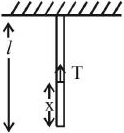
$A$ uniform string of length $20 \ m$ is suspended from a rigid support. $A$ short wave pulse is introduced at its lowest end. It starts moving up the string. The time taken to reach the support is (take $g = 10 \ ms^{-2}$):
A
$2\sqrt{2} \ s$
B
$\sqrt{2} \ s$
C
$2\pi\sqrt{2} \ s$
D
$2 \ s$
Solution
(A) The velocity of a wave on a string is given by $v = \sqrt{\frac{T}{\mu}}$,where $T$ is the tension and $\mu$ is the mass per unit length.
For a string of length $l$ and mass $m$,$\mu = \frac{m}{l}$.
At a distance $x$ from the lower end,the tension $T$ is due to the weight of the string below that point: $T = \mu x g$.
Substituting this into the velocity formula: $v = \sqrt{\frac{\mu x g}{\mu}} = \sqrt{gx}$.
Since $v = \frac{dx}{dt}$,we have $\frac{dx}{dt} = \sqrt{gx}$.
Separating variables: $x^{-1/2} dx = \sqrt{g} dt$.
Integrating from $x=0$ to $x=l$ and $t=0$ to $t=T_{total}$:
$\int_{0}^{l} x^{-1/2} dx = \int_{0}^{T_{total}} \sqrt{g} dt$.
$[2x^{1/2}]_{0}^{l} = \sqrt{g} T_{total}$.
$2\sqrt{l} = \sqrt{g} T_{total} \implies T_{total} = 2\sqrt{\frac{l}{g}}$.
Given $l = 20 \ m$ and $g = 10 \ ms^{-2}$,we get $T_{total} = 2\sqrt{\frac{20}{10}} = 2\sqrt{2} \ s$.
For a string of length $l$ and mass $m$,$\mu = \frac{m}{l}$.
At a distance $x$ from the lower end,the tension $T$ is due to the weight of the string below that point: $T = \mu x g$.
Substituting this into the velocity formula: $v = \sqrt{\frac{\mu x g}{\mu}} = \sqrt{gx}$.
Since $v = \frac{dx}{dt}$,we have $\frac{dx}{dt} = \sqrt{gx}$.
Separating variables: $x^{-1/2} dx = \sqrt{g} dt$.
Integrating from $x=0$ to $x=l$ and $t=0$ to $t=T_{total}$:
$\int_{0}^{l} x^{-1/2} dx = \int_{0}^{T_{total}} \sqrt{g} dt$.
$[2x^{1/2}]_{0}^{l} = \sqrt{g} T_{total}$.
$2\sqrt{l} = \sqrt{g} T_{total} \implies T_{total} = 2\sqrt{\frac{l}{g}}$.
Given $l = 20 \ m$ and $g = 10 \ ms^{-2}$,we get $T_{total} = 2\sqrt{\frac{20}{10}} = 2\sqrt{2} \ s$.
0 likes
View Solution17
MediumMCQ
Which of the following graphs is $CORRECT$?
A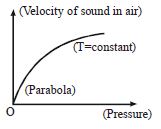
B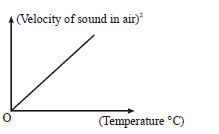
C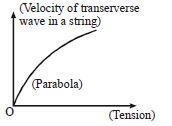
D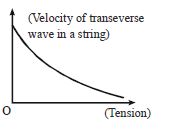
Solution
(C) The velocity of sound in air is given by $V = \sqrt{\frac{\gamma RT}{M}}$.
Since $V \propto \sqrt{T}$,where $T$ is the absolute temperature in Kelvin,we have $V^2 \propto T$.
Option $(A)$ shows velocity vs pressure,which is incorrect as velocity of sound in an ideal gas is independent of pressure.
Option $(B)$ shows $V^2$ vs temperature in $^\circ C$. Since $V^2 \propto (t + 273.15)$,the graph of $V^2$ versus $t$ $(^\circ C)$ should be a straight line with a positive intercept on the $V^2$ axis,not passing through the origin.
Option $(C)$ shows the velocity of a transverse wave in a string,$V = \sqrt{\frac{T}{\mu}}$,where $T$ is the tension. This implies $V \propto \sqrt{T}$,which represents a parabolic curve $V^2 \propto T$. Thus,the graph of $V$ versus $T$ is a parabola opening towards the $T$-axis.
Option $(D)$ shows an inverse relationship,which is incorrect.
Therefore,the correct graph is $(C)$.
Since $V \propto \sqrt{T}$,where $T$ is the absolute temperature in Kelvin,we have $V^2 \propto T$.
Option $(A)$ shows velocity vs pressure,which is incorrect as velocity of sound in an ideal gas is independent of pressure.
Option $(B)$ shows $V^2$ vs temperature in $^\circ C$. Since $V^2 \propto (t + 273.15)$,the graph of $V^2$ versus $t$ $(^\circ C)$ should be a straight line with a positive intercept on the $V^2$ axis,not passing through the origin.
Option $(C)$ shows the velocity of a transverse wave in a string,$V = \sqrt{\frac{T}{\mu}}$,where $T$ is the tension. This implies $V \propto \sqrt{T}$,which represents a parabolic curve $V^2 \propto T$. Thus,the graph of $V$ versus $T$ is a parabola opening towards the $T$-axis.
Option $(D)$ shows an inverse relationship,which is incorrect.
Therefore,the correct graph is $(C)$.
0 likes
View Solution18
MediumMCQ
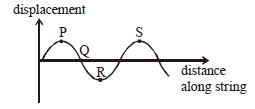
The given graph illustrates a transverse wave travelling on a string at a particular instant,and the points $P, Q, R$ and $S$ represent elements of the string. Which of the following statements about the motion of the elements is correct?
A
The speed of the element at $P$ is a maximum.
B
The displacement of the element at $Q$ is always zero.
C
The energy of the element at $R$ is entirely kinetic.
D
The acceleration of the element at $S$ is maximum.
Solution
(D) In a transverse wave,the elements of the string perform simple harmonic motion $(SHM)$.
For an element in $SHM$,the displacement $y$ is given by $y = A \sin(\omega t + \phi)$.
The velocity is $v = \frac{dy}{dt} = A\omega \cos(\omega t + \phi)$,which is maximum at the mean position $(y = 0)$.
The acceleration is $a = \frac{d^2y}{dt^2} = -\omega^2 y$,which is maximum at the extreme positions $(y = \pm A)$.
Points $P$ and $S$ are at the crests (extreme positions),so the acceleration of the elements at $P$ and $S$ is maximum.
Point $Q$ is at the mean position,so its velocity is maximum,but its displacement is zero only at this instant,not always.
Point $R$ is at the trough (extreme position),where its velocity is zero and its energy is entirely potential.
Therefore,the correct statement is that the acceleration of the element at $S$ is maximum.
For an element in $SHM$,the displacement $y$ is given by $y = A \sin(\omega t + \phi)$.
The velocity is $v = \frac{dy}{dt} = A\omega \cos(\omega t + \phi)$,which is maximum at the mean position $(y = 0)$.
The acceleration is $a = \frac{d^2y}{dt^2} = -\omega^2 y$,which is maximum at the extreme positions $(y = \pm A)$.
Points $P$ and $S$ are at the crests (extreme positions),so the acceleration of the elements at $P$ and $S$ is maximum.
Point $Q$ is at the mean position,so its velocity is maximum,but its displacement is zero only at this instant,not always.
Point $R$ is at the trough (extreme position),where its velocity is zero and its energy is entirely potential.
Therefore,the correct statement is that the acceleration of the element at $S$ is maximum.
0 likes
View Solution19
MediumMCQ
$A$ transverse wave is passing through a string as shown in the figure. The mass density of the string is $1 \ kg/m^3$ and the cross-sectional area of the string is $0.01 \ m^2$. The equation of the wave in the string is $y = 2 \sin(20t - 10x)$. The hanging mass is (in $kg$):-
A
$40$
B
$0.2$
C
$0.004$
D
$0.00025$
Solution
(C) The wave equation is given by $y = 2 \sin(20t - 10x)$. Comparing this with the standard wave equation $y = A \sin(\omega t - kx)$,we get angular frequency $\omega = 20 \ rad/s$ and wave number $k = 10 \ m^{-1}$.
The wave speed $v$ is given by $v = \frac{\omega}{k} = \frac{20}{10} = 2 \ m/s$.
The speed of a transverse wave on a string is also given by $v = \sqrt{\frac{T}{\mu}}$,where $T$ is the tension and $\mu$ is the linear mass density.
Linear mass density $\mu = \text{density} \times \text{area} = 1 \ kg/m^3 \times 0.01 \ m^2 = 0.01 \ kg/m$.
The tension $T$ in the string is provided by the weight of the hanging mass $M$,so $T = Mg$.
Substituting these into the speed formula: $2 = \sqrt{\frac{Mg}{0.01}}$.
Squaring both sides: $4 = \frac{Mg}{0.01} \implies 4 = \frac{M \times 10}{0.01} \implies 4 = 1000M$.
Therefore,$M = \frac{4}{1000} = 0.004 \ kg$.
The wave speed $v$ is given by $v = \frac{\omega}{k} = \frac{20}{10} = 2 \ m/s$.
The speed of a transverse wave on a string is also given by $v = \sqrt{\frac{T}{\mu}}$,where $T$ is the tension and $\mu$ is the linear mass density.
Linear mass density $\mu = \text{density} \times \text{area} = 1 \ kg/m^3 \times 0.01 \ m^2 = 0.01 \ kg/m$.
The tension $T$ in the string is provided by the weight of the hanging mass $M$,so $T = Mg$.
Substituting these into the speed formula: $2 = \sqrt{\frac{Mg}{0.01}}$.
Squaring both sides: $4 = \frac{Mg}{0.01} \implies 4 = \frac{M \times 10}{0.01} \implies 4 = 1000M$.
Therefore,$M = \frac{4}{1000} = 0.004 \ kg$.
0 likes
View Solution20
DifficultMCQ
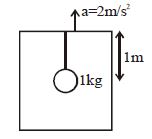
In the figure shown,a mass of $1 \ kg$ is connected to a string of mass per unit length $1.2 \ g/m$. The length of the string is $1 \ m$ and its other end is connected to the ceiling of a lift which is accelerating upwards with an acceleration of $2 \ m/s^2$. $A$ transverse pulse is produced at the lowest point of the string. The time taken by the pulse to reach the top of the string is .... $s$. (Take $g = 10 \ m/s^2$)
A
$0.1$
B
$0.01$
C
$0.05$
D
$0.5$
Solution
(B) The tension $T$ in the string is due to the mass $M = 1 \ kg$ hanging from it. Since the system is accelerating upwards with $a = 2 \ m/s^2$,the effective acceleration is $g_{eff} = g + a = 10 + 2 = 12 \ m/s^2$.
The tension $T$ at any point in the string (neglecting the mass of the string itself as it is very small compared to $1 \ kg$) is $T = M(g + a) = 1 \times 12 = 12 \ N$.
The speed of the transverse pulse $v$ is given by $v = \sqrt{\frac{T}{\mu}}$,where $\mu = 1.2 \ g/m = 1.2 \times 10^{-3} \ kg/m$.
$v = \sqrt{\frac{12}{1.2 \times 10^{-3}}} = \sqrt{10^4} = 100 \ m/s$.
Since the speed is constant,the time taken $t$ to travel the length $L = 1 \ m$ is $t = \frac{L}{v} = \frac{1}{100} = 0.01 \ s$.
The tension $T$ at any point in the string (neglecting the mass of the string itself as it is very small compared to $1 \ kg$) is $T = M(g + a) = 1 \times 12 = 12 \ N$.
The speed of the transverse pulse $v$ is given by $v = \sqrt{\frac{T}{\mu}}$,where $\mu = 1.2 \ g/m = 1.2 \times 10^{-3} \ kg/m$.
$v = \sqrt{\frac{12}{1.2 \times 10^{-3}}} = \sqrt{10^4} = 100 \ m/s$.
Since the speed is constant,the time taken $t$ to travel the length $L = 1 \ m$ is $t = \frac{L}{v} = \frac{1}{100} = 0.01 \ s$.
0 likes
View Solution21
DifficultMCQ
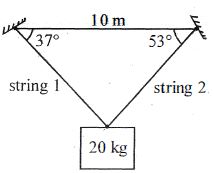
$A$ mass of $20\ kg$ is hanging with the support of two strings of the same linear mass density. Now,pulses are generated in both strings at the same time near the joint at the mass. The ratio of the time taken by a pulse to travel through string $1$ to that taken by a pulse on string $2$ is:
A
$\frac{4}{3}$
B
$\frac{\sqrt{4}}{\sqrt{3}}$
C
$\frac{4\sqrt{4}}{3\sqrt{3}}$
D
$\frac{3\sqrt{4}}{4\sqrt{3}}$
Solution
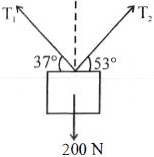
(C) Let $T_1$ and $T_2$ be the tensions in string $1$ and string $2$,respectively. For the mass to be in equilibrium:
$T_1 \sin(37^\circ) + T_2 \sin(53^\circ) = mg = 20 \times 10 = 200\ N$
$T_1 \cos(37^\circ) = T_2 \cos(53^\circ) \Rightarrow T_1 \times (4/5) = T_2 \times (3/5) \Rightarrow T_1 = (3/4) T_2$
Substituting $T_1$ in the vertical equilibrium equation:
$(3/4) T_2 \times (3/5) + T_2 \times (4/5) = 200 \Rightarrow (9/20 + 16/20) T_2 = 200 \Rightarrow (25/20) T_2 = 200 \Rightarrow T_2 = 160\ N$
$T_1 = (3/4) \times 160 = 120\ N$
The lengths of the strings are $L_1 = 10 \sin(53^\circ) = 10 \times (4/5) = 8\ m$ and $L_2 = 10 \sin(37^\circ) = 10 \times (3/5) = 6\ m$.
The wave speed is $v = \sqrt{T/\mu}$. Thus,$v_1 = \sqrt{T_1/\mu}$ and $v_2 = \sqrt{T_2/\mu}$.
The time taken is $t = L/v$. Therefore,$t_1/t_2 = (L_1/v_1) / (L_2/v_2) = (L_1/L_2) \times \sqrt{T_2/T_1}$.
$t_1/t_2 = (8/6) \times \sqrt{160/120} = (4/3) \times \sqrt{4/3} = \frac{4\sqrt{4}}{3\sqrt{3}}$.
$T_1 \sin(37^\circ) + T_2 \sin(53^\circ) = mg = 20 \times 10 = 200\ N$
$T_1 \cos(37^\circ) = T_2 \cos(53^\circ) \Rightarrow T_1 \times (4/5) = T_2 \times (3/5) \Rightarrow T_1 = (3/4) T_2$
Substituting $T_1$ in the vertical equilibrium equation:
$(3/4) T_2 \times (3/5) + T_2 \times (4/5) = 200 \Rightarrow (9/20 + 16/20) T_2 = 200 \Rightarrow (25/20) T_2 = 200 \Rightarrow T_2 = 160\ N$
$T_1 = (3/4) \times 160 = 120\ N$
The lengths of the strings are $L_1 = 10 \sin(53^\circ) = 10 \times (4/5) = 8\ m$ and $L_2 = 10 \sin(37^\circ) = 10 \times (3/5) = 6\ m$.
The wave speed is $v = \sqrt{T/\mu}$. Thus,$v_1 = \sqrt{T_1/\mu}$ and $v_2 = \sqrt{T_2/\mu}$.
The time taken is $t = L/v$. Therefore,$t_1/t_2 = (L_1/v_1) / (L_2/v_2) = (L_1/L_2) \times \sqrt{T_2/T_1}$.
$t_1/t_2 = (8/6) \times \sqrt{160/120} = (4/3) \times \sqrt{4/3} = \frac{4\sqrt{4}}{3\sqrt{3}}$.
0 likes
View Solution22
MediumMCQ
The linear density of a vibrating string is $1.3 \times 10^{-4} \, kg/m$. $A$ transverse wave is propagating on the string and is described by the equation $Y = 0.021 \, \sin(x + 30t)$,where $x$ and $y$ are measured in meters and $t$ in seconds. The tension in the string is ..... $N$.
A
$0.117$
B
$0.48$
C
$1.20$
D
$4.80$
Solution
(A) The wave equation is given by $Y = A \sin(kx + \omega t)$.
Comparing this with the given equation $Y = 0.021 \sin(x + 30t)$,we get the angular frequency $\omega = 30 \, rad/s$ and the wave number $k = 1 \, m^{-1}$.
The wave speed $v$ is given by $v = \frac{\omega}{k} = \frac{30}{1} = 30 \, m/s$.
The speed of a transverse wave on a string is also given by $v = \sqrt{\frac{T}{\mu}}$,where $T$ is the tension and $\mu$ is the linear mass density.
Given $\mu = 1.3 \times 10^{-4} \, kg/m$.
Substituting the values: $30 = \sqrt{\frac{T}{1.3 \times 10^{-4}}}$.
Squaring both sides: $900 = \frac{T}{1.3 \times 10^{-4}}$.
$T = 900 \times 1.3 \times 10^{-4} = 1170 \times 10^{-4} = 0.117 \, N$.
Comparing this with the given equation $Y = 0.021 \sin(x + 30t)$,we get the angular frequency $\omega = 30 \, rad/s$ and the wave number $k = 1 \, m^{-1}$.
The wave speed $v$ is given by $v = \frac{\omega}{k} = \frac{30}{1} = 30 \, m/s$.
The speed of a transverse wave on a string is also given by $v = \sqrt{\frac{T}{\mu}}$,where $T$ is the tension and $\mu$ is the linear mass density.
Given $\mu = 1.3 \times 10^{-4} \, kg/m$.
Substituting the values: $30 = \sqrt{\frac{T}{1.3 \times 10^{-4}}}$.
Squaring both sides: $900 = \frac{T}{1.3 \times 10^{-4}}$.
$T = 900 \times 1.3 \times 10^{-4} = 1170 \times 10^{-4} = 0.117 \, N$.
0 likes
View Solution23
DifficultMCQ
$A$ string of mass $2.5\ kg$ is under a tension of $200\ N$. The length of the stretched string is $20.0\ m$. If a transverse jerk is struck at one end of the string,the disturbance will reach the other end in .... $\sec$.
A
$1$
B
$0.5$
C
$2$
D
Data given is insufficient.
Solution
(B) The speed of a transverse wave on a stretched string is given by $v = \sqrt{\frac{T}{\mu}}$,where $T$ is the tension and $\mu$ is the linear mass density.
Linear mass density $\mu = \frac{m}{l} = \frac{2.5\ kg}{20.0\ m} = 0.125\ kg/m$.
Now,calculate the wave speed $v = \sqrt{\frac{200\ N}{0.125\ kg/m}} = \sqrt{1600} = 40\ m/s$.
The time taken for the disturbance to reach the other end is $t = \frac{l}{v} = \frac{20.0\ m}{40\ m/s} = 0.5\ s$.
Linear mass density $\mu = \frac{m}{l} = \frac{2.5\ kg}{20.0\ m} = 0.125\ kg/m$.
Now,calculate the wave speed $v = \sqrt{\frac{200\ N}{0.125\ kg/m}} = \sqrt{1600} = 40\ m/s$.
The time taken for the disturbance to reach the other end is $t = \frac{l}{v} = \frac{20.0\ m}{40\ m/s} = 0.5\ s$.
0 likes
View Solution24
DifficultMCQ
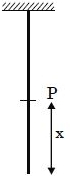
$A$ uniform string is suspended vertically. $A$ transverse pulse is created at the top of the string. Then:
A
the speed of the pulse remains constant.
B
the speed of the pulse decreases at a constant rate as the pulse moves downward.
C
the speed of the pulse decreases with an increasing rate as the pulse moves downward.
D
the speed of the pulse increases at a constant rate as the pulse moves downward.
Solution
(B) Let $L$ be the length of the string and $m$ be its total mass. The linear mass density is $\mu = m/L$.
Consider a point $P$ at a distance $x$ from the bottom end of the string.
The tension $T$ at point $P$ is equal to the weight of the string below it,so $T = (\mu x)g = \frac{m}{L}gx$.
The speed of a transverse pulse in a string is given by $v = \sqrt{T/\mu}$.
Substituting $T$,we get $v = \sqrt{\frac{(\mu x)g}{\mu}} = \sqrt{gx}$.
As the pulse moves downward,$x$ decreases,so the speed $v$ decreases.
To find the rate of change of speed with respect to time,we use $a = \frac{dv}{dt} = \frac{dv}{dx} \cdot \frac{dx}{dt}$.
Since the pulse moves downward,$\frac{dx}{dt} = -v = -\sqrt{gx}$.
Calculating $\frac{dv}{dx} = \frac{d}{dx}(\sqrt{gx}) = \frac{g}{2\sqrt{gx}}$.
Thus,$a = \left(\frac{g}{2\sqrt{gx}}\right) \cdot (-\sqrt{gx}) = -g/2$.
The negative sign indicates that the speed decreases at a constant rate of $g/2$ as it moves downward.
Consider a point $P$ at a distance $x$ from the bottom end of the string.
The tension $T$ at point $P$ is equal to the weight of the string below it,so $T = (\mu x)g = \frac{m}{L}gx$.
The speed of a transverse pulse in a string is given by $v = \sqrt{T/\mu}$.
Substituting $T$,we get $v = \sqrt{\frac{(\mu x)g}{\mu}} = \sqrt{gx}$.
As the pulse moves downward,$x$ decreases,so the speed $v$ decreases.
To find the rate of change of speed with respect to time,we use $a = \frac{dv}{dt} = \frac{dv}{dx} \cdot \frac{dx}{dt}$.
Since the pulse moves downward,$\frac{dx}{dt} = -v = -\sqrt{gx}$.
Calculating $\frac{dv}{dx} = \frac{d}{dx}(\sqrt{gx}) = \frac{g}{2\sqrt{gx}}$.
Thus,$a = \left(\frac{g}{2\sqrt{gx}}\right) \cdot (-\sqrt{gx}) = -g/2$.
The negative sign indicates that the speed decreases at a constant rate of $g/2$ as it moves downward.
0 likes
View Solution25
DifficultMCQ
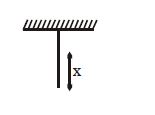
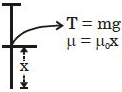
$A$ wire of variable mass per unit length $\mu = \mu_0 x$ is hanging from the ceiling as shown in the figure. The length of the wire is $l_0$. $A$ small transverse disturbance is produced at its lower end. Find the time after which the disturbance will reach the other end.
A
$\sqrt{\frac{8l_0}{g}}$
B
$\sqrt{\frac{4l_0}{g}}$
C
$\sqrt{\frac{2l_0}{g}}$
D
None
Solution
(A) Let $x$ be the distance from the lower end of the wire. The tension $T$ at a distance $x$ from the lower end is equal to the weight of the wire below that point.
The mass of the wire of length $x$ is $m = \int_0^x \mu(x') dx' = \int_0^x \mu_0 x' dx' = \frac{\mu_0 x^2}{2}$.
Thus,the tension $T$ at distance $x$ is $T = mg = \frac{\mu_0 x^2 g}{2}$.
The speed of the transverse wave at distance $x$ is $v = \sqrt{\frac{T}{\mu}} = \sqrt{\frac{\mu_0 x^2 g / 2}{\mu_0 x}} = \sqrt{\frac{gx}{2}}$.
Since $v = \frac{dx}{dt}$,we have $\frac{dx}{dt} = \sqrt{\frac{g}{2}} \sqrt{x}$.
Separating variables,$\int_0^{l_0} x^{-1/2} dx = \int_0^t \sqrt{\frac{g}{2}} dt$.
$[2x^{1/2}]_0^{l_0} = \sqrt{\frac{g}{2}} t$.
$2\sqrt{l_0} = \sqrt{\frac{g}{2}} t$.
$t = 2\sqrt{l_0} \sqrt{\frac{2}{g}} = 2\sqrt{\frac{2l_0}{g}} = \sqrt{\frac{8l_0}{g}}$.
The mass of the wire of length $x$ is $m = \int_0^x \mu(x') dx' = \int_0^x \mu_0 x' dx' = \frac{\mu_0 x^2}{2}$.
Thus,the tension $T$ at distance $x$ is $T = mg = \frac{\mu_0 x^2 g}{2}$.
The speed of the transverse wave at distance $x$ is $v = \sqrt{\frac{T}{\mu}} = \sqrt{\frac{\mu_0 x^2 g / 2}{\mu_0 x}} = \sqrt{\frac{gx}{2}}$.
Since $v = \frac{dx}{dt}$,we have $\frac{dx}{dt} = \sqrt{\frac{g}{2}} \sqrt{x}$.
Separating variables,$\int_0^{l_0} x^{-1/2} dx = \int_0^t \sqrt{\frac{g}{2}} dt$.
$[2x^{1/2}]_0^{l_0} = \sqrt{\frac{g}{2}} t$.
$2\sqrt{l_0} = \sqrt{\frac{g}{2}} t$.
$t = 2\sqrt{l_0} \sqrt{\frac{2}{g}} = 2\sqrt{\frac{2l_0}{g}} = \sqrt{\frac{8l_0}{g}}$.
0 likes
View Solution26
MediumMCQ
$A$ uniform metal wire of density $\rho$,cross-sectional area $A$,and length $L$ is stretched with a tension $T$. The speed of a transverse wave in the wire is given by:
A
$\sqrt{\frac{TL}{\rho A}}$
B
$\sqrt{\frac{T\rho}{AL}}$
C
$\sqrt{\frac{T}{A\rho}}$
D
$\sqrt{\frac{T\rho}{A}}$
Solution
(C) The speed of a transverse wave in a stretched string is given by $v = \sqrt{\frac{T}{\mu}}$,where $T$ is the tension and $\mu$ is the mass per unit length.
$\mu = \frac{M}{L}$,where $M$ is the total mass of the wire.
Since density $\rho = \frac{M}{V} = \frac{M}{AL}$,we have $M = \rho AL$.
Substituting $M$ into the expression for $\mu$:
$\mu = \frac{\rho AL}{L} = \rho A$.
Therefore,the speed of the wave is $v = \sqrt{\frac{T}{\rho A}}$.
$\mu = \frac{M}{L}$,where $M$ is the total mass of the wire.
Since density $\rho = \frac{M}{V} = \frac{M}{AL}$,we have $M = \rho AL$.
Substituting $M$ into the expression for $\mu$:
$\mu = \frac{\rho AL}{L} = \rho A$.
Therefore,the speed of the wave is $v = \sqrt{\frac{T}{\rho A}}$.
0 likes
View Solution27
MediumMCQ
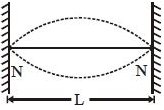
$A$ wire stretched between two rigid supports vibrates in its fundamental mode with a frequency of $50 \, Hz$. The mass of the wire is $30 \, g$ and its linear density is $4 \times 10^{-2} \, kg/m$. The speed of the transverse wave on the string is ...... $m/s$.
A
$25$
B
$50$
C
$75$
D
$100$
Solution
(C) Given:
Frequency of fundamental mode,$n = 50 \, Hz$
Mass of the wire,$M = 30 \, g = 30 \times 10^{-3} \, kg$
Linear mass density,$\mu = 4 \times 10^{-2} \, kg/m$
First,we find the length of the wire $(L)$:
Since $\mu = M/L$,we have $L = M/\mu$
$L = (30 \times 10^{-3} \, kg) / (4 \times 10^{-2} \, kg/m) = 0.75 \, m$
For the fundamental mode of vibration in a string fixed at both ends:
$L = \lambda / 2$
$\lambda = 2L = 2 \times 0.75 \, m = 1.5 \, m$
The speed of the transverse wave $(v)$ is given by:
$v = n \lambda$
$v = 50 \, Hz \times 1.5 \, m = 75 \, m/s$
Frequency of fundamental mode,$n = 50 \, Hz$
Mass of the wire,$M = 30 \, g = 30 \times 10^{-3} \, kg$
Linear mass density,$\mu = 4 \times 10^{-2} \, kg/m$
First,we find the length of the wire $(L)$:
Since $\mu = M/L$,we have $L = M/\mu$
$L = (30 \times 10^{-3} \, kg) / (4 \times 10^{-2} \, kg/m) = 0.75 \, m$
For the fundamental mode of vibration in a string fixed at both ends:
$L = \lambda / 2$
$\lambda = 2L = 2 \times 0.75 \, m = 1.5 \, m$
The speed of the transverse wave $(v)$ is given by:
$v = n \lambda$
$v = 50 \, Hz \times 1.5 \, m = 75 \, m/s$
0 likes
View Solution28
MediumMCQ
$A$ $43\, m$ long rope of mass $5.0\, kg$ joins two rock climbers. One climber strikes the rope and the second one feels the effect $1.4\, s$ later. What is the tension in the rope in $N$?
A
$110$
B
$301$
C
$215$
D
$154$
Solution
(A) The speed of the wave in the rope is given by $v = \frac{L}{t} = \frac{43\, m}{1.4\, s} \approx 30.71\, m/s$.
The linear mass density $\mu$ of the rope is $\mu = \frac{m}{L} = \frac{5.0\, kg}{43\, m} \approx 0.116\, kg/m$.
The wave speed in a stretched string is given by $v = \sqrt{\frac{T}{\mu}}$,where $T$ is the tension.
Rearranging for tension: $T = v^2 \mu = \left(\frac{43}{1.4}\right)^2 \times \frac{5.0}{43}$.
$T = \frac{43^2}{1.96} \times \frac{5}{43} = \frac{43 \times 5}{1.96} = \frac{215}{1.96} \approx 109.69\, N$.
Rounding to the nearest whole number,the tension is approximately $110\, N$.
The linear mass density $\mu$ of the rope is $\mu = \frac{m}{L} = \frac{5.0\, kg}{43\, m} \approx 0.116\, kg/m$.
The wave speed in a stretched string is given by $v = \sqrt{\frac{T}{\mu}}$,where $T$ is the tension.
Rearranging for tension: $T = v^2 \mu = \left(\frac{43}{1.4}\right)^2 \times \frac{5.0}{43}$.
$T = \frac{43^2}{1.96} \times \frac{5}{43} = \frac{43 \times 5}{1.96} = \frac{215}{1.96} \approx 109.69\, N$.
Rounding to the nearest whole number,the tension is approximately $110\, N$.
0 likes
View Solution29
DifficultMCQ
$A$ string of mass $2.5 \, kg$ is under some tension. The length of the stretched string is $20 \, m$. If the transverse jerk produced at one end of the string takes $0.5 \, s$ to reach the other end,the tension in the string is .... $N$
A
$100$
B
$200$
C
$300$
D
$400$
Solution
(B) The velocity of the transverse wave in the string is given by $v = \frac{L}{t}$,where $L = 20 \, m$ and $t = 0.5 \, s$.
$v = \frac{20}{0.5} = 40 \, m/s$.
The velocity of a transverse wave in a string is also given by $v = \sqrt{\frac{T}{\mu}}$,where $T$ is the tension and $\mu$ is the linear mass density.
Linear mass density $\mu = \frac{m}{L} = \frac{2.5 \, kg}{20 \, m} = 0.125 \, kg/m$.
Squaring the velocity formula,we get $v^2 = \frac{T}{\mu}$,which implies $T = v^2 \times \mu$.
Substituting the values: $T = (40)^2 \times 0.125 = 1600 \times 0.125 = 200 \, N$.
$v = \frac{20}{0.5} = 40 \, m/s$.
The velocity of a transverse wave in a string is also given by $v = \sqrt{\frac{T}{\mu}}$,where $T$ is the tension and $\mu$ is the linear mass density.
Linear mass density $\mu = \frac{m}{L} = \frac{2.5 \, kg}{20 \, m} = 0.125 \, kg/m$.
Squaring the velocity formula,we get $v^2 = \frac{T}{\mu}$,which implies $T = v^2 \times \mu$.
Substituting the values: $T = (40)^2 \times 0.125 = 1600 \times 0.125 = 200 \, N$.
0 likes
View Solution30
MediumMCQ
The equation of a travelling wave on a stretched string of linear mass density $5 \, g/m$ is $y = 0.03 \sin(450t - 9x)$,where distance and time are measured in $SI$ units. The tension in the string is ... $N$.
A
$10$
B
$7.5$
C
$12.5$
D
$5$
Solution
(C) The given wave equation is $y = 0.03 \sin(450t - 9x)$.
Comparing this with the standard wave equation $y = A \sin(\omega t - kx)$,we get angular frequency $\omega = 450 \, rad/s$ and wave number $k = 9 \, m^{-1}$.
The wave speed $v$ is given by $v = \frac{\omega}{k} = \frac{450}{9} = 50 \, m/s$.
The linear mass density $\mu = 5 \, g/m = 5 \times 10^{-3} \, kg/m$.
The speed of a wave on a stretched string is given by $v = \sqrt{\frac{T}{\mu}}$,where $T$ is the tension.
Squaring both sides,we get $v^2 = \frac{T}{\mu}$,so $T = \mu v^2$.
Substituting the values,$T = (5 \times 10^{-3} \, kg/m) \times (50 \, m/s)^2$.
$T = 5 \times 10^{-3} \times 2500 = 5 \times 2.5 = 12.5 \, N$.
Comparing this with the standard wave equation $y = A \sin(\omega t - kx)$,we get angular frequency $\omega = 450 \, rad/s$ and wave number $k = 9 \, m^{-1}$.
The wave speed $v$ is given by $v = \frac{\omega}{k} = \frac{450}{9} = 50 \, m/s$.
The linear mass density $\mu = 5 \, g/m = 5 \times 10^{-3} \, kg/m$.
The speed of a wave on a stretched string is given by $v = \sqrt{\frac{T}{\mu}}$,where $T$ is the tension.
Squaring both sides,we get $v^2 = \frac{T}{\mu}$,so $T = \mu v^2$.
Substituting the values,$T = (5 \times 10^{-3} \, kg/m) \times (50 \, m/s)^2$.
$T = 5 \times 10^{-3} \times 2500 = 5 \times 2.5 = 12.5 \, N$.
0 likes
View Solution31
DifficultMCQ
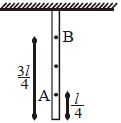
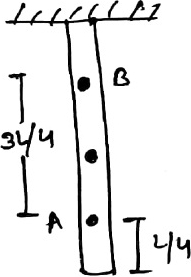
$A$ string of mass $m$ and length $l$ hangs from a ceiling as shown in the figure. $A$ wave in the string moves upward. $v_A$ and $v_B$ are the speeds of the wave at points $A$ and $B$ respectively. Then $v_B$ is
A
$\sqrt{3} v_A$
B
$v_A$
C
$< v_A$
D
$\sqrt{2} v_A$
Solution
(A) Let the mass of the string be $m$ and its length be $l$. The linear mass density is $\mu = \frac{m}{l}$.
The tension at any point in the string is equal to the weight of the portion of the string below that point.
For point $A$,the length of the string below it is $\frac{l}{4}$. Thus,the mass below $A$ is $m_A = \mu \times \frac{l}{4} = \frac{m}{4}$.
The tension at $A$ is $T_A = m_A g = \frac{mg}{4}$.
The speed of the wave at $A$ is $v_A = \sqrt{\frac{T_A}{\mu}} = \sqrt{\frac{mg/4}{m/l}} = \sqrt{\frac{gl}{4}}$.
For point $B$,the length of the string below it is $\frac{3l}{4}$. Thus,the mass below $B$ is $m_B = \mu \times \frac{3l}{4} = \frac{3m}{4}$.
The tension at $B$ is $T_B = m_B g = \frac{3mg}{4}$.
The speed of the wave at $B$ is $v_B = \sqrt{\frac{T_B}{\mu}} = \sqrt{\frac{3mg/4}{m/l}} = \sqrt{\frac{3gl}{4}}$.
Comparing $v_B$ and $v_A$:
$v_B = \sqrt{3} \times \sqrt{\frac{gl}{4}} = \sqrt{3} v_A$.
The tension at any point in the string is equal to the weight of the portion of the string below that point.
For point $A$,the length of the string below it is $\frac{l}{4}$. Thus,the mass below $A$ is $m_A = \mu \times \frac{l}{4} = \frac{m}{4}$.
The tension at $A$ is $T_A = m_A g = \frac{mg}{4}$.
The speed of the wave at $A$ is $v_A = \sqrt{\frac{T_A}{\mu}} = \sqrt{\frac{mg/4}{m/l}} = \sqrt{\frac{gl}{4}}$.
For point $B$,the length of the string below it is $\frac{3l}{4}$. Thus,the mass below $B$ is $m_B = \mu \times \frac{3l}{4} = \frac{3m}{4}$.
The tension at $B$ is $T_B = m_B g = \frac{3mg}{4}$.
The speed of the wave at $B$ is $v_B = \sqrt{\frac{T_B}{\mu}} = \sqrt{\frac{3mg/4}{m/l}} = \sqrt{\frac{3gl}{4}}$.
Comparing $v_B$ and $v_A$:
$v_B = \sqrt{3} \times \sqrt{\frac{gl}{4}} = \sqrt{3} v_A$.
0 likes
View Solution32
DifficultMCQ
$A$ string $1\,m$ long is driven by a $300\,Hz$ vibrator attached to its end. The string vibrates in three segments. The speed of transverse waves in the string is equal to ..... $m/s$.
A
$100$
B
$200$
C
$300$
D
$400$
Solution
(B) Given: Length of the string $L = 1\,m$,Frequency $f = 300\,Hz$,Number of segments $n = 3$.
For a string vibrating in $n$ segments,the length of each segment is $\lambda/2 = L/n$.
Therefore,the wavelength $\lambda = 2L/n$.
Substituting the values: $\lambda = 2 \times 1 / 3 = 2/3\,m$.
The speed of the transverse wave is given by $v = f \lambda$.
$v = 300 \times (2/3) = 200\,m/s$.
For a string vibrating in $n$ segments,the length of each segment is $\lambda/2 = L/n$.
Therefore,the wavelength $\lambda = 2L/n$.
Substituting the values: $\lambda = 2 \times 1 / 3 = 2/3\,m$.
The speed of the transverse wave is given by $v = f \lambda$.
$v = 300 \times (2/3) = 200\,m/s$.
0 likes
View Solution33
DifficultMCQ
Which of the following graphs is correct?
A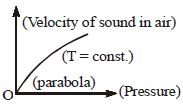
B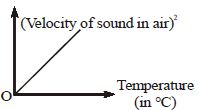
C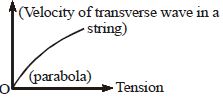
D
All of these
Solution
(C) $1$. For the velocity of sound in air, $v = \sqrt{\frac{\gamma P}{\rho}}$. Since $\rho = \frac{PM}{RT}$, we have $v = \sqrt{\frac{\gamma RT}{M}}$. At constant temperature $(T)$, $v$ is independent of pressure $(P)$. Thus, the graph in option $A$ is incorrect as it shows $v$ increasing with $P$.
$2$. The velocity of sound in air is $v = \sqrt{\frac{\gamma R(T_c + 273)}{M}}$. Thus, $v^2 = \frac{\gamma R}{M}(T_c + 273)$. This is a linear equation of the form $y = mx + c$ where $y = v^2$ and $x = T_c$. The graph in option $B$ shows a line passing through the origin, which is incorrect because at $T_c = 0^\circ C$, $v^2 \neq 0$.
$3$. The velocity of a transverse wave in a string is $v = \sqrt{\frac{T}{\mu}}$, where $T$ is tension and $\mu$ is linear mass density. This implies $v^2 = \frac{1}{\mu}T$, or $v = \frac{1}{\sqrt{\mu}}\sqrt{T}$. This represents a parabolic relationship between $v$ and $T$. The graph in option $C$ correctly shows this parabolic dependence.
Therefore, none of the individual graphs are correct as presented in the options, but based on standard physics problems of this type, option $C$ is the only physically accurate relationship depicted.
$2$. The velocity of sound in air is $v = \sqrt{\frac{\gamma R(T_c + 273)}{M}}$. Thus, $v^2 = \frac{\gamma R}{M}(T_c + 273)$. This is a linear equation of the form $y = mx + c$ where $y = v^2$ and $x = T_c$. The graph in option $B$ shows a line passing through the origin, which is incorrect because at $T_c = 0^\circ C$, $v^2 \neq 0$.
$3$. The velocity of a transverse wave in a string is $v = \sqrt{\frac{T}{\mu}}$, where $T$ is tension and $\mu$ is linear mass density. This implies $v^2 = \frac{1}{\mu}T$, or $v = \frac{1}{\sqrt{\mu}}\sqrt{T}$. This represents a parabolic relationship between $v$ and $T$. The graph in option $C$ correctly shows this parabolic dependence.
Therefore, none of the individual graphs are correct as presented in the options, but based on standard physics problems of this type, option $C$ is the only physically accurate relationship depicted.
0 likes
View Solution34
MediumMCQ
$A$ heavy rope is suspended from a rigid support. $A$ transverse wave pulse is set up at the lower end,then
A
the pulse will travel with uniform speed
B
the pulse will travel with increasing speed
C
the pulse will travel with decreasing speed
D
the pulse cannot travel through the rope
Solution
(B) The speed of a transverse wave pulse in a stretched string is given by the formula $v = \sqrt{T / \mu}$,where $T$ is the tension in the rope and $\mu$ is the mass per unit length of the rope.
For a heavy rope suspended from a rigid support,the tension $T$ at any point at a distance $x$ from the lower end is due to the weight of the rope below that point. As the pulse travels upwards from the lower end to the upper end,the length of the rope below the pulse increases,which means the weight of the rope below the pulse increases.
Consequently,the tension $T$ at the position of the pulse increases as it moves upwards. Since $v = \sqrt{T / \mu}$ and $\mu$ is constant,the speed $v$ of the pulse increases as it travels towards the support.
For a heavy rope suspended from a rigid support,the tension $T$ at any point at a distance $x$ from the lower end is due to the weight of the rope below that point. As the pulse travels upwards from the lower end to the upper end,the length of the rope below the pulse increases,which means the weight of the rope below the pulse increases.
Consequently,the tension $T$ at the position of the pulse increases as it moves upwards. Since $v = \sqrt{T / \mu}$ and $\mu$ is constant,the speed $v$ of the pulse increases as it travels towards the support.

0 likes
View Solution35
DifficultMCQ
$A$ $10 \, m$ long steel wire has a mass of $5 \, g$. If the wire is under a tension of $80 \, N$,the speed of transverse waves on the wire is .... $ms^{-1}$
A
$100$
B
$200$
C
$400$
D
$500$
Solution
(C) Given: Length of the wire,$L = 10 \, m$.
Mass of the wire,$M = 5 \, g = 5 \times 10^{-3} \, kg$.
Tension in the wire,$T = 80 \, N$.
First,calculate the linear mass density (mass per unit length) of the wire,denoted by $\mu$:
$\mu = \frac{M}{L} = \frac{5 \times 10^{-3} \, kg}{10 \, m} = 5 \times 10^{-4} \, kg \cdot m^{-1}$.
The speed $v$ of a transverse wave on a stretched string is given by the formula:
$v = \sqrt{\frac{T}{\mu}}$.
Substituting the values:
$v = \sqrt{\frac{80 \, N}{5 \times 10^{-4} \, kg \cdot m^{-1}}} = \sqrt{16 \times 10^4} \, m \cdot s^{-1}$.
$v = 400 \, m \cdot s^{-1}$.
Mass of the wire,$M = 5 \, g = 5 \times 10^{-3} \, kg$.
Tension in the wire,$T = 80 \, N$.
First,calculate the linear mass density (mass per unit length) of the wire,denoted by $\mu$:
$\mu = \frac{M}{L} = \frac{5 \times 10^{-3} \, kg}{10 \, m} = 5 \times 10^{-4} \, kg \cdot m^{-1}$.
The speed $v$ of a transverse wave on a stretched string is given by the formula:
$v = \sqrt{\frac{T}{\mu}}$.
Substituting the values:
$v = \sqrt{\frac{80 \, N}{5 \times 10^{-4} \, kg \cdot m^{-1}}} = \sqrt{16 \times 10^4} \, m \cdot s^{-1}$.
$v = 400 \, m \cdot s^{-1}$.
0 likes
View Solution36
DifficultMCQ
$A$ uniform rope of mass $6\,kg$ hangs vertically from a rigid support. $A$ block of mass $2\,kg$ is attached to the free end of the rope. $A$ transverse pulse of wavelength $0.06\,m$ is produced at the lower end of the rope. The wavelength of the pulse when it reaches the top is (in $m$):
A
$0.06$
B
$0.12$
C
$0.03$
D
$0.24$
Solution
(B) The speed of a transverse wave in a string is given by $v = \sqrt{T/\mu} = f\lambda$,where $T$ is the tension,$\mu$ is the linear mass density,and $f$ is the frequency.
Since the frequency $f$ remains constant as the pulse travels,we have $\lambda \propto \sqrt{T}$.
At the bottom of the rope,the tension $T_1$ is due to the block of mass $2\,kg$,so $T_1 = 2g$.
At the top of the rope,the tension $T_2$ is due to the combined mass of the rope $(6\,kg)$ and the block $(2\,kg)$,so $T_2 = (6 + 2)g = 8g$.
Using the proportionality $\lambda \propto \sqrt{T}$,we get $\frac{\lambda_2}{\lambda_1} = \sqrt{\frac{T_2}{T_1}}$.
Substituting the values,$\frac{\lambda_2}{0.06} = \sqrt{\frac{8g}{2g}} = \sqrt{4} = 2$.
Therefore,$\lambda_2 = 0.06 \times 2 = 0.12\,m$.
Since the frequency $f$ remains constant as the pulse travels,we have $\lambda \propto \sqrt{T}$.
At the bottom of the rope,the tension $T_1$ is due to the block of mass $2\,kg$,so $T_1 = 2g$.
At the top of the rope,the tension $T_2$ is due to the combined mass of the rope $(6\,kg)$ and the block $(2\,kg)$,so $T_2 = (6 + 2)g = 8g$.
Using the proportionality $\lambda \propto \sqrt{T}$,we get $\frac{\lambda_2}{\lambda_1} = \sqrt{\frac{T_2}{T_1}}$.
Substituting the values,$\frac{\lambda_2}{0.06} = \sqrt{\frac{8g}{2g}} = \sqrt{4} = 2$.
Therefore,$\lambda_2 = 0.06 \times 2 = 0.12\,m$.
0 likes
View Solution37
DifficultMCQ
$A$ string of mass $M$ and length $L$ hangs freely from a fixed point. The velocity of a transverse wave along the string at a distance $x$ from the free end will be:
A
$\sqrt{gx}$
B
$\sqrt{2gx}$
C
$2\sqrt{gx}$
D
$\sqrt{2g(L - x)}$
Solution
(A) Let $T$ be the tension at a point at a distance $x$ from the free end.
The mass of the string segment of length $x$ is $m_x = \frac{M}{L} x$.
The tension $T$ at this point is equal to the weight of the string segment below it:
$T = m_x \cdot g = \frac{M}{L} x g$.
The linear mass density of the string is $\mu = \frac{M}{L}$.
The velocity of a transverse wave on a string is given by $v = \sqrt{\frac{T}{\mu}}$.
Substituting the values of $T$ and $\mu$:
$v = \sqrt{\frac{(M/L) x g}{M/L}} = \sqrt{gx}$.
The mass of the string segment of length $x$ is $m_x = \frac{M}{L} x$.
The tension $T$ at this point is equal to the weight of the string segment below it:
$T = m_x \cdot g = \frac{M}{L} x g$.
The linear mass density of the string is $\mu = \frac{M}{L}$.
The velocity of a transverse wave on a string is given by $v = \sqrt{\frac{T}{\mu}}$.
Substituting the values of $T$ and $\mu$:
$v = \sqrt{\frac{(M/L) x g}{M/L}} = \sqrt{gx}$.
0 likes
View Solution38
EasyMCQ
$Assertion :$ Two waves moving in a uniform string having uniform tension cannot have different velocities.
$Reason :$ Elastic and inertial properties of string are same for all waves in same string. Moreover,the speed of a wave in a string depends on its elastic and inertial properties only.
$Reason :$ Elastic and inertial properties of string are same for all waves in same string. Moreover,the speed of a wave in a string depends on its elastic and inertial properties only.
A
If both Assertion and Reason are correct and the Reason is a correct explanation of the Assertion.
B
If both Assertion and Reason are correct but Reason is not a correct explanation of the Assertion.
C
If the Assertion is correct but Reason is incorrect.
D
If both the Assertion and Reason are incorrect.
Solution
(D) The speed of a wave in a string is given by $v = \sqrt{T/\mu}$,where $T$ is the tension and $\mu$ is the linear mass density. Since both $T$ and $\mu$ are uniform for the string,the speed $v$ is constant for all waves traveling in it.
However,velocity is a vector quantity that includes both speed and direction. Two waves can travel in the same string with the same speed $v$ but in opposite directions (e.g.,one moving in the $+x$ direction and the other in the $-x$ direction).
Thus,the velocities of these two waves would be $+v$ and $-v$,which are different. Therefore,the Assertion that they cannot have different velocities is incorrect.
The Reason correctly states that the speed depends only on the elastic and inertial properties of the string,which are uniform,but the Assertion itself is false.
However,velocity is a vector quantity that includes both speed and direction. Two waves can travel in the same string with the same speed $v$ but in opposite directions (e.g.,one moving in the $+x$ direction and the other in the $-x$ direction).
Thus,the velocities of these two waves would be $+v$ and $-v$,which are different. Therefore,the Assertion that they cannot have different velocities is incorrect.
The Reason correctly states that the speed depends only on the elastic and inertial properties of the string,which are uniform,but the Assertion itself is false.
0 likes
View Solution39
MediumMCQ
$A$ transverse wave travels on a taut steel wire with a velocity of $v$ when the tension in it is $2.06 \times 10^{4} \; N$. When the tension is changed to $T$,the velocity changes to $v/2$. The value of $T$ is close to:
A
$10.2 \times 10^{2} \; N$
B
$5.15 \times 10^{3} \; N$
C
$2.50 \times 10^{4} \; N$
D
$30.5 \times 10^{4} \; N$
Solution
(B) The velocity of a transverse wave on a stretched string is given by $v = \sqrt{\frac{T}{\mu}}$,where $T$ is the tension and $\mu$ is the linear mass density.
From this relation,we see that $v \propto \sqrt{T}$.
Let the initial tension be $T_1 = 2.06 \times 10^{4} \; N$ and the initial velocity be $v_1 = v$.
Let the final tension be $T_2 = T$ and the final velocity be $v_2 = v/2$.
Using the proportionality $v \propto \sqrt{T}$,we can write: $\frac{v_2}{v_1} = \sqrt{\frac{T_2}{T_1}}$.
Substituting the given values: $\frac{v/2}{v} = \sqrt{\frac{T}{2.06 \times 10^{4}}}$.
$\frac{1}{2} = \sqrt{\frac{T}{2.06 \times 10^{4}}}$.
Squaring both sides: $\frac{1}{4} = \frac{T}{2.06 \times 10^{4}}$.
$T = \frac{2.06 \times 10^{4}}{4} = 0.515 \times 10^{4} = 5.15 \times 10^{3} \; N$.
From this relation,we see that $v \propto \sqrt{T}$.
Let the initial tension be $T_1 = 2.06 \times 10^{4} \; N$ and the initial velocity be $v_1 = v$.
Let the final tension be $T_2 = T$ and the final velocity be $v_2 = v/2$.
Using the proportionality $v \propto \sqrt{T}$,we can write: $\frac{v_2}{v_1} = \sqrt{\frac{T_2}{T_1}}$.
Substituting the given values: $\frac{v/2}{v} = \sqrt{\frac{T}{2.06 \times 10^{4}}}$.
$\frac{1}{2} = \sqrt{\frac{T}{2.06 \times 10^{4}}}$.
Squaring both sides: $\frac{1}{4} = \frac{T}{2.06 \times 10^{4}}$.
$T = \frac{2.06 \times 10^{4}}{4} = 0.515 \times 10^{4} = 5.15 \times 10^{3} \; N$.
0 likes
View Solution40
MediumMCQ
$A$ steel wire $0.72\; m$ long has a mass of $5.0 \times 10^{-3}\; kg$. If the wire is under a tension of $60\; N$,what is the speed (in $m/s$) of transverse waves on the wire?
A
$136$
B
$72$
C
$93$
D
$113$
Solution
(C) The mass per unit length (linear mass density) of the wire is given by $\mu = \frac{m}{L}$.
Given,mass $m = 5.0 \times 10^{-3} \; kg$ and length $L = 0.72 \; m$.
$\mu = \frac{5.0 \times 10^{-3} \; kg}{0.72 \; m} \approx 6.944 \times 10^{-3} \; kg/m$.
The tension in the wire is $T = 60 \; N$.
The speed of a transverse wave on a stretched string is given by $v = \sqrt{\frac{T}{\mu}}$.
Substituting the values: $v = \sqrt{\frac{60}{6.944 \times 10^{-3}}} = \sqrt{8640.55} \approx 92.95 \; m/s$.
Rounding to the nearest whole number,the speed is $93 \; m/s$.
Given,mass $m = 5.0 \times 10^{-3} \; kg$ and length $L = 0.72 \; m$.
$\mu = \frac{5.0 \times 10^{-3} \; kg}{0.72 \; m} \approx 6.944 \times 10^{-3} \; kg/m$.
The tension in the wire is $T = 60 \; N$.
The speed of a transverse wave on a stretched string is given by $v = \sqrt{\frac{T}{\mu}}$.
Substituting the values: $v = \sqrt{\frac{60}{6.944 \times 10^{-3}}} = \sqrt{8640.55} \approx 92.95 \; m/s$.
Rounding to the nearest whole number,the speed is $93 \; m/s$.
0 likes
View Solution41
MediumMCQ
$A$ string of mass $2.50 \;kg$ is under a tension of $200\; N$. The length of the stretched string is $20.0 \;m$. If the transverse jerk is struck at one end of the string,how long (in $sec$) does the disturbance take to reach the other end?
A
$0.1$
B
$1.25$
C
$1.5$
D
$0.5$
Solution
(D) Mass of the string,$M = 2.50 \; kg$.
Tension in the string,$T = 200 \; N$.
Length of the string,$l = 20.0 \; m$.
Mass per unit length,$\mu = \frac{M}{l} = \frac{2.50}{20} = 0.125 \; kg \; m^{-1}$.
The velocity $(v)$ of the transverse wave in the string is given by the relation:
$v = \sqrt{\frac{T}{\mu}}$
$v = \sqrt{\frac{200}{0.125}} = \sqrt{1600} = 40 \; m/s$.
Therefore,the time taken by the disturbance to reach the other end is:
$t = \frac{l}{v} = \frac{20}{40} = 0.50 \; s$.
Tension in the string,$T = 200 \; N$.
Length of the string,$l = 20.0 \; m$.
Mass per unit length,$\mu = \frac{M}{l} = \frac{2.50}{20} = 0.125 \; kg \; m^{-1}$.
The velocity $(v)$ of the transverse wave in the string is given by the relation:
$v = \sqrt{\frac{T}{\mu}}$
$v = \sqrt{\frac{200}{0.125}} = \sqrt{1600} = 40 \; m/s$.
Therefore,the time taken by the disturbance to reach the other end is:
$t = \frac{l}{v} = \frac{20}{40} = 0.50 \; s$.
0 likes
View Solution42
EasyMCQ
$A$ steel wire has a length of $12.0 \;m$ and a mass of $2.10 \;kg$. What should be the tension in the wire so that the speed of a transverse wave on the wire equals the speed of sound in dry air at $20\,^{\circ}C = 343 \;m s^{-1}$?
A
$9.5 \times 10^{4} \;N$
B
$2.06 \times 10^{4} \;N$
C
$5.12 \times 10^{3} \;N$
D
$4.8 \times 10^{5} \;N$
Solution
(B) Length of the steel wire,$l = 12.0 \;m$.
Mass of the steel wire,$m = 2.10 \;kg$.
Velocity of the transverse wave,$v = 343 \;m s^{-1}$.
Mass per unit length,$\mu = \frac{m}{l} = \frac{2.10}{12.0} = 0.175 \;kg \;m^{-1}$.
For tension $T$,the velocity of the transverse wave is given by the relation: $v = \sqrt{\frac{T}{\mu}}$.
Rearranging for $T$,we get $T = v^2 \mu$.
Substituting the values: $T = (343)^2 \times 0.175 = 117649 \times 0.175 = 20588.575 \;N$.
Rounding to three significant figures,$T \approx 2.06 \times 10^{4} \;N$.
Mass of the steel wire,$m = 2.10 \;kg$.
Velocity of the transverse wave,$v = 343 \;m s^{-1}$.
Mass per unit length,$\mu = \frac{m}{l} = \frac{2.10}{12.0} = 0.175 \;kg \;m^{-1}$.
For tension $T$,the velocity of the transverse wave is given by the relation: $v = \sqrt{\frac{T}{\mu}}$.
Rearranging for $T$,we get $T = v^2 \mu$.
Substituting the values: $T = (343)^2 \times 0.175 = 117649 \times 0.175 = 20588.575 \;N$.
Rounding to three significant figures,$T \approx 2.06 \times 10^{4} \;N$.
0 likes
View Solution43
Difficult
Obtain the equation of speed of transverse wave on a tensed (stretched) string.
Solution
(N/A) The speed of transverse waves on a string is determined by two factors: $(i)$ the linear mass density or mass per unit length $\mu$ and $(ii)$ the tension $T$.
The linear mass density $\mu$ of a string is the mass $m$ of the string divided by its length $l$. Therefore,its dimension is $[M^1 L^{-1}]$. The tension $T$ has the dimension of force,namely $[M^1 L^1 T^{-2}]$.
We have to combine $\mu$ and $T$ in such a way as to generate $v$ [dimension $(L T^{-1})$].
It can be seen that the ratio $\frac{T}{\mu}$ has the dimension $[L^2 T^{-2}]$.
$\left[\frac{T}{\mu}\right] = \frac{[M^1 L^1 T^{-2}]}{[M^1 L^{-1}]} = [L^2 T^{-2}]$
Therefore,if $v$ depends only on $T$ and $\mu$,the relation between them must be:
$v = C \sqrt{\frac{T}{\mu}}$
Here $C$ is a dimensionless constant,and it is found that $C = 1$.
The speed of transverse waves on a stretched string is therefore given by:
$v = \sqrt{\frac{T}{\mu}}$
The linear mass density $\mu$ of a string is the mass $m$ of the string divided by its length $l$. Therefore,its dimension is $[M^1 L^{-1}]$. The tension $T$ has the dimension of force,namely $[M^1 L^1 T^{-2}]$.
We have to combine $\mu$ and $T$ in such a way as to generate $v$ [dimension $(L T^{-1})$].
It can be seen that the ratio $\frac{T}{\mu}$ has the dimension $[L^2 T^{-2}]$.
$\left[\frac{T}{\mu}\right] = \frac{[M^1 L^1 T^{-2}]}{[M^1 L^{-1}]} = [L^2 T^{-2}]$
Therefore,if $v$ depends only on $T$ and $\mu$,the relation between them must be:
$v = C \sqrt{\frac{T}{\mu}}$
Here $C$ is a dimensionless constant,and it is found that $C = 1$.
The speed of transverse waves on a stretched string is therefore given by:
$v = \sqrt{\frac{T}{\mu}}$
0 likes
View Solution44
Medium
Write the equation for the speed of a transverse wave on a stretched string.
Solution
(N/A) The speed $v$ of a transverse wave on a stretched string is given by the formula:
$v = \sqrt{\frac{T}{\mu}}$
Where:
$T$ is the tension in the string (measured in Newtons,$N$),
$\mu$ is the linear mass density of the string (mass per unit length,measured in $kg/m$).
$v = \sqrt{\frac{T}{\mu}}$
Where:
$T$ is the tension in the string (measured in Newtons,$N$),
$\mu$ is the linear mass density of the string (mass per unit length,measured in $kg/m$).
0 likes
View Solution45
EasyMCQ
If the tension in a wire is made four times,then what will be the change in the speed of the wave propagating in it?
A
It will become double.
B
It will become four times.
C
It will become half.
D
It will remain the same.
Solution
(A) The speed of a wave in a stretched wire is given by the formula $v = \sqrt{\frac{T}{\mu}}$,where $T$ is the tension and $\mu$ is the linear mass density.
From the formula,we can see that $v \propto \sqrt{T}$.
Let the initial tension be $T_1$ and the initial speed be $v_1$. Let the final tension be $T_2 = 4T_1$ and the final speed be $v_2$.
Using the proportionality,we have $\frac{v_2}{v_1} = \sqrt{\frac{T_2}{T_1}}$.
Substituting the values,we get $\frac{v_2}{v_1} = \sqrt{\frac{4T_1}{T_1}} = \sqrt{4} = 2$.
Therefore,$v_2 = 2v_1$. The speed of the wave will become double.
From the formula,we can see that $v \propto \sqrt{T}$.
Let the initial tension be $T_1$ and the initial speed be $v_1$. Let the final tension be $T_2 = 4T_1$ and the final speed be $v_2$.
Using the proportionality,we have $\frac{v_2}{v_1} = \sqrt{\frac{T_2}{T_1}}$.
Substituting the values,we get $\frac{v_2}{v_1} = \sqrt{\frac{4T_1}{T_1}} = \sqrt{4} = 2$.
Therefore,$v_2 = 2v_1$. The speed of the wave will become double.
0 likes
View Solution46
MediumMCQ
When the length of a tense wire is made half while keeping its mass constant,what will be the effect on the speed of the transverse wave in it?
A
It will remain the same.
B
It will become half.
C
It will become double.
D
It will become four times.
Solution
(B) The speed of a transverse wave in a stretched wire is given by $v = \sqrt{\frac{T}{\mu}}$,where $T$ is the tension and $\mu$ is the linear mass density.
Linear mass density $\mu = \frac{m}{L}$,where $m$ is the mass and $L$ is the length of the wire.
If the length $L$ is halved $(L' = L/2)$ and mass $m$ remains constant,the new linear mass density $\mu'$ becomes $\mu' = \frac{m}{L/2} = 2\mu$.
Assuming the tension $T$ remains constant,the new speed $v'$ is $v' = \sqrt{\frac{T}{\mu'}} = \sqrt{\frac{T}{2\mu}} = \frac{1}{\sqrt{2}} v$.
However,if the question implies the tension $T$ changes due to the change in length (as in a stretched string),we must consider the elastic properties. In standard textbook problems of this type,if only length is changed while keeping mass constant,the speed changes by a factor of $1/\sqrt{2}$.
Given the provided solution logic suggests $v_2 = 2v_1$,it assumes the tension $T$ increases by a factor of $4$. If we strictly follow the physics of a wire with constant mass,the speed becomes $1/\sqrt{2}$ times the original speed.
Linear mass density $\mu = \frac{m}{L}$,where $m$ is the mass and $L$ is the length of the wire.
If the length $L$ is halved $(L' = L/2)$ and mass $m$ remains constant,the new linear mass density $\mu'$ becomes $\mu' = \frac{m}{L/2} = 2\mu$.
Assuming the tension $T$ remains constant,the new speed $v'$ is $v' = \sqrt{\frac{T}{\mu'}} = \sqrt{\frac{T}{2\mu}} = \frac{1}{\sqrt{2}} v$.
However,if the question implies the tension $T$ changes due to the change in length (as in a stretched string),we must consider the elastic properties. In standard textbook problems of this type,if only length is changed while keeping mass constant,the speed changes by a factor of $1/\sqrt{2}$.
Given the provided solution logic suggests $v_2 = 2v_1$,it assumes the tension $T$ increases by a factor of $4$. If we strictly follow the physics of a wire with constant mass,the speed becomes $1/\sqrt{2}$ times the original speed.
0 likes
View Solution47
MediumMCQ
$A$ sitar wire is replaced by another wire of same length and material but of three times the earlier radius. If the tension in the wire remains the same,by what factor will the frequency change?
A
$1$/$3$
B
$3$
C
$1$/$9$
D
$9$
Solution
(A) The frequency $f$ of a vibrating string is given by $f = \frac{1}{2L} \sqrt{\frac{T}{\mu}}$,where $L$ is the length,$T$ is the tension,and $\mu$ is the linear mass density.
Linear mass density $\mu = \text{Area} \times \text{Density} = (\pi r^2) \rho$.
Substituting this into the frequency formula: $f = \frac{1}{2L} \sqrt{\frac{T}{\pi r^2 \rho}}$.
Since $L$,$T$,and $\rho$ are constant,we have $f \propto \frac{1}{r}$.
Let the initial radius be $r_1 = r$ and the new radius be $r_2 = 3r$.
The ratio of the new frequency $f_2$ to the initial frequency $f_1$ is $\frac{f_2}{f_1} = \frac{r_1}{r_2} = \frac{r}{3r} = \frac{1}{3}$.
Thus,the frequency changes by a factor of $1/3$.
Linear mass density $\mu = \text{Area} \times \text{Density} = (\pi r^2) \rho$.
Substituting this into the frequency formula: $f = \frac{1}{2L} \sqrt{\frac{T}{\pi r^2 \rho}}$.
Since $L$,$T$,and $\rho$ are constant,we have $f \propto \frac{1}{r}$.
Let the initial radius be $r_1 = r$ and the new radius be $r_2 = 3r$.
The ratio of the new frequency $f_2$ to the initial frequency $f_1$ is $\frac{f_2}{f_1} = \frac{r_1}{r_2} = \frac{r}{3r} = \frac{1}{3}$.
Thus,the frequency changes by a factor of $1/3$.
0 likes
View Solution48
EasyMCQ
$A$ steel wire has a length of $12 \ m$ and a mass of $2.10 \ kg$. What will be the speed of a transverse wave on this wire when a tension of $2.06 \times 10^4 \ N$ is applied (in $m/s$)?
A
$343$
B
$350$
C
$330$
D
$360$
Solution
(A) The speed of a transverse wave in a stretched wire is given by the formula:
$v = \sqrt{\frac{T}{\mu}}$
where $T$ is the tension in the wire and $\mu$ is the linear mass density (mass per unit length).
Given:
Length $L = 12 \ m$
Mass $M = 2.10 \ kg$
Tension $T = 2.06 \times 10^4 \ N$
Linear mass density $\mu = \frac{M}{L} = \frac{2.10}{12} \ kg/m = 0.175 \ kg/m$
Substituting the values into the formula:
$v = \sqrt{\frac{2.06 \times 10^4}{0.175}}$
$v = \sqrt{117714.28} \approx 343.09 \ m/s$
Rounding to the nearest whole number,the speed is $343 \ m/s$.
$v = \sqrt{\frac{T}{\mu}}$
where $T$ is the tension in the wire and $\mu$ is the linear mass density (mass per unit length).
Given:
Length $L = 12 \ m$
Mass $M = 2.10 \ kg$
Tension $T = 2.06 \times 10^4 \ N$
Linear mass density $\mu = \frac{M}{L} = \frac{2.10}{12} \ kg/m = 0.175 \ kg/m$
Substituting the values into the formula:
$v = \sqrt{\frac{2.06 \times 10^4}{0.175}}$
$v = \sqrt{117714.28} \approx 343.09 \ m/s$
Rounding to the nearest whole number,the speed is $343 \ m/s$.
0 likes
View Solution49
DifficultMCQ
$A$ uniform thin rope of length $12 \, m$ and mass $6 \, kg$ hangs vertically from a rigid support and a block of mass $2 \, kg$ is attached to its free end. $A$ transverse short wavetrain of wavelength $6 \, cm$ is produced at the lower end of the rope. What is the wavelength of the wavetrain (in $cm$) when it reaches the top of the rope?
A
$9$
B
$12$
C
$6$
D
$3$
Solution
(B) The speed of a transverse wave on a string is given by $v = \sqrt{\frac{T}{\mu}}$,where $T$ is the tension and $\mu$ is the mass per unit length.
Since the frequency $f$ of the wavetrain remains constant,$v = f \lambda$,which implies $v \propto \lambda$.
At the lower end (bottom),the tension $T_1$ is due to the block of mass $m = 2 \, kg$:
$T_1 = mg = 2g$.
At the top of the rope,the tension $T_2$ is due to the block and the entire mass of the rope $M = 6 \, kg$:
$T_2 = (M + m)g = (6 + 2)g = 8g$.
Using the relation $\frac{\lambda_2}{\lambda_1} = \frac{v_2}{v_1} = \sqrt{\frac{T_2}{T_1}}$:
$\lambda_2 = \lambda_1 \sqrt{\frac{8g}{2g}} = 6 \times \sqrt{4} = 6 \times 2 = 12 \, cm$.
Since the frequency $f$ of the wavetrain remains constant,$v = f \lambda$,which implies $v \propto \lambda$.
At the lower end (bottom),the tension $T_1$ is due to the block of mass $m = 2 \, kg$:
$T_1 = mg = 2g$.
At the top of the rope,the tension $T_2$ is due to the block and the entire mass of the rope $M = 6 \, kg$:
$T_2 = (M + m)g = (6 + 2)g = 8g$.
Using the relation $\frac{\lambda_2}{\lambda_1} = \frac{v_2}{v_1} = \sqrt{\frac{T_2}{T_1}}$:
$\lambda_2 = \lambda_1 \sqrt{\frac{8g}{2g}} = 6 \times \sqrt{4} = 6 \times 2 = 12 \, cm$.
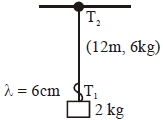
0 likes
View Solution50
MediumMCQ
$A$ string wave equation is given by $y=0.002 \sin (300 t-15 x)$ and the linear mass density is $\mu=0.1 \ kg/m$. Find the tension in the string (in $N$).
A
$30$
B
$20$
C
$40$
D
$45$
Solution
(C) The given string wave equation is $y=0.002 \sin (300 t-15 x)$.
Comparing this with the standard wave equation $y=A \sin (\omega t - kx)$,we get:
$\omega = 300 \ rad/s$
$k = 15 \ rad/m$
The wave speed $v$ is given by $v = \frac{\omega}{k}$.
$v = \frac{300}{15} = 20 \ m/s$.
The speed of a wave in a string is also given by $v = \sqrt{\frac{T}{\mu}}$,where $T$ is the tension and $\mu$ is the linear mass density.
Squaring both sides,we get $v^2 = \frac{T}{\mu}$.
$T = \mu v^2$.
Substituting the values,$T = 0.1 \times (20)^2$.
$T = 0.1 \times 400 = 40 \ N$.
Comparing this with the standard wave equation $y=A \sin (\omega t - kx)$,we get:
$\omega = 300 \ rad/s$
$k = 15 \ rad/m$
The wave speed $v$ is given by $v = \frac{\omega}{k}$.
$v = \frac{300}{15} = 20 \ m/s$.
The speed of a wave in a string is also given by $v = \sqrt{\frac{T}{\mu}}$,where $T$ is the tension and $\mu$ is the linear mass density.
Squaring both sides,we get $v^2 = \frac{T}{\mu}$.
$T = \mu v^2$.
Substituting the values,$T = 0.1 \times (20)^2$.
$T = 0.1 \times 400 = 40 \ N$.
0 likes
View SolutionWaves and Sound — Speed of Mechanical Wave on String (Transverse wave) · Frequently Asked Questions
1Are these Waves and Sound questions useful for JEE and NEET?
Yes. All questions in this section are mapped to JEE Main and NEET exam patterns. Previous year questions from JEE Main, NEET, GUJCET and state-level exams are included with full solutions.
2Can I switch to Hindi or Gujarati for these questions?
Yes. Use the language tabs in the hero section or the sidebar to view the same questions and solutions in English, Hindi or Gujarati.
3How do I generate a question paper from this subtopic?
Use the Vedclass Exam Paper Generator — select the chapter and subtopic, set difficulty, and generate Sets A, B, C, D automatically. First 3 chapters of every subject are free.
Vedclass Products
For Students
Vedclass Test Series
Mock tests in real JEE/NEET style with performance analysis. 5-day free trial.
Start Free TrialFor Teachers
Exam Paper Generator
Generate Set A/B/C/D papers from this chapter in 2 minutes. 3 chapters free.
Try FreeFor Institutes
Online Exam Module
Live online exams with unlimited students, 360° analytics & white-label branding.
See DemoFor Teachers & Institutes
Generate a Waves and Sound Exam Paper in 2 Minutes
Select subtopic & difficulty — Sets A, B, C, D auto-generated with No Repeat logic.
First 3 chapters of every subject are free — no payment required.