
A English
Beats and Tuning fork Questions in English
Class 11 Physics · Waves and Sound · Beats and Tuning fork
211+
Questions
English
Language
100%
With Solutions
Showing 50 of 211 questions in English
1
EasyMCQ
$A$ tuning fork produces waves in a medium. If the temperature of the medium changes,then which of the following will change?
A
Amplitude
B
Frequency
C
Wavelength
D
Time-period
Solution
(C) The frequency of a tuning fork is a characteristic property of the source and depends on its physical dimensions and material properties,not on the medium's temperature.
Since the speed of sound in a medium depends on temperature $(v \propto \sqrt{T})$,and the relationship between speed,frequency,and wavelength is given by $v = f \lambda$,if the temperature changes,the velocity $v$ changes.
Since the frequency $f$ remains constant,the wavelength $\lambda$ must change to satisfy the equation $\lambda = v/f$.
Therefore,the correct option is $(c)$.
Since the speed of sound in a medium depends on temperature $(v \propto \sqrt{T})$,and the relationship between speed,frequency,and wavelength is given by $v = f \lambda$,if the temperature changes,the velocity $v$ changes.
Since the frequency $f$ remains constant,the wavelength $\lambda$ must change to satisfy the equation $\lambda = v/f$.
Therefore,the correct option is $(c)$.
0 likes
View Solution2
MediumMCQ
The frequency of a tuning fork is $384 \text{ Hz}$ and the velocity of sound in air is $352 \text{ m/s}$. How far has the sound traveled while the fork completes $36$ vibrations (in $\text{ m}$)?
A
$3$
B
$13$
C
$23$
D
$33$
Solution
(D) The frequency of the tuning fork is $n = 384 \text{ Hz}$.
The velocity of sound in air is $v = 352 \text{ m/s}$.
The time taken for one vibration is $T = \frac{1}{n} = \frac{1}{384} \text{ s}$.
The distance traveled by sound in one vibration is the wavelength $\lambda = v \times T = \frac{v}{n} = \frac{352}{384} \text{ m}$.
For $36$ vibrations, the total time taken is $t = 36 \times T = \frac{36}{384} \text{ s}$.
The total distance traveled by the sound is $d = v \times t = 352 \times \frac{36}{384} \text{ m}$.
$d = \frac{352 \times 36}{384} = 33 \text{ m}$.
The velocity of sound in air is $v = 352 \text{ m/s}$.
The time taken for one vibration is $T = \frac{1}{n} = \frac{1}{384} \text{ s}$.
The distance traveled by sound in one vibration is the wavelength $\lambda = v \times T = \frac{v}{n} = \frac{352}{384} \text{ m}$.
For $36$ vibrations, the total time taken is $t = 36 \times T = \frac{36}{384} \text{ s}$.
The total distance traveled by the sound is $d = v \times t = 352 \times \frac{36}{384} \text{ m}$.
$d = \frac{352 \times 36}{384} = 33 \text{ m}$.
0 likes
View Solution3
EasyMCQ
The minimum intensity of sound is zero at a point due to two sources of nearly equal frequencies, when
A
Two sources are vibrating in opposite phase
B
The amplitude of two sources are equal
C
At the point of observation, the amplitudes of two $S.H.M.$ produced by two sources are equal and both the $S.H.M.$ are along the same straight line
D
Both the sources are in the same phase
Solution
(C) When two sound waves of nearly equal frequencies superpose at a point, they produce the phenomenon of beats.
The resultant intensity $I$ at any point is given by $I = I_1 + I_2 + 2\sqrt{I_1 I_2} \cos(\phi)$, where $\phi$ is the phase difference.
For the intensity to be minimum $(I_{\min} = 0)$, the condition is $I_1 = I_2$ and $\cos(\phi) = -1$.
This implies that the amplitudes of the two $S.H.M.$ produced by the sources must be equal, and they must be traveling along the same straight line to interfere destructively at the point of observation.
The resultant intensity $I$ at any point is given by $I = I_1 + I_2 + 2\sqrt{I_1 I_2} \cos(\phi)$, where $\phi$ is the phase difference.
For the intensity to be minimum $(I_{\min} = 0)$, the condition is $I_1 = I_2$ and $\cos(\phi) = -1$.
This implies that the amplitudes of the two $S.H.M.$ produced by the sources must be equal, and they must be traveling along the same straight line to interfere destructively at the point of observation.
0 likes
View Solution4
MediumMCQ
Two tuning forks when sounded together produce $4$ beats/sec. The frequency of one fork is $256 \, Hz$. The number of beats heard increases when the fork of frequency $256 \, Hz$ is loaded with wax. The frequency of the other fork is (in $, Hz$)
A
$504$
B
$520$
C
$260$
D
$252$
Solution
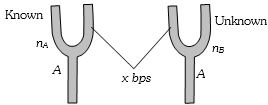
(C) Let the two tuning forks be $A$ and $B$ with frequencies $n_A = 256 \, Hz$ (known) and $n_B$ (unknown). The beat frequency is $x = 4 \, bps$.
The possible frequencies for the unknown tuning fork are $n_B = 256 + 4 = 260 \, Hz$ or $n_B = 256 - 4 = 252 \, Hz$.
It is given that when the fork $A$ (frequency $256 \, Hz$) is loaded with wax,its frequency decreases $(n_A \downarrow)$. Consequently,the beat frequency increases.
If $n_B = 252 \, Hz$,then $n_A - n_B = 256 - 252 = 4 \, Hz$. When $n_A$ decreases,the difference $(n_A - n_B)$ decreases,meaning the beat frequency would decrease.
If $n_B = 260 \, Hz$,then $n_B - n_A = 260 - 256 = 4 \, Hz$. When $n_A$ decreases,the difference $(n_B - n_A)$ increases,meaning the beat frequency increases.
Since the problem states that the beat frequency increases,the correct frequency of the other fork must be $n_B = 260 \, Hz$.
The possible frequencies for the unknown tuning fork are $n_B = 256 + 4 = 260 \, Hz$ or $n_B = 256 - 4 = 252 \, Hz$.
It is given that when the fork $A$ (frequency $256 \, Hz$) is loaded with wax,its frequency decreases $(n_A \downarrow)$. Consequently,the beat frequency increases.
If $n_B = 252 \, Hz$,then $n_A - n_B = 256 - 252 = 4 \, Hz$. When $n_A$ decreases,the difference $(n_A - n_B)$ decreases,meaning the beat frequency would decrease.
If $n_B = 260 \, Hz$,then $n_B - n_A = 260 - 256 = 4 \, Hz$. When $n_A$ decreases,the difference $(n_B - n_A)$ increases,meaning the beat frequency increases.
Since the problem states that the beat frequency increases,the correct frequency of the other fork must be $n_B = 260 \, Hz$.
0 likes
View Solution5
EasyMCQ
Beats are the result of
A
Diffraction
B
Destructive interference
C
Constructive and destructive interference
D
Superposition of two waves of nearly equal frequency
Solution
(D) Beats are the result of the superposition of two waves of nearly equal frequencies.
When two sound waves with slightly different frequencies travel in the same direction,they interfere with each other.
This interference causes the resultant amplitude to vary periodically with time,leading to a phenomenon known as beats.
The frequency of the beats is equal to the difference between the frequencies of the two original waves,i.e.,$f_{beat} = |f_1 - f_2|$.
As the waves alternately interfere constructively and destructively,the loudness of the sound rises and falls periodically.
When two sound waves with slightly different frequencies travel in the same direction,they interfere with each other.
This interference causes the resultant amplitude to vary periodically with time,leading to a phenomenon known as beats.
The frequency of the beats is equal to the difference between the frequencies of the two original waves,i.e.,$f_{beat} = |f_1 - f_2|$.
As the waves alternately interfere constructively and destructively,the loudness of the sound rises and falls periodically.
0 likes
View Solution6
EasyMCQ
Two adjacent piano keys are struck simultaneously. The notes emitted by them have frequencies $n_1$ and $n_2$. The number of beats heard per second is
A
$\frac{1}{2}(n_1 - n_2)$
B
$\frac{1}{2}(n_1 + n_2)$
C
$|n_1 - n_2|$
D
$2(n_1 - n_2)$
Solution
(C) The phenomenon of beats occurs when two sound waves of slightly different frequencies interfere with each other.
The beat frequency is defined as the absolute difference between the frequencies of the two interfering sound waves.
If the frequencies of the two notes are $n_1$ and $n_2$,the number of beats heard per second is given by the formula:
$B = |n_1 - n_2|$
Therefore,the correct option is $C$.
The beat frequency is defined as the absolute difference between the frequencies of the two interfering sound waves.
If the frequencies of the two notes are $n_1$ and $n_2$,the number of beats heard per second is given by the formula:
$B = |n_1 - n_2|$
Therefore,the correct option is $C$.
0 likes
View Solution7
MediumMCQ
$A$ tuning fork of frequency $100 \, Hz$ when sounded together with another tuning fork of unknown frequency produces $2$ beats per second. On loading the tuning fork whose frequency is not known and sounding it together with the tuning fork of frequency $100 \, Hz$,it produces one beat. The frequency of the other tuning fork is: (in $, Hz$)
A
$102$
B
$98$
C
$99$
D
$101$
Solution
(A) Let the known frequency be $n_A = 100 \, Hz$ and the unknown frequency be $n_B$.
The beat frequency is given by $|n_A - n_B| = 2 \, Hz$. This implies $n_B = 100 \pm 2$,so $n_B$ is either $102 \, Hz$ or $98 \, Hz$.
When the unknown tuning fork is loaded,its frequency $n_B$ decreases $(n_B \downarrow)$.
Case $1$: If $n_B = 98 \, Hz$,loading it further decreases the frequency (e.g.,to $97 \, Hz$). The new beat frequency would be $|100 - 97| = 3 \, Hz$,which is an increase.
Case $2$: If $n_B = 102 \, Hz$,loading it decreases the frequency (e.g.,to $101 \, Hz$). The new beat frequency would be $|100 - 101| = 1 \, Hz$,which is a decrease.
Since the problem states that the beat frequency decreases to $1 \, Hz$ after loading,the unknown frequency must be $102 \, Hz$.
The beat frequency is given by $|n_A - n_B| = 2 \, Hz$. This implies $n_B = 100 \pm 2$,so $n_B$ is either $102 \, Hz$ or $98 \, Hz$.
When the unknown tuning fork is loaded,its frequency $n_B$ decreases $(n_B \downarrow)$.
Case $1$: If $n_B = 98 \, Hz$,loading it further decreases the frequency (e.g.,to $97 \, Hz$). The new beat frequency would be $|100 - 97| = 3 \, Hz$,which is an increase.
Case $2$: If $n_B = 102 \, Hz$,loading it decreases the frequency (e.g.,to $101 \, Hz$). The new beat frequency would be $|100 - 101| = 1 \, Hz$,which is a decrease.
Since the problem states that the beat frequency decreases to $1 \, Hz$ after loading,the unknown frequency must be $102 \, Hz$.
0 likes
View Solution8
MediumMCQ
$A$ tuning fork sounded together with a tuning fork of frequency $256 \ Hz$ emits $2$ beats per second. On loading the tuning fork of frequency $256 \ Hz,$ the number of beats heard is $1$ per second. The frequency of the unknown tuning fork is: (in $Hz$)
A
$257$
B
$258$
C
$256$
D
$254$
Solution
(D) Let the frequency of the unknown tuning fork be $n_B$ and the known frequency be $n_A = 256 \ Hz$.
The beat frequency is given by $|n_A - n_B| = 2 \ Hz$.
This implies $n_B = 256 \pm 2$,so $n_B$ is either $258 \ Hz$ or $254 \ Hz$.
When the known tuning fork $(256 \ Hz)$ is loaded with wax,its frequency $n_A$ decreases.
Given that the beat frequency decreases from $2 \ Hz$ to $1 \ Hz$ after loading,we analyze the two cases:
Case $1$: If $n_B = 258 \ Hz$,then $n_B - n_A = 258 - 256 = 2 \ Hz$. After loading,$n_A$ decreases,so $(n_B - n_A)$ increases. This contradicts the observation.
Case $2$: If $n_B = 254 \ Hz$,then $n_A - n_B = 256 - 254 = 2 \ Hz$. After loading,$n_A$ decreases,so $(n_A - n_B)$ decreases. This matches the observation $(1 \ Hz)$.
Therefore,the frequency of the unknown tuning fork is $254 \ Hz$.
The beat frequency is given by $|n_A - n_B| = 2 \ Hz$.
This implies $n_B = 256 \pm 2$,so $n_B$ is either $258 \ Hz$ or $254 \ Hz$.
When the known tuning fork $(256 \ Hz)$ is loaded with wax,its frequency $n_A$ decreases.
Given that the beat frequency decreases from $2 \ Hz$ to $1 \ Hz$ after loading,we analyze the two cases:
Case $1$: If $n_B = 258 \ Hz$,then $n_B - n_A = 258 - 256 = 2 \ Hz$. After loading,$n_A$ decreases,so $(n_B - n_A)$ increases. This contradicts the observation.
Case $2$: If $n_B = 254 \ Hz$,then $n_A - n_B = 256 - 254 = 2 \ Hz$. After loading,$n_A$ decreases,so $(n_A - n_B)$ decreases. This matches the observation $(1 \ Hz)$.
Therefore,the frequency of the unknown tuning fork is $254 \ Hz$.
1 likes
View Solution9
MediumMCQ
If two tuning forks $A$ and $B$ are sounded together,they produce $4$ beats per second. $A$ is then slightly loaded with wax,and they produce $2$ beats when sounded again. The frequency of $A$ is $256 \ Hz$. The frequency of $B$ will be: (in $Hz$)
A
$250$
B
$252$
C
$260$
D
$262$
Solution
(B) Given: Frequency of tuning fork $A$ $(n_A)$ = $256 \ Hz$.
Initial beat frequency $(x)$ = $4 \ Hz$.
When $A$ is loaded with wax,its frequency decreases $(n_A \downarrow)$.
New beat frequency $(x')$ = $2 \ Hz$.
Since the beat frequency decreases from $4 \ Hz$ to $2 \ Hz$ upon loading $A$,the initial condition must be $n_A - n_B = x$.
Substituting the values: $256 - n_B = 4$,which gives $n_B = 252 \ Hz$.
Verification: After loading $A$,$n_A$ becomes less than $256$. Let the new frequency be $n_A'$. Then $n_A' - n_B = 2$. Since $n_B = 252$,$n_A' = 254 \ Hz$. This is consistent with the frequency of $A$ decreasing.
Therefore,the frequency of $B$ is $252 \ Hz$.
Initial beat frequency $(x)$ = $4 \ Hz$.
When $A$ is loaded with wax,its frequency decreases $(n_A \downarrow)$.
New beat frequency $(x')$ = $2 \ Hz$.
Since the beat frequency decreases from $4 \ Hz$ to $2 \ Hz$ upon loading $A$,the initial condition must be $n_A - n_B = x$.
Substituting the values: $256 - n_B = 4$,which gives $n_B = 252 \ Hz$.
Verification: After loading $A$,$n_A$ becomes less than $256$. Let the new frequency be $n_A'$. Then $n_A' - n_B = 2$. Since $n_B = 252$,$n_A' = 254 \ Hz$. This is consistent with the frequency of $A$ decreasing.
Therefore,the frequency of $B$ is $252 \ Hz$.
0 likes
View Solution10
MediumMCQ
The frequencies of two sound sources are $256 \text{ Hz}$ and $260 \text{ Hz}$. At $t = 0$,the intensity of sound is maximum. Then the phase difference at the time $t = \frac{1}{16} \text{ s}$ will be
A
Zero
B
$\pi$
C
$\pi / 2$
D
$\pi / 4$
Solution
(C) The beat frequency is given by $f_b = |n_1 - n_2| = |260 - 256| = 4 \text{ Hz}$.
The time period of the beat is $T = \frac{1}{f_b} = \frac{1}{4} \text{ s}$.
At $t = 0$,the intensity is maximum,which corresponds to a phase of $0$ or $2\pi$.
The phase difference $\phi$ at time $t$ is related to the beat period $T$ by the formula $\phi = \frac{2\pi}{T} \times t$.
Substituting the given values: $\phi = \frac{2\pi}{(1/4)} \times \frac{1}{16} = 8\pi \times \frac{1}{16} = \frac{\pi}{2}$ radians.
The time period of the beat is $T = \frac{1}{f_b} = \frac{1}{4} \text{ s}$.
At $t = 0$,the intensity is maximum,which corresponds to a phase of $0$ or $2\pi$.
The phase difference $\phi$ at time $t$ is related to the beat period $T$ by the formula $\phi = \frac{2\pi}{T} \times t$.
Substituting the given values: $\phi = \frac{2\pi}{(1/4)} \times \frac{1}{16} = 8\pi \times \frac{1}{16} = \frac{\pi}{2}$ radians.
0 likes
View Solution11
EasyMCQ
Two tuning forks have frequencies $450\, Hz$ and $454\, Hz$ respectively. On sounding these forks together,the time interval between successive maximum intensities will be .... $sec$
A
$0.25$
B
$0.5$
C
$1$
D
$2$
Solution
(A) The number of beats produced per second is equal to the difference in frequencies of the two tuning forks.
Beat frequency $b = |n_2 - n_1| = |454\, Hz - 450\, Hz| = 4\, Hz$.
The time interval between two successive maximum intensities is the time period of the beats,which is the reciprocal of the beat frequency.
Time interval $T = \frac{1}{b} = \frac{1}{4}\, sec = 0.25\, sec$.
Beat frequency $b = |n_2 - n_1| = |454\, Hz - 450\, Hz| = 4\, Hz$.
The time interval between two successive maximum intensities is the time period of the beats,which is the reciprocal of the beat frequency.
Time interval $T = \frac{1}{b} = \frac{1}{4}\, sec = 0.25\, sec$.
0 likes
View Solution12
MediumMCQ
When a tuning fork of frequency $341 \ Hz$ is sounded with another tuning fork,six beats per second are heard. When the second tuning fork is loaded with wax and sounded with the first tuning fork,the number of beats is two per second. The natural frequency of the second tuning fork is: (in $Hz$)
A
$334$
B
$339$
C
$343$
D
$347$
Solution
(D) Let the frequency of the first tuning fork be $n_A = 341 \ Hz$ and the frequency of the second tuning fork be $n_B$.
The beat frequency is given by $|n_A - n_B| = 6 \ Hz$.
This implies $n_B = 341 \pm 6$,so $n_B$ could be $347 \ Hz$ or $335 \ Hz$.
When the second tuning fork is loaded with wax,its frequency $n_B$ decreases $(n_B \downarrow)$.
After loading,the new beat frequency is $2 \ Hz$.
Case $1$: If $n_B = 335 \ Hz$,then $n_A - n_B = 6 \ Hz$. Loading $n_B$ makes it smaller,so $(n_A - n_B)$ increases. This contradicts the observation that the beat frequency decreased to $2 \ Hz$.
Case $2$: If $n_B = 347 \ Hz$,then $n_B - n_A = 6 \ Hz$. Loading $n_B$ makes it smaller,so $(n_B - n_A)$ decreases. As $n_B$ decreases towards $n_A$,the beat frequency decreases. This matches the observation that the beat frequency decreased to $2 \ Hz$.
Therefore,the natural frequency of the second tuning fork is $347 \ Hz$.
The beat frequency is given by $|n_A - n_B| = 6 \ Hz$.
This implies $n_B = 341 \pm 6$,so $n_B$ could be $347 \ Hz$ or $335 \ Hz$.
When the second tuning fork is loaded with wax,its frequency $n_B$ decreases $(n_B \downarrow)$.
After loading,the new beat frequency is $2 \ Hz$.
Case $1$: If $n_B = 335 \ Hz$,then $n_A - n_B = 6 \ Hz$. Loading $n_B$ makes it smaller,so $(n_A - n_B)$ increases. This contradicts the observation that the beat frequency decreased to $2 \ Hz$.
Case $2$: If $n_B = 347 \ Hz$,then $n_B - n_A = 6 \ Hz$. Loading $n_B$ makes it smaller,so $(n_B - n_A)$ decreases. As $n_B$ decreases towards $n_A$,the beat frequency decreases. This matches the observation that the beat frequency decreased to $2 \ Hz$.
Therefore,the natural frequency of the second tuning fork is $347 \ Hz$.
0 likes
View Solution13
MediumMCQ
Two tuning forks of frequencies $256$ and $258$ vibrations/sec are sounded together,then the time interval between consecutive maxima heard by the observer is ..... $sec$.
A
$2$
B
$0.5$
C
$250$
D
$252$
Solution
(B) The beat frequency $f_b$ is the difference between the frequencies of the two tuning forks.
$f_b = |f_2 - f_1| = |258 - 256| = 2 \text{ Hz}$.
The time interval between consecutive maxima (beats) is the reciprocal of the beat frequency.
$T = \frac{1}{f_b} = \frac{1}{2} = 0.5 \text{ sec}$.
Therefore,the time interval between consecutive maxima is $0.5 \text{ sec}$.
$f_b = |f_2 - f_1| = |258 - 256| = 2 \text{ Hz}$.
The time interval between consecutive maxima (beats) is the reciprocal of the beat frequency.
$T = \frac{1}{f_b} = \frac{1}{2} = 0.5 \text{ sec}$.
Therefore,the time interval between consecutive maxima is $0.5 \text{ sec}$.
0 likes
View Solution14
MediumMCQ
$A$ tuning fork gives $5$ beats with another tuning fork of frequency $100\,Hz.$ When the first tuning fork is loaded with wax,the number of beats remains unchanged. What is the frequency of the first tuning fork in $Hz$?
A
$95$
B
$100$
C
$105$
D
$110$
Solution
(C) Let the frequency of the known tuning fork be $n_A = 100\,Hz$ and the frequency of the unknown tuning fork be $n_B$.
Given that the beat frequency is $x = 5\,Hz$.
Therefore,$n_B = n_A \pm x$,which means $n_B = 100 \pm 5$,so $n_B$ is either $95\,Hz$ or $105\,Hz$.
When the tuning fork $B$ is loaded with wax,its frequency $n_B$ decreases.
If $n_B = 95\,Hz$,loading it further decreases the frequency,making the difference $|n_A - n_B|$ increase from $5\,Hz$ to a larger value.
If $n_B = 105\,Hz$,loading it decreases the frequency towards $100\,Hz$. The beat frequency $|n_B - n_A|$ decreases initially. However,if the loading is such that the frequency remains $105\,Hz$ (or if the question implies the beat frequency remains $5\,Hz$ after loading),we analyze the condition:
Since the beat frequency remains $5\,Hz$ after loading,it implies the frequency was $105\,Hz$ and decreased,but the beat frequency is defined by the absolute difference.
For the beat frequency to remain $5\,Hz$ after loading (decreasing $n_B$),$n_B$ must have been greater than $n_A$.
Thus,$n_B = 100 + 5 = 105\,Hz$.
Given that the beat frequency is $x = 5\,Hz$.
Therefore,$n_B = n_A \pm x$,which means $n_B = 100 \pm 5$,so $n_B$ is either $95\,Hz$ or $105\,Hz$.
When the tuning fork $B$ is loaded with wax,its frequency $n_B$ decreases.
If $n_B = 95\,Hz$,loading it further decreases the frequency,making the difference $|n_A - n_B|$ increase from $5\,Hz$ to a larger value.
If $n_B = 105\,Hz$,loading it decreases the frequency towards $100\,Hz$. The beat frequency $|n_B - n_A|$ decreases initially. However,if the loading is such that the frequency remains $105\,Hz$ (or if the question implies the beat frequency remains $5\,Hz$ after loading),we analyze the condition:
Since the beat frequency remains $5\,Hz$ after loading,it implies the frequency was $105\,Hz$ and decreased,but the beat frequency is defined by the absolute difference.
For the beat frequency to remain $5\,Hz$ after loading (decreasing $n_B$),$n_B$ must have been greater than $n_A$.
Thus,$n_B = 100 + 5 = 105\,Hz$.
0 likes
View Solution15
MediumMCQ
Tuning fork $F_1$ has a frequency of $256 Hz$ and it is observed to produce $6$ beats/second with another tuning fork $F_2$. When $F_2$ is loaded with wax,it still produces $6$ beats/second with $F_1$. The frequency of $F_2$ before loading was ..... $Hz$.
A
$253$
B
$262$
C
$250$
D
$259$
Solution
(B) Let the frequency of tuning fork $F_1$ be $n_1 = 256 Hz$ and the frequency of tuning fork $F_2$ be $n_2$.
Given that the beat frequency is $6 Hz$,so $|n_1 - n_2| = 6$.
This implies $n_2 = 256 \pm 6$,so $n_2 = 262 Hz$ or $n_2 = 250 Hz$.
When $F_2$ is loaded with wax,its frequency decreases $(n_2' < n_2)$.
If $n_2 = 250 Hz$,loading it would decrease the frequency further away from $256 Hz$,increasing the beat frequency (e.g.,$256 - 249 = 7 Hz$),which contradicts the observation that the beat frequency remains $6 Hz$.
If $n_2 = 262 Hz$,loading it decreases the frequency towards $256 Hz$. The new beat frequency is $n_2' - n_1 = 6 Hz$,which is consistent with the problem statement.
Therefore,the initial frequency of $F_2$ was $262 Hz$.
Given that the beat frequency is $6 Hz$,so $|n_1 - n_2| = 6$.
This implies $n_2 = 256 \pm 6$,so $n_2 = 262 Hz$ or $n_2 = 250 Hz$.
When $F_2$ is loaded with wax,its frequency decreases $(n_2' < n_2)$.
If $n_2 = 250 Hz$,loading it would decrease the frequency further away from $256 Hz$,increasing the beat frequency (e.g.,$256 - 249 = 7 Hz$),which contradicts the observation that the beat frequency remains $6 Hz$.
If $n_2 = 262 Hz$,loading it decreases the frequency towards $256 Hz$. The new beat frequency is $n_2' - n_1 = 6 Hz$,which is consistent with the problem statement.
Therefore,the initial frequency of $F_2$ was $262 Hz$.
0 likes
View Solution16
MediumMCQ
Two tuning forks $A$ and $B$ vibrating simultaneously produce $5$ beats. The frequency of $B$ is $512 \ Hz$. It is observed that if one arm of $A$ is filed,the number of beats increases. The frequency of $A$ is: (in $Hz$)
A
$502$
B
$507$
C
$517$
D
$522$
Solution
(C) The beat frequency is given by $|n_A - n_B| = 5 \ Hz$. Since $n_B = 512 \ Hz$,$n_A$ can be either $517 \ Hz$ or $507 \ Hz$.
When a tuning fork is filed,its mass decreases,which causes its frequency to increase $(n_A \uparrow)$.
It is given that the beat frequency increases after filing.
Case $1$: If $n_A = 507 \ Hz$,then $n_B - n_A = 5 \ Hz$. As $n_A$ increases,the difference $(n_B - n_A)$ decreases (i.e.,beats decrease).
Case $2$: If $n_A = 517 \ Hz$,then $n_A - n_B = 5 \ Hz$. As $n_A$ increases,the difference $(n_A - n_B)$ increases (i.e.,beats increase).
Since the problem states that the number of beats increases,the correct frequency of $A$ must be $517 \ Hz$.
When a tuning fork is filed,its mass decreases,which causes its frequency to increase $(n_A \uparrow)$.
It is given that the beat frequency increases after filing.
Case $1$: If $n_A = 507 \ Hz$,then $n_B - n_A = 5 \ Hz$. As $n_A$ increases,the difference $(n_B - n_A)$ decreases (i.e.,beats decrease).
Case $2$: If $n_A = 517 \ Hz$,then $n_A - n_B = 5 \ Hz$. As $n_A$ increases,the difference $(n_A - n_B)$ increases (i.e.,beats increase).
Since the problem states that the number of beats increases,the correct frequency of $A$ must be $517 \ Hz$.
0 likes
View Solution17
EasyMCQ
The beats are produced by two sound sources of same amplitude and of nearly equal frequencies. The maximum intensity of beats will be ...... that of one source.
A
Same
B
Double
C
Four times
D
Eight times
Solution
(C) The intensity of a sound wave is directly proportional to the square of its amplitude,i.e.,$I \propto A^2$.
When two sound sources of the same amplitude $a_0$ interfere,the maximum amplitude $A_{\max}$ produced during the formation of beats is the sum of the individual amplitudes: $A_{\max} = a_0 + a_0 = 2a_0$.
The maximum intensity $I_{\max}$ is then given by $I_{\max} \propto (A_{\max})^2 = (2a_0)^2 = 4a_0^2$.
Since the intensity of one source is $I_0 \propto a_0^2$,we have $I_{\max} = 4I_0$.
Therefore,the maximum intensity of beats is $4$ times that of one source.
When two sound sources of the same amplitude $a_0$ interfere,the maximum amplitude $A_{\max}$ produced during the formation of beats is the sum of the individual amplitudes: $A_{\max} = a_0 + a_0 = 2a_0$.
The maximum intensity $I_{\max}$ is then given by $I_{\max} \propto (A_{\max})^2 = (2a_0)^2 = 4a_0^2$.
Since the intensity of one source is $I_0 \propto a_0^2$,we have $I_{\max} = 4I_0$.
Therefore,the maximum intensity of beats is $4$ times that of one source.
0 likes
View Solution18
MediumMCQ
Beats are produced by two waves given by $y_1 = a \sin(2000 \pi t)$ and $y_2 = a \sin(2008 \pi t)$. The number of beats heard per second is
A
$0$
B
$1$
C
$4$
D
$8$
Solution
(C) The number of beats heard per second is given by the difference in frequencies of the two waves,$|n_1 - n_2|$.
Given the equations $y_1 = a \sin(2000 \pi t)$ and $y_2 = a \sin(2008 \pi t)$,we compare these with the standard form $y = a \sin(2 \pi n t)$.
For the first wave: $2 \pi n_1 = 2000 \pi$,which gives $n_1 = 1000 \text{ Hz}$.
For the second wave: $2 \pi n_2 = 2008 \pi$,which gives $n_2 = 1004 \text{ Hz}$.
The number of beats per second is $|n_2 - n_1| = |1004 - 1000| = 4 \text{ beats per second}$.
Given the equations $y_1 = a \sin(2000 \pi t)$ and $y_2 = a \sin(2008 \pi t)$,we compare these with the standard form $y = a \sin(2 \pi n t)$.
For the first wave: $2 \pi n_1 = 2000 \pi$,which gives $n_1 = 1000 \text{ Hz}$.
For the second wave: $2 \pi n_2 = 2008 \pi$,which gives $n_2 = 1004 \text{ Hz}$.
The number of beats per second is $|n_2 - n_1| = |1004 - 1000| = 4 \text{ beats per second}$.
0 likes
View Solution19
MediumMCQ
$A$ tuning fork whose frequency as given by the manufacturer is $512 \ Hz$ is being tested with an accurate oscillator. It is found that the fork produces a beat of $2 \ Hz$ when the oscillator reads $514 \ Hz$,but produces a beat of $6 \ Hz$ when the oscillator reads $510 \ Hz$. The actual frequency of the fork is ..... $Hz$.
A
$508$
B
$512$
C
$516$
D
$518$
Solution
(C) Let the actual frequency of the tuning fork be $f$.
When the oscillator frequency $f_1 = 514 \ Hz$ is used,the beat frequency is $|f - 514| = 2 \ Hz$. This implies $f = 514 \pm 2$,so $f = 516 \ Hz$ or $f = 512 \ Hz$.
When the oscillator frequency $f_2 = 510 \ Hz$ is used,the beat frequency is $|f - 510| = 6 \ Hz$. This implies $f = 510 \pm 6$,so $f = 516 \ Hz$ or $f = 504 \ Hz$.
The common frequency in both cases is $516 \ Hz$.
Thus,the actual frequency of the tuning fork is $516 \ Hz$.
When the oscillator frequency $f_1 = 514 \ Hz$ is used,the beat frequency is $|f - 514| = 2 \ Hz$. This implies $f = 514 \pm 2$,so $f = 516 \ Hz$ or $f = 512 \ Hz$.
When the oscillator frequency $f_2 = 510 \ Hz$ is used,the beat frequency is $|f - 510| = 6 \ Hz$. This implies $f = 510 \pm 6$,so $f = 516 \ Hz$ or $f = 504 \ Hz$.
The common frequency in both cases is $516 \ Hz$.
Thus,the actual frequency of the tuning fork is $516 \ Hz$.
0 likes
View Solution20
MediumMCQ
$A$ tuning fork of frequency $480 \ Hz$ produces $10$ beats per second when sounded with a vibrating sonometer string. What must have been the frequency of the string if a slight increase in tension produces fewer beats per second than before?
A
$460$
B
$470$
C
$480$
D
$490$
Solution
(B) Let $n_S$ be the frequency of the sonometer string and $n_f = 480 \ Hz$ be the frequency of the tuning fork.
The beat frequency is given by $|n_f - n_S| = 10 \ Hz$.
This implies $n_S = 480 \pm 10$,so $n_S$ is either $470 \ Hz$ or $490 \ Hz$.
The frequency of a sonometer string is given by $n_S = \frac{1}{2l} \sqrt{\frac{T}{m}}$. Thus,$n_S \propto \sqrt{T}$.
When the tension $T$ is increased,$n_S$ increases.
Case $1$: If $n_S = 470 \ Hz$,then $n_f - n_S = 10 \ Hz$. As $n_S$ increases,$n_f - n_S$ decreases (e.g.,if $n_S$ becomes $475 \ Hz$,beats become $5 \ Hz$). This matches the given condition.
Case $2$: If $n_S = 490 \ Hz$,then $n_S - n_f = 10 \ Hz$. As $n_S$ increases,$n_S - n_f$ increases (e.g.,if $n_S$ becomes $495 \ Hz$,beats become $15 \ Hz$). This contradicts the given condition.
Therefore,the frequency of the string must be $470 \ Hz$.
The beat frequency is given by $|n_f - n_S| = 10 \ Hz$.
This implies $n_S = 480 \pm 10$,so $n_S$ is either $470 \ Hz$ or $490 \ Hz$.
The frequency of a sonometer string is given by $n_S = \frac{1}{2l} \sqrt{\frac{T}{m}}$. Thus,$n_S \propto \sqrt{T}$.
When the tension $T$ is increased,$n_S$ increases.
Case $1$: If $n_S = 470 \ Hz$,then $n_f - n_S = 10 \ Hz$. As $n_S$ increases,$n_f - n_S$ decreases (e.g.,if $n_S$ becomes $475 \ Hz$,beats become $5 \ Hz$). This matches the given condition.
Case $2$: If $n_S = 490 \ Hz$,then $n_S - n_f = 10 \ Hz$. As $n_S$ increases,$n_S - n_f$ increases (e.g.,if $n_S$ becomes $495 \ Hz$,beats become $15 \ Hz$). This contradicts the given condition.
Therefore,the frequency of the string must be $470 \ Hz$.
0 likes
View Solution21
MediumMCQ
When a tuning fork $A$ of unknown frequency is sounded with another tuning fork $B$ of frequency $256 \ Hz$,then $3$ beats per second are observed. After that,$A$ is loaded with wax and sounded again,and $3$ beats per second are observed. The frequency of the tuning fork $A$ is ..... $Hz$.
A
$250$
B
$253$
C
$259$
D
$262$
Solution
(C) Let the frequency of tuning fork $A$ be $n_A$ and the frequency of tuning fork $B$ be $n_B = 256 \ Hz$.
The beat frequency is given as $x = 3 \ Hz$.
Therefore,$n_A = n_B \pm x = 256 \pm 3$,which means $n_A$ is either $259 \ Hz$ or $253 \ Hz$.
When tuning fork $A$ is loaded with wax,its frequency $n_A$ decreases.
Case $1$: If $n_A = 253 \ Hz$,loading it will decrease the frequency further below $253 \ Hz$. The new beat frequency would be $256 - n_A' > 3$,which contradicts the observation that the beat frequency remains $3 \ Hz$.
Case $2$: If $n_A = 259 \ Hz$,loading it will decrease the frequency towards $256 \ Hz$. The new beat frequency would be $n_A' - 256 = 3$,which is consistent with the observation.
Thus,the original frequency of tuning fork $A$ is $259 \ Hz$.
The beat frequency is given as $x = 3 \ Hz$.
Therefore,$n_A = n_B \pm x = 256 \pm 3$,which means $n_A$ is either $259 \ Hz$ or $253 \ Hz$.
When tuning fork $A$ is loaded with wax,its frequency $n_A$ decreases.
Case $1$: If $n_A = 253 \ Hz$,loading it will decrease the frequency further below $253 \ Hz$. The new beat frequency would be $256 - n_A' > 3$,which contradicts the observation that the beat frequency remains $3 \ Hz$.
Case $2$: If $n_A = 259 \ Hz$,loading it will decrease the frequency towards $256 \ Hz$. The new beat frequency would be $n_A' - 256 = 3$,which is consistent with the observation.
Thus,the original frequency of tuning fork $A$ is $259 \ Hz$.
0 likes
View Solution22
MediumMCQ
$A$ source of sound gives five beats per second when sounded with another source of frequency $100 \, s^{-1}$. The second harmonic of the source together with a source of frequency $205 \, s^{-1}$ gives five beats per second. What is the frequency of the source in $s^{-1}$?
A
$105$
B
$205$
C
$95$
D
$100$
Solution
(A) Let the frequency of the source be $f$.
Since it produces $5$ beats per second with a source of $100 \, s^{-1}$,the frequency $f$ can be $100 \pm 5$,which is $105 \, s^{-1}$ or $95 \, s^{-1}$.
The second harmonic of the source is $2f$.
If $f = 105 \, s^{-1}$,the second harmonic is $210 \, s^{-1}$.
If $f = 95 \, s^{-1}$,the second harmonic is $190 \, s^{-1}$.
We are given that the second harmonic produces $5$ beats per second with a source of $205 \, s^{-1}$.
Checking the cases:
For $210 \, s^{-1}$: $|210 - 205| = 5 \, s^{-1}$ (This matches the condition).
For $190 \, s^{-1}$: $|190 - 205| = 15 \, s^{-1}$ (This does not match).
Therefore,the frequency of the source is $105 \, s^{-1}$.
Since it produces $5$ beats per second with a source of $100 \, s^{-1}$,the frequency $f$ can be $100 \pm 5$,which is $105 \, s^{-1}$ or $95 \, s^{-1}$.
The second harmonic of the source is $2f$.
If $f = 105 \, s^{-1}$,the second harmonic is $210 \, s^{-1}$.
If $f = 95 \, s^{-1}$,the second harmonic is $190 \, s^{-1}$.
We are given that the second harmonic produces $5$ beats per second with a source of $205 \, s^{-1}$.
Checking the cases:
For $210 \, s^{-1}$: $|210 - 205| = 5 \, s^{-1}$ (This matches the condition).
For $190 \, s^{-1}$: $|190 - 205| = 15 \, s^{-1}$ (This does not match).
Therefore,the frequency of the source is $105 \, s^{-1}$.
0 likes
View Solution23
EasyMCQ
When two sound waves are superimposed,beats are produced when they have
A
Different amplitudes and phases
B
Different velocities
C
Different phases
D
Different frequencies
Solution
(D) Beats are the periodic variation in the intensity of sound heard when two sound waves of slightly different frequencies,but similar amplitudes,are superimposed on each other.
If the frequencies of the two waves are $f_1$ and $f_2$,the beat frequency is given by $f_{beat} = |f_1 - f_2|$.
Therefore,the condition for producing beats is that the waves must have different frequencies.
If the frequencies of the two waves are $f_1$ and $f_2$,the beat frequency is given by $f_{beat} = |f_1 - f_2|$.
Therefore,the condition for producing beats is that the waves must have different frequencies.
0 likes
View Solution24
MediumMCQ
Two tuning forks $A$ and $B$ produce $4$ beats per second. The frequency of $A$ is $256 \ Hz$. On loading $B$ slightly,the beat frequency becomes $5$ beats in $2$ seconds. The frequency of $B$ after loading is .... $Hz$
A
$253.5$
B
$258.5$
C
$260$
D
$252$
Solution
(B) Initial frequency of $A$ is $n_A = 256 \ Hz$. The initial beat frequency is $x_1 = 4 \ Hz$.
Since $n_B = n_A \pm x_1$,the initial frequency of $B$ could be $256 + 4 = 260 \ Hz$ or $256 - 4 = 252 \ Hz$.
After loading $B$ slightly,its frequency $n_B$ decreases. The new beat frequency is $x_2 = 5 \text{ beats} / 2 \text{ seconds} = 2.5 \ Hz$.
Case $1$: If initial $n_B = 252 \ Hz$,loading $B$ decreases its frequency further away from $256 \ Hz$,so the beat frequency should increase. This contradicts the observation that the beat frequency decreased from $4 \ Hz$ to $2.5 \ Hz$.
Case $2$: If initial $n_B = 260 \ Hz$,loading $B$ decreases its frequency towards $256 \ Hz$,so the beat frequency should decrease. The new frequency is $n_B' = 256 + 2.5 = 258.5 \ Hz$.
However,the question asks for the frequency of $B$ after loading. Since $n_B' = 258.5 \ Hz$,the beat frequency is $258.5 - 256 = 2.5 \ Hz$,which matches the condition. Thus,the frequency of $B$ after loading is $258.5 \ Hz$.
Since $n_B = n_A \pm x_1$,the initial frequency of $B$ could be $256 + 4 = 260 \ Hz$ or $256 - 4 = 252 \ Hz$.
After loading $B$ slightly,its frequency $n_B$ decreases. The new beat frequency is $x_2 = 5 \text{ beats} / 2 \text{ seconds} = 2.5 \ Hz$.
Case $1$: If initial $n_B = 252 \ Hz$,loading $B$ decreases its frequency further away from $256 \ Hz$,so the beat frequency should increase. This contradicts the observation that the beat frequency decreased from $4 \ Hz$ to $2.5 \ Hz$.
Case $2$: If initial $n_B = 260 \ Hz$,loading $B$ decreases its frequency towards $256 \ Hz$,so the beat frequency should decrease. The new frequency is $n_B' = 256 + 2.5 = 258.5 \ Hz$.
However,the question asks for the frequency of $B$ after loading. Since $n_B' = 258.5 \ Hz$,the beat frequency is $258.5 - 256 = 2.5 \ Hz$,which matches the condition. Thus,the frequency of $B$ after loading is $258.5 \ Hz$.
0 likes
View Solution25
MediumMCQ
$A$ tuning fork $A$ of frequency $200 \ Hz$ is sounded with fork $B,$ the number of beats per second is $5.$ By putting some wax on $A,$ the number of beats increases to $8.$ The frequency of fork $B$ is .... $Hz$
A
$200$
B
$195$
C
$192$
D
$205$
Solution
(D) The frequency of tuning fork $A$ is $n_A = 200 \ Hz$. The beat frequency is $5 \ Hz$,so the frequency of fork $B$ $(n_B)$ is either $200 + 5 = 205 \ Hz$ or $200 - 5 = 195 \ Hz$.
When wax is added to fork $A$,its frequency $(n_A)$ decreases.
If $n_B = 195 \ Hz$,then the new beat frequency would be $n_A' - n_B$ (where $n_A' < 200$). As $n_A$ decreases,the difference $n_A - n_B$ decreases,so the beat frequency would decrease from $5 \ Hz$ to a lower value.
If $n_B = 205 \ Hz$,then the beat frequency is $n_B - n_A = 205 - 200 = 5 \ Hz$. As $n_A$ decreases,the difference $n_B - n_A$ increases,so the beat frequency increases from $5 \ Hz$ to $8 \ Hz$.
Since the beat frequency increases to $8 \ Hz$,the correct frequency of fork $B$ must be $205 \ Hz$.
When wax is added to fork $A$,its frequency $(n_A)$ decreases.
If $n_B = 195 \ Hz$,then the new beat frequency would be $n_A' - n_B$ (where $n_A' < 200$). As $n_A$ decreases,the difference $n_A - n_B$ decreases,so the beat frequency would decrease from $5 \ Hz$ to a lower value.
If $n_B = 205 \ Hz$,then the beat frequency is $n_B - n_A = 205 - 200 = 5 \ Hz$. As $n_A$ decreases,the difference $n_B - n_A$ increases,so the beat frequency increases from $5 \ Hz$ to $8 \ Hz$.
Since the beat frequency increases to $8 \ Hz$,the correct frequency of fork $B$ must be $205 \ Hz$.
0 likes
View Solution26
MediumMCQ
Two tuning forks,$A$ and $B$,produce $4$ beats per second when sounded together. The frequency of $A$ is $320 \ Hz$. When some wax is added to $B$ and it is sounded with $A$,$4$ beats per second are again heard. The frequency of $B$ is .... $Hz$.
A
$312$
B
$316$
C
$324$
D
$328$
Solution
(C) The frequency of tuning fork $A$ is $n_A = 320 \ Hz$. The beat frequency is $4 \ Hz$,so the frequency of $B$ $(n_B)$ is either $320 + 4 = 324 \ Hz$ or $320 - 4 = 316 \ Hz$.
When wax is added to a tuning fork,its frequency decreases.
If $n_B = 316 \ Hz$,adding wax would decrease the frequency further,increasing the beat frequency $(320 - n_B' > 4)$,which contradicts the problem statement.
If $n_B = 324 \ Hz$,adding wax decreases the frequency of $B$ $(n_B' < 324)$. For the beat frequency to remain $4 \ Hz$,the new frequency must be $n_B' = 320 + 4 = 324 \ Hz$ (impossible as it decreased) or $n_B' = 320 - 4 = 316 \ Hz$ (also impossible). Wait,let's re-evaluate: If $n_B = 316 \ Hz$,adding wax makes $n_B' < 316$,so $|320 - n_B'| > 4$. If $n_B = 324 \ Hz$,adding wax makes $n_B' < 324$. If $n_B'$ becomes $316 \ Hz$,the beats would change. However,the standard interpretation for this classic problem is that $n_B = 324 \ Hz$ is the correct value because adding wax to $324 \ Hz$ brings it closer to $320 \ Hz$,but the question states $4$ beats are heard again. This implies $n_B - n_A = 4$ initially $(324 - 320 = 4)$. After adding wax,$n_B$ decreases to $n_B'$. If $n_B' - n_A = 4$ is not possible,we check $n_A - n_B' = 4$. If $n_B = 316 \ Hz$,$n_A - n_B = 4$. Adding wax makes $n_B' < 316$,so $n_A - n_B' > 4$. Thus,the initial frequency must have been $n_B = 324 \ Hz$.
When wax is added to a tuning fork,its frequency decreases.
If $n_B = 316 \ Hz$,adding wax would decrease the frequency further,increasing the beat frequency $(320 - n_B' > 4)$,which contradicts the problem statement.
If $n_B = 324 \ Hz$,adding wax decreases the frequency of $B$ $(n_B' < 324)$. For the beat frequency to remain $4 \ Hz$,the new frequency must be $n_B' = 320 + 4 = 324 \ Hz$ (impossible as it decreased) or $n_B' = 320 - 4 = 316 \ Hz$ (also impossible). Wait,let's re-evaluate: If $n_B = 316 \ Hz$,adding wax makes $n_B' < 316$,so $|320 - n_B'| > 4$. If $n_B = 324 \ Hz$,adding wax makes $n_B' < 324$. If $n_B'$ becomes $316 \ Hz$,the beats would change. However,the standard interpretation for this classic problem is that $n_B = 324 \ Hz$ is the correct value because adding wax to $324 \ Hz$ brings it closer to $320 \ Hz$,but the question states $4$ beats are heard again. This implies $n_B - n_A = 4$ initially $(324 - 320 = 4)$. After adding wax,$n_B$ decreases to $n_B'$. If $n_B' - n_A = 4$ is not possible,we check $n_A - n_B' = 4$. If $n_B = 316 \ Hz$,$n_A - n_B = 4$. Adding wax makes $n_B' < 316$,so $n_A - n_B' > 4$. Thus,the initial frequency must have been $n_B = 324 \ Hz$.
0 likes
View Solution27
MediumMCQ
Two tuning forks have frequencies $380 \ Hz$ and $384 \ Hz$ respectively. When they are sounded together,they produce $4$ beats per second. After hearing the maximum sound,how long will it take to hear the minimum sound in seconds?
A
$0.5$
B
$0.25$
C
$0.125$
D
$0.0625$
Solution
(C) The beat frequency is given by $f_b = |f_1 - f_2| = |384 - 380| = 4 \ Hz$.
The time period of one complete beat cycle is $T = \frac{1}{f_b} = \frac{1}{4} = 0.25 \ \text{seconds}$.
$A$ beat cycle consists of one maximum (loud sound) and one minimum (faint sound).
The time interval between a maximum sound and the subsequent minimum sound is half of the beat period.
Therefore,$t = \frac{T}{2} = \frac{0.25}{2} = 0.125 \ \text{seconds}$.
The time period of one complete beat cycle is $T = \frac{1}{f_b} = \frac{1}{4} = 0.25 \ \text{seconds}$.
$A$ beat cycle consists of one maximum (loud sound) and one minimum (faint sound).
The time interval between a maximum sound and the subsequent minimum sound is half of the beat period.
Therefore,$t = \frac{T}{2} = \frac{0.25}{2} = 0.125 \ \text{seconds}$.
0 likes
View Solution28
MediumMCQ
Beats are produced with the help of two sound waves of amplitudes $3$ and $5$ units. The ratio of maximum to minimum intensity in the beats is
A
$2:1$
B
$5:3$
C
$4:1$
D
$16:1$
Solution
(D) The intensity $I$ of a sound wave is proportional to the square of its amplitude $a$,i.e.,$I \propto a^2$.
For two waves with amplitudes $a_1 = 5$ and $a_2 = 3$,the maximum intensity $I_{\max}$ occurs when the waves interfere constructively,and the minimum intensity $I_{\min}$ occurs when they interfere destructively.
The ratio of maximum to minimum intensity is given by the formula:
$\frac{I_{\max}}{I_{\min}} = \left( \frac{a_1 + a_2}{a_1 - a_2} \right)^2$
Substituting the given values:
$\frac{I_{\max}}{I_{\min}} = \left( \frac{5 + 3}{5 - 3} \right)^2 = \left( \frac{8}{2} \right)^2 = (4)^2 = \frac{16}{1}$
Thus,the ratio is $16:1$.
For two waves with amplitudes $a_1 = 5$ and $a_2 = 3$,the maximum intensity $I_{\max}$ occurs when the waves interfere constructively,and the minimum intensity $I_{\min}$ occurs when they interfere destructively.
The ratio of maximum to minimum intensity is given by the formula:
$\frac{I_{\max}}{I_{\min}} = \left( \frac{a_1 + a_2}{a_1 - a_2} \right)^2$
Substituting the given values:
$\frac{I_{\max}}{I_{\min}} = \left( \frac{5 + 3}{5 - 3} \right)^2 = \left( \frac{8}{2} \right)^2 = (4)^2 = \frac{16}{1}$
Thus,the ratio is $16:1$.
1 likes
View Solution29
MediumMCQ
Two waves of lengths $50 \; cm$ and $51 \; cm$ produce $12$ beats per second. The velocity of sound is .... $m/s$.
A
$306$
B
$331$
C
$340$
D
$360$
Solution
(A) The frequency of a wave is given by $n = \frac{v}{\lambda}$,where $v$ is the velocity and $\lambda$ is the wavelength.
Given wavelengths are $\lambda_1 = 50 \; cm = 0.50 \; m$ and $\lambda_2 = 51 \; cm = 0.51 \; m$.
The frequencies are $n_1 = \frac{v}{0.50}$ and $n_2 = \frac{v}{0.51}$.
The beat frequency is the difference between the two frequencies: $\Delta n = n_1 - n_2 = 12 \; Hz$.
Substituting the values: $v \left( \frac{1}{0.50} - \frac{1}{0.51} \right) = 12$.
$v \left( \frac{0.51 - 0.50}{0.50 \times 0.51} \right) = 12$.
$v \left( \frac{0.01}{0.255} \right) = 12$.
$v = \frac{12 \times 0.255}{0.01} = 12 \times 25.5 = 306 \; m/s$.
Given wavelengths are $\lambda_1 = 50 \; cm = 0.50 \; m$ and $\lambda_2 = 51 \; cm = 0.51 \; m$.
The frequencies are $n_1 = \frac{v}{0.50}$ and $n_2 = \frac{v}{0.51}$.
The beat frequency is the difference between the two frequencies: $\Delta n = n_1 - n_2 = 12 \; Hz$.
Substituting the values: $v \left( \frac{1}{0.50} - \frac{1}{0.51} \right) = 12$.
$v \left( \frac{0.51 - 0.50}{0.50 \times 0.51} \right) = 12$.
$v \left( \frac{0.01}{0.255} \right) = 12$.
$v = \frac{12 \times 0.255}{0.01} = 12 \times 25.5 = 306 \; m/s$.
0 likes
View Solution30
MediumMCQ
Two waves $y = 0.25 \sin(316t)$ and $y = 0.25 \sin(310t)$ are travelling in the same direction. The number of beats produced per second will be:
A
$6$
B
$3$
C
$3/\pi$
D
$3\pi$
Solution
(C) The general equation for a wave is $y = A \sin(\omega t)$.
Comparing the given equations with the standard form,we have angular frequencies $\omega_1 = 316 \text{ rad/s}$ and $\omega_2 = 310 \text{ rad/s}$.
The frequency $f$ is related to angular frequency $\omega$ by the formula $f = \frac{\omega}{2\pi}$.
Therefore,the frequencies of the two waves are $f_1 = \frac{316}{2\pi} \text{ Hz}$ and $f_2 = \frac{310}{2\pi} \text{ Hz}$.
The number of beats produced per second is the difference between the two frequencies:
$\text{Beat frequency} = |f_1 - f_2| = \left| \frac{316}{2\pi} - \frac{310}{2\pi} \right| = \frac{6}{2\pi} = \frac{3}{\pi} \text{ Hz}$.
Comparing the given equations with the standard form,we have angular frequencies $\omega_1 = 316 \text{ rad/s}$ and $\omega_2 = 310 \text{ rad/s}$.
The frequency $f$ is related to angular frequency $\omega$ by the formula $f = \frac{\omega}{2\pi}$.
Therefore,the frequencies of the two waves are $f_1 = \frac{316}{2\pi} \text{ Hz}$ and $f_2 = \frac{310}{2\pi} \text{ Hz}$.
The number of beats produced per second is the difference between the two frequencies:
$\text{Beat frequency} = |f_1 - f_2| = \left| \frac{316}{2\pi} - \frac{310}{2\pi} \right| = \frac{6}{2\pi} = \frac{3}{\pi} \text{ Hz}$.
0 likes
View Solution31
EasyMCQ
$A$ pair of tuning forks produces $2$ beats in a time interval of $0.4 \ s$. The beat frequency is .... $Hz$.
A
$8$
B
$5$
C
$2$
D
$10$
Solution
(B) The beat frequency $(f_b)$ is defined as the number of beats produced per unit time.
Given:
Number of beats $(n)$ = $2$
Time interval $(t)$ = $0.4 \ s$
Formula: $f_b = \frac{n}{t}$
Calculation: $f_b = \frac{2}{0.4} = \frac{20}{4} = 5 \ Hz$.
Therefore,the beat frequency is $5 \ Hz$.
Given:
Number of beats $(n)$ = $2$
Time interval $(t)$ = $0.4 \ s$
Formula: $f_b = \frac{n}{t}$
Calculation: $f_b = \frac{2}{0.4} = \frac{20}{4} = 5 \ Hz$.
Therefore,the beat frequency is $5 \ Hz$.
0 likes
View Solution32
MediumMCQ
An unknown frequency $x$ produces $8$ beats per second with a frequency of $250 \ Hz$ and $12$ beats per second with a $270 \ Hz$ source. Then $x$ is .... $Hz$.
A
$258$
B
$242$
C
$262$
D
$282$
Solution
(A) The number of beats per second is the difference between the two frequencies.
Given that the unknown frequency $x$ produces $8$ beats per second with $250 \ Hz$,the possible values for $x$ are $250 \pm 8$,which are $258 \ Hz$ or $242 \ Hz$.
Given that the unknown frequency $x$ produces $12$ beats per second with $270 \ Hz$,the possible values for $x$ are $270 \pm 12$,which are $282 \ Hz$ or $258 \ Hz$.
Comparing both sets of possibilities,the common frequency is $258 \ Hz$.
Therefore,the unknown frequency $x$ is $258 \ Hz$.
Given that the unknown frequency $x$ produces $8$ beats per second with $250 \ Hz$,the possible values for $x$ are $250 \pm 8$,which are $258 \ Hz$ or $242 \ Hz$.
Given that the unknown frequency $x$ produces $12$ beats per second with $270 \ Hz$,the possible values for $x$ are $270 \pm 12$,which are $282 \ Hz$ or $258 \ Hz$.
Comparing both sets of possibilities,the common frequency is $258 \ Hz$.
Therefore,the unknown frequency $x$ is $258 \ Hz$.
0 likes
View Solution33
MediumMCQ
The wavelengths of two waves are $50 \ cm$ and $51 \ cm$ respectively. If the temperature of the room is $20^{\circ}C$,what will be the number of beats produced per second by these waves,given that the speed of sound at $0^{\circ}C$ is $332 \ m/s$?
A
$14$
B
$10$
C
$24$
D
None of these
Solution
(A) The speed of sound at $0^{\circ}C$ is $v_0 = 332 \ m/s$.
The speed of sound at $t^{\circ}C$ is given by $v_t = v_0 + 0.61 \times t$.
At $t = 20^{\circ}C$,the speed of sound is $v_{20} = 332 + 0.61 \times 20 = 332 + 12.2 = 344.2 \ m/s$.
The frequencies of the two waves are $n_1 = \frac{v}{\lambda_1}$ and $n_2 = \frac{v}{\lambda_2}$.
The number of beats produced per second is the difference in frequencies: $\Delta n = |n_1 - n_2| = v \left( \frac{1}{\lambda_1} - \frac{1}{\lambda_2} \right)$.
Converting wavelengths to meters: $\lambda_1 = 0.50 \ m$ and $\lambda_2 = 0.51 \ m$.
$\Delta n = 344.2 \left( \frac{1}{0.50} - \frac{1}{0.51} \right) = 344.2 \left( 2 - 1.96078 \right) = 344.2 \times 0.03922 \approx 13.5 \approx 14 \ Hz$.
The speed of sound at $t^{\circ}C$ is given by $v_t = v_0 + 0.61 \times t$.
At $t = 20^{\circ}C$,the speed of sound is $v_{20} = 332 + 0.61 \times 20 = 332 + 12.2 = 344.2 \ m/s$.
The frequencies of the two waves are $n_1 = \frac{v}{\lambda_1}$ and $n_2 = \frac{v}{\lambda_2}$.
The number of beats produced per second is the difference in frequencies: $\Delta n = |n_1 - n_2| = v \left( \frac{1}{\lambda_1} - \frac{1}{\lambda_2} \right)$.
Converting wavelengths to meters: $\lambda_1 = 0.50 \ m$ and $\lambda_2 = 0.51 \ m$.
$\Delta n = 344.2 \left( \frac{1}{0.50} - \frac{1}{0.51} \right) = 344.2 \left( 2 - 1.96078 \right) = 344.2 \times 0.03922 \approx 13.5 \approx 14 \ Hz$.
0 likes
View Solution34
EasyMCQ
The maximum number of beats per second that a human ear can distinguish is
A
$10$
B
$4$
C
$20$
D
$6$
Solution
(A) The human ear has a phenomenon known as the persistence of hearing,which lasts for approximately $0.1 \ s$.
This means that if two sounds reach the ear with a time interval of less than $0.1 \ s$,the ear cannot distinguish them as separate sounds.
Therefore,the maximum number of beats per second that can be heard is given by the reciprocal of the persistence of hearing:
$f_{max} = \frac{1}{0.1 \ s} = 10 \ Hz$.
Thus,the human ear can distinguish a maximum of $10$ beats per second.
This means that if two sounds reach the ear with a time interval of less than $0.1 \ s$,the ear cannot distinguish them as separate sounds.
Therefore,the maximum number of beats per second that can be heard is given by the reciprocal of the persistence of hearing:
$f_{max} = \frac{1}{0.1 \ s} = 10 \ Hz$.
Thus,the human ear can distinguish a maximum of $10$ beats per second.
0 likes
View Solution35
MediumMCQ
On sounding tuning fork $A$ with another tuning fork $B$ of frequency $384 \ Hz$,$6$ beats are produced per second. After loading the prongs of $A$ with some wax and then sounding it again with $B$,$4$ beats are produced per second. What is the frequency of the tuning fork $A$ in $Hz$?
A
$388$
B
$380$
C
$378$
D
$390$
Solution
(D) Let the frequency of tuning fork $A$ be $n_A$ and the frequency of tuning fork $B$ be $n_B = 384 \ Hz$.
The initial beat frequency is $x_1 = |n_A - n_B| = 6 \ Hz$.
This implies $n_A = 384 \pm 6$,so $n_A$ is either $390 \ Hz$ or $378 \ Hz$.
When tuning fork $A$ is loaded with wax,its frequency $n_A$ decreases.
After loading,the new beat frequency is $x_2 = 4 \ Hz$.
If $n_A = 390 \ Hz$,loading decreases it towards $384 \ Hz$,so the beat frequency decreases from $6$ to $4$. This matches the given condition.
If $n_A = 378 \ Hz$,loading decreases it further away from $384 \ Hz$,so the beat frequency would increase from $6$ to a higher value. This contradicts the given condition.
Therefore,the original frequency of tuning fork $A$ is $390 \ Hz$.
The initial beat frequency is $x_1 = |n_A - n_B| = 6 \ Hz$.
This implies $n_A = 384 \pm 6$,so $n_A$ is either $390 \ Hz$ or $378 \ Hz$.
When tuning fork $A$ is loaded with wax,its frequency $n_A$ decreases.
After loading,the new beat frequency is $x_2 = 4 \ Hz$.
If $n_A = 390 \ Hz$,loading decreases it towards $384 \ Hz$,so the beat frequency decreases from $6$ to $4$. This matches the given condition.
If $n_A = 378 \ Hz$,loading decreases it further away from $384 \ Hz$,so the beat frequency would increase from $6$ to a higher value. This contradicts the given condition.
Therefore,the original frequency of tuning fork $A$ is $390 \ Hz$.
0 likes
View Solution36
EasyMCQ
It is possible to hear beats from two vibrating sources of frequency:
A
$100 \ Hz$ and $150 \ Hz$
B
$20 \ Hz$ and $25 \ Hz$
C
$400 \ Hz$ and $500 \ Hz$
D
$1000 \ Hz$ and $1500 \ Hz$
Solution
(B) The phenomenon of beats occurs when two sound waves of slightly different frequencies interfere with each other.
For the human ear to perceive these beats,the frequency difference between the two sources must be small,typically less than $10 \ Hz$ to $15 \ Hz$,due to the persistence of hearing.
In option $A$,the difference is $150 \ Hz - 100 \ Hz = 50 \ Hz$.
In option $B$,the difference is $25 \ Hz - 20 \ Hz = 5 \ Hz$.
In option $C$,the difference is $500 \ Hz - 400 \ Hz = 100 \ Hz$.
In option $D$,the difference is $1500 \ Hz - 1000 \ Hz = 500 \ Hz$.
Since only the frequency difference in option $B$ is within the audible range for beats,it is the correct answer.
For the human ear to perceive these beats,the frequency difference between the two sources must be small,typically less than $10 \ Hz$ to $15 \ Hz$,due to the persistence of hearing.
In option $A$,the difference is $150 \ Hz - 100 \ Hz = 50 \ Hz$.
In option $B$,the difference is $25 \ Hz - 20 \ Hz = 5 \ Hz$.
In option $C$,the difference is $500 \ Hz - 400 \ Hz = 100 \ Hz$.
In option $D$,the difference is $1500 \ Hz - 1000 \ Hz = 500 \ Hz$.
Since only the frequency difference in option $B$ is within the audible range for beats,it is the correct answer.
0 likes
View Solution37
MediumMCQ
Two sound waves of wavelengths $5 \ m$ and $6 \ m$ produce $30$ beats in $3 \ s$. The velocity of sound is .... $m/s$.
A
$300$
B
$310$
C
$320$
D
$330$
Solution
(A) The number of beats per second (beat frequency) is given by $n = \frac{30}{3} = 10 \ Hz$.
The beat frequency is also given by the formula $n = v \left( \frac{1}{\lambda_1} - \frac{1}{\lambda_2} \right)$,where $v$ is the velocity of sound.
Substituting the given values: $10 = v \left( \frac{1}{5} - \frac{1}{6} \right)$.
Calculating the difference: $\frac{1}{5} - \frac{1}{6} = \frac{6-5}{30} = \frac{1}{30}$.
Therefore,$10 = v \left( \frac{1}{30} \right)$.
Solving for $v$: $v = 10 \times 30 = 300 \ m/s$.
The beat frequency is also given by the formula $n = v \left( \frac{1}{\lambda_1} - \frac{1}{\lambda_2} \right)$,where $v$ is the velocity of sound.
Substituting the given values: $10 = v \left( \frac{1}{5} - \frac{1}{6} \right)$.
Calculating the difference: $\frac{1}{5} - \frac{1}{6} = \frac{6-5}{30} = \frac{1}{30}$.
Therefore,$10 = v \left( \frac{1}{30} \right)$.
Solving for $v$: $v = 10 \times 30 = 300 \ m/s$.
0 likes
View Solution38
MediumMCQ
The wavelength of one wave is $99 \ cm$ and that of another is $100 \ cm$. If the speed of sound is $396 \ m/s$,the number of beats heard per second is:
A
$4$
B
$5$
C
$1$
D
$8$
Solution
(A) The frequency of a wave is given by $n = \frac{v}{\lambda}$,where $v$ is the speed of sound and $\lambda$ is the wavelength.
Given: $v = 396 \ m/s$,$\lambda_1 = 99 \ cm = 0.99 \ m$,and $\lambda_2 = 100 \ cm = 1.0 \ m$.
The frequencies are $n_1 = \frac{396}{0.99} = 400 \ Hz$ and $n_2 = \frac{396}{1.0} = 396 \ Hz$.
The number of beats heard per second is the difference in frequencies: $\Delta n = |n_1 - n_2| = |400 - 396| = 4 \ Hz$.
Therefore,the number of beats heard is $4$.
Given: $v = 396 \ m/s$,$\lambda_1 = 99 \ cm = 0.99 \ m$,and $\lambda_2 = 100 \ cm = 1.0 \ m$.
The frequencies are $n_1 = \frac{396}{0.99} = 400 \ Hz$ and $n_2 = \frac{396}{1.0} = 396 \ Hz$.
The number of beats heard per second is the difference in frequencies: $\Delta n = |n_1 - n_2| = |400 - 396| = 4 \ Hz$.
Therefore,the number of beats heard is $4$.
0 likes
View Solution39
MediumMCQ
$A$ tuning fork arrangement (pair) produces $4 \, beats/sec$ with one fork of frequency $288 \, cps$. $A$ little wax is placed on the unknown fork and it then produces $2 \, beats/sec$. The frequency of the unknown fork is .... $cps$.
A
$286$
B
$288$
C
$294$
D
$292$
Solution
(D) Let the frequency of the known tuning fork be $n_A = 288 \, Hz$ and the unknown fork be $n_B$.
Initially,the beat frequency is $x = |n_A - n_B| = 4 \, Hz$.
This implies $n_B = 288 \pm 4$,so $n_B$ is either $292 \, Hz$ or $284 \, Hz$.
When wax is added to the unknown fork,its frequency $n_B$ decreases $(n_B \downarrow)$.
After adding wax,the new beat frequency is $x' = 2 \, Hz$.
Case $1$: If $n_B = 284 \, Hz$,then $n_B$ decreases further away from $288 \, Hz$,so the beat frequency would increase $(|288 - 283| = 5 \, Hz)$,which contradicts the observation.
Case $2$: If $n_B = 292 \, Hz$,then $n_B$ decreases towards $288 \, Hz$,so the beat frequency decreases $(|288 - 290| = 2 \, Hz)$.
This matches the given observation.
Therefore,the frequency of the unknown fork is $292 \, Hz$.
Initially,the beat frequency is $x = |n_A - n_B| = 4 \, Hz$.
This implies $n_B = 288 \pm 4$,so $n_B$ is either $292 \, Hz$ or $284 \, Hz$.
When wax is added to the unknown fork,its frequency $n_B$ decreases $(n_B \downarrow)$.
After adding wax,the new beat frequency is $x' = 2 \, Hz$.
Case $1$: If $n_B = 284 \, Hz$,then $n_B$ decreases further away from $288 \, Hz$,so the beat frequency would increase $(|288 - 283| = 5 \, Hz)$,which contradicts the observation.
Case $2$: If $n_B = 292 \, Hz$,then $n_B$ decreases towards $288 \, Hz$,so the beat frequency decreases $(|288 - 290| = 2 \, Hz)$.
This matches the given observation.
Therefore,the frequency of the unknown fork is $292 \, Hz$.
0 likes
View Solution40
EasyMCQ
$A$ tuning fork vibrates with $2$ beats in $0.04$ seconds. The frequency of the fork is .... $Hz$.
A
$50$
B
$100$
C
$80$
D
None of these
Solution
(A) The frequency $(f)$ of a vibrating source is defined as the number of oscillations or cycles per unit time.
Given that the tuning fork produces $2$ beats in $0.04$ seconds.
Using the formula: $f = \frac{\text{Number of beats}}{\text{Time in seconds}}$
$f = \frac{2}{0.04} = \frac{200}{4} = 50\,Hz$.
Therefore,the frequency of the tuning fork is $50\,Hz$.
Given that the tuning fork produces $2$ beats in $0.04$ seconds.
Using the formula: $f = \frac{\text{Number of beats}}{\text{Time in seconds}}$
$f = \frac{2}{0.04} = \frac{200}{4} = 50\,Hz$.
Therefore,the frequency of the tuning fork is $50\,Hz$.
0 likes
View Solution41
MediumMCQ
Two sound sources,when sounded simultaneously,produce four beats in $0.25 \ s$. The difference in their frequencies must be: (in $Hz$)
A
$4$
B
$8$
C
$16$
D
$1$
Solution
(C) The number of beats produced per unit time is defined as the beat frequency.
Beat frequency is equal to the difference between the frequencies of the two sound sources.
Given that $4$ beats are produced in $0.25 \ s$.
Beat frequency = $\frac{\text{Number of beats}}{\text{Time interval}} = \frac{4}{0.25} \ Hz$.
Beat frequency = $16 \ Hz$.
Therefore,the difference in their frequencies is $16 \ Hz$.
Beat frequency is equal to the difference between the frequencies of the two sound sources.
Given that $4$ beats are produced in $0.25 \ s$.
Beat frequency = $\frac{\text{Number of beats}}{\text{Time interval}} = \frac{4}{0.25} \ Hz$.
Beat frequency = $16 \ Hz$.
Therefore,the difference in their frequencies is $16 \ Hz$.
0 likes
View Solution42
MediumMCQ
$A$ tuning fork of known frequency $256\,Hz$ produces $5$ beats per second with the vibrating string of a piano. The beat frequency decreases to $2$ beats per second when the tension in the piano string is slightly increased. The frequency of the piano string before increasing the tension was
A
$256 + 5\,Hz$
B
$256 + 2\,Hz$
C
$256 - 2\,Hz$
D
$256 - 5\,Hz$
Solution
(D) Let the frequency of the piano string be $n_P$. The frequency of the tuning fork is $n_f = 256\,Hz$.
The beat frequency is given by $|n_f - n_P| = 5\,Hz$. This implies $n_P = 256 \pm 5\,Hz$,so $n_P$ is either $251\,Hz$ or $261\,Hz$.
When the tension $T$ in the piano string is increased,the frequency $n_P$ increases because $n_P \propto \sqrt{T}$.
If $n_P$ was $251\,Hz$,increasing the tension makes $n_P$ approach $256\,Hz$,which would decrease the beat frequency $|256 - n_P|$.
If $n_P$ was $261\,Hz$,increasing the tension makes $n_P$ move further away from $256\,Hz$,which would increase the beat frequency.
Since the beat frequency decreases from $5\,Hz$ to $2\,Hz$,the initial frequency must have been $251\,Hz$.
Therefore,the frequency of the piano string before increasing the tension was $256 - 5 = 251\,Hz$.
The beat frequency is given by $|n_f - n_P| = 5\,Hz$. This implies $n_P = 256 \pm 5\,Hz$,so $n_P$ is either $251\,Hz$ or $261\,Hz$.
When the tension $T$ in the piano string is increased,the frequency $n_P$ increases because $n_P \propto \sqrt{T}$.
If $n_P$ was $251\,Hz$,increasing the tension makes $n_P$ approach $256\,Hz$,which would decrease the beat frequency $|256 - n_P|$.
If $n_P$ was $261\,Hz$,increasing the tension makes $n_P$ move further away from $256\,Hz$,which would increase the beat frequency.
Since the beat frequency decreases from $5\,Hz$ to $2\,Hz$,the initial frequency must have been $251\,Hz$.
Therefore,the frequency of the piano string before increasing the tension was $256 - 5 = 251\,Hz$.
0 likes
View Solution43
EasyMCQ
When temperature increases,the frequency of a tuning fork
A
Increases
B
Decreases
C
Remains same
D
Increases or decreases depending on the material
Solution
(B) The frequency of a tuning fork is given by the relation $n = \frac{1}{2l} \sqrt{\frac{Y}{\rho}}$,where $Y$ is Young's modulus and $\rho$ is the density of the material.
As the temperature increases,the Young's modulus $Y$ of the material decreases,and the length $l$ of the prongs increases due to thermal expansion.
Both these factors contribute to a decrease in the frequency of the tuning fork.
The relationship is given by $n_t = n_0(1 - \alpha t)$,where $n_t$ is the frequency at $t^\circ C$,$n_0$ is the frequency at $0^\circ C$,and $\alpha$ is a constant related to the material properties.
Therefore,the correct option is $B$.
As the temperature increases,the Young's modulus $Y$ of the material decreases,and the length $l$ of the prongs increases due to thermal expansion.
Both these factors contribute to a decrease in the frequency of the tuning fork.
The relationship is given by $n_t = n_0(1 - \alpha t)$,where $n_t$ is the frequency at $t^\circ C$,$n_0$ is the frequency at $0^\circ C$,and $\alpha$ is a constant related to the material properties.
Therefore,the correct option is $B$.
0 likes
View Solution44
MediumMCQ
Two strings $X$ and $Y$ of a sitar produce a beat frequency of $4 \ Hz$. When the tension of the string $Y$ is slightly increased,the beat frequency is found to be $2 \ Hz$. If the frequency of $X$ is $300 \ Hz$,then the original frequency of $Y$ was .... $Hz$.
A
$296$
B
$298$
C
$302$
D
$304$
Solution
(A) Given: Frequency of string $X$ $(n_X)$ = $300 \ Hz$.
Initial beat frequency = $|n_X - n_Y| = 4 \ Hz$.
This implies the initial frequency of $Y$ $(n_Y)$ is either $300 - 4 = 296 \ Hz$ or $300 + 4 = 304 \ Hz$.
When the tension of string $Y$ is increased,its frequency $n_Y$ increases because $n \propto \sqrt{T}$.
Case $1$: If $n_Y = 296 \ Hz$,increasing the tension makes $n_Y$ approach $300 \ Hz$ (e.g.,$298 \ Hz$),so the beat frequency $|300 - 298| = 2 \ Hz$. This matches the given condition.
Case $2$: If $n_Y = 304 \ Hz$,increasing the tension makes $n_Y$ move further away from $300 \ Hz$ (e.g.,$306 \ Hz$),so the beat frequency $|300 - 306| = 6 \ Hz$. This does not match the condition.
Therefore,the original frequency of $Y$ was $296 \ Hz$.
Initial beat frequency = $|n_X - n_Y| = 4 \ Hz$.
This implies the initial frequency of $Y$ $(n_Y)$ is either $300 - 4 = 296 \ Hz$ or $300 + 4 = 304 \ Hz$.
When the tension of string $Y$ is increased,its frequency $n_Y$ increases because $n \propto \sqrt{T}$.
Case $1$: If $n_Y = 296 \ Hz$,increasing the tension makes $n_Y$ approach $300 \ Hz$ (e.g.,$298 \ Hz$),so the beat frequency $|300 - 298| = 2 \ Hz$. This matches the given condition.
Case $2$: If $n_Y = 304 \ Hz$,increasing the tension makes $n_Y$ move further away from $300 \ Hz$ (e.g.,$306 \ Hz$),so the beat frequency $|300 - 306| = 6 \ Hz$. This does not match the condition.
Therefore,the original frequency of $Y$ was $296 \ Hz$.
0 likes
View Solution45
MediumMCQ
The frequencies of tuning forks $A$ and $B$ are respectively $3\%$ more and $2\%$ less than the frequency of tuning fork $C$. When $A$ and $B$ are simultaneously excited,$5$ beats per second are produced. Then the frequency of the tuning fork $A$ (in $Hz$) is
A
$98$
B
$100$
C
$103$
D
$105$
Solution
(C) Let $n$ be the frequency of tuning fork $C$ in $Hz$.
Given that the frequency of $A$ is $3\%$ more than $C$,so $n_A = n + 0.03n = 1.03n$.
The frequency of $B$ is $2\%$ less than $C$,so $n_B = n - 0.02n = 0.98n$.
When $A$ and $B$ are sounded together,the beat frequency is given by $|n_A - n_B| = 5$.
Substituting the expressions: $|1.03n - 0.98n| = 5$.
$0.05n = 5$.
$n = \frac{5}{0.05} = 100\,Hz$.
Therefore,the frequency of tuning fork $A$ is $n_A = 1.03 \times 100 = 103\,Hz$.
Given that the frequency of $A$ is $3\%$ more than $C$,so $n_A = n + 0.03n = 1.03n$.
The frequency of $B$ is $2\%$ less than $C$,so $n_B = n - 0.02n = 0.98n$.
When $A$ and $B$ are sounded together,the beat frequency is given by $|n_A - n_B| = 5$.
Substituting the expressions: $|1.03n - 0.98n| = 5$.
$0.05n = 5$.
$n = \frac{5}{0.05} = 100\,Hz$.
Therefore,the frequency of tuning fork $A$ is $n_A = 1.03 \times 100 = 103\,Hz$.
0 likes
View Solution46
MediumMCQ
Two vibrating tuning forks produce progressive waves given by $Y_1 = 4\sin(500\pi t)$ and $Y_2 = 2\sin(506\pi t)$. The number of beats produced per minute is:
A
$360$
B
$180$
C
$3$
D
$60$
Solution
(B) The given equations for the progressive waves are $Y_1 = 4\sin(500\pi t)$ and $Y_2 = 2\sin(506\pi t)$.
Comparing these with the standard equation $Y = A\sin(\omega t)$,we get angular frequencies $\omega_1 = 500\pi \text{ rad/s}$ and $\omega_2 = 506\pi \text{ rad/s}$.
The frequencies $n_1$ and $n_2$ are calculated using $\omega = 2\pi n$:
$n_1 = \frac{500\pi}{2\pi} = 250 \text{ Hz}$
$n_2 = \frac{506\pi}{2\pi} = 253 \text{ Hz}$
The beat frequency is the difference between the two frequencies: $f_b = n_2 - n_1 = 253 - 250 = 3 \text{ beats per second}$.
To find the number of beats per minute,we multiply the beats per second by $60$:
$\text{Beats per minute} = 3 \times 60 = 180$.
Comparing these with the standard equation $Y = A\sin(\omega t)$,we get angular frequencies $\omega_1 = 500\pi \text{ rad/s}$ and $\omega_2 = 506\pi \text{ rad/s}$.
The frequencies $n_1$ and $n_2$ are calculated using $\omega = 2\pi n$:
$n_1 = \frac{500\pi}{2\pi} = 250 \text{ Hz}$
$n_2 = \frac{506\pi}{2\pi} = 253 \text{ Hz}$
The beat frequency is the difference between the two frequencies: $f_b = n_2 - n_1 = 253 - 250 = 3 \text{ beats per second}$.
To find the number of beats per minute,we multiply the beats per second by $60$:
$\text{Beats per minute} = 3 \times 60 = 180$.
0 likes
View Solution47
EasyMCQ
When a tuning fork produces sound waves in air,which one of the following remains the same in the material of the tuning fork as well as in the air?
A
Wavelength
B
Frequency
C
Velocity
D
Amplitude
Solution
(B) The frequency of a wave is determined by the source of the disturbance.
Since the tuning fork acts as the source,the frequency of the sound wave produced remains constant regardless of the medium through which it travels.
Therefore,the frequency is the same in both the material of the tuning fork and the air.
Other properties like wavelength and velocity depend on the medium's properties (such as density and elasticity),and amplitude depends on the energy of the wave,which may change due to damping.
Since the tuning fork acts as the source,the frequency of the sound wave produced remains constant regardless of the medium through which it travels.
Therefore,the frequency is the same in both the material of the tuning fork and the air.
Other properties like wavelength and velocity depend on the medium's properties (such as density and elasticity),and amplitude depends on the energy of the wave,which may change due to damping.
0 likes
View Solution48
EasyMCQ
The disc of a siren containing $60$ holes rotates at a constant speed of $360\,rpm$. The emitted sound is in unison with a tuning fork of frequency .... $Hz$
A
$10$
B
$360$
C
$216$
D
$6$
Solution
(B) The frequency $f$ of the sound produced by a siren disc is given by the formula $f = n \times \nu$,where $n$ is the number of holes and $\nu$ is the frequency of rotation in revolutions per second.
Given,$n = 60$ holes.
The rotational speed is $360\,rpm$ (revolutions per minute).
To convert $rpm$ to revolutions per second,divide by $60$: $\nu = \frac{360}{60} = 6\,rev/s$.
Therefore,the frequency of the emitted sound is $f = 60 \times 6 = 360\,Hz$.
Since the sound is in unison with the tuning fork,the frequency of the tuning fork is $360\,Hz$.
Given,$n = 60$ holes.
The rotational speed is $360\,rpm$ (revolutions per minute).
To convert $rpm$ to revolutions per second,divide by $60$: $\nu = \frac{360}{60} = 6\,rev/s$.
Therefore,the frequency of the emitted sound is $f = 60 \times 6 = 360\,Hz$.
Since the sound is in unison with the tuning fork,the frequency of the tuning fork is $360\,Hz$.
0 likes
View Solution49
DifficultMCQ
Two wires are in unison. If the tension in one of the wires is increased by $2\%$,$5$ beats are produced per second. The initial frequency of each wire is .... $Hz$.
A
$200$
B
$400$
C
$500$
D
$1000$
Solution
(C) The frequency of a stretched wire is given by $n = \frac{1}{2L} \sqrt{\frac{T}{\mu}}$,which implies $n \propto \sqrt{T}$.
Taking the derivative,we get $\frac{\Delta n}{n} = \frac{1}{2} \frac{\Delta T}{T}$.
Given that the tension increases by $2\%$,i.e.,$\frac{\Delta T}{T} = 0.02$,the change in frequency is $\frac{\Delta n}{n} = \frac{1}{2} \times 0.02 = 0.01$ or $1\%$.
Let the initial frequency be $n$. The new frequency is $n' = n + 0.01n = 1.01n$.
The number of beats produced per second is the difference in frequencies: $n' - n = 5$.
$1.01n - n = 5 \implies 0.01n = 5$.
$n = \frac{5}{0.01} = 500 \ Hz$.
Taking the derivative,we get $\frac{\Delta n}{n} = \frac{1}{2} \frac{\Delta T}{T}$.
Given that the tension increases by $2\%$,i.e.,$\frac{\Delta T}{T} = 0.02$,the change in frequency is $\frac{\Delta n}{n} = \frac{1}{2} \times 0.02 = 0.01$ or $1\%$.
Let the initial frequency be $n$. The new frequency is $n' = n + 0.01n = 1.01n$.
The number of beats produced per second is the difference in frequencies: $n' - n = 5$.
$1.01n - n = 5 \implies 0.01n = 5$.
$n = \frac{5}{0.01} = 500 \ Hz$.
0 likes
View Solution50
EasyMCQ
Two perfectly identical wires are in unison. When the tension in one wire is increased by $1\%$,then on sounding them together $3$ beats are heard in $2 \,s$. The initial frequency of each wire is .... $\text{s}^{-1}$.
A
$220$
B
$320$
C
$150$
D
$300$
Solution
(D) Let the initial frequency of each wire be $n$. The frequency of a stretched wire is given by $n = \frac{1}{2L} \sqrt{\frac{T}{\mu}}$,which implies $n \propto \sqrt{T}$.
Taking the derivative,we get $\frac{dn}{n} = \frac{1}{2} \frac{dT}{T}$.
Given the percentage change in tension is $1\%$,so $\frac{dT}{T} = 0.01$.
The change in frequency is $\Delta n = \frac{1}{2} \times n \times \frac{dT}{T} = \frac{1}{2} \times n \times 0.01 = 0.005n$.
We are given that $3$ beats are heard in $2 \,s$,so the beat frequency is $\Delta n = \frac{3}{2} = 1.5 \,Hz$.
Equating the two expressions for $\Delta n$: $0.005n = 1.5$.
Solving for $n$: $n = \frac{1.5}{0.005} = 300 \,Hz$ or $300 \,s^{-1}$.
Taking the derivative,we get $\frac{dn}{n} = \frac{1}{2} \frac{dT}{T}$.
Given the percentage change in tension is $1\%$,so $\frac{dT}{T} = 0.01$.
The change in frequency is $\Delta n = \frac{1}{2} \times n \times \frac{dT}{T} = \frac{1}{2} \times n \times 0.01 = 0.005n$.
We are given that $3$ beats are heard in $2 \,s$,so the beat frequency is $\Delta n = \frac{3}{2} = 1.5 \,Hz$.
Equating the two expressions for $\Delta n$: $0.005n = 1.5$.
Solving for $n$: $n = \frac{1.5}{0.005} = 300 \,Hz$ or $300 \,s^{-1}$.
0 likes
View SolutionWaves and Sound — Beats and Tuning fork · Frequently Asked Questions
1Are these Waves and Sound questions useful for JEE and NEET?
Yes. All questions in this section are mapped to JEE Main and NEET exam patterns. Previous year questions from JEE Main, NEET, GUJCET and state-level exams are included with full solutions.
2Can I switch to Hindi or Gujarati for these questions?
Yes. Use the language tabs in the hero section or the sidebar to view the same questions and solutions in English, Hindi or Gujarati.
3How do I generate a question paper from this subtopic?
Use the Vedclass Exam Paper Generator — select the chapter and subtopic, set difficulty, and generate Sets A, B, C, D automatically. First 3 chapters of every subject are free.
Vedclass Products
For Students
Vedclass Test Series
Mock tests in real JEE/NEET style with performance analysis. 5-day free trial.
Start Free TrialFor Teachers
Exam Paper Generator
Generate Set A/B/C/D papers from this chapter in 2 minutes. 3 chapters free.
Try FreeFor Institutes
Online Exam Module
Live online exams with unlimited students, 360° analytics & white-label branding.
See DemoFor Teachers & Institutes
Generate a Waves and Sound Exam Paper in 2 Minutes
Select subtopic & difficulty — Sets A, B, C, D auto-generated with No Repeat logic.
First 3 chapters of every subject are free — no payment required.