
A English
Doppler’s Effect Questions in English
Class 11 Physics · Waves and Sound · Doppler’s Effect
322+
Questions
English
Language
100%
With Solutions
Showing 49 of 322 questions in English
1
EasyMCQ
Doppler shift in frequency does not depend upon:
A
The frequency of the wave produced
B
The velocity of the source
C
The velocity of the observer
D
Distance from the source to the listener
Solution
(D) The apparent frequency $f'$ observed due to the Doppler effect is given by the formula $f' = f \left( \frac{v \pm v_o}{v \mp v_s} \right)$,where $f$ is the source frequency,$v$ is the speed of sound,$v_o$ is the observer velocity,and $v_s$ is the source velocity.
From this expression,it is clear that the Doppler shift depends on the source frequency,the velocity of the source,and the velocity of the observer.
However,the formula does not contain any term representing the distance between the source and the observer.
Therefore,the Doppler shift is independent of the distance between the source and the listener.
From this expression,it is clear that the Doppler shift depends on the source frequency,the velocity of the source,and the velocity of the observer.
However,the formula does not contain any term representing the distance between the source and the observer.
Therefore,the Doppler shift is independent of the distance between the source and the listener.
0 likes
View Solution2
EasyMCQ
$A$ source of sound of frequency $450 \text{ cycles/sec}$ is moving towards a stationary observer with $34 \text{ m/sec}$ speed. If the speed of sound is $340 \text{ m/sec}$,then the apparent frequency will be ..... $\text{cycles/sec}$.
A
$410$
B
$500$
C
$550$
D
$450$
Solution
(B) The apparent frequency $n'$ heard by a stationary observer when the source is moving towards them is given by the Doppler effect formula:
$n' = n \left( \frac{v}{v - v_s} \right)$
Where:
$n = 450 \text{ cycles/sec}$ (source frequency)
$v = 340 \text{ m/sec}$ (speed of sound)
$v_s = 34 \text{ m/sec}$ (speed of source)
Substituting the values:
$n' = 450 \left( \frac{340}{340 - 34} \right)$
$n' = 450 \left( \frac{340}{306} \right)$
$n' = 450 \times 1.111... = 500 \text{ cycles/sec}$.
Thus,the apparent frequency is $500 \text{ cycles/sec}$.
$n' = n \left( \frac{v}{v - v_s} \right)$
Where:
$n = 450 \text{ cycles/sec}$ (source frequency)
$v = 340 \text{ m/sec}$ (speed of sound)
$v_s = 34 \text{ m/sec}$ (speed of source)
Substituting the values:
$n' = 450 \left( \frac{340}{340 - 34} \right)$
$n' = 450 \left( \frac{340}{306} \right)$
$n' = 450 \times 1.111... = 500 \text{ cycles/sec}$.
Thus,the apparent frequency is $500 \text{ cycles/sec}$.
0 likes
View Solution3
MediumMCQ
The wavelength is $120 \, cm$ when the source is stationary. If the source is moving with a relative velocity of $60 \, m/s$ towards the observer,then the wavelength of the sound wave reaching the observer will be ... $cm$ (velocity of sound $= 330 \, m/s$).
A
$98$
B
$140$
C
$120$
D
$144$
Solution
(A) The wavelength $\lambda$ of a sound wave emitted by a stationary source is given by $\lambda = v/n$,where $v$ is the speed of sound and $n$ is the frequency.
When the source moves towards a stationary observer with velocity $v_s$,the frequency heard by the observer is $n' = n \left( \frac{v}{v - v_s} \right)$.
The wavelength observed by the observer is $\lambda' = \frac{v}{n'} = \frac{v}{n \left( \frac{v}{v - v_s} \right)} = \lambda \left( \frac{v - v_s}{v} \right)$.
Given $\lambda = 120 \, cm$,$v = 330 \, m/s$,and $v_s = 60 \, m/s$:
$\lambda' = 120 \left( \frac{330 - 60}{330} \right) = 120 \left( \frac{270}{330} \right) = 120 \left( \frac{9}{11} \right) \approx 98.18 \, cm$.
Rounding to the nearest integer provided in the options,the value is $98 \, cm$.
When the source moves towards a stationary observer with velocity $v_s$,the frequency heard by the observer is $n' = n \left( \frac{v}{v - v_s} \right)$.
The wavelength observed by the observer is $\lambda' = \frac{v}{n'} = \frac{v}{n \left( \frac{v}{v - v_s} \right)} = \lambda \left( \frac{v - v_s}{v} \right)$.
Given $\lambda = 120 \, cm$,$v = 330 \, m/s$,and $v_s = 60 \, m/s$:
$\lambda' = 120 \left( \frac{330 - 60}{330} \right) = 120 \left( \frac{270}{330} \right) = 120 \left( \frac{9}{11} \right) \approx 98.18 \, cm$.
Rounding to the nearest integer provided in the options,the value is $98 \, cm$.
0 likes
View Solution4
MediumMCQ
The frequency of a whistle of an engine is $600 \, Hz$ and it is moving with a speed of $30 \, m/s$ towards a stationary observer. The apparent frequency heard by the observer will be .... $Hz$ (velocity of sound $= 330 \, m/s$).
A
$600$
B
$660$
C
$990$
D
$330$
Solution
(B) According to the Doppler effect,when a source moves towards a stationary observer,the apparent frequency $n'$ is given by the formula:
$n' = n \left( \frac{v}{v - v_s} \right)$
Where:
$n = 600 \, Hz$ (actual frequency)
$v = 330 \, m/s$ (velocity of sound)
$v_s = 30 \, m/s$ (velocity of source)
Substituting the values:
$n' = 600 \left( \frac{330}{330 - 30} \right)$
$n' = 600 \left( \frac{330}{300} \right)$
$n' = 600 \times 1.1 = 660 \, Hz$
Therefore,the apparent frequency is $660 \, Hz$.
$n' = n \left( \frac{v}{v - v_s} \right)$
Where:
$n = 600 \, Hz$ (actual frequency)
$v = 330 \, m/s$ (velocity of sound)
$v_s = 30 \, m/s$ (velocity of source)
Substituting the values:
$n' = 600 \left( \frac{330}{330 - 30} \right)$
$n' = 600 \left( \frac{330}{300} \right)$
$n' = 600 \times 1.1 = 660 \, Hz$
Therefore,the apparent frequency is $660 \, Hz$.
0 likes
View Solution5
EasyMCQ
$A$ source of sound emits waves with frequency $f \, Hz$ and speed $V \, m/s$. Two observers move away from this source in opposite directions,each with a speed $0.2V$ relative to the source. The ratio of frequencies heard by the two observers will be
A
$3:2$
B
$2:3$
C
$1:1$
D
$4:10$
Solution
(C) According to the Doppler effect,the frequency $f'$ heard by an observer moving away from a stationary source is given by $f' = f \left( \frac{V - v_o}{V} \right)$,where $V$ is the speed of sound and $v_o$ is the speed of the observer.
Since both observers are moving away from the source with the same speed $v_o = 0.2V$,the frequency heard by both observers is $f' = f \left( \frac{V - 0.2V}{V} \right) = f \left( \frac{0.8V}{V} \right) = 0.8f$.
Therefore,the ratio of the frequencies heard by the two observers is $0.8f : 0.8f = 1:1$.
Since both observers are moving away from the source with the same speed $v_o = 0.2V$,the frequency heard by both observers is $f' = f \left( \frac{V - 0.2V}{V} \right) = f \left( \frac{0.8V}{V} \right) = 0.8f$.
Therefore,the ratio of the frequencies heard by the two observers is $0.8f : 0.8f = 1:1$.
0 likes
View Solution6
EasyMCQ
The source producing sound and an observer are both moving along the direction of propagation of sound waves. If the respective velocities of sound,source,and an observer are $v$,$v_s$,and $v_o$,then the apparent frequency heard by the observer will be ($n =$ frequency of sound).
A
$\frac{n(v + v_o)}{v - v_o}$
B
$\frac{n(v - v_o)}{v - v_s}$
C
$\frac{n(v - v_o)}{v + v_s}$
D
$\frac{n(v + v_o)}{v + v_s}$
Solution
(B) According to the Doppler effect,the apparent frequency $n'$ is given by the formula:
$n' = n \left( \frac{v - v_o}{v - v_s} \right)$
Here,$v$ is the velocity of sound,$v_o$ is the velocity of the observer,and $v_s$ is the velocity of the source.
Since both the source and the observer are moving in the same direction as the sound wave propagation,their velocities are taken as positive relative to the direction of sound.
Substituting these into the general Doppler formula,we get $n' = n \frac{(v - v_o)}{(v - v_s)}$.
$n' = n \left( \frac{v - v_o}{v - v_s} \right)$
Here,$v$ is the velocity of sound,$v_o$ is the velocity of the observer,and $v_s$ is the velocity of the source.
Since both the source and the observer are moving in the same direction as the sound wave propagation,their velocities are taken as positive relative to the direction of sound.
Substituting these into the general Doppler formula,we get $n' = n \frac{(v - v_o)}{(v - v_s)}$.
0 likes
View Solution7
MediumMCQ
An observer moves towards a stationary source of sound of frequency $n$. The apparent frequency heard by him is $2n$. If the velocity of sound in air is $332 \, m/s$,then the velocity of the observer is .... $m/s$.
A
$166$
B
$664$
C
$332$
D
$1328$
Solution
(C) According to the Doppler effect,when an observer moves towards a stationary source,the apparent frequency $n'$ is given by the formula:
$n' = n \left( \frac{v + v_O}{v} \right)$
where $v$ is the velocity of sound and $v_O$ is the velocity of the observer.
Given that $n' = 2n$ and $v = 332 \, m/s$,we substitute these values into the equation:
$2n = n \left( \frac{332 + v_O}{332} \right)$
Dividing both sides by $n$:
$2 = \frac{332 + v_O}{332}$
$664 = 332 + v_O$
$v_O = 664 - 332 = 332 \, m/s$.
Therefore,the velocity of the observer is $332 \, m/s$.
$n' = n \left( \frac{v + v_O}{v} \right)$
where $v$ is the velocity of sound and $v_O$ is the velocity of the observer.
Given that $n' = 2n$ and $v = 332 \, m/s$,we substitute these values into the equation:
$2n = n \left( \frac{332 + v_O}{332} \right)$
Dividing both sides by $n$:
$2 = \frac{332 + v_O}{332}$
$664 = 332 + v_O$
$v_O = 664 - 332 = 332 \, m/s$.
Therefore,the velocity of the observer is $332 \, m/s$.
0 likes
View Solution8
EasyMCQ
An observer is moving towards a stationary source of sound. In this case:
A
Apparent frequency will be less than the real frequency
B
Apparent frequency will be greater than the real frequency
C
Apparent frequency will be equal to the real frequency
D
Only the quality of sound will change
Solution
(B) According to the Doppler effect,when an observer moves towards a stationary source,the apparent frequency $n'$ is given by the formula:
$n' = n \left( \frac{v + v_O}{v} \right)$
Where $n$ is the actual frequency,$v$ is the speed of sound,and $v_O$ is the velocity of the observer.
Since the observer is moving towards the source,$v_O > 0$.
Therefore,the factor $\frac{v + v_O}{v} > 1$.
This implies that $n' > n$,meaning the apparent frequency is greater than the real frequency.
$n' = n \left( \frac{v + v_O}{v} \right)$
Where $n$ is the actual frequency,$v$ is the speed of sound,and $v_O$ is the velocity of the observer.
Since the observer is moving towards the source,$v_O > 0$.
Therefore,the factor $\frac{v + v_O}{v} > 1$.
This implies that $n' > n$,meaning the apparent frequency is greater than the real frequency.
0 likes
View Solution9
MediumMCQ
$A$ whistle sends out $256$ waves in a second. If the whistle approaches the observer with a velocity equal to $\frac{1}{3}$ of the velocity of sound in air,calculate the number of waves per second the observer will receive.
A
$384$
B
$192$
C
$300$
D
$200$
Solution
(A) The number of waves per second received by an observer is the apparent frequency $f'$.
Given the source frequency $f = 256 \text{ Hz}$.
The source velocity $v_s = \frac{v}{3}$,where $v$ is the velocity of sound.
According to the Doppler effect,when the source approaches a stationary observer,the apparent frequency is given by:
$f' = f \left( \frac{v}{v - v_s} \right)$
Substituting the values:
$f' = 256 \left( \frac{v}{v - v/3} \right)$
$f' = 256 \left( \frac{v}{2v/3} \right)$
$f' = 256 \times \frac{3}{2}$
$f' = 128 \times 3 = 384 \text{ waves per second}$.
Given the source frequency $f = 256 \text{ Hz}$.
The source velocity $v_s = \frac{v}{3}$,where $v$ is the velocity of sound.
According to the Doppler effect,when the source approaches a stationary observer,the apparent frequency is given by:
$f' = f \left( \frac{v}{v - v_s} \right)$
Substituting the values:
$f' = 256 \left( \frac{v}{v - v/3} \right)$
$f' = 256 \left( \frac{v}{2v/3} \right)$
$f' = 256 \times \frac{3}{2}$
$f' = 128 \times 3 = 384 \text{ waves per second}$.
0 likes
View Solution10
MediumMCQ
$A$ person feels a $2.5\%$ difference in the frequency of a motor-car horn. If the motor-car is moving towards the person and the velocity of sound is $320\, m/s$,then the velocity of the car will be:
A
$8\, m/s$ (approx.)
B
$800\, m/s$
C
$7\, m/s$
D
$6\, m/s$ (approx.)
Solution
(A) According to the Doppler effect,when the source moves towards a stationary observer,the observed frequency $n'$ is given by $n' = n \left( \frac{v}{v - v_s} \right)$,where $v$ is the speed of sound and $v_s$ is the speed of the source.
Given the frequency difference is $2.5\%$,we have $\frac{n' - n}{n} = 0.025$,which implies $\frac{n'}{n} = 1.025$.
Substituting this into the Doppler formula: $1.025 = \frac{v}{v - v_s}$.
Given $v = 320\, m/s$,we have $1.025 = \frac{320}{320 - v_s}$.
$320 - v_s = \frac{320}{1.025} \approx 312.195$.
$v_s = 320 - 312.195 = 7.805\, m/s$.
Rounding to the nearest integer,the velocity of the car is approximately $8\, m/s$.
Given the frequency difference is $2.5\%$,we have $\frac{n' - n}{n} = 0.025$,which implies $\frac{n'}{n} = 1.025$.
Substituting this into the Doppler formula: $1.025 = \frac{v}{v - v_s}$.
Given $v = 320\, m/s$,we have $1.025 = \frac{320}{320 - v_s}$.
$320 - v_s = \frac{320}{1.025} \approx 312.195$.
$v_s = 320 - 312.195 = 7.805\, m/s$.
Rounding to the nearest integer,the velocity of the car is approximately $8\, m/s$.
0 likes
View Solution11
MediumMCQ
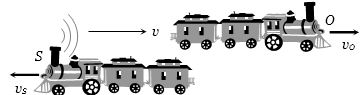
Two passenger trains moving with a speed of $108\, km/h$ cross each other. One of them blows a whistle whose frequency is $750\, Hz$. If the speed of sound is $330\, m/s$,then the passengers sitting in the other train,after the trains cross each other,will hear a sound whose frequency is .... $Hz$.
A
$900$
B
$625$
C
$750$
D
$800$
Solution
(B) Given: Speed of both trains $v_s = v_o = 108\, km/h = 108 \times \frac{5}{18} = 30\, m/s$.
Frequency of the source $n = 750\, Hz$.
Speed of sound $v = 330\, m/s$.
After the trains cross each other,the source and the observer are moving away from each other.
Using the Doppler effect formula for this condition:
$n' = n \left( \frac{v - v_o}{v + v_s} \right)$
Substituting the values:
$n' = 750 \left( \frac{330 - 30}{330 + 30} \right)$
$n' = 750 \left( \frac{300}{360} \right)$
$n' = 750 \times \frac{5}{6} = 125 \times 5 = 625\, Hz$.
Frequency of the source $n = 750\, Hz$.
Speed of sound $v = 330\, m/s$.
After the trains cross each other,the source and the observer are moving away from each other.
Using the Doppler effect formula for this condition:
$n' = n \left( \frac{v - v_o}{v + v_s} \right)$
Substituting the values:
$n' = 750 \left( \frac{330 - 30}{330 + 30} \right)$
$n' = 750 \left( \frac{300}{360} \right)$
$n' = 750 \times \frac{5}{6} = 125 \times 5 = 625\, Hz$.
0 likes
View Solution12
EasyMCQ
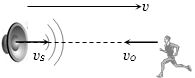
With what velocity should an observer move relative to a stationary source so that they hear a sound of double the frequency of the source?
A
Velocity of sound towards the source
B
Velocity of sound away from the source
C
Half the velocity of sound towards the source
D
Double the velocity of sound towards the source
Solution
(A) The general formula for Doppler's effect is $n' = n \left( \frac{v + v_O}{v - v_S} \right)$,where $n'$ is the observed frequency,$n$ is the source frequency,$v$ is the speed of sound,$v_O$ is the velocity of the observer,and $v_S$ is the velocity of the source.
Given that the source is stationary,$v_S = 0$.
We want the observed frequency to be double the source frequency,so $n' = 2n$.
Substituting these values into the formula: $2n = n \left( \frac{v + v_O}{v - 0} \right)$.
Dividing both sides by $n$: $2 = \frac{v + v_O}{v}$.
Multiplying by $v$: $2v = v + v_O$.
Solving for $v_O$: $v_O = v$.
Since the observer is moving towards the source to hear a higher frequency,the velocity of the observer is equal to the velocity of sound directed towards the source.
Given that the source is stationary,$v_S = 0$.
We want the observed frequency to be double the source frequency,so $n' = 2n$.
Substituting these values into the formula: $2n = n \left( \frac{v + v_O}{v - 0} \right)$.
Dividing both sides by $n$: $2 = \frac{v + v_O}{v}$.
Multiplying by $v$: $2v = v + v_O$.
Solving for $v_O$: $v_O = v$.
Since the observer is moving towards the source to hear a higher frequency,the velocity of the observer is equal to the velocity of sound directed towards the source.
0 likes
View Solution13
EasyMCQ
$A$ source of sound emitting a note of frequency $200 Hz$ moves towards an observer with a velocity $v$ equal to the velocity of sound. If the observer also moves away from the source with the same velocity $v$,the apparent frequency heard by the observer is .... $Hz$
A
$50$
B
$100$
C
$150$
D
$200$
Solution
(D) The Doppler effect formula for apparent frequency $f'$ is given by $f' = f \left( \frac{v_s \pm v_o}{v_s \mp v_s} \right)$,where $v_s$ is the velocity of sound,$v_o$ is the velocity of the observer,and $v_s$ is the velocity of the source.
Given that the source moves towards the observer with velocity $v = v_s$ and the observer moves away from the source with velocity $v = v_s$.
Using the sign convention: $f' = f \left( \frac{v_s - v}{v_s - v} \right)$.
Since $v = v_s$,the expression becomes $f' = f \left( \frac{v_s - v_s}{v_s - v_s} \right)$.
However,in the case where both source and observer move with the same velocity in the same direction,there is no relative motion between them.
Therefore,the relative velocity is zero,and the apparent frequency heard by the observer remains equal to the original frequency.
Thus,$f' = 200 Hz$.
Given that the source moves towards the observer with velocity $v = v_s$ and the observer moves away from the source with velocity $v = v_s$.
Using the sign convention: $f' = f \left( \frac{v_s - v}{v_s - v} \right)$.
Since $v = v_s$,the expression becomes $f' = f \left( \frac{v_s - v_s}{v_s - v_s} \right)$.
However,in the case where both source and observer move with the same velocity in the same direction,there is no relative motion between them.
Therefore,the relative velocity is zero,and the apparent frequency heard by the observer remains equal to the original frequency.
Thus,$f' = 200 Hz$.
0 likes
View Solution14
EasyMCQ
Doppler's effect will not be applicable when the velocity of sound source is
A
Equal to that of the sound velocity
B
Less than the velocity of sound
C
Greater than the velocity of sound
D
Zero
Solution
(C) The Doppler effect describes the change in frequency of a wave in relation to an observer who is moving relative to the wave source. When the velocity of the sound source $(v_s)$ exceeds the velocity of sound in the medium $(v)$,the source moves faster than the waves it produces. This results in the formation of a shock wave (sonic boom),and the standard Doppler effect formulas are no longer applicable as the wave fronts overlap in a way that prevents the observer from receiving the waves in the expected sequence.
0 likes
View Solution15
MediumMCQ
$A$ source of sound is travelling towards a stationary observer. The frequency of sound heard by the observer is three times the original frequency. If the velocity of sound is $v \ m/s$,the speed of the source will be:
A
$\frac{2}{3}v$
B
$v$
C
$\frac{3}{2}v$
D
$3v$
Solution
(A) According to the Doppler effect,when a source of sound moves towards a stationary observer,the observed frequency $n'$ is given by the formula:
$n' = n \left( \frac{v}{v - v_s} \right)$
where $n$ is the original frequency,$v$ is the velocity of sound,and $v_s$ is the velocity of the source.
Given that the observed frequency is three times the original frequency,we have $n' = 3n$.
Substituting this into the formula:
$3n = n \left( \frac{v}{v - v_s} \right)$
$3 = \frac{v}{v - v_s}$
$3(v - v_s) = v$
$3v - 3v_s = v$
$2v = 3v_s$
$v_s = \frac{2}{3}v$
Therefore,the speed of the source is $\frac{2}{3}v$.
$n' = n \left( \frac{v}{v - v_s} \right)$
where $n$ is the original frequency,$v$ is the velocity of sound,and $v_s$ is the velocity of the source.
Given that the observed frequency is three times the original frequency,we have $n' = 3n$.
Substituting this into the formula:
$3n = n \left( \frac{v}{v - v_s} \right)$
$3 = \frac{v}{v - v_s}$
$3(v - v_s) = v$
$3v - 3v_s = v$
$2v = 3v_s$
$v_s = \frac{2}{3}v$
Therefore,the speed of the source is $\frac{2}{3}v$.
0 likes
View Solution16
MediumMCQ
The speed of sound in air at a given temperature is $350 \, m/s$. An engine blows a whistle at a frequency of $1200 \, cps$. It is approaching the observer with a velocity of $50 \, m/s$. The apparent frequency in $cps$ heard by the observer will be:
A
$600$
B
$1050$
C
$1400$
D
$2400$
Solution
(C) According to the Doppler effect,when a source of sound approaches a stationary observer,the apparent frequency $n'$ is given by the formula:
$n' = n \left( \frac{v}{v - v_s} \right)$
Where:
$n = 1200 \, cps$ (actual frequency)
$v = 350 \, m/s$ (speed of sound)
$v_s = 50 \, m/s$ (speed of the source)
Substituting the values:
$n' = 1200 \times \left( \frac{350}{350 - 50} \right)$
$n' = 1200 \times \left( \frac{350}{300} \right)$
$n' = 1200 \times \frac{7}{6} = 200 \times 7 = 1400 \, cps$
Therefore,the apparent frequency heard by the observer is $1400 \, cps$.
$n' = n \left( \frac{v}{v - v_s} \right)$
Where:
$n = 1200 \, cps$ (actual frequency)
$v = 350 \, m/s$ (speed of sound)
$v_s = 50 \, m/s$ (speed of the source)
Substituting the values:
$n' = 1200 \times \left( \frac{350}{350 - 50} \right)$
$n' = 1200 \times \left( \frac{350}{300} \right)$
$n' = 1200 \times \frac{7}{6} = 200 \times 7 = 1400 \, cps$
Therefore,the apparent frequency heard by the observer is $1400 \, cps$.
0 likes
View Solution17
MediumMCQ
Suppose that the speed of sound in air at a given temperature is $400 \ m/s$. An engine blows a whistle at $1200 \ Hz$ frequency. It is approaching an observer at the speed of $100 \ m/s$. What is the apparent frequency as heard by the observer in $Hz$?
A
$600$
B
$1200$
C
$1500$
D
$1600$
Solution
(D) According to the Doppler effect,when a source of sound approaches a stationary observer,the apparent frequency $n'$ is given by the formula:
$n' = n \left( \frac{v}{v - v_s} \right)$
Where:
$n = 1200 \ Hz$ (source frequency)
$v = 400 \ m/s$ (speed of sound)
$v_s = 100 \ m/s$ (speed of the source)
Substituting the values into the formula:
$n' = 1200 \left( \frac{400}{400 - 100} \right)$
$n' = 1200 \left( \frac{400}{300} \right)$
$n' = 1200 \times \frac{4}{3}$
$n' = 400 \times 4 = 1600 \ Hz$
Therefore,the apparent frequency heard by the observer is $1600 \ Hz$.
$n' = n \left( \frac{v}{v - v_s} \right)$
Where:
$n = 1200 \ Hz$ (source frequency)
$v = 400 \ m/s$ (speed of sound)
$v_s = 100 \ m/s$ (speed of the source)
Substituting the values into the formula:
$n' = 1200 \left( \frac{400}{400 - 100} \right)$
$n' = 1200 \left( \frac{400}{300} \right)$
$n' = 1200 \times \frac{4}{3}$
$n' = 400 \times 4 = 1600 \ Hz$
Therefore,the apparent frequency heard by the observer is $1600 \ Hz$.
0 likes
View Solution18
MediumMCQ
$A$ source of frequency $150 \, Hz$ is moving in the direction of a person with a velocity of $110 \, m/s$. The frequency heard by the person will be .... $Hz$ (speed of sound in medium $= 330 \, m/s$)
A
$225$
B
$200$
C
$150$
D
$100$
Solution
(A) According to the Doppler effect,when a source moves towards a stationary observer,the apparent frequency $n'$ is given by the formula:
$n' = n \times \left( \frac{v}{v - v_s} \right)$
Given:
Frequency of source $n = 150 \, Hz$
Velocity of sound $v = 330 \, m/s$
Velocity of source $v_s = 110 \, m/s$
Substituting the values:
$n' = 150 \times \left( \frac{330}{330 - 110} \right)$
$n' = 150 \times \left( \frac{330}{220} \right)$
$n' = 150 \times 1.5 = 225 \, Hz$
Therefore,the frequency heard by the person is $225 \, Hz$.
$n' = n \times \left( \frac{v}{v - v_s} \right)$
Given:
Frequency of source $n = 150 \, Hz$
Velocity of sound $v = 330 \, m/s$
Velocity of source $v_s = 110 \, m/s$
Substituting the values:
$n' = 150 \times \left( \frac{330}{330 - 110} \right)$
$n' = 150 \times \left( \frac{330}{220} \right)$
$n' = 150 \times 1.5 = 225 \, Hz$
Therefore,the frequency heard by the person is $225 \, Hz$.
0 likes
View Solution19
MediumMCQ
$A$ source of sound is moving with a constant velocity of $20\, m/s$ emitting a note of frequency $1000\, Hz.$ The ratio of frequencies observed by a stationary observer while the source is approaching him and after it crosses him will be (Speed of sound $v = 340\, m/s$).
A
$9:8$
B
$8:9$
C
$1:1$
D
$9:10$
Solution
(A) When the source is approaching the stationary observer,the observed frequency $n_a$ is given by the Doppler effect formula:
$n_a = \left( \frac{v}{v - v_s} \right) n$
Substituting the values $v = 340\, m/s$,$v_s = 20\, m/s$,and $n = 1000\, Hz$:
$n_a = \left( \frac{340}{340 - 20} \right) \times 1000 = \frac{340}{320} \times 1000 = \frac{17}{16} \times 1000 = 1062.5\, Hz$
When the source is receding from the observer,the observed frequency $n_r$ is:
$n_r = \left( \frac{v}{v + v_s} \right) n$
$n_r = \left( \frac{340}{340 + 20} \right) \times 1000 = \frac{340}{360} \times 1000 = \frac{17}{18} \times 1000 = 944.4\, Hz$
The ratio of the frequencies is:
$\frac{n_a}{n_r} = \frac{\frac{v}{v - v_s} n}{\frac{v}{v + v_s} n} = \frac{v + v_s}{v - v_s}$
$\frac{n_a}{n_r} = \frac{340 + 20}{340 - 20} = \frac{360}{320} = \frac{9}{8}$
Thus,the ratio is $9:8$.
$n_a = \left( \frac{v}{v - v_s} \right) n$
Substituting the values $v = 340\, m/s$,$v_s = 20\, m/s$,and $n = 1000\, Hz$:
$n_a = \left( \frac{340}{340 - 20} \right) \times 1000 = \frac{340}{320} \times 1000 = \frac{17}{16} \times 1000 = 1062.5\, Hz$
When the source is receding from the observer,the observed frequency $n_r$ is:
$n_r = \left( \frac{v}{v + v_s} \right) n$
$n_r = \left( \frac{340}{340 + 20} \right) \times 1000 = \frac{340}{360} \times 1000 = \frac{17}{18} \times 1000 = 944.4\, Hz$
The ratio of the frequencies is:
$\frac{n_a}{n_r} = \frac{\frac{v}{v - v_s} n}{\frac{v}{v + v_s} n} = \frac{v + v_s}{v - v_s}$
$\frac{n_a}{n_r} = \frac{340 + 20}{340 - 20} = \frac{360}{320} = \frac{9}{8}$
Thus,the ratio is $9:8$.
0 likes
View Solution20
MediumMCQ
$A$ source of sound $S$ is moving with a velocity $50 \ m/s$ towards a stationary observer. The observer measures the frequency of the source as $1000 \ Hz$. What will be the apparent frequency of the source when it is moving away from the observer after crossing him? The velocity of sound in the medium is $350 \ m/s$.
A
$750$
B
$857$
C
$1143$
D
$1333$
Solution
(A) The apparent frequency $n'$ heard by a stationary observer when the source is moving with velocity $v_s$ is given by the Doppler effect formula: $n' = n \left( \frac{v}{v \mp v_s} \right)$.
When the source is approaching the observer,the apparent frequency is $n_a = n \left( \frac{v}{v - v_s} \right) = 1000 \ Hz$.
When the source is moving away from the observer,the apparent frequency is $n_r = n \left( \frac{v}{v + v_s} \right)$.
Dividing the two expressions: $\frac{n_a}{n_r} = \frac{v + v_s}{v - v_s}$.
Substituting the given values: $\frac{1000}{n_r} = \frac{350 + 50}{350 - 50} = \frac{400}{300} = \frac{4}{3}$.
Therefore,$n_r = 1000 \times \frac{3}{4} = 750 \ Hz$.
When the source is approaching the observer,the apparent frequency is $n_a = n \left( \frac{v}{v - v_s} \right) = 1000 \ Hz$.
When the source is moving away from the observer,the apparent frequency is $n_r = n \left( \frac{v}{v + v_s} \right)$.
Dividing the two expressions: $\frac{n_a}{n_r} = \frac{v + v_s}{v - v_s}$.
Substituting the given values: $\frac{1000}{n_r} = \frac{350 + 50}{350 - 50} = \frac{400}{300} = \frac{4}{3}$.
Therefore,$n_r = 1000 \times \frac{3}{4} = 750 \ Hz$.
0 likes
View Solution21
MediumMCQ
$A$ source and a listener are both moving towards each other with a speed of $v/10$,where $v$ is the speed of sound. If the frequency of the note emitted by the source is $f$,the frequency heard by the listener would be nearly:
A
$1.11 f$
B
$1.22 f$
C
$f$
D
$1.27 f$
Solution
(B) According to the Doppler effect,when both the source and the listener are moving towards each other,the apparent frequency $f'$ heard by the listener is given by the formula:
$f' = f \left( \frac{v + v_O}{v - v_S} \right)$
Here,$v_O$ is the velocity of the observer (listener) and $v_S$ is the velocity of the source.
Given that $v_O = v/10$ and $v_S = v/10$,we substitute these values into the formula:
$f' = f \left( \frac{v + v/10}{v - v/10} \right)$
$f' = f \left( \frac{1.1v}{0.9v} \right)$
$f' = f \left( \frac{11}{9} \right)$
$f' \approx 1.22 f$
Thus,the frequency heard by the listener is approximately $1.22 f$.
$f' = f \left( \frac{v + v_O}{v - v_S} \right)$
Here,$v_O$ is the velocity of the observer (listener) and $v_S$ is the velocity of the source.
Given that $v_O = v/10$ and $v_S = v/10$,we substitute these values into the formula:
$f' = f \left( \frac{v + v/10}{v - v/10} \right)$
$f' = f \left( \frac{1.1v}{0.9v} \right)$
$f' = f \left( \frac{11}{9} \right)$
$f' \approx 1.22 f$
Thus,the frequency heard by the listener is approximately $1.22 f$.
0 likes
View Solution22
MediumMCQ
$A$ table is revolving on its axis at $5$ revolutions per second. $A$ sound source of frequency $1000 \text{ Hz}$ is fixed on the table at $70 \text{ cm}$ from the axis. The minimum frequency heard by a listener standing at a distance from the table will be .... $\text{ Hz}$ (speed of sound $= 352 \text{ m/s}$)
A
$1000$
B
$1066$
C
$941$
D
$352$
Solution
(C) The source is moving in a circular path. The linear speed of the source is given by $v_S = r\omega$.
Given $r = 70 \text{ cm} = 0.70 \text{ m}$ and frequency of revolution $f_{rev} = 5 \text{ rev/s}$.
Angular velocity $\omega = 2\pi f_{rev} = 2 \times \pi \times 5 = 10\pi \text{ rad/s}$.
Thus,$v_S = 0.70 \times 10\pi = 7\pi \approx 7 \times 3.1416 = 21.99 \approx 22 \text{ m/s}$.
The minimum frequency is heard when the source is moving directly away from the listener.
Using the Doppler effect formula for a receding source: $n_{\min} = n \left( \frac{v}{v + v_S} \right)$.
Substituting the values: $n_{\min} = 1000 \times \left( \frac{352}{352 + 22} \right) = 1000 \times \left( \frac{352}{374} \right) \approx 941.17 \text{ Hz}$.
Rounding to the nearest integer,the minimum frequency is $941 \text{ Hz}$.
Given $r = 70 \text{ cm} = 0.70 \text{ m}$ and frequency of revolution $f_{rev} = 5 \text{ rev/s}$.
Angular velocity $\omega = 2\pi f_{rev} = 2 \times \pi \times 5 = 10\pi \text{ rad/s}$.
Thus,$v_S = 0.70 \times 10\pi = 7\pi \approx 7 \times 3.1416 = 21.99 \approx 22 \text{ m/s}$.
The minimum frequency is heard when the source is moving directly away from the listener.
Using the Doppler effect formula for a receding source: $n_{\min} = n \left( \frac{v}{v + v_S} \right)$.
Substituting the values: $n_{\min} = 1000 \times \left( \frac{352}{352 + 22} \right) = 1000 \times \left( \frac{352}{374} \right) \approx 941.17 \text{ Hz}$.
Rounding to the nearest integer,the minimum frequency is $941 \text{ Hz}$.
0 likes
View Solution23
DifficultMCQ
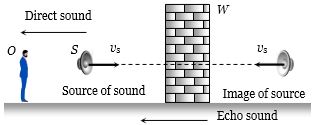
$A$ source of sound $S$ of frequency $500 \ Hz$ situated between a stationary observer $O$ and a wall $W$,moves towards the wall with a speed of $2 \ m/s$. If the velocity of sound is $332 \ m/s$,then the number of beats per second heard by the observer is (approximately)
A
$8$
B
$6$
C
$4$
D
$2$
Solution
(B) The observer hears two sounds: one directly from the source and one reflected from the wall (echo).
$1$. For the direct sound,the source is moving away from the stationary observer. The frequency heard $(n_1)$ is given by the Doppler effect formula:
$n_1 = n \left( \frac{v}{v + v_s} \right) = 500 \left( \frac{332}{332 + 2} \right) = 500 \left( \frac{332}{334} \right) \ Hz$
$2$. For the reflected sound (echo),the wall acts as a stationary source reflecting the sound. Effectively,the image of the source is moving towards the observer at a speed of $v_s = 2 \ m/s$. The frequency heard $(n_2)$ is:
$n_2 = n \left( \frac{v}{v - v_s} \right) = 500 \left( \frac{332}{332 - 2} \right) = 500 \left( \frac{332}{330} \right) \ Hz$
$3$. The beat frequency is the difference between these two frequencies:
$\text{Beat frequency} = n_2 - n_1 = 500 \times 332 \left( \frac{1}{330} - \frac{1}{334} \right)$
$= 500 \times 332 \left( \frac{334 - 330}{330 \times 334} \right) = 500 \times 332 \left( \frac{4}{110220} \right) \approx 6.02 \ Hz$
Thus,the number of beats per second is approximately $6$.
$1$. For the direct sound,the source is moving away from the stationary observer. The frequency heard $(n_1)$ is given by the Doppler effect formula:
$n_1 = n \left( \frac{v}{v + v_s} \right) = 500 \left( \frac{332}{332 + 2} \right) = 500 \left( \frac{332}{334} \right) \ Hz$
$2$. For the reflected sound (echo),the wall acts as a stationary source reflecting the sound. Effectively,the image of the source is moving towards the observer at a speed of $v_s = 2 \ m/s$. The frequency heard $(n_2)$ is:
$n_2 = n \left( \frac{v}{v - v_s} \right) = 500 \left( \frac{332}{332 - 2} \right) = 500 \left( \frac{332}{330} \right) \ Hz$
$3$. The beat frequency is the difference between these two frequencies:
$\text{Beat frequency} = n_2 - n_1 = 500 \times 332 \left( \frac{1}{330} - \frac{1}{334} \right)$
$= 500 \times 332 \left( \frac{334 - 330}{330 \times 334} \right) = 500 \times 332 \left( \frac{4}{110220} \right) \approx 6.02 \ Hz$
Thus,the number of beats per second is approximately $6$.
0 likes
View Solution24
DifficultMCQ
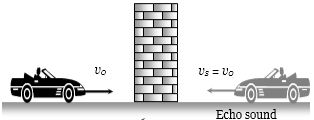
$A$ motor car blowing a horn of frequency $124\,vib/sec$ moves with a velocity $72\,km/hr$ towards a tall wall. The frequency of the reflected sound heard by the driver will be .... $vib/sec$ (velocity of sound in air is $330\,m/s$).
A
$109$
B
$132$
C
$140$
D
$248$
Solution
(C) The frequency of the reflected sound heard by the driver is given by the Doppler effect formula for a moving source and a moving observer.
Here,the car acts as both the source and the observer.
The velocity of the car $v_s = v_o = 72\,km/hr = 72 \times \frac{5}{18} = 20\,m/s$.
The velocity of sound $v = 330\,m/s$.
The frequency of the horn $n = 124\,vib/sec$.
The formula for the reflected frequency $n'$ is:
$n' = n \left( \frac{v + v_o}{v - v_s} \right)$
Substituting the values:
$n' = 124 \left( \frac{330 + 20}{330 - 20} \right)$
$n' = 124 \left( \frac{350}{310} \right)$
$n' = 124 \times \frac{35}{31} = 4 \times 35 = 140\,vib/sec$.
Here,the car acts as both the source and the observer.
The velocity of the car $v_s = v_o = 72\,km/hr = 72 \times \frac{5}{18} = 20\,m/s$.
The velocity of sound $v = 330\,m/s$.
The frequency of the horn $n = 124\,vib/sec$.
The formula for the reflected frequency $n'$ is:
$n' = n \left( \frac{v + v_o}{v - v_s} \right)$
Substituting the values:
$n' = 124 \left( \frac{330 + 20}{330 - 20} \right)$
$n' = 124 \left( \frac{350}{310} \right)$
$n' = 124 \times \frac{35}{31} = 4 \times 35 = 140\,vib/sec$.
0 likes
View Solution25
MediumMCQ
$A$ source of sound of frequency $n$ is moving towards a stationary observer with a speed $S$. If the speed of sound in air is $V$ and the frequency heard by the observer is $n_1$,the value of $n_1/n$ is
A
$(V + S)/V$
B
$V/(V + S)$
C
$(V - S)/V$
D
$V/(V - S)$
Solution
(D) According to the Doppler effect,when a source of sound moves towards a stationary observer,the apparent frequency $n_1$ is given by the formula:
$n_1 = n \left( \frac{V}{V - S} \right)$
where $n$ is the actual frequency,$V$ is the speed of sound in air,and $S$ is the speed of the source.
Dividing both sides by $n$,we get:
$\frac{n_1}{n} = \frac{V}{V - S}$
$n_1 = n \left( \frac{V}{V - S} \right)$
where $n$ is the actual frequency,$V$ is the speed of sound in air,and $S$ is the speed of the source.
Dividing both sides by $n$,we get:
$\frac{n_1}{n} = \frac{V}{V - S}$
0 likes
View Solution26
EasyMCQ
$A$ vehicle with a horn of frequency $n$ is moving with a velocity of $30\, m/s$ in a direction perpendicular to the straight line joining the observer and the vehicle. The observer perceives the sound to have a frequency $n + n_1$. Then (if the sound velocity in air is $300\, m/s$):
A
$n_1 = 10\,n$
B
$n_1 = 0$
C
$n_1 = 0.1\,n$
D
$n_1 = -0.1\,n$
Solution
(B) The Doppler effect occurs when there is a relative velocity between the source and the observer along the line joining them.
In this problem,the vehicle is moving in a direction perpendicular to the line joining the observer and the vehicle.
Therefore,the component of the velocity of the source along the line joining the observer and the source is $v_s \cos(90^{\circ}) = 0$.
Since there is no relative motion along the line of sight,the frequency perceived by the observer remains the same as the source frequency.
Thus,the observed frequency is $n' = n$.
Given that the observed frequency is $n + n_1$,we have $n + n_1 = n$,which implies $n_1 = 0$.
In this problem,the vehicle is moving in a direction perpendicular to the line joining the observer and the vehicle.
Therefore,the component of the velocity of the source along the line joining the observer and the source is $v_s \cos(90^{\circ}) = 0$.
Since there is no relative motion along the line of sight,the frequency perceived by the observer remains the same as the source frequency.
Thus,the observed frequency is $n' = n$.
Given that the observed frequency is $n + n_1$,we have $n + n_1 = n$,which implies $n_1 = 0$.
0 likes
View Solution27
MediumMCQ
$A$ whistle giving out $450 Hz$ approaches a stationary observer at a speed of $33 m/s$. The frequency heard by the observer in $Hz$ is (Take speed of sound $v = 330 m/s$)
A
$409$
B
$429$
C
$517$
D
$500$
Solution
(D) The apparent frequency $n'$ heard by the observer is given by the Doppler effect formula for a source moving towards a stationary observer:
$n' = n \left( \frac{v}{v - v_s} \right)$
Given:
Source frequency $n = 450 Hz$
Speed of sound $v = 330 m/s$
Speed of source $v_s = 33 m/s$
Substituting the values:
$n' = 450 \times \left( \frac{330}{330 - 33} \right)$
$n' = 450 \times \left( \frac{330}{297} \right)$
$n' = 450 \times \frac{10}{9}$
$n' = 50 \times 10 = 500 Hz$
Therefore,the frequency heard by the observer is $500 Hz$.
$n' = n \left( \frac{v}{v - v_s} \right)$
Given:
Source frequency $n = 450 Hz$
Speed of sound $v = 330 m/s$
Speed of source $v_s = 33 m/s$
Substituting the values:
$n' = 450 \times \left( \frac{330}{330 - 33} \right)$
$n' = 450 \times \left( \frac{330}{297} \right)$
$n' = 450 \times \frac{10}{9}$
$n' = 50 \times 10 = 500 Hz$
Therefore,the frequency heard by the observer is $500 Hz$.
0 likes
View Solution28
MediumMCQ
An observer is moving away from a source of sound of frequency $100 \, Hz$. His speed is $33 \, m/s$. If the speed of sound is $330 \, m/s$,then the observed frequency is .... $Hz$.
A
$90$
B
$100$
C
$91$
D
$110$
Solution
(A) The Doppler effect formula for an observer moving away from a stationary source is given by:
$n' = n \left( \frac{v - v_O}{v} \right)$
Where:
$n = 100 \, Hz$ (source frequency)
$v = 330 \, m/s$ (speed of sound)
$v_O = 33 \, m/s$ (speed of observer moving away)
Substituting the values:
$n' = 100 \left( \frac{330 - 33}{330} \right)$
$n' = 100 \left( \frac{297}{330} \right)$
$n' = 100 \times 0.9 = 90 \, Hz$
Thus,the observed frequency is $90 \, Hz$.
$n' = n \left( \frac{v - v_O}{v} \right)$
Where:
$n = 100 \, Hz$ (source frequency)
$v = 330 \, m/s$ (speed of sound)
$v_O = 33 \, m/s$ (speed of observer moving away)
Substituting the values:
$n' = 100 \left( \frac{330 - 33}{330} \right)$
$n' = 100 \left( \frac{297}{330} \right)$
$n' = 100 \times 0.9 = 90 \, Hz$
Thus,the observed frequency is $90 \, Hz$.
0 likes
View Solution29
DifficultMCQ
An observer standing at a station observes a frequency of $219 \, Hz$ when a train approaches and $184 \, Hz$ when the train goes away from him. If the velocity of sound in air is $340 \, m/s$,then the velocity of the train and the actual frequency of the whistle will be:
A
$15.5 \, m/s, \, 200 \, Hz$
B
$19.5 \, m/s, \, 205 \, Hz$
C
$29.5 \, m/s, \, 200 \, Hz$
D
$32.5 \, m/s, \, 205 \, Hz$
Solution
(C) When the train is approaching,the frequency heard by the observer is given by the Doppler effect formula: $n_a = n \left( \frac{v}{v - v_s} \right)$.
Substituting the values: $219 = n \left( \frac{340}{340 - v_s} \right)$ ... $(i)$.
When the train is receding,the frequency heard by the observer is: $n_r = n \left( \frac{v}{v + v_s} \right)$.
Substituting the values: $184 = n \left( \frac{340}{340 + v_s} \right)$ ... $(ii)$.
Dividing equation $(i)$ by $(ii)$:
$\frac{219}{184} = \frac{340 + v_s}{340 - v_s}$.
$219(340 - v_s) = 184(340 + v_s)$.
$74460 - 219v_s = 62560 + 184v_s$.
$11900 = 403v_s$.
$v_s \approx 29.53 \, m/s \approx 29.5 \, m/s$.
Substituting $v_s$ back into equation $(i)$:
$219 = n \left( \frac{340}{340 - 29.5} \right) = n \left( \frac{340}{310.5} \right)$.
$n = \frac{219 \times 310.5}{340} \approx 200 \, Hz$.
Substituting the values: $219 = n \left( \frac{340}{340 - v_s} \right)$ ... $(i)$.
When the train is receding,the frequency heard by the observer is: $n_r = n \left( \frac{v}{v + v_s} \right)$.
Substituting the values: $184 = n \left( \frac{340}{340 + v_s} \right)$ ... $(ii)$.
Dividing equation $(i)$ by $(ii)$:
$\frac{219}{184} = \frac{340 + v_s}{340 - v_s}$.
$219(340 - v_s) = 184(340 + v_s)$.
$74460 - 219v_s = 62560 + 184v_s$.
$11900 = 403v_s$.
$v_s \approx 29.53 \, m/s \approx 29.5 \, m/s$.
Substituting $v_s$ back into equation $(i)$:
$219 = n \left( \frac{340}{340 - 29.5} \right) = n \left( \frac{340}{310.5} \right)$.
$n = \frac{219 \times 310.5}{340} \approx 200 \, Hz$.
0 likes
View Solution30
DifficultMCQ
$A$ boy is walking away from a wall towards an observer at a speed of $1\, m/s$ and blows a whistle whose frequency is $680\, Hz$. The number of beats heard by the observer per second is (Velocity of sound in air $= 340\, m/s$).
A
$0$
B
$2$
C
$8$
D
$4$
Solution
(D) The observer hears two sounds: one directly from the source and one reflected from the wall.
Let $v = 340\, m/s$ be the speed of sound and $v_s = 1\, m/s$ be the speed of the source (the boy).
$1$. Frequency heard directly from the source $(n_1)$: Since the source is moving towards the observer,the frequency is given by $n_1 = n_0 \left( \frac{v}{v - v_s} \right) = 680 \left( \frac{340}{340 - 1} \right) = 680 \left( \frac{340}{339} \right) \approx 682\, Hz$.
$2$. Frequency heard from the reflection off the wall $(n_2)$: The wall acts as a stationary source moving away from the observer. The frequency reflected by the wall is $n' = n_0 \left( \frac{v}{v + v_s} \right)$. This reflected sound then travels to the observer. Thus,$n_2 = 680 \left( \frac{340}{340 + 1} \right) = 680 \left( \frac{340}{341} \right) \approx 678\, Hz$.
$3$. The number of beats per second is the difference between the two frequencies: $n_1 - n_2 = 680 \left( \frac{340}{339} - \frac{340}{341} \right) = 680 \times 340 \left( \frac{341 - 339}{339 \times 341} \right) = 680 \times 340 \left( \frac{2}{115600 - 1} \right) \approx 680 \times 340 \times \frac{2}{115600} = 680 \times \frac{680}{115600} = 4\, Hz$.
Let $v = 340\, m/s$ be the speed of sound and $v_s = 1\, m/s$ be the speed of the source (the boy).
$1$. Frequency heard directly from the source $(n_1)$: Since the source is moving towards the observer,the frequency is given by $n_1 = n_0 \left( \frac{v}{v - v_s} \right) = 680 \left( \frac{340}{340 - 1} \right) = 680 \left( \frac{340}{339} \right) \approx 682\, Hz$.
$2$. Frequency heard from the reflection off the wall $(n_2)$: The wall acts as a stationary source moving away from the observer. The frequency reflected by the wall is $n' = n_0 \left( \frac{v}{v + v_s} \right)$. This reflected sound then travels to the observer. Thus,$n_2 = 680 \left( \frac{340}{340 + 1} \right) = 680 \left( \frac{340}{341} \right) \approx 678\, Hz$.
$3$. The number of beats per second is the difference between the two frequencies: $n_1 - n_2 = 680 \left( \frac{340}{339} - \frac{340}{341} \right) = 680 \times 340 \left( \frac{341 - 339}{339 \times 341} \right) = 680 \times 340 \left( \frac{2}{115600 - 1} \right) \approx 680 \times 340 \times \frac{2}{115600} = 680 \times \frac{680}{115600} = 4\, Hz$.
0 likes
View Solution31
MediumMCQ
The driver of a car travelling with speed $30 \ m/s$ towards a hill sounds a horn of frequency $600 \ Hz$. If the velocity of sound in air is $330 \ m/s$,the frequency of the reflected sound as heard by the driver is .... $Hz$
A
$720$
B
$555.5$
C
$550$
D
$500$
Solution
(A) The problem involves the Doppler effect with a moving source and a moving observer (the driver).
$1$. First,the sound from the horn travels to the hill. The hill acts as a stationary observer receiving sound from a source (the car) moving towards it at $v_s = 30 \ m/s$. The frequency $n_1$ received by the hill is:
$n_1 = n \left( \frac{v}{v - v_s} \right) = 600 \left( \frac{330}{330 - 30} \right) = 600 \left( \frac{330}{300} \right) = 660 \ Hz$.
$2$. The hill reflects this sound,acting as a stationary source of frequency $n_1 = 660 \ Hz$. The driver (observer) is moving towards the hill at $v_o = 30 \ m/s$. The frequency $n'$ heard by the driver is:
$n' = n_1 \left( \frac{v + v_o}{v} \right) = 660 \left( \frac{330 + 30}{330} \right) = 660 \left( \frac{360}{330} \right) = 2 \times 360 = 720 \ Hz$.
Alternatively,using the combined formula for a moving observer and source towards a stationary reflector:
$n' = n \left( \frac{v + v_o}{v - v_s} \right) = 600 \left( \frac{330 + 30}{330 - 30} \right) = 600 \left( \frac{360}{300} \right) = 720 \ Hz$.
$1$. First,the sound from the horn travels to the hill. The hill acts as a stationary observer receiving sound from a source (the car) moving towards it at $v_s = 30 \ m/s$. The frequency $n_1$ received by the hill is:
$n_1 = n \left( \frac{v}{v - v_s} \right) = 600 \left( \frac{330}{330 - 30} \right) = 600 \left( \frac{330}{300} \right) = 660 \ Hz$.
$2$. The hill reflects this sound,acting as a stationary source of frequency $n_1 = 660 \ Hz$. The driver (observer) is moving towards the hill at $v_o = 30 \ m/s$. The frequency $n'$ heard by the driver is:
$n' = n_1 \left( \frac{v + v_o}{v} \right) = 660 \left( \frac{330 + 30}{330} \right) = 660 \left( \frac{360}{330} \right) = 2 \times 360 = 720 \ Hz$.
Alternatively,using the combined formula for a moving observer and source towards a stationary reflector:
$n' = n \left( \frac{v + v_o}{v - v_s} \right) = 600 \left( \frac{330 + 30}{330 - 30} \right) = 600 \left( \frac{360}{300} \right) = 720 \ Hz$.
0 likes
View Solution32
DifficultMCQ
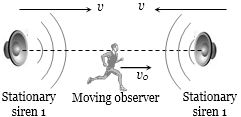
Two sirens situated one kilometer apart are producing sound of frequency $330 \ Hz$. An observer starts moving from one siren to the other with a speed of $2 \ m/s$. If the speed of sound is $330 \ m/s$,what will be the beat frequency heard by the observer?
A
$8$
B
$4$
C
$6$
D
$1$
Solution
(B) The observer is moving away from siren $1$ and towards siren $2$.
The frequency of sound heard from siren $1$ is given by the Doppler effect formula for a moving observer moving away from a stationary source:
$n_1 = n \left( \frac{v - v_0}{v} \right) = 330 \left( \frac{330 - 2}{330} \right) = 328 \ Hz$
The frequency of sound heard from siren $2$ is given by the Doppler effect formula for a moving observer moving towards a stationary source:
$n_2 = n \left( \frac{v + v_0}{v} \right) = 330 \left( \frac{330 + 2}{330} \right) = 332 \ Hz$
The beat frequency is the difference between the two observed frequencies:
$\text{Beat frequency} = n_2 - n_1 = 332 - 328 = 4 \ Hz$.
The frequency of sound heard from siren $1$ is given by the Doppler effect formula for a moving observer moving away from a stationary source:
$n_1 = n \left( \frac{v - v_0}{v} \right) = 330 \left( \frac{330 - 2}{330} \right) = 328 \ Hz$
The frequency of sound heard from siren $2$ is given by the Doppler effect formula for a moving observer moving towards a stationary source:
$n_2 = n \left( \frac{v + v_0}{v} \right) = 330 \left( \frac{330 + 2}{330} \right) = 332 \ Hz$
The beat frequency is the difference between the two observed frequencies:
$\text{Beat frequency} = n_2 - n_1 = 332 - 328 = 4 \ Hz$.
0 likes
View Solution33
MediumMCQ
$A$ source of sound and a listener are approaching each other with a speed of $40 \, m/s$. The apparent frequency of the note produced by the source is $400 \, cps$. Then,its true frequency (in $cps$) is (velocity of sound in air $= 360 \, m/s$).
A
$420$
B
$360$
C
$400$
D
$320$
Solution
(D) The formula for the apparent frequency $(n')$ when the source and listener are approaching each other is given by:
$n' = n \left( \frac{v + v_O}{v - v_S} \right)$
Where:
$n'$ = apparent frequency = $400 \, cps$
$n$ = true frequency
$v$ = velocity of sound = $360 \, m/s$
$v_O$ = velocity of observer = $40 \, m/s$
$v_S$ = velocity of source = $40 \, m/s$
Substituting the values into the formula:
$400 = n \left( \frac{360 + 40}{360 - 40} \right)$
$400 = n \left( \frac{400}{320} \right)$
$400 = n \left( \frac{5}{4} \right)$
$n = 400 \times \frac{4}{5} = 320 \, cps$
Therefore,the true frequency is $320 \, cps$.
$n' = n \left( \frac{v + v_O}{v - v_S} \right)$
Where:
$n'$ = apparent frequency = $400 \, cps$
$n$ = true frequency
$v$ = velocity of sound = $360 \, m/s$
$v_O$ = velocity of observer = $40 \, m/s$
$v_S$ = velocity of source = $40 \, m/s$
Substituting the values into the formula:
$400 = n \left( \frac{360 + 40}{360 - 40} \right)$
$400 = n \left( \frac{400}{320} \right)$
$400 = n \left( \frac{5}{4} \right)$
$n = 400 \times \frac{4}{5} = 320 \, cps$
Therefore,the true frequency is $320 \, cps$.
0 likes
View Solution34
MediumMCQ
$A$ siren emitting sound of frequency $500 \; Hz$ is going away from a static listener with a speed of $50 \; m/s$. The frequency of sound heard by the listener is .... $Hz$. (Take speed of sound $v = 330 \; m/s$)
A
$434.2$
B
$589.3$
C
$481.2$
D
$286.5$
Solution
(A) According to the Doppler effect,when the source is moving away from a stationary observer,the observed frequency $f'$ is given by the formula:
$f' = f \left( \frac{v}{v + v_s} \right)$
Where:
$f = 500 \; Hz$ (source frequency)
$v = 330 \; m/s$ (speed of sound)
$v_s = 50 \; m/s$ (speed of the source)
Substituting the values:
$f' = 500 \times \left( \frac{330}{330 + 50} \right)$
$f' = 500 \times \left( \frac{330}{380} \right)$
$f' = 500 \times 0.8684$
$f' \approx 434.2 \; Hz$
$f' = f \left( \frac{v}{v + v_s} \right)$
Where:
$f = 500 \; Hz$ (source frequency)
$v = 330 \; m/s$ (speed of sound)
$v_s = 50 \; m/s$ (speed of the source)
Substituting the values:
$f' = 500 \times \left( \frac{330}{330 + 50} \right)$
$f' = 500 \times \left( \frac{330}{380} \right)$
$f' = 500 \times 0.8684$
$f' \approx 434.2 \; Hz$
0 likes
View Solution35
EasyMCQ
$A$ man sitting in a moving train hears the whistle of the engine. The frequency of the whistle is $600 \ Hz$.
A
The apparent frequency as heard by him is smaller than $600 \ Hz$.
B
The apparent frequency is larger than $600 \ Hz$.
C
The frequency as heard by him is $600 \ Hz$.
D
None of the above.
Solution
(C) According to the Doppler effect,the apparent frequency heard by an observer depends on the relative motion between the source of sound and the observer.
In this scenario,the man (observer) and the engine (source) are both part of the same moving train.
Since they are moving together at the same velocity,there is no relative motion between the source and the observer.
Therefore,the frequency heard by the man remains equal to the actual frequency of the whistle,which is $600 \ Hz$.
In this scenario,the man (observer) and the engine (source) are both part of the same moving train.
Since they are moving together at the same velocity,there is no relative motion between the source and the observer.
Therefore,the frequency heard by the man remains equal to the actual frequency of the whistle,which is $600 \ Hz$.
0 likes
View Solution36
MediumMCQ
$A$ source of sound of frequency $500 Hz$ is moving towards an observer with velocity $30 m/s$. The speed of sound is $330 m/s$. The frequency heard by the observer will be .... $Hz$
A
$550$
B
$458.3$
C
$530$
D
$545.5$
Solution
(A) According to the Doppler effect,when a source moves towards a stationary observer,the apparent frequency $n'$ is given by the formula:
$n' = n \left( \frac{v}{v - v_S} \right)$
Where:
$n = 500 Hz$ (source frequency)
$v = 330 m/s$ (speed of sound)
$v_S = 30 m/s$ (velocity of source)
Substituting the values:
$n' = 500 \left( \frac{330}{330 - 30} \right)$
$n' = 500 \left( \frac{330}{300} \right)$
$n' = 500 \times 1.1 = 550 Hz$
Therefore,the frequency heard by the observer is $550 Hz$.
$n' = n \left( \frac{v}{v - v_S} \right)$
Where:
$n = 500 Hz$ (source frequency)
$v = 330 m/s$ (speed of sound)
$v_S = 30 m/s$ (velocity of source)
Substituting the values:
$n' = 500 \left( \frac{330}{330 - 30} \right)$
$n' = 500 \left( \frac{330}{300} \right)$
$n' = 500 \times 1.1 = 550 Hz$
Therefore,the frequency heard by the observer is $550 Hz$.
0 likes
View Solution37
MediumMCQ
$A$ source of sound of frequency $90 \text{ vibrations/sec}$ is approaching a stationary observer with a speed equal to $1/10$ the speed of sound. What will be the frequency heard by the observer in $\text{vibrations/sec}$?
A
$80$
B
$90$
C
$100$
D
$120$
Solution
(C) According to the Doppler effect,when a source of sound approaches a stationary observer,the observed frequency $n'$ is given by the formula:
$n' = n \left( \frac{v}{v - v_s} \right)$
Where:
$n = 90 \text{ vibrations/sec}$ (source frequency)
$v = \text{speed of sound}$
$v_s = \frac{v}{10}$ (speed of the source)
Substituting the values:
$n' = 90 \left( \frac{v}{v - \frac{v}{10}} \right)$
$n' = 90 \left( \frac{v}{\frac{9v}{10}} \right)$
$n' = 90 \times \frac{10}{9} = 100 \text{ vibrations/sec}$.
$n' = n \left( \frac{v}{v - v_s} \right)$
Where:
$n = 90 \text{ vibrations/sec}$ (source frequency)
$v = \text{speed of sound}$
$v_s = \frac{v}{10}$ (speed of the source)
Substituting the values:
$n' = 90 \left( \frac{v}{v - \frac{v}{10}} \right)$
$n' = 90 \left( \frac{v}{\frac{9v}{10}} \right)$
$n' = 90 \times \frac{10}{9} = 100 \text{ vibrations/sec}$.
0 likes
View Solution38
DifficultMCQ
$A$ whistle of frequency $500 \, Hz$ tied to the end of a string of length $1.2 \, m$ revolves at $400 \, rev/min$. $A$ listener standing some distance away in the plane of rotation of the whistle hears frequencies in the range (speed of sound $= 340 \, m/s$):
A
$436 \, Hz$ to $586 \, Hz$
B
$426 \, Hz$ to $574 \, Hz$
C
$426 \, Hz$ to $584 \, Hz$
D
$436 \, Hz$ to $674 \, Hz$
Solution
(A) The linear velocity of the whistle is given by $v_S = r\omega$.
Given $r = 1.2 \, m$ and angular velocity $\omega = 2\pi \times \frac{400}{60} \, rad/s$.
$v_S = 1.2 \times 2\pi \times \frac{400}{60} = 1.2 \times 2\pi \times \frac{20}{3} = 16\pi \approx 50.26 \, m/s$. Using $v_S \approx 50 \, m/s$ as per standard approximation.
When the whistle approaches the listener,the observed frequency is maximum: $n_{max} = n \left( \frac{v}{v - v_S} \right) = 500 \left( \frac{340}{340 - 50} \right) = 500 \left( \frac{340}{290} \right) \approx 586 \, Hz$.
When the whistle moves away from the listener,the observed frequency is minimum: $n_{min} = n \left( \frac{v}{v + v_S} \right) = 500 \left( \frac{340}{340 + 50} \right) = 500 \left( \frac{340}{390} \right) \approx 436 \, Hz$.
Thus,the range of frequencies heard is $436 \, Hz$ to $586 \, Hz$.
Given $r = 1.2 \, m$ and angular velocity $\omega = 2\pi \times \frac{400}{60} \, rad/s$.
$v_S = 1.2 \times 2\pi \times \frac{400}{60} = 1.2 \times 2\pi \times \frac{20}{3} = 16\pi \approx 50.26 \, m/s$. Using $v_S \approx 50 \, m/s$ as per standard approximation.
When the whistle approaches the listener,the observed frequency is maximum: $n_{max} = n \left( \frac{v}{v - v_S} \right) = 500 \left( \frac{340}{340 - 50} \right) = 500 \left( \frac{340}{290} \right) \approx 586 \, Hz$.
When the whistle moves away from the listener,the observed frequency is minimum: $n_{min} = n \left( \frac{v}{v + v_S} \right) = 500 \left( \frac{340}{340 + 50} \right) = 500 \left( \frac{340}{390} \right) \approx 436 \, Hz$.
Thus,the range of frequencies heard is $436 \, Hz$ to $586 \, Hz$.
0 likes
View Solution39
MediumMCQ
$A$ train moves towards a stationary observer with a speed of $34 \ m/s$. The train sounds a whistle and its frequency registered by the observer is $f_1$. If the train's speed is reduced to $17 \ m/s$,the frequency registered is $f_2$. If the speed of sound is $340 \ m/s$,then the ratio $f_1/f_2$ is:
A
$18/19$
B
$1/2$
C
$2$
D
$19/18$
Solution
(D) According to the Doppler effect,when a source moves towards a stationary observer,the observed frequency $f'$ is given by $f' = f \left( \frac{v}{v - v_s} \right)$,where $v$ is the speed of sound and $v_s$ is the speed of the source.
For the first case,$v_s = 34 \ m/s$:
$f_1 = f \left( \frac{340}{340 - 34} \right) = f \left( \frac{340}{306} \right)$
For the second case,$v_s = 17 \ m/s$:
$f_2 = f \left( \frac{340}{340 - 17} \right) = f \left( \frac{340}{323} \right)$
Now,calculating the ratio $f_1/f_2$:
$\frac{f_1}{f_2} = \frac{f \left( \frac{340}{306} \right)}{f \left( \frac{340}{323} \right)} = \frac{323}{306}$
Dividing both numerator and denominator by $17$:
$\frac{323 \div 17}{306 \div 17} = \frac{19}{18}$
Thus,the ratio $f_1/f_2$ is $19/18$.
For the first case,$v_s = 34 \ m/s$:
$f_1 = f \left( \frac{340}{340 - 34} \right) = f \left( \frac{340}{306} \right)$
For the second case,$v_s = 17 \ m/s$:
$f_2 = f \left( \frac{340}{340 - 17} \right) = f \left( \frac{340}{323} \right)$
Now,calculating the ratio $f_1/f_2$:
$\frac{f_1}{f_2} = \frac{f \left( \frac{340}{306} \right)}{f \left( \frac{340}{323} \right)} = \frac{323}{306}$
Dividing both numerator and denominator by $17$:
$\frac{323 \div 17}{306 \div 17} = \frac{19}{18}$
Thus,the ratio $f_1/f_2$ is $19/18$.
0 likes
View Solution40
EasyMCQ
If the source and the observer are both relatively at rest and the speed of sound is increased,then the frequency heard by the observer will:
A
Increase
B
Decrease
C
Cannot be predicted
D
Will not change
Solution
(D) The frequency heard by an observer is given by the Doppler effect formula: $f' = f \left( \frac{v + v_o}{v - v_s} \right)$,where $v$ is the speed of sound,$v_o$ is the velocity of the observer,and $v_s$ is the velocity of the source.
Since the source and the observer are both at rest,$v_o = 0$ and $v_s = 0$.
Substituting these values into the formula,we get $f' = f \left( \frac{v + 0}{v - 0} \right) = f \left( \frac{v}{v} \right) = f$.
Therefore,the observed frequency $f'$ is equal to the source frequency $f$,regardless of the speed of sound $v$.
Thus,the frequency heard by the observer will not change.
Since the source and the observer are both at rest,$v_o = 0$ and $v_s = 0$.
Substituting these values into the formula,we get $f' = f \left( \frac{v + 0}{v - 0} \right) = f \left( \frac{v}{v} \right) = f$.
Therefore,the observed frequency $f'$ is equal to the source frequency $f$,regardless of the speed of sound $v$.
Thus,the frequency heard by the observer will not change.
0 likes
View Solution41
MediumMCQ
$A$ source and an observer move away from each other with a velocity of $10\; m/s$ with respect to the ground. If the observer finds the frequency of sound coming from the source as $1950\; Hz$,then the actual frequency of the source is .... $Hz$ (velocity of sound in air = $340\; m/s$).
A
$1903$
B
$2068$
C
$2100$
D
$602$
Solution
(B) According to the Doppler effect,when the source and observer move away from each other,the observed frequency $n'$ is given by the formula:
$n' = n \left( \frac{v - v_O}{v + v_S} \right)$
Here,$v = 340\; m/s$ is the speed of sound,$v_O = 10\; m/s$ is the velocity of the observer,and $v_S = 10\; m/s$ is the velocity of the source.
Given $n' = 1950\; Hz$,we substitute the values:
$1950 = n \left( \frac{340 - 10}{340 + 10} \right)$
$1950 = n \left( \frac{330}{350} \right)$
$1950 = n \left( \frac{33}{35} \right)$
$n = 1950 \times \frac{35}{33} \approx 2068.18\; Hz$
Rounding to the nearest whole number,the actual frequency is $2068\; Hz$.
$n' = n \left( \frac{v - v_O}{v + v_S} \right)$
Here,$v = 340\; m/s$ is the speed of sound,$v_O = 10\; m/s$ is the velocity of the observer,and $v_S = 10\; m/s$ is the velocity of the source.
Given $n' = 1950\; Hz$,we substitute the values:
$1950 = n \left( \frac{340 - 10}{340 + 10} \right)$
$1950 = n \left( \frac{330}{350} \right)$
$1950 = n \left( \frac{33}{35} \right)$
$n = 1950 \times \frac{35}{33} \approx 2068.18\; Hz$
Rounding to the nearest whole number,the actual frequency is $2068\; Hz$.
0 likes
View Solution42
MediumMCQ
$A$ source is moving towards an observer with a speed of $20 \ m/s$ and having a frequency of $240 \ Hz$. The observer is now moving towards the source with a speed of $20 \ m/s$. If the velocity of sound is $340 \ m/s$,the apparent frequency heard by the observer is ... $Hz$.
A
$240$
B
$270$
C
$280$
D
$360$
Solution
(B) According to the Doppler effect,the apparent frequency $n'$ is given by the formula:
$n' = n \left( \frac{v + v_O}{v - v_S} \right)$
Where:
$n = 240 \ Hz$ (source frequency)
$v = 340 \ m/s$ (velocity of sound)
$v_O = 20 \ m/s$ (velocity of observer moving towards the source)
$v_S = 20 \ m/s$ (velocity of source moving towards the observer)
Substituting the values:
$n' = 240 \left( \frac{340 + 20}{340 - 20} \right)$
$n' = 240 \left( \frac{360}{320} \right)$
$n' = 240 \times 1.125 = 270 \ Hz$.
$n' = n \left( \frac{v + v_O}{v - v_S} \right)$
Where:
$n = 240 \ Hz$ (source frequency)
$v = 340 \ m/s$ (velocity of sound)
$v_O = 20 \ m/s$ (velocity of observer moving towards the source)
$v_S = 20 \ m/s$ (velocity of source moving towards the observer)
Substituting the values:
$n' = 240 \left( \frac{340 + 20}{340 - 20} \right)$
$n' = 240 \left( \frac{360}{320} \right)$
$n' = 240 \times 1.125 = 270 \ Hz$.
0 likes
View Solution43
DifficultMCQ
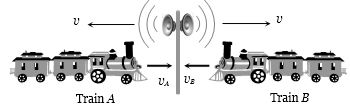
$A$ siren placed at a railway platform is emitting sound of frequency $5 \text{ kHz}$. $A$ passenger sitting in a moving train $A$ records a frequency of $5.5 \text{ kHz}$ while the train approaches the siren. During his return journey in a different train $B$,he records a frequency of $6.0 \text{ kHz}$ while approaching the same siren. The ratio of the velocity of train $B$ to that of train $A$ is
A
$242/252$
B
$2$
C
$5/6$
D
$11/6$
Solution
(B) According to the Doppler effect,when an observer moves towards a stationary source,the observed frequency $n'$ is given by:
$n' = n \left( \frac{v + v_0}{v} \right)$
where $n$ is the source frequency,$v$ is the speed of sound,and $v_0$ is the speed of the observer.
For train $A$:
$5.5 = 5 \left( \frac{v + v_A}{v} \right) \implies 1.1 = 1 + \frac{v_A}{v} \implies \frac{v_A}{v} = 0.1$ ... $(i)$
For train $B$:
$6.0 = 5 \left( \frac{v + v_B}{v} \right) \implies 1.2 = 1 + \frac{v_B}{v} \implies \frac{v_B}{v} = 0.2$ ... $(ii)$
Dividing equation $(ii)$ by equation $(i)$:
$\frac{v_B / v}{v_A / v} = \frac{0.2}{0.1} = 2$
Therefore,the ratio of the velocity of train $B$ to that of train $A$ is $2$.
$n' = n \left( \frac{v + v_0}{v} \right)$
where $n$ is the source frequency,$v$ is the speed of sound,and $v_0$ is the speed of the observer.
For train $A$:
$5.5 = 5 \left( \frac{v + v_A}{v} \right) \implies 1.1 = 1 + \frac{v_A}{v} \implies \frac{v_A}{v} = 0.1$ ... $(i)$
For train $B$:
$6.0 = 5 \left( \frac{v + v_B}{v} \right) \implies 1.2 = 1 + \frac{v_B}{v} \implies \frac{v_B}{v} = 0.2$ ... $(ii)$
Dividing equation $(ii)$ by equation $(i)$:
$\frac{v_B / v}{v_A / v} = \frac{0.2}{0.1} = 2$
Therefore,the ratio of the velocity of train $B$ to that of train $A$ is $2$.
0 likes
View Solution44
MediumMCQ
$A$ whistle revolves in a circle with an angular speed of $20 \; rad/s$ using a string of length $50 \; cm.$ If the frequency of sound from the whistle is $385 \; Hz,$ then what is the minimum frequency heard by an observer,who is far away from the centre in the same plane? $(v = 340 \; m/s)$
A
$333$
B
$374$
C
$385$
D
$394$
Solution
(B) The linear speed of the whistle is given by $v_s = r\omega.$
Given $r = 50 \; cm = 0.5 \; m$ and $\omega = 20 \; rad/s.$
So,$v_s = 0.5 \times 20 = 10 \; m/s.$
The minimum frequency is heard when the source is moving directly away from the observer.
The formula for the observed frequency is $n_{\min} = n \left( \frac{v}{v + v_s} \right).$
Substituting the values: $n_{\min} = 385 \left( \frac{340}{340 + 10} \right) = 385 \left( \frac{340}{350} \right) = 385 \times \frac{34}{35} = 11 \times 34 = 374 \; Hz.$
Given $r = 50 \; cm = 0.5 \; m$ and $\omega = 20 \; rad/s.$
So,$v_s = 0.5 \times 20 = 10 \; m/s.$
The minimum frequency is heard when the source is moving directly away from the observer.
The formula for the observed frequency is $n_{\min} = n \left( \frac{v}{v + v_s} \right).$
Substituting the values: $n_{\min} = 385 \left( \frac{340}{340 + 10} \right) = 385 \left( \frac{340}{350} \right) = 385 \times \frac{34}{35} = 11 \times 34 = 374 \; Hz.$
0 likes
View Solution45
MediumMCQ
$A$ siren emitting sound of frequency $800 \; Hz$ is going away from a static listener with a speed of $30 \; m/s$. The frequency of the sound heard by the listener is... $Hz$ (take velocity of sound as $330 \; m/s$).
A
$733.3$
B
$644.8$
C
$481.2$
D
$286.5$
Solution
(A) According to the Doppler effect,when the source is moving away from a stationary observer,the observed frequency $n'$ is given by the formula:
$n' = n \left( \frac{v}{v + v_S} \right)$
Where:
$n = 800 \; Hz$ (source frequency)
$v = 330 \; m/s$ (velocity of sound)
$v_S = 30 \; m/s$ (velocity of source)
Substituting the values:
$n' = 800 \left( \frac{330}{330 + 30} \right)$
$n' = 800 \left( \frac{330}{360} \right)$
$n' = 800 \left( \frac{11}{12} \right)$
$n' = \frac{8800}{12} \approx 733.33 \; Hz$.
$n' = n \left( \frac{v}{v + v_S} \right)$
Where:
$n = 800 \; Hz$ (source frequency)
$v = 330 \; m/s$ (velocity of sound)
$v_S = 30 \; m/s$ (velocity of source)
Substituting the values:
$n' = 800 \left( \frac{330}{330 + 30} \right)$
$n' = 800 \left( \frac{330}{360} \right)$
$n' = 800 \left( \frac{11}{12} \right)$
$n' = \frac{8800}{12} \approx 733.33 \; Hz$.
0 likes
View Solution46
MediumMCQ
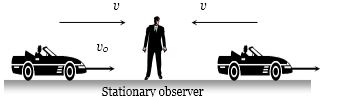
$A$ car sounding a horn of frequency $1000 \ Hz$ passes a stationary observer. The ratio of the frequencies of the horn noted by the observer before and after the passing of the car is $11 : 9$. If the speed of sound is $v$,what is the speed of the car?
A
$\frac{1}{10}v$
B
$\frac{1}{2}v$
C
$\frac{1}{5}v$
D
$v$
Solution
(A) According to the Doppler effect,the frequency $n'$ heard by a stationary observer when the source moves with speed $v_c$ is given by $n' = n \left( \frac{v}{v \mp v_c} \right)$.
Before passing,the source approaches the observer: $n_{Before} = n \left( \frac{v}{v - v_c} \right)$.
After passing,the source moves away from the observer: $n_{After} = n \left( \frac{v}{v + v_c} \right)$.
The ratio of the frequencies is given as $\frac{n_{Before}}{n_{After}} = \frac{11}{9}$.
Substituting the expressions:
$\frac{n \left( \frac{v}{v - v_c} \right)}{n \left( \frac{v}{v + v_c} \right)} = \frac{v + v_c}{v - v_c} = \frac{11}{9}$.
Cross-multiplying gives:
$9(v + v_c) = 11(v - v_c)$
$9v + 9v_c = 11v - 11v_c$
$20v_c = 2v$
$v_c = \frac{2v}{20} = \frac{1}{10}v$.
Before passing,the source approaches the observer: $n_{Before} = n \left( \frac{v}{v - v_c} \right)$.
After passing,the source moves away from the observer: $n_{After} = n \left( \frac{v}{v + v_c} \right)$.
The ratio of the frequencies is given as $\frac{n_{Before}}{n_{After}} = \frac{11}{9}$.
Substituting the expressions:
$\frac{n \left( \frac{v}{v - v_c} \right)}{n \left( \frac{v}{v + v_c} \right)} = \frac{v + v_c}{v - v_c} = \frac{11}{9}$.
Cross-multiplying gives:
$9(v + v_c) = 11(v - v_c)$
$9v + 9v_c = 11v - 11v_c$
$20v_c = 2v$
$v_c = \frac{2v}{20} = \frac{1}{10}v$.
0 likes
View Solution47
MediumMCQ
What should be the velocity of a sound source moving towards a stationary observer so that the apparent frequency is double the actual frequency? (Velocity of sound is $v$)
A
$v$
B
$2v$
C
$\frac{v}{2}$
D
$\frac{v}{4}$
Solution
(C) The formula for the apparent frequency $n'$ heard by a stationary observer when the source moves towards them with velocity $v_S$ is given by:
$n' = n \left( \frac{v}{v - v_S} \right)$
Given that the apparent frequency is double the actual frequency,$n' = 2n$.
Substituting this into the formula:
$2n = n \left( \frac{v}{v - v_S} \right)$
$2 = \frac{v}{v - v_S}$
$2(v - v_S) = v$
$2v - 2v_S = v$
$v = 2v_S$
$v_S = \frac{v}{2}$
Therefore,the velocity of the source should be $\frac{v}{2}$.
$n' = n \left( \frac{v}{v - v_S} \right)$
Given that the apparent frequency is double the actual frequency,$n' = 2n$.
Substituting this into the formula:
$2n = n \left( \frac{v}{v - v_S} \right)$
$2 = \frac{v}{v - v_S}$
$2(v - v_S) = v$
$2v - 2v_S = v$
$v = 2v_S$
$v_S = \frac{v}{2}$
Therefore,the velocity of the source should be $\frac{v}{2}$.
0 likes
View Solution48
MediumMCQ
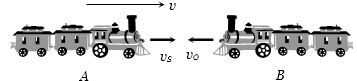
Two trains are moving towards each other at speeds of $20 \, m/s$ and $15 \, m/s$ relative to the ground. The first train sounds a whistle of frequency $600 \, Hz$. The frequency of the whistle heard by a passenger in the second train before the trains meet is ...... $Hz$ (the speed of sound in air is $340 \, m/s$).
A
$600$
B
$585$
C
$645$
D
$666$
Solution
(D) According to the Doppler effect,when the source and the observer are moving towards each other,the observed frequency $n'$ is given by:
$n' = n \left( \frac{v + v_o}{v - v_s} \right)$
Here,$n = 600 \, Hz$ is the source frequency,$v = 340 \, m/s$ is the speed of sound,$v_s = 20 \, m/s$ is the speed of the source (first train),and $v_o = 15 \, m/s$ is the speed of the observer (second train).
Substituting the values:
$n' = 600 \left( \frac{340 + 15}{340 - 20} \right)$
$n' = 600 \left( \frac{355}{320} \right)$
$n' = 600 \times 1.109375 = 665.625 \, Hz \approx 666 \, Hz$.
$n' = n \left( \frac{v + v_o}{v - v_s} \right)$
Here,$n = 600 \, Hz$ is the source frequency,$v = 340 \, m/s$ is the speed of sound,$v_s = 20 \, m/s$ is the speed of the source (first train),and $v_o = 15 \, m/s$ is the speed of the observer (second train).
Substituting the values:
$n' = 600 \left( \frac{340 + 15}{340 - 20} \right)$
$n' = 600 \left( \frac{355}{320} \right)$
$n' = 600 \times 1.109375 = 665.625 \, Hz \approx 666 \, Hz$.
0 likes
View Solution49
MediumMCQ
$A$ source and an observer approach each other with the same velocity $50 \, m/s$. If the apparent frequency is $435 \, s^{-1}$,then the real frequency is .... $s^{-1}$ (Take speed of sound $v = 332 \, m/s$)
A
$320$
B
$360$
C
$390$
D
$420$
Solution
(A) The formula for the apparent frequency $n'$ when the source and observer approach each other is given by:
$n' = n \left[ \frac{v + v_O}{v - v_S} \right]$
Given:
Apparent frequency $n' = 435 \, s^{-1}$
Speed of sound $v = 332 \, m/s$
Velocity of observer $v_O = 50 \, m/s$
Velocity of source $v_S = 50 \, m/s$
Substituting the values into the formula:
$435 = n \left[ \frac{332 + 50}{332 - 50} \right]$
$435 = n \left[ \frac{382}{282} \right]$
$435 = n \times 1.3546$
$n = \frac{435}{1.3546} \approx 321.12 \, s^{-1}$
Rounding to the nearest given option,the real frequency is $320 \, s^{-1}$.
$n' = n \left[ \frac{v + v_O}{v - v_S} \right]$
Given:
Apparent frequency $n' = 435 \, s^{-1}$
Speed of sound $v = 332 \, m/s$
Velocity of observer $v_O = 50 \, m/s$
Velocity of source $v_S = 50 \, m/s$
Substituting the values into the formula:
$435 = n \left[ \frac{332 + 50}{332 - 50} \right]$
$435 = n \left[ \frac{382}{282} \right]$
$435 = n \times 1.3546$
$n = \frac{435}{1.3546} \approx 321.12 \, s^{-1}$
Rounding to the nearest given option,the real frequency is $320 \, s^{-1}$.
0 likes
View SolutionWaves and Sound — Doppler’s Effect · Frequently Asked Questions
1Are these Waves and Sound questions useful for JEE and NEET?
Yes. All questions in this section are mapped to JEE Main and NEET exam patterns. Previous year questions from JEE Main, NEET, GUJCET and state-level exams are included with full solutions.
2Can I switch to Hindi or Gujarati for these questions?
Yes. Use the language tabs in the hero section or the sidebar to view the same questions and solutions in English, Hindi or Gujarati.
3How do I generate a question paper from this subtopic?
Use the Vedclass Exam Paper Generator — select the chapter and subtopic, set difficulty, and generate Sets A, B, C, D automatically. First 3 chapters of every subject are free.
Vedclass Products
For Students
Vedclass Test Series
Mock tests in real JEE/NEET style with performance analysis. 5-day free trial.
Start Free TrialFor Teachers
Exam Paper Generator
Generate Set A/B/C/D papers from this chapter in 2 minutes. 3 chapters free.
Try FreeFor Institutes
Online Exam Module
Live online exams with unlimited students, 360° analytics & white-label branding.
See DemoFor Teachers & Institutes
Generate a Waves and Sound Exam Paper in 2 Minutes
Select subtopic & difficulty — Sets A, B, C, D auto-generated with No Repeat logic.
First 3 chapters of every subject are free — no payment required.