
A English
Introduction and Classification of Waves Questions in English
Class 11 Physics · Waves and Sound · Introduction and Classification of Waves
34+
Questions
English
Language
100%
With Solutions
Showing 34 of 34 questions in English
1
EasyMCQ
The type of waves that can be propagated through solids is:
A
Transverse
B
Longitudinal
C
Both $(a)$ and $(b)$
D
None of these
Solution
(C) Solids possess both elasticity (bulk modulus) and rigidity (shear modulus).
Due to the presence of bulk modulus,longitudinal waves can propagate through solids.
Due to the presence of shear modulus (rigidity),transverse waves can also propagate through solids.
Therefore,both longitudinal and transverse waves can propagate through solids.
Due to the presence of bulk modulus,longitudinal waves can propagate through solids.
Due to the presence of shear modulus (rigidity),transverse waves can also propagate through solids.
Therefore,both longitudinal and transverse waves can propagate through solids.
0 likes
View Solution2
EasyMCQ
Water waves are
A
Longitudinal
B
Transverse
C
Both longitudinal and transverse
D
Neither longitudinal nor transverse
Solution
(C) Water waves are complex waves. On the surface of the water,the particles move in circular paths,which involves both longitudinal and transverse components. Therefore,water waves are considered to be both longitudinal and transverse in nature.
0 likes
View Solution3
EasyMCQ
The waves in which the particles of the medium vibrate in a direction perpendicular to the direction of wave motion are known as:
A
Transverse waves
B
Longitudinal waves
C
Propagated waves
D
None of these
Solution
(A) In transverse waves,the particles of the medium vibrate in a direction perpendicular to the direction of wave propagation.
Since the question describes this specific motion,the correct answer is $A$.
Since the question describes this specific motion,the correct answer is $A$.
1 likes
View Solution4
EasyMCQ
$A$ medium can carry a longitudinal wave because it has the property of
A
Mass
B
Density
C
Compressibility
D
Elasticity
Solution
(D) For a medium to propagate a longitudinal wave,it must be able to undergo deformation and then return to its original state. This ability of a medium to restore its original shape or volume after the removal of a deforming force is known as elasticity. Therefore,a medium can carry a longitudinal wave because it possesses the property of elasticity.
0 likes
View Solution5
EasyMCQ
Transverse waves can propagate in
A
Liquids
B
Solids
C
Gases
D
None of these
Solution
(B) Transverse waves require a medium that possesses shear modulus (rigidity) to propagate.
Solids have a definite shear modulus,allowing transverse waves to travel through them.
Liquids and gases do not have a shear modulus (they cannot sustain shear stress),so transverse waves cannot propagate through them (except on the surface of liquids,where surface tension acts as a restoring force).
Solids have a definite shear modulus,allowing transverse waves to travel through them.
Liquids and gases do not have a shear modulus (they cannot sustain shear stress),so transverse waves cannot propagate through them (except on the surface of liquids,where surface tension acts as a restoring force).
0 likes
View Solution6
EasyMCQ
Mechanical waves on the surface of a liquid are
A
Transverse
B
Longitudinal
C
Torsional
D
Both transverse and longitudinal
Solution
(D) Mechanical waves on the surface of a liquid are complex waves.
These waves involve both the transverse displacement of liquid particles (due to surface tension and gravity) and the longitudinal displacement (due to compression and rarefaction of the liquid).
Therefore,surface waves on a liquid are a combination of both transverse and longitudinal waves.
These waves involve both the transverse displacement of liquid particles (due to surface tension and gravity) and the longitudinal displacement (due to compression and rarefaction of the liquid).
Therefore,surface waves on a liquid are a combination of both transverse and longitudinal waves.
0 likes
View Solution7
EasyMCQ
Dispersion can take place for
A
Transverse waves only but not for longitudinal waves
B
Longitudinal waves only but not for transverse waves
C
Both transverse and longitudinal waves
D
Neither transverse nor longitudinal waves
Solution
(C) Dispersion is the phenomenon where the phase velocity of a wave depends on its frequency. This phenomenon occurs when waves propagate through a dispersive medium. Both transverse waves (such as light waves in glass) and longitudinal waves (such as sound waves in certain materials or plasma) can undergo dispersion,provided that the medium's refractive index or the wave's phase velocity varies with frequency.
0 likes
View Solution8
EasyMCQ
Which of the following waves cannot travel in a vacuum?
A
$X$-rays
B
Infrasonic waves
C
Ultraviolet rays
D
Radio waves
Solution
(B) Mechanical waves require a material medium for their propagation and cannot travel through a vacuum.
Infrasonic waves are sound waves with frequencies below $20 \ Hz$,which are mechanical in nature.
$X$-rays,ultraviolet rays,and radio waves are all electromagnetic waves,which do not require a material medium and can travel through a vacuum.
Therefore,the correct option is $B$.
Infrasonic waves are sound waves with frequencies below $20 \ Hz$,which are mechanical in nature.
$X$-rays,ultraviolet rays,and radio waves are all electromagnetic waves,which do not require a material medium and can travel through a vacuum.
Therefore,the correct option is $B$.
0 likes
View Solution9
EasyMCQ
Sound waves exhibit more diffraction than light waves because:
A
The wavelength of sound waves is greater than that of light waves.
B
The wavelength of light waves is greater than that of sound waves.
C
The wavelengths of sound waves and light waves are equal.
D
None of the above.
Solution
(A) Diffraction is the bending of waves around the corners of an obstacle or through an aperture. The condition for significant diffraction is that the size of the obstacle or aperture $(a)$ must be comparable to the wavelength $(\lambda)$ of the wave, i.e., $a \approx \lambda$ or $\frac{a}{\lambda} \approx 1$.
Since the wavelength of sound waves $(\lambda_s)$ is much larger than the wavelength of light waves $(\lambda_l)$, sound waves can easily diffract around common obstacles (like doors or walls) whose dimensions are in the range of meters.
Conversely, light waves have very small wavelengths (in the range of $10^{-7} \, m$), so they only show noticeable diffraction when passing through extremely small apertures or around very fine edges.
Since the wavelength of sound waves $(\lambda_s)$ is much larger than the wavelength of light waves $(\lambda_l)$, sound waves can easily diffract around common obstacles (like doors or walls) whose dimensions are in the range of meters.
Conversely, light waves have very small wavelengths (in the range of $10^{-7} \, m$), so they only show noticeable diffraction when passing through extremely small apertures or around very fine edges.
0 likes
View Solution10
EasyMCQ
$A$ person outside a room can hear the conversation happening inside the room because of...
A
Interference of sound waves
B
Reflection of sound waves
C
Diffraction of sound waves
D
Refraction of sound waves
Solution
(C) Sound waves have a much longer wavelength compared to light waves.
For diffraction to occur significantly, the size of the obstacle or aperture $(a)$ must be comparable to the wavelength $(\lambda)$ of the wave, i.e., $a/\lambda \approx 1$.
Since the wavelength of sound waves is large and comparable to the size of doors or windows, they bend around the corners of these obstacles and reach the person outside.
This phenomenon is known as the diffraction of sound waves.
For diffraction to occur significantly, the size of the obstacle or aperture $(a)$ must be comparable to the wavelength $(\lambda)$ of the wave, i.e., $a/\lambda \approx 1$.
Since the wavelength of sound waves is large and comparable to the size of doors or windows, they bend around the corners of these obstacles and reach the person outside.
This phenomenon is known as the diffraction of sound waves.
0 likes
View Solution11
EasyMCQ
Which of the following waves are not of the transverse type?
A
Light produced by a sodium lamp
B
Sound waves propagating in air
C
$X$-rays emitted from an $X$-ray machine
D
Microwaves used in radar
Solution
(B) Transverse waves are waves in which the particles of the medium oscillate perpendicular to the direction of wave propagation. Electromagnetic waves (light,$X$-rays,microwaves) are transverse in nature. Sound waves propagating in air are longitudinal waves,meaning the particles of the medium oscillate parallel to the direction of wave propagation. Therefore,sound waves are not transverse.
0 likes
View Solution12
MediumMCQ
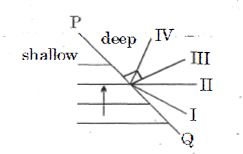
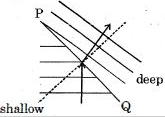
The figure shows wave fronts in still water moving in the direction of the arrow towards the interface $PQ$ between a shallow region and a deep (denser) region. Which of the lines shown may represent one of the wave fronts in the deep region?
A
$I$
B
$II$
C
$III$
D
$IV$
Solution
(D) When a wave travels from a shallow region to a deep region,its speed increases. According to Snell's law,the wave bends away from the normal as it enters the denser (deeper) medium. Since the wave fronts are always perpendicular to the direction of wave propagation (the ray),the refracted wave fronts will bend away from the normal. Looking at the geometry,line $IV$ represents the wave front that has bent away from the normal relative to the incident direction.
0 likes
View Solution13
EasyMCQ
In a transverse wave,the particles of the medium:
A
Vibrate in a direction perpendicular to the direction of the propagation.
B
Vibrate in a direction parallel to the direction of the propagation.
C
Move in a circle.
D
Move in an ellipse.
Solution
(A) In a transverse wave,the particles of the medium oscillate or vibrate in a direction perpendicular to the direction of wave propagation. This creates a pattern of crests and troughs.
0 likes
View Solution14
EasyMCQ
$Assertion :$ When a beetle moves along the sand within a few tens of centimeters of a sand scorpion,the scorpion immediately turns towards the beetle and dashes towards it.
$Reason :$ When a beetle disturbs the sand,it sends pulses along the sand's surface. One set of pulses is longitudinal while the other set is transverse.
$Reason :$ When a beetle disturbs the sand,it sends pulses along the sand's surface. One set of pulses is longitudinal while the other set is transverse.
A
If both Assertion and Reason are correct and the Reason is a correct explanation of the Assertion.
B
If both Assertion and Reason are correct but Reason is not a correct explanation of the Assertion.
C
If the Assertion is correct but Reason is incorrect.
D
If both the Assertion and Reason are incorrect.
Solution
(A) When a beetle moves along the sand,it creates disturbances that travel as waves on the sand's surface.
These disturbances consist of two types of pulses: longitudinal waves (which travel faster) and transverse waves (which travel slower).
The sand scorpion is highly sensitive to these vibrations. By sensing the time interval between the arrival of the longitudinal waves and the transverse waves,the scorpion can calculate the distance to the beetle.
Furthermore,by comparing the signals received by its different legs,the scorpion can determine the direction of the beetle.
Thus,the Reason correctly explains how the scorpion detects and locates the beetle.
These disturbances consist of two types of pulses: longitudinal waves (which travel faster) and transverse waves (which travel slower).
The sand scorpion is highly sensitive to these vibrations. By sensing the time interval between the arrival of the longitudinal waves and the transverse waves,the scorpion can calculate the distance to the beetle.
Furthermore,by comparing the signals received by its different legs,the scorpion can determine the direction of the beetle.
Thus,the Reason correctly explains how the scorpion detects and locates the beetle.
0 likes
View Solution15
Medium
Given below are some examples of wave motion. State in each case if the wave motion is transverse,longitudinal or a combination of both:
$(a)$ Motion of a kink in a longitudinal spring produced by displacing one end of the spring sideways.
$(b)$ Waves produced in a cylinder containing a liquid by moving its piston back and forth.
$(c)$ Waves produced by a motorboat sailing in water.
$(d)$ Ultrasonic waves in air produced by a vibrating quartz crystal.
$(a)$ Motion of a kink in a longitudinal spring produced by displacing one end of the spring sideways.
$(b)$ Waves produced in a cylinder containing a liquid by moving its piston back and forth.
$(c)$ Waves produced by a motorboat sailing in water.
$(d)$ Ultrasonic waves in air produced by a vibrating quartz crystal.
Solution
(N/A) Transverse and longitudinal: The sideways displacement creates a transverse component,while the spring's inherent nature allows for longitudinal propagation.
$(b)$ Longitudinal: The back-and-forth motion of the piston creates pressure variations in the liquid,which travel as longitudinal waves.
$(c)$ Transverse and longitudinal: $A$ motorboat creates surface ripples (transverse) and pressure disturbances (longitudinal) in the water.
$(d)$ Longitudinal: Sound waves,including ultrasonic waves,travel in air as pressure variations,which are strictly longitudinal.
$(b)$ Longitudinal: The back-and-forth motion of the piston creates pressure variations in the liquid,which travel as longitudinal waves.
$(c)$ Transverse and longitudinal: $A$ motorboat creates surface ripples (transverse) and pressure disturbances (longitudinal) in the water.
$(d)$ Longitudinal: Sound waves,including ultrasonic waves,travel in air as pressure variations,which are strictly longitudinal.
0 likes
View Solution16
Medium
What are called waves? Mention their importance.
Solution
(N/A) wave is a disturbance that travels through a medium or vacuum,transferring energy from one point to another without the net transport of matter.
Definition: The patterns that move without the actual physical transfer or flow of matter as a whole are called waves. In general,the motion of a disturbance in a medium or vacuum is called a wave.
Importance:
$1$. Energy Transfer: Waves are the primary mechanism for transferring energy from one location to another without moving the medium itself.
$2$. Information Transfer: Waves allow for the transmission of information. For example,sound waves carry speech,and electromagnetic waves carry data in telecommunications.
$3$. Communication Systems: Modern long-distance communication (telephone,radio,internet,satellite) relies entirely on the transmission,propagation,and reception of signals in the form of waves.
$4$. Sensing and Detection: Waves are used in various detectors (like ears for sound or antennas for electromagnetic waves) to receive and interpret signals,enabling interaction with our environment.
Definition: The patterns that move without the actual physical transfer or flow of matter as a whole are called waves. In general,the motion of a disturbance in a medium or vacuum is called a wave.
Importance:
$1$. Energy Transfer: Waves are the primary mechanism for transferring energy from one location to another without moving the medium itself.
$2$. Information Transfer: Waves allow for the transmission of information. For example,sound waves carry speech,and electromagnetic waves carry data in telecommunications.
$3$. Communication Systems: Modern long-distance communication (telephone,radio,internet,satellite) relies entirely on the transmission,propagation,and reception of signals in the form of waves.
$4$. Sensing and Detection: Waves are used in various detectors (like ears for sound or antennas for electromagnetic waves) to receive and interpret signals,enabling interaction with our environment.
0 likes
View Solution17
Easy
Describe the classification of waves in detail with examples.
Solution
(N/A) All types of waves can be classified into the following three categories:
$(1)$ Mechanical Waves: "The waves which require an elastic medium for their propagation are called mechanical waves."
For example: String waves, spring waves, water waves, sound waves, and seismic waves are all mechanical waves. Here, waves propagate due to the elasticity of the medium.
$(2)$ Electromagnetic Waves or Non-mechanical Waves: "The waves which do not require any medium for their propagation are called non-mechanical waves. They are also called electromagnetic waves because, during their propagation, electric and magnetic fields oscillate periodically in mutually perpendicular directions in a plane perpendicular to the direction of propagation of the wave."
For example: Radio waves, infrared light, visible light, ultraviolet light, $X$-rays, and gamma rays. They can propagate in a vacuum. All electromagnetic waves have the same speed in a vacuum, $c = 2.99792458 \times 10^{8} \ m/s$.
$(3)$ Matter Waves: "When a fundamental particle of mass $m$ moves with a velocity $v$, its motion can be described by a wave of wavelength $\lambda = \frac{h}{mv}$, where $h$ is Planck's constant $(6.625 \times 10^{-34} \ Js)$." These are called "Matter Waves" or "De-Broglie waves". They represent the motion of atoms, molecules, and fundamental particles like electrons and protons. They are used in modern technology, such as the electron microscope.
$(1)$ Mechanical Waves: "The waves which require an elastic medium for their propagation are called mechanical waves."
For example: String waves, spring waves, water waves, sound waves, and seismic waves are all mechanical waves. Here, waves propagate due to the elasticity of the medium.
$(2)$ Electromagnetic Waves or Non-mechanical Waves: "The waves which do not require any medium for their propagation are called non-mechanical waves. They are also called electromagnetic waves because, during their propagation, electric and magnetic fields oscillate periodically in mutually perpendicular directions in a plane perpendicular to the direction of propagation of the wave."
For example: Radio waves, infrared light, visible light, ultraviolet light, $X$-rays, and gamma rays. They can propagate in a vacuum. All electromagnetic waves have the same speed in a vacuum, $c = 2.99792458 \times 10^{8} \ m/s$.
$(3)$ Matter Waves: "When a fundamental particle of mass $m$ moves with a velocity $v$, its motion can be described by a wave of wavelength $\lambda = \frac{h}{mv}$, where $h$ is Planck's constant $(6.625 \times 10^{-34} \ Js)$." These are called "Matter Waves" or "De-Broglie waves". They represent the motion of atoms, molecules, and fundamental particles like electrons and protons. They are used in modern technology, such as the electron microscope.
0 likes
View Solution18
Medium
Provide an example of a spring for wave propagation.

Solution
(N/A) The provided image shows a spring being used to demonstrate wave propagation. When one end of a spring (like a Slinky) is pushed and pulled or moved up and down,it creates mechanical waves. Specifically,the image illustrates longitudinal waves,where the coils of the spring compress and rarefy,causing the disturbance to travel along the length of the spring. This is a classic example of how mechanical waves propagate through a medium.
0 likes
View Solution19
Easy
What are called mechanical waves? Give its examples.
Solution
(N/A) Mechanical waves are waves that require a material medium (solid,liquid,or gas) for their propagation. These waves are produced due to the periodic disturbance in the medium,which causes particles to oscillate about their mean positions.
Examples of mechanical waves include:
$1$. Sound waves traveling through air.
$2$. Waves produced on a stretched string.
$3$. Water waves on the surface of a pond.
$4$. Seismic waves (earthquake waves) traveling through the Earth's crust.
Examples of mechanical waves include:
$1$. Sound waves traveling through air.
$2$. Waves produced on a stretched string.
$3$. Water waves on the surface of a pond.
$4$. Seismic waves (earthquake waves) traveling through the Earth's crust.
0 likes
View Solution20
MediumMCQ
Are the waves propagating in solids transverse,longitudinal or both?
A
Transverse only
B
Longitudinal only
C
Both transverse and longitudinal
D
Neither transverse nor longitudinal
Solution
(C) In solids,both longitudinal and transverse waves can propagate.
Longitudinal waves (such as sound waves) propagate due to the compression and rarefaction of the medium,which is possible in solids,liquids,and gases.
Transverse waves (such as shear waves) require the medium to have shear modulus (rigidity),which solids possess.
Therefore,solids can support both types of mechanical waves.
Longitudinal waves (such as sound waves) propagate due to the compression and rarefaction of the medium,which is possible in solids,liquids,and gases.
Transverse waves (such as shear waves) require the medium to have shear modulus (rigidity),which solids possess.
Therefore,solids can support both types of mechanical waves.
0 likes
View Solution21
Medium
Explain the types of waves based on the direction of oscillations of the particles of the medium.
Solution
(N/A) Depending upon the direction of oscillations of the particles of the medium,mechanical waves are classified into the following two categories:
$(1)$ Transverse waves
$(2)$ Longitudinal waves
$(1)$ Transverse Waves: During the propagation of mechanical waves,if the particles of the medium oscillate perpendicular to the direction of propagation of the wave,then they are called transverse waves.
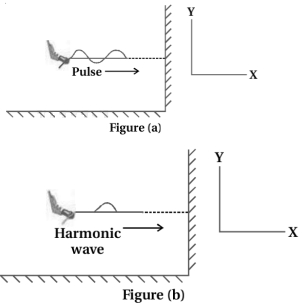
Consider a horizontal string tied at one end to a fixed rigid support,which is stretched and kept under proper tension. If a single jerk is given at the free end of this string,a crest or trough (pulse) is formed which travels along the string. The particles of the string move up and down (perpendicular to the direction of wave motion),which is a characteristic of transverse waves.
$(2)$ Longitudinal Waves: During the propagation of mechanical waves,if the particles of the medium oscillate parallel to the direction of propagation of the wave,then they are called longitudinal waves. Sound waves in air are a common example of longitudinal waves,where air particles oscillate back and forth in the same direction as the wave travels,creating regions of compressions and rarefactions.
$(1)$ Transverse waves
$(2)$ Longitudinal waves
$(1)$ Transverse Waves: During the propagation of mechanical waves,if the particles of the medium oscillate perpendicular to the direction of propagation of the wave,then they are called transverse waves.
Consider a horizontal string tied at one end to a fixed rigid support,which is stretched and kept under proper tension. If a single jerk is given at the free end of this string,a crest or trough (pulse) is formed which travels along the string. The particles of the string move up and down (perpendicular to the direction of wave motion),which is a characteristic of transverse waves.
$(2)$ Longitudinal Waves: During the propagation of mechanical waves,if the particles of the medium oscillate parallel to the direction of propagation of the wave,then they are called longitudinal waves. Sound waves in air are a common example of longitudinal waves,where air particles oscillate back and forth in the same direction as the wave travels,creating regions of compressions and rarefactions.
0 likes
View Solution22
Medium
Transverse and longitudinal waves can propagate in solids,whereas only longitudinal waves can propagate in air. Explain this statement.
Solution
(N/A) Mechanical waves require a medium for propagation because they depend on the elastic properties of the medium. There are two types: transverse and longitudinal.
In a transverse wave,the particles of the medium oscillate perpendicular to the direction of wave propagation,causing shear deformation. Thus,each element of the medium experiences shear stress.
Solids and strings possess a shear modulus (rigidity),meaning they can withstand shear stress. Fluids (liquids and gases) do not have a fixed shape and cannot withstand shear stress; therefore,transverse waves cannot propagate in fluids. However,both solids and fluids possess a bulk modulus,meaning they can withstand compressive stress. Since longitudinal waves involve compressive stress (pressure variations),they can propagate in both solids and fluids.
Thus,a steel rod (solid) possesses both shear and bulk moduli,allowing both transverse and longitudinal waves to propagate. Air (fluid) only possesses a bulk modulus,allowing only longitudinal waves to propagate. When both types of waves propagate in solids,their speeds differ because the shear modulus and bulk modulus have different values.
In a transverse wave,the particles of the medium oscillate perpendicular to the direction of wave propagation,causing shear deformation. Thus,each element of the medium experiences shear stress.
Solids and strings possess a shear modulus (rigidity),meaning they can withstand shear stress. Fluids (liquids and gases) do not have a fixed shape and cannot withstand shear stress; therefore,transverse waves cannot propagate in fluids. However,both solids and fluids possess a bulk modulus,meaning they can withstand compressive stress. Since longitudinal waves involve compressive stress (pressure variations),they can propagate in both solids and fluids.
Thus,a steel rod (solid) possesses both shear and bulk moduli,allowing both transverse and longitudinal waves to propagate. Air (fluid) only possesses a bulk modulus,allowing only longitudinal waves to propagate. When both types of waves propagate in solids,their speeds differ because the shear modulus and bulk modulus have different values.
0 likes
View Solution23
Medium
What is called a transverse wave? And what is called a longitudinal wave?
Solution
(N/A) transverse wave is a wave in which the particles of the medium oscillate in a direction perpendicular to the direction of wave propagation. For example,waves on a stretched string.
$A$ longitudinal wave is a wave in which the particles of the medium oscillate in a direction parallel to the direction of wave propagation. For example,sound waves in air.
$A$ longitudinal wave is a wave in which the particles of the medium oscillate in a direction parallel to the direction of wave propagation. For example,sound waves in air.
0 likes
View Solution24
EasyMCQ
What are called mechanical waves?
A
Waves that require a material medium for their propagation.
B
Waves that do not require any medium for their propagation.
C
Waves that travel only in a vacuum.
D
Waves that are electromagnetic in nature.
Solution
(A) Mechanical waves are those waves which require a material medium (solid,liquid,or gas) for their propagation.
These waves are produced due to the periodic disturbance in the medium,which causes the particles of the medium to oscillate about their mean positions.
Examples of mechanical waves include sound waves,water waves,and waves on a stretched string.
Since they rely on the interaction of particles,they cannot travel through a vacuum.
These waves are produced due to the periodic disturbance in the medium,which causes the particles of the medium to oscillate about their mean positions.
Examples of mechanical waves include sound waves,water waves,and waves on a stretched string.
Since they rely on the interaction of particles,they cannot travel through a vacuum.
0 likes
View Solution25
MediumMCQ
Which type of waves can propagate in solids?
A
Longitudinal waves only
B
Transverse waves only
C
Both longitudinal and transverse waves
D
Neither longitudinal nor transverse waves
Solution
(C) In solids,the atoms or molecules are held together by strong intermolecular forces,which allow for both longitudinal and transverse displacements.
$1$. Longitudinal waves: These involve the compression and rarefaction of the medium,which can occur in any state of matter (solids,liquids,and gases).
$2$. Transverse waves: These involve the displacement of particles perpendicular to the direction of wave propagation. In solids,the shear modulus (rigidity) allows the material to resist deformation and support transverse waves.
Therefore,both longitudinal and transverse waves can propagate in solids.
$1$. Longitudinal waves: These involve the compression and rarefaction of the medium,which can occur in any state of matter (solids,liquids,and gases).
$2$. Transverse waves: These involve the displacement of particles perpendicular to the direction of wave propagation. In solids,the shear modulus (rigidity) allows the material to resist deformation and support transverse waves.
Therefore,both longitudinal and transverse waves can propagate in solids.
0 likes
View Solution26
Medium
Explain reflection and refraction of waves.
Solution
(N/A) Reflection: When a wave reaches a boundary and the second medium is rigid,the wave is returned back into the first medium. This phenomenon is called reflection of the wave. Incident and reflected waves follow the law of reflection (angle of incidence equals angle of reflection).
Refraction: When a wave encounters an interface between two different elastic media,a part of the wave is reflected and a part is transmitted into the second medium. If the wave is incident obliquely on the boundary,the transmitted wave changes its direction. This phenomenon is called refraction of the wave. The incident and refracted waves obey Snell's law of refraction: $\frac{\sin i}{\sin r} = \frac{v_1}{v_2}$,where $v_1$ and $v_2$ are the wave speeds in the first and second media,respectively.
Refraction: When a wave encounters an interface between two different elastic media,a part of the wave is reflected and a part is transmitted into the second medium. If the wave is incident obliquely on the boundary,the transmitted wave changes its direction. This phenomenon is called refraction of the wave. The incident and refracted waves obey Snell's law of refraction: $\frac{\sin i}{\sin r} = \frac{v_1}{v_2}$,where $v_1$ and $v_2$ are the wave speeds in the first and second media,respectively.
0 likes
View Solution27
EasyMCQ
Which properties of a medium are required for the propagation of mechanical waves?
A
Elasticity and inertia
B
Elasticity and density
C
Inertia and viscosity
D
Density and viscosity
Solution
(A) For the propagation of mechanical waves,the medium must possess two essential properties:
$1$. Elasticity: This property allows the particles of the medium to return to their original equilibrium position after being displaced by the wave.
$2$. Inertia: This property allows the particles of the medium to store kinetic energy and continue their motion,enabling the transfer of the disturbance from one particle to the next.
$1$. Elasticity: This property allows the particles of the medium to return to their original equilibrium position after being displaced by the wave.
$2$. Inertia: This property allows the particles of the medium to store kinetic energy and continue their motion,enabling the transfer of the disturbance from one particle to the next.
0 likes
View Solution28
Easy
What will be the shape of a wave propagating on the sea when observed from the sea shore? Why?
Solution
(N/A) When observed from the sea shore,the waves propagating on the sea surface appear to have a trochoidal shape.
This is because the motion of water particles in sea waves is not purely transverse or purely longitudinal.
It is a combination of both,where water particles move in circular or elliptical paths as the wave passes.
Near the surface,the combination of capillary waves (surface tension effects) and gravity waves (restoring force due to gravity) results in this complex trochoidal wave profile.
This is because the motion of water particles in sea waves is not purely transverse or purely longitudinal.
It is a combination of both,where water particles move in circular or elliptical paths as the wave passes.
Near the surface,the combination of capillary waves (surface tension effects) and gravity waves (restoring force due to gravity) results in this complex trochoidal wave profile.
0 likes
View Solution29
EasyMCQ
$A$ transverse wave travels along the $x$-axis. The particles of the medium move
A
Along the $x$-axis
B
Along the $y$-axis
C
Along the $z$-axis
D
Either along the $y$-axis or $z$-axis
Solution
(D) In a transverse wave,the wave propagates along a specific direction (in this case,the $x$-axis).
The particles of the medium oscillate in a direction perpendicular to the direction of wave propagation.
Since the wave travels along the $x$-axis,the particles must move in the $yz$-plane.
Therefore,the particles can move either along the $y$-axis or along the $z$-axis,or in any direction within the $yz$-plane.
Thus,option $D$ is correct.
The particles of the medium oscillate in a direction perpendicular to the direction of wave propagation.
Since the wave travels along the $x$-axis,the particles must move in the $yz$-plane.
Therefore,the particles can move either along the $y$-axis or along the $z$-axis,or in any direction within the $yz$-plane.
Thus,option $D$ is correct.
0 likes
View Solution30
EasyMCQ
In a stretched string,which type of waves can exist?
A
Only transverse waves can exist
B
Only longitudinal waves can exist
C
Both transverse and longitudinal waves can exist
D
None of these
Solution
(C) In a stretched string,transverse waves are primarily produced due to the displacement of the string perpendicular to its length. However,longitudinal waves can also be generated in a stretched string if the string is subjected to longitudinal pulses (e.g.,by pulling or pushing the end along the axis of the string). Since a string is a solid medium,it possesses both elasticity of shape (shear modulus) and elasticity of volume (bulk modulus),allowing both types of waves to propagate.
0 likes
View Solution31
MediumMCQ
The angle between particle velocity and wave velocity in a transverse wave is
A
zero
B
$\pi / 4$
C
$\pi / 2$
D
$\pi$
Solution
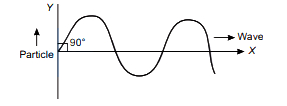
(C) In a transverse wave,the particles of the medium vibrate about their mean positions in a direction perpendicular to the direction of wave propagation.
Since the wave propagates along the $X$-axis and the particles oscillate along the $Y$-axis,the direction of particle velocity is perpendicular to the direction of wave velocity.
Therefore,the angle between the particle velocity and the wave velocity is $90^{\circ}$ or $\frac{\pi}{2}$ radians.
Since the wave propagates along the $X$-axis and the particles oscillate along the $Y$-axis,the direction of particle velocity is perpendicular to the direction of wave velocity.
Therefore,the angle between the particle velocity and the wave velocity is $90^{\circ}$ or $\frac{\pi}{2}$ radians.
0 likes
View Solution32
EasyMCQ
To propagate both longitudinal and transverse waves,a material must have
A
bulk and shear moduli
B
bulk modulus
C
shear modulus
D
Young's and bulk modulus
Solution
(A) In transverse waves,the particle motion is perpendicular to the direction of wave propagation. This requires the medium to resist shearing stress,which is characterized by the shear modulus.
In longitudinal waves,the particles oscillate along the direction of wave propagation,causing volume changes. This requires the medium to resist compressive stress,which is characterized by the bulk modulus.
Therefore,for a medium to support both types of waves,it must possess both bulk modulus and shear modulus.
In longitudinal waves,the particles oscillate along the direction of wave propagation,causing volume changes. This requires the medium to resist compressive stress,which is characterized by the bulk modulus.
Therefore,for a medium to support both types of waves,it must possess both bulk modulus and shear modulus.
0 likes
View Solution33
EasyMCQ
The angle between the particle velocity and wave velocity in a transverse wave is [except when the particle passes through the mean position].
A
$\frac{\pi}{4}$ radian
B
$\frac{\pi}{2}$ radian
C
$\pi$ radian
D
Zero radian
Solution
(B) In a transverse wave,the particles of the medium oscillate in a direction perpendicular to the direction of wave propagation.
Since the wave velocity is along the direction of propagation and the particle velocity is perpendicular to it,the angle between them is $\frac{\pi}{2}$ radian.
This holds true for all positions of the particle except at the mean position,where the particle velocity is momentarily zero.
Since the wave velocity is along the direction of propagation and the particle velocity is perpendicular to it,the angle between them is $\frac{\pi}{2}$ radian.
This holds true for all positions of the particle except at the mean position,where the particle velocity is momentarily zero.
0 likes
View Solution34
EasyMCQ
Among the following statements,the correct statement for a wave is
A
Transverse waves cannot propagate through all media
B
Longitudinal waves can propagate through solids only
C
Transverse waves can propagate through solids
D
Longitudinal waves can propagate through vacuum
Solution
(C) Transverse waves require a medium with shear modulus to propagate,which is why they can propagate through solids and on the surface of liquids. They cannot propagate through gases or the interior of liquids. Longitudinal waves can propagate through all states of matter (solids,liquids,and gases) but cannot propagate through a vacuum. Therefore,the statement that transverse waves can propagate through solids is correct.
0 likes
View SolutionWaves and Sound — Introduction and Classification of Waves · Frequently Asked Questions
1Are these Waves and Sound questions useful for JEE and NEET?
Yes. All questions in this section are mapped to JEE Main and NEET exam patterns. Previous year questions from JEE Main, NEET, GUJCET and state-level exams are included with full solutions.
2Can I switch to Hindi or Gujarati for these questions?
Yes. Use the language tabs in the hero section or the sidebar to view the same questions and solutions in English, Hindi or Gujarati.
3How do I generate a question paper from this subtopic?
Use the Vedclass Exam Paper Generator — select the chapter and subtopic, set difficulty, and generate Sets A, B, C, D automatically. First 3 chapters of every subject are free.
Vedclass Products
For Students
Vedclass Test Series
Mock tests in real JEE/NEET style with performance analysis. 5-day free trial.
Start Free TrialFor Teachers
Exam Paper Generator
Generate Set A/B/C/D papers from this chapter in 2 minutes. 3 chapters free.
Try FreeFor Institutes
Online Exam Module
Live online exams with unlimited students, 360° analytics & white-label branding.
See DemoFor Teachers & Institutes
Generate a Waves and Sound Exam Paper in 2 Minutes
Select subtopic & difficulty — Sets A, B, C, D auto-generated with No Repeat logic.
First 3 chapters of every subject are free — no payment required.