
A English
Mix Examples-Waves and Sound Questions in English
Class 11 Physics · Waves and Sound · Mix Examples-Waves and Sound
72+
Questions
English
Language
100%
With Solutions
Showing 50 of 72 questions in English
1
EasyMCQ
The wavelength of light in the visible part $(\lambda_V)$ and for sound $(\lambda_S)$ are related as:
A
$\lambda_V > \lambda_S$
B
$\lambda_S > \lambda_V$
C
$\lambda_S = \lambda_V$
D
None of these
Solution
(B) The speed of sound in air is approximately $340 \ m/s$,while the speed of light is approximately $3 \times 10^8 \ m/s$.
Since the speed of a wave $v$ is given by $v = f \lambda$,where $f$ is frequency and $\lambda$ is wavelength,for a given frequency,the wavelength is directly proportional to the speed of the wave.
Because the speed of light is significantly greater than the speed of sound,the wavelength of light in the visible spectrum is much smaller than the wavelength of audible sound waves.
Therefore,$\lambda_S > \lambda_V$.
Since the speed of a wave $v$ is given by $v = f \lambda$,where $f$ is frequency and $\lambda$ is wavelength,for a given frequency,the wavelength is directly proportional to the speed of the wave.
Because the speed of light is significantly greater than the speed of sound,the wavelength of light in the visible spectrum is much smaller than the wavelength of audible sound waves.
Therefore,$\lambda_S > \lambda_V$.
0 likes
View Solution2
MediumMCQ
$A$ transverse sinusoidal wave of amplitude $a,$ wavelength $\lambda,$ and frequency $n$ is travelling on a stretched string. The maximum speed of any point on the string is $v/10,$ where $v$ is the speed of propagation of the wave. If $a = 10^{-3} \ m$ and $v = 10 \ m/s,$ then $\lambda$ and $n$ are given by:
A
$\lambda = 2\pi \times 10^{-2} \ m$
B
$\lambda = 10^{-3} \ m$
C
$n = \frac{10^3}{2\pi} \ Hz$
D
Both $(A)$ and $(C)$
Solution
(D) The maximum particle velocity of a transverse wave is given by $v_{\max} = a\omega = a(2\pi n).$
Given $v_{\max} = v/10,$ where $v = 10 \ m/s,$ we have $v_{\max} = 10/10 = 1 \ m/s.$
Substituting $a = 10^{-3} \ m,$ we get $10^{-3} \times 2\pi n = 1 \implies n = \frac{10^3}{2\pi} \ Hz.$
Using the wave speed relation $v = n\lambda,$ we find $\lambda = \frac{v}{n} = \frac{10}{10^3 / 2\pi} = 2\pi \times 10^{-2} \ m.$
Thus,both options $(A)$ and $(C)$ are correct.
Given $v_{\max} = v/10,$ where $v = 10 \ m/s,$ we have $v_{\max} = 10/10 = 1 \ m/s.$
Substituting $a = 10^{-3} \ m,$ we get $10^{-3} \times 2\pi n = 1 \implies n = \frac{10^3}{2\pi} \ Hz.$
Using the wave speed relation $v = n\lambda,$ we find $\lambda = \frac{v}{n} = \frac{10}{10^3 / 2\pi} = 2\pi \times 10^{-2} \ m.$
Thus,both options $(A)$ and $(C)$ are correct.
0 likes
View Solution3
MediumMCQ
The superposing waves are represented by the following equations: ${y_1} = 5\sin 2\pi (10t - 0.1x)$ and ${y_2} = 10\sin 2\pi (20t - 0.2x)$. The ratio of intensities $\frac{I_{\max}}{I_{\min}}$ will be:
A
$1$
B
$9$
C
$4$
D
$16$
Solution
(B) The amplitudes of the two waves are given by ${a_1} = 5$ and ${a_2} = 10$.
The intensity of a wave is proportional to the square of its amplitude,$I \propto a^2$.
The ratio of maximum intensity to minimum intensity is given by the formula:
$\frac{I_{\max}}{I_{\min}} = \frac{(a_1 + a_2)^2}{(a_1 - a_2)^2}$.
Substituting the values of the amplitudes:
$\frac{I_{\max}}{I_{\min}} = \left( \frac{5 + 10}{5 - 10} \right)^2 = \left( \frac{15}{-5} \right)^2 = (-3)^2 = 9$.
Therefore,the ratio is $9:1$ or simply $9$.
The intensity of a wave is proportional to the square of its amplitude,$I \propto a^2$.
The ratio of maximum intensity to minimum intensity is given by the formula:
$\frac{I_{\max}}{I_{\min}} = \frac{(a_1 + a_2)^2}{(a_1 - a_2)^2}$.
Substituting the values of the amplitudes:
$\frac{I_{\max}}{I_{\min}} = \left( \frac{5 + 10}{5 - 10} \right)^2 = \left( \frac{15}{-5} \right)^2 = (-3)^2 = 9$.
Therefore,the ratio is $9:1$ or simply $9$.
0 likes
View Solution4
DifficultMCQ
If $T$ is the reverberation time of an auditorium of volume $V$,then:
A
$T \propto \frac{1}{V}$
B
$T \propto \frac{1}{V^2}$
C
$T \propto V^2$
D
$T \propto V$
Solution
(D) The reverberation time $T$ of an auditorium is given by the Sabine formula: $T = \frac{0.161 V}{\sum \alpha S}$,where $V$ is the volume of the auditorium,$S$ is the surface area,and $\alpha$ is the absorption coefficient.
From this formula,it is clear that $T$ is directly proportional to the volume $V$ of the auditorium.
Therefore,$T \propto V$.
From this formula,it is clear that $T$ is directly proportional to the volume $V$ of the auditorium.
Therefore,$T \propto V$.
0 likes
View Solution5
DifficultMCQ
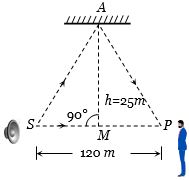
In a large room,a person receives direct sound waves from a source $120 \ m$ away from him. He also receives waves from the same source which reach him after being reflected from the $25 \ m$ high ceiling at a point halfway between them. The two waves interfere constructively for wavelengths of
A
$20, 20/3, 20/5$ etc.
B
$10, 5, 2.5$ etc.
C
$10, 20, 30$ etc.
D
$15, 25, 35$ etc.
Solution
(A) Let $S$ be the source of sound and $P$ be the person or listener.
The waves from $S$ reach point $P$ directly following the path $SP$ and also after being reflected from the ceiling at point $A$ following the path $SAP$.
$M$ is the midpoint of $SP$ (i.e.,$SM = MP = 60 \ m$) and $\angle SMA = 90^\circ$.
The path length of the direct wave is $SP = 120 \ m$.
The path length of the reflected wave is $SAP = SA + AP = 2 \times SA$.
In $\triangle SMA$,$SA = \sqrt{SM^2 + MA^2} = \sqrt{60^2 + 25^2} = \sqrt{3600 + 625} = \sqrt{4225} = 65 \ m$.
So,$SAP = 2 \times 65 = 130 \ m$.
The geometric path difference is $\Delta x_{geom} = SAP - SP = 130 - 120 = 10 \ m$.
Since the wave is reflected from a rigid ceiling,there is an additional phase shift of $\pi$,which corresponds to a path difference of $\lambda/2$.
Thus,the effective path difference is $\Delta x = 10 + \lambda/2$.
For constructive interference,the effective path difference must be an integer multiple of $\lambda$,i.e.,$\Delta x = n\lambda$ (where $n = 1, 2, 3, \dots$).
$10 + \lambda/2 = n\lambda \Rightarrow 10 = (n - 1/2)\lambda = (2n - 1)\lambda/2$.
$\lambda = 20 / (2n - 1)$.
For $n = 1, 2, 3, \dots$,the wavelengths are $\lambda = 20/1, 20/3, 20/5, \dots$ or $20, 20/3, 20/5, \dots \ m$.
The waves from $S$ reach point $P$ directly following the path $SP$ and also after being reflected from the ceiling at point $A$ following the path $SAP$.
$M$ is the midpoint of $SP$ (i.e.,$SM = MP = 60 \ m$) and $\angle SMA = 90^\circ$.
The path length of the direct wave is $SP = 120 \ m$.
The path length of the reflected wave is $SAP = SA + AP = 2 \times SA$.
In $\triangle SMA$,$SA = \sqrt{SM^2 + MA^2} = \sqrt{60^2 + 25^2} = \sqrt{3600 + 625} = \sqrt{4225} = 65 \ m$.
So,$SAP = 2 \times 65 = 130 \ m$.
The geometric path difference is $\Delta x_{geom} = SAP - SP = 130 - 120 = 10 \ m$.
Since the wave is reflected from a rigid ceiling,there is an additional phase shift of $\pi$,which corresponds to a path difference of $\lambda/2$.
Thus,the effective path difference is $\Delta x = 10 + \lambda/2$.
For constructive interference,the effective path difference must be an integer multiple of $\lambda$,i.e.,$\Delta x = n\lambda$ (where $n = 1, 2, 3, \dots$).
$10 + \lambda/2 = n\lambda \Rightarrow 10 = (n - 1/2)\lambda = (2n - 1)\lambda/2$.
$\lambda = 20 / (2n - 1)$.
For $n = 1, 2, 3, \dots$,the wavelengths are $\lambda = 20/1, 20/3, 20/5, \dots$ or $20, 20/3, 20/5, \dots \ m$.
0 likes
View Solution6
DifficultMCQ
The frequency of a stretched uniform wire under tension is in resonance with the fundamental frequency of a closed tube. If the tension in the wire is increased by $8 \ N$,it is in resonance with the first overtone of the closed tube. The initial tension in the wire is .... $N$.
A
$1$
B
$4$
C
$8$
D
$16$
Solution
(A) Let the initial tension in the wire be $T$ and the mass per unit length be $m$. The frequency of the stretched wire is given by $f_w = \frac{1}{2L_w} \sqrt{\frac{T}{m}}$.
The fundamental frequency of a closed organ pipe of length $L_p$ is $f_c = \frac{v}{4L_p}$.
According to the problem,initially,$f_w = f_c$,so $\frac{1}{2L_w} \sqrt{\frac{T}{m}} = \frac{v}{4L_p}$ ..... $(i)$.
When the tension is increased by $8 \ N$,the new frequency is $f_w' = \frac{1}{2L_w} \sqrt{\frac{T+8}{m}}$. This is in resonance with the first overtone of the closed pipe,which is $3f_c = \frac{3v}{4L_p}$.
So,$\frac{1}{2L_w} \sqrt{\frac{T+8}{m}} = \frac{3v}{4L_p}$ ..... $(ii)$.
Dividing equation $(i)$ by equation $(ii)$,we get:
$\frac{\sqrt{T}}{\sqrt{T+8}} = \frac{1}{3}$.
Squaring both sides:
$\frac{T}{T+8} = \frac{1}{9}$.
$9T = T + 8 \Rightarrow 8T = 8 \Rightarrow T = 1 \ N$.
The fundamental frequency of a closed organ pipe of length $L_p$ is $f_c = \frac{v}{4L_p}$.
According to the problem,initially,$f_w = f_c$,so $\frac{1}{2L_w} \sqrt{\frac{T}{m}} = \frac{v}{4L_p}$ ..... $(i)$.
When the tension is increased by $8 \ N$,the new frequency is $f_w' = \frac{1}{2L_w} \sqrt{\frac{T+8}{m}}$. This is in resonance with the first overtone of the closed pipe,which is $3f_c = \frac{3v}{4L_p}$.
So,$\frac{1}{2L_w} \sqrt{\frac{T+8}{m}} = \frac{3v}{4L_p}$ ..... $(ii)$.
Dividing equation $(i)$ by equation $(ii)$,we get:
$\frac{\sqrt{T}}{\sqrt{T+8}} = \frac{1}{3}$.
Squaring both sides:
$\frac{T}{T+8} = \frac{1}{9}$.
$9T = T + 8 \Rightarrow 8T = 8 \Rightarrow T = 1 \ N$.
0 likes
View Solution7
DifficultMCQ
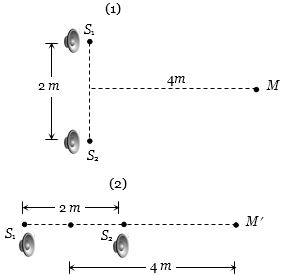
Two speakers connected to the same source of fixed frequency are placed $2.0 \ m$ apart in a box. $A$ sensitive microphone placed at a distance of $4.0 \ m$ from their midpoint along the perpendicular bisector shows maximum response. The box is slowly rotated until the speakers are in line with the microphone. The distance between the midpoint of the speakers and the microphone remains unchanged. Exactly five maximum responses are observed in the microphone in doing this. The wavelength of the sound wave is .... $m$
A
$0.2$
B
$0.4$
C
$0.6$
D
$0.8$
Solution
(B) Let the distance between the speakers be $d = 2.0 \ m$. The distance from the midpoint to the microphone is $D = 4.0 \ m$.
Initially,the microphone is on the perpendicular bisector,so the path difference $\Delta x = 0$. This corresponds to the central maximum $(n=0)$.
When the box is rotated by $90^\circ$,the speakers are in line with the microphone. The distances from the speakers to the microphone are $D - d/2$ and $D + d/2$.
The path difference at this final position is $\Delta x = (D + d/2) - (D - d/2) = d = 2.0 \ m$.
For constructive interference (maxima),the path difference is $\Delta x = n\lambda$,where $n$ is an integer.
In the process of rotating from $0^\circ$ to $90^\circ$,we observe $5$ maxima. The central maximum is at $0^\circ$ $(n=0)$. As we rotate,we pass through $n=1, 2, 3, 4$ and finally reach the $5^{th}$ maximum at $90^\circ$ where $n=5$.
Thus,at the final position,$\Delta x = 5\lambda$.
Given $\Delta x = 2.0 \ m$,we have $5\lambda = 2.0 \ m$.
Therefore,$\lambda = \frac{2.0}{5} = 0.4 \ m$.
Initially,the microphone is on the perpendicular bisector,so the path difference $\Delta x = 0$. This corresponds to the central maximum $(n=0)$.
When the box is rotated by $90^\circ$,the speakers are in line with the microphone. The distances from the speakers to the microphone are $D - d/2$ and $D + d/2$.
The path difference at this final position is $\Delta x = (D + d/2) - (D - d/2) = d = 2.0 \ m$.
For constructive interference (maxima),the path difference is $\Delta x = n\lambda$,where $n$ is an integer.
In the process of rotating from $0^\circ$ to $90^\circ$,we observe $5$ maxima. The central maximum is at $0^\circ$ $(n=0)$. As we rotate,we pass through $n=1, 2, 3, 4$ and finally reach the $5^{th}$ maximum at $90^\circ$ where $n=5$.
Thus,at the final position,$\Delta x = 5\lambda$.
Given $\Delta x = 2.0 \ m$,we have $5\lambda = 2.0 \ m$.
Therefore,$\lambda = \frac{2.0}{5} = 0.4 \ m$.
0 likes
View Solution8
DifficultMCQ
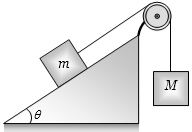
$A$ wire of linear mass density $\mu = 9.8 \times 10^{-3} \, kg \, m^{-1}$ passes over a frictionless light pulley fixed on the top of a frictionless inclined plane which makes an angle of $30^{\circ}$ with the horizontal. Masses $m$ and $M$ are tied at the two ends of the wire such that $m$ rests on the plane and $M$ hangs freely vertically downwards. The entire system is in equilibrium and a transverse wave propagates along the wire with a velocity of $100 \, m \, s^{-1}$. Choose the correct option for $m$ in $kg$.
A
$20$
B
$5$
C
$2$
D
$7$
Solution
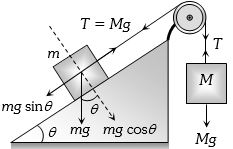
(A) The velocity of a transverse wave on a stretched string is given by $v = \sqrt{\frac{T}{\mu}}$,where $T$ is the tension in the string and $\mu$ is the linear mass density.
For the system in equilibrium,the tension $T$ in the string is equal to the weight of the hanging mass $M$,so $T = Mg$.
Also,for the mass $m$ on the inclined plane to be in equilibrium,the component of its weight along the plane must balance the tension: $T = mg \sin 30^{\circ}$.
Equating the two expressions for tension: $Mg = mg \sin 30^{\circ} \implies M = m \sin 30^{\circ} = \frac{m}{2} \implies m = 2M$.
Given $v = 100 \, m \, s^{-1}$ and $\mu = 9.8 \times 10^{-3} \, kg \, m^{-1}$,we have:
$100 = \sqrt{\frac{Mg}{9.8 \times 10^{-3}}}$
$100^2 = \frac{M(9.8)}{9.8 \times 10^{-3}}$
$10000 = M \times 1000$
$M = 10 \, kg$.
Since $m = 2M$,we get $m = 2 \times 10 = 20 \, kg$.
For the system in equilibrium,the tension $T$ in the string is equal to the weight of the hanging mass $M$,so $T = Mg$.
Also,for the mass $m$ on the inclined plane to be in equilibrium,the component of its weight along the plane must balance the tension: $T = mg \sin 30^{\circ}$.
Equating the two expressions for tension: $Mg = mg \sin 30^{\circ} \implies M = m \sin 30^{\circ} = \frac{m}{2} \implies m = 2M$.
Given $v = 100 \, m \, s^{-1}$ and $\mu = 9.8 \times 10^{-3} \, kg \, m^{-1}$,we have:
$100 = \sqrt{\frac{Mg}{9.8 \times 10^{-3}}}$
$100^2 = \frac{M(9.8)}{9.8 \times 10^{-3}}$
$10000 = M \times 1000$
$M = 10 \, kg$.
Since $m = 2M$,we get $m = 2 \times 10 = 20 \, kg$.
0 likes
View Solution9
DifficultMCQ
$A$ man standing in front of a mountain beats a drum at regular intervals. The rate of drumming is gradually increased and he finds that the echo is not heard distinctly when the rate becomes $40$ per minute. He then moves nearer to the mountain by $90 \ m$ and finds that the echo is again not heard when the drumming rate becomes $60$ per minute. The distance between the mountain and the initial position of the man is .... $m$
A
$205$
B
$300$
C
$180$
D
$270$
Solution
(D) For the echo to not be heard distinctly,the time interval between the drum beats must be equal to the time taken for the echo to return.
Let $d$ be the initial distance and $v$ be the speed of sound.
The time interval for $40$ beats per minute is $t_1 = \frac{60}{40} = 1.5 \ s$.
Thus,$\frac{2d}{v} = 1.5 \implies 2d = 1.5v$......$(i)$
When the man moves $90 \ m$ closer,the new distance is $(d - 90) \ m$.
The time interval for $60$ beats per minute is $t_2 = \frac{60}{60} = 1 \ s$.
Thus,$\frac{2(d - 90)}{v} = 1 \implies 2d - 180 = v$......$(ii)$
Substituting $2d = 1.5v$ from equation $(i)$ into equation $(ii)$:
$1.5v - 180 = v$
$0.5v = 180 \implies v = 360 \ m/s$.
Now,substituting $v = 360 \ m/s$ back into equation $(i)$:
$2d = 1.5 \times 360 = 540$
$d = 270 \ m$.
Let $d$ be the initial distance and $v$ be the speed of sound.
The time interval for $40$ beats per minute is $t_1 = \frac{60}{40} = 1.5 \ s$.
Thus,$\frac{2d}{v} = 1.5 \implies 2d = 1.5v$......$(i)$
When the man moves $90 \ m$ closer,the new distance is $(d - 90) \ m$.
The time interval for $60$ beats per minute is $t_2 = \frac{60}{60} = 1 \ s$.
Thus,$\frac{2(d - 90)}{v} = 1 \implies 2d - 180 = v$......$(ii)$
Substituting $2d = 1.5v$ from equation $(i)$ into equation $(ii)$:
$1.5v - 180 = v$
$0.5v = 180 \implies v = 360 \ m/s$.
Now,substituting $v = 360 \ m/s$ back into equation $(i)$:
$2d = 1.5 \times 360 = 540$
$d = 270 \ m$.
0 likes
View Solution10
MediumMCQ
The displacement of a particle in a string stretched in the $X$ direction is represented by $y$. Among the following expressions for $y$,which ones describe wave motion?
A
$\cos kx \sin \omega t$
B
$k^2 x^2 - \omega^2 t^2$
C
$\cos (kx + \omega t)$
D
Both $(a)$ and $(c)$
Solution
(D) function $y(x, t)$ represents a wave motion if it satisfies the general wave equation $\frac{\partial^2 y}{\partial t^2} = v^2 \frac{\partial^2 y}{\partial x^2}$.
$1$. For $y = \cos(kx + \omega t)$,this is a standard traveling wave equation of the form $f(kx \pm \omega t)$,which satisfies the wave equation.
$2$. For $y = \cos kx \sin \omega t$,this can be written as $\frac{1}{2} [\sin(kx + \omega t) - \sin(kx - \omega t)]$. This represents a standing wave,which is formed by the superposition of two traveling waves moving in opposite directions. Standing waves are also a form of wave motion.
Therefore,both expressions describe wave motion.
$1$. For $y = \cos(kx + \omega t)$,this is a standard traveling wave equation of the form $f(kx \pm \omega t)$,which satisfies the wave equation.
$2$. For $y = \cos kx \sin \omega t$,this can be written as $\frac{1}{2} [\sin(kx + \omega t) - \sin(kx - \omega t)]$. This represents a standing wave,which is formed by the superposition of two traveling waves moving in opposite directions. Standing waves are also a form of wave motion.
Therefore,both expressions describe wave motion.
0 likes
View Solution11
DifficultMCQ
An earthquake generates both transverse $(S)$ and longitudinal $(P)$ waves in the Earth. The speed of $S$ waves is about $4.5 \, km/s$ and that of $P$ waves is about $8.0 \, km/s$. $A$ seismograph records $P$ and $S$ waves from an earthquake. The first $P$ wave arrives $4.0 \, min$ before the first $S$ wave. The epicenter of the earthquake is located at a distance of about .... $km$.
A
$25$
B
$250$
C
$2500$
D
$5000$
Solution
(C) Let $d$ be the distance of the epicenter from the seismograph.
Let $v_P = 8.0 \, km/s$ and $v_S = 4.5 \, km/s$ be the speeds of $P$ and $S$ waves respectively.
The time taken by $P$ waves is $t_P = d / v_P$ and by $S$ waves is $t_S = d / v_S$.
Given the time difference $\Delta t = t_S - t_P = 4.0 \, min = 240 \, s$.
Substituting the expressions for time: $d / v_S - d / v_P = 240$.
$d (1 / 4.5 - 1 / 8.0) = 240$.
$d ((8.0 - 4.5) / (4.5 \times 8.0)) = 240$.
$d (3.5 / 36) = 240$.
$d = (240 \times 36) / 3.5 \approx 2468.6 \, km$.
Rounding to the nearest given option,the distance is approximately $2500 \, km$.
Let $v_P = 8.0 \, km/s$ and $v_S = 4.5 \, km/s$ be the speeds of $P$ and $S$ waves respectively.
The time taken by $P$ waves is $t_P = d / v_P$ and by $S$ waves is $t_S = d / v_S$.
Given the time difference $\Delta t = t_S - t_P = 4.0 \, min = 240 \, s$.
Substituting the expressions for time: $d / v_S - d / v_P = 240$.
$d (1 / 4.5 - 1 / 8.0) = 240$.
$d ((8.0 - 4.5) / (4.5 \times 8.0)) = 240$.
$d (3.5 / 36) = 240$.
$d = (240 \times 36) / 3.5 \approx 2468.6 \, km$.
Rounding to the nearest given option,the distance is approximately $2500 \, km$.
0 likes
View Solution12
MediumMCQ
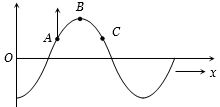
$A$ wave is travelling along a string. At an instant,the shape of the string is as shown in the figure. At this instant,point $A$ is moving upwards. Which of the following statements is/are correct?
A
The wave is travelling to the right.
B
Displacement amplitude of the wave is equal to the displacement of $B$ at this instant.
C
Phase difference between $A$ and $C$ may be equal to $\frac{\pi}{2}$.
D
Both $(b)$ and $(c)$.
Solution
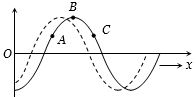
(D) Since point $A$ is moving upwards,after an elemental time interval,the wave profile will shift to the left (as shown by the dotted line in the figure). This indicates that the wave is travelling in the leftward direction. Therefore,statement $(a)$ is incorrect.
The displacement amplitude of a wave is defined as the maximum possible displacement of the medium particles from their mean position. At the given instant,point $B$ is at the crest,representing the maximum displacement. Thus,the displacement amplitude is equal to the displacement of $B$. Hence,statement $(b)$ is correct.
The phase difference $\Delta \phi$ between two points is related to the path difference $\Delta x$ by the relation $\Delta \phi = \frac{2\pi}{\lambda} \Delta x$. For the phase difference to be $\frac{\pi}{2}$,the path difference must be $\Delta x = \frac{\lambda}{4}$.
Since the distance between points $A$ and $C$ is less than $\frac{\lambda}{2}$,it is possible for the distance between them to be exactly $\frac{\lambda}{4}$. Therefore,the phase difference between these two points may be equal to $\frac{\pi}{2}$. Hence,statement $(c)$ is also correct.
Since both $(b)$ and $(c)$ are correct,the correct option is $(d)$.
The displacement amplitude of a wave is defined as the maximum possible displacement of the medium particles from their mean position. At the given instant,point $B$ is at the crest,representing the maximum displacement. Thus,the displacement amplitude is equal to the displacement of $B$. Hence,statement $(b)$ is correct.
The phase difference $\Delta \phi$ between two points is related to the path difference $\Delta x$ by the relation $\Delta \phi = \frac{2\pi}{\lambda} \Delta x$. For the phase difference to be $\frac{\pi}{2}$,the path difference must be $\Delta x = \frac{\lambda}{4}$.
Since the distance between points $A$ and $C$ is less than $\frac{\lambda}{2}$,it is possible for the distance between them to be exactly $\frac{\lambda}{4}$. Therefore,the phase difference between these two points may be equal to $\frac{\pi}{2}$. Hence,statement $(c)$ is also correct.
Since both $(b)$ and $(c)$ are correct,the correct option is $(d)$.
0 likes
View Solution13
MediumMCQ
The time of reverberation of a room $A$ is $1 \; s$. What will be the time (in seconds) of reverberation of a room,having all the dimensions double of those of room $A$?
A
$0.5$
B
$1$
C
$4$
D
$2$
Solution
(D) The time of reverberation is defined as the time during which the intensity of sound in an auditorium becomes one millionth of its initial intensity. Sabine's formula for reverberation time is given by:
$T = \frac{0.16 V}{\sum a s}$
Where $V$ is the volume of the hall in $m^3$ and $\sum a s$ is the total absorption of the hall.
Since the dimensions of the room are doubled,the volume $V$ becomes $V' = (2L)(2W)(2H) = 8V$.
The total surface area $S$ (which is proportional to $\sum a s$) becomes $S' = (2L)(2W) + (2W)(2H) + (2H)(2L) = 4S$.
Using the ratio of the reverberation times:
$\frac{T'}{T} = \frac{V'}{S'} \times \frac{S}{V} = \frac{8V}{4S} \times \frac{S}{V} = \frac{8}{4} = 2$
Given $T = 1 \; s$,we find $T' = 2 \times 1 = 2 \; s$.
$T = \frac{0.16 V}{\sum a s}$
Where $V$ is the volume of the hall in $m^3$ and $\sum a s$ is the total absorption of the hall.
Since the dimensions of the room are doubled,the volume $V$ becomes $V' = (2L)(2W)(2H) = 8V$.
The total surface area $S$ (which is proportional to $\sum a s$) becomes $S' = (2L)(2W) + (2W)(2H) + (2H)(2L) = 4S$.
Using the ratio of the reverberation times:
$\frac{T'}{T} = \frac{V'}{S'} \times \frac{S}{V} = \frac{8V}{4S} \times \frac{S}{V} = \frac{8}{4} = 2$
Given $T = 1 \; s$,we find $T' = 2 \times 1 = 2 \; s$.
0 likes
View Solution14
EasyMCQ
If a microwave and an ultrasonic sound wave have the same wavelength, the ratio of their frequencies is approximately:
A
$10^6 : 1$
B
$10^4 : 1$
C
$10^2 : 1$
D
$1 : 1$
Solution
(A) The frequency $f$ of a wave is given by $f = \frac{v}{\lambda}$, where $v$ is the speed of the wave and $\lambda$ is the wavelength.
For a microwave (electromagnetic wave), the speed $v_m \approx 3 \times 10^8 \, m/s$.
For an ultrasonic sound wave, the speed $v_u \approx 330 \, m/s$ (speed of sound in air).
Given that the wavelengths are equal $(\lambda_m = \lambda_u = \lambda)$, the ratio of their frequencies is:
$\frac{f_m}{f_u} = \frac{v_m / \lambda}{v_u / \lambda} = \frac{v_m}{v_u}$
$\frac{f_m}{f_u} \approx \frac{3 \times 10^8}{330} \approx 0.9 \times 10^6 \approx 10^6$
Therefore, the ratio of their frequencies is approximately $10^6 : 1$.
For a microwave (electromagnetic wave), the speed $v_m \approx 3 \times 10^8 \, m/s$.
For an ultrasonic sound wave, the speed $v_u \approx 330 \, m/s$ (speed of sound in air).
Given that the wavelengths are equal $(\lambda_m = \lambda_u = \lambda)$, the ratio of their frequencies is:
$\frac{f_m}{f_u} = \frac{v_m / \lambda}{v_u / \lambda} = \frac{v_m}{v_u}$
$\frac{f_m}{f_u} \approx \frac{3 \times 10^8}{330} \approx 0.9 \times 10^6 \approx 10^6$
Therefore, the ratio of their frequencies is approximately $10^6 : 1$.
0 likes
View Solution15
MediumMCQ
Two periodic waves of intensities $I_1$ and $I_2$ pass through a region at the same time in the same direction. The sum of the maximum and minimum intensities is
A
$(\sqrt{I_1} - \sqrt{I_2})^2$
B
$2(I_1 + I_2)$
C
$I_1 + I_2$
D
$(\sqrt{I_1} + \sqrt{I_2})^2$
Solution
(B) The intensity $I$ of a wave is proportional to the square of its amplitude $A$,i.e.,$I = kA^2$,where $k$ is a constant. Thus,$A = \sqrt{I/k}$.
When two waves superpose,the maximum and minimum amplitudes are given by $A_{\max} = A_1 + A_2$ and $A_{\min} = |A_1 - A_2|$.
The maximum intensity is $I_{\max} = k(A_1 + A_2)^2 = k(A_1^2 + A_2^2 + 2A_1A_2) = I_1 + I_2 + 2\sqrt{I_1I_2}$.
The minimum intensity is $I_{\min} = k(A_1 - A_2)^2 = k(A_1^2 + A_2^2 - 2A_1A_2) = I_1 + I_2 - 2\sqrt{I_1I_2}$.
Adding the maximum and minimum intensities:
$I_{\max} + I_{\min} = (I_1 + I_2 + 2\sqrt{I_1I_2}) + (I_1 + I_2 - 2\sqrt{I_1I_2}) = 2(I_1 + I_2)$.
When two waves superpose,the maximum and minimum amplitudes are given by $A_{\max} = A_1 + A_2$ and $A_{\min} = |A_1 - A_2|$.
The maximum intensity is $I_{\max} = k(A_1 + A_2)^2 = k(A_1^2 + A_2^2 + 2A_1A_2) = I_1 + I_2 + 2\sqrt{I_1I_2}$.
The minimum intensity is $I_{\min} = k(A_1 - A_2)^2 = k(A_1^2 + A_2^2 - 2A_1A_2) = I_1 + I_2 - 2\sqrt{I_1I_2}$.
Adding the maximum and minimum intensities:
$I_{\max} + I_{\min} = (I_1 + I_2 + 2\sqrt{I_1I_2}) + (I_1 + I_2 - 2\sqrt{I_1I_2}) = 2(I_1 + I_2)$.
0 likes
View Solution16
EasyMCQ
Four different independent waves are represented by $(i)$ $y_1 = a_1 \sin \omega t$,$(ii)$ $y_2 = a_2 \sin 2\omega t$,$(iii)$ $y_3 = a_3 \cos \omega t$,and $(iv)$ $y_4 = a_4 \sin (\omega t + \frac{\pi}{3})$. With which two waves is interference possible?
A
In $(i)$ and $(iii)$
B
In $(i)$ and $(iv)$
C
In $(iii)$ and $(iv)$
D
Insufficient data to predict.
Solution
(D) For interference to occur,the waves must be coherent,meaning they must have the same frequency and a constant phase difference.
In the given equations,waves $(i)$,$(iii)$,and $(iv)$ all have the same angular frequency $\omega$.
However,the problem states that the four waves are 'independent'.
Independent sources generally do not maintain a constant phase difference over time,which is a requirement for stable interference.
Therefore,without information regarding the coherence of these sources,there is insufficient data to predict if interference will occur.
In the given equations,waves $(i)$,$(iii)$,and $(iv)$ all have the same angular frequency $\omega$.
However,the problem states that the four waves are 'independent'.
Independent sources generally do not maintain a constant phase difference over time,which is a requirement for stable interference.
Therefore,without information regarding the coherence of these sources,there is insufficient data to predict if interference will occur.
0 likes
View Solution17
DifficultMCQ
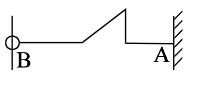
$A$ pulse shown here is reflected from the rigid wall $A$ and then from the free end $B$. The shape of the string after these $2$ reflections will be
A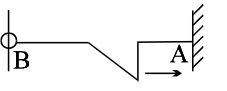
B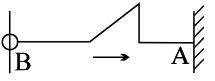
C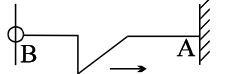
D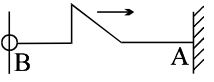
Solution
(A) When a pulse reflects from a rigid boundary (fixed end $A$),it undergoes a phase change of $\pi$,meaning it gets inverted.
When a pulse reflects from a free boundary (free end $B$),it does not undergo any phase change,meaning it remains upright.
In this problem,the pulse first reflects from the rigid wall $A$. Since the pulse is initially moving towards $A$,it will be inverted after reflection at $A$ and start moving towards $B$.
Then,this inverted pulse reflects from the free end $B$. Since reflection at a free end causes no phase change,the pulse remains inverted as it reflects back towards $A$.
Therefore,after two reflections,the pulse will be inverted and moving towards the right.
When a pulse reflects from a free boundary (free end $B$),it does not undergo any phase change,meaning it remains upright.
In this problem,the pulse first reflects from the rigid wall $A$. Since the pulse is initially moving towards $A$,it will be inverted after reflection at $A$ and start moving towards $B$.
Then,this inverted pulse reflects from the free end $B$. Since reflection at a free end causes no phase change,the pulse remains inverted as it reflects back towards $A$.
Therefore,after two reflections,the pulse will be inverted and moving towards the right.
0 likes
View Solution18
AdvancedMCQ
$A$ composite string is made up by joining two strings of different masses per unit length $\mu$ and $4\mu$. The composite string is under the same tension. $A$ transverse wave pulse $Y = (6 \text{ mm}) \sin(5t + 40x)$,where $t$ is in seconds and $x$ in meters,is sent along the lighter string towards the joint. The percentage of power transmitted to the heavier string through the joint is approximately ..... $\%$
A
$33$
B
$89$
C
$67$
D
$75$
Solution
(B) The power transmitted by a wave is given by $P = \frac{1}{2} \mu \omega^2 A^2 v$,where $v = \sqrt{T/\mu}$.
Let the lighter string have mass per unit length $\mu_1 = \mu$ and the heavier string have $\mu_2 = 4\mu$.
The impedance of the strings are $Z_1 = \sqrt{\mu_1 T} = \sqrt{\mu T}$ and $Z_2 = \sqrt{\mu_2 T} = \sqrt{4\mu T} = 2\sqrt{\mu T}$.
The amplitude of the transmitted wave $A_t$ is given by $A_t = \frac{2 Z_1}{Z_1 + Z_2} A_i = \frac{2 \sqrt{\mu T}}{\sqrt{\mu T} + 2\sqrt{\mu T}} A_i = \frac{2}{3} A_i$.
The power transmitted $P_t$ is $P_t = \frac{1}{2} \mu_2 \omega^2 A_t^2 v_2$.
Substituting $v_2 = \sqrt{T/4\mu} = \frac{1}{2} \sqrt{T/\mu} = \frac{1}{2} v_1$ and $A_t = \frac{2}{3} A_i$:
$P_t = \frac{1}{2} (4\mu) \omega^2 (\frac{4}{9} A_i^2) (\frac{1}{2} v_1) = \frac{8}{9} (\frac{1}{2} \mu \omega^2 A_i^2 v_1) = \frac{8}{9} P_i$.
The percentage of power transmitted is $\frac{8}{9} \times 100 \approx 88.89 \% \approx 89 \%$.
Let the lighter string have mass per unit length $\mu_1 = \mu$ and the heavier string have $\mu_2 = 4\mu$.
The impedance of the strings are $Z_1 = \sqrt{\mu_1 T} = \sqrt{\mu T}$ and $Z_2 = \sqrt{\mu_2 T} = \sqrt{4\mu T} = 2\sqrt{\mu T}$.
The amplitude of the transmitted wave $A_t$ is given by $A_t = \frac{2 Z_1}{Z_1 + Z_2} A_i = \frac{2 \sqrt{\mu T}}{\sqrt{\mu T} + 2\sqrt{\mu T}} A_i = \frac{2}{3} A_i$.
The power transmitted $P_t$ is $P_t = \frac{1}{2} \mu_2 \omega^2 A_t^2 v_2$.
Substituting $v_2 = \sqrt{T/4\mu} = \frac{1}{2} \sqrt{T/\mu} = \frac{1}{2} v_1$ and $A_t = \frac{2}{3} A_i$:
$P_t = \frac{1}{2} (4\mu) \omega^2 (\frac{4}{9} A_i^2) (\frac{1}{2} v_1) = \frac{8}{9} (\frac{1}{2} \mu \omega^2 A_i^2 v_1) = \frac{8}{9} P_i$.
The percentage of power transmitted is $\frac{8}{9} \times 100 \approx 88.89 \% \approx 89 \%$.
0 likes
View Solution19
AdvancedMCQ
$A$ wave pulse on a string has the dimensions shown in the figure. The wave speed is $v = 1 \, cm/s$. If point $O$ is a free end,what is the shape of the wave at time $t = 3 \, s$?
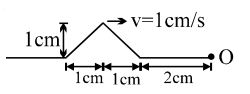
A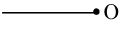
B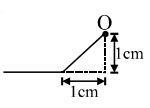
C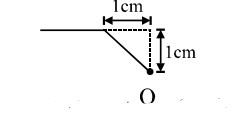
D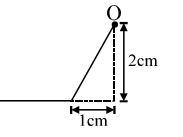
Solution
(D) The wave pulse travels at a speed of $v = 1 \, cm/s$. In $t = 3 \, s$,the pulse travels a distance of $d = v \times t = 1 \, cm/s \times 3 \, s = 3 \, cm$.
Looking at the initial figure,the front of the pulse is $4 \, cm$ away from the free end $O$ ($2 \, cm$ of flat string + $2 \, cm$ of the pulse base). After $3 \, s$,the front of the pulse reaches $1 \, cm$ from $O$.
Since $O$ is a free end,the wave reflects without a phase change. When a pulse reflects from a free end,the reflected pulse overlaps with the incident pulse,and their amplitudes add up constructively.
At $t = 3 \, s$,the peak of the pulse (which is $1 \, cm$ from the front) reaches the free end $O$. At this instant,the amplitude at $O$ becomes the sum of the incident and reflected amplitudes,which is $1 \, cm + 1 \, cm = 2 \, cm$. The shape corresponds to the pulse being partially reflected and superimposed at the free end,resulting in a maximum amplitude of $2 \, cm$ at $O$.
Looking at the initial figure,the front of the pulse is $4 \, cm$ away from the free end $O$ ($2 \, cm$ of flat string + $2 \, cm$ of the pulse base). After $3 \, s$,the front of the pulse reaches $1 \, cm$ from $O$.
Since $O$ is a free end,the wave reflects without a phase change. When a pulse reflects from a free end,the reflected pulse overlaps with the incident pulse,and their amplitudes add up constructively.
At $t = 3 \, s$,the peak of the pulse (which is $1 \, cm$ from the front) reaches the free end $O$. At this instant,the amplitude at $O$ becomes the sum of the incident and reflected amplitudes,which is $1 \, cm + 1 \, cm = 2 \, cm$. The shape corresponds to the pulse being partially reflected and superimposed at the free end,resulting in a maximum amplitude of $2 \, cm$ at $O$.
0 likes
View Solution20
DifficultMCQ
In Quincke's tube,a detector detects minimum intensity. Now,one of the tubes is displaced by $5 \, cm$. During displacement,the detector detects maximum intensity $10$ times,and finally a minimum intensity (when displacement is complete). The wavelength of sound is .... $cm$.
A
$10/9$
B
$1$
C
$1/2$
D
$5/9$
Solution
(B) In a Quincke's tube,the path difference between the two waves is $\Delta x = 2 \times \Delta d$,where $\Delta d$ is the displacement of the tube.
Given $\Delta d = 5 \, cm$,the total change in path difference is $\Delta x = 2 \times 5 \, cm = 10 \, cm$.
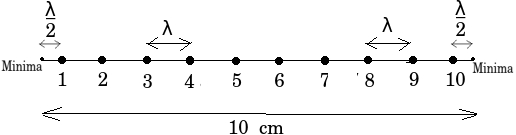
As the tube is moved,the detector observes $10$ maxima and ends at a minimum intensity. This means the path difference covers $10$ full wavelengths plus the distance between consecutive minima (which is $\lambda/2$ at each end).
Based on the provided diagram,the total distance corresponds to $\frac{\lambda}{2} + 9\lambda + \frac{\lambda}{2} = 10 \, cm$.
Simplifying this,we get $10\lambda = 10 \, cm$,which implies $\lambda = 1 \, cm$.
Given $\Delta d = 5 \, cm$,the total change in path difference is $\Delta x = 2 \times 5 \, cm = 10 \, cm$.
As the tube is moved,the detector observes $10$ maxima and ends at a minimum intensity. This means the path difference covers $10$ full wavelengths plus the distance between consecutive minima (which is $\lambda/2$ at each end).
Based on the provided diagram,the total distance corresponds to $\frac{\lambda}{2} + 9\lambda + \frac{\lambda}{2} = 10 \, cm$.
Simplifying this,we get $10\lambda = 10 \, cm$,which implies $\lambda = 1 \, cm$.
0 likes
View Solution21
DifficultMCQ
$A$ wave equation is given as $y = \cos(500t - 70x)$,where $y$ is in $mm$,$x$ is in $m$,and $t$ is in $s$. Which of the following statements is correct?
A
The wave must be a transverse propagating wave.
B
The speed of the wave is $50/7 \ m/s$.
C
Two closest points which are in the same phase have a separation of $20\pi/7 \ cm$.
D
All of the above.
Solution
(D) The given wave equation is $y = \cos(500t - 70x)$.
$1$. $A$ wave represented by a function of $(kx - \omega t)$ or $(\omega t - kx)$ is a traveling wave. In mechanical waves,if the displacement is perpendicular to the direction of propagation,it is a transverse wave.
$2$. The speed of the wave $v$ is given by $v = \frac{\omega}{k}$,where $\omega = 500 \ rad/s$ and $k = 70 \ rad/m$.
$v = \frac{500}{70} = \frac{50}{7} \ m/s$. Thus,option $B$ is correct.
$3$. The wavelength $\lambda$ is given by $\lambda = \frac{2\pi}{k} = \frac{2\pi}{70} \ m = \frac{\pi}{35} \ m$.
Converting to $cm$: $\lambda = \frac{\pi}{35} \times 100 \ cm = \frac{100\pi}{35} \ cm = \frac{20\pi}{7} \ cm$. The separation between two closest points in the same phase is equal to the wavelength $\lambda$. Thus,option $C$ is correct.
Since $A$,$B$,and $C$ are correct,the correct answer is $D$.
$1$. $A$ wave represented by a function of $(kx - \omega t)$ or $(\omega t - kx)$ is a traveling wave. In mechanical waves,if the displacement is perpendicular to the direction of propagation,it is a transverse wave.
$2$. The speed of the wave $v$ is given by $v = \frac{\omega}{k}$,where $\omega = 500 \ rad/s$ and $k = 70 \ rad/m$.
$v = \frac{500}{70} = \frac{50}{7} \ m/s$. Thus,option $B$ is correct.
$3$. The wavelength $\lambda$ is given by $\lambda = \frac{2\pi}{k} = \frac{2\pi}{70} \ m = \frac{\pi}{35} \ m$.
Converting to $cm$: $\lambda = \frac{\pi}{35} \times 100 \ cm = \frac{100\pi}{35} \ cm = \frac{20\pi}{7} \ cm$. The separation between two closest points in the same phase is equal to the wavelength $\lambda$. Thus,option $C$ is correct.
Since $A$,$B$,and $C$ are correct,the correct answer is $D$.
0 likes
View Solution22
DifficultMCQ
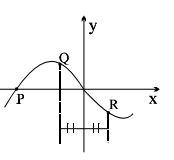
At a certain moment, the photograph of a string on which a harmonic wave is travelling to the right is shown. Then, which of the following is true regarding the velocities of the points $P$, $Q$ and $R$ on the string?
A
$v_P$ is upwards
B
$v_Q = v_R$
C
$| v_P | > | v_Q | = | v_R |$
D
both $(B)$ and $(C)$
Solution
(D) The particle velocity $v_p$ is given by $v_p = -v \cdot (\text{slope})$, where $v$ is the wave speed and slope is $\frac{\partial y}{\partial x}$.
$1$. For point $P$: The slope is positive. Since the wave is moving to the right, $v_P = -v \cdot (\text{positive slope}) < 0$, so $v_P$ is downwards.
$2$. For points $Q$ and $R$: Both points are at the same distance from the origin on opposite sides of the $y$-axis. By symmetry, the slopes at $Q$ and $R$ have equal magnitudes and are both negative. Since $v_Q = -v \cdot (\text{slope}_Q)$ and $v_R = -v \cdot (\text{slope}_R)$, and $\text{slope}_Q = \text{slope}_R < 0$, we get $v_Q = v_R$.
$3$. Comparing magnitudes: The slope at $P$ is steeper than the slopes at $Q$ and $R$. Therefore, $|v_P| > |v_Q| = |v_R|$.
Thus, both statements $(B)$ and $(C)$ are correct.
$1$. For point $P$: The slope is positive. Since the wave is moving to the right, $v_P = -v \cdot (\text{positive slope}) < 0$, so $v_P$ is downwards.
$2$. For points $Q$ and $R$: Both points are at the same distance from the origin on opposite sides of the $y$-axis. By symmetry, the slopes at $Q$ and $R$ have equal magnitudes and are both negative. Since $v_Q = -v \cdot (\text{slope}_Q)$ and $v_R = -v \cdot (\text{slope}_R)$, and $\text{slope}_Q = \text{slope}_R < 0$, we get $v_Q = v_R$.
$3$. Comparing magnitudes: The slope at $P$ is steeper than the slopes at $Q$ and $R$. Therefore, $|v_P| > |v_Q| = |v_R|$.
Thus, both statements $(B)$ and $(C)$ are correct.
0 likes
View Solution23
MediumMCQ
The length,tension,diameter,and density of a wire $B$ are double those of the corresponding quantities for another stretched wire $A$. Then:
A
The fundamental frequency of $A$ is equal to the third overtone of $B$.
B
The velocity of wave in $B$ is $\frac{1}{\sqrt{2}}$ times that of velocity in $A$.
C
The velocity of wave in $B$ is half that of velocity in $A$.
D
Both $(A)$ and $(C)$.
Solution
(D) The velocity of a transverse wave in a stretched wire is given by $v = \sqrt{\frac{T}{\mu}}$,where $T$ is tension and $\mu$ is linear mass density.
Since $\mu = \rho \cdot A_{cross} = \rho \cdot \pi r^2$,we have $\mu \propto \rho \cdot d^2$ (where $d$ is diameter).
Given for wire $B$: $L_B = 2L_A$,$T_B = 2T_A$,$d_B = 2d_A$,and $\rho_B = 2\rho_A$.
Velocity ratio: $\frac{v_B}{v_A} = \sqrt{\frac{T_B}{T_A} \cdot \frac{\mu_A}{\mu_B}} = \sqrt{\frac{2T_A}{T_A} \cdot \frac{\rho_A d_A^2}{\rho_B d_B^2}} = \sqrt{2 \cdot \frac{1}{2} \cdot \frac{1}{4}} = \sqrt{\frac{1}{4}} = \frac{1}{2}$.
Thus,$v_B = \frac{1}{2} v_A$. So,option $(C)$ is correct.
Fundamental frequency $n = \frac{v}{2L}$.
$\frac{n_B}{n_A} = \frac{v_B}{v_A} \cdot \frac{L_A}{L_B} = \frac{1}{2} \cdot \frac{1}{2} = \frac{1}{4}$.
So,$n_A = 4n_B$. The third overtone of $B$ is $4n_B$,which equals $n_A$. Thus,option $(A)$ is also correct.
Therefore,both $(A)$ and $(C)$ are correct.
Since $\mu = \rho \cdot A_{cross} = \rho \cdot \pi r^2$,we have $\mu \propto \rho \cdot d^2$ (where $d$ is diameter).
Given for wire $B$: $L_B = 2L_A$,$T_B = 2T_A$,$d_B = 2d_A$,and $\rho_B = 2\rho_A$.
Velocity ratio: $\frac{v_B}{v_A} = \sqrt{\frac{T_B}{T_A} \cdot \frac{\mu_A}{\mu_B}} = \sqrt{\frac{2T_A}{T_A} \cdot \frac{\rho_A d_A^2}{\rho_B d_B^2}} = \sqrt{2 \cdot \frac{1}{2} \cdot \frac{1}{4}} = \sqrt{\frac{1}{4}} = \frac{1}{2}$.
Thus,$v_B = \frac{1}{2} v_A$. So,option $(C)$ is correct.
Fundamental frequency $n = \frac{v}{2L}$.
$\frac{n_B}{n_A} = \frac{v_B}{v_A} \cdot \frac{L_A}{L_B} = \frac{1}{2} \cdot \frac{1}{2} = \frac{1}{4}$.
So,$n_A = 4n_B$. The third overtone of $B$ is $4n_B$,which equals $n_A$. Thus,option $(A)$ is also correct.
Therefore,both $(A)$ and $(C)$ are correct.
0 likes
View Solution24
AdvancedMCQ
$A$ clamped string is oscillating in the $n^{th}$ harmonic,then
A
total energy of oscillations will be $n^2$ times that of fundamental frequency
B
total energy of oscillations will be $(n-1)^2$ times that of fundamental frequency
C
average kinetic energy of the string over a complete oscillation is half of the total energy of the string
D
both $(A)$ and $(C)$
Solution
(D) For a standing wave,the total energy $E$ is proportional to the square of the frequency $\Omega^2$ and the square of the amplitude $A^2$. Since $\Omega_n = n \Omega_1$,the energy $E_n \propto n^2 E_1$. Thus,the total energy of the $n^{th}$ harmonic is $n^2$ times the energy of the fundamental frequency.
For any harmonic oscillator (including segments of a string),the average kinetic energy over a complete cycle is equal to the average potential energy. Since the total energy $E = K.E._{avg} + P.E._{avg}$ and $K.E._{avg} = P.E._{avg}$,it follows that $K.E._{avg} = E / 2$.
Therefore,both statements $(A)$ and $(C)$ are correct.
For any harmonic oscillator (including segments of a string),the average kinetic energy over a complete cycle is equal to the average potential energy. Since the total energy $E = K.E._{avg} + P.E._{avg}$ and $K.E._{avg} = P.E._{avg}$,it follows that $K.E._{avg} = E / 2$.
Therefore,both statements $(A)$ and $(C)$ are correct.
0 likes
View Solution25
MediumMCQ
Which of the following graphs is/are correct?
A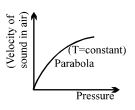
B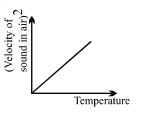
C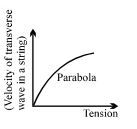
D
Both $(B)$ and $(C)$.
Solution
(D) For graph $(A)$: The velocity of sound in air is given by $v = \sqrt{\frac{\gamma P}{\rho}}$. Since $\rho = \frac{PM}{RT}$,we have $v = \sqrt{\frac{\gamma RT}{M}}$. At constant temperature,$v$ is independent of pressure. Thus,the graph of $v$ versus $P$ should be a horizontal straight line. Graph $(A)$ is incorrect.
For graph $(B)$: The velocity of sound in air is $v = \sqrt{\frac{\gamma RT}{M}}$. Squaring both sides,$v^2 = \frac{\gamma R}{M} T$. Since $\frac{\gamma R}{M}$ is constant,$v^2 \propto T$. The graph of $v^2$ versus $T$ is a straight line passing through the origin. Graph $(B)$ is correct.
For graph $(C)$: The velocity of a transverse wave in a string is $v = \sqrt{\frac{T}{\mu}}$,where $T$ is the tension and $\mu$ is the linear mass density. Thus,$v \propto \sqrt{T}$,which implies $v^2 \propto T$. The graph of $v$ versus $T$ is a parabola opening towards the $T$-axis. Graph $(C)$ is correct.
Therefore,both $(B)$ and $(C)$ are correct.
For graph $(B)$: The velocity of sound in air is $v = \sqrt{\frac{\gamma RT}{M}}$. Squaring both sides,$v^2 = \frac{\gamma R}{M} T$. Since $\frac{\gamma R}{M}$ is constant,$v^2 \propto T$. The graph of $v^2$ versus $T$ is a straight line passing through the origin. Graph $(B)$ is correct.
For graph $(C)$: The velocity of a transverse wave in a string is $v = \sqrt{\frac{T}{\mu}}$,where $T$ is the tension and $\mu$ is the linear mass density. Thus,$v \propto \sqrt{T}$,which implies $v^2 \propto T$. The graph of $v$ versus $T$ is a parabola opening towards the $T$-axis. Graph $(C)$ is correct.
Therefore,both $(B)$ and $(C)$ are correct.
0 likes
View Solution26
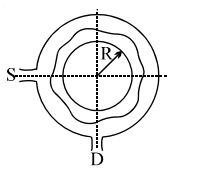
AdvancedMCQ
$A$ narrow tube is bent in the form of a circle of radius $R,$ as shown in the figure. Two small holes $S$ and $D$ are made in the tube at positions right-angled to each other. $A$ source placed at $S$ generates a wave of intensity $I_0$ which is equally divided into two parts: one part travels along the longer path,while the other travels along the shorter path. Both the waves meet at point $D$ where a detector is placed. If a maxima is formed at the detector,then the possible values for the wavelength $\lambda$ of the wave produced are given by:
A
$\pi R$
B
$\frac{\pi R}{2}$
C
$\frac{\pi R}{4}$
D
All of the above
Solution
(D) The length of the shorter path is $L_1 = \frac{1}{4}(2\pi R) = \frac{\pi R}{2}$.
The length of the longer path is $L_2 = \frac{3}{4}(2\pi R) = \frac{3\pi R}{2}$.
The path difference between the two waves is $\Delta = L_2 - L_1 = \frac{3\pi R}{2} - \frac{\pi R}{2} = \pi R$.
For constructive interference (maxima) at the detector,the path difference must be an integer multiple of the wavelength:
$\Delta = n\lambda$,where $n = 1, 2, 3, \dots$
Substituting $\Delta = \pi R$,we get $\pi R = n\lambda$.
Therefore,$\lambda = \frac{\pi R}{n}$.
For $n=1$,$\lambda = \pi R$.
For $n=2$,$\lambda = \frac{\pi R}{2}$.
For $n=3$,$\lambda = \frac{\pi R}{3}$.
Since the options include $\pi R$,$\frac{\pi R}{2}$,and $\frac{\pi R}{4}$ (which corresponds to $n=4$),and all these are possible values for different integers $n$,the correct option is 'All of the above'.
The length of the longer path is $L_2 = \frac{3}{4}(2\pi R) = \frac{3\pi R}{2}$.
The path difference between the two waves is $\Delta = L_2 - L_1 = \frac{3\pi R}{2} - \frac{\pi R}{2} = \pi R$.
For constructive interference (maxima) at the detector,the path difference must be an integer multiple of the wavelength:
$\Delta = n\lambda$,where $n = 1, 2, 3, \dots$
Substituting $\Delta = \pi R$,we get $\pi R = n\lambda$.
Therefore,$\lambda = \frac{\pi R}{n}$.
For $n=1$,$\lambda = \pi R$.
For $n=2$,$\lambda = \frac{\pi R}{2}$.
For $n=3$,$\lambda = \frac{\pi R}{3}$.
Since the options include $\pi R$,$\frac{\pi R}{2}$,and $\frac{\pi R}{4}$ (which corresponds to $n=4$),and all these are possible values for different integers $n$,the correct option is 'All of the above'.
0 likes
View Solution27
AdvancedMCQ
$A$ narrow tube is bent in the form of a circle of radius $R,$ as shown in the figure. Two small holes $S$ and $D$ are made in the tube at positions at a right angle to each other. $A$ source placed at $S$ generates a wave of intensity $I_0$ which is equally divided into two parts: one part travels along the longer path,while the other travels along the shorter path. Both the waves meet at the point $D$ where a detector is placed. If a minimum is formed at the detector,then the magnitude of the wavelength $\lambda$ of the wave produced is given by:
A
$2\pi R$
B
$\frac{2\pi R}{5}$
C
$\frac{2\pi R}{3}$
D
All of the above
Solution
(D) The circumference of the circular tube is $2\pi R$. The source $S$ and detector $D$ are at positions at a right angle to each other.
The shorter path length is $L_1 = \frac{1}{4} (2\pi R) = \frac{\pi R}{2}$.
The longer path length is $L_2 = \frac{3}{4} (2\pi R) = \frac{3\pi R}{2}$.
The path difference between the waves traveling through the two paths is $\Delta x = L_2 - L_1 = \frac{3\pi R}{2} - \frac{\pi R}{2} = \pi R$.
For a minimum to occur at the detector,the path difference must be an odd multiple of half-wavelengths:
$\Delta x = (n + \frac{1}{2}) \lambda$,where $n = 0, 1, 2, \dots$
$\pi R = \frac{(2n + 1) \lambda}{2}$
$\lambda = \frac{2\pi R}{2n + 1}$
For $n = 0$,$\lambda = 2\pi R$.
For $n = 1$,$\lambda = \frac{2\pi R}{3}$.
For $n = 2$,$\lambda = \frac{2\pi R}{5}$.
Thus,all the given options are possible values for the wavelength $\lambda$.
The shorter path length is $L_1 = \frac{1}{4} (2\pi R) = \frac{\pi R}{2}$.
The longer path length is $L_2 = \frac{3}{4} (2\pi R) = \frac{3\pi R}{2}$.
The path difference between the waves traveling through the two paths is $\Delta x = L_2 - L_1 = \frac{3\pi R}{2} - \frac{\pi R}{2} = \pi R$.
For a minimum to occur at the detector,the path difference must be an odd multiple of half-wavelengths:
$\Delta x = (n + \frac{1}{2}) \lambda$,where $n = 0, 1, 2, \dots$
$\pi R = \frac{(2n + 1) \lambda}{2}$
$\lambda = \frac{2\pi R}{2n + 1}$
For $n = 0$,$\lambda = 2\pi R$.
For $n = 1$,$\lambda = \frac{2\pi R}{3}$.
For $n = 2$,$\lambda = \frac{2\pi R}{5}$.
Thus,all the given options are possible values for the wavelength $\lambda$.
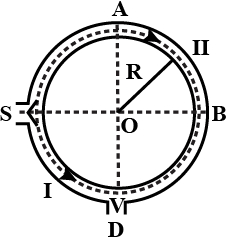
0 likes
View Solution28
AdvancedMCQ
$A$ narrow tube is bent in the form of a circle of radius $R,$ as shown in the figure. Two small holes $S$ and $D$ are made in the tube at positions right-angled to each other. $A$ source placed at $S$ generates a wave of intensity $I_0$ which is equally divided into two parts: one part travels along the longer path,while the other travels along the shorter path. Both the waves meet at the point $D$ where a detector is placed. The maximum intensity produced at $D$ is given by
A
$4I_0$
B
$2I_0$
C
$I_0$
D
All of the above
Solution
(B) The source at $S$ generates a wave of intensity $I_0$. This intensity is equally divided into two parts,so each part has an intensity $I = I_0 / 2$.
Since intensity $I$ is proportional to the square of the amplitude $A$ $(I \propto A^2)$,the amplitude of each wave is $A = \sqrt{I} = \sqrt{I_0 / 2}$.
When these two waves meet at point $D$,they interfere. The resultant intensity $I_{res}$ is given by the formula $I_{res} = I_1 + I_2 + 2\sqrt{I_1 I_2} \cos \phi$,where $\phi$ is the phase difference.
For maximum intensity,the waves must interfere constructively,meaning $\cos \phi = 1$.
Thus,$I_{max} = I_1 + I_2 + 2\sqrt{I_1 I_2} = (\sqrt{I_1} + \sqrt{I_2})^2$.
Substituting $I_1 = I_2 = I_0 / 2$:
$I_{max} = (\sqrt{I_0 / 2} + \sqrt{I_0 / 2})^2 = (2 \sqrt{I_0 / 2})^2 = 4 \times (I_0 / 2) = 2I_0$.
Since intensity $I$ is proportional to the square of the amplitude $A$ $(I \propto A^2)$,the amplitude of each wave is $A = \sqrt{I} = \sqrt{I_0 / 2}$.
When these two waves meet at point $D$,they interfere. The resultant intensity $I_{res}$ is given by the formula $I_{res} = I_1 + I_2 + 2\sqrt{I_1 I_2} \cos \phi$,where $\phi$ is the phase difference.
For maximum intensity,the waves must interfere constructively,meaning $\cos \phi = 1$.
Thus,$I_{max} = I_1 + I_2 + 2\sqrt{I_1 I_2} = (\sqrt{I_1} + \sqrt{I_2})^2$.
Substituting $I_1 = I_2 = I_0 / 2$:
$I_{max} = (\sqrt{I_0 / 2} + \sqrt{I_0 / 2})^2 = (2 \sqrt{I_0 / 2})^2 = 4 \times (I_0 / 2) = 2I_0$.
0 likes
View Solution29
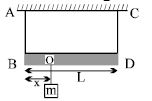
DifficultMCQ
$A$ massless rod is suspended by two identical strings $AB$ and $CD$ of equal length. $A$ block of mass $m$ is suspended from point $O$ such that $BO$ is equal to $x$. Further,it is observed that the frequency of the $1^{st}$ harmonic (fundamental frequency) in $AB$ is equal to the $2^{nd}$ harmonic frequency in $CD$. Then,the length of $BO$ is:
A
$\frac{L}{5}$
B
$\frac{L}{4}$
C
$\frac{4L}{5}$
D
$\frac{3L}{4}$
Solution
(A) Let $T_1$ and $T_2$ be the tensions in strings $AB$ and $CD$ respectively.
Given that the fundamental frequency of $AB$ equals the $2^{nd}$ harmonic frequency of $CD$:
$f_1 = f_2$
$\frac{1}{2l} \sqrt{\frac{T_1}{\mu}} = \frac{2}{2l} \sqrt{\frac{T_2}{\mu}}$
$\sqrt{T_1} = 2 \sqrt{T_2} \implies T_1 = 4T_2$
For the rod to be in rotational equilibrium about point $O$,the torques must balance:
$T_1 \cdot x = T_2 \cdot (L - x)$
Substituting $T_1 = 4T_2$:
$4T_2 \cdot x = T_2 \cdot (L - x)$
$4x = L - x$
$5x = L$
$x = \frac{L}{5}$
Given that the fundamental frequency of $AB$ equals the $2^{nd}$ harmonic frequency of $CD$:
$f_1 = f_2$
$\frac{1}{2l} \sqrt{\frac{T_1}{\mu}} = \frac{2}{2l} \sqrt{\frac{T_2}{\mu}}$
$\sqrt{T_1} = 2 \sqrt{T_2} \implies T_1 = 4T_2$
For the rod to be in rotational equilibrium about point $O$,the torques must balance:
$T_1 \cdot x = T_2 \cdot (L - x)$
Substituting $T_1 = 4T_2$:
$4T_2 \cdot x = T_2 \cdot (L - x)$
$4x = L - x$
$5x = L$
$x = \frac{L}{5}$
0 likes
View Solution30
DifficultMCQ
$A$ vibrating string of certain length $l$ under a tension $T$ resonates with a mode corresponding to the first overtone (third harmonic) of an air column of length $75 \ cm$ inside a tube closed at one end. The string also generates $4$ beats per second when excited along with a tuning fork of frequency $n$. Now,when the tension of the string is slightly increased,the number of beats reduces to $2$ per second. Assuming the velocity of sound in air to be $340 \ m/s$,the frequency $n$ of the tuning fork in $Hz$ is:
A
$344$
B
$336$
C
$117.3$
D
$109.3$
Solution
(A) The frequency of the first overtone (third harmonic) of a closed organ pipe is given by $f = \frac{3v}{4L}$.
Given $v = 340 \ m/s$ and $L = 0.75 \ m$,we have $f = \frac{3 \times 340}{4 \times 0.75} = \frac{1020}{3} = 340 \ Hz$.
The string resonates at $340 \ Hz$,so the frequency of the string $f_s = 340 \ Hz$.
Beats produced with a tuning fork of frequency $n$ is $|f_s - n| = 4$,so $n = 340 \pm 4$,which means $n = 344 \ Hz$ or $336 \ Hz$.
When tension $T$ is increased,the frequency of the string $f_s$ increases $(f_s \propto \sqrt{T})$.
If $n = 344 \ Hz$,the beat frequency $|344 - f_s|$ decreases from $4$ to $2$ as $f_s$ increases towards $344 \ Hz$.
If $n = 336 \ Hz$,the beat frequency $|f_s - 336|$ would increase as $f_s$ increases from $340 \ Hz$.
Therefore,the correct frequency $n$ is $344 \ Hz$.
Given $v = 340 \ m/s$ and $L = 0.75 \ m$,we have $f = \frac{3 \times 340}{4 \times 0.75} = \frac{1020}{3} = 340 \ Hz$.
The string resonates at $340 \ Hz$,so the frequency of the string $f_s = 340 \ Hz$.
Beats produced with a tuning fork of frequency $n$ is $|f_s - n| = 4$,so $n = 340 \pm 4$,which means $n = 344 \ Hz$ or $336 \ Hz$.
When tension $T$ is increased,the frequency of the string $f_s$ increases $(f_s \propto \sqrt{T})$.
If $n = 344 \ Hz$,the beat frequency $|344 - f_s|$ decreases from $4$ to $2$ as $f_s$ increases towards $344 \ Hz$.
If $n = 336 \ Hz$,the beat frequency $|f_s - 336|$ would increase as $f_s$ increases from $340 \ Hz$.
Therefore,the correct frequency $n$ is $344 \ Hz$.
0 likes
View Solution31
DifficultMCQ
In the Kundt's tube experiment (shown in fig. $(i)$),the rod is clamped at the center. In the modified experiment (shown in fig. $(ii)$),the rod is clamped at the end. It is known that the speed of sound in air is $330\ m/s$,the powder piles up at successive distances of $0.6\ m$,and the length of the rod used is $1\ m$. Calculate the speed of sound in the rod in $m/s$.
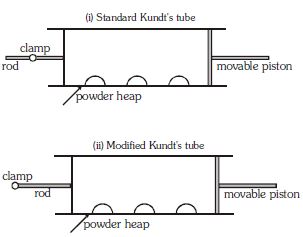
A
$550$
B
$1100$
C
$1200$
D
$600$
Solution
(B) In the rod clamped at the end,the fundamental mode of vibration corresponds to a quarter wavelength,so $L = \frac{\lambda_r}{4}$,which gives $\lambda_r = 4L$. The frequency is $f = \frac{v_r}{\lambda_r} = \frac{v_r}{4L}$.
In the air column,the distance between successive nodes (powder heaps) is $\frac{\lambda_a}{2} = 0.6\ m$,so $\lambda_a = 1.2\ m$. The frequency of the air column is $f = \frac{v_a}{\lambda_a} = \frac{330}{1.2} = 275\ Hz$.
Since the rod and air column vibrate at the same frequency,we have $\frac{v_r}{4L} = 275$.
Substituting $L = 1\ m$,we get $v_r = 275 \times 4 = 1100\ m/s$.
In the air column,the distance between successive nodes (powder heaps) is $\frac{\lambda_a}{2} = 0.6\ m$,so $\lambda_a = 1.2\ m$. The frequency of the air column is $f = \frac{v_a}{\lambda_a} = \frac{330}{1.2} = 275\ Hz$.
Since the rod and air column vibrate at the same frequency,we have $\frac{v_r}{4L} = 275$.
Substituting $L = 1\ m$,we get $v_r = 275 \times 4 = 1100\ m/s$.
0 likes
View Solution32
EasyMCQ
Diffraction of sound waves is more evident than light waves in daily life because:
A
$\lambda_{\text{sound}} > \lambda_{\text{light}}$
B
$\lambda_{\text{sound}} < \lambda_{\text{light}}$
C
$\lambda_{\text{sound}} = \lambda_{\text{light}}$
D
Sound waves are longitudinal but light waves are transverse
Solution
(A) Diffraction is the bending of waves around the corners of an obstacle or through an aperture. The condition for significant diffraction is that the wavelength of the wave $(\lambda)$ must be comparable to the size of the obstacle or aperture $(a)$, i.e., $\lambda \approx a$.
In daily life, the size of obstacles (like doors or windows) is typically in the range of $0.1 \, m$ to $1 \, m$.
The wavelength of audible sound waves ranges from approximately $1.7 \, cm$ to $17 \, m$, which is comparable to the size of these obstacles.
In contrast, the wavelength of visible light is extremely small, ranging from about $400 \, nm$ to $700 \, nm$ ($4 \times 10^{-7} \, m$ to $7 \times 10^{-7} \, m$).
Since $\lambda_{\text{sound}} \gg \lambda_{\text{light}}$, sound waves diffract much more easily around common objects than light waves do.
In daily life, the size of obstacles (like doors or windows) is typically in the range of $0.1 \, m$ to $1 \, m$.
The wavelength of audible sound waves ranges from approximately $1.7 \, cm$ to $17 \, m$, which is comparable to the size of these obstacles.
In contrast, the wavelength of visible light is extremely small, ranging from about $400 \, nm$ to $700 \, nm$ ($4 \times 10^{-7} \, m$ to $7 \times 10^{-7} \, m$).
Since $\lambda_{\text{sound}} \gg \lambda_{\text{light}}$, sound waves diffract much more easily around common objects than light waves do.
0 likes
View Solution33
MediumMCQ
Following are expressions for four plane simple harmonic waves:
$(i) \, y_1 = A \cos 2\pi \left( n_1 t + \frac{x}{\lambda_1} \right)$
$(ii) \, y_2 = A \cos 2\pi \left( n_1 t + \frac{x}{\lambda_1} + \frac{1}{2} \right)$
$(iii) \, y_3 = A \cos 2\pi \left( n_2 t + \frac{x}{\lambda_2} \right)$
$(iv) \, y_4 = A \cos 2\pi \left( n_2 t - \frac{x}{\lambda_2} \right)$
The pairs of waves which will produce destructive interference and stationary waves respectively in a medium are:
$(i) \, y_1 = A \cos 2\pi \left( n_1 t + \frac{x}{\lambda_1} \right)$
$(ii) \, y_2 = A \cos 2\pi \left( n_1 t + \frac{x}{\lambda_1} + \frac{1}{2} \right)$
$(iii) \, y_3 = A \cos 2\pi \left( n_2 t + \frac{x}{\lambda_2} \right)$
$(iv) \, y_4 = A \cos 2\pi \left( n_2 t - \frac{x}{\lambda_2} \right)$
The pairs of waves which will produce destructive interference and stationary waves respectively in a medium are:
A
$(iii, iv), (i, ii)$
B
$(i, iii), (ii, iv)$
C
$(i, iv), (ii, iii)$
D
$(i, ii), (iii, iv)$
Solution
(D) $1$. Destructive interference occurs when two waves have the same frequency and amplitude but a phase difference of $\pi$ radians $(180^o)$. Comparing $(i)$ and $(ii)$,the phase difference is $\Delta \phi = 2\pi \times \frac{1}{2} = \pi$. Thus,$(i)$ and $(ii)$ produce destructive interference.
$2$. Stationary (standing) waves are formed by the superposition of two waves of the same frequency and amplitude traveling in opposite directions. Comparing $(iii)$ and $(iv)$,they have the same frequency $n_2$ and wavelength $\lambda_2$,but the term $\pm \frac{x}{\lambda_2}$ indicates they travel in opposite directions. Thus,$(iii)$ and $(iv)$ produce stationary waves.
$2$. Stationary (standing) waves are formed by the superposition of two waves of the same frequency and amplitude traveling in opposite directions. Comparing $(iii)$ and $(iv)$,they have the same frequency $n_2$ and wavelength $\lambda_2$,but the term $\pm \frac{x}{\lambda_2}$ indicates they travel in opposite directions. Thus,$(iii)$ and $(iv)$ produce stationary waves.
0 likes
View Solution34
DifficultMCQ
Two identical flutes produce fundamental notes of frequency $300 \ Hz$ at $27 \ ^oC$. If the temperature of air in one flute is increased to $31 \ ^oC$,the number of beats heard per second will be
A
$1$
B
$2$
C
$3$
D
$4$
Solution
(B) The velocity of sound $v$ is directly proportional to the square root of the absolute temperature $T$,i.e.,$v \propto \sqrt{T}$.
Since the length of the flute remains constant,the wavelength $\lambda$ of the fundamental note remains constant. Given $v = n\lambda$,we have $n \propto v$,so $n \propto \sqrt{T}$.
Let $n_1 = 300 \ Hz$ at $T_1 = 27 + 273 = 300 \ K$.
Let $n_2 = 300 + x$ at $T_2 = 31 + 273 = 304 \ K$,where $x$ is the number of beats per second.
Using the ratio: $\frac{n_2}{n_1} = \sqrt{\frac{T_2}{T_1}}$
$\frac{300 + x}{300} = \sqrt{\frac{304}{300}} = \sqrt{1 + \frac{4}{300}}$
Using the binomial approximation $(1 + z)^n \approx 1 + nz$ for small $z$:
$1 + \frac{x}{300} \approx 1 + \frac{1}{2} \times \frac{4}{300}$
$\frac{x}{300} = \frac{2}{300}$
$x = 2$.
Thus,the number of beats heard per second is $2$.
Since the length of the flute remains constant,the wavelength $\lambda$ of the fundamental note remains constant. Given $v = n\lambda$,we have $n \propto v$,so $n \propto \sqrt{T}$.
Let $n_1 = 300 \ Hz$ at $T_1 = 27 + 273 = 300 \ K$.
Let $n_2 = 300 + x$ at $T_2 = 31 + 273 = 304 \ K$,where $x$ is the number of beats per second.
Using the ratio: $\frac{n_2}{n_1} = \sqrt{\frac{T_2}{T_1}}$
$\frac{300 + x}{300} = \sqrt{\frac{304}{300}} = \sqrt{1 + \frac{4}{300}}$
Using the binomial approximation $(1 + z)^n \approx 1 + nz$ for small $z$:
$1 + \frac{x}{300} \approx 1 + \frac{1}{2} \times \frac{4}{300}$
$\frac{x}{300} = \frac{2}{300}$
$x = 2$.
Thus,the number of beats heard per second is $2$.
0 likes
View Solution35
DifficultMCQ
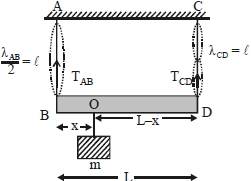
$A$ massless rod of length $L$ is suspended by two identical strings $AB$ and $CD$ of equal length. $A$ block of mass $m$ is suspended from point $O$ such that $BO$ is equal to $x$. Further,it is observed that the frequency of the $1^{st}$ harmonic in $AB$ is equal to the $2^{nd}$ harmonic frequency in $CD$. The value of $x$ is
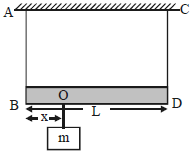
A
$\frac{L}{5}$
B
$\frac{4L}{5}$
C
$\frac{3L}{4}$
D
$\frac{L}{4}$
Solution
(A) The frequency of the $n^{th}$ harmonic of a string is given by $f_n = \frac{n}{2l} \sqrt{\frac{T}{\mu}}$.
Frequency of the $1^{st}$ harmonic of $AB$ is $f_{AB} = \frac{1}{2l} \sqrt{\frac{T_{AB}}{\mu}}$.
Frequency of the $2^{nd}$ harmonic of $CD$ is $f_{CD} = \frac{2}{2l} \sqrt{\frac{T_{CD}}{\mu}} = \frac{1}{l} \sqrt{\frac{T_{CD}}{\mu}}$.
Given that $f_{AB} = f_{CD}$,we have:
$\frac{1}{2l} \sqrt{\frac{T_{AB}}{\mu}} = \frac{1}{l} \sqrt{\frac{T_{CD}}{\mu}}$
$\Rightarrow \frac{T_{AB}}{4} = T_{CD} \Rightarrow T_{AB} = 4T_{CD} \quad ...(i)$
For rotational equilibrium of the rod about point $O$:
$T_{AB} \cdot x = T_{CD} \cdot (L - x) \quad ...(ii)$
For translational equilibrium:
$T_{AB} + T_{CD} = mg \quad ...(iii)$
Substituting $(i)$ into $(iii)$:
$4T_{CD} + T_{CD} = mg \Rightarrow 5T_{CD} = mg \Rightarrow T_{CD} = \frac{mg}{5}$.
Then,$T_{AB} = 4 \left( \frac{mg}{5} \right) = \frac{4mg}{5}$.
Substituting these into $(ii)$:
$\left( \frac{4mg}{5} \right) x = \left( \frac{mg}{5} \right) (L - x)$
$4x = L - x \Rightarrow 5x = L \Rightarrow x = \frac{L}{5}$.
Frequency of the $1^{st}$ harmonic of $AB$ is $f_{AB} = \frac{1}{2l} \sqrt{\frac{T_{AB}}{\mu}}$.
Frequency of the $2^{nd}$ harmonic of $CD$ is $f_{CD} = \frac{2}{2l} \sqrt{\frac{T_{CD}}{\mu}} = \frac{1}{l} \sqrt{\frac{T_{CD}}{\mu}}$.
Given that $f_{AB} = f_{CD}$,we have:
$\frac{1}{2l} \sqrt{\frac{T_{AB}}{\mu}} = \frac{1}{l} \sqrt{\frac{T_{CD}}{\mu}}$
$\Rightarrow \frac{T_{AB}}{4} = T_{CD} \Rightarrow T_{AB} = 4T_{CD} \quad ...(i)$
For rotational equilibrium of the rod about point $O$:
$T_{AB} \cdot x = T_{CD} \cdot (L - x) \quad ...(ii)$
For translational equilibrium:
$T_{AB} + T_{CD} = mg \quad ...(iii)$
Substituting $(i)$ into $(iii)$:
$4T_{CD} + T_{CD} = mg \Rightarrow 5T_{CD} = mg \Rightarrow T_{CD} = \frac{mg}{5}$.
Then,$T_{AB} = 4 \left( \frac{mg}{5} \right) = \frac{4mg}{5}$.
Substituting these into $(ii)$:
$\left( \frac{4mg}{5} \right) x = \left( \frac{mg}{5} \right) (L - x)$
$4x = L - x \Rightarrow 5x = L \Rightarrow x = \frac{L}{5}$.
0 likes
View Solution36
EasyMCQ
$Assertion :$ Sound waves cannot travel in vacuum but light can travel in vacuum.
$Reason :$ Sound waves are longitudinal waves and they cannot be polarised but electromagnetic waves are transverse and they can be polarised.
$Reason :$ Sound waves are longitudinal waves and they cannot be polarised but electromagnetic waves are transverse and they can be polarised.
A
If both $Assertion$ and $Reason$ are correct and the $Reason$ is a correct explanation of the $Assertion$.
B
If both $Assertion$ and $Reason$ are correct but $Reason$ is not a correct explanation of the $Assertion$.
C
If the $Assertion$ is correct but $Reason$ is incorrect.
D
If both the $Assertion$ and $Reason$ are incorrect.
Solution
(B) Sound waves are mechanical waves that require a material medium for propagation because they travel through the compression and rarefaction of medium particles. Thus,they cannot travel in a vacuum.
Light waves are electromagnetic waves consisting of oscillating electric and magnetic field vectors perpendicular to the direction of propagation. Since they do not require a medium,they can travel in a vacuum.
The $Assertion$ is correct.
The $Reason$ correctly identifies that sound waves are longitudinal (cannot be polarized) and electromagnetic waves are transverse (can be polarized). However,the ability to be polarized is a property of transverse waves,not the reason why they can travel in a vacuum. Therefore,the $Reason$ is a true statement but not the correct explanation for the $Assertion$.
Light waves are electromagnetic waves consisting of oscillating electric and magnetic field vectors perpendicular to the direction of propagation. Since they do not require a medium,they can travel in a vacuum.
The $Assertion$ is correct.
The $Reason$ correctly identifies that sound waves are longitudinal (cannot be polarized) and electromagnetic waves are transverse (can be polarized). However,the ability to be polarized is a property of transverse waves,not the reason why they can travel in a vacuum. Therefore,the $Reason$ is a true statement but not the correct explanation for the $Assertion$.
0 likes
View Solution37
EasyMCQ
$Assertion :$ The pitch of wind instruments rises and that of string instruments falls as an orchestra warms up.
$Reason :$ When temperature rises,the speed of sound increases,but the speed of a wave in a string fixed at both ends decreases.
$Reason :$ When temperature rises,the speed of sound increases,but the speed of a wave in a string fixed at both ends decreases.
A
If both Assertion and Reason are correct and the Reason is a correct explanation of the Assertion.
B
If both Assertion and Reason are correct but Reason is not a correct explanation of the Assertion.
C
If the Assertion is correct but Reason is incorrect.
D
If both the Assertion and Reason are incorrect.
Solution
(A) $1$. For wind instruments (like a flute or organ pipe),the frequency is given by $f = \frac{v}{2L}$ (or similar depending on the pipe). As the temperature increases,the speed of sound $v$ in the air increases. Since $f \propto v$,the frequency (pitch) rises.
$2$. For string instruments (like a guitar or violin),the frequency is given by $f = \frac{1}{2L} \sqrt{\frac{T}{\mu}}$. As the temperature increases,the string expands due to thermal expansion,increasing its length $L$. Additionally,the tension $T$ in the string decreases due to the expansion of the instrument's body. Both factors lead to a decrease in frequency (pitch).
$3$. Thus,the Assertion is correct. The Reason correctly identifies that the speed of sound increases with temperature and explains the physical changes in string instruments that lead to a decrease in pitch. Therefore,the Reason is a correct explanation of the Assertion.
$2$. For string instruments (like a guitar or violin),the frequency is given by $f = \frac{1}{2L} \sqrt{\frac{T}{\mu}}$. As the temperature increases,the string expands due to thermal expansion,increasing its length $L$. Additionally,the tension $T$ in the string decreases due to the expansion of the instrument's body. Both factors lead to a decrease in frequency (pitch).
$3$. Thus,the Assertion is correct. The Reason correctly identifies that the speed of sound increases with temperature and explains the physical changes in string instruments that lead to a decrease in pitch. Therefore,the Reason is a correct explanation of the Assertion.
0 likes
View Solution38
EasyMCQ
$Assertion :$ Transverse waves are produced in a very long string fixed at one end. Only a progressive wave is observed near the free end.
$Reason :$ Energy of the reflected wave does not reach the free end.
$Reason :$ Energy of the reflected wave does not reach the free end.
A
If both Assertion and Reason are correct and the Reason is a correct explanation of the Assertion.
B
If both Assertion and Reason are correct but Reason is not a correct explanation of the Assertion.
C
If the Assertion is correct but Reason is incorrect.
D
If both the Assertion and Reason are incorrect.
Solution
(A) In a very long string fixed at one end,when a transverse wave is produced,it travels towards the fixed end and gets reflected.
However,because the string is very long,the reflected wave loses significant energy due to damping and internal friction before it can travel all the way back to the source or the free end.
Consequently,near the free end (where the wave is generated),the amplitude of the reflected wave is negligible compared to the incident wave.
Therefore,the superposition of the incident and reflected waves is not significant enough to form a standing wave pattern,and only the progressive wave is observed.
Both the Assertion and the Reason are correct,and the Reason explains why the reflected wave does not interfere significantly to form a standing wave at the source end.
However,because the string is very long,the reflected wave loses significant energy due to damping and internal friction before it can travel all the way back to the source or the free end.
Consequently,near the free end (where the wave is generated),the amplitude of the reflected wave is negligible compared to the incident wave.
Therefore,the superposition of the incident and reflected waves is not significant enough to form a standing wave pattern,and only the progressive wave is observed.
Both the Assertion and the Reason are correct,and the Reason explains why the reflected wave does not interfere significantly to form a standing wave at the source end.
0 likes
View Solution39
MediumMCQ
Speed of a transverse wave on a straight wire (mass $6.0\; g$,length $60\; cm$,and area of cross-section $1.0\; mm^{2}$) is $90\; ms^{-1}$. If the Young's modulus of the wire is $16 \times 10^{11}\; Nm^{-2}$,the extension of the wire over its natural length is: (in $; mm$)
A
$0.02$
B
$0.04$
C
$0.03$
D
$0.01$
Solution
(C) The speed of a transverse wave on a stretched wire is given by $v = \sqrt{\frac{T}{\mu}}$,where $T$ is the tension and $\mu$ is the linear mass density.
Given: $v = 90\; ms^{-1}$,$m = 6.0 \times 10^{-3}\; kg$,$L = 0.6\; m$,$A = 1.0 \times 10^{-6}\; m^{2}$,$Y = 16 \times 10^{11}\; Nm^{-2}$.
Linear mass density $\mu = \frac{m}{L} = \frac{6.0 \times 10^{-3}}{0.6} = 10^{-2}\; kg/m$.
From $v = \sqrt{\frac{T}{\mu}}$,we have $T = v^{2} \mu = (90)^{2} \times 10^{-2} = 8100 \times 10^{-2} = 81\; N$.
Young's modulus $Y = \frac{T/A}{\Delta L/L}$,so $\Delta L = \frac{T L}{Y A}$.
Substituting the values: $\Delta L = \frac{81 \times 0.6}{16 \times 10^{11} \times 1.0 \times 10^{-6}} = \frac{48.6}{16 \times 10^{5}} = 3.0375 \times 10^{-5}\; m \approx 0.03\; mm$.
Given: $v = 90\; ms^{-1}$,$m = 6.0 \times 10^{-3}\; kg$,$L = 0.6\; m$,$A = 1.0 \times 10^{-6}\; m^{2}$,$Y = 16 \times 10^{11}\; Nm^{-2}$.
Linear mass density $\mu = \frac{m}{L} = \frac{6.0 \times 10^{-3}}{0.6} = 10^{-2}\; kg/m$.
From $v = \sqrt{\frac{T}{\mu}}$,we have $T = v^{2} \mu = (90)^{2} \times 10^{-2} = 8100 \times 10^{-2} = 81\; N$.
Young's modulus $Y = \frac{T/A}{\Delta L/L}$,so $\Delta L = \frac{T L}{Y A}$.
Substituting the values: $\Delta L = \frac{81 \times 0.6}{16 \times 10^{11} \times 1.0 \times 10^{-6}} = \frac{48.6}{16 \times 10^{5}} = 3.0375 \times 10^{-5}\; m \approx 0.03\; mm$.
0 likes
View Solution40
Medium
Given below are some functions of $x$ and $t$ to represent the displacement (transverse or longitudinal) of an elastic wave. State which of these represent $(i)$ a travelling wave,$(ii)$ a stationary wave or $(iii)$ none at all:
$(a)$ $y = 2 \cos(3x) \sin(10t)$
$(b)$ $y = 2 \sqrt{x - vt}$
$(c)$ $y = 3 \sin(5x - 0.5t) + 4 \cos(5x - 0.5t)$
$(d)$ $y = \cos x \sin t + \cos 2x \sin 2t$
$(a)$ $y = 2 \cos(3x) \sin(10t)$
$(b)$ $y = 2 \sqrt{x - vt}$
$(c)$ $y = 3 \sin(5x - 0.5t) + 4 \cos(5x - 0.5t)$
$(d)$ $y = \cos x \sin t + \cos 2x \sin 2t$
Solution
(A) $y = 2 \cos(3x) \sin(10t)$ represents a stationary wave because the spatial part $k x$ and temporal part $\omega t$ appear as separate factors.
$(b)$ $y = 2 \sqrt{x - vt}$ does not represent a wave because it does not satisfy the general wave equation $\frac{\partial^2 y}{\partial x^2} = \frac{1}{v^2} \frac{\partial^2 y}{\partial t^2}$ and is not a periodic function.
$(c)$ $y = 3 \sin(5x - 0.5t) + 4 \cos(5x - 0.5t)$ represents a travelling wave because it is a linear combination of functions of the form $f(kx - \omega t)$.
$(d)$ $y = \cos x \sin t + \cos 2x \sin 2t$ represents a stationary wave because it is a superposition of two stationary waves,where each term has separate spatial and temporal components.
$(b)$ $y = 2 \sqrt{x - vt}$ does not represent a wave because it does not satisfy the general wave equation $\frac{\partial^2 y}{\partial x^2} = \frac{1}{v^2} \frac{\partial^2 y}{\partial t^2}$ and is not a periodic function.
$(c)$ $y = 3 \sin(5x - 0.5t) + 4 \cos(5x - 0.5t)$ represents a travelling wave because it is a linear combination of functions of the form $f(kx - \omega t)$.
$(d)$ $y = \cos x \sin t + \cos 2x \sin 2t$ represents a stationary wave because it is a superposition of two stationary waves,where each term has separate spatial and temporal components.
0 likes
View Solution41
Medium
Explain why (or how):
$(a)$ in a sound wave,a displacement node is a pressure antinode and vice versa,
$(b)$ bats can ascertain distances,directions,nature,and sizes of the obstacles without any eyes,
$(c)$ a violin note and sitar note may have the same frequency,yet we can distinguish between the two notes,
$(d)$ solids can support both longitudinal and transverse waves,but only longitudinal waves can propagate in gases,and
$(e)$ the shape of a pulse gets distorted during propagation in a dispersive medium.
$(a)$ in a sound wave,a displacement node is a pressure antinode and vice versa,
$(b)$ bats can ascertain distances,directions,nature,and sizes of the obstacles without any eyes,
$(c)$ a violin note and sitar note may have the same frequency,yet we can distinguish between the two notes,
$(d)$ solids can support both longitudinal and transverse waves,but only longitudinal waves can propagate in gases,and
$(e)$ the shape of a pulse gets distorted during propagation in a dispersive medium.
Solution
(N/A) displacement node is a point where the amplitude of vibration is zero,which corresponds to the point of maximum pressure variation (pressure antinode). Conversely,a displacement antinode is a point of maximum amplitude,which corresponds to the point of minimum pressure variation (pressure node).
$(b)$ Bats emit high-frequency ultrasonic waves. These waves reflect off obstacles. By analyzing the time delay,intensity,and frequency shift of the reflected waves,bats can determine the distance,direction,nature,and size of obstacles.
$(c)$ Although the fundamental frequencies may be the same,the quality or timbre of the sound differs because the number and relative intensities of the overtones (harmonics) produced by a violin and a sitar are different.
$(d)$ Solids possess shear modulus,allowing them to support shearing stress,which is required for transverse waves. Gases lack shear modulus and cannot support shearing stress,thus they cannot support transverse waves. Both solids and gases possess bulk modulus,allowing them to support longitudinal waves.
$(e)$ $A$ pulse is a superposition of waves with different wavelengths. In a dispersive medium,the velocity of a wave depends on its wavelength. Since different components of the pulse travel at different speeds,the pulse shape becomes distorted over time.
$(b)$ Bats emit high-frequency ultrasonic waves. These waves reflect off obstacles. By analyzing the time delay,intensity,and frequency shift of the reflected waves,bats can determine the distance,direction,nature,and size of obstacles.
$(c)$ Although the fundamental frequencies may be the same,the quality or timbre of the sound differs because the number and relative intensities of the overtones (harmonics) produced by a violin and a sitar are different.
$(d)$ Solids possess shear modulus,allowing them to support shearing stress,which is required for transverse waves. Gases lack shear modulus and cannot support shearing stress,thus they cannot support transverse waves. Both solids and gases possess bulk modulus,allowing them to support longitudinal waves.
$(e)$ $A$ pulse is a superposition of waves with different wavelengths. In a dispersive medium,the velocity of a wave depends on its wavelength. Since different components of the pulse travel at different speeds,the pulse shape becomes distorted over time.
0 likes
View Solution42
MediumMCQ
When the tense wire of a sitar is pulled slightly from the middle and then released,which type of waves are produced?
A
Transverse waves only
B
Longitudinal waves only
C
Mechanical and transverse waves in the wire,and mechanical and longitudinal waves in the surrounding air
D
Electromagnetic waves
Solution
(C) When the wire of a sitar is plucked,the displacement of the wire particles is perpendicular to the direction of wave propagation,resulting in the formation of mechanical transverse waves along the wire.
As the wire vibrates,it pushes and pulls the surrounding air molecules,creating regions of compression and rarefaction,which results in the formation of mechanical longitudinal waves (sound waves) in the air.
As the wire vibrates,it pushes and pulls the surrounding air molecules,creating regions of compression and rarefaction,which results in the formation of mechanical longitudinal waves (sound waves) in the air.
0 likes
View Solution43
Easy
State whether the following statements are True or False:
$(i)$ Compared to moist air,the speed of sound is greater in dry air.
$(ii)$ When the prongs of a tuning fork are rubbed,its frequency decreases.
$(iii)$ In the case of a stationary wave,the amplitudes of particles in any one loop are the same.
$(iv)$ In the case of a stationary wave,the amplitude of a particle decreases from node to antinode.
$(i)$ Compared to moist air,the speed of sound is greater in dry air.
$(ii)$ When the prongs of a tuning fork are rubbed,its frequency decreases.
$(iii)$ In the case of a stationary wave,the amplitudes of particles in any one loop are the same.
$(iv)$ In the case of a stationary wave,the amplitude of a particle decreases from node to antinode.
Solution
(D) $(i)$ False. The speed of sound in air is given by $v = \sqrt{\frac{\gamma P}{\rho}}$. Since moist air is less dense than dry air,the speed of sound is greater in moist air.
$(ii)$ False. Rubbing or filing the prongs of a tuning fork removes material,which decreases the mass of the prongs. According to the frequency formula $f \propto \frac{1}{\sqrt{m}}$,the frequency increases.
$(iii)$ False. In a stationary wave,the amplitude varies from zero at the nodes to a maximum at the antinodes. Particles in a loop have different amplitudes depending on their position.
$(iv)$ False. In a stationary wave,the amplitude of a particle increases from zero at a node to a maximum value at the antinode.
$(ii)$ False. Rubbing or filing the prongs of a tuning fork removes material,which decreases the mass of the prongs. According to the frequency formula $f \propto \frac{1}{\sqrt{m}}$,the frequency increases.
$(iii)$ False. In a stationary wave,the amplitude varies from zero at the nodes to a maximum at the antinodes. Particles in a loop have different amplitudes depending on their position.
$(iv)$ False. In a stationary wave,the amplitude of a particle increases from zero at a node to a maximum value at the antinode.
0 likes
View Solution44
Easy
Fill in the blanks:
$(i)$ For humans,the minimum wavelength of a sound wave in the audible range is nearly ...... .
$(ii)$ Only ...... waves can be propagated by a fluid medium.
$(iii)$ The distance travelled by a travelling wave having wavelength $\lambda$ and periodic time $T$,in one second is ...... .
$(i)$ For humans,the minimum wavelength of a sound wave in the audible range is nearly ...... .
$(ii)$ Only ...... waves can be propagated by a fluid medium.
$(iii)$ The distance travelled by a travelling wave having wavelength $\lambda$ and periodic time $T$,in one second is ...... .
Solution
(A) $(i)$ Given the speed of sound $v = 332 \text{ m/s}$ and the maximum audible frequency $f_{\max} = 20000 \text{ Hz}$.
Using $v = f \lambda$,we have $\lambda_{\min} = \frac{v}{f_{\max}} = \frac{332}{20000} = 0.0166 \text{ m} = 1.66 \text{ cm}$.
$(ii)$ Fluids (liquids and gases) do not support shear stress,therefore only longitudinal waves can propagate through them.
$(iii)$ The distance travelled by a wave in one second is equal to its speed $v$.
Since $v = \frac{\lambda}{T}$,the distance travelled in one second is $\frac{\lambda}{T}$.
Using $v = f \lambda$,we have $\lambda_{\min} = \frac{v}{f_{\max}} = \frac{332}{20000} = 0.0166 \text{ m} = 1.66 \text{ cm}$.
$(ii)$ Fluids (liquids and gases) do not support shear stress,therefore only longitudinal waves can propagate through them.
$(iii)$ The distance travelled by a wave in one second is equal to its speed $v$.
Since $v = \frac{\lambda}{T}$,the distance travelled in one second is $\frac{\lambda}{T}$.
0 likes
View Solution45
Easy
Fill in the blanks:
$(i)$ If the fundamental frequency of a given closed pipe is $50 \ Hz$,then the frequency for the second overtone is ...... .
$(ii)$ The speed of sound in air at $STP$ is ...... .
$(iii)$ In the case of sound waves,in order to experience beats quite clearly,the value of the beat frequency $|f_1 - f_2|$ should not be greater than ...... .
$(i)$ If the fundamental frequency of a given closed pipe is $50 \ Hz$,then the frequency for the second overtone is ...... .
$(ii)$ The speed of sound in air at $STP$ is ...... .
$(iii)$ In the case of sound waves,in order to experience beats quite clearly,the value of the beat frequency $|f_1 - f_2|$ should not be greater than ...... .
Solution
(A) $(i)$ For a closed pipe,the frequency of the $n^{th}$ harmonic is given by $f_n = (2n - 1)f_1$,where $f_1$ is the fundamental frequency.
The first overtone is the $3^{rd}$ harmonic $(n=2)$,and the second overtone is the $5^{th}$ harmonic $(n=3)$.
Therefore,the frequency of the second overtone is $f_3 = 5 \times f_1 = 5 \times 50 \ Hz = 250 \ Hz$.
$(ii)$ The speed of sound in air at $STP$ ($0^{\circ}C$ and $1 \ atm$) is approximately $332 \ m/s$.
$(iii)$ For the human ear to perceive beats clearly,the beat frequency $|f_1 - f_2|$ should generally not exceed $6 \ Hz$ to $7 \ Hz$ due to the persistence of hearing.
The first overtone is the $3^{rd}$ harmonic $(n=2)$,and the second overtone is the $5^{th}$ harmonic $(n=3)$.
Therefore,the frequency of the second overtone is $f_3 = 5 \times f_1 = 5 \times 50 \ Hz = 250 \ Hz$.
$(ii)$ The speed of sound in air at $STP$ ($0^{\circ}C$ and $1 \ atm$) is approximately $332 \ m/s$.
$(iii)$ For the human ear to perceive beats clearly,the beat frequency $|f_1 - f_2|$ should generally not exceed $6 \ Hz$ to $7 \ Hz$ due to the persistence of hearing.
0 likes
View Solution46
Medium
Match Column-$1$ with Column-$2$.
| Column-$1$ | Column-$2$ |
| $(a)$ Light waves | $(i)$ Mechanical and transverse. |
| $(b)$ Sound waves | $(ii)$ Mechanical and longitudinal. |
| $(c)$ Earthquake waves | $(iii)$ Non-mechanical and transverse. |
| $(d)$ Waves on a tense string | $(iv)$ Mechanical,transverse and longitudinal. |
Solution
(A) The correct matches are as follows:
$(a)$ Light waves are electromagnetic waves,which are non-mechanical and transverse in nature. Hence,$(a-iii)$.
$(b)$ Sound waves require a medium to propagate,making them mechanical,and they propagate as longitudinal waves. Hence,$(b-ii)$.
$(c)$ Earthquake waves (seismic waves) include both $P$-waves (longitudinal) and $S$-waves (transverse),making them mechanical,transverse,and longitudinal. Hence,$(c-iv)$.
$(d)$ Waves on a tense string are mechanical waves that propagate as transverse waves. Hence,$(d-i)$.
Therefore,the correct matching is $(a-iii, b-ii, c-iv, d-i)$.
$(a)$ Light waves are electromagnetic waves,which are non-mechanical and transverse in nature. Hence,$(a-iii)$.
$(b)$ Sound waves require a medium to propagate,making them mechanical,and they propagate as longitudinal waves. Hence,$(b-ii)$.
$(c)$ Earthquake waves (seismic waves) include both $P$-waves (longitudinal) and $S$-waves (transverse),making them mechanical,transverse,and longitudinal. Hence,$(c-iv)$.
$(d)$ Waves on a tense string are mechanical waves that propagate as transverse waves. Hence,$(d-i)$.
Therefore,the correct matching is $(a-iii, b-ii, c-iv, d-i)$.
0 likes
View Solution47
AdvancedMCQ
$A$ parallel beam of light is incident on a tank filled with water up to a height of $61.5 \,mm$ as shown in the figure below. Ultrasonic waves of frequency $0.5 \,MHz$ are sent along the length of the water column using a transducer placed at the top and they form longitudinal standing waves in the water. Which of the schematic plots below best describes the intensity distribution of the light as seen on the screen? (Take the speed of sound in water to be $1500 \,m/s$)
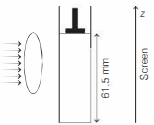
A
B
C
D
Solution
(A) The wavelength of the ultrasonic wave in water is given by $\lambda = v / f = 1500 / (0.5 \times 10^6) = 3 \times 10^{-3} \,m = 3 \,mm$.
The height of the water column is $L = 61.5 \,mm$.
For a standing wave in a column closed at one end (by the transducer) and open at the other (or reflecting off the bottom),the condition for resonance is $L = (2n - 1) \lambda / 4$.
Here,$61.5 / 3 = 20.5$,which corresponds to $L = 41 \lambda / 2$ or similar standing wave modes. The standing wave creates regions of varying density in the water.
Since the refractive index of water depends on its density,the water column acts like a diffraction grating or a phase-modulated medium for the incident light.
Light passing through regions of different densities undergoes different phase shifts,leading to interference patterns on the screen.
Because the standing wave has multiple nodes and antinodes along the $61.5 \,mm$ length,the intensity distribution on the screen will show multiple interference maxima and minima,which is best represented by the plot with multiple sharp peaks.
The height of the water column is $L = 61.5 \,mm$.
For a standing wave in a column closed at one end (by the transducer) and open at the other (or reflecting off the bottom),the condition for resonance is $L = (2n - 1) \lambda / 4$.
Here,$61.5 / 3 = 20.5$,which corresponds to $L = 41 \lambda / 2$ or similar standing wave modes. The standing wave creates regions of varying density in the water.
Since the refractive index of water depends on its density,the water column acts like a diffraction grating or a phase-modulated medium for the incident light.
Light passing through regions of different densities undergoes different phase shifts,leading to interference patterns on the screen.
Because the standing wave has multiple nodes and antinodes along the $61.5 \,mm$ length,the intensity distribution on the screen will show multiple interference maxima and minima,which is best represented by the plot with multiple sharp peaks.
0 likes
View Solution48
AdvancedMCQ
The persistence of sound in a room after the source of sound is turned off is called reverberation. The measure of reverberation time is the time required for sound intensity to decrease by $60 \,dB$. It is given that the intensity of sound falls off as $I = I_0 \exp(-c_1 \alpha)$,where $I_0$ is the initial intensity,$c_1$ is a dimensionless constant with value $1/4$. Here,$\alpha$ is a positive constant which depends on the speed of sound $v_s$,volume of the room $V$,reverberation time $t$,and the effective absorbing area $A_e$. The value of $A_e$ is the product of the absorbing coefficient and the area of the room. For a concert hall of volume $V = 600 \,m^3$,the value of $A_e$ (in $m^2$) required to give a reverberation time of $t = 1 \,s$ is closest to (speed of sound in air $v_s = 340 \,m/s$):
A
$50$
B
$100$
C
$110$
D
$67$
Solution
(B) The sound intensity level difference is given by $\Delta \beta = 10 \log_{10} (I_0 / I) = 60 \,dB$.
Thus,$\log_{10} (I_0 / I) = 6$,which implies $I_0 / I = 10^6$,or $I = I_0 \times 10^{-6}$.
Given the decay formula $I = I_0 \exp(-c_1 \alpha)$ with $c_1 = 1/4$,we have $I = I_0 \exp(-\alpha / 4)$.
Equating the two expressions for $I$: $I_0 \exp(-\alpha / 4) = I_0 \times 10^{-6}$.
Taking the natural logarithm on both sides: $-\alpha / 4 = \ln(10^{-6}) = -6 \ln(10)$.
Therefore,$\alpha = 24 \ln(10) \approx 24 \times 2.303 = 55.272$.
The relationship for $\alpha$ based on physical parameters is $\alpha = (A_e \cdot v_s \cdot t) / V$.
Rearranging for $A_e$: $A_e = (\alpha \cdot V) / (v_s \cdot t)$.
Substituting the values: $A_e = (55.272 \times 600) / (340 \times 1) = 33163.2 / 340 \approx 97.54 \,m^2$.
Rounding to the nearest option,$A_e \approx 100 \,m^2$.
Thus,$\log_{10} (I_0 / I) = 6$,which implies $I_0 / I = 10^6$,or $I = I_0 \times 10^{-6}$.
Given the decay formula $I = I_0 \exp(-c_1 \alpha)$ with $c_1 = 1/4$,we have $I = I_0 \exp(-\alpha / 4)$.
Equating the two expressions for $I$: $I_0 \exp(-\alpha / 4) = I_0 \times 10^{-6}$.
Taking the natural logarithm on both sides: $-\alpha / 4 = \ln(10^{-6}) = -6 \ln(10)$.
Therefore,$\alpha = 24 \ln(10) \approx 24 \times 2.303 = 55.272$.
The relationship for $\alpha$ based on physical parameters is $\alpha = (A_e \cdot v_s \cdot t) / V$.
Rearranging for $A_e$: $A_e = (\alpha \cdot V) / (v_s \cdot t)$.
Substituting the values: $A_e = (55.272 \times 600) / (340 \times 1) = 33163.2 / 340 \approx 97.54 \,m^2$.
Rounding to the nearest option,$A_e \approx 100 \,m^2$.
0 likes
View Solution49
DifficultMCQ
Two superimposing waves are represented by the equations $y_1 = 2 \sin 2 \pi(10 t - 0.4 x)$ and $y_2 = 4 \sin 2 \pi(20 t - 0.8 x)$. The ratio of $I_{\max}$ to $I_{\min}$ is ........
A
$36: 4$
B
$25: 9$
C
$1: 4$
D
$4: 1$
Solution
(B) The intensity of a wave is given by $I = 2 \pi^2 f^2 \rho v A^2$,which implies $I \propto f^2 A^2$.
For two waves with different frequencies,the resultant intensity varies with time. However,for the ratio of maximum to minimum intensity in the context of superposition of waves with different frequencies,we consider the amplitudes of the individual waves as $A_1' = f_1 A_1$ and $A_2' = f_2 A_2$.
Given $y_1 = 2 \sin(20 \pi t - 0.8 \pi x)$,we have $f_1 = 10 \text{ Hz}$ and $A_1 = 2$. Thus,$A_1' = 10 \times 2 = 20$.
Given $y_2 = 4 \sin(40 \pi t - 1.6 \pi x)$,we have $f_2 = 20 \text{ Hz}$ and $A_2 = 4$. Thus,$A_2' = 20 \times 4 = 80$.
The ratio of maximum to minimum intensity is given by $\frac{I_{\max}}{I_{\min}} = \frac{(A_1' + A_2')^2}{(A_2' - A_1')^2}$.
Substituting the values: $\frac{I_{\max}}{I_{\min}} = \frac{(20 + 80)^2}{(80 - 20)^2} = \frac{100^2}{60^2} = \left(\frac{100}{60}\right)^2 = \left(\frac{5}{3}\right)^2 = \frac{25}{9}$.
Therefore,the ratio is $25: 9$.
For two waves with different frequencies,the resultant intensity varies with time. However,for the ratio of maximum to minimum intensity in the context of superposition of waves with different frequencies,we consider the amplitudes of the individual waves as $A_1' = f_1 A_1$ and $A_2' = f_2 A_2$.
Given $y_1 = 2 \sin(20 \pi t - 0.8 \pi x)$,we have $f_1 = 10 \text{ Hz}$ and $A_1 = 2$. Thus,$A_1' = 10 \times 2 = 20$.
Given $y_2 = 4 \sin(40 \pi t - 1.6 \pi x)$,we have $f_2 = 20 \text{ Hz}$ and $A_2 = 4$. Thus,$A_2' = 20 \times 4 = 80$.
The ratio of maximum to minimum intensity is given by $\frac{I_{\max}}{I_{\min}} = \frac{(A_1' + A_2')^2}{(A_2' - A_1')^2}$.
Substituting the values: $\frac{I_{\max}}{I_{\min}} = \frac{(20 + 80)^2}{(80 - 20)^2} = \frac{100^2}{60^2} = \left(\frac{100}{60}\right)^2 = \left(\frac{5}{3}\right)^2 = \frac{25}{9}$.
Therefore,the ratio is $25: 9$.
0 likes
View Solution50
MediumMCQ
The ratio of intensities between two coherent sound sources is $4:1$. The difference of loudness in $dB$ between maximum and minimum intensities when they interfere in the space is ..........
A
$20 \log_{10}(3)$
B
$10 \log_{10}(2)$
C
$20 \log_{10}(3)$
D
$10 \log_{10}(3)$
Solution
(A) Given the ratio of intensities $I_1/I_2 = 4/1$,so $I_1 = 4I_2$.
Let the amplitudes be $A_1$ and $A_2$. Since $I \propto A^2$,we have $A_1/A_2 = \sqrt{I_1/I_2} = \sqrt{4/1} = 2/1$,so $A_1 = 2A_2$.
The maximum intensity is $I_{max} = (A_1 + A_2)^2 = (2A_2 + A_2)^2 = (3A_2)^2 = 9A_2^2$.
The minimum intensity is $I_{min} = (A_1 - A_2)^2 = (2A_2 - A_2)^2 = (A_2)^2 = A_2^2$.
The ratio of maximum to minimum intensity is $I_{max}/I_{min} = 9/1$.
The difference in loudness $\Delta L$ in $dB$ is given by $\Delta L = 10 \log_{10}(I_{max}/I_{min})$.
Substituting the values,$\Delta L = 10 \log_{10}(9) = 10 \log_{10}(3^2) = 20 \log_{10}(3)$.
Let the amplitudes be $A_1$ and $A_2$. Since $I \propto A^2$,we have $A_1/A_2 = \sqrt{I_1/I_2} = \sqrt{4/1} = 2/1$,so $A_1 = 2A_2$.
The maximum intensity is $I_{max} = (A_1 + A_2)^2 = (2A_2 + A_2)^2 = (3A_2)^2 = 9A_2^2$.
The minimum intensity is $I_{min} = (A_1 - A_2)^2 = (2A_2 - A_2)^2 = (A_2)^2 = A_2^2$.
The ratio of maximum to minimum intensity is $I_{max}/I_{min} = 9/1$.
The difference in loudness $\Delta L$ in $dB$ is given by $\Delta L = 10 \log_{10}(I_{max}/I_{min})$.
Substituting the values,$\Delta L = 10 \log_{10}(9) = 10 \log_{10}(3^2) = 20 \log_{10}(3)$.
0 likes
View SolutionWaves and Sound — Mix Examples-Waves and Sound · Frequently Asked Questions
1Are these Waves and Sound questions useful for JEE and NEET?
Yes. All questions in this section are mapped to JEE Main and NEET exam patterns. Previous year questions from JEE Main, NEET, GUJCET and state-level exams are included with full solutions.
2Can I switch to Hindi or Gujarati for these questions?
Yes. Use the language tabs in the hero section or the sidebar to view the same questions and solutions in English, Hindi or Gujarati.
3How do I generate a question paper from this subtopic?
Use the Vedclass Exam Paper Generator — select the chapter and subtopic, set difficulty, and generate Sets A, B, C, D automatically. First 3 chapters of every subject are free.
Vedclass Products
For Students
Vedclass Test Series
Mock tests in real JEE/NEET style with performance analysis. 5-day free trial.
Start Free TrialFor Teachers
Exam Paper Generator
Generate Set A/B/C/D papers from this chapter in 2 minutes. 3 chapters free.
Try FreeFor Institutes
Online Exam Module
Live online exams with unlimited students, 360° analytics & white-label branding.
See DemoFor Teachers & Institutes
Generate a Waves and Sound Exam Paper in 2 Minutes
Select subtopic & difficulty — Sets A, B, C, D auto-generated with No Repeat logic.
First 3 chapters of every subject are free — no payment required.