
A English
Energy and Intensity of Waves Questions in English
Class 11 Physics · Waves and Sound · Energy and Intensity of Waves
57+
Questions
English
Language
100%
With Solutions
Showing 50 of 57 questions in English
1
EasyMCQ
$A$ point source emits sound equally in all directions in a non-absorbing medium. Two points $P$ and $Q$ are at distances of $2 \ m$ and $3 \ m$ respectively from the source. The ratio of the intensities of the waves at $P$ and $Q$ is:
A
$9:4$
B
$2:3$
C
$3:2$
D
$4:9$
Solution
(A) The intensity $I$ of sound from a point source in a non-absorbing medium is inversely proportional to the square of the distance $r$ from the source,given by $I \propto \frac{1}{r^2}$.
Given distances are $r_P = 2 \ m$ and $r_Q = 3 \ m$.
The ratio of intensities at $P$ and $Q$ is $\frac{I_P}{I_Q} = \frac{r_Q^2}{r_P^2}$.
Substituting the values,we get $\frac{I_P}{I_Q} = \left( \frac{3}{2} \right)^2 = \frac{9}{4}$.
Thus,the ratio is $9:4$.
Given distances are $r_P = 2 \ m$ and $r_Q = 3 \ m$.
The ratio of intensities at $P$ and $Q$ is $\frac{I_P}{I_Q} = \frac{r_Q^2}{r_P^2}$.
Substituting the values,we get $\frac{I_P}{I_Q} = \left( \frac{3}{2} \right)^2 = \frac{9}{4}$.
Thus,the ratio is $9:4$.
0 likes
View Solution2
EasyMCQ
If the amplitude of waves at a distance $r$ from a point source is $A$,the amplitude at a distance $2r$ will be
A
$2A$
B
$A$
C
$A/2$
D
$A/4$
Solution
(C) For a spherical wave originating from a point source,the intensity $I$ is given by $I = \frac{P}{4\pi r^2}$,where $P$ is the power of the source.
Since intensity $I$ is proportional to the square of the amplitude $A$ $(I \propto A^2)$,we have $A^2 \propto \frac{1}{r^2}$.
This implies that the amplitude $A$ is inversely proportional to the distance $r$,i.e.,$A \propto \frac{1}{r}$.
Given that at distance $r$,the amplitude is $A_1 = A$.
At distance $r_2 = 2r$,the new amplitude $A_2$ will be:
$\frac{A_2}{A_1} = \frac{r_1}{r_2} = \frac{r}{2r} = \frac{1}{2}$.
Therefore,$A_2 = \frac{A}{2}$.
Since intensity $I$ is proportional to the square of the amplitude $A$ $(I \propto A^2)$,we have $A^2 \propto \frac{1}{r^2}$.
This implies that the amplitude $A$ is inversely proportional to the distance $r$,i.e.,$A \propto \frac{1}{r}$.
Given that at distance $r$,the amplitude is $A_1 = A$.
At distance $r_2 = 2r$,the new amplitude $A_2$ will be:
$\frac{A_2}{A_1} = \frac{r_1}{r_2} = \frac{r}{2r} = \frac{1}{2}$.
Therefore,$A_2 = \frac{A}{2}$.
0 likes
View Solution3
EasyMCQ
The relation between time and displacement for two particles is given by
${y_1} = 0.06 \sin 2\pi (1.04t + {\phi _1})$
${y_2} = 0.03 \sin 2\pi (1.04t + {\phi _2})$
The ratio of the intensity of the waves produced by the vibrations of the two particles will be
${y_1} = 0.06 \sin 2\pi (1.04t + {\phi _1})$
${y_2} = 0.03 \sin 2\pi (1.04t + {\phi _2})$
The ratio of the intensity of the waves produced by the vibrations of the two particles will be
A
$2:1$
B
$1:2$
C
$4:1$
D
$1:4$
Solution
(C) The intensity $I$ of a wave is directly proportional to the square of its amplitude $a$,i.e.,$I \propto a^2$.
Given the equations for the two particles:
${y_1} = 0.06 \sin 2\pi (1.04t + {\phi _1})$
${y_2} = 0.03 \sin 2\pi (1.04t + {\phi _2})$
The amplitudes are ${a_1} = 0.06$ and ${a_2} = 0.03$.
The ratio of the intensities is given by:
$\frac{{{I_1}}}{{{I_2}}} = \frac{{a_1^2}}{{a_2^2}} = \left( \frac{{0.06}}{{0.03}} \right)^2 = (2)^2 = \frac{4}{1}$.
Therefore,the ratio of the intensities is $4:1$.
Given the equations for the two particles:
${y_1} = 0.06 \sin 2\pi (1.04t + {\phi _1})$
${y_2} = 0.03 \sin 2\pi (1.04t + {\phi _2})$
The amplitudes are ${a_1} = 0.06$ and ${a_2} = 0.03$.
The ratio of the intensities is given by:
$\frac{{{I_1}}}{{{I_2}}} = \frac{{a_1^2}}{{a_2^2}} = \left( \frac{{0.06}}{{0.03}} \right)^2 = (2)^2 = \frac{4}{1}$.
Therefore,the ratio of the intensities is $4:1$.
0 likes
View Solution4
MediumMCQ
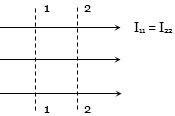
As a wave propagates:
A
The wave intensity remains constant for a plane wave.
B
Total intensity (power) of the spherical wave over the spherical surface centered at the source remains constant at all times.
C
The wave intensity decreases as the inverse square of the distance from the source for a spherical wave.
D
All of the above.
Solution
(D) The correct answer is $(d)$.
For a plane wave,the wavefronts are parallel planes,and the energy is distributed uniformly,so the intensity remains constant as the wave propagates.
For a spherical wave,the energy emitted by the source spreads over an increasing surface area $A = 4\pi r^2$. Thus,the intensity $I = P / A = P / (4\pi r^2)$ is inversely proportional to the square of the distance $r$ from the source.
The total power $P$ (often referred to as total intensity in this context) passing through any spherical surface centered at the source remains constant,as energy is conserved.
For a plane wave,the wavefronts are parallel planes,and the energy is distributed uniformly,so the intensity remains constant as the wave propagates.
For a spherical wave,the energy emitted by the source spreads over an increasing surface area $A = 4\pi r^2$. Thus,the intensity $I = P / A = P / (4\pi r^2)$ is inversely proportional to the square of the distance $r$ from the source.
The total power $P$ (often referred to as total intensity in this context) passing through any spherical surface centered at the source remains constant,as energy is conserved.
0 likes
View Solution5
EasyMCQ
With the propagation of a longitudinal wave through a material medium,the quantities transmitted in the propagation direction are
A
Energy,momentum and mass
B
Energy
C
Energy and mass
D
Energy and linear momentum
Solution
(D) wave is defined as a disturbance that travels through a medium,transporting energy and momentum from one point to another without the net transport of matter.
In a longitudinal wave,particles of the medium oscillate back and forth about their mean positions in the direction of wave propagation.
While the particles themselves do not travel with the wave (there is no net mass transfer),the wave carries energy and linear momentum through the medium.
Therefore,the correct quantities transmitted are energy and linear momentum.
In a longitudinal wave,particles of the medium oscillate back and forth about their mean positions in the direction of wave propagation.
While the particles themselves do not travel with the wave (there is no net mass transfer),the wave carries energy and linear momentum through the medium.
Therefore,the correct quantities transmitted are energy and linear momentum.
0 likes
View Solution6
EasyMCQ
The intensity of a progressing plane wave in a loss-free medium is
A
Directly proportional to the square of the amplitude of the wave
B
Directly proportional to the velocity of the wave
C
Directly proportional to the square of the frequency of the wave
D
All of the above
Solution
(D) The intensity $I$ of a progressive plane wave in a medium of density $\rho$ is given by the formula:
$I = 2\pi^2 n^2 a^2 \rho v$
where $n$ is the frequency,$a$ is the amplitude,and $v$ is the wave velocity.
From this expression,it is clear that:
$1. I \propto a^2$ (Directly proportional to the square of amplitude)
$2. I \propto v$ (Directly proportional to the velocity)
$3. I \propto n^2$ (Directly proportional to the square of frequency)
Therefore,all the given statements are correct.
Hence,the correct option is $D$.
$I = 2\pi^2 n^2 a^2 \rho v$
where $n$ is the frequency,$a$ is the amplitude,and $v$ is the wave velocity.
From this expression,it is clear that:
$1. I \propto a^2$ (Directly proportional to the square of amplitude)
$2. I \propto v$ (Directly proportional to the velocity)
$3. I \propto n^2$ (Directly proportional to the square of frequency)
Therefore,all the given statements are correct.
Hence,the correct option is $D$.
0 likes
View Solution7
EasyMCQ
Two waves represented by the following equations are travelling in the same medium: $y_1 = 5\sin 2\pi (75t - 0.25x)$ and $y_2 = 10\sin 2\pi (150t - 0.50x)$. The intensity ratio $I_1/I_2$ of the two waves is:
A
$1:2$
B
$1:4$
C
$1:8$
D
$1:16$
Solution
(B) The intensity $I$ of a wave is directly proportional to the square of its amplitude $a$ $(I \propto a^2)$.
Given the wave equations:
$y_1 = 5\sin 2\pi (75t - 0.25x) \implies a_1 = 5$
$y_2 = 10\sin 2\pi (150t - 0.50x) \implies a_2 = 10$
The ratio of intensities is given by $\frac{I_1}{I_2} = \frac{a_1^2}{a_2^2}$.
Substituting the values: $\frac{I_1}{I_2} = \frac{5^2}{10^2} = \frac{25}{100} = \frac{1}{4}$.
Thus,the intensity ratio is $1:4$.
Given the wave equations:
$y_1 = 5\sin 2\pi (75t - 0.25x) \implies a_1 = 5$
$y_2 = 10\sin 2\pi (150t - 0.50x) \implies a_2 = 10$
The ratio of intensities is given by $\frac{I_1}{I_2} = \frac{a_1^2}{a_2^2}$.
Substituting the values: $\frac{I_1}{I_2} = \frac{5^2}{10^2} = \frac{25}{100} = \frac{1}{4}$.
Thus,the intensity ratio is $1:4$.
0 likes
View Solution8
EasyMCQ
The intensity ratio of two waves is $1 : 16$. The ratio of their amplitudes is
A
$1:16$
B
$1:4$
C
$4:1$
D
$2:1$
Solution
(B) The intensity $I$ of a wave is directly proportional to the square of its amplitude $a$,i.e.,$I \propto a^2$.
Given the ratio of intensities is $\frac{I_1}{I_2} = \frac{1}{16}$.
Using the relation $\frac{I_1}{I_2} = \left( \frac{a_1}{a_2} \right)^2$,we have $\left( \frac{a_1}{a_2} \right)^2 = \frac{1}{16}$.
Taking the square root on both sides,we get $\frac{a_1}{a_2} = \sqrt{\frac{1}{16}} = \frac{1}{4}$.
Therefore,the ratio of their amplitudes is $1:4$.
Given the ratio of intensities is $\frac{I_1}{I_2} = \frac{1}{16}$.
Using the relation $\frac{I_1}{I_2} = \left( \frac{a_1}{a_2} \right)^2$,we have $\left( \frac{a_1}{a_2} \right)^2 = \frac{1}{16}$.
Taking the square root on both sides,we get $\frac{a_1}{a_2} = \sqrt{\frac{1}{16}} = \frac{1}{4}$.
Therefore,the ratio of their amplitudes is $1:4$.
0 likes
View Solution9
MediumMCQ
If the ratio of the amplitudes of two waves is $2:1$,then the ratio of their maximum and minimum intensity is:
A
$9:1$
B
$1:9$
C
$4:1$
D
$1:4$
Solution
(A) The intensity $I$ of a wave is directly proportional to the square of its amplitude $a$,i.e.,$I \propto a^2$.
Let the amplitudes be $a_1$ and $a_2$. Given $\frac{a_1}{a_2} = \frac{2}{1}$.
The maximum intensity $I_{\max}$ is proportional to $(a_1 + a_2)^2$ and the minimum intensity $I_{\min}$ is proportional to $(a_1 - a_2)^2$.
Therefore,the ratio of maximum to minimum intensity is given by:
$\frac{I_{\max}}{I_{\min}} = \left( \frac{a_1 + a_2}{a_1 - a_2} \right)^2 = \left( \frac{\frac{a_1}{a_2} + 1}{\frac{a_1}{a_2} - 1} \right)^2$.
Substituting the given ratio $\frac{a_1}{a_2} = 2$:
$\frac{I_{\max}}{I_{\min}} = \left( \frac{2 + 1}{2 - 1} \right)^2 = \left( \frac{3}{1} \right)^2 = \frac{9}{1}$.
Thus,the ratio is $9:1$.
Let the amplitudes be $a_1$ and $a_2$. Given $\frac{a_1}{a_2} = \frac{2}{1}$.
The maximum intensity $I_{\max}$ is proportional to $(a_1 + a_2)^2$ and the minimum intensity $I_{\min}$ is proportional to $(a_1 - a_2)^2$.
Therefore,the ratio of maximum to minimum intensity is given by:
$\frac{I_{\max}}{I_{\min}} = \left( \frac{a_1 + a_2}{a_1 - a_2} \right)^2 = \left( \frac{\frac{a_1}{a_2} + 1}{\frac{a_1}{a_2} - 1} \right)^2$.
Substituting the given ratio $\frac{a_1}{a_2} = 2$:
$\frac{I_{\max}}{I_{\min}} = \left( \frac{2 + 1}{2 - 1} \right)^2 = \left( \frac{3}{1} \right)^2 = \frac{9}{1}$.
Thus,the ratio is $9:1$.
0 likes
View Solution10
MediumMCQ
If the ratio of the amplitude of two waves is $4 : 3$,then the ratio of their maximum and minimum intensity will be:
A
$16:18$
B
$18:16$
C
$49:1$
D
$1:49$
Solution
(C) The intensity $I$ of a wave is proportional to the square of its amplitude $a$,i.e.,$I \propto a^2$.
For two waves with amplitudes $a_1$ and $a_2$,the ratio of maximum intensity to minimum intensity is given by the formula:
$\frac{I_{\max}}{I_{\min}} = \left( \frac{a_1 + a_2}{a_1 - a_2} \right)^2 = \left( \frac{\frac{a_1}{a_2} + 1}{\frac{a_1}{a_2} - 1} \right)^2$.
Given the ratio of amplitudes $\frac{a_1}{a_2} = \frac{4}{3}$.
Substituting the values into the formula:
$\frac{I_{\max}}{I_{\min}} = \left( \frac{\frac{4}{3} + 1}{\frac{4}{3} - 1} \right)^2 = \left( \frac{\frac{7}{3}}{\frac{1}{3}} \right)^2 = (7)^2 = \frac{49}{1}$.
Thus,the ratio is $49:1$.
For two waves with amplitudes $a_1$ and $a_2$,the ratio of maximum intensity to minimum intensity is given by the formula:
$\frac{I_{\max}}{I_{\min}} = \left( \frac{a_1 + a_2}{a_1 - a_2} \right)^2 = \left( \frac{\frac{a_1}{a_2} + 1}{\frac{a_1}{a_2} - 1} \right)^2$.
Given the ratio of amplitudes $\frac{a_1}{a_2} = \frac{4}{3}$.
Substituting the values into the formula:
$\frac{I_{\max}}{I_{\min}} = \left( \frac{\frac{4}{3} + 1}{\frac{4}{3} - 1} \right)^2 = \left( \frac{\frac{7}{3}}{\frac{1}{3}} \right)^2 = (7)^2 = \frac{49}{1}$.
Thus,the ratio is $49:1$.
0 likes
View Solution11
EasyMCQ
$A$ spherical source of power $4 W$ and frequency $800 Hz$ is emitting sound waves. The intensity of waves at a distance $200 m$ is
A
$8 \times 10^{-6} W/m^2$
B
$2 \times 10^{-4} W/m^2$
C
$1 \times 10^{-4} W/m^2$
D
$4 W/m^2$
Solution
(A) The intensity $I$ of a spherical wave at a distance $r$ from a source of power $P$ is given by the formula: $I = \frac{P}{A} = \frac{P}{4\pi r^2}$.
Given: Power $P = 4 W$,distance $r = 200 m$.
Substituting the values: $I = \frac{4}{4\pi \times (200)^2}$.
$I = \frac{1}{\pi \times 40000} = \frac{1}{125663.7} W/m^2$.
$I \approx 7.957 \times 10^{-6} W/m^2$.
Rounding to the nearest provided option,we get $I \approx 8 \times 10^{-6} W/m^2$.
Given: Power $P = 4 W$,distance $r = 200 m$.
Substituting the values: $I = \frac{4}{4\pi \times (200)^2}$.
$I = \frac{1}{\pi \times 40000} = \frac{1}{125663.7} W/m^2$.
$I \approx 7.957 \times 10^{-6} W/m^2$.
Rounding to the nearest provided option,we get $I \approx 8 \times 10^{-6} W/m^2$.
0 likes
View Solution12
EasyMCQ
If the pressure amplitude in a sound wave is tripled,then the intensity of sound is increased by a factor of
A
$9$
B
$3$
C
$6$
D
$1.73$
Solution
(A) The intensity $I$ of a sound wave is directly proportional to the square of the pressure amplitude $P_0$,given by the relation $I \propto P_0^2$.
If the pressure amplitude is tripled,the new pressure amplitude $P_0' = 3P_0$.
The new intensity $I'$ will be $I' \propto (P_0')^2 = (3P_0)^2 = 9P_0^2$.
Therefore,$I' = 9I$.
The intensity of the sound increases by a factor of $9$.
If the pressure amplitude is tripled,the new pressure amplitude $P_0' = 3P_0$.
The new intensity $I'$ will be $I' \propto (P_0')^2 = (3P_0)^2 = 9P_0^2$.
Therefore,$I' = 9I$.
The intensity of the sound increases by a factor of $9$.
0 likes
View Solution13
MediumMCQ
If the amplitude of sound is doubled and the frequency is reduced to one-fourth,the intensity of sound at the same point will be
A
Increased by a factor of $2$
B
Decreased by a factor of $2$
C
Decreased by a factor of $4$
D
Unchanged
Solution
(C) The intensity of a sound wave is given by the formula $I = 2{\pi ^2}{a^2}{n^2}\rho v$,where $a$ is the amplitude and $n$ is the frequency.
From this,we see that $I \propto {a^2}{n^2}$.
Let the initial amplitude be $a_1$ and frequency be $n_1$. Let the final amplitude be $a_2 = 2a_1$ and frequency be $n_2 = n_1/4$.
The ratio of intensities is $\frac{I_2}{I_1} = \left( \frac{a_2}{a_1} \right)^2 \times \left( \frac{n_2}{n_1} \right)^2$.
Substituting the values: $\frac{I_2}{I_1} = (2)^2 \times (1/4)^2 = 4 \times (1/16) = 1/4$.
Therefore,$I_2 = I_1/4$,which means the intensity is decreased by a factor of $4$.
From this,we see that $I \propto {a^2}{n^2}$.
Let the initial amplitude be $a_1$ and frequency be $n_1$. Let the final amplitude be $a_2 = 2a_1$ and frequency be $n_2 = n_1/4$.
The ratio of intensities is $\frac{I_2}{I_1} = \left( \frac{a_2}{a_1} \right)^2 \times \left( \frac{n_2}{n_1} \right)^2$.
Substituting the values: $\frac{I_2}{I_1} = (2)^2 \times (1/4)^2 = 4 \times (1/16) = 1/4$.
Therefore,$I_2 = I_1/4$,which means the intensity is decreased by a factor of $4$.
0 likes
View Solution14
EasyMCQ
The amplitudes of two waves are in the ratio $5 : 2$. If all other conditions for the two waves are the same,what is the ratio of their energy densities?
A
$5:2$
B
$10:4$
C
$25:4$
D
$25:4$
Solution
(D) The energy density $(u)$ of a wave is directly proportional to the square of its amplitude $(A)$.
Mathematically,$u \propto A^2$.
Given the ratio of amplitudes $A_1 : A_2 = 5 : 2$.
The ratio of their energy densities is given by $\frac{u_1}{u_2} = \left( \frac{A_1}{A_2} \right)^2$.
Substituting the values,$\frac{u_1}{u_2} = \left( \frac{5}{2} \right)^2 = \frac{25}{4}$.
Thus,the ratio of their energy densities is $25 : 4$.
Mathematically,$u \propto A^2$.
Given the ratio of amplitudes $A_1 : A_2 = 5 : 2$.
The ratio of their energy densities is given by $\frac{u_1}{u_2} = \left( \frac{A_1}{A_2} \right)^2$.
Substituting the values,$\frac{u_1}{u_2} = \left( \frac{5}{2} \right)^2 = \frac{25}{4}$.
Thus,the ratio of their energy densities is $25 : 4$.
0 likes
View Solution15
EasyMCQ
$A$ is singing a note and at the same time $B$ is singing a note with exactly one-eighth the frequency of the note of $A$. If the energies of the two sounds are equal,the amplitude of the note of $B$ is:
A
Same as that of $A$
B
Twice as that of $A$
C
Four times as that of $A$
D
Eight times as that of $A$
Solution
(D) The energy $E$ of a sound wave is given by the relation $E \propto a^2 n^2$,where $a$ is the amplitude and $n$ is the frequency.
Since the energies of the two sounds are equal,we have $E_A = E_B$.
Therefore,$a_A^2 n_A^2 = a_B^2 n_B^2$.
Given that the frequency of $B$ is one-eighth the frequency of $A$,we have $n_B = \frac{1}{8} n_A$,or $\frac{n_A}{n_B} = 8$.
Rearranging the energy equation: $\frac{a_B^2}{a_A^2} = \frac{n_A^2}{n_B^2}$.
Taking the square root on both sides: $\frac{a_B}{a_A} = \frac{n_A}{n_B} = 8$.
Thus,$a_B = 8 a_A$.
The amplitude of the note of $B$ is eight times that of $A$.
Since the energies of the two sounds are equal,we have $E_A = E_B$.
Therefore,$a_A^2 n_A^2 = a_B^2 n_B^2$.
Given that the frequency of $B$ is one-eighth the frequency of $A$,we have $n_B = \frac{1}{8} n_A$,or $\frac{n_A}{n_B} = 8$.
Rearranging the energy equation: $\frac{a_B^2}{a_A^2} = \frac{n_A^2}{n_B^2}$.
Taking the square root on both sides: $\frac{a_B}{a_A} = \frac{n_A}{n_B} = 8$.
Thus,$a_B = 8 a_A$.
The amplitude of the note of $B$ is eight times that of $A$.
0 likes
View Solution16
EasyMCQ
The intensity of sound from a radio at a distance of $2 \ m$ from its speaker is $1 \times 10^{-2} \ \mu W/m^2$. The intensity at a distance of $10 \ m$ would be:
A
$0.2 \times 10^{-2} \ \mu W/m^2$
B
$1 \times 10^{-2} \ \mu W/m^2$
C
$4 \times 10^{-4} \ \mu W/m^2$
D
$5 \times 10^{-2} \ \mu W/m^2$
Solution
(C) The intensity of a spherical sound wave is inversely proportional to the square of the distance from the source: $I \propto \frac{1}{r^2}$.
Given: $I_1 = 1 \times 10^{-2} \ \mu W/m^2$ at $r_1 = 2 \ m$.
We need to find $I_2$ at $r_2 = 10 \ m$.
Using the relation $\frac{I_2}{I_1} = \frac{r_1^2}{r_2^2}$:
$\frac{I_2}{1 \times 10^{-2}} = \frac{2^2}{10^2} = \frac{4}{100} = 0.04$.
Therefore,$I_2 = 0.04 \times 10^{-2} \ \mu W/m^2 = 4 \times 10^{-4} \ \mu W/m^2$.
Given: $I_1 = 1 \times 10^{-2} \ \mu W/m^2$ at $r_1 = 2 \ m$.
We need to find $I_2$ at $r_2 = 10 \ m$.
Using the relation $\frac{I_2}{I_1} = \frac{r_1^2}{r_2^2}$:
$\frac{I_2}{1 \times 10^{-2}} = \frac{2^2}{10^2} = \frac{4}{100} = 0.04$.
Therefore,$I_2 = 0.04 \times 10^{-2} \ \mu W/m^2 = 4 \times 10^{-4} \ \mu W/m^2$.
0 likes
View Solution17
MediumMCQ
The intensity of a sound wave while passing through an elastic medium falls by $10\%$ as it covers $1 \ m$ distance through the medium. If the initial intensity of the sound wave was $100 \ dB$,its value after it has passed through $3 \ m$ thickness of the medium will be .... $dB$.
A
$70$
B
$72.9$
C
$81$
D
$60$
Solution
(B) The intensity of the sound wave decreases by $10\%$ for every $1 \ m$ distance covered.
This means that after $1 \ m$,the intensity becomes $90\%$ of the initial intensity,i.e.,$0.9 \ I_0$.
After passing through $3 \ m$,the intensity $I_3$ will be:
$I_3 = I_0 \times (0.9) \times (0.9) \times (0.9)$
$I_3 = I_0 \times (0.9)^3$
$I_3 = I_0 \times 0.729$
Given the initial intensity $I_0 = 100 \ dB$,the final intensity is:
$I_3 = 100 \times 0.729 = 72.9 \ dB$.
This means that after $1 \ m$,the intensity becomes $90\%$ of the initial intensity,i.e.,$0.9 \ I_0$.
After passing through $3 \ m$,the intensity $I_3$ will be:
$I_3 = I_0 \times (0.9) \times (0.9) \times (0.9)$
$I_3 = I_0 \times (0.9)^3$
$I_3 = I_0 \times 0.729$
Given the initial intensity $I_0 = 100 \ dB$,the final intensity is:
$I_3 = 100 \times 0.729 = 72.9 \ dB$.
0 likes
View Solution18
EasyMCQ
If the separation between the screen and the source is increased by $2\%$,what would be the effect on the intensity?
A
Increases by $4\%$
B
Increases by $2\%$
C
Decreases by $2\%$
D
Decreases by $4\%$
Solution
(D) The intensity $I$ of a point source at a distance $r$ is given by the inverse square law: $I \propto \frac{1}{r^2}$.
Taking the logarithmic derivative,we get: $\frac{\Delta I}{I} = -2 \frac{\Delta r}{r}$.
Given that the separation $r$ is increased by $2\%$,we have $\frac{\Delta r}{r} = 0.02$.
Substituting this value: $\frac{\Delta I}{I} = -2 \times 0.02 = -0.04$.
This corresponds to a decrease of $4\%$.
Therefore,the intensity decreases by $4\%$.
Taking the logarithmic derivative,we get: $\frac{\Delta I}{I} = -2 \frac{\Delta r}{r}$.
Given that the separation $r$ is increased by $2\%$,we have $\frac{\Delta r}{r} = 0.02$.
Substituting this value: $\frac{\Delta I}{I} = -2 \times 0.02 = -0.04$.
This corresponds to a decrease of $4\%$.
Therefore,the intensity decreases by $4\%$.
0 likes
View Solution19
DifficultMCQ
The intensity level at a distance of $200 \ cm$ from a sound source is $80 \ dB$. If there is no loss of acoustic power in the air and the threshold intensity of hearing is $10^{-12} \ W/m^2$,what is the intensity level at a distance of $400 \ cm$ from the source (in $dB$)?
A
$0$
B
$74$
C
$64$
D
$44$
Solution
(B) The intensity $I$ of a spherical sound wave follows the inverse square law: $I \propto \frac{1}{r^2}$.
Given $r_1 = 200 \ cm$ and $r_2 = 400 \ cm$,the ratio of intensities is $\frac{I_2}{I_1} = \left(\frac{r_1}{r_2}\right)^2 = \left(\frac{200}{400}\right)^2 = \left(\frac{1}{2}\right)^2 = \frac{1}{4}$.
Thus,$I_1 = 4I_2$.
The intensity level $L$ in decibels is given by $L = 10 \log_{10}\left(\frac{I}{I_0}\right)$.
The difference in intensity levels is $L_1 - L_2 = 10 \log_{10}\left(\frac{I_1}{I_2}\right)$.
Substituting the ratio: $L_1 - L_2 = 10 \log_{10}(4) = 10 \times 0.602 = 6.02 \ dB \approx 6 \ dB$.
Therefore,$L_2 = L_1 - 6 \ dB = 80 \ dB - 6 \ dB = 74 \ dB$.
Given $r_1 = 200 \ cm$ and $r_2 = 400 \ cm$,the ratio of intensities is $\frac{I_2}{I_1} = \left(\frac{r_1}{r_2}\right)^2 = \left(\frac{200}{400}\right)^2 = \left(\frac{1}{2}\right)^2 = \frac{1}{4}$.
Thus,$I_1 = 4I_2$.
The intensity level $L$ in decibels is given by $L = 10 \log_{10}\left(\frac{I}{I_0}\right)$.
The difference in intensity levels is $L_1 - L_2 = 10 \log_{10}\left(\frac{I_1}{I_2}\right)$.
Substituting the ratio: $L_1 - L_2 = 10 \log_{10}(4) = 10 \times 0.602 = 6.02 \ dB \approx 6 \ dB$.
Therefore,$L_2 = L_1 - 6 \ dB = 80 \ dB - 6 \ dB = 74 \ dB$.
0 likes
View Solution20
MediumMCQ
Consider ten identical sources of sound,all emitting the same frequency but having random phase angles. If the average intensity of each source is $I_0$,what will be the average resultant intensity $I$ due to all these ten sources?
A
$I = 100\,I_0$
B
$I = 10\,I_0$
C
$I = I_0$
D
$I = \sqrt{10}\,I_0$
Solution
(B) For the interference of two waves,the resultant intensity is given by $I = I_1 + I_2 + 2\sqrt{I_1 I_2} \cos \phi$.
If the phase difference $\phi$ varies randomly with time,the average value of the cosine term is $(\cos \phi)_{av} = 0$.
Therefore,the average resultant intensity becomes $I = I_1 + I_2$.
For $n$ identical sources,each with intensity $I_0$,the total average intensity is the sum of the individual intensities: $I = I_0 + I_0 + \dots + I_0$ ($n$ times).
Thus,$I = n\,I_0$.
Given $n = 10$,the resultant intensity is $I = 10\,I_0$.
If the phase difference $\phi$ varies randomly with time,the average value of the cosine term is $(\cos \phi)_{av} = 0$.
Therefore,the average resultant intensity becomes $I = I_1 + I_2$.
For $n$ identical sources,each with intensity $I_0$,the total average intensity is the sum of the individual intensities: $I = I_0 + I_0 + \dots + I_0$ ($n$ times).
Thus,$I = n\,I_0$.
Given $n = 10$,the resultant intensity is $I = 10\,I_0$.
0 likes
View Solution21
MediumMCQ
$A$ person speaking normally produces a sound intensity of $40 \ dB$ at a distance of $1 \ m$. If the threshold intensity for reasonable audibility is $20 \ dB$,the maximum distance at which he can be heard clearly is ... $m$.
A
$4$
B
$5$
C
$10$
D
$20$
Solution
(C) The sound intensity level in decibels is given by $\beta = 10 \log_{10} \left( \frac{I}{I_0} \right)$.
At $r_1 = 1 \ m$,$\beta_1 = 40 \ dB$. Thus,$40 = 10 \log_{10} \left( \frac{I_1}{I_0} \right) \implies \frac{I_1}{I_0} = 10^4$.
At distance $r_2$,$\beta_2 = 20 \ dB$. Thus,$20 = 10 \log_{10} \left( \frac{I_2}{I_0} \right) \implies \frac{I_2}{I_0} = 10^2$.
Dividing the two equations: $\frac{I_1}{I_2} = \frac{10^4}{10^2} = 10^2 = 100$.
Since intensity $I \propto \frac{1}{r^2}$,we have $\frac{I_1}{I_2} = \frac{r_2^2}{r_1^2}$.
Substituting the values: $100 = \frac{r_2^2}{(1)^2} \implies r_2^2 = 100 \implies r_2 = 10 \ m$.
At $r_1 = 1 \ m$,$\beta_1 = 40 \ dB$. Thus,$40 = 10 \log_{10} \left( \frac{I_1}{I_0} \right) \implies \frac{I_1}{I_0} = 10^4$.
At distance $r_2$,$\beta_2 = 20 \ dB$. Thus,$20 = 10 \log_{10} \left( \frac{I_2}{I_0} \right) \implies \frac{I_2}{I_0} = 10^2$.
Dividing the two equations: $\frac{I_1}{I_2} = \frac{10^4}{10^2} = 10^2 = 100$.
Since intensity $I \propto \frac{1}{r^2}$,we have $\frac{I_1}{I_2} = \frac{r_2^2}{r_1^2}$.
Substituting the values: $100 = \frac{r_2^2}{(1)^2} \implies r_2^2 = 100 \implies r_2 = 10 \ m$.
0 likes
View Solution22
MediumMCQ
$A$ sound source emits sound waves in a uniform medium. If energy density is $E$ and maximum speed of the particles of the medium is ${v_{\max }}$,the plot between $E$ and ${v_{\max }}$ is best represented by
A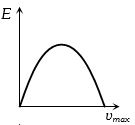
B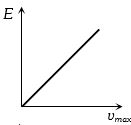
C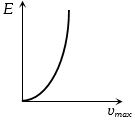
D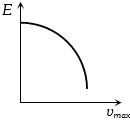
Solution
(C) The energy density $(E)$ of a sound wave is given by the formula: $E = 2{\pi ^2}\rho {n^2}{A^2}$.
Here,$\rho$ is the density of the medium,$n$ is the frequency,and $A$ is the amplitude.
The maximum speed of the particles of the medium is given by: ${v_{\max }} = \omega A = 2\pi nA$.
Squaring the expression for ${v_{\max }}$,we get: ${({v_{\max }})^2} = 4{\pi ^2}{n^2}{A^2}$.
Comparing the two expressions,we can see that $E = \frac{1}{2}\rho {({v_{\max }})^2}$.
This implies that $E \propto {({v_{\max }})^2}$.
Since $E$ is proportional to the square of ${v_{\max }}$,the graph between $E$ and ${v_{\max }}$ will be a parabola opening upwards,which is represented by Graph $C$.
Here,$\rho$ is the density of the medium,$n$ is the frequency,and $A$ is the amplitude.
The maximum speed of the particles of the medium is given by: ${v_{\max }} = \omega A = 2\pi nA$.
Squaring the expression for ${v_{\max }}$,we get: ${({v_{\max }})^2} = 4{\pi ^2}{n^2}{A^2}$.
Comparing the two expressions,we can see that $E = \frac{1}{2}\rho {({v_{\max }})^2}$.
This implies that $E \propto {({v_{\max }})^2}$.
Since $E$ is proportional to the square of ${v_{\max }}$,the graph between $E$ and ${v_{\max }}$ will be a parabola opening upwards,which is represented by Graph $C$.
0 likes
View Solution23
MediumMCQ
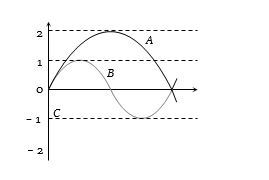
The displacement-time graphs for two sound waves $A$ and $B$ are shown in the figure. The ratio of their intensities $I_A/I_B$ is equal to:
A
$1:4$
B
$1:16$
C
$1:2$
D
$1:1$
Solution
(D) The intensity $I$ of a sound wave is proportional to the square of its amplitude $a$ and the square of its angular frequency $\omega$,i.e.,$I \propto a^2 \omega^2$.
From the given graph:
For wave $A$,the amplitude $a_A = 2$ units and the time period $T_A = 2$ units (as it completes one cycle in $2$ units of time).
For wave $B$,the amplitude $a_B = 1$ unit and the time period $T_B = 1$ unit (as it completes one cycle in $1$ unit of time).
Since angular frequency $\omega = 2\pi/T$,we have $\omega_A / \omega_B = T_B / T_A = 1/2$.
Now,the ratio of intensities is:
$\frac{I_A}{I_B} = \left( \frac{a_A}{a_B} \right)^2 \times \left( \frac{\omega_A}{\omega_B} \right)^2$
$\frac{I_A}{I_B} = \left( \frac{2}{1} \right)^2 \times \left( \frac{1}{2} \right)^2 = 4 \times \frac{1}{4} = 1$
Thus,the ratio $I_A/I_B$ is $1:1$.
From the given graph:
For wave $A$,the amplitude $a_A = 2$ units and the time period $T_A = 2$ units (as it completes one cycle in $2$ units of time).
For wave $B$,the amplitude $a_B = 1$ unit and the time period $T_B = 1$ unit (as it completes one cycle in $1$ unit of time).
Since angular frequency $\omega = 2\pi/T$,we have $\omega_A / \omega_B = T_B / T_A = 1/2$.
Now,the ratio of intensities is:
$\frac{I_A}{I_B} = \left( \frac{a_A}{a_B} \right)^2 \times \left( \frac{\omega_A}{\omega_B} \right)^2$
$\frac{I_A}{I_B} = \left( \frac{2}{1} \right)^2 \times \left( \frac{1}{2} \right)^2 = 4 \times \frac{1}{4} = 1$
Thus,the ratio $I_A/I_B$ is $1:1$.
0 likes
View Solution24
EasyMCQ
$A$ wave can transmit ...... from one place to another.
A
Energy
B
Amplitude
C
Wavelength
D
Matter
Solution
(A) wave is defined as a disturbance that travels through a medium or vacuum,transferring energy from one point to another without the net transport of matter.
Therefore,the correct option is $A$.
Therefore,the correct option is $A$.
0 likes
View Solution25
EasyMCQ
If the ratio of intensities of two waves is $1 : 25$,then the ratio of their amplitudes will be
A
$1:25$
B
$5:1$
C
$26:27$
D
$1:5$
Solution
(D) The intensity $I$ of a wave is directly proportional to the square of its amplitude $a$,i.e.,$I \propto a^2$.
Given the ratio of intensities is $\frac{I_1}{I_2} = \frac{1}{25}$.
Since $\frac{I_1}{I_2} = \frac{a_1^2}{a_2^2}$,we have $\frac{a_1^2}{a_2^2} = \frac{1}{25}$.
Taking the square root on both sides,we get $\frac{a_1}{a_2} = \sqrt{\frac{1}{25}} = \frac{1}{5}$.
Therefore,the ratio of their amplitudes is $1:5$.
Given the ratio of intensities is $\frac{I_1}{I_2} = \frac{1}{25}$.
Since $\frac{I_1}{I_2} = \frac{a_1^2}{a_2^2}$,we have $\frac{a_1^2}{a_2^2} = \frac{1}{25}$.
Taking the square root on both sides,we get $\frac{a_1}{a_2} = \sqrt{\frac{1}{25}} = \frac{1}{5}$.
Therefore,the ratio of their amplitudes is $1:5$.
0 likes
View Solution26
EasyMCQ
The ratio of intensities of two waves is given by $4:1$. The ratio of the amplitudes of the two waves is
A
$2:1$
B
$1:2$
C
$4:1$
D
$1:4$
Solution
(A) The intensity $I$ of a wave is directly proportional to the square of its amplitude $a$,i.e.,$I \propto a^2$.
Given the ratio of intensities is $\frac{I_1}{I_2} = \frac{4}{1}$.
Since $\frac{I_1}{I_2} = \left( \frac{a_1}{a_2} \right)^2$,we have $\left( \frac{a_1}{a_2} \right)^2 = \frac{4}{1}$.
Taking the square root on both sides,we get $\frac{a_1}{a_2} = \sqrt{\frac{4}{1}} = \frac{2}{1}$.
Therefore,the ratio of the amplitudes is $2:1$.
Given the ratio of intensities is $\frac{I_1}{I_2} = \frac{4}{1}$.
Since $\frac{I_1}{I_2} = \left( \frac{a_1}{a_2} \right)^2$,we have $\left( \frac{a_1}{a_2} \right)^2 = \frac{4}{1}$.
Taking the square root on both sides,we get $\frac{a_1}{a_2} = \sqrt{\frac{4}{1}} = \frac{2}{1}$.
Therefore,the ratio of the amplitudes is $2:1$.
0 likes
View Solution27
MediumMCQ
If the ratio of the amplitude of two waves is $4:3$,then the ratio of their maximum and minimum intensity is:
A
$16:18$
B
$18:16$
C
$49:1$
D
$94:1$
Solution
(C) The intensity $I$ of a wave is proportional to the square of its amplitude $a$,i.e.,$I \propto a^2$.
For two waves with amplitudes $a_1$ and $a_2$,the ratio of maximum intensity to minimum intensity is given by the formula:
$\frac{I_{\max}}{I_{\min}} = \left( \frac{a_1 + a_2}{a_1 - a_2} \right)^2 = \left( \frac{\frac{a_1}{a_2} + 1}{\frac{a_1}{a_2} - 1} \right)^2$
Given the ratio of amplitudes $\frac{a_1}{a_2} = \frac{4}{3}$,we substitute this into the formula:
$\frac{I_{\max}}{I_{\min}} = \left( \frac{\frac{4}{3} + 1}{\frac{4}{3} - 1} \right)^2 = \left( \frac{\frac{7}{3}}{\frac{1}{3}} \right)^2 = (7)^2 = \frac{49}{1}$
Thus,the ratio of maximum and minimum intensity is $49:1$.
For two waves with amplitudes $a_1$ and $a_2$,the ratio of maximum intensity to minimum intensity is given by the formula:
$\frac{I_{\max}}{I_{\min}} = \left( \frac{a_1 + a_2}{a_1 - a_2} \right)^2 = \left( \frac{\frac{a_1}{a_2} + 1}{\frac{a_1}{a_2} - 1} \right)^2$
Given the ratio of amplitudes $\frac{a_1}{a_2} = \frac{4}{3}$,we substitute this into the formula:
$\frac{I_{\max}}{I_{\min}} = \left( \frac{\frac{4}{3} + 1}{\frac{4}{3} - 1} \right)^2 = \left( \frac{\frac{7}{3}}{\frac{1}{3}} \right)^2 = (7)^2 = \frac{49}{1}$
Thus,the ratio of maximum and minimum intensity is $49:1$.
0 likes
View Solution28
MediumMCQ
If the distance between the source and the screen is increased by $2\%$,what will be the effect on the intensity on the screen?
A
Increase by $4\%$.
B
Increase by $2\%$.
C
Decrease by $2\%$.
D
Decrease by $4\%$.
Solution
(D) The intensity $I$ of a point source is inversely proportional to the square of the distance $r$ from the source: $I \propto \frac{1}{r^2}$.
Given that the distance $r$ increases by $2\%$,the new distance $r_2 = r_1 + 0.02r_1 = 1.02r_1$.
The ratio of intensities is given by $\frac{I_2}{I_1} = \left( \frac{r_1}{r_2} \right)^2 = \left( \frac{r_1}{1.02r_1} \right)^2 = (1.02)^{-2}$.
Using the binomial approximation $(1+x)^n \approx 1+nx$ for small $x$,where $x = 0.02$ and $n = -2$:
$I_2 = I_1(1 + 0.02)^{-2} \approx I_1(1 - 2 \times 0.02) = I_1(1 - 0.04)$.
$I_2 = I_1 - 0.04I_1$.
This represents a decrease of $4\%$ in intensity.
Given that the distance $r$ increases by $2\%$,the new distance $r_2 = r_1 + 0.02r_1 = 1.02r_1$.
The ratio of intensities is given by $\frac{I_2}{I_1} = \left( \frac{r_1}{r_2} \right)^2 = \left( \frac{r_1}{1.02r_1} \right)^2 = (1.02)^{-2}$.
Using the binomial approximation $(1+x)^n \approx 1+nx$ for small $x$,where $x = 0.02$ and $n = -2$:
$I_2 = I_1(1 + 0.02)^{-2} \approx I_1(1 - 2 \times 0.02) = I_1(1 - 0.04)$.
$I_2 = I_1 - 0.04I_1$.
This represents a decrease of $4\%$ in intensity.
0 likes
View Solution29
MediumMCQ
$A$ stone is dropped in still water,creating a circular wave pattern that spreads outward. If $r$ is the distance from the center of this circular pattern,the amplitude of the wave is proportional to ........
A
$r^{-1/2}$
B
$r^{-1}$
C
$r^{-2}$
D
$r^{-3/2}$
Solution
(A) The intensity $I$ of a wave is defined as the power $P$ per unit area $A$.
For a circular wave spreading in two dimensions on the surface of water,the area $A$ is proportional to the circumference,which is $2\pi r$.
Thus,the intensity $I$ is given by $I = \frac{P}{2\pi r}$,which implies $I \propto \frac{1}{r}$.
Since the intensity $I$ is proportional to the square of the amplitude $A_{amp}$ (i.e.,$I \propto A_{amp}^2$),we have $A_{amp}^2 \propto \frac{1}{r}$.
Therefore,the amplitude $A_{amp}$ is proportional to $r^{-1/2}$.
For a circular wave spreading in two dimensions on the surface of water,the area $A$ is proportional to the circumference,which is $2\pi r$.
Thus,the intensity $I$ is given by $I = \frac{P}{2\pi r}$,which implies $I \propto \frac{1}{r}$.
Since the intensity $I$ is proportional to the square of the amplitude $A_{amp}$ (i.e.,$I \propto A_{amp}^2$),we have $A_{amp}^2 \propto \frac{1}{r}$.
Therefore,the amplitude $A_{amp}$ is proportional to $r^{-1/2}$.
0 likes
View Solution30
EasyMCQ
Which property distinguishes progressive waves from stationary waves?
A
Amplitude
B
Frequency
C
Energy transport
D
Phase
Solution
(C) In a progressive wave,energy is transported from one point to another through the medium as the wave propagates.
In a stationary (standing) wave,the energy is confined within the medium between the nodes and does not propagate or transport across the medium.
Therefore,the property that distinguishes them is the transport of energy.
In a stationary (standing) wave,the energy is confined within the medium between the nodes and does not propagate or transport across the medium.
Therefore,the property that distinguishes them is the transport of energy.
0 likes
View Solution31
EasyMCQ
The amplitude of a wave at a distance $r$ from a point source is $A$. What will be the amplitude at a distance $2r$ from the source?
A
$2A$
B
$A$
C
$A/2$
D
$A/4$
Solution
(C) For a spherical wave originating from a point source,the intensity $I$ is inversely proportional to the square of the distance $r$,i.e.,$I \propto 1/r^2$.
Since the intensity $I$ is also proportional to the square of the amplitude $A$ $(I \propto A^2)$,we can write $A^2 \propto 1/r^2$.
Taking the square root on both sides,we get $A \propto 1/r$.
Therefore,the ratio of amplitudes at two different distances is given by $A_1/A_2 = r_2/r_1$.
Given $r_1 = r$,$A_1 = A$,and $r_2 = 2r$,we substitute these values:
$A/A_2 = (2r)/r = 2$.
Solving for $A_2$,we get $A_2 = A/2$.
Since the intensity $I$ is also proportional to the square of the amplitude $A$ $(I \propto A^2)$,we can write $A^2 \propto 1/r^2$.
Taking the square root on both sides,we get $A \propto 1/r$.
Therefore,the ratio of amplitudes at two different distances is given by $A_1/A_2 = r_2/r_1$.
Given $r_1 = r$,$A_1 = A$,and $r_2 = 2r$,we substitute these values:
$A/A_2 = (2r)/r = 2$.
Solving for $A_2$,we get $A_2 = A/2$.
0 likes
View Solution32
MediumMCQ
$A$ surface of area $S$ is placed perpendicular to the direction of travel of a plane wave. The energy per unit time intercepted by the surface is $E$ when the amplitude of the wave is $A$. The area of the surface is reduced to $\frac{1}{2} S$ and the amplitude of the wave is increased to $2A$. What is the energy per unit time intercepted by this smaller surface?
A
$4E$
B
$2E$
C
$E$
D
$\frac{1}{2} E$
Solution
(B) The energy per unit time intercepted by a surface is given by the power $P$,which is proportional to the intensity $I$ and the area $S$.
Since intensity $I \propto A^2$,where $A$ is the amplitude,the power intercepted is $P \propto A^2 S$.
Let the initial power be $P_1 = E = k A^2 S$,where $k$ is a constant.
For the new conditions,the new area is $S' = \frac{1}{2} S$ and the new amplitude is $A' = 2A$.
The new power $P_2$ is given by $P_2 = k (A')^2 S' = k (2A)^2 (\frac{1}{2} S)$.
$P_2 = k (4A^2) (\frac{1}{2} S) = 2 k A^2 S$.
Since $E = k A^2 S$,we have $P_2 = 2E$.
Since intensity $I \propto A^2$,where $A$ is the amplitude,the power intercepted is $P \propto A^2 S$.
Let the initial power be $P_1 = E = k A^2 S$,where $k$ is a constant.
For the new conditions,the new area is $S' = \frac{1}{2} S$ and the new amplitude is $A' = 2A$.
The new power $P_2$ is given by $P_2 = k (A')^2 S' = k (2A)^2 (\frac{1}{2} S)$.
$P_2 = k (4A^2) (\frac{1}{2} S) = 2 k A^2 S$.
Since $E = k A^2 S$,we have $P_2 = 2E$.
0 likes
View Solution33
EasyMCQ
Which of the following statements is correct?
A
In case of a wave traveling in a string,the oscillation energy of an elemental length remains constant.
B
In case of a wave traveling in a string,the oscillation energy of an elemental length varies periodically.
C
In case of a wave traveling in a string,the kinetic energy of all elemental parts having equal length is the same.
D
None of these.
Solution
(A) When a wave travels in a medium,the displacement and velocity of each particle vary with time.
For any elemental length of the string,both its kinetic energy $(K.E.)$ and potential energy $(P.E.)$ change periodically with time.
However,the total energy (sum of $K.E.$ and $P.E.$) of an elemental length remains constant as the wave propagates.
Therefore,the oscillation energy,which is the total energy of the element,remains constant.
For any elemental length of the string,both its kinetic energy $(K.E.)$ and potential energy $(P.E.)$ change periodically with time.
However,the total energy (sum of $K.E.$ and $P.E.$) of an elemental length remains constant as the wave propagates.
Therefore,the oscillation energy,which is the total energy of the element,remains constant.
0 likes
View Solution34
MediumMCQ
Statement-$1$: Two longitudinal waves given by equations $y_1(x, t) = 2a \sin(\omega t - kx)$ and $y_2(x, t) = a \sin(2\omega t - 2kx)$ will have equal intensity.
Statement-$2$: Intensity of waves of given frequency in the same medium is proportional to the square of amplitude only.
Statement-$2$: Intensity of waves of given frequency in the same medium is proportional to the square of amplitude only.
A
Statement-$1$ is True,Statement-$2$ is True; Statement-$2$ is a correct explanation for Statement-$1$.
B
Statement-$1$ is True,Statement-$2$ is True; Statement-$2$ is not a correct explanation for Statement-$1$.
C
Statement-$1$ is True,Statement-$2$ is False.
D
Statement-$1$ is False,Statement-$2$ is True.
Solution
(C) The intensity $I$ of a wave is given by the formula $I = 2\pi^2 f^2 A^2 \rho v$,where $f$ is frequency,$A$ is amplitude,$\rho$ is density,and $v$ is wave speed.
For wave $1$: $A_1 = 2a$ and $\omega_1 = \omega$ (so $f_1 = \omega / 2\pi$).
Intensity $I_1 \propto f_1^2 A_1^2 = (\omega/2\pi)^2 (2a)^2 = 4 \cdot (\omega/2\pi)^2 a^2$.
For wave $2$: $A_2 = a$ and $\omega_2 = 2\omega$ (so $f_2 = 2\omega / 2\pi$).
Intensity $I_2 \propto f_2^2 A_2^2 = (2\omega/2\pi)^2 (a)^2 = 4 \cdot (\omega/2\pi)^2 a^2$.
Since $I_1 = I_2$,Statement-$1$ is True.
Statement-$2$ is False because intensity is proportional to the square of both amplitude $AND$ frequency $(I \propto A^2 f^2)$. Therefore,Statement-$1$ is True and Statement-$2$ is False.
For wave $1$: $A_1 = 2a$ and $\omega_1 = \omega$ (so $f_1 = \omega / 2\pi$).
Intensity $I_1 \propto f_1^2 A_1^2 = (\omega/2\pi)^2 (2a)^2 = 4 \cdot (\omega/2\pi)^2 a^2$.
For wave $2$: $A_2 = a$ and $\omega_2 = 2\omega$ (so $f_2 = 2\omega / 2\pi$).
Intensity $I_2 \propto f_2^2 A_2^2 = (2\omega/2\pi)^2 (a)^2 = 4 \cdot (\omega/2\pi)^2 a^2$.
Since $I_1 = I_2$,Statement-$1$ is True.
Statement-$2$ is False because intensity is proportional to the square of both amplitude $AND$ frequency $(I \propto A^2 f^2)$. Therefore,Statement-$1$ is True and Statement-$2$ is False.
0 likes
View Solution35
AdvancedMCQ
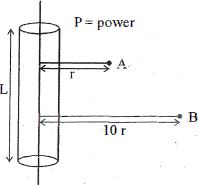
There is a long linear source of sound whose power is $P$ and length is $L$. At point $A$,the sound level is $80 \ dB$. Then at point $B$,the sound level will be .... $dB$.
A
$60$
B
$70$
C
$40$
D
$50$
Solution
(B) For a long linear source of sound,the intensity $I$ at a distance $r$ is given by $I = \frac{P}{2 \pi r L}$.
The sound level $\beta$ in decibels is given by $\beta = 10 \log_{10} \left( \frac{I}{I_0} \right) = 10 \log_{10} \left( \frac{P}{2 \pi L I_0 r} \right)$.
Let $\beta_A$ be the sound level at distance $r$ and $\beta_B$ be the sound level at distance $10r$.
$\beta_A - \beta_B = 10 \log_{10} \left( \frac{P}{2 \pi L I_0 r} \right) - 10 \log_{10} \left( \frac{P}{2 \pi L I_0 (10r)} \right)$.
$\beta_A - \beta_B = 10 \log_{10} \left( \frac{P / (2 \pi L I_0 r)}{P / (2 \pi L I_0 10r)} \right) = 10 \log_{10} (10) = 10 \ dB$.
Given $\beta_A = 80 \ dB$,we have $80 \ dB - \beta_B = 10 \ dB$.
Therefore,$\beta_B = 80 \ dB - 10 \ dB = 70 \ dB$.
The sound level $\beta$ in decibels is given by $\beta = 10 \log_{10} \left( \frac{I}{I_0} \right) = 10 \log_{10} \left( \frac{P}{2 \pi L I_0 r} \right)$.
Let $\beta_A$ be the sound level at distance $r$ and $\beta_B$ be the sound level at distance $10r$.
$\beta_A - \beta_B = 10 \log_{10} \left( \frac{P}{2 \pi L I_0 r} \right) - 10 \log_{10} \left( \frac{P}{2 \pi L I_0 (10r)} \right)$.
$\beta_A - \beta_B = 10 \log_{10} \left( \frac{P / (2 \pi L I_0 r)}{P / (2 \pi L I_0 10r)} \right) = 10 \log_{10} (10) = 10 \ dB$.
Given $\beta_A = 80 \ dB$,we have $80 \ dB - \beta_B = 10 \ dB$.
Therefore,$\beta_B = 80 \ dB - 10 \ dB = 70 \ dB$.
0 likes
View Solution36
MediumMCQ
$A$ point source emits sound equally in all directions in a non-absorbing medium. Two points $P$ and $Q$ are at a distance of $9 \ m$ and $25 \ m$ respectively from the source. The ratio of the amplitudes of the waves at $P$ and $Q$ is
A
$5:3$
B
$3:5$
C
$25:9$
D
$625:81$
Solution
(C) For a point source emitting sound in all directions,the intensity $I$ at a distance $r$ is given by $I = \frac{P}{4\pi r^2}$,where $P$ is the power of the source. Thus,$I \propto \frac{1}{r^2}$.
Since the intensity $I$ is proportional to the square of the amplitude $A$ $(I \propto A^2)$,we have $A^2 \propto \frac{1}{r^2}$,which implies $A \propto \frac{1}{r}$.
Therefore,the ratio of the amplitudes at points $P$ and $Q$ is $\frac{A_P}{A_Q} = \frac{r_Q}{r_P}$.
Given $r_P = 9 \ m$ and $r_Q = 25 \ m$,the ratio is $\frac{A_P}{A_Q} = \frac{25}{9}$.
Since the intensity $I$ is proportional to the square of the amplitude $A$ $(I \propto A^2)$,we have $A^2 \propto \frac{1}{r^2}$,which implies $A \propto \frac{1}{r}$.
Therefore,the ratio of the amplitudes at points $P$ and $Q$ is $\frac{A_P}{A_Q} = \frac{r_Q}{r_P}$.
Given $r_P = 9 \ m$ and $r_Q = 25 \ m$,the ratio is $\frac{A_P}{A_Q} = \frac{25}{9}$.
0 likes
View Solution37
DifficultMCQ
$A$ transverse wave is passing through a stretched string with a speed of $20 \ m/s$. The tension in the string is $20 \ N$. At a certain point $P$ on the string,it is observed that energy is being transferred at a rate of $40 \ mW$ at a given instant. Find the speed of point $P$.
A
$40 \ cm/s$
B
$20 \ cm/s$
C
$2 \ mm/s$
D
$20 \ mm/s$
Solution
(B) The power $P$ transmitted by a transverse wave in a string is given by $P = F v_p$,where $F$ is the transverse component of the tension force and $v_p$ is the transverse velocity of the particle at point $P$.
For a wave traveling in the $x$-direction,the transverse force is $F = -T \frac{\partial y}{\partial x}$.
Since $\frac{\partial y}{\partial x} = -\frac{v_p}{v}$,where $v$ is the wave speed,we have $F = T \frac{v_p}{v}$.
Thus,the power is $P = (T \frac{v_p}{v}) v_p = \frac{T}{v} v_p^2$.
Given $P = 40 \ mW = 40 \times 10^{-3} \ W$,$T = 20 \ N$,and $v = 20 \ m/s$.
Substituting the values: $40 \times 10^{-3} = \frac{20}{20} v_p^2$.
$40 \times 10^{-3} = v_p^2$.
$v_p = \sqrt{0.04} \ m/s = 0.2 \ m/s$.
Converting to $cm/s$: $v_p = 0.2 \times 100 \ cm/s = 20 \ cm/s$.
For a wave traveling in the $x$-direction,the transverse force is $F = -T \frac{\partial y}{\partial x}$.
Since $\frac{\partial y}{\partial x} = -\frac{v_p}{v}$,where $v$ is the wave speed,we have $F = T \frac{v_p}{v}$.
Thus,the power is $P = (T \frac{v_p}{v}) v_p = \frac{T}{v} v_p^2$.
Given $P = 40 \ mW = 40 \times 10^{-3} \ W$,$T = 20 \ N$,and $v = 20 \ m/s$.
Substituting the values: $40 \times 10^{-3} = \frac{20}{20} v_p^2$.
$40 \times 10^{-3} = v_p^2$.
$v_p = \sqrt{0.04} \ m/s = 0.2 \ m/s$.
Converting to $cm/s$: $v_p = 0.2 \times 100 \ cm/s = 20 \ cm/s$.
0 likes
View Solution38
DifficultMCQ
$A$ string of mass $100 \, g$ is clamped between two rigid supports. $A$ wave of amplitude $2 \, mm$ is generated in the string. If the angular frequency of the wave is $5000 \, rad/s$,then the total energy of the wave in the string is ..... $J$.
A
$25$
B
$5$
C
$0.5$
D
$2.5$
Solution
(B) The mass of the string is $m = 100 \, g = 0.1 \, kg$.
The amplitude of the wave is $A = 2 \, mm = 2 \times 10^{-3} \, m$.
The angular frequency is $\omega = 5000 \, rad/s$.
The total energy $E$ of a wave in a string is given by the formula $E = \frac{1}{2} m \omega^2 A^2$.
Substituting the values:
$E = \frac{1}{2} \times (0.1) \times (5000)^2 \times (2 \times 10^{-3})^2$
$E = 0.05 \times (25 \times 10^6) \times (4 \times 10^{-6})$
$E = 0.05 \times 100 = 5 \, J$.
The amplitude of the wave is $A = 2 \, mm = 2 \times 10^{-3} \, m$.
The angular frequency is $\omega = 5000 \, rad/s$.
The total energy $E$ of a wave in a string is given by the formula $E = \frac{1}{2} m \omega^2 A^2$.
Substituting the values:
$E = \frac{1}{2} \times (0.1) \times (5000)^2 \times (2 \times 10^{-3})^2$
$E = 0.05 \times (25 \times 10^6) \times (4 \times 10^{-6})$
$E = 0.05 \times 100 = 5 \, J$.
0 likes
View Solution39
DifficultMCQ
Waves of displacement amplitude $A$ and angular frequency $\omega$ travel in air with the same velocity. Which of the following waves has the highest intensity?
A
$A = 10 \times 10^{-4} \, m, \omega = 500 \, s^{-1}$
B
$A = 2 \times 10^{-4} \, m, \omega = 2000 \, s^{-1}$
C
$A = 2 \times 10^{-4} \, m, \omega = 115 \, s^{-1}$
D
$A = 20 \times 10^{-4} \, m, \omega = 200 \, s^{-1}$
Solution
(A) The intensity $I$ of a sound wave is given by the relation $I = \frac{1}{2} \rho v \omega^2 A^2$,where $\rho$ is the density of the medium,$v$ is the wave velocity,$\omega$ is the angular frequency,and $A$ is the displacement amplitude.
Since $\rho$ and $v$ are constant for all waves traveling in the same medium,the intensity is proportional to the square of the product of angular frequency and amplitude: $I \propto (\omega A)^2$.
Let us calculate the value of $(\omega A)$ for each option:
$A) \omega A = 500 \times 10 \times 10^{-4} = 0.5$
$B) \omega A = 2000 \times 2 \times 10^{-4} = 0.4$
$C) \omega A = 115 \times 2 \times 10^{-4} = 0.023$
$D) \omega A = 200 \times 20 \times 10^{-4} = 0.4$
Comparing the values,option $A$ has the highest value of $(\omega A)$,and therefore,the highest intensity.
Since $\rho$ and $v$ are constant for all waves traveling in the same medium,the intensity is proportional to the square of the product of angular frequency and amplitude: $I \propto (\omega A)^2$.
Let us calculate the value of $(\omega A)$ for each option:
$A) \omega A = 500 \times 10 \times 10^{-4} = 0.5$
$B) \omega A = 2000 \times 2 \times 10^{-4} = 0.4$
$C) \omega A = 115 \times 2 \times 10^{-4} = 0.023$
$D) \omega A = 200 \times 20 \times 10^{-4} = 0.4$
Comparing the values,option $A$ has the highest value of $(\omega A)$,and therefore,the highest intensity.
0 likes
View Solution40
MediumMCQ
$A$ travelling wave is partly reflected and partly transmitted from a rigid boundary. Let $a_i, a_r$ and $a_t$ be the amplitudes of the incident wave,reflected wave,and transmitted wave,and $I_i, I_r$ and $I_t$ be the corresponding intensities. Choose the correct alternative.
A
$\frac{I_i}{I_r} = \left( \frac{a_i}{a_r} \right)^2$
B
$\frac{I_i}{I_r} = \left( \frac{a_i}{a_t} \right)^2$
C
$\frac{I_r}{I_t} = \left( \frac{a_r}{a_t} \right)^2$
D
All of these
Solution
(A) The intensity $I$ of a travelling wave is given by $I = \frac{1}{2} \rho \omega^2 A^2 v$,where $\rho$ is the density of the medium,$\omega$ is the angular frequency,$A$ is the amplitude,and $v$ is the wave speed.
For the incident and reflected waves,they travel in the same medium,so $\rho$,$\omega$,and $v$ are identical for both. Thus,the ratio of intensities is proportional to the square of the ratio of amplitudes: $\frac{I_i}{I_r} = \frac{\frac{1}{2} \rho \omega^2 a_i^2 v}{\frac{1}{2} \rho \omega^2 a_r^2 v} = \left( \frac{a_i}{a_r} \right)^2$.
Since the transmitted wave travels into a different medium,the density $\rho$ and wave speed $v$ change,meaning the relationship between $I_t$ and $a_t$ involves different constants compared to the incident wave. Therefore,only the ratio involving the incident and reflected waves in the same medium holds as $\frac{I_i}{I_r} = \left( \frac{a_i}{a_r} \right)^2$.
For the incident and reflected waves,they travel in the same medium,so $\rho$,$\omega$,and $v$ are identical for both. Thus,the ratio of intensities is proportional to the square of the ratio of amplitudes: $\frac{I_i}{I_r} = \frac{\frac{1}{2} \rho \omega^2 a_i^2 v}{\frac{1}{2} \rho \omega^2 a_r^2 v} = \left( \frac{a_i}{a_r} \right)^2$.
Since the transmitted wave travels into a different medium,the density $\rho$ and wave speed $v$ change,meaning the relationship between $I_t$ and $a_t$ involves different constants compared to the incident wave. Therefore,only the ratio involving the incident and reflected waves in the same medium holds as $\frac{I_i}{I_r} = \left( \frac{a_i}{a_r} \right)^2$.
0 likes
View Solution41
MediumMCQ
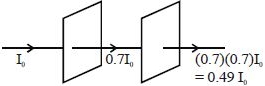
The intensity of sound after passing through a slab decreases by $30\%$. On passing through two such slabs,the intensity will decrease by ..... $\%$
A
$49$
B
$50$
C
$60$
D
$51$
Solution
(D) Let the initial intensity of sound be $I_0$.
After passing through one slab,the intensity decreases by $30\%$,so the remaining intensity is $I_1 = I_0 - 0.30 I_0 = 0.70 I_0$.
When passing through a second identical slab,the intensity again decreases by $30\%$ of the incident intensity on that slab.
So,the final intensity $I_2 = 0.70 I_1 = 0.70 \times (0.70 I_0) = 0.49 I_0$.
The total decrease in intensity is $I_0 - I_2 = I_0 - 0.49 I_0 = 0.51 I_0$.
Therefore,the intensity decreases by $51\%$.
After passing through one slab,the intensity decreases by $30\%$,so the remaining intensity is $I_1 = I_0 - 0.30 I_0 = 0.70 I_0$.
When passing through a second identical slab,the intensity again decreases by $30\%$ of the incident intensity on that slab.
So,the final intensity $I_2 = 0.70 I_1 = 0.70 \times (0.70 I_0) = 0.49 I_0$.
The total decrease in intensity is $I_0 - I_2 = I_0 - 0.49 I_0 = 0.51 I_0$.
Therefore,the intensity decreases by $51\%$.
0 likes
View Solution42
DifficultMCQ
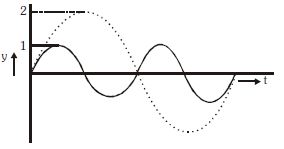
The dependence of disturbances due to two waves on time is shown in the figure. The ratio of their intensities $I_1 / I_2$ will be
A
$1 : 1$
B
$1 : 2$
C
$4 : 1$
D
$16 : 1$
Solution
(A) From the graph,for the first wave (solid line),the amplitude $A_1 = 1$ and the time period $T_1 = 2$ units.
For the second wave (dotted line),the amplitude $A_2 = 2$ and the time period $T_2 = 4$ units.
The intensity $I$ of a wave is given by $I = 2 \pi^2 \rho v f^2 A^2$,where $f = 1/T$.
Thus,$I \propto (A/T)^2$.
Therefore,the ratio of intensities is $\frac{I_1}{I_2} = \left( \frac{A_1}{A_2} \cdot \frac{T_2}{T_1} \right)^2$.
Substituting the values: $\frac{I_1}{I_2} = \left( \frac{1}{2} \cdot \frac{4}{2} \right)^2 = (1)^2 = 1 : 1$.
For the second wave (dotted line),the amplitude $A_2 = 2$ and the time period $T_2 = 4$ units.
The intensity $I$ of a wave is given by $I = 2 \pi^2 \rho v f^2 A^2$,where $f = 1/T$.
Thus,$I \propto (A/T)^2$.
Therefore,the ratio of intensities is $\frac{I_1}{I_2} = \left( \frac{A_1}{A_2} \cdot \frac{T_2}{T_1} \right)^2$.
Substituting the values: $\frac{I_1}{I_2} = \left( \frac{1}{2} \cdot \frac{4}{2} \right)^2 = (1)^2 = 1 : 1$.
0 likes
View Solution43
EasyMCQ
As a wave propagates,which of the following statements is correct?
A
The wave intensity remains constant for a plane wave.
B
The wave intensity decreases as the inverse of the distance from the source for a spherical wave.
C
The wave intensity decreases as the inverse of the square of the distance from the source for a spherical wave.
D
Total intensity of the spherical wave over the spherical surface centered at the source remains constant at all times.
Solution
(A, C) plane wave does not have any radial dependence,so it travels with constant intensity.
For a spherical wave,the power $P$ emitted by the source is distributed over the surface area of a sphere of radius $r$,which is $4 \pi r^2$.
Thus,the intensity $I$ is given by $I = \frac{P}{4 \pi r^2}$.
This shows that the intensity of a spherical wave decreases as the inverse square of the distance from the source $(I \propto \frac{1}{r^2})$.
Additionally,the total power passing through any spherical surface centered at the source remains constant,but the intensity (power per unit area) decreases with distance.
Therefore,options $A$ and $C$ are correct.
For a spherical wave,the power $P$ emitted by the source is distributed over the surface area of a sphere of radius $r$,which is $4 \pi r^2$.
Thus,the intensity $I$ is given by $I = \frac{P}{4 \pi r^2}$.
This shows that the intensity of a spherical wave decreases as the inverse square of the distance from the source $(I \propto \frac{1}{r^2})$.
Additionally,the total power passing through any spherical surface centered at the source remains constant,but the intensity (power per unit area) decreases with distance.
Therefore,options $A$ and $C$ are correct.
0 likes
View Solution44
MediumMCQ
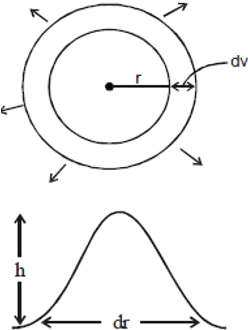
$A$ stone thrown into still water creates a circular wave pattern moving radially outwards. If $r$ is the distance measured from the centre of the pattern, the amplitude of the wave varies as
A
$r^{-1/2}$
B
$r^{-1}$
C
$r^{-2}$
D
$r^{-3/2}$
Solution
(A) When a stone is thrown into still water, it creates circular ripples. The energy $E$ of the wave is conserved as it spreads outwards.
The energy of a circular crest of width $dr$ and amplitude $h$ is proportional to its mass and the square of its amplitude. The mass of the crest is proportional to its circumference $(2 \pi r)$ and its width $(dr)$.
Thus, the energy $E$ is given by:
$E \propto (2 \pi r) \cdot dr \cdot h^2$
Since the total energy $E$ remains constant as the wave propagates outwards, we have:
$r \cdot h^2 \approx \text{constant}$
Therefore, $h^2 \propto \frac{1}{r}$, which implies $h \propto r^{-1/2}$.
Thus, the amplitude of the wave varies as $r^{-1/2}$.
The energy of a circular crest of width $dr$ and amplitude $h$ is proportional to its mass and the square of its amplitude. The mass of the crest is proportional to its circumference $(2 \pi r)$ and its width $(dr)$.
Thus, the energy $E$ is given by:
$E \propto (2 \pi r) \cdot dr \cdot h^2$
Since the total energy $E$ remains constant as the wave propagates outwards, we have:
$r \cdot h^2 \approx \text{constant}$
Therefore, $h^2 \propto \frac{1}{r}$, which implies $h \propto r^{-1/2}$.
Thus, the amplitude of the wave varies as $r^{-1/2}$.
0 likes
View Solution45
MediumMCQ
What is carried by the waves? Mass,velocity,or energy?
A
Mass
B
Velocity
C
Energy
D
All of the above
Solution
(C) wave is a disturbance that travels through a medium or space,transferring energy from one point to another without the net transport of matter (mass).
While the particles of the medium oscillate about their equilibrium positions,they do not travel along with the wave.
Velocity is a property of the wave's propagation,not something that is 'carried' by the wave.
Therefore,the fundamental quantity transported by waves is energy.
While the particles of the medium oscillate about their equilibrium positions,they do not travel along with the wave.
Velocity is a property of the wave's propagation,not something that is 'carried' by the wave.
Therefore,the fundamental quantity transported by waves is energy.
0 likes
View Solution46
EasyMCQ
Do waves carry momentum also along with energy?
A
Yes
B
No
C
Only in vacuum
D
Only in solids
Solution
(A) Yes,waves carry both energy and momentum.
When a wave propagates through a medium,the particles of the medium oscillate about their mean positions.
Due to the elasticity and inertia of the medium,these particles transfer energy and momentum to their neighboring particles.
This process continues,allowing the wave to transport both energy and momentum from one point to another without the net transfer of matter.
When a wave propagates through a medium,the particles of the medium oscillate about their mean positions.
Due to the elasticity and inertia of the medium,these particles transfer energy and momentum to their neighboring particles.
This process continues,allowing the wave to transport both energy and momentum from one point to another without the net transfer of matter.
0 likes
View Solution47
AdvancedMCQ
The clocktower ("ghantaghar") of Dehradun is famous for the sound of its bell, which can be heard, albeit faintly, up to the outskirts of the city $8 \,km$ away. Let the intensity of this faint sound be $30 \,dB$. The clock is situated $80 \,m$ high. The intensity at the base of the tower is ............. $\,dB$.
A
$60$
B
$70$
C
$80$
D
$90$
Solution
(B) Given: Distance $r_{1} = 8 \,km = 8000 \,m$, Intensity level $L_{1} = 30 \,dB$.
Distance at the base $r_{2} = 80 \,m$, Intensity level $L_{2} = ?$.
The intensity level $L$ is given by $L = 10 \log_{10} \left( \frac{I}{I_{0}} \right)$.
Since the sound source acts as a point source, intensity $I = \frac{P}{4 \pi r^{2}}$, which implies $I \propto \frac{1}{r^{2}}$.
The difference in intensity levels is given by:
$L_{2} - L_{1} = 10 \log_{10} \left( \frac{I_{2}}{I_{1}} \right) = 10 \log_{10} \left( \frac{r_{1}}{r_{2}} \right)^{2} = 20 \log_{10} \left( \frac{r_{1}}{r_{2}} \right)$.
Substituting the values:
$L_{2} - 30 = 20 \log_{10} \left( \frac{8000}{80} \right)$
$L_{2} - 30 = 20 \log_{10} (100)$
$L_{2} - 30 = 20 \times 2 = 40$
$L_{2} = 40 + 30 = 70 \,dB$.
Thus, the intensity at the base of the tower is $70 \,dB$.
Distance at the base $r_{2} = 80 \,m$, Intensity level $L_{2} = ?$.
The intensity level $L$ is given by $L = 10 \log_{10} \left( \frac{I}{I_{0}} \right)$.
Since the sound source acts as a point source, intensity $I = \frac{P}{4 \pi r^{2}}$, which implies $I \propto \frac{1}{r^{2}}$.
The difference in intensity levels is given by:
$L_{2} - L_{1} = 10 \log_{10} \left( \frac{I_{2}}{I_{1}} \right) = 10 \log_{10} \left( \frac{r_{1}}{r_{2}} \right)^{2} = 20 \log_{10} \left( \frac{r_{1}}{r_{2}} \right)$.
Substituting the values:
$L_{2} - 30 = 20 \log_{10} \left( \frac{8000}{80} \right)$
$L_{2} - 30 = 20 \log_{10} (100)$
$L_{2} - 30 = 20 \times 2 = 40$
$L_{2} = 40 + 30 = 70 \,dB$.
Thus, the intensity at the base of the tower is $70 \,dB$.
0 likes
View Solution48
EasyMCQ
The sound intensity level at a point $4 \,m$ from the point source is $10 \,dB$. Then the sound level at a distance $2 \,m$ from the same source will be ........ $dB$.
A
$26$
B
$16$
C
$23$
D
$32$
Solution
(B) The sound intensity $I$ at a distance $r$ from a point source is given by $I = \frac{P}{4\pi r^2}$,where $P$ is the power of the source. Thus,$I \propto \frac{1}{r^2}$.
The sound intensity level $\beta$ in decibels $(dB)$ is defined as $\beta = 10 \log_{10} \left( \frac{I}{I_0} \right)$,where $I_0$ is the reference intensity.
Let $\beta_1 = 10 \,dB$ at $r_1 = 4 \,m$ and $\beta_2$ be the level at $r_2 = 2 \,m$.
$\beta_2 - \beta_1 = 10 \log_{10} \left( \frac{I_2}{I_1} \right) = 10 \log_{10} \left( \frac{r_1^2}{r_2^2} \right) = 20 \log_{10} \left( \frac{r_1}{r_2} \right)$.
Substituting the values: $\beta_2 - 10 = 20 \log_{10} \left( \frac{4}{2} \right) = 20 \log_{10}(2)$.
Using $\log_{10}(2) \approx 0.301$,we get $\beta_2 - 10 = 20 \times 0.301 = 6.02$.
Therefore,$\beta_2 = 10 + 6.02 = 16.02 \,dB \approx 16 \,dB$.
The sound intensity level $\beta$ in decibels $(dB)$ is defined as $\beta = 10 \log_{10} \left( \frac{I}{I_0} \right)$,where $I_0$ is the reference intensity.
Let $\beta_1 = 10 \,dB$ at $r_1 = 4 \,m$ and $\beta_2$ be the level at $r_2 = 2 \,m$.
$\beta_2 - \beta_1 = 10 \log_{10} \left( \frac{I_2}{I_1} \right) = 10 \log_{10} \left( \frac{r_1^2}{r_2^2} \right) = 20 \log_{10} \left( \frac{r_1}{r_2} \right)$.
Substituting the values: $\beta_2 - 10 = 20 \log_{10} \left( \frac{4}{2} \right) = 20 \log_{10}(2)$.
Using $\log_{10}(2) \approx 0.301$,we get $\beta_2 - 10 = 20 \times 0.301 = 6.02$.
Therefore,$\beta_2 = 10 + 6.02 = 16.02 \,dB \approx 16 \,dB$.
0 likes
View Solution49
EasyMCQ
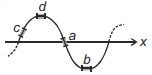
The figure shows a snapshot of a travelling sine wave along a string. Four elemental portions $a, b, c,$ and $d$ are indicated on the string. Which elemental portion$(s)$ has/have the maximum potential energy?
A
$a$
B
$b$
C
$c$
D
$b$ and $d$
Solution
(A) In a travelling wave on a string,the potential energy of an elemental portion is proportional to the square of the slope of the string at that point,i.e.,$dU_p \propto (\frac{\partial y}{\partial x})^2$.
$1$. At points $a$ and $c$,the slope of the wave is maximum (either positive or negative maximum).
$2$. At points $b$ and $d$,the string is at its extreme positions (trough and crest),where the slope is zero.
$3$. Since the potential energy is maximum where the slope is maximum,the portions $a$ and $c$ have the maximum potential energy.
$4$. However,looking at the options provided and the standard nature of this problem,the slope is maximum at the equilibrium position (where the wave crosses the $x$-axis). Thus,$a$ and $c$ are the points with maximum potential energy. Given the options,if only one is to be chosen,$a$ is the most appropriate representation of the maximum slope region.
$1$. At points $a$ and $c$,the slope of the wave is maximum (either positive or negative maximum).
$2$. At points $b$ and $d$,the string is at its extreme positions (trough and crest),where the slope is zero.
$3$. Since the potential energy is maximum where the slope is maximum,the portions $a$ and $c$ have the maximum potential energy.
$4$. However,looking at the options provided and the standard nature of this problem,the slope is maximum at the equilibrium position (where the wave crosses the $x$-axis). Thus,$a$ and $c$ are the points with maximum potential energy. Given the options,if only one is to be chosen,$a$ is the most appropriate representation of the maximum slope region.
0 likes
View Solution50
MediumMCQ
Two waves are represented by
$y_1 = 5 \sin 2 \pi(75 t - 0.25 x)$
$y_2 = 10 \sin 2 \pi(150 t - 0.50 x)$
The intensity ratio $\frac{I_1}{I_2}$ of the two waves is
$y_1 = 5 \sin 2 \pi(75 t - 0.25 x)$
$y_2 = 10 \sin 2 \pi(150 t - 0.50 x)$
The intensity ratio $\frac{I_1}{I_2}$ of the two waves is
A
$1: 2$
B
$1: 4$
C
$1: 8$
D
$1: 16$
Solution
(D) The intensity of a wave is given by $I = 2 \pi^2 \rho v f^2 A^2$,where $\rho$ is density,$v$ is wave speed,$f$ is frequency,and $A$ is amplitude.
For the given waves:
Wave $1$: $y_1 = 5 \sin(150 \pi t - 0.5 \pi x)$. Amplitude $A_1 = 5$,angular frequency $\omega_1 = 150 \pi$,wave number $k_1 = 0.5 \pi$. Wave speed $v_1 = \frac{\omega_1}{k_1} = \frac{150 \pi}{0.5 \pi} = 300 \ m/s$.
Wave $2$: $y_2 = 10 \sin(300 \pi t - 1.0 \pi x)$. Amplitude $A_2 = 10$,angular frequency $\omega_2 = 300 \pi$,wave number $k_2 = 1.0 \pi$. Wave speed $v_2 = \frac{\omega_2}{k_2} = \frac{300 \pi}{1.0 \pi} = 300 \ m/s$.
Since $v_1 = v_2$ and assuming the medium is the same $(\rho_1 = \rho_2)$,the intensity ratio is $\frac{I_1}{I_2} = \left(\frac{A_1}{A_2}\right)^2 \times \left(\frac{f_1}{f_2}\right)^2 = \left(\frac{A_1}{A_2}\right)^2 \times \left(\frac{\omega_1}{\omega_2}\right)^2$.
Substituting the values: $\frac{I_1}{I_2} = \left(\frac{5}{10}\right)^2 \times \left(\frac{150 \pi}{300 \pi}\right)^2 = \left(\frac{1}{2}\right)^2 \times \left(\frac{1}{2}\right)^2 = \frac{1}{4} \times \frac{1}{4} = \frac{1}{16}$.
For the given waves:
Wave $1$: $y_1 = 5 \sin(150 \pi t - 0.5 \pi x)$. Amplitude $A_1 = 5$,angular frequency $\omega_1 = 150 \pi$,wave number $k_1 = 0.5 \pi$. Wave speed $v_1 = \frac{\omega_1}{k_1} = \frac{150 \pi}{0.5 \pi} = 300 \ m/s$.
Wave $2$: $y_2 = 10 \sin(300 \pi t - 1.0 \pi x)$. Amplitude $A_2 = 10$,angular frequency $\omega_2 = 300 \pi$,wave number $k_2 = 1.0 \pi$. Wave speed $v_2 = \frac{\omega_2}{k_2} = \frac{300 \pi}{1.0 \pi} = 300 \ m/s$.
Since $v_1 = v_2$ and assuming the medium is the same $(\rho_1 = \rho_2)$,the intensity ratio is $\frac{I_1}{I_2} = \left(\frac{A_1}{A_2}\right)^2 \times \left(\frac{f_1}{f_2}\right)^2 = \left(\frac{A_1}{A_2}\right)^2 \times \left(\frac{\omega_1}{\omega_2}\right)^2$.
Substituting the values: $\frac{I_1}{I_2} = \left(\frac{5}{10}\right)^2 \times \left(\frac{150 \pi}{300 \pi}\right)^2 = \left(\frac{1}{2}\right)^2 \times \left(\frac{1}{2}\right)^2 = \frac{1}{4} \times \frac{1}{4} = \frac{1}{16}$.
0 likes
View SolutionWaves and Sound — Energy and Intensity of Waves · Frequently Asked Questions
1Are these Waves and Sound questions useful for JEE and NEET?
Yes. All questions in this section are mapped to JEE Main and NEET exam patterns. Previous year questions from JEE Main, NEET, GUJCET and state-level exams are included with full solutions.
2Can I switch to Hindi or Gujarati for these questions?
Yes. Use the language tabs in the hero section or the sidebar to view the same questions and solutions in English, Hindi or Gujarati.
3How do I generate a question paper from this subtopic?
Use the Vedclass Exam Paper Generator — select the chapter and subtopic, set difficulty, and generate Sets A, B, C, D automatically. First 3 chapters of every subject are free.
Vedclass Products
For Students
Vedclass Test Series
Mock tests in real JEE/NEET style with performance analysis. 5-day free trial.
Start Free TrialFor Teachers
Exam Paper Generator
Generate Set A/B/C/D papers from this chapter in 2 minutes. 3 chapters free.
Try FreeFor Institutes
Online Exam Module
Live online exams with unlimited students, 360° analytics & white-label branding.
See DemoFor Teachers & Institutes
Generate a Waves and Sound Exam Paper in 2 Minutes
Select subtopic & difficulty — Sets A, B, C, D auto-generated with No Repeat logic.
First 3 chapters of every subject are free — no payment required.