
A English
Transverse Stationary Waves and Sonometer Questions in English
Class 11 Physics · Waves and Sound · Transverse Stationary Waves and Sonometer
225+
Questions
English
Language
100%
With Solutions
Showing 49 of 225 questions in English
1
MediumMCQ
$A$ tuning fork and a sonometer wire are sounded together and produce $4$ beats per second. When the length of the sonometer wire is $95 \ cm$ or $100 \ cm$,the frequency of the tuning fork is ..... $Hz$.
A
$156$
B
$152$
C
$148$
D
$160$
Solution
(A) Let the frequency of the tuning fork be $n$ and the frequency of the sonometer wire be $f$. The frequency of a sonometer wire is inversely proportional to its length,i.e.,$f \propto \frac{1}{l}$.
Since $4$ beats per second are produced,the frequency of the wire is either $(n + 4)$ or $(n - 4)$.
As length increases,frequency decreases. Therefore,for $l_1 = 95 \ cm$,the frequency is $(n + 4)$,and for $l_2 = 100 \ cm$,the frequency is $(n - 4)$.
Using the relation $f_1 l_1 = f_2 l_2$,we have $(n + 4) \times 95 = (n - 4) \times 100$.
Dividing by $5$,we get $(n + 4) \times 19 = (n - 4) \times 20$.
$19n + 76 = 20n - 80$.
$n = 76 + 80 = 156 \ Hz$.
Since $4$ beats per second are produced,the frequency of the wire is either $(n + 4)$ or $(n - 4)$.
As length increases,frequency decreases. Therefore,for $l_1 = 95 \ cm$,the frequency is $(n + 4)$,and for $l_2 = 100 \ cm$,the frequency is $(n - 4)$.
Using the relation $f_1 l_1 = f_2 l_2$,we have $(n + 4) \times 95 = (n - 4) \times 100$.
Dividing by $5$,we get $(n + 4) \times 19 = (n - 4) \times 20$.
$19n + 76 = 20n - 80$.
$n = 76 + 80 = 156 \ Hz$.
0 likes
View Solution2
EasyMCQ
$A$ tuning fork gives $4$ beats with $50 \ cm$ length of a sonometer wire. If the length of the wire is shortened by $1 \ cm$,the number of beats is still the same. The frequency of the fork is (in $Hz$)
A
$396$
B
$400$
C
$404$
D
$384$
Solution
(A) Let the frequency of the tuning fork be $n$ and the frequency of the sonometer wire be $f$.
Given that the wire produces $4$ beats with the tuning fork,the frequency of the wire is $f = n \pm 4$.
Since frequency $f \propto \frac{1}{l}$,we have $f \cdot l = \text{constant}$.
For the initial length $l_1 = 50 \ cm$,$f_1 = n \pm 4$.
For the shortened length $l_2 = 49 \ cm$,$f_2 = n \pm 4$.
Since $l_2 < l_1$,the frequency $f_2 > f_1$.
Therefore,$f_1 = n - 4$ and $f_2 = n + 4$.
Using the relation $f_1 l_1 = f_2 l_2$:
$(n - 4) \times 50 = (n + 4) \times 49$
$50n - 200 = 49n + 196$
$n = 196 + 200 = 396 \ Hz$.
Given that the wire produces $4$ beats with the tuning fork,the frequency of the wire is $f = n \pm 4$.
Since frequency $f \propto \frac{1}{l}$,we have $f \cdot l = \text{constant}$.
For the initial length $l_1 = 50 \ cm$,$f_1 = n \pm 4$.
For the shortened length $l_2 = 49 \ cm$,$f_2 = n \pm 4$.
Since $l_2 < l_1$,the frequency $f_2 > f_1$.
Therefore,$f_1 = n - 4$ and $f_2 = n + 4$.
Using the relation $f_1 l_1 = f_2 l_2$:
$(n - 4) \times 50 = (n + 4) \times 49$
$50n - 200 = 49n + 196$
$n = 196 + 200 = 396 \ Hz$.
0 likes
View Solution3
EasyMCQ
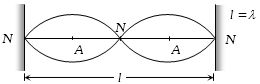
$A$ string fixed at both ends is vibrating in two segments. The wavelength of the corresponding wave is
A
$\frac{l}{4}$
B
$\frac{l}{2}$
C
$l$
D
$2l$
Solution
(C) When a string of length $l$ fixed at both ends vibrates in two segments,it forms two loops.
Each loop corresponds to half a wavelength,i.e.,$\frac{\lambda}{2}$.
Since there are two segments,the total length of the string is $l = 2 \times \frac{\lambda}{2}$.
Therefore,$l = \lambda$.
Thus,the wavelength of the corresponding wave is $l$.
Each loop corresponds to half a wavelength,i.e.,$\frac{\lambda}{2}$.
Since there are two segments,the total length of the string is $l = 2 \times \frac{\lambda}{2}$.
Therefore,$l = \lambda$.
Thus,the wavelength of the corresponding wave is $l$.
0 likes
View Solution4
EasyMCQ
$A$ $1 \, cm$ long string vibrates with a fundamental frequency of $256 \, Hz$. If the length is reduced to $\frac{1}{4} \, cm$ keeping the tension unaltered,the new fundamental frequency will be: (in $, Hz$)
A
$64$
B
$256$
C
$512$
D
$1024$
Solution
(D) The fundamental frequency $n$ of a stretched string is given by the formula $n = \frac{1}{2l} \sqrt{\frac{T}{\mu}}$,where $l$ is the length,$T$ is the tension,and $\mu$ is the linear mass density.
Since the tension $T$ and mass per unit length $\mu$ remain constant,the frequency is inversely proportional to the length: $n \propto \frac{1}{l}$.
Therefore,$\frac{n_2}{n_1} = \frac{l_1}{l_2}$.
Given $l_1 = 1 \, cm$,$l_2 = \frac{1}{4} \, cm$,and $n_1 = 256 \, Hz$.
Substituting the values: $n_2 = n_1 \times \frac{l_1}{l_2} = 256 \times \frac{1}{1/4} = 256 \times 4 = 1024 \, Hz$.
Since the tension $T$ and mass per unit length $\mu$ remain constant,the frequency is inversely proportional to the length: $n \propto \frac{1}{l}$.
Therefore,$\frac{n_2}{n_1} = \frac{l_1}{l_2}$.
Given $l_1 = 1 \, cm$,$l_2 = \frac{1}{4} \, cm$,and $n_1 = 256 \, Hz$.
Substituting the values: $n_2 = n_1 \times \frac{l_1}{l_2} = 256 \times \frac{1}{1/4} = 256 \times 4 = 1024 \, Hz$.
0 likes
View Solution5
MediumMCQ
$A$ stretched string of $1 \ m$ length and mass $5 \times 10^{-4} \ kg$ is having a tension of $20 \ N$. If it is plucked at $25 \ cm$ from one end,then it will vibrate with a frequency of ... $Hz$.
A
$100$
B
$200$
C
$256$
D
$400$
Solution
(B) The length of the string $l = 1 \ m = 100 \ cm$. The mass $m = 5 \times 10^{-4} \ kg$. The tension $T = 20 \ N$.
When a string is plucked at a distance $x$ from one end,it vibrates in the $p^{th}$ harmonic such that $x = \frac{l}{2p}$.
Given $x = 25 \ cm$,we have $25 = \frac{100}{2p}$,which gives $2p = 4$,so $p = 2$.
The frequency of vibration $f$ is given by $f = \frac{p}{2l} \sqrt{\frac{T}{\mu}}$,where $\mu$ is the mass per unit length.
Here,$\mu = \frac{m}{l} = \frac{5 \times 10^{-4} \ kg}{1 \ m} = 5 \times 10^{-4} \ kg/m$.
Substituting the values: $f = \frac{2}{2 \times 1} \sqrt{\frac{20}{5 \times 10^{-4}}} = 1 \times \sqrt{4 \times 10^4} = 200 \ Hz$.
When a string is plucked at a distance $x$ from one end,it vibrates in the $p^{th}$ harmonic such that $x = \frac{l}{2p}$.
Given $x = 25 \ cm$,we have $25 = \frac{100}{2p}$,which gives $2p = 4$,so $p = 2$.
The frequency of vibration $f$ is given by $f = \frac{p}{2l} \sqrt{\frac{T}{\mu}}$,where $\mu$ is the mass per unit length.
Here,$\mu = \frac{m}{l} = \frac{5 \times 10^{-4} \ kg}{1 \ m} = 5 \times 10^{-4} \ kg/m$.
Substituting the values: $f = \frac{2}{2 \times 1} \sqrt{\frac{20}{5 \times 10^{-4}}} = 1 \times \sqrt{4 \times 10^4} = 200 \ Hz$.
0 likes
View Solution6
EasyMCQ
Two similar sonometer wires have fundamental frequencies of $500 \, Hz$. They are under the same tension. By what percentage should the tension be increased in one wire so that the two wires produce $5 \, \text{beats/sec}$ (in $\%$)?
A
$1$
B
$2$
C
$3$
D
$4$
Solution
(B) The fundamental frequency of a sonometer wire is given by $n = \frac{1}{2l} \sqrt{\frac{T}{\mu}}$.
Since $l$ and $\mu$ are constant,$n \propto \sqrt{T}$,which implies $T \propto n^2$.
Taking the derivative,we get $\frac{\Delta T}{T} = 2 \frac{\Delta n}{n}$.
Given the initial frequency $n = 500 \, Hz$ and the beat frequency $\Delta n = 5 \, Hz$,the new frequency required is $n' = 505 \, Hz$.
The fractional change in frequency is $\frac{\Delta n}{n} = \frac{5}{500} = 0.01$ or $1 \%$.
Substituting this into the tension relation: $\frac{\Delta T}{T} \times 100 = 2 \times (\frac{\Delta n}{n} \times 100) = 2 \times 1 \% = 2 \%$.
Therefore,the tension must be increased by $2 \%$.
Since $l$ and $\mu$ are constant,$n \propto \sqrt{T}$,which implies $T \propto n^2$.
Taking the derivative,we get $\frac{\Delta T}{T} = 2 \frac{\Delta n}{n}$.
Given the initial frequency $n = 500 \, Hz$ and the beat frequency $\Delta n = 5 \, Hz$,the new frequency required is $n' = 505 \, Hz$.
The fractional change in frequency is $\frac{\Delta n}{n} = \frac{5}{500} = 0.01$ or $1 \%$.
Substituting this into the tension relation: $\frac{\Delta T}{T} \times 100 = 2 \times (\frac{\Delta n}{n} \times 100) = 2 \times 1 \% = 2 \%$.
Therefore,the tension must be increased by $2 \%$.
0 likes
View Solution7
EasyMCQ
If the tension of a sonometer wire increases four times,then the fundamental frequency of the wire will increase by how many times?
A
$2$
B
$4$
C
$0.5$
D
None of the above
Solution
(A) The fundamental frequency $n$ of a sonometer wire is given by the formula $n = \frac{1}{2l} \sqrt{\frac{T}{m}}$,where $l$ is the length,$T$ is the tension,and $m$ is the mass per unit length.
From this relation,we can see that $n \propto \sqrt{T}$.
Let the initial tension be $T_1$ and the initial frequency be $n_1$. Let the new tension be $T_2 = 4T_1$ and the new frequency be $n_2$.
Then,$\frac{n_2}{n_1} = \sqrt{\frac{T_2}{T_1}} = \sqrt{\frac{4T_1}{T_1}} = \sqrt{4} = 2$.
Therefore,the fundamental frequency increases by $2$ times.
From this relation,we can see that $n \propto \sqrt{T}$.
Let the initial tension be $T_1$ and the initial frequency be $n_1$. Let the new tension be $T_2 = 4T_1$ and the new frequency be $n_2$.
Then,$\frac{n_2}{n_1} = \sqrt{\frac{T_2}{T_1}} = \sqrt{\frac{4T_1}{T_1}} = \sqrt{4} = 2$.
Therefore,the fundamental frequency increases by $2$ times.
0 likes
View Solution8
EasyMCQ
If the frequency of vibrations of a string is to be increased by a factor of two,then the tension in the string must be made:
A
Half
B
Twice
C
Four times
D
Eight times
Solution
(C) The frequency of vibration of a stretched string is given by the formula $n = \frac{1}{2L} \sqrt{\frac{T}{\mu}}$,where $n$ is the frequency,$L$ is the length,$T$ is the tension,and $\mu$ is the linear mass density.
From this relation,we can see that $n \propto \sqrt{T}$.
If the frequency is increased by a factor of two,the new frequency $n' = 2n$.
Therefore,$\frac{n'}{n} = \frac{\sqrt{T'}}{\sqrt{T}} = 2$.
Squaring both sides,we get $\frac{T'}{T} = 4$,which implies $T' = 4T$.
Thus,the tension must be made four times the original tension.
From this relation,we can see that $n \propto \sqrt{T}$.
If the frequency is increased by a factor of two,the new frequency $n' = 2n$.
Therefore,$\frac{n'}{n} = \frac{\sqrt{T'}}{\sqrt{T}} = 2$.
Squaring both sides,we get $\frac{T'}{T} = 4$,which implies $T' = 4T$.
Thus,the tension must be made four times the original tension.
0 likes
View Solution9
EasyMCQ
Four wires of identical length,diameter,and material are stretched on a sonometer. If the ratio of their tensions is $1 : 4 : 9 : 16$,then the ratio of their fundamental frequencies is:
A
$16 : 9 : 4 : 1$
B
$4 : 3 : 2 : 1$
C
$1 : 4 : 2 : 16$
D
$1 : 2 : 3 : 4$
Solution
(D) The fundamental frequency $n$ of a stretched wire is given by the formula $n = \frac{1}{2L} \sqrt{\frac{T}{\mu}}$,where $L$ is the length,$T$ is the tension,and $\mu$ is the linear mass density.
Since the wires have identical length,diameter,and material,$L$ and $\mu$ are constant for all wires.
Therefore,the frequency is directly proportional to the square root of the tension: $n \propto \sqrt{T}$.
Given the ratio of tensions $T_1 : T_2 : T_3 : T_4 = 1 : 4 : 9 : 16$,the ratio of their fundamental frequencies is:
$n_1 : n_2 : n_3 : n_4 = \sqrt{1} : \sqrt{4} : \sqrt{9} : \sqrt{16}$.
Calculating the square roots,we get $1 : 2 : 3 : 4$.
Thus,the correct ratio is $1 : 2 : 3 : 4$.
Since the wires have identical length,diameter,and material,$L$ and $\mu$ are constant for all wires.
Therefore,the frequency is directly proportional to the square root of the tension: $n \propto \sqrt{T}$.
Given the ratio of tensions $T_1 : T_2 : T_3 : T_4 = 1 : 4 : 9 : 16$,the ratio of their fundamental frequencies is:
$n_1 : n_2 : n_3 : n_4 = \sqrt{1} : \sqrt{4} : \sqrt{9} : \sqrt{16}$.
Calculating the square roots,we get $1 : 2 : 3 : 4$.
Thus,the correct ratio is $1 : 2 : 3 : 4$.
0 likes
View Solution10
MediumMCQ
$A$ tuning fork vibrating with a sonometer having $20 \ cm$ wire produces $5$ beats per second. The beat frequency does not change if the length of the wire is changed to $21 \ cm$. The frequency of the tuning fork (in Hertz) must be
A
$200$
B
$210$
C
$205$
D
$215$
Solution
(C) Let the frequency of the tuning fork be $N$.
Since the frequency of a vibrating string is inversely proportional to its length $(f \propto 1/l)$,we have $f \cdot l = \text{constant}$.
For a sonometer wire,the frequency $f$ is given by $f = k/l$.
When the length is $20 \ cm$,the frequency is $f_1 = k/20$. Since it produces $5$ beats per second with the tuning fork,$f_1 = N \pm 5$.
When the length is $21 \ cm$,the frequency is $f_2 = k/21$. Since the beat frequency remains $5$,$f_2 = N \mp 5$.
As the length increases,the frequency decreases. Therefore,$f_1 = N + 5$ and $f_2 = N - 5$.
Thus,$(N + 5) \cdot 20 = (N - 5) \cdot 21$.
$20N + 100 = 21N - 105$.
$N = 205 \ Hz$.
Since the frequency of a vibrating string is inversely proportional to its length $(f \propto 1/l)$,we have $f \cdot l = \text{constant}$.
For a sonometer wire,the frequency $f$ is given by $f = k/l$.
When the length is $20 \ cm$,the frequency is $f_1 = k/20$. Since it produces $5$ beats per second with the tuning fork,$f_1 = N \pm 5$.
When the length is $21 \ cm$,the frequency is $f_2 = k/21$. Since the beat frequency remains $5$,$f_2 = N \mp 5$.
As the length increases,the frequency decreases. Therefore,$f_1 = N + 5$ and $f_2 = N - 5$.
Thus,$(N + 5) \cdot 20 = (N - 5) \cdot 21$.
$20N + 100 = 21N - 105$.
$N = 205 \ Hz$.
0 likes
View Solution11
EasyMCQ
If you set up the ninth harmonic on a string fixed at both ends,its frequency compared to the seventh harmonic is:
A
Higher
B
Lower
C
Equal
D
None of the above
Solution
(A) The frequency of the $n^{th}$ harmonic for a string fixed at both ends is given by $f_n = \frac{n}{2L} \sqrt{\frac{T}{\mu}}$,where $n$ is the harmonic number.
For the $9^{th}$ harmonic,$f_9 = \frac{9}{2L} \sqrt{\frac{T}{\mu}}$.
For the $7^{th}$ harmonic,$f_7 = \frac{7}{2L} \sqrt{\frac{T}{\mu}}$.
Since $9 > 7$,it follows that $f_9 > f_7$.
Therefore,the frequency of the $9^{th}$ harmonic is higher than that of the $7^{th}$ harmonic.
For the $9^{th}$ harmonic,$f_9 = \frac{9}{2L} \sqrt{\frac{T}{\mu}}$.
For the $7^{th}$ harmonic,$f_7 = \frac{7}{2L} \sqrt{\frac{T}{\mu}}$.
Since $9 > 7$,it follows that $f_9 > f_7$.
Therefore,the frequency of the $9^{th}$ harmonic is higher than that of the $7^{th}$ harmonic.
0 likes
View Solution12
EasyMCQ
The frequency of a sonometer wire is $n$. If its tension is increased $4$ times and its length is doubled,then the new frequency will be
A
$n/2$
B
$4n$
C
$2n$
D
$n$
Solution
(D) The fundamental frequency of a sonometer wire is given by the formula $n = \frac{1}{2l} \sqrt{\frac{T}{\mu}}$,where $l$ is the length,$T$ is the tension,and $\mu$ is the linear mass density.
From this,we can see that $n \propto \frac{1}{l} \sqrt{T}$.
Let the initial frequency be $n$,initial length be $l$,and initial tension be $T$.
Given: New tension $T' = 4T$ and new length $l' = 2l$.
The new frequency $n'$ is given by:
$\frac{n'}{n} = \frac{l}{l'} \times \sqrt{\frac{T'}{T}}$
Substituting the values:
$\frac{n'}{n} = \frac{l}{2l} \times \sqrt{\frac{4T}{T}}$
$\frac{n'}{n} = \frac{1}{2} \times \sqrt{4} = \frac{1}{2} \times 2 = 1$
Therefore,$n' = n$.
From this,we can see that $n \propto \frac{1}{l} \sqrt{T}$.
Let the initial frequency be $n$,initial length be $l$,and initial tension be $T$.
Given: New tension $T' = 4T$ and new length $l' = 2l$.
The new frequency $n'$ is given by:
$\frac{n'}{n} = \frac{l}{l'} \times \sqrt{\frac{T'}{T}}$
Substituting the values:
$\frac{n'}{n} = \frac{l}{2l} \times \sqrt{\frac{4T}{T}}$
$\frac{n'}{n} = \frac{1}{2} \times \sqrt{4} = \frac{1}{2} \times 2 = 1$
Therefore,$n' = n$.
0 likes
View Solution13
EasyMCQ
$A$ device used for investigating the vibration of a fixed string or wire is
A
Sonometer
B
Barometer
C
Hydrometer
D
None of these
Solution
(A) $Sonometer$ is a laboratory instrument used to investigate the relationship between the frequency of the sound produced by a plucked string and the tension,length,and mass per unit length of the string.
It works on the principle of resonance,where the frequency of the vibrating string is matched with the frequency of an external sound source.
It works on the principle of resonance,where the frequency of the vibrating string is matched with the frequency of an external sound source.
0 likes
View Solution14
EasyMCQ
$A$ string on a musical instrument is $50 \ cm$ long and its fundamental frequency is $270 \ Hz$. If the desired frequency of $1000 \ Hz$ is to be produced,the required length of the string is .... $cm$.
A
$13.5$
B
$2.7$
C
$5.4$
D
$10.3$
Solution
(A) The fundamental frequency $n$ of a stretched string is inversely proportional to its length $l$,given by $n \propto \frac{1}{l}$.
This implies $n_1 l_1 = n_2 l_2$.
Given: $l_1 = 50 \ cm$,$n_1 = 270 \ Hz$,and $n_2 = 1000 \ Hz$.
We need to find $l_2$.
Using the relation $l_2 = l_1 \left( \frac{n_1}{n_2} \right)$,
$l_2 = 50 \times \left( \frac{270}{1000} \right)$,
$l_2 = 50 \times 0.27 = 13.5 \ cm$.
This implies $n_1 l_1 = n_2 l_2$.
Given: $l_1 = 50 \ cm$,$n_1 = 270 \ Hz$,and $n_2 = 1000 \ Hz$.
We need to find $l_2$.
Using the relation $l_2 = l_1 \left( \frac{n_1}{n_2} \right)$,
$l_2 = 50 \times \left( \frac{270}{1000} \right)$,
$l_2 = 50 \times 0.27 = 13.5 \ cm$.
0 likes
View Solution15
MediumMCQ
The tension in a piano wire is $10 \ N$. What should be the tension in the wire to produce a note of double the frequency (in $N$)?
A
$5$
B
$20$
C
$40$
D
$80$
Solution
(C) The frequency $n$ of a stretched string is given by the formula $n = \frac{1}{2l} \sqrt{\frac{T}{\mu}}$,where $T$ is the tension and $\mu$ is the linear mass density.
Since $l$ and $\mu$ are constant,we have $n \propto \sqrt{T}$.
Therefore,$\frac{n_1}{n_2} = \sqrt{\frac{T_1}{T_2}}$.
Given $n_1 = n$,$n_2 = 2n$,and $T_1 = 10 \ N$.
Substituting these values: $\frac{n}{2n} = \sqrt{\frac{10}{T_2}}$.
$\frac{1}{2} = \sqrt{\frac{10}{T_2}}$.
Squaring both sides: $\frac{1}{4} = \frac{10}{T_2}$.
Thus,$T_2 = 40 \ N$.
Since $l$ and $\mu$ are constant,we have $n \propto \sqrt{T}$.
Therefore,$\frac{n_1}{n_2} = \sqrt{\frac{T_1}{T_2}}$.
Given $n_1 = n$,$n_2 = 2n$,and $T_1 = 10 \ N$.
Substituting these values: $\frac{n}{2n} = \sqrt{\frac{10}{T_2}}$.
$\frac{1}{2} = \sqrt{\frac{10}{T_2}}$.
Squaring both sides: $\frac{1}{4} = \frac{10}{T_2}$.
Thus,$T_2 = 40 \ N$.
0 likes
View Solution16
EasyMCQ
To increase the frequency of a stretched string from $100 \ Hz$ to $400 \ Hz$,the tension in the string has to be changed by how many times?
A
$4$
B
$16$
C
$20$
D
None of these
Solution
(B) The fundamental frequency $n$ of a stretched string is given by the formula $n = \frac{1}{2L} \sqrt{\frac{T}{\mu}}$,where $T$ is the tension and $\mu$ is the linear mass density.
Since $L$ and $\mu$ are constant,we have $n \propto \sqrt{T}$.
Let the initial frequency be $n_1 = 100 \ Hz$ and the final frequency be $n_2 = 400 \ Hz$.
Then,$\frac{n_2}{n_1} = \sqrt{\frac{T_2}{T_1}}$.
Substituting the values: $\frac{400}{100} = \sqrt{\frac{T_2}{T_1}} \implies 4 = \sqrt{\frac{T_2}{T_1}}$.
Squaring both sides,we get $\frac{T_2}{T_1} = 4^2 = 16$.
Therefore,the tension must be increased by $16$ times.
Since $L$ and $\mu$ are constant,we have $n \propto \sqrt{T}$.
Let the initial frequency be $n_1 = 100 \ Hz$ and the final frequency be $n_2 = 400 \ Hz$.
Then,$\frac{n_2}{n_1} = \sqrt{\frac{T_2}{T_1}}$.
Substituting the values: $\frac{400}{100} = \sqrt{\frac{T_2}{T_1}} \implies 4 = \sqrt{\frac{T_2}{T_1}}$.
Squaring both sides,we get $\frac{T_2}{T_1} = 4^2 = 16$.
Therefore,the tension must be increased by $16$ times.
0 likes
View Solution17
MediumMCQ
In order to double the frequency of the fundamental note emitted by a stretched string,the length is reduced to $\frac{3}{4}$ of the original length and the tension is changed. The factor by which the tension is to be changed is:
A
$0.37$
B
$0.67$
C
$0.89$
D
$2.25$
Solution
(D) The fundamental frequency $n$ of a stretched string is given by $n = \frac{1}{2l} \sqrt{\frac{T}{m}}$,where $l$ is the length,$T$ is the tension,and $m$ is the mass per unit length.
From this formula,we have $n \propto \frac{\sqrt{T}}{l}$.
Let the initial frequency be $n_1$ and the final frequency be $n_2 = 2n_1$.
Let the initial length be $l_1$ and the final length be $l_2 = \frac{3}{4}l_1$.
Using the proportionality $n \propto \frac{\sqrt{T}}{l}$,we can write $\frac{n_2}{n_1} = \frac{\sqrt{T_2}/l_2}{\sqrt{T_1}/l_1} = \sqrt{\frac{T_2}{T_1}} \cdot \frac{l_1}{l_2}$.
Substituting the given values: $2 = \sqrt{\frac{T_2}{T_1}} \cdot \frac{l_1}{(3/4)l_1} = \sqrt{\frac{T_2}{T_1}} \cdot \frac{4}{3}$.
Squaring both sides: $4 = \frac{T_2}{T_1} \cdot \frac{16}{9}$.
Therefore,$\frac{T_2}{T_1} = 4 \cdot \frac{9}{16} = \frac{9}{4} = 2.25$.
From this formula,we have $n \propto \frac{\sqrt{T}}{l}$.
Let the initial frequency be $n_1$ and the final frequency be $n_2 = 2n_1$.
Let the initial length be $l_1$ and the final length be $l_2 = \frac{3}{4}l_1$.
Using the proportionality $n \propto \frac{\sqrt{T}}{l}$,we can write $\frac{n_2}{n_1} = \frac{\sqrt{T_2}/l_2}{\sqrt{T_1}/l_1} = \sqrt{\frac{T_2}{T_1}} \cdot \frac{l_1}{l_2}$.
Substituting the given values: $2 = \sqrt{\frac{T_2}{T_1}} \cdot \frac{l_1}{(3/4)l_1} = \sqrt{\frac{T_2}{T_1}} \cdot \frac{4}{3}$.
Squaring both sides: $4 = \frac{T_2}{T_1} \cdot \frac{16}{9}$.
Therefore,$\frac{T_2}{T_1} = 4 \cdot \frac{9}{16} = \frac{9}{4} = 2.25$.
0 likes
View Solution18
MediumMCQ
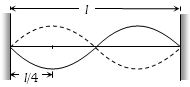
$A$ second harmonic has to be generated in a string of length $l$ stretched between two rigid supports. The points where the string has to be plucked and touched are
A
Plucked at $\frac{l}{4}$ and touched at $\frac{l}{2}$
B
Plucked at $\frac{l}{4}$ and touched at $\frac{3l}{4}$
C
Plucked at $\frac{l}{2}$ and touched at $\frac{l}{4}$
D
Plucked at $\frac{l}{2}$ and touched at $\frac{3l}{4}$
Solution
(A) To generate the $p$-th harmonic in a string of length $l$,the string should be plucked at a distance $x = \frac{l}{2p}$ from one end to create an antinode,and touched at a node to suppress other harmonics.
For the second harmonic,$p = 2$.
Therefore,the plucking point is $x = \frac{l}{2 \times 2} = \frac{l}{4}$ from one end.
The string must be touched at a node to ensure the second harmonic mode is formed. In the second harmonic,there is a node at the center of the string,which is at distance $\frac{l}{2}$ from either end.
Thus,the string is plucked at $\frac{l}{4}$ and touched at $\frac{l}{2}$.
For the second harmonic,$p = 2$.
Therefore,the plucking point is $x = \frac{l}{2 \times 2} = \frac{l}{4}$ from one end.
The string must be touched at a node to ensure the second harmonic mode is formed. In the second harmonic,there is a node at the center of the string,which is at distance $\frac{l}{2}$ from either end.
Thus,the string is plucked at $\frac{l}{4}$ and touched at $\frac{l}{2}$.
0 likes
View Solution19
DifficultMCQ
$A$ sonometer wire resonates with a given tuning fork forming standing waves with five antinodes between the two bridges when a mass of $9 \ kg$ is suspended from the wire. When this mass is replaced by a mass $M$,the wire resonates with the same tuning fork forming three antinodes for the same positions of the bridges. The value of $M$ is ... $kg$.
A
$25$
B
$5$
C
$12.5$
D
$1/25$
Solution
(A) The frequency of vibration of a sonometer wire is given by $n = \frac{p}{2l} \sqrt{\frac{T}{\mu}}$,where $p$ is the number of loops (antinodes),$l$ is the length,$T$ is the tension,and $\mu$ is the mass per unit length.
In the first case,$p_1 = 5$ and $T_1 = 9g$. Thus,$n = \frac{5}{2l} \sqrt{\frac{9g}{\mu}}$.
In the second case,$p_2 = 3$ and $T_2 = Mg$. Thus,$n = \frac{3}{2l} \sqrt{\frac{Mg}{\mu}}$.
Since the tuning fork is the same,the frequency $n$ remains constant. Equating the two expressions:
$\frac{5}{2l} \sqrt{\frac{9g}{\mu}} = \frac{3}{2l} \sqrt{\frac{Mg}{\mu}}$
Squaring both sides:
$25 \times 9g = 9 \times Mg$
$225g = 9Mg$
$M = \frac{225}{9} = 25 \ kg$.
In the first case,$p_1 = 5$ and $T_1 = 9g$. Thus,$n = \frac{5}{2l} \sqrt{\frac{9g}{\mu}}$.
In the second case,$p_2 = 3$ and $T_2 = Mg$. Thus,$n = \frac{3}{2l} \sqrt{\frac{Mg}{\mu}}$.
Since the tuning fork is the same,the frequency $n$ remains constant. Equating the two expressions:
$\frac{5}{2l} \sqrt{\frac{9g}{\mu}} = \frac{3}{2l} \sqrt{\frac{Mg}{\mu}}$
Squaring both sides:
$25 \times 9g = 9 \times Mg$
$225g = 9Mg$
$M = \frac{225}{9} = 25 \ kg$.
0 likes
View Solution20
MediumMCQ
The tension of a stretched string is increased by $69\%$. In order to keep its frequency of vibration constant,its length must be increased by .... $\%$
A
$20$
B
$30$
C
$\sqrt{69}$
D
$69$
Solution
(B) The frequency $n$ of a stretched string is given by $n = \frac{1}{2l} \sqrt{\frac{T}{\mu}}$,where $T$ is the tension,$l$ is the length,and $\mu$ is the mass per unit length.
Since $n$ and $\mu$ are constant,we have $n \propto \frac{\sqrt{T}}{l}$,which implies $l \propto \sqrt{T}$.
Given that the tension is increased by $69\%$,the new tension $T_2 = T_1 + 0.69 T_1 = 1.69 T_1$.
Using the proportionality $l_2 / l_1 = \sqrt{T_2 / T_1}$,we get $l_2 / l_1 = \sqrt{1.69 T_1 / T_1} = \sqrt{1.69} = 1.3$.
Therefore,$l_2 = 1.3 l_1 = l_1 + 0.3 l_1$.
This represents an increase of $30\%$ in length.
Since $n$ and $\mu$ are constant,we have $n \propto \frac{\sqrt{T}}{l}$,which implies $l \propto \sqrt{T}$.
Given that the tension is increased by $69\%$,the new tension $T_2 = T_1 + 0.69 T_1 = 1.69 T_1$.
Using the proportionality $l_2 / l_1 = \sqrt{T_2 / T_1}$,we get $l_2 / l_1 = \sqrt{1.69 T_1 / T_1} = \sqrt{1.69} = 1.3$.
Therefore,$l_2 = 1.3 l_1 = l_1 + 0.3 l_1$.
This represents an increase of $30\%$ in length.
0 likes
View Solution21
EasyMCQ
The length of a sonometer wire tuned to a frequency of $250 \ Hz$ is $0.60 \ m$. The frequency of the tuning fork with which the vibrating wire will be in tune when the length is made $0.40 \ m$ is .... $Hz$.
A
$250$
B
$375$
C
$256$
D
$384$
Solution
(B) For a sonometer wire vibrating in its fundamental mode,the frequency $n$ is inversely proportional to the length $l$ of the wire,given by the relation $n \propto \frac{1}{l}$,or $nl = \text{constant}$.
Given:
Initial frequency $n_1 = 250 \ Hz$
Initial length $l_1 = 0.60 \ m$
Final length $l_2 = 0.40 \ m$
Using the relation $n_1 l_1 = n_2 l_2$:
$250 \times 0.60 = n_2 \times 0.40$
$n_2 = \frac{250 \times 0.60}{0.40}$
$n_2 = \frac{150}{0.40} = 375 \ Hz$.
Therefore,the frequency of the tuning fork is $375 \ Hz$.
Given:
Initial frequency $n_1 = 250 \ Hz$
Initial length $l_1 = 0.60 \ m$
Final length $l_2 = 0.40 \ m$
Using the relation $n_1 l_1 = n_2 l_2$:
$250 \times 0.60 = n_2 \times 0.40$
$n_2 = \frac{250 \times 0.60}{0.40}$
$n_2 = \frac{150}{0.40} = 375 \ Hz$.
Therefore,the frequency of the tuning fork is $375 \ Hz$.
0 likes
View Solution22
MediumMCQ
$A$ string in a musical instrument is $50 \ cm$ long and its fundamental frequency is $800 \ Hz$. If a frequency of $1000 \ Hz$ is to be produced,then the required length of the string is ..... $cm$.
A
$62.5$
B
$50$
C
$40$
D
$37.5$
Solution
(C) The fundamental frequency $f$ of a stretched string is given by $f = \frac{v}{2L}$,where $v$ is the wave speed and $L$ is the length of the string.
Since the tension and mass per unit length of the string remain constant,the wave speed $v$ is constant.
Therefore,$f \propto \frac{1}{L}$,which implies $f_1 L_1 = f_2 L_2$.
Given: $f_1 = 800 \ Hz$,$L_1 = 50 \ cm$,and $f_2 = 1000 \ Hz$.
Substituting the values: $800 \times 50 = 1000 \times L_2$.
$L_2 = \frac{800 \times 50}{1000} = 40 \ cm$.
Thus,the required length of the string is $40 \ cm$.
Since the tension and mass per unit length of the string remain constant,the wave speed $v$ is constant.
Therefore,$f \propto \frac{1}{L}$,which implies $f_1 L_1 = f_2 L_2$.
Given: $f_1 = 800 \ Hz$,$L_1 = 50 \ cm$,and $f_2 = 1000 \ Hz$.
Substituting the values: $800 \times 50 = 1000 \times L_2$.
$L_2 = \frac{800 \times 50}{1000} = 40 \ cm$.
Thus,the required length of the string is $40 \ cm$.
0 likes
View Solution23
DifficultMCQ
Two wires are fixed in a sonometer. Their tensions are in the ratio $8:1$. The lengths are in the ratio $36:35$. The diameters are in the ratio $4:1$. Densities of the materials are in the ratio $1:2$. If the lower frequency in the setting is $360 \ Hz$,the beat frequency when the two wires are sounded together is: (in $Hz$)
A
$5$
B
$8$
C
$6$
D
$10$
Solution
(D) The frequency $n$ of a stretched string is given by $n = \frac{1}{2l} \sqrt{\frac{T}{\mu}} = \frac{1}{2l} \sqrt{\frac{T}{\pi r^2 \rho}} = \frac{1}{l} \sqrt{\frac{T}{\pi d^2 \rho}}$,where $d$ is the diameter.
Taking the ratio of frequencies for two wires:
$\frac{n_1}{n_2} = \frac{l_2}{l_1} \sqrt{\frac{T_1}{T_2} \times \left(\frac{d_2}{d_1}\right)^2 \times \frac{\rho_2}{\rho_1}}$
Given ratios: $\frac{T_1}{T_2} = \frac{8}{1}$,$\frac{l_1}{l_2} = \frac{36}{35}$,$\frac{d_1}{d_2} = \frac{4}{1}$,$\frac{\rho_1}{\rho_2} = \frac{1}{2}$.
Substituting these values:
$\frac{n_1}{n_2} = \frac{35}{36} \sqrt{\frac{8}{1} \times \left(\frac{1}{4}\right)^2 \times \frac{2}{1}}$
$\frac{n_1}{n_2} = \frac{35}{36} \sqrt{8 \times \frac{1}{16} \times 2} = \frac{35}{36} \sqrt{1} = \frac{35}{36}$.
Since $n_1 = 360 \ Hz$ is the lower frequency,$n_1 = 360 \ Hz$ and $n_2 = 360 \times \frac{36}{35} = 370 \ Hz$.
Beat frequency = $|n_2 - n_1| = |370 - 360| = 10 \ Hz$.
Taking the ratio of frequencies for two wires:
$\frac{n_1}{n_2} = \frac{l_2}{l_1} \sqrt{\frac{T_1}{T_2} \times \left(\frac{d_2}{d_1}\right)^2 \times \frac{\rho_2}{\rho_1}}$
Given ratios: $\frac{T_1}{T_2} = \frac{8}{1}$,$\frac{l_1}{l_2} = \frac{36}{35}$,$\frac{d_1}{d_2} = \frac{4}{1}$,$\frac{\rho_1}{\rho_2} = \frac{1}{2}$.
Substituting these values:
$\frac{n_1}{n_2} = \frac{35}{36} \sqrt{\frac{8}{1} \times \left(\frac{1}{4}\right)^2 \times \frac{2}{1}}$
$\frac{n_1}{n_2} = \frac{35}{36} \sqrt{8 \times \frac{1}{16} \times 2} = \frac{35}{36} \sqrt{1} = \frac{35}{36}$.
Since $n_1 = 360 \ Hz$ is the lower frequency,$n_1 = 360 \ Hz$ and $n_2 = 360 \times \frac{36}{35} = 370 \ Hz$.
Beat frequency = $|n_2 - n_1| = |370 - 360| = 10 \ Hz$.
0 likes
View Solution24
EasyMCQ
The first overtone of a stretched wire of given length is $320 \ Hz$. The first harmonic is .... $Hz$.
A
$320$
B
$160$
C
$480$
D
$640$
Solution
(B) For a stretched wire fixed at both ends,the frequencies of harmonics are given by $n_k = k \cdot n_1$,where $n_1$ is the fundamental frequency (first harmonic) and $k = 1, 2, 3, \dots$.
The first overtone corresponds to the second harmonic $(k = 2)$.
Given that the first overtone $n_2 = 320 \ Hz$.
Since $n_2 = 2 \cdot n_1$,we have $320 \ Hz = 2 \cdot n_1$.
Therefore,the first harmonic $n_1 = \frac{320 \ Hz}{2} = 160 \ Hz$.
The first overtone corresponds to the second harmonic $(k = 2)$.
Given that the first overtone $n_2 = 320 \ Hz$.
Since $n_2 = 2 \cdot n_1$,we have $320 \ Hz = 2 \cdot n_1$.
Therefore,the first harmonic $n_1 = \frac{320 \ Hz}{2} = 160 \ Hz$.
0 likes
View Solution25
MediumMCQ
The frequency of transverse vibrations in a stretched string is $200 \ Hz$. If the tension is increased four times and the length is reduced to one-fourth the original value,the frequency of vibration will be .... $Hz$.
A
$25$
B
$200$
C
$400$
D
$1600$
Solution
(D) The fundamental frequency of a stretched string is given by the formula: $n = \frac{1}{2l} \sqrt{\frac{T}{m}}$,where $l$ is the length,$T$ is the tension,and $m$ is the mass per unit length.
From the formula,we can see that $n \propto \frac{1}{l} \sqrt{T}$.
Let the initial frequency be $n_1 = 200 \ Hz$,initial length be $l_1$,and initial tension be $T_1$.
Let the final frequency be $n_2$,final length be $l_2 = \frac{l_1}{4}$,and final tension be $T_2 = 4T_1$.
Using the proportionality: $\frac{n_2}{n_1} = \frac{l_1}{l_2} \sqrt{\frac{T_2}{T_1}}$.
Substituting the values: $\frac{n_2}{200} = \frac{l_1}{l_1/4} \sqrt{\frac{4T_1}{T_1}} = 4 \times \sqrt{4} = 4 \times 2 = 8$.
Therefore,$n_2 = 8 \times 200 = 1600 \ Hz$.
From the formula,we can see that $n \propto \frac{1}{l} \sqrt{T}$.
Let the initial frequency be $n_1 = 200 \ Hz$,initial length be $l_1$,and initial tension be $T_1$.
Let the final frequency be $n_2$,final length be $l_2 = \frac{l_1}{4}$,and final tension be $T_2 = 4T_1$.
Using the proportionality: $\frac{n_2}{n_1} = \frac{l_1}{l_2} \sqrt{\frac{T_2}{T_1}}$.
Substituting the values: $\frac{n_2}{200} = \frac{l_1}{l_1/4} \sqrt{\frac{4T_1}{T_1}} = 4 \times \sqrt{4} = 4 \times 2 = 8$.
Therefore,$n_2 = 8 \times 200 = 1600 \ Hz$.
0 likes
View Solution26
MediumMCQ
Three similar wires of frequencies $n_1, n_2$ and $n_3$ are joined to form a single wire. What will be its resulting frequency $n$?
A
$n = n_1 + n_2 + n_3$
B
$\frac{1}{n} = \frac{1}{n_1} + \frac{1}{n_2} + \frac{1}{n_3}$
C
$n = n_1 \times n_2 \times n_3$
D
$n = \frac{n_1 + n_2 + n_3}{3}$
Solution
(B) The fundamental frequency of a stretched wire is given by $n = \frac{1}{2l} \sqrt{\frac{T}{\mu}}$,where $l$ is the length,$T$ is the tension,and $\mu$ is the mass per unit length.
Since the wires are similar,the mass per unit length $\mu$ and tension $T$ are the same for all segments.
Thus,$n \propto \frac{1}{l}$,which implies $nl = k$ (a constant).
For the three wires,we have $n_1 l_1 = n_2 l_2 = n_3 l_3 = k$.
This gives $l_1 = \frac{k}{n_1}$,$l_2 = \frac{k}{n_2}$,and $l_3 = \frac{k}{n_3}$.
The total length of the combined wire is $l = l_1 + l_2 + l_3$.
Substituting the values,we get $\frac{k}{n} = \frac{k}{n_1} + \frac{k}{n_2} + \frac{k}{n_3}$.
Dividing by $k$,we obtain $\frac{1}{n} = \frac{1}{n_1} + \frac{1}{n_2} + \frac{1}{n_3}$.
Since the wires are similar,the mass per unit length $\mu$ and tension $T$ are the same for all segments.
Thus,$n \propto \frac{1}{l}$,which implies $nl = k$ (a constant).
For the three wires,we have $n_1 l_1 = n_2 l_2 = n_3 l_3 = k$.
This gives $l_1 = \frac{k}{n_1}$,$l_2 = \frac{k}{n_2}$,and $l_3 = \frac{k}{n_3}$.
The total length of the combined wire is $l = l_1 + l_2 + l_3$.
Substituting the values,we get $\frac{k}{n} = \frac{k}{n_1} + \frac{k}{n_2} + \frac{k}{n_3}$.
Dividing by $k$,we obtain $\frac{1}{n} = \frac{1}{n_1} + \frac{1}{n_2} + \frac{1}{n_3}$.
0 likes
View Solution27
MediumMCQ
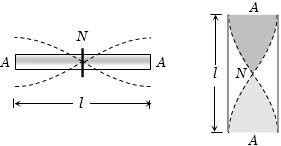
$A$ steel rod $100 \ cm$ long is clamped at its mid-point. The fundamental frequency of longitudinal vibrations of the rod is given to be $2.53 \ kHz$. What is the speed of sound in steel in $km/s$ (in $.06$)?
A
$5$
B
$6$
C
$7$
D
$8$
Solution
(A) When a rod is clamped at its mid-point,the mid-point acts as a node $(N)$ and the free ends act as antinodes $(A)$.
The length of the rod is $l = 100 \ cm = 1 \ m$.
For the fundamental mode of vibration,the length of the rod corresponds to half the wavelength,i.e.,$l = \frac{\lambda}{2}$,or $\lambda = 2l$.
The frequency $f$ is given by $f = \frac{v}{\lambda} = \frac{v}{2l}$.
Given $f = 2.53 \ kHz = 2530 \ Hz$ and $l = 1 \ m$,we have:
$2530 = \frac{v}{2 \times 1}$
$v = 2530 \times 2 = 5060 \ m/s$.
Converting to $km/s$,we get $v = 5.06 \ km/s$.
The length of the rod is $l = 100 \ cm = 1 \ m$.
For the fundamental mode of vibration,the length of the rod corresponds to half the wavelength,i.e.,$l = \frac{\lambda}{2}$,or $\lambda = 2l$.
The frequency $f$ is given by $f = \frac{v}{\lambda} = \frac{v}{2l}$.
Given $f = 2.53 \ kHz = 2530 \ Hz$ and $l = 1 \ m$,we have:
$2530 = \frac{v}{2 \times 1}$
$v = 2530 \times 2 = 5060 \ m/s$.
Converting to $km/s$,we get $v = 5.06 \ km/s$.
0 likes
View Solution28
MediumMCQ
Calculate the frequency of the second harmonic formed on a string of length $0.5 \ m$ and mass $2 \times 10^{-4} \ kg$ when stretched with a tension of $20 \ N$.
A
$274.4$
B
$744.2$
C
$44.72$
D
$447.2$
Solution
(D) The mass per unit length $\mu$ is given by $\mu = \frac{M}{L} = \frac{2 \times 10^{-4} \ kg}{0.5 \ m} = 4 \times 10^{-4} \ kg/m$.
The fundamental frequency $n_1$ of a stretched string is given by $n_1 = \frac{1}{2L} \sqrt{\frac{T}{\mu}}$.
The frequency of the second harmonic $n_2$ is given by $n_2 = 2n_1 = 2 \times \frac{1}{2L} \sqrt{\frac{T}{\mu}} = \frac{1}{L} \sqrt{\frac{T}{\mu}}$.
Substituting the values: $n_2 = \frac{1}{0.5} \sqrt{\frac{20}{4 \times 10^{-4}}} = 2 \times \sqrt{5 \times 10^4} = 2 \times 223.6 = 447.2 \ Hz$.
The fundamental frequency $n_1$ of a stretched string is given by $n_1 = \frac{1}{2L} \sqrt{\frac{T}{\mu}}$.
The frequency of the second harmonic $n_2$ is given by $n_2 = 2n_1 = 2 \times \frac{1}{2L} \sqrt{\frac{T}{\mu}} = \frac{1}{L} \sqrt{\frac{T}{\mu}}$.
Substituting the values: $n_2 = \frac{1}{0.5} \sqrt{\frac{20}{4 \times 10^{-4}}} = 2 \times \sqrt{5 \times 10^4} = 2 \times 223.6 = 447.2 \ Hz$.
0 likes
View Solution29
MediumMCQ
The fundamental frequency of a string stretched with a weight of $4 \ kg$ is $256 \ Hz$. The weight required to produce its octave is .... $kg \ wt$.
A
$4$
B
$8$
C
$12$
D
$16$
Solution
(D) The fundamental frequency $n$ of a stretched string is given by the formula: $n = \frac{1}{2l} \sqrt{\frac{T}{m}}$.
Since $l$ and $m$ are constant for a given string,the frequency is directly proportional to the square root of the tension: $n \propto \sqrt{T}$.
An octave corresponds to a frequency that is double the fundamental frequency,so $n' = 2n$.
Using the ratio: $\frac{n'}{n} = \sqrt{\frac{T'}{T}} = 2$.
Squaring both sides gives: $\frac{T'}{T} = 4$.
Therefore,the required tension is $T' = 4T = 4 \times 4 \ kg \ wt = 16 \ kg \ wt$.
Since $l$ and $m$ are constant for a given string,the frequency is directly proportional to the square root of the tension: $n \propto \sqrt{T}$.
An octave corresponds to a frequency that is double the fundamental frequency,so $n' = 2n$.
Using the ratio: $\frac{n'}{n} = \sqrt{\frac{T'}{T}} = 2$.
Squaring both sides gives: $\frac{T'}{T} = 4$.
Therefore,the required tension is $T' = 4T = 4 \times 4 \ kg \ wt = 16 \ kg \ wt$.
0 likes
View Solution30
MediumMCQ
Two vibrating strings of the same material but lengths $L$ and $2L$ have radii $2r$ and $r$ respectively. They are stretched under the same tension. Both the strings vibrate in their fundamental modes,the one of length $L$ with frequency $n_1$ and the other with frequency $n_2$. The ratio $n_1/n_2$ is given by
A
$2$
B
$4$
C
$8$
D
$1$
Solution
(D) The fundamental frequency $n$ of a vibrating string is given by the formula: $n = \frac{1}{2l} \sqrt{\frac{T}{\mu}}$,where $\mu$ is the mass per unit length.
Since $\mu = \pi r^2 \rho$ (where $\rho$ is the density of the material),the frequency is $n = \frac{1}{2lr} \sqrt{\frac{T}{\pi \rho}}$.
Given that the material is the same,$\rho$ is constant. Since the tension $T$ is also the same,we have $n \propto \frac{1}{lr}$.
Therefore,the ratio of the frequencies is $\frac{n_1}{n_2} = \frac{l_2 r_2}{l_1 r_1}$.
Substituting the given values: $l_1 = L$,$l_2 = 2L$,$r_1 = 2r$,and $r_2 = r$.
$\frac{n_1}{n_2} = \frac{2L \times r}{L \times 2r} = \frac{2Lr}{2Lr} = 1$.
Since $\mu = \pi r^2 \rho$ (where $\rho$ is the density of the material),the frequency is $n = \frac{1}{2lr} \sqrt{\frac{T}{\pi \rho}}$.
Given that the material is the same,$\rho$ is constant. Since the tension $T$ is also the same,we have $n \propto \frac{1}{lr}$.
Therefore,the ratio of the frequencies is $\frac{n_1}{n_2} = \frac{l_2 r_2}{l_1 r_1}$.
Substituting the given values: $l_1 = L$,$l_2 = 2L$,$r_1 = 2r$,and $r_2 = r$.
$\frac{n_1}{n_2} = \frac{2L \times r}{L \times 2r} = \frac{2Lr}{2Lr} = 1$.
0 likes
View Solution31
MediumMCQ
If the tension and diameter of a sonometer wire of fundamental frequency $n$ are doubled and density is halved,then its fundamental frequency will become
A
$\frac{n}{4}$
B
$\sqrt{2} \, n$
C
$n$
D
$\frac{n}{\sqrt{2}}$
Solution
(C) The fundamental frequency $n$ of a sonometer wire is given by the formula: $n = \frac{1}{2l} \sqrt{\frac{T}{\mu}}$,where $\mu = \pi r^2 \rho$ is the linear mass density.
Thus,$n \propto \sqrt{\frac{T}{r^2 \rho}}$.
Let the initial values be $T_1 = T$,$r_1 = r$,and $\rho_1 = \rho$. The new values are $T_2 = 2T$,$r_2 = 2r$,and $\rho_2 = \frac{\rho}{2}$.
The ratio of the frequencies is given by:
$\frac{n_2}{n_1} = \sqrt{\frac{T_2}{T_1} \cdot \left(\frac{r_1}{r_2}\right)^2 \cdot \frac{\rho_1}{\rho_2}}$
Substituting the values:
$\frac{n_2}{n_1} = \sqrt{\frac{2T}{T} \cdot \left(\frac{r}{2r}\right)^2 \cdot \frac{\rho}{\rho/2}} = \sqrt{2 \cdot \frac{1}{4} \cdot 2} = \sqrt{1} = 1$.
Therefore,$n_2 = n_1 = n$.
Thus,$n \propto \sqrt{\frac{T}{r^2 \rho}}$.
Let the initial values be $T_1 = T$,$r_1 = r$,and $\rho_1 = \rho$. The new values are $T_2 = 2T$,$r_2 = 2r$,and $\rho_2 = \frac{\rho}{2}$.
The ratio of the frequencies is given by:
$\frac{n_2}{n_1} = \sqrt{\frac{T_2}{T_1} \cdot \left(\frac{r_1}{r_2}\right)^2 \cdot \frac{\rho_1}{\rho_2}}$
Substituting the values:
$\frac{n_2}{n_1} = \sqrt{\frac{2T}{T} \cdot \left(\frac{r}{2r}\right)^2 \cdot \frac{\rho}{\rho/2}} = \sqrt{2 \cdot \frac{1}{4} \cdot 2} = \sqrt{1} = 1$.
Therefore,$n_2 = n_1 = n$.
0 likes
View Solution32
MediumMCQ
In a sonometer wire,the tension is maintained by suspending a $50.7 \, kg$ mass from the free end of the wire. The suspended mass has a volume of $0.0075 \, m^3$. The fundamental frequency of the wire is $260 \, Hz$. If the suspended mass is completely submerged in water,the fundamental frequency will become .... $Hz$ (take $g = 10 \, ms^{-2}$)
A
$240$
B
$230$
C
$220$
D
$200$
Solution
(A) The fundamental frequency of a sonometer wire is given by $n = \frac{1}{2l} \sqrt{\frac{T}{\mu}}$,where $T$ is the tension and $\mu$ is the linear mass density. Since $l$ and $\mu$ are constant,$n \propto \sqrt{T}$.
Initially,the tension $T_1 = M g = 50.7 \times 10 = 507 \, N$.
When the mass is submerged in water,the buoyant force $F_B = V \rho_{water} g = 0.0075 \times 1000 \times 10 = 75 \, N$.
The new tension $T_2 = M g - F_B = 507 - 75 = 432 \, N$.
Using the ratio $\frac{n_1}{n_2} = \sqrt{\frac{T_1}{T_2}}$,we get $\frac{260}{n_2} = \sqrt{\frac{507}{432}}$.
$\frac{260}{n_2} = \sqrt{1.1736} \approx 1.0833$.
$n_2 = \frac{260}{1.0833} \approx 240 \, Hz$.
Initially,the tension $T_1 = M g = 50.7 \times 10 = 507 \, N$.
When the mass is submerged in water,the buoyant force $F_B = V \rho_{water} g = 0.0075 \times 1000 \times 10 = 75 \, N$.
The new tension $T_2 = M g - F_B = 507 - 75 = 432 \, N$.
Using the ratio $\frac{n_1}{n_2} = \sqrt{\frac{T_1}{T_2}}$,we get $\frac{260}{n_2} = \sqrt{\frac{507}{432}}$.
$\frac{260}{n_2} = \sqrt{1.1736} \approx 1.0833$.
$n_2 = \frac{260}{1.0833} \approx 240 \, Hz$.
0 likes
View Solution33
MediumMCQ
$A$ string of length $2 \ m$ is fixed at both ends. If this string vibrates in its fourth normal mode with a frequency of $500 \ Hz$,then the waves would travel on it with a velocity of ..... $m/s$.
A
$125$
B
$250$
C
$500$
D
$1000$
Solution
(C) For a string fixed at both ends,the wavelength $\lambda$ for the $p$-th harmonic is given by $\lambda = \frac{2L}{p}$,where $L$ is the length of the string and $p$ is the mode number.
Given: $L = 2 \ m$,$p = 4$,and frequency $f = 500 \ Hz$.
First,calculate the wavelength: $\lambda = \frac{2 \times 2}{4} = 1 \ m$.
The velocity of the wave $v$ is given by $v = f \times \lambda$.
Substituting the values: $v = 500 \ Hz \times 1 \ m = 500 \ m/s$.
Given: $L = 2 \ m$,$p = 4$,and frequency $f = 500 \ Hz$.
First,calculate the wavelength: $\lambda = \frac{2 \times 2}{4} = 1 \ m$.
The velocity of the wave $v$ is given by $v = f \times \lambda$.
Substituting the values: $v = 500 \ Hz \times 1 \ m = 500 \ m/s$.
0 likes
View Solution34
MediumMCQ
The fundamental frequency of a sonometer wire is $n$. If its radius is doubled and its tension becomes half,while the material of the wire remains the same,the new fundamental frequency will be
A
$n$
B
$\frac{n}{\sqrt{2}}$
C
$\frac{n}{2}$
D
$\frac{n}{2\sqrt{2}}$
Solution
(D) The fundamental frequency $n$ of a sonometer wire is given by the formula:
$n = \frac{1}{2l} \sqrt{\frac{T}{\mu}}$
where $T$ is the tension,$l$ is the length,and $\mu$ is the linear mass density.
Since $\mu = \pi r^2 \rho$ (where $r$ is the radius and $\rho$ is the density of the material),the formula becomes:
$n = \frac{1}{2l} \sqrt{\frac{T}{\pi r^2 \rho}} = \frac{1}{2l} \frac{1}{r} \sqrt{\frac{T}{\pi \rho}}$
This implies $n \propto \frac{\sqrt{T}}{r}$.
Given that the new radius $r_2 = 2r_1$ and the new tension $T_2 = \frac{T_1}{2}$,the ratio of the new frequency $n_2$ to the original frequency $n_1$ is:
$\frac{n_2}{n_1} = \frac{r_1}{r_2} \sqrt{\frac{T_2}{T_1}} = \frac{r_1}{2r_1} \sqrt{\frac{T_1/2}{T_1}} = \frac{1}{2} \times \sqrt{\frac{1}{2}} = \frac{1}{2\sqrt{2}}$.
Therefore,the new frequency $n_2 = \frac{n}{2\sqrt{2}}$.
$n = \frac{1}{2l} \sqrt{\frac{T}{\mu}}$
where $T$ is the tension,$l$ is the length,and $\mu$ is the linear mass density.
Since $\mu = \pi r^2 \rho$ (where $r$ is the radius and $\rho$ is the density of the material),the formula becomes:
$n = \frac{1}{2l} \sqrt{\frac{T}{\pi r^2 \rho}} = \frac{1}{2l} \frac{1}{r} \sqrt{\frac{T}{\pi \rho}}$
This implies $n \propto \frac{\sqrt{T}}{r}$.
Given that the new radius $r_2 = 2r_1$ and the new tension $T_2 = \frac{T_1}{2}$,the ratio of the new frequency $n_2$ to the original frequency $n_1$ is:
$\frac{n_2}{n_1} = \frac{r_1}{r_2} \sqrt{\frac{T_2}{T_1}} = \frac{r_1}{2r_1} \sqrt{\frac{T_1/2}{T_1}} = \frac{1}{2} \times \sqrt{\frac{1}{2}} = \frac{1}{2\sqrt{2}}$.
Therefore,the new frequency $n_2 = \frac{n}{2\sqrt{2}}$.
0 likes
View Solution35
MediumMCQ
In an experiment with a sonometer,a tuning fork of frequency $256 \ Hz$ resonates with a length of $25 \ cm$ and another tuning fork resonates with a length of $16 \ cm$. If the tension of the string remains constant,the frequency of the second tuning fork is .... $Hz$
A
$163.84$
B
$400$
C
$320$
D
$204.8$
Solution
(B) For a sonometer wire,the fundamental frequency $n$ is given by the relation:
$n = \frac{1}{2l} \sqrt{\frac{T}{m}}$
Since the tension $T$ and mass per unit length $m$ are constant,the frequency is inversely proportional to the resonating length $l$:
$n \propto \frac{1}{l}$
Therefore,$n_1 l_1 = n_2 l_2$
Given:
$n_1 = 256 \ Hz$,$l_1 = 25 \ cm$,$l_2 = 16 \ cm$
Substituting the values:
$256 \times 25 = n_2 \times 16$
$n_2 = \frac{256 \times 25}{16}$
$n_2 = 16 \times 25 = 400 \ Hz$
Thus,the frequency of the second tuning fork is $400 \ Hz$.
$n = \frac{1}{2l} \sqrt{\frac{T}{m}}$
Since the tension $T$ and mass per unit length $m$ are constant,the frequency is inversely proportional to the resonating length $l$:
$n \propto \frac{1}{l}$
Therefore,$n_1 l_1 = n_2 l_2$
Given:
$n_1 = 256 \ Hz$,$l_1 = 25 \ cm$,$l_2 = 16 \ cm$
Substituting the values:
$256 \times 25 = n_2 \times 16$
$n_2 = \frac{256 \times 25}{16}$
$n_2 = 16 \times 25 = 400 \ Hz$
Thus,the frequency of the second tuning fork is $400 \ Hz$.
0 likes
View Solution36
MediumMCQ
$A$ metal wire of linear mass density of $9.8 \, g/m$ is stretched with a tension of $10 \, kg$ weight between two rigid supports $1 \, m$ apart. The wire passes at its middle point between the poles of a permanent magnet,and it vibrates in resonance when carrying an alternating current of frequency $n$. The frequency $n$ of the alternating source is ..... $Hz$.
A
$25$
B
$50$
C
$100$
D
$200$
Solution
(B) In the condition of resonance,the frequency of the alternating current $(n)$ is equal to the fundamental frequency of the vibrating wire.
The fundamental frequency of a stretched string is given by $n = \frac{1}{2l} \sqrt{\frac{T}{\mu}}$,where $l$ is the length,$T$ is the tension,and $\mu$ is the linear mass density.
Given:
Length $l = 1 \, m$
Tension $T = 10 \, kg \text{-} wt = 10 \times 9.8 \, N = 98 \, N$
Linear mass density $\mu = 9.8 \, g/m = 9.8 \times 10^{-3} \, kg/m$
Substituting the values:
$n = \frac{1}{2 \times 1} \sqrt{\frac{98}{9.8 \times 10^{-3}}}$
$n = \frac{1}{2} \sqrt{10000}$
$n = \frac{1}{2} \times 100 = 50 \, Hz$.
The fundamental frequency of a stretched string is given by $n = \frac{1}{2l} \sqrt{\frac{T}{\mu}}$,where $l$ is the length,$T$ is the tension,and $\mu$ is the linear mass density.
Given:
Length $l = 1 \, m$
Tension $T = 10 \, kg \text{-} wt = 10 \times 9.8 \, N = 98 \, N$
Linear mass density $\mu = 9.8 \, g/m = 9.8 \times 10^{-3} \, kg/m$
Substituting the values:
$n = \frac{1}{2 \times 1} \sqrt{\frac{98}{9.8 \times 10^{-3}}}$
$n = \frac{1}{2} \sqrt{10000}$
$n = \frac{1}{2} \times 100 = 50 \, Hz$.
0 likes
View Solution37
DifficultMCQ
$A$ wire of density $9 \times 10^3 \text{ kg/m}^3$ is stretched between two clamps $1 \text{ m}$ apart and is subjected to an extension of $4.9 \times 10^{-4} \text{ m}$. The lowest frequency of transverse vibration in the wire is ..... $\text{Hz}$ $(Y = 9 \times 10^{10} \text{ N/m}^2)$.
A
$40$
B
$35$
C
$30$
D
$25$
Solution
(B) The fundamental (lowest) frequency of a stretched wire is given by $n = \frac{1}{2l} \sqrt{\frac{T}{m}}$,where $T$ is the tension and $m$ is the mass per unit length.
Given: Density $\rho = 9 \times 10^3 \text{ kg/m}^3$,length $l = 1 \text{ m}$,extension $\Delta l = 4.9 \times 10^{-4} \text{ m}$,and Young's modulus $Y = 9 \times 10^{10} \text{ N/m}^2$.
Mass per unit length $m = \frac{M}{l} = \frac{A \cdot l \cdot \rho}{l} = A\rho$.
From Young's modulus,$Y = \frac{T/A}{\Delta l/l} \implies T = \frac{Y \cdot A \cdot \Delta l}{l}$.
Substituting $T$ and $m$ into the frequency formula:
$n = \frac{1}{2l} \sqrt{\frac{Y \cdot A \cdot \Delta l / l}{A \cdot \rho}} = \frac{1}{2l} \sqrt{\frac{Y \cdot \Delta l}{l \cdot \rho}}$.
Substituting the values:
$n = \frac{1}{2 \times 1} \sqrt{\frac{9 \times 10^{10} \times 4.9 \times 10^{-4}}{1 \times 9 \times 10^3}} = \frac{1}{2} \sqrt{\frac{9 \times 4.9 \times 10^6}{9 \times 10^3}} = \frac{1}{2} \sqrt{4.9 \times 10^3} = \frac{1}{2} \sqrt{4900} = \frac{70}{2} = 35 \text{ Hz}$.
Given: Density $\rho = 9 \times 10^3 \text{ kg/m}^3$,length $l = 1 \text{ m}$,extension $\Delta l = 4.9 \times 10^{-4} \text{ m}$,and Young's modulus $Y = 9 \times 10^{10} \text{ N/m}^2$.
Mass per unit length $m = \frac{M}{l} = \frac{A \cdot l \cdot \rho}{l} = A\rho$.
From Young's modulus,$Y = \frac{T/A}{\Delta l/l} \implies T = \frac{Y \cdot A \cdot \Delta l}{l}$.
Substituting $T$ and $m$ into the frequency formula:
$n = \frac{1}{2l} \sqrt{\frac{Y \cdot A \cdot \Delta l / l}{A \cdot \rho}} = \frac{1}{2l} \sqrt{\frac{Y \cdot \Delta l}{l \cdot \rho}}$.
Substituting the values:
$n = \frac{1}{2 \times 1} \sqrt{\frac{9 \times 10^{10} \times 4.9 \times 10^{-4}}{1 \times 9 \times 10^3}} = \frac{1}{2} \sqrt{\frac{9 \times 4.9 \times 10^6}{9 \times 10^3}} = \frac{1}{2} \sqrt{4.9 \times 10^3} = \frac{1}{2} \sqrt{4900} = \frac{70}{2} = 35 \text{ Hz}$.
0 likes
View Solution38
DifficultMCQ
$A$ stone is hung in air from a wire which is stretched over a sonometer. The bridges of the sonometer are $L \, cm$ apart when the wire is in unison with a tuning fork of frequency $N$. When the stone is completely immersed in water,the length between the bridges is $l \, cm$ for re-establishing unison. The specific gravity of the material of the stone is:
A
$\frac{L^2}{L^2 + l^2}$
B
$\frac{L^2 - l^2}{L^2}$
C
$\frac{L^2}{L^2 - l^2}$
D
$\frac{l^2}{L^2 - l^2}$
Solution
(C) The frequency of vibration of a stretched string is given by $n = \frac{1}{2L} \sqrt{\frac{T}{m}}$.
Since the frequency $N$ remains constant,we have $L \propto \sqrt{T}$,where $T$ is the tension in the wire.
In air,the tension $T_{air} = V \rho g$,where $V$ is the volume of the stone and $\rho$ is its density.
When immersed in water,the tension becomes $T_{water} = V(\rho - \sigma)g$,where $\sigma$ is the density of water. Taking $\sigma = 1$ (specific gravity unit),$T_{water} = V(\rho - 1)g$.
Thus,$\frac{L}{l} = \sqrt{\frac{T_{air}}{T_{water}}} = \sqrt{\frac{V \rho g}{V(\rho - 1)g}} = \sqrt{\frac{\rho}{\rho - 1}}$.
Squaring both sides,$\frac{L^2}{l^2} = \frac{\rho}{\rho - 1}$.
$\rho(l^2) = L^2(\rho - 1) \implies \rho l^2 = L^2 \rho - L^2$.
$L^2 = \rho(L^2 - l^2)$.
Therefore,$\rho = \frac{L^2}{L^2 - l^2}$.
Since the frequency $N$ remains constant,we have $L \propto \sqrt{T}$,where $T$ is the tension in the wire.
In air,the tension $T_{air} = V \rho g$,where $V$ is the volume of the stone and $\rho$ is its density.
When immersed in water,the tension becomes $T_{water} = V(\rho - \sigma)g$,where $\sigma$ is the density of water. Taking $\sigma = 1$ (specific gravity unit),$T_{water} = V(\rho - 1)g$.
Thus,$\frac{L}{l} = \sqrt{\frac{T_{air}}{T_{water}}} = \sqrt{\frac{V \rho g}{V(\rho - 1)g}} = \sqrt{\frac{\rho}{\rho - 1}}$.
Squaring both sides,$\frac{L^2}{l^2} = \frac{\rho}{\rho - 1}$.
$\rho(l^2) = L^2(\rho - 1) \implies \rho l^2 = L^2 \rho - L^2$.
$L^2 = \rho(L^2 - l^2)$.
Therefore,$\rho = \frac{L^2}{L^2 - l^2}$.
0 likes
View Solution39
DifficultMCQ
In Melde's experiment,the string vibrates in $4$ loops when a $50 \,g$ weight is placed in the pan of weight $15 \,g$. To make the string vibrate in $6$ loops,the weight that has to be removed from the pan is:
A
$0.0007 \,kg \,wt$
B
$0.0021 \,kg \,wt$
C
$0.036 \,kg \,wt$
D
$0.0029 \,kg \,wt$
Solution
(C) The frequency of vibration of a string is given by $n = \frac{p}{2l} \sqrt{\frac{T}{m}}$,where $p$ is the number of loops,$l$ is the length,$T$ is the tension,and $m$ is the mass per unit length.
Since $n$,$l$,and $m$ are constant,we have $p \propto \frac{1}{\sqrt{T}}$,which implies $p_1 \sqrt{T_1} = p_2 \sqrt{T_2}$.
Given $p_1 = 4$ and $T_1 = (50 + 15) \,g = 65 \,g$.
For $p_2 = 6$,we have $4 \sqrt{65} = 6 \sqrt{T_2}$.
Squaring both sides: $16 \times 65 = 36 \times T_2$.
$T_2 = \frac{16 \times 65}{36} = \frac{4 \times 65}{9} \approx 28.89 \,g$.
The weight to be removed is $\Delta T = T_1 - T_2 = 65 - 28.89 = 36.11 \,g \approx 36 \,g$.
Converting to $kg$,we get $36 \,g = 0.036 \,kg \,wt$.
Since $n$,$l$,and $m$ are constant,we have $p \propto \frac{1}{\sqrt{T}}$,which implies $p_1 \sqrt{T_1} = p_2 \sqrt{T_2}$.
Given $p_1 = 4$ and $T_1 = (50 + 15) \,g = 65 \,g$.
For $p_2 = 6$,we have $4 \sqrt{65} = 6 \sqrt{T_2}$.
Squaring both sides: $16 \times 65 = 36 \times T_2$.
$T_2 = \frac{16 \times 65}{36} = \frac{4 \times 65}{9} \approx 28.89 \,g$.
The weight to be removed is $\Delta T = T_1 - T_2 = 65 - 28.89 = 36.11 \,g \approx 36 \,g$.
Converting to $kg$,we get $36 \,g = 0.036 \,kg \,wt$.
0 likes
View Solution40
MediumMCQ
The correct graph between the frequency $n$ and the square root of density $(\rho)$ of a wire,keeping its length,radius,and tension constant,is:
A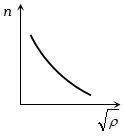
B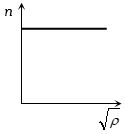
C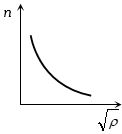
D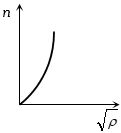
Solution
(A) The frequency $n$ of a vibrating wire is given by the formula:
$n = \frac{p}{2l} \sqrt{\frac{T}{\pi r^2 \rho}}$
where $p$ is the mode of vibration,$l$ is the length,$T$ is the tension,$r$ is the radius,and $\rho$ is the density.
Given that $l$,$r$,and $T$ are constant,the relationship between frequency $n$ and density $\rho$ is:
$n \propto \frac{1}{\sqrt{\rho}}$
This represents an inverse relationship,which graphically corresponds to a rectangular hyperbola. As $\sqrt{\rho}$ increases,$n$ decreases. Thus,the correct graph is a hyperbola.
$n = \frac{p}{2l} \sqrt{\frac{T}{\pi r^2 \rho}}$
where $p$ is the mode of vibration,$l$ is the length,$T$ is the tension,$r$ is the radius,and $\rho$ is the density.
Given that $l$,$r$,and $T$ are constant,the relationship between frequency $n$ and density $\rho$ is:
$n \propto \frac{1}{\sqrt{\rho}}$
This represents an inverse relationship,which graphically corresponds to a rectangular hyperbola. As $\sqrt{\rho}$ increases,$n$ decreases. Thus,the correct graph is a hyperbola.
0 likes
View Solution41
MediumMCQ
$A$ tuning fork is sounded with a sonometer wire of length $95 \, cm$ or $100 \, cm$,producing $4$ beats per second in both cases. What is the frequency of the tuning fork in $Hz$?
A
$156$
B
$152$
C
$148$
D
$160$
Solution
(A) The frequency $n$ of a sonometer wire is inversely proportional to its length $l$,i.e.,$n \propto \frac{1}{l}$.
Given that the tuning fork produces $4$ beats per second with lengths $l_1 = 95 \, cm$ and $l_2 = 100 \, cm$.
Let the frequency of the tuning fork be $n$.
For $l_1 = 95 \, cm$,the frequency of the wire is $n_1 = \frac{k}{95}$. Since $l_1 < l_2$,$n_1 > n_2$. Thus,$n_1 = n + 4$.
For $l_2 = 100 \, cm$,the frequency of the wire is $n_2 = \frac{k}{100}$. Thus,$n_2 = n - 4$.
We have the relation: $(n + 4) \times 95 = (n - 4) \times 100$.
$95n + 380 = 100n - 400$.
$5n = 780$.
$n = 156 \, Hz$.
Given that the tuning fork produces $4$ beats per second with lengths $l_1 = 95 \, cm$ and $l_2 = 100 \, cm$.
Let the frequency of the tuning fork be $n$.
For $l_1 = 95 \, cm$,the frequency of the wire is $n_1 = \frac{k}{95}$. Since $l_1 < l_2$,$n_1 > n_2$. Thus,$n_1 = n + 4$.
For $l_2 = 100 \, cm$,the frequency of the wire is $n_2 = \frac{k}{100}$. Thus,$n_2 = n - 4$.
We have the relation: $(n + 4) \times 95 = (n - 4) \times 100$.
$95n + 380 = 100n - 400$.
$5n = 780$.
$n = 156 \, Hz$.
0 likes
View Solution42
MediumMCQ
If $n_{1}, n_{2}$ and $n_{3}$ are the fundamental frequencies of three segments into which a string is divided,then the original fundamental frequency $n$ of the string is given by
A
$n = n_{1} + n_{2} + n_{3}$
B
$\sqrt{n} = \sqrt{n_{1}} + \sqrt{n_{2}} + \sqrt{n_{3}}$
C
$\frac{1}{n} = \frac{1}{n_{1}} + \frac{1}{n_{2}} + \frac{1}{n_{3}}$
D
$\frac{1}{n^{2}} = \frac{1}{n_{1}^{2}} + \frac{1}{n_{2}^{2}} + \frac{1}{n_{3}^{2}}$
Solution
(C) The fundamental frequency of a stretched string is given by $n = \frac{1}{2l} \sqrt{\frac{T}{\mu}}$.
Since the tension $T$ and mass per unit length $\mu$ are constant for the string,we have $n \propto \frac{1}{l}$,which implies $l = \frac{k}{n}$,where $k$ is a constant.
When the string is divided into three segments of lengths $l_{1}, l_{2}, l_{3}$ with fundamental frequencies $n_{1}, n_{2}, n_{3}$ respectively,we have $l_{1} = \frac{k}{n_{1}}$,$l_{2} = \frac{k}{n_{2}}$,and $l_{3} = \frac{k}{n_{3}}$.
The total length of the string is $l = l_{1} + l_{2} + l_{3}$.
Substituting the expressions for length in terms of frequency,we get $\frac{k}{n} = \frac{k}{n_{1}} + \frac{k}{n_{2}} + \frac{k}{n_{3}}$.
Dividing by $k$,we obtain the relation $\frac{1}{n} = \frac{1}{n_{1}} + \frac{1}{n_{2}} + \frac{1}{n_{3}}$.
Since the tension $T$ and mass per unit length $\mu$ are constant for the string,we have $n \propto \frac{1}{l}$,which implies $l = \frac{k}{n}$,where $k$ is a constant.
When the string is divided into three segments of lengths $l_{1}, l_{2}, l_{3}$ with fundamental frequencies $n_{1}, n_{2}, n_{3}$ respectively,we have $l_{1} = \frac{k}{n_{1}}$,$l_{2} = \frac{k}{n_{2}}$,and $l_{3} = \frac{k}{n_{3}}$.
The total length of the string is $l = l_{1} + l_{2} + l_{3}$.
Substituting the expressions for length in terms of frequency,we get $\frac{k}{n} = \frac{k}{n_{1}} + \frac{k}{n_{2}} + \frac{k}{n_{3}}$.
Dividing by $k$,we obtain the relation $\frac{1}{n} = \frac{1}{n_{1}} + \frac{1}{n_{2}} + \frac{1}{n_{3}}$.
0 likes
View Solution43
EasyMCQ
The frequency of the first harmonic of a string stretched between two points is $100 \, Hz$. The frequency of the third overtone is ... $Hz$.
A
$200$
B
$300$
C
$400$
D
$600$
Solution
(C) The fundamental frequency (first harmonic) is given as $n_1 = 100 \, Hz$.
In a string stretched between two fixed points,the harmonics are given by $n_k = k \times n_1$,where $k$ is the harmonic number $(k = 1, 2, 3, \dots)$.
The first overtone is the second harmonic $(n_2 = 2n_1)$.
The second overtone is the third harmonic $(n_3 = 3n_1)$.
The third overtone is the fourth harmonic $(n_4 = 4n_1)$.
Therefore,the frequency of the third overtone is $n_4 = 4 \times 100 \, Hz = 400 \, Hz$.
In a string stretched between two fixed points,the harmonics are given by $n_k = k \times n_1$,where $k$ is the harmonic number $(k = 1, 2, 3, \dots)$.
The first overtone is the second harmonic $(n_2 = 2n_1)$.
The second overtone is the third harmonic $(n_3 = 3n_1)$.
The third overtone is the fourth harmonic $(n_4 = 4n_1)$.
Therefore,the frequency of the third overtone is $n_4 = 4 \times 100 \, Hz = 400 \, Hz$.
0 likes
View Solution44
EasyMCQ
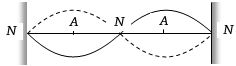
Unlike a laboratory sonometer,a stringed instrument is seldom plucked in the middle. Supposing a sitar string is plucked at about $\frac{1}{4}$th of its length from the end. The most prominent harmonic would be
A
Eighth
B
Fourth
C
Third
D
Second
Solution
(D) When a string is plucked at a distance of $\frac{1}{n}$th of its length from one end,the $n$th harmonic is the most prominent one.
In this case,the string is plucked at $\frac{1}{4}$th of its length from the end,which means $n = 4$.
However,the question asks for the most prominent harmonic. If a string is plucked at $\frac{L}{n}$,the $n$th harmonic is absent if $n$ is a multiple of the harmonic number. Specifically,if plucked at $\frac{1}{4}$th,the $4$th harmonic has a node at the point of plucking and is therefore absent.
The harmonics present are those where the plucking point is an antinode. For a string plucked at $\frac{L}{4}$,the $1$st,$2$nd,$3$rd,$5$th,etc.,harmonics are present. The $2$nd harmonic is the most prominent among the lower harmonics because the plucking point coincides with an antinode of the $2$nd harmonic (which has antinodes at $\frac{L}{4}$ and $\frac{3L}{4}$). Thus,the $2$nd harmonic is the most prominent.
In this case,the string is plucked at $\frac{1}{4}$th of its length from the end,which means $n = 4$.
However,the question asks for the most prominent harmonic. If a string is plucked at $\frac{L}{n}$,the $n$th harmonic is absent if $n$ is a multiple of the harmonic number. Specifically,if plucked at $\frac{1}{4}$th,the $4$th harmonic has a node at the point of plucking and is therefore absent.
The harmonics present are those where the plucking point is an antinode. For a string plucked at $\frac{L}{4}$,the $1$st,$2$nd,$3$rd,$5$th,etc.,harmonics are present. The $2$nd harmonic is the most prominent among the lower harmonics because the plucking point coincides with an antinode of the $2$nd harmonic (which has antinodes at $\frac{L}{4}$ and $\frac{3L}{4}$). Thus,the $2$nd harmonic is the most prominent.
0 likes
View Solution45
MediumMCQ
If ${n_1}, {n_2}, {n_3}, \dots$ are the frequencies of segments of a stretched string,the frequency $n$ of the string is given by
A
$n = {n_1} + {n_2} + {n_3} + \dots$
B
$n = \sqrt {{n_1} \times {n_2} \times {n_3} \times \dots}$
C
$\frac{1}{n} = \frac{1}{{{n_1}}} + \frac{1}{{{n_2}}} + \frac{1}{{{n_3}}} + \dots$
D
None of these
Solution
(C) For a vibrating string,the product of frequency $n$ and length $l$ is constant,i.e.,$n_1 l_1 = n_2 l_2 = n_3 l_3 = \dots = nl = k$ (constant).
Since the total length of the string is the sum of the lengths of its segments,we have $l_1 + l_2 + l_3 + \dots = l$.
Substituting $l_i = \frac{k}{n_i}$ and $l = \frac{k}{n}$ into the equation,we get $\frac{k}{n_1} + \frac{k}{n_2} + \frac{k}{n_3} + \dots = \frac{k}{n}$.
Dividing both sides by $k$,we obtain $\frac{1}{n} = \frac{1}{n_1} + \frac{1}{n_2} + \frac{1}{n_3} + \dots$.
Since the total length of the string is the sum of the lengths of its segments,we have $l_1 + l_2 + l_3 + \dots = l$.
Substituting $l_i = \frac{k}{n_i}$ and $l = \frac{k}{n}$ into the equation,we get $\frac{k}{n_1} + \frac{k}{n_2} + \frac{k}{n_3} + \dots = \frac{k}{n}$.
Dividing both sides by $k$,we obtain $\frac{1}{n} = \frac{1}{n_1} + \frac{1}{n_2} + \frac{1}{n_3} + \dots$.
0 likes
View Solution46
DifficultMCQ
$A$ metallic wire of length $L$ is fixed between two rigid supports. If the wire is cooled through a temperature difference $\Delta T$ ($Y =$ Young's modulus,$\rho =$ density,$\alpha =$ coefficient of linear expansion),then the frequency of transverse vibration is proportional to:
A
$\frac{\alpha}{\sqrt{\rho Y}}$
B
$\sqrt{\frac{Y\alpha}{\rho}}$
C
$\frac{\rho}{\sqrt{Y\alpha}}$
D
$\sqrt{\frac{\rho\alpha}{Y}}$
Solution
(B) When the wire is cooled,it tends to contract,but since it is fixed between rigid supports,a tension $F$ is developed in the wire.
The thermal strain $\alpha \Delta T$ is equal to the elastic strain $\frac{F}{AY}$.
$\frac{F}{AY} = \alpha \Delta T \implies F = Y A \alpha \Delta T$
The frequency of the fundamental mode of transverse vibration is given by $f = \frac{1}{2L} \sqrt{\frac{F}{\mu}}$,where $\mu$ is the mass per unit length.
Since $\mu = \rho A$,we substitute $F$ and $\mu$ into the frequency formula:
$f = \frac{1}{2L} \sqrt{\frac{Y A \alpha \Delta T}{\rho A}} = \frac{1}{2L} \sqrt{\frac{Y \alpha \Delta T}{\rho}}$
Since $L, \Delta T$ are constants,$f \propto \sqrt{\frac{Y \alpha}{\rho}}$.
The thermal strain $\alpha \Delta T$ is equal to the elastic strain $\frac{F}{AY}$.
$\frac{F}{AY} = \alpha \Delta T \implies F = Y A \alpha \Delta T$
The frequency of the fundamental mode of transverse vibration is given by $f = \frac{1}{2L} \sqrt{\frac{F}{\mu}}$,where $\mu$ is the mass per unit length.
Since $\mu = \rho A$,we substitute $F$ and $\mu$ into the frequency formula:
$f = \frac{1}{2L} \sqrt{\frac{Y A \alpha \Delta T}{\rho A}} = \frac{1}{2L} \sqrt{\frac{Y \alpha \Delta T}{\rho}}$
Since $L, \Delta T$ are constants,$f \propto \sqrt{\frac{Y \alpha}{\rho}}$.
0 likes
View Solution47
AdvancedMCQ
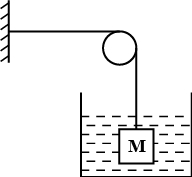
The frequency of a sonometer wire is $f$. When the weights producing the tension are completely immersed in water,the frequency becomes $f/2$. When the weights are immersed in a certain liquid,the frequency becomes $f/3$. The specific gravity of the liquid is:
A
$4/3$
B
$16/9$
C
$15/12$
D
$32/27$
Solution
(D) The frequency of a sonometer wire is given by $f = \frac{1}{2l} \sqrt{\frac{T}{\mu}}$,where $T$ is the tension and $\mu$ is the mass per unit length. Since $f \propto \sqrt{T}$,we have $f \propto \sqrt{Mg}$.
When the mass $M$ is immersed in water,the effective tension is $T_w = Mg - V\rho_w g$,where $V$ is the volume of the mass and $\rho_w$ is the density of water. Given $f_w = f/2$,we have:
$\frac{f}{2} = \frac{1}{2l} \sqrt{\frac{Mg - V\rho_w g}{\mu}} \implies \frac{1}{4} = \frac{Mg - V\rho_w g}{Mg} = 1 - \frac{V\rho_w}{M}$.
Thus,$\frac{V\rho_w}{M} = 1 - \frac{1}{4} = \frac{3}{4}$,so $V = \frac{3M}{4\rho_w}$.
When the mass is immersed in a liquid of density $\rho_L$,the frequency is $f_L = f/3$. The effective tension is $T_L = Mg - V\rho_L g$. Thus:
$\frac{f}{3} = \frac{1}{2l} \sqrt{\frac{Mg - V\rho_L g}{\mu}} \implies \frac{1}{9} = \frac{Mg - V\rho_L g}{Mg} = 1 - \frac{V\rho_L}{M}$.
Substituting $V = \frac{3M}{4\rho_w}$:
$\frac{1}{9} = 1 - \frac{3M}{4\rho_w} \cdot \frac{\rho_L}{M} \implies \frac{3}{4} \cdot \frac{\rho_L}{\rho_w} = 1 - \frac{1}{9} = \frac{8}{9}$.
Therefore,the specific gravity $\frac{\rho_L}{\rho_w} = \frac{8}{9} \cdot \frac{4}{3} = \frac{32}{27}$.
When the mass $M$ is immersed in water,the effective tension is $T_w = Mg - V\rho_w g$,where $V$ is the volume of the mass and $\rho_w$ is the density of water. Given $f_w = f/2$,we have:
$\frac{f}{2} = \frac{1}{2l} \sqrt{\frac{Mg - V\rho_w g}{\mu}} \implies \frac{1}{4} = \frac{Mg - V\rho_w g}{Mg} = 1 - \frac{V\rho_w}{M}$.
Thus,$\frac{V\rho_w}{M} = 1 - \frac{1}{4} = \frac{3}{4}$,so $V = \frac{3M}{4\rho_w}$.
When the mass is immersed in a liquid of density $\rho_L$,the frequency is $f_L = f/3$. The effective tension is $T_L = Mg - V\rho_L g$. Thus:
$\frac{f}{3} = \frac{1}{2l} \sqrt{\frac{Mg - V\rho_L g}{\mu}} \implies \frac{1}{9} = \frac{Mg - V\rho_L g}{Mg} = 1 - \frac{V\rho_L}{M}$.
Substituting $V = \frac{3M}{4\rho_w}$:
$\frac{1}{9} = 1 - \frac{3M}{4\rho_w} \cdot \frac{\rho_L}{M} \implies \frac{3}{4} \cdot \frac{\rho_L}{\rho_w} = 1 - \frac{1}{9} = \frac{8}{9}$.
Therefore,the specific gravity $\frac{\rho_L}{\rho_w} = \frac{8}{9} \cdot \frac{4}{3} = \frac{32}{27}$.
0 likes
View Solution48
MediumMCQ
$A$ sonometer wire of length $1.5 \ m$ is made of steel. The tension in it produces an elastic strain of $1 \%$. What is the fundamental frequency of steel if density and elasticity of steel are $7.7 \times 10^3 \ kg/m^3$ and $2.2 \times 10^{11} \ N/m^2$ respectively (in $Hz$)?
A
$770$
B
$188.5$
C
$178.2$
D
$200.5$
Solution
(C) The fundamental frequency of a sonometer wire is given by $f = \frac{v}{2L} = \frac{1}{2L} \sqrt{\frac{T}{\mu}}$.
Since $\mu = A \rho$,we have $f = \frac{1}{2L} \sqrt{\frac{T}{A \rho}}$.
From Young's modulus $Y = \frac{T/A}{\Delta L/L}$,we get $\frac{T}{A} = Y \times \text{strain} = Y \times \frac{\Delta L}{L}$.
Substituting this into the frequency formula: $f = \frac{1}{2L} \sqrt{\frac{Y \times \text{strain}}{\rho}}$.
Given: $L = 1.5 \ m$,$\text{strain} = 1\% = 0.01$,$Y = 2.2 \times 10^{11} \ N/m^2$,$\rho = 7.7 \times 10^3 \ kg/m^3$.
$f = \frac{1}{2 \times 1.5} \sqrt{\frac{2.2 \times 10^{11} \times 0.01}{7.7 \times 10^3}}$.
$f = \frac{1}{3} \sqrt{\frac{2.2 \times 10^9}{7.7}} = \frac{1}{3} \sqrt{0.2857 \times 10^9} = \frac{1}{3} \sqrt{28.57 \times 10^7} \approx \frac{5345}{3} \approx 178.2 \ Hz$.
Since $\mu = A \rho$,we have $f = \frac{1}{2L} \sqrt{\frac{T}{A \rho}}$.
From Young's modulus $Y = \frac{T/A}{\Delta L/L}$,we get $\frac{T}{A} = Y \times \text{strain} = Y \times \frac{\Delta L}{L}$.
Substituting this into the frequency formula: $f = \frac{1}{2L} \sqrt{\frac{Y \times \text{strain}}{\rho}}$.
Given: $L = 1.5 \ m$,$\text{strain} = 1\% = 0.01$,$Y = 2.2 \times 10^{11} \ N/m^2$,$\rho = 7.7 \times 10^3 \ kg/m^3$.
$f = \frac{1}{2 \times 1.5} \sqrt{\frac{2.2 \times 10^{11} \times 0.01}{7.7 \times 10^3}}$.
$f = \frac{1}{3} \sqrt{\frac{2.2 \times 10^9}{7.7}} = \frac{1}{3} \sqrt{0.2857 \times 10^9} = \frac{1}{3} \sqrt{28.57 \times 10^7} \approx \frac{5345}{3} \approx 178.2 \ Hz$.
0 likes
View Solution49
DifficultMCQ
In an experiment to study standing waves,you use a string whose mass per unit length is $\mu = (1.0 \pm 0.1) \times 10^{-4} \ kg/m$. You look at the fundamental mode,whose frequency $f$ is related to the length $L$ and tension $T$ of the string by the equation $L = \frac{1}{2f} \sqrt{\frac{T}{\mu}}$. You make a plot with $L$ on the $y$-axis and $\sqrt{T}$ on the $x$-axis,and find that the best-fitting line is $y = (8.0 \pm 0.3) \times 10^{-3}x + (0.2 \pm 0.04)$ in $SI$ units. What is the value of the frequency of the wave (including the error)? Express your result in $SI$ units $(Hz)$.
A
$6250 \pm 859.8 \ Hz$
B
$1250 \pm 32.3 \ Hz$
C
$6250 \pm 546.9 \ Hz$
D
$4875 \pm 287 \ Hz$
Solution
(C) The equation for the fundamental mode is $L = \frac{1}{2f\sqrt{\mu}} \sqrt{T}$.
Comparing this with the equation of a line $y = mx + c$,where $y = L$ and $x = \sqrt{T}$,the slope $m = \frac{1}{2f\sqrt{\mu}}$.
Given $m = 8.0 \times 10^{-3}$ and $\mu = 1.0 \times 10^{-4} \ kg/m$,we have:
$8.0 \times 10^{-3} = \frac{1}{2f \sqrt{1.0 \times 10^{-4}}} = \frac{1}{2f \times 10^{-2}}$.
Solving for $f$: $f = \frac{1}{2 \times 10^{-2} \times 8.0 \times 10^{-3}} = \frac{1}{16 \times 10^{-5}} = \frac{10^5}{16} = 6250 \ Hz$.
To find the error $\Delta f$,we use the relative error formula from $f = \frac{1}{2m\sqrt{\mu}}$:
$\frac{\Delta f}{f} = \frac{\Delta m}{m} + \frac{1}{2} \frac{\Delta \mu}{\mu}$.
Given $\Delta m = 0.3 \times 10^{-3}$ and $\Delta \mu = 0.1 \times 10^{-4}$:
$\frac{\Delta f}{f} = \frac{0.3 \times 10^{-3}}{8.0 \times 10^{-3}} + \frac{1}{2} \left( \frac{0.1 \times 10^{-4}}{1.0 \times 10^{-4}} \right) = \frac{0.3}{8.0} + \frac{0.1}{2} = 0.0375 + 0.05 = 0.0875$.
$\Delta f = 6250 \times 0.0875 = 546.875 \ Hz \approx 546.9 \ Hz$.
Thus,$f = (6250 \pm 546.9) \ Hz$.
Comparing this with the equation of a line $y = mx + c$,where $y = L$ and $x = \sqrt{T}$,the slope $m = \frac{1}{2f\sqrt{\mu}}$.
Given $m = 8.0 \times 10^{-3}$ and $\mu = 1.0 \times 10^{-4} \ kg/m$,we have:
$8.0 \times 10^{-3} = \frac{1}{2f \sqrt{1.0 \times 10^{-4}}} = \frac{1}{2f \times 10^{-2}}$.
Solving for $f$: $f = \frac{1}{2 \times 10^{-2} \times 8.0 \times 10^{-3}} = \frac{1}{16 \times 10^{-5}} = \frac{10^5}{16} = 6250 \ Hz$.
To find the error $\Delta f$,we use the relative error formula from $f = \frac{1}{2m\sqrt{\mu}}$:
$\frac{\Delta f}{f} = \frac{\Delta m}{m} + \frac{1}{2} \frac{\Delta \mu}{\mu}$.
Given $\Delta m = 0.3 \times 10^{-3}$ and $\Delta \mu = 0.1 \times 10^{-4}$:
$\frac{\Delta f}{f} = \frac{0.3 \times 10^{-3}}{8.0 \times 10^{-3}} + \frac{1}{2} \left( \frac{0.1 \times 10^{-4}}{1.0 \times 10^{-4}} \right) = \frac{0.3}{8.0} + \frac{0.1}{2} = 0.0375 + 0.05 = 0.0875$.
$\Delta f = 6250 \times 0.0875 = 546.875 \ Hz \approx 546.9 \ Hz$.
Thus,$f = (6250 \pm 546.9) \ Hz$.
0 likes
View SolutionWaves and Sound — Transverse Stationary Waves and Sonometer · Frequently Asked Questions
1Are these Waves and Sound questions useful for JEE and NEET?
Yes. All questions in this section are mapped to JEE Main and NEET exam patterns. Previous year questions from JEE Main, NEET, GUJCET and state-level exams are included with full solutions.
2Can I switch to Hindi or Gujarati for these questions?
Yes. Use the language tabs in the hero section or the sidebar to view the same questions and solutions in English, Hindi or Gujarati.
3How do I generate a question paper from this subtopic?
Use the Vedclass Exam Paper Generator — select the chapter and subtopic, set difficulty, and generate Sets A, B, C, D automatically. First 3 chapters of every subject are free.
Vedclass Products
For Students
Vedclass Test Series
Mock tests in real JEE/NEET style with performance analysis. 5-day free trial.
Start Free TrialFor Teachers
Exam Paper Generator
Generate Set A/B/C/D papers from this chapter in 2 minutes. 3 chapters free.
Try FreeFor Institutes
Online Exam Module
Live online exams with unlimited students, 360° analytics & white-label branding.
See DemoFor Teachers & Institutes
Generate a Waves and Sound Exam Paper in 2 Minutes
Select subtopic & difficulty — Sets A, B, C, D auto-generated with No Repeat logic.
First 3 chapters of every subject are free — no payment required.