
A English
Sound Waves (Longitudinal wave) and it’s Characteristics (Speed etc.) Questions in English
Class 11 Physics · Waves and Sound · Sound Waves (Longitudinal wave) and it’s Characteristics (Speed etc.)
210+
Questions
English
Language
100%
With Solutions
Showing 50 of 210 questions in English
1
EasyMCQ
One Mach number is equal to
A
Velocity of light
B
Velocity of sound $(332\,m/s)$
C
$1\,km/s$
D
$1\,m/s$
Solution
(B) The Mach number is a dimensionless quantity representing the ratio of the speed of an object to the speed of sound in the surrounding medium.
Mathematically,$\text{Mach number} = \frac{\text{Velocity of object}}{\text{Velocity of sound}}$.
Therefore,one Mach number corresponds to the velocity of sound in that medium,which is approximately $332\,m/s$ in air at standard conditions.
Mathematically,$\text{Mach number} = \frac{\text{Velocity of object}}{\text{Velocity of sound}}$.
Therefore,one Mach number corresponds to the velocity of sound in that medium,which is approximately $332\,m/s$ in air at standard conditions.
0 likes
View Solution2
EasyMCQ
The densities of two diatomic gases at constant temperature and pressure are $d_1$ and $d_2$. The ratio of the speed of sound in these gases is:
A
$d_1 d_2$
B
$\sqrt{d_2 / d_1}$
C
$\sqrt{d_1 / d_2}$
D
$\sqrt{d_1 d_2}$
Solution
(B) The speed of sound $v$ in a gas is given by the formula: $v = \sqrt{\frac{\gamma P}{\rho}}$,where $\gamma$ is the adiabatic index,$P$ is the pressure,and $\rho$ is the density.
Since both gases are diatomic,the adiabatic index $\gamma$ is the same for both.
Given that the temperature and pressure $P$ are constant,the ratio of the speeds $v_1$ and $v_2$ is:
$\frac{v_1}{v_2} = \sqrt{\frac{\gamma P / d_1}{\gamma P / d_2}} = \sqrt{\frac{d_2}{d_1}}$.
Since both gases are diatomic,the adiabatic index $\gamma$ is the same for both.
Given that the temperature and pressure $P$ are constant,the ratio of the speeds $v_1$ and $v_2$ is:
$\frac{v_1}{v_2} = \sqrt{\frac{\gamma P / d_1}{\gamma P / d_2}} = \sqrt{\frac{d_2}{d_1}}$.
0 likes
View Solution3
EasyMCQ
What is the velocity of a wave in a monoatomic gas having a pressure of $1 \, kPa$ and a density of $2.6 \, kg/m^3$?
A
$3.6 \, m/s$
B
$8.9 \times 10^3 \, m/s$
C
Zero
D
None of these
Solution
(D) The velocity of a sound wave in a gas is given by the formula $v = \sqrt{\frac{\gamma P}{\rho}}$.
For a monoatomic gas,the adiabatic index $\gamma = \frac{5}{3}$.
Given: Pressure $P = 1 \, kPa = 10^3 \, Pa$,Density $\rho = 2.6 \, kg/m^3$.
Substituting these values into the formula:
$v = \sqrt{\frac{\frac{5}{3} \times 10^3}{2.6}}$
$v = \sqrt{\frac{1666.67}{2.6}}$
$v = \sqrt{641.02} \approx 25.3 \, m/s$.
Since $25.3 \, m/s$ is not among the options $A$,$B$,or $C$,the correct option is $D$.
For a monoatomic gas,the adiabatic index $\gamma = \frac{5}{3}$.
Given: Pressure $P = 1 \, kPa = 10^3 \, Pa$,Density $\rho = 2.6 \, kg/m^3$.
Substituting these values into the formula:
$v = \sqrt{\frac{\frac{5}{3} \times 10^3}{2.6}}$
$v = \sqrt{\frac{1666.67}{2.6}}$
$v = \sqrt{641.02} \approx 25.3 \, m/s$.
Since $25.3 \, m/s$ is not among the options $A$,$B$,or $C$,the correct option is $D$.
0 likes
View Solution4
EasyMCQ
Which of the following statements is wrong?
A
Sound travels in a straight line.
B
Sound is a form of energy.
C
Sound travels in the form of waves.
D
Sound travels faster in a vacuum than in air.
Solution
(D) Sound is a mechanical wave,which requires a material medium for its propagation. Therefore,sound cannot travel through a vacuum. Since sound cannot travel in a vacuum at all,the statement that it travels faster in a vacuum than in air is incorrect.
0 likes
View Solution5
MediumMCQ
Ultrasonic,infrasonic,and audible waves travel through a medium with speeds $V_u$,$V_i$,and $V_a$ respectively. Then:
A
$V_u$,$V_i$,and $V_a$ are nearly equal.
B
$V_u \ge V_a \ge V_i$
C
$V_u \le V_a \le V_i$
D
$V_a \le V_u$ and $V_u \approx V_i$
Solution
(A) The velocity of a sound wave in a medium is given by the formula $v = \sqrt{\frac{K}{\rho}}$,where $K$ is the bulk modulus and $\rho$ is the density of the medium.
The classification of sound waves into ultrasonic,infrasonic,and audible ranges is based solely on their frequency (or wavelength).
The speed of a sound wave depends only on the physical properties of the medium (such as elasticity and density) and is independent of the frequency of the wave.
Therefore,in a given medium,the speeds of ultrasonic,infrasonic,and audible waves are nearly equal,i.e.,$V_u \approx V_i \approx V_a$.
The classification of sound waves into ultrasonic,infrasonic,and audible ranges is based solely on their frequency (or wavelength).
The speed of a sound wave depends only on the physical properties of the medium (such as elasticity and density) and is independent of the frequency of the wave.
Therefore,in a given medium,the speeds of ultrasonic,infrasonic,and audible waves are nearly equal,i.e.,$V_u \approx V_i \approx V_a$.
0 likes
View Solution6
EasyMCQ
$A$ tuning fork makes $256$ vibrations per second in air. When the velocity of sound is $330\, m/s$,the wavelength of the tone emitted is ... $m$.
A
$0.56$
B
$0.89$
C
$1.11$
D
$1.29$
Solution
(D) The relationship between wave velocity $(v)$,frequency $(n)$,and wavelength $(\lambda)$ is given by the formula: $v = n\lambda$.
Given:
Frequency $(n)$ = $256\, Hz$ (vibrations per second).
Velocity of sound $(v)$ = $330\, m/s$.
Rearranging the formula to solve for wavelength $(\lambda)$:
$\lambda = \frac{v}{n}$
Substituting the values:
$\lambda = \frac{330}{256} \approx 1.289\, m$.
Rounding to two decimal places,we get $\lambda = 1.29\, m$.
Given:
Frequency $(n)$ = $256\, Hz$ (vibrations per second).
Velocity of sound $(v)$ = $330\, m/s$.
Rearranging the formula to solve for wavelength $(\lambda)$:
$\lambda = \frac{v}{n}$
Substituting the values:
$\lambda = \frac{330}{256} \approx 1.289\, m$.
Rounding to two decimal places,we get $\lambda = 1.29\, m$.
0 likes
View Solution7
EasyMCQ
$A$ man sets his watch by a whistle that is $2\, km$ away. How much will his watch be in error? (Speed of sound in air = $330\, m/s$)
A
$3\, s$ fast
B
$3\, s$ slow
C
$6\, s$ fast
D
$6\, s$ slow
Solution
(D) The sound of the whistle takes a finite amount of time to travel from the source to the man.
Given distance $d = 2\, km = 2000\, m$.
Speed of sound $v = 330\, m/s$.
The time taken by the sound to reach the man is $t = \frac{d}{v}$.
$t = \frac{2000}{330} \approx 6.06\, s \approx 6\, s$.
Since the sound takes $6\, s$ to reach the man,he will hear the whistle $6\, s$ after it is blown. Consequently,he will set his watch $6\, s$ late,meaning his watch will be $6\, s$ slow.
Given distance $d = 2\, km = 2000\, m$.
Speed of sound $v = 330\, m/s$.
The time taken by the sound to reach the man is $t = \frac{d}{v}$.
$t = \frac{2000}{330} \approx 6.06\, s \approx 6\, s$.
Since the sound takes $6\, s$ to reach the man,he will hear the whistle $6\, s$ after it is blown. Consequently,he will set his watch $6\, s$ late,meaning his watch will be $6\, s$ slow.
0 likes
View Solution8
EasyMCQ
When a sound wave of frequency $300 Hz$ passes through a medium,the maximum displacement of a particle of the medium is $0.1 cm$. The maximum velocity of the particle is equal to:
A
$60\pi \text{ cm/s}$
B
$30\pi \text{ cm/s}$
C
$30 \text{ cm/s}$
D
$60 \text{ cm/s}$
Solution
(A) The maximum velocity $(v_{\max})$ of a particle in simple harmonic motion is given by the formula $v_{\max} = a\omega$,where $a$ is the amplitude and $\omega$ is the angular frequency.
Given:
Amplitude $a = 0.1 \text{ cm}$
Frequency $n = 300 \text{ Hz}$
Angular frequency $\omega = 2\pi n = 2 \times \pi \times 300 = 600\pi \text{ rad/s}$.
Substituting these values into the formula:
$v_{\max} = 0.1 \times 600\pi = 60\pi \text{ cm/s}$.
Therefore,the maximum velocity of the particle is $60\pi \text{ cm/s}$.
Given:
Amplitude $a = 0.1 \text{ cm}$
Frequency $n = 300 \text{ Hz}$
Angular frequency $\omega = 2\pi n = 2 \times \pi \times 300 = 600\pi \text{ rad/s}$.
Substituting these values into the formula:
$v_{\max} = 0.1 \times 600\pi = 60\pi \text{ cm/s}$.
Therefore,the maximum velocity of the particle is $60\pi \text{ cm/s}$.
0 likes
View Solution9
EasyMCQ
Which of the following frequencies of sound waves is audible to human beings?
A
$5 \ Hz$
B
$27,000 \ Hz$
C
$5,000 \ Hz$
D
$50,000 \ Hz$
Solution
(C) The audible range of frequency for human beings is typically between $20 \ Hz$ and $20,000 \ Hz$ $(20 \ kHz)$.
Comparing the given options:
$A) 5 \ Hz$ is infrasonic (below $20 \ Hz$).
$B) 27,000 \ Hz$ is ultrasonic (above $20,000 \ Hz$).
$C) 5,000 \ Hz$ falls within the audible range $(20 \ Hz - 20,000 \ Hz)$.
$D) 50,000 \ Hz$ is ultrasonic (above $20,000 \ Hz$).
Therefore,the correct option is $C$.
Comparing the given options:
$A) 5 \ Hz$ is infrasonic (below $20 \ Hz$).
$B) 27,000 \ Hz$ is ultrasonic (above $20,000 \ Hz$).
$C) 5,000 \ Hz$ falls within the audible range $(20 \ Hz - 20,000 \ Hz)$.
$D) 50,000 \ Hz$ is ultrasonic (above $20,000 \ Hz$).
Therefore,the correct option is $C$.
0 likes
View Solution10
MediumMCQ
The wavelength of ultrasonic waves in air is of the order of
A
$5 \times 10^{-5} \, cm$
B
$5 \times 10^{-8} \, cm$
C
$5 \times 10^{5} \, cm$
D
$5 \times 10^{8} \, cm$
Solution
(A) The wavelength $\lambda$ is given by the formula $\lambda = \frac{v}{n}$,where $v$ is the speed of sound and $n$ is the frequency.
Ultrasonic waves have frequencies $n$ greater than $20,000 \, Hz$. Let us take $n \approx 50,000 \, Hz$.
The speed of sound in air is $v \approx 330 \, m/s$.
Substituting these values: $\lambda = \frac{330}{50,000} \, m = 0.0066 \, m = 0.66 \, cm$.
Converting to scientific notation,$0.66 \, cm = 6.6 \times 10^{-1} \, cm$. However,considering the order of magnitude for typical ultrasonic waves used in experiments,the value is approximately $5 \times 10^{-5} \, m$ or $5 \times 10^{-3} \, cm$. Given the options provided,the order of magnitude $5 \times 10^{-5} \, cm$ is the most appropriate choice.
Ultrasonic waves have frequencies $n$ greater than $20,000 \, Hz$. Let us take $n \approx 50,000 \, Hz$.
The speed of sound in air is $v \approx 330 \, m/s$.
Substituting these values: $\lambda = \frac{330}{50,000} \, m = 0.0066 \, m = 0.66 \, cm$.
Converting to scientific notation,$0.66 \, cm = 6.6 \times 10^{-1} \, cm$. However,considering the order of magnitude for typical ultrasonic waves used in experiments,the value is approximately $5 \times 10^{-5} \, m$ or $5 \times 10^{-3} \, cm$. Given the options provided,the order of magnitude $5 \times 10^{-5} \, cm$ is the most appropriate choice.
0 likes
View Solution11
EasyMCQ
$A$ hospital uses an ultrasonic scanner to locate tumours in a tissue. The operating frequency of the scanner is $4.2 \, MHz$. The speed of sound in a tissue is $1.7 \, km/s$. The wavelength of sound in the tissue is close to:
A
$4 \times 10^{-4} \, m$
B
$8 \times 10^{-3} \, m$
C
$4 \times 10^{-3} \, m$
D
$8 \times 10^{-4} \, m$
Solution
(A) The relationship between wave speed $(v)$,frequency $(n)$,and wavelength $(\lambda)$ is given by the formula: $v = n \lambda$.
Rearranging for wavelength,we get: $\lambda = \frac{v}{n}$.
Given:
Frequency $(n)$ = $4.2 \, MHz = 4.2 \times 10^6 \, Hz$.
Speed of sound $(v)$ = $1.7 \, km/s = 1.7 \times 10^3 \, m/s$.
Substituting the values:
$\lambda = \frac{1.7 \times 10^3}{4.2 \times 10^6} = \frac{1.7}{4.2} \times 10^{-3} \approx 0.4047 \times 10^{-3} \, m = 4.047 \times 10^{-4} \, m$.
Rounding to the nearest value,we get $\lambda \approx 4 \times 10^{-4} \, m$.
Rearranging for wavelength,we get: $\lambda = \frac{v}{n}$.
Given:
Frequency $(n)$ = $4.2 \, MHz = 4.2 \times 10^6 \, Hz$.
Speed of sound $(v)$ = $1.7 \, km/s = 1.7 \times 10^3 \, m/s$.
Substituting the values:
$\lambda = \frac{1.7 \times 10^3}{4.2 \times 10^6} = \frac{1.7}{4.2} \times 10^{-3} \approx 0.4047 \times 10^{-3} \, m = 4.047 \times 10^{-4} \, m$.
Rounding to the nearest value,we get $\lambda \approx 4 \times 10^{-4} \, m$.
0 likes
View Solution12
EasyMCQ
The minimum audible wavelength at room temperature is about
A
$0.2 \mathring A$
B
$5 \mathring A$
C
$5 \text{ cm}$ to $2 \text{ m}$
D
$20 \text{ mm}$
Solution
(D) The audible frequency range for a human ear is $20 \text{ Hz}$ to $20,000 \text{ Hz}$.
Taking the speed of sound in air at room temperature as $v \approx 340 \text{ m/s}$.
The wavelength $\lambda$ is given by the formula $\lambda = \frac{v}{f}$.
To find the minimum wavelength $\lambda_{\min}$,we use the maximum frequency $f_{\max} = 20,000 \text{ Hz}$.
$\lambda_{\min} = \frac{340}{20,000} \text{ m} = 0.017 \text{ m} = 17 \text{ mm}$.
Rounding to the nearest provided option,the value is approximately $20 \text{ mm}$.
Taking the speed of sound in air at room temperature as $v \approx 340 \text{ m/s}$.
The wavelength $\lambda$ is given by the formula $\lambda = \frac{v}{f}$.
To find the minimum wavelength $\lambda_{\min}$,we use the maximum frequency $f_{\max} = 20,000 \text{ Hz}$.
$\lambda_{\min} = \frac{340}{20,000} \text{ m} = 0.017 \text{ m} = 17 \text{ mm}$.
Rounding to the nearest provided option,the value is approximately $20 \text{ mm}$.
0 likes
View Solution13
MediumMCQ
The ratio of the speed of sound in nitrogen gas to that in helium gas,at $300 K$ is
A
$\sqrt{2/7}$
B
$\sqrt{1/7}$
C
$\sqrt{3}/5$
D
$\sqrt{6}/5$
Solution
(C) The speed of sound in an ideal gas is given by the formula $v = \sqrt{\frac{\gamma RT}{M}}$,where $\gamma$ is the adiabatic index,$R$ is the universal gas constant,$T$ is the temperature,and $M$ is the molar mass of the gas.
Since the temperature $T$ is the same for both gases,the ratio of the speeds is given by $\frac{v_{N_2}}{v_{He}} = \sqrt{\frac{\gamma_{N_2}}{\gamma_{He}} \times \frac{M_{He}}{M_{N_2}}}$.
For nitrogen $(N_2)$,which is a diatomic gas,$\gamma_{N_2} = 1.4 = 7/5$ and the molar mass $M_{N_2} = 28 \ g/mol$.
For helium $(He)$,which is a monatomic gas,$\gamma_{He} = 1.67 = 5/3$ and the molar mass $M_{He} = 4 \ g/mol$.
Substituting these values: $\frac{v_{N_2}}{v_{He}} = \sqrt{\frac{7/5}{5/3} \times \frac{4}{28}} = \sqrt{\frac{7}{5} \times \frac{3}{5} \times \frac{1}{7}} = \sqrt{\frac{3}{25}} = \frac{\sqrt{3}}{5}$.
Since the temperature $T$ is the same for both gases,the ratio of the speeds is given by $\frac{v_{N_2}}{v_{He}} = \sqrt{\frac{\gamma_{N_2}}{\gamma_{He}} \times \frac{M_{He}}{M_{N_2}}}$.
For nitrogen $(N_2)$,which is a diatomic gas,$\gamma_{N_2} = 1.4 = 7/5$ and the molar mass $M_{N_2} = 28 \ g/mol$.
For helium $(He)$,which is a monatomic gas,$\gamma_{He} = 1.67 = 5/3$ and the molar mass $M_{He} = 4 \ g/mol$.
Substituting these values: $\frac{v_{N_2}}{v_{He}} = \sqrt{\frac{7/5}{5/3} \times \frac{4}{28}} = \sqrt{\frac{7}{5} \times \frac{3}{5} \times \frac{1}{7}} = \sqrt{\frac{3}{25}} = \frac{\sqrt{3}}{5}$.
0 likes
View Solution14
EasyMCQ
The frequency of a rod is $200 Hz$. If the velocity of sound in air is $340 m/s$,the wavelength of the sound produced is:
A
$1.7 cm$
B
$6.8 cm$
C
$1.7 m$
D
$6.8 m$
Solution
(C) Given:
Frequency $(n)$ = $200 Hz$
Velocity of sound $(v)$ = $340 m/s$
We know the relationship between velocity,frequency,and wavelength is given by the formula:
$v = n \times \lambda$
Where $\lambda$ is the wavelength.
Rearranging for $\lambda$:
$\lambda = \frac{v}{n}$
Substituting the given values:
$\lambda = \frac{340}{200} = 1.7 m$
Therefore,the wavelength of the sound produced is $1.7 m$.
Frequency $(n)$ = $200 Hz$
Velocity of sound $(v)$ = $340 m/s$
We know the relationship between velocity,frequency,and wavelength is given by the formula:
$v = n \times \lambda$
Where $\lambda$ is the wavelength.
Rearranging for $\lambda$:
$\lambda = \frac{v}{n}$
Substituting the given values:
$\lambda = \frac{340}{200} = 1.7 m$
Therefore,the wavelength of the sound produced is $1.7 m$.
0 likes
View Solution15
EasyMCQ
Frequency range of the audible sounds is
A
$0 Hz - 30 Hz$
B
$20 Hz - 20 kHz$
C
$20 kHz - 20,000 kHz$
D
$20 kHz - 20 MHz$
Solution
(B) The human ear is sensitive to sound waves with frequencies ranging from $20 Hz$ to $20,000 Hz$ $(20 kHz)$.
This specific range is defined as the audible range for human beings.
Therefore,the correct frequency range is $20 Hz - 20 kHz$.
This specific range is defined as the audible range for human beings.
Therefore,the correct frequency range is $20 Hz - 20 kHz$.
0 likes
View Solution16
EasyMCQ
In a medium,sound travels $2 \, km$ in $3 \, sec$ and in air,it travels $3 \, km$ in $10 \, sec$. The ratio of the wavelengths of sound in the two media is
A
$1:8$
B
$1:18$
C
$8:1$
D
$20:9$
Solution
(D) The speed of sound in a medium is given by $v = \frac{d}{t}$.
For the first medium,$v_1 = \frac{2 \, km}{3 \, sec} = \frac{2}{3} \, km/s$.
For the second medium (air),$v_2 = \frac{3 \, km}{10 \, sec} = \frac{3}{10} \, km/s$.
Since the frequency $f$ of the sound wave remains constant when it travels between different media,the speed $v$ is directly proportional to the wavelength $\lambda$ $(v = f \lambda \implies v \propto \lambda)$.
Therefore,the ratio of the wavelengths is $\frac{\lambda_1}{\lambda_2} = \frac{v_1}{v_2}$.
Substituting the values: $\frac{\lambda_1}{\lambda_2} = \frac{2/3}{3/10} = \frac{2}{3} \times \frac{10}{3} = \frac{20}{9}$.
Thus,the ratio is $20:9$.
For the first medium,$v_1 = \frac{2 \, km}{3 \, sec} = \frac{2}{3} \, km/s$.
For the second medium (air),$v_2 = \frac{3 \, km}{10 \, sec} = \frac{3}{10} \, km/s$.
Since the frequency $f$ of the sound wave remains constant when it travels between different media,the speed $v$ is directly proportional to the wavelength $\lambda$ $(v = f \lambda \implies v \propto \lambda)$.
Therefore,the ratio of the wavelengths is $\frac{\lambda_1}{\lambda_2} = \frac{v_1}{v_2}$.
Substituting the values: $\frac{\lambda_1}{\lambda_2} = \frac{2/3}{3/10} = \frac{2}{3} \times \frac{10}{3} = \frac{20}{9}$.
Thus,the ratio is $20:9$.
0 likes
View Solution17
EasyMCQ
When sound waves travel from air to water,which of the following remains constant?
A
Velocity
B
Frequency
C
Wavelength
D
All the above
Solution
(B) When a wave travels from one medium to another,its frequency depends only on the source of the wave and remains unchanged.
However,the velocity and wavelength of the wave change depending on the properties of the medium (such as density and elasticity).
Therefore,the frequency remains constant.
However,the velocity and wavelength of the wave change depending on the properties of the medium (such as density and elasticity).
Therefore,the frequency remains constant.
0 likes
View Solution18
MediumMCQ
$A$ stone is dropped into a well that is $19.6\,m$ deep. If the echo is heard after $2.06\,s$ of dropping the stone,calculate the velocity of sound in $m/s$.
A
$332.6$
B
$326.7$
C
$300.4$
D
$290.5$
Solution
(B) The total time $t$ taken to hear the echo is the sum of the time taken by the stone to fall to the water surface $(t_1)$ and the time taken by the sound to travel back to the top $(t_2)$.
$t = t_1 + t_2$
For the stone falling from rest,$h = \frac{1}{2}gt_1^2$,so $t_1 = \sqrt{\frac{2h}{g}}$.
Given $h = 19.6\,m$ and $g = 9.8\,m/s^2$,$t_1 = \sqrt{\frac{2 \times 19.6}{9.8}} = \sqrt{4} = 2.0\,s$.
The time taken by sound to travel back is $t_2 = t - t_1 = 2.06\,s - 2.0\,s = 0.06\,s$.
The velocity of sound $v$ is given by $v = \frac{h}{t_2} = \frac{19.6}{0.06} \approx 326.7\,m/s$.
$t = t_1 + t_2$
For the stone falling from rest,$h = \frac{1}{2}gt_1^2$,so $t_1 = \sqrt{\frac{2h}{g}}$.
Given $h = 19.6\,m$ and $g = 9.8\,m/s^2$,$t_1 = \sqrt{\frac{2 \times 19.6}{9.8}} = \sqrt{4} = 2.0\,s$.
The time taken by sound to travel back is $t_2 = t - t_1 = 2.06\,s - 2.0\,s = 0.06\,s$.
The velocity of sound $v$ is given by $v = \frac{h}{t_2} = \frac{19.6}{0.06} \approx 326.7\,m/s$.
0 likes
View Solution19
MediumMCQ
At what temperature is the velocity of sound double that of its velocity at $0^{\circ}C$?
A
$19 \ K$
B
$819^{\circ}C$
C
$600^{\circ}C$
D
$600 \ K$
Solution
(B) The velocity of sound in a gas is directly proportional to the square root of its absolute temperature: $v \propto \sqrt{T}$.
Given that the velocity at temperature $T_2$ is double the velocity at $T_1 = 0^{\circ}C = 273 \ K$,we have:
$\frac{v_2}{v_1} = \sqrt{\frac{T_2}{T_1}}$
Substituting the given values:
$2 = \sqrt{\frac{T_2}{273}}$
Squaring both sides:
$4 = \frac{T_2}{273}$
$T_2 = 4 \times 273 = 1092 \ K$
To convert this to Celsius:
$T(^{\circ}C) = 1092 - 273 = 819^{\circ}C$.
Therefore,the correct option is $B$.
Given that the velocity at temperature $T_2$ is double the velocity at $T_1 = 0^{\circ}C = 273 \ K$,we have:
$\frac{v_2}{v_1} = \sqrt{\frac{T_2}{T_1}}$
Substituting the given values:
$2 = \sqrt{\frac{T_2}{273}}$
Squaring both sides:
$4 = \frac{T_2}{273}$
$T_2 = 4 \times 273 = 1092 \ K$
To convert this to Celsius:
$T(^{\circ}C) = 1092 - 273 = 819^{\circ}C$.
Therefore,the correct option is $B$.
0 likes
View Solution20
EasyMCQ
Velocity of sound is maximum in
A
Air
B
Water
C
Vacuum
D
Steel
Solution
(D) The velocity of sound depends on the elasticity and density of the medium. The formula for the speed of sound in a solid is $v = \sqrt{Y/\rho}$,where $Y$ is Young's modulus and $\rho$ is the density.
Among the given options,$Steel$ is a solid,$Water$ is a liquid,and $Air$ is a gas. Sound travels fastest in solids because the particles are more closely packed,allowing for faster transmission of mechanical vibrations.
In $Vacuum$,sound cannot travel at all because it requires a material medium for propagation. Therefore,the velocity of sound is maximum in $Steel$.
Among the given options,$Steel$ is a solid,$Water$ is a liquid,and $Air$ is a gas. Sound travels fastest in solids because the particles are more closely packed,allowing for faster transmission of mechanical vibrations.
In $Vacuum$,sound cannot travel at all because it requires a material medium for propagation. Therefore,the velocity of sound is maximum in $Steel$.
0 likes
View Solution21
EasyMCQ
If the velocity of sound in a gas is $360\, m/s$ and the distance between a compression and the nearest rarefaction is $1\, m$,then the frequency of sound is ..... $Hz$.
A
$90$
B
$180$
C
$360$
D
$720$
Solution
(B) The distance between a compression and the nearest rarefaction is equal to half the wavelength,$\frac{\lambda}{2}$.
Given,$\frac{\lambda}{2} = 1\, m$,so the wavelength $\lambda = 2\, m$.
The velocity of sound $v = 360\, m/s$.
The frequency $f$ is given by the formula $f = \frac{v}{\lambda}$.
Substituting the values,$f = \frac{360}{2} = 180\, Hz$.
Given,$\frac{\lambda}{2} = 1\, m$,so the wavelength $\lambda = 2\, m$.
The velocity of sound $v = 360\, m/s$.
The frequency $f$ is given by the formula $f = \frac{v}{\lambda}$.
Substituting the values,$f = \frac{360}{2} = 180\, Hz$.
0 likes
View Solution22
MediumMCQ
If the density of oxygen is $16$ times that of hydrogen,what will be the ratio of their corresponding velocities of sound waves?
A
$1:4$
B
$4:1$
C
$16:1$
D
$1:16$
Solution
(A) The velocity of sound in a gas is given by the formula $v = \sqrt{\frac{\gamma P}{\rho}}$,where $\gamma$ is the adiabatic index,$P$ is the pressure,and $\rho$ is the density of the gas.
Assuming the temperature and pressure are the same for both gases,the ratio of the velocities is inversely proportional to the square root of their densities:
$\frac{v_{O_2}}{v_{H_2}} = \sqrt{\frac{\rho_{H_2}}{\rho_{O_2}}}$
Given that the density of oxygen is $16$ times that of hydrogen,i.e.,$\rho_{O_2} = 16 \rho_{H_2}$,we have:
$\frac{v_{O_2}}{v_{H_2}} = \sqrt{\frac{\rho_{H_2}}{16 \rho_{H_2}}} = \sqrt{\frac{1}{16}} = \frac{1}{4}$
Thus,the ratio of the velocities of sound waves in oxygen and hydrogen is $1:4$.
Assuming the temperature and pressure are the same for both gases,the ratio of the velocities is inversely proportional to the square root of their densities:
$\frac{v_{O_2}}{v_{H_2}} = \sqrt{\frac{\rho_{H_2}}{\rho_{O_2}}}$
Given that the density of oxygen is $16$ times that of hydrogen,i.e.,$\rho_{O_2} = 16 \rho_{H_2}$,we have:
$\frac{v_{O_2}}{v_{H_2}} = \sqrt{\frac{\rho_{H_2}}{16 \rho_{H_2}}} = \sqrt{\frac{1}{16}} = \frac{1}{4}$
Thus,the ratio of the velocities of sound waves in oxygen and hydrogen is $1:4$.
0 likes
View Solution23
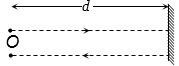
MediumMCQ
The echo of a gun shot is heard $8 \, s$ after the gun is fired. How far from the shooter is the surface that reflects the sound (in $, m$)? (Velocity of sound in air $= 350 \, m/s$)
A
$1400$
B
$2800$
C
$700$
D
$350$
Solution
(A) Let the distance between the shooter and the reflecting surface be $d$.
When a sound is produced,it travels to the reflecting surface and returns to the shooter to form an echo.
Therefore,the total distance traveled by the sound is $2d$.
The time taken for the echo to be heard is given by $t = \frac{\text{Total distance}}{\text{Velocity of sound}} = \frac{2d}{v}$.
Given $t = 8 \, s$ and $v = 350 \, m/s$.
Substituting the values: $8 = \frac{2d}{350}$.
$2d = 8 \times 350 = 2800$.
$d = \frac{2800}{2} = 1400 \, m$.
Thus,the distance to the reflecting surface is $1400 \, m$.
When a sound is produced,it travels to the reflecting surface and returns to the shooter to form an echo.
Therefore,the total distance traveled by the sound is $2d$.
The time taken for the echo to be heard is given by $t = \frac{\text{Total distance}}{\text{Velocity of sound}} = \frac{2d}{v}$.
Given $t = 8 \, s$ and $v = 350 \, m/s$.
Substituting the values: $8 = \frac{2d}{350}$.
$2d = 8 \times 350 = 2800$.
$d = \frac{2800}{2} = 1400 \, m$.
Thus,the distance to the reflecting surface is $1400 \, m$.
0 likes
View Solution24
EasyMCQ
$A$ man sets his watch by the sound of a siren placed at a distance of $1 \,km$ away. If the velocity of sound is $330 \,m/s$,what is the status of his watch?
A
His watch is set $3 \,s$ faster
B
His watch is set $3 \,s$ slower
C
His watch is set correctly
D
None of the above
Solution
(B) The time taken by the sound to travel from the siren to the man is given by the formula: $t = \frac{d}{v}$.
Given,distance $d = 1 \,km = 1000 \,m$ and velocity of sound $v = 330 \,m/s$.
Calculating the time: $t = \frac{1000}{330} \approx 3.03 \,s$.
Since the sound reaches the man $3.03 \,s$ after it is produced,the man hears the siren $3.03 \,s$ late.
Therefore,when he sets his watch to the time he hears the sound,his watch will be $3.03 \,s$ behind the actual time.
Thus,his watch is set approximately $3 \,s$ slower.
Given,distance $d = 1 \,km = 1000 \,m$ and velocity of sound $v = 330 \,m/s$.
Calculating the time: $t = \frac{1000}{330} \approx 3.03 \,s$.
Since the sound reaches the man $3.03 \,s$ after it is produced,the man hears the siren $3.03 \,s$ late.
Therefore,when he sets his watch to the time he hears the sound,his watch will be $3.03 \,s$ behind the actual time.
Thus,his watch is set approximately $3 \,s$ slower.
0 likes
View Solution25
EasyMCQ
The velocity of sound in air is:
A
Faster in dry air than in moist air
B
Directly proportional to pressure
C
Directly proportional to temperature
D
Independent of the pressure of air
Solution
(D) The speed of sound in a gas is given by the formula $v = \sqrt{\frac{\gamma P}{\rho}}$,where $\gamma$ is the adiabatic index,$P$ is the pressure,and $\rho$ is the density of the gas.
According to the ideal gas law,$PV = nRT$,which can be written as $P = \frac{\rho RT}{M}$,where $M$ is the molar mass.
Substituting this into the velocity formula,we get $v = \sqrt{\frac{\gamma RT}{M}}$.
Since $v$ depends only on temperature $T$ and the nature of the gas (constant $\gamma$ and $M$),it is independent of the pressure $P$ at a constant temperature.
Therefore,the velocity of sound in air is independent of the pressure of air.
According to the ideal gas law,$PV = nRT$,which can be written as $P = \frac{\rho RT}{M}$,where $M$ is the molar mass.
Substituting this into the velocity formula,we get $v = \sqrt{\frac{\gamma RT}{M}}$.
Since $v$ depends only on temperature $T$ and the nature of the gas (constant $\gamma$ and $M$),it is independent of the pressure $P$ at a constant temperature.
Therefore,the velocity of sound in air is independent of the pressure of air.
0 likes
View Solution26
EasyMCQ
Two monoatomic ideal gases $1$ and $2$ of molecular masses $m_1$ and $m_2$ respectively are enclosed in separate containers kept at the same temperature. The ratio of the speed of sound in gas $1$ to that in gas $2$ is given by
A
$\sqrt{\frac{m_1}{m_2}}$
B
$\sqrt{\frac{m_2}{m_1}}$
C
$\frac{m_1}{m_2}$
D
$\frac{m_2}{m_1}$
Solution
(B) The speed of sound $v$ in an ideal gas is given by the formula $v = \sqrt{\frac{\gamma RT}{M}}$,where $\gamma$ is the adiabatic index,$R$ is the universal gas constant,$T$ is the absolute temperature,and $M$ is the molar mass.
Since both gases are monoatomic,they have the same adiabatic index $\gamma = 5/3$.
Given that both gases are at the same temperature $T$,the speed of sound is inversely proportional to the square root of the molar mass: $v \propto \frac{1}{\sqrt{M}}$.
Therefore,the ratio of the speed of sound in gas $1$ $(v_1)$ to that in gas $2$ $(v_2)$ is $\frac{v_1}{v_2} = \sqrt{\frac{m_2}{m_1}}$.
Since both gases are monoatomic,they have the same adiabatic index $\gamma = 5/3$.
Given that both gases are at the same temperature $T$,the speed of sound is inversely proportional to the square root of the molar mass: $v \propto \frac{1}{\sqrt{M}}$.
Therefore,the ratio of the speed of sound in gas $1$ $(v_1)$ to that in gas $2$ $(v_2)$ is $\frac{v_1}{v_2} = \sqrt{\frac{m_2}{m_1}}$.
0 likes
View Solution27
MediumMCQ
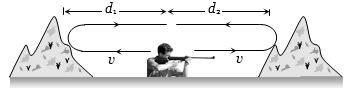
$A$ man is standing between two parallel cliffs and fires a gun. If he hears the first and second echoes after $1.5 \, s$ and $3.5 \, s$ respectively,the distance between the cliffs is .... $m$ (Velocity of sound in air $= 340 \, ms^{-1}$)
A
$1190$
B
$850$
C
$595$
D
$510$
Solution
(B) Let the distances of the man from the two cliffs be $d_1$ and $d_2$ respectively.
The total distance traveled by the sound for the first echo is $2d_1 = v \times t_1$,where $v = 340 \, ms^{-1}$ and $t_1 = 1.5 \, s$.
$d_1 = \frac{v \times t_1}{2} = \frac{340 \times 1.5}{2} = 170 \times 1.5 = 255 \, m$.
The total distance traveled by the sound for the second echo is $2d_2 = v \times t_2$,where $t_2 = 3.5 \, s$.
$d_2 = \frac{v \times t_2}{2} = \frac{340 \times 3.5}{2} = 170 \times 3.5 = 595 \, m$.
The total distance between the cliffs is $D = d_1 + d_2 = 255 + 595 = 850 \, m$.
The total distance traveled by the sound for the first echo is $2d_1 = v \times t_1$,where $v = 340 \, ms^{-1}$ and $t_1 = 1.5 \, s$.
$d_1 = \frac{v \times t_1}{2} = \frac{340 \times 1.5}{2} = 170 \times 1.5 = 255 \, m$.
The total distance traveled by the sound for the second echo is $2d_2 = v \times t_2$,where $t_2 = 3.5 \, s$.
$d_2 = \frac{v \times t_2}{2} = \frac{340 \times 3.5}{2} = 170 \times 3.5 = 595 \, m$.
The total distance between the cliffs is $D = d_1 + d_2 = 255 + 595 = 850 \, m$.
0 likes
View Solution28
EasyMCQ
The frequency of a sound wave is $n$ and its velocity is $v$. If the frequency is increased to $4n$,the velocity of the wave will be
A
$v$
B
$2v$
C
$4v$
D
$v/4$
Solution
(A) The velocity of a sound wave in a given medium depends only on the properties of the medium (such as density,elasticity,temperature,etc.) and is independent of the frequency of the wave.
Since the medium remains the same,the velocity of the wave remains constant at $v$ even when the frequency is increased to $4n$.
Since the medium remains the same,the velocity of the wave remains constant at $v$ even when the frequency is increased to $4n$.
0 likes
View Solution29
MediumMCQ
The temperature at which the speed of sound in air becomes double of its value at $27^\circ C$ is ... $^\circ C$
A
$0$
B
$273$
C
$927$
D
$1027$
Solution
(C) The speed of sound in an ideal gas is given by the formula $v = \sqrt{\frac{\gamma RT}{M}}$,where $\gamma$ is the adiabatic index,$R$ is the gas constant,$T$ is the absolute temperature in Kelvin,and $M$ is the molar mass of the gas.
From this relation,we can see that $v \propto \sqrt{T}$.
Let $v_1$ be the speed of sound at temperature $T_1$ and $v_2$ be the speed at $T_2$.
Given $T_1 = 27^\circ C = 27 + 273 = 300 \ K$.
We want the speed to be doubled,so $v_2 = 2v_1$.
Using the proportionality $v_2/v_1 = \sqrt{T_2/T_1}$,we get $2 = \sqrt{T_2/300}$.
Squaring both sides,$4 = T_2/300$,which gives $T_2 = 1200 \ K$.
Converting back to Celsius,$T_2 = 1200 - 273 = 927^\circ C$.
From this relation,we can see that $v \propto \sqrt{T}$.
Let $v_1$ be the speed of sound at temperature $T_1$ and $v_2$ be the speed at $T_2$.
Given $T_1 = 27^\circ C = 27 + 273 = 300 \ K$.
We want the speed to be doubled,so $v_2 = 2v_1$.
Using the proportionality $v_2/v_1 = \sqrt{T_2/T_1}$,we get $2 = \sqrt{T_2/300}$.
Squaring both sides,$4 = T_2/300$,which gives $T_2 = 1200 \ K$.
Converting back to Celsius,$T_2 = 1200 - 273 = 927^\circ C$.
0 likes
View Solution30
EasyMCQ
Speed of sound at constant temperature depends on
A
Pressure
B
Density of gas
C
Both of the above
D
None of the above
Solution
(D) The speed of sound in an ideal gas is given by the formula $v = \sqrt{\frac{\gamma RT}{M}}$.
Here,$\gamma$ is the adiabatic index,$R$ is the universal gas constant,$T$ is the absolute temperature,and $M$ is the molar mass of the gas.
Since $v$ depends only on the temperature $T$ and the nature of the gas (represented by $\gamma$ and $M$),it is independent of the pressure $P$ and density $\rho$ of the gas at a constant temperature.
Therefore,the correct option is $D$.
Here,$\gamma$ is the adiabatic index,$R$ is the universal gas constant,$T$ is the absolute temperature,and $M$ is the molar mass of the gas.
Since $v$ depends only on the temperature $T$ and the nature of the gas (represented by $\gamma$ and $M$),it is independent of the pressure $P$ and density $\rho$ of the gas at a constant temperature.
Therefore,the correct option is $D$.
0 likes
View Solution31
EasyMCQ
$A$ man standing on a cliff claps his hands and hears the echo after $1 \, s$. If the sound is reflected from another mountain and the velocity of sound in air is $340 \, m/s$,then the distance between the man and the reflection point is ..... $m$.
A
$680$
B
$340$
C
$85$
D
$170$
Solution
(D) Let $d$ be the distance between the man and the reflecting surface.
For an echo to be heard,the sound must travel to the reflecting surface and back to the observer.
Therefore,the total distance traveled by the sound is $2d$.
Using the formula $2d = v \times t$,where $v = 340 \, m/s$ and $t = 1 \, s$:
$2d = 340 \times 1$
$2d = 340$
$d = \frac{340}{2} = 170 \, m$.
Thus,the distance between the man and the reflection point is $170 \, m$.
For an echo to be heard,the sound must travel to the reflecting surface and back to the observer.
Therefore,the total distance traveled by the sound is $2d$.
Using the formula $2d = v \times t$,where $v = 340 \, m/s$ and $t = 1 \, s$:
$2d = 340 \times 1$
$2d = 340$
$d = \frac{340}{2} = 170 \, m$.
Thus,the distance between the man and the reflection point is $170 \, m$.
0 likes
View Solution32
EasyMCQ
Sound velocity is maximum in
A
$H_2$
B
$N_2$
C
$He$
D
$O_2$
Solution
(A) The velocity of sound in an ideal gas is given by the formula $v = \sqrt{\frac{\gamma RT}{M}}$.
From this relation,it is clear that $v \propto \frac{1}{\sqrt{M}}$,where $M$ is the molar mass of the gas.
Comparing the molar masses of the given gases:
$M(H_2) = 2 \ g/mol$
$M(N_2) = 28 \ g/mol$
$M(He) = 4 \ g/mol$
$M(O_2) = 32 \ g/mol$
Since $H_2$ has the minimum molar mass among the given options,the velocity of sound is maximum in $H_2$.
From this relation,it is clear that $v \propto \frac{1}{\sqrt{M}}$,where $M$ is the molar mass of the gas.
Comparing the molar masses of the given gases:
$M(H_2) = 2 \ g/mol$
$M(N_2) = 28 \ g/mol$
$M(He) = 4 \ g/mol$
$M(O_2) = 32 \ g/mol$
Since $H_2$ has the minimum molar mass among the given options,the velocity of sound is maximum in $H_2$.
0 likes
View Solution33
MediumMCQ
The minimum distance of the reflector surface from the source to hear the echo of sound is ..... $m$.
A
$28$
B
$18$
C
$19$
D
$16.5$
Solution
(D) The formula for the distance $d$ to the reflecting surface is $2d = v \times t$,where $v$ is the velocity of sound in air,typically taken as $332 \, m/s$.
$t$ is the persistence of hearing,which is approximately $\frac{1}{10} \, s$.
Substituting these values into the equation:
$d = \frac{v \times t}{2} = \frac{332 \times 0.1}{2} = \frac{33.2}{2} = 16.6 \, m$.
Given the options,$16.5 \, m$ is the standard accepted value based on the approximation of the speed of sound.
$t$ is the persistence of hearing,which is approximately $\frac{1}{10} \, s$.
Substituting these values into the equation:
$d = \frac{v \times t}{2} = \frac{332 \times 0.1}{2} = \frac{33.2}{2} = 16.6 \, m$.
Given the options,$16.5 \, m$ is the standard accepted value based on the approximation of the speed of sound.
0 likes
View Solution34
EasyMCQ
$A$ man stands in front of a hillock and fires a gun. He hears an echo after $1.5\, s$. The distance of the hillock from the man is ...... $m$ (velocity of sound in air is $330\, m/s$).
A
$220$
B
$247.5$
C
$268.5$
D
$292.5$
Solution
(B) The sound travels from the man to the hillock and back to the man to produce an echo.
Let $d$ be the distance between the man and the hillock.
The total distance traveled by the sound is $2d$.
Given,velocity of sound $v = 330\, m/s$ and time $t = 1.5\, s$.
Using the formula,$2d = v \times t$.
$2d = 330 \times 1.5 = 495\, m$.
$d = \frac{495}{2} = 247.5\, m$.
Therefore,the distance of the hillock from the man is $247.5\, m$.
Let $d$ be the distance between the man and the hillock.
The total distance traveled by the sound is $2d$.
Given,velocity of sound $v = 330\, m/s$ and time $t = 1.5\, s$.
Using the formula,$2d = v \times t$.
$2d = 330 \times 1.5 = 495\, m$.
$d = \frac{495}{2} = 247.5\, m$.
Therefore,the distance of the hillock from the man is $247.5\, m$.
0 likes
View Solution35
EasyMCQ
Velocity of sound in air:
$I.$ Increases with temperature
$II.$ Decreases with temperature
$III.$ Increases with pressure
$IV.$ Is independent of pressure
$V.$ Is independent of temperature
Choose the correct answer.
$I.$ Increases with temperature
$II.$ Decreases with temperature
$III.$ Increases with pressure
$IV.$ Is independent of pressure
$V.$ Is independent of temperature
Choose the correct answer.
A
Only $I$ and $II$ are true
B
Only $I$ and $III$ are true
C
Only $II$ and $III$ are true
D
Only $I$ and $IV$ are true
Solution
(D) The speed of sound in an ideal gas is given by the formula $v = \sqrt{\frac{\gamma RT}{M}}$.
From this relation,it is clear that $v \propto \sqrt{T}$,meaning the velocity of sound increases with an increase in temperature. Thus,statement $I$ is true.
Regarding pressure,for an ideal gas,the density $\rho$ changes proportionally with pressure $P$ at a constant temperature $(P = \rho RT/M)$,such that the ratio $P/\rho$ remains constant. Therefore,the speed of sound is independent of pressure. Thus,statement $IV$ is true.
Hence,statements $I$ and $IV$ are correct.
From this relation,it is clear that $v \propto \sqrt{T}$,meaning the velocity of sound increases with an increase in temperature. Thus,statement $I$ is true.
Regarding pressure,for an ideal gas,the density $\rho$ changes proportionally with pressure $P$ at a constant temperature $(P = \rho RT/M)$,such that the ratio $P/\rho$ remains constant. Therefore,the speed of sound is independent of pressure. Thus,statement $IV$ is true.
Hence,statements $I$ and $IV$ are correct.
0 likes
View Solution36
EasyMCQ
If at the same temperature and pressure,the densities of two diatomic gases are respectively $d_1$ and $d_2$,then the ratio of the velocities of sound in these gases will be
A
$\sqrt{\frac{d_2}{d_1}}$
B
$\sqrt{\frac{d_1}{d_2}}$
C
$d_1 d_2$
D
$\sqrt{d_1 d_2}$
Solution
(A) The speed of sound in a gas is given by the formula $v = \sqrt{\frac{\gamma P}{d}}$,where $\gamma$ is the adiabatic index,$P$ is the pressure,and $d$ is the density of the gas.
Since both gases are diatomic,the adiabatic index $\gamma$ is the same for both.
Given that the temperature and pressure $P$ are the same for both gases,the ratio of the velocities $v_1$ and $v_2$ is:
$\frac{v_1}{v_2} = \frac{\sqrt{\frac{\gamma P}{d_1}}}{\sqrt{\frac{\gamma P}{d_2}}} = \sqrt{\frac{d_2}{d_1}}$
Therefore,the ratio of the velocities of sound is $\sqrt{\frac{d_2}{d_1}}$.
Since both gases are diatomic,the adiabatic index $\gamma$ is the same for both.
Given that the temperature and pressure $P$ are the same for both gases,the ratio of the velocities $v_1$ and $v_2$ is:
$\frac{v_1}{v_2} = \frac{\sqrt{\frac{\gamma P}{d_1}}}{\sqrt{\frac{\gamma P}{d_2}}} = \sqrt{\frac{d_2}{d_1}}$
Therefore,the ratio of the velocities of sound is $\sqrt{\frac{d_2}{d_1}}$.
0 likes
View Solution37
MediumMCQ
$v_1$ and $v_2$ are the velocities of sound at the same temperature in two monoatomic gases of densities $\rho_1$ and $\rho_2$ respectively. If $\frac{\rho_1}{\rho_2} = \frac{1}{4}$,then the ratio of velocities $v_1$ and $v_2$ will be
A
$1:2$
B
$4:1$
C
$2:1$
D
$1:4$
Solution
(C) The velocity of sound in a gas is given by the formula $v = \sqrt{\frac{\gamma P}{\rho}}$.
Since the temperature is the same and the gases are monoatomic,the adiabatic index $\gamma$ is the same for both.
Assuming the pressure $P$ is the same,we have $v \propto \frac{1}{\sqrt{\rho}}$.
Therefore,the ratio of velocities is $\frac{v_1}{v_2} = \sqrt{\frac{\rho_2}{\rho_1}}$.
Given $\frac{\rho_1}{\rho_2} = \frac{1}{4}$,it follows that $\frac{\rho_2}{\rho_1} = 4$.
Substituting this value,we get $\frac{v_1}{v_2} = \sqrt{4} = 2$.
Thus,the ratio $v_1 : v_2$ is $2:1$.
Since the temperature is the same and the gases are monoatomic,the adiabatic index $\gamma$ is the same for both.
Assuming the pressure $P$ is the same,we have $v \propto \frac{1}{\sqrt{\rho}}$.
Therefore,the ratio of velocities is $\frac{v_1}{v_2} = \sqrt{\frac{\rho_2}{\rho_1}}$.
Given $\frac{\rho_1}{\rho_2} = \frac{1}{4}$,it follows that $\frac{\rho_2}{\rho_1} = 4$.
Substituting this value,we get $\frac{v_1}{v_2} = \sqrt{4} = 2$.
Thus,the ratio $v_1 : v_2$ is $2:1$.
0 likes
View Solution38
EasyMCQ
The temperature at which the speed of sound in air becomes double of its value at $0^oC$ is ...... $K$.
A
$273$
B
$546$
C
$1092$
D
$0$
Solution
(C) The speed of sound in a gas is given by $v = \sqrt{\frac{\gamma RT}{M}}$,which implies $v \propto \sqrt{T}$.
Given that the initial temperature $T_1 = 0^oC = 273 \ K$.
Let the initial speed be $v_1$ and the final speed be $v_2 = 2v_1$.
Using the relation $\frac{v_2}{v_1} = \sqrt{\frac{T_2}{T_1}}$,we get:
$2 = \sqrt{\frac{T_2}{273}}$.
Squaring both sides,we get $4 = \frac{T_2}{273}$.
Therefore,$T_2 = 4 \times 273 = 1092 \ K$.
Given that the initial temperature $T_1 = 0^oC = 273 \ K$.
Let the initial speed be $v_1$ and the final speed be $v_2 = 2v_1$.
Using the relation $\frac{v_2}{v_1} = \sqrt{\frac{T_2}{T_1}}$,we get:
$2 = \sqrt{\frac{T_2}{273}}$.
Squaring both sides,we get $4 = \frac{T_2}{273}$.
Therefore,$T_2 = 4 \times 273 = 1092 \ K$.
0 likes
View Solution39
EasyMCQ
The ratio of the velocity of sound in hydrogen gas to that in oxygen gas at a given temperature is:
A
$1:4$
B
$4:1$
C
$2:1$
D
$1:1$
Solution
(B) The velocity of sound in an ideal gas is given by the formula $v = \sqrt{\frac{\gamma RT}{M}}$,where $\gamma$ is the adiabatic index,$R$ is the universal gas constant,$T$ is the absolute temperature,and $M$ is the molar mass of the gas.
For a given temperature and assuming both gases are diatomic ($\gamma$ is the same),the velocity is inversely proportional to the square root of the molar mass: $v \propto \frac{1}{\sqrt{M}}$.
Therefore,the ratio of the velocity of sound in hydrogen $(H_2)$ to oxygen $(O_2)$ is:
$\frac{v_{H_2}}{v_{O_2}} = \sqrt{\frac{M_{O_2}}{M_{H_2}}}$
The molar mass of oxygen $(O_2)$ is $32 \ g/mol$ and the molar mass of hydrogen $(H_2)$ is $2 \ g/mol$.
$\frac{v_{H_2}}{v_{O_2}} = \sqrt{\frac{32}{2}} = \sqrt{16} = 4$.
Thus,the ratio is $4:1$.
For a given temperature and assuming both gases are diatomic ($\gamma$ is the same),the velocity is inversely proportional to the square root of the molar mass: $v \propto \frac{1}{\sqrt{M}}$.
Therefore,the ratio of the velocity of sound in hydrogen $(H_2)$ to oxygen $(O_2)$ is:
$\frac{v_{H_2}}{v_{O_2}} = \sqrt{\frac{M_{O_2}}{M_{H_2}}}$
The molar mass of oxygen $(O_2)$ is $32 \ g/mol$ and the molar mass of hydrogen $(H_2)$ is $2 \ g/mol$.
$\frac{v_{H_2}}{v_{O_2}} = \sqrt{\frac{32}{2}} = \sqrt{16} = 4$.
Thus,the ratio is $4:1$.
0 likes
View Solution40
MediumMCQ
Find the frequency of the minimum distance between a compression and a rarefaction of a wire. If the length of the wire is $1\, m$ and the velocity of sound in air is $360\, m/s$,find the frequency in $sec^{-1}$.
A
$90$
B
$180$
C
$120$
D
$360$
Solution
(A) The minimum distance between a compression and a rarefaction in a longitudinal wave corresponds to one-fourth of the wavelength,i.e.,$d = \frac{\lambda}{4}$.
Given the length of the wire $l = 1\, m$,we assume this length represents the distance between a compression and a rarefaction,so $l = \frac{\lambda}{4}$.
Therefore,the wavelength $\lambda = 4l = 4 \times 1 = 4\, m$.
Using the wave equation $v = n\lambda$,where $v$ is the velocity of sound and $n$ is the frequency:
$n = \frac{v}{\lambda} = \frac{360}{4} = 90\, sec^{-1}$.
Given the length of the wire $l = 1\, m$,we assume this length represents the distance between a compression and a rarefaction,so $l = \frac{\lambda}{4}$.
Therefore,the wavelength $\lambda = 4l = 4 \times 1 = 4\, m$.
Using the wave equation $v = n\lambda$,where $v$ is the velocity of sound and $n$ is the frequency:
$n = \frac{v}{\lambda} = \frac{360}{4} = 90\, sec^{-1}$.
0 likes
View Solution41
EasyMCQ
The velocity of sound is $v_s$ in air. If the density of air is increased to $4$ times,then the new velocity of sound will be
A
$\frac{v_s}{2}$
B
$\frac{v_s}{12}$
C
$12v_s$
D
$\frac{3}{2}v_s^2$
Solution
(A) The velocity of sound in a gas is given by the formula $v = \sqrt{\frac{\gamma P}{\rho}}$,where $\gamma$ is the adiabatic index,$P$ is the pressure,and $\rho$ is the density of the gas.
Assuming the pressure $P$ remains constant,the velocity of sound is inversely proportional to the square root of the density: $v \propto \frac{1}{\sqrt{\rho}}$.
Given the initial velocity is $v_s$ at density $\rho_1 = \rho$,and the new density is $\rho_2 = 4\rho$.
Using the ratio: $\frac{v_{new}}{v_s} = \sqrt{\frac{\rho_1}{\rho_2}} = \sqrt{\frac{\rho}{4\rho}} = \sqrt{\frac{1}{4}} = \frac{1}{2}$.
Therefore,the new velocity is $v_{new} = \frac{v_s}{2}$.
Assuming the pressure $P$ remains constant,the velocity of sound is inversely proportional to the square root of the density: $v \propto \frac{1}{\sqrt{\rho}}$.
Given the initial velocity is $v_s$ at density $\rho_1 = \rho$,and the new density is $\rho_2 = 4\rho$.
Using the ratio: $\frac{v_{new}}{v_s} = \sqrt{\frac{\rho_1}{\rho_2}} = \sqrt{\frac{\rho}{4\rho}} = \sqrt{\frac{1}{4}} = \frac{1}{2}$.
Therefore,the new velocity is $v_{new} = \frac{v_s}{2}$.
0 likes
View Solution42
EasyMCQ
It takes $2.0 \ s$ for a sound wave to travel between two fixed points when the day temperature is $10^{\circ}C$. If the temperature rises to $30^{\circ}C$,the sound wave travels between the same fixed points in ...... $s$.
A
$1.9$
B
$2.0$
C
$2.1$
D
$2.2$
Solution
(A) The speed of sound in a gas is given by $v = \sqrt{\frac{\gamma RT}{M}}$,which implies $v \propto \sqrt{T}$,where $T$ is the absolute temperature in Kelvin.
Let $d$ be the distance between the two fixed points.
The time taken is $t = \frac{d}{v}$.
Therefore,$\frac{t_1}{t_2} = \frac{v_2}{v_1} = \sqrt{\frac{T_2}{T_1}}$.
Given $T_1 = 10^{\circ}C = 10 + 273 = 283 \ K$ and $T_2 = 30^{\circ}C = 30 + 273 = 303 \ K$.
Given $t_1 = 2.0 \ s$.
Substituting the values: $\frac{2.0}{t_2} = \sqrt{\frac{303}{283}} \approx \sqrt{1.0706} \approx 1.0347$.
$t_2 = \frac{2.0}{1.0347} \approx 1.93 \ s$.
Rounding to the nearest given option,the correct answer is $1.9 \ s$.
Let $d$ be the distance between the two fixed points.
The time taken is $t = \frac{d}{v}$.
Therefore,$\frac{t_1}{t_2} = \frac{v_2}{v_1} = \sqrt{\frac{T_2}{T_1}}$.
Given $T_1 = 10^{\circ}C = 10 + 273 = 283 \ K$ and $T_2 = 30^{\circ}C = 30 + 273 = 303 \ K$.
Given $t_1 = 2.0 \ s$.
Substituting the values: $\frac{2.0}{t_2} = \sqrt{\frac{303}{283}} \approx \sqrt{1.0706} \approx 1.0347$.
$t_2 = \frac{2.0}{1.0347} \approx 1.93 \ s$.
Rounding to the nearest given option,the correct answer is $1.9 \ s$.
0 likes
View Solution43
EasyMCQ
If $v_m$ is the velocity of sound in moist air and $v_d$ is the velocity of sound in dry air,under identical conditions of pressure and temperature,then:
A
$v_m > v_d$
B
$v_m < v_d$
C
$v_m = v_d$
D
$v_m / v_d = 1$
Solution
(A) The velocity of sound in a gas is given by the formula $v = \sqrt{\frac{\gamma P}{\rho}}$,where $\gamma$ is the adiabatic index,$P$ is the pressure,and $\rho$ is the density of the gas.
Under identical conditions of pressure and temperature,the density of moist air (air mixed with water vapor) is less than the density of dry air because the molecular weight of water vapor $(18 \ g/mol)$ is less than the average molecular weight of dry air (approximately $29 \ g/mol$).
Since $v \propto \frac{1}{\sqrt{\rho}}$,a lower density results in a higher velocity of sound.
Therefore,$v_m > v_d$.
Under identical conditions of pressure and temperature,the density of moist air (air mixed with water vapor) is less than the density of dry air because the molecular weight of water vapor $(18 \ g/mol)$ is less than the average molecular weight of dry air (approximately $29 \ g/mol$).
Since $v \propto \frac{1}{\sqrt{\rho}}$,a lower density results in a higher velocity of sound.
Therefore,$v_m > v_d$.
0 likes
View Solution44
MediumMCQ
$A$ man,standing between two cliffs,claps his hands and starts hearing a series of echoes at intervals of one second. If the speed of sound in air is $340 \, ms^{-1}$,the distance between the cliffs is .... $m$
A
$340$
B
$1620$
C
$680$
D
$1700$
Solution
(A) Let the distances of the two cliffs from the man be $d_1$ and $d_2$. The total distance between the cliffs is $D = d_1 + d_2$.
The time taken for the first echo to return is $t_1 = \frac{2d_1}{v}$.
The time taken for the second echo to return is $t_2 = \frac{2d_2}{v}$.
The interval between the two echoes is given as $1 \, s$,so $|t_2 - t_1| = 1 \, s$.
Substituting the values,$\frac{2d_2}{v} - \frac{2d_1}{v} = 1 \implies d_2 - d_1 = \frac{v}{2} = \frac{340}{2} = 170 \, m$.
However,the question asks for the distance between the cliffs,which is $D = d_1 + d_2$. This cannot be determined uniquely from the given information alone without further assumptions about the sequence of echoes. Assuming the echoes are consecutive and the total time for the round trip of both is $2 \, s$ as per the provided solution logic,$D = \frac{v \times t}{2} = \frac{340 \times 2}{2} = 340 \, m$.
The time taken for the first echo to return is $t_1 = \frac{2d_1}{v}$.
The time taken for the second echo to return is $t_2 = \frac{2d_2}{v}$.
The interval between the two echoes is given as $1 \, s$,so $|t_2 - t_1| = 1 \, s$.
Substituting the values,$\frac{2d_2}{v} - \frac{2d_1}{v} = 1 \implies d_2 - d_1 = \frac{v}{2} = \frac{340}{2} = 170 \, m$.
However,the question asks for the distance between the cliffs,which is $D = d_1 + d_2$. This cannot be determined uniquely from the given information alone without further assumptions about the sequence of echoes. Assuming the echoes are consecutive and the total time for the round trip of both is $2 \, s$ as per the provided solution logic,$D = \frac{v \times t}{2} = \frac{340 \times 2}{2} = 340 \, m$.
0 likes
View Solution45
EasyMCQ
$A$ source of sound of frequency $600 Hz$ is placed inside water. The speed of sound in water is $1500 m/s$ and in air is $300 m/s.$ The frequency of sound recorded by an observer who is standing in air is .... $Hz$
A
$200$
B
$3000$
C
$120$
D
$600$
Solution
(D) The frequency of a sound wave is a characteristic property of the source itself.
When a sound wave travels from one medium (water) to another medium (air),its speed and wavelength change,but the frequency remains constant.
Therefore,the frequency of the sound recorded by an observer in the air will be the same as the frequency of the source.
Frequency = $600 Hz$.
When a sound wave travels from one medium (water) to another medium (air),its speed and wavelength change,but the frequency remains constant.
Therefore,the frequency of the sound recorded by an observer in the air will be the same as the frequency of the source.
Frequency = $600 Hz$.
0 likes
View Solution46
EasyMCQ
If the temperature of the atmosphere is increased,which of the following characteristics of a sound wave is affected?
A
Amplitude
B
Frequency
C
Velocity
D
Wavelength
Solution
(C) The velocity of sound in a gas is given by the formula $v = \sqrt{\frac{\gamma RT}{M}}$,where $\gamma$ is the adiabatic index,$R$ is the universal gas constant,$T$ is the absolute temperature,and $M$ is the molar mass of the gas.
From this relation,it is clear that $v \propto \sqrt{T}$.
Therefore,when the temperature of the atmosphere increases,the velocity of the sound wave increases.
From this relation,it is clear that $v \propto \sqrt{T}$.
Therefore,when the temperature of the atmosphere increases,the velocity of the sound wave increases.
0 likes
View Solution47
EasyMCQ
An underwater sonar source operating at a frequency of $60 \, kHz$ directs its beam towards the surface. If the velocity of sound in air is $330 \, m/s$,the wavelength and frequency of waves in air are:
A
$5.5 \, mm, 60 \, kHz$
B
$330 \, m, 60 \, kHz$
C
$5.5 \, mm, 20 \, kHz$
D
$5.5 \, mm, 80 \, kHz$
Solution
(A) When a sound wave travels from one medium to another,its frequency remains unchanged because it is determined by the source.
Therefore,the frequency of the wave in air remains $f = 60 \, kHz$.
The wavelength $\lambda$ in air is given by the formula $\lambda = \frac{v}{f}$,where $v$ is the velocity of sound in air.
Substituting the given values: $\lambda = \frac{330 \, m/s}{60 \times 10^3 \, Hz} = \frac{330}{60000} \, m = 0.0055 \, m = 5.5 \, mm$.
Thus,the wavelength is $5.5 \, mm$ and the frequency is $60 \, kHz$.
Therefore,the frequency of the wave in air remains $f = 60 \, kHz$.
The wavelength $\lambda$ in air is given by the formula $\lambda = \frac{v}{f}$,where $v$ is the velocity of sound in air.
Substituting the given values: $\lambda = \frac{330 \, m/s}{60 \times 10^3 \, Hz} = \frac{330}{60000} \, m = 0.0055 \, m = 5.5 \, mm$.
Thus,the wavelength is $5.5 \, mm$ and the frequency is $60 \, kHz$.
0 likes
View Solution48
EasyMCQ
Sound travels in rocks in the form of
A
Longitudinal elastic waves only
B
Transverse elastic waves only
C
Both longitudinal and transverse elastic waves
D
Non-elastic waves
Solution
(C) Sound waves are mechanical waves that require a medium to propagate.
In solids,such as rocks,the material possesses both bulk modulus and shear modulus.
Because of these properties,solids can support both longitudinal waves (where particles oscillate parallel to the direction of propagation) and transverse waves (where particles oscillate perpendicular to the direction of propagation).
Therefore,sound travels in rocks in the form of both longitudinal and transverse elastic waves.
In solids,such as rocks,the material possesses both bulk modulus and shear modulus.
Because of these properties,solids can support both longitudinal waves (where particles oscillate parallel to the direction of propagation) and transverse waves (where particles oscillate perpendicular to the direction of propagation).
Therefore,sound travels in rocks in the form of both longitudinal and transverse elastic waves.
0 likes
View Solution49
EasyMCQ
Which of the following is a longitudinal wave?
A
Sound waves
B
Waves on a plucked string
C
Water waves
D
Light waves
Solution
(A) longitudinal wave is a wave in which the particles of the medium vibrate parallel to the direction of wave propagation.
Sound waves in air are classic examples of longitudinal waves because they consist of compressions and rarefactions traveling through the medium.
Waves on a plucked string are transverse waves.
Light waves are electromagnetic $(EM)$ waves,which are transverse in nature.
Water waves are a combination of both transverse and longitudinal motions,but sound waves are strictly longitudinal in fluids.
Sound waves in air are classic examples of longitudinal waves because they consist of compressions and rarefactions traveling through the medium.
Waves on a plucked string are transverse waves.
Light waves are electromagnetic $(EM)$ waves,which are transverse in nature.
Water waves are a combination of both transverse and longitudinal motions,but sound waves are strictly longitudinal in fluids.
0 likes
View Solution50
EasyMCQ
The nature of sound waves in gases is
A
Transverse
B
Longitudinal
C
Stationary
D
Electromagnetic
Solution
(B) Sound waves are mechanical waves that require a material medium for propagation.
In gases,sound waves travel as longitudinal waves.
This is because the particles of the medium vibrate back and forth in a direction parallel to the direction of the propagation of the wave,creating regions of compression and rarefaction.
In gases,sound waves travel as longitudinal waves.
This is because the particles of the medium vibrate back and forth in a direction parallel to the direction of the propagation of the wave,creating regions of compression and rarefaction.
0 likes
View SolutionWaves and Sound — Sound Waves (Longitudinal wave) and it’s Characteristics (Speed etc.) · Frequently Asked Questions
1Are these Waves and Sound questions useful for JEE and NEET?
Yes. All questions in this section are mapped to JEE Main and NEET exam patterns. Previous year questions from JEE Main, NEET, GUJCET and state-level exams are included with full solutions.
2Can I switch to Hindi or Gujarati for these questions?
Yes. Use the language tabs in the hero section or the sidebar to view the same questions and solutions in English, Hindi or Gujarati.
3How do I generate a question paper from this subtopic?
Use the Vedclass Exam Paper Generator — select the chapter and subtopic, set difficulty, and generate Sets A, B, C, D automatically. First 3 chapters of every subject are free.
Vedclass Products
For Students
Vedclass Test Series
Mock tests in real JEE/NEET style with performance analysis. 5-day free trial.
Start Free TrialFor Teachers
Exam Paper Generator
Generate Set A/B/C/D papers from this chapter in 2 minutes. 3 chapters free.
Try FreeFor Institutes
Online Exam Module
Live online exams with unlimited students, 360° analytics & white-label branding.
See DemoFor Teachers & Institutes
Generate a Waves and Sound Exam Paper in 2 Minutes
Select subtopic & difficulty — Sets A, B, C, D auto-generated with No Repeat logic.
First 3 chapters of every subject are free — no payment required.