
A English
Progressive Waves Questions in English
Class 11 Physics · Waves and Sound · Progressive Waves
47+
Questions
English
Language
100%
With Solutions
Showing 46 of 47 questions in English
1
MediumMCQ
The equation of a progressive wave is given by $y = 0.2 \cos \pi (0.04t + 0.02x - \frac{\pi}{6})$. The distance is expressed in $cm$ and time in seconds. What will be the minimum distance between two particles having a phase difference of $\pi / 2$ in $cm$?
A
$4$
B
$8$
C
$25$
D
$12.5$
Solution
(C) Comparing the given equation $y = 0.2 \cos \pi (0.04t + 0.02x - \frac{\pi}{6})$ with the standard wave equation $y = a \cos (\omega t + kx - \phi)$,we distribute $\pi$ inside the bracket:
$y = 0.2 \cos (0.04\pi t + 0.02\pi x - \frac{\pi^2}{6})$.
Here,the wave number $k = 0.02\pi$.
We know that $k = \frac{2\pi}{\lambda}$,so $0.02\pi = \frac{2\pi}{\lambda}$.
Solving for wavelength $\lambda$: $\lambda = \frac{2\pi}{0.02\pi} = 100 \ cm$.
The relationship between phase difference $\Delta \phi$ and path difference $\Delta x$ is given by $\Delta \phi = \frac{2\pi}{\lambda} \Delta x$.
Given $\Delta \phi = \frac{\pi}{2}$,we have $\frac{\pi}{2} = \frac{2\pi}{100} \Delta x$.
$\Delta x = \frac{\pi}{2} \times \frac{100}{2\pi} = 25 \ cm$.
$y = 0.2 \cos (0.04\pi t + 0.02\pi x - \frac{\pi^2}{6})$.
Here,the wave number $k = 0.02\pi$.
We know that $k = \frac{2\pi}{\lambda}$,so $0.02\pi = \frac{2\pi}{\lambda}$.
Solving for wavelength $\lambda$: $\lambda = \frac{2\pi}{0.02\pi} = 100 \ cm$.
The relationship between phase difference $\Delta \phi$ and path difference $\Delta x$ is given by $\Delta \phi = \frac{2\pi}{\lambda} \Delta x$.
Given $\Delta \phi = \frac{\pi}{2}$,we have $\frac{\pi}{2} = \frac{2\pi}{100} \Delta x$.
$\Delta x = \frac{\pi}{2} \times \frac{100}{2\pi} = 25 \ cm$.
0 likes
View Solution2
MediumMCQ
At a moment in a progressive wave,the phase of a particle executing $S.H.M.$ is $\frac{\pi}{3}$. What will be the phase of a particle $15 \ cm$ ahead at a time $\frac{T}{2}$ later,if the wavelength is $60 \ cm$?
A
$\frac{\pi}{2}$
B
$\frac{2\pi}{3}$
C
Zero
D
$\frac{5\pi}{6}$
Solution
(D) The phase of a wave is given by $\phi = (\omega t - kx + \phi_0)$.
The phase difference due to a spatial separation $\Delta x$ is $\Delta \phi_x = \frac{2\pi}{\lambda} \Delta x$.
Given $\Delta x = 15 \ cm$ and $\lambda = 60 \ cm$,the phase change due to distance is $\Delta \phi_x = \frac{2\pi}{60} \times 15 = \frac{\pi}{2}$.
Since the particle is ahead in the direction of wave propagation,its phase is $\phi_1 = \phi_0 - \Delta \phi_x = \frac{\pi}{3} - \frac{\pi}{2} = -\frac{\pi}{6}$.
The phase change due to a time interval $\Delta t = \frac{T}{2}$ is $\Delta \phi_t = \omega \Delta t = \frac{2\pi}{T} \times \frac{T}{2} = \pi$.
The new phase is $\phi_{new} = \phi_1 + \Delta \phi_t = -\frac{\pi}{6} + \pi = \frac{5\pi}{6}$.
The phase difference due to a spatial separation $\Delta x$ is $\Delta \phi_x = \frac{2\pi}{\lambda} \Delta x$.
Given $\Delta x = 15 \ cm$ and $\lambda = 60 \ cm$,the phase change due to distance is $\Delta \phi_x = \frac{2\pi}{60} \times 15 = \frac{\pi}{2}$.
Since the particle is ahead in the direction of wave propagation,its phase is $\phi_1 = \phi_0 - \Delta \phi_x = \frac{\pi}{3} - \frac{\pi}{2} = -\frac{\pi}{6}$.
The phase change due to a time interval $\Delta t = \frac{T}{2}$ is $\Delta \phi_t = \omega \Delta t = \frac{2\pi}{T} \times \frac{T}{2} = \pi$.
The new phase is $\phi_{new} = \phi_1 + \Delta \phi_t = -\frac{\pi}{6} + \pi = \frac{5\pi}{6}$.
0 likes
View Solution3
EasyMCQ
The equation of a progressive wave is given by $y = a \sin(628t - 31.4x)$. If the distances are expressed in $cm$ and time in seconds,then the wave velocity will be ...... $cm/sec$.
A
$314$
B
$628$
C
$20$
D
$400$
Solution
(C) The standard equation of a progressive wave is given by $y = a \sin(\omega t - kx)$,where $\omega$ is the angular frequency and $k$ is the wave number.
Comparing the given equation $y = a \sin(628t - 31.4x)$ with the standard form,we get:
$\omega = 628 \, rad/s$
$k = 31.4 \, rad/cm$
The wave velocity $v$ is given by the ratio of the coefficient of $t$ to the coefficient of $x$:
$v = \frac{\omega}{k} = \frac{628}{31.4} = 20 \, cm/sec$.
Comparing the given equation $y = a \sin(628t - 31.4x)$ with the standard form,we get:
$\omega = 628 \, rad/s$
$k = 31.4 \, rad/cm$
The wave velocity $v$ is given by the ratio of the coefficient of $t$ to the coefficient of $x$:
$v = \frac{\omega}{k} = \frac{628}{31.4} = 20 \, cm/sec$.
0 likes
View Solution4
MediumMCQ
The equation of a progressive wave is given by $y = 4 \sin \left( \pi \left( \frac{t}{5} - \frac{x}{9} \right) + \frac{\pi}{6} \right)$. Which of the following is correct?
A
$v = 5 \, m/s$
B
$\lambda = 18 \, m$
C
$a = 0.04 \, m$
D
$n = 50 \, Hz$
Solution
(B) The standard equation of a progressive wave is $y = a \sin (\omega t - kx + \phi)$.
Comparing the given equation $y = 4 \sin \left( \frac{\pi t}{5} - \frac{\pi x}{9} + \frac{\pi}{6} \right)$ with the standard form:
Amplitude $a = 4$ units (assuming units are in $m$,$a = 4 \, m$).
Angular frequency $\omega = \frac{\pi}{5} \, rad/s$.
Wave number $k = \frac{\pi}{9} \, rad/m$.
Frequency $n = \frac{\omega}{2\pi} = \frac{\pi/5}{2\pi} = 0.1 \, Hz$.
Wave length $\lambda = \frac{2\pi}{k} = \frac{2\pi}{\pi/9} = 18 \, m$.
Wave speed $v = \frac{\omega}{k} = \frac{\pi/5}{\pi/9} = 1.8 \, m/s$.
Thus,option $B$ is correct.
Comparing the given equation $y = 4 \sin \left( \frac{\pi t}{5} - \frac{\pi x}{9} + \frac{\pi}{6} \right)$ with the standard form:
Amplitude $a = 4$ units (assuming units are in $m$,$a = 4 \, m$).
Angular frequency $\omega = \frac{\pi}{5} \, rad/s$.
Wave number $k = \frac{\pi}{9} \, rad/m$.
Frequency $n = \frac{\omega}{2\pi} = \frac{\pi/5}{2\pi} = 0.1 \, Hz$.
Wave length $\lambda = \frac{2\pi}{k} = \frac{2\pi}{\pi/9} = 18 \, m$.
Wave speed $v = \frac{\omega}{k} = \frac{\pi/5}{\pi/9} = 1.8 \, m/s$.
Thus,option $B$ is correct.
0 likes
View Solution5
EasyMCQ
The equation of a progressive wave is given by $y = a \sin \pi (40t - x)$,where $a$ and $x$ are in meters and $t$ is in seconds. The velocity of the wave is ..... $m/s$.
A
$80$
B
$10$
C
$40$
D
$20$
Solution
(C) The standard equation of a progressive wave is $y = a \sin (\omega t - kx)$.
Given equation: $y = a \sin \pi (40t - x) = a \sin (40\pi t - \pi x)$.
Comparing this with the standard equation,we get the angular frequency $\omega = 40\pi$ and the wave number $k = \pi$.
The velocity of the wave $v$ is given by the formula $v = \frac{\omega}{k}$.
Substituting the values: $v = \frac{40\pi}{\pi} = 40 \, m/s$.
Alternatively,for a wave equation of the form $y = f(vt - x)$,the velocity is the ratio of the coefficient of $t$ to the coefficient of $x$ inside the function: $v = \frac{40\pi}{\pi} = 40 \, m/s$.
Given equation: $y = a \sin \pi (40t - x) = a \sin (40\pi t - \pi x)$.
Comparing this with the standard equation,we get the angular frequency $\omega = 40\pi$ and the wave number $k = \pi$.
The velocity of the wave $v$ is given by the formula $v = \frac{\omega}{k}$.
Substituting the values: $v = \frac{40\pi}{\pi} = 40 \, m/s$.
Alternatively,for a wave equation of the form $y = f(vt - x)$,the velocity is the ratio of the coefficient of $t$ to the coefficient of $x$ inside the function: $v = \frac{40\pi}{\pi} = 40 \, m/s$.
0 likes
View Solution6
EasyMCQ
The equation of a progressive wave is $y = 0.2 \sin 2\pi \left[ \frac{t}{0.01} - \frac{x}{0.3} \right]$,where $x$ and $y$ are in meters and $t$ is in seconds. The velocity of propagation of the wave is .... $m/s$.
A
$30$
B
$40$
C
$300$
D
$400$
Solution
(A) The standard equation of a progressive wave is $y = A \sin (\omega t - kx)$.
Given equation: $y = 0.2 \sin \left( \frac{2\pi t}{0.01} - \frac{2\pi x}{0.3} \right)$.
Comparing this with the standard form,the angular frequency $\omega = \frac{2\pi}{0.01} \text{ rad/s}$ and the wave number $k = \frac{2\pi}{0.3} \text{ rad/m}$.
The velocity of propagation $v$ is given by $v = \frac{\omega}{k}$.
Substituting the values: $v = \frac{2\pi / 0.01}{2\pi / 0.3} = \frac{0.3}{0.01} = 30 \text{ m/s}$.
Given equation: $y = 0.2 \sin \left( \frac{2\pi t}{0.01} - \frac{2\pi x}{0.3} \right)$.
Comparing this with the standard form,the angular frequency $\omega = \frac{2\pi}{0.01} \text{ rad/s}$ and the wave number $k = \frac{2\pi}{0.3} \text{ rad/m}$.
The velocity of propagation $v$ is given by $v = \frac{\omega}{k}$.
Substituting the values: $v = \frac{2\pi / 0.01}{2\pi / 0.3} = \frac{0.3}{0.01} = 30 \text{ m/s}$.
0 likes
View Solution7
EasyMCQ
Which of the following is not true for the progressive wave $y = 4\sin 2\pi \left( \frac{t}{0.02} - \frac{x}{100} \right)$,where $y$ and $x$ are in $cm$ and $t$ is in $sec$?
A
Its amplitude is $4 \ cm$.
B
Its wavelength is $100 \ cm$.
C
Its frequency is $50 \ \text{cycles/sec}$.
D
Its propagation velocity is $50 \times 10^3 \ \text{cm/sec}$.
Solution
(D) The given equation is $y = 4\sin 2\pi \left( \frac{t}{0.02} - \frac{x}{100} \right)$.
Comparing this with the standard wave equation $y = a\sin 2\pi \left( \frac{t}{T} - \frac{x}{\lambda} \right)$:
$1$. Amplitude $a = 4 \ cm$.
$2$. Time period $T = 0.02 \ sec$,so frequency $f = \frac{1}{T} = \frac{1}{0.02} = 50 \ \text{Hz}$ (or $\text{cycles/sec}$).
$3$. Wavelength $\lambda = 100 \ cm$.
$4$. Wave velocity $v = f \lambda = 50 \times 100 = 5000 \ \text{cm/sec} = 5 \times 10^3 \ \text{cm/sec}$.
Comparing this with option $(d)$,$50 \times 10^3 \ \text{cm/sec}$ is incorrect. Thus,statement $(d)$ is not true.
Comparing this with the standard wave equation $y = a\sin 2\pi \left( \frac{t}{T} - \frac{x}{\lambda} \right)$:
$1$. Amplitude $a = 4 \ cm$.
$2$. Time period $T = 0.02 \ sec$,so frequency $f = \frac{1}{T} = \frac{1}{0.02} = 50 \ \text{Hz}$ (or $\text{cycles/sec}$).
$3$. Wavelength $\lambda = 100 \ cm$.
$4$. Wave velocity $v = f \lambda = 50 \times 100 = 5000 \ \text{cm/sec} = 5 \times 10^3 \ \text{cm/sec}$.
Comparing this with option $(d)$,$50 \times 10^3 \ \text{cm/sec}$ is incorrect. Thus,statement $(d)$ is not true.
0 likes
View Solution8
EasyMCQ
The equation of a progressive wave is given by $y = a \sin \pi [\frac{t}{2} - \frac{x}{4}]$,where $t$ is in seconds and $x$ is in meters. The distance through which the wave moves in $8 \ s$ is .... $(m)$
A
$8$
B
$16$
C
$2$
D
$4$
Solution
(B) The given wave equation is $y = a \sin \pi [\frac{t}{2} - \frac{x}{4}]$.
Comparing this with the standard wave equation $y = a \sin (\omega t - kx)$,we have $\omega = \frac{\pi}{2}$ and $k = \frac{\pi}{4}$.
The wave velocity $v$ is given by $v = \frac{\omega}{k} = \frac{\pi/2}{\pi/4} = 2 \ m/s$.
The distance $d$ traveled by the wave in time $t = 8 \ s$ is $d = v \times t$.
$d = 2 \ m/s \times 8 \ s = 16 \ m$.
Comparing this with the standard wave equation $y = a \sin (\omega t - kx)$,we have $\omega = \frac{\pi}{2}$ and $k = \frac{\pi}{4}$.
The wave velocity $v$ is given by $v = \frac{\omega}{k} = \frac{\pi/2}{\pi/4} = 2 \ m/s$.
The distance $d$ traveled by the wave in time $t = 8 \ s$ is $d = v \times t$.
$d = 2 \ m/s \times 8 \ s = 16 \ m$.
0 likes
View Solution9
MediumMCQ
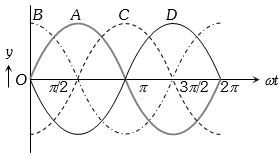
The figure shows four progressive waves $A, B, C$ and $D$ with their phases expressed with respect to the wave $A$. It can be concluded from the figure that
A
The wave $C$ is ahead by a phase angle of $\pi /2$ and the wave $B$ lags behind by a phase angle of $\pi /2$.
B
The wave $C$ lags behind by a phase angle of $\pi /2$ and the wave $B$ is ahead by a phase angle of $\pi /2$.
C
The wave $C$ is ahead by a phase angle of $\pi$ and the wave $B$ lags behind by a phase angle of $\pi$.
D
The wave $C$ lags behind by a phase angle of $\pi$ and the wave $B$ is ahead by a phase angle of $\pi$.
Solution
(B) The equation of wave $A$ is given by $y_A = A \sin(\omega t)$.
From the graph,wave $B$ starts at its maximum positive value at $t=0$,so its equation is $y_B = A \sin(\omega t + \pi/2)$. This means wave $B$ is ahead of wave $A$ by a phase angle of $\pi/2$.
Wave $C$ starts at its minimum value at $t=0$,so its equation is $y_C = A \sin(\omega t - \pi/2)$. This means wave $C$ lags behind wave $A$ by a phase angle of $\pi/2$.
Wave $D$ starts at $t=0$ with a negative slope,representing a phase shift of $\pi$ relative to $A$,so $y_D = A \sin(\omega t - \pi)$.
Thus,wave $C$ lags behind by a phase angle of $\pi/2$ and wave $B$ is ahead by a phase angle of $\pi/2$.
From the graph,wave $B$ starts at its maximum positive value at $t=0$,so its equation is $y_B = A \sin(\omega t + \pi/2)$. This means wave $B$ is ahead of wave $A$ by a phase angle of $\pi/2$.
Wave $C$ starts at its minimum value at $t=0$,so its equation is $y_C = A \sin(\omega t - \pi/2)$. This means wave $C$ lags behind wave $A$ by a phase angle of $\pi/2$.
Wave $D$ starts at $t=0$ with a negative slope,representing a phase shift of $\pi$ relative to $A$,so $y_D = A \sin(\omega t - \pi)$.
Thus,wave $C$ lags behind by a phase angle of $\pi/2$ and wave $B$ is ahead by a phase angle of $\pi/2$.
0 likes
View Solution10
MediumMCQ
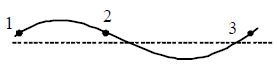
The diagram below shows an instantaneous position of a string as a transverse progressive wave travels along it from left to right. Which one of the following correctly shows the direction of the velocity of the points $1$, $2$ and $3$ on the string?

A
$\rightarrow$ $\rightarrow$ $\rightarrow$
B
$\rightarrow$ $\leftarrow$ $\rightarrow$
C
$\downarrow$ $\downarrow$ $\downarrow$
D
$\downarrow$ $\uparrow$ $\downarrow$
Solution
(D) The particle velocity $v_p$ of a point on a string is given by the relation $v_p = -v \times (\text{slope of the graph at that point})$, where $v$ is the wave speed.
Since the wave is traveling from left to right, the slope determines the direction of the particle's motion.
At point $1$: The slope of the curve is positive. Therefore, $v_p = -v \times (\text{positive}) = \text{negative}$, which means the velocity is downward $(\downarrow)$.
At point $2$: The slope of the curve is negative. Therefore, $v_p = -v \times (\text{negative}) = \text{positive}$, which means the velocity is upward $(\uparrow)$.
At point $3$: The slope of the curve is positive. Therefore, $v_p = -v \times (\text{positive}) = \text{negative}$, which means the velocity is downward $(\downarrow)$.
Thus, the directions are $\downarrow, \uparrow, \downarrow$ respectively.
Since the wave is traveling from left to right, the slope determines the direction of the particle's motion.
At point $1$: The slope of the curve is positive. Therefore, $v_p = -v \times (\text{positive}) = \text{negative}$, which means the velocity is downward $(\downarrow)$.
At point $2$: The slope of the curve is negative. Therefore, $v_p = -v \times (\text{negative}) = \text{positive}$, which means the velocity is upward $(\uparrow)$.
At point $3$: The slope of the curve is positive. Therefore, $v_p = -v \times (\text{positive}) = \text{negative}$, which means the velocity is downward $(\downarrow)$.
Thus, the directions are $\downarrow, \uparrow, \downarrow$ respectively.
0 likes
View Solution11
EasyMCQ
The equation of a progressive wave is given by $y = 0.5 \sin(10t + x) \text{ m}$. What is the wave velocity in $\text{m/s}$?
A
$10$
B
$20$
C
$5$
D
None of these
Solution
(A) The standard equation of a progressive wave is $y = A \sin(\omega t + kx + \phi)$.
Comparing the given equation $y = 0.5 \sin(10t + x)$ with the standard equation,we get:
Angular frequency $\omega = 10 \text{ rad/s}$.
Wave number $k = 1 \text{ rad/m}$.
The wave velocity $v$ is given by the formula $v = \frac{\omega}{k}$.
Substituting the values,$v = \frac{10}{1} = 10 \text{ m/s}$.
Comparing the given equation $y = 0.5 \sin(10t + x)$ with the standard equation,we get:
Angular frequency $\omega = 10 \text{ rad/s}$.
Wave number $k = 1 \text{ rad/m}$.
The wave velocity $v$ is given by the formula $v = \frac{\omega}{k}$.
Substituting the values,$v = \frac{10}{1} = 10 \text{ m/s}$.
0 likes
View Solution12
EasyMCQ
The equation of a progressive wave is given by $x = 1.2 \sin(314t + 12.56y)$. What are the wavelength and the direction of the wave?
A
$0.5 \, m, +ve \, x$-direction
B
$0.5 \, m, +ve \, y$-direction
C
$0.5 \, m, -ve \, y$-direction
D
$0.5 \, m, -ve \, x$-direction
Solution
(C) The standard equation for a progressive wave is $x = A \sin(\omega t + ky)$.
Comparing the given equation $x = 1.2 \sin(314t + 12.56y)$ with the standard form,we get the wave number $k = 12.56 \, \text{rad/m}$.
The wavelength $\lambda$ is given by the formula $\lambda = \frac{2\pi}{k}$.
Substituting the value of $k$ and $\pi \approx 3.14$:
$\lambda = \frac{2 \times 3.14}{12.56} = \frac{6.28}{12.56} = 0.5 \, \text{m}$.
Since the term inside the sine function is $(314t + 12.56y)$,the positive sign between the $t$ and $y$ terms indicates that the wave is traveling in the negative direction of the axis associated with the variable $y$.
Therefore,the wave is traveling in the $-ve \, y$-direction.
Comparing the given equation $x = 1.2 \sin(314t + 12.56y)$ with the standard form,we get the wave number $k = 12.56 \, \text{rad/m}$.
The wavelength $\lambda$ is given by the formula $\lambda = \frac{2\pi}{k}$.
Substituting the value of $k$ and $\pi \approx 3.14$:
$\lambda = \frac{2 \times 3.14}{12.56} = \frac{6.28}{12.56} = 0.5 \, \text{m}$.
Since the term inside the sine function is $(314t + 12.56y)$,the positive sign between the $t$ and $y$ terms indicates that the wave is traveling in the negative direction of the axis associated with the variable $y$.
Therefore,the wave is traveling in the $-ve \, y$-direction.
0 likes
View Solution13
DifficultMCQ
For a progressive wave given by the equation $y = 4 \sin \frac{\pi}{2} (8t - \frac{x}{8}) \, cm$,what is the wave velocity and its direction?
A
$64 \, cm/s$ in $-x$ direction
B
$32 \, cm/s$ in $-x$ direction
C
$32 \, cm/s$ in $+x$ direction
D
$64 \, cm/s$ in $+x$ direction
Solution
(D) The given wave equation is $y = 4 \sin \frac{\pi}{2} (8t - \frac{x}{8})$.
Expanding the equation,we get $y = 4 \sin (4\pi t - \frac{\pi x}{16})$.
Comparing this with the standard wave equation $y = A \sin (\omega t - kx)$,we identify the angular frequency $\omega = 4\pi \, rad/s$ and the wave number $k = \frac{\pi}{16} \, rad/cm$.
The wave velocity $v$ is given by the formula $v = \frac{\omega}{k}$.
Substituting the values,$v = \frac{4\pi}{\pi/16} = 4\pi \times \frac{16}{\pi} = 64 \, cm/s$.
Since the sign between the $t$ and $x$ terms is negative,the wave is traveling in the positive $x$ direction.
Expanding the equation,we get $y = 4 \sin (4\pi t - \frac{\pi x}{16})$.
Comparing this with the standard wave equation $y = A \sin (\omega t - kx)$,we identify the angular frequency $\omega = 4\pi \, rad/s$ and the wave number $k = \frac{\pi}{16} \, rad/cm$.
The wave velocity $v$ is given by the formula $v = \frac{\omega}{k}$.
Substituting the values,$v = \frac{4\pi}{\pi/16} = 4\pi \times \frac{16}{\pi} = 64 \, cm/s$.
Since the sign between the $t$ and $x$ terms is negative,the wave is traveling in the positive $x$ direction.
0 likes
View Solution14
MediumMCQ
$A$ sinusoidal progressive wave is generated in a string. Its equation is given by $y = (2 \text{ mm}) \sin(2\pi x - 100\pi t + \pi/3)$. The time when the particle at $x = 4 \text{ m}$ first passes through the mean position will be:
A
$\frac{1}{150} \text{ s}$
B
$\frac{1}{12} \text{ s}$
C
$\frac{1}{300} \text{ s}$
D
$\frac{1}{100} \text{ s}$
Solution
(C) The equation of the wave is $y = 2 \sin(2\pi x - 100\pi t + \pi/3)$.
For the particle to be at the mean position,the displacement $y$ must be $0$.
So,$2 \sin(2\pi x - 100\pi t + \pi/3) = 0$.
This implies the argument of the sine function must be an integer multiple of $\pi$,i.e.,$2\pi x - 100\pi t + \pi/3 = n\pi$,where $n$ is an integer.
Given $x = 4 \text{ m}$,we substitute this into the equation:
$2\pi(4) - 100\pi t + \pi/3 = n\pi$
$8\pi - 100\pi t + \pi/3 = n\pi$
$100\pi t = 8\pi + \pi/3 - n\pi = \frac{25\pi}{3} - n\pi$.
To find the first time $t > 0$,we choose $n$ such that $t$ is positive and minimal. For $n = 8$:
$100\pi t = \frac{25\pi}{3} - 8\pi = \frac{\pi}{3}$.
$t = \frac{\pi/3}{100\pi} = \frac{1}{300} \text{ s}$.
For the particle to be at the mean position,the displacement $y$ must be $0$.
So,$2 \sin(2\pi x - 100\pi t + \pi/3) = 0$.
This implies the argument of the sine function must be an integer multiple of $\pi$,i.e.,$2\pi x - 100\pi t + \pi/3 = n\pi$,where $n$ is an integer.
Given $x = 4 \text{ m}$,we substitute this into the equation:
$2\pi(4) - 100\pi t + \pi/3 = n\pi$
$8\pi - 100\pi t + \pi/3 = n\pi$
$100\pi t = 8\pi + \pi/3 - n\pi = \frac{25\pi}{3} - n\pi$.
To find the first time $t > 0$,we choose $n$ such that $t$ is positive and minimal. For $n = 8$:
$100\pi t = \frac{25\pi}{3} - 8\pi = \frac{\pi}{3}$.
$t = \frac{\pi/3}{100\pi} = \frac{1}{300} \text{ s}$.
0 likes
View Solution15
DifficultMCQ
The equation of a plane progressive wave is given by $y = 0.6 \sin 2\pi (t - x/2)$. On reflection from a denser medium,its amplitude becomes $2/3$ of the amplitude of the incident wave. The equation of the reflected wave is:
A
$y = 0.6 \sin 2\pi (t + x/2)$
B
$y = -0.4 \sin 2\pi (t + x/2)$
C
$y = 0.4 \sin 2\pi (t + x/2)$
D
$y = -0.4 \sin 2\pi (t - x/2)$
Solution
(B) $1$. The incident wave travels in the positive $x$-direction,so the reflected wave will travel in the negative $x$-direction. This changes the sign of the $x$ term inside the sine function from $-x/2$ to $+x/2$.
$2$. When a wave reflects from a denser medium,it undergoes a phase change of $\pi$ radians $(180^{\circ})$,which introduces a negative sign to the amplitude.
$3$. The new amplitude is given as $2/3$ of the incident amplitude: $A' = (2/3) \times 0.6 = 0.4$.
$4$. Combining these,the equation of the reflected wave is $y = -0.4 \sin 2\pi (t + x/2)$.
$2$. When a wave reflects from a denser medium,it undergoes a phase change of $\pi$ radians $(180^{\circ})$,which introduces a negative sign to the amplitude.
$3$. The new amplitude is given as $2/3$ of the incident amplitude: $A' = (2/3) \times 0.6 = 0.4$.
$4$. Combining these,the equation of the reflected wave is $y = -0.4 \sin 2\pi (t + x/2)$.
0 likes
View Solution16
MediumMCQ
During the propagation of a plane progressive mechanical wave,which of the following statements is incorrect?
A
All the particles are vibrating in the same phase.
B
Amplitude of all the particles is equal.
C
Particles of the medium execute $S.H.M.$
D
Wave velocity depends upon the nature of the medium.
Solution
(A) In a plane progressive mechanical wave,particles of the medium perform $S.H.M.$ with the same amplitude but different phases depending on their position.
Statement $A$ is incorrect because particles at different positions along the direction of wave propagation vibrate with different phases.
Statements $B$,$C$,and $D$ are standard properties of a plane progressive wave and are therefore correct.
Statement $A$ is incorrect because particles at different positions along the direction of wave propagation vibrate with different phases.
Statements $B$,$C$,and $D$ are standard properties of a plane progressive wave and are therefore correct.
0 likes
View Solution17
DifficultMCQ
The equation of a plane progressive wave is given by $y = 0.6 \sin 2\pi \left( t - \frac{x}{2} \right)$. On reflection from a denser medium,its amplitude becomes $2/3$ of the amplitude of the incident wave. The equation of the reflected wave is:
A
$y = 0.6 \sin 2\pi \left( t + \frac{x}{2} \right)$
B
$y = -0.4 \sin 2\pi \left( t + \frac{x}{2} \right)$
C
$y = 0.4 \sin 2\pi \left( t + \frac{x}{2} \right)$
D
$y = -0.4 \sin 2\pi \left( t - \frac{x}{2} \right)$
Solution
(B) The incident wave is traveling in the positive $x$-direction,given by $y = 0.6 \sin 2\pi (t - x/2)$.
Upon reflection from a denser medium,the wave travels in the opposite direction (negative $x$-direction),so the term $(t - x/2)$ becomes $(t + x/2)$.
Additionally,reflection from a denser medium introduces a phase change of $\pi$ $(180^{\circ})$,which is equivalent to a negative sign.
The new amplitude is given as $A' = \frac{2}{3} \times 0.6 = 0.4$.
Combining these,the equation of the reflected wave is $y = -0.4 \sin 2\pi (t + x/2)$.
Upon reflection from a denser medium,the wave travels in the opposite direction (negative $x$-direction),so the term $(t - x/2)$ becomes $(t + x/2)$.
Additionally,reflection from a denser medium introduces a phase change of $\pi$ $(180^{\circ})$,which is equivalent to a negative sign.
The new amplitude is given as $A' = \frac{2}{3} \times 0.6 = 0.4$.
Combining these,the equation of the reflected wave is $y = -0.4 \sin 2\pi (t + x/2)$.
0 likes
View Solution18
MediumMCQ
The diagram below shows an instantaneous position of a string as a transverse progressive wave travels along it from left to right. Which one of the following correctly shows the direction of the velocity of the points $1, 2$ and $3$ on the string?
A
$1 - \to, 2 - \to, 3 - \to$
B
$1 - \leftarrow, 2 - \leftarrow, 3 - \leftarrow$
C
$1 - \downarrow, 2 - \downarrow, 3 - \downarrow$
D
$1 - \downarrow, 2 - \uparrow, 3 - \downarrow$
Solution
(D) The particle velocity $v_p$ is given by the relation $v_p = -v \times (\text{slope of the graph at that point})$, where $v$ is the wave velocity.
Since the wave is traveling from left to right, $v$ is positive.
At point $1$: The slope of the curve is positive. Therefore, the particle velocity $v_p = -v \times (\text{positive slope})$ is negative, which means the direction is downward $(\downarrow)$.
At point $2$: The slope of the curve is negative. Therefore, the particle velocity $v_p = -v \times (\text{negative slope})$ is positive, which means the direction is upward $(\uparrow)$.
At point $3$: The slope of the curve is positive. Therefore, the particle velocity $v_p = -v \times (\text{positive slope})$ is negative, which means the direction is downward $(\downarrow)$.
Thus, the correct directions are $1 - \downarrow, 2 - \uparrow, 3 - \downarrow$.
Since the wave is traveling from left to right, $v$ is positive.
At point $1$: The slope of the curve is positive. Therefore, the particle velocity $v_p = -v \times (\text{positive slope})$ is negative, which means the direction is downward $(\downarrow)$.
At point $2$: The slope of the curve is negative. Therefore, the particle velocity $v_p = -v \times (\text{negative slope})$ is positive, which means the direction is upward $(\uparrow)$.
At point $3$: The slope of the curve is positive. Therefore, the particle velocity $v_p = -v \times (\text{positive slope})$ is negative, which means the direction is downward $(\downarrow)$.
Thus, the correct directions are $1 - \downarrow, 2 - \uparrow, 3 - \downarrow$.
0 likes
View Solution19
MediumMCQ
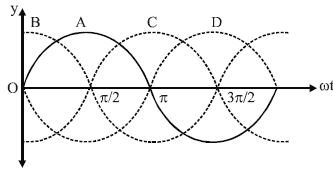
The figure given below shows four progressive waves $A, B, C$ and $D$ with their phases expressed with respect to the wave $A$. It can be calculated from the figure that
A
the wave $C$ is ahead by a phase angle of $\pi /2$ and the wave $B$ lags behind by a phase angle of $\pi /2$
B
the wave $C$ lags behind by a phase angle of $\pi /2$ and the wave $B$ is ahead by a phase angle of $\pi /2$
C
the wave $C$ is ahead by a phase angle of $\pi$ and the wave $B$ lags behind by a phase angle of $\pi$
D
the wave $C$ lags behind by a phase angle of $\pi$ and the wave $B$ is ahead by a phase angle of $\pi$
Solution
(B) From the given figure,we can observe the phase relationship between the waves.
Wave $A$ is represented by $y = a \sin(\omega t)$.
Wave $B$ starts at $t=0$ with a negative slope and reaches its mean position at $t=0$,which corresponds to a phase shift of $+\pi/2$ relative to $A$ (since it is a negative sine wave,$y_B = a \sin(\omega t + \pi/2) = a \cos(\omega t)$).
Wave $C$ reaches its mean position at $t = \pi/2\omega$,which is $\pi/2$ later than wave $A$. Thus,wave $C$ lags behind wave $A$ by a phase angle of $\pi/2$ $(y_C = a \sin(\omega t - \pi/2))$.
Therefore,wave $C$ lags behind by a phase angle of $\pi/2$ and wave $B$ is ahead by a phase angle of $\pi/2$.
Wave $A$ is represented by $y = a \sin(\omega t)$.
Wave $B$ starts at $t=0$ with a negative slope and reaches its mean position at $t=0$,which corresponds to a phase shift of $+\pi/2$ relative to $A$ (since it is a negative sine wave,$y_B = a \sin(\omega t + \pi/2) = a \cos(\omega t)$).
Wave $C$ reaches its mean position at $t = \pi/2\omega$,which is $\pi/2$ later than wave $A$. Thus,wave $C$ lags behind wave $A$ by a phase angle of $\pi/2$ $(y_C = a \sin(\omega t - \pi/2))$.
Therefore,wave $C$ lags behind by a phase angle of $\pi/2$ and wave $B$ is ahead by a phase angle of $\pi/2$.
0 likes
View Solution20
MediumMCQ
Which of the following statements is incorrect during the propagation of a plane progressive mechanical wave?
A
All the particles are vibrating in the same phase.
B
Amplitude of all the particles is equal.
C
Particles of the medium execute $SHM$.
D
Wave velocity depends upon the nature of the medium.
Solution
(A) In a plane progressive mechanical wave,particles of the medium perform $SHM$ with the same amplitude and frequency,but they vibrate with different phases depending on their position. The wave velocity is determined by the properties of the medium (such as elasticity and density). Therefore,the statement that 'all particles are vibrating in the same phase' is incorrect,as the phase varies with the position $x$ according to the equation $\phi = kx - \omega t$.
0 likes
View Solution21
MediumMCQ
Given below are some functions of $x$ and $t$ to represent the displacement (transverse or longitudinal) of an elastic wave. State which of these represent a travelling wave.
A
$y = 2 \cos(3x) \sin(10t)$
B
$y = 2 \sqrt{x - vt}$
C
$y = 3 \sin(5x - 0.5t) + 4 \cos(5x - 0.5t)$
D
$y = \cos(x) \sin(t) + \cos(2x) \sin(2t)$
Solution
(C) travelling wave is represented by a function of the form $f(x \pm vt)$ or a linear combination of harmonic terms $k x \pm \omega t$.
Option $A$ represents a standing wave because the spatial and temporal parts are separated.
Option $B$ is not a valid wave function as it does not satisfy the wave equation $\frac{\partial^2 y}{\partial x^2} = \frac{1}{v^2} \frac{\partial^2 y}{\partial t^2}$.
Option $C$ can be written as $y = R \sin(5x - 0.5t + \phi)$,which is a standard form of a travelling wave.
Option $D$ represents a superposition of two standing waves.
Therefore,only option $C$ represents a travelling wave.
Option $A$ represents a standing wave because the spatial and temporal parts are separated.
Option $B$ is not a valid wave function as it does not satisfy the wave equation $\frac{\partial^2 y}{\partial x^2} = \frac{1}{v^2} \frac{\partial^2 y}{\partial t^2}$.
Option $C$ can be written as $y = R \sin(5x - 0.5t + \phi)$,which is a standard form of a travelling wave.
Option $D$ represents a superposition of two standing waves.
Therefore,only option $C$ represents a travelling wave.
0 likes
View Solution22
MediumMCQ
The equation of a progressive wave is $y = 0.02 \sin 2\pi \left[ \frac{t}{0.01} - \frac{x}{0.30} \right]$. Here $x$ and $y$ are in $m$ and $t$ is in $s$. The velocity of propagation of the wave is .... $ms^{-1}$.
A
$300$
B
$30$
C
$400$
D
$40$
Solution
(B) The standard equation of a progressive wave is $y = A \sin (\omega t - kx)$.
Given equation is $y = 0.02 \sin \left( \frac{2\pi t}{0.01} - \frac{2\pi x}{0.30} \right)$.
Comparing the two,we get angular frequency $\omega = \frac{2\pi}{0.01} \text{ rad/s}$ and wave number $k = \frac{2\pi}{0.30} \text{ rad/m}$.
The velocity of propagation $v$ is given by $v = \frac{\omega}{k}$.
Substituting the values: $v = \frac{2\pi / 0.01}{2\pi / 0.30} = \frac{0.30}{0.01} = 30 \text{ m/s}$.
Given equation is $y = 0.02 \sin \left( \frac{2\pi t}{0.01} - \frac{2\pi x}{0.30} \right)$.
Comparing the two,we get angular frequency $\omega = \frac{2\pi}{0.01} \text{ rad/s}$ and wave number $k = \frac{2\pi}{0.30} \text{ rad/m}$.
The velocity of propagation $v$ is given by $v = \frac{\omega}{k}$.
Substituting the values: $v = \frac{2\pi / 0.01}{2\pi / 0.30} = \frac{0.30}{0.01} = 30 \text{ m/s}$.
0 likes
View Solution23
Medium
$A$ transverse harmonic wave on a string is described by $y(x, t) = 3.0 \sin (36t + 0.018x + \pi/4)$,where $x$ and $y$ are in $cm$ and $t$ is in $s$. The positive direction of $x$ is from left to right.
$(a)$ Is this a travelling wave or a stationary wave? If it is travelling,what are the speed and direction of its propagation?
$(b)$ What are its amplitude and frequency?
$(c)$ What is the initial phase at the origin?
$(d)$ What is the least distance between two successive crests in the wave?
$(a)$ Is this a travelling wave or a stationary wave? If it is travelling,what are the speed and direction of its propagation?
$(b)$ What are its amplitude and frequency?
$(c)$ What is the initial phase at the origin?
$(d)$ What is the least distance between two successive crests in the wave?
Solution
(A) The standard equation for a progressive wave is $y(x, t) = a \sin (\omega t + kx + \phi)$.
Comparing this with $y(x, t) = 3.0 \sin (36t + 0.018x + \pi/4)$:
$(a)$ Since the equation is of the form $f(ax + bt)$,it represents a travelling wave. Because the sign between $t$ and $x$ is positive,it propagates from right to left (negative $x$-direction). The speed $v = \omega/k = 36 / 0.018 = 2000 \, cm/s = 20 \, m/s$.
$(b)$ Amplitude $a = 3.0 \, cm$. Frequency $\nu = \omega / (2\pi) = 36 / (2 \times 3.1416) \approx 5.73 \, Hz$.
$(c)$ The initial phase at the origin $(x=0, t=0)$ is $\phi = \pi/4 \, rad$.
$(d)$ The distance between two successive crests is the wavelength $\lambda = 2\pi / k = 2 \times 3.1416 / 0.018 \approx 349 \, cm = 3.49 \, m$.
Comparing this with $y(x, t) = 3.0 \sin (36t + 0.018x + \pi/4)$:
$(a)$ Since the equation is of the form $f(ax + bt)$,it represents a travelling wave. Because the sign between $t$ and $x$ is positive,it propagates from right to left (negative $x$-direction). The speed $v = \omega/k = 36 / 0.018 = 2000 \, cm/s = 20 \, m/s$.
$(b)$ Amplitude $a = 3.0 \, cm$. Frequency $\nu = \omega / (2\pi) = 36 / (2 \times 3.1416) \approx 5.73 \, Hz$.
$(c)$ The initial phase at the origin $(x=0, t=0)$ is $\phi = \pi/4 \, rad$.
$(d)$ The distance between two successive crests is the wavelength $\lambda = 2\pi / k = 2 \times 3.1416 / 0.018 \approx 349 \, cm = 3.49 \, m$.
0 likes
View Solution24
Difficult
What are called progressive waves? What is called a wave equation? Write the wave equation for a progressive harmonic transverse wave propagating and explain it by drawing graphs.
Solution
(N/A) $1$. Progressive Wave: $A$ wave that travels continuously in a medium in a specific direction without any change in its form is called a progressive or traveling wave.
$2$. Wave Equation: $A$ mathematical expression that describes the displacement of particles of the medium as a function of both position $(x)$ and time $(t)$ is called a wave equation.
$3$. Wave Equation for a Progressive Harmonic Transverse Wave: The displacement $y$ of a particle at position $x$ and time $t$ is given by $y(x, t) = A \sin(kx - \omega t + \phi)$,where $A$ is the amplitude,$k = \frac{2\pi}{\lambda}$ is the angular wave number,$\omega = 2\pi f$ is the angular frequency,and $\phi$ is the initial phase constant.
$4$. Graphical Explanation:
- $y-x$ graph (at constant $t$): Represents the snapshot of the wave at a specific instant,showing the spatial variation of displacement.
- $y-t$ graph (at constant $x$): Represents the oscillation of a single particle at a fixed position over time.
$2$. Wave Equation: $A$ mathematical expression that describes the displacement of particles of the medium as a function of both position $(x)$ and time $(t)$ is called a wave equation.
$3$. Wave Equation for a Progressive Harmonic Transverse Wave: The displacement $y$ of a particle at position $x$ and time $t$ is given by $y(x, t) = A \sin(kx - \omega t + \phi)$,where $A$ is the amplitude,$k = \frac{2\pi}{\lambda}$ is the angular wave number,$\omega = 2\pi f$ is the angular frequency,and $\phi$ is the initial phase constant.
$4$. Graphical Explanation:
- $y-x$ graph (at constant $t$): Represents the snapshot of the wave at a specific instant,showing the spatial variation of displacement.
- $y-t$ graph (at constant $x$): Represents the oscillation of a single particle at a fixed position over time.
0 likes
View Solution25
EasyMCQ
What is a progressive wave?
A
$A$ wave that remains stationary in space.
B
$A$ wave that travels from one point to another in a medium,transferring energy and momentum.
C
$A$ wave that oscillates only at a single point.
D
$A$ wave that does not transport energy.
Solution
(B) progressive wave (or traveling wave) is a wave that moves continuously in a medium without change in its shape.
It is characterized by the continuous transfer of energy and momentum from one point to another in the medium.
Examples include sound waves,water waves,and light waves.
In a progressive wave,each particle of the medium executes simple harmonic motion about its mean position with the same amplitude and frequency,but with a phase difference relative to its neighbors.
It is characterized by the continuous transfer of energy and momentum from one point to another in the medium.
Examples include sound waves,water waves,and light waves.
In a progressive wave,each particle of the medium executes simple harmonic motion about its mean position with the same amplitude and frequency,but with a phase difference relative to its neighbors.
0 likes
View Solution26
Difficult
Write the definition of the speed of a progressive wave and derive $v = \frac{\omega}{k}$ and $v = \frac{\lambda}{T}$.
Solution
(N/A) Wave speed: The distance covered by a wave in unit time is called wave speed. Its $SI$ unit is $m/s$.
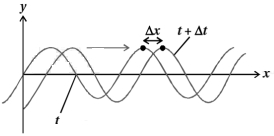
To find the speed of a progressive wave,we consider the motion of a point on the wave (e.g.,a crest). As shown in the figure,a point on the wave maintains its displacement relative to the wave pattern as it moves.
If the wave covers a displacement $\Delta x$ in time $\Delta t$,the wave speed is given by:
$v = \frac{\Delta x}{\Delta t}$
For a progressive wave represented by $y(x, t) = A \sin(kx - \omega t + \phi)$,the phase of the wave remains constant for a specific point on the wave pattern:
$kx - \omega t = \text{constant}$
As the wave moves,for a point to maintain the same phase at a later time $(t + \Delta t)$,its position must change to $(x + \Delta x)$:
$k(x + \Delta x) - \omega(t + \Delta t) = kx - \omega t$
$kx + k\Delta x - \omega t - \omega\Delta t = kx - \omega t$
$k\Delta x = \omega\Delta t$
$\frac{\Delta x}{\Delta t} = \frac{\omega}{k}$
Since $v = \frac{\Delta x}{\Delta t}$,we get $v = \frac{\omega}{k}$.
We know that $\omega = \frac{2\pi}{T}$ and $k = \frac{2\pi}{\lambda}$.
Substituting these values:
$v = \frac{(2\pi / T)}{(2\pi / \lambda)} = \frac{\lambda}{T}$.
To find the speed of a progressive wave,we consider the motion of a point on the wave (e.g.,a crest). As shown in the figure,a point on the wave maintains its displacement relative to the wave pattern as it moves.
If the wave covers a displacement $\Delta x$ in time $\Delta t$,the wave speed is given by:
$v = \frac{\Delta x}{\Delta t}$
For a progressive wave represented by $y(x, t) = A \sin(kx - \omega t + \phi)$,the phase of the wave remains constant for a specific point on the wave pattern:
$kx - \omega t = \text{constant}$
As the wave moves,for a point to maintain the same phase at a later time $(t + \Delta t)$,its position must change to $(x + \Delta x)$:
$k(x + \Delta x) - \omega(t + \Delta t) = kx - \omega t$
$kx + k\Delta x - \omega t - \omega\Delta t = kx - \omega t$
$k\Delta x = \omega\Delta t$
$\frac{\Delta x}{\Delta t} = \frac{\omega}{k}$
Since $v = \frac{\Delta x}{\Delta t}$,we get $v = \frac{\omega}{k}$.
We know that $\omega = \frac{2\pi}{T}$ and $k = \frac{2\pi}{\lambda}$.
Substituting these values:
$v = \frac{(2\pi / T)}{(2\pi / \lambda)} = \frac{\lambda}{T}$.
0 likes
View Solution27
MediumMCQ
Distance travelled by a progressive wave having wavelength $\lambda$ and frequency $\nu$ in time $t$ is ......
A
$\lambda \nu t$
B
$\lambda t / \nu$
C
$\nu t / \lambda$
D
$\lambda \nu / t$
Solution
(A) The speed of a wave $(v)$ is given by the product of its wavelength $(\lambda)$ and frequency $(\nu)$: $v = \nu \lambda$.
Distance travelled by the wave in time $t$ is given by: $\text{Distance} = \text{speed} \times \text{time}$.
Substituting the value of speed: $\text{Distance} = (\nu \lambda) \times t = \lambda \nu t$.
Distance travelled by the wave in time $t$ is given by: $\text{Distance} = \text{speed} \times \text{time}$.
Substituting the value of speed: $\text{Distance} = (\nu \lambda) \times t = \lambda \nu t$.
0 likes
View Solution28
EasyMCQ
For a progressive wave,$y = 5 \sin (0.01x - 2t)$ (where $x$ and $y$ are in $cm$ and $t$ is in $s$). What will be its speed of propagation (in $cm/s$)?
A
$100$
B
$200$
C
$50$
D
$25$
Solution
(B) The standard equation for a progressive wave is given by $y = A \sin (kx - \omega t)$.
Comparing the given equation $y = 5 \sin (0.01x - 2t)$ with the standard equation,we identify the wave number $k$ and the angular frequency $\omega$:
$k = 0.01 \ rad/cm$
$\omega = 2 \ rad/s$
The speed of propagation $v$ of a wave is defined by the ratio of angular frequency to the wave number:
$v = \frac{\omega}{k}$
Substituting the values:
$v = \frac{2}{0.01} = 200 \ cm/s$
Thus,the speed of propagation is $200 \ cm/s$.
Comparing the given equation $y = 5 \sin (0.01x - 2t)$ with the standard equation,we identify the wave number $k$ and the angular frequency $\omega$:
$k = 0.01 \ rad/cm$
$\omega = 2 \ rad/s$
The speed of propagation $v$ of a wave is defined by the ratio of angular frequency to the wave number:
$v = \frac{\omega}{k}$
Substituting the values:
$v = \frac{2}{0.01} = 200 \ cm/s$
Thus,the speed of propagation is $200 \ cm/s$.
0 likes
View Solution29
Medium
In the given progressive wave $y = 5 \sin(100\pi t + 0.4\pi x)$,where $y$ and $x$ are in $m$ and $t$ is in $s$. Find the:
$(a)$ Amplitude
$(b)$ Wavelength
$(c)$ Frequency
$(d)$ Wave velocity
$(e)$ Particle velocity amplitude.
$(a)$ Amplitude
$(b)$ Wavelength
$(c)$ Frequency
$(d)$ Wave velocity
$(e)$ Particle velocity amplitude.
Solution
(N/A) Comparing the given equation $y = 5 \sin(100\pi t + 0.4\pi x)$ with the standard wave equation $y = a \sin(\omega t + kx + \phi)$:
$(a)$ Amplitude $a = 5 \ m$.
$(b)$ Wave number $k = 0.4\pi$. Since $k = \frac{2\pi}{\lambda}$,we have $0.4\pi = \frac{2\pi}{\lambda} \Rightarrow \lambda = \frac{2}{0.4} = 5 \ m$.
$(c)$ Angular frequency $\omega = 100\pi$. Since $\omega = 2\pi f$,we have $100\pi = 2\pi f \Rightarrow f = 50 \ Hz$.
$(d)$ Wave velocity $v = \frac{\omega}{k} = \frac{100\pi}{0.4\pi} = 250 \ m/s$.
$(e)$ Particle velocity amplitude $v_{\max} = a\omega = 5 \times 100\pi = 500\pi \ m/s$.
$(a)$ Amplitude $a = 5 \ m$.
$(b)$ Wave number $k = 0.4\pi$. Since $k = \frac{2\pi}{\lambda}$,we have $0.4\pi = \frac{2\pi}{\lambda} \Rightarrow \lambda = \frac{2}{0.4} = 5 \ m$.
$(c)$ Angular frequency $\omega = 100\pi$. Since $\omega = 2\pi f$,we have $100\pi = 2\pi f \Rightarrow f = 50 \ Hz$.
$(d)$ Wave velocity $v = \frac{\omega}{k} = \frac{100\pi}{0.4\pi} = 250 \ m/s$.
$(e)$ Particle velocity amplitude $v_{\max} = a\omega = 5 \times 100\pi = 500\pi \ m/s$.
0 likes
View Solution30
EasyMCQ
$A$ plane progressive wave propagating along the positive $x$-axis is represented by:
A
$y = A \sin(\omega t + kx)$
B
$y = A \sin(\omega t - kx)$
C
$y = A \sin(\omega t) \sin(kx)$
D
$y = A \sin(\omega t) \cdot kx$
Solution
(B) plane progressive wave traveling in the positive $x$-direction is mathematically represented by the equation $y = A \sin(\omega t - kx)$.
Here,$A$ is the amplitude,$\omega$ is the angular frequency,$t$ is time,$k$ is the wave number,and $x$ is the position.
The negative sign between $\omega t$ and $kx$ indicates propagation in the positive $x$-direction,while a positive sign would indicate propagation in the negative $x$-direction.
Here,$A$ is the amplitude,$\omega$ is the angular frequency,$t$ is time,$k$ is the wave number,and $x$ is the position.
The negative sign between $\omega t$ and $kx$ indicates propagation in the positive $x$-direction,while a positive sign would indicate propagation in the negative $x$-direction.
0 likes
View Solution31
MediumMCQ
The equation of a progressive wave is given by $y = A \cos 240(t - x/12)$,where $t$ is the time in seconds and $x$ is the distance in meters. The phase difference (in radians) between two positions $0.5 \, m$ apart is:
A
$40$
B
$20$
C
$10$
D
$5$
Solution
(C) The given wave equation is $y = A \cos 240(t - x/12)$.
Expanding this,we get $y = A \cos(240t - 240x/12) = A \cos(240t - 20x)$.
Comparing this with the standard wave equation $y = A \cos(\omega t - kx)$,we identify the wave number $k = 20 \, rad/m$.
The phase difference $\Delta \phi$ between two points separated by a distance $\Delta x$ is given by the formula $\Delta \phi = k \cdot \Delta x$.
Given $\Delta x = 0.5 \, m$ and $k = 20 \, rad/m$,we calculate:
$\Delta \phi = 20 \times 0.5 = 10 \, rad$.
Thus,the phase difference is $10 \, rad$.
Expanding this,we get $y = A \cos(240t - 240x/12) = A \cos(240t - 20x)$.
Comparing this with the standard wave equation $y = A \cos(\omega t - kx)$,we identify the wave number $k = 20 \, rad/m$.
The phase difference $\Delta \phi$ between two points separated by a distance $\Delta x$ is given by the formula $\Delta \phi = k \cdot \Delta x$.
Given $\Delta x = 0.5 \, m$ and $k = 20 \, rad/m$,we calculate:
$\Delta \phi = 20 \times 0.5 = 10 \, rad$.
Thus,the phase difference is $10 \, rad$.
0 likes
View Solution32
EasyMCQ
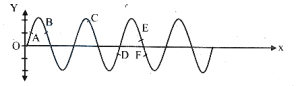
The diagram shows the propagation of a progressive wave. $A$,$B$,$C$,$D$,$E$,and $F$ are points on this wave. Which of the following points are in the same state of vibration (i.e.,in the same phase)?
A
$A, B$
B
$B, C$
C
$B, D$
D
$B, E$
Solution
(D) Two points are in the same state of vibration (same phase) if they have the same displacement and are moving in the same direction. This occurs at points separated by an integer multiple of the wavelength $\lambda$.
Looking at the diagram,point $B$ is on the downward slope of the first crest. Point $E$ is on the downward slope of the third crest.
The distance between $B$ and $E$ is exactly one full wavelength $\lambda$.
Therefore,points $B$ and $E$ are in the same phase.
Looking at the diagram,point $B$ is on the downward slope of the first crest. Point $E$ is on the downward slope of the third crest.
The distance between $B$ and $E$ is exactly one full wavelength $\lambda$.
Therefore,points $B$ and $E$ are in the same phase.
0 likes
View Solution33
DifficultMCQ
The equation of a progressive wave is $Y = a \sin 2 \pi (n t - \frac{x}{5})$. The ratio of maximum particle velocity to wave velocity is
A
$\frac{\pi a}{5}$
B
$\frac{2 \pi a}{5}$
C
$\frac{3 \pi a}{5}$
D
$\frac{4 \pi a}{5}$
Solution
(B) The general equation for a progressive wave is $Y = a \sin (\omega t - kx)$.
Comparing this with the given equation $Y = a \sin (2 \pi n t - \frac{2 \pi x}{5})$:
Angular frequency $\omega = 2 \pi n$.
Wave number $k = \frac{2 \pi}{5}$.
Wave velocity $v = \frac{\omega}{k} = \frac{2 \pi n}{2 \pi / 5} = 5n$.
Particle velocity $v_p = \frac{dY}{dt} = a \omega \cos (\omega t - kx)$.
Maximum particle velocity $v_m = a \omega = a (2 \pi n) = 2 \pi n a$.
The ratio of maximum particle velocity to wave velocity is $\frac{v_m}{v} = \frac{2 \pi n a}{5n} = \frac{2 \pi a}{5}$.
Comparing this with the given equation $Y = a \sin (2 \pi n t - \frac{2 \pi x}{5})$:
Angular frequency $\omega = 2 \pi n$.
Wave number $k = \frac{2 \pi}{5}$.
Wave velocity $v = \frac{\omega}{k} = \frac{2 \pi n}{2 \pi / 5} = 5n$.
Particle velocity $v_p = \frac{dY}{dt} = a \omega \cos (\omega t - kx)$.
Maximum particle velocity $v_m = a \omega = a (2 \pi n) = 2 \pi n a$.
The ratio of maximum particle velocity to wave velocity is $\frac{v_m}{v} = \frac{2 \pi n a}{5n} = \frac{2 \pi a}{5}$.
0 likes
View Solution34
MediumMCQ
$A$ progressive wave of frequency $50 \,Hz$ is travelling with velocity $350 \,m/s$ through a medium. The change in phase at a given time interval of $0.01 \,s$ is
A
$\frac{\pi}{4} \,rad$
B
$\frac{3\pi}{2} \,rad$
C
$\pi \,rad$
D
$\frac{\pi}{2} \,rad$
Solution
(C) The relationship between phase difference $\Delta \phi$ and time interval $\Delta t$ is given by:
$\Delta \phi = \omega \Delta t = (2\pi f) \Delta t$
Given frequency $f = 50 \,Hz$ and time interval $\Delta t = 0.01 \,s$.
Substituting the values:
$\Delta \phi = 2 \times \pi \times 50 \times 0.01$
$\Delta \phi = 100 \pi \times 0.01$
$\Delta \phi = \pi \,rad$.
$\Delta \phi = \omega \Delta t = (2\pi f) \Delta t$
Given frequency $f = 50 \,Hz$ and time interval $\Delta t = 0.01 \,s$.
Substituting the values:
$\Delta \phi = 2 \times \pi \times 50 \times 0.01$
$\Delta \phi = 100 \pi \times 0.01$
$\Delta \phi = \pi \,rad$.
0 likes
View Solution35
MediumMCQ
$A$ progressive wave is represented by $y=12 \sin (5 t-4 x) \ cm$. On this wave,how far away are the two points having a phase difference of $90^{\circ}$?
A
$\frac{\pi}{2} \ cm$
B
$\frac{\pi}{4} \ cm$
C
$\frac{\pi}{8} \ cm$
D
$\frac{\pi}{16} \ cm$
Solution
(C) The given equation of the progressive wave is $y = 12 \sin(5t - 4x)$.
Comparing this with the standard wave equation $y = A \sin(\omega t - kx)$,we get the wave number $k = 4 \ rad/cm$.
The phase difference $\Delta \phi$ between two points separated by a distance $\Delta x$ is given by the relation $\Delta \phi = k \cdot \Delta x$.
We are given the phase difference $\Delta \phi = 90^{\circ} = \frac{\pi}{2} \ rad$.
Substituting the values,we have $\frac{\pi}{2} = 4 \cdot \Delta x$.
Therefore,$\Delta x = \frac{\pi}{2 \times 4} = \frac{\pi}{8} \ cm$.
Comparing this with the standard wave equation $y = A \sin(\omega t - kx)$,we get the wave number $k = 4 \ rad/cm$.
The phase difference $\Delta \phi$ between two points separated by a distance $\Delta x$ is given by the relation $\Delta \phi = k \cdot \Delta x$.
We are given the phase difference $\Delta \phi = 90^{\circ} = \frac{\pi}{2} \ rad$.
Substituting the values,we have $\frac{\pi}{2} = 4 \cdot \Delta x$.
Therefore,$\Delta x = \frac{\pi}{2 \times 4} = \frac{\pi}{8} \ cm$.
0 likes
View Solution36
MediumMCQ
$A$ progressive wave of frequency $400 \ Hz$ is travelling with velocity $336 \ m/s$. How far apart are the two points on a wave which are $60^{\circ}$ out of phase (in $m$)?
A
$0.12$
B
$0.14$
C
$0.21$
D
$0.28$
Solution
(B) Given:
Frequency $f = 400 \ Hz$
Velocity $v = 336 \ m/s$
Phase difference $\Delta \phi = 60^{\circ} = \frac{\pi}{3} \text{ radians}$.
First,calculate the wavelength $\lambda$ using the formula $v = f \lambda$:
$\lambda = \frac{v}{f} = \frac{336}{400} = 0.84 \ m$.
The relationship between phase difference $\Delta \phi$ and path difference $\Delta x$ is given by:
$\Delta \phi = \frac{2\pi}{\lambda} \Delta x$.
Rearranging for $\Delta x$:
$\Delta x = \frac{\Delta \phi \cdot \lambda}{2\pi}$.
Substituting the values:
$\Delta x = \frac{(\pi/3) \cdot 0.84}{2\pi} = \frac{0.84}{6} = 0.14 \ m$.
Therefore,the two points are $0.14 \ m$ apart.
Frequency $f = 400 \ Hz$
Velocity $v = 336 \ m/s$
Phase difference $\Delta \phi = 60^{\circ} = \frac{\pi}{3} \text{ radians}$.
First,calculate the wavelength $\lambda$ using the formula $v = f \lambda$:
$\lambda = \frac{v}{f} = \frac{336}{400} = 0.84 \ m$.
The relationship between phase difference $\Delta \phi$ and path difference $\Delta x$ is given by:
$\Delta \phi = \frac{2\pi}{\lambda} \Delta x$.
Rearranging for $\Delta x$:
$\Delta x = \frac{\Delta \phi \cdot \lambda}{2\pi}$.
Substituting the values:
$\Delta x = \frac{(\pi/3) \cdot 0.84}{2\pi} = \frac{0.84}{6} = 0.14 \ m$.
Therefore,the two points are $0.14 \ m$ apart.
0 likes
View Solution37
MediumMCQ
The equation of a progressive wave is $Y = 3 \sin \left[ \pi \left( \frac{t}{3} - \frac{x}{5} \right) + \frac{\pi}{4} \right]$ where $x$ and $y$ are in meters and time $t$ is in seconds. Which of the following is correct?
A
Wavelength $= 10 \ m$
B
Velocity $= 1.5 \ m/s$
C
Amplitude $= 3 \ cm$
D
Frequency $= 0.2 \ Hz$
Solution
(A) The standard equation of a progressive wave is $Y = A \sin \left( \omega t - kx + \phi \right)$.
Comparing the given equation $Y = 3 \sin \left[ \pi \left( \frac{t}{3} - \frac{x}{5} \right) + \frac{\pi}{4} \right]$ with the standard form:
$Y = 3 \sin \left( \frac{\pi t}{3} - \frac{\pi x}{5} + \frac{\pi}{4} \right)$.
Here,the amplitude $A = 3 \ m$ (since $x$ and $y$ are in meters).
The angular frequency $\omega = \frac{\pi}{3} \ rad/s$.
The wave number $k = \frac{\pi}{5} \ rad/m$.
$1$. Wavelength $\lambda = \frac{2\pi}{k} = \frac{2\pi}{\pi/5} = 10 \ m$.
$2$. Velocity $v = \frac{\omega}{k} = \frac{\pi/3}{\pi/5} = \frac{5}{3} \approx 1.67 \ m/s$.
$3$. Frequency $f = \frac{\omega}{2\pi} = \frac{\pi/3}{2\pi} = \frac{1}{6} \approx 0.167 \ Hz$.
Comparing these results with the options,option $A$ is correct.
Comparing the given equation $Y = 3 \sin \left[ \pi \left( \frac{t}{3} - \frac{x}{5} \right) + \frac{\pi}{4} \right]$ with the standard form:
$Y = 3 \sin \left( \frac{\pi t}{3} - \frac{\pi x}{5} + \frac{\pi}{4} \right)$.
Here,the amplitude $A = 3 \ m$ (since $x$ and $y$ are in meters).
The angular frequency $\omega = \frac{\pi}{3} \ rad/s$.
The wave number $k = \frac{\pi}{5} \ rad/m$.
$1$. Wavelength $\lambda = \frac{2\pi}{k} = \frac{2\pi}{\pi/5} = 10 \ m$.
$2$. Velocity $v = \frac{\omega}{k} = \frac{\pi/3}{\pi/5} = \frac{5}{3} \approx 1.67 \ m/s$.
$3$. Frequency $f = \frac{\omega}{2\pi} = \frac{\pi/3}{2\pi} = \frac{1}{6} \approx 0.167 \ Hz$.
Comparing these results with the options,option $A$ is correct.
0 likes
View Solution38
MediumMCQ
$A$ progressive wave is given by $Y = 12 \sin (5t - 4x)$. On this wave,how far away are the two points having a phase difference of $90^{\circ}$?
A
$\frac{\pi}{4}$
B
$\frac{\pi}{8}$
C
$\frac{\pi}{16}$
D
$\frac{\pi}{32}$
Solution
(B) The given equation of the progressive wave is $y = 12 \sin (5t - 4x)$.
The standard form of a progressive wave is $y = A \sin (\omega t - kx)$,where $k = \frac{2\pi}{\lambda}$.
Comparing the given equation with the standard form,we get the wave number $k = 4$.
The relationship between phase difference $(\Delta \phi)$ and path difference $(\Delta x)$ is given by $\Delta \phi = k \cdot \Delta x$.
Given phase difference $\Delta \phi = 90^{\circ} = \frac{\pi}{2}$ radians.
Substituting the values: $\frac{\pi}{2} = 4 \cdot \Delta x$.
Therefore,$\Delta x = \frac{\pi}{2 \cdot 4} = \frac{\pi}{8}$.
The standard form of a progressive wave is $y = A \sin (\omega t - kx)$,where $k = \frac{2\pi}{\lambda}$.
Comparing the given equation with the standard form,we get the wave number $k = 4$.
The relationship between phase difference $(\Delta \phi)$ and path difference $(\Delta x)$ is given by $\Delta \phi = k \cdot \Delta x$.
Given phase difference $\Delta \phi = 90^{\circ} = \frac{\pi}{2}$ radians.
Substituting the values: $\frac{\pi}{2} = 4 \cdot \Delta x$.
Therefore,$\Delta x = \frac{\pi}{2 \cdot 4} = \frac{\pi}{8}$.
0 likes
View Solution39
EasyMCQ
Which of the following expressions represents a simple harmonic progressive wave?
A
$y = a \sin(\omega t)$
B
$y = a \sin(\omega t) \cos(kx)$
C
$y = a \sin(\omega t - kx)$
D
$y = a \cos(kx)$
Solution
(C) simple harmonic progressive wave is a wave that travels through a medium without any permanent displacement of the medium particles.
Mathematically,a progressive wave is represented by a function of the form $y = f(vt \pm x)$ or $y = a \sin(\omega t \pm kx + \phi)$.
In this expression,$y$ is the displacement,$a$ is the amplitude,$\omega$ is the angular frequency,$t$ is time,$k$ is the wave number,and $x$ is the position.
Option $A$ represents simple harmonic motion at a fixed position.
Option $B$ represents a standing wave.
Option $C$ represents a simple harmonic progressive wave because it contains both space $(x)$ and time $(t)$ variables in the phase argument.
Option $D$ represents a stationary spatial variation.
Mathematically,a progressive wave is represented by a function of the form $y = f(vt \pm x)$ or $y = a \sin(\omega t \pm kx + \phi)$.
In this expression,$y$ is the displacement,$a$ is the amplitude,$\omega$ is the angular frequency,$t$ is time,$k$ is the wave number,and $x$ is the position.
Option $A$ represents simple harmonic motion at a fixed position.
Option $B$ represents a standing wave.
Option $C$ represents a simple harmonic progressive wave because it contains both space $(x)$ and time $(t)$ variables in the phase argument.
Option $D$ represents a stationary spatial variation.
0 likes
View Solution40
MediumMCQ
$y=3 \sin \pi\left(\frac{t}{2}-\frac{x}{4}\right)$ represents an equation of a progressive wave,where $t$ is in $s$ and $x$ is in $m$. The distance travelled by the wave in $5 \,s$ is (in $\,m$)
A
$8$
B
$10$
C
$5$
D
$32$
Solution
(B) The given equation of a progressive wave is $y=3 \sin \pi\left(\frac{t}{2}-\frac{x}{4}\right)$.
Comparing this with the standard wave equation $y=A \sin 2\pi \left(\frac{t}{T}-\frac{x}{\lambda}\right)$,we rewrite the given equation as $y=3 \sin 2\pi \left(\frac{t}{4}-\frac{x}{8}\right)$.
From this,we identify the time period $T=4 \,s$ and the wavelength $\lambda=8 \,m$.
The wave velocity $v$ is given by $v = \frac{\lambda}{T} = \frac{8}{4} = 2 \,m/s$.
The distance travelled by the wave in time $t=5 \,s$ is $s = v \times t = 2 \times 5 = 10 \,m$.
Comparing this with the standard wave equation $y=A \sin 2\pi \left(\frac{t}{T}-\frac{x}{\lambda}\right)$,we rewrite the given equation as $y=3 \sin 2\pi \left(\frac{t}{4}-\frac{x}{8}\right)$.
From this,we identify the time period $T=4 \,s$ and the wavelength $\lambda=8 \,m$.
The wave velocity $v$ is given by $v = \frac{\lambda}{T} = \frac{8}{4} = 2 \,m/s$.
The distance travelled by the wave in time $t=5 \,s$ is $s = v \times t = 2 \times 5 = 10 \,m$.
0 likes
View Solution41
MediumMCQ
Among the following,the equation representing a progressive wave is
$(A)$ $y=2 \cos 3x \sin 10t$
$(B)$ $y=2 \sqrt{x-vt}$
$(C)$ $y=3 \sin (5x-0.5t)+4 \cos (5x-0.5t)$
$(D)$ $y=\cos x \sin t+\cos 2x \sin 2t$
$(A)$ $y=2 \cos 3x \sin 10t$
$(B)$ $y=2 \sqrt{x-vt}$
$(C)$ $y=3 \sin (5x-0.5t)+4 \cos (5x-0.5t)$
$(D)$ $y=\cos x \sin t+\cos 2x \sin 2t$
A
$A$ and $D$
B
$C$
C
$A, C, D$
D
$B$
Solution
(B) progressive wave is represented by a function of the form $y = f(ax \pm bt)$.
Option $(A)$ represents a standing wave because it is a product of spatial and temporal functions.
Option $(B)$ is not a periodic function.
Option $(C)$ can be rewritten using the identity $A \sin \theta + B \cos \theta = R \sin(\theta + \phi)$,where $R = \sqrt{3^2 + 4^2} = 5$. Thus,$y = 5 \sin(5x - 0.5t + \phi)$,which is a standard progressive wave equation.
Option $(D)$ is a superposition of two different waves with different frequencies and wave numbers,not a single progressive wave.
Therefore,only $(C)$ represents a single progressive wave.
Option $(A)$ represents a standing wave because it is a product of spatial and temporal functions.
Option $(B)$ is not a periodic function.
Option $(C)$ can be rewritten using the identity $A \sin \theta + B \cos \theta = R \sin(\theta + \phi)$,where $R = \sqrt{3^2 + 4^2} = 5$. Thus,$y = 5 \sin(5x - 0.5t + \phi)$,which is a standard progressive wave equation.
Option $(D)$ is a superposition of two different waves with different frequencies and wave numbers,not a single progressive wave.
Therefore,only $(C)$ represents a single progressive wave.
0 likes
View Solution42
EasyMCQ
$A$ wave is represented by $x = 0.4 \cos \left(8t - \frac{y}{2}\right)$ where $x$ and $y$ are in meters and $t$ is in seconds. The speed of the wave is
A
$0.5 \ m \cdot s^{-1}$
B
$8 \ m \cdot s^{-1}$
C
$16 \ m \cdot s^{-1}$
D
$0.1 \ m \cdot s^{-1}$
Solution
(C) The standard equation of a progressive wave is given by $x = A \cos(\omega t - ky)$.
Comparing the given equation $x = 0.4 \cos \left(8t - \frac{y}{2}\right)$ with the standard equation,we get:
Angular frequency $\omega = 8 \ rad \cdot s^{-1}$
Wave number $k = \frac{1}{2} \ m^{-1}$
The speed of the wave $v$ is given by the formula $v = \frac{\omega}{k}$.
Substituting the values,$v = \frac{8}{1/2} = 8 \times 2 = 16 \ m \cdot s^{-1}$.
Therefore,the speed of the wave is $16 \ m \cdot s^{-1}$.
Comparing the given equation $x = 0.4 \cos \left(8t - \frac{y}{2}\right)$ with the standard equation,we get:
Angular frequency $\omega = 8 \ rad \cdot s^{-1}$
Wave number $k = \frac{1}{2} \ m^{-1}$
The speed of the wave $v$ is given by the formula $v = \frac{\omega}{k}$.
Substituting the values,$v = \frac{8}{1/2} = 8 \times 2 = 16 \ m \cdot s^{-1}$.
Therefore,the speed of the wave is $16 \ m \cdot s^{-1}$.
0 likes
View Solution43
EasyMCQ
$A$ progressive wave of frequency $500 \,Hz$ is travelling with a velocity of $360 \,ms^{-1}$. The distance between two points, having a phase difference of $60^{\circ}$, is ............. (in $\,m$)
A
$1.2$
B
$12$
C
$0.12$
D
$0.012$
Solution
(C) Given: Frequency $f = 500 \,Hz$, Velocity $v = 360 \,ms^{-1}$, Phase difference $\Delta\phi = 60^{\circ}$.
First, calculate the wavelength $\lambda$ using the formula $\lambda = \frac{v}{f}$.
$\lambda = \frac{360}{500} = 0.72 \,m$.
The relationship between path difference $\Delta x$ and phase difference $\Delta\phi$ is given by $\Delta\phi = \frac{2\pi}{\lambda} \Delta x$.
Converting $60^{\circ}$ to radians: $60^{\circ} = \frac{\pi}{3} \,rad$.
Substituting the values: $\frac{\pi}{3} = \frac{2\pi}{\lambda} \Delta x$.
$\Delta x = \frac{\lambda}{6} = \frac{0.72}{6} = 0.12 \,m$.
Therefore, the distance between the two points is $0.12 \,m$.
First, calculate the wavelength $\lambda$ using the formula $\lambda = \frac{v}{f}$.
$\lambda = \frac{360}{500} = 0.72 \,m$.
The relationship between path difference $\Delta x$ and phase difference $\Delta\phi$ is given by $\Delta\phi = \frac{2\pi}{\lambda} \Delta x$.
Converting $60^{\circ}$ to radians: $60^{\circ} = \frac{\pi}{3} \,rad$.
Substituting the values: $\frac{\pi}{3} = \frac{2\pi}{\lambda} \Delta x$.
$\Delta x = \frac{\lambda}{6} = \frac{0.72}{6} = 0.12 \,m$.
Therefore, the distance between the two points is $0.12 \,m$.
0 likes
View Solution44
EasyMCQ
The displacement of a plane progressive wave in a medium,travelling towards the positive $x$-axis with a velocity of $4 \ m/s$,at $t=0$ is given by $y=3 \sin 2 \pi (-x/3)$. The expression for the displacement at a later time $t=4 \ s$ will be:
A
$y=3 \sin 2 \pi \left(-\frac{x-16}{3}\right)$
B
$y=3 \sin 2 \pi \left(\frac{-x-16}{3}\right)$
C
$y=3 \sin 2 \pi \left(\frac{-x-1}{3}\right)$
D
$y=3 \sin 2 \pi \left(\frac{-x+16}{3}\right)$
Solution
(A) The general equation for a wave travelling in the positive $x$-direction is $y = A \sin(\omega t - kx + \phi)$.
At $t=0$,the equation is $y = 3 \sin(-2\pi x / 3)$,which implies $k = 2\pi / 3$.
Given the wave velocity $v = 4 \ m/s$,we use the relation $v = \omega / k$.
Thus,$\omega = v \cdot k = 4 \times (2\pi / 3) = 8\pi / 3$.
The general wave equation is $y = 3 \sin \left(\frac{8\pi}{3}t - \frac{2\pi}{3}x\right)$.
At $t=4 \ s$,substituting the value of $t$:
$y = 3 \sin \left(\frac{8\pi}{3}(4) - \frac{2\pi}{3}x\right)$
$y = 3 \sin \left(\frac{32\pi}{3} - \frac{2\pi}{3}x\right)$
Factoring out $2\pi$:
$y = 3 \sin 2\pi \left(\frac{16}{3} - \frac{x}{3}\right) = 3 \sin 2\pi \left(-\frac{x-16}{3}\right)$.
At $t=0$,the equation is $y = 3 \sin(-2\pi x / 3)$,which implies $k = 2\pi / 3$.
Given the wave velocity $v = 4 \ m/s$,we use the relation $v = \omega / k$.
Thus,$\omega = v \cdot k = 4 \times (2\pi / 3) = 8\pi / 3$.
The general wave equation is $y = 3 \sin \left(\frac{8\pi}{3}t - \frac{2\pi}{3}x\right)$.
At $t=4 \ s$,substituting the value of $t$:
$y = 3 \sin \left(\frac{8\pi}{3}(4) - \frac{2\pi}{3}x\right)$
$y = 3 \sin \left(\frac{32\pi}{3} - \frac{2\pi}{3}x\right)$
Factoring out $2\pi$:
$y = 3 \sin 2\pi \left(\frac{16}{3} - \frac{x}{3}\right) = 3 \sin 2\pi \left(-\frac{x-16}{3}\right)$.
0 likes
View Solution45
MediumMCQ
$A$ progressive wave moving along the $x$-axis is represented by $y = A \sin \left[ \frac{2 \pi}{\lambda} (vt - x) \right]$. The wavelength $\lambda$ at which the maximum particle velocity is $3$ times the wave velocity is:
A
$2 \pi A / 3$
B
$2 A (3 \pi)$
C
$(3 / 4) \pi A$
D
$(2 / 3) \pi A$
Solution
(A) The given wave equation is $y = A \sin \left[ \frac{2 \pi}{\lambda} (vt - x) \right]$.
Comparing this with the standard form $y = A \sin (\omega t - kx)$,we have $\omega = \frac{2 \pi v}{\lambda}$ and $k = \frac{2 \pi}{\lambda}$.
The particle velocity $v_p$ is given by $\frac{\partial y}{\partial t} = A \omega \cos \left[ \frac{2 \pi}{\lambda} (vt - x) \right]$.
The maximum particle velocity is $(v_p)_{\max} = A \omega = A \left( \frac{2 \pi v}{\lambda} \right)$.
According to the problem,$(v_p)_{\max} = 3v$.
Therefore,$A \left( \frac{2 \pi v}{\lambda} \right) = 3v$.
Canceling $v$ from both sides,we get $\frac{2 \pi A}{\lambda} = 3$.
Solving for $\lambda$,we find $\lambda = \frac{2 \pi A}{3}$.
Comparing this with the standard form $y = A \sin (\omega t - kx)$,we have $\omega = \frac{2 \pi v}{\lambda}$ and $k = \frac{2 \pi}{\lambda}$.
The particle velocity $v_p$ is given by $\frac{\partial y}{\partial t} = A \omega \cos \left[ \frac{2 \pi}{\lambda} (vt - x) \right]$.
The maximum particle velocity is $(v_p)_{\max} = A \omega = A \left( \frac{2 \pi v}{\lambda} \right)$.
According to the problem,$(v_p)_{\max} = 3v$.
Therefore,$A \left( \frac{2 \pi v}{\lambda} \right) = 3v$.
Canceling $v$ from both sides,we get $\frac{2 \pi A}{\lambda} = 3$.
Solving for $\lambda$,we find $\lambda = \frac{2 \pi A}{3}$.
0 likes
View Solution46
DifficultMCQ
The equation of a plane progressive wave is given by $y = 5 \cos \pi (200t - \frac{x}{150})$ where $x$ and $y$ are in cm and $t$ is in second. The velocity of the wave is . . . . . . m/s.
A
$120$
B
$150$
C
$200$
D
$300$
Solution
(D) The standard equation of a plane progressive wave is $y = A \cos(\omega t - kx)$.
Given equation: $y = 5 \cos(200\pi t - \frac{\pi x}{150})$.
Comparing the given equation with the standard form,we identify the angular frequency $\omega = 200\pi \text{ rad/s}$ and the wave number $k = \frac{\pi}{150} \text{ rad/cm}$.
The wave velocity $v$ is given by the formula $v = \frac{\omega}{k}$.
Substituting the values: $v = \frac{200\pi}{\pi/150} = 200 \times 150 = 30000 \text{ cm/s}$.
To convert the velocity into m/s,we divide by $100$: $v = \frac{30000}{100} = 300 \text{ m/s}$.
Given equation: $y = 5 \cos(200\pi t - \frac{\pi x}{150})$.
Comparing the given equation with the standard form,we identify the angular frequency $\omega = 200\pi \text{ rad/s}$ and the wave number $k = \frac{\pi}{150} \text{ rad/cm}$.
The wave velocity $v$ is given by the formula $v = \frac{\omega}{k}$.
Substituting the values: $v = \frac{200\pi}{\pi/150} = 200 \times 150 = 30000 \text{ cm/s}$.
To convert the velocity into m/s,we divide by $100$: $v = \frac{30000}{100} = 300 \text{ m/s}$.
0 likes
View SolutionWaves and Sound — Progressive Waves · Frequently Asked Questions
1Are these Waves and Sound questions useful for JEE and NEET?
Yes. All questions in this section are mapped to JEE Main and NEET exam patterns. Previous year questions from JEE Main, NEET, GUJCET and state-level exams are included with full solutions.
2Can I switch to Hindi or Gujarati for these questions?
Yes. Use the language tabs in the hero section or the sidebar to view the same questions and solutions in English, Hindi or Gujarati.
3How do I generate a question paper from this subtopic?
Use the Vedclass Exam Paper Generator — select the chapter and subtopic, set difficulty, and generate Sets A, B, C, D automatically. First 3 chapters of every subject are free.
Vedclass Products
For Students
Vedclass Test Series
Mock tests in real JEE/NEET style with performance analysis. 5-day free trial.
Start Free TrialFor Teachers
Exam Paper Generator
Generate Set A/B/C/D papers from this chapter in 2 minutes. 3 chapters free.
Try FreeFor Institutes
Online Exam Module
Live online exams with unlimited students, 360° analytics & white-label branding.
See DemoFor Teachers & Institutes
Generate a Waves and Sound Exam Paper in 2 Minutes
Select subtopic & difficulty — Sets A, B, C, D auto-generated with No Repeat logic.
First 3 chapters of every subject are free — no payment required.