
A English
Principle of superposition of waves Questions in English
Class 11 Physics · Waves and Sound · Principle of superposition of waves
100+
Questions
English
Language
100%
With Solutions
Showing 50 of 100 questions in English
1
MediumMCQ
Equations of motion for two waves traveling in the same direction are given by $y_1 = 2a \sin(\omega t - kx)$ and $y_2 = 2a \sin(\omega t - kx - \theta)$. The resultant amplitude of the medium particle will be:
A
$2a \cos \theta$
B
$\sqrt{2} a \cos \theta$
C
$4a \cos(\theta / 2)$
D
$\sqrt{2} a \cos(\theta / 2)$
Solution
(C) The given wave equations are $y_1 = A_1 \sin(\omega t - kx)$ and $y_2 = A_2 \sin(\omega t - kx - \theta)$,where $A_1 = 2a$ and $A_2 = 2a$.
Using the principle of superposition,the resultant amplitude $A_R$ for two waves with amplitudes $A_1$ and $A_2$ and phase difference $\phi$ is given by $A_R = \sqrt{A_1^2 + A_2^2 + 2A_1 A_2 \cos \phi}$.
Here,$A_1 = A_2 = 2a$ and $\phi = \theta$.
$A_R = \sqrt{(2a)^2 + (2a)^2 + 2(2a)(2a) \cos \theta}$
$A_R = \sqrt{4a^2 + 4a^2 + 8a^2 \cos \theta} = \sqrt{8a^2(1 + \cos \theta)}$
Using the identity $1 + \cos \theta = 2 \cos^2(\theta / 2)$:
$A_R = \sqrt{8a^2 \cdot 2 \cos^2(\theta / 2)} = \sqrt{16a^2 \cos^2(\theta / 2)}$
$A_R = 4a \cos(\theta / 2)$.
Using the principle of superposition,the resultant amplitude $A_R$ for two waves with amplitudes $A_1$ and $A_2$ and phase difference $\phi$ is given by $A_R = \sqrt{A_1^2 + A_2^2 + 2A_1 A_2 \cos \phi}$.
Here,$A_1 = A_2 = 2a$ and $\phi = \theta$.
$A_R = \sqrt{(2a)^2 + (2a)^2 + 2(2a)(2a) \cos \theta}$
$A_R = \sqrt{4a^2 + 4a^2 + 8a^2 \cos \theta} = \sqrt{8a^2(1 + \cos \theta)}$
Using the identity $1 + \cos \theta = 2 \cos^2(\theta / 2)$:
$A_R = \sqrt{8a^2 \cdot 2 \cos^2(\theta / 2)} = \sqrt{16a^2 \cos^2(\theta / 2)}$
$A_R = 4a \cos(\theta / 2)$.
0 likes
View Solution2
EasyMCQ
There is a destructive interference between two waves of wavelength $\lambda$ coming from two different paths at a point. To get maximum sound or constructive interference at that point,the path of one wave is to be increased by
A
$\frac{\lambda}{4}$
B
$\frac{\lambda}{2}$
C
$\frac{3\lambda}{4}$
D
$\lambda$
Solution
(B) For destructive interference,the path difference between two waves is given by $\Delta x = (2n + 1) \frac{\lambda}{2}$,where $n = 0, 1, 2, ...$. For the first case of destructive interference $(n=0)$,the path difference is $\Delta x = \frac{\lambda}{2}$.
To achieve constructive interference,the path difference must be an integer multiple of the wavelength,i.e.,$\Delta x' = n\lambda$. The condition for constructive interference is $\Delta x' = m\lambda$ (where $m$ is an integer).
If we increase the path of one wave by $\frac{\lambda}{2}$,the new path difference becomes $\Delta x_{new} = \Delta x + \frac{\lambda}{2} = \frac{\lambda}{2} + \frac{\lambda}{2} = \lambda$. Since $\lambda$ is an integer multiple of the wavelength $(m=1)$,constructive interference occurs.
To achieve constructive interference,the path difference must be an integer multiple of the wavelength,i.e.,$\Delta x' = n\lambda$. The condition for constructive interference is $\Delta x' = m\lambda$ (where $m$ is an integer).
If we increase the path of one wave by $\frac{\lambda}{2}$,the new path difference becomes $\Delta x_{new} = \Delta x + \frac{\lambda}{2} = \frac{\lambda}{2} + \frac{\lambda}{2} = \lambda$. Since $\lambda$ is an integer multiple of the wavelength $(m=1)$,constructive interference occurs.
0 likes
View Solution3
MediumMCQ
When two sound waves with a phase difference of $\pi / 2$,and each having amplitude $A$ and frequency $\omega$,are superimposed on each other,then the maximum amplitude and frequency of the resultant wave is:
A
$A / \sqrt{2}, \omega / 2$
B
$A / \sqrt{2}, \omega$
C
$\sqrt{2} A, \omega / 2$
D
$\sqrt{2} A, \omega$
Solution
(D) The resultant amplitude $A_R$ of two waves with amplitudes $A_1$ and $A_2$ and phase difference $\phi$ is given by $A_R = \sqrt{A_1^2 + A_2^2 + 2 A_1 A_2 \cos \phi}$.
Given $A_1 = A_2 = A$ and $\phi = \pi / 2$.
Substituting these values: $A_R = \sqrt{A^2 + A^2 + 2 A^2 \cos(\pi / 2)}$.
Since $\cos(\pi / 2) = 0$,we get $A_R = \sqrt{2 A^2} = \sqrt{2} A$.
The frequency of the resultant wave remains the same as the frequency of the individual waves,which is $\omega$.
Given $A_1 = A_2 = A$ and $\phi = \pi / 2$.
Substituting these values: $A_R = \sqrt{A^2 + A^2 + 2 A^2 \cos(\pi / 2)}$.
Since $\cos(\pi / 2) = 0$,we get $A_R = \sqrt{2 A^2} = \sqrt{2} A$.
The frequency of the resultant wave remains the same as the frequency of the individual waves,which is $\omega$.
0 likes
View Solution4
EasyMCQ
If the phase difference between two waves is $2\pi$ during superposition,then the resultant amplitude is
A
Maximum
B
Minimum
C
Maximum or minimum
D
None of the above
Solution
(A) The resultant amplitude $R$ of two waves with amplitudes $A_1$ and $A_2$ and phase difference $\phi$ is given by $R = \sqrt{A_1^2 + A_2^2 + 2A_1A_2 \cos(\phi)}$.
Given the phase difference $\phi = 2\pi$.
Since $\cos(2\pi) = 1$,the expression becomes $R = \sqrt{A_1^2 + A_2^2 + 2A_1A_2} = \sqrt{(A_1 + A_2)^2} = A_1 + A_2$.
This represents constructive interference,where the resultant amplitude is maximum.
Given the phase difference $\phi = 2\pi$.
Since $\cos(2\pi) = 1$,the expression becomes $R = \sqrt{A_1^2 + A_2^2 + 2A_1A_2} = \sqrt{(A_1 + A_2)^2} = A_1 + A_2$.
This represents constructive interference,where the resultant amplitude is maximum.
0 likes
View Solution5
MediumMCQ
The superposition takes place between two waves of frequency $f$ and amplitude $a$. The total intensity is directly proportional to
A
$a$
B
$2a$
C
$2a^2$
D
$4a^2$
Solution
(D) When two waves of the same frequency $f$ and amplitude $a$ superpose,the resultant amplitude $A$ is given by the formula:
$A = \sqrt{a^2 + a^2 + 2a^2 \cos \phi} = \sqrt{2a^2(1 + \cos \phi)} = \sqrt{4a^2 \cos^2(\phi/2)} = 2a \cos(\phi/2)$
Since the intensity $I$ of a wave is directly proportional to the square of its amplitude $(I \propto A^2)$,
$I \propto (2a \cos(\phi/2))^2 = 4a^2 \cos^2(\phi/2)$.
For constructive interference,the maximum intensity is proportional to $4a^2$.
$A = \sqrt{a^2 + a^2 + 2a^2 \cos \phi} = \sqrt{2a^2(1 + \cos \phi)} = \sqrt{4a^2 \cos^2(\phi/2)} = 2a \cos(\phi/2)$
Since the intensity $I$ of a wave is directly proportional to the square of its amplitude $(I \propto A^2)$,
$I \propto (2a \cos(\phi/2))^2 = 4a^2 \cos^2(\phi/2)$.
For constructive interference,the maximum intensity is proportional to $4a^2$.
0 likes
View Solution6
EasyMCQ
If two waves of the same frequency and same amplitude,on superimposition,produce a resultant disturbance of the same amplitude,the phase difference between the waves is
A
$A) \pi$
B
$B) 2\pi / 3$
C
$C) \pi / 2$
D
$D) 0$
Solution
(B) Let the amplitude of each wave be $a$. The resultant amplitude $A$ is given by the formula:
$A^2 = a_1^2 + a_2^2 + 2a_1a_2 \cos \phi$
Given $a_1 = a_2 = a$ and the resultant amplitude $A = a$,we substitute these values:
$a^2 = a^2 + a^2 + 2a^2 \cos \phi$
$a^2 = 2a^2 + 2a^2 \cos \phi$
$-a^2 = 2a^2 \cos \phi$
$\cos \phi = -1/2$
Since $\cos \phi = -1/2$,the phase difference $\phi$ is $2\pi / 3$ radians.
$A^2 = a_1^2 + a_2^2 + 2a_1a_2 \cos \phi$
Given $a_1 = a_2 = a$ and the resultant amplitude $A = a$,we substitute these values:
$a^2 = a^2 + a^2 + 2a^2 \cos \phi$
$a^2 = 2a^2 + 2a^2 \cos \phi$
$-a^2 = 2a^2 \cos \phi$
$\cos \phi = -1/2$
Since $\cos \phi = -1/2$,the phase difference $\phi$ is $2\pi / 3$ radians.
0 likes
View Solution7
DifficultMCQ
Two sources of sound $A$ and $B$ produce waves of $350 Hz$,and they vibrate in the same phase. $A$ particle $P$ is vibrating under the influence of these two waves. If the amplitudes at point $P$ produced by the two waves are $0.3 mm$ and $0.4 mm$,what will be the resultant amplitude of the point $P$ when $AP - BP = 25 cm$ and the velocity of sound is $350 m/s$?
A
$0.7$
B
$0.1$
C
$0.2$
D
$0.5$
Solution
(D) The wavelength $\lambda$ is given by $\lambda = \frac{v}{f} = \frac{350}{350} = 1 m = 100 cm$.
The path difference $(\Delta x)$ between the waves at point $P$ is $\Delta x = AP - BP = 25 cm$.
The phase difference $(\Delta \phi)$ is calculated as $\Delta \phi = \frac{2\pi}{\lambda} \Delta x = \frac{2\pi}{100} \times 25 = \frac{\pi}{2} rad$.
Since the phase difference is $\frac{\pi}{2}$,the two waves are perpendicular to each other in terms of phase. The resultant amplitude $A$ is given by $A = \sqrt{a_1^2 + a_2^2 + 2a_1 a_2 \cos(\Delta \phi)}$.
Substituting the values: $A = \sqrt{(0.3)^2 + (0.4)^2 + 2(0.3)(0.4) \cos(\frac{\pi}{2})}$.
Since $\cos(\frac{\pi}{2}) = 0$,we get $A = \sqrt{0.09 + 0.16} = \sqrt{0.25} = 0.5 mm$.
The path difference $(\Delta x)$ between the waves at point $P$ is $\Delta x = AP - BP = 25 cm$.
The phase difference $(\Delta \phi)$ is calculated as $\Delta \phi = \frac{2\pi}{\lambda} \Delta x = \frac{2\pi}{100} \times 25 = \frac{\pi}{2} rad$.
Since the phase difference is $\frac{\pi}{2}$,the two waves are perpendicular to each other in terms of phase. The resultant amplitude $A$ is given by $A = \sqrt{a_1^2 + a_2^2 + 2a_1 a_2 \cos(\Delta \phi)}$.
Substituting the values: $A = \sqrt{(0.3)^2 + (0.4)^2 + 2(0.3)(0.4) \cos(\frac{\pi}{2})}$.
Since $\cos(\frac{\pi}{2}) = 0$,we get $A = \sqrt{0.09 + 0.16} = \sqrt{0.25} = 0.5 mm$.
0 likes
View Solution8
MediumMCQ
Two waves are propagating to point $P$ along a straight line,produced by two sources $A$ and $B$ of simple harmonic motion and equal frequency. The amplitude of every wave at $P$ is $a$. The phase of $A$ is ahead by $\frac{\pi}{3}$ compared to $B$,and the distance $AP$ is greater than $BP$ by $50 \ cm$. If the wavelength is $1 \ m$,what will be the resultant amplitude at point $P$?
A
$2a$
B
$a\sqrt{3}$
C
$a\sqrt{2}$
D
$a$
Solution
(D) Given: Amplitude of each wave = $a$. Wavelength $\lambda = 1 \ m$. Path difference $\Delta x = AP - BP = 50 \ cm = 0.5 \ m$.
The phase difference due to path difference is $\phi_{path} = \frac{2\pi}{\lambda} \times \Delta x = \frac{2\pi}{1} \times 0.5 = \pi$.
Since source $A$ is ahead of $B$ by $\frac{\pi}{3}$,the total phase difference $\Delta \phi$ between the two waves at point $P$ is $\Delta \phi = \phi_{path} - \frac{\pi}{3} = \pi - \frac{\pi}{3} = \frac{2\pi}{3}$.
The resultant amplitude $R$ is given by $R = \sqrt{a^2 + a^2 + 2a^2 \cos(\Delta \phi)}$.
Substituting $\Delta \phi = \frac{2\pi}{3}$:
$R = \sqrt{2a^2 + 2a^2 \cos(120^\circ)} = \sqrt{2a^2 + 2a^2(-0.5)} = \sqrt{2a^2 - a^2} = \sqrt{a^2} = a$.
The phase difference due to path difference is $\phi_{path} = \frac{2\pi}{\lambda} \times \Delta x = \frac{2\pi}{1} \times 0.5 = \pi$.
Since source $A$ is ahead of $B$ by $\frac{\pi}{3}$,the total phase difference $\Delta \phi$ between the two waves at point $P$ is $\Delta \phi = \phi_{path} - \frac{\pi}{3} = \pi - \frac{\pi}{3} = \frac{2\pi}{3}$.
The resultant amplitude $R$ is given by $R = \sqrt{a^2 + a^2 + 2a^2 \cos(\Delta \phi)}$.
Substituting $\Delta \phi = \frac{2\pi}{3}$:
$R = \sqrt{2a^2 + 2a^2 \cos(120^\circ)} = \sqrt{2a^2 + 2a^2(-0.5)} = \sqrt{2a^2 - a^2} = \sqrt{a^2} = a$.
0 likes
View Solution9
MediumMCQ
Two sound waves (expressed in $CGS$ units) given by $y_1 = 0.3 \sin \frac{2\pi}{\lambda}(vt - x)$ and $y_2 = 0.4 \sin \frac{2\pi}{\lambda}(vt - x + \theta)$ interfere. The resultant amplitude at a place where phase difference is $\pi/2$ will be .... $cm$.
A
$0.7$
B
$0.1$
C
$0.5$
D
$\frac{1}{10}\sqrt{7}$
Solution
(C) The resultant amplitude $A$ of two interfering waves with amplitudes $a_1$ and $a_2$ and phase difference $\phi$ is given by the formula:
$A = \sqrt{a_1^2 + a_2^2 + 2a_1a_2 \cos \phi}$
Given values are $a_1 = 0.3 \ cm$,$a_2 = 0.4 \ cm$,and $\phi = \pi/2$.
Substituting these values into the formula:
$A = \sqrt{(0.3)^2 + (0.4)^2 + 2(0.3)(0.4) \cos(\pi/2)}$
Since $\cos(\pi/2) = 0$,the expression simplifies to:
$A = \sqrt{0.09 + 0.16 + 0} = \sqrt{0.25} = 0.5 \ cm$.
$A = \sqrt{a_1^2 + a_2^2 + 2a_1a_2 \cos \phi}$
Given values are $a_1 = 0.3 \ cm$,$a_2 = 0.4 \ cm$,and $\phi = \pi/2$.
Substituting these values into the formula:
$A = \sqrt{(0.3)^2 + (0.4)^2 + 2(0.3)(0.4) \cos(\pi/2)}$
Since $\cos(\pi/2) = 0$,the expression simplifies to:
$A = \sqrt{0.09 + 0.16 + 0} = \sqrt{0.25} = 0.5 \ cm$.
0 likes
View Solution10
EasyMCQ
If two waves having amplitudes $2A$ and $A$ and same frequency and velocity,propagate in the same direction in the same phase,the resulting amplitude will be
A
$3A$
B
$\sqrt{5}A$
C
$\sqrt{2}A$
D
$A$
Solution
(A) When two waves propagate in the same direction with the same frequency and velocity,the resultant amplitude $R$ is given by the formula $R = \sqrt{a_1^2 + a_2^2 + 2a_1a_2 \cos \phi}$.
Given that the waves are in the same phase,the phase difference $\phi = 0$.
Since $\cos(0) = 1$,the formula simplifies to $R = \sqrt{a_1^2 + a_2^2 + 2a_1a_2} = \sqrt{(a_1 + a_2)^2} = a_1 + a_2$.
Substituting the given amplitudes $a_1 = 2A$ and $a_2 = A$,we get $R = 2A + A = 3A$.
Given that the waves are in the same phase,the phase difference $\phi = 0$.
Since $\cos(0) = 1$,the formula simplifies to $R = \sqrt{a_1^2 + a_2^2 + 2a_1a_2} = \sqrt{(a_1 + a_2)^2} = a_1 + a_2$.
Substituting the given amplitudes $a_1 = 2A$ and $a_2 = A$,we get $R = 2A + A = 3A$.
0 likes
View Solution11
MediumMCQ
Out of the given four waves $(1), (2), (3)$ and $(4)$:
$y = a \sin(kx + \omega t)$ ......$(1)$
$y = a \sin(\omega t - kx)$ ......$(2)$
$y = a \cos(\omega t - kx)$ ......$(3)$
$y = a \cos(kx + \omega t)$ ......$(4)$
emitted by four different sources $S_1, S_2, S_3$ and $S_4$ respectively,interference phenomena would be observed in space under appropriate conditions when:
$y = a \sin(kx + \omega t)$ ......$(1)$
$y = a \sin(\omega t - kx)$ ......$(2)$
$y = a \cos(\omega t - kx)$ ......$(3)$
$y = a \cos(kx + \omega t)$ ......$(4)$
emitted by four different sources $S_1, S_2, S_3$ and $S_4$ respectively,interference phenomena would be observed in space under appropriate conditions when:
A
Source $S_1$ emits wave $(1)$ and $S_2$ emits wave $(2)$
B
Source $S_3$ emits wave $(3)$ and $S_4$ emits wave $(4)$
C
Source $S_2$ emits wave $(2)$ and $S_4$ emits wave $(4)$
D
$S_4$ emits wave $(4)$ and $S_3$ emits wave $(3)$
Solution
(C) For interference to occur,two waves must have a constant phase relationship.
Wave $(2)$ is $y = a \sin(\omega t - kx)$ and wave $(4)$ is $y = a \cos(\omega t - kx) = a \sin(\omega t - kx + \pi/2)$.
Since both waves $(2)$ and $(4)$ have the same frequency and travel in the same direction with a constant phase difference of $\pi/2$,they can produce a stable interference pattern.
Similarly,waves $(1)$ and $(3)$ have a constant phase relationship,but among the given options,only the pair $(2)$ and $(4)$ is listed correctly as a valid combination for interference.
Wave $(2)$ is $y = a \sin(\omega t - kx)$ and wave $(4)$ is $y = a \cos(\omega t - kx) = a \sin(\omega t - kx + \pi/2)$.
Since both waves $(2)$ and $(4)$ have the same frequency and travel in the same direction with a constant phase difference of $\pi/2$,they can produce a stable interference pattern.
Similarly,waves $(1)$ and $(3)$ have a constant phase relationship,but among the given options,only the pair $(2)$ and $(4)$ is listed correctly as a valid combination for interference.
0 likes
View Solution12
EasyMCQ
Two waves of same frequency and intensity superimpose with each other in opposite phases,then after superposition the
A
Intensity increases by $4$ times
B
Intensity increases by two times
C
Frequency increases by $4$ times
D
None of these
Solution
(D) When two waves of the same frequency and intensity superimpose in opposite phases (phase difference of $\pi$ radians),destructive interference occurs.
In destructive interference,the resultant amplitude $A_{res} = A_1 - A_2$.
Since the intensities are equal,the amplitudes are also equal $(A_1 = A_2 = A)$.
Therefore,the resultant amplitude $A_{res} = A - A = 0$.
Since intensity $I \propto A^2$,the resultant intensity $I_{res} = 0$.
Thus,the intensity becomes zero,which is not mentioned in the options $A$,$B$,or $C$.
In destructive interference,the resultant amplitude $A_{res} = A_1 - A_2$.
Since the intensities are equal,the amplitudes are also equal $(A_1 = A_2 = A)$.
Therefore,the resultant amplitude $A_{res} = A - A = 0$.
Since intensity $I \propto A^2$,the resultant intensity $I_{res} = 0$.
Thus,the intensity becomes zero,which is not mentioned in the options $A$,$B$,or $C$.
0 likes
View Solution13
EasyMCQ
Two waves $y_1 = A_1 \sin(\omega t - \beta_1)$ and $y_2 = A_2 \sin(\omega t - \beta_2)$ superimpose to form a resultant wave whose amplitude is:
A
$\sqrt{A_1^2 + A_2^2 + 2A_1A_2 \cos(\beta_1 - \beta_2)}$
B
$\sqrt{A_1^2 + A_2^2 + 2A_1A_2 \sin(\beta_1 - \beta_2)}$
C
$A_1 + A_2$
D
$|A_1 + A_2|$
Solution
(A) The phase difference between the two waves is given by $\phi = (\omega t - \beta_2) - (\omega t - \beta_1) = \beta_1 - \beta_2$.
According to the principle of superposition,the resultant amplitude $A$ of two waves with amplitudes $A_1$ and $A_2$ and phase difference $\phi$ is given by the formula $A = \sqrt{A_1^2 + A_2^2 + 2A_1A_2 \cos \phi}$.
Substituting the value of $\phi$,we get $A = \sqrt{A_1^2 + A_2^2 + 2A_1A_2 \cos(\beta_1 - \beta_2)}$.
According to the principle of superposition,the resultant amplitude $A$ of two waves with amplitudes $A_1$ and $A_2$ and phase difference $\phi$ is given by the formula $A = \sqrt{A_1^2 + A_2^2 + 2A_1A_2 \cos \phi}$.
Substituting the value of $\phi$,we get $A = \sqrt{A_1^2 + A_2^2 + 2A_1A_2 \cos(\beta_1 - \beta_2)}$.
0 likes
View Solution14
MediumMCQ
The equations of motion for two waves traveling in the same direction are given by ${y_1} = A\sin (\omega t - kx)$ and ${y_2} = A\sin (\omega t - kx - \theta )$. The resultant amplitude of the medium particle will be
A
$2A\cos \frac{\theta }{2}$
B
$2A\cos \theta $
C
$\sqrt 2 A\cos \frac{\theta }{2}$
D
$\sqrt 2 A\cos \theta $
Solution
(A) The resultant wave is given by the superposition principle: $y = y_1 + y_2 = A\sin(\omega t - kx) + A\sin(\omega t - kx - \theta )$.
Using the trigonometric identity $\sin C + \sin D = 2\sin(\frac{C+D}{2})\cos(\frac{C-D}{2})$,we get:
$y = 2A \sin(\omega t - kx - \frac{\theta}{2}) \cos(\frac{\theta}{2})$.
The resultant amplitude $A_R$ is the coefficient of the sine term:
$A_R = 2A \cos(\frac{\theta}{2})$.
Alternatively,using the vector addition formula for amplitudes:
$A_R = \sqrt{A_1^2 + A_2^2 + 2A_1A_2\cos\theta} = \sqrt{A^2 + A^2 + 2A^2\cos\theta} = \sqrt{2A^2(1 + \cos\theta)}$.
Since $1 + \cos\theta = 2\cos^2(\frac{\theta}{2})$,we have $A_R = \sqrt{2A^2 \cdot 2\cos^2(\frac{\theta}{2})} = 2A\cos(\frac{\theta}{2})$.
Using the trigonometric identity $\sin C + \sin D = 2\sin(\frac{C+D}{2})\cos(\frac{C-D}{2})$,we get:
$y = 2A \sin(\omega t - kx - \frac{\theta}{2}) \cos(\frac{\theta}{2})$.
The resultant amplitude $A_R$ is the coefficient of the sine term:
$A_R = 2A \cos(\frac{\theta}{2})$.
Alternatively,using the vector addition formula for amplitudes:
$A_R = \sqrt{A_1^2 + A_2^2 + 2A_1A_2\cos\theta} = \sqrt{A^2 + A^2 + 2A^2\cos\theta} = \sqrt{2A^2(1 + \cos\theta)}$.
Since $1 + \cos\theta = 2\cos^2(\frac{\theta}{2})$,we have $A_R = \sqrt{2A^2 \cdot 2\cos^2(\frac{\theta}{2})} = 2A\cos(\frac{\theta}{2})$.
0 likes
View Solution15
EasyMCQ
Two waves are represented by $y_1 = a \sin(\omega t + \frac{\pi}{6})$ and $y_2 = a \cos(\omega t)$. What will be their resultant amplitude?
A
$a$
B
$\sqrt{2} a$
C
$\sqrt{3} a$
D
$2a$
Solution
(C) The first wave is $y_1 = a \sin(\omega t + \frac{\pi}{6})$.
The second wave is $y_2 = a \cos(\omega t) = a \sin(\omega t + \frac{\pi}{2})$.
The phase difference between the two waves is $\phi = (\omega t + \frac{\pi}{2}) - (\omega t + \frac{\pi}{6}) = \frac{\pi}{2} - \frac{\pi}{6} = \frac{\pi}{3}$.
The resultant amplitude $A$ of two waves with equal amplitude $a$ is given by $A = \sqrt{a_1^2 + a_2^2 + 2a_1 a_2 \cos \phi}$.
Substituting $a_1 = a$,$a_2 = a$,and $\phi = \frac{\pi}{3}$:
$A = \sqrt{a^2 + a^2 + 2(a)(a) \cos(\frac{\pi}{3})}$
$A = \sqrt{2a^2 + 2a^2(\frac{1}{2})}$
$A = \sqrt{2a^2 + a^2} = \sqrt{3a^2} = \sqrt{3} a$.
The second wave is $y_2 = a \cos(\omega t) = a \sin(\omega t + \frac{\pi}{2})$.
The phase difference between the two waves is $\phi = (\omega t + \frac{\pi}{2}) - (\omega t + \frac{\pi}{6}) = \frac{\pi}{2} - \frac{\pi}{6} = \frac{\pi}{3}$.
The resultant amplitude $A$ of two waves with equal amplitude $a$ is given by $A = \sqrt{a_1^2 + a_2^2 + 2a_1 a_2 \cos \phi}$.
Substituting $a_1 = a$,$a_2 = a$,and $\phi = \frac{\pi}{3}$:
$A = \sqrt{a^2 + a^2 + 2(a)(a) \cos(\frac{\pi}{3})}$
$A = \sqrt{2a^2 + 2a^2(\frac{1}{2})}$
$A = \sqrt{2a^2 + a^2} = \sqrt{3a^2} = \sqrt{3} a$.
0 likes
View Solution16
MediumMCQ
Two waves have equations $x_1 = a \sin(\omega t + \phi_1)$ and $x_2 = a \sin(\omega t + \phi_2)$. If the frequency and amplitude of the resultant wave remain equal to those of the superimposing waves,then the phase difference between them is:
A
$\frac{\pi}{6}$
B
$\frac{2\pi}{3}$
C
$\frac{\pi}{4}$
D
$\frac{\pi}{3}$
Solution
(B) The resultant amplitude $A$ of two superimposing waves with equal amplitude $a$ is given by the formula: $A^2 = a^2 + a^2 + 2a^2 \cos \phi$,where $\phi$ is the phase difference.
Given that the resultant amplitude $A$ is equal to the amplitude of the individual waves,$A = a$.
Substituting this into the equation: $a^2 = a^2 + a^2 + 2a^2 \cos \phi$.
$a^2 = 2a^2 + 2a^2 \cos \phi$.
$-a^2 = 2a^2 \cos \phi$.
$\cos \phi = -\frac{1}{2}$.
Since $\cos(120^\circ) = -\frac{1}{2}$,the phase difference $\phi = \frac{2\pi}{3}$ radians.
Given that the resultant amplitude $A$ is equal to the amplitude of the individual waves,$A = a$.
Substituting this into the equation: $a^2 = a^2 + a^2 + 2a^2 \cos \phi$.
$a^2 = 2a^2 + 2a^2 \cos \phi$.
$-a^2 = 2a^2 \cos \phi$.
$\cos \phi = -\frac{1}{2}$.
Since $\cos(120^\circ) = -\frac{1}{2}$,the phase difference $\phi = \frac{2\pi}{3}$ radians.
0 likes
View Solution17
MediumMCQ
Two loudspeakers $L_1$ and $L_2$,driven by a common oscillator and amplifier,are arranged as shown. The frequency of the oscillator is gradually increased from zero,and the detector at $D$ records a series of maxima and minima. If the speed of sound is $330 \, m/s$,then the frequency at which the first maximum is observed is .... $Hz$.
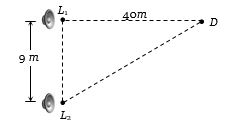
A
$165$
B
$330$
C
$496$
D
$660$
Solution
(B) The path difference between the waves reaching the detector $D$ from $L_1$ and $L_2$ is given by:
$\Delta x = L_2D - L_1D$
From the geometry,$L_1D = 40 \, m$ and the distance between $L_1$ and $L_2$ is $9 \, m$. Thus,$L_2D = \sqrt{40^2 + 9^2} = \sqrt{1600 + 81} = \sqrt{1681} = 41 \, m$.
$\Delta x = 41 \, m - 40 \, m = 1 \, m$.
For constructive interference (maxima),the condition is $\Delta x = n\lambda$,where $n = 1, 2, 3, ...$.
For the first maximum,we take $n = 1$:
$1 \, m = 1 \cdot \lambda \implies \lambda = 1 \, m$.
The frequency $f$ is given by $f = \frac{v}{\lambda}$,where $v = 330 \, m/s$.
$f = \frac{330 \, m/s}{1 \, m} = 330 \, Hz$.
$\Delta x = L_2D - L_1D$
From the geometry,$L_1D = 40 \, m$ and the distance between $L_1$ and $L_2$ is $9 \, m$. Thus,$L_2D = \sqrt{40^2 + 9^2} = \sqrt{1600 + 81} = \sqrt{1681} = 41 \, m$.
$\Delta x = 41 \, m - 40 \, m = 1 \, m$.
For constructive interference (maxima),the condition is $\Delta x = n\lambda$,where $n = 1, 2, 3, ...$.
For the first maximum,we take $n = 1$:
$1 \, m = 1 \cdot \lambda \implies \lambda = 1 \, m$.
The frequency $f$ is given by $f = \frac{v}{\lambda}$,where $v = 330 \, m/s$.
$f = \frac{330 \, m/s}{1 \, m} = 330 \, Hz$.
0 likes
View Solution18
MediumMCQ
Three waves of equal frequency having amplitudes $10 \,\mu m, 4 \,\mu m$ and $7 \,\mu m$ arrive at a given point with successive phase difference of $\frac{\pi}{2}$. The amplitude of the resulting wave in $\mu m$ is given by
A
$7$
B
$6$
C
$5$
D
$4$
Solution
(C) Let the amplitudes be $A_1 = 10 \,\mu m$,$A_2 = 4 \,\mu m$,and $A_3 = 7 \,\mu m$.
The waves arrive with successive phase differences of $\frac{\pi}{2}$.
Let the phase of the first wave be $0$,the second be $\frac{\pi}{2}$,and the third be $\pi$.
Using the phasor method,the resultant amplitude $A_R$ is given by the vector sum of the amplitudes:
$A_R = \sqrt{(\sum A_i \cos \phi_i)^2 + (\sum A_i \sin \phi_i)^2}$
$A_x = A_1 \cos(0) + A_2 \cos(\frac{\pi}{2}) + A_3 \cos(\pi) = 10(1) + 4(0) + 7(-1) = 10 - 7 = 3 \,\mu m$
$A_y = A_1 \sin(0) + A_2 \sin(\frac{\pi}{2}) + A_3 \sin(\pi) = 10(0) + 4(1) + 7(0) = 4 \,\mu m$
Resultant amplitude $A_R = \sqrt{A_x^2 + A_y^2} = \sqrt{3^2 + 4^2} = \sqrt{9 + 16} = \sqrt{25} = 5 \,\mu m$.
The waves arrive with successive phase differences of $\frac{\pi}{2}$.
Let the phase of the first wave be $0$,the second be $\frac{\pi}{2}$,and the third be $\pi$.
Using the phasor method,the resultant amplitude $A_R$ is given by the vector sum of the amplitudes:
$A_R = \sqrt{(\sum A_i \cos \phi_i)^2 + (\sum A_i \sin \phi_i)^2}$
$A_x = A_1 \cos(0) + A_2 \cos(\frac{\pi}{2}) + A_3 \cos(\pi) = 10(1) + 4(0) + 7(-1) = 10 - 7 = 3 \,\mu m$
$A_y = A_1 \sin(0) + A_2 \sin(\frac{\pi}{2}) + A_3 \sin(\pi) = 10(0) + 4(1) + 7(0) = 4 \,\mu m$
Resultant amplitude $A_R = \sqrt{A_x^2 + A_y^2} = \sqrt{3^2 + 4^2} = \sqrt{9 + 16} = \sqrt{25} = 5 \,\mu m$.
0 likes
View Solution19
MediumMCQ
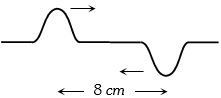
Two pulses in a stretched string whose centres are initially $8 \ cm$ apart are moving towards each other as shown in the figure. The speed of each pulse is $2 \ cm/s$. After $2 \ seconds$,the total energy of the pulses will be
A
Zero
B
Purely kinetic
C
Purely potential
D
Partly kinetic and partly potential
Solution
(B) The initial distance between the centres of the two pulses is $d = 8 \ cm$.
Each pulse moves towards the other with a speed of $v = 2 \ cm/s$.
The relative speed of the two pulses is $v_{rel} = v + v = 2 + 2 = 4 \ cm/s$.
The time taken for the pulses to meet is $t = d / v_{rel} = 8 \ cm / 4 \ cm/s = 2 \ s$.
After $2 \ s$,the two pulses overlap completely.
Since the pulses have opposite phases (one is a crest and the other is a trough of equal magnitude),their displacements cancel each other out at every point,making the string momentarily straight.
Because the string is straight,there is no deformation,and thus the potential energy is zero.
However,the particles of the string still possess velocity at this instant,so the total energy of the system is purely kinetic.
Each pulse moves towards the other with a speed of $v = 2 \ cm/s$.
The relative speed of the two pulses is $v_{rel} = v + v = 2 + 2 = 4 \ cm/s$.
The time taken for the pulses to meet is $t = d / v_{rel} = 8 \ cm / 4 \ cm/s = 2 \ s$.
After $2 \ s$,the two pulses overlap completely.
Since the pulses have opposite phases (one is a crest and the other is a trough of equal magnitude),their displacements cancel each other out at every point,making the string momentarily straight.
Because the string is straight,there is no deformation,and thus the potential energy is zero.
However,the particles of the string still possess velocity at this instant,so the total energy of the system is purely kinetic.
0 likes
View Solution20
EasyMCQ
Two pulses travel in mutually opposite directions in a string with a speed of $2.5 \ cm/s$ as shown in the figure. Initially,the pulses are $10 \ cm$ apart. What will be the state of the string after two seconds?
A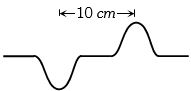
B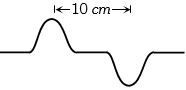
C
D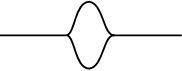
Solution
(C) The speed of each pulse is $v = 2.5 \ cm/s$.
The time elapsed is $t = 2 \ s$.
The distance traveled by each pulse is $d = v \times t = 2.5 \ cm/s \times 2 \ s = 5 \ cm$.
Initially,the pulses are $10 \ cm$ apart. Since they are moving towards each other,after $2 \ s$,each pulse covers $5 \ cm$,effectively closing the $10 \ cm$ gap.
When the two pulses meet,they are in mutually opposite phases (one is a crest and the other is a trough). According to the principle of superposition,the resultant displacement of the string will be the algebraic sum of the individual displacements.
Since the pulses have equal and opposite amplitudes,their sum will be zero at the point of intersection.
Therefore,the string will appear as a straight line.
The time elapsed is $t = 2 \ s$.
The distance traveled by each pulse is $d = v \times t = 2.5 \ cm/s \times 2 \ s = 5 \ cm$.
Initially,the pulses are $10 \ cm$ apart. Since they are moving towards each other,after $2 \ s$,each pulse covers $5 \ cm$,effectively closing the $10 \ cm$ gap.
When the two pulses meet,they are in mutually opposite phases (one is a crest and the other is a trough). According to the principle of superposition,the resultant displacement of the string will be the algebraic sum of the individual displacements.
Since the pulses have equal and opposite amplitudes,their sum will be zero at the point of intersection.
Therefore,the string will appear as a straight line.
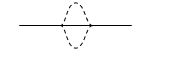
0 likes
View Solution21
EasyMCQ
The similarity between sound waves and light waves is:
A
Both are electromagnetic waves
B
Both are longitudinal waves
C
Both have the same speed in a medium
D
They can produce interference
Solution
(D) Both sound waves and light waves are wave phenomena that exhibit the property of interference. Interference occurs when two waves of the same frequency and constant phase difference superpose,resulting in a new wave pattern with a different amplitude. Since both sound and light satisfy the conditions for wave superposition,they both produce interference patterns. Other options are incorrect because sound waves are mechanical and longitudinal,while light waves are electromagnetic and transverse,and they travel at vastly different speeds.
0 likes
View Solution22
MediumMCQ
If two waves represented by $y_1 = 4\sin \omega t$ and $y_2 = 3\sin (\omega t + \pi/3)$ interfere at a point,the amplitude of the resulting wave will be about
A
$7$
B
$6$
C
$5$
D
$3.5$
Solution
(B) The given wave equations are $y_1 = 4\sin \omega t$ and $y_2 = 3\sin (\omega t + \pi/3)$.
Comparing these with the standard form $y = a\sin(\omega t + \phi)$,we get amplitudes $a_1 = 4$ and $a_2 = 3$,and the phase difference $\phi = \pi/3$.
The amplitude $A$ of the resulting wave is given by the formula $A = \sqrt{a_1^2 + a_2^2 + 2a_1a_2 \cos \phi}$.
Substituting the values: $A = \sqrt{4^2 + 3^2 + 2(4)(3) \cos(\pi/3)}$.
Since $\cos(\pi/3) = 0.5$,we have $A = \sqrt{16 + 9 + 24(0.5)} = \sqrt{25 + 12} = \sqrt{37}$.
Calculating the square root,$A \approx 6.08$,which is approximately $6$.
Comparing these with the standard form $y = a\sin(\omega t + \phi)$,we get amplitudes $a_1 = 4$ and $a_2 = 3$,and the phase difference $\phi = \pi/3$.
The amplitude $A$ of the resulting wave is given by the formula $A = \sqrt{a_1^2 + a_2^2 + 2a_1a_2 \cos \phi}$.
Substituting the values: $A = \sqrt{4^2 + 3^2 + 2(4)(3) \cos(\pi/3)}$.
Since $\cos(\pi/3) = 0.5$,we have $A = \sqrt{16 + 9 + 24(0.5)} = \sqrt{25 + 12} = \sqrt{37}$.
Calculating the square root,$A \approx 6.08$,which is approximately $6$.
0 likes
View Solution23
MediumMCQ
Two waves $Y_1 = a \sin \omega t$ and $Y_2 = a \sin (\omega t + \delta)$ produce interference. The resultant intensity is ......
A
$a^2 \cos^2 \left( \frac{\delta}{2} \right)$
B
$2a^2 \cos^2 \left( \frac{\delta}{2} \right)$
C
$3a^2 \cos^2 \left( \frac{\delta}{2} \right)$
D
$4a^2 \cos^2 \left( \frac{\delta}{2} \right)$
Solution
(D) The resultant amplitude $R$ of two waves with amplitudes $a_1$ and $a_2$ and phase difference $\delta$ is given by $R^2 = a_1^2 + a_2^2 + 2a_1 a_2 \cos \delta$.
Here,$a_1 = a$ and $a_2 = a$.
Substituting these values,we get $R^2 = a^2 + a^2 + 2(a)(a) \cos \delta$.
$R^2 = 2a^2 + 2a^2 \cos \delta = 2a^2(1 + \cos \delta)$.
Using the trigonometric identity $1 + \cos \delta = 2 \cos^2 \left( \frac{\delta}{2} \right)$,we get:
$R^2 = 2a^2 \times 2 \cos^2 \left( \frac{\delta}{2} \right) = 4a^2 \cos^2 \left( \frac{\delta}{2} \right)$.
Since intensity $I \propto R^2$,the resultant intensity is proportional to $4a^2 \cos^2 \left( \frac{\delta}{2} \right)$.
Here,$a_1 = a$ and $a_2 = a$.
Substituting these values,we get $R^2 = a^2 + a^2 + 2(a)(a) \cos \delta$.
$R^2 = 2a^2 + 2a^2 \cos \delta = 2a^2(1 + \cos \delta)$.
Using the trigonometric identity $1 + \cos \delta = 2 \cos^2 \left( \frac{\delta}{2} \right)$,we get:
$R^2 = 2a^2 \times 2 \cos^2 \left( \frac{\delta}{2} \right) = 4a^2 \cos^2 \left( \frac{\delta}{2} \right)$.
Since intensity $I \propto R^2$,the resultant intensity is proportional to $4a^2 \cos^2 \left( \frac{\delta}{2} \right)$.
0 likes
View Solution24
MediumMCQ
Four independent waves are represented by the following equations. Which of these equations represent the phenomenon of interference?
$Y_1 = a_1 \sin \omega t$
$Y_2 = a_2 \sin \omega t$
$Y_3 = a_3 \cos \omega t$
$Y_4 = a_4 \sin (\omega t + \frac{\pi}{3})$
$Y_1 = a_1 \sin \omega t$
$Y_2 = a_2 \sin \omega t$
$Y_3 = a_3 \cos \omega t$
$Y_4 = a_4 \sin (\omega t + \frac{\pi}{3})$
A
$1$ and $3$
B
$1$ and $4$
C
$1, 2, 3$ and $4$ all
D
None of these
Solution
(D) Interference is a phenomenon that occurs when two or more coherent waves superpose.
Coherent waves are waves that have the same frequency and a constant phase difference over time.
In this problem,the waves are stated to be 'independent'.
Independent sources of light emit waves with random phase changes,meaning they are incoherent.
Therefore,interference cannot be observed between independent sources.
Thus,none of the given pairs represent the phenomenon of interference.
Coherent waves are waves that have the same frequency and a constant phase difference over time.
In this problem,the waves are stated to be 'independent'.
Independent sources of light emit waves with random phase changes,meaning they are incoherent.
Therefore,interference cannot be observed between independent sources.
Thus,none of the given pairs represent the phenomenon of interference.
0 likes
View Solution25
EasyMCQ
The resultant amplitude of waves ${y_1} = a \sin \left( \omega t + \frac{\pi}{3} \right)$ and ${y_2} = a \sin \omega t$ is:
A
$a$
B
$\sqrt{2} a$
C
$2a$
D
$\sqrt{3} a$
Solution
(D) The resultant amplitude $A$ of two waves with amplitudes $a_1$ and $a_2$ and phase difference $\phi$ is given by the formula: $A = \sqrt{a_1^2 + a_2^2 + 2 a_1 a_2 \cos \phi}$.
Here,$a_1 = a$,$a_2 = a$,and the phase difference $\phi = \frac{\pi}{3} - 0 = \frac{\pi}{3}$.
Substituting these values into the formula:
$A = \sqrt{a^2 + a^2 + 2(a)(a) \cos(\frac{\pi}{3})}$
Since $\cos(\frac{\pi}{3}) = \frac{1}{2}$,we get:
$A = \sqrt{a^2 + a^2 + 2a^2(\frac{1}{2})}$
$A = \sqrt{2a^2 + a^2} = \sqrt{3a^2} = \sqrt{3} a$.
Here,$a_1 = a$,$a_2 = a$,and the phase difference $\phi = \frac{\pi}{3} - 0 = \frac{\pi}{3}$.
Substituting these values into the formula:
$A = \sqrt{a^2 + a^2 + 2(a)(a) \cos(\frac{\pi}{3})}$
Since $\cos(\frac{\pi}{3}) = \frac{1}{2}$,we get:
$A = \sqrt{a^2 + a^2 + 2a^2(\frac{1}{2})}$
$A = \sqrt{2a^2 + a^2} = \sqrt{3a^2} = \sqrt{3} a$.
0 likes
View Solution26
EasyMCQ
The amplitude of the resultant wave produced by the superposition of two waves $y_1 = A_1 \sin(wt - \beta_1)$ and $y_2 = A_2 \sin(wt - \beta_2)$ is:
A
$[A_1^2 + A_2^2 + 2A_1A_2 \cos(\beta_1 - \beta_2)]^{1/2}$
B
$[A_1^2 + A_2^2 + 2A_1A_2 \sin(\beta_1 - \beta_2)]^{1/2}$
C
$A_1 - A_2$
D
$A_1 + A_2$
Solution
(A) The resultant wave is $y = y_1 + y_2$.
$y = A_1 \sin(wt - \beta_1) + A_2 \sin(wt - \beta_2)$.
Using the identity $\sin(x - y) = \sin x \cos y - \cos x \sin y$:
$y = A_1(\sin wt \cos \beta_1 - \cos wt \sin \beta_1) + A_2(\sin wt \cos \beta_2 - \cos wt \sin \beta_2)$.
Grouping the terms:
$y = (A_1 \cos \beta_1 + A_2 \cos \beta_2) \sin wt - (A_1 \sin \beta_1 + A_2 \sin \beta_2) \cos wt$.
Let $X = A_1 \cos \beta_1 + A_2 \cos \beta_2$ and $Y = A_1 \sin \beta_1 + A_2 \sin \beta_2$.
The resultant amplitude $A$ is $\sqrt{X^2 + Y^2}$.
$A = \sqrt{(A_1 \cos \beta_1 + A_2 \cos \beta_2)^2 + (A_1 \sin \beta_1 + A_2 \sin \beta_2)^2}$.
Expanding the squares:
$A = \sqrt{A_1^2(\cos^2 \beta_1 + \sin^2 \beta_1) + A_2^2(\cos^2 \beta_2 + \sin^2 \beta_2) + 2A_1A_2(\cos \beta_1 \cos \beta_2 + \sin \beta_1 \sin \beta_2)}$.
Using trigonometric identities $\sin^2 \theta + \cos^2 \theta = 1$ and $\cos(A - B) = \cos A \cos B + \sin A \sin B$:
$A = \sqrt{A_1^2 + A_2^2 + 2A_1A_2 \cos(\beta_1 - \beta_2)}$.
$y = A_1 \sin(wt - \beta_1) + A_2 \sin(wt - \beta_2)$.
Using the identity $\sin(x - y) = \sin x \cos y - \cos x \sin y$:
$y = A_1(\sin wt \cos \beta_1 - \cos wt \sin \beta_1) + A_2(\sin wt \cos \beta_2 - \cos wt \sin \beta_2)$.
Grouping the terms:
$y = (A_1 \cos \beta_1 + A_2 \cos \beta_2) \sin wt - (A_1 \sin \beta_1 + A_2 \sin \beta_2) \cos wt$.
Let $X = A_1 \cos \beta_1 + A_2 \cos \beta_2$ and $Y = A_1 \sin \beta_1 + A_2 \sin \beta_2$.
The resultant amplitude $A$ is $\sqrt{X^2 + Y^2}$.
$A = \sqrt{(A_1 \cos \beta_1 + A_2 \cos \beta_2)^2 + (A_1 \sin \beta_1 + A_2 \sin \beta_2)^2}$.
Expanding the squares:
$A = \sqrt{A_1^2(\cos^2 \beta_1 + \sin^2 \beta_1) + A_2^2(\cos^2 \beta_2 + \sin^2 \beta_2) + 2A_1A_2(\cos \beta_1 \cos \beta_2 + \sin \beta_1 \sin \beta_2)}$.
Using trigonometric identities $\sin^2 \theta + \cos^2 \theta = 1$ and $\cos(A - B) = \cos A \cos B + \sin A \sin B$:
$A = \sqrt{A_1^2 + A_2^2 + 2A_1A_2 \cos(\beta_1 - \beta_2)}$.
0 likes
View Solution27
EasyMCQ
Two waves each of intensity $I$ interfere with a phase difference of $120^o$. The resultant intensity of the waves will be:
A
$I$
B
$2I$
C
$I/2$
D
$4I$
Solution
(A) The resultant intensity $I_R$ of two interfering waves with intensities $I_1$ and $I_2$ and phase difference $\phi$ is given by the formula: $I_R = I_1 + I_2 + 2\sqrt{I_1 I_2} \cos \phi$.
Given $I_1 = I$,$I_2 = I$,and $\phi = 120^o$.
Substituting these values into the formula:
$I_R = I + I + 2\sqrt{I \cdot I} \cos(120^o)$.
Since $\cos(120^o) = -1/2$,we get:
$I_R = 2I + 2I(-1/2) = 2I - I = I$.
Therefore,the resultant intensity is $I$.
Given $I_1 = I$,$I_2 = I$,and $\phi = 120^o$.
Substituting these values into the formula:
$I_R = I + I + 2\sqrt{I \cdot I} \cos(120^o)$.
Since $\cos(120^o) = -1/2$,we get:
$I_R = 2I + 2I(-1/2) = 2I - I = I$.
Therefore,the resultant intensity is $I$.
0 likes
View Solution28
MediumMCQ
If two waves represented by $y_1 = 4 \sin \omega t$ and $y_2 = 3 \sin (\omega t + \pi / 3)$ interfere at a point,find the amplitude of the resultant wave.
A
$9$
B
$8$
C
$6$
D
$4$
Solution
(C) The resultant amplitude $A$ of two interfering waves is given by the formula:
$A = \sqrt{a_1^2 + a_2^2 + 2a_1 a_2 \cos \phi}$
Here,$a_1 = 4$,$a_2 = 3$,and the phase difference $\phi = \pi / 3$.
Substituting these values into the formula:
$A = \sqrt{4^2 + 3^2 + 2(4)(3) \cos(\pi / 3)}$
Since $\cos(\pi / 3) = 0.5$:
$A = \sqrt{16 + 9 + 24(0.5)}$
$A = \sqrt{25 + 12}$
$A = \sqrt{37}$
$A \approx 6.08$
Rounding to the nearest integer,the amplitude is $6$.
$A = \sqrt{a_1^2 + a_2^2 + 2a_1 a_2 \cos \phi}$
Here,$a_1 = 4$,$a_2 = 3$,and the phase difference $\phi = \pi / 3$.
Substituting these values into the formula:
$A = \sqrt{4^2 + 3^2 + 2(4)(3) \cos(\pi / 3)}$
Since $\cos(\pi / 3) = 0.5$:
$A = \sqrt{16 + 9 + 24(0.5)}$
$A = \sqrt{25 + 12}$
$A = \sqrt{37}$
$A \approx 6.08$
Rounding to the nearest integer,the amplitude is $6$.
0 likes
View Solution29
MediumMCQ
Two waves of the same frequency and same amplitude $a$ are superimposed. If the resultant amplitude is also $a$,what is the phase difference between the two waves?
A
$\pi$
B
$2\pi / 3$
C
$\pi / 2$
D
$0$
Solution
(B) The resultant amplitude $A$ of two waves with amplitudes $A_1$ and $A_2$ and phase difference $\phi$ is given by the formula: $A = \sqrt{A_1^2 + A_2^2 + 2A_1A_2 \cos \phi}$.
Given $A_1 = A_2 = a$ and the resultant amplitude $A = a$.
Substituting these values into the formula: $a = \sqrt{a^2 + a^2 + 2a^2 \cos \phi}$.
Squaring both sides: $a^2 = 2a^2 + 2a^2 \cos \phi$.
Dividing by $a^2$: $1 = 2 + 2 \cos \phi$.
Rearranging gives: $2 \cos \phi = -1$,so $\cos \phi = -1/2$.
Therefore,the phase difference $\phi = 120^\circ$ or $\phi = 2\pi / 3$ radians.
Given $A_1 = A_2 = a$ and the resultant amplitude $A = a$.
Substituting these values into the formula: $a = \sqrt{a^2 + a^2 + 2a^2 \cos \phi}$.
Squaring both sides: $a^2 = 2a^2 + 2a^2 \cos \phi$.
Dividing by $a^2$: $1 = 2 + 2 \cos \phi$.
Rearranging gives: $2 \cos \phi = -1$,so $\cos \phi = -1/2$.
Therefore,the phase difference $\phi = 120^\circ$ or $\phi = 2\pi / 3$ radians.
0 likes
View Solution30
EasyMCQ
When two waves of the same amplitude $a$ and the same frequency $f$ superimpose,the total intensity is proportional to which of the following?
A
$a$
B
$2a$
C
$2a^2$
D
$4a^2$
Solution
(D) The intensity $I$ of a wave is proportional to the square of its amplitude,$I \propto A^2$.
When two waves with amplitudes $a_1$ and $a_2$ superimpose,the resultant amplitude $A_R$ can range from $|a_1 - a_2|$ to $(a_1 + a_2)$.
For maximum intensity (constructive interference),the resultant amplitude is $A_R = a_1 + a_2$.
Given $a_1 = a_2 = a$,the resultant amplitude is $A_R = a + a = 2a$.
The resultant intensity $I$ is proportional to the square of the resultant amplitude:
$I \propto (A_R)^2$
$I \propto (2a)^2$
$I \propto 4a^2$.
When two waves with amplitudes $a_1$ and $a_2$ superimpose,the resultant amplitude $A_R$ can range from $|a_1 - a_2|$ to $(a_1 + a_2)$.
For maximum intensity (constructive interference),the resultant amplitude is $A_R = a_1 + a_2$.
Given $a_1 = a_2 = a$,the resultant amplitude is $A_R = a + a = 2a$.
The resultant intensity $I$ is proportional to the square of the resultant amplitude:
$I \propto (A_R)^2$
$I \propto (2a)^2$
$I \propto 4a^2$.
0 likes
View Solution31
MediumMCQ
Two waves have the same amplitude $A$ and the same frequency $\omega$. If the phase difference between them is $\pi / 2$,what are the resultant amplitude and the resultant frequency when they superimpose at a point?
A
$A / \sqrt{2}; \omega / 2$
B
$A / \sqrt{2}; \omega$
C
$\sqrt{2} A; \omega / 2$
D
$\sqrt{2} A; \omega$
Solution
(D) The resultant amplitude $A_R$ of two superimposing waves with amplitudes $a_1$ and $a_2$ and phase difference $\phi$ is given by:
$A_R = \sqrt{a_1^2 + a_2^2 + 2a_1a_2 \cos \phi}$
Given $a_1 = a_2 = A$ and $\phi = \pi / 2$:
$A_R = \sqrt{A^2 + A^2 + 2A^2 \cos(\pi / 2)}$
Since $\cos(\pi / 2) = 0$,we get:
$A_R = \sqrt{2A^2} = \sqrt{2} A$
When two waves of the same frequency superimpose,the resultant wave has the same frequency as the individual waves.
Therefore,the resultant frequency is $\omega$.
$A_R = \sqrt{a_1^2 + a_2^2 + 2a_1a_2 \cos \phi}$
Given $a_1 = a_2 = A$ and $\phi = \pi / 2$:
$A_R = \sqrt{A^2 + A^2 + 2A^2 \cos(\pi / 2)}$
Since $\cos(\pi / 2) = 0$,we get:
$A_R = \sqrt{2A^2} = \sqrt{2} A$
When two waves of the same frequency superimpose,the resultant wave has the same frequency as the individual waves.
Therefore,the resultant frequency is $\omega$.
0 likes
View Solution32
DifficultMCQ
Two waves have intensities $x$ and $y$. If the time difference between them is $3T/2$,what is the resultant intensity?
A
$(\sqrt{x} - \sqrt{y})^2$
B
$(\sqrt{x} + \sqrt{y} + \sqrt{xy})$
C
$x + y + 2\sqrt{xy}$
D
$\frac{x + y}{2\sqrt{xy}}$
Solution
(A) The relationship between time difference $(\Delta t)$ and phase difference $(\phi)$ is given by $\phi = \frac{2\pi}{T} \times \Delta t$.
Given $\Delta t = \frac{3T}{2}$,we substitute this into the formula:
$\phi = \frac{2\pi}{T} \times \frac{3T}{2} = 3\pi$.
The resultant intensity $I_R$ of two waves with intensities $I_1 = x$ and $I_2 = y$ is given by $I_R = I_1 + I_2 + 2\sqrt{I_1 I_2} \cos(\phi)$.
Substituting $\phi = 3\pi$ and $\cos(3\pi) = -1$:
$I_R = x + y + 2\sqrt{xy}(-1) = x + y - 2\sqrt{xy} = (\sqrt{x} - \sqrt{y})^2$.
Therefore,the correct resultant intensity is $(\sqrt{x} - \sqrt{y})^2$.
Given $\Delta t = \frac{3T}{2}$,we substitute this into the formula:
$\phi = \frac{2\pi}{T} \times \frac{3T}{2} = 3\pi$.
The resultant intensity $I_R$ of two waves with intensities $I_1 = x$ and $I_2 = y$ is given by $I_R = I_1 + I_2 + 2\sqrt{I_1 I_2} \cos(\phi)$.
Substituting $\phi = 3\pi$ and $\cos(3\pi) = -1$:
$I_R = x + y + 2\sqrt{xy}(-1) = x + y - 2\sqrt{xy} = (\sqrt{x} - \sqrt{y})^2$.
Therefore,the correct resultant intensity is $(\sqrt{x} - \sqrt{y})^2$.
0 likes
View Solution33
MediumMCQ
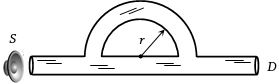
$A$ sound wave of wavelength $32 \ cm$ enters the tube at $S$ as shown in the figure. Then the smallest radius $r$ so that a minimum of sound is heard at detector $D$ is ... $cm$.
A
$7$
B
$14$
C
$21$
D
$28$
Solution
(B) The sound wave splits into two paths at the junction. One path is straight (length $L_1 = 2r$) and the other path is semicircular (length $L_2 = \pi r$).
For a minimum of sound to be heard at the detector $D$,the path difference between the two waves must be an odd multiple of half the wavelength,i.e.,$\Delta x = (2n + 1) \frac{\lambda}{2}$.
For the smallest radius $r$,we take $n = 0$,so $\Delta x = \frac{\lambda}{2}$.
The path difference is $\Delta x = L_2 - L_1 = \pi r - 2r = r(\pi - 2)$.
Given $\lambda = 32 \ cm$,we have $r(\pi - 2) = \frac{32}{2} = 16$.
Therefore,$r = \frac{16}{\pi - 2} \approx \frac{16}{3.14 - 2} = \frac{16}{1.14} \approx 14 \ cm$.
For a minimum of sound to be heard at the detector $D$,the path difference between the two waves must be an odd multiple of half the wavelength,i.e.,$\Delta x = (2n + 1) \frac{\lambda}{2}$.
For the smallest radius $r$,we take $n = 0$,so $\Delta x = \frac{\lambda}{2}$.
The path difference is $\Delta x = L_2 - L_1 = \pi r - 2r = r(\pi - 2)$.
Given $\lambda = 32 \ cm$,we have $r(\pi - 2) = \frac{32}{2} = 16$.
Therefore,$r = \frac{16}{\pi - 2} \approx \frac{16}{3.14 - 2} = \frac{16}{1.14} \approx 14 \ cm$.
0 likes
View Solution34
MediumMCQ
Two waves of equal amplitude and frequency interfere with each other. The ratio of intensity when the two waves arrive in phase to that when they arrive $90^{\circ}$ out of phase is:
A
$1 : 1$
B
$\sqrt{2} : 1$
C
$2 : 1$
D
$4 : 1$
Solution
(C) The resultant intensity $I$ of two interfering waves of equal intensity $I_0$ is given by $I = 4I_0 \cos^2(\phi/2)$,where $\phi$ is the phase difference between the waves.
For waves arriving in phase,the phase difference $\phi_1 = 0^{\circ}$.
Thus,$I_1 = 4I_0 \cos^2(0/2) = 4I_0 \cos^2(0) = 4I_0$.
For waves arriving $90^{\circ}$ out of phase,the phase difference $\phi_2 = 90^{\circ}$.
Thus,$I_2 = 4I_0 \cos^2(90^{\circ}/2) = 4I_0 \cos^2(45^{\circ}) = 4I_0 \times (1/\sqrt{2})^2 = 4I_0 \times (1/2) = 2I_0$.
The ratio of the intensities is $\frac{I_1}{I_2} = \frac{4I_0}{2I_0} = \frac{2}{1}$.
For waves arriving in phase,the phase difference $\phi_1 = 0^{\circ}$.
Thus,$I_1 = 4I_0 \cos^2(0/2) = 4I_0 \cos^2(0) = 4I_0$.
For waves arriving $90^{\circ}$ out of phase,the phase difference $\phi_2 = 90^{\circ}$.
Thus,$I_2 = 4I_0 \cos^2(90^{\circ}/2) = 4I_0 \cos^2(45^{\circ}) = 4I_0 \times (1/\sqrt{2})^2 = 4I_0 \times (1/2) = 2I_0$.
The ratio of the intensities is $\frac{I_1}{I_2} = \frac{4I_0}{2I_0} = \frac{2}{1}$.
0 likes
View Solution35
MediumMCQ
The resultant amplitude due to the superposition of two waves $y_1 = 5 \sin (\omega t - kx)$ and $y_2 = -5 \cos (\omega t - kx - 150^{\circ})$ is:
A
$5$
B
$5\sqrt{3}$
C
$5\sqrt{2 - \sqrt{3}}$
D
$5\sqrt{2 + \sqrt{3}}$
Solution
(A) Given waves are $y_1 = 5 \sin (\omega t - kx)$ and $y_2 = -5 \cos (\omega t - kx - 150^{\circ})$.
We know that $-\cos(\theta) = \sin(\theta - 90^{\circ})$.
So,$y_2 = 5 \sin (\omega t - kx - 150^{\circ} - 90^{\circ}) = 5 \sin (\omega t - kx - 240^{\circ})$.
Alternatively,$y_2 = 5 \sin (\omega t - kx - 240^{\circ} + 360^{\circ}) = 5 \sin (\omega t - kx + 120^{\circ})$.
The resultant amplitude $A$ of two waves $A_1 \sin(\phi_1)$ and $A_2 \sin(\phi_2)$ is given by $A = \sqrt{A_1^2 + A_2^2 + 2A_1A_2 \cos(\Delta\phi)}$.
Here $A_1 = 5$,$A_2 = 5$,and the phase difference $\Delta\phi = 120^{\circ} - 0^{\circ} = 120^{\circ}$.
$A = \sqrt{5^2 + 5^2 + 2(5)(5) \cos(120^{\circ})}$.
Since $\cos(120^{\circ}) = -0.5$,we have $A = \sqrt{25 + 25 + 50(-0.5)} = \sqrt{50 - 25} = \sqrt{25} = 5$.
We know that $-\cos(\theta) = \sin(\theta - 90^{\circ})$.
So,$y_2 = 5 \sin (\omega t - kx - 150^{\circ} - 90^{\circ}) = 5 \sin (\omega t - kx - 240^{\circ})$.
Alternatively,$y_2 = 5 \sin (\omega t - kx - 240^{\circ} + 360^{\circ}) = 5 \sin (\omega t - kx + 120^{\circ})$.
The resultant amplitude $A$ of two waves $A_1 \sin(\phi_1)$ and $A_2 \sin(\phi_2)$ is given by $A = \sqrt{A_1^2 + A_2^2 + 2A_1A_2 \cos(\Delta\phi)}$.
Here $A_1 = 5$,$A_2 = 5$,and the phase difference $\Delta\phi = 120^{\circ} - 0^{\circ} = 120^{\circ}$.
$A = \sqrt{5^2 + 5^2 + 2(5)(5) \cos(120^{\circ})}$.
Since $\cos(120^{\circ}) = -0.5$,we have $A = \sqrt{25 + 25 + 50(-0.5)} = \sqrt{50 - 25} = \sqrt{25} = 5$.
0 likes
View Solution36
DifficultMCQ
Three coherent waves of equal frequencies having amplitudes $10 \, \mu m$,$4 \, \mu m$,and $7 \, \mu m$ respectively,arrive at a given point with successive phase differences of $\pi / 2$. The amplitude of the resulting wave in $\mu m$ is given by
A
$5$
B
$6$
C
$3$
D
$4$
Solution
(A) The amplitudes of the waves are $a_{1} = 10 \, \mu m$,$a_{2} = 4 \, \mu m$,and $a_{3} = 7 \, \mu m$.
The phase difference between the $1^{st}$ and $2^{nd}$ wave is $\phi_{12} = \pi / 2$,and the phase difference between the $2^{nd}$ and $3^{rd}$ wave is $\phi_{23} = \pi / 2$. Thus,the phase difference between the $1^{st}$ and $3^{rd}$ wave is $\phi_{13} = \pi$.
First,we combine the $1^{st}$ and $3^{rd}$ waves. Since they are in opposite phase $(\pi)$,their resultant amplitude $A_{13}$ is:
$A_{13} = |a_{1} - a_{3}| = |10 - 7| = 3 \, \mu m$.
Now,we combine this resultant $A_{13}$ with the $2^{nd}$ wave. The phase difference between the $2^{nd}$ wave and the resultant of the $1^{st}$ and $3^{rd}$ waves is $\pi / 2$ (since the resultant $A_{13}$ is in the direction of the $1^{st}$ wave).
The final resultant amplitude $A$ is given by:
$A = \sqrt{A_{13}^{2} + a_{2}^{2} + 2 A_{13} a_{2} \cos(\pi / 2)}$
$A = \sqrt{3^{2} + 4^{2} + 0} = \sqrt{9 + 16} = \sqrt{25} = 5 \, \mu m$.
The phase difference between the $1^{st}$ and $2^{nd}$ wave is $\phi_{12} = \pi / 2$,and the phase difference between the $2^{nd}$ and $3^{rd}$ wave is $\phi_{23} = \pi / 2$. Thus,the phase difference between the $1^{st}$ and $3^{rd}$ wave is $\phi_{13} = \pi$.
First,we combine the $1^{st}$ and $3^{rd}$ waves. Since they are in opposite phase $(\pi)$,their resultant amplitude $A_{13}$ is:
$A_{13} = |a_{1} - a_{3}| = |10 - 7| = 3 \, \mu m$.
Now,we combine this resultant $A_{13}$ with the $2^{nd}$ wave. The phase difference between the $2^{nd}$ wave and the resultant of the $1^{st}$ and $3^{rd}$ waves is $\pi / 2$ (since the resultant $A_{13}$ is in the direction of the $1^{st}$ wave).
The final resultant amplitude $A$ is given by:
$A = \sqrt{A_{13}^{2} + a_{2}^{2} + 2 A_{13} a_{2} \cos(\pi / 2)}$
$A = \sqrt{3^{2} + 4^{2} + 0} = \sqrt{9 + 16} = \sqrt{25} = 5 \, \mu m$.
0 likes
View Solution37
DifficultMCQ
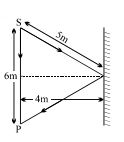
$A$ person standing at a distance of $6\, m$ from a source of sound receives sound waves in two ways: one directly from the source and the other after reflection from a rigid boundary,as shown in the figure. The maximum wavelength for which the person will receive maximum sound intensity is .... $m$.
A
$4$
B
$\frac{16}{3}$
C
$2$
D
$\frac{8}{3}$
Solution
(A) The person receives sound via two paths: the direct path of length $d_1 = 6\, m$ and the reflected path of length $d_2 = 5\, m + 5\, m = 10\, m$.
The path difference between the two waves is $\Delta x = d_2 - d_1 = 10\, m - 6\, m = 4\, m$.
For constructive interference (maximum sound intensity),the path difference must be an integral multiple of the wavelength $\lambda$:
$\Delta x = n\lambda$,where $n = 1, 2, 3, \dots$
Substituting the values,we get $4 = n\lambda$,which implies $\lambda = \frac{4}{n}$.
To find the maximum wavelength,we must choose the smallest positive integer value for $n$,which is $n = 1$.
Therefore,$\lambda_{\max} = \frac{4}{1} = 4\, m$.
The path difference between the two waves is $\Delta x = d_2 - d_1 = 10\, m - 6\, m = 4\, m$.
For constructive interference (maximum sound intensity),the path difference must be an integral multiple of the wavelength $\lambda$:
$\Delta x = n\lambda$,where $n = 1, 2, 3, \dots$
Substituting the values,we get $4 = n\lambda$,which implies $\lambda = \frac{4}{n}$.
To find the maximum wavelength,we must choose the smallest positive integer value for $n$,which is $n = 1$.
Therefore,$\lambda_{\max} = \frac{4}{1} = 4\, m$.
0 likes
View Solution38
DifficultMCQ
Two sound waves having intensities $I$ and $4I$ interfere to produce an interference pattern. The phase difference between the waves is $\pi / 2$ at point $A$ and $\pi$ at point $B$. Then the difference between the resultant intensities at $A$ and $B$ is (in $I$)
A
$2$
B
$4$
C
$5$
D
$7$
Solution
(B) The resultant intensity $I_R$ of two interfering waves is given by the formula: $I_R = I_1 + I_2 + 2\sqrt{I_1 I_2} \cos \phi$,where $\phi$ is the phase difference.
Given $I_1 = I$ and $I_2 = 4I$.
At point $A$,the phase difference $\phi_A = \pi / 2$. Substituting this into the formula:
$I_A = I + 4I + 2\sqrt{I \cdot 4I} \cos(\pi / 2) = 5I + 2(2I)(0) = 5I$.
At point $B$,the phase difference $\phi_B = \pi$. Substituting this into the formula:
$I_B = I + 4I + 2\sqrt{I \cdot 4I} \cos(\pi) = 5I + 2(2I)(-1) = 5I - 4I = I$.
The difference between the resultant intensities at $A$ and $B$ is $I_A - I_B = 5I - I = 4I$.
Given $I_1 = I$ and $I_2 = 4I$.
At point $A$,the phase difference $\phi_A = \pi / 2$. Substituting this into the formula:
$I_A = I + 4I + 2\sqrt{I \cdot 4I} \cos(\pi / 2) = 5I + 2(2I)(0) = 5I$.
At point $B$,the phase difference $\phi_B = \pi$. Substituting this into the formula:
$I_B = I + 4I + 2\sqrt{I \cdot 4I} \cos(\pi) = 5I + 2(2I)(-1) = 5I - 4I = I$.
The difference between the resultant intensities at $A$ and $B$ is $I_A - I_B = 5I - I = 4I$.
0 likes
View Solution39
MediumMCQ
Two waves are propagating along a taut string that coincides with the $x$-axis. The first wave has the wave function $y_1 = A \cos[k(x - vt)]$ and the second has the wave function $y_2 = A \cos[k(x + vt) + \phi]$.
A
For constructive interference at $x = 0, \phi = \pi$.
B
For constructive interference at $x = 0, \phi = 3\pi$.
C
For destructive interference at $x = 0, \phi = \pi$.
D
For destructive interference at $x = 0, \phi = 2\pi$.
Solution
(C) The resultant wave function at $x = 0$ is $y = y_1 + y_2$.
Substituting $x = 0$ into the wave functions:
$y_1 = A \cos(-kvt) = A \cos(kvt)$
$y_2 = A \cos(kvt + \phi)$
Using the superposition principle,$y = A [\cos(kvt) + \cos(kvt + \phi)]$.
Using the trigonometric identity $\cos C + \cos D = 2 \cos(\frac{C+D}{2}) \cos(\frac{C-D}{2})$:
$y = 2A \cos(kvt + \frac{\phi}{2}) \cos(\frac{\phi}{2})$.
For constructive interference,the amplitude must be maximum,which occurs when $|\cos(\frac{\phi}{2})| = 1$,implying $\frac{\phi}{2} = n\pi$,or $\phi = 2n\pi$ (where $n = 0, 1, 2, ...$).
For destructive interference,the amplitude must be zero,which occurs when $\cos(\frac{\phi}{2}) = 0$,implying $\frac{\phi}{2} = (2n+1)\frac{\pi}{2}$,or $\phi = (2n+1)\pi$ (where $n = 0, 1, 2, ...$).
Checking the options,for $n=0$ in the destructive interference condition,$\phi = \pi$. Thus,option $C$ is correct.
Substituting $x = 0$ into the wave functions:
$y_1 = A \cos(-kvt) = A \cos(kvt)$
$y_2 = A \cos(kvt + \phi)$
Using the superposition principle,$y = A [\cos(kvt) + \cos(kvt + \phi)]$.
Using the trigonometric identity $\cos C + \cos D = 2 \cos(\frac{C+D}{2}) \cos(\frac{C-D}{2})$:
$y = 2A \cos(kvt + \frac{\phi}{2}) \cos(\frac{\phi}{2})$.
For constructive interference,the amplitude must be maximum,which occurs when $|\cos(\frac{\phi}{2})| = 1$,implying $\frac{\phi}{2} = n\pi$,or $\phi = 2n\pi$ (where $n = 0, 1, 2, ...$).
For destructive interference,the amplitude must be zero,which occurs when $\cos(\frac{\phi}{2}) = 0$,implying $\frac{\phi}{2} = (2n+1)\frac{\pi}{2}$,or $\phi = (2n+1)\pi$ (where $n = 0, 1, 2, ...$).
Checking the options,for $n=0$ in the destructive interference condition,$\phi = \pi$. Thus,option $C$ is correct.
0 likes
View Solution40
DifficultMCQ
Two interfering waves have the same wavelength,frequency,and amplitude. They are traveling in the same direction but are $90^o$ out of phase. Compared to the individual waves,the resultant wave will have the same.
A
amplitude and velocity but different wavelength
B
amplitude and wavelength but different velocity
C
wavelength and velocity but different amplitude
D
amplitude and frequency but different velocity
Solution
(C) Let the equations of the two waves be $y_1 = A \sin(kx - \omega t)$ and $y_2 = A \sin(kx - \omega t + \frac{\pi}{2})$.
Since $\sin(kx - \omega t + \frac{\pi}{2}) = \cos(kx - \omega t)$,the resultant wave is $y = y_1 + y_2 = A \sin(kx - \omega t) + A \cos(kx - \omega t)$.
Using the identity $a \sin \theta + b \cos \theta = \sqrt{a^2 + b^2} \sin(\theta + \phi)$,where $\phi = \tan^{-1}(b/a)$,we get:
$y = \sqrt{A^2 + A^2} \sin(kx - \omega t + \frac{\pi}{4}) = \sqrt{2}A \sin(kx - \omega t + \frac{\pi}{4})$.
The resultant wave has an amplitude of $\sqrt{2}A$,which is different from the individual amplitude $A$.
However,the wavelength $\lambda = \frac{2\pi}{k}$ and the frequency $f = \frac{\omega}{2\pi}$ (and thus the velocity $v = f\lambda = \frac{\omega}{k}$) remain the same as those of the individual waves.
Therefore,the resultant wave has the same wavelength and velocity as the individual waves,but a different amplitude.
Since $\sin(kx - \omega t + \frac{\pi}{2}) = \cos(kx - \omega t)$,the resultant wave is $y = y_1 + y_2 = A \sin(kx - \omega t) + A \cos(kx - \omega t)$.
Using the identity $a \sin \theta + b \cos \theta = \sqrt{a^2 + b^2} \sin(\theta + \phi)$,where $\phi = \tan^{-1}(b/a)$,we get:
$y = \sqrt{A^2 + A^2} \sin(kx - \omega t + \frac{\pi}{4}) = \sqrt{2}A \sin(kx - \omega t + \frac{\pi}{4})$.
The resultant wave has an amplitude of $\sqrt{2}A$,which is different from the individual amplitude $A$.
However,the wavelength $\lambda = \frac{2\pi}{k}$ and the frequency $f = \frac{\omega}{2\pi}$ (and thus the velocity $v = f\lambda = \frac{\omega}{k}$) remain the same as those of the individual waves.
Therefore,the resultant wave has the same wavelength and velocity as the individual waves,but a different amplitude.
0 likes
View Solution41
AdvancedMCQ
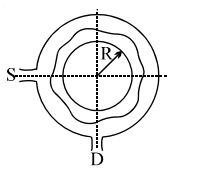
$A$ narrow tube is bent in the form of a circle of radius $R,$ as shown in the figure. Two small holes $S$ and $D$ are made in the tube at positions right-angled to each other. $A$ source placed at $S$ generates a wave of intensity $I_0$ which is equally divided into two parts: one part travels along the longer path,while the other travels along the shorter path. Both the waves meet at point $D$ where a detector is placed. The maximum value of $\lambda$ to produce a minima at $D$ is given by
A
$\pi R$
B
$2\pi R$
C
$\frac{\pi R}{2}$
D
$\frac{3\pi R}{2}$
Solution
(B) The circumference of the circular tube is $2\pi R$.
The two paths from $S$ to $D$ are along the arcs of the circle. Since $S$ and $D$ are at right angles,the shorter path length is $L_1 = \frac{1}{4}(2\pi R) = \frac{\pi R}{2}$.
The longer path length is $L_2 = \frac{3}{4}(2\pi R) = \frac{3\pi R}{2}$.
The path difference between the two waves is $\Delta x = L_2 - L_1 = \frac{3\pi R}{2} - \frac{\pi R}{2} = \pi R$.
For destructive interference (minima) to occur at $D$,the path difference must be an odd multiple of half-wavelengths:
$\Delta x = (2n + 1) \frac{\lambda}{2}$,where $n = 0, 1, 2, \dots$
Equating the path difference:
$\pi R = (2n + 1) \frac{\lambda}{2}$
$\lambda = \frac{2\pi R}{2n + 1}$
To find the maximum value of $\lambda$,we choose the smallest non-negative integer $n = 0$:
$\lambda_{\text{max}} = \frac{2\pi R}{2(0) + 1} = 2\pi R$.
The two paths from $S$ to $D$ are along the arcs of the circle. Since $S$ and $D$ are at right angles,the shorter path length is $L_1 = \frac{1}{4}(2\pi R) = \frac{\pi R}{2}$.
The longer path length is $L_2 = \frac{3}{4}(2\pi R) = \frac{3\pi R}{2}$.
The path difference between the two waves is $\Delta x = L_2 - L_1 = \frac{3\pi R}{2} - \frac{\pi R}{2} = \pi R$.
For destructive interference (minima) to occur at $D$,the path difference must be an odd multiple of half-wavelengths:
$\Delta x = (2n + 1) \frac{\lambda}{2}$,where $n = 0, 1, 2, \dots$
Equating the path difference:
$\pi R = (2n + 1) \frac{\lambda}{2}$
$\lambda = \frac{2\pi R}{2n + 1}$
To find the maximum value of $\lambda$,we choose the smallest non-negative integer $n = 0$:
$\lambda_{\text{max}} = \frac{2\pi R}{2(0) + 1} = 2\pi R$.
0 likes
View Solution42
MediumMCQ
Two generators $S_1$ and $S_2$ produce water waves of equal frequency. $A$ point $P$ is located such that $(S_1P - S_2P)$ is equal to half a wavelength. When operated alone,$S_1$ produces an oscillation of amplitude $2a$ at $P$,while $S_2$ produces an oscillation of amplitude $a$. If the generators are operated in phase,which graph correctly shows the resultant oscillation at $P$?
A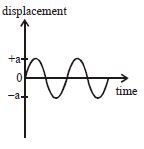
B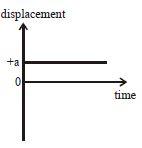
C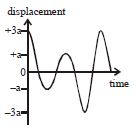
D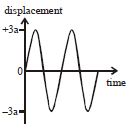
Solution
(A) The path difference is given by $\Delta x = S_1P - S_2P = \frac{\lambda}{2}$.
The phase difference $\Delta \phi$ is calculated as $\Delta \phi = k \Delta x = \frac{2 \pi}{\lambda} \times \Delta x$.
Substituting the value of $\Delta x$,we get $\Delta \phi = \frac{2 \pi}{\lambda} \times \frac{\lambda}{2} = \pi$.
Since the phase difference is $\pi$,the two waves interfere destructively at point $P$.
The resultant amplitude $A_R$ is given by $A_R = |A_1 - A_2|$,where $A_1 = 2a$ and $A_2 = a$.
Thus,$A_R = |2a - a| = a$.
The resultant oscillation at $P$ will be a sinusoidal wave with an amplitude of $a$.
The phase difference $\Delta \phi$ is calculated as $\Delta \phi = k \Delta x = \frac{2 \pi}{\lambda} \times \Delta x$.
Substituting the value of $\Delta x$,we get $\Delta \phi = \frac{2 \pi}{\lambda} \times \frac{\lambda}{2} = \pi$.
Since the phase difference is $\pi$,the two waves interfere destructively at point $P$.
The resultant amplitude $A_R$ is given by $A_R = |A_1 - A_2|$,where $A_1 = 2a$ and $A_2 = a$.
Thus,$A_R = |2a - a| = a$.
The resultant oscillation at $P$ will be a sinusoidal wave with an amplitude of $a$.
0 likes
View Solution43
DifficultMCQ
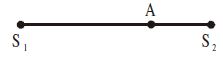
If $y_1 = 5 \text{ mm} \sin(\pi t)$ is the equation of oscillation of source $S_1$ and $y_2 = 5 \text{ mm} \sin(\pi t + \pi/6)$ is that of $S_2$,and it takes $1 \text{ s}$ and $0.5 \text{ s}$ for the transverse waves to reach point $A$ from sources $S_1$ and $S_2$ respectively,then the resulting amplitude at point $A$ is .... $\text{mm}$.
A
$5\sqrt{2 + \sqrt{3}}$
B
$5\sqrt{3}/2$
C
$5$
D
$5\sqrt{2}$
Solution
(C) The displacement of the wave from $S_1$ at point $A$ at time $t$ is $y_{A1} = 5 \sin(\pi(t - 1))$.
The displacement of the wave from $S_2$ at point $A$ at time $t$ is $y_{A2} = 5 \sin(\pi(t - 0.5) + \pi/6)$.
Comparing the phases at point $A$:
Phase of wave $1$: $\phi_1 = \pi t - \pi$.
Phase of wave $2$: $\phi_2 = \pi t - 0.5\pi + \pi/6 = \pi t - \pi/2 + \pi/6 = \pi t - \pi/3$.
The phase difference $\Delta\phi = \phi_2 - \phi_1 = (\pi t - \pi/3) - (\pi t - \pi) = \pi - \pi/3 = 2\pi/3$.
The resulting amplitude $A_{res} = \sqrt{A_1^2 + A_2^2 + 2A_1 A_2 \cos(\Delta\phi)}$.
Given $A_1 = A_2 = 5 \text{ mm}$ and $\Delta\phi = 2\pi/3$:
$A_{res} = \sqrt{5^2 + 5^2 + 2(5)(5) \cos(2\pi/3)} = \sqrt{25 + 25 + 50(-0.5)} = \sqrt{50 - 25} = \sqrt{25} = 5 \text{ mm}$.
The displacement of the wave from $S_2$ at point $A$ at time $t$ is $y_{A2} = 5 \sin(\pi(t - 0.5) + \pi/6)$.
Comparing the phases at point $A$:
Phase of wave $1$: $\phi_1 = \pi t - \pi$.
Phase of wave $2$: $\phi_2 = \pi t - 0.5\pi + \pi/6 = \pi t - \pi/2 + \pi/6 = \pi t - \pi/3$.
The phase difference $\Delta\phi = \phi_2 - \phi_1 = (\pi t - \pi/3) - (\pi t - \pi) = \pi - \pi/3 = 2\pi/3$.
The resulting amplitude $A_{res} = \sqrt{A_1^2 + A_2^2 + 2A_1 A_2 \cos(\Delta\phi)}$.
Given $A_1 = A_2 = 5 \text{ mm}$ and $\Delta\phi = 2\pi/3$:
$A_{res} = \sqrt{5^2 + 5^2 + 2(5)(5) \cos(2\pi/3)} = \sqrt{25 + 25 + 50(-0.5)} = \sqrt{50 - 25} = \sqrt{25} = 5 \text{ mm}$.
0 likes
View Solution44
DifficultMCQ
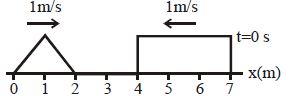
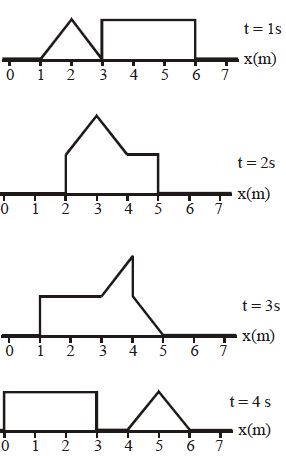
Two pulses on a string approach each other at speeds of $1 \ m/s$. What is the shape of the string at $t = 3 \ s$ :-
A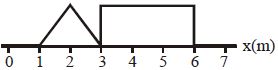
B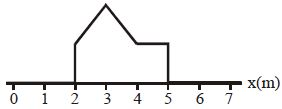
C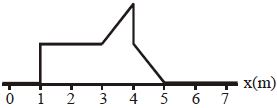
D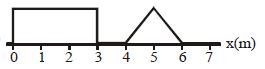
Solution
(C) At $t = 0 \ s$,the triangular pulse is between $x = 0 \ m$ and $x = 2 \ m$ moving to the right at $1 \ m/s$. The rectangular pulse is between $x = 4 \ m$ and $x = 7 \ m$ moving to the left at $1 \ m/s$.
At $t = 3 \ s$,the triangular pulse has moved $3 \ m$ to the right,occupying the region between $x = 3 \ m$ and $x = 5 \ m$.
The rectangular pulse has moved $3 \ m$ to the left,occupying the region between $x = 1 \ m$ and $x = 4 \ m$.
Therefore,the combined shape of the string at $t = 3 \ s$ is the superposition of these two pulses,which spans from $x = 1 \ m$ to $x = 5 \ m$.
At $t = 3 \ s$,the triangular pulse has moved $3 \ m$ to the right,occupying the region between $x = 3 \ m$ and $x = 5 \ m$.
The rectangular pulse has moved $3 \ m$ to the left,occupying the region between $x = 1 \ m$ and $x = 4 \ m$.
Therefore,the combined shape of the string at $t = 3 \ s$ is the superposition of these two pulses,which spans from $x = 1 \ m$ to $x = 5 \ m$.
0 likes
View Solution45
MediumMCQ
An observer receives waves directly from a source of sound distant $120\,m$ in a big hall. He also receives waves reflected from the mid-point of a $25\,m$ high ceiling. The wavelength of sound for constructive interference to take place between the two waves must be:
A
$5, 2.5, \frac{5}{3}...... m$
B
$10, 5, \frac{10}{3}...... m$
C
$20, \frac{20}{3}, 4 ...... m$
D
$10, \frac{10}{3}, 2 ...... m$
Solution
(B) Let the source be at $S$ and the observer at $O$. The direct distance $SO = 120\,m$.
The ceiling is at a height $h = 25\,m$. The reflected wave travels from $S$ to the midpoint of the ceiling and then to $O$.
Since the ceiling is at the midpoint,the horizontal distance from $S$ to the reflection point is $60\,m$ and from the reflection point to $O$ is $60\,m$.
The path length of the reflected wave is $d = 2 \times \sqrt{60^2 + 25^2} = 2 \times \sqrt{3600 + 625} = 2 \times \sqrt{4225} = 2 \times 65 = 130\,m$.
The path difference between the reflected wave and the direct wave is $\Delta x = 130\,m - 120\,m = 10\,m$.
For constructive interference,the path difference must be an integer multiple of the wavelength: $\Delta x = n\lambda$,where $n = 1, 2, 3, \dots$.
Thus,$10 = n\lambda \Rightarrow \lambda = \frac{10}{n}$.
For $n = 1, 2, 3, \dots$,the possible wavelengths are $\lambda = 10\,m, 5\,m, \frac{10}{3}\,m, \dots$.
The ceiling is at a height $h = 25\,m$. The reflected wave travels from $S$ to the midpoint of the ceiling and then to $O$.
Since the ceiling is at the midpoint,the horizontal distance from $S$ to the reflection point is $60\,m$ and from the reflection point to $O$ is $60\,m$.
The path length of the reflected wave is $d = 2 \times \sqrt{60^2 + 25^2} = 2 \times \sqrt{3600 + 625} = 2 \times \sqrt{4225} = 2 \times 65 = 130\,m$.
The path difference between the reflected wave and the direct wave is $\Delta x = 130\,m - 120\,m = 10\,m$.
For constructive interference,the path difference must be an integer multiple of the wavelength: $\Delta x = n\lambda$,where $n = 1, 2, 3, \dots$.
Thus,$10 = n\lambda \Rightarrow \lambda = \frac{10}{n}$.
For $n = 1, 2, 3, \dots$,the possible wavelengths are $\lambda = 10\,m, 5\,m, \frac{10}{3}\,m, \dots$.
0 likes
View Solution46
DifficultMCQ
Two waves represented by $y_1 = a \sin \frac{2\pi}{\lambda} (vt - x)$ and $y_2 = a \cos \frac{2\pi}{\lambda} (vt - x)$ are superposed. The resultant wave has an amplitude equal to
A
Zero
B
$2a$
C
$a$
D
$a\sqrt{2}$
Solution
(D) The first wave is $y_1 = a \sin \frac{2\pi}{\lambda} (vt - x)$.
The second wave is $y_2 = a \cos \frac{2\pi}{\lambda} (vt - x) = a \sin \left( \frac{2\pi}{\lambda} (vt - x) + \frac{\pi}{2} \right)$.
Comparing these with the standard form $y = A \sin(\omega t - kx + \phi)$,the phase difference between the two waves is $\Delta \phi = \frac{\pi}{2}$.
The resultant amplitude $A_{res}$ of two waves with equal amplitude $a$ and phase difference $\Delta \phi$ is given by $A_{res} = \sqrt{a^2 + a^2 + 2a^2 \cos(\Delta \phi)}$.
Substituting $\Delta \phi = 90^{\circ}$,we get $A_{res} = \sqrt{a^2 + a^2 + 2a^2 \cos(90^{\circ})} = \sqrt{2a^2 + 0} = a\sqrt{2}$.
The second wave is $y_2 = a \cos \frac{2\pi}{\lambda} (vt - x) = a \sin \left( \frac{2\pi}{\lambda} (vt - x) + \frac{\pi}{2} \right)$.
Comparing these with the standard form $y = A \sin(\omega t - kx + \phi)$,the phase difference between the two waves is $\Delta \phi = \frac{\pi}{2}$.
The resultant amplitude $A_{res}$ of two waves with equal amplitude $a$ and phase difference $\Delta \phi$ is given by $A_{res} = \sqrt{a^2 + a^2 + 2a^2 \cos(\Delta \phi)}$.
Substituting $\Delta \phi = 90^{\circ}$,we get $A_{res} = \sqrt{a^2 + a^2 + 2a^2 \cos(90^{\circ})} = \sqrt{2a^2 + 0} = a\sqrt{2}$.
0 likes
View Solution47
MediumMCQ
If two waves represented by $y_1 = 4 \sin \omega t$ and $y_2 = 3 \sin (\omega t + \frac{\pi}{3})$ interfere at a point,then the amplitude of the resulting wave will be about:
A
$7$
B
$6$
C
$5$
D
$3.5$
Solution
(B) The resultant amplitude $A$ of two interfering waves with amplitudes $a_1$ and $a_2$ and phase difference $\phi$ is given by the formula:
$A = \sqrt{a_1^2 + a_2^2 + 2 a_1 a_2 \cos \phi}$
Here,$a_1 = 4$,$a_2 = 3$,and $\phi = \frac{\pi}{3} = 60^{\circ}$.
Substituting these values into the formula:
$A = \sqrt{4^2 + 3^2 + 2(4)(3) \cos 60^{\circ}}$
$A = \sqrt{16 + 9 + 24 \times 0.5}$
$A = \sqrt{25 + 12}$
$A = \sqrt{37} \approx 6.08$
Thus,the amplitude of the resulting wave is approximately $6$.
$A = \sqrt{a_1^2 + a_2^2 + 2 a_1 a_2 \cos \phi}$
Here,$a_1 = 4$,$a_2 = 3$,and $\phi = \frac{\pi}{3} = 60^{\circ}$.
Substituting these values into the formula:
$A = \sqrt{4^2 + 3^2 + 2(4)(3) \cos 60^{\circ}}$
$A = \sqrt{16 + 9 + 24 \times 0.5}$
$A = \sqrt{25 + 12}$
$A = \sqrt{37} \approx 6.08$
Thus,the amplitude of the resulting wave is approximately $6$.
0 likes
View Solution48
MediumMCQ
The similarity between sound and light waves is:
A
Both are electromagnetic waves
B
Both are longitudinal waves
C
Both have the same speed in a medium
D
They can produce interference
Solution
(D) Interference is a fundamental property of all wave phenomena. Both light waves (electromagnetic) and sound waves (mechanical/longitudinal) exhibit the phenomenon of interference when two or more waves overlap in space.
0 likes
View Solution49
MediumMCQ
Two waves $Y_1 = A_1 \sin(\omega t - \beta_1)$ and $Y_2 = A_2 \sin(\omega t - \beta_2)$ superimpose to form a resultant wave whose amplitude is
A
$\sqrt{A_1^2 + A_2^2 + 2A_1A_2 \cos(\beta_1 - \beta_2)}$
B
$\sqrt{A_1^2 + A_2^2 + 2A_1A_2 \sin(\beta_1 - \beta_2)}$
C
$A_1 + A_2$
D
$|A_1 - A_2|$
Solution
(A) The two waves are given by $Y_1 = A_1 \sin(\omega t - \beta_1)$ and $Y_2 = A_2 \sin(\omega t - \beta_2)$.
The phase difference between the two waves is $\phi = (\omega t - \beta_1) - (\omega t - \beta_2) = \beta_2 - \beta_1$.
The resultant amplitude $A$ of two superimposing waves with amplitudes $A_1$ and $A_2$ and phase difference $\phi$ is given by the formula:
$A = \sqrt{A_1^2 + A_2^2 + 2A_1A_2 \cos \phi}$.
Substituting $\phi = \beta_2 - \beta_1$ into the formula,and noting that $\cos(\beta_2 - \beta_1) = \cos(\beta_1 - \beta_2)$:
$A = \sqrt{A_1^2 + A_2^2 + 2A_1A_2 \cos(\beta_1 - \beta_2)}$.
The phase difference between the two waves is $\phi = (\omega t - \beta_1) - (\omega t - \beta_2) = \beta_2 - \beta_1$.
The resultant amplitude $A$ of two superimposing waves with amplitudes $A_1$ and $A_2$ and phase difference $\phi$ is given by the formula:
$A = \sqrt{A_1^2 + A_2^2 + 2A_1A_2 \cos \phi}$.
Substituting $\phi = \beta_2 - \beta_1$ into the formula,and noting that $\cos(\beta_2 - \beta_1) = \cos(\beta_1 - \beta_2)$:
$A = \sqrt{A_1^2 + A_2^2 + 2A_1A_2 \cos(\beta_1 - \beta_2)}$.
0 likes
View Solution50
DifficultMCQ
The displacement of a particle executing periodic motion is given by :
$y = 4 \cos^2(t/2) \sin(1000t)$
This expression may be considered to be a result of the superposition of
$y = 4 \cos^2(t/2) \sin(1000t)$
This expression may be considered to be a result of the superposition of
A
two waves
B
three waves
C
four waves
D
five waves
Solution
(B) Given the displacement equation: $y = 4 \cos^2(t/2) \sin(1000t)$
Using the trigonometric identity $2 \cos^2 \theta = 1 + \cos(2\theta)$,we can rewrite the expression as:
$y = 2 [2 \cos^2(t/2)] \sin(1000t)$
$y = 2(1 + \cos t) \sin(1000t)$
$y = 2 \sin(1000t) + 2 \sin(1000t) \cos t$
Using the product-to-sum identity $2 \sin A \cos B = \sin(A+B) + \sin(A-B)$,we get:
$y = 2 \sin(1000t) + \sin(1000t + t) + \sin(1000t - t)$
$y = 2 \sin(1000t) + \sin(1001t) + \sin(999t)$
Thus,the given expression represents the superposition of three waves.
Using the trigonometric identity $2 \cos^2 \theta = 1 + \cos(2\theta)$,we can rewrite the expression as:
$y = 2 [2 \cos^2(t/2)] \sin(1000t)$
$y = 2(1 + \cos t) \sin(1000t)$
$y = 2 \sin(1000t) + 2 \sin(1000t) \cos t$
Using the product-to-sum identity $2 \sin A \cos B = \sin(A+B) + \sin(A-B)$,we get:
$y = 2 \sin(1000t) + \sin(1000t + t) + \sin(1000t - t)$
$y = 2 \sin(1000t) + \sin(1001t) + \sin(999t)$
Thus,the given expression represents the superposition of three waves.
0 likes
View SolutionWaves and Sound — Principle of superposition of waves · Frequently Asked Questions
1Are these Waves and Sound questions useful for JEE and NEET?
Yes. All questions in this section are mapped to JEE Main and NEET exam patterns. Previous year questions from JEE Main, NEET, GUJCET and state-level exams are included with full solutions.
2Can I switch to Hindi or Gujarati for these questions?
Yes. Use the language tabs in the hero section or the sidebar to view the same questions and solutions in English, Hindi or Gujarati.
3How do I generate a question paper from this subtopic?
Use the Vedclass Exam Paper Generator — select the chapter and subtopic, set difficulty, and generate Sets A, B, C, D automatically. First 3 chapters of every subject are free.
Vedclass Products
For Students
Vedclass Test Series
Mock tests in real JEE/NEET style with performance analysis. 5-day free trial.
Start Free TrialFor Teachers
Exam Paper Generator
Generate Set A/B/C/D papers from this chapter in 2 minutes. 3 chapters free.
Try FreeFor Institutes
Online Exam Module
Live online exams with unlimited students, 360° analytics & white-label branding.
See DemoFor Teachers & Institutes
Generate a Waves and Sound Exam Paper in 2 Minutes
Select subtopic & difficulty — Sets A, B, C, D auto-generated with No Repeat logic.
First 3 chapters of every subject are free — no payment required.