
A English
Speed of Mechanical Wave on String (Transverse wave) Questions in English
Class 11 Physics · Waves and Sound · Speed of Mechanical Wave on String (Transverse wave)
102+
Questions
English
Language
100%
With Solutions
Showing 48 of 102 questions in English
51
DifficultMCQ
The mass per unit length of a uniform wire is $0.135 \, g/cm$. $A$ transverse wave of the form $y = -0.21 \sin(x + 30t)$ is produced in it,where $x$ is in meters and $t$ is in seconds. Then,the expected value of tension in the wire is $x \times 10^{-2} \, N$. The value of $x$ is (Round off to the nearest integer).
A
$12.15$
B
$121.5$
C
$1215$
D
$24.3$
Solution
(C) Given mass per unit length $\mu = 0.135 \, g/cm = 0.135 \times 10^{-3} \, kg / 10^{-2} \, m = 0.0135 \, kg/m$.
The wave equation is $y = -0.21 \sin(x + 30t)$.
Comparing this with the standard wave equation $y = A \sin(kx + \omega t)$,we get angular frequency $\omega = 30 \, rad/s$ and wave number $k = 1 \, m^{-1}$.
The wave speed $v$ is given by $v = \frac{\omega}{k} = \frac{30}{1} = 30 \, m/s$.
The speed of a transverse wave on a stretched string is $v = \sqrt{\frac{T}{\mu}}$,where $T$ is the tension.
Therefore,$T = v^2 \mu = (30)^2 \times 0.0135 = 900 \times 0.0135 = 12.15 \, N$.
We are given $T = x \times 10^{-2} \, N$,so $12.15 = x \times 10^{-2}$.
Thus,$x = 12.15 \times 100 = 1215$.
The wave equation is $y = -0.21 \sin(x + 30t)$.
Comparing this with the standard wave equation $y = A \sin(kx + \omega t)$,we get angular frequency $\omega = 30 \, rad/s$ and wave number $k = 1 \, m^{-1}$.
The wave speed $v$ is given by $v = \frac{\omega}{k} = \frac{30}{1} = 30 \, m/s$.
The speed of a transverse wave on a stretched string is $v = \sqrt{\frac{T}{\mu}}$,where $T$ is the tension.
Therefore,$T = v^2 \mu = (30)^2 \times 0.0135 = 900 \times 0.0135 = 12.15 \, N$.
We are given $T = x \times 10^{-2} \, N$,so $12.15 = x \times 10^{-2}$.
Thus,$x = 12.15 \times 100 = 1215$.
0 likes
View Solution52
MediumMCQ
The percentage increase in the speed of transverse waves produced in a stretched string if the tension is increased by $4\, \%$,will be ......... $\%$
A
$1$
B
$2$
C
$0$
D
$4$
Solution
(B) The speed of a transverse wave in a stretched string is given by the formula $v = \sqrt{\frac{T}{\mu}}$,where $T$ is the tension and $\mu$ is the linear mass density.
Taking the natural logarithm on both sides,we get $\ln v = \frac{1}{2} \ln T - \frac{1}{2} \ln \mu$.
Differentiating both sides,we obtain the relative error formula: $\frac{\Delta v}{v} = \frac{1}{2} \frac{\Delta T}{T}$.
Given that the percentage increase in tension is $\frac{\Delta T}{T} \times 100 = 4\, \%$.
Substituting this value into the error formula: $\frac{\Delta v}{v} \times 100 = \frac{1}{2} \times (4\, \%) = 2\, \%$.
Therefore,the percentage increase in the speed of the wave is $2\, \%$.
Taking the natural logarithm on both sides,we get $\ln v = \frac{1}{2} \ln T - \frac{1}{2} \ln \mu$.
Differentiating both sides,we obtain the relative error formula: $\frac{\Delta v}{v} = \frac{1}{2} \frac{\Delta T}{T}$.
Given that the percentage increase in tension is $\frac{\Delta T}{T} \times 100 = 4\, \%$.
Substituting this value into the error formula: $\frac{\Delta v}{v} \times 100 = \frac{1}{2} \times (4\, \%) = 2\, \%$.
Therefore,the percentage increase in the speed of the wave is $2\, \%$.
0 likes
View Solution53
EasyMCQ
If the initial tension on a stretched string is doubled,then the ratio of the initial and final speeds of a transverse wave along the string is:
A
$ \sqrt{2} : 1 $
B
$ 1 : \sqrt{2} $
C
$ 1 : 2 $
D
$ 1 : 1 $
Solution
(B) The speed of a transverse wave on a stretched string is given by the formula $v = \sqrt{\frac{T}{\mu}}$,where $T$ is the tension and $\mu$ is the linear mass density.
Since $\mu$ remains constant,the speed is directly proportional to the square root of the tension: $v \propto \sqrt{T}$.
Let the initial tension be $T_i = T$ and the final tension be $T_f = 2T$.
The ratio of the initial speed $v_i$ to the final speed $v_f$ is given by:
$\frac{v_i}{v_f} = \sqrt{\frac{T_i}{T_f}}$
Substituting the values,we get:
$\frac{v_i}{v_f} = \sqrt{\frac{T}{2T}} = \sqrt{\frac{1}{2}} = \frac{1}{\sqrt{2}}$
Thus,the ratio is $1 : \sqrt{2}$.
Since $\mu$ remains constant,the speed is directly proportional to the square root of the tension: $v \propto \sqrt{T}$.
Let the initial tension be $T_i = T$ and the final tension be $T_f = 2T$.
The ratio of the initial speed $v_i$ to the final speed $v_f$ is given by:
$\frac{v_i}{v_f} = \sqrt{\frac{T_i}{T_f}}$
Substituting the values,we get:
$\frac{v_i}{v_f} = \sqrt{\frac{T}{2T}} = \sqrt{\frac{1}{2}} = \frac{1}{\sqrt{2}}$
Thus,the ratio is $1 : \sqrt{2}$.
0 likes
View Solution54
AdvancedMCQ
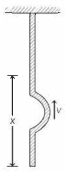
$A$ rope of length $L$ and uniform linear density is hanging from the ceiling. $A$ transverse wave pulse,generated close to the free end of the rope,travels upwards through the rope. Select the correct option.
A
The speed of the pulse decreases as it moves up.
B
The time taken by the pulse to travel the length of the rope is proportional to $\sqrt{L}$.
C
The tension will be constant along the length of the rope.
D
The speed of the pulse will be constant along the length of the rope.
Solution
(B) The tension $T$ at a section at a distance $x$ from the free end is given by $T = m g = \mu x g$,where $\mu$ is the mass per unit length of the rope.
The wave speed $v$ on the rope is given by $v = \sqrt{\frac{T}{\mu}} = \sqrt{\frac{\mu x g}{\mu}} = \sqrt{g x}$.
Since $v = \sqrt{g x}$,the speed increases as the pulse moves up (as $x$ increases).
To find the time $t$ taken to travel a distance $x$,we use $v = \frac{dx}{dt} = \sqrt{g x}$.
Rearranging gives $dx / \sqrt{x} = \sqrt{g} dt$.
Integrating both sides from $0$ to $x$ and $0$ to $t$,we get $\int_{0}^{x} x^{-1/2} dx = \int_{0}^{t} \sqrt{g} dt$.
$2\sqrt{x} = \sqrt{g} t$,which implies $t = 2\sqrt{\frac{x}{g}}$.
For the total length $L$,the time taken is $t = 2\sqrt{\frac{L}{g}}$,so $t \propto \sqrt{L}$.
The wave speed $v$ on the rope is given by $v = \sqrt{\frac{T}{\mu}} = \sqrt{\frac{\mu x g}{\mu}} = \sqrt{g x}$.
Since $v = \sqrt{g x}$,the speed increases as the pulse moves up (as $x$ increases).
To find the time $t$ taken to travel a distance $x$,we use $v = \frac{dx}{dt} = \sqrt{g x}$.
Rearranging gives $dx / \sqrt{x} = \sqrt{g} dt$.
Integrating both sides from $0$ to $x$ and $0$ to $t$,we get $\int_{0}^{x} x^{-1/2} dx = \int_{0}^{t} \sqrt{g} dt$.
$2\sqrt{x} = \sqrt{g} t$,which implies $t = 2\sqrt{\frac{x}{g}}$.
For the total length $L$,the time taken is $t = 2\sqrt{\frac{L}{g}}$,so $t \propto \sqrt{L}$.
0 likes
View Solution55
MediumMCQ
$A$ transverse wave propagating on a string can be described by the equation $y = 2 \sin (10x + 300t)$,where $x$ and $y$ are in meters and $t$ is in seconds. If the vibrating string has a linear mass density of $0.6 \times 10^{-3} \, g/cm$,then the tension in the string is .............. $N$.
A
$5.4$
B
$0.054$
C
$54$
D
$0.0054$
Solution
(B) The given wave equation is $y = 2 \sin (10x + 300t)$.
Comparing this with the standard wave equation $y = A \sin (kx + \omega t)$,we get the wave number $k = 10 \, rad/m$ and the angular frequency $\omega = 300 \, rad/s$.
The linear mass density $\mu = 0.6 \times 10^{-3} \, g/cm$. Converting this to $SI$ units $(kg/m)$:
$\mu = \frac{0.6 \times 10^{-3} \times 10^{-3} \, kg}{10^{-2} \, m} = 6 \times 10^{-5} \, kg/m$.
The wave speed $v$ is given by $v = \frac{\omega}{k} = \frac{300}{10} = 30 \, m/s$.
The speed of a transverse wave on a string is related to tension $T$ and linear mass density $\mu$ by $v = \sqrt{\frac{T}{\mu}}$.
Therefore,$T = v^2 \mu$.
Substituting the values: $T = (30)^2 \times (6 \times 10^{-5}) = 900 \times 6 \times 10^{-5} = 5400 \times 10^{-5} = 0.054 \, N$.
Comparing this with the standard wave equation $y = A \sin (kx + \omega t)$,we get the wave number $k = 10 \, rad/m$ and the angular frequency $\omega = 300 \, rad/s$.
The linear mass density $\mu = 0.6 \times 10^{-3} \, g/cm$. Converting this to $SI$ units $(kg/m)$:
$\mu = \frac{0.6 \times 10^{-3} \times 10^{-3} \, kg}{10^{-2} \, m} = 6 \times 10^{-5} \, kg/m$.
The wave speed $v$ is given by $v = \frac{\omega}{k} = \frac{300}{10} = 30 \, m/s$.
The speed of a transverse wave on a string is related to tension $T$ and linear mass density $\mu$ by $v = \sqrt{\frac{T}{\mu}}$.
Therefore,$T = v^2 \mu$.
Substituting the values: $T = (30)^2 \times (6 \times 10^{-5}) = 900 \times 6 \times 10^{-5} = 5400 \times 10^{-5} = 0.054 \, N$.
0 likes
View Solution56
DifficultMCQ
$A$ copper wire is held at the two ends by rigid supports. At $50^{\circ} C$ the wire is just taut,with negligible tension. If $Y=1.2 \times 10^{11} \, N/m^2$,$\alpha=1.6 \times 10^{-5} /^{\circ} C$,and $\rho=9.2 \times 10^3 \, kg/m^3$,then the speed of transverse waves in this wire at $30^{\circ} C$ is .......... $m/s$.
A
$64.6$
B
$16.2$
C
$23.2$
D
$32.2$
Solution
(A) The thermal stress $F/A$ developed in a wire due to a temperature change $\Delta T$ is given by $F/A = Y \alpha \Delta T$.
The speed of a transverse wave on a stretched wire is $v = \sqrt{T/\mu}$,where $T$ is the tension and $\mu$ is the linear mass density.
Here,the tension $T = F = Y A \alpha \Delta T$ and the linear mass density $\mu = \rho A$.
Substituting these into the velocity formula: $v = \sqrt{\frac{Y A \alpha \Delta T}{\rho A}} = \sqrt{\frac{Y \alpha \Delta T}{\rho}}$.
Given: $Y = 1.2 \times 10^{11} \, N/m^2$,$\alpha = 1.6 \times 10^{-5} /^{\circ} C$,$\rho = 9.2 \times 10^3 \, kg/m^3$,and $\Delta T = 50^{\circ} C - 30^{\circ} C = 20^{\circ} C$.
Calculating the speed: $v = \sqrt{\frac{1.2 \times 10^{11} \times 1.6 \times 10^{-5} \times 20}{9.2 \times 10^3}}$.
$v = \sqrt{\frac{3.84 \times 10^7}{9.2 \times 10^3}} = \sqrt{4173.9} \approx 64.6 \, m/s$.
The speed of a transverse wave on a stretched wire is $v = \sqrt{T/\mu}$,where $T$ is the tension and $\mu$ is the linear mass density.
Here,the tension $T = F = Y A \alpha \Delta T$ and the linear mass density $\mu = \rho A$.
Substituting these into the velocity formula: $v = \sqrt{\frac{Y A \alpha \Delta T}{\rho A}} = \sqrt{\frac{Y \alpha \Delta T}{\rho}}$.
Given: $Y = 1.2 \times 10^{11} \, N/m^2$,$\alpha = 1.6 \times 10^{-5} /^{\circ} C$,$\rho = 9.2 \times 10^3 \, kg/m^3$,and $\Delta T = 50^{\circ} C - 30^{\circ} C = 20^{\circ} C$.
Calculating the speed: $v = \sqrt{\frac{1.2 \times 10^{11} \times 1.6 \times 10^{-5} \times 20}{9.2 \times 10^3}}$.
$v = \sqrt{\frac{3.84 \times 10^7}{9.2 \times 10^3}} = \sqrt{4173.9} \approx 64.6 \, m/s$.
0 likes
View Solution57
MediumMCQ
$A$ pulse is generated at the lower end of a hanging rope of uniform density and length $L$. The speed of the pulse when it reaches the midpoint of the rope is:

A
$\sqrt{2 g L}$
B
$\sqrt{g L}$
C
$\sqrt{\frac{g L}{2}}$
D
$\frac{\sqrt{g L}}{2}$
Solution
(C) The speed of a transverse wave on a string is given by $v = \sqrt{\frac{T}{\mu}}$,where $T$ is the tension and $\mu$ is the linear mass density of the string.
For a hanging rope of length $L$ and linear mass density $\mu$,the tension $T$ at a distance $y$ from the lower end is due to the weight of the rope segment below it.
The mass of the rope segment of length $y$ is $m = \mu y$.
Thus,the tension at distance $y$ is $T = \mu y g$.
The speed of the pulse at distance $y$ is $v = \sqrt{\frac{\mu y g}{\mu}} = \sqrt{gy}$.
At the midpoint of the rope,$y = \frac{L}{2}$.
Therefore,the speed of the pulse at the midpoint is $v = \sqrt{g \left(\frac{L}{2}\right)} = \sqrt{\frac{g L}{2}}$.
For a hanging rope of length $L$ and linear mass density $\mu$,the tension $T$ at a distance $y$ from the lower end is due to the weight of the rope segment below it.
The mass of the rope segment of length $y$ is $m = \mu y$.
Thus,the tension at distance $y$ is $T = \mu y g$.
The speed of the pulse at distance $y$ is $v = \sqrt{\frac{\mu y g}{\mu}} = \sqrt{gy}$.
At the midpoint of the rope,$y = \frac{L}{2}$.
Therefore,the speed of the pulse at the midpoint is $v = \sqrt{g \left(\frac{L}{2}\right)} = \sqrt{\frac{g L}{2}}$.
0 likes
View Solution58
DifficultMCQ
$A$ rope of length $L$ and mass $M$ hangs freely from the ceiling. If the time taken by a transverse wave to travel from the bottom to the top of the rope is $T$,then the time taken to cover the first half length is:
A
$T$
B
$T\left(\frac{\sqrt{2}-1}{\sqrt{2}}\right)$
C
$\frac{T}{\sqrt{2}}$
D
$\frac{T}{2}$
Solution
(C) The speed of a transverse wave on a string is given by $v = \sqrt{\frac{T_s}{\mu}}$,where $T_s$ is the tension and $\mu = \frac{M}{L}$ is the mass per unit length.
At a distance $x$ from the bottom,the tension $T_s$ is due to the mass of the rope below it,which is $m = \frac{M}{L} x$. Thus,$T_s = \left(\frac{M}{L} x\right)g$.
The speed at distance $x$ is $v(x) = \sqrt{\frac{(M/L)xg}{M/L}} = \sqrt{gx}$.
Since $v = \frac{dx}{dt}$,we have $dt = \frac{dx}{\sqrt{gx}}$.
Integrating from $x=0$ to $x=L$ to find the total time $T$:
$T = \int_0^L \frac{dx}{\sqrt{gx}} = \frac{1}{\sqrt{g}} [2\sqrt{x}]_0^L = 2\sqrt{\frac{L}{g}}$.
Now,to find the time $T_1$ to cover the first half length ($x=0$ to $x=L/2$):
$T_1 = \int_0^{L/2} \frac{dx}{\sqrt{gx}} = \frac{1}{\sqrt{g}} [2\sqrt{x}]_0^{L/2} = 2\sqrt{\frac{L}{2g}} = \frac{2}{\sqrt{2}}\sqrt{\frac{L}{g}} = \frac{T}{\sqrt{2}}$.
At a distance $x$ from the bottom,the tension $T_s$ is due to the mass of the rope below it,which is $m = \frac{M}{L} x$. Thus,$T_s = \left(\frac{M}{L} x\right)g$.
The speed at distance $x$ is $v(x) = \sqrt{\frac{(M/L)xg}{M/L}} = \sqrt{gx}$.
Since $v = \frac{dx}{dt}$,we have $dt = \frac{dx}{\sqrt{gx}}$.
Integrating from $x=0$ to $x=L$ to find the total time $T$:
$T = \int_0^L \frac{dx}{\sqrt{gx}} = \frac{1}{\sqrt{g}} [2\sqrt{x}]_0^L = 2\sqrt{\frac{L}{g}}$.
Now,to find the time $T_1$ to cover the first half length ($x=0$ to $x=L/2$):
$T_1 = \int_0^{L/2} \frac{dx}{\sqrt{gx}} = \frac{1}{\sqrt{g}} [2\sqrt{x}]_0^{L/2} = 2\sqrt{\frac{L}{2g}} = \frac{2}{\sqrt{2}}\sqrt{\frac{L}{g}} = \frac{T}{\sqrt{2}}$.
0 likes
View Solution59
DifficultMCQ
$A$ transverse pulse generated at the bottom of a uniform rope of length $L$ travels in an upward direction. The time taken by it to travel the full length of the rope will be
A
$\sqrt{\frac{L}{2g}}$
B
$\sqrt{\frac{2L}{g}}$
C
$\sqrt{\frac{L}{g}}$
D
$\sqrt{\frac{4L}{g}}$
Solution
(D) The velocity of a transverse wave on a string at a distance $x$ from the free end is given by $v = \sqrt{gx}$.
Since the pulse starts from the bottom (free end),at a distance $x$ from the bottom,the velocity is $v = \frac{dx}{dt} = \sqrt{gx}$.
Rearranging for time,we get $dt = \frac{dx}{\sqrt{gx}}$.
To find the total time $T$ to travel the length $L$,we integrate from $0$ to $L$:
$T = \int_{0}^{L} \frac{dx}{\sqrt{gx}} = \frac{1}{\sqrt{g}} \int_{0}^{L} x^{-1/2} dx$.
$T = \frac{1}{\sqrt{g}} [2x^{1/2}]_{0}^{L} = \frac{1}{\sqrt{g}} (2\sqrt{L}) = 2\sqrt{\frac{L}{g}} = \sqrt{\frac{4L}{g}}$.
Thus,the correct option is $D$.
Since the pulse starts from the bottom (free end),at a distance $x$ from the bottom,the velocity is $v = \frac{dx}{dt} = \sqrt{gx}$.
Rearranging for time,we get $dt = \frac{dx}{\sqrt{gx}}$.
To find the total time $T$ to travel the length $L$,we integrate from $0$ to $L$:
$T = \int_{0}^{L} \frac{dx}{\sqrt{gx}} = \frac{1}{\sqrt{g}} \int_{0}^{L} x^{-1/2} dx$.
$T = \frac{1}{\sqrt{g}} [2x^{1/2}]_{0}^{L} = \frac{1}{\sqrt{g}} (2\sqrt{L}) = 2\sqrt{\frac{L}{g}} = \sqrt{\frac{4L}{g}}$.
Thus,the correct option is $D$.
0 likes
View Solution60
EasyMCQ
$A$ steel wire with mass per unit length $7.0 \times 10^{-3} \, kg \, m^{-1}$ is under tension of $70 \, N$. The speed of transverse waves in the wire will be $......... \, m/s$.
A
$200$
B
$100$
C
$10$
D
$50$
Solution
(B) The speed of a transverse wave on a stretched string is given by the formula $v = \sqrt{\frac{T}{\mu}}$,where $T$ is the tension and $\mu$ is the mass per unit length.
Given:
Tension $T = 70 \, N$
Mass per unit length $\mu = 7.0 \times 10^{-3} \, kg \, m^{-1}$
Substituting the values into the formula:
$v = \sqrt{\frac{70}{7.0 \times 10^{-3}}}$
$v = \sqrt{\frac{70}{0.007}}$
$v = \sqrt{10000}$
$v = 100 \, m/s$
Therefore,the speed of the transverse wave is $100 \, m/s$.
Given:
Tension $T = 70 \, N$
Mass per unit length $\mu = 7.0 \times 10^{-3} \, kg \, m^{-1}$
Substituting the values into the formula:
$v = \sqrt{\frac{70}{7.0 \times 10^{-3}}}$
$v = \sqrt{\frac{70}{0.007}}$
$v = \sqrt{10000}$
$v = 100 \, m/s$
Therefore,the speed of the transverse wave is $100 \, m/s$.
0 likes
View Solution61
MediumMCQ
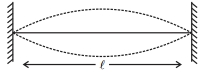
The fundamental frequency of vibration of a string stretched between two rigid supports is $50\,Hz$. The mass of the string is $18\,g$ and its linear mass density is $20\,g/m$. The speed of the transverse waves produced in the string is $..........\,m/s$.
A
$90$
B
$45$
C
$30$
D
$15$
Solution
(A) Given:
Fundamental frequency $f = 50\,Hz$
Mass of the string $m = 18\,g = 0.018\,kg$
Linear mass density $\mu = 20\,g/m = 0.02\,kg/m$
Step $1$: Find the length of the string $(L)$.
We know that $\mu = \frac{m}{L}$,so $L = \frac{m}{\mu} = \frac{18\,g}{20\,g/m} = 0.9\,m$.
Step $2$: Relate frequency to wave speed.
For the fundamental mode of a string fixed at both ends,the length $L$ is equal to half the wavelength: $L = \frac{\lambda}{2}$,which implies $\lambda = 2L$.
Substituting $L = 0.9\,m$,we get $\lambda = 2 \times 0.9 = 1.8\,m$.
Step $3$: Calculate the wave speed $(v)$.
The speed of the wave is given by $v = f \lambda$.
$v = 50\,Hz \times 1.8\,m = 90\,m/s$.
Thus,the speed of the transverse waves is $90\,m/s$.
Fundamental frequency $f = 50\,Hz$
Mass of the string $m = 18\,g = 0.018\,kg$
Linear mass density $\mu = 20\,g/m = 0.02\,kg/m$
Step $1$: Find the length of the string $(L)$.
We know that $\mu = \frac{m}{L}$,so $L = \frac{m}{\mu} = \frac{18\,g}{20\,g/m} = 0.9\,m$.
Step $2$: Relate frequency to wave speed.
For the fundamental mode of a string fixed at both ends,the length $L$ is equal to half the wavelength: $L = \frac{\lambda}{2}$,which implies $\lambda = 2L$.
Substituting $L = 0.9\,m$,we get $\lambda = 2 \times 0.9 = 1.8\,m$.
Step $3$: Calculate the wave speed $(v)$.
The speed of the wave is given by $v = f \lambda$.
$v = 50\,Hz \times 1.8\,m = 90\,m/s$.
Thus,the speed of the transverse waves is $90\,m/s$.
3 likes
View Solution62
AdvancedMCQ
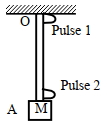
$A$ block $M$ hangs vertically at the bottom end of a uniform rope of constant mass per unit length. The top end of the rope is attached to a fixed rigid support at $O$. $A$ transverse wave pulse (Pulse $1$) of wavelength $\lambda_0$ is produced at point $O$ on the rope. The pulse takes time $T_{OA}$ to reach point $A$. If the wave pulse of wavelength $\lambda_0$ is produced at point $A$ (Pulse $2$) without disturbing the position of $M$,it takes time $T_{AO}$ to reach point $O$. Which of the following options is/are correct?
A
$B, C, D$
B
$A, B, D$
C
$B, C$
D
$C, D$
Solution
(B) The speed of a transverse pulse at any point on the rope is given by $v = \sqrt{\frac{T(x)}{\mu}}$,where $T(x)$ is the tension at that point and $\mu$ is the linear mass density.
$1$. For Pulse $1$ moving from $O$ to $A$,the tension at a distance $x$ from $O$ is $T(x) = (M + \mu x)g$.
$2$. For Pulse $2$ moving from $A$ to $O$,the tension at a distance $x$ from $O$ is also $T(x) = (M + \mu x)g$.
Since the tension profile along the rope is identical for both paths,the speed at any given point $x$ is the same for both pulses. Thus,the time taken $T_{OA} = T_{AO}$. Option $A$ is correct.
$3$. Since the speed $v(x)$ is the same at any point $x$ for both pulses,option $B$ is correct.
$4$. The speed of a transverse wave on a string is $v = \sqrt{T/\mu}$,which is independent of frequency and wavelength. Thus,option $D$ is correct.
$5$. As the pulse moves from $O$ to $A$,the tension increases,so the speed $v$ increases. Since $v = f\lambda$ and the frequency $f$ remains constant,the wavelength $\lambda$ must increase. Thus,option $C$ is correct.
Therefore,options $A, B, C,$ and $D$ are all correct.
$1$. For Pulse $1$ moving from $O$ to $A$,the tension at a distance $x$ from $O$ is $T(x) = (M + \mu x)g$.
$2$. For Pulse $2$ moving from $A$ to $O$,the tension at a distance $x$ from $O$ is also $T(x) = (M + \mu x)g$.
Since the tension profile along the rope is identical for both paths,the speed at any given point $x$ is the same for both pulses. Thus,the time taken $T_{OA} = T_{AO}$. Option $A$ is correct.
$3$. Since the speed $v(x)$ is the same at any point $x$ for both pulses,option $B$ is correct.
$4$. The speed of a transverse wave on a string is $v = \sqrt{T/\mu}$,which is independent of frequency and wavelength. Thus,option $D$ is correct.
$5$. As the pulse moves from $O$ to $A$,the tension increases,so the speed $v$ increases. Since $v = f\lambda$ and the frequency $f$ remains constant,the wavelength $\lambda$ must increase. Thus,option $C$ is correct.
Therefore,options $A, B, C,$ and $D$ are all correct.
0 likes
View Solution63
MediumMCQ
Two strings with circular cross section and made of same material are stretched to have the same amount of tension. $A$ transverse wave is then made to pass through both the strings. The velocity of the wave in the first string having the radius of cross section $R$ is $v_1$,and that in the other string having radius of cross section $R/2$ is $v_2$. Then $\frac{v_2}{v_1} = $
A
$\sqrt{2}$
B
$2$
C
$8$
D
$4$
Solution
(B) The velocity of a transverse wave in a stretched string is given by $v = \sqrt{\frac{T}{\mu}}$,where $T$ is the tension and $\mu$ is the linear mass density.
Linear mass density $\mu = \rho A = \rho (\pi R^2)$,where $\rho$ is the density of the material and $R$ is the radius of the cross section.
Since both strings are made of the same material,$\rho$ is constant. Given that the tension $T$ is the same for both strings,we have $v \propto \frac{1}{\sqrt{R^2}} \propto \frac{1}{R}$.
Therefore,$\frac{v_2}{v_1} = \frac{R_1}{R_2}$.
Given $R_1 = R$ and $R_2 = R/2$,we get $\frac{v_2}{v_1} = \frac{R}{R/2} = 2$.
Linear mass density $\mu = \rho A = \rho (\pi R^2)$,where $\rho$ is the density of the material and $R$ is the radius of the cross section.
Since both strings are made of the same material,$\rho$ is constant. Given that the tension $T$ is the same for both strings,we have $v \propto \frac{1}{\sqrt{R^2}} \propto \frac{1}{R}$.
Therefore,$\frac{v_2}{v_1} = \frac{R_1}{R_2}$.
Given $R_1 = R$ and $R_2 = R/2$,we get $\frac{v_2}{v_1} = \frac{R}{R/2} = 2$.
0 likes
View Solution64
MediumMCQ
The linear mass density of a vibrating string is $1.3 \times 10^{-4} \ kg/m$. $A$ transverse wave is propagating on the string and is described by the equation $y = 0.021 \sin(x + 30t)$,where $x$ and $y$ are measured in meters and $t$ in seconds. The tension in the string is approximately: (in $N$)
A
$0.12$
B
$0.48$
C
$1.20$
D
$4.80$
Solution
(A) The standard equation of a transverse wave is $y = A \sin(kx + \omega t)$.
Comparing this with the given equation $y = 0.021 \sin(x + 30t)$,we get the angular frequency $\omega = 30 \ rad/s$ and the wave number $k = 1 \ m^{-1}$.
The wave speed $v$ is given by $v = \frac{\omega}{k} = \frac{30}{1} = 30 \ m/s$.
The tension $T$ in a string is related to the linear mass density $\mu$ and wave speed $v$ by the formula $T = \mu v^2$.
Given $\mu = 1.3 \times 10^{-4} \ kg/m$,we have $T = (1.3 \times 10^{-4}) \times (30)^2$.
$T = 1.3 \times 10^{-4} \times 900 = 1.3 \times 0.09 = 0.117 \ N$.
Rounding to two decimal places,the tension is approximately $0.12 \ N$.
Comparing this with the given equation $y = 0.021 \sin(x + 30t)$,we get the angular frequency $\omega = 30 \ rad/s$ and the wave number $k = 1 \ m^{-1}$.
The wave speed $v$ is given by $v = \frac{\omega}{k} = \frac{30}{1} = 30 \ m/s$.
The tension $T$ in a string is related to the linear mass density $\mu$ and wave speed $v$ by the formula $T = \mu v^2$.
Given $\mu = 1.3 \times 10^{-4} \ kg/m$,we have $T = (1.3 \times 10^{-4}) \times (30)^2$.
$T = 1.3 \times 10^{-4} \times 900 = 1.3 \times 0.09 = 0.117 \ N$.
Rounding to two decimal places,the tension is approximately $0.12 \ N$.
0 likes
View Solution65
AdvancedMCQ
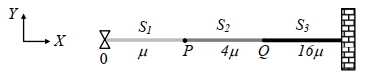
Consider a system of three connected strings,$S_1, S_2$ and $S_3$ with uniform linear mass densities $\mu \text{ kg/m}$,$4\mu \text{ kg/m}$ and $16\mu \text{ kg/m}$,respectively,as shown in the figure. $S_1$ and $S_2$ are connected at the point $P$,whereas $S_2$ and $S_3$ are connected at the point $Q$,and the other end of $S_3$ is connected to a wall. $A$ wave generator $O$ is connected to the free end of $S_1$. The wave from the generator is represented by $y = y_0 \cos(\omega t - kx) \text{ cm}$,where $y_0, \omega$ and $k$ are constants of appropriate dimensions. Which of the following statements is/are correct:
$(A)$ When the wave reflects from $P$ for the first time,the reflected wave is represented by $y = \alpha_1 y_0 \cos(\omega t + kx + \pi) \text{ cm}$,where $\alpha_1$ is a positive constant.
$(B)$ When the wave transmits through $P$ for the first time,the transmitted wave is represented by $y = \alpha_2 y_0 \cos(\omega t - kx) \text{ cm}$,where $\alpha_2$ is a positive constant.
$(C)$ When the wave reflects from $Q$ for the first time,the reflected wave is represented by $y = \alpha_3 y_0 \cos(\omega t - kx + \pi) \text{ cm}$,where $\alpha_3$ is a positive constant.
$(D)$ When the wave transmits through $Q$ for the first time,the transmitted wave is represented by $y = \alpha_4 y_0 \cos(\omega t - 4kx) \text{ cm}$,where $\alpha_4$ is a positive constant.
$(A)$ When the wave reflects from $P$ for the first time,the reflected wave is represented by $y = \alpha_1 y_0 \cos(\omega t + kx + \pi) \text{ cm}$,where $\alpha_1$ is a positive constant.
$(B)$ When the wave transmits through $P$ for the first time,the transmitted wave is represented by $y = \alpha_2 y_0 \cos(\omega t - kx) \text{ cm}$,where $\alpha_2$ is a positive constant.
$(C)$ When the wave reflects from $Q$ for the first time,the reflected wave is represented by $y = \alpha_3 y_0 \cos(\omega t - kx + \pi) \text{ cm}$,where $\alpha_3$ is a positive constant.
$(D)$ When the wave transmits through $Q$ for the first time,the transmitted wave is represented by $y = \alpha_4 y_0 \cos(\omega t - 4kx) \text{ cm}$,where $\alpha_4$ is a positive constant.
A
$(A, C)$
B
$(A, D)$
C
$(B, C)$
D
$(B, D)$
Solution
(B) The incident wave is $y_i = y_0 \cos(\omega t - kx)$.
At point $P$,the wave travels from a medium with density $\mu$ to $4\mu$. Since it moves from a rarer to a denser medium,the reflected wave undergoes a phase change of $\pi$. Thus,$y_r = \alpha_1 y_0 \cos(\omega t + kx + \pi)$. Statement $(A)$ is correct.
The transmitted wave in $S_2$ has the same frequency $\omega$. The wave speed $v = \sqrt{T/\mu}$. Since $T$ is constant,$v \propto 1/\sqrt{\mu}$. Thus,$v_2 = v_1 / \sqrt{4} = v_1 / 2$. Since $v = \omega/k$,we have $k_2 = 2k$. The transmitted wave is $y_t = \alpha_2 y_0 \cos(\omega t - 2kx)$. Statement $(B)$ is incorrect.
At point $Q$,the wave travels from $S_2$ (density $4\mu$) to $S_3$ (density $16\mu$). The incident wave on $Q$ is $y_i = \alpha_2 y_0 \cos(\omega t - 2kx)$. Since it moves from a rarer to a denser medium,the reflected wave at $Q$ undergoes a phase change of $\pi$. Thus,$y_r = \alpha_3 y_0 \cos(\omega t + 2kx + \pi)$. Statement $(C)$ is incorrect.
For the transmitted wave in $S_3$,$v_3 = v_2 / \sqrt{16/4} = v_2 / 2 = v_1 / 4$. Thus,$k_3 = 4k$. The transmitted wave is $y_t = \alpha_4 y_0 \cos(\omega t - 4kx)$. Statement $(D)$ is correct.
Therefore,the correct statements are $(A)$ and $(D)$.
At point $P$,the wave travels from a medium with density $\mu$ to $4\mu$. Since it moves from a rarer to a denser medium,the reflected wave undergoes a phase change of $\pi$. Thus,$y_r = \alpha_1 y_0 \cos(\omega t + kx + \pi)$. Statement $(A)$ is correct.
The transmitted wave in $S_2$ has the same frequency $\omega$. The wave speed $v = \sqrt{T/\mu}$. Since $T$ is constant,$v \propto 1/\sqrt{\mu}$. Thus,$v_2 = v_1 / \sqrt{4} = v_1 / 2$. Since $v = \omega/k$,we have $k_2 = 2k$. The transmitted wave is $y_t = \alpha_2 y_0 \cos(\omega t - 2kx)$. Statement $(B)$ is incorrect.
At point $Q$,the wave travels from $S_2$ (density $4\mu$) to $S_3$ (density $16\mu$). The incident wave on $Q$ is $y_i = \alpha_2 y_0 \cos(\omega t - 2kx)$. Since it moves from a rarer to a denser medium,the reflected wave at $Q$ undergoes a phase change of $\pi$. Thus,$y_r = \alpha_3 y_0 \cos(\omega t + 2kx + \pi)$. Statement $(C)$ is incorrect.
For the transmitted wave in $S_3$,$v_3 = v_2 / \sqrt{16/4} = v_2 / 2 = v_1 / 4$. Thus,$k_3 = 4k$. The transmitted wave is $y_t = \alpha_4 y_0 \cos(\omega t - 4kx)$. Statement $(D)$ is correct.
Therefore,the correct statements are $(A)$ and $(D)$.

0 likes
View Solution66
DifficultMCQ
$A$ transverse wave is travelling with velocity $V$ through a metal wire of length $L$ and density $\rho$. The tensile stress in the wire is
A
$V \rho^{2}$
B
$\frac{V^{2}}{\rho}$
C
$\frac{\rho}{V^{2}}$
D
$V^{2} \rho$
Solution
(D) The velocity of a transverse wave in a stretched string is given by $V = \sqrt{\frac{T}{\mu}}$,where $T$ is the tension and $\mu$ is the mass per unit length (linear mass density).
$\mu = \frac{M}{L} = \frac{A \cdot L \cdot \rho}{L} = A \cdot \rho$,where $A$ is the cross-sectional area and $\rho$ is the material density.
Substituting $\mu$ into the velocity equation: $V = \sqrt{\frac{T}{A \cdot \rho}}$.
Squaring both sides: $V^{2} = \frac{T}{A \cdot \rho}$.
Rearranging to find the tensile stress (which is defined as $\text{Stress} = \frac{T}{A}$): $\frac{T}{A} = V^{2} \cdot \rho$.
Therefore,the tensile stress in the wire is $V^{2} \rho$.
$\mu = \frac{M}{L} = \frac{A \cdot L \cdot \rho}{L} = A \cdot \rho$,where $A$ is the cross-sectional area and $\rho$ is the material density.
Substituting $\mu$ into the velocity equation: $V = \sqrt{\frac{T}{A \cdot \rho}}$.
Squaring both sides: $V^{2} = \frac{T}{A \cdot \rho}$.
Rearranging to find the tensile stress (which is defined as $\text{Stress} = \frac{T}{A}$): $\frac{T}{A} = V^{2} \cdot \rho$.
Therefore,the tensile stress in the wire is $V^{2} \rho$.
0 likes
View Solution67
DifficultMCQ
$A$ string has a mass per unit length of $10^{-6} \,kg/cm$. The equation of a simple harmonic wave produced in it is $Y=0.2 \sin(2x+80t) \,m$. The tension in the string is: (in $N$)
A
$0.16$
B
$0.0016$
C
$1.6$
D
$16$
Solution
(A) The wave velocity $v$ is given by the formula $v = \sqrt{\frac{T}{\mu}}$,where $T$ is the tension and $\mu$ is the mass per unit length.
Rearranging for tension,we get $T = v^2 \mu$.
Given $\mu = 10^{-6} \,kg/cm = 10^{-4} \,kg/m$.
Comparing the given wave equation $Y = 0.2 \sin(2x + 80t)$ with the standard form $Y = A \sin(Kx + \omega t)$,we identify the angular frequency $\omega = 80 \,rad/s$ and the wave number $K = 2 \,rad/m$.
The wave velocity is $v = \frac{\omega}{K} = \frac{80}{2} = 40 \,m/s$.
Substituting these values into the tension formula:
$T = (40)^2 \times 10^{-4} = 1600 \times 10^{-4} = 0.16 \,N$.
Rearranging for tension,we get $T = v^2 \mu$.
Given $\mu = 10^{-6} \,kg/cm = 10^{-4} \,kg/m$.
Comparing the given wave equation $Y = 0.2 \sin(2x + 80t)$ with the standard form $Y = A \sin(Kx + \omega t)$,we identify the angular frequency $\omega = 80 \,rad/s$ and the wave number $K = 2 \,rad/m$.
The wave velocity is $v = \frac{\omega}{K} = \frac{80}{2} = 40 \,m/s$.
Substituting these values into the tension formula:
$T = (40)^2 \times 10^{-4} = 1600 \times 10^{-4} = 0.16 \,N$.
0 likes
View Solution68
MediumMCQ
$A$ wire $PQ$ has length $4.8 \ m$ and mass $0.06 \ kg$. Another wire $QR$ has length $2.56 \ m$ and mass $0.2 \ kg$. Both wires have the same radii and are joined as a single wire. This wire is under a tension of $80 \ N$. $A$ wave pulse of amplitude $3.5 \ cm$ is sent along the wire $PQ$ from end $P$. The time taken by the wave to reach the other end of the single wire is (No power is dissipated during propagation). (in $s$)
A
$0.1$
B
$0.12$
C
$0.14$
D
$0.16$
Solution
(C) Mass per unit length for wire $PQ$ is $m_{PQ} = \frac{0.06}{4.8} = \frac{1}{80} \ kg/m$.
Mass per unit length for wire $QR$ is $m_{QR} = \frac{0.2}{2.56} = \frac{5}{64} \ kg/m$.
The velocity of the wave in wire $PQ$ is $v_{PQ} = \sqrt{\frac{T}{m_{PQ}}} = \sqrt{\frac{80}{1/80}} = \sqrt{6400} = 80 \ m/s$.
The time taken to travel through wire $PQ$ is $t_1 = \frac{L_{PQ}}{v_{PQ}} = \frac{4.8}{80} = 0.06 \ s$.
The velocity of the wave in wire $QR$ is $v_{QR} = \sqrt{\frac{T}{m_{QR}}} = \sqrt{\frac{80}{5/64}} = \sqrt{\frac{80 \times 64}{5}} = \sqrt{16 \times 64} = 4 \times 8 = 32 \ m/s$.
The time taken to travel through wire $QR$ is $t_2 = \frac{L_{QR}}{v_{QR}} = \frac{2.56}{32} = 0.08 \ s$.
The total time taken is $t = t_1 + t_2 = 0.06 + 0.08 = 0.14 \ s$.
Mass per unit length for wire $QR$ is $m_{QR} = \frac{0.2}{2.56} = \frac{5}{64} \ kg/m$.
The velocity of the wave in wire $PQ$ is $v_{PQ} = \sqrt{\frac{T}{m_{PQ}}} = \sqrt{\frac{80}{1/80}} = \sqrt{6400} = 80 \ m/s$.
The time taken to travel through wire $PQ$ is $t_1 = \frac{L_{PQ}}{v_{PQ}} = \frac{4.8}{80} = 0.06 \ s$.
The velocity of the wave in wire $QR$ is $v_{QR} = \sqrt{\frac{T}{m_{QR}}} = \sqrt{\frac{80}{5/64}} = \sqrt{\frac{80 \times 64}{5}} = \sqrt{16 \times 64} = 4 \times 8 = 32 \ m/s$.
The time taken to travel through wire $QR$ is $t_2 = \frac{L_{QR}}{v_{QR}} = \frac{2.56}{32} = 0.08 \ s$.
The total time taken is $t = t_1 + t_2 = 0.06 + 0.08 = 0.14 \ s$.
0 likes
View Solution69
EasyMCQ
The equation of a simple harmonic wave produced in a string under a tension of $0.4 \,N$ is given by $y=4 \sin (3x+60t) \,m$. The mass per unit length of the string is:
A
$10^{-3} \,kg \,m^{-1}$
B
$10^{-5} \,kg \,m^{-1}$
C
$10^{-3} \,g \,cm^{-1}$
D
$10^{-5} \,g \,cm^{-1}$
Solution
(A) The standard equation of a traveling wave is given by $y=A \sin (kx+\omega t)$.
Comparing this with the given equation $y=4 \sin (3x+60t)$,we get the wave number $k=3 \,m^{-1}$ and the angular frequency $\omega=60 \,rad/s$.
The wave speed $V$ is calculated as $V = \frac{\omega}{k} = \frac{60}{3} = 20 \,m/s$.
The speed of a transverse wave in a stretched string is given by $V = \sqrt{\frac{T}{\mu}}$,where $T$ is the tension and $\mu$ is the mass per unit length.
Squaring both sides,we get $V^2 = \frac{T}{\mu}$,which implies $\mu = \frac{T}{V^2}$.
Substituting the given values $T = 0.4 \,N$ and $V = 20 \,m/s$:
$\mu = \frac{0.4}{(20)^2} = \frac{0.4}{400} = \frac{4 \times 10^{-1}}{4 \times 10^2} = 10^{-3} \,kg \,m^{-1}$.
Comparing this with the given equation $y=4 \sin (3x+60t)$,we get the wave number $k=3 \,m^{-1}$ and the angular frequency $\omega=60 \,rad/s$.
The wave speed $V$ is calculated as $V = \frac{\omega}{k} = \frac{60}{3} = 20 \,m/s$.
The speed of a transverse wave in a stretched string is given by $V = \sqrt{\frac{T}{\mu}}$,where $T$ is the tension and $\mu$ is the mass per unit length.
Squaring both sides,we get $V^2 = \frac{T}{\mu}$,which implies $\mu = \frac{T}{V^2}$.
Substituting the given values $T = 0.4 \,N$ and $V = 20 \,m/s$:
$\mu = \frac{0.4}{(20)^2} = \frac{0.4}{400} = \frac{4 \times 10^{-1}}{4 \times 10^2} = 10^{-3} \,kg \,m^{-1}$.
0 likes
View Solution70
DifficultMCQ
$A$ uniform rope of length $12 \ m$ and mass $6 \ kg$ hangs vertically from a rigid support. $A$ block of mass $2 \ kg$ is attached to the free end of the rope. $A$ transverse pulse of wavelength $0.06 \ m$ is produced at the lower end of the rope. The wavelength of the pulse when it reaches the top of the rope is (in $m$)
A
$0.12$
B
$0.4$
C
$0.8$
D
$0.16$
Solution
(A) The speed of a transverse wave in a string is given by $v = f \lambda = \sqrt{\frac{T}{\mu}}$,where $T$ is the tension and $\mu$ is the linear mass density.
Since the frequency $f$ of the pulse remains constant as it travels,we have $\lambda \propto \sqrt{T}$.
Therefore,the ratio of wavelengths is $\frac{\lambda_2}{\lambda_1} = \sqrt{\frac{T_2}{T_1}}$.
At the lower end (bottom),the tension $T_1$ is due to the block of mass $2 \ kg$: $T_1 = 2g$.
At the top of the rope,the tension $T_2$ supports both the block $(2 \ kg)$ and the rope $(6 \ kg)$: $T_2 = (2 + 6)g = 8g$.
Given $\lambda_1 = 0.06 \ m$,we calculate $\lambda_2$ as:
$\lambda_2 = \lambda_1 \sqrt{\frac{T_2}{T_1}} = 0.06 \times \sqrt{\frac{8g}{2g}} = 0.06 \times \sqrt{4} = 0.06 \times 2 = 0.12 \ m$.
Since the frequency $f$ of the pulse remains constant as it travels,we have $\lambda \propto \sqrt{T}$.
Therefore,the ratio of wavelengths is $\frac{\lambda_2}{\lambda_1} = \sqrt{\frac{T_2}{T_1}}$.
At the lower end (bottom),the tension $T_1$ is due to the block of mass $2 \ kg$: $T_1 = 2g$.
At the top of the rope,the tension $T_2$ supports both the block $(2 \ kg)$ and the rope $(6 \ kg)$: $T_2 = (2 + 6)g = 8g$.
Given $\lambda_1 = 0.06 \ m$,we calculate $\lambda_2$ as:
$\lambda_2 = \lambda_1 \sqrt{\frac{T_2}{T_1}} = 0.06 \times \sqrt{\frac{8g}{2g}} = 0.06 \times \sqrt{4} = 0.06 \times 2 = 0.12 \ m$.
0 likes
View Solution71
MediumMCQ
$A$ string of mass $0.1 \, kg$ is under a tension $1.6 \, N$. The length of the string is $1 \, m$. $A$ transverse wave starts from one end of the string. The time taken by the wave to reach the other end is (in $s$.)
A
$0.30$
B
$0.50$
C
$0.25$
D
$0.75$
Solution
(C) Given: Mass of string $m = 0.1 \, kg$, Tension $T = 1.6 \, N$, Length $\ell = 1 \, m$.
Mass per unit length $\mu = \frac{m}{\ell} = \frac{0.1}{1} = 0.1 \, kg/m$.
The velocity $v$ of the transverse wave in the string is given by the formula $v = \sqrt{\frac{T}{\mu}}$.
Substituting the values, $v = \sqrt{\frac{1.6}{0.1}} = \sqrt{16} = 4 \, m/s$.
The time taken $t$ to reach the other end is $t = \frac{\ell}{v} = \frac{1}{4} = 0.25 \, s$.
Mass per unit length $\mu = \frac{m}{\ell} = \frac{0.1}{1} = 0.1 \, kg/m$.
The velocity $v$ of the transverse wave in the string is given by the formula $v = \sqrt{\frac{T}{\mu}}$.
Substituting the values, $v = \sqrt{\frac{1.6}{0.1}} = \sqrt{16} = 4 \, m/s$.
The time taken $t$ to reach the other end is $t = \frac{\ell}{v} = \frac{1}{4} = 0.25 \, s$.
0 likes
View Solution72
MediumMCQ
$A$ transverse wave is travelling on a string with velocity $V$. The extension in the string is $x$. If the string is extended by $50 \%$,the speed of the wave along the string will be nearly (Hooke's law is obeyed).
A
$(0.7) V$
B
$(1.22) V$
C
$(1.1) V$
D
$(0.9) V$
Solution
(B) The speed of a transverse wave on a stretched string is given by $V = \sqrt{\frac{T}{\mu}}$,where $T$ is the tension and $\mu$ is the mass per unit length.
According to Hooke's Law,$T = kx$,where $k$ is the spring constant and $x$ is the extension.
Since the mass of the string remains constant,$\mu = \frac{m}{L}$. When the string is extended,its length $L$ increases. However,for small extensions,the change in $\mu$ is negligible compared to the change in tension $T$.
Thus,$V \propto \sqrt{T} \propto \sqrt{x}$.
Given the initial extension is $x_1 = x$ and the final extension is $x_2 = x + 0.5x = 1.5x$.
The ratio of the speeds is $\frac{V_2}{V_1} = \sqrt{\frac{x_2}{x_1}} = \sqrt{\frac{1.5x}{x}} = \sqrt{1.5}$.
Calculating the value,$\sqrt{1.5} \approx 1.2247$.
Therefore,the new speed $V_2 \approx 1.22 V$.
According to Hooke's Law,$T = kx$,where $k$ is the spring constant and $x$ is the extension.
Since the mass of the string remains constant,$\mu = \frac{m}{L}$. When the string is extended,its length $L$ increases. However,for small extensions,the change in $\mu$ is negligible compared to the change in tension $T$.
Thus,$V \propto \sqrt{T} \propto \sqrt{x}$.
Given the initial extension is $x_1 = x$ and the final extension is $x_2 = x + 0.5x = 1.5x$.
The ratio of the speeds is $\frac{V_2}{V_1} = \sqrt{\frac{x_2}{x_1}} = \sqrt{\frac{1.5x}{x}} = \sqrt{1.5}$.
Calculating the value,$\sqrt{1.5} \approx 1.2247$.
Therefore,the new speed $V_2 \approx 1.22 V$.
0 likes
View Solution73
MediumMCQ
$A$ uniform metal wire of length $L$,mass $M$,and density $\rho$ is under a tension $T$. If the speed of a transverse wave along the wire is $V$,then the area of cross-section of the wire is:
A
$\frac{V}{T\rho}$
B
$\frac{T}{V^{2}\rho}$
C
$\frac{T^{2}}{V\rho}$
D
$\frac{V^{2}}{T\rho}$
Solution
(B) The speed of a transverse wave in a stretched wire is given by $V = \sqrt{\frac{T}{\mu}}$,where $T$ is the tension and $\mu$ is the linear mass density.
Linear mass density $\mu = \frac{M}{L}$.
Also,mass $M = \text{Volume} \times \text{Density} = (A \times L) \times \rho$,where $A$ is the area of cross-section.
Therefore,$\mu = \frac{A \times L \times \rho}{L} = A\rho$.
Substituting this into the wave speed formula: $V = \sqrt{\frac{T}{A\rho}}$.
Squaring both sides: $V^{2} = \frac{T}{A\rho}$.
Rearranging for the area of cross-section $A$: $A = \frac{T}{V^{2}\rho}$.
Linear mass density $\mu = \frac{M}{L}$.
Also,mass $M = \text{Volume} \times \text{Density} = (A \times L) \times \rho$,where $A$ is the area of cross-section.
Therefore,$\mu = \frac{A \times L \times \rho}{L} = A\rho$.
Substituting this into the wave speed formula: $V = \sqrt{\frac{T}{A\rho}}$.
Squaring both sides: $V^{2} = \frac{T}{A\rho}$.
Rearranging for the area of cross-section $A$: $A = \frac{T}{V^{2}\rho}$.
0 likes
View Solution74
MediumMCQ
$A$ uniform metal wire has length $L$,mass $M$,and density $\rho$. It is under tension $T$,and $v$ is the speed of a transverse wave along the wire. The area of cross-section of the wire is:
A
$\frac{v^{2} \rho}{T}$
B
$\frac{T}{v^{2} \rho}$
C
$T^{2} \rho v$
D
$Tv^{2} \rho$
Solution
(B) The speed of a transverse wave on a stretched string is given by $v = \sqrt{\frac{T}{\mu}}$,where $T$ is the tension and $\mu$ is the linear mass density.
Linear mass density $\mu = \frac{M}{L}$.
Since mass $M = \text{Volume} \times \text{density} = (A \times L) \times \rho$,where $A$ is the cross-sectional area.
Therefore,$\mu = \frac{A \times L \times \rho}{L} = A \rho$.
Substituting this into the wave speed formula: $v = \sqrt{\frac{T}{A \rho}}$.
Squaring both sides: $v^{2} = \frac{T}{A \rho}$.
Rearranging for the area $A$: $A = \frac{T}{v^{2} \rho}$.
Linear mass density $\mu = \frac{M}{L}$.
Since mass $M = \text{Volume} \times \text{density} = (A \times L) \times \rho$,where $A$ is the cross-sectional area.
Therefore,$\mu = \frac{A \times L \times \rho}{L} = A \rho$.
Substituting this into the wave speed formula: $v = \sqrt{\frac{T}{A \rho}}$.
Squaring both sides: $v^{2} = \frac{T}{A \rho}$.
Rearranging for the area $A$: $A = \frac{T}{v^{2} \rho}$.
0 likes
View Solution75
EasyMCQ
Two $Cu$ wires of radii $R_{1}$ and $R_{2}$ are such that $(R_{1} > R_{2})$. Then which of the following is true?
A
Transverse wave travels faster in thicker wire
B
Transverse wave travels faster in thinner wire
C
Travels with the same speed in both the wires
D
Does not travel
Solution
(B) The velocity of a transverse wave in a stretched string is given by $v = \sqrt{\frac{T}{\mu}}$,where $T$ is the tension and $\mu$ is the linear mass density.
Since $\mu = \rho A = \rho (\pi R^2)$,where $\rho$ is the density of the material and $A$ is the cross-sectional area,we have:
$v = \sqrt{\frac{T}{\rho \pi R^2}} = \frac{1}{R} \sqrt{\frac{T}{\rho \pi}}$.
From this expression,it is clear that $v \propto \frac{1}{R}$.
Since $R_{1} > R_{2}$,the velocity $v_{1}$ in the thicker wire will be less than the velocity $v_{2}$ in the thinner wire $(v_{1} < v_{2})$.
Therefore,the transverse wave travels faster in the thinner wire.
Since $\mu = \rho A = \rho (\pi R^2)$,where $\rho$ is the density of the material and $A$ is the cross-sectional area,we have:
$v = \sqrt{\frac{T}{\rho \pi R^2}} = \frac{1}{R} \sqrt{\frac{T}{\rho \pi}}$.
From this expression,it is clear that $v \propto \frac{1}{R}$.
Since $R_{1} > R_{2}$,the velocity $v_{1}$ in the thicker wire will be less than the velocity $v_{2}$ in the thinner wire $(v_{1} < v_{2})$.
Therefore,the transverse wave travels faster in the thinner wire.
0 likes
View Solution76
MediumMCQ
$A$ uniform wire $20 \,m$ long and weighing $50 \,N$ hangs vertically. The speed of the wave at the midpoint of the wire is (acceleration due to gravity $= g = 10 \,ms^{-2}$)
A
$4 \,ms^{-1}$
B
$10 \sqrt{2} \,ms^{-1}$
C
$10 \,ms^{-1}$
D
Zero $ms^{-1}$
Solution
(C) The mass of the wire is $m = \frac{W}{g} = \frac{50}{10} = 5 \,kg$.
The linear mass density of the wire is $\mu = \frac{m}{L} = \frac{5}{20} = 0.25 \,kg/m$.
At the midpoint of the wire,the tension $T$ is equal to the weight of the lower half of the wire.
The mass of the lower half is $m' = \frac{m}{2} = 2.5 \,kg$.
Thus,$T = m'g = 2.5 \times 10 = 25 \,N$.
The speed of the wave $v$ is given by $v = \sqrt{\frac{T}{\mu}}$.
Substituting the values: $v = \sqrt{\frac{25}{0.25}} = \sqrt{100} = 10 \,ms^{-1}$.
The linear mass density of the wire is $\mu = \frac{m}{L} = \frac{5}{20} = 0.25 \,kg/m$.
At the midpoint of the wire,the tension $T$ is equal to the weight of the lower half of the wire.
The mass of the lower half is $m' = \frac{m}{2} = 2.5 \,kg$.
Thus,$T = m'g = 2.5 \times 10 = 25 \,N$.
The speed of the wave $v$ is given by $v = \sqrt{\frac{T}{\mu}}$.
Substituting the values: $v = \sqrt{\frac{25}{0.25}} = \sqrt{100} = 10 \,ms^{-1}$.
0 likes
View Solution77
MediumMCQ
$A$ string of mass $0.2 \ kg$ is under a tension of $2.5 \ N$. The length of the string is $2 \ m$. $A$ transverse wave starts from one end of the string. The time taken by the wave to reach the other end is: (in $s$)
A
$0.2$
B
$0.4$
C
$0.6$
D
$0.8$
Solution
(B) Mass per unit length $(m)$:
$m = \frac{M}{l} = \frac{0.2 \ kg}{2 \ m} = 0.1 \ kg/m$
Velocity of the transverse wave $(v)$:
$v = \sqrt{\frac{T}{m}} = \sqrt{\frac{2.5 \ N}{0.1 \ kg/m}} = \sqrt{25} = 5 \ m/s$
Time taken $(t)$ by the wave to reach the other end:
$t = \frac{l}{v} = \frac{2 \ m}{5 \ m/s} = 0.4 \ s$
$m = \frac{M}{l} = \frac{0.2 \ kg}{2 \ m} = 0.1 \ kg/m$
Velocity of the transverse wave $(v)$:
$v = \sqrt{\frac{T}{m}} = \sqrt{\frac{2.5 \ N}{0.1 \ kg/m}} = \sqrt{25} = 5 \ m/s$
Time taken $(t)$ by the wave to reach the other end:
$t = \frac{l}{v} = \frac{2 \ m}{5 \ m/s} = 0.4 \ s$
0 likes
View Solution78
MediumMCQ
$A$ uniform rope of length $L$ and mass $m_1$ hangs vertically from a rigid support. $A$ block of mass $m_2$ is attached to the free end of the rope. $A$ transverse wave of wavelength $\lambda_1$ is produced at the lower end of the rope. The wavelength of the wave when it reaches the top of the rope is $\lambda_2$. The ratio $\frac{\lambda_1}{\lambda_2}$ is
A
$\left[\frac{m_2}{m_1+m_2}\right]^{\frac{1}{2}}$
B
$\left[\frac{m_1+m_2}{m_2}\right]^{\frac{1}{2}}$
C
$\left[\frac{m_1}{m_1+m_2}\right]^{\frac{1}{2}}$
D
$\left[\frac{m_2}{m_1-m_2}\right]^{\frac{1}{2}}$
Solution
(A) Let the velocity of the pulse at the lower end be $v_1$ and at the top be $v_2$.
Since the frequency $n$ of the wave remains constant,we have $\lambda = \frac{v}{n}$,which implies $\frac{\lambda_2}{\lambda_1} = \frac{v_2}{v_1}$.
The velocity of a transverse wave on a string is given by $v = \sqrt{\frac{T}{\mu}}$,where $T$ is the tension and $\mu$ is the linear mass density.
Thus,$v \propto \sqrt{T}$.
At the lower end,the tension $T_1$ is due to the block of mass $m_2$,so $T_1 = m_2 g$.
At the top end,the tension $T_2$ is due to the total mass of the rope and the block,so $T_2 = (m_1 + m_2) g$.
Therefore,$\frac{\lambda_2}{\lambda_1} = \frac{v_2}{v_1} = \sqrt{\frac{T_2}{T_1}} = \sqrt{\frac{(m_1 + m_2)g}{m_2 g}} = \sqrt{\frac{m_1 + m_2}{m_2}}$.
Taking the reciprocal,we get $\frac{\lambda_1}{\lambda_2} = \sqrt{\frac{m_2}{m_1 + m_2}} = \left[\frac{m_2}{m_1+m_2}\right]^{\frac{1}{2}}$.
Since the frequency $n$ of the wave remains constant,we have $\lambda = \frac{v}{n}$,which implies $\frac{\lambda_2}{\lambda_1} = \frac{v_2}{v_1}$.
The velocity of a transverse wave on a string is given by $v = \sqrt{\frac{T}{\mu}}$,where $T$ is the tension and $\mu$ is the linear mass density.
Thus,$v \propto \sqrt{T}$.
At the lower end,the tension $T_1$ is due to the block of mass $m_2$,so $T_1 = m_2 g$.
At the top end,the tension $T_2$ is due to the total mass of the rope and the block,so $T_2 = (m_1 + m_2) g$.
Therefore,$\frac{\lambda_2}{\lambda_1} = \frac{v_2}{v_1} = \sqrt{\frac{T_2}{T_1}} = \sqrt{\frac{(m_1 + m_2)g}{m_2 g}} = \sqrt{\frac{m_1 + m_2}{m_2}}$.
Taking the reciprocal,we get $\frac{\lambda_1}{\lambda_2} = \sqrt{\frac{m_2}{m_1 + m_2}} = \left[\frac{m_2}{m_1+m_2}\right]^{\frac{1}{2}}$.
0 likes
View Solution79
EasyMCQ
Two copper wires of radii $r_1$ and $r_2$ $(r_1 > r_2)$ are subjected to the same tension and are plucked. The transverse waves will
A
not travel through both the wires
B
travel with the same velocity in both the wires
C
travel faster in the thinner wire
D
travel faster in the thicker wire
Solution
(C) The velocity $v$ of a transverse wave on a stretched string is given by the formula $v = \sqrt{\frac{T}{\mu}}$,where $T$ is the tension and $\mu$ is the linear mass density.
Linear mass density $\mu = \rho \cdot A$,where $\rho$ is the density of the material and $A$ is the cross-sectional area.
Since the wires are made of the same material (copper),$\rho$ is constant.
The cross-sectional area $A = \pi r^2$,so $\mu = \rho \cdot \pi r^2$.
Substituting this into the velocity formula: $v = \sqrt{\frac{T}{\rho \pi r^2}} = \frac{1}{r} \sqrt{\frac{T}{\rho \pi}}$.
Since $T$,$\rho$,and $\pi$ are constant,we have $v \propto \frac{1}{r}$.
Given $r_1 > r_2$,the thinner wire $(r_2)$ will have a higher velocity compared to the thicker wire $(r_1)$.
Therefore,the transverse wave travels faster in the thinner wire.
Linear mass density $\mu = \rho \cdot A$,where $\rho$ is the density of the material and $A$ is the cross-sectional area.
Since the wires are made of the same material (copper),$\rho$ is constant.
The cross-sectional area $A = \pi r^2$,so $\mu = \rho \cdot \pi r^2$.
Substituting this into the velocity formula: $v = \sqrt{\frac{T}{\rho \pi r^2}} = \frac{1}{r} \sqrt{\frac{T}{\rho \pi}}$.
Since $T$,$\rho$,and $\pi$ are constant,we have $v \propto \frac{1}{r}$.
Given $r_1 > r_2$,the thinner wire $(r_2)$ will have a higher velocity compared to the thicker wire $(r_1)$.
Therefore,the transverse wave travels faster in the thinner wire.
0 likes
View Solution80
MediumMCQ
$A$ uniform metal wire has length $L$,mass $M$,and cross-sectional area $A$. It is under tension $T$,and $V$ is the speed of a transverse wave along the wire. The density of the wire is:
A
$\frac{A T}{V^2}$
B
$\frac{T}{A^2 V}$
C
$\frac{T}{V^2 A}$
D
$\frac{V^2}{A^2 T}$
Solution
(C) The speed of a transverse wave on a stretched wire is given by $V = \sqrt{\frac{T}{\mu}}$,where $\mu$ is the mass per unit length.
Given that the wire has mass $M$,length $L$,and cross-sectional area $A$,the mass per unit length $\mu$ is $\mu = \frac{M}{L}$.
Since $M = \text{density} (\rho) \times \text{volume} = \rho \times A \times L$,we have $\mu = \frac{\rho A L}{L} = \rho A$.
Substituting this into the wave speed formula: $V = \sqrt{\frac{T}{\rho A}}$.
Squaring both sides: $V^2 = \frac{T}{\rho A}$.
Rearranging to solve for density $\rho$: $\rho = \frac{T}{V^2 A}$.
Given that the wire has mass $M$,length $L$,and cross-sectional area $A$,the mass per unit length $\mu$ is $\mu = \frac{M}{L}$.
Since $M = \text{density} (\rho) \times \text{volume} = \rho \times A \times L$,we have $\mu = \frac{\rho A L}{L} = \rho A$.
Substituting this into the wave speed formula: $V = \sqrt{\frac{T}{\rho A}}$.
Squaring both sides: $V^2 = \frac{T}{\rho A}$.
Rearranging to solve for density $\rho$: $\rho = \frac{T}{V^2 A}$.
0 likes
View Solution81
MediumMCQ
$A$ string of mass $M$ is under a tension $T$. The length of the string is $L$. $A$ transverse wave starts at one end of the string. The time required for the disturbance to reach the other end is
A
$\sqrt{\frac{L M}{T}}$
B
$\sqrt{L M T}$
C
$\sqrt{\frac{T}{L M}}$
D
$\sqrt{\frac{L T}{M}}$
Solution
(A) The velocity of a transverse wave on a string is given by $v = \sqrt{\frac{T}{\mu}}$,where $T$ is the tension and $\mu$ is the mass per unit length of the string,defined as $\mu = \frac{M}{L}$.
Substituting $\mu$ into the velocity formula,we get $v = \sqrt{\frac{T}{M/L}} = \sqrt{\frac{TL}{M}}$.
The time $t$ required for the disturbance to travel the length $L$ of the string is given by $t = \frac{L}{v}$.
Substituting the expression for $v$,we get $t = \frac{L}{\sqrt{TL/M}} = L \sqrt{\frac{M}{TL}} = \sqrt{\frac{L^2 M}{TL}} = \sqrt{\frac{LM}{T}}$.
Substituting $\mu$ into the velocity formula,we get $v = \sqrt{\frac{T}{M/L}} = \sqrt{\frac{TL}{M}}$.
The time $t$ required for the disturbance to travel the length $L$ of the string is given by $t = \frac{L}{v}$.
Substituting the expression for $v$,we get $t = \frac{L}{\sqrt{TL/M}} = L \sqrt{\frac{M}{TL}} = \sqrt{\frac{L^2 M}{TL}} = \sqrt{\frac{LM}{T}}$.
0 likes
View Solution82
MediumMCQ
$A$ transverse wave is propagating on a string. The linear mass density of the vibrating string is $10^{-3} \ kg/m$. The equation of the wave is $Y = 0.05 \sin(x + 15t)$,where $x$ and $Y$ are in meters and time $t$ is in seconds. The tension in the string is: (in $N$)
A
$0.2$
B
$0.250$
C
$0.225$
D
$0.325$
Solution
(C) The general equation of a transverse wave is given by $Y = A \sin(kx + \omega t)$.
Comparing this with the given equation $Y = 0.05 \sin(x + 15t)$,we get the angular frequency $\omega = 15 \ rad/s$ and the wave number $k = 1 \ m^{-1}$.
The wave speed $v$ is given by $v = \frac{\omega}{k} = \frac{15}{1} = 15 \ m/s$.
The speed of a transverse wave on a string is also given by $v = \sqrt{\frac{T}{\mu}}$,where $T$ is the tension and $\mu$ is the linear mass density.
Given $\mu = 10^{-3} \ kg/m$,we have $15 = \sqrt{\frac{T}{10^{-3}}}$.
Squaring both sides,$225 = \frac{T}{10^{-3}}$.
Therefore,$T = 225 \times 10^{-3} \ N = 0.225 \ N$.
Comparing this with the given equation $Y = 0.05 \sin(x + 15t)$,we get the angular frequency $\omega = 15 \ rad/s$ and the wave number $k = 1 \ m^{-1}$.
The wave speed $v$ is given by $v = \frac{\omega}{k} = \frac{15}{1} = 15 \ m/s$.
The speed of a transverse wave on a string is also given by $v = \sqrt{\frac{T}{\mu}}$,where $T$ is the tension and $\mu$ is the linear mass density.
Given $\mu = 10^{-3} \ kg/m$,we have $15 = \sqrt{\frac{T}{10^{-3}}}$.
Squaring both sides,$225 = \frac{T}{10^{-3}}$.
Therefore,$T = 225 \times 10^{-3} \ N = 0.225 \ N$.
0 likes
View Solution83
EasyMCQ
Two strings $A$ and $B$ of the same material are stretched by the same tension. The radius of string $A$ is double the radius of string $B$. $A$ transverse wave travels on string $A$ with speed $V_A$ and on string $B$ with speed $V_B$. The ratio $\frac{V_A}{V_B}$ is:
A
$\frac{1}{4}$
B
$\frac{1}{2}$
C
$2$
D
$4$
Solution
(B) The velocity $V$ of a transverse wave travelling on a stretched string is given by the formula $V = \sqrt{\frac{T}{\mu}}$,where $T$ is the tension and $\mu$ is the linear mass density.
Since $\mu = \rho \cdot A = \rho \cdot \pi r^2$,where $\rho$ is the density of the material and $r$ is the radius of the string,we have $V = \sqrt{\frac{T}{\rho \cdot \pi r^2}}$.
Given that the material is the same ($\rho$ is constant) and the tension $T$ is the same,we find that $V \propto \frac{1}{r}$.
Therefore,the ratio of the speeds is $\frac{V_A}{V_B} = \frac{r_B}{r_A}$.
Given $r_A = 2r_B$,we substitute this into the ratio: $\frac{V_A}{V_B} = \frac{r_B}{2r_B} = \frac{1}{2}$.
Since $\mu = \rho \cdot A = \rho \cdot \pi r^2$,where $\rho$ is the density of the material and $r$ is the radius of the string,we have $V = \sqrt{\frac{T}{\rho \cdot \pi r^2}}$.
Given that the material is the same ($\rho$ is constant) and the tension $T$ is the same,we find that $V \propto \frac{1}{r}$.
Therefore,the ratio of the speeds is $\frac{V_A}{V_B} = \frac{r_B}{r_A}$.
Given $r_A = 2r_B$,we substitute this into the ratio: $\frac{V_A}{V_B} = \frac{r_B}{2r_B} = \frac{1}{2}$.
0 likes
View Solution84
EasyMCQ
$A$ metallic wire of $1 \ m$ length has a mass of $10 \times 10^{-3} \ kg$. If a tension of $100 \ N$ is applied to the wire,what is the speed of the transverse wave (in $ms^{-1}$)?
A
$100$
B
$10$
C
$200$
D
$0.1$
Solution
(A) Given: Length of wire,$l = 1 \ m$; Mass of wire,$m = 10 \times 10^{-3} \ kg$; Tension,$T = 100 \ N$.
The speed of a transverse wave in a stretched string is given by the formula: $v = \sqrt{\frac{T}{\mu}}$,where $\mu$ is the linear mass density.
Linear mass density $\mu = \frac{m}{l} = \frac{10 \times 10^{-3} \ kg}{1 \ m} = 10 \times 10^{-3} \ kg/m$.
Substituting the values into the formula:
$v = \sqrt{\frac{100}{10 \times 10^{-3}}} = \sqrt{\frac{100}{0.01}} = \sqrt{10000} = 100 \ ms^{-1}$.
Therefore,the speed of the transverse wave is $100 \ ms^{-1}$.
The speed of a transverse wave in a stretched string is given by the formula: $v = \sqrt{\frac{T}{\mu}}$,where $\mu$ is the linear mass density.
Linear mass density $\mu = \frac{m}{l} = \frac{10 \times 10^{-3} \ kg}{1 \ m} = 10 \times 10^{-3} \ kg/m$.
Substituting the values into the formula:
$v = \sqrt{\frac{100}{10 \times 10^{-3}}} = \sqrt{\frac{100}{0.01}} = \sqrt{10000} = 100 \ ms^{-1}$.
Therefore,the speed of the transverse wave is $100 \ ms^{-1}$.
0 likes
View Solution85
MediumMCQ
$A$ steel wire of length $81 \text{ cm}$ has a mass of $5 \times 10^{-3} \text{ kg}$. If the wire is under a tension of $50 \text{ N}$, then the speed of transverse waves on the wire is (in $\text{ m s}^{-1}$)
A
$100$
B
$105$
C
$90$
D
$60$
Solution
(C) The speed of a transverse wave on a stretched string is given by the formula $v = \sqrt{\frac{T}{\mu}}$, where $T$ is the tension and $\mu$ is the linear mass density.
Linear mass density $\mu = \frac{m}{L}$.
Given: $m = 5 \times 10^{-3} \text{ kg}$, $L = 81 \text{ cm} = 0.81 \text{ m}$, $T = 50 \text{ N}$.
Calculate $\mu$: $\mu = \frac{5 \times 10^{-3}}{0.81} \text{ kg/m}$.
Now, substitute the values into the speed formula:
$v = \sqrt{\frac{50}{\frac{5 \times 10^{-3}}{0.81}}} = \sqrt{\frac{50 \times 0.81}{5 \times 10^{-3}}} = \sqrt{10 \times 0.81 \times 10^3} = \sqrt{8100} = 90 \text{ m s}^{-1}$.
Thus, the speed of the transverse wave is $90 \text{ m s}^{-1}$.
Linear mass density $\mu = \frac{m}{L}$.
Given: $m = 5 \times 10^{-3} \text{ kg}$, $L = 81 \text{ cm} = 0.81 \text{ m}$, $T = 50 \text{ N}$.
Calculate $\mu$: $\mu = \frac{5 \times 10^{-3}}{0.81} \text{ kg/m}$.
Now, substitute the values into the speed formula:
$v = \sqrt{\frac{50}{\frac{5 \times 10^{-3}}{0.81}}} = \sqrt{\frac{50 \times 0.81}{5 \times 10^{-3}}} = \sqrt{10 \times 0.81 \times 10^3} = \sqrt{8100} = 90 \text{ m s}^{-1}$.
Thus, the speed of the transverse wave is $90 \text{ m s}^{-1}$.
0 likes
View Solution86
MediumMCQ
The equation of a transverse wave propagating along a stretched string of length $80 \ cm$ is $y=1.5 \sin \{(5 \times 10^{-3} x) + 20 t\}$,where $x$ and $y$ are in $cm$ and the time $t$ is in seconds. If the mass of the string is $3 \ g$,then the tension in the string is: (in $N$)
A
$12$
B
$4$
C
$6$
D
$8$
Solution
(C) The standard equation of a wave is $y = A \sin(kx + \omega t)$.
Comparing this with the given equation $y = 1.5 \sin((5 \times 10^{-3} x) + 20 t)$,we get:
Wave number $k = 5 \times 10^{-3} \ cm^{-1}$
Angular frequency $\omega = 20 \ rad/s$
The wave speed $v$ is given by $v = \frac{\omega}{k} = \frac{20}{5 \times 10^{-3}} = 4000 \ cm/s = 40 \ m/s$.
The mass per unit length $\mu$ is $\frac{m}{L} = \frac{3 \ g}{80 \ cm} = \frac{3 \times 10^{-3} \ kg}{0.8 \ m} = 3.75 \times 10^{-3} \ kg/m$.
The wave speed in a stretched string is $v = \sqrt{\frac{T}{\mu}}$,where $T$ is the tension.
Therefore,$T = v^2 \mu = (40)^2 \times (3.75 \times 10^{-3}) = 1600 \times 0.00375 = 6 \ N$.
Comparing this with the given equation $y = 1.5 \sin((5 \times 10^{-3} x) + 20 t)$,we get:
Wave number $k = 5 \times 10^{-3} \ cm^{-1}$
Angular frequency $\omega = 20 \ rad/s$
The wave speed $v$ is given by $v = \frac{\omega}{k} = \frac{20}{5 \times 10^{-3}} = 4000 \ cm/s = 40 \ m/s$.
The mass per unit length $\mu$ is $\frac{m}{L} = \frac{3 \ g}{80 \ cm} = \frac{3 \times 10^{-3} \ kg}{0.8 \ m} = 3.75 \times 10^{-3} \ kg/m$.
The wave speed in a stretched string is $v = \sqrt{\frac{T}{\mu}}$,where $T$ is the tension.
Therefore,$T = v^2 \mu = (40)^2 \times (3.75 \times 10^{-3}) = 1600 \times 0.00375 = 6 \ N$.
0 likes
View Solution87
MediumMCQ
The speed of a wave on a string is $150 \,ms^{-1}$ when the tension is $120 \,N$. The percentage increase in the tension in order to raise the wave speed by $20 \%$ is
A
$44$
B
$40$
C
$20$
D
$22$
Solution
(A) For a wave on a string, the speed $v$ is given by $v = \sqrt{\frac{T}{\mu}}$, where $T$ is the tension and $\mu$ is the linear mass density.
Since $\mu$ is constant, $v \propto \sqrt{T}$.
Given $v_1 = 150 \,ms^{-1}$ and $T_1 = 120 \,N$.
We want to increase the speed by $20 \%$, so $v_2 = v_1 + 0.20 v_1 = 1.2 v_1$.
Using the proportionality $v \propto \sqrt{T}$, we have $\frac{v_2}{v_1} = \sqrt{\frac{T_2}{T_1}}$.
Substituting the values: $1.2 = \sqrt{\frac{T_2}{120}}$.
Squaring both sides: $1.44 = \frac{T_2}{120}$.
$T_2 = 1.44 \times 120 = 172.8 \,N$.
The percentage increase in tension is given by $\frac{T_2 - T_1}{T_1} \times 100$.
$\% \Delta T = \frac{172.8 - 120}{120} \times 100 = \frac{52.8}{120} \times 100 = 44 \%$.
Since $\mu$ is constant, $v \propto \sqrt{T}$.
Given $v_1 = 150 \,ms^{-1}$ and $T_1 = 120 \,N$.
We want to increase the speed by $20 \%$, so $v_2 = v_1 + 0.20 v_1 = 1.2 v_1$.
Using the proportionality $v \propto \sqrt{T}$, we have $\frac{v_2}{v_1} = \sqrt{\frac{T_2}{T_1}}$.
Substituting the values: $1.2 = \sqrt{\frac{T_2}{120}}$.
Squaring both sides: $1.44 = \frac{T_2}{120}$.
$T_2 = 1.44 \times 120 = 172.8 \,N$.
The percentage increase in tension is given by $\frac{T_2 - T_1}{T_1} \times 100$.
$\% \Delta T = \frac{172.8 - 120}{120} \times 100 = \frac{52.8}{120} \times 100 = 44 \%$.
0 likes
View Solution88
MediumMCQ
$A$ string of length $L$ is stretched by $\frac{L}{20}$ and the speed of transverse waves along it is $v$. The speed of the wave when it is stretched by $\frac{L}{10}$ will be (assume that Hooke's law is applicable).
A
$2 v$
B
$\frac{v}{\sqrt{2}}$
C
$v \sqrt{2}$
D
$4 v$
Solution
(C) The speed of a transverse wave in a stretched string is given by $v = \sqrt{\frac{T}{\mu}}$,where $T$ is the tension and $\mu$ is the linear mass density.
According to Hooke's Law,the tension $T$ in a stretched string is proportional to the extension $\Delta l$,so $T = k \Delta l$.
Since the mass and length of the string remain constant,$\mu$ is constant. Thus,$v \propto \sqrt{T} \propto \sqrt{\Delta l}$.
Given the initial extension $\Delta l_1 = \frac{L}{20}$ and initial speed $v_1 = v$.
For the second case,the extension is $\Delta l_2 = \frac{L}{10}$.
Using the ratio: $\frac{v_2}{v_1} = \sqrt{\frac{\Delta l_2}{\Delta l_1}} = \sqrt{\frac{L/10}{L/20}} = \sqrt{\frac{20}{10}} = \sqrt{2}$.
Therefore,$v_2 = v \sqrt{2}$.
According to Hooke's Law,the tension $T$ in a stretched string is proportional to the extension $\Delta l$,so $T = k \Delta l$.
Since the mass and length of the string remain constant,$\mu$ is constant. Thus,$v \propto \sqrt{T} \propto \sqrt{\Delta l}$.
Given the initial extension $\Delta l_1 = \frac{L}{20}$ and initial speed $v_1 = v$.
For the second case,the extension is $\Delta l_2 = \frac{L}{10}$.
Using the ratio: $\frac{v_2}{v_1} = \sqrt{\frac{\Delta l_2}{\Delta l_1}} = \sqrt{\frac{L/10}{L/20}} = \sqrt{\frac{20}{10}} = \sqrt{2}$.
Therefore,$v_2 = v \sqrt{2}$.
0 likes
View Solution89
MediumMCQ
The ratio of radii of two wires is $1: 2$ and the ratio of the densities of their materials is $1: 4$. If the same tension is applied to both wires,then the ratio of the speed of transverse waves produced in them is
A
$1: 16$
B
$16: 1$
C
$1: 4$
D
$4: 1$
Solution
(D) The speed of a transverse wave in a stretched wire is given by $v = \sqrt{\frac{T}{\mu}}$,where $T$ is the tension and $\mu$ is the linear mass density.
Linear mass density $\mu = \frac{\text{mass}}{\text{length}} = \frac{\rho \times \text{Volume}}{\text{length}} = \rho \times A = \rho \times \pi R^2$,where $\rho$ is the material density and $R$ is the radius of the wire.
Substituting $\mu$ in the velocity formula: $v = \sqrt{\frac{T}{\rho \pi R^2}}$.
Given the ratio of radii $\frac{R_1}{R_2} = \frac{1}{2}$ and the ratio of densities $\frac{\rho_1}{\rho_2} = \frac{1}{4}$.
Since the tension $T$ is the same for both wires,the ratio of speeds is:
$\frac{v_1}{v_2} = \sqrt{\frac{\rho_2}{\rho_1} \times \frac{R_2^2}{R_1^2}}$
$\frac{v_1}{v_2} = \sqrt{\left(\frac{4}{1}\right) \times \left(\frac{2}{1}\right)^2} = \sqrt{4 \times 4} = \sqrt{16} = 4$.
Thus,the ratio is $4: 1$.
Linear mass density $\mu = \frac{\text{mass}}{\text{length}} = \frac{\rho \times \text{Volume}}{\text{length}} = \rho \times A = \rho \times \pi R^2$,where $\rho$ is the material density and $R$ is the radius of the wire.
Substituting $\mu$ in the velocity formula: $v = \sqrt{\frac{T}{\rho \pi R^2}}$.
Given the ratio of radii $\frac{R_1}{R_2} = \frac{1}{2}$ and the ratio of densities $\frac{\rho_1}{\rho_2} = \frac{1}{4}$.
Since the tension $T$ is the same for both wires,the ratio of speeds is:
$\frac{v_1}{v_2} = \sqrt{\frac{\rho_2}{\rho_1} \times \frac{R_2^2}{R_1^2}}$
$\frac{v_1}{v_2} = \sqrt{\left(\frac{4}{1}\right) \times \left(\frac{2}{1}\right)^2} = \sqrt{4 \times 4} = \sqrt{16} = 4$.
Thus,the ratio is $4: 1$.
0 likes
View Solution90
MediumMCQ
When the area of cross-section of a stretched wire is halved and tension is doubled,the speed of propagation of transverse waves along it becomes $k$ times the initial speed. Then,$k$ is:
A
$1$
B
$4$
C
$2$
D
$8$
Solution
(C) The speed of a transverse wave in a stretched wire is given by the formula:
$v = \sqrt{\frac{T}{\mu}}$
where $T$ is the tension in the wire and $\mu$ is the mass per unit length.
Since $\mu = \frac{M}{l} = \frac{A \cdot l \cdot \rho}{l} = A \cdot \rho$,where $A$ is the cross-sectional area and $\rho$ is the density of the material,the speed becomes:
$v = \sqrt{\frac{T}{A \rho}}$
This implies $v \propto \sqrt{\frac{T}{A}}$.
Given that the new area $A_2 = \frac{A_1}{2}$ and the new tension $T_2 = 2T_1$,the ratio of the new speed $v_2$ to the initial speed $v_1$ is:
$\frac{v_2}{v_1} = \sqrt{\frac{T_2}{T_1} \times \frac{A_1}{A_2}}$
Substituting the given values:
$\frac{v_2}{v_1} = \sqrt{\frac{2T_1}{T_1} \times \frac{A_1}{A_1/2}} = \sqrt{2 \times 2} = \sqrt{4} = 2$
Thus,$v_2 = 2v_1$,which means $k = 2$.
$v = \sqrt{\frac{T}{\mu}}$
where $T$ is the tension in the wire and $\mu$ is the mass per unit length.
Since $\mu = \frac{M}{l} = \frac{A \cdot l \cdot \rho}{l} = A \cdot \rho$,where $A$ is the cross-sectional area and $\rho$ is the density of the material,the speed becomes:
$v = \sqrt{\frac{T}{A \rho}}$
This implies $v \propto \sqrt{\frac{T}{A}}$.
Given that the new area $A_2 = \frac{A_1}{2}$ and the new tension $T_2 = 2T_1$,the ratio of the new speed $v_2$ to the initial speed $v_1$ is:
$\frac{v_2}{v_1} = \sqrt{\frac{T_2}{T_1} \times \frac{A_1}{A_2}}$
Substituting the given values:
$\frac{v_2}{v_1} = \sqrt{\frac{2T_1}{T_1} \times \frac{A_1}{A_1/2}} = \sqrt{2 \times 2} = \sqrt{4} = 2$
Thus,$v_2 = 2v_1$,which means $k = 2$.
0 likes
View Solution91
MediumMCQ
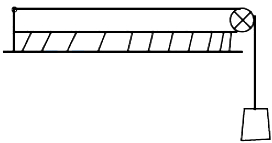
As shown in the figure, a block of mass $9 \, kg$ is hung by a wire of area of cross-section $1 \, mm^2$ in a lift going up with an acceleration of $2 \, ms^{-2}$. If the speed of the transverse wave on the wire is $120 \, ms^{-1}$, the density of the material of the wire is (Acceleration due to gravity $= 10 \, ms^{-2}$)
A
$1.5 \, g \, cm^{-3}$
B
$3.5 \, g \, cm^{-3}$
C
$5.5 \, g \, cm^{-3}$
D
$7.5 \, g \, cm^{-3}$
Solution
(D) The tension $T$ in the wire when the lift is accelerating upwards is given by $T = m(g + a)$.
Given $m = 9 \, kg$, $g = 10 \, ms^{-2}$, and $a = 2 \, ms^{-2}$, we have $T = 9(10 + 2) = 9 \times 12 = 108 \, N$.
The speed of a transverse wave on a wire is given by $v = \sqrt{\frac{T}{\mu}}$, where $\mu$ is the linear mass density.
We know $\mu = \rho A$, where $\rho$ is the density of the material and $A$ is the cross-sectional area.
Given $v = 120 \, ms^{-1}$ and $A = 1 \, mm^2 = 10^{-6} \, m^2$, we have $v^2 = \frac{T}{\rho A}$.
Rearranging for $\rho$, we get $\rho = \frac{T}{v^2 A} = \frac{108}{(120)^2 \times 10^{-6}} = \frac{108}{14400 \times 10^{-6}} = \frac{108}{0.0144} = 7500 \, kg \, m^{-3}$.
Converting to $g \, cm^{-3}$, $\rho = 7500 \times 10^{-3} \, g \, cm^{-3} = 7.5 \, g \, cm^{-3}$.
Thus, the correct option is $D$.
Given $m = 9 \, kg$, $g = 10 \, ms^{-2}$, and $a = 2 \, ms^{-2}$, we have $T = 9(10 + 2) = 9 \times 12 = 108 \, N$.
The speed of a transverse wave on a wire is given by $v = \sqrt{\frac{T}{\mu}}$, where $\mu$ is the linear mass density.
We know $\mu = \rho A$, where $\rho$ is the density of the material and $A$ is the cross-sectional area.
Given $v = 120 \, ms^{-1}$ and $A = 1 \, mm^2 = 10^{-6} \, m^2$, we have $v^2 = \frac{T}{\rho A}$.
Rearranging for $\rho$, we get $\rho = \frac{T}{v^2 A} = \frac{108}{(120)^2 \times 10^{-6}} = \frac{108}{14400 \times 10^{-6}} = \frac{108}{0.0144} = 7500 \, kg \, m^{-3}$.
Converting to $g \, cm^{-3}$, $\rho = 7500 \times 10^{-3} \, g \, cm^{-3} = 7.5 \, g \, cm^{-3}$.
Thus, the correct option is $D$.
0 likes
View Solution92
MediumMCQ
$A$ string of length $1 \,m$ and mass $490 \,g$ is put under a tension of $25 \,N$. $A$ wave of frequency $120 \,Hz$ is sent along it. The speed of this wave is (in $\,m/s$)
A
$7.14$
B
$0.71$
C
$0.51$
D
$51.0$
Solution
(A) The speed of a transverse wave on a stretched string is given by the formula $v = \sqrt{\frac{T}{\mu}}$, where $T$ is the tension and $\mu$ is the linear mass density.
Given:
Tension $T = 25 \,N$
Length $L = 1 \,m$
Mass $M = 490 \,g = 0.49 \,kg$
Linear mass density $\mu = \frac{M}{L} = \frac{0.49 \,kg}{1 \,m} = 0.49 \,kg/m$.
Substituting the values into the formula:
$v = \sqrt{\frac{25}{0.49}} = \sqrt{\frac{2500}{49}} = \frac{50}{7} \approx 7.14 \,m/s$.
Given:
Tension $T = 25 \,N$
Length $L = 1 \,m$
Mass $M = 490 \,g = 0.49 \,kg$
Linear mass density $\mu = \frac{M}{L} = \frac{0.49 \,kg}{1 \,m} = 0.49 \,kg/m$.
Substituting the values into the formula:
$v = \sqrt{\frac{25}{0.49}} = \sqrt{\frac{2500}{49}} = \frac{50}{7} \approx 7.14 \,m/s$.
0 likes
View Solution93
DifficultMCQ
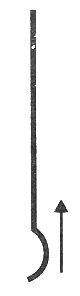
$A$ heavy uniform rope is suspended vertically from a ceiling and is in equilibrium. $A$ pulse is generated at the bottom end of the rope as shown. As the pulse travels up the rope,its acceleration at any instant is ($g$ is acceleration due to gravity).
A
Constant and equal to $\frac{g}{2}$
B
Variable but equal to $\frac{g}{2}$ when the pulse is exactly at the middle of the string
C
Constant and equal to $g$
D
Variable but equal to $g$ when the pulse is exactly at the middle of the string.
Solution
(A) Let the total mass of the rope be $M$ and its length be $L$. Let $\mu = \frac{M}{L}$ be the mass per unit length.
Consider the pulse at a distance $x$ from the bottom end of the rope.
The tension $T$ at a distance $x$ from the bottom is equal to the weight of the rope segment of length $x$ below that point: $T = \mu x g$.
The speed of the pulse $v$ is given by $v = \sqrt{\frac{T}{\mu}} = \sqrt{\frac{\mu x g}{\mu}} = \sqrt{xg}$.
The acceleration of the pulse is $a = \frac{dv}{dt} = \frac{dv}{dx} \cdot \frac{dx}{dt}$.
Since $v = \sqrt{xg}$,we have $\frac{dv}{dx} = \frac{1}{2\sqrt{x}} \sqrt{g}$.
Also,$\frac{dx}{dt} = v = \sqrt{xg}$.
Therefore,$a = \left( \frac{1}{2\sqrt{x}} \sqrt{g} \right) \cdot \sqrt{xg} = \frac{1}{2} \sqrt{g} \cdot \sqrt{g} = \frac{g}{2}$.
Since the acceleration $a = \frac{g}{2}$ is independent of $x$,the acceleration of the pulse is constant throughout its motion.
Consider the pulse at a distance $x$ from the bottom end of the rope.
The tension $T$ at a distance $x$ from the bottom is equal to the weight of the rope segment of length $x$ below that point: $T = \mu x g$.
The speed of the pulse $v$ is given by $v = \sqrt{\frac{T}{\mu}} = \sqrt{\frac{\mu x g}{\mu}} = \sqrt{xg}$.
The acceleration of the pulse is $a = \frac{dv}{dt} = \frac{dv}{dx} \cdot \frac{dx}{dt}$.
Since $v = \sqrt{xg}$,we have $\frac{dv}{dx} = \frac{1}{2\sqrt{x}} \sqrt{g}$.
Also,$\frac{dx}{dt} = v = \sqrt{xg}$.
Therefore,$a = \left( \frac{1}{2\sqrt{x}} \sqrt{g} \right) \cdot \sqrt{xg} = \frac{1}{2} \sqrt{g} \cdot \sqrt{g} = \frac{g}{2}$.
Since the acceleration $a = \frac{g}{2}$ is independent of $x$,the acceleration of the pulse is constant throughout its motion.
0 likes
View Solution94
MediumMCQ
The equation of a transverse wave propagating on a stretched string is given by $y = 3 \sin (4x + 200t)$,where $x$ and $y$ are in metres and the time $t$ is in seconds. If the tension applied to the string is $500 \ N$,the linear density of the string is: (in $kg \ m^{-1}$)
A
$0.25$
B
$0.4$
C
$0.2$
D
$0.1$
Solution
(C) The standard equation of a transverse wave is $y = A \sin(kx + \omega t)$.
Comparing this with the given equation $y = 3 \sin(4x + 200t)$,we get:
Wave number $k = 4 \ m^{-1}$
Angular frequency $\omega = 200 \ rad \ s^{-1}$
The wave speed $v$ is given by $v = \frac{\omega}{k} = \frac{200}{4} = 50 \ m/s$.
The speed of a transverse wave on a stretched string is also given by $v = \sqrt{\frac{T}{\mu}}$,where $T$ is the tension and $\mu$ is the linear mass density.
Squaring both sides,we get $v^2 = \frac{T}{\mu}$,which implies $\mu = \frac{T}{v^2}$.
Substituting the given values $T = 500 \ N$ and $v = 50 \ m/s$:
$\mu = \frac{500}{(50)^2} = \frac{500}{2500} = \frac{1}{5} = 0.2 \ kg \ m^{-1}$.
Thus,the linear density of the string is $0.2 \ kg \ m^{-1}$.
Comparing this with the given equation $y = 3 \sin(4x + 200t)$,we get:
Wave number $k = 4 \ m^{-1}$
Angular frequency $\omega = 200 \ rad \ s^{-1}$
The wave speed $v$ is given by $v = \frac{\omega}{k} = \frac{200}{4} = 50 \ m/s$.
The speed of a transverse wave on a stretched string is also given by $v = \sqrt{\frac{T}{\mu}}$,where $T$ is the tension and $\mu$ is the linear mass density.
Squaring both sides,we get $v^2 = \frac{T}{\mu}$,which implies $\mu = \frac{T}{v^2}$.
Substituting the given values $T = 500 \ N$ and $v = 50 \ m/s$:
$\mu = \frac{500}{(50)^2} = \frac{500}{2500} = \frac{1}{5} = 0.2 \ kg \ m^{-1}$.
Thus,the linear density of the string is $0.2 \ kg \ m^{-1}$.
0 likes
View Solution95
DifficultMCQ
The speed of a transverse wave in a stretched string '$A$' is '$v$'. Another string '$B$' of the same length and same radius is subjected to the same tension. If the density of the material of the string '$B$' is $2\%$ more than that of '$A$',then the speed of the transverse wave in string '$B$' is
A
$\sqrt{1.04} v$
B
$\sqrt{1.02} v$
C
$\frac{v}{\sqrt{1.04}}$
D
$\frac{v}{\sqrt{1.02}}$
Solution
(D) The speed of a transverse wave in a stretched string is given by the formula $v = \sqrt{\frac{T}{\mu}}$,where $T$ is the tension and $\mu$ is the linear mass density.
Since $\mu = \text{Area} \times \text{density} = (\pi r^2) \rho$,the speed becomes $v = \sqrt{\frac{T}{\pi r^2 \rho}}$.
Given that the tension $T$ and radius $r$ are the same for both strings,we have $v \propto \frac{1}{\sqrt{\rho}}$.
Let $\rho_A = \rho$. Then $\rho_B = \rho + 0.02\rho = 1.02\rho$.
The speed in string '$B$' is $v_B = \sqrt{\frac{T}{\pi r^2 (1.02\rho)}} = \frac{1}{\sqrt{1.02}} \sqrt{\frac{T}{\pi r^2 \rho}}$.
Therefore,$v_B = \frac{v}{\sqrt{1.02}}$.
Since $\mu = \text{Area} \times \text{density} = (\pi r^2) \rho$,the speed becomes $v = \sqrt{\frac{T}{\pi r^2 \rho}}$.
Given that the tension $T$ and radius $r$ are the same for both strings,we have $v \propto \frac{1}{\sqrt{\rho}}$.
Let $\rho_A = \rho$. Then $\rho_B = \rho + 0.02\rho = 1.02\rho$.
The speed in string '$B$' is $v_B = \sqrt{\frac{T}{\pi r^2 (1.02\rho)}} = \frac{1}{\sqrt{1.02}} \sqrt{\frac{T}{\pi r^2 \rho}}$.
Therefore,$v_B = \frac{v}{\sqrt{1.02}}$.
0 likes
View Solution96
DifficultMCQ
$A$ uniform rope of mass $0.1 \,kg$ and length $2.45 \,m$ hangs from a rigid support. The time taken by a transverse wave formed in the rope to travel through the full length of the rope is (Assume $g = 9.8 \,m/s^2$). (in $\,s$)
A
$0.5$
B
$1.6$
C
$1.2$
D
$1.0$
Solution
(D) The velocity of a transverse wave in a rope at a distance $x$ from the free end is given by $v = \sqrt{gx}$.
Since $v = \frac{dx}{dt}$, we have $\frac{dx}{dt} = \sqrt{gx}$.
Rearranging the terms, we get $dt = \frac{dx}{\sqrt{gx}}$.
Integrating from $x = 0$ to $x = l$, the total time $t$ is:
$t = \int_{0}^{l} \frac{dx}{\sqrt{gx}} = \frac{1}{\sqrt{g}} [2\sqrt{x}]_{0}^{l} = 2\sqrt{\frac{l}{g}}$.
Substituting the given values $l = 2.45 \,m$ and $g = 9.8 \,m/s^2$:
$t = 2 \sqrt{\frac{2.45}{9.8}} = 2 \sqrt{\frac{1}{4}} = 2 \times 0.5 = 1 \,s$.
Since $v = \frac{dx}{dt}$, we have $\frac{dx}{dt} = \sqrt{gx}$.
Rearranging the terms, we get $dt = \frac{dx}{\sqrt{gx}}$.
Integrating from $x = 0$ to $x = l$, the total time $t$ is:
$t = \int_{0}^{l} \frac{dx}{\sqrt{gx}} = \frac{1}{\sqrt{g}} [2\sqrt{x}]_{0}^{l} = 2\sqrt{\frac{l}{g}}$.
Substituting the given values $l = 2.45 \,m$ and $g = 9.8 \,m/s^2$:
$t = 2 \sqrt{\frac{2.45}{9.8}} = 2 \sqrt{\frac{1}{4}} = 2 \times 0.5 = 1 \,s$.
0 likes
View Solution97
DifficultMCQ
$A$ transverse wave propagating on a stretched string of linear density $3 \times 10^{-4} \ kg \ m^{-1}$ is represented by the equation $y = 0.2 \sin (1.5 x + 60 t)$,where $x$ is in metres and $t$ is in seconds. The tension in the string (in newton) is
A
$0.24$
B
$0.48$
C
$1.2$
D
$1.8$
Solution
(B) The given equation of the wave is $y = 0.2 \sin (1.5 x + 60 t)$.
Comparing this with the standard wave equation $y = A \sin (kx + \omega t)$,we get:
Wave number $k = 1.5 \ m^{-1}$ and angular frequency $\omega = 60 \ rad \ s^{-1}$.
The velocity of the wave is given by $v = \frac{\omega}{k} = \frac{60}{1.5} = 40 \ m \ s^{-1}$.
The velocity of a transverse wave in a stretched string is given by $v = \sqrt{\frac{T}{\mu}}$,where $T$ is the tension and $\mu$ is the linear mass density.
Given $\mu = 3 \times 10^{-4} \ kg \ m^{-1}$.
Rearranging for tension $T$: $T = v^2 \mu$.
Substituting the values: $T = (40)^2 \times (3 \times 10^{-4}) = 1600 \times 3 \times 10^{-4} = 4800 \times 10^{-4} = 0.48 \ N$.
Comparing this with the standard wave equation $y = A \sin (kx + \omega t)$,we get:
Wave number $k = 1.5 \ m^{-1}$ and angular frequency $\omega = 60 \ rad \ s^{-1}$.
The velocity of the wave is given by $v = \frac{\omega}{k} = \frac{60}{1.5} = 40 \ m \ s^{-1}$.
The velocity of a transverse wave in a stretched string is given by $v = \sqrt{\frac{T}{\mu}}$,where $T$ is the tension and $\mu$ is the linear mass density.
Given $\mu = 3 \times 10^{-4} \ kg \ m^{-1}$.
Rearranging for tension $T$: $T = v^2 \mu$.
Substituting the values: $T = (40)^2 \times (3 \times 10^{-4}) = 1600 \times 3 \times 10^{-4} = 4800 \times 10^{-4} = 0.48 \ N$.
0 likes
View Solution98
EasyMCQ
$A$ wire of length $50 \ cm$ and weighing $10 \ g$ is attached to a spring at one end and to a fixed wall at the other end. The spring has a spring constant of $50 \ N/m$ and is stretched by $1 \ cm$. If a wave pulse is produced on the string near the wall,then how much time will it take to reach the spring (in $s$)?
A
$0.1$
B
$0.2$
C
$0.3$
D
$0.4$
Solution
(A) The tension $T$ in the wire is provided by the spring: $T = kx = 50 \ N/m \times 0.01 \ m = 0.5 \ N$.
The mass per unit length $\mu$ of the wire is calculated as: $\mu = \frac{m}{l} = \frac{10 \times 10^{-3} \ kg}{0.5 \ m} = 0.02 \ kg/m$.
The speed $v$ of the wave pulse on the string is given by: $v = \sqrt{\frac{T}{\mu}} = \sqrt{\frac{0.5}{0.02}} = \sqrt{25} = 5 \ m/s$.
The time $t$ taken by the pulse to travel the length of the wire is: $t = \frac{l}{v} = \frac{0.5 \ m}{5 \ m/s} = 0.1 \ s$.
The mass per unit length $\mu$ of the wire is calculated as: $\mu = \frac{m}{l} = \frac{10 \times 10^{-3} \ kg}{0.5 \ m} = 0.02 \ kg/m$.
The speed $v$ of the wave pulse on the string is given by: $v = \sqrt{\frac{T}{\mu}} = \sqrt{\frac{0.5}{0.02}} = \sqrt{25} = 5 \ m/s$.
The time $t$ taken by the pulse to travel the length of the wire is: $t = \frac{l}{v} = \frac{0.5 \ m}{5 \ m/s} = 0.1 \ s$.
0 likes
View SolutionWaves and Sound — Speed of Mechanical Wave on String (Transverse wave) · Frequently Asked Questions
1Are these Waves and Sound questions useful for JEE and NEET?
Yes. All questions in this section are mapped to JEE Main and NEET exam patterns. Previous year questions from JEE Main, NEET, GUJCET and state-level exams are included with full solutions.
2Can I switch to Hindi or Gujarati for these questions?
Yes. Use the language tabs in the hero section or the sidebar to view the same questions and solutions in English, Hindi or Gujarati.
3How do I generate a question paper from this subtopic?
Use the Vedclass Exam Paper Generator — select the chapter and subtopic, set difficulty, and generate Sets A, B, C, D automatically. First 3 chapters of every subject are free.
Vedclass Products
For Students
Vedclass Test Series
Mock tests in real JEE/NEET style with performance analysis. 5-day free trial.
Start Free TrialFor Teachers
Exam Paper Generator
Generate Set A/B/C/D papers from this chapter in 2 minutes. 3 chapters free.
Try FreeFor Institutes
Online Exam Module
Live online exams with unlimited students, 360° analytics & white-label branding.
See DemoFor Teachers & Institutes
Generate a Waves and Sound Exam Paper in 2 Minutes
Select subtopic & difficulty — Sets A, B, C, D auto-generated with No Repeat logic.
First 3 chapters of every subject are free — no payment required.