
A English
Stationary Waves (Standing wave) Questions in English
Class 11 Physics · Waves and Sound · Stationary Waves (Standing wave)
189+
Questions
English
Language
100%
With Solutions
Showing 44 of 189 questions in English
1
EasyMCQ
$A$ wave is reflected from a rigid support. The change in phase on reflection will be
A
$\pi /4$
B
$\pi /2$
C
$\pi$
D
$2\pi$
Solution
(C) When a wave is reflected from a rigid boundary (or fixed end),the reflected wave undergoes a phase change of $\pi$ radians.
This occurs because the rigid boundary exerts an equal and opposite force on the string,resulting in the inversion of the wave pulse.
Therefore,the phase change is $\pi$.
This occurs because the rigid boundary exerts an equal and opposite force on the string,resulting in the inversion of the wave pulse.
Therefore,the phase change is $\pi$.
0 likes
View Solution2
EasyMCQ
$A$ pulse or a wave train travels along a stretched string and reaches the fixed end of the string. It will be reflected back with
A
The same phase as the incident pulse but with velocity reversed
B
$A$ phase change of $180^o$ with no reversal of velocity
C
The same phase as the incident pulse with no reversal of velocity
D
$A$ phase change of $180^o$ with velocity reversed
Solution
(D) When a wave pulse traveling along a stretched string reaches a fixed end,the fixed end acts as a rigid boundary or a denser medium.
According to the laws of reflection,when a wave is reflected from a fixed boundary,it undergoes a phase change of $\pi$ radians (or $180^o$).
Since the wave is now traveling in the opposite direction,its velocity vector is also reversed.
Therefore,the reflected pulse has a phase change of $180^o$ and its velocity is reversed.
According to the laws of reflection,when a wave is reflected from a fixed boundary,it undergoes a phase change of $\pi$ radians (or $180^o$).
Since the wave is now traveling in the opposite direction,its velocity vector is also reversed.
Therefore,the reflected pulse has a phase change of $180^o$ and its velocity is reversed.
0 likes
View Solution3
MediumMCQ
$A$ sound source of frequency $170 \, Hz$ is placed near a wall. $A$ man walking from the source towards the wall finds that there is a periodic rise and fall of sound intensity. If the speed of sound in air is $340 \, m/s$,the distance (in metres) separating the two adjacent positions of minimum intensity is
A
$0.5$
B
$1$
C
$1.5$
D
$2$
Solution
(B) The sound source and its reflection from the wall create a stationary wave pattern due to interference.
Given frequency $f = 170 \, Hz$ and speed of sound $v = 340 \, m/s$.
The wavelength $\lambda$ is given by $\lambda = \frac{v}{f} = \frac{340}{170} = 2 \, m$.
Positions of minimum intensity (nodes) in a stationary wave are separated by a distance of $\frac{\lambda}{2}$.
Therefore,the distance between two adjacent positions of minimum intensity is $\frac{\lambda}{2} = \frac{2}{2} = 1 \, m$.
Given frequency $f = 170 \, Hz$ and speed of sound $v = 340 \, m/s$.
The wavelength $\lambda$ is given by $\lambda = \frac{v}{f} = \frac{340}{170} = 2 \, m$.
Positions of minimum intensity (nodes) in a stationary wave are separated by a distance of $\frac{\lambda}{2}$.
Therefore,the distance between two adjacent positions of minimum intensity is $\frac{\lambda}{2} = \frac{2}{2} = 1 \, m$.
0 likes
View Solution4
EasyMCQ
The distance between the nearest node and antinode in a stationary wave is
A
$\lambda$
B
$\frac{\lambda}{2}$
C
$\frac{\lambda}{4}$
D
$2\lambda$
Solution
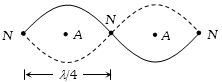
(C) In a stationary wave,the points of minimum displacement are called nodes $(N)$,and the points of maximum displacement are called antinodes $(A)$.
The distance between two consecutive nodes is $\frac{\lambda}{2}$.
The distance between two consecutive antinodes is $\frac{\lambda}{2}$.
The distance between a node and its nearest antinode is half the distance between two consecutive nodes,which is $\frac{1}{2} \times \frac{\lambda}{2} = \frac{\lambda}{4}$.
The distance between two consecutive nodes is $\frac{\lambda}{2}$.
The distance between two consecutive antinodes is $\frac{\lambda}{2}$.
The distance between a node and its nearest antinode is half the distance between two consecutive nodes,which is $\frac{1}{2} \times \frac{\lambda}{2} = \frac{\lambda}{4}$.
0 likes
View Solution5
EasyMCQ
In a stationary wave,which of the following statements is correct regarding strain?
A
Strain is minimum at nodes.
B
Strain is maximum at antinodes.
C
Strain is maximum at nodes.
D
Amplitude is zero at all the points.
Solution
(C) In a stationary wave,nodes are points where the displacement of particles is always zero. Because the displacement gradient (which is related to strain) is highest at these points,the pressure variation and strain are maximum at the nodes. Conversely,at antinodes,the displacement is maximum,but the strain is minimum.
0 likes
View Solution6
EasyMCQ
The phase difference between the two particles situated on both the sides of a node in a stationary wave is ... $^o$.
A
$0$
B
$90$
C
$180$
D
$360$
Solution
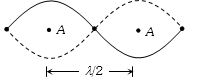
(C) In a stationary wave,all particles in a single loop vibrate in phase with each other.
Particles located in adjacent loops are separated by a node.
When two particles are situated on opposite sides of a node,they vibrate in opposite phases.
Therefore,the phase difference between them is $\pi \text{ radians}$,which is equivalent to $180^o$.
Particles located in adjacent loops are separated by a node.
When two particles are situated on opposite sides of a node,they vibrate in opposite phases.
Therefore,the phase difference between them is $\pi \text{ radians}$,which is equivalent to $180^o$.
0 likes
View Solution7
MediumMCQ
Which property distinguishes between progressive and stationary waves?
A
Amplitude
B
Frequency
C
Propagation of energy
D
Phase of the wave
Solution
(C) The correct answer is $C$.
In a progressive wave,energy is continuously transported from one point to another in the medium as the wave travels.
In contrast,a stationary (or standing) wave is formed by the superposition of two identical waves traveling in opposite directions,resulting in no net transport of energy across any point in the medium.
In a progressive wave,energy is continuously transported from one point to another in the medium as the wave travels.
In contrast,a stationary (or standing) wave is formed by the superposition of two identical waves traveling in opposite directions,resulting in no net transport of energy across any point in the medium.
0 likes
View Solution8
EasyMCQ
Stationary waves are formed when
A
Two waves of equal amplitude and equal frequency travel along the same path in opposite directions
B
Two waves of equal wavelength and equal amplitude travel along the same path with equal speeds in opposite directions
C
Two waves of equal wavelength and equal phase travel along the same path with equal speed
D
Two waves of equal amplitude and equal speed travel along the same path in opposite direction
Solution
(B) Stationary waves (also known as standing waves) are formed by the superposition of two waves of the same frequency (or wavelength) and same amplitude traveling in opposite directions along the same path.
Since $v = f \lambda$, if the frequency and wavelength are the same, the speeds are also the same.
Therefore, the condition is that two waves of equal wavelength, equal amplitude, and equal speed travel along the same path in opposite directions.
Thus, option $B$ is the correct answer.
Since $v = f \lambda$, if the frequency and wavelength are the same, the speeds are also the same.
Therefore, the condition is that two waves of equal wavelength, equal amplitude, and equal speed travel along the same path in opposite directions.
Thus, option $B$ is the correct answer.
0 likes
View Solution9
MediumMCQ
The equation of a stationary wave along a stretched string is given by $y = 5 \sin \frac{\pi x}{3} \cos 40\pi t$,where $x$ and $y$ are in $cm$ and $t$ is in seconds. The separation between two adjacent nodes is..... $cm$.
A
$1.5$
B
$3$
C
$6$
D
$4$
Solution
(B) The standard equation of a stationary wave is given by $y = 2a \sin \frac{2\pi x}{\lambda} \cos \omega t$.
Comparing the given equation $y = 5 \sin \frac{\pi x}{3} \cos 40\pi t$ with the standard equation,we get the propagation constant $k = \frac{2\pi}{\lambda} = \frac{\pi}{3}$.
Solving for $\lambda$,we find $\lambda = 6 \ cm$.
The separation between two adjacent nodes in a stationary wave is given by $\frac{\lambda}{2}$.
Therefore,the separation = $\frac{6}{2} = 3 \ cm$.
Comparing the given equation $y = 5 \sin \frac{\pi x}{3} \cos 40\pi t$ with the standard equation,we get the propagation constant $k = \frac{2\pi}{\lambda} = \frac{\pi}{3}$.
Solving for $\lambda$,we find $\lambda = 6 \ cm$.
The separation between two adjacent nodes in a stationary wave is given by $\frac{\lambda}{2}$.
Therefore,the separation = $\frac{6}{2} = 3 \ cm$.
0 likes
View Solution10
EasyMCQ
The equation $\overrightarrow{\phi}(x, t) = \overrightarrow{j} \sin \left( \frac{2\pi}{\lambda} vt \right) \cos \left( \frac{2\pi}{\lambda} x \right)$ represents:
A
Transverse progressive wave
B
Longitudinal progressive wave
C
Longitudinal stationary wave
D
Transverse stationary wave
Solution
(D) The given wave equation is $\overrightarrow{\phi}(x, t) = \overrightarrow{j} \sin \left( \frac{2\pi}{\lambda} vt \right) \cos \left( \frac{2\pi}{\lambda} x \right)$.
$1$. Stationary vs Progressive: $A$ wave is stationary if it has nodes (points where the amplitude is always zero). If we set $x = \frac{(2n+1)\lambda}{4}$ for $n = 0, 1, 2, \dots$,the term $\cos \left( \frac{2\pi}{\lambda} x \right)$ becomes zero. Since these points do not depend on time $t$,the amplitude remains zero at these positions. Thus,the wave is a stationary wave.
$2$. Transverse vs Longitudinal: The displacement vector $\overrightarrow{\phi}$ is in the direction of $\overrightarrow{j}$ (the $y$-direction). The wave function depends on $x$,indicating propagation along the $x$-axis. Since the direction of vibration ($y$-axis) is perpendicular to the direction of propagation ($x$-axis),the wave is transverse.
Therefore,the equation represents a transverse stationary wave. The correct option is $(D)$.
$1$. Stationary vs Progressive: $A$ wave is stationary if it has nodes (points where the amplitude is always zero). If we set $x = \frac{(2n+1)\lambda}{4}$ for $n = 0, 1, 2, \dots$,the term $\cos \left( \frac{2\pi}{\lambda} x \right)$ becomes zero. Since these points do not depend on time $t$,the amplitude remains zero at these positions. Thus,the wave is a stationary wave.
$2$. Transverse vs Longitudinal: The displacement vector $\overrightarrow{\phi}$ is in the direction of $\overrightarrow{j}$ (the $y$-direction). The wave function depends on $x$,indicating propagation along the $x$-axis. Since the direction of vibration ($y$-axis) is perpendicular to the direction of propagation ($x$-axis),the wave is transverse.
Therefore,the equation represents a transverse stationary wave. The correct option is $(D)$.
0 likes
View Solution11
EasyMCQ
In a stationary wave,all particles are
A
At rest at the same time twice in every period of oscillation
B
At rest at the same time only once in every period of oscillation
C
Never at rest at the same time
D
Never at rest at all
Solution
(A) In a stationary wave,the displacement of any particle is given by $y = A \sin(kx) \cos(\omega t)$.
For the particles to be at rest,the velocity $v = \frac{dy}{dt} = -A \omega \sin(kx) \sin(\omega t)$ must be zero.
This condition is satisfied when $\sin(\omega t) = 0$,which occurs at $\omega t = 0, \pi, 2\pi, \dots$
Since $\omega = \frac{2\pi}{T}$,the condition $\sin(\omega t) = 0$ implies $t = 0, \frac{T}{2}, T, \dots$
Thus,all particles in the medium come to rest simultaneously twice in every period of oscillation $T$.
Therefore,option $A$ is correct.
For the particles to be at rest,the velocity $v = \frac{dy}{dt} = -A \omega \sin(kx) \sin(\omega t)$ must be zero.
This condition is satisfied when $\sin(\omega t) = 0$,which occurs at $\omega t = 0, \pi, 2\pi, \dots$
Since $\omega = \frac{2\pi}{T}$,the condition $\sin(\omega t) = 0$ implies $t = 0, \frac{T}{2}, T, \dots$
Thus,all particles in the medium come to rest simultaneously twice in every period of oscillation $T$.
Therefore,option $A$ is correct.
0 likes
View Solution12
MediumMCQ
$A$ wave represented by the equation $y = a \cos (kx - \omega t)$ is superposed with another wave to form a stationary wave such that the point $x = 0$ is a node. The equation for the other wave is:
A
$y = a \sin (kx + \omega t)$
B
$y = -a \cos (kx + \omega t)$
C
$y = -a \cos (kx - \omega t)$
D
$y = -a \sin (kx - \omega t)$
Solution
(B) stationary wave is formed by the superposition of two waves of the same frequency and amplitude traveling in opposite directions.
Given the incident wave is $y_1 = a \cos (kx - \omega t)$.
For a point $x = 0$ to be a node,the resultant displacement at $x = 0$ must be zero for all time $t$.
Let the second wave be $y_2 = a \cos (kx + \omega t + \phi)$.
The resultant wave is $y = y_1 + y_2 = a [\cos (kx - \omega t) + \cos (kx + \omega t + \phi)]$.
Using the identity $\cos A + \cos B = 2 \cos \frac{A+B}{2} \cos \frac{A-B}{2}$,we get:
$y = 2a \cos (kx + \phi/2) \cos (\omega t + \phi/2)$.
At $x = 0$,$y = 2a \cos (\phi/2) \cos (\omega t + \phi/2)$.
For this to be a node (zero displacement) for all $t$,we must have $\cos (\phi/2) = 0$,which implies $\phi/2 = \pi/2$,or $\phi = \pi$.
Substituting $\phi = \pi$ into the equation for the second wave:
$y_2 = a \cos (kx + \omega t + \pi) = -a \cos (kx + \omega t)$.
Given the incident wave is $y_1 = a \cos (kx - \omega t)$.
For a point $x = 0$ to be a node,the resultant displacement at $x = 0$ must be zero for all time $t$.
Let the second wave be $y_2 = a \cos (kx + \omega t + \phi)$.
The resultant wave is $y = y_1 + y_2 = a [\cos (kx - \omega t) + \cos (kx + \omega t + \phi)]$.
Using the identity $\cos A + \cos B = 2 \cos \frac{A+B}{2} \cos \frac{A-B}{2}$,we get:
$y = 2a \cos (kx + \phi/2) \cos (\omega t + \phi/2)$.
At $x = 0$,$y = 2a \cos (\phi/2) \cos (\omega t + \phi/2)$.
For this to be a node (zero displacement) for all $t$,we must have $\cos (\phi/2) = 0$,which implies $\phi/2 = \pi/2$,or $\phi = \pi$.
Substituting $\phi = \pi$ into the equation for the second wave:
$y_2 = a \cos (kx + \omega t + \pi) = -a \cos (kx + \omega t)$.
1 likes
View Solution13
MediumMCQ
At a certain instant,a stationary transverse wave is found to have maximum kinetic energy. The appearance of the string at that instant is:
A
Sinusoidal shape with amplitude $A/3$
B
Sinusoidal shape with amplitude $A/2$
C
Sinusoidal shape with amplitude $A$
D
Straight line
Solution
(D) In a stationary wave,the total energy oscillates between kinetic and potential energy.
When the kinetic energy of the string is maximum,the potential energy is zero.
Potential energy is associated with the deformation (displacement) of the string.
Since potential energy is zero,the displacement of every particle on the string must be zero at that instant.
Therefore,all particles are passing through their mean positions simultaneously.
This results in the string appearing as a straight line along the equilibrium axis.
When the kinetic energy of the string is maximum,the potential energy is zero.
Potential energy is associated with the deformation (displacement) of the string.
Since potential energy is zero,the displacement of every particle on the string must be zero at that instant.
Therefore,all particles are passing through their mean positions simultaneously.
This results in the string appearing as a straight line along the equilibrium axis.
0 likes
View Solution14
EasyMCQ
The equation $y = 0.15 \sin(5x) \cos(300t)$ describes a stationary wave. The wavelength of the stationary wave is .... $m$.
A
$0$
B
$1.26$
C
$2.51$
D
$0.63$
Solution
(B) The standard equation for a stationary wave is given by $y = A \sin(kx) \cos(\omega t)$.
Comparing the given equation $y = 0.15 \sin(5x) \cos(300t)$ with the standard form,we identify the wave number $k = 5 \text{ rad/m}$.
The relationship between the wave number $k$ and the wavelength $\lambda$ is $k = \frac{2\pi}{\lambda}$.
Substituting the value of $k$,we get $5 = \frac{2\pi}{\lambda}$.
Therefore,$\lambda = \frac{2\pi}{5} = \frac{2 \times 3.14159}{5} = \frac{6.283}{5} = 1.2566 \text{ m}$.
Rounding to two decimal places,we get $\lambda \approx 1.26 \text{ m}$.
Comparing the given equation $y = 0.15 \sin(5x) \cos(300t)$ with the standard form,we identify the wave number $k = 5 \text{ rad/m}$.
The relationship between the wave number $k$ and the wavelength $\lambda$ is $k = \frac{2\pi}{\lambda}$.
Substituting the value of $k$,we get $5 = \frac{2\pi}{\lambda}$.
Therefore,$\lambda = \frac{2\pi}{5} = \frac{2 \times 3.14159}{5} = \frac{6.283}{5} = 1.2566 \text{ m}$.
Rounding to two decimal places,we get $\lambda \approx 1.26 \text{ m}$.
0 likes
View Solution15
EasyMCQ
In stationary waves,antinodes are the points where there is
A
Minimum displacement and minimum pressure change
B
Minimum displacement and maximum pressure change
C
Maximum displacement and maximum pressure change
D
Maximum displacement and minimum pressure change
Solution
(D) In a stationary wave,antinodes are the points of maximum amplitude of displacement.
At these points,the variation in pressure is minimum because the air particles move with maximum velocity and the density change is minimal.
Conversely,nodes are the points of zero displacement,where the pressure change is maximum.
Therefore,antinodes correspond to maximum displacement and minimum pressure change.
At these points,the variation in pressure is minimum because the air particles move with maximum velocity and the density change is minimal.
Conversely,nodes are the points of zero displacement,where the pressure change is maximum.
Therefore,antinodes correspond to maximum displacement and minimum pressure change.
0 likes
View Solution16
EasyMCQ
In stationary waves,all particles between two consecutive nodes pass through the mean position:
A
At different times with different velocities
B
At different times with the same velocity
C
At the same time with equal velocity
D
At the same time with different velocities
Solution
(D) In a stationary wave,all particles between two consecutive nodes oscillate with the same frequency.
Since they are in the same phase,they all reach their mean position at the same time.
However,the amplitude of vibration for each particle depends on its position $x$ relative to the nodes,given by $A(x) = A_0 \sin(kx)$.
Since the velocity of a particle in simple harmonic motion is given by $v = \omega \sqrt{A^2 - y^2}$,at the mean position $(y = 0)$,the velocity is $v = \omega A$.
Because the amplitude $A$ varies for different particles between the nodes,the maximum velocity at the mean position is different for each particle.
Therefore,all particles pass through the mean position at the same time but with different velocities.
Since they are in the same phase,they all reach their mean position at the same time.
However,the amplitude of vibration for each particle depends on its position $x$ relative to the nodes,given by $A(x) = A_0 \sin(kx)$.
Since the velocity of a particle in simple harmonic motion is given by $v = \omega \sqrt{A^2 - y^2}$,at the mean position $(y = 0)$,the velocity is $v = \omega A$.
Because the amplitude $A$ varies for different particles between the nodes,the maximum velocity at the mean position is different for each particle.
Therefore,all particles pass through the mean position at the same time but with different velocities.
0 likes
View Solution17
EasyMCQ
Standing waves can be produced:
A
On a string clamped at both ends.
B
On a string clamped at one end and free at the other.
C
When an incident wave is reflected from a wall.
D
All of the above.
Solution
(D) Standing waves are formed by the superposition of two waves of the same frequency and speed traveling in opposite directions.
$(a)$ $A$ string clamped at both ends allows for the reflection of waves at the boundaries,creating standing waves.
$(b)$ $A$ string clamped at one end and free at the other also allows for reflection,resulting in standing waves.
$(c)$ When an incident wave hits a wall,it reflects back,and the superposition of the incident and reflected waves creates standing waves.
Therefore,all the given conditions can produce standing waves. The correct option is $D$.
$(a)$ $A$ string clamped at both ends allows for the reflection of waves at the boundaries,creating standing waves.
$(b)$ $A$ string clamped at one end and free at the other also allows for reflection,resulting in standing waves.
$(c)$ When an incident wave hits a wall,it reflects back,and the superposition of the incident and reflected waves creates standing waves.
Therefore,all the given conditions can produce standing waves. The correct option is $D$.
0 likes
View Solution18
EasyMCQ
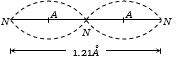
$A$ standing wave having $3$ nodes and $2$ antinodes is formed between two atoms having a distance of $1.21 \; \mathring{A}$ between them. The wavelength of the standing wave is .... $\mathring{A}$
A
$1.21$
B
$2.42$
C
$0.605$
D
$3.63$
Solution
(A) The distance between two consecutive nodes is $\frac{\lambda}{2}$.
In a standing wave with $3$ nodes and $2$ antinodes,there are $2$ loops.
The total length $L$ between the two extreme nodes is given by $L = 2 \times \frac{\lambda}{2} = \lambda$.
Given that the distance between the two atoms (which act as the extreme nodes) is $1.21 \; \mathring{A}$,we have $L = 1.21 \; \mathring{A}$.
Therefore,the wavelength $\lambda = 1.21 \; \mathring{A}$.
In a standing wave with $3$ nodes and $2$ antinodes,there are $2$ loops.
The total length $L$ between the two extreme nodes is given by $L = 2 \times \frac{\lambda}{2} = \lambda$.
Given that the distance between the two atoms (which act as the extreme nodes) is $1.21 \; \mathring{A}$,we have $L = 1.21 \; \mathring{A}$.
Therefore,the wavelength $\lambda = 1.21 \; \mathring{A}$.
0 likes
View Solution19
MediumMCQ
In stationary waves,the distance between a node and its nearest antinode is $20 \ cm$. The phase difference between two particles having a separation of $60 \ cm$ will be
A
Zero
B
$\pi / 2$
C
$\pi$
D
$3\pi / 2$
Solution
(D) In a stationary wave,the distance between a node and its nearest antinode is given by $\frac{\lambda}{4}$.
Given $\frac{\lambda}{4} = 20 \ cm$,therefore the wavelength $\lambda = 80 \ cm$.
The phase difference $\Delta \phi$ between two particles separated by a distance $\Delta x$ is given by the formula $\Delta \phi = \frac{2\pi}{\lambda} \Delta x$.
Substituting the values $\Delta x = 60 \ cm$ and $\lambda = 80 \ cm$:
$\Delta \phi = \frac{2\pi}{80} \times 60 = \frac{120\pi}{80} = \frac{3\pi}{2}$ radians.
Given $\frac{\lambda}{4} = 20 \ cm$,therefore the wavelength $\lambda = 80 \ cm$.
The phase difference $\Delta \phi$ between two particles separated by a distance $\Delta x$ is given by the formula $\Delta \phi = \frac{2\pi}{\lambda} \Delta x$.
Substituting the values $\Delta x = 60 \ cm$ and $\lambda = 80 \ cm$:
$\Delta \phi = \frac{2\pi}{80} \times 60 = \frac{120\pi}{80} = \frac{3\pi}{2}$ radians.
0 likes
View Solution20
EasyMCQ
Stationary waves of frequency $300\, Hz$ are formed in a medium in which the velocity of sound is $1200\, m/s$. The distance between a node and the neighbouring antinode is ... $m$.
A
$1$
B
$2$
C
$3$
D
$4$
Solution
(A) The velocity of the wave is given by $v = n\lambda$,where $n$ is the frequency and $\lambda$ is the wavelength.
Given $v = 1200\, m/s$ and $n = 300\, Hz$.
Calculating the wavelength: $\lambda = \frac{v}{n} = \frac{1200}{300} = 4\, m$.
The distance between a node and the adjacent antinode in a stationary wave is always $\frac{\lambda}{4}$.
Therefore,the required distance $= \frac{4\, m}{4} = 1\, m$.
Given $v = 1200\, m/s$ and $n = 300\, Hz$.
Calculating the wavelength: $\lambda = \frac{v}{n} = \frac{1200}{300} = 4\, m$.
The distance between a node and the adjacent antinode in a stationary wave is always $\frac{\lambda}{4}$.
Therefore,the required distance $= \frac{4\, m}{4} = 1\, m$.
0 likes
View Solution21
EasyMCQ
Which two of the given transverse waves will produce stationary waves when superimposed?
${z_1} = a\cos(kx - \omega t)$.....$(A)$
${z_2} = a\cos(kx + \omega t)$.....$(B)$
${z_3} = a\cos(ky - \omega t)$.....$(C)$
${z_1} = a\cos(kx - \omega t)$.....$(A)$
${z_2} = a\cos(kx + \omega t)$.....$(B)$
${z_3} = a\cos(ky - \omega t)$.....$(C)$
A
$A$ and $B$
B
$A$ and $C$
C
$B$ and $C$
D
Any two
Solution
(A) For two waves to produce a stationary wave,they must have the same frequency,same amplitude,and travel in opposite directions along the same line.
Wave $A$ $(z_1 = a\cos(kx - \omega t))$ travels in the positive $x$-direction.
Wave $B$ $(z_2 = a\cos(kx + \omega t))$ travels in the negative $x$-direction.
Both waves $A$ and $B$ have the same amplitude $a$,the same angular frequency $\omega$,and the same wave number $k$,and they propagate along the same axis ($x$-axis).
Wave $C$ $(z_3 = a\cos(ky - \omega t))$ propagates along the $y$-axis,so it cannot form a stationary wave with $A$ or $B$.
Therefore,the superposition of $A$ and $B$ results in a stationary wave: $z = z_1 + z_2 = a[\cos(kx - \omega t) + \cos(kx + \omega t)] = 2a\cos(kx)\cos(\omega t)$.
Wave $A$ $(z_1 = a\cos(kx - \omega t))$ travels in the positive $x$-direction.
Wave $B$ $(z_2 = a\cos(kx + \omega t))$ travels in the negative $x$-direction.
Both waves $A$ and $B$ have the same amplitude $a$,the same angular frequency $\omega$,and the same wave number $k$,and they propagate along the same axis ($x$-axis).
Wave $C$ $(z_3 = a\cos(ky - \omega t))$ propagates along the $y$-axis,so it cannot form a stationary wave with $A$ or $B$.
Therefore,the superposition of $A$ and $B$ results in a stationary wave: $z = z_1 + z_2 = a[\cos(kx - \omega t) + \cos(kx + \omega t)] = 2a\cos(kx)\cos(\omega t)$.
0 likes
View Solution22
EasyMCQ
$A$ standing wave is represented by $Y = A \sin(100t) \cos(0.01x)$,where $Y$ and $A$ are in millimetres,$t$ is in seconds,and $x$ is in metres. The velocity of the wave is ..... $m/s$.
A
$10000$
B
$1$
C
$10^{-4}$
D
Not derivable from above data
Solution
(A) The given equation for the standing wave is $Y = A \sin(100t) \cos(0.01x)$.
Comparing this with the standard equation of a standing wave $Y = A \sin(\omega t) \cos(kx)$,we identify the angular frequency $\omega = 100 \ rad/s$ and the wave number $k = 0.01 \ rad/m$.
The velocity of the wave $v$ is given by the ratio of angular frequency to wave number:
$v = \frac{\omega}{k} = \frac{100}{0.01} = 10000 \ m/s$.
Comparing this with the standard equation of a standing wave $Y = A \sin(\omega t) \cos(kx)$,we identify the angular frequency $\omega = 100 \ rad/s$ and the wave number $k = 0.01 \ rad/m$.
The velocity of the wave $v$ is given by the ratio of angular frequency to wave number:
$v = \frac{\omega}{k} = \frac{100}{0.01} = 10000 \ m/s$.
0 likes
View Solution23
EasyMCQ
$A$ wave of frequency $100 \, Hz$ is sent along a string towards a fixed end. When this wave travels back after reflection,a node is formed at a distance of $10 \, cm$ from the fixed end of the string. The speed of the incident (and reflected) wave is .... $m/s$.
A
$40$
B
$20$
C
$10$
D
$5$
Solution
(B) At a fixed end,a node is always formed.
Given that a node is formed at a distance of $10 \, cm$ from the fixed end,this distance represents the distance between two consecutive nodes.
The distance between two consecutive nodes is given by $\frac{\lambda}{2} = 10 \, cm$.
Therefore,the wavelength $\lambda = 20 \, cm = 0.2 \, m$.
The speed of the wave $v$ is given by the formula $v = f \lambda$,where $f = 100 \, Hz$.
$v = 100 \times 0.2 = 20 \, m/s$.
Given that a node is formed at a distance of $10 \, cm$ from the fixed end,this distance represents the distance between two consecutive nodes.
The distance between two consecutive nodes is given by $\frac{\lambda}{2} = 10 \, cm$.
Therefore,the wavelength $\lambda = 20 \, cm = 0.2 \, m$.
The speed of the wave $v$ is given by the formula $v = f \lambda$,where $f = 100 \, Hz$.
$v = 100 \times 0.2 = 20 \, m/s$.
0 likes
View Solution24
EasyMCQ
$A$ wave $y = a \cos (kx + \omega t)$ superimposes on another wave to form a stationary wave having a node at $x = 0$. What is the equation of the other wave?
A
$ - a \cos (kx + \omega t)$
B
$a \cos (kx - \omega t)$
C
$ - a \cos (kx - \omega t)$
D
$ - a \sin (kx + \omega t)$
Solution
(C) stationary wave is formed by the superposition of two waves of the same frequency and amplitude traveling in opposite directions.
Given the first wave is $y_1 = a \cos (kx + \omega t)$.
For a stationary wave to have a node at $x = 0$,the resultant displacement $y = y_1 + y_2$ must be zero at $x = 0$ for all $t$.
So,$y_1(0, t) + y_2(0, t) = 0$.
$a \cos (\omega t) + y_2(0, t) = 0$,which implies $y_2(0, t) = -a \cos (\omega t)$.
Since the waves must travel in opposite directions,if the first wave is traveling in the negative $x$-direction (as indicated by $kx + \omega t$),the second wave must travel in the positive $x$-direction,taking the form $y_2 = a' \cos (kx - \omega t + \phi)$.
At $x = 0$,$y_2(0, t) = a' \cos (- \omega t + \phi) = a' \cos (\omega t - \phi)$.
Comparing this with $-a \cos (\omega t)$,we get $a' = a$ and $\phi = \pi$.
Thus,$y_2 = a \cos (kx - \omega t + \pi) = -a \cos (kx - \omega t)$.
Given the first wave is $y_1 = a \cos (kx + \omega t)$.
For a stationary wave to have a node at $x = 0$,the resultant displacement $y = y_1 + y_2$ must be zero at $x = 0$ for all $t$.
So,$y_1(0, t) + y_2(0, t) = 0$.
$a \cos (\omega t) + y_2(0, t) = 0$,which implies $y_2(0, t) = -a \cos (\omega t)$.
Since the waves must travel in opposite directions,if the first wave is traveling in the negative $x$-direction (as indicated by $kx + \omega t$),the second wave must travel in the positive $x$-direction,taking the form $y_2 = a' \cos (kx - \omega t + \phi)$.
At $x = 0$,$y_2(0, t) = a' \cos (- \omega t + \phi) = a' \cos (\omega t - \phi)$.
Comparing this with $-a \cos (\omega t)$,we get $a' = a$ and $\phi = \pi$.
Thus,$y_2 = a \cos (kx - \omega t + \pi) = -a \cos (kx - \omega t)$.
0 likes
View Solution25
EasyMCQ
Two waves are approaching each other with a velocity of $20 \ m/s$ and frequency $n$. The distance between two consecutive nodes is
A
$20/n$
B
$10/n$
C
$5/n$
D
$n/10$
Solution
(B) The distance between two consecutive nodes in a stationary wave is given by $\frac{\lambda}{2}$.
Given the velocity $v = 20 \ m/s$ and frequency $f = n$.
The wavelength $\lambda$ is calculated as $\lambda = \frac{v}{f} = \frac{20}{n}$.
Therefore,the distance between two consecutive nodes is $\frac{\lambda}{2} = \frac{1}{2} \times \frac{20}{n} = \frac{10}{n}$.
Given the velocity $v = 20 \ m/s$ and frequency $f = n$.
The wavelength $\lambda$ is calculated as $\lambda = \frac{v}{f} = \frac{20}{n}$.
Therefore,the distance between two consecutive nodes is $\frac{\lambda}{2} = \frac{1}{2} \times \frac{20}{n} = \frac{10}{n}$.
0 likes
View Solution26
EasyMCQ
Energy is not carried by which of the following waves?
A
Stationary
B
Progressive
C
Transverse
D
Electromagnetic
Solution
(A) stationary wave (also known as a standing wave) is formed by the superposition of two identical waves traveling in opposite directions.
In a stationary wave,the energy is trapped between the nodes and does not propagate through the medium.
While the energy oscillates between kinetic and potential forms at different points,there is no net transport of energy across the medium.
In contrast,progressive waves,transverse waves,and electromagnetic waves are all characterized by the transport of energy from one point to another.
Therefore,the correct answer is $A$.
In a stationary wave,the energy is trapped between the nodes and does not propagate through the medium.
While the energy oscillates between kinetic and potential forms at different points,there is no net transport of energy across the medium.
In contrast,progressive waves,transverse waves,and electromagnetic waves are all characterized by the transport of energy from one point to another.
Therefore,the correct answer is $A$.
0 likes
View Solution27
EasyMCQ
The stationary wave produced on a string is represented by the equation $y = 5 \cos (\pi x / 3) \sin (40 \pi t)$. Where $x$ and $y$ are in $cm$ and $t$ is in seconds. The distance between consecutive nodes is .... $cm$.
A
$5$
B
$\pi$
C
$3$
D
$40$
Solution
(C) The standard equation for a stationary wave is given by $y = A \cos(kx) \sin(\omega t)$.
Comparing the given equation $y = 5 \cos(\pi x / 3) \sin(40 \pi t)$ with the standard equation,we get the wave number $k = \pi / 3$.
We know that $k = 2\pi / \lambda$,where $\lambda$ is the wavelength.
Substituting the value of $k$: $\pi / 3 = 2\pi / \lambda$.
Solving for $\lambda$,we get $\lambda = 6 \, cm$.
The distance between two consecutive nodes in a stationary wave is given by $\lambda / 2$.
Therefore,the distance = $6 / 2 = 3 \, cm$.
Comparing the given equation $y = 5 \cos(\pi x / 3) \sin(40 \pi t)$ with the standard equation,we get the wave number $k = \pi / 3$.
We know that $k = 2\pi / \lambda$,where $\lambda$ is the wavelength.
Substituting the value of $k$: $\pi / 3 = 2\pi / \lambda$.
Solving for $\lambda$,we get $\lambda = 6 \, cm$.
The distance between two consecutive nodes in a stationary wave is given by $\lambda / 2$.
Therefore,the distance = $6 / 2 = 3 \, cm$.
0 likes
View Solution28
EasyMCQ
Two sinusoidal waves with same wavelengths and amplitudes travel in opposite directions along a string with a speed $10 \, ms^{-1}$. If the minimum time interval between two instants when the string is flat is $0.5 \, s$,the wavelength of the waves is .... $m$
A
$25$
B
$20$
C
$15$
D
$10$
Solution
(D) When two sinusoidal waves of the same frequency and amplitude travel in opposite directions,they form a stationary wave.
In a stationary wave,the string becomes flat (all particles pass through their mean position) twice in one time period $T$.
Therefore,the time interval between two consecutive instants when the string is flat is given by $\frac{T}{2}$.
Given,$\frac{T}{2} = 0.5 \, s$,which implies $T = 1.0 \, s$.
The relationship between wavelength $\lambda$,wave speed $v$,and time period $T$ is $\lambda = v \times T$.
Substituting the given values,$\lambda = 10 \, ms^{-1} \times 1.0 \, s = 10 \, m$.
In a stationary wave,the string becomes flat (all particles pass through their mean position) twice in one time period $T$.
Therefore,the time interval between two consecutive instants when the string is flat is given by $\frac{T}{2}$.
Given,$\frac{T}{2} = 0.5 \, s$,which implies $T = 1.0 \, s$.
The relationship between wavelength $\lambda$,wave speed $v$,and time period $T$ is $\lambda = v \times T$.
Substituting the given values,$\lambda = 10 \, ms^{-1} \times 1.0 \, s = 10 \, m$.
0 likes
View Solution29
EasyMCQ
“Stationary waves” are so called because in them
A
The particles of the medium are not disturbed at all
B
The particles of the medium do not execute $SHM$
C
There occurs no flow of energy along the wave
D
The interference effect can't be observed
Solution
(C) In a stationary wave (also known as a standing wave),the wave pattern does not propagate through the medium.
While individual particles of the medium perform $SHM$ with varying amplitudes,the wave itself does not transport energy from one point to another in the direction of the wave propagation.
Therefore,the net energy flow across any cross-section of the medium is zero.
This lack of energy transport is the defining characteristic that gives stationary waves their name.
Thus,the correct option is $C$.
While individual particles of the medium perform $SHM$ with varying amplitudes,the wave itself does not transport energy from one point to another in the direction of the wave propagation.
Therefore,the net energy flow across any cross-section of the medium is zero.
This lack of energy transport is the defining characteristic that gives stationary waves their name.
Thus,the correct option is $C$.
0 likes
View Solution30
EasyMCQ
Two waves are approaching each other with a velocity of $16 \ m/s$ and frequency $n$. The distance between two consecutive nodes is
A
$16/n$
B
$8/n$
C
$n/16$
D
$n/8$
Solution
(B) The distance between two consecutive nodes in a stationary wave is given by $\lambda/2$.
Given that the velocity of the waves is $v = 16 \ m/s$ and the frequency is $n$.
The relationship between velocity,frequency,and wavelength is $v = n\lambda$,which implies $\lambda = v/n$.
Substituting the value of $\lambda$ into the expression for the distance between two nodes:
Distance $= \lambda/2 = (v/n)/2 = v/(2n)$.
Substituting $v = 16 \ m/s$:
Distance $= 16/(2n) = 8/n$.
Given that the velocity of the waves is $v = 16 \ m/s$ and the frequency is $n$.
The relationship between velocity,frequency,and wavelength is $v = n\lambda$,which implies $\lambda = v/n$.
Substituting the value of $\lambda$ into the expression for the distance between two nodes:
Distance $= \lambda/2 = (v/n)/2 = v/(2n)$.
Substituting $v = 16 \ m/s$:
Distance $= 16/(2n) = 8/n$.
0 likes
View Solution31
EasyMCQ
Which of the following statements is true regarding stationary waves?
A
They transport energy.
B
They do not transport energy.
C
They have nodes and antinodes.
D
Both $(b)$ and $(c)$.
Solution
(D) Stationary waves are formed by the superposition of two waves of the same frequency and amplitude traveling in opposite directions.
Because the waves travel in opposite directions,the net energy transport across any cross-section is zero.
Stationary waves are characterized by fixed points of zero displacement called nodes and points of maximum displacement called antinodes.
Therefore,both statements $(b)$ and $(c)$ are correct.
Because the waves travel in opposite directions,the net energy transport across any cross-section is zero.
Stationary waves are characterized by fixed points of zero displacement called nodes and points of maximum displacement called antinodes.
Therefore,both statements $(b)$ and $(c)$ are correct.
0 likes
View Solution32
EasyMCQ
In a stationary wave,all the particles:
A
On either side of a node vibrate in the same phase
B
In the region between two nodes vibrate in the same phase
C
In the region between two antinodes vibrate in the same phase
D
Of the medium vibrate in the same phase
Solution
(B) In a stationary wave,the medium is divided into segments by nodes (points of zero displacement).
All particles within a single segment (the region between two consecutive nodes) move in the same direction at any given instant and reach their extreme positions simultaneously.
Therefore,all particles in the region between two nodes vibrate in the same phase.
All particles within a single segment (the region between two consecutive nodes) move in the same direction at any given instant and reach their extreme positions simultaneously.
Therefore,all particles in the region between two nodes vibrate in the same phase.
0 likes
View Solution33
EasyMCQ
When a stationary wave is formed,what is its frequency?
A
Same as that of the individual waves
B
Twice that of the individual waves
C
Half that of the individual waves
D
None of the above
Solution
(A) stationary wave is formed by the superposition of two identical waves traveling in opposite directions.
If the incident wave is given by ${y_1} = a \sin(\omega t - kx)$ and the reflected wave is ${y_2} = a \sin(\omega t + kx)$,the resulting stationary wave is ${y} = {y_1} + {y_2} = 2a \sin(\omega t) \cos(kx)$.
In this expression,the angular frequency $\omega$ remains the same as that of the individual component waves.
Therefore,the frequency $f = \frac{\omega}{2\pi}$ of the stationary wave is the same as the frequency of the individual waves.
If the incident wave is given by ${y_1} = a \sin(\omega t - kx)$ and the reflected wave is ${y_2} = a \sin(\omega t + kx)$,the resulting stationary wave is ${y} = {y_1} + {y_2} = 2a \sin(\omega t) \cos(kx)$.
In this expression,the angular frequency $\omega$ remains the same as that of the individual component waves.
Therefore,the frequency $f = \frac{\omega}{2\pi}$ of the stationary wave is the same as the frequency of the individual waves.
0 likes
View Solution34
EasyMCQ
In stationary waves,
A
Energy is uniformly distributed
B
Energy is minimum at nodes and maximum at antinodes
C
Energy is maximum at nodes and minimum at antinodes
D
Alternating maximum and minimum energy producing at nodes and antinodes
Solution
(B) In a stationary wave,a node is a point where the amplitude always remains zero at all times,and an antinode is a point where the amplitude is maximum at all times.
Since the energy of a wave is proportional to the square of its amplitude $(E \propto A^2)$,the energy is zero at the nodes (where $A = 0$) and maximum at the antinodes (where $A$ is maximum).
Therefore,energy is minimum at nodes and maximum at antinodes.
Since the energy of a wave is proportional to the square of its amplitude $(E \propto A^2)$,the energy is zero at the nodes (where $A = 0$) and maximum at the antinodes (where $A$ is maximum).
Therefore,energy is minimum at nodes and maximum at antinodes.
0 likes
View Solution35
EasyMCQ
The equation of a stationary wave is $y = 10 \sin \left( \frac{\pi x}{4} \right) \cos (20 \pi t)$. The distance between two consecutive nodes is:
A
$4$
B
$2$
C
$1$
D
$8$
Solution
(A) The standard equation of a stationary wave is given by $y = A \sin(kx) \cos(\omega t)$.
Comparing the given equation $y = 10 \sin \left( \frac{\pi x}{4} \right) \cos(20 \pi t)$ with the standard form,we get the wave number $k = \frac{\pi}{4}$.
We know that $k = \frac{2\pi}{\lambda}$,where $\lambda$ is the wavelength.
Substituting the value of $k$: $\frac{2\pi}{\lambda} = \frac{\pi}{4}$.
Solving for $\lambda$: $\lambda = 8$.
The distance between two consecutive nodes in a stationary wave is given by $\frac{\lambda}{2}$.
Therefore,the distance $= \frac{8}{2} = 4$.
Comparing the given equation $y = 10 \sin \left( \frac{\pi x}{4} \right) \cos(20 \pi t)$ with the standard form,we get the wave number $k = \frac{\pi}{4}$.
We know that $k = \frac{2\pi}{\lambda}$,where $\lambda$ is the wavelength.
Substituting the value of $k$: $\frac{2\pi}{\lambda} = \frac{\pi}{4}$.
Solving for $\lambda$: $\lambda = 8$.
The distance between two consecutive nodes in a stationary wave is given by $\frac{\lambda}{2}$.
Therefore,the distance $= \frac{8}{2} = 4$.
0 likes
View Solution36
EasyMCQ
At nodes in stationary waves,
A
Change in pressure and density are maximum
B
Change in pressure and density are minimum
C
Strain is zero
D
Energy is minimum
Solution
(A) In a longitudinal stationary wave,nodes are points where the displacement of particles is always zero.
Because the particles do not move at these points,the compression and rarefaction are most intense here.
Consequently,the change in pressure and density is maximum at the nodes.
Conversely,at antinodes,the displacement is maximum,but the pressure and density variations are minimum.
Because the particles do not move at these points,the compression and rarefaction are most intense here.
Consequently,the change in pressure and density is maximum at the nodes.
Conversely,at antinodes,the displacement is maximum,but the pressure and density variations are minimum.
0 likes
View Solution37
MediumMCQ
Consider the three waves $z_1, z_2$ and $z_3$ as $z_1 = A \sin(kx - \omega t)$,$z_2 = A \sin(kx + \omega t)$ and $z_3 = A \sin(ky - \omega t)$. Which of the following represents a standing wave?
A
$z_1 + z_2$
B
$z_2 + z_3$
C
$z_3 + z_1$
D
$z_1 + z_2 + z_3$
Solution
(A) standing wave (or stationary wave) is formed by the superposition of two waves of the same frequency and amplitude traveling in opposite directions along the same line.
Given:
$z_1 = A \sin(kx - \omega t)$ (traveling in $+x$ direction)
$z_2 = A \sin(kx + \omega t)$ (traveling in $-x$ direction)
$z_3 = A \sin(ky - \omega t)$ (traveling in $+y$ direction)
Adding $z_1$ and $z_2$:
$z_1 + z_2 = A \sin(kx - \omega t) + A \sin(kx + \omega t)$
Using the identity $\sin(C) + \sin(D) = 2 \sin(\frac{C+D}{2}) \cos(\frac{C-D}{2})$:
$z_1 + z_2 = 2A \sin(kx) \cos(\omega t)$
This represents a standing wave because the spatial part $\sin(kx)$ and temporal part $\cos(\omega t)$ are separated.
Waves $z_3$ and $z_1$ (or $z_2$) travel in different directions ($y$ and $x$ respectively),so they do not form a standing wave along a single axis.
Given:
$z_1 = A \sin(kx - \omega t)$ (traveling in $+x$ direction)
$z_2 = A \sin(kx + \omega t)$ (traveling in $-x$ direction)
$z_3 = A \sin(ky - \omega t)$ (traveling in $+y$ direction)
Adding $z_1$ and $z_2$:
$z_1 + z_2 = A \sin(kx - \omega t) + A \sin(kx + \omega t)$
Using the identity $\sin(C) + \sin(D) = 2 \sin(\frac{C+D}{2}) \cos(\frac{C-D}{2})$:
$z_1 + z_2 = 2A \sin(kx) \cos(\omega t)$
This represents a standing wave because the spatial part $\sin(kx)$ and temporal part $\cos(\omega t)$ are separated.
Waves $z_3$ and $z_1$ (or $z_2$) travel in different directions ($y$ and $x$ respectively),so they do not form a standing wave along a single axis.
0 likes
View Solution38
MediumMCQ
The following equations represent progressive transverse waves:
$Z_1 = A \cos(\omega t - kx)$,
$Z_2 = A \cos(\omega t + kx)$,
$Z_3 = A \cos(\omega t + ky)$,
$Z_4 = A \cos(2\omega t - 2ky)$.
$A$ stationary wave will be formed by superposing:
$Z_1 = A \cos(\omega t - kx)$,
$Z_2 = A \cos(\omega t + kx)$,
$Z_3 = A \cos(\omega t + ky)$,
$Z_4 = A \cos(2\omega t - 2ky)$.
$A$ stationary wave will be formed by superposing:
A
$Z_1$ and $Z_2$
B
$Z_1$ and $Z_4$
C
$Z_2$ and $Z_3$
D
$Z_3$ and $Z_4$
Solution
(A) stationary wave is formed when two progressive waves of the same frequency and amplitude travel in opposite directions along the same line.
$1$. $Z_1 = A \cos(\omega t - kx)$ represents a wave traveling in the $+x$ direction with frequency $\omega$.
$2$. $Z_2 = A \cos(\omega t + kx)$ represents a wave traveling in the $-x$ direction with the same frequency $\omega$ and amplitude $A$.
$3$. Since $Z_1$ and $Z_2$ have the same frequency and travel in opposite directions along the same axis ($x$-axis),their superposition results in a stationary wave.
Therefore,the correct option is $A$.
$1$. $Z_1 = A \cos(\omega t - kx)$ represents a wave traveling in the $+x$ direction with frequency $\omega$.
$2$. $Z_2 = A \cos(\omega t + kx)$ represents a wave traveling in the $-x$ direction with the same frequency $\omega$ and amplitude $A$.
$3$. Since $Z_1$ and $Z_2$ have the same frequency and travel in opposite directions along the same axis ($x$-axis),their superposition results in a stationary wave.
Therefore,the correct option is $A$.
0 likes
View Solution39
EasyMCQ
Two travelling waves ${y_1} = A\sin [k(x - ct)]$ and ${y_2} = A\sin [k(x + ct)]$ are superimposed on a string. The distance between adjacent nodes is
A
$ct/\pi$
B
$ct/2\pi$
C
$\pi /2k$
D
$\pi /k$
Solution
(D) The superposition of two waves travelling in opposite directions with the same frequency and amplitude results in a stationary wave.
Using the principle of superposition,the resultant wave is $y = y_1 + y_2 = A\sin[k(x - ct)] + A\sin[k(x + ct)]$.
Using the trigonometric identity $\sin(C) + \sin(D) = 2\sin(\frac{C+D}{2})\cos(\frac{C-D}{2})$,we get:
$y = 2A\sin(kx)\cos(kct)$.
Nodes occur where the displacement is zero for all time $t$,which happens when $\sin(kx) = 0$.
This implies $kx = n\pi$,where $n = 0, 1, 2, \dots$.
The positions of the nodes are $x = \frac{n\pi}{k}$.
The distance between two adjacent nodes is the difference between consecutive positions:
$\Delta x = \frac{(n+1)\pi}{k} - \frac{n\pi}{k} = \frac{\pi}{k}$.
Alternatively,since $k = \frac{2\pi}{\lambda}$,the distance between adjacent nodes is $\frac{\lambda}{2} = \frac{\pi}{k}$.
Using the principle of superposition,the resultant wave is $y = y_1 + y_2 = A\sin[k(x - ct)] + A\sin[k(x + ct)]$.
Using the trigonometric identity $\sin(C) + \sin(D) = 2\sin(\frac{C+D}{2})\cos(\frac{C-D}{2})$,we get:
$y = 2A\sin(kx)\cos(kct)$.
Nodes occur where the displacement is zero for all time $t$,which happens when $\sin(kx) = 0$.
This implies $kx = n\pi$,where $n = 0, 1, 2, \dots$.
The positions of the nodes are $x = \frac{n\pi}{k}$.
The distance between two adjacent nodes is the difference between consecutive positions:
$\Delta x = \frac{(n+1)\pi}{k} - \frac{n\pi}{k} = \frac{\pi}{k}$.
Alternatively,since $k = \frac{2\pi}{\lambda}$,the distance between adjacent nodes is $\frac{\lambda}{2} = \frac{\pi}{k}$.
0 likes
View Solution40
MediumMCQ
$A$ string vibrates according to the equation $y = 5 \sin \left( \frac{2\pi x}{3} \right) \cos (20\pi t)$,where $x$ and $y$ are in $cm$ and $t$ is in $sec$. The distance between two adjacent nodes is .... $cm$.
A
$3$
B
$4.5$
C
$6$
D
$1.5$
Solution
(D) The given equation for the stationary wave is $y = 5 \sin \left( \frac{2\pi x}{3} \right) \cos (20\pi t)$.
Comparing this with the standard equation of a stationary wave $y = A \sin \left( \frac{2\pi x}{\lambda} \right) \cos (\omega t)$,we get $\frac{2\pi}{\lambda} = \frac{2\pi}{3}$.
Therefore,the wavelength $\lambda = 3 \ cm$.
The distance between two adjacent nodes in a stationary wave is given by $\frac{\lambda}{2}$.
Distance $= \frac{3}{2} = 1.5 \ cm$.
Comparing this with the standard equation of a stationary wave $y = A \sin \left( \frac{2\pi x}{\lambda} \right) \cos (\omega t)$,we get $\frac{2\pi}{\lambda} = \frac{2\pi}{3}$.
Therefore,the wavelength $\lambda = 3 \ cm$.
The distance between two adjacent nodes in a stationary wave is given by $\frac{\lambda}{2}$.
Distance $= \frac{3}{2} = 1.5 \ cm$.
0 likes
View Solution41
MediumMCQ
Standing waves are produced in a $10 \; m$ long stretched string. If the string vibrates in $5$ segments and the wave velocity is $20 \; m/s$,the frequency is ... $Hz$.
A
$2$
B
$4$
C
$5$
D
$10$
Solution
(C) The length of the string is $l = 10 \; m$. The number of segments is $p = 5$. The wave velocity is $v = 20 \; m/s$.
For a string vibrating in $p$ segments,the length $l$ is related to the wavelength $\lambda$ by the formula $l = p \cdot \frac{\lambda}{2}$.
Substituting the values,we get $10 = 5 \cdot \frac{\lambda}{2}$,which simplifies to $\lambda = \frac{10 \cdot 2}{5} = 4 \; m$.
The frequency $f$ is given by the relation $f = \frac{v}{\lambda}$.
Substituting the values,$f = \frac{20 \; m/s}{4 \; m} = 5 \; Hz$.
For a string vibrating in $p$ segments,the length $l$ is related to the wavelength $\lambda$ by the formula $l = p \cdot \frac{\lambda}{2}$.
Substituting the values,we get $10 = 5 \cdot \frac{\lambda}{2}$,which simplifies to $\lambda = \frac{10 \cdot 2}{5} = 4 \; m$.
The frequency $f$ is given by the relation $f = \frac{v}{\lambda}$.
Substituting the values,$f = \frac{20 \; m/s}{4 \; m} = 5 \; Hz$.
0 likes
View Solution42
EasyMCQ
The velocity of waves in a string fixed at both ends is $2 \ m/s$. The string forms standing waves with nodes $5.0 \ cm$ apart. The frequency of vibration of the string in $Hz$ is
A
$40$
B
$30$
C
$20$
D
$10$
Solution
(C) In a standing wave,the distance between two consecutive nodes is equal to $\frac{\lambda}{2}$.
Given,the distance between nodes is $5.0 \ cm = 0.05 \ m$.
Therefore,$\frac{\lambda}{2} = 0.05 \ m$,which implies $\lambda = 0.1 \ m$.
The velocity of the wave is given as $v = 2 \ m/s$.
The frequency $f$ is calculated using the relation $v = f \lambda$.
Thus,$f = \frac{v}{\lambda} = \frac{2 \ m/s}{0.1 \ m} = 20 \ Hz$.
Given,the distance between nodes is $5.0 \ cm = 0.05 \ m$.
Therefore,$\frac{\lambda}{2} = 0.05 \ m$,which implies $\lambda = 0.1 \ m$.
The velocity of the wave is given as $v = 2 \ m/s$.
The frequency $f$ is calculated using the relation $v = f \lambda$.
Thus,$f = \frac{v}{\lambda} = \frac{2 \ m/s}{0.1 \ m} = 20 \ Hz$.
0 likes
View Solution43
EasyMCQ
$A$ stretched string of length $l,$ fixed at both ends,can sustain stationary waves of wavelength $\lambda,$ given by:
A
$\lambda = \frac{n^2}{2l}$
B
$\lambda = \frac{l^2}{2n}$
C
$\lambda = \frac{2l}{n}$
D
$\lambda = 2ln$
Solution
(C) For a string of length $l$ fixed at both ends,the boundary conditions require nodes at both ends.
This means the length $l$ must be an integer multiple of half-wavelengths: $l = n \frac{\lambda}{2}$,where $n = 1, 2, 3, \dots$ is the number of loops or the harmonic number.
Rearranging this equation for the wavelength $\lambda$,we get:
$\lambda = \frac{2l}{n}$.
This means the length $l$ must be an integer multiple of half-wavelengths: $l = n \frac{\lambda}{2}$,where $n = 1, 2, 3, \dots$ is the number of loops or the harmonic number.
Rearranging this equation for the wavelength $\lambda$,we get:
$\lambda = \frac{2l}{n}$.
0 likes
View Solution44
MediumMCQ
If you set up the seventh harmonic on a string fixed at both ends,how many nodes and antinodes are set up in it?
A
$8, 7$
B
$7, 7$
C
$8, 9$
D
$9, 8$
Solution
(A) For a string fixed at both ends,the $n^{th}$ harmonic corresponds to $n$ loops.
In the $7^{th}$ harmonic,the string vibrates in $7$ loops.
Each loop consists of $1$ antinode,so the total number of antinodes is $7$.
The number of nodes in a string with $n$ loops is $n + 1$.
Therefore,the number of nodes $= 7 + 1 = 8$.
Thus,there are $8$ nodes and $7$ antinodes.
In the $7^{th}$ harmonic,the string vibrates in $7$ loops.
Each loop consists of $1$ antinode,so the total number of antinodes is $7$.
The number of nodes in a string with $n$ loops is $n + 1$.
Therefore,the number of nodes $= 7 + 1 = 8$.
Thus,there are $8$ nodes and $7$ antinodes.
0 likes
View SolutionWaves and Sound — Stationary Waves (Standing wave) · Frequently Asked Questions
1Are these Waves and Sound questions useful for JEE and NEET?
Yes. All questions in this section are mapped to JEE Main and NEET exam patterns. Previous year questions from JEE Main, NEET, GUJCET and state-level exams are included with full solutions.
2Can I switch to Hindi or Gujarati for these questions?
Yes. Use the language tabs in the hero section or the sidebar to view the same questions and solutions in English, Hindi or Gujarati.
3How do I generate a question paper from this subtopic?
Use the Vedclass Exam Paper Generator — select the chapter and subtopic, set difficulty, and generate Sets A, B, C, D automatically. First 3 chapters of every subject are free.
Vedclass Products
For Students
Vedclass Test Series
Mock tests in real JEE/NEET style with performance analysis. 5-day free trial.
Start Free TrialFor Teachers
Exam Paper Generator
Generate Set A/B/C/D papers from this chapter in 2 minutes. 3 chapters free.
Try FreeFor Institutes
Online Exam Module
Live online exams with unlimited students, 360° analytics & white-label branding.
See DemoFor Teachers & Institutes
Generate a Waves and Sound Exam Paper in 2 Minutes
Select subtopic & difficulty — Sets A, B, C, D auto-generated with No Repeat logic.
First 3 chapters of every subject are free — no payment required.