
A English
Capillary Tube and Capillarity Questions in English
Class 11 Physics · Fluid Mechanics and Surface Tension · Capillary Tube and Capillarity
204+
Questions
English
Language
100%
With Solutions
Showing 46 of 204 questions in English
151
MediumMCQ
Water rises up to height '$X$' in a capillary tube immersed vertically in water. When the whole arrangement is taken to a depth '$d$' in a mine,the water level rises up to height '$Y$'. If '$R$' is the radius of the Earth,then the ratio $\frac{Y}{X}$ is
A
$\left(1-\frac{d}{R}\right)^{-1}$
B
$\left(1-\frac{d}{R}\right)$
C
$\left(1+\frac{d}{R}\right)^{-1}$
D
$\left(1+\frac{d}{R}\right)$
Solution
(A) The rise of liquid in a capillary tube is given by the formula: $h = \frac{2T \cos \theta}{r \rho g}$.
Since $T$,$\theta$,$r$,and $\rho$ are constant,the height of the liquid column is inversely proportional to the acceleration due to gravity: $h \propto \frac{1}{g}$.
At the surface of the Earth,the height is $X = \frac{k}{g}$,where $k$ is a constant.
At a depth '$d$' in a mine,the acceleration due to gravity is given by $g_d = g \left(1 - \frac{d}{R}\right)$.
The new height is $Y = \frac{k}{g_d} = \frac{k}{g \left(1 - \frac{d}{R}\right)}$.
Therefore,the ratio $\frac{Y}{X} = \frac{k / [g(1 - d/R)]}{k/g} = \frac{1}{1 - d/R} = \left(1 - \frac{d}{R}\right)^{-1}$.
Since $T$,$\theta$,$r$,and $\rho$ are constant,the height of the liquid column is inversely proportional to the acceleration due to gravity: $h \propto \frac{1}{g}$.
At the surface of the Earth,the height is $X = \frac{k}{g}$,where $k$ is a constant.
At a depth '$d$' in a mine,the acceleration due to gravity is given by $g_d = g \left(1 - \frac{d}{R}\right)$.
The new height is $Y = \frac{k}{g_d} = \frac{k}{g \left(1 - \frac{d}{R}\right)}$.
Therefore,the ratio $\frac{Y}{X} = \frac{k / [g(1 - d/R)]}{k/g} = \frac{1}{1 - d/R} = \left(1 - \frac{d}{R}\right)^{-1}$.
0 likes
View Solution152
EasyMCQ
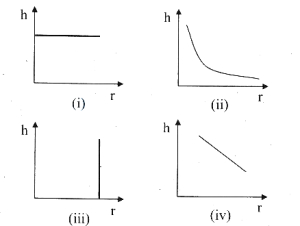
Identify the correct figure which shows the relation between the height of water column in a capillary tube and the capillary radius.
A
(ii)
B
(iv)
C
$(i)$
D
(iii)
Solution
(A) The height $h$ of a liquid column in a capillary tube is given by the formula:
$h = \frac{2T \cos \theta}{r \rho g}$
Where $T$ is the surface tension,$\theta$ is the angle of contact,$r$ is the radius of the capillary tube,$\rho$ is the density of the liquid,and $g$ is the acceleration due to gravity.
Assuming $T$,$\theta$,$\rho$,and $g$ are constants,we have:
$h \propto \frac{1}{r}$
This represents an inverse relationship,which is graphically depicted as a rectangular hyperbola.
Among the given options,graph $(ii)$ correctly shows this inverse relationship between $h$ and $r$.
$h = \frac{2T \cos \theta}{r \rho g}$
Where $T$ is the surface tension,$\theta$ is the angle of contact,$r$ is the radius of the capillary tube,$\rho$ is the density of the liquid,and $g$ is the acceleration due to gravity.
Assuming $T$,$\theta$,$\rho$,and $g$ are constants,we have:
$h \propto \frac{1}{r}$
This represents an inverse relationship,which is graphically depicted as a rectangular hyperbola.
Among the given options,graph $(ii)$ correctly shows this inverse relationship between $h$ and $r$.
0 likes
View Solution153
MediumMCQ
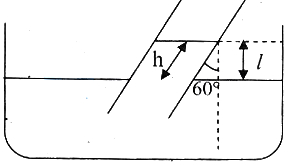
$A$ glass capillary of radius $0.35 \ mm$ is inclined at $60^{\circ}$ with the vertical in water. The length of the water column in the capillary is (surface tension of water $= 7 \times 10^{-2} \ N/m$,acceleration due to gravity $g = 10 \ m/s^2$,$\cos 0^{\circ} = 1$,$\cos 60^{\circ} = 0.5$,density of water $\rho = 10^3 \ kg/m^3$) (in $cm$)
A
$6$
B
$8$
C
$10$
D
$12$
Solution
(B) The vertical height $h$ of the water column in a capillary tube is given by the formula: $h = \frac{2T \cos \theta}{r \rho g}$.
Here,$T = 7 \times 10^{-2} \ N/m$,$r = 0.35 \ mm = 0.35 \times 10^{-3} \ m$,$\theta = 0^{\circ}$ (for glass-water contact),$\rho = 10^3 \ kg/m^3$,and $g = 10 \ m/s^2$.
Substituting the values:
$h = \frac{2 \times (7 \times 10^{-2}) \times \cos 0^{\circ}}{(0.35 \times 10^{-3}) \times 10^3 \times 10} = \frac{14 \times 10^{-2}}{3.5} = 4 \times 10^{-2} \ m = 0.04 \ m = 4 \ cm$.
When the capillary is inclined at an angle $\phi = 60^{\circ}$ with the vertical,the length $l$ of the water column along the capillary is given by $l = \frac{h}{\cos \phi}$.
$l = \frac{0.04}{\cos 60^{\circ}} = \frac{0.04}{0.5} = 0.08 \ m = 8 \ cm$.
Here,$T = 7 \times 10^{-2} \ N/m$,$r = 0.35 \ mm = 0.35 \times 10^{-3} \ m$,$\theta = 0^{\circ}$ (for glass-water contact),$\rho = 10^3 \ kg/m^3$,and $g = 10 \ m/s^2$.
Substituting the values:
$h = \frac{2 \times (7 \times 10^{-2}) \times \cos 0^{\circ}}{(0.35 \times 10^{-3}) \times 10^3 \times 10} = \frac{14 \times 10^{-2}}{3.5} = 4 \times 10^{-2} \ m = 0.04 \ m = 4 \ cm$.
When the capillary is inclined at an angle $\phi = 60^{\circ}$ with the vertical,the length $l$ of the water column along the capillary is given by $l = \frac{h}{\cos \phi}$.
$l = \frac{0.04}{\cos 60^{\circ}} = \frac{0.04}{0.5} = 0.08 \ m = 8 \ cm$.
0 likes
View Solution154
MediumMCQ
Water rises in a capillary tube of radius $r$ up to a height $h$. The mass of water in the capillary is $m$. The mass of water that will rise in a capillary of radius $r/3$ will be:
A
$m$
B
$m/3$
C
$m/6$
D
$m/9$
Solution
(B) The height of water rising in a capillary tube is given by $h = \frac{2T \cos \theta}{r \rho g}$.
For water,$\cos \theta \approx 1$,so $h \propto \frac{1}{r}$.
If the new radius is $r' = r/3$,the new height $h'$ will be $h' = \frac{h}{r/3} \cdot r = 3h$.
The mass of water in the capillary is given by $m = V \rho = (\pi r^2 h) \rho$.
For the new capillary,the mass $m'$ is $m' = \pi (r')^2 h' \rho$.
Substituting $r' = r/3$ and $h' = 3h$:
$m' = \pi (r/3)^2 (3h) \rho = \pi (r^2/9) (3h) \rho = \frac{1}{3} (\pi r^2 h \rho) = \frac{m}{3}$.
For water,$\cos \theta \approx 1$,so $h \propto \frac{1}{r}$.
If the new radius is $r' = r/3$,the new height $h'$ will be $h' = \frac{h}{r/3} \cdot r = 3h$.
The mass of water in the capillary is given by $m = V \rho = (\pi r^2 h) \rho$.
For the new capillary,the mass $m'$ is $m' = \pi (r')^2 h' \rho$.
Substituting $r' = r/3$ and $h' = 3h$:
$m' = \pi (r/3)^2 (3h) \rho = \pi (r^2/9) (3h) \rho = \frac{1}{3} (\pi r^2 h \rho) = \frac{m}{3}$.
0 likes
View Solution155
EasyMCQ
$A$ capillary tube stands with its lower end dipped into a liquid for which the angle of contact is $90^{\circ}$. The liquid will
A
neither rise nor fall.
B
get depressed only.
C
rise only.
D
rise up to the top of the tube.
Solution
(A) The height $h$ of a liquid column in a capillary tube is given by the formula:
$h = \frac{2T \cos \theta}{\rho g r}$
where $T$ is the surface tension,$\theta$ is the angle of contact,$\rho$ is the density of the liquid,$g$ is the acceleration due to gravity,and $r$ is the radius of the capillary tube.
Given that the angle of contact $\theta = 90^{\circ}$,we substitute this into the formula:
$h = \frac{2T \cos 90^{\circ}}{\rho g r}$
Since $\cos 90^{\circ} = 0$,we get:
$h = 0$
Therefore,the liquid will neither rise nor fall in the capillary tube.
$h = \frac{2T \cos \theta}{\rho g r}$
where $T$ is the surface tension,$\theta$ is the angle of contact,$\rho$ is the density of the liquid,$g$ is the acceleration due to gravity,and $r$ is the radius of the capillary tube.
Given that the angle of contact $\theta = 90^{\circ}$,we substitute this into the formula:
$h = \frac{2T \cos 90^{\circ}}{\rho g r}$
Since $\cos 90^{\circ} = 0$,we get:
$h = 0$
Therefore,the liquid will neither rise nor fall in the capillary tube.
0 likes
View Solution156
MediumMCQ
Two capillary tubes $A$ and $B$ of the same internal diameter are kept vertically in two different liquids whose densities are in the ratio $4:3$. If the surface tensions of these two liquids are in the ratio $6:5$,then the ratio of rise of liquid in capillary $A$ to that in $B$ is (assume their angles of contact are nearly equal).
A
$10:9$
B
$9:10$
C
$7:10$
D
$10:7$
Solution
(B) The height of a liquid column in a capillary tube is given by the formula: $h = \frac{2T \cos \theta}{r \rho g}$.
Given that the internal diameters are the same,the radii are equal: $r_A = r_B$.
Assuming the angles of contact are nearly equal: $\theta_A = \theta_B$.
Thus,the height $h$ is proportional to $\frac{T}{\rho}$,where $T$ is surface tension and $\rho$ is density.
Therefore,the ratio of the heights is: $\frac{h_A}{h_B} = \frac{T_A}{T_B} \times \frac{\rho_B}{\rho_A}$.
Given $\frac{\rho_A}{\rho_B} = \frac{4}{3}$ and $\frac{T_A}{T_B} = \frac{6}{5}$.
Substituting these values: $\frac{h_A}{h_B} = \frac{6}{5} \times \frac{3}{4} = \frac{18}{20} = \frac{9}{10}$.
So,the ratio is $9:10$.
Given that the internal diameters are the same,the radii are equal: $r_A = r_B$.
Assuming the angles of contact are nearly equal: $\theta_A = \theta_B$.
Thus,the height $h$ is proportional to $\frac{T}{\rho}$,where $T$ is surface tension and $\rho$ is density.
Therefore,the ratio of the heights is: $\frac{h_A}{h_B} = \frac{T_A}{T_B} \times \frac{\rho_B}{\rho_A}$.
Given $\frac{\rho_A}{\rho_B} = \frac{4}{3}$ and $\frac{T_A}{T_B} = \frac{6}{5}$.
Substituting these values: $\frac{h_A}{h_B} = \frac{6}{5} \times \frac{3}{4} = \frac{18}{20} = \frac{9}{10}$.
So,the ratio is $9:10$.
0 likes
View Solution157
MediumMCQ
The angle of contact between glass and water is $0^{\circ}$ and water rises in a glass capillary up to $6 \ cm$ (Surface tension of water is $T$). Another liquid of surface tension $2T$,angle of contact $60^{\circ}$ and relative density $2$ will rise in the same capillary up to (Given: $\cos 0^{\circ}=1, \cos 60^{\circ}=0.5$) (in $cm$)
A
$1.5$
B
$2$
C
$3$
D
$4.0$
Solution
(C) The height of liquid rise in a capillary tube is given by the formula: $h = \frac{2T \cos \theta}{r \rho g}$.
For water: $h_1 = 6 \ cm$,$\theta_1 = 0^{\circ}$,$\rho_1 = 1 \ g/cm^3$,$T_1 = T$.
$6 = \frac{2T \cos 0^{\circ}}{r \cdot 1 \cdot g} \implies 6 = \frac{2T}{rg} \implies rg = \frac{2T}{6} = \frac{T}{3}$.
For the other liquid: $T_2 = 2T$,$\theta_2 = 60^{\circ}$,$\rho_2 = 2 \ g/cm^3$.
$h_2 = \frac{2T_2 \cos \theta_2}{r \rho_2 g} = \frac{2(2T) \cos 60^{\circ}}{r \cdot 2 \cdot g} = \frac{4T \cdot 0.5}{2rg} = \frac{2T}{2rg} = \frac{T}{rg}$.
Substituting $rg = \frac{T}{3}$ into the equation for $h_2$:
$h_2 = \frac{T}{T/3} = 3 \ cm$.
For water: $h_1 = 6 \ cm$,$\theta_1 = 0^{\circ}$,$\rho_1 = 1 \ g/cm^3$,$T_1 = T$.
$6 = \frac{2T \cos 0^{\circ}}{r \cdot 1 \cdot g} \implies 6 = \frac{2T}{rg} \implies rg = \frac{2T}{6} = \frac{T}{3}$.
For the other liquid: $T_2 = 2T$,$\theta_2 = 60^{\circ}$,$\rho_2 = 2 \ g/cm^3$.
$h_2 = \frac{2T_2 \cos \theta_2}{r \rho_2 g} = \frac{2(2T) \cos 60^{\circ}}{r \cdot 2 \cdot g} = \frac{4T \cdot 0.5}{2rg} = \frac{2T}{2rg} = \frac{T}{rg}$.
Substituting $rg = \frac{T}{3}$ into the equation for $h_2$:
$h_2 = \frac{T}{T/3} = 3 \ cm$.
0 likes
View Solution158
MediumMCQ
When a capillary tube is dipped vertically in water,the rise of water in the capillary is $h$. The angle of contact is $0^{\circ}$. Now,the tube is depressed so that its length above the water surface is $\frac{h}{3}$. The new apparent angle of contact is $(\cos 0^{\circ} = 1)$.
A
$\cos ^{-1}\left(\frac{1}{2}\right)$
B
$\cos ^{-1}\left(\frac{1}{3}\right)$
C
$\cos ^{-1}\left(\frac{1}{4}\right)$
D
$\cos ^{-1}\left(\frac{1}{6}\right)$
Solution
(B) The height of water rise in a capillary tube is given by $h = \frac{2T \cos \theta}{r \rho g}$.
Since the surface tension $T$,radius $r$,density $\rho$,and acceleration due to gravity $g$ remain constant,the product $h \cos \theta$ must be constant.
Initially,$h \cos 0^{\circ} = h(1) = h$.
When the tube is depressed such that the height above the surface is $h' = \frac{h}{3}$,the new angle of contact $\theta'$ satisfies:
$h' \cos \theta' = h \cos 0^{\circ}$
$\frac{h}{3} \cos \theta' = h(1)$
$\cos \theta' = \frac{1}{3}$
$\theta' = \cos ^{-1}\left(\frac{1}{3}\right)$.
Since the surface tension $T$,radius $r$,density $\rho$,and acceleration due to gravity $g$ remain constant,the product $h \cos \theta$ must be constant.
Initially,$h \cos 0^{\circ} = h(1) = h$.
When the tube is depressed such that the height above the surface is $h' = \frac{h}{3}$,the new angle of contact $\theta'$ satisfies:
$h' \cos \theta' = h \cos 0^{\circ}$
$\frac{h}{3} \cos \theta' = h(1)$
$\cos \theta' = \frac{1}{3}$
$\theta' = \cos ^{-1}\left(\frac{1}{3}\right)$.
0 likes
View Solution159
EasyMCQ
Three liquids have the same surface tension and densities $\rho_1, \rho_2$,and $\rho_3$ $(\rho_1 > \rho_2 > \rho_3)$. In three identical capillaries,the rise of the liquid is the same. The corresponding angles of contact $\theta_1, \theta_2$,and $\theta_3$ are related as:
A
$\theta_1 > \theta_2 > \theta_3$
B
$\theta_1 > \theta_3 > \theta_2$
C
$\theta_1 < \theta_2 < \theta_3$
D
$\theta_1 = \theta_2 = \theta_3$
Solution
(C) The height of the liquid rise in a capillary tube is given by the formula: $h = \frac{2T \cos \theta}{r \rho g}$.
Given that $h, T, r$,and $g$ are constant for all three liquids.
Therefore,$\frac{\cos \theta}{\rho} = \text{constant}$.
This implies: $\frac{\cos \theta_1}{\rho_1} = \frac{\cos \theta_2}{\rho_2} = \frac{\cos \theta_3}{\rho_3}$.
Since $\rho_1 > \rho_2 > \rho_3$,it follows that $\cos \theta_1 > \cos \theta_2 > \cos \theta_3$.
Because the cosine function is a decreasing function in the range $[0, \pi/2]$,a larger cosine value corresponds to a smaller angle.
Therefore,$\theta_1 < \theta_2 < \theta_3$.
Given that $h, T, r$,and $g$ are constant for all three liquids.
Therefore,$\frac{\cos \theta}{\rho} = \text{constant}$.
This implies: $\frac{\cos \theta_1}{\rho_1} = \frac{\cos \theta_2}{\rho_2} = \frac{\cos \theta_3}{\rho_3}$.
Since $\rho_1 > \rho_2 > \rho_3$,it follows that $\cos \theta_1 > \cos \theta_2 > \cos \theta_3$.
Because the cosine function is a decreasing function in the range $[0, \pi/2]$,a larger cosine value corresponds to a smaller angle.
Therefore,$\theta_1 < \theta_2 < \theta_3$.
0 likes
View Solution160
MediumMCQ
Two capillary tubes of the same diameter are kept vertically in two different liquids whose densities are in the ratio $4:3$. The rise of liquid in two capillaries is $h_1$ and $h_2$ respectively. If the surface tensions of liquids are in the ratio $6:5$,the ratio of heights $\left(\frac{h_1}{h_2}\right)$ is (Assume that their angles of contact are same).
A
$0.4$
B
$0.5$
C
$0.8$
D
$0.9$
Solution
(D) The height of liquid rise in a capillary tube is given by the formula: $h = \frac{2T \cos \theta}{r \rho g}$.
Given that the diameter $(2r)$,angle of contact $(\theta)$,and acceleration due to gravity $(g)$ are constant,the height is proportional to the ratio of surface tension to density: $h \propto \frac{T}{\rho}$.
Therefore,the ratio of the heights is given by: $\frac{h_1}{h_2} = \frac{T_1}{\rho_1} \times \frac{\rho_2}{T_2} = \left(\frac{T_1}{T_2}\right) \times \left(\frac{\rho_2}{\rho_1}\right)$.
Given $\frac{T_1}{T_2} = \frac{6}{5}$ and $\frac{\rho_1}{\rho_2} = \frac{4}{3}$,we have $\frac{\rho_2}{\rho_1} = \frac{3}{4}$.
Substituting these values: $\frac{h_1}{h_2} = \frac{6}{5} \times \frac{3}{4} = \frac{18}{20} = 0.9$.
Given that the diameter $(2r)$,angle of contact $(\theta)$,and acceleration due to gravity $(g)$ are constant,the height is proportional to the ratio of surface tension to density: $h \propto \frac{T}{\rho}$.
Therefore,the ratio of the heights is given by: $\frac{h_1}{h_2} = \frac{T_1}{\rho_1} \times \frac{\rho_2}{T_2} = \left(\frac{T_1}{T_2}\right) \times \left(\frac{\rho_2}{\rho_1}\right)$.
Given $\frac{T_1}{T_2} = \frac{6}{5}$ and $\frac{\rho_1}{\rho_2} = \frac{4}{3}$,we have $\frac{\rho_2}{\rho_1} = \frac{3}{4}$.
Substituting these values: $\frac{h_1}{h_2} = \frac{6}{5} \times \frac{3}{4} = \frac{18}{20} = 0.9$.
0 likes
View Solution161
MediumMCQ
Water rises in a capillary tube of radius $r$ up to a height $h$. The mass of water in the capillary is $m$. The mass of water that will rise in a capillary tube of radius $\frac{r}{3}$ will be:
A
$3m$
B
$\frac{m}{3}$
C
$m$
D
$\frac{2m}{3}$
Solution
(B) The height $h$ to which water rises in a capillary tube is given by $h = \frac{2T \cos \theta}{r \rho g}$,which implies $h \propto \frac{1}{r}$.
The mass of water $m$ in the capillary is given by $m = \text{Volume} \times \text{Density} = (\pi r^2 h) \rho$.
Substituting $h \propto \frac{1}{r}$ into the mass equation,we get $m \propto r^2 \times \frac{1}{r}$,which simplifies to $m \propto r$.
For a new radius $r' = \frac{r}{3}$,the new mass $m'$ will be $m' = m \times \frac{r'}{r} = m \times \frac{r/3}{r} = \frac{m}{3}$.
The mass of water $m$ in the capillary is given by $m = \text{Volume} \times \text{Density} = (\pi r^2 h) \rho$.
Substituting $h \propto \frac{1}{r}$ into the mass equation,we get $m \propto r^2 \times \frac{1}{r}$,which simplifies to $m \propto r$.
For a new radius $r' = \frac{r}{3}$,the new mass $m'$ will be $m' = m \times \frac{r'}{r} = m \times \frac{r/3}{r} = \frac{m}{3}$.
0 likes
View Solution162
MediumMCQ
If a capillary tube of radius $1 \,mm$ is immersed in water, the mass of water rising in the capillary tube is $m$. If the radius of the capillary tube is doubled, then the mass of water that rises in the same capillary tube will be
A
$3 \,m$
B
$m / 2$
C
$m$
D
$2 \,m$
Solution
(D) The height of water rising in a capillary tube is given by $h = \frac{2T \cos \theta}{r \rho g}$, which implies $h \propto \frac{1}{r}$.
Thus, $h_1 r_1 = h_2 r_2$.
Given $r_2 = 2r_1$, we have $h_2 = \frac{h_1 r_1}{2r_1} = \frac{h_1}{2}$.
The mass of water in the capillary is $m = \pi r^2 h \rho$.
Let $m_1 = \pi r_1^2 h_1 \rho$ and $m_2 = \pi r_2^2 h_2 \rho$.
Taking the ratio: $\frac{m_2}{m_1} = \frac{\pi (2r_1)^2 h_2 \rho}{\pi r_1^2 h_1 \rho} = 4 \times \frac{h_2}{h_1} = 4 \times \frac{1}{2} = 2$.
Therefore, $m_2 = 2m$.
Thus, $h_1 r_1 = h_2 r_2$.
Given $r_2 = 2r_1$, we have $h_2 = \frac{h_1 r_1}{2r_1} = \frac{h_1}{2}$.
The mass of water in the capillary is $m = \pi r^2 h \rho$.
Let $m_1 = \pi r_1^2 h_1 \rho$ and $m_2 = \pi r_2^2 h_2 \rho$.
Taking the ratio: $\frac{m_2}{m_1} = \frac{\pi (2r_1)^2 h_2 \rho}{\pi r_1^2 h_1 \rho} = 4 \times \frac{h_2}{h_1} = 4 \times \frac{1}{2} = 2$.
Therefore, $m_2 = 2m$.
0 likes
View Solution163
DifficultMCQ
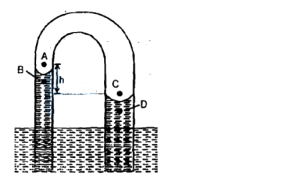
Two narrow tubes of diameters $d_1$ and $d_2$ are joined together to form a $U$-tube open at both ends. If the $U$-tube contains water,the difference in water levels in the limbs is ($T$ is the surface tension of water,the angle of contact is zero,the density of water is $\rho$,and $g$ is the acceleration due to gravity).
A
$\frac{4 T}{\rho g}\left[\frac{d_2-d_1}{d_1 d_2}\right]$
B
$\frac{4 T}{\rho g}\left[\frac{d_1 d_2}{d_1+d_2}\right]$
C
$\frac{2 T}{\rho g}\left[\frac{d_2-d_1}{d_1 d_2}\right]$
D
$\frac{2 T}{\rho g}\left[\frac{d_1+d_2}{d_1 d_2}\right]$
Solution
(A) When the angle of contact is zero,the radius of the meniscus $(r)$ equals the radius of the tube $(d/2)$.
Excess pressure in the first tube is $P_1 = \frac{2T}{r_1} = \frac{2T}{d_1/2} = \frac{4T}{d_1}$.
Excess pressure in the second tube is $P_2 = \frac{2T}{r_2} = \frac{2T}{d_2/2} = \frac{4T}{d_2}$.
The pressure difference between the two limbs is balanced by the hydrostatic pressure of the water column of height $h$,where $h$ is the difference in levels.
$\Delta P = P_1 - P_2 = h \rho g$.
Substituting the values of $P_1$ and $P_2$:
$h \rho g = \frac{4T}{d_1} - \frac{4T}{d_2} = 4T \left( \frac{1}{d_1} - \frac{1}{d_2} \right)$.
$h \rho g = 4T \left( \frac{d_2 - d_1}{d_1 d_2} \right)$.
Therefore,$h = \frac{4T}{\rho g} \left[ \frac{d_2 - d_1}{d_1 d_2} \right]$.
Excess pressure in the first tube is $P_1 = \frac{2T}{r_1} = \frac{2T}{d_1/2} = \frac{4T}{d_1}$.
Excess pressure in the second tube is $P_2 = \frac{2T}{r_2} = \frac{2T}{d_2/2} = \frac{4T}{d_2}$.
The pressure difference between the two limbs is balanced by the hydrostatic pressure of the water column of height $h$,where $h$ is the difference in levels.
$\Delta P = P_1 - P_2 = h \rho g$.
Substituting the values of $P_1$ and $P_2$:
$h \rho g = \frac{4T}{d_1} - \frac{4T}{d_2} = 4T \left( \frac{1}{d_1} - \frac{1}{d_2} \right)$.
$h \rho g = 4T \left( \frac{d_2 - d_1}{d_1 d_2} \right)$.
Therefore,$h = \frac{4T}{\rho g} \left[ \frac{d_2 - d_1}{d_1 d_2} \right]$.
0 likes
View Solution164
MediumMCQ
In a capillary tube having an area of cross-section '$A$',water rises to a height '$h$'. If the cross-sectional area is reduced to $\frac{A}{9}$,the rise of water in the capillary tube is:
A
$h$
B
$4 h$
C
$3 h$
D
$2 h$
Solution
(C) The height of water rise in a capillary tube is given by the formula: $h = \frac{2 T \cos \theta}{r \rho g}$.
From this,we can see that $h \propto \frac{1}{r}$.
The area of cross-section is $A = \pi r^2$,which implies $r = \sqrt{\frac{A}{\pi}}$,so $r \propto \sqrt{A}$.
Substituting this into the proportionality for height,we get $h \propto \frac{1}{\sqrt{A}}$.
Given the initial area is $A_1 = A$ and the final area is $A_2 = \frac{A}{9}$,we have the ratio:
$\frac{h_2}{h_1} = \sqrt{\frac{A_1}{A_2}} = \sqrt{\frac{A}{A/9}} = \sqrt{9} = 3$.
Therefore,the new height $h_2 = 3 h$.
From this,we can see that $h \propto \frac{1}{r}$.
The area of cross-section is $A = \pi r^2$,which implies $r = \sqrt{\frac{A}{\pi}}$,so $r \propto \sqrt{A}$.
Substituting this into the proportionality for height,we get $h \propto \frac{1}{\sqrt{A}}$.
Given the initial area is $A_1 = A$ and the final area is $A_2 = \frac{A}{9}$,we have the ratio:
$\frac{h_2}{h_1} = \sqrt{\frac{A_1}{A_2}} = \sqrt{\frac{A}{A/9}} = \sqrt{9} = 3$.
Therefore,the new height $h_2 = 3 h$.
0 likes
View Solution165
MediumMCQ
Water rises in a capillary tube of radius $r$ up to a height $h$. The mass of water in the capillary is $m$. What will be the mass of water that rises in a capillary of radius $\frac{r}{4}$?
A
$4m$
B
$\frac{m}{4}$
C
$m$
D
$\frac{m}{16}$
Solution
(B) The height $h$ of a water column in a capillary tube is given by the formula: $h = \frac{2T \cos \theta}{r \rho g}$.
Since $T, \theta, \rho,$ and $g$ are constant,we have $h \propto \frac{1}{r}$.
The mass $m$ of the liquid in the capillary is given by $m = V \rho = (\pi r^2 h) \rho$.
Substituting $h \propto \frac{1}{r}$ into the mass equation,we get $m \propto r^2 \times \frac{1}{r}$,which simplifies to $m \propto r$.
If the radius changes from $r$ to $r' = \frac{r}{4}$,the new mass $m'$ will be $m' = m \times \frac{r'}{r} = m \times \frac{r/4}{r} = \frac{m}{4}$.
Since $T, \theta, \rho,$ and $g$ are constant,we have $h \propto \frac{1}{r}$.
The mass $m$ of the liquid in the capillary is given by $m = V \rho = (\pi r^2 h) \rho$.
Substituting $h \propto \frac{1}{r}$ into the mass equation,we get $m \propto r^2 \times \frac{1}{r}$,which simplifies to $m \propto r$.
If the radius changes from $r$ to $r' = \frac{r}{4}$,the new mass $m'$ will be $m' = m \times \frac{r'}{r} = m \times \frac{r/4}{r} = \frac{m}{4}$.
0 likes
View Solution166
DifficultMCQ
Water rises up to a height $h$ in a capillary tube immersed vertically in water. When this whole arrangement is taken to a depth $d$ in a mine,the water level rises up to a height $h^{\prime}$. If $R$ is the radius of the earth,then the ratio $\frac{h}{h^{\prime}}$ is
A
$1+\frac{d}{R}$
B
$1-\frac{d}{R}$
C
$\frac{R+d}{R-d}$
D
$\frac{R-d}{R+d}$
Solution
(B) The height of water in a capillary tube is given by $h = \frac{2T \cos \theta}{r \rho g}$,where $T$ is surface tension,$r$ is the radius of the tube,$\rho$ is the density of water,and $g$ is the acceleration due to gravity.
On the surface of the earth,$h = \frac{2T \cos \theta}{r \rho g}$.
At a depth $d$ inside a mine,the acceleration due to gravity becomes $g^{\prime} = g(1 - \frac{d}{R})$.
The new height $h^{\prime}$ at depth $d$ is $h^{\prime} = \frac{2T \cos \theta}{r \rho g^{\prime}} = \frac{2T \cos \theta}{r \rho g(1 - \frac{d}{R})}$.
Therefore,the ratio $\frac{h}{h^{\prime}}$ is given by:
$\frac{h}{h^{\prime}} = \frac{\frac{2T \cos \theta}{r \rho g}}{\frac{2T \cos \theta}{r \rho g(1 - \frac{d}{R})}} = 1 - \frac{d}{R}$.
On the surface of the earth,$h = \frac{2T \cos \theta}{r \rho g}$.
At a depth $d$ inside a mine,the acceleration due to gravity becomes $g^{\prime} = g(1 - \frac{d}{R})$.
The new height $h^{\prime}$ at depth $d$ is $h^{\prime} = \frac{2T \cos \theta}{r \rho g^{\prime}} = \frac{2T \cos \theta}{r \rho g(1 - \frac{d}{R})}$.
Therefore,the ratio $\frac{h}{h^{\prime}}$ is given by:
$\frac{h}{h^{\prime}} = \frac{\frac{2T \cos \theta}{r \rho g}}{\frac{2T \cos \theta}{r \rho g(1 - \frac{d}{R})}} = 1 - \frac{d}{R}$.
0 likes
View Solution167
EasyMCQ
Water rises to a height of $10 \,cm$ in a capillary tube. In which of the following conditions will it rise to a height much greater than $10 \,cm$ in a very long capillary tube?
A
On the surface of the Moon
B
At the North Pole
C
In a lift moving up with an acceleration
D
On the equator
Solution
(A) The height $h$ to which a liquid rises in a capillary tube is given by the formula:
$h = \frac{2T \cos \theta}{r \rho g}$
From this expression, we can see that the height of the liquid column is inversely proportional to the acceleration due to gravity $(g)$:
$h \propto \frac{1}{g}$
To make $h$ much greater than $10 \,cm$, the value of $g$ must be significantly smaller than the value of $g$ on Earth.
Among the given options, the acceleration due to gravity is minimum on the surface of the Moon $(g_{moon} \approx \frac{g_{earth}}{6})$.
Therefore, the water will rise to a greater height on the Moon.
$h = \frac{2T \cos \theta}{r \rho g}$
From this expression, we can see that the height of the liquid column is inversely proportional to the acceleration due to gravity $(g)$:
$h \propto \frac{1}{g}$
To make $h$ much greater than $10 \,cm$, the value of $g$ must be significantly smaller than the value of $g$ on Earth.
Among the given options, the acceleration due to gravity is minimum on the surface of the Moon $(g_{moon} \approx \frac{g_{earth}}{6})$.
Therefore, the water will rise to a greater height on the Moon.
0 likes
View Solution168
MediumMCQ
Water rises to a height of $2 \,cm$ in a capillary tube. If the cross-sectional area of the tube is reduced to $\frac{1}{16}^{\text{th}}$ of the initial area, then water will rise to a height of: (in $\,cm$)
A
$4$
B
$8$
C
$12$
D
$16$
Solution
(B) The height $h$ to which a liquid rises in a capillary tube is given by the formula: $h = \frac{2T \cos \theta}{r \rho g}$.
Since $T$, $\theta$, $\rho$, and $g$ are constant, we have $h \propto \frac{1}{r}$, which implies $h_1 r_1 = h_2 r_2$.
Given the cross-sectional area $A = \pi r^2$, we have $A \propto r^2$, or $r \propto \sqrt{A}$.
Therefore, $\frac{r_1}{r_2} = \sqrt{\frac{A_1}{A_2}}$.
Given that the new area $A_2 = \frac{1}{16} A_1$, we have $\frac{A_1}{A_2} = 16$.
Thus, $\frac{r_1}{r_2} = \sqrt{16} = 4$, which means $r_1 = 4 r_2$.
Using the relation $h_2 = h_1 \left( \frac{r_1}{r_2} \right)$:
$h_2 = 2 \,cm \times 4 = 8 \,cm$.
Since $T$, $\theta$, $\rho$, and $g$ are constant, we have $h \propto \frac{1}{r}$, which implies $h_1 r_1 = h_2 r_2$.
Given the cross-sectional area $A = \pi r^2$, we have $A \propto r^2$, or $r \propto \sqrt{A}$.
Therefore, $\frac{r_1}{r_2} = \sqrt{\frac{A_1}{A_2}}$.
Given that the new area $A_2 = \frac{1}{16} A_1$, we have $\frac{A_1}{A_2} = 16$.
Thus, $\frac{r_1}{r_2} = \sqrt{16} = 4$, which means $r_1 = 4 r_2$.
Using the relation $h_2 = h_1 \left( \frac{r_1}{r_2} \right)$:
$h_2 = 2 \,cm \times 4 = 8 \,cm$.
0 likes
View Solution169
DifficultMCQ
$A$ glass rod of radius $r_1$ is inserted symmetrically into a vertical capillary tube of radius $r_2$ $(r_1 < r_2)$ such that their lower ends are at the same level. The arrangement is dipped in water. The height to which water will rise into the tube will be ($\rho =$ density of water,$T =$ surface tension of water,$g =$ acceleration due to gravity).
A
$\frac{2T}{(r_2-r_1)\rho g}$
B
$\frac{T}{(r_2^2-r_1^2)\rho g}$
C
$\frac{T}{(r_2-r_1)\rho g}$
D
$\frac{2T}{(r_2^2-r_1^2)\rho g}$
Solution
(A) The water rises in the annular space between the glass rod and the capillary tube. The total length of the contact line is the sum of the inner circumference of the tube and the outer circumference of the rod,which is $L = 2\pi r_1 + 2\pi r_2 = 2\pi(r_1 + r_2)$.
The upward force due to surface tension is $F = L \cdot T \cos \theta = 2\pi(r_1 + r_2) T \cos \theta$.
The weight of the water column in the annular space is $W = \text{Volume} \times \rho \times g = \pi(r_2^2 - r_1^2) h \rho g$.
Equating the upward force to the weight of the liquid column: $\pi(r_2^2 - r_1^2) h \rho g = 2\pi(r_1 + r_2) T \cos \theta$.
Using the identity $r_2^2 - r_1^2 = (r_2 - r_1)(r_2 + r_1)$,we get $\pi(r_2 - r_1)(r_2 + r_1) h \rho g = 2\pi(r_1 + r_2) T \cos \theta$.
For pure water,$\theta = 0^{\circ}$,so $\cos \theta = 1$. Simplifying for $h$:
$h = \frac{2T}{(r_2 - r_1)\rho g}$.
The upward force due to surface tension is $F = L \cdot T \cos \theta = 2\pi(r_1 + r_2) T \cos \theta$.
The weight of the water column in the annular space is $W = \text{Volume} \times \rho \times g = \pi(r_2^2 - r_1^2) h \rho g$.
Equating the upward force to the weight of the liquid column: $\pi(r_2^2 - r_1^2) h \rho g = 2\pi(r_1 + r_2) T \cos \theta$.
Using the identity $r_2^2 - r_1^2 = (r_2 - r_1)(r_2 + r_1)$,we get $\pi(r_2 - r_1)(r_2 + r_1) h \rho g = 2\pi(r_1 + r_2) T \cos \theta$.
For pure water,$\theta = 0^{\circ}$,so $\cos \theta = 1$. Simplifying for $h$:
$h = \frac{2T}{(r_2 - r_1)\rho g}$.
0 likes
View Solution170
MediumMCQ
Water rises up to a height of $4 \,cm$ in a capillary tube. The lower end of the capillary tube is at a depth of $8 \,cm$ below the water level. The mouth pressure required to blow an air bubble at the lower end of the capillary will be '$X$' $cm$ of water,where $X$ is equal to
A
$10$
B
$8$
C
$6$
D
$12$
Solution
(D) The pressure at the lower end of the capillary tube is the sum of the hydrostatic pressure due to the depth of the tube and the pressure due to the capillary rise.
Given that the depth of the lower end is $8 \,cm$ and the capillary rise is $4 \,cm$.
The total pressure $P$ at the lower end is given by $P = h_{depth} + h_{rise}$.
Substituting the values,$P = 8 \,cm + 4 \,cm = 12 \,cm$ of water.
Therefore,the pressure required to blow an air bubble at the lower end is $12 \,cm$ of water.
Thus,$X = 12$.
Given that the depth of the lower end is $8 \,cm$ and the capillary rise is $4 \,cm$.
The total pressure $P$ at the lower end is given by $P = h_{depth} + h_{rise}$.
Substituting the values,$P = 8 \,cm + 4 \,cm = 12 \,cm$ of water.
Therefore,the pressure required to blow an air bubble at the lower end is $12 \,cm$ of water.
Thus,$X = 12$.
0 likes
View Solution171
EasyMCQ
Water rises to a height of $15 \,mm$ in a capillary tube having cross-sectional area $A$. If the cross-sectional area of the tube is made $A / 3$, then the water will rise to a height of:
A
$15 \sqrt{3} \times 10^{-3} \,m$
B
$20 \sqrt{3} \times 10^{-3} \,m$
C
$5 \sqrt{3} \times 10^{-3} \,m$
D
$10 \sqrt{3} \times 10^{-3} \,m$
Solution
(A) The height $h$ to which a liquid rises in a capillary tube is given by the formula $h = \frac{2T \cos \theta}{r \rho g}$, where $r$ is the radius of the tube.
This implies $h \propto \frac{1}{r}$.
Since the cross-sectional area $A = \pi r^2$, we have $r = \sqrt{\frac{A}{\pi}}$, which means $r \propto \sqrt{A}$.
Substituting this into the proportionality, we get $h \propto \frac{1}{\sqrt{A}}$.
Given $h_1 = 15 \,mm = 15 \times 10^{-3} \,m$ for area $A_1 = A$.
For the new area $A_2 = A / 3$, we have the ratio $\frac{A_1}{A_2} = 3$.
Using the relation $\frac{h_2}{h_1} = \sqrt{\frac{A_1}{A_2}}$, we get $\frac{h_2}{h_1} = \sqrt{3}$.
Therefore, $h_2 = h_1 \times \sqrt{3} = 15 \times 10^{-3} \times \sqrt{3} \,m = 15 \sqrt{3} \times 10^{-3} \,m$.
This implies $h \propto \frac{1}{r}$.
Since the cross-sectional area $A = \pi r^2$, we have $r = \sqrt{\frac{A}{\pi}}$, which means $r \propto \sqrt{A}$.
Substituting this into the proportionality, we get $h \propto \frac{1}{\sqrt{A}}$.
Given $h_1 = 15 \,mm = 15 \times 10^{-3} \,m$ for area $A_1 = A$.
For the new area $A_2 = A / 3$, we have the ratio $\frac{A_1}{A_2} = 3$.
Using the relation $\frac{h_2}{h_1} = \sqrt{\frac{A_1}{A_2}}$, we get $\frac{h_2}{h_1} = \sqrt{3}$.
Therefore, $h_2 = h_1 \times \sqrt{3} = 15 \times 10^{-3} \times \sqrt{3} \,m = 15 \sqrt{3} \times 10^{-3} \,m$.
0 likes
View Solution172
EasyMCQ
Water rises up to a height '$h$' in a capillary tube on the surface of the earth. The value of '$h$' increases if the capillary tube apparatus is kept:
A
in a lift going upward with acceleration.
B
on the sun.
C
on the poles.
D
in a lift going downward with acceleration '$a$' where '$a < g$' (acceleration due to gravity).
Solution
(D) The height of the liquid column in a capillary tube is given by the formula: $h = \frac{2 T \cos \theta}{r \rho g}$.
From this expression,it is clear that $h \propto \frac{1}{g}$.
When a lift moves downward with an acceleration '$a$',the effective acceleration due to gravity becomes $g_{eff} = g - a$.
Since $a < g$,the effective gravity $g_{eff}$ is less than the actual gravity $g$.
As $g_{eff} < g$,the value of '$h$' increases because '$h$' is inversely proportional to the acceleration due to gravity.
From this expression,it is clear that $h \propto \frac{1}{g}$.
When a lift moves downward with an acceleration '$a$',the effective acceleration due to gravity becomes $g_{eff} = g - a$.
Since $a < g$,the effective gravity $g_{eff}$ is less than the actual gravity $g$.
As $g_{eff} < g$,the value of '$h$' increases because '$h$' is inversely proportional to the acceleration due to gravity.
0 likes
View Solution173
EasyMCQ
$A$ capillary tube is vertically immersed in water,and water rises up to a height $h_{1}$. When the whole arrangement is taken to a depth $d$ in a mine,the water level rises up to a height $h_{2}$. The ratio $h_{1} / h_{2}$ is ($R =$ radius of earth).
A
$\left(1+\frac{2d}{R}\right)$
B
$\left(1-\frac{d}{R}\right)$
C
$\left(1+\frac{d}{R}\right)$
D
$\left(1-\frac{2d}{R}\right)$
Solution
(B) The height of the liquid column in a capillary tube is given by $h = \frac{2T \cos \theta}{r \rho g}$.
From this expression,we can see that $h \propto \frac{1}{g}$.
Therefore,the ratio of the heights is $\frac{h_{1}}{h_{2}} = \frac{g_{2}}{g_{1}}$.
At a depth $d$ below the surface of the Earth,the acceleration due to gravity is given by $g_{2} = g_{1} \left(1 - \frac{d}{R}\right)$,where $g_{1}$ is the acceleration due to gravity at the surface.
Substituting this into the ratio,we get $\frac{h_{1}}{h_{2}} = \frac{g_{1}(1 - d/R)}{g_{1}} = 1 - \frac{d}{R}$.
From this expression,we can see that $h \propto \frac{1}{g}$.
Therefore,the ratio of the heights is $\frac{h_{1}}{h_{2}} = \frac{g_{2}}{g_{1}}$.
At a depth $d$ below the surface of the Earth,the acceleration due to gravity is given by $g_{2} = g_{1} \left(1 - \frac{d}{R}\right)$,where $g_{1}$ is the acceleration due to gravity at the surface.
Substituting this into the ratio,we get $\frac{h_{1}}{h_{2}} = \frac{g_{1}(1 - d/R)}{g_{1}} = 1 - \frac{d}{R}$.
0 likes
View Solution174
MediumMCQ
Water rises to a height of $2.2 \text{ cm}$ in a glass capillary tube. The height to which the same water rises in another capillary having $\frac{1}{4}$ of the cross-sectional area is: (in $\text{ cm}$)
A
$16.4$
B
$4.4$
C
$8.4$
D
$2.2$
Solution
(B) The height $h$ to which a liquid rises in a capillary tube is given by the formula $h = \frac{2T \cos \theta}{r \rho g}$, where $r$ is the radius of the tube.
Since $h \propto \frac{1}{r}$, and the area of cross-section $A = \pi r^2$, we have $r = \sqrt{\frac{A}{\pi}}$, which implies $r \propto \sqrt{A}$.
Therefore, $h \propto \frac{1}{\sqrt{A}}$, or $h_1 \sqrt{A_1} = h_2 \sqrt{A_2}$.
Given $h_1 = 2.2 \text{ cm}$ and $A_2 = \frac{1}{4} A_1$, we have $\sqrt{A_2} = \frac{1}{2} \sqrt{A_1}$.
Substituting these values: $2.2 \times \sqrt{A_1} = h_2 \times \frac{1}{2} \sqrt{A_1}$.
Solving for $h_2$: $h_2 = 2.2 \times 2 = 4.4 \text{ cm}$.
Since $h \propto \frac{1}{r}$, and the area of cross-section $A = \pi r^2$, we have $r = \sqrt{\frac{A}{\pi}}$, which implies $r \propto \sqrt{A}$.
Therefore, $h \propto \frac{1}{\sqrt{A}}$, or $h_1 \sqrt{A_1} = h_2 \sqrt{A_2}$.
Given $h_1 = 2.2 \text{ cm}$ and $A_2 = \frac{1}{4} A_1$, we have $\sqrt{A_2} = \frac{1}{2} \sqrt{A_1}$.
Substituting these values: $2.2 \times \sqrt{A_1} = h_2 \times \frac{1}{2} \sqrt{A_1}$.
Solving for $h_2$: $h_2 = 2.2 \times 2 = 4.4 \text{ cm}$.
0 likes
View Solution175
MediumMCQ
Water rises to a height of $3 \,cm$ in a capillary tube. If the cross-sectional area of the capillary tube is reduced to $1/9$th of its initial area, then the water will rise to a height of: (in $\,cm$)
A
$9$
B
$6$
C
$7$
D
$8$
Solution
(A) The height $h$ to which a liquid rises in a capillary tube is given by the formula $h = \frac{2T \cos \theta}{r \rho g}$, where $T$ is surface tension, $\theta$ is the contact angle, $r$ is the radius of the tube, $\rho$ is the density, and $g$ is acceleration due to gravity.
From this, we see that $h \propto \frac{1}{r}$.
The cross-sectional area $A$ is given by $A = \pi r^2$, which implies $r \propto \sqrt{A}$.
Substituting this into the height relation, we get $h \propto \frac{1}{\sqrt{A}}$, or $h_1 \sqrt{A_1} = h_2 \sqrt{A_2}$.
Given $h_1 = 3 \,cm$ and $A_2 = \frac{1}{9} A_1$, we have $\sqrt{A_2} = \frac{1}{3} \sqrt{A_1}$.
Substituting these values: $3 \times \sqrt{A_1} = h_2 \times \frac{1}{3} \sqrt{A_1}$.
Solving for $h_2$: $h_2 = 3 \times 3 = 9 \,cm$.
From this, we see that $h \propto \frac{1}{r}$.
The cross-sectional area $A$ is given by $A = \pi r^2$, which implies $r \propto \sqrt{A}$.
Substituting this into the height relation, we get $h \propto \frac{1}{\sqrt{A}}$, or $h_1 \sqrt{A_1} = h_2 \sqrt{A_2}$.
Given $h_1 = 3 \,cm$ and $A_2 = \frac{1}{9} A_1$, we have $\sqrt{A_2} = \frac{1}{3} \sqrt{A_1}$.
Substituting these values: $3 \times \sqrt{A_1} = h_2 \times \frac{1}{3} \sqrt{A_1}$.
Solving for $h_2$: $h_2 = 3 \times 3 = 9 \,cm$.
0 likes
View Solution176
MediumMCQ
Water rises in a capillary tube of radius $r$ up to a height $h$. The mass of water in the capillary is $m$. What will be the mass of water that rises in a capillary tube of radius $\frac{r}{4}$?
A
$\frac{m}{4}$
B
$\frac{4}{m}$
C
$4m$
D
$m$
Solution
(A) The height of water in a capillary tube is given by $h = \frac{2T \cos \theta}{r \rho g}$.
Since $T, \theta, \rho,$ and $g$ are constant,$h \propto \frac{1}{r}$,which implies $hr = \text{constant}$.
For a capillary of radius $r_1 = r$,the height is $h_1 = h$. For a capillary of radius $r_2 = \frac{r}{4}$,the new height $h_2$ is given by $h_1 r_1 = h_2 r_2$.
$h \times r = h_2 \times \frac{r}{4} \implies h_2 = 4h$.
The mass of water in a capillary is given by $m = \text{Volume} \times \text{density} = (\pi r^2 h) \rho$.
For the new capillary,the mass $m'$ is $m' = \pi (r_2)^2 h_2 \rho$.
Substituting $r_2 = \frac{r}{4}$ and $h_2 = 4h$:
$m' = \pi \left(\frac{r}{4}\right)^2 (4h) \rho = \pi \left(\frac{r^2}{16}\right) (4h) \rho = \frac{1}{4} (\pi r^2 h \rho) = \frac{m}{4}$.
Since $T, \theta, \rho,$ and $g$ are constant,$h \propto \frac{1}{r}$,which implies $hr = \text{constant}$.
For a capillary of radius $r_1 = r$,the height is $h_1 = h$. For a capillary of radius $r_2 = \frac{r}{4}$,the new height $h_2$ is given by $h_1 r_1 = h_2 r_2$.
$h \times r = h_2 \times \frac{r}{4} \implies h_2 = 4h$.
The mass of water in a capillary is given by $m = \text{Volume} \times \text{density} = (\pi r^2 h) \rho$.
For the new capillary,the mass $m'$ is $m' = \pi (r_2)^2 h_2 \rho$.
Substituting $r_2 = \frac{r}{4}$ and $h_2 = 4h$:
$m' = \pi \left(\frac{r}{4}\right)^2 (4h) \rho = \pi \left(\frac{r^2}{16}\right) (4h) \rho = \frac{1}{4} (\pi r^2 h \rho) = \frac{m}{4}$.
0 likes
View Solution177
EasyMCQ
Water rises up to a height $h$ in a capillary tube on the surface of the earth. The value of $h$ will increase if the experimental setup is kept in:
A
a lift going upward with a certain acceleration.
B
a lift going down with acceleration.
C
an accelerating train.
D
a satellite rotating close to the earth.
Solution
(D) The height $h$ to which a liquid rises in a capillary tube is given by the formula: $h = \frac{2T \cos \theta}{r \rho g}$.
From this relation,we can see that $h \propto \frac{1}{g}$.
For a lift going down with an acceleration $a$,the effective acceleration due to gravity is $g' = g - a$. Since $g' < g$,the height $h$ will increase.
However,in a satellite orbiting the earth,the effective gravity $g'$ becomes $0$ (weightlessness). As $g' \to 0$,$h \to \infty$. Thus,the height $h$ increases significantly in a satellite compared to the other options where $g$ is only partially reduced.
From this relation,we can see that $h \propto \frac{1}{g}$.
For a lift going down with an acceleration $a$,the effective acceleration due to gravity is $g' = g - a$. Since $g' < g$,the height $h$ will increase.
However,in a satellite orbiting the earth,the effective gravity $g'$ becomes $0$ (weightlessness). As $g' \to 0$,$h \to \infty$. Thus,the height $h$ increases significantly in a satellite compared to the other options where $g$ is only partially reduced.
0 likes
View Solution178
EasyMCQ
When a capillary tube is immersed in water vertically,water rises to a height $h$ inside the tube. If the radius of another capillary tube is $\frac{1}{3}$ that of the previous,the height to which water will rise in this tube is:
A
$h$
B
$h \sqrt{3}$
C
$\frac{h}{3}$
D
$3h$
Solution
(D) The height $h$ to which a liquid rises in a capillary tube is given by the formula: $h = \frac{2T \cos \theta}{r \rho g}$.
Since $T$,$\theta$,$\rho$,and $g$ are constants for the given liquid and tube material,we have the relation $h \propto \frac{1}{r}$,which implies $h_{1} r_{1} = h_{2} r_{2}$.
Given $h_{1} = h$,$r_{1} = r$,and $r_{2} = \frac{r}{3}$.
Substituting these values into the equation: $h \cdot r = h_{2} \cdot \frac{r}{3}$.
Solving for $h_{2}$: $h_{2} = 3h$.
Since $T$,$\theta$,$\rho$,and $g$ are constants for the given liquid and tube material,we have the relation $h \propto \frac{1}{r}$,which implies $h_{1} r_{1} = h_{2} r_{2}$.
Given $h_{1} = h$,$r_{1} = r$,and $r_{2} = \frac{r}{3}$.
Substituting these values into the equation: $h \cdot r = h_{2} \cdot \frac{r}{3}$.
Solving for $h_{2}$: $h_{2} = 3h$.
0 likes
View Solution179
MediumMCQ
Three liquids have the same surface tension and densities $\varrho_{1}, \varrho_{2}$,and $\varrho_{3}$ $(\varrho_{1} > \varrho_{2} > \varrho_{3})$. In three identical capillaries,the rise of liquid is the same. The corresponding angles of contact $\theta_{1}, \theta_{2}$,and $\theta_{3}$ are related as:
A
$\theta_{1} > \theta_{2} > \theta_{3}$
B
$\theta_{1} < \theta_{2} > \theta_{3}$
C
$\theta_{1} > \theta_{2} < \theta_{3}$
D
$\theta_{1} < \theta_{2} < \theta_{3}$
Solution
(D) The rise of a liquid in a capillary tube is given by the formula: $h = \frac{2 T \cos \theta}{r \rho g}$.
Rearranging for the angle of contact,we get: $\cos \theta = \frac{h r \rho g}{2 T}$.
Here,$h$ (rise),$r$ (radius),and $T$ (surface tension) are constants for all three liquids.
Thus,$\cos \theta \propto \rho$.
Given the densities are $\varrho_{1} > \varrho_{2} > \varrho_{3}$,it follows that $\cos \theta_{1} > \cos \theta_{2} > \cos \theta_{3}$.
Since the cosine function is a decreasing function for angles between $0$ and $\frac{\pi}{2}$,a larger cosine value corresponds to a smaller angle.
Therefore,$\theta_{1} < \theta_{2} < \theta_{3}$.
Rearranging for the angle of contact,we get: $\cos \theta = \frac{h r \rho g}{2 T}$.
Here,$h$ (rise),$r$ (radius),and $T$ (surface tension) are constants for all three liquids.
Thus,$\cos \theta \propto \rho$.
Given the densities are $\varrho_{1} > \varrho_{2} > \varrho_{3}$,it follows that $\cos \theta_{1} > \cos \theta_{2} > \cos \theta_{3}$.
Since the cosine function is a decreasing function for angles between $0$ and $\frac{\pi}{2}$,a larger cosine value corresponds to a smaller angle.
Therefore,$\theta_{1} < \theta_{2} < \theta_{3}$.
0 likes
View Solution180
MediumMCQ
Two capillary tubes of different diameters are dipped in water. The rise of water is
A
zero in both the tubes
B
same in both the tubes
C
more in the tube of larger diameter
D
more in the tube of smaller diameter
Solution
(D) The height of the liquid column in a capillary tube is given by the formula: $h = \frac{2 T \cos \theta}{\rho g r}$,where $T$ is the surface tension,$\theta$ is the contact angle,$\rho$ is the density of the liquid,$g$ is the acceleration due to gravity,and $r$ is the radius of the capillary tube.
From the formula,we can see that $h \propto \frac{1}{r}$.
This implies that the height of the water rise is inversely proportional to the radius (or diameter) of the capillary tube.
Therefore,the rise of water will be greater in the tube with the smaller diameter.
From the formula,we can see that $h \propto \frac{1}{r}$.
This implies that the height of the water rise is inversely proportional to the radius (or diameter) of the capillary tube.
Therefore,the rise of water will be greater in the tube with the smaller diameter.
0 likes
View Solution181
MediumMCQ
In a capillary tube having area of cross-section $A$,the water rises to a height $h$. If the cross-sectional area is reduced to $\frac{A}{9}$,the rise of water in the capillary tube is
A
$4 h$
B
$3 h$
C
$2 h$
D
$h$
Solution
(B) The height of water rise in a capillary tube is given by the formula $h = \frac{2T \cos \theta}{r \rho g}$,where $T$ is surface tension,$\theta$ is the contact angle,$r$ is the radius of the tube,$\rho$ is the density of the liquid,and $g$ is the acceleration due to gravity.
Since $T, \theta, \rho,$ and $g$ are constant,we have $h \propto \frac{1}{r}$,which means $rh = \text{constant}$.
The area of cross-section is $A = \pi r^2$,so $r = \sqrt{\frac{A}{\pi}}$,which implies $r \propto \sqrt{A}$.
Given the initial area $A_1 = A$ and final area $A_2 = \frac{A}{9}$.
The ratio of radii is $\frac{r_2}{r_1} = \sqrt{\frac{A_2}{A_1}} = \sqrt{\frac{A/9}{A}} = \sqrt{\frac{1}{9}} = \frac{1}{3}$.
Using the relation $r_1 h_1 = r_2 h_2$,we get $h_2 = h_1 \left( \frac{r_1}{r_2} \right)$.
Substituting the values,$h_2 = h \times 3 = 3h$.
Since $T, \theta, \rho,$ and $g$ are constant,we have $h \propto \frac{1}{r}$,which means $rh = \text{constant}$.
The area of cross-section is $A = \pi r^2$,so $r = \sqrt{\frac{A}{\pi}}$,which implies $r \propto \sqrt{A}$.
Given the initial area $A_1 = A$ and final area $A_2 = \frac{A}{9}$.
The ratio of radii is $\frac{r_2}{r_1} = \sqrt{\frac{A_2}{A_1}} = \sqrt{\frac{A/9}{A}} = \sqrt{\frac{1}{9}} = \frac{1}{3}$.
Using the relation $r_1 h_1 = r_2 h_2$,we get $h_2 = h_1 \left( \frac{r_1}{r_2} \right)$.
Substituting the values,$h_2 = h \times 3 = 3h$.
0 likes
View Solution182
MediumMCQ
In a capillary tube of radius $R$,a straight thin metal wire of radius $r$ $(R > r)$ is inserted symmetrically,and one end of the combination is dipped vertically in water such that the lower end of the combination is at the same level. The rise of water in the capillary tube is $[T =$ surface tension of water,$\rho =$ density of water,$g =$ gravitational acceleration$]$.
A
$\frac{T}{(R+r) \rho g}$
B
$\frac{2 T}{(R+r) \rho g}$
C
$\frac{2 T}{(R-r) \rho g}$
D
$\frac{(R-r) \rho g}{T}$
Solution
(C) The rise of water $h$ in a capillary tube is given by the formula $h = \frac{2T \cos \theta}{\rho g R_{eff}}$,where $R_{eff}$ is the effective radius of the meniscus.
In this case,the water rises in the annular space between the capillary tube of radius $R$ and the wire of radius $r$.
The effective radius for the annular space is the difference between the radii,$R_{eff} = R - r$.
Assuming the contact angle $\theta = 0$ for water and glass/metal,we have $\cos \theta = 1$.
Substituting these values into the formula,we get $h = \frac{2T}{\rho g (R - r)}$.
In this case,the water rises in the annular space between the capillary tube of radius $R$ and the wire of radius $r$.
The effective radius for the annular space is the difference between the radii,$R_{eff} = R - r$.
Assuming the contact angle $\theta = 0$ for water and glass/metal,we have $\cos \theta = 1$.
Substituting these values into the formula,we get $h = \frac{2T}{\rho g (R - r)}$.
0 likes
View Solution183
DifficultMCQ
The height of a liquid column raised in a capillary tube of a certain radius when dipped in liquid '$A$' vertically is $5 \,cm$. If the tube is dipped in a similar manner in another liquid '$B$' of surface tension and density double the values of liquid '$A$',the height of the liquid column raised in liquid '$B$' would be (Assume the angle of contact is the same). (in $\,m$)
A
$0.20$
B
$0.5$
C
$0.05$
D
$0.10$
Solution
(C) The height of a liquid column in a capillary tube is given by the formula: $h = \frac{2T \cos \theta}{r \rho g}$.
Given for liquid '$A$': $h_1 = 5 \,cm$,surface tension = $T_1$,density = $\rho_1$.
Given for liquid '$B$': surface tension $T_2 = 2T_1$,density $\rho_2 = 2\rho_1$,and the radius $r$ and angle of contact $\theta$ remain the same.
Substituting these into the formula for liquid '$B$':
$h_2 = \frac{2T_2 \cos \theta}{r \rho_2 g} = \frac{2(2T_1) \cos \theta}{r(2\rho_1) g} = \frac{4T_1 \cos \theta}{2r \rho_1 g} = \frac{2T_1 \cos \theta}{r \rho_1 g}$.
Since $h_1 = \frac{2T_1 \cos \theta}{r \rho_1 g} = 5 \,cm$,it follows that $h_2 = h_1 = 5 \,cm$.
Converting to meters: $5 \,cm = 0.05 \,m$.
Given for liquid '$A$': $h_1 = 5 \,cm$,surface tension = $T_1$,density = $\rho_1$.
Given for liquid '$B$': surface tension $T_2 = 2T_1$,density $\rho_2 = 2\rho_1$,and the radius $r$ and angle of contact $\theta$ remain the same.
Substituting these into the formula for liquid '$B$':
$h_2 = \frac{2T_2 \cos \theta}{r \rho_2 g} = \frac{2(2T_1) \cos \theta}{r(2\rho_1) g} = \frac{4T_1 \cos \theta}{2r \rho_1 g} = \frac{2T_1 \cos \theta}{r \rho_1 g}$.
Since $h_1 = \frac{2T_1 \cos \theta}{r \rho_1 g} = 5 \,cm$,it follows that $h_2 = h_1 = 5 \,cm$.
Converting to meters: $5 \,cm = 0.05 \,m$.
0 likes
View Solution184
MediumMCQ
Two capillary tubes $P$ and $Q$ are dipped vertically in water. The height of water level in capillary tube $P$ is $\frac{2}{3}$ of the height in capillary tube $Q$. The ratio of their diameters is
A
$2: 3$
B
$3: 2$
C
$3: 4$
D
$4: 3$
Solution
(B) The height of capillary rise $h$ of a liquid in a capillary tube is given by the formula:
$h = \frac{2 T \cos \theta}{r \rho g}$
Since $T$,$\theta$,$\rho$,and $g$ are constant for the same liquid and tube material,we have:
$h \propto \frac{1}{r}$
Since the diameter $D = 2r$,we can also write $h \propto \frac{1}{D}$.
Given that $h_P = \frac{2}{3} h_Q$,we have $\frac{h_P}{h_Q} = \frac{2}{3}$.
Using the inverse proportionality $h \propto \frac{1}{D}$,we get:
$\frac{h_P}{h_Q} = \frac{D_Q}{D_P} = \frac{2}{3}$
Therefore,the ratio of their diameters is $\frac{D_P}{D_Q} = \frac{3}{2}$ or $3: 2$.
$h = \frac{2 T \cos \theta}{r \rho g}$
Since $T$,$\theta$,$\rho$,and $g$ are constant for the same liquid and tube material,we have:
$h \propto \frac{1}{r}$
Since the diameter $D = 2r$,we can also write $h \propto \frac{1}{D}$.
Given that $h_P = \frac{2}{3} h_Q$,we have $\frac{h_P}{h_Q} = \frac{2}{3}$.
Using the inverse proportionality $h \propto \frac{1}{D}$,we get:
$\frac{h_P}{h_Q} = \frac{D_Q}{D_P} = \frac{2}{3}$
Therefore,the ratio of their diameters is $\frac{D_P}{D_Q} = \frac{3}{2}$ or $3: 2$.
0 likes
View Solution185
EasyMCQ
Two capillary tubes of different diameters are dipped in water. The rise of water is
A
the same in both tubes
B
greater in the tube of larger diameter
C
greater in the tube of smaller diameter
D
independent of the diameter of the tube
Solution
(C) The height of water in a capillary tube is given by the formula:
$h = \frac{2T \cos \theta}{r \rho g}$
where $T$ is the surface tension,$\theta$ is the angle of contact,$r$ is the radius of the capillary tube,$\rho$ is the density of the liquid,and $g$ is the acceleration due to gravity.
From this formula,we can see that $h \propto \frac{1}{r}$.
Since the height $h$ is inversely proportional to the radius $r$ of the tube,the rise of water will be greater in the tube with the smaller diameter (smaller radius).
$h = \frac{2T \cos \theta}{r \rho g}$
where $T$ is the surface tension,$\theta$ is the angle of contact,$r$ is the radius of the capillary tube,$\rho$ is the density of the liquid,and $g$ is the acceleration due to gravity.
From this formula,we can see that $h \propto \frac{1}{r}$.
Since the height $h$ is inversely proportional to the radius $r$ of the tube,the rise of water will be greater in the tube with the smaller diameter (smaller radius).
0 likes
View Solution186
MediumMCQ
Water rises in plant fibres due to
A
capillarity
B
viscosity
C
fluid pressure
D
osmosis
Solution
(A) The rise or fall of liquids in narrow tubes or porous materials is known as capillarity.
Plant fibres act as a network of fine capillary tubes.
Therefore,water rises in plant fibres due to the phenomenon of capillarity.
Plant fibres act as a network of fine capillary tubes.
Therefore,water rises in plant fibres due to the phenomenon of capillarity.
0 likes
View Solution187
MediumMCQ
$A$ capillary tube of radius $0.1 \,mm$ is dipped in water. The water rises to a height of $2 \,cm$ in the tube. If the surface tension of water is $0.072 \,N/m$, the contact angle between water and the wall of the tube is:
A
$\theta = \cos^{-1}\left(\frac{1}{3.6}\right)$
B
$\theta = \cos^{-1}\left(\frac{1}{7.2}\right)$
C
$\theta = \cos^{-1}\left(\frac{1}{1.8}\right)$
D
$\theta = \cos^{-1}\left(\frac{1}{6.2}\right)$
Solution
(B) Given: Radius of capillary tube $r = 0.1 \,mm = 0.1 \times 10^{-3} \,m$.
Height of water rise $h = 2 \,cm = 2 \times 10^{-2} \,m$.
Surface tension $T = 0.072 \,N/m$.
Density of water $\rho = 10^3 \,kg/m^3$ and acceleration due to gravity $g = 10 \,m/s^2$.
The formula for capillary rise is $h = \frac{2T \cos \theta}{\rho g r}$.
Rearranging for $\cos \theta$: $\cos \theta = \frac{h \rho g r}{2T}$.
Substituting the values: $\cos \theta = \frac{(2 \times 10^{-2}) \times (10^3) \times (10) \times (0.1 \times 10^{-3})}{2 \times 0.072}$.
$\cos \theta = \frac{2 \times 10^{-2} \times 10^4 \times 0.1 \times 10^{-3}}{0.144} = \frac{0.02}{0.144} = \frac{20}{144} = \frac{1}{7.2}$.
Therefore, $\theta = \cos^{-1}\left(\frac{1}{7.2}\right)$.
Height of water rise $h = 2 \,cm = 2 \times 10^{-2} \,m$.
Surface tension $T = 0.072 \,N/m$.
Density of water $\rho = 10^3 \,kg/m^3$ and acceleration due to gravity $g = 10 \,m/s^2$.
The formula for capillary rise is $h = \frac{2T \cos \theta}{\rho g r}$.
Rearranging for $\cos \theta$: $\cos \theta = \frac{h \rho g r}{2T}$.
Substituting the values: $\cos \theta = \frac{(2 \times 10^{-2}) \times (10^3) \times (10) \times (0.1 \times 10^{-3})}{2 \times 0.072}$.
$\cos \theta = \frac{2 \times 10^{-2} \times 10^4 \times 0.1 \times 10^{-3}}{0.144} = \frac{0.02}{0.144} = \frac{20}{144} = \frac{1}{7.2}$.
Therefore, $\theta = \cos^{-1}\left(\frac{1}{7.2}\right)$.
0 likes
View Solution188
DifficultMCQ
In a $U$-shaped tube,the radius of one limb is $2 \ mm$ and that of the other limb is $4 \ mm$. $A$ liquid of surface tension $0.03 \ Nm^{-1}$,density $1500 \ kgm^{-3}$,and angle of contact zero is taken in the tube. The difference in the heights of the levels of the liquid in the two limbs is (Acceleration due to gravity $= 10 \ ms^{-2}$) (in $mm$)
A
$3$
B
$2.5$
C
$1$
D
$1.5$
Solution
(C) The height of capillary rise in a tube is given by $h = \frac{2T \cos \theta}{r \rho g}$,where $T$ is surface tension,$\theta$ is the angle of contact,$r$ is the radius of the capillary tube,and $\rho$ is the density of the liquid.
Given: $T = 0.03 \ Nm^{-1}$,$\rho = 1500 \ kgm^{-3}$,$\theta = 0^\circ$ (so $\cos \theta = 1$),$g = 10 \ ms^{-2}$,$r_1 = 2 \ mm = 2 \times 10^{-3} \ m$,and $r_2 = 4 \ mm = 4 \times 10^{-3} \ m$.
The heights in the two limbs are $h_1 = \frac{2T}{r_1 \rho g}$ and $h_2 = \frac{2T}{r_2 \rho g}$.
The difference in liquid levels is $\Delta h = h_1 - h_2 = \frac{2T}{\rho g} \left( \frac{1}{r_1} - \frac{1}{r_2} \right)$.
Substituting the values: $\Delta h = \frac{2 \times 0.03}{1500 \times 10} \left( \frac{1}{2 \times 10^{-3}} - \frac{1}{4 \times 10^{-3}} \right)$.
$\Delta h = \frac{0.06}{15000} \left( 500 - 250 \right) = \frac{0.06}{15000} \times 250 = \frac{0.06}{60} = 0.001 \ m$.
Therefore,$\Delta h = 1 \ mm$.
Given: $T = 0.03 \ Nm^{-1}$,$\rho = 1500 \ kgm^{-3}$,$\theta = 0^\circ$ (so $\cos \theta = 1$),$g = 10 \ ms^{-2}$,$r_1 = 2 \ mm = 2 \times 10^{-3} \ m$,and $r_2 = 4 \ mm = 4 \times 10^{-3} \ m$.
The heights in the two limbs are $h_1 = \frac{2T}{r_1 \rho g}$ and $h_2 = \frac{2T}{r_2 \rho g}$.
The difference in liquid levels is $\Delta h = h_1 - h_2 = \frac{2T}{\rho g} \left( \frac{1}{r_1} - \frac{1}{r_2} \right)$.
Substituting the values: $\Delta h = \frac{2 \times 0.03}{1500 \times 10} \left( \frac{1}{2 \times 10^{-3}} - \frac{1}{4 \times 10^{-3}} \right)$.
$\Delta h = \frac{0.06}{15000} \left( 500 - 250 \right) = \frac{0.06}{15000} \times 250 = \frac{0.06}{60} = 0.001 \ m$.
Therefore,$\Delta h = 1 \ mm$.
0 likes
View Solution189
EasyMCQ
The lower end of a capillary tube is dipped into water and it is observed that the water in the capillary tube rises by $7.5 \ cm$. Find the radius of the capillary tube used,if the surface tension of water is $7.5 \times 10^{-2} \ N \ m^{-1}$. The angle of contact between water and glass is $0^{\circ}$ and the acceleration due to gravity is $10 \ m \ s^{-2}$.
A
$0.2 \ cm$
B
$0.1 \ cm$
C
$0.4 \ mm$
D
$0.2 \ mm$
Solution
(D) The height of the rise of liquid due to surface tension in a capillary tube is given by the formula: $h = \frac{2 S \cos \theta}{r \rho g}$.
Given values are: height of liquid rise $h = 7.5 \ cm = 7.5 \times 10^{-2} \ m$,surface tension $S = 7.5 \times 10^{-2} \ N \ m^{-1}$,angle of contact $\theta = 0^{\circ}$,density of water $\rho = 1000 \ kg \ m^{-3}$,and acceleration due to gravity $g = 10 \ m \ s^{-2}$.
Rearranging the formula to solve for the radius $r$: $r = \frac{2 S \cos \theta}{h \rho g}$.
Substituting the values: $r = \frac{2 \times (7.5 \times 10^{-2}) \times \cos 0^{\circ}}{(7.5 \times 10^{-2}) \times 1000 \times 10}$.
Since $\cos 0^{\circ} = 1$,we get: $r = \frac{2 \times 7.5 \times 10^{-2}}{7.5 \times 10^{-2} \times 10^4} = \frac{2}{10^4} = 2 \times 10^{-4} \ m$.
Converting to millimeters: $r = 2 \times 10^{-4} \times 10^3 \ mm = 0.2 \ mm$.
Given values are: height of liquid rise $h = 7.5 \ cm = 7.5 \times 10^{-2} \ m$,surface tension $S = 7.5 \times 10^{-2} \ N \ m^{-1}$,angle of contact $\theta = 0^{\circ}$,density of water $\rho = 1000 \ kg \ m^{-3}$,and acceleration due to gravity $g = 10 \ m \ s^{-2}$.
Rearranging the formula to solve for the radius $r$: $r = \frac{2 S \cos \theta}{h \rho g}$.
Substituting the values: $r = \frac{2 \times (7.5 \times 10^{-2}) \times \cos 0^{\circ}}{(7.5 \times 10^{-2}) \times 1000 \times 10}$.
Since $\cos 0^{\circ} = 1$,we get: $r = \frac{2 \times 7.5 \times 10^{-2}}{7.5 \times 10^{-2} \times 10^4} = \frac{2}{10^4} = 2 \times 10^{-4} \ m$.
Converting to millimeters: $r = 2 \times 10^{-4} \times 10^3 \ mm = 0.2 \ mm$.
0 likes
View Solution190
DifficultMCQ
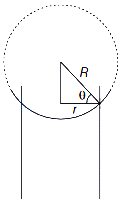
The radius of the bore of a capillary tube is $r$ and the angle of contact of the liquid is $\theta$. When the tube is dipped in the liquid,the radius of curvature of the meniscus of liquid rising in the tube is
A
$r \sin \theta$
B
$\frac{r}{\sin \theta}$
C
$r \cos \theta$
D
$\frac{r}{\cos \theta}$
Solution
(D) Consider a capillary tube of radius $r$ dipped in a liquid. The liquid forms a meniscus at the top of the tube.
Let $R$ be the radius of curvature of the meniscus and $\theta$ be the angle of contact.
From the geometry of the meniscus,we can form a right-angled triangle where the hypotenuse is $R$,the base is $r$,and the angle between the radius of the meniscus and the horizontal is $\theta$.
Using trigonometry,we have $\cos \theta = \frac{r}{R}$.
Therefore,the radius of curvature of the meniscus is $R = \frac{r}{\cos \theta}$.
Let $R$ be the radius of curvature of the meniscus and $\theta$ be the angle of contact.
From the geometry of the meniscus,we can form a right-angled triangle where the hypotenuse is $R$,the base is $r$,and the angle between the radius of the meniscus and the horizontal is $\theta$.
Using trigonometry,we have $\cos \theta = \frac{r}{R}$.
Therefore,the radius of curvature of the meniscus is $R = \frac{r}{\cos \theta}$.
0 likes
View Solution191
DifficultMCQ
Two capillary tubes of radii $R$ and $2R$ are dipped in water. The water rises to heights $h_1$ and $h_2$ respectively in the two tubes. If $m_1$ and $m_2$ be the masses of water ascended in the tubes,then $m_1: m_2=$
A
$1: 2$
B
$1: 4$
C
$1: \sqrt{2}$
D
$1: 1$
Solution
(A) The height of water in a capillary tube is given by $h = \frac{2T \cos \theta}{r \rho g}$.
Since $T$,$\theta$,$\rho$,and $g$ are constant,$h \propto \frac{1}{r}$.
Thus,$h_1 = \frac{k}{R}$ and $h_2 = \frac{k}{2R}$,where $k$ is a constant.
The mass of water in the tube is $m = \text{Volume} \times \text{Density} = (\pi r^2 h) \rho$.
Substituting $h = \frac{2T \cos \theta}{r \rho g}$,we get $m = \pi r^2 \left( \frac{2T \cos \theta}{r \rho g} \right) \rho = \frac{2 \pi T r \cos \theta}{g}$.
Since $T$,$\theta$,and $g$ are constant,$m \propto r$.
Therefore,$\frac{m_1}{m_2} = \frac{R}{2R} = \frac{1}{2}$.
Since $T$,$\theta$,$\rho$,and $g$ are constant,$h \propto \frac{1}{r}$.
Thus,$h_1 = \frac{k}{R}$ and $h_2 = \frac{k}{2R}$,where $k$ is a constant.
The mass of water in the tube is $m = \text{Volume} \times \text{Density} = (\pi r^2 h) \rho$.
Substituting $h = \frac{2T \cos \theta}{r \rho g}$,we get $m = \pi r^2 \left( \frac{2T \cos \theta}{r \rho g} \right) \rho = \frac{2 \pi T r \cos \theta}{g}$.
Since $T$,$\theta$,and $g$ are constant,$m \propto r$.
Therefore,$\frac{m_1}{m_2} = \frac{R}{2R} = \frac{1}{2}$.
0 likes
View Solution192
DifficultMCQ
Two tubes of same length and diameters $4 \ mm$ and $8 \ mm$ are joined together to form a $U$-shaped tube open at both the ends. If the $U$-tube contains water,then the difference between the levels of water in the two limbs of the tube is (Surface tension of water at the temperature of experiment is $7.3 \times 10^{-2} \ N \ m^{-1}$,angle of contact $= 0^{\circ}$,density of water $= 1.0 \times 10^3 \ kg \ m^{-3}$ and acceleration due to gravity $= 10 \ m \ s^{-2}$) (in $mm$)
A
$3.65$
B
$36.5$
C
$0.365$
D
$365$
Solution
(A) The pressure just below the meniscus in a capillary tube of radius $r$ is given by $P = P_0 - \frac{2T}{r}$,where $P_0$ is the atmospheric pressure and $T$ is the surface tension.
For the two limbs with radii $R_1 = 2 \ mm = 2 \times 10^{-3} \ m$ and $R_2 = 4 \ mm = 4 \times 10^{-3} \ m$,the pressures at the same horizontal level $OO'$ are equal.
Let $h_1$ and $h_2$ be the heights of the water columns in the two limbs above the level $OO'$. The pressure at level $OO'$ in the two limbs is:
$P_{OO'} = P_0 - \frac{2T}{R_1} + \rho g h_1 = P_0 - \frac{2T}{R_2} + \rho g h_2$
Since the total amount of water is constant,the difference in levels $x = h_1 - h_2$ is determined by the capillary rise difference:
$x = h_1 - h_2 = \frac{2T}{\rho g} \left( \frac{1}{R_1} - \frac{1}{R_2} \right)$
Substituting the values:
$x = \frac{2 \times 7.3 \times 10^{-2}}{1.0 \times 10^3 \times 10} \left( \frac{1}{2 \times 10^{-3}} - \frac{1}{4 \times 10^{-3}} \right)$
$x = \frac{14.6 \times 10^{-2}}{10^4} \left( \frac{2 - 1}{4 \times 10^{-3}} \right) = 14.6 \times 10^{-6} \times \frac{1}{4 \times 10^{-3}} = 3.65 \times 10^{-3} \ m = 3.65 \ mm$.
Thus,the difference between the levels is $3.65 \ mm$.
For the two limbs with radii $R_1 = 2 \ mm = 2 \times 10^{-3} \ m$ and $R_2 = 4 \ mm = 4 \times 10^{-3} \ m$,the pressures at the same horizontal level $OO'$ are equal.
Let $h_1$ and $h_2$ be the heights of the water columns in the two limbs above the level $OO'$. The pressure at level $OO'$ in the two limbs is:
$P_{OO'} = P_0 - \frac{2T}{R_1} + \rho g h_1 = P_0 - \frac{2T}{R_2} + \rho g h_2$
Since the total amount of water is constant,the difference in levels $x = h_1 - h_2$ is determined by the capillary rise difference:
$x = h_1 - h_2 = \frac{2T}{\rho g} \left( \frac{1}{R_1} - \frac{1}{R_2} \right)$
Substituting the values:
$x = \frac{2 \times 7.3 \times 10^{-2}}{1.0 \times 10^3 \times 10} \left( \frac{1}{2 \times 10^{-3}} - \frac{1}{4 \times 10^{-3}} \right)$
$x = \frac{14.6 \times 10^{-2}}{10^4} \left( \frac{2 - 1}{4 \times 10^{-3}} \right) = 14.6 \times 10^{-6} \times \frac{1}{4 \times 10^{-3}} = 3.65 \times 10^{-3} \ m = 3.65 \ mm$.
Thus,the difference between the levels is $3.65 \ mm$.
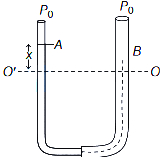
0 likes
View Solution193
MediumMCQ
$A$ capillary tube of radius '$r$' is immersed in water and water rises to a height of '$h$'. The mass of water in the capillary tube is $5 \times 10^{-3} \ kg$. The same capillary tube is now immersed in a liquid whose surface tension is $\sqrt{2}$ times the surface tension of water. The angle of contact between the capillary tube and this liquid is $45^{\circ}$. The mass of liquid which rises into the capillary tube now is (in $kg$):
A
$5 \times 10^{-3}$
B
$2.5 \times 10^{-3}$
C
$5 \sqrt{2} \times 10^{-3}$
D
$3.5 \times 10^{-3}$
Solution
(A) The height of a liquid column in a capillary tube is given by $h = \frac{2T \cos \theta}{rdg}$.
For water: $h_1 = \frac{2T_1 \cos \theta_1}{rdg}$. Given $T_1 = T$,$\theta_1 = 0^{\circ}$ (so $\cos \theta_1 = 1$),and mass $m_1 = 5 \times 10^{-3} \ kg$.
Since $m = \pi r^2 h d$,we have $h_1 = \frac{m_1}{\pi r^2 d}$.
For the second liquid: $T_2 = \sqrt{2}T$ and $\theta_2 = 45^{\circ}$.
The new height $h_2 = \frac{2T_2 \cos \theta_2}{rdg} = \frac{2(\sqrt{2}T) \cos 45^{\circ}}{rdg} = \frac{2\sqrt{2}T \times (1/\sqrt{2})}{rdg} = \frac{2T}{rdg} = h_1$.
Since the radius '$r$' and density '$d$' (assuming same density for simplicity or as implied by the problem context) remain constant,and $h_2 = h_1$,the mass of the liquid $m_2 = \pi r^2 h_2 d = m_1 = 5 \times 10^{-3} \ kg$.
For water: $h_1 = \frac{2T_1 \cos \theta_1}{rdg}$. Given $T_1 = T$,$\theta_1 = 0^{\circ}$ (so $\cos \theta_1 = 1$),and mass $m_1 = 5 \times 10^{-3} \ kg$.
Since $m = \pi r^2 h d$,we have $h_1 = \frac{m_1}{\pi r^2 d}$.
For the second liquid: $T_2 = \sqrt{2}T$ and $\theta_2 = 45^{\circ}$.
The new height $h_2 = \frac{2T_2 \cos \theta_2}{rdg} = \frac{2(\sqrt{2}T) \cos 45^{\circ}}{rdg} = \frac{2\sqrt{2}T \times (1/\sqrt{2})}{rdg} = \frac{2T}{rdg} = h_1$.
Since the radius '$r$' and density '$d$' (assuming same density for simplicity or as implied by the problem context) remain constant,and $h_2 = h_1$,the mass of the liquid $m_2 = \pi r^2 h_2 d = m_1 = 5 \times 10^{-3} \ kg$.
0 likes
View Solution194
EasyMCQ
Liquid $A$ rises to a height of $10 \ cm$ in a capillary tube and liquid $B$ falls to a depth of $2 \ cm$ in the same tube. The densities of $A$ and $B$ are $1 \ g/cm^3$ and $10 \ g/cm^3$ respectively. The contact angles of $A$ and $B$ with the tube are $0^{\circ}$ and $135^{\circ}$ respectively. If the surface tensions of $A$ and $B$ are $S_A$ and $S_B$,then the ratio $\frac{S_B}{S_A}$ is:
A
$\sqrt{2}$
B
$2 \sqrt{2}$
C
$\frac{1}{\sqrt{2}}$
D
$\frac{1}{2 \sqrt{2}}$
Solution
(B) The height of capillary rise is given by the formula: $h = \frac{2 S \cos \theta}{r \rho g}$,where $r$ is the radius of the tube.
For liquid $A$: $h_A = 10 \ cm$,$\rho_A = 1 \ g/cm^3$,$\theta_A = 0^{\circ}$.
$10 = \frac{2 S_A \cos(0^{\circ})}{r \times 1 \times g} = \frac{2 S_A}{r g}$ --- $(1)$
For liquid $B$: $h_B = -2 \ cm$ (fall),$\rho_B = 10 \ g/cm^3$,$\theta_B = 135^{\circ}$.
$-2 = \frac{2 S_B \cos(135^{\circ})}{r \times 10 \times g} = \frac{2 S_B (-1/\sqrt{2})}{10 r g} = -\frac{S_B}{5 \sqrt{2} r g}$
$2 = \frac{S_B}{5 \sqrt{2} r g}$ --- $(2)$
Dividing $(2)$ by $(1)$:
$\frac{2}{10} = \frac{S_B / (5 \sqrt{2} r g)}{2 S_A / (r g)} = \frac{S_B}{5 \sqrt{2} r g} \times \frac{r g}{2 S_A} = \frac{S_B}{10 \sqrt{2} S_A}$
$\frac{1}{5} = \frac{S_B}{10 \sqrt{2} S_A} \Rightarrow \frac{S_B}{S_A} = \frac{10 \sqrt{2}}{5} = 2 \sqrt{2}$.
For liquid $A$: $h_A = 10 \ cm$,$\rho_A = 1 \ g/cm^3$,$\theta_A = 0^{\circ}$.
$10 = \frac{2 S_A \cos(0^{\circ})}{r \times 1 \times g} = \frac{2 S_A}{r g}$ --- $(1)$
For liquid $B$: $h_B = -2 \ cm$ (fall),$\rho_B = 10 \ g/cm^3$,$\theta_B = 135^{\circ}$.
$-2 = \frac{2 S_B \cos(135^{\circ})}{r \times 10 \times g} = \frac{2 S_B (-1/\sqrt{2})}{10 r g} = -\frac{S_B}{5 \sqrt{2} r g}$
$2 = \frac{S_B}{5 \sqrt{2} r g}$ --- $(2)$
Dividing $(2)$ by $(1)$:
$\frac{2}{10} = \frac{S_B / (5 \sqrt{2} r g)}{2 S_A / (r g)} = \frac{S_B}{5 \sqrt{2} r g} \times \frac{r g}{2 S_A} = \frac{S_B}{10 \sqrt{2} S_A}$
$\frac{1}{5} = \frac{S_B}{10 \sqrt{2} S_A} \Rightarrow \frac{S_B}{S_A} = \frac{10 \sqrt{2}}{5} = 2 \sqrt{2}$.
0 likes
View Solution195
MediumMCQ
The maximum length of a water column that can stay without falling in a vertically held capillary tube of diameter $1 \ mm$ and open at both ends is (Acceleration due to gravity $= 10 \ ms^{-2}$ and surface tension of water $= 0.07 \ Nm^{-1}$) (in $cm$)
A
$2.8$
B
$5.6$
C
$1.4$
D
$0$
Solution
(D) For a capillary tube open at both ends,the water column is supported by surface tension forces at the meniscus.
When a water column of length $h$ is held in a capillary tube,the pressure difference due to surface tension must balance the hydrostatic pressure of the water column.
For a tube open at both ends,the water will not be able to be supported if the tube is vertical because the pressure at the top and bottom meniscus would be atmospheric,and gravity would pull the water down.
However,if we consider the capillary rise formula $h = \frac{2T \cos \theta}{r \rho g}$,this applies to a tube dipping in a reservoir.
In a tube open at both ends,the water column cannot be supported against gravity unless there is a pressure difference.
Since the tube is open at both ends,the pressure at both ends is atmospheric pressure $(P_0)$.
Thus,the water column will fall out due to gravity.
Therefore,the maximum length of the water column that can stay without falling is $0 \ cm$.
When a water column of length $h$ is held in a capillary tube,the pressure difference due to surface tension must balance the hydrostatic pressure of the water column.
For a tube open at both ends,the water will not be able to be supported if the tube is vertical because the pressure at the top and bottom meniscus would be atmospheric,and gravity would pull the water down.
However,if we consider the capillary rise formula $h = \frac{2T \cos \theta}{r \rho g}$,this applies to a tube dipping in a reservoir.
In a tube open at both ends,the water column cannot be supported against gravity unless there is a pressure difference.
Since the tube is open at both ends,the pressure at both ends is atmospheric pressure $(P_0)$.
Thus,the water column will fall out due to gravity.
Therefore,the maximum length of the water column that can stay without falling is $0 \ cm$.
0 likes
View Solution196
DifficultMCQ
The heat evolved for the rise of water when one end of the capillary tube of radius $r$ is immersed vertically into water is (Assume surface tension $= T$ and density of water to be $\rho$)
A
$\frac{2 \pi T}{\rho g}$
B
$\frac{\pi T^2}{\rho g}$
C
$\frac{2 \pi T^2}{\rho g}$
D
None of these
Solution
(C) The height to which water rises in a capillary tube is given by $h = \frac{2T}{\rho g r}$.
The potential energy of the water column of mass $m$ is $U = \frac{mgh}{2}$.
Since $m = \pi r^2 h \rho$,we have $U = \frac{(\pi r^2 h \rho) g h}{2} = \frac{\pi r^2 \rho g h^2}{2}$.
Substituting $h = \frac{2T}{\rho g r}$,we get $U = \frac{\pi r^2 \rho g}{2} \left( \frac{2T}{\rho g r} \right)^2 = \frac{2 \pi T^2}{\rho g}$.
The work done by the surface tension force is $W = (2 \pi r T) h = 2 \pi r T \left( \frac{2T}{\rho g r} \right) = \frac{4 \pi T^2}{\rho g}$.
From the principle of conservation of energy,the heat evolved $Q$ is the difference between the work done and the potential energy gained:
$Q = W - U = \frac{4 \pi T^2}{\rho g} - \frac{2 \pi T^2}{\rho g} = \frac{2 \pi T^2}{\rho g}$.
The potential energy of the water column of mass $m$ is $U = \frac{mgh}{2}$.
Since $m = \pi r^2 h \rho$,we have $U = \frac{(\pi r^2 h \rho) g h}{2} = \frac{\pi r^2 \rho g h^2}{2}$.
Substituting $h = \frac{2T}{\rho g r}$,we get $U = \frac{\pi r^2 \rho g}{2} \left( \frac{2T}{\rho g r} \right)^2 = \frac{2 \pi T^2}{\rho g}$.
The work done by the surface tension force is $W = (2 \pi r T) h = 2 \pi r T \left( \frac{2T}{\rho g r} \right) = \frac{4 \pi T^2}{\rho g}$.
From the principle of conservation of energy,the heat evolved $Q$ is the difference between the work done and the potential energy gained:
$Q = W - U = \frac{4 \pi T^2}{\rho g} - \frac{2 \pi T^2}{\rho g} = \frac{2 \pi T^2}{\rho g}$.
0 likes
View SolutionFluid Mechanics and Surface Tension — Capillary Tube and Capillarity · Frequently Asked Questions
1Are these Fluid Mechanics and Surface Tension questions useful for JEE and NEET?
Yes. All questions in this section are mapped to JEE Main and NEET exam patterns. Previous year questions from JEE Main, NEET, GUJCET and state-level exams are included with full solutions.
2Can I switch to Hindi or Gujarati for these questions?
Yes. Use the language tabs in the hero section or the sidebar to view the same questions and solutions in English, Hindi or Gujarati.
3How do I generate a question paper from this subtopic?
Use the Vedclass Exam Paper Generator — select the chapter and subtopic, set difficulty, and generate Sets A, B, C, D automatically. First 3 chapters of every subject are free.
Vedclass Products
For Students
Vedclass Test Series
Mock tests in real JEE/NEET style with performance analysis. 5-day free trial.
Start Free TrialFor Teachers
Exam Paper Generator
Generate Set A/B/C/D papers from this chapter in 2 minutes. 3 chapters free.
Try FreeFor Institutes
Online Exam Module
Live online exams with unlimited students, 360° analytics & white-label branding.
See DemoFor Teachers & Institutes
Generate a Fluid Mechanics and Surface Tension Exam Paper in 2 Minutes
Select subtopic & difficulty — Sets A, B, C, D auto-generated with No Repeat logic.
First 3 chapters of every subject are free — no payment required.