
A English
Capillary Tube and Capillarity Questions in English
Class 11 Physics · Fluid Mechanics and Surface Tension · Capillary Tube and Capillarity
204+
Questions
English
Language
100%
With Solutions
Showing 49 of 204 questions in English
101
EasyMCQ
When a capillary tube is kept in water, water $......$ in the capillary, while when it is kept in mercury, the mercury $......$ in the capillary. (Choose the correct words: $rising up$ / $depressed$)
A
rising up,depressed
B
depressed,rising up
C
rising up,rising up
D
depressed,depressed
Solution
(A) The behavior of a liquid in a capillary tube depends on the angle of contact between the liquid and the glass surface.
For water and glass, the angle of contact is acute $( < 90^{\circ})$, which results in an upward force due to surface tension, causing the water to rise in the capillary.
For mercury and glass, the angle of contact is obtuse $( > 90^{\circ})$, which results in a downward force due to surface tension, causing the mercury level to be depressed in the capillary.
Therefore, water rises up and mercury is depressed.
For water and glass, the angle of contact is acute $( < 90^{\circ})$, which results in an upward force due to surface tension, causing the water to rise in the capillary.
For mercury and glass, the angle of contact is obtuse $( > 90^{\circ})$, which results in a downward force due to surface tension, causing the mercury level to be depressed in the capillary.
Therefore, water rises up and mercury is depressed.
0 likes
View Solution102
Easy
Write the formula for the height of a liquid column in a capillary tube.
Solution
(N/A) The height $h$ of a liquid column in a capillary tube is given by the formula:
$h = \frac{2T \cos \theta}{r \rho g}$
Where:
$T$ is the surface tension of the liquid.
$\theta$ is the angle of contact between the liquid and the capillary wall.
$r$ is the radius of the capillary tube.
$\rho$ is the density of the liquid.
$g$ is the acceleration due to gravity.
$h = \frac{2T \cos \theta}{r \rho g}$
Where:
$T$ is the surface tension of the liquid.
$\theta$ is the angle of contact between the liquid and the capillary wall.
$r$ is the radius of the capillary tube.
$\rho$ is the density of the liquid.
$g$ is the acceleration due to gravity.
0 likes
View Solution103
Easy
Fill in the blanks:
$(i)$ Smaller the radius of the capillary tube,...... the height of the column. ( more / less )
$(ii)$ If the meniscus is convex,then the liquid .......... in the capillary,and if it is concave,then the liquid .......... in the capillary. ( depressed / rises up )
$(i)$ Smaller the radius of the capillary tube,...... the height of the column. ( more / less )
$(ii)$ If the meniscus is convex,then the liquid .......... in the capillary,and if it is concave,then the liquid .......... in the capillary. ( depressed / rises up )
Solution
(A) The height of the liquid column in a capillary tube is given by the formula $h = \frac{2T \cos \theta}{r \rho g}$,where $T$ is surface tension,$\theta$ is the angle of contact,$r$ is the radius of the tube,$\rho$ is the density of the liquid,and $g$ is the acceleration due to gravity.
$(i)$ Since $h \propto \frac{1}{r}$,as the radius $r$ of the capillary tube decreases,the height $h$ of the column increases. Therefore,the answer is 'more'.
$(ii)$ For a convex meniscus,the angle of contact $\theta > 90^\circ$,making $\cos \theta$ negative,which results in a depression of the liquid level. For a concave meniscus,the angle of contact $\theta < 90^\circ$,making $\cos \theta$ positive,which results in the liquid rising up. Therefore,the answers are 'depressed' and 'rises up' respectively.
$(i)$ Since $h \propto \frac{1}{r}$,as the radius $r$ of the capillary tube decreases,the height $h$ of the column increases. Therefore,the answer is 'more'.
$(ii)$ For a convex meniscus,the angle of contact $\theta > 90^\circ$,making $\cos \theta$ negative,which results in a depression of the liquid level. For a concave meniscus,the angle of contact $\theta < 90^\circ$,making $\cos \theta$ positive,which results in the liquid rising up. Therefore,the answers are 'depressed' and 'rises up' respectively.
0 likes
View Solution104
Medium
Give reason: The lighting of a lamp is due to the wick of the lamp.
Solution
(N/A) The lighting of a lamp is due to the phenomenon of $Capillarity$.
In a lamp,the wick consists of fine pores or capillaries.
When the lamp is filled with oil,the oil rises up through these fine pores of the wick due to the surface tension of the liquid.
This process is known as capillary action,which allows the oil to reach the flame at the top of the wick,enabling the lamp to burn continuously.
In a lamp,the wick consists of fine pores or capillaries.
When the lamp is filled with oil,the oil rises up through these fine pores of the wick due to the surface tension of the liquid.
This process is known as capillary action,which allows the oil to reach the flame at the top of the wick,enabling the lamp to burn continuously.
0 likes
View Solution105
MediumMCQ
Water rises to a height of $20 \ mm$ in a capillary tube. If the radius of the capillary tube is made $\frac{1}{3}rd$ of its previous value,what is the new height of the capillary rise (in $mm$)?
A
$60$
B
$20$
C
$10$
D
$40$
Solution
(A) The height of capillary rise $h$ is given by the formula $h = \frac{2T \cos \theta}{r \rho g}$,where $T$ is surface tension,$\theta$ is the angle of contact,$r$ is the radius,$\rho$ is the density,and $g$ is the acceleration due to gravity.
From this formula,we see that $h \propto \frac{1}{r}$.
Given that the initial height $h = 20 \ mm$ and the new radius $r' = \frac{r}{3}$.
Using the proportionality $h' r' = h r$,we get:
$h' = h \left( \frac{r}{r'} \right) = 20 \times \left( \frac{r}{r/3} \right) = 20 \times 3 = 60 \ mm$.
From this formula,we see that $h \propto \frac{1}{r}$.
Given that the initial height $h = 20 \ mm$ and the new radius $r' = \frac{r}{3}$.
Using the proportionality $h' r' = h r$,we get:
$h' = h \left( \frac{r}{r'} \right) = 20 \times \left( \frac{r}{r/3} \right) = 20 \times 3 = 60 \ mm$.
0 likes
View Solution106
Medium
How does an oil lamp produce light through a wick that is lit using a match?
Solution
(N/A) The wick of an oil lamp is made of thin cotton fibers. These fibers act as tiny capillary tubes. Due to the phenomenon of capillarity,the oil rises through the wick against gravity. This continuous supply of oil to the top of the wick sustains the flame,allowing the lamp to produce light.
0 likes
View Solution107
Medium
Why is moisture retained in the soil when a farm is ploughed?
Solution
(N/A) Soil contains fine capillary tubes formed by the arrangement of soil particles. Through these capillaries,water from the deeper layers rises to the surface due to capillary action and evaporates,causing the soil to dry out. When a farm is ploughed,these capillary tubes are broken. This disruption prevents the water from rising to the surface,thereby retaining moisture in the soil.
0 likes
View Solution108
Easy
Why is it better to wear cotton clothes in summer?
Solution
(N/A) Cotton clothes contain thin fibers that act like capillaries. Due to the phenomenon of capillarity,these fibers absorb sweat from the body. When this absorbed sweat is exposed to the atmosphere,it undergoes evaporation. Since evaporation is an endothermic process,it absorbs latent heat from the body,providing a cooling effect and keeping the body dry.
0 likes
View Solution109
Medium
Why is the refill of a marker pen used to write on a whiteboard made of fibers?
Solution
(N/A) The ink must move against the force of gravity while writing with such a pen on a whiteboard. In a fiber refill,the ink moves due to the capillary phenomenon within the fiber-made capillaries. This allows the ink to flow continuously,enabling smooth writing on the board.
0 likes
View Solution110
Easy
Why does the water rise in a capillary tube? Explain.
Solution
(N/A) The rise of a liquid in a capillary tube is governed by the formula $h = \frac{2S \cos \theta}{r \rho g}$,where $S$ is the surface tension,$\theta$ is the angle of contact,$r$ is the radius of the capillary,$\rho$ is the density of the liquid,and $g$ is the acceleration due to gravity.
For water in a glass capillary,the angle of contact $\theta$ is acute (i.e.,$\theta < 90^{\circ}$),which makes $\cos \theta$ positive.
Since $S, r, \rho,$ and $g$ are all positive constants,the height $h$ becomes positive,indicating that the liquid level rises inside the capillary tube to balance the pressure difference caused by the curved meniscus.
For water in a glass capillary,the angle of contact $\theta$ is acute (i.e.,$\theta < 90^{\circ}$),which makes $\cos \theta$ positive.
Since $S, r, \rho,$ and $g$ are all positive constants,the height $h$ becomes positive,indicating that the liquid level rises inside the capillary tube to balance the pressure difference caused by the curved meniscus.
0 likes
View Solution111
Medium
Why does the mercury level fall in a capillary tube? Explain.
Solution
(N/A) The height of a liquid column in a capillary tube is given by the formula $h = \frac{2S \cos \theta}{r \rho g}$,where $S$ is the surface tension,$\theta$ is the angle of contact,$r$ is the radius of the capillary,$\rho$ is the density of the liquid,and $g$ is the acceleration due to gravity.
For mercury and glass,the angle of contact $\theta$ is obtuse (approximately $135^{\circ}$),which is greater than $90^{\circ}$.
Since $\cos \theta$ is negative for angles greater than $90^{\circ}$,the value of $h$ becomes negative.
$A$ negative height indicates that the level of mercury in the capillary tube is lower than the level of the mercury in the surrounding container. This phenomenon is known as capillary depression.
For mercury and glass,the angle of contact $\theta$ is obtuse (approximately $135^{\circ}$),which is greater than $90^{\circ}$.
Since $\cos \theta$ is negative for angles greater than $90^{\circ}$,the value of $h$ becomes negative.
$A$ negative height indicates that the level of mercury in the capillary tube is lower than the level of the mercury in the surrounding container. This phenomenon is known as capillary depression.
0 likes
View Solution112
MediumMCQ
$A$ $20 \ cm$ long capillary tube is dipped in water. The water rises up to $8 \ cm$. If the entire arrangement is put in a freely falling elevator,the length of the water column in the capillary tube will be (in $cm$)?
A
$8$
B
$10$
C
$20$
D
$0$
Solution
(C) The height of the water column in a capillary tube is given by the formula $h = \frac{2S \cos \theta}{r \rho g}$,where $S$ is the surface tension,$\theta$ is the angle of contact,$r$ is the radius of the tube,$\rho$ is the density of the liquid,and $g$ is the acceleration due to gravity.
In a freely falling elevator,the effective acceleration due to gravity is $g_{eff} = 0$.
As $g_{eff} \to 0$,the height $h$ of the water column tends to infinity $(h \propto \frac{1}{g})$.
However,the water column is constrained by the length of the capillary tube.
Therefore,the water will rise to fill the entire length of the tube.
Thus,the length of the water column in the tube will be $20 \ cm$.
In a freely falling elevator,the effective acceleration due to gravity is $g_{eff} = 0$.
As $g_{eff} \to 0$,the height $h$ of the water column tends to infinity $(h \propto \frac{1}{g})$.
However,the water column is constrained by the length of the capillary tube.
Therefore,the water will rise to fill the entire length of the tube.
Thus,the length of the water column in the tube will be $20 \ cm$.
0 likes
View Solution113
Easy
The sap in trees,which consists mainly of water in summer,rises in a system of capillaries of radius $r = 2.5 \times 10^{-5} \ m$. The surface tension of sap is $T = 7.28 \times 10^{-2} \ N/m$ and the angle of contact is $0^{\circ}$. Does surface tension alone account for the supply of water to the top of all trees?
Solution
(N/A) The height $h$ to which a liquid rises in a capillary tube is given by the formula: $h = \frac{2T \cos \theta}{r \rho g}$.
Given values are: $T = 7.28 \times 10^{-2} \ N/m$,$r = 2.5 \times 10^{-5} \ m$,$\theta = 0^{\circ}$,$\rho = 10^3 \ kg/m^3$ (density of water),and $g = 9.8 \ m/s^2$.
Substituting these values into the formula:
$h = \frac{2 \times (7.28 \times 10^{-2}) \times \cos 0^{\circ}}{(2.5 \times 10^{-5}) \times 10^3 \times 9.8}$
$h = \frac{14.56 \times 10^{-2}}{2.5 \times 10^{-2} \times 9.8} = \frac{14.56}{24.5} \approx 0.594 \ m \approx 0.6 \ m$.
Since the height reached by capillary action is only about $0.6 \ m$,it is insufficient to supply water to the tops of tall trees (which can be $10 \ m$ to $100 \ m$ high). Therefore,surface tension alone cannot account for the supply of water to the top of all trees.
Given values are: $T = 7.28 \times 10^{-2} \ N/m$,$r = 2.5 \times 10^{-5} \ m$,$\theta = 0^{\circ}$,$\rho = 10^3 \ kg/m^3$ (density of water),and $g = 9.8 \ m/s^2$.
Substituting these values into the formula:
$h = \frac{2 \times (7.28 \times 10^{-2}) \times \cos 0^{\circ}}{(2.5 \times 10^{-5}) \times 10^3 \times 9.8}$
$h = \frac{14.56 \times 10^{-2}}{2.5 \times 10^{-2} \times 9.8} = \frac{14.56}{24.5} \approx 0.594 \ m \approx 0.6 \ m$.
Since the height reached by capillary action is only about $0.6 \ m$,it is insufficient to supply water to the tops of tall trees (which can be $10 \ m$ to $100 \ m$ high). Therefore,surface tension alone cannot account for the supply of water to the top of all trees.
0 likes
View Solution114
DifficultMCQ
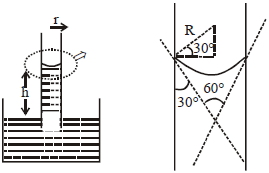
$A$ capillary tube made of glass with a radius of $0.15\, mm$ is dipped vertically in a beaker filled with methylene iodide (surface tension $= 0.05\, N m^{-1}$,density $= 667\, kg m^{-3}$),which rises to a height $h$ in the tube. It is observed that the two tangents drawn from the liquid-glass interfaces (from opposite sides of the capillary) make an angle of $60^{\circ}$ with one another. Then $h$ is close to $...... m$ $(g = 10\, m s^{-2})$
A
$0.137$
B
$0.172$
C
$0.087$
D
$0.049$
Solution
(C) Let $r$ be the radius of the capillary tube and $R$ be the radius of the meniscus.
From the geometry of the meniscus,the angle of contact $\theta$ is related to the angle between the tangents. Since the tangents make an angle of $60^{\circ}$ with each other,the angle between the tangent and the vertical wall is $30^{\circ}$. Thus,the contact angle $\theta = 30^{\circ}$.
From the geometry,$\cos \theta = \frac{r}{R}$,so $R = \frac{r}{\cos 30^{\circ}} = \frac{r}{\sqrt{3}/2} = \frac{2r}{\sqrt{3}}$.
Given $r = 0.15 \times 10^{-3} m$,we have $R = \frac{2 \times 0.15 \times 10^{-3}}{\sqrt{3}} = \frac{0.3 \times 10^{-3}}{\sqrt{3}} m$.
The height $h$ of the liquid column is given by $h = \frac{2T \cos \theta}{\rho g r}$.
Substituting the values: $h = \frac{2 \times 0.05 \times \cos 30^{\circ}}{667 \times 10 \times 0.15 \times 10^{-3}}$.
Alternatively,using $h = \frac{2T}{\rho g R}$:
$h = \frac{2 \times 0.05}{667 \times 10 \times (\frac{0.3 \times 10^{-3}}{\sqrt{3}})} = \frac{0.1 \times \sqrt{3}}{6670 \times 0.3 \times 10^{-3}} = \frac{0.1732}{2.001} \approx 0.0865\, m$.
Rounding to the nearest value,$h \approx 0.087\, m$.
From the geometry of the meniscus,the angle of contact $\theta$ is related to the angle between the tangents. Since the tangents make an angle of $60^{\circ}$ with each other,the angle between the tangent and the vertical wall is $30^{\circ}$. Thus,the contact angle $\theta = 30^{\circ}$.
From the geometry,$\cos \theta = \frac{r}{R}$,so $R = \frac{r}{\cos 30^{\circ}} = \frac{r}{\sqrt{3}/2} = \frac{2r}{\sqrt{3}}$.
Given $r = 0.15 \times 10^{-3} m$,we have $R = \frac{2 \times 0.15 \times 10^{-3}}{\sqrt{3}} = \frac{0.3 \times 10^{-3}}{\sqrt{3}} m$.
The height $h$ of the liquid column is given by $h = \frac{2T \cos \theta}{\rho g r}$.
Substituting the values: $h = \frac{2 \times 0.05 \times \cos 30^{\circ}}{667 \times 10 \times 0.15 \times 10^{-3}}$.
Alternatively,using $h = \frac{2T}{\rho g R}$:
$h = \frac{2 \times 0.05}{667 \times 10 \times (\frac{0.3 \times 10^{-3}}{\sqrt{3}})} = \frac{0.1 \times \sqrt{3}}{6670 \times 0.3 \times 10^{-3}} = \frac{0.1732}{2.001} \approx 0.0865\, m$.
Rounding to the nearest value,$h \approx 0.087\, m$.
0 likes
View Solution115
MediumMCQ
When a long glass capillary tube of radius $0.015 \; cm$ is dipped in a liquid,the liquid rises to a height of $15 \; cm$ within it. If the contact angle between the liquid and glass is close to $0^{\circ}$,the surface tension of the liquid,in $milliNewton \; m^{-1}$ is $.....$
$[\rho_{\text{liquid}} = 900 \; kg \; m^{-3}, g = 10 \; ms^{-2}]$ (Give answer in closest integer)
$[\rho_{\text{liquid}} = 900 \; kg \; m^{-3}, g = 10 \; ms^{-2}]$ (Give answer in closest integer)
A
$115$
B
$120$
C
$101$
D
$109$
Solution
(C) The formula for capillary rise is given by $h = \frac{2S \cos \theta}{\rho gr}$.
Rearranging for surface tension $S$,we get $S = \frac{\rho grh}{2 \cos \theta}$.
Given values:
Radius $r = 0.015 \; cm = 1.5 \times 10^{-4} \; m$.
Height $h = 15 \; cm = 0.15 \; m$.
Density $\rho = 900 \; kg \; m^{-3}$.
Acceleration due to gravity $g = 10 \; ms^{-2}$.
Contact angle $\theta = 0^{\circ}$,so $\cos \theta = 1$.
Substituting the values:
$S = \frac{900 \times 10 \times 0.15 \times 1.5 \times 10^{-4}}{2 \times 1}$
$S = \frac{9000 \times 0.225 \times 10^{-4}}{2}$
$S = \frac{2025 \times 10^{-4}}{2} = 1012.5 \times 10^{-4} \; N/m$.
Converting to $mN/m$ $(1 \; N/m = 1000 \; mN/m)$:
$S = 1012.5 \times 10^{-4} \times 10^3 \; mN/m = 101.25 \; mN/m$.
The closest integer is $101$.
Rearranging for surface tension $S$,we get $S = \frac{\rho grh}{2 \cos \theta}$.
Given values:
Radius $r = 0.015 \; cm = 1.5 \times 10^{-4} \; m$.
Height $h = 15 \; cm = 0.15 \; m$.
Density $\rho = 900 \; kg \; m^{-3}$.
Acceleration due to gravity $g = 10 \; ms^{-2}$.
Contact angle $\theta = 0^{\circ}$,so $\cos \theta = 1$.
Substituting the values:
$S = \frac{900 \times 10 \times 0.15 \times 1.5 \times 10^{-4}}{2 \times 1}$
$S = \frac{9000 \times 0.225 \times 10^{-4}}{2}$
$S = \frac{2025 \times 10^{-4}}{2} = 1012.5 \times 10^{-4} \; N/m$.
Converting to $mN/m$ $(1 \; N/m = 1000 \; mN/m)$:
$S = 1012.5 \times 10^{-4} \times 10^3 \; mN/m = 101.25 \; mN/m$.
The closest integer is $101$.
0 likes
View Solution116
MediumMCQ
$A$ capillary tube of radius $r$ is immersed in water and water rises in it to a height $h$. The mass of the water in the capillary is $5 \, g$. Another capillary tube of radius $2r$ is immersed in water. The mass of water that will rise in this tube is $........ \, g$.
A
$20.0$
B
$2.5$
C
$5.0$
D
$10.0$
Solution
(D) The height of water rise in a capillary tube is given by $h = \frac{2T \cos \theta}{r \rho g}$.
The mass of water in the capillary tube is $m = V \rho = (\pi r^2 h) \rho$.
Substituting the expression for $h$:
$m = \pi r^2 \left( \frac{2T \cos \theta}{r \rho g} \right) \rho = \frac{2 \pi r T \cos \theta}{g}$.
Since $T$,$\theta$,and $g$ are constants,we find that $m \propto r$.
For the first tube,$m_1 = 5 \, g$ and $r_1 = r$.
For the second tube,$r_2 = 2r$.
Using the proportionality $m \propto r$:
$\frac{m_2}{m_1} = \frac{r_2}{r_1} = \frac{2r}{r} = 2$.
Therefore,$m_2 = 2 \times m_1 = 2 \times 5 \, g = 10 \, g$.
The mass of water in the capillary tube is $m = V \rho = (\pi r^2 h) \rho$.
Substituting the expression for $h$:
$m = \pi r^2 \left( \frac{2T \cos \theta}{r \rho g} \right) \rho = \frac{2 \pi r T \cos \theta}{g}$.
Since $T$,$\theta$,and $g$ are constants,we find that $m \propto r$.
For the first tube,$m_1 = 5 \, g$ and $r_1 = r$.
For the second tube,$r_2 = 2r$.
Using the proportionality $m \propto r$:
$\frac{m_2}{m_1} = \frac{r_2}{r_1} = \frac{2r}{r} = 2$.
Therefore,$m_2 = 2 \times m_1 = 2 \times 5 \, g = 10 \, g$.
0 likes
View Solution117
DifficultMCQ
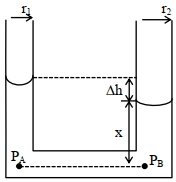
Two narrow bores of diameter $5.0 \, mm$ and $8.0 \, mm$ are joined together to form a $U$-shaped tube open at both ends. If this $U$-tube contains water,what is the difference in the level of two limbs of the tube? [Take surface tension of water $T = 7.3 \times 10^{-2} \, Nm^{-1}$,angle of contact $= 0$,$g = 10 \, ms^{-2}$ and density of water $\rho = 1.0 \times 10^{3} \, kg \, m^{-3}$] (in $mm$)
A
$3.62$
B
$2.19$
C
$5.34$
D
$4.97$
Solution
(B) The pressure at points $A$ and $B$ at the same horizontal level must be equal,so $P_A = P_B$.
The pressure just below the meniscus in the two limbs is given by $P_{atm} - \frac{2T}{r_1}$ and $P_{atm} - \frac{2T}{r_2}$ respectively.
Equating the pressures at the same horizontal level:
$P_{atm} - \frac{2T}{r_1} + \rho g(x + \Delta h) = P_{atm} - \frac{2T}{r_2} + \rho g x$
$\rho g \Delta h = 2T \left( \frac{1}{r_1} - \frac{1}{r_2} \right)$
Given $r_1 = 2.5 \, mm = 2.5 \times 10^{-3} \, m$ and $r_2 = 4.0 \, mm = 4.0 \times 10^{-3} \, m$.
$\Delta h = \frac{2T}{\rho g} \left( \frac{1}{r_1} - \frac{1}{r_2} \right)$
$\Delta h = \frac{2 \times 7.3 \times 10^{-2}}{1.0 \times 10^3 \times 10} \left( \frac{1}{2.5 \times 10^{-3}} - \frac{1}{4.0 \times 10^{-3}} \right)$
$\Delta h = \frac{14.6 \times 10^{-2}}{10^4} \times 10^3 \left( \frac{1}{2.5} - \frac{1}{4.0} \right)$
$\Delta h = 14.6 \times 10^{-3} \times (0.4 - 0.25) = 14.6 \times 10^{-3} \times 0.15 = 2.19 \times 10^{-3} \, m = 2.19 \, mm$.
The pressure just below the meniscus in the two limbs is given by $P_{atm} - \frac{2T}{r_1}$ and $P_{atm} - \frac{2T}{r_2}$ respectively.
Equating the pressures at the same horizontal level:
$P_{atm} - \frac{2T}{r_1} + \rho g(x + \Delta h) = P_{atm} - \frac{2T}{r_2} + \rho g x$
$\rho g \Delta h = 2T \left( \frac{1}{r_1} - \frac{1}{r_2} \right)$
Given $r_1 = 2.5 \, mm = 2.5 \times 10^{-3} \, m$ and $r_2 = 4.0 \, mm = 4.0 \times 10^{-3} \, m$.
$\Delta h = \frac{2T}{\rho g} \left( \frac{1}{r_1} - \frac{1}{r_2} \right)$
$\Delta h = \frac{2 \times 7.3 \times 10^{-2}}{1.0 \times 10^3 \times 10} \left( \frac{1}{2.5 \times 10^{-3}} - \frac{1}{4.0 \times 10^{-3}} \right)$
$\Delta h = \frac{14.6 \times 10^{-2}}{10^4} \times 10^3 \left( \frac{1}{2.5} - \frac{1}{4.0} \right)$
$\Delta h = 14.6 \times 10^{-3} \times (0.4 - 0.25) = 14.6 \times 10^{-3} \times 0.15 = 2.19 \times 10^{-3} \, m = 2.19 \, mm$.
0 likes
View Solution118
AdvancedMCQ
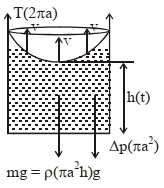
According to Poiseuille's law,the pressure drop per unit length required to overcome viscous forces is $\Delta P = \frac{8 \eta v}{r^2}$,where $r$ is the radius of the cross-section,$v$ is the fluid velocity,and $\eta$ is the coefficient of viscosity. $A$ capillary tube of radius $a$ is dipped in a liquid of density $\rho$,surface tension $T$,and coefficient of viscosity $\eta$. The liquid starts rising in it so that its height $h(t)$ is a function of time $t$. The resulting rate of change of the momentum of the liquid column in the capillary (taking vertically up to be the positive direction and the contact angle to be close to $0^{\circ}$) is $-\pi a^2 \rho gh + F$. Then $F$ is ($g$ is the acceleration due to gravity):
A
$4 \pi Ta + 8 \pi \eta h \frac{dh}{dt}$
B
$4 \pi Ta - 8 \pi \eta h \frac{dh}{dt}$
C
$2 \pi Ta - 8 \pi \eta h \frac{dh}{dt}$
D
$2 \pi Ta + 8 \pi \eta h \frac{dh}{dt}$
Solution
(C) The net force acting on the liquid column of height $h$ is given by the sum of the surface tension force,the weight of the liquid,and the viscous drag force.
The upward force due to surface tension is $F_s = T(2 \pi a)$.
The downward force due to gravity is $F_g = m g = (\pi a^2 h \rho) g$.
According to Poiseuille's law,the pressure drop per unit length is $\frac{\Delta P}{h} = \frac{8 \eta v}{a^2}$. The viscous force acting downwards is $F_v = \Delta P \cdot A = (\frac{8 \eta v}{a^2} h) (\pi a^2) = 8 \pi \eta h v$,where $v = \frac{dh}{dt}$.
By Newton's second law,the rate of change of momentum is equal to the net force:
$\frac{dp}{dt} = F_s - F_g - F_v$
Substituting the expressions:
$\frac{dp}{dt} = T(2 \pi a) - (\pi a^2 \rho g h) - 8 \pi \eta h \frac{dh}{dt}$
Comparing this with the given expression $\frac{dp}{dt} = -\pi a^2 \rho gh + F$,we get:
$F = T(2 \pi a) - 8 \pi \eta h \frac{dh}{dt}$
Thus,the correct option is $C$.
The upward force due to surface tension is $F_s = T(2 \pi a)$.
The downward force due to gravity is $F_g = m g = (\pi a^2 h \rho) g$.
According to Poiseuille's law,the pressure drop per unit length is $\frac{\Delta P}{h} = \frac{8 \eta v}{a^2}$. The viscous force acting downwards is $F_v = \Delta P \cdot A = (\frac{8 \eta v}{a^2} h) (\pi a^2) = 8 \pi \eta h v$,where $v = \frac{dh}{dt}$.
By Newton's second law,the rate of change of momentum is equal to the net force:
$\frac{dp}{dt} = F_s - F_g - F_v$
Substituting the expressions:
$\frac{dp}{dt} = T(2 \pi a) - (\pi a^2 \rho g h) - 8 \pi \eta h \frac{dh}{dt}$
Comparing this with the given expression $\frac{dp}{dt} = -\pi a^2 \rho gh + F$,we get:
$F = T(2 \pi a) - 8 \pi \eta h \frac{dh}{dt}$
Thus,the correct option is $C$.
0 likes
View Solution119
EasyMCQ
On putting a capillary tube in a pot filled with water,the level of water rises up to a height of $4 \,cm$ in the tube. If a tube of half the diameter is used instead,the water will rise to a height of nearly ............. $cm$.
A
$2$
B
$4$
C
$8$
D
$11$
Solution
(C) The height of the liquid column in a capillary tube is given by the formula:
$h = \frac{2T \cos \theta}{r \rho g}$
Where $T$ is surface tension,$\theta$ is the angle of contact,$r$ is the radius of the tube,$\rho$ is the density of the liquid,and $g$ is the acceleration due to gravity.
Since $T, \theta, \rho,$ and $g$ are constant for the given liquid and tube material,we have:
$h \propto \frac{1}{r}$
Since the diameter $d = 2r$,it follows that $h \propto \frac{1}{d}$.
Given $h_1 = 4 \,cm$ and $d_2 = \frac{d_1}{2}$,we can write:
$\frac{h_1}{h_2} = \frac{d_2}{d_1}$
$\frac{4}{h_2} = \frac{d_1 / 2}{d_1} = \frac{1}{2}$
$h_2 = 4 \times 2 = 8 \,cm$.
Therefore,the water will rise to a height of $8 \,cm$.
$h = \frac{2T \cos \theta}{r \rho g}$
Where $T$ is surface tension,$\theta$ is the angle of contact,$r$ is the radius of the tube,$\rho$ is the density of the liquid,and $g$ is the acceleration due to gravity.
Since $T, \theta, \rho,$ and $g$ are constant for the given liquid and tube material,we have:
$h \propto \frac{1}{r}$
Since the diameter $d = 2r$,it follows that $h \propto \frac{1}{d}$.
Given $h_1 = 4 \,cm$ and $d_2 = \frac{d_1}{2}$,we can write:
$\frac{h_1}{h_2} = \frac{d_2}{d_1}$
$\frac{4}{h_2} = \frac{d_1 / 2}{d_1} = \frac{1}{2}$
$h_2 = 4 \times 2 = 8 \,cm$.
Therefore,the water will rise to a height of $8 \,cm$.
0 likes
View Solution120
EasyMCQ
The kerosene oil rises up in the wick of a lamp ...........
A
Due to high surface tension of oil
B
Because the wick attracts the oil
C
Because wick decreases the surface tension of oil
D
Due to capillaries formed in the wick
Solution
(D) The correct answer is $D$.
The phenomenon responsible for the rise of kerosene in the wick of a lamp is capillary action.
$A$ wick consists of a bundle of fibers that create numerous fine pores or narrow spaces,which act as capillaries.
Due to the surface tension of the liquid and the adhesive forces between the liquid and the wick material,the kerosene rises through these capillaries against gravity,allowing it to reach the flame.
The phenomenon responsible for the rise of kerosene in the wick of a lamp is capillary action.
$A$ wick consists of a bundle of fibers that create numerous fine pores or narrow spaces,which act as capillaries.
Due to the surface tension of the liquid and the adhesive forces between the liquid and the wick material,the kerosene rises through these capillaries against gravity,allowing it to reach the flame.
0 likes
View Solution121
EasyMCQ
Ploughing helps to retain water by soil by:
A
By creating capillaries
B
By breaking capillaries
C
By turning the soil upside down
D
None of these
Solution
(B) Ploughing helps in retaining moisture in the soil by breaking the capillary tubes formed in the soil.
Capillaries are fine pores or channels formed in the soil through which water can rise to the surface due to surface tension and evaporate.
By breaking these capillaries,the upward movement of water is stopped,thereby preventing evaporation and helping the soil retain its moisture.
Capillaries are fine pores or channels formed in the soil through which water can rise to the surface due to surface tension and evaporate.
By breaking these capillaries,the upward movement of water is stopped,thereby preventing evaporation and helping the soil retain its moisture.
0 likes
View Solution122
DifficultMCQ
$A$ capillary tube of radius $r$ is immersed in a liquid and the mass of the liquid which rises up in it is $M$. If the radius of the tube is doubled,then the mass of the liquid which will rise in the capillary tube will be ............
A
$2 M$
B
$M$
C
$M / 2$
D
$M / 4$
Solution
(A) The height $h$ of the liquid column in a capillary tube is given by the formula: $h = \frac{2S \cos \theta}{r \rho g}$,where $S$ is the surface tension,$\theta$ is the contact angle,$\rho$ is the density of the liquid,$r$ is the radius of the tube,and $g$ is the acceleration due to gravity.
The mass $M$ of the liquid in the capillary tube is given by: $M = \text{Volume} \times \text{Density} = (\pi r^2 h) \rho$.
Substituting the expression for $h$ into the mass equation:
$M = \pi r^2 \left( \frac{2S \cos \theta}{r \rho g} \right) \rho$
$M = \frac{2 \pi S \cos \theta}{g} \times r$.
From this expression,we can see that the mass $M$ is directly proportional to the radius $r$ of the capillary tube $(M \propto r)$.
If the radius of the tube is doubled $(r' = 2r)$,the new mass $M'$ will be:
$M' \propto r' = 2r$
$M' = 2M$.
Therefore,the mass of the liquid that rises in the capillary tube will be $2M$.
The mass $M$ of the liquid in the capillary tube is given by: $M = \text{Volume} \times \text{Density} = (\pi r^2 h) \rho$.
Substituting the expression for $h$ into the mass equation:
$M = \pi r^2 \left( \frac{2S \cos \theta}{r \rho g} \right) \rho$
$M = \frac{2 \pi S \cos \theta}{g} \times r$.
From this expression,we can see that the mass $M$ is directly proportional to the radius $r$ of the capillary tube $(M \propto r)$.
If the radius of the tube is doubled $(r' = 2r)$,the new mass $M'$ will be:
$M' \propto r' = 2r$
$M' = 2M$.
Therefore,the mass of the liquid that rises in the capillary tube will be $2M$.
0 likes
View Solution123
MediumMCQ
$A$ glass capillary tube of inner diameter $0.28 \,mm$ is lowered vertically into water in a vessel. The pressure to be applied on the water in the capillary tube so that the water level in the tube is the same as that in the vessel is ............ $\times 10^3 \,N/m^2$ (surface tension of water $= 0.07 \,N/m$ and atmospheric pressure $= 10^5 \,N/m^2$).
A
$1$
B
$99$
C
$100$
D
$101$
Solution
(D) The capillary rise $h$ is given by $h = \frac{2T}{r \rho g}$,where $T$ is surface tension,$r$ is the radius,$\rho$ is density,and $g$ is acceleration due to gravity.
To keep the water level in the capillary at the same height as the vessel,we must apply an external pressure $P$ to counteract the capillary pressure.
The pressure difference across the meniscus is $\Delta P = \frac{2T}{r} = \frac{4T}{d}$,where $d$ is the diameter.
Given $T = 0.07 \,N/m$ and $d = 0.28 \times 10^{-3} \,m$,the pressure difference is $\Delta P = \frac{4 \times 0.07}{0.28 \times 10^{-3}} = \frac{0.28}{0.28 \times 10^{-3}} = 10^3 \,N/m^2$.
The total pressure $P$ required is $P = P_0 + \Delta P$,where $P_0 = 10^5 \,N/m^2$.
$P = 10^5 + 10^3 = 100 \times 10^3 + 1 \times 10^3 = 101 \times 10^3 \,N/m^2$.
Thus,the value is $101$.
To keep the water level in the capillary at the same height as the vessel,we must apply an external pressure $P$ to counteract the capillary pressure.
The pressure difference across the meniscus is $\Delta P = \frac{2T}{r} = \frac{4T}{d}$,where $d$ is the diameter.
Given $T = 0.07 \,N/m$ and $d = 0.28 \times 10^{-3} \,m$,the pressure difference is $\Delta P = \frac{4 \times 0.07}{0.28 \times 10^{-3}} = \frac{0.28}{0.28 \times 10^{-3}} = 10^3 \,N/m^2$.
The total pressure $P$ required is $P = P_0 + \Delta P$,where $P_0 = 10^5 \,N/m^2$.
$P = 10^5 + 10^3 = 100 \times 10^3 + 1 \times 10^3 = 101 \times 10^3 \,N/m^2$.
Thus,the value is $101$.
0 likes
View Solution124
EasyMCQ
$A$ capillary tube is dipped in water and it is $20 \, cm$ outside water. The water rises up to $8 \, cm$. If the entire arrangement is put in a freely falling elevator,the length of the water column in the capillary tube will be ........ $cm$.
A
$20$
B
$4$
C
$10$
D
$8$
Solution
(A) The height of the water column in a capillary tube is given by the formula $h = \frac{2T \cos \theta}{r \rho g}$,where $T$ is surface tension,$\theta$ is the contact angle,$r$ is the radius of the tube,$\rho$ is the density of the liquid,and $g$ is the acceleration due to gravity.
In a freely falling elevator,the effective acceleration due to gravity $g_{eff} = g - a$. Since the elevator is in free fall,$a = g$,therefore $g_{eff} = 0$.
As $g_{eff} \to 0$,the height of the water column $h \to \infty$.
However,the water will rise until it reaches the top of the capillary tube. Since the tube is $20 \, cm$ long,the water will fill the entire length of the tube.
In a freely falling elevator,the effective acceleration due to gravity $g_{eff} = g - a$. Since the elevator is in free fall,$a = g$,therefore $g_{eff} = 0$.
As $g_{eff} \to 0$,the height of the water column $h \to \infty$.
However,the water will rise until it reaches the top of the capillary tube. Since the tube is $20 \, cm$ long,the water will fill the entire length of the tube.
0 likes
View Solution125
MediumMCQ
$A$ glass capillary tube of internal radius $r = 0.25 \, mm$ is immersed in water. The top end of the tube projects $2 \, cm$ above the surface of the water. At what angle does the liquid meet the tube (in $^{\circ}$)? (Surface tension of water $T = 0.07 \, N/m$,density $\rho = 1000 \, kg/m^3$,$g = 9.8 \, m/s^2$)
A
$70$
B
$90$
C
$45$
D
$35$
Solution
(A) The maximum height $h$ to which water can rise in a capillary tube is given by $h = \frac{2T \cos \theta}{r \rho g}$.
Assuming the contact angle $\theta = 0^{\circ}$ for water and glass,the maximum height is $h_{max} = \frac{2T}{r \rho g}$.
Substituting the values: $h_{max} = \frac{2 \times 0.07}{0.25 \times 10^{-3} \times 1000 \times 9.8} = \frac{0.14}{2.45} = 0.0571 \, m = 5.71 \, cm$.
Since the tube projects only $2 \, cm$ above the water surface,the water will rise to the top of the tube and adjust its contact angle $\theta$ to satisfy the equilibrium condition $h' = \frac{2T \cos \theta}{r \rho g}$,where $h' = 2 \, cm = 0.02 \, m$.
Thus,$\cos \theta = \frac{h' r \rho g}{2T} = \frac{0.02 \times 0.25 \times 10^{-3} \times 1000 \times 9.8}{2 \times 0.07} = \frac{0.049}{0.14} = 0.35$.
Calculating the angle,$\theta = \cos^{-1}(0.35) \approx 69.5^{\circ} \approx 70^{\circ}$.
Assuming the contact angle $\theta = 0^{\circ}$ for water and glass,the maximum height is $h_{max} = \frac{2T}{r \rho g}$.
Substituting the values: $h_{max} = \frac{2 \times 0.07}{0.25 \times 10^{-3} \times 1000 \times 9.8} = \frac{0.14}{2.45} = 0.0571 \, m = 5.71 \, cm$.
Since the tube projects only $2 \, cm$ above the water surface,the water will rise to the top of the tube and adjust its contact angle $\theta$ to satisfy the equilibrium condition $h' = \frac{2T \cos \theta}{r \rho g}$,where $h' = 2 \, cm = 0.02 \, m$.
Thus,$\cos \theta = \frac{h' r \rho g}{2T} = \frac{0.02 \times 0.25 \times 10^{-3} \times 1000 \times 9.8}{2 \times 0.07} = \frac{0.049}{0.14} = 0.35$.
Calculating the angle,$\theta = \cos^{-1}(0.35) \approx 69.5^{\circ} \approx 70^{\circ}$.
0 likes
View Solution126
MediumMCQ
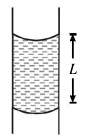
$A$ vertical glass capillary tube of radius $r$ open at both ends contains some water (surface tension $T$ and density $\rho$). If $L$ be the length of the water column,then:
A
$L=\frac{4 T}{r \rho g}$
B
$L=\frac{2 T}{r \rho g}$
C
$L=\frac{T}{4 r \rho g}$
D
$L=\frac{T}{2 r \rho g}$
Solution
(A) The water column in the capillary tube forms two concave menisci at both ends.
Let $P_0$ be the atmospheric pressure.
The pressure just below the upper meniscus is $P_{upper} = P_0 - \frac{2T}{r}$.
The pressure just below the lower meniscus is $P_{lower} = P_0 - \frac{2T}{r}$.
Moving from the top meniscus to the bottom meniscus through the water column of length $L$,the pressure changes as:
$P_{lower} = P_{upper} + \rho g L$
Substituting the values:
$P_0 - \frac{2T}{r} = (P_0 - \frac{2T}{r}) + \rho g L$
Wait,this implies the column is in equilibrium under the pressure difference. The pressure at the top is $P_0 - \frac{2T}{r}$ and at the bottom is $P_0 - \frac{2T}{r}$.
Actually,for a water column of length $L$ to be in equilibrium,the pressure difference between the two ends must balance the hydrostatic pressure $\rho g L$.
Since both ends have concave menisci,the pressure at the top is $P_0 - \frac{2T}{r}$ and the pressure at the bottom is $P_0 + \frac{2T}{r}$ (if the meniscus is convex relative to the water). However,in a capillary tube,both ends form concave menisci. The pressure at the top is $P_0 - \frac{2T}{r}$ and the pressure at the bottom is $P_0 - \frac{2T}{r}$. This would mean the column cannot be in equilibrium unless the pressure difference is balanced by gravity.
Correct approach: The pressure at the top is $P_0 - \frac{2T}{r}$. The pressure at the bottom is $P_0 - \frac{2T}{r}$. The pressure difference across the column is $\rho g L$. Thus,$\rho g L = \frac{2T}{r} - (-\frac{2T}{r}) = \frac{4T}{r}$.
Therefore,$L = \frac{4T}{r \rho g}$.
Let $P_0$ be the atmospheric pressure.
The pressure just below the upper meniscus is $P_{upper} = P_0 - \frac{2T}{r}$.
The pressure just below the lower meniscus is $P_{lower} = P_0 - \frac{2T}{r}$.
Moving from the top meniscus to the bottom meniscus through the water column of length $L$,the pressure changes as:
$P_{lower} = P_{upper} + \rho g L$
Substituting the values:
$P_0 - \frac{2T}{r} = (P_0 - \frac{2T}{r}) + \rho g L$
Wait,this implies the column is in equilibrium under the pressure difference. The pressure at the top is $P_0 - \frac{2T}{r}$ and at the bottom is $P_0 - \frac{2T}{r}$.
Actually,for a water column of length $L$ to be in equilibrium,the pressure difference between the two ends must balance the hydrostatic pressure $\rho g L$.
Since both ends have concave menisci,the pressure at the top is $P_0 - \frac{2T}{r}$ and the pressure at the bottom is $P_0 + \frac{2T}{r}$ (if the meniscus is convex relative to the water). However,in a capillary tube,both ends form concave menisci. The pressure at the top is $P_0 - \frac{2T}{r}$ and the pressure at the bottom is $P_0 - \frac{2T}{r}$. This would mean the column cannot be in equilibrium unless the pressure difference is balanced by gravity.
Correct approach: The pressure at the top is $P_0 - \frac{2T}{r}$. The pressure at the bottom is $P_0 - \frac{2T}{r}$. The pressure difference across the column is $\rho g L$. Thus,$\rho g L = \frac{2T}{r} - (-\frac{2T}{r}) = \frac{4T}{r}$.
Therefore,$L = \frac{4T}{r \rho g}$.
0 likes
View Solution127
MediumMCQ
The height of a liquid column raised in a capillary tube of a certain radius when dipped in liquid $A$ vertically is $5 \ cm$. If the tube is dipped in a similar manner in another liquid $B$ with surface tension and density double the values of liquid $A$,the height of the liquid column raised in liquid $B$ would be $........ \ m$.
A
$0.20$
B
$0.5$
C
$0.05$
D
$0.10$
Solution
(C) The capillary rise formula is given by $h = \frac{2S \cos \theta}{r \rho g}$.
Assuming the angle of contact $\theta$ and radius $r$ remain constant,we have $h \propto \frac{S}{\rho}$.
Given for liquid $A$: $h_1 = 5 \ cm$,surface tension $= S_1$,density $= \rho_1$.
Given for liquid $B$: surface tension $S_2 = 2S_1$,density $\rho_2 = 2\rho_1$.
Using the ratio: $\frac{h_1}{h_2} = \frac{S_1}{S_2} \times \frac{\rho_2}{\rho_1}$.
Substituting the values: $\frac{5}{h_2} = \frac{S_1}{2S_1} \times \frac{2\rho_1}{\rho_1} = \frac{1}{2} \times 2 = 1$.
Therefore,$h_2 = 5 \ cm = 0.05 \ m$.
Assuming the angle of contact $\theta$ and radius $r$ remain constant,we have $h \propto \frac{S}{\rho}$.
Given for liquid $A$: $h_1 = 5 \ cm$,surface tension $= S_1$,density $= \rho_1$.
Given for liquid $B$: surface tension $S_2 = 2S_1$,density $\rho_2 = 2\rho_1$.
Using the ratio: $\frac{h_1}{h_2} = \frac{S_1}{S_2} \times \frac{\rho_2}{\rho_1}$.
Substituting the values: $\frac{5}{h_2} = \frac{S_1}{2S_1} \times \frac{2\rho_1}{\rho_1} = \frac{1}{2} \times 2 = 1$.
Therefore,$h_2 = 5 \ cm = 0.05 \ m$.
0 likes
View Solution128
DifficultMCQ
Given below are two statements:
$Statement$ $I$: If a capillary tube is immersed first in cold water and then in hot water,the height of capillary rise will be smaller in hot water.
$Statement$ $II$: If a capillary tube is immersed first in cold water and then in hot water,the height of capillary rise will be smaller in cold water.
In the light of the above statements,choose the most appropriate from the options given below:
$Statement$ $I$: If a capillary tube is immersed first in cold water and then in hot water,the height of capillary rise will be smaller in hot water.
$Statement$ $II$: If a capillary tube is immersed first in cold water and then in hot water,the height of capillary rise will be smaller in cold water.
In the light of the above statements,choose the most appropriate from the options given below:
A
Both $Statement$ $I$ and $Statement$ $II$ are true.
B
Both $Statement$ $I$ and $Statement$ $II$ are false.
C
$Statement$ $I$ is true but $Statement$ $II$ is false.
D
$Statement$ $I$ is false but $Statement$ $II$ is true.
Solution
(C) The height of capillary rise $h$ is given by the formula $h = \frac{2T \cos \theta}{\rho gr}$,where $T$ is the surface tension,$\theta$ is the contact angle,$\rho$ is the density,$g$ is the acceleration due to gravity,and $r$ is the radius of the capillary tube.
As the temperature of water increases,the surface tension $T$ of water decreases.
Since $h \propto T$,a decrease in surface tension leads to a decrease in the height of the capillary rise.
Therefore,the height of the capillary rise is smaller in hot water compared to cold water.
Thus,$Statement$ $I$ is true and $Statement$ $II$ is false.
As the temperature of water increases,the surface tension $T$ of water decreases.
Since $h \propto T$,a decrease in surface tension leads to a decrease in the height of the capillary rise.
Therefore,the height of the capillary rise is smaller in hot water compared to cold water.
Thus,$Statement$ $I$ is true and $Statement$ $II$ is false.
0 likes
View Solution129
DifficultMCQ
Given below are two statements:
Statement $I$: The contact angle between a solid and a liquid is a property of the material of the solid and liquid as well.
Statement $II$: The rise of a liquid in a capillary tube does not depend on the inner radius of the tube.
In the light of the above statements,choose the correct answer from the options given below:
Statement $I$: The contact angle between a solid and a liquid is a property of the material of the solid and liquid as well.
Statement $II$: The rise of a liquid in a capillary tube does not depend on the inner radius of the tube.
In the light of the above statements,choose the correct answer from the options given below:
A
Both Statement $I$ and Statement $II$ are false.
B
Statement $I$ is false but Statement $II$ is true.
C
Statement $I$ is true but Statement $II$ is false.
D
Both Statement $I$ and Statement $II$ are true.
Solution
(C) Statement $I$ is correct because the contact angle depends on the nature of the solid and liquid surfaces,as well as the cohesive and adhesive forces between the molecules.
Statement $II$ is incorrect because the height $h$ of a liquid column in a capillary tube is given by the formula $h = \frac{2T \cos \theta}{\rho g r}$,where $T$ is the surface tension,$\theta$ is the contact angle,$\rho$ is the density of the liquid,$g$ is the acceleration due to gravity,and $r$ is the inner radius of the capillary tube. Since $h \propto \frac{1}{r}$,the rise of the liquid depends on the radius of the tube.
Therefore,Statement $I$ is true and Statement $II$ is false.
Statement $II$ is incorrect because the height $h$ of a liquid column in a capillary tube is given by the formula $h = \frac{2T \cos \theta}{\rho g r}$,where $T$ is the surface tension,$\theta$ is the contact angle,$\rho$ is the density of the liquid,$g$ is the acceleration due to gravity,and $r$ is the inner radius of the capillary tube. Since $h \propto \frac{1}{r}$,the rise of the liquid depends on the radius of the tube.
Therefore,Statement $I$ is true and Statement $II$ is false.
0 likes
View Solution130
AdvancedMCQ
$A$ uniform capillary tube of inner radius $r$ is dipped vertically into a beaker filled with water. The water rises to a height $h$ in the capillary tube above the water surface in the beaker. The surface tension of water is $\sigma$. The angle of contact between water and the wall of the capillary tube is $\theta$. Ignore the mass of water in the meniscus. Which of the following statements is (are) true?
$(A)$ For a given material of the capillary tube,$h$ decreases with increase in $r$.
$(B)$ For a given material of the capillary tube,$h$ is independent of $\sigma$.
$(C)$ If this experiment is performed in a lift going up with a constant acceleration,then $h$ decreases.
$(D)$ $h$ is proportional to contact angle $\theta$.
$(A)$ For a given material of the capillary tube,$h$ decreases with increase in $r$.
$(B)$ For a given material of the capillary tube,$h$ is independent of $\sigma$.
$(C)$ If this experiment is performed in a lift going up with a constant acceleration,then $h$ decreases.
$(D)$ $h$ is proportional to contact angle $\theta$.
A
$A, B$
B
$A, C$
C
$A, D$
D
$A, B, C$
Solution
(B) The pressure balance at the meniscus is given by $\frac{2 \sigma}{R} = \rho g h$,where $R$ is the radius of the meniscus.
From the geometry of the meniscus,$R = \frac{r}{\cos \theta}$,where $r$ is the radius of the capillary and $\theta$ is the angle of contact.
Substituting $R$ into the height equation: $h = \frac{2 \sigma \cos \theta}{\rho g r}$.
$(A)$ For a given material,$\theta$ is constant,so $h \propto \frac{1}{r}$. Thus,$h$ decreases as $r$ increases. This is true.
$(B)$ From the formula,$h \propto \sigma$,so $h$ depends on $\sigma$. This is false.
$(C)$ If the lift accelerates upward with acceleration $a$,the effective gravity becomes $g_{\text{eff}} = g + a$. The new height is $h' = \frac{2 \sigma \cos \theta}{\rho (g+a) r}$. Since $g+a > g$,$h'$ decreases. This is true.
$(D)$ From the formula,$h \propto \cos \theta$,not $\theta$. This is false.
Therefore,statements $(A)$ and $(C)$ are true.
From the geometry of the meniscus,$R = \frac{r}{\cos \theta}$,where $r$ is the radius of the capillary and $\theta$ is the angle of contact.
Substituting $R$ into the height equation: $h = \frac{2 \sigma \cos \theta}{\rho g r}$.
$(A)$ For a given material,$\theta$ is constant,so $h \propto \frac{1}{r}$. Thus,$h$ decreases as $r$ increases. This is true.
$(B)$ From the formula,$h \propto \sigma$,so $h$ depends on $\sigma$. This is false.
$(C)$ If the lift accelerates upward with acceleration $a$,the effective gravity becomes $g_{\text{eff}} = g + a$. The new height is $h' = \frac{2 \sigma \cos \theta}{\rho (g+a) r}$. Since $g+a > g$,$h'$ decreases. This is true.
$(D)$ From the formula,$h \propto \cos \theta$,not $\theta$. This is false.
Therefore,statements $(A)$ and $(C)$ are true.
0 likes
View Solution131
AdvancedMCQ
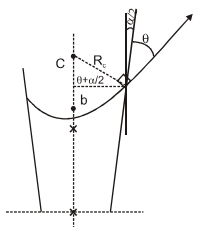
$A$ glass capillary tube is in the shape of a truncated cone with an apex angle $\alpha$ so that its two ends have cross sections of different radii. When dipped in water vertically,water rises in it to a height $h$,where the radius of its cross section is $b$. If the surface tension of water is $S$,its density is $\rho$,and its contact angle with glass is $\theta$,the value of $h$ will be ($g$ is the acceleration due to gravity).
A
$\frac{2 S }{ b \rho g } \cos (\theta-\alpha)$
B
$\frac{2 S }{ b \rho g } \cos (\theta+\alpha)$
C
$\frac{2 S}{ b \rho g } \cos (\theta-\alpha / 2)$
D
$\frac{2 S }{ b \rho g } \cos (\theta+\alpha / 2)$
Solution
(D) Let $R_c$ be the radius of curvature of the meniscus. From the geometry of the capillary tube,the angle between the vertical axis and the wall of the tube is $\alpha/2$. The contact angle $\theta$ is measured between the tangent to the liquid surface and the wall of the tube.
From the geometry shown in the figure,we have $\cos(\theta + \alpha/2) = \frac{b}{R_c}$,which implies $R_c = \frac{b}{\cos(\theta + \alpha/2)}$.
The pressure difference across the curved meniscus is given by $\Delta P = \frac{2S}{R_c}$.
Equating the pressure at the level of the meniscus inside the tube to the atmospheric pressure $P_0$,we have $P_0 - \frac{2S}{R_c} + h\rho g = P_0$,which simplifies to $h\rho g = \frac{2S}{R_c}$.
Substituting the expression for $R_c$,we get $h\rho g = \frac{2S \cos(\theta + \alpha/2)}{b}$.
Therefore,$h = \frac{2S}{b\rho g} \cos(\theta + \alpha/2)$.
From the geometry shown in the figure,we have $\cos(\theta + \alpha/2) = \frac{b}{R_c}$,which implies $R_c = \frac{b}{\cos(\theta + \alpha/2)}$.
The pressure difference across the curved meniscus is given by $\Delta P = \frac{2S}{R_c}$.
Equating the pressure at the level of the meniscus inside the tube to the atmospheric pressure $P_0$,we have $P_0 - \frac{2S}{R_c} + h\rho g = P_0$,which simplifies to $h\rho g = \frac{2S}{R_c}$.
Substituting the expression for $R_c$,we get $h\rho g = \frac{2S \cos(\theta + \alpha/2)}{b}$.
Therefore,$h = \frac{2S}{b\rho g} \cos(\theta + \alpha/2)$.
0 likes
View Solution132
DifficultMCQ
$A$ capillary tube of radius $0.1 \ mm$ is partly dipped in water (surface tension $70 \ dyn/cm$ and glass-water contact angle $\simeq 0^{\circ}$) inclined at $30^{\circ}$ with the vertical. The length of water risen in the capillary is . . . . . . $cm$. (Take $g = 980 \ cm/s^2$)
A
$16.49 \ cm$
B
$\frac{57}{2}$
C
$\frac{71}{5}$
D
$\frac{68}{5}$
Solution
(A) The vertical height $h$ of the water column in a capillary tube is given by the formula: $h = \frac{2T \cos \theta}{\rho gr}$.
Given values are: $T = 70 \ dyn/cm$,$\theta = 0^{\circ}$,$\rho = 1 \ g/cm^3$,$g = 980 \ cm/s^2$,and $r = 0.1 \ mm = 0.01 \ cm$.
Substituting these values into the formula:
$h = \frac{2 \times 70 \times \cos 0^{\circ}}{1 \times 980 \times 0.01} = \frac{140}{9.8} = \frac{1400}{98} = \frac{100}{7} \ cm$.
The tube is inclined at $30^{\circ}$ with the vertical,which means the angle $\alpha$ with the horizontal is $90^{\circ} - 30^{\circ} = 60^{\circ}$.
The length $\ell$ of the water column along the tube is related to the vertical height $h$ by the relation $\ell = \frac{h}{\sin \alpha}$.
Substituting $\alpha = 60^{\circ}$:
$\ell = \frac{100/7}{\sin 60^{\circ}} = \frac{100/7}{\sqrt{3}/2} = \frac{200}{7\sqrt{3}} \approx 16.49 \ cm$.
Thus,the correct option is $A$.
Given values are: $T = 70 \ dyn/cm$,$\theta = 0^{\circ}$,$\rho = 1 \ g/cm^3$,$g = 980 \ cm/s^2$,and $r = 0.1 \ mm = 0.01 \ cm$.
Substituting these values into the formula:
$h = \frac{2 \times 70 \times \cos 0^{\circ}}{1 \times 980 \times 0.01} = \frac{140}{9.8} = \frac{1400}{98} = \frac{100}{7} \ cm$.
The tube is inclined at $30^{\circ}$ with the vertical,which means the angle $\alpha$ with the horizontal is $90^{\circ} - 30^{\circ} = 60^{\circ}$.
The length $\ell$ of the water column along the tube is related to the vertical height $h$ by the relation $\ell = \frac{h}{\sin \alpha}$.
Substituting $\alpha = 60^{\circ}$:
$\ell = \frac{100/7}{\sin 60^{\circ}} = \frac{100/7}{\sqrt{3}/2} = \frac{200}{7\sqrt{3}} \approx 16.49 \ cm$.
Thus,the correct option is $A$.
0 likes
View Solution133
DifficultMCQ
Liquid rises to a height $2 \ cm$ in a capillary tube; in that case,the angle of contact between the solid and the liquid is $0^{\circ}$. The tube is lowered more now,so that the capillary is only $1 \ cm$ above the liquid. In this case,the angle of contact between the solid and liquid is $......^{\circ}$.
A
$0$
B
$30$
C
$60$
D
$90$
Solution
(C) The height of the liquid column in a capillary tube is given by $h = \frac{2T \cos \theta}{r \rho g}$.
When the tube is long enough,the liquid rises to height $h = 2 \ cm$ with an angle of contact $\theta = 0^{\circ}$.
When the tube is cut or lowered such that its length above the liquid surface is $h' = 1 \ cm$,the liquid will rise to the top of the tube and adjust its angle of contact to $\theta'$ to maintain equilibrium.
Since $T$,$r$,$\rho$,and $g$ are constant,we have $h \cos \theta = h' \cos \theta'$.
Substituting the values: $2 \times \cos(0^{\circ}) = 1 \times \cos(\theta')$.
Since $\cos(0^{\circ}) = 1$,we get $2 \times 1 = \cos(\theta')$,which implies $\cos(\theta') = 0.5$.
Therefore,$\theta' = \cos^{-1}(0.5) = 60^{\circ}$.
When the tube is long enough,the liquid rises to height $h = 2 \ cm$ with an angle of contact $\theta = 0^{\circ}$.
When the tube is cut or lowered such that its length above the liquid surface is $h' = 1 \ cm$,the liquid will rise to the top of the tube and adjust its angle of contact to $\theta'$ to maintain equilibrium.
Since $T$,$r$,$\rho$,and $g$ are constant,we have $h \cos \theta = h' \cos \theta'$.
Substituting the values: $2 \times \cos(0^{\circ}) = 1 \times \cos(\theta')$.
Since $\cos(0^{\circ}) = 1$,we get $2 \times 1 = \cos(\theta')$,which implies $\cos(\theta') = 0.5$.
Therefore,$\theta' = \cos^{-1}(0.5) = 60^{\circ}$.
0 likes
View Solution134
EasyMCQ
$A$ liquid (density $= 10^3 \ kg/m^3$) rises to a height of $10 \ cm$ in a capillary tube. If the angle of contact of the liquid-glass pair is $0^{\circ}$ and the radius of the tube is $2 \ mm$,then the surface tension of the liquid is:
A
$10^{-3} \ N/m$
B
$10^{-2} \ N/m$
C
$10^{-1} \ N/m$
D
$1 \ N/m$
Solution
(D) The formula for the height of a liquid column in a capillary tube is $h = \frac{2T \cos \theta}{r \rho g}$.
Rearranging for surface tension $T$,we get $T = \frac{h r \rho g}{2 \cos \theta}$.
Given values: $h = 10 \ cm = 0.1 \ m$,$r = 2 \ mm = 2 \times 10^{-3} \ m$,$\rho = 10^3 \ kg/m^3$,$\theta = 0^{\circ}$,and $g = 10 \ m/s^2$ (assuming standard gravity).
Substituting these values:
$T = \frac{0.1 \times (2 \times 10^{-3}) \times 10^3 \times 10}{2 \times \cos(0^{\circ})}$
$T = \frac{0.1 \times 2 \times 10}{2 \times 1} = \frac{2}{2} = 1 \ N/m$.
Rearranging for surface tension $T$,we get $T = \frac{h r \rho g}{2 \cos \theta}$.
Given values: $h = 10 \ cm = 0.1 \ m$,$r = 2 \ mm = 2 \times 10^{-3} \ m$,$\rho = 10^3 \ kg/m^3$,$\theta = 0^{\circ}$,and $g = 10 \ m/s^2$ (assuming standard gravity).
Substituting these values:
$T = \frac{0.1 \times (2 \times 10^{-3}) \times 10^3 \times 10}{2 \times \cos(0^{\circ})}$
$T = \frac{0.1 \times 2 \times 10}{2 \times 1} = \frac{2}{2} = 1 \ N/m$.
0 likes
View Solution135
DifficultMCQ
The lower end of a glass capillary tube is dipped in water. Water rises to a height of $8 \ cm$. The tube is then broken at a height of $6 \ cm$. The new height of water column and new angle of contact will be $:-$
A
$6 \ cm, \sin^{-1} \frac{3}{4}$
B
$6 \ cm, \cos^{-1} \frac{3}{4}$
C
$4 \ cm, \sin^{-1} \frac{1}{2}$
D
$4 \ cm, \cos^{-1} \frac{3}{4}$
Solution
(B) The height of the water column in a capillary tube is given by $h = \frac{2S \cos \theta}{\rho rg}$.
Initially,the water rises to $h_1 = 8 \ cm$ with an angle of contact $\theta_1 = 0^{\circ}$ (for water and glass).
When the tube is cut at $h_2 = 6 \ cm$,the water will fill the entire tube up to the top because $6 \ cm < 8 \ cm$.
Thus,the new height of the water column is $6 \ cm$.
Since $h \propto \cos \theta$,we have $\frac{h_1}{\cos \theta_1} = \frac{h_2}{\cos \theta_2}$.
Substituting the values: $\frac{8}{\cos 0^{\circ}} = \frac{6}{\cos \theta_2}$.
Since $\cos 0^{\circ} = 1$,we get $\cos \theta_2 = \frac{6}{8} = \frac{3}{4}$.
Therefore,the new angle of contact is $\theta_2 = \cos^{-1} \left( \frac{3}{4} \right)$.
Initially,the water rises to $h_1 = 8 \ cm$ with an angle of contact $\theta_1 = 0^{\circ}$ (for water and glass).
When the tube is cut at $h_2 = 6 \ cm$,the water will fill the entire tube up to the top because $6 \ cm < 8 \ cm$.
Thus,the new height of the water column is $6 \ cm$.
Since $h \propto \cos \theta$,we have $\frac{h_1}{\cos \theta_1} = \frac{h_2}{\cos \theta_2}$.
Substituting the values: $\frac{8}{\cos 0^{\circ}} = \frac{6}{\cos \theta_2}$.
Since $\cos 0^{\circ} = 1$,we get $\cos \theta_2 = \frac{6}{8} = \frac{3}{4}$.
Therefore,the new angle of contact is $\theta_2 = \cos^{-1} \left( \frac{3}{4} \right)$.
0 likes
View Solution136
MediumMCQ
Radius of a capillary is $2 \times 10^{-3} \,m$. $A$ liquid of weight $6.2 \times 10^{-4} \,N$ may remain in the capillary. Then the surface tension of the liquid will be $:-$
A
$5 \times 10^{-3} \,N / m$
B
$5 \times 10^{-2} \,N / m$
C
$5 \,N / m$
D
$50 \,N / m$
Solution
(B) The upward force due to surface tension acting on the liquid column is given by $F = (2 \pi R) T \cos \theta_C$.
In equilibrium,the upward force due to surface tension balances the weight of the liquid column: $(2 \pi R) T \cos \theta_C = W$.
Assuming the contact angle $\theta_C = 0^{\circ}$ for a liquid that rises in a capillary,we have $\cos 0^{\circ} = 1$.
Thus,$T = \frac{W}{2 \pi R}$.
Substituting the given values: $T = \frac{6.2 \times 10^{-4}}{2 \times 3.14 \times 2 \times 10^{-3}}$.
$T = \frac{6.2 \times 10^{-4}}{12.56 \times 10^{-3}} \approx 0.04936 \,N/m \approx 5 \times 10^{-2} \,N/m$.
In equilibrium,the upward force due to surface tension balances the weight of the liquid column: $(2 \pi R) T \cos \theta_C = W$.
Assuming the contact angle $\theta_C = 0^{\circ}$ for a liquid that rises in a capillary,we have $\cos 0^{\circ} = 1$.
Thus,$T = \frac{W}{2 \pi R}$.
Substituting the given values: $T = \frac{6.2 \times 10^{-4}}{2 \times 3.14 \times 2 \times 10^{-3}}$.
$T = \frac{6.2 \times 10^{-4}}{12.56 \times 10^{-3}} \approx 0.04936 \,N/m \approx 5 \times 10^{-2} \,N/m$.
0 likes
View Solution137
EasyMCQ
$A$ narrow glass capillary tube of radius $1.00 \ mm$ is dipped in a trough containing mercury. The amount by which the level of mercury dips down relative to the normal level outside the tube will be approximately $..... \ mm$.
$[$Surface tension of mercury at room temperature $= 0.465 \ N/m$,density of mercury $= 13.6 \times 10^3 \ kg/m^3$,angle of contact with glass $= 135^{\circ}$,$g = 9.8 \ m/s^2]$
$[$Surface tension of mercury at room temperature $= 0.465 \ N/m$,density of mercury $= 13.6 \times 10^3 \ kg/m^3$,angle of contact with glass $= 135^{\circ}$,$g = 9.8 \ m/s^2]$
A
$2$
B
$3$
C
$5$
D
$8$
Solution
(C) The capillary rise or depression is given by the formula: $h = \frac{2T \cos \theta}{r \rho g}$.
Given values: Surface tension $T = 0.465 \ N/m$,radius $r = 1.00 \ mm = 10^{-3} \ m$,density $\rho = 13.6 \times 10^3 \ kg/m^3$,angle of contact $\theta = 135^{\circ}$,and acceleration due to gravity $g = 9.8 \ m/s^2$.
Substituting the values: $h = \frac{2 \times 0.465 \times \cos(135^{\circ})}{10^{-3} \times 13.6 \times 10^3 \times 9.8}$.
Since $\cos(135^{\circ}) = -\frac{1}{\sqrt{2}} \approx -0.707$,the negative sign indicates a depression.
$h = \frac{2 \times 0.465 \times (-0.707)}{13.6 \times 9.8} \times 10^3 \approx -4.93 \times 10^{-3} \ m$.
$h \approx -5 \times 10^{-3} \ m = -5 \ mm$.
The magnitude of the depression is approximately $5 \ mm$.
Given values: Surface tension $T = 0.465 \ N/m$,radius $r = 1.00 \ mm = 10^{-3} \ m$,density $\rho = 13.6 \times 10^3 \ kg/m^3$,angle of contact $\theta = 135^{\circ}$,and acceleration due to gravity $g = 9.8 \ m/s^2$.
Substituting the values: $h = \frac{2 \times 0.465 \times \cos(135^{\circ})}{10^{-3} \times 13.6 \times 10^3 \times 9.8}$.
Since $\cos(135^{\circ}) = -\frac{1}{\sqrt{2}} \approx -0.707$,the negative sign indicates a depression.
$h = \frac{2 \times 0.465 \times (-0.707)}{13.6 \times 9.8} \times 10^3 \approx -4.93 \times 10^{-3} \ m$.
$h \approx -5 \times 10^{-3} \ m = -5 \ mm$.
The magnitude of the depression is approximately $5 \ mm$.
0 likes
View Solution138
MediumMCQ
Water rises in a capillary tube kept vertically on the surface of the Earth to a height $h$. Choose the false statement regarding capillary rise from the following $:-$
A
On the surface of Planet Jupiter,the height will be less than $h$.
B
On Earth,in a lift moving up with constant acceleration,the height is less than $h$.
C
On the surface of the Moon,the height is more than $h$.
D
On Earth,in a lift moving down with constant acceleration,the height is less than $h$.
Solution
(D) The formula for capillary rise is given by $h = \frac{2T \cos \theta}{r \rho g_{eff}}$,where $T$ is surface tension,$\theta$ is the contact angle,$r$ is the radius of the tube,$\rho$ is the density of the liquid,and $g_{eff}$ is the effective acceleration due to gravity.
From this relation,we see that $h \propto \frac{1}{g_{eff}}$.
$A$: On Jupiter,$g$ is much larger than on Earth,so $h$ will be less than $h_{earth}$. This is true.
$B$: In a lift moving up with constant acceleration $a$,$g_{eff} = g + a > g$,so $h$ will be less than $h_{earth}$. This is true.
$C$: On the Moon,$g$ is less than on Earth,so $h$ will be more than $h_{earth}$. This is true.
$D$: In a lift moving down with constant acceleration $a$,$g_{eff} = g - a < g$,so $h$ will be greater than $h_{earth}$. The statement that it is less than $h$ is false.
From this relation,we see that $h \propto \frac{1}{g_{eff}}$.
$A$: On Jupiter,$g$ is much larger than on Earth,so $h$ will be less than $h_{earth}$. This is true.
$B$: In a lift moving up with constant acceleration $a$,$g_{eff} = g + a > g$,so $h$ will be less than $h_{earth}$. This is true.
$C$: On the Moon,$g$ is less than on Earth,so $h$ will be more than $h_{earth}$. This is true.
$D$: In a lift moving down with constant acceleration $a$,$g_{eff} = g - a < g$,so $h$ will be greater than $h_{earth}$. The statement that it is less than $h$ is false.
0 likes
View Solution139
EasyMCQ
Water rises to a height of $20 \,mm$ in a capillary tube of cross-sectional area $A$. If the area of cross-section of the tube is made $\frac{A}{4}$, then water will rise to a height of (in $\,cm$)
A
$2$
B
$6$
C
$4$
D
$3$
Solution
(C) The capillary rise $h$ is given by the formula: $h = \frac{2T \cos \theta}{r \rho g}$.
Since the cross-sectional area $A = \pi r^2$, we have $r = \sqrt{\frac{A}{\pi}}$, which implies $r \propto \sqrt{A}$.
Substituting this into the formula, we get $h \propto \frac{1}{\sqrt{A}}$.
Given the initial height $h_1 = 20 \,mm$ for area $A_1 = A$.
For the new area $A_2 = \frac{A}{4}$, the new height $h_2$ is calculated as:
$\frac{h_2}{h_1} = \sqrt{\frac{A_1}{A_2}} = \sqrt{\frac{A}{A/4}} = \sqrt{4} = 2$.
Therefore, $h_2 = 2 \times h_1 = 2 \times 20 \,mm = 40 \,mm$.
Converting to centimeters, $h_2 = 4 \,cm$.
Since the cross-sectional area $A = \pi r^2$, we have $r = \sqrt{\frac{A}{\pi}}$, which implies $r \propto \sqrt{A}$.
Substituting this into the formula, we get $h \propto \frac{1}{\sqrt{A}}$.
Given the initial height $h_1 = 20 \,mm$ for area $A_1 = A$.
For the new area $A_2 = \frac{A}{4}$, the new height $h_2$ is calculated as:
$\frac{h_2}{h_1} = \sqrt{\frac{A_1}{A_2}} = \sqrt{\frac{A}{A/4}} = \sqrt{4} = 2$.
Therefore, $h_2 = 2 \times h_1 = 2 \times 20 \,mm = 40 \,mm$.
Converting to centimeters, $h_2 = 4 \,cm$.
0 likes
View Solution140
DifficultMCQ
One end of a capillary tube is dipped in water,the rise of water column is $h$. The upward force of $98 \text{ dyne}$ due to surface tension is balanced by the force due to the weight of the water column. The inner circumference of the capillary is (surface tension of water $= 7 \times 10^{-2} \text{ Nm}^{-1}$) (in $\text{ cm}$)
A
$1.4$
B
$0.7$
C
$0.14$
D
$0.07$
Solution
(A) The upward force due to surface tension $(F)$ is given by the formula $F = T \times L$,where $T$ is the surface tension and $L$ is the inner circumference of the capillary tube.
Given: $F = 98 \text{ dyne} = 98 \times 10^{-5} \text{ N}$ (since $1 \text{ dyne} = 10^{-5} \text{ N}$).
Surface tension $T = 7 \times 10^{-2} \text{ Nm}^{-1}$.
We need to find the circumference $L$.
Using the formula $F = T \times L$,we get $L = F / T$.
$L = (98 \times 10^{-5} \text{ N}) / (7 \times 10^{-2} \text{ Nm}^{-1})$.
$L = 14 \times 10^{-3} \text{ m}$.
$L = 0.014 \text{ m} = 1.4 \text{ cm}$.
Given: $F = 98 \text{ dyne} = 98 \times 10^{-5} \text{ N}$ (since $1 \text{ dyne} = 10^{-5} \text{ N}$).
Surface tension $T = 7 \times 10^{-2} \text{ Nm}^{-1}$.
We need to find the circumference $L$.
Using the formula $F = T \times L$,we get $L = F / T$.
$L = (98 \times 10^{-5} \text{ N}) / (7 \times 10^{-2} \text{ Nm}^{-1})$.
$L = 14 \times 10^{-3} \text{ m}$.
$L = 0.014 \text{ m} = 1.4 \text{ cm}$.
0 likes
View Solution141
EasyMCQ
$A$ liquid rises to a height of $2.4 \ cm$ in a glass capillary $P$. Another glass capillary $Q$ having a diameter $80\%$ of capillary $P$ is immersed in the same liquid. The rise of liquid in capillary $Q$ is (in $cm$)
A
$2.4$
B
$3.4$
C
$3.0$
D
$2.5$
Solution
(C) The height of a liquid column in a capillary tube is given by the formula $h = \frac{2T \cos \theta}{r \rho g}$,where $T$ is surface tension,$\theta$ is the contact angle,$r$ is the radius of the capillary,$\rho$ is the density of the liquid,and $g$ is the acceleration due to gravity.
Since $T, \theta, \rho,$ and $g$ are constant for the same liquid and glass,we have $h \propto \frac{1}{r}$ or $h \propto \frac{1}{d}$,where $d$ is the diameter.
Let $h_P = 2.4 \ cm$ and $d_P$ be the diameter of capillary $P$.
For capillary $Q$,the diameter $d_Q = 0.80 \times d_P$.
Using the relation $h_P d_P = h_Q d_Q$,we get:
$h_Q = h_P \times \frac{d_P}{d_Q} = 2.4 \times \frac{d_P}{0.80 \times d_P} = \frac{2.4}{0.80} = 3.0 \ cm$.
Therefore,the rise of liquid in capillary $Q$ is $3.0 \ cm$.
Since $T, \theta, \rho,$ and $g$ are constant for the same liquid and glass,we have $h \propto \frac{1}{r}$ or $h \propto \frac{1}{d}$,where $d$ is the diameter.
Let $h_P = 2.4 \ cm$ and $d_P$ be the diameter of capillary $P$.
For capillary $Q$,the diameter $d_Q = 0.80 \times d_P$.
Using the relation $h_P d_P = h_Q d_Q$,we get:
$h_Q = h_P \times \frac{d_P}{d_Q} = 2.4 \times \frac{d_P}{0.80 \times d_P} = \frac{2.4}{0.80} = 3.0 \ cm$.
Therefore,the rise of liquid in capillary $Q$ is $3.0 \ cm$.
0 likes
View Solution142
MediumMCQ
Water rises up to height $x$ in a capillary tube immersed vertically in water. When the whole arrangement is taken to a depth $d$ in a mine,the water level rises up to height $Y$. If $R$ is the radius of the earth,then the ratio $Y:x$ is
A
$R:(R+d)$
B
$R:(R-d)$
C
$R:(R-d)^2$
D
$R:(R+d)^2$
Solution
(B) The height of water in a capillary tube is given by the formula $h = \frac{2T \cos \theta}{r \rho g}$,where $T$ is surface tension,$\theta$ is the contact angle,$r$ is the radius of the tube,$\rho$ is the density of water,and $g$ is the acceleration due to gravity.
Since $T, \theta, r,$ and $\rho$ are constant,we have $h \propto \frac{1}{g}$.
At the surface of the earth,the acceleration due to gravity is $g_0$. Thus,$x = \frac{k}{g_0}$.
At a depth $d$ inside a mine,the acceleration due to gravity is given by $g_d = g_0(1 - \frac{d}{R}) = g_0(\frac{R-d}{R})$.
Thus,the new height is $Y = \frac{k}{g_d} = \frac{k}{g_0(\frac{R-d}{R})} = \frac{k}{g_0} \cdot \frac{R}{R-d}$.
Substituting $x = \frac{k}{g_0}$,we get $Y = x \cdot \frac{R}{R-d}$.
Therefore,the ratio $Y:x = \frac{R}{R-d}$,which is $R:(R-d)$.
Since $T, \theta, r,$ and $\rho$ are constant,we have $h \propto \frac{1}{g}$.
At the surface of the earth,the acceleration due to gravity is $g_0$. Thus,$x = \frac{k}{g_0}$.
At a depth $d$ inside a mine,the acceleration due to gravity is given by $g_d = g_0(1 - \frac{d}{R}) = g_0(\frac{R-d}{R})$.
Thus,the new height is $Y = \frac{k}{g_d} = \frac{k}{g_0(\frac{R-d}{R})} = \frac{k}{g_0} \cdot \frac{R}{R-d}$.
Substituting $x = \frac{k}{g_0}$,we get $Y = x \cdot \frac{R}{R-d}$.
Therefore,the ratio $Y:x = \frac{R}{R-d}$,which is $R:(R-d)$.
0 likes
View Solution143
MediumMCQ
Two capillary tubes of same diameter are kept vertically in two liquids whose densities are in the ratio $4:3$. If their surface tensions are in the ratio $6:5$,the ratio of heights $\left(\frac{h_1}{h_2}\right)$ of liquids in the two capillary tubes is (Their angle of contacts are same).
A
$\frac{10}{7}$
B
$\frac{9}{10}$
C
$\frac{10}{9}$
D
$\frac{1}{2}$
Solution
(B) The height of a liquid column in a capillary tube is given by the formula $h = \frac{2T \cos \theta}{r \rho g}$,where $T$ is surface tension,$\theta$ is the angle of contact,$r$ is the radius of the tube,$\rho$ is the density of the liquid,and $g$ is the acceleration due to gravity.
Since the diameter (and thus radius $r$) is the same for both tubes,and the angle of contact $\theta$ is the same,the height $h$ is proportional to $\frac{T}{\rho}$.
Therefore,the ratio of heights is $\frac{h_1}{h_2} = \left(\frac{T_1}{T_2}\right) \times \left(\frac{\rho_2}{\rho_1}\right)$.
Given $\frac{T_1}{T_2} = \frac{6}{5}$ and $\frac{\rho_1}{\rho_2} = \frac{4}{3}$,we have $\frac{\rho_2}{\rho_1} = \frac{3}{4}$.
Substituting these values,we get $\frac{h_1}{h_2} = \left(\frac{6}{5}\right) \times \left(\frac{3}{4}\right) = \frac{18}{20} = \frac{9}{10}$.
Since the diameter (and thus radius $r$) is the same for both tubes,and the angle of contact $\theta$ is the same,the height $h$ is proportional to $\frac{T}{\rho}$.
Therefore,the ratio of heights is $\frac{h_1}{h_2} = \left(\frac{T_1}{T_2}\right) \times \left(\frac{\rho_2}{\rho_1}\right)$.
Given $\frac{T_1}{T_2} = \frac{6}{5}$ and $\frac{\rho_1}{\rho_2} = \frac{4}{3}$,we have $\frac{\rho_2}{\rho_1} = \frac{3}{4}$.
Substituting these values,we get $\frac{h_1}{h_2} = \left(\frac{6}{5}\right) \times \left(\frac{3}{4}\right) = \frac{18}{20} = \frac{9}{10}$.
0 likes
View Solution144
MediumMCQ
$A$ capillary tube is taken from the Earth's surface to the Moon's surface. What happens to the rise of the liquid column on the Moon's surface? (Acceleration due to gravity on the Earth's surface is six times that of the Moon's surface.)
A
zero.
B
six times that on the Earth's surface.
C
equal to that on the Earth's surface.
D
$\left(\frac{1}{6}\right)^{\text{th}}$ that on the Earth's surface.
Solution
(B) The height of the liquid column in a capillary tube is given by the formula $h = \frac{2T \cos \theta}{r \rho g}$,where $T$ is the surface tension,$\theta$ is the angle of contact,$r$ is the radius of the capillary,$\rho$ is the density of the liquid,and $g$ is the acceleration due to gravity.
From the formula,we see that $h \propto \frac{1}{g}$.
Let $g_e$ be the acceleration due to gravity on Earth and $g_m$ be the acceleration due to gravity on the Moon.
Given that $g_e = 6g_m$,or $g_m = \frac{g_e}{6}$.
Let $h_e$ be the height on Earth and $h_m$ be the height on the Moon.
Then,$\frac{h_m}{h_e} = \frac{g_e}{g_m} = \frac{g_e}{g_e / 6} = 6$.
Therefore,$h_m = 6h_e$.
The rise of the liquid column on the Moon's surface is six times that on the Earth's surface.
From the formula,we see that $h \propto \frac{1}{g}$.
Let $g_e$ be the acceleration due to gravity on Earth and $g_m$ be the acceleration due to gravity on the Moon.
Given that $g_e = 6g_m$,or $g_m = \frac{g_e}{6}$.
Let $h_e$ be the height on Earth and $h_m$ be the height on the Moon.
Then,$\frac{h_m}{h_e} = \frac{g_e}{g_m} = \frac{g_e}{g_e / 6} = 6$.
Therefore,$h_m = 6h_e$.
The rise of the liquid column on the Moon's surface is six times that on the Earth's surface.
0 likes
View Solution145
MediumMCQ
Water rises in a capillary tube of radius $r$ up to a height $h$. The mass of water in the capillary is $m$. The mass of water that will rise in a capillary of radius $\frac{r}{5}$ will be:
A
$\frac{m}{5}$
B
$\frac{m}{2}$
C
$m$
D
$\frac{m}{25}$
Solution
(A) The height $h$ to which a liquid rises in a capillary tube is given by $h = \frac{2T \cos \theta}{r \rho g}$,where $T$ is surface tension,$\rho$ is density,and $r$ is the radius of the tube.
Since $h \propto \frac{1}{r}$,if the radius becomes $\frac{r}{5}$,the new height $h' = 5h$.
The mass of water in the capillary is given by $m = \text{Volume} \times \text{Density} = (\pi r^2 h) \rho$.
For the new capillary,the new mass $m'$ is $m' = \pi (r')^2 h' \rho$.
Substituting $r' = \frac{r}{5}$ and $h' = 5h$:
$m' = \pi (\frac{r}{5})^2 (5h) \rho = \pi (\frac{r^2}{25}) (5h) \rho = \frac{1}{5} (\pi r^2 h \rho) = \frac{m}{5}$.
Since $h \propto \frac{1}{r}$,if the radius becomes $\frac{r}{5}$,the new height $h' = 5h$.
The mass of water in the capillary is given by $m = \text{Volume} \times \text{Density} = (\pi r^2 h) \rho$.
For the new capillary,the new mass $m'$ is $m' = \pi (r')^2 h' \rho$.
Substituting $r' = \frac{r}{5}$ and $h' = 5h$:
$m' = \pi (\frac{r}{5})^2 (5h) \rho = \pi (\frac{r^2}{25}) (5h) \rho = \frac{1}{5} (\pi r^2 h \rho) = \frac{m}{5}$.
0 likes
View Solution146
EasyMCQ
In a capillary tube of area of cross-section $a$,water rises to a height $h$. To what height will water rise in a capillary tube of area of cross-section $4a$?
A
$4h$
B
$2h$
C
$h/2$
D
$h/4$
Solution
(C) The height of water rise in a capillary tube is given by the formula $h = \frac{2T \cos \theta}{r \rho g}$,where $T$ is surface tension,$\theta$ is the angle of contact,$r$ is the radius of the tube,$\rho$ is the density of the liquid,and $g$ is the acceleration due to gravity.
From this formula,we see that $h \propto \frac{1}{r}$.
The area of cross-section $a$ is given by $a = \pi r^2$,which implies $r = \sqrt{\frac{a}{\pi}}$,so $r \propto \sqrt{a}$.
Therefore,$h \propto \frac{1}{\sqrt{a}}$.
Let $h_1 = h$ for area $a_1 = a$,and $h_2$ be the height for area $a_2 = 4a$.
Then,$\frac{h_2}{h_1} = \sqrt{\frac{a_1}{a_2}} = \sqrt{\frac{a}{4a}} = \sqrt{\frac{1}{4}} = \frac{1}{2}$.
Thus,$h_2 = \frac{h}{2}$.
From this formula,we see that $h \propto \frac{1}{r}$.
The area of cross-section $a$ is given by $a = \pi r^2$,which implies $r = \sqrt{\frac{a}{\pi}}$,so $r \propto \sqrt{a}$.
Therefore,$h \propto \frac{1}{\sqrt{a}}$.
Let $h_1 = h$ for area $a_1 = a$,and $h_2$ be the height for area $a_2 = 4a$.
Then,$\frac{h_2}{h_1} = \sqrt{\frac{a_1}{a_2}} = \sqrt{\frac{a}{4a}} = \sqrt{\frac{1}{4}} = \frac{1}{2}$.
Thus,$h_2 = \frac{h}{2}$.
0 likes
View Solution147
MediumMCQ
When one end of a capillary tube is dipped in water,the height of water column is $h$. The upward force of $105 \text{ dyne}$ due to surface tension is balanced by the force due to the weight of water column. The inner circumference of the capillary tube is (Surface tension of water $= 7 \times 10^{-2} \text{ N/m}$) (in $\text{ cm}$)
A
$1.5$
B
$2$
C
$2.5$
D
$3$
Solution
(A) The upward force due to surface tension $(F)$ is given by the formula: $F = T \cdot L$,where $T$ is the surface tension and $L$ is the inner circumference of the capillary tube.
Given: $F = 105 \text{ dyne} = 105 \times 10^{-5} \text{ N} = 1.05 \times 10^{-3} \text{ N}$.
Surface tension $T = 7 \times 10^{-2} \text{ N/m}$.
We need to find the circumference $L$.
Using the formula $L = F / T$:
$L = (1.05 \times 10^{-3} \text{ N}) / (7 \times 10^{-2} \text{ N/m})$
$L = 0.15 \times 10^{-1} \text{ m} = 0.015 \text{ m}$.
Converting to centimeters: $L = 0.015 \times 100 \text{ cm} = 1.5 \text{ cm}$.
Thus,the inner circumference of the capillary tube is $1.5 \text{ cm}$.
Given: $F = 105 \text{ dyne} = 105 \times 10^{-5} \text{ N} = 1.05 \times 10^{-3} \text{ N}$.
Surface tension $T = 7 \times 10^{-2} \text{ N/m}$.
We need to find the circumference $L$.
Using the formula $L = F / T$:
$L = (1.05 \times 10^{-3} \text{ N}) / (7 \times 10^{-2} \text{ N/m})$
$L = 0.15 \times 10^{-1} \text{ m} = 0.015 \text{ m}$.
Converting to centimeters: $L = 0.015 \times 100 \text{ cm} = 1.5 \text{ cm}$.
Thus,the inner circumference of the capillary tube is $1.5 \text{ cm}$.
0 likes
View Solution148
MediumMCQ
$A$ capillary tube is immersed vertically in water,and the water rises to a height $h_1$ on the Earth's surface. When this arrangement is taken into a mine of depth $d$ below the Earth's surface,the height of the water column is $h_2$. If $R$ is the radius of the Earth,the ratio $\frac{h_2}{h_1}$ is:
A
$\frac{R+d}{R}$
B
$\frac{R-d}{R}$
C
$\frac{R}{R+d}$
D
$\frac{R}{R-d}$
Solution
(D) The height of the water column in a capillary tube is given by the formula $h = \frac{2T \cos \theta}{r \rho g}$,where $T$ is the surface tension,$\theta$ is the angle of contact,$r$ is the radius of the capillary,$\rho$ is the density of water,and $g$ is the acceleration due to gravity.
Since $T, \theta, r,$ and $\rho$ remain constant,we have $h \propto \frac{1}{g}$.
Therefore,$\frac{h_2}{h_1} = \frac{g_1}{g_2}$,where $g_1$ is the acceleration due to gravity on the Earth's surface and $g_2$ is the acceleration due to gravity at depth $d$.
The acceleration due to gravity at depth $d$ is given by $g_2 = g_1 \left(1 - \frac{d}{R}\right) = g_1 \left(\frac{R-d}{R}\right)$.
Substituting this into the ratio,we get $\frac{h_2}{h_1} = \frac{g_1}{g_1 \left(\frac{R-d}{R}\right)} = \frac{R}{R-d}$.
Thus,the correct option is $D$.
Since $T, \theta, r,$ and $\rho$ remain constant,we have $h \propto \frac{1}{g}$.
Therefore,$\frac{h_2}{h_1} = \frac{g_1}{g_2}$,where $g_1$ is the acceleration due to gravity on the Earth's surface and $g_2$ is the acceleration due to gravity at depth $d$.
The acceleration due to gravity at depth $d$ is given by $g_2 = g_1 \left(1 - \frac{d}{R}\right) = g_1 \left(\frac{R-d}{R}\right)$.
Substituting this into the ratio,we get $\frac{h_2}{h_1} = \frac{g_1}{g_1 \left(\frac{R-d}{R}\right)} = \frac{R}{R-d}$.
Thus,the correct option is $D$.
0 likes
View Solution149
MediumMCQ
When one end of a capillary tube is dipped in water,the height of the water column is $h$. The upward force of $108 \ dyne$ due to surface tension is balanced by the force due to the weight of the water column. What is the inner circumference of the capillary (in $cm$)? (Surface tension of water $T = 7.2 \times 10^{-2} \ N/m$)
A
$3$
B
$2.5$
C
$1.8$
D
$1.5$
Solution
(D) The upward force due to surface tension $(F)$ acting on the circumference of the capillary is given by the formula: $F = T \times L$,where $T$ is the surface tension and $L$ is the inner circumference of the capillary.
Given: $F = 108 \ dyne = 108 \times 10^{-5} \ N$ (since $1 \ dyne = 10^{-5} \ N$).
Given: $T = 7.2 \times 10^{-2} \ N/m$.
We need to find the circumference $L$.
Using the formula $F = T \times L$,we get:
$L = F / T$
$L = (108 \times 10^{-5}) / (7.2 \times 10^{-2})$
$L = (108 / 7.2) \times 10^{-3}$
$L = 15 \times 10^{-3} \ m$
$L = 1.5 \times 10^{-2} \ m = 1.5 \ cm$.
Therefore,the inner circumference of the capillary is $1.5 \ cm$.
Given: $F = 108 \ dyne = 108 \times 10^{-5} \ N$ (since $1 \ dyne = 10^{-5} \ N$).
Given: $T = 7.2 \times 10^{-2} \ N/m$.
We need to find the circumference $L$.
Using the formula $F = T \times L$,we get:
$L = F / T$
$L = (108 \times 10^{-5}) / (7.2 \times 10^{-2})$
$L = (108 / 7.2) \times 10^{-3}$
$L = 15 \times 10^{-3} \ m$
$L = 1.5 \times 10^{-2} \ m = 1.5 \ cm$.
Therefore,the inner circumference of the capillary is $1.5 \ cm$.
0 likes
View SolutionFluid Mechanics and Surface Tension — Capillary Tube and Capillarity · Frequently Asked Questions
1Are these Fluid Mechanics and Surface Tension questions useful for JEE and NEET?
Yes. All questions in this section are mapped to JEE Main and NEET exam patterns. Previous year questions from JEE Main, NEET, GUJCET and state-level exams are included with full solutions.
2Can I switch to Hindi or Gujarati for these questions?
Yes. Use the language tabs in the hero section or the sidebar to view the same questions and solutions in English, Hindi or Gujarati.
3How do I generate a question paper from this subtopic?
Use the Vedclass Exam Paper Generator — select the chapter and subtopic, set difficulty, and generate Sets A, B, C, D automatically. First 3 chapters of every subject are free.
Vedclass Products
For Students
Vedclass Test Series
Mock tests in real JEE/NEET style with performance analysis. 5-day free trial.
Start Free TrialFor Teachers
Exam Paper Generator
Generate Set A/B/C/D papers from this chapter in 2 minutes. 3 chapters free.
Try FreeFor Institutes
Online Exam Module
Live online exams with unlimited students, 360° analytics & white-label branding.
See DemoFor Teachers & Institutes
Generate a Fluid Mechanics and Surface Tension Exam Paper in 2 Minutes
Select subtopic & difficulty — Sets A, B, C, D auto-generated with No Repeat logic.
First 3 chapters of every subject are free — no payment required.