
ChemistryQ1–41 of 41 questions
Page 1 of 1 · English
1
ChemistryEasyMCQWBJEE · 2017
The yield of $acetanilide$ in the reaction ($100\%$ conversion) of $2$ moles of $aniline$ with $1$ mole of $acetic$ $anhydride$ is (in $g$)
A
$270$
B
$135$
C
$67.5$
D
$177$
Solution
(B) The reaction between $aniline$ and $acetic$ $anhydride$ is:
$C_6H_5NH_2 + (CH_3CO)_2O \rightarrow C_6H_5NHCOCH_3 + CH_3COOH$
Here,$1$ mole of $aniline$ reacts with $1$ mole of $acetic$ $anhydride$ to form $1$ mole of $acetanilide$ $(C_6H_5NHCOCH_3)$.
Given: $2$ moles of $aniline$ and $1$ mole of $acetic$ $anhydride$.
Since $acetic$ $anhydride$ is the limiting reagent,$1$ mole of $acetanilide$ will be formed.
The molar mass of $acetanilide$ $(C_8H_9NO)$ is $135 \ g/mol$.
Therefore,the yield is $1 \ mol \times 135 \ g/mol = 135 \ g$.
$C_6H_5NH_2 + (CH_3CO)_2O \rightarrow C_6H_5NHCOCH_3 + CH_3COOH$
Here,$1$ mole of $aniline$ reacts with $1$ mole of $acetic$ $anhydride$ to form $1$ mole of $acetanilide$ $(C_6H_5NHCOCH_3)$.
Given: $2$ moles of $aniline$ and $1$ mole of $acetic$ $anhydride$.
Since $acetic$ $anhydride$ is the limiting reagent,$1$ mole of $acetanilide$ will be formed.
The molar mass of $acetanilide$ $(C_8H_9NO)$ is $135 \ g/mol$.
Therefore,the yield is $1 \ mol \times 135 \ g/mol = 135 \ g$.
0 likesView Solution
2
ChemistryMediumMCQWBJEE · 2017
Equilibrium constants for the following reactions at $1200 \ K$ are given:
$2 \ H_2O_{(g)} \rightleftharpoons 2 \ H_{2(g)} + O_{2(g)}$
$K_1 = 6.4 \times 10^{-8}$
$2 \ CO_{2(g)} \rightleftharpoons 2 \ CO_{(g)} + O_{2(g)}$
$K_2 = 1.6 \times 10^{-6}$
The equilibrium constant for the reaction: $H_{2(g)} + CO_{2(g)} \rightleftharpoons CO_{(g)} + H_2O_{(g)}$
at $1200 \ K$ will be
$2 \ H_2O_{(g)} \rightleftharpoons 2 \ H_{2(g)} + O_{2(g)}$
$K_1 = 6.4 \times 10^{-8}$
$2 \ CO_{2(g)} \rightleftharpoons 2 \ CO_{(g)} + O_{2(g)}$
$K_2 = 1.6 \times 10^{-6}$
The equilibrium constant for the reaction: $H_{2(g)} + CO_{2(g)} \rightleftharpoons CO_{(g)} + H_2O_{(g)}$
at $1200 \ K$ will be
A
$0.05$
B
$20$
C
$0.2$
D
$5$
Solution
(D) The given reactions are:
$(1) \ 2 \ H_2O_{(g)} \rightleftharpoons 2 \ H_{2(g)} + O_{2(g)}, \ K_1 = 6.4 \times 10^{-8}$
$(2) \ 2 \ CO_{2(g)} \rightleftharpoons 2 \ CO_{(g)} + O_{2(g)}, \ K_2 = 1.6 \times 10^{-6}$
We need the equilibrium constant $(K)$ for the reaction: $H_{2(g)} + CO_{2(g)} \rightleftharpoons CO_{(g)} + H_2O_{(g)}$
Divide reaction $(1)$ by $2$ and reverse it: $H_{2(g)} + \frac{1}{2} O_{2(g)} \rightleftharpoons H_2O_{(g)}$,$K_3 = \frac{1}{\sqrt{K_1}}$
Divide reaction $(2)$ by $2$: $CO_{2(g)} \rightleftharpoons CO_{(g)} + \frac{1}{2} O_{2(g)}$,$K_4 = \sqrt{K_2}$
Adding these two reactions gives the target reaction,so $K = K_3 \times K_4 = \frac{\sqrt{K_2}}{\sqrt{K_1}}$
$K = \sqrt{\frac{1.6 \times 10^{-6}}{6.4 \times 10^{-8}}} = \sqrt{\frac{16 \times 10^{-7}}{6.4 \times 10^{-8}}} = \sqrt{\frac{160}{6.4}} = \sqrt{25} = 5$
$(1) \ 2 \ H_2O_{(g)} \rightleftharpoons 2 \ H_{2(g)} + O_{2(g)}, \ K_1 = 6.4 \times 10^{-8}$
$(2) \ 2 \ CO_{2(g)} \rightleftharpoons 2 \ CO_{(g)} + O_{2(g)}, \ K_2 = 1.6 \times 10^{-6}$
We need the equilibrium constant $(K)$ for the reaction: $H_{2(g)} + CO_{2(g)} \rightleftharpoons CO_{(g)} + H_2O_{(g)}$
Divide reaction $(1)$ by $2$ and reverse it: $H_{2(g)} + \frac{1}{2} O_{2(g)} \rightleftharpoons H_2O_{(g)}$,$K_3 = \frac{1}{\sqrt{K_1}}$
Divide reaction $(2)$ by $2$: $CO_{2(g)} \rightleftharpoons CO_{(g)} + \frac{1}{2} O_{2(g)}$,$K_4 = \sqrt{K_2}$
Adding these two reactions gives the target reaction,so $K = K_3 \times K_4 = \frac{\sqrt{K_2}}{\sqrt{K_1}}$
$K = \sqrt{\frac{1.6 \times 10^{-6}}{6.4 \times 10^{-8}}} = \sqrt{\frac{16 \times 10^{-7}}{6.4 \times 10^{-8}}} = \sqrt{\frac{160}{6.4}} = \sqrt{25} = 5$
0 likesView Solution
3
ChemistryMediumMCQWBJEE · 2017
Among $Me_{3}N$,$C_{5}H_{5}N$ and $MeCN$ $(Me = \text{methyl group})$,the electronegativity of $N$ is in the order:
A
$MeCN > C_{5}H_{5}N > Me_{3}N$
B
$C_{5}H_{5}N > Me_{3}N > MeCN$
C
$Me_{3}N > MeCN > C_{5}H_{5}N$
D
Electronegativity is the same in all
Solution
(A) The electronegativity of an atom depends on the percentage of $s$-character in its hybrid orbitals. Higher $s$-character leads to higher electronegativity.
In $Me_{3}N$,the nitrogen atom is $sp^{3}$-hybridized ($25\% \ s$-character).
In $C_{5}H_{5}N$ (pyridine),the nitrogen atom is $sp^{2}$-hybridized ($33.3\% \ s$-character).
In $MeCN$ (acetonitrile),the nitrogen atom is $sp$-hybridized ($50\% \ s$-character).
Therefore,the order of electronegativity of the nitrogen atom is $MeCN > C_{5}H_{5}N > Me_{3}N$.
In $Me_{3}N$,the nitrogen atom is $sp^{3}$-hybridized ($25\% \ s$-character).
In $C_{5}H_{5}N$ (pyridine),the nitrogen atom is $sp^{2}$-hybridized ($33.3\% \ s$-character).
In $MeCN$ (acetonitrile),the nitrogen atom is $sp$-hybridized ($50\% \ s$-character).
Therefore,the order of electronegativity of the nitrogen atom is $MeCN > C_{5}H_{5}N > Me_{3}N$.
0 likesView Solution
4
ChemistryEasyMCQWBJEE · 2017
Which of the following atoms should have the highest $1^{st}$ electron affinity?
A
$F$
B
$O$
C
$N$
D
$C$
Solution
(A) The electron affinity generally increases across a period from left to right due to an increase in effective nuclear charge and a decrease in atomic size.
Among the given elements ($C$,$N$,$O$,$F$),$F$ has the highest effective nuclear charge and the smallest atomic size.
Although $Cl$ has the highest electron affinity in the entire periodic table,among the provided options,$F$ has the highest $1^{st}$ electron affinity.
Among the given elements ($C$,$N$,$O$,$F$),$F$ has the highest effective nuclear charge and the smallest atomic size.
Although $Cl$ has the highest electron affinity in the entire periodic table,among the provided options,$F$ has the highest $1^{st}$ electron affinity.
0 likesView Solution
5
ChemistryMediumMCQWBJEE · 2017
In the $IUPAC$ system,$PhCH_{2}CH_{2}CO_{2}H$ is named as
A
$3-$phenylpropanoic acid
B
benzylacetic acid
C
carboxyethylbenzene
D
$2-$phenylpropanoic acid
Solution
(A) The structure is $Ph-CH_{2}-CH_{2}-COOH$.
To name this compound according to $IUPAC$ rules,we identify the longest carbon chain containing the carboxylic acid group as the parent chain.
The carbon atom of the $-COOH$ group is assigned position $1$.
The chain consists of $3$ carbons,so the parent alkane is propane.
The carboxylic acid suffix is $-oic$ acid.
There is a phenyl group attached to the $3^{rd}$ carbon atom.
Therefore,the correct name is $3-$phenylpropanoic acid.
To name this compound according to $IUPAC$ rules,we identify the longest carbon chain containing the carboxylic acid group as the parent chain.
The carbon atom of the $-COOH$ group is assigned position $1$.
The chain consists of $3$ carbons,so the parent alkane is propane.
The carboxylic acid suffix is $-oic$ acid.
There is a phenyl group attached to the $3^{rd}$ carbon atom.
Therefore,the correct name is $3-$phenylpropanoic acid.
0 likesView Solution
6
ChemistryEasyMCQWBJEE · 2017
The isomerisation of $1-$butyne to $2-$butyne can be achieved by treatment with
A
hydrochloric acid
B
ammoniacal silver nitrate
C
ammoniacal cuprous chloride
D
ethanolic potassium hydroxide
Solution
(D) The isomerisation of $1-$butyne $(CH_3-CH_2-C \equiv CH)$ to $2-$butyne $(CH_3-C \equiv C-CH_3)$ is a base-catalyzed reaction.
When $1-$butyne is treated with ethanolic $KOH$ at high temperatures,it undergoes base-catalyzed isomerisation to form the more stable internal alkyne,$2-$butyne.
The reaction is as follows:
$CH_3-CH_2-C \equiv CH \xrightarrow{\text{ethanolic } KOH, \Delta} CH_3-C \equiv C-CH_3$
When $1-$butyne is treated with ethanolic $KOH$ at high temperatures,it undergoes base-catalyzed isomerisation to form the more stable internal alkyne,$2-$butyne.
The reaction is as follows:
$CH_3-CH_2-C \equiv CH \xrightarrow{\text{ethanolic } KOH, \Delta} CH_3-C \equiv C-CH_3$
0 likesView Solution
7
ChemistryEasyMCQWBJEE · 2017
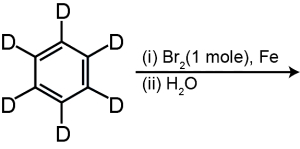
The major product$(s)$ obtained from the following reaction of $1 \ mole$ of hexadeuteriobenzene $(C_6D_6)$ is/are:
A
Bromopentadeuteriobenzene $(C_6D_5Br)$
B
Hexadeuteriobiphenyl
C
Dibromotetradeuteriobenzene
D
Monodeuterio-pentabromobenzene
Solution
(A) The reaction of hexadeuteriobenzene $(C_6D_6)$ with $Br_2$ in the presence of $Fe$ is an electrophilic aromatic substitution reaction.
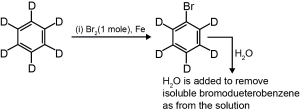
Since $1 \ mole$ of $Br_2$ is used,one deuterium atom is replaced by a bromine atom to form bromopentadeuteriobenzene $(C_6D_5Br)$.
The addition of $H_2O$ is a standard workup procedure to remove inorganic salts or quench the reaction.
Thus,the major product is bromopentadeuteriobenzene.
Since $1 \ mole$ of $Br_2$ is used,one deuterium atom is replaced by a bromine atom to form bromopentadeuteriobenzene $(C_6D_5Br)$.
The addition of $H_2O$ is a standard workup procedure to remove inorganic salts or quench the reaction.
Thus,the major product is bromopentadeuteriobenzene.
0 likesView Solution
8
ChemistryMediumMCQWBJEE · 2017
Of the following compounds,which one is the strongest Bronsted acid in an aqueous solution?
A
$HClO_{3}$
B
$HClO_{2}$
C
$HOCl$
D
$HOBr$
Solution
(A) The strength of oxo-acids increases with the increase in the oxidation number of the central atom.
For $HClO_{3}$,the oxidation number of $Cl$ is $+5$.
For $HClO_{2}$,the oxidation number of $Cl$ is $+3$.
For $HOCl$,the oxidation number of $Cl$ is $+1$.
For $HOBr$,the oxidation number of $Br$ is $+1$.
Since $HClO_{3}$ has the highest oxidation number of the central atom,it is the strongest Bronsted acid among the given compounds.
For $HClO_{3}$,the oxidation number of $Cl$ is $+5$.
For $HClO_{2}$,the oxidation number of $Cl$ is $+3$.
For $HOCl$,the oxidation number of $Cl$ is $+1$.
For $HOBr$,the oxidation number of $Br$ is $+1$.
Since $HClO_{3}$ has the highest oxidation number of the central atom,it is the strongest Bronsted acid among the given compounds.
0 likesView Solution
9
ChemistryEasyMCQWBJEE · 2017
Dissolving $NaCN$ in de-ionised water will result in a solution having
A
$pH < 7$
B
$pH = 7$
C
$pOH = 7$
D
$pH > 7$
Solution
(D) When $NaCN$ is dissolved in de-ionised water,it undergoes hydrolysis as follows:
$CN^{-} + H_2O \rightleftharpoons HCN + OH^{-}$
Since $NaCN$ is a salt of a strong base $(NaOH)$ and a weak acid $(HCN)$,the $CN^{-}$ ion undergoes anionic hydrolysis.
This reaction produces $OH^{-}$ ions in the solution,making it basic.
Therefore,the resulting solution will have a $pH > 7$.
$CN^{-} + H_2O \rightleftharpoons HCN + OH^{-}$
Since $NaCN$ is a salt of a strong base $(NaOH)$ and a weak acid $(HCN)$,the $CN^{-}$ ion undergoes anionic hydrolysis.
This reaction produces $OH^{-}$ ions in the solution,making it basic.
Therefore,the resulting solution will have a $pH > 7$.
0 likesView Solution
10
ChemistryEasyMCQWBJEE · 2017
The shape of $XeF_{5}^{-}$ will be
A
square pyramid
B
trigonal bipyramidal
C
planar
D
pentagonal bipyramid
Solution
(C) To determine the shape of $XeF_{5}^{-}$,we calculate the number of electron pairs around the central $Xe$ atom:
Number of electron pairs $= \frac{1}{2} [V + M - C + A] = \frac{1}{2} [8 + 5 - 0 + 1] = 7$.
Here,$V = 8$ (valence electrons of $Xe$),$M = 5$ (monovalent atoms),and $A = 1$ (anionic charge).
With $7$ electron pairs,the electron geometry is pentagonal bipyramidal ($sp^{3}d^{3}$ hybridization).
Out of these $7$ pairs,$5$ are bond pairs and $2$ are lone pairs.
The two lone pairs occupy the axial positions to minimize repulsion,leaving the $5$ $Xe-F$ bonds in a single equatorial plane.
Therefore,the molecular shape of $XeF_{5}^{-}$ is pentagonal planar.
Number of electron pairs $= \frac{1}{2} [V + M - C + A] = \frac{1}{2} [8 + 5 - 0 + 1] = 7$.
Here,$V = 8$ (valence electrons of $Xe$),$M = 5$ (monovalent atoms),and $A = 1$ (anionic charge).
With $7$ electron pairs,the electron geometry is pentagonal bipyramidal ($sp^{3}d^{3}$ hybridization).
Out of these $7$ pairs,$5$ are bond pairs and $2$ are lone pairs.
The two lone pairs occupy the axial positions to minimize repulsion,leaving the $5$ $Xe-F$ bonds in a single equatorial plane.
Therefore,the molecular shape of $XeF_{5}^{-}$ is pentagonal planar.
0 likesView Solution
11
ChemistryEasyMCQWBJEE · 2017
Which of the following solutions will turn violet when a drop of lime juice is added to it?
A
$A$. $A$ solution of $NaI$
B
$B$. $A$ solution mixture of $KI$ and $NaIO_{3}$
C
$C$. $A$ solution mixture of $NaI$ and $KI$
D
$D$. $A$ solution mixture of $KIO_{3}$ and $NaIO_{3}$
Solution
(B) Lime juice contains citric acid,which acts as a source of $H^{+}$ ions. When $H^{+}$ is added to a mixture containing iodide $(I^{-})$ and iodate $(IO_{3}^{-})$ ions,a comproportionation reaction occurs to produce iodine $(I_{2})$,which appears violet in solution. The balanced chemical equation is: $5I^{-} + IO_{3}^{-} + 6H^{+} \longrightarrow 3I_{2} + 3H_{2}O$.
0 likesView Solution
12
ChemistryMediumMCQWBJEE · 2017
$0.126 \ g$ of an acid is needed to completely neutralise $20 \ mL$ of $0.1 \ N$ $NaOH$ solution. The equivalent weight of the acid is:
A
$53$
B
$40$
C
$45$
D
$63$
Solution
(D) The number of milli-equivalents of $NaOH$ is given by $N \times V = 0.1 \times 20 = 2 \ mEq$.
Since $1 \ mEq = 10^{-3} \ Eq$,the number of equivalents is $2 \times 10^{-3} = 0.002 \ Eq$.
At the point of neutralisation,the number of equivalents of acid equals the number of equivalents of base.
Therefore,$0.002 = \frac{\text{mass of acid}}{\text{equivalent weight}} = \frac{0.126}{E}$.
Solving for $E$,we get $E = \frac{0.126}{0.002} = 63$.
Since $1 \ mEq = 10^{-3} \ Eq$,the number of equivalents is $2 \times 10^{-3} = 0.002 \ Eq$.
At the point of neutralisation,the number of equivalents of acid equals the number of equivalents of base.
Therefore,$0.002 = \frac{\text{mass of acid}}{\text{equivalent weight}} = \frac{0.126}{E}$.
Solving for $E$,we get $E = \frac{0.126}{0.002} = 63$.
0 likesView Solution
13
ChemistryEasyMCQWBJEE · 2017
The ground state magnetic property of $B_{2}$ and $C_{2}$ molecules will be
A
$B_{2}$ paramagnetic and $C_{2}$ diamagnetic
B
$B_{2}$ diamagnetic and $C_{2}$ paramagnetic
C
Both are diamagnetic
D
Both are paramagnetic
Solution
(A) According to molecular orbital theory,the electronic configuration for $B_{2}$ ($10$ electrons) is: $\sigma 1s^{2}, \sigma^{*} 1s^{2}, \sigma 2s^{2}, \sigma^{*} 2s^{2}, \pi 2p_{x}^{1} = \pi 2p_{y}^{1}$.
Since it contains two unpaired electrons,$B_{2}$ is paramagnetic.
The electronic configuration for $C_{2}$ ($12$ electrons) is: $\sigma 1s^{2}, \sigma^{*} 1s^{2}, \sigma 2s^{2}, \sigma^{*} 2s^{2}, \pi 2p_{x}^{2} = \pi 2p_{y}^{2}$.
Since all electrons are paired,$C_{2}$ is diamagnetic.
Since it contains two unpaired electrons,$B_{2}$ is paramagnetic.
The electronic configuration for $C_{2}$ ($12$ electrons) is: $\sigma 1s^{2}, \sigma^{*} 1s^{2}, \sigma 2s^{2}, \sigma^{*} 2s^{2}, \pi 2p_{x}^{2} = \pi 2p_{y}^{2}$.
Since all electrons are paired,$C_{2}$ is diamagnetic.
0 likesView Solution
14
ChemistryEasyMCQWBJEE · 2017
In a flask,the weight ratio of $CH_{4(g)}$ and $SO_{2(g)}$ at $298 \ K$ and $1 \ bar$ is $1:2$. The ratio of the number of molecules of $SO_{2(g)}$ and $CH_{4(g)}$ is
A
$1:4$
B
$4:1$
C
$1:2$
D
$2:1$
Solution
(C) Given weight ratio of $CH_4$ and $SO_2$ is $1:2$.
Let the weight of $CH_4 = w$ and weight of $SO_2 = 2w$.
Molar mass of $CH_4 (M_1) = 16 \ g/mol$.
Molar mass of $SO_2 (M_2) = 64 \ g/mol$.
Number of moles of $CH_4 (n_1) = \frac{w}{16}$.
Number of moles of $SO_2 (n_2) = \frac{2w}{64} = \frac{w}{32}$.
The ratio of the number of molecules is equal to the ratio of the number of moles.
Ratio $= \frac{n_{SO_2}}{n_{CH_4}} = \frac{w/32}{w/16} = \frac{16}{32} = \frac{1}{2}$.
Thus,the ratio is $1:2$.
Let the weight of $CH_4 = w$ and weight of $SO_2 = 2w$.
Molar mass of $CH_4 (M_1) = 16 \ g/mol$.
Molar mass of $SO_2 (M_2) = 64 \ g/mol$.
Number of moles of $CH_4 (n_1) = \frac{w}{16}$.
Number of moles of $SO_2 (n_2) = \frac{2w}{64} = \frac{w}{32}$.
The ratio of the number of molecules is equal to the ratio of the number of moles.
Ratio $= \frac{n_{SO_2}}{n_{CH_4}} = \frac{w/32}{w/16} = \frac{16}{32} = \frac{1}{2}$.
Thus,the ratio is $1:2$.
0 likesView Solution
15
ChemistryMediumMCQWBJEE · 2017
What will be the normality of the salt solution obtained by neutralising $x \ mL$ $y \ (N)$ $HCl$ with $y \ mL$ $x \ (N)$ $NaOH$,and finally adding $(x+y) \ mL$ distilled water?
A
$\frac{2(x+y)}{xy} \ N$
B
$\frac{xy}{2(x+y)} \ N$
C
$\left(\frac{2xy}{x+y}\right) \ N$
D
$\left(\frac{x+y}{xy}\right) \ N$
Solution
(B) The neutralization reaction is $HCl + NaOH \longrightarrow NaCl + H_2O$.
Number of milliequivalents of $HCl = x \times y$.
Number of milliequivalents of $NaOH = y \times x$.
Since the milliequivalents are equal,the solution is neutral and the number of milliequivalents of $NaCl$ formed is $xy$.
Total volume of solution = $x \ mL$ $(HCl)$ + $y \ mL$ $(NaOH)$ + $(x+y) \ mL$ (distilled water) = $2(x+y) \ mL$.
$\text{Normality} = \frac{\text{Total milliequivalents of salt}}{\text{Total volume in } mL} = \frac{xy}{2(x+y)} \ N$.
Number of milliequivalents of $HCl = x \times y$.
Number of milliequivalents of $NaOH = y \times x$.
Since the milliequivalents are equal,the solution is neutral and the number of milliequivalents of $NaCl$ formed is $xy$.
Total volume of solution = $x \ mL$ $(HCl)$ + $y \ mL$ $(NaOH)$ + $(x+y) \ mL$ (distilled water) = $2(x+y) \ mL$.
$\text{Normality} = \frac{\text{Total milliequivalents of salt}}{\text{Total volume in } mL} = \frac{xy}{2(x+y)} \ N$.
0 likesView Solution
16
ChemistryDifficultMCQWBJEE · 2017
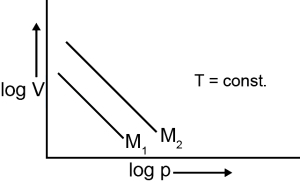
For the same mass of two different ideal gases of molecular weights $M_{1}$ and $M_{2}$,plots of $\log V$ vs $\log p$ at a given constant temperature are shown. Identify the correct option.
A
$M_{1} > M_{2}$
B
$M_{1} = M_{2}$
C
$M_{1} < M_{2}$
D
Can be predicted only if temperature is known
Solution
(A) For an ideal gas,the ideal gas equation is $pV = \frac{w}{M}RT$,where $w$ is the mass,$M$ is the molecular weight,$R$ is the gas constant,and $T$ is the temperature.
Since $w$,$R$,and $T$ are constant,let $wRT = K$. Then $pV = \frac{K}{M}$,or $V = \frac{K}{Mp}$.
Taking the logarithm on both sides: $\log V = \log \left( \frac{K}{M} \right) - \log p$.
This is in the form of $y = mx + c$,where $y = \log V$,$x = \log p$,$m = -1$,and the intercept $c = \log \left( \frac{K}{M} \right)$.
From the graph,the intercept for $M_{2}$ is higher than the intercept for $M_{1}$.
Therefore,$\log \left( \frac{K}{M_{2}} \right) > \log \left( \frac{K}{M_{1}} \right)$.
This implies $\frac{K}{M_{2}} > \frac{K}{M_{1}}$,which means $M_{1} > M_{2}$.
Since $w$,$R$,and $T$ are constant,let $wRT = K$. Then $pV = \frac{K}{M}$,or $V = \frac{K}{Mp}$.
Taking the logarithm on both sides: $\log V = \log \left( \frac{K}{M} \right) - \log p$.
This is in the form of $y = mx + c$,where $y = \log V$,$x = \log p$,$m = -1$,and the intercept $c = \log \left( \frac{K}{M} \right)$.
From the graph,the intercept for $M_{2}$ is higher than the intercept for $M_{1}$.
Therefore,$\log \left( \frac{K}{M_{2}} \right) > \log \left( \frac{K}{M_{1}} \right)$.
This implies $\frac{K}{M_{2}} > \frac{K}{M_{1}}$,which means $M_{1} > M_{2}$.
0 likesView Solution
17
ChemistryDifficultMCQWBJEE · 2017
Which one of the following corresponds to a photon of highest energy?
A
$\lambda = 300 \ nm$
B
$v = 3 \times 10^{4} \ s^{-1}$
C
$\bar{v} = 30 \ cm^{-1}$
D
$\varepsilon = 6.626 \times 10^{-27} \ J$
Solution
(A) The energy of a photon is given by $E = h \nu = \frac{hc}{\lambda} = hc \cdot \bar{\nu}$,where $\bar{\nu} = \frac{1}{\lambda}$.
For option $(A)$: $\lambda = 300 \ nm = 300 \times 10^{-9} \ m$. $E = \frac{(6.626 \times 10^{-34} \ J \cdot s)(3 \times 10^{8} \ m/s)}{300 \times 10^{-9} \ m} = 6.626 \times 10^{-19} \ J$.
For option $(B)$: $\nu = 3 \times 10^{4} \ s^{-1}$. $E = h \nu = (6.626 \times 10^{-34} \ J \cdot s)(3 \times 10^{4} \ s^{-1}) = 1.9878 \times 10^{-29} \ J$.
For option $(C)$: $\bar{\nu} = 30 \ cm^{-1} = 3000 \ m^{-1}$. $E = hc \cdot \bar{\nu} = (6.626 \times 10^{-34} \ J \cdot s)(3 \times 10^{8} \ m/s)(3000 \ m^{-1}) = 5.9634 \times 10^{-22} \ J$.
For option $(D)$: $E = 6.626 \times 10^{-27} \ J$.
Comparing the values,the energy in option $(A)$ is the highest.
For option $(A)$: $\lambda = 300 \ nm = 300 \times 10^{-9} \ m$. $E = \frac{(6.626 \times 10^{-34} \ J \cdot s)(3 \times 10^{8} \ m/s)}{300 \times 10^{-9} \ m} = 6.626 \times 10^{-19} \ J$.
For option $(B)$: $\nu = 3 \times 10^{4} \ s^{-1}$. $E = h \nu = (6.626 \times 10^{-34} \ J \cdot s)(3 \times 10^{4} \ s^{-1}) = 1.9878 \times 10^{-29} \ J$.
For option $(C)$: $\bar{\nu} = 30 \ cm^{-1} = 3000 \ m^{-1}$. $E = hc \cdot \bar{\nu} = (6.626 \times 10^{-34} \ J \cdot s)(3 \times 10^{8} \ m/s)(3000 \ m^{-1}) = 5.9634 \times 10^{-22} \ J$.
For option $(D)$: $E = 6.626 \times 10^{-27} \ J$.
Comparing the values,the energy in option $(A)$ is the highest.
0 likesView Solution
18
ChemistryEasyMCQWBJEE · 2017
If the given four electronic configurations:
$(i)$ $n=4, l=1$
$(ii)$ $n=4, l=0$
$(iii)$ $n=3, l=2$
$(iv)$ $n=3, l=1$
are arranged in order of increasing energy,then the order will be:
$(i)$ $n=4, l=1$
$(ii)$ $n=4, l=0$
$(iii)$ $n=3, l=2$
$(iv)$ $n=3, l=1$
are arranged in order of increasing energy,then the order will be:
A
$(iv) < (ii) < (iii) < (i)$
B
$(ii) < (iv) < (i) < (iii)$
C
$(i) < (iii) < (ii) < (iv)$
D
$(iii) < (i) < (iv) < (ii)$
Solution
(A) According to the $(n+l)$ rule:
$1$. The orbital with a lower $(n+l)$ value has lower energy.
$2$. If the $(n+l)$ values are the same,the orbital with the lower $n$ value has lower energy.
Calculating $(n+l)$ values:
$(i)$ $n+l = 4+1 = 5$
$(ii)$ $n+l = 4+0 = 4$
$(iii)$ $n+l = 3+2 = 5$
$(iv)$ $n+l = 3+1 = 4$
Comparing the values:
For $(iv)$ and $(ii)$,both have $(n+l) = 4$. Since $(iv)$ has $n=3$ and $(ii)$ has $n=4$,$(iv) < (ii)$.
For $(iii)$ and $(i)$,both have $(n+l) = 5$. Since $(iii)$ has $n=3$ and $(i)$ has $n=4$,$(iii) < (i)$.
Combining these,the order of increasing energy is $(iv) < (ii) < (iii) < (i)$.
$1$. The orbital with a lower $(n+l)$ value has lower energy.
$2$. If the $(n+l)$ values are the same,the orbital with the lower $n$ value has lower energy.
Calculating $(n+l)$ values:
$(i)$ $n+l = 4+1 = 5$
$(ii)$ $n+l = 4+0 = 4$
$(iii)$ $n+l = 3+2 = 5$
$(iv)$ $n+l = 3+1 = 4$
Comparing the values:
For $(iv)$ and $(ii)$,both have $(n+l) = 4$. Since $(iv)$ has $n=3$ and $(ii)$ has $n=4$,$(iv) < (ii)$.
For $(iii)$ and $(i)$,both have $(n+l) = 5$. Since $(iii)$ has $n=3$ and $(i)$ has $n=4$,$(iii) < (i)$.
Combining these,the order of increasing energy is $(iv) < (ii) < (iii) < (i)$.
0 likesView Solution
19
ChemistryEasyMCQWBJEE · 2017
Which of the following sets of quantum numbers represents the $19^{\text{th}}$ electron of $Cr$ $(Z=24)$?
A
$(4, 1, -1, +\frac{1}{2})$
B
$(4, 0, 0, +\frac{1}{2})$
C
$(3, 2, 0, -\frac{1}{2})$
D
$(3, 2, -2, +\frac{1}{2})$
Solution
(B) The electronic configuration of $Cr$ $(Z=24)$ is $[Ar]_{18} 4s^1 3d^5$.
Electrons $1$ to $18$ are filled in the $Ar$ core.
The $19^{\text{th}}$ electron is the first electron to enter the $4s$ orbital.
For the $4s$ orbital: principal quantum number $n=4$,azimuthal quantum number $l=0$,magnetic quantum number $m_l=0$,and spin quantum number $m_s=+\frac{1}{2}$.
Thus,the set of quantum numbers is $(4, 0, 0, +\frac{1}{2})$.
Electrons $1$ to $18$ are filled in the $Ar$ core.
The $19^{\text{th}}$ electron is the first electron to enter the $4s$ orbital.
For the $4s$ orbital: principal quantum number $n=4$,azimuthal quantum number $l=0$,magnetic quantum number $m_l=0$,and spin quantum number $m_s=+\frac{1}{2}$.
Thus,the set of quantum numbers is $(4, 0, 0, +\frac{1}{2})$.
0 likesView Solution
20
ChemistryEasyMCQWBJEE · 2017
Which of the following has the dimension of $[ML^{2} T^{-2}]$?
A
Coefficient of viscosity
B
Surface tension
C
Vapour pressure
D
Kinetic energy
Solution
(D) The dimension $[ML^{2} T^{-2}]$ represents energy or work.
$\because$ Kinetic energy $(E_k) = \frac{1}{2} mv^{2} = [M][LT^{-1}]^{2} = [ML^{2} T^{-2}]$.
$\therefore$ Kinetic energy has the dimension of $[ML^{2} T^{-2}]$.
$\because$ Kinetic energy $(E_k) = \frac{1}{2} mv^{2} = [M][LT^{-1}]^{2} = [ML^{2} T^{-2}]$.
$\therefore$ Kinetic energy has the dimension of $[ML^{2} T^{-2}]$.
0 likesView Solution
21
ChemistryMCQWBJEE · 2017
If $f(x) = \int_{-1}^{x} |t| \, dt$,then for any $x \geq 0$,$f(x)$ is equal to
A
$\frac{1}{2}(1-x^2)$
B
$1-x^2$
C
$\frac{1}{2}(1+x^2)$
D
$1+x^2$
Solution
(C) Given $f(x) = \int_{-1}^{x} |t| \, dt$.
For $x \geq 0$,we can split the integral at $t=0$:
$f(x) = \int_{-1}^{0} |t| \, dt + \int_{0}^{x} |t| \, dt$.
Since $|t| = -t$ for $t < 0$ and $|t| = t$ for $t \geq 0$,we have:
$f(x) = \int_{-1}^{0} (-t) \, dt + \int_{0}^{x} t \, dt$.
Evaluating the integrals:
$f(x) = \left[ -\frac{t^2}{2} \right]_{-1}^{0} + \left[ \frac{t^2}{2} \right]_{0}^{x}$.
$f(x) = \left( 0 - (-\frac{(-1)^2}{2}) \right) + \left( \frac{x^2}{2} - 0 \right)$.
$f(x) = \frac{1}{2} + \frac{x^2}{2} = \frac{1}{2}(1+x^2)$.
For $x \geq 0$,we can split the integral at $t=0$:
$f(x) = \int_{-1}^{0} |t| \, dt + \int_{0}^{x} |t| \, dt$.
Since $|t| = -t$ for $t < 0$ and $|t| = t$ for $t \geq 0$,we have:
$f(x) = \int_{-1}^{0} (-t) \, dt + \int_{0}^{x} t \, dt$.
Evaluating the integrals:
$f(x) = \left[ -\frac{t^2}{2} \right]_{-1}^{0} + \left[ \frac{t^2}{2} \right]_{0}^{x}$.
$f(x) = \left( 0 - (-\frac{(-1)^2}{2}) \right) + \left( \frac{x^2}{2} - 0 \right)$.
$f(x) = \frac{1}{2} + \frac{x^2}{2} = \frac{1}{2}(1+x^2)$.
0 likesView Solution
22
ChemistryMediumMCQWBJEE · 2017
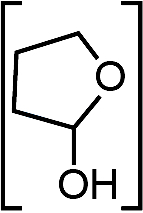
Reduction of the lactol $S$ with sodium borohydride $(NaBH_4)$ gives:
A
Tetrahydrofuran
B
Butyrolactone
C
Pentane$-1,5-$diol
D
Butan$-1-$ol
Solution
(C) lactol exists in equilibrium with its open-chain hydroxy-aldehyde form.
In the presence of $NaBH_4$,the aldehyde group is reduced to a primary alcohol.
The lactol $S$ ($2$-hydroxytetrahydropyran) opens to form $5-$hydroxypentanal,which is then reduced by $NaBH_4$ to pentane$-1,5-$diol.
In the presence of $NaBH_4$,the aldehyde group is reduced to a primary alcohol.
The lactol $S$ ($2$-hydroxytetrahydropyran) opens to form $5-$hydroxypentanal,which is then reduced by $NaBH_4$ to pentane$-1,5-$diol.
0 likesView Solution
23
ChemistryDifficultMCQWBJEE · 2017
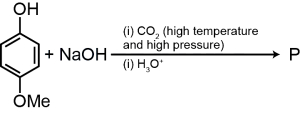
The structure of the product $P$ of the following reaction is
A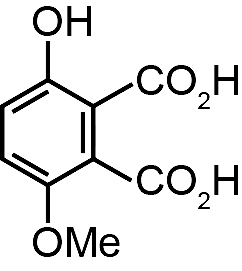
B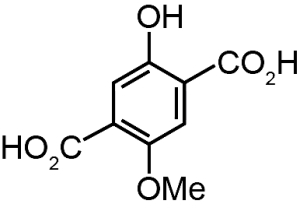
C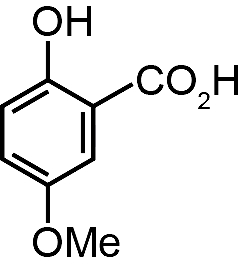
D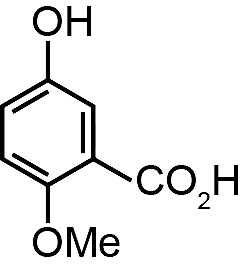
Solution
(D) The reaction is a Kolbe-Schmitt reaction.
$1$. $4$-Methoxyphenol reacts with $NaOH$ to form sodium $4$-methoxyphenoxide.
$2$. The phenoxide ion is highly reactive towards electrophilic aromatic substitution.
$3$. The $-O^-$ group is a strong ortho/para directing group. Since the para position is already occupied by the $-OMe$ group,the electrophile $(CO_2)$ attacks the ortho position relative to the $-O^-$ group.
$4$. Subsequent acidification with $H_3O^+$ yields the final product,$2$-hydroxy-$5$-methoxybenzoic acid.
$1$. $4$-Methoxyphenol reacts with $NaOH$ to form sodium $4$-methoxyphenoxide.
$2$. The phenoxide ion is highly reactive towards electrophilic aromatic substitution.
$3$. The $-O^-$ group is a strong ortho/para directing group. Since the para position is already occupied by the $-OMe$ group,the electrophile $(CO_2)$ attacks the ortho position relative to the $-O^-$ group.
$4$. Subsequent acidification with $H_3O^+$ yields the final product,$2$-hydroxy-$5$-methoxybenzoic acid.
0 likesView Solution
24
ChemistryEasyMCQWBJEE · 2017
The reduction of benzenediazonium chloride to phenylhydrazine can be accomplished by:
A
$SnCl_{2} / HCl$
B
$Na_{2}SO_{3}$
C
$CH_{3}CH_{2}OH$
D
Both $(A)$ and $(B)$
Solution
(D) The reduction of benzenediazonium chloride $(C_{6}H_{5}N_{2}^{+}Cl^{-})$ to phenylhydrazine $(C_{6}H_{5}NHNH_{2})$ is a standard chemical transformation.
It can be achieved using $SnCl_{2} / HCl$ (stannous chloride in hydrochloric acid) or $Na_{2}SO_{3}$ (sodium sulfite).
Therefore,both reagents are effective for this reduction.
It can be achieved using $SnCl_{2} / HCl$ (stannous chloride in hydrochloric acid) or $Na_{2}SO_{3}$ (sodium sulfite).
Therefore,both reagents are effective for this reduction.
0 likesView Solution
25
ChemistryEasyMCQWBJEE · 2017
The compound that would produce a nauseating smell/odour with a hot mixture of chloroform and ethanolic potassium hydroxide is
A
$PhCONH_2$
B
$PhNHCH_3$
C
$PhNH_2$
D
$PhOH$
Solution
(C) The reaction described is the $Carbylamine$ reaction,which is a characteristic test for primary amines ($R-NH_2$ or $Ar-NH_2$).
When a primary amine is heated with chloroform $(CHCl_3)$ and ethanolic potassium hydroxide $(KOH)$,it forms an isocyanide (carbylamine),which is characterized by a highly offensive or nauseating smell.
Among the given options,$PhNH_2$ (aniline) is a primary amine.
The reaction is: $PhNH_2 + CHCl_3 + 3KOH \xrightarrow{\Delta} PhNC + 3KCl + 3H_2O$.
Thus,$PhNH_2$ produces the nauseating smell.
When a primary amine is heated with chloroform $(CHCl_3)$ and ethanolic potassium hydroxide $(KOH)$,it forms an isocyanide (carbylamine),which is characterized by a highly offensive or nauseating smell.
Among the given options,$PhNH_2$ (aniline) is a primary amine.
The reaction is: $PhNH_2 + CHCl_3 + 3KOH \xrightarrow{\Delta} PhNC + 3KCl + 3H_2O$.
Thus,$PhNH_2$ produces the nauseating smell.
0 likesView Solution
26
ChemistryEasyMCQWBJEE · 2017
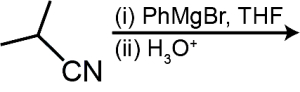
For the reaction below,the structure of the product $Q$ is:
A
$3-$methyl$-1-$phenylbutan$-1-$ol
B
$3-$methyl$-1-$phenylbutan$-1-$one
C
$2-$methyl$-2-$phenylpropanenitrile
D
$3-$methyl$-1-$phenylbut$-1-$en$-1-$amine
Solution
(B) The reaction of an alkyl nitrile with a Grignard reagent $(PhMgBr)$ followed by acidic hydrolysis $(H_3O^+)$ proceeds as follows:
$1$. The nucleophilic phenyl group $(Ph^-)$ from $PhMgBr$ attacks the electrophilic carbon of the nitrile group $(-CN)$ to form an imine salt intermediate.
$2$. Upon acidic hydrolysis $(H_3O^+)$,the imine salt is converted into an imine,which is unstable and further hydrolyzes to form a ketone.
$3$. The reaction sequence is: $R-CN + PhMgBr$ $\rightarrow R-C(Ph)=N-MgBr$ $\xrightarrow{H_3O^+} R-C(Ph)=NH$ $\xrightarrow{H_3O^+} R-C(=O)Ph$.
$4$. In this case,$R$ is an isopropyl group,so the final product is $3$-methyl-$1$-phenylbutan-$1$-one.
$1$. The nucleophilic phenyl group $(Ph^-)$ from $PhMgBr$ attacks the electrophilic carbon of the nitrile group $(-CN)$ to form an imine salt intermediate.
$2$. Upon acidic hydrolysis $(H_3O^+)$,the imine salt is converted into an imine,which is unstable and further hydrolyzes to form a ketone.
$3$. The reaction sequence is: $R-CN + PhMgBr$ $\rightarrow R-C(Ph)=N-MgBr$ $\xrightarrow{H_3O^+} R-C(Ph)=NH$ $\xrightarrow{H_3O^+} R-C(=O)Ph$.
$4$. In this case,$R$ is an isopropyl group,so the final product is $3$-methyl-$1$-phenylbutan-$1$-one.
0 likesView Solution
27
ChemistryEasyMCQWBJEE · 2017
$ADP$ and $ATP$ differ in the number of
A
phosphate units
B
ribose units
C
adenine base
D
nitrogen atom
Solution
(A) $ADP$ stands for adenosine diphosphate,which contains $2$ phosphate groups.
$ATP$ stands for adenosine triphosphate,which contains $3$ phosphate groups.
Therefore,they differ in the number of phosphate units.
$ATP$ stands for adenosine triphosphate,which contains $3$ phosphate groups.
Therefore,they differ in the number of phosphate units.
0 likesView Solution
28
ChemistryMediumMCQWBJEE · 2017
The correct order of acid strengths of benzoic acid $(X)$,peroxybenzoic acid $(Y)$ and $p-$nitrobenzoic acid $(Z)$ is
A
$Y > Z > X$
B
$Z > Y > X$
C
$Z > X > Y$
D
$Y > X > Z$
Solution
(C) $p-$nitrobenzoic acid $(Z)$ contains a $-NO_2$ group,which is a strong electron-withdrawing group. This stabilizes the carboxylate anion through both inductive and resonance effects,making it the most acidic.
Benzoic acid $(X)$ is stabilized by resonance of the carboxylate group with the benzene ring.
Peroxybenzoic acid $(Y)$ has the structure $C_6H_5CO_3H$. The $-O-O-$ bond is less stable and the resonance stabilization of the carboxylate anion is less effective compared to benzoic acid due to the presence of the extra oxygen atom,making it less acidic than benzoic acid.
Therefore,the correct order of acid strength is $Z > X > Y$.
Benzoic acid $(X)$ is stabilized by resonance of the carboxylate group with the benzene ring.
Peroxybenzoic acid $(Y)$ has the structure $C_6H_5CO_3H$. The $-O-O-$ bond is less stable and the resonance stabilization of the carboxylate anion is less effective compared to benzoic acid due to the presence of the extra oxygen atom,making it less acidic than benzoic acid.
Therefore,the correct order of acid strength is $Z > X > Y$.
0 likesView Solution
29
ChemistryEasyMCQWBJEE · 2017
The conversion of $CH_{3}CH_{2}COOH$ to the product shown below can be accomplished by:
$CH_{3}CH_{2}CH(OCH_{2}CH_{2}O)$
$CH_{3}CH_{2}CH(OCH_{2}CH_{2}O)$
A
$SOCl_{2}, LiAlH_{4},$ ethylene glycol
B
$SOCl_{2}, KMnO_{4}, NH_{2}NH_{2}$
C
$SnCl_{2}, HCl, Na_{2}SO_{3}$
D
$HCl, SnCl_{2},$ ethylene glycol
Solution
(A, D) The conversion of propanoic acid $(CH_{3}CH_{2}COOH)$ to the cyclic acetal $(CH_{3}CH_{2}CH(OCH_{2}CH_{2}O))$ involves the following steps:
$1$. Conversion of carboxylic acid to acid chloride using $SOCl_{2}$ or $PCl_{5}$.
$2$. Reduction of acid chloride to aldehyde using $LiAlH_{4}$ (at low temperature) or Rosenmund reduction $(H_{2}/Pd-BaSO_{4})$.
$3$. Protection of the aldehyde group by forming a cyclic acetal using ethylene glycol in the presence of an acid catalyst.
Both options $(A)$ and $(D)$ describe valid pathways for this transformation,as $SnCl_{2}/HCl$ is also a standard reagent for the reduction of acid chlorides to aldehydes (Stephen reduction).
$1$. Conversion of carboxylic acid to acid chloride using $SOCl_{2}$ or $PCl_{5}$.
$2$. Reduction of acid chloride to aldehyde using $LiAlH_{4}$ (at low temperature) or Rosenmund reduction $(H_{2}/Pd-BaSO_{4})$.
$3$. Protection of the aldehyde group by forming a cyclic acetal using ethylene glycol in the presence of an acid catalyst.
Both options $(A)$ and $(D)$ describe valid pathways for this transformation,as $SnCl_{2}/HCl$ is also a standard reagent for the reduction of acid chlorides to aldehydes (Stephen reduction).
0 likesView Solution
30
ChemistryMediumMCQWBJEE · 2017
$C_{6}H_{5}F^{18}$ is an $F^{18}$ radio-isotope labelled organic compound. $F^{18}$ decays by positron emission. The product resulting from the decay is:
A
$C_{6}H_{5}O^{18}$
B
$C_{6}H_{5}Ar^{10}$
C
$B^{12}C_{5}H_{5}F$
D
$C_{6}H_{5}O^{16}$
Solution
(A) In positron emission,the atomic number of the nucleus decreases by $1$ while the mass number remains constant.
The decay reaction for $F^{18}$ is:
${ }_{9}F^{18} \longrightarrow { }_{8}O^{18} + { }_{+1}e^{0}$
Since the $F^{18}$ atom is part of the $C_{6}H_{5}F^{18}$ molecule,the $F^{18}$ nucleus transforms into an $O^{18}$ nucleus.
Therefore,the resulting decay product is $C_{6}H_{5}O^{18}$.
The decay reaction for $F^{18}$ is:
${ }_{9}F^{18} \longrightarrow { }_{8}O^{18} + { }_{+1}e^{0}$
Since the $F^{18}$ atom is part of the $C_{6}H_{5}F^{18}$ molecule,the $F^{18}$ nucleus transforms into an $O^{18}$ nucleus.
Therefore,the resulting decay product is $C_{6}H_{5}O^{18}$.
0 likesView Solution
31
ChemistryMediumMCQWBJEE · 2017
The number of unpaired electrons in $[NiCl_{4}]^{2-}$,$Ni(CO)_{4}$ and $[Cu(NH_{3})_{4}]^{2+}$ respectively are
A
$2, 2, 1$
B
$2, 0, 1$
C
$0, 2, 1$
D
$2, 2, 0$
Solution
(B) $1$. For $[NiCl_{4}]^{2-}$: $Ni$ is in $+2$ oxidation state $(3d^8)$. $Cl^-$ is a weak field ligand,so no pairing occurs. It has $2$ unpaired electrons.
$2$. For $Ni(CO)_{4}$: $Ni$ is in $0$ oxidation state $(3d^8 4s^2)$. $CO$ is a strong field ligand,causing pairing of $4s$ electrons into $3d$ orbitals,resulting in $0$ unpaired electrons.
$3$. For $[Cu(NH_{3})_{4}]^{2+}$: $Cu$ is in $+2$ oxidation state $(3d^9)$. It has $1$ unpaired electron.
Thus,the number of unpaired electrons are $2, 0, 1$ respectively. The correct option is $B$.
$2$. For $Ni(CO)_{4}$: $Ni$ is in $0$ oxidation state $(3d^8 4s^2)$. $CO$ is a strong field ligand,causing pairing of $4s$ electrons into $3d$ orbitals,resulting in $0$ unpaired electrons.
$3$. For $[Cu(NH_{3})_{4}]^{2+}$: $Cu$ is in $+2$ oxidation state $(3d^9)$. It has $1$ unpaired electron.
Thus,the number of unpaired electrons are $2, 0, 1$ respectively. The correct option is $B$.
0 likesView Solution
32
ChemistryEasyMCQWBJEE · 2017
The correct basicity order of the following lanthanide ions is
A
$La^{3+} > Lu^{3+} > Ce^{3+} > Eu^{3+}$
B
$Ce^{3+} > Lu^{3+} > La^{3+} > Eu^{3+}$
C
$Lu^{3+} > Ce^{3+} > Eu^{3+} > La^{3+}$
D
$La^{3+} > Ce^{3+} > Eu^{3+} > Lu^{3+}$
Solution
(D) The basicity of lanthanide ions depends on their ionic character.
As the atomic number increases from $La$ to $Lu$,the ionic radius decreases due to lanthanide contraction.
As the size of the cation decreases,the covalent character increases and the ionic character decreases.
Therefore,the basicity decreases as the ionic radius decreases.
The correct order of basicity is $La^{3+} > Ce^{3+} > Eu^{3+} > Lu^{3+}$.
As the atomic number increases from $La$ to $Lu$,the ionic radius decreases due to lanthanide contraction.
As the size of the cation decreases,the covalent character increases and the ionic character decreases.
Therefore,the basicity decreases as the ionic radius decreases.
The correct order of basicity is $La^{3+} > Ce^{3+} > Eu^{3+} > Lu^{3+}$.
0 likesView Solution
33
ChemistryEasyMCQWBJEE · 2017
The role of fluorspar $(CaF_2)$,which is added in small quantities in the electrolytic reduction of alumina $(Al_2O_3)$ dissolved in fused cryolite $(Na_3AlF_6)$,is:
A
as a catalyst
B
to make the fused mixture conducting
C
to lower the melting temperature of the mixture
D
to decrease the rate of oxidation of carbon at the anode
Solution
(C) In the Hall-Heroult process,pure alumina $(Al_2O_3)$ has a very high melting point and is a poor conductor of electricity.
To overcome these issues,it is dissolved in molten cryolite $(Na_3AlF_6)$.
Fluorspar $(CaF_2)$ is added in small quantities to the mixture to lower the melting point of the electrolyte and to increase its electrical conductivity.
Therefore,both $(b)$ and $(c)$ are correct roles of fluorspar.
To overcome these issues,it is dissolved in molten cryolite $(Na_3AlF_6)$.
Fluorspar $(CaF_2)$ is added in small quantities to the mixture to lower the melting point of the electrolyte and to increase its electrical conductivity.
Therefore,both $(b)$ and $(c)$ are correct roles of fluorspar.
0 likesView Solution
34
ChemistryEasyMCQWBJEE · 2017
The reaction sequence given below gives product $R$. The structure of the product $R$ is:

A
$Br-(CH_2)_4-CO_2H$
B
$HO_2C-CH(Br)-(CH_2)_3-CO_2Me$
C
$HO_2C-(CH_2)_3-CH(Br)-CO_2Me$
D
$MeO_2C-(CH_2)_4-Br$
Solution
(D) The reaction sequence is as follows:
$1$. The starting material is a mono-methyl ester of a dicarboxylic acid,$HO_2C-(CH_2)_4-CO_2Me$.
$2$. Treatment with $Ag_2O$ converts the carboxylic acid group $(-COOH)$ into its silver salt $(-COO^-Ag^+)$.
$3$. Subsequent treatment with $Br_2$ in $CCl_4$ is the Borodine-Hunsdiecker reaction,which decarboxylates the silver salt and replaces the carboxyl group with a bromine atom.
$4$. The reaction is: $HO_2C-(CH_2)_4-CO_2Me$ $\xrightarrow{Ag_2O} AgO_2C-(CH_2)_4-CO_2Me$ $\xrightarrow{Br_2, CCl_4} Br-(CH_2)_4-CO_2Me$.
$5$. Thus,the product $R$ is $MeO_2C-(CH_2)_4-Br$.
$1$. The starting material is a mono-methyl ester of a dicarboxylic acid,$HO_2C-(CH_2)_4-CO_2Me$.
$2$. Treatment with $Ag_2O$ converts the carboxylic acid group $(-COOH)$ into its silver salt $(-COO^-Ag^+)$.
$3$. Subsequent treatment with $Br_2$ in $CCl_4$ is the Borodine-Hunsdiecker reaction,which decarboxylates the silver salt and replaces the carboxyl group with a bromine atom.
$4$. The reaction is: $HO_2C-(CH_2)_4-CO_2Me$ $\xrightarrow{Ag_2O} AgO_2C-(CH_2)_4-CO_2Me$ $\xrightarrow{Br_2, CCl_4} Br-(CH_2)_4-CO_2Me$.
$5$. Thus,the product $R$ is $MeO_2C-(CH_2)_4-Br$.
0 likesView Solution
35
ChemistryEasyMCQWBJEE · 2017
$PbCl_{2}$ is insoluble in cold water. Addition of $HCl$ increases its solubility due to
A
formation of soluble complex anions like $[PbCl_{3}]^{-}$
B
oxidation of $Pb(II)$ to $Pb(IV)$
C
formation of $[Pb(H_{2}O)_{6}]^{2+}$
D
formation of polymeric lead complexes
Solution
(A) $PbCl_{2}$ is sparingly soluble in cold water. Upon adding $HCl$,the excess $Cl^{-}$ ions react with $PbCl_{2}$ to form soluble complex anions.
The reaction is as follows:
$PbCl_{2(s)} + Cl^{-} \rightarrow [PbCl_{3}]^{-}_{(aq)}$
$PbCl_{2(s)} + 2Cl^{-} \rightarrow [PbCl_{4}]^{2-}_{(aq)}$
These complex ions are soluble in water,which increases the overall solubility of $PbCl_{2}$ in the presence of $HCl$.
The reaction is as follows:
$PbCl_{2(s)} + Cl^{-} \rightarrow [PbCl_{3}]^{-}_{(aq)}$
$PbCl_{2(s)} + 2Cl^{-} \rightarrow [PbCl_{4}]^{2-}_{(aq)}$
These complex ions are soluble in water,which increases the overall solubility of $PbCl_{2}$ in the presence of $HCl$.
0 likesView Solution
36
ChemistryEasyMCQWBJEE · 2017
When $BaCl_{2}$ is added to an aqueous salt solution,a white precipitate is obtained. The anion among $CO_{3}^{2-}$,$SO_{3}^{2-}$,and $SO_{4}^{2-}$ that was present in the solution can be
A
$CO_{3}^{2-}$ but not any of the other two
B
$SO_{3}^{2-}$ but not any of the other two
C
$SO_{4}^{2-}$ but not any of the other two
D
Any of them
Solution
(D) When $BaCl_{2}$ is added to an aqueous solution containing $CO_{3}^{2-}$,$SO_{3}^{2-}$,or $SO_{4}^{2-}$ ions,white precipitates are formed in all three cases due to the formation of $BaCO_{3}$,$BaSO_{3}$,and $BaSO_{4}$ respectively.
Therefore,the presence of a white precipitate does not uniquely identify any one of these anions,as all three anions react with $Ba^{2+}$ to produce a white precipitate.
Therefore,the presence of a white precipitate does not uniquely identify any one of these anions,as all three anions react with $Ba^{2+}$ to produce a white precipitate.
0 likesView Solution
37
ChemistryEasyMCQWBJEE · 2017
How many faradays are required to reduce $1 \ mol$ of $Cr_{2}O_{7}^{2-}$ to $Cr^{3+}$ in acidic medium?
A
$2$
B
$3$
C
$5$
D
$6$
Solution
(D) The reduction half-reaction is: $Cr_{2}O_{7}^{2-} + 14H^+ + 6e^- \longrightarrow 2Cr^{3+} + 7H_2O$.
In this reaction,the oxidation state of $Cr$ changes from $+6$ to $+3$.
Since there are $2$ atoms of $Cr$ in $Cr_{2}O_{7}^{2-}$,the total change in oxidation state is $2 \times (6 - 3) = 6$.
Therefore,$6 \ mol$ of electrons are required to reduce $1 \ mol$ of $Cr_{2}O_{7}^{2-}$,which corresponds to $6 \ F$ of electricity.
In this reaction,the oxidation state of $Cr$ changes from $+6$ to $+3$.
Since there are $2$ atoms of $Cr$ in $Cr_{2}O_{7}^{2-}$,the total change in oxidation state is $2 \times (6 - 3) = 6$.
Therefore,$6 \ mol$ of electrons are required to reduce $1 \ mol$ of $Cr_{2}O_{7}^{2-}$,which corresponds to $6 \ F$ of electricity.
0 likesView Solution
38
ChemistryMediumMCQWBJEE · 2017
You are supplied with $500 \ mL$ each of $2 \ N \ HCl$ and $5 \ N \ HCl$. What is the maximum volume of $3 \ M \ HCl$ that you can prepare using only these two solutions (in $mL$)?
A
$250$
B
$500$
C
$750$
D
$1000$
Solution
(C) For $HCl$,the normality $(N)$ is equal to the molarity $(M)$ because the n-factor is $1$. Thus,$2 \ N = 2 \ M$ and $5 \ N = 5 \ M$.
Let $V_1$ be the volume of $2 \ M \ HCl$ used and $V_2$ be the volume of $5 \ M \ HCl$ used.
We are given $V_1 = 500 \ mL$ and we have a maximum of $500 \ mL$ of $5 \ M \ HCl$ available $(V_2 \leq 500 \ mL)$.
The mixture equation is $M_1 V_1 + M_2 V_2 = M_{final} (V_1 + V_2)$.
Substituting the values: $2(500) + 5(V_2) = 3(500 + V_2)$.
$1000 + 5V_2 = 1500 + 3V_2$.
$2V_2 = 500$,which gives $V_2 = 250 \ mL$.
Since $250 \ mL < 500 \ mL$,this is feasible.
The total volume of $3 \ M \ HCl$ prepared is $V_1 + V_2 = 500 \ mL + 250 \ mL = 750 \ mL$.
Let $V_1$ be the volume of $2 \ M \ HCl$ used and $V_2$ be the volume of $5 \ M \ HCl$ used.
We are given $V_1 = 500 \ mL$ and we have a maximum of $500 \ mL$ of $5 \ M \ HCl$ available $(V_2 \leq 500 \ mL)$.
The mixture equation is $M_1 V_1 + M_2 V_2 = M_{final} (V_1 + V_2)$.
Substituting the values: $2(500) + 5(V_2) = 3(500 + V_2)$.
$1000 + 5V_2 = 1500 + 3V_2$.
$2V_2 = 500$,which gives $V_2 = 250 \ mL$.
Since $250 \ mL < 500 \ mL$,this is feasible.
The total volume of $3 \ M \ HCl$ prepared is $V_1 + V_2 = 500 \ mL + 250 \ mL = 750 \ mL$.
0 likesView Solution
39
ChemistryEasyMCQWBJEE · 2017
During the electrolysis of molten $NaCl$,some water was added. What will happen?
A
Electrolysis will stop
B
Hydrogen will be evolved
C
Some amount of caustic soda will be formed
D
$A$ fire is likely
Solution
(B, C, D) When water is added to molten $NaCl$ during electrolysis,the following occurs:
$1$. The reaction $2Na + 2H_2O \longrightarrow 2NaOH + H_2$ takes place.
$2$. Hydrogen gas $(H_2)$ is evolved at the cathode because the discharge potential of $H^+$ ions is lower than that of $Na^+$ ions.
$3$. Caustic soda $(NaOH)$ is formed as a byproduct.
$4$. The reaction between sodium and water is highly exothermic,which can lead to the ignition of the evolved hydrogen gas,making a fire likely.
Therefore,options $B$,$C$,and $D$ are correct.
$1$. The reaction $2Na + 2H_2O \longrightarrow 2NaOH + H_2$ takes place.
$2$. Hydrogen gas $(H_2)$ is evolved at the cathode because the discharge potential of $H^+$ ions is lower than that of $Na^+$ ions.
$3$. Caustic soda $(NaOH)$ is formed as a byproduct.
$4$. The reaction between sodium and water is highly exothermic,which can lead to the ignition of the evolved hydrogen gas,making a fire likely.
Therefore,options $B$,$C$,and $D$ are correct.
0 likesView Solution
40
ChemistryEasyMCQWBJEE · 2017
In a body-centred cubic $(bcc)$ lattice of potassium,the correct relation between the atomic radius $(r)$ of potassium and the edge-length $(a)$ of the cube is:
A
$r = \frac{a}{\sqrt{2}}$
B
$r = \frac{a}{\sqrt{3}}$
C
$r = \frac{\sqrt{3}}{2} a$
D
$r = \frac{\sqrt{3}}{4} a$
Solution
(D) In a body-centred cubic $(bcc)$ unit cell,the atoms touch each other along the body diagonal.
The length of the body diagonal is $\sqrt{3} a$.
Since the body diagonal consists of two radii of the corner atoms and the full diameter of the central atom,we have $\sqrt{3} a = 4r$.
Therefore,the atomic radius is $r = \frac{\sqrt{3}}{4} a$.
The length of the body diagonal is $\sqrt{3} a$.
Since the body diagonal consists of two radii of the corner atoms and the full diameter of the central atom,we have $\sqrt{3} a = 4r$.
Therefore,the atomic radius is $r = \frac{\sqrt{3}}{4} a$.
0 likesView Solution
41
ChemistryMediumMCQWBJEE · 2017
Assuming the compounds to be completely dissociated in aqueous solution,identify the pair of the solutions that can be expected to be isotonic at the same temperature.
A
$0.01 \ M$ urea and $0.01 \ M \ NaCl$
B
$0.02 \ M \ NaCl$ and $0.01 \ M \ Na_2SO_4$
C
$0.03 \ M \ NaCl$ and $0.02 \ M \ MgCl_2$
D
$0.01 \ M$ sucrose and $0.02 \ M$ glucose
Solution
(C) For isotonic solutions,the effective concentration (osmolarity) must be the same: $i_1C_1 = i_2C_2$.
Assuming complete dissociation:
For $0.03 \ M \ NaCl$: $i = 2$,so $iC = 2 \times 0.03 = 0.06 \ M$.
For $0.02 \ M \ MgCl_2$: $i = 3$,so $iC = 3 \times 0.02 = 0.06 \ M$.
Since the $iC$ values are equal,the solutions are isotonic.
Assuming complete dissociation:
For $0.03 \ M \ NaCl$: $i = 2$,so $iC = 2 \times 0.03 = 0.06 \ M$.
For $0.02 \ M \ MgCl_2$: $i = 3$,so $iC = 3 \times 0.02 = 0.06 \ M$.
Since the $iC$ values are equal,the solutions are isotonic.
0 likesView Solution
Vedclass Products
For Students
Vedclass Test Series
Mock tests in real WBJEE style covering Chemistry with performance analysis. 5-day free trial.
Start Free TrialFor Teachers
Exam Paper Generator
Generate Set A/B/C/D Chemistry papers from 7.5L+ questions in 2 minutes. 3 chapters free.
Try FreeFor Institutes
Online Exam Module
Run live WBJEE mock exams with unlimited students, 360° analytics & white-label branding.
See DemoFrequently Asked Questions
How many Chemistry questions are in WBJEE 2017?
There are 41 Chemistry questions from the WBJEE 2017 paper on Vedclass, each with a detailed step-by-step solution in English.
Are WBJEE 2017 Chemistry solutions available in English?
Yes. All solutions on this page are in English. You can also switch to English or Hindi using the language buttons above the questions.
Can I practice WBJEE 2017 Chemistry as a timed test?
Yes. Use the Vedclass Test Series to attempt a full WBJEE mock test covering Chemistry with time limits and instant score analysis.
Can teachers create Chemistry papers from WBJEE previous year questions?
Yes. The Vedclass Exam Paper Generator lets teachers mix WBJEE Chemistry questions and generate Set A/B/C/D papers in minutes.
For Teachers & Institutes
Build a Custom Chemistry Paper
Pick WBJEE 2017 Chemistry questions, set difficulty, and generate Set A/B/C/D in 2 minutes.