
ChemistryQ1–42 of 42 questions
Page 1 of 1 · English
1
ChemistryEasyMCQWBJEE · 2012
In $but-2-ene$,which one of the following statements is true?
A
$C_1-C_2$ bond is a $sp^3-sp^3$ $\sigma$-bond
B
$C_2-C_3$ bond is a $sp^3-sp^2$ $\sigma$-bond
C
$C_1-C_2$ bond is a $sp^3-sp^2$ $\sigma$-bond
D
$C_1-C_2$ bond is a $sp^2-sp^2$ $\sigma$-bond
Solution
(C) The structure of $but-2-ene$ is $CH_3-CH=CH-CH_3$.
In this molecule:
$C_1$ is $sp^3$ hybridized (attached to $3$ $H$ atoms and $C_2$).
$C_2$ is $sp^2$ hybridized (attached to $H$,$C_1$,and double-bonded to $C_3$).
$C_3$ is $sp^2$ hybridized.
$C_4$ is $sp^3$ hybridized.
Therefore,the $C_1-C_2$ bond is formed by the overlap of $sp^3$ orbital of $C_1$ and $sp^2$ orbital of $C_2$,making it a $sp^3-sp^2$ $\sigma$-bond.
In this molecule:
$C_1$ is $sp^3$ hybridized (attached to $3$ $H$ atoms and $C_2$).
$C_2$ is $sp^2$ hybridized (attached to $H$,$C_1$,and double-bonded to $C_3$).
$C_3$ is $sp^2$ hybridized.
$C_4$ is $sp^3$ hybridized.
Therefore,the $C_1-C_2$ bond is formed by the overlap of $sp^3$ orbital of $C_1$ and $sp^2$ orbital of $C_2$,making it a $sp^3-sp^2$ $\sigma$-bond.
0 likesView Solution
2
ChemistryEasyMCQWBJEE · 2012
The state of hybridization of the central atom and the number of lone pairs over the central atom in $POCl_{3}$ are
A
$sp, 0$
B
$sp^{2}, 0$
C
$sp^{3}, 0$
D
$dsp^{2}, 1$
Solution
(C) In $POCl_{3}$,the central phosphorus atom is bonded to one oxygen atom via a double bond and three chlorine atoms via single bonds.
Total number of electron pairs around the central atom = $4$ (three $P-Cl$ $\sigma$-bonds and one $P=O$ bond,where the double bond counts as one region of electron density for hybridization).
Since there are $4$ bonding pairs and no lone pairs,the hybridization is $sp^{3}$.
Therefore,the hybridization is $sp^{3}$ and the number of lone pairs is $0$.
Total number of electron pairs around the central atom = $4$ (three $P-Cl$ $\sigma$-bonds and one $P=O$ bond,where the double bond counts as one region of electron density for hybridization).
Since there are $4$ bonding pairs and no lone pairs,the hybridization is $sp^{3}$.
Therefore,the hybridization is $sp^{3}$ and the number of lone pairs is $0$.
0 likesView Solution
3
ChemistryEasyMCQWBJEE · 2012
The paramagnetic behaviour of $B_2$ is due to the presence of
A
two unpaired electrons in $\pi^*$ $MO$
B
two unpaired electrons in $\pi$ $MO$
C
two unpaired electrons in $\sigma$ $MO$
D
two unpaired electrons in $\sigma^*$ $MO$
Solution
(B) The total number of electrons in $B_2$ is $5 + 5 = 10 \ e^-$.
According to Molecular Orbital Theory,the electronic configuration is: $\sigma 1s^2, \sigma^* 1s^2, \sigma 2s^2, \sigma^* 2s^2, \pi 2p_x^1, \pi 2p_y^1$.
Due to the presence of $2$ unpaired electrons in the $\pi 2p$ bonding molecular orbitals,$B_2$ exhibits paramagnetic behaviour.
According to Molecular Orbital Theory,the electronic configuration is: $\sigma 1s^2, \sigma^* 1s^2, \sigma 2s^2, \sigma^* 2s^2, \pi 2p_x^1, \pi 2p_y^1$.
Due to the presence of $2$ unpaired electrons in the $\pi 2p$ bonding molecular orbitals,$B_2$ exhibits paramagnetic behaviour.
0 likesView Solution
4
ChemistryDifficultMCQWBJEE · 2012
$CO$ is practically non-polar since
A
the $\sigma$-electron drift from $C$ to $O$ is almost nullified by the $\pi$-electron drift from $O$ to $C$
B
the $\sigma$-electron drift from $O$ to $C$ is almost nullified by the $\pi$-electron drift from $C$ to $O$
C
the bond moment is low
D
there is a triple bond between $C$ and $O$
Solution
(A) In the $CO$ molecule,the electronegativity difference suggests a dipole moment,but the actual dipole moment is very small $(0.11 \ D)$.
This is because the $\sigma$-electron drift from $C$ to $O$ (due to the lone pair on $C$) is almost completely nullified by the back-donation of $\pi$-electrons from $O$ to $C$ through $\pi$-bonding.
Thus,the net dipole moment is nearly zero,making it practically non-polar.
This is because the $\sigma$-electron drift from $C$ to $O$ (due to the lone pair on $C$) is almost completely nullified by the back-donation of $\pi$-electrons from $O$ to $C$ through $\pi$-bonding.
Thus,the net dipole moment is nearly zero,making it practically non-polar.
0 likesView Solution
5
ChemistryMediumMCQWBJEE · 2012
In a reversible chemical reaction at equilibrium,if the concentration of any one of the reactants is doubled,then the equilibrium constant will
A
also be doubled
B
be halved
C
remains the same
D
becomes one-fourth
Solution
(C) The equilibrium constant ($K_c$ or $K_p$) is a characteristic value for a given reaction at a specific temperature. It depends only on the temperature and is independent of the initial concentrations of the reactants or products,pressure,or the presence of a catalyst. Therefore,if the concentration of any reactant is doubled,the equilibrium constant remains unchanged.
0 likesView Solution
6
ChemistryMediumMCQWBJEE · 2012
Which of the following is correct regarding the ionic radii of the given species?
A
Radius of $Ca^{2+} < Cl^{-} < S^{2-}$
B
Radius of $Cl^{-} < S^{2-} < Ca^{2+}$
C
Radius of $S^{2-} = Cl^{-} = Ca^{2+}$
D
Radius of $S^{2-} < Cl^{-} < Ca^{2+}$
Solution
(A) The given species $Ca^{2+}$,$Cl^{-}$,and $S^{2-}$ are isoelectronic,meaning they all contain $18$ electrons.
For isoelectronic species,the ionic radius decreases as the nuclear charge (atomic number) increases. Since the atomic numbers are $Z(S^{2-}) = 16$,$Z(Cl^{-}) = 17$,and $Z(Ca^{2+}) = 20$,the order of increasing radius is $Ca^{2+} < Cl^{-} < S^{2-}$.
| Species | Atomic number $(Z)$ | Number of electrons |
| $Ca^{2+}$ | $20$ | $18$ |
| $Cl^{-}$ | $17$ | $18$ |
| $S^{2-}$ | $16$ | $18$ |
For isoelectronic species,the ionic radius decreases as the nuclear charge (atomic number) increases. Since the atomic numbers are $Z(S^{2-}) = 16$,$Z(Cl^{-}) = 17$,and $Z(Ca^{2+}) = 20$,the order of increasing radius is $Ca^{2+} < Cl^{-} < S^{2-}$.
0 likesView Solution
7
ChemistryDifficultMCQWBJEE · 2012
The equivalent weight of $K_{2}Cr_{2}O_{7}$ in acidic medium is expressed in terms of its molecular weight $(M)$ as
A
$M / 3$
B
$M / 4$
C
$M / 6$
D
$M / 7$
Solution
(C) In acidic medium,the reduction reaction is:
$Cr_{2}O_{7}^{2-} + 14H^{+} + 6e^{-} \longrightarrow 2Cr^{3+} + 7H_{2}O$
Here,the oxidation state of $Cr$ changes from $+6$ to $+3$.
Since there are two $Cr$ atoms in $K_{2}Cr_{2}O_{7}$,the total change in oxidation state is $2 \times (6 - 3) = 6$.
Therefore,the n-factor is $6$.
Equivalent weight = $\frac{\text{Molecular weight}}{\text{n-factor}} = \frac{M}{6}$.
$Cr_{2}O_{7}^{2-} + 14H^{+} + 6e^{-} \longrightarrow 2Cr^{3+} + 7H_{2}O$
Here,the oxidation state of $Cr$ changes from $+6$ to $+3$.
Since there are two $Cr$ atoms in $K_{2}Cr_{2}O_{7}$,the total change in oxidation state is $2 \times (6 - 3) = 6$.
Therefore,the n-factor is $6$.
Equivalent weight = $\frac{\text{Molecular weight}}{\text{n-factor}} = \frac{M}{6}$.
0 likesView Solution
8
ChemistryMediumMCQWBJEE · 2012
When $H_{2}O_{2}$ is shaken with an acidified solution of $K_{2}Cr_{2}O_{7}$ in the presence of ether,the ethereal layer turns blue due to the formation of
A
$Cr_{2}O_{3}$
B
$CrO_{4}^{2-}$
C
$Cr_{2}(SO_{4})_{3}$
D
$CrO_{5}$
Solution
(D) When $H_{2}O_{2}$ reacts with an acidified solution of $K_{2}Cr_{2}O_{7}$,it forms chromium pentoxide $(CrO_{5})$.
The reaction is: $K_{2}Cr_{2}O_{7} + H_{2}SO_{4} + 4H_{2}O_{2} \rightarrow K_{2}SO_{4} + 5H_{2}O + 2CrO_{5}$.
$CrO_{5}$ is unstable in aqueous solution but is stabilized in ether,which gives a characteristic blue color to the ethereal layer.
The reaction is: $K_{2}Cr_{2}O_{7} + H_{2}SO_{4} + 4H_{2}O_{2} \rightarrow K_{2}SO_{4} + 5H_{2}O + 2CrO_{5}$.
$CrO_{5}$ is unstable in aqueous solution but is stabilized in ether,which gives a characteristic blue color to the ethereal layer.
0 likesView Solution
9
ChemistryMCQWBJEE · 2012
In a slide caliper, \((m+1)\) number of vernier divisions is equal to \(m\) number of smallest main scale divisions. If \(d\) unit is the magnitude of the smallest main scale division, then the magnitude of the vernicr constant is
A
\(d /(m+1)\) unit
B
\(d / m\) unit
C
md/ \((m+1)\) unit
D
\((m+1) d / m\) unit
Solution
\((m+1)\) vernier division \(=m\) main scale division One division on vernier scale \(=\left(\frac{m}{m+1}\right)\) division on main scale Vernier constant \(=\left(1-\frac{m}{m+1}\right) d=\frac{d}{m+1}\)
0 likesView Solution
10
ChemistryEasyMCQWBJEE · 2012
Among the following carbocations:
$(I)$ $Ph_{2}\stackrel{+}{C} CH_{2} Me$
$(II)$ $Ph CH_{2} CH_{2} \stackrel{+}{C} HPh$
$(III)$ $Ph_{2} CH \stackrel{+}{C} HMe$
$(IV)$ $Ph_{2} C(Me) \stackrel{+}{C} H_{2}$
The order of stability is:
$(I)$ $Ph_{2}\stackrel{+}{C} CH_{2} Me$
$(II)$ $Ph CH_{2} CH_{2} \stackrel{+}{C} HPh$
$(III)$ $Ph_{2} CH \stackrel{+}{C} HMe$
$(IV)$ $Ph_{2} C(Me) \stackrel{+}{C} H_{2}$
The order of stability is:
A
$IV > II > I > III$
B
$I > II > III > IV$
C
$II > I > IV > III$
D
$I > IV > III > II$
Solution
(B) The stability of carbocations is determined by resonance and inductive effects.
$(I)$ $Ph_{2}\stackrel{+}{C} CH_{2} Me$ is a $3^{\circ}$ benzylic carbocation stabilized by two phenyl rings.
$(II)$ $Ph CH_{2} CH_{2} \stackrel{+}{C} HPh$ is a $2^{\circ}$ benzylic carbocation stabilized by one phenyl ring.
$(III)$ $Ph_{2} CH \stackrel{+}{C} HMe$ is a $2^{\circ}$ carbocation with two phenyl groups attached to the adjacent carbon,providing some inductive stabilization.
$(IV)$ $Ph_{2} C(Me) \stackrel{+}{C} H_{2}$ is a $1^{\circ}$ carbocation.
Comparing these,the resonance stabilization from phenyl rings is the dominant factor. The order of stability is $(I)$ > $(II)$ > $(III)$ > $(IV)$.
$(I)$ $Ph_{2}\stackrel{+}{C} CH_{2} Me$ is a $3^{\circ}$ benzylic carbocation stabilized by two phenyl rings.
$(II)$ $Ph CH_{2} CH_{2} \stackrel{+}{C} HPh$ is a $2^{\circ}$ benzylic carbocation stabilized by one phenyl ring.
$(III)$ $Ph_{2} CH \stackrel{+}{C} HMe$ is a $2^{\circ}$ carbocation with two phenyl groups attached to the adjacent carbon,providing some inductive stabilization.
$(IV)$ $Ph_{2} C(Me) \stackrel{+}{C} H_{2}$ is a $1^{\circ}$ carbocation.
Comparing these,the resonance stabilization from phenyl rings is the dominant factor. The order of stability is $(I)$ > $(II)$ > $(III)$ > $(IV)$.
0 likesView Solution
11
ChemistryMediumMCQWBJEE · 2012
The stability of $Me_2C=CH_2$ is more than that of $MeCH_2CH=CH_2$ due to
A
inductive effect of the $Me$ groups
B
resonance effect of the $Me$ groups
C
hyperconjugative effect of the $Me$ groups
D
resonance as well as inductive effect of the $Me$ groups
Solution
(C) The stability of alkenes is determined by the number of hyperconjugative structures,which depends on the number of $\alpha$-hydrogen atoms attached to the $sp^2$ hybridized carbon atoms.
In $Me_2C=CH_2$ ($2$-methylprop$-1-$ene),there are two $Me$ groups attached to the double-bonded carbon,providing $3 + 3 = 6$ $\alpha$-hydrogen atoms.
In $MeCH_2CH=CH_2$ (but$-1-$ene),there is only one $MeCH_2$ group attached to the double-bonded carbon,providing $2$ $\alpha$-hydrogen atoms.
Since $Me_2C=CH_2$ has more $\alpha$-hydrogen atoms $(6)$ compared to $MeCH_2CH=CH_2$ $(2)$,it exhibits a greater hyperconjugative effect,making it more stable.
In $Me_2C=CH_2$ ($2$-methylprop$-1-$ene),there are two $Me$ groups attached to the double-bonded carbon,providing $3 + 3 = 6$ $\alpha$-hydrogen atoms.
In $MeCH_2CH=CH_2$ (but$-1-$ene),there is only one $MeCH_2$ group attached to the double-bonded carbon,providing $2$ $\alpha$-hydrogen atoms.
Since $Me_2C=CH_2$ has more $\alpha$-hydrogen atoms $(6)$ compared to $MeCH_2CH=CH_2$ $(2)$,it exhibits a greater hyperconjugative effect,making it more stable.
0 likesView Solution
12
ChemistryEasyMCQWBJEE · 2012
Which one of the following characteristics belongs to an electrophile?
A
It is any species having electron deficiency which reacts at an electron rich $C$-centre
B
It is any species having electron enrichment,that reacts at an electron deficient $C$-centre
C
It is cationic in nature
D
It is anionic in nature
Solution
(A) Electrophiles are electron-deficient species (neutral or cationic).
They attack electron-rich $C$-atoms.
They attack electron-rich $C$-atoms.
0 likesView Solution
13
ChemistryMediumMCQWBJEE · 2012
Friedel-Crafts reaction using $MeCl$ and anhydrous $AlCl_3$ will take place most efficiently with
A
benzene
B
nitrobenzene
C
acetophenone
D
toluene
Solution
(D) The Friedel-Crafts reaction is an electrophilic aromatic substitution reaction.
It requires an electron-rich aromatic ring to react efficiently with the electrophile $(CH_3^+)$.
Nitrobenzene and acetophenone contain electron-withdrawing groups ($-NO_2$ and $-COCH_3$ respectively),which deactivate the benzene ring towards electrophilic substitution.
Benzene is moderately reactive.
Toluene contains a methyl group $(-CH_3)$,which is an electron-donating group due to the $+I$ effect and hyperconjugation.
This increases the electron density of the benzene ring,making it the most reactive among the given options towards electrophilic substitution.
It requires an electron-rich aromatic ring to react efficiently with the electrophile $(CH_3^+)$.
Nitrobenzene and acetophenone contain electron-withdrawing groups ($-NO_2$ and $-COCH_3$ respectively),which deactivate the benzene ring towards electrophilic substitution.
Benzene is moderately reactive.
Toluene contains a methyl group $(-CH_3)$,which is an electron-donating group due to the $+I$ effect and hyperconjugation.
This increases the electron density of the benzene ring,making it the most reactive among the given options towards electrophilic substitution.
0 likesView Solution
14
ChemistryMediumMCQWBJEE · 2012
The well-known compounds,$(+)$-lactic acid and $(-)$-lactic acid,have the same molecular formula,$C_{3}H_{6}O_{3}$. The correct relationship between them is
A
constitutional isomerism
B
geometrical isomerism
C
identicalness
D
optical isomerism
Solution
(D) $(+)$-lactic acid and $(-)$-lactic acid are non-superimposable mirror images of each other.
They possess a chiral carbon atom and rotate the plane of plane-polarized light in opposite directions.
Therefore,they are enantiomers,which is a type of optical isomerism.
They possess a chiral carbon atom and rotate the plane of plane-polarized light in opposite directions.
Therefore,they are enantiomers,which is a type of optical isomerism.
0 likesView Solution
15
ChemistryEasyMCQWBJEE · 2012
The most contributing tautomeric enol form of $MeCOCH_{2}CO_{2}Et$ is
A
$CH_{2}=C(OH)CH_{2}CO_{2}Et$
B
$MeC(OH)=CHCO_{2}Et$
C
$MeCOCH=C(OH)OEt$
D
$CH_{2}=C(OH)CH=C(OH)OEt$
Solution
(B) The compound $MeCOCH_{2}CO_{2}Et$ is ethyl acetoacetate,a $\beta$-keto ester.
It can form an enol by the migration of an $\alpha$-hydrogen to the carbonyl oxygen.
The most stable enol form is the one that is stabilized by intramolecular hydrogen bonding and conjugation.
In $MeC(OH)=CHCO_{2}Et$,the enol double bond is conjugated with the ester carbonyl group,and it forms a stable six-membered ring through intramolecular hydrogen bonding between the hydroxyl group and the ester carbonyl oxygen.
Therefore,$MeC(OH)=CHCO_{2}Et$ is the most contributing tautomeric enol form.
It can form an enol by the migration of an $\alpha$-hydrogen to the carbonyl oxygen.
The most stable enol form is the one that is stabilized by intramolecular hydrogen bonding and conjugation.
In $MeC(OH)=CHCO_{2}Et$,the enol double bond is conjugated with the ester carbonyl group,and it forms a stable six-membered ring through intramolecular hydrogen bonding between the hydroxyl group and the ester carbonyl oxygen.
Therefore,$MeC(OH)=CHCO_{2}Et$ is the most contributing tautomeric enol form.
0 likesView Solution
16
ChemistryMediumMCQWBJEE · 2012
The number of acidic protons in $H_{3}PO_{3}$ is:
A
$0$
B
$1$
C
$2$
D
$3$
Solution
(C) The structure of phosphorous acid $(H_{3}PO_{3})$ contains one $P=O$ bond,two $P-OH$ bonds,and one $P-H$ bond.
Protons attached directly to oxygen atoms in $P-OH$ groups are acidic because the oxygen atom is highly electronegative,which facilitates the release of the $H^+$ ion.
The hydrogen atom directly bonded to the phosphorus atom $(P-H)$ is not acidic because the electronegativity difference between $P$ and $H$ is very small.
Therefore,$H_{3}PO_{3}$ has $2$ acidic protons.
Protons attached directly to oxygen atoms in $P-OH$ groups are acidic because the oxygen atom is highly electronegative,which facilitates the release of the $H^+$ ion.
The hydrogen atom directly bonded to the phosphorus atom $(P-H)$ is not acidic because the electronegativity difference between $P$ and $H$ is very small.
Therefore,$H_{3}PO_{3}$ has $2$ acidic protons.
0 likesView Solution
17
ChemistryMediumMCQWBJEE · 2012
$A$ $100 \ mL$,$0.1 \ M$ solution of ammonium acetate is diluted by adding $100 \ mL$ of water. The pH of the resulting solution will be ($pK_{a}$ of acetic acid is nearly equal to $pK_{b}$ of $NH_{4}OH$)
A
$4.9$
B
$5$
C
$7$
D
$10$
Solution
(C) Ammonium acetate $(CH_3COONH_4)$ is a salt formed from a weak acid $(CH_3COOH)$ and a weak base $(NH_4OH)$.
For a salt of a weak acid and a weak base,the pH of the solution is given by the formula:
$pH = 7 + \frac{1}{2} pK_a - \frac{1}{2} pK_b$
Since the pH of such a salt solution is independent of the concentration (dilution),the pH remains constant upon dilution.
Given that $pK_a \approx pK_b$,the equation simplifies to:
$pH = 7 + \frac{1}{2} (pK_a - pK_b) = 7 + 0 = 7$
Therefore,the pH of the resulting solution is $7$.
For a salt of a weak acid and a weak base,the pH of the solution is given by the formula:
$pH = 7 + \frac{1}{2} pK_a - \frac{1}{2} pK_b$
Since the pH of such a salt solution is independent of the concentration (dilution),the pH remains constant upon dilution.
Given that $pK_a \approx pK_b$,the equation simplifies to:
$pH = 7 + \frac{1}{2} (pK_a - pK_b) = 7 + 0 = 7$
Therefore,the pH of the resulting solution is $7$.
0 likesView Solution
18
ChemistryDifficultMCQWBJEE · 2012
$20 \ mL$ of $0.1 \ (N)$ acetic acid is mixed with $10 \ mL$ of $0.1 \ (N)$ solution of $NaOH$. The $pH$ of the resulting solution is ($pK_a$ of acetic acid is $4.74$). (in $.74$)
A
$3$
B
$4$
C
$5$
D
$6$
Solution
(B) The reaction is: $CH_3COOH + NaOH \rightarrow CH_3COONa + H_2O$
Initial millimoles of $CH_3COOH = 20 \ mL \times 0.1 \ N = 2 \ mmol$.
Initial millimoles of $NaOH = 10 \ mL \times 0.1 \ N = 1 \ mmol$.
After the reaction,$1 \ mmol$ of $CH_3COOH$ remains and $1 \ mmol$ of $CH_3COONa$ is formed.
This forms an acidic buffer solution.
Using Henderson-Hasselbalch equation:
$pH = pK_a + \log \frac{[Salt]}{[Acid]}$
$pH = 4.74 + \log \frac{1 \ mmol}{1 \ mmol}$
$pH = 4.74 + \log(1) = 4.74 + 0 = 4.74$.
Initial millimoles of $CH_3COOH = 20 \ mL \times 0.1 \ N = 2 \ mmol$.
Initial millimoles of $NaOH = 10 \ mL \times 0.1 \ N = 1 \ mmol$.
After the reaction,$1 \ mmol$ of $CH_3COOH$ remains and $1 \ mmol$ of $CH_3COONa$ is formed.
This forms an acidic buffer solution.
Using Henderson-Hasselbalch equation:
$pH = pK_a + \log \frac{[Salt]}{[Acid]}$
$pH = 4.74 + \log \frac{1 \ mmol}{1 \ mmol}$
$pH = 4.74 + \log(1) = 4.74 + 0 = 4.74$.
0 likesView Solution
19
ChemistryMediumMCQWBJEE · 2012
Equal weights of $CH_{4}$ and $H_{2}$ are mixed in an empty container at $25^{\circ} C$. The fraction of the total pressure exerted by $H_{2}$ is
A
$1 / 9$
B
$1 / 2$
C
$8 / 9$
D
$16 / 17$
Solution
(C) Let the weight of each gas be $x \ g$.
Number of moles of $CH_{4} = \frac{x}{16} \ mol$.
Number of moles of $H_{2} = \frac{x}{2} \ mol$.
Total moles = $\frac{x}{16} + \frac{x}{2} = \frac{x + 8x}{16} = \frac{9x}{16} \ mol$.
The mole fraction of $H_{2}$ is $X_{H_{2}} = \frac{n_{H_{2}}}{n_{total}} = \frac{x/2}{9x/16} = \frac{x}{2} \times \frac{16}{9x} = \frac{8}{9}$.
According to Dalton's Law,the partial pressure is proportional to the mole fraction.
Therefore,the fraction of total pressure exerted by $H_{2} = \frac{8}{9}$.
Number of moles of $CH_{4} = \frac{x}{16} \ mol$.
Number of moles of $H_{2} = \frac{x}{2} \ mol$.
Total moles = $\frac{x}{16} + \frac{x}{2} = \frac{x + 8x}{16} = \frac{9x}{16} \ mol$.
The mole fraction of $H_{2}$ is $X_{H_{2}} = \frac{n_{H_{2}}}{n_{total}} = \frac{x/2}{9x/16} = \frac{x}{2} \times \frac{16}{9x} = \frac{8}{9}$.
According to Dalton's Law,the partial pressure is proportional to the mole fraction.
Therefore,the fraction of total pressure exerted by $H_{2} = \frac{8}{9}$.
0 likesView Solution
20
ChemistryMCQWBJEE · 2012
The number of integer values of $m$,for which the $x$-coordinate of the point of intersection of the lines $3x + 4y = 9$ and $y = mx + 1$ is also an integer,is
A
$0$
B
$2$
C
$4$
D
$1$
Solution
(B) Given lines are:
$3x + 4y = 9$ $(i)$
$y = mx + 1$ (ii)
Substituting (ii) into $(i)$:
$3x + 4(mx + 1) = 9$
$3x + 4mx + 4 = 9$
$x(3 + 4m) = 5$
$x = \frac{5}{3 + 4m}$
For $x$ to be an integer,$(3 + 4m)$ must be a divisor of $5$.
The divisors of $5$ are $\pm 1, \pm 5$.
Case $1$: $3 + 4m = 1 \implies 4m = -2 \implies m = -0.5$ (not an integer).
Case $2$: $3 + 4m = -1 \implies 4m = -4 \implies m = -1$ (integer).
Case $3$: $3 + 4m = 5 \implies 4m = 2 \implies m = 0.5$ (not an integer).
Case $4$: $3 + 4m = -5 \implies 4m = -8 \implies m = -2$ (integer).
Thus,the possible integer values for $m$ are $-1$ and $-2$.
The number of such integer values is $2$.
$3x + 4y = 9$ $(i)$
$y = mx + 1$ (ii)
Substituting (ii) into $(i)$:
$3x + 4(mx + 1) = 9$
$3x + 4mx + 4 = 9$
$x(3 + 4m) = 5$
$x = \frac{5}{3 + 4m}$
For $x$ to be an integer,$(3 + 4m)$ must be a divisor of $5$.
The divisors of $5$ are $\pm 1, \pm 5$.
Case $1$: $3 + 4m = 1 \implies 4m = -2 \implies m = -0.5$ (not an integer).
Case $2$: $3 + 4m = -1 \implies 4m = -4 \implies m = -1$ (integer).
Case $3$: $3 + 4m = 5 \implies 4m = 2 \implies m = 0.5$ (not an integer).
Case $4$: $3 + 4m = -5 \implies 4m = -8 \implies m = -2$ (integer).
Thus,the possible integer values for $m$ are $-1$ and $-2$.
The number of such integer values is $2$.
0 likesView Solution
21
ChemistryEasyMCQWBJEE · 2012
If the first ionization energy of $H$ atom is $13.6 \ eV,$ then the second ionization energy of $He$ atom is (in $eV$)
A
$27.2$
B
$40.8$
C
$54.4$
D
$108.8$
Solution
(C) The ionization energy $(IE)$ for a hydrogen-like species is given by the formula: $IE_n = 13.6 \times Z^2 / n^2 \ eV$.
For the second ionization of $He$ $(He^+ \rightarrow He^{2+} + e^-)$,the electron is removed from the $n=1$ state of a $He^+$ ion,which has an atomic number $Z=2$.
Substituting these values: $IE = 13.6 \times (2^2 / 1^2) \ eV = 13.6 \times 4 \ eV = 54.4 \ eV$.
For the second ionization of $He$ $(He^+ \rightarrow He^{2+} + e^-)$,the electron is removed from the $n=1$ state of a $He^+$ ion,which has an atomic number $Z=2$.
Substituting these values: $IE = 13.6 \times (2^2 / 1^2) \ eV = 13.6 \times 4 \ eV = 54.4 \ eV$.
0 likesView Solution
22
ChemistryMediumMCQWBJEE · 2012
Which of the following does not represent the mathematical expression for the $\text{HEISENBERG}$ uncertainty principle?
A
$\Delta x \cdot \Delta p \geq \frac{h}{4 \pi}$
B
$\Delta x \cdot \Delta v \geq \frac{h}{4 \pi m}$
C
$\Delta E \cdot \Delta t \geq \frac{h}{4 \pi}$
D
$\Delta E \cdot \Delta x \geq \frac{h}{4 \pi}$
Solution
(D) According to the $\text{HEISENBERG}$ uncertainty principle,the product of uncertainty in position and momentum is given by $\Delta x \cdot \Delta p \geq \frac{h}{4 \pi}$.
Since $\Delta p = m \Delta v$,substituting this into the equation gives $\Delta x \cdot m \Delta v \geq \frac{h}{4 \pi}$,which simplifies to $\Delta x \cdot \Delta v \geq \frac{h}{4 \pi m}$.
Additionally,the principle can be expressed in terms of energy and time as $\Delta E \cdot \Delta t \geq \frac{h}{4 \pi}$.
Therefore,the expression $\Delta E \cdot \Delta x \geq \frac{h}{4 \pi}$ is incorrect.
Since $\Delta p = m \Delta v$,substituting this into the equation gives $\Delta x \cdot m \Delta v \geq \frac{h}{4 \pi}$,which simplifies to $\Delta x \cdot \Delta v \geq \frac{h}{4 \pi m}$.
Additionally,the principle can be expressed in terms of energy and time as $\Delta E \cdot \Delta t \geq \frac{h}{4 \pi}$.
Therefore,the expression $\Delta E \cdot \Delta x \geq \frac{h}{4 \pi}$ is incorrect.
0 likesView Solution
23
ChemistryEasyMCQWBJEE · 2012
Which of the following statements is correct?
A
Evaporation of water causes an increase in disorder of the system
B
Melting of ice causes a decrease in randomness of the system
C
Condensation of steam causes an increase in disorder of the system
D
There is practically no change in the randomness of the system when water is evaporated
Solution
(A) When water evaporates,it changes from a liquid state to a gaseous state.
In the gaseous state,the molecules have more freedom of movement compared to the liquid state.
Therefore,the disorder or entropy of the system increases during evaporation.
In the gaseous state,the molecules have more freedom of movement compared to the liquid state.
Therefore,the disorder or entropy of the system increases during evaporation.
0 likesView Solution
24
ChemistryEasyMCQWBJEE · 2012
Identify the correct statement from the following regarding a chemical reaction.
A
The entropy always increases.
B
The change in entropy along with a suitable change in enthalpy decides the spontaneity of the reaction.
C
The enthalpy always decreases.
D
Both the enthalpy and the entropy remain constant.
Solution
(B) The spontaneity of a chemical reaction is determined by the Gibbs free energy equation: $\Delta G = \Delta H - T \Delta S$.
If $\Delta G < 0$,the reaction is spontaneous.
If $\Delta G > 0$,the reaction is non-spontaneous.
Therefore,the change in entropy $(\Delta S)$ along with the change in enthalpy $(\Delta H)$ determines the spontaneity of the reaction.
If $\Delta G < 0$,the reaction is spontaneous.
If $\Delta G > 0$,the reaction is non-spontaneous.
Therefore,the change in entropy $(\Delta S)$ along with the change in enthalpy $(\Delta H)$ determines the spontaneity of the reaction.
0 likesView Solution
25
ChemistryMediumMCQWBJEE · 2012
Which one of the following properties is exhibited by phenol?
A
It is soluble in aq. $NaOH$ and evolves $CO_{2}$ with aq. $NaHCO_{3}$
B
It is soluble in aq. $NaOH$ and does not evolve $CO_{2}$ with aq. $NaHCO_{3}$
C
It is not soluble in aq. $NaOH$ but evolves $CO_{2}$ with aq. $NaHCO_{3}$
D
It is insoluble in aq. $NaOH$ and does not evolve $CO_{2}$ with aq. $NaHCO_{3}$
Solution
(B) Phenol is acidic enough to react with strong bases like $NaOH$ to form sodium phenoxide $(C_{6}H_{5}ONa)$,which is water-soluble.
Phenol is a weaker acid than carbonic acid $(H_{2}CO_{3})$,therefore it cannot displace $CO_{2}$ from $NaHCO_{3}$.
Phenol is a weaker acid than carbonic acid $(H_{2}CO_{3})$,therefore it cannot displace $CO_{2}$ from $NaHCO_{3}$.
0 likesView Solution
26
ChemistryMediumMCQWBJEE · 2012
Which one of the following methods is used to prepare $Me_{3}COEt$ with a good yield?
A
Mixing $EtONa$ with $Me_{3}CCl$
B
Mixing $Me_{3}CONa$ with $EtCl$
C
Heating a mixture of $(1:1)$ $EtOH$ and $Me_{3}COH$ in the presence of conc. $H_{2}SO_{4}$
D
Treatment of $Me_{3}COH$ with $EtMgI$
Solution
(B) $Me_{3}CONa + EtCl \rightarrow Me_{3}COEt + NaCl$
Williamson synthesis involves the reaction of an alkoxide with a primary alkyl halide to form an ether.
Since $EtCl$ is a primary $(1^{\circ})$ alkyl halide and $Me_{3}CONa$ is a bulky alkoxide,this reaction proceeds via an $S_{N}2$ mechanism to yield the desired ether.
Option $A$ would result in elimination $(E2)$ because $Me_{3}CCl$ is a tertiary alkyl halide.
Therefore,the correct option is $B$.
Williamson synthesis involves the reaction of an alkoxide with a primary alkyl halide to form an ether.
Since $EtCl$ is a primary $(1^{\circ})$ alkyl halide and $Me_{3}CONa$ is a bulky alkoxide,this reaction proceeds via an $S_{N}2$ mechanism to yield the desired ether.
Option $A$ would result in elimination $(E2)$ because $Me_{3}CCl$ is a tertiary alkyl halide.
Therefore,the correct option is $B$.
0 likesView Solution
27
ChemistryEasyMCQWBJEE · 2012
Upon treatment with $I_{2}$ and aqueous $NaOH$,which of the following compounds will form iodoform?
A
$CH_{3} CH_{2} CH_{2} CH_{2} CHO$
B
$CH_{3} CH_{2} CO CH_{2} CH_{3}$
C
$CH_{3} CH_{2} CH_{2} CH_{2} CH_{2} OH$
D
$CH_{3} CH_{2} CH_{2} CH(OH) CH_{3}$
Solution
(D) The iodoform test is given by compounds containing the $CH_{3}CO-$ group or compounds that can be oxidized to this group,such as secondary alcohols with the $CH_{3}CH(OH)-$ group.
Option $A$: $CH_{3} CH_{2} CH_{2} CH_{2} CHO$ is a pentanal,which does not contain the $CH_{3}CO-$ group.
Option $B$: $CH_{3} CH_{2} CO CH_{2} CH_{3}$ is pentan-$3$-one,which lacks the $CH_{3}CO-$ group.
Option $C$: $CH_{3} CH_{2} CH_{2} CH_{2} CH_{2} OH$ is pentan-$1$-ol,a primary alcohol that does not form the required methyl ketone upon oxidation.
Option $D$: $CH_{3} CH_{2} CH_{2} CH(OH) CH_{3}$ is pentan-$2$-ol. It contains the $CH_{3}CH(OH)-$ group,which is oxidized by $I_{2}/NaOH$ to pentan-$2$-one $(CH_{3} CH_{2} CH_{2} CO CH_{3})$,a methyl ketone that subsequently undergoes the iodoform reaction to produce $CHI_{3}$ (iodoform).
Option $A$: $CH_{3} CH_{2} CH_{2} CH_{2} CHO$ is a pentanal,which does not contain the $CH_{3}CO-$ group.
Option $B$: $CH_{3} CH_{2} CO CH_{2} CH_{3}$ is pentan-$3$-one,which lacks the $CH_{3}CO-$ group.
Option $C$: $CH_{3} CH_{2} CH_{2} CH_{2} CH_{2} OH$ is pentan-$1$-ol,a primary alcohol that does not form the required methyl ketone upon oxidation.
Option $D$: $CH_{3} CH_{2} CH_{2} CH(OH) CH_{3}$ is pentan-$2$-ol. It contains the $CH_{3}CH(OH)-$ group,which is oxidized by $I_{2}/NaOH$ to pentan-$2$-one $(CH_{3} CH_{2} CH_{2} CO CH_{3})$,a methyl ketone that subsequently undergoes the iodoform reaction to produce $CHI_{3}$ (iodoform).
0 likesView Solution
28
ChemistryEasyMCQWBJEE · 2012
Upon treatment with $Al(OEt)_3$ followed by usual reactions (work up),$CH_3CHO$ will produce
A
only $CH_3COOCH_2CH_3$
B
a mixture of $CH_3COOH$ and $EtOH$
C
only $CH_3COOH$
D
only $EtOH$
Solution
(A) The reaction of $CH_3CHO$ (acetaldehyde) with $Al(OEt)_3$ (aluminum ethoxide) is known as the Tishchenko reaction.
This reaction involves the disproportionation of two molecules of an aldehyde to form an ester.
Specifically,$2CH_3CHO \xrightarrow{Al(OEt)_3} CH_3COOCH_2CH_3$ (ethyl acetate).
Therefore,the product formed is ethyl acetate $(CH_3COOCH_2CH_3)$.
This reaction involves the disproportionation of two molecules of an aldehyde to form an ester.
Specifically,$2CH_3CHO \xrightarrow{Al(OEt)_3} CH_3COOCH_2CH_3$ (ethyl acetate).
Therefore,the product formed is ethyl acetate $(CH_3COOCH_2CH_3)$.
0 likesView Solution
29
ChemistryEasyMCQWBJEE · 2012
Which one of the following is wrong about molecularity of a reaction?
A
It may be whole number or fractional
B
It is calculated from reaction mechanism
C
It is the number of molecules of the reactants taking part in a single step chemical reaction
D
It is always equal to the order of elementary reaction
Solution
(A) Molecularity of a reaction is defined as the number of reacting species (atoms,ions,or molecules) taking part in an elementary reaction,which must collide in order to bring about a chemical reaction.
Molecularity is always a whole number $(1, 2, 3, ...)$ and can never be zero,fractional,or negative.
Therefore,the statement that it may be a fractional number is incorrect.
Molecularity is always a whole number $(1, 2, 3, ...)$ and can never be zero,fractional,or negative.
Therefore,the statement that it may be a fractional number is incorrect.
0 likesView Solution
30
ChemistryEasyMCQWBJEE · 2012
$_{11}Na^{24}$ is radioactive and it decays to
A
$_{9}F^{20}$ and $\alpha$-particles
B
$_{13}Al^{24}$ and positron
C
$_{11}Na^{23}$ and neutron
D
$_{12}Mg^{24}$ and $\beta$-particles
Solution
(D) The radioactive decay of $_{11}Na^{24}$ occurs via $\beta^-$-decay.
In $\beta^-$-decay,a neutron is converted into a proton,increasing the atomic number by $1$ while the mass number remains constant.
The nuclear reaction is: $_{11}Na^{24} \longrightarrow _{12}Mg^{24} + _{-1}\beta^{0}$.
In $\beta^-$-decay,a neutron is converted into a proton,increasing the atomic number by $1$ while the mass number remains constant.
The nuclear reaction is: $_{11}Na^{24} \longrightarrow _{12}Mg^{24} + _{-1}\beta^{0}$.
0 likesView Solution
31
ChemistryEasyMCQWBJEE · 2012
The stable bivalency of $Pb$ and trivalency of $Bi$ is
A
due to $d$ contraction in $Pb$ and $Bi$
B
due to relativistic contraction of the $6s$ orbitals of $Pb$ and $Bi$,leading to inert pair effect
C
due to screening effect
D
due to attainment of noble liquid configuration
Solution
(B) $_{82}Pb = [Xe] 4f^{14} 5d^{10} 6s^{2} 6p^{2}$
$_{83}Bi = [Xe] 4f^{14} 5d^{10} 6s^{2} 6p^{3}$
Due to the inert pair effect,the $6s^{2}$ electrons are held tightly by the nucleus due to relativistic contraction and poor shielding by $4f$ and $5d$ electrons.
Consequently,$Pb$ shows a stable bivalency ($+2$ oxidation state) and $Bi$ shows a stable trivalency ($+3$ oxidation state) instead of their group oxidation states of $+4$ and $+5$ respectively.
$_{83}Bi = [Xe] 4f^{14} 5d^{10} 6s^{2} 6p^{3}$
Due to the inert pair effect,the $6s^{2}$ electrons are held tightly by the nucleus due to relativistic contraction and poor shielding by $4f$ and $5d$ electrons.
Consequently,$Pb$ shows a stable bivalency ($+2$ oxidation state) and $Bi$ shows a stable trivalency ($+3$ oxidation state) instead of their group oxidation states of $+4$ and $+5$ respectively.
0 likesView Solution
32
ChemistryMediumMCQWBJEE · 2012
In the brown ring complex $[Fe(H_2O)_5(NO)]SO_4$,nitric oxide behaves as:
A
$NO^{+}$
B
neutral $NO$ molecule
C
$NO^{-}$
D
$NO^{2-}$
Solution
(A) In the brown ring complex $[Fe(H_2O)_5(NO)]SO_4$,the iron is in the $+1$ oxidation state $(Fe^{+})$.
To balance the charge of the complex,the nitric oxide ligand $(NO)$ acts as a nitrosonium ion $(NO^{+})$.
Thus,the oxidation state of $Fe$ is $+1$ and $NO$ is $+1$.
To balance the charge of the complex,the nitric oxide ligand $(NO)$ acts as a nitrosonium ion $(NO^{+})$.
Thus,the oxidation state of $Fe$ is $+1$ and $NO$ is $+1$.
0 likesView Solution
33
ChemistryEasyMCQWBJEE · 2012
$Li$ occupies a higher position in the electrochemical series of metals as compared to $Cu$ since:
A
the standard reduction potential of $Li^{+} / Li$ is lower than that of $Cu^{2+} / Cu$
B
the standard reduction potential of $Cu^{2+} / Cu$ is lower than that of $Li^{+} / Li$
C
the standard oxidation potential of $Li / Li^{+}$ is lower than that of $Cu / Cu^{2+}$
D
$Li$ is smaller in size as compared to $Cu$
Solution
(A) In the electrochemical series,metals are arranged in the increasing order of their standard reduction potential.
The standard reduction potential $(E^{\circ})$ of $Li^{+} / Li$ is $-3.05 \ V$.
The standard reduction potential $(E^{\circ})$ of $Cu^{2+} / Cu$ is $+0.34 \ V$.
Since $-3.05 \ V < +0.34 \ V$,$Li$ has a lower standard reduction potential than $Cu$.
Therefore,$Li$ is placed higher in the electrochemical series than $Cu$.
The standard reduction potential $(E^{\circ})$ of $Li^{+} / Li$ is $-3.05 \ V$.
The standard reduction potential $(E^{\circ})$ of $Cu^{2+} / Cu$ is $+0.34 \ V$.
Since $-3.05 \ V < +0.34 \ V$,$Li$ has a lower standard reduction potential than $Cu$.
Therefore,$Li$ is placed higher in the electrochemical series than $Cu$.
0 likesView Solution
34
ChemistryMediumMCQWBJEE · 2012
On passing $C$ ampere of current for time $t$ seconds through $1 \ L$ of $2 \ M$ $CuSO_4$ solution (atomic weight of $Cu = 63.5$),the amount $m$ of $Cu$ (in grams) deposited on the cathode will be:
A
$m = Ct / (63.5 \times 96500)$
B
$m = Ct / (31.25 \times 96500)$
C
$m = (C \times 96500) / (31.25 \times t)$
D
$m = (31.75 \times C \times t) / 96500$
Solution
(D) According to Faraday's law of electrolysis,the mass $m$ deposited is given by $m = \frac{E \times I \times t}{F}$.
Here,$I = C$,$t = t$,and $F = 96500 \ C/mol$.
The equivalent weight $E$ of $Cu$ in $CuSO_4$ is $\frac{\text{Atomic weight}}{\text{Valency factor}} = \frac{63.5}{2} = 31.75$.
Substituting these values,we get $m = \frac{31.75 \times C \times t}{96500}$.
Here,$I = C$,$t = t$,and $F = 96500 \ C/mol$.
The equivalent weight $E$ of $Cu$ in $CuSO_4$ is $\frac{\text{Atomic weight}}{\text{Valency factor}} = \frac{63.5}{2} = 31.75$.
Substituting these values,we get $m = \frac{31.75 \times C \times t}{96500}$.
0 likesView Solution
35
ChemistryEasyMCQWBJEE · 2012
Under identical conditions,the $S_{N}1$ reaction will occur most efficiently with
A
tert-butyl chloride
B
$1-$chlorobutane
C
$2-$methyl$-1-$chloropropane
D
$2-$chlorobutane
Solution
(A) The rate of $S_{N}1$ reaction depends on the stability of the carbocation intermediate formed during the rate-determining step.
$S_{N}1$ reactions proceed via the formation of a carbocation,and the stability order of carbocations is $3^{\circ} > 2^{\circ} > 1^{\circ}$.
Therefore,the reactivity order for $S_{N}1$ reactions is $3^{\circ} > 2^{\circ} > 1^{\circ}$ alkyl halides.
Among the given options:
$A$. tert-butyl chloride is a $3^{\circ}$ alkyl halide.
$B$. $1-$chlorobutane is a $1^{\circ}$ alkyl halide.
$C$. $2-$methyl$-1-$chloropropane is a $1^{\circ}$ alkyl halide.
$D$. $2-$chlorobutane is a $2^{\circ}$ alkyl halide.
Since tert-butyl chloride forms the most stable $3^{\circ}$ carbocation,it reacts most efficiently via the $S_{N}1$ mechanism.
$S_{N}1$ reactions proceed via the formation of a carbocation,and the stability order of carbocations is $3^{\circ} > 2^{\circ} > 1^{\circ}$.
Therefore,the reactivity order for $S_{N}1$ reactions is $3^{\circ} > 2^{\circ} > 1^{\circ}$ alkyl halides.
Among the given options:
$A$. tert-butyl chloride is a $3^{\circ}$ alkyl halide.
$B$. $1-$chlorobutane is a $1^{\circ}$ alkyl halide.
$C$. $2-$methyl$-1-$chloropropane is a $1^{\circ}$ alkyl halide.
$D$. $2-$chlorobutane is a $2^{\circ}$ alkyl halide.
Since tert-butyl chloride forms the most stable $3^{\circ}$ carbocation,it reacts most efficiently via the $S_{N}1$ mechanism.
0 likesView Solution
36
ChemistryMediumMCQWBJEE · 2012
The basicity of aniline is weaker in comparison to that of methylamine due to
A
hyperconjugative effect of $CH_3$ group in $CH_3NH_2$
B
resonance effect of the phenyl group in aniline
C
lower molecular weight of methylamine as compared to that of aniline
D
resonance effect of $-NH_2$ group in $CH_3NH_2$
Solution
(B) In aniline $(C_6H_5NH_2)$,the lone pair of electrons on the nitrogen atom is delocalized into the benzene ring through resonance.
This reduces the availability of the lone pair for protonation,making aniline a weaker base.
In contrast,in methylamine $(CH_3NH_2)$,the electron-donating methyl group increases the electron density on the nitrogen atom,making it more basic than aniline.
This reduces the availability of the lone pair for protonation,making aniline a weaker base.
In contrast,in methylamine $(CH_3NH_2)$,the electron-donating methyl group increases the electron density on the nitrogen atom,making it more basic than aniline.
0 likesView Solution
37
ChemistryEasyMCQWBJEE · 2012
By passing excess $Cl_{2(g)}$ in boiling toluene,which one of the following compounds is exclusively formed?
A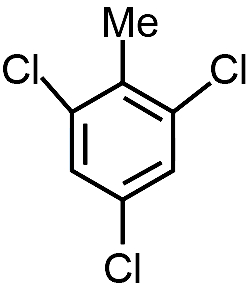
$p-$chlorotoluene
B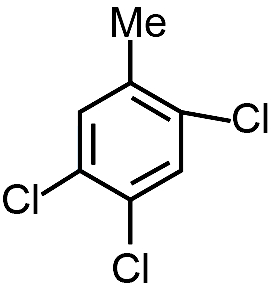
$m-$chlorotoluene
C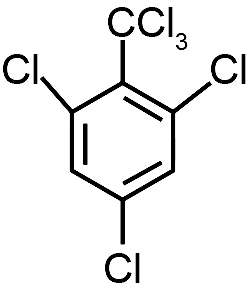
benzyl chloride
D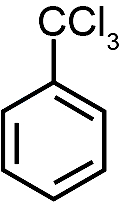
trichloromethylbenzene (benzotrichloride)
Solution
(D) In the presence of heat (boiling point conditions) or $UV$ light,chlorine reacts with the side chain of toluene via a free radical substitution mechanism.
When excess $Cl_{2}$ is used,it leads to the progressive substitution of all three hydrogen atoms on the methyl group.
The reaction proceeds as follows:
$C_6H_5CH_3$ $\xrightarrow{Cl_2, \Delta} C_6H_5CH_2Cl$ $\xrightarrow{Cl_2, \Delta} C_6H_5CHCl_2$ $\xrightarrow{Cl_2, \Delta} C_6H_5CCl_3$.
Thus,the final product is $C_6H_5CCl_3$,which is known as trichloromethylbenzene or benzotrichloride.
When excess $Cl_{2}$ is used,it leads to the progressive substitution of all three hydrogen atoms on the methyl group.
The reaction proceeds as follows:
$C_6H_5CH_3$ $\xrightarrow{Cl_2, \Delta} C_6H_5CH_2Cl$ $\xrightarrow{Cl_2, \Delta} C_6H_5CHCl_2$ $\xrightarrow{Cl_2, \Delta} C_6H_5CCl_3$.
Thus,the final product is $C_6H_5CCl_3$,which is known as trichloromethylbenzene or benzotrichloride.
0 likesView Solution
38
ChemistryMediumMCQWBJEE · 2012
An equimolar mixture of toluene and chlorobenzene is treated with a mixture of conc. $H_{2}SO_{4}$ and conc. $HNO_{3}$. Indicate the correct statement from the following.
A
$p$-nitrotoluene is formed in excess
B
equimolar amounts of $p$-nitrotoluene and $p$-nitrochlorobenzene are formed
C
$p$-nitrochlorobenzene is formed in excess
D
$m$-nitrochlorobenzene is formed in excess
Solution
(A) Toluene $(C_{6}H_{5}CH_{3})$ and chlorobenzene $(C_{6}H_{5}Cl)$ both undergo electrophilic aromatic substitution (nitration) when treated with a mixture of conc. $H_{2}SO_{4}$ and conc. $HNO_{3}$.
The methyl group $(-CH_{3})$ in toluene is an activating group,which increases the electron density of the benzene ring,making it more reactive towards electrophilic substitution compared to the benzene ring in chlorobenzene.
The chlorine atom $(-Cl)$ in chlorobenzene is a deactivating group due to its strong $-I$ effect,which decreases the electron density of the benzene ring,making it less reactive towards electrophilic substitution.
Since toluene is more reactive than chlorobenzene,it will undergo nitration at a faster rate,resulting in the formation of $p$-nitrotoluene in excess compared to $p$-nitrochlorobenzene.
The methyl group $(-CH_{3})$ in toluene is an activating group,which increases the electron density of the benzene ring,making it more reactive towards electrophilic substitution compared to the benzene ring in chlorobenzene.
The chlorine atom $(-Cl)$ in chlorobenzene is a deactivating group due to its strong $-I$ effect,which decreases the electron density of the benzene ring,making it less reactive towards electrophilic substitution.
Since toluene is more reactive than chlorobenzene,it will undergo nitration at a faster rate,resulting in the formation of $p$-nitrotoluene in excess compared to $p$-nitrochlorobenzene.
0 likesView Solution
39
ChemistryEasyMCQWBJEE · 2012
Which of the following will show a negative deviation from Raoult's law?
A
Acetone-benzene
B
Acetone-ethanol
C
Benzene-methanol
D
Acetone-chloroform
Solution
(D) When $Acetone$ $(CH_3COCH_3)$ and $Chloroform$ $(CHCl_3)$ are mixed,they form intermolecular hydrogen bonds between the oxygen atom of acetone and the hydrogen atom of chloroform.
This interaction is stronger than the original $Acetone-Acetone$ and $Chloroform-Chloroform$ interactions.
As a result,the escaping tendency of the molecules decreases,leading to a negative deviation from Raoult's law.
This interaction is stronger than the original $Acetone-Acetone$ and $Chloroform-Chloroform$ interactions.
As a result,the escaping tendency of the molecules decreases,leading to a negative deviation from Raoult's law.
0 likesView Solution
40
ChemistryDifficultMCQWBJEE · 2012
$58.4 \ g$ of $NaCl$ and $180 \ g$ of glucose were separately dissolved in $1000 \ mL$ of water. Identify the correct statement regarding the elevation of boiling point $(b.p.)$ of the resulting solutions.
A
$NaCl$ solution will show higher elevation of boiling point
B
Glucose solution will show higher elevation of boiling point
C
Both the solutions will show equal elevation of boiling point
D
The boiling point elevation will be shown by neither of the solutions
Solution
(A) Elevation in boiling point is given by $\Delta T_{b} = i \times K_{b} \times m$.
For $NaCl$ $(58.4 \ g \approx 1 \text{ mole})$,$i = 2$.
For glucose $(180 \ g = 1 \text{ mole})$,$i = 1$.
Since both solutes are dissolved in the same amount of solvent ($1000 \ mL \approx 1 \text{ kg}$ of water),their molality $(m)$ is the same.
Therefore,$\Delta T_{b} \propto i$.
Since $i_{NaCl} > i_{glucose}$,the $NaCl$ solution will show a higher elevation of boiling point.
For $NaCl$ $(58.4 \ g \approx 1 \text{ mole})$,$i = 2$.
For glucose $(180 \ g = 1 \text{ mole})$,$i = 1$.
Since both solutes are dissolved in the same amount of solvent ($1000 \ mL \approx 1 \text{ kg}$ of water),their molality $(m)$ is the same.
Therefore,$\Delta T_{b} \propto i$.
Since $i_{NaCl} > i_{glucose}$,the $NaCl$ solution will show a higher elevation of boiling point.
0 likesView Solution
41
ChemistryMediumMCQWBJEE · 2012
Identify the method by which $Me_{3}CCOOH$ can be prepared.
A
Treating $1 \ mol$ of $MeCOMe$ with $2 \ mol$ of $MeMgI$
B
Treating $1 \ mol$ of $MeCO_{2}Me$ with $3 \ mol$ of $MeMgI$
C
Treating $1 \ mol$ of $MeCHO$ with $3 \ mol$ of $MeMgI$
D
Treating $1 \ mol$ of dry ice with $1 \ mol$ of $Me_{3}CMgI$
Solution
(D) The preparation of $Me_{3}CCOOH$ (pivalic acid) from a Grignard reagent involves the reaction of a Grignard reagent with dry ice $(CO_{2})$.
The reaction is as follows:
$O=C=O + (CH_{3})_{3}CMgI \rightarrow (CH_{3})_{3}C-COOMgI$
Followed by hydrolysis:
$(CH_{3})_{3}C-COOMgI + H_{2}O \rightarrow (CH_{3})_{3}C-COOH + Mg(OH)I$
Thus,treating $1 \ mol$ of dry ice with $1 \ mol$ of $Me_{3}CMgI$ yields $Me_{3}CCOOH$.
The reaction is as follows:
$O=C=O + (CH_{3})_{3}CMgI \rightarrow (CH_{3})_{3}C-COOMgI$
Followed by hydrolysis:
$(CH_{3})_{3}C-COOMgI + H_{2}O \rightarrow (CH_{3})_{3}C-COOH + Mg(OH)I$
Thus,treating $1 \ mol$ of dry ice with $1 \ mol$ of $Me_{3}CMgI$ yields $Me_{3}CCOOH$.
0 likesView Solution
42
ChemistryEasyMCQWBJEE · 2012
The weight of oxalic acid that will be required to prepare a $1000 \ mL$ $(N / 20)$ solution is
A
$126 / 100 \ g$
B
$63 / 40 \ g$
C
$63 / 20 \ g$
D
$126 / 20 \ g$
Solution
(C) The formula for normality is $N = \frac{w \times 1000}{E \times V(mL)}$.
Here,$N = 1/20$,$V = 1000 \ mL$,and the equivalent weight $E$ of oxalic acid $(H_2C_2O_4 \cdot 2H_2O)$ is $63 \ g/eq$.
Substituting the values: $w = \frac{N \times E \times V}{1000} = \frac{1}{20} \times 63 \times \frac{1000}{1000} = \frac{63}{20} \ g$.
Here,$N = 1/20$,$V = 1000 \ mL$,and the equivalent weight $E$ of oxalic acid $(H_2C_2O_4 \cdot 2H_2O)$ is $63 \ g/eq$.
Substituting the values: $w = \frac{N \times E \times V}{1000} = \frac{1}{20} \times 63 \times \frac{1000}{1000} = \frac{63}{20} \ g$.
0 likesView Solution
Vedclass Products
For Students
Vedclass Test Series
Mock tests in real WBJEE style covering Chemistry with performance analysis. 5-day free trial.
Start Free TrialFor Teachers
Exam Paper Generator
Generate Set A/B/C/D Chemistry papers from 7.5L+ questions in 2 minutes. 3 chapters free.
Try FreeFor Institutes
Online Exam Module
Run live WBJEE mock exams with unlimited students, 360° analytics & white-label branding.
See DemoFrequently Asked Questions
How many Chemistry questions are in WBJEE 2012?
There are 42 Chemistry questions from the WBJEE 2012 paper on Vedclass, each with a detailed step-by-step solution in English.
Are WBJEE 2012 Chemistry solutions available in English?
Yes. All solutions on this page are in English. You can also switch to English or Hindi using the language buttons above the questions.
Can I practice WBJEE 2012 Chemistry as a timed test?
Yes. Use the Vedclass Test Series to attempt a full WBJEE mock test covering Chemistry with time limits and instant score analysis.
Can teachers create Chemistry papers from WBJEE previous year questions?
Yes. The Vedclass Exam Paper Generator lets teachers mix WBJEE Chemistry questions and generate Set A/B/C/D papers in minutes.
For Teachers & Institutes
Build a Custom Chemistry Paper
Pick WBJEE 2012 Chemistry questions, set difficulty, and generate Set A/B/C/D in 2 minutes.