
MathematicsQ1–77 of 80 questions
Page 1 of 2 · English
1
MathematicsMediumMCQWBJEE · 2012
The number of integer values of $m$,for which the $x$-coordinate of the point of intersection of the lines $3x + 4y = 9$ and $y = mx + 1$ is also an integer,is
A
$2$
B
$0$
C
$4$
D
$1$
Solution
(A) Given the equations of the lines are $3x + 4y = 9$ and $y = mx + 1$.
Substituting $y = mx + 1$ into the first equation:
$3x + 4(mx + 1) = 9$
$3x + 4mx + 4 = 9$
$x(3 + 4m) = 5$
$x = \frac{5}{3 + 4m}$
For $x$ to be an integer,$(3 + 4m)$ must be a divisor of $5$.
The divisors of $5$ are $\{1, -1, 5, -5\}$.
Case $1$: $3 + 4m = 1 \implies 4m = -2 \implies m = -0.5$ (Not an integer).
Case $2$: $3 + 4m = -1 \implies 4m = -4 \implies m = -1$ (Integer).
Case $3$: $3 + 4m = 5 \implies 4m = 2 \implies m = 0.5$ (Not an integer).
Case $4$: $3 + 4m = -5 \implies 4m = -8 \implies m = -2$ (Integer).
Thus,there are $2$ integer values of $m$,which are $\{-1, -2\}$.
Substituting $y = mx + 1$ into the first equation:
$3x + 4(mx + 1) = 9$
$3x + 4mx + 4 = 9$
$x(3 + 4m) = 5$
$x = \frac{5}{3 + 4m}$
For $x$ to be an integer,$(3 + 4m)$ must be a divisor of $5$.
The divisors of $5$ are $\{1, -1, 5, -5\}$.
Case $1$: $3 + 4m = 1 \implies 4m = -2 \implies m = -0.5$ (Not an integer).
Case $2$: $3 + 4m = -1 \implies 4m = -4 \implies m = -1$ (Integer).
Case $3$: $3 + 4m = 5 \implies 4m = 2 \implies m = 0.5$ (Not an integer).
Case $4$: $3 + 4m = -5 \implies 4m = -8 \implies m = -2$ (Integer).
Thus,there are $2$ integer values of $m$,which are $\{-1, -2\}$.
0 likesView Solution
2
MathematicsEasyMCQWBJEE · 2012
The number of solutions of the equation $\log _{2}\left(x^{2}+2 x-1\right)=1$ is
A
$0$
B
$1$
C
$2$
D
$3$
Solution
(C) Given equation: $\log _{2}\left(x^{2}+2 x-1\right)=1$
By the definition of logarithm,$\log _{b}(a) = c \implies a = b^{c}$.
So,$x^{2}+2 x-1 = 2^{1} = 2$.
Rearranging the terms: $x^{2}+2 x-3 = 0$.
Factoring the quadratic equation: $(x+3)(x-1) = 0$.
This gives $x = -3$ or $x = 1$.
Check the domain: For $\log _{2}(f(x))$ to be defined,$f(x) > 0$.
If $x = 1$,$x^{2}+2 x-1 = 1+2-1 = 2 > 0$ (Valid).
If $x = -3$,$x^{2}+2 x-1 = 9-6-1 = 2 > 0$ (Valid).
Both solutions are valid,so there are $2$ solutions.
By the definition of logarithm,$\log _{b}(a) = c \implies a = b^{c}$.
So,$x^{2}+2 x-1 = 2^{1} = 2$.
Rearranging the terms: $x^{2}+2 x-3 = 0$.
Factoring the quadratic equation: $(x+3)(x-1) = 0$.
This gives $x = -3$ or $x = 1$.
Check the domain: For $\log _{2}(f(x))$ to be defined,$f(x) > 0$.
If $x = 1$,$x^{2}+2 x-1 = 1+2-1 = 2 > 0$ (Valid).
If $x = -3$,$x^{2}+2 x-1 = 9-6-1 = 2 > 0$ (Valid).
Both solutions are valid,so there are $2$ solutions.
0 likesView Solution
3
MathematicsEasyMCQWBJEE · 2012
If $\log _{e}\left(x^{2}-16\right) \leq \log _{e}(4 x-11)$,then
A
$4 < x \leq 5$
B
$x < -4$ or $x > 4$
C
$-1 \leq x \leq 5$
D
$x < -1$ or $x > 5$
Solution
(A) For the logarithmic inequality $\log _{e}\left(x^{2}-16\right) \leq \log _{e}(4 x-11)$ to be defined,the arguments must be positive:
$1) \ x^{2}-16 > 0$ $\Rightarrow (x-4)(x+4) > 0$ $\Rightarrow x \in (-\infty, -4) \cup (4, \infty)$
$2) \ 4x-11 > 0 \Rightarrow x > \frac{11}{4} = 2.75$
Combining these,the domain is $x > 4$.
Now,solving the inequality:
$x^{2}-16 \leq 4x-11$
$x^{2}-4x-5 \leq 0$
$(x-5)(x+1) \leq 0$
This holds for $x \in [-1, 5]$.
Taking the intersection of the domain $(x > 4)$ and the solution $(x \in [-1, 5])$,we get $4 < x \leq 5$.
$1) \ x^{2}-16 > 0$ $\Rightarrow (x-4)(x+4) > 0$ $\Rightarrow x \in (-\infty, -4) \cup (4, \infty)$
$2) \ 4x-11 > 0 \Rightarrow x > \frac{11}{4} = 2.75$
Combining these,the domain is $x > 4$.
Now,solving the inequality:
$x^{2}-16 \leq 4x-11$
$x^{2}-4x-5 \leq 0$
$(x-5)(x+1) \leq 0$
This holds for $x \in [-1, 5]$.
Taking the intersection of the domain $(x > 4)$ and the solution $(x \in [-1, 5])$,we get $4 < x \leq 5$.
0 likesView Solution
4
MathematicsMediumMCQWBJEE · 2012
If $(\alpha+\sqrt{\beta})$ and $(\alpha-\sqrt{\beta})$ are the roots of the equation $x^{2}+px+q=0$,where $\alpha, \beta, p$ and $q$ are real,then the roots of the equation $(p^{2}-4q)(p^{2}x^{2}+4px)-16q=0$ are
A
$(\frac{1}{\alpha}+\frac{1}{\sqrt{\beta}})$ and $(\frac{1}{\alpha}-\frac{1}{\sqrt{\beta}})$
B
$(\frac{1}{\sqrt{\alpha}}+\frac{1}{\beta})$ and $(\frac{1}{\sqrt{\alpha}}-\frac{1}{\beta})$
C
$(\frac{1}{\sqrt{\alpha}}+\frac{1}{\sqrt{\beta}})$ and $(\frac{1}{\sqrt{\alpha}}-\frac{1}{\sqrt{\beta}})$
D
$(\sqrt{\alpha}+\sqrt{\beta})$ and $(\sqrt{\alpha}-\sqrt{\beta})$
Solution
(A) Given that $(\alpha+\sqrt{\beta})$ and $(\alpha-\sqrt{\beta})$ are roots of $x^{2}+px+q=0$.
Sum of roots: $(\alpha+\sqrt{\beta}) + (\alpha-\sqrt{\beta}) = -p \Rightarrow 2\alpha = -p \Rightarrow \alpha = -\frac{p}{2}$.
Product of roots: $(\alpha+\sqrt{\beta})(\alpha-\sqrt{\beta}) = q \Rightarrow \alpha^{2}-\beta = q \Rightarrow \beta = \alpha^{2}-q = \frac{p^{2}}{4}-q$.
Thus,$p^{2}-4q = 4\beta$.
Substitute into the equation $(p^{2}-4q)(p^{2}x^{2}+4px)-16q=0$:
$4\beta(p^{2}x^{2}+4px) - 16q = 0$.
Since $p = -2\alpha$,$p^{2} = 4\alpha^{2}$ and $q = \alpha^{2}-\beta$:
$4\beta(4\alpha^{2}x^{2}-8\alpha x) - 16(\alpha^{2}-\beta) = 0$.
Divide by $4$:
$\beta(\alpha^{2}x^{2}-2\alpha x) - (\alpha^{2}-\beta) = 0$.
$\alpha^{2}\beta x^{2} - 2\alpha\beta x - \alpha^{2} + \beta = 0$.
Rearranging terms: $\alpha^{2}(\beta x^{2}-1) - \beta(2\alpha x - 1) = 0$ is not straightforward,so let's simplify $4\beta(p^{2}x^{2}+4px) = 16q$:
$4\beta(4\alpha^{2}x^{2}-8\alpha x) = 16(\alpha^{2}-\beta) \Rightarrow \beta(\alpha^{2}x^{2}-2\alpha x) = \alpha^{2}-\beta$.
$\alpha^{2}\beta x^{2} - 2\alpha\beta x + \beta = \alpha^{2} \Rightarrow \beta(\alpha x - 1)^{2} = \alpha^{2}$.
$(\alpha x - 1)^{2} = \frac{\alpha^{2}}{\beta} \Rightarrow \alpha x - 1 = \pm \frac{\alpha}{\sqrt{\beta}}$.
$\alpha x = 1 \pm \frac{\alpha}{\sqrt{\beta}} \Rightarrow x = \frac{1}{\alpha} \pm \frac{1}{\sqrt{\beta}}$.
Sum of roots: $(\alpha+\sqrt{\beta}) + (\alpha-\sqrt{\beta}) = -p \Rightarrow 2\alpha = -p \Rightarrow \alpha = -\frac{p}{2}$.
Product of roots: $(\alpha+\sqrt{\beta})(\alpha-\sqrt{\beta}) = q \Rightarrow \alpha^{2}-\beta = q \Rightarrow \beta = \alpha^{2}-q = \frac{p^{2}}{4}-q$.
Thus,$p^{2}-4q = 4\beta$.
Substitute into the equation $(p^{2}-4q)(p^{2}x^{2}+4px)-16q=0$:
$4\beta(p^{2}x^{2}+4px) - 16q = 0$.
Since $p = -2\alpha$,$p^{2} = 4\alpha^{2}$ and $q = \alpha^{2}-\beta$:
$4\beta(4\alpha^{2}x^{2}-8\alpha x) - 16(\alpha^{2}-\beta) = 0$.
Divide by $4$:
$\beta(\alpha^{2}x^{2}-2\alpha x) - (\alpha^{2}-\beta) = 0$.
$\alpha^{2}\beta x^{2} - 2\alpha\beta x - \alpha^{2} + \beta = 0$.
Rearranging terms: $\alpha^{2}(\beta x^{2}-1) - \beta(2\alpha x - 1) = 0$ is not straightforward,so let's simplify $4\beta(p^{2}x^{2}+4px) = 16q$:
$4\beta(4\alpha^{2}x^{2}-8\alpha x) = 16(\alpha^{2}-\beta) \Rightarrow \beta(\alpha^{2}x^{2}-2\alpha x) = \alpha^{2}-\beta$.
$\alpha^{2}\beta x^{2} - 2\alpha\beta x + \beta = \alpha^{2} \Rightarrow \beta(\alpha x - 1)^{2} = \alpha^{2}$.
$(\alpha x - 1)^{2} = \frac{\alpha^{2}}{\beta} \Rightarrow \alpha x - 1 = \pm \frac{\alpha}{\sqrt{\beta}}$.
$\alpha x = 1 \pm \frac{\alpha}{\sqrt{\beta}} \Rightarrow x = \frac{1}{\alpha} \pm \frac{1}{\sqrt{\beta}}$.
0 likesView Solution
5
MathematicsMediumMCQWBJEE · 2012
If $a, b$ and $c$ are in arithmetic progression,then the roots of the equation $a x^{2}-2 b x+c=0$ are
A
$1$ and $\frac{c}{a}$
B
$-\frac{1}{a}$ and $-c$
C
$-1$ and $-\frac{c}{a}$
D
$-2$ and $-\frac{c}{2 a}$
Solution
(A) Since $a, b$ and $c$ are in $AP$,we have $2b = a + c$.
Given the quadratic equation $a x^{2} - 2b x + c = 0$.
Substituting $2b = a + c$ into the equation,we get:
$a x^{2} - (a + c) x + c = 0$
$a x^{2} - a x - c x + c = 0$
$a x(x - 1) - c(x - 1) = 0$
$(x - 1)(a x - c) = 0$
Thus,the roots are $x = 1$ and $x = \frac{c}{a}$.
Given the quadratic equation $a x^{2} - 2b x + c = 0$.
Substituting $2b = a + c$ into the equation,we get:
$a x^{2} - (a + c) x + c = 0$
$a x^{2} - a x - c x + c = 0$
$a x(x - 1) - c(x - 1) = 0$
$(x - 1)(a x - c) = 0$
Thus,the roots are $x = 1$ and $x = \frac{c}{a}$.
0 likesView Solution
6
MathematicsMediumMCQWBJEE · 2012
The equations $x^{2}+x+a=0$ and $x^{2}+ax+1=0$ have a common real root.
A
for no value of $a$
B
for exactly one value of $a$
C
for exactly two values of $a$
D
for exactly three values of $a$
Solution
(B) Let $\alpha$ be the common root.
Then,$\alpha^{2}+\alpha+a=0$ ... $(i)$
And $\alpha^{2}+a\alpha+1=0$ ... (ii)
Subtracting (ii) from $(i)$,we get:
$(\alpha^{2}+\alpha+a) - (\alpha^{2}+a\alpha+1) = 0$
$\alpha(1-a) + (a-1) = 0$
$\alpha(1-a) - (1-a) = 0$
$(1-a)(\alpha-1) = 0$
This implies $a=1$ or $\alpha=1$.
Case $1$: If $a=1$,the equations become $x^{2}+x+1=0$,which has no real roots.
Case $2$: If $\alpha=1$,substituting into $(i)$ gives $1^{2}+1+a=0$,so $a=-2$.
For $a=-2$,the equations are $x^{2}+x-2=0$ and $x^{2}-2x+1=0$.
The roots of $x^{2}+x-2=0$ are $x=1, -2$.
The roots of $x^{2}-2x+1=0$ are $x=1, 1$.
The common root is $x=1$,which is real.
Thus,there is exactly one value of $a$ $(a=-2)$ for which the equations have a common real root.
Then,$\alpha^{2}+\alpha+a=0$ ... $(i)$
And $\alpha^{2}+a\alpha+1=0$ ... (ii)
Subtracting (ii) from $(i)$,we get:
$(\alpha^{2}+\alpha+a) - (\alpha^{2}+a\alpha+1) = 0$
$\alpha(1-a) + (a-1) = 0$
$\alpha(1-a) - (1-a) = 0$
$(1-a)(\alpha-1) = 0$
This implies $a=1$ or $\alpha=1$.
Case $1$: If $a=1$,the equations become $x^{2}+x+1=0$,which has no real roots.
Case $2$: If $\alpha=1$,substituting into $(i)$ gives $1^{2}+1+a=0$,so $a=-2$.
For $a=-2$,the equations are $x^{2}+x-2=0$ and $x^{2}-2x+1=0$.
The roots of $x^{2}+x-2=0$ are $x=1, -2$.
The roots of $x^{2}-2x+1=0$ are $x=1, 1$.
The common root is $x=1$,which is real.
Thus,there is exactly one value of $a$ $(a=-2)$ for which the equations have a common real root.
0 likesView Solution
7
MathematicsMediumMCQWBJEE · 2012
The quadratic equation $2x^{2} - (a^{3} + 8a - 1)x + a^{2} - 4a = 0$ has roots of opposite signs. Then,
A
$a \leq 0$
B
$0 < a < 4$
C
$4 \leq a < 8$
D
$a \geq 8$
Solution
(B) For a quadratic equation $Ax^{2} + Bx + C = 0$ to have roots of opposite signs,the product of the roots must be less than zero.
Product of the roots = $\frac{C}{A} < 0$.
Here,$A = 2$ and $C = a^{2} - 4a$.
So,$\frac{a^{2} - 4a}{2} < 0$.
$a^{2} - 4a < 0$.
$a(a - 4) < 0$.
This inequality holds when $0 < a < 4$.
Product of the roots = $\frac{C}{A} < 0$.
Here,$A = 2$ and $C = a^{2} - 4a$.
So,$\frac{a^{2} - 4a}{2} < 0$.
$a^{2} - 4a < 0$.
$a(a - 4) < 0$.
This inequality holds when $0 < a < 4$.
0 likesView Solution
8
MathematicsMediumMCQWBJEE · 2012
If $\left(\frac{3}{2}+i \frac{\sqrt{3}}{2}\right)^{50}=3^{25}(x+i y)$ where $x$ and $y$ are real,then the ordered pair $(x, y)$ is
A
$(-3, 0)$
B
$(0, 3)$
C
$(0, -3)$
D
$\left(\frac{1}{2}, \frac{\sqrt{3}}{2}\right)$
Solution
(D) Let $z = \frac{3}{2} + i \frac{\sqrt{3}}{2} = \sqrt{3} \left( \frac{\sqrt{3}}{2} + i \frac{1}{2} \right) = \sqrt{3} \left( \cos \frac{\pi}{6} + i \sin \frac{\pi}{6} \right) = \sqrt{3} e^{i \frac{\pi}{6}}$.
Then,$\left( \frac{3}{2} + i \frac{\sqrt{3}}{2} \right)^{50} = (\sqrt{3})^{50} e^{i \frac{50\pi}{6}} = 3^{25} e^{i \frac{25\pi}{3}}$.
Since $\frac{25\pi}{3} = 8\pi + \frac{\pi}{3}$,we have $e^{i \frac{25\pi}{3}} = e^{i \frac{\pi}{3}} = \cos \frac{\pi}{3} + i \sin \frac{\pi}{3} = \frac{1}{2} + i \frac{\sqrt{3}}{2}$.
Thus,$3^{25} (x + iy) = 3^{25} \left( \frac{1}{2} + i \frac{\sqrt{3}}{2} \right)$.
Comparing real and imaginary parts,we get $x = \frac{1}{2}$ and $y = \frac{\sqrt{3}}{2}$.
Then,$\left( \frac{3}{2} + i \frac{\sqrt{3}}{2} \right)^{50} = (\sqrt{3})^{50} e^{i \frac{50\pi}{6}} = 3^{25} e^{i \frac{25\pi}{3}}$.
Since $\frac{25\pi}{3} = 8\pi + \frac{\pi}{3}$,we have $e^{i \frac{25\pi}{3}} = e^{i \frac{\pi}{3}} = \cos \frac{\pi}{3} + i \sin \frac{\pi}{3} = \frac{1}{2} + i \frac{\sqrt{3}}{2}$.
Thus,$3^{25} (x + iy) = 3^{25} \left( \frac{1}{2} + i \frac{\sqrt{3}}{2} \right)$.
Comparing real and imaginary parts,we get $x = \frac{1}{2}$ and $y = \frac{\sqrt{3}}{2}$.
0 likesView Solution
9
MathematicsDifficultMCQWBJEE · 2012
The maximum value of $|z|$,when the complex number $z$ satisfies the condition $\left|z+\frac{2}{z}\right|=2$ is
A
$\sqrt{3}$
B
$\sqrt{3}+\sqrt{2}$
C
$\sqrt{3}+1$
D
$\sqrt{3}-1$
Solution
(C) Given the condition $\left|z+\frac{2}{z}\right|=2$.
Using the triangle inequality,$|z| = \left|z+\frac{2}{z}-\frac{2}{z}\right| \leq \left|z+\frac{2}{z}\right| + \left|-\frac{2}{z}\right|$.
Substituting the given value,$|z| \leq 2 + \frac{2}{|z|}$.
Multiplying by $|z|$ (since $|z| > 0$),we get $|z|^2 \leq 2|z| + 2$.
Rearranging the terms,$|z|^2 - 2|z| \leq 2$.
Completing the square,$|z|^2 - 2|z| + 1 \leq 2 + 1$,which gives $(|z|-1)^2 \leq 3$.
Taking the square root,$-\sqrt{3} \leq |z|-1 \leq \sqrt{3}$.
Adding $1$ to all sides,$1-\sqrt{3} \leq |z| \leq 1+\sqrt{3}$.
Since $|z| \geq 0$,the maximum value of $|z|$ is $1+\sqrt{3}$.
Using the triangle inequality,$|z| = \left|z+\frac{2}{z}-\frac{2}{z}\right| \leq \left|z+\frac{2}{z}\right| + \left|-\frac{2}{z}\right|$.
Substituting the given value,$|z| \leq 2 + \frac{2}{|z|}$.
Multiplying by $|z|$ (since $|z| > 0$),we get $|z|^2 \leq 2|z| + 2$.
Rearranging the terms,$|z|^2 - 2|z| \leq 2$.
Completing the square,$|z|^2 - 2|z| + 1 \leq 2 + 1$,which gives $(|z|-1)^2 \leq 3$.
Taking the square root,$-\sqrt{3} \leq |z|-1 \leq \sqrt{3}$.
Adding $1$ to all sides,$1-\sqrt{3} \leq |z| \leq 1+\sqrt{3}$.
Since $|z| \geq 0$,the maximum value of $|z|$ is $1+\sqrt{3}$.
0 likesView Solution
10
MathematicsMediumMCQWBJEE · 2012
If $\frac{z-1}{z+1}$ is purely imaginary,then
A
$|z|=\frac{1}{2}$
B
$|z|=1$
C
$|z|=2$
D
$|z|=3$
Solution
(B) Let $\omega = \frac{z-1}{z+1}$ be a purely imaginary number.
$A$ complex number $\omega$ is purely imaginary if and only if $\omega + \overline{\omega} = 0$ (where $\omega \neq 0$).
So,$\frac{z-1}{z+1} + \overline{\left(\frac{z-1}{z+1}\right)} = 0$
$\frac{z-1}{z+1} + \frac{\overline{z}-1}{\overline{z}+1} = 0$
$(z-1)(\overline{z}+1) + (\overline{z}-1)(z+1) = 0$
$(z\overline{z} + z - \overline{z} - 1) + (z\overline{z} - z + \overline{z} - 1) = 0$
$2z\overline{z} - 2 = 0$
$z\overline{z} = 1$
Since $|z|^2 = z\overline{z}$,we have $|z|^2 = 1$,which implies $|z| = 1$.
$A$ complex number $\omega$ is purely imaginary if and only if $\omega + \overline{\omega} = 0$ (where $\omega \neq 0$).
So,$\frac{z-1}{z+1} + \overline{\left(\frac{z-1}{z+1}\right)} = 0$
$\frac{z-1}{z+1} + \frac{\overline{z}-1}{\overline{z}+1} = 0$
$(z-1)(\overline{z}+1) + (\overline{z}-1)(z+1) = 0$
$(z\overline{z} + z - \overline{z} - 1) + (z\overline{z} - z + \overline{z} - 1) = 0$
$2z\overline{z} - 2 = 0$
$z\overline{z} = 1$
Since $|z|^2 = z\overline{z}$,we have $|z|^2 = 1$,which implies $|z| = 1$.
0 likesView Solution
11
MathematicsMediumMCQWBJEE · 2012
The points representing the complex number $z$ for which $\text{arg}\left(\frac{z-2}{z+2}\right)=\frac{\pi}{3}$ lie on
A
a circle
B
a straight line
C
an ellipse
D
a parabola
Solution
(A) Let $z = x + iy$. The given equation is $\text{arg}\left(\frac{z-2}{z+2}\right) = \frac{\pi}{3}$.
This is the locus of a point $z$ such that the angle subtended by the segment joining $2$ and $-2$ at $z$ is $\frac{\pi}{3}$.
Using the property $\text{arg}\left(\frac{z-z_1}{z-z_2}\right) = \theta$,the locus is an arc of a circle.
Specifically,$\frac{z-2}{z+2} = k(\cos\frac{\pi}{3} + i\sin\frac{\pi}{3})$ for some $k > 0$.
This simplifies to $\frac{z-2}{z+2} = k(\frac{1}{2} + i\frac{\sqrt{3}}{2})$.
Solving for $z$ leads to the equation of a circle.
This is the locus of a point $z$ such that the angle subtended by the segment joining $2$ and $-2$ at $z$ is $\frac{\pi}{3}$.
Using the property $\text{arg}\left(\frac{z-z_1}{z-z_2}\right) = \theta$,the locus is an arc of a circle.
Specifically,$\frac{z-2}{z+2} = k(\cos\frac{\pi}{3} + i\sin\frac{\pi}{3})$ for some $k > 0$.
This simplifies to $\frac{z-2}{z+2} = k(\frac{1}{2} + i\frac{\sqrt{3}}{2})$.
Solving for $z$ leads to the equation of a circle.
0 likesView Solution
12
MathematicsEasyMCQWBJEE · 2012
$A$ vehicle registration number consists of $2$ letters of the English alphabet followed by $4$ digits,where the first digit is not zero. The total number of vehicles with distinct registration numbers is
A
$26^{2} \times 10^{4}$
B
$^{26}P_{2} \times ^{10}P_{4}$
C
$^{26}P_{2} \times 9 \times ^{10}P_{3}$
D
$26^{2} \times 9 \times 10^{3}$
Solution
(D) The total number of ways to choose $2$ letters from the English alphabet (assuming repetition is allowed as it is not specified otherwise) is $26 \times 26 = 26^{2}$.
The total number of ways to choose $4$ digits such that the first digit is not zero is $9 \times 10 \times 10 \times 10 = 9 \times 10^{3}$.
Therefore,the total number of distinct registration numbers is $26^{2} \times 9 \times 10^{3}$.
The total number of ways to choose $4$ digits such that the first digit is not zero is $9 \times 10 \times 10 \times 10 = 9 \times 10^{3}$.
Therefore,the total number of distinct registration numbers is $26^{2} \times 9 \times 10^{3}$.
0 likesView Solution
13
MathematicsEasyMCQWBJEE · 2012
The number of words that can be written using all the letters of the word "$IRRATIONAL$" is
A
$\frac{10 !}{(2 !)^{3}}$
B
$\frac{10 !}{(2 !)^{2}}$
C
$\frac{10 !}{2 !}$
D
$10 !$
Solution
(A) The word "$IRRATIONAL$" contains $10$ letters in total.
Counting the frequency of each letter:
$I$ appears $2$ times.
$R$ appears $2$ times.
$A$ appears $2$ times.
$T, O, N, L$ appear $1$ time each.
Using the formula for permutations of a multiset,the total number of arrangements is given by $\frac{n!}{n_1! n_2! n_3! \dots n_k!}$.
Here,$n = 10$,$n_1 = 2$ (for $I$),$n_2 = 2$ (for $R$),and $n_3 = 2$ (for $A$).
Therefore,the total number of words $= \frac{10!}{2! 2! 2!} = \frac{10!}{(2!)^3}$.
Counting the frequency of each letter:
$I$ appears $2$ times.
$R$ appears $2$ times.
$A$ appears $2$ times.
$T, O, N, L$ appear $1$ time each.
Using the formula for permutations of a multiset,the total number of arrangements is given by $\frac{n!}{n_1! n_2! n_3! \dots n_k!}$.
Here,$n = 10$,$n_1 = 2$ (for $I$),$n_2 = 2$ (for $R$),and $n_3 = 2$ (for $A$).
Therefore,the total number of words $= \frac{10!}{2! 2! 2!} = \frac{10!}{(2!)^3}$.
0 likesView Solution
14
MathematicsEasyMCQWBJEE · 2012
Four speakers will address a meeting where speaker $Q$ will always speak before $P$. Then,the number of ways in which the order of speakers can be prepared is
A
$256$
B
$128$
C
$24$
D
$12$
Solution
(D) The total number of ways to arrange $4$ speakers is $4! = 4 \times 3 \times 2 \times 1 = 24$.
In any arrangement,there are only two possibilities for the relative order of speakers $P$ and $Q$: either $P$ speaks before $Q$ or $Q$ speaks before $P$.
Since these two cases are equally likely,exactly half of the total arrangements will have $Q$ speaking before $P$.
Therefore,the required number of ways is $\frac{24}{2} = 12$.
In any arrangement,there are only two possibilities for the relative order of speakers $P$ and $Q$: either $P$ speaks before $Q$ or $Q$ speaks before $P$.
Since these two cases are equally likely,exactly half of the total arrangements will have $Q$ speaking before $P$.
Therefore,the required number of ways is $\frac{24}{2} = 12$.
0 likesView Solution
15
MathematicsEasyMCQWBJEE · 2012
The number of diagonals in a regular polygon of $100$ sides is
A
$4950$
B
$4850$
C
$4750$
D
$4650$
Solution
(B) The number of diagonals in a regular polygon of $n$ sides is given by the formula $\frac{n(n-3)}{2}$ or ${ }^{n} C_{2}-n$.
For a polygon with $n = 100$ sides:
Number of diagonals $= { }^{100} C_{2} - 100$
$= \frac{100 \times 99}{2} - 100$
$= 50 \times 99 - 100$
$= 4950 - 100$
$= 4850$
For a polygon with $n = 100$ sides:
Number of diagonals $= { }^{100} C_{2} - 100$
$= \frac{100 \times 99}{2} - 100$
$= 50 \times 99 - 100$
$= 4950 - 100$
$= 4850$
0 likesView Solution
16
MathematicsMediumMCQWBJEE · 2012
Let the coefficients of powers of $x$ in the $2nd$,$3rd$,and $4th$ terms in the expansion of $(1+x)^{n}$,where $n$ is a positive integer,be in arithmetic progression. Then,the sum of the coefficients of odd powers of $x$ in the expansion is
A
$32$
B
$64$
C
$128$
D
$256$
Solution
(B) The coefficients of the $2nd$,$3rd$,and $4th$ terms in the expansion of $(1+x)^{n}$ are ${}^{n}C_{1}$,${}^{n}C_{2}$,and ${}^{n}C_{3}$ respectively.
Given that these are in arithmetic progression,we have $2({}^{n}C_{2}) = {}^{n}C_{1} + {}^{n}C_{3}$.
Substituting the values,$2 \times \frac{n(n-1)}{2} = n + \frac{n(n-1)(n-2)}{6}$.
Dividing by $n$ (since $n \neq 0$),we get $n-1 = 1 + \frac{(n-1)(n-2)}{6}$.
$6(n-2) = (n-1)(n-2)$.
Since $n \neq 2$,we divide by $(n-2)$ to get $6 = n-1$,which implies $n = 7$.
The sum of the coefficients of odd powers of $x$ in the expansion of $(1+x)^{n}$ is given by $2^{n-1}$.
Substituting $n=7$,the sum is $2^{7-1} = 2^{6} = 64$.
Given that these are in arithmetic progression,we have $2({}^{n}C_{2}) = {}^{n}C_{1} + {}^{n}C_{3}$.
Substituting the values,$2 \times \frac{n(n-1)}{2} = n + \frac{n(n-1)(n-2)}{6}$.
Dividing by $n$ (since $n \neq 0$),we get $n-1 = 1 + \frac{(n-1)(n-2)}{6}$.
$6(n-2) = (n-1)(n-2)$.
Since $n \neq 2$,we divide by $(n-2)$ to get $6 = n-1$,which implies $n = 7$.
The sum of the coefficients of odd powers of $x$ in the expansion of $(1+x)^{n}$ is given by $2^{n-1}$.
Substituting $n=7$,the sum is $2^{7-1} = 2^{6} = 64$.
0 likesView Solution
17
MathematicsMediumMCQWBJEE · 2012
Six numbers are in an $AP$ such that their sum is $3$. The first term is $4$ times the third term. Then,the fifth term is:
A
-$15$
B
-$3$
C
$9$
D
-$4$
Solution
(D) Let the six terms of the $AP$ be $a-5d, a-3d, a-d, a+d, a+3d, a+5d$ with common difference $2d$.
Sum of the terms $= (a-5d) + (a-3d) + (a-d) + (a+d) + (a+3d) + (a+5d) = 6a$.
Given $6a = 3$,so $a = \frac{1}{2}$.
Given $T_1 = 4T_3$,where $T_1 = a-5d$ and $T_3 = a-d$.
$a-5d = 4(a-d)$ $\Rightarrow a-5d = 4a-4d$ $\Rightarrow -3a = d$.
Substituting $a = \frac{1}{2}$,we get $d = -3 \times \frac{1}{2} = -\frac{3}{2}$.
The fifth term is $T_5 = a+3d$.
$T_5 = \frac{1}{2} + 3(-\frac{3}{2}) = \frac{1}{2} - \frac{9}{2} = -\frac{8}{2} = -4$.
Sum of the terms $= (a-5d) + (a-3d) + (a-d) + (a+d) + (a+3d) + (a+5d) = 6a$.
Given $6a = 3$,so $a = \frac{1}{2}$.
Given $T_1 = 4T_3$,where $T_1 = a-5d$ and $T_3 = a-d$.
$a-5d = 4(a-d)$ $\Rightarrow a-5d = 4a-4d$ $\Rightarrow -3a = d$.
Substituting $a = \frac{1}{2}$,we get $d = -3 \times \frac{1}{2} = -\frac{3}{2}$.
The fifth term is $T_5 = a+3d$.
$T_5 = \frac{1}{2} + 3(-\frac{3}{2}) = \frac{1}{2} - \frac{9}{2} = -\frac{8}{2} = -4$.
0 likesView Solution
18
MathematicsMediumMCQWBJEE · 2012
The sum of the infinite series $1+\frac{1}{3}+\frac{1 \cdot 3}{3 \cdot 6}+\frac{1 \cdot 3 \cdot 5}{3 \cdot 6 \cdot 9}+\frac{1 \cdot 3 \cdot 5 \cdot 7}{3 \cdot 6 \cdot 9 \cdot 12}+\ldots$ is equal to
A
$\sqrt{2}$
B
$\sqrt{3}$
C
$\sqrt{\frac{3}{2}}$
D
$\sqrt{\frac{1}{3}}$
Solution
(B) The given series is $S = 1 + \frac{1}{3} + \frac{1 \cdot 3}{3 \cdot 6} + \frac{1 \cdot 3 \cdot 5}{3 \cdot 6 \cdot 9} + \dots$
This is a binomial series of the form $(1-x)^{-n} = 1 + nx + \frac{n(n+1)}{2!}x^2 + \dots$
We can rewrite the terms as $1 + \frac{1}{2}(\frac{2}{3}) + \frac{\frac{1}{2}(\frac{1}{2}+1)}{2!}(\frac{2}{3})^2 + \frac{\frac{1}{2}(\frac{1}{2}+1)(\frac{1}{2}+2)}{3!}(\frac{2}{3})^3 + \dots$
Comparing this with the binomial expansion $(1-x)^{-n}$,we have $n = \frac{1}{2}$ and $x = \frac{2}{3}$.
Thus,the sum is $(1 - \frac{2}{3})^{-1/2} = (\frac{1}{3})^{-1/2} = 3^{1/2} = \sqrt{3}$.
This is a binomial series of the form $(1-x)^{-n} = 1 + nx + \frac{n(n+1)}{2!}x^2 + \dots$
We can rewrite the terms as $1 + \frac{1}{2}(\frac{2}{3}) + \frac{\frac{1}{2}(\frac{1}{2}+1)}{2!}(\frac{2}{3})^2 + \frac{\frac{1}{2}(\frac{1}{2}+1)(\frac{1}{2}+2)}{3!}(\frac{2}{3})^3 + \dots$
Comparing this with the binomial expansion $(1-x)^{-n}$,we have $n = \frac{1}{2}$ and $x = \frac{2}{3}$.
Thus,the sum is $(1 - \frac{2}{3})^{-1/2} = (\frac{1}{3})^{-1/2} = 3^{1/2} = \sqrt{3}$.
0 likesView Solution
19
MathematicsEasyMCQWBJEE · 2012
If $64, 27, 36$ are the $P^{\text{th}}$,$Q^{\text{th}}$,and $R^{\text{th}}$ terms of a $GP$,then $P+2Q$ is equal to
A
$R$
B
$2R$
C
$3R$
D
$4R$
Solution
(C) Let $a$ be the first term and $r$ be the common ratio of a $GP$. The $P^{\text{th}}$,$Q^{\text{th}}$,and $R^{\text{th}}$ terms are $ar^{P-1}$,$ar^{Q-1}$,and $ar^{R-1}$ respectively.
According to the question:
$ar^{P-1} = 64$ $(i)$
$ar^{Q-1} = 27$ (ii)
$ar^{R-1} = 36$ (iii)
Dividing $(i)$ by (ii):
$r^{P-Q} = \frac{64}{27} = \left(\frac{4}{3}\right)^3$ (iv)
Dividing (ii) by (iii):
$r^{Q-R} = \frac{27}{36} = \frac{3}{4}$
Raising to the power of $3$:
$r^{3(Q-R)} = \left(\frac{3}{4}\right)^3 = \left(\frac{4}{3}\right)^{-3}$ $(v)$
Multiplying (iv) and $(v)$:
$r^{P-Q} \times r^{3Q-3R} = \left(\frac{4}{3}\right)^3 \times \left(\frac{4}{3}\right)^{-3} = 1$
$r^{P+2Q-3R} = r^0$
Therefore,$P+2Q-3R = 0$,which implies $P+2Q = 3R$.
According to the question:
$ar^{P-1} = 64$ $(i)$
$ar^{Q-1} = 27$ (ii)
$ar^{R-1} = 36$ (iii)
Dividing $(i)$ by (ii):
$r^{P-Q} = \frac{64}{27} = \left(\frac{4}{3}\right)^3$ (iv)
Dividing (ii) by (iii):
$r^{Q-R} = \frac{27}{36} = \frac{3}{4}$
Raising to the power of $3$:
$r^{3(Q-R)} = \left(\frac{3}{4}\right)^3 = \left(\frac{4}{3}\right)^{-3}$ $(v)$
Multiplying (iv) and $(v)$:
$r^{P-Q} \times r^{3Q-3R} = \left(\frac{4}{3}\right)^3 \times \left(\frac{4}{3}\right)^{-3} = 1$
$r^{P+2Q-3R} = r^0$
Therefore,$P+2Q-3R = 0$,which implies $P+2Q = 3R$.
0 likesView Solution
20
MathematicsMediumMCQWBJEE · 2012
Let $a, b, c, p, q$ and $r$ be positive real numbers such that $a, b$ and $c$ are in $GP$ and $a^{p} = b^{q} = c^{r}$. Then,
A
$p, q, r$ are in $G.P.$
B
$p, q, r$ are in $A.P.$
C
$p, q, r$ are in $H.P.$
D
$p^{2}, q^{2}, r^{2}$ are in $A.P.$
Solution
(C) Let $a^{p} = b^{q} = c^{r} = k$.
Since $a, b, c$ are positive real numbers,we can write $a = k^{1/p}$,$b = k^{1/q}$,and $c = k^{1/r}$.
Given that $a, b, c$ are in $GP$,we have $\frac{b}{a} = \frac{c}{b}$.
Substituting the values of $a, b, c$,we get $\frac{k^{1/q}}{k^{1/p}} = \frac{k^{1/r}}{k^{1/q}}$.
This implies $k^{(1/q - 1/p)} = k^{(1/r - 1/q)}$.
Equating the exponents,we get $\frac{1}{q} - \frac{1}{p} = \frac{1}{r} - \frac{1}{q}$,which simplifies to $\frac{2}{q} = \frac{1}{p} + \frac{1}{r}$.
This shows that $\frac{1}{p}, \frac{1}{q}, \frac{1}{r}$ are in $A.P.$
Therefore,$p, q, r$ are in $H.P.$
Since $a, b, c$ are positive real numbers,we can write $a = k^{1/p}$,$b = k^{1/q}$,and $c = k^{1/r}$.
Given that $a, b, c$ are in $GP$,we have $\frac{b}{a} = \frac{c}{b}$.
Substituting the values of $a, b, c$,we get $\frac{k^{1/q}}{k^{1/p}} = \frac{k^{1/r}}{k^{1/q}}$.
This implies $k^{(1/q - 1/p)} = k^{(1/r - 1/q)}$.
Equating the exponents,we get $\frac{1}{q} - \frac{1}{p} = \frac{1}{r} - \frac{1}{q}$,which simplifies to $\frac{2}{q} = \frac{1}{p} + \frac{1}{r}$.
This shows that $\frac{1}{p}, \frac{1}{q}, \frac{1}{r}$ are in $A.P.$
Therefore,$p, q, r$ are in $H.P.$
0 likesView Solution
21
MathematicsMediumMCQWBJEE · 2012
Let $S_{k}$ be the sum of an infinite $GP$ series whose first term is $k$ and common ratio is $\frac{k}{k+1}$ $(k>0)$. Then,the value of $\sum_{k=1}^{\infty} \frac{(-1)^{k}}{S_{k}}$ is equal to
A
$\log _{e} 4$
B
$\log _{e} 2-1$
C
$1-\log _{e} 2$
D
$1-\log _{e} 4$
Solution
(D) The sum of an infinite $GP$ with first term $a=k$ and common ratio $r=\frac{k}{k+1}$ is given by $S_{k} = \frac{a}{1-r} = \frac{k}{1-\frac{k}{k+1}} = \frac{k}{\frac{1}{k+1}} = k(k+1)$.
We need to calculate $\sum_{k=1}^{\infty} \frac{(-1)^{k}}{S_{k}} = \sum_{k=1}^{\infty} \frac{(-1)^{k}}{k(k+1)}$.
Using partial fractions,$\frac{1}{k(k+1)} = \frac{1}{k} - \frac{1}{k+1}$.
So,the sum is $\sum_{k=1}^{\infty} (-1)^{k} \left( \frac{1}{k} - \frac{1}{k+1} \right) = -(\frac{1}{1} - \frac{1}{2}) + (\frac{1}{2} - \frac{1}{3}) - (\frac{1}{3} - \frac{1}{4}) + (\frac{1}{4} - \frac{1}{5}) - \dots$
$= -1 + \frac{1}{2} + \frac{1}{2} - \frac{1}{3} - \frac{1}{3} + \frac{1}{4} + \frac{1}{4} - \dots$
$= -1 + 2 \left( \frac{1}{2} - \frac{1}{3} + \frac{1}{4} - \frac{1}{5} + \dots \right)$.
Recall the expansion $\log_{e}(1+x) = x - \frac{x^2}{2} + \frac{x^3}{3} - \frac{x^4}{4} + \dots$. For $x=1$,$\log_{e} 2 = 1 - \frac{1}{2} + \frac{1}{3} - \frac{1}{4} + \dots$,so $\frac{1}{2} - \frac{1}{3} + \frac{1}{4} - \dots = 1 - \log_{e} 2$.
Substituting this back,the sum is $-1 + 2(1 - \log_{e} 2) = -1 + 2 - 2 \log_{e} 2 = 1 - 2 \log_{e} 2 = 1 - \log_{e} 4$.
We need to calculate $\sum_{k=1}^{\infty} \frac{(-1)^{k}}{S_{k}} = \sum_{k=1}^{\infty} \frac{(-1)^{k}}{k(k+1)}$.
Using partial fractions,$\frac{1}{k(k+1)} = \frac{1}{k} - \frac{1}{k+1}$.
So,the sum is $\sum_{k=1}^{\infty} (-1)^{k} \left( \frac{1}{k} - \frac{1}{k+1} \right) = -(\frac{1}{1} - \frac{1}{2}) + (\frac{1}{2} - \frac{1}{3}) - (\frac{1}{3} - \frac{1}{4}) + (\frac{1}{4} - \frac{1}{5}) - \dots$
$= -1 + \frac{1}{2} + \frac{1}{2} - \frac{1}{3} - \frac{1}{3} + \frac{1}{4} + \frac{1}{4} - \dots$
$= -1 + 2 \left( \frac{1}{2} - \frac{1}{3} + \frac{1}{4} - \frac{1}{5} + \dots \right)$.
Recall the expansion $\log_{e}(1+x) = x - \frac{x^2}{2} + \frac{x^3}{3} - \frac{x^4}{4} + \dots$. For $x=1$,$\log_{e} 2 = 1 - \frac{1}{2} + \frac{1}{3} - \frac{1}{4} + \dots$,so $\frac{1}{2} - \frac{1}{3} + \frac{1}{4} - \dots = 1 - \log_{e} 2$.
Substituting this back,the sum is $-1 + 2(1 - \log_{e} 2) = -1 + 2 - 2 \log_{e} 2 = 1 - 2 \log_{e} 2 = 1 - \log_{e} 4$.
0 likesView Solution
22
MathematicsDifficultMCQWBJEE · 2012
The sum $1 \times 1! + 2 \times 2! + \ldots + 50 \times 50!$ equals
A
$51!$
B
$51! - 1$
C
$51! + 1$
D
$2 \times 51!$
Solution
(B) The general term of the series is $T_n = n \times n!$.
We can rewrite $T_n$ as $T_n = ((n + 1) - 1) \times n! = (n + 1)! - n!$.
The sum $S_{50} = \sum_{n=1}^{50} T_n = \sum_{n=1}^{50} ((n + 1)! - n!)$.
This is a telescoping series:
$S_{50} = (2! - 1!) + (3! - 2!) + (4! - 3!) + \ldots + (51! - 50!)$.
All intermediate terms cancel out,leaving $S_{50} = 51! - 1!$.
Since $1! = 1$,the sum is $51! - 1$.
We can rewrite $T_n$ as $T_n = ((n + 1) - 1) \times n! = (n + 1)! - n!$.
The sum $S_{50} = \sum_{n=1}^{50} T_n = \sum_{n=1}^{50} ((n + 1)! - n!)$.
This is a telescoping series:
$S_{50} = (2! - 1!) + (3! - 2!) + (4! - 3!) + \ldots + (51! - 50!)$.
All intermediate terms cancel out,leaving $S_{50} = 51! - 1!$.
Since $1! = 1$,the sum is $51! - 1$.
0 likesView Solution
23
MathematicsMediumMCQWBJEE · 2012
The coefficient of $x^{10}$ in the expansion of $1+(1+x)+\dots+(1+x)^{20}$
A
${ }^{19} C_{9}$
B
${ }^{20} C_{10}$
C
${ }^{21} C_{11}$
D
${ }^{22} C_{12}$
Solution
(C) The given series is a geometric progression with $a=1$,common ratio $r=(1+x)$,and $n=21$ terms.
The sum of the series is $S = \frac{1((1+x)^{21}-1)}{(1+x)-1} = \frac{(1+x)^{21}-1}{x}$.
We need to find the coefficient of $x^{10}$ in $S = \frac{(1+x)^{21}-1}{x}$.
This is equivalent to finding the coefficient of $x^{11}$ in the expansion of $(1+x)^{21}-1$.
The general term in the expansion of $(1+x)^{21}$ is given by $T_{r+1} = {}^{21}C_{r} x^{r}$.
For $r=11$,the term is ${}^{21}C_{11} x^{11}$.
Thus,the coefficient of $x^{11}$ in $(1+x)^{21}$ is ${}^{21}C_{11}$.
Therefore,the coefficient of $x^{10}$ in the given series is ${}^{21}C_{11}$.
The sum of the series is $S = \frac{1((1+x)^{21}-1)}{(1+x)-1} = \frac{(1+x)^{21}-1}{x}$.
We need to find the coefficient of $x^{10}$ in $S = \frac{(1+x)^{21}-1}{x}$.
This is equivalent to finding the coefficient of $x^{11}$ in the expansion of $(1+x)^{21}-1$.
The general term in the expansion of $(1+x)^{21}$ is given by $T_{r+1} = {}^{21}C_{r} x^{r}$.
For $r=11$,the term is ${}^{21}C_{11} x^{11}$.
Thus,the coefficient of $x^{11}$ in $(1+x)^{21}$ is ${}^{21}C_{11}$.
Therefore,the coefficient of $x^{10}$ in the given series is ${}^{21}C_{11}$.
0 likesView Solution
24
MathematicsDifficultMCQWBJEE · 2012
The sum of the series $1 + \frac{1}{2} {}^{n}C_{1} + \frac{1}{3} {}^{n}C_{2} + \dots + \frac{1}{n+1} {}^{n}C_{n}$ is equal to
A
$\frac{2^{n+1}-1}{n+1}$
B
$\frac{3(2^{n}-1)}{2n}$
C
$\frac{2^{n}+1}{n+1}$
D
$\frac{2^{n}+1}{2n}$
Solution
(A) Let the sum be $S = \sum_{k=0}^{n} \frac{1}{k+1} {}^{n}C_{k}$.
Using the identity $\frac{1}{k+1} {}^{n}C_{k} = \frac{1}{n+1} {}^{n+1}C_{k+1}$,we have:
$S = \sum_{k=0}^{n} \frac{1}{n+1} {}^{n+1}C_{k+1}$
$S = \frac{1}{n+1} \sum_{k=0}^{n} {}^{n+1}C_{k+1}$
$S = \frac{1}{n+1} [{}^{n+1}C_{1} + {}^{n+1}C_{2} + \dots + {}^{n+1}C_{n+1}]$
Since $\sum_{r=0}^{m} {}^{m}C_{r} = 2^{m}$,we know that $\sum_{r=1}^{m} {}^{m}C_{r} = 2^{m} - {}^{m}C_{0} = 2^{m} - 1$.
Here $m = n+1$,so the sum is $2^{n+1} - 1$.
Therefore,$S = \frac{2^{n+1}-1}{n+1}$.
Using the identity $\frac{1}{k+1} {}^{n}C_{k} = \frac{1}{n+1} {}^{n+1}C_{k+1}$,we have:
$S = \sum_{k=0}^{n} \frac{1}{n+1} {}^{n+1}C_{k+1}$
$S = \frac{1}{n+1} \sum_{k=0}^{n} {}^{n+1}C_{k+1}$
$S = \frac{1}{n+1} [{}^{n+1}C_{1} + {}^{n+1}C_{2} + \dots + {}^{n+1}C_{n+1}]$
Since $\sum_{r=0}^{m} {}^{m}C_{r} = 2^{m}$,we know that $\sum_{r=1}^{m} {}^{m}C_{r} = 2^{m} - {}^{m}C_{0} = 2^{m} - 1$.
Here $m = n+1$,so the sum is $2^{n+1} - 1$.
Therefore,$S = \frac{2^{n+1}-1}{n+1}$.
0 likesView Solution
25
MathematicsDifficultMCQWBJEE · 2012
The value of $\sum_{r=2}^{\infty} \frac{1+2+\dots+(r-1)}{r !}$ is:
A
$e$
B
$2e$
C
$\frac{e}{2}$
D
$\frac{3e}{2}$
Solution
(C) The sum of the first $(r-1)$ natural numbers is given by $\frac{(r-1)r}{2}$.
Substituting this into the summation,we get $\sum_{r=2}^{\infty} \frac{(r-1)r}{2 \cdot r!}$.
Since $r! = r(r-1)(r-2)!$,the expression simplifies to $\sum_{r=2}^{\infty} \frac{1}{2(r-2)!}$.
Factoring out the constant $\frac{1}{2}$,we have $\frac{1}{2} \sum_{r=2}^{\infty} \frac{1}{(r-2)!}$.
Let $k = r-2$. As $r$ goes from $2$ to $\infty$,$k$ goes from $0$ to $\infty$.
Thus,the expression becomes $\frac{1}{2} \sum_{k=0}^{\infty} \frac{1}{k!} = \frac{1}{2} e$.
Substituting this into the summation,we get $\sum_{r=2}^{\infty} \frac{(r-1)r}{2 \cdot r!}$.
Since $r! = r(r-1)(r-2)!$,the expression simplifies to $\sum_{r=2}^{\infty} \frac{1}{2(r-2)!}$.
Factoring out the constant $\frac{1}{2}$,we have $\frac{1}{2} \sum_{r=2}^{\infty} \frac{1}{(r-2)!}$.
Let $k = r-2$. As $r$ goes from $2$ to $\infty$,$k$ goes from $0$ to $\infty$.
Thus,the expression becomes $\frac{1}{2} \sum_{k=0}^{\infty} \frac{1}{k!} = \frac{1}{2} e$.
0 likesView Solution
26
MathematicsMediumMCQWBJEE · 2012
Let $(1+x)^{10} = \sum_{r=0}^{10} c_{r} x^{r}$ and $(1+x)^{7} = \sum_{r=0}^{7} d_{r} x^{r}$. If $P = \sum_{r=0}^{5} c_{2r}$ and $Q = \sum_{r=0}^{3} d_{2r+1}$,then $\frac{P}{Q}$ is equal to:
A
$4$
B
$8$
C
$16$
D
$32$
Solution
(B) Given $P = \sum_{r=0}^{5} c_{2r} = c_{0} + c_{2} + c_{4} + c_{6} + c_{8} + c_{10}$.
Since $c_{r} = {}^{10}C_{r}$,we have $P = {}^{10}C_{0} + {}^{10}C_{2} + {}^{10}C_{4} + {}^{10}C_{6} + {}^{10}C_{8} + {}^{10}C_{10} = 2^{10-1} = 2^{9}$.
Given $Q = \sum_{r=0}^{3} d_{2r+1} = d_{1} + d_{3} + d_{5} + d_{7}$.
Since $d_{r} = {}^{7}C_{r}$,we have $Q = {}^{7}C_{1} + {}^{7}C_{3} + {}^{7}C_{5} + {}^{7}C_{7} = 2^{7-1} = 2^{6}$.
Therefore,$\frac{P}{Q} = \frac{2^{9}}{2^{6}} = 2^{9-6} = 2^{3} = 8$.
Since $c_{r} = {}^{10}C_{r}$,we have $P = {}^{10}C_{0} + {}^{10}C_{2} + {}^{10}C_{4} + {}^{10}C_{6} + {}^{10}C_{8} + {}^{10}C_{10} = 2^{10-1} = 2^{9}$.
Given $Q = \sum_{r=0}^{3} d_{2r+1} = d_{1} + d_{3} + d_{5} + d_{7}$.
Since $d_{r} = {}^{7}C_{r}$,we have $Q = {}^{7}C_{1} + {}^{7}C_{3} + {}^{7}C_{5} + {}^{7}C_{7} = 2^{7-1} = 2^{6}$.
Therefore,$\frac{P}{Q} = \frac{2^{9}}{2^{6}} = 2^{9-6} = 2^{3} = 8$.
0 likesView Solution
27
MathematicsMediumMCQWBJEE · 2012
The number of solutions of the equation $\tan x + \sec x = 2 \cos x$ for $x \in [0, \pi]$ is
A
$0$
B
$1$
C
$2$
D
$3$
Solution
(C) Given equation: $\tan x + \sec x = 2 \cos x$
Using $\tan x = \frac{\sin x}{\cos x}$ and $\sec x = \frac{1}{\cos x}$,we have:
$\frac{\sin x + 1}{\cos x} = 2 \cos x$
$\sin x + 1 = 2 \cos^2 x$
Since $\cos^2 x = 1 - \sin^2 x$,the equation becomes:
$\sin x + 1 = 2(1 - \sin^2 x)$
$\sin x + 1 = 2 - 2 \sin^2 x$
$2 \sin^2 x + \sin x - 1 = 0$
Factoring the quadratic equation:
$2 \sin^2 x + 2 \sin x - \sin x - 1 = 0$
$2 \sin x(\sin x + 1) - 1(\sin x + 1) = 0$
$(2 \sin x - 1)(\sin x + 1) = 0$
This gives $\sin x = \frac{1}{2}$ or $\sin x = -1$.
For $x \in [0, \pi]$,$\sin x = \frac{1}{2}$ gives $x = \frac{\pi}{6}$ and $x = \frac{5\pi}{6}$.
If $\sin x = -1$,then $x = \frac{3\pi}{2}$,which is outside the interval $[0, \pi]$.
Also,at $x = \frac{\pi}{2}$,$\tan x$ and $\sec x$ are undefined,so $x = \frac{\pi}{2}$ is not a solution.
Thus,the solutions are $x = \frac{\pi}{6}$ and $x = \frac{5\pi}{6}$.
The number of solutions is $2$.
Using $\tan x = \frac{\sin x}{\cos x}$ and $\sec x = \frac{1}{\cos x}$,we have:
$\frac{\sin x + 1}{\cos x} = 2 \cos x$
$\sin x + 1 = 2 \cos^2 x$
Since $\cos^2 x = 1 - \sin^2 x$,the equation becomes:
$\sin x + 1 = 2(1 - \sin^2 x)$
$\sin x + 1 = 2 - 2 \sin^2 x$
$2 \sin^2 x + \sin x - 1 = 0$
Factoring the quadratic equation:
$2 \sin^2 x + 2 \sin x - \sin x - 1 = 0$
$2 \sin x(\sin x + 1) - 1(\sin x + 1) = 0$
$(2 \sin x - 1)(\sin x + 1) = 0$
This gives $\sin x = \frac{1}{2}$ or $\sin x = -1$.
For $x \in [0, \pi]$,$\sin x = \frac{1}{2}$ gives $x = \frac{\pi}{6}$ and $x = \frac{5\pi}{6}$.
If $\sin x = -1$,then $x = \frac{3\pi}{2}$,which is outside the interval $[0, \pi]$.
Also,at $x = \frac{\pi}{2}$,$\tan x$ and $\sec x$ are undefined,so $x = \frac{\pi}{2}$ is not a solution.
Thus,the solutions are $x = \frac{\pi}{6}$ and $x = \frac{5\pi}{6}$.
The number of solutions is $2$.
0 likesView Solution
28
MathematicsEasyMCQWBJEE · 2012
The line joining $A(b \cos \alpha, b \sin \alpha)$ and $B(a \cos \beta, a \sin \beta),$ where $a \neq b,$ is produced to the point $M(x, y)$ such that $AM : MB = b : a$. Then,$x \cos \frac{\alpha+\beta}{2} + y \sin \frac{\alpha+\beta}{2}$ is equal to
A
$0$
B
$1$
C
-$1$
D
$a^{2}+b^{2}$
Solution
(A) Given $A(b \cos \alpha, b \sin \alpha)$ and $B(a \cos \beta, a \sin \beta)$.
Since $M(x, y)$ divides $AB$ externally in the ratio $b : a$,the coordinates of $M$ are given by the section formula for external division:
$x = \frac{b(a \cos \beta) - a(b \cos \alpha)}{b - a} = \frac{ab(\cos \beta - \cos \alpha)}{b - a}$
$y = \frac{b(a \sin \beta) - a(b \sin \alpha)}{b - a} = \frac{ab(\sin \beta - \sin \alpha)}{b - a}$
Now,consider the expression $E = x \cos \frac{\alpha+\beta}{2} + y \sin \frac{\alpha+\beta}{2}$.
Substituting $x$ and $y$:
$E = \frac{ab}{b-a} [(\cos \beta - \cos \alpha) \cos \frac{\alpha+\beta}{2} + (\sin \beta - \sin \alpha) \sin \frac{\alpha+\beta}{2}]$
Using the identity $\cos C - \cos D = -2 \sin \frac{C+D}{2} \sin \frac{C-D}{2}$ and $\sin C - \sin D = 2 \cos \frac{C+D}{2} \sin \frac{C-D}{2}$:
$E = \frac{ab}{b-a} [(-2 \sin \frac{\beta+\alpha}{2} \sin \frac{\beta-\alpha}{2}) \cos \frac{\alpha+\beta}{2} + (2 \cos \frac{\beta+\alpha}{2} \sin \frac{\beta-\alpha}{2}) \sin \frac{\alpha+\beta}{2}]$
$E = \frac{2ab \sin \frac{\beta-\alpha}{2}}{b-a} [-\sin \frac{\alpha+\beta}{2} \cos \frac{\alpha+\beta}{2} + \cos \frac{\alpha+\beta}{2} \sin \frac{\alpha+\beta}{2}]$
$E = \frac{2ab \sin \frac{\beta-\alpha}{2}}{b-a} [0] = 0$.
Since $M(x, y)$ divides $AB$ externally in the ratio $b : a$,the coordinates of $M$ are given by the section formula for external division:
$x = \frac{b(a \cos \beta) - a(b \cos \alpha)}{b - a} = \frac{ab(\cos \beta - \cos \alpha)}{b - a}$
$y = \frac{b(a \sin \beta) - a(b \sin \alpha)}{b - a} = \frac{ab(\sin \beta - \sin \alpha)}{b - a}$
Now,consider the expression $E = x \cos \frac{\alpha+\beta}{2} + y \sin \frac{\alpha+\beta}{2}$.
Substituting $x$ and $y$:
$E = \frac{ab}{b-a} [(\cos \beta - \cos \alpha) \cos \frac{\alpha+\beta}{2} + (\sin \beta - \sin \alpha) \sin \frac{\alpha+\beta}{2}]$
Using the identity $\cos C - \cos D = -2 \sin \frac{C+D}{2} \sin \frac{C-D}{2}$ and $\sin C - \sin D = 2 \cos \frac{C+D}{2} \sin \frac{C-D}{2}$:
$E = \frac{ab}{b-a} [(-2 \sin \frac{\beta+\alpha}{2} \sin \frac{\beta-\alpha}{2}) \cos \frac{\alpha+\beta}{2} + (2 \cos \frac{\beta+\alpha}{2} \sin \frac{\beta-\alpha}{2}) \sin \frac{\alpha+\beta}{2}]$
$E = \frac{2ab \sin \frac{\beta-\alpha}{2}}{b-a} [-\sin \frac{\alpha+\beta}{2} \cos \frac{\alpha+\beta}{2} + \cos \frac{\alpha+\beta}{2} \sin \frac{\alpha+\beta}{2}]$
$E = \frac{2ab \sin \frac{\beta-\alpha}{2}}{b-a} [0] = 0$.
0 likesView Solution
29
MathematicsEasyMCQWBJEE · 2012
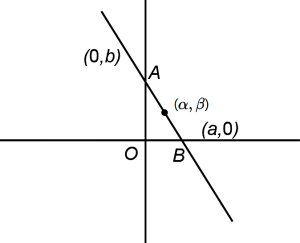
If a straight line passes through the point $(\alpha, \beta)$ and the portion of the line intercepted between the axes is divided equally at that point,then $\frac{x}{\alpha} + \frac{y}{\beta}$ is
A
$0$
B
$1$
C
$2$
D
$4$
Solution
(C) Let the equation of the line in intercept form be $\frac{x}{a} + \frac{y}{b} = 1$.
The coordinates of the points where the line intersects the axes are $A(0, b)$ and $B(a, 0)$.
Since the point $(\alpha, \beta)$ is the midpoint of the segment $AB$,we have:
$\alpha = \frac{0 + a}{2} \Rightarrow a = 2\alpha$
$\beta = \frac{b + 0}{2} \Rightarrow b = 2\beta$
Substituting these values into the intercept form equation:
$\frac{x}{2\alpha} + \frac{y}{2\beta} = 1$
Multiplying both sides by $2$:
$\frac{x}{\alpha} + \frac{y}{\beta} = 2$
The coordinates of the points where the line intersects the axes are $A(0, b)$ and $B(a, 0)$.
Since the point $(\alpha, \beta)$ is the midpoint of the segment $AB$,we have:
$\alpha = \frac{0 + a}{2} \Rightarrow a = 2\alpha$
$\beta = \frac{b + 0}{2} \Rightarrow b = 2\beta$
Substituting these values into the intercept form equation:
$\frac{x}{2\alpha} + \frac{y}{2\beta} = 1$
Multiplying both sides by $2$:
$\frac{x}{\alpha} + \frac{y}{\beta} = 2$
0 likesView Solution
30
MathematicsEasyMCQWBJEE · 2012
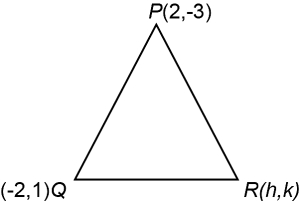
Let $P(2, -3)$ and $Q(-2, 1)$ be the vertices of the $\Delta PQR$. If the centroid of $\Delta PQR$ lies on the line $2x + 3y = 1$,then the locus of $R$ is
A
$2x + 3y = 9$
B
$2x - 3y = 7$
C
$3x + 2y = 5$
D
$3x - 2y = 5$
Solution
(A) Let the coordinates of vertex $R$ be $(h, k)$.
The centroid of a triangle with vertices $(x_1, y_1), (x_2, y_2),$ and $(x_3, y_3)$ is given by $\left(\frac{x_1 + x_2 + x_3}{3}, \frac{y_1 + y_2 + y_3}{3}\right)$.
Substituting the given vertices $P(2, -3), Q(-2, 1),$ and $R(h, k)$,the centroid is $\left(\frac{2 - 2 + h}{3}, \frac{-3 + 1 + k}{3}\right) = \left(\frac{h}{3}, \frac{k - 2}{3}\right)$.
Since the centroid lies on the line $2x + 3y = 1$,the coordinates must satisfy the equation:
$2\left(\frac{h}{3}\right) + 3\left(\frac{k - 2}{3}\right) = 1$
Multiplying by $3$,we get:
$2h + 3(k - 2) = 3$
$2h + 3k - 6 = 3$
$2h + 3k = 9$
Replacing $(h, k)$ with $(x, y)$,the locus of $R$ is $2x + 3y = 9$.
The centroid of a triangle with vertices $(x_1, y_1), (x_2, y_2),$ and $(x_3, y_3)$ is given by $\left(\frac{x_1 + x_2 + x_3}{3}, \frac{y_1 + y_2 + y_3}{3}\right)$.
Substituting the given vertices $P(2, -3), Q(-2, 1),$ and $R(h, k)$,the centroid is $\left(\frac{2 - 2 + h}{3}, \frac{-3 + 1 + k}{3}\right) = \left(\frac{h}{3}, \frac{k - 2}{3}\right)$.
Since the centroid lies on the line $2x + 3y = 1$,the coordinates must satisfy the equation:
$2\left(\frac{h}{3}\right) + 3\left(\frac{k - 2}{3}\right) = 1$
Multiplying by $3$,we get:
$2h + 3(k - 2) = 3$
$2h + 3k - 6 = 3$
$2h + 3k = 9$
Replacing $(h, k)$ with $(x, y)$,the locus of $R$ is $2x + 3y = 9$.
0 likesView Solution
31
MathematicsMediumMCQWBJEE · 2012
$A$ straight line through the point of intersection of the lines $x+2y=4$ and $2x+y=4$ meets the coordinate axes at $A$ and $B$. The locus of the mid-point of $AB$ is
A
$3(x+y)=2xy$
B
$2(x+y)=3xy$
C
$2(x+y)=xy$
D
$x+y=3xy$
Solution
(B) Given lines are $x+2y=4$ $(i)$ and $2x+y=4$ (ii).
Solving equations $(i)$ and (ii),we get the point of intersection as $(\frac{4}{3}, \frac{4}{3})$.
Let the equation of the line passing through this point be $\frac{x}{a} + \frac{y}{b} = 1$.
Since it passes through $(\frac{4}{3}, \frac{4}{3})$,we have $\frac{4}{3a} + \frac{4}{3b} = 1$,which simplifies to $\frac{1}{a} + \frac{1}{b} = \frac{3}{4}$ (iii).
Let the mid-point of $AB$ be $(h, k)$. Then $h = \frac{a}{2}$ and $k = \frac{b}{2}$,so $a = 2h$ and $b = 2k$.
Substituting these into equation (iii),we get $\frac{1}{2h} + \frac{1}{2k} = \frac{3}{4}$.
Multiplying by $2hk$,we get $k + h = \frac{3}{2}hk$,or $2(h+k) = 3hk$.
Replacing $(h, k)$ with $(x, y)$,the locus is $2(x+y) = 3xy$.
Solving equations $(i)$ and (ii),we get the point of intersection as $(\frac{4}{3}, \frac{4}{3})$.
Let the equation of the line passing through this point be $\frac{x}{a} + \frac{y}{b} = 1$.
Since it passes through $(\frac{4}{3}, \frac{4}{3})$,we have $\frac{4}{3a} + \frac{4}{3b} = 1$,which simplifies to $\frac{1}{a} + \frac{1}{b} = \frac{3}{4}$ (iii).
Let the mid-point of $AB$ be $(h, k)$. Then $h = \frac{a}{2}$ and $k = \frac{b}{2}$,so $a = 2h$ and $b = 2k$.
Substituting these into equation (iii),we get $\frac{1}{2h} + \frac{1}{2k} = \frac{3}{4}$.
Multiplying by $2hk$,we get $k + h = \frac{3}{2}hk$,or $2(h+k) = 3hk$.
Replacing $(h, k)$ with $(x, y)$,the locus is $2(x+y) = 3xy$.
0 likesView Solution
32
MathematicsMediumMCQWBJEE · 2012
If four distinct points $(2k, 3k)$,$(2,0)$,$(0,3)$,and $(0,0)$ lie on a circle,then:
A
$k < 0$
B
$0 < k < 1$
C
$k = 1$
D
$k > 1$
Solution
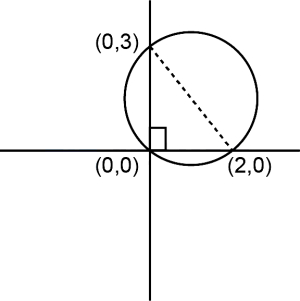
(C) The points $(2,0)$,$(0,3)$,and $(0,0)$ form a right-angled triangle at the origin $(0,0)$ because the angle between the $x$-axis and $y$-axis is $90^{\circ}$.
Since the angle subtended by the line segment joining $(2,0)$ and $(0,3)$ at the point $(0,0)$ is $90^{\circ}$,this line segment must be the diameter of the circle.
The equation of a circle with diameter endpoints $(x_1, y_1)$ and $(x_2, y_2)$ is $(x-x_1)(x-x_2) + (y-y_1)(y-y_2) = 0$.
Substituting the points $(2,0)$ and $(0,3)$,we get:
$(x-2)(x-0) + (y-0)(y-3) = 0$
$x^2 - 2x + y^2 - 3y = 0$
$x^2 + y^2 - 2x - 3y = 0$
Since the point $(2k, 3k)$ lies on this circle,it must satisfy the equation:
$(2k)^2 + (3k)^2 - 2(2k) - 3(3k) = 0$
$4k^2 + 9k^2 - 4k - 9k = 0$
$13k^2 - 13k = 0$
$13k(k - 1) = 0$
This gives $k = 0$ or $k = 1$.
If $k = 0$,the point $(2k, 3k)$ becomes $(0,0)$,which is not a distinct point from the given point $(0,0)$.
Therefore,for the four points to be distinct,we must have $k = 1$.
Since the angle subtended by the line segment joining $(2,0)$ and $(0,3)$ at the point $(0,0)$ is $90^{\circ}$,this line segment must be the diameter of the circle.
The equation of a circle with diameter endpoints $(x_1, y_1)$ and $(x_2, y_2)$ is $(x-x_1)(x-x_2) + (y-y_1)(y-y_2) = 0$.
Substituting the points $(2,0)$ and $(0,3)$,we get:
$(x-2)(x-0) + (y-0)(y-3) = 0$
$x^2 - 2x + y^2 - 3y = 0$
$x^2 + y^2 - 2x - 3y = 0$
Since the point $(2k, 3k)$ lies on this circle,it must satisfy the equation:
$(2k)^2 + (3k)^2 - 2(2k) - 3(3k) = 0$
$4k^2 + 9k^2 - 4k - 9k = 0$
$13k^2 - 13k = 0$
$13k(k - 1) = 0$
This gives $k = 0$ or $k = 1$.
If $k = 0$,the point $(2k, 3k)$ becomes $(0,0)$,which is not a distinct point from the given point $(0,0)$.
Therefore,for the four points to be distinct,we must have $k = 1$.
0 likesView Solution
33
MathematicsEasyMCQWBJEE · 2012
If the circles $x^{2}+y^{2}+2x+2ky+6=0$ and $x^{2}+y^{2}+2ky+k=0$ intersect orthogonally,then $k$ is equal to
A
$2$ or $-\frac{3}{2}$
B
$-2$ or $-\frac{3}{2}$
C
$2$ or $\frac{3}{2}$
D
$-2$ or $\frac{3}{2}$
Solution
(A) Two circles $x^{2}+y^{2}+2g_{1}x+2f_{1}y+c_{1}=0$ and $x^{2}+y^{2}+2g_{2}x+2f_{2}y+c_{2}=0$ intersect orthogonally if and only if $2(g_{1}g_{2}+f_{1}f_{2})=c_{1}+c_{2}$.
For the given circles:
Circle $1$: $g_{1}=1, f_{1}=k, c_{1}=6$
Circle $2$: $g_{2}=0, f_{2}=k, c_{2}=k$
Substituting these values into the condition:
$2((1)(0) + (k)(k)) = 6 + k$
$2k^{2} = 6 + k$
$2k^{2} - k - 6 = 0$
Factoring the quadratic equation:
$2k^{2} - 4k + 3k - 6 = 0$
$2k(k-2) + 3(k-2) = 0$
$(k-2)(2k+3) = 0$
Thus,$k = 2$ or $k = -\frac{3}{2}$.
For the given circles:
Circle $1$: $g_{1}=1, f_{1}=k, c_{1}=6$
Circle $2$: $g_{2}=0, f_{2}=k, c_{2}=k$
Substituting these values into the condition:
$2((1)(0) + (k)(k)) = 6 + k$
$2k^{2} = 6 + k$
$2k^{2} - k - 6 = 0$
Factoring the quadratic equation:
$2k^{2} - 4k + 3k - 6 = 0$
$2k(k-2) + 3(k-2) = 0$
$(k-2)(2k+3) = 0$
Thus,$k = 2$ or $k = -\frac{3}{2}$.
0 likesView Solution
34
MathematicsMediumMCQWBJEE · 2012
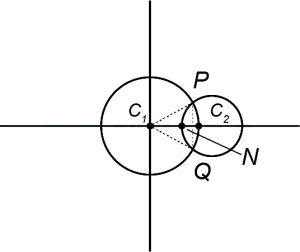
Let $C_{1}$ and $C_{2}$ denote the centres of the circles $x^{2}+y^{2}=4$ and $(x-2)^{2}+y^{2}=1$ respectively and let $P$ and $Q$ be their points of intersection. Then,the areas of $\Delta C_{1} P Q$ and $\Delta C_{2} P Q$ are in the ratio (in $: 1$)
A
$3$
B
$5$
C
$7$
D
$9$
Solution
(C) The given equations of the circles are:
$C_{1}: x^{2}+y^{2}=4$ (centre $C_{1} = (0,0)$,radius $r_{1} = 2$)
$C_{2}: (x-2)^{2}+y^{2}=1$ (centre $C_{2} = (2,0)$,radius $r_{2} = 1$)
Let $N$ be the point of intersection of the common chord $PQ$ with the line joining the centres $C_{1}C_{2}$.
Subtracting the two equations:
$(x^{2}+y^{2}) - ((x-2)^{2}+y^{2}) = 4 - 1$
$x^{2} - (x^{2}-4x+4) = 3$
$4x - 4 = 3 \implies 4x = 7 \implies x = \frac{7}{4}$
Since $N$ lies on the line $C_{1}C_{2}$ (the $x$-axis),the coordinate of $N$ is $(\frac{7}{4}, 0)$.
The distance $C_{1}N = \frac{7}{4}$.
The distance $C_{2}N = |C_{1}C_{2} - C_{1}N| = |2 - \frac{7}{4}| = \frac{1}{4}$.
Both triangles $\Delta C_{1}PQ$ and $\Delta C_{2}PQ$ share the same base $PQ$.
The ratio of their areas is the ratio of their heights from the base $PQ$ to the vertices $C_{1}$ and $C_{2}$ respectively,which is the ratio of the distances $C_{1}N$ and $C_{2}N$:
$\frac{\text{Area}(\Delta C_{1}PQ)}{\text{Area}(\Delta C_{2}PQ)} = \frac{\frac{1}{2} \times PQ \times C_{1}N}{\frac{1}{2} \times PQ \times C_{2}N} = \frac{C_{1}N}{C_{2}N} = \frac{7/4}{1/4} = 7: 1$.
Thus,the correct option is $C$.
$C_{1}: x^{2}+y^{2}=4$ (centre $C_{1} = (0,0)$,radius $r_{1} = 2$)
$C_{2}: (x-2)^{2}+y^{2}=1$ (centre $C_{2} = (2,0)$,radius $r_{2} = 1$)
Let $N$ be the point of intersection of the common chord $PQ$ with the line joining the centres $C_{1}C_{2}$.
Subtracting the two equations:
$(x^{2}+y^{2}) - ((x-2)^{2}+y^{2}) = 4 - 1$
$x^{2} - (x^{2}-4x+4) = 3$
$4x - 4 = 3 \implies 4x = 7 \implies x = \frac{7}{4}$
Since $N$ lies on the line $C_{1}C_{2}$ (the $x$-axis),the coordinate of $N$ is $(\frac{7}{4}, 0)$.
The distance $C_{1}N = \frac{7}{4}$.
The distance $C_{2}N = |C_{1}C_{2} - C_{1}N| = |2 - \frac{7}{4}| = \frac{1}{4}$.
Both triangles $\Delta C_{1}PQ$ and $\Delta C_{2}PQ$ share the same base $PQ$.
The ratio of their areas is the ratio of their heights from the base $PQ$ to the vertices $C_{1}$ and $C_{2}$ respectively,which is the ratio of the distances $C_{1}N$ and $C_{2}N$:
$\frac{\text{Area}(\Delta C_{1}PQ)}{\text{Area}(\Delta C_{2}PQ)} = \frac{\frac{1}{2} \times PQ \times C_{1}N}{\frac{1}{2} \times PQ \times C_{2}N} = \frac{C_{1}N}{C_{2}N} = \frac{7/4}{1/4} = 7: 1$.
Thus,the correct option is $C$.
0 likesView Solution
35
MathematicsEasyMCQWBJEE · 2012
The equation $y^{2}+4x+4y+k=0$ represents a parabola whose latus rectum is
A
$1$
B
$2$
C
$3$
D
$4$
Solution
(D) Given equation: $y^{2}+4x+4y+k=0$
Complete the square for $y$:
$y^{2}+4y+4-4+4x+k=0$
$(y+2)^{2} = -4x+4-k$
$(y+2)^{2} = -4(x - \frac{4-k}{4})$
Comparing this with the standard form of a parabola $(y-k')^{2} = -4a(x-h')$,we get $4a = 4$.
Therefore,the length of the latus rectum is $4$ units.
Complete the square for $y$:
$y^{2}+4y+4-4+4x+k=0$
$(y+2)^{2} = -4x+4-k$
$(y+2)^{2} = -4(x - \frac{4-k}{4})$
Comparing this with the standard form of a parabola $(y-k')^{2} = -4a(x-h')$,we get $4a = 4$.
Therefore,the length of the latus rectum is $4$ units.
0 likesView Solution
36
MathematicsMediumMCQWBJEE · 2012
Let $P$ be the mid-point of a chord joining the vertex of the parabola $y^{2}=8x$ to another point on it. Then,the locus of $P$ is
A
$y^{2}=2x$
B
$y^{2}=4x$
C
$\frac{x^{2}}{4}+y^{2}=1$
D
$x^{2}+\frac{y^{2}}{4}=1$
Solution
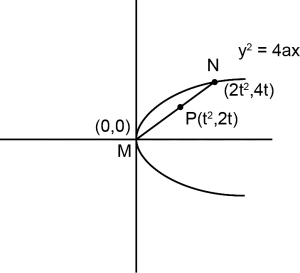
(B) The vertex of the parabola $y^{2}=8x$ is $M(0,0)$.
Let the other point on the parabola be $N(2t^{2}, 4t)$,where $t$ is a parameter.
Let $P(x, y)$ be the mid-point of the chord $MN$.
Using the mid-point formula,we have:
$x = \frac{0 + 2t^{2}}{2} = t^{2}$
$y = \frac{0 + 4t}{2} = 2t$
From the second equation,$t = \frac{y}{2}$.
Substituting this into the first equation:
$x = (\frac{y}{2})^{2}$
$x = \frac{y^{2}}{4}$
$y^{2} = 4x$
Thus,the locus of $P$ is $y^{2}=4x$.
Let the other point on the parabola be $N(2t^{2}, 4t)$,where $t$ is a parameter.
Let $P(x, y)$ be the mid-point of the chord $MN$.
Using the mid-point formula,we have:
$x = \frac{0 + 2t^{2}}{2} = t^{2}$
$y = \frac{0 + 4t}{2} = 2t$
From the second equation,$t = \frac{y}{2}$.
Substituting this into the first equation:
$x = (\frac{y}{2})^{2}$
$x = \frac{y^{2}}{4}$
$y^{2} = 4x$
Thus,the locus of $P$ is $y^{2}=4x$.
0 likesView Solution
37
MathematicsMediumMCQWBJEE · 2012
Let $P$ and $Q$ be points on the parabola $y^{2}=4x$ such that the line segment $PQ$ subtends a right angle at the vertex. If $PQ$ intersects the axis of the parabola at $R$,then the distance of the vertex from $R$ is
A
$1$
B
$2$
C
$4$
D
$6$
Solution
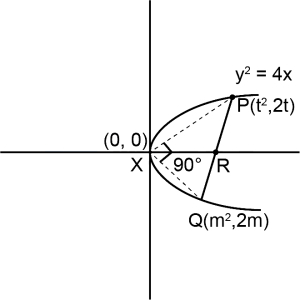
(C) Let the coordinates of points $P$ and $Q$ on the parabola $y^{2}=4x$ be $(t^{2}, 2t)$ and $(m^{2}, 2m)$ respectively. The vertex of the parabola is $X(0, 0)$.
Since $PQ$ subtends a right angle at the vertex $X$,the product of the slopes of $XP$ and $XQ$ is $-1$.
Slope of $XP = \frac{2t-0}{t^{2}-0} = \frac{2}{t}$.
Slope of $XQ = \frac{2m-0}{m^{2}-0} = \frac{2}{m}$.
Given,$(\frac{2}{t}) \times (\frac{2}{m}) = -1 \Rightarrow tm = -4$.
The equation of the line $PQ$ passing through $(t^{2}, 2t)$ and $(m^{2}, 2m)$ is:
$y - 2t = \frac{2m-2t}{m^{2}-t^{2}}(x - t^{2})$
$y - 2t = \frac{2(m-t)}{(m-t)(m+t)}(x - t^{2})$
$y - 2t = \frac{2}{m+t}(x - t^{2})$.
Since $PQ$ intersects the axis of the parabola ($x$-axis) at $R(\alpha, 0)$,we substitute $y=0$ and $x=\alpha$:
$0 - 2t = \frac{2}{m+t}(\alpha - t^{2})$
$-t(m+t) = \alpha - t^{2}$
$-tm - t^{2} = \alpha - t^{2}$
$\alpha = -tm$.
Since $tm = -4$,we have $\alpha = -(-4) = 4$.
Thus,the distance of the vertex $X(0, 0)$ from $R(4, 0)$ is $4$.
Since $PQ$ subtends a right angle at the vertex $X$,the product of the slopes of $XP$ and $XQ$ is $-1$.
Slope of $XP = \frac{2t-0}{t^{2}-0} = \frac{2}{t}$.
Slope of $XQ = \frac{2m-0}{m^{2}-0} = \frac{2}{m}$.
Given,$(\frac{2}{t}) \times (\frac{2}{m}) = -1 \Rightarrow tm = -4$.
The equation of the line $PQ$ passing through $(t^{2}, 2t)$ and $(m^{2}, 2m)$ is:
$y - 2t = \frac{2m-2t}{m^{2}-t^{2}}(x - t^{2})$
$y - 2t = \frac{2(m-t)}{(m-t)(m+t)}(x - t^{2})$
$y - 2t = \frac{2}{m+t}(x - t^{2})$.
Since $PQ$ intersects the axis of the parabola ($x$-axis) at $R(\alpha, 0)$,we substitute $y=0$ and $x=\alpha$:
$0 - 2t = \frac{2}{m+t}(\alpha - t^{2})$
$-t(m+t) = \alpha - t^{2}$
$-tm - t^{2} = \alpha - t^{2}$
$\alpha = -tm$.
Since $tm = -4$,we have $\alpha = -(-4) = 4$.
Thus,the distance of the vertex $X(0, 0)$ from $R(4, 0)$ is $4$.
0 likesView Solution
38
MathematicsEasyMCQWBJEE · 2012
The eccentric angle in the first quadrant of a point on the ellipse $\frac{x^{2}}{10}+\frac{y^{2}}{8}=1$ at a distance $3$ units from the centre of the ellipse is
A
$\frac{\pi}{6}$
B
$\frac{\pi}{4}$
C
$\frac{\pi}{3}$
D
$\frac{\pi}{2}$
Solution
(B) Let $P(\sqrt{10} \cos \theta, \sqrt{8} \sin \theta)$ be the point on the ellipse $\frac{x^{2}}{10}+\frac{y^{2}}{8}=1$.
Given that the distance of $P$ from the centre $(0,0)$ is $3$ units.
So,$OP^2 = 3^2 = 9$.
$10 \cos^2 \theta + 8 \sin^2 \theta = 9$.
Using the identity $\sin^2 \theta + \cos^2 \theta = 1$,we can write $9 = 9(\sin^2 \theta + \cos^2 \theta)$.
$10 \cos^2 \theta + 8 \sin^2 \theta = 9 \sin^2 \theta + 9 \cos^2 \theta$.
Rearranging the terms,we get $\cos^2 \theta = \sin^2 \theta$.
$\tan^2 \theta = 1$.
Since the point is in the first quadrant,$\theta = \frac{\pi}{4}$.
Given that the distance of $P$ from the centre $(0,0)$ is $3$ units.
So,$OP^2 = 3^2 = 9$.
$10 \cos^2 \theta + 8 \sin^2 \theta = 9$.
Using the identity $\sin^2 \theta + \cos^2 \theta = 1$,we can write $9 = 9(\sin^2 \theta + \cos^2 \theta)$.
$10 \cos^2 \theta + 8 \sin^2 \theta = 9 \sin^2 \theta + 9 \cos^2 \theta$.
Rearranging the terms,we get $\cos^2 \theta = \sin^2 \theta$.
$\tan^2 \theta = 1$.
Since the point is in the first quadrant,$\theta = \frac{\pi}{4}$.
0 likesView Solution
39
MathematicsMediumMCQWBJEE · 2012
The line $x=2y$ intersects the ellipse $\frac{x^{2}}{4}+y^{2}=1$ at the points $P$ and $Q$. The equation of the circle with $PQ$ as diameter is
A
$x^{2}+y^{2}=\frac{1}{2}$
B
$x^{2}+y^{2}=1$
C
$x^{2}+y^{2}=2$
D
$x^{2}+y^{2}=\frac{5}{2}$
Solution
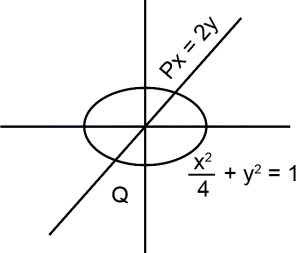
(D) Given equations are $x=2y$ $(i)$ and $\frac{x^{2}}{4}+y^{2}=1$ (ii).
Substituting $x=2y$ into (ii),we get:
$\frac{(2y)^{2}}{4}+y^{2}=1$
$\frac{4y^{2}}{4}+y^{2}=1$
$y^{2}+y^{2}=1$
$2y^{2}=1$ $\Rightarrow y^{2}=\frac{1}{2}$ $\Rightarrow y=\pm \frac{1}{\sqrt{2}}$.
From $(i)$,$x=2y$,so $x=\pm 2(\frac{1}{\sqrt{2}}) = \pm \sqrt{2}$.
Thus,the points of intersection are $P(\sqrt{2}, \frac{1}{\sqrt{2}})$ and $Q(-\sqrt{2}, -\frac{1}{\sqrt{2}})$.
The equation of a circle with diameter $PQ$ is given by $(x-x_1)(x-x_2) + (y-y_1)(y-y_2) = 0$.
$(x-\sqrt{2})(x+\sqrt{2}) + (y-\frac{1}{\sqrt{2}})(y+\frac{1}{\sqrt{2}}) = 0$
$(x^{2}-2) + (y^{2}-\frac{1}{2}) = 0$
$x^{2}+y^{2} = 2 + \frac{1}{2}$
$x^{2}+y^{2} = \frac{5}{2}$.
Substituting $x=2y$ into (ii),we get:
$\frac{(2y)^{2}}{4}+y^{2}=1$
$\frac{4y^{2}}{4}+y^{2}=1$
$y^{2}+y^{2}=1$
$2y^{2}=1$ $\Rightarrow y^{2}=\frac{1}{2}$ $\Rightarrow y=\pm \frac{1}{\sqrt{2}}$.
From $(i)$,$x=2y$,so $x=\pm 2(\frac{1}{\sqrt{2}}) = \pm \sqrt{2}$.
Thus,the points of intersection are $P(\sqrt{2}, \frac{1}{\sqrt{2}})$ and $Q(-\sqrt{2}, -\frac{1}{\sqrt{2}})$.
The equation of a circle with diameter $PQ$ is given by $(x-x_1)(x-x_2) + (y-y_1)(y-y_2) = 0$.
$(x-\sqrt{2})(x+\sqrt{2}) + (y-\frac{1}{\sqrt{2}})(y+\frac{1}{\sqrt{2}}) = 0$
$(x^{2}-2) + (y^{2}-\frac{1}{2}) = 0$
$x^{2}+y^{2} = 2 + \frac{1}{2}$
$x^{2}+y^{2} = \frac{5}{2}$.
0 likesView Solution
40
MathematicsMediumMCQWBJEE · 2012
Let the foci of the ellipse $\frac{x^{2}}{9}+y^{2}=1$ subtend a right angle at a point $P$. Then,the locus of $P$ is
A
$x^{2}+y^{2}=1$
B
$x^{2}+y^{2}=2$
C
$x^{2}+y^{2}=4$
D
$x^{2}+y^{2}=8$
Solution
(D) Given the ellipse equation is $\frac{x^{2}}{9}+\frac{y^{2}}{1}=1$.
Comparing with $\frac{x^{2}}{a^{2}}+\frac{y^{2}}{b^{2}}=1$,we have $a^{2}=9$ and $b^{2}=1$.
The eccentricity $e$ is given by $e=\sqrt{1-\frac{b^{2}}{a^{2}}}=\sqrt{1-\frac{1}{9}}=\sqrt{\frac{8}{9}}=\frac{2\sqrt{2}}{3}$.
The foci are $(\pm ae, 0) = (\pm 3 \times \frac{2\sqrt{2}}{3}, 0) = (\pm 2\sqrt{2}, 0)$.
Let $P(h, k)$ be a point such that the foci $F_{1}(2\sqrt{2}, 0)$ and $F_{2}(-2\sqrt{2}, 0)$ subtend a right angle at $P$.
Thus,the product of the slopes of $PF_{1}$ and $PF_{2}$ is $-1$.
$\frac{k-0}{h-2\sqrt{2}} \times \frac{k-0}{h+2\sqrt{2}} = -1$.
$\frac{k^{2}}{h^{2}-(2\sqrt{2})^{2}} = -1$.
$k^{2} = -(h^{2}-8)$.
$h^{2}+k^{2} = 8$.
Replacing $(h, k)$ with $(x, y)$,the locus is $x^{2}+y^{2}=8$.
Comparing with $\frac{x^{2}}{a^{2}}+\frac{y^{2}}{b^{2}}=1$,we have $a^{2}=9$ and $b^{2}=1$.
The eccentricity $e$ is given by $e=\sqrt{1-\frac{b^{2}}{a^{2}}}=\sqrt{1-\frac{1}{9}}=\sqrt{\frac{8}{9}}=\frac{2\sqrt{2}}{3}$.
The foci are $(\pm ae, 0) = (\pm 3 \times \frac{2\sqrt{2}}{3}, 0) = (\pm 2\sqrt{2}, 0)$.
Let $P(h, k)$ be a point such that the foci $F_{1}(2\sqrt{2}, 0)$ and $F_{2}(-2\sqrt{2}, 0)$ subtend a right angle at $P$.
Thus,the product of the slopes of $PF_{1}$ and $PF_{2}$ is $-1$.
$\frac{k-0}{h-2\sqrt{2}} \times \frac{k-0}{h+2\sqrt{2}} = -1$.
$\frac{k^{2}}{h^{2}-(2\sqrt{2})^{2}} = -1$.
$k^{2} = -(h^{2}-8)$.
$h^{2}+k^{2} = 8$.
Replacing $(h, k)$ with $(x, y)$,the locus is $x^{2}+y^{2}=8$.
0 likesView Solution
41
MathematicsEasyMCQWBJEE · 2012
The transverse axis of a hyperbola is along the $x$-axis and its length is $2a$. The vertex of the hyperbola bisects the line segment joining the centre and the focus. The equation of the hyperbola is
A
$6x^{2}-y^{2}=3a^{2}$
B
$x^{2}-3y^{2}=3a^{2}$
C
$x^{2}-6y^{2}=3a^{2}$
D
$3x^{2}-y^{2}=3a^{2}$
Solution
(D) Let $e$ be the eccentricity of the hyperbola. The centre is $(0, 0)$,the vertex is $(a, 0)$,and the focus is $(ae, 0)$.
Since the vertex $(a, 0)$ bisects the line segment joining the centre $(0, 0)$ and the focus $(ae, 0)$,we have:
$a = \frac{ae + 0}{2}$ $\Rightarrow 2a = ae$ $\Rightarrow e = 2$.
For a hyperbola,$b^{2} = a^{2}(e^{2} - 1)$.
Substituting $e = 2$,we get $b^{2} = a^{2}(2^{2} - 1) = 3a^{2}$.
The equation of the hyperbola is $\frac{x^{2}}{a^{2}} - \frac{y^{2}}{b^{2}} = 1$.
Substituting $b^{2} = 3a^{2}$,we get $\frac{x^{2}}{a^{2}} - \frac{y^{2}}{3a^{2}} = 1$.
Multiplying by $3a^{2}$,we obtain $3x^{2} - y^{2} = 3a^{2}$.
Since the vertex $(a, 0)$ bisects the line segment joining the centre $(0, 0)$ and the focus $(ae, 0)$,we have:
$a = \frac{ae + 0}{2}$ $\Rightarrow 2a = ae$ $\Rightarrow e = 2$.
For a hyperbola,$b^{2} = a^{2}(e^{2} - 1)$.
Substituting $e = 2$,we get $b^{2} = a^{2}(2^{2} - 1) = 3a^{2}$.
The equation of the hyperbola is $\frac{x^{2}}{a^{2}} - \frac{y^{2}}{b^{2}} = 1$.
Substituting $b^{2} = 3a^{2}$,we get $\frac{x^{2}}{a^{2}} - \frac{y^{2}}{3a^{2}} = 1$.
Multiplying by $3a^{2}$,we obtain $3x^{2} - y^{2} = 3a^{2}$.
0 likesView Solution
42
MathematicsEasyMCQWBJEE · 2012
$A$ point moves in such a way that the difference of its distances from two points $(8,0)$ and $(-8,0)$ always remains $4$. Then,the locus of the point is
A
a circle
B
a parabola
C
an ellipse
D
a hyperbola
Solution
(D) The definition of a hyperbola states that it is the locus of a point such that the absolute difference of its distances from two fixed points (foci) is constant.
Given the fixed points are $(8,0)$ and $(-8,0)$,these are the foci of the hyperbola.
The constant difference is given as $2a = 4$.
Since the absolute difference of distances from two fixed points is a constant value less than the distance between the two fixed points (which is $16$),this locus represents a hyperbola.
Given the fixed points are $(8,0)$ and $(-8,0)$,these are the foci of the hyperbola.
The constant difference is given as $2a = 4$.
Since the absolute difference of distances from two fixed points is a constant value less than the distance between the two fixed points (which is $16$),this locus represents a hyperbola.
0 likesView Solution
43
MathematicsEasyMCQWBJEE · 2012
$\lim _{x \rightarrow 0} \frac{\pi^{x}-1}{\sqrt{1+x}-1}$
A
does not exist
B
equals $\log _{e}\left(\pi^{2}\right)$
C
equals $1$
D
lies between $10$ and $11$
Solution
(B) Given limit is $\lim _{x \rightarrow 0} \frac{\pi^{x}-1}{\sqrt{1+x}-1}$.
This is a $\frac{0}{0}$ indeterminate form.
Applying $L$'$H$ôpital's rule by differentiating the numerator and denominator with respect to $x$:
$\lim _{x \rightarrow 0} \frac{\frac{d}{dx}(\pi^{x}-1)}{\frac{d}{dx}(\sqrt{1+x}-1)}$
$= \lim _{x \rightarrow 0} \frac{\pi^{x} \log _{e} \pi}{\frac{1}{2 \sqrt{1+x}}}$
$= \lim _{x \rightarrow 0} 2 \sqrt{1+x} \cdot \pi^{x} \log _{e} \pi$
Substituting $x = 0$:
$= 2 \sqrt{1+0} \cdot \pi^{0} \log _{e} \pi$
$= 2 \cdot 1 \cdot 1 \cdot \log _{e} \pi$
$= 2 \log _{e} \pi = \log _{e} \pi^{2}$.
This is a $\frac{0}{0}$ indeterminate form.
Applying $L$'$H$ôpital's rule by differentiating the numerator and denominator with respect to $x$:
$\lim _{x \rightarrow 0} \frac{\frac{d}{dx}(\pi^{x}-1)}{\frac{d}{dx}(\sqrt{1+x}-1)}$
$= \lim _{x \rightarrow 0} \frac{\pi^{x} \log _{e} \pi}{\frac{1}{2 \sqrt{1+x}}}$
$= \lim _{x \rightarrow 0} 2 \sqrt{1+x} \cdot \pi^{x} \log _{e} \pi$
Substituting $x = 0$:
$= 2 \sqrt{1+0} \cdot \pi^{0} \log _{e} \pi$
$= 2 \cdot 1 \cdot 1 \cdot \log _{e} \pi$
$= 2 \log _{e} \pi = \log _{e} \pi^{2}$.
0 likesView Solution
44
MathematicsDifficultMCQWBJEE · 2012
The value of $\lim _{n \rightarrow \infty} \frac{(n !)^{1 / n}}{n}$ is
A
$1$
B
$\frac{1}{e^{2}}$
C
$\frac{1}{2 e}$
D
$\frac{1}{e}$
Solution
(D) Let $L = \lim _{n \rightarrow \infty} \frac{(n !)^{1 / n}}{n} = \lim _{n \rightarrow \infty} \left( \frac{n!}{n^n} \right)^{1/n}$.
Taking the natural logarithm on both sides:
$\ln L = \lim _{n \rightarrow \infty} \frac{1}{n} \ln \left( \frac{n!}{n^n} \right) = \lim _{n \rightarrow \infty} \frac{1}{n} \sum_{r=1}^{n} \ln \left( \frac{r}{n} \right)$.
This is a Riemann sum for the integral $\int_{0}^{1} \ln(x) \, dx$.
$\ln L = \int_{0}^{1} \ln(x) \, dx = [x \ln x - x]_{0}^{1}$.
Evaluating the limit as $x \rightarrow 0^+$,we get $\lim_{x \rightarrow 0^+} x \ln x = 0$.
So,$\ln L = (1 \ln 1 - 1) - (0) = -1$.
Therefore,$L = e^{-1} = \frac{1}{e}$.
Taking the natural logarithm on both sides:
$\ln L = \lim _{n \rightarrow \infty} \frac{1}{n} \ln \left( \frac{n!}{n^n} \right) = \lim _{n \rightarrow \infty} \frac{1}{n} \sum_{r=1}^{n} \ln \left( \frac{r}{n} \right)$.
This is a Riemann sum for the integral $\int_{0}^{1} \ln(x) \, dx$.
$\ln L = \int_{0}^{1} \ln(x) \, dx = [x \ln x - x]_{0}^{1}$.
Evaluating the limit as $x \rightarrow 0^+$,we get $\lim_{x \rightarrow 0^+} x \ln x = 0$.
So,$\ln L = (1 \ln 1 - 1) - (0) = -1$.
Therefore,$L = e^{-1} = \frac{1}{e}$.
0 likesView Solution
45
MathematicsEasyMCQWBJEE · 2012
Let $p, q$ and $r$ be the sides opposite to the angles $P, Q$ and $R$ respectively in a $\Delta PQR$. If $r^{2} \sin P \sin Q = pq$,then the triangle is
A
equilateral
B
acute angled but not equilateral
C
obtuse angled
D
right angled
Solution
(D) Using the Sine Rule in $\Delta PQR$,we have $\frac{p}{\sin P} = \frac{q}{\sin Q} = \frac{r}{\sin R} = 2R_{c}$,where $R_{c}$ is the circumradius of the triangle.
Thus,$\sin P = \frac{p}{2R_{c}}$,$\sin Q = \frac{q}{2R_{c}}$,and $\sin R = \frac{r}{2R_{c}}$.
Given the equation $r^{2} \sin P \sin Q = pq$.
Substituting the values of $\sin P$ and $\sin Q$:
$r^{2} \left( \frac{p}{2R_{c}} \right) \left( \frac{q}{2R_{c}} \right) = pq$
$r^{2} \frac{pq}{4R_{c}^{2}} = pq$
Since $p, q \neq 0$,we can divide both sides by $pq$:
$\frac{r^{2}}{4R_{c}^{2}} = 1$
$r^{2} = 4R_{c}^{2}$
$r = 2R_{c}$
Since $r = 2R_{c} \sin R$,we have $2R_{c} \sin R = 2R_{c}$.
$\sin R = 1$
$R = 90^{\circ}$.
Therefore,the triangle is a right-angled triangle.
Thus,$\sin P = \frac{p}{2R_{c}}$,$\sin Q = \frac{q}{2R_{c}}$,and $\sin R = \frac{r}{2R_{c}}$.
Given the equation $r^{2} \sin P \sin Q = pq$.
Substituting the values of $\sin P$ and $\sin Q$:
$r^{2} \left( \frac{p}{2R_{c}} \right) \left( \frac{q}{2R_{c}} \right) = pq$
$r^{2} \frac{pq}{4R_{c}^{2}} = pq$
Since $p, q \neq 0$,we can divide both sides by $pq$:
$\frac{r^{2}}{4R_{c}^{2}} = 1$
$r^{2} = 4R_{c}^{2}$
$r = 2R_{c}$
Since $r = 2R_{c} \sin R$,we have $2R_{c} \sin R = 2R_{c}$.
$\sin R = 1$
$R = 90^{\circ}$.
Therefore,the triangle is a right-angled triangle.
0 likesView Solution
46
MathematicsEasyMCQWBJEE · 2012
Let $p, q$ and $r$ be the sides opposite to the angles $P, Q$ and $R$ respectively in a $\Delta PQR$. Then,$2pr \sin \left(\frac{P-Q+R}{2}\right)$ equals
A
$p^{2}+q^{2}+r^{2}$
B
$p^{2}+r^{2}-q^{2}$
C
$q^{2}+r^{2}-p^{2}$
D
$p^{2}+q^{2}-r^{2}$
Solution
(B) In $\Delta PQR$,the sum of angles is $P+Q+R = 180^{\circ}$.
Since $P+R = 180^{\circ}-Q$,we substitute this into the expression:
$2pr \sin \left(\frac{P+R-Q}{2}\right) = 2pr \sin \left(\frac{180^{\circ}-Q-Q}{2}\right)$
$= 2pr \sin \left(\frac{180^{\circ}-2Q}{2}\right)$
$= 2pr \sin (90^{\circ}-Q)$
$= 2pr \cos Q$
Using the Law of Cosines,$\cos Q = \frac{p^{2}+r^{2}-q^{2}}{2pr}$.
Substituting this value:
$= 2pr \left(\frac{p^{2}+r^{2}-q^{2}}{2pr}\right)$
$= p^{2}+r^{2}-q^{2}$.
Since $P+R = 180^{\circ}-Q$,we substitute this into the expression:
$2pr \sin \left(\frac{P+R-Q}{2}\right) = 2pr \sin \left(\frac{180^{\circ}-Q-Q}{2}\right)$
$= 2pr \sin \left(\frac{180^{\circ}-2Q}{2}\right)$
$= 2pr \sin (90^{\circ}-Q)$
$= 2pr \cos Q$
Using the Law of Cosines,$\cos Q = \frac{p^{2}+r^{2}-q^{2}}{2pr}$.
Substituting this value:
$= 2pr \left(\frac{p^{2}+r^{2}-q^{2}}{2pr}\right)$
$= p^{2}+r^{2}-q^{2}$.
0 likesView Solution
47
MathematicsEasyMCQWBJEE · 2012
Let $p, q$ and $r$ be the altitudes of a triangle with area $S$ and perimeter $2t$. Then,the value of $\frac{1}{p}+\frac{1}{q}+\frac{1}{r}$ is
A
$\frac{S}{t}$
B
$\frac{t}{S}$
C
$\frac{S}{2t}$
D
$\frac{2S}{t}$
Solution
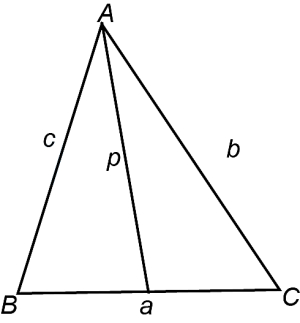
(B) Let the sides of the triangle be $a, b, c$. The area $S$ of the triangle is given by:
$S = \frac{1}{2} a p = \frac{1}{2} b q = \frac{1}{2} c r$
From this,we can express the reciprocals of the altitudes as:
$\frac{1}{p} = \frac{a}{2S}, \frac{1}{q} = \frac{b}{2S}, \frac{1}{r} = \frac{c}{2S}$
Adding these expressions,we get:
$\frac{1}{p} + \frac{1}{q} + \frac{1}{r} = \frac{a+b+c}{2S}$
Since the perimeter is $2t = a+b+c$,we substitute this into the equation:
$\frac{1}{p} + \frac{1}{q} + \frac{1}{r} = \frac{2t}{2S} = \frac{t}{S}$
$S = \frac{1}{2} a p = \frac{1}{2} b q = \frac{1}{2} c r$
From this,we can express the reciprocals of the altitudes as:
$\frac{1}{p} = \frac{a}{2S}, \frac{1}{q} = \frac{b}{2S}, \frac{1}{r} = \frac{c}{2S}$
Adding these expressions,we get:
$\frac{1}{p} + \frac{1}{q} + \frac{1}{r} = \frac{a+b+c}{2S}$
Since the perimeter is $2t = a+b+c$,we substitute this into the equation:
$\frac{1}{p} + \frac{1}{q} + \frac{1}{r} = \frac{2t}{2S} = \frac{t}{S}$
0 likesView Solution
48
MathematicsMediumMCQWBJEE · 2012
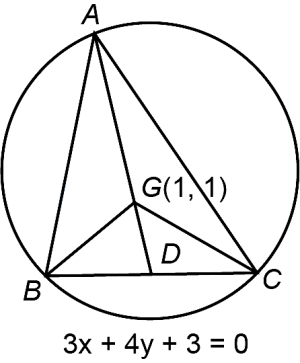
The incentre of an equilateral triangle is $(1, 1)$ and the equation of one side is $3x + 4y + 3 = 0$. Then,the equation of the circumcircle of the triangle is
A
$x^{2} + y^{2} - 2x - 2y - 2 = 0$
B
$x^{2} + y^{2} - 2x - 2y - 14 = 0$
C
$x^{2} + y^{2} - 2x - 2y + 2 = 0$
D
$x^{2} + y^{2} - 2x - 2y + 14 = 0$
Solution
(B) In an equilateral triangle,the incentre,centroid,circumcentre,and orthocentre coincide. Let the incentre be $G(1, 1)$.
The distance $r$ from the incentre $G(1, 1)$ to the side $3x + 4y + 3 = 0$ is the inradius:
$r = \frac{|3(1) + 4(1) + 3|}{\sqrt{3^{2} + 4^{2}}} = \frac{|3 + 4 + 3|}{\sqrt{9 + 16}} = \frac{10}{5} = 2$.
In an equilateral triangle,the circumradius $R$ is twice the inradius $r$. Therefore,$R = 2r = 2(2) = 4$.
The circumcircle has its centre at the incentre $(1, 1)$ and radius $R = 4$.
The equation of the circle is $(x - 1)^{2} + (y - 1)^{2} = 4^{2}$.
$x^{2} - 2x + 1 + y^{2} - 2y + 1 = 16$.
$x^{2} + y^{2} - 2x - 2y + 2 = 16$.
$x^{2} + y^{2} - 2x - 2y - 14 = 0$.
The distance $r$ from the incentre $G(1, 1)$ to the side $3x + 4y + 3 = 0$ is the inradius:
$r = \frac{|3(1) + 4(1) + 3|}{\sqrt{3^{2} + 4^{2}}} = \frac{|3 + 4 + 3|}{\sqrt{9 + 16}} = \frac{10}{5} = 2$.
In an equilateral triangle,the circumradius $R$ is twice the inradius $r$. Therefore,$R = 2r = 2(2) = 4$.
The circumcircle has its centre at the incentre $(1, 1)$ and radius $R = 4$.
The equation of the circle is $(x - 1)^{2} + (y - 1)^{2} = 4^{2}$.
$x^{2} - 2x + 1 + y^{2} - 2y + 1 = 16$.
$x^{2} + y^{2} - 2x - 2y + 2 = 16$.
$x^{2} + y^{2} - 2x - 2y - 14 = 0$.
0 likesView Solution
49
MathematicsMediumMCQWBJEE · 2012
There are $100$ students in a class. In an examination,$50$ of them failed in Mathematics,$45$ failed in Physics,$40$ failed in Biology and $32$ failed in exactly two of the three subjects. Only one student passed in all the subjects. Then,the number of students failing in all the three subjects is:
A
is $12$
B
is $4$
C
is $2$
D
cannot be determined from the given information
Solution
(C) Let $M, P, B$ be the sets of students who failed in Mathematics,Physics,and Biology respectively. Let the regions in the Venn diagram be represented by $a, b, c, d, e, f, g$ as shown,and $h$ be the number of students who passed in all subjects.
Total students = $100$,so $a+b+c+d+e+f+g+h = 100$. Given $h = 1$,so $a+b+c+d+e+f+g = 99$.
Given:
$1) \text{ Failed in Mathematics: } a+b+d+e = 50$
$2) \text{ Failed in Physics: } b+c+d+f = 45$
$3) \text{ Failed in Biology: } d+e+f+g = 40$
$4) \text{ Failed in exactly two subjects: } b+e+f = 32$
Summing equations $(1), (2), (3)$:
$(a+b+d+e) + (b+c+d+f) + (d+e+f+g) = 50 + 45 + 40 = 135$
$(a+b+c+d+e+f+g) + (b+d+e+f) + d = 135$
$99 + (b+e+f) + 2d = 135$
$99 + 32 + 2d = 135$
$131 + 2d = 135$
$2d = 4 \implies d = 2$.
Thus,the number of students failing in all three subjects is $2$.
Total students = $100$,so $a+b+c+d+e+f+g+h = 100$. Given $h = 1$,so $a+b+c+d+e+f+g = 99$.
Given:
$1) \text{ Failed in Mathematics: } a+b+d+e = 50$
$2) \text{ Failed in Physics: } b+c+d+f = 45$
$3) \text{ Failed in Biology: } d+e+f+g = 40$
$4) \text{ Failed in exactly two subjects: } b+e+f = 32$
Summing equations $(1), (2), (3)$:
$(a+b+d+e) + (b+c+d+f) + (d+e+f+g) = 50 + 45 + 40 = 135$
$(a+b+c+d+e+f+g) + (b+d+e+f) + d = 135$
$99 + (b+e+f) + 2d = 135$
$99 + 32 + 2d = 135$
$131 + 2d = 135$
$2d = 4 \implies d = 2$.
Thus,the number of students failing in all three subjects is $2$.
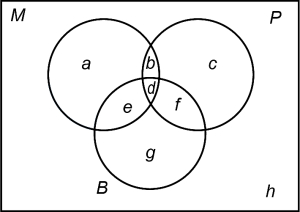
0 likesView Solution
50
MathematicsEasyMCQWBJEE · 2012
The total number of injections (one-one into mappings) from the set $A = \{a_{1}, a_{2}, a_{3}, a_{4}\}$ to the set $B = \{b_{1}, b_{2}, b_{3}, b_{4}, b_{5}, b_{6}, b_{7}\}$ is:
A
$400$
B
$420$
C
$800$
D
$840$
Solution
(D) Let $A = \{a_{1}, a_{2}, a_{3}, a_{4}\}$ and $B = \{b_{1}, b_{2}, b_{3}, b_{4}, b_{5}, b_{6}, b_{7}\}$.
Here,the number of elements in set $A$ is $n(A) = 4$ and the number of elements in set $B$ is $n(B) = 7$.
An injection (one-one mapping) from set $A$ to set $B$ exists if we choose $4$ distinct elements from $B$ and assign them to the $4$ elements of $A$.
The total number of such injections is given by the permutation formula $P(n, r) = \frac{n!}{(n-r)!}$,where $n = 7$ and $r = 4$.
Total injections $= {}^{7}P_{4} = \frac{7!}{(7-4)!} = \frac{7!}{3!} = 7 \times 6 \times 5 \times 4 = 840$.
Here,the number of elements in set $A$ is $n(A) = 4$ and the number of elements in set $B$ is $n(B) = 7$.
An injection (one-one mapping) from set $A$ to set $B$ exists if we choose $4$ distinct elements from $B$ and assign them to the $4$ elements of $A$.
The total number of such injections is given by the permutation formula $P(n, r) = \frac{n!}{(n-r)!}$,where $n = 7$ and $r = 4$.
Total injections $= {}^{7}P_{4} = \frac{7!}{(7-4)!} = \frac{7!}{3!} = 7 \times 6 \times 5 \times 4 = 840$.
0 likesView Solution
51
MathematicsEasyMCQWBJEE · 2012
If $P = \begin{bmatrix} 1 & 2 & 1 \\ 1 & 3 & 1 \end{bmatrix}$ and $Q = P P^{T}$,then the value of the determinant of $Q$ is:
A
$2$
B
$-2$
C
$1$
D
$0$
Solution
(A) Given,$P = \begin{bmatrix} 1 & 2 & 1 \\ 1 & 3 & 1 \end{bmatrix}$.
We need to find $Q = P P^{T}$.
$P^{T} = \begin{bmatrix} 1 & 1 \\ 2 & 3 \\ 1 & 1 \end{bmatrix}$.
$Q = \begin{bmatrix} 1 & 2 & 1 \\ 1 & 3 & 1 \end{bmatrix} \begin{bmatrix} 1 & 1 \\ 2 & 3 \\ 1 & 1 \end{bmatrix}$.
$Q = \begin{bmatrix} (1 \times 1 + 2 \times 2 + 1 \times 1) & (1 \times 1 + 2 \times 3 + 1 \times 1) \\ (1 \times 1 + 3 \times 2 + 1 \times 1) & (1 \times 1 + 3 \times 3 + 1 \times 1) \end{bmatrix}$.
$Q = \begin{bmatrix} (1 + 4 + 1) & (1 + 6 + 1) \\ (1 + 6 + 1) & (1 + 9 + 1) \end{bmatrix} = \begin{bmatrix} 6 & 8 \\ 8 & 11 \end{bmatrix}$.
Now,the determinant of $Q$ is $|Q| = (6 \times 11) - (8 \times 8)$.
$|Q| = 66 - 64 = 2$.
We need to find $Q = P P^{T}$.
$P^{T} = \begin{bmatrix} 1 & 1 \\ 2 & 3 \\ 1 & 1 \end{bmatrix}$.
$Q = \begin{bmatrix} 1 & 2 & 1 \\ 1 & 3 & 1 \end{bmatrix} \begin{bmatrix} 1 & 1 \\ 2 & 3 \\ 1 & 1 \end{bmatrix}$.
$Q = \begin{bmatrix} (1 \times 1 + 2 \times 2 + 1 \times 1) & (1 \times 1 + 2 \times 3 + 1 \times 1) \\ (1 \times 1 + 3 \times 2 + 1 \times 1) & (1 \times 1 + 3 \times 3 + 1 \times 1) \end{bmatrix}$.
$Q = \begin{bmatrix} (1 + 4 + 1) & (1 + 6 + 1) \\ (1 + 6 + 1) & (1 + 9 + 1) \end{bmatrix} = \begin{bmatrix} 6 & 8 \\ 8 & 11 \end{bmatrix}$.
Now,the determinant of $Q$ is $|Q| = (6 \times 11) - (8 \times 8)$.
$|Q| = 66 - 64 = 2$.
0 likesView Solution
52
MathematicsMediumMCQWBJEE · 2012
If $P, Q$ and $R$ are angles of $\Delta PQR$,then the value of $\left|\begin{array}{ccc}-1 & \cos R & \cos Q \\ \cos R & -1 & \cos P \\ \cos Q & \cos P & -1\end{array}\right|$ is equal to
A
-$1$
B
$0$
C
$\frac{1}{2}$
D
$1$
Solution
(B) Let $\Delta = \left|\begin{array}{ccc}-1 & \cos R & \cos Q \\ \cos R & -1 & \cos P \\ \cos Q & \cos P & -1\end{array}\right|$.
Expanding the determinant along the first row:
$\Delta = -1(1 - \cos^2 P) - \cos R(-\cos R - \cos Q \cos P) + \cos Q(\cos R \cos P + \cos Q)$
$\Delta = -(1 - \cos^2 P) + \cos^2 R + \cos R \cos Q \cos P + \cos Q \cos R \cos P + \cos^2 Q$
$\Delta = -1 + \cos^2 P + \cos^2 R + \cos^2 Q + 2 \cos P \cos Q \cos R$.
Since $P, Q, R$ are angles of a triangle,$P+Q+R = \pi$,so $R = \pi - (P+Q)$.
Using the identity for the sum of squares of cosines in a triangle: $\cos^2 P + \cos^2 Q + \cos^2 R = 1 - 2 \cos P \cos Q \cos R$.
Substituting this into the expression for $\Delta$:
$\Delta = -1 + (1 - 2 \cos P \cos Q \cos R) + 2 \cos P \cos Q \cos R = 0$.
Expanding the determinant along the first row:
$\Delta = -1(1 - \cos^2 P) - \cos R(-\cos R - \cos Q \cos P) + \cos Q(\cos R \cos P + \cos Q)$
$\Delta = -(1 - \cos^2 P) + \cos^2 R + \cos R \cos Q \cos P + \cos Q \cos R \cos P + \cos^2 Q$
$\Delta = -1 + \cos^2 P + \cos^2 R + \cos^2 Q + 2 \cos P \cos Q \cos R$.
Since $P, Q, R$ are angles of a triangle,$P+Q+R = \pi$,so $R = \pi - (P+Q)$.
Using the identity for the sum of squares of cosines in a triangle: $\cos^2 P + \cos^2 Q + \cos^2 R = 1 - 2 \cos P \cos Q \cos R$.
Substituting this into the expression for $\Delta$:
$\Delta = -1 + (1 - 2 \cos P \cos Q \cos R) + 2 \cos P \cos Q \cos R = 0$.
0 likesView Solution
53
MathematicsDifficultMCQWBJEE · 2012
The number of real values of $\alpha$ for which the system of equations
$x+3y+5z=\alpha x$
$5x+y+3z=\alpha y$
$3x+5y+z=\alpha z$
has infinite number of solutions is
$x+3y+5z=\alpha x$
$5x+y+3z=\alpha y$
$3x+5y+z=\alpha z$
has infinite number of solutions is
A
$1$
B
$2$
C
$4$
D
$6$
Solution
(A) The given system of equations can be rewritten as:
$(1-\alpha)x + 3y + 5z = 0$
$5x + (1-\alpha)y + 3z = 0$
$3x + 5y + (1-\alpha)z = 0$
For the system to have infinite solutions,the determinant of the coefficient matrix must be zero:
$\left|\begin{array}{ccc} 1-\alpha & 3 & 5 \\ 5 & 1-\alpha & 3 \\ 3 & 5 & 1-\alpha \end{array}\right| = 0$
Applying $C_1 \rightarrow C_1 + C_2 + C_3$,we get:
$\left|\begin{array}{ccc} 9-\alpha & 3 & 5 \\ 9-\alpha & 1-\alpha & 3 \\ 9-\alpha & 5 & 1-\alpha \end{array}\right| = 0$
Taking $(9-\alpha)$ common from the first column:
$(9-\alpha) \left|\begin{array}{ccc} 1 & 3 & 5 \\ 1 & 1-\alpha & 3 \\ 1 & 5 & 1-\alpha \end{array}\right| = 0$
Performing $R_2 \rightarrow R_2 - R_1$ and $R_3 \rightarrow R_3 - R_1$:
$(9-\alpha) \left|\begin{array}{ccc} 1 & 3 & 5 \\ 0 & -\alpha-2 & -2 \\ 0 & 2 & -\alpha-4 \end{array}\right| = 0$
$(9-\alpha) [(-\alpha-2)(-\alpha-4) - (-4)] = 0$
$(9-\alpha) [\alpha^2 + 6\alpha + 8 + 4] = 0$
$(9-\alpha) (\alpha^2 + 6\alpha + 12) = 0$
For $\alpha^2 + 6\alpha + 12 = 0$,the discriminant $D = 6^2 - 4(1)(12) = 36 - 48 = -12 < 0$. Thus,there are no real roots for this quadratic part.
Therefore,the only real value is $\alpha = 9$. The number of real values is $1$.
$(1-\alpha)x + 3y + 5z = 0$
$5x + (1-\alpha)y + 3z = 0$
$3x + 5y + (1-\alpha)z = 0$
For the system to have infinite solutions,the determinant of the coefficient matrix must be zero:
$\left|\begin{array}{ccc} 1-\alpha & 3 & 5 \\ 5 & 1-\alpha & 3 \\ 3 & 5 & 1-\alpha \end{array}\right| = 0$
Applying $C_1 \rightarrow C_1 + C_2 + C_3$,we get:
$\left|\begin{array}{ccc} 9-\alpha & 3 & 5 \\ 9-\alpha & 1-\alpha & 3 \\ 9-\alpha & 5 & 1-\alpha \end{array}\right| = 0$
Taking $(9-\alpha)$ common from the first column:
$(9-\alpha) \left|\begin{array}{ccc} 1 & 3 & 5 \\ 1 & 1-\alpha & 3 \\ 1 & 5 & 1-\alpha \end{array}\right| = 0$
Performing $R_2 \rightarrow R_2 - R_1$ and $R_3 \rightarrow R_3 - R_1$:
$(9-\alpha) \left|\begin{array}{ccc} 1 & 3 & 5 \\ 0 & -\alpha-2 & -2 \\ 0 & 2 & -\alpha-4 \end{array}\right| = 0$
$(9-\alpha) [(-\alpha-2)(-\alpha-4) - (-4)] = 0$
$(9-\alpha) [\alpha^2 + 6\alpha + 8 + 4] = 0$
$(9-\alpha) (\alpha^2 + 6\alpha + 12) = 0$
For $\alpha^2 + 6\alpha + 12 = 0$,the discriminant $D = 6^2 - 4(1)(12) = 36 - 48 = -12 < 0$. Thus,there are no real roots for this quadratic part.
Therefore,the only real value is $\alpha = 9$. The number of real values is $1$.
0 likesView Solution
54
MathematicsEasyMCQWBJEE · 2012
The system of linear equations $\lambda x + y + z = 3$,$x - y - 2z = 6$,and $-x + y + z = \mu$ has:
A
infinite number of solutions for $\lambda \neq -1$ and all $\mu$
B
infinite number of solutions for $\lambda = -1$ and $\mu = 3$
C
no solution for $\lambda = -1$ and $\mu \neq 3$
D
unique solution for $\lambda = -1$ and $\mu = 3$
Solution
(B) The augmented matrix $[A|B]$ is given by $\begin{bmatrix} \lambda & 1 & 1 & 3 \\ 1 & -1 & -2 & 6 \\ -1 & 1 & 1 & \mu \end{bmatrix}$.
Performing row operations:
$R_1 \leftrightarrow R_2$ gives $\begin{bmatrix} 1 & -1 & -2 & 6 \\ \lambda & 1 & 1 & 3 \\ -1 & 1 & 1 & \mu \end{bmatrix}$.
$R_3 \rightarrow R_3 + R_1$ gives $\begin{bmatrix} 1 & -1 & -2 & 6 \\ \lambda & 1 & 1 & 3 \\ 0 & 0 & -1 & \mu + 6 \end{bmatrix}$.
$R_2 \rightarrow R_2 - \lambda R_1$ gives $\begin{bmatrix} 1 & -1 & -2 & 6 \\ 0 & 1+\lambda & 1+2\lambda & 3-6\lambda \\ 0 & 0 & -1 & \mu + 6 \end{bmatrix}$.
For infinite solutions,the rank of the matrix must be less than the number of variables $(3)$.
If $\lambda = -1$,the second row becomes $[0, 0, -1, 9]$.
The system becomes consistent with infinite solutions if the equations are dependent,which occurs when $\mu = 3$.
Performing row operations:
$R_1 \leftrightarrow R_2$ gives $\begin{bmatrix} 1 & -1 & -2 & 6 \\ \lambda & 1 & 1 & 3 \\ -1 & 1 & 1 & \mu \end{bmatrix}$.
$R_3 \rightarrow R_3 + R_1$ gives $\begin{bmatrix} 1 & -1 & -2 & 6 \\ \lambda & 1 & 1 & 3 \\ 0 & 0 & -1 & \mu + 6 \end{bmatrix}$.
$R_2 \rightarrow R_2 - \lambda R_1$ gives $\begin{bmatrix} 1 & -1 & -2 & 6 \\ 0 & 1+\lambda & 1+2\lambda & 3-6\lambda \\ 0 & 0 & -1 & \mu + 6 \end{bmatrix}$.
For infinite solutions,the rank of the matrix must be less than the number of variables $(3)$.
If $\lambda = -1$,the second row becomes $[0, 0, -1, 9]$.
The system becomes consistent with infinite solutions if the equations are dependent,which occurs when $\mu = 3$.
0 likesView Solution
55
MathematicsEasyMCQWBJEE · 2012
If $\sin ^{-1} x+\sin ^{-1} y+\sin ^{-1} z=\frac{3 \pi}{2},$ then the value of $x^{9}+y^{9}+z^{9}-\frac{1}{x^{9} y^{9} z^{9}}$ is equal to
A
$0$
B
$1$
C
$2$
D
$3$
Solution
(C) We know that the range of $\sin ^{-1} \theta$ is $[-\frac{\pi}{2}, \frac{\pi}{2}]$.
Given that $\sin ^{-1} x+\sin ^{-1} y+\sin ^{-1} z=\frac{3 \pi}{2}$.
Since the maximum value of each term $\sin ^{-1} x, \sin ^{-1} y, \sin ^{-1} z$ is $\frac{\pi}{2}$,the sum can be $\frac{3 \pi}{2}$ only if $\sin ^{-1} x = \frac{\pi}{2}$,$\sin ^{-1} y = \frac{\pi}{2}$,and $\sin ^{-1} z = \frac{\pi}{2}$.
This implies $x = \sin(\frac{\pi}{2}) = 1$,$y = \sin(\frac{\pi}{2}) = 1$,and $z = \sin(\frac{\pi}{2}) = 1$.
Substituting these values into the expression:
$x^{9}+y^{9}+z^{9}-\frac{1}{x^{9} y^{9} z^{9}} = (1)^{9}+(1)^{9}+(1)^{9}-\frac{1}{(1)^{9}(1)^{9}(1)^{9}}$
$= 1+1+1-\frac{1}{1 \times 1 \times 1}$
$= 3-1 = 2$.
Given that $\sin ^{-1} x+\sin ^{-1} y+\sin ^{-1} z=\frac{3 \pi}{2}$.
Since the maximum value of each term $\sin ^{-1} x, \sin ^{-1} y, \sin ^{-1} z$ is $\frac{\pi}{2}$,the sum can be $\frac{3 \pi}{2}$ only if $\sin ^{-1} x = \frac{\pi}{2}$,$\sin ^{-1} y = \frac{\pi}{2}$,and $\sin ^{-1} z = \frac{\pi}{2}$.
This implies $x = \sin(\frac{\pi}{2}) = 1$,$y = \sin(\frac{\pi}{2}) = 1$,and $z = \sin(\frac{\pi}{2}) = 1$.
Substituting these values into the expression:
$x^{9}+y^{9}+z^{9}-\frac{1}{x^{9} y^{9} z^{9}} = (1)^{9}+(1)^{9}+(1)^{9}-\frac{1}{(1)^{9}(1)^{9}(1)^{9}}$
$= 1+1+1-\frac{1}{1 \times 1 \times 1}$
$= 3-1 = 2$.
0 likesView Solution
56
MathematicsEasyMCQWBJEE · 2012
Let $R$ be the set of real numbers and the functions $f: R \rightarrow R$ and $g: R \rightarrow R$ be defined by $f(x) = x^{2} + 2x - 3$ and $g(x) = x + 1$. Then,the value of $x$ for which $f(g(x)) = g(f(x))$ is
A
-$1$
B
$0$
C
$1$
D
$2$
Solution
(A) Given $f(x) = x^{2} + 2x - 3$ and $g(x) = x + 1$.
We need to find $x$ such that $f(g(x)) = g(f(x))$.
First,calculate $f(g(x))$:
$f(g(x)) = f(x + 1) = (x + 1)^{2} + 2(x + 1) - 3 = (x^{2} + 2x + 1) + 2x + 2 - 3 = x^{2} + 4x$.
Next,calculate $g(f(x))$:
$g(f(x)) = g(x^{2} + 2x - 3) = (x^{2} + 2x - 3) + 1 = x^{2} + 2x - 2$.
Equating both expressions:
$x^{2} + 4x = x^{2} + 2x - 2$.
Subtracting $x^{2}$ from both sides:
$4x = 2x - 2$.
$4x - 2x = -2$.
$2x = -2$.
$x = -1$.
We need to find $x$ such that $f(g(x)) = g(f(x))$.
First,calculate $f(g(x))$:
$f(g(x)) = f(x + 1) = (x + 1)^{2} + 2(x + 1) - 3 = (x^{2} + 2x + 1) + 2x + 2 - 3 = x^{2} + 4x$.
Next,calculate $g(f(x))$:
$g(f(x)) = g(x^{2} + 2x - 3) = (x^{2} + 2x - 3) + 1 = x^{2} + 2x - 2$.
Equating both expressions:
$x^{2} + 4x = x^{2} + 2x - 2$.
Subtracting $x^{2}$ from both sides:
$4x = 2x - 2$.
$4x - 2x = -2$.
$2x = -2$.
$x = -1$.
0 likesView Solution
57
MathematicsMediumMCQWBJEE · 2012
For $-\frac{\pi}{2} < x < \frac{3 \pi}{2}$,the value of $\frac{d}{d x}\left\{\tan ^{-1} \frac{\cos x}{1+\sin x}\right\}$ is equal to
A
$\frac{1}{2}$
B
$-\frac{1}{2}$
C
$1$
D
$\frac{\sin x}{(1+\sin x)^{2}}$
Solution
(B) Let $y = \tan^{-1} \left( \frac{\cos x}{1 + \sin x} \right)$.
Using the trigonometric identities $\cos x = \sin(\frac{\pi}{2} - x)$ and $1 + \sin x = 1 + \cos(\frac{\pi}{2} - x) = 2 \cos^2(\frac{\pi}{4} - \frac{x}{2})$:
$\frac{\cos x}{1 + \sin x} = \frac{\sin(\frac{\pi}{2} - x)}{2 \cos^2(\frac{\pi}{4} - \frac{x}{2})} = \frac{2 \sin(\frac{\pi}{4} - \frac{x}{2}) \cos(\frac{\pi}{4} - \frac{x}{2})}{2 \cos^2(\frac{\pi}{4} - \frac{x}{2})} = \tan(\frac{\pi}{4} - \frac{x}{2})$.
Thus,$y = \tan^{-1} \left( \tan(\frac{\pi}{4} - \frac{x}{2}) \right) = \frac{\pi}{4} - \frac{x}{2}$.
Differentiating with respect to $x$:
$\frac{dy}{dx} = \frac{d}{dx} \left( \frac{\pi}{4} - \frac{x}{2} \right) = -\frac{1}{2}$.
Using the trigonometric identities $\cos x = \sin(\frac{\pi}{2} - x)$ and $1 + \sin x = 1 + \cos(\frac{\pi}{2} - x) = 2 \cos^2(\frac{\pi}{4} - \frac{x}{2})$:
$\frac{\cos x}{1 + \sin x} = \frac{\sin(\frac{\pi}{2} - x)}{2 \cos^2(\frac{\pi}{4} - \frac{x}{2})} = \frac{2 \sin(\frac{\pi}{4} - \frac{x}{2}) \cos(\frac{\pi}{4} - \frac{x}{2})}{2 \cos^2(\frac{\pi}{4} - \frac{x}{2})} = \tan(\frac{\pi}{4} - \frac{x}{2})$.
Thus,$y = \tan^{-1} \left( \tan(\frac{\pi}{4} - \frac{x}{2}) \right) = \frac{\pi}{4} - \frac{x}{2}$.
Differentiating with respect to $x$:
$\frac{dy}{dx} = \frac{d}{dx} \left( \frac{\pi}{4} - \frac{x}{2} \right) = -\frac{1}{2}$.
0 likesView Solution
58
MathematicsDifficultMCQWBJEE · 2012
Let $y = \left(\frac{3^{x}-1}{3^{x}+1}\right) \sin x + \log_{e}(1+x)$ for $x > -1$. Then,at $x = 0$,$\frac{dy}{dx}$ equals:
A
$1$
B
$0$
C
$-1$
D
$-2$
Solution
(A) Given,$y = \left(\frac{3^{x}-1}{3^{x}+1}\right) \sin x + \log_{e}(1+x)$.
Applying the product rule to the first term and the chain rule to the second term:
$\frac{dy}{dx} = \left(\frac{3^{x}-1}{3^{x}+1}\right) \frac{d}{dx}(\sin x) + \sin x \frac{d}{dx}\left(\frac{3^{x}-1}{3^{x}+1}\right) + \frac{1}{1+x}$.
Using the quotient rule for $\frac{d}{dx}\left(\frac{3^{x}-1}{3^{x}+1}\right)$:
$\frac{d}{dx}\left(\frac{3^{x}-1}{3^{x}+1}\right) = \frac{(3^{x}+1)(3^{x} \ln 3) - (3^{x}-1)(3^{x} \ln 3)}{(3^{x}+1)^{2}} = \frac{3^{x} \ln 3 (3^{x} + 1 - 3^{x} + 1)}{(3^{x}+1)^{2}} = \frac{2 \cdot 3^{x} \ln 3}{(3^{x}+1)^{2}}$.
Substituting this back into the derivative expression:
$\frac{dy}{dx} = \left(\frac{3^{x}-1}{3^{x}+1}\right) \cos x + \sin x \left(\frac{2 \cdot 3^{x} \ln 3}{(3^{x}+1)^{2}}\right) + \frac{1}{1+x}$.
Evaluating at $x = 0$:
$\left(\frac{dy}{dx}\right)_{x=0} = \left(\frac{3^{0}-1}{3^{0}+1}\right) \cos(0) + \sin(0) \left(\frac{2 \cdot 3^{0} \ln 3}{(3^{0}+1)^{2}}\right) + \frac{1}{1+0}$.
$= \left(\frac{1-1}{1+1}\right) \cdot 1 + 0 \cdot \left(\frac{2 \ln 3}{4}\right) + 1 = 0 + 0 + 1 = 1$.
Applying the product rule to the first term and the chain rule to the second term:
$\frac{dy}{dx} = \left(\frac{3^{x}-1}{3^{x}+1}\right) \frac{d}{dx}(\sin x) + \sin x \frac{d}{dx}\left(\frac{3^{x}-1}{3^{x}+1}\right) + \frac{1}{1+x}$.
Using the quotient rule for $\frac{d}{dx}\left(\frac{3^{x}-1}{3^{x}+1}\right)$:
$\frac{d}{dx}\left(\frac{3^{x}-1}{3^{x}+1}\right) = \frac{(3^{x}+1)(3^{x} \ln 3) - (3^{x}-1)(3^{x} \ln 3)}{(3^{x}+1)^{2}} = \frac{3^{x} \ln 3 (3^{x} + 1 - 3^{x} + 1)}{(3^{x}+1)^{2}} = \frac{2 \cdot 3^{x} \ln 3}{(3^{x}+1)^{2}}$.
Substituting this back into the derivative expression:
$\frac{dy}{dx} = \left(\frac{3^{x}-1}{3^{x}+1}\right) \cos x + \sin x \left(\frac{2 \cdot 3^{x} \ln 3}{(3^{x}+1)^{2}}\right) + \frac{1}{1+x}$.
Evaluating at $x = 0$:
$\left(\frac{dy}{dx}\right)_{x=0} = \left(\frac{3^{0}-1}{3^{0}+1}\right) \cos(0) + \sin(0) \left(\frac{2 \cdot 3^{0} \ln 3}{(3^{0}+1)^{2}}\right) + \frac{1}{1+0}$.
$= \left(\frac{1-1}{1+1}\right) \cdot 1 + 0 \cdot \left(\frac{2 \ln 3}{4}\right) + 1 = 0 + 0 + 1 = 1$.
0 likesView Solution
59
MathematicsDifficultMCQWBJEE · 2012
If $f$ is a real-valued differentiable function such that $f(x) f^{\prime}(x) < 0$ for all real $x,$ then
A
$f(x)$ must be an increasing function
B
$f(x)$ must be a decreasing function
C
$|f(x)|$ must be an increasing function
D
$|f(x)|$ must be a decreasing function
Solution
(D) Given,$f(x) f^{\prime}(x) < 0$. This implies that $f(x)$ and $f^{\prime}(x)$ have opposite signs for all $x \in R$.
Consider the function $g(x) = |f(x)|$.
Then $g(x)^2 = |f(x)|^2 = f(x)^2$.
Differentiating both sides with respect to $x$,we get $2g(x) g^{\prime}(x) = 2f(x) f^{\prime}(x)$.
Thus,$g^{\prime}(x) = \frac{f(x) f^{\prime}(x)}{g(x)} = \frac{f(x) f^{\prime}(x)}{|f(x)|}$.
Since $f(x) f^{\prime}(x) < 0$ and $|f(x)| > 0$ for all $x$ where $f(x) \neq 0$,it follows that $g^{\prime}(x) < 0$.
Therefore,$|f(x)|$ is a decreasing function.
Consider the function $g(x) = |f(x)|$.
Then $g(x)^2 = |f(x)|^2 = f(x)^2$.
Differentiating both sides with respect to $x$,we get $2g(x) g^{\prime}(x) = 2f(x) f^{\prime}(x)$.
Thus,$g^{\prime}(x) = \frac{f(x) f^{\prime}(x)}{g(x)} = \frac{f(x) f^{\prime}(x)}{|f(x)|}$.
Since $f(x) f^{\prime}(x) < 0$ and $|f(x)| > 0$ for all $x$ where $f(x) \neq 0$,it follows that $g^{\prime}(x) < 0$.
Therefore,$|f(x)|$ is a decreasing function.
0 likesView Solution
60
MathematicsMediumMCQWBJEE · 2012
Maximum value of the function $f(x)=\frac{x}{8}+\frac{2}{x}$ on the interval $[1,6]$ is
A
$1$
B
$\frac{9}{8}$
C
$\frac{13}{12}$
D
$\frac{17}{8}$
Solution
(D) Given function is $f(x) = \frac{x}{8} + \frac{2}{x}$.
First,find the derivative $f'(x) = \frac{1}{8} - \frac{2}{x^2} = \frac{x^2 - 16}{8x^2}$.
To find critical points,set $f'(x) = 0$,which gives $x^2 - 16 = 0$,so $x = 4$ or $x = -4$.
Since the interval is $[1, 6]$,we only consider $x = 4$.
Now,evaluate $f(x)$ at the critical point and the endpoints of the interval $[1, 6]$:
$f(1) = \frac{1}{8} + \frac{2}{1} = \frac{1}{8} + 2 = \frac{17}{8} = 2.125$.
$f(4) = \frac{4}{8} + \frac{2}{4} = \frac{1}{2} + \frac{1}{2} = 1$.
$f(6) = \frac{6}{8} + \frac{2}{6} = \frac{3}{4} + \frac{1}{3} = \frac{9+4}{12} = \frac{13}{12} \approx 1.083$.
Comparing the values $f(1) = \frac{17}{8}$,$f(4) = 1$,and $f(6) = \frac{13}{12}$,the maximum value is $\frac{17}{8}$.
First,find the derivative $f'(x) = \frac{1}{8} - \frac{2}{x^2} = \frac{x^2 - 16}{8x^2}$.
To find critical points,set $f'(x) = 0$,which gives $x^2 - 16 = 0$,so $x = 4$ or $x = -4$.
Since the interval is $[1, 6]$,we only consider $x = 4$.
Now,evaluate $f(x)$ at the critical point and the endpoints of the interval $[1, 6]$:
$f(1) = \frac{1}{8} + \frac{2}{1} = \frac{1}{8} + 2 = \frac{17}{8} = 2.125$.
$f(4) = \frac{4}{8} + \frac{2}{4} = \frac{1}{2} + \frac{1}{2} = 1$.
$f(6) = \frac{6}{8} + \frac{2}{6} = \frac{3}{4} + \frac{1}{3} = \frac{9+4}{12} = \frac{13}{12} \approx 1.083$.
Comparing the values $f(1) = \frac{17}{8}$,$f(4) = 1$,and $f(6) = \frac{13}{12}$,the maximum value is $\frac{17}{8}$.
0 likesView Solution
61
MathematicsEasyMCQWBJEE · 2012
Rolle's theorem is applicable in the interval $[-2, 2]$ for the function
A
$f(x) = x^{3}$
B
$f(x) = 4x^{4}$
C
$f(x) = 2x^{3} + 3$
D
$f(x) = \pi|x|$
Solution
(B) For Rolle's theorem to be applicable to a function $f(x)$ on the interval $[a, b]$,the following conditions must be met:
$(i)$ $f(x)$ must be continuous on $[a, b]$.
(ii) $f(x)$ must be differentiable on $(a, b)$.
(iii) $f(a) = f(b)$.
Let us check the options for the interval $[-2, 2]$:
$(A)$ $f(x) = x^{3} \Rightarrow f(-2) = -8, f(2) = 8$. Since $f(-2) \neq f(2)$,Rolle's theorem is not applicable.
$(B)$ $f(x) = 4x^{4} \Rightarrow f(-2) = 4(-2)^{4} = 64$ and $f(2) = 4(2)^{4} = 64$. Since $f(-2) = f(2)$,and the function is a polynomial (continuous and differentiable everywhere),Rolle's theorem is applicable.
$(C)$ $f(x) = 2x^{3} + 3 \Rightarrow f(-2) = 2(-8) + 3 = -13, f(2) = 2(8) + 3 = 19$. Since $f(-2) \neq f(2)$,Rolle's theorem is not applicable.
$(D)$ $f(x) = \pi|x|$ is not differentiable at $x = 0$,which lies in $(-2, 2)$. Thus,Rolle's theorem is not applicable.
Therefore,the correct option is $B$.
$(i)$ $f(x)$ must be continuous on $[a, b]$.
(ii) $f(x)$ must be differentiable on $(a, b)$.
(iii) $f(a) = f(b)$.
Let us check the options for the interval $[-2, 2]$:
$(A)$ $f(x) = x^{3} \Rightarrow f(-2) = -8, f(2) = 8$. Since $f(-2) \neq f(2)$,Rolle's theorem is not applicable.
$(B)$ $f(x) = 4x^{4} \Rightarrow f(-2) = 4(-2)^{4} = 64$ and $f(2) = 4(2)^{4} = 64$. Since $f(-2) = f(2)$,and the function is a polynomial (continuous and differentiable everywhere),Rolle's theorem is applicable.
$(C)$ $f(x) = 2x^{3} + 3 \Rightarrow f(-2) = 2(-8) + 3 = -13, f(2) = 2(8) + 3 = 19$. Since $f(-2) \neq f(2)$,Rolle's theorem is not applicable.
$(D)$ $f(x) = \pi|x|$ is not differentiable at $x = 0$,which lies in $(-2, 2)$. Thus,Rolle's theorem is not applicable.
Therefore,the correct option is $B$.
0 likesView Solution
62
MathematicsEasyMCQWBJEE · 2012
If $f(x)$ and $g(x)$ are twice differentiable functions on $(0,3)$ satisfying $f^{\prime \prime}(x)=g^{\prime \prime}(x)$,$f^{\prime}(1)=4$,$g^{\prime}(1)=6$,$f(2)=3$,and $g(2)=9$,then $f(1)-g(1)$ is
A
$4$
B
$-4$
C
$0$
D
$-2$
Solution
(B) Given that $f^{\prime \prime}(x)=g^{\prime \prime}(x)$.
Integrating both sides with respect to $x$,we get $f^{\prime}(x)=g^{\prime}(x)+C_1$.
Substituting $x=1$,we have $f^{\prime}(1)=g^{\prime}(1)+C_1$.
Given $f^{\prime}(1)=4$ and $g^{\prime}(1)=6$,so $4=6+C_1$,which implies $C_1=-2$.
Thus,$f^{\prime}(x)=g^{\prime}(x)-2$.
Integrating again with respect to $x$,we get $f(x)=g(x)-2x+C_2$.
Substituting $x=2$,we have $f(2)=g(2)-2(2)+C_2$.
Given $f(2)=3$ and $g(2)=9$,so $3=9-4+C_2$,which implies $3=5+C_2$,so $C_2=-2$.
Thus,$f(x)=g(x)-2x-2$.
Rearranging the terms,we get $f(x)-g(x)=-2x-2$.
For $x=1$,$f(1)-g(1)=-2(1)-2=-4$.
Integrating both sides with respect to $x$,we get $f^{\prime}(x)=g^{\prime}(x)+C_1$.
Substituting $x=1$,we have $f^{\prime}(1)=g^{\prime}(1)+C_1$.
Given $f^{\prime}(1)=4$ and $g^{\prime}(1)=6$,so $4=6+C_1$,which implies $C_1=-2$.
Thus,$f^{\prime}(x)=g^{\prime}(x)-2$.
Integrating again with respect to $x$,we get $f(x)=g(x)-2x+C_2$.
Substituting $x=2$,we have $f(2)=g(2)-2(2)+C_2$.
Given $f(2)=3$ and $g(2)=9$,so $3=9-4+C_2$,which implies $3=5+C_2$,so $C_2=-2$.
Thus,$f(x)=g(x)-2x-2$.
Rearranging the terms,we get $f(x)-g(x)=-2x-2$.
For $x=1$,$f(1)-g(1)=-2(1)-2=-4$.
0 likesView Solution
63
MathematicsMediumMCQWBJEE · 2012
Let $[x]$ denote the greatest integer less than or equal to $x$,then the value of the integral $\int_{-1}^{1}(|x|-2[x]) \, dx$ is equal to
A
$3$
B
$2$
C
$-2$
D
$-3$
Solution
(A) Let $I = \int_{-1}^{1}(|x|-2[x]) \, dx$.
We split the integral at $x=0$:
$I = \int_{-1}^{0}(|x|-2[x]) \, dx + \int_{0}^{1}(|x|-2[x]) \, dx$.
For $x \in [-1, 0)$,$|x| = -x$ and $[x] = -1$.
For $x \in [0, 1)$,$|x| = x$ and $[x] = 0$.
Substituting these values:
$I = \int_{-1}^{0}(-x - 2(-1)) \, dx + \int_{0}^{1}(x - 2(0)) \, dx$.
$I = \int_{-1}^{0}(-x + 2) \, dx + \int_{0}^{1} x \, dx$.
Evaluating the integrals:
$I = \left[ -\frac{x^2}{2} + 2x \right]_{-1}^{0} + \left[ \frac{x^2}{2} \right]_{0}^{1}$.
$I = (0 - 0) - \left( -\frac{(-1)^2}{2} + 2(-1) \right) + \left( \frac{1^2}{2} - 0 \right)$.
$I = - \left( -\frac{1}{2} - 2 \right) + \frac{1}{2}$.
$I = \frac{1}{2} + 2 + \frac{1}{2} = 1 + 2 = 3$.
We split the integral at $x=0$:
$I = \int_{-1}^{0}(|x|-2[x]) \, dx + \int_{0}^{1}(|x|-2[x]) \, dx$.
For $x \in [-1, 0)$,$|x| = -x$ and $[x] = -1$.
For $x \in [0, 1)$,$|x| = x$ and $[x] = 0$.
Substituting these values:
$I = \int_{-1}^{0}(-x - 2(-1)) \, dx + \int_{0}^{1}(x - 2(0)) \, dx$.
$I = \int_{-1}^{0}(-x + 2) \, dx + \int_{0}^{1} x \, dx$.
Evaluating the integrals:
$I = \left[ -\frac{x^2}{2} + 2x \right]_{-1}^{0} + \left[ \frac{x^2}{2} \right]_{0}^{1}$.
$I = (0 - 0) - \left( -\frac{(-1)^2}{2} + 2(-1) \right) + \left( \frac{1^2}{2} - 0 \right)$.
$I = - \left( -\frac{1}{2} - 2 \right) + \frac{1}{2}$.
$I = \frac{1}{2} + 2 + \frac{1}{2} = 1 + 2 = 3$.
0 likesView Solution
64
MathematicsMediumMCQWBJEE · 2012
The value of the integral $\int_{\pi / 6}^{\pi / 2} \left( \frac{1+\sin 2x+\cos 2x}{\sin x+\cos x} \right) dx$ is equal to
A
$16$
B
$8$
C
$4$
D
$1$
Solution
(D) Let $I = \int_{\pi / 6}^{\pi / 2} \left( \frac{1+\sin 2x+\cos 2x}{\sin x+\cos x} \right) dx$
Using the identities $\sin 2x = 2\sin x \cos x$ and $\cos 2x = 2\cos^2 x - 1$:
$I = \int_{\pi / 6}^{\pi / 2} \left( \frac{1 + 2\sin x \cos x + 2\cos^2 x - 1}{\sin x + \cos x} \right) dx$
$I = \int_{\pi / 6}^{\pi / 2} \left( \frac{2\cos x(\sin x + \cos x)}{\sin x + \cos x} \right) dx$
$I = \int_{\pi / 6}^{\pi / 2} 2\cos x dx$
$I = 2[\sin x]_{\pi / 6}^{\pi / 2}$
$I = 2\left( \sin \frac{\pi}{2} - \sin \frac{\pi}{6} \right)$
$I = 2\left( 1 - \frac{1}{2} \right) = 2 \times \frac{1}{2} = 1$
Using the identities $\sin 2x = 2\sin x \cos x$ and $\cos 2x = 2\cos^2 x - 1$:
$I = \int_{\pi / 6}^{\pi / 2} \left( \frac{1 + 2\sin x \cos x + 2\cos^2 x - 1}{\sin x + \cos x} \right) dx$
$I = \int_{\pi / 6}^{\pi / 2} \left( \frac{2\cos x(\sin x + \cos x)}{\sin x + \cos x} \right) dx$
$I = \int_{\pi / 6}^{\pi / 2} 2\cos x dx$
$I = 2[\sin x]_{\pi / 6}^{\pi / 2}$
$I = 2\left( \sin \frac{\pi}{2} - \sin \frac{\pi}{6} \right)$
$I = 2\left( 1 - \frac{1}{2} \right) = 2 \times \frac{1}{2} = 1$
0 likesView Solution
65
MathematicsMediumMCQWBJEE · 2012
The value of the integral $\int_{0}^{\pi / 2} \frac{1}{1+(\tan x)^{-101}} d x$ is equal to
A
$1$
B
$\frac{\pi}{6}$
C
$\frac{\pi}{8}$
D
$\frac{\pi}{4}$
Solution
(D) Let $I = \int_{0}^{\pi / 2} \frac{1}{1+(\tan x)^{-101}} dx$.
Using the property $\int_{0}^{a} f(x) dx = \int_{0}^{a} f(a-x) dx$,we get:
$I = \int_{0}^{\pi / 2} \frac{1}{1+(\tan(\frac{\pi}{2}-x))^{-101}} dx$
$I = \int_{0}^{\pi / 2} \frac{1}{1+(\cot x)^{-101}} dx$
$I = \int_{0}^{\pi / 2} \frac{1}{1+(\frac{1}{\tan x})^{-101}} dx = \int_{0}^{\pi / 2} \frac{1}{1+(\tan x)^{101}} dx$.
Adding the two expressions for $I$:
$2I = \int_{0}^{\pi / 2} (\frac{1}{1+(\tan x)^{-101}} + \frac{1}{1+(\tan x)^{101}}) dx$
$2I = \int_{0}^{\pi / 2} (\frac{(\tan x)^{101}}{(\tan x)^{101}+1} + \frac{1}{1+(\tan x)^{101}}) dx$
$2I = \int_{0}^{\pi / 2} \frac{1+(\tan x)^{101}}{1+(\tan x)^{101}} dx = \int_{0}^{\pi / 2} 1 dx = \frac{\pi}{2}$.
Therefore,$I = \frac{\pi}{4}$.
Using the property $\int_{0}^{a} f(x) dx = \int_{0}^{a} f(a-x) dx$,we get:
$I = \int_{0}^{\pi / 2} \frac{1}{1+(\tan(\frac{\pi}{2}-x))^{-101}} dx$
$I = \int_{0}^{\pi / 2} \frac{1}{1+(\cot x)^{-101}} dx$
$I = \int_{0}^{\pi / 2} \frac{1}{1+(\frac{1}{\tan x})^{-101}} dx = \int_{0}^{\pi / 2} \frac{1}{1+(\tan x)^{101}} dx$.
Adding the two expressions for $I$:
$2I = \int_{0}^{\pi / 2} (\frac{1}{1+(\tan x)^{-101}} + \frac{1}{1+(\tan x)^{101}}) dx$
$2I = \int_{0}^{\pi / 2} (\frac{(\tan x)^{101}}{(\tan x)^{101}+1} + \frac{1}{1+(\tan x)^{101}}) dx$
$2I = \int_{0}^{\pi / 2} \frac{1+(\tan x)^{101}}{1+(\tan x)^{101}} dx = \int_{0}^{\pi / 2} 1 dx = \frac{\pi}{2}$.
Therefore,$I = \frac{\pi}{4}$.
0 likesView Solution
66
MathematicsMediumMCQWBJEE · 2012
The value of the integral $\int_{0}^{\pi / 4} \frac{\sin x+\cos x}{3+\sin 2 x} d x$ is equal to
A
$\log _{e} 2$
B
$\log _{e} 3$
C
$\frac{1}{4} \log _{e} 2$
D
$\frac{1}{4} \log _{e} 3$
Solution
(D) Let $I = \int_{0}^{\pi / 4} \frac{\sin x + \cos x}{3 + \sin 2x} dx$.
Since $\sin 2x = 1 - (1 - \sin 2x) = 1 - (\sin x - \cos x)^2$,we can rewrite the denominator as $3 + 1 - (\sin x - \cos x)^2 = 4 - (\sin x - \cos x)^2$.
Thus,$I = \int_{0}^{\pi / 4} \frac{\sin x + \cos x}{4 - (\sin x - \cos x)^2} dx$.
Let $t = \sin x - \cos x$,then $dt = (\cos x + \sin x) dx$.
When $x = 0$,$t = \sin 0 - \cos 0 = -1$.
When $x = \pi / 4$,$t = \sin(\pi / 4) - \cos(\pi / 4) = 0$.
Substituting these into the integral,we get $I = \int_{-1}^{0} \frac{dt}{4 - t^2}$.
Using the formula $\int \frac{dx}{a^2 - x^2} = \frac{1}{2a} \log |\frac{a+x}{a-x}|$,we have:
$I = \frac{1}{2(2)} [\log |\frac{2+t}{2-t}|]_{-1}^{0} = \frac{1}{4} [\log |\frac{2+0}{2-0}| - \log |\frac{2-1}{2+1}|]$.
$I = \frac{1}{4} [\log 1 - \log (1/3)] = \frac{1}{4} [0 - (-\log 3)] = \frac{1}{4} \log 3$.
Since $\sin 2x = 1 - (1 - \sin 2x) = 1 - (\sin x - \cos x)^2$,we can rewrite the denominator as $3 + 1 - (\sin x - \cos x)^2 = 4 - (\sin x - \cos x)^2$.
Thus,$I = \int_{0}^{\pi / 4} \frac{\sin x + \cos x}{4 - (\sin x - \cos x)^2} dx$.
Let $t = \sin x - \cos x$,then $dt = (\cos x + \sin x) dx$.
When $x = 0$,$t = \sin 0 - \cos 0 = -1$.
When $x = \pi / 4$,$t = \sin(\pi / 4) - \cos(\pi / 4) = 0$.
Substituting these into the integral,we get $I = \int_{-1}^{0} \frac{dt}{4 - t^2}$.
Using the formula $\int \frac{dx}{a^2 - x^2} = \frac{1}{2a} \log |\frac{a+x}{a-x}|$,we have:
$I = \frac{1}{2(2)} [\log |\frac{2+t}{2-t}|]_{-1}^{0} = \frac{1}{4} [\log |\frac{2+0}{2-0}| - \log |\frac{2-1}{2+1}|]$.
$I = \frac{1}{4} [\log 1 - \log (1/3)] = \frac{1}{4} [0 - (-\log 3)] = \frac{1}{4} \log 3$.
0 likesView Solution
67
MathematicsEasyMCQWBJEE · 2012
The value of the integral $\int_{-2}^{2}(1+2 \sin x) e^{|x|} d x$ is equal to
A
$0$
B
$e^{2}-1$
C
$2(e^{2}-1)$
D
$1$
Solution
(C) Let $I = \int_{-2}^{2}(1+2 \sin x) e^{|x|} d x$.
We can split the integral as:
$I = \int_{-2}^{2} e^{|x|} d x + 2 \int_{-2}^{2} \sin x e^{|x|} d x$.
Consider the first part: $f(x) = e^{|x|}$. Since $f(-x) = e^{|-x|} = e^{|x|} = f(x)$,$f(x)$ is an even function.
Thus,$\int_{-2}^{2} e^{|x|} d x = 2 \int_{0}^{2} e^{x} d x = 2[e^{x}]_{0}^{2} = 2(e^{2}-1)$.
Consider the second part: $g(x) = \sin x e^{|x|}$. Since $g(-x) = \sin(-x) e^{|-x|} = -\sin x e^{|x|} = -g(x)$,$g(x)$ is an odd function.
Thus,$\int_{-2}^{2} \sin x e^{|x|} d x = 0$.
Therefore,$I = 2(e^{2}-1) + 2(0) = 2(e^{2}-1)$.
We can split the integral as:
$I = \int_{-2}^{2} e^{|x|} d x + 2 \int_{-2}^{2} \sin x e^{|x|} d x$.
Consider the first part: $f(x) = e^{|x|}$. Since $f(-x) = e^{|-x|} = e^{|x|} = f(x)$,$f(x)$ is an even function.
Thus,$\int_{-2}^{2} e^{|x|} d x = 2 \int_{0}^{2} e^{x} d x = 2[e^{x}]_{0}^{2} = 2(e^{2}-1)$.
Consider the second part: $g(x) = \sin x e^{|x|}$. Since $g(-x) = \sin(-x) e^{|-x|} = -\sin x e^{|x|} = -g(x)$,$g(x)$ is an odd function.
Thus,$\int_{-2}^{2} \sin x e^{|x|} d x = 0$.
Therefore,$I = 2(e^{2}-1) + 2(0) = 2(e^{2}-1)$.
0 likesView Solution
68
MathematicsDifficultMCQWBJEE · 2012
The value of the integral $\int_{1}^{5}[|x-3|+|1-x|] dx$ is equal to
A
$4$
B
$8$
C
$12$
D
$16$
Solution
(C) Let $I = \int_{1}^{5} [|x-3| + |1-x|] dx$.
Since $x \in [1, 5]$,$|1-x| = x-1$.
Thus,$I = \int_{1}^{5} |x-3| dx + \int_{1}^{5} (x-1) dx$.
For the first part,$\int_{1}^{5} |x-3| dx = \int_{1}^{3} -(x-3) dx + \int_{3}^{5} (x-3) dx$.
$= \int_{1}^{3} (3-x) dx + \int_{3}^{5} (x-3) dx = [3x - \frac{x^2}{2}]_{1}^{3} + [\frac{x^2}{2} - 3x]_{3}^{5}$.
$= (9 - 4.5) - (3 - 0.5) + (12.5 - 15) - (4.5 - 9) = 4.5 - 2.5 - 2.5 + 4.5 = 4$.
For the second part,$\int_{1}^{5} (x-1) dx = [\frac{x^2}{2} - x]_{1}^{5} = (12.5 - 5) - (0.5 - 1) = 7.5 - (-0.5) = 8$.
Therefore,$I = 4 + 8 = 12$.
Since $x \in [1, 5]$,$|1-x| = x-1$.
Thus,$I = \int_{1}^{5} |x-3| dx + \int_{1}^{5} (x-1) dx$.
For the first part,$\int_{1}^{5} |x-3| dx = \int_{1}^{3} -(x-3) dx + \int_{3}^{5} (x-3) dx$.
$= \int_{1}^{3} (3-x) dx + \int_{3}^{5} (x-3) dx = [3x - \frac{x^2}{2}]_{1}^{3} + [\frac{x^2}{2} - 3x]_{3}^{5}$.
$= (9 - 4.5) - (3 - 0.5) + (12.5 - 15) - (4.5 - 9) = 4.5 - 2.5 - 2.5 + 4.5 = 4$.
For the second part,$\int_{1}^{5} (x-1) dx = [\frac{x^2}{2} - x]_{1}^{5} = (12.5 - 5) - (0.5 - 1) = 7.5 - (-0.5) = 8$.
Therefore,$I = 4 + 8 = 12$.
0 likesView Solution
69
MathematicsEasyMCQWBJEE · 2012
The area of the region bounded by the curves $y=x^{3}$,$y=\frac{1}{x}$,and the line $x=2$ in the first quadrant is:
A
$4-\log _{e} 2$
B
$\frac{1}{4}+\log _{e} 2$
C
$3-\log _{e} 2$
D
$\frac{15}{4}-\log _{e} 2$
Solution
(B) The curves $y=x^{3}$ and $y=\frac{1}{x}$ intersect at $x^{3} = \frac{1}{x}$,which implies $x^{4} = 1$. Since we are in the first quadrant,$x=1$. At $x=1$,$y=1$.
The region is bounded by $y=x^{3}$ from $x=0$ to $x=1$ and by $y=\frac{1}{x}$ from $x=1$ to $x=2$.
Required Area $= \int_{0}^{1} x^{3} dx + \int_{1}^{2} \frac{1}{x} dx$
$= \left[ \frac{x^{4}}{4} \right]_{0}^{1} + \left[ \log_{e} x \right]_{1}^{2}$
$= (\frac{1}{4} - 0) + (\log_{e} 2 - \log_{e} 1)$
$= \frac{1}{4} + \log_{e} 2$.
The region is bounded by $y=x^{3}$ from $x=0$ to $x=1$ and by $y=\frac{1}{x}$ from $x=1$ to $x=2$.
Required Area $= \int_{0}^{1} x^{3} dx + \int_{1}^{2} \frac{1}{x} dx$
$= \left[ \frac{x^{4}}{4} \right]_{0}^{1} + \left[ \log_{e} x \right]_{1}^{2}$
$= (\frac{1}{4} - 0) + (\log_{e} 2 - \log_{e} 1)$
$= \frac{1}{4} + \log_{e} 2$.
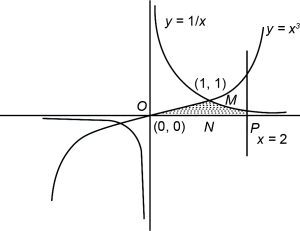
0 likesView Solution
70
MathematicsMediumMCQWBJEE · 2012
The area of the region,bounded by the curves $y=\sin ^{-1} x+x(1-x)$ and $y=\sin ^{-1} x-x(1-x)$ in the first quadrant,is
A
$1$
B
$\frac{1}{2}$
C
$\frac{1}{3}$
D
$\frac{1}{4}$
Solution
(C) The function $y = \sin^{-1} x$ is defined for $-1 \leq x \leq 1$. In the first quadrant,we have $0 \leq x \leq 1$.
Since $x(1-x) \geq 0$ for $x \in [0, 1]$,the curve $y_1 = \sin^{-1} x + x(1-x)$ lies above the curve $y_2 = \sin^{-1} x - x(1-x)$.
The intersection points are found by setting $y_1 = y_2$,which gives $2x(1-x) = 0$,implying $x = 0$ or $x = 1$.
The required area is given by the integral:
$A = \int_{0}^{1} (y_1 - y_2) dx = \int_{0}^{1} [(\sin^{-1} x + x - x^2) - (\sin^{-1} x - x + x^2)] dx$
$A = \int_{0}^{1} (2x - 2x^2) dx = 2 \int_{0}^{1} (x - x^2) dx$
$A = 2 \left[ \frac{x^2}{2} - \frac{x^3}{3} \right]_{0}^{1} = 2 \left( \frac{1}{2} - \frac{1}{3} \right) = 2 \left( \frac{1}{6} \right) = \frac{1}{3}$.
Since $x(1-x) \geq 0$ for $x \in [0, 1]$,the curve $y_1 = \sin^{-1} x + x(1-x)$ lies above the curve $y_2 = \sin^{-1} x - x(1-x)$.
The intersection points are found by setting $y_1 = y_2$,which gives $2x(1-x) = 0$,implying $x = 0$ or $x = 1$.
The required area is given by the integral:
$A = \int_{0}^{1} (y_1 - y_2) dx = \int_{0}^{1} [(\sin^{-1} x + x - x^2) - (\sin^{-1} x - x + x^2)] dx$
$A = \int_{0}^{1} (2x - 2x^2) dx = 2 \int_{0}^{1} (x - x^2) dx$
$A = 2 \left[ \frac{x^2}{2} - \frac{x^3}{3} \right]_{0}^{1} = 2 \left( \frac{1}{2} - \frac{1}{3} \right) = 2 \left( \frac{1}{6} \right) = \frac{1}{3}$.
0 likesView Solution
71
MathematicsDifficultMCQWBJEE · 2012
The general solution of the differential equation $\frac{d y}{d x}=\frac{x+y+1}{2 x+2 y+1}$ is
A
$\log _{e}|3 x+3 y+2|+3 x+6 y=C$
B
$\log _{e}|3 x+3 y+2|-3 x+6 y=C$
C
$\log _{e}|3 x+3 y+2|-3 x-6 y=C$
D
$\log _{e}|3 x+3 y+2|+3 x-6 y=C$
Solution
(D) Given differential equation: $\frac{d y}{d x}=\frac{x+y+1}{2 x+2 y+1}$
Let $x+y=v$. Then $1+\frac{d y}{d x}=\frac{d v}{d x}$,so $\frac{d y}{d x}=\frac{d v}{d x}-1$.
Substituting this into the equation: $\frac{d v}{d x}-1=\frac{v+1}{2 v+1}$
$\frac{d v}{d x}=\frac{v+1}{2 v+1}+1 = \frac{v+1+2 v+1}{2 v+1} = \frac{3 v+2}{2 v+1}$
Separating variables: $\frac{2 v+1}{3 v+2} d v=d x$
Rewrite the numerator: $\frac{\frac{2}{3}(3 v+2)-\frac{1}{3}}{3 v+2} d v=d x$
$\left(\frac{2}{3}-\frac{1}{3(3 v+2)}\right) d v=d x$
Integrating both sides: $\int \left(\frac{2}{3}-\frac{1}{3(3 v+2)}\right) d v = \int d x + C'$
$\frac{2}{3} v - \frac{1}{9} \log |3 v+2| = x + C'$
Substitute $v=x+y$: $\frac{2}{3}(x+y) - \frac{1}{9} \log |3 x+3 y+2| = x + C'$
Multiply by $9$: $6(x+y) - \log |3 x+3 y+2| = 9 x + 9 C'$
$6 x + 6 y - 9 x - \log |3 x+3 y+2| = C$
$-3 x + 6 y - \log |3 x+3 y+2| = C$
Multiplying by $-1$: $3 x - 6 y + \log |3 x+3 y+2| = C$
Thus,the correct option is $D$.
Let $x+y=v$. Then $1+\frac{d y}{d x}=\frac{d v}{d x}$,so $\frac{d y}{d x}=\frac{d v}{d x}-1$.
Substituting this into the equation: $\frac{d v}{d x}-1=\frac{v+1}{2 v+1}$
$\frac{d v}{d x}=\frac{v+1}{2 v+1}+1 = \frac{v+1+2 v+1}{2 v+1} = \frac{3 v+2}{2 v+1}$
Separating variables: $\frac{2 v+1}{3 v+2} d v=d x$
Rewrite the numerator: $\frac{\frac{2}{3}(3 v+2)-\frac{1}{3}}{3 v+2} d v=d x$
$\left(\frac{2}{3}-\frac{1}{3(3 v+2)}\right) d v=d x$
Integrating both sides: $\int \left(\frac{2}{3}-\frac{1}{3(3 v+2)}\right) d v = \int d x + C'$
$\frac{2}{3} v - \frac{1}{9} \log |3 v+2| = x + C'$
Substitute $v=x+y$: $\frac{2}{3}(x+y) - \frac{1}{9} \log |3 x+3 y+2| = x + C'$
Multiply by $9$: $6(x+y) - \log |3 x+3 y+2| = 9 x + 9 C'$
$6 x + 6 y - 9 x - \log |3 x+3 y+2| = C$
$-3 x + 6 y - \log |3 x+3 y+2| = C$
Multiplying by $-1$: $3 x - 6 y + \log |3 x+3 y+2| = C$
Thus,the correct option is $D$.
0 likesView Solution
72
MathematicsMediumMCQWBJEE · 2012
The solution of $25 \frac{d^{2} y}{d x^{2}}-10 \frac{d y}{d x}+y=0$,$y(0)=1, y(1)=2 e^{1 / 5}$ is
A
$y=e^{5 x}+e^{-5 x}$
B
$y=(1+x) e^{5 x}$
C
$y=(1+x) e^{x / 5}$
D
$y=(1+x) e^{-x / 5}$
Solution
(C) The given differential equation is $25 \frac{d^{2} y}{d x^{2}}-10 \frac{d y}{d x}+y=0$.
The auxiliary equation is $25 m^{2}-10 m+1=0$.
This can be written as $(5 m-1)^{2}=0$,which gives $m=\frac{1}{5}, \frac{1}{5}$.
Since the roots are real and equal,the general solution is $y=(c_{1}+c_{2} x) e^{x / 5} \quad \dots(i)$.
Given $y(0)=1$,substituting $x=0$ in $(i)$ gives $1=(c_{1}+0) e^{0} \Rightarrow c_{1}=1$.
Given $y(1)=2 e^{1 / 5}$,substituting $x=1$ and $c_{1}=1$ in $(i)$ gives $2 e^{1 / 5}=(1+c_{2}) e^{1 / 5}$.
Dividing by $e^{1 / 5}$,we get $2=1+c_{2} \Rightarrow c_{2}=1$.
Substituting $c_{1}=1$ and $c_{2}=1$ in $(i)$,the particular solution is $y=(1+x) e^{x / 5}$.
The auxiliary equation is $25 m^{2}-10 m+1=0$.
This can be written as $(5 m-1)^{2}=0$,which gives $m=\frac{1}{5}, \frac{1}{5}$.
Since the roots are real and equal,the general solution is $y=(c_{1}+c_{2} x) e^{x / 5} \quad \dots(i)$.
Given $y(0)=1$,substituting $x=0$ in $(i)$ gives $1=(c_{1}+0) e^{0} \Rightarrow c_{1}=1$.
Given $y(1)=2 e^{1 / 5}$,substituting $x=1$ and $c_{1}=1$ in $(i)$ gives $2 e^{1 / 5}=(1+c_{2}) e^{1 / 5}$.
Dividing by $e^{1 / 5}$,we get $2=1+c_{2} \Rightarrow c_{2}=1$.
Substituting $c_{1}=1$ and $c_{2}=1$ in $(i)$,the particular solution is $y=(1+x) e^{x / 5}$.
0 likesView Solution
73
MathematicsDifficultMCQWBJEE · 2012
The integrating factor of the differential equation $3 x \log _{e} x \frac{d y}{d x}+y=2 \log _{e} x$ is given by
A
$(\log _{e} x)^{3}$
B
$\log _{e}(\log _{e} x)$
C
$\log _{e} x$
D
$(\log _{e} x)^{1 / 3}$
Solution
(D) Given the differential equation: $3 x \log _{e} x \frac{d y}{d x}+y=2 \log _{e} x$.
Dividing both sides by $3 x \log _{e} x$,we get: $\frac{d y}{d x} + \frac{1}{3 x \log _{e} x} y = \frac{2}{3 x}$.
This is a linear differential equation of the form $\frac{d y}{d x} + P y = Q$,where $P = \frac{1}{3 x \log _{e} x}$.
The integrating factor $(IF)$ is given by $e^{\int P d x}$.
$IF = e^{\int \frac{1}{3 x \log _{e} x} d x}$.
Let $t = \log _{e} x$,then $d t = \frac{1}{x} d x$.
$IF = e^{\frac{1}{3} \int \frac{1}{t} d t} = e^{\frac{1}{3} \log _{e} t} = e^{\log _{e} (t^{1/3})} = t^{1/3}$.
Substituting back $t = \log _{e} x$,we get $IF = (\log _{e} x)^{1/3}$.
Dividing both sides by $3 x \log _{e} x$,we get: $\frac{d y}{d x} + \frac{1}{3 x \log _{e} x} y = \frac{2}{3 x}$.
This is a linear differential equation of the form $\frac{d y}{d x} + P y = Q$,where $P = \frac{1}{3 x \log _{e} x}$.
The integrating factor $(IF)$ is given by $e^{\int P d x}$.
$IF = e^{\int \frac{1}{3 x \log _{e} x} d x}$.
Let $t = \log _{e} x$,then $d t = \frac{1}{x} d x$.
$IF = e^{\frac{1}{3} \int \frac{1}{t} d t} = e^{\frac{1}{3} \log _{e} t} = e^{\log _{e} (t^{1/3})} = t^{1/3}$.
Substituting back $t = \log _{e} x$,we get $IF = (\log _{e} x)^{1/3}$.
0 likesView Solution
74
MathematicsMediumMCQWBJEE · 2012
Let $y$ be the solution of the differential equation $x \frac{dy}{dx} = \frac{y^2}{1 - y \log x}$ satisfying $y(1) = 1$. Then,$y$ satisfies:
A
$y = x^{y-1}$
B
$y = x^y$
C
$y = x^{y+1}$
D
$y = x^{y+2}$
Solution
(B) Given the differential equation: $x \frac{dy}{dx} = \frac{y^2}{1 - y \log x}$.
Rearranging the terms,we get: $\frac{1 - y \log x}{y^2} dy = \frac{1}{x} dx$.
Integrating both sides: $\int (y^{-2} - \frac{\log x}{y}) dy = \int \frac{1}{x} dx$ is not direct. Let us check the options.
If $y = x^y$,then taking $\log$ on both sides: $\log y = y \log x$.
Differentiating w.r.t. $x$: $\frac{1}{y} \frac{dy}{dx} = y \cdot \frac{1}{x} + \log x \cdot \frac{dy}{dx}$.
Rearranging for $\frac{dy}{dx}$: $\frac{dy}{dx} (\frac{1}{y} - \log x) = \frac{y}{x}$.
$\frac{dy}{dx} (\frac{1 - y \log x}{y}) = \frac{y}{x}$.
$x \frac{dy}{dx} = \frac{y^2}{1 - y \log x}$.
This matches the given differential equation. Also,for $x=1$,$y=1^y=1$,which satisfies the condition $y(1)=1$.
Rearranging the terms,we get: $\frac{1 - y \log x}{y^2} dy = \frac{1}{x} dx$.
Integrating both sides: $\int (y^{-2} - \frac{\log x}{y}) dy = \int \frac{1}{x} dx$ is not direct. Let us check the options.
If $y = x^y$,then taking $\log$ on both sides: $\log y = y \log x$.
Differentiating w.r.t. $x$: $\frac{1}{y} \frac{dy}{dx} = y \cdot \frac{1}{x} + \log x \cdot \frac{dy}{dx}$.
Rearranging for $\frac{dy}{dx}$: $\frac{dy}{dx} (\frac{1}{y} - \log x) = \frac{y}{x}$.
$\frac{dy}{dx} (\frac{1 - y \log x}{y}) = \frac{y}{x}$.
$x \frac{dy}{dx} = \frac{y^2}{1 - y \log x}$.
This matches the given differential equation. Also,for $x=1$,$y=1^y=1$,which satisfies the condition $y(1)=1$.
0 likesView Solution
75
MathematicsEasyMCQWBJEE · 2012
Two decks of playing cards are well shuffled and $26$ cards are randomly distributed to a player. Then,the probability that the player gets all distinct cards is
A
${ }^{52} C_{26} /{ }^{104} C_{26}$
B
$2 \times { }^{52} C_{26} /{ }^{104} C_{26}$
C
$2^{3} \times { }^{52} C_{26} /{ }^{104} C_{26}$
D
$2^{26} \times { }^{52} C_{26} /{ }^{104} C_{26}$
Solution
(D) There are $52$ distinct types of cards in a standard deck,and each type appears twice in two decks combined (total $104$ cards).
To get $26$ distinct cards,we must first choose $26$ types out of $52$ types,which can be done in ${ }^{52} C_{26}$ ways.
For each of these $26$ chosen types,we can pick either of the $2$ available cards,which gives $2^{26}$ ways.
The total number of ways to choose $26$ cards from $104$ is ${ }^{104} C_{26}$.
Therefore,the probability is $\frac{{ }^{52} C_{26} \times 2^{26}}{{ }^{104} C_{26}}$.
To get $26$ distinct cards,we must first choose $26$ types out of $52$ types,which can be done in ${ }^{52} C_{26}$ ways.
For each of these $26$ chosen types,we can pick either of the $2$ available cards,which gives $2^{26}$ ways.
The total number of ways to choose $26$ cards from $104$ is ${ }^{104} C_{26}$.
Therefore,the probability is $\frac{{ }^{52} C_{26} \times 2^{26}}{{ }^{104} C_{26}}$.
0 likesView Solution
76
MathematicsEasyMCQWBJEE · 2012
Let $A$ and $B$ be two events with $P(A^{C}) = 0.3$,$P(B) = 0.4$,and $P(A \cap B^{C}) = 0.5$. Then $P(B \mid A \cup B^{C})$ is equal to
A
$\frac{1}{4}$
B
$\frac{1}{3}$
C
$\frac{1}{2}$
D
$\frac{2}{3}$
Solution
(A) Given: $P(A^{C}) = 0.3 \implies P(A) = 1 - 0.3 = 0.7$.
$P(B) = 0.4 \implies P(B^{C}) = 1 - 0.4 = 0.6$.
$P(A \cap B^{C}) = 0.5$.
We know $P(A) = P(A \cap B) + P(A \cap B^{C})$,so $P(A \cap B) = P(A) - P(A \cap B^{C}) = 0.7 - 0.5 = 0.2$.
We need to find $P(B \mid A \cup B^{C}) = \frac{P(B \cap (A \cup B^{C}))}{P(A \cup B^{C})}$.
Numerator: $P(B \cap (A \cup B^{C})) = P((B \cap A) \cup (B \cap B^{C})) = P(A \cap B) = 0.2$.
Denominator: $P(A \cup B^{C}) = P(A) + P(B^{C}) - P(A \cap B^{C}) = 0.7 + 0.6 - 0.5 = 0.8$.
Thus,$P(B \mid A \cup B^{C}) = \frac{0.2}{0.8} = \frac{1}{4}$.
$P(B) = 0.4 \implies P(B^{C}) = 1 - 0.4 = 0.6$.
$P(A \cap B^{C}) = 0.5$.
We know $P(A) = P(A \cap B) + P(A \cap B^{C})$,so $P(A \cap B) = P(A) - P(A \cap B^{C}) = 0.7 - 0.5 = 0.2$.
We need to find $P(B \mid A \cup B^{C}) = \frac{P(B \cap (A \cup B^{C}))}{P(A \cup B^{C})}$.
Numerator: $P(B \cap (A \cup B^{C})) = P((B \cap A) \cup (B \cap B^{C})) = P(A \cap B) = 0.2$.
Denominator: $P(A \cup B^{C}) = P(A) + P(B^{C}) - P(A \cap B^{C}) = 0.7 + 0.6 - 0.5 = 0.8$.
Thus,$P(B \mid A \cup B^{C}) = \frac{0.2}{0.8} = \frac{1}{4}$.
0 likesView Solution
77
MathematicsEasyMCQWBJEE · 2012
Two coins are available,one fair and the other two-headed. Choose a coin and toss it once; assume that the unbiased coin is chosen with probability $\frac{3}{4}$. Given that the outcome is head,the probability that the two-headed coin was chosen,is
A
$\frac{3}{5}$
B
$\frac{2}{5}$
C
$\frac{1}{5}$
D
$\frac{2}{7}$
Solution
(B) Let $F$ denote the fair coin,$T$ denote the two-headed coin,and $H$ denote the event that the outcome is a head.
Given probabilities are $P(F) = \frac{3}{4}$ and $P(T) = 1 - \frac{3}{4} = \frac{1}{4}$.
The probability of getting a head given the fair coin is $P(H|F) = \frac{1}{2}$.
The probability of getting a head given the two-headed coin is $P(H|T) = 1$.
We need to find the probability that the two-headed coin was chosen given that the outcome is a head,$P(T|H)$.
By Bayes' theorem:
$P(T|H) = \frac{P(H|T) \cdot P(T)}{P(H|T) \cdot P(T) + P(H|F) \cdot P(F)}$
$P(T|H) = \frac{1 \cdot \frac{1}{4}}{1 \cdot \frac{1}{4} + \frac{1}{2} \cdot \frac{3}{4}}$
$P(T|H) = \frac{\frac{1}{4}}{\frac{1}{4} + \frac{3}{8}} = \frac{\frac{1}{4}}{\frac{2+3}{8}} = \frac{\frac{1}{4}}{\frac{5}{8}} = \frac{1}{4} \times \frac{8}{5} = \frac{2}{5}$.
Given probabilities are $P(F) = \frac{3}{4}$ and $P(T) = 1 - \frac{3}{4} = \frac{1}{4}$.
The probability of getting a head given the fair coin is $P(H|F) = \frac{1}{2}$.
The probability of getting a head given the two-headed coin is $P(H|T) = 1$.
We need to find the probability that the two-headed coin was chosen given that the outcome is a head,$P(T|H)$.
By Bayes' theorem:
$P(T|H) = \frac{P(H|T) \cdot P(T)}{P(H|T) \cdot P(T) + P(H|F) \cdot P(F)}$
$P(T|H) = \frac{1 \cdot \frac{1}{4}}{1 \cdot \frac{1}{4} + \frac{1}{2} \cdot \frac{3}{4}}$
$P(T|H) = \frac{\frac{1}{4}}{\frac{1}{4} + \frac{3}{8}} = \frac{\frac{1}{4}}{\frac{2+3}{8}} = \frac{\frac{1}{4}}{\frac{5}{8}} = \frac{1}{4} \times \frac{8}{5} = \frac{2}{5}$.
0 likesView Solution
Vedclass Products
For Students
Vedclass Test Series
Mock tests in real WBJEE style covering Mathematics with performance analysis. 5-day free trial.
Start Free TrialFor Teachers
Exam Paper Generator
Generate Set A/B/C/D Mathematics papers from 7.5L+ questions in 2 minutes. 3 chapters free.
Try FreeFor Institutes
Online Exam Module
Run live WBJEE mock exams with unlimited students, 360° analytics & white-label branding.
See DemoFrequently Asked Questions
How many Mathematics questions are in WBJEE 2012?
There are 80 Mathematics questions from the WBJEE 2012 paper on Vedclass, each with a detailed step-by-step solution in English.
Are WBJEE 2012 Mathematics solutions available in English?
Yes. All solutions on this page are in English. You can also switch to English or Hindi using the language buttons above the questions.
Can I practice WBJEE 2012 Mathematics as a timed test?
Yes. Use the Vedclass Test Series to attempt a full WBJEE mock test covering Mathematics with time limits and instant score analysis.
Can teachers create Mathematics papers from WBJEE previous year questions?
Yes. The Vedclass Exam Paper Generator lets teachers mix WBJEE Mathematics questions and generate Set A/B/C/D papers in minutes.
For Teachers & Institutes
Build a Custom Mathematics Paper
Pick WBJEE 2012 Mathematics questions, set difficulty, and generate Set A/B/C/D in 2 minutes.