
PhysicsQ1–34 of 34 questions
Page 1 of 1 · English
1
PhysicsMediumMCQWBJEE · 2012
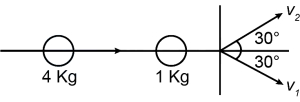
$A$ spherical ball $A$ of mass $4 \ kg$,moving along a straight line,strikes another spherical ball $B$ of mass $1 \ kg$ at rest. After the collision,$A$ and $B$ move with velocities $v_1 \ ms^{-1}$ and $v_2 \ ms^{-1}$ respectively,making angles of $30^{\circ}$ and $60^{\circ}$ with respect to the original direction of motion of $A$. The ratio $\frac{v_1}{v_2}$ will be
A
$\frac{\sqrt{3}}{4}$
B
$\frac{4}{\sqrt{3}}$
C
$\frac{1}{\sqrt{3}}$
D
$\sqrt{3}$
Solution
(A) According to the law of conservation of linear momentum,the net external force on the system is zero,so the momentum along the $y$-axis (perpendicular to the initial direction of motion) must be conserved.
Initially,the system has no momentum along the $y$-axis.
After the collision,the components of momentum along the $y$-axis for balls $A$ and $B$ must be equal and opposite.
Let $m_1 = 4 \ kg$ and $m_2 = 1 \ kg$.
$m_1 v_1 \sin(30^{\circ}) = m_2 v_2 \sin(60^{\circ})$
$4 \cdot v_1 \cdot \frac{1}{2} = 1 \cdot v_2 \cdot \frac{\sqrt{3}}{2}$
$2 v_1 = \frac{\sqrt{3}}{2} v_2$
$\frac{v_1}{v_2} = \frac{\sqrt{3}}{4}$
Initially,the system has no momentum along the $y$-axis.
After the collision,the components of momentum along the $y$-axis for balls $A$ and $B$ must be equal and opposite.
Let $m_1 = 4 \ kg$ and $m_2 = 1 \ kg$.
$m_1 v_1 \sin(30^{\circ}) = m_2 v_2 \sin(60^{\circ})$
$4 \cdot v_1 \cdot \frac{1}{2} = 1 \cdot v_2 \cdot \frac{\sqrt{3}}{2}$
$2 v_1 = \frac{\sqrt{3}}{2} v_2$
$\frac{v_1}{v_2} = \frac{\sqrt{3}}{4}$
0 likesView Solution
2
PhysicsEasyMCQWBJEE · 2012
The average distance of the Earth from the Sun is $L_{1}$. If one year of the Earth is $D$ days,then one year of another planet whose average distance from the Sun is $L_{2}$ will be:
A
$D\left(\frac{L_{2}}{L_{1}}\right)^{\frac{1}{2}} \text{ days}$
B
$D\left(\frac{L_{2}}{L_{1}}\right)^{\frac{3}{2}} \text{ days}$
C
$D\left(\frac{L_{2}}{L_{1}}\right)^{\frac{2}{3}} \text{ days}$
D
$D\left(\frac{L_{2}}{L_{1}}\right) \text{ days}$
Solution
(B) According to Kepler's third law of planetary motion,the square of the time period $(T)$ of a planet is directly proportional to the cube of its average distance $(R)$ from the Sun.
$T^{2} \propto R^{3}$
Let $T_{1} = D$ be the time period of the Earth at distance $L_{1}$,and $T_{2}$ be the time period of the other planet at distance $L_{2}$.
Then,$\frac{T_{2}^{2}}{T_{1}^{2}} = \frac{L_{2}^{3}}{L_{1}^{3}}$
$\frac{T_{2}^{2}}{D^{2}} = \left(\frac{L_{2}}{L_{1}}\right)^{3}$
$T_{2}^{2} = D^{2} \left(\frac{L_{2}}{L_{1}}\right)^{3}$
Taking the square root on both sides:
$T_{2} = D \left(\frac{L_{2}}{L_{1}}\right)^{3/2} \text{ days}$.
$T^{2} \propto R^{3}$
Let $T_{1} = D$ be the time period of the Earth at distance $L_{1}$,and $T_{2}$ be the time period of the other planet at distance $L_{2}$.
Then,$\frac{T_{2}^{2}}{T_{1}^{2}} = \frac{L_{2}^{3}}{L_{1}^{3}}$
$\frac{T_{2}^{2}}{D^{2}} = \left(\frac{L_{2}}{L_{1}}\right)^{3}$
$T_{2}^{2} = D^{2} \left(\frac{L_{2}}{L_{1}}\right)^{3}$
Taking the square root on both sides:
$T_{2} = D \left(\frac{L_{2}}{L_{1}}\right)^{3/2} \text{ days}$.
0 likesView Solution
3
PhysicsMediumMCQWBJEE · 2012
$A$ box of mass $2 kg$ is placed on the roof of a car. The box would remain stationary until the car attains a maximum acceleration. The coefficient of static friction between the box and the roof of the car is $0.2$ and $g=10 ms^{-2}$. This maximum acceleration of the car,for the box to remain stationary,is: (in $ms^{-2}$)
A
$8$
B
$6$
C
$4$
D
$2$
Solution
(D) Given: Mass of the box $m = 2 kg$,coefficient of static friction $\mu = 0.2$,and acceleration due to gravity $g = 10 ms^{-2}$.
For the box to remain stationary on the roof of the car,the pseudo-force acting on the box must be balanced by the static frictional force.
The maximum static frictional force is given by $f_{max} = \mu N = \mu mg$.
The force required to accelerate the box with the car is $F = ma$.
Equating the two,we get $ma = \mu mg$.
Therefore,$a = \mu g$.
Substituting the values: $a = 0.2 \times 10 = 2 ms^{-2}$.
Thus,the maximum acceleration of the car is $2 ms^{-2}$.
For the box to remain stationary on the roof of the car,the pseudo-force acting on the box must be balanced by the static frictional force.
The maximum static frictional force is given by $f_{max} = \mu N = \mu mg$.
The force required to accelerate the box with the car is $F = ma$.
Equating the two,we get $ma = \mu mg$.
Therefore,$a = \mu g$.
Substituting the values: $a = 0.2 \times 10 = 2 ms^{-2}$.
Thus,the maximum acceleration of the car is $2 ms^{-2}$.
0 likesView Solution
4
PhysicsMediumMCQWBJEE · 2012
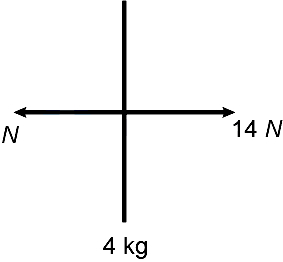
Three blocks of masses $4 \ kg$,$2 \ kg$,and $1 \ kg$ respectively are in contact on a frictionless table as shown in the figure. If a force of $14 \ N$ is applied on the $4 \ kg$ block,the contact force between the $4 \ kg$ and the $2 \ kg$ block will be: (in $N$)

A
$2$
B
$6$
C
$8$
D
$14$
Solution
(B) The total mass of the system is $M = 4 \ kg + 2 \ kg + 1 \ kg = 7 \ kg$.
Since the surface is frictionless,the acceleration $a$ of the system is given by $a = \frac{F}{M} = \frac{14 \ N}{7 \ kg} = 2 \ m/s^2$.
To find the contact force $N$ between the $4 \ kg$ and $2 \ kg$ blocks,we consider the motion of the combined $2 \ kg$ and $1 \ kg$ blocks (total mass $m' = 3 \ kg$).
The force $N$ is the only horizontal force acting on this combined system of $3 \ kg$ that causes it to accelerate at $2 \ m/s^2$.
Therefore,$N = m' \times a = 3 \ kg \times 2 \ m/s^2 = 6 \ N$.
Since the surface is frictionless,the acceleration $a$ of the system is given by $a = \frac{F}{M} = \frac{14 \ N}{7 \ kg} = 2 \ m/s^2$.
To find the contact force $N$ between the $4 \ kg$ and $2 \ kg$ blocks,we consider the motion of the combined $2 \ kg$ and $1 \ kg$ blocks (total mass $m' = 3 \ kg$).
The force $N$ is the only horizontal force acting on this combined system of $3 \ kg$ that causes it to accelerate at $2 \ m/s^2$.
Therefore,$N = m' \times a = 3 \ kg \times 2 \ m/s^2 = 6 \ N$.
0 likesView Solution
5
PhysicsMediumMCQWBJEE · 2012
$A$ body when fully immersed in a liquid of specific gravity $1.2$ weighs $44 \text{ gwt}$. The same body when fully immersed in water weighs $50 \text{ gwt}$. The mass of the body is (in $\text{ g}$)
A
$36$
B
$48$
C
$64$
D
$80$
Solution
(D) Let $m$ be the mass of the body in grams and $V$ be the volume of the body in $\text{cm}^3$. The density of water is $\rho_w = 1 \text{ g/cm}^3$. The apparent weight $W'$ is given by $W' = W_{actual} - F_B$,where $F_B$ is the buoyant force.
For the liquid with specific gravity $1.2$,the density is $\rho_l = 1.2 \text{ g/cm}^3$. The weight is $44 \text{ gwt}$,so:
$44 = m - 1.2V$ $(i)$
For water,the weight is $50 \text{ gwt}$,so:
$50 = m - V$ $(ii)$
Subtracting $(i)$ from $(ii)$:
$(50 - 44) = (m - V) - (m - 1.2V)$
$6 = 0.2V$
$V = 30 \text{ cm}^3$
Substituting $V = 30$ into $(ii)$:
$50 = m - 30$
$m = 80 \text{ g}$
For the liquid with specific gravity $1.2$,the density is $\rho_l = 1.2 \text{ g/cm}^3$. The weight is $44 \text{ gwt}$,so:
$44 = m - 1.2V$ $(i)$
For water,the weight is $50 \text{ gwt}$,so:
$50 = m - V$ $(ii)$
Subtracting $(i)$ from $(ii)$:
$(50 - 44) = (m - V) - (m - 1.2V)$
$6 = 0.2V$
$V = 30 \text{ cm}^3$
Substituting $V = 30$ into $(ii)$:
$50 = m - 30$
$m = 80 \text{ g}$
0 likesView Solution
6
PhysicsEasyMCQWBJEE · 2012
Water is flowing through a very narrow tube. The velocity of water below which the flow remains a streamline flow is known as
A
relative velocity
B
terminal velocity
C
critical velocity
D
particle velocity
Solution
(C) The velocity of a fluid,such as water,flowing through a tube,below which the flow remains streamline (or laminar) and above which it becomes turbulent,is defined as the critical velocity.
0 likesView Solution
7
PhysicsEasyMCQWBJEE · 2012
Let $L$ be the length and $d$ be the diameter of the cross-section of a wire. Wires of the same material with different $L$ and $d$ are subjected to the same tension along the length of the wire. In which of the following cases will the extension of the wire be the maximum?
A
$L = 200 \ cm, d = 0.5 \ mm$
B
$L = 300 \ cm, d = 1.0 \ mm$
C
$L = 50 \ cm, d = 0.05 \ mm$
D
$L = 100 \ cm, d = 0.2 \ mm$
Solution
(C) The extension $\Delta L$ of a wire is given by the formula $\Delta L = \frac{F \cdot L}{A \cdot Y}$,where $F$ is the tension,$L$ is the length,$A$ is the cross-sectional area,and $Y$ is Young's modulus.
Since $A = \pi \cdot (d/2)^2 = \frac{\pi d^2}{4}$,we can write $\Delta L = \frac{4 F L}{\pi d^2 Y}$.
Given that $F$ and $Y$ are constant for the same material and same tension,we have $\Delta L \propto \frac{L}{d^2}$.
Calculating the ratio $\frac{L}{d^2}$ for each case:
$A: \frac{200}{(0.5)^2} = \frac{200}{0.25} = 800$
$B: \frac{300}{(1.0)^2} = \frac{300}{1} = 300$
$C: \frac{50}{(0.05)^2} = \frac{50}{0.0025} = 20000$
$D: \frac{100}{(0.2)^2} = \frac{100}{0.04} = 2500$
Comparing these values,the ratio is maximum for option $C$.
Since $A = \pi \cdot (d/2)^2 = \frac{\pi d^2}{4}$,we can write $\Delta L = \frac{4 F L}{\pi d^2 Y}$.
Given that $F$ and $Y$ are constant for the same material and same tension,we have $\Delta L \propto \frac{L}{d^2}$.
Calculating the ratio $\frac{L}{d^2}$ for each case:
$A: \frac{200}{(0.5)^2} = \frac{200}{0.25} = 800$
$B: \frac{300}{(1.0)^2} = \frac{300}{1} = 300$
$C: \frac{50}{(0.05)^2} = \frac{50}{0.0025} = 20000$
$D: \frac{100}{(0.2)^2} = \frac{100}{0.04} = 2500$
Comparing these values,the ratio is maximum for option $C$.
0 likesView Solution
8
PhysicsMediumMCQWBJEE · 2012
$A$ particle is projected from the ground with a kinetic energy $E$ at an angle of $60^{\circ}$ with the horizontal. Its kinetic energy at the highest point of its motion will be
A
$E / \sqrt{2}$
B
$E / 2$
C
$E / 4$
D
$E / 8$
Solution
(C) At the ground,the initial kinetic energy is given by $E = \frac{1}{2} m u^{2}$,where $u$ is the initial velocity.
At the highest point of the trajectory,the vertical component of the velocity becomes zero,and the velocity of the particle is only the horizontal component,which is $v_x = u \cos \theta$.
Given the angle of projection $\theta = 60^{\circ}$,the horizontal velocity at the highest point is $v_x = u \cos 60^{\circ} = u \times \frac{1}{2} = \frac{u}{2}$.
The kinetic energy at the highest point $E^{\prime}$ is given by $E^{\prime} = \frac{1}{2} m v_x^{2}$.
Substituting the value of $v_x$,we get $E^{\prime} = \frac{1}{2} m \left( \frac{u}{2} \right)^{2} = \frac{1}{2} m \left( \frac{u^{2}}{4} \right) = \frac{1}{4} \left( \frac{1}{2} m u^{2} \right)$.
Since $E = \frac{1}{2} m u^{2}$,we have $E^{\prime} = \frac{E}{4}$.
At the highest point of the trajectory,the vertical component of the velocity becomes zero,and the velocity of the particle is only the horizontal component,which is $v_x = u \cos \theta$.
Given the angle of projection $\theta = 60^{\circ}$,the horizontal velocity at the highest point is $v_x = u \cos 60^{\circ} = u \times \frac{1}{2} = \frac{u}{2}$.
The kinetic energy at the highest point $E^{\prime}$ is given by $E^{\prime} = \frac{1}{2} m v_x^{2}$.
Substituting the value of $v_x$,we get $E^{\prime} = \frac{1}{2} m \left( \frac{u}{2} \right)^{2} = \frac{1}{2} m \left( \frac{u^{2}}{4} \right) = \frac{1}{4} \left( \frac{1}{2} m u^{2} \right)$.
Since $E = \frac{1}{2} m u^{2}$,we have $E^{\prime} = \frac{E}{4}$.
0 likesView Solution
9
PhysicsMediumMCQWBJEE · 2012
From the top of a tower,$80 \ m$ high from the ground,a stone is thrown in the horizontal direction with a velocity of $8 \ ms^{-1}$. The stone reaches the ground after a time $t$ and falls at a distance of $d$ from the foot of the tower. Assuming $g=10 \ ms^{-2}$,the time $t$ and distance $d$ are given respectively by
A
$6 \ s, 64 \ m$
B
$6 \ s, 48 \ m$
C
$4 \ s, 32 \ m$
D
$4 \ s, 16 \ m$
Solution
(C) Given: Height $h = 80 \ m$,initial horizontal velocity $v = 8 \ ms^{-1}$,and acceleration due to gravity $g = 10 \ ms^{-2}$.
For vertical motion,the time taken to reach the ground is given by the equation $h = \frac{1}{2}gt^2$.
Substituting the values: $80 = \frac{1}{2} \times 10 \times t^2$.
$80 = 5t^2 \implies t^2 = 16 \implies t = 4 \ s$.
For horizontal motion,the distance $d$ covered is given by $d = v \times t$.
Substituting the values: $d = 8 \times 4 = 32 \ m$.
Thus,the time $t$ is $4 \ s$ and the distance $d$ is $32 \ m$.
For vertical motion,the time taken to reach the ground is given by the equation $h = \frac{1}{2}gt^2$.
Substituting the values: $80 = \frac{1}{2} \times 10 \times t^2$.
$80 = 5t^2 \implies t^2 = 16 \implies t = 4 \ s$.
For horizontal motion,the distance $d$ covered is given by $d = v \times t$.
Substituting the values: $d = 8 \times 4 = 32 \ m$.
Thus,the time $t$ is $4 \ s$ and the distance $d$ is $32 \ m$.
0 likesView Solution
10
PhysicsEasyMCQWBJEE · 2012
What is the phase difference between two simple harmonic motions represented by $x_{1}=A \sin \left(\omega t+\frac{\pi}{6}\right)$ and $x_{2}=A \cos (\omega t)$?
A
$\frac{\pi}{6}$
B
$\frac{\pi}{3}$
C
$\frac{\pi}{2}$
D
$\frac{2 \pi}{3}$
Solution
(B) Given equations for simple harmonic motion are:
$x_{1}=A \sin \left(\omega t+\frac{\pi}{6}\right)$
$x_{2}=A \cos (\omega t)$
To find the phase difference,we must express both equations in the same trigonometric function (sine).
Using the identity $\cos(\theta) = \sin(\theta + \frac{\pi}{2})$,we can rewrite $x_{2}$ as:
$x_{2}=A \sin \left(\omega t+\frac{\pi}{2}\right)$
Now,the phase of the first motion is $\phi_{1} = \omega t + \frac{\pi}{6}$ and the phase of the second motion is $\phi_{2} = \omega t + \frac{\pi}{2}$.
The phase difference $\Delta \phi$ is given by:
$\Delta \phi = \phi_{2} - \phi_{1}$
$\Delta \phi = \left(\omega t + \frac{\pi}{2}\right) - \left(\omega t + \frac{\pi}{6}\right)$
$\Delta \phi = \frac{\pi}{2} - \frac{\pi}{6} = \frac{3\pi - \pi}{6} = \frac{2\pi}{6} = \frac{\pi}{3}$
Therefore,the phase difference is $\frac{\pi}{3}$.
$x_{1}=A \sin \left(\omega t+\frac{\pi}{6}\right)$
$x_{2}=A \cos (\omega t)$
To find the phase difference,we must express both equations in the same trigonometric function (sine).
Using the identity $\cos(\theta) = \sin(\theta + \frac{\pi}{2})$,we can rewrite $x_{2}$ as:
$x_{2}=A \sin \left(\omega t+\frac{\pi}{2}\right)$
Now,the phase of the first motion is $\phi_{1} = \omega t + \frac{\pi}{6}$ and the phase of the second motion is $\phi_{2} = \omega t + \frac{\pi}{2}$.
The phase difference $\Delta \phi$ is given by:
$\Delta \phi = \phi_{2} - \phi_{1}$
$\Delta \phi = \left(\omega t + \frac{\pi}{2}\right) - \left(\omega t + \frac{\pi}{6}\right)$
$\Delta \phi = \frac{\pi}{2} - \frac{\pi}{6} = \frac{3\pi - \pi}{6} = \frac{2\pi}{6} = \frac{\pi}{3}$
Therefore,the phase difference is $\frac{\pi}{3}$.
0 likesView Solution
11
PhysicsDifficultMCQWBJEE · 2012
$22320 \ cal$ of heat is supplied to $100 \ g$ of ice at $0^{\circ} C$. If the latent heat of fusion of ice is $80 \ cal \ g^{-1}$ and latent heat of vaporization of water is $540 \ cal \ g^{-1}$,the final amount of water thus obtained and its temperature respectively are:
A
$8 \ g, 100^{\circ} C$
B
$100 \ g, 90^{\circ} C$
C
$92 \ g, 100^{\circ} C$
D
$82 \ g, 100^{\circ} C$
Solution
(C) $1$. Heat required to melt $100 \ g$ of ice at $0^{\circ} C$ to water at $0^{\circ} C$: $Q_1 = m \times L_f = 100 \ g \times 80 \ cal/g = 8000 \ cal$.
$2$. Heat required to raise the temperature of $100 \ g$ of water from $0^{\circ} C$ to $100^{\circ} C$: $Q_2 = m \times s \times \Delta T = 100 \ g \times 1 \ cal/g^{\circ} C \times 100^{\circ} C = 10000 \ cal$.
$3$. Total heat used so far: $Q_{total} = Q_1 + Q_2 = 8000 + 10000 = 18000 \ cal$.
$4$. Remaining heat: $Q_{rem} = 22320 \ cal - 18000 \ cal = 4320 \ cal$.
$5$. This remaining heat will convert some water at $100^{\circ} C$ into steam: $m_{steam} = Q_{rem} / L_v = 4320 \ cal / 540 \ cal/g = 8 \ g$.
$6$. Final amount of water remaining: $100 \ g - 8 \ g = 92 \ g$ of water at $100^{\circ} C$.
$2$. Heat required to raise the temperature of $100 \ g$ of water from $0^{\circ} C$ to $100^{\circ} C$: $Q_2 = m \times s \times \Delta T = 100 \ g \times 1 \ cal/g^{\circ} C \times 100^{\circ} C = 10000 \ cal$.
$3$. Total heat used so far: $Q_{total} = Q_1 + Q_2 = 8000 + 10000 = 18000 \ cal$.
$4$. Remaining heat: $Q_{rem} = 22320 \ cal - 18000 \ cal = 4320 \ cal$.
$5$. This remaining heat will convert some water at $100^{\circ} C$ into steam: $m_{steam} = Q_{rem} / L_v = 4320 \ cal / 540 \ cal/g = 8 \ g$.
$6$. Final amount of water remaining: $100 \ g - 8 \ g = 92 \ g$ of water at $100^{\circ} C$.
0 likesView Solution
12
PhysicsEasyMCQWBJEE · 2012
In a mercury thermometer, the ice point (lower fixed point) is marked as $10^{\circ}$ and the steam point (upper fixed point) is marked as $130^{\circ}$. At $40^{\circ} C$ temperature, what will this thermometer read (in $^{\circ}$)?
A
$78$
B
$66$
C
$62$
D
$58$
Solution
(D) The relationship between any temperature scale and the Celsius scale is given by the formula: $\frac{X - \text{Lower Fixed Point}}{\text{Upper Fixed Point} - \text{Lower Fixed Point}} = \frac{C}{100}$.
Here, the lower fixed point is $10^{\circ}$ and the upper fixed point is $130^{\circ}$.
Substituting the given values: $\frac{X - 10}{130 - 10} = \frac{40}{100}$.
$\frac{X - 10}{120} = \frac{40}{100}$.
$X - 10 = \frac{40}{100} \times 120$.
$X - 10 = 0.4 \times 120 = 48$.
$X = 48 + 10 = 58^{\circ}$.
Here, the lower fixed point is $10^{\circ}$ and the upper fixed point is $130^{\circ}$.
Substituting the given values: $\frac{X - 10}{130 - 10} = \frac{40}{100}$.
$\frac{X - 10}{120} = \frac{40}{100}$.
$X - 10 = \frac{40}{100} \times 120$.
$X - 10 = 0.4 \times 120 = 48$.
$X = 48 + 10 = 58^{\circ}$.
0 likesView Solution
13
PhysicsMediumMCQWBJEE · 2012
$A$ train approaching a railway platform with a speed of $20 \ ms^{-1}$ starts blowing the whistle. The speed of sound in air is $340 \ ms^{-1}$. If the frequency of the emitted sound from the whistle is $640 \ Hz$,the frequency of sound to a person standing on the platform will appear to be: (in $Hz$)
A
$600$
B
$640$
C
$680$
D
$720$
Solution
(C) According to the Doppler effect,when a source of sound moves towards a stationary observer,the apparent frequency $f'$ is given by:
$f' = f \left( \frac{v}{v - v_s} \right)$
Where:
$f = 640 \ Hz$ (source frequency)
$v = 340 \ ms^{-1}$ (speed of sound)
$v_s = 20 \ ms^{-1}$ (speed of the source/train)
Substituting the values:
$f' = 640 \left( \frac{340}{340 - 20} \right)$
$f' = 640 \left( \frac{340}{320} \right)$
$f' = 640 \times 1.0625 = 680 \ Hz$
Therefore,the frequency heard by the person on the platform is $680 \ Hz$.
$f' = f \left( \frac{v}{v - v_s} \right)$
Where:
$f = 640 \ Hz$ (source frequency)
$v = 340 \ ms^{-1}$ (speed of sound)
$v_s = 20 \ ms^{-1}$ (speed of the source/train)
Substituting the values:
$f' = 640 \left( \frac{340}{340 - 20} \right)$
$f' = 640 \left( \frac{340}{320} \right)$
$f' = 640 \times 1.0625 = 680 \ Hz$
Therefore,the frequency heard by the person on the platform is $680 \ Hz$.
0 likesView Solution
14
PhysicsEasyMCQWBJEE · 2012
The frequency of the first overtone of a closed pipe of length $l_{1}$ is equal to that of the first overtone of an open pipe of length $l_{2}$. The ratio of their lengths $(l_{1}: l_{2})$ is
A
$2: 3$
B
$4: 5$
C
$3: 5$
D
$3: 4$
Solution
(D) For a closed pipe,the frequency of the $n$-th overtone is given by $f_{c} = \frac{(2n+1)v}{4l_{1}}$,where $n$ is the overtone number. For the first overtone $(n=1)$,$f_{c} = \frac{3v}{4l_{1}}$.
For an open pipe,the frequency of the $n$-th overtone is given by $f_{o} = \frac{(n+1)v}{2l_{2}}$,where $n$ is the overtone number. For the first overtone $(n=1)$,$f_{o} = \frac{2v}{2l_{2}} = \frac{v}{l_{2}}$.
Given that the frequencies are equal: $\frac{3v}{4l_{1}} = \frac{v}{l_{2}}$.
Rearranging for the ratio: $\frac{l_{1}}{l_{2}} = \frac{3}{4}$.
For an open pipe,the frequency of the $n$-th overtone is given by $f_{o} = \frac{(n+1)v}{2l_{2}}$,where $n$ is the overtone number. For the first overtone $(n=1)$,$f_{o} = \frac{2v}{2l_{2}} = \frac{v}{l_{2}}$.
Given that the frequencies are equal: $\frac{3v}{4l_{1}} = \frac{v}{l_{2}}$.
Rearranging for the ratio: $\frac{l_{1}}{l_{2}} = \frac{3}{4}$.
0 likesView Solution
15
PhysicsMediumMCQWBJEE · 2012
$A$ progressive wave moving along the $x$-axis is represented by $y = A \sin \left[ \frac{2 \pi}{\lambda} (vt - x) \right]$. The wavelength $\lambda$ at which the maximum particle velocity is $3$ times the wave velocity is:
A
$2 \pi A / 3$
B
$2 A (3 \pi)$
C
$(3 / 4) \pi A$
D
$(2 / 3) \pi A$
Solution
(A) The given wave equation is $y = A \sin \left[ \frac{2 \pi}{\lambda} (vt - x) \right]$.
Comparing this with the standard form $y = A \sin (\omega t - kx)$,we have $\omega = \frac{2 \pi v}{\lambda}$ and $k = \frac{2 \pi}{\lambda}$.
The particle velocity $v_p$ is given by $\frac{\partial y}{\partial t} = A \omega \cos \left[ \frac{2 \pi}{\lambda} (vt - x) \right]$.
The maximum particle velocity is $(v_p)_{\max} = A \omega = A \left( \frac{2 \pi v}{\lambda} \right)$.
According to the problem,$(v_p)_{\max} = 3v$.
Therefore,$A \left( \frac{2 \pi v}{\lambda} \right) = 3v$.
Canceling $v$ from both sides,we get $\frac{2 \pi A}{\lambda} = 3$.
Solving for $\lambda$,we find $\lambda = \frac{2 \pi A}{3}$.
Comparing this with the standard form $y = A \sin (\omega t - kx)$,we have $\omega = \frac{2 \pi v}{\lambda}$ and $k = \frac{2 \pi}{\lambda}$.
The particle velocity $v_p$ is given by $\frac{\partial y}{\partial t} = A \omega \cos \left[ \frac{2 \pi}{\lambda} (vt - x) \right]$.
The maximum particle velocity is $(v_p)_{\max} = A \omega = A \left( \frac{2 \pi v}{\lambda} \right)$.
According to the problem,$(v_p)_{\max} = 3v$.
Therefore,$A \left( \frac{2 \pi v}{\lambda} \right) = 3v$.
Canceling $v$ from both sides,we get $\frac{2 \pi A}{\lambda} = 3$.
Solving for $\lambda$,we find $\lambda = \frac{2 \pi A}{3}$.
0 likesView Solution
16
PhysicsEasyMCQWBJEE · 2012
When a spring is stretched by $10 \ cm$,the potential energy stored is $E$. When the spring is stretched by $10 \ cm$ more,the potential energy stored in the spring becomes (in $E$)
A
$2$
B
$4$
C
$6$
D
$10$
Solution
(B) The potential energy $U$ stored in a spring stretched by a distance $x$ is given by $U = \frac{1}{2} k x^2$,where $k$ is the spring constant.
In the first case,the extension is $x_1 = 10 \ cm = 0.1 \ m$. Thus,$E = \frac{1}{2} k (0.1)^2 = 0.005 k$.
In the second case,the spring is stretched by $10 \ cm$ more,so the total extension is $x_2 = 10 \ cm + 10 \ cm = 20 \ cm = 0.2 \ m$.
The new potential energy $E'$ is $E' = \frac{1}{2} k (0.2)^2 = \frac{1}{2} k (4 \times 0.01) = 4 \times (\frac{1}{2} k (0.1)^2)$.
Therefore,$E' = 4 E$.
In the first case,the extension is $x_1 = 10 \ cm = 0.1 \ m$. Thus,$E = \frac{1}{2} k (0.1)^2 = 0.005 k$.
In the second case,the spring is stretched by $10 \ cm$ more,so the total extension is $x_2 = 10 \ cm + 10 \ cm = 20 \ cm = 0.2 \ m$.
The new potential energy $E'$ is $E' = \frac{1}{2} k (0.2)^2 = \frac{1}{2} k (4 \times 0.01) = 4 \times (\frac{1}{2} k (0.1)^2)$.
Therefore,$E' = 4 E$.
0 likesView Solution
17
PhysicsMediumMCQWBJEE · 2012
Two elements $A$ and $B$ with atomic numbers $Z_{A}$ and $Z_{B}$ are used to produce characteristic $X$-rays with frequencies $v_{A}$ and $v_{B}$ respectively. If $Z_{A}: Z_{B} = 1: 2$,then $v_{A}: v_{B}$ will be
A
$1: \sqrt{2}$
B
$1: 8$
C
$4: 1$
D
$1: 4$
Solution
(D) According to Moseley's law for characteristic $X$-rays,the frequency $v$ of the emitted $X$-rays is related to the atomic number $Z$ as $v \propto (Z - b)^2$,where $b$ is a screening constant. For the $K_{\alpha}$ line,$b = 1$.
Assuming the same series for both elements,we have $v \propto Z^2$.
Given the ratio of atomic numbers $Z_{A} : Z_{B} = 1 : 2$.
Therefore,the ratio of frequencies is:
$\frac{v_{A}}{v_{B}} = \left( \frac{Z_{A}}{Z_{B}} \right)^2$
$\frac{v_{A}}{v_{B}} = \left( \frac{1}{2} \right)^2 = \frac{1}{4}$
Thus,$v_{A} : v_{B} = 1 : 4$.
Assuming the same series for both elements,we have $v \propto Z^2$.
Given the ratio of atomic numbers $Z_{A} : Z_{B} = 1 : 2$.
Therefore,the ratio of frequencies is:
$\frac{v_{A}}{v_{B}} = \left( \frac{Z_{A}}{Z_{B}} \right)^2$
$\frac{v_{A}}{v_{B}} = \left( \frac{1}{2} \right)^2 = \frac{1}{4}$
Thus,$v_{A} : v_{B} = 1 : 4$.
0 likesView Solution
18
PhysicsMediumMCQWBJEE · 2012
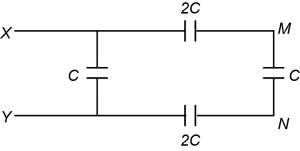
In the adjoining figure,the potential difference between $X$ and $Y$ is $60 \ V$. The potential difference between the points $M$ and $N$ will be: (in $V$)
A
$10$
B
$15$
C
$20$
D
$30$
Solution
(D) Let the potential difference across the capacitor $C$ (connected between $X$ and $Y$) be $V_{XY} = 60 \ V$.
The circuit consists of a capacitor $C$ in parallel with a series combination of capacitors $2C$,$C$,and $2C$.
Since the capacitors $2C$,$C$,and $2C$ are in series,the same charge $q$ flows through them.
The potential difference across the series branch is $V_{XY} = 60 \ V$.
The equivalent capacitance of the series branch is given by:
$\frac{1}{C_{eq}} = \frac{1}{2C} + \frac{1}{C} + \frac{1}{2C} = \frac{1+2+1}{2C} = \frac{4}{2C} = \frac{2}{C}$
So,$C_{eq} = \frac{C}{2}$.
The charge $q$ on each capacitor in the series branch is:
$q = C_{eq} \times V_{XY} = \frac{C}{2} \times 60 \ V = 30C$.
The potential difference between points $M$ and $N$ is the potential difference across the capacitor $C$ located between them.
$V_{MN} = \frac{q}{C} = \frac{30C}{C} = 30 \ V$.
The circuit consists of a capacitor $C$ in parallel with a series combination of capacitors $2C$,$C$,and $2C$.
Since the capacitors $2C$,$C$,and $2C$ are in series,the same charge $q$ flows through them.
The potential difference across the series branch is $V_{XY} = 60 \ V$.
The equivalent capacitance of the series branch is given by:
$\frac{1}{C_{eq}} = \frac{1}{2C} + \frac{1}{C} + \frac{1}{2C} = \frac{1+2+1}{2C} = \frac{4}{2C} = \frac{2}{C}$
So,$C_{eq} = \frac{C}{2}$.
The charge $q$ on each capacitor in the series branch is:
$q = C_{eq} \times V_{XY} = \frac{C}{2} \times 60 \ V = 30C$.
The potential difference between points $M$ and $N$ is the potential difference across the capacitor $C$ located between them.
$V_{MN} = \frac{q}{C} = \frac{30C}{C} = 30 \ V$.
0 likesView Solution
19
PhysicsEasyMCQWBJEE · 2012
Heat is produced at a rate given by $H$ in a resistor when it is connected across a supply of voltage $V$. If now the resistance of the resistor is doubled and the supply voltage is made $V / 3$,then the rate of production of heat in the resistor will be
A
$H / 18$
B
$H / 9$
C
$6 H$
D
$18 H$
Solution
(A) The rate of heat production (power) in a resistor is given by the formula $H = \frac{V^2}{R}$.
In the first case,the power is $H = \frac{V^2}{R}$.
In the second case,the new voltage is $V' = \frac{V}{3}$ and the new resistance is $R' = 2R$.
The new rate of heat production $H'$ is given by:
$H' = \frac{(V')^2}{R'} = \frac{(\frac{V}{3})^2}{2R} = \frac{\frac{V^2}{9}}{2R} = \frac{V^2}{18R}$.
Since $H = \frac{V^2}{R}$,we can substitute this into the equation:
$H' = \frac{H}{18}$.
In the first case,the power is $H = \frac{V^2}{R}$.
In the second case,the new voltage is $V' = \frac{V}{3}$ and the new resistance is $R' = 2R$.
The new rate of heat production $H'$ is given by:
$H' = \frac{(V')^2}{R'} = \frac{(\frac{V}{3})^2}{2R} = \frac{\frac{V^2}{9}}{2R} = \frac{V^2}{18R}$.
Since $H = \frac{V^2}{R}$,we can substitute this into the equation:
$H' = \frac{H}{18}$.
0 likesView Solution
20
PhysicsEasyMCQWBJEE · 2012
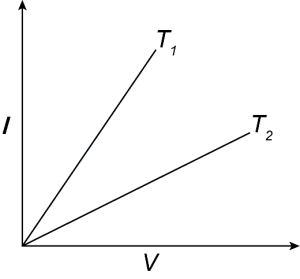
The $I-V$ characteristics of a metal wire at two different temperatures ($T_{1}$ and $T_{2}$) are given in the adjoining figure. Here,we can conclude that:
A
$T_{1} > T_{2}$
B
$T_{1} < T_{2}$
C
$T_{1} = T_{2}$
D
$T_{1} = 2T_{2}$
Solution
(B) For a metal wire,the resistance $R$ increases with an increase in temperature.
The slope of the $I-V$ graph is given by $\frac{I}{V} = \frac{1}{R}$.
From the figure,the slope of the line corresponding to $T_{1}$ is greater than the slope of the line corresponding to $T_{2}$.
Therefore,$\frac{1}{R_{1}} > \frac{1}{R_{2}}$,which implies $R_{1} < R_{2}$.
Since resistance increases with temperature,$R_{1} < R_{2}$ implies $T_{1} < T_{2}$.
The slope of the $I-V$ graph is given by $\frac{I}{V} = \frac{1}{R}$.
From the figure,the slope of the line corresponding to $T_{1}$ is greater than the slope of the line corresponding to $T_{2}$.
Therefore,$\frac{1}{R_{1}} > \frac{1}{R_{2}}$,which implies $R_{1} < R_{2}$.
Since resistance increases with temperature,$R_{1} < R_{2}$ implies $T_{1} < T_{2}$.
0 likesView Solution
21
PhysicsDifficultMCQWBJEE · 2012
An electric bulb marked as $50 W - 200 V$ is connected across a $100 V$ supply. The present power of the bulb is (in $W$)
A
$37.5$
B
$25$
C
$12.5$
D
$10$
Solution
(C) The resistance $R$ of the bulb is constant and is determined by its rated values:
$R = \frac{V_{rated}^2}{P_{rated}} = \frac{200^2}{50} = \frac{40000}{50} = 800 \, \Omega$
When connected to a new supply voltage $V' = 100 V$,the new power $P'$ consumed by the bulb is given by:
$P' = \frac{(V')^2}{R} = \frac{100^2}{800} = \frac{10000}{800} = 12.5 \, W$
Therefore,the present power of the bulb is $12.5 \, W$.
$R = \frac{V_{rated}^2}{P_{rated}} = \frac{200^2}{50} = \frac{40000}{50} = 800 \, \Omega$
When connected to a new supply voltage $V' = 100 V$,the new power $P'$ consumed by the bulb is given by:
$P' = \frac{(V')^2}{R} = \frac{100^2}{800} = \frac{10000}{800} = 12.5 \, W$
Therefore,the present power of the bulb is $12.5 \, W$.
0 likesView Solution
22
PhysicsMediumMCQWBJEE · 2012
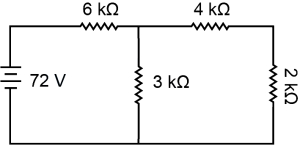
What current will flow through the $2 k\Omega$ resistor in the circuit shown in the figure (in $mA$)?
A
$3$
B
$6$
C
$12$
D
$36$
Solution
(A) First,find the equivalent resistance of the circuit. The $4 k\Omega$ and $2 k\Omega$ resistors are in series,so their equivalent resistance is $R_s = 4 k\Omega + 2 k\Omega = 6 k\Omega$.
This $6 k\Omega$ equivalent resistance is in parallel with the $3 k\Omega$ resistor. Their equivalent resistance $R_p$ is given by:
$\frac{1}{R_p} = \frac{1}{6 k\Omega} + \frac{1}{3 k\Omega} = \frac{1+2}{6 k\Omega} = \frac{3}{6 k\Omega} = \frac{1}{2 k\Omega}$
So,$R_p = 2 k\Omega$.
Now,the total resistance of the circuit is $R_{total} = 6 k\Omega + R_p = 6 k\Omega + 2 k\Omega = 8 k\Omega$.
The total current $I$ from the $72 V$ battery is:
$I = \frac{V}{R_{total}} = \frac{72 V}{8 k\Omega} = 9 mA$.
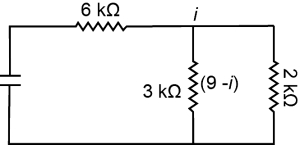
This current $I = 9 mA$ flows through the $6 k\Omega$ resistor and then splits at the junction into the $3 k\Omega$ branch and the branch containing the $4 k\Omega$ and $2 k\Omega$ resistors in series.
Let $i$ be the current through the $2 k\Omega$ resistor. The voltage across the parallel branches is the same:
$i \times (4 k\Omega + 2 k\Omega) = (I - i) \times 3 k\Omega$
$i \times 6 k\Omega = (9 mA - i) \times 3 k\Omega$
$2i = 9 mA - i$
$3i = 9 mA$
$i = 3 mA$.
This $6 k\Omega$ equivalent resistance is in parallel with the $3 k\Omega$ resistor. Their equivalent resistance $R_p$ is given by:
$\frac{1}{R_p} = \frac{1}{6 k\Omega} + \frac{1}{3 k\Omega} = \frac{1+2}{6 k\Omega} = \frac{3}{6 k\Omega} = \frac{1}{2 k\Omega}$
So,$R_p = 2 k\Omega$.
Now,the total resistance of the circuit is $R_{total} = 6 k\Omega + R_p = 6 k\Omega + 2 k\Omega = 8 k\Omega$.
The total current $I$ from the $72 V$ battery is:
$I = \frac{V}{R_{total}} = \frac{72 V}{8 k\Omega} = 9 mA$.
This current $I = 9 mA$ flows through the $6 k\Omega$ resistor and then splits at the junction into the $3 k\Omega$ branch and the branch containing the $4 k\Omega$ and $2 k\Omega$ resistors in series.
Let $i$ be the current through the $2 k\Omega$ resistor. The voltage across the parallel branches is the same:
$i \times (4 k\Omega + 2 k\Omega) = (I - i) \times 3 k\Omega$
$i \times 6 k\Omega = (9 mA - i) \times 3 k\Omega$
$2i = 9 mA - i$
$3i = 9 mA$
$i = 3 mA$.
0 likesView Solution
23
PhysicsEasyMCQWBJEE · 2012
$A$ Wheatstone bridge has the resistances $10 \Omega, 10 \Omega, 10 \Omega$ and $30 \Omega$ in its four arms. What resistance joined in parallel to the $30 \Omega$ resistance will bring it to the balanced condition (in $Omega$)?
A
$2$
B
$5$
C
$10$
D
$15$
Solution
(D) In a balanced Wheatstone bridge,the ratio of resistances in adjacent arms must be equal,i.e.,$\frac{P}{Q} = \frac{R}{S}$.
Let the four arms be $P = 10 \Omega$,$Q = 10 \Omega$,$R = 10 \Omega$,and $S = 30 \Omega$.
To balance the bridge,the effective resistance $S'$ in the fourth arm must satisfy $\frac{10}{10} = \frac{10}{S'}$,which gives $S' = 10 \Omega$.
Let a resistance $x$ be connected in parallel to the $30 \Omega$ resistor to make the equivalent resistance $10 \Omega$.
The formula for parallel resistance is $\frac{1}{S'} = \frac{1}{30} + \frac{1}{x}$.
Substituting the values: $\frac{1}{10} = \frac{1}{30} + \frac{1}{x}$.
$\frac{1}{x} = \frac{1}{10} - \frac{1}{30} = \frac{3-1}{30} = \frac{2}{30} = \frac{1}{15}$.
Therefore,$x = 15 \Omega$.
Let the four arms be $P = 10 \Omega$,$Q = 10 \Omega$,$R = 10 \Omega$,and $S = 30 \Omega$.
To balance the bridge,the effective resistance $S'$ in the fourth arm must satisfy $\frac{10}{10} = \frac{10}{S'}$,which gives $S' = 10 \Omega$.
Let a resistance $x$ be connected in parallel to the $30 \Omega$ resistor to make the equivalent resistance $10 \Omega$.
The formula for parallel resistance is $\frac{1}{S'} = \frac{1}{30} + \frac{1}{x}$.
Substituting the values: $\frac{1}{10} = \frac{1}{30} + \frac{1}{x}$.
$\frac{1}{x} = \frac{1}{10} - \frac{1}{30} = \frac{3-1}{30} = \frac{2}{30} = \frac{1}{15}$.
Therefore,$x = 15 \Omega$.
0 likesView Solution
24
PhysicsMediumMCQWBJEE · 2012
The de-Broglie wavelength of an electron moving with a velocity $v = c / 2$ ($c$ is the velocity of light in vacuum) is equal to the wavelength of a photon. The ratio of the kinetic energies of the electron and the photon is:
A
$1: 4$
B
$1: 2$
C
$1: 1$
D
$2: 1$
Solution
(A) The de-Broglie wavelength of an electron is given by $\lambda_e = \frac{h}{m_e v_e}$,where $v_e = c/2$. So,$\lambda_e = \frac{h}{m_e (c/2)} = \frac{2h}{m_e c}$.
For a photon,the wavelength is $\lambda_p = \frac{h}{p_p} = \frac{h}{E_p/c} = \frac{hc}{E_p}$,where $E_p$ is the energy of the photon.
Given $\lambda_e = \lambda_p$,we have $\frac{2h}{m_e c} = \frac{hc}{E_p}$.
This implies $E_p = \frac{m_e c^2}{2}$.
The kinetic energy of the electron is $K_e = \frac{1}{2} m_e v_e^2 = \frac{1}{2} m_e (c/2)^2 = \frac{1}{8} m_e c^2$.
The ratio of kinetic energies is $\frac{K_e}{E_p} = \frac{\frac{1}{8} m_e c^2}{\frac{1}{2} m_e c^2} = \frac{1}{4}$.
For a photon,the wavelength is $\lambda_p = \frac{h}{p_p} = \frac{h}{E_p/c} = \frac{hc}{E_p}$,where $E_p$ is the energy of the photon.
Given $\lambda_e = \lambda_p$,we have $\frac{2h}{m_e c} = \frac{hc}{E_p}$.
This implies $E_p = \frac{m_e c^2}{2}$.
The kinetic energy of the electron is $K_e = \frac{1}{2} m_e v_e^2 = \frac{1}{2} m_e (c/2)^2 = \frac{1}{8} m_e c^2$.
The ratio of kinetic energies is $\frac{K_e}{E_p} = \frac{\frac{1}{8} m_e c^2}{\frac{1}{2} m_e c^2} = \frac{1}{4}$.
0 likesView Solution
25
PhysicsEasyMCQWBJEE · 2012
When a certain metal surface is illuminated with light of frequency $v$,the stopping potential for photoelectric current is $V_{0}$. When the same surface is illuminated by light of frequency $\frac{v}{2}$,the stopping potential is $\frac{V_{0}}{4}$. The threshold frequency for photoelectric emission is:
A
$\frac{v}{6}$
B
$\frac{v}{3}$
C
$\frac{2v}{3}$
D
$\frac{4v}{3}$
Solution
(B) According to Einstein's photoelectric equation: $h\nu = h\nu_{0} + eV_{0}$,where $\nu_{0}$ is the threshold frequency.
For the first case:
$h\nu = h\nu_{0} + eV_{0}$ --- $(i)$
For the second case:
$h(\frac{\nu}{2}) = h\nu_{0} + e(\frac{V_{0}}{4})$ --- (ii)
From equation $(i)$,we have $eV_{0} = h\nu - h\nu_{0}$.
Substitute this into equation (ii):
$\frac{h\nu}{2} = h\nu_{0} + \frac{1}{4}(h\nu - h\nu_{0})$
Multiply the entire equation by $4$ to clear the denominator:
$2h\nu = 4h\nu_{0} + h\nu - h\nu_{0}$
$2h\nu = 3h\nu_{0} + h\nu$
$h\nu = 3h\nu_{0}$
$\nu_{0} = \frac{\nu}{3}$
For the first case:
$h\nu = h\nu_{0} + eV_{0}$ --- $(i)$
For the second case:
$h(\frac{\nu}{2}) = h\nu_{0} + e(\frac{V_{0}}{4})$ --- (ii)
From equation $(i)$,we have $eV_{0} = h\nu - h\nu_{0}$.
Substitute this into equation (ii):
$\frac{h\nu}{2} = h\nu_{0} + \frac{1}{4}(h\nu - h\nu_{0})$
Multiply the entire equation by $4$ to clear the denominator:
$2h\nu = 4h\nu_{0} + h\nu - h\nu_{0}$
$2h\nu = 3h\nu_{0} + h\nu$
$h\nu = 3h\nu_{0}$
$\nu_{0} = \frac{\nu}{3}$
0 likesView Solution
26
PhysicsEasyMCQWBJEE · 2012
The magnetic flux linked with a coil satisfies the relation $\phi = 4t^2 + 6t + 9 \text{ Wb}$, where $t$ is the time in seconds. The emf induced in the coil at $t = 2 \text{ s}$ is (in $\text{ V}$)
A
$22$
B
$18$
C
$16$
D
$40$
Solution
(A) Given the magnetic flux $\phi = 4t^2 + 6t + 9 \text{ Wb}$.
According to Faraday's law of electromagnetic induction, the induced emf $\varepsilon$ is given by $\varepsilon = -\frac{d\phi}{dt}$.
Taking the magnitude, $\varepsilon = \left| \frac{d\phi}{dt} \right|$.
Differentiating $\phi$ with respect to $t$:
$\frac{d\phi}{dt} = \frac{d}{dt}(4t^2 + 6t + 9) = 8t + 6$.
At $t = 2 \text{ s}$, the induced emf is:
$\varepsilon = 8(2) + 6 = 16 + 6 = 22 \text{ V}$.
According to Faraday's law of electromagnetic induction, the induced emf $\varepsilon$ is given by $\varepsilon = -\frac{d\phi}{dt}$.
Taking the magnitude, $\varepsilon = \left| \frac{d\phi}{dt} \right|$.
Differentiating $\phi$ with respect to $t$:
$\frac{d\phi}{dt} = \frac{d}{dt}(4t^2 + 6t + 9) = 8t + 6$.
At $t = 2 \text{ s}$, the induced emf is:
$\varepsilon = 8(2) + 6 = 16 + 6 = 22 \text{ V}$.
0 likesView Solution
27
PhysicsMediumMCQWBJEE · 2012
Two infinite parallel metal planes contain electric charges with charge densities $+\sigma$ and $-\sigma$ respectively,and they are separated by a small distance in air. If the permittivity of air is $\varepsilon_{0}$,then the magnitude of the field between the two planes with its direction will be:
A
$\sigma / \varepsilon_{0}$ towards the positively charged plane
B
$\sigma / \varepsilon_{0}$ towards the negatively charged plane
C
$\sigma / (2 \varepsilon_{0})$ towards the positively charged plane
D
$0$ and towards any direction
Solution
(B) The electric field due to an infinite plane sheet of charge with surface charge density $\sigma$ is given by $E = \frac{\sigma}{2\varepsilon_{0}}$.
For the positively charged plane $(+\sigma)$,the electric field $E_{+}$ points away from the plane.
For the negatively charged plane $(-\sigma)$,the electric field $E_{-}$ points towards the plane.
Between the two planes,both fields point in the same direction,i.e.,from the positive plane to the negative plane.
Therefore,the net electric field $E_{net} = E_{+} + E_{-} = \frac{\sigma}{2\varepsilon_{0}} + \frac{\sigma}{2\varepsilon_{0}} = \frac{\sigma}{\varepsilon_{0}}$.
The direction is from the positive plane towards the negative plane.
For the positively charged plane $(+\sigma)$,the electric field $E_{+}$ points away from the plane.
For the negatively charged plane $(-\sigma)$,the electric field $E_{-}$ points towards the plane.
Between the two planes,both fields point in the same direction,i.e.,from the positive plane to the negative plane.
Therefore,the net electric field $E_{net} = E_{+} + E_{-} = \frac{\sigma}{2\varepsilon_{0}} + \frac{\sigma}{2\varepsilon_{0}} = \frac{\sigma}{\varepsilon_{0}}$.
The direction is from the positive plane towards the negative plane.
0 likesView Solution
28
PhysicsEasyMCQWBJEE · 2012
In a region,the intensity of an electric field is given by $E = 2i + 3j + k$ in $NC^{-1}$. The electric flux through a surface $S = 10i \ m^2$ in the region is
A
$5 \ Nm^2 C^{-1}$
B
$10 \ Nm^2 C^{-1}$
C
$15 \ Nm^2 C^{-1}$
D
$20 \ Nm^2 C^{-1}$
Solution
(D) Given,electric field intensity $E = (2i + 3j + k) \ NC^{-1}$.
Area vector $S = 10i \ m^2$.
The electric flux $\phi$ through a surface is defined by the dot product of the electric field vector and the area vector:
$\phi = E \cdot S$
Substituting the given values:
$\phi = (2i + 3j + k) \cdot (10i)$
Since $i \cdot i = 1$,$j \cdot i = 0$,and $k \cdot i = 0$:
$\phi = (2 \times 10) + (3 \times 0) + (1 \times 0)$
$\phi = 20 \ Nm^2 C^{-1}$.
Area vector $S = 10i \ m^2$.
The electric flux $\phi$ through a surface is defined by the dot product of the electric field vector and the area vector:
$\phi = E \cdot S$
Substituting the given values:
$\phi = (2i + 3j + k) \cdot (10i)$
Since $i \cdot i = 1$,$j \cdot i = 0$,and $k \cdot i = 0$:
$\phi = (2 \times 10) + (3 \times 0) + (1 \times 0)$
$\phi = 20 \ Nm^2 C^{-1}$.
0 likesView Solution
29
PhysicsMediumMCQWBJEE · 2012
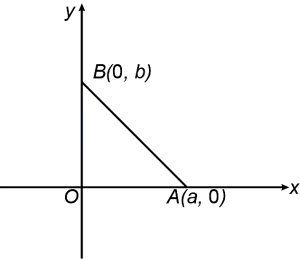
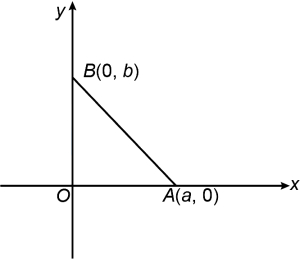
$A$ charge $+q$ is placed at the origin $O$ of $X-Y$ axes as shown in the figure. The work done in taking a charge $Q$ from $A$ to $B$ along the straight line $AB$ is
A
$\frac{q Q}{4 \pi \varepsilon_{0}}\left(\frac{a-b}{a b}\right)$
B
$\frac{q Q}{4 \pi \varepsilon_{0}}\left(\frac{b-a}{a b}\right)$
C
$\frac{q Q}{4 \pi \varepsilon_{0}}\left(\frac{b}{a^{2}}-\frac{1}{b}\right)$
D
$\frac{q Q}{4 \pi \varepsilon_{0}}\left(\frac{a}{b^{2}}-\frac{1}{b}\right)$
Solution
(A) The electric potential $V$ at a distance $r$ from a point charge $q$ is given by $V = \frac{q}{4 \pi \varepsilon_{0} r}$.
Since the electric field is conservative,the work done in moving a charge $Q$ from point $A$ to point $B$ is independent of the path and is given by $W = Q(V_B - V_A)$.
The potential at point $A(a, 0)$ is $V_A = \frac{q}{4 \pi \varepsilon_{0} a}$.
The potential at point $B(0, b)$ is $V_B = \frac{q}{4 \pi \varepsilon_{0} b}$.
Therefore,the work done is $W = Q \left( \frac{q}{4 \pi \varepsilon_{0} b} - \frac{q}{4 \pi \varepsilon_{0} a} \right)$.
$W = \frac{q Q}{4 \pi \varepsilon_{0}} \left( \frac{1}{b} - \frac{1}{a} \right) = \frac{q Q}{4 \pi \varepsilon_{0}} \left( \frac{a - b}{a b} \right)$.
Since the electric field is conservative,the work done in moving a charge $Q$ from point $A$ to point $B$ is independent of the path and is given by $W = Q(V_B - V_A)$.
The potential at point $A(a, 0)$ is $V_A = \frac{q}{4 \pi \varepsilon_{0} a}$.
The potential at point $B(0, b)$ is $V_B = \frac{q}{4 \pi \varepsilon_{0} b}$.
Therefore,the work done is $W = Q \left( \frac{q}{4 \pi \varepsilon_{0} b} - \frac{q}{4 \pi \varepsilon_{0} a} \right)$.
$W = \frac{q Q}{4 \pi \varepsilon_{0}} \left( \frac{1}{b} - \frac{1}{a} \right) = \frac{q Q}{4 \pi \varepsilon_{0}} \left( \frac{a - b}{a b} \right)$.
0 likesView Solution
30
PhysicsEasyMCQWBJEE · 2012
$A$ straight wire of length $2 \ m$ carries a current of $10 \ A$. If this wire is placed in a uniform magnetic field of $0.15 \ T$ making an angle of $45^{\circ}$ with the magnetic field,the applied force on the wire will be
A
$1.5 \ N$
B
$3 \ N$
C
$3 \sqrt{2} \ N$
D
$\frac{3}{\sqrt{2}} \ N$
Solution
(D) The force $F$ on a current-carrying wire in a magnetic field is given by the formula $F = I L B \sin \theta$.
Given values are:
Current $I = 10 \ A$
Length $L = 2 \ m$
Magnetic field $B = 0.15 \ T$
Angle $\theta = 45^{\circ}$
Substituting these values into the formula:
$F = 10 \times 2 \times 0.15 \times \sin 45^{\circ}$
$F = 3 \times \frac{1}{\sqrt{2}}$
$F = \frac{3}{\sqrt{2}} \ N$.
Given values are:
Current $I = 10 \ A$
Length $L = 2 \ m$
Magnetic field $B = 0.15 \ T$
Angle $\theta = 45^{\circ}$
Substituting these values into the formula:
$F = 10 \times 2 \times 0.15 \times \sin 45^{\circ}$
$F = 3 \times \frac{1}{\sqrt{2}}$
$F = \frac{3}{\sqrt{2}} \ N$.
0 likesView Solution
31
PhysicsEasyMCQWBJEE · 2012
$A$ magnetic needle is placed in a uniform magnetic field and is aligned with the field. The needle is now rotated by an angle of $60^{\circ}$ and the work done is $W$. The torque on the magnetic needle at this position is
A
$2 \sqrt{3} W$
B
$\sqrt{3} W$
C
$\frac{\sqrt{3}}{2} W$
D
$\frac{\sqrt{3}}{4} W$
Solution
(B) The work done in rotating a magnetic dipole in a uniform magnetic field is given by $W = MB(1 - \cos \theta)$.
Given $\theta = 60^{\circ}$,we have:
$W = MB(1 - \cos 60^{\circ}) = MB(1 - 0.5) = \frac{MB}{2}$.
Therefore,$MB = 2W$.
The torque $\tau$ on the magnetic needle is given by $\tau = MB \sin \theta$.
Substituting the values,$\tau = (2W) \sin 60^{\circ} = 2W \times \frac{\sqrt{3}}{2} = \sqrt{3} W$.
Given $\theta = 60^{\circ}$,we have:
$W = MB(1 - \cos 60^{\circ}) = MB(1 - 0.5) = \frac{MB}{2}$.
Therefore,$MB = 2W$.
The torque $\tau$ on the magnetic needle is given by $\tau = MB \sin \theta$.
Substituting the values,$\tau = (2W) \sin 60^{\circ} = 2W \times \frac{\sqrt{3}}{2} = \sqrt{3} W$.
0 likesView Solution
32
PhysicsMediumMCQWBJEE · 2012
Two radioactive substances $A$ and $B$ have decay constants $5 \lambda$ and $\lambda$ respectively. At $t=0$,they have the same number of nuclei. The ratio of the number of nuclei of $A$ to that of $B$ will be $(1/e)^2$ after a time interval of:
A
$\frac{1}{\lambda}$
B
$\frac{1}{2 \lambda}$
C
$\frac{1}{3 \lambda}$
D
$\frac{1}{4 \lambda}$
Solution
(B) The number of nuclei remaining at time $t$ is given by $N(t) = N_0 e^{-\lambda t}$.
For substance $A$,$N_A = N_0 e^{-5 \lambda t}$.
For substance $B$,$N_B = N_0 e^{-\lambda t}$.
Given the ratio $\frac{N_A}{N_B} = (1/e)^2 = e^{-2}$.
Substituting the expressions:
$\frac{N_0 e^{-5 \lambda t}}{N_0 e^{-\lambda t}} = e^{-2}$
$e^{-5 \lambda t + \lambda t} = e^{-2}$
$e^{-4 \lambda t} = e^{-2}$
Equating the exponents:
$-4 \lambda t = -2$
$t = \frac{2}{4 \lambda} = \frac{1}{2 \lambda}$.
For substance $A$,$N_A = N_0 e^{-5 \lambda t}$.
For substance $B$,$N_B = N_0 e^{-\lambda t}$.
Given the ratio $\frac{N_A}{N_B} = (1/e)^2 = e^{-2}$.
Substituting the expressions:
$\frac{N_0 e^{-5 \lambda t}}{N_0 e^{-\lambda t}} = e^{-2}$
$e^{-5 \lambda t + \lambda t} = e^{-2}$
$e^{-4 \lambda t} = e^{-2}$
Equating the exponents:
$-4 \lambda t = -2$
$t = \frac{2}{4 \lambda} = \frac{1}{2 \lambda}$.
0 likesView Solution
33
PhysicsMediumMCQWBJEE · 2012
An object placed in front of a concave mirror at a distance of $x \ cm$ from the pole gives a $3$ times magnified real image. If it is moved to a distance of $(x+5) \ cm$, the magnification of the image becomes $2$. The focal length of the mirror is: (in $cm$)
A
$15$
B
$20$
C
$25$
D
$30$
Solution
(D) For a concave mirror, the magnification $m$ for a real image is negative, so $m = -3$ and $m = -2$.
Using the mirror formula $\frac{1}{v} + \frac{1}{u} = \frac{1}{f}$ and magnification $m = -\frac{v}{u}$, we have $v = -mu$.
Case $1$: $u_1 = -x$, $m_1 = -3$, so $v_1 = -(-3)(-x) = -3x$.
$\frac{1}{-3x} + \frac{1}{-x} = \frac{1}{f} \implies \frac{-1-3}{3x} = \frac{1}{f} \implies \frac{1}{f} = \frac{-4}{3x} \quad (i)$
Case $2$: $u_2 = -(x+5)$, $m_2 = -2$, so $v_2 = -(-2)(-(x+5)) = -2(x+5)$.
$\frac{1}{-2(x+5)} + \frac{1}{-(x+5)} = \frac{1}{f} \implies \frac{-1-2}{2(x+5)} = \frac{1}{f} \implies \frac{1}{f} = \frac{-3}{2(x+5)} \quad (ii)$
Equating $(i)$ and $(ii)$:
$\frac{-4}{3x} = \frac{-3}{2(x+5)} \implies 8(x+5) = 9x \implies 8x + 40 = 9x \implies x = 40 \ cm$.
Substituting $x = 40$ into $(i)$:
$\frac{1}{f} = \frac{-4}{3(40)} = \frac{-4}{120} = \frac{-1}{30} \implies f = -30 \ cm$.
The magnitude of the focal length is $30 \ cm$.
Using the mirror formula $\frac{1}{v} + \frac{1}{u} = \frac{1}{f}$ and magnification $m = -\frac{v}{u}$, we have $v = -mu$.
Case $1$: $u_1 = -x$, $m_1 = -3$, so $v_1 = -(-3)(-x) = -3x$.
$\frac{1}{-3x} + \frac{1}{-x} = \frac{1}{f} \implies \frac{-1-3}{3x} = \frac{1}{f} \implies \frac{1}{f} = \frac{-4}{3x} \quad (i)$
Case $2$: $u_2 = -(x+5)$, $m_2 = -2$, so $v_2 = -(-2)(-(x+5)) = -2(x+5)$.
$\frac{1}{-2(x+5)} + \frac{1}{-(x+5)} = \frac{1}{f} \implies \frac{-1-2}{2(x+5)} = \frac{1}{f} \implies \frac{1}{f} = \frac{-3}{2(x+5)} \quad (ii)$
Equating $(i)$ and $(ii)$:
$\frac{-4}{3x} = \frac{-3}{2(x+5)} \implies 8(x+5) = 9x \implies 8x + 40 = 9x \implies x = 40 \ cm$.
Substituting $x = 40$ into $(i)$:
$\frac{1}{f} = \frac{-4}{3(40)} = \frac{-4}{120} = \frac{-1}{30} \implies f = -30 \ cm$.
The magnitude of the focal length is $30 \ cm$.
0 likesView Solution
34
PhysicsEasyMCQWBJEE · 2012
If the velocity of light in vacuum is $3 \times 10^{8} \text{ m/s}$,the time taken (in nanoseconds) to travel through a glass plate of thickness $10 \text{ cm}$ and refractive index $1.5$ is:
A
$0.5$
B
$1$
C
$2$
D
$3$
Solution
(A) Given: Velocity of light in vacuum $(c)$ = $3 \times 10^{8} \text{ m/s}$,thickness of glass plate $(d)$ = $10 \text{ cm} = 0.1 \text{ m}$,and refractive index $(\mu)$ = $1.5$.
The velocity of light in the glass plate $(v)$ is given by $v = \frac{c}{\mu} = \frac{3 \times 10^{8}}{1.5} = 2 \times 10^{8} \text{ m/s}$.
The time taken $(t)$ to travel through the glass plate is $t = \frac{d}{v}$.
Substituting the values: $t = \frac{0.1 \text{ m}}{2 \times 10^{8} \text{ m/s}} = 0.05 \times 10^{-8} \text{ s} = 0.5 \times 10^{-9} \text{ s}$.
Since $1 \text{ nanosecond} = 10^{-9} \text{ s}$,the time taken is $0.5 \text{ ns}$.
The velocity of light in the glass plate $(v)$ is given by $v = \frac{c}{\mu} = \frac{3 \times 10^{8}}{1.5} = 2 \times 10^{8} \text{ m/s}$.
The time taken $(t)$ to travel through the glass plate is $t = \frac{d}{v}$.
Substituting the values: $t = \frac{0.1 \text{ m}}{2 \times 10^{8} \text{ m/s}} = 0.05 \times 10^{-8} \text{ s} = 0.5 \times 10^{-9} \text{ s}$.
Since $1 \text{ nanosecond} = 10^{-9} \text{ s}$,the time taken is $0.5 \text{ ns}$.
0 likesView Solution
Vedclass Products
For Students
Vedclass Test Series
Mock tests in real WBJEE style covering Physics with performance analysis. 5-day free trial.
Start Free TrialFor Teachers
Exam Paper Generator
Generate Set A/B/C/D Physics papers from 7.5L+ questions in 2 minutes. 3 chapters free.
Try FreeFor Institutes
Online Exam Module
Run live WBJEE mock exams with unlimited students, 360° analytics & white-label branding.
See DemoFrequently Asked Questions
How many Physics questions are in WBJEE 2012?
There are 34 Physics questions from the WBJEE 2012 paper on Vedclass, each with a detailed step-by-step solution in English.
Are WBJEE 2012 Physics solutions available in English?
Yes. All solutions on this page are in English. You can also switch to English or Hindi using the language buttons above the questions.
Can I practice WBJEE 2012 Physics as a timed test?
Yes. Use the Vedclass Test Series to attempt a full WBJEE mock test covering Physics with time limits and instant score analysis.
Can teachers create Physics papers from WBJEE previous year questions?
Yes. The Vedclass Exam Paper Generator lets teachers mix WBJEE Physics questions and generate Set A/B/C/D papers in minutes.
For Teachers & Institutes
Build a Custom Physics Paper
Pick WBJEE 2012 Physics questions, set difficulty, and generate Set A/B/C/D in 2 minutes.