
ChemistryQ51–150 of 241 questions
Page 2 of 3 · English
51
ChemistryMCQTS EAMCET · 2024
The internal and external diameters of a hollow cylinder measured with vernier calipers are $(5.73 \pm 0.01) \text{ cm}$ and $(6.01 \pm 0.01) \text{ cm}$ respectively. Then the thickness of the cylinder wall is
A
$(0.28 \pm 0.01) \text{ cm}$
B
$(0.28 \pm 0.02) \text{ cm}$
C
$(0.14 \pm 0.02) \text{ cm}$
D
$(0.14 \pm 0.01) \text{ cm}$
Solution
(D) Given:
Internal diameter $d = (5.73 \pm 0.01) \text{ cm}$
External diameter $D = (6.01 \pm 0.01) \text{ cm}$
The thickness $t$ of the cylinder wall is given by the formula:
$t = \frac{D - d}{2}$
First,calculate the mean value:
$t_{\text{mean}} = \frac{6.01 - 5.73}{2} = \frac{0.28}{2} = 0.14 \text{ cm}$
Next,calculate the uncertainty in thickness:
Since the thickness involves subtraction,the absolute errors add up:
$\Delta t = \frac{\Delta D + \Delta d}{2} = \frac{0.01 + 0.01}{2} = \frac{0.02}{2} = 0.01 \text{ cm}$
Therefore,the thickness is $(0.14 \pm 0.01) \text{ cm}$.
Internal diameter $d = (5.73 \pm 0.01) \text{ cm}$
External diameter $D = (6.01 \pm 0.01) \text{ cm}$
The thickness $t$ of the cylinder wall is given by the formula:
$t = \frac{D - d}{2}$
First,calculate the mean value:
$t_{\text{mean}} = \frac{6.01 - 5.73}{2} = \frac{0.28}{2} = 0.14 \text{ cm}$
Next,calculate the uncertainty in thickness:
Since the thickness involves subtraction,the absolute errors add up:
$\Delta t = \frac{\Delta D + \Delta d}{2} = \frac{0.01 + 0.01}{2} = \frac{0.02}{2} = 0.01 \text{ cm}$
Therefore,the thickness is $(0.14 \pm 0.01) \text{ cm}$.
0 likesView Solution
52
ChemistryDifficultMCQTS EAMCET · 2024
The $IUPAC$ name of the following compound is:
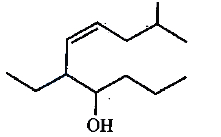
A
$6-$ethyl$-2-$methyldec$-4-$en$-7-$ol
B
$2-$methyl$-6-$ethyldec$-4-$en$-7-$ol
C
$5-$ethyl$-9-$methyldec$-6-$en$-4-$ol
D
$9-$methyl$-5-$ethyldec$-6-$en$-4-$ol
Solution
(B) $1$. Identify the longest carbon chain containing the principal functional group $(-OH)$ and the double bond. The chain has $10$ carbons,so the parent alkane is decane.
$2$. Number the chain to give the lowest possible locants to the functional group $(-OH)$,then the double bond,and finally the substituents.
$3$. Starting from the right,the $-OH$ group is at $C-4$,the double bond starts at $C-6$,and the ethyl group is at $C-5$. However,the standard $IUPAC$ numbering gives the $-OH$ group the lowest locant $4$.
$4$. Following the numbering shown in the provided solution image: the $-OH$ group is at $C-7$,the double bond is at $C-4$,and the methyl group is at $C-2$.
$5$. The correct $IUPAC$ name is $2-$methyl$-6-$ethyldec$-4-$en$-7-$ol.
$2$. Number the chain to give the lowest possible locants to the functional group $(-OH)$,then the double bond,and finally the substituents.
$3$. Starting from the right,the $-OH$ group is at $C-4$,the double bond starts at $C-6$,and the ethyl group is at $C-5$. However,the standard $IUPAC$ numbering gives the $-OH$ group the lowest locant $4$.
$4$. Following the numbering shown in the provided solution image: the $-OH$ group is at $C-7$,the double bond is at $C-4$,and the methyl group is at $C-2$.
$5$. The correct $IUPAC$ name is $2-$methyl$-6-$ethyldec$-4-$en$-7-$ol.
0 likesView Solution
53
ChemistryMediumMCQTS EAMCET · 2024
The correct $IUPAC$ name of the structure given below is
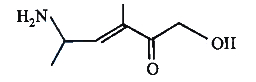
A
$5-$Amino$-1-$hydroxy$-3-$methylhex$-3-$en$-2-$one
B
$4-$Amino$-2-$methylpentanoic acid
C
$5-$Amino$-3-$methyl$-2-$oxohex$-3-$en$-1-$ol
D
$2-$Amino$-6-$hydroxy$-5-$keto$-4-$methyl$-3-$hexene
Solution
(A) $1$. Identify the principal functional group: The molecule contains an amino group $(-NH_2)$,a ketone group $(>C=O)$,and a hydroxyl group $(-OH)$. According to $IUPAC$ priority rules,the ketone group has higher priority than the alcohol and amine groups. Therefore,the suffix will be '-one'.
$2$. Select the longest carbon chain containing the principal functional group: The longest chain containing the ketone group has $6$ carbons.
$3$. Number the chain: Numbering should start from the end that gives the ketone group the lowest possible locant. Numbering from right to left,the ketone is at position $2$. The chain is numbered as follows: $C_1(H_2OH)-C_2(=O)-C_3(CH_3)=C_4(H)-C_5(H, NH_2)-C_6(H_3)$.
$4$. Identify substituents and their positions: There is an amino group at position $5$,a methyl group at position $3$,and a hydroxy group at position $1$.
$5$. Assemble the name: Combining these,we get $5-$amino$-1-$hydroxy$-3-$methylhex$-3-$en$-2-$one.
$2$. Select the longest carbon chain containing the principal functional group: The longest chain containing the ketone group has $6$ carbons.
$3$. Number the chain: Numbering should start from the end that gives the ketone group the lowest possible locant. Numbering from right to left,the ketone is at position $2$. The chain is numbered as follows: $C_1(H_2OH)-C_2(=O)-C_3(CH_3)=C_4(H)-C_5(H, NH_2)-C_6(H_3)$.
$4$. Identify substituents and their positions: There is an amino group at position $5$,a methyl group at position $3$,and a hydroxy group at position $1$.
$5$. Assemble the name: Combining these,we get $5-$amino$-1-$hydroxy$-3-$methylhex$-3-$en$-2-$one.
0 likesView Solution
54
ChemistryEasyMCQTS EAMCET · 2024
In which of the following options,the $IUPAC$ name is not correctly matched with the structure of the compound?
A
$3, 4-$Dimethylphenol
B
$4-$Chloro$-1, 3-$dinitrobenzene
C
$2-$Chloro$-1-$methyl$-4-$nitrobenzene
D
$4-$Ethyl$-2-$methylaniline
Solution
(B) Let us analyze each option:
$A$: The structure shows a phenol ring with methyl groups at positions $3$ and $4$. This is $3, 4-$dimethylphenol. This is correct.
$B$: The structure shows a benzene ring with a chlorine atom at position $1$ and nitro groups at positions $2$ and $4$. The $IUPAC$ name should be $1-$chloro$-2, 4-$dinitrobenzene. The given name $4-$chloro$-1, 3-$dinitrobenzene is incorrect.
$C$: The structure shows a benzene ring with a methyl group at position $1$,a chlorine atom at position $2$,and a nitro group at position $4$. This is $2-$chloro$-1-$methyl$-4-$nitrobenzene. This is correct.
$D$: The structure shows an aniline ring with a methyl group at position $2$ and an ethyl group at position $4$. This is $4-$ethyl$-2-$methylaniline. This is correct.
Therefore,the option that is not correctly matched is $B$.
$A$: The structure shows a phenol ring with methyl groups at positions $3$ and $4$. This is $3, 4-$dimethylphenol. This is correct.
$B$: The structure shows a benzene ring with a chlorine atom at position $1$ and nitro groups at positions $2$ and $4$. The $IUPAC$ name should be $1-$chloro$-2, 4-$dinitrobenzene. The given name $4-$chloro$-1, 3-$dinitrobenzene is incorrect.
$C$: The structure shows a benzene ring with a methyl group at position $1$,a chlorine atom at position $2$,and a nitro group at position $4$. This is $2-$chloro$-1-$methyl$-4-$nitrobenzene. This is correct.
$D$: The structure shows an aniline ring with a methyl group at position $2$ and an ethyl group at position $4$. This is $4-$ethyl$-2-$methylaniline. This is correct.
Therefore,the option that is not correctly matched is $B$.
0 likesView Solution
55
ChemistryEasyMCQTS EAMCET · 2024
Consider the following carbocations:
$I. C_6H_5CH_2^+$
$II. CH_2=CH^+$
$III. CH_3-CH^+(CH_3)$
$IV. CH_3-CH_2^+$
$V. HC \equiv C^+$
Arrange the above carbocations in the order of decreasing stability.
$I. C_6H_5CH_2^+$
$II. CH_2=CH^+$
$III. CH_3-CH^+(CH_3)$
$IV. CH_3-CH_2^+$
$V. HC \equiv C^+$
Arrange the above carbocations in the order of decreasing stability.
A
$I > III > IV > II > V$
B
$V > II > IV > III > I$
C
$V > II > III > I > IV$
D
$II > III > IV > V > I$
Solution
(A) The stability of carbocations is determined by resonance,hyperconjugation,and inductive effects.
$I$ $(C_6H_5CH_2^+)$ is a benzylic carbocation,which is highly stabilized by resonance with the phenyl ring.
$III$ $(CH_3-CH^+(CH_3))$ is a secondary $(2^{\circ})$ carbocation,stabilized by hyperconjugation and inductive effects of two methyl groups.
$IV$ $(CH_3-CH_2^+)$ is a primary $(1^{\circ})$ carbocation,stabilized by hyperconjugation and inductive effects of one methyl group.
$II$ $(CH_2=CH^+)$ is a vinylic carbocation,and $V$ $(HC \equiv C^+)$ is an acetylenic carbocation. Both have the positive charge on an $sp^2$ and $sp$ hybridized carbon,respectively. Higher $s$-character increases electronegativity,making the positive charge less stable.
Since $sp$ hybridization ($50\% \ s$-character) is more electronegative than $sp^2$ hybridization ($33.3\% \ s$-character),$V$ is less stable than $II$.
Thus,the decreasing order of stability is $I > III > IV > II > V$.
$I$ $(C_6H_5CH_2^+)$ is a benzylic carbocation,which is highly stabilized by resonance with the phenyl ring.
$III$ $(CH_3-CH^+(CH_3))$ is a secondary $(2^{\circ})$ carbocation,stabilized by hyperconjugation and inductive effects of two methyl groups.
$IV$ $(CH_3-CH_2^+)$ is a primary $(1^{\circ})$ carbocation,stabilized by hyperconjugation and inductive effects of one methyl group.
$II$ $(CH_2=CH^+)$ is a vinylic carbocation,and $V$ $(HC \equiv C^+)$ is an acetylenic carbocation. Both have the positive charge on an $sp^2$ and $sp$ hybridized carbon,respectively. Higher $s$-character increases electronegativity,making the positive charge less stable.
Since $sp$ hybridization ($50\% \ s$-character) is more electronegative than $sp^2$ hybridization ($33.3\% \ s$-character),$V$ is less stable than $II$.
Thus,the decreasing order of stability is $I > III > IV > II > V$.
0 likesView Solution
56
ChemistryEasyMCQTS EAMCET · 2024
The electron displacement effect observed in the given structures is known as
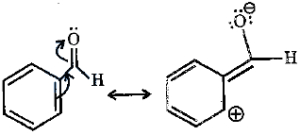
A
$+R$ effect
B
$-R$ effect
C
Electromeric effect
D
$-I$ effect
Solution
(B) The $CHO$ (aldehyde) group attached to the benzene ring is an electron-withdrawing group.
In the given structures,the $\pi$-electrons of the benzene ring are delocalized towards the oxygen atom of the $CHO$ group.
This type of electron displacement,where the substituent withdraws electron density from the conjugated system through resonance,is known as the $-R$ effect (or $-M$ effect).
In the given structures,the $\pi$-electrons of the benzene ring are delocalized towards the oxygen atom of the $CHO$ group.
This type of electron displacement,where the substituent withdraws electron density from the conjugated system through resonance,is known as the $-R$ effect (or $-M$ effect).
0 likesView Solution
57
ChemistryMediumMCQTS EAMCET · 2024
The possible number of isomers including stereoisomers for an organic compound with the molecular formula $C_4H_9Br$ is
A
$3$
B
$4$
C
$5$
D
$8$
Solution
(C) The structural isomers for $C_4H_9Br$ are:
$1$. $CH_3CH_2CH_2CH_2Br$ ($1$-bromobutane)
$2$. $CH_3CH_2CH(Br)CH_3$ ($2$-bromobutane)
$3$. $(CH_3)_2CHCH_2Br$ ($1$-bromo-$2$-methylpropane)
$4$. $(CH_3)_3CBr$ ($2$-bromo-$2$-methylpropane)
Among these,$2$-bromobutane $(CH_3CH_2CH(Br)CH_3)$ has a chiral center at the $C_2$ position,meaning it exists as a pair of enantiomers ($R$ and $S$ configurations).
Therefore,the total number of isomers including stereoisomers is $4$ structural isomers + $1$ additional enantiomer = $5$ isomers.
$1$. $CH_3CH_2CH_2CH_2Br$ ($1$-bromobutane)
$2$. $CH_3CH_2CH(Br)CH_3$ ($2$-bromobutane)
$3$. $(CH_3)_2CHCH_2Br$ ($1$-bromo-$2$-methylpropane)
$4$. $(CH_3)_3CBr$ ($2$-bromo-$2$-methylpropane)
Among these,$2$-bromobutane $(CH_3CH_2CH(Br)CH_3)$ has a chiral center at the $C_2$ position,meaning it exists as a pair of enantiomers ($R$ and $S$ configurations).
Therefore,the total number of isomers including stereoisomers is $4$ structural isomers + $1$ additional enantiomer = $5$ isomers.
0 likesView Solution
58
ChemistryMCQTS EAMCET · 2024
If a body dropped freely from a height of $20 ~m$ reaches the surface of a planet with a velocity of $31.4 ~ms^{-1}$,then the length of a simple pendulum that ticks seconds on the planet is (in $~m$)
A
$1$
B
$0.625$
C
$2.5$
D
$2$
Solution
(C) Given: Height $h = 20 ~m$,final velocity $v = 31.4 ~ms^{-1}$.
Using the equation of motion $v^2 = u^2 + 2gh$,where initial velocity $u = 0$:
$v^2 = 2gh$
$g = \frac{v^2}{2h} = \frac{31.4 \times 31.4}{2 \times 20} = \frac{985.96}{40} \approx 24.65 ~ms^{-2}$.
Note that $31.4 \approx 10\pi$,so $g = \frac{(10\pi)^2}{40} = \frac{100\pi^2}{40} = 2.5\pi^2 ~ms^{-2}$.
For a seconds pendulum,the time period $T = 2 ~s$.
The formula for the time period of a simple pendulum is $T = 2\pi \sqrt{\frac{l}{g}}$.
Squaring both sides: $T^2 = 4\pi^2 \frac{l}{g} \Rightarrow l = \frac{T^2 g}{4\pi^2}$.
Substituting $T = 2 ~s$ and $g = 2.5\pi^2 ~ms^{-2}$:
$l = \frac{2^2 \times 2.5\pi^2}{4\pi^2} = \frac{4 \times 2.5\pi^2}{4\pi^2} = 2.5 ~m$.
Using the equation of motion $v^2 = u^2 + 2gh$,where initial velocity $u = 0$:
$v^2 = 2gh$
$g = \frac{v^2}{2h} = \frac{31.4 \times 31.4}{2 \times 20} = \frac{985.96}{40} \approx 24.65 ~ms^{-2}$.
Note that $31.4 \approx 10\pi$,so $g = \frac{(10\pi)^2}{40} = \frac{100\pi^2}{40} = 2.5\pi^2 ~ms^{-2}$.
For a seconds pendulum,the time period $T = 2 ~s$.
The formula for the time period of a simple pendulum is $T = 2\pi \sqrt{\frac{l}{g}}$.
Squaring both sides: $T^2 = 4\pi^2 \frac{l}{g} \Rightarrow l = \frac{T^2 g}{4\pi^2}$.
Substituting $T = 2 ~s$ and $g = 2.5\pi^2 ~ms^{-2}$:
$l = \frac{2^2 \times 2.5\pi^2}{4\pi^2} = \frac{4 \times 2.5\pi^2}{4\pi^2} = 2.5 ~m$.
0 likesView Solution
59
ChemistryMCQTS EAMCET · 2024
Two stars of masses $M$ and $2M$ are at a distance $d$ apart and are revolving around their common center of mass. The angular velocity of the system of two stars is ($G$ is the universal gravitational constant):
A
$\sqrt{\frac{4GM}{d^3}}$
B
$\sqrt{\frac{2GM}{d^3}}$
C
$\sqrt{\frac{9GM}{d^3}}$
D
$\sqrt{\frac{3GM}{d^3}}$
Solution
(D) Let the distances of the stars of masses $M$ and $2M$ from their center of mass be $r_1$ and $r_2$ respectively.
By the definition of center of mass,$M r_1 = (2M) r_2$ and $r_1 + r_2 = d$.
Solving these,we get $r_1 = \frac{2d}{3}$ and $r_2 = \frac{d}{3}$.
The gravitational force between the stars provides the necessary centripetal force for their circular motion.
For the star of mass $M$: $F_g = M \omega^2 r_1$.
Substituting the values: $\frac{G(M)(2M)}{d^2} = M \omega^2 \left(\frac{2d}{3}\right)$.
$\frac{2GM^2}{d^2} = M \omega^2 \left(\frac{2d}{3}\right)$.
$\omega^2 = \frac{3GM}{d^3}$.
Therefore,$\omega = \sqrt{\frac{3GM}{d^3}}$.
By the definition of center of mass,$M r_1 = (2M) r_2$ and $r_1 + r_2 = d$.
Solving these,we get $r_1 = \frac{2d}{3}$ and $r_2 = \frac{d}{3}$.
The gravitational force between the stars provides the necessary centripetal force for their circular motion.
For the star of mass $M$: $F_g = M \omega^2 r_1$.
Substituting the values: $\frac{G(M)(2M)}{d^2} = M \omega^2 \left(\frac{2d}{3}\right)$.
$\frac{2GM^2}{d^2} = M \omega^2 \left(\frac{2d}{3}\right)$.
$\omega^2 = \frac{3GM}{d^3}$.
Therefore,$\omega = \sqrt{\frac{3GM}{d^3}}$.
0 likesView Solution
60
ChemistryDifficultMCQTS EAMCET · 2024
What is the percentage of carbon in the product '$Z$' formed in the reaction?
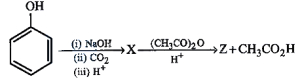
A
$40$
B
$50$
C
$70$
D
$60$
Solution
(D) The reaction sequence is the Kolbe-Schmitt reaction followed by acetylation to form aspirin $(C_9H_8O_4)$.
$1$. Phenol reacts with $NaOH$, $CO_2$, and $H^+$ to form salicylic acid.
$2$. Salicylic acid reacts with acetic anhydride $((CH_3CO)_2O)$ in the presence of $H^+$ to form aspirin $(Z)$ and acetic acid $(CH_3COOH)$.
$3$. The molecular formula of aspirin $(Z)$ is $C_9H_8O_4$.
$4$. The molar mass of $C_9H_8O_4 = (9 \times 12) + (8 \times 1) + (4 \times 16) = 108 + 8 + 64 = 180 \ g/mol$.
$5$. The mass of carbon in one mole of $C_9H_8O_4 = 9 \times 12 = 108 \ g$.
$6$. Percentage of carbon = $\frac{\text{Mass of Carbon}}{\text{Molar Mass of } Z} \times 100 = \frac{108}{180} \times 100 = 60 \%$.
$1$. Phenol reacts with $NaOH$, $CO_2$, and $H^+$ to form salicylic acid.
$2$. Salicylic acid reacts with acetic anhydride $((CH_3CO)_2O)$ in the presence of $H^+$ to form aspirin $(Z)$ and acetic acid $(CH_3COOH)$.
$3$. The molecular formula of aspirin $(Z)$ is $C_9H_8O_4$.
$4$. The molar mass of $C_9H_8O_4 = (9 \times 12) + (8 \times 1) + (4 \times 16) = 108 + 8 + 64 = 180 \ g/mol$.
$5$. The mass of carbon in one mole of $C_9H_8O_4 = 9 \times 12 = 108 \ g$.
$6$. Percentage of carbon = $\frac{\text{Mass of Carbon}}{\text{Molar Mass of } Z} \times 100 = \frac{108}{180} \times 100 = 60 \%$.
0 likesView Solution
61
ChemistryMediumMCQTS EAMCET · 2024
Compound '$A$' on heating with sodalime gives propane. Identify the compound '$A$'.
A
$CH_3-CH_2-CH_2-OH$
B
$CH_3-CH_2-CO_2Na$
C
$CH_3-CH_2-CH_2-CO_2Na$
D
$CH_3-CO-CH_3$
Solution
(C) Decarboxylation of sodium salts of carboxylic acids with sodalime $(NaOH + CaO)$ removes one carbon atom as $Na_2CO_3$ to form an alkane with one less carbon atom.
To obtain propane ($CH_3-CH_2-CH_3$,$3$ carbons),the starting material must be a sodium salt of butanoic acid ($4$ carbons).
The reaction is: $CH_3-CH_2-CH_2-COONa + NaOH \xrightarrow[\Delta]{CaO} CH_3-CH_2-CH_3 + Na_2CO_3$.
Therefore,compound '$A$' is sodium butanoate $(CH_3-CH_2-CH_2-CO_2Na)$.
To obtain propane ($CH_3-CH_2-CH_3$,$3$ carbons),the starting material must be a sodium salt of butanoic acid ($4$ carbons).
The reaction is: $CH_3-CH_2-CH_2-COONa + NaOH \xrightarrow[\Delta]{CaO} CH_3-CH_2-CH_3 + Na_2CO_3$.
Therefore,compound '$A$' is sodium butanoate $(CH_3-CH_2-CH_2-CO_2Na)$.
0 likesView Solution
62
ChemistryMediumMCQTS EAMCET · 2024
The alkane which is next to methane in the homologous series can be prepared from which of the following reactions?
$I$. $2 CH_3 Br \xrightarrow[\text{dry ether}]{Na}$
$II$. $CH_3 COOH \xrightarrow[CaO, \Delta]{NaOH}$
$III$. $CH_3 CH=CH_2 \xrightarrow{H_2 / Pt}$
$IV$. $CH_3 CH_2 Br \xrightarrow[H^{+}]{Zn}$
Correct answer is
$I$. $2 CH_3 Br \xrightarrow[\text{dry ether}]{Na}$
$II$. $CH_3 COOH \xrightarrow[CaO, \Delta]{NaOH}$
$III$. $CH_3 CH=CH_2 \xrightarrow{H_2 / Pt}$
$IV$. $CH_3 CH_2 Br \xrightarrow[H^{+}]{Zn}$
Correct answer is
A
$I, IV$ only
B
$II, III$ only
C
$I, III$ only
D
$II, IV$ only
Solution
(A) The homologous series of alkanes is represented by the general formula $C_n H_{2n+2}$.
Methane is $CH_4$ $(n=1)$.
The next member in the homologous series is ethane,$C_2 H_6$ $(n=2)$.
$I$. Wurtz reaction: $2 CH_3 Br \xrightarrow[\text{dry ether}]{Na} CH_3-CH_3 + 2 NaBr$. This produces ethane.
$II$. Decarboxylation: $CH_3 COONa \xrightarrow[CaO, \Delta]{NaOH} CH_4 + Na_2 CO_3$. This produces methane.
$III$. Hydrogenation: $CH_3-CH=CH_2 \xrightarrow{H_2 / Pt} CH_3-CH_2-CH_3$. This produces propane.
$IV$. Reduction of alkyl halide: $CH_3-CH_2 Br \xrightarrow[H^{+}]{Zn} CH_3-CH_3 + HBr$. This produces ethane.
Therefore,reactions $I$ and $IV$ produce ethane.
Methane is $CH_4$ $(n=1)$.
The next member in the homologous series is ethane,$C_2 H_6$ $(n=2)$.
$I$. Wurtz reaction: $2 CH_3 Br \xrightarrow[\text{dry ether}]{Na} CH_3-CH_3 + 2 NaBr$. This produces ethane.
$II$. Decarboxylation: $CH_3 COONa \xrightarrow[CaO, \Delta]{NaOH} CH_4 + Na_2 CO_3$. This produces methane.
$III$. Hydrogenation: $CH_3-CH=CH_2 \xrightarrow{H_2 / Pt} CH_3-CH_2-CH_3$. This produces propane.
$IV$. Reduction of alkyl halide: $CH_3-CH_2 Br \xrightarrow[H^{+}]{Zn} CH_3-CH_3 + HBr$. This produces ethane.
Therefore,reactions $I$ and $IV$ produce ethane.
0 likesView Solution
63
ChemistryMediumMCQTS EAMCET · 2024
An alkene $X$ $(C_4H_8)$ exhibits geometrical isomerism. Oxidation of $X$ with $KMnO_4 | H^+$ gives $Y$. On heating the sodium salt of $Y$ with a mixture of $NaOH$ and $CaO$,$Z$ is obtained. What is $Z$?
A
$CH_3CH_3$
B
$CH_3CH_2CH_3$
C
$CH_3CH_2CH_2CH_3$
D
$CH_4$
Solution
(D) $1$. The alkene $X$ is $but-2-ene$ $(CH_3CH=CHCH_3)$,which exhibits geometrical isomerism.
$2$. Oxidation of $but-2-ene$ with acidic $KMnO_4$ yields acetic acid $(CH_3COOH)$ as $Y$.
$3$. The sodium salt of $Y$ is sodium acetate $(CH_3COONa)$.
$4$. Heating sodium acetate with soda lime $(NaOH + CaO)$ undergoes decarboxylation to produce methane $(CH_4)$ as $Z$.
$2$. Oxidation of $but-2-ene$ with acidic $KMnO_4$ yields acetic acid $(CH_3COOH)$ as $Y$.
$3$. The sodium salt of $Y$ is sodium acetate $(CH_3COONa)$.
$4$. Heating sodium acetate with soda lime $(NaOH + CaO)$ undergoes decarboxylation to produce methane $(CH_4)$ as $Z$.
0 likesView Solution
64
ChemistryMediumMCQTS EAMCET · 2024
Acrolein $(X)$ is one of the chemicals formed when $O_3$ and $NO_2$ react with unburnt hydrocarbons present in the polluted air. The structure of '$X$' is
A
$CH_3-CH=CH_2$
B
$CH_2=CH-CHO$
C
$CH_2=CH-CN$
D
$CH_3CO(OO)NO_2$
Solution
(B) Acrolein is an unsaturated aldehyde with the chemical formula $CH_2=CH-CHO$.
It is formed as a byproduct of photochemical smog reactions involving unburnt hydrocarbons,nitrogen oxides $(NO_x)$,and ozone $(O_3)$ in the atmosphere.
The reaction products typically include formaldehyde $(CH_2=O)$,acrolein $(CH_2=CH-CHO)$,and peroxyacetyl nitrate $(CH_3CO(OO)NO_2)$.
It is formed as a byproduct of photochemical smog reactions involving unburnt hydrocarbons,nitrogen oxides $(NO_x)$,and ozone $(O_3)$ in the atmosphere.
The reaction products typically include formaldehyde $(CH_2=O)$,acrolein $(CH_2=CH-CHO)$,and peroxyacetyl nitrate $(CH_3CO(OO)NO_2)$.
0 likesView Solution
65
ChemistryDifficultMCQTS EAMCET · 2024
What is '$Y$' in the following set of reactions?

A
$2-$butene
B
$2-$methyl$-2-$butene
C
$1-$butene
D
$2-$butene
Solution
(B) $1$. The reaction of $C_3H_4$ (propyne) with $H_2O$ in the presence of $Hg^{2+}/H^+$ at $333 \ K$ is a hydration reaction that follows Markovnikov's rule to form an enol intermediate,which then tautomerizes to form $X$ (acetone,$CH_3COCH_3$).
$2$. The second part of the reaction shows that $Y$ undergoes ozonolysis $((i) O_3, (ii) Zn/H_2O)$ to produce $X$ (acetone).
$3$. Ozonolysis of an alkene $R_2C=CR_2$ produces two carbonyl compounds. To obtain acetone $(CH_3COCH_3)$ as the product,the alkene $Y$ must be $2,3-$dimethyl$-2-$butene $((CH_3)_2C=C(CH_3)_2)$.
$4$. Looking at the options provided,the structure in option $B$ represents $2,3-$dimethyl$-2-$butene.
$2$. The second part of the reaction shows that $Y$ undergoes ozonolysis $((i) O_3, (ii) Zn/H_2O)$ to produce $X$ (acetone).
$3$. Ozonolysis of an alkene $R_2C=CR_2$ produces two carbonyl compounds. To obtain acetone $(CH_3COCH_3)$ as the product,the alkene $Y$ must be $2,3-$dimethyl$-2-$butene $((CH_3)_2C=C(CH_3)_2)$.
$4$. Looking at the options provided,the structure in option $B$ represents $2,3-$dimethyl$-2-$butene.
0 likesView Solution
66
ChemistryMediumMCQTS EAMCET · 2024
What is the percentage of carbon in the product '$X$' formed in the given reaction (in $.6$)?
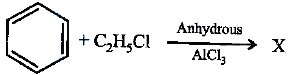
A
$85$
B
$80$
C
$90$
D
$70$
Solution
(C) The given reaction is the Friedel-Crafts alkylation of benzene with ethyl chloride $(C_2H_5Cl)$ in the presence of anhydrous $AlCl_3$ to form ethylbenzene $(X)$.
The chemical formula of ethylbenzene $(X)$ is $C_8H_{10}$.
Atomic mass of Carbon $(C)$ $= 12.01 \ g/mol$.
Atomic mass of Hydrogen $(H)$ $= 1.008 \ g/mol$.
Molar mass of $C_8H_{10} = (8 \times 12.01) + (10 \times 1.008) = 96.08 + 10.08 = 106.16 \ g/mol$.
Percentage of carbon in $C_8H_{10} = \frac{\text{Mass of Carbon}}{\text{Total Molar Mass}} \times 100$.
Percentage of carbon $= \frac{96.08}{106.16} \times 100 \approx 90.505 \% \approx 90.6 \%$.
The chemical formula of ethylbenzene $(X)$ is $C_8H_{10}$.
Atomic mass of Carbon $(C)$ $= 12.01 \ g/mol$.
Atomic mass of Hydrogen $(H)$ $= 1.008 \ g/mol$.
Molar mass of $C_8H_{10} = (8 \times 12.01) + (10 \times 1.008) = 96.08 + 10.08 = 106.16 \ g/mol$.
Percentage of carbon in $C_8H_{10} = \frac{\text{Mass of Carbon}}{\text{Total Molar Mass}} \times 100$.
Percentage of carbon $= \frac{96.08}{106.16} \times 100 \approx 90.505 \% \approx 90.6 \%$.
0 likesView Solution
67
ChemistryDifficultMCQTS EAMCET · 2024
$C_3H_6$ $\xrightarrow{X} Y$ $\xrightarrow[C_6H_6]{AlCl_3} Z \text{ (major product)}$
$X$ and $Z$ respectively in the following reaction sequence are
$X$ and $Z$ respectively in the following reaction sequence are
A
$HBr$,$n$-propylbenzene
B
$HBr$,$p$-isopropylbenzene
C
$HBr/ROOR$,isopropylbenzene
D
$HBr/ROOR$,$n$-propylbenzene
Solution
(C) $1$. The reaction begins with propene $(C_3H_6)$.
$2$. The reagent $X$ is $HBr/ROOR$ (peroxide effect/anti-Markovnikov addition),which converts propene to $1$-bromopropane $(Y = CH_3CH_2CH_2Br)$.
$3$. In the presence of $AlCl_3$,$1$-bromopropane undergoes rearrangement to form a more stable isopropyl carbocation $(CH_3CH^+CH_3)$.
$4$. This isopropyl carbocation then undergoes Friedel-Crafts alkylation with benzene $(C_6H_6)$ to form isopropylbenzene (cumene) as the major product $(Z)$.
$5$. Thus,$X$ is $HBr/ROOR$ and $Z$ is isopropylbenzene.
$2$. The reagent $X$ is $HBr/ROOR$ (peroxide effect/anti-Markovnikov addition),which converts propene to $1$-bromopropane $(Y = CH_3CH_2CH_2Br)$.
$3$. In the presence of $AlCl_3$,$1$-bromopropane undergoes rearrangement to form a more stable isopropyl carbocation $(CH_3CH^+CH_3)$.
$4$. This isopropyl carbocation then undergoes Friedel-Crafts alkylation with benzene $(C_6H_6)$ to form isopropylbenzene (cumene) as the major product $(Z)$.
$5$. Thus,$X$ is $HBr/ROOR$ and $Z$ is isopropylbenzene.
0 likesView Solution
68
ChemistryEasyMCQTS EAMCET · 2024
The number of activating and deactivating groups among the following are respectively: $-OCH_2CH_3, -COCH_3, -NHCOCH_3, -COOCH_3, -SO_3H$
A
$2, 3$
B
$3, 2$
C
$1, 4$
D
$4, 1$
Solution
(A) Activating groups are those that donate electron density to the benzene ring,typically via resonance (e.g.,lone pairs). Deactivating groups are those that withdraw electron density from the benzene ring,typically via inductive or resonance effects.
$1$. $-OCH_2CH_3$: Activating (due to lone pair on oxygen).
$2$. $-COCH_3$: Deactivating (electron-withdrawing carbonyl group).
$3$. $-NHCOCH_3$: Activating (due to lone pair on nitrogen).
$4$. $-COOCH_3$: Deactivating (electron-withdrawing ester group).
$5$. $-SO_3H$: Deactivating (electron-withdrawing sulfonic acid group).
Thus,there are $2$ activating groups $(-OCH_2CH_3, -NHCOCH_3)$ and $3$ deactivating groups $(-COCH_3, -COOCH_3, -SO_3H)$.
Therefore,the correct answer is $2, 3$.
$1$. $-OCH_2CH_3$: Activating (due to lone pair on oxygen).
$2$. $-COCH_3$: Deactivating (electron-withdrawing carbonyl group).
$3$. $-NHCOCH_3$: Activating (due to lone pair on nitrogen).
$4$. $-COOCH_3$: Deactivating (electron-withdrawing ester group).
$5$. $-SO_3H$: Deactivating (electron-withdrawing sulfonic acid group).
Thus,there are $2$ activating groups $(-OCH_2CH_3, -NHCOCH_3)$ and $3$ deactivating groups $(-COCH_3, -COOCH_3, -SO_3H)$.
Therefore,the correct answer is $2, 3$.
0 likesView Solution
69
ChemistryDifficultMCQTS EAMCET · 2024
Identify the end product $(Z)$ in the sequence of the following reactions:
$C_2H_4Br_2$ $\xrightarrow[(ii) NaNH_2]{(i) Alc. KOH} X$ $\xrightarrow[873 \ K]{\text{Red hot Fe tube}} Y$ $\xrightarrow[\text{Anhy } AlCl_3, \Delta]{CH_3COCl} Z$
$C_2H_4Br_2$ $\xrightarrow[(ii) NaNH_2]{(i) Alc. KOH} X$ $\xrightarrow[873 \ K]{\text{Red hot Fe tube}} Y$ $\xrightarrow[\text{Anhy } AlCl_3, \Delta]{CH_3COCl} Z$
A
$C_6H_5COCl$
B
$C_6H_5COCH_3$
C
$C_6H_5CH_2CH_3$
D
$C_6H_5CONH_2$
Solution
(B) $1$. The reaction of $C_2H_4Br_2$ ($1$,$2$-dibromoethane) with $Alc. KOH$ followed by $NaNH_2$ leads to dehydrohalogenation to form ethyne $(X = HC \equiv CH)$.
$2$. Passing ethyne through a red-hot iron tube at $873 \ K$ results in cyclic polymerization to form benzene $(Y = C_6H_6)$.
$3$. Benzene reacts with acetyl chloride $(CH_3COCl)$ in the presence of anhydrous $AlCl_3$ via Friedel-Crafts acylation to produce acetophenone $(Z = C_6H_5COCH_3)$.
$2$. Passing ethyne through a red-hot iron tube at $873 \ K$ results in cyclic polymerization to form benzene $(Y = C_6H_6)$.
$3$. Benzene reacts with acetyl chloride $(CH_3COCl)$ in the presence of anhydrous $AlCl_3$ via Friedel-Crafts acylation to produce acetophenone $(Z = C_6H_5COCH_3)$.
0 likesView Solution
70
ChemistryMediumMCQTS EAMCET · 2024
Identify the pair of hydrides which have polymeric structure.
A
$LiH, NaH$
B
$BeH_2, MgH_2$
C
$NH_3, CH_4$
D
$B_2H_6, H_2O$
Solution
(B) The hydrides of alkaline earth metals,specifically $BeH_2$ and $MgH_2$,exhibit a polymeric structure due to the presence of electron-deficient three-center two-electron $(3c-2e)$ bonds.
These structures allow the metal atoms to achieve a stable coordination environment through bridging hydrogen atoms.
These structures allow the metal atoms to achieve a stable coordination environment through bridging hydrogen atoms.
0 likesView Solution
71
ChemistryMediumMCQTS EAMCET · 2024
The dihedral angles in gaseous and solid phases of $H_2O_2$ molecule respectively are
A
$90.2^{\circ}, 111.5^{\circ}$
B
$101.9^{\circ}, 94.8^{\circ}$
C
$111.5^{\circ}, 90.2^{\circ}$
D
$94.8^{\circ}, 101.9^{\circ}$
Solution
(C) The structure of $H_2O_2$ is non-planar.
In the gaseous phase,the dihedral angle is $111.5^{\circ}$.
In the solid phase,due to hydrogen bonding,the dihedral angle decreases to $90.2^{\circ}$.
Therefore,the dihedral angles in gaseous and solid phases are $111.5^{\circ}$ and $90.2^{\circ}$ respectively.
In the gaseous phase,the dihedral angle is $111.5^{\circ}$.
In the solid phase,due to hydrogen bonding,the dihedral angle decreases to $90.2^{\circ}$.
Therefore,the dihedral angles in gaseous and solid phases are $111.5^{\circ}$ and $90.2^{\circ}$ respectively.
0 likesView Solution
72
ChemistryMediumMCQTS EAMCET · 2024
The proper conditions of storing $H_2O_2$ are
A
Placing in wax lined plastic bottle and kept in dark
B
Placing in wax lined plastic bottle and exposed to light
C
Placing in wax lined plastic bottle containing traces of base
D
Placing in metal vessel and exposed to light
Solution
(A) $H_2O_2$ is unstable and decomposes into $H_2O$ and $O_2$ in the presence of light or rough surfaces like glass containing alkali oxides.
To prevent this,it is stored in wax-lined glass or plastic bottles to provide a smooth,inert surface.
Additionally,it must be kept in the dark to avoid photochemical decomposition.
To prevent this,it is stored in wax-lined glass or plastic bottles to provide a smooth,inert surface.
Additionally,it must be kept in the dark to avoid photochemical decomposition.
0 likesView Solution
73
ChemistryEasyMCQTS EAMCET · 2024
Observe the following reactions:
$I$. $2H_2O_{(l)} + 2Na_{(s)} \rightarrow 2NaOH_{(aq)} + H_{2(g)}$
$II$. $2H_2O_{(l)} + 2F_{2(g)} \rightarrow 4H^{+}_{(aq)} + 4F^{-}_{(aq)} + O_{2(g)}$
Identify the correct statement from the following:
$I$. $2H_2O_{(l)} + 2Na_{(s)} \rightarrow 2NaOH_{(aq)} + H_{2(g)}$
$II$. $2H_2O_{(l)} + 2F_{2(g)} \rightarrow 4H^{+}_{(aq)} + 4F^{-}_{(aq)} + O_{2(g)}$
Identify the correct statement from the following:
A
In both reaction $I$ and reaction $II$,water is oxidized.
B
In both reaction $I$ and reaction $II$,water is reduced.
C
In reaction $I$ water is reduced and in reaction $II$ water is oxidized.
D
In reaction $I$ water is oxidized and in reaction $II$ water is reduced.
Solution
(C) In reaction $I$,the oxidation state of $H$ in $H_2O$ changes from $+1$ to $0$ (in $H_2$),which is a decrease in oxidation number,hence water is reduced.
In reaction $II$,the oxidation state of $O$ in $H_2O$ changes from $-2$ to $0$ (in $O_2$),which is an increase in oxidation number,hence water is oxidized.
Therefore,in reaction $I$ water is reduced and in reaction $II$ water is oxidized.
In reaction $II$,the oxidation state of $O$ in $H_2O$ changes from $-2$ to $0$ (in $O_2$),which is an increase in oxidation number,hence water is oxidized.
Therefore,in reaction $I$ water is reduced and in reaction $II$ water is oxidized.
0 likesView Solution
74
ChemistryMediumMCQTS EAMCET · 2024
The normality of $20$ volume solution of hydrogen peroxide is (in $N$)
A
$0.892$
B
$1.785$
C
$2.678$
D
$3.570$
Solution
(D) The relationship between volume strength and normality of $H_2O_2$ is given by the formula: $\text{Volume strength} = 5.6 \times \text{Normality}$.
Given,volume strength = $20$.
Therefore,$\text{Normality} = \frac{\text{Volume strength}}{5.6} = \frac{20}{5.6} \approx 3.571 \ N$.
Thus,the correct option is $D$.
Given,volume strength = $20$.
Therefore,$\text{Normality} = \frac{\text{Volume strength}}{5.6} = \frac{20}{5.6} \approx 3.571 \ N$.
Thus,the correct option is $D$.
0 likesView Solution
75
ChemistryEasyMCQTS EAMCET · 2024
Observe the following species:
$(i)$ $NH_3$
$(ii)$ $AlCl_3$
$(iii)$ $SnCl_4$
$(iv)$ $CO_2$
$(v)$ $Ag^{+}$
$(vi)$ $HSO_4^{-}$
How many of the above species act as Lewis acids?
$(i)$ $NH_3$
$(ii)$ $AlCl_3$
$(iii)$ $SnCl_4$
$(iv)$ $CO_2$
$(v)$ $Ag^{+}$
$(vi)$ $HSO_4^{-}$
How many of the above species act as Lewis acids?
A
$5$
B
$3$
C
$4$
D
$2$
Solution
(C) Lewis acid is an electron-pair acceptor.
$(i)$ $NH_3$: Has a lone pair on $N$,acts as a Lewis base.
$(ii)$ $AlCl_3$: $Al$ has an incomplete octet ($6$ electrons),acts as a Lewis acid.
$(iii)$ $SnCl_4$: $Sn$ has vacant $d$-orbitals and can expand its octet,acts as a Lewis acid.
$(iv)$ $CO_2$: The $C$ atom is electron-deficient due to the high electronegativity of oxygen atoms,acts as a Lewis acid.
$(v)$ $Ag^{+}$: $A$ metal cation with vacant orbitals,acts as a Lewis acid.
$(vi)$ $HSO_4^{-}$: Can act as a Lewis base (due to lone pairs on $O$) or a Brønsted-Lowry acid,but is not typically classified as a Lewis acid in this context.
Therefore,$AlCl_3$,$SnCl_4$,$CO_2$,and $Ag^{+}$ act as Lewis acids.
The total count is $4$.
$(i)$ $NH_3$: Has a lone pair on $N$,acts as a Lewis base.
$(ii)$ $AlCl_3$: $Al$ has an incomplete octet ($6$ electrons),acts as a Lewis acid.
$(iii)$ $SnCl_4$: $Sn$ has vacant $d$-orbitals and can expand its octet,acts as a Lewis acid.
$(iv)$ $CO_2$: The $C$ atom is electron-deficient due to the high electronegativity of oxygen atoms,acts as a Lewis acid.
$(v)$ $Ag^{+}$: $A$ metal cation with vacant orbitals,acts as a Lewis acid.
$(vi)$ $HSO_4^{-}$: Can act as a Lewis base (due to lone pairs on $O$) or a Brønsted-Lowry acid,but is not typically classified as a Lewis acid in this context.
Therefore,$AlCl_3$,$SnCl_4$,$CO_2$,and $Ag^{+}$ act as Lewis acids.
The total count is $4$.
0 likesView Solution
76
ChemistryMCQTS EAMCET · 2024
$A$ vessel contains hydrogen and nitrogen gases in the ratio $2:3$ by mass. If the temperature of the mixture of the gases is $30^{\circ} C$,then the ratio of the average kinetic energies per molecule of hydrogen and nitrogen gases is $($Molecular mass of hydrogen $=2$ and molecular mass of nitrogen $=28)$
A
$3:7$
B
$2:3$
C
$1:1$
D
$1:14$
Solution
(C) The average kinetic energy per molecule of an ideal gas is given by the formula $\langle KE \rangle = \frac{f}{2} k_B T$,where $f$ is the degrees of freedom,$k_B$ is the Boltzmann constant,and $T$ is the absolute temperature.
Since both hydrogen and nitrogen are diatomic gases at $30^{\circ} C$,they have the same number of degrees of freedom $(f=5)$.
Because the gases are in the same vessel,they are in thermal equilibrium,meaning they are at the same temperature $(T_{H_2} = T_{N_2} = T)$.
Therefore,the ratio of the average kinetic energies per molecule is $\frac{\langle KE \rangle_{H_2}}{\langle KE \rangle_{N_2}} = \frac{\frac{5}{2} k_B T}{\frac{5}{2} k_B T} = 1:1$.
The mass ratio is irrelevant because the average kinetic energy per molecule depends only on the temperature,not on the mass or the number of molecules.
Since both hydrogen and nitrogen are diatomic gases at $30^{\circ} C$,they have the same number of degrees of freedom $(f=5)$.
Because the gases are in the same vessel,they are in thermal equilibrium,meaning they are at the same temperature $(T_{H_2} = T_{N_2} = T)$.
Therefore,the ratio of the average kinetic energies per molecule is $\frac{\langle KE \rangle_{H_2}}{\langle KE \rangle_{N_2}} = \frac{\frac{5}{2} k_B T}{\frac{5}{2} k_B T} = 1:1$.
The mass ratio is irrelevant because the average kinetic energy per molecule depends only on the temperature,not on the mass or the number of molecules.
0 likesView Solution
77
ChemistryMCQTS EAMCET · 2024
An aircraft executes a horizontal loop of radius $9 \ km$ at a constant speed of $540 \ km/h$. The wings of the aircraft are banked at an angle of (Acceleration due to gravity $g = 10 \ m/s^2$):
A
$\operatorname{cosec}^{-1}(4)$
B
$\cot^{-1}(4)$
C
$\tan^{-1}(4)$
D
$\sec^{-1}(4)$
Solution
(B) Given: Radius $r = 9 \ km = 9000 \ m$. Speed $v = 540 \ km/h = 540 \times \frac{5}{18} \ m/s = 150 \ m/s$. Acceleration due to gravity $g = 10 \ m/s^2$.
For a banked aircraft in a horizontal loop,the banking angle $\theta$ is given by the relation: $\tan \theta = \frac{v^2}{rg}$.
Substituting the values: $\tan \theta = \frac{150 \times 150}{9000 \times 10} = \frac{22500}{90000} = \frac{1}{4}$.
Since $\tan \theta = \frac{1}{4}$,we have $\cot \theta = 4$,which implies $\theta = \cot^{-1}(4)$.
For a banked aircraft in a horizontal loop,the banking angle $\theta$ is given by the relation: $\tan \theta = \frac{v^2}{rg}$.
Substituting the values: $\tan \theta = \frac{150 \times 150}{9000 \times 10} = \frac{22500}{90000} = \frac{1}{4}$.
Since $\tan \theta = \frac{1}{4}$,we have $\cot \theta = 4$,which implies $\theta = \cot^{-1}(4)$.
0 likesView Solution
78
ChemistryMCQTS EAMCET · 2024
$A$ straight wire of length $20 \ cm$ carrying a current of $\frac{3}{\pi^2} \ A$ is bent in the form of a circle. The magnetic field at the centre of the circle is
A
$8 \times 10^{-6} \ T$
B
$3 \times 10^{-6} \ T$
C
$12 \times 10^{-6} \ T$
D
$6 \times 10^{-6} \ T$
Solution
(D) Given: Length of wire $l = 20 \ cm = 0.2 \ m$,Current $I = \frac{3}{\pi^2} \ A$.
When the wire is bent into a circle,its length becomes the circumference of the circle: $l = 2 \pi R$.
So,$0.2 = 2 \pi R \Rightarrow R = \frac{0.1}{\pi} \ m = \frac{10^{-1}}{\pi} \ m$.
The magnetic field $B$ at the centre of a circular loop is given by $B = \frac{\mu_0 I}{2R}$.
Substituting the values: $B = \frac{(4 \pi \times 10^{-7}) \times (\frac{3}{\pi^2})}{2 \times (\frac{10^{-1}}{\pi})}$.
Simplifying: $B = \frac{4 \pi \times 10^{-7} \times 3}{2 \times 10^{-1} \times \pi} = \frac{12 \pi \times 10^{-7}}{2 \pi \times 10^{-1}} = 6 \times 10^{-6} \ T$.
When the wire is bent into a circle,its length becomes the circumference of the circle: $l = 2 \pi R$.
So,$0.2 = 2 \pi R \Rightarrow R = \frac{0.1}{\pi} \ m = \frac{10^{-1}}{\pi} \ m$.
The magnetic field $B$ at the centre of a circular loop is given by $B = \frac{\mu_0 I}{2R}$.
Substituting the values: $B = \frac{(4 \pi \times 10^{-7}) \times (\frac{3}{\pi^2})}{2 \times (\frac{10^{-1}}{\pi})}$.
Simplifying: $B = \frac{4 \pi \times 10^{-7} \times 3}{2 \times 10^{-1} \times \pi} = \frac{12 \pi \times 10^{-7}}{2 \pi \times 10^{-1}} = 6 \times 10^{-6} \ T$.
0 likesView Solution
79
ChemistryMCQTS EAMCET · 2024
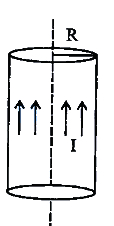
$A$ long straight rod of diameter $4 \ mm$ carries a steady current '$i$'. The current is uniformly distributed across its cross-section. The ratio of the magnetic fields at distances $1 \ mm$ and $4 \ mm$ from the axis of the rod is
A
$1:2$
B
$1:4$
C
$4:1$
D
$1:1$
Solution
(D) Given: Diameter $D = 4 \ mm$,so radius $R = 2 \ mm$.
For a point inside the rod $(r < R)$,the magnetic field is given by $B_{in} = \frac{\mu_0 i r}{2 \pi R^2}$.
At $r_1 = 1 \ mm$,$B_1 = \frac{\mu_0 i (1)}{2 \pi (2)^2} = \frac{\mu_0 i}{8 \pi}$.
For a point outside the rod $(r > R)$,the magnetic field is given by $B_{out} = \frac{\mu_0 i}{2 \pi r}$.
At $r_2 = 4 \ mm$,$B_2 = \frac{\mu_0 i}{2 \pi (4)} = \frac{\mu_0 i}{8 \pi}$.
The ratio of the magnetic fields is $\frac{B_1}{B_2} = \frac{\mu_0 i / 8 \pi}{\mu_0 i / 8 \pi} = 1:1$.
For a point inside the rod $(r < R)$,the magnetic field is given by $B_{in} = \frac{\mu_0 i r}{2 \pi R^2}$.
At $r_1 = 1 \ mm$,$B_1 = \frac{\mu_0 i (1)}{2 \pi (2)^2} = \frac{\mu_0 i}{8 \pi}$.
For a point outside the rod $(r > R)$,the magnetic field is given by $B_{out} = \frac{\mu_0 i}{2 \pi r}$.
At $r_2 = 4 \ mm$,$B_2 = \frac{\mu_0 i}{2 \pi (4)} = \frac{\mu_0 i}{8 \pi}$.
The ratio of the magnetic fields is $\frac{B_1}{B_2} = \frac{\mu_0 i / 8 \pi}{\mu_0 i / 8 \pi} = 1:1$.
0 likesView Solution
80
ChemistryMCQTS EAMCET · 2024
Which of the following statements regarding the nature of physical laws is $NOT$ correct?
A
All conserved quantities are necessarily scalars
B
The laws of nature do not change with time
C
The laws of nature are same everywhere in the universe
D
The law of gravitation is the same both on the moon and the earth
Solution
(A) Physical laws are based on conserved quantities,which can be either scalars (like energy) or vectors (like linear momentum and angular momentum). Therefore,the statement that all conserved quantities are necessarily scalars is incorrect.
0 likesView Solution
81
ChemistryMCQTS EAMCET · 2024
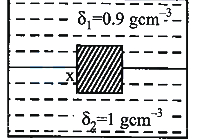
$A$ wooden cube of side $10 \ cm$ floats at the interface between water and oil with its lower surface $3 \ cm$ below the interface. If the density of oil is $0.9 \ g \ cm^{-3}$, the mass of the wooden cube is (in $g$)
A
$940$
B
$900$
C
$1000$
D
$930$
Solution
(D) Given: Side of the cube $a = 10 \ cm$, depth in water $x = 3 \ cm$, density of oil $\delta_1 = 0.9 \ g \ cm^{-3}$, density of water $\delta_2 = 1 \ g \ cm^{-3}$.
Since the cube is floating, the weight of the cube is equal to the total buoyant force exerted by the oil and water.
Weight of cube $W = mg$.
Buoyant force $F_B = (\text{Volume in oil} \times \delta_1 \times g) + (\text{Volume in water} \times \delta_2 \times g)$.
Volume of cube $V = a^3 = 10^3 = 1000 \ cm^3$.
Volume in water $V_2 = a^2 \times x = 10^2 \times 3 = 300 \ cm^3$.
Volume in oil $V_1 = a^2 \times (a - x) = 10^2 \times (10 - 3) = 700 \ cm^3$.
By the law of flotation, $mg = V_1 \delta_1 g + V_2 \delta_2 g$.
$m = V_1 \delta_1 + V_2 \delta_2$.
$m = (700 \times 0.9) + (300 \times 1)$.
$m = 630 + 300 = 930 \ g$.
Since the cube is floating, the weight of the cube is equal to the total buoyant force exerted by the oil and water.
Weight of cube $W = mg$.
Buoyant force $F_B = (\text{Volume in oil} \times \delta_1 \times g) + (\text{Volume in water} \times \delta_2 \times g)$.
Volume of cube $V = a^3 = 10^3 = 1000 \ cm^3$.
Volume in water $V_2 = a^2 \times x = 10^2 \times 3 = 300 \ cm^3$.
Volume in oil $V_1 = a^2 \times (a - x) = 10^2 \times (10 - 3) = 700 \ cm^3$.
By the law of flotation, $mg = V_1 \delta_1 g + V_2 \delta_2 g$.
$m = V_1 \delta_1 + V_2 \delta_2$.
$m = (700 \times 0.9) + (300 \times 1)$.
$m = 630 + 300 = 930 \ g$.
0 likesView Solution
82
ChemistryMCQTS EAMCET · 2024
$A$ big liquid drop splits into $n$ similar small drops under isothermal conditions. Then,in this process:
A
volume decreases
B
total surface area decreases
C
energy is absorbed
D
energy is liberated
Solution
(C) The volume of the liquid remains constant during the splitting process.
When a large drop of radius $R$ splits into $n$ small drops of radius $r$,the total volume is conserved: $\frac{4}{3} \pi R^3 = n \times \frac{4}{3} \pi r^3$,which implies $R^3 = nr^3$ or $r = R / n^{1/3}$.
The total surface area of the large drop is $A_1 = 4 \pi R^2$.
The total surface area of $n$ small drops is $A_2 = n \times 4 \pi r^2 = n \times 4 \pi (R / n^{1/3})^2 = n^{1/3} \times 4 \pi R^2$.
Since $n > 1$,$n^{1/3} > 1$,therefore $A_2 > A_1$. The surface area increases.
Surface energy is given by $U = T \times A$,where $T$ is surface tension.
Since the surface area increases,the surface energy of the system increases.
To increase the surface energy,work must be done on the system,meaning energy is absorbed from the surroundings.
When a large drop of radius $R$ splits into $n$ small drops of radius $r$,the total volume is conserved: $\frac{4}{3} \pi R^3 = n \times \frac{4}{3} \pi r^3$,which implies $R^3 = nr^3$ or $r = R / n^{1/3}$.
The total surface area of the large drop is $A_1 = 4 \pi R^2$.
The total surface area of $n$ small drops is $A_2 = n \times 4 \pi r^2 = n \times 4 \pi (R / n^{1/3})^2 = n^{1/3} \times 4 \pi R^2$.
Since $n > 1$,$n^{1/3} > 1$,therefore $A_2 > A_1$. The surface area increases.
Surface energy is given by $U = T \times A$,where $T$ is surface tension.
Since the surface area increases,the surface energy of the system increases.
To increase the surface energy,work must be done on the system,meaning energy is absorbed from the surroundings.
0 likesView Solution
83
ChemistryMCQTS EAMCET · 2024
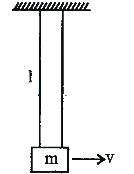
$A$ block of mass $2 \ kg$ is tied to one end of a $2 \ m$ long metal wire of $1.0 \ mm^2$ area of cross-section and rotated in a vertical circle such that the tension in the wire is zero at the highest point. If the maximum elongation in the wire is $2 \ mm$,the Young's modulus of the metal is (Acceleration due to gravity $= 10 \ ms^{-2}$)
A
$1.0 \times 10^{11} \ Nm^{-2}$
B
$1.2 \times 10^{11} \ Nm^{-2}$
C
$2.0 \times 10^{11} \ Nm^{-2}$
D
$0.2 \times 10^{11} \ Nm^{-2}$
Solution
(B) Given: Mass $m = 2 \ kg$,length $l = 2 \ m$,area $A = 1 \ mm^2 = 1 \times 10^{-6} \ m^2$,maximum elongation $\Delta l = 2 \ mm = 2 \times 10^{-3} \ m$,$g = 10 \ ms^{-2}$.
For the tension to be zero at the highest point in a vertical circle,the velocity at the bottom point must be $v = \sqrt{5gl}$.
$v = \sqrt{5 \times 10 \times 2} = \sqrt{100} = 10 \ ms^{-1}$.
The maximum tension $T_{\max}$ occurs at the lowest point of the vertical circle.
$T_{\max} = mg + \frac{mv^2}{l} = 2 \times 10 + \frac{2 \times (10)^2}{2} = 20 + 100 = 120 \ N$.
Using the formula for Young's modulus $Y = \frac{T_{\max} \cdot l}{A \cdot \Delta l}$:
$Y = \frac{120 \times 2}{1 \times 10^{-6} \times 2 \times 10^{-3}} = \frac{240}{2 \times 10^{-9}} = 120 \times 10^9 = 1.2 \times 10^{11} \ Nm^{-2}$.
For the tension to be zero at the highest point in a vertical circle,the velocity at the bottom point must be $v = \sqrt{5gl}$.
$v = \sqrt{5 \times 10 \times 2} = \sqrt{100} = 10 \ ms^{-1}$.
The maximum tension $T_{\max}$ occurs at the lowest point of the vertical circle.
$T_{\max} = mg + \frac{mv^2}{l} = 2 \times 10 + \frac{2 \times (10)^2}{2} = 20 + 100 = 120 \ N$.
Using the formula for Young's modulus $Y = \frac{T_{\max} \cdot l}{A \cdot \Delta l}$:
$Y = \frac{120 \times 2}{1 \times 10^{-6} \times 2 \times 10^{-3}} = \frac{240}{2 \times 10^{-9}} = 120 \times 10^9 = 1.2 \times 10^{11} \ Nm^{-2}$.
0 likesView Solution
84
ChemistryMCQTS EAMCET · 2024
$A$ body moving with uniform acceleration travels a distance of $25 \ m$ in the fourth second and $37 \ m$ in the sixth second. The distance covered by the body in the next two seconds is (in $m$)
A
$63$
B
$84$
C
$49$
D
$92$
Solution
(D) For uniformly accelerated motion,the distance covered in the $n^{th}$ second is given by $S_n = u + \frac{a}{2}(2n - 1)$.
For the fourth second $(n=4)$: $25 = u + \frac{a}{2}(2 \times 4 - 1) \implies 25 = u + 3.5a$ --- $(i)$
For the sixth second $(n=6)$: $37 = u + \frac{a}{2}(2 \times 6 - 1) \implies 37 = u + 5.5a$ --- (ii)
Subtracting $(i)$ from (ii): $(37 - 25) = (5.5a - 3.5a) \implies 12 = 2a \implies a = 6 \ m/s^2$.
Substituting $a=6$ in $(i)$: $25 = u + 3.5(6) \implies 25 = u + 21 \implies u = 4 \ m/s$.
The distance covered in the next two seconds (from $t=6 \ s$ to $t=8 \ s$) is calculated using $S = ut + \frac{1}{2}at^2$ where $u$ is the velocity at $t=6 \ s$.
Velocity at $t=6 \ s$: $v = u + at = 4 + (6 \times 6) = 40 \ m/s$.
Distance covered in $t=2 \ s$: $S = (40 \times 2) + \frac{1}{2} \times 6 \times (2)^2 = 80 + 12 = 92 \ m$.
For the fourth second $(n=4)$: $25 = u + \frac{a}{2}(2 \times 4 - 1) \implies 25 = u + 3.5a$ --- $(i)$
For the sixth second $(n=6)$: $37 = u + \frac{a}{2}(2 \times 6 - 1) \implies 37 = u + 5.5a$ --- (ii)
Subtracting $(i)$ from (ii): $(37 - 25) = (5.5a - 3.5a) \implies 12 = 2a \implies a = 6 \ m/s^2$.
Substituting $a=6$ in $(i)$: $25 = u + 3.5(6) \implies 25 = u + 21 \implies u = 4 \ m/s$.
The distance covered in the next two seconds (from $t=6 \ s$ to $t=8 \ s$) is calculated using $S = ut + \frac{1}{2}at^2$ where $u$ is the velocity at $t=6 \ s$.
Velocity at $t=6 \ s$: $v = u + at = 4 + (6 \times 6) = 40 \ m/s$.
Distance covered in $t=2 \ s$: $S = (40 \times 2) + \frac{1}{2} \times 6 \times (2)^2 = 80 + 12 = 92 \ m$.
0 likesView Solution
85
ChemistryMCQTS EAMCET · 2024
$A$ body is projected from the ground at an angle of $\tan ^{-1}(\sqrt{7})$ with the horizontal. At half of the maximum height,the speed of the body is '$n$' times the speed of projection. The value of '$n$' is
A
$2$
B
$\frac{1}{3}$
C
$\frac{4}{3}$
D
$\frac{3}{4}$
Solution
(D) For projectile motion,the angle of projection is $\theta = \tan^{-1}(\sqrt{7})$,so $\tan \theta = \sqrt{7}$.
At any height $y$,the vertical component of velocity is $v_y^2 = u_y^2 - 2gy$.
At $y = \frac{H}{2}$,where $H = \frac{u^2 \sin^2 \theta}{2g}$ is the maximum height:
$v_y^2 = u^2 \sin^2 \theta - 2g \left( \frac{u^2 \sin^2 \theta}{4g} \right) = u^2 \sin^2 \theta - \frac{u^2 \sin^2 \theta}{2} = \frac{u^2 \sin^2 \theta}{2}$.
The horizontal component of velocity remains constant: $v_x = u \cos \theta$.
The speed $v$ at $y = \frac{H}{2}$ is $v = \sqrt{v_x^2 + v_y^2} = \sqrt{u^2 \cos^2 \theta + \frac{u^2 \sin^2 \theta}{2}}$.
Given $v = nu$,we have $n^2 u^2 = u^2 \cos^2 \theta + \frac{u^2 \sin^2 \theta}{2}$.
$n^2 = \cos^2 \theta + \frac{\sin^2 \theta}{2} = \cos^2 \theta + \frac{1 - \cos^2 \theta}{2} = \frac{1 + \cos^2 \theta}{2}$.
Since $\tan \theta = \sqrt{7}$,$\tan^2 \theta = 7$,so $\sec^2 \theta = 1 + 7 = 8$,which means $\cos^2 \theta = \frac{1}{8}$.
$n^2 = \frac{1 + 1/8}{2} = \frac{9/8}{2} = \frac{9}{16}$.
Therefore,$n = \frac{3}{4}$.
At any height $y$,the vertical component of velocity is $v_y^2 = u_y^2 - 2gy$.
At $y = \frac{H}{2}$,where $H = \frac{u^2 \sin^2 \theta}{2g}$ is the maximum height:
$v_y^2 = u^2 \sin^2 \theta - 2g \left( \frac{u^2 \sin^2 \theta}{4g} \right) = u^2 \sin^2 \theta - \frac{u^2 \sin^2 \theta}{2} = \frac{u^2 \sin^2 \theta}{2}$.
The horizontal component of velocity remains constant: $v_x = u \cos \theta$.
The speed $v$ at $y = \frac{H}{2}$ is $v = \sqrt{v_x^2 + v_y^2} = \sqrt{u^2 \cos^2 \theta + \frac{u^2 \sin^2 \theta}{2}}$.
Given $v = nu$,we have $n^2 u^2 = u^2 \cos^2 \theta + \frac{u^2 \sin^2 \theta}{2}$.
$n^2 = \cos^2 \theta + \frac{\sin^2 \theta}{2} = \cos^2 \theta + \frac{1 - \cos^2 \theta}{2} = \frac{1 + \cos^2 \theta}{2}$.
Since $\tan \theta = \sqrt{7}$,$\tan^2 \theta = 7$,so $\sec^2 \theta = 1 + 7 = 8$,which means $\cos^2 \theta = \frac{1}{8}$.
$n^2 = \frac{1 + 1/8}{2} = \frac{9/8}{2} = \frac{9}{16}$.
Therefore,$n = \frac{3}{4}$.
0 likesView Solution
86
ChemistryMCQTS EAMCET · 2024
The operation of a nuclear reactor is said to be critical when the value of the neutron multiplication factor $K$ is:
A
$K=0$
B
$K > 1$
C
$K=1$
D
$0 < K < 1$
Solution
(C) The neutron multiplication factor $K$ (also denoted as $k$) is defined as the ratio of the number of neutrons produced in a generation to the number of neutrons produced in the preceding generation.
When $K = 1$,the rate of fission remains constant,and the reactor is said to be in a 'critical' state.
If $K > 1$,the reactor is 'supercritical' (power increases).
If $K < 1$,the reactor is 'subcritical' (power decreases).
Therefore,for a critical reactor,$K = 1$.
When $K = 1$,the rate of fission remains constant,and the reactor is said to be in a 'critical' state.
If $K > 1$,the reactor is 'supercritical' (power increases).
If $K < 1$,the reactor is 'subcritical' (power decreases).
Therefore,for a critical reactor,$K = 1$.
0 likesView Solution
87
ChemistryMCQTS EAMCET · 2024
An $\alpha$-particle of energy $E$ is liberated during the decay of a nucleus of mass number $236$. The total energy released in this process is
A
$58 E$
B
$59 E$
C
$\frac{58 E}{59}$
D
$\frac{59 E}{58}$
Solution
(D) In the decay of a nucleus with mass number $A=236$,the parent nucleus decays into an $\alpha$-particle (mass number $4$) and a daughter nucleus (mass number $A-4 = 232$).
By the law of conservation of linear momentum,the magnitude of momentum of the $\alpha$-particle $(P_{\alpha})$ must be equal to the magnitude of momentum of the daughter nucleus $(P_{d})$,so $P_{\alpha} = P_{d} = P$.
The kinetic energy $KE$ is given by $KE = \frac{P^2}{2m}$,which implies $KE \propto \frac{1}{m}$.
Therefore,the ratio of kinetic energies is $\frac{(KE)_{d}}{(KE)_{\alpha}} = \frac{m_{\alpha}}{m_{d}} = \frac{4}{232} = \frac{1}{58}$.
Given $(KE)_{\alpha} = E$,we find $(KE)_{d} = \frac{E}{58}$.
The total energy released $(Q)$ is the sum of the kinetic energies of the products:
$Q = (KE)_{\alpha} + (KE)_{d} = E + \frac{E}{58} = \frac{59E}{58}$.
By the law of conservation of linear momentum,the magnitude of momentum of the $\alpha$-particle $(P_{\alpha})$ must be equal to the magnitude of momentum of the daughter nucleus $(P_{d})$,so $P_{\alpha} = P_{d} = P$.
The kinetic energy $KE$ is given by $KE = \frac{P^2}{2m}$,which implies $KE \propto \frac{1}{m}$.
Therefore,the ratio of kinetic energies is $\frac{(KE)_{d}}{(KE)_{\alpha}} = \frac{m_{\alpha}}{m_{d}} = \frac{4}{232} = \frac{1}{58}$.
Given $(KE)_{\alpha} = E$,we find $(KE)_{d} = \frac{E}{58}$.
The total energy released $(Q)$ is the sum of the kinetic energies of the products:
$Q = (KE)_{\alpha} + (KE)_{d} = E + \frac{E}{58} = \frac{59E}{58}$.
0 likesView Solution
88
ChemistryMediumMCQTS EAMCET · 2024
Consider the following reactions (not balanced):
$BF_3 + NaH \xrightarrow{450 \ K} X + NaF$
$X + H_2O \longrightarrow Y + H_2 \uparrow$
The correct statements about $X$ and $Y$ are:
$I$. $X$ is an electron-deficient molecule
$II$. In $X$,$B-B$ bond is present
$III$. $Y$ is a weak tribasic acid
$IV$. $Y$ acts as a Lewis acid
$BF_3 + NaH \xrightarrow{450 \ K} X + NaF$
$X + H_2O \longrightarrow Y + H_2 \uparrow$
The correct statements about $X$ and $Y$ are:
$I$. $X$ is an electron-deficient molecule
$II$. In $X$,$B-B$ bond is present
$III$. $Y$ is a weak tribasic acid
$IV$. $Y$ acts as a Lewis acid
A
$I$ and $IV$
B
$II$ and $III$
C
$II$ and $IV$
D
$I$ and $III$
Solution
(A) On balancing the equation $(1)$:
$2BF_3 + 6NaH \xrightarrow{450 \ K} B_2H_6 + 6NaF$
So,$X$ is $B_2H_6$ (diborane).
Balancing the equation $(2)$:
$B_2H_6 + 6H_2O \longrightarrow 2B(OH)_3 + 6H_2 \uparrow$
So,$Y$ is $B(OH)_3$ (boric acid).
$I$. $X$ $(B_2H_6)$ is an electron-deficient molecule (contains $3c-2e^-$ bonds). This is correct.
$II$. In $X$ $(B_2H_6)$,there is no direct $B-B$ bond; it has two bridging hydrogen atoms $(B-H-B)$. This is incorrect.
$III$. $Y$ $(B(OH)_3)$ is a weak monobasic Lewis acid,not a tribasic acid. This is incorrect.
$IV$. $Y$ $(B(OH)_3)$ acts as a Lewis acid as it accepts a lone pair of electrons from $OH^-$ ions. This is correct.
Therefore,statements $I$ and $IV$ are correct.
$2BF_3 + 6NaH \xrightarrow{450 \ K} B_2H_6 + 6NaF$
So,$X$ is $B_2H_6$ (diborane).
Balancing the equation $(2)$:
$B_2H_6 + 6H_2O \longrightarrow 2B(OH)_3 + 6H_2 \uparrow$
So,$Y$ is $B(OH)_3$ (boric acid).
$I$. $X$ $(B_2H_6)$ is an electron-deficient molecule (contains $3c-2e^-$ bonds). This is correct.
$II$. In $X$ $(B_2H_6)$,there is no direct $B-B$ bond; it has two bridging hydrogen atoms $(B-H-B)$. This is incorrect.
$III$. $Y$ $(B(OH)_3)$ is a weak monobasic Lewis acid,not a tribasic acid. This is incorrect.
$IV$. $Y$ $(B(OH)_3)$ acts as a Lewis acid as it accepts a lone pair of electrons from $OH^-$ ions. This is correct.
Therefore,statements $I$ and $IV$ are correct.
0 likesView Solution
89
ChemistryDifficultMCQTS EAMCET · 2024
Observe the following reactions (not balanced):
$BF_3 + LiAlH_4 \xrightarrow{(C_2H_5)_2O} X + LiF + AlF_3$
$X + NaH \longrightarrow Y$
The incorrect statement about $Y$ is:
$BF_3 + LiAlH_4 \xrightarrow{(C_2H_5)_2O} X + LiF + AlF_3$
$X + NaH \longrightarrow Y$
The incorrect statement about $Y$ is:
A
It is a good oxidizing agent
B
It is a good reducing agent
C
Oxidation state of hydrogen in it is $-1$
D
Oxidation of it with iodine gives diborane
Solution
(A) The first reaction is: $4BF_3 + 3LiAlH_4 \xrightarrow{(C_2H_5)_2O} 2B_2H_6 + 3LiF + 3AlF_3$. Here,$X$ is $B_2H_6$ (diborane).
The second reaction is: $B_2H_6 + 2NaH \longrightarrow 2NaBH_4$. Here,$Y$ is $NaBH_4$ (sodium borohydride).
$NaBH_4$ contains the $BH_4^-$ ion,where hydrogen is in the $-1$ oxidation state.
$NaBH_4$ is a well-known reducing agent,not an oxidizing agent.
Therefore,the statement 'It is a good oxidizing agent' is incorrect.
The second reaction is: $B_2H_6 + 2NaH \longrightarrow 2NaBH_4$. Here,$Y$ is $NaBH_4$ (sodium borohydride).
$NaBH_4$ contains the $BH_4^-$ ion,where hydrogen is in the $-1$ oxidation state.
$NaBH_4$ is a well-known reducing agent,not an oxidizing agent.
Therefore,the statement 'It is a good oxidizing agent' is incorrect.
0 likesView Solution
90
ChemistryDifficultMCQTS EAMCET · 2024
What are $X$ and $Y$ respectively in the following reactions?
$X \xleftarrow{CO} B_2 H_6 \xrightarrow[(C_2 H_5)_2 O]{NaH} Y$
$X \xleftarrow{CO} B_2 H_6 \xrightarrow[(C_2 H_5)_2 O]{NaH} Y$
A
$BH_3 \cdot 2 CO ; NaBO_2$
B
$BH_3 \cdot CO ; NaBH_4$
C
$BH_3 \cdot CO ; NaBO_2$
D
$BH_3 \cdot CO ; Na_2 B_4 O_7$
Solution
(B) The reaction of diborane $(B_2 H_6)$ with carbon monoxide $(CO)$ under pressure yields the borane carbonyl adduct,$BH_3 \cdot CO$ $(X)$.
$B_2 H_6 + 2 CO \rightarrow 2 BH_3 \cdot CO$
The reaction of diborane $(B_2 H_6)$ with sodium hydride $(NaH)$ in the presence of diethyl ether $((C_2 H_5)_2 O)$ yields sodium borohydride,$NaBH_4$ $(Y)$.
$B_2 H_6 + 2 NaH \xrightarrow{(C_2 H_5)_2 O} 2 NaBH_4$
Therefore,$X = BH_3 \cdot CO$ and $Y = NaBH_4$.
$B_2 H_6 + 2 CO \rightarrow 2 BH_3 \cdot CO$
The reaction of diborane $(B_2 H_6)$ with sodium hydride $(NaH)$ in the presence of diethyl ether $((C_2 H_5)_2 O)$ yields sodium borohydride,$NaBH_4$ $(Y)$.
$B_2 H_6 + 2 NaH \xrightarrow{(C_2 H_5)_2 O} 2 NaBH_4$
Therefore,$X = BH_3 \cdot CO$ and $Y = NaBH_4$.
0 likesView Solution
91
ChemistryEasyMCQTS EAMCET · 2024
The correct formula of borax is $Na_2[B_4O_5(OH)_4] \cdot 8H_2O$. If the formula is represented as $Na_2[B_4O_5(OH)_x] \cdot yH_2O$,then the sum of $x$ and $y$ is:
A
$14$
B
$09$
C
$12$
D
$10$
Solution
(C) The chemical formula of borax is $Na_2[B_4O_5(OH)_4] \cdot 8H_2O$.
Comparing this with the given expression $Na_2[B_4O_5(OH)_x] \cdot yH_2O$,we get:
$x = 4$
$y = 8$
Therefore,the sum $x + y = 4 + 8 = 12$.
Comparing this with the given expression $Na_2[B_4O_5(OH)_x] \cdot yH_2O$,we get:
$x = 4$
$y = 8$
Therefore,the sum $x + y = 4 + 8 = 12$.
0 likesView Solution
92
ChemistryMediumMCQTS EAMCET · 2024
Which of the following statements are correct?
$(i)$ $CCl_4$ undergoes hydrolysis easily
$(ii)$ Diamond has directional covalent bonds
$(iii)$ Fullerene is the thermodynamically most stable allotrope of carbon
$(iv)$ Glass is a man-made silicate
The correct answer is
$(i)$ $CCl_4$ undergoes hydrolysis easily
$(ii)$ Diamond has directional covalent bonds
$(iii)$ Fullerene is the thermodynamically most stable allotrope of carbon
$(iv)$ Glass is a man-made silicate
The correct answer is
A
$(i, iii)$ only
B
$(ii, iv)$ only
C
$(ii, iii, iv)$ only
D
$(i, ii)$ only
Solution
(B) $(i)$ $CCl_4$ does not undergo hydrolysis because it lacks vacant $d$-orbitals to accept lone pairs from water molecules.
$(ii)$ The structure of diamond consists of a $3-D$ network of carbon atoms with directional covalent bonds throughout the lattice.
$(iii)$ The thermodynamic stability order of carbon allotropes is $\text{Graphite} > \text{Diamond} > \text{Fullerene}$.
$(iv)$ Glass is a man-made amorphous silicate.
Therefore,statements $(ii)$ and $(iv)$ are correct.
$(ii)$ The structure of diamond consists of a $3-D$ network of carbon atoms with directional covalent bonds throughout the lattice.
$(iii)$ The thermodynamic stability order of carbon allotropes is $\text{Graphite} > \text{Diamond} > \text{Fullerene}$.
$(iv)$ Glass is a man-made amorphous silicate.
Therefore,statements $(ii)$ and $(iv)$ are correct.
0 likesView Solution
93
ChemistryEasyMCQTS EAMCET · 2024
Assertion $(A)$: Silicones are used for water proofing of fabrics.
Reason $(R)$: The repeating unit in silicones is $R_2SiO$.
Reason $(R)$: The repeating unit in silicones is $R_2SiO$.
A
$(A)$ and $(R)$ are correct,but $(R)$ is not the correct explanation of $(A)$
B
$(A)$ and $(R)$ are correct,$(R)$ is the correct explanation of $(A)$
C
$(A)$ is not correct but $(R)$ is correct
D
$(A)$ is correct but $(R)$ is not correct
Solution
(B) Silicones are organosilicon polymers which have the general empirical formula $(R_2SiO)_n$.
They are hydrophobic in nature due to the presence of organic groups $(R)$ attached to the silicon atoms.
Because of this hydrophobic nature,they are widely used for water proofing of fabrics.
Thus,both Assertion $(A)$ and Reason $(R)$ are correct,and $(R)$ is the correct explanation of $(A)$.
They are hydrophobic in nature due to the presence of organic groups $(R)$ attached to the silicon atoms.
Because of this hydrophobic nature,they are widely used for water proofing of fabrics.
Thus,both Assertion $(A)$ and Reason $(R)$ are correct,and $(R)$ is the correct explanation of $(A)$.
0 likesView Solution
94
ChemistryDifficultMCQTS EAMCET · 2024
Observe the following reactions (unbalanced):
$P_2O_3 + H_2O \rightarrow X$
$P_4O_{10} + H_2O \rightarrow Y$
The number of $P=O$ bonds present in $X$ and $Y$ are respectively:
$P_2O_3 + H_2O \rightarrow X$
$P_4O_{10} + H_2O \rightarrow Y$
The number of $P=O$ bonds present in $X$ and $Y$ are respectively:
A
$1, 3$
B
$1, 2$
C
$2, 1$
D
$1, 1$
Solution
(D) The balanced chemical equations are:
$P_2O_3 + 3H_2O \rightarrow 2H_3PO_3$ $(X = H_3PO_3)$
$P_4O_{10} + 6H_2O \rightarrow 4H_3PO_4$ $(Y = H_3PO_4)$
In $H_3PO_3$ (phosphorous acid),the structure contains $1$ $P=O$ bond,$2$ $P-OH$ bonds,and $1$ $P-H$ bond.
In $H_3PO_4$ (phosphoric acid),the structure contains $1$ $P=O$ bond and $3$ $P-OH$ bonds.
Thus,the number of $P=O$ bonds in $X$ and $Y$ are $1$ and $1$ respectively.
$P_2O_3 + 3H_2O \rightarrow 2H_3PO_3$ $(X = H_3PO_3)$
$P_4O_{10} + 6H_2O \rightarrow 4H_3PO_4$ $(Y = H_3PO_4)$
In $H_3PO_3$ (phosphorous acid),the structure contains $1$ $P=O$ bond,$2$ $P-OH$ bonds,and $1$ $P-H$ bond.
In $H_3PO_4$ (phosphoric acid),the structure contains $1$ $P=O$ bond and $3$ $P-OH$ bonds.
Thus,the number of $P=O$ bonds in $X$ and $Y$ are $1$ and $1$ respectively.
0 likesView Solution
95
ChemistryMediumMCQTS EAMCET · 2024
Carbon on reaction with hot conc. $H_2SO_4$ gives two oxides along with $H_2O$. What is the nature of these two oxides?
A
Both are acidic
B
Both are basic
C
Both are neutral
D
Both are amphoteric
Solution
(A) The chemical reaction is: $C + 2H_2SO_4 \rightarrow CO_2 + 2SO_2 + 2H_2O$.
Both $CO_2$ and $SO_2$ are non-metallic oxides,which are acidic in nature.
Both $CO_2$ and $SO_2$ are non-metallic oxides,which are acidic in nature.
0 likesView Solution
96
ChemistryEasyMCQTS EAMCET · 2024
$C +$ Conc. $H_2SO_4 \xrightarrow{\Delta} X + Y + H_2O$. $X$ and $Y$ in the above reaction are:
A
$CO, SO_3$
B
$CO_2, SO_2$
C
$CO, SO_2$
D
$C_3O_2, SO_2$
Solution
(B) The reaction of carbon with concentrated sulfuric acid is an oxidation-reduction reaction.
Carbon is oxidized to carbon dioxide $(CO_2)$ and sulfuric acid is reduced to sulfur dioxide $(SO_2)$.
The balanced chemical equation is:
$C + 2 H_2SO_4 \xrightarrow{\Delta} CO_2 + 2 SO_2 + 2 H_2O$
Thus,$X$ is $CO_2$ and $Y$ is $SO_2$.
Carbon is oxidized to carbon dioxide $(CO_2)$ and sulfuric acid is reduced to sulfur dioxide $(SO_2)$.
The balanced chemical equation is:
$C + 2 H_2SO_4 \xrightarrow{\Delta} CO_2 + 2 SO_2 + 2 H_2O$
Thus,$X$ is $CO_2$ and $Y$ is $SO_2$.
0 likesView Solution
97
ChemistryEasyMCQTS EAMCET · 2024
The correct order of boiling points of hydrogen halides is
A
$HF < HCl < HBr < HI$
B
$HI < HBr < HCl < HF$
C
$HCl < HBr < HI < HF$
D
$HBr < HCl < HI < HF$
Solution
(C) The boiling points of hydrogen halides follow the order: $HCl < HBr < HI < HF$.
$HF$ exhibits strong intermolecular hydrogen bonding,which significantly increases its boiling point compared to other hydrogen halides.
For the remaining hydrogen halides $(HCl, HBr, HI)$,the boiling point increases with an increase in molecular mass due to stronger van der Waals forces.
$HF$ exhibits strong intermolecular hydrogen bonding,which significantly increases its boiling point compared to other hydrogen halides.
For the remaining hydrogen halides $(HCl, HBr, HI)$,the boiling point increases with an increase in molecular mass due to stronger van der Waals forces.
0 likesView Solution
98
ChemistryMCQTS EAMCET · 2024
$A$ thin plano-convex lens of focal length $73.5 \text{ cm}$ has a circular aperture of diameter $8.4 \text{ cm}$. If the refractive index of the material of the lens is $\frac{5}{3}$,then the thickness of the lens is nearly
A
$2.4 \text{ cm}$
B
$2.4 \text{ mm}$
C
$1.8 \text{ mm}$
D
$1.8 \text{ cm}$
Solution
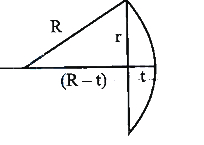
(C) For a plano-convex lens,the radius of curvature $R$ is related to the aperture radius $r$ and thickness $t$ by the geometric relation: $R^2 = (R-t)^2 + r^2$. Since $t$ is very small,$R^2 \approx R^2 - 2Rt + t^2 + r^2$,which simplifies to $2Rt \approx r^2$,or $R = \frac{r^2}{2t}$.
Given the diameter $d = 8.4 \text{ cm}$,the radius $r = \frac{d}{2} = 4.2 \text{ cm}$.
Using the Lens Maker's Formula: $\frac{1}{f} = (\mu - 1)(\frac{1}{R_1} - \frac{1}{R_2})$.
For a plano-convex lens,$R_1 = R$ and $R_2 = \infty$,so $\frac{1}{f} = (\mu - 1)(\frac{1}{R})$.
Thus,$R = f(\mu - 1)$.
Substituting $R = \frac{r^2}{2t}$,we get $\frac{r^2}{2t} = f(\mu - 1)$.
Rearranging for thickness $t$: $t = \frac{r^2}{2f(\mu - 1)}$.
Substituting the values: $r = 4.2 \text{ cm}$,$f = 73.5 \text{ cm}$,$\mu = \frac{5}{3}$.
$t = \frac{(4.2)^2}{2 \times 73.5 \times (\frac{5}{3} - 1)} = \frac{17.64}{147 \times \frac{2}{3}} = \frac{17.64}{98} = 0.18 \text{ cm} = 1.8 \text{ mm}$.
Given the diameter $d = 8.4 \text{ cm}$,the radius $r = \frac{d}{2} = 4.2 \text{ cm}$.
Using the Lens Maker's Formula: $\frac{1}{f} = (\mu - 1)(\frac{1}{R_1} - \frac{1}{R_2})$.
For a plano-convex lens,$R_1 = R$ and $R_2 = \infty$,so $\frac{1}{f} = (\mu - 1)(\frac{1}{R})$.
Thus,$R = f(\mu - 1)$.
Substituting $R = \frac{r^2}{2t}$,we get $\frac{r^2}{2t} = f(\mu - 1)$.
Rearranging for thickness $t$: $t = \frac{r^2}{2f(\mu - 1)}$.
Substituting the values: $r = 4.2 \text{ cm}$,$f = 73.5 \text{ cm}$,$\mu = \frac{5}{3}$.
$t = \frac{(4.2)^2}{2 \times 73.5 \times (\frac{5}{3} - 1)} = \frac{17.64}{147 \times \frac{2}{3}} = \frac{17.64}{98} = 0.18 \text{ cm} = 1.8 \text{ mm}$.
0 likesView Solution
99
ChemistryMCQTS EAMCET · 2024
When an object of height $12 \ cm$ is placed at a distance from a convex lens,an image of height $18 \ cm$ is formed on a screen. Without changing the positions of the object and the screen,if the lens is moved towards the screen,another clear image is formed on the screen. The height of this image is (in $cm$)
A
$4$
B
$6$
C
$8$
D
$10$
Solution
(C) Let the height of the object be $h_0 = 12 \ cm$.
When the lens is placed at the first position,the image height is $h_1 = 18 \ cm$.
When the lens is moved to the second position,the image height is $h_2$.
According to the displacement method for a convex lens,the relationship between the object height and the two image heights is given by the formula:
$h_0 = \sqrt{h_1 \cdot h_2}$
Substituting the given values:
$12 = \sqrt{18 \cdot h_2}$
Squaring both sides:
$144 = 18 \cdot h_2$
$h_2 = \frac{144}{18} = 8 \ cm$.
Thus,the height of the second image is $8 \ cm$.
When the lens is placed at the first position,the image height is $h_1 = 18 \ cm$.
When the lens is moved to the second position,the image height is $h_2$.
According to the displacement method for a convex lens,the relationship between the object height and the two image heights is given by the formula:
$h_0 = \sqrt{h_1 \cdot h_2}$
Substituting the given values:
$12 = \sqrt{18 \cdot h_2}$
Squaring both sides:
$144 = 18 \cdot h_2$
$h_2 = \frac{144}{18} = 8 \ cm$.
Thus,the height of the second image is $8 \ cm$.
0 likesView Solution
100
ChemistryEasyMCQTS EAMCET · 2024
Observe the following reaction:
$2 KClO_{3(s)} \xrightarrow{\Delta} 2 KCl_{(s)} + 3 O_{2(g)}$
In this reaction:
$2 KClO_{3(s)} \xrightarrow{\Delta} 2 KCl_{(s)} + 3 O_{2(g)}$
In this reaction:
A
$Cl$ is oxidized and $O$ is reduced
B
$Cl$ is reduced and $O$ is oxidized
C
$K$ is oxidized and $O$ is reduced
D
$K$ is reduced and $Cl$ is also reduced
Solution
(B) Assign oxidation states to each element:
In $KClO_3$,the oxidation state of $K$ is $+1$,$Cl$ is $+5$,and $O$ is $-2$.
In $KCl$,the oxidation state of $K$ is $+1$ and $Cl$ is $-1$.
In $O_2$,the oxidation state of $O$ is $0$.
Comparing the oxidation states:
$Cl$ changes from $+5$ to $-1$ (decrease in oxidation state,so $Cl$ is reduced).
$O$ changes from $-2$ to $0$ (increase in oxidation state,so $O$ is oxidized).
Therefore,$Cl$ is reduced and $O$ is oxidized.
In $KClO_3$,the oxidation state of $K$ is $+1$,$Cl$ is $+5$,and $O$ is $-2$.
In $KCl$,the oxidation state of $K$ is $+1$ and $Cl$ is $-1$.
In $O_2$,the oxidation state of $O$ is $0$.
Comparing the oxidation states:
$Cl$ changes from $+5$ to $-1$ (decrease in oxidation state,so $Cl$ is reduced).
$O$ changes from $-2$ to $0$ (increase in oxidation state,so $O$ is oxidized).
Therefore,$Cl$ is reduced and $O$ is oxidized.
0 likesView Solution
101
ChemistryMediumMCQTS EAMCET · 2024
Identify the correct statements from the following: $(i)$ $Ti(IV)$ is more stable than $Ti(III)$ and $Ti(II)$ $(ii)$ Among $3d-$series elements (from $Z=22$ to $29$) only copper has positive reduction potential $(M^{2+} / M)$ $(iii)$ Both $Sc$ and $Zn$ exhibit $+1$ oxidation state
A
$i, ii$ only
B
$i, iii$ only
C
$ii, iii$ only
D
$i, ii, iii$
Solution
(A) $Ti = [Ar] 3d^2 4s^2$
$Ti^{3+} = [Ar] 3d^1 4s^0$
$Ti^{4+} = [Ar] 3d^0 4s^0$
Since $Ti^{4+}$ has a vacant $d$-orbital and it acquires the nearest noble gas configuration,it is more stable compared to $Ti^{3+}$ and $Ti^{2+}$.
$Cu^{2+} / Cu = +0.34 \ V$ has an exceptionally positive reduction potential among $3d$ series elements.
$Sc$ shows $+3$ oxidation state and $Zn$ shows $+2$ oxidation state. They do not exhibit $+1$ oxidation state.
Therefore,only $(i)$ and $(ii)$ are correct.
$Ti^{3+} = [Ar] 3d^1 4s^0$
$Ti^{4+} = [Ar] 3d^0 4s^0$
Since $Ti^{4+}$ has a vacant $d$-orbital and it acquires the nearest noble gas configuration,it is more stable compared to $Ti^{3+}$ and $Ti^{2+}$.
$Cu^{2+} / Cu = +0.34 \ V$ has an exceptionally positive reduction potential among $3d$ series elements.
$Sc$ shows $+3$ oxidation state and $Zn$ shows $+2$ oxidation state. They do not exhibit $+1$ oxidation state.
Therefore,only $(i)$ and $(ii)$ are correct.
0 likesView Solution
102
ChemistryEasyMCQTS EAMCET · 2024
Which of the following orders is correct for the property given?
A
$Cr < Mn < Fe$ - standard electrode potential value of $M^{3+} / M^{2+}$
B
$Cr^{2+} < Mn^{2+} < Fe^{2+}$ - magnetic moments
C
$VO_2^{+} < Cr_2O_7^{2-} < MnO_4^{-}$ - oxidizing power
D
$Ti < V < Cr$ - first ionization enthalpy
Solution
(C) The standard electrode potential $(E^{\circ})$ for $M^{3+}/M^{2+}$ follows the order $Mn^{3+}/Mn^{2+} > Fe^{3+}/Fe^{2+} > Cr^{3+}/Cr^{2+}$. Thus,option $A$ is incorrect.
Magnetic moment is calculated as $\mu = \sqrt{n(n+2)}$,where $n$ is the number of unpaired electrons.
For $Mn^{2+}$ $(3d^5)$,$n=5$. For $Cr^{2+}$ $(3d^4)$,$n=4$. For $Fe^{2+}$ $(3d^6)$,$n=4$. The order is $Mn^{2+} > Cr^{2+} \approx Fe^{2+}$. Thus,option $B$ is incorrect.
Oxidizing power depends on the reduction potential and the stability of the lower oxidation state. $MnO_4^-$ $(Mn^{+7})$ is a stronger oxidizing agent than $Cr_2O_7^{2-}$ $(Cr^{+6})$ and $VO_2^+$ $(V^{+5})$. The correct order is $VO_2^+ < Cr_2O_7^{2-} < MnO_4^-$. Thus,option $C$ is correct.
First ionization enthalpy generally increases across the period but shows irregularities due to electronic configuration. The order is $Ti < V < Cr$ is incorrect; the correct order is $Ti < V < Cr$ is not followed due to stability of half-filled $d$-orbitals in $Cr$.
Magnetic moment is calculated as $\mu = \sqrt{n(n+2)}$,where $n$ is the number of unpaired electrons.
For $Mn^{2+}$ $(3d^5)$,$n=5$. For $Cr^{2+}$ $(3d^4)$,$n=4$. For $Fe^{2+}$ $(3d^6)$,$n=4$. The order is $Mn^{2+} > Cr^{2+} \approx Fe^{2+}$. Thus,option $B$ is incorrect.
Oxidizing power depends on the reduction potential and the stability of the lower oxidation state. $MnO_4^-$ $(Mn^{+7})$ is a stronger oxidizing agent than $Cr_2O_7^{2-}$ $(Cr^{+6})$ and $VO_2^+$ $(V^{+5})$. The correct order is $VO_2^+ < Cr_2O_7^{2-} < MnO_4^-$. Thus,option $C$ is correct.
First ionization enthalpy generally increases across the period but shows irregularities due to electronic configuration. The order is $Ti < V < Cr$ is incorrect; the correct order is $Ti < V < Cr$ is not followed due to stability of half-filled $d$-orbitals in $Cr$.
0 likesView Solution
103
ChemistryDifficultMCQTS EAMCET · 2024
Observe the following $f$-block elements: $Eu (Z=63)$; $Pu (Z=94)$; $Cf (Z=98)$; $Sm (Z=62)$; $Gd (Z=64)$; $Cm (Z=96)$. How many of the above have half-filled $f$-orbitals in their ground state?
A
$3$
B
$4$
C
$2$
D
$5$
Solution
(A) The electronic configurations are:
$Eu (Z=63): [Xe] 4f^7 6s^2$ (Half-filled $f$-orbital)
$Pu (Z=94): [Rn] 5f^6 7s^2$
$Cf (Z=98): [Rn] 5f^{10} 7s^2$
$Sm (Z=62): [Xe] 4f^6 6s^2$
$Gd (Z=64): [Xe] 4f^7 5d^1 6s^2$ (Half-filled $f$-orbital)
$Cm (Z=96): [Rn] 5f^7 6d^1 7s^2$ (Half-filled $f$-orbital)
The elements with half-filled $f$-orbitals are $Eu, Gd,$ and $Cm$.
Total count = $3$.
$Eu (Z=63): [Xe] 4f^7 6s^2$ (Half-filled $f$-orbital)
$Pu (Z=94): [Rn] 5f^6 7s^2$
$Cf (Z=98): [Rn] 5f^{10} 7s^2$
$Sm (Z=62): [Xe] 4f^6 6s^2$
$Gd (Z=64): [Xe] 4f^7 5d^1 6s^2$ (Half-filled $f$-orbital)
$Cm (Z=96): [Rn] 5f^7 6d^1 7s^2$ (Half-filled $f$-orbital)
The elements with half-filled $f$-orbitals are $Eu, Gd,$ and $Cm$.
Total count = $3$.
0 likesView Solution
104
ChemistryMediumMCQTS EAMCET · 2024
Identify the correct statements from the following:
$(A)$ At $298 \ K$,the potential of a hydrogen electrode placed in a solution of $pH = 10$ is $-0.59 \ V$.
$(B)$ The limiting molar conductivity of $Ca^{2+}$ and $Cl^{-}$ are $119$ and $76 \ S \ cm^2 \ mol^{-1}$ respectively. The limiting molar conductivity of $CaCl_2$ is $195 \ S \ cm^2 \ mol^{-1}$.
$(C)$ The correct relationship between $K_{c}$ and $E_{cell}^{0}$ is $E_{cell}^{0} = \frac{2.303 RT}{nF} \log K_{c}$.
$(A)$ At $298 \ K$,the potential of a hydrogen electrode placed in a solution of $pH = 10$ is $-0.59 \ V$.
$(B)$ The limiting molar conductivity of $Ca^{2+}$ and $Cl^{-}$ are $119$ and $76 \ S \ cm^2 \ mol^{-1}$ respectively. The limiting molar conductivity of $CaCl_2$ is $195 \ S \ cm^2 \ mol^{-1}$.
$(C)$ The correct relationship between $K_{c}$ and $E_{cell}^{0}$ is $E_{cell}^{0} = \frac{2.303 RT}{nF} \log K_{c}$.
A
$A, B, C$
B
$A, B$ only
C
$A, C$ only
D
$B, C$ only
Solution
(C) For a hydrogen electrode,$E = -0.0591 \times pH = -0.0591 \times 10 = -0.591 \ V$. Thus,statement $(A)$ is correct.
$(B)$ $\Lambda^{\circ}_{m}(CaCl_2) = \Lambda^{\circ}_{m}(Ca^{2+}) + 2 \times \Lambda^{\circ}_{m}(Cl^{-}) = 119 + 2(76) = 119 + 152 = 271 \ S \ cm^2 \ mol^{-1}$. Since $271 \neq 195$,statement $(B)$ is incorrect.
$(C)$ The Nernst equation at equilibrium is $E_{cell} = 0$,which gives $0 = E_{cell}^{0} - \frac{2.303 RT}{nF} \log K_{c}$,so $E_{cell}^{0} = \frac{2.303 RT}{nF} \log K_{c}$. Thus,statement $(C)$ is correct.
Therefore,statements $(A)$ and $(C)$ are correct.
$(B)$ $\Lambda^{\circ}_{m}(CaCl_2) = \Lambda^{\circ}_{m}(Ca^{2+}) + 2 \times \Lambda^{\circ}_{m}(Cl^{-}) = 119 + 2(76) = 119 + 152 = 271 \ S \ cm^2 \ mol^{-1}$. Since $271 \neq 195$,statement $(B)$ is incorrect.
$(C)$ The Nernst equation at equilibrium is $E_{cell} = 0$,which gives $0 = E_{cell}^{0} - \frac{2.303 RT}{nF} \log K_{c}$,so $E_{cell}^{0} = \frac{2.303 RT}{nF} \log K_{c}$. Thus,statement $(C)$ is correct.
Therefore,statements $(A)$ and $(C)$ are correct.
0 likesView Solution
105
ChemistryMediumMCQTS EAMCET · 2024
Two statements are given below.
Statement $I$ : Molten $NaCl$ is electrolysed using $Pt$ electrodes. $Cl_2$ is liberated at anode.
Statement $II$ : Aqueous $CuSO_4$ is electrolysed using $Pt$ electrodes. $O_2$ is liberated at cathode.
The correct answer is
Statement $I$ : Molten $NaCl$ is electrolysed using $Pt$ electrodes. $Cl_2$ is liberated at anode.
Statement $II$ : Aqueous $CuSO_4$ is electrolysed using $Pt$ electrodes. $O_2$ is liberated at cathode.
The correct answer is
A
Both statement $I$ and $II$ are correct
B
Both statement $I$ and $II$ are not correct
C
Statement $I$ is correct but statement $II$ is not correct
D
Statement $I$ is not correct but statement $II$ is correct
Solution
(C) During the electrolysis of molten $NaCl$,$Na$ metal is deposited at the cathode,and $Cl_2$ gas is liberated at the anode.
At cathode: $Na^+ + e^- \rightarrow Na$
At anode: $2Cl^- \rightarrow Cl_2 + 2e^-$
Thus,Statement $I$ is correct.
When aqueous $CuSO_4$ is electrolyzed using $Pt$ electrodes,$Cu$ is deposited at the cathode and $O_2$ is liberated at the anode.
At cathode: $Cu^{2+} + 2e^- \rightarrow Cu$
At anode: $2H_2O \rightarrow O_2 + 4H^+ + 4e^-$
Since $O_2$ is liberated at the anode,not the cathode,Statement $II$ is incorrect.
Therefore,Statement $I$ is correct but Statement $II$ is incorrect.
At cathode: $Na^+ + e^- \rightarrow Na$
At anode: $2Cl^- \rightarrow Cl_2 + 2e^-$
Thus,Statement $I$ is correct.
When aqueous $CuSO_4$ is electrolyzed using $Pt$ electrodes,$Cu$ is deposited at the cathode and $O_2$ is liberated at the anode.
At cathode: $Cu^{2+} + 2e^- \rightarrow Cu$
At anode: $2H_2O \rightarrow O_2 + 4H^+ + 4e^-$
Since $O_2$ is liberated at the anode,not the cathode,Statement $II$ is incorrect.
Therefore,Statement $I$ is correct but Statement $II$ is incorrect.
0 likesView Solution
106
ChemistryEasyMCQTS EAMCET · 2024
The standard electrode potentials $E^{\circ} (V)$ for $Li^{+} / Li$ and $Na^{+} / Na$ respectively are:
A
$-3.04, -2.714$
B
$-2.714, -3.04$
C
$-3.04, -3.04$
D
$-2.714, -2.714$
Solution
(A) The standard electrode potential $(E^{\circ})$ represents the tendency of an electrode to undergo reduction.
For $Li^{+} / Li$,the standard electrode potential is $-3.04 \ V$.
For $Na^{+} / Na$,the standard electrode potential is $-2.714 \ V$.
Therefore,the values are $-3.04 \ V$ and $-2.714 \ V$ respectively.
For $Li^{+} / Li$,the standard electrode potential is $-3.04 \ V$.
For $Na^{+} / Na$,the standard electrode potential is $-2.714 \ V$.
Therefore,the values are $-3.04 \ V$ and $-2.714 \ V$ respectively.
0 likesView Solution
107
ChemistryEasyMCQTS EAMCET · 2024
$0.592 \ g$ of copper is deposited in $60 \ minutes$ by passing $0.5 \ amperes$ current through a solution of copper$(II)$ sulphate. The electrochemical equivalent of copper$(II)$ (in $g \ C^{-1}$) is $\left(F=96500 \ C \ mol^{-1}\right)$
A
$3.3 \times 10^{-3}$
B
$3.3 \times 10^{-4}$
C
$6.6 \times 10^{-3}$
D
$6.6 \times 10^{-4}$
Solution
(B) According to Faraday's law of electrolysis,$W = Z \times i \times t$,where $Z$ is the electrochemical equivalent.
Given:
$W = 0.592 \ g$
$i = 0.5 \ A$
$t = 60 \ minutes = 60 \times 60 \ s = 3600 \ s$
Substituting the values in the formula:
$0.592 = Z \times 0.5 \times 3600$
$0.592 = Z \times 1800$
$Z = \frac{0.592}{1800} \approx 3.288 \times 10^{-4} \ g \ C^{-1}$
Rounding to two significant figures,$Z \approx 3.3 \times 10^{-4} \ g \ C^{-1}$.
Given:
$W = 0.592 \ g$
$i = 0.5 \ A$
$t = 60 \ minutes = 60 \times 60 \ s = 3600 \ s$
Substituting the values in the formula:
$0.592 = Z \times 0.5 \times 3600$
$0.592 = Z \times 1800$
$Z = \frac{0.592}{1800} \approx 3.288 \times 10^{-4} \ g \ C^{-1}$
Rounding to two significant figures,$Z \approx 3.3 \times 10^{-4} \ g \ C^{-1}$.
0 likesView Solution
108
ChemistryMediumMCQTS EAMCET · 2024
The molar conductivity of a $0.02 \ M$ solution of an electrolyte is $124 \times 10^{-4} \ S \ m^2 \ mol^{-1}$. What is the resistance of the same solution (in ohms),kept in a cell with a cell constant of $129 \ m^{-1}$?
A
$390$
B
$130$
C
$260$
D
$520$
Solution
(D) Given: Concentration $C = 0.02 \ M = 0.02 \ mol \ L^{-1} = 0.02 \times 1000 \ mol \ m^{-3} = 20 \ mol \ m^{-3}$.
Cell constant $G^* = 129 \ m^{-1}$.
Molar conductivity $\Lambda_m = 124 \times 10^{-4} \ S \ m^2 \ mol^{-1}$.
Formula: $\Lambda_m = \frac{\kappa}{C}$,where $\kappa$ is conductivity.
$\kappa = \Lambda_m \times C = (124 \times 10^{-4} \ S \ m^2 \ mol^{-1}) \times (20 \ mol \ m^{-3}) = 2480 \times 10^{-4} \ S \ m^{-1} = 0.248 \ S \ m^{-1}$.
Resistance $R = \frac{G^*}{\kappa} = \frac{129 \ m^{-1}}{0.248 \ S \ m^{-1}} \approx 520.16 \ \Omega$.
Rounding to the nearest integer,$R = 520 \ \Omega$.
Cell constant $G^* = 129 \ m^{-1}$.
Molar conductivity $\Lambda_m = 124 \times 10^{-4} \ S \ m^2 \ mol^{-1}$.
Formula: $\Lambda_m = \frac{\kappa}{C}$,where $\kappa$ is conductivity.
$\kappa = \Lambda_m \times C = (124 \times 10^{-4} \ S \ m^2 \ mol^{-1}) \times (20 \ mol \ m^{-3}) = 2480 \times 10^{-4} \ S \ m^{-1} = 0.248 \ S \ m^{-1}$.
Resistance $R = \frac{G^*}{\kappa} = \frac{129 \ m^{-1}}{0.248 \ S \ m^{-1}} \approx 520.16 \ \Omega$.
Rounding to the nearest integer,$R = 520 \ \Omega$.
0 likesView Solution
109
ChemistryEasyMCQTS EAMCET · 2024
Which of the following is an example of an allylic halide?
A
B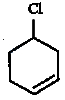
C
D
Solution
(B) An allylic halide is a compound in which the halogen atom is bonded to an $sp^3$ hybridized carbon atom that is adjacent to a carbon-carbon double bond $(C=C)$.
In option $B$,the chlorine atom is attached to a carbon atom that is directly adjacent to the $C=C$ double bond. This carbon is $sp^3$ hybridized,making it an allylic halide.
In option $A$,the chlorine is attached directly to the double-bonded carbon,which is a vinylic halide.
Therefore,the correct option is $B$.
In option $B$,the chlorine atom is attached to a carbon atom that is directly adjacent to the $C=C$ double bond. This carbon is $sp^3$ hybridized,making it an allylic halide.
In option $A$,the chlorine is attached directly to the double-bonded carbon,which is a vinylic halide.
Therefore,the correct option is $B$.
0 likesView Solution
110
ChemistryEasyMCQTS EAMCET · 2024
The $IUPAC$ name of the following compound is:
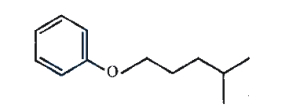
A
$2-$Methylpentoxybenzene
B
$4-$Methylpentoxybenzene
C
Phenoxy$-4-$methylpentane
D
Phenoxy$-2-$methylpentane
Solution
(B) $1$. Identify the longest carbon chain attached to the oxygen atom. The chain has $5$ carbon atoms,so the parent alkane is pentane.
$2$. The phenoxy group $(-OC_6H_5)$ is attached to the first carbon of the pentane chain.
$3$. Number the chain starting from the carbon attached to the oxygen atom to give the lowest possible number to the substituent.
$4$. The methyl group is at the $4^{th}$ position.
$5$. Thus,the $IUPAC$ name is $1-$phenoxy$-4-$methylpentane.
$6$. However,based on the provided options and the structure,the compound is named as an ether derivative of benzene where the alkoxy group is $4-$methylpentoxy. Therefore,the name is $4-$methylpentoxybenzene.
$2$. The phenoxy group $(-OC_6H_5)$ is attached to the first carbon of the pentane chain.
$3$. Number the chain starting from the carbon attached to the oxygen atom to give the lowest possible number to the substituent.
$4$. The methyl group is at the $4^{th}$ position.
$5$. Thus,the $IUPAC$ name is $1-$phenoxy$-4-$methylpentane.
$6$. However,based on the provided options and the structure,the compound is named as an ether derivative of benzene where the alkoxy group is $4-$methylpentoxy. Therefore,the name is $4-$methylpentoxybenzene.
0 likesView Solution
111
ChemistryMediumMCQTS EAMCET · 2024
The number of $-OH$ groups present in the structures of bithionol,terpineol and chloroxylenol is respectively:
A
$2, 1, 1$
B
$1, 2, 1$
C
$1, 1, 2$
D
$2, 2, 1$
Solution
(A) $1$. Bithionol: It contains two $-OH$ groups attached to the two benzene rings.
$2$. Terpineol: It contains one $-OH$ group in its structure.
$3$. Chloroxylenol: It contains one $-OH$ group attached to the benzene ring.
Therefore,the number of $-OH$ groups in bithionol,terpineol,and chloroxylenol is $2, 1, 1$ respectively.
$2$. Terpineol: It contains one $-OH$ group in its structure.
$3$. Chloroxylenol: It contains one $-OH$ group attached to the benzene ring.
Therefore,the number of $-OH$ groups in bithionol,terpineol,and chloroxylenol is $2, 1, 1$ respectively.
0 likesView Solution
112
ChemistryDifficultMCQTS EAMCET · 2024
Kaolinite is a silicate mineral of metal '$X$' and calamine is a carbonate mineral of metal '$Y$'. $X$ and $Y$ respectively are
A
$Fe, Cu$
B
$Zn, Al$
C
$Al, Zn$
D
$Zn, Cu$
Solution
(C) Kaolinite is a clay mineral with the chemical formula $Al_2Si_2O_5(OH)_4$,which contains the metal $Al$ (Aluminum).
Calamine is a zinc ore with the chemical formula $ZnCO_3$,which contains the metal $Zn$ (Zinc).
Therefore,$X$ is $Al$ and $Y$ is $Zn$.
Calamine is a zinc ore with the chemical formula $ZnCO_3$,which contains the metal $Zn$ (Zinc).
Therefore,$X$ is $Al$ and $Y$ is $Zn$.
0 likesView Solution
113
ChemistryEasyMCQTS EAMCET · 2024
Copper matte is a mixture of
A
Oxides of $Cu$ and $Fe$
B
Carbonates of $Cu$ and $Fe$
C
Sulphides of $Cu$ and $Fe$
D
Silicates of $Cu$ and $Fe$
Solution
(C) Copper matte is obtained during the extraction of copper from copper pyrites.
It is primarily a mixture of copper$(I)$ sulphide $(Cu_2S)$ and iron$(II)$ sulphide $(FeS)$.
It is primarily a mixture of copper$(I)$ sulphide $(Cu_2S)$ and iron$(II)$ sulphide $(FeS)$.
0 likesView Solution
114
ChemistryEasyMCQTS EAMCET · 2024
$A$ low boiling point metal contains a high boiling point metal as an impurity. The correct refining method is:
A
Liquation
B
Distillation
C
Poling
D
Vapour phase refining
Solution
(B) Distillation is the process used to refine metals that have low boiling points,such as $Zn$,$Cd$,and $Hg$. In this method,the impure metal is heated to vaporize the pure metal,leaving behind the high boiling point impurities as a residue. The vapors are then condensed to obtain the pure metal.
0 likesView Solution
115
ChemistryEasyMCQTS EAMCET · 2024
Among the following,the calcination process is
A
$2 Cu_2S + 3 O_2 \xrightarrow{\Delta} 2 Cu_2O + 2 SO_2 \uparrow$
B
$Al_2O_{3(s)} + 2 NaOH_{(aq)} + 3 H_2O_{(l)} \longrightarrow 2 Na[Al(OH)_4]_{(aq)}$
C
$2 CuFeS_2 + O_2 \longrightarrow Cu_2S + 2 FeS + SO_2 \uparrow$
D
$Fe_2O_3 \cdot x H_2O \xrightarrow{\Delta} Fe_2O_{3(s)} + x H_2O_{(g)}$
Solution
(D) Calcination is a process of heating an ore in a limited supply of air or in the absence of air to remove volatile impurities and moisture.
It is typically used for carbonate or hydrated oxide ores.
The reaction $Fe_2O_3 \cdot x H_2O \xrightarrow{\Delta} Fe_2O_{3(s)} + x H_2O_{(g)}$ represents the removal of water of hydration from limonite,which is a characteristic calcination process.
It is typically used for carbonate or hydrated oxide ores.
The reaction $Fe_2O_3 \cdot x H_2O \xrightarrow{\Delta} Fe_2O_{3(s)} + x H_2O_{(g)}$ represents the removal of water of hydration from limonite,which is a characteristic calcination process.
0 likesView Solution
116
ChemistryMediumMCQTS EAMCET · 2024
$A$ halogen compound $X$ $(C_4 H_9 Br)$ on hydrolysis gives an alcohol $Y$. The alcohol $Y$ undergoes dehydration with $20 \% H_3 PO_4$ at $358 \ K$. What is $X$?
A
$(CH_3)_3 CBr$
B
$(CH_3)_2 CHCH_2 Br$
C
$CH_3 CH_2 CH_2 CH_2 Br$
D
$CH_3 CH(Br) CH_2 CH_3$
Solution
(A) The reaction sequence is as follows:
$1$. Hydrolysis of $C_4 H_9 Br$ $(X)$ gives an alcohol $Y$ $(C_4 H_9 OH)$.
$2$. The alcohol $Y$ undergoes dehydration with $20 \% H_3 PO_4$ at $358 \ K$ to form an alkene.
$3$. Tertiary butyl bromide,$(CH_3)_3 CBr$,on hydrolysis gives tertiary butyl alcohol,$(CH_3)_3 COH$.
$4$. Tertiary butyl alcohol undergoes easy dehydration with $20 \% H_3 PO_4$ at $358 \ K$ to form isobutylene ($2$-methylpropene),which is consistent with the provided reaction conditions.
$5$. Therefore,$X$ is $(CH_3)_3 CBr$.
$1$. Hydrolysis of $C_4 H_9 Br$ $(X)$ gives an alcohol $Y$ $(C_4 H_9 OH)$.
$2$. The alcohol $Y$ undergoes dehydration with $20 \% H_3 PO_4$ at $358 \ K$ to form an alkene.
$3$. Tertiary butyl bromide,$(CH_3)_3 CBr$,on hydrolysis gives tertiary butyl alcohol,$(CH_3)_3 COH$.
$4$. Tertiary butyl alcohol undergoes easy dehydration with $20 \% H_3 PO_4$ at $358 \ K$ to form isobutylene ($2$-methylpropene),which is consistent with the provided reaction conditions.
$5$. Therefore,$X$ is $(CH_3)_3 CBr$.
0 likesView Solution
117
ChemistryEasyMCQTS EAMCET · 2024
Identify the major product $(P)$ in the following reaction sequence.
$(CH_3)_3 CBr$ $\xrightarrow{\text{Alcoholic } KOH, \Delta}$ $\xrightarrow{HBr} P$
$(CH_3)_3 CBr$ $\xrightarrow{\text{Alcoholic } KOH, \Delta}$ $\xrightarrow{HBr} P$
A
$(CH_3)_3 CBr$
B
$(CH_3)_2 CHCH_2 Br$
C
$CH_3-CH(Br)-CH_2-CH_3$
D
$CH_3-CH=CH-CH_3$
Solution
(A) Step $1$: Dehydrohalogenation of tert-butyl bromide with alcoholic $KOH$ gives isobutylene ($2$-methylpropene).
$(CH_3)_3 CBr \xrightarrow{\text{alc. } KOH, \Delta} (CH_3)_2 C=CH_2 + KBr + H_2O$
Step $2$: Electrophilic addition of $HBr$ to isobutylene follows Markovnikov's rule to form tert-butyl bromide as the major product.
$(CH_3)_2 C=CH_2 + HBr \rightarrow (CH_3)_3 CBr$
$(CH_3)_3 CBr \xrightarrow{\text{alc. } KOH, \Delta} (CH_3)_2 C=CH_2 + KBr + H_2O$
Step $2$: Electrophilic addition of $HBr$ to isobutylene follows Markovnikov's rule to form tert-butyl bromide as the major product.
$(CH_3)_2 C=CH_2 + HBr \rightarrow (CH_3)_3 CBr$
0 likesView Solution
118
ChemistryEasyMCQTS EAMCET · 2024
The organic halide,which does not undergo hydrolysis by $S_{N}1$ mechanism is
A
Benzyl chloride $(C_6H_5CH_2Cl)$
B
$CH_2=CH-CH_2Cl$
C
$(CH_3)_3C-Cl$
D
$CH_3-CH=CH-Cl$
Solution
(D) $S_{N}1$ mechanism proceeds via the formation of a carbocation intermediate. The stability of the carbocation determines the ease of the $S_{N}1$ reaction.
$(A)$ Benzyl chloride forms a benzyl carbocation $(C_6H_5CH_2^+)$,which is resonance-stabilized by the benzene ring.
$(B)$ $CH_2=CH-CH_2Cl$ forms an allyl carbocation $(CH_2=CH-CH_2^+)$,which is resonance-stabilized.
$(C)$ $(CH_3)_3C-Cl$ forms a tertiary carbocation $((CH_3)_3C^+)$,which is stabilized by the inductive effect $(+I)$ of three methyl groups.
$(D)$ $CH_3-CH=CH-Cl$ would form a vinylic carbocation $(CH_3-CH=CH^+)$. $A$ positive charge on a carbon atom involved in a double bond is highly unstable due to the high electronegativity of $sp$-hybridized carbon.
Therefore,$CH_3-CH=CH-Cl$ does not undergo hydrolysis by the $S_{N}1$ mechanism.
$(A)$ Benzyl chloride forms a benzyl carbocation $(C_6H_5CH_2^+)$,which is resonance-stabilized by the benzene ring.
$(B)$ $CH_2=CH-CH_2Cl$ forms an allyl carbocation $(CH_2=CH-CH_2^+)$,which is resonance-stabilized.
$(C)$ $(CH_3)_3C-Cl$ forms a tertiary carbocation $((CH_3)_3C^+)$,which is stabilized by the inductive effect $(+I)$ of three methyl groups.
$(D)$ $CH_3-CH=CH-Cl$ would form a vinylic carbocation $(CH_3-CH=CH^+)$. $A$ positive charge on a carbon atom involved in a double bond is highly unstable due to the high electronegativity of $sp$-hybridized carbon.
Therefore,$CH_3-CH=CH-Cl$ does not undergo hydrolysis by the $S_{N}1$ mechanism.
0 likesView Solution
119
ChemistryEasyMCQTS EAMCET · 2024
Conversion of $X$ to $Y$ in the above reaction is
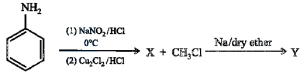
A
Wurtz reaction
B
Fittig reaction
C
Wurtz-Fittig reaction
D
Sandmeyer reaction
Solution
(C) The reaction sequence is as follows:
$1$. Aniline reacts with $NaNO_2/HCl$ at $0^{\circ}C$ followed by $Cu_2Cl_2/HCl$ to form chlorobenzene $(X)$. This is the Sandmeyer reaction.
$2$. Chlorobenzene $(X)$ reacts with methyl chloride $(CH_3Cl)$ in the presence of $Na$ and dry ether to form toluene $(Y)$.
$3$. The reaction between an aryl halide and an alkyl halide in the presence of sodium and dry ether is known as the Wurtz-Fittig reaction.
$1$. Aniline reacts with $NaNO_2/HCl$ at $0^{\circ}C$ followed by $Cu_2Cl_2/HCl$ to form chlorobenzene $(X)$. This is the Sandmeyer reaction.
$2$. Chlorobenzene $(X)$ reacts with methyl chloride $(CH_3Cl)$ in the presence of $Na$ and dry ether to form toluene $(Y)$.
$3$. The reaction between an aryl halide and an alkyl halide in the presence of sodium and dry ether is known as the Wurtz-Fittig reaction.
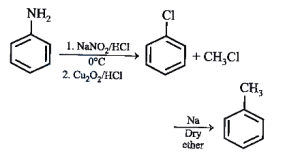
0 likesView Solution
120
ChemistryDifficultMCQTS EAMCET · 2024
What are $Y$ and $Z$ respectively in the given reaction sequence?

A
$CH_3COCH_3, CH_3CH=CHCHO$
B
$CH_3CH_2CHO, CH_3CH_2CH=C(CH_3)CHO$
C
$CH_3CH_2CHO, CH_3CH_2CH=C(CH_3)CHO$
D
$CH_3CH_2CH_2OH, CH_3CH_2COOH$
Solution
(B) $1$. The starting material is propene $(CH_3CH=CH_2)$.
$2$. Hydroboration-oxidation of propene with $(i) B_2H_6$ and $(ii) H_2O_2/NaOH$ gives propan$-1-$ol $(CH_3CH_2CH_2OH)$ as $X$.
$3$. Dehydrogenation of propan$-1-$ol $(X)$ using $Cu$ at $573 \ K$ gives propanal $(CH_3CH_2CHO)$ as $Y$.
$4$. Propanal $(Y)$ undergoes aldol condensation in the presence of dilute $NaOH$ followed by heating $(\Delta)$ to give the $\alpha,\beta$-unsaturated aldehyde,$2$-methylpent-$2$-enal $(CH_3CH_2CH=C(CH_3)CHO)$ as $Z$.
$2$. Hydroboration-oxidation of propene with $(i) B_2H_6$ and $(ii) H_2O_2/NaOH$ gives propan$-1-$ol $(CH_3CH_2CH_2OH)$ as $X$.
$3$. Dehydrogenation of propan$-1-$ol $(X)$ using $Cu$ at $573 \ K$ gives propanal $(CH_3CH_2CHO)$ as $Y$.
$4$. Propanal $(Y)$ undergoes aldol condensation in the presence of dilute $NaOH$ followed by heating $(\Delta)$ to give the $\alpha,\beta$-unsaturated aldehyde,$2$-methylpent-$2$-enal $(CH_3CH_2CH=C(CH_3)CHO)$ as $Z$.
0 likesView Solution
121
ChemistryEasyMCQTS EAMCET · 2024
Identify the element for which $+1$ oxidation state is more stable than $+3$ oxidation state.
A
$Ga$
B
$Sn$
C
$Tl$
D
$Ge$
Solution
(C) In group $13$ elements,the stability of the $+1$ oxidation state increases down the group due to the inert pair effect.
For $Tl$ (Thallium),the $+1$ oxidation state is more stable than the $+3$ oxidation state because the $6s^2$ electrons are reluctant to participate in bonding.
For $Tl$ (Thallium),the $+1$ oxidation state is more stable than the $+3$ oxidation state because the $6s^2$ electrons are reluctant to participate in bonding.
0 likesView Solution
122
ChemistryMediumMCQTS EAMCET · 2024
Which of the following,when subjected to thermal decomposition,will liberate dinitrogen?
$(i)$ Sodium nitrate
$(ii)$ Ammonium dichromate
$(iii)$ Barium azide
$(i)$ Sodium nitrate
$(ii)$ Ammonium dichromate
$(iii)$ Barium azide
A
$i, ii$ only
B
$ii, iii$ only
C
$i, iii$ only
D
$i, ii, iii$
Solution
(B) The thermal decomposition reactions are as follows:
$(NH_4)_2Cr_2O_7 \xrightarrow{\Delta} Cr_2O_3 + N_2 \uparrow + 4H_2O$
$Ba(N_3)_2 \xrightarrow{\Delta} Ba + 3N_2$
$2NaNO_3 \xrightarrow{\Delta} 2NaNO_2 + O_2$
From the above reactions,it is clear that ammonium dichromate $(ii)$ and barium azide $(iii)$ liberate dinitrogen gas upon heating,whereas sodium nitrate $(i)$ liberates dioxygen gas.
Therefore,the correct option is $ii$ and $iii$ only.
$(NH_4)_2Cr_2O_7 \xrightarrow{\Delta} Cr_2O_3 + N_2 \uparrow + 4H_2O$
$Ba(N_3)_2 \xrightarrow{\Delta} Ba + 3N_2$
$2NaNO_3 \xrightarrow{\Delta} 2NaNO_2 + O_2$
From the above reactions,it is clear that ammonium dichromate $(ii)$ and barium azide $(iii)$ liberate dinitrogen gas upon heating,whereas sodium nitrate $(i)$ liberates dioxygen gas.
Therefore,the correct option is $ii$ and $iii$ only.
0 likesView Solution
123
ChemistryEasyMCQTS EAMCET · 2024
Among the hydrides $NH_3, PH_3,$ and $BiH_3$,the hydride with the highest boiling point is $X$ and the hydride with the lowest boiling point is $Y$. What are $X$ and $Y$ respectively?
A
$PH_3, NH_3$
B
$NH_3, PH_3$
C
$BiH_3, PH_3$
D
$NH_3, BiH_3$
Solution
(C) The boiling point of the hydrides of the nitrogen family $(Group \ 15)$ follows the order: $PH_3 < AsH_3 < NH_3 < SbH_3 < BiH_3$.
$NH_3$ has an anomalously high boiling point due to intermolecular hydrogen bonding,but the boiling point increases down the group due to an increase in molecular mass and van der Waals forces.
Comparing the given hydrides: $PH_3$ has the lowest boiling point $(Y = PH_3)$.
$BiH_3$ has the highest boiling point $(X = BiH_3)$.
Therefore,$X = BiH_3$ and $Y = PH_3$.
$NH_3$ has an anomalously high boiling point due to intermolecular hydrogen bonding,but the boiling point increases down the group due to an increase in molecular mass and van der Waals forces.
Comparing the given hydrides: $PH_3$ has the lowest boiling point $(Y = PH_3)$.
$BiH_3$ has the highest boiling point $(X = BiH_3)$.
Therefore,$X = BiH_3$ and $Y = PH_3$.
0 likesView Solution
124
ChemistryEasyMCQTS EAMCET · 2024
In Haber's process for the manufacture of ammonia,the 'catalyst',the 'promoter',and the 'poison for the catalyst' are respectively:
A
$Fe, W, CO$
B
$Co, Mo, CO$
C
$Fe, Mo, CO_2$
D
$Fe, Mo, CO$
Solution
(D) In Haber's process for the manufacture of ammonia,the catalyst used is finely divided $Fe$,the promoter used is $Mo$ (or $K_2O$ and $Al_2O_3$),and the poison for the catalyst is $CO$.
0 likesView Solution
125
ChemistryEasyMCQTS EAMCET · 2024
Match the following industrial processes in List-$I$ with the catalysts used in List-$II$:
| List-$I$ (Industrial process) | List-$II$ (Catalyst used) |
|---|---|
| $A$. Ostwald's process | $I$. $CuCl_2$ |
| $B$. Haber's process | $II$. Zeolites |
| $C$. Deacon's process | $III$. $Pt$ gauge |
| $D$. Cracking of hydrocarbons | $IV$. $Fe$ |
A
$A-III, B-IV, C-I, D-II$
B
$A-IV, B-I, C-II, D-III$
C
$A-III, B-IV, C-II, D-I$
D
$A-II, B-I, C-IV, D-III$
Solution
(A) The correct matches are as follows:
$A$. Ostwald's process uses $Pt$ gauge as a catalyst $(A-III)$.
$B$. Haber's process uses $Fe$ as a catalyst $(B-IV)$.
$C$. Deacon's process uses $CuCl_2$ as a catalyst $(C-I)$.
$D$. Cracking of hydrocarbons uses Zeolites as a catalyst $(D-II)$.
Therefore,the correct sequence is $A-III, B-IV, C-I, D-II$.
$A$. Ostwald's process uses $Pt$ gauge as a catalyst $(A-III)$.
$B$. Haber's process uses $Fe$ as a catalyst $(B-IV)$.
$C$. Deacon's process uses $CuCl_2$ as a catalyst $(C-I)$.
$D$. Cracking of hydrocarbons uses Zeolites as a catalyst $(D-II)$.
Therefore,the correct sequence is $A-III, B-IV, C-I, D-II$.
0 likesView Solution
126
ChemistryMediumMCQTS EAMCET · 2024
Which among the following oxoacids of phosphorus will have $P-O-P$ bonds?
$I$. $H_4P_2O_5$
$II$. $H_4P_2O_6$
$III$. $H_4P_2O_7$
$IV$. $(HPO_3)_3$
$I$. $H_4P_2O_5$
$II$. $H_4P_2O_6$
$III$. $H_4P_2O_7$
$IV$. $(HPO_3)_3$
A
$III$ and $IV$
B
$I$ and $II$
C
$I$ and $III$
D
$II$ and $IV$
Solution
(A) To determine which oxoacids contain $P-O-P$ bonds,we examine their structures:
$I$. $H_4P_2O_5$ (Pyrophosphorous acid): Contains a $P-O-P$ linkage.
$II$. $H_4P_2O_6$ (Hypophosphoric acid): Contains a $P-P$ bond,not $P-O-P$.
$III$. $H_4P_2O_7$ (Pyrophosphoric acid): Contains a $P-O-P$ linkage.
$IV$. $(HPO_3)_3$ (Cyclotrimetaphosphoric acid): Contains a cyclic structure with $P-O-P$ linkages.
Therefore,$I$,$III$,and $IV$ all contain $P-O-P$ bonds. Given the options provided,both $A$ ($III$ and $IV$) and $C$ ($I$ and $III$) contain correct examples,but $I$,$III$,and $IV$ are the complete set.
$I$. $H_4P_2O_5$ (Pyrophosphorous acid): Contains a $P-O-P$ linkage.
$II$. $H_4P_2O_6$ (Hypophosphoric acid): Contains a $P-P$ bond,not $P-O-P$.
$III$. $H_4P_2O_7$ (Pyrophosphoric acid): Contains a $P-O-P$ linkage.
$IV$. $(HPO_3)_3$ (Cyclotrimetaphosphoric acid): Contains a cyclic structure with $P-O-P$ linkages.
Therefore,$I$,$III$,and $IV$ all contain $P-O-P$ bonds. Given the options provided,both $A$ ($III$ and $IV$) and $C$ ($I$ and $III$) contain correct examples,but $I$,$III$,and $IV$ are the complete set.
0 likesView Solution
127
ChemistryEasyMCQTS EAMCET · 2024
In the contact process for the manufacture of $H_2SO_4$,the arsenic purifier used in the industrial plant contains:
A
$Al_2O_3 \cdot xH_2O$
B
$FeO \cdot xH_2O$
C
$Cr_2O_3 \cdot xH_2O$
D
$Fe_2O_3 \cdot xH_2O$
Solution
(D) In the contact process for the manufacture of sulfuric acid $(H_2SO_4)$,the sulfur dioxide $(SO_2)$ gas obtained from burning sulfur or roasting sulfide ores contains impurities like arsenic compounds.
These impurities act as catalytic poisons for the platinum catalyst used in the converter.
To remove these arsenic impurities,an arsenic purifier is used.
The arsenic purifier contains ferric oxide $(Fe_2O_3 \cdot xH_2O)$,which effectively adsorbs the arsenic impurities from the gas stream.
These impurities act as catalytic poisons for the platinum catalyst used in the converter.
To remove these arsenic impurities,an arsenic purifier is used.
The arsenic purifier contains ferric oxide $(Fe_2O_3 \cdot xH_2O)$,which effectively adsorbs the arsenic impurities from the gas stream.
0 likesView Solution
128
ChemistryEasyMCQTS EAMCET · 2024
Observe the following reaction. This reaction represents:
$4 HCl + O_2 \xrightarrow[723 \ K]{CuCl_2} 2 Cl_2 + 2 H_2 O$
$4 HCl + O_2 \xrightarrow[723 \ K]{CuCl_2} 2 Cl_2 + 2 H_2 O$
A
van Arkel process
B
Hall-Heroult process
C
Serpeck's process
D
Deacon's process
Solution
(D) The given reaction is the industrial method for the preparation of chlorine gas,known as the Deacon's process.
In this process,$HCl$ is oxidized by atmospheric oxygen in the presence of $CuCl_2$ as a catalyst at $723 \ K$.
$4 HCl + O_2 \xrightarrow[723 \ K]{CuCl_2} 2 Cl_2 + 2 H_2 O$
In this process,$HCl$ is oxidized by atmospheric oxygen in the presence of $CuCl_2$ as a catalyst at $723 \ K$.
$4 HCl + O_2 \xrightarrow[723 \ K]{CuCl_2} 2 Cl_2 + 2 H_2 O$
0 likesView Solution
129
ChemistryEasyMCQTS EAMCET · 2024
Identify the set which is not correctly matched in the following.
A
$PH_3$,colourless gas,rotten fish smell
B
$Cl_2$,greenish yellow gas,pungent smell
C
$Ne$,fluorescent green gas,rotten egg smell
D
$SO_2$,colourless gas,pungent smell
Solution
(C) Neon $(Ne)$ is a noble gas,which is colorless,odorless,and chemically inert.
Option $C$ is incorrect because $Ne$ is not a fluorescent green gas and does not have a rotten egg smell.
$PH_3$ has a rotten fish smell,$Cl_2$ is a greenish-yellow gas with a pungent smell,and $SO_2$ is a colorless gas with a pungent smell.
Option $C$ is incorrect because $Ne$ is not a fluorescent green gas and does not have a rotten egg smell.
$PH_3$ has a rotten fish smell,$Cl_2$ is a greenish-yellow gas with a pungent smell,and $SO_2$ is a colorless gas with a pungent smell.
0 likesView Solution
130
ChemistryMediumMCQTS EAMCET · 2024
The monomer which is present in both Bakelite and Melamine polymers is
A
Methanal
B
Methanol
C
Phenol
D
Ethane-$1, 2$-diol
Solution
(A) Bakelite is formed by the condensation polymerization of phenol and formaldehyde (methanal).
Melamine is formed by the condensation polymerization of melamine and formaldehyde (methanal).
Therefore,methanal is the common monomer present in both polymers.
Melamine is formed by the condensation polymerization of melamine and formaldehyde (methanal).
Therefore,methanal is the common monomer present in both polymers.
0 likesView Solution
131
ChemistryEasyMCQTS EAMCET · 2024
Which one of the following is not an example of a condensation polymer?
A
Terylene
B
Nylon $6,6$
C
Bakelite
D
Polystyrene
Solution
(D) Condensation polymers are formed by repeated condensation reactions between two different bi-functional monomeric units,involving the elimination of small molecules such as water,alcohol,or hydrogen chloride.
$A$,$B$,and $C$ (Terylene,Nylon $6,6$,and Bakelite) are examples of condensation polymers.
Polystyrene is an addition polymer formed by the polymerization of styrene $(C_6H_5CH=CH_2)$ monomers without the elimination of any small molecules.
$A$,$B$,and $C$ (Terylene,Nylon $6,6$,and Bakelite) are examples of condensation polymers.
Polystyrene is an addition polymer formed by the polymerization of styrene $(C_6H_5CH=CH_2)$ monomers without the elimination of any small molecules.
0 likesView Solution
132
ChemistryEasyMCQTS EAMCET · 2024
Match the following List-$I$ (Monomer/s) with List-$II$ (Name of the polymer) and select the correct answer:
| List-$I$ (Monomer/s) | List-$II$ (Name of the polymer) |
| :--- | :--- |
| $A$. $CF_2=CF_2$ | $I$. Neoprene |
| $B$. $NH_2(CH_2)_6NH_2, HO_2C(CH_2)_4CO_2H$ | $II$. Bakelite |
| $C$. $C_6H_5OH, HCHO$ | $III$. Teflon |
| $D$. $CH_2=CH(Cl)-CH=CH_2$ | $IV$. Nylon $6, 6$ |
| List-$I$ (Monomer/s) | List-$II$ (Name of the polymer) |
| :--- | :--- |
| $A$. $CF_2=CF_2$ | $I$. Neoprene |
| $B$. $NH_2(CH_2)_6NH_2, HO_2C(CH_2)_4CO_2H$ | $II$. Bakelite |
| $C$. $C_6H_5OH, HCHO$ | $III$. Teflon |
| $D$. $CH_2=CH(Cl)-CH=CH_2$ | $IV$. Nylon $6, 6$ |
A
$A-II; B-III; C-I; D-IV$
B
$A-III; B-IV; C-II; D-I$
C
$A-III; B-IV; C-I; D-II$
D
$A-III; B-I; C-IV; D-II$
Solution
(B) The correct matches are:
$A$. $CF_2=CF_2$ is the monomer for Teflon $(III)$.
$B$. $NH_2(CH_2)_6NH_2$ (hexamethylenediamine) and $HO_2C(CH_2)_4CO_2H$ (adipic acid) are monomers for Nylon $6, 6$ $(IV)$.
$C$. $C_6H_5OH$ (phenol) and $HCHO$ (formaldehyde) are monomers for Bakelite $(II)$.
$D$. $CH_2=CH(Cl)-CH=CH_2$ (chloroprene) is the monomer for Neoprene $(I)$.
Thus,the correct matching is $A-III, B-IV, C-II, D-I$.
$A$. $CF_2=CF_2$ is the monomer for Teflon $(III)$.
$B$. $NH_2(CH_2)_6NH_2$ (hexamethylenediamine) and $HO_2C(CH_2)_4CO_2H$ (adipic acid) are monomers for Nylon $6, 6$ $(IV)$.
$C$. $C_6H_5OH$ (phenol) and $HCHO$ (formaldehyde) are monomers for Bakelite $(II)$.
$D$. $CH_2=CH(Cl)-CH=CH_2$ (chloroprene) is the monomer for Neoprene $(I)$.
Thus,the correct matching is $A-III, B-IV, C-II, D-I$.
0 likesView Solution
133
ChemistryDifficultMCQTS EAMCET · 2024
Identify the structure of the polymer '$P$' formed in the given reaction:
$Caprolactam \xrightarrow[H_2O]{533-543 \ K} P$
$Caprolactam \xrightarrow[H_2O]{533-543 \ K} P$
A
$[C(=O)-NH-(CH_2)_5-C]_n$
B
$[NH-(CH_2)_6-NH-CO-(CH_2)_4-C]_n$
C
$[C(=O)-(CH_2)_5-NH]_n$
D
$[C(=O)-(CH_2)_6-NH]_n$
Solution
(C) Caprolactam on heating with water at $533-543 \ K$ undergoes ring-opening polymerization to form Nylon-$6$.
The reaction is:
$Caprolactam \xrightarrow[H_2O]{533-543 \ K} [CO-(CH_2)_5-NH]_n$
This polymer is known as Nylon-$6$. The structure of the repeating unit is $[CO-(CH_2)_5-NH]_n$.
The reaction is:
$Caprolactam \xrightarrow[H_2O]{533-543 \ K} [CO-(CH_2)_5-NH]_n$
This polymer is known as Nylon-$6$. The structure of the repeating unit is $[CO-(CH_2)_5-NH]_n$.
0 likesView Solution
134
ChemistryDifficultMCQTS EAMCET · 2024
What are '$X$' and '$Y$' respectively in the following reactions?

A
Phthalic acid,Terephthalic acid
B
Terephthalic acid,Phthalic acid
C
Isophthalic acid,Terephthalic acid
D
Terephthalic acid,Isophthalic acid
Solution
(A) The reaction of ethylene glycol $(HO-CH_2-CH_2-OH)$ with phthalic acid produces Glyptal,which is used in the manufacture of paints. Thus,$X$ is phthalic acid.
The reaction of ethylene glycol with terephthalic acid produces Terylene (or Dacron),which is used in making safety helmets and synthetic fibers. Thus,$Y$ is terephthalic acid.
Therefore,$X$ is phthalic acid and $Y$ is terephthalic acid.
The reaction of ethylene glycol with terephthalic acid produces Terylene (or Dacron),which is used in making safety helmets and synthetic fibers. Thus,$Y$ is terephthalic acid.
Therefore,$X$ is phthalic acid and $Y$ is terephthalic acid.
0 likesView Solution
135
ChemistryMediumMCQTS EAMCET · 2024
In which of the following,ions are correctly arranged in the increasing order of oxidizing power?
A
$Cr_2O_7^{2-} < MnO_4^{-} < VO_2^{+}$
B
$VO_2^{+} < Cr_2O_7^{2-} < MnO_4^{-}$
C
$VO_2^{+} < MnO_4^{-} < Cr_2O_7^{2-}$
D
$MnO_4^{-} < Cr_2O_7^{2-} < VO_2^{+}$
Solution
(B) The oxidation states of the transition elements in the given ions are $V$ in $VO_2^{+}$ is $+5$,$Cr$ in $Cr_2O_7^{2-}$ is $+6$,and $Mn$ in $MnO_4^{-}$ is $+7$.
Oxidizing power is directly related to the ease of reduction,which depends on the stability of the lower oxidation states formed.
For these transition metals,the stability of the reduced products follows the trend $Mn^{2+} > Cr^{3+} > V^{3+}$.
Consequently,the oxidizing power increases as the reduction potential increases,leading to the order $VO_2^{+} < Cr_2O_7^{2-} < MnO_4^{-}$.
Oxidizing power is directly related to the ease of reduction,which depends on the stability of the lower oxidation states formed.
For these transition metals,the stability of the reduced products follows the trend $Mn^{2+} > Cr^{3+} > V^{3+}$.
Consequently,the oxidizing power increases as the reduction potential increases,leading to the order $VO_2^{+} < Cr_2O_7^{2-} < MnO_4^{-}$.
0 likesView Solution
136
ChemistryMediumMCQTS EAMCET · 2024
$Pt + 3:1$ mixture of (conc. $HCl +$ conc. $HNO_3$) $\rightarrow [X]^{2-}$. What is the oxidation state of $Pt$ in $[X]^{2-}$ complex ion?
A
$2$
B
$3$
C
$4$
D
$6$
Solution
(C) When $Pt$ reacts with a $3:1$ mixture of concentrated hydrochloric acid $(HCl)$ and concentrated nitric acid $(HNO_3)$,it forms a solution known as aqua regia. Aqua regia is capable of dissolving platinum by forming chlorocomplexes. The reaction typically forms $H_2[PtCl_6]$.
In this complex,the $Pt$ is in the $+4$ oxidation state. The balanced chemical equation for the reaction is:
$Pt + 4HNO_3 + 6HCl \rightarrow H_2[PtCl_6] + 4NO_2 + 4H_2O$
So,in $[PtCl_6]^{2-}$ the oxidation state of $Pt$ is:
$x + 6(-1) = -2$
$x - 6 = -2$
$x = +4$
In this complex,the $Pt$ is in the $+4$ oxidation state. The balanced chemical equation for the reaction is:
$Pt + 4HNO_3 + 6HCl \rightarrow H_2[PtCl_6] + 4NO_2 + 4H_2O$
So,in $[PtCl_6]^{2-}$ the oxidation state of $Pt$ is:
$x + 6(-1) = -2$
$x - 6 = -2$
$x = +4$
0 likesView Solution
137
ChemistryMediumMCQTS EAMCET · 2024
$Y$ in the given sequence of reactions is
$P_4 + x NaOH + y H_2O \xrightarrow{CO_2} X + z NaH_2PO_2$
$X + CuSO_4 \rightarrow Y + H_2SO_4$
$P_4 + x NaOH + y H_2O \xrightarrow{CO_2} X + z NaH_2PO_2$
$X + CuSO_4 \rightarrow Y + H_2SO_4$
A
$Cu_3(PO_4)_2$
B
$Cu_3P_2$
C
$CuH_2PO_2$
D
$Cu_2(PO_3)_2$
Solution
(B) The reaction of white phosphorus with sodium hydroxide is a disproportionation reaction:
$P_4 + 3 NaOH + 3 H_2O \rightarrow PH_3 + 3 NaH_2PO_2$
Here,$X$ is phosphine $(PH_3)$.
Next,phosphine reacts with copper$(II)$ sulfate:
$2 PH_3 + 3 CuSO_4 \rightarrow Cu_3P_2 + 3 H_2SO_4$
Thus,$Y$ is copper phosphide $(Cu_3P_2)$.
$P_4 + 3 NaOH + 3 H_2O \rightarrow PH_3 + 3 NaH_2PO_2$
Here,$X$ is phosphine $(PH_3)$.
Next,phosphine reacts with copper$(II)$ sulfate:
$2 PH_3 + 3 CuSO_4 \rightarrow Cu_3P_2 + 3 H_2SO_4$
Thus,$Y$ is copper phosphide $(Cu_3P_2)$.
0 likesView Solution
138
ChemistryMediumMCQTS EAMCET · 2024
The major components of cement are
A
$SiO_2, Al_2O_3$
B
$Al_2O_3, Fe_2O_3$
C
$SiO_2, Fe_2O_3$
D
$SiO_2, CaO$
Solution
(D) Cement is primarily composed of calcium oxide $(CaO)$ and silicon dioxide $(SiO_2)$.
Other significant components include aluminum oxide $(Al_2O_3)$,magnesium oxide $(MgO)$,iron oxide $(Fe_2O_3)$,and sulfur trioxide $(SO_3)$.
Among the given options,$SiO_2$ and $CaO$ constitute the largest percentage by mass in Portland cement.
Other significant components include aluminum oxide $(Al_2O_3)$,magnesium oxide $(MgO)$,iron oxide $(Fe_2O_3)$,and sulfur trioxide $(SO_3)$.
Among the given options,$SiO_2$ and $CaO$ constitute the largest percentage by mass in Portland cement.
0 likesView Solution
139
ChemistryMediumMCQTS EAMCET · 2024
The molecular formula of a compound is $AB_2O_4$. Atoms of $O$ form a $ccp$ lattice. Atoms of $A$ (cation) occupy $\frac{1}{8}$ of the tetrahedral voids. Atoms of $B$ (cation) occupy a fraction of the octahedral voids. What is the fraction of vacant octahedral voids?
A
$\frac{3}{4}$
B
$\frac{1}{4}$
C
$\frac{1}{3}$
D
$\frac{1}{2}$
Solution
(D) In a $ccp$ lattice,if the number of atoms is $N$,then the number of octahedral voids is $N$ and the number of tetrahedral voids is $2N$.
Given the formula $AB_2O_4$,let the number of $O$ atoms be $4$.
Since $O$ forms a $ccp$ lattice,$N = 4$.
Number of tetrahedral voids $= 2 \times 4 = 8$.
Number of octahedral voids $= 4$.
Atoms of $A$ occupy $\frac{1}{8}$ of tetrahedral voids,so number of $A$ atoms $= \frac{1}{8} \times 8 = 1$.
Atoms of $B$ occupy octahedral voids. From the formula $AB_2O_4$,there are $2$ atoms of $B$.
Fraction of occupied octahedral voids $= \frac{\text{Number of } B \text{ atoms}}{\text{Total octahedral voids}} = \frac{2}{4} = \frac{1}{2}$.
Fraction of vacant octahedral voids $= 1 - \frac{1}{2} = \frac{1}{2}$.
Given the formula $AB_2O_4$,let the number of $O$ atoms be $4$.
Since $O$ forms a $ccp$ lattice,$N = 4$.
Number of tetrahedral voids $= 2 \times 4 = 8$.
Number of octahedral voids $= 4$.
Atoms of $A$ occupy $\frac{1}{8}$ of tetrahedral voids,so number of $A$ atoms $= \frac{1}{8} \times 8 = 1$.
Atoms of $B$ occupy octahedral voids. From the formula $AB_2O_4$,there are $2$ atoms of $B$.
Fraction of occupied octahedral voids $= \frac{\text{Number of } B \text{ atoms}}{\text{Total octahedral voids}} = \frac{2}{4} = \frac{1}{2}$.
Fraction of vacant octahedral voids $= 1 - \frac{1}{2} = \frac{1}{2}$.
0 likesView Solution
140
ChemistryMediumMCQTS EAMCET · 2024
An element with molar mass $2.7 \times 10^{-2} \ kg \ mol^{-1}$ forms a cubic unit cell with edge length of $405 \ pm$. If its density is $2.7 \times 10^3 \ kg \ m^{-3}$, the number of atoms present in one unit cell of it is (Given : $N_{A}=6.023 \times 10^{23} \ mol^{-1}$)
A
$2$
B
$4$
C
$6$
D
$12$
Solution
(B) The density of a unit cell is given by the formula: $\rho = \frac{Z \times M}{N_A \times a^3}$
Where $Z$ is the number of atoms per unit cell, $M$ is the molar mass, $N_A$ is Avogadro's number, and $a$ is the edge length.
Rearranging for $Z$: $Z = \frac{\rho \times N_A \times a^3}{M}$
Given:
$\rho = 2.7 \times 10^3 \ kg \ m^{-3}$
$M = 2.7 \times 10^{-2} \ kg \ mol^{-1}$
$a = 405 \ pm = 405 \times 10^{-12} \ m = 4.05 \times 10^{-10} \ m$
$N_A = 6.023 \times 10^{23} \ mol^{-1}$
Substituting the values:
$Z = \frac{(2.7 \times 10^3) \times (6.023 \times 10^{23}) \times (4.05 \times 10^{-10})^3}{2.7 \times 10^{-2}}$
$Z = \frac{2.7 \times 10^3 \times 6.023 \times 10^{23} \times 66.43 \times 10^{-30}}{2.7 \times 10^{-2}}$
$Z = \frac{1080.14 \times 10^{-4}}{2.7 \times 10^{-2}} \approx 4$
Thus, the number of atoms per unit cell is $4$.
Where $Z$ is the number of atoms per unit cell, $M$ is the molar mass, $N_A$ is Avogadro's number, and $a$ is the edge length.
Rearranging for $Z$: $Z = \frac{\rho \times N_A \times a^3}{M}$
Given:
$\rho = 2.7 \times 10^3 \ kg \ m^{-3}$
$M = 2.7 \times 10^{-2} \ kg \ mol^{-1}$
$a = 405 \ pm = 405 \times 10^{-12} \ m = 4.05 \times 10^{-10} \ m$
$N_A = 6.023 \times 10^{23} \ mol^{-1}$
Substituting the values:
$Z = \frac{(2.7 \times 10^3) \times (6.023 \times 10^{23}) \times (4.05 \times 10^{-10})^3}{2.7 \times 10^{-2}}$
$Z = \frac{2.7 \times 10^3 \times 6.023 \times 10^{23} \times 66.43 \times 10^{-30}}{2.7 \times 10^{-2}}$
$Z = \frac{1080.14 \times 10^{-4}}{2.7 \times 10^{-2}} \approx 4$
Thus, the number of atoms per unit cell is $4$.
0 likesView Solution
141
ChemistryDifficultMCQTS EAMCET · 2024
The molecular formula of a crystal is $AB_2O_4$. Oxygen atoms form $ccp$ lattice. Atoms of $A$ occupy $x \%$ of tetrahedral voids and atoms of $B$ occupy $y \%$ of octahedral voids. $x$ and $y$ are respectively:
A
$12.5 \%, 50 \%$
B
$50 \%, 12.5 \%$
C
$33.3 \%, 66.6 \%$
D
$66.6 \%, 33.3 \%$
Solution
(A) In a $ccp$ lattice,if the number of oxygen atoms is $4$,then:
Number of octahedral voids $= 4$
Number of tetrahedral voids $= 8$
Given the formula $AB_2O_4$,there are $1$ atom of $A$,$2$ atoms of $B$,and $4$ atoms of $O$.
For atom $A$ in tetrahedral voids: $x \% \text{ of } 8 = 1 \implies x = (1/8) \times 100 = 12.5 \%$.
For atom $B$ in octahedral voids: $y \% \text{ of } 4 = 2 \implies y = (2/4) \times 100 = 50 \%$.
Thus,$x = 12.5 \%$ and $y = 50 \%$.
Number of octahedral voids $= 4$
Number of tetrahedral voids $= 8$
Given the formula $AB_2O_4$,there are $1$ atom of $A$,$2$ atoms of $B$,and $4$ atoms of $O$.
For atom $A$ in tetrahedral voids: $x \% \text{ of } 8 = 1 \implies x = (1/8) \times 100 = 12.5 \%$.
For atom $B$ in octahedral voids: $y \% \text{ of } 4 = 2 \implies y = (2/4) \times 100 = 50 \%$.
Thus,$x = 12.5 \%$ and $y = 50 \%$.
0 likesView Solution
142
ChemistryMediumMCQTS EAMCET · 2024
In a $BCC$ lattice containing $X$ and $Y$ type of atoms,$X$ type of atoms are present at the corners and $Y$ type of atoms are present at the body center. In its unit cell,if three atoms are missing from the corners,the formula of the compound is:
A
$X_5 Y_8$
B
$X_8 Y_5$
C
$X_3 Y_5$
D
$X_5 Y_3$
Solution
(A) In a $BCC$ unit cell,there are $8$ corners and $1$ body center.
Number of $X$ atoms at corners = $8 - 3 = 5$.
Contribution of each corner atom = $1/8$.
Total $X$ atoms = $5 \times (1/8) = 5/8$.
Number of $Y$ atoms at the body center = $1$.
Contribution of body center atom = $1$.
Total $Y$ atoms = $1$.
Ratio $X : Y = 5/8 : 1 = 5 : 8$.
Therefore,the formula of the compound is $X_5 Y_8$.
Number of $X$ atoms at corners = $8 - 3 = 5$.
Contribution of each corner atom = $1/8$.
Total $X$ atoms = $5 \times (1/8) = 5/8$.
Number of $Y$ atoms at the body center = $1$.
Contribution of body center atom = $1$.
Total $Y$ atoms = $1$.
Ratio $X : Y = 5/8 : 1 = 5 : 8$.
Therefore,the formula of the compound is $X_5 Y_8$.
0 likesView Solution
143
ChemistryMediumMCQTS EAMCET · 2024
Identify the correct statement about the crystal defects in solids.
A
Frenkel defect is favoured when the difference between sizes of cation and anion is very small.
B
Frenkel defect is not a dislocation effect.
C
Schottky defects have no effect on physical properties of solids.
D
Trapping of electrons in lattice leads to the formation of $F$-centres.
Solution
(D) The correct statement is that the trapping of electrons in the lattice leads to the formation of $F$-centres.
$1-$ Frenkel defect is favoured when the difference between the size of the cation and anion is large.
$2-$ Frenkel defect is also known as a dislocation defect.
$3-$ Schottky defect affects the physical properties of solids,specifically by decreasing the density of the substance.
$1-$ Frenkel defect is favoured when the difference between the size of the cation and anion is large.
$2-$ Frenkel defect is also known as a dislocation defect.
$3-$ Schottky defect affects the physical properties of solids,specifically by decreasing the density of the substance.
0 likesView Solution
144
ChemistryEasyMCQTS EAMCET · 2024
Dry air contains $79 \% \,N_2$ and $21 \% \,O_2$. At $T \,K$, if Henry's law constants for $N_2$ and $O_2$ in water are $8.57 \times 10^4 \,atm$ and $4.56 \times 10^4 \,atm$ respectively, the ratio of mole fractions of $N_2$ and $O_2$ dissolved in water at $1 \,atm$ is
A
$4: 1$
B
$1: 4$
C
$2: 1$
D
$1: 2$
Solution
(C) Total pressure of air over water $= 1 \,atm$.
Partial pressure of $N_2$ and $O_2$ are:
$P_{N_2} = \frac{1 \times 79}{100} = 0.79 \,atm$
$P_{O_2} = \frac{1 \times 21}{100} = 0.21 \,atm$
Applying Henry's law $(P = K_H \times X)$:
$X_{N_2} = \frac{P_{N_2}}{K_{H, N_2}} = \frac{0.79}{8.57 \times 10^4} \approx 9.22 \times 10^{-6}$
$X_{O_2} = \frac{P_{O_2}}{K_{H, O_2}} = \frac{0.21}{4.56 \times 10^4} \approx 4.60 \times 10^{-6}$
Ratio of mole fractions of $N_2$ and $O_2$:
$\frac{X_{N_2}}{X_{O_2}} = \frac{9.22 \times 10^{-6}}{4.60 \times 10^{-6}} \approx 2$
Thus, the ratio is $2: 1$.
Partial pressure of $N_2$ and $O_2$ are:
$P_{N_2} = \frac{1 \times 79}{100} = 0.79 \,atm$
$P_{O_2} = \frac{1 \times 21}{100} = 0.21 \,atm$
Applying Henry's law $(P = K_H \times X)$:
$X_{N_2} = \frac{P_{N_2}}{K_{H, N_2}} = \frac{0.79}{8.57 \times 10^4} \approx 9.22 \times 10^{-6}$
$X_{O_2} = \frac{P_{O_2}}{K_{H, O_2}} = \frac{0.21}{4.56 \times 10^4} \approx 4.60 \times 10^{-6}$
Ratio of mole fractions of $N_2$ and $O_2$:
$\frac{X_{N_2}}{X_{O_2}} = \frac{9.22 \times 10^{-6}}{4.60 \times 10^{-6}} \approx 2$
Thus, the ratio is $2: 1$.
0 likesView Solution
145
ChemistryMediumMCQTS EAMCET · 2024
At $300 \ K$,$0.06 \ kg$ of an organic solute is dissolved in $1 \ kg$ water. The vapour pressure of the solution at $300 \ K$ is $3.768 \ kPa$. If the vapour pressure of water at that temperature is $3.78 \ kPa$,what is the molar mass of the organic solute (in $g \ mol^{-1}$)? (Assume the solution is dilute)
A
$180$
B
$120$
C
$340$
D
$260$
Solution
(C) For a dilute solution,the relative lowering of vapour pressure is given by: $\frac{P^0 - P_s}{P^0} = \frac{n_2}{n_1} = \frac{W_2 \times M_1}{M_2 \times W_1}$
Given: $W_2 = 0.06 \ kg = 60 \ g$,$W_1 = 1 \ kg = 1000 \ g$,$P^0 = 3.78 \ kPa$,$P_s = 3.768 \ kPa$,$M_1 = 18 \ g \ mol^{-1}$ (for water).
$\Delta P = P^0 - P_s = 3.78 - 3.768 = 0.012 \ kPa$.
Rearranging the formula for $M_2$: $M_2 = \frac{W_2 \times M_1 \times P^0}{\Delta P \times W_1}$
$M_2 = \frac{60 \times 18 \times 3.78}{0.012 \times 1000} = \frac{4082.4}{12} = 340.2 \ g \ mol^{-1}$
The closest integer value is $340 \ g \ mol^{-1}$.
Given: $W_2 = 0.06 \ kg = 60 \ g$,$W_1 = 1 \ kg = 1000 \ g$,$P^0 = 3.78 \ kPa$,$P_s = 3.768 \ kPa$,$M_1 = 18 \ g \ mol^{-1}$ (for water).
$\Delta P = P^0 - P_s = 3.78 - 3.768 = 0.012 \ kPa$.
Rearranging the formula for $M_2$: $M_2 = \frac{W_2 \times M_1 \times P^0}{\Delta P \times W_1}$
$M_2 = \frac{60 \times 18 \times 3.78}{0.012 \times 1000} = \frac{4082.4}{12} = 340.2 \ g \ mol^{-1}$
The closest integer value is $340 \ g \ mol^{-1}$.
0 likesView Solution
146
ChemistryEasyMCQTS EAMCET · 2024
At $300 \ K$,the vapour pressure of toluene and benzene are $3.63 \ kPa$ and $9.7 \ kPa$ respectively. What is the composition of vapour in equilibrium with the solution containing $0.4$ mole fraction of toluene? (Assume the solution is ideal)
A
$0.40$
B
$0.60$
C
$0.80$
D
$0.20$
Solution
(D) Given: $P_{T}^0 = 3.63 \ kPa$,$P_{B}^0 = 9.7 \ kPa$,$X_{T} = 0.4$.
Since $X_{T} + X_{B} = 1$,the mole fraction of benzene is $X_{B} = 1 - 0.4 = 0.6$.
The total vapour pressure of the solution is given by $P_{total} = P_{T}^0 X_{T} + P_{B}^0 X_{B}$.
$P_{total} = (3.63 \times 0.4) + (9.7 \times 0.6) = 1.452 + 5.82 = 7.272 \ kPa$.
The composition of toluene in the vapour phase $(y_{T})$ is calculated using Dalton's Law: $y_{T} = \frac{P_{T}}{P_{total}} = \frac{P_{T}^0 X_{T}}{P_{total}}$.
$y_{T} = \frac{1.452}{7.272} \approx 0.1996 \approx 0.20$.
Since $X_{T} + X_{B} = 1$,the mole fraction of benzene is $X_{B} = 1 - 0.4 = 0.6$.
The total vapour pressure of the solution is given by $P_{total} = P_{T}^0 X_{T} + P_{B}^0 X_{B}$.
$P_{total} = (3.63 \times 0.4) + (9.7 \times 0.6) = 1.452 + 5.82 = 7.272 \ kPa$.
The composition of toluene in the vapour phase $(y_{T})$ is calculated using Dalton's Law: $y_{T} = \frac{P_{T}}{P_{total}} = \frac{P_{T}^0 X_{T}}{P_{total}}$.
$y_{T} = \frac{1.452}{7.272} \approx 0.1996 \approx 0.20$.
0 likesView Solution
147
ChemistryEasyMCQTS EAMCET · 2024
Distilled water boils at $373.15 \ K$ and freezes at $273.15 \ K$. $A$ solution of glucose in distilled water boils at $373.202 \ K$. What is the freezing point (in $K$) of the same solution? (For water,$K_{b}=0.52 \ K \ kg \ mol^{-1}, \ K_{f}=1.86 \ K \ kg \ mol^{-1}$)
A
$273.15$
B
$273$
C
$272.964$
D
$273.336$
Solution
(C) Given: $T_{b}^{\circ} = 373.15 \ K$,$T_{b} = 373.202 \ K$,$K_{b} = 0.52 \ K \ kg \ mol^{-1}$,$K_{f} = 1.86 \ K \ kg \ mol^{-1}$,$T_{f}^{\circ} = 273.15 \ K$.
Elevation in boiling point: $\Delta T_{b} = T_{b} - T_{b}^{\circ} = 373.202 - 373.15 = 0.052 \ K$.
Since $\Delta T_{b} = m \times K_{b}$,we have $0.052 = m \times 0.52$,which gives molality $m = 0.1 \ mol \ kg^{-1}$.
Depression in freezing point: $\Delta T_{f} = m \times K_{f} = 0.1 \times 1.86 = 0.186 \ K$.
Freezing point of the solution: $T_{f} = T_{f}^{\circ} - \Delta T_{f} = 273.15 - 0.186 = 272.964 \ K$.
Elevation in boiling point: $\Delta T_{b} = T_{b} - T_{b}^{\circ} = 373.202 - 373.15 = 0.052 \ K$.
Since $\Delta T_{b} = m \times K_{b}$,we have $0.052 = m \times 0.52$,which gives molality $m = 0.1 \ mol \ kg^{-1}$.
Depression in freezing point: $\Delta T_{f} = m \times K_{f} = 0.1 \times 1.86 = 0.186 \ K$.
Freezing point of the solution: $T_{f} = T_{f}^{\circ} - \Delta T_{f} = 273.15 - 0.186 = 272.964 \ K$.
0 likesView Solution
148
ChemistryEasyMCQTS EAMCET · 2024
At $T \ K$,$0.1 \ mol$ of a non-volatile solute was dissolved in $0.9 \ mol$ of a volatile solvent. The vapour pressure of pure solvent is $0.9 \ bar$. What is the vapour pressure (in $bar$) of the solution?
A
$0.89$
B
$0.81$
C
$0.79$
D
$0.71$
Solution
(B) According to Raoult's law,the vapour pressure of a solution containing a non-volatile solute is given by $P_s = P_1^0 \times X_1$.
Given: $n_{\text{solute}} = 0.1 \ mol$,$n_{\text{solvent}} = 0.9 \ mol$,$P_1^0 = 0.9 \ bar$.
Mole fraction of solvent $(X_1)$ = $\frac{n_{\text{solvent}}}{n_{\text{solvent}} + n_{\text{solute}}} = \frac{0.9}{0.9 + 0.1} = 0.9$.
$P_s = 0.9 \times 0.9 = 0.81 \ bar$.
Given: $n_{\text{solute}} = 0.1 \ mol$,$n_{\text{solvent}} = 0.9 \ mol$,$P_1^0 = 0.9 \ bar$.
Mole fraction of solvent $(X_1)$ = $\frac{n_{\text{solvent}}}{n_{\text{solvent}} + n_{\text{solute}}} = \frac{0.9}{0.9 + 0.1} = 0.9$.
$P_s = 0.9 \times 0.9 = 0.81 \ bar$.
0 likesView Solution
149
ChemistryMediumMCQTS EAMCET · 2024
Adsorption of a gas on a solid adsorbent follows the Freundlich adsorption isotherm. If $x$ is the mass of the gas adsorbed on mass '$m$' of the adsorbent at pressure $p$,then from the given graph,the extent of adsorption is proportional to:
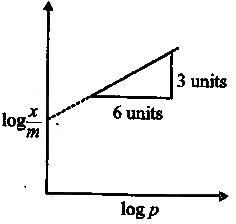
A
$p^{1/2}$
B
$p^2$
C
$p$
D
$p^{1/4}$
Solution
(A) According to the Freundlich adsorption isotherm:
$\frac{x}{m} = k \cdot p^{1/n}$
Taking logarithm on both sides:
$\log(\frac{x}{m}) = \log k + \frac{1}{n} \log p$
This equation represents a straight line of the form $y = mx + c$,where the slope is $\frac{1}{n}$.
From the given graph,the slope is calculated as:
$\text{Slope} = \frac{\text{change in } \log(\frac{x}{m})}{\text{change in } \log p} = \frac{3}{6} = \frac{1}{2}$
Therefore,$\frac{1}{n} = \frac{1}{2}$.
Substituting this back into the Freundlich equation:
$\frac{x}{m} = k \cdot p^{1/2}$
Thus,the extent of adsorption is proportional to $p^{1/2}$.
$\frac{x}{m} = k \cdot p^{1/n}$
Taking logarithm on both sides:
$\log(\frac{x}{m}) = \log k + \frac{1}{n} \log p$
This equation represents a straight line of the form $y = mx + c$,where the slope is $\frac{1}{n}$.
From the given graph,the slope is calculated as:
$\text{Slope} = \frac{\text{change in } \log(\frac{x}{m})}{\text{change in } \log p} = \frac{3}{6} = \frac{1}{2}$
Therefore,$\frac{1}{n} = \frac{1}{2}$.
Substituting this back into the Freundlich equation:
$\frac{x}{m} = k \cdot p^{1/2}$
Thus,the extent of adsorption is proportional to $p^{1/2}$.
0 likesView Solution
150
ChemistryEasyMCQTS EAMCET · 2024
Adsorption of a gas on an adsorbent follows Freundlich adsorption isotherm. The slope and intercept (on $y$-axis) of the isotherm are $0.5$ and $1.0$ respectively. What is the value of $\frac{x}{m}$,when the pressure of the gas $(p)$ is $100 \ atm$?
A
$10$
B
$1$
C
$100$
D
$1000$
Solution
(C) The Freundlich adsorption isotherm equation is given by: $\log \frac{x}{m} = \log k + \frac{1}{n} \log p$.
Comparing this with the equation of a straight line $y = mx + c$,where $y = \log \frac{x}{m}$,$x = \log p$,slope $= \frac{1}{n}$,and intercept $= \log k$.
Given: Slope $(\frac{1}{n}) = 0.5$ and Intercept $(\log k) = 1.0$.
Pressure $(p) = 100 \ atm$.
Substituting the values into the equation: $\log \frac{x}{m} = 1.0 + 0.5 \times \log(100)$.
Since $\log(100) = 2$,we get: $\log \frac{x}{m} = 1.0 + 0.5 \times 2 = 1.0 + 1.0 = 2.0$.
Therefore,$\frac{x}{m} = 10^2 = 100$.
Comparing this with the equation of a straight line $y = mx + c$,where $y = \log \frac{x}{m}$,$x = \log p$,slope $= \frac{1}{n}$,and intercept $= \log k$.
Given: Slope $(\frac{1}{n}) = 0.5$ and Intercept $(\log k) = 1.0$.
Pressure $(p) = 100 \ atm$.
Substituting the values into the equation: $\log \frac{x}{m} = 1.0 + 0.5 \times \log(100)$.
Since $\log(100) = 2$,we get: $\log \frac{x}{m} = 1.0 + 0.5 \times 2 = 1.0 + 1.0 = 2.0$.
Therefore,$\frac{x}{m} = 10^2 = 100$.
0 likesView Solution
Vedclass Products
For Students
Vedclass Test Series
Mock tests in real TS EAMCET style covering Chemistry with performance analysis. 5-day free trial.
Start Free TrialFor Teachers
Exam Paper Generator
Generate Set A/B/C/D Chemistry papers from 7.5L+ questions in 2 minutes. 3 chapters free.
Try FreeFor Institutes
Online Exam Module
Run live TS EAMCET mock exams with unlimited students, 360° analytics & white-label branding.
See DemoFrequently Asked Questions
How many Chemistry questions are in TS EAMCET 2024?
There are 241 Chemistry questions from the TS EAMCET 2024 paper on Vedclass, each with a detailed step-by-step solution in English.
Are TS EAMCET 2024 Chemistry solutions available in English?
Yes. All solutions on this page are in English. You can also switch to English or Hindi using the language buttons above the questions.
Can I practice TS EAMCET 2024 Chemistry as a timed test?
Yes. Use the Vedclass Test Series to attempt a full TS EAMCET mock test covering Chemistry with time limits and instant score analysis.
Can teachers create Chemistry papers from TS EAMCET previous year questions?
Yes. The Vedclass Exam Paper Generator lets teachers mix TS EAMCET Chemistry questions and generate Set A/B/C/D papers in minutes.
For Teachers & Institutes
Build a Custom Chemistry Paper
Pick TS EAMCET 2024 Chemistry questions, set difficulty, and generate Set A/B/C/D in 2 minutes.