
ChemistryQ101–141 of 241 questions
Page 3 of 3 · English
101
ChemistryMediumMCQTS EAMCET · 2024
Consider the following reactions:
$Cs + O_2 \text{ (excess)} \rightarrow X$
$Na + O_2 \rightarrow Y$
Identify the correct statement about $X$ and $Y$.
$Cs + O_2 \text{ (excess)} \rightarrow X$
$Na + O_2 \rightarrow Y$
Identify the correct statement about $X$ and $Y$.
A
$Y$ is monoxide and $X$ is superoxide
B
$Y$ is peroxide and $X$ is peroxide
C
$Y$ is peroxide and $X$ is superoxide
D
$Y$ is superoxide and $X$ is peroxide
Solution
(C) The reaction of alkali metals with oxygen depends on the size of the metal cation.
Lithium $(Li)$ forms monoxide $(Li_2O)$.
Sodium $(Na)$ forms peroxide $(Na_2O_2)$.
Potassium $(K)$,Rubidium $(Rb)$,and Cesium $(Cs)$ form superoxides $(MO_2)$.
Therefore,$X$ is $CsO_2$ (superoxide) and $Y$ is $Na_2O_2$ (peroxide).
Lithium $(Li)$ forms monoxide $(Li_2O)$.
Sodium $(Na)$ forms peroxide $(Na_2O_2)$.
Potassium $(K)$,Rubidium $(Rb)$,and Cesium $(Cs)$ form superoxides $(MO_2)$.
Therefore,$X$ is $CsO_2$ (superoxide) and $Y$ is $Na_2O_2$ (peroxide).
0 likesView Solution
102
ChemistryMCQTS EAMCET · 2024
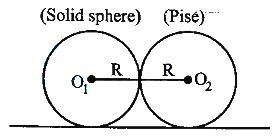
$A$ solid sphere and a disc of same mass $M$ and radius $R$ are kept such that their curved surfaces are in contact and their centers lie along the same horizontal line. The moment of inertia of the two-body system about an axis passing through their point of contact and perpendicular to the plane of the disc is
A
$\frac{53 M R^2}{20}$
B
$\frac{39 M R^2}{10}$
C
$\frac{29 M R^2}{10}$
D
$\frac{9 M R^2}{10}$
Solution
(C) The moment of inertia of a solid sphere about an axis passing through its center is $I_{cm, sphere} = \frac{2}{5} M R^2$. Using the parallel axis theorem,the moment of inertia about an axis passing through its edge (point of contact) is $I_1 = I_{cm, sphere} + M R^2 = \frac{2}{5} M R^2 + M R^2 = \frac{7}{5} M R^2$.
The moment of inertia of a disc about an axis passing through its center and perpendicular to its plane is $I_{cm, disc} = \frac{1}{2} M R^2$. Using the parallel axis theorem,the moment of inertia about an axis passing through its edge (point of contact) is $I_2 = I_{cm, disc} + M R^2 = \frac{1}{2} M R^2 + M R^2 = \frac{3}{2} M R^2$.
The total moment of inertia of the system about the axis passing through the point of contact is $I = I_1 + I_2 = \frac{7}{5} M R^2 + \frac{3}{2} M R^2 = \frac{14 + 15}{10} M R^2 = \frac{29}{10} M R^2$.
The moment of inertia of a disc about an axis passing through its center and perpendicular to its plane is $I_{cm, disc} = \frac{1}{2} M R^2$. Using the parallel axis theorem,the moment of inertia about an axis passing through its edge (point of contact) is $I_2 = I_{cm, disc} + M R^2 = \frac{1}{2} M R^2 + M R^2 = \frac{3}{2} M R^2$.
The total moment of inertia of the system about the axis passing through the point of contact is $I = I_1 + I_2 = \frac{7}{5} M R^2 + \frac{3}{2} M R^2 = \frac{14 + 15}{10} M R^2 = \frac{29}{10} M R^2$.
0 likesView Solution
103
ChemistryMediumMCQTS EAMCET · 2024
What is the correct stability order of $KO_2$,$RbO_2$,and $CsO_2$?
A
$KO_2 < RbO_2 < CsO_2$
B
$CsO_2 < KO_2 < RbO_2$
C
$CsO_2 < RbO_2 < KO_2$
D
$KO_2 > RbO_2 > CsO_2$
Solution
(A) The stability of alkali metal superoxides $(MO_2)$ increases as the size of the alkali metal cation increases.
This is because the large cation stabilizes the large superoxide anion $(O_2^-)$ through lattice energy effects.
The ionic radii of the alkali metals follow the order: $K^+ < Rb^+ < Cs^+$.
Therefore,the stability order is $KO_2 < RbO_2 < CsO_2$.
This is because the large cation stabilizes the large superoxide anion $(O_2^-)$ through lattice energy effects.
The ionic radii of the alkali metals follow the order: $K^+ < Rb^+ < Cs^+$.
Therefore,the stability order is $KO_2 < RbO_2 < CsO_2$.
0 likesView Solution
104
ChemistryMediumMCQTS EAMCET · 2024
An organic compound containing phosphorus on oxidation with $Na_2O_2$ gives a compound '$X$'. This '$X$' when boiled with $HNO_3$ followed by treatment with ammonium molybdate reagent gives a yellow precipitate '$Y$'. '$X$' and '$Y$' respectively are:
A
$Na_3PO_4, (NH_4)_2MoO_4$
B
$Na_3PO_4, (NH_4)_3PO_4 \cdot 12MoO_3$
C
$H_3PO_4, (NH_4)_2MoO_4$
D
$Na_3PO_4, (NH_4)_2MoO_3$
Solution
(B) $1$. When an organic compound containing phosphorus is fused with sodium peroxide $(Na_2O_2)$,the phosphorus is oxidized to phosphate ions,forming sodium phosphate $(Na_3PO_4)$ as compound '$X$'.
$2$. When '$X$' $(Na_3PO_4)$ is boiled with concentrated nitric acid $(HNO_3)$ and then treated with ammonium molybdate reagent,it forms a yellow precipitate of ammonium phosphomolybdate,which is $(NH_4)_3PO_4 \cdot 12MoO_3$ (or $(NH_4)_3[P(Mo_3O_{10})_4]$),identified as '$Y$'.
$3$. Therefore,'$X$' is $Na_3PO_4$ and '$Y$' is $(NH_4)_3PO_4 \cdot 12MoO_3$.
$2$. When '$X$' $(Na_3PO_4)$ is boiled with concentrated nitric acid $(HNO_3)$ and then treated with ammonium molybdate reagent,it forms a yellow precipitate of ammonium phosphomolybdate,which is $(NH_4)_3PO_4 \cdot 12MoO_3$ (or $(NH_4)_3[P(Mo_3O_{10})_4]$),identified as '$Y$'.
$3$. Therefore,'$X$' is $Na_3PO_4$ and '$Y$' is $(NH_4)_3PO_4 \cdot 12MoO_3$.
0 likesView Solution
105
ChemistryEasyMCQTS EAMCET · 2024
Match the following alloys in List-$I$ with their uses in List-$II$:
| List-$I$ (Alloy) | List-$II$ (Use) |
|---|---|
| $A$. $Li-Pb$ | $I$. In aircraft construction |
| $B$. $Be-Cu$ | $II$. To make bearings for motor engines |
| $C$. $Mg-Al$ | $III$. To make tetraethyl lead |
| $D$. $Na-Pb$ | $IV$. To make high strength springs |
A
$A-II, B-IV, C-III, D-I$
B
$A-II, B-IV, C-I, D-III$
C
$A-IV, B-I, C-II, D-III$
D
$A-III, B-II, C-I, D-IV$
Solution
(B) The correct matches are as follows:
$A$. $Li-Pb$ is used to make bearings for motor engines $(II)$.
$B$. $Be-Cu$ is used to make high strength springs $(IV)$.
$C$. $Mg-Al$ is used in aircraft construction $(I)$.
$D$. $Na-Pb$ is used to make tetraethyl lead $(III)$.
Thus,the correct matching is $A-II, B-IV, C-I, D-III$.
$A$. $Li-Pb$ is used to make bearings for motor engines $(II)$.
$B$. $Be-Cu$ is used to make high strength springs $(IV)$.
$C$. $Mg-Al$ is used in aircraft construction $(I)$.
$D$. $Na-Pb$ is used to make tetraethyl lead $(III)$.
Thus,the correct matching is $A-II, B-IV, C-I, D-III$.
0 likesView Solution
106
ChemistryEasyMCQTS EAMCET · 2024
Assertion $(A)$: $MgO$,$CaO$,$SrO$,and $BaO$ are insoluble in water.
Reason $(R)$: In aqueous medium,the basic strength of $MgO$,$CaO$,$SrO$,and $BaO$ increases with an increase in the atomic number of the metal.
The correct option among the following is:
Reason $(R)$: In aqueous medium,the basic strength of $MgO$,$CaO$,$SrO$,and $BaO$ increases with an increase in the atomic number of the metal.
The correct option among the following is:
A
$A$ and $(R)$ are correct,and $(R)$ is the correct explanation of $(A)$
B
$A$ and $(R)$ are correct,but $(R)$ is not the correct explanation of $(A)$
C
$A$ is correct but $(R)$ is not correct
D
$A$ is not correct but $(R)$ is correct
Solution
(D) Assertion $(A)$: $MgO$,$CaO$,$SrO$,and $BaO$ are oxides of alkaline earth metals. While $MgO$ is sparingly soluble,$CaO$,$SrO$,and $BaO$ react with water to form hydroxides $(M(OH)_2)$,which are soluble to varying degrees. Therefore,the statement that they are all insoluble is incorrect.
Reason $(R)$: The basic strength of alkaline earth metal oxides increases down the group as the electropositive character of the metal increases with the increase in atomic number. Thus,$BaO > SrO > CaO > MgO$ in terms of basicity. This statement is correct.
Conclusion: Since $(A)$ is incorrect and $(R)$ is correct,the correct option is $(D)$.
Reason $(R)$: The basic strength of alkaline earth metal oxides increases down the group as the electropositive character of the metal increases with the increase in atomic number. Thus,$BaO > SrO > CaO > MgO$ in terms of basicity. This statement is correct.
Conclusion: Since $(A)$ is incorrect and $(R)$ is correct,the correct option is $(D)$.
0 likesView Solution
107
ChemistryEasyMCQTS EAMCET · 2024
The hydroxide of which of the following metals reacts with both acid and alkali?
A
$Mg$
B
$Na$
C
$Be$
D
$Ca$
Solution
(C) Amphoteric hydroxides are those that react with both acids and bases.
Among the given options,$Be(OH)_2$ is amphoteric in nature.
It reacts with acids to form salts and with alkalis to form beryllates.
For example:
$Be(OH)_2 + 2HCl \rightarrow BeCl_2 + 2H_2O$
$Be(OH)_2 + 2NaOH \rightarrow Na_2BeO_2 + 2H_2O$
Among the given options,$Be(OH)_2$ is amphoteric in nature.
It reacts with acids to form salts and with alkalis to form beryllates.
For example:
$Be(OH)_2 + 2HCl \rightarrow BeCl_2 + 2H_2O$
$Be(OH)_2 + 2NaOH \rightarrow Na_2BeO_2 + 2H_2O$
0 likesView Solution
108
ChemistryMediumMCQTS EAMCET · 2024
Identify the compound which gives $CO_2$ more readily on heating.
A
$CaCO_3$
B
$Na_2CO_3$
C
$NaHCO_3$
D
$Li_2CO_3$
Solution
(C) The thermal stability of carbonates and bicarbonates determines how easily they release $CO_2$ upon heating.
$NaHCO_3$ (sodium bicarbonate) decomposes at a much lower temperature compared to the others: $2NaHCO_3 \rightarrow Na_2CO_3 + H_2O + CO_2$.
$CaCO_3$ and $Li_2CO_3$ require significantly higher temperatures for decomposition,while $Na_2CO_3$ is thermally very stable and does not decompose easily.
$NaHCO_3$ (sodium bicarbonate) decomposes at a much lower temperature compared to the others: $2NaHCO_3 \rightarrow Na_2CO_3 + H_2O + CO_2$.
$CaCO_3$ and $Li_2CO_3$ require significantly higher temperatures for decomposition,while $Na_2CO_3$ is thermally very stable and does not decompose easily.
0 likesView Solution
109
ChemistryEasyMCQTS EAMCET · 2024
Choose the correct statements from the following:
$(I)$ In vapour phase $BeCl_2$ exists as a chlorobridged dimer.
$(II)$ $BeSO_4$ is readily soluble in water.
$(III)$ $BeO$ is completely basic in nature.
$(IV)$ $BeCO_3$ being unstable,is kept in an atmosphere of $CO_2$.
$(V)$ $BeCO_3$ is the least soluble among all the carbonates of group $2$ elements.
$(I)$ In vapour phase $BeCl_2$ exists as a chlorobridged dimer.
$(II)$ $BeSO_4$ is readily soluble in water.
$(III)$ $BeO$ is completely basic in nature.
$(IV)$ $BeCO_3$ being unstable,is kept in an atmosphere of $CO_2$.
$(V)$ $BeCO_3$ is the least soluble among all the carbonates of group $2$ elements.
A
$II, III, IV$
B
$I, II, IV$
C
$I, IV, V$
D
$II, III, V$
Solution
(B) $(I)$ Correct: $BeCl_2$ exists as a chlorobridged dimer in the vapour phase.
$(II)$ Correct: $BeSO_4$ is highly soluble in water due to the high hydration enthalpy of $Be^{2+}$ ions.
$(III)$ Incorrect: $BeO$ is amphoteric in nature,not basic.
$(IV)$ Correct: $BeCO_3$ is unstable and decomposes easily,so it is stored in a $CO_2$ atmosphere.
$(V)$ Correct: $BeCO_3$ is the least soluble among group $2$ carbonates due to the high lattice energy of the small $Be^{2+}$ ion.
Therefore,statements $(I)$,$(II)$,$(IV)$,and $(V)$ are correct. However,based on the provided options,the best fit is $(I, IV, V)$ or $(I, II, IV)$. Given the standard chemistry facts,$(I, II, IV)$ is often cited in textbooks.
$(II)$ Correct: $BeSO_4$ is highly soluble in water due to the high hydration enthalpy of $Be^{2+}$ ions.
$(III)$ Incorrect: $BeO$ is amphoteric in nature,not basic.
$(IV)$ Correct: $BeCO_3$ is unstable and decomposes easily,so it is stored in a $CO_2$ atmosphere.
$(V)$ Correct: $BeCO_3$ is the least soluble among group $2$ carbonates due to the high lattice energy of the small $Be^{2+}$ ion.
Therefore,statements $(I)$,$(II)$,$(IV)$,and $(V)$ are correct. However,based on the provided options,the best fit is $(I, IV, V)$ or $(I, II, IV)$. Given the standard chemistry facts,$(I, II, IV)$ is often cited in textbooks.
0 likesView Solution
110
ChemistryMCQTS EAMCET · 2024
The voltage gain of a transistor in common emitter configuration is $160$. The resistances in base and collector sides of the circuit are $1 \text{ k}\Omega$ and $4 \text{ k}\Omega$ respectively. If the change in base current is $100 \mu A$, then the change in output current is:
A
$4 \text{ mA}$
B
$4 \mu A$
C
$40 \text{ mA}$
D
$40 \mu A$
Solution
(A) Given: Voltage gain $A_V = 160$, Base resistance $R_B = 1 \text{ k}\Omega$, Collector resistance $R_C = 4 \text{ k}\Omega$, Change in base current $\Delta I_B = 100 \mu A = 10^{-4} \text{ A}$.
We know that voltage gain $A_V$ is given by $A_V = \beta \times \frac{R_C}{R_B}$, where $\beta = \frac{\Delta I_C}{\Delta I_B}$ is the current gain.
Substituting the values: $160 = \left( \frac{\Delta I_C}{100 \times 10^{-6} \text{ A}} \right) \times \left( \frac{4 \text{ k}\Omega}{1 \text{ k}\Omega} \right)$.
$160 = \left( \frac{\Delta I_C}{10^{-4} \text{ A}} \right) \times 4$.
$40 = \frac{\Delta I_C}{10^{-4} \text{ A}}$.
$\Delta I_C = 40 \times 10^{-4} \text{ A} = 4 \times 10^{-3} \text{ A} = 4 \text{ mA}$.
Thus, the change in output current is $4 \text{ mA}$.
We know that voltage gain $A_V$ is given by $A_V = \beta \times \frac{R_C}{R_B}$, where $\beta = \frac{\Delta I_C}{\Delta I_B}$ is the current gain.
Substituting the values: $160 = \left( \frac{\Delta I_C}{100 \times 10^{-6} \text{ A}} \right) \times \left( \frac{4 \text{ k}\Omega}{1 \text{ k}\Omega} \right)$.
$160 = \left( \frac{\Delta I_C}{10^{-4} \text{ A}} \right) \times 4$.
$40 = \frac{\Delta I_C}{10^{-4} \text{ A}}$.
$\Delta I_C = 40 \times 10^{-4} \text{ A} = 4 \times 10^{-3} \text{ A} = 4 \text{ mA}$.
Thus, the change in output current is $4 \text{ mA}$.
0 likesView Solution
111
ChemistryEasyMCQTS EAMCET · 2024
$12 \ g$ of an element reacts with $32 \ g$ of oxygen. What is the equivalent weight of the element?
A
$12$
B
$6$
C
$4$
D
$3$
Solution
(D) The equivalent weight of an element is defined as the mass of the element that reacts with $8 \ g$ of oxygen.
Given that $12 \ g$ of the element reacts with $32 \ g$ of oxygen.
Therefore,the mass of the element that reacts with $1 \ g$ of oxygen is $\frac{12}{32} \ g$.
Thus,the mass of the element that reacts with $8 \ g$ of oxygen is $\frac{12 \times 8}{32} = 3 \ g$.
Hence,the equivalent weight of the element is $3$.
Given that $12 \ g$ of the element reacts with $32 \ g$ of oxygen.
Therefore,the mass of the element that reacts with $1 \ g$ of oxygen is $\frac{12}{32} \ g$.
Thus,the mass of the element that reacts with $8 \ g$ of oxygen is $\frac{12 \times 8}{32} = 3 \ g$.
Hence,the equivalent weight of the element is $3$.
0 likesView Solution
112
ChemistryDifficultMCQTS EAMCET · 2024
Match the following substances in List-$I$ with their equivalent weights in List-$II$ ($M$ = Formula weight):
| List-$I$ (Substance) | List-$II$ (Equivalent weight) |
|---|---|
| $A. Na_2CO_3$ | $I. M/5$ |
| $B. KMnO_4 / H^+$ | $II. M/3$ |
| $C. K_2Cr_2O_7 / H^+$ | $III. M/2$ |
| $D. KMnO_4 / H_2O$ | $IV. M/6$ |
A
$A-III, B-I, C-IV, D-II$
B
$A-III, B-IV, C-I, D-II$
C
$A-II, B-III, C-IV, D-I$
D
$A-IV, B-III, C-IV, D-I$
Solution
(A) The equivalent weight is calculated as: $\text{Equivalent weight} = \frac{\text{Molecular mass}}{n-\text{factor}}$.
$A. Na_2CO_3$: It dissociates as $Na_2CO_3 \rightarrow 2Na^+ + CO_3^{2-}$. The total positive charge is $2$,so $n-\text{factor} = 2$. Equivalent weight $= M/2$ $(III)$.
$B. KMnO_4 / H^+$: In acidic medium,$Mn^{+7}$ is reduced to $Mn^{+2}$. Change in oxidation state $= 7 - 2 = 5$. $n-\text{factor} = 5$. Equivalent weight $= M/5$ $(I)$.
$C. K_2Cr_2O_7 / H^+$: In acidic medium,$Cr_2^{+6}$ is reduced to $2Cr^{+3}$. Change in oxidation state $= 2 \times (6 - 3) = 6$. $n-\text{factor} = 6$. Equivalent weight $= M/6$ $(IV)$.
$D. KMnO_4 / H_2O$: In neutral medium,$Mn^{+7}$ is reduced to $Mn^{+4}$ in $MnO_2$. Change in oxidation state $= 7 - 4 = 3$. $n-\text{factor} = 3$. Equivalent weight $= M/3$ $(II)$.
Therefore,the correct matching is $A-III, B-I, C-IV, D-II$.
$A. Na_2CO_3$: It dissociates as $Na_2CO_3 \rightarrow 2Na^+ + CO_3^{2-}$. The total positive charge is $2$,so $n-\text{factor} = 2$. Equivalent weight $= M/2$ $(III)$.
$B. KMnO_4 / H^+$: In acidic medium,$Mn^{+7}$ is reduced to $Mn^{+2}$. Change in oxidation state $= 7 - 2 = 5$. $n-\text{factor} = 5$. Equivalent weight $= M/5$ $(I)$.
$C. K_2Cr_2O_7 / H^+$: In acidic medium,$Cr_2^{+6}$ is reduced to $2Cr^{+3}$. Change in oxidation state $= 2 \times (6 - 3) = 6$. $n-\text{factor} = 6$. Equivalent weight $= M/6$ $(IV)$.
$D. KMnO_4 / H_2O$: In neutral medium,$Mn^{+7}$ is reduced to $Mn^{+4}$ in $MnO_2$. Change in oxidation state $= 7 - 4 = 3$. $n-\text{factor} = 3$. Equivalent weight $= M/3$ $(II)$.
Therefore,the correct matching is $A-III, B-I, C-IV, D-II$.
0 likesView Solution
113
ChemistryDifficultMCQTS EAMCET · 2024
At $27^{\circ} C$,$100 \ mL$ of $0.5 \ M$ $HCl$ is mixed with $100 \ mL$ of $0.4 \ M$ $NaOH$ solution. To this resultant solution,$800 \ mL$ of distilled water is added. What is the $pH$ of the final solution?
A
$12$
B
$2$
C
$1.3$
D
$1$
Solution
(B) Initial moles of $HCl$ $(n_1)$ = $0.5 \ M \times 0.1 \ L = 0.05 \ mol$.
Initial moles of $NaOH$ $(n_2)$ = $0.4 \ M \times 0.1 \ L = 0.04 \ mol$.
Since $HCl$ is a strong acid and $NaOH$ is a strong base,they neutralize each other: $n_{H^+} = n_1 - n_2 = 0.05 - 0.04 = 0.01 \ mol$.
Total volume of the final solution = $100 \ mL + 100 \ mL + 800 \ mL = 1000 \ mL = 1 \ L$.
Final concentration of $H^+$ ions = $\frac{0.01 \ mol}{1 \ L} = 0.01 \ M = 10^{-2} \ M$.
$pH = -\log[H^+] = -\log(10^{-2}) = 2$.
Initial moles of $NaOH$ $(n_2)$ = $0.4 \ M \times 0.1 \ L = 0.04 \ mol$.
Since $HCl$ is a strong acid and $NaOH$ is a strong base,they neutralize each other: $n_{H^+} = n_1 - n_2 = 0.05 - 0.04 = 0.01 \ mol$.
Total volume of the final solution = $100 \ mL + 100 \ mL + 800 \ mL = 1000 \ mL = 1 \ L$.
Final concentration of $H^+$ ions = $\frac{0.01 \ mol}{1 \ L} = 0.01 \ M = 10^{-2} \ M$.
$pH = -\log[H^+] = -\log(10^{-2}) = 2$.
0 likesView Solution
114
ChemistryDifficultMCQTS EAMCET · 2024
$0.43 \ g$ of a metal of valence $2$ was dissolved in $50 \ mL$ of $0.5 \ M \ H_2SO_4$ solution. The unreacted acid required $14.2 \ mL$ of $1 \ M \ NaOH$ solution for neutralization. The atomic weight of the metal is: (in $u$)
A
$56$
B
$40$
C
$27$
D
$24$
Solution
(D) The reaction of the metal $(M)$ with $H_2SO_4$ is: $M + H_2SO_4 \rightarrow MSO_4 + H_2$.
Total millimoles of $H_2SO_4$ taken = $50 \ mL \times 0.5 \ M = 25 \ mmol$.
Reaction with $NaOH$: $H_2SO_4 + 2NaOH \rightarrow Na_2SO_4 + 2H_2O$.
Millimoles of $NaOH$ used = $14.2 \ mL \times 1 \ M = 14.2 \ mmol$.
Since $1 \ mmol$ of $H_2SO_4$ reacts with $2 \ mmol$ of $NaOH$,the unreacted $H_2SO_4 = 14.2 / 2 = 7.1 \ mmol$.
Millimoles of $H_2SO_4$ reacted with metal = $25 - 7.1 = 17.9 \ mmol = 0.0179 \ mol$.
Since the metal has a valence of $2$,the stoichiometry is $1:1$,so moles of metal = $0.0179 \ mol$.
Atomic weight of metal = $\text{mass} / \text{moles} = 0.43 \ g / 0.0179 \ mol \approx 24.02 \ u$.
Total millimoles of $H_2SO_4$ taken = $50 \ mL \times 0.5 \ M = 25 \ mmol$.
Reaction with $NaOH$: $H_2SO_4 + 2NaOH \rightarrow Na_2SO_4 + 2H_2O$.
Millimoles of $NaOH$ used = $14.2 \ mL \times 1 \ M = 14.2 \ mmol$.
Since $1 \ mmol$ of $H_2SO_4$ reacts with $2 \ mmol$ of $NaOH$,the unreacted $H_2SO_4 = 14.2 / 2 = 7.1 \ mmol$.
Millimoles of $H_2SO_4$ reacted with metal = $25 - 7.1 = 17.9 \ mmol = 0.0179 \ mol$.
Since the metal has a valence of $2$,the stoichiometry is $1:1$,so moles of metal = $0.0179 \ mol$.
Atomic weight of metal = $\text{mass} / \text{moles} = 0.43 \ g / 0.0179 \ mol \approx 24.02 \ u$.
0 likesView Solution
115
ChemistryEasyMCQTS EAMCET · 2024
The incorrect rule regarding the determination of significant figures is
A
Zeros preceding the first non-zero digit are not significant.
B
Zeros between two non-zero digits are not significant.
C
Zeros at the right end of the number are significant if they are on the right side of the decimal point.
D
All non-zero digits are significant.
Solution
(B) The statement $B$ is incorrect.
According to the rules for significant figures,zeros between two non-zero digits are always significant.
For example,in the number $2.005$,there are $4$ significant figures.
According to the rules for significant figures,zeros between two non-zero digits are always significant.
For example,in the number $2.005$,there are $4$ significant figures.
0 likesView Solution
116
ChemistryMediumMCQTS EAMCET · 2024
An open vessel containing air was heated from $27^{\circ} C$ to $727^{\circ} C$. Some air was expelled. What is the fraction of air remaining in the vessel? (Assume air as an ideal gas)
A
$\frac{1}{10}$
B
$\frac{7}{10}$
C
$\frac{3}{10}$
D
$\frac{9}{10}$
Solution
(C) For an open vessel,the pressure $P$ and volume $V$ remain constant. According to the ideal gas equation $PV = nRT$,we have $n \propto \frac{1}{T}$.
Therefore,$n_1 T_1 = n_2 T_2$.
Given: $T_1 = 27 + 273 = 300 \ K$ and $T_2 = 727 + 273 = 1000 \ K$.
The fraction of air remaining is $\frac{n_2}{n_1} = \frac{T_1}{T_2}$.
Substituting the values: $\frac{n_2}{n_1} = \frac{300}{1000} = \frac{3}{10}$.
Therefore,$n_1 T_1 = n_2 T_2$.
Given: $T_1 = 27 + 273 = 300 \ K$ and $T_2 = 727 + 273 = 1000 \ K$.
The fraction of air remaining is $\frac{n_2}{n_1} = \frac{T_1}{T_2}$.
Substituting the values: $\frac{n_2}{n_1} = \frac{300}{1000} = \frac{3}{10}$.
0 likesView Solution
117
ChemistryDifficultMCQTS EAMCET · 2024
The variation of volume of an ideal gas with its number of moles $(n)$ is obtained as a graph at $300 \ K$ and $1 \ atm$ pressure. What is the slope of the graph?
A
$24.6 \ L$
B
$24.6 \ L \ mol^{-1}$
C
$\frac{1}{24.6} \ L \ mol^{-1}$
D
$24.6 \ L^{-1} \ mol$
Solution
(B) For an ideal gas,the equation is $PV = nRT$.
Rearranging for volume $V$ as a function of moles $n$: $V = n \times (\frac{RT}{P})$.
Comparing this with the equation of a straight line $Y = mx + C$,where $Y = V$ and $x = n$,the slope $m$ is given by $\frac{RT}{P}$.
Given $R = 0.0821 \ L \ atm \ K^{-1} \ mol^{-1}$,$T = 300 \ K$,and $P = 1 \ atm$.
$\text{Slope} = \frac{0.0821 \times 300}{1} = 24.6 \ L \ mol^{-1}$.
Rearranging for volume $V$ as a function of moles $n$: $V = n \times (\frac{RT}{P})$.
Comparing this with the equation of a straight line $Y = mx + C$,where $Y = V$ and $x = n$,the slope $m$ is given by $\frac{RT}{P}$.
Given $R = 0.0821 \ L \ atm \ K^{-1} \ mol^{-1}$,$T = 300 \ K$,and $P = 1 \ atm$.
$\text{Slope} = \frac{0.0821 \times 300}{1} = 24.6 \ L \ mol^{-1}$.
0 likesView Solution
118
ChemistryEasyMCQTS EAMCET · 2024
At what temperature will the $RMS$ velocity of sulphur dioxide $(SO_2)$ molecules at $400 \ K$ be the same as the most probable velocity of oxygen $(O_2)$ molecules (in $K$)?
A
$600$
B
$200$
C
$400$
D
$300$
Solution
(D) The formula for $RMS$ velocity is $v_{rms} = \sqrt{\frac{3RT}{M}}$ ...$(I)$
The formula for most probable velocity is $v_{mp} = \sqrt{\frac{2RT}{M}}$ ...$(II)$
Given:
For $SO_2$: $T_1 = 400 \ K$,$M_1 = 64 \ g/mol$
For $O_2$: $T_2 = ?$,$M_2 = 32 \ g/mol$
Equating the two velocities:
$\sqrt{\frac{3R \times 400}{64}} = \sqrt{\frac{2R \times T_2}{32}}$
Squaring both sides:
$\frac{1200}{64} = \frac{2T_2}{32}$
$\frac{1200}{64} = \frac{T_2}{16}$
$T_2 = \frac{1200 \times 16}{64} = \frac{1200}{4} = 300 \ K$
The formula for most probable velocity is $v_{mp} = \sqrt{\frac{2RT}{M}}$ ...$(II)$
Given:
For $SO_2$: $T_1 = 400 \ K$,$M_1 = 64 \ g/mol$
For $O_2$: $T_2 = ?$,$M_2 = 32 \ g/mol$
Equating the two velocities:
$\sqrt{\frac{3R \times 400}{64}} = \sqrt{\frac{2R \times T_2}{32}}$
Squaring both sides:
$\frac{1200}{64} = \frac{2T_2}{32}$
$\frac{1200}{64} = \frac{T_2}{16}$
$T_2 = \frac{1200 \times 16}{64} = \frac{1200}{4} = 300 \ K$
0 likesView Solution
119
ChemistryDifficultMCQTS EAMCET · 2024
If the density of a mixture of nitrogen and oxygen gases at $400 \ K$ and $1 \ atm$ pressure is $0.920 \ g \ L^{-1}$,what is the mole fraction of nitrogen in the mixture? ($R=0.082 \ L \ atm \ mol^{-1} \ K^{-1}$; assume ideal gas behavior for oxygen and nitrogen)
A
$0.456$
B
$0.432$
C
$0.554$
D
$0.568$
Solution
(A) Given: $P = 1 \ atm$,$T = 400 \ K$,$\delta = 0.920 \ g \ L^{-1}$,$R = 0.082 \ L \ atm \ mol^{-1} \ K^{-1}$.
Using the ideal gas equation $PV = nRT$ and $n = \frac{m}{M}$,we get $PM = \delta RT$.
$M = \frac{\delta RT}{P} = \frac{0.920 \times 0.082 \times 400}{1} = 30.176 \ g \ mol^{-1}$.
Let $x$ be the mole fraction of $N_2$. Then the mole fraction of $O_2$ is $(1-x)$.
The average molar mass $M = x M_{N_2} + (1-x) M_{O_2}$.
$30.176 = x(28) + (1-x)(32)$.
$30.176 = 28x + 32 - 32x$.
$4x = 32 - 30.176 = 1.824$.
$x = \frac{1.824}{4} = 0.456$.
Thus,the mole fraction of nitrogen is $0.456$.
Using the ideal gas equation $PV = nRT$ and $n = \frac{m}{M}$,we get $PM = \delta RT$.
$M = \frac{\delta RT}{P} = \frac{0.920 \times 0.082 \times 400}{1} = 30.176 \ g \ mol^{-1}$.
Let $x$ be the mole fraction of $N_2$. Then the mole fraction of $O_2$ is $(1-x)$.
The average molar mass $M = x M_{N_2} + (1-x) M_{O_2}$.
$30.176 = x(28) + (1-x)(32)$.
$30.176 = 28x + 32 - 32x$.
$4x = 32 - 30.176 = 1.824$.
$x = \frac{1.824}{4} = 0.456$.
Thus,the mole fraction of nitrogen is $0.456$.
0 likesView Solution
120
ChemistryEasyMCQTS EAMCET · 2024
Identify the pair of species having the same energy from the following (The number given in the bracket corresponds to the principal quantum number $(n)$ in which the electron is present).
A
$H(n=1), Li^{2+}(n=1)$
B
$Li^{2+}(n=3), Be^{3+}(n=4)$
C
$He^{+}(n=1), Li^{2+}(n=3)$
D
$H(n=3), Li^{2+}(n=2)$
Solution
(B) For a single-electron species,the energy is given by the formula: $E_{n} = -13.6 \times \frac{Z^2}{n^2} \ \text{eV}$.
For $Li^{2+}$,the atomic number $Z = 3$. At $n = 3$,the energy is $E_3 = -13.6 \times \frac{3^2}{3^2} = -13.6 \ \text{eV}$.
For $Be^{3+}$,the atomic number $Z = 4$. At $n = 4$,the energy is $E_4 = -13.6 \times \frac{4^2}{4^2} = -13.6 \ \text{eV}$.
Since both species have the same energy of $-13.6 \ \text{eV}$,the correct pair is $Li^{2+}(n=3)$ and $Be^{3+}(n=4)$.
For $Li^{2+}$,the atomic number $Z = 3$. At $n = 3$,the energy is $E_3 = -13.6 \times \frac{3^2}{3^2} = -13.6 \ \text{eV}$.
For $Be^{3+}$,the atomic number $Z = 4$. At $n = 4$,the energy is $E_4 = -13.6 \times \frac{4^2}{4^2} = -13.6 \ \text{eV}$.
Since both species have the same energy of $-13.6 \ \text{eV}$,the correct pair is $Li^{2+}(n=3)$ and $Be^{3+}(n=4)$.
0 likesView Solution
121
ChemistryEasyMCQTS EAMCET · 2024
If the radius of the first orbit of a hydrogen-like ion is $1.763 \times 10^{-2} \ nm$,the energy associated with that orbit (in $J$) is
A
$+1.962 \times 10^{-17}$
B
$-1.962 \times 10^{-17}$
C
$-0.872 \times 10^{-17}$
D
$-2.18 \times 10^{-18}$
Solution
(B) The radius of a hydrogen-like ion is given by $r = \frac{0.0529 \times n^2}{Z} \ nm$.
Given $r = 1.763 \times 10^{-2} \ nm$ and $n = 1$.
Substituting the values: $1.763 \times 10^{-2} = \frac{0.0529 \times (1)^2}{Z}$.
$Z = \frac{0.0529}{0.01763} \approx 3$.
The energy of an orbit is given by $E = -2.18 \times 10^{-18} \times \frac{Z^2}{n^2} \ J$.
Substituting $Z = 3$ and $n = 1$: $E = -2.18 \times 10^{-18} \times \frac{3^2}{1^2} \ J$.
$E = -2.18 \times 10^{-18} \times 9 \ J = -19.62 \times 10^{-18} \ J$.
$E = -1.962 \times 10^{-17} \ J$.
Given $r = 1.763 \times 10^{-2} \ nm$ and $n = 1$.
Substituting the values: $1.763 \times 10^{-2} = \frac{0.0529 \times (1)^2}{Z}$.
$Z = \frac{0.0529}{0.01763} \approx 3$.
The energy of an orbit is given by $E = -2.18 \times 10^{-18} \times \frac{Z^2}{n^2} \ J$.
Substituting $Z = 3$ and $n = 1$: $E = -2.18 \times 10^{-18} \times \frac{3^2}{1^2} \ J$.
$E = -2.18 \times 10^{-18} \times 9 \ J = -19.62 \times 10^{-18} \ J$.
$E = -1.962 \times 10^{-17} \ J$.
0 likesView Solution
122
ChemistryEasyMCQTS EAMCET · 2024
Which one of the following corresponds to the wavelength of a line in the Balmer series of the $H$ atom spectrum? $(R =$ Rydberg constant$)$
A
$\frac{9}{8 R}$
B
$\frac{100}{21 R}$
C
$\frac{25}{24 R}$
D
$\frac{16}{15 R}$
Solution
(B) The Rydberg formula for the wavelength $\lambda$ of a spectral line is given by: $\frac{1}{\lambda} = R \left[ \frac{1}{n_2^2} - \frac{1}{n_1^2} \right]$.
For the Balmer series,$n_2 = 2$ and $n_1 = 3, 4, 5, \dots$.
Substituting $n_2 = 2$ and $n_1 = 5$ into the formula:
$\frac{1}{\lambda} = R \left[ \frac{1}{2^2} - \frac{1}{5^2} \right] = R \left[ \frac{1}{4} - \frac{1}{25} \right]$.
$\frac{1}{\lambda} = R \left[ \frac{25 - 4}{100} \right] = R \left[ \frac{21}{100} \right]$.
Therefore,$\lambda = \frac{100}{21 R}$.
For the Balmer series,$n_2 = 2$ and $n_1 = 3, 4, 5, \dots$.
Substituting $n_2 = 2$ and $n_1 = 5$ into the formula:
$\frac{1}{\lambda} = R \left[ \frac{1}{2^2} - \frac{1}{5^2} \right] = R \left[ \frac{1}{4} - \frac{1}{25} \right]$.
$\frac{1}{\lambda} = R \left[ \frac{25 - 4}{100} \right] = R \left[ \frac{21}{100} \right]$.
Therefore,$\lambda = \frac{100}{21 R}$.
0 likesView Solution
123
ChemistryDifficultMCQTS EAMCET · 2024
The kinetic energy of electrons emitted,when radiation of frequency $1.0 \times 10^{15} \ Hz$ hits a metal,is $2 \times 10^{-19} \ J$. What is the threshold frequency of the metal (in $Hz$)?
$(h = 6.6 \times 10^{-34} \ Js)$
$(h = 6.6 \times 10^{-34} \ Js)$
A
$3.5 \times 10^{15}$
B
$3.3 \times 10^{14}$
C
$6.97 \times 10^{15}$
D
$6.97 \times 10^{14}$
Solution
(D) Given:
Kinetic energy $(K.E.) = 2 \times 10^{-19} \ J$
Frequency of incident radiation $(\nu) = 1.0 \times 10^{15} \ Hz$
Planck's constant $(h) = 6.6 \times 10^{-34} \ Js$
According to Einstein's photoelectric equation:
$K.E. = h(\nu - \nu_0)$
Where $\nu_0$ is the threshold frequency.
Substituting the values:
$2 \times 10^{-19} = 6.6 \times 10^{-34} \times (1.0 \times 10^{15} - \nu_0)$
$\frac{2 \times 10^{-19}}{6.6 \times 10^{-34}} = 1.0 \times 10^{15} - \nu_0$
$0.303 \times 10^{15} = 1.0 \times 10^{15} - \nu_0$
$\nu_0 = 1.0 \times 10^{15} - 0.303 \times 10^{15}$
$\nu_0 = 0.697 \times 10^{15} \ Hz = 6.97 \times 10^{14} \ Hz$
Kinetic energy $(K.E.) = 2 \times 10^{-19} \ J$
Frequency of incident radiation $(\nu) = 1.0 \times 10^{15} \ Hz$
Planck's constant $(h) = 6.6 \times 10^{-34} \ Js$
According to Einstein's photoelectric equation:
$K.E. = h(\nu - \nu_0)$
Where $\nu_0$ is the threshold frequency.
Substituting the values:
$2 \times 10^{-19} = 6.6 \times 10^{-34} \times (1.0 \times 10^{15} - \nu_0)$
$\frac{2 \times 10^{-19}}{6.6 \times 10^{-34}} = 1.0 \times 10^{15} - \nu_0$
$0.303 \times 10^{15} = 1.0 \times 10^{15} - \nu_0$
$\nu_0 = 1.0 \times 10^{15} - 0.303 \times 10^{15}$
$\nu_0 = 0.697 \times 10^{15} \ Hz = 6.97 \times 10^{14} \ Hz$
0 likesView Solution
124
ChemistryEasyMCQTS EAMCET · 2024
The wavenumber of the first spectral line of the Lyman series of $He^{+}$ ion is $x \ m^{-1}$. What is the wavenumber (in $m^{-1}$) of the second spectral line of the Balmer series of $Li^{2+}$ ion?
A
$\frac{9 x}{16}$
B
$\frac{16 x}{9}$
C
$\frac{6 x}{27}$
D
$\frac{27 x}{8}$
Solution
(A) The Rydberg formula for wavenumber is $\bar{\nu} = R_H Z^2 \left[ \frac{1}{n_1^2} - \frac{1}{n_2^2} \right]$.
For the first spectral line of the Lyman series of $He^{+}$ $(Z=2)$: $n_1=1, n_2=2$.
$\bar{\nu}_1 = R_H \times 2^2 \times \left[ \frac{1}{1^2} - \frac{1}{2^2} \right] = R_H \times 4 \times \frac{3}{4} = 3 R_H = x$.
Thus,$R_H = \frac{x}{3}$.
For the second spectral line of the Balmer series of $Li^{2+}$ $(Z=3)$: $n_1=2, n_2=4$.
$\bar{\nu}_2 = R_H \times 3^2 \times \left[ \frac{1}{2^2} - \frac{1}{4^2} \right] = R_H \times 9 \times \left[ \frac{1}{4} - \frac{1}{16} \right] = R_H \times 9 \times \frac{3}{16} = \frac{27 R_H}{16}$.
Substituting $R_H = \frac{x}{3}$:
$\bar{\nu}_2 = \frac{27}{16} \times \frac{x}{3} = \frac{9 x}{16}$.
For the first spectral line of the Lyman series of $He^{+}$ $(Z=2)$: $n_1=1, n_2=2$.
$\bar{\nu}_1 = R_H \times 2^2 \times \left[ \frac{1}{1^2} - \frac{1}{2^2} \right] = R_H \times 4 \times \frac{3}{4} = 3 R_H = x$.
Thus,$R_H = \frac{x}{3}$.
For the second spectral line of the Balmer series of $Li^{2+}$ $(Z=3)$: $n_1=2, n_2=4$.
$\bar{\nu}_2 = R_H \times 3^2 \times \left[ \frac{1}{2^2} - \frac{1}{4^2} \right] = R_H \times 9 \times \left[ \frac{1}{4} - \frac{1}{16} \right] = R_H \times 9 \times \frac{3}{16} = \frac{27 R_H}{16}$.
Substituting $R_H = \frac{x}{3}$:
$\bar{\nu}_2 = \frac{27}{16} \times \frac{x}{3} = \frac{9 x}{16}$.
0 likesView Solution
125
ChemistryDifficultMCQTS EAMCET · 2024
The uncertainty in the determination of the position of a small ball of mass $10 \ g$ is $10^{-33} \ m$. With what percentage of accuracy can its speed be measured,if it has a speed of $52.5 \ m \ s^{-1}$? (Given: $h = 6.6 \times 10^{-34} \ J \ s$)
A
$1.0$
B
$20$
C
$10$
D
$2.0$
Solution
(C) According to Heisenberg's uncertainty principle: $\Delta x \cdot \Delta p = \frac{h}{4 \pi}$
$\Delta x \cdot m \Delta v = \frac{h}{4 \pi}$
$\Delta v = \frac{h}{4 \pi \cdot \Delta x \cdot m}$
Given: $m = 10 \ g = 10^{-2} \ kg$,$\Delta x = 10^{-33} \ m$,$h = 6.6 \times 10^{-34} \ J \ s$,$v = 52.5 \ m \ s^{-1}$
$\Delta v = \frac{6.6 \times 10^{-34}}{4 \times 3.14 \times 10^{-33} \times 10^{-2}} = \frac{6.6 \times 10^{-34}}{12.56 \times 10^{-35}} = \frac{66}{12.56} \approx 5.25 \ m \ s^{-1}$
Percentage accuracy in speed = $\frac{\Delta v}{v} \times 100 = \frac{5.25}{52.5} \times 100 = 0.1 \times 100 = 10\%$
$\Delta x \cdot m \Delta v = \frac{h}{4 \pi}$
$\Delta v = \frac{h}{4 \pi \cdot \Delta x \cdot m}$
Given: $m = 10 \ g = 10^{-2} \ kg$,$\Delta x = 10^{-33} \ m$,$h = 6.6 \times 10^{-34} \ J \ s$,$v = 52.5 \ m \ s^{-1}$
$\Delta v = \frac{6.6 \times 10^{-34}}{4 \times 3.14 \times 10^{-33} \times 10^{-2}} = \frac{6.6 \times 10^{-34}}{12.56 \times 10^{-35}} = \frac{66}{12.56} \approx 5.25 \ m \ s^{-1}$
Percentage accuracy in speed = $\frac{\Delta v}{v} \times 100 = \frac{5.25}{52.5} \times 100 = 0.1 \times 100 = 10\%$
0 likesView Solution
126
ChemistryDifficultMCQTS EAMCET · 2024
The wavelength of an electron is $10^3 \ nm$. What is its momentum (in $kg \ m \ s^{-1}$)? $(h = 6.625 \times 10^{-34} \ J \ s)$
A
$6.625 \times 10^{-31}$
B
$6.625 \times 10^{-37}$
C
$6.625 \times 10^{-28}$
D
$6.625 \times 10^{-34}$
Solution
(C) According to the de-Broglie relation,the wavelength $\lambda$ is related to momentum $p$ by the formula: $\lambda = \frac{h}{p}$.
Given values: $h = 6.625 \times 10^{-34} \ J \ s$ and $\lambda = 10^3 \ nm = 10^3 \times 10^{-9} \ m = 10^{-6} \ m$.
Rearranging the formula for momentum: $p = \frac{h}{\lambda}$.
Substituting the values: $p = \frac{6.625 \times 10^{-34} \ J \ s}{10^{-6} \ m} = 6.625 \times 10^{-28} \ kg \ m \ s^{-1}$.
Given values: $h = 6.625 \times 10^{-34} \ J \ s$ and $\lambda = 10^3 \ nm = 10^3 \times 10^{-9} \ m = 10^{-6} \ m$.
Rearranging the formula for momentum: $p = \frac{h}{\lambda}$.
Substituting the values: $p = \frac{6.625 \times 10^{-34} \ J \ s}{10^{-6} \ m} = 6.625 \times 10^{-28} \ kg \ m \ s^{-1}$.
0 likesView Solution
127
ChemistryEasyMCQTS EAMCET · 2024
If $n$ and $l$ represent the principal and azimuthal quantum numbers respectively,the formula used to determine the number of radial nodes possible for a given orbital is:
A
$(n-l)$
B
$(n-l+1)$
C
$(n-l-1)$
D
$(n-2)$
Solution
(C) The number of radial nodes in an orbital is given by the formula: $\text{Radial nodes} = n - l - 1$.
Angular nodes are given by: $\text{Angular nodes} = l$.
The total number of nodes is the sum of radial and angular nodes: $\text{Total nodes} = (n - l - 1) + l = n - 1$.
Angular nodes are given by: $\text{Angular nodes} = l$.
The total number of nodes is the sum of radial and angular nodes: $\text{Total nodes} = (n - l - 1) + l = n - 1$.
0 likesView Solution
128
ChemistryMediumMCQTS EAMCET · 2024
Two statements are given below:
Statement $I$: In $H$ atom,the energy of $2s$ and $2p$ orbitals is same.
Statement $II$: In $He$ atom,the energy of $2s$ and $2p$ orbitals is same.
The correct answer is:
Statement $I$: In $H$ atom,the energy of $2s$ and $2p$ orbitals is same.
Statement $II$: In $He$ atom,the energy of $2s$ and $2p$ orbitals is same.
The correct answer is:
A
Both statements $I$ and $II$ are correct
B
Both statements $I$ and $II$ are not correct
C
Statement $I$ is correct but statement $II$ is not correct
D
Statement $I$ is not correct but statement $II$ is correct
Solution
(C) In a hydrogen atom,which is a single-electron system,the energy of orbitals depends only on the principal quantum number $(n)$. Therefore,$2s$ and $2p$ orbitals have the same energy.
In multi-electron atoms like $He$,the energy of orbitals depends on both the principal quantum number $(n)$ and the azimuthal quantum number $(l)$. Due to the shielding effect,the $2s$ orbital has lower energy than the $2p$ orbital.
Thus,statement $I$ is correct,and statement $II$ is incorrect.
In multi-electron atoms like $He$,the energy of orbitals depends on both the principal quantum number $(n)$ and the azimuthal quantum number $(l)$. Due to the shielding effect,the $2s$ orbital has lower energy than the $2p$ orbital.
Thus,statement $I$ is correct,and statement $II$ is incorrect.
0 likesView Solution
129
ChemistryMCQTS EAMCET · 2024
The ratio of the specific heat capacities of a gas is $1.5$. When the gas undergoes an adiabatic process,its volume is doubled and pressure becomes $P_1$. When the gas undergoes an isothermal process,its volume is doubled and pressure becomes $P_2$. If $P_1 = P_2$,the ratio of the initial pressures of the gas when it undergoes adiabatic and isothermal processes is
A
$\sqrt{3}: \sqrt{2}$
B
$1: 1$
C
$\sqrt{3}: 1$
D
$\sqrt{2}: 1$
Solution
(D) Given,the ratio of specific heat capacities $\gamma = 1.5 = 3/2$.
For an adiabatic process,$P_i V_i^\gamma = P_f V_f^\gamma$. Given $V_f = 2V_i$ and $P_f = P_1$,we have $P_{i, \text{ad}} V_i^{1.5} = P_1 (2V_i)^{1.5}$.
Thus,$P_{i, \text{ad}} = P_1 (2)^{1.5} = P_1 (2\sqrt{2})$.
For an isothermal process,$P_i V_i = P_f V_f$. Given $V_f = 2V_i$ and $P_f = P_2$,we have $P_{i, \text{iso}} V_i = P_2 (2V_i)$.
Thus,$P_{i, \text{iso}} = 2P_2$.
Given $P_1 = P_2$,the ratio of initial pressures is $\frac{P_{i, \text{ad}}}{P_{i, \text{iso}}} = \frac{P_1 (2)^{1.5}}{2 P_1} = \frac{2\sqrt{2}}{2} = \sqrt{2} : 1$.
For an adiabatic process,$P_i V_i^\gamma = P_f V_f^\gamma$. Given $V_f = 2V_i$ and $P_f = P_1$,we have $P_{i, \text{ad}} V_i^{1.5} = P_1 (2V_i)^{1.5}$.
Thus,$P_{i, \text{ad}} = P_1 (2)^{1.5} = P_1 (2\sqrt{2})$.
For an isothermal process,$P_i V_i = P_f V_f$. Given $V_f = 2V_i$ and $P_f = P_2$,we have $P_{i, \text{iso}} V_i = P_2 (2V_i)$.
Thus,$P_{i, \text{iso}} = 2P_2$.
Given $P_1 = P_2$,the ratio of initial pressures is $\frac{P_{i, \text{ad}}}{P_{i, \text{iso}}} = \frac{P_1 (2)^{1.5}}{2 P_1} = \frac{2\sqrt{2}}{2} = \sqrt{2} : 1$.
0 likesView Solution
130
ChemistryMCQTS EAMCET · 2024
The thickness of a uniform rectangular metal plate is $5 ~mm$ and the area of each surface is $5 ~cm^2$. In steady state,the temperature difference between the two surfaces of the plate is $14^{\circ} C$. If the heat flowing through the plate in one second from one surface to the other surface is $42 ~J$,then the thermal conductivity of the metal is:
A
$90 ~W ~m^{-1} ~K^{-1}$
B
$30 ~W ~m^{-1} ~K^{-1}$
C
$45 ~W ~m^{-1} ~K^{-1}$
D
$60 ~W ~m^{-1} ~K^{-1}$
Solution
(B) Given: Thickness $\Delta x = 5 ~mm = 5 \times 10^{-3} ~m$,Area $A = 5 ~cm^2 = 5 \times 10^{-4} ~m^2$,Temperature difference $\Delta T = 14^{\circ} C$,Heat flow rate $Q = 42 ~J/s = 42 ~W$.
Using the formula for heat conduction in steady state:
$Q = \frac{KA \Delta T}{\Delta x}$
Rearranging for thermal conductivity $K$:
$K = \frac{Q \Delta x}{A \Delta T}$
Substituting the values:
$K = \frac{42 \times 5 \times 10^{-3}}{5 \times 10^{-4} \times 14}$
$K = \frac{42 \times 5 \times 10^{-3}}{70 \times 10^{-4}}$
$K = \frac{210 \times 10^{-3}}{70 \times 10^{-4}} = 3 \times 10^{1} = 30 ~W ~m^{-1} ~K^{-1}$.
Using the formula for heat conduction in steady state:
$Q = \frac{KA \Delta T}{\Delta x}$
Rearranging for thermal conductivity $K$:
$K = \frac{Q \Delta x}{A \Delta T}$
Substituting the values:
$K = \frac{42 \times 5 \times 10^{-3}}{5 \times 10^{-4} \times 14}$
$K = \frac{42 \times 5 \times 10^{-3}}{70 \times 10^{-4}}$
$K = \frac{210 \times 10^{-3}}{70 \times 10^{-4}} = 3 \times 10^{1} = 30 ~W ~m^{-1} ~K^{-1}$.
0 likesView Solution
131
ChemistryMediumMCQTS EAMCET · 2024
At $61 \ K$,one mole of an ideal gas of $1.0 \ L$ volume expands isothermally and reversibly to a final volume of $10.0 \ L$. What is the work done in the expansion (in $L \ atm$)?
A
$-11.52$
B
$-23.04$
C
$-46.08$
D
$-5.76$
Solution
(A) Given: $n = 1 \ mol$,$T = 61 \ K$,$V_1 = 1.0 \ L$,$V_2 = 10.0 \ L$,$R = 0.0821 \ L \ atm \ K^{-1} \ mol^{-1}$.
For an isothermal reversible expansion,the work done is given by the formula:
$W = -nRT \ln(V_2 / V_1)$
Substituting the values into the equation:
$W = -(1) \times (0.0821) \times (61) \times \ln(10 / 1)$
$W = -5.0081 \times 2.303$
$W \approx -11.53 \ L \ atm$.
Rounding to the nearest provided option,the work done is $-11.52 \ L \ atm$.
For an isothermal reversible expansion,the work done is given by the formula:
$W = -nRT \ln(V_2 / V_1)$
Substituting the values into the equation:
$W = -(1) \times (0.0821) \times (61) \times \ln(10 / 1)$
$W = -5.0081 \times 2.303$
$W \approx -11.53 \ L \ atm$.
Rounding to the nearest provided option,the work done is $-11.52 \ L \ atm$.
0 likesView Solution
132
ChemistryMediumMCQTS EAMCET · 2024
At $400 \ K$,an ideal gas is enclosed in a $0.5 \ m^3$ vessel at a pressure of $203 \ kPa$. What is the change in temperature required (in $K$),if it occupies a volume of $0.2 \ m^3$ under a pressure of $304 \ kPa$? (Nearest integer)
A
$240$
B
$160$
C
$120$
D
$80$
Solution
(B) Using the ideal gas law for a fixed amount of gas: $\frac{P_1 V_1}{T_1} = \frac{P_2 V_2}{T_2}$
Given: $P_1 = 203 \ kPa$,$V_1 = 0.5 \ m^3$,$T_1 = 400 \ K$
$P_2 = 304 \ kPa$,$V_2 = 0.2 \ m^3$
Substituting the values: $\frac{203 \times 0.5}{400} = \frac{304 \times 0.2}{T_2}$
$T_2 = \frac{304 \times 0.2 \times 400}{203 \times 0.5} = \frac{24320}{101.5} \approx 239.6 \ K$
Change in temperature $\Delta T = |T_2 - T_1| = |239.6 - 400| = 160.4 \ K$
The nearest integer is $160 \ K$.
Given: $P_1 = 203 \ kPa$,$V_1 = 0.5 \ m^3$,$T_1 = 400 \ K$
$P_2 = 304 \ kPa$,$V_2 = 0.2 \ m^3$
Substituting the values: $\frac{203 \times 0.5}{400} = \frac{304 \times 0.2}{T_2}$
$T_2 = \frac{304 \times 0.2 \times 400}{203 \times 0.5} = \frac{24320}{101.5} \approx 239.6 \ K$
Change in temperature $\Delta T = |T_2 - T_1| = |239.6 - 400| = 160.4 \ K$
The nearest integer is $160 \ K$.
0 likesView Solution
133
ChemistryMediumMCQTS EAMCET · 2024
At $300 \ K$,$3.0 \ \text{moles}$ of an ideal gas at $3.0 \ \text{atm}$ pressure is compressed isothermally to one half of its volume by an external pressure of $6.0 \ \text{atm}$. The work done (in $kJ$) is. Given,$R=0.082 \ \text{L atm K}^{-1} \text{mol}^{-1}$ $(1 \ \text{L atm} = 101.3 \ \text{J})$.
A
$7.476$
B
$11.214$
C
$3.738$
D
$14.952$
Solution
(A) For an ideal gas,the initial volume $V_1$ is calculated using the ideal gas equation $PV=nRT$:
$V_1 = \frac{nRT}{P} = \frac{3 \ \text{mol} \times 0.082 \ \text{L atm K}^{-1} \text{mol}^{-1} \times 300 \ \text{K}}{3 \ \text{atm}} = 24.6 \ \text{L}$.
Since the gas is compressed to one half of its volume,the final volume $V_2 = \frac{V_1}{2} = 12.3 \ \text{L}$.
The change in volume $\Delta V = V_2 - V_1 = 12.3 \ \text{L} - 24.6 \ \text{L} = -12.3 \ \text{L}$.
The work done during isothermal irreversible compression against a constant external pressure $P_{ext}$ is given by $W = -P_{ext} \Delta V$:
$W = -6 \ \text{atm} \times (-12.3 \ \text{L}) = 73.8 \ \text{L atm}$.
Converting the work into $kJ$:
$W = \frac{73.8 \times 101.3 \ \text{J}}{1000} = 7.476 \ \text{kJ}$.
$V_1 = \frac{nRT}{P} = \frac{3 \ \text{mol} \times 0.082 \ \text{L atm K}^{-1} \text{mol}^{-1} \times 300 \ \text{K}}{3 \ \text{atm}} = 24.6 \ \text{L}$.
Since the gas is compressed to one half of its volume,the final volume $V_2 = \frac{V_1}{2} = 12.3 \ \text{L}$.
The change in volume $\Delta V = V_2 - V_1 = 12.3 \ \text{L} - 24.6 \ \text{L} = -12.3 \ \text{L}$.
The work done during isothermal irreversible compression against a constant external pressure $P_{ext}$ is given by $W = -P_{ext} \Delta V$:
$W = -6 \ \text{atm} \times (-12.3 \ \text{L}) = 73.8 \ \text{L atm}$.
Converting the work into $kJ$:
$W = \frac{73.8 \times 101.3 \ \text{J}}{1000} = 7.476 \ \text{kJ}$.
0 likesView Solution
134
ChemistryEasyMCQTS EAMCET · 2024
The standard enthalpy of formation $(\Delta_f H^{\circ})$ of ammonia is $-46.2 \ kJ \ mol^{-1}$. What is the $\Delta_r H^{\circ}$ of the following reaction?
$N_{2(g)} + 3H_{2(g)} \rightarrow 2NH_{3(g)}$
$N_{2(g)} + 3H_{2(g)} \rightarrow 2NH_{3(g)}$
A
$-46.2 \ kJ \ mol^{-1}$
B
$+46.2 \ kJ \ mol^{-1}$
C
$-92.4 \ kJ \ mol^{-1}$
D
$-184.8 \ kJ \ mol^{-1}$
Solution
(C) The standard enthalpy of reaction $(\Delta_r H^{\circ})$ is calculated using the formula: $\Delta_r H^{\circ} = \Sigma \Delta_f H^{\circ} (\text{products}) - \Sigma \Delta_f H^{\circ} (\text{reactants})$.
For the reaction $N_{2(g)} + 3H_{2(g)} \rightarrow 2NH_{3(g)}$,the expression is: $\Delta_r H^{\circ} = [2 \times \Delta_f H^{\circ}(NH_3)] - [\Delta_f H^{\circ}(N_2) + 3 \times \Delta_f H^{\circ}(H_2)]$.
Since $N_2$ and $H_2$ are elements in their standard states,their standard enthalpy of formation is $0 \ kJ \ mol^{-1}$.
Substituting the values: $\Delta_r H^{\circ} = [2 \times (-46.2 \ kJ \ mol^{-1})] - [0 + 3 \times 0] = -92.4 \ kJ \ mol^{-1}$.
For the reaction $N_{2(g)} + 3H_{2(g)} \rightarrow 2NH_{3(g)}$,the expression is: $\Delta_r H^{\circ} = [2 \times \Delta_f H^{\circ}(NH_3)] - [\Delta_f H^{\circ}(N_2) + 3 \times \Delta_f H^{\circ}(H_2)]$.
Since $N_2$ and $H_2$ are elements in their standard states,their standard enthalpy of formation is $0 \ kJ \ mol^{-1}$.
Substituting the values: $\Delta_r H^{\circ} = [2 \times (-46.2 \ kJ \ mol^{-1})] - [0 + 3 \times 0] = -92.4 \ kJ \ mol^{-1}$.
0 likesView Solution
135
ChemistryDifficultMCQTS EAMCET · 2024
The standard enthalpy of combustion of $C$ (graphite),$H_{2(g)}$ and $CH_3OH_{(l)}$ respectively are $-393 \ kJ \ mol^{-1}$,$-286 \ kJ \ mol^{-1}$ and $-726 \ kJ \ mol^{-1}$. What is the standard enthalpy of formation of methanol?
A
$-726 \ kJ \ mol^{-1}$
B
$-239 \ kJ \ mol^{-1}$
C
$-96 \ kJ \ mol^{-1}$
D
$+96 \ kJ \ mol^{-1}$
Solution
(B) The formation reaction for methanol is: $C(graphite) + 2H_{2(g)} + \frac{1}{2}O_{2(g)} \rightarrow CH_3OH_{(l)}$
Given combustion reactions:
$(i)$ $C(graphite) + O_{2(g)} \rightarrow CO_{2(g)}$,$\Delta H_1 = -393 \ kJ \ mol^{-1}$
(ii) $H_{2(g)} + \frac{1}{2}O_{2(g)} \rightarrow H_2O_{(l)}$,$\Delta H_2 = -286 \ kJ \ mol^{-1}$
(iii) $CH_3OH_{(l)} + \frac{3}{2}O_{2(g)} \rightarrow CO_{2(g)} + 2H_2O_{(l)}$,$\Delta H_3 = -726 \ kJ \ mol^{-1}$
To get the formation reaction,we perform: $(i) + 2 \times (ii) - (iii)$
$\Delta H_f = \Delta H_1 + 2(\Delta H_2) - \Delta H_3$
$\Delta H_f = -393 + 2(-286) - (-726)$
$\Delta H_f = -393 - 572 + 726 = -239 \ kJ \ mol^{-1}$
Given combustion reactions:
$(i)$ $C(graphite) + O_{2(g)} \rightarrow CO_{2(g)}$,$\Delta H_1 = -393 \ kJ \ mol^{-1}$
(ii) $H_{2(g)} + \frac{1}{2}O_{2(g)} \rightarrow H_2O_{(l)}$,$\Delta H_2 = -286 \ kJ \ mol^{-1}$
(iii) $CH_3OH_{(l)} + \frac{3}{2}O_{2(g)} \rightarrow CO_{2(g)} + 2H_2O_{(l)}$,$\Delta H_3 = -726 \ kJ \ mol^{-1}$
To get the formation reaction,we perform: $(i) + 2 \times (ii) - (iii)$
$\Delta H_f = \Delta H_1 + 2(\Delta H_2) - \Delta H_3$
$\Delta H_f = -393 + 2(-286) - (-726)$
$\Delta H_f = -393 - 572 + 726 = -239 \ kJ \ mol^{-1}$
0 likesView Solution
136
ChemistryMediumMCQTS EAMCET · 2024
The $\Delta_f H^{\circ}$ of $AO_{(s)}$,$BO_{2(g)}$ and $ABO_{3(s)}$ is $-635$,$x$ and $-1210 \ kJ \ mol^{-1}$ respectively.
$ABO_{3(s)} \rightarrow AO_{(s)} + BO_{2(g)} ; \Delta_r H^{\circ} = 175 \ kJ \ mol^{-1}$.
What is the value of $x$ (in $kJ \ mol^{-1}$) ?
$ABO_{3(s)} \rightarrow AO_{(s)} + BO_{2(g)} ; \Delta_r H^{\circ} = 175 \ kJ \ mol^{-1}$.
What is the value of $x$ (in $kJ \ mol^{-1}$) ?
A
$-750$
B
$400$
C
$-400$
D
$750$
Solution
(C) The standard enthalpy of reaction is given by the formula:
$\Delta_r H^{\circ} = \sum \Delta_f H^{\circ}(\text{products}) - \sum \Delta_f H^{\circ}(\text{reactants})$
For the reaction $ABO_{3(s)} \rightarrow AO_{(s)} + BO_{2(g)}$,the equation is:
$\Delta_r H^{\circ} = \Delta_f H^{\circ}(AO_{(s)}) + \Delta_f H^{\circ}(BO_{2(g)}) - \Delta_f H^{\circ}(ABO_{3(s)})$
Substituting the given values:
$175 = -635 + x - (-1210)$
$175 = -635 + x + 1210$
$175 = x + 575$
$x = 175 - 575$
$x = -400 \ kJ \ mol^{-1}$
$\Delta_r H^{\circ} = \sum \Delta_f H^{\circ}(\text{products}) - \sum \Delta_f H^{\circ}(\text{reactants})$
For the reaction $ABO_{3(s)} \rightarrow AO_{(s)} + BO_{2(g)}$,the equation is:
$\Delta_r H^{\circ} = \Delta_f H^{\circ}(AO_{(s)}) + \Delta_f H^{\circ}(BO_{2(g)}) - \Delta_f H^{\circ}(ABO_{3(s)})$
Substituting the given values:
$175 = -635 + x - (-1210)$
$175 = -635 + x + 1210$
$175 = x + 575$
$x = 175 - 575$
$x = -400 \ kJ \ mol^{-1}$
0 likesView Solution
137
ChemistryMCQTS EAMCET · 2024
In Young's double slit experiment,the intensity of light at a point on the screen where the path difference is $\lambda$ is $I$. What is the intensity at a point on the screen where the path difference is $\frac{\lambda}{3}$?
A
$\frac{I}{4}$
B
$\frac{I}{3}$
C
$\frac{2 I}{3}$
D
$3 I$
Solution
(A) In Young's double slit experiment $(YDSE)$,the intensity $I$ at any point is given by $I = I_{max} \cos^2(\frac{\phi}{2})$,where $\phi$ is the phase difference.
Phase difference $\phi$ is related to path difference $\Delta x$ by $\phi = \frac{2\pi}{\lambda} \Delta x$.
For the first point,$\Delta x_1 = \lambda$,so $\phi_1 = \frac{2\pi}{\lambda} \cdot \lambda = 2\pi$.
The intensity is $I_1 = I = I_{max} \cos^2(\frac{2\pi}{2}) = I_{max} \cos^2(\pi) = I_{max}(1)^2 = I_{max}$.
For the second point,$\Delta x_2 = \frac{\lambda}{3}$,so $\phi_2 = \frac{2\pi}{\lambda} \cdot \frac{\lambda}{3} = \frac{2\pi}{3}$.
The intensity at this point is $I_2 = I_{max} \cos^2(\frac{\phi_2}{2}) = I_{max} \cos^2(\frac{2\pi/3}{2}) = I_{max} \cos^2(\frac{\pi}{3})$.
Since $\cos(\frac{\pi}{3}) = \frac{1}{2}$,we have $I_2 = I_{max} (\frac{1}{2})^2 = \frac{I_{max}}{4}$.
Since $I_{max} = I$,the intensity is $I_2 = \frac{I}{4}$.
Phase difference $\phi$ is related to path difference $\Delta x$ by $\phi = \frac{2\pi}{\lambda} \Delta x$.
For the first point,$\Delta x_1 = \lambda$,so $\phi_1 = \frac{2\pi}{\lambda} \cdot \lambda = 2\pi$.
The intensity is $I_1 = I = I_{max} \cos^2(\frac{2\pi}{2}) = I_{max} \cos^2(\pi) = I_{max}(1)^2 = I_{max}$.
For the second point,$\Delta x_2 = \frac{\lambda}{3}$,so $\phi_2 = \frac{2\pi}{\lambda} \cdot \frac{\lambda}{3} = \frac{2\pi}{3}$.
The intensity at this point is $I_2 = I_{max} \cos^2(\frac{\phi_2}{2}) = I_{max} \cos^2(\frac{2\pi/3}{2}) = I_{max} \cos^2(\frac{\pi}{3})$.
Since $\cos(\frac{\pi}{3}) = \frac{1}{2}$,we have $I_2 = I_{max} (\frac{1}{2})^2 = \frac{I_{max}}{4}$.
Since $I_{max} = I$,the intensity is $I_2 = \frac{I}{4}$.
0 likesView Solution
138
ChemistryMCQTS EAMCET · 2024
The displacement equations of sound waves produced by two sources are given by $y_1 = 5 \sin(400 \pi t)$ and $y_2 = 8 \sin(408 \pi t)$,where $t$ is time in seconds. If the waves are produced simultaneously,the number of beats produced per minute is
A
$4$
B
$8$
C
$120$
D
$240$
Solution
(D) The given equations are $y_1 = 5 \sin(400 \pi t)$ and $y_2 = 8 \sin(408 \pi t)$.
Comparing these with the standard equation $y = A \sin(\omega t)$,we get angular frequencies $\omega_1 = 400 \pi \text{ rad/s}$ and $\omega_2 = 408 \pi \text{ rad/s}$.
The frequencies of the two waves are $f_1 = \frac{\omega_1}{2 \pi} = \frac{400 \pi}{2 \pi} = 200 \text{ Hz}$ and $f_2 = \frac{\omega_2}{2 \pi} = \frac{408 \pi}{2 \pi} = 204 \text{ Hz}$.
The beat frequency is the difference between the two frequencies: $f_b = |f_2 - f_1| = |204 - 200| = 4 \text{ beats per second}$.
To find the number of beats per minute,we multiply the beat frequency by $60 \text{ seconds}$:
$\text{Beats per minute} = 4 \times 60 = 240 \text{ beats/min}$.
Comparing these with the standard equation $y = A \sin(\omega t)$,we get angular frequencies $\omega_1 = 400 \pi \text{ rad/s}$ and $\omega_2 = 408 \pi \text{ rad/s}$.
The frequencies of the two waves are $f_1 = \frac{\omega_1}{2 \pi} = \frac{400 \pi}{2 \pi} = 200 \text{ Hz}$ and $f_2 = \frac{\omega_2}{2 \pi} = \frac{408 \pi}{2 \pi} = 204 \text{ Hz}$.
The beat frequency is the difference between the two frequencies: $f_b = |f_2 - f_1| = |204 - 200| = 4 \text{ beats per second}$.
To find the number of beats per minute,we multiply the beat frequency by $60 \text{ seconds}$:
$\text{Beats per minute} = 4 \times 60 = 240 \text{ beats/min}$.
0 likesView Solution
139
ChemistryMCQTS EAMCET · 2024
The difference between the fundamental frequencies of an open pipe and a closed pipe of the same length is $100 \ Hz$. The difference between the frequencies of the second harmonic of the open pipe and the third harmonic of the closed pipe is: (in $Hz$)
A
$100$
B
$150$
C
$200$
D
$250$
Solution
(A) Let the length of both pipes be $l$ and the speed of sound be $v$.
For an open organ pipe,the fundamental frequency is $f_{o} = \frac{v}{2l}$.
For a closed organ pipe,the fundamental frequency is $f_{c} = \frac{v}{4l}$.
Given that the difference between their fundamental frequencies is $100 \ Hz$:
$f_{o} - f_{c} = \frac{v}{2l} - \frac{v}{4l} = 100 \ Hz$.
This simplifies to $\frac{v}{4l} = 100 \ Hz$.
The second harmonic of the open pipe is $f_{2,o} = 2 \times f_{o} = 2 \times \frac{v}{2l} = \frac{v}{l}$.
The third harmonic of the closed pipe is $f_{3,c} = 3 \times f_{c} = 3 \times \frac{v}{4l} = \frac{3v}{4l}$.
The difference between these frequencies is $f_{2,o} - f_{3,c} = \frac{v}{l} - \frac{3v}{4l} = \frac{4v - 3v}{4l} = \frac{v}{4l}$.
Since $\frac{v}{4l} = 100 \ Hz$,the required difference is $100 \ Hz$.
For an open organ pipe,the fundamental frequency is $f_{o} = \frac{v}{2l}$.
For a closed organ pipe,the fundamental frequency is $f_{c} = \frac{v}{4l}$.
Given that the difference between their fundamental frequencies is $100 \ Hz$:
$f_{o} - f_{c} = \frac{v}{2l} - \frac{v}{4l} = 100 \ Hz$.
This simplifies to $\frac{v}{4l} = 100 \ Hz$.
The second harmonic of the open pipe is $f_{2,o} = 2 \times f_{o} = 2 \times \frac{v}{2l} = \frac{v}{l}$.
The third harmonic of the closed pipe is $f_{3,c} = 3 \times f_{c} = 3 \times \frac{v}{4l} = \frac{3v}{4l}$.
The difference between these frequencies is $f_{2,o} - f_{3,c} = \frac{v}{l} - \frac{3v}{4l} = \frac{4v - 3v}{4l} = \frac{v}{4l}$.
Since $\frac{v}{4l} = 100 \ Hz$,the required difference is $100 \ Hz$.
0 likesView Solution
140
ChemistryMCQTS EAMCET · 2024
$A$ body thrown vertically upwards from the ground reaches a maximum height $h$. The ratio of the kinetic and potential energies of the body at a height $40 \%$ of $h$ from the ground is
A
$2$:$3$
B
$3$:$2$
C
$1$:$1$
D
$4$:$9$
Solution
(B) Let the mass of the body be $m$ and the initial velocity be $u$. At maximum height $h$,the total energy is $E = mgh = \frac{1}{2}mu^2$.
At a height $y = 0.4h$ from the ground:
The potential energy is $PE = mgy = mg(0.4h) = 0.4mgh$.
According to the law of conservation of energy,the total energy remains constant.
$KE + PE = E$
$KE + 0.4mgh = mgh$
$KE = mgh - 0.4mgh = 0.6mgh$.
The ratio of kinetic energy to potential energy is:
$\frac{KE}{PE} = \frac{0.6mgh}{0.4mgh} = \frac{0.6}{0.4} = \frac{6}{4} = 3:2$.
At a height $y = 0.4h$ from the ground:
The potential energy is $PE = mgy = mg(0.4h) = 0.4mgh$.
According to the law of conservation of energy,the total energy remains constant.
$KE + PE = E$
$KE + 0.4mgh = mgh$
$KE = mgh - 0.4mgh = 0.6mgh$.
The ratio of kinetic energy to potential energy is:
$\frac{KE}{PE} = \frac{0.6mgh}{0.4mgh} = \frac{0.6}{0.4} = \frac{6}{4} = 3:2$.
0 likesView Solution
141
ChemistryMediumMCQTS EAMCET · 2024
$10 \ mL$ of $0.5 \ M$ $NaCl$ is required to coagulate $1 \ L$ of $Sb_2S_3$ sol in $2$ hours. The flocculating value of $NaCl$ (in millimoles) is:
A
$20$
B
$10$
C
$5$
D
$15$
Solution
(C) The flocculating value is defined as the minimum concentration of an electrolyte in millimoles per liter required to cause the coagulation of a sol.
Number of millimoles of $NaCl = \text{Molarity} \times \text{Volume in mL} = 0.5 \ M \times 10 \ mL = 5 \ \text{millimoles}$.
Since this amount is required to coagulate $1 \ L$ of the $Sb_2S_3$ sol,the flocculating value is $5 \ \text{millimoles/L}$.
Number of millimoles of $NaCl = \text{Molarity} \times \text{Volume in mL} = 0.5 \ M \times 10 \ mL = 5 \ \text{millimoles}$.
Since this amount is required to coagulate $1 \ L$ of the $Sb_2S_3$ sol,the flocculating value is $5 \ \text{millimoles/L}$.
0 likesView Solution
Vedclass Products
For Students
Vedclass Test Series
Mock tests in real TS EAMCET style covering Chemistry with performance analysis. 5-day free trial.
Start Free TrialFor Teachers
Exam Paper Generator
Generate Set A/B/C/D Chemistry papers from 7.5L+ questions in 2 minutes. 3 chapters free.
Try FreeFor Institutes
Online Exam Module
Run live TS EAMCET mock exams with unlimited students, 360° analytics & white-label branding.
See DemoFrequently Asked Questions
How many Chemistry questions are in TS EAMCET 2024?
There are 241 Chemistry questions from the TS EAMCET 2024 paper on Vedclass, each with a detailed step-by-step solution in English.
Are TS EAMCET 2024 Chemistry solutions available in English?
Yes. All solutions on this page are in English. You can also switch to English or Hindi using the language buttons above the questions.
Can I practice TS EAMCET 2024 Chemistry as a timed test?
Yes. Use the Vedclass Test Series to attempt a full TS EAMCET mock test covering Chemistry with time limits and instant score analysis.
Can teachers create Chemistry papers from TS EAMCET previous year questions?
Yes. The Vedclass Exam Paper Generator lets teachers mix TS EAMCET Chemistry questions and generate Set A/B/C/D papers in minutes.
For Teachers & Institutes
Build a Custom Chemistry Paper
Pick TS EAMCET 2024 Chemistry questions, set difficulty, and generate Set A/B/C/D in 2 minutes.