
ChemistryQ1–100 of 240 questions
Page 1 of 3 · English
1
ChemistryMCQTS EAMCET · 2018
The angle between the lines whose direction cosines are given by the equations $l^2+m^2-n^2=0$ and $l+m+n=0$ is
A
$\frac{\pi}{6}$
B
$\frac{\pi}{4}$
C
$\frac{\pi}{3}$
D
$\frac{\pi}{2}$
Solution
(C) Given,$l^2+m^2-n^2=0$ $(i)$ and $l+m+n=0$ $(ii)$.
From $(ii)$,$n=-(l+m)$. Substituting this into $(i)$:
$l^2+m^2=(-(l+m))^2 = l^2+m^2+2lm$.
This implies $2lm=0$,so $l=0$ or $m=0$.
Case $1$: If $l=0$,then $n=-m$. Since $l^2+m^2+n^2=1$,we have $0^2+m^2+(-m)^2=1 \Rightarrow 2m^2=1 \Rightarrow m=\pm\frac{1}{\sqrt{2}}$. Thus,the direction cosines are $(0, \frac{1}{\sqrt{2}}, -\frac{1}{\sqrt{2}})$ and $(0, -\frac{1}{\sqrt{2}}, \frac{1}{\sqrt{2}})$.
Case $2$: If $m=0$,then $n=-l$. Since $l^2+m^2+n^2=1$,we have $l^2+0^2+(-l)^2=1 \Rightarrow 2l^2=1 \Rightarrow l=\pm\frac{1}{\sqrt{2}}$. Thus,the direction cosines are $(\frac{1}{\sqrt{2}}, 0, -\frac{1}{\sqrt{2}})$ and $(-\frac{1}{\sqrt{2}}, 0, \frac{1}{\sqrt{2}})$.
Let the direction vectors of the two lines be $\vec{a} = (0, \frac{1}{\sqrt{2}}, -\frac{1}{\sqrt{2}})$ and $\vec{b} = (\frac{1}{\sqrt{2}}, 0, -\frac{1}{\sqrt{2}})$.
The angle $\theta$ between the lines is given by $\cos \theta = |l_1l_2 + m_1m_2 + n_1n_2|$.
$\cos \theta = |(0)(\frac{1}{\sqrt{2}}) + (\frac{1}{\sqrt{2}})(0) + (-\frac{1}{\sqrt{2}})(-\frac{1}{\sqrt{2}})| = |0 + 0 + \frac{1}{2}| = \frac{1}{2}$.
Therefore,$\theta = \cos^{-1}(\frac{1}{2}) = \frac{\pi}{3}$.
From $(ii)$,$n=-(l+m)$. Substituting this into $(i)$:
$l^2+m^2=(-(l+m))^2 = l^2+m^2+2lm$.
This implies $2lm=0$,so $l=0$ or $m=0$.
Case $1$: If $l=0$,then $n=-m$. Since $l^2+m^2+n^2=1$,we have $0^2+m^2+(-m)^2=1 \Rightarrow 2m^2=1 \Rightarrow m=\pm\frac{1}{\sqrt{2}}$. Thus,the direction cosines are $(0, \frac{1}{\sqrt{2}}, -\frac{1}{\sqrt{2}})$ and $(0, -\frac{1}{\sqrt{2}}, \frac{1}{\sqrt{2}})$.
Case $2$: If $m=0$,then $n=-l$. Since $l^2+m^2+n^2=1$,we have $l^2+0^2+(-l)^2=1 \Rightarrow 2l^2=1 \Rightarrow l=\pm\frac{1}{\sqrt{2}}$. Thus,the direction cosines are $(\frac{1}{\sqrt{2}}, 0, -\frac{1}{\sqrt{2}})$ and $(-\frac{1}{\sqrt{2}}, 0, \frac{1}{\sqrt{2}})$.
Let the direction vectors of the two lines be $\vec{a} = (0, \frac{1}{\sqrt{2}}, -\frac{1}{\sqrt{2}})$ and $\vec{b} = (\frac{1}{\sqrt{2}}, 0, -\frac{1}{\sqrt{2}})$.
The angle $\theta$ between the lines is given by $\cos \theta = |l_1l_2 + m_1m_2 + n_1n_2|$.
$\cos \theta = |(0)(\frac{1}{\sqrt{2}}) + (\frac{1}{\sqrt{2}})(0) + (-\frac{1}{\sqrt{2}})(-\frac{1}{\sqrt{2}})| = |0 + 0 + \frac{1}{2}| = \frac{1}{2}$.
Therefore,$\theta = \cos^{-1}(\frac{1}{2}) = \frac{\pi}{3}$.
0 likesView Solution
2
ChemistryMCQTS EAMCET · 2018
If the direction cosines of two lines are given by $l+m+n=0$ and $l^2-5m^2+n^2=0$,then the angle between them is
A
$\frac{\pi}{2}$
B
$\frac{\pi}{6}$
C
$\frac{\pi}{4}$
D
$\frac{\pi}{3}$
Solution
(D) Given the equations for the direction cosines $(l, m, n)$ of two lines:
$l+m+n=0 \implies n = -(l+m)$
Substitute $n$ into the second equation $l^2-5m^2+n^2=0$:
$l^2-5m^2+(-l-m)^2 = 0$
$l^2-5m^2+l^2+2lm+m^2 = 0$
$2l^2+2lm-4m^2 = 0$
$l^2+lm-2m^2 = 0$
$(l+2m)(l-m) = 0$
This gives two cases:
Case $1$: $l=m$. Then $n = -(l+m) = -2l$. The direction ratios are $(l, l, -2l)$,which simplifies to $(1, 1, -2)$. The direction cosines are $(\frac{1}{\sqrt{6}}, \frac{1}{\sqrt{6}}, -\frac{2}{\sqrt{6}})$.
Case $2$: $l=-2m$. Then $n = -(-2m+m) = m$. The direction ratios are $(-2m, m, m)$,which simplifies to $(-2, 1, 1)$. The direction cosines are $(-\frac{2}{\sqrt{6}}, \frac{1}{\sqrt{6}}, \frac{1}{\sqrt{6}})$.
Let the two lines have direction cosines $(l_1, m_1, n_1) = (\frac{1}{\sqrt{6}}, \frac{1}{\sqrt{6}}, -\frac{2}{\sqrt{6}})$ and $(l_2, m_2, n_2) = (-\frac{2}{\sqrt{6}}, \frac{1}{\sqrt{6}}, \frac{1}{\sqrt{6}})$.
The cosine of the angle $\theta$ between them is given by:
$\cos \theta = |l_1 l_2 + m_1 m_2 + n_1 n_2|$
$\cos \theta = |(\frac{1}{\sqrt{6}})(-\frac{2}{\sqrt{6}}) + (\frac{1}{\sqrt{6}})(\frac{1}{\sqrt{6}}) + (-\frac{2}{\sqrt{6}})(\frac{1}{\sqrt{6}})|$
$\cos \theta = |-\frac{2}{6} + \frac{1}{6} - \frac{2}{6}| = |-\frac{3}{6}| = \frac{1}{2}$
Since $\cos \theta = \frac{1}{2}$,we have $\theta = 60^{\circ} = \frac{\pi}{3}$.
$l+m+n=0 \implies n = -(l+m)$
Substitute $n$ into the second equation $l^2-5m^2+n^2=0$:
$l^2-5m^2+(-l-m)^2 = 0$
$l^2-5m^2+l^2+2lm+m^2 = 0$
$2l^2+2lm-4m^2 = 0$
$l^2+lm-2m^2 = 0$
$(l+2m)(l-m) = 0$
This gives two cases:
Case $1$: $l=m$. Then $n = -(l+m) = -2l$. The direction ratios are $(l, l, -2l)$,which simplifies to $(1, 1, -2)$. The direction cosines are $(\frac{1}{\sqrt{6}}, \frac{1}{\sqrt{6}}, -\frac{2}{\sqrt{6}})$.
Case $2$: $l=-2m$. Then $n = -(-2m+m) = m$. The direction ratios are $(-2m, m, m)$,which simplifies to $(-2, 1, 1)$. The direction cosines are $(-\frac{2}{\sqrt{6}}, \frac{1}{\sqrt{6}}, \frac{1}{\sqrt{6}})$.
Let the two lines have direction cosines $(l_1, m_1, n_1) = (\frac{1}{\sqrt{6}}, \frac{1}{\sqrt{6}}, -\frac{2}{\sqrt{6}})$ and $(l_2, m_2, n_2) = (-\frac{2}{\sqrt{6}}, \frac{1}{\sqrt{6}}, \frac{1}{\sqrt{6}})$.
The cosine of the angle $\theta$ between them is given by:
$\cos \theta = |l_1 l_2 + m_1 m_2 + n_1 n_2|$
$\cos \theta = |(\frac{1}{\sqrt{6}})(-\frac{2}{\sqrt{6}}) + (\frac{1}{\sqrt{6}})(\frac{1}{\sqrt{6}}) + (-\frac{2}{\sqrt{6}})(\frac{1}{\sqrt{6}})|$
$\cos \theta = |-\frac{2}{6} + \frac{1}{6} - \frac{2}{6}| = |-\frac{3}{6}| = \frac{1}{2}$
Since $\cos \theta = \frac{1}{2}$,we have $\theta = 60^{\circ} = \frac{\pi}{3}$.
0 likesView Solution
3
ChemistryMCQTS EAMCET · 2018
The angle between the lines whose direction cosines satisfy the equations $l+m+n=0$ and $l^2+m^2-n^2=0$ is
A
$\frac{\pi}{6}$
B
$\frac{\pi}{4}$
C
$\frac{\pi}{3}$
D
$\frac{\pi}{2}$
Solution
(C) Given,$l+m+n=0 \implies l = -m-n$ and $l^2+m^2-n^2=0$.
Substituting $l = -m-n$ into the second equation:
$(-m-n)^2 + m^2 - n^2 = 0$
$m^2 + 2mn + n^2 + m^2 - n^2 = 0$
$2m^2 + 2mn = 0$
$2m(m+n) = 0$.
This gives two cases:
Case $1$: If $m=0$,then $l = -n$. The direction ratios are $(-n, 0, n)$,which simplifies to $(-1, 0, 1)$. Let $\vec{v_1} = (-1, 0, 1)$.
Case $2$: If $m+n=0$,then $m = -n$. Substituting into $l = -m-n$,we get $l = -(-n)-n = 0$. The direction ratios are $(0, -n, n)$,which simplifies to $(0, -1, 1)$. Let $\vec{v_2} = (0, -1, 1)$.
The angle $\theta$ between the lines is given by $\cos \theta = \frac{|\vec{v_1} \cdot \vec{v_2}|}{|\vec{v_1}| |\vec{v_2}|}$.
$\vec{v_1} \cdot \vec{v_2} = (-1)(0) + (0)(-1) + (1)(1) = 1$.
$|\vec{v_1}| = \sqrt{(-1)^2 + 0^2 + 1^2} = \sqrt{2}$.
$|\vec{v_2}| = \sqrt{0^2 + (-1)^2 + 1^2} = \sqrt{2}$.
$\cos \theta = \frac{1}{\sqrt{2} \cdot \sqrt{2}} = \frac{1}{2}$.
Therefore,$\theta = \frac{\pi}{3}$.
Substituting $l = -m-n$ into the second equation:
$(-m-n)^2 + m^2 - n^2 = 0$
$m^2 + 2mn + n^2 + m^2 - n^2 = 0$
$2m^2 + 2mn = 0$
$2m(m+n) = 0$.
This gives two cases:
Case $1$: If $m=0$,then $l = -n$. The direction ratios are $(-n, 0, n)$,which simplifies to $(-1, 0, 1)$. Let $\vec{v_1} = (-1, 0, 1)$.
Case $2$: If $m+n=0$,then $m = -n$. Substituting into $l = -m-n$,we get $l = -(-n)-n = 0$. The direction ratios are $(0, -n, n)$,which simplifies to $(0, -1, 1)$. Let $\vec{v_2} = (0, -1, 1)$.
The angle $\theta$ between the lines is given by $\cos \theta = \frac{|\vec{v_1} \cdot \vec{v_2}|}{|\vec{v_1}| |\vec{v_2}|}$.
$\vec{v_1} \cdot \vec{v_2} = (-1)(0) + (0)(-1) + (1)(1) = 1$.
$|\vec{v_1}| = \sqrt{(-1)^2 + 0^2 + 1^2} = \sqrt{2}$.
$|\vec{v_2}| = \sqrt{0^2 + (-1)^2 + 1^2} = \sqrt{2}$.
$\cos \theta = \frac{1}{\sqrt{2} \cdot \sqrt{2}} = \frac{1}{2}$.
Therefore,$\theta = \frac{\pi}{3}$.
0 likesView Solution
4
ChemistryDifficultMCQTS EAMCET · 2018
Which of the following statements are correct with respect to benzene?
$(i)$ It forms triozonide with $O_3$.
$(ii)$ It is non-planar.
$(iii)$ It forms only one monosubstituted product with $CH_3COCl$ in the presence of anhydrous $AlCl_3$.
$(iv)$ It forms hexachlorobenzene on heating with $Cl_2$ under photochemical conditions.
$(i)$ It forms triozonide with $O_3$.
$(ii)$ It is non-planar.
$(iii)$ It forms only one monosubstituted product with $CH_3COCl$ in the presence of anhydrous $AlCl_3$.
$(iv)$ It forms hexachlorobenzene on heating with $Cl_2$ under photochemical conditions.
A
$(i)$,$(ii)$
B
$(ii)$,$(iii)$
C
$(i)$,$(iii)$
D
$(iii)$,$(iv)$
Solution
(C) $(i)$ Benzene reacts with $O_3$ to form benzene triozonide. This is a correct statement.
$(ii)$ Benzene is a planar molecule with $sp^2$ hybridized carbon atoms. This is an incorrect statement.
$(iii)$ Benzene undergoes Friedel-Crafts acylation with $CH_3COCl$ in the presence of anhydrous $AlCl_3$ to form acetophenone (phenylethanone),which is a monosubstituted product. This is a correct statement.
$(iv)$ Benzene reacts with $Cl_2$ under photochemical conditions ($UV$ light) via addition reaction to form $1,2,3,4,5,6$-hexachlorocyclohexane (gammexane),not hexachlorobenzene. This is an incorrect statement.
Therefore,statements $(i)$ and $(iii)$ are correct.
$(ii)$ Benzene is a planar molecule with $sp^2$ hybridized carbon atoms. This is an incorrect statement.
$(iii)$ Benzene undergoes Friedel-Crafts acylation with $CH_3COCl$ in the presence of anhydrous $AlCl_3$ to form acetophenone (phenylethanone),which is a monosubstituted product. This is a correct statement.
$(iv)$ Benzene reacts with $Cl_2$ under photochemical conditions ($UV$ light) via addition reaction to form $1,2,3,4,5,6$-hexachlorocyclohexane (gammexane),not hexachlorobenzene. This is an incorrect statement.
Therefore,statements $(i)$ and $(iii)$ are correct.
0 likesView Solution
5
ChemistryMCQTS EAMCET · 2018
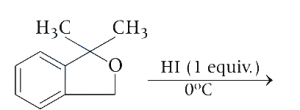
The major product of the following reaction is
A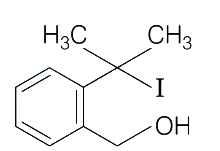
B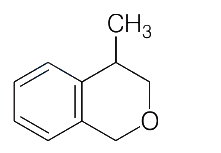
C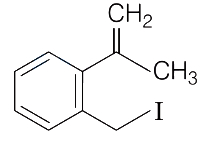
D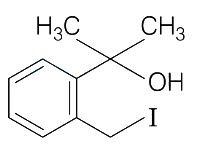
Solution
(A) The reaction is the acidic cleavage of a cyclic ether with $HI$. The ether oxygen gets protonated by $H^+$. The cleavage occurs at the bond that leads to the formation of a more stable carbocation. In this case,the bond between the oxygen and the tertiary carbon atom breaks to form a stable benzylic-tertiary carbocation. The iodide ion $(I^-)$ then attacks this carbocation to form the final product. The structure of the product is $2-(2-iodo-propan-2-yl)phenol$ or a related derivative where the ring is opened,specifically forming an alcohol and an alkyl iodide. The correct product is the one where the $I$ is attached to the tertiary carbon and the $OH$ is attached to the primary carbon of the side chain.
0 likesView Solution
6
ChemistryEasyMCQTS EAMCET · 2018
The stability of dihalides of $Si, Ge, Sn$ and $Pb$ follows the sequence.
A
$SiX_2 < GeX_2 < PbX_2 < SnX_2$
B
$SiX_2 < GeX_2 < SnX_2 < PbX_2$
C
$PbX_2 < SnX_2 < GeX_2 < SiX_2$
D
$GeX_2 < SiX_2 < SnX_2 < PbX_2$
Solution
(B) The stability of the $+2$ oxidation state in Group $14$ elements increases down the group due to the inert pair effect.
As we move from $Si$ to $Pb$,the $ns^2$ electrons become more reluctant to participate in bonding.
Therefore,the stability of dihalides $(MX_2)$ follows the order: $SiX_2 < GeX_2 < SnX_2 < PbX_2$.
As we move from $Si$ to $Pb$,the $ns^2$ electrons become more reluctant to participate in bonding.
Therefore,the stability of dihalides $(MX_2)$ follows the order: $SiX_2 < GeX_2 < SnX_2 < PbX_2$.
0 likesView Solution
7
ChemistryMediumMCQTS EAMCET · 2018
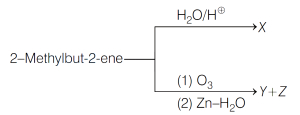
Identify $X, Y$ and $Z$ in the following reactions:
A
$(H_3C)_2C(OH)CH_2CH_3, \quad CH_3COCH_3, \quad CH_3CHO$
B
$(H_3C)_2CHCH(OH)CH_3, \quad (H_3C)_2CO, \quad CH_3CHO$
C
$(H_3C)_2C(OH)CH_2CH_3, \quad (H_3C)_2CO, \quad CH_3CHO$
D
$CH_3CH_2CH(OH)CH_2CH_3, \quad CH_3CHO, \quad CH_3COOH$
Solution
(C) The reaction of $2\text{-methylbut-2-ene}$ with $H_2O/H^+$ is an acid-catalyzed hydration reaction following Markovnikov's rule. The product $X$ is $2\text{-methylbutan-2-ol}$,which is $(H_3C)_2C(OH)CH_2CH_3$.
The reaction of $2\text{-methylbut-2-ene}$ with $(1) O_3$ followed by $(2) Zn-H_2O$ is reductive ozonolysis. The double bond breaks to form carbonyl compounds.
$CH_3-C(CH_3)=CH-CH_3 \xrightarrow{O_3, Zn/H_2O} (CH_3)_2C=O + CH_3CHO$.
Thus,$Y$ and $Z$ are acetone $(CH_3)_2CO$ and acetaldehyde $CH_3CHO$ respectively.
Therefore,$X = (H_3C)_2C(OH)CH_2CH_3$,$Y = (H_3C)_2CO$,and $Z = CH_3CHO$.
The reaction of $2\text{-methylbut-2-ene}$ with $(1) O_3$ followed by $(2) Zn-H_2O$ is reductive ozonolysis. The double bond breaks to form carbonyl compounds.
$CH_3-C(CH_3)=CH-CH_3 \xrightarrow{O_3, Zn/H_2O} (CH_3)_2C=O + CH_3CHO$.
Thus,$Y$ and $Z$ are acetone $(CH_3)_2CO$ and acetaldehyde $CH_3CHO$ respectively.
Therefore,$X = (H_3C)_2C(OH)CH_2CH_3$,$Y = (H_3C)_2CO$,and $Z = CH_3CHO$.
0 likesView Solution
8
ChemistryMediumMCQTS EAMCET · 2018
What are the products formed in the reaction given below:
$Ph-CH_2-CH=CH-CH_3 \xrightarrow[Zn \text{ dust } + H_2O]{1) O_3} ?$
$Ph-CH_2-CH=CH-CH_3 \xrightarrow[Zn \text{ dust } + H_2O]{1) O_3} ?$
A
Acetic acid and $2-$phenyl acetic acid
B
$2-$Phenyl ethanal and ethanal
C
$2-$Phenyl ethanol and ethanol
D
$1-$Phenyl butane$-2,3-$diol
Solution
(B) The reaction is an ozonolysis of an alkene followed by reductive workup with $Zn$ dust and $H_2O$.
Ozonolysis cleaves the $C=C$ double bond to form carbonyl compounds.
$Ph-CH_2-CH=CH-CH_3 \xrightarrow[Zn \text{ dust } + H_2O]{1) O_3} Ph-CH_2-CHO + CH_3-CHO$.
The products formed are $2-$phenyl ethanal $(Ph-CH_2-CHO)$ and ethanal $(CH_3-CHO)$.
Ozonolysis cleaves the $C=C$ double bond to form carbonyl compounds.
$Ph-CH_2-CH=CH-CH_3 \xrightarrow[Zn \text{ dust } + H_2O]{1) O_3} Ph-CH_2-CHO + CH_3-CHO$.
The products formed are $2-$phenyl ethanal $(Ph-CH_2-CHO)$ and ethanal $(CH_3-CHO)$.
0 likesView Solution
9
ChemistryMCQTS EAMCET · 2018
Identify the non-reducing sugar from the following.
A
Maltose
B
Sucrose
C
Lactose
D
Glucose
Solution
(B) Sucrose is a disaccharide composed of two monosaccharides: glucose and fructose.
These two monosaccharides are linked together by a glycosidic linkage between the $C_1$ of glucose and the $C_2$ of fructose.
Since the reducing groups (the aldehyde group of glucose and the ketone group of fructose) are involved in the formation of the glycosidic bond,they are not available for a reducing reaction.
Therefore,sucrose is a non-reducing sugar.
Hence,option $(B)$ is correct.
These two monosaccharides are linked together by a glycosidic linkage between the $C_1$ of glucose and the $C_2$ of fructose.
Since the reducing groups (the aldehyde group of glucose and the ketone group of fructose) are involved in the formation of the glycosidic bond,they are not available for a reducing reaction.
Therefore,sucrose is a non-reducing sugar.
Hence,option $(B)$ is correct.
0 likesView Solution
10
ChemistryMCQTS EAMCET · 2018
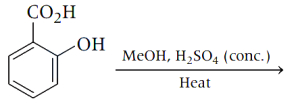
The major product in the following reaction is:
A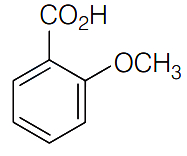
B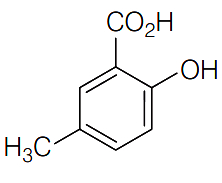
C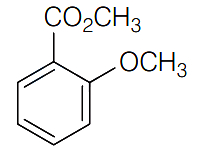
D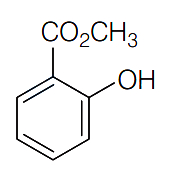
Solution
(D) The reaction is an esterification reaction between salicylic acid $(2-hydroxybenzoic acid)$ and methanol $(MeOH)$ in the presence of a concentrated acid catalyst $(H_2SO_4)$.
In this reaction,the carboxylic acid group $(-COOH)$ reacts with the alcohol $(-OH)$ to form an ester $(-COOCH_3)$.
The phenolic $-OH$ group is less reactive towards esterification under these conditions compared to the carboxylic acid group.
Therefore,the major product is methyl salicylate,where the carboxylic acid group is converted to a methyl ester.
In this reaction,the carboxylic acid group $(-COOH)$ reacts with the alcohol $(-OH)$ to form an ester $(-COOCH_3)$.
The phenolic $-OH$ group is less reactive towards esterification under these conditions compared to the carboxylic acid group.
Therefore,the major product is methyl salicylate,where the carboxylic acid group is converted to a methyl ester.
0 likesView Solution
11
ChemistryEasyMCQTS EAMCET · 2018
Identify the pair that is not isostructural.
A
$PCl_5, BrF_5$
B
$CH_4, SiCl_4$
C
$CO_3^{2-}, NO_3^{-}$
D
$AlF_6^{3-}, SF_6$
Solution
(A) Isostructural species have the same shape and hybridization.
$PCl_5$ and $BrF_5$ are not isostructural.
$PCl_5$: The central atom $P$ has $5$ bond pairs and $0$ lone pairs,resulting in $sp^3d$ hybridization and a trigonal bipyramidal shape.
$BrF_5$: The central atom $Br$ has $5$ bond pairs and $1$ lone pair,resulting in $sp^3d^2$ hybridization and a square pyramidal shape.
Other pairs like $(CH_4, SiCl_4)$,$(CO_3^{2-}, NO_3^{-})$,and $(AlF_6^{3-}, SF_6)$ are isostructural as they have the same hybridization and geometry.
$PCl_5$ and $BrF_5$ are not isostructural.
$PCl_5$: The central atom $P$ has $5$ bond pairs and $0$ lone pairs,resulting in $sp^3d$ hybridization and a trigonal bipyramidal shape.
$BrF_5$: The central atom $Br$ has $5$ bond pairs and $1$ lone pair,resulting in $sp^3d^2$ hybridization and a square pyramidal shape.
Other pairs like $(CH_4, SiCl_4)$,$(CO_3^{2-}, NO_3^{-})$,and $(AlF_6^{3-}, SF_6)$ are isostructural as they have the same hybridization and geometry.
0 likesView Solution
12
ChemistryMediumMCQTS EAMCET · 2018
The hybridisation of $N$ in $NO_2^{+}$,$NO_3^{-}$ and $NH_4^{+}$ respectively is
A
$sp, sp^2, sp^3$
B
$sp, sp^3, sp^3$
C
$sp^2, sp^3, sp^3$
D
$sp, sp, sp^3$
Solution
(A) To determine the hybridisation,we use the formula: $\text{Steric Number} = \text{Number of bond pairs} + \text{Number of lone pairs}$.
For $NO_2^{+}$:
$\text{Steric Number} = 2 + 0 = 2$. Hybridisation is $sp$.
For $NO_3^{-}$:
$\text{Steric Number} = 3 + 0 = 3$. Hybridisation is $sp^2$.
For $NH_4^{+}$:
$\text{Steric Number} = 4 + 0 = 4$. Hybridisation is $sp^3$.
Thus,the hybridisation states are $sp, sp^2, sp^3$ respectively.
For $NO_2^{+}$:
$\text{Steric Number} = 2 + 0 = 2$. Hybridisation is $sp$.
For $NO_3^{-}$:
$\text{Steric Number} = 3 + 0 = 3$. Hybridisation is $sp^2$.
For $NH_4^{+}$:
$\text{Steric Number} = 4 + 0 = 4$. Hybridisation is $sp^3$.
Thus,the hybridisation states are $sp, sp^2, sp^3$ respectively.
0 likesView Solution
13
ChemistryMediumMCQTS EAMCET · 2018
Match the following molecules/ions in List-$I$ with their respective bond orders in List-$II$:
| List-$I$ (Molecules/ions) | List-$II$ (Bond order) |
| :--- | :--- |
| $A. N_2^+$ | $I. 1.0$ |
| $B. CO$ | $II. 1.5$ |
| $C. O_2$ | $III. 2.0$ |
| $D. O_2^-$ | $IV. 2.5$ |
| | $V. 3.0$ |
| List-$I$ (Molecules/ions) | List-$II$ (Bond order) |
| :--- | :--- |
| $A. N_2^+$ | $I. 1.0$ |
| $B. CO$ | $II. 1.5$ |
| $C. O_2$ | $III. 2.0$ |
| $D. O_2^-$ | $IV. 2.5$ |
| | $V. 3.0$ |
A
$A-IV, B-V, C-III, D-II$
B
$A-III, B-V, C-IV, D-II$
C
$A-IV, B-V, C-II, D-III$
D
$A-V, B-IV, C-III, D-II$
Solution
(A) The bond order is calculated using the formula: $\text{Bond order} = \frac{1}{2} (N_b - N_a)$,where $N_b$ is the number of bonding electrons and $N_a$ is the number of antibonding electrons.
$A. N_2^+$ ($13$ electrons): $\sigma 1s^2 < \sigma^* 1s^2 < \sigma 2s^2 < \sigma^* 2s^2 < \pi 2p_x^2 = \pi 2p_y^2 < \sigma 2p_z^1$. Bond order = $\frac{9-4}{2} = 2.5$ $(IV)$.
$B. CO$ ($14$ electrons): $\sigma 1s^2 < \sigma^* 1s^2 < \sigma 2s^2 < \sigma^* 2s^2 < \sigma 2p_z^2 < \pi 2p_x^2 = \pi 2p_y^2$. Bond order = $\frac{10-4}{2} = 3.0$ $(V)$.
$C. O_2$ ($16$ electrons): $\sigma 1s^2 < \sigma^* 1s^2 < \sigma 2s^2 < \sigma^* 2s^2 < \sigma 2p_z^2 < \pi 2p_x^2 = \pi 2p_y^2 < \pi^* 2p_x^1 = \pi^* 2p_y^1$. Bond order = $\frac{10-6}{2} = 2.0$ $(III)$.
$D. O_2^-$ ($17$ electrons): $\sigma 1s^2 < \sigma^* 1s^2 < \sigma 2s^2 < \sigma^* 2s^2 < \sigma 2p_z^2 < \pi 2p_x^2 = \pi 2p_y^2 < \pi^* 2p_x^2 = \pi^* 2p_y^1$. Bond order = $\frac{10-7}{2} = 1.5$ $(II)$.
Therefore,the correct match is $A-IV, B-V, C-III, D-II$.
$A. N_2^+$ ($13$ electrons): $\sigma 1s^2 < \sigma^* 1s^2 < \sigma 2s^2 < \sigma^* 2s^2 < \pi 2p_x^2 = \pi 2p_y^2 < \sigma 2p_z^1$. Bond order = $\frac{9-4}{2} = 2.5$ $(IV)$.
$B. CO$ ($14$ electrons): $\sigma 1s^2 < \sigma^* 1s^2 < \sigma 2s^2 < \sigma^* 2s^2 < \sigma 2p_z^2 < \pi 2p_x^2 = \pi 2p_y^2$. Bond order = $\frac{10-4}{2} = 3.0$ $(V)$.
$C. O_2$ ($16$ electrons): $\sigma 1s^2 < \sigma^* 1s^2 < \sigma 2s^2 < \sigma^* 2s^2 < \sigma 2p_z^2 < \pi 2p_x^2 = \pi 2p_y^2 < \pi^* 2p_x^1 = \pi^* 2p_y^1$. Bond order = $\frac{10-6}{2} = 2.0$ $(III)$.
$D. O_2^-$ ($17$ electrons): $\sigma 1s^2 < \sigma^* 1s^2 < \sigma 2s^2 < \sigma^* 2s^2 < \sigma 2p_z^2 < \pi 2p_x^2 = \pi 2p_y^2 < \pi^* 2p_x^2 = \pi^* 2p_y^1$. Bond order = $\frac{10-7}{2} = 1.5$ $(II)$.
Therefore,the correct match is $A-IV, B-V, C-III, D-II$.
0 likesView Solution
14
ChemistryEasyMCQTS EAMCET · 2018
The molecular orbital theory supports paramagnetic behaviour of:
A
$Be_2$
B
$C_2$
C
$N_2$
D
$O_2$
Solution
(D) The molecular orbital electronic configuration of $Be_2$ is: $\sigma 1s^2 < \sigma^* 1s^2 < \sigma 2s^2 < \sigma^* 2s^2$.
The molecular orbital electronic configuration of $C_2$ is: $\sigma 1s^2 < \sigma^* 1s^2 < \sigma 2s^2 < \sigma^* 2s^2 < [\pi 2p_{x}^2 = \pi 2p_{y}^2]$.
The molecular orbital electronic configuration of $N_2$ is: $\sigma 1s^2 < \sigma^* 1s^2 < \sigma 2s^2 < \sigma^* 2s^2 < [\pi 2p_{x}^2 = \pi 2p_{y}^2] < \sigma 2p_{z}^2$.
The molecular orbital electronic configuration of $O_2$ is: $\sigma 1s^2 < \sigma^* 1s^2 < \sigma 2s^2 < \sigma^* 2s^2 < \sigma 2p_{z}^2 < [\pi 2p_{x}^2 = \pi 2p_{y}^2] < [\pi^* 2p_{x}^1 = \pi^* 2p_{y}^1]$.
Molecules having unpaired electrons are paramagnetic,and those without unpaired electrons are diamagnetic.
Since $O_2$ has $2$ unpaired electrons in its antibonding molecular orbitals,it is paramagnetic. Conversely,$Be_2$,$C_2$,and $N_2$ have no unpaired electrons,making them diamagnetic.
The molecular orbital electronic configuration of $C_2$ is: $\sigma 1s^2 < \sigma^* 1s^2 < \sigma 2s^2 < \sigma^* 2s^2 < [\pi 2p_{x}^2 = \pi 2p_{y}^2]$.
The molecular orbital electronic configuration of $N_2$ is: $\sigma 1s^2 < \sigma^* 1s^2 < \sigma 2s^2 < \sigma^* 2s^2 < [\pi 2p_{x}^2 = \pi 2p_{y}^2] < \sigma 2p_{z}^2$.
The molecular orbital electronic configuration of $O_2$ is: $\sigma 1s^2 < \sigma^* 1s^2 < \sigma 2s^2 < \sigma^* 2s^2 < \sigma 2p_{z}^2 < [\pi 2p_{x}^2 = \pi 2p_{y}^2] < [\pi^* 2p_{x}^1 = \pi^* 2p_{y}^1]$.
Molecules having unpaired electrons are paramagnetic,and those without unpaired electrons are diamagnetic.
Since $O_2$ has $2$ unpaired electrons in its antibonding molecular orbitals,it is paramagnetic. Conversely,$Be_2$,$C_2$,and $N_2$ have no unpaired electrons,making them diamagnetic.
0 likesView Solution
15
ChemistryMediumMCQTS EAMCET · 2018
Match the molecules in List-$I$ with their respective bond orders in List-$II$.
| List-$I$ | List-$II$ |
|---|---|
| $A. Li_2$ | $i. 3$ |
| $B. N_2$ | $ii. 1.5$ |
| $C. Be_2$ | $iii. 1.0$ |
| $D. O_2$ | $iv. 0$ |
| $v. 2$ |
A
$A-iii, B-i, C-iv, D-v$
B
$A-ii, B-i, C-iv, D-v$
C
$A-iii, B-v, C-iv, D-i$
D
$A-i, B-iii, C-iv, D-v$
Solution
(A) According to Molecular Orbital Theory $(MOT)$:
Bond Order $(B.O.)$ = $\frac{1}{2} (N_b - N_a)$
For $Li_2$ ($6$ electrons): $\sigma 1s^2, \sigma^* 1s^2, \sigma 2s^2$. $B.O. = \frac{1}{2} (4 - 2) = 1.0$ $(iii)$.
For $N_2$ ($14$ electrons): $\sigma 1s^2, \sigma^* 1s^2, \sigma 2s^2, \sigma^* 2s^2, \pi 2p_x^2 = \pi 2p_y^2, \sigma 2p_z^2$. $B.O. = \frac{1}{2} (10 - 4) = 3$ $(i)$.
For $Be_2$ ($8$ electrons): $\sigma 1s^2, \sigma^* 1s^2, \sigma 2s^2, \sigma^* 2s^2$. $B.O. = \frac{1}{2} (4 - 4) = 0$ $(iv)$.
For $O_2$ ($16$ electrons): $\sigma 1s^2, \sigma^* 1s^2, \sigma 2s^2, \sigma^* 2s^2, \sigma 2p_z^2, \pi 2p_x^2 = \pi 2p_y^2, \pi^* 2p_x^1 = \pi^* 2p_y^1$. $B.O. = \frac{1}{2} (10 - 6) = 2$ $(v)$.
Therefore,the correct match is $A-iii, B-i, C-iv, D-v$.
Bond Order $(B.O.)$ = $\frac{1}{2} (N_b - N_a)$
For $Li_2$ ($6$ electrons): $\sigma 1s^2, \sigma^* 1s^2, \sigma 2s^2$. $B.O. = \frac{1}{2} (4 - 2) = 1.0$ $(iii)$.
For $N_2$ ($14$ electrons): $\sigma 1s^2, \sigma^* 1s^2, \sigma 2s^2, \sigma^* 2s^2, \pi 2p_x^2 = \pi 2p_y^2, \sigma 2p_z^2$. $B.O. = \frac{1}{2} (10 - 4) = 3$ $(i)$.
For $Be_2$ ($8$ electrons): $\sigma 1s^2, \sigma^* 1s^2, \sigma 2s^2, \sigma^* 2s^2$. $B.O. = \frac{1}{2} (4 - 4) = 0$ $(iv)$.
For $O_2$ ($16$ electrons): $\sigma 1s^2, \sigma^* 1s^2, \sigma 2s^2, \sigma^* 2s^2, \sigma 2p_z^2, \pi 2p_x^2 = \pi 2p_y^2, \pi^* 2p_x^1 = \pi^* 2p_y^1$. $B.O. = \frac{1}{2} (10 - 6) = 2$ $(v)$.
Therefore,the correct match is $A-iii, B-i, C-iv, D-v$.
0 likesView Solution
16
ChemistryMediumMCQTS EAMCET · 2018
Group the following molecules/ions according to their bond order: $O_2^{2-}, Li_2, O_2^{2+}, F_2, N_2, He_2^{2+}$.
A
$O_2^{2-}, Li_2, O_2^{2+}, F_2, N_2, He_2^{2+}$
B
$F_2, O_2^{2+}, N_2, O_2^{2-}, He_2^{2+}, Li_2$
C
$O_2^{-}, Li_2, F_2, He_2^{2+}, N_2, O_2^{2+}$
D
$Li_2, F_2, O_2^{2+}, N_2, O_2^{2-}, He_2^{2+}$
Solution
(A) To group the species by bond order,we calculate the bond order $(B.O.)$ for each using Molecular Orbital Theory:
$1$. $O_2^{2-}$ ($18$ electrons): $B.O. = \frac{1}{2}(10-8) = 1$
$2$. $Li_2$ ($6$ electrons): $B.O. = \frac{1}{2}(4-2) = 1$
$3$. $F_2$ ($18$ electrons): $B.O. = \frac{1}{2}(10-8) = 1$
$4$. $He_2^{2+}$ ($2$ electrons): $B.O. = \frac{1}{2}(2-0) = 1$
$5$. $N_2$ ($14$ electrons): $B.O. = \frac{1}{2}(10-4) = 3$
$6$. $O_2^{2+}$ ($14$ electrons): $B.O. = \frac{1}{2}(10-4) = 3$
Thus,the species with $B.O. = 1$ are $(O_2^{2-}, Li_2, F_2, He_2^{2+})$ and the species with $B.O. = 3$ are $(N_2, O_2^{2+})$.
$1$. $O_2^{2-}$ ($18$ electrons): $B.O. = \frac{1}{2}(10-8) = 1$
$2$. $Li_2$ ($6$ electrons): $B.O. = \frac{1}{2}(4-2) = 1$
$3$. $F_2$ ($18$ electrons): $B.O. = \frac{1}{2}(10-8) = 1$
$4$. $He_2^{2+}$ ($2$ electrons): $B.O. = \frac{1}{2}(2-0) = 1$
$5$. $N_2$ ($14$ electrons): $B.O. = \frac{1}{2}(10-4) = 3$
$6$. $O_2^{2+}$ ($14$ electrons): $B.O. = \frac{1}{2}(10-4) = 3$
Thus,the species with $B.O. = 1$ are $(O_2^{2-}, Li_2, F_2, He_2^{2+})$ and the species with $B.O. = 3$ are $(N_2, O_2^{2+})$.
0 likesView Solution
17
ChemistryMediumMCQTS EAMCET · 2018
The equatorial and axial $P-Cl$ bond lengths (in $pm$) respectively in $PCl_5$ are:
A
$202, 240$
B
$240, 202$
C
$200, 400$
D
$200, 410$
Solution
(A) $PCl_5$ has a trigonal bipyramidal geometry.
In this structure, the three equatorial $P-Cl$ bonds are shorter than the two axial $P-Cl$ bonds due to greater repulsion experienced by the axial bonds.
The equatorial $P-Cl$ bond length is $202 \ pm$ and the axial $P-Cl$ bond length is $240 \ pm$.
In this structure, the three equatorial $P-Cl$ bonds are shorter than the two axial $P-Cl$ bonds due to greater repulsion experienced by the axial bonds.
The equatorial $P-Cl$ bond length is $202 \ pm$ and the axial $P-Cl$ bond length is $240 \ pm$.
0 likesView Solution
18
ChemistryMediumMCQTS EAMCET · 2018
The bond orders of $He_2^{+}$ and $He_2$ are respectively
A
$1/2, 0$
B
$0, 1/2$
C
$0, 1$
D
$1, 0$
Solution
(A) The molecular orbital electronic configuration of $He_2$ is $\sigma 1s^2, \sigma^* 1s^2$.
Bond order $= \frac{(\text{electrons in bonding MO}) - (\text{electrons in antibonding MO})}{2}$.
For $He_2$,bond order $= \frac{2-2}{2} = 0$.
Since the bond order is $0$,the $He_2$ molecule does not exist.
For $He_2^{+}$,the molecular orbital electronic configuration is $\sigma 1s^2, \sigma^* 1s^1$.
Bond order $= \frac{2-1}{2} = 1/2$.
Bond order $= \frac{(\text{electrons in bonding MO}) - (\text{electrons in antibonding MO})}{2}$.
For $He_2$,bond order $= \frac{2-2}{2} = 0$.
Since the bond order is $0$,the $He_2$ molecule does not exist.
For $He_2^{+}$,the molecular orbital electronic configuration is $\sigma 1s^2, \sigma^* 1s^1$.
Bond order $= \frac{2-1}{2} = 1/2$.
0 likesView Solution
19
ChemistryMediumMCQTS EAMCET · 2018
The correct increasing order of ionisation enthalpy of $He, Li^{+}, Be^{2+}$ is
A
$He < Li^{+} < Be^{2+}$
B
$Be^{2+} < Li^{+} < He$
C
$Li^{+} < Be^{2+} < He$
D
$Be^{2+} < He < Li^{+}$
Solution
(A) $He, Li^{+}$,and $Be^{2+}$ are isoelectronic species,each containing $2$ electrons.
For isoelectronic species,the ionisation enthalpy increases as the nuclear charge $(Z)$ increases.
The atomic numbers are: $He = 2$,$Li = 3$,$Be = 4$.
Since the number of electrons $(e)$ is the same $(2)$ for all,the effective nuclear charge increases in the order $He < Li^{+} < Be^{2+}$.
Therefore,the ionisation enthalpy follows the order: $He < Li^{+} < Be^{2+}$.
For isoelectronic species,the ionisation enthalpy increases as the nuclear charge $(Z)$ increases.
The atomic numbers are: $He = 2$,$Li = 3$,$Be = 4$.
Since the number of electrons $(e)$ is the same $(2)$ for all,the effective nuclear charge increases in the order $He < Li^{+} < Be^{2+}$.
Therefore,the ionisation enthalpy follows the order: $He < Li^{+} < Be^{2+}$.
0 likesView Solution
20
ChemistryEasyMCQTS EAMCET · 2018
Statement $(A)$ $CO_2$ has no dipole moment,whereas $SO_2$ and $H_2O$ have dipole moment.
Statement $(B)$ $SnCl_2$ is ionic,whereas $SnCl_4$ is covalent.
Which of the following is correct?
Statement $(B)$ $SnCl_2$ is ionic,whereas $SnCl_4$ is covalent.
Which of the following is correct?
A
Both $(A)$ and $(B)$ are not correct
B
$(A)$ is correct but $(B)$ is not correct
C
Both $(A)$ and $(B)$ are correct
D
$(A)$ is not correct but $(B)$ is correct
Solution
(C) Statement $(A)$: $CO_2$ has a linear geometry,so the bond dipoles cancel each other,resulting in a net dipole moment of $0$. $SO_2$ has a bent geometry due to the presence of a lone pair on $S$,and $H_2O$ has a bent geometry due to two lone pairs on $O$,so both have a non-zero net dipole moment. Thus,Statement $(A)$ is correct.
Statement $(B)$: According to Fajan's rule,the polarizing power of a cation increases with its charge. $Sn^{4+}$ has a higher charge than $Sn^{2+}$,so $SnCl_4$ exhibits significant covalent character,whereas $SnCl_2$ is predominantly ionic. Thus,Statement $(B)$ is correct.
Statement $(B)$: According to Fajan's rule,the polarizing power of a cation increases with its charge. $Sn^{4+}$ has a higher charge than $Sn^{2+}$,so $SnCl_4$ exhibits significant covalent character,whereas $SnCl_2$ is predominantly ionic. Thus,Statement $(B)$ is correct.
0 likesView Solution
21
ChemistryMediumMCQTS EAMCET · 2018
Identify the correct statements from the following. $(1)$ The dipole moment of $CO_2$ and $BF_3$ is zero. $(2)$ The dipole moment of $NF_3$ is higher than the dipole moment of $NH_3$. $(3)$ The dipole moment of $HI$ is lower than the dipole moment of $HCl$.
A
$1, 3$
B
$1, 2$
C
$2, 3$
D
$1, 2, 3$
Solution
(A) $1$. $CO_2$ is linear and $BF_3$ is trigonal planar. Due to their symmetrical geometry,the net dipole moment is zero. This statement is correct.
$2$. In $NH_3$,the dipole moments of $N-H$ bonds and the lone pair are in the same direction,leading to a higher net dipole moment. In $NF_3$,the dipole moments of $N-F$ bonds are in the opposite direction to the lone pair moment,resulting in a smaller net dipole moment. Thus,the dipole moment of $NF_3$ is lower than that of $NH_3$. This statement is incorrect.
$3$. The dipole moment $\mu = q \times d$. Although the bond length of $HI$ is greater than $HCl$,the electronegativity difference in $HCl$ is much larger than in $HI$,making the charge separation $q$ significantly higher in $HCl$. Thus,$HI$ has a lower dipole moment than $HCl$. This statement is correct.
$2$. In $NH_3$,the dipole moments of $N-H$ bonds and the lone pair are in the same direction,leading to a higher net dipole moment. In $NF_3$,the dipole moments of $N-F$ bonds are in the opposite direction to the lone pair moment,resulting in a smaller net dipole moment. Thus,the dipole moment of $NF_3$ is lower than that of $NH_3$. This statement is incorrect.
$3$. The dipole moment $\mu = q \times d$. Although the bond length of $HI$ is greater than $HCl$,the electronegativity difference in $HCl$ is much larger than in $HI$,making the charge separation $q$ significantly higher in $HCl$. Thus,$HI$ has a lower dipole moment than $HCl$. This statement is correct.
0 likesView Solution
22
ChemistryMediumMCQTS EAMCET · 2018
For a reaction $2A_{(g)} \rightleftharpoons 2B_{(g)} + C_{(g)}$,$K_c = 3.75 \times 10^{-6}$ at $1069 \ K$. The approximate value of $K_p$ for this reaction at the same temperature is $(R = 0.082 \ L \ bar \ mol^{-1} \ K^{-1})$.
A
$2.4 \times 10^{-4}$
B
$3.3 \times 10^{-4}$
C
$33 \times 10^2$
D
$7.2 \times 10^{34}$
Solution
(B) The relationship between the equilibrium constant in terms of concentration $(K_c)$ and partial pressure $(K_p)$ is given by the equation:
$K_p = K_c(RT)^{\Delta n}$
Here,$\Delta n$ is the change in the number of gaseous moles:
$\Delta n = (2 + 1) - 2 = 1$
Given $K_c = 3.75 \times 10^{-6}$,$R = 0.082 \ L \ bar \ mol^{-1} \ K^{-1}$,and $T = 1069 \ K$:
$K_p = 3.75 \times 10^{-6} \times (0.082 \times 1069)^{1}$
$K_p = 3.75 \times 10^{-6} \times 87.658$
$K_p \approx 3.287 \times 10^{-4}$
Rounding to two significant figures,we get $K_p \approx 3.3 \times 10^{-4}$.
$K_p = K_c(RT)^{\Delta n}$
Here,$\Delta n$ is the change in the number of gaseous moles:
$\Delta n = (2 + 1) - 2 = 1$
Given $K_c = 3.75 \times 10^{-6}$,$R = 0.082 \ L \ bar \ mol^{-1} \ K^{-1}$,and $T = 1069 \ K$:
$K_p = 3.75 \times 10^{-6} \times (0.082 \times 1069)^{1}$
$K_p = 3.75 \times 10^{-6} \times 87.658$
$K_p \approx 3.287 \times 10^{-4}$
Rounding to two significant figures,we get $K_p \approx 3.3 \times 10^{-4}$.
0 likesView Solution
23
ChemistryDifficultMCQTS EAMCET · 2018
Estimate the approximate $pK_a$ of $0.5 \ M$ $CH_3COOH$. Degree of dissociation (ionisation) is $0.15$ $(\log 1.32 = 0.12)$.
A
$2$
B
$1.5$
C
$1.88$
D
$0.15$
Solution
(C) The dissociation of acetic acid is represented as: $CH_3COOH \rightleftharpoons H^{+} + CH_3COO^{-}$
Using the expression for the dissociation constant $K_a = \frac{C\alpha^2}{1-\alpha}$,where $C = 0.5 \ M$ and $\alpha = 0.15$.
$K_a = \frac{0.5 \times (0.15)^2}{1 - 0.15} = \frac{0.5 \times 0.0225}{0.85} = \frac{0.01125}{0.85} \approx 0.0132$.
Now,calculate $pK_a$ using $pK_a = -\log K_a$.
$pK_a = -\log(0.0132) = -\log(1.32 \times 10^{-2})$.
$pK_a = -(\log 1.32 + \log 10^{-2}) = -(0.12 - 2) = 1.88$.
Using the expression for the dissociation constant $K_a = \frac{C\alpha^2}{1-\alpha}$,where $C = 0.5 \ M$ and $\alpha = 0.15$.
$K_a = \frac{0.5 \times (0.15)^2}{1 - 0.15} = \frac{0.5 \times 0.0225}{0.85} = \frac{0.01125}{0.85} \approx 0.0132$.
Now,calculate $pK_a$ using $pK_a = -\log K_a$.
$pK_a = -\log(0.0132) = -\log(1.32 \times 10^{-2})$.
$pK_a = -(\log 1.32 + \log 10^{-2}) = -(0.12 - 2) = 1.88$.
0 likesView Solution
24
ChemistryMediumMCQTS EAMCET · 2018
For the formation of $NH_3$ from $N_2$ and $H_2$ at $500 \ K$,the concentrations of $N_2, H_2$ and $NH_3$ at equilibrium are $1.5 \times 10^{-2} \ M, 3.0 \times 10^{-2} \ M$ and $1.2 \times 10^{-2} \ M$,respectively. The equilibrium constant for the reverse reaction is
A
$3.56 \times 10^2$
B
$2.81 \times 10^{-3}$
C
$3.56 \times 10^{-2}$
D
$2.81 \times 10^3$
Solution
(B) The balanced chemical equation for the formation of $NH_3$ is: $N_2(g) + 3H_2(g) \rightleftharpoons 2NH_3(g)$.
For the reverse reaction,the equation is: $2NH_3(g) \rightleftharpoons N_2(g) + 3H_2(g)$.
The equilibrium constant $K_C$ for the reverse reaction is given by the expression: $K_C = \frac{[N_2][H_2]^3}{[NH_3]^2}$.
Substituting the given equilibrium concentrations:
$K_C = \frac{(1.5 \times 10^{-2}) \times (3.0 \times 10^{-2})^3}{(1.2 \times 10^{-2})^2}$.
$K_C = \frac{(1.5 \times 10^{-2}) \times (27.0 \times 10^{-6})}{1.44 \times 10^{-4}}$.
$K_C = \frac{40.5 \times 10^{-8}}{1.44 \times 10^{-4}} = 28.125 \times 10^{-4} = 2.81 \times 10^{-3}$.
For the reverse reaction,the equation is: $2NH_3(g) \rightleftharpoons N_2(g) + 3H_2(g)$.
The equilibrium constant $K_C$ for the reverse reaction is given by the expression: $K_C = \frac{[N_2][H_2]^3}{[NH_3]^2}$.
Substituting the given equilibrium concentrations:
$K_C = \frac{(1.5 \times 10^{-2}) \times (3.0 \times 10^{-2})^3}{(1.2 \times 10^{-2})^2}$.
$K_C = \frac{(1.5 \times 10^{-2}) \times (27.0 \times 10^{-6})}{1.44 \times 10^{-4}}$.
$K_C = \frac{40.5 \times 10^{-8}}{1.44 \times 10^{-4}} = 28.125 \times 10^{-4} = 2.81 \times 10^{-3}$.
0 likesView Solution
25
ChemistryDifficultMCQTS EAMCET · 2018
Consider the following reaction in a $1 \ L$ closed vessel: $N_2 + 3H_2 \rightleftharpoons 2NH_3$. If all the species $N_2, H_2$ and $NH_3$ are $1 \ mol$ each at the beginning of the reaction and equilibrium is attained when unreacted $N_2$ is $0.7 \ mol$,what is the value of the equilibrium constant?
A
$3600$
B
$3657.14$
C
$2657.14$
D
$1828.57$
Solution
(B) Given reaction: $N_2 + 3H_2 \rightleftharpoons 2NH_3$
Initial moles: $n(N_2) = 1, n(H_2) = 1, n(NH_3) = 1$
Let $x$ be the moles of $N_2$ reacted at equilibrium.
Equilibrium moles of $N_2 = 1 - x = 0.7 \Rightarrow x = 0.3 \ mol$
Equilibrium moles of $H_2 = 1 - 3x = 1 - 3(0.3) = 0.1 \ mol$
Equilibrium moles of $NH_3 = 1 + 2x = 1 + 2(0.3) = 1.6 \ mol$
Since volume $V = 1 \ L$,concentrations are equal to the number of moles.
$[N_2] = 0.7 \ M, [H_2] = 0.1 \ M, [NH_3] = 1.6 \ M$
Equilibrium constant $K_c = \frac{[NH_3]^2}{[N_2][H_2]^3}$
$K_c = \frac{(1.6)^2}{(0.7)(0.1)^3} = \frac{2.56}{0.7 \times 0.001} = \frac{2.56}{0.0007} = 3657.14$
Initial moles: $n(N_2) = 1, n(H_2) = 1, n(NH_3) = 1$
Let $x$ be the moles of $N_2$ reacted at equilibrium.
Equilibrium moles of $N_2 = 1 - x = 0.7 \Rightarrow x = 0.3 \ mol$
Equilibrium moles of $H_2 = 1 - 3x = 1 - 3(0.3) = 0.1 \ mol$
Equilibrium moles of $NH_3 = 1 + 2x = 1 + 2(0.3) = 1.6 \ mol$
Since volume $V = 1 \ L$,concentrations are equal to the number of moles.
$[N_2] = 0.7 \ M, [H_2] = 0.1 \ M, [NH_3] = 1.6 \ M$
Equilibrium constant $K_c = \frac{[NH_3]^2}{[N_2][H_2]^3}$
$K_c = \frac{(1.6)^2}{(0.7)(0.1)^3} = \frac{2.56}{0.7 \times 0.001} = \frac{2.56}{0.0007} = 3657.14$
0 likesView Solution
26
ChemistryEasyMCQTS EAMCET · 2018
$PCl_5 \rightleftharpoons PCl_3 + Cl_2$. If the equilibrium constant $(K_C)$ for the above reaction at $500 \ K$ is $1.79$ and the equilibrium concentrations of $PCl_5$ and $PCl_3$ are $1.41 \ M$ and $1.59 \ M$,respectively,then the concentration of $Cl_2$ is approximately: (in $M$)
A
$1.26$
B
$3.59$
C
$0.59$
D
$1.59$
Solution
(D) The equilibrium constant expression for the reaction $PCl_5 \rightleftharpoons PCl_3 + Cl_2$ is given by:
$K_C = \frac{[PCl_3][Cl_2]}{[PCl_5]}$
Given $K_C = 1.79$,$[PCl_5] = 1.41 \ M$,and $[PCl_3] = 1.59 \ M$.
Substituting these values into the expression:
$1.79 = \frac{1.59 \times [Cl_2]}{1.41}$
Solving for $[Cl_2]$:
$[Cl_2] = \frac{1.79 \times 1.41}{1.59} = 1.587 \ M$
Rounding to two decimal places,we get $[Cl_2] \approx 1.59 \ M$.
$K_C = \frac{[PCl_3][Cl_2]}{[PCl_5]}$
Given $K_C = 1.79$,$[PCl_5] = 1.41 \ M$,and $[PCl_3] = 1.59 \ M$.
Substituting these values into the expression:
$1.79 = \frac{1.59 \times [Cl_2]}{1.41}$
Solving for $[Cl_2]$:
$[Cl_2] = \frac{1.79 \times 1.41}{1.59} = 1.587 \ M$
Rounding to two decimal places,we get $[Cl_2] \approx 1.59 \ M$.
0 likesView Solution
27
ChemistryEasyMCQTS EAMCET · 2018
The symbol of an element is $Une$. Its atomic number is
A
$110$
B
$109$
C
$101$
D
$108$
Solution
(B) The $IUPAC$ systematic nomenclature for elements with atomic number $Z > 100$ uses roots for digits: $1 = un$,$0 = nil$,$9 = enn$.
Therefore,the symbol $Une$ corresponds to the atomic number $109$.
$U$ (un) = $1$,$n$ (nil) = $0$,$e$ (enn) = $9$.
Thus,$Une$ represents the element with atomic number $109$,which is $Mt$ (Meitnerium).
Therefore,the symbol $Une$ corresponds to the atomic number $109$.
$U$ (un) = $1$,$n$ (nil) = $0$,$e$ (enn) = $9$.
Thus,$Une$ represents the element with atomic number $109$,which is $Mt$ (Meitnerium).
0 likesView Solution
28
ChemistryEasyMCQTS EAMCET · 2018
Covalent bond length of a chlorine molecule is $1.98 \mathring{A}$. Covalent radius (in $\mathring{A}$) of chlorine atom is $........$
A
$1.98$
B
$0.99$
C
$3.96$
D
$0.49$
Solution
(B) The covalent bond length of a homonuclear diatomic molecule like $Cl_2$ is defined as the distance between the nuclei of the two covalently bonded atoms.
Therefore,the covalent radius $(r)$ is half of the covalent bond length $(d)$.
$r = \frac{d}{2}$
Given,bond length $d = 1.98 \mathring{A}$.
$r = \frac{1.98 \mathring{A}}{2} = 0.99 \mathring{A}$.
Therefore,the covalent radius $(r)$ is half of the covalent bond length $(d)$.
$r = \frac{d}{2}$
Given,bond length $d = 1.98 \mathring{A}$.
$r = \frac{1.98 \mathring{A}}{2} = 0.99 \mathring{A}$.
0 likesView Solution
29
ChemistryDifficultTS EAMCET · 2018
Consider the following statements:
$(i) Na_2O < MgO < ZnO < P_4O_6$ - Acidic property
$(ii) F > Cl > Br$ - Electron gain enthalpy
$(iii) M^{2-} > M^{-} > M^{+} > M^{2+}$ - Ionic size
$(iv)$ The second ionisation enthalpy of $Cu$ is more than the second ionisation enthalpy of $K$.
Which of the following is the correct representation of True $(T)$ / False $(F)$ for the given statements?
$(a)$ $T, T, F, F$
$(b)$ $F, T, F, T$
$(c)$ $F, F, F, T$
$(d)$ $T, F, T, F$
$(i) Na_2O < MgO < ZnO < P_4O_6$ - Acidic property
$(ii) F > Cl > Br$ - Electron gain enthalpy
$(iii) M^{2-} > M^{-} > M^{+} > M^{2+}$ - Ionic size
$(iv)$ The second ionisation enthalpy of $Cu$ is more than the second ionisation enthalpy of $K$.
Which of the following is the correct representation of True $(T)$ / False $(F)$ for the given statements?
$(a)$ $T, T, F, F$
$(b)$ $F, T, F, T$
$(c)$ $F, F, F, T$
$(d)$ $T, F, T, F$
Solution
(D) $(i)$ Acidic property increases with the increase in oxidation number of the central atom and for the same oxidation number,acidic nature increases along the period. Thus,$Na_2O$ (basic) $< MgO$ (basic) $< ZnO$ (amphoteric) $< P_4O_6$ (acidic). This statement is True $(T)$.
$(ii)$ The electron gain enthalpy of $Cl$ is more negative than that of $F$ due to the small size and inter-electronic repulsion in $F$. The order is $Cl > F > Br$. Thus,this statement is False $(F)$.
$(iii)$ Ionic size increases with an increase in the number of electrons (anions) and decreases with a loss of electrons (cations). The order $M^{2-} > M^{-} > M^{+} > M^{2+}$ is correct. This statement is True $(T)$.
$(iv)$ The second ionisation enthalpy involves removing an electron from $M^{+}$ ion. $K^{+}$ has a stable noble gas configuration $([Ar])$,while $Cu^{+}$ has a $d^{10}$ configuration. Removing an electron from the stable noble gas configuration of $K^{+}$ requires much more energy than from $Cu^{+}$. Thus,the second ionisation enthalpy of $K$ is greater than that of $Cu$. This statement is False $(F)$.
Therefore,the correct sequence is $(i)-T, (ii)-F, (iii)-T, (iv)-F$. The correct option is $(d)$.
$(ii)$ The electron gain enthalpy of $Cl$ is more negative than that of $F$ due to the small size and inter-electronic repulsion in $F$. The order is $Cl > F > Br$. Thus,this statement is False $(F)$.
$(iii)$ Ionic size increases with an increase in the number of electrons (anions) and decreases with a loss of electrons (cations). The order $M^{2-} > M^{-} > M^{+} > M^{2+}$ is correct. This statement is True $(T)$.
$(iv)$ The second ionisation enthalpy involves removing an electron from $M^{+}$ ion. $K^{+}$ has a stable noble gas configuration $([Ar])$,while $Cu^{+}$ has a $d^{10}$ configuration. Removing an electron from the stable noble gas configuration of $K^{+}$ requires much more energy than from $Cu^{+}$. Thus,the second ionisation enthalpy of $K$ is greater than that of $Cu$. This statement is False $(F)$.
Therefore,the correct sequence is $(i)-T, (ii)-F, (iii)-T, (iv)-F$. The correct option is $(d)$.
0 likesView Solution
30
ChemistryEasyMCQTS EAMCET · 2018
The correct option for the first ionisation enthalpy (in $kJ \ mol^{-1}$) of $Li$,$Na$,$K$ and $Cs$ respectively is
A
$496, 520, 419, 374$
B
$374, 419, 496, 520$
C
$520, 496, 419, 374$
D
$374, 419, 520, 496$
Solution
(C) The first ionisation enthalpy decreases down the group as the atomic size increases.
The order of atomic size is $Li < Na < K < Cs$.
Therefore,the order of first ionisation enthalpy is $Li > Na > K > Cs$.
The values are: $Li = 520 \ kJ \ mol^{-1}$,$Na = 496 \ kJ \ mol^{-1}$,$K = 419 \ kJ \ mol^{-1}$,and $Cs = 374 \ kJ \ mol^{-1}$.
Thus,the correct sequence is $520, 496, 419, 374$.
The order of atomic size is $Li < Na < K < Cs$.
Therefore,the order of first ionisation enthalpy is $Li > Na > K > Cs$.
The values are: $Li = 520 \ kJ \ mol^{-1}$,$Na = 496 \ kJ \ mol^{-1}$,$K = 419 \ kJ \ mol^{-1}$,and $Cs = 374 \ kJ \ mol^{-1}$.
Thus,the correct sequence is $520, 496, 419, 374$.
0 likesView Solution
31
ChemistryDifficultMCQTS EAMCET · 2018
Which of the following statements are correct?
$(i)$ First ionisation enthalpy of $He < $ Second ionisation enthalpy of $Li$.
$(ii)$ $Li$ has the highest second ionisation enthalpy.
$(iii)$ All $d$-block elements are transition elements.
$(iv)$ The only alphabet not found in the periodic table is the letter '$J$'.
$(v)$ Francium concentration is $\sim 10^{-18} \ ppm$ on Earth.
$(i)$ First ionisation enthalpy of $He < $ Second ionisation enthalpy of $Li$.
$(ii)$ $Li$ has the highest second ionisation enthalpy.
$(iii)$ All $d$-block elements are transition elements.
$(iv)$ The only alphabet not found in the periodic table is the letter '$J$'.
$(v)$ Francium concentration is $\sim 10^{-18} \ ppm$ on Earth.
A
$(i), (ii), (iv)$
B
$(i), (ii), (iv), (v)$
C
$(i), (ii), (v)$
D
$(iv), (v)$
Solution
(B) $(i)$ First ionisation enthalpy of $He$ $(2372 \ kJ/mol)$ is less than the second ionisation enthalpy of $Li$ $(7298 \ kJ/mol)$. This is correct.
$(ii)$ $Li$ has the highest second ionisation enthalpy because removing the second electron from $Li^+$ requires breaking the stable $1s^2$ noble gas configuration. This is correct.
$(iii)$ All transition elements are $d$-block elements,but all $d$-block elements are not transition elements (e.g.,$Zn, Cd, Hg$). This is incorrect.
$(iv)$ The letter '$J$' is the only alphabet not found in the periodic table. This is correct.
$(v)$ Francium is extremely rare,and its concentration in the Earth's crust is estimated to be $\sim 10^{-18} \ ppm$. This is correct.
Therefore,statements $(i), (ii), (iv),$ and $(v)$ are correct.
$(ii)$ $Li$ has the highest second ionisation enthalpy because removing the second electron from $Li^+$ requires breaking the stable $1s^2$ noble gas configuration. This is correct.
$(iii)$ All transition elements are $d$-block elements,but all $d$-block elements are not transition elements (e.g.,$Zn, Cd, Hg$). This is incorrect.
$(iv)$ The letter '$J$' is the only alphabet not found in the periodic table. This is correct.
$(v)$ Francium is extremely rare,and its concentration in the Earth's crust is estimated to be $\sim 10^{-18} \ ppm$. This is correct.
Therefore,statements $(i), (ii), (iv),$ and $(v)$ are correct.
0 likesView Solution
32
ChemistryMCQTS EAMCET · 2018
Which of the following sets correctly represents the increasing order of the paramagnetic property of the ions?
A
$Cu^{2+} < V^{2+} < Cr^{2+} < Mn^{2+}$
B
$Cu^{2+} < Cr^{2+} < V^{2+} < Mn^{2+}$
C
$Mn^{2+} < V^{2+} < Cr^{2+} < Cu^{2+}$
D
$Mn^{2+} < Cu^{2+} < Cr^{2+} < V^{2+}$
Solution
(A) The paramagnetic property of an ion is directly proportional to the number of unpaired electrons present in its $d$-orbitals. Let us calculate the number of unpaired electrons for each ion:
Arranging them in increasing order of unpaired electrons: $1 < 3 < 4 < 5$.
Therefore,the correct order is $Cu^{2+} < V^{2+} < Cr^{2+} < Mn^{2+}$.
| $Cu^{2+}$ $([Ar]3d^9)$ | $1$ unpaired electron |
| $V^{2+}$ $([Ar]3d^3)$ | $3$ unpaired electrons |
| $Cr^{2+}$ $([Ar]3d^4)$ | $4$ unpaired electrons |
| $Mn^{2+}$ $([Ar]3d^5)$ | $5$ unpaired electrons |
Arranging them in increasing order of unpaired electrons: $1 < 3 < 4 < 5$.
Therefore,the correct order is $Cu^{2+} < V^{2+} < Cr^{2+} < Mn^{2+}$.
0 likesView Solution
33
ChemistryMediumMCQTS EAMCET · 2018
If stoichiometric quantities of a $KMnO_4$ and $K_2Cr_2O_7$ mixture are added for the oxidation of $Fe^{2+}$ to $Fe^{3+}$ in an acidic medium,then $Fe^{2+}$ will be oxidized:
A
equally by $KMnO_4$ and $K_2Cr_2O_7$
B
more by $KMnO_4$
C
more by $K_2Cr_2O_7$
D
no reaction
Solution
(B) In an acidic medium,both $KMnO_4$ and $K_2Cr_2O_7$ act as oxidizing agents to convert $Fe^{2+}$ to $Fe^{3+}$.
$MnO_4^- + 8H^+ + 5e^- \rightarrow Mn^{2+} + 4H_2O$ (n-factor = $5$)
$Cr_2O_7^{2-} + 14H^+ + 6e^- \rightarrow 2Cr^{3+} + 7H_2O$ (n-factor = $6$)
Since the question specifies that stoichiometric quantities are added,the amount of $Fe^{2+}$ oxidized depends on the number of moles of electrons provided by each oxidant.
However,$KMnO_4$ is a stronger oxidizing agent than $K_2Cr_2O_7$ due to its higher reduction potential in acidic medium ($E^\circ_{MnO_4^-/Mn^{2+}} = 1.51 \ V$ vs $E^\circ_{Cr_2O_7^{2-}/Cr^{3+}} = 1.33 \ V$).
Therefore,$KMnO_4$ is more effective at oxidizing $Fe^{2+}$.
$MnO_4^- + 8H^+ + 5e^- \rightarrow Mn^{2+} + 4H_2O$ (n-factor = $5$)
$Cr_2O_7^{2-} + 14H^+ + 6e^- \rightarrow 2Cr^{3+} + 7H_2O$ (n-factor = $6$)
Since the question specifies that stoichiometric quantities are added,the amount of $Fe^{2+}$ oxidized depends on the number of moles of electrons provided by each oxidant.
However,$KMnO_4$ is a stronger oxidizing agent than $K_2Cr_2O_7$ due to its higher reduction potential in acidic medium ($E^\circ_{MnO_4^-/Mn^{2+}} = 1.51 \ V$ vs $E^\circ_{Cr_2O_7^{2-}/Cr^{3+}} = 1.33 \ V$).
Therefore,$KMnO_4$ is more effective at oxidizing $Fe^{2+}$.
0 likesView Solution
34
ChemistryEasyMCQTS EAMCET · 2018
Which of the following correctly represents the relationship between $\Delta G$ and $\Delta G^{\circ}$? $[P = \text{products}, R = \text{reactants}]$
A
$\Delta G = \Delta G^{\circ} + 2.303 RT \log \frac{[R]}{[P]}$
B
$\Delta G = \Delta G^{\circ} - 2.303 RT \log \frac{[P]}{[R]}$
C
$\Delta G^{\circ} = \Delta G + 2.303 RT \log \frac{[R]}{[P]}$
D
$\Delta G^{\circ} = \Delta G - 2.303 RT \log \frac{[R]}{[P]}$
Solution
(C) The relationship between Gibbs free energy change and the reaction quotient is given by: $\Delta G = \Delta G^{\circ} + RT \ln Q$.
Substituting $Q = \frac{[P]}{[R]}$ and converting natural logarithm to base $10$ $(\ln x = 2.303 \log x)$,we get: $\Delta G = \Delta G^{\circ} + 2.303 RT \log \frac{[P]}{[R]}$.
Rearranging this equation to solve for $\Delta G^{\circ}$: $\Delta G^{\circ} = \Delta G - 2.303 RT \log \frac{[P]}{[R]}$.
Since $-\log \frac{[P]}{[R]} = \log \frac{[R]}{[P]}$,the equation can be written as: $\Delta G^{\circ} = \Delta G + 2.303 RT \log \frac{[R]}{[P]}$.
Thus,option $C$ is correct.
Substituting $Q = \frac{[P]}{[R]}$ and converting natural logarithm to base $10$ $(\ln x = 2.303 \log x)$,we get: $\Delta G = \Delta G^{\circ} + 2.303 RT \log \frac{[P]}{[R]}$.
Rearranging this equation to solve for $\Delta G^{\circ}$: $\Delta G^{\circ} = \Delta G - 2.303 RT \log \frac{[P]}{[R]}$.
Since $-\log \frac{[P]}{[R]} = \log \frac{[R]}{[P]}$,the equation can be written as: $\Delta G^{\circ} = \Delta G + 2.303 RT \log \frac{[R]}{[P]}$.
Thus,option $C$ is correct.
0 likesView Solution
35
ChemistryMCQTS EAMCET · 2018
If $\frac{3x+2}{(x+1)(2x^2+3)} = \frac{A}{x+1} + \frac{Bx+C}{2x^2+3}$,then $A-B+C =$
A
$1$
B
$2$
C
$3$
D
$5$
Solution
(B) Given the partial fraction decomposition: $\frac{3x+2}{(x+1)(2x^2+3)} = \frac{A}{x+1} + \frac{Bx+C}{2x^2+3}$.
Multiplying both sides by $(x+1)(2x^2+3)$,we get: $3x+2 = A(2x^2+3) + (x+1)(Bx+C)$.
Setting $x = -1$: $3(-1)+2 = A(2(-1)^2+3) + 0$ $\Rightarrow -1 = 5A$ $\Rightarrow A = -\frac{1}{5}$.
Comparing the coefficients of $x^2$: $0 = 2A + B \Rightarrow B = -2A = -2(-\frac{1}{5}) = \frac{2}{5}$.
Comparing the constant terms: $2 = 3A + C \Rightarrow C = 2 - 3A = 2 - 3(-\frac{1}{5}) = 2 + \frac{3}{5} = \frac{13}{5}$.
Now,calculate $A-B+C = -\frac{1}{5} - \frac{2}{5} + \frac{13}{5} = \frac{-1-2+13}{5} = \frac{10}{5} = 2$.
Multiplying both sides by $(x+1)(2x^2+3)$,we get: $3x+2 = A(2x^2+3) + (x+1)(Bx+C)$.
Setting $x = -1$: $3(-1)+2 = A(2(-1)^2+3) + 0$ $\Rightarrow -1 = 5A$ $\Rightarrow A = -\frac{1}{5}$.
Comparing the coefficients of $x^2$: $0 = 2A + B \Rightarrow B = -2A = -2(-\frac{1}{5}) = \frac{2}{5}$.
Comparing the constant terms: $2 = 3A + C \Rightarrow C = 2 - 3A = 2 - 3(-\frac{1}{5}) = 2 + \frac{3}{5} = \frac{13}{5}$.
Now,calculate $A-B+C = -\frac{1}{5} - \frac{2}{5} + \frac{13}{5} = \frac{-1-2+13}{5} = \frac{10}{5} = 2$.
0 likesView Solution
36
ChemistryMCQTS EAMCET · 2018
If $x^2+2px-2p+8>0$ for all real values of $x$,then the set of all possible values of $p$ is
A
$(2,4)$
B
$(-\infty,-4)$
C
$(2, \infty)$
D
$(-4,2)$
Solution
(D) For a quadratic expression $P(x) = ax^2+bx+c$ to be positive for all real values of $x$,the conditions are $a>0$ and the discriminant $D < 0$.
Here,$a=1$,which is $>0$.
Now,calculate the discriminant $D = b^2-4ac < 0$:
$D = (2p)^2 - 4(1)(-2p+8) < 0$
$4p^2 + 8p - 32 < 0$
Divide by $4$:
$p^2 + 2p - 8 < 0$
Factor the quadratic:
$(p+4)(p-2) < 0$
For the product to be negative,$p$ must lie between the roots:
$p \in (-4, 2)$
Here,$a=1$,which is $>0$.
Now,calculate the discriminant $D = b^2-4ac < 0$:
$D = (2p)^2 - 4(1)(-2p+8) < 0$
$4p^2 + 8p - 32 < 0$
Divide by $4$:
$p^2 + 2p - 8 < 0$
Factor the quadratic:
$(p+4)(p-2) < 0$
For the product to be negative,$p$ must lie between the roots:
$p \in (-4, 2)$
0 likesView Solution
37
ChemistryMCQTS EAMCET · 2018
The range of the function $f(x)=-\sqrt{-x^2-6x-5}$ is
A
$[-2,0]$
B
$[0,2]$
C
$(-\infty,-2]$
D
$[-2,2]$
Solution
(A) Given the function $f(x)=-\sqrt{-x^2-6x-5}$.
For $f(x)$ to be defined,the expression inside the square root must be non-negative:
$-x^2-6x-5 \geq 0$
$x^2+6x+5 \leq 0$
$(x+1)(x+5) \leq 0$
This inequality holds for $x \in [-5, -1]$.
Now,let $g(x) = -x^2-6x-5$. The vertex of this parabola occurs at $x = -\frac{b}{2a} = -\frac{-6}{2(-1)} = -3$.
The value of $g(x)$ at $x = -3$ is $-(-3)^2-6(-3)-5 = -9+18-5 = 4$.
At the endpoints $x = -5$ and $x = -1$,$g(x) = 0$.
Thus,the range of $g(x)$ is $[0, 4]$.
Since $f(x) = -\sqrt{g(x)}$,the range of $f(x)$ is $-\sqrt{[0, 4]} = [-\sqrt{4}, -\sqrt{0}] = [-2, 0]$.
For $f(x)$ to be defined,the expression inside the square root must be non-negative:
$-x^2-6x-5 \geq 0$
$x^2+6x+5 \leq 0$
$(x+1)(x+5) \leq 0$
This inequality holds for $x \in [-5, -1]$.
Now,let $g(x) = -x^2-6x-5$. The vertex of this parabola occurs at $x = -\frac{b}{2a} = -\frac{-6}{2(-1)} = -3$.
The value of $g(x)$ at $x = -3$ is $-(-3)^2-6(-3)-5 = -9+18-5 = 4$.
At the endpoints $x = -5$ and $x = -1$,$g(x) = 0$.
Thus,the range of $g(x)$ is $[0, 4]$.
Since $f(x) = -\sqrt{g(x)}$,the range of $f(x)$ is $-\sqrt{[0, 4]} = [-\sqrt{4}, -\sqrt{0}] = [-2, 0]$.
0 likesView Solution
38
ChemistryMediumMCQTS EAMCET · 2018
When vegetation is burnt in the absence of oxygen,which of the following will be formed?
A
$CH_4$
B
$H_2C=CH_2$
C
$HC \equiv CH$
D
$H_3C-CH_3$
Solution
(A) When vegetation is burnt in the absence of oxygen,a process known as pyrolysis or anaerobic decomposition occurs.
This process leads to the formation of methane $(CH_4)$ as a primary product.
$CH_4$ is the simplest alkane and is commonly known as marsh gas or natural gas.
This process leads to the formation of methane $(CH_4)$ as a primary product.
$CH_4$ is the simplest alkane and is commonly known as marsh gas or natural gas.
0 likesView Solution
39
ChemistryEasyMCQTS EAMCET · 2018
Which of the following chemicals is not involved in photochemical smog formation?
A
$SO_2$
B
$O_3$
C
$NO_2$
D
$NO$
Solution
(A) Photochemical smog is formed by the reaction of sunlight,nitrogen oxides $(NO_x)$,and volatile organic compounds $(VOCs)$ in the atmosphere.
The primary reactions involved are:
$(I)$ $NO + O_2 \longrightarrow NO_2$
$(II)$ $NO_{2(g)} \stackrel{h \nu}{\longrightarrow} NO_{(g)} + [O]$
$(III)$ $[O] + O_2 \longrightarrow O_3$
$(IV)$ $O_3 + NO \longrightarrow NO_2 + O_2$
$SO_2$ is primarily associated with classical (sulfurous) smog,not photochemical smog.
The primary reactions involved are:
$(I)$ $NO + O_2 \longrightarrow NO_2$
$(II)$ $NO_{2(g)} \stackrel{h \nu}{\longrightarrow} NO_{(g)} + [O]$
$(III)$ $[O] + O_2 \longrightarrow O_3$
$(IV)$ $O_3 + NO \longrightarrow NO_2 + O_2$
$SO_2$ is primarily associated with classical (sulfurous) smog,not photochemical smog.
0 likesView Solution
40
ChemistryEasyMCQTS EAMCET · 2018
Identify the reactions that occur in photochemical smog.
$(i)$ $CH_2=O + H_2 \longrightarrow CH_3OH$
$(ii)$ $NO_{2(g)} \xrightarrow{h \nu} NO_{(g)} + O_{(g)}$; $O_{(g)} + O_{2(g)} \longrightarrow O_{3(g)}$
$(iii)$ $CH_4 + 2O_3 \longrightarrow CH_2=O + 2H_2O$
$(iv)$ $NO_{(g)} + O_{3(g)} \longrightarrow NO_{2(g)} + O_{2(g)}$
$(i)$ $CH_2=O + H_2 \longrightarrow CH_3OH$
$(ii)$ $NO_{2(g)} \xrightarrow{h \nu} NO_{(g)} + O_{(g)}$; $O_{(g)} + O_{2(g)} \longrightarrow O_{3(g)}$
$(iii)$ $CH_4 + 2O_3 \longrightarrow CH_2=O + 2H_2O$
$(iv)$ $NO_{(g)} + O_{3(g)} \longrightarrow NO_{2(g)} + O_{2(g)}$
A
$(ii)$,$(iii)$,$(iv)$
B
$(i)$,$(ii)$,$(iii)$
C
$(i)$,$(ii)$,$(iv)$
D
$(i)$,$(iii)$,$(iv)$
Solution
(A) Photochemical smog is formed by the action of sunlight on nitrogen oxides $(NO_x)$ and hydrocarbons.
Reaction $(ii)$ shows the photolysis of $NO_2$ to produce atomic oxygen,which then reacts with $O_2$ to form ozone $(O_3)$.
Reaction $(iii)$ represents the oxidation of hydrocarbons (like $CH_4$) by ozone to form formaldehyde $(CH_2=O)$ and water.
Reaction $(iv)$ shows the reaction between $NO$ and $O_3$ to regenerate $NO_2$ and $O_2$.
Reaction $(i)$ is not a characteristic reaction of photochemical smog.
Therefore,reactions $(ii)$,$(iii)$,and $(iv)$ are involved in the formation and cycle of photochemical smog.
Reaction $(ii)$ shows the photolysis of $NO_2$ to produce atomic oxygen,which then reacts with $O_2$ to form ozone $(O_3)$.
Reaction $(iii)$ represents the oxidation of hydrocarbons (like $CH_4$) by ozone to form formaldehyde $(CH_2=O)$ and water.
Reaction $(iv)$ shows the reaction between $NO$ and $O_3$ to regenerate $NO_2$ and $O_2$.
Reaction $(i)$ is not a characteristic reaction of photochemical smog.
Therefore,reactions $(ii)$,$(iii)$,and $(iv)$ are involved in the formation and cycle of photochemical smog.
0 likesView Solution
41
ChemistryEasyMCQTS EAMCET · 2018
Which of the following statements about smog is/are correct?
$(i)$ Smog formed on sunny days contains oxidizing molecules.
$(ii)$ Photochemical smog contains many reactive molecules.
$(iii)$ The main polluting components of smog are oxides of carbon.
$(iv)$ The presence of carbon monoxide in air leads to the formation of ozone in smog.
$(i)$ Smog formed on sunny days contains oxidizing molecules.
$(ii)$ Photochemical smog contains many reactive molecules.
$(iii)$ The main polluting components of smog are oxides of carbon.
$(iv)$ The presence of carbon monoxide in air leads to the formation of ozone in smog.
A
$(i)$,$(iii)$
B
$(i)$,$(ii)$
C
$(ii)$,$(iv)$
D
Only $(ii)$
Solution
(B) Photochemical smog is formed due to the presence of nitrogen oxides $(NO_x)$,hydrocarbons,and sunlight.
It is a daytime phenomenon and contains many reactive molecules like ozone $(O_3)$,nitric oxide $(NO)$,and formaldehyde $(HCHO)$.
Statement $(i)$ is correct because photochemical smog is oxidizing in nature due to the presence of ozone and other oxidizing agents.
Statement $(ii)$ is correct as it contains highly reactive species.
Statement $(iii)$ is incorrect because the main components are nitrogen oxides and hydrocarbons,not just oxides of carbon.
Statement $(iv)$ is incorrect because ozone formation is primarily driven by nitrogen oxides and hydrocarbons,not carbon monoxide.
It is a daytime phenomenon and contains many reactive molecules like ozone $(O_3)$,nitric oxide $(NO)$,and formaldehyde $(HCHO)$.
Statement $(i)$ is correct because photochemical smog is oxidizing in nature due to the presence of ozone and other oxidizing agents.
Statement $(ii)$ is correct as it contains highly reactive species.
Statement $(iii)$ is incorrect because the main components are nitrogen oxides and hydrocarbons,not just oxides of carbon.
Statement $(iv)$ is incorrect because ozone formation is primarily driven by nitrogen oxides and hydrocarbons,not carbon monoxide.
0 likesView Solution
42
ChemistryEasyMCQTS EAMCET · 2018
Pure water would have a $BOD$ value of
A
about $1 \ ppm$
B
$5-10 \ ppm$
C
$10-15 \ ppm$
D
$15-20 \ ppm$
Solution
(A) The $BOD$ (Biochemical Oxygen Demand) is a measure of the amount of dissolved oxygen required by aerobic microorganisms to decompose organic matter present in a given volume of water.
Pure water has a very low $BOD$ value,typically around $1 \ ppm$.
$A$ water supply with a $BOD$ level of $3-5 \ ppm$ is considered moderately clean,while water with a $BOD$ level of $6-9 \ ppm$ is considered polluted.
Pure water has a very low $BOD$ value,typically around $1 \ ppm$.
$A$ water supply with a $BOD$ level of $3-5 \ ppm$ is considered moderately clean,while water with a $BOD$ level of $6-9 \ ppm$ is considered polluted.
0 likesView Solution
43
ChemistryMediumMCQTS EAMCET · 2018
The $IUPAC$ name for the following compound is
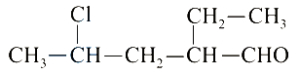
A
$2-$chloro$-4-$ethylpentanal
B
$2-$ethyl$-4-$chloropentanal
C
$4-$chloro$-2-$ethylpentanal
D
$2-$chlorohexane$-4-$al
Solution
(C) $1$. Identify the longest carbon chain containing the principal functional group (aldehyde). The chain has $5$ carbons,so the parent alkane is pentane,and the suffix is $-al$ (pentanal).
$2$. Number the chain starting from the aldehyde carbon as $C-1$.
$3$. The substituent at $C-2$ is an ethyl group $(-CH_2CH_3)$ and the substituent at $C-4$ is a chloro group $(-Cl)$.
$4$. Arrange the substituents alphabetically: $4-$chloro and $2-$ethyl.
$5$. Combining these,the $IUPAC$ name is $4-$chloro$-2-$ethylpentanal.
$2$. Number the chain starting from the aldehyde carbon as $C-1$.
$3$. The substituent at $C-2$ is an ethyl group $(-CH_2CH_3)$ and the substituent at $C-4$ is a chloro group $(-Cl)$.
$4$. Arrange the substituents alphabetically: $4-$chloro and $2-$ethyl.
$5$. Combining these,the $IUPAC$ name is $4-$chloro$-2-$ethylpentanal.
0 likesView Solution
44
ChemistryDifficultMCQTS EAMCET · 2018
The $IUPAC$ name of the following compound is
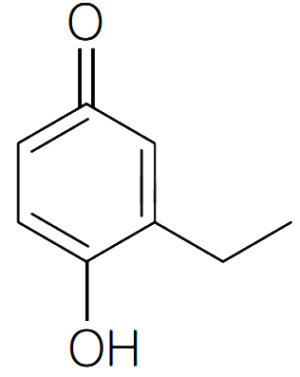
A
$2-$hydroxy$-5-$oxoethylcyclohexane
B
$2-$ethyl$-4-$oxocyclohexanol
C
$3-$ethyl$-4-$hydroxycyclohexanone
D
$6-$hydroxy$-3-$oxoethylcyclohexane
Solution
(C) The given compound is a substituted cyclohexanone.
$1$. The principal functional group is the ketone $(-C=O)$,so the carbon attached to the oxygen is numbered $1$.
$2$. We number the ring to give the substituents the lowest possible locants.
$3$. Starting from the ketone carbon as $1$,moving towards the ethyl group gives the ethyl group at position $3$ and the hydroxyl group at position $4$.
$4$. Thus,the $IUPAC$ name is $3-$ethyl$-4-$hydroxycyclohexanone.
$1$. The principal functional group is the ketone $(-C=O)$,so the carbon attached to the oxygen is numbered $1$.
$2$. We number the ring to give the substituents the lowest possible locants.
$3$. Starting from the ketone carbon as $1$,moving towards the ethyl group gives the ethyl group at position $3$ and the hydroxyl group at position $4$.
$4$. Thus,the $IUPAC$ name is $3-$ethyl$-4-$hydroxycyclohexanone.
0 likesView Solution
45
ChemistryEasyMCQTS EAMCET · 2018
The $IUPAC$ name of isoprene is:
A
$1,3-$butadiene
B
$2,3-$dimethylbutadiene
C
$2-$methyl$-1,3-$butadiene
D
$1,3-$dimethylbutadiene
Solution
(C) The structure of isoprene is $CH_2=C(CH_3)-CH=CH_2$.
To name it according to $IUPAC$ rules:
$1$. Select the longest carbon chain containing the double bonds,which is a $4-$carbon chain (buta-).
$2$. Number the chain from the end that gives the lowest locants to the double bonds: $1, 2, 3, 4$.
$3$. There is a methyl group at position $2$.
$4$. The double bonds are at positions $1$ and $3$.
Therefore,the $IUPAC$ name is $2-$methyl$-1,3-$butadiene.
To name it according to $IUPAC$ rules:
$1$. Select the longest carbon chain containing the double bonds,which is a $4-$carbon chain (buta-).
$2$. Number the chain from the end that gives the lowest locants to the double bonds: $1, 2, 3, 4$.
$3$. There is a methyl group at position $2$.
$4$. The double bonds are at positions $1$ and $3$.
Therefore,the $IUPAC$ name is $2-$methyl$-1,3-$butadiene.
0 likesView Solution
46
ChemistryMediumMCQTS EAMCET · 2018
Match the following acids in List-$I$ with their respective acid dissociation constants $(K_a)$ in List-$II$:
The correct match is:
| List-$I$ (Acid) | List-$II$ $(K_a)$ |
|---|---|
| $A$. Phenol | $I$. $1 \times 10^{-13}$ |
| $B$. Benzoic acid | $II$. $3.0 \times 10^{-8}$ |
| $C$. $HClO$ | $III$. $1.0 \times 10^{-10}$ |
| $D$. $CH_3COOH$ | $IV$. $6.5 \times 10^{-5}$ |
| $V$. $1.75 \times 10^{-5}$ |
The correct match is:
A
$A-III, B-IV, C-II, D-V$
B
$A-I, B-IV, C-II, D-V$
C
$A-III, B-IV, C-I, D-V$
D
$A-I, B-IV, C-III, D-V$
Solution
(A) The acid dissociation constant $(K_a)$ values for the given acids are as follows:
$A$. Phenol $(C_6H_5OH)$: $K_a \approx 1.0 \times 10^{-10}$ (Match $III$)
$B$. Benzoic acid $(C_6H_5COOH)$: $K_a \approx 6.5 \times 10^{-5}$ (Match $IV$)
$C$. Hypochlorous acid $(HClO)$: $K_a \approx 3.0 \times 10^{-8}$ (Match $II$)
$D$. Acetic acid $(CH_3COOH)$: $K_a \approx 1.75 \times 10^{-5}$ (Match $V$)
Thus,the correct matching is $A-III, B-IV, C-II, D-V$.
$A$. Phenol $(C_6H_5OH)$: $K_a \approx 1.0 \times 10^{-10}$ (Match $III$)
$B$. Benzoic acid $(C_6H_5COOH)$: $K_a \approx 6.5 \times 10^{-5}$ (Match $IV$)
$C$. Hypochlorous acid $(HClO)$: $K_a \approx 3.0 \times 10^{-8}$ (Match $II$)
$D$. Acetic acid $(CH_3COOH)$: $K_a \approx 1.75 \times 10^{-5}$ (Match $V$)
Thus,the correct matching is $A-III, B-IV, C-II, D-V$.
0 likesView Solution
47
ChemistryMediumMCQTS EAMCET · 2018
Tropolone is
A
benzenoid and aromatic
B
non-benzenoid and not aromatic
C
non-benzenoid and aromatic
D
non-benzenoid and anti-aromatic
Solution
(C) Tropolone is a seven-membered ring compound containing a carbonyl group and a hydroxyl group.
It does not contain a benzene ring,so it is non-benzenoid.
It exhibits aromatic character due to the resonance structure where the seven-membered ring becomes a tropylium cation $(C_7H_7^+)$,which follows $H$ückel's rule ($4n+2$ $\pi$ electrons,where $n=1$).
Thus,tropolone is non-benzenoid and aromatic.
It does not contain a benzene ring,so it is non-benzenoid.
It exhibits aromatic character due to the resonance structure where the seven-membered ring becomes a tropylium cation $(C_7H_7^+)$,which follows $H$ückel's rule ($4n+2$ $\pi$ electrons,where $n=1$).
Thus,tropolone is non-benzenoid and aromatic.
0 likesView Solution
48
ChemistryMediumMCQTS EAMCET · 2018
The number of possible constitutional isomers of an alkane with the formula $C_6H_{14}$ is:
A
$3$
B
$5$
C
$2$
D
$10$
Solution
(B) The constitutional isomers of $C_6H_{14}$ (hexane) are as follows:
$(i)$ $n$-Hexane: $CH_3-CH_2-CH_2-CH_2-CH_2-CH_3$
$(ii)$ $2$-Methylpentane: $CH_3-CH(CH_3)-CH_2-CH_2-CH_3$
$(iii)$ $3$-Methylpentane: $CH_3-CH_2-CH(CH_3)-CH_2-CH_3$
$(iv)$ $2,2$-Dimethylbutane: $CH_3-C(CH_3)_2-CH_2-CH_3$
$(v)$ $2,3$-Dimethylbutane: $CH_3-CH(CH_3)-CH(CH_3)-CH_3$
Thus,there are $5$ possible constitutional isomers.
$(i)$ $n$-Hexane: $CH_3-CH_2-CH_2-CH_2-CH_2-CH_3$
$(ii)$ $2$-Methylpentane: $CH_3-CH(CH_3)-CH_2-CH_2-CH_3$
$(iii)$ $3$-Methylpentane: $CH_3-CH_2-CH(CH_3)-CH_2-CH_3$
$(iv)$ $2,2$-Dimethylbutane: $CH_3-C(CH_3)_2-CH_2-CH_3$
$(v)$ $2,3$-Dimethylbutane: $CH_3-CH(CH_3)-CH(CH_3)-CH_3$
Thus,there are $5$ possible constitutional isomers.
0 likesView Solution
49
ChemistryEasyMCQTS EAMCET · 2018
Which of the following molecules is not chiral?
A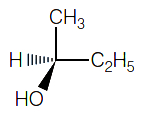
$2-$butanol
B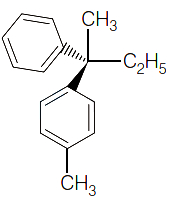
$2-$phenyl$-2-$methylbutane
C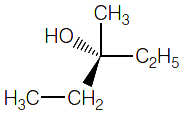
$3-$hexanol
D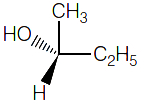
$2-$methyl$-2-$butanol
Solution
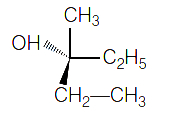
0 likesView Solution
50
ChemistryMediumMCQTS EAMCET · 2018
The Newman projection of the staggered conformation of ethane is:
A
$A$ sawhorse projection representation.
B
An eclipsed Newman projection.
C
Another sawhorse projection representation.
D
The staggered Newman projection.
Solution
(D) In a Newman projection,the molecule is viewed along the $C-C$ bond axis.
For ethane $(CH_3-CH_3)$,the staggered conformation is the one where the hydrogen atoms on the front carbon are positioned between the hydrogen atoms on the back carbon,minimizing steric repulsion.
Option $D$ shows the staggered conformation where the dihedral angle between the $C-H$ bonds of adjacent carbons is $60^{\circ}$.
For ethane $(CH_3-CH_3)$,the staggered conformation is the one where the hydrogen atoms on the front carbon are positioned between the hydrogen atoms on the back carbon,minimizing steric repulsion.
Option $D$ shows the staggered conformation where the dihedral angle between the $C-H$ bonds of adjacent carbons is $60^{\circ}$.
0 likesView Solution
51
ChemistryEasyMCQTS EAMCET · 2018
Identify the non-reducing sugar from the following.
A
$Sucrose$
B
$Maltose$
C
$Lactose$
D
$Glucose$
Solution
(A) non-reducing sugar is a carbohydrate that does not have a free aldehyde or ketone group to act as a reducing agent.
$Sucrose$ is a disaccharide composed of $Glucose$ and $Fructose$ units linked by a glycosidic bond between their respective anomeric carbons ($C1$ of $Glucose$ and $C2$ of $Fructose$).
Since both anomeric carbons are involved in the glycosidic linkage,$Sucrose$ cannot open to form an aldehyde or ketone group,making it a non-reducing sugar.
$Maltose$,$Lactose$,and $Glucose$ all contain at least one free anomeric carbon,making them reducing sugars.
$Sucrose$ is a disaccharide composed of $Glucose$ and $Fructose$ units linked by a glycosidic bond between their respective anomeric carbons ($C1$ of $Glucose$ and $C2$ of $Fructose$).
Since both anomeric carbons are involved in the glycosidic linkage,$Sucrose$ cannot open to form an aldehyde or ketone group,making it a non-reducing sugar.
$Maltose$,$Lactose$,and $Glucose$ all contain at least one free anomeric carbon,making them reducing sugars.
0 likesView Solution
52
ChemistryMediumMCQTS EAMCET · 2018
The major product of the following reaction is
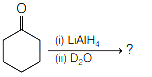
A
Cyclohexanol with a $D$ atom attached to the carbon and an $-OH$ group.
B
Cyclohexanol with a $D$ atom attached to the carbon and an $-OD$ group.
C
Cyclohexanol with a $D$ atom and an $H$ atom attached to the carbon.
D
Cyclohexanol with an $H$ atom attached to the carbon and an $-OD$ group.
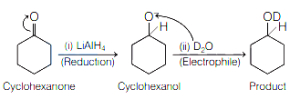
Solution
(D) $LiAlH_4$ acts as a source of hydride ion $(H^-)$,which attacks the electrophilic carbonyl carbon of cyclohexanone to form an alkoxide intermediate.
In the second step,$D_2O$ acts as a source of deuterium $(D^+)$,which protonates (deuterates) the alkoxide oxygen to form the final product,which is a cyclohexanol derivative with an $-OD$ group and a hydrogen atom attached to the alpha carbon.
In the second step,$D_2O$ acts as a source of deuterium $(D^+)$,which protonates (deuterates) the alkoxide oxygen to form the final product,which is a cyclohexanol derivative with an $-OD$ group and a hydrogen atom attached to the alpha carbon.
0 likesView Solution
53
ChemistryEasyMCQTS EAMCET · 2018
The major product obtained in the following reaction is $C_2H_5ONa + (CH_3)_3C-Cl \rightarrow$
A
$CH_3-C(CH_3)_2-O-C_2H_5$
B
$CH_2=C(CH_3)_2$
C
$CH_3-CH(CH_3)-O-C_2H_5$
D
$(CH_3)_3C-CH_2CHO$
Solution
(B) The reaction involves a tertiary alkyl halide,$(CH_3)_3C-Cl$,and a strong base,$C_2H_5ONa$ (sodium ethoxide).
Since the alkyl halide is sterically hindered (tertiary),the $S_N2$ pathway is unfavorable.
Instead,the base acts as a proton acceptor,leading to an $E2$ elimination reaction.
The base abstracts a proton from one of the $\beta$-carbon atoms,resulting in the formation of an alkene.
The major product is $2$-methylpropene,which is $(CH_3)_2C=CH_2$.
Since the alkyl halide is sterically hindered (tertiary),the $S_N2$ pathway is unfavorable.
Instead,the base acts as a proton acceptor,leading to an $E2$ elimination reaction.
The base abstracts a proton from one of the $\beta$-carbon atoms,resulting in the formation of an alkene.
The major product is $2$-methylpropene,which is $(CH_3)_2C=CH_2$.
0 likesView Solution
54
ChemistryEasyMCQTS EAMCET · 2018
The structure of ranitidine is:
A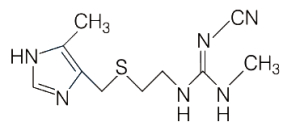
B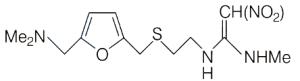
C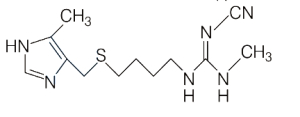
D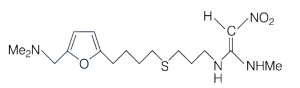
Solution
(B) Ranitidine is an antacid used to treat stomach ulcers and gastroesophageal reflux disease. Its chemical structure consists of a furan ring substituted with a dimethylaminomethyl group and a thioether chain ending in a nitroethenediamine moiety. The correct structure is shown in option $B$.
0 likesView Solution
55
ChemistryMediumMCQTS EAMCET · 2018
The major product of the following reaction is:
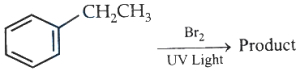
A
$1-$bromo$-1-$phenylethane
B
$2-$bromo$-1-$phenylethane
C
p-bromoethylbenzene
D
o,p-dibromoethylbenzene
Solution
(A) The reaction of ethylbenzene with $Br_2$ in the presence of $UV$ light is a free radical substitution reaction. The bromine radical abstracts a hydrogen atom from the benzylic carbon because the resulting benzylic radical is resonance-stabilized by the phenyl ring. The radical formed at the $\alpha$-carbon (benzylic position) is more stable than the radical at the $\beta$-carbon. Therefore,the major product is $1$-bromo-$1$-phenylethane $(C_6H_5CH(Br)CH_3)$.
0 likesView Solution
56
ChemistryMediumMCQTS EAMCET · 2018
From the following,identify the reactions that give alcohol as the product.
$(i)$ $Cyclohexylidenemethane \xrightarrow[(ii) H_2O_2/NaOH]{(i) B_2H_6}$
(ii) $Methyl \ benzoate \xrightarrow{H_2/Catalyst}$
(iii) $Acetophenone \xrightarrow{NaBH_4/MeOH}$
(iv) $2,2-Dichloropropane \xrightarrow{H_2O/NaOH}$
$(i)$ $Cyclohexylidenemethane \xrightarrow[(ii) H_2O_2/NaOH]{(i) B_2H_6}$
(ii) $Methyl \ benzoate \xrightarrow{H_2/Catalyst}$
(iii) $Acetophenone \xrightarrow{NaBH_4/MeOH}$
(iv) $2,2-Dichloropropane \xrightarrow{H_2O/NaOH}$
A
$i, iii, iv$
B
$i, ii, iv$
C
$i, ii, iii$
D
$ii, iii, iv$
Solution
(C) Let us analyze each reaction:
$(i)$ Hydroboration-oxidation of an alkene gives an alcohol. This reaction yields cyclohexylmethanol,which is an alcohol.
(ii) Catalytic hydrogenation of an ester $(Methyl \ benzoate)$ yields a primary alcohol $(Benzyl \ alcohol)$ and methanol.
(iii) Reduction of a ketone $(Acetophenone)$ with $NaBH_4$ yields a secondary alcohol $(1-phenylethanol)$.
(iv) Hydrolysis of a gem-dichloride $(2,2-dichloropropane)$ with aqueous $NaOH$ yields a ketone $(Acetone)$,not an alcohol.
Therefore,reactions $(i), (ii),$ and $(iii)$ produce alcohols. The correct option is $C$.
$(i)$ Hydroboration-oxidation of an alkene gives an alcohol. This reaction yields cyclohexylmethanol,which is an alcohol.
(ii) Catalytic hydrogenation of an ester $(Methyl \ benzoate)$ yields a primary alcohol $(Benzyl \ alcohol)$ and methanol.
(iii) Reduction of a ketone $(Acetophenone)$ with $NaBH_4$ yields a secondary alcohol $(1-phenylethanol)$.
(iv) Hydrolysis of a gem-dichloride $(2,2-dichloropropane)$ with aqueous $NaOH$ yields a ketone $(Acetone)$,not an alcohol.
Therefore,reactions $(i), (ii),$ and $(iii)$ produce alcohols. The correct option is $C$.
0 likesView Solution
57
ChemistryDifficultMCQTS EAMCET · 2018
From the following reactions,identify the reactions that give carboxylic acids as products.
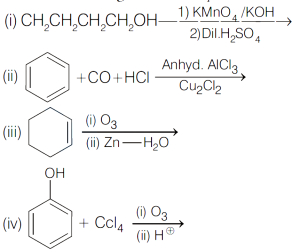
A
$(i), (iii)$
B
$(i), (iv)$
C
$(ii), (iii)$
D
$(ii), (iv)$
Solution
(B) Let us analyze each reaction:
$(i)$ Oxidation of $CH_3CH_2CH_2CH_2OH$ with alkaline $KMnO_4$ followed by acidification gives butanoic acid $(CH_3CH_2CH_2COOH)$,which is a carboxylic acid.
$(ii)$ Gattermann-Koch reaction of benzene with $CO$ and $HCl$ in the presence of anhydrous $AlCl_3/Cu_2Cl_2$ gives benzaldehyde $(C_6H_5CHO)$,which is an aldehyde.
$(iii)$ Reductive ozonolysis of cyclohexene with $O_3$ followed by $Zn/H_2O$ gives hexanedial $(OHC-(CH_2)_4-CHO)$,which is a dialdehyde.
$(iv)$ Reimer-Tiemann reaction of phenol with $CCl_4$ in the presence of $NaOH$ followed by acidification gives salicylic acid $(2-hydroxybenzoic \ acid)$,which is a carboxylic acid.
Thus,reactions $(i)$ and $(iv)$ produce carboxylic acids.
$(i)$ Oxidation of $CH_3CH_2CH_2CH_2OH$ with alkaline $KMnO_4$ followed by acidification gives butanoic acid $(CH_3CH_2CH_2COOH)$,which is a carboxylic acid.
$(ii)$ Gattermann-Koch reaction of benzene with $CO$ and $HCl$ in the presence of anhydrous $AlCl_3/Cu_2Cl_2$ gives benzaldehyde $(C_6H_5CHO)$,which is an aldehyde.
$(iii)$ Reductive ozonolysis of cyclohexene with $O_3$ followed by $Zn/H_2O$ gives hexanedial $(OHC-(CH_2)_4-CHO)$,which is a dialdehyde.
$(iv)$ Reimer-Tiemann reaction of phenol with $CCl_4$ in the presence of $NaOH$ followed by acidification gives salicylic acid $(2-hydroxybenzoic \ acid)$,which is a carboxylic acid.
Thus,reactions $(i)$ and $(iv)$ produce carboxylic acids.
0 likesView Solution
58
ChemistryEasyMCQTS EAMCET · 2018
Which one of the following reactions gives phenol as a major product?
A
Reaction of benzene with conc. $HNO_3$ and conc. $H_2SO_4$
B
Reaction of aniline with $NaNO_2 / HCl$ followed by treatment with warm water
C
Reaction of benzene with hot water
D
Sodium salt of benzoic acid with soda lime reaction
Solution
(B) Step $1$: Aniline reacts with $NaNO_2$ and $HCl$ at $273-278 \ K$ to form benzene diazonium chloride.
Step $2$: Benzene diazonium chloride,when treated with warm water,undergoes hydrolysis to form phenol,$N_2$ gas,and $HCl$.
Step $2$: Benzene diazonium chloride,when treated with warm water,undergoes hydrolysis to form phenol,$N_2$ gas,and $HCl$.
0 likesView Solution
59
ChemistryMediumMCQTS EAMCET · 2018
The major product in the following reaction is:
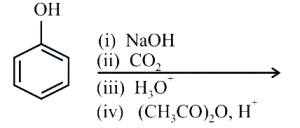
A
$4-$acetoxybenzoic acid
B
$2-$acetoxybenzoic acid
C
$4-$hydroxy$-3-$acetylbenzoic acid
D
$2-$hydroxybenzoic acid methyl ester
Solution
(B) The reaction sequence is as follows:
$1$. Phenol reacts with $NaOH$ to form sodium phenoxide.
$2$. Sodium phenoxide undergoes Kolbe's reaction with $CO_2$ followed by acidification $(H_3O^+)$ to produce salicylic acid ($2$-hydroxybenzoic acid).
$3$. Salicylic acid then reacts with acetic anhydride $((CH_3CO)_2O)$ in the presence of an acid catalyst $(H^+)$ to undergo acetylation of the phenolic $-OH$ group.
$4$. The final product is $2-$acetoxybenzoic acid,commonly known as aspirin.
$1$. Phenol reacts with $NaOH$ to form sodium phenoxide.
$2$. Sodium phenoxide undergoes Kolbe's reaction with $CO_2$ followed by acidification $(H_3O^+)$ to produce salicylic acid ($2$-hydroxybenzoic acid).
$3$. Salicylic acid then reacts with acetic anhydride $((CH_3CO)_2O)$ in the presence of an acid catalyst $(H^+)$ to undergo acetylation of the phenolic $-OH$ group.
$4$. The final product is $2-$acetoxybenzoic acid,commonly known as aspirin.
0 likesView Solution
60
ChemistryMediumMCQTS EAMCET · 2018
The major product formed in the following reaction is:
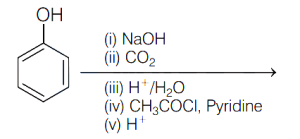
A
Aspirin (o-acetoxybenzoic acid)
B
Methyl salicylate
C
p-acetoxybenzoic acid
D
Methyl p-hydroxybenzoate
Solution
(A) The reaction sequence is as follows:
$1$. The reaction of phenol with $NaOH$ followed by $CO_2$ and then $H^+/H_2O$ is the Kolbe-Schmitt reaction,which yields salicylic acid ($2$-hydroxybenzoic acid).
$2$. The subsequent reaction with $CH_3COCl$ in the presence of pyridine is an acetylation reaction of the phenolic $-OH$ group.
$3$. This converts the $-OH$ group of salicylic acid into an acetoxy group $(-OCOCH_3)$,resulting in the formation of aspirin ($2$-acetoxybenzoic acid).
$1$. The reaction of phenol with $NaOH$ followed by $CO_2$ and then $H^+/H_2O$ is the Kolbe-Schmitt reaction,which yields salicylic acid ($2$-hydroxybenzoic acid).
$2$. The subsequent reaction with $CH_3COCl$ in the presence of pyridine is an acetylation reaction of the phenolic $-OH$ group.
$3$. This converts the $-OH$ group of salicylic acid into an acetoxy group $(-OCOCH_3)$,resulting in the formation of aspirin ($2$-acetoxybenzoic acid).
0 likesView Solution
61
ChemistryMediumMCQTS EAMCET · 2018
The major product $P$ formed in the following reaction is
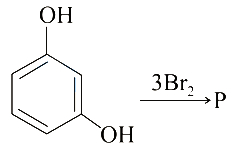
A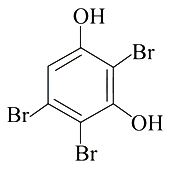
B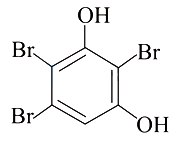
C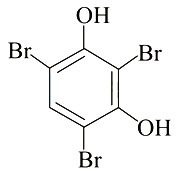
D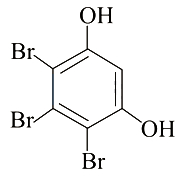
Solution
(A) The reaction of resorcinol ($1,3$-dihydroxybenzene) with $3Br_2$ (bromine water) is an electrophilic aromatic substitution reaction. The $-OH$ groups are strongly activating and ortho/para directing. In resorcinol,the positions $2, 4,$ and $6$ are activated by the two $-OH$ groups. Therefore,bromination occurs at all three positions to form $2,4,6$-tribromoresorcinol.
0 likesView Solution
62
ChemistryDifficultMCQTS EAMCET · 2018
The major product $(Z)$ of the following chemical reaction is
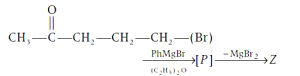
A
$CH_3-C(OH)(Ph)-CH_2-CH_2-CH_3$
B
$CH_3-C(OH)(Ph)-CH_2-CH_2-CH_2Br$
C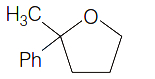
$A$ cyclic ether with a five-membered ring containing a phenyl group and a methyl group at the same carbon.
D
$CH_3-C(=O)-CH_2-CH_2-CH_2-Ph$
Solution
(C) The reaction involves the nucleophilic addition of the Grignard reagent,$PhMgBr$,to the carbonyl group of $5$-bromo-$2$-pentanone.
$1$. The phenyl group $(Ph^-)$ attacks the electrophilic carbonyl carbon of the ketone to form an intermediate alkoxide,$CH_3-C(OMgBr)(Ph)-CH_2-CH_2-CH_2Br$ (labeled as $P$).
$2$. The alkoxide oxygen then performs an intramolecular nucleophilic substitution $(S_N2)$ on the carbon bearing the bromine atom,displacing the bromide ion and forming a five-membered cyclic ether ring.
$3$. This results in the formation of $2$-methyl-$2$-phenyltetrahydrofuran as the major product $(Z)$.
$1$. The phenyl group $(Ph^-)$ attacks the electrophilic carbonyl carbon of the ketone to form an intermediate alkoxide,$CH_3-C(OMgBr)(Ph)-CH_2-CH_2-CH_2Br$ (labeled as $P$).
$2$. The alkoxide oxygen then performs an intramolecular nucleophilic substitution $(S_N2)$ on the carbon bearing the bromine atom,displacing the bromide ion and forming a five-membered cyclic ether ring.
$3$. This results in the formation of $2$-methyl-$2$-phenyltetrahydrofuran as the major product $(Z)$.
0 likesView Solution
63
ChemistryMediumMCQTS EAMCET · 2018
The products $A$ and $B$ of the below reaction sequence are
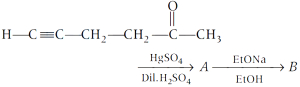
A
$CH_3COCH_2CH_2COCH_3$,$3$-methylcyclopent-$2$-en-$1$-one
B
$OHC(CH_2)_3COCH_3$,$2$-methylcyclobut-$1$-ene-$1$-carbaldehyde
C
$CH_3CH(OH)CH_2CH_2COCH_3$,$2$-methyl-tetrahydrofuran-$2$-ol
D
$CH_3COCH_2CH_2COCH_3$,$3$-methylcyclopent-$2$-en-$1$-one
Solution
(D) The reaction of $HC \equiv C-CH_2-CH_2-COCH_3$ with $HgSO_4$ and dilute $H_2SO_4$ is a hydration reaction of an alkyne. The terminal alkyne undergoes hydration to form a ketone. The product $A$ is $CH_3COCH_2CH_2COCH_3$ (hexane-$2,5$-dione).
Next,the reaction of $CH_3COCH_2CH_2COCH_3$ with $EtONa$ and $EtOH$ is an intramolecular aldol condensation. The base $EtO^-$ abstracts an $\alpha$-hydrogen from one of the methyl groups,forming an enolate,which then attacks the other carbonyl group to form a five-membered ring. Subsequent dehydration yields $3$-methylcyclopent-$2$-en-$1$-one as product $B$.
Next,the reaction of $CH_3COCH_2CH_2COCH_3$ with $EtONa$ and $EtOH$ is an intramolecular aldol condensation. The base $EtO^-$ abstracts an $\alpha$-hydrogen from one of the methyl groups,forming an enolate,which then attacks the other carbonyl group to form a five-membered ring. Subsequent dehydration yields $3$-methylcyclopent-$2$-en-$1$-one as product $B$.
0 likesView Solution
64
ChemistryMediumMCQTS EAMCET · 2018
The major product formed in the following reaction is:
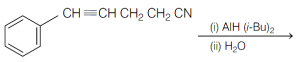
A
$Ph-CH_2-CH_2-CH_2-CH_2-CH_2-NH_2$
B
$Ph-CH_2-CH_2-CH_2-CH_2-CH_2-OH$
C
$Ph-CH=CH-CH_2-CH_2-CH_2-NH_2$
D
$Ph-CH=CH-CH_2-CH_2-CHO$
Solution
(D) The reagent $DIBAL-H$ (diisobutylaluminium hydride,$AlH(i-Bu)_2$) is a selective reducing agent. It reduces nitriles $(-CN)$ to aldehydes $(-CHO)$ after hydrolysis,while leaving other functional groups like carbon-carbon double bonds $(C=C)$ unaffected. Therefore,the reaction of $Ph-CH=CH-CH_2-CH_2-CN$ with $DIBAL-H$ followed by $H_2O$ yields $Ph-CH=CH-CH_2-CH_2-CHO$.
0 likesView Solution
65
ChemistryDifficultMCQTS EAMCET · 2018
The major product obtained in the reaction of isobutylbenzene with acetic anhydride in the presence of anhydrous $AlCl_3$ is:
A
$p-$isobutylacetophenone
B
acetophenone
C
$m-$isobutylacetophenone
D
$o-$isobutylacetophenone
Solution
(A) The reaction is a Friedel-Crafts acylation,which involves the electrophilic aromatic substitution of an arene with an acylating agent (like acetic anhydride) in the presence of a Lewis acid catalyst such as anhydrous $AlCl_3$.
In isobutylbenzene,the isobutyl group $(-CH_2CH(CH_3)_2)$ is an ortho/para-directing group due to its electron-donating inductive effect.
Due to steric hindrance caused by the bulky isobutyl group at the ortho position,the electrophile (acetyl cation,$CH_3CO^+$) preferentially attacks the less hindered para position.
Therefore,the major product formed is $p-$isobutylacetophenone.
In isobutylbenzene,the isobutyl group $(-CH_2CH(CH_3)_2)$ is an ortho/para-directing group due to its electron-donating inductive effect.
Due to steric hindrance caused by the bulky isobutyl group at the ortho position,the electrophile (acetyl cation,$CH_3CO^+$) preferentially attacks the less hindered para position.
Therefore,the major product formed is $p-$isobutylacetophenone.
0 likesView Solution
66
ChemistryDifficultMCQTS EAMCET · 2018
The major product obtained in the reaction of bromobenzene with $Mg$ in dry ether followed by the reaction with benzonitrile and hydrolysis is
A
acetophenone
B
benzophenone
C
phenyl benzoate
D
benzoic acid
Solution
(B) Step $1$: Bromobenzene reacts with $Mg$ in dry ether to form phenylmagnesium bromide $(C_6H_5MgBr)$,which is a Grignard reagent.
Step $2$: Phenylmagnesium bromide reacts with benzonitrile $(C_6H_5CN)$ to form an intermediate imine salt.
Step $3$: Acidic hydrolysis of the intermediate imine salt yields benzophenone $(C_6H_5COC_6H_5)$ as the final product.
Step $2$: Phenylmagnesium bromide reacts with benzonitrile $(C_6H_5CN)$ to form an intermediate imine salt.
Step $3$: Acidic hydrolysis of the intermediate imine salt yields benzophenone $(C_6H_5COC_6H_5)$ as the final product.
0 likesView Solution
67
ChemistryDifficultMCQTS EAMCET · 2018
The products $A$,$B$ and $C$ in the following reaction sequence are:

A
$A$: $1-$phenylbutan$-2-$ol,$B$: $1-$phenylbutan$-2-$imine,$C$: $1-$phenylbutan$-2-$amine
B
$A$: $1-$phenylbutan$-2-$one,$B$: $1-$phenylbut$-1-$ene,$C$: $1-$phenylbutane
C
$A$: $1-$phenylbutan$-2-$one,$B$: $1-$phenylbutan$-2-$hydrazone,$C$: $1-$phenylbutane
D
$A$: $1-$phenylbutan$-2-$one,$B$: $1-$phenylbutan$-2-$imine,$C$: $1-$phenylbutane
Solution
(C) The reaction sequence is as follows:
$1$. Oxidation of the secondary alcohol $1\text{-phenylbutan-2-ol}$ with $PCC$ (Pyridinium chlorochromate) yields the ketone $A$,which is $1\text{-phenylbutan-2-one}$ $(CH_3CH_2COCH_2Ph)$.
$2$. The reaction of the ketone $A$ with hydrazine $(H_2N-NH_2)$ forms the hydrazone $B$,which is $1\text{-phenylbutan-2-one hydrazone}$ $(CH_3CH_2C(=NNH_2)CH_2Ph)$.
$3$. The subsequent treatment of the hydrazone $B$ with $KOH$ in ethylene glycol at high temperature is the Wolff-Kishner reduction,which reduces the carbonyl group to a methylene group,yielding the alkane $C$,which is $1\text{-phenylbutane}$ $(CH_3CH_2CH_2CH_2Ph)$.
Thus,the correct sequence is $A$: $1\text{-phenylbutan-2-one}$,$B$: $1\text{-phenylbutan-2-one hydrazone}$,$C$: $1\text{-phenylbutane}$.
$1$. Oxidation of the secondary alcohol $1\text{-phenylbutan-2-ol}$ with $PCC$ (Pyridinium chlorochromate) yields the ketone $A$,which is $1\text{-phenylbutan-2-one}$ $(CH_3CH_2COCH_2Ph)$.
$2$. The reaction of the ketone $A$ with hydrazine $(H_2N-NH_2)$ forms the hydrazone $B$,which is $1\text{-phenylbutan-2-one hydrazone}$ $(CH_3CH_2C(=NNH_2)CH_2Ph)$.
$3$. The subsequent treatment of the hydrazone $B$ with $KOH$ in ethylene glycol at high temperature is the Wolff-Kishner reduction,which reduces the carbonyl group to a methylene group,yielding the alkane $C$,which is $1\text{-phenylbutane}$ $(CH_3CH_2CH_2CH_2Ph)$.
Thus,the correct sequence is $A$: $1\text{-phenylbutan-2-one}$,$B$: $1\text{-phenylbutan-2-one hydrazone}$,$C$: $1\text{-phenylbutane}$.
0 likesView Solution
68
ChemistryMediumMCQTS EAMCET · 2018
What is the possible product $(P)$ in the following reaction?
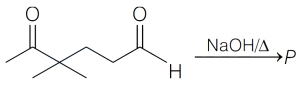
A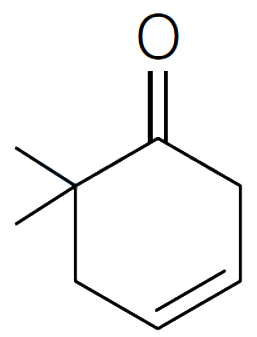
B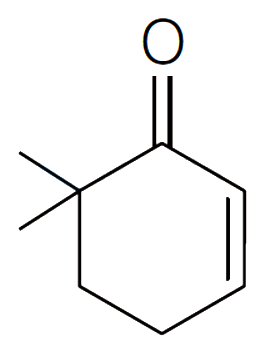
C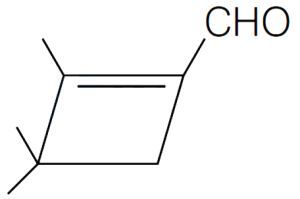
D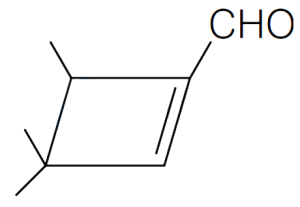
Solution
(A) The given reaction is an intramolecular aldol condensation.
$1$. The reactant is a keto-aldehyde,specifically $6$-methylhept-$5$-en-$2$-one derivative or similar structure.
$2$. In the presence of $NaOH$ and heat $(\Delta)$,the enolate formed at the $\alpha$-carbon of the ketone attacks the carbonyl carbon of the aldehyde.
$3$. This leads to the formation of a cyclic $\beta$-hydroxy aldehyde/ketone,which subsequently undergoes dehydration (elimination of water) to form an $\alpha,\beta$-unsaturated carbonyl compound.
$4$. Based on the structure,the product is $6,6$-dimethylcyclohex-$2$-en-$1$-one.
$1$. The reactant is a keto-aldehyde,specifically $6$-methylhept-$5$-en-$2$-one derivative or similar structure.
$2$. In the presence of $NaOH$ and heat $(\Delta)$,the enolate formed at the $\alpha$-carbon of the ketone attacks the carbonyl carbon of the aldehyde.
$3$. This leads to the formation of a cyclic $\beta$-hydroxy aldehyde/ketone,which subsequently undergoes dehydration (elimination of water) to form an $\alpha,\beta$-unsaturated carbonyl compound.
$4$. Based on the structure,the product is $6,6$-dimethylcyclohex-$2$-en-$1$-one.
0 likesView Solution
69
ChemistryDifficultMCQTS EAMCET · 2018
The major product in the following reaction is:
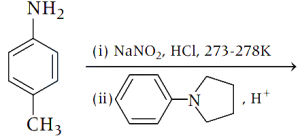
A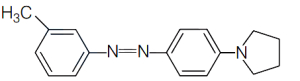
B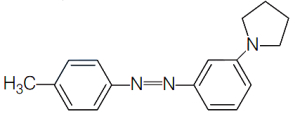
C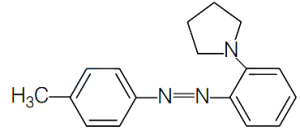
D
Solution
(D) In the given reaction,$p$-toluidine reacts with $NaNO_2$ and $HCl$ at $273-278 \ K$ to form a diazonium salt,which is $p$-methylbenzenediazonium chloride.
This diazonium salt then undergoes an electrophilic aromatic substitution (coupling reaction) with $N$-phenylpyrrolidine in the presence of $H^+$.
The coupling reaction occurs at the para-position of the $N$-phenylpyrrolidine ring because the pyrrolidinyl group is a strong ortho/para-directing group and the para-position is sterically less hindered.
Thus,the major product is the para-coupled azo dye as shown in option $D$.
This diazonium salt then undergoes an electrophilic aromatic substitution (coupling reaction) with $N$-phenylpyrrolidine in the presence of $H^+$.
The coupling reaction occurs at the para-position of the $N$-phenylpyrrolidine ring because the pyrrolidinyl group is a strong ortho/para-directing group and the para-position is sterically less hindered.
Thus,the major product is the para-coupled azo dye as shown in option $D$.
0 likesView Solution
70
ChemistryMediumMCQTS EAMCET · 2018
Which of the following reactions leads to the formation of benzonitrile?
A
Reaction of bromobenzene with $KCN$
B
Reaction of aniline with $NaNO_2$ and $HCl$ at $273 \ K$ followed by the reaction with $CuCN$
C
Reaction of bromobenzene with $NaNO_2$ and $HCl$ at $273 \ K$ followed by the reaction with $CuCN$
D
Reaction of aniline with $KCN$
Solution
(B) The formation of benzonitrile from aniline involves two main steps:
$1$. Diazotization: Aniline reacts with $NaNO_2$ and $HCl$ at $273-278 \ K$ to form benzene diazonium chloride.
$2$. Sandmeyer reaction: Benzene diazonium chloride reacts with $CuCN$ to form benzonitrile.
Therefore,the correct sequence is the reaction of aniline with $NaNO_2$ and $HCl$ at $273 \ K$ followed by the reaction with $CuCN$.
$1$. Diazotization: Aniline reacts with $NaNO_2$ and $HCl$ at $273-278 \ K$ to form benzene diazonium chloride.
$2$. Sandmeyer reaction: Benzene diazonium chloride reacts with $CuCN$ to form benzonitrile.
Therefore,the correct sequence is the reaction of aniline with $NaNO_2$ and $HCl$ at $273 \ K$ followed by the reaction with $CuCN$.
0 likesView Solution
71
ChemistryMediumMCQTS EAMCET · 2018
The major product of the following reaction is:
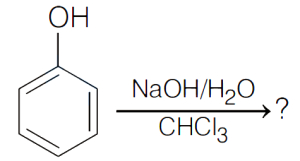
A
Sodium $2-$chlorophenolate
B
Sodium $2-$carboxyphenolate
C
Sodium $2-$formylphenolate
D
Sodium $2-$hydroxyphenolate
Solution
(C) The reaction of phenol with $CHCl_3$ in the presence of aqueous $NaOH$ is known as the $Reimer-Tiemann$ reaction.
In this reaction,$CHCl_3$ reacts with $NaOH$ to generate a dichlorocarbene intermediate $(:CCl_2)$.
This electrophilic carbene attacks the phenoxide ion at the ortho position.
The intermediate formed undergoes hydrolysis to yield salicylaldehyde ($2$-hydroxybenzaldehyde) in its salt form,which is sodium $2-$formylphenolate.
In this reaction,$CHCl_3$ reacts with $NaOH$ to generate a dichlorocarbene intermediate $(:CCl_2)$.
This electrophilic carbene attacks the phenoxide ion at the ortho position.
The intermediate formed undergoes hydrolysis to yield salicylaldehyde ($2$-hydroxybenzaldehyde) in its salt form,which is sodium $2-$formylphenolate.
0 likesView Solution
72
ChemistryEasyMCQTS EAMCET · 2018
In the below given synthetic sequence,the product "$C$" is
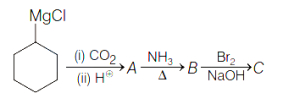
A
Cyclohexanamine
B
Cyclohexanecarboxamide
C
Cyclohexylmethanamine
D
$N$-Bromocyclohexanecarboxamide
Solution
(A) $1$. The reaction of cyclohexylmagnesium chloride with $CO_2$ followed by acidic hydrolysis $(H^ )$ yields cyclohexanecarboxylic acid $(A)$.
$2$. Cyclohexanecarboxylic acid reacts with $NH_3$ upon heating $(\Delta)$ to form cyclohexanecarboxamide $(B)$.
$3$. The reaction of cyclohexanecarboxamide with $Br_2$ and $NaOH$ is the Hoffmann bromamide degradation reaction,which converts the amide into a primary amine with one less carbon atom.
$4$. Therefore,the product $C$ is cyclohexanamine.
$2$. Cyclohexanecarboxylic acid reacts with $NH_3$ upon heating $(\Delta)$ to form cyclohexanecarboxamide $(B)$.
$3$. The reaction of cyclohexanecarboxamide with $Br_2$ and $NaOH$ is the Hoffmann bromamide degradation reaction,which converts the amide into a primary amine with one less carbon atom.
$4$. Therefore,the product $C$ is cyclohexanamine.
0 likesView Solution
73
ChemistryEasyMCQTS EAMCET · 2018
Which of the options correctly represents the basicity order for these compounds?
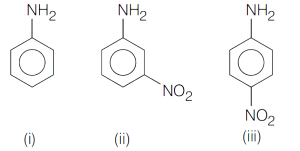
A
$i > ii > iii$
B
$i > iii > ii$
C
$iii > ii > i$
D
$iii > i > ii$
Solution
(A) The $-NO_2$ group is a strong electron-withdrawing group that exerts both $-I$ (inductive) and $-M$ (mesomeric) effects.
These effects decrease the electron density on the nitrogen atom of the $-NH_2$ group,thereby reducing its basicity.
In compound $(i)$,there is no electron-withdrawing group,so it is the most basic.
In compound $(ii)$,the $-NO_2$ group is at the meta position,exerting only the $-I$ effect.
In compound $(iii)$,the $-NO_2$ group is at the para position,exerting both $-I$ and strong $-M$ effects,which significantly reduce the electron density on the nitrogen atom.
Therefore,the basicity order is $(i) > (ii) > (iii)$.
These effects decrease the electron density on the nitrogen atom of the $-NH_2$ group,thereby reducing its basicity.
In compound $(i)$,there is no electron-withdrawing group,so it is the most basic.
In compound $(ii)$,the $-NO_2$ group is at the meta position,exerting only the $-I$ effect.
In compound $(iii)$,the $-NO_2$ group is at the para position,exerting both $-I$ and strong $-M$ effects,which significantly reduce the electron density on the nitrogen atom.
Therefore,the basicity order is $(i) > (ii) > (iii)$.
0 likesView Solution
74
ChemistryDifficultMCQTS EAMCET · 2018
The order of basicity among the following nitrogen compounds is:
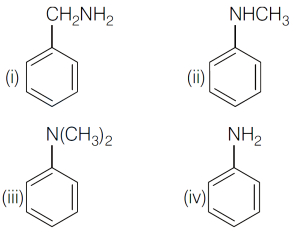
A
$iv > i > iii > ii$
B
$iii > i > iv > ii$
C
$ii > i > iii > iv$
D
$i > iii > ii > iv$
Solution
(D) The given compounds are:
$(i)$ $C_6H_5CH_2NH_2$ (Benzylamine)
(ii) $C_6H_5NHCH_3$ ($N$-methylaniline)
(iii) $C_6H_5N(CH_3)_2$ ($N,N$-dimethylaniline)
(iv) $C_6H_5NH_2$ (Aniline)
Benzylamine $(i)$ is an aliphatic amine where the lone pair on nitrogen is not involved in resonance with the benzene ring,making it the most basic.
Among the aryl amines (ii,iii,and iv),the basicity depends on the electron-donating effect of the methyl groups.
$N,N$-dimethylaniline (iii) has two electron-donating methyl groups,making it more basic than $N$-methylaniline (ii),which has one methyl group.
Aniline (iv) has no electron-donating methyl groups,making it the least basic.
Thus,the correct order of basicity is $i > iii > ii > iv$.
$(i)$ $C_6H_5CH_2NH_2$ (Benzylamine)
(ii) $C_6H_5NHCH_3$ ($N$-methylaniline)
(iii) $C_6H_5N(CH_3)_2$ ($N,N$-dimethylaniline)
(iv) $C_6H_5NH_2$ (Aniline)
Benzylamine $(i)$ is an aliphatic amine where the lone pair on nitrogen is not involved in resonance with the benzene ring,making it the most basic.
Among the aryl amines (ii,iii,and iv),the basicity depends on the electron-donating effect of the methyl groups.
$N,N$-dimethylaniline (iii) has two electron-donating methyl groups,making it more basic than $N$-methylaniline (ii),which has one methyl group.
Aniline (iv) has no electron-donating methyl groups,making it the least basic.
Thus,the correct order of basicity is $i > iii > ii > iv$.
0 likesView Solution
75
ChemistryMediumMCQTS EAMCET · 2018
In the following reaction,the major product $(P)$ formed is
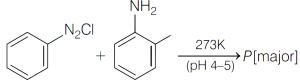
A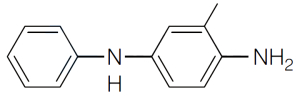
B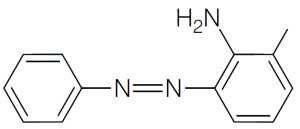
C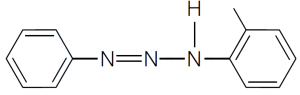
D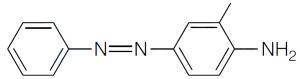
Solution
(D) The reaction between benzene diazonium chloride and $o$-toluidine ($2$-methylaniline) at $273 \ K$ and $pH \ 4-5$ is an electrophilic aromatic substitution reaction known as coupling reaction.
In this reaction,the diazonium cation acts as an electrophile.
The $-NH_2$ group is a strong activating group and is ortho/para directing.
Due to the steric hindrance caused by the methyl group at the ortho position,the electrophile attacks the para position with respect to the $-NH_2$ group.
Therefore,the major product is $4$-amino-$3$-methylazobenzene.
In this reaction,the diazonium cation acts as an electrophile.
The $-NH_2$ group is a strong activating group and is ortho/para directing.
Due to the steric hindrance caused by the methyl group at the ortho position,the electrophile attacks the para position with respect to the $-NH_2$ group.
Therefore,the major product is $4$-amino-$3$-methylazobenzene.
0 likesView Solution
76
ChemistryMediumMCQTS EAMCET · 2018
Which product of the following reactions fails to give the carbylamine test?
A
Hoffmann bromide degradation
B
Gabriel phthalimide synthesis
C
Reduction of nitriles with $LiAlH_4$
D
Reduction of tertiary amides with $LiAlH_4$
Solution
(D) The carbylamine test is a characteristic reaction of primary amines $(R-NH_2)$.
Secondary and tertiary amines do not give this test.
$A$. Hoffmann bromide degradation produces primary amines.
$B$. Gabriel phthalimide synthesis produces primary amines.
$C$. Reduction of nitriles with $LiAlH_4$ produces primary amines.
$D$. Reduction of tertiary amides with $LiAlH_4$ produces tertiary amines $(R_3N)$.
Since tertiary amines do not contain the $-NH_2$ group,they fail to give the carbylamine test.
Secondary and tertiary amines do not give this test.
$A$. Hoffmann bromide degradation produces primary amines.
$B$. Gabriel phthalimide synthesis produces primary amines.
$C$. Reduction of nitriles with $LiAlH_4$ produces primary amines.
$D$. Reduction of tertiary amides with $LiAlH_4$ produces tertiary amines $(R_3N)$.
Since tertiary amines do not contain the $-NH_2$ group,they fail to give the carbylamine test.
0 likesView Solution
77
ChemistryEasyMCQTS EAMCET · 2018
Which of the following carbohydrates has a glycosidic linkage?
A
Fructofuranose
B
Glucopyranose
C
Maltose
D
$\beta-D$-fructose
Solution
(C) glycosidic linkage is a type of covalent bond that joins a carbohydrate (sugar) molecule to another group,which may or may not be another carbohydrate.
Monosaccharides like Fructofuranose,Glucopyranose,and $\beta-D$-fructose do not contain glycosidic linkages because they are single sugar units.
Maltose is a disaccharide formed by the condensation of two $D$-glucose units.
In maltose,the two glucose residues are joined by an $\alpha-1,4$-glycosidic linkage between the $C-1$ of one glucose unit and the $C-4$ of the other.
Monosaccharides like Fructofuranose,Glucopyranose,and $\beta-D$-fructose do not contain glycosidic linkages because they are single sugar units.
Maltose is a disaccharide formed by the condensation of two $D$-glucose units.
In maltose,the two glucose residues are joined by an $\alpha-1,4$-glycosidic linkage between the $C-1$ of one glucose unit and the $C-4$ of the other.
0 likesView Solution
78
ChemistryMediumMCQTS EAMCET · 2018
Which one of the following structures represents amylose?
A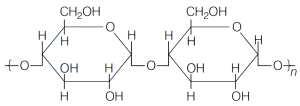
B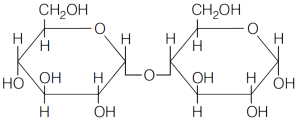
C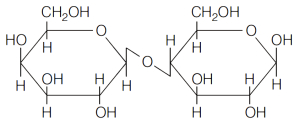
D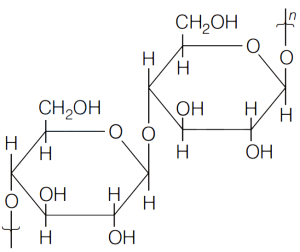
Solution
(A) Amylose is a polysaccharide composed of $\alpha-D$-glucose units linked together by $\alpha(1-4)$ glycosidic linkages.
Looking at the provided structures,the structure that correctly depicts the $\alpha(1-4)$ glycosidic linkage between two $\alpha-D$-glucose units in a repeating polymer chain is represented by option $A$.
Looking at the provided structures,the structure that correctly depicts the $\alpha(1-4)$ glycosidic linkage between two $\alpha-D$-glucose units in a repeating polymer chain is represented by option $A$.
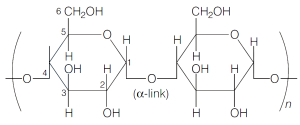
0 likesView Solution
79
ChemistryEasyMCQTS EAMCET · 2018
Which one of the following statements is correct?
A
Starch on complete hydrolysis gives fructose
B
Lactose on hydrolysis gives glucose and fructose
C
Glucose on slow oxidation to $CO_2$ and $H_2O$ by enzyme does not liberate energy
D
Cellulose is not digestible in human body
Solution
(D) Cellulose is a polysaccharide consisting of many glucose units linked by $(\beta)-1,4$-glycosidic bonds.
Human beings lack the specific enzyme (cellulase) required to break these $(\beta)-1,4$-glycosidic linkages.
Therefore,cellulose cannot be digested in the human body.
Option $A$ is incorrect because starch hydrolysis yields glucose.
Option $B$ is incorrect because lactose hydrolysis yields glucose and galactose.
Option $C$ is incorrect because the oxidation of glucose is an exothermic process that releases energy.
Human beings lack the specific enzyme (cellulase) required to break these $(\beta)-1,4$-glycosidic linkages.
Therefore,cellulose cannot be digested in the human body.
Option $A$ is incorrect because starch hydrolysis yields glucose.
Option $B$ is incorrect because lactose hydrolysis yields glucose and galactose.
Option $C$ is incorrect because the oxidation of glucose is an exothermic process that releases energy.
0 likesView Solution
80
ChemistryMediumMCQTS EAMCET · 2018
Which of the following is present in $RNA$ only?
A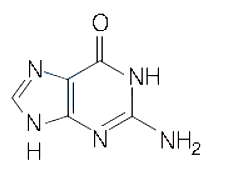
B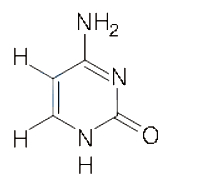
C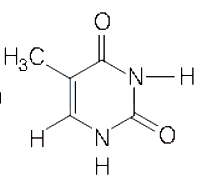
D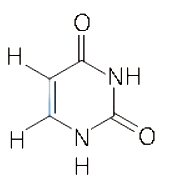
Solution
(D) The nitrogenous bases found in nucleic acids are Adenine $(A)$,Guanine $(G)$,Thymine $(T)$,Cytosine $(C)$,and Uracil $(U)$.
$DNA$ contains $A, G, T,$ and $C$.
$RNA$ contains $A, G, C,$ and $U$.
Uracil is present in $RNA$ instead of Thymine,which is found in $DNA$. Therefore,Uracil is present in $RNA$ only.
$DNA$ contains $A, G, T,$ and $C$.
$RNA$ contains $A, G, C,$ and $U$.
Uracil is present in $RNA$ instead of Thymine,which is found in $DNA$. Therefore,Uracil is present in $RNA$ only.
0 likesView Solution
81
ChemistryMediumMCQTS EAMCET · 2018
The major product formed in the following reaction is
$C_6H_5CH=CH_2$ $\xrightarrow[(ii) H_3O^+]{(i) KMnO_4, KOH, \Delta}$ $\xrightarrow{(iii) Br_2/FeBr_3} \text{Product}$
$C_6H_5CH=CH_2$ $\xrightarrow[(ii) H_3O^+]{(i) KMnO_4, KOH, \Delta}$ $\xrightarrow{(iii) Br_2/FeBr_3} \text{Product}$
A
$p$-bromophenylacetic acid
B
$o$-bromobenzoic acid
C
$m$-bromoacetophenone
D
$m$-bromobenzoic acid
Solution
(D) Step $(i)$ and $(ii)$: The oxidation of styrene $(C_6H_5CH=CH_2)$ with alkaline $KMnO_4$ followed by acidic workup $(H_3O^+)$ results in the formation of benzoic acid $(C_6H_5COOH)$.
Step $(iii)$: Benzoic acid contains a $-COOH$ group,which is a deactivating and meta-directing group. Therefore,electrophilic aromatic substitution with $Br_2/FeBr_3$ will direct the bromine atom to the meta position.
The final product is $m$-bromobenzoic acid.
Step $(iii)$: Benzoic acid contains a $-COOH$ group,which is a deactivating and meta-directing group. Therefore,electrophilic aromatic substitution with $Br_2/FeBr_3$ will direct the bromine atom to the meta position.
The final product is $m$-bromobenzoic acid.
0 likesView Solution
82
ChemistryMediumMCQTS EAMCET · 2018
Identify $A$ and $B$ in the following reaction:
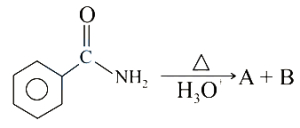
A
$A = C_6H_5CH_2NO_2, B = NH_2OH$
B
$A = C_6H_5COOH, B = NH_3$
C
$A = C_6H_5COOH, B = C_6H_5NO_2$
D
$A = C_6H_5CONH_2, B = NH_3$
Solution
(B) The hydrolysis of an aromatic amide in the presence of a dilute mineral acid and heat yields a carboxylic acid and ammonia.
The reaction is:
$C_6H_5CONH_2 + H_2O \xrightarrow{\Delta, H_3O^+} C_6H_5COOH + NH_3$
Here,the reactant is benzamide.
Product $A$ is benzoic acid $(C_6H_5COOH)$ and product $B$ is ammonia $(NH_3)$.
The reaction is:
$C_6H_5CONH_2 + H_2O \xrightarrow{\Delta, H_3O^+} C_6H_5COOH + NH_3$
Here,the reactant is benzamide.
Product $A$ is benzoic acid $(C_6H_5COOH)$ and product $B$ is ammonia $(NH_3)$.
0 likesView Solution
83
ChemistryMediumMCQTS EAMCET · 2018
What are the products $B$ and $C$ in the following reaction sequence?
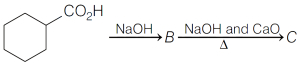
A
$(B) = \text{cyclohexyl sodium}, (C) = \text{cyclohexanol}$
B
$(B) = \text{sodium cyclohexanecarboxylate}, (C) = \text{cyclohexanol}$
C
$(B) = \text{sodium cyclohexanecarboxylate}, (C) = \text{cyclohexane}$
D
$(B) = \text{sodium cyclohexanecarboxylate}, (C) = \text{sodium cyclohexyl}$
Solution
(C) The reaction sequence is as follows:
$1$. Cyclohexanecarboxylic acid reacts with $NaOH$ (a base) to form its sodium salt,$B$,which is sodium cyclohexanecarboxylate $(C_6H_{11}COONa)$.
$2$. The sodium salt $B$ then undergoes decarboxylation when heated with soda lime $(NaOH + CaO)$. This process removes the $-COONa$ group and replaces it with a hydrogen atom,resulting in the formation of cyclohexane $(C_6H_{12})$ as product $C$.
$1$. Cyclohexanecarboxylic acid reacts with $NaOH$ (a base) to form its sodium salt,$B$,which is sodium cyclohexanecarboxylate $(C_6H_{11}COONa)$.
$2$. The sodium salt $B$ then undergoes decarboxylation when heated with soda lime $(NaOH + CaO)$. This process removes the $-COONa$ group and replaces it with a hydrogen atom,resulting in the formation of cyclohexane $(C_6H_{12})$ as product $C$.
0 likesView Solution
84
ChemistryEasyMCQTS EAMCET · 2018
Which of the following ions possesses an $S-O-S$ bond?
A
$S_2O_3^{2-}$
B
$SO_4^{2-}$
C
$S_2O_8^{2-}$
D
$S_2O_7^{2-}$
Solution
(D) The $S_2O_7^{2-}$ (pyrosulphate or disulphate) ion possesses an $S-O-S$ bridge bond.
In its structure,two $SO_4$ tetrahedra share a common oxygen atom,resulting in an $S-O-S$ linkage.
In its structure,two $SO_4$ tetrahedra share a common oxygen atom,resulting in an $S-O-S$ linkage.
0 likesView Solution
85
ChemistryMediumTS EAMCET · 2018
Match the following:
The correct match is:
| List-$I$ (Hybridisation) | List-$II$ (Compound/ion) |
|---|---|
| $A. sp^3d$ | $I. [PtCl_4]^{2-}$ |
| $B. sp^3d^2$ | $II. SF_6$ |
| $C. dsp^2$ | $III. BCl_3$ |
| $D. dsp^3$ | $IV. PCl_5$ |
| $V. ClF_3$ |
The correct match is:
Solution
(A-IV, B-II, C-I, D-V) To find the correct match,we determine the hybridisation of each compound/ion:
$A. sp^3d$: $PCl_5$ $(IV)$ has $5$ bond pairs and $0$ lone pairs,total $5$ hybrid orbitals,corresponding to $sp^3d$ hybridisation.
$B. sp^3d^2$: $SF_6$ $(II)$ has $6$ bond pairs and $0$ lone pairs,total $6$ hybrid orbitals,corresponding to $sp^3d^2$ hybridisation.
$C. dsp^2$: $[PtCl_4]^{2-}$ $(I)$ has $4$ bond pairs and $0$ lone pairs,total $4$ hybrid orbitals,corresponding to $dsp^2$ hybridisation.
$D. dsp^3$: $ClF_3$ $(V)$ has $3$ bond pairs and $2$ lone pairs,total $5$ hybrid orbitals,which can be $sp^3d$ or $dsp^3$ (depending on the model,but $ClF_3$ is commonly associated with $sp^3d$ geometry). However,based on standard matching options provided in such questions,$D$ matches $V$ $(ClF_3)$.
Thus,the correct matching is: $A-IV, B-II, C-I, D-V$.
$A. sp^3d$: $PCl_5$ $(IV)$ has $5$ bond pairs and $0$ lone pairs,total $5$ hybrid orbitals,corresponding to $sp^3d$ hybridisation.
$B. sp^3d^2$: $SF_6$ $(II)$ has $6$ bond pairs and $0$ lone pairs,total $6$ hybrid orbitals,corresponding to $sp^3d^2$ hybridisation.
$C. dsp^2$: $[PtCl_4]^{2-}$ $(I)$ has $4$ bond pairs and $0$ lone pairs,total $4$ hybrid orbitals,corresponding to $dsp^2$ hybridisation.
$D. dsp^3$: $ClF_3$ $(V)$ has $3$ bond pairs and $2$ lone pairs,total $5$ hybrid orbitals,which can be $sp^3d$ or $dsp^3$ (depending on the model,but $ClF_3$ is commonly associated with $sp^3d$ geometry). However,based on standard matching options provided in such questions,$D$ matches $V$ $(ClF_3)$.
Thus,the correct matching is: $A-IV, B-II, C-I, D-V$.
0 likesView Solution
86
ChemistryEasyMCQTS EAMCET · 2018
Assertion $(A)$: $Xe$ atoms in $XeF_2$ are $d^2 s p^3$ hybridised.
Reason $(R)$: $XeF_2$ molecule does not follow the octet rule.
Which of the following is correct?
Reason $(R)$: $XeF_2$ molecule does not follow the octet rule.
Which of the following is correct?
A
Both $(A)$ and $(R)$ are true and $(R)$ is the correct explanation of $(A)$
B
Both $(A)$ and $(R)$ are true,but $(R)$ is not the correct explanation of $(A)$
C
$(A)$ is true,but $(R)$ is false
D
$(A)$ is false,but $(R)$ is true
Solution
(D) $XeF_2$ has $2$ bond pairs and $3$ lone pairs on the central $Xe$ atom,resulting in a steric number of $5$.
Therefore,the hybridisation of $Xe$ in $XeF_2$ is $s p^3 d$,not $d^2 s p^3$.
Thus,Assertion $(A)$ is false.
$XeF_2$ has $10$ electrons around the central $Xe$ atom,which is an expanded octet,meaning it does not follow the octet rule.
Thus,Reason $(R)$ is true.
Therefore,the correct option is $(D)$.
Therefore,the hybridisation of $Xe$ in $XeF_2$ is $s p^3 d$,not $d^2 s p^3$.
Thus,Assertion $(A)$ is false.
$XeF_2$ has $10$ electrons around the central $Xe$ atom,which is an expanded octet,meaning it does not follow the octet rule.
Thus,Reason $(R)$ is true.
Therefore,the correct option is $(D)$.
0 likesView Solution
87
ChemistryMediumMCQTS EAMCET · 2018
Which one of the following is square planar in structure and has diamagnetic property?
A
$\left[ Ni(H_2O)_6 \right]^{2+}$
B
$\left[ Ni(CO)_4 \right]$
C
$\left[ Ni(CN)_4 \right]^{2-}$
D
$\left[ NiCl_4 \right]^{2-}$
Solution
(C) In $\left[ Ni(CN)_4 \right]^{2-}$,the oxidation state of $Ni$ is $+2$,which has a $3d^8$ configuration.
$CN^{-}$ is a strong field ligand,which causes the pairing of the two unpaired electrons in the $3d$ orbital.
This results in $dsp^2$ hybridization,leading to a square planar geometry.
Since all electrons are paired,the complex is diamagnetic.
$CN^{-}$ is a strong field ligand,which causes the pairing of the two unpaired electrons in the $3d$ orbital.
This results in $dsp^2$ hybridization,leading to a square planar geometry.
Since all electrons are paired,the complex is diamagnetic.
0 likesView Solution
88
ChemistryEasyMCQTS EAMCET · 2018
$A$ particular reaction has a rate constant $1.15 \times 10^{-3} \,s^{-1}$. How long does it take for $6 \,g$ of the reactant to reduce to $3 \,g$ (in $\,s$)? $(\log 2 = 0.301)$
A
$301$
B
$603$
C
$840$
D
$15$
Solution
(B) The unit of the rate constant $k$ is $s^{-1}$, which indicates that the reaction is a first-order reaction.
For a first-order reaction, the rate constant equation is given by:
$k = \frac{2.303}{t} \log \frac{[A]_0}{[A]_t}$
Given:
$k = 1.15 \times 10^{-3} \,s^{-1}$
$[A]_0 = 6 \,g$
$[A]_t = 3 \,g$
Substituting the values:
$1.15 \times 10^{-3} = \frac{2.303}{t} \log \frac{6}{3}$
$1.15 \times 10^{-3} = \frac{2.303}{t} \log 2$
Using $\log 2 = 0.301$:
$t = \frac{2.303 \times 0.301}{1.15 \times 10^{-3}}$
$t = \frac{0.6932}{1.15 \times 10^{-3}}$
$t \approx 602.8 \,s \approx 603 \,s$
For a first-order reaction, the rate constant equation is given by:
$k = \frac{2.303}{t} \log \frac{[A]_0}{[A]_t}$
Given:
$k = 1.15 \times 10^{-3} \,s^{-1}$
$[A]_0 = 6 \,g$
$[A]_t = 3 \,g$
Substituting the values:
$1.15 \times 10^{-3} = \frac{2.303}{t} \log \frac{6}{3}$
$1.15 \times 10^{-3} = \frac{2.303}{t} \log 2$
Using $\log 2 = 0.301$:
$t = \frac{2.303 \times 0.301}{1.15 \times 10^{-3}}$
$t = \frac{0.6932}{1.15 \times 10^{-3}}$
$t \approx 602.8 \,s \approx 603 \,s$
0 likesView Solution
89
ChemistryEasyMCQTS EAMCET · 2018
Which of the following graphs represents a zero order reaction?
($a = $ initial concentration of reactant,
$x = $ concentration of reactant consumed,
$t = $ time)
($a = $ initial concentration of reactant,
$x = $ concentration of reactant consumed,
$t = $ time)
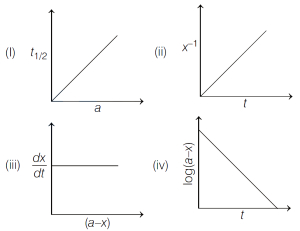
A
$i, iii, iv$
B
$i, iii$
C
$ii, iii, iv$
D
$i, iv$
Solution
(B) For a zero order reaction,the rate is constant and independent of the concentration of the reactant. Thus,$\frac{dx}{dt} = k$ (constant),which matches graph $(iii)$.
Also,the half-life period is given by $t_{1/2} = \frac{a}{2k}$,which shows that $t_{1/2}$ is directly proportional to the initial concentration $a$. This matches graph $(i)$.
Graph $(ii)$ represents a second order reaction ($1/x$ vs $t$ is linear for second order).
Graph $(iv)$ represents a first order reaction ($log(a-x)$ vs $t$ is linear for first order).
Therefore,graphs $(i)$ and $(iii)$ represent a zero order reaction.
Also,the half-life period is given by $t_{1/2} = \frac{a}{2k}$,which shows that $t_{1/2}$ is directly proportional to the initial concentration $a$. This matches graph $(i)$.
Graph $(ii)$ represents a second order reaction ($1/x$ vs $t$ is linear for second order).
Graph $(iv)$ represents a first order reaction ($log(a-x)$ vs $t$ is linear for first order).
Therefore,graphs $(i)$ and $(iii)$ represent a zero order reaction.
0 likesView Solution
90
ChemistryMediumMCQTS EAMCET · 2018
Which of the following graphs represent a first order reaction ($a =$ initial concentration of reactant,$x =$ concentration of reactant consumed,$t =$ time)?
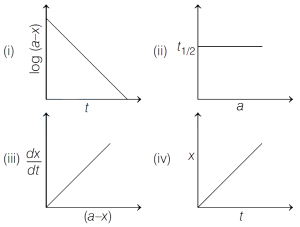
A
$(i), (ii)$
B
$(iii), (iv)$
C
$(ii), (iii)$
D
$(i), (ii), (iii)$
Solution
(D) For a first order reaction,the integrated rate equation is $\log(a-x) = -\frac{kt}{2.303} + \log a$. Thus,a plot of $\log(a-x)$ vs $t$ is a straight line with a negative slope,as shown in $(i)$.
For a first order reaction,the half-life is $t_{1/2} = \frac{0.693}{k}$,which is independent of the initial concentration $a$. Thus,a plot of $t_{1/2}$ vs $a$ is a horizontal line,as shown in $(ii)$.
For a first order reaction,the rate is $\frac{dx}{dt} = k(a-x)$. Thus,a plot of $\frac{dx}{dt}$ vs $(a-x)$ is a straight line passing through the origin,as shown in $(iii)$.
Therefore,graphs $(i), (ii),$ and $(iii)$ represent a first order reaction.
For a first order reaction,the half-life is $t_{1/2} = \frac{0.693}{k}$,which is independent of the initial concentration $a$. Thus,a plot of $t_{1/2}$ vs $a$ is a horizontal line,as shown in $(ii)$.
For a first order reaction,the rate is $\frac{dx}{dt} = k(a-x)$. Thus,a plot of $\frac{dx}{dt}$ vs $(a-x)$ is a straight line passing through the origin,as shown in $(iii)$.
Therefore,graphs $(i), (ii),$ and $(iii)$ represent a first order reaction.
0 likesView Solution
91
ChemistryMediumMCQTS EAMCET · 2018
If the rate constants of a reaction at $500 \ K$ and $700 \ K$ are $0.002 \ s^{-1}$ and $0.06 \ s^{-1}$,respectively,the value of activation energy is $(R=8.314 \ J \ mol^{-1} \ K^{-1}, \log 3=0.477)$.
A
$49.49 \ kJ \ mol^{-1}$
B
$98.98 \ kJ \ mol^{-1}$
C
$24.75 \ kJ \ mol^{-1}$
D
$12.37 \ kJ \ mol^{-1}$
Solution
(A) The Arrhenius equation is given by $\log \left(\frac{k_2}{k_1}\right) = \frac{E_a}{2.303 \ R} \left(\frac{T_2 - T_1}{T_1 \ T_2}\right)$.
Given: $k_1 = 0.002 \ s^{-1}$,$T_1 = 500 \ K$,$k_2 = 0.06 \ s^{-1}$,$T_2 = 700 \ K$,$R = 8.314 \ J \ mol^{-1} \ K^{-1}$.
Substituting the values:
$\log \left(\frac{0.06}{0.002}\right) = \frac{E_a}{2.303 \times 8.314} \left(\frac{700 - 500}{700 \times 500}\right)$
$\log(30) = \frac{E_a}{19.147} \left(\frac{200}{350000}\right)$
$1.477 = \frac{E_a}{19.147} \times \frac{2}{3500}$
$E_a = \frac{1.477 \times 19.147 \times 3500}{200} \approx 49.49 \ kJ \ mol^{-1}$.
Given: $k_1 = 0.002 \ s^{-1}$,$T_1 = 500 \ K$,$k_2 = 0.06 \ s^{-1}$,$T_2 = 700 \ K$,$R = 8.314 \ J \ mol^{-1} \ K^{-1}$.
Substituting the values:
$\log \left(\frac{0.06}{0.002}\right) = \frac{E_a}{2.303 \times 8.314} \left(\frac{700 - 500}{700 \times 500}\right)$
$\log(30) = \frac{E_a}{19.147} \left(\frac{200}{350000}\right)$
$1.477 = \frac{E_a}{19.147} \times \frac{2}{3500}$
$E_a = \frac{1.477 \times 19.147 \times 3500}{200} \approx 49.49 \ kJ \ mol^{-1}$.
0 likesView Solution
92
ChemistryEasyMCQTS EAMCET · 2018
For a particular reaction,the rate constant becomes double on increasing temperature from $27^{\circ} C$ to $37^{\circ} C$. Calculate the approximate activation energy (in $kcal \ mol^{-1}$,$R=2 \ cal \ mol^{-1} \ K^{-1}$).
A
$1289$
B
$12.89$
C
$1.28$
D
$53.41$
Solution
(B) We know that the Arrhenius equation is: $\log \frac{k_2}{k_1} = \frac{E_a}{2.303 R} \times \left( \frac{T_2 - T_1}{T_1 T_2} \right)$
Given: $k_2 = 2k_1$,$T_1 = 300 \ K$,$T_2 = 310 \ K$,$R = 2 \ cal \ mol^{-1} \ K^{-1}$.
Substituting the values: $\log 2 = \frac{E_a}{2.303 \times 2} \times \left( \frac{310 - 300}{300 \times 310} \right)$
$0.3010 = \frac{E_a}{4.606} \times \left( \frac{10}{93000} \right)$
$0.3010 = \frac{E_a}{4.606} \times \frac{1}{9300}$
$E_a = 0.3010 \times 4.606 \times 9300 \approx 12890 \ cal \ mol^{-1}$.
Converting to $kcal \ mol^{-1}$: $E_a = \frac{12890}{1000} = 12.89 \ kcal \ mol^{-1}$.
Given: $k_2 = 2k_1$,$T_1 = 300 \ K$,$T_2 = 310 \ K$,$R = 2 \ cal \ mol^{-1} \ K^{-1}$.
Substituting the values: $\log 2 = \frac{E_a}{2.303 \times 2} \times \left( \frac{310 - 300}{300 \times 310} \right)$
$0.3010 = \frac{E_a}{4.606} \times \left( \frac{10}{93000} \right)$
$0.3010 = \frac{E_a}{4.606} \times \frac{1}{9300}$
$E_a = 0.3010 \times 4.606 \times 9300 \approx 12890 \ cal \ mol^{-1}$.
Converting to $kcal \ mol^{-1}$: $E_a = \frac{12890}{1000} = 12.89 \ kcal \ mol^{-1}$.
0 likesView Solution
93
ChemistryDifficultMCQTS EAMCET · 2018
Identify an antioxidant,an antiseptic,and an antibiotic respectively from the following:
| $A$. Equanil | $B$. Chloramphenicol | $C$. Bithionol |
| $D$. Aspartame | $E$. Dimetapp | $F$. Butylated hydroxytoluene |
A
$A, C, E$
B
$F, C, B$
C
$B, D, E$
D
$C, D, F$
Solution
(B) Antioxidants are compounds that inhibit oxidation. Butylated hydroxytoluene $(F)$ is an example of an antioxidant.
An antiseptic is a substance that prevents or slows down the growth of microorganisms. Bithionol $(C)$ is an example of an antiseptic.
Antibiotics are medicines that help stop infections caused by bacteria. Chloramphenicol $(B)$ is an example of an antibiotic.
Therefore,the correct sequence for antioxidant,antiseptic,and antibiotic is $F, C, B$.
An antiseptic is a substance that prevents or slows down the growth of microorganisms. Bithionol $(C)$ is an example of an antiseptic.
Antibiotics are medicines that help stop infections caused by bacteria. Chloramphenicol $(B)$ is an example of an antibiotic.
Therefore,the correct sequence for antioxidant,antiseptic,and antibiotic is $F, C, B$.
0 likesView Solution
94
ChemistryMediumMCQTS EAMCET · 2018
Opiates have the following general structure. The correct representation of $R^1$ and $R^2$ for codeine $(X)$ and heroin $(Y)$ is
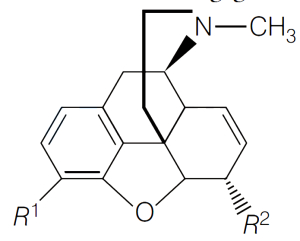
A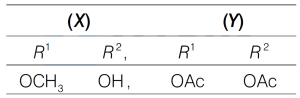
B
C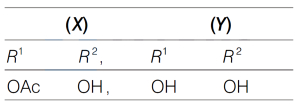
D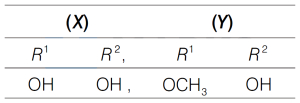
Solution
(A) Codeine $(X)$ is a methyl ether of morphine,where $R^1 = OCH_3$ and $R^2 = OH$.
Heroin $(Y)$ is diacetylmorphine,where both hydroxyl groups of morphine are acetylated,so $R^1 = OCOCH_3$ (or $OAc$) and $R^2 = OCOCH_3$ (or $OAc$).
Heroin $(Y)$ is diacetylmorphine,where both hydroxyl groups of morphine are acetylated,so $R^1 = OCOCH_3$ (or $OAc$) and $R^2 = OCOCH_3$ (or $OAc$).
0 likesView Solution
95
ChemistryEasyMCQTS EAMCET · 2018
The structure of ranitidine is
A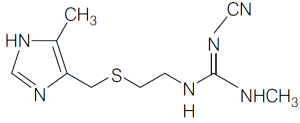
B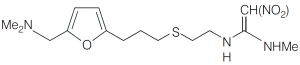
C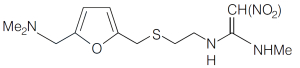
D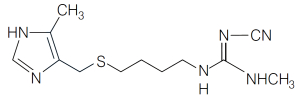
Solution
(C) Ranitidine is a histamine $H_2$-receptor antagonist that inhibits stomach acid production. It is commonly known by the brand name $Zantac$. The chemical structure of ranitidine contains a furan ring,a thioether linkage,and a nitroethenediamine group. Among the given options,the structure that correctly represents ranitidine is shown in option $C$.
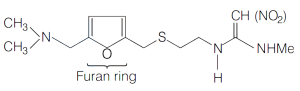
0 likesView Solution
96
ChemistryEasyMCQTS EAMCET · 2018
The drug tetracycline is
A
an antibiotic
B
an antimalarial
C
an antiseptic
D
an analgesic
Solution
(A) Tetracycline,$C_{22}H_{24}N_{2}O_{8}$,is a broad-spectrum antibiotic.
It is effective against a wide range of Gram-positive and Gram-negative bacteria.
It is effective against a wide range of Gram-positive and Gram-negative bacteria.
0 likesView Solution
97
ChemistryDifficultMCQTS EAMCET · 2018
Identify the correct set of functional groups present in aspartame,an artificial sweetener.
A
$-COOCH_3, -NH_2, -CONH-, -COOC_2H_5$
B
$-COOH, -NH_2, -CONH-, -COOCH_3$
C
$-CONH_2, -NH-, -CO-, -COOH$
D
$-CHO, -CN, -OH, -COOCH_3$
Solution
(B) Aspartame is the methyl ester of the dipeptide formed from aspartic acid and phenylalanine. Its chemical structure is $H_2N-CH(CH_2COOH)-CONH-CH(CH_2C_6H_5)-COOCH_3$.
By analyzing the structure,we can identify the following functional groups:
$1$. Carboxylic acid group $(-COOH)$
$2$. Amine group $(-NH_2)$
$3$. Amide linkage $(-CONH-)$
$4$. Ester group $(-COOCH_3)$
Thus,the correct set of functional groups is $-COOH, -NH_2, -CONH-, -COOCH_3$.
By analyzing the structure,we can identify the following functional groups:
$1$. Carboxylic acid group $(-COOH)$
$2$. Amine group $(-NH_2)$
$3$. Amide linkage $(-CONH-)$
$4$. Ester group $(-COOCH_3)$
Thus,the correct set of functional groups is $-COOH, -NH_2, -CONH-, -COOCH_3$.
0 likesView Solution
98
ChemistryEasyMCQTS EAMCET · 2018
What is the correct order of atomic/ionic size?
A
$Cu^{+} < Cu < Zn^{2+} < Ag$
B
$Zn^{2+} < Cu^{+} < Cu < Ag$
C
$Ag < Cu < Cu^{+} < Zn^{2+}$
D
$Cu^{+} < Zn^{2+} < Cu < Ag$
Solution
(B) The atomic/ionic size depends on the effective nuclear charge $(Z_{eff})$ and the number of shells.
For ions,as the positive charge increases,the $Z_{eff}$ increases,leading to a decrease in ionic size. Thus,$Zn^{2+}$ is smaller than $Cu^{+}$.
For neutral atoms,the size increases down a group. Since $Ag$ is in the $5^{th}$ period and $Cu$ is in the $4^{th}$ period,$Ag > Cu$.
Comparing the species: $Zn^{2+}$ ($Z=30$,$28$ electrons),$Cu^{+}$ ($Z=29$,$28$ electrons),$Cu$ ($Z=29$,$29$ electrons),and $Ag$ ($Z=47$,$47$ electrons).
The correct order of size is $Zn^{2+} < Cu^{+} < Cu < Ag$.
For ions,as the positive charge increases,the $Z_{eff}$ increases,leading to a decrease in ionic size. Thus,$Zn^{2+}$ is smaller than $Cu^{+}$.
For neutral atoms,the size increases down a group. Since $Ag$ is in the $5^{th}$ period and $Cu$ is in the $4^{th}$ period,$Ag > Cu$.
Comparing the species: $Zn^{2+}$ ($Z=30$,$28$ electrons),$Cu^{+}$ ($Z=29$,$28$ electrons),$Cu$ ($Z=29$,$29$ electrons),and $Ag$ ($Z=47$,$47$ electrons).
The correct order of size is $Zn^{2+} < Cu^{+} < Cu < Ag$.
0 likesView Solution
99
ChemistryMediumTS EAMCET · 2018
Match the following:
The correct answer is:
| List-$I$ | List-$II$ |
|---|---|
| $A$. Oxidation state of $V$ in $VOCl_2$ | $I$. $0$ |
| $B$. Number of unpaired electrons in $MnO_4^{2-}$ ion | $II$. $1$ |
| $C$. Number of unpaired electrons in $[NiCl_4]^{2-}$ ion | $III$. $5$ |
| $D$. This oxidation state is exhibited by all lanthanide ions | $IV$. $3$ |
| $V$. $4$ | |
| $VI$. $2$ |
The correct answer is:
Solution
(A-V, B-II, C-VI, D-IV) Oxidation state of $V$ in $VOCl_2$:
Let oxidation state of $V = x$.
$x + (-2) + 2(-1) = 0$ $\Rightarrow x - 4 = 0$ $\Rightarrow x = +4$.
Thus,$(A)$ matches with $(V)$.
$(B)$ Oxidation state of $Mn$ in $MnO_4^{2-}$:
Let oxidation state of $Mn = x$.
$x + 4(-2) = -2$ $\Rightarrow x - 8 = -2$ $\Rightarrow x = +6$.
Electronic configuration of $Mn^{6+}$ is $[Ar] 3d^1 4s^0$. It has $1$ unpaired electron.
Thus,$(B)$ matches with $(II)$.
$(C)$ Oxidation state of $Ni$ in $[NiCl_4]^{2-}$:
Let oxidation state of $Ni = x$.
$x + 4(-1) = -2 \Rightarrow x = +2$.
Electronic configuration of $Ni^{2+}$ is $[Ar] 3d^8 4s^0$. It has $2$ unpaired electrons.
Thus,$(C)$ matches with $(VI)$.
$(D)$ All lanthanide ions exhibit an oxidation state of $+3$.
Thus,$(D)$ matches with $(IV)$.
Let oxidation state of $V = x$.
$x + (-2) + 2(-1) = 0$ $\Rightarrow x - 4 = 0$ $\Rightarrow x = +4$.
Thus,$(A)$ matches with $(V)$.
$(B)$ Oxidation state of $Mn$ in $MnO_4^{2-}$:
Let oxidation state of $Mn = x$.
$x + 4(-2) = -2$ $\Rightarrow x - 8 = -2$ $\Rightarrow x = +6$.
Electronic configuration of $Mn^{6+}$ is $[Ar] 3d^1 4s^0$. It has $1$ unpaired electron.
Thus,$(B)$ matches with $(II)$.
$(C)$ Oxidation state of $Ni$ in $[NiCl_4]^{2-}$:
Let oxidation state of $Ni = x$.
$x + 4(-1) = -2 \Rightarrow x = +2$.
Electronic configuration of $Ni^{2+}$ is $[Ar] 3d^8 4s^0$. It has $2$ unpaired electrons.
Thus,$(C)$ matches with $(VI)$.
$(D)$ All lanthanide ions exhibit an oxidation state of $+3$.
Thus,$(D)$ matches with $(IV)$.
0 likesView Solution
100
ChemistryEasyMCQTS EAMCET · 2018
The covalency of $Al$ in $[AlCl(H_2O)_5]^{2+}$ is:
A
$3$
B
$5$
C
$1$
D
$6$
Solution
(D) The given compound is a coordination compound.
In the complex ion $[AlCl(H_2O)_5]^{2+}$,the central metal atom is $Al$.
The ligands attached to the central metal atom are $1$ $Cl^-$ ion and $5$ $H_2O$ molecules.
The total number of coordinate bonds formed by the central metal atom with the ligands is $1 + 5 = 6$.
Thus,the coordination number (covalency) of $Al$ is $6$.
In the complex ion $[AlCl(H_2O)_5]^{2+}$,the central metal atom is $Al$.
The ligands attached to the central metal atom are $1$ $Cl^-$ ion and $5$ $H_2O$ molecules.
The total number of coordinate bonds formed by the central metal atom with the ligands is $1 + 5 = 6$.
Thus,the coordination number (covalency) of $Al$ is $6$.
0 likesView Solution
Vedclass Products
For Students
Vedclass Test Series
Mock tests in real TS EAMCET style covering Chemistry with performance analysis. 5-day free trial.
Start Free TrialFor Teachers
Exam Paper Generator
Generate Set A/B/C/D Chemistry papers from 7.5L+ questions in 2 minutes. 3 chapters free.
Try FreeFor Institutes
Online Exam Module
Run live TS EAMCET mock exams with unlimited students, 360° analytics & white-label branding.
See DemoFrequently Asked Questions
How many Chemistry questions are in TS EAMCET 2018?
There are 240 Chemistry questions from the TS EAMCET 2018 paper on Vedclass, each with a detailed step-by-step solution in English.
Are TS EAMCET 2018 Chemistry solutions available in English?
Yes. All solutions on this page are in English. You can also switch to English or Hindi using the language buttons above the questions.
Can I practice TS EAMCET 2018 Chemistry as a timed test?
Yes. Use the Vedclass Test Series to attempt a full TS EAMCET mock test covering Chemistry with time limits and instant score analysis.
Can teachers create Chemistry papers from TS EAMCET previous year questions?
Yes. The Vedclass Exam Paper Generator lets teachers mix TS EAMCET Chemistry questions and generate Set A/B/C/D papers in minutes.
For Teachers & Institutes
Build a Custom Chemistry Paper
Pick TS EAMCET 2018 Chemistry questions, set difficulty, and generate Set A/B/C/D in 2 minutes.