
ChemistryQ1–100 of 206 questions
Page 1 of 3 · English
1
ChemistryMCQTS EAMCET · 2019
If the angle between the pair of lines $x^2+2 \sqrt{2} x y+k y^2=0, k>0$ is $45^{\circ}$,then the area (in square units) of the triangle formed by the pair of bisectors of the angles between these lines and the line $x+2 y+1=0$ is
A
$\frac{1}{3}$
B
$1$
C
$\frac{2}{3}$
D
$2$
Solution
(A) The given pair of lines is $x^2+2 \sqrt{2} x y+k y^2=0$. Comparing with $ax^2+2hxy+by^2=0$,we have $a=1, h=\sqrt{2}, b=k$.
The angle $\theta$ between the lines is given by $\tan \theta = \left| \frac{2\sqrt{h^2-ab}}{a+b} \right|$.
Given $\theta = 45^{\circ}$,so $\tan 45^{\circ} = 1 = \left| \frac{2\sqrt{2-k}}{1+k} \right|$.
Squaring both sides: $1 = \frac{4(2-k)}{(1+k)^2}$ $\Rightarrow (1+k)^2 = 8-4k$ $\Rightarrow 1+k^2+2k = 8-4k$ $\Rightarrow k^2+6k-7=0$.
Solving for $k$: $(k+7)(k-1)=0$. Since $k>0$,we get $k=1$.
The pair of lines is $x^2+2\sqrt{2}xy+y^2=0$. The equation of the angle bisectors is $\frac{x^2-y^2}{a-b} = \frac{xy}{h} \Rightarrow \frac{x^2-y^2}{1-1} = \frac{xy}{\sqrt{2}}$,which is not the standard form. Using $\frac{x^2-y^2}{a-b} = \frac{xy}{h}$ is invalid when $a=b$. The correct bisector equation is $h(x^2-y^2) = (a-b)xy$. Since $a=b=1$,we have $0 = \sqrt{2}(x^2-y^2)$,so $x^2-y^2=0$,which gives $x-y=0$ and $x+y=0$.
The triangle is formed by $x-y=0, x+y=0$ and $x+2y+1=0$. The vertices are $(0,0)$,$(-1,0)$,and $(-1/3, -1/3)$.
The area is $\frac{1}{2} |x_1(y_2-y_3) + x_2(y_3-y_1) + x_3(y_1-y_2)| = \frac{1}{2} |0 + (-1)(-1/3-0) + (-1/3)(0-0)| = \frac{1}{2} |1/3| = \frac{1}{6}$.
The angle $\theta$ between the lines is given by $\tan \theta = \left| \frac{2\sqrt{h^2-ab}}{a+b} \right|$.
Given $\theta = 45^{\circ}$,so $\tan 45^{\circ} = 1 = \left| \frac{2\sqrt{2-k}}{1+k} \right|$.
Squaring both sides: $1 = \frac{4(2-k)}{(1+k)^2}$ $\Rightarrow (1+k)^2 = 8-4k$ $\Rightarrow 1+k^2+2k = 8-4k$ $\Rightarrow k^2+6k-7=0$.
Solving for $k$: $(k+7)(k-1)=0$. Since $k>0$,we get $k=1$.
The pair of lines is $x^2+2\sqrt{2}xy+y^2=0$. The equation of the angle bisectors is $\frac{x^2-y^2}{a-b} = \frac{xy}{h} \Rightarrow \frac{x^2-y^2}{1-1} = \frac{xy}{\sqrt{2}}$,which is not the standard form. Using $\frac{x^2-y^2}{a-b} = \frac{xy}{h}$ is invalid when $a=b$. The correct bisector equation is $h(x^2-y^2) = (a-b)xy$. Since $a=b=1$,we have $0 = \sqrt{2}(x^2-y^2)$,so $x^2-y^2=0$,which gives $x-y=0$ and $x+y=0$.
The triangle is formed by $x-y=0, x+y=0$ and $x+2y+1=0$. The vertices are $(0,0)$,$(-1,0)$,and $(-1/3, -1/3)$.
The area is $\frac{1}{2} |x_1(y_2-y_3) + x_2(y_3-y_1) + x_3(y_1-y_2)| = \frac{1}{2} |0 + (-1)(-1/3-0) + (-1/3)(0-0)| = \frac{1}{2} |1/3| = \frac{1}{6}$.
0 likesView Solution
2
ChemistryMCQTS EAMCET · 2019
$\int_0^{\frac{\pi}{4}} \frac{\cos ^2 x}{\cos ^2 x+4 \sin ^2 x} d x=$
A
$\frac{\pi}{4}+\frac{2}{3} \tan ^{-1} 2$
B
$-\frac{\pi}{3}-\frac{2}{3} \tan ^{-1} 3$
C
$-\frac{\pi}{12}+\frac{2}{3} \tan ^{-1} 2$
D
$\frac{\pi}{6}-\frac{2}{3} \tan ^{-1} 4$
Solution
(C) Let $I = \int_0^{\frac{\pi}{4}} \frac{\cos^2 x}{\cos^2 x + 4\sin^2 x} dx$.
Divide the numerator and denominator by $\cos^2 x$:
$I = \int_0^{\frac{\pi}{4}} \frac{1}{1 + 4\tan^2 x} dx$.
Let $u = \tan x$,then $du = \sec^2 x dx$. Since $\sec^2 x = 1 + \tan^2 x = 1 + u^2$,we have $dx = \frac{du}{1+u^2}$.
When $x = 0, u = 0$. When $x = \frac{\pi}{4}, u = 1$.
$I = \int_0^1 \frac{1}{(1+4u^2)(1+u^2)} du$.
Using partial fractions: $\frac{1}{(1+4u^2)(1+u^2)} = \frac{A}{1+4u^2} + \frac{B}{1+u^2}$.
$1 = A(1+u^2) + B(1+4u^2)$.
For $u^2 = -1, 1 = B(1-4) \Rightarrow B = -\frac{1}{3}$.
For $u^2 = -\frac{1}{4}, 1 = A(1-\frac{1}{4}) \Rightarrow A = \frac{4}{3}$.
$I = \int_0^1 (\frac{4/3}{1+4u^2} - \frac{1/3}{1+u^2}) du = [\frac{4}{3} \cdot \frac{1}{2} \tan^{-1}(2u) - \frac{1}{3} \tan^{-1}(u)]_0^1$.
$I = [\frac{2}{3} \tan^{-1}(2u) - \frac{1}{3} \tan^{-1}(u)]_0^1 = \frac{2}{3} \tan^{-1}(2) - \frac{1}{3} \tan^{-1}(1) = \frac{2}{3} \tan^{-1}(2) - \frac{1}{3} \cdot \frac{\pi}{4} = \frac{2}{3} \tan^{-1}(2) - \frac{\pi}{12}$.
Divide the numerator and denominator by $\cos^2 x$:
$I = \int_0^{\frac{\pi}{4}} \frac{1}{1 + 4\tan^2 x} dx$.
Let $u = \tan x$,then $du = \sec^2 x dx$. Since $\sec^2 x = 1 + \tan^2 x = 1 + u^2$,we have $dx = \frac{du}{1+u^2}$.
When $x = 0, u = 0$. When $x = \frac{\pi}{4}, u = 1$.
$I = \int_0^1 \frac{1}{(1+4u^2)(1+u^2)} du$.
Using partial fractions: $\frac{1}{(1+4u^2)(1+u^2)} = \frac{A}{1+4u^2} + \frac{B}{1+u^2}$.
$1 = A(1+u^2) + B(1+4u^2)$.
For $u^2 = -1, 1 = B(1-4) \Rightarrow B = -\frac{1}{3}$.
For $u^2 = -\frac{1}{4}, 1 = A(1-\frac{1}{4}) \Rightarrow A = \frac{4}{3}$.
$I = \int_0^1 (\frac{4/3}{1+4u^2} - \frac{1/3}{1+u^2}) du = [\frac{4}{3} \cdot \frac{1}{2} \tan^{-1}(2u) - \frac{1}{3} \tan^{-1}(u)]_0^1$.
$I = [\frac{2}{3} \tan^{-1}(2u) - \frac{1}{3} \tan^{-1}(u)]_0^1 = \frac{2}{3} \tan^{-1}(2) - \frac{1}{3} \tan^{-1}(1) = \frac{2}{3} \tan^{-1}(2) - \frac{1}{3} \cdot \frac{\pi}{4} = \frac{2}{3} \tan^{-1}(2) - \frac{\pi}{12}$.
0 likesView Solution
3
ChemistryEasyMCQTS EAMCET · 2019
The maximum number of electrons that can have the set of quantum numbers $n=4$,$m_l=0$,and $m_s=\frac{1}{2}$ is
A
$3$
B
$4$
C
$5$
D
$6$
Solution
(B) For a given principal quantum number $n=4$,the possible subshells are $4s$,$4p$,$4d$,and $4f$.
Each subshell contains at least one orbital with $m_l=0$ (specifically the $ns$,$np_z$,$nd_{z^2}$,and $nf_{z^3}$ orbitals).
There are $4$ such orbitals in the $n=4$ shell that have $m_l=0$.
Since each orbital can hold only one electron with a specific spin $m_s=\frac{1}{2}$,the total number of electrons is $4 \times 1 = 4$.
Each subshell contains at least one orbital with $m_l=0$ (specifically the $ns$,$np_z$,$nd_{z^2}$,and $nf_{z^3}$ orbitals).
There are $4$ such orbitals in the $n=4$ shell that have $m_l=0$.
Since each orbital can hold only one electron with a specific spin $m_s=\frac{1}{2}$,the total number of electrons is $4 \times 1 = 4$.
0 likesView Solution
4
ChemistryMediumMCQTS EAMCET · 2019
The compound '$A$' decolourises $Br_2 / CCl_4$ and releases $N_2$ gas with $HNO_2$. The compound '$A$' is
A
Cyclopent$-3-$en$-1-$amine
B
$1,2,3,6-$Tetrahydropyridine
C
$1,2,3,6-$Tetrahydropyridine (isomer)
D
$N$-Methylaniline
Solution
(A) The compound '$A$' must contain an alkene group to decolourise $Br_2 / CCl_4$ and a primary amine group $(-NH_2)$ to release $N_2$ gas upon reaction with nitrous acid $(HNO_2)$.
$1$. Reaction with $HNO_2$: Primary aliphatic amines react with $HNO_2$ to form unstable diazonium salts,which decompose to release $N_2$ gas and form alcohols.
$2$. Reaction with $Br_2 / CCl_4$: The presence of a carbon-carbon double bond $(C=C)$ leads to the addition of bromine,which causes the reddish-brown colour of $Br_2$ to disappear.
Among the given options,Cyclopent$-3-$en$-1-$amine contains both a primary amine group and a double bond,satisfying both conditions.
$1$. Reaction with $HNO_2$: Primary aliphatic amines react with $HNO_2$ to form unstable diazonium salts,which decompose to release $N_2$ gas and form alcohols.
$2$. Reaction with $Br_2 / CCl_4$: The presence of a carbon-carbon double bond $(C=C)$ leads to the addition of bromine,which causes the reddish-brown colour of $Br_2$ to disappear.
Among the given options,Cyclopent$-3-$en$-1-$amine contains both a primary amine group and a double bond,satisfying both conditions.
0 likesView Solution
5
ChemistryMediumMCQTS EAMCET · 2019
Which of the following ions has Tetrahedral geometry and $sp^3$ hybridisation for its central atom?
A
$BH_4^{-}$
B
$NH_2^{-}$
C
$CO_3^{2-}$
D
$H_3O^{+}$
Solution
(A)
The central atom in $BH_4^{-}$ is $B$ (Boron). The steric number is $4$ ($4$ bond pairs,$0$ lone pairs),which corresponds to $sp^3$ hybridisation and a Tetrahedral geometry. Thus,$BH_4^{-}$ is the correct answer.
| Ionic species | Steric Number/Hybridisation/Geometry |
| $BH_4^{-}$ | $4, sp^3$,Tetrahedral |
| $NH_2^{-}$ | $4, sp^3$,$V$-shaped |
| $CO_3^{2-}$ | $3, sp^2$,Trigonal Planar |
| $H_3O^{+}$ | $4, sp^3$,Pyramidal |
The central atom in $BH_4^{-}$ is $B$ (Boron). The steric number is $4$ ($4$ bond pairs,$0$ lone pairs),which corresponds to $sp^3$ hybridisation and a Tetrahedral geometry. Thus,$BH_4^{-}$ is the correct answer.
0 likesView Solution
6
ChemistryEasyMCQTS EAMCET · 2019
$XeF_4$ is square planar while $XeF_6$ has a distorted octahedral structure. What is the correct explanation for this observation?
A
Both molecules have one lone pair of electrons
B
Both molecules have two lone pairs of electrons
C
$XeF_4$ does not have any lone pair of electrons; $XeF_6$ has one lone pair of electrons on $Xe$
D
$XeF_4$ has two lone pairs of electrons on $Xe$; $XeF_6$ has one lone pair of electrons on $Xe$
Solution
(D) $XeF_4$ has $4$ bond pairs and $2$ lone pairs of electrons on $Xe$,resulting in $sp^3d^2$ hybridisation and a square planar geometry.
$XeF_6$ has $6$ bond pairs and $1$ lone pair of electrons on $Xe$,resulting in $sp^3d^3$ hybridisation and a distorted octahedral geometry due to the presence of the lone pair.
Thus,option $D$ is correct.
$XeF_6$ has $6$ bond pairs and $1$ lone pair of electrons on $Xe$,resulting in $sp^3d^3$ hybridisation and a distorted octahedral geometry due to the presence of the lone pair.
Thus,option $D$ is correct.
0 likesView Solution
7
ChemistryMediumMCQTS EAMCET · 2019
Match the molecular geometries in List-$I$ with their corresponding molecules in List-$II$:
The correct match for $A, B, C, D$ is:
| $A$. Trigonal planar | $I$. $PCl_5$ |
| $B$. Tetrahedral | $II$. $SF_6$ |
| $C$. Trigonal bipyramidal | $III$. $BF_3$ |
| $D$. Octahedral | $IV$. $CCl_4$ |
The correct match for $A, B, C, D$ is:
A
$A-III, B-IV, C-I, D-II$
B
$A-III, B-IV, C-II, D-I$
C
$A-IV, B-III, C-I, D-II$
D
$A-I, B-IV, C-III, D-II$
Solution
(A) . Trigonal planar geometry is observed in $BF_3$ $(III)$.
$B$. Tetrahedral geometry is observed in $CCl_4$ $(IV)$.
$C$. Trigonal bipyramidal geometry is observed in $PCl_5$ $(I)$.
$D$. Octahedral geometry is observed in $SF_6$ $(II)$.
Therefore,the correct match is $A-III, B-IV, C-I, D-II$.
$B$. Tetrahedral geometry is observed in $CCl_4$ $(IV)$.
$C$. Trigonal bipyramidal geometry is observed in $PCl_5$ $(I)$.
$D$. Octahedral geometry is observed in $SF_6$ $(II)$.
Therefore,the correct match is $A-III, B-IV, C-I, D-II$.
0 likesView Solution
8
ChemistryMediumMCQTS EAMCET · 2019
Which of the following have linear structure?
| $I. SnCl_2$ | $II. BeF_2$ |
| $III. SO_2$ | $IV. NO_2^+$ |
| $V. C_2H_2$ |
A
$I, II, IV$
B
$II, IV, V$
C
$II, III, IV$
D
$I, IV, V$
Solution
(B) To determine the linear structure,we analyze the hybridization and lone pairs on the central atom:
$I. SnCl_2$: $Sn$ has $4$ valence electrons. It forms $2$ sigma bonds and has $1$ lone pair. Due to the lone pair,it has a bent ($V$-shaped) structure.
$II. BeF_2$: $Be$ has $2$ valence electrons,both involved in bonding with $F$ atoms. It has no lone pair and is $sp$ hybridized,resulting in a linear structure.
$III. SO_2$: $S$ has $6$ valence electrons. It forms $2$ sigma bonds and $2$ pi bonds with $O$ atoms,leaving $1$ lone pair on $S$. This results in a bent structure.
$IV. NO_2^+$: The nitronium ion $(NO_2^+)$ has $N$ as the central atom with $4$ valence electrons (after losing one). It forms $2$ double bonds with $O$ atoms. It has no lone pair and is $sp$ hybridized,resulting in a linear structure.
$V. C_2H_2$: Each $C$ atom is $sp$ hybridized,forming $1$ sigma bond with $H$ and $1$ sigma bond with the other $C$ atom,plus $2$ pi bonds. The molecule is linear.
Thus,$II, IV,$ and $V$ have linear structures. The correct option is $(b)$.
$I. SnCl_2$: $Sn$ has $4$ valence electrons. It forms $2$ sigma bonds and has $1$ lone pair. Due to the lone pair,it has a bent ($V$-shaped) structure.
$II. BeF_2$: $Be$ has $2$ valence electrons,both involved in bonding with $F$ atoms. It has no lone pair and is $sp$ hybridized,resulting in a linear structure.
$III. SO_2$: $S$ has $6$ valence electrons. It forms $2$ sigma bonds and $2$ pi bonds with $O$ atoms,leaving $1$ lone pair on $S$. This results in a bent structure.
$IV. NO_2^+$: The nitronium ion $(NO_2^+)$ has $N$ as the central atom with $4$ valence electrons (after losing one). It forms $2$ double bonds with $O$ atoms. It has no lone pair and is $sp$ hybridized,resulting in a linear structure.
$V. C_2H_2$: Each $C$ atom is $sp$ hybridized,forming $1$ sigma bond with $H$ and $1$ sigma bond with the other $C$ atom,plus $2$ pi bonds. The molecule is linear.
Thus,$II, IV,$ and $V$ have linear structures. The correct option is $(b)$.
0 likesView Solution
9
ChemistryEasyMCQTS EAMCET · 2019
How many of the following species are diamagnetic? $He_2^{+}, H_2, H_2^{+}, H_2^{-}, He$
A
$1$
B
$2$
C
$3$
D
$0$
Solution
(B) According to molecular orbital theory,species with all paired electrons in their electronic configuration are diamagnetic in nature.
$He_2^{+} \rightarrow$ Total $3$ electrons,configuration $\sigma 1s^2, \sigma^* 1s^1$. It contains one unpaired electron and is paramagnetic.
$H_2 \rightarrow$ Total $2$ electrons,configuration $\sigma 1s^2$. All electrons are paired,hence it is diamagnetic.
$H_2^{+} \rightarrow$ Total $1$ electron,configuration $\sigma 1s^1$. It contains one unpaired electron and is paramagnetic.
$H_2^{-} \rightarrow$ Total $3$ electrons,configuration $\sigma 1s^2, \sigma^* 1s^1$. It contains one unpaired electron and is paramagnetic.
$He \rightarrow$ Total $2$ electrons,configuration $\sigma 1s^2$. All electrons are paired,hence it is diamagnetic.
Therefore,$H_2$ and $He$ are diamagnetic. The total count is $2$.
$He_2^{+} \rightarrow$ Total $3$ electrons,configuration $\sigma 1s^2, \sigma^* 1s^1$. It contains one unpaired electron and is paramagnetic.
$H_2 \rightarrow$ Total $2$ electrons,configuration $\sigma 1s^2$. All electrons are paired,hence it is diamagnetic.
$H_2^{+} \rightarrow$ Total $1$ electron,configuration $\sigma 1s^1$. It contains one unpaired electron and is paramagnetic.
$H_2^{-} \rightarrow$ Total $3$ electrons,configuration $\sigma 1s^2, \sigma^* 1s^1$. It contains one unpaired electron and is paramagnetic.
$He \rightarrow$ Total $2$ electrons,configuration $\sigma 1s^2$. All electrons are paired,hence it is diamagnetic.
Therefore,$H_2$ and $He$ are diamagnetic. The total count is $2$.
0 likesView Solution
10
ChemistryMediumMCQTS EAMCET · 2019
How many ions of the following have a bond order of $2.5 ?$
$N_2^{-} ; NO^{-} ; C_2^{-} ; N_2^{+} ; C_2^{2-} ; CN^{+}$
$N_2^{-} ; NO^{-} ; C_2^{-} ; N_2^{+} ; C_2^{2-} ; CN^{+}$
A
$4$
B
$3$
C
$2$
D
$5$
Solution
(B) Bond order is calculated using the formula: $\text{Bond Order} = \frac{N_b - N_a}{2}$,where $N_b$ is the number of bonding electrons and $N_a$ is the number of antibonding electrons.
From the table,the ions with a bond order of $2.5$ are $N_2^{-}$,$C_2^{-}$,and $N_2^{+}$.
Therefore,there are $3$ such ions.
| Species | Bond Order |
| $N_2^{-}$ | $2.5$ |
| $NO^{-}$ | $2$ |
| $C_2^{-}$ | $2.5$ |
| $N_2^{+}$ | $2.5$ |
| $C_2^{2-}$ | $3$ |
| $CN^{+}$ | $2$ |
From the table,the ions with a bond order of $2.5$ are $N_2^{-}$,$C_2^{-}$,and $N_2^{+}$.
Therefore,there are $3$ such ions.
0 likesView Solution
11
ChemistryMediumMCQTS EAMCET · 2019
Match the following molecules/ions in List-$I$ with their respective bond orders in List-$II$:
| List-$I$ (Molecules/ions) | List-$II$ (Bond order) |
| :--- | :--- |
| $A. N_2^+$ | $I. 1.0$ |
| $B. CO$ | $II. 1.5$ |
| $C. O_2$ | $III. 2.0$ |
| $D. O_2^-$ | $IV. 2.5$ |
| | $V. 3.0$ |
| List-$I$ (Molecules/ions) | List-$II$ (Bond order) |
| :--- | :--- |
| $A. N_2^+$ | $I. 1.0$ |
| $B. CO$ | $II. 1.5$ |
| $C. O_2$ | $III. 2.0$ |
| $D. O_2^-$ | $IV. 2.5$ |
| | $V. 3.0$ |
A
$A-IV, B-V, C-III, D-II$
B
$A-III, B-V, C-IV, D-II$
C
$A-IV, B-V, C-II, D-III$
D
$A-V, B-IV, C-III, D-II$
Solution
(A) The bond order is calculated using the formula: $\text{Bond order} = \frac{1}{2} (N_b - N_a)$,where $N_b$ is the number of bonding electrons and $N_a$ is the number of antibonding electrons.
$A. N_2^+$ ($13$ electrons): $\sigma 1s^2 < \sigma^* 1s^2 < \sigma 2s^2 < \sigma^* 2s^2 < \pi 2p_x^2 = \pi 2p_y^2 < \sigma 2p_z^1$. Bond order = $\frac{9-4}{2} = 2.5$ $(IV)$.
$B. CO$ ($14$ electrons): $\sigma 1s^2 < \sigma^* 1s^2 < \sigma 2s^2 < \sigma^* 2s^2 < \sigma 2p_z^2 < \pi 2p_x^2 = \pi 2p_y^2$. Bond order = $\frac{10-4}{2} = 3.0$ $(V)$.
$C. O_2$ ($16$ electrons): $\sigma 1s^2 < \sigma^* 1s^2 < \sigma 2s^2 < \sigma^* 2s^2 < \sigma 2p_z^2 < \pi 2p_x^2 = \pi 2p_y^2 < \pi^* 2p_x^1 = \pi^* 2p_y^1$. Bond order = $\frac{10-6}{2} = 2.0$ $(III)$.
$D. O_2^-$ ($17$ electrons): $\sigma 1s^2 < \sigma^* 1s^2 < \sigma 2s^2 < \sigma^* 2s^2 < \sigma 2p_z^2 < \pi 2p_x^2 = \pi 2p_y^2 < \pi^* 2p_x^2 = \pi^* 2p_y^1$. Bond order = $\frac{10-7}{2} = 1.5$ $(II)$.
Therefore,the correct match is $A-IV, B-V, C-III, D-II$.
$A. N_2^+$ ($13$ electrons): $\sigma 1s^2 < \sigma^* 1s^2 < \sigma 2s^2 < \sigma^* 2s^2 < \pi 2p_x^2 = \pi 2p_y^2 < \sigma 2p_z^1$. Bond order = $\frac{9-4}{2} = 2.5$ $(IV)$.
$B. CO$ ($14$ electrons): $\sigma 1s^2 < \sigma^* 1s^2 < \sigma 2s^2 < \sigma^* 2s^2 < \sigma 2p_z^2 < \pi 2p_x^2 = \pi 2p_y^2$. Bond order = $\frac{10-4}{2} = 3.0$ $(V)$.
$C. O_2$ ($16$ electrons): $\sigma 1s^2 < \sigma^* 1s^2 < \sigma 2s^2 < \sigma^* 2s^2 < \sigma 2p_z^2 < \pi 2p_x^2 = \pi 2p_y^2 < \pi^* 2p_x^1 = \pi^* 2p_y^1$. Bond order = $\frac{10-6}{2} = 2.0$ $(III)$.
$D. O_2^-$ ($17$ electrons): $\sigma 1s^2 < \sigma^* 1s^2 < \sigma 2s^2 < \sigma^* 2s^2 < \sigma 2p_z^2 < \pi 2p_x^2 = \pi 2p_y^2 < \pi^* 2p_x^2 = \pi^* 2p_y^1$. Bond order = $\frac{10-7}{2} = 1.5$ $(II)$.
Therefore,the correct match is $A-IV, B-V, C-III, D-II$.
0 likesView Solution
12
ChemistryEasyMCQTS EAMCET · 2019
What is the bonding nature in $LiCl$ bond?
A
Pure ionic
B
Pure covalent
C
Coordinate bond
D
Ionic and covalent
Solution
(D) $LiCl$ exhibits both ionic and covalent character.
$LiCl$ is ionic because $Li$ is a metal and $Cl$ is a non-metal,resulting in an electrostatic force of attraction between the positive $(Li^{+})$ and negative $(Cl^{-})$ ions.
$LiCl$ also exhibits covalent character because the small size of the $Li^{+}$ cation causes significant polarization of the larger $Cl^{-}$ anion,as described by Fajan's rule.
Therefore,the bonding in $LiCl$ is both ionic and covalent.
$LiCl$ is ionic because $Li$ is a metal and $Cl$ is a non-metal,resulting in an electrostatic force of attraction between the positive $(Li^{+})$ and negative $(Cl^{-})$ ions.
$LiCl$ also exhibits covalent character because the small size of the $Li^{+}$ cation causes significant polarization of the larger $Cl^{-}$ anion,as described by Fajan's rule.
Therefore,the bonding in $LiCl$ is both ionic and covalent.
0 likesView Solution
13
ChemistryMediumMCQTS EAMCET · 2019
Which of the following compounds has the highest dipole moment $(D)$?
A
$HBr$
B
$CH_3COCH_3$
C
$H_2S$
D
$COCl_2$
Solution
(B) The dipole moments of the given compounds are as follows:
$(a)$ For $HBr$,$\mu = 0.82 \ D$.
$(b)$ For acetone $(CH_3COCH_3)$,the electron-releasing methyl groups increase the electron density towards the oxygen atom,resulting in a net dipole moment of $\mu_{net} = 2.69 \ D$.
$(c)$ For $H_2S$,$\mu_{net} = 0.97 \ D$.
$(d)$ For $COCl_2$,$\mu_{net} = 1.17 \ D$.
Comparing these values,acetone $(CH_3COCH_3)$ has the highest dipole moment.
$(a)$ For $HBr$,$\mu = 0.82 \ D$.
$(b)$ For acetone $(CH_3COCH_3)$,the electron-releasing methyl groups increase the electron density towards the oxygen atom,resulting in a net dipole moment of $\mu_{net} = 2.69 \ D$.
$(c)$ For $H_2S$,$\mu_{net} = 0.97 \ D$.
$(d)$ For $COCl_2$,$\mu_{net} = 1.17 \ D$.
Comparing these values,acetone $(CH_3COCH_3)$ has the highest dipole moment.
0 likesView Solution
14
ChemistryMediumMCQTS EAMCET · 2019
Which is the correct order of dipole moments of $BF_3$,$NF_3$ and $NH_3$?
A
$NH_3 > BF_3 > NF_3$
B
$BF_3 > NF_3 > NH_3$
C
$NH_3 > NF_3 > BF_3$
D
$NF_3 > NH_3 > BF_3$
Solution
(C) $BF_3$ has a zero dipole moment due to its symmetrical trigonal planar geometry.
In $NH_3$,$N$ is more electronegative than $H$. The bond dipoles of the three $N-H$ bonds and the lone pair on the nitrogen atom are in the same direction,which reinforces each other,resulting in a high net dipole moment.
In $NF_3$,$F$ is more electronegative than $N$. The bond dipoles of the three $N-F$ bonds are in the opposite direction to the dipole moment of the lone pair on the nitrogen atom,which partially cancels out the net dipole moment.
Therefore,the dipole moment of $NH_3$ is greater than that of $NF_3$,and $BF_3$ has the lowest (zero) dipole moment.
The correct order is $NH_3 > NF_3 > BF_3$.
In $NH_3$,$N$ is more electronegative than $H$. The bond dipoles of the three $N-H$ bonds and the lone pair on the nitrogen atom are in the same direction,which reinforces each other,resulting in a high net dipole moment.
In $NF_3$,$F$ is more electronegative than $N$. The bond dipoles of the three $N-F$ bonds are in the opposite direction to the dipole moment of the lone pair on the nitrogen atom,which partially cancels out the net dipole moment.
Therefore,the dipole moment of $NH_3$ is greater than that of $NF_3$,and $BF_3$ has the lowest (zero) dipole moment.
The correct order is $NH_3 > NF_3 > BF_3$.
0 likesView Solution
15
ChemistryEasyMCQTS EAMCET · 2019
In which of the following is the hydrogen bonding strongest?
A
$O-H \cdots N$
B
$O-H \cdots O$
C
$O-H \cdots F$
D
$F-H \cdots F$
Solution
(D) Key Idea: The strength of hydrogen bonding is directly proportional to the electronegativity difference between the $H$-atom and the atom to which it is covalently bonded,as well as the electronegativity of the atom forming the hydrogen bond.
Since the electronegativity of $F$ is the highest among $N$,$O$,and $F$,the $H-F$ bond is the most polar,and the interaction in $F-H \cdots F$ is the strongest.
Therefore,option $D$ is the correct answer.
Since the electronegativity of $F$ is the highest among $N$,$O$,and $F$,the $H-F$ bond is the most polar,and the interaction in $F-H \cdots F$ is the strongest.
Therefore,option $D$ is the correct answer.
0 likesView Solution
16
ChemistryMediumMCQTS EAMCET · 2019
For the reaction,$0.5 C_{(s)} + 0.5 CO_{2(g)} \rightleftharpoons CO_{(g)}$,the equilibrium pressure is $12 \ atm$. If $CO_2$ conversion is $50 \%$,the value of $K_p$,in $atm$,is:
A
$4$
B
$1$
C
$0.5$
D
$2$
Solution
(A) The reaction is $0.5 C_{(s)} + 0.5 CO_{2(g)} \rightleftharpoons CO_{(g)}$.
Let the initial moles of $CO_{2(g)}$ be $1 \ mol$.
At equilibrium,$50 \%$ of $CO_{2(g)}$ is converted,so $0.5 \ mol$ of $CO_{2(g)}$ remains.
The amount of $CO_{(g)}$ formed is $1 \ mol$ (based on stoichiometry: $0.5 \ mol$ of $CO_2$ produces $1 \ mol$ of $CO$).
Total moles at equilibrium = $0.5 \ (CO_2) + 1 \ (CO) = 1.5 \ mol$.
Mole fraction of $CO_2$ $(x_{CO_2})$ = $0.5 / 1.5 = 1/3$.
Mole fraction of $CO$ $(x_{CO})$ = $1 / 1.5 = 2/3$.
Partial pressure $P_{CO_2} = (1/3) \times 12 \ atm = 4 \ atm$.
Partial pressure $P_{CO} = (2/3) \times 12 \ atm = 8 \ atm$.
$K_p = \frac{P_{CO}}{(P_{CO_2})^{0.5}} = \frac{8}{(4)^{0.5}} = \frac{8}{2} = 4 \ atm^{0.5}$.
Thus,the value of $K_p$ is $4$.
Let the initial moles of $CO_{2(g)}$ be $1 \ mol$.
At equilibrium,$50 \%$ of $CO_{2(g)}$ is converted,so $0.5 \ mol$ of $CO_{2(g)}$ remains.
The amount of $CO_{(g)}$ formed is $1 \ mol$ (based on stoichiometry: $0.5 \ mol$ of $CO_2$ produces $1 \ mol$ of $CO$).
Total moles at equilibrium = $0.5 \ (CO_2) + 1 \ (CO) = 1.5 \ mol$.
Mole fraction of $CO_2$ $(x_{CO_2})$ = $0.5 / 1.5 = 1/3$.
Mole fraction of $CO$ $(x_{CO})$ = $1 / 1.5 = 2/3$.
Partial pressure $P_{CO_2} = (1/3) \times 12 \ atm = 4 \ atm$.
Partial pressure $P_{CO} = (2/3) \times 12 \ atm = 8 \ atm$.
$K_p = \frac{P_{CO}}{(P_{CO_2})^{0.5}} = \frac{8}{(4)^{0.5}} = \frac{8}{2} = 4 \ atm^{0.5}$.
Thus,the value of $K_p$ is $4$.
0 likesView Solution
17
ChemistryMediumMCQTS EAMCET · 2019
$A$ solution of $0.1 \ mol$ of $CH_3NH_2$ $(K_b = 5 \times 10^{-4})$ and $0.08 \ mol$ of $HCl$ is diluted to $1 \ L$. The $pOH$ of the resulting solution is $(\log 1.25 = 0.1)$.
A
$10.1$
B
$3.9$
C
$4.9$
D
$9.9$
Solution
(B) The reaction is: $CH_3NH_2 + HCl \rightarrow CH_3NH_3^+ + Cl^-$
Initial moles: $0.1 \ mol$ of $CH_3NH_2$ and $0.08 \ mol$ of $HCl$.
After reaction: $0.02 \ mol$ of $CH_3NH_2$ remains and $0.08 \ mol$ of $CH_3NH_3Cl$ is formed.
This forms a basic buffer solution.
The $pOH$ is calculated using the Henderson-Hasselbalch equation: $pOH = pK_b + \log \left( \frac{[Salt]}{[Base]} \right)$.
$pK_b = -\log(5 \times 10^{-4}) = 4 - \log 5 = 4 - 0.7 = 3.3$.
$pOH = 3.3 + \log \left( \frac{0.08}{0.02} \right) = 3.3 + \log(4) = 3.3 + 0.6 = 3.9$.
Initial moles: $0.1 \ mol$ of $CH_3NH_2$ and $0.08 \ mol$ of $HCl$.
After reaction: $0.02 \ mol$ of $CH_3NH_2$ remains and $0.08 \ mol$ of $CH_3NH_3Cl$ is formed.
This forms a basic buffer solution.
The $pOH$ is calculated using the Henderson-Hasselbalch equation: $pOH = pK_b + \log \left( \frac{[Salt]}{[Base]} \right)$.
$pK_b = -\log(5 \times 10^{-4}) = 4 - \log 5 = 4 - 0.7 = 3.3$.
$pOH = 3.3 + \log \left( \frac{0.08}{0.02} \right) = 3.3 + \log(4) = 3.3 + 0.6 = 3.9$.
0 likesView Solution
18
ChemistryEasyMCQTS EAMCET · 2019
Consider the equilibrium,$H_2 + I_2 \rightleftharpoons 2 HI$. Calculate the equilibrium constant of the reverse reaction when the equilibrium concentrations of $H_2$,$I_2$,and $HI$ are $1.14 \times 10^{-2} \ mol \ L^{-1}$,$0.12 \times 10^{-2} \ mol \ L^{-1}$,and $2.52 \times 10^{-2} \ mol \ L^{-1}$,respectively.
A
$46.4$
B
$0.021$
C
$18.42$
D
$0.054$
Solution
(B) The given reaction is $H_2 + I_2 \rightleftharpoons 2 HI$.
The reverse reaction is $2 HI \rightleftharpoons H_2 + I_2$.
The equilibrium constant for the reverse reaction is given by $K = \frac{[H_2][I_2]}{[HI]^2}$.
Given concentrations are $[H_2] = 1.14 \times 10^{-2} \ mol \ L^{-1}$,$[I_2] = 0.12 \times 10^{-2} \ mol \ L^{-1}$,and $[HI] = 2.52 \times 10^{-2} \ mol \ L^{-1}$.
Substituting these values into the expression:
$K = \frac{(1.14 \times 10^{-2}) \times (0.12 \times 10^{-2})}{(2.52 \times 10^{-2})^2}$
$K = \frac{0.1368 \times 10^{-4}}{6.3504 \times 10^{-4}}$
$K \approx 0.02154$.
Rounding to two significant figures,$K = 0.021$.
The reverse reaction is $2 HI \rightleftharpoons H_2 + I_2$.
The equilibrium constant for the reverse reaction is given by $K = \frac{[H_2][I_2]}{[HI]^2}$.
Given concentrations are $[H_2] = 1.14 \times 10^{-2} \ mol \ L^{-1}$,$[I_2] = 0.12 \times 10^{-2} \ mol \ L^{-1}$,and $[HI] = 2.52 \times 10^{-2} \ mol \ L^{-1}$.
Substituting these values into the expression:
$K = \frac{(1.14 \times 10^{-2}) \times (0.12 \times 10^{-2})}{(2.52 \times 10^{-2})^2}$
$K = \frac{0.1368 \times 10^{-4}}{6.3504 \times 10^{-4}}$
$K \approx 0.02154$.
Rounding to two significant figures,$K = 0.021$.
0 likesView Solution
19
ChemistryDifficultMCQTS EAMCET · 2019
In which of the following plots,an endothermic reaction is correctly represented?
A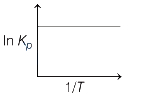
B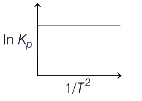
C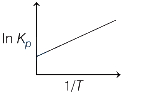
D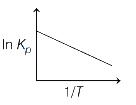
Solution
(D) The relationship between the equilibrium constant $K_p$ and temperature $T$ is given by the van 't Hoff equation:
$\ln K_p = -\frac{\Delta H^\circ}{R} \cdot \frac{1}{T} + \frac{\Delta S^\circ}{R}$
where $\Delta H^\circ$ is the standard enthalpy change of the reaction,$R$ is the gas constant,and $\Delta S^\circ$ is the standard entropy change.
For an endothermic reaction,$\Delta H^\circ > 0$.
Comparing this with the linear equation $y = mx + c$,where $y = \ln K_p$ and $x = \frac{1}{T}$,the slope $m = -\frac{\Delta H^\circ}{R}$.
Since $\Delta H^\circ > 0$ and $R > 0$,the slope $m = -\frac{\Delta H^\circ}{R}$ must be negative.
Therefore,the plot of $\ln K_p$ versus $\frac{1}{T}$ for an endothermic reaction is a straight line with a negative slope.
Thus,option $(d)$ is correct.
$\ln K_p = -\frac{\Delta H^\circ}{R} \cdot \frac{1}{T} + \frac{\Delta S^\circ}{R}$
where $\Delta H^\circ$ is the standard enthalpy change of the reaction,$R$ is the gas constant,and $\Delta S^\circ$ is the standard entropy change.
For an endothermic reaction,$\Delta H^\circ > 0$.
Comparing this with the linear equation $y = mx + c$,where $y = \ln K_p$ and $x = \frac{1}{T}$,the slope $m = -\frac{\Delta H^\circ}{R}$.
Since $\Delta H^\circ > 0$ and $R > 0$,the slope $m = -\frac{\Delta H^\circ}{R}$ must be negative.
Therefore,the plot of $\ln K_p$ versus $\frac{1}{T}$ for an endothermic reaction is a straight line with a negative slope.
Thus,option $(d)$ is correct.
0 likesView Solution
20
ChemistryEasyMCQTS EAMCET · 2019
In which group of the periodic table will the element with $Z=120$ be placed?
A
$2$
B
$1$
C
$14$
D
$15$
Solution
(A) The element with $Z=120$ is a hypothetical element with the $IUPAC$ name $\text{unbinilium}$.
Its electronic configuration is $[Og] 8s^2$,where $[Og]$ represents the configuration of Oganesson $(Z=118)$.
Since it has two electrons in its outermost $s$-orbital $(8s^2)$,it belongs to group $2$ of the $s$-block in the periodic table.
Therefore,option $(A)$ is the correct answer.
Its electronic configuration is $[Og] 8s^2$,where $[Og]$ represents the configuration of Oganesson $(Z=118)$.
Since it has two electrons in its outermost $s$-orbital $(8s^2)$,it belongs to group $2$ of the $s$-block in the periodic table.
Therefore,option $(A)$ is the correct answer.
0 likesView Solution
21
ChemistryMediumMCQTS EAMCET · 2019
Among the isoelectronic ions $(O^{2-}, N^{3-}, Mg^{2+}, Na^{+})$,the ions with the least and the highest ionic radius are,respectively
A
$Mg^{2+}, N^{3-}$
B
$Mg^{2+}, O^{2-}$
C
$Na^{+}, N^{3-}$
D
$Na^{+}, O^{2-}$
Solution
(A) For isoelectronic species,the ionic radius decreases as the nuclear charge (number of protons) increases because the electrons are more strongly attracted to the nucleus.
As the number of protons increases,the effective nuclear charge increases,leading to a smaller ionic radius.
The order of ionic radius is: $Mg^{2+} < Na^{+} < O^{2-} < N^{3-}$.
Thus,$Mg^{2+}$ has the least ionic radius and $N^{3-}$ has the highest ionic radius.
| $Species$ | $N^{3-}, O^{2-}, Na^{+}, Mg^{2+}$ |
| $Number$ of electrons | $10, 10, 10, 10$ |
| $Number$ of protons | $7, 8, 11, 12$ |
As the number of protons increases,the effective nuclear charge increases,leading to a smaller ionic radius.
The order of ionic radius is: $Mg^{2+} < Na^{+} < O^{2-} < N^{3-}$.
Thus,$Mg^{2+}$ has the least ionic radius and $N^{3-}$ has the highest ionic radius.
0 likesView Solution
22
ChemistryMediumMCQTS EAMCET · 2019
Arrange the following in the decreasing order of radius: $S^{2-}, P^{3-}, Cl^{-}, Ca^{2+}, Ar, K^{+}$
A
$P^{3-} > S^{2-} > Cl^{-} > Ar > K^{+} > Ca^{2+}$
B
$Cl^{-} > P^{3-} > S^{2-} > Ar > K^{+} > Ca^{2+}$
C
$Ar > P^{3-} > S^{2-} > Cl^{-} > Ca^{2+} > K^{+}$
D
$K^{+} > Ca^{2+} > Cl^{-} > S^{2-} > P^{3-} > Ar$
Solution
(A) All the given species $(S^{2-}, P^{3-}, Cl^{-}, Ca^{2+}, Ar, K^{+})$ are isoelectronic,meaning they all contain $18$ electrons.
For isoelectronic species,the ionic radius decreases as the nuclear charge (atomic number,$Z$) increases.
The atomic numbers are: $P (Z=15), S (Z=16), Cl (Z=17), Ar (Z=18), K (Z=19), Ca (Z=20)$.
Since the number of electrons is constant $(18)$,the species with the lowest atomic number will have the weakest nuclear attraction for the electrons,resulting in the largest radius.
Therefore,the decreasing order of radius is: $P^{3-} > S^{2-} > Cl^{-} > Ar > K^{+} > Ca^{2+}$.
For isoelectronic species,the ionic radius decreases as the nuclear charge (atomic number,$Z$) increases.
The atomic numbers are: $P (Z=15), S (Z=16), Cl (Z=17), Ar (Z=18), K (Z=19), Ca (Z=20)$.
Since the number of electrons is constant $(18)$,the species with the lowest atomic number will have the weakest nuclear attraction for the electrons,resulting in the largest radius.
Therefore,the decreasing order of radius is: $P^{3-} > S^{2-} > Cl^{-} > Ar > K^{+} > Ca^{2+}$.
0 likesView Solution
23
ChemistryEasyMCQTS EAMCET · 2019
The reason for a cation to be smaller than its parent atom is
A
repulsion between the electrons of outer orbit
B
Increased electrostatic attraction between nucleus and electrons.
C
increase in the mass of the cation compared to neutral atom.
D
change in the number of protons of cation compared to neutral atom.
Solution
(B) When an atom loses one or more electrons to form a cation,the number of protons remains the same,but the number of electrons decreases. This results in an increased effective nuclear charge,which leads to a stronger electrostatic attraction between the nucleus and the remaining electrons,pulling them closer and causing the ionic radius to be smaller than the atomic radius.
0 likesView Solution
24
ChemistryEasyMCQTS EAMCET · 2019
Identify the correct order of ionic radii of the following ions.
A
$Al^{3+} > K^{+} > Mg^{2+} > Li^{+}$
B
$K^{+} > Mg^{2+} > Al^{3+} > Li^{+}$
C
$K^{+} > Li^{+} > Mg^{2+} > Al^{3+}$
D
$K^{+} > Mg^{2+} > Li^{+} > Al^{3+}$
Solution
(C) The ionic radii of isoelectronic species decrease as the nuclear charge increases.
For the given ions,$K^{+}$ ($18$ electrons),$Li^{+}$ ($2$ electrons),$Mg^{2+}$ ($10$ electrons),and $Al^{3+}$ ($10$ electrons) have different electronic configurations.
Comparing them based on their positions in the periodic table:
$K^{+}$ is in the $4^{th}$ period,so it has the largest radius.
$Li^{+}$ is in the $2^{nd}$ period.
$Mg^{2+}$ and $Al^{3+}$ are isoelectronic ($10$ electrons each) and belong to the $3^{rd}$ period.
For isoelectronic species,the ionic radius decreases as the atomic number $(Z)$ increases: $Mg^{2+}$ $(Z=12)$ > $Al^{3+}$ $(Z=13)$.
Thus,the correct order is $K^{+} > Li^{+} > Mg^{2+} > Al^{3+}$.
For the given ions,$K^{+}$ ($18$ electrons),$Li^{+}$ ($2$ electrons),$Mg^{2+}$ ($10$ electrons),and $Al^{3+}$ ($10$ electrons) have different electronic configurations.
Comparing them based on their positions in the periodic table:
$K^{+}$ is in the $4^{th}$ period,so it has the largest radius.
$Li^{+}$ is in the $2^{nd}$ period.
$Mg^{2+}$ and $Al^{3+}$ are isoelectronic ($10$ electrons each) and belong to the $3^{rd}$ period.
For isoelectronic species,the ionic radius decreases as the atomic number $(Z)$ increases: $Mg^{2+}$ $(Z=12)$ > $Al^{3+}$ $(Z=13)$.
Thus,the correct order is $K^{+} > Li^{+} > Mg^{2+} > Al^{3+}$.
0 likesView Solution
25
ChemistryEasyMCQTS EAMCET · 2019
Which one among the following statements is/are not correct?
$I$. $Ba$ compounds,generally are more covalent than $Be$ compounds.
$II$. The electron gain enthalpy of $He$ is positive.
$III$. The oxidation state of $O$ in $OF_2$ and $Na_2O$ are same.
$IV$. The radius of $Na^{+}$ ion is smaller than that of $F^{-}$ ion.
$I$. $Ba$ compounds,generally are more covalent than $Be$ compounds.
$II$. The electron gain enthalpy of $He$ is positive.
$III$. The oxidation state of $O$ in $OF_2$ and $Na_2O$ are same.
$IV$. The radius of $Na^{+}$ ion is smaller than that of $F^{-}$ ion.
A
$I, III, IV$
B
$II$
C
$II, III, IV$
D
$I, III$
Solution
(D) The explanation of the given statements is as follows:
$I$. Both beryllium $(Be)$ and barium $(Ba)$ belong to the same group (group-$2$). As we move down the group,the size of the atom/ion increases,and the covalent character decreases. Thus,$Ba$ compounds are generally less covalent than $Be$ compounds. Therefore,statement $I$ is not correct.
$II$. The electron gain enthalpy of $He$ is positive due to its very small size and fully-filled electronic configuration $(1s^2)$. Hence,statement $II$ is correct.
$III$. The oxidation state of $O$ in $OF_2$ is $+2$,whereas the oxidation state of $O$ in $Na_2O$ is $-2$. Hence,statement $III$ is not correct.
$IV$. Both $Na^{+}$ and $F^{-}$ are isoelectronic species (both have $10$ electrons). However,$Na^{+}$ has $11$ protons while $F^{-}$ has $9$ protons. Due to the higher nuclear charge in $Na^{+}$,it exerts a greater attractive force on the electrons,making its radius smaller than that of $F^{-}$. Hence,statement $IV$ is correct.
Since statements $I$ and $III$ are not correct,the correct option is $(D)$.
$I$. Both beryllium $(Be)$ and barium $(Ba)$ belong to the same group (group-$2$). As we move down the group,the size of the atom/ion increases,and the covalent character decreases. Thus,$Ba$ compounds are generally less covalent than $Be$ compounds. Therefore,statement $I$ is not correct.
$II$. The electron gain enthalpy of $He$ is positive due to its very small size and fully-filled electronic configuration $(1s^2)$. Hence,statement $II$ is correct.
$III$. The oxidation state of $O$ in $OF_2$ is $+2$,whereas the oxidation state of $O$ in $Na_2O$ is $-2$. Hence,statement $III$ is not correct.
$IV$. Both $Na^{+}$ and $F^{-}$ are isoelectronic species (both have $10$ electrons). However,$Na^{+}$ has $11$ protons while $F^{-}$ has $9$ protons. Due to the higher nuclear charge in $Na^{+}$,it exerts a greater attractive force on the electrons,making its radius smaller than that of $F^{-}$. Hence,statement $IV$ is correct.
Since statements $I$ and $III$ are not correct,the correct option is $(D)$.
0 likesView Solution
26
ChemistryMediumMCQTS EAMCET · 2019
How many water molecules present in $CuSO_4 \cdot 5 H_2 O$ are hydrogen bonded?
A
$5$
B
$1$
C
$4$
D
$2$
Solution
(B) In the structure of $CuSO_4 \cdot 5 H_2 O$,there are $5$ water molecules present as water of crystallization.
Out of these $5 H_2 O$ molecules,$4 H_2 O$ molecules are directly coordinated to the $Cu^{2+}$ ion through coordinate covalent bonds.
The fifth $H_2 O$ molecule is held in the crystal lattice by hydrogen bonding between the $SO_4^{2-}$ ion and the coordinated water molecules.
Therefore,only $1$ water molecule is hydrogen bonded.
Thus,option $(b)$ is the correct answer.
Out of these $5 H_2 O$ molecules,$4 H_2 O$ molecules are directly coordinated to the $Cu^{2+}$ ion through coordinate covalent bonds.
The fifth $H_2 O$ molecule is held in the crystal lattice by hydrogen bonding between the $SO_4^{2-}$ ion and the coordinated water molecules.
Therefore,only $1$ water molecule is hydrogen bonded.
Thus,option $(b)$ is the correct answer.
0 likesView Solution
27
ChemistryEasyMCQTS EAMCET · 2019
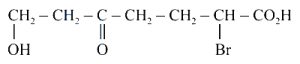
Find the suitable $IUPAC$ name of the compound given below.
A
$2-$Bromo$-7-$hydroxy$-5-$oxoheptanoic acid
B
$6-$Bromo$-7-$hydroxy$-3-$oxoheptanoic acid
C
$2-$Bromo$-5-$oxo$-7-$hydroxyheptanoic acid
D
$2-$Bromo$-7-$hydroxy$-5-$oxoheptanoic acid
Solution
(A) $1$. Identify the principal functional group: The carboxylic acid group $(-COOH)$ has the highest priority,so the parent chain is a heptanoic acid derivative,and the carbon of $-COOH$ is $C-1$.
$2$. Number the chain: Starting from the carboxylic acid carbon as $C-1$,the chain is numbered as follows: $C-1$ $(-COOH)$,$C-2$ $(-CHBr)$,$C-3$ $(-CH_2)$,$C-4$ $(-CH_2)$,$C-5$ $(C=O)$,$C-6$ $(-CH_2)$,$C-7$ $(-CH_2OH)$.
$3$. Identify substituents and their positions: There is a bromo group at $C-2$,an oxo group at $C-5$,and a hydroxy group at $C-7$.
$4$. Assemble the name: Alphabetical order for substituents is Bromo,Hydroxy,Oxo. Thus,the name is $2-$Bromo$-7-$hydroxy$-5-$oxoheptanoic acid.
$2$. Number the chain: Starting from the carboxylic acid carbon as $C-1$,the chain is numbered as follows: $C-1$ $(-COOH)$,$C-2$ $(-CHBr)$,$C-3$ $(-CH_2)$,$C-4$ $(-CH_2)$,$C-5$ $(C=O)$,$C-6$ $(-CH_2)$,$C-7$ $(-CH_2OH)$.
$3$. Identify substituents and their positions: There is a bromo group at $C-2$,an oxo group at $C-5$,and a hydroxy group at $C-7$.
$4$. Assemble the name: Alphabetical order for substituents is Bromo,Hydroxy,Oxo. Thus,the name is $2-$Bromo$-7-$hydroxy$-5-$oxoheptanoic acid.
0 likesView Solution
28
ChemistryEasyMCQTS EAMCET · 2019
The irritant red haze in traffic and congested places is due to
A
$CO_2$
B
$O_3$
C
$SO_x$ (oxides of sulphur)
D
$NO_x$ (oxides of nitrogen)
Solution
(D) The irritant red haze in traffic and congested places is due to the oxides of nitrogen $(NO_x)$.
Nitrogen dioxide $(NO_2)$ is a poisonous gas with a reddish-brown color.
When it is mixed with aerosols in the atmosphere,it causes a reddish-brown haze in congested areas.
Thus,option $(D)$ is correct.
Nitrogen dioxide $(NO_2)$ is a poisonous gas with a reddish-brown color.
When it is mixed with aerosols in the atmosphere,it causes a reddish-brown haze in congested areas.
Thus,option $(D)$ is correct.
0 likesView Solution
29
ChemistryEasyMCQTS EAMCET · 2019
Consider the following reactions involving some atmospheric pollutants:
$NO + O_3 \rightarrow NO_2 + O_2$
$NO_2 \xrightarrow{h \nu} NO + O$
$O + O_2 \rightarrow O_3$
$4 NO_2 + O_2 + 2 H_2 O \longrightarrow 4 HNO_3$
$3 CH_4 + 2 O_3 \longrightarrow 3 H_2 C = O + 3 H_2 O$
Based on the above,the formation of formaldehyde from methane in the atmosphere will be controlled by:
$NO + O_3 \rightarrow NO_2 + O_2$
$NO_2 \xrightarrow{h \nu} NO + O$
$O + O_2 \rightarrow O_3$
$4 NO_2 + O_2 + 2 H_2 O \longrightarrow 4 HNO_3$
$3 CH_4 + 2 O_3 \longrightarrow 3 H_2 C = O + 3 H_2 O$
Based on the above,the formation of formaldehyde from methane in the atmosphere will be controlled by:
A
Only $O_3$
B
$O_3$ and $NO_2$
C
$O_3, NO$ and $NO_2$
D
$NO$ and $NO_2$
Solution
(C) The reaction sequence shows that $NO$ and $NO_2$ participate in the catalytic cycle that maintains the concentration of $O_3$ in the atmosphere.
The formation of formaldehyde $(H_2C=O)$ from methane $(CH_4)$ is directly dependent on the concentration of ozone $(O_3)$.
Since the concentration of $O_3$ is regulated by the $NO_x$ cycle ($NO$ and $NO_2$),the overall formation of formaldehyde is controlled by the presence of $O_3, NO$ and $NO_2$.
Therefore,option $(C)$ is correct.
The formation of formaldehyde $(H_2C=O)$ from methane $(CH_4)$ is directly dependent on the concentration of ozone $(O_3)$.
Since the concentration of $O_3$ is regulated by the $NO_x$ cycle ($NO$ and $NO_2$),the overall formation of formaldehyde is controlled by the presence of $O_3, NO$ and $NO_2$.
Therefore,option $(C)$ is correct.
0 likesView Solution
30
ChemistryMediumMCQTS EAMCET · 2019
What is the formula of the product formed when $F^{-}$ reacts with enamel on teeth?
A
$CaSO_4, CaF_2$
B
$3 Ca_3(PO_4)_2, PF_5$
C
$Ca_2 SO_4 \cdot CaF_2$
D
$3[Ca_3(PO_4)_2 \cdot CaF_2]$
Solution
(D) The enamel of teeth is composed of hydroxyapatite,which has the formula $Ca_{10}(PO_4)_6(OH)_2$.
When it reacts with $F^{-}$ ions,the $OH^{-}$ ions are replaced by $F^{-}$ ions to form fluorapatite:
$Ca_{10}(PO_4)_6(OH)_2 + 2 F^{-} \longrightarrow Ca_{10}(PO_4)_6 F_2 + 2 OH^{-}$
This product,$Ca_{10}(PO_4)_6 F_2$,can be represented as $3[Ca_3(PO_4)_2] \cdot CaF_2$.
Therefore,option $(D)$ is the correct answer.
When it reacts with $F^{-}$ ions,the $OH^{-}$ ions are replaced by $F^{-}$ ions to form fluorapatite:
$Ca_{10}(PO_4)_6(OH)_2 + 2 F^{-} \longrightarrow Ca_{10}(PO_4)_6 F_2 + 2 OH^{-}$
This product,$Ca_{10}(PO_4)_6 F_2$,can be represented as $3[Ca_3(PO_4)_2] \cdot CaF_2$.
Therefore,option $(D)$ is the correct answer.
0 likesView Solution
31
ChemistryEasyMCQTS EAMCET · 2019
Match the items in List-$I$ with the items in List-$II$ and select the correct answer from the given options:
| List-$I$ | List-$II$ |
| $A$. Bleaching of paper | $I$. $CF_2Cl_2$ |
| $B$. Eye irritant | $II$. $H_2O_2$ |
| $C$. Freons | $III$. $Na_2AsO_3$ |
| $D$. Herbicide | $IV$. $PAN$ |
| $V$. $CO_2$ |
A
$III, V, IV, II$
B
$IV, IV, II, I, III$
C
$II, IV, III, I$
D
$II, IV, I, III$
Solution
(D) The correct matches are as follows:
$(A)$ Bleaching of paper $\rightarrow$ $(II)$ $H_2O_2$ is used as a bleaching agent for paper.
$(B)$ Eye irritant $\rightarrow$ $(IV)$ $PAN$ (Peroxyacetyl nitrate) is a well-known eye irritant.
$(C)$ Freons $\rightarrow$ $(I)$ $CF_2Cl_2$ (Dichlorodifluoromethane) is a common type of freon.
$(D)$ Herbicide $\rightarrow$ $(III)$ $Na_2AsO_3$ (Sodium arsenite) is used as an herbicide.
Therefore,the correct sequence is $A-II, B-IV, C-I, D-III$.
Hence,option $(D)$ is the correct answer.
$(A)$ Bleaching of paper $\rightarrow$ $(II)$ $H_2O_2$ is used as a bleaching agent for paper.
$(B)$ Eye irritant $\rightarrow$ $(IV)$ $PAN$ (Peroxyacetyl nitrate) is a well-known eye irritant.
$(C)$ Freons $\rightarrow$ $(I)$ $CF_2Cl_2$ (Dichlorodifluoromethane) is a common type of freon.
$(D)$ Herbicide $\rightarrow$ $(III)$ $Na_2AsO_3$ (Sodium arsenite) is used as an herbicide.
Therefore,the correct sequence is $A-II, B-IV, C-I, D-III$.
Hence,option $(D)$ is the correct answer.
0 likesView Solution
32
ChemistryMediumMCQTS EAMCET · 2019
The boiling point (in $K$) of $cis-but-2-ene$ and dipole moment (in $D$) of $trans-but-2-ene$ are respectively:
A
$274, 0.00$
B
$277, 0.00$
C
$277, 0.33$
D
$274, 0.33$
Solution
(B) In the $cis-isomer$,the methyl groups are on the same side of the double bond,resulting in a net dipole moment.
In the $trans-isomer$,the methyl groups are on opposite sides,causing the individual bond dipoles to cancel each other out,resulting in a net dipole moment of $0.00 \ D$.
Due to the higher polarity,the $cis-isomer$ has stronger intermolecular dipole-dipole interactions compared to the $trans-isomer$,leading to a higher boiling point.
The boiling point of $cis-but-2-ene$ is $277 \ K$ and the dipole moment of $trans-but-2-ene$ is $0.00 \ D$.
In the $trans-isomer$,the methyl groups are on opposite sides,causing the individual bond dipoles to cancel each other out,resulting in a net dipole moment of $0.00 \ D$.
Due to the higher polarity,the $cis-isomer$ has stronger intermolecular dipole-dipole interactions compared to the $trans-isomer$,leading to a higher boiling point.
The boiling point of $cis-but-2-ene$ is $277 \ K$ and the dipole moment of $trans-but-2-ene$ is $0.00 \ D$.
0 likesView Solution
33
ChemistryMediumMCQTS EAMCET · 2019
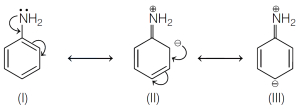
The order of stability of the resonance structures given below is:
A
$I > II > III$
B
$I > III > II$
C
$II > I > III$
D
$III > II > I$
Solution
(A) Non-charged molecular species are the most stable. Therefore,structure $(I)$ has the maximum stability.
In the charged resonating structures $(II)$ and $(III)$,the stability depends on the distance between the positive and negative charges.
Structure $(II)$ has the negative charge at the ortho position relative to the positive charge,while structure $(III)$ has the negative charge at the para position.
Since the distance between the opposite charges is smaller in $(II)$ than in $(III)$,the electrostatic attraction is stronger in $(II)$.
Thus,the stability order is $I > II > III$.
In the charged resonating structures $(II)$ and $(III)$,the stability depends on the distance between the positive and negative charges.
Structure $(II)$ has the negative charge at the ortho position relative to the positive charge,while structure $(III)$ has the negative charge at the para position.
Since the distance between the opposite charges is smaller in $(II)$ than in $(III)$,the electrostatic attraction is stronger in $(II)$.
Thus,the stability order is $I > II > III$.
0 likesView Solution
34
ChemistryDifficultTS EAMCET · 2019
Identify the atoms or groups from the following that exhibit $-R$ effect and $+R$ effect when present on a benzene ring:
$-OR, -NHCOR, -CN, -X, -NO_2, -NH_2, -CHO$
$-OR, -NHCOR, -CN, -X, -NO_2, -NH_2, -CHO$
Solution
(A) Groups that exhibit $-R$ effect (electron-withdrawing groups) decrease the electron density on the benzene ring. These include: $-CN, -NO_2, -CHO$.
Groups that exhibit $+R$ effect (electron-donating groups) increase the electron density on the benzene ring. These include: $-OR, -NHCOR, -X, -NH_2$ (Note: Halogens like $-X$ exhibit $-I$ effect but $+R$ effect).
Groups that exhibit $+R$ effect (electron-donating groups) increase the electron density on the benzene ring. These include: $-OR, -NHCOR, -X, -NH_2$ (Note: Halogens like $-X$ exhibit $-I$ effect but $+R$ effect).
0 likesView Solution
35
ChemistryMediumMCQTS EAMCET · 2019
Match the following acids in List-$I$ with their respective acid dissociation constants $(K_a)$ in List-$II$:
The correct match is:
| List-$I$ (Acid) | List-$II$ $(K_a)$ |
|---|---|
| $A$. Phenol | $I$. $1 \times 10^{-13}$ |
| $B$. Benzoic acid | $II$. $3.0 \times 10^{-8}$ |
| $C$. $HClO$ | $III$. $1.0 \times 10^{-10}$ |
| $D$. $CH_3COOH$ | $IV$. $6.5 \times 10^{-5}$ |
| $V$. $1.75 \times 10^{-5}$ |
The correct match is:
A
$A-III, B-IV, C-II, D-V$
B
$A-I, B-IV, C-II, D-V$
C
$A-III, B-IV, C-I, D-V$
D
$A-I, B-IV, C-III, D-V$
Solution
(A) The acid dissociation constant $(K_a)$ values for the given acids are as follows:
$A$. Phenol $(C_6H_5OH)$: $K_a \approx 1.0 \times 10^{-10}$ (Match $III$)
$B$. Benzoic acid $(C_6H_5COOH)$: $K_a \approx 6.5 \times 10^{-5}$ (Match $IV$)
$C$. Hypochlorous acid $(HClO)$: $K_a \approx 3.0 \times 10^{-8}$ (Match $II$)
$D$. Acetic acid $(CH_3COOH)$: $K_a \approx 1.75 \times 10^{-5}$ (Match $V$)
Thus,the correct matching is $A-III, B-IV, C-II, D-V$.
$A$. Phenol $(C_6H_5OH)$: $K_a \approx 1.0 \times 10^{-10}$ (Match $III$)
$B$. Benzoic acid $(C_6H_5COOH)$: $K_a \approx 6.5 \times 10^{-5}$ (Match $IV$)
$C$. Hypochlorous acid $(HClO)$: $K_a \approx 3.0 \times 10^{-8}$ (Match $II$)
$D$. Acetic acid $(CH_3COOH)$: $K_a \approx 1.75 \times 10^{-5}$ (Match $V$)
Thus,the correct matching is $A-III, B-IV, C-II, D-V$.
0 likesView Solution
36
ChemistryEasyMCQTS EAMCET · 2019
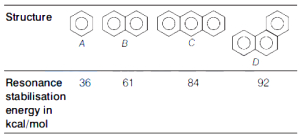
The order of stability of the aromatic hydrocarbons given below is:
A
$C < B < D < A$
B
$C < B < A < D$
C
$A < D < B < C$
D
$C < D < B < A$
Solution
(A) The stability of polycyclic aromatic hydrocarbons is determined by the resonance energy per ring.
Benzene $(A)$: $36 \ kcal/mol$ per ring.
Naphthalene $(B)$: $61 \ kcal/mol$ for $2$ rings,so $61/2 = 30.5 \ kcal/mol$ per ring.
Anthracene $(C)$: $84 \ kcal/mol$ for $3$ rings,so $84/3 = 28 \ kcal/mol$ per ring.
Phenanthrene $(D)$: $92 \ kcal/mol$ for $3$ rings,so $92/3 = 30.67 \ kcal/mol$ per ring.
Comparing the values: $28 (C) < 30.5 (B) < 30.67 (D) < 36 (A)$.
Therefore,the order of stability is $C < B < D < A$.
Benzene $(A)$: $36 \ kcal/mol$ per ring.
Naphthalene $(B)$: $61 \ kcal/mol$ for $2$ rings,so $61/2 = 30.5 \ kcal/mol$ per ring.
Anthracene $(C)$: $84 \ kcal/mol$ for $3$ rings,so $84/3 = 28 \ kcal/mol$ per ring.
Phenanthrene $(D)$: $92 \ kcal/mol$ for $3$ rings,so $92/3 = 30.67 \ kcal/mol$ per ring.
Comparing the values: $28 (C) < 30.5 (B) < 30.67 (D) < 36 (A)$.
Therefore,the order of stability is $C < B < D < A$.
0 likesView Solution
37
ChemistryMediumMCQTS EAMCET · 2019
The number of no bond resonance structures possible for but$-1-$ene and a $3^{\circ}$ carbocation having methyl,ethyl,and isobutyl groups on the cationic carbon,respectively,are:
A
$3, 7$
B
$4, 6$
C
$2, 7$
D
$5, 6$
Solution
(C) No bond resonance (hyperconjugation) depends on the number of $\alpha-H$ atoms.
For but$-1-$ene $(CH_3-CH_2-CH=CH_2)$,the $\alpha$-carbon is the $CH_2$ group attached to the double bond. It has $2$ $\alpha-H$ atoms. Therefore,it gives $2$ no bond resonating structures.
For a $3^{\circ}$ carbocation with methyl $(-CH_3)$,ethyl $(-CH_2CH_3)$,and isobutyl $(-CH_2CH(CH_3)_2)$ groups attached to the cationic carbon,the total number of $\alpha-H$ atoms is calculated as follows:
- From methyl group: $3$ $\alpha-H$
- From ethyl group: $2$ $\alpha-H$
- From isobutyl group: $2$ $\alpha-H$
Total $\alpha-H = 3 + 2 + 2 = 7$.
Thus,it forms $7$ no bond resonating structures.
Hence,option $(C)$ is correct.
For but$-1-$ene $(CH_3-CH_2-CH=CH_2)$,the $\alpha$-carbon is the $CH_2$ group attached to the double bond. It has $2$ $\alpha-H$ atoms. Therefore,it gives $2$ no bond resonating structures.
For a $3^{\circ}$ carbocation with methyl $(-CH_3)$,ethyl $(-CH_2CH_3)$,and isobutyl $(-CH_2CH(CH_3)_2)$ groups attached to the cationic carbon,the total number of $\alpha-H$ atoms is calculated as follows:
- From methyl group: $3$ $\alpha-H$
- From ethyl group: $2$ $\alpha-H$
- From isobutyl group: $2$ $\alpha-H$
Total $\alpha-H = 3 + 2 + 2 = 7$.
Thus,it forms $7$ no bond resonating structures.
Hence,option $(C)$ is correct.
0 likesView Solution
38
ChemistryMediumMCQTS EAMCET · 2019
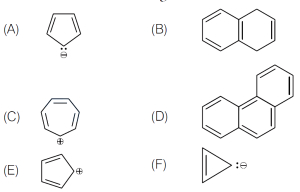
Which of the following are not aromatic?
A
$A, C, E$
B
$B, E, F$
C
$B, C, F$
D
$C, D, E$
Solution
(B) Key Idea: Conditions for a species to be aromatic are:
$(I)$ The structure must follow $H$ückel's rule,i.e.,it must have $(4n+2) \pi$-electrons,where $n$ is an integer $(0, 1, 2, 3, \dots)$.
$(II)$ The structure must be a planar cyclic ring.
$(A)$ Cyclopentadienyl anion: It has $6 \pi$-electrons $(n=1)$ and is planar. Thus,it is aromatic.
$(B)$ $1,2-$dihydronaphthalene: It is not fully conjugated and has $8 \pi$-electrons. Thus,it is not aromatic.
$(C)$ Tropylium cation: It has $6 \pi$-electrons $(n=1)$ and is planar. Thus,it is aromatic.
$(D)$ Phenanthrene: It has $14 \pi$-electrons $(n=3)$ and is planar. Thus,it is aromatic.
$(E)$ Cyclopentadienyl cation: It has $4 \pi$-electrons ($n=1$ for $4n$ rule). Thus,it is anti-aromatic (not aromatic).
$(F)$ Cyclopropenyl anion: It has $4 \pi$-electrons ($n=0$ for $4n$ rule). Thus,it is anti-aromatic (not aromatic).
Therefore,species $(B)$,$(E)$,and $(F)$ are not aromatic. Hence,option $(b)$ is the correct answer.
$(I)$ The structure must follow $H$ückel's rule,i.e.,it must have $(4n+2) \pi$-electrons,where $n$ is an integer $(0, 1, 2, 3, \dots)$.
$(II)$ The structure must be a planar cyclic ring.
$(A)$ Cyclopentadienyl anion: It has $6 \pi$-electrons $(n=1)$ and is planar. Thus,it is aromatic.
$(B)$ $1,2-$dihydronaphthalene: It is not fully conjugated and has $8 \pi$-electrons. Thus,it is not aromatic.
$(C)$ Tropylium cation: It has $6 \pi$-electrons $(n=1)$ and is planar. Thus,it is aromatic.
$(D)$ Phenanthrene: It has $14 \pi$-electrons $(n=3)$ and is planar. Thus,it is aromatic.
$(E)$ Cyclopentadienyl cation: It has $4 \pi$-electrons ($n=1$ for $4n$ rule). Thus,it is anti-aromatic (not aromatic).
$(F)$ Cyclopropenyl anion: It has $4 \pi$-electrons ($n=0$ for $4n$ rule). Thus,it is anti-aromatic (not aromatic).
Therefore,species $(B)$,$(E)$,and $(F)$ are not aromatic. Hence,option $(b)$ is the correct answer.
0 likesView Solution
39
ChemistryDifficultMCQTS EAMCET · 2019
Total number of acyclic and cyclic isomers possible for molecular formula $C_4H_6$ is
A
$5$
B
$7$
C
$9$
D
$8$
Solution
(C) The degree of unsaturation for $C_4H_6$ is $4 - (6/2) + 1 = 2$. The possible isomers are:
$(i)$ $CH_3-CH_2-C \equiv CH$ (but-$1$-yne)
$(ii)$ $CH_3-C \equiv C-CH_3$ (but-$2$-yne)
$(iii)$ $CH_2=CH-CH=CH_2$ (buta-$1,3$-diene)
$(iv)$ $CH_3-CH=C=CH_2$ (buta-$1,2$-diene)
$(v)$ cyclobutene
$(vi)$ $1$-methylcyclopropene
$(vii)$ $3$-methylcyclopropene
$(viii)$ methylenecyclopropane
$(ix)$ bicyclo[$1.1.0$]butane
Thus,there are $9$ possible isomers. Hence,option $(C)$ is correct.
$(i)$ $CH_3-CH_2-C \equiv CH$ (but-$1$-yne)
$(ii)$ $CH_3-C \equiv C-CH_3$ (but-$2$-yne)
$(iii)$ $CH_2=CH-CH=CH_2$ (buta-$1,3$-diene)
$(iv)$ $CH_3-CH=C=CH_2$ (buta-$1,2$-diene)
$(v)$ cyclobutene
$(vi)$ $1$-methylcyclopropene
$(vii)$ $3$-methylcyclopropene
$(viii)$ methylenecyclopropane
$(ix)$ bicyclo[$1.1.0$]butane
Thus,there are $9$ possible isomers. Hence,option $(C)$ is correct.
0 likesView Solution
40
ChemistryEasyMCQTS EAMCET · 2019
Which of the following methods is adopted to obtain gasoline from crude oil?
A
Vacuum distillation
B
Steam distillation
C
Adsorption on animal charcoal
D
Fractional distillation
Solution
(D) Gasoline is a mixture of hydrocarbons,primarily $C_8H_{18}$,present in crude oil along with many other components.
Since these components have different boiling points,they are separated by the process of fractional distillation.
Hence,option $(D)$ is the correct answer.
Since these components have different boiling points,they are separated by the process of fractional distillation.
Hence,option $(D)$ is the correct answer.
0 likesView Solution
41
ChemistryEasyMCQTS EAMCET · 2019
Which one of the following methods can be used to find out the percentage composition of halogen present in an organic compound?
A
Kjeldahl method
B
Durna's method
C
Lassaigne's method
D
Carius method
Solution
(D) The $Carius$ method is the standard analytical technique used for the quantitative estimation of halogens in organic compounds.
In this method,a known mass of the organic compound is heated with fuming $HNO_3$ in the presence of $AgNO_3$ in a hard glass tube known as a $Carius$ tube.
The halogen present in the compound reacts with $AgNO_3$ to form a precipitate of silver halide $(AgX)$,which is then filtered,washed,dried,and weighed to calculate the percentage of the halogen.
In this method,a known mass of the organic compound is heated with fuming $HNO_3$ in the presence of $AgNO_3$ in a hard glass tube known as a $Carius$ tube.
The halogen present in the compound reacts with $AgNO_3$ to form a precipitate of silver halide $(AgX)$,which is then filtered,washed,dried,and weighed to calculate the percentage of the halogen.
0 likesView Solution
42
ChemistryMediumMCQTS EAMCET · 2019
The final product $B$ of the below reaction sequence is:
$CH_3-CH(Br)-CH_3$ $\xrightarrow{KOH/C_2H_5OH} A$ $\xrightarrow{(C_6H_5CO)_2O_2, HBr} B$
$CH_3-CH(Br)-CH_3$ $\xrightarrow{KOH/C_2H_5OH} A$ $\xrightarrow{(C_6H_5CO)_2O_2, HBr} B$
A
$CH_3-CH_2-CH_2-OH$
B
$CH_3-CH=CH_2$
C
$CH_3-CH_2-CH_2-Br$
D
$(CH_3-CH_2-CH_2)_2O$
Solution
(C) Step $1$: Dehydrohalogenation of $2$-bromopropane with alcoholic $KOH$ gives propene $(A)$ as the major product.
$CH_3-CH(Br)-CH_3 \xrightarrow{alc. KOH} CH_3-CH=CH_2 (A) + HBr$
Step $2$: Addition of $HBr$ to propene in the presence of peroxide $( (C_6H_5CO)_2O_2 )$ follows the Anti-Markownikoff rule (Kharasch effect).
$CH_3-CH=CH_2 + HBr \xrightarrow{peroxide} CH_3-CH_2-CH_2-Br (B)$
Thus,the final product $B$ is $1$-bromopropane.
Hence,option $C$ is correct.
$CH_3-CH(Br)-CH_3 \xrightarrow{alc. KOH} CH_3-CH=CH_2 (A) + HBr$
Step $2$: Addition of $HBr$ to propene in the presence of peroxide $( (C_6H_5CO)_2O_2 )$ follows the Anti-Markownikoff rule (Kharasch effect).
$CH_3-CH=CH_2 + HBr \xrightarrow{peroxide} CH_3-CH_2-CH_2-Br (B)$
Thus,the final product $B$ is $1$-bromopropane.
Hence,option $C$ is correct.
0 likesView Solution
43
ChemistryDifficultTS EAMCET · 2019
Match the following reactions in List-$I$ with their products in List-$II$:
| List-$I$ | List-$II$ |
|---|---|
| $A$. The reaction of $1,6$-dibromohexane with $Zn$. | $i$. $H_3C-C \equiv CH$ |
| $B$. Reaction of ethanol with concentrated $H_2SO_4$ at $443 \ K$. | $ii$. $H_2C=CH_2$ |
| $C$. Major product in the reaction of propene with $HBr$ in the presence of benzoyl peroxide. | $iii$. $CH_3-CH_2-CH_2-Br$ |
| $D$. The reaction of $1,1$-dibromopropane with $NaNH_2$ at $433 \ K$. | $iv$. Cyclohexane |
Solution
(A-IV, B-II, C-III, D-I) . $1,6$-dibromohexane reacts with $Zn$ to undergo intramolecular cyclization to form cyclohexane. Thus,$A-iv$.
$B$. Ethanol $(C_2H_5OH)$ reacts with concentrated $H_2SO_4$ at $443 \ K$ to undergo dehydration to form ethene $(H_2C=CH_2)$. Thus,$B-ii$.
$C$. Propene reacts with $HBr$ in the presence of peroxide (anti-Markovnikov addition) to form $1$-bromopropane $(CH_3-CH_2-CH_2-Br)$. Thus,$C-iii$.
$D$. $1,1$-dibromopropane reacts with $NaNH_2$ (a strong base) to undergo dehydrohalogenation to form propyne $(H_3C-C \equiv CH)$. Thus,$D-i$.
Therefore,the correct matching is $A-iv, B-ii, C-iii, D-i$.
$B$. Ethanol $(C_2H_5OH)$ reacts with concentrated $H_2SO_4$ at $443 \ K$ to undergo dehydration to form ethene $(H_2C=CH_2)$. Thus,$B-ii$.
$C$. Propene reacts with $HBr$ in the presence of peroxide (anti-Markovnikov addition) to form $1$-bromopropane $(CH_3-CH_2-CH_2-Br)$. Thus,$C-iii$.
$D$. $1,1$-dibromopropane reacts with $NaNH_2$ (a strong base) to undergo dehydrohalogenation to form propyne $(H_3C-C \equiv CH)$. Thus,$D-i$.
Therefore,the correct matching is $A-iv, B-ii, C-iii, D-i$.
0 likesView Solution
44
ChemistryDifficultMCQTS EAMCET · 2019
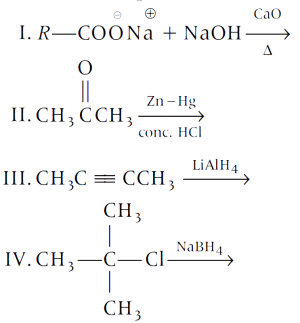
Which of the following reactions produce an alkane as the product?
A
$I, II, III$
B
$I, III, IV$
C
$I, II, IV$
D
$II, III, IV$
Solution
(C) $(I)$ The mixture of $NaOH + CaO$ is called sodalime. When it reacts with the sodium salt of a carboxylic acid,it gives the corresponding alkane. This reaction is called decarboxylation of salts of carboxylic acids: $R-COONa + NaOH \xrightarrow[\Delta]{CaO} R-H + Na_2CO_3$ (Alkane).
$(II)$ This reaction is called Clemmensen reduction. It converts aldehydes and ketones to the corresponding alkane: $CH_3COCH_3 \xrightarrow[conc. HCl]{Zn-Hg} CH_3CH_2CH_3$ (Propane,an alkane).
$(III)$ The reaction of $CH_3C \equiv CCH_3$ with $LiAlH_4$ does not typically reduce alkynes to alkanes; it is generally unreactive toward isolated alkynes,or may lead to complex mixtures depending on conditions,but it is not a standard method for alkane synthesis.
$(IV)$ The reaction of a tertiary alkyl halide like $(CH_3)_3CCl$ with $NaBH_4$ is generally slow or does not occur under standard conditions,as $NaBH_4$ is a mild reducing agent typically used for aldehydes and ketones,not alkyl halides.
Therefore,only reactions $(I)$ and $(II)$ produce alkanes. However,reviewing the options provided,if we re-evaluate the reactivity,$(IV)$ can sometimes undergo reduction to alkanes with specific reagents,but based on standard textbook reactions,$(I)$ and $(II)$ are the primary alkane-producing reactions. Given the options,$(C)$ is the most plausible choice if $(IV)$ is considered to proceed under specific conditions.
$(II)$ This reaction is called Clemmensen reduction. It converts aldehydes and ketones to the corresponding alkane: $CH_3COCH_3 \xrightarrow[conc. HCl]{Zn-Hg} CH_3CH_2CH_3$ (Propane,an alkane).
$(III)$ The reaction of $CH_3C \equiv CCH_3$ with $LiAlH_4$ does not typically reduce alkynes to alkanes; it is generally unreactive toward isolated alkynes,or may lead to complex mixtures depending on conditions,but it is not a standard method for alkane synthesis.
$(IV)$ The reaction of a tertiary alkyl halide like $(CH_3)_3CCl$ with $NaBH_4$ is generally slow or does not occur under standard conditions,as $NaBH_4$ is a mild reducing agent typically used for aldehydes and ketones,not alkyl halides.
Therefore,only reactions $(I)$ and $(II)$ produce alkanes. However,reviewing the options provided,if we re-evaluate the reactivity,$(IV)$ can sometimes undergo reduction to alkanes with specific reagents,but based on standard textbook reactions,$(I)$ and $(II)$ are the primary alkane-producing reactions. Given the options,$(C)$ is the most plausible choice if $(IV)$ is considered to proceed under specific conditions.
0 likesView Solution
45
ChemistryEasyMCQTS EAMCET · 2019
Which of the following statements is correct in the Kolbe's electrolysis?
A
Hydrocarbons containing even number of carbon atoms produced at anode
B
Hydrocarbons containing odd number of carbon atoms produced at anode
C
Hydrocarbons containing even number of carbon atoms produced at cathode
D
Hydrocarbons containing odd number of carbon atoms produced at cathode
Solution
(A) In Kolbe's electrolysis,the aqueous solution of sodium or potassium salt of a carboxylic acid is electrolyzed. The reaction is: $2RCOO^{-}Na^{+} + 2H_2O \rightarrow R-R + 2CO_2 + H_2 + 2NaOH$.
At the anode,the carboxylate ion loses an electron to form a radical,which then decarboxylates and dimerizes to form an alkane: $2RCOO^{-}$ $\rightarrow 2RCOO^{\bullet} + 2e^{-}$ $\rightarrow 2R^{\bullet} + 2CO_2$ $\rightarrow R-R + 2CO_2$.
Since the product $R-R$ is formed by the coupling of two identical alkyl groups $(R)$,the resulting hydrocarbon always contains an even number of carbon atoms.
At the cathode,water is reduced to produce hydrogen gas: $2H_2O + 2e^{-} \rightarrow H_2 + 2OH^{-}$.
Therefore,hydrocarbons with an even number of carbon atoms are produced at the anode.
Thus,option $(A)$ is the correct answer.
At the anode,the carboxylate ion loses an electron to form a radical,which then decarboxylates and dimerizes to form an alkane: $2RCOO^{-}$ $\rightarrow 2RCOO^{\bullet} + 2e^{-}$ $\rightarrow 2R^{\bullet} + 2CO_2$ $\rightarrow R-R + 2CO_2$.
Since the product $R-R$ is formed by the coupling of two identical alkyl groups $(R)$,the resulting hydrocarbon always contains an even number of carbon atoms.
At the cathode,water is reduced to produce hydrogen gas: $2H_2O + 2e^{-} \rightarrow H_2 + 2OH^{-}$.
Therefore,hydrocarbons with an even number of carbon atoms are produced at the anode.
Thus,option $(A)$ is the correct answer.
0 likesView Solution
46
ChemistryMediumMCQTS EAMCET · 2019
$A$ hydrocarbon with molecular formula $C_4H_6$ undergoes the following reactions:
$A$. Decolourises molecular bromine.
$B$. Reacts with $HBr$.
$C$. Addition of ozone and then cleavage of the ozonide by $Zn / H_2O$ gives the product $C_4H_6O_2$.
Then,the structure of the hydrocarbon is:
$A$. Decolourises molecular bromine.
$B$. Reacts with $HBr$.
$C$. Addition of ozone and then cleavage of the ozonide by $Zn / H_2O$ gives the product $C_4H_6O_2$.
Then,the structure of the hydrocarbon is:
A
Cyclobutene
B
None of these
C
$CH_3CH_2C \equiv CH$
D
Methylenecyclopropane
Solution
(A) The hydrocarbon has the molecular formula $C_4H_6$.
Cyclobutene $(C_4H_6)$ reacts with $Br_2$ to decolourise it,reacts with $HBr$ to form bromocyclobutane,and undergoes ozonolysis $(O_3 / Zn + H_2O)$ to produce butane$-1,4-$dial $(C_4H_6O_2)$.
Therefore,the correct structure is cyclobutene.
Cyclobutene $(C_4H_6)$ reacts with $Br_2$ to decolourise it,reacts with $HBr$ to form bromocyclobutane,and undergoes ozonolysis $(O_3 / Zn + H_2O)$ to produce butane$-1,4-$dial $(C_4H_6O_2)$.
Therefore,the correct structure is cyclobutene.
0 likesView Solution
47
ChemistryEasyMCQTS EAMCET · 2019
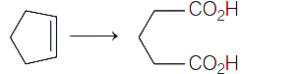
What are the suitable conditions for the following transformation?
A
$KMnO_4-H_2SO_4 / \Delta$
B
$O_3 / O_2, Zn+H_2O$
C
$OsO_4$
D
$Pb(OAc)_4$
Solution
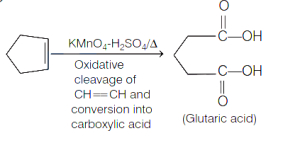
(A) The given reaction is the oxidative cleavage of cyclopentene to form glutaric acid $(HOOC-(CH_2)_3-COOH)$.
Strong oxidizing agents like hot acidic potassium permanganate $(KMnO_4-H_2SO_4 / \Delta)$ cause the oxidative cleavage of the carbon-carbon double bond in alkenes to produce carboxylic acids.
Thus,option $(A)$ is correct.
Strong oxidizing agents like hot acidic potassium permanganate $(KMnO_4-H_2SO_4 / \Delta)$ cause the oxidative cleavage of the carbon-carbon double bond in alkenes to produce carboxylic acids.
Thus,option $(A)$ is correct.
0 likesView Solution
48
ChemistryMediumMCQTS EAMCET · 2019
The major product $(P)$ formed in the below reaction is:
$CH_2$ attached to a cyclohexane ring $\xrightarrow[(ii) NaBH_4, OH^-]{(i) Hg(OAc)_2, H_2O-THF} P?$
$CH_2$ attached to a cyclohexane ring $\xrightarrow[(ii) NaBH_4, OH^-]{(i) Hg(OAc)_2, H_2O-THF} P?$
A
Methylcyclohexane
B
Cyclohexylmethanol
C
$1-$Methylcyclohexanol
D
Cyclohexylmethyl acetate
Solution
(C) The reaction is an oxymercuration-demercuration of an alkene.
$1$. In the first step,$Hg(OAc)_2$ in aqueous $THF$ reacts with the alkene to form an organomercurial intermediate via an electrophilic addition of $Hg(OAc)^+$ followed by the attack of water.
$2$. In the second step,$NaBH_4$ reduces the $C-Hg$ bond to a $C-H$ bond,resulting in the Markovnikov addition of water across the double bond.
$3$. For methylenecyclohexane,the addition of water follows Markovnikov's rule,where the $OH$ group attaches to the more substituted carbon (the tertiary carbon of the ring).
$4$. Thus,the product formed is $1$-methylcyclohexanol.
Hence,option $(C)$ is the correct answer.
$1$. In the first step,$Hg(OAc)_2$ in aqueous $THF$ reacts with the alkene to form an organomercurial intermediate via an electrophilic addition of $Hg(OAc)^+$ followed by the attack of water.
$2$. In the second step,$NaBH_4$ reduces the $C-Hg$ bond to a $C-H$ bond,resulting in the Markovnikov addition of water across the double bond.
$3$. For methylenecyclohexane,the addition of water follows Markovnikov's rule,where the $OH$ group attaches to the more substituted carbon (the tertiary carbon of the ring).
$4$. Thus,the product formed is $1$-methylcyclohexanol.
Hence,option $(C)$ is the correct answer.
0 likesView Solution
49
ChemistryEasyMCQTS EAMCET · 2019
If one wants to make methanol out of synthesis gas,what should be the ratio of the gaseous components in the synthesis gas?
A
$1: 2$
B
$1: 1$
C
$1: 3$
D
$3: 1$
Solution
(A) Synthesis gas is a mixture of $CO$ and $H_2$.
To produce methanol $(CH_3OH)$,the chemical reaction is: $CO(g) + 2H_2(g) \longrightarrow CH_3OH(g)$.
According to the stoichiometry of the reaction,$1$ mole of $CO$ reacts with $2$ moles of $H_2$.
Therefore,the ratio of $CO:H_2$ in the synthesis gas should be $1: 2$.
Hence,option $(A)$ is correct.
To produce methanol $(CH_3OH)$,the chemical reaction is: $CO(g) + 2H_2(g) \longrightarrow CH_3OH(g)$.
According to the stoichiometry of the reaction,$1$ mole of $CO$ reacts with $2$ moles of $H_2$.
Therefore,the ratio of $CO:H_2$ in the synthesis gas should be $1: 2$.
Hence,option $(A)$ is correct.
0 likesView Solution
50
ChemistryMediumMCQTS EAMCET · 2019
What is the approximate volume (in $mL$) of $10$ vol $H_2O_2$ solution that will react completely with $1 \ L$ of $0.02 \ M \ KMnO_4$ solution in acidic medium?
A
$56.05$
B
$113.5$
C
$90.8$
D
$75.75$
Solution
(A) The balanced chemical equation for the reaction between $KMnO_4$ and $H_2O_2$ in an acidic medium is:
$2 \ KMnO_4 + 3 \ H_2SO_4 + 5 \ H_2O_2 \longrightarrow K_2SO_4 + 2 \ MnSO_4 + 8 \ H_2O + 5 \ O_2$
From the stoichiometry,$2 \ \text{moles of } KMnO_4$ react with $5 \ \text{moles of } H_2O_2$.
Given: $n(KMnO_4) = \text{Molarity} \times \text{Volume} = 0.02 \ M \times 1 \ L = 0.02 \ \text{moles}$.
Therefore,$n(H_2O_2) = \frac{5}{2} \times 0.02 = 0.05 \ \text{moles}$.
Mass of $H_2O_2 = 0.05 \ \text{mol} \times 34 \ g/mol = 1.7 \ g$.
$10 \ \text{vol } H_2O_2$ means $1 \ L$ of $H_2O_2$ solution gives $10 \ L$ of $O_2$ at $STP$.
Since $1 \ L$ of $H_2O_2$ contains $30.3 \ g$ of $H_2O_2$ (as $68 \ g$ of $H_2O_2$ gives $22.4 \ L$ of $O_2$,so $10 \ L$ of $O_2$ corresponds to $\frac{68 \times 10}{22.4} \approx 30.35 \ g$),the concentration is $\frac{30.35 \ g}{1000 \ mL}$.
Volume of $H_2O_2$ solution required $= \frac{1.7 \ g}{30.35 \ g/L} \approx 0.056 \ L = 56 \ mL$.
$2 \ KMnO_4 + 3 \ H_2SO_4 + 5 \ H_2O_2 \longrightarrow K_2SO_4 + 2 \ MnSO_4 + 8 \ H_2O + 5 \ O_2$
From the stoichiometry,$2 \ \text{moles of } KMnO_4$ react with $5 \ \text{moles of } H_2O_2$.
Given: $n(KMnO_4) = \text{Molarity} \times \text{Volume} = 0.02 \ M \times 1 \ L = 0.02 \ \text{moles}$.
Therefore,$n(H_2O_2) = \frac{5}{2} \times 0.02 = 0.05 \ \text{moles}$.
Mass of $H_2O_2 = 0.05 \ \text{mol} \times 34 \ g/mol = 1.7 \ g$.
$10 \ \text{vol } H_2O_2$ means $1 \ L$ of $H_2O_2$ solution gives $10 \ L$ of $O_2$ at $STP$.
Since $1 \ L$ of $H_2O_2$ contains $30.3 \ g$ of $H_2O_2$ (as $68 \ g$ of $H_2O_2$ gives $22.4 \ L$ of $O_2$,so $10 \ L$ of $O_2$ corresponds to $\frac{68 \times 10}{22.4} \approx 30.35 \ g$),the concentration is $\frac{30.35 \ g}{1000 \ mL}$.
Volume of $H_2O_2$ solution required $= \frac{1.7 \ g}{30.35 \ g/L} \approx 0.056 \ L = 56 \ mL$.
0 likesView Solution
51
ChemistryEasyMCQTS EAMCET · 2019
Find the suitable product for the following reaction: $R-COOH \underset{(ii) H_2O/H^{\oplus}}{\xrightarrow{(i) B_2H_6}} ?$
A
$R-CHO$
B
$R-CH_2OH$
C
$R-CO_2R$
D
$R-CH_3$
Solution
(B) In the given reaction,carboxylic acid $(R-COOH)$ is treated with diborane $(B_2H_6)$ followed by acidic hydrolysis $(H_2O/H^{\oplus})$.
$B_2H_6$ is a selective reducing agent that reduces carboxylic acids to primary alcohols $(R-CH_2OH)$ without affecting other functional groups like esters or halides.
Therefore,the product is $R-CH_2OH$.
$B_2H_6$ is a selective reducing agent that reduces carboxylic acids to primary alcohols $(R-CH_2OH)$ without affecting other functional groups like esters or halides.
Therefore,the product is $R-CH_2OH$.
0 likesView Solution
52
ChemistryDifficultMCQTS EAMCET · 2019
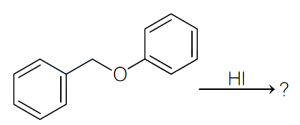
In the following reaction,the major products are
A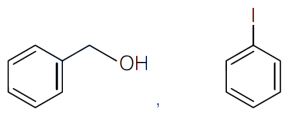
B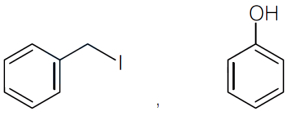
C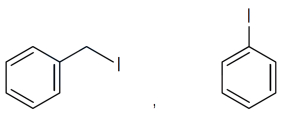
D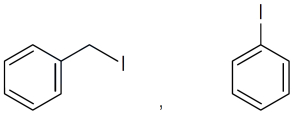
Solution
(C) The reaction of benzyl phenyl ether with $HI$ proceeds via the protonation of the ether oxygen atom.
Following protonation,the bond between the oxygen and the benzylic carbon breaks to form a stable benzylic carbocation $(C_6H_5CH_2^+)$ and phenol $(C_6H_5OH)$.
The benzylic carbocation is resonance-stabilized.
Finally,the iodide ion $(I^-)$ attacks the benzylic carbocation to form benzyl iodide $(C_6H_5CH_2I)$.
Thus,the major products are benzyl iodide and phenol.
This corresponds to option $C$.
Following protonation,the bond between the oxygen and the benzylic carbon breaks to form a stable benzylic carbocation $(C_6H_5CH_2^+)$ and phenol $(C_6H_5OH)$.
The benzylic carbocation is resonance-stabilized.
Finally,the iodide ion $(I^-)$ attacks the benzylic carbocation to form benzyl iodide $(C_6H_5CH_2I)$.
Thus,the major products are benzyl iodide and phenol.
This corresponds to option $C$.
0 likesView Solution
53
ChemistryDifficultMCQTS EAMCET · 2019
Identify $X, Y$ and $Z$ respectively from the following reactions:
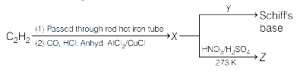
A
Benzaldehyde,Aniline,$m$-Nitrobenzaldehyde
B
Benzaldehyde,Phenylhydrazine,$m$-Nitrobenzoic acid
C
Benzoic acid,Aniline,$m$-Nitrobenzoic acid
D
Benzaldehyde,$2$,$4$-Dinitrophenylhydrazine,$p$-Nitrobenzoic acid
Solution
(A) The reaction sequence is as follows:
$1$. $C_2H_2$ (acetylene) when passed through a red hot iron tube undergoes cyclic polymerization to form benzene. Benzene reacts with $CO$ and $HCl$ in the presence of anhydrous $AlCl_3/CuCl$ (Gattermann-Koch reaction) to form $X$ (Benzaldehyde).
$2$. Benzaldehyde $(X)$ reacts with aniline $(Y)$ to form a Schiff's base.
$3$. Benzaldehyde $(X)$ undergoes nitration with $HNO_3/H_2SO_4$ at $273 \ K$ to form $Z$ ($m$-nitrobenzaldehyde) because the $-CHO$ group is meta-directing.
Therefore,$X$ is benzaldehyde,$Y$ is aniline,and $Z$ is $m$-nitrobenzaldehyde. The correct option is $(a)$.
$1$. $C_2H_2$ (acetylene) when passed through a red hot iron tube undergoes cyclic polymerization to form benzene. Benzene reacts with $CO$ and $HCl$ in the presence of anhydrous $AlCl_3/CuCl$ (Gattermann-Koch reaction) to form $X$ (Benzaldehyde).
$2$. Benzaldehyde $(X)$ reacts with aniline $(Y)$ to form a Schiff's base.
$3$. Benzaldehyde $(X)$ undergoes nitration with $HNO_3/H_2SO_4$ at $273 \ K$ to form $Z$ ($m$-nitrobenzaldehyde) because the $-CHO$ group is meta-directing.
Therefore,$X$ is benzaldehyde,$Y$ is aniline,and $Z$ is $m$-nitrobenzaldehyde. The correct option is $(a)$.
0 likesView Solution
54
ChemistryDifficultMCQTS EAMCET · 2019
What is the product $E$ in the following reaction?
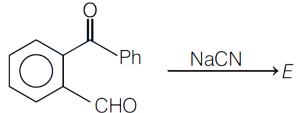
A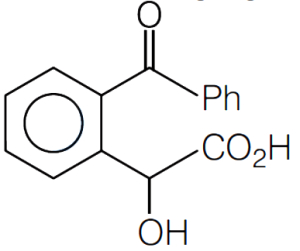
B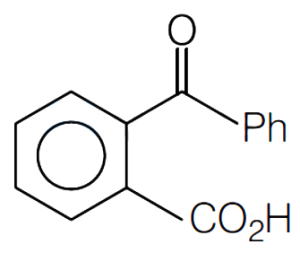
C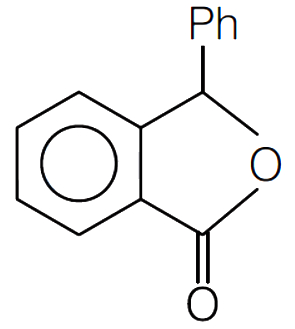
D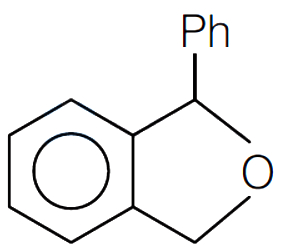
Solution
(C) The reaction is an intramolecular benzoin condensation followed by rearrangement.
$CN^-$ acts as a nucleophile and attacks the aldehyde carbonyl group.
This is followed by an intramolecular attack on the ketone carbonyl group.
After hydrolysis and rearrangement,the final product $E$ is formed,which is a cyclic compound as shown in the reaction mechanism.
$CN^-$ acts as a nucleophile and attacks the aldehyde carbonyl group.
This is followed by an intramolecular attack on the ketone carbonyl group.
After hydrolysis and rearrangement,the final product $E$ is formed,which is a cyclic compound as shown in the reaction mechanism.
0 likesView Solution
55
ChemistryMediumMCQTS EAMCET · 2019
Benzaldehyde can be converted to benzonitrile by treatment with
A
$NH_3$
B
$NH_3$ followed by reaction with $C_6H_5SO_2Cl$
C
$NH_2OH$ followed by reaction with acetic anhydride
D
$NH_2OH$
Solution
(C) When benzaldehyde reacts with $NH_2OH$ (hydroxylamine),an oxime is formed.
Further,the oxime undergoes dehydration upon heating with acetic anhydride to yield benzonitrile.
$C_6H_5CHO + NH_2OH \rightarrow C_6H_5CH=NOH + H_2O$
$C_6H_5CH=NOH \xrightarrow{Ac_2O, \Delta} C_6H_5CN + H_2O$
Thus,option $(C)$ is correct.
Further,the oxime undergoes dehydration upon heating with acetic anhydride to yield benzonitrile.
$C_6H_5CHO + NH_2OH \rightarrow C_6H_5CH=NOH + H_2O$
$C_6H_5CH=NOH \xrightarrow{Ac_2O, \Delta} C_6H_5CN + H_2O$
Thus,option $(C)$ is correct.
0 likesView Solution
56
ChemistryMediumMCQTS EAMCET · 2019
Identify the method that gives benzyl alcohol.
A
Toluene $\xrightarrow{1) CrO_2Cl_2, CS_2 \ 2) H_3O^+}$
B
Benzaldehyde $\xrightarrow{H_2, Pd-BaSO_4}$
C
Benzaldehyde $\xrightarrow{Conc. NaOH, \Delta}$
D
Benzene $\xrightarrow{CO, HCl, Anhyd. AlCl_3/CuCl}$
Solution
(C) The reaction of benzaldehyde with concentrated $NaOH$ is a Cannizzaro reaction.
In this reaction,two molecules of a non-enolizable aldehyde undergo base-induced disproportionation to form a primary alcohol and a carboxylic acid salt.
Benzaldehyde,being a non-enolizable aldehyde,reacts with concentrated $NaOH$ to produce benzyl alcohol and sodium benzoate.
Therefore,option $(C)$ is correct.
In this reaction,two molecules of a non-enolizable aldehyde undergo base-induced disproportionation to form a primary alcohol and a carboxylic acid salt.
Benzaldehyde,being a non-enolizable aldehyde,reacts with concentrated $NaOH$ to produce benzyl alcohol and sodium benzoate.
Therefore,option $(C)$ is correct.
0 likesView Solution
57
ChemistryMediumMCQTS EAMCET · 2019
The product $(P)$ of the below reaction sequence is:
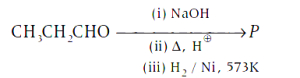
A
$CH_3CH_2CH=C(CH_3)CH_3$
B
$CH_3CH_2CH_2CH(CH_3)CH_2OH$
C
$CH_3CH_2CH=C(CH_3)CHO$
D
$CH_3CH_2CH=C(CH_3)CO_2H$
Solution
(B) Step $1$: Aldol condensation of $CH_3CH_2CHO$ (propanal) in the presence of $NaOH$ gives $\beta$-hydroxy aldehyde,which upon heating $( \Delta, H^{\oplus} )$ undergoes dehydration to form an $\alpha,\beta$-unsaturated aldehyde: $CH_3CH_2CH=C(CH_3)CHO$.
Step $2$: The final step involves hydrogenation using $H_2/Ni$ at $573 \ K$. This reagent reduces both the carbon-carbon double bond and the aldehyde group to a primary alcohol.
Thus,the final product $(P)$ is $CH_3CH_2CH_2CH(CH_3)CH_2OH$.
Step $2$: The final step involves hydrogenation using $H_2/Ni$ at $573 \ K$. This reagent reduces both the carbon-carbon double bond and the aldehyde group to a primary alcohol.
Thus,the final product $(P)$ is $CH_3CH_2CH_2CH(CH_3)CH_2OH$.
0 likesView Solution
58
ChemistryEasyMCQTS EAMCET · 2019
Which of the following reactions produce carboxylic acids?
$(a)$ $MnO_2$ with $CH_3COCH_3$
$(b)$ $Ph-CCl_3 \xrightarrow[(ii) H_2O/H^+]{(i) aq. NaOH} PhCOOH$
$(c)$ $C_2H_5Br \xrightarrow[(iii) H_2O/H^+]{(i) Mg, (ii) CO_2} C_2H_5COOH$
$(d)$ $CH_3CH=CHCH_3 \xrightarrow[\Delta]{K_2Cr_2O_7/H_2SO_4} 2CH_3COOH$
$(a)$ $MnO_2$ with $CH_3COCH_3$
$(b)$ $Ph-CCl_3 \xrightarrow[(ii) H_2O/H^+]{(i) aq. NaOH} PhCOOH$
$(c)$ $C_2H_5Br \xrightarrow[(iii) H_2O/H^+]{(i) Mg, (ii) CO_2} C_2H_5COOH$
$(d)$ $CH_3CH=CHCH_3 \xrightarrow[\Delta]{K_2Cr_2O_7/H_2SO_4} 2CH_3COOH$
A
$a, b, c$
B
$b, c, d$
C
$a, c, d$
D
$a, b, d$
Solution
(B) $MnO_2$ is a mild oxidizing agent and does not oxidize ketones like $CH_3COCH_3$ to carboxylic acids.
$(b)$ $Ph-CCl_3$ undergoes hydrolysis with aqueous $NaOH$ followed by acidification to form benzoic acid $(PhCOOH)$. This is a correct reaction.
$(c)$ Alkyl halides react with $Mg$ to form Grignard reagents $(RMgX)$,which react with $CO_2$ followed by hydrolysis to yield carboxylic acids. This is a correct reaction.
$(d)$ Vigorous oxidation of internal alkenes like $CH_3CH=CHCH_3$ with acidified $K_2Cr_2O_7$ cleaves the double bond to form two molecules of acetic acid $(CH_3COOH)$. This is a correct reaction.
Therefore,reactions $(b)$,$(c)$,and $(d)$ produce carboxylic acids.
$(b)$ $Ph-CCl_3$ undergoes hydrolysis with aqueous $NaOH$ followed by acidification to form benzoic acid $(PhCOOH)$. This is a correct reaction.
$(c)$ Alkyl halides react with $Mg$ to form Grignard reagents $(RMgX)$,which react with $CO_2$ followed by hydrolysis to yield carboxylic acids. This is a correct reaction.
$(d)$ Vigorous oxidation of internal alkenes like $CH_3CH=CHCH_3$ with acidified $K_2Cr_2O_7$ cleaves the double bond to form two molecules of acetic acid $(CH_3COOH)$. This is a correct reaction.
Therefore,reactions $(b)$,$(c)$,and $(d)$ produce carboxylic acids.
0 likesView Solution
59
ChemistryDifficultMCQTS EAMCET · 2019
$NaCl$ is a $FCC$ lattice where $Na^{+}$ ions are at corner and face centre positions. Chloride ions are at edge centres and body centre positions. How many $NaCl$ formula units will be in a unit cell?
A
$2$
B
$4$
C
$3$
D
$1$
Solution
(B) In a standard $NaCl$ crystal structure,$Na^{+}$ ions occupy the octahedral voids (edge centres and body centre) and $Cl^{-}$ ions occupy the $FCC$ lattice points (corners and face centres).
However,based on the specific distribution provided in the question:
$Na^{+}$ ions at corners $(8 \times \frac{1}{8} = 1)$ and face centres $(6 \times \frac{1}{2} = 3)$,total $Na^{+} = 1 + 3 = 4$.
$Cl^{-}$ ions at edge centres $(12 \times \frac{1}{4} = 3)$ and body centre $(1 \times 1 = 1)$,total $Cl^{-} = 3 + 1 = 4$.
Since there are $4$ $Na^{+}$ ions and $4$ $Cl^{-}$ ions per unit cell,the number of $NaCl$ formula units is $4$.
However,based on the specific distribution provided in the question:
$Na^{+}$ ions at corners $(8 \times \frac{1}{8} = 1)$ and face centres $(6 \times \frac{1}{2} = 3)$,total $Na^{+} = 1 + 3 = 4$.
$Cl^{-}$ ions at edge centres $(12 \times \frac{1}{4} = 3)$ and body centre $(1 \times 1 = 1)$,total $Cl^{-} = 3 + 1 = 4$.
Since there are $4$ $Na^{+}$ ions and $4$ $Cl^{-}$ ions per unit cell,the number of $NaCl$ formula units is $4$.
0 likesView Solution
60
ChemistryDifficultMCQTS EAMCET · 2019
The major products $P$ and $Q$ formed in the following reactions of benzonitrile are
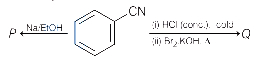
A
Benzamide and Benzylamine
B
Benzaldimine and Aniline
C
Benzylamine and Aniline
D
Aniline and Benzamide
Solution
(C) When $C_6H_5CN$ reacts with $Na / C_2H_5OH$,$C_6H_5CN$ undergoes reduction and the $-C \equiv N$ group changes to $-CH_2-NH_2$. Thus,the product $(P)$ is $C_6H_5CH_2NH_2$ (Benzylamine).
The reaction occurs as follows:
$C_6H_5CN + 4[H] \rightarrow C_6H_5CH_2NH_2$
When $C_6H_5CN$ reacts with $(i)$ $HCl$ (conc. cold) and (ii) $Br_2 / KOH$,it follows the partial hydrolysis of nitrile to amide,followed by the Hoffmann-Bromamide degradation reaction. The final product $(Q)$ is aniline $(C_6H_5NH_2)$.
The whole reaction is as follows:
$C_6H_5CN$ $\xrightarrow{H_2O, OH^{-}} C_6H_5CONH_2$ $\xrightarrow{Br_2 / KOH} C_6H_5NH_2$
Hence,option $(C)$ is the correct answer.
The reaction occurs as follows:
$C_6H_5CN + 4[H] \rightarrow C_6H_5CH_2NH_2$
When $C_6H_5CN$ reacts with $(i)$ $HCl$ (conc. cold) and (ii) $Br_2 / KOH$,it follows the partial hydrolysis of nitrile to amide,followed by the Hoffmann-Bromamide degradation reaction. The final product $(Q)$ is aniline $(C_6H_5NH_2)$.
The whole reaction is as follows:
$C_6H_5CN$ $\xrightarrow{H_2O, OH^{-}} C_6H_5CONH_2$ $\xrightarrow{Br_2 / KOH} C_6H_5NH_2$
Hence,option $(C)$ is the correct answer.
0 likesView Solution
61
ChemistryMediumMCQTS EAMCET · 2019
Identify the structure of $Z$ in the following reaction sequence:
$Phthalic \ acid + NH_3 \rightleftharpoons X$ $\xrightarrow{\Delta} Y$ $\xrightarrow{\text{heating}} Z$
$Phthalic \ acid + NH_3 \rightleftharpoons X$ $\xrightarrow{\Delta} Y$ $\xrightarrow{\text{heating}} Z$
A
Aniline
B
Phthalamic acid
C
Phthalonitrile
D
Phthalimide
Solution
(D) The reaction sequence is as follows:
$1$. $Phthalic \ acid + 2NH_3 \rightarrow Ammonium \ phthalate (X)$
$2$. $Ammonium \ phthalate (X) \xrightarrow{\Delta} Phthalamide (Y) + 2H_2O$
$3$. $Phthalamide (Y) \xrightarrow{\text{heating}} Phthalimide (Z) + NH_3$
Thus,$Z$ is Phthalimide.
$1$. $Phthalic \ acid + 2NH_3 \rightarrow Ammonium \ phthalate (X)$
$2$. $Ammonium \ phthalate (X) \xrightarrow{\Delta} Phthalamide (Y) + 2H_2O$
$3$. $Phthalamide (Y) \xrightarrow{\text{heating}} Phthalimide (Z) + NH_3$
Thus,$Z$ is Phthalimide.
0 likesView Solution
62
ChemistryMediumMCQTS EAMCET · 2019
In the following reaction,the major product $(P)$ formed is
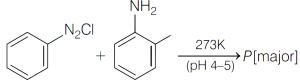
A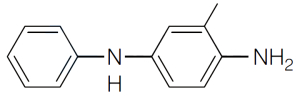
B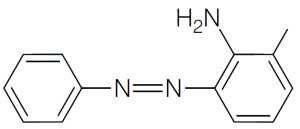
C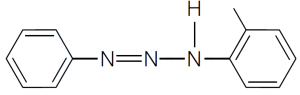
D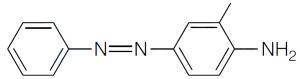
Solution
(D) The reaction between benzene diazonium chloride and $o$-toluidine ($2$-methylaniline) at $273 \ K$ and $pH \ 4-5$ is an electrophilic aromatic substitution reaction known as coupling reaction.
In this reaction,the diazonium cation acts as an electrophile.
The $-NH_2$ group is a strong activating group and is ortho/para directing.
Due to the steric hindrance caused by the methyl group at the ortho position,the electrophile attacks the para position with respect to the $-NH_2$ group.
Therefore,the major product is $4$-amino-$3$-methylazobenzene.
In this reaction,the diazonium cation acts as an electrophile.
The $-NH_2$ group is a strong activating group and is ortho/para directing.
Due to the steric hindrance caused by the methyl group at the ortho position,the electrophile attacks the para position with respect to the $-NH_2$ group.
Therefore,the major product is $4$-amino-$3$-methylazobenzene.
0 likesView Solution
63
ChemistryEasyMCQTS EAMCET · 2019
Which of the following are reducing sugars?
$(A)$ Sucrose,$(B)$ Maltose,$(C)$ Lactose,$(D)$ Fructose
$(A)$ Sucrose,$(B)$ Maltose,$(C)$ Lactose,$(D)$ Fructose
A
$A, B, C$
B
$A, B, D$
C
$A, C, D$
D
$B, C, D$
Solution
(D) Reducing sugars are those carbohydrates that contain a free hemiacetal or hemiketal group,which can act as a reducing agent.
$(A)$ Sucrose is a non-reducing sugar because both anomeric carbons are involved in the glycosidic linkage.
$(B)$ Maltose is a reducing sugar as it contains a free hemiacetal group.
$(C)$ Lactose is a reducing sugar as it contains a free hemiacetal group.
$(D)$ Fructose is a reducing sugar because it can tautomerize to glucose in alkaline solution due to the presence of an $\alpha$-hydroxy ketone group.
Therefore,$(B)$,$(C)$,and $(D)$ are reducing sugars.
$(A)$ Sucrose is a non-reducing sugar because both anomeric carbons are involved in the glycosidic linkage.
$(B)$ Maltose is a reducing sugar as it contains a free hemiacetal group.
$(C)$ Lactose is a reducing sugar as it contains a free hemiacetal group.
$(D)$ Fructose is a reducing sugar because it can tautomerize to glucose in alkaline solution due to the presence of an $\alpha$-hydroxy ketone group.
Therefore,$(B)$,$(C)$,and $(D)$ are reducing sugars.
0 likesView Solution
64
ChemistryEasyMCQTS EAMCET · 2019
The product$(s)$ formed when glucose reacts with a strong oxidising agent like $HNO_3$ is/are
A
$COOH(CHOH)_4 COOH$
B
$CO_2, H_2 O$
C
$COOH(CHOH)_4 CHO$
D
$CO, CO_2, H_2 O$
Solution
(A) When glucose is oxidised by a strong oxidising agent like $HNO_3$,both the terminal aldehyde group $(-CHO)$ and the primary alcoholic group $(-CH_2OH)$ are oxidised to carboxylic acid groups $(-COOH)$.
This results in the formation of a dicarboxylic acid known as saccharic acid or glucaric acid.
The reaction is represented as:
$CHO(CHOH)_4 CH_2OH + [O] \xrightarrow{Conc. HNO_3} COOH(CHOH)_4 COOH + H_2O$.
This results in the formation of a dicarboxylic acid known as saccharic acid or glucaric acid.
The reaction is represented as:
$CHO(CHOH)_4 CH_2OH + [O] \xrightarrow{Conc. HNO_3} COOH(CHOH)_4 COOH + H_2O$.
0 likesView Solution
65
ChemistryEasyMCQTS EAMCET · 2019
Find the reagent that oxidizes glucose into saccharic acid.
A
$Br_2, H_2O$
B
$HI, \Delta$
C
$HNO_3$
D
$HCN$
Solution
(C) Glucose $(CHO(CHOH)_4CH_2OH)$ on oxidation with concentrated nitric acid $(HNO_3)$ gets oxidized to a dicarboxylic acid,which is known as saccharic acid (glucaric acid).
The reaction is as follows:
$CHO(CHOH)_4CH_2OH \xrightarrow{HNO_3} COOH(CHOH)_4COOH$
Thus,$HNO_3$ is the reagent that oxidizes glucose into saccharic acid.
Hence,option $(C)$ is the correct answer.
The reaction is as follows:
$CHO(CHOH)_4CH_2OH \xrightarrow{HNO_3} COOH(CHOH)_4COOH$
Thus,$HNO_3$ is the reagent that oxidizes glucose into saccharic acid.
Hence,option $(C)$ is the correct answer.
0 likesView Solution
66
ChemistryMediumMCQTS EAMCET · 2019
Match the following.
| Column $I$ | Column $II$ |
| $A$. Analgesic | $I$. Phenelzine |
| $B$. Tranquilizer | $II$. Terfenadine |
| $C$. Antibiotic | $III$. Codeine |
| $D$. Antihistamine | $IV$. Prontosil |
A
$A-III, B-II, C-IV, D-I$
B
$A-III, B-I, C-IV, D-II$
C
$A-II, B-III, C-I, D-IV$
D
$A-II, B-III, C-IV, D-I$
Solution
(B) Analgesic: Analgesics are medications designed to relieve pain. $Codeine$ is an example of an analgesic.
Tranquilizer: Tranquilizers are chemical compounds used for the treatment of stress and mental diseases. $Phenelzine$ is an example of a tranquilizer.
Antibiotic: Antibiotics are drugs used to treat infections. $Prontosil$ is an example of an antibiotic.
Antihistamine: Antihistamines block the action of histamine during allergic reactions. $Terfenadine$ is an example of an antihistamine.
Therefore,the correct matching is $A-III, B-I, C-IV, D-II$.
Tranquilizer: Tranquilizers are chemical compounds used for the treatment of stress and mental diseases. $Phenelzine$ is an example of a tranquilizer.
Antibiotic: Antibiotics are drugs used to treat infections. $Prontosil$ is an example of an antibiotic.
Antihistamine: Antihistamines block the action of histamine during allergic reactions. $Terfenadine$ is an example of an antihistamine.
Therefore,the correct matching is $A-III, B-I, C-IV, D-II$.
0 likesView Solution
67
ChemistryEasyMCQTS EAMCET · 2019
Among the following $B$ group vitamins,the deficiency of which one results in convulsions?
A
$B_6$
B
$B_{12}$
C
$B_1$
D
$B_2$
Solution
(A) Convulsions are the result of abnormal electrical activity in the brain.
Deficiency of vitamin $B_6$ (pyridoxine) is known to cause convulsions,especially in infants.
Therefore,the correct option is $A$.
Deficiency of vitamin $B_6$ (pyridoxine) is known to cause convulsions,especially in infants.
Therefore,the correct option is $A$.
0 likesView Solution
68
ChemistryMediumMCQTS EAMCET · 2019
Find the suitable method from the following to prepare primary amines without the loss of carbons.
A
Gabriel method
B
Alkylation method
C
Hoffmann bromamide method
D
Stephen method
Solution
(A) Gabriel phthalimide synthesis is used for the preparation of aliphatic primary amines without the loss of carbons. It involves nucleophilic substitution $(S_{N}2)$ of alkyl halides by the anion formed by the phthalimide.
Phthalimide on treatment with ethanolic $KOH$ forms potassium salt of phthalimide which on heating with $RX$ followed by either alkaline hydrolysis or hydrazinolysis with hydrazine produces the corresponding $1^{\circ}$ amine.
Phthalimide on treatment with ethanolic $KOH$ forms potassium salt of phthalimide which on heating with $RX$ followed by either alkaline hydrolysis or hydrazinolysis with hydrazine produces the corresponding $1^{\circ}$ amine.
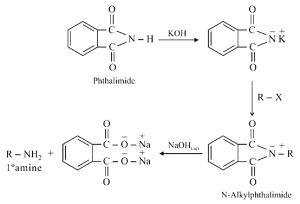
0 likesView Solution
69
ChemistryDifficultMCQTS EAMCET · 2019
Statement $(A)$: Carboxylic acid can be obtained by the reaction of $R-C \equiv N$ with $H_3O^+$ under mild reaction conditions.
Statement $(B)$: Hydrolysis of $R-C \equiv N$ in alkaline aqueous medium gives $R-COONa$ and $NH_3$ as products.
The correct answer is:
Statement $(B)$: Hydrolysis of $R-C \equiv N$ in alkaline aqueous medium gives $R-COONa$ and $NH_3$ as products.
The correct answer is:
A
Both $(A)$ and $(B)$ are correct
B
Both $(A)$ and $(B)$ are not correct
C
$(A)$ is correct,but $(B)$ is not correct
D
$(A)$ is not correct but $(B)$ is correct
Solution
(D) The reaction of $R-C \equiv N$ with $H_3O^+$ (acidic hydrolysis) typically requires heating to proceed to the carboxylic acid stage. Under mild conditions,it often stops at the amide stage $(R-CONH_2)$. Thus,statement $(A)$ is generally considered incorrect as it implies a simple,mild reaction.
When alkyl cyanide $(R-C \equiv N)$ is hydrolysed in an alkaline aqueous medium,it undergoes hydrolysis to form a carboxylate salt $(R-COO^-Na^+)$ and ammonia $(NH_3)$. Thus,statement $(B)$ is correct.
When alkyl cyanide $(R-C \equiv N)$ is hydrolysed in an alkaline aqueous medium,it undergoes hydrolysis to form a carboxylate salt $(R-COO^-Na^+)$ and ammonia $(NH_3)$. Thus,statement $(B)$ is correct.
0 likesView Solution
70
ChemistryDifficultMCQTS EAMCET · 2019
Identify $X, Y$ and $Z$ respectively in the following reaction sequence:
$CH_3COOH$ $\xrightarrow[(ii) \Delta]{(i) NH_3} CH_3CONH_2$ $\xrightarrow[Pyridine / 343 \ K]{(iii) C_6H_5SO_2Cl} X + Y + Z$
$CH_3COOH$ $\xrightarrow[(ii) \Delta]{(i) NH_3} CH_3CONH_2$ $\xrightarrow[Pyridine / 343 \ K]{(iii) C_6H_5SO_2Cl} X + Y + Z$
A
$CH_3CONHSO_2C_6H_5, H_2O, HCl$
B
$CH_3CONHSO_2C_6H_5, H_2O, HCl$
C
$C_6H_5SO_3H, CH_3CN, HCl$
D
$C_6H_5SO_2Cl, CH_3NC, H_2O$
Solution
(A) The reaction sequence is as follows:
$1$. Acetic acid $(CH_3COOH)$ reacts with $NH_3$ followed by heating to form acetamide $(CH_3CONH_2)$.
$2$. Acetamide reacts with benzenesulfonyl chloride $(C_6H_5SO_2Cl)$ in the presence of pyridine to form $N$-acetylbenzenesulfonamide $(CH_3CONHSO_2C_6H_5)$ along with water $(H_2O)$ and hydrogen chloride $(HCl)$.
$3$. The reaction is: $CH_3CONH_2 + C_6H_5SO_2Cl \xrightarrow{Pyridine} CH_3CONHSO_2C_6H_5 + H_2O + HCl$.
$4$. Thus,$X = CH_3CONHSO_2C_6H_5$,$Y = H_2O$,and $Z = HCl$.
$1$. Acetic acid $(CH_3COOH)$ reacts with $NH_3$ followed by heating to form acetamide $(CH_3CONH_2)$.
$2$. Acetamide reacts with benzenesulfonyl chloride $(C_6H_5SO_2Cl)$ in the presence of pyridine to form $N$-acetylbenzenesulfonamide $(CH_3CONHSO_2C_6H_5)$ along with water $(H_2O)$ and hydrogen chloride $(HCl)$.
$3$. The reaction is: $CH_3CONH_2 + C_6H_5SO_2Cl \xrightarrow{Pyridine} CH_3CONHSO_2C_6H_5 + H_2O + HCl$.
$4$. Thus,$X = CH_3CONHSO_2C_6H_5$,$Y = H_2O$,and $Z = HCl$.
0 likesView Solution
71
ChemistryMediumTS EAMCET · 2019
Match the following:
The correct match is:
| List-$I$ (Hybridisation) | List-$II$ (Compound/ion) |
|---|---|
| $A. sp^3d$ | $I. [PtCl_4]^{2-}$ |
| $B. sp^3d^2$ | $II. SF_6$ |
| $C. dsp^2$ | $III. BCl_3$ |
| $D. dsp^3$ | $IV. PCl_5$ |
| $V. ClF_3$ |
The correct match is:
Solution
(A-IV, B-II, C-I, D-V) To find the correct match,we determine the hybridisation of each compound/ion:
$A. sp^3d$: $PCl_5$ $(IV)$ has $5$ bond pairs and $0$ lone pairs,total $5$ hybrid orbitals,corresponding to $sp^3d$ hybridisation.
$B. sp^3d^2$: $SF_6$ $(II)$ has $6$ bond pairs and $0$ lone pairs,total $6$ hybrid orbitals,corresponding to $sp^3d^2$ hybridisation.
$C. dsp^2$: $[PtCl_4]^{2-}$ $(I)$ has $4$ bond pairs and $0$ lone pairs,total $4$ hybrid orbitals,corresponding to $dsp^2$ hybridisation.
$D. dsp^3$: $ClF_3$ $(V)$ has $3$ bond pairs and $2$ lone pairs,total $5$ hybrid orbitals,which can be $sp^3d$ or $dsp^3$ (depending on the model,but $ClF_3$ is commonly associated with $sp^3d$ geometry). However,based on standard matching options provided in such questions,$D$ matches $V$ $(ClF_3)$.
Thus,the correct matching is: $A-IV, B-II, C-I, D-V$.
$A. sp^3d$: $PCl_5$ $(IV)$ has $5$ bond pairs and $0$ lone pairs,total $5$ hybrid orbitals,corresponding to $sp^3d$ hybridisation.
$B. sp^3d^2$: $SF_6$ $(II)$ has $6$ bond pairs and $0$ lone pairs,total $6$ hybrid orbitals,corresponding to $sp^3d^2$ hybridisation.
$C. dsp^2$: $[PtCl_4]^{2-}$ $(I)$ has $4$ bond pairs and $0$ lone pairs,total $4$ hybrid orbitals,corresponding to $dsp^2$ hybridisation.
$D. dsp^3$: $ClF_3$ $(V)$ has $3$ bond pairs and $2$ lone pairs,total $5$ hybrid orbitals,which can be $sp^3d$ or $dsp^3$ (depending on the model,but $ClF_3$ is commonly associated with $sp^3d$ geometry). However,based on standard matching options provided in such questions,$D$ matches $V$ $(ClF_3)$.
Thus,the correct matching is: $A-IV, B-II, C-I, D-V$.
0 likesView Solution
72
ChemistryDifficultMCQTS EAMCET · 2019
The major product formed in the following reaction sequence is:
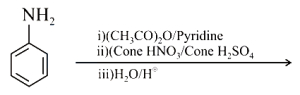
A
$2-$Nitroaniline
B
$N$-($4$-nitrophenyl)acetamide
C
$4-$Nitroaniline
D
$4-$Aminoacetophenone
Solution
(C) The reaction sequence is as follows:
$1$. $N$-acylation of aniline with $(CH_3CO)_2O$ in the presence of pyridine yields acetanilide $(C_6H_5NHCOCH_3)$.
$2$. Nitration of acetanilide using concentrated $HNO_3$ and concentrated $H_2SO_4$ occurs primarily at the para-position due to the steric hindrance of the bulky $-NHCOCH_3$ group,forming $p$-nitroacetanilide.
$3$. Finally,acid-catalyzed hydrolysis $(H_2O/H^+)$ of $p$-nitroacetanilide removes the acetyl group to yield $p$-nitroaniline ($4$-nitroaniline) as the major product.
$1$. $N$-acylation of aniline with $(CH_3CO)_2O$ in the presence of pyridine yields acetanilide $(C_6H_5NHCOCH_3)$.
$2$. Nitration of acetanilide using concentrated $HNO_3$ and concentrated $H_2SO_4$ occurs primarily at the para-position due to the steric hindrance of the bulky $-NHCOCH_3$ group,forming $p$-nitroacetanilide.
$3$. Finally,acid-catalyzed hydrolysis $(H_2O/H^+)$ of $p$-nitroacetanilide removes the acetyl group to yield $p$-nitroaniline ($4$-nitroaniline) as the major product.
0 likesView Solution
73
ChemistryMediumMCQTS EAMCET · 2019
The mass of Haemoglobin in $mg$ required to protect from coagulation of $50 \ mL$ of a gold sol on adding $5 \ mL$ of $10 \% NaCl$ solution is: (Gold number of Haemoglobin $= 0.03$)
A
$0.03$
B
$0.75$
C
$0.30$
D
$0.15$
Solution
(D) Gold number is defined as the minimum mass of a protective colloid in $mg$ that prevents the coagulation of $10 \ mL$ of a gold sol when $1 \ mL$ of $10 \% NaCl$ solution is added to it.
Given,the gold number of Haemoglobin $= 0.03$.
This means $0.03 \ mg$ of Haemoglobin is required to protect $10 \ mL$ of gold sol against $1 \ mL$ of $10 \% NaCl$.
For $50 \ mL$ of gold sol,the amount of protective colloid required is $5 \times 0.03 \ mg = 0.15 \ mg$.
Since the amount of $NaCl$ added is $5 \ mL$ (which is $5 \times$ the standard amount),the protection required is proportional to the volume of the gold sol.
Thus,the mass of Haemoglobin required is $0.15 \ mg$.
Given,the gold number of Haemoglobin $= 0.03$.
This means $0.03 \ mg$ of Haemoglobin is required to protect $10 \ mL$ of gold sol against $1 \ mL$ of $10 \% NaCl$.
For $50 \ mL$ of gold sol,the amount of protective colloid required is $5 \times 0.03 \ mg = 0.15 \ mg$.
Since the amount of $NaCl$ added is $5 \ mL$ (which is $5 \times$ the standard amount),the protection required is proportional to the volume of the gold sol.
Thus,the mass of Haemoglobin required is $0.15 \ mg$.
0 likesView Solution
74
ChemistryEasyMCQTS EAMCET · 2019
For a zero-order reaction,the correct expression for rate constant $(k)$ at half-life time $(t_{1/2})$ is ($[R_0] =$ initial concentration of reactant).
A
$k = \frac{2.303}{t_{1/2}} \log \frac{[R_0]}{\frac{[R_0]}{2}}$
B
$k = \frac{2.303}{t} \log \frac{[R_0]}{[R_0]}$
C
$k = \frac{[R_0] - \frac{1}{2}[R_0]}{t_{1/2}}$
D
$k = \frac{2.303}{(t_2 - t_1)} \log [R_0]$
Solution
(C) For a zero-order reaction,the integrated rate equation is given as:
$k = \frac{[R_0] - [R]}{t}$
where $k$ is the rate constant,$[R_0]$ is the initial concentration,and $[R]$ is the concentration at time $t$.
At half-life time,$t = t_{1/2}$,the concentration of the reactant is $[R] = \frac{[R_0]}{2}$.
Substituting these values into the rate equation:
$k = \frac{[R_0] - \frac{[R_0]}{2}}{t_{1/2}}$
Thus,the correct expression is $k = \frac{[R_0] - \frac{1}{2}[R_0]}{t_{1/2}}$.
Hence,option $(C)$ is the correct answer.
$k = \frac{[R_0] - [R]}{t}$
where $k$ is the rate constant,$[R_0]$ is the initial concentration,and $[R]$ is the concentration at time $t$.
At half-life time,$t = t_{1/2}$,the concentration of the reactant is $[R] = \frac{[R_0]}{2}$.
Substituting these values into the rate equation:
$k = \frac{[R_0] - \frac{[R_0]}{2}}{t_{1/2}}$
Thus,the correct expression is $k = \frac{[R_0] - \frac{1}{2}[R_0]}{t_{1/2}}$.
Hence,option $(C)$ is the correct answer.
0 likesView Solution
75
ChemistryMediumMCQTS EAMCET · 2019
The decomposition of $O_{3(g)}$ follows first order kinetics and is given by $O_{3(g)} \longrightarrow O_{2(g)} + O_{(g)}$. The rate constant for this reaction is $1.0 \times 10^{-3} \ s^{-1}$. The initial pressure of $O_{3(g)}$ is $100 \ atm$. What will be the partial pressure (in $atm$) of $O_3, O_2, O$ respectively after $38.38 \ minutes$?
A
$95, 5, 5$
B
$10, 90, 0$
C
$10, 90, 90$
D
$10, 0, 90$
Solution
(C) The decomposition reaction is $O_{3(g)} \longrightarrow O_{2(g)} + O_{(g)}$.
Initial pressure: $100 \ atm, \ 0, \ 0$.
Pressure after time $t$: $(100-x), \ x, \ x$.
Given: $k = 1.0 \times 10^{-3} \ s^{-1}$,$t = 38.38 \ min = 38.38 \times 60 \ s = 2302.8 \ s$.
Using the first-order rate equation: $k = \frac{2.303}{t} \log \frac{p_i}{p_f}$.
$1.0 \times 10^{-3} = \frac{2.303}{2302.8} \log \frac{100}{100-x}$.
$\log \frac{100}{100-x} = \frac{1.0 \times 10^{-3} \times 2302.8}{2.303} \approx 1$.
$\frac{100}{100-x} = 10^1 = 10$.
$100 = 1000 - 10x \implies 10x = 900 \implies x = 90 \ atm$.
Partial pressure of $O_3 = 100 - 90 = 10 \ atm$.
Partial pressure of $O_2 = 90 \ atm$.
Partial pressure of $O = 90 \ atm$.
Thus,the correct option is $C$.
Initial pressure: $100 \ atm, \ 0, \ 0$.
Pressure after time $t$: $(100-x), \ x, \ x$.
Given: $k = 1.0 \times 10^{-3} \ s^{-1}$,$t = 38.38 \ min = 38.38 \times 60 \ s = 2302.8 \ s$.
Using the first-order rate equation: $k = \frac{2.303}{t} \log \frac{p_i}{p_f}$.
$1.0 \times 10^{-3} = \frac{2.303}{2302.8} \log \frac{100}{100-x}$.
$\log \frac{100}{100-x} = \frac{1.0 \times 10^{-3} \times 2302.8}{2.303} \approx 1$.
$\frac{100}{100-x} = 10^1 = 10$.
$100 = 1000 - 10x \implies 10x = 900 \implies x = 90 \ atm$.
Partial pressure of $O_3 = 100 - 90 = 10 \ atm$.
Partial pressure of $O_2 = 90 \ atm$.
Partial pressure of $O = 90 \ atm$.
Thus,the correct option is $C$.
0 likesView Solution
76
ChemistryMediumMCQTS EAMCET · 2019
The first order decomposition of $H_2O_2$ in an appropriate medium is characterised by a rate constant of $0.2303 \ min^{-1}$. What is the time (in $min$) required to complete $9/10$ fraction of the reaction?
A
$0.1$
B
$10$
C
$100$
D
$0.01$
Solution
(B) Given,rate constant $(k)$ for first order $= 0.2303 \ min^{-1}$.
For a first order reaction,the time $(t)$ is given by:
$t = \frac{2.303}{k} \log \left( \frac{a}{a-x} \right)$
where $a$ is the initial concentration and $x$ is the amount reacted.
Let the initial concentration $(a) = 1$.
Given that the fraction completed is $9/10$,so $x = 0.9$.
The remaining concentration $(a-x) = 1 - 0.9 = 0.1$.
Substituting the values into the equation:
$t = \frac{2.303}{0.2303} \log \left( \frac{1}{0.1} \right)$
$t = 10 \log(10)$
Since $\log(10) = 1$,we get $t = 10 \times 1 = 10 \ min$.
Therefore,the correct option is $(b)$.
For a first order reaction,the time $(t)$ is given by:
$t = \frac{2.303}{k} \log \left( \frac{a}{a-x} \right)$
where $a$ is the initial concentration and $x$ is the amount reacted.
Let the initial concentration $(a) = 1$.
Given that the fraction completed is $9/10$,so $x = 0.9$.
The remaining concentration $(a-x) = 1 - 0.9 = 0.1$.
Substituting the values into the equation:
$t = \frac{2.303}{0.2303} \log \left( \frac{1}{0.1} \right)$
$t = 10 \log(10)$
Since $\log(10) = 1$,we get $t = 10 \times 1 = 10 \ min$.
Therefore,the correct option is $(b)$.
0 likesView Solution
77
ChemistryEasyMCQTS EAMCET · 2019
When the temperature of a reaction is raised by $10^{\circ}C$,how many times the rate will be enhanced?
A
$1.5$
B
$3$
C
$2$
D
$4$
Solution
(C) For most chemical reactions,the rate constant approximately doubles when the temperature is increased by $10^{\circ}C$.
This is known as the temperature coefficient,which is defined as the ratio of rate constants at temperatures differing by $10^{\circ}C$ (usually at $T+10$ and $T$).
Mathematically,$\text{Temperature Coefficient} = \frac{k_{T+10}}{k_T} \approx 2$ to $3$.
In standard textbook problems,this value is typically taken as $2$.
This is known as the temperature coefficient,which is defined as the ratio of rate constants at temperatures differing by $10^{\circ}C$ (usually at $T+10$ and $T$).
Mathematically,$\text{Temperature Coefficient} = \frac{k_{T+10}}{k_T} \approx 2$ to $3$.
In standard textbook problems,this value is typically taken as $2$.
0 likesView Solution
78
ChemistryMediumMCQTS EAMCET · 2019
Identify opiates from the following:
$A$. Codeine,$B$. Thymine,$C$. Epinephrine,$D$. Morphine,$E$. Thiamine,$F$. Heroin
$A$. Codeine,$B$. Thymine,$C$. Epinephrine,$D$. Morphine,$E$. Thiamine,$F$. Heroin
A
$A, D, F$
B
$C, D, E$
C
$B, E, F$
D
$A, B, C$
Solution
(A) Codeine,$(D)$ morphine,and $(F)$ heroin are classified as opiates or narcotics. These substances are primarily used for pain relief.
$(B)$ Thymine is a nitrogenous base found in $DNA$.
$(C)$ Epinephrine is a hormone and neurotransmitter released during extreme stress.
$(E)$ Thiamine is a vitamin $(Vitamin \ B_1)$.
Therefore,the correct combination of opiates is $(A, D, F)$,which corresponds to option $(A)$.
$(B)$ Thymine is a nitrogenous base found in $DNA$.
$(C)$ Epinephrine is a hormone and neurotransmitter released during extreme stress.
$(E)$ Thiamine is a vitamin $(Vitamin \ B_1)$.
Therefore,the correct combination of opiates is $(A, D, F)$,which corresponds to option $(A)$.
0 likesView Solution
79
ChemistryMediumMCQTS EAMCET · 2019
Which one of the following is used to obtain the maximum percentage of terminal alkene by dehydrohalogenation of $CH_3CH_2C(CH_3)_2Br$?
A
Sodium ethoxide in ethanol
B
Potassium ethoxide in ethanol
C
Potassium tert-butoxide in tert-butyl alcohol
D
Potassium alkoxide derived from $3$-ethyl-$3$-pentanol in $HO^{-}C(C_2H_5)_3$
Solution
(D) To obtain the maximum percentage of the terminal alkene (Hoffman product) in a dehydrohalogenation reaction,a bulky base is required.
Steric hindrance prevents the base from abstracting a proton from the more substituted $\beta$-carbon,favoring the abstraction of a proton from the less substituted $\beta$-carbon.
Among the given options,the potassium alkoxide derived from $3$-ethyl-$3$-pentanol,which is $(C_2H_5)_3CO^-K^+$,is the bulkiest base.
Therefore,it will yield the highest percentage of the terminal alkene.
Steric hindrance prevents the base from abstracting a proton from the more substituted $\beta$-carbon,favoring the abstraction of a proton from the less substituted $\beta$-carbon.
Among the given options,the potassium alkoxide derived from $3$-ethyl-$3$-pentanol,which is $(C_2H_5)_3CO^-K^+$,is the bulkiest base.
Therefore,it will yield the highest percentage of the terminal alkene.
0 likesView Solution
80
ChemistryMediumMCQTS EAMCET · 2019
Methacetin ($4$-methoxy-acetanilide) is a/an ... drug.
A
antipyretic
B
narcotic
C
antiseptic
D
disinfectant
Solution
(A) Methacetin ($4$-methoxy-acetanilide) is a derivative of acetanilide and belongs to the class of analgesics and antipyretics.
It acts by reducing fever and relieving pain.
Therefore,it is classified as an antipyretic drug.
Thus,option $(A)$ is correct.
It acts by reducing fever and relieving pain.
Therefore,it is classified as an antipyretic drug.
Thus,option $(A)$ is correct.
0 likesView Solution
81
ChemistryEasyMCQTS EAMCET · 2019
Which one among the following is an antioxidant?
A
Sulfanilamide
B
Butylated hydroxy toluene $(BHT)$
C
Veronal
D
Saccharin
Solution
(B) Antioxidants are substances that retard the oxidative degradation of food. They act as sacrificial materials by being more readily oxidized than the food material they protect. They are often used as food additives to prevent rancidity.
Among the given options,$BHT$ (butylated hydroxy toluene) is a well-known antioxidant used in food preservation.
Sulfanilamide is a sulfa drug (antibacterial),Veronal is a barbiturate (tranquilizer),and Saccharin is an artificial sweetener.
Therefore,option $(b)$ is the correct answer.
Among the given options,$BHT$ (butylated hydroxy toluene) is a well-known antioxidant used in food preservation.
Sulfanilamide is a sulfa drug (antibacterial),Veronal is a barbiturate (tranquilizer),and Saccharin is an artificial sweetener.
Therefore,option $(b)$ is the correct answer.
0 likesView Solution
82
ChemistryDifficultMCQTS EAMCET · 2019
Which of the following statements are true for saccharin?
$(A)$ It is a sodium salt and is not soluble in water.
$(B)$ It is much sweeter than cane sugar.
$(C)$ It is of great value for diabetic patients and is excreted as such in urine.
$(D)$ It is harmful.
$(A)$ It is a sodium salt and is not soluble in water.
$(B)$ It is much sweeter than cane sugar.
$(C)$ It is of great value for diabetic patients and is excreted as such in urine.
$(D)$ It is harmful.
A
$A, B$
B
$B, C$
C
$C, D$
D
$B, D$
Solution
(B) Saccharin is an artificial sweetener that is about $550$ times sweeter than cane sugar.
Its sodium salt is highly soluble in water.
It is of great value for diabetic patients as it provides no food energy.
It is excreted as such in the urine without being metabolized by the body,and it is considered safe for consumption.
Therefore,statements $(B)$ and $(C)$ are true.
Its sodium salt is highly soluble in water.
It is of great value for diabetic patients as it provides no food energy.
It is excreted as such in the urine without being metabolized by the body,and it is considered safe for consumption.
Therefore,statements $(B)$ and $(C)$ are true.
0 likesView Solution
83
ChemistryEasyMCQTS EAMCET · 2019
The elements with highest and lowest electron gain enthalpy in group $16$ respectively are
A
$O ; Te$
B
$O ; Po$
C
$S ; O$
D
$S ; Te$
Solution
(C) In group $16$,the electron gain enthalpy becomes less negative as we move down the group due to an increase in atomic size.
However,oxygen $(O)$ has an exceptionally low electron gain enthalpy due to its small size and strong inter-electronic repulsions.
Therefore,sulfur $(S)$ has the highest (most negative) electron gain enthalpy,and polonium $(Po)$ or tellurium $(Te)$ depending on the context,but generally,oxygen is the lowest in the group.
Comparing the options,sulfur $(S)$ has the highest and oxygen $(O)$ has the lowest electron gain enthalpy in group $16$.
Thus,option $(C)$ is correct.
However,oxygen $(O)$ has an exceptionally low electron gain enthalpy due to its small size and strong inter-electronic repulsions.
Therefore,sulfur $(S)$ has the highest (most negative) electron gain enthalpy,and polonium $(Po)$ or tellurium $(Te)$ depending on the context,but generally,oxygen is the lowest in the group.
Comparing the options,sulfur $(S)$ has the highest and oxygen $(O)$ has the lowest electron gain enthalpy in group $16$.
Thus,option $(C)$ is correct.
0 likesView Solution
84
ChemistryEasyMCQTS EAMCET · 2019
Assertion $(A)$: While going from left to right in the periodic table,the atomic size decreases more rapidly for the $3d$-series compared to the $4f$-series of elements.
Reason $(R)$: $3d$-electrons experience lesser shielding than $4f$-electrons.
Reason $(R)$: $3d$-electrons experience lesser shielding than $4f$-electrons.
A
Both $(A)$ and $(R)$ are correct and $(R)$ is the correct explanation of $(A)$
B
Both $(A)$ and $(R)$ are correct,but $(R)$ is not the correct explanation of $(A)$
C
$(A)$ is correct but $(R)$ is not correct
D
$(A)$ is not correct but $(R)$ is correct
Solution
(A) In the periodic table,as we move from left to right,the atomic size decreases due to an increase in effective nuclear charge.
For the $4f$-series (lanthanoids),the decrease in atomic size is less pronounced due to the poor shielding effect of $4f$-electrons,which leads to lanthanoid contraction.
Conversely,the $3d$-series elements show a more rapid decrease in atomic size compared to the $4f$-series because $3d$-electrons provide better shielding than $4f$-electrons,but the overall effective nuclear charge increase is more dominant in the $3d$ transition series.
Therefore,both Assertion $(A)$ and Reason $(R)$ are correct,and $(R)$ is the correct explanation of $(A)$.
For the $4f$-series (lanthanoids),the decrease in atomic size is less pronounced due to the poor shielding effect of $4f$-electrons,which leads to lanthanoid contraction.
Conversely,the $3d$-series elements show a more rapid decrease in atomic size compared to the $4f$-series because $3d$-electrons provide better shielding than $4f$-electrons,but the overall effective nuclear charge increase is more dominant in the $3d$ transition series.
Therefore,both Assertion $(A)$ and Reason $(R)$ are correct,and $(R)$ is the correct explanation of $(A)$.
0 likesView Solution
85
ChemistryMediumTS EAMCET · 2019
Match the following:
The correct answer is:
| List-$I$ | List-$II$ |
|---|---|
| $A$. Oxidation state of $V$ in $VOCl_2$ | $I$. $0$ |
| $B$. Number of unpaired electrons in $MnO_4^{2-}$ ion | $II$. $1$ |
| $C$. Number of unpaired electrons in $[NiCl_4]^{2-}$ ion | $III$. $5$ |
| $D$. This oxidation state is exhibited by all lanthanide ions | $IV$. $3$ |
| $V$. $4$ | |
| $VI$. $2$ |
The correct answer is:
Solution
(A-V, B-II, C-VI, D-IV) Oxidation state of $V$ in $VOCl_2$:
Let oxidation state of $V = x$.
$x + (-2) + 2(-1) = 0$ $\Rightarrow x - 4 = 0$ $\Rightarrow x = +4$.
Thus,$(A)$ matches with $(V)$.
$(B)$ Oxidation state of $Mn$ in $MnO_4^{2-}$:
Let oxidation state of $Mn = x$.
$x + 4(-2) = -2$ $\Rightarrow x - 8 = -2$ $\Rightarrow x = +6$.
Electronic configuration of $Mn^{6+}$ is $[Ar] 3d^1 4s^0$. It has $1$ unpaired electron.
Thus,$(B)$ matches with $(II)$.
$(C)$ Oxidation state of $Ni$ in $[NiCl_4]^{2-}$:
Let oxidation state of $Ni = x$.
$x + 4(-1) = -2 \Rightarrow x = +2$.
Electronic configuration of $Ni^{2+}$ is $[Ar] 3d^8 4s^0$. It has $2$ unpaired electrons.
Thus,$(C)$ matches with $(VI)$.
$(D)$ All lanthanide ions exhibit an oxidation state of $+3$.
Thus,$(D)$ matches with $(IV)$.
Let oxidation state of $V = x$.
$x + (-2) + 2(-1) = 0$ $\Rightarrow x - 4 = 0$ $\Rightarrow x = +4$.
Thus,$(A)$ matches with $(V)$.
$(B)$ Oxidation state of $Mn$ in $MnO_4^{2-}$:
Let oxidation state of $Mn = x$.
$x + 4(-2) = -2$ $\Rightarrow x - 8 = -2$ $\Rightarrow x = +6$.
Electronic configuration of $Mn^{6+}$ is $[Ar] 3d^1 4s^0$. It has $1$ unpaired electron.
Thus,$(B)$ matches with $(II)$.
$(C)$ Oxidation state of $Ni$ in $[NiCl_4]^{2-}$:
Let oxidation state of $Ni = x$.
$x + 4(-1) = -2 \Rightarrow x = +2$.
Electronic configuration of $Ni^{2+}$ is $[Ar] 3d^8 4s^0$. It has $2$ unpaired electrons.
Thus,$(C)$ matches with $(VI)$.
$(D)$ All lanthanide ions exhibit an oxidation state of $+3$.
Thus,$(D)$ matches with $(IV)$.
0 likesView Solution
86
ChemistryMediumMCQTS EAMCET · 2019
Which one of the following is a biodegradable polymer?
A
Nylon-$6,6$
B
Nylon-$6$
C
Nylon-$2$-nylon-$6$
D
Bakelite
Solution
(C) Biodegradable polymers are polymers that can be decomposed by microorganisms or enzymes under aerobic or anaerobic conditions.
$A$. Nylon-$6,6$ is a synthetic polyamide and is non-biodegradable.
$B$. Nylon-$6$ is a synthetic polyamide and is non-biodegradable.
$C$. Nylon-$2$-nylon-$6$ is an alternating copolymer of glycine and amino caproic acid,which is a well-known biodegradable polymer.
$D$. Bakelite is a thermosetting phenol-formaldehyde resin and is non-biodegradable.
Therefore,the correct option is $C$.
$A$. Nylon-$6,6$ is a synthetic polyamide and is non-biodegradable.
$B$. Nylon-$6$ is a synthetic polyamide and is non-biodegradable.
$C$. Nylon-$2$-nylon-$6$ is an alternating copolymer of glycine and amino caproic acid,which is a well-known biodegradable polymer.
$D$. Bakelite is a thermosetting phenol-formaldehyde resin and is non-biodegradable.
Therefore,the correct option is $C$.
0 likesView Solution
87
ChemistryEasyMCQTS EAMCET · 2019
The name of the compound $[Ag(NH_3)_2][Ag(CN)_2]$ is
A
dicyanoargentate $(I)$ diammino $(I)$ silver
B
diamino silver dicyanate
C
diammine silver $(I)$ dicyanoargentate $(I)$
D
silver diamminedicyano argentate
Solution
(C) The given compound is $[Ag(NH_3)_2][Ag(CN)_2]$.
In this coordination entity,the cation is $[Ag(NH_3)_2]^+$ and the anion is $[Ag(CN)_2]^-$.
For the cation $[Ag(NH_3)_2]^+$,the name is diammine silver $(I)$.
For the anion $[Ag(CN)_2]^-$,the name is dicyanoargentate $(I)$.
Combining these,the $IUPAC$ name is diammine silver $(I)$ dicyanoargentate $(I)$.
In this coordination entity,the cation is $[Ag(NH_3)_2]^+$ and the anion is $[Ag(CN)_2]^-$.
For the cation $[Ag(NH_3)_2]^+$,the name is diammine silver $(I)$.
For the anion $[Ag(CN)_2]^-$,the name is dicyanoargentate $(I)$.
Combining these,the $IUPAC$ name is diammine silver $(I)$ dicyanoargentate $(I)$.
0 likesView Solution
88
ChemistryEasyMCQTS EAMCET · 2019
Which one of the following is tris(ethane-$1,2$-diamine)cobalt$(III)$ sulphate?
A
$[Co(en)_2]_2(SO_4)_3$
B
$[Co(en)_2 SO_4]$
C
$[Co(en)_3] SO_4$
D
$[Co(en)_3]_2(SO_4)_3$
Solution
(D) The name tris(ethane-$1,2$-diamine)cobalt$(III)$ sulphate indicates a coordination complex.
$1$. The central metal is Cobalt $(Co)$ with an oxidation state of $+3$.
$2$. The ligand is ethane-$1,2$-diamine,abbreviated as $en$,which is a neutral bidentate ligand. Since there are three such ligands,the coordination sphere is $[Co(en)_3]^{3+}$.
$3$. The anion is sulphate,$SO_4^{2-}$.
$4$. To balance the charges,we need two $[Co(en)_3]^{3+}$ cations and three $SO_4^{2-}$ anions.
$5$. Thus,the chemical formula is $[Co(en)_3]_2(SO_4)_3$.
Hence,option $D$ is the correct answer.
$1$. The central metal is Cobalt $(Co)$ with an oxidation state of $+3$.
$2$. The ligand is ethane-$1,2$-diamine,abbreviated as $en$,which is a neutral bidentate ligand. Since there are three such ligands,the coordination sphere is $[Co(en)_3]^{3+}$.
$3$. The anion is sulphate,$SO_4^{2-}$.
$4$. To balance the charges,we need two $[Co(en)_3]^{3+}$ cations and three $SO_4^{2-}$ anions.
$5$. Thus,the chemical formula is $[Co(en)_3]_2(SO_4)_3$.
Hence,option $D$ is the correct answer.
0 likesView Solution
89
ChemistryMediumMCQTS EAMCET · 2019
Which one of the following complexes has the highest magnitude of crystal field splitting energy $\left(\Delta_0\right)$?
A
$[Co(H_2O)_6]^{3+}$
B
$[Co(NH_3)_6]^{3+}$
C
$[Co(C_2O_4)_3]^{3-}$
D
$[CoF_6]^{3-}$
Solution
(B) The crystal field splitting energy,$\Delta_0$,depends on the nature of the ligand and the oxidation state of the metal ion.
Ligands are arranged in the spectrochemical series based on their field strength: $I^{\ominus} < Br^{\ominus} < SCN^{\ominus} < Cl^{\ominus} < F^{\ominus} < OH^{\ominus} < C_2O_4^{2-} < H_2O < NCS^{\ominus} < EDTA^{4-} < NH_3 < en < CN^{\ominus} < CO$.
In the given complexes,the metal ion is $Co^{3+}$ in all cases.
Comparing the ligands: $F^{\ominus}$ (weak field),$C_2O_4^{2-}$ (moderate field),$H_2O$ (moderate field),and $NH_3$ (strong field).
Since $NH_3$ is the strongest ligand among the options provided,the complex $[Co(NH_3)_6]^{3+}$ will have the highest magnitude of $\Delta_0$.
Therefore,the correct option is $B$.
Ligands are arranged in the spectrochemical series based on their field strength: $I^{\ominus} < Br^{\ominus} < SCN^{\ominus} < Cl^{\ominus} < F^{\ominus} < OH^{\ominus} < C_2O_4^{2-} < H_2O < NCS^{\ominus} < EDTA^{4-} < NH_3 < en < CN^{\ominus} < CO$.
In the given complexes,the metal ion is $Co^{3+}$ in all cases.
Comparing the ligands: $F^{\ominus}$ (weak field),$C_2O_4^{2-}$ (moderate field),$H_2O$ (moderate field),and $NH_3$ (strong field).
Since $NH_3$ is the strongest ligand among the options provided,the complex $[Co(NH_3)_6]^{3+}$ will have the highest magnitude of $\Delta_0$.
Therefore,the correct option is $B$.
0 likesView Solution
90
ChemistryEasyMCQTS EAMCET · 2019
Match the following:
The correct answer is
| List-$I$ | List-$II$ |
|---|---|
| $A$. $Co^{2+}$ | $I$. Yellow colour |
| $B$. $Fe^{2+}$ | $II$. Dark green colour |
| $C$. $Ni^{2+}$ | $III$. Blue colour |
| $D$. $Cu^{2+}$ | $IV$. Pale green colour |
| $V$. Pink colour |
The correct answer is
A
$A-V, B-IV, C-II, D-III$
B
$A-IV, B-V, C-II, D-III$
C
$A-V, B-IV, C-III, D-II$
D
$A-IV, B-V, C-III, D-II$
Solution
(A) . $Co^{2+} \longrightarrow (V)$ Pink colour
$B$. $Fe^{2+} \longrightarrow (IV)$ Pale green colour
$C$. $Ni^{2+} \longrightarrow (II)$ Dark green colour
$D$. $Cu^{2+} \longrightarrow (III)$ Blue colour
Hence,the correct matching is $A-V, B-IV, C-II, D-III$.
Therefore,option $(A)$ is the correct answer.
$B$. $Fe^{2+} \longrightarrow (IV)$ Pale green colour
$C$. $Ni^{2+} \longrightarrow (II)$ Dark green colour
$D$. $Cu^{2+} \longrightarrow (III)$ Blue colour
Hence,the correct matching is $A-V, B-IV, C-II, D-III$.
Therefore,option $(A)$ is the correct answer.
0 likesView Solution
91
ChemistryDifficultMCQTS EAMCET · 2019
The $IUPAC$ name of the compound $(NH_4)_2[Ni(C_2O_4)_2(H_2O)_2]$ is
A
Nickel $(II)$ diammino dioxalato diaquate
B
Dioxalato diammino diaquo nickelate $(III)$
C
Ammonium diaquabis (oxalato) nickelate $(II)$
D
$Ni$ dioxalato diaqua $(II)$ amminate
Solution
(C) The rules for naming a coordination compound are:
$1.$ Name the counterion first: $Ammonium$.
$2.$ Name the ligands in alphabetical order: $diaqua$ $(H_2O)$ and $oxalato$ $(C_2O_4^{2-})$. Since $oxalato$ is a polydentate ligand,we use $bis$ for the prefix.
$3.$ Name the central metal atom: Since the complex is anionic,we add the suffix $-ate$ to $Nickel$,resulting in $nickelate$.
$4.$ Determine the oxidation state of $Ni$: Let $x$ be the oxidation state of $Ni$. $2(+1) + x + 2(-2) + 2(0) = 0 \implies 2 + x - 4 = 0 \implies x = +2$.
$5.$ Combine the parts: $Ammonium$ $diaquabis(oxalato)nickelate(II)$.
$1.$ Name the counterion first: $Ammonium$.
$2.$ Name the ligands in alphabetical order: $diaqua$ $(H_2O)$ and $oxalato$ $(C_2O_4^{2-})$. Since $oxalato$ is a polydentate ligand,we use $bis$ for the prefix.
$3.$ Name the central metal atom: Since the complex is anionic,we add the suffix $-ate$ to $Nickel$,resulting in $nickelate$.
$4.$ Determine the oxidation state of $Ni$: Let $x$ be the oxidation state of $Ni$. $2(+1) + x + 2(-2) + 2(0) = 0 \implies 2 + x - 4 = 0 \implies x = +2$.
$5.$ Combine the parts: $Ammonium$ $diaquabis(oxalato)nickelate(II)$.
0 likesView Solution
92
ChemistryDifficultMCQTS EAMCET · 2019
Name the gaseous products from the following $A$ and $B$ reactions,respectively.
$A.$ Hydrochloric acid is added to sodium sulphide.
$B.$ Concentrated sulphuric acid is added to a mixture of sodium chloride and manganese dioxide.
$A.$ Hydrochloric acid is added to sodium sulphide.
$B.$ Concentrated sulphuric acid is added to a mixture of sodium chloride and manganese dioxide.
A
$Cl_2, Cl_2$
B
$H_2, HCl$
C
$H_2S, O_2$
D
$H_2S, Cl_2$
Solution
(D) $A)$ The reaction of hydrochloric acid with sodium sulphide produces hydrogen sulphide gas: $2HCl(aq) + Na_2S(s) \rightarrow 2NaCl(aq) + H_2S(g) \uparrow$.
$B)$ The reaction of concentrated sulphuric acid with a mixture of sodium chloride and manganese dioxide produces chlorine gas: $MnO_2(s) + 2NaCl(s) + 3H_2SO_4(conc.) \rightarrow 2NaHSO_4(aq) + MnSO_4(aq) + 2H_2O(l) + Cl_2(g) \uparrow$.
$B)$ The reaction of concentrated sulphuric acid with a mixture of sodium chloride and manganese dioxide produces chlorine gas: $MnO_2(s) + 2NaCl(s) + 3H_2SO_4(conc.) \rightarrow 2NaHSO_4(aq) + MnSO_4(aq) + 2H_2O(l) + Cl_2(g) \uparrow$.
0 likesView Solution
93
ChemistryEasyMCQTS EAMCET · 2019
The correct order of the increasing magnetic moments for the following ions is $NiCl_4^{2-}$,$Fe(H_2O)_6^{2+}$,$Ni(CN)_4^{2-}$,and $Cu(H_2O)_6^{2+}$.
A
$Ni(CN)_4^{2-} < Cu(H_2O)_6^{2+} < NiCl_4^{2-} < Fe(H_2O)_6^{2+}$
B
$NiCl_4^{2-} < Ni(CN)_4^{2-} < Fe(H_2O)_6^{2+} < Cu(H_2O)_6^{2+}$
C
$Ni(CN)_4^{2-} < NiCl_4^{2-} < Cu(H_2O)_6^{2+} < Fe(H_2O)_6^{2+}$
D
$Ni(CN)_4^{2-} < Cu(H_2O)_6^{2+} < Fe(H_2O)_6^{2+} < NiCl_4^{2-}$
Solution
(A) To determine the magnetic moment,we calculate the number of unpaired electrons $(n)$ using the formula $\mu = \sqrt{n(n+2)} \ BM$.
$1$. $Ni(CN)_4^{2-}$: $Ni^{2+}$ is $d^8$. $CN^-$ is a strong field ligand,causing pairing. $n = 0$,$\mu = 0 \ BM$.
$2$. $Cu(H_2O)_6^{2+}$: $Cu^{2+}$ is $d^9$. $n = 1$,$\mu = \sqrt{1(1+2)} = \sqrt{3} \approx 1.73 \ BM$.
$3$. $NiCl_4^{2-}$: $Ni^{2+}$ is $d^8$. $Cl^-$ is a weak field ligand,no pairing. $n = 2$,$\mu = \sqrt{2(2+2)} = \sqrt{8} \approx 2.83 \ BM$.
$4$. $Fe(H_2O)_6^{2+}$: $Fe^{2+}$ is $d^6$. $H_2O$ is a weak field ligand. $n = 4$,$\mu = \sqrt{4(4+2)} = \sqrt{24} \approx 4.90 \ BM$.
The increasing order of magnetic moments is $Ni(CN)_4^{2-} < Cu(H_2O)_6^{2+} < NiCl_4^{2-} < Fe(H_2O)_6^{2+}$.
$1$. $Ni(CN)_4^{2-}$: $Ni^{2+}$ is $d^8$. $CN^-$ is a strong field ligand,causing pairing. $n = 0$,$\mu = 0 \ BM$.
$2$. $Cu(H_2O)_6^{2+}$: $Cu^{2+}$ is $d^9$. $n = 1$,$\mu = \sqrt{1(1+2)} = \sqrt{3} \approx 1.73 \ BM$.
$3$. $NiCl_4^{2-}$: $Ni^{2+}$ is $d^8$. $Cl^-$ is a weak field ligand,no pairing. $n = 2$,$\mu = \sqrt{2(2+2)} = \sqrt{8} \approx 2.83 \ BM$.
$4$. $Fe(H_2O)_6^{2+}$: $Fe^{2+}$ is $d^6$. $H_2O$ is a weak field ligand. $n = 4$,$\mu = \sqrt{4(4+2)} = \sqrt{24} \approx 4.90 \ BM$.
The increasing order of magnetic moments is $Ni(CN)_4^{2-} < Cu(H_2O)_6^{2+} < NiCl_4^{2-} < Fe(H_2O)_6^{2+}$.
0 likesView Solution
94
ChemistryEasyMCQTS EAMCET · 2019
Match the following metal ions with their respective colours:
| Metal ion | Colour |
|---|---|
| $A. V^{4+}$ | $I. Colourless$ |
| $B. Ti^{3+}$ | $II. Purple$ |
| $C. Ti^{4+}$ | $III. Green$ |
| $D. Ni^{2+}$ | $IV. Blue$ |
| $V. Yellow$ |
A
$A-IV, B-II, C-I, D-III$
B
$A-II, B-IV, C-I, D-III$
C
$A-IV, B-II, C-I, D-V$
D
$A-II, B-IV, C-I, D-V$
Solution
(A) $V^{4+}$ $(3d^1)$,$Ti^{3+}$ $(3d^1)$,and $Ni^{2+}$ $(3d^8)$ have unpaired electrons in their $d$-subshell. Therefore,these ions show $d-d$ transition and exhibit characteristic colours.
$Ti^{4+}$ $(3d^0)$ does not have any unpaired electrons,therefore it is colourless.
Matching the ions with their colours:
$A. V^{4+}$: $IV. Blue$
$B. Ti^{3+}$: $II. Purple$
$C. Ti^{4+}$: $I. Colourless$
$D. Ni^{2+}$: $III. Green$
Thus,the correct matching is $A-IV, B-II, C-I, D-III$.
$Ti^{4+}$ $(3d^0)$ does not have any unpaired electrons,therefore it is colourless.
Matching the ions with their colours:
$A. V^{4+}$: $IV. Blue$
$B. Ti^{3+}$: $II. Purple$
$C. Ti^{4+}$: $I. Colourless$
$D. Ni^{2+}$: $III. Green$
Thus,the correct matching is $A-IV, B-II, C-I, D-III$.
0 likesView Solution
95
ChemistryMediumMCQTS EAMCET · 2019
The common oxidation state of $f$-block elements is $+3$. The other stable oxidation states of $^{63}Eu$ and $^{65}Tb$ are respectively:
A
$+2, +4$
B
$+4, +2$
C
$+2, +5$
D
$+5, +2$
Solution
(A) The common oxidation state of $f$-block elements is $+3$.
$Eu$ $(Z=63)$ has the electronic configuration $[Xe] 4f^7 6s^2$. It shows a stable $+2$ oxidation state due to the stable half-filled $4f^7$ configuration.
$Tb$ $(Z=65)$ has the electronic configuration $[Xe] 4f^9 6s^2$. It shows a stable $+4$ oxidation state due to the stable half-filled $4f^7$ configuration after losing four electrons.
Therefore,the other stable oxidation states for $Eu$ and $Tb$ are $+2$ and $+4$ respectively.
Hence,option $A$ is the correct answer.
$Eu$ $(Z=63)$ has the electronic configuration $[Xe] 4f^7 6s^2$. It shows a stable $+2$ oxidation state due to the stable half-filled $4f^7$ configuration.
$Tb$ $(Z=65)$ has the electronic configuration $[Xe] 4f^9 6s^2$. It shows a stable $+4$ oxidation state due to the stable half-filled $4f^7$ configuration after losing four electrons.
Therefore,the other stable oxidation states for $Eu$ and $Tb$ are $+2$ and $+4$ respectively.
Hence,option $A$ is the correct answer.
0 likesView Solution
96
ChemistryDifficultMCQTS EAMCET · 2019
The correct increasing order of basic character of $Ce(OH)_3$,$Gd(OH)_3$ and $Nd(OH)_3$ is
A
$Ce(OH)_3 < Nd(OH)_3 < Gd(OH)_3$
B
$Gd(OH)_3 < Ce(OH)_3 < Nd(OH)_3$
C
$Gd(OH)_3 < Nd(OH)_3 < Ce(OH)_3$
D
$Ce(OH)_3 < Gd(OH)_3 < Nd(OH)_3$
Solution
(C) Due to lanthanide contraction,the ionic radius of lanthanide ions $(Ln^{3+})$ decreases as the atomic number increases from $Ce$ $(Z=58)$ to $Gd$ $(Z=64)$.
As the size of the $Ln^{3+}$ ion decreases,the covalent character of the $Ln-OH$ bond increases according to Fajan's rule.
Consequently,the basic strength of the hydroxides decreases as we move from $Ce(OH)_3$ to $Gd(OH)_3$.
Therefore,the correct increasing order of basic character is $Gd(OH)_3 < Nd(OH)_3 < Ce(OH)_3$.
As the size of the $Ln^{3+}$ ion decreases,the covalent character of the $Ln-OH$ bond increases according to Fajan's rule.
Consequently,the basic strength of the hydroxides decreases as we move from $Ce(OH)_3$ to $Gd(OH)_3$.
Therefore,the correct increasing order of basic character is $Gd(OH)_3 < Nd(OH)_3 < Ce(OH)_3$.
0 likesView Solution
97
ChemistryMediumMCQTS EAMCET · 2019
Which is the correct equation for the reaction of $AgCl$ with $NH_4OH$?
A
$AgCl + NH_4OH \rightarrow AgOH + NH_4^{+} + Cl^{-}$
B
$AgCl + 2NH_4OH \rightarrow [Ag(NH_3)_2]^{+} + Cl^{-} + 2H_2O$
C
$AgCl + 4NH_4OH \rightarrow [Ag(NH_3)_4]^{+} + Cl^{-} + 4H_2O$
D
$2AgCl + NH_4OH \rightarrow Ag_2O + NH_4^{+} + H^{+} + 2Cl^{-}$
Solution
(B) The reaction of $AgCl$ with $NH_4OH$ is a complexation reaction.
$AgCl + 2NH_4OH \rightarrow [Ag(NH_3)_2]^{+} + Cl^{-} + 2H_2O$
$AgCl$ is a white-colored,water-insoluble compound.
In the presence of $NH_3$ (from $NH_4OH$),its solubility increases due to the formation of the soluble complex $[Ag(NH_3)_2]Cl$.
$AgCl + 2NH_4OH \rightarrow [Ag(NH_3)_2]^{+} + Cl^{-} + 2H_2O$
$AgCl$ is a white-colored,water-insoluble compound.
In the presence of $NH_3$ (from $NH_4OH$),its solubility increases due to the formation of the soluble complex $[Ag(NH_3)_2]Cl$.
0 likesView Solution
98
ChemistryEasyMCQTS EAMCET · 2019
Consider the systems having liquid-solid interface,$(A)$ copper wire in silver nitrate solution and $(B)$ silver wire in copper sulphate solution. Predict which interface will show spontaneous reaction,if $E_{Cu^{2+}/Cu}^{\circ} = 0.34 \ V$ and $E_{Ag^{+}/Ag}^{\circ} = 0.80 \ V$?
A
Copper-silver nitrate interface
B
Silver-copper sulphate interface
C
There will be no spontaneous reaction
D
Both interfaces will give spontaneous reaction
Solution
(A) reaction is spontaneous if the standard cell potential $E^{\circ}_{cell}$ is positive,which corresponds to a negative Gibbs free energy change $\Delta G^{\circ} = -nFE^{\circ}_{cell}$.
For system $(A)$: $Cu(s) + 2Ag^{+}(aq) \rightarrow Cu^{2+}(aq) + 2Ag(s)$.
$E^{\circ}_{cell} = E^{\circ}_{cathode} - E^{\circ}_{anode} = E^{\circ}_{Ag^{+}/Ag} - E^{\circ}_{Cu^{2+}/Cu} = 0.80 \ V - 0.34 \ V = 0.46 \ V$.
Since $E^{\circ}_{cell} > 0$,the reaction is spontaneous.
For system $(B)$: $Ag(s) + Cu^{2+}(aq) \rightarrow Ag^{+}(aq) + Cu(s)$.
$E^{\circ}_{cell} = E^{\circ}_{Cu^{2+}/Cu} - E^{\circ}_{Ag^{+}/Ag} = 0.34 \ V - 0.80 \ V = -0.46 \ V$.
Since $E^{\circ}_{cell} < 0$,the reaction is non-spontaneous.
Therefore,the copper-silver nitrate interface shows a spontaneous reaction.
For system $(A)$: $Cu(s) + 2Ag^{+}(aq) \rightarrow Cu^{2+}(aq) + 2Ag(s)$.
$E^{\circ}_{cell} = E^{\circ}_{cathode} - E^{\circ}_{anode} = E^{\circ}_{Ag^{+}/Ag} - E^{\circ}_{Cu^{2+}/Cu} = 0.80 \ V - 0.34 \ V = 0.46 \ V$.
Since $E^{\circ}_{cell} > 0$,the reaction is spontaneous.
For system $(B)$: $Ag(s) + Cu^{2+}(aq) \rightarrow Ag^{+}(aq) + Cu(s)$.
$E^{\circ}_{cell} = E^{\circ}_{Cu^{2+}/Cu} - E^{\circ}_{Ag^{+}/Ag} = 0.34 \ V - 0.80 \ V = -0.46 \ V$.
Since $E^{\circ}_{cell} < 0$,the reaction is non-spontaneous.
Therefore,the copper-silver nitrate interface shows a spontaneous reaction.
0 likesView Solution
99
ChemistryMediumMCQTS EAMCET · 2019
For a half-cell containing a $Pt$ rod immersed in a solution of $1 \ M$ $HA$,$O_{2(g)}$ is bubbled at $1 \ atm$. The standard reduction potential for water formation is $1.23 \ V$. Given a dissociation constant,$K_a = 1 \times 10^{-4}$ for $HA$,what is $E_{\text{Half-cell}}$ at $298 \ K$ in $V$?
A
$1.289$
B
$1.171$
C
$1.348$
D
$1.112$
Solution
(D) The half-cell reaction is: $O_{2(g)} + 4H^+_{(aq)} + 4e^- \rightarrow 2H_2O_{(l)}$
For $HA \rightleftharpoons H^+ + A^-$,$[H^+] = \sqrt{K_a \times C} = \sqrt{10^{-4} \times 1} = 10^{-2} \ M$.
Using the Nernst equation: $E = E^{\circ} - \frac{0.0592}{n} \log \frac{1}{P_{O_2} [H^+]^4}$.
Here,$n = 4$,$P_{O_2} = 1 \ atm$,and $[H^+] = 10^{-2} \ M$.
$E = 1.23 - \frac{0.0592}{4} \log \frac{1}{1 \times (10^{-2})^4}$.
$E = 1.23 - \frac{0.0592}{4} \log (10^8)$.
$E = 1.23 - \frac{0.0592}{4} \times 8$.
$E = 1.23 - 0.0592 \times 2 = 1.23 - 0.1184 = 1.1116 \ V \approx 1.112 \ V$.
For $HA \rightleftharpoons H^+ + A^-$,$[H^+] = \sqrt{K_a \times C} = \sqrt{10^{-4} \times 1} = 10^{-2} \ M$.
Using the Nernst equation: $E = E^{\circ} - \frac{0.0592}{n} \log \frac{1}{P_{O_2} [H^+]^4}$.
Here,$n = 4$,$P_{O_2} = 1 \ atm$,and $[H^+] = 10^{-2} \ M$.
$E = 1.23 - \frac{0.0592}{4} \log \frac{1}{1 \times (10^{-2})^4}$.
$E = 1.23 - \frac{0.0592}{4} \log (10^8)$.
$E = 1.23 - \frac{0.0592}{4} \times 8$.
$E = 1.23 - 0.0592 \times 2 = 1.23 - 0.1184 = 1.1116 \ V \approx 1.112 \ V$.
0 likesView Solution
100
ChemistryMediumMCQTS EAMCET · 2019
If $A$ is the reactant and $P$ is the product,which one of the following is the correct form of the Nernst equation?
A
$\frac{[A]}{[P]}=\exp \left(\frac{R T}{n F}(E-E^{\circ})\right)$
B
$\frac{[A]}{[P]}=\exp \left(\frac{n F}{R T}(E-E^{\circ})\right)$
C
$\frac{[A]}{[P]}=\exp \left(-\frac{n F}{R T}(E-E^{\circ})\right)$
D
$E=E^{\circ}-\frac{R T}{n F} \ln \frac{[A]}{[P]}$
Solution
(B) The Nernst equation is given by:
$E = E^{\circ} - \frac{R T}{n F} \ln \frac{[P]}{[A]}$
Rearranging the equation:
$E - E^{\circ} = -\frac{R T}{n F} \ln \frac{[P]}{[A]}$
$E - E^{\circ} = \frac{R T}{n F} \ln \frac{[A]}{[P]}$
Multiplying by $\frac{n F}{R T}$:
$\frac{n F}{R T} (E - E^{\circ}) = \ln \frac{[A]}{[P]}$
Taking the exponential of both sides:
$\frac{[A]}{[P]} = \exp \left(\frac{n F}{R T} (E - E^{\circ})\right)$
Thus,option $B$ is the correct answer.
$E = E^{\circ} - \frac{R T}{n F} \ln \frac{[P]}{[A]}$
Rearranging the equation:
$E - E^{\circ} = -\frac{R T}{n F} \ln \frac{[P]}{[A]}$
$E - E^{\circ} = \frac{R T}{n F} \ln \frac{[A]}{[P]}$
Multiplying by $\frac{n F}{R T}$:
$\frac{n F}{R T} (E - E^{\circ}) = \ln \frac{[A]}{[P]}$
Taking the exponential of both sides:
$\frac{[A]}{[P]} = \exp \left(\frac{n F}{R T} (E - E^{\circ})\right)$
Thus,option $B$ is the correct answer.
0 likesView Solution
Vedclass Products
For Students
Vedclass Test Series
Mock tests in real TS EAMCET style covering Chemistry with performance analysis. 5-day free trial.
Start Free TrialFor Teachers
Exam Paper Generator
Generate Set A/B/C/D Chemistry papers from 7.5L+ questions in 2 minutes. 3 chapters free.
Try FreeFor Institutes
Online Exam Module
Run live TS EAMCET mock exams with unlimited students, 360° analytics & white-label branding.
See DemoFrequently Asked Questions
How many Chemistry questions are in TS EAMCET 2019?
There are 206 Chemistry questions from the TS EAMCET 2019 paper on Vedclass, each with a detailed step-by-step solution in English.
Are TS EAMCET 2019 Chemistry solutions available in English?
Yes. All solutions on this page are in English. You can also switch to English or Hindi using the language buttons above the questions.
Can I practice TS EAMCET 2019 Chemistry as a timed test?
Yes. Use the Vedclass Test Series to attempt a full TS EAMCET mock test covering Chemistry with time limits and instant score analysis.
Can teachers create Chemistry papers from TS EAMCET previous year questions?
Yes. The Vedclass Exam Paper Generator lets teachers mix TS EAMCET Chemistry questions and generate Set A/B/C/D papers in minutes.
For Teachers & Institutes
Build a Custom Chemistry Paper
Pick TS EAMCET 2019 Chemistry questions, set difficulty, and generate Set A/B/C/D in 2 minutes.