
ChemistryQ1–100 of 241 questions
Page 1 of 3 · English
1
ChemistryMCQTS EAMCET · 2024
If the slope of one line of the pair of lines $2x^2 + hxy + 6y^2 = 0$ is thrice the slope of the other line,then $h =$
A
$\pm 16$
B
$\pm 9$
C
$\pm 18$
D
$\pm 8$
Solution
(D) Given the equation of the pair of lines is $2x^2 + hxy + 6y^2 = 0$.
Comparing this with the general form $ax^2 + 2h'xy + by^2 = 0$,we have $a = 2$,$2h' = h$,and $b = 6$.
Let the slopes of the two lines be $m_1$ and $m_2$.
We know that $m_1 + m_2 = -\frac{2h'}{b} = -\frac{h}{6}$ and $m_1 m_2 = \frac{a}{b} = \frac{2}{6} = \frac{1}{3}$.
Given that one slope is thrice the other,let $m_1 = 3m_2$.
Substituting this into the product equation: $(3m_2) \cdot m_2 = \frac{1}{3}$ $\Rightarrow 3m_2^2 = \frac{1}{3}$ $\Rightarrow m_2^2 = \frac{1}{9}$ $\Rightarrow m_2 = \pm \frac{1}{3}$.
If $m_2 = \frac{1}{3}$,then $m_1 = 1$.
If $m_2 = -\frac{1}{3}$,then $m_1 = -1$.
Using the sum of slopes: $m_1 + m_2 = 4m_2 = -\frac{h}{6}$.
For $m_2 = \frac{1}{3}$,$4(\frac{1}{3}) = -\frac{h}{6}$ $\Rightarrow \frac{4}{3} = -\frac{h}{6}$ $\Rightarrow h = -8$.
For $m_2 = -\frac{1}{3}$,$4(-\frac{1}{3}) = -\frac{h}{6}$ $\Rightarrow -\frac{4}{3} = -\frac{h}{6}$ $\Rightarrow h = 8$.
Thus,$h = \pm 8$.
Comparing this with the general form $ax^2 + 2h'xy + by^2 = 0$,we have $a = 2$,$2h' = h$,and $b = 6$.
Let the slopes of the two lines be $m_1$ and $m_2$.
We know that $m_1 + m_2 = -\frac{2h'}{b} = -\frac{h}{6}$ and $m_1 m_2 = \frac{a}{b} = \frac{2}{6} = \frac{1}{3}$.
Given that one slope is thrice the other,let $m_1 = 3m_2$.
Substituting this into the product equation: $(3m_2) \cdot m_2 = \frac{1}{3}$ $\Rightarrow 3m_2^2 = \frac{1}{3}$ $\Rightarrow m_2^2 = \frac{1}{9}$ $\Rightarrow m_2 = \pm \frac{1}{3}$.
If $m_2 = \frac{1}{3}$,then $m_1 = 1$.
If $m_2 = -\frac{1}{3}$,then $m_1 = -1$.
Using the sum of slopes: $m_1 + m_2 = 4m_2 = -\frac{h}{6}$.
For $m_2 = \frac{1}{3}$,$4(\frac{1}{3}) = -\frac{h}{6}$ $\Rightarrow \frac{4}{3} = -\frac{h}{6}$ $\Rightarrow h = -8$.
For $m_2 = -\frac{1}{3}$,$4(-\frac{1}{3}) = -\frac{h}{6}$ $\Rightarrow -\frac{4}{3} = -\frac{h}{6}$ $\Rightarrow h = 8$.
Thus,$h = \pm 8$.
0 likesView Solution
2
ChemistryEasyMCQTS EAMCET · 2024
The major product '$Y$' in the given sequence of reactions is
$C_3H_7OH$ $\xrightarrow[443 \ K]{\text{Conc. } H_2SO_4} X$ $\xrightarrow[(C_6H_5CO)_2O_2]{HBr} Y$
$C_3H_7OH$ $\xrightarrow[443 \ K]{\text{Conc. } H_2SO_4} X$ $\xrightarrow[(C_6H_5CO)_2O_2]{HBr} Y$
A
$CH_3CH_2CH_2Br$
B
$CH_3CH(Br)CH_3$
C
$CH_3COC_6H_5$
D
$C_6H_5COBr$
Solution
(A) Step $1$: Dehydration of propan-$1$-ol $(C_3H_7OH)$ with concentrated $H_2SO_4$ at $443 \ K$ yields propene $(X)$ as the major product via an elimination reaction: $CH_3CH_2CH_2OH \xrightarrow{Conc. H_2SO_4, 443 \ K} CH_3CH=CH_2 + H_2O$.
Step $2$: Addition of $HBr$ to propene in the presence of benzoyl peroxide $((C_6H_5CO)_2O_2)$ follows the anti-Markovnikov rule (peroxide effect or Kharasch effect),resulting in $1$-bromopropane $(Y)$ as the major product: $CH_3CH=CH_2 + HBr \xrightarrow{(C_6H_5CO)_2O_2} CH_3CH_2CH_2Br$.
Step $2$: Addition of $HBr$ to propene in the presence of benzoyl peroxide $((C_6H_5CO)_2O_2)$ follows the anti-Markovnikov rule (peroxide effect or Kharasch effect),resulting in $1$-bromopropane $(Y)$ as the major product: $CH_3CH=CH_2 + HBr \xrightarrow{(C_6H_5CO)_2O_2} CH_3CH_2CH_2Br$.
0 likesView Solution
3
ChemistryDifficultMCQTS EAMCET · 2024
At high pressure and regulated supply of air, methane is heated with catalyst '$X$' to give methanol and with catalyst '$Y$' to give methanal. $X$ and $Y$ respectively are
A
$Mo_2O_3, Cu$
B
$Cu, Mo_2O_3$
C
$V_2O_5, KMnO_4$
D
$KMnO_4, Cr_2O_3$
Solution
(B) The controlled oxidation of methane under different conditions yields different products.
$1$. When methane is heated with $Cu$ at $523 \ K$ and $100 \ atm$ pressure, it gives methanol: $2CH_4 + O_2 \xrightarrow{Cu / 523 \ K / 100 \ atm} 2CH_3OH$.
$2$. When methane is heated with $Mo_2O_3$, it gives methanal: $CH_4 + O_2 \xrightarrow{Mo_2O_3 / \Delta} HCHO + H_2O$.
Therefore, $X = Cu$ and $Y = Mo_2O_3$.
$1$. When methane is heated with $Cu$ at $523 \ K$ and $100 \ atm$ pressure, it gives methanol: $2CH_4 + O_2 \xrightarrow{Cu / 523 \ K / 100 \ atm} 2CH_3OH$.
$2$. When methane is heated with $Mo_2O_3$, it gives methanal: $CH_4 + O_2 \xrightarrow{Mo_2O_3 / \Delta} HCHO + H_2O$.
Therefore, $X = Cu$ and $Y = Mo_2O_3$.
0 likesView Solution
4
ChemistryDifficultMCQTS EAMCET · 2024
Consider the following reaction sequence:
$2-\text{Methylpropane}$ $\xrightarrow{KMnO_4} X$ $\xrightarrow[358 \ K]{20 \% \ H_3PO_4} Y$ $\xrightarrow[\text{(ii) } Zn \mid H_2O]{\text{(i) } O_3} A + B$
What are $A$ and $B$?
$2-\text{Methylpropane}$ $\xrightarrow{KMnO_4} X$ $\xrightarrow[358 \ K]{20 \% \ H_3PO_4} Y$ $\xrightarrow[\text{(ii) } Zn \mid H_2O]{\text{(i) } O_3} A + B$
What are $A$ and $B$?
A
$CH_3CH=O, CH_3CH=O$
B
$(CH_3)_2C=O, CH_2=O$
C
$(CH_3)_2C=O, CH_3CH=O$
D
$CH_3CH=O, CH_2=O$
Solution
(B) $1$. Oxidation of $2-\text{methylpropane}$ with $KMnO_4$ yields $2-\text{methylpropan-2-ol}$ $(X)$: $(CH_3)_3CH \xrightarrow{KMnO_4} (CH_3)_3COH$.
$2$. Dehydration of $2-\text{methylpropan-2-ol}$ with $20 \% \ H_3PO_4$ at $358 \ K$ gives $2-\text{methylpropene}$ $(Y)$: $(CH_3)_3COH \xrightarrow{H_3PO_4, \Delta} CH_2=C(CH_3)_2$.
$3$. Ozonolysis of $2-\text{methylpropene}$ followed by reductive workup with $Zn \mid H_2O$ yields acetone and formaldehyde: $CH_2=C(CH_3)_2 \xrightarrow[(ii) Zn \mid H_2O]{(i) O_3} (CH_3)_2C=O + CH_2=O$.
$4$. Thus,$A$ and $B$ are $(CH_3)_2C=O$ and $CH_2=O$.
$2$. Dehydration of $2-\text{methylpropan-2-ol}$ with $20 \% \ H_3PO_4$ at $358 \ K$ gives $2-\text{methylpropene}$ $(Y)$: $(CH_3)_3COH \xrightarrow{H_3PO_4, \Delta} CH_2=C(CH_3)_2$.
$3$. Ozonolysis of $2-\text{methylpropene}$ followed by reductive workup with $Zn \mid H_2O$ yields acetone and formaldehyde: $CH_2=C(CH_3)_2 \xrightarrow[(ii) Zn \mid H_2O]{(i) O_3} (CH_3)_2C=O + CH_2=O$.
$4$. Thus,$A$ and $B$ are $(CH_3)_2C=O$ and $CH_2=O$.
0 likesView Solution
5
ChemistryMediumMCQTS EAMCET · 2024
The bond angle in $A$ is $X$ and the bond angle in $B$ is $Y$. What are $X$ and $Y$?
| $A$ | $B$ |
| $CH_3OH$ | $CH_3OCH_3$ |
A
$X < 109^{\circ} 28', Y > 109^{\circ} 28'$
B
$X < 109^{\circ} 28', Y < 109^{\circ} 28'$
C
$X > 109^{\circ} 28', Y < 109^{\circ} 28'$
D
$X > 109^{\circ} 28', Y > 109^{\circ} 28'$
Solution
(A) In $CH_3OH$ (methanol),the oxygen atom is $sp^3$ hybridized with two lone pairs. Due to the repulsion between lone pairs,the bond angle is compressed to less than the tetrahedral angle of $109^{\circ} 28'$.
In $CH_3OCH_3$ (dimethyl ether),the oxygen atom is also $sp^3$ hybridized,but the presence of two bulky methyl groups causes steric repulsion between them,which increases the bond angle to greater than $109^{\circ} 28'$.
Therefore,$X < 109^{\circ} 28'$ and $Y > 109^{\circ} 28'$.
In $CH_3OCH_3$ (dimethyl ether),the oxygen atom is also $sp^3$ hybridized,but the presence of two bulky methyl groups causes steric repulsion between them,which increases the bond angle to greater than $109^{\circ} 28'$.
Therefore,$X < 109^{\circ} 28'$ and $Y > 109^{\circ} 28'$.
0 likesView Solution
6
ChemistryMCQTS EAMCET · 2024
An inductor and a resistor are connected in series to an $AC$ source of $10 \ V$. If the potential difference across the inductor is $6 \ V$,then the potential difference across the resistor is: (in $V$)
A
$4$
B
$10$
C
$6$
D
$8$
Solution
(D) In an $LR$ series circuit,the total voltage $V$ is the phasor sum of the voltage across the inductor $(V_L)$ and the voltage across the resistor $(V_R)$.
The relationship is given by: $V^2 = V_L^2 + V_R^2$.
Given: $V = 10 \ V$ and $V_L = 6 \ V$.
Substituting the values into the equation:
$(10)^2 = (6)^2 + V_R^2$
$100 = 36 + V_R^2$
$V_R^2 = 100 - 36 = 64$
$V_R = \sqrt{64} = 8 \ V$.
Therefore,the potential difference across the resistor is $8 \ V$.
The relationship is given by: $V^2 = V_L^2 + V_R^2$.
Given: $V = 10 \ V$ and $V_L = 6 \ V$.
Substituting the values into the equation:
$(10)^2 = (6)^2 + V_R^2$
$100 = 36 + V_R^2$
$V_R^2 = 100 - 36 = 64$
$V_R = \sqrt{64} = 8 \ V$.
Therefore,the potential difference across the resistor is $8 \ V$.
0 likesView Solution
7
ChemistryMCQTS EAMCET · 2024
The ratio of the centripetal accelerations of the electron in two successive orbits of hydrogen is $81: 16$. Due to a transition between these two states,the angular momentum of the electron changes by ($h$ - Planck's constant).
A
$\frac{h}{3 \pi}$
B
$\frac{3 h}{\pi}$
C
$\frac{h}{2 \pi}$
D
$\frac{2 h}{\pi}$
Solution
(C) The centripetal acceleration of an electron in the $n^{th}$ orbit is given by $a_c = \frac{v^2}{r}$. Since $v \propto \frac{1}{n}$ and $r \propto n^2$,we have $a_c \propto \frac{(1/n)^2}{n^2} = \frac{1}{n^4}$.
Given the ratio of accelerations for two successive orbits $n$ and $(n-1)$ is $\frac{a_n}{a_{n-1}} = \frac{(n-1)^4}{n^4} = \frac{16}{81}$.
Taking the fourth root,we get $\frac{n-1}{n} = \frac{2}{3}$,which implies $3n - 3 = 2n$,so $n = 3$.
The two orbits are $n = 3$ and $n = 2$.
The angular momentum of an electron in the $n^{th}$ orbit is $L_n = \frac{nh}{2\pi}$.
The change in angular momentum is $\Delta L = L_n - L_{n-1} = \frac{nh}{2\pi} - \frac{(n-1)h}{2\pi} = \frac{h}{2\pi}(n - n + 1) = \frac{h}{2\pi}$.
Given the ratio of accelerations for two successive orbits $n$ and $(n-1)$ is $\frac{a_n}{a_{n-1}} = \frac{(n-1)^4}{n^4} = \frac{16}{81}$.
Taking the fourth root,we get $\frac{n-1}{n} = \frac{2}{3}$,which implies $3n - 3 = 2n$,so $n = 3$.
The two orbits are $n = 3$ and $n = 2$.
The angular momentum of an electron in the $n^{th}$ orbit is $L_n = \frac{nh}{2\pi}$.
The change in angular momentum is $\Delta L = L_n - L_{n-1} = \frac{nh}{2\pi} - \frac{(n-1)h}{2\pi} = \frac{h}{2\pi}(n - n + 1) = \frac{h}{2\pi}$.
0 likesView Solution
8
ChemistryMCQTS EAMCET · 2024
$A$ $10 \mu F$ capacitor is charged by a $100 \text{ V}$ battery. It is disconnected from the battery and is connected to another uncharged capacitor of capacitance $30 \mu F$. During this process,the electrostatic energy lost by the first capacitor is
A
$5 \times 10^{-2} \text{ J}$
B
$1.25 \times 10^{-2} \text{ J}$
C
$2.75 \times 10^{-2} \text{ J}$
D
$3.75 \times 10^{-2} \text{ J}$
Solution
(D) Given: $C_1 = 10 \mu F$,$V_1 = 100 \text{ V}$,$C_2 = 30 \mu F$,$V_2 = 0 \text{ V}$.
When two capacitors are connected,the electrostatic energy lost during the redistribution of charge is given by the formula:
$\Delta U = \frac{1}{2} \left( \frac{C_1 C_2}{C_1 + C_2} \right) (V_1 - V_2)^2$
Substituting the values:
$\Delta U = \frac{1}{2} \left( \frac{10 \times 10^{-6} \times 30 \times 10^{-6}}{10 \times 10^{-6} + 30 \times 10^{-6}} \right) (100 - 0)^2$
$\Delta U = \frac{1}{2} \left( \frac{300 \times 10^{-12}}{40 \times 10^{-6}} \right) (10000)$
$\Delta U = \frac{1}{2} \times (7.5 \times 10^{-6}) \times 10^4$
$\Delta U = 3.75 \times 10^{-2} \text{ J}$.
When two capacitors are connected,the electrostatic energy lost during the redistribution of charge is given by the formula:
$\Delta U = \frac{1}{2} \left( \frac{C_1 C_2}{C_1 + C_2} \right) (V_1 - V_2)^2$
Substituting the values:
$\Delta U = \frac{1}{2} \left( \frac{10 \times 10^{-6} \times 30 \times 10^{-6}}{10 \times 10^{-6} + 30 \times 10^{-6}} \right) (100 - 0)^2$
$\Delta U = \frac{1}{2} \left( \frac{300 \times 10^{-12}}{40 \times 10^{-6}} \right) (10000)$
$\Delta U = \frac{1}{2} \times (7.5 \times 10^{-6}) \times 10^4$
$\Delta U = 3.75 \times 10^{-2} \text{ J}$.
0 likesView Solution
9
ChemistryMCQTS EAMCET · 2024
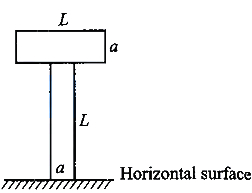
An alphabet '$T$' made of two similar thin uniform metal plates of each length '$L$' and width '$a$' is placed on a horizontal surface as shown in the figure. If the alphabet is vertically inverted,the shift in the position of its centre of mass from the horizontal surface is
A
$\frac{L-a}{2}$
B
$\frac{a-L}{2}$
C
$L-\frac{a}{2}$
D
$\frac{L}{2}-a$
Solution
(A) Let the vertical plate be $1$ and the horizontal plate be $2$. Both have area $A = L \times a$.
For the initial position:
The centre of mass of the vertical plate is at $y_1 = L/2$.
The centre of mass of the horizontal plate is at $y_2 = L + a/2$.
The combined centre of mass $y_{cm}$ is:
$y_{cm} = \frac{A_1 y_1 + A_2 y_2}{A_1 + A_2} = \frac{(La)(L/2) + (La)(L + a/2)}{2La} = \frac{L/2 + L + a/2}{2} = \frac{3L + a}{4}$.
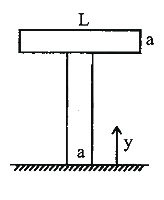
When inverted,the horizontal plate is at the bottom. The new centre of mass $y'_{cm}$ from the surface is:
The centre of mass of the horizontal plate is at $y'_1 = a/2$.
The centre of mass of the vertical plate is at $y'_2 = a + L/2$.
$y'_{cm} = \frac{(La)(a/2) + (La)(a + L/2)}{2La} = \frac{a/2 + a + L/2}{2} = \frac{3a + L}{4}$.
The shift in the centre of mass is:
$\Delta y_{cm} = y_{cm} - y'_{cm} = \frac{3L + a}{4} - \frac{3a + L}{4} = \frac{2L - 2a}{4} = \frac{L - a}{2}$.
For the initial position:
The centre of mass of the vertical plate is at $y_1 = L/2$.
The centre of mass of the horizontal plate is at $y_2 = L + a/2$.
The combined centre of mass $y_{cm}$ is:
$y_{cm} = \frac{A_1 y_1 + A_2 y_2}{A_1 + A_2} = \frac{(La)(L/2) + (La)(L + a/2)}{2La} = \frac{L/2 + L + a/2}{2} = \frac{3L + a}{4}$.
When inverted,the horizontal plate is at the bottom. The new centre of mass $y'_{cm}$ from the surface is:
The centre of mass of the horizontal plate is at $y'_1 = a/2$.
The centre of mass of the vertical plate is at $y'_2 = a + L/2$.
$y'_{cm} = \frac{(La)(a/2) + (La)(a + L/2)}{2La} = \frac{a/2 + a + L/2}{2} = \frac{3a + L}{4}$.
The shift in the centre of mass is:
$\Delta y_{cm} = y_{cm} - y'_{cm} = \frac{3L + a}{4} - \frac{3a + L}{4} = \frac{2L - 2a}{4} = \frac{L - a}{2}$.
0 likesView Solution
10
ChemistryMCQTS EAMCET · 2024
$A$ ball of mass $1.2 \ kg$ moving with a velocity of $12 \ ms^{-1}$ makes a one-dimensional collision with another stationary ball of mass $1.2 \ kg$. If the coefficient of restitution is $\frac{1}{\sqrt{2}}$,then the ratio of the total kinetic energy of the balls after collision to the initial kinetic energy is:
A
$3:4$
B
$1:1$
C
$2:3$
D
$3:\sqrt{2}$
Solution
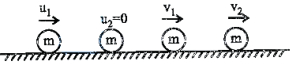
(A) Given: Mass of balls $m_1 = m_2 = m = 1.2 \ kg$. Initial velocities $u_1 = 12 \ ms^{-1}$,$u_2 = 0$. Coefficient of restitution $e = \frac{1}{\sqrt{2}}$.
By the principle of conservation of linear momentum:
$m u_1 + m u_2 = m v_1 + m v_2$
$12 + 0 = v_1 + v_2 \Rightarrow v_1 + v_2 = 12 \quad ...(i)$
By the definition of coefficient of restitution:
$e = \frac{v_2 - v_1}{u_1 - u_2}$
$\frac{1}{\sqrt{2}} = \frac{v_2 - v_1}{12 - 0} \Rightarrow v_2 - v_1 = \frac{12}{\sqrt{2}} = 6\sqrt{2} \quad ...(ii)$
Adding equations $(i)$ and $(ii)$:
$2v_2 = 12 + 6\sqrt{2} \Rightarrow v_2 = 6 + 3\sqrt{2} \ ms^{-1}$
Subtracting equation $(ii)$ from $(i)$:
$2v_1 = 12 - 6\sqrt{2} \Rightarrow v_1 = 6 - 3\sqrt{2} \ ms^{-1}$
Initial kinetic energy $(KE)_i = \frac{1}{2} m u_1^2 = \frac{1}{2} m (12)^2 = 72m$
Final kinetic energy $(KE)_f = \frac{1}{2} m v_1^2 + \frac{1}{2} m v_2^2 = \frac{1}{2} m [(6 - 3\sqrt{2})^2 + (6 + 3\sqrt{2})^2]$
$(KE)_f = \frac{1}{2} m [(36 + 18 - 36\sqrt{2}) + (36 + 18 + 36\sqrt{2})] = \frac{1}{2} m [54 + 54] = 54m$
Ratio $\frac{(KE)_f}{(KE)_i} = \frac{54m}{72m} = \frac{3}{4}$ or $3:4$.
By the principle of conservation of linear momentum:
$m u_1 + m u_2 = m v_1 + m v_2$
$12 + 0 = v_1 + v_2 \Rightarrow v_1 + v_2 = 12 \quad ...(i)$
By the definition of coefficient of restitution:
$e = \frac{v_2 - v_1}{u_1 - u_2}$
$\frac{1}{\sqrt{2}} = \frac{v_2 - v_1}{12 - 0} \Rightarrow v_2 - v_1 = \frac{12}{\sqrt{2}} = 6\sqrt{2} \quad ...(ii)$
Adding equations $(i)$ and $(ii)$:
$2v_2 = 12 + 6\sqrt{2} \Rightarrow v_2 = 6 + 3\sqrt{2} \ ms^{-1}$
Subtracting equation $(ii)$ from $(i)$:
$2v_1 = 12 - 6\sqrt{2} \Rightarrow v_1 = 6 - 3\sqrt{2} \ ms^{-1}$
Initial kinetic energy $(KE)_i = \frac{1}{2} m u_1^2 = \frac{1}{2} m (12)^2 = 72m$
Final kinetic energy $(KE)_f = \frac{1}{2} m v_1^2 + \frac{1}{2} m v_2^2 = \frac{1}{2} m [(6 - 3\sqrt{2})^2 + (6 + 3\sqrt{2})^2]$
$(KE)_f = \frac{1}{2} m [(36 + 18 - 36\sqrt{2}) + (36 + 18 + 36\sqrt{2})] = \frac{1}{2} m [54 + 54] = 54m$
Ratio $\frac{(KE)_f}{(KE)_i} = \frac{54m}{72m} = \frac{3}{4}$ or $3:4$.
0 likesView Solution
11
ChemistryEasyMCQTS EAMCET · 2024
Which of the following does not exist?
A
$[GeCl_6]^{2-}$
B
$[SiF_6]^{2-}$
C
$[SiCl_6]^{2-}$
D
$[Sn(OH)_6]^{2-}$
Solution
(C) $[SiCl_6]^{2-}$ does not exist because six large $Cl^{-}$ ions cannot be accommodated around the small $Si^{4+}$ ion due to steric hindrance and inter-electronic repulsion between the chloride ions.
In contrast,$[SiF_6]^{2-}$ exists because the $F^{-}$ ion is small enough to fit around the $Si^{4+}$ ion.
$[GeCl_6]^{2-}$ and $[Sn(OH)_6]^{2-}$ are stable due to the larger size of the central $Ge^{4+}$ and $Sn^{4+}$ ions,which can accommodate six ligands.
In contrast,$[SiF_6]^{2-}$ exists because the $F^{-}$ ion is small enough to fit around the $Si^{4+}$ ion.
$[GeCl_6]^{2-}$ and $[Sn(OH)_6]^{2-}$ are stable due to the larger size of the central $Ge^{4+}$ and $Sn^{4+}$ ions,which can accommodate six ligands.
0 likesView Solution
12
ChemistryDifficultMCQTS EAMCET · 2024
In which of the following species,the ratio of $s$-electrons to $p$-electrons is the same?
A
$K^{+}, Cr^{3+}$
B
$Zn, Fe^{2+}$
C
$Zn, Cr^{3+}$
D
$Na^{+}, K^{+}$
Solution
(A) The ratio of $s$-electrons to $p$-electrons is determined by the electronic configuration of each species.
For $K^{+}$ $(Z=19)$: $1s^2 2s^2 2p^6 3s^2 3p^6$. Total $s$-electrons = $2+2+2 = 6$. Total $p$-electrons = $6+6 = 12$. Ratio = $6:12 = 1:2$.
For $Cr^{3+}$ $(Z=24)$: $1s^2 2s^2 2p^6 3s^2 3p^6 3d^3$. Total $s$-electrons = $2+2+2 = 6$. Total $p$-electrons = $6+6 = 12$. Ratio = $6:12 = 1:2$.
Since both $K^{+}$ and $Cr^{3+}$ have the same ratio of $1:2$,the correct option is $A$.
For $K^{+}$ $(Z=19)$: $1s^2 2s^2 2p^6 3s^2 3p^6$. Total $s$-electrons = $2+2+2 = 6$. Total $p$-electrons = $6+6 = 12$. Ratio = $6:12 = 1:2$.
For $Cr^{3+}$ $(Z=24)$: $1s^2 2s^2 2p^6 3s^2 3p^6 3d^3$. Total $s$-electrons = $2+2+2 = 6$. Total $p$-electrons = $6+6 = 12$. Ratio = $6:12 = 1:2$.
Since both $K^{+}$ and $Cr^{3+}$ have the same ratio of $1:2$,the correct option is $A$.
0 likesView Solution
13
ChemistryEasyMCQTS EAMCET · 2024
Consider the following reactions:
$2 Cu_2S + 3 O_2 \rightarrow 2 Cu_2O + 2 SO_2$
$2 Cu_2O + Cu_2S \rightarrow 6 Cu + SO_2 \uparrow$
Here,$X$ is $Cu_2S$ and $Y$ is $SO_2$. The shape of the molecule $Y$ is:
$2 Cu_2S + 3 O_2 \rightarrow 2 Cu_2O + 2 SO_2$
$2 Cu_2O + Cu_2S \rightarrow 6 Cu + SO_2 \uparrow$
Here,$X$ is $Cu_2S$ and $Y$ is $SO_2$. The shape of the molecule $Y$ is:
A
Linear
B
Tetrahedral
C
Pyramidal
D
Angular
Solution
(D) The given reactions are part of the copper extraction process:
$1. 2 Cu_2S + 3 O_2 \rightarrow 2 Cu_2O + 2 SO_2$ (where $X = Cu_2S$)
$2. 2 Cu_2O + Cu_2S \rightarrow 6 Cu + SO_2$ (where $Y = SO_2$)
In the $SO_2$ molecule,the sulfur atom is $sp^2$ hybridized with one lone pair of electrons.
Due to the presence of the lone pair,the geometry is bent or angular.
$1. 2 Cu_2S + 3 O_2 \rightarrow 2 Cu_2O + 2 SO_2$ (where $X = Cu_2S$)
$2. 2 Cu_2O + Cu_2S \rightarrow 6 Cu + SO_2$ (where $Y = SO_2$)
In the $SO_2$ molecule,the sulfur atom is $sp^2$ hybridized with one lone pair of electrons.
Due to the presence of the lone pair,the geometry is bent or angular.
0 likesView Solution
14
ChemistryEasyMCQTS EAMCET · 2024
The pair of molecules/ions with the same geometry but central atoms in different states of hybridization is:
A
$SnCl_2, H_2O$
B
$SF_4, XeF_4$
C
$NH_4^{+}, CO_3^{2-}$
D
$PF_5, BrF_5$
Solution
(A) Both $SnCl_2$ and $H_2O$ have a bent geometry.
In $SnCl_2$,the central atom $Sn$ has $2$ bond pairs and $1$ lone pair,resulting in $sp^2$ hybridization.
In $H_2O$,the central atom $O$ has $2$ bond pairs and $2$ lone pairs,resulting in $sp^3$ hybridization.
Since both have a bent geometry but different hybridization states,the correct pair is $SnCl_2$ and $H_2O$.
In $SnCl_2$,the central atom $Sn$ has $2$ bond pairs and $1$ lone pair,resulting in $sp^2$ hybridization.
In $H_2O$,the central atom $O$ has $2$ bond pairs and $2$ lone pairs,resulting in $sp^3$ hybridization.
Since both have a bent geometry but different hybridization states,the correct pair is $SnCl_2$ and $H_2O$.
0 likesView Solution
15
ChemistryDifficultMCQTS EAMCET · 2024
$NH_2CONH_2 + 2 H_2O \rightarrow [X] \rightleftharpoons 2 NH_3 + H_2O + [Y]$
The hybridization of carbon in $X$ and $Y$ respectively are
The hybridization of carbon in $X$ and $Y$ respectively are
A
$sp^2, sp$
B
$sp, sp^2$
C
$sp^3, sp^2$
D
$sp^2, sp^3$
Solution
(A) The reaction is: $NH_2CONH_2 + 2 H_2O \rightarrow (NH_4)_2CO_3 \rightleftharpoons 2 NH_3 + H_2O + CO_2$.
Here,$[X]$ is ammonium carbonate $(NH_4)_2CO_3$ and $[Y]$ is carbon dioxide $(CO_2)$.
In the carbonate ion $(CO_3^{2-})$,the carbon atom is bonded to three oxygen atoms with one double bond and two single bonds,resulting in $sp^2$ hybridization.
In the carbon dioxide molecule $(O=C=O)$,the carbon atom is bonded to two oxygen atoms with two double bonds,resulting in $sp$ hybridization.
Therefore,the hybridization of carbon in $X$ and $Y$ is $sp^2$ and $sp$ respectively.
Here,$[X]$ is ammonium carbonate $(NH_4)_2CO_3$ and $[Y]$ is carbon dioxide $(CO_2)$.
In the carbonate ion $(CO_3^{2-})$,the carbon atom is bonded to three oxygen atoms with one double bond and two single bonds,resulting in $sp^2$ hybridization.
In the carbon dioxide molecule $(O=C=O)$,the carbon atom is bonded to two oxygen atoms with two double bonds,resulting in $sp$ hybridization.
Therefore,the hybridization of carbon in $X$ and $Y$ is $sp^2$ and $sp$ respectively.
0 likesView Solution
16
ChemistryEasyMCQTS EAMCET · 2024
Match the molecules in List-$I$ with their respective shapes in List-$II$.
| List-$I$ (Molecule) | List-$II$ (Shape) |
|---|---|
| $A. SF_4$ | $I. T\text{-shaped}$ |
| $B. ClF_3$ | $II. \text{Square planar}$ |
| $C. BrF_5$ | $III. \text{See-saw}$ |
| $D. XeF_4$ | $IV. \text{Square pyramidal}$ |
A
$A-II, B-III, C-I, D-IV$
B
$A-II, B-I, C-IV, D-III$
C
$A-III, B-II, C-IV, D-I$
D
$A-III, B-I, C-IV, D-II$
Solution
(D) To determine the shape of the molecules, we use the $VSEPR$ theory:
$A. SF_4$: Hybridisation is $sp^3d$ with one lone pair, resulting in a see-saw shape $(III)$.
$B. ClF_3$: Hybridisation is $sp^3d$ with two lone pairs, resulting in a $T$-shaped geometry $(I)$.
$C. BrF_5$: Hybridisation is $sp^3d^2$ with one lone pair, resulting in a square pyramidal shape $(IV)$.
$D. XeF_4$: Hybridisation is $sp^3d^2$ with two lone pairs, resulting in a square planar shape $(II)$.
Therefore, the correct matching is $A-III, B-I, C-IV, D-II$.
$A. SF_4$: Hybridisation is $sp^3d$ with one lone pair, resulting in a see-saw shape $(III)$.
$B. ClF_3$: Hybridisation is $sp^3d$ with two lone pairs, resulting in a $T$-shaped geometry $(I)$.
$C. BrF_5$: Hybridisation is $sp^3d^2$ with one lone pair, resulting in a square pyramidal shape $(IV)$.
$D. XeF_4$: Hybridisation is $sp^3d^2$ with two lone pairs, resulting in a square planar shape $(II)$.
Therefore, the correct matching is $A-III, B-I, C-IV, D-II$.
0 likesView Solution
17
ChemistryEasyMCQTS EAMCET · 2024
The hybridisation of the central atom of $BF_3$,$SnCl_2$,and $HgCl_2$ respectively is:
A
$sp^2, sp^2, sp$
B
$sp^2, sp^2, sp^2$
C
$sp^3, sp^2, sp^2$
D
$sp^3, sp, sp^2$
Solution
(A) For $BF_3$: The central atom $B$ has $3$ valence electrons and forms $3$ bonds with $F$ atoms. Steric number $= 3 + 0 = 3$,which corresponds to $sp^2$ hybridisation.
For $SnCl_2$: The central atom $Sn$ has $4$ valence electrons. It forms $2$ bonds with $Cl$ atoms and has $1$ lone pair. Steric number $= 2 + 1 = 3$,which corresponds to $sp^2$ hybridisation.
For $HgCl_2$: The central atom $Hg$ has $2$ valence electrons and forms $2$ bonds with $Cl$ atoms. Steric number $= 2 + 0 = 2$,which corresponds to $sp$ hybridisation.
Therefore,the correct sequence is $sp^2, sp^2, sp$.
For $SnCl_2$: The central atom $Sn$ has $4$ valence electrons. It forms $2$ bonds with $Cl$ atoms and has $1$ lone pair. Steric number $= 2 + 1 = 3$,which corresponds to $sp^2$ hybridisation.
For $HgCl_2$: The central atom $Hg$ has $2$ valence electrons and forms $2$ bonds with $Cl$ atoms. Steric number $= 2 + 0 = 2$,which corresponds to $sp$ hybridisation.
Therefore,the correct sequence is $sp^2, sp^2, sp$.
0 likesView Solution
18
ChemistryEasyMCQTS EAMCET · 2024
The number of lone pairs of electrons on the central atom of $ClF_3, NF_3, SF_4,$ and $XeF_4$ respectively are:
A
$0, 1, 0, 2$
B
$2, 1, 0, 0$
C
$2, 1, 1, 2$
D
$2, 1, 1, 0$
Solution
(C) To determine the number of lone pairs on the central atom,we use the formula: $\text{Lone pairs} = \frac{1}{2} (V - N)$,where $V$ is the number of valence electrons of the central atom and $N$ is the number of monovalent atoms bonded to it.
$1$. For $ClF_3$: $V = 7, N = 3$. $\text{Lone pairs} = \frac{1}{2} (7 - 3) = 2$.
$2$. For $NF_3$: $V = 5, N = 3$. $\text{Lone pairs} = \frac{1}{2} (5 - 3) = 1$.
$3$. For $SF_4$: $V = 6, N = 4$. $\text{Lone pairs} = \frac{1}{2} (6 - 4) = 1$.
$4$. For $XeF_4$: $V = 8, N = 4$. $\text{Lone pairs} = \frac{1}{2} (8 - 4) = 2$.
Therefore,the correct sequence is $2, 1, 1, 2$.
$1$. For $ClF_3$: $V = 7, N = 3$. $\text{Lone pairs} = \frac{1}{2} (7 - 3) = 2$.
$2$. For $NF_3$: $V = 5, N = 3$. $\text{Lone pairs} = \frac{1}{2} (5 - 3) = 1$.
$3$. For $SF_4$: $V = 6, N = 4$. $\text{Lone pairs} = \frac{1}{2} (6 - 4) = 1$.
$4$. For $XeF_4$: $V = 8, N = 4$. $\text{Lone pairs} = \frac{1}{2} (8 - 4) = 2$.
| Compound | Lone pairs |
| $ClF_3$ | $2$ |
| $NF_3$ | $1$ |
| $SF_4$ | $1$ |
| $XeF_4$ | $2$ |
Therefore,the correct sequence is $2, 1, 1, 2$.
0 likesView Solution
19
ChemistryMediumMCQTS EAMCET · 2024
The bond angles $H-O-N$ and $O-N-O$ in the planar structure of nitric acid molecule are respectively:
A
$130^{\circ}, 102^{\circ}$
B
$102^{\circ}, 130^{\circ}$
C
$134^{\circ}, 100^{\circ}$
D
$100^{\circ}, 134^{\circ}$
Solution
(B) In the planar structure of the nitric acid $(HNO_3)$ molecule,the nitrogen atom is $sp^2$ hybridized.
Based on the experimental structural data provided in the image:
The bond angle $H-O-N$ is approximately $102.2^{\circ}$.
The bond angle $O-N-O$ (between the two oxygen atoms bonded to nitrogen) is approximately $130.27^{\circ}$.
Therefore,the respective bond angles are $102^{\circ}$ and $130^{\circ}$.
Based on the experimental structural data provided in the image:
The bond angle $H-O-N$ is approximately $102.2^{\circ}$.
The bond angle $O-N-O$ (between the two oxygen atoms bonded to nitrogen) is approximately $130.27^{\circ}$.
Therefore,the respective bond angles are $102^{\circ}$ and $130^{\circ}$.
0 likesView Solution
20
ChemistryMediumMCQTS EAMCET · 2024
Identify the pair in which the difference in bond order value is maximum.
A
$O_2^{-}, O_2^{+}$
B
$O_2^{2-}, O_2^{2+}$
C
$O_2, O_2^{2+}$
D
$O_2^{+}, O_2^{2+}$
Solution
(B) The bond order is calculated as: $\text{Bond order} = \frac{1}{2} [N_b - N_a]$,where $N_b$ is the number of bonding electrons and $N_a$ is the number of anti-bonding electrons.
For $O_2$ ($16$ electrons): $\text{Bond order} = \frac{1}{2} [10 - 6] = 2.0$.
For $O_2^{-}$ ($17$ electrons): $\text{Bond order} = \frac{1}{2} [10 - 7] = 1.5$.
For $O_2^{+}$ ($15$ electrons): $\text{Bond order} = \frac{1}{2} [10 - 5] = 2.5$.
For $O_2^{2-}$ ($18$ electrons): $\text{Bond order} = \frac{1}{2} [10 - 8] = 1.0$.
For $O_2^{2+}$ ($14$ electrons): $\text{Bond order} = \frac{1}{2} [10 - 4] = 3.0$.
Calculating the differences:
$(A)$ $|2.5 - 1.5| = 1.0$
$(B)$ $|3.0 - 1.0| = 2.0$
$(C)$ $|3.0 - 2.0| = 1.0$
$(D)$ $|3.0 - 2.5| = 0.5$
The maximum difference is $2.0$ for the pair $O_2^{2-}$ and $O_2^{2+}$.
For $O_2$ ($16$ electrons): $\text{Bond order} = \frac{1}{2} [10 - 6] = 2.0$.
For $O_2^{-}$ ($17$ electrons): $\text{Bond order} = \frac{1}{2} [10 - 7] = 1.5$.
For $O_2^{+}$ ($15$ electrons): $\text{Bond order} = \frac{1}{2} [10 - 5] = 2.5$.
For $O_2^{2-}$ ($18$ electrons): $\text{Bond order} = \frac{1}{2} [10 - 8] = 1.0$.
For $O_2^{2+}$ ($14$ electrons): $\text{Bond order} = \frac{1}{2} [10 - 4] = 3.0$.
Calculating the differences:
$(A)$ $|2.5 - 1.5| = 1.0$
$(B)$ $|3.0 - 1.0| = 2.0$
$(C)$ $|3.0 - 2.0| = 1.0$
$(D)$ $|3.0 - 2.5| = 0.5$
The maximum difference is $2.0$ for the pair $O_2^{2-}$ and $O_2^{2+}$.
0 likesView Solution
21
ChemistryMediumMCQTS EAMCET · 2024
According to molecular orbital theory,which of the following statements is not correct?
A
$C_2$ molecule is diamagnetic in nature
B
Bond order of $C_2$ molecule is $2$
C
$C_2^{-}$ ion is paramagnetic in nature
D
$C_2$ consists of $1 \sigma$ and $1 \pi$ bond
Solution
(D) The electronic configuration of $C_2$ ($12$ electrons) is: $(\sigma 1s)^2 (\sigma^* 1s)^2 (\sigma 2s)^2 (\sigma^* 2s)^2 (\pi 2p_x)^2 (\pi 2p_y)^2$.
Bond order $= \frac{1}{2}(N_b - N_a) = \frac{1}{2}(8 - 4) = 2$.
Since all electrons are paired,$C_2$ is diamagnetic.
$C_2^{-}$ has $13$ electrons,configuration: $(\sigma 1s)^2 (\sigma^* 1s)^2 (\sigma 2s)^2 (\sigma^* 2s)^2 (\pi 2p_x)^2 (\pi 2p_y)^2 (\sigma 2p_z)^1$. It has one unpaired electron,so it is paramagnetic.
In $C_2$,the two highest occupied molecular orbitals are $\pi$ orbitals,meaning $C_2$ consists of two $\pi$ bonds.
Therefore,the statement that $C_2$ consists of $1 \sigma$ and $1 \pi$ bond is incorrect.
Bond order $= \frac{1}{2}(N_b - N_a) = \frac{1}{2}(8 - 4) = 2$.
Since all electrons are paired,$C_2$ is diamagnetic.
$C_2^{-}$ has $13$ electrons,configuration: $(\sigma 1s)^2 (\sigma^* 1s)^2 (\sigma 2s)^2 (\sigma^* 2s)^2 (\pi 2p_x)^2 (\pi 2p_y)^2 (\sigma 2p_z)^1$. It has one unpaired electron,so it is paramagnetic.
In $C_2$,the two highest occupied molecular orbitals are $\pi$ orbitals,meaning $C_2$ consists of two $\pi$ bonds.
Therefore,the statement that $C_2$ consists of $1 \sigma$ and $1 \pi$ bond is incorrect.
0 likesView Solution
22
ChemistryMediumMCQTS EAMCET · 2024
According to Fajan's rules,which of the following is not correct about covalent character?
A
$KF < KI$
B
$LiF < KF$
C
$SnCl_2 < SnCl_4$
D
$NaCl < CuCl$
Solution
(B) According to Fajan's rules,covalent character increases with:
$1$. Smaller size of the cation.
$2$. Larger size of the anion.
$3$. Higher charge on the cation or anion.
Evaluating the options:
- $KF < KI$: $I^-$ is larger than $F^-$,so $KI$ is more covalent. (Correct)
- $LiF < KF$: $Li^+$ is smaller than $K^+$,so $LiF$ should be more covalent than $KF$. Thus,$LiF > KF$. (Incorrect)
- $SnCl_2 < SnCl_4$: $Sn^{4+}$ has a higher charge than $Sn^{2+}$,so $SnCl_4$ is more covalent. (Correct)
- $NaCl < CuCl$: $Cu^+$ has a pseudo-noble gas configuration ($18$ electrons in the valence shell) and is more polarizing than $Na^+$. (Correct)
Therefore,the statement $LiF < KF$ is incorrect.
$1$. Smaller size of the cation.
$2$. Larger size of the anion.
$3$. Higher charge on the cation or anion.
Evaluating the options:
- $KF < KI$: $I^-$ is larger than $F^-$,so $KI$ is more covalent. (Correct)
- $LiF < KF$: $Li^+$ is smaller than $K^+$,so $LiF$ should be more covalent than $KF$. Thus,$LiF > KF$. (Incorrect)
- $SnCl_2 < SnCl_4$: $Sn^{4+}$ has a higher charge than $Sn^{2+}$,so $SnCl_4$ is more covalent. (Correct)
- $NaCl < CuCl$: $Cu^+$ has a pseudo-noble gas configuration ($18$ electrons in the valence shell) and is more polarizing than $Na^+$. (Correct)
Therefore,the statement $LiF < KF$ is incorrect.
0 likesView Solution
23
ChemistryEasyMCQTS EAMCET · 2024
Consider the following pairs:
Which of the above pairs are correctly matched?
| Order | Property |
|---|---|
| $(A)$ $NO_2 > O_3 > H_2O$ | Bond angle |
| $(B)$ $H_2O > HF > NH_3$ | Dipole moment |
| $(C)$ $I_2 > F_2 > N_2$ | Bond length |
Which of the above pairs are correctly matched?
A
$(A), (B) \& (C)$
B
$(B) \& (C)$ only
C
$(A) \& (C)$ only
D
$(A) \& (B)$ only
Solution
(A) Let us analyze each pair:
$(A)$ Bond angle: The bond angles are $NO_2$ $(134^{\circ})$,$O_3$ $(116.8^{\circ})$,and $H_2O$ $(104.5^{\circ})$. Thus,the order $NO_2 > O_3 > H_2O$ is correct.
$(B)$ Dipole moment: The dipole moments are $H_2O$ $(1.85 \ D)$,$HF$ $(1.78 \ D)$,and $NH_3$ $(1.47 \ D)$. Thus,the order $H_2O > HF > NH_3$ is correct.
$(C)$ Bond length: $I_2$ has a single bond with a large atomic size,$F_2$ has a single bond with a smaller atomic size,and $N_2$ has a triple bond with a very small atomic size. Bond length order is $I_2 > F_2 > N_2$. This is correct.
Therefore,all three pairs $(A), (B),$ and $(C)$ are correctly matched.
$(A)$ Bond angle: The bond angles are $NO_2$ $(134^{\circ})$,$O_3$ $(116.8^{\circ})$,and $H_2O$ $(104.5^{\circ})$. Thus,the order $NO_2 > O_3 > H_2O$ is correct.
$(B)$ Dipole moment: The dipole moments are $H_2O$ $(1.85 \ D)$,$HF$ $(1.78 \ D)$,and $NH_3$ $(1.47 \ D)$. Thus,the order $H_2O > HF > NH_3$ is correct.
$(C)$ Bond length: $I_2$ has a single bond with a large atomic size,$F_2$ has a single bond with a smaller atomic size,and $N_2$ has a triple bond with a very small atomic size. Bond length order is $I_2 > F_2 > N_2$. This is correct.
Therefore,all three pairs $(A), (B),$ and $(C)$ are correctly matched.
0 likesView Solution
24
ChemistryMediumMCQTS EAMCET · 2024
Identify the set of molecules which are not in the correct order of their dipole moments.
A
$HF > HCl > HBr$
B
$H_2O > H_2S > CO_2$
C
$H_2S > HCl > HF$
D
$NH_3 > NF_3 > BF_3$
Solution
(C) Dipole moment $\mu = q \times d$.
The dipole moments of the given molecules are as follows:
Evaluating the options:
Option $A$: $1.82 > 1.08 > 0.83$ (Correct order).
Option $B$: $1.85 > 0.95 > 0.00$ (Correct order).
Option $C$: $0.95 > 1.08 > 1.82$ (Incorrect order,as $HF$ has the highest dipole moment).
Option $D$: $1.47 > 0.24 > 0.00$ (Correct order).
The dipole moments of the given molecules are as follows:
| $HF = 1.82 \ D$ | $H_2O = 1.85 \ D$ | $NH_3 = 1.47 \ D$ |
| $HCl = 1.08 \ D$ | $H_2S = 0.95 \ D$ | $NF_3 = 0.24 \ D$ |
| $HBr = 0.83 \ D$ | $CO_2 = 0.00 \ D$ | $BF_3 = 0.00 \ D$ |
Evaluating the options:
Option $A$: $1.82 > 1.08 > 0.83$ (Correct order).
Option $B$: $1.85 > 0.95 > 0.00$ (Correct order).
Option $C$: $0.95 > 1.08 > 1.82$ (Incorrect order,as $HF$ has the highest dipole moment).
Option $D$: $1.47 > 0.24 > 0.00$ (Correct order).
0 likesView Solution
25
ChemistryMediumMCQTS EAMCET · 2024
The melting point of $o$-hydroxybenzaldehyde $(A)$ is lower than that of $p$-hydroxybenzaldehyde $(B)$. This is because
A
$(A)$ has intermolecular $H$-bonding and $(B)$ has intramolecular $H$-bonding
B
Both $(A)$ and $(B)$ have intermolecular $H$-bonding
C
Both $(A)$ and $(B)$ have intramolecular $H$-bonding
D
$(A)$ has intramolecular $H$-bonding and $(B)$ has intermolecular $H$-bonding
Solution
(D) $o$-hydroxybenzaldehyde $(A)$ exhibits intramolecular $H$-bonding,which leads to the formation of a stable chelate ring within the molecule. This restricts the association between different molecules.
In contrast,$p$-hydroxybenzaldehyde $(B)$ exhibits intermolecular $H$-bonding,which allows for strong association between different molecules,resulting in a higher melting point.
Therefore,the lower melting point of $(A)$ is due to the presence of intramolecular $H$-bonding,while $(B)$ has intermolecular $H$-bonding.
In contrast,$p$-hydroxybenzaldehyde $(B)$ exhibits intermolecular $H$-bonding,which allows for strong association between different molecules,resulting in a higher melting point.
Therefore,the lower melting point of $(A)$ is due to the presence of intramolecular $H$-bonding,while $(B)$ has intermolecular $H$-bonding.
0 likesView Solution
26
ChemistryMediumMCQTS EAMCET · 2024
At $T \ K$,$K_c$ for the reaction $AO_{2(g)} + BO_{2(g)} \rightleftharpoons AO_{3(g)} + BO_{(g)}$ is $16$. One mole each of reactants and products are taken in a $1 \ L$ flask and heated to $T \ K$,and equilibrium is established. What is the equilibrium concentration of $BO$ (in $mol \ L^{-1}$)?
A
$1.6$
B
$0.4$
C
$1.2$
D
$0.8$
Solution
(A) The reaction is $AO_{2(g)} + BO_{2(g)} \rightleftharpoons AO_{3(g)} + BO_{(g)}$.
Given $K_c = 16$ and initial concentrations $[AO_2] = [BO_2] = [AO_3] = [BO] = 1.0 \ M$.
Let the change in concentration be $x$.
At equilibrium:
$[AO_2] = 1 - x$
$[BO_2] = 1 - x$
$[AO_3] = 1 + x$
$[BO] = 1 + x$
$K_c = \frac{[AO_3][BO]}{[AO_2][BO_2]} = \frac{(1+x)(1+x)}{(1-x)(1-x)} = 16$
Taking the square root of both sides:
$\frac{1+x}{1-x} = 4$
$1 + x = 4 - 4x$
$5x = 3 \implies x = 0.6$
Equilibrium concentration of $[BO] = 1 + x = 1 + 0.6 = 1.6 \ mol \ L^{-1}$.
Given $K_c = 16$ and initial concentrations $[AO_2] = [BO_2] = [AO_3] = [BO] = 1.0 \ M$.
Let the change in concentration be $x$.
At equilibrium:
$[AO_2] = 1 - x$
$[BO_2] = 1 - x$
$[AO_3] = 1 + x$
$[BO] = 1 + x$
$K_c = \frac{[AO_3][BO]}{[AO_2][BO_2]} = \frac{(1+x)(1+x)}{(1-x)(1-x)} = 16$
Taking the square root of both sides:
$\frac{1+x}{1-x} = 4$
$1 + x = 4 - 4x$
$5x = 3 \implies x = 0.6$
Equilibrium concentration of $[BO] = 1 + x = 1 + 0.6 = 1.6 \ mol \ L^{-1}$.
0 likesView Solution
27
ChemistryEasyMCQTS EAMCET · 2024
At $T$ $(K)$,$K_c$ for the dissociation of $PCl_5$ is $2 \times 10^{-2} \ mol \ L^{-1}$. The number of moles of $PCl_5$ that must be taken in a $1.0 \ L$ flask at the same temperature to get $0.2 \ mol$ of chlorine at equilibrium is:
A
$2.2$
B
$1.8$
C
$1.1$
D
$4.4$
Solution
(A) The dissociation reaction is: $PCl_{5(g)} \rightleftharpoons PCl_{3(g)} + Cl_{2(g)}$
Given $K_c = 2 \times 10^{-2} \ mol \ L^{-1}$ and volume $V = 1.0 \ L$.
Let the initial moles of $PCl_5$ be $x$.
Since $V = 1.0 \ L$,the concentrations at equilibrium are $[PCl_5] = (x - 0.2) \ M$,$[PCl_3] = 0.2 \ M$,and $[Cl_2] = 0.2 \ M$.
The equilibrium constant expression is $K_c = \frac{[PCl_3][Cl_2]}{[PCl_5]}$.
Substituting the values: $2 \times 10^{-2} = \frac{0.2 \times 0.2}{x - 0.2}$.
$0.02 = \frac{0.04}{x - 0.2} \implies x - 0.2 = \frac{0.04}{0.02} = 2$.
$x = 2 + 0.2 = 2.2 \ mol$.
Given $K_c = 2 \times 10^{-2} \ mol \ L^{-1}$ and volume $V = 1.0 \ L$.
Let the initial moles of $PCl_5$ be $x$.
| Reaction | $PCl_{5(g)}$ | $PCl_{3(g)} + Cl_{2(g)}$ |
| Initial moles | $x$ | $0, 0$ |
| Equilibrium moles | $x - 0.2$ | $0.2, 0.2$ |
Since $V = 1.0 \ L$,the concentrations at equilibrium are $[PCl_5] = (x - 0.2) \ M$,$[PCl_3] = 0.2 \ M$,and $[Cl_2] = 0.2 \ M$.
The equilibrium constant expression is $K_c = \frac{[PCl_3][Cl_2]}{[PCl_5]}$.
Substituting the values: $2 \times 10^{-2} = \frac{0.2 \times 0.2}{x - 0.2}$.
$0.02 = \frac{0.04}{x - 0.2} \implies x - 0.2 = \frac{0.04}{0.02} = 2$.
$x = 2 + 0.2 = 2.2 \ mol$.
0 likesView Solution
28
ChemistryMediumMCQTS EAMCET · 2024
At $T \ K$,the equilibrium constants for the following two reactions are given below:
$2 A_{(g)} \rightleftharpoons B_{(g)} + C_{(g)} ; K_1 = 16$
$2 B_{(g)} + C_{(g)} \rightleftharpoons 2 D_{(g)} ; K_2 = 25$
What is the value of equilibrium constant $(K)$ for the reaction given below at $T \ K$?
$A_{(g)} + \frac{1}{2} B_{(g)} \rightleftharpoons D_{(g)}$
$2 A_{(g)} \rightleftharpoons B_{(g)} + C_{(g)} ; K_1 = 16$
$2 B_{(g)} + C_{(g)} \rightleftharpoons 2 D_{(g)} ; K_2 = 25$
What is the value of equilibrium constant $(K)$ for the reaction given below at $T \ K$?
$A_{(g)} + \frac{1}{2} B_{(g)} \rightleftharpoons D_{(g)}$
A
$100$
B
$50$
C
$20$
D
$75$
Solution
(C) Given reactions:
$(i) \ 2 A_{(g)} \rightleftharpoons B_{(g)} + C_{(g)} ; K_1 = 16$
$(ii) \ 2 B_{(g)} + C_{(g)} \rightleftharpoons 2 D_{(g)} ; K_2 = 25$
We need the equilibrium constant $(K_3)$ for:
$(iii) \ A_{(g)} + \frac{1}{2} B_{(g)} \rightleftharpoons D_{(g)}$
From $(i)$,$K_1 = \frac{[B][C]}{[A]^2} = 16$.
From $(ii)$,$K_2 = \frac{[D]^2}{[C][B]^2} = 25$.
Multiplying $(i)$ and $(ii)$:
$K_1 \times K_2 = \frac{[B][C]}{[A]^2} \times \frac{[D]^2}{[C][B]^2} = \frac{[D]^2}{[A]^2 [B]} = 16 \times 25 = 400$.
Taking the square root of the expression:
$\sqrt{\frac{[D]^2}{[A]^2 [B]}} = \frac{[D]}{[A][B]^{1/2}} = \sqrt{400} = 20$.
Thus,$K_3 = 20$.
$(i) \ 2 A_{(g)} \rightleftharpoons B_{(g)} + C_{(g)} ; K_1 = 16$
$(ii) \ 2 B_{(g)} + C_{(g)} \rightleftharpoons 2 D_{(g)} ; K_2 = 25$
We need the equilibrium constant $(K_3)$ for:
$(iii) \ A_{(g)} + \frac{1}{2} B_{(g)} \rightleftharpoons D_{(g)}$
From $(i)$,$K_1 = \frac{[B][C]}{[A]^2} = 16$.
From $(ii)$,$K_2 = \frac{[D]^2}{[C][B]^2} = 25$.
Multiplying $(i)$ and $(ii)$:
$K_1 \times K_2 = \frac{[B][C]}{[A]^2} \times \frac{[D]^2}{[C][B]^2} = \frac{[D]^2}{[A]^2 [B]} = 16 \times 25 = 400$.
Taking the square root of the expression:
$\sqrt{\frac{[D]^2}{[A]^2 [B]}} = \frac{[D]}{[A][B]^{1/2}} = \sqrt{400} = 20$.
Thus,$K_3 = 20$.
0 likesView Solution
29
ChemistryMediumMCQTS EAMCET · 2024
In the synthesis of sodium lauryl sulphate,lauryl alcohol is treated with $H_2SO_4$ to form lauryl hydrogen sulphate,which is then neutralized with $NaOH$. The structure of lauryl alcohol is $CH_3(CH_2)_nCH_2OH$. What is the value of '$n$'?
A
$10$
B
$12$
C
$16$
D
$14$
Solution
(A) Lauryl alcohol is $1$-dodecanol,which has a total of $12$ carbon atoms in its chain.
The chemical formula for lauryl alcohol is $CH_3(CH_2)_{10}CH_2OH$.
Comparing this with the given general formula $CH_3(CH_2)_nCH_2OH$,we find that $n=10$.
The chemical formula for lauryl alcohol is $CH_3(CH_2)_{10}CH_2OH$.
Comparing this with the given general formula $CH_3(CH_2)_nCH_2OH$,we find that $n=10$.
0 likesView Solution
30
ChemistryEasyMCQTS EAMCET · 2024
Observe the oxides $CO, B_2O_3, SiO_2, CO_2, Al_2O_3, PbO_2, Tl_2O_3$. The number of acidic oxides in the list is:
A
$3$
B
$4$
C
$5$
D
$2$
Solution
(A) The acidic oxides are $B_2O_3, SiO_2,$ and $CO_2$.
$CO$ is a neutral oxide.
$Al_2O_3$ and $PbO_2$ are amphoteric oxides.
$Tl_2O_3$ is a basic oxide.
Therefore,the total number of acidic oxides is $3$.
$CO$ is a neutral oxide.
$Al_2O_3$ and $PbO_2$ are amphoteric oxides.
$Tl_2O_3$ is a basic oxide.
Therefore,the total number of acidic oxides is $3$.
0 likesView Solution
31
ChemistryEasyMCQTS EAMCET · 2024
Which of the following has the least electron gain enthalpy?
A
Chlorine
B
Iodine
C
Oxygen
D
Sulphur
Solution
(B) Electron gain enthalpy becomes less negative (or smaller in magnitude) as we move down a group due to an increase in atomic size.
Among the given elements,$Cl$ and $S$ are in the $3^{rd}$ period,while $O$ and $I$ are in the $2^{nd}$ and $5^{th}$ periods respectively.
$Cl$ has the most negative electron gain enthalpy.
$Iodine$ $(I)$ has the least negative electron gain enthalpy among the halogens listed due to its large atomic size,which reduces the attraction for an incoming electron.
Comparing $O$ and $S$,$O$ has a smaller electron gain enthalpy than $S$ due to inter-electronic repulsion in its small $2p$ orbital.
However,comparing all four,$Iodine$ $(I)$ has the least electron gain enthalpy.
Among the given elements,$Cl$ and $S$ are in the $3^{rd}$ period,while $O$ and $I$ are in the $2^{nd}$ and $5^{th}$ periods respectively.
$Cl$ has the most negative electron gain enthalpy.
$Iodine$ $(I)$ has the least negative electron gain enthalpy among the halogens listed due to its large atomic size,which reduces the attraction for an incoming electron.
Comparing $O$ and $S$,$O$ has a smaller electron gain enthalpy than $S$ due to inter-electronic repulsion in its small $2p$ orbital.
However,comparing all four,$Iodine$ $(I)$ has the least electron gain enthalpy.
0 likesView Solution
32
ChemistryMediumMCQTS EAMCET · 2024
Identify the pair of elements in which the ratio of the number of $s$-electrons to $p$-electrons is $2:3$.
A
$P, Mg$
B
$P, Ca$
C
$O, Mg$
D
$O, S$
Solution
(B) For $P$ $(Z=15)$: $1s^2 2s^2 2p^6 3s^2 3p^3$. Total $s$-electrons = $2+2+2 = 6$. Total $p$-electrons = $6+3 = 9$. Ratio = $6/9 = 2/3$.
For $Ca$ $(Z=20)$: $1s^2 2s^2 2p^6 3s^2 3p^6 4s^2$. Total $s$-electrons = $2+2+2+2 = 8$. Total $p$-electrons = $6+6 = 12$. Ratio = $8/12 = 2/3$.
Thus,the pair is $P$ and $Ca$.
For $Ca$ $(Z=20)$: $1s^2 2s^2 2p^6 3s^2 3p^6 4s^2$. Total $s$-electrons = $2+2+2+2 = 8$. Total $p$-electrons = $6+6 = 12$. Ratio = $8/12 = 2/3$.
Thus,the pair is $P$ and $Ca$.
0 likesView Solution
33
ChemistryEasyMCQTS EAMCET · 2024
Identify the pair of elements in which the difference in atomic radii is maximum.
A
$C, N$
B
$P, S$
C
$O, F$
D
$Li, Be$
Solution
(D) $1.$ $C$ and $N$ are in the same period. The atomic radius of $C$ is $\approx 77 \ pm$ and $N$ is $\approx 75 \ pm$. The difference is $\approx 2 \ pm$.
$2.$ $O$ and $F$ are in the same period. The atomic radius of $O$ is $\approx 73 \ pm$ and $F$ is $\approx 71 \ pm$. The difference is $\approx 2 \ pm$.
$3.$ $P$ and $S$ are in the same period. The atomic radius of $P$ is $\approx 110 \ pm$ and $S$ is $\approx 103 \ pm$. The difference is $\approx 7 \ pm$.
$4.$ $Li$ and $Be$ are in the same period. The atomic radius of $Li$ is $\approx 152 \ pm$ and $Be$ is $\approx 111 \ pm$. The difference is $\approx 41 \ pm$.
Comparing all pairs, the difference in atomic radii is maximum for the pair $(Li, Be)$.
$2.$ $O$ and $F$ are in the same period. The atomic radius of $O$ is $\approx 73 \ pm$ and $F$ is $\approx 71 \ pm$. The difference is $\approx 2 \ pm$.
$3.$ $P$ and $S$ are in the same period. The atomic radius of $P$ is $\approx 110 \ pm$ and $S$ is $\approx 103 \ pm$. The difference is $\approx 7 \ pm$.
$4.$ $Li$ and $Be$ are in the same period. The atomic radius of $Li$ is $\approx 152 \ pm$ and $Be$ is $\approx 111 \ pm$. The difference is $\approx 41 \ pm$.
Comparing all pairs, the difference in atomic radii is maximum for the pair $(Li, Be)$.
0 likesView Solution
34
ChemistryMediumMCQTS EAMCET · 2024
In which of the following ionic pairs,is the second ion smaller in size than the first ion?
A
$Al^{3+}, Mg^{2+}$
B
$F^{-}, Na^{+}$
C
$O^{2-}, N^{3-}$
D
$Mg^{2+}, Na^{+}$
Solution
(B) For isoelectronic species,the size decreases as the nuclear charge (number of protons) increases.
$F^{-}$ has $9$ protons and $10$ electrons.
$Na^{+}$ has $11$ protons and $10$ electrons.
Since $Na^{+}$ has a higher nuclear charge than $F^{-}$,the electrons are pulled more strongly towards the nucleus,making $Na^{+}$ smaller than $F^{-}$.
Thus,in the pair $(F^{-}, Na^{+})$,the second ion is smaller than the first.
$F^{-}$ has $9$ protons and $10$ electrons.
$Na^{+}$ has $11$ protons and $10$ electrons.
Since $Na^{+}$ has a higher nuclear charge than $F^{-}$,the electrons are pulled more strongly towards the nucleus,making $Na^{+}$ smaller than $F^{-}$.
Thus,in the pair $(F^{-}, Na^{+})$,the second ion is smaller than the first.
0 likesView Solution
35
ChemistryEasyMCQTS EAMCET · 2024
Assertion $(A)$: The ionic radii of $Na^{+}$ and $F^{-}$ are same.
Reason $(R)$: Both $Na^{+}$ and $F^{-}$ are isoelectronic species.
The correct answer is:
Reason $(R)$: Both $Na^{+}$ and $F^{-}$ are isoelectronic species.
The correct answer is:
A
$(A)$ and $(R)$ are correct. $(R)$ is the correct explanation of $(A)$
B
$(A)$ and $(R)$ are correct,but $(R)$ is not the correct explanation of $(A)$
C
$(A)$ is correct but $(R)$ is not correct
D
$(A)$ is not correct but $(R)$ is correct
Solution
(D) The electronic configuration of $Na^{+}$ is $1s^2 2s^2 2p^6$ ($10$ electrons).
The electronic configuration of $F^{-}$ is $1s^2 2s^2 2p^6$ ($10$ electrons).
Since both have the same number of electrons,they are isoelectronic species,so $(R)$ is correct.
However,the ionic radius depends on the nuclear charge $(Z)$.
For $Na^{+}$,$Z = 11$,and for $F^{-}$,$Z = 9$.
As the nuclear charge increases,the attraction of the nucleus on the electrons increases,leading to a smaller ionic radius.
Therefore,the ionic radius of $Na^{+}$ $(102 \ pm)$ is smaller than that of $F^{-}$ $(133 \ pm)$.
Thus,$(A)$ is incorrect.
The electronic configuration of $F^{-}$ is $1s^2 2s^2 2p^6$ ($10$ electrons).
Since both have the same number of electrons,they are isoelectronic species,so $(R)$ is correct.
However,the ionic radius depends on the nuclear charge $(Z)$.
For $Na^{+}$,$Z = 11$,and for $F^{-}$,$Z = 9$.
As the nuclear charge increases,the attraction of the nucleus on the electrons increases,leading to a smaller ionic radius.
Therefore,the ionic radius of $Na^{+}$ $(102 \ pm)$ is smaller than that of $F^{-}$ $(133 \ pm)$.
Thus,$(A)$ is incorrect.
0 likesView Solution
36
ChemistryEasyMCQTS EAMCET · 2024
The set containing the elements with positive electron gain enthalpies is
A
$S, Se, Te$
B
$Kr, Xe, Rn$
C
$Cl, Br, I$
D
$K, Rb, Cs$
Solution
(B) Noble gases have large positive electron gain enthalpies because the added electron has to enter the next higher principal quantum level,which leads to a very unstable electronic configuration.
Therefore,the set containing noble gases,$Kr, Xe, Rn$,will have positive electron gain enthalpies.
Thus,option $(B)$ is correct.
Therefore,the set containing noble gases,$Kr, Xe, Rn$,will have positive electron gain enthalpies.
Thus,option $(B)$ is correct.
0 likesView Solution
37
ChemistryEasyMCQTS EAMCET · 2024
Among the oxides $SiO_2, SO_2, Al_2O_3$ and $P_2O_3$,the correct order of acidic strength is
A
$SiO_2 < SO_2 < Al_2O_3 < P_2O_3$
B
$SO_2 < P_2O_3 < Al_2O_3 < SiO_2$
C
$Al_2O_3 < SiO_2 < P_2O_3 < SO_2$
D
$Al_2O_3 < P_2O_3 < SiO_2 < SO_2$
Solution
(C) Across a period from left to right,the electronegativity of the element increases,which leads to an increase in the acidic strength of its oxides.
The elements $Al, Si, P$ and $S$ belong to the same period (Period $3$).
The order of electronegativity is $Al < Si < P < S$.
Thus,the correct order of acidic strength is $Al_2O_3 < SiO_2 < P_2O_3 < SO_2$.
The elements $Al, Si, P$ and $S$ belong to the same period (Period $3$).
The order of electronegativity is $Al < Si < P < S$.
Thus,the correct order of acidic strength is $Al_2O_3 < SiO_2 < P_2O_3 < SO_2$.
0 likesView Solution
38
ChemistryEasyMCQTS EAMCET · 2024
If first ionization enthalpy $(\Delta_i H)$ values of $Na$,$Mg$ and $Si$ are respectively $496$,$737$ and $786 \ kJ \ mol^{-1}$,the first ionization enthalpy value of $Al$ (in $kJ \ mol^{-1}$) will be
A
$575$
B
$760$
C
$400$
D
$790$
Solution
(A) Ionization enthalpy generally increases across a period due to an increase in effective nuclear charge. However,there are exceptions due to stable electronic configurations.
The electronic configuration of $Mg$ $([Ne] 3s^2)$ is more stable than that of $Al$ $([Ne] 3s^2 3p^1)$ because $Mg$ has a completely filled $s$-orbital.
Consequently,the first ionization enthalpy of $Al$ is lower than that of $Mg$.
The values are: $Na (496) < Al (575) < Mg (737) < Si (786)$.
Therefore,the value for $Al$ is $575 \ kJ \ mol^{-1}$.
The electronic configuration of $Mg$ $([Ne] 3s^2)$ is more stable than that of $Al$ $([Ne] 3s^2 3p^1)$ because $Mg$ has a completely filled $s$-orbital.
Consequently,the first ionization enthalpy of $Al$ is lower than that of $Mg$.
The values are: $Na (496) < Al (575) < Mg (737) < Si (786)$.
Therefore,the value for $Al$ is $575 \ kJ \ mol^{-1}$.
0 likesView Solution
39
ChemistryMCQTS EAMCET · 2024
The relation between the current $i$ (in ampere) in a conductor and the time $t$ (in second) is $i=12t+9t^2$. The charge passing through the conductor between the times $t=2 \ s$ and $t=10 \ s$ is (in $C$)
A
$3720$
B
$3648$
C
$3600$
D
$3552$
Solution
(D) The relationship between current $i$ and time $t$ is given by $i = 12t + 9t^2$.
We know that the charge $q$ flowing through a conductor is the integral of current with respect to time: $q = \int_{t_1}^{t_2} i \ dt$.
Given $t_1 = 2 \ s$ and $t_2 = 10 \ s$,we substitute the expression for $i$:
$q = \int_{2}^{10} (12t + 9t^2) \ dt$.
Integrating the terms:
$q = [12 \cdot \frac{t^2}{2} + 9 \cdot \frac{t^3}{3}]_{2}^{10} = [6t^2 + 3t^3]_{2}^{10}$.
Evaluating at the limits:
$q = [6(10)^2 + 3(10)^3] - [6(2)^2 + 3(2)^3]$.
$q = [600 + 3000] - [24 + 24] = 3600 - 48 = 3552 \ C$.
We know that the charge $q$ flowing through a conductor is the integral of current with respect to time: $q = \int_{t_1}^{t_2} i \ dt$.
Given $t_1 = 2 \ s$ and $t_2 = 10 \ s$,we substitute the expression for $i$:
$q = \int_{2}^{10} (12t + 9t^2) \ dt$.
Integrating the terms:
$q = [12 \cdot \frac{t^2}{2} + 9 \cdot \frac{t^3}{3}]_{2}^{10} = [6t^2 + 3t^3]_{2}^{10}$.
Evaluating at the limits:
$q = [6(10)^2 + 3(10)^3] - [6(2)^2 + 3(2)^3]$.
$q = [600 + 3000] - [24 + 24] = 3600 - 48 = 3552 \ C$.
0 likesView Solution
40
ChemistryMCQTS EAMCET · 2024
$A$ conductor of length $1.5 \ m$ and area of cross-section $3 \times 10^{-5} \ m^2$ has an electrical resistance of $15 \ \Omega$. The current density in the conductor for an electric field of $21 \ Vm^{-1}$ is
A
$0.7 \times 10^6 \ Am^{-2}$
B
$0.7 \times 10^{-6} \ Am^{-2}$
C
$0.7 \times 10^{-5} \ Am^{-2}$
D
$0.7 \times 10^5 \ Am^{-2}$
Solution
(D) Given: Length $l = 1.5 \ m$,Area $A = 3 \times 10^{-5} \ m^2$,Resistance $R = 15 \ \Omega$,Electric field $E = 21 \ Vm^{-1}$.
We know that current density $J = \sigma E$,where $\sigma$ is the conductivity.
Since $\sigma = \frac{1}{\rho} = \frac{l}{RA}$,we can write $J = \frac{l}{RA} \times E$.
Substituting the values:
$J = \frac{1.5 \times 21}{15 \times 3 \times 10^{-5}}$
$J = \frac{31.5}{45 \times 10^{-5}}$
$J = 0.7 \times 10^5 \ Am^{-2}$.
We know that current density $J = \sigma E$,where $\sigma$ is the conductivity.
Since $\sigma = \frac{1}{\rho} = \frac{l}{RA}$,we can write $J = \frac{l}{RA} \times E$.
Substituting the values:
$J = \frac{1.5 \times 21}{15 \times 3 \times 10^{-5}}$
$J = \frac{31.5}{45 \times 10^{-5}}$
$J = 0.7 \times 10^5 \ Am^{-2}$.
0 likesView Solution
41
ChemistryMediumMCQTS EAMCET · 2024
The alloy formed by beryllium with '$X$' is used in the preparation of high strength springs. '$X$' is
A
$Al$
B
$Zn$
C
$Cu$
D
$Cr$
Solution
(C) Beryllium forms an alloy with copper known as beryllium copper or $Cu-Be$ alloy.
This alloy is widely used in the manufacturing of high-strength springs,electrical connectors,and non-sparking tools due to its excellent mechanical properties and conductivity.
This alloy is widely used in the manufacturing of high-strength springs,electrical connectors,and non-sparking tools due to its excellent mechanical properties and conductivity.
0 likesView Solution
42
ChemistryMCQTS EAMCET · 2024
The de Broglie wavelength of a proton is twice the de Broglie wavelength of an alpha particle. The ratio of the kinetic energies of the proton and the alpha particle is
A
$1$:$1$
B
$1$:$4$
C
$1$:$2$
D
$1$:$8$
Solution
(A) The de Broglie wavelength $\lambda$ of a particle is given by $\lambda = \frac{h}{\sqrt{2mK}}$,where $m$ is the mass and $K$ is the kinetic energy.
From this,we have $\lambda \propto \frac{1}{\sqrt{mK}}$,which implies $K \propto \frac{1}{m\lambda^2}$.
Let $m_p$ and $m_\alpha$ be the masses of the proton and alpha particle respectively. We know $m_\alpha = 4m_p$.
Given $\lambda_p = 2\lambda_\alpha$.
The ratio of kinetic energies is $\frac{K_p}{K_\alpha} = \frac{m_\alpha}{m_p} \times \left( \frac{\lambda_\alpha}{\lambda_p} \right)^2$.
Substituting the values: $\frac{K_p}{K_\alpha} = \left( \frac{4m_p}{m_p} \right) \times \left( \frac{\lambda_\alpha}{2\lambda_\alpha} \right)^2 = 4 \times \left( \frac{1}{2} \right)^2 = 4 \times \frac{1}{4} = 1$.
Thus,the ratio is $1:1$.
From this,we have $\lambda \propto \frac{1}{\sqrt{mK}}$,which implies $K \propto \frac{1}{m\lambda^2}$.
Let $m_p$ and $m_\alpha$ be the masses of the proton and alpha particle respectively. We know $m_\alpha = 4m_p$.
Given $\lambda_p = 2\lambda_\alpha$.
The ratio of kinetic energies is $\frac{K_p}{K_\alpha} = \frac{m_\alpha}{m_p} \times \left( \frac{\lambda_\alpha}{\lambda_p} \right)^2$.
Substituting the values: $\frac{K_p}{K_\alpha} = \left( \frac{4m_p}{m_p} \right) \times \left( \frac{\lambda_\alpha}{2\lambda_\alpha} \right)^2 = 4 \times \left( \frac{1}{2} \right)^2 = 4 \times \frac{1}{4} = 1$.
Thus,the ratio is $1:1$.
0 likesView Solution
43
ChemistryDifficultMCQTS EAMCET · 2024
If the degree of dissociation of formic acid is $11.0 \%$,the molar conductivity of $0.02 \ M$ solution of it is (Given: $\lambda^{\circ}(H^{+}) = 349.6 \ S \ cm^2 \ mol^{-1}, \lambda^{\circ}(HCOO^{-}) = 54.6 \ S \ cm^2 \ mol^{-1}$)
A
$44.46 \ S \ cm^2 \ mol^{-1}$
B
$40.42 \ S \ cm^2 \ mol^{-1}$
C
$22.23 \ S \ cm^2 \ mol^{-1}$
D
$80.84 \ S \ cm^2 \ mol^{-1}$
Solution
(A) Given: $\lambda^{\circ}(H^{+}) = 349.6 \ S \ cm^2 \ mol^{-1}$ and $\lambda^{\circ}(HCOO^{-}) = 54.6 \ S \ cm^2 \ mol^{-1}$.
Degree of dissociation $\alpha = 11.0 \% = 0.11$.
The molar conductivity at infinite dilution is calculated as: $\lambda_{m}^{\circ}(HCOOH) = \lambda^{\circ}(H^{+}) + \lambda^{\circ}(HCOO^{-}) = 349.6 + 54.6 = 404.2 \ S \ cm^2 \ mol^{-1}$.
The molar conductivity $\lambda_{m}$ at a given concentration is related to the degree of dissociation by the formula: $\lambda_{m} = \alpha \times \lambda_{m}^{\circ}$.
Substituting the values: $\lambda_{m} = 0.11 \times 404.2 = 44.46 \ S \ cm^2 \ mol^{-1}$.
Degree of dissociation $\alpha = 11.0 \% = 0.11$.
The molar conductivity at infinite dilution is calculated as: $\lambda_{m}^{\circ}(HCOOH) = \lambda^{\circ}(H^{+}) + \lambda^{\circ}(HCOO^{-}) = 349.6 + 54.6 = 404.2 \ S \ cm^2 \ mol^{-1}$.
The molar conductivity $\lambda_{m}$ at a given concentration is related to the degree of dissociation by the formula: $\lambda_{m} = \alpha \times \lambda_{m}^{\circ}$.
Substituting the values: $\lambda_{m} = 0.11 \times 404.2 = 44.46 \ S \ cm^2 \ mol^{-1}$.
0 likesView Solution
44
ChemistryMCQTS EAMCET · 2024
$A$ circular coil of area $200 ~cm^2$ and $50$ turns is rotating about its vertical diameter with an angular speed of $40 ~rad/s$ in a uniform horizontal magnetic field of magnitude $2 \times 10^{-2} ~T$. The maximum emf induced in the coil is (in $~V$)
A
$1.2$
B
$0.8$
C
$0.6$
D
$0.3$
Solution
(B) The maximum induced electromotive force $(emf)$ in a rotating coil is given by the formula: $e_{\max} = N B A \omega$.
Given:
Number of turns $(N)$ = $50$
Magnetic field $(B)$ = $2 \times 10^{-2} ~T$
Area $(A)$ = $200 ~cm^2 = 200 \times 10^{-4} ~m^2 = 2 \times 10^{-2} ~m^2$
Angular speed $(\omega)$ = $40 ~rad/s$
Substituting these values into the formula:
$e_{\max} = 50 \times (2 \times 10^{-2}) \times (2 \times 10^{-2}) \times 40$
$e_{\max} = 50 \times 4 \times 10^{-4} \times 40$
$e_{\max} = 200 \times 40 \times 10^{-4}$
$e_{\max} = 8000 \times 10^{-4} = 0.8 ~V$
Thus,the maximum induced $emf$ is $0.8 ~V$.
Given:
Number of turns $(N)$ = $50$
Magnetic field $(B)$ = $2 \times 10^{-2} ~T$
Area $(A)$ = $200 ~cm^2 = 200 \times 10^{-4} ~m^2 = 2 \times 10^{-2} ~m^2$
Angular speed $(\omega)$ = $40 ~rad/s$
Substituting these values into the formula:
$e_{\max} = 50 \times (2 \times 10^{-2}) \times (2 \times 10^{-2}) \times 40$
$e_{\max} = 50 \times 4 \times 10^{-4} \times 40$
$e_{\max} = 200 \times 40 \times 10^{-4}$
$e_{\max} = 8000 \times 10^{-4} = 0.8 ~V$
Thus,the maximum induced $emf$ is $0.8 ~V$.
0 likesView Solution
45
ChemistryMCQTS EAMCET · 2024
If the peak value of the magnetic field of an electromagnetic wave is $30 \times 10^{-9} \ T$,then the peak value of the electric field is (in $Vm^{-1}$)
A
$3$
B
$12$
C
$6$
D
$9$
Solution
(D) For an electromagnetic wave,the relationship between the peak electric field $(E_0)$ and the peak magnetic field $(B_0)$ is given by $E_0 = c B_0$,where $c$ is the speed of light in vacuum.
Given:
$B_0 = 30 \times 10^{-9} \ T$
$c = 3 \times 10^8 \ m/s$
Substituting these values into the formula:
$E_0 = (3 \times 10^8 \ m/s) \times (30 \times 10^{-9} \ T)$
$E_0 = 90 \times 10^{-1} \ Vm^{-1}$
$E_0 = 9 \ Vm^{-1}$
Therefore,the peak value of the electric field is $9 \ Vm^{-1}$.
Given:
$B_0 = 30 \times 10^{-9} \ T$
$c = 3 \times 10^8 \ m/s$
Substituting these values into the formula:
$E_0 = (3 \times 10^8 \ m/s) \times (30 \times 10^{-9} \ T)$
$E_0 = 90 \times 10^{-1} \ Vm^{-1}$
$E_0 = 9 \ Vm^{-1}$
Therefore,the peak value of the electric field is $9 \ Vm^{-1}$.
0 likesView Solution
46
ChemistryMCQTS EAMCET · 2024
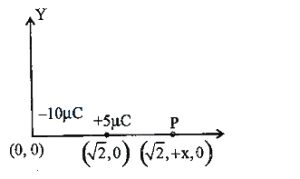
Two point charges $-10 \mu C$ and $+5 \mu C$ are situated on the $X$-axis at $x=0$ and $x=\sqrt{2} \ m$. The point along the $X$-axis where the electric field becomes zero is:
A
$x=(\sqrt{2}-1) \ m$
B
$x=2(\sqrt{2}-1) \ m$
C
$x=2(\sqrt{2}+1) \ m$
D
$x=(\sqrt{2}+1) \ m$
Solution
(C) Let the two charges be $q_1 = -10 \mu C$ at $x_1 = 0$ and $q_2 = +5 \mu C$ at $x_2 = \sqrt{2} \ m$.
For the electric field to be zero,the point must be closer to the charge with the smaller magnitude. Since $|q_2| < |q_1|$,the point $P$ must lie on the $X$-axis to the right of $q_2$.
Let the distance of point $P$ from $q_2$ be $x$. The position of $P$ is $x_P = \sqrt{2} + x$.
The electric field due to $q_1$ at $P$ is $E_1 = \frac{k|q_1|}{(\sqrt{2}+x)^2}$ (directed towards the origin).
The electric field due to $q_2$ at $P$ is $E_2 = \frac{k|q_2|}{x^2}$ (directed away from the origin).
Setting $E_1 = E_2$:
$\frac{10}{x^2 + 2\sqrt{2}x + 2} = \frac{5}{x^2}$
$2x^2 = x^2 + 2\sqrt{2}x + 2$
$x^2 - 2\sqrt{2}x - 2 = 0$
Using the quadratic formula $x = \frac{-b \pm \sqrt{b^2 - 4ac}}{2a}$:
$x = \frac{2\sqrt{2} \pm \sqrt{8 - 4(1)(-2)}}{2} = \frac{2\sqrt{2} \pm \sqrt{16}}{2} = \sqrt{2} \pm 2$.
Since $x$ must be positive,$x = \sqrt{2} + 2$.
The coordinate of point $P$ is $x_P = \sqrt{2} + x = \sqrt{2} + (\sqrt{2} + 2) = 2\sqrt{2} + 2 = 2(\sqrt{2} + 1) \ m$.
For the electric field to be zero,the point must be closer to the charge with the smaller magnitude. Since $|q_2| < |q_1|$,the point $P$ must lie on the $X$-axis to the right of $q_2$.
Let the distance of point $P$ from $q_2$ be $x$. The position of $P$ is $x_P = \sqrt{2} + x$.
The electric field due to $q_1$ at $P$ is $E_1 = \frac{k|q_1|}{(\sqrt{2}+x)^2}$ (directed towards the origin).
The electric field due to $q_2$ at $P$ is $E_2 = \frac{k|q_2|}{x^2}$ (directed away from the origin).
Setting $E_1 = E_2$:
$\frac{10}{x^2 + 2\sqrt{2}x + 2} = \frac{5}{x^2}$
$2x^2 = x^2 + 2\sqrt{2}x + 2$
$x^2 - 2\sqrt{2}x - 2 = 0$
Using the quadratic formula $x = \frac{-b \pm \sqrt{b^2 - 4ac}}{2a}$:
$x = \frac{2\sqrt{2} \pm \sqrt{8 - 4(1)(-2)}}{2} = \frac{2\sqrt{2} \pm \sqrt{16}}{2} = \sqrt{2} \pm 2$.
Since $x$ must be positive,$x = \sqrt{2} + 2$.
The coordinate of point $P$ is $x_P = \sqrt{2} + x = \sqrt{2} + (\sqrt{2} + 2) = 2\sqrt{2} + 2 = 2(\sqrt{2} + 1) \ m$.
0 likesView Solution
47
ChemistryMediumMCQTS EAMCET · 2024
Methemoglobinemia is due to
A
Excess of nitrate concentration in drinking water
B
Excess of sulphate concentration in drinking water
C
Excess of fluoride concentration in drinking water
D
Excess of lead in drinking water
Solution
(A) Methemoglobinemia is caused by an excess of nitrate concentration in drinking water.
High levels of nitrate in drinking water can cause methemoglobinemia,which is also known as $blue \ baby \ syndrome$.
When consumed,nitrates are absorbed into the blood and some are converted into nitrites,which react with hemoglobin to create methemoglobin,reducing the oxygen-carrying capacity of the blood.
High levels of nitrate in drinking water can cause methemoglobinemia,which is also known as $blue \ baby \ syndrome$.
When consumed,nitrates are absorbed into the blood and some are converted into nitrites,which react with hemoglobin to create methemoglobin,reducing the oxygen-carrying capacity of the blood.
0 likesView Solution
48
ChemistryEasyMCQTS EAMCET · 2024
Which of the following industries generate non-biodegradable wastes?
A
Cotton mills
B
Paper mills
C
Thermal power plants
D
Textile factories
Solution
(C) Non-biodegradable wastes are substances that cannot be broken down by biological processes. Thermal power plants generate fly ash,which is a non-biodegradable waste product.
0 likesView Solution
49
ChemistryEasyMCQTS EAMCET · 2024
The common components of photochemical smog are
A
$O_3, CH_4, CO_2$
B
$O_3, CO_2, CO$
C
$O_2, SO_3, PAN$
D
$O_3, NO, PAN$
Solution
(D) Photochemical smog is formed by the action of sunlight on nitrogen oxides $(NO_x)$ and volatile organic compounds $(VOCs)$ in the atmosphere.
Its common components include Ozone $(O_3)$,Nitrogen dioxide $(NO_2)$,Peroxyacetyl nitrate $(PAN)$,and aldehydes (compounds containing the $-CHO$ group).
Its common components include Ozone $(O_3)$,Nitrogen dioxide $(NO_2)$,Peroxyacetyl nitrate $(PAN)$,and aldehydes (compounds containing the $-CHO$ group).
0 likesView Solution
50
ChemistryEasyMCQTS EAMCET · 2024
Eutrophication can lead to
A
Decrease in nutrients
B
Increase in dissolved salts
C
Decrease in dissolved oxygen
D
Decrease in water pollution
Solution
(C) Eutrophication is a process where water bodies receive excessive amounts of nutrients,such as nitrates and phosphates,which results in excessive plant and algal growth.
As these plants die and decompose,the process consumes a large amount of oxygen.
Therefore,eutrophication leads to a significant decrease in the level of $DO$ (dissolved oxygen) in the water.
As these plants die and decompose,the process consumes a large amount of oxygen.
Therefore,eutrophication leads to a significant decrease in the level of $DO$ (dissolved oxygen) in the water.
0 likesView Solution
51
ChemistryDifficultMCQTS EAMCET · 2024
What are $X$ and $Y$ respectively in the following reactions?
$C_6H_5COOH \xrightarrow{X} C_6H_5CHO$
$C_6H_5CHO \xrightarrow[OH^-, 293 \ K]{C_6H_5COOH} Y \text{ (Major product)}$
$C_6H_5COOH \xrightarrow{X} C_6H_5CHO$
$C_6H_5CHO \xrightarrow[OH^-, 293 \ K]{C_6H_5COOH} Y \text{ (Major product)}$
A
$(i) \ SOCl_2, (ii) \ H_2|Ni; \ C_6H_5-C(CH_3)=CH-C_6H_5$
B
$(i) \ SOCl_2, (ii) \ H_2|Ni; \ C_6H_5-CH=CH-CO-C_6H_5$
C
$(i) \ C_2H_5OH|H^+, (ii) \ DiBAL-H, (iii) \ H_2O; \ C_6H_5-CH=CH-CO-C_6H_5$
D
$(i) \ C_2H_5OH|H^+, (ii) \ DiBAL-H, (iii) \ H_2O; \ C_6H_5-C(CH_3)=CH-C_6H_5$
Solution
(C) The first reaction is the reduction of benzoic acid $(C_6H_5COOH)$ to benzaldehyde $(C_6H_5CHO)$. This cannot be done directly with $SOCl_2$ and $H_2|Ni$ (which reduces acid chlorides to aldehydes,but the conditions are specific). The standard laboratory method to reduce a carboxylic acid to an aldehyde involves converting it to an ester first,followed by reduction with $DiBAL-H$.
Step $1$: $C_6H_5COOH + C_2H_5OH \xrightarrow{H^+} C_6H_5COOC_2H_5 + H_2O$ (Esterification).
Step $2$: $C_6H_5COOC_2H_5 \xrightarrow{(i) \ DiBAL-H, (ii) \ H_2O} C_6H_5CHO$ (Reduction of ester to aldehyde).
Thus,$X$ is $(i) \ C_2H_5OH|H^+, (ii) \ DiBAL-H, (iii) \ H_2O$.
Step $3$: The second reaction is an Aldol condensation between benzaldehyde $(C_6H_5CHO)$ and acetophenone (implied,though the prompt shows $C_6H_5COOH$ as a reactant,the product $Y$ is clearly the Claisen-Schmidt condensation product,benzalacetophenone or chalcone,$C_6H_5-CH=CH-CO-C_6H_5$).
Therefore,the correct option is $C$.
Step $1$: $C_6H_5COOH + C_2H_5OH \xrightarrow{H^+} C_6H_5COOC_2H_5 + H_2O$ (Esterification).
Step $2$: $C_6H_5COOC_2H_5 \xrightarrow{(i) \ DiBAL-H, (ii) \ H_2O} C_6H_5CHO$ (Reduction of ester to aldehyde).
Thus,$X$ is $(i) \ C_2H_5OH|H^+, (ii) \ DiBAL-H, (iii) \ H_2O$.
Step $3$: The second reaction is an Aldol condensation between benzaldehyde $(C_6H_5CHO)$ and acetophenone (implied,though the prompt shows $C_6H_5COOH$ as a reactant,the product $Y$ is clearly the Claisen-Schmidt condensation product,benzalacetophenone or chalcone,$C_6H_5-CH=CH-CO-C_6H_5$).
Therefore,the correct option is $C$.
0 likesView Solution
52
ChemistryMediumMCQTS EAMCET · 2024
What are $X$ and $Y$ respectively in the following reactions?
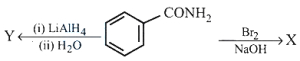
A
$C_6H_5NH_2$ and $C_6H_5NH_2$
B
$C_6H_5NH_2$ and $C_6H_5CH_2NH_2$
C
$C_6H_5CH_2NH_2$ and $C_6H_5CH_2NH_2$
D
$C_6H_5CH_2NH_2$ and $C_6H_5NH_2$
Solution
(B) The given reaction involves two different chemical transformations of benzamide $(C_6H_5CONH_2)$:
$1$. Reaction with $LiAlH_4$ followed by $H_2O$: This is a reduction reaction. $LiAlH_4$ reduces the amide group $(-CONH_2)$ to an amine group $(-CH_2NH_2)$. Thus,$Y$ is benzylamine $(C_6H_5CH_2NH_2)$.
$2$. Reaction with $Br_2$ and $NaOH$: This is the Hoffmann bromamide degradation reaction. It converts an amide $(-CONH_2)$ into a primary amine with one carbon atom less $(-NH_2)$. Thus,$X$ is aniline $(C_6H_5NH_2)$.
Therefore,$X$ is $C_6H_5NH_2$ and $Y$ is $C_6H_5CH_2NH_2$.
$1$. Reaction with $LiAlH_4$ followed by $H_2O$: This is a reduction reaction. $LiAlH_4$ reduces the amide group $(-CONH_2)$ to an amine group $(-CH_2NH_2)$. Thus,$Y$ is benzylamine $(C_6H_5CH_2NH_2)$.
$2$. Reaction with $Br_2$ and $NaOH$: This is the Hoffmann bromamide degradation reaction. It converts an amide $(-CONH_2)$ into a primary amine with one carbon atom less $(-NH_2)$. Thus,$X$ is aniline $(C_6H_5NH_2)$.
Therefore,$X$ is $C_6H_5NH_2$ and $Y$ is $C_6H_5CH_2NH_2$.
0 likesView Solution
53
ChemistryMediumMCQTS EAMCET · 2024
What are $Y$ and $Z$ respectively in the following reaction sequence?
Chlorobenzene $\xrightarrow[Conc. H_2SO_4]{HNO_3}$ $X$ (major product) $\xrightarrow{Y}$ $Z$
Chlorobenzene $\xrightarrow[Conc. H_2SO_4]{HNO_3}$ $X$ (major product) $\xrightarrow{Y}$ $Z$
A
$(i)$ $NaOH, 443 \ K, H^+$; $3-$nitrophenol
B
$(i)$ $NaOH, 443 \ K, (ii) H^+$; $4-$nitrophenol
C
$H_2O, \Delta$; $4-$nitrophenol
D
$H_2O, \Delta$; $2-$nitrophenol
Solution
(B) $1$. The nitration of chlorobenzene with $conc. HNO_3$ and $conc. H_2SO_4$ yields $1$-chloro-$4$-nitrobenzene as the major product $(X)$ because the $-Cl$ group is ortho/para directing and the para-isomer is sterically favored.
$2$. The conversion of $1$-chloro-$4$-nitrobenzene to $4$-nitrophenol involves nucleophilic aromatic substitution.
$3$. The reaction requires strong nucleophilic conditions,which are provided by $(i) NaOH$ at $443 \ K$ followed by $(ii) H^+$ (acidification) to convert the phenoxide ion to the phenol.
$4$. Thus,$Y$ is $(i) NaOH, 443 \ K, (ii) H^+$ and $Z$ is $4$-nitrophenol.
$2$. The conversion of $1$-chloro-$4$-nitrobenzene to $4$-nitrophenol involves nucleophilic aromatic substitution.
$3$. The reaction requires strong nucleophilic conditions,which are provided by $(i) NaOH$ at $443 \ K$ followed by $(ii) H^+$ (acidification) to convert the phenoxide ion to the phenol.
$4$. Thus,$Y$ is $(i) NaOH, 443 \ K, (ii) H^+$ and $Z$ is $4$-nitrophenol.
0 likesView Solution
54
ChemistryMediumMCQTS EAMCET · 2024
What are $X$ and $Y$ respectively in the following reactions?
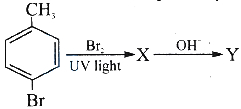
A
$X = \text{4-bromobenzyl bromide}, Y = \text{4-bromobenzyl alcohol}$
B
$X = \text{2-bromo-4-bromotoluene}, Y = \text{2-hydroxy-4-bromotoluene}$
C
$X = \text{2-bromo-4-bromotoluene}, Y = \text{4-bromo-2-hydroxytoluene}$
D
$X = \text{4-bromobenzyl bromide}, Y = \text{4-bromophenol}$
Solution
(A) The reaction of $4$-bromotoluene with $Br_2$ in the presence of $UV$ light is a free radical substitution reaction. This reaction occurs at the benzylic position,not on the aromatic ring. Therefore,$X$ is $4$-bromobenzyl bromide $(Br-C_6H_4-CH_2Br)$.
When $4$-bromobenzyl bromide is treated with $OH^-$,it undergoes a nucleophilic substitution reaction $(S_N2)$ where the $Br$ atom on the side chain is replaced by an $OH$ group. Therefore,$Y$ is $4$-bromobenzyl alcohol $(Br-C_6H_4-CH_2OH)$.
When $4$-bromobenzyl bromide is treated with $OH^-$,it undergoes a nucleophilic substitution reaction $(S_N2)$ where the $Br$ atom on the side chain is replaced by an $OH$ group. Therefore,$Y$ is $4$-bromobenzyl alcohol $(Br-C_6H_4-CH_2OH)$.
0 likesView Solution
55
ChemistryEasyMCQTS EAMCET · 2024
Arrange the following in the correct order of their boiling points.
| $I$. $(C_2H_5)_2O$ |
| $II$. $CH_3(CH_2)_3OH$ |
| $III$. $CH_3CH(CH_3)CH_2OH$ |
| $IV$. $CH_3(CH_2)_3CH_3$ |
A
$I > III > II > IV$
B
$II > I > III > IV$
C
$III > II > I > IV$
D
$II > III > IV > I$
Solution
(D) The boiling points depend on intermolecular forces.
$1$. $II$ ($n$-butanol) and $III$ (isobutanol) are alcohols and exhibit strong intermolecular hydrogen bonding,leading to higher boiling points compared to ethers and alkanes.
$2$. Between $II$ and $III$,$II$ is a straight-chain alcohol with a larger surface area,leading to stronger van der Waals forces than the branched $III$. Thus,$II > III$.
$3$. $I$ (diethyl ether) is polar due to the $C-O-C$ bond,giving it a higher boiling point than the non-polar alkane $IV$ ($n$-pentane).
$4$. Therefore,the order is $II > III > I > IV$.
$1$. $II$ ($n$-butanol) and $III$ (isobutanol) are alcohols and exhibit strong intermolecular hydrogen bonding,leading to higher boiling points compared to ethers and alkanes.
$2$. Between $II$ and $III$,$II$ is a straight-chain alcohol with a larger surface area,leading to stronger van der Waals forces than the branched $III$. Thus,$II > III$.
$3$. $I$ (diethyl ether) is polar due to the $C-O-C$ bond,giving it a higher boiling point than the non-polar alkane $IV$ ($n$-pentane).
$4$. Therefore,the order is $II > III > I > IV$.
0 likesView Solution
56
ChemistryDifficultMCQTS EAMCET · 2024
An alcohol $X$ $(C_5H_{12}O)$ when reacted with conc. $HCl$ and anhydrous $ZnCl_2$ produces turbidity instantly. The alcohol $X$ can be prepared from which of the following reactions?
A
Reduction of $2-$pentanone with $NaBH_4$
B
Reaction of isopropyl magnesium bromide with ethanal
C
Reaction of ethyl magnesium bromide with propanal
D
Acid catalysed hydration of $2-$methyl$-1-$butene
Solution
(D) The Lucas test uses conc. $HCl$ and anhydrous $ZnCl_2$ to distinguish between primary,secondary,and tertiary alcohols.
Tertiary alcohols react instantly to produce turbidity due to the formation of an insoluble alkyl chloride.
Given the molecular formula $C_5H_{12}O$,the alcohol $X$ must be a tertiary alcohol,which is $2-$methyl$-2-$butanol.
Acid-catalysed hydration of $2-$methyl$-1-$butene follows Markovnikov's rule to yield $2-$methyl$-2-$butanol,which is a tertiary alcohol.
Therefore,option $D$ is the correct answer.
Tertiary alcohols react instantly to produce turbidity due to the formation of an insoluble alkyl chloride.
Given the molecular formula $C_5H_{12}O$,the alcohol $X$ must be a tertiary alcohol,which is $2-$methyl$-2-$butanol.
Acid-catalysed hydration of $2-$methyl$-1-$butene follows Markovnikov's rule to yield $2-$methyl$-2-$butanol,which is a tertiary alcohol.
Therefore,option $D$ is the correct answer.
0 likesView Solution
57
ChemistryMediumMCQTS EAMCET · 2024
Identify the products $R$ and $S$ in the reaction sequence given:
$(CH_3)_3 COH$ $\xrightarrow{Na} P$ $\xrightarrow{CH_3 Br} Q$ $\xrightarrow[\Delta]{HI} R + S$
$(CH_3)_3 COH$ $\xrightarrow{Na} P$ $\xrightarrow{CH_3 Br} Q$ $\xrightarrow[\Delta]{HI} R + S$
A
$(CH_3)_3 CI, CH_3 OH$
B
$(CH_3)_3 COH, CH_3 I$
C
$(CH_3)_3 COH, CH_3 OH$
D
$(CH_3)_2 C=CH_2, CH_3 OH$
Solution
(A) Step $1$: Reaction of tert-butyl alcohol with $Na$ gives sodium tert-butoxide $(P)$:
$(CH_3)_3 COH Na \rightarrow (CH_3)_3 CONa \frac{1}{2} H_2$
Step $2$: Reaction of $P$ with methyl bromide $(CH_3 Br)$ via $S_N2$ mechanism gives tert-butyl methyl ether $(Q)$:
$(CH_3)_3 CONa CH_3 Br \rightarrow (CH_3)_3 COCH_3 NaBr$
Step $3$: Cleavage of ether $Q$ with $HI$ at high temperature $(\Delta)$:
Since the ether contains a tertiary alkyl group,the reaction proceeds via an $S_N1$ mechanism.
The protonated ether undergoes cleavage to form a stable tertiary carbocation $(CH_3)_3 C $,which then reacts with $I^-$ to form tert-butyl iodide $(R = (CH_3)_3 CI)$ and methanol $(S = CH_3 OH)$.
$(CH_3)_3 COH Na \rightarrow (CH_3)_3 CONa \frac{1}{2} H_2$
Step $2$: Reaction of $P$ with methyl bromide $(CH_3 Br)$ via $S_N2$ mechanism gives tert-butyl methyl ether $(Q)$:
$(CH_3)_3 CONa CH_3 Br \rightarrow (CH_3)_3 COCH_3 NaBr$
Step $3$: Cleavage of ether $Q$ with $HI$ at high temperature $(\Delta)$:
Since the ether contains a tertiary alkyl group,the reaction proceeds via an $S_N1$ mechanism.
The protonated ether undergoes cleavage to form a stable tertiary carbocation $(CH_3)_3 C $,which then reacts with $I^-$ to form tert-butyl iodide $(R = (CH_3)_3 CI)$ and methanol $(S = CH_3 OH)$.
0 likesView Solution
58
ChemistryMediumMCQTS EAMCET · 2024
In the given reaction sequence,$Z$ is a mixture of alcohol and acid. The reaction for the conversion of $Y$ to $Z$ is:
$CH_3CH_2OH$ $\xrightarrow[443 \ K]{\text{Conc. } H_2SO_4} X$ $\xrightarrow[(2) \ Zn/H_2O]{(1) \ O_3} Y$ $\xrightarrow[(ii) \ H^+]{(i) \ \text{Conc. } NaOH} Z$
$CH_3CH_2OH$ $\xrightarrow[443 \ K]{\text{Conc. } H_2SO_4} X$ $\xrightarrow[(2) \ Zn/H_2O]{(1) \ O_3} Y$ $\xrightarrow[(ii) \ H^+]{(i) \ \text{Conc. } NaOH} Z$
A
Reimer-Tiemann reaction
B
Kolbe's reaction
C
Cannizzaro reaction
D
Stephen reaction
Solution
(C) $1$. Dehydration of ethanol: $CH_3CH_2OH \xrightarrow[443 \ K]{\text{Conc. } H_2SO_4} CH_2=CH_2$ ($X$ is ethene).
$2$. Ozonolysis of ethene: $CH_2=CH_2 \xrightarrow[(2) \ Zn/H_2O]{(1) \ O_3} 2HCHO$ ($Y$ is formaldehyde).
$3$. Cannizzaro reaction: Formaldehyde $(HCHO)$ has no $\alpha$-hydrogen,so it undergoes the Cannizzaro reaction in the presence of concentrated $NaOH$ to form methanol $(CH_3OH)$ and sodium formate $(HCOONa)$.
$4$. Thus,the conversion of $Y$ to $Z$ is the Cannizzaro reaction.
$2$. Ozonolysis of ethene: $CH_2=CH_2 \xrightarrow[(2) \ Zn/H_2O]{(1) \ O_3} 2HCHO$ ($Y$ is formaldehyde).
$3$. Cannizzaro reaction: Formaldehyde $(HCHO)$ has no $\alpha$-hydrogen,so it undergoes the Cannizzaro reaction in the presence of concentrated $NaOH$ to form methanol $(CH_3OH)$ and sodium formate $(HCOONa)$.
$4$. Thus,the conversion of $Y$ to $Z$ is the Cannizzaro reaction.
0 likesView Solution
59
ChemistryEasyMCQTS EAMCET · 2024
The reagent '$X$' used in the following reaction to obtain a good yield of the product is:
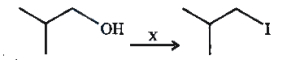
A
$KI, H_2SO_4$
B
$KI, 95\% H_3PO_4$
C
$NaI, ZnCl_2$
D
$HI$
Solution
(B) The reaction involves the conversion of an alcohol to an alkyl iodide.
Using $H_2SO_4$ with $KI$ is not ideal because $H_2SO_4$ is an oxidizing agent that can oxidize $HI$ to $I_2$.
Phosphoric acid $(H_3PO_4)$ is a non-oxidizing acid and is preferred for the in-situ generation of $HI$ from $KI$.
The reaction is: $3 KI + H_3PO_4 \rightarrow 3 HI + K_3PO_4$.
This $HI$ then reacts with the alcohol via an $S_N2$ mechanism to give the alkyl iodide with a good yield.
Using $H_2SO_4$ with $KI$ is not ideal because $H_2SO_4$ is an oxidizing agent that can oxidize $HI$ to $I_2$.
Phosphoric acid $(H_3PO_4)$ is a non-oxidizing acid and is preferred for the in-situ generation of $HI$ from $KI$.
The reaction is: $3 KI + H_3PO_4 \rightarrow 3 HI + K_3PO_4$.
This $HI$ then reacts with the alcohol via an $S_N2$ mechanism to give the alkyl iodide with a good yield.
0 likesView Solution
60
ChemistryEasyMCQTS EAMCET · 2024
Match the following reactions of phenol with their products:
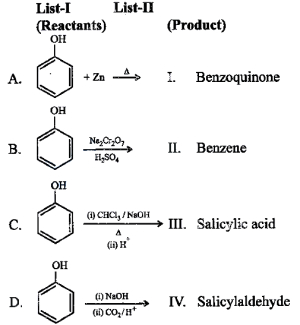
A
$A-II, B-I, C-IV, D-III$
B
$A-II, B-III, C-I, D-IV$
C
$A-III, B-II, C-IV, D-I$
D
$A-III, B-IV, C-I, D-II$
Solution
(A) The reactions are as follows:
$A$. Phenol reacts with $Zn$ dust to form benzene: $C_6H_5OH + Zn \rightarrow C_6H_6 + ZnO$ $(II)$.
$B$. Phenol is oxidized by $Na_2Cr_2O_7/H_2SO_4$ to form benzoquinone $(I)$.
$C$. Reimer-Tiemann reaction of phenol with $CHCl_3/NaOH$ followed by $H^+$ gives salicylaldehyde $(IV)$.
$D$. Kolbe's reaction of phenol with $NaOH$ followed by $CO_2/H^+$ gives salicylic acid $(III)$.
Therefore,the correct matching is $A-II, B-I, C-IV, D-III$.
$A$. Phenol reacts with $Zn$ dust to form benzene: $C_6H_5OH + Zn \rightarrow C_6H_6 + ZnO$ $(II)$.
$B$. Phenol is oxidized by $Na_2Cr_2O_7/H_2SO_4$ to form benzoquinone $(I)$.
$C$. Reimer-Tiemann reaction of phenol with $CHCl_3/NaOH$ followed by $H^+$ gives salicylaldehyde $(IV)$.
$D$. Kolbe's reaction of phenol with $NaOH$ followed by $CO_2/H^+$ gives salicylic acid $(III)$.
Therefore,the correct matching is $A-II, B-I, C-IV, D-III$.
0 likesView Solution
61
ChemistryMediumMCQTS EAMCET · 2024
The bromides formed by the cleavage of ethers $A$ and $B$ with $HBr$ respectively are:
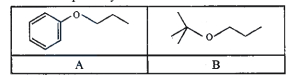
A
Phenyl bromide and $tert$-butyl bromide
B
Phenyl bromide and $n$-propyl bromide
C
$n$-propyl bromide and $n$-propyl bromide
D
$n$-propyl bromide and $tert$-butyl bromide
Solution
(D) For ether $A$ (phenyl $n$-propyl ether): The $C-O$ bond between the phenyl group and oxygen cannot be cleaved because the $C-O$ bond has partial double bond character due to resonance. Therefore,cleavage occurs at the alkyl side,yielding phenol and $n$-propyl bromide.
For ether $B$ ($tert$-butyl $n$-propyl ether): The cleavage occurs to form the more stable carbocation. The $tert$-butyl group forms a $3^{\circ}$ carbocation,which is much more stable than the $n$-propyl carbocation. Thus,the $C-O$ bond between the $tert$-butyl group and oxygen is cleaved,yielding $tert$-butyl bromide and $n$-propanol.
Therefore,the bromides formed are $n$-propyl bromide and $tert$-butyl bromide.
For ether $B$ ($tert$-butyl $n$-propyl ether): The cleavage occurs to form the more stable carbocation. The $tert$-butyl group forms a $3^{\circ}$ carbocation,which is much more stable than the $n$-propyl carbocation. Thus,the $C-O$ bond between the $tert$-butyl group and oxygen is cleaved,yielding $tert$-butyl bromide and $n$-propanol.
Therefore,the bromides formed are $n$-propyl bromide and $tert$-butyl bromide.
0 likesView Solution
62
ChemistryMediumMCQTS EAMCET · 2024
Identify the correct statements about $Z$ in the following reaction sequence:
$C_2H_5NH_2$ $\xrightarrow[NaNO_2 / HCl]{} X$ $\xrightarrow{H_2O} Y$ $\xrightarrow{Cu / 573 \ K} Z$
$I$. $Z$ is an aldehyde
$II$. $Z$ undergoes Cannizzaro reaction
$III$. $Z$ gives iodoform test
$IV$. $Z$ does not give test with Tollens' reagent
$C_2H_5NH_2$ $\xrightarrow[NaNO_2 / HCl]{} X$ $\xrightarrow{H_2O} Y$ $\xrightarrow{Cu / 573 \ K} Z$
$I$. $Z$ is an aldehyde
$II$. $Z$ undergoes Cannizzaro reaction
$III$. $Z$ gives iodoform test
$IV$. $Z$ does not give test with Tollens' reagent
A
$I$ and $III$
B
$II$ and $IV$
C
$I$ and $IV$
D
$II$ and $III$
Solution
(A) The reaction sequence is as follows:
$C_2H_5NH_2$ $\xrightarrow{NaNO_2/HCl} [C_2H_5N_2^+Cl^-] (X)$ $\xrightarrow{H_2O} C_2H_5OH (Y)$ $\xrightarrow{Cu, 573 \ K} CH_3CHO (Z)$
$Z$ is acetaldehyde $(CH_3CHO)$.
$I$. $Z$ is an aldehyde. (Correct)
$II$. $Z$ has $\alpha$-hydrogen atoms,so it does not undergo Cannizzaro reaction. (Incorrect)
$III$. $Z$ contains a $CH_3CO-$ group,so it gives a positive iodoform test. (Correct)
$IV$. $Z$ is an aldehyde,so it gives a positive test with Tollens' reagent. (Incorrect)
Thus,statements $I$ and $III$ are correct.
$C_2H_5NH_2$ $\xrightarrow{NaNO_2/HCl} [C_2H_5N_2^+Cl^-] (X)$ $\xrightarrow{H_2O} C_2H_5OH (Y)$ $\xrightarrow{Cu, 573 \ K} CH_3CHO (Z)$
$Z$ is acetaldehyde $(CH_3CHO)$.
$I$. $Z$ is an aldehyde. (Correct)
$II$. $Z$ has $\alpha$-hydrogen atoms,so it does not undergo Cannizzaro reaction. (Incorrect)
$III$. $Z$ contains a $CH_3CO-$ group,so it gives a positive iodoform test. (Correct)
$IV$. $Z$ is an aldehyde,so it gives a positive test with Tollens' reagent. (Incorrect)
Thus,statements $I$ and $III$ are correct.
0 likesView Solution
63
ChemistryEasyMCQTS EAMCET · 2024
The $pK_{a}$ values of $X, Y, Z$ respectively are $8.3, 7.1, 10.2$. What are $X, Y, Z$?
A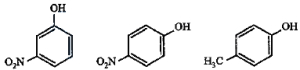
B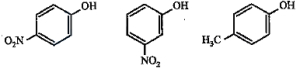
C
D
Solution
(A) The acidity of phenols is determined by the stability of the phenoxide ion formed after the loss of a proton. Electron-withdrawing groups (like $-NO_2$) increase acidity (lower $pK_{a}$),while electron-donating groups (like $-CH_3$) decrease acidity (higher $pK_{a}$).
$1$. $p$-Nitrophenol has a $-NO_2$ group at the para position,which exerts a strong $-R$ (resonance) and $-I$ (inductive) effect,making it the most acidic $(pK_{a} = 7.1)$.
$2$. $m$-Nitrophenol has a $-NO_2$ group at the meta position,which exerts only a $-I$ effect,making it less acidic than $p$-nitrophenol $(pK_{a} = 8.3)$.
$3$. $p$-Cresol has a $-CH_3$ group at the para position,which is an electron-donating group ($+I$ and hyperconjugation),making it the least acidic $(pK_{a} = 10.2)$.
Thus,$X = m$-nitrophenol $(8.3)$,$Y = p$-nitrophenol $(7.1)$,and $Z = p$-cresol $(10.2)$.
$1$. $p$-Nitrophenol has a $-NO_2$ group at the para position,which exerts a strong $-R$ (resonance) and $-I$ (inductive) effect,making it the most acidic $(pK_{a} = 7.1)$.
$2$. $m$-Nitrophenol has a $-NO_2$ group at the meta position,which exerts only a $-I$ effect,making it less acidic than $p$-nitrophenol $(pK_{a} = 8.3)$.
$3$. $p$-Cresol has a $-CH_3$ group at the para position,which is an electron-donating group ($+I$ and hyperconjugation),making it the least acidic $(pK_{a} = 10.2)$.
Thus,$X = m$-nitrophenol $(8.3)$,$Y = p$-nitrophenol $(7.1)$,and $Z = p$-cresol $(10.2)$.
0 likesView Solution
64
ChemistryMediumMCQTS EAMCET · 2024
Assertion $(A)$: Chlorobenzene is not formed in the reaction of phenol with thionyl chloride.
Reason $(R)$: In phenol,the carbon-oxygen bond has partial double bond character.
The correct answer is
Reason $(R)$: In phenol,the carbon-oxygen bond has partial double bond character.
The correct answer is
A
$(A)$ and $(R)$ are correct. $(R)$ is the correct explanation of $(A)$
B
$(A)$ and $(R)$ are correct,but $(R)$ is not the correct explanation of $(A)$
C
$A$ is correct but $R$ is not correct
D
$A$ is not correct but $R$ is correct
Solution
(A) The reaction of alcohols with $SOCl_2$ proceeds via an $S_N2$ mechanism or $S_Ni$ mechanism to replace the $-OH$ group with $-Cl$.
In phenol,the lone pair of electrons on the oxygen atom participates in resonance with the benzene ring,giving the $C-O$ bond a partial double bond character.
This makes the $C-O$ bond stronger and shorter,preventing the cleavage of the $C-O$ bond required to replace the $-OH$ group with $-Cl$.
Therefore,chlorobenzene is not formed when phenol reacts with $SOCl_2$.
Both Assertion $(A)$ and Reason $(R)$ are correct,and $(R)$ is the correct explanation of $(A)$.
In phenol,the lone pair of electrons on the oxygen atom participates in resonance with the benzene ring,giving the $C-O$ bond a partial double bond character.
This makes the $C-O$ bond stronger and shorter,preventing the cleavage of the $C-O$ bond required to replace the $-OH$ group with $-Cl$.
Therefore,chlorobenzene is not formed when phenol reacts with $SOCl_2$.
Both Assertion $(A)$ and Reason $(R)$ are correct,and $(R)$ is the correct explanation of $(A)$.
0 likesView Solution
65
ChemistryMediumMCQTS EAMCET · 2024
Arrange the following compounds in the increasing order of their $pK_a$ values:
$I.$ Phenol
$II.$ $p$-Nitrophenol
$III.$ Ethanol
$IV.$ $p$-Nitrobenzoic acid
$I.$ Phenol
$II.$ $p$-Nitrophenol
$III.$ Ethanol
$IV.$ $p$-Nitrobenzoic acid
A
$III < IV < II < I$
B
$II < III < IV < I$
C
$IV < II < I < III$
D
$IV < III < II < I$
Solution
(C) The $pK_a$ value is inversely proportional to the acidic strength of the compound.
Acidic strength order:
$IV$ ($p$-Nitrobenzoic acid) > $II$ ($p$-Nitrophenol) > $I$ (Phenol) > $III$ (Ethanol).
$p$-Nitrobenzoic acid is a carboxylic acid,which is significantly more acidic than phenols and alcohols.
$p$-Nitrophenol is more acidic than phenol due to the electron-withdrawing effect of the $-NO_2$ group.
Phenol is more acidic than ethanol due to the resonance stabilization of the phenoxide ion.
Therefore,the increasing order of $pK_a$ values is the reverse of the acidic strength order:
$IV < II < I < III$.
Acidic strength order:
$IV$ ($p$-Nitrobenzoic acid) > $II$ ($p$-Nitrophenol) > $I$ (Phenol) > $III$ (Ethanol).
$p$-Nitrobenzoic acid is a carboxylic acid,which is significantly more acidic than phenols and alcohols.
$p$-Nitrophenol is more acidic than phenol due to the electron-withdrawing effect of the $-NO_2$ group.
Phenol is more acidic than ethanol due to the resonance stabilization of the phenoxide ion.
Therefore,the increasing order of $pK_a$ values is the reverse of the acidic strength order:
$IV < II < I < III$.
0 likesView Solution
66
ChemistryMediumMCQTS EAMCET · 2024
What is '$Z$' in the given sequence of reactions?

A
Chlorobenzene
B
Toluene
C
Benzyl alcohol
D
Phenol
Solution
(B) The reaction sequence is as follows:
$1$. Benzaldehyde $(C_6H_5CHO)$ is oxidized by $KMnO_4/H^+$ to form Benzoic acid $(C_6H_5COOH)$,which is '$X$'.
$2$. Benzoic acid reacts with $SOCl_2$ to form Benzoyl chloride $(C_6H_5COCl)$.
$3$. Benzoyl chloride undergoes Rosenmund reduction $(H_2, Pd/BaSO_4)$ to form Benzaldehyde $(C_6H_5CHO)$,which is '$Y$'.
$4$. Benzaldehyde undergoes Clemmensen reduction $(Zn-Hg/Conc. HCl)$ to form Toluene $(C_6H_5CH_3)$,which is '$Z$'.
Therefore,'$Z$' is Toluene.
$1$. Benzaldehyde $(C_6H_5CHO)$ is oxidized by $KMnO_4/H^+$ to form Benzoic acid $(C_6H_5COOH)$,which is '$X$'.
$2$. Benzoic acid reacts with $SOCl_2$ to form Benzoyl chloride $(C_6H_5COCl)$.
$3$. Benzoyl chloride undergoes Rosenmund reduction $(H_2, Pd/BaSO_4)$ to form Benzaldehyde $(C_6H_5CHO)$,which is '$Y$'.
$4$. Benzaldehyde undergoes Clemmensen reduction $(Zn-Hg/Conc. HCl)$ to form Toluene $(C_6H_5CH_3)$,which is '$Z$'.
Therefore,'$Z$' is Toluene.
0 likesView Solution
67
ChemistryMediumMCQTS EAMCET · 2024
Assertion $(A)$: Aldehydes are more reactive than ketones towards nucleophilic addition reactions.
Reason $(R)$: In aldehydes,carbonyl carbon is less electrophilic compared to ketones.
The correct answer is
Reason $(R)$: In aldehydes,carbonyl carbon is less electrophilic compared to ketones.
The correct answer is
A
$(A)$ and $(R)$ are correct. $(R)$ is the correct explanation of $(A)$
B
$(A)$ and $(R)$ are correct,but $(R)$ is not the correct explanation of $(A)$
C
$(A)$ is correct but $(R)$ is not correct
D
$(A)$ is not correct but $(R)$ is correct
Solution
(C) Assertion $(A)$ is correct: Aldehydes are more reactive than ketones towards nucleophilic addition reactions due to both electronic and steric factors.
Reason $(R)$ is incorrect: In aldehydes,the carbonyl carbon is more electrophilic than in ketones because aldehydes have only one electron-donating alkyl group attached to the carbonyl carbon,whereas ketones have two.
Additionally,aldehydes have less steric hindrance compared to ketones,making them more susceptible to nucleophilic attack.
Reason $(R)$ is incorrect: In aldehydes,the carbonyl carbon is more electrophilic than in ketones because aldehydes have only one electron-donating alkyl group attached to the carbonyl carbon,whereas ketones have two.
Additionally,aldehydes have less steric hindrance compared to ketones,making them more susceptible to nucleophilic attack.
0 likesView Solution
68
ChemistryMediumMCQTS EAMCET · 2024
Identify the set in which $X$ and $Y$ are correctly matched for the reaction of benzaldehyde with a reagent $X$ to form product $Y$.
A
$NH_2OH$,Hydrazone
B
$NH_2NH_2$,Semicarbazone
C
$C_6H_5NH_2$,Schiff base
D
$RNH_2$,Oxime
Solution
(C) The reaction of an aldehyde or ketone with a primary amine $(RNH_2)$ leads to the formation of an imine,which is also known as a Schiff base.
In the given reaction,benzaldehyde reacts with aniline $(C_6H_5NH_2)$ to form a Schiff base.
Therefore,$X = C_6H_5NH_2$ and $Y = \text{Schiff base}$.
Other options are incorrect because:
- $NH_2OH$ forms an oxime.
- $NH_2NH_2$ forms a hydrazone.
- $NH_2CONHNH_2$ forms a semicarbazone.
In the given reaction,benzaldehyde reacts with aniline $(C_6H_5NH_2)$ to form a Schiff base.
Therefore,$X = C_6H_5NH_2$ and $Y = \text{Schiff base}$.
Other options are incorrect because:
- $NH_2OH$ forms an oxime.
- $NH_2NH_2$ forms a hydrazone.
- $NH_2CONHNH_2$ forms a semicarbazone.
0 likesView Solution
69
ChemistryDifficultMCQTS EAMCET · 2024
What is the $IUPAC$ name of the product $Y$ in the given reaction sequence?
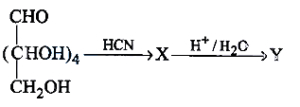
A
$2,3,4,5,6,7$-hexahydroxyheptanoic acid
B
$2,3,4,5,6$-pentahydroxyhexanoic acid
C
$3,4,5$-trihydroxyheptanoic acid
D
$3,4,5$-trihydroxyhexanoic acid
Solution
(A) The reaction sequence is as follows:
$1$. Glucose reacts with $HCN$ to form a cyanohydrin $(X)$. The aldehyde group $(-CHO)$ is converted into a cyanohydrin group $(-CH(OH)CN)$.
$2$. The cyanohydrin $(X)$ undergoes acid-catalyzed hydrolysis $(H^+/H_2O)$ to convert the cyano group $(-CN)$ into a carboxylic acid group $(-COOH)$.
$3$. The starting material is glucose,which has $6$ carbon atoms. The addition of $HCN$ adds one carbon atom,resulting in a chain of $7$ carbon atoms.
$4$. The final product $Y$ is a heptanoic acid derivative with hydroxyl groups on carbons $2, 3, 4, 5, 6,$ and $7$. Thus,the $IUPAC$ name is $2,3,4,5,6,7$-hexahydroxyheptanoic acid.
$1$. Glucose reacts with $HCN$ to form a cyanohydrin $(X)$. The aldehyde group $(-CHO)$ is converted into a cyanohydrin group $(-CH(OH)CN)$.
$2$. The cyanohydrin $(X)$ undergoes acid-catalyzed hydrolysis $(H^+/H_2O)$ to convert the cyano group $(-CN)$ into a carboxylic acid group $(-COOH)$.
$3$. The starting material is glucose,which has $6$ carbon atoms. The addition of $HCN$ adds one carbon atom,resulting in a chain of $7$ carbon atoms.
$4$. The final product $Y$ is a heptanoic acid derivative with hydroxyl groups on carbons $2, 3, 4, 5, 6,$ and $7$. Thus,the $IUPAC$ name is $2,3,4,5,6,7$-hexahydroxyheptanoic acid.
0 likesView Solution
70
ChemistryDifficultMCQTS EAMCET · 2024
What is the major product $Z$ in the given reaction sequence?
$(CH_3)_2 C=O \xrightarrow[(2) H_3O^{+}]{\text{(1) } C_2H_5MgBr} X$
$i) SOCl_2$ $\xrightarrow[\Delta]{\text{ii) } CH_3ONa} Y$ $\xrightarrow[\text{Peroxide}]{HBr} Z$
$(CH_3)_2 C=O \xrightarrow[(2) H_3O^{+}]{\text{(1) } C_2H_5MgBr} X$
$i) SOCl_2$ $\xrightarrow[\Delta]{\text{ii) } CH_3ONa} Y$ $\xrightarrow[\text{Peroxide}]{HBr} Z$
A
$1-$Bromo$-2-$methylpropene
B
$2-$Methoxy$-2-$methylbutane
C
$2-$Bromo$-3-$methylbutane
D
$1-$Bromo$-2-$methylbutane
Solution
(D) Step $1$: Reaction of acetone with $C_2H_5MgBr$ followed by hydrolysis gives $2-$methylbutan$-2-$ol $(X)$: $(CH_3)_2C=O + C_2H_5MgBr \rightarrow (CH_3)_2C(OH)C_2H_5$.
Step $2$: Reaction of $X$ with $SOCl_2$ gives $2-$chloro$-2-$methylbutane,which upon treatment with $CH_3ONa$ (base) undergoes dehydrohalogenation to form $2-$methylbut$-2-$ene $(Y)$ as the major product.
Step $3$: Addition of $HBr$ to $2-$methylbut$-2-$ene in the presence of peroxide follows anti-Markovnikov's rule to give $1-$bromo$-2-$methylbutane $(Z)$.
Step $2$: Reaction of $X$ with $SOCl_2$ gives $2-$chloro$-2-$methylbutane,which upon treatment with $CH_3ONa$ (base) undergoes dehydrohalogenation to form $2-$methylbut$-2-$ene $(Y)$ as the major product.
Step $3$: Addition of $HBr$ to $2-$methylbut$-2-$ene in the presence of peroxide follows anti-Markovnikov's rule to give $1-$bromo$-2-$methylbutane $(Z)$.
0 likesView Solution
71
ChemistryMediumMCQTS EAMCET · 2024
What is '$C$' in the following reaction sequence?
$(CH_3)_2CO + CH_3MgBr$ $\xrightarrow{\text{Ether}} A$ $\xrightarrow{H_3O^+} B$ $\xrightarrow{Cu/573K} C$
$(CH_3)_2CO + CH_3MgBr$ $\xrightarrow{\text{Ether}} A$ $\xrightarrow{H_3O^+} B$ $\xrightarrow{Cu/573K} C$
A
Propanone
B
$2-$methyl$-2-$propanol
C
$2-$methylprop$-1-$ene
D
But$-2-$enal
Solution
(C) $1$. The reaction of propanone $(CH_3)_2CO$ with methylmagnesium bromide $(CH_3MgBr)$ in the presence of ether forms an addition product $A$ (an alkoxide complex).
$2$. Acidic hydrolysis $(H_3O^+)$ of $A$ yields $B$,which is $2-$methylpropan$-2-$ol $(CH_3)_3C-OH$ (a tertiary alcohol).
$3$. When tertiary alcohols are passed over heated copper $(Cu)$ at $573 \ K$,they undergo dehydration to form alkenes.
$4$. Therefore,$2-$methylpropan$-2-$ol undergoes dehydration to form $2-$methylprop$-1-$ene $(CH_3)_2C=CH_2$ as the final product $C$.
$2$. Acidic hydrolysis $(H_3O^+)$ of $A$ yields $B$,which is $2-$methylpropan$-2-$ol $(CH_3)_3C-OH$ (a tertiary alcohol).
$3$. When tertiary alcohols are passed over heated copper $(Cu)$ at $573 \ K$,they undergo dehydration to form alkenes.
$4$. Therefore,$2-$methylpropan$-2-$ol undergoes dehydration to form $2-$methylprop$-1-$ene $(CH_3)_2C=CH_2$ as the final product $C$.
0 likesView Solution
72
ChemistryMediumMCQTS EAMCET · 2024
The correct statements of the following are:
$A$. Aniline forms a stable benzene diazonium chloride at $285 \ K$.
$B$. $N$-Phenylethanamide is less reactive towards nitration than aniline.
$C$. $p-CH_3C_6H_4COCl$ is Hinsberg reagent.
$A$. Aniline forms a stable benzene diazonium chloride at $285 \ K$.
$B$. $N$-Phenylethanamide is less reactive towards nitration than aniline.
$C$. $p-CH_3C_6H_4COCl$ is Hinsberg reagent.
A
$A$ & $B$ only
B
$A$ & $C$ only
C
$B$ only
D
$C$ only
Solution
(C) Statement $A$ is incorrect: Benzene diazonium chloride is stable only at low temperatures $(273-278 \ K)$. At $285 \ K$,it is unstable and decomposes.
Statement $B$ is correct: The $-NHCOCH_3$ group in $N$-phenylethanamide is electron-withdrawing due to resonance with the carbonyl group,making the ring less electron-rich compared to the $-NH_2$ group in aniline. Thus,it is less reactive towards electrophilic substitution like nitration.
Statement $C$ is incorrect: Hinsberg reagent is benzenesulphonyl chloride $(C_6H_5SO_2Cl)$,not $p-CH_3C_6H_4COCl$.
Therefore,only statement $B$ is correct.
Statement $B$ is correct: The $-NHCOCH_3$ group in $N$-phenylethanamide is electron-withdrawing due to resonance with the carbonyl group,making the ring less electron-rich compared to the $-NH_2$ group in aniline. Thus,it is less reactive towards electrophilic substitution like nitration.
Statement $C$ is incorrect: Hinsberg reagent is benzenesulphonyl chloride $(C_6H_5SO_2Cl)$,not $p-CH_3C_6H_4COCl$.
Therefore,only statement $B$ is correct.
0 likesView Solution
73
ChemistryEasyMCQTS EAMCET · 2024
Match the following:
The correct answer is
| List-$I$ (Amine) | List-$II$ ($pK_b$ value) |
| $A$. $N,N$-Dimethylaniline | $I$. $9.30$ |
| $B$. Aniline | $II$. $8.92$ |
| $C$. $N$-Ethylethanamine | $III$. $9.38$ |
| $D$. $N$-Methylaniline | $IV$. $3.00$ |
The correct answer is
A
$A-II, B-III, C-IV, D-I$
B
$A-II, B-IV, C-III, D-I$
C
$A-III, B-IV, C-I, D-II$
D
$A-IV, B-III, C-II, D-I$
Solution
(A) The basicity of amines is inversely proportional to their $pK_b$ values. $A$ lower $pK_b$ value indicates a stronger base.
$1$. $N$-Ethylethanamine (diethylamine) is an aliphatic secondary amine,which is much more basic than aromatic amines due to the absence of resonance stabilization of the lone pair on nitrogen. Thus,it has the lowest $pK_b$ value: $C-IV$ $(3.00)$.
$2$. Among the aromatic amines,$N,N$-Dimethylaniline $(A)$ is more basic than $N$-Methylaniline $(D)$ and Aniline $(B)$ due to the electron-donating $+I$ effect of the two methyl groups,which increases electron density on the nitrogen atom. Thus,$A$ has the lowest $pK_b$ among the aromatics: $A-II$ $(8.92)$.
$3$. $N$-Methylaniline $(D)$ is more basic than Aniline $(B)$ due to the $+I$ effect of one methyl group. Thus,$D-I$ $(9.30)$.
$4$. Aniline $(B)$ is the least basic among these due to the resonance of the lone pair with the benzene ring. Thus,$B-III$ $(9.38)$.
Therefore,the correct matching is $A-II, B-III, C-IV, D-I$.
$1$. $N$-Ethylethanamine (diethylamine) is an aliphatic secondary amine,which is much more basic than aromatic amines due to the absence of resonance stabilization of the lone pair on nitrogen. Thus,it has the lowest $pK_b$ value: $C-IV$ $(3.00)$.
$2$. Among the aromatic amines,$N,N$-Dimethylaniline $(A)$ is more basic than $N$-Methylaniline $(D)$ and Aniline $(B)$ due to the electron-donating $+I$ effect of the two methyl groups,which increases electron density on the nitrogen atom. Thus,$A$ has the lowest $pK_b$ among the aromatics: $A-II$ $(8.92)$.
$3$. $N$-Methylaniline $(D)$ is more basic than Aniline $(B)$ due to the $+I$ effect of one methyl group. Thus,$D-I$ $(9.30)$.
$4$. Aniline $(B)$ is the least basic among these due to the resonance of the lone pair with the benzene ring. Thus,$B-III$ $(9.38)$.
Therefore,the correct matching is $A-II, B-III, C-IV, D-I$.
0 likesView Solution
74
ChemistryDifficultMCQTS EAMCET · 2024
What is '$C$' in the given sequence of reactions?
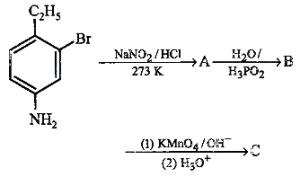
A
$2-$bromo$-1-$methylbenzene$-4-$carboxylic acid
B
$2-$bromobenzoic acid
C
$2-$bromo-phenylacetic acid
D
Bromobenzene
Solution
(B) $1$. The starting material is $4$-amino-$3$-bromoethylbenzene. Treatment with $NaNO_2/HCl$ at $273 \ K$ converts the $-NH_2$ group into a diazonium salt $(-N_2^+Cl^-)$,forming compound $A$.
$2$. Treatment of the diazonium salt with $H_3PO_2/H_2O$ reduces the diazonium group to a hydrogen atom,resulting in $1$-bromo-$2$-ethylbenzene (compound $B$).
$3$. Finally,oxidation of the ethyl group $(-CH_2CH_3)$ with alkaline $KMnO_4$ followed by acidic workup $(H_3O^+)$ converts the alkyl side chain into a carboxylic acid group $(-COOH)$. The product $C$ is $2$-bromobenzoic acid.
$2$. Treatment of the diazonium salt with $H_3PO_2/H_2O$ reduces the diazonium group to a hydrogen atom,resulting in $1$-bromo-$2$-ethylbenzene (compound $B$).
$3$. Finally,oxidation of the ethyl group $(-CH_2CH_3)$ with alkaline $KMnO_4$ followed by acidic workup $(H_3O^+)$ converts the alkyl side chain into a carboxylic acid group $(-COOH)$. The product $C$ is $2$-bromobenzoic acid.
0 likesView Solution
75
ChemistryEasyMCQTS EAMCET · 2024
What are $X$ and $Y$ respectively in the following reactions?

A
$(i) \ LiAlH_4 \ (ii) \ H_2O ; NaOH + Br_2$
B
$NaOH + Br_2 ; (i) \ LiAlH_4 \ (ii) \ H_2O$
C
$NaOH + Br_2 ; (i) \ NaBH_4 \ (ii) \ H_2O$
D
$(i) \ NaBH_4 \ (ii) \ H_2O ; NaOH + Br_2$
Solution
(B) The conversion of benzamide $(C_6H_5CONH_2)$ to aniline $(C_6H_5NH_2)$ involves the removal of a carbonyl group,which is achieved by the Hoffmann bromamide degradation reaction using $NaOH + Br_2$. Thus,$X = NaOH + Br_2$.
The conversion of benzamide $(C_6H_5CONH_2)$ to benzylamine $(C_6H_5CH_2NH_2)$ involves the reduction of the amide group to an amine group,which is achieved using a strong reducing agent like $LiAlH_4$ followed by hydrolysis. Thus,$Y = (i) \ LiAlH_4 \ (ii) \ H_2O$.
Therefore,$X = NaOH + Br_2$ and $Y = (i) \ LiAlH_4 \ (ii) \ H_2O$.
The conversion of benzamide $(C_6H_5CONH_2)$ to benzylamine $(C_6H_5CH_2NH_2)$ involves the reduction of the amide group to an amine group,which is achieved using a strong reducing agent like $LiAlH_4$ followed by hydrolysis. Thus,$Y = (i) \ LiAlH_4 \ (ii) \ H_2O$.
Therefore,$X = NaOH + Br_2$ and $Y = (i) \ LiAlH_4 \ (ii) \ H_2O$.
0 likesView Solution
76
ChemistryEasyMCQTS EAMCET · 2024
The reagents/chemicals $X$ and $Y$ that convert cyanobenzene to a Schiff's base are:
A
$(i) \text{ DIBAL-H}, NH_2OH; (ii) H_2O$
B
$DIBAL-H, H_2O$
C
$LAH, CH_3OH$
D
$H_3O^+$
Solution
(B) The conversion of cyanobenzene (benzonitrile) to a Schiff's base involves two main steps:
$1$. Reduction of cyanobenzene to benzaldehyde using $DIBAL-H$ followed by hydrolysis $(H_2O)$.
$2$. Reaction of benzaldehyde with an amine (like aniline) to form a Schiff's base $(R-CH=N-R')$.
Given the options,the primary reagents for the reduction step are $DIBAL-H$ and $H_2O$.
$1$. Reduction of cyanobenzene to benzaldehyde using $DIBAL-H$ followed by hydrolysis $(H_2O)$.
$2$. Reaction of benzaldehyde with an amine (like aniline) to form a Schiff's base $(R-CH=N-R')$.
Given the options,the primary reagents for the reduction step are $DIBAL-H$ and $H_2O$.
0 likesView Solution
77
ChemistryDifficultMCQTS EAMCET · 2024
Cellulose is a polysaccharide and is made of
A
$ \beta $-$D$-glucose units joined through $1,4$-glycosidic linkages
B
$ \alpha $-$D$-glucose units joined through $1,4$-glycosidic linkages
C
$ \alpha $-$D$-glucose units joined through $1,6$-glycosidic linkages
D
$ \beta $-$D$-glucose units joined through $1,6$-glycosidic linkages
Solution
(A) Cellulose is a linear polysaccharide composed of $ \beta $-$D$-glucose units joined through $1,4$-glycosidic linkages.
These glucose units are linked by glycosidic bonds between the $C_1$ carbon of one unit and the $C_4$ carbon of the adjacent unit,where the anomeric $C_1$ carbon maintains a $ \beta $-configuration.
These glucose units are linked by glycosidic bonds between the $C_1$ carbon of one unit and the $C_4$ carbon of the adjacent unit,where the anomeric $C_1$ carbon maintains a $ \beta $-configuration.
0 likesView Solution
78
ChemistryMediumMCQTS EAMCET · 2024
The functional groups involved in the conversion of glucose to gluconic acid and gluconic acid to saccharic acid respectively are
A
$-CHO, >CHOH$
B
$-CHO, -CH_2OH$
C
$-CH_2OH, -CHO$
D
$-CH_2OH, >CHOH$
Solution
(B) Glucose $(CHO(CHOH)_4CH_2OH)$ on oxidation with mild oxidizing agents like $Br_2$ water gets converted to gluconic acid $(COOH(CHOH)_4CH_2OH)$. Here,the aldehyde group $(-CHO)$ is oxidized to a carboxylic acid group $(-COOH)$.
Gluconic acid $(COOH(CHOH)_4CH_2OH)$ on oxidation with strong oxidizing agents like $HNO_3$ gets converted to saccharic acid $(COOH(CHOH)_4COOH)$. Here,the primary alcoholic group $(-CH_2OH)$ is oxidized to a carboxylic acid group $(-COOH)$.
Thus,the functional groups involved in the respective conversions are $-CHO$ and $-CH_2OH$.
Gluconic acid $(COOH(CHOH)_4CH_2OH)$ on oxidation with strong oxidizing agents like $HNO_3$ gets converted to saccharic acid $(COOH(CHOH)_4COOH)$. Here,the primary alcoholic group $(-CH_2OH)$ is oxidized to a carboxylic acid group $(-COOH)$.
Thus,the functional groups involved in the respective conversions are $-CHO$ and $-CH_2OH$.
0 likesView Solution
79
ChemistryEasyMCQTS EAMCET · 2024
Two statements are given below.
Statement $I$: Milk sugar is a disaccharide of $\alpha-D$-galactose and $\beta-D$-glucose.
Statement $II$: Sucrose is a disaccharide of $\alpha-D$-glucose and $\beta-D$-fructose.
Correct answer is
Statement $I$: Milk sugar is a disaccharide of $\alpha-D$-galactose and $\beta-D$-glucose.
Statement $II$: Sucrose is a disaccharide of $\alpha-D$-glucose and $\beta-D$-fructose.
Correct answer is
A
Both statements $I$ and $II$ are correct
B
Both statements $I$ and $II$ are incorrect
C
Statement $I$ is correct but statement $II$ is incorrect
D
Statement $I$ is incorrect but statement $II$ is correct
Solution
(D) Lactose,i.e.,milk sugar,is composed of a $\beta-D$-galactose unit and an $\alpha-D$-glucose unit joined by a $\beta$-glycosidic linkage between $C-1$ of galactose and $C-4$ of the glucose unit. Thus,Statement $I$ is incorrect because it mentions $\alpha-D$-galactose instead of $\beta-D$-galactose.
Sucrose,i.e.,cane sugar,is composed of $\alpha-D$-glucose and $\beta-D$-fructose units. These units are joined by an $\alpha,\beta$-glycosidic linkage between $C-1$ of glucose and $C-2$ of fructose. Thus,Statement $II$ is correct.
Sucrose,i.e.,cane sugar,is composed of $\alpha-D$-glucose and $\beta-D$-fructose units. These units are joined by an $\alpha,\beta$-glycosidic linkage between $C-1$ of glucose and $C-2$ of fructose. Thus,Statement $II$ is correct.
0 likesView Solution
80
ChemistryEasyMCQTS EAMCET · 2024
Formic acid on heating with concentrated $H_2SO_4$ at $373 \ K$ gives $X$,a colourless substance and $Y$,a good reducing agent. The number of $\sigma$ and $\pi$ bonds in $X$ and $Y$ are respectively:
A
$X=2,0; Y=1,2$
B
$X=1,2; Y=2,2$
C
$X=2,1; Y=1,1$
D
$X=1,2; Y=3,3$
Solution
(A) The reaction of formic acid $(HCOOH)$ with concentrated $H_2SO_4$ is a dehydration reaction:
$HCOOH \xrightarrow{Conc. H_2SO_4, 373 \ K} H_2O + CO$
Here,$X$ is $H_2O$ (water) and $Y$ is $CO$ (carbon monoxide).
In $H_2O$ $(X)$,there are two $O-H$ single bonds,so it has $2 \sigma$ bonds and $0 \pi$ bonds.
In $CO$ $(Y)$,the structure is $C \equiv O$,which consists of $1 \sigma$ bond and $2 \pi$ bonds.
Therefore,for $X$ $(H_2O)$,the count is $2 \sigma, 0 \pi$ and for $Y$ $(CO)$,the count is $1 \sigma, 2 \pi$.
Thus,the correct option is $A$.
$HCOOH \xrightarrow{Conc. H_2SO_4, 373 \ K} H_2O + CO$
Here,$X$ is $H_2O$ (water) and $Y$ is $CO$ (carbon monoxide).
In $H_2O$ $(X)$,there are two $O-H$ single bonds,so it has $2 \sigma$ bonds and $0 \pi$ bonds.
In $CO$ $(Y)$,the structure is $C \equiv O$,which consists of $1 \sigma$ bond and $2 \pi$ bonds.
Therefore,for $X$ $(H_2O)$,the count is $2 \sigma, 0 \pi$ and for $Y$ $(CO)$,the count is $1 \sigma, 2 \pi$.
Thus,the correct option is $A$.
0 likesView Solution
81
ChemistryEasyMCQTS EAMCET · 2024
In the given reaction sequence,$Z$ is
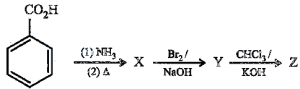
A
Chlorobenzene
B
Phenol
C
Phenyl isocyanide
D
Benzonitrile
Solution
(C) The reaction sequence is as follows:
$1$. Benzoic acid reacts with $NH_3$ followed by heating to form benzamide $(X)$.
$2$. Benzamide undergoes Hofmann bromamide degradation with $Br_2/NaOH$ to form aniline $(Y)$.
$3$. Aniline reacts with $CHCl_3/KOH$ (carbylamine reaction) to form phenyl isocyanide $(Z)$,which is characterized by a foul smell.
$1$. Benzoic acid reacts with $NH_3$ followed by heating to form benzamide $(X)$.
$2$. Benzamide undergoes Hofmann bromamide degradation with $Br_2/NaOH$ to form aniline $(Y)$.
$3$. Aniline reacts with $CHCl_3/KOH$ (carbylamine reaction) to form phenyl isocyanide $(Z)$,which is characterized by a foul smell.
0 likesView Solution
82
ChemistryDifficultMCQTS EAMCET · 2024
The functional groups present in the product '$X$' of the reaction given below are
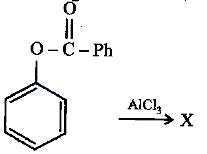
A
$-OH, -C-H$
B
$-OH, -C-$
C
$-O-Ph, -C-$
D
$-C-OH, -OH$
Solution
(B) The reaction shown is a Fries rearrangement.
When phenyl benzoate is treated with $AlCl_3$ (a Lewis acid),it undergoes rearrangement to form a mixture of ortho-hydroxybenzophenone and para-hydroxybenzophenone.
The product '$X$' is ortho-hydroxybenzophenone,which contains a phenolic hydroxyl group $(-OH)$ and a ketone carbonyl group $(-C=O)$.
Therefore,the functional groups present are $-OH$ and $-C=O$ (ketone).
When phenyl benzoate is treated with $AlCl_3$ (a Lewis acid),it undergoes rearrangement to form a mixture of ortho-hydroxybenzophenone and para-hydroxybenzophenone.
The product '$X$' is ortho-hydroxybenzophenone,which contains a phenolic hydroxyl group $(-OH)$ and a ketone carbonyl group $(-C=O)$.
Therefore,the functional groups present are $-OH$ and $-C=O$ (ketone).
0 likesView Solution
83
ChemistryMediumMCQTS EAMCET · 2024
Xenon $(VI)$ fluoride on complete hydrolysis gives an oxide of xenon '$O$'. The total number of $\sigma$ and $\pi$ bonds in '$O$' is
A
$2$
B
$4$
C
$6$
D
$8$
Solution
(C) The complete hydrolysis of $XeF_6$ is given by the reaction:
$XeF_6 + 3H_2O \rightarrow XeO_3 + 6HF$
Here,the oxide of xenon '$O$' is $XeO_3$.
In the structure of $XeO_3$,the xenon atom is bonded to three oxygen atoms by double bonds $(Xe=O)$.
Each $Xe=O$ bond consists of one $\sigma$ bond and one $\pi$ bond.
Therefore,there are $3$ $\sigma$ bonds and $3$ $\pi$ bonds.
Total number of $\sigma$ and $\pi$ bonds $= 3 + 3 = 6$.
$XeF_6 + 3H_2O \rightarrow XeO_3 + 6HF$
Here,the oxide of xenon '$O$' is $XeO_3$.
In the structure of $XeO_3$,the xenon atom is bonded to three oxygen atoms by double bonds $(Xe=O)$.
Each $Xe=O$ bond consists of one $\sigma$ bond and one $\pi$ bond.
Therefore,there are $3$ $\sigma$ bonds and $3$ $\pi$ bonds.
Total number of $\sigma$ and $\pi$ bonds $= 3 + 3 = 6$.
0 likesView Solution
84
ChemistryEasyMCQTS EAMCET · 2024
The decomposition of benzene diazonium chloride is a first order reaction. The time taken for the decomposition of $\frac{1}{4}$ and $\frac{1}{10}$ of its initial concentration are $t_{1/4}$ and $t_{1/10}$ respectively. The value of $\frac{t_{1/4}}{t_{1/10}} \times 100$ is (Given: $\log 2 = 0.3, \log 3 = 0.477$)
A
$272$
B
$300$
C
$90$
D
$45$
Solution
(A) For a first order reaction,$k = \frac{2.303}{t} \log \frac{a}{a-x}$.
For $t_{1/4}$,$x = \frac{a}{4}$,so $t_{1/4} = \frac{2.303}{k} \log \frac{a}{3a/4} = \frac{2.303}{k} \log \frac{4}{3}$.
For $t_{1/10}$,$x = \frac{a}{10}$,so $t_{1/10} = \frac{2.303}{k} \log \frac{a}{9a/10} = \frac{2.303}{k} \log \frac{10}{9}$.
Taking the ratio: $\frac{t_{1/4}}{t_{1/10}} = \frac{\log(4/3)}{\log(10/9)} = \frac{\log 4 - \log 3}{\log 10 - \log 9} = \frac{2 \log 2 - \log 3}{1 - 2 \log 3}$.
Using $\log 2 = 0.3$ and $\log 3 = 0.477$: $\frac{t_{1/4}}{t_{1/10}} = \frac{2(0.3) - 0.477}{1 - 2(0.477)} = \frac{0.6 - 0.477}{1 - 0.954} = \frac{0.123}{0.046} \approx 2.67$.
Thus,$\frac{t_{1/4}}{t_{1/10}} \times 100 \approx 267$. The closest option is $272$.
For $t_{1/4}$,$x = \frac{a}{4}$,so $t_{1/4} = \frac{2.303}{k} \log \frac{a}{3a/4} = \frac{2.303}{k} \log \frac{4}{3}$.
For $t_{1/10}$,$x = \frac{a}{10}$,so $t_{1/10} = \frac{2.303}{k} \log \frac{a}{9a/10} = \frac{2.303}{k} \log \frac{10}{9}$.
Taking the ratio: $\frac{t_{1/4}}{t_{1/10}} = \frac{\log(4/3)}{\log(10/9)} = \frac{\log 4 - \log 3}{\log 10 - \log 9} = \frac{2 \log 2 - \log 3}{1 - 2 \log 3}$.
Using $\log 2 = 0.3$ and $\log 3 = 0.477$: $\frac{t_{1/4}}{t_{1/10}} = \frac{2(0.3) - 0.477}{1 - 2(0.477)} = \frac{0.6 - 0.477}{1 - 0.954} = \frac{0.123}{0.046} \approx 2.67$.
Thus,$\frac{t_{1/4}}{t_{1/10}} \times 100 \approx 267$. The closest option is $272$.
0 likesView Solution
85
ChemistryMediumMCQTS EAMCET · 2024
For the gaseous reaction,$N_2O_5 \rightarrow 2NO_2 + \frac{1}{2}O_2$,the rate can be expressed as:
$-\frac{d[N_2O_5]}{dt} = K_1[N_2O_5]$
$+\frac{d[NO_2]}{dt} = K_2[N_2O_5]$
$+\frac{d[O_2]}{dt} = K_3[N_2O_5]$
The correct relation between $K_1, K_2$ and $K_3$ is:
$-\frac{d[N_2O_5]}{dt} = K_1[N_2O_5]$
$+\frac{d[NO_2]}{dt} = K_2[N_2O_5]$
$+\frac{d[O_2]}{dt} = K_3[N_2O_5]$
The correct relation between $K_1, K_2$ and $K_3$ is:
A
$K_1 = 2K_2 = 4K_3$
B
$2K_1 = K_2 = 4K_3$
C
$2K_1 = 3K_2 = 4K_3$
D
$4K_1 = 2K_2 = K_3$
Solution
(B) For the reaction $N_2O_5 \rightarrow 2NO_2 + \frac{1}{2}O_2$,the rate of reaction is given by:
Rate $= -\frac{d[N_2O_5]}{dt} = \frac{1}{2} \frac{d[NO_2]}{dt} = 2 \frac{d[O_2]}{dt}$
Substituting the given rate expressions:
$K_1[N_2O_5] = \frac{1}{2} K_2[N_2O_5] = 2K_3[N_2O_5]$
Dividing by $[N_2O_5]$ gives $K_1 = \frac{1}{2} K_2 = 2K_3$.
Multiplying the entire relation by $2$,we get $2K_1 = K_2 = 4K_3$.
Rate $= -\frac{d[N_2O_5]}{dt} = \frac{1}{2} \frac{d[NO_2]}{dt} = 2 \frac{d[O_2]}{dt}$
Substituting the given rate expressions:
$K_1[N_2O_5] = \frac{1}{2} K_2[N_2O_5] = 2K_3[N_2O_5]$
Dividing by $[N_2O_5]$ gives $K_1 = \frac{1}{2} K_2 = 2K_3$.
Multiplying the entire relation by $2$,we get $2K_1 = K_2 = 4K_3$.
0 likesView Solution
86
ChemistryDifficultMCQTS EAMCET · 2024
Consider the gaseous reaction $A_2 + B_2 \rightarrow 2 AB$. The following data was obtained for the above reaction:
The value of the rate constant for the above reaction is:
| $[A_2]_0$ | $[B_2]_0$ | Initial rate of formation of $AB$ $(mol \ L^{-1} s^{-1})$ |
| $0.1 \ M$ | $0.1 \ M$ | $2.5 \times 10^{-4}$ |
| $0.2 \ M$ | $0.1 \ M$ | $5.0 \times 10^{-4}$ |
| $0.2 \ M$ | $0.2 \ M$ | $1.0 \times 10^{-3}$ |
The value of the rate constant for the above reaction is:
A
$1.25 \times 10^{-2}$
B
$1.25 \times 10^{-3}$
C
$2.5 \times 10^{-2}$
D
$2.5 \times 10^{-1}$
Solution
(A) For the reaction $A_2 + B_2 \rightarrow 2 AB$,the rate of reaction $R$ is defined as $R = k[A_2]^x [B_2]^y$.
The rate of formation of $AB$ is given as $\frac{d[AB]}{dt} = 2R$.
From the table:
$1.25 \times 10^{-4} = k(0.1)^x(0.1)^y \dots (i)$
$2.5 \times 10^{-4} = k(0.2)^x(0.1)^y \dots (ii)$
$5.0 \times 10^{-4} = k(0.2)^x(0.2)^y \dots (iii)$
Dividing $(ii)$ by $(i)$,we get $2^x = 2$,so $x = 1$.
Dividing $(iii)$ by $(ii)$,we get $2^y = 2$,so $y = 1$.
Thus,the rate law is $R = k[A_2][B_2]$.
Using values from $(i)$: $1.25 \times 10^{-4} = k(0.1)(0.1) = k(0.01)$.
$k = \frac{1.25 \times 10^{-4}}{0.01} = 1.25 \times 10^{-2} \ L \ mol^{-1} s^{-1}$.
The rate of formation of $AB$ is given as $\frac{d[AB]}{dt} = 2R$.
From the table:
$1.25 \times 10^{-4} = k(0.1)^x(0.1)^y \dots (i)$
$2.5 \times 10^{-4} = k(0.2)^x(0.1)^y \dots (ii)$
$5.0 \times 10^{-4} = k(0.2)^x(0.2)^y \dots (iii)$
Dividing $(ii)$ by $(i)$,we get $2^x = 2$,so $x = 1$.
Dividing $(iii)$ by $(ii)$,we get $2^y = 2$,so $y = 1$.
Thus,the rate law is $R = k[A_2][B_2]$.
Using values from $(i)$: $1.25 \times 10^{-4} = k(0.1)(0.1) = k(0.01)$.
$k = \frac{1.25 \times 10^{-4}}{0.01} = 1.25 \times 10^{-2} \ L \ mol^{-1} s^{-1}$.
0 likesView Solution
87
ChemistryMediumMCQTS EAMCET · 2024
For a first order reaction,the graph between $\log \frac{a}{(a-x)}$ (on $y$-axis) and time (in $min$,on $x$-axis) gave a straight line passing through origin. The slope is $2 \times 10^{-3} \ min^{-1}$. What is the rate constant (in $min^{-1}$)?
A
$2 \times 10^{-3}$
B
$\frac{2 \times 10^{-3}}{2.303}$
C
$4.606 \times 10^{-3}$
D
$0.5 \times 10^{-5}$
Solution
(C) For a first order reaction,the integrated rate equation is given by:
$\log \frac{a}{a-x} = \frac{kt}{2.303}$
Comparing this with the equation of a straight line $y = mx + c$:
Here,$y = \log \frac{a}{a-x}$,$x = t$,and the slope $m = \frac{k}{2.303}$.
Given that the slope $m = 2 \times 10^{-3} \ min^{-1}$,we have:
$\frac{k}{2.303} = 2 \times 10^{-3} \ min^{-1}$
Therefore,$k = 2.303 \times 2 \times 10^{-3} \ min^{-1} = 4.606 \times 10^{-3} \ min^{-1}$.
$\log \frac{a}{a-x} = \frac{kt}{2.303}$
Comparing this with the equation of a straight line $y = mx + c$:
Here,$y = \log \frac{a}{a-x}$,$x = t$,and the slope $m = \frac{k}{2.303}$.
Given that the slope $m = 2 \times 10^{-3} \ min^{-1}$,we have:
$\frac{k}{2.303} = 2 \times 10^{-3} \ min^{-1}$
Therefore,$k = 2.303 \times 2 \times 10^{-3} \ min^{-1} = 4.606 \times 10^{-3} \ min^{-1}$.
0 likesView Solution
88
ChemistryEasyMCQTS EAMCET · 2024
For a first order reaction,a plot of $\ln k$ ($y$-axis) and $\frac{1}{T}$ ($x$-axis) gave a straight line with a slope equal to $-10^3 \ K$ and an intercept equal to $2.303$ (on $y$-axis). What is the activation energy ($E_a$ in $kJ \ mol^{-1}$) of the reaction? (Given $R = 8.314 \ J \ mol^{-1} \ K^{-1}$)
A
$8.314$
B
$2303$
C
$2.303$
D
$83.14$
Solution
(A) According to the Arrhenius equation: $\ln k = \ln A - \frac{E_a}{RT}$.
Comparing this with the equation of a straight line,$y = mx + c$,where $y = \ln k$ and $x = \frac{1}{T}$:
The slope $(m) = -\frac{E_a}{R}$.
Given the slope $(m) = -10^3 \ K$,we have:
$-\frac{E_a}{R} = -10^3 \ K$
$E_a = 10^3 \ K \times R$
$E_a = 10^3 \ K \times 8.314 \ J \ mol^{-1} \ K^{-1} = 8314 \ J \ mol^{-1}$.
To convert to $kJ \ mol^{-1}$,divide by $1000$:
$E_a = \frac{8314}{1000} \ kJ \ mol^{-1} = 8.314 \ kJ \ mol^{-1}$.
Comparing this with the equation of a straight line,$y = mx + c$,where $y = \ln k$ and $x = \frac{1}{T}$:
The slope $(m) = -\frac{E_a}{R}$.
Given the slope $(m) = -10^3 \ K$,we have:
$-\frac{E_a}{R} = -10^3 \ K$
$E_a = 10^3 \ K \times R$
$E_a = 10^3 \ K \times 8.314 \ J \ mol^{-1} \ K^{-1} = 8314 \ J \ mol^{-1}$.
To convert to $kJ \ mol^{-1}$,divide by $1000$:
$E_a = \frac{8314}{1000} \ kJ \ mol^{-1} = 8.314 \ kJ \ mol^{-1}$.
0 likesView Solution
89
ChemistryEasyMCQTS EAMCET · 2024
Among the following,the incorrect statement about chloramphenicol is:
A
It is a bacteriostatic drug
B
It is a broad spectrum antibiotic
C
It is a bactericidal drug
D
It is used to treat typhoid
Solution
(C) Chloramphenicol is a chlorine-containing antibiotic produced by microorganisms. It is a broad-spectrum antibiotic that is very effective for the treatment of typhoid fever. It acts as a bacteriostatic drug,meaning it inhibits the growth of bacteria rather than killing them. Therefore,the statement that it is a bactericidal drug is incorrect.
0 likesView Solution
90
ChemistryDifficultMCQTS EAMCET · 2024
Match the following:
The correct answer is:
| List-$I$ (Type of drug) | List-$II$ (Example) |
|---|---|
| $(A)$ Antacid | $(I)$ Serotonin |
| $(B)$ Antihistamine | $(II)$ Seldane |
| $(C)$ Tranquilizer | $(III)$ Ranitidine |
| $(D)$ Antibiotic | $(IV)$ Chloramphenicol |
The correct answer is:
A
$(A)-(III), (B)-(I), (C)-(IV), (D)-(II)$
B
$(A)-(II), (B)-(III), (C)-(IV), (D)-(I)$
C
$(A)-(III), (B)-(II), (C)-(I), (D)-(IV)$
D
$(A)-(II), (B)-(III), (C)-(I), (D)-(IV)$
Solution
(C) $\rightarrow (III), (B)$ $\rightarrow (II), (C)$ $\rightarrow (I), (D)$ $\rightarrow (IV)$
$(A)$ Antacid: Substances which neutralize excess acid in the stomach are called antacids. Example: Ranitidine.
$(B)$ Antihistamine: Substances which reduce the release of histamine are called antihistamines. Example: Seldane.
$(C)$ Tranquilizer: Substances that are used to treat nervous system disorders. Example: Serotonin.
$(D)$ Antibiotic: Substances which inhibit or kill the growth of bacteria. Example: Chloramphenicol.
$(A)$ Antacid: Substances which neutralize excess acid in the stomach are called antacids. Example: Ranitidine.
$(B)$ Antihistamine: Substances which reduce the release of histamine are called antihistamines. Example: Seldane.
$(C)$ Tranquilizer: Substances that are used to treat nervous system disorders. Example: Serotonin.
$(D)$ Antibiotic: Substances which inhibit or kill the growth of bacteria. Example: Chloramphenicol.
0 likesView Solution
91
ChemistryEasyMCQTS EAMCET · 2024
Which of the following vitamins is also called pyridoxine?
A
$B_6$
B
$B_{12}$
C
$B_2$
D
$B_1$
Solution
(A) Vitamin $B_6$ is also known as Pyridoxine.
$B_2$ is known as Riboflavin.
$B_1$ is known as Thiamine.
$B_{12}$ is known as Cobalamin.
$B_2$ is known as Riboflavin.
$B_1$ is known as Thiamine.
$B_{12}$ is known as Cobalamin.
0 likesView Solution
92
ChemistryEasyMCQTS EAMCET · 2024
The effects that aspirin can produce in the body are:
| $A$. Anti-inflammatory | $B$. Antidepressant | $C$. Antipyretic |
| $D$. Anticoagulant | $E$. Hypnotic |
A
$A, B, C$
B
$A, C, D$
C
$A, B, E$
D
$C, D, E$
Solution
(B) Aspirin (acetylsalicylic acid) is a non-narcotic analgesic that exhibits the following properties:
$1$. Anti-inflammatory $(A)$: It reduces inflammation.
$2$. Antipyretic $(C)$: It reduces fever.
$3$. Anticoagulant $(D)$: It prevents blood clotting.
It does not act as an antidepressant $(B)$ or a hypnotic $(E)$.
Therefore,the correct effects are $A, C, D$.
$1$. Anti-inflammatory $(A)$: It reduces inflammation.
$2$. Antipyretic $(C)$: It reduces fever.
$3$. Anticoagulant $(D)$: It prevents blood clotting.
It does not act as an antidepressant $(B)$ or a hypnotic $(E)$.
Therefore,the correct effects are $A, C, D$.
0 likesView Solution
93
ChemistryMediumMCQTS EAMCET · 2024
Match the following:
The correct answer is
| List-$I$ (Element) | List-$II$ (Block) |
|---|---|
| $(A)$ $Ra$ | $(I)$ $p$-block |
| $(B)$ $Uuq$ | $(II)$ $s$-block |
| $(C)$ $Ds$ | $(III)$ $f$-block |
| $(D)$ $Fm$ | $(IV)$ $d$-block |
The correct answer is
A
$(A)-(II); (B)-(III); (C)-(IV); (D)-(I)$
B
$(A)-(III); (B)-(II); (C)-(I); (D)-(IV)$
C
$(A)-(III); (B)-(IV); (C)-(II); (D)-(I)$
D
$(A)-(II); (B)-(I); (C)-(IV); (D)-(III)$
Solution
(D) $\rightarrow (II), (B)$ $\rightarrow (I), (C)$ $\rightarrow (IV), (D)$ $\rightarrow (III)$
The electronic configuration of elements is as follows:
$(A)$ $Ra$ $(Z=88)$: The last electron enters the $7s$ orbital. Thus,it is an $s$-block element.
$(B)$ $Uuq$ ($Z=114$,Flerovium): The last electron enters the $7p$ orbital. Thus,it is a $p$-block element.
$(C)$ $Ds$ ($Z=110$,Darmstadtium): The last electron enters the $6d$ orbital. Thus,it is a $d$-block element.
$(D)$ $Fm$ ($Z=100$,Fermium): The last electron enters the $5f$ orbital. Thus,it is an $f$-block element.
The electronic configuration of elements is as follows:
$(A)$ $Ra$ $(Z=88)$: The last electron enters the $7s$ orbital. Thus,it is an $s$-block element.
$(B)$ $Uuq$ ($Z=114$,Flerovium): The last electron enters the $7p$ orbital. Thus,it is a $p$-block element.
$(C)$ $Ds$ ($Z=110$,Darmstadtium): The last electron enters the $6d$ orbital. Thus,it is a $d$-block element.
$(D)$ $Fm$ ($Z=100$,Fermium): The last electron enters the $5f$ orbital. Thus,it is an $f$-block element.
0 likesView Solution
94
ChemistryMediumMCQTS EAMCET · 2024
The set of elements which obey the general electronic configuration $(n-1)d^{1-10}ns^2$ is
A
$Bh, Eu, Po$
B
$Ho, Er, Lu$
C
$Hs, Hg, W$
D
$K, Bi, Ba$
Solution
(C) The general electronic configuration $(n-1)d^{1-10}ns^2$ represents the transition elements (d-block elements).
Let us analyze the configurations of the elements in option $C$:
${}_{108}Hs \Rightarrow [Rn] 5f^{14} 6d^6 7s^2$
${}_{80}Hg \Rightarrow [Xe] 4f^{14} 5d^{10} 6s^2$
${}_{74}W \Rightarrow [Xe] 4f^{14} 5d^4 6s^2$
All these elements belong to the d-block and follow the general configuration $(n-1)d^{1-10}ns^2$.
Let us analyze the configurations of the elements in option $C$:
${}_{108}Hs \Rightarrow [Rn] 5f^{14} 6d^6 7s^2$
${}_{80}Hg \Rightarrow [Xe] 4f^{14} 5d^{10} 6s^2$
${}_{74}W \Rightarrow [Xe] 4f^{14} 5d^4 6s^2$
All these elements belong to the d-block and follow the general configuration $(n-1)d^{1-10}ns^2$.
0 likesView Solution
95
ChemistryMediumMCQTS EAMCET · 2024
The molecular formula of a coordination complex is $CoH_{12}O_6Cl_3$. When one mole of this aqueous solution of the complex is reacted with an excess of aqueous $AgNO_3$ solution,$3$ moles of $AgCl$ are formed. What is the correct formula of the complex?
A
$[Co(H_2O)_6]Cl_3$
B
$[Co(H_2O)_5Cl]Cl_2 \cdot H_2O$
C
$[Co(H_2O)_4Cl_2]Cl \cdot 2H_2O$
D
$[Co(H_2O)_3Cl_3] \cdot 3H_2O$
Solution
(A) The reaction of the complex with $AgNO_3$ precipitates $Cl^-$ ions present outside the coordination sphere as $AgCl$.
Since $1$ mole of the complex yields $3$ moles of $AgCl$,there must be $3$ chloride ions outside the coordination sphere.
The formula $[Co(H_2O)_6]Cl_3$ dissociates as:
$[Co(H_2O)_6]Cl_3(aq) \rightarrow [Co(H_2O)_6]^{3+}(aq) + 3Cl^-(aq)$
The $3Cl^-$ ions react with $AgNO_3$ to form $3$ moles of $AgCl$:
$3Ag^+(aq) + 3Cl^-(aq) \rightarrow 3AgCl(s)$
Thus,the correct formula is $[Co(H_2O)_6]Cl_3$.
Since $1$ mole of the complex yields $3$ moles of $AgCl$,there must be $3$ chloride ions outside the coordination sphere.
The formula $[Co(H_2O)_6]Cl_3$ dissociates as:
$[Co(H_2O)_6]Cl_3(aq) \rightarrow [Co(H_2O)_6]^{3+}(aq) + 3Cl^-(aq)$
The $3Cl^-$ ions react with $AgNO_3$ to form $3$ moles of $AgCl$:
$3Ag^+(aq) + 3Cl^-(aq) \rightarrow 3AgCl(s)$
Thus,the correct formula is $[Co(H_2O)_6]Cl_3$.
0 likesView Solution
96
ChemistryMediumMCQTS EAMCET · 2024
Which one of the following complex ions has geometrical isomers?
A
$\left[ Co(Cl)_2(en)_2 \right]^{+}$
B
$\left[ Cr(NH_3)_4(en) \right]^{3+}$
C
$\left[ Co(en)_3 \right]^{3+}$
D
$\left[ Ni(NH_3)_5 Br \right]^{+}$
Solution
(A) Geometrical isomerism in coordination complexes occurs when ligands can be arranged in different spatial positions relative to each other.
For the complex $\left[ Co(Cl)_2(en)_2 \right]^{+}$,the two $Cl^-$ ligands can be either adjacent to each other (cis-isomer) or opposite to each other (trans-isomer).
Therefore,$\left[ Co(Cl)_2(en)_2 \right]^{+}$ exhibits geometrical isomerism.
For the complex $\left[ Co(Cl)_2(en)_2 \right]^{+}$,the two $Cl^-$ ligands can be either adjacent to each other (cis-isomer) or opposite to each other (trans-isomer).
Therefore,$\left[ Co(Cl)_2(en)_2 \right]^{+}$ exhibits geometrical isomerism.
0 likesView Solution
97
ChemistryEasyMCQTS EAMCET · 2024
Identify the complex ion with electronic configuration $t_{2g}^3 e_g^2$.
A
$[Fe(H_2O)_6]^{3+}$
B
$[Cr(H_2O)_6]^{3+}$
C
$[Ni(H_2O)_6]^{2+}$
D
$[Ti(H_2O)_6]^{3+}$
Solution
(A) In $[Fe(H_2O)_6]^{3+}$,the oxidation state of $Fe$ is $+3$.
$Fe$ $(Z=26)$: $[Ar] 3d^6 4s^2$.
$Fe^{3+}$: $[Ar] 3d^5$.
Since $H_2O$ is a weak field ligand,pairing of electrons does not occur.
According to Crystal Field Theory $(CFT)$,the five $d$-electrons occupy the $t_{2g}$ and $e_g$ orbitals singly,resulting in the electronic configuration $t_{2g}^3 e_g^2$.
$Fe$ $(Z=26)$: $[Ar] 3d^6 4s^2$.
$Fe^{3+}$: $[Ar] 3d^5$.
Since $H_2O$ is a weak field ligand,pairing of electrons does not occur.
According to Crystal Field Theory $(CFT)$,the five $d$-electrons occupy the $t_{2g}$ and $e_g$ orbitals singly,resulting in the electronic configuration $t_{2g}^3 e_g^2$.
0 likesView Solution
98
ChemistryMediumMCQTS EAMCET · 2024
In which of the following ions is the spin-only magnetic moment the lowest?
A
$[Ti(H_2O)_6]^{3+}$
B
$[Mn(H_2O)_6]^{2+}$
C
$[Ni(H_2O)_6]^{2+}$
D
$[Co(H_2O)_6]^{2+}$
Solution
(A) The spin-only magnetic moment is calculated using the formula $\mu = \sqrt{n(n+2)} \ BM$,where $n$ is the number of unpaired electrons. The lower the number of unpaired electrons,the lower the magnetic moment.
Since $[Ti(H_2O)_6]^{3+}$ has the lowest number of unpaired electrons $(n=1)$,it has the lowest spin-only magnetic moment.
| Ion | Electronic Configuration | Number of Unpaired Electrons $(n)$ |
|---|---|---|
| $[Ti(H_2O)_6]^{3+}$ | $3d^1$ | $1$ |
| $[Mn(H_2O)_6]^{2+}$ | $3d^5$ | $5$ |
| $[Ni(H_2O)_6]^{2+}$ | $3d^8$ | $2$ |
| $[Co(H_2O)_6]^{2+}$ | $3d^7$ | $3$ |
Since $[Ti(H_2O)_6]^{3+}$ has the lowest number of unpaired electrons $(n=1)$,it has the lowest spin-only magnetic moment.
0 likesView Solution
99
ChemistryMediumMCQTS EAMCET · 2024
Arrange the following in increasing order of their crystal field splitting energy:
$I. [Co(H_2O)_6]^{3+}$
$II. [Co(NH_3)_6]^{3+}$
$III. [Co(CN)_6]^{3-}$
$IV. [CoF_6]^{3-}$
$I. [Co(H_2O)_6]^{3+}$
$II. [Co(NH_3)_6]^{3+}$
$III. [Co(CN)_6]^{3-}$
$IV. [CoF_6]^{3-}$
A
$I < II < III < IV$
B
$IV < I < II < III$
C
$I < III < II < IV$
D
$IV < II < I < III$
Solution
(B) The crystal field splitting energy $(\Delta_o)$ depends on the strength of the ligand.
Stronger ligands cause greater splitting.
According to the spectrochemical series,the order of field strength for the given ligands is: $F^- < H_2O < NH_3 < CN^-$.
Therefore,the order of crystal field splitting energy is:
$[CoF_6]^{3-} < [Co(H_2O)_6]^{3 } < [Co(NH_3)_6]^{3 } < [Co(CN)_6]^{3-}$.
This corresponds to $IV < I < II < III$.
Stronger ligands cause greater splitting.
According to the spectrochemical series,the order of field strength for the given ligands is: $F^- < H_2O < NH_3 < CN^-$.
Therefore,the order of crystal field splitting energy is:
$[CoF_6]^{3-} < [Co(H_2O)_6]^{3 } < [Co(NH_3)_6]^{3 } < [Co(CN)_6]^{3-}$.
This corresponds to $IV < I < II < III$.
0 likesView Solution
100
ChemistryEasyMCQTS EAMCET · 2024
Which of the following will have a spin-only magnetic moment of $2.86 \ BM$?
A
$[CoF_6]^{3-}$
B
$[Co(NH_3)_6]^{3+}$
C
$[NiCl_4]^{2-}$
D
$[Ni(CN)_4]^{2-}$
Solution
(C) The spin-only magnetic moment $\mu$ is given by the formula $\mu = \sqrt{n(n+2)} \ BM$,where $n$ is the number of unpaired electrons.
For $\mu = 2.86 \ BM$,we have $\sqrt{n(n+2)} \approx 2.86$,which implies $n(n+2) \approx 8$,so $n = 2$.
In $[NiCl_4]^{2-}$,$Ni$ is in the $+2$ oxidation state ($3d^8$ configuration).
For $Ni^{2+}$ $(3d^8)$,the electrons are arranged as $t_{2g}^6 e_g^2$ in a tetrahedral field,resulting in $n = 2$ unpaired electrons.
Thus,$\mu = \sqrt{2(2+2)} = \sqrt{8} \approx 2.83 \ BM$,which matches the given value.
For $\mu = 2.86 \ BM$,we have $\sqrt{n(n+2)} \approx 2.86$,which implies $n(n+2) \approx 8$,so $n = 2$.
In $[NiCl_4]^{2-}$,$Ni$ is in the $+2$ oxidation state ($3d^8$ configuration).
For $Ni^{2+}$ $(3d^8)$,the electrons are arranged as $t_{2g}^6 e_g^2$ in a tetrahedral field,resulting in $n = 2$ unpaired electrons.
Thus,$\mu = \sqrt{2(2+2)} = \sqrt{8} \approx 2.83 \ BM$,which matches the given value.
0 likesView Solution
Vedclass Products
For Students
Vedclass Test Series
Mock tests in real TS EAMCET style covering Chemistry with performance analysis. 5-day free trial.
Start Free TrialFor Teachers
Exam Paper Generator
Generate Set A/B/C/D Chemistry papers from 7.5L+ questions in 2 minutes. 3 chapters free.
Try FreeFor Institutes
Online Exam Module
Run live TS EAMCET mock exams with unlimited students, 360° analytics & white-label branding.
See DemoFrequently Asked Questions
How many Chemistry questions are in TS EAMCET 2024?
There are 241 Chemistry questions from the TS EAMCET 2024 paper on Vedclass, each with a detailed step-by-step solution in English.
Are TS EAMCET 2024 Chemistry solutions available in English?
Yes. All solutions on this page are in English. You can also switch to English or Hindi using the language buttons above the questions.
Can I practice TS EAMCET 2024 Chemistry as a timed test?
Yes. Use the Vedclass Test Series to attempt a full TS EAMCET mock test covering Chemistry with time limits and instant score analysis.
Can teachers create Chemistry papers from TS EAMCET previous year questions?
Yes. The Vedclass Exam Paper Generator lets teachers mix TS EAMCET Chemistry questions and generate Set A/B/C/D papers in minutes.
For Teachers & Institutes
Build a Custom Chemistry Paper
Pick TS EAMCET 2024 Chemistry questions, set difficulty, and generate Set A/B/C/D in 2 minutes.