
PhysicsQ1–50 of 50 questions
Page 1 of 1 · English
1
PhysicsMediumMCQNEET · 2024
$A$ particle moving with uniform speed in a circular path maintains:
A
Constant acceleration
B
Constant velocity but varying acceleration
C
Varying velocity and varying acceleration
D
Constant velocity
Solution
(C) In uniform circular motion,the speed of the particle remains constant,but the direction of motion changes at every point along the circular path.
Since velocity is a vector quantity (having both magnitude and direction),a change in direction implies a change in velocity. Therefore,the velocity is varying.
Furthermore,the centripetal acceleration,given by $a_c = v^2/r$,is directed towards the center of the circle. As the particle moves,the direction of this acceleration vector changes continuously to remain pointing towards the center.
Thus,both velocity and acceleration are varying.
Since velocity is a vector quantity (having both magnitude and direction),a change in direction implies a change in velocity. Therefore,the velocity is varying.
Furthermore,the centripetal acceleration,given by $a_c = v^2/r$,is directed towards the center of the circle. As the particle moves,the direction of this acceleration vector changes continuously to remain pointing towards the center.
Thus,both velocity and acceleration are varying.
0 likesView Solution
2
PhysicsMediumMCQNEET · 2024
At any instant of time $t$, the displacement of a particle is given by $x = 2t - 1$ ($SI$ units) under the influence of a force of $5 \,N$. The value of instantaneous power is (in $SI$ units):
A
$5$
B
$7$
C
$6$
D
$10$
Solution
(D) Given:
Displacement $x = 2t - 1 \,m$
Force $F = 5 \,N$
Step $1$: Find the velocity of the particle.
Velocity $v = \frac{dx}{dt} = \frac{d}{dt}(2t - 1) = 2 \,m/s$
Step $2$: Calculate the instantaneous power.
Power $P = F \cdot v$
$P = 5 \,N \times 2 \,m/s = 10 \,W$
Thus, the instantaneous power is $10 \,W$.
Displacement $x = 2t - 1 \,m$
Force $F = 5 \,N$
Step $1$: Find the velocity of the particle.
Velocity $v = \frac{dx}{dt} = \frac{d}{dt}(2t - 1) = 2 \,m/s$
Step $2$: Calculate the instantaneous power.
Power $P = F \cdot v$
$P = 5 \,N \times 2 \,m/s = 10 \,W$
Thus, the instantaneous power is $10 \,W$.
0 likesView Solution
3
PhysicsMediumMCQNEET · 2024
The moment of inertia of a thin rod about an axis passing through its midpoint and perpendicular to the rod is $2400 \,g \,cm^2$. The length of the $400 \,g$ rod is nearly: (in $\,cm$)
A
$17.5$
B
$20.7$
C
$72.0$
D
$8.5$
Solution
(D) The formula for the moment of inertia $(I)$ of a thin rod of mass $m$ and length $\ell$ about an axis passing through its midpoint and perpendicular to its length is given by:
$I = \frac{m \ell^2}{12}$
Given:
$I = 2400 \,g \,cm^2$
$m = 400 \,g$
Substituting the values into the formula:
$2400 = \frac{400 \times \ell^2}{12}$
Simplify the equation:
$2400 = \frac{100 \times \ell^2}{3}$
$2400 \times 3 = 100 \times \ell^2$
$7200 = 100 \times \ell^2$
$\ell^2 = 72$
Taking the square root:
$\ell = \sqrt{72} \approx 8.485 \,cm$
Rounding to the nearest value, we get:
$\ell \approx 8.5 \,cm$
$I = \frac{m \ell^2}{12}$
Given:
$I = 2400 \,g \,cm^2$
$m = 400 \,g$
Substituting the values into the formula:
$2400 = \frac{400 \times \ell^2}{12}$
Simplify the equation:
$2400 = \frac{100 \times \ell^2}{3}$
$2400 \times 3 = 100 \times \ell^2$
$7200 = 100 \times \ell^2$
$\ell^2 = 72$
Taking the square root:
$\ell = \sqrt{72} \approx 8.485 \,cm$
Rounding to the nearest value, we get:
$\ell \approx 8.5 \,cm$
1 likesView Solution
4
PhysicsMediumMCQNEET · 2024
$A$ bob of mass $m$ is whirled in a horizontal plane by means of a string of length $\ell$ with an initial angular speed of $\omega$. The tension in the string is $T$. If the angular speed becomes $2\omega$ while keeping the same radius $\ell$,the tension in the string becomes:
A
$4T$
B
$\frac{T}{4}$
C
$\sqrt{2}T$
D
$T$
Solution
(A) For a bob of mass $m$ rotating in a horizontal circle of radius $\ell$ with angular speed $\omega$,the centripetal force is provided by the tension $T$ in the string.
$T = m\ell\omega^2$ --- $(1)$
When the angular speed is increased to $2\omega$ while keeping the radius $\ell$ constant,the new tension $T'$ is given by:
$T' = m\ell(2\omega)^2$
$T' = m\ell(4\omega^2)$
$T' = 4(m\ell\omega^2)$
Substituting equation $(1)$ into this expression,we get:
$T' = 4T$
$T = m\ell\omega^2$ --- $(1)$
When the angular speed is increased to $2\omega$ while keeping the radius $\ell$ constant,the new tension $T'$ is given by:
$T' = m\ell(2\omega)^2$
$T' = m\ell(4\omega^2)$
$T' = 4(m\ell\omega^2)$
Substituting equation $(1)$ into this expression,we get:
$T' = 4T$

0 likesView Solution
5
PhysicsMediumMCQNEET · 2024
The quantities which have the same dimensions as those of solid angle are:
A
stress and angle
B
strain and arc
C
angular speed and stress
D
strain and angle
Solution
(D) The solid angle is defined as $d\Omega = \frac{dA}{r^2}$. Since it is the ratio of area to the square of distance,its dimensions are $[M^0 L^0 T^0]$,making it a dimensionless quantity.
Strain is defined as the ratio of change in length to original length,$\text{Strain} = \frac{\Delta l}{l}$,which is also dimensionless $[M^0 L^0 T^0]$.
An angle $\theta = \frac{l}{r}$ is the ratio of arc length to radius,which is also dimensionless $[M^0 L^0 T^0]$.
Therefore,both strain and angle have the same dimensions as a solid angle.
Strain is defined as the ratio of change in length to original length,$\text{Strain} = \frac{\Delta l}{l}$,which is also dimensionless $[M^0 L^0 T^0]$.
An angle $\theta = \frac{l}{r}$ is the ratio of arc length to radius,which is also dimensionless $[M^0 L^0 T^0]$.
Therefore,both strain and angle have the same dimensions as a solid angle.
0 likesView Solution
6
PhysicsMediumMCQNEET · 2024
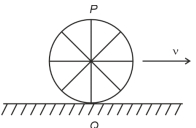
$A$ wheel of a bullock cart is rolling on a level road as shown in the figure. If its linear speed is $v$ in the direction shown,which one of the following options is correct ($P$ and $Q$ are the highest and lowest points on the wheel,respectively)?
A
Point $P$ moves faster than point $Q$
B
Both the points $P$ and $Q$ move with equal speed
C
Point $P$ has zero speed
D
Point $P$ moves slower than point $Q$
Solution
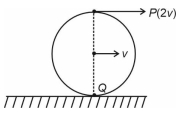
(A) In the case of pure rolling motion,the velocity of any point on the rim of the wheel is the vector sum of the translational velocity of the center of mass $(v)$ and the tangential velocity due to rotation $(v = r\omega)$.
For the topmost point $P$,the translational velocity and the rotational velocity are in the same direction. Thus,the resultant velocity is $v + v = 2v$.
For the lowest point $Q$,the translational velocity is in the forward direction $(v)$ and the rotational velocity is in the backward direction $(v)$. Thus,the resultant velocity is $v - v = 0$.
Since the velocity of point $P$ is $2v$ and the velocity of point $Q$ is $0$,point $P$ moves faster than point $Q$.
For the topmost point $P$,the translational velocity and the rotational velocity are in the same direction. Thus,the resultant velocity is $v + v = 2v$.
For the lowest point $Q$,the translational velocity is in the forward direction $(v)$ and the rotational velocity is in the backward direction $(v)$. Thus,the resultant velocity is $v - v = 0$.
Since the velocity of point $P$ is $2v$ and the velocity of point $Q$ is $0$,point $P$ moves faster than point $Q$.
0 likesView Solution
7
PhysicsMediumMCQNEET · 2024
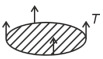
$A$ thin flat circular disc of radius $4.5 \,cm$ is placed gently over the surface of water. If the surface tension of water is $0.07 \,N \,m^{-1}$, then the excess force required to take it away from the surface is
A
$198 \,N$
B
$1.98 \,mN$
C
$99 \,N$
D
$19.8 \,mN$
Solution
(D) The excess force required to pull a circular disc of radius $R$ from the surface of a liquid with surface tension $T$ is given by the force due to surface tension acting along the circumference of the disc.
Excess force $F = T \times (2 \pi R)$
Given:
Radius $R = 4.5 \,cm = 4.5 \times 10^{-2} \,m$
Surface tension $T = 0.07 \,N \,m^{-1}$
Substituting the values:
$F = 0.07 \times 2 \times 3.14 \times 4.5 \times 10^{-2}$
$F = 0.07 \times 28.26 \times 10^{-2}$
$F = 1.9782 \times 10^{-2} \,N$
$F \approx 19.8 \times 10^{-3} \,N$
$F = 19.8 \,mN$
Excess force $F = T \times (2 \pi R)$
Given:
Radius $R = 4.5 \,cm = 4.5 \times 10^{-2} \,m$
Surface tension $T = 0.07 \,N \,m^{-1}$
Substituting the values:
$F = 0.07 \times 2 \times 3.14 \times 4.5 \times 10^{-2}$
$F = 0.07 \times 28.26 \times 10^{-2}$
$F = 1.9782 \times 10^{-2} \,N$
$F \approx 19.8 \times 10^{-3} \,N$
$F = 19.8 \,mN$
0 likesView Solution
8
PhysicsMediumMCQNEET · 2024
The maximum elongation of a steel wire of $1 \,m$ length if the elastic limit of steel and its Young's modulus,respectively,are $8 \times 10^8 \,N \,m^{-2}$ and $2 \times 10^{11} \,N \,m^{-2}$,is: (in $\,mm$)
A
$0.4$
B
$40$
C
$8$
D
$4$
Solution
(D) For maximum elongation,the stress applied must be equal to the elastic limit of the material.
Given:
Length of the wire,$L = 1 \,m$
Elastic limit (maximum stress),$\sigma = 8 \times 10^8 \,N \,m^{-2}$
Young's modulus,$Y = 2 \times 10^{11} \,N \,m^{-2}$
Using the formula for Young's modulus: $Y = \frac{\text{Stress}}{\text{Strain}} = \frac{\sigma}{\Delta L / L}$
Rearranging for elongation $\Delta L$:
$\Delta L = \frac{\sigma \times L}{Y}$
Substituting the values:
$\Delta L = \frac{8 \times 10^8 \times 1}{2 \times 10^{11}}$
$\Delta L = 4 \times 10^{-3} \,m$
Converting to millimeters:
$\Delta L = 4 \,mm$
Thus,the maximum elongation is $4 \,mm$.
Given:
Length of the wire,$L = 1 \,m$
Elastic limit (maximum stress),$\sigma = 8 \times 10^8 \,N \,m^{-2}$
Young's modulus,$Y = 2 \times 10^{11} \,N \,m^{-2}$
Using the formula for Young's modulus: $Y = \frac{\text{Stress}}{\text{Strain}} = \frac{\sigma}{\Delta L / L}$
Rearranging for elongation $\Delta L$:
$\Delta L = \frac{\sigma \times L}{Y}$
Substituting the values:
$\Delta L = \frac{8 \times 10^8 \times 1}{2 \times 10^{11}}$
$\Delta L = 4 \times 10^{-3} \,m$
Converting to millimeters:
$\Delta L = 4 \,mm$
Thus,the maximum elongation is $4 \,mm$.
0 likesView Solution
9
PhysicsMediumMCQNEET · 2024
In a vernier callipers,$(N+1)$ divisions of vernier scale coincide with $N$ divisions of main scale. If $1 \text{ MSD}$ represents $0.1 \text{ mm}$,the vernier constant (in $\text{cm}$) is:
A
$\frac{1}{100(N+1)}$
B
$100 \text{ N}$
C
$10(N+1)$
D
$\frac{1}{10 \text{ N}}$
Solution
(A) The Vernier Constant $(V.C.)$ is defined as the difference between one Main Scale Division $(MSD)$ and one Vernier Scale Division $(VSD)$: $V.C. = 1 \text{ MSD} - 1 \text{ VSD}$.
Given that $(N+1)$ divisions of the vernier scale coincide with $N$ divisions of the main scale:
$(N+1) \text{ VSD} = N \text{ MSD}$
$1 \text{ VSD} = \frac{N}{N+1} \text{ MSD}$.
Substituting this into the $V.C.$ formula:
$V.C. = 1 \text{ MSD} - \left(\frac{N}{N+1}\right) \text{ MSD}$
$V.C. = \text{ MSD} \left(1 - \frac{N}{N+1}\right) = \frac{1}{N+1} \text{ MSD}$.
Given $1 \text{ MSD} = 0.1 \text{ mm}$. Since $1 \text{ cm} = 10 \text{ mm}$,$1 \text{ mm} = 0.1 \text{ cm}$.
Therefore,$1 \text{ MSD} = 0.1 \times 0.1 \text{ cm} = 0.01 \text{ cm}$.
Thus,$V.C. = \frac{0.01}{N+1} \text{ cm} = \frac{1}{100(N+1)} \text{ cm}$.
Given that $(N+1)$ divisions of the vernier scale coincide with $N$ divisions of the main scale:
$(N+1) \text{ VSD} = N \text{ MSD}$
$1 \text{ VSD} = \frac{N}{N+1} \text{ MSD}$.
Substituting this into the $V.C.$ formula:
$V.C. = 1 \text{ MSD} - \left(\frac{N}{N+1}\right) \text{ MSD}$
$V.C. = \text{ MSD} \left(1 - \frac{N}{N+1}\right) = \frac{1}{N+1} \text{ MSD}$.
Given $1 \text{ MSD} = 0.1 \text{ mm}$. Since $1 \text{ cm} = 10 \text{ mm}$,$1 \text{ mm} = 0.1 \text{ cm}$.
Therefore,$1 \text{ MSD} = 0.1 \times 0.1 \text{ cm} = 0.01 \text{ cm}$.
Thus,$V.C. = \frac{0.01}{N+1} \text{ cm} = \frac{1}{100(N+1)} \text{ cm}$.
0 likesView Solution
10
PhysicsMediumMCQNEET · 2024
If $x=5 \sin \left(\pi t+\frac{\pi}{3}\right) \text{ m}$ represents the motion of a particle executing simple harmonic motion,the amplitude and time period of motion,respectively,are
A
$5 \text{ m}, 2 \text{ s}$
B
$5 \text{ cm}, 1 \text{ s}$
C
$5 \text{ m}, 1 \text{ s}$
D
$5 \text{ cm}, 2 \text{ s}$
Solution
(A) The general equation for simple harmonic motion is given by $x = A \sin(\omega t + \phi)$.
Comparing the given equation $x = 5 \sin \left(\pi t + \frac{\pi}{3}\right) \text{ m}$ with the general equation:
Amplitude $A = 5 \text{ m}$.
Angular frequency $\omega = \pi \text{ rad/s}$.
The time period $T$ is related to angular frequency by the formula $T = \frac{2\pi}{\omega}$.
Substituting the value of $\omega$: $T = \frac{2\pi}{\pi} = 2 \text{ s}$.
Thus,the amplitude is $5 \text{ m}$ and the time period is $2 \text{ s}$.
Comparing the given equation $x = 5 \sin \left(\pi t + \frac{\pi}{3}\right) \text{ m}$ with the general equation:
Amplitude $A = 5 \text{ m}$.
Angular frequency $\omega = \pi \text{ rad/s}$.
The time period $T$ is related to angular frequency by the formula $T = \frac{2\pi}{\omega}$.
Substituting the value of $\omega$: $T = \frac{2\pi}{\pi} = 2 \text{ s}$.
Thus,the amplitude is $5 \text{ m}$ and the time period is $2 \text{ s}$.
0 likesView Solution
11
PhysicsMediumMCQNEET · 2024
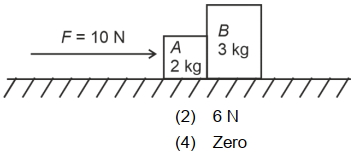
$A$ horizontal force of $10 \,N$ is applied to a block $A$ as shown in the figure. The masses of blocks $A$ and $B$ are $2 \,kg$ and $3 \,kg$ respectively. The blocks slide over a frictionless surface. The force exerted by block $A$ on block $B$ is:
A
$4 \,N$
B
$6 \,N$
C
$10 \,N$
D
Zero
Solution
(B) Given: Force $F = 10 \,N$, mass of block $A$ $(m_A) = 2 \,kg$, mass of block $B$ $(m_B) = 3 \,kg$.
Since the blocks are in contact and moving together, the acceleration $(a)$ of the system is given by Newton's second law:
$F = (m_A + m_B) a$
$10 = (2 + 3) a$
$10 = 5a$
$a = 2 \,m/s^2$
Now, consider the free body diagram of block $B$. The only horizontal force acting on block $B$ is the force exerted by block $A$ $(F_{AB})$, which causes it to accelerate at $2 \,m/s^2$:
$F_{AB} = m_B \times a$
$F_{AB} = 3 \,kg \times 2 \,m/s^2 = 6 \,N$
Therefore, the force exerted by block $A$ on block $B$ is $6 \,N$.
Since the blocks are in contact and moving together, the acceleration $(a)$ of the system is given by Newton's second law:
$F = (m_A + m_B) a$
$10 = (2 + 3) a$
$10 = 5a$
$a = 2 \,m/s^2$
Now, consider the free body diagram of block $B$. The only horizontal force acting on block $B$ is the force exerted by block $A$ $(F_{AB})$, which causes it to accelerate at $2 \,m/s^2$:
$F_{AB} = m_B \times a$
$F_{AB} = 3 \,kg \times 2 \,m/s^2 = 6 \,N$
Therefore, the force exerted by block $A$ on block $B$ is $6 \,N$.
0 likesView Solution
12
PhysicsMediumMCQNEET · 2024
Two bodies $A$ and $B$ of same mass undergo a completely inelastic one-dimensional collision. The body $A$ moves with velocity $v_1$ while body $B$ is at rest before the collision. The velocity of the system after the collision is $v_2$. The ratio $v_1: v_2$ is
A
$2: 1$
B
$4: 1$
C
$1: 4$
D
$1: 2$
Solution
(A) Let the mass of both bodies $A$ and $B$ be $m$.
Before the collision,body $A$ has velocity $v_1$ and body $B$ is at rest $(v_B = 0)$.
After the collision,since it is a completely inelastic collision,both bodies stick together and move with a common velocity $v_2$.
According to the law of conservation of linear momentum:
Initial momentum = Final momentum
$m v_1 + m(0) = (m + m) v_2$
$m v_1 = 2m v_2$
Dividing both sides by $m v_2$,we get:
$\frac{v_1}{v_2} = \frac{2}{1}$
Therefore,the ratio $v_1: v_2$ is $2: 1$.
Before the collision,body $A$ has velocity $v_1$ and body $B$ is at rest $(v_B = 0)$.
After the collision,since it is a completely inelastic collision,both bodies stick together and move with a common velocity $v_2$.
According to the law of conservation of linear momentum:
Initial momentum = Final momentum
$m v_1 + m(0) = (m + m) v_2$
$m v_1 = 2m v_2$
Dividing both sides by $m v_2$,we get:
$\frac{v_1}{v_2} = \frac{2}{1}$
Therefore,the ratio $v_1: v_2$ is $2: 1$.
0 likesView Solution
13
PhysicsMediumMCQNEET · 2024
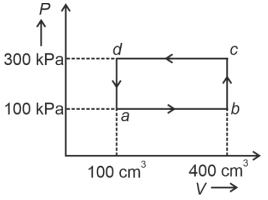
$A$ cyclic process of a thermodynamic system is taken through $a \to b \to c \to d \to a$ as shown in the $P-V$ diagram. The work done by the gas along the path $b \to c$ is
A
$30 \ J$
B
$-90 \ J$
C
$-60 \ J$
D
Zero
Solution
(D) In a $P-V$ diagram,the work done by a gas is given by the area under the curve,which is $\int P \ dV$.
Along the path $b \to c$,the volume $V$ remains constant at $400 \ cm^3$.
Since there is no change in volume $(dV = 0)$,the process is an isochoric process.
Therefore,the work done by the gas along the path $b \to c$ is $W = P \Delta V = P \times 0 = 0 \ J$.
Along the path $b \to c$,the volume $V$ remains constant at $400 \ cm^3$.
Since there is no change in volume $(dV = 0)$,the process is an isochoric process.
Therefore,the work done by the gas along the path $b \to c$ is $W = P \Delta V = P \times 0 = 0 \ J$.
0 likesView Solution
14
PhysicsMediumMCQNEET · 2024
The mass of a planet is $\frac{1}{10}$ that of the earth and its diameter is half that of the earth. The acceleration due to gravity on that planet is: (in $m \ s^{-2}$)
A
$9.8$
B
$4.9$
C
$3.92$
D
$19.6$
Solution
(C) The acceleration due to gravity on the surface of a planet is given by $g = \frac{GM}{R^2}$.
Let the mass and radius of the earth be $M$ and $R$ respectively. Then $g = \frac{GM}{R^2} = 9.8 \ m \ s^{-2}$.
For the given planet,the mass $M' = \frac{M}{10}$ and the radius $R' = \frac{R}{2}$ (since diameter is half,radius is also half).
The acceleration due to gravity on the planet is $g' = \frac{GM'}{R'^2}$.
Substituting the values: $g' = \frac{G(M/10)}{(R/2)^2} = \frac{GM/10}{R^2/4} = \frac{4}{10} \frac{GM}{R^2}$.
Since $\frac{GM}{R^2} = 9.8 \ m \ s^{-2}$,we have $g' = 0.4 \times 9.8 \ m \ s^{-2} = 3.92 \ m \ s^{-2}$.
Let the mass and radius of the earth be $M$ and $R$ respectively. Then $g = \frac{GM}{R^2} = 9.8 \ m \ s^{-2}$.
For the given planet,the mass $M' = \frac{M}{10}$ and the radius $R' = \frac{R}{2}$ (since diameter is half,radius is also half).
The acceleration due to gravity on the planet is $g' = \frac{GM'}{R'^2}$.
Substituting the values: $g' = \frac{G(M/10)}{(R/2)^2} = \frac{GM/10}{R^2/4} = \frac{4}{10} \frac{GM}{R^2}$.
Since $\frac{GM}{R^2} = 9.8 \ m \ s^{-2}$,we have $g' = 0.4 \times 9.8 \ m \ s^{-2} = 3.92 \ m \ s^{-2}$.
0 likesView Solution
15
PhysicsMediumMCQNEET · 2024
The minimum energy required to launch a satellite of mass $m$ from the surface of the Earth of mass $M$ and radius $R$ into a circular orbit at an altitude of $2R$ from the surface of the Earth is:
A
$\frac{2 G m M}{3 R}$
B
$\frac{G m M}{2 R}$
C
$\frac{G m M}{3 R}$
D
$\frac{5 G m M}{6 R}$
Solution
(D) The total energy of the satellite at the surface of the Earth is $E_i = K_i + U_i = K_i - \frac{G M m}{R}$.
At an altitude of $2R$ from the surface,the distance from the center of the Earth is $r = R + 2R = 3R$.
The orbital velocity $v$ at distance $r = 3R$ is given by $v = \sqrt{\frac{G M}{3R}}$.
The total energy at the orbit is $E_f = K_f + U_f = \frac{1}{2} m v^2 - \frac{G M m}{3R} = \frac{1}{2} m \left(\frac{G M}{3R}\right) - \frac{G M m}{3R} = \frac{G M m}{6R} - \frac{G M m}{3R} = -\frac{G M m}{6R}$.
By the law of conservation of energy,$E_i = E_f$:
$K_i - \frac{G M m}{R} = -\frac{G M m}{6R}$.
$K_i = \frac{G M m}{R} - \frac{G M m}{6R} = \frac{5 G M m}{6R}$.
At an altitude of $2R$ from the surface,the distance from the center of the Earth is $r = R + 2R = 3R$.
The orbital velocity $v$ at distance $r = 3R$ is given by $v = \sqrt{\frac{G M}{3R}}$.
The total energy at the orbit is $E_f = K_f + U_f = \frac{1}{2} m v^2 - \frac{G M m}{3R} = \frac{1}{2} m \left(\frac{G M}{3R}\right) - \frac{G M m}{3R} = \frac{G M m}{6R} - \frac{G M m}{3R} = -\frac{G M m}{6R}$.
By the law of conservation of energy,$E_i = E_f$:
$K_i - \frac{G M m}{R} = -\frac{G M m}{6R}$.
$K_i = \frac{G M m}{R} - \frac{G M m}{6R} = \frac{5 G M m}{6R}$.
2 likesView Solution
16
PhysicsMediumMCQNEET · 2024
If the mass of the bob in a simple pendulum is increased to thrice its original mass and its length is made half its original length,then the new time period of oscillation is $\frac{x}{2}$ times its original time period. Then the value of $x$ is
A
$\sqrt{2}$
B
$2 \sqrt{3}$
C
$4$
D
$\sqrt{3}$
Solution
(A) The time period of a simple pendulum is given by $T = 2 \pi \sqrt{\frac{\ell}{g}}$,where $\ell$ is the length of the pendulum and $g$ is the acceleration due to gravity. The time period is independent of the mass of the bob.
Given that the new length $\ell^{\prime} = \frac{\ell}{2}$.
The new time period $T^{\prime} = 2 \pi \sqrt{\frac{\ell^{\prime}}{g}} = 2 \pi \sqrt{\frac{\ell}{2g}} = \frac{1}{\sqrt{2}} \left( 2 \pi \sqrt{\frac{\ell}{g}} \right) = \frac{1}{\sqrt{2}} T$.
According to the problem,$T^{\prime} = \frac{x}{2} T$.
Therefore,$\frac{x}{2} = \frac{1}{\sqrt{2}}$.
$x = \frac{2}{\sqrt{2}} = \sqrt{2}$.
Given that the new length $\ell^{\prime} = \frac{\ell}{2}$.
The new time period $T^{\prime} = 2 \pi \sqrt{\frac{\ell^{\prime}}{g}} = 2 \pi \sqrt{\frac{\ell}{2g}} = \frac{1}{\sqrt{2}} \left( 2 \pi \sqrt{\frac{\ell}{g}} \right) = \frac{1}{\sqrt{2}} T$.
According to the problem,$T^{\prime} = \frac{x}{2} T$.
Therefore,$\frac{x}{2} = \frac{1}{\sqrt{2}}$.
$x = \frac{2}{\sqrt{2}} = \sqrt{2}$.
0 likesView Solution
17
PhysicsMediumMCQNEET · 2024
$A$ force defined by $F = \alpha t^2 + \beta t$ acts on a particle at a given time $t$. The factor which is dimensionless,if $\alpha$ and $\beta$ are constants,is:
A
$\alpha t / \beta$
B
$\alpha \beta t$
C
$\alpha \beta / t$
D
$\beta t / \alpha$
Solution
(A) According to the principle of homogeneity of dimensions,the dimensions of each term in an equation must be the same.
Therefore,$[F] = [\alpha t^2] = [\beta t]$.
From $[\alpha t^2] = [\beta t]$,we can write:
$\frac{[\alpha]}{[\beta]} = \frac{[t]}{[t^2]} = \frac{1}{[t]}$.
Multiplying both sides by $[t]$,we get:
$\frac{[\alpha][t]}{[\beta]} = 1$.
This implies that the quantity $\frac{\alpha t}{\beta}$ is dimensionless.
Therefore,$[F] = [\alpha t^2] = [\beta t]$.
From $[\alpha t^2] = [\beta t]$,we can write:
$\frac{[\alpha]}{[\beta]} = \frac{[t]}{[t^2]} = \frac{1}{[t]}$.
Multiplying both sides by $[t]$,we get:
$\frac{[\alpha][t]}{[\beta]} = 1$.
This implies that the quantity $\frac{\alpha t}{\beta}$ is dimensionless.
1 likesView Solution
18
PhysicsMediumMCQNEET · 2024
$A$ metallic bar of Young's modulus $0.5 \times 10^{11} \,N \,m^{-2}$, coefficient of linear thermal expansion $10^{-5} \,^{\circ}C^{-1}$, length $1 \,m$, and area of cross-section $10^{-3} \,m^2$ is heated from $0^{\circ}C$ to $100^{\circ}C$ without expansion or bending. The compressive force developed in it is:
A
$50 \times 10^3 \,N$
B
$100 \times 10^3 \,N$
C
$2 \times 10^3 \,N$
D
$5 \times 10^3 \,N$
Solution
(A) The thermal strain produced in the bar is given by $\epsilon = \alpha \Delta T$.
Given $\alpha = 10^{-5} \,^{\circ}C^{-1}$ and $\Delta T = 100^{\circ}C - 0^{\circ}C = 100^{\circ}C$.
So, $\epsilon = 10^{-5} \times 100 = 10^{-3}$.
Since the bar is prevented from expanding, the compressive stress $\sigma$ is given by $\sigma = Y \times \epsilon$, where $Y$ is Young's modulus.
$\sigma = (0.5 \times 10^{11} \,N \,m^{-2}) \times 10^{-3} = 0.5 \times 10^8 \,N \,m^{-2}$.
The compressive force $F$ is given by $F = \sigma \times A$, where $A$ is the area of cross-section.
$F = (0.5 \times 10^8 \,N \,m^{-2}) \times (10^{-3} \,m^2) = 0.5 \times 10^5 \,N = 50 \times 10^3 \,N$.
Given $\alpha = 10^{-5} \,^{\circ}C^{-1}$ and $\Delta T = 100^{\circ}C - 0^{\circ}C = 100^{\circ}C$.
So, $\epsilon = 10^{-5} \times 100 = 10^{-3}$.
Since the bar is prevented from expanding, the compressive stress $\sigma$ is given by $\sigma = Y \times \epsilon$, where $Y$ is Young's modulus.
$\sigma = (0.5 \times 10^{11} \,N \,m^{-2}) \times 10^{-3} = 0.5 \times 10^8 \,N \,m^{-2}$.
The compressive force $F$ is given by $F = \sigma \times A$, where $A$ is the area of cross-section.
$F = (0.5 \times 10^8 \,N \,m^{-2}) \times (10^{-3} \,m^2) = 0.5 \times 10^5 \,N = 50 \times 10^3 \,N$.
1 likesView Solution
19
PhysicsMediumMCQNEET · 2024
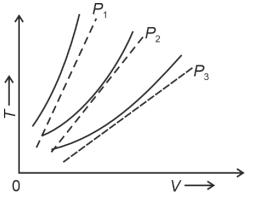
The following graph represents the $T-V$ curves of an ideal gas (where $T$ is the temperature and $V$ is the volume) at three pressures $P_1, P_2$ and $P_3$ compared with those of Charles's law represented as dotted lines. Then the correct relation is:
A
$P_1 > P_3 > P_2$
B
$P_2 > P_1 > P_3$
C
$P_1 > P_2 > P_3$
D
$P_3 > P_2 > P_1$
Solution
(C) From the ideal gas equation,$PV = nRT$,we have $T = (P/nR)V$.
For a fixed amount of gas ($n$ is constant),the slope of the $T-V$ graph is given by $m = P/nR$.
Since $n$ and $R$ are constants,the slope $m$ is directly proportional to the pressure $P$.
Therefore,a steeper slope in the $T-V$ graph corresponds to a higher pressure.
Looking at the graph,the slope of the curve for $P_1$ is the steepest,followed by $P_2$,and then $P_3$.
Thus,the correct relation is $P_1 > P_2 > P_3$.
For a fixed amount of gas ($n$ is constant),the slope of the $T-V$ graph is given by $m = P/nR$.
Since $n$ and $R$ are constants,the slope $m$ is directly proportional to the pressure $P$.
Therefore,a steeper slope in the $T-V$ graph corresponds to a higher pressure.
Looking at the graph,the slope of the curve for $P_1$ is the steepest,followed by $P_2$,and then $P_3$.
Thus,the correct relation is $P_1 > P_2 > P_3$.
0 likesView Solution
20
PhysicsMediumMCQNEET · 2024
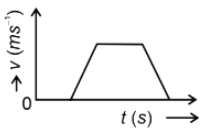
The velocity $(v)-$ time $(t)$ plot of the motion of a body is shown below:
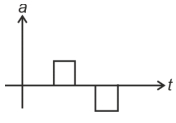
The acceleration $(a)-$ time $(t)$ graph that best suits this motion is:
The acceleration $(a)-$ time $(t)$ graph that best suits this motion is:
A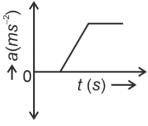
B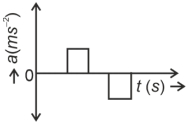
C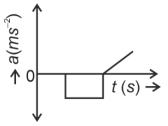
D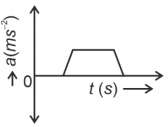
Solution
(B) The acceleration $(a)$ is defined as the rate of change of velocity,which corresponds to the slope of the velocity-time $(v-t)$ graph,i.e.,$a = \frac{dv}{dt}$.
$1$. In the first interval,the velocity increases linearly with time. Since the slope is constant and positive,the acceleration is constant and positive.
$2$. In the second interval,the velocity is constant. Since the slope of a horizontal line is zero,the acceleration is zero.
$3$. In the third interval,the velocity decreases linearly with time. Since the slope is constant and negative,the acceleration is constant and negative.
Comparing this with the given options,the graph that shows a positive constant acceleration,followed by zero acceleration,and then a negative constant acceleration is represented by option $B$.
$1$. In the first interval,the velocity increases linearly with time. Since the slope is constant and positive,the acceleration is constant and positive.
$2$. In the second interval,the velocity is constant. Since the slope of a horizontal line is zero,the acceleration is zero.
$3$. In the third interval,the velocity decreases linearly with time. Since the slope is constant and negative,the acceleration is constant and negative.
Comparing this with the given options,the graph that shows a positive constant acceleration,followed by zero acceleration,and then a negative constant acceleration is represented by option $B$.
0 likesView Solution
21
PhysicsMediumMCQNEET · 2024
Consider the following statements $A$ and $B$ and identify the correct answer:
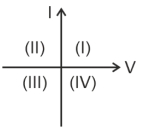
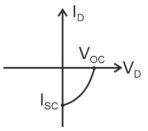
$A$. For a solar-cell,the $I-V$ characteristics lies in the $IV$ quadrant of the given graph.
$B$. In a reverse biased $pn$ junction diode,the current measured in $(\mu A)$ is due to majority charge carriers.
$A$. For a solar-cell,the $I-V$ characteristics lies in the $IV$ quadrant of the given graph.
$B$. In a reverse biased $pn$ junction diode,the current measured in $(\mu A)$ is due to majority charge carriers.
A
$A$ is incorrect but $B$ is correct
B
Both $A$ and $B$ are correct
C
Both $A$ and $B$ are incorrect
D
$A$ is correct but $B$ is incorrect
Solution
(D) Statement $A$: $A$ solar cell converts light energy into electrical energy. In the $I-V$ characteristic curve of a solar cell,the voltage is positive and the current is negative (as it delivers power to an external load). This corresponds to the $IV$ quadrant of the $I-V$ graph. Thus,statement $A$ is correct.
Statement $B$: In a reverse-biased $pn$ junction diode,the current is extremely small (in the order of $\mu A$) and is caused by the drift of minority charge carriers across the junction. The majority charge carriers are pushed away from the junction,preventing them from contributing to the current. Thus,statement $B$ is incorrect.
Statement $B$: In a reverse-biased $pn$ junction diode,the current is extremely small (in the order of $\mu A$) and is caused by the drift of minority charge carriers across the junction. The majority charge carriers are pushed away from the junction,preventing them from contributing to the current. Thus,statement $B$ is incorrect.
0 likesView Solution
22
PhysicsMediumMCQNEET · 2024
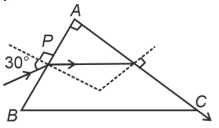
$A$ light ray enters through a right-angled prism at point $P$ with an angle of incidence of $30^{\circ}$ as shown in the figure. It travels through the prism parallel to its base $BC$ and emerges along the face $AC$. The refractive index of the prism is:
A
$\frac{\sqrt{5}}{2}$
B
$\frac{\sqrt{3}}{4}$
C
$\frac{\sqrt{3}}{2}$
D
$\frac{\sqrt{5}}{4}$
Solution
(A) Let the prism angle at the top be $A = 90^{\circ}$.
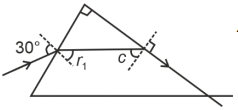
In the prism,the sum of the angles of refraction at the two faces is equal to the prism angle,so $r_1 + r_2 = A = 90^{\circ}$.
Since the ray travels parallel to the base $BC$,the angle of refraction at the second face is the critical angle $c$,so $r_2 = c$.
Thus,$r_1 = 90^{\circ} - c$.
Applying Snell's law at the first surface:
$1 \cdot \sin 30^{\circ} = \mu \cdot \sin r_1$
$1 \cdot \frac{1}{2} = \mu \cdot \sin(90^{\circ} - c)$
$\frac{1}{2} = \mu \cdot \cos c$.
We know that $\sin c = \frac{1}{\mu}$,so $\cos c = \sqrt{1 - \sin^2 c} = \sqrt{1 - \frac{1}{\mu^2}} = \frac{\sqrt{\mu^2 - 1}}{\mu}$.
Substituting this into the equation:
$\frac{1}{2} = \mu \cdot \frac{\sqrt{\mu^2 - 1}}{\mu}$
$\frac{1}{2} = \sqrt{\mu^2 - 1}$.
Squaring both sides:
$\frac{1}{4} = \mu^2 - 1$
$\mu^2 = 1 + \frac{1}{4} = \frac{5}{4}$
$\mu = \frac{\sqrt{5}}{2}$.
In the prism,the sum of the angles of refraction at the two faces is equal to the prism angle,so $r_1 + r_2 = A = 90^{\circ}$.
Since the ray travels parallel to the base $BC$,the angle of refraction at the second face is the critical angle $c$,so $r_2 = c$.
Thus,$r_1 = 90^{\circ} - c$.
Applying Snell's law at the first surface:
$1 \cdot \sin 30^{\circ} = \mu \cdot \sin r_1$
$1 \cdot \frac{1}{2} = \mu \cdot \sin(90^{\circ} - c)$
$\frac{1}{2} = \mu \cdot \cos c$.
We know that $\sin c = \frac{1}{\mu}$,so $\cos c = \sqrt{1 - \sin^2 c} = \sqrt{1 - \frac{1}{\mu^2}} = \frac{\sqrt{\mu^2 - 1}}{\mu}$.
Substituting this into the equation:
$\frac{1}{2} = \mu \cdot \frac{\sqrt{\mu^2 - 1}}{\mu}$
$\frac{1}{2} = \sqrt{\mu^2 - 1}$.
Squaring both sides:
$\frac{1}{4} = \mu^2 - 1$
$\mu^2 = 1 + \frac{1}{4} = \frac{5}{4}$
$\mu = \frac{\sqrt{5}}{2}$.
0 likesView Solution
23
PhysicsMediumMCQNEET · 2024
In an ideal transformer,the turns ratio is $\frac{N_p}{N_S} = \frac{1}{2}$. The ratio $V_s : V_p$ is equal to (the symbols carry their usual meaning):
A
$2 : 1$
B
$1 : 1$
C
$1 : 4$
D
$1 : 2$
Solution
(A) For an ideal transformer,the relationship between the voltage ratio and the turns ratio is given by the formula: $\frac{V_s}{V_p} = \frac{N_s}{N_p}$.
Given the turns ratio $\frac{N_p}{N_s} = \frac{1}{2}$,we can find the inverse ratio $\frac{N_s}{N_p} = \frac{2}{1}$.
Substituting this into the transformer equation,we get $\frac{V_s}{V_p} = \frac{2}{1}$.
Therefore,the ratio $V_s : V_p$ is $2 : 1$.
Given the turns ratio $\frac{N_p}{N_s} = \frac{1}{2}$,we can find the inverse ratio $\frac{N_s}{N_p} = \frac{2}{1}$.
Substituting this into the transformer equation,we get $\frac{V_s}{V_p} = \frac{2}{1}$.
Therefore,the ratio $V_s : V_p$ is $2 : 1$.
0 likesView Solution
24
PhysicsMediumMCQNEET · 2024
Match List $I$ with List $II$.
Choose the correct answer from the options given below:
| List $I$ (Spectral Lines of Hydrogen for transitions from) | List $II$ (Wavelengths $(nm)$) |
| $A$. $n_2=3$ to $n_1=2$ | $I$. $410.2$ |
| $B$. $n_2=4$ to $n_1=2$ | $II$. $434.1$ |
| $C$. $n_2=5$ to $n_1=2$ | $III$. $656.3$ |
| $D$. $n_2=6$ to $n_1=2$ | $IV$. $486.1$ |
Choose the correct answer from the options given below:
A
$A-III, B-IV, C-II, D-I$
B
$A-IV, B-III, C-I, D-II$
C
$A-I, B-II, C-III, D-IV$
D
$A-II, B-I, C-IV, D-III$
Solution
$(A)$ The energy difference for a transition is given by $\Delta E = \frac{hc}{\lambda}$.
Therefore, the wavelength is inversely proportional to the energy difference: $\lambda \propto \frac{1}{\Delta E}$.
As the energy difference increases, the wavelength decreases.
For the Balmer series $(n_1=2)$, the energy differences are:
$(\Delta E)_{3-2} < (\Delta E)_{4-2} < (\Delta E)_{5-2} < (\Delta E)_{6-2}$.
Consequently, the wavelengths follow the order:
$\lambda_{3-2} > \lambda_{4-2} > \lambda_{5-2} > \lambda_{6-2}$.
Matching the values:
$A$ ($n_2=3$ to $n_1=2$) corresponds to $656.3 \, nm$ $(III)$.
$B$ ($n_2=4$ to $n_1=2$) corresponds to $486.1 \, nm$ $(IV)$.
$C$ ($n_2=5$ to $n_1=2$) corresponds to $434.1 \, nm$ $(II)$.
$D$ ($n_2=6$ to $n_1=2$) corresponds to $410.2 \, nm$ $(I)$.
Thus, the correct match is $A-III, B-IV, C-II, D-I$.
Therefore, the wavelength is inversely proportional to the energy difference: $\lambda \propto \frac{1}{\Delta E}$.
As the energy difference increases, the wavelength decreases.
For the Balmer series $(n_1=2)$, the energy differences are:
$(\Delta E)_{3-2} < (\Delta E)_{4-2} < (\Delta E)_{5-2} < (\Delta E)_{6-2}$.
Consequently, the wavelengths follow the order:
$\lambda_{3-2} > \lambda_{4-2} > \lambda_{5-2} > \lambda_{6-2}$.
Matching the values:
$A$ ($n_2=3$ to $n_1=2$) corresponds to $656.3 \, nm$ $(III)$.
$B$ ($n_2=4$ to $n_1=2$) corresponds to $486.1 \, nm$ $(IV)$.
$C$ ($n_2=5$ to $n_1=2$) corresponds to $434.1 \, nm$ $(II)$.
$D$ ($n_2=6$ to $n_1=2$) corresponds to $410.2 \, nm$ $(I)$.
Thus, the correct match is $A-III, B-IV, C-II, D-I$.
0 likesView Solution
25
PhysicsMediumMCQNEET · 2024
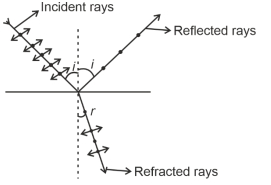
An unpolarised light beam strikes a glass surface at Brewster's angle. Then
A
The refracted light will be completely polarised.
B
Both the reflected and refracted light will be completely polarised.
C
The reflected light will be completely polarised but the refracted light will be partially polarised.
D
The reflected light will be partially polarised.
Solution
(C) According to Brewster's law,when unpolarised light is incident on a transparent medium at Brewster's angle $(i_B)$,the reflected light is completely plane-polarised with its electric field vector perpendicular to the plane of incidence.
The refracted light,however,remains partially polarised because it contains both components of the electric field vector,although the intensity of the component parallel to the plane of incidence is greater than that of the perpendicular component.
The refracted light,however,remains partially polarised because it contains both components of the electric field vector,although the intensity of the component parallel to the plane of incidence is greater than that of the perpendicular component.
0 likesView Solution
26
PhysicsMediumMCQNEET · 2024
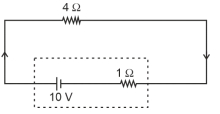
The terminal voltage of the battery, whose emf is $10 \, V$ and internal resistance is $1 \, \Omega$, when connected through an external resistance of $4 \, \Omega$ as shown in the figure is: (in $V$)
A
$6$
B
$8$
C
$10$
D
$4$
Solution
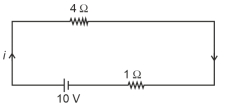
(B) The current $i$ in the circuit is given by Ohm's law: $i = \frac{E}{R + r}$, where $E = 10 \, V$, $R = 4 \, \Omega$, and $r = 1 \, \Omega$.
$i = \frac{10}{4 + 1} = \frac{10}{5} = 2 \, A$.
The terminal voltage $V$ of the battery is given by the formula: $V = E - ir$.
Substituting the values: $V = 10 - (2 \times 1) = 10 - 2 = 8 \, V$.
Thus, the terminal voltage is $8 \, V$.
$i = \frac{10}{4 + 1} = \frac{10}{5} = 2 \, A$.
The terminal voltage $V$ of the battery is given by the formula: $V = E - ir$.
Substituting the values: $V = 10 - (2 \times 1) = 10 - 2 = 8 \, V$.
Thus, the terminal voltage is $8 \, V$.
0 likesView Solution
27
PhysicsMediumMCQNEET · 2024
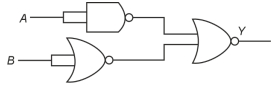
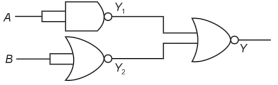
The output $(Y)$ of the given logic gate is similar to the output of an/a
A
$NOR$ gate
B
$OR$ gate
C
$AND$ gate
D
$NAND$ gate
Solution
(C) Let the inputs to the first $NAND$ gate be $A$ and $A$. The output is $Y_1 = \overline{A \cdot A} = \bar{A}$.
Let the inputs to the $NOR$ gate be $B$ and $B$. The output is $Y_2 = \overline{B+B} = \bar{B}$.
The final gate is a $NOR$ gate with inputs $Y_1$ and $Y_2$. The output $Y$ is given by:
$Y = \overline{Y_1 + Y_2}$
Substituting the values of $Y_1$ and $Y_2$:
$Y = \overline{\bar{A} + \bar{B}}$
Using De Morgan's theorem,$\overline{\bar{A} + \bar{B}} = \overline{\bar{A}} \cdot \overline{\bar{B}} = A \cdot B$.
Thus,the output $Y = A \cdot B$,which is the output of an $AND$ gate.
Let the inputs to the $NOR$ gate be $B$ and $B$. The output is $Y_2 = \overline{B+B} = \bar{B}$.
The final gate is a $NOR$ gate with inputs $Y_1$ and $Y_2$. The output $Y$ is given by:
$Y = \overline{Y_1 + Y_2}$
Substituting the values of $Y_1$ and $Y_2$:
$Y = \overline{\bar{A} + \bar{B}}$
Using De Morgan's theorem,$\overline{\bar{A} + \bar{B}} = \overline{\bar{A}} \cdot \overline{\bar{B}} = A \cdot B$.
Thus,the output $Y = A \cdot B$,which is the output of an $AND$ gate.
0 likesView Solution
28
PhysicsMediumMCQNEET · 2024
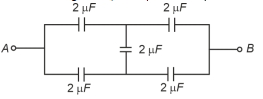
In the following circuit,the equivalent capacitance between terminal $A$ and terminal $B$ is: (in $\mu F$)
A
$1$
B
$0.5$
C
$4$
D
$2$
Solution
(D) The given circuit is a balanced Wheatstone bridge because the ratio of capacitances in the arms is equal $(2 \mu F / 2 \mu F = 2 \mu F / 2 \mu F)$.
In a balanced Wheatstone bridge,the central capacitor does not store any charge,so it can be removed from the circuit.
After removing the central capacitor,the circuit consists of two parallel branches,each containing two $2 \mu F$ capacitors in series.
For the upper branch,the equivalent capacitance $C_1$ is given by:
$1/C_1 = 1/2 + 1/2 = 1 \implies C_1 = 1 \mu F$.
Similarly,for the lower branch,the equivalent capacitance $C_2$ is:
$1/C_2 = 1/2 + 1/2 = 1 \implies C_2 = 1 \mu F$.
Since these two branches are in parallel,the total equivalent capacitance $C_{AB}$ is:
$C_{AB} = C_1 + C_2 = 1 \mu F + 1 \mu F = 2 \mu F$.
In a balanced Wheatstone bridge,the central capacitor does not store any charge,so it can be removed from the circuit.
After removing the central capacitor,the circuit consists of two parallel branches,each containing two $2 \mu F$ capacitors in series.
For the upper branch,the equivalent capacitance $C_1$ is given by:
$1/C_1 = 1/2 + 1/2 = 1 \implies C_1 = 1 \mu F$.
Similarly,for the lower branch,the equivalent capacitance $C_2$ is:
$1/C_2 = 1/2 + 1/2 = 1 \implies C_2 = 1 \mu F$.
Since these two branches are in parallel,the total equivalent capacitance $C_{AB}$ is:
$C_{AB} = C_1 + C_2 = 1 \mu F + 1 \mu F = 2 \mu F$.

0 likesView Solution
29
PhysicsMediumMCQNEET · 2024
${ }_{82}^{290} X \xrightarrow{\alpha} Y \xrightarrow{e^{+}} Z \xrightarrow{\beta^{-}} P \xrightarrow{e^{-}} Q$
In the nuclear emission stated above, the mass number and atomic number of the product $Q$ respectively, are
In the nuclear emission stated above, the mass number and atomic number of the product $Q$ respectively, are
A
$286, 80$
B
$288, 82$
C
$286, 81$
D
$280, 81$
Solution
(C) $1$. Alpha decay ($\alpha$): Mass number decreases by $4$, atomic number decreases by $2$.
${ }_{82}^{290} X \xrightarrow{\alpha} { }_{80}^{286} Y$
$2$. Positron emission ($e^{+}$): Mass number remains same, atomic number decreases by $1$.
${ }_{80}^{286} Y \xrightarrow{e^{+}} { }_{79}^{286} Z$
$3$. Beta decay ($\beta^{-}$): Mass number remains same, atomic number increases by $1$.
${ }_{79}^{286} Z \xrightarrow{\beta^{-}} { }_{80}^{286} P$
$4$. Electron emission ($e^{-}$): This is equivalent to $\beta^{-}$ decay. Mass number remains same, atomic number increases by $1$.
${ }_{80}^{286} P \xrightarrow{e^{-}} { }_{81}^{286} Q$
Thus, for the final product $Q$, the mass number $A = 286$ and the atomic number $Z = 81$.
${ }_{82}^{290} X \xrightarrow{\alpha} { }_{80}^{286} Y$
$2$. Positron emission ($e^{+}$): Mass number remains same, atomic number decreases by $1$.
${ }_{80}^{286} Y \xrightarrow{e^{+}} { }_{79}^{286} Z$
$3$. Beta decay ($\beta^{-}$): Mass number remains same, atomic number increases by $1$.
${ }_{79}^{286} Z \xrightarrow{\beta^{-}} { }_{80}^{286} P$
$4$. Electron emission ($e^{-}$): This is equivalent to $\beta^{-}$ decay. Mass number remains same, atomic number increases by $1$.
${ }_{80}^{286} P \xrightarrow{e^{-}} { }_{81}^{286} Q$
Thus, for the final product $Q$, the mass number $A = 286$ and the atomic number $Z = 81$.
0 likesView Solution
30
PhysicsMediumMCQNEET · 2024
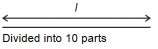
$A$ wire of length $l$ and resistance $100 \Omega$ is divided into $10$ equal parts. The first $5$ parts are connected in series while the next $5$ parts are connected in parallel. The two combinations are again connected in series. The resistance of this final combination is: (in $Omega$)
A
$52$
B
$55$
C
$60$
D
$26$
Solution
(A) The resistance of the original wire is $R = 100 \Omega$.
When the wire is divided into $10$ equal parts,the resistance of each part is $r = \frac{R}{10} = \frac{100 \Omega}{10} = 10 \Omega$.
For the first $5$ parts connected in series,the equivalent resistance is $R_S = 5 \times r = 5 \times 10 \Omega = 50 \Omega$.
For the next $5$ parts connected in parallel,the equivalent resistance $R_P$ is given by $\frac{1}{R_P} = \frac{1}{r} + \frac{1}{r} + \frac{1}{r} + \frac{1}{r} + \frac{1}{r} = \frac{5}{r}$.
Thus,$R_P = \frac{r}{5} = \frac{10 \Omega}{5} = 2 \Omega$.
Since these two combinations are connected in series,the final equivalent resistance is $R_{eq} = R_S + R_P = 50 \Omega + 2 \Omega = 52 \Omega$.
When the wire is divided into $10$ equal parts,the resistance of each part is $r = \frac{R}{10} = \frac{100 \Omega}{10} = 10 \Omega$.
For the first $5$ parts connected in series,the equivalent resistance is $R_S = 5 \times r = 5 \times 10 \Omega = 50 \Omega$.
For the next $5$ parts connected in parallel,the equivalent resistance $R_P$ is given by $\frac{1}{R_P} = \frac{1}{r} + \frac{1}{r} + \frac{1}{r} + \frac{1}{r} + \frac{1}{r} = \frac{5}{r}$.
Thus,$R_P = \frac{r}{5} = \frac{10 \Omega}{5} = 2 \Omega$.
Since these two combinations are connected in series,the final equivalent resistance is $R_{eq} = R_S + R_P = 50 \Omega + 2 \Omega = 52 \Omega$.
0 likesView Solution
31
PhysicsMediumMCQNEET · 2024
$A$ tightly wound $100$ turns coil of radius $10 \,cm$ carries a current of $7 \,A$. The magnitude of the magnetic field at the centre of the coil is (Take permeability of free space as $4 \pi \times 10^{-7} \,SI$ units):
A
$4.4 \,T$
B
$4.4 \,mT$
C
$44 \,T$
D
$44 \,mT$
Solution
(B) The magnitude of the magnetic field at the centre of a circular coil with $N$ turns is given by the formula:
$B_c = \frac{\mu_0 i N}{2 R}$
Given:
Number of turns $N = 100$
Radius $R = 10 \,cm = 0.1 \,m$
Current $i = 7 \,A$
Permeability of free space $\mu_0 = 4 \pi \times 10^{-7} \,T \cdot m/A$
Substituting the values:
$B_c = \frac{4 \pi \times 10^{-7} \times 7 \times 100}{2 \times 0.1}$
$B_c = \frac{4 \times 3.14159 \times 10^{-7} \times 700}{0.2}$
$B_c = \frac{8796.46 \times 10^{-7}}{0.2} \approx 4.398 \times 10^{-3} \,T$
Rounding to two significant figures,we get:
$B_c = 4.4 \times 10^{-3} \,T = 4.4 \,mT$
$B_c = \frac{\mu_0 i N}{2 R}$
Given:
Number of turns $N = 100$
Radius $R = 10 \,cm = 0.1 \,m$
Current $i = 7 \,A$
Permeability of free space $\mu_0 = 4 \pi \times 10^{-7} \,T \cdot m/A$
Substituting the values:
$B_c = \frac{4 \pi \times 10^{-7} \times 7 \times 100}{2 \times 0.1}$
$B_c = \frac{4 \times 3.14159 \times 10^{-7} \times 700}{0.2}$
$B_c = \frac{8796.46 \times 10^{-7}}{0.2} \approx 4.398 \times 10^{-3} \,T$
Rounding to two significant figures,we get:
$B_c = 4.4 \times 10^{-3} \,T = 4.4 \,mT$
1 likesView Solution
32
PhysicsMediumMCQNEET · 2024
$A$ logic circuit provides the output $Y$ as per the following truth table:
The expression for the output $Y$ is:
| $A$ | $B$ | $Y$ |
|---|---|---|
| $0$ | $0$ | $1$ |
| $0$ | $1$ | $0$ |
| $1$ | $0$ | $1$ |
| $1$ | $1$ | $0$ |
The expression for the output $Y$ is:
A
$A \cdot \bar{B} + \bar{A}$
B
$\bar{B}$
C
$B$
D
$A \cdot B + \bar{A}$
Solution
(B) By observing the truth table:
When $B = 0$,$Y = 1$ (regardless of $A$).
When $B = 1$,$Y = 0$ (regardless of $A$).
This shows that the output $Y$ depends only on the input $B$ and is the inverse of $B$.
Therefore,the Boolean expression for the output is $Y = \bar{B}$.
When $B = 0$,$Y = 1$ (regardless of $A$).
When $B = 1$,$Y = 0$ (regardless of $A$).
This shows that the output $Y$ depends only on the input $B$ and is the inverse of $B$.
Therefore,the Boolean expression for the output is $Y = \bar{B}$.
0 likesView Solution
33
PhysicsMediumMCQNEET · 2024
If $c$ is the velocity of light in free space,the correct statements about photon among the following are:
$A$. The energy of a photon is $E=h v$.
$B$. The velocity of a photon is $c$.
$C$. The momentum of a photon,$p=\frac{h v}{c}$.
$D$. In a photon-electron collision,both total energy and total momentum are conserved.
$E$. Photon possesses positive charge.
Choose the correct answer from the options given below:
$A$. The energy of a photon is $E=h v$.
$B$. The velocity of a photon is $c$.
$C$. The momentum of a photon,$p=\frac{h v}{c}$.
$D$. In a photon-electron collision,both total energy and total momentum are conserved.
$E$. Photon possesses positive charge.
Choose the correct answer from the options given below:
A
$A, B, C$ and $D$ only
B
$A, C$ and $D$ only
C
$A, B, D$ and $E$ only
D
$A$ and $B$ only
Solution
(A) The properties of a photon are as follows:
$1$. The energy of a photon is given by $E = h\nu$,where $h$ is Planck's constant and $\nu$ is the frequency. Thus,statement $A$ is correct.
$2$. $A$ photon travels with the speed of light in free space,which is $c$. Thus,statement $B$ is correct.
$3$. The momentum $p$ of a photon is related to its energy $E$ by $p = E/c$. Substituting $E = h\nu$,we get $p = h\nu/c$. Thus,statement $C$ is correct.
$4$. In any collision,including a photon-electron collision (Compton scattering),both total energy and total momentum are conserved. Thus,statement $D$ is correct.
$5$. $A$ photon is an electrically neutral particle,meaning it has zero charge. Thus,statement $E$ is incorrect.
Therefore,statements $A, B, C,$ and $D$ are correct.
$1$. The energy of a photon is given by $E = h\nu$,where $h$ is Planck's constant and $\nu$ is the frequency. Thus,statement $A$ is correct.
$2$. $A$ photon travels with the speed of light in free space,which is $c$. Thus,statement $B$ is correct.
$3$. The momentum $p$ of a photon is related to its energy $E$ by $p = E/c$. Substituting $E = h\nu$,we get $p = h\nu/c$. Thus,statement $C$ is correct.
$4$. In any collision,including a photon-electron collision (Compton scattering),both total energy and total momentum are conserved. Thus,statement $D$ is correct.
$5$. $A$ photon is an electrically neutral particle,meaning it has zero charge. Thus,statement $E$ is incorrect.
Therefore,statements $A, B, C,$ and $D$ are correct.
0 likesView Solution
34
PhysicsMediumMCQNEET · 2024
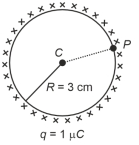
$A$ thin spherical shell is charged by some source. The potential difference between the two points $C$ (the center) and $P$ (a point on the surface) as shown in the figure is: (Take $\frac{1}{4 \pi \varepsilon_0} = 9 \times 10^9 \text{ SI units}$)
A
$1 \times 10^5 \text{ V}$
B
$0.5 \times 10^5 \text{ V}$
C
Zero
D
$3 \times 10^5 \text{ V}$
Solution
(C) For a uniformly charged thin spherical shell of radius $R$ and charge $q$,the electric potential at any point inside the shell (including the center) is constant and equal to the potential at the surface.
The potential at any point $r \leq R$ is given by $V = \frac{1}{4 \pi \varepsilon_0} \frac{q}{R}$.
Since point $C$ is at the center $(r = 0)$ and point $P$ is on the surface $(r = R)$,both points are at the same potential.
Therefore,$V_C = V_P = \frac{1}{4 \pi \varepsilon_0} \frac{q}{R}$.
The potential difference between points $C$ and $P$ is $V_C - V_P = 0$.
The potential at any point $r \leq R$ is given by $V = \frac{1}{4 \pi \varepsilon_0} \frac{q}{R}$.
Since point $C$ is at the center $(r = 0)$ and point $P$ is on the surface $(r = R)$,both points are at the same potential.
Therefore,$V_C = V_P = \frac{1}{4 \pi \varepsilon_0} \frac{q}{R}$.
The potential difference between points $C$ and $P$ is $V_C - V_P = 0$.
0 likesView Solution
35
PhysicsMediumMCQNEET · 2024
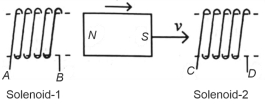
In the above diagram,a strong bar magnet is moving towards solenoid-$2$ from solenoid-$1$. The direction of induced current in solenoid-$1$ and that in solenoid-$2$,respectively,are through the directions:
A
$B A$ and $C D$
B
$A B$ and $C D$
C
$B A$ and $D C$
D
$A B$ and $D C$
Solution
(A) According to Lenz's Law,the induced current in a coil opposes the change in magnetic flux that produces it.
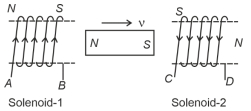
For solenoid-$1$: The North pole of the magnet is moving away from it. To oppose this,the end $B$ of solenoid-$1$ must act as a South pole. Using the right-hand thumb rule,the current flows from $B$ to $A$.
For solenoid-$2$: The South pole of the magnet is approaching it. To oppose this,the end $C$ of solenoid-$2$ must act as a South pole. Using the right-hand thumb rule,the current flows from $C$ to $D$.
Therefore,the directions of induced current are $B A$ and $C D$ respectively.
For solenoid-$1$: The North pole of the magnet is moving away from it. To oppose this,the end $B$ of solenoid-$1$ must act as a South pole. Using the right-hand thumb rule,the current flows from $B$ to $A$.
For solenoid-$2$: The South pole of the magnet is approaching it. To oppose this,the end $C$ of solenoid-$2$ must act as a South pole. Using the right-hand thumb rule,the current flows from $C$ to $D$.
Therefore,the directions of induced current are $B A$ and $C D$ respectively.
0 likesView Solution
36
PhysicsMediumMCQNEET · 2024
The graph which shows the variation of $\left(\frac{1}{\lambda^2}\right)$ and its kinetic energy,$E$ is (where $\lambda$ is de Broglie wavelength of a free particle):
A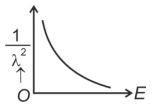
B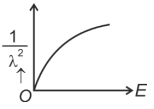
C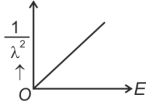
D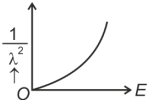
Solution
(C) The de Broglie wavelength $\lambda$ is given by $\lambda = \frac{h}{p} = \frac{h}{\sqrt{2mE}}$,where $h$ is Planck's constant,$m$ is the mass of the particle,and $E$ is its kinetic energy.
Squaring both sides,we get $\lambda^2 = \frac{h^2}{2mE}$.
Rearranging the terms,we find $\frac{1}{\lambda^2} = \left(\frac{2m}{h^2}\right) E$.
This equation is of the form $y = mx$,where $y = \frac{1}{\lambda^2}$,$x = E$,and the slope $m = \frac{2m}{h^2}$ is a constant.
Therefore,the graph of $\frac{1}{\lambda^2}$ versus $E$ is a straight line passing through the origin.
Squaring both sides,we get $\lambda^2 = \frac{h^2}{2mE}$.
Rearranging the terms,we find $\frac{1}{\lambda^2} = \left(\frac{2m}{h^2}\right) E$.
This equation is of the form $y = mx$,where $y = \frac{1}{\lambda^2}$,$x = E$,and the slope $m = \frac{2m}{h^2}$ is a constant.
Therefore,the graph of $\frac{1}{\lambda^2}$ versus $E$ is a straight line passing through the origin.
0 likesView Solution
37
PhysicsMediumMCQNEET · 2024
In a uniform magnetic field of $0.049 \ T$, a magnetic needle performs $20$ complete oscillations in $5 \ s$. The moment of inertia of the needle is $9.8 \times 10^{-5} \ kg \ m^2$. If the magnitude of the magnetic moment of the needle is $x \times 10^{-5} \ A \ m^2$, then the value of '$x$' is: (in $\pi^2$)
A
$128$
B
$50$
C
$1280$
D
$5$
Solution
(C) The time period of oscillation for a magnetic needle in a uniform magnetic field is given by $T = 2 \pi \sqrt{\frac{I}{MB}}$, where $I$ is the moment of inertia, $M$ is the magnetic moment, and $B$ is the magnetic field strength.
Given: $B = 0.049 \ T$, $I = 9.8 \times 10^{-5} \ kg \ m^2$, and the needle performs $20$ oscillations in $5 \ s$.
The time period $T = \frac{5 \ s}{20} = 0.25 \ s = \frac{1}{4} \ s$.
Substituting the values into the formula: $\frac{1}{4} = 2 \pi \sqrt{\frac{9.8 \times 10^{-5}}{M \times 0.049}}$.
Squaring both sides: $\frac{1}{16} = 4 \pi^2 \times \frac{9.8 \times 10^{-5}}{M \times 0.049}$.
Rearranging for $M$: $M = \frac{4 \pi^2 \times 9.8 \times 10^{-5} \times 16}{0.049} = \frac{4 \pi^2 \times 9.8 \times 10^{-5} \times 16}{0.049}$.
Since $9.8 / 0.049 = 200$, we get $M = 4 \pi^2 \times 200 \times 16 \times 10^{-5} = 12800 \pi^2 \times 10^{-5} \ A \ m^2$.
Wait, re-calculating: $M = \frac{4 \pi^2 \times 9.8 \times 10^{-5} \times 16}{49 \times 10^{-3}} = 4 \pi^2 \times 0.2 \times 16 \times 10^{-2} = 12.8 \pi^2 \times 10^{-2} = 1280 \pi^2 \times 10^{-5} \ A \ m^2$.
Thus, $x = 1280 \pi^2$.
Given: $B = 0.049 \ T$, $I = 9.8 \times 10^{-5} \ kg \ m^2$, and the needle performs $20$ oscillations in $5 \ s$.
The time period $T = \frac{5 \ s}{20} = 0.25 \ s = \frac{1}{4} \ s$.
Substituting the values into the formula: $\frac{1}{4} = 2 \pi \sqrt{\frac{9.8 \times 10^{-5}}{M \times 0.049}}$.
Squaring both sides: $\frac{1}{16} = 4 \pi^2 \times \frac{9.8 \times 10^{-5}}{M \times 0.049}$.
Rearranging for $M$: $M = \frac{4 \pi^2 \times 9.8 \times 10^{-5} \times 16}{0.049} = \frac{4 \pi^2 \times 9.8 \times 10^{-5} \times 16}{0.049}$.
Since $9.8 / 0.049 = 200$, we get $M = 4 \pi^2 \times 200 \times 16 \times 10^{-5} = 12800 \pi^2 \times 10^{-5} \ A \ m^2$.
Wait, re-calculating: $M = \frac{4 \pi^2 \times 9.8 \times 10^{-5} \times 16}{49 \times 10^{-3}} = 4 \pi^2 \times 0.2 \times 16 \times 10^{-2} = 12.8 \pi^2 \times 10^{-2} = 1280 \pi^2 \times 10^{-5} \ A \ m^2$.
Thus, $x = 1280 \pi^2$.
0 likesView Solution
38
PhysicsMediumMCQNEET · 2024
Match List-$I$ with List-$II$.
Choose the correct answer from the options given below:
| List-$I$ (Material) | List-$II$ (Susceptibility $(\chi)$) |
| $A$. Diamagnetic | $I$. $\chi=0$ |
| $B$. Ferromagnetic | $II$. $0 > \chi \geq -1$ |
| $C$. Paramagnetic | $III$. $\chi >> 1$ |
| $D$. Non-magnetic | $IV$. $0 < \chi < \varepsilon$ (a small positive number) |
Choose the correct answer from the options given below:
A
$A-II, B-I, C-III, D-IV$
B
$A-III, B-II, C-I, D-IV$
C
$A-IV, B-III, C-II, D-I$
D
$A-II, B-III, C-IV, D-I$
Solution
(D) The magnetic susceptibility $(\chi)$ characterizes the magnetic properties of materials:
$1$. Diamagnetic materials: These materials are weakly repelled by a magnetic field, and their susceptibility is small and negative, typically $0 > \chi \geq -1$. Thus, $A-II$.
$2$. Ferromagnetic materials: These materials are strongly attracted by a magnetic field, and their susceptibility is large and positive, $\chi >> 1$. Thus, $B-III$.
$3$. Paramagnetic materials: These materials are weakly attracted by a magnetic field, and their susceptibility is small and positive, $0 < \chi < \varepsilon$. Thus, $C-IV$.
$4$. Non-magnetic materials: These materials do not interact with magnetic fields, so their susceptibility is zero, $\chi = 0$. Thus, $D-I$.
Therefore, the correct matching is $A-II, B-III, C-IV, D-I$.
$1$. Diamagnetic materials: These materials are weakly repelled by a magnetic field, and their susceptibility is small and negative, typically $0 > \chi \geq -1$. Thus, $A-II$.
$2$. Ferromagnetic materials: These materials are strongly attracted by a magnetic field, and their susceptibility is large and positive, $\chi >> 1$. Thus, $B-III$.
$3$. Paramagnetic materials: These materials are weakly attracted by a magnetic field, and their susceptibility is small and positive, $0 < \chi < \varepsilon$. Thus, $C-IV$.
$4$. Non-magnetic materials: These materials do not interact with magnetic fields, so their susceptibility is zero, $\chi = 0$. Thus, $D-I$.
Therefore, the correct matching is $A-II, B-III, C-IV, D-I$.
0 likesView Solution
39
PhysicsMediumMCQNEET · 2024
Given below are two statements:
Statement $I$: Atoms are electrically neutral as they contain equal number of positive and negative charges.
Statement $II$: Atoms of each element are stable and emit their characteristic spectrum.
In the light of the above statements,choose the most appropriate answer from the options given below.
Statement $I$: Atoms are electrically neutral as they contain equal number of positive and negative charges.
Statement $II$: Atoms of each element are stable and emit their characteristic spectrum.
In the light of the above statements,choose the most appropriate answer from the options given below.
A
Both Statement $I$ and Statement $II$ are incorrect
B
Statement $I$ is correct but Statement $II$ is incorrect
C
Statement $I$ is incorrect but Statement $II$ is correct
D
Both Statement $I$ and Statement $II$ are correct
Solution
(B) Statement $I$ is correct. Atoms are electrically neutral because the number of protons (positive charge) in the nucleus is equal to the number of electrons (negative charge) orbiting the nucleus.
Statement $II$ is incorrect. While many atoms are stable,there are many radioactive elements whose atoms are unstable and undergo decay. Furthermore,while atoms do emit characteristic spectra,the statement implies that 'each' element's atom is stable,which is a generalization that ignores radioactive instability.
Statement $II$ is incorrect. While many atoms are stable,there are many radioactive elements whose atoms are unstable and undergo decay. Furthermore,while atoms do emit characteristic spectra,the statement implies that 'each' element's atom is stable,which is a generalization that ignores radioactive instability.
0 likesView Solution
40
PhysicsMediumMCQNEET · 2024
If the monochromatic source in Young's double slit experiment is replaced by white light,then
A
There will be a central dark fringe surrounded by a few coloured fringes
B
There will be a central bright white fringe surrounded by a few coloured fringes
C
All bright fringes will be of equal width
D
Interference pattern will disappear
Solution
(B) In Young's double slit experiment,the path difference at the central point on the screen is zero for all wavelengths present in white light.
Since the condition for constructive interference is $\Delta x = n\lambda$,for $n=0$,the path difference is zero regardless of the wavelength $\lambda$.
Therefore,all colors overlap at the central point,resulting in a central bright white fringe.
For other fringes,the fringe width is given by $\beta = \frac{\lambda D}{d}$. Since $\beta$ depends on the wavelength $\lambda$,different colors will form fringes at different positions,resulting in a few coloured fringes surrounding the central white fringe.
Since the condition for constructive interference is $\Delta x = n\lambda$,for $n=0$,the path difference is zero regardless of the wavelength $\lambda$.
Therefore,all colors overlap at the central point,resulting in a central bright white fringe.
For other fringes,the fringe width is given by $\beta = \frac{\lambda D}{d}$. Since $\beta$ depends on the wavelength $\lambda$,different colors will form fringes at different positions,resulting in a few coloured fringes surrounding the central white fringe.
0 likesView Solution
41
PhysicsMediumMCQNEET · 2024
Given below are two statements: one is labelled as Assertion $A$ and the other is labelled as Reason $R$.
Assertion $A$: The potential $(V)$ at any axial point, at $2 \ m$ distance $(r)$ from the centre of the dipole of dipole moment vector $\vec{P}$ of magnitude $4 \times 10^{-6} \ C \ m$, is $\pm 9 \times 10^3 \ V$.
(Take $\frac{1}{4 \pi \epsilon_0} = 9 \times 10^9 \ SI$ units)
Reason $R$: $V = \pm \frac{1}{4 \pi \epsilon_0} \frac{P}{r^2}$, where $r$ is the distance of any axial point, situated at $2 \ m$ from the centre of the dipole.
In the light of the above statements, choose the correct answer from the options given below:
Assertion $A$: The potential $(V)$ at any axial point, at $2 \ m$ distance $(r)$ from the centre of the dipole of dipole moment vector $\vec{P}$ of magnitude $4 \times 10^{-6} \ C \ m$, is $\pm 9 \times 10^3 \ V$.
(Take $\frac{1}{4 \pi \epsilon_0} = 9 \times 10^9 \ SI$ units)
Reason $R$: $V = \pm \frac{1}{4 \pi \epsilon_0} \frac{P}{r^2}$, where $r$ is the distance of any axial point, situated at $2 \ m$ from the centre of the dipole.
In the light of the above statements, choose the correct answer from the options given below:
A
Both $A$ and $R$ are true and $R$ is $NOT$ the correct explanation of $A$.
B
$A$ is true but $R$ is false.
C
$A$ is false but $R$ is true.
D
Both $A$ and $R$ are true and $R$ is the correct explanation of $A$.
Solution
(D) The electric potential $V$ at a point due to an electric dipole at a distance $r$ from its center is given by $V = \frac{1}{4 \pi \epsilon_0} \frac{P \cos \theta}{r^2}$.
For an axial point, the angle $\theta$ is either $0^{\circ}$ or $180^{\circ}$.
Thus, the potential is $V = \pm \frac{1}{4 \pi \epsilon_0} \frac{P}{r^2}$.
Given $P = 4 \times 10^{-6} \ C \ m$, $r = 2 \ m$, and $\frac{1}{4 \pi \epsilon_0} = 9 \times 10^9 \ SI$ units.
Substituting these values: $V = \pm \frac{9 \times 10^9 \times 4 \times 10^{-6}}{2^2} = \pm \frac{36 \times 10^3}{4} = \pm 9 \times 10^3 \ V$.
Both Assertion $A$ and Reason $R$ are true, and $R$ correctly explains $A$.
For an axial point, the angle $\theta$ is either $0^{\circ}$ or $180^{\circ}$.
Thus, the potential is $V = \pm \frac{1}{4 \pi \epsilon_0} \frac{P}{r^2}$.
Given $P = 4 \times 10^{-6} \ C \ m$, $r = 2 \ m$, and $\frac{1}{4 \pi \epsilon_0} = 9 \times 10^9 \ SI$ units.
Substituting these values: $V = \pm \frac{9 \times 10^9 \times 4 \times 10^{-6}}{2^2} = \pm \frac{36 \times 10^3}{4} = \pm 9 \times 10^3 \ V$.
Both Assertion $A$ and Reason $R$ are true, and $R$ correctly explains $A$.
0 likesView Solution
42
PhysicsMediumMCQNEET · 2024
$A$ small telescope has an objective of focal length $140 \ cm$ and an eyepiece of focal length $5.0 \ cm$. The magnifying power of the telescope for viewing a distant object is:
A
$28$
B
$17$
C
$32$
D
$34$
Solution
(A) Given:
Focal length of the objective lens,$f_o = 140 \ cm$.
Focal length of the eyepiece,$f_e = 5.0 \ cm$.
For a telescope viewing a distant object (at normal adjustment),the magnifying power $m$ is given by the formula:
$m = \frac{f_o}{f_e}$
Substituting the values:
$m = \frac{140}{5.0} = 28$
Therefore,the magnifying power of the telescope is $28$.
Focal length of the objective lens,$f_o = 140 \ cm$.
Focal length of the eyepiece,$f_e = 5.0 \ cm$.
For a telescope viewing a distant object (at normal adjustment),the magnifying power $m$ is given by the formula:
$m = \frac{f_o}{f_e}$
Substituting the values:
$m = \frac{140}{5.0} = 28$
Therefore,the magnifying power of the telescope is $28$.
0 likesView Solution
43
PhysicsMediumMCQNEET · 2024
Two heaters $A$ and $B$ have power ratings of $1 \text{ kW}$ and $2 \text{ kW}$,respectively. These two are first connected in series and then in parallel to a fixed power source. The ratio of power outputs for these two cases is:
A
$2: 9$
B
$1: 2$
C
$2: 3$
D
$1: 1$
Solution
(A) The power rating $P$ of a heater is given by $P = \frac{V^2}{R}$,where $V$ is the voltage and $R$ is the resistance.
Since $V$ is constant,$R = \frac{V^2}{P}$.
For heater $A$,$P_A = 1 \text{ kW}$,so $R_A = \frac{V^2}{1}$.
For heater $B$,$P_B = 2 \text{ kW}$,so $R_B = \frac{V^2}{2}$.
Thus,$R_A = 2R_B$.
In series combination,the equivalent resistance is $R_S = R_A + R_B = 2R_B + R_B = 3R_B$. The power consumed is $P_S = \frac{V^2}{R_S} = \frac{V^2}{3R_B}$.
In parallel combination,the equivalent resistance is $R_P = \frac{R_A R_B}{R_A + R_B} = \frac{(2R_B)(R_B)}{2R_B + R_B} = \frac{2R_B^2}{3R_B} = \frac{2}{3}R_B$. The power consumed is $P_P = \frac{V^2}{R_P} = \frac{V^2}{(2/3)R_B} = \frac{3V^2}{2R_B}$.
The ratio of power outputs is $\frac{P_S}{P_P} = \frac{V^2 / 3R_B}{3V^2 / 2R_B} = \frac{1}{3} \times \frac{2}{3} = \frac{2}{9}$.
Since $V$ is constant,$R = \frac{V^2}{P}$.
For heater $A$,$P_A = 1 \text{ kW}$,so $R_A = \frac{V^2}{1}$.
For heater $B$,$P_B = 2 \text{ kW}$,so $R_B = \frac{V^2}{2}$.
Thus,$R_A = 2R_B$.
In series combination,the equivalent resistance is $R_S = R_A + R_B = 2R_B + R_B = 3R_B$. The power consumed is $P_S = \frac{V^2}{R_S} = \frac{V^2}{3R_B}$.
In parallel combination,the equivalent resistance is $R_P = \frac{R_A R_B}{R_A + R_B} = \frac{(2R_B)(R_B)}{2R_B + R_B} = \frac{2R_B^2}{3R_B} = \frac{2}{3}R_B$. The power consumed is $P_P = \frac{V^2}{R_P} = \frac{V^2}{(2/3)R_B} = \frac{3V^2}{2R_B}$.
The ratio of power outputs is $\frac{P_S}{P_P} = \frac{V^2 / 3R_B}{3V^2 / 2R_B} = \frac{1}{3} \times \frac{2}{3} = \frac{2}{9}$.
0 likesView Solution
44
PhysicsMediumMCQNEET · 2024
$A$ $10 \mu F$ capacitor is connected to a $210 \text{ V}, 50 \text{ Hz}$ source as shown in the figure. The peak current in the circuit is nearly $(\pi = 3.14)$ : (in $\text{ A}$)
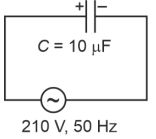
A
$0.93$
B
$1.20$
C
$0.35$
D
$0.58$
Solution
$(A)$ The capacitive reactance $X_C$ is given by $X_C = \frac{1}{\omega C} = \frac{1}{2 \pi f C}$.
Substituting the given values: $X_C = \frac{1}{2 \times 3.14 \times 50 \times 10 \times 10^{-6}} = \frac{1}{3140 \times 10^{-6}} = \frac{1000}{3.14} \approx 318.47 \Omega$.
The $RMS$ voltage is $V_{\text{rms}} = 210 \text{ V}$.
The $RMS$ current is $I_{\text{rms}} = \frac{V_{\text{rms}}}{X_C} = \frac{210}{1000 / 3.14} = \frac{210 \times 3.14}{1000} = 0.6594 \text{ A}$.
The peak current $I_0$ is given by $I_0 = \sqrt{2} \times I_{\text{rms}}$.
$I_0 = 1.414 \times 0.6594 \approx 0.932 \text{ A}$.
Thus, the peak current is approximately $0.93 \text{ A}$.
Substituting the given values: $X_C = \frac{1}{2 \times 3.14 \times 50 \times 10 \times 10^{-6}} = \frac{1}{3140 \times 10^{-6}} = \frac{1000}{3.14} \approx 318.47 \Omega$.
The $RMS$ voltage is $V_{\text{rms}} = 210 \text{ V}$.
The $RMS$ current is $I_{\text{rms}} = \frac{V_{\text{rms}}}{X_C} = \frac{210}{1000 / 3.14} = \frac{210 \times 3.14}{1000} = 0.6594 \text{ A}$.
The peak current $I_0$ is given by $I_0 = \sqrt{2} \times I_{\text{rms}}$.
$I_0 = 1.414 \times 0.6594 \approx 0.932 \text{ A}$.
Thus, the peak current is approximately $0.93 \text{ A}$.
0 likesView Solution
45
PhysicsMediumMCQNEET · 2024
Choose the correct circuit which can achieve the bridge balance.
A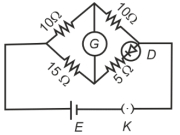
B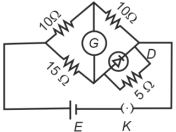
C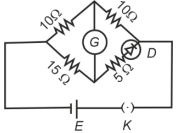
D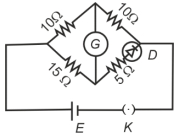
Solution
(A) For a Wheatstone bridge to be balanced,the ratio of resistances in the two arms must be equal,i.e.,$\frac{R_1}{R_2} = \frac{R_3}{R_4}$.
In the given circuit,the left arm has resistances $10 \Omega$ and $15 \Omega$,so the ratio is $\frac{10}{15} = \frac{2}{3}$.
For the right arm,we need the effective resistance $R_{eff}$ such that $\frac{10}{R_{eff}} = \frac{2}{3}$,which implies $R_{eff} = 15 \Omega$.
The right arm consists of a $5 \Omega$ resistor in series with a diode $D$. If the diode is forward-biased and has a dynamic resistance $R_D = 10 \Omega$,the total resistance becomes $R_{eff} = 5 \Omega + 10 \Omega = 15 \Omega$.
Thus,the bridge is balanced when the diode is in series with the $5 \Omega$ resistor and is forward-biased. Looking at the options,the circuit where the diode is in series with the $5 \Omega$ resistor and oriented to be forward-biased allows for this balance.
In the given circuit,the left arm has resistances $10 \Omega$ and $15 \Omega$,so the ratio is $\frac{10}{15} = \frac{2}{3}$.
For the right arm,we need the effective resistance $R_{eff}$ such that $\frac{10}{R_{eff}} = \frac{2}{3}$,which implies $R_{eff} = 15 \Omega$.
The right arm consists of a $5 \Omega$ resistor in series with a diode $D$. If the diode is forward-biased and has a dynamic resistance $R_D = 10 \Omega$,the total resistance becomes $R_{eff} = 5 \Omega + 10 \Omega = 15 \Omega$.
Thus,the bridge is balanced when the diode is in series with the $5 \Omega$ resistor and is forward-biased. Looking at the options,the circuit where the diode is in series with the $5 \Omega$ resistor and oriented to be forward-biased allows for this balance.
0 likesView Solution
46
PhysicsMediumMCQNEET · 2024
If the plates of a parallel plate capacitor connected to a battery are moved close to each other,then
$A$. the charge stored in it,increases.
$B$. the energy stored in it,decreases.
$C$. its capacitance increases.
$D$. the ratio of charge to its potential remains the same.
$E$. the product of charge and voltage increases.
Choose the most appropriate answer from the options given below:
$A$. the charge stored in it,increases.
$B$. the energy stored in it,decreases.
$C$. its capacitance increases.
$D$. the ratio of charge to its potential remains the same.
$E$. the product of charge and voltage increases.
Choose the most appropriate answer from the options given below:
A
$A, C$ and $E$ only
B
$B, D$ and $E$ only
C
$A, B$ and $C$ only
D
$A, B$ and $E$ only
Solution
(A) Given that the capacitor is connected to a battery,the potential difference $V$ remains constant.
$(i)$ Capacitance $C = \frac{\varepsilon_0 A}{d}$. As the plates are moved closer,the distance $d$ decreases,so the capacitance $C$ increases. Thus,statement $C$ is correct.
$(ii)$ Charge $Q = CV$. Since $C$ increases and $V$ is constant,the charge $Q$ increases. Thus,statement $A$ is correct.
$(iii)$ Energy stored $U = \frac{1}{2}CV^2$. Since $C$ increases and $V$ is constant,the energy $U$ increases. Thus,statement $B$ is incorrect.
$(iv)$ The ratio of charge to potential is $\frac{Q}{V} = C$. Since $C$ increases,the ratio $\frac{Q}{V}$ changes. Thus,statement $D$ is incorrect.
$(v)$ The product of charge and voltage is $QV = CV^2$. Since $C$ increases and $V$ is constant,the product $QV$ increases. Thus,statement $E$ is correct.
Therefore,statements $A, C,$ and $E$ are correct.
$(i)$ Capacitance $C = \frac{\varepsilon_0 A}{d}$. As the plates are moved closer,the distance $d$ decreases,so the capacitance $C$ increases. Thus,statement $C$ is correct.
$(ii)$ Charge $Q = CV$. Since $C$ increases and $V$ is constant,the charge $Q$ increases. Thus,statement $A$ is correct.
$(iii)$ Energy stored $U = \frac{1}{2}CV^2$. Since $C$ increases and $V$ is constant,the energy $U$ increases. Thus,statement $B$ is incorrect.
$(iv)$ The ratio of charge to potential is $\frac{Q}{V} = C$. Since $C$ increases,the ratio $\frac{Q}{V}$ changes. Thus,statement $D$ is incorrect.
$(v)$ The product of charge and voltage is $QV = CV^2$. Since $C$ increases and $V$ is constant,the product $QV$ increases. Thus,statement $E$ is correct.
Therefore,statements $A, C,$ and $E$ are correct.
0 likesView Solution
47
PhysicsMediumMCQNEET · 2024
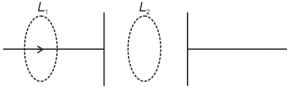
$A$ parallel plate capacitor is charged by connecting it to a battery through a resistor. If $I$ is the current in the circuit,then in the gap between the plates:
A
Displacement current of magnitude equal to $I$ flows in the same direction as $I$.
B
Displacement current of magnitude equal to $I$ flows in a direction opposite to that of $I$.
C
Displacement current of magnitude greater than $I$ flows but can be in any direction.
D
There is no current.
Solution
(A) According to the modified Ampere's circuital law,the total current is the sum of conduction current $(I_C)$ and displacement current $(I_D)$: $\oint B \cdot dl = \mu_0(I_C + I_D)$.
In the wire,there is only conduction current $I_C = I$,and the displacement current $I_D = 0$.
In the gap between the plates,there is no conduction current $(I_C = 0)$,but the changing electric field produces a displacement current $I_D$.
By the principle of continuity of current,the displacement current in the gap must be equal to the conduction current in the wire,i.e.,$I_D = I_C = I$.
This displacement current flows in the same direction as the conduction current to maintain the continuity of the total current in the circuit.
In the wire,there is only conduction current $I_C = I$,and the displacement current $I_D = 0$.
In the gap between the plates,there is no conduction current $(I_C = 0)$,but the changing electric field produces a displacement current $I_D$.
By the principle of continuity of current,the displacement current in the gap must be equal to the conduction current in the wire,i.e.,$I_D = I_C = I$.
This displacement current flows in the same direction as the conduction current to maintain the continuity of the total current in the circuit.
0 likesView Solution
48
PhysicsMediumMCQNEET · 2024
The property which is not of an electromagnetic wave travelling in free space is that:
A
The energy density in electric field is equal to energy density in magnetic field
B
They travel with a speed equal to $\frac{1}{\sqrt{\mu_0 \varepsilon_0}}$
C
They originate from charges moving with uniform speed
D
They are transverse in nature
Solution
(C) Electromagnetic $(EM)$ waves are produced by accelerating charges.
According to the theory of electromagnetism,a charge moving with a uniform velocity produces a steady magnetic field and does not radiate energy in the form of $EM$ waves.
Therefore,the statement that they originate from charges moving with uniform speed is incorrect.
All other options are standard properties of $EM$ waves:
$1$. The energy density of the electric field $(u_E = \frac{1}{2} \varepsilon_0 E^2)$ is equal to the energy density of the magnetic field $(u_B = \frac{1}{2\mu_0} B^2)$.
$2$. The speed of $EM$ waves in free space is $c = \frac{1}{\sqrt{\mu_0 \varepsilon_0}}$.
$3$. $EM$ waves are transverse in nature,meaning the oscillations of electric and magnetic fields are perpendicular to the direction of wave propagation.
According to the theory of electromagnetism,a charge moving with a uniform velocity produces a steady magnetic field and does not radiate energy in the form of $EM$ waves.
Therefore,the statement that they originate from charges moving with uniform speed is incorrect.
All other options are standard properties of $EM$ waves:
$1$. The energy density of the electric field $(u_E = \frac{1}{2} \varepsilon_0 E^2)$ is equal to the energy density of the magnetic field $(u_B = \frac{1}{2\mu_0} B^2)$.
$2$. The speed of $EM$ waves in free space is $c = \frac{1}{\sqrt{\mu_0 \varepsilon_0}}$.
$3$. $EM$ waves are transverse in nature,meaning the oscillations of electric and magnetic fields are perpendicular to the direction of wave propagation.
0 likesView Solution
49
PhysicsMediumMCQNEET · 2024
$A$ sheet is placed on a horizontal surface in front of a strong magnetic pole. $A$ force is needed to:
$A$. hold the sheet there if it is magnetic.
$B$. hold the sheet there if it is non-magnetic.
$C$. move the sheet away from the pole with uniform velocity if it is conducting.
$D$. move the sheet away from the pole with uniform velocity if it is both,non-conducting and non-polar.
Choose the correct statement$(s)$ from the options given below:
$A$. hold the sheet there if it is magnetic.
$B$. hold the sheet there if it is non-magnetic.
$C$. move the sheet away from the pole with uniform velocity if it is conducting.
$D$. move the sheet away from the pole with uniform velocity if it is both,non-conducting and non-polar.
Choose the correct statement$(s)$ from the options given below:
A
$A$ and $C$ only
B
$A$,$C$ and $D$ only
C
$C$ only
D
$B$ and $D$ only
Solution
(A) . $A$ magnetic pole will exert an attractive or repulsive force on a magnetic sheet,so a force is required to hold it in place.
$B$. If the sheet is non-magnetic,there is no magnetic interaction,so no force is needed to hold it.
$C$. If the sheet is conducting,moving it through a magnetic field induces eddy currents. According to Lenz's Law,these currents create a force that opposes the motion. Therefore,an external force is required to move the sheet with uniform velocity.
$D$. $A$ non-conducting and non-polar sheet does not interact with the magnetic field of the pole,so no force is required to move it.
$B$. If the sheet is non-magnetic,there is no magnetic interaction,so no force is needed to hold it.
$C$. If the sheet is conducting,moving it through a magnetic field induces eddy currents. According to Lenz's Law,these currents create a force that opposes the motion. Therefore,an external force is required to move the sheet with uniform velocity.
$D$. $A$ non-conducting and non-polar sheet does not interact with the magnetic field of the pole,so no force is required to move it.
0 likesView Solution
50
PhysicsMediumMCQNEET · 2024
An iron bar of length $L$ has a magnetic moment $M$. It is bent at the middle of its length such that the two arms make an angle of $60^{\circ}$ with each other. The magnetic moment of this new magnet is:
A
$\frac{M}{2}$
B
$2 M$
C
$\frac{M}{\sqrt{3}}$
D
$M$
Solution
(A) Let the pole strength of the original iron bar be $m$. The magnetic moment is given by $M = m L$.
When the bar is bent at the middle,each arm has a length of $L/2$.
The new magnetic moment $M'$ is the product of the pole strength $m$ and the effective length (the distance between the two poles).
The effective length $L'$ is the distance between the two ends of the bent bar. Since the two arms of length $L/2$ make an angle of $60^{\circ}$,the effective length forms the third side of an isosceles triangle with two sides of length $L/2$ and an included angle of $60^{\circ}$.
This triangle is equilateral,so the effective length $L' = L/2$.
The new magnetic moment is $M' = m L' = m (L/2) = M/2$.
When the bar is bent at the middle,each arm has a length of $L/2$.
The new magnetic moment $M'$ is the product of the pole strength $m$ and the effective length (the distance between the two poles).
The effective length $L'$ is the distance between the two ends of the bent bar. Since the two arms of length $L/2$ make an angle of $60^{\circ}$,the effective length forms the third side of an isosceles triangle with two sides of length $L/2$ and an included angle of $60^{\circ}$.
This triangle is equilateral,so the effective length $L' = L/2$.
The new magnetic moment is $M' = m L' = m (L/2) = M/2$.
0 likesView Solution
Vedclass Products
For Students
Vedclass Test Series
Mock tests in real NEET style covering Physics with performance analysis. 5-day free trial.
Start Free TrialFor Teachers
Exam Paper Generator
Generate Set A/B/C/D Physics papers from 7.5L+ questions in 2 minutes. 3 chapters free.
Try FreeFor Institutes
Online Exam Module
Run live NEET mock exams with unlimited students, 360° analytics & white-label branding.
See DemoFrequently Asked Questions
How many Physics questions are in NEET 2024?
There are 50 Physics questions from the NEET 2024 paper on Vedclass, each with a detailed step-by-step solution in English.
Are NEET 2024 Physics solutions available in English?
Yes. All solutions on this page are in English. You can also switch to English or Hindi using the language buttons above the questions.
Can I practice NEET 2024 Physics as a timed test?
Yes. Use the Vedclass Test Series to attempt a full NEET mock test covering Physics with time limits and instant score analysis.
Can teachers create Physics papers from NEET previous year questions?
Yes. The Vedclass Exam Paper Generator lets teachers mix NEET Physics questions and generate Set A/B/C/D papers in minutes.
For Teachers & Institutes
Build a Custom Physics Paper
Pick NEET 2024 Physics questions, set difficulty, and generate Set A/B/C/D in 2 minutes.