
PhysicsQ1–86 of 90 questions
Page 1 of 2 · English
1
PhysicsMediumMCQNEET · 2020
$A$ body weighs $72 \ N$ on the surface of the earth. What is the gravitational force on it at a height equal to half the radius of the earth (in $N$)?
A
$32$
B
$30$
C
$24$
D
$48$
Solution
(A) The weight of a body at the surface of the earth is given by $W = mg = 72 \ N$.
At a height $h$ above the surface of the earth,the acceleration due to gravity $g'$ is given by the formula $g' = g \left( \frac{R}{R + h} \right)^2$,where $R$ is the radius of the earth.
Given $h = \frac{R}{2}$,we substitute this into the formula:
$g' = g \left( \frac{R}{R + \frac{R}{2}} \right)^2 = g \left( \frac{R}{\frac{3R}{2}} \right)^2 = g \left( \frac{2}{3} \right)^2 = \frac{4}{9}g$.
The weight of the body at height $h$ is $W' = mg' = m \left( \frac{4}{9}g \right) = \frac{4}{9} W$.
Substituting the value of $W = 72 \ N$:
$W' = \frac{4}{9} \times 72 = 4 \times 8 = 32 \ N$.
At a height $h$ above the surface of the earth,the acceleration due to gravity $g'$ is given by the formula $g' = g \left( \frac{R}{R + h} \right)^2$,where $R$ is the radius of the earth.
Given $h = \frac{R}{2}$,we substitute this into the formula:
$g' = g \left( \frac{R}{R + \frac{R}{2}} \right)^2 = g \left( \frac{R}{\frac{3R}{2}} \right)^2 = g \left( \frac{2}{3} \right)^2 = \frac{4}{9}g$.
The weight of the body at height $h$ is $W' = mg' = m \left( \frac{4}{9}g \right) = \frac{4}{9} W$.
Substituting the value of $W = 72 \ N$:
$W' = \frac{4}{9} \times 72 = 4 \times 8 = 32 \ N$.
1 likesView Solution
2
PhysicsEasyMCQNEET · 2020
Find the torque about the origin when a force of $3 \hat{j} \text{ N}$ acts on a particle whose position vector is $2 \hat{k} \text{ m}$.
A
$6 \hat{k} \text{ Nm}$
B
$6 \hat{i} \text{ Nm}$
C
$6 \hat{j} \text{ Nm}$
D
$-6 \hat{i} \text{ Nm}$
Solution
(D) The torque $\vec{\tau}$ about the origin is given by the cross product of the position vector $\vec{r}$ and the force vector $\vec{F}$.
Given: $\vec{F} = 3 \hat{j} \text{ N}$ and $\vec{r} = 2 \hat{k} \text{ m}$.
$\vec{\tau} = \vec{r} \times \vec{F} = (2 \hat{k}) \times (3 \hat{j})$.
Using the properties of unit vector cross products: $\hat{k} \times \hat{j} = -\hat{i}$.
Therefore,$\vec{\tau} = 6 (\hat{k} \times \hat{j}) = 6(-\hat{i}) = -6 \hat{i} \text{ Nm}$.
Given: $\vec{F} = 3 \hat{j} \text{ N}$ and $\vec{r} = 2 \hat{k} \text{ m}$.
$\vec{\tau} = \vec{r} \times \vec{F} = (2 \hat{k}) \times (3 \hat{j})$.
Using the properties of unit vector cross products: $\hat{k} \times \hat{j} = -\hat{i}$.
Therefore,$\vec{\tau} = 6 (\hat{k} \times \hat{j}) = 6(-\hat{i}) = -6 \hat{i} \text{ Nm}$.
0 likesView Solution
3
PhysicsEasyMCQNEET · 2020
$A$ cylinder contains hydrogen gas at a pressure of $249\; kPa$ and temperature $27^{\circ} C$. Its density is $............. kg/m^{3}$ $(R = 8.3\; J\; mol^{-1} K^{-1})$.
A
$0.02$
B
$0.5$
C
$0.2$
D
$0.1$
Solution
(C) The ideal gas equation is given by $PV = nRT$.
Since $n = \frac{m}{M_w}$,we have $PV = \frac{m}{M_w} RT$.
Rearranging for density $\rho = \frac{m}{V}$,we get $\rho = \frac{PM_w}{RT}$.
Given: Pressure $P = 249\; kPa = 249 \times 10^{3}\; Pa$,Temperature $T = 27^{\circ} C = 300\; K$,Gas constant $R = 8.3\; J\; mol^{-1} K^{-1}$,and Molar mass of hydrogen gas $(H_2)$ $M_w = 2 \times 10^{-3}\; kg/mol$.
Substituting the values:
$\rho = \frac{249 \times 10^{3} \times 2 \times 10^{-3}}{8.3 \times 300}$
$\rho = \frac{498}{2490} = 0.2\; kg/m^{3}$.
Since $n = \frac{m}{M_w}$,we have $PV = \frac{m}{M_w} RT$.
Rearranging for density $\rho = \frac{m}{V}$,we get $\rho = \frac{PM_w}{RT}$.
Given: Pressure $P = 249\; kPa = 249 \times 10^{3}\; Pa$,Temperature $T = 27^{\circ} C = 300\; K$,Gas constant $R = 8.3\; J\; mol^{-1} K^{-1}$,and Molar mass of hydrogen gas $(H_2)$ $M_w = 2 \times 10^{-3}\; kg/mol$.
Substituting the values:
$\rho = \frac{249 \times 10^{3} \times 2 \times 10^{-3}}{8.3 \times 300}$
$\rho = \frac{498}{2490} = 0.2\; kg/m^{3}$.
0 likesView Solution
4
PhysicsEasyMCQNEET · 2020
Two cylinders $A$ and $B$ of equal capacity are connected to each other via a stop cock. Cylinder $A$ contains an ideal gas at standard temperature and pressure. Cylinder $B$ is completely evacuated. The entire system is thermally insulated. The stop cock is suddenly opened. The process is:
A
isobaric
B
isothermal
C
adiabatic
D
isochoric
Solution
(C) The process described is known as free expansion,where a gas expands into a vacuum.
Since the system is thermally insulated,there is no heat exchange with the surroundings,meaning $Q = 0$.
Because the gas expands into a vacuum,it does no work against any external pressure,meaning $W = 0$.
According to the first law of thermodynamics,$\Delta U = Q - W$. Since $Q = 0$ and $W = 0$,the change in internal energy $\Delta U = 0$.
For an ideal gas,internal energy depends only on temperature. Therefore,if $\Delta U = 0$,the temperature remains constant.
However,the defining characteristic of a process where $Q = 0$ is that it is an adiabatic process.
Since the system is thermally insulated,there is no heat exchange with the surroundings,meaning $Q = 0$.
Because the gas expands into a vacuum,it does no work against any external pressure,meaning $W = 0$.
According to the first law of thermodynamics,$\Delta U = Q - W$. Since $Q = 0$ and $W = 0$,the change in internal energy $\Delta U = 0$.
For an ideal gas,internal energy depends only on temperature. Therefore,if $\Delta U = 0$,the temperature remains constant.
However,the defining characteristic of a process where $Q = 0$ is that it is an adiabatic process.
0 likesView Solution
5
PhysicsMediumMCQNEET · 2020
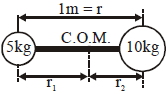
Two particles of mass $5\, kg$ and $10\, kg$ respectively are attached to the two ends of a rigid rod of length $1\, m$ with negligible mass. The centre of mass of the system from the $5\, kg$ particle is nearly at a distance of $..........\, cm$.
A
$80$
B
$33$
C
$50$
D
$67$
Solution
(D) Let $m_1 = 5\, kg$ and $m_2 = 10\, kg$ be the masses of the two particles.
Let $r = 1\, m = 100\, cm$ be the length of the rod.
Let $r_1$ be the distance of the centre of mass from the $5\, kg$ particle.
The formula for the distance of the centre of mass from mass $m_1$ is given by $r_1 = \frac{m_2 r}{m_1 + m_2}$.
Substituting the values: $r_1 = \frac{10\, kg \times 100\, cm}{5\, kg + 10\, kg} = \frac{1000}{15}\, cm$.
$r_1 = 66.67\, cm \approx 67\, cm$.
Let $r = 1\, m = 100\, cm$ be the length of the rod.
Let $r_1$ be the distance of the centre of mass from the $5\, kg$ particle.
The formula for the distance of the centre of mass from mass $m_1$ is given by $r_1 = \frac{m_2 r}{m_1 + m_2}$.
Substituting the values: $r_1 = \frac{10\, kg \times 100\, cm}{5\, kg + 10\, kg} = \frac{1000}{15}\, cm$.
$r_1 = 66.67\, cm \approx 67\, cm$.
0 likesView Solution
6
PhysicsEasyMCQNEET · 2020
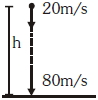
$A$ ball is thrown vertically downward with a velocity of $20\; m/s$ from the top of a tower. It hits the ground after some time with a velocity of $80\; m/s$. The height of the tower is $......m$ : $(g = 10\; m/s^2)$
A
$300$
B
$360$
C
$340$
D
$320$
Solution
(A) Given:
Initial velocity,$u = 20\; m/s$
Final velocity,$v = 80\; m/s$
Acceleration due to gravity,$g = 10\; m/s^2$
Using the third equation of motion:
$v^2 = u^2 + 2gh$
Substituting the values:
$80^2 = 20^2 + 2 \times 10 \times h$
$6400 = 400 + 20h$
$6000 = 20h$
$h = \frac{6000}{20} = 300\; m$
Therefore,the height of the tower is $300\; m$.
Initial velocity,$u = 20\; m/s$
Final velocity,$v = 80\; m/s$
Acceleration due to gravity,$g = 10\; m/s^2$
Using the third equation of motion:
$v^2 = u^2 + 2gh$
Substituting the values:
$80^2 = 20^2 + 2 \times 10 \times h$
$6400 = 400 + 20h$
$6000 = 20h$
$h = \frac{6000}{20} = 300\; m$
Therefore,the height of the tower is $300\; m$.
0 likesView Solution
7
PhysicsEasyMCQNEET · 2020
The average thermal energy for a mono-atomic gas is: ($k_{B}$ is Boltzmann constant and $T$ is absolute temperature)
A
$\frac{7}{2} k_{B} T$
B
$\frac{1}{2} k_{B} T$
C
$\frac{3}{2} k_{B} T$
D
$\frac{5}{2} k_{B} T$
Solution
(C) According to the law of equipartition of energy,the average energy associated with each degree of freedom is $\frac{1}{2} k_{B} T$.
For a mono-atomic gas,the number of degrees of freedom $(f)$ is $3$ (all translational).
Therefore,the average thermal energy $E = f \times \frac{1}{2} k_{B} T = 3 \times \frac{1}{2} k_{B} T = \frac{3}{2} k_{B} T$.
For a mono-atomic gas,the number of degrees of freedom $(f)$ is $3$ (all translational).
Therefore,the average thermal energy $E = f \times \frac{1}{2} k_{B} T = 3 \times \frac{1}{2} k_{B} T = \frac{3}{2} k_{B} T$.
0 likesView Solution
8
PhysicsMediumMCQNEET · 2020
$A$ capillary tube of radius $r$ is immersed in water and water rises in it to a height $h$. The mass of the water in the capillary is $5 \, g$. Another capillary tube of radius $2r$ is immersed in water. The mass of water that will rise in this tube is $........ \, g$.
A
$20.0$
B
$2.5$
C
$5.0$
D
$10.0$
Solution
(D) The height of water rise in a capillary tube is given by $h = \frac{2T \cos \theta}{r \rho g}$.
The mass of water in the capillary tube is $m = V \rho = (\pi r^2 h) \rho$.
Substituting the expression for $h$:
$m = \pi r^2 \left( \frac{2T \cos \theta}{r \rho g} \right) \rho = \frac{2 \pi r T \cos \theta}{g}$.
Since $T$,$\theta$,and $g$ are constants,we find that $m \propto r$.
For the first tube,$m_1 = 5 \, g$ and $r_1 = r$.
For the second tube,$r_2 = 2r$.
Using the proportionality $m \propto r$:
$\frac{m_2}{m_1} = \frac{r_2}{r_1} = \frac{2r}{r} = 2$.
Therefore,$m_2 = 2 \times m_1 = 2 \times 5 \, g = 10 \, g$.
The mass of water in the capillary tube is $m = V \rho = (\pi r^2 h) \rho$.
Substituting the expression for $h$:
$m = \pi r^2 \left( \frac{2T \cos \theta}{r \rho g} \right) \rho = \frac{2 \pi r T \cos \theta}{g}$.
Since $T$,$\theta$,and $g$ are constants,we find that $m \propto r$.
For the first tube,$m_1 = 5 \, g$ and $r_1 = r$.
For the second tube,$r_2 = 2r$.
Using the proportionality $m \propto r$:
$\frac{m_2}{m_1} = \frac{r_2}{r_1} = \frac{2r}{r} = 2$.
Therefore,$m_2 = 2 \times m_1 = 2 \times 5 \, g = 10 \, g$.
0 likesView Solution
9
PhysicsEasyMCQNEET · 2020
$A$ wire of length $L$ and area of cross-section $A$ is hanging from a fixed support. The length of the wire changes to $L_{1}$ when a mass $M$ is suspended from its free end. The expression for Young's modulus is:
A
$\frac{MgL}{A(L_{1}-L)}$
B
$\frac{MgL_{1}}{AL}$
C
$\frac{Mg(L_{1}-L)}{AL}$
D
$\frac{MgL}{AL_{1}}$
Solution
(A) Young's modulus $(Y)$ is defined as the ratio of longitudinal stress to longitudinal strain.
Stress = $\frac{F}{A} = \frac{Mg}{A}$
Strain = $\frac{\Delta L}{L} = \frac{L_{1}-L}{L}$
Therefore,$Y = \frac{\text{Stress}}{\text{Strain}} = \frac{Mg/A}{(L_{1}-L)/L} = \frac{MgL}{A(L_{1}-L)}$.
Stress = $\frac{F}{A} = \frac{Mg}{A}$
Strain = $\frac{\Delta L}{L} = \frac{L_{1}-L}{L}$
Therefore,$Y = \frac{\text{Stress}}{\text{Strain}} = \frac{Mg/A}{(L_{1}-L)/L} = \frac{MgL}{A(L_{1}-L)}$.
0 likesView Solution
10
PhysicsEasyMCQNEET · 2020
The energy required to break one bond in $DNA$ is $10^{-20} \ J$. This value in $eV$ is nearly:
A
$0.006$
B
$6$
C
$0.6$
D
$0.0625$
Solution
(D) To convert energy from Joules $(J)$ to electron-volts $(eV)$,we divide the energy value by the charge of an electron,which is $1.6 \times 10^{-19} \ C$.
Given energy $E = 10^{-20} \ J$.
$E \text{ (in } eV) = \frac{10^{-20} \ J}{1.6 \times 10^{-19} \ J/eV}$
$E = \frac{1}{1.6} \times 10^{-1} \ eV$
$E = 0.625 \times 0.1 \ eV$
$E = 0.0625 \ eV$.
Given energy $E = 10^{-20} \ J$.
$E \text{ (in } eV) = \frac{10^{-20} \ J}{1.6 \times 10^{-19} \ J/eV}$
$E = \frac{1}{1.6} \times 10^{-1} \ eV$
$E = 0.625 \times 0.1 \ eV$
$E = 0.0625 \ eV$.
2 likesView Solution
11
PhysicsEasyMCQNEET · 2020
The mean free path for a gas,with molecular diameter $d$ and number density $n$,can be expressed as:
A
$\frac{1}{\sqrt{2} n^2 \pi^2 d^2}$
B
$\frac{1}{\sqrt{2} n \pi d}$
C
$\frac{1}{\sqrt{2} n \pi d^2}$
D
$\frac{1}{\sqrt{2} n^2 \pi d^2}$
Solution
(C) The mean free path $(\lambda)$ is the average distance traveled by a molecule between two successive collisions.
According to the kinetic theory of gases,the mean free path is given by the formula:
$\lambda = \frac{1}{\sqrt{2} \pi d^2 n}$
where:
$d$ = molecular diameter
$n$ = number density (number of molecules per unit volume)
Thus,the correct expression is $\frac{1}{\sqrt{2} n \pi d^2}$.
According to the kinetic theory of gases,the mean free path is given by the formula:
$\lambda = \frac{1}{\sqrt{2} \pi d^2 n}$
where:
$d$ = molecular diameter
$n$ = number density (number of molecules per unit volume)
Thus,the correct expression is $\frac{1}{\sqrt{2} n \pi d^2}$.
0 likesView Solution
12
PhysicsMediumMCQNEET · 2020
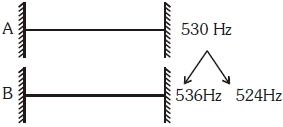
In a guitar,two strings $A$ and $B$ made of the same material are slightly out of tune and produce beats of frequency $6 \, Hz$. When the tension in $B$ is slightly decreased,the beat frequency increases to $7 \, Hz$. If the frequency of $A$ is $530 \, Hz$,the original frequency of $B$ will be $......... \, Hz$.
A
$537$
B
$523$
C
$524$
D
$536$
Solution
(C) The frequency of a stretched string is given by $f = \frac{1}{2L} \sqrt{\frac{T}{\mu}}$. Thus,$f \propto \sqrt{T}$.
When the tension $T$ in string $B$ is decreased,its frequency $f_B$ decreases.
The initial beat frequency is $|f_A - f_B| = 6 \, Hz$. Given $f_A = 530 \, Hz$,the possible values for $f_B$ are $530 + 6 = 536 \, Hz$ or $530 - 6 = 524 \, Hz$.
Case $1$: If $f_B = 536 \, Hz$,decreasing the tension decreases $f_B$. As $f_B$ moves towards $530 \, Hz$,the beat frequency $|530 - f_B|$ decreases (e.g.,$536 \to 535 \implies$ beats $6 \to 5$). This contradicts the problem statement.
Case $2$: If $f_B = 524 \, Hz$,decreasing the tension decreases $f_B$. As $f_B$ moves away from $530 \, Hz$,the beat frequency $|530 - f_B|$ increases (e.g.,$524 \to 523 \implies$ beats $6 \to 7$). This matches the problem statement.
Therefore,the original frequency of $B$ is $524 \, Hz$.
When the tension $T$ in string $B$ is decreased,its frequency $f_B$ decreases.
The initial beat frequency is $|f_A - f_B| = 6 \, Hz$. Given $f_A = 530 \, Hz$,the possible values for $f_B$ are $530 + 6 = 536 \, Hz$ or $530 - 6 = 524 \, Hz$.
Case $1$: If $f_B = 536 \, Hz$,decreasing the tension decreases $f_B$. As $f_B$ moves towards $530 \, Hz$,the beat frequency $|530 - f_B|$ decreases (e.g.,$536 \to 535 \implies$ beats $6 \to 5$). This contradicts the problem statement.
Case $2$: If $f_B = 524 \, Hz$,decreasing the tension decreases $f_B$. As $f_B$ moves away from $530 \, Hz$,the beat frequency $|530 - f_B|$ increases (e.g.,$524 \to 523 \implies$ beats $6 \to 7$). This matches the problem statement.
Therefore,the original frequency of $B$ is $524 \, Hz$.
0 likesView Solution
13
PhysicsEasyMCQNEET · 2020
The phase difference between displacement and acceleration of a particle in a simple harmonic motion is
A
Zero
B
$\pi \; rad$
C
$\frac{3 \pi}{2} \; rad$
D
$\frac{\pi}{2} \; rad$
Solution
(B) The displacement $(x)$ of a particle in $SHM$ is given by $x = A \sin(\omega t + \phi)$.
The velocity $(v)$ is the first derivative of displacement: $v = \frac{dx}{dt} = A \omega \cos(\omega t + \phi)$.
The acceleration $(a)$ is the second derivative of displacement: $a = \frac{d^2x}{dt^2} = -A \omega^2 \sin(\omega t + \phi)$.
Using the trigonometric identity $-\sin(\theta) = \sin(\theta + \pi)$,we can rewrite the acceleration as $a = A \omega^2 \sin(\omega t + \phi + \pi)$.
Comparing the phase of displacement $(\omega t + \phi)$ and acceleration $(\omega t + \phi + \pi)$,the phase difference is $\pi \; rad$.
The velocity $(v)$ is the first derivative of displacement: $v = \frac{dx}{dt} = A \omega \cos(\omega t + \phi)$.
The acceleration $(a)$ is the second derivative of displacement: $a = \frac{d^2x}{dt^2} = -A \omega^2 \sin(\omega t + \phi)$.
Using the trigonometric identity $-\sin(\theta) = \sin(\theta + \pi)$,we can rewrite the acceleration as $a = A \omega^2 \sin(\omega t + \phi + \pi)$.
Comparing the phase of displacement $(\omega t + \phi)$ and acceleration $(\omega t + \phi + \pi)$,the phase difference is $\pi \; rad$.
0 likesView Solution
14
PhysicsEasyMCQNEET · 2020
Taking into account the significant figures,what is the value of $9.99\, m - 0.0099\, m$ (in $, m$)?
A
$9.9$
B
$9.9801$
C
$9.98$
D
$9.980$
Solution
(C) In subtraction,the number of decimal places in the result should be equal to the number of decimal places of the term in the operation that contains the fewest decimal places.
Given values:
$9.99\, m$ (has $2$ decimal places)
$0.0099\, m$ (has $4$ decimal places)
Performing the subtraction:
$9.99 - 0.0099 = 9.9801$
According to the rule of significant figures for subtraction,the result must be rounded to the same number of decimal places as the term with the fewest decimal places,which is $2$ decimal places.
Rounding $9.9801$ to $2$ decimal places gives $9.98$.
Thus,the final result is $9.98\, m$.
Given values:
$9.99\, m$ (has $2$ decimal places)
$0.0099\, m$ (has $4$ decimal places)
Performing the subtraction:
$9.99 - 0.0099 = 9.9801$
According to the rule of significant figures for subtraction,the result must be rounded to the same number of decimal places as the term with the fewest decimal places,which is $2$ decimal places.
Rounding $9.9801$ to $2$ decimal places gives $9.98$.
Thus,the final result is $9.98\, m$.
0 likesView Solution
15
PhysicsEasyMCQNEET · 2020
Dimensions of stress are
A
$[M L^{-1} T^{-2}]$
B
$[M L T^{-2}]$
C
$[M L^{2} T^{-2}]$
D
$[M L^{0} T^{-2}]$
Solution
(A) Stress is defined as the restoring force per unit area.
$\text{Stress} = \frac{\text{Force}}{\text{Area}}$
Substituting the dimensional formulas for force $[M L T^{-2}]$ and area $[L^2]$:
$\text{Stress} = \frac{[M L T^{-2}]}{[L^2]}$
$\text{Stress} = [M L^{1-2} T^{-2}]$
$\text{Stress} = [M L^{-1} T^{-2}]$
$\text{Stress} = \frac{\text{Force}}{\text{Area}}$
Substituting the dimensional formulas for force $[M L T^{-2}]$ and area $[L^2]$:
$\text{Stress} = \frac{[M L T^{-2}]}{[L^2]}$
$\text{Stress} = [M L^{1-2} T^{-2}]$
$\text{Stress} = [M L^{-1} T^{-2}]$
0 likesView Solution
16
PhysicsMediumMCQNEET · 2020
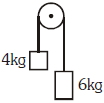
Two bodies of mass $4 \, kg$ and $6 \, kg$ are tied to the ends of a massless string. The string passes over a pulley which is frictionless (see figure). The acceleration of the system in terms of acceleration due to gravity $(g)$ is
A
$\frac{g}{10}$
B
$g$
C
$\frac{g}{2}$
D
$\frac{g}{5}$
Solution
(D) For a system of two masses $m_1$ and $m_2$ connected by a string over a frictionless pulley,the acceleration $a$ is given by the formula:
$a = \frac{(m_2 - m_1)g}{m_1 + m_2}$
Here,$m_1 = 4 \, kg$ and $m_2 = 6 \, kg$.
Substituting the values into the formula:
$a = \frac{(6 - 4)g}{6 + 4}$
$a = \frac{2g}{10}$
$a = \frac{g}{5}$
Thus,the acceleration of the system is $\frac{g}{5}$.
$a = \frac{(m_2 - m_1)g}{m_1 + m_2}$
Here,$m_1 = 4 \, kg$ and $m_2 = 6 \, kg$.
Substituting the values into the formula:
$a = \frac{(6 - 4)g}{6 + 4}$
$a = \frac{2g}{10}$
$a = \frac{g}{5}$
Thus,the acceleration of the system is $\frac{g}{5}$.
1 likesView Solution
17
PhysicsEasyMCQNEET · 2020
$A$ screw gauge has a least count of $0.01\, mm$ and there are $50$ divisions on its circular scale. The pitch of the screw gauge is $........\, mm$.
A
$1.0$
B
$0.01$
C
$0.25$
D
$0.5$
Solution
(D) The least count $(L.C.)$ of a screw gauge is defined by the formula:
$L.C. = \frac{\text{Pitch}}{\text{Number of divisions on circular scale}}$
Given:
$L.C. = 0.01\, mm$
Number of divisions = $50$
Substituting the values into the formula:
$0.01\, mm = \frac{\text{Pitch}}{50}$
Therefore,the pitch is:
$\text{Pitch} = 0.01\, mm \times 50 = 0.5\, mm$.
$L.C. = \frac{\text{Pitch}}{\text{Number of divisions on circular scale}}$
Given:
$L.C. = 0.01\, mm$
Number of divisions = $50$
Substituting the values into the formula:
$0.01\, mm = \frac{\text{Pitch}}{50}$
Therefore,the pitch is:
$\text{Pitch} = 0.01\, mm \times 50 = 0.5\, mm$.
0 likesView Solution
18
PhysicsMediumMCQNEET · 2020
The quantities of heat required to raise the temperature of two solid copper spheres of radii $r_{1}$ and $r_{2}$ $(r_{1} = 1.5 r_{2})$ through $1 \ K$ are in the ratio:
A
$5/3$
B
$27/8$
C
$9/4$
D
$3/2$
Solution
(B) The heat required to change the temperature of a body is given by the formula $\Delta Q = M s \Delta T$,where $M$ is the mass,$s$ is the specific heat capacity,and $\Delta T$ is the change in temperature.
Since both spheres are made of copper,the specific heat capacity $s$ is the same for both.
Given that the temperature change $\Delta T = 1 \ K$ is the same for both,we have $\Delta Q \propto M$.
The mass $M$ of a sphere is given by $M = V \rho = \frac{4}{3} \pi r^3 \rho$,where $V$ is the volume,$r$ is the radius,and $\rho$ is the density.
Since $\rho$ is the same for both copper spheres,$M \propto r^3$.
Therefore,the ratio of heat required is $\frac{\Delta Q_1}{\Delta Q_2} = \frac{M_1}{M_2} = \left( \frac{r_1}{r_2} \right)^3$.
Given $r_1 = 1.5 r_2$,we have $\frac{r_1}{r_2} = 1.5 = \frac{3}{2}$.
Thus,$\frac{\Delta Q_1}{\Delta Q_2} = \left( \frac{3}{2} \right)^3 = \frac{27}{8}$.
Since both spheres are made of copper,the specific heat capacity $s$ is the same for both.
Given that the temperature change $\Delta T = 1 \ K$ is the same for both,we have $\Delta Q \propto M$.
The mass $M$ of a sphere is given by $M = V \rho = \frac{4}{3} \pi r^3 \rho$,where $V$ is the volume,$r$ is the radius,and $\rho$ is the density.
Since $\rho$ is the same for both copper spheres,$M \propto r^3$.
Therefore,the ratio of heat required is $\frac{\Delta Q_1}{\Delta Q_2} = \frac{M_1}{M_2} = \left( \frac{r_1}{r_2} \right)^3$.
Given $r_1 = 1.5 r_2$,we have $\frac{r_1}{r_2} = 1.5 = \frac{3}{2}$.
Thus,$\frac{\Delta Q_1}{\Delta Q_2} = \left( \frac{3}{2} \right)^3 = \frac{27}{8}$.
0 likesView Solution
19
PhysicsEasyMCQNEET · 2020
The mean free path $\ell$ for a gas molecule depends upon the diameter $d$ of the molecule as:
A
$\ell \propto \frac{1}{d}$
B
$\ell \propto \frac{1}{d^{2}}$
C
$\ell \propto d$
D
$\ell \propto d^{2}$
Solution
(B) The mean free path $\ell$ of a gas molecule is defined as the average distance traveled by a molecule between two successive collisions.
The formula for the mean free path is given by:
$\ell = \frac{1}{\sqrt{2} n \pi d^{2}}$
where $n$ is the number density of molecules and $d$ is the diameter of the molecule.
From the formula,it is clear that $\ell$ is inversely proportional to the square of the diameter $d$.
Therefore,$\ell \propto \frac{1}{d^{2}}$.
The formula for the mean free path is given by:
$\ell = \frac{1}{\sqrt{2} n \pi d^{2}}$
where $n$ is the number density of molecules and $d$ is the diameter of the molecule.
From the formula,it is clear that $\ell$ is inversely proportional to the square of the diameter $d$.
Therefore,$\ell \propto \frac{1}{d^{2}}$.
0 likesView Solution
20
PhysicsMediumMCQNEET · 2020
Time intervals measured by a clock give the following readings: $1.25 \; s, 1.24 \; s, 1.27 \; s, 1.21 \; s$,and $1.28 \; s$. What is the percentage relative error of the observations?
A
$1.6$
B
$2$
C
$4$
D
$16$
Solution
(A) The arithmetic mean of the given values is taken as the true value.
$t_{\text{mean}} = \frac{1.25 + 1.24 + 1.27 + 1.21 + 1.28}{5} = \frac{6.25}{5} = 1.25 \; s$.
The absolute errors in each measurement are:
$|\Delta t_1| = |1.25 - 1.25| = 0 \; s$
$|\Delta t_2| = |1.24 - 1.25| = 0.01 \; s$
$|\Delta t_3| = |1.27 - 1.25| = 0.02 \; s$
$|\Delta t_4| = |1.21 - 1.25| = 0.04 \; s$
$|\Delta t_5| = |1.28 - 1.25| = 0.03 \; s$
The mean absolute error is:
$\Delta t_{\text{mean}} = \frac{0 + 0.01 + 0.02 + 0.04 + 0.03}{5} = \frac{0.10}{5} = 0.02 \; s$.
The percentage relative error is:
$\text{Percentage error} = \frac{\Delta t_{\text{mean}}}{t_{\text{mean}}} \times 100 = \frac{0.02}{1.25} \times 100 = 1.6 \%$.
$t_{\text{mean}} = \frac{1.25 + 1.24 + 1.27 + 1.21 + 1.28}{5} = \frac{6.25}{5} = 1.25 \; s$.
The absolute errors in each measurement are:
$|\Delta t_1| = |1.25 - 1.25| = 0 \; s$
$|\Delta t_2| = |1.24 - 1.25| = 0.01 \; s$
$|\Delta t_3| = |1.27 - 1.25| = 0.02 \; s$
$|\Delta t_4| = |1.21 - 1.25| = 0.04 \; s$
$|\Delta t_5| = |1.28 - 1.25| = 0.03 \; s$
The mean absolute error is:
$\Delta t_{\text{mean}} = \frac{0 + 0.01 + 0.02 + 0.04 + 0.03}{5} = \frac{0.10}{5} = 0.02 \; s$.
The percentage relative error is:
$\text{Percentage error} = \frac{\Delta t_{\text{mean}}}{t_{\text{mean}}} \times 100 = \frac{0.02}{1.25} \times 100 = 1.6 \%$.
0 likesView Solution
21
PhysicsEasyMCQNEET · 2020
An ideal gas equation can be written as $P = \frac{\rho R T}{M_{0}}$,where $\rho$ and $M_{0}$ are respectively,
A
Number density,mass of the gas
B
Mass density,mass of the gas
C
Number density,molar mass
D
Mass density,molar mass
Solution
(D) The ideal gas equation is given by $PV = \mu RT$.
Here,$\mu$ is the number of moles,which is defined as $\mu = \frac{M}{M_{0}}$,where $M$ is the total mass of the gas and $M_{0}$ is the molar mass.
Substituting this into the ideal gas equation,we get $PV = \left(\frac{M}{M_{0}}\right) RT$.
Rearranging the terms,we get $P = \left(\frac{M}{V}\right) \frac{RT}{M_{0}}$.
Since mass density $\rho$ is defined as $\rho = \frac{M}{V}$,we can substitute it into the equation to get $P = \frac{\rho RT}{M_{0}}$.
Thus,$\rho$ represents the mass density and $M_{0}$ represents the molar mass.
Here,$\mu$ is the number of moles,which is defined as $\mu = \frac{M}{M_{0}}$,where $M$ is the total mass of the gas and $M_{0}$ is the molar mass.
Substituting this into the ideal gas equation,we get $PV = \left(\frac{M}{M_{0}}\right) RT$.
Rearranging the terms,we get $P = \left(\frac{M}{V}\right) \frac{RT}{M_{0}}$.
Since mass density $\rho$ is defined as $\rho = \frac{M}{V}$,we can substitute it into the equation to get $P = \frac{\rho RT}{M_{0}}$.
Thus,$\rho$ represents the mass density and $M_{0}$ represents the molar mass.
0 likesView Solution
22
PhysicsMediumMCQNEET · 2020
The length of the string of a musical instrument is $90 \;cm$ and has a fundamental frequency of $120 \;Hz$. Where (in $cm$) should it be pressed to produce a fundamental frequency of $180 \;Hz$?
A
$80$
B
$75$
C
$60$
D
$45$
Solution
(C) The fundamental frequency of a stretched string is given by $n = \frac{1}{2L} \sqrt{\frac{T}{\mu}}$.
Since the tension $T$ and mass per unit length $\mu$ are constant,the frequency is inversely proportional to the length of the string: $n \propto \frac{1}{L}$.
Therefore,$n_1 L_1 = n_2 L_2$.
Given $n_1 = 120 \;Hz$,$L_1 = 90 \;cm$,and $n_2 = 180 \;Hz$.
Substituting the values: $120 \times 90 = 180 \times L_2$.
$L_2 = \frac{120 \times 90}{180} = \frac{10800}{180} = 60 \;cm$.
Thus,the string should be pressed at $60 \;cm$ from one end to produce the required frequency.
Since the tension $T$ and mass per unit length $\mu$ are constant,the frequency is inversely proportional to the length of the string: $n \propto \frac{1}{L}$.
Therefore,$n_1 L_1 = n_2 L_2$.
Given $n_1 = 120 \;Hz$,$L_1 = 90 \;cm$,and $n_2 = 180 \;Hz$.
Substituting the values: $120 \times 90 = 180 \times L_2$.
$L_2 = \frac{120 \times 90}{180} = \frac{10800}{180} = 60 \;cm$.
Thus,the string should be pressed at $60 \;cm$ from one end to produce the required frequency.
0 likesView Solution
23
PhysicsEasyMCQNEET · 2020
$A$ barometer is constructed using a liquid (density $= 760 \; kg/m^3$). What would be the height (in $m$) of the liquid column,when a mercury barometer reads $76 \; cm$? (density of mercury $= 13600 \; kg/m^3$)
A
$0.76$
B
$1.36$
C
$13.6$
D
$136$
Solution
(C) The pressure exerted by a liquid column is given by the formula $P = h \rho g$,where $h$ is the height,$\rho$ is the density,and $g$ is the acceleration due to gravity.
For the mercury barometer,the pressure is $P = h_{Hg} \rho_{Hg} g = 0.76 \; m \times 13600 \; kg/m^3 \times g$.
For the liquid barometer,the pressure is $P = h' \rho' g = h' \times 760 \; kg/m^3 \times g$.
Since the atmospheric pressure is the same in both cases,we equate the two expressions:
$h' \times 760 = 0.76 \times 13600$
Solving for $h'$:
$h' = \frac{0.76 \times 13600}{760}$
$h' = \frac{10336}{760} = 13.6 \; m$.
For the mercury barometer,the pressure is $P = h_{Hg} \rho_{Hg} g = 0.76 \; m \times 13600 \; kg/m^3 \times g$.
For the liquid barometer,the pressure is $P = h' \rho' g = h' \times 760 \; kg/m^3 \times g$.
Since the atmospheric pressure is the same in both cases,we equate the two expressions:
$h' \times 760 = 0.76 \times 13600$
Solving for $h'$:
$h' = \frac{0.76 \times 13600}{760}$
$h' = \frac{10336}{760} = 13.6 \; m$.
0 likesView Solution
24
PhysicsEasyMCQNEET · 2020
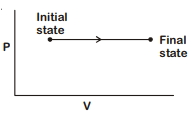
The $P-V$ diagram for an ideal gas in a piston-cylinder assembly undergoing a thermodynamic process is shown in the figure. The process is
A
isothermal
B
adiabatic
C
isochoric
D
isobaric
Solution
(D) In a $P-V$ diagram,the $y$-axis represents pressure $(P)$ and the $x$-axis represents volume $(V)$.
From the given figure,the line representing the process is horizontal,which means the pressure $(P)$ remains constant as the volume $(V)$ changes from the initial state to the final state.
$A$ thermodynamic process in which the pressure of the system remains constant is known as an isobaric process.
Therefore,the correct option is $D$.
From the given figure,the line representing the process is horizontal,which means the pressure $(P)$ remains constant as the volume $(V)$ changes from the initial state to the final state.
$A$ thermodynamic process in which the pressure of the system remains constant is known as an isobaric process.
Therefore,the correct option is $D$.
0 likesView Solution
25
PhysicsEasyMCQNEET · 2020
The efficiency of a Carnot engine depends upon
A
the temperature of the source only
B
the temperature of the sink only
C
the temperatures of the source and sink
D
the volume of the cylinder of the engine
Solution
(C) The efficiency $\eta$ of a Carnot engine is given by the formula:
$\eta = 1 - \frac{T_{2}}{T_{1}}$
where $T_{1}$ is the absolute temperature of the source and $T_{2}$ is the absolute temperature of the sink.
Therefore,the efficiency of a Carnot engine depends on both the temperature of the source and the temperature of the sink.
$\eta = 1 - \frac{T_{2}}{T_{1}}$
where $T_{1}$ is the absolute temperature of the source and $T_{2}$ is the absolute temperature of the sink.
Therefore,the efficiency of a Carnot engine depends on both the temperature of the source and the temperature of the sink.
0 likesView Solution
26
PhysicsEasyMCQNEET · 2020
$A$ liquid does not wet the solid surface if the angle of contact is
A
$0^{\circ}$
B
equal to $45^{\circ}$
C
equal to $60^{\circ}$
D
greater than $90^{\circ}$
Solution
(D) The angle of contact $\theta$ determines the wetting behavior of a liquid on a solid surface.
If $\theta < 90^{\circ},$ the liquid wets the surface (e.g.,water on glass).
If $\theta > 90^{\circ},$ the cohesive forces between liquid molecules are stronger than the adhesive forces between the liquid and the solid surface.
Consequently,the liquid does not wet the solid surface (e.g.,mercury on glass).
Therefore,the correct condition for a liquid not to wet a solid surface is that the angle of contact is greater than $90^{\circ}.$
If $\theta < 90^{\circ},$ the liquid wets the surface (e.g.,water on glass).
If $\theta > 90^{\circ},$ the cohesive forces between liquid molecules are stronger than the adhesive forces between the liquid and the solid surface.
Consequently,the liquid does not wet the solid surface (e.g.,mercury on glass).
Therefore,the correct condition for a liquid not to wet a solid surface is that the angle of contact is greater than $90^{\circ}.$
0 likesView Solution
27
PhysicsMediumMCQNEET · 2020
Three stars $A, B, C$ have surface temperatures $T_{A}, T_{B}, T_{C}$ respectively. Star $A$ appears bluish,star $B$ appears reddish,and star $C$ appears yellowish. Hence,
A
$T_{A} > T_{C} > T_{B}$
B
$T_{A} > T_{B} > T_{C}$
C
$T_{B} > T_{C} > T_{A}$
D
$T_{C} > T_{B} > T_{A}$
Solution
(A) According to Wien's Displacement Law,the product of the wavelength of maximum emission $\lambda_{m}$ and the absolute temperature $T$ is constant,i.e.,$\lambda_{m} T = b$.
This implies $T \propto \frac{1}{\lambda_{m}}$.
The wavelength of light corresponding to colors follows the order: $\lambda_{\text{blue}} < \lambda_{\text{yellow}} < \lambda_{\text{red}}$.
Given that star $A$ is bluish,star $C$ is yellowish,and star $B$ is reddish,their wavelengths are $\lambda_{A} < \lambda_{C} < \lambda_{B}$.
Since temperature is inversely proportional to wavelength,we have $T_{A} > T_{C} > T_{B}$.
This implies $T \propto \frac{1}{\lambda_{m}}$.
The wavelength of light corresponding to colors follows the order: $\lambda_{\text{blue}} < \lambda_{\text{yellow}} < \lambda_{\text{red}}$.
Given that star $A$ is bluish,star $C$ is yellowish,and star $B$ is reddish,their wavelengths are $\lambda_{A} < \lambda_{C} < \lambda_{B}$.
Since temperature is inversely proportional to wavelength,we have $T_{A} > T_{C} > T_{B}$.
0 likesView Solution
28
PhysicsMediumMCQNEET · 2020
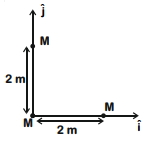
Three identical spheres,each of mass $M$,are placed at the corners of a right-angled triangle with mutually perpendicular sides equal to $2 \; m$ (see figure). Taking the point of intersection of the two mutually perpendicular sides as the origin,find the position vector of the center of mass.
A
$\frac{4}{3}(\hat{i}+\hat{j})$
B
$2(\hat{i}+\hat{j})$
C
$(\hat{i}+\hat{j})$
D
$\frac{2}{3}(\hat{i}+\hat{j})$
Solution
(D) Let the three spheres be located at coordinates $(0, 0)$,$(2, 0)$,and $(0, 2)$ in the $xy$-plane.
Since all spheres have the same mass $M$,the coordinates of the center of mass $(x_{cm}, y_{cm})$ are given by:
$x_{cm} = \frac{M(0) + M(2) + M(0)}{M + M + M} = \frac{2M}{3M} = \frac{2}{3} \; m$
$y_{cm} = \frac{M(0) + M(0) + M(2)}{M + M + M} = \frac{2M}{3M} = \frac{2}{3} \; m$
Therefore,the position vector of the center of mass is $\vec{r}_{cm} = x_{cm}\hat{i} + y_{cm}\hat{j} = \frac{2}{3}(\hat{i} + \hat{j}) \; m$.
Since all spheres have the same mass $M$,the coordinates of the center of mass $(x_{cm}, y_{cm})$ are given by:
$x_{cm} = \frac{M(0) + M(2) + M(0)}{M + M + M} = \frac{2M}{3M} = \frac{2}{3} \; m$
$y_{cm} = \frac{M(0) + M(0) + M(2)}{M + M + M} = \frac{2M}{3M} = \frac{2}{3} \; m$
Therefore,the position vector of the center of mass is $\vec{r}_{cm} = x_{cm}\hat{i} + y_{cm}\hat{j} = \frac{2}{3}(\hat{i} + \hat{j}) \; m$.
0 likesView Solution
29
PhysicsEasyMCQNEET · 2020
The angle of $1^{\prime}$ (minute of arc) in radian is nearly equal to
A
$1.75 \times 10^{-2} \; rad$
B
$2.91 \times 10^{-4} \; rad$
C
$4.85 \times 10^{-4} \; rad$
D
$4.80 \times 10^{-6} \; rad$
Solution
(B) We know that $1^{\circ} = 60^{\prime}$ (minutes of arc).
Therefore,$1^{\prime} = (1/60)^{\circ}$.
To convert degrees to radians,we multiply by $\frac{\pi}{180}$.
So,$1^{\prime} = \left(\frac{1}{60}\right) \times \left(\frac{\pi}{180}\right) \text{ rad}$.
Using $\pi \approx 3.14159$,we get:
$1^{\prime} = \frac{3.14159}{10800} \text{ rad} \approx 2.9088 \times 10^{-4} \text{ rad}$.
Rounding to three significant figures,we get $2.91 \times 10^{-4} \text{ rad}$.
Therefore,$1^{\prime} = (1/60)^{\circ}$.
To convert degrees to radians,we multiply by $\frac{\pi}{180}$.
So,$1^{\prime} = \left(\frac{1}{60}\right) \times \left(\frac{\pi}{180}\right) \text{ rad}$.
Using $\pi \approx 3.14159$,we get:
$1^{\prime} = \frac{3.14159}{10800} \text{ rad} \approx 2.9088 \times 10^{-4} \text{ rad}$.
Rounding to three significant figures,we get $2.91 \times 10^{-4} \text{ rad}$.
0 likesView Solution
30
PhysicsMediumMCQNEET · 2020
What is the depth at which the value of acceleration due to gravity becomes $\frac{1}{n}$ times the value at the surface of the Earth? (radius of Earth $= R$)
A
$\frac{R}{n}$
B
$\frac{R}{n^{2}}$
C
$\frac{R(n-1)}{n}$
D
$\frac{Rn}{n-1}$
Solution
(C) The value of acceleration due to gravity at a depth $d$ below the surface of the Earth is given by the formula:
$g' = g \left(1 - \frac{d}{R}\right)$
where $g$ is the acceleration due to gravity at the surface and $R$ is the radius of the Earth.
According to the problem,the value of acceleration at depth $d$ is $\frac{1}{n}$ times the value at the surface:
$g' = \frac{g}{n}$
Substituting this into the formula:
$\frac{g}{n} = g \left(1 - \frac{d}{R}\right)$
Dividing both sides by $g$:
$\frac{1}{n} = 1 - \frac{d}{R}$
Rearranging the terms to solve for $d$:
$\frac{d}{R} = 1 - \frac{1}{n}$
$\frac{d}{R} = \frac{n-1}{n}$
$d = R \left(\frac{n-1}{n}\right)$
$g' = g \left(1 - \frac{d}{R}\right)$
where $g$ is the acceleration due to gravity at the surface and $R$ is the radius of the Earth.
According to the problem,the value of acceleration at depth $d$ is $\frac{1}{n}$ times the value at the surface:
$g' = \frac{g}{n}$
Substituting this into the formula:
$\frac{g}{n} = g \left(1 - \frac{d}{R}\right)$
Dividing both sides by $g$:
$\frac{1}{n} = 1 - \frac{d}{R}$
Rearranging the terms to solve for $d$:
$\frac{d}{R} = 1 - \frac{1}{n}$
$\frac{d}{R} = \frac{n-1}{n}$
$d = R \left(\frac{n-1}{n}\right)$
1 likesView Solution
31
PhysicsMediumMCQNEET · 2020
The angular speed of the wheel of a vehicle is increased from $360 \; rpm$ to $1200 \; rpm$ in $14 \; s$. Its angular acceleration is,
A
$1 \; rad/s^2$
B
$2 \pi \; rad/s^2$
C
$28 \pi \; rad/s^2$
D
$120 \pi \; rad/s^2$
Solution
(B) Initial angular speed $\omega_0 = 360 \; rpm = 360 \times \frac{2\pi}{60} \; rad/s = 12\pi \; rad/s$.
Final angular speed $\omega = 1200 \; rpm = 1200 \times \frac{2\pi}{60} \; rad/s = 40\pi \; rad/s$.
Time taken $t = 14 \; s$.
Using the equation of rotational motion $\omega = \omega_0 + \alpha t$,where $\alpha$ is the angular acceleration:
$40\pi = 12\pi + \alpha(14)$.
$28\pi = 14\alpha$.
$\alpha = \frac{28\pi}{14} = 2\pi \; rad/s^2$.
Final angular speed $\omega = 1200 \; rpm = 1200 \times \frac{2\pi}{60} \; rad/s = 40\pi \; rad/s$.
Time taken $t = 14 \; s$.
Using the equation of rotational motion $\omega = \omega_0 + \alpha t$,where $\alpha$ is the angular acceleration:
$40\pi = 12\pi + \alpha(14)$.
$28\pi = 14\alpha$.
$\alpha = \frac{28\pi}{14} = 2\pi \; rad/s^2$.
0 likesView Solution
32
PhysicsMediumMCQNEET · 2020
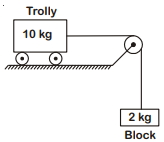
Calculate the acceleration (in $m/s^{2}$) of the block and trolley system shown in the figure. The coefficient of kinetic friction between the trolley and the surface is $0.05$. (Given: $g = 10\; m/s^{2}$,mass of the string is negligible and no other friction exists).
A
$1$
B
$1.25$
C
$1.5$
D
$1.66$
Solution
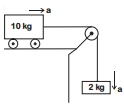
(B) Free Body Diagram ($F$.$B$.$D$.) of the trolley:
$T - f = m_{T} a$
Where $f = \mu m_{T} g = 0.05 \times 10 \times 10 = 5\; N$.
So,$T - 5 = 10a$ --- $(i)$
Free Body Diagram ($F$.$B$.$D$.) of the block:
$m_{b} g - T = m_{b} a$
$2 \times 10 - T = 2a$
$20 - T = 2a$ --- (ii)
Adding equations $(i)$ and (ii):
$(T - 5) + (20 - T) = 10a + 2a$
$15 = 12a$
$a = \frac{15}{12} = 1.25\; m/s^{2}$.
$T - f = m_{T} a$
Where $f = \mu m_{T} g = 0.05 \times 10 \times 10 = 5\; N$.
So,$T - 5 = 10a$ --- $(i)$
Free Body Diagram ($F$.$B$.$D$.) of the block:
$m_{b} g - T = m_{b} a$
$2 \times 10 - T = 2a$
$20 - T = 2a$ --- (ii)
Adding equations $(i)$ and (ii):
$(T - 5) + (20 - T) = 10a + 2a$
$15 = 12a$
$a = \frac{15}{12} = 1.25\; m/s^{2}$.
0 likesView Solution
33
PhysicsMediumMCQNEET · 2020
$A$ point mass '$m$' is moved in a vertical circle of radius '$r$' with the help of a string. The velocity of the mass is $\sqrt{7gr}$ at the lowest point. The tension in the string at the lowest point is .......... $mg$.
A
$1$
B
$6$
C
$7$
D
$8$
Solution
(D) At the lowest point of a vertical circle,the forces acting on the mass '$m$' are the tension '$T$' acting upwards and the weight '$mg$' acting downwards.
The net centripetal force required for circular motion is provided by the difference between tension and weight:
$T - mg = \frac{mv^2}{r}$
Given that the velocity at the lowest point is $v = \sqrt{7gr}$,we substitute this into the equation:
$T - mg = \frac{m(\sqrt{7gr})^2}{r}$
$T - mg = \frac{m(7gr)}{r}$
$T - mg = 7mg$
$T = 7mg + mg = 8mg$
Therefore,the tension in the string at the lowest point is $8mg$.
The net centripetal force required for circular motion is provided by the difference between tension and weight:
$T - mg = \frac{mv^2}{r}$
Given that the velocity at the lowest point is $v = \sqrt{7gr}$,we substitute this into the equation:
$T - mg = \frac{m(\sqrt{7gr})^2}{r}$
$T - mg = \frac{m(7gr)}{r}$
$T - mg = 7mg$
$T = 7mg + mg = 8mg$
Therefore,the tension in the string at the lowest point is $8mg$.

1 likesView Solution
34
PhysicsEasyMCQNEET · 2020
$A$ plano-convex lens of unknown material and unknown focal length is given. With the help of a Spherometer,we can measure the,
A
refractive index of the material
B
focal length of the lens
C
radius of curvature of the curved surface
D
aperture of the lens
Solution
(C) Spherometer is a precision instrument designed to measure the sagitta (height) of a spherical surface. By knowing the distance between the legs of the Spherometer and measuring the sagitta,we can calculate the radius of curvature $(R)$ of the curved surface using the formula $R = \frac{a^2}{6h} + \frac{h}{2}$,where $a$ is the distance between the legs and $h$ is the sagitta. Therefore,a Spherometer is used to measure the radius of curvature of the curved surface.
0 likesView Solution
35
PhysicsMediumMCQNEET · 2020
Identify the function which represents a periodic motion.
A
$e^{-\omega t}$
B
$e^{\omega t}$
C
$\log_{e}(\omega t)$
D
$\sin \omega t + \cos \omega t$
Solution
(D) function $f(t)$ is periodic if it repeats its value after a fixed interval of time $T$,such that $f(t) = f(t + T)$.
$1$. The functions $e^{-\omega t}$,$e^{\omega t}$,and $\log_{e}(\omega t)$ are non-periodic functions because they do not repeat their values at regular intervals.
$2$. For the function $f(t) = \sin \omega t + \cos \omega t$,we can check for periodicity by replacing $t$ with $t + T$:
$f(t + T) = \sin(\omega(t + T)) + \cos(\omega(t + T)) = \sin(\omega t + \omega T) + \cos(\omega t + \omega T)$.
$3$. If we choose $T = \frac{2\pi}{\omega}$,then $\omega T = 2\pi$. Substituting this:
$f(t + T) = \sin(\omega t + 2\pi) + \cos(\omega t + 2\pi) = \sin \omega t + \cos \omega t = f(t)$.
Since the function repeats itself after a time period $T = \frac{2\pi}{\omega}$,it represents a periodic motion.
$1$. The functions $e^{-\omega t}$,$e^{\omega t}$,and $\log_{e}(\omega t)$ are non-periodic functions because they do not repeat their values at regular intervals.
$2$. For the function $f(t) = \sin \omega t + \cos \omega t$,we can check for periodicity by replacing $t$ with $t + T$:
$f(t + T) = \sin(\omega(t + T)) + \cos(\omega(t + T)) = \sin(\omega t + \omega T) + \cos(\omega t + \omega T)$.
$3$. If we choose $T = \frac{2\pi}{\omega}$,then $\omega T = 2\pi$. Substituting this:
$f(t + T) = \sin(\omega t + 2\pi) + \cos(\omega t + 2\pi) = \sin \omega t + \cos \omega t = f(t)$.
Since the function repeats itself after a time period $T = \frac{2\pi}{\omega}$,it represents a periodic motion.
0 likesView Solution
36
PhysicsMediumMCQNEET · 2020
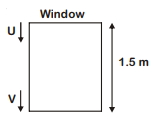
$A$ person sitting on the ground floor of a building notices through a window of height $1.5 \; m$ that a ball dropped from the roof of the building crosses the window in $0.1 \; s$. What is the velocity (in $m/s$) of the ball when it is at the topmost point of the window? (Take $g = 10 \; m/s^2$)
A
$20$
B
$15.5$
C
$14.5$
D
$4.5$
Solution
(C) Let $u$ be the velocity of the ball at the top of the window.
Using the second equation of motion for the motion of the ball across the window:
$S = ut + \frac{1}{2}at^2$
Here,$S = 1.5 \; m$,$t = 0.1 \; s$,and $a = g = 10 \; m/s^2$.
Substituting the values:
$1.5 = u(0.1) + \frac{1}{2} \times 10 \times (0.1)^2$
$1.5 = 0.1u + 5 \times 0.01$
$1.5 = 0.1u + 0.05$
$0.1u = 1.5 - 0.05$
$0.1u = 1.45$
$u = \frac{1.45}{0.1} = 14.5 \; m/s$.
Using the second equation of motion for the motion of the ball across the window:
$S = ut + \frac{1}{2}at^2$
Here,$S = 1.5 \; m$,$t = 0.1 \; s$,and $a = g = 10 \; m/s^2$.
Substituting the values:
$1.5 = u(0.1) + \frac{1}{2} \times 10 \times (0.1)^2$
$1.5 = 0.1u + 5 \times 0.01$
$1.5 = 0.1u + 0.05$
$0.1u = 1.5 - 0.05$
$0.1u = 1.45$
$u = \frac{1.45}{0.1} = 14.5 \; m/s$.
0 likesView Solution
37
PhysicsMediumMCQNEET · 2020
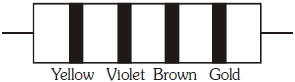
The color code of a resistor is given below. The values of resistance and tolerance,respectively,are:
A
$470 \; \Omega, 5 \%$
B
$470 \; k\Omega, 5 \%$
C
$47 \; k\Omega, 10 \%$
D
$4.7 \; k\Omega, 5 \%$
Solution
(A) The color code for the resistor is Yellow,Violet,Brown,and Gold.
According to the standard color code table:
$1$. The first color is Yellow,which corresponds to the digit $4$.
$2$. The second color is Violet,which corresponds to the digit $7$.
$3$. The third color is Brown,which acts as the multiplier $10^{1}$.
$4$. The fourth color is Gold,which represents the tolerance of $\pm 5 \%$.
Thus,the resistance value is $R = 47 \times 10^{1} \; \Omega = 470 \; \Omega$.
The tolerance is $5 \%$.
Therefore,the resistance is $470 \; \Omega, 5 \%$.
According to the standard color code table:
$1$. The first color is Yellow,which corresponds to the digit $4$.
$2$. The second color is Violet,which corresponds to the digit $7$.
$3$. The third color is Brown,which acts as the multiplier $10^{1}$.
$4$. The fourth color is Gold,which represents the tolerance of $\pm 5 \%$.
Thus,the resistance value is $R = 47 \times 10^{1} \; \Omega = 470 \; \Omega$.
The tolerance is $5 \%$.
Therefore,the resistance is $470 \; \Omega, 5 \%$.
0 likesView Solution
38
PhysicsMediumMCQNEET · 2020
$A$ ray is incident at an angle of incidence $i$ on one surface of a small angle prism (with angle of prism $A$) and emerges normally from the opposite surface. If the refractive index of the material of the prism is $\mu$,then the angle of incidence is nearly equal to
A
$\frac{\mu A}{2}$
B
$\frac{A}{2\mu}$
C
$\frac{2A}{\mu}$
D
$\mu A$
Solution
(D) For a prism,the angle of the prism is given by $A = r_1 + r_2$.
Since the ray emerges normally from the opposite surface,the angle of emergence $e = 0$,which implies the angle of refraction at the second surface $r_2 = 0$.
Substituting $r_2 = 0$ into the prism equation,we get $r_1 = A$.
Applying Snell's law at the first surface: $\sin i = \mu \sin r_1$.
For small angles,$\sin i \approx i$ and $\sin r_1 \approx r_1$.
Therefore,$i = \mu r_1$.
Substituting $r_1 = A$,we get $i = \mu A$.
Since the ray emerges normally from the opposite surface,the angle of emergence $e = 0$,which implies the angle of refraction at the second surface $r_2 = 0$.
Substituting $r_2 = 0$ into the prism equation,we get $r_1 = A$.
Applying Snell's law at the first surface: $\sin i = \mu \sin r_1$.
For small angles,$\sin i \approx i$ and $\sin r_1 \approx r_1$.
Therefore,$i = \mu r_1$.
Substituting $r_1 = A$,we get $i = \mu A$.

0 likesView Solution
39
PhysicsMediumMCQNEET · 2020
An iron rod of susceptibility $599$ is subjected to a magnetising field of $1200 \, A m^{-1}$. The permeability of the material of the rod is $(\mu_{0} = 4 \pi \times 10^{-7} \, T m A^{-1})$.
A
$2.4 \pi \times 10^{-7} \, T m A^{-1}$
B
$2.4 \pi \times 10^{-4} \, T m A^{-1}$
C
$8.0 \times 10^{-5} \, T m A^{-1}$
D
$2.4 \pi \times 10^{-5} \, T m A^{-1}$
Solution
(B) The relative permeability $\mu_{r}$ is related to magnetic susceptibility $\chi_{m}$ by the formula: $\mu_{r} = 1 + \chi_{m}$.
Given $\chi_{m} = 599$,we have $\mu_{r} = 1 + 599 = 600$.
The absolute permeability $\mu$ of the material is given by $\mu = \mu_{0} \mu_{r}$.
Substituting the values,$\mu = (4 \pi \times 10^{-7} \, T m A^{-1}) \times 600$.
$\mu = 2400 \pi \times 10^{-7} \, T m A^{-1} = 2.4 \pi \times 10^{-4} \, T m A^{-1}$.
Given $\chi_{m} = 599$,we have $\mu_{r} = 1 + 599 = 600$.
The absolute permeability $\mu$ of the material is given by $\mu = \mu_{0} \mu_{r}$.
Substituting the values,$\mu = (4 \pi \times 10^{-7} \, T m A^{-1}) \times 600$.
$\mu = 2400 \pi \times 10^{-7} \, T m A^{-1} = 2.4 \pi \times 10^{-4} \, T m A^{-1}$.
0 likesView Solution
40
PhysicsEasyMCQNEET · 2020
For transistor action,which of the following statements is correct?
A
The base region must be very thin and lightly doped.
B
Base,emitter and collector regions should have same doping concentrations.
C
Base,emitter and collector regions should have same size.
D
Both emitter junction as well as the collector junction are forward biased.
Solution
(A) For effective transistor action,the base region must be very thin and lightly doped to ensure that most of the charge carriers injected from the emitter reach the collector without recombining in the base.
0 likesView Solution
41
PhysicsMediumMCQNEET · 2020
Light with an average flux of $20 \, W/cm^2$ falls on a non-reflecting surface at normal incidence having a surface area of $20 \, cm^2$. The energy received by the surface during a time span of $1 \, minute$ is $............ \, J$.
A
$48 \times 10^3$
B
$10 \times 10^3$
C
$12 \times 10^3$
D
$24 \times 10^3$
Solution
(D) The intensity (flux) $I$ is defined as the energy $E$ incident per unit area $A$ per unit time $t$,given by $I = \frac{E}{At}$.
To find the total energy $E$,we rearrange the formula: $E = I \times A \times t$.
Given values:
Intensity $I = 20 \, W/cm^2$
Area $A = 20 \, cm^2$
Time $t = 1 \, minute = 60 \, seconds$
Substituting the values into the equation:
$E = 20 \, W/cm^2 \times 20 \, cm^2 \times 60 \, s$
$E = 400 \times 60 \, J$
$E = 24000 \, J = 24 \times 10^3 \, J$.
To find the total energy $E$,we rearrange the formula: $E = I \times A \times t$.
Given values:
Intensity $I = 20 \, W/cm^2$
Area $A = 20 \, cm^2$
Time $t = 1 \, minute = 60 \, seconds$
Substituting the values into the equation:
$E = 20 \, W/cm^2 \times 20 \, cm^2 \times 60 \, s$
$E = 400 \times 60 \, J$
$E = 24000 \, J = 24 \times 10^3 \, J$.
0 likesView Solution
42
PhysicsMediumMCQNEET · 2020
$A$ short electric dipole has a dipole moment of $16 \times 10^{-9} \, Cm$. The electric potential due to the dipole at a point at a distance of $0.6 \, m$ from the centre of the dipole,situated on a line making an angle of $60^{\circ}$ with the dipole axis is $.........V$. (Given: $\frac{1}{4 \pi \epsilon_{0}} = 9 \times 10^{9} \, Nm^{2}/C^{2}$)
A
zero
B
$50$
C
$200$
D
$400$
Solution
(C) The electric potential $V$ due to a short electric dipole at a point $(r, \theta)$ is given by the formula:
$V = \frac{1}{4 \pi \epsilon_{0}} \frac{p \cos \theta}{r^{2}}$
Given values:
Dipole moment $p = 16 \times 10^{-9} \, Cm$
Distance $r = 0.6 \, m$
Angle $\theta = 60^{\circ}$
Constant $k = \frac{1}{4 \pi \epsilon_{0}} = 9 \times 10^{9} \, Nm^{2}/C^{2}$
Substituting the values into the formula:
$V = \frac{9 \times 10^{9} \times 16 \times 10^{-9} \times \cos(60^{\circ})}{(0.6)^{2}}$
Since $\cos(60^{\circ}) = 0.5$:
$V = \frac{9 \times 16 \times 0.5}{0.36}$
$V = \frac{72}{0.36}$
$V = 200 \, V$
$V = \frac{1}{4 \pi \epsilon_{0}} \frac{p \cos \theta}{r^{2}}$
Given values:
Dipole moment $p = 16 \times 10^{-9} \, Cm$
Distance $r = 0.6 \, m$
Angle $\theta = 60^{\circ}$
Constant $k = \frac{1}{4 \pi \epsilon_{0}} = 9 \times 10^{9} \, Nm^{2}/C^{2}$
Substituting the values into the formula:
$V = \frac{9 \times 10^{9} \times 16 \times 10^{-9} \times \cos(60^{\circ})}{(0.6)^{2}}$
Since $\cos(60^{\circ}) = 0.5$:
$V = \frac{9 \times 16 \times 0.5}{0.36}$
$V = \frac{72}{0.36}$
$V = 200 \, V$
0 likesView Solution
43
PhysicsMediumMCQNEET · 2020
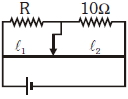
$A$ resistance wire connected in the left gap of a meter bridge balances a $10\, \Omega$ resistance in the right gap at a point which divides the bridge wire in the ratio $3: 2$. If the length of the resistance wire is $1.5\, m$,then the length of $1\, \Omega$ of the resistance wire is $....... \times 10^{-2}\, m$.
A
$1.5$
B
$1.0$
C
$10$
D
$15$
Solution
(C) In a meter bridge,the balancing condition is given by $\frac{R}{S} = \frac{\ell_1}{\ell_2}$,where $R$ is the resistance in the left gap and $S$ is the resistance in the right gap.
Given $S = 10\, \Omega$ and the ratio $\frac{\ell_1}{\ell_2} = \frac{3}{2}$.
Substituting these values: $\frac{R}{10} = \frac{3}{2} \implies R = 15\, \Omega$.
The total length of the resistance wire $R$ is $1.5\, m$.
Therefore,the length per unit resistance is $\frac{1.5\, m}{15\, \Omega} = 0.1\, m/\Omega$.
Converting this to the required form: $0.1\, m = 10 \times 10^{-2}\, m$.
Thus,the value is $10$.
Given $S = 10\, \Omega$ and the ratio $\frac{\ell_1}{\ell_2} = \frac{3}{2}$.
Substituting these values: $\frac{R}{10} = \frac{3}{2} \implies R = 15\, \Omega$.
The total length of the resistance wire $R$ is $1.5\, m$.
Therefore,the length per unit resistance is $\frac{1.5\, m}{15\, \Omega} = 0.1\, m/\Omega$.
Converting this to the required form: $0.1\, m = 10 \times 10^{-2}\, m$.
Thus,the value is $10$.
0 likesView Solution
44
PhysicsEasyMCQNEET · 2020
When a uranium isotope ${ }_{92}^{235} U$ is bombarded with a neutron,it generates ${ }_{36}^{89} Kr$,three neutrons and:
A
${ }_{36}^{103} Kr$
B
${ }_{56}^{144} Ba$
C
${ }_{91}^{40} Zr$
D
${ }_{36}^{101} Kr$
Solution
(B) The nuclear fission reaction is given by the conservation of mass number and atomic number.
Let the unknown nucleus be ${ }_{Z}^{A} X$.
The reaction is: ${ }_{92}^{235} U + { }_{0}^{1} n \rightarrow { }_{36}^{89} Kr + { }_{Z}^{A} X + 3({ }_{0}^{1} n)$.
Conservation of mass number $(A)$: $235 + 1 = 89 + A + 3(1) \Rightarrow 236 = 92 + A \Rightarrow A = 144$.
Conservation of atomic number $(Z)$: $92 + 0 = 36 + Z + 3(0) \Rightarrow 92 = 36 + Z \Rightarrow Z = 56$.
The element with atomic number $56$ is Barium $(Ba)$.
Thus,the missing nucleus is ${ }_{56}^{144} Ba$.
Let the unknown nucleus be ${ }_{Z}^{A} X$.
The reaction is: ${ }_{92}^{235} U + { }_{0}^{1} n \rightarrow { }_{36}^{89} Kr + { }_{Z}^{A} X + 3({ }_{0}^{1} n)$.
Conservation of mass number $(A)$: $235 + 1 = 89 + A + 3(1) \Rightarrow 236 = 92 + A \Rightarrow A = 144$.
Conservation of atomic number $(Z)$: $92 + 0 = 36 + Z + 3(0) \Rightarrow 92 = 36 + Z \Rightarrow Z = 56$.
The element with atomic number $56$ is Barium $(Ba)$.
Thus,the missing nucleus is ${ }_{56}^{144} Ba$.
0 likesView Solution
45
PhysicsMediumMCQNEET · 2020
$A$ long solenoid of $50\, cm$ length having $100$ turns carries a current of $2.5\, A$. The magnetic field at the centre of the solenoid is $...... \times 10^{-5}\, T$. $(\mu_{0} = 4\pi \times 10^{-7}\, T\, m\, A^{-1})$
A
$3.14$
B
$62.8$
C
$31.4$
D
$6.28$
Solution
(B) The magnetic field $B$ at the centre of a long solenoid is given by the formula: $B = \mu_{0} n I$,where $n = \frac{N}{\ell}$.
Given:
Length $\ell = 50\, cm = 0.5\, m$
Number of turns $N = 100$
Current $I = 2.5\, A$
Permeability $\mu_{0} = 4\pi \times 10^{-7}\, T\, m\, A^{-1}$
Substituting the values:
$B = (4\pi \times 10^{-7}) \times \left(\frac{100}{0.5}\right) \times 2.5$
$B = (4 \times 3.14159 \times 10^{-7}) \times 200 \times 2.5$
$B = 12.566 \times 10^{-7} \times 500$
$B = 6283.18 \times 10^{-7} = 6.283 \times 10^{-4}\, T$
To express this in the form $...... \times 10^{-5}\, T$:
$B = 62.83 \times 10^{-5}\, T$
Rounding to the nearest option,the value is $62.8$.
Given:
Length $\ell = 50\, cm = 0.5\, m$
Number of turns $N = 100$
Current $I = 2.5\, A$
Permeability $\mu_{0} = 4\pi \times 10^{-7}\, T\, m\, A^{-1}$
Substituting the values:
$B = (4\pi \times 10^{-7}) \times \left(\frac{100}{0.5}\right) \times 2.5$
$B = (4 \times 3.14159 \times 10^{-7}) \times 200 \times 2.5$
$B = 12.566 \times 10^{-7} \times 500$
$B = 6283.18 \times 10^{-7} = 6.283 \times 10^{-4}\, T$
To express this in the form $...... \times 10^{-5}\, T$:
$B = 62.83 \times 10^{-5}\, T$
Rounding to the nearest option,the value is $62.8$.
0 likesView Solution
46
PhysicsEasyMCQNEET · 2020
The ratio of contributions made by the electric field and magnetic field components to the intensity of an electromagnetic wave is:
A
$1: c^2$
B
$c: 1$
C
$1: 1$
D
$1: c$
Solution
(C) In an electromagnetic wave $(EMW)$,the energy density associated with the electric field is $u_E = \frac{1}{2} \epsilon_0 E^2$ and the energy density associated with the magnetic field is $u_B = \frac{1}{2} \frac{B^2}{\mu_0}$.
Since $E = cB$ and $c = \frac{1}{\sqrt{\mu_0 \epsilon_0}}$,we have $u_E = u_B$.
Because the intensity of the wave is proportional to the energy density,the contributions of the electric field and magnetic field components to the total intensity are equal.
Therefore,the ratio is $1:1$.
Since $E = cB$ and $c = \frac{1}{\sqrt{\mu_0 \epsilon_0}}$,we have $u_E = u_B$.
Because the intensity of the wave is proportional to the energy density,the contributions of the electric field and magnetic field components to the total intensity are equal.
Therefore,the ratio is $1:1$.
0 likesView Solution
47
PhysicsEasyMCQNEET · 2020
Assume that light of wavelength $600\, nm$ is coming from a star. The limit of resolution of a telescope whose objective has a diameter of $2\, m$ is $......... \times 10^{-7}\, rad$.
A
$6.00$
B
$3.66$
C
$1.83$
D
$7.32$
Solution
(B) The limit of resolution $(\Delta \theta)$ of a telescope is given by the formula: $\Delta \theta = \frac{1.22 \lambda}{D}$, where $\lambda$ is the wavelength of light and $D$ is the diameter of the objective lens.
Given: $\lambda = 600\, nm = 600 \times 10^{-9}\, m = 6 \times 10^{-7}\, m$ and $D = 2\, m$.
Substituting the values into the formula:
$\Delta \theta = \frac{1.22 \times 6 \times 10^{-7}}{2}$
$\Delta \theta = 1.22 \times 3 \times 10^{-7}$
$\Delta \theta = 3.66 \times 10^{-7}\, rad$.
Thus, the value is $3.66$.
Given: $\lambda = 600\, nm = 600 \times 10^{-9}\, m = 6 \times 10^{-7}\, m$ and $D = 2\, m$.
Substituting the values into the formula:
$\Delta \theta = \frac{1.22 \times 6 \times 10^{-7}}{2}$
$\Delta \theta = 1.22 \times 3 \times 10^{-7}$
$\Delta \theta = 3.66 \times 10^{-7}\, rad$.
Thus, the value is $3.66$.
0 likesView Solution
48
PhysicsEasyMCQNEET · 2020
In a certain region of space with volume $0.2 \ m^3$,the electric potential is found to be $5 \ V$ throughout. The magnitude of the electric field in this region is . . . . . . $N/C$.
A
$5$
B
$0$
C
$0.5$
D
$1$
Solution
(B) The relationship between electric field $\vec{E}$ and electric potential $V$ is given by the gradient formula: $\vec{E} = -\nabla V$.
Since the electric potential $V$ is constant $(5 \ V)$ throughout the given region,its spatial derivative (gradient) is zero.
Therefore,$\vec{E} = -\frac{dV}{dr} = 0$.
Thus,the magnitude of the electric field in this region is $0 \ N/C$.
Since the electric potential $V$ is constant $(5 \ V)$ throughout the given region,its spatial derivative (gradient) is zero.
Therefore,$\vec{E} = -\frac{dV}{dr} = 0$.
Thus,the magnitude of the electric field in this region is $0 \ N/C$.
0 likesView Solution
49
PhysicsMediumMCQNEET · 2020
An electron is accelerated from rest through a potential difference of $V$ volt. If the de Broglie wavelength of the electron is $1.227 \times 10^{-2} \, nm$,the potential difference is $......V$.
A
$10^{4}$
B
$10$
C
$10^{2}$
D
$10^{3}$
Solution
(A) The de Broglie wavelength $\lambda$ of an electron accelerated through a potential difference $V$ is given by the formula: $\lambda = \frac{12.27}{\sqrt{V}} \, \mathring{A}$.
Given $\lambda = 1.227 \times 10^{-2} \, nm$.
Since $1 \, nm = 10 \, \mathring{A}$,we have $\lambda = 1.227 \times 10^{-2} \times 10 \, \mathring{A} = 0.1227 \, \mathring{A}$.
Substituting this into the formula: $0.1227 = \frac{12.27}{\sqrt{V}}$.
Rearranging for $\sqrt{V}$: $\sqrt{V} = \frac{12.27}{0.1227} = 100 = 10^{2}$.
Squaring both sides: $V = (10^{2})^{2} = 10^{4} \, V$.
Given $\lambda = 1.227 \times 10^{-2} \, nm$.
Since $1 \, nm = 10 \, \mathring{A}$,we have $\lambda = 1.227 \times 10^{-2} \times 10 \, \mathring{A} = 0.1227 \, \mathring{A}$.
Substituting this into the formula: $0.1227 = \frac{12.27}{\sqrt{V}}$.
Rearranging for $\sqrt{V}$: $\sqrt{V} = \frac{12.27}{0.1227} = 100 = 10^{2}$.
Squaring both sides: $V = (10^{2})^{2} = 10^{4} \, V$.
0 likesView Solution
50
PhysicsMediumMCQNEET · 2020
$A$ $40 \, \mu F$ capacitor is connected to a $200 \, V, 50 \, Hz$ $AC$ supply. The rms value of the current in the circuit is nearly $....... A$.
A
$25.1$
B
$1.7$
C
$2.05$
D
$2.5$
Solution
(D) Given: Capacitance $C = 40 \, \mu F = 40 \times 10^{-6} \, F$, Voltage $V_{rms} = 200 \, V$, Frequency $f = 50 \, Hz$.
The capacitive reactance is given by $X_C = \frac{1}{\omega C} = \frac{1}{2 \pi f C}$.
The rms current is given by $I_{rms} = \frac{V_{rms}}{X_C} = V_{rms} \times 2 \pi f C$.
Substituting the values:
$I_{rms} = 200 \times 2 \times 3.1416 \times 50 \times 40 \times 10^{-6}$.
$I_{rms} = 200 \times 314.16 \times 40 \times 10^{-6} = 2.513 \, A$.
Rounding to the nearest value, we get $I_{rms} \approx 2.5 \, A$.
The capacitive reactance is given by $X_C = \frac{1}{\omega C} = \frac{1}{2 \pi f C}$.
The rms current is given by $I_{rms} = \frac{V_{rms}}{X_C} = V_{rms} \times 2 \pi f C$.
Substituting the values:
$I_{rms} = 200 \times 2 \times 3.1416 \times 50 \times 40 \times 10^{-6}$.
$I_{rms} = 200 \times 314.16 \times 40 \times 10^{-6} = 2.513 \, A$.
Rounding to the nearest value, we get $I_{rms} \approx 2.5 \, A$.
0 likesView Solution
51
PhysicsEasyMCQNEET · 2020
The increase in the width of the depletion region in a $p-n$ junction diode is due to
A
increase in forward current
B
forward bias only
C
reverse bias only
D
both forward bias and reverse bias
Solution
(C) In a $p-n$ junction diode,when a reverse bias is applied,the positive terminal of the external battery is connected to the $n$-region and the negative terminal to the $p$-region.
This causes the majority charge carriers (electrons in the $n$-region and holes in the $p$-region) to be pulled away from the junction.
As a result,the number of uncovered immobile ions near the junction increases,which leads to an increase in the width of the depletion region.
This causes the majority charge carriers (electrons in the $n$-region and holes in the $p$-region) to be pulled away from the junction.
As a result,the number of uncovered immobile ions near the junction increases,which leads to an increase in the width of the depletion region.
0 likesView Solution
52
PhysicsMediumMCQNEET · 2020
The Brewster's angle $i_b$ for an interface should be
A
$i_b = 90^{\circ}$
B
$0^{\circ} < i_b < 30^{\circ}$
C
$30^{\circ} < i_b < 45^{\circ}$
D
$45^{\circ} < i_b < 90^{\circ}$
Solution
(D) According to Brewster's law,$\tan i_b = \frac{\mu_2}{\mu_1}$.
Assuming the first medium is air,$\mu_1 = 1$.
Thus,$\tan i_b = \mu_2$.
Since the refractive index of any denser medium $\mu_2$ is greater than $1$ (i.e.,$\mu_2 > 1$),we have $\tan i_b > 1$.
Since $\tan 45^{\circ} = 1$,for $\tan i_b > 1$,the angle $i_b$ must be greater than $45^{\circ}$.
Also,the angle of incidence must be less than $90^{\circ}$ for the interface.
Therefore,$45^{\circ} < i_b < 90^{\circ}$.
Assuming the first medium is air,$\mu_1 = 1$.
Thus,$\tan i_b = \mu_2$.
Since the refractive index of any denser medium $\mu_2$ is greater than $1$ (i.e.,$\mu_2 > 1$),we have $\tan i_b > 1$.
Since $\tan 45^{\circ} = 1$,for $\tan i_b > 1$,the angle $i_b$ must be greater than $45^{\circ}$.
Also,the angle of incidence must be less than $90^{\circ}$ for the interface.
Therefore,$45^{\circ} < i_b < 90^{\circ}$.
0 likesView Solution
53
PhysicsMediumMCQNEET · 2020
$A$ spherical conductor of radius $10 \, cm$ has a charge of $3.2 \times 10^{-7} \, C$ distributed uniformly. What is the magnitude of the electric field at a point $15 \, cm$ from the centre of the sphere?
$\left(\frac{1}{4 \pi \epsilon_{0}} = 9 \times 10^{9} \, Nm^{2}/C^{2}\right)$
$\left(\frac{1}{4 \pi \epsilon_{0}} = 9 \times 10^{9} \, Nm^{2}/C^{2}\right)$
A
$1.28 \times 10^{7} \, N/C$
B
$1.28 \times 10^{4} \, N/C$
C
$1.28 \times 10^{5} \, N/C$
D
$1.28 \times 10^{6} \, N/C$
Solution
(C) For a point outside a spherical conductor,the conductor acts as a point charge located at its centre.
Given: Charge $Q = 3.2 \times 10^{-7} \, C$,distance $r = 15 \, cm = 0.15 \, m$,and $k = 9 \times 10^{9} \, Nm^{2}/C^{2}$.
The formula for the electric field is $E = \frac{kQ}{r^{2}}$.
Substituting the values: $E = \frac{9 \times 10^{9} \times 3.2 \times 10^{-7}}{(0.15)^{2}}$.
$E = \frac{28.8 \times 10^{2}}{0.0225} = \frac{2880}{0.0225} = 1.28 \times 10^{5} \, N/C$.
Given: Charge $Q = 3.2 \times 10^{-7} \, C$,distance $r = 15 \, cm = 0.15 \, m$,and $k = 9 \times 10^{9} \, Nm^{2}/C^{2}$.
The formula for the electric field is $E = \frac{kQ}{r^{2}}$.
Substituting the values: $E = \frac{9 \times 10^{9} \times 3.2 \times 10^{-7}}{(0.15)^{2}}$.
$E = \frac{28.8 \times 10^{2}}{0.0225} = \frac{2880}{0.0225} = 1.28 \times 10^{5} \, N/C$.
0 likesView Solution
54
PhysicsEasyMCQNEET · 2020
The capacitance of a parallel plate capacitor with air as medium is $6\, \mu F$. With the introduction of a dielectric medium,the capacitance becomes $30\, \mu F$. The permittivity of the medium is..........$C^{2} N^{-1} m^{-2}$.
$(\varepsilon_{0} = 8.85 \times 10^{-12} C^{2} N^{-1} m^{-2})$
$(\varepsilon_{0} = 8.85 \times 10^{-12} C^{2} N^{-1} m^{-2})$
A
$5.00$
B
$0.44 \times 10^{-13}$
C
$1.77 \times 10^{-12}$
D
$0.44 \times 10^{-10}$
Solution
(D) The capacitance of a parallel plate capacitor with air is given by $C_{0} = 6\, \mu F$.
When a dielectric medium is introduced,the new capacitance is $C_{m} = 30\, \mu F$.
The dielectric constant $\epsilon_{r}$ is defined as the ratio of the capacitance with the medium to the capacitance with air:
$\epsilon_{r} = \frac{C_{m}}{C_{0}} = \frac{30}{6} = 5$.
The permittivity of the medium $\epsilon$ is given by $\epsilon = \epsilon_{0} \cdot \epsilon_{r}$.
Substituting the given values:
$\epsilon = 8.85 \times 10^{-12} \times 5 = 44.25 \times 10^{-12} = 0.4425 \times 10^{-10} \approx 0.44 \times 10^{-10} C^{2} N^{-1} m^{-2}$.
When a dielectric medium is introduced,the new capacitance is $C_{m} = 30\, \mu F$.
The dielectric constant $\epsilon_{r}$ is defined as the ratio of the capacitance with the medium to the capacitance with air:
$\epsilon_{r} = \frac{C_{m}}{C_{0}} = \frac{30}{6} = 5$.
The permittivity of the medium $\epsilon$ is given by $\epsilon = \epsilon_{0} \cdot \epsilon_{r}$.
Substituting the given values:
$\epsilon = 8.85 \times 10^{-12} \times 5 = 44.25 \times 10^{-12} = 0.4425 \times 10^{-10} \approx 0.44 \times 10^{-10} C^{2} N^{-1} m^{-2}$.
0 likesView Solution
55
PhysicsMediumMCQNEET · 2020
$A$ series $LCR$ circuit is connected to an ac voltage source. When $L$ is removed from the circuit,the phase difference between current and voltage is $\frac{\pi}{3}$. If instead $C$ is removed from the circuit,the phase difference is again $\frac{\pi}{3}$ between current and voltage. The power factor of the circuit is:
A
-$1.0$
B
zero
C
$0.5$
D
$1.0$
Solution
(D) In a series $LCR$ circuit,the phase difference $\phi$ is given by $\tan \phi = \frac{|X_L - X_C|}{R}$.
When $L$ is removed,the circuit becomes an $RC$ circuit. The phase difference is $\tan \phi = \frac{X_C}{R} = \tan(\frac{\pi}{3}) = \sqrt{3}$.
When $C$ is removed,the circuit becomes an $RL$ circuit. The phase difference is $\tan \phi = \frac{X_L}{R} = \tan(\frac{\pi}{3}) = \sqrt{3}$.
Equating the two,we get $\frac{X_C}{R} = \frac{X_L}{R}$,which implies $X_L = X_C$.
Since $X_L = X_C$,the circuit is at resonance.
At resonance,the impedance $Z = R$.
The power factor is $\cos \phi = \frac{R}{Z} = \frac{R}{R} = 1.0$.
When $L$ is removed,the circuit becomes an $RC$ circuit. The phase difference is $\tan \phi = \frac{X_C}{R} = \tan(\frac{\pi}{3}) = \sqrt{3}$.
When $C$ is removed,the circuit becomes an $RL$ circuit. The phase difference is $\tan \phi = \frac{X_L}{R} = \tan(\frac{\pi}{3}) = \sqrt{3}$.
Equating the two,we get $\frac{X_C}{R} = \frac{X_L}{R}$,which implies $X_L = X_C$.
Since $X_L = X_C$,the circuit is at resonance.
At resonance,the impedance $Z = R$.
The power factor is $\cos \phi = \frac{R}{Z} = \frac{R}{R} = 1.0$.
0 likesView Solution
56
PhysicsMediumMCQNEET · 2020
Light of frequency $1.5$ times the threshold frequency is incident on a photosensitive material. What will be the photoelectric current if the frequency is halved and intensity is doubled?
A
$0$
B
doubled
C
four times
D
one-fourth
Solution
(A) The threshold frequency is denoted by $\nu_0$ and the work function is $\phi_0 = h\nu_0$.
In the first case,the incident frequency is $\nu_1 = 1.5\nu_0$. Since $\nu_1 > \nu_0$,photoelectric emission occurs.
In the second case,the frequency is halved,so the new frequency is $\nu_2 = \frac{1.5\nu_0}{2} = 0.75\nu_0$.
Since the new incident frequency $\nu_2$ is less than the threshold frequency $\nu_0$ $(\nu_2 < \nu_0)$,no photoelectric emission can take place regardless of the intensity of the light.
Therefore,the photoelectric current will be $0$.
In the first case,the incident frequency is $\nu_1 = 1.5\nu_0$. Since $\nu_1 > \nu_0$,photoelectric emission occurs.
In the second case,the frequency is halved,so the new frequency is $\nu_2 = \frac{1.5\nu_0}{2} = 0.75\nu_0$.
Since the new incident frequency $\nu_2$ is less than the threshold frequency $\nu_0$ $(\nu_2 < \nu_0)$,no photoelectric emission can take place regardless of the intensity of the light.
Therefore,the photoelectric current will be $0$.
0 likesView Solution
57
PhysicsEasyMCQNEET · 2020
The solids which have the negative temperature coefficient of resistance are:
A
Insulators and semiconductors
B
Metals
C
Insulators only
D
Semiconductors only
Solution
(A) The temperature coefficient of resistance $(\alpha)$ is defined by the relation $R_t = R_0(1 + \alpha \Delta T)$.
For metals, resistance increases with temperature, so $\alpha$ is positive.
For insulators and semiconductors, the number of charge carriers increases significantly with an increase in temperature, which leads to a decrease in resistance.
Therefore, insulators and semiconductors exhibit a negative temperature coefficient of resistance.
For metals, resistance increases with temperature, so $\alpha$ is positive.
For insulators and semiconductors, the number of charge carriers increases significantly with an increase in temperature, which leads to a decrease in resistance.
Therefore, insulators and semiconductors exhibit a negative temperature coefficient of resistance.
0 likesView Solution
58
PhysicsEasyMCQNEET · 2020
$A$ charged particle having a drift velocity of $7.5 \times 10^{-4} \, m s^{-1}$ in an electric field of $3 \times 10^{-10} \, V m^{-1}$ has a mobility in $m^{2} V^{-1} s^{-1}$ of:
A
$2.25 \times 10^{-15}$
B
$2.25 \times 10^{15}$
C
$2.5 \times 10^{6}$
D
$2.5 \times 10^{-6}$
Solution
(C) The mobility $\mu$ of a charged particle is defined as the ratio of its drift velocity $v_d$ to the applied electric field $E$.
Formula: $\mu = \frac{v_d}{E}$
Given:
$v_d = 7.5 \times 10^{-4} \, m s^{-1}$
$E = 3 \times 10^{-10} \, V m^{-1}$
Calculation:
$\mu = \frac{7.5 \times 10^{-4}}{3 \times 10^{-10}}$
$\mu = 2.5 \times 10^{-4 - (-10)}$
$\mu = 2.5 \times 10^{6} \, m^{2} V^{-1} s^{-1}$
Formula: $\mu = \frac{v_d}{E}$
Given:
$v_d = 7.5 \times 10^{-4} \, m s^{-1}$
$E = 3 \times 10^{-10} \, V m^{-1}$
Calculation:
$\mu = \frac{7.5 \times 10^{-4}}{3 \times 10^{-10}}$
$\mu = 2.5 \times 10^{-4 - (-10)}$
$\mu = 2.5 \times 10^{6} \, m^{2} V^{-1} s^{-1}$
0 likesView Solution
59
PhysicsMediumMCQNEET · 2020
Which of the following graphs represents the variation of resistivity ( $\rho$ ) with temperature $(T)$ for copper?
A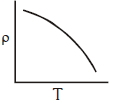
B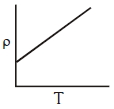
C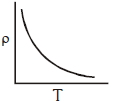
D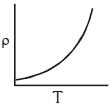
Solution
(D) For metals like copper,the resistivity ( $\rho$ ) increases with an increase in temperature $(T)$.
According to the relation $\rho_T = \rho_0 [1 + \alpha(T - T_0)]$,the resistivity increases linearly with temperature for a wide range of temperatures.
At very low temperatures,the curve becomes non-linear and approaches a finite value as $T$ approaches $0 \ K$.
Among the given options,graph $D$ correctly represents this characteristic behavior of resistivity versus temperature for a metal like copper.
According to the relation $\rho_T = \rho_0 [1 + \alpha(T - T_0)]$,the resistivity increases linearly with temperature for a wide range of temperatures.
At very low temperatures,the curve becomes non-linear and approaches a finite value as $T$ approaches $0 \ K$.
Among the given options,graph $D$ correctly represents this characteristic behavior of resistivity versus temperature for a metal like copper.
0 likesView Solution
60
PhysicsMediumMCQNEET · 2020
In Young's double slit experiment,if the separation between coherent sources is halved and the distance of the screen from the coherent sources is doubled,then the fringe width becomes:
A
one-fourth
B
double
C
half
D
four times
Solution
(D) The formula for fringe width in Young's double slit experiment is given by $\beta = \frac{\lambda D}{d}$,where $\lambda$ is the wavelength,$D$ is the distance of the screen from the sources,and $d$ is the separation between the sources.
Let the initial fringe width be $\beta = \frac{\lambda D}{d}$.
According to the problem,the new distance $D^{\prime} = 2D$ and the new separation $d^{\prime} = \frac{d}{2}$.
The new fringe width $\beta^{\prime}$ is given by $\beta^{\prime} = \frac{\lambda D^{\prime}}{d^{\prime}}$.
Substituting the new values: $\beta^{\prime} = \frac{\lambda (2D)}{d/2} = 4 \times \frac{\lambda D}{d}$.
Therefore,$\beta^{\prime} = 4\beta$.
The fringe width becomes $4$ times the original value.
Let the initial fringe width be $\beta = \frac{\lambda D}{d}$.
According to the problem,the new distance $D^{\prime} = 2D$ and the new separation $d^{\prime} = \frac{d}{2}$.
The new fringe width $\beta^{\prime}$ is given by $\beta^{\prime} = \frac{\lambda D^{\prime}}{d^{\prime}}$.
Substituting the new values: $\beta^{\prime} = \frac{\lambda (2D)}{d/2} = 4 \times \frac{\lambda D}{d}$.
Therefore,$\beta^{\prime} = 4\beta$.
The fringe width becomes $4$ times the original value.
0 likesView Solution
61
PhysicsMediumMCQNEET · 2020
For the logic circuit shown,the truth table is:
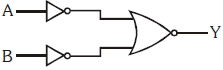
A
| $A$ | $B$ | $Y$ |
|---|---|---|
| $0$ | $0$ | $1$ |
| $0$ | $1$ | $0$ |
| $1$ | $0$ | $0$ |
| $1$ | $1$ | $0$ |
B
| $A$ | $B$ | $Y$ |
|---|---|---|
| $0$ | $0$ | $0$ |
| $0$ | $1$ | $0$ |
| $1$ | $0$ | $0$ |
| $1$ | $1$ | $1$ |
C
| $A$ | $B$ | $Y$ |
|---|---|---|
| $0$ | $0$ | $0$ |
| $0$ | $1$ | $1$ |
| $1$ | $0$ | $1$ |
| $1$ | $1$ | $1$ |
D
| $A$ | $B$ | $Y$ |
|---|---|---|
| $0$ | $0$ | $1$ |
| $0$ | $1$ | $1$ |
| $1$ | $0$ | $1$ |
| $1$ | $1$ | $0$ |
Solution
(B) The given circuit consists of two $NOT$ gates followed by a $NOR$ gate.
Let the inputs be $A$ and $B$.
The outputs of the two $NOT$ gates are $\bar{A}$ and $\bar{B}$.
These are the inputs to the $NOR$ gate.
The output $Y$ of the $NOR$ gate is given by the Boolean expression:
$Y = \overline{\bar{A} + \bar{B}}$
Using De Morgan's theorem,$\overline{\bar{A} + \bar{B}} = \overline{\bar{A}} \cdot \overline{\bar{B}} = A \cdot B$.
Thus,the circuit acts as an $AND$ gate.
The truth table for an $AND$ gate is:
Therefore,the correct option is $B$.
Let the inputs be $A$ and $B$.
The outputs of the two $NOT$ gates are $\bar{A}$ and $\bar{B}$.
These are the inputs to the $NOR$ gate.
The output $Y$ of the $NOR$ gate is given by the Boolean expression:
$Y = \overline{\bar{A} + \bar{B}}$
Using De Morgan's theorem,$\overline{\bar{A} + \bar{B}} = \overline{\bar{A}} \cdot \overline{\bar{B}} = A \cdot B$.
Thus,the circuit acts as an $AND$ gate.
The truth table for an $AND$ gate is:
| $A$ | $B$ | $Y$ |
|---|---|---|
| $0$ | $0$ | $0$ |
| $0$ | $1$ | $0$ |
| $1$ | $0$ | $0$ |
| $1$ | $1$ | $1$ |
Therefore,the correct option is $B$.
0 likesView Solution
62
PhysicsEasyMCQNEET · 2020
The energy equivalent of $0.5\, g$ of a substance is $........\, J$.
A
$0.5 \times 10^{13}$
B
$4.5 \times 10^{16}$
C
$4.5 \times 10^{13}$
D
$1.5 \times 10^{13}$
Solution
(C) According to Einstein's mass-energy equivalence principle,the energy $E$ is given by the formula $E = mc^2$.
Given mass $m = 0.5\, g = 0.5 \times 10^{-3}\, kg$.
The speed of light $c = 3 \times 10^8\, m/s$.
Substituting these values into the equation:
$E = (0.5 \times 10^{-3}\, kg) \times (3 \times 10^8\, m/s)^2$
$E = 0.5 \times 10^{-3} \times 9 \times 10^{16}\, J$
$E = 4.5 \times 10^{13}\, J$.
Given mass $m = 0.5\, g = 0.5 \times 10^{-3}\, kg$.
The speed of light $c = 3 \times 10^8\, m/s$.
Substituting these values into the equation:
$E = (0.5 \times 10^{-3}\, kg) \times (3 \times 10^8\, m/s)^2$
$E = 0.5 \times 10^{-3} \times 9 \times 10^{16}\, J$
$E = 4.5 \times 10^{13}\, J$.
0 likesView Solution
63
PhysicsEasyMCQNEET · 2020
For which one of the following,is the Bohr model not valid?
A
Singly ionized neon atom $(Ne^+)$
B
Hydrogen atom
C
Singly ionized helium atom $(He^+)$
D
Deuteron atom
Solution
(A) The Bohr model is strictly applicable only to hydrogen-like species,which are atoms or ions containing exactly one electron.
$1$. Hydrogen atom $(H)$ has $1$ electron.
$2$. Singly ionized helium atom $(He^+)$ has $2 - 1 = 1$ electron.
$3$. Deuteron atom (an isotope of hydrogen) has $1$ electron.
$4$. Singly ionized neon atom $(Ne^+)$ has $10 - 1 = 9$ electrons.
Since $Ne^+$ has more than one electron,the Bohr model is not valid for it.
$1$. Hydrogen atom $(H)$ has $1$ electron.
$2$. Singly ionized helium atom $(He^+)$ has $2 - 1 = 1$ electron.
$3$. Deuteron atom (an isotope of hydrogen) has $1$ electron.
$4$. Singly ionized neon atom $(Ne^+)$ has $10 - 1 = 9$ electrons.
Since $Ne^+$ has more than one electron,the Bohr model is not valid for it.
0 likesView Solution
64
PhysicsEasyMCQNEET · 2020
An intrinsic semiconductor is converted into $N$-type extrinsic semiconductor by doping it with
A
Germanium
B
Phosphorous
C
Aluminium
D
Silver
Solution
(B) An intrinsic semiconductor (such as $Si$ or $Ge$) is converted into an $N$-type extrinsic semiconductor by doping it with a pentavalent impurity element (Group $15$ elements).
Examples of pentavalent dopants include Phosphorus $(P)$,Arsenic $(As)$,and Antimony $(Sb)$.
When a pentavalent atom is added to the crystal lattice,four of its valence electrons form covalent bonds with the neighboring semiconductor atoms,while the fifth electron remains loosely bound and becomes available for conduction.
Since the dopant atom donates an extra electron,it is called a donor impurity,resulting in an $N$-type semiconductor.
Examples of pentavalent dopants include Phosphorus $(P)$,Arsenic $(As)$,and Antimony $(Sb)$.
When a pentavalent atom is added to the crystal lattice,four of its valence electrons form covalent bonds with the neighboring semiconductor atoms,while the fifth electron remains loosely bound and becomes available for conduction.
Since the dopant atom donates an extra electron,it is called a donor impurity,resulting in an $N$-type semiconductor.
0 likesView Solution
65
PhysicsMediumMCQNEET · 2020
The half-life of a radioactive sample undergoing $\alpha$-decay is $1.4 \times 10^{17} \; s$. If the number of nuclei in the sample is $2.0 \times 10^{21}$,the activity of the sample is nearly:
A
$10^{3} \; Bq$
B
$10^{4} \; Bq$
C
$10^{5} \; Bq$
D
$10^{6} \; Bq$
Solution
(B) The activity $(A)$ of a radioactive sample is defined as the rate of decay,given by the formula: $A = \lambda N$.
Here,$\lambda$ is the decay constant,which is related to the half-life $(T_{1/2})$ by the expression: $\lambda = \frac{0.693}{T_{1/2}}$.
Given:
Number of nuclei $(N)$ = $2.0 \times 10^{21}$
Half-life $(T_{1/2})$ = $1.4 \times 10^{17} \; s$
Substituting these values into the activity formula:
$A = N \times \frac{0.693}{T_{1/2}}$
$A = (2.0 \times 10^{21}) \times \frac{0.693}{1.4 \times 10^{17}}$
$A = \frac{1.386}{1.4} \times 10^{4}$
$A \approx 0.99 \times 10^{4} \; Bq$
$A \approx 10^{4} \; Bq$.
Here,$\lambda$ is the decay constant,which is related to the half-life $(T_{1/2})$ by the expression: $\lambda = \frac{0.693}{T_{1/2}}$.
Given:
Number of nuclei $(N)$ = $2.0 \times 10^{21}$
Half-life $(T_{1/2})$ = $1.4 \times 10^{17} \; s$
Substituting these values into the activity formula:
$A = N \times \frac{0.693}{T_{1/2}}$
$A = (2.0 \times 10^{21}) \times \frac{0.693}{1.4 \times 10^{17}}$
$A = \frac{1.386}{1.4} \times 10^{4}$
$A \approx 0.99 \times 10^{4} \; Bq$
$A \approx 10^{4} \; Bq$.
0 likesView Solution
66
PhysicsEasyMCQNEET · 2020
The electromagnetic ($E$.$M$.) wave with the shortest wavelength among the following is:
A
Microwaves
B
Ultraviolet rays
C
$X$-rays
D
Gamma-rays
Solution
(D) The electromagnetic spectrum is ordered by wavelength.
Gamma rays have the shortest wavelength,typically ranging from $10^{-10} \ m$ to $10^{-14} \ m$.
Comparing the given options:
$1$. Microwaves: $10^{-3} \ m$ to $10^{-1} \ m$
$2$. Ultraviolet rays: $10^{-7} \ m$ to $10^{-8} \ m$
$3$. $X$-rays: $10^{-8} \ m$ to $10^{-10} \ m$
$4$. Gamma-rays: $< 10^{-10} \ m$
Therefore,Gamma-rays have the shortest wavelength.
Gamma rays have the shortest wavelength,typically ranging from $10^{-10} \ m$ to $10^{-14} \ m$.
Comparing the given options:
$1$. Microwaves: $10^{-3} \ m$ to $10^{-1} \ m$
$2$. Ultraviolet rays: $10^{-7} \ m$ to $10^{-8} \ m$
$3$. $X$-rays: $10^{-8} \ m$ to $10^{-10} \ m$
$4$. Gamma-rays: $< 10^{-10} \ m$
Therefore,Gamma-rays have the shortest wavelength.
0 likesView Solution
67
PhysicsMediumMCQNEET · 2020
For the circuit shown in the figure,the current $I$ will be .......$A$.
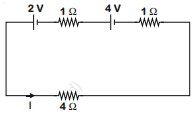
A
$0.5$
B
$0.75$
C
$1$
D
$1.5$
Solution
(C) Applying Kirchhoff's Voltage Law $(KVL)$ to the closed loop:
Starting from point $B$ and moving clockwise:
$-I(4) - 2 - I(1) - 4 - I(1) = 0$
$-6I - 6 = 0$
$-6I = 6$
$I = -1 \text{ A}$
The magnitude of the current is $1 \text{ A}$. The negative sign indicates that the current flows in the opposite direction to the assumed path.
Starting from point $B$ and moving clockwise:
$-I(4) - 2 - I(1) - 4 - I(1) = 0$
$-6I - 6 = 0$
$-6I = 6$
$I = -1 \text{ A}$
The magnitude of the current is $1 \text{ A}$. The negative sign indicates that the current flows in the opposite direction to the assumed path.
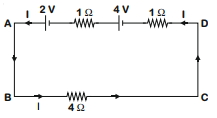
0 likesView Solution
68
PhysicsMediumMCQNEET · 2020
The equivalent resistance between $A$ and $B$ for the mesh shown in the figure is ......... $\Omega$.
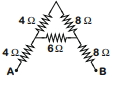
A
$4.8$
B
$7.2$
C
$16$
D
$30$
Solution
(C) From the given figure,we can observe that the two resistors of $4 \ \Omega$ and $8 \ \Omega$ in the upper branch are in series. Their equivalent resistance is $R_1 = 4 \ \Omega + 8 \ \Omega = 12 \ \Omega$.
This $12 \ \Omega$ resistor is in parallel with the $6 \ \Omega$ resistor connected between the same two nodes. The equivalent resistance $R_p$ of this parallel combination is given by $\frac{1}{R_p} = \frac{1}{12} + \frac{1}{6} = \frac{1+2}{12} = \frac{3}{12} = \frac{1}{4}$,so $R_p = 4 \ \Omega$.
Now,the circuit simplifies to a series combination of the lower $4 \ \Omega$ resistor,the equivalent $4 \ \Omega$ resistor,and the lower $8 \ \Omega$ resistor.
Therefore,the total equivalent resistance between $A$ and $B$ is $R_{AB} = 4 \ \Omega + 4 \ \Omega + 8 \ \Omega = 16 \ \Omega$.
This $12 \ \Omega$ resistor is in parallel with the $6 \ \Omega$ resistor connected between the same two nodes. The equivalent resistance $R_p$ of this parallel combination is given by $\frac{1}{R_p} = \frac{1}{12} + \frac{1}{6} = \frac{1+2}{12} = \frac{3}{12} = \frac{1}{4}$,so $R_p = 4 \ \Omega$.
Now,the circuit simplifies to a series combination of the lower $4 \ \Omega$ resistor,the equivalent $4 \ \Omega$ resistor,and the lower $8 \ \Omega$ resistor.
Therefore,the total equivalent resistance between $A$ and $B$ is $R_{AB} = 4 \ \Omega + 4 \ \Omega + 8 \ \Omega = 16 \ \Omega$.
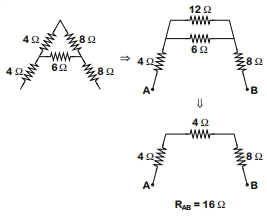
0 likesView Solution
69
PhysicsMediumMCQNEET · 2020
$A$ wheel with $20$ metallic spokes,each $1 \,m$ long,is rotated with a speed of $120 \,rpm$ in a plane perpendicular to a magnetic field of $0.4 \,G$. The induced emf between the axle and the rim of the wheel will be $\left(1 \;G = 10^{-4} \;T \right)$.
A
$2.51 \;V$
B
$2.51 \times 10^{-4} \;V$
C
$2.51 \times 10^{-5} \;V$
D
$4.0 \times 10^{-5} \;V$
Solution
(B) Consider one spoke $(OP)$ as shown in the diagram.
The induced emf across one spoke $(OP)$ is given by:
$e = \frac{B \omega l^2}{2}$
Given:
$B = 0.4 \,G = 0.4 \times 10^{-4} \,T$
$l = 1 \,m$
$f = 120 \,rpm = \frac{120}{60} \,rps = 2 \,rps$
Angular velocity $\omega = 2 \pi f = 2 \pi \times 2 = 4 \pi \,rad/s$
Substituting the values:
$e = \frac{1}{2} \times (0.4 \times 10^{-4}) \times (4 \pi) \times (1)^2$
$e = 0.2 \times 10^{-4} \times 4 \times 3.14159$
$e = 0.8 \times 3.14159 \times 10^{-4} \approx 2.51 \times 10^{-4} \,V$
Since all spokes are connected in parallel between the axle and the rim,the net induced emf is equal to the emf induced in a single spoke:
$e_{\text{Net}} = e = 2.51 \times 10^{-4} \,V$
The induced emf across one spoke $(OP)$ is given by:
$e = \frac{B \omega l^2}{2}$
Given:
$B = 0.4 \,G = 0.4 \times 10^{-4} \,T$
$l = 1 \,m$
$f = 120 \,rpm = \frac{120}{60} \,rps = 2 \,rps$
Angular velocity $\omega = 2 \pi f = 2 \pi \times 2 = 4 \pi \,rad/s$
Substituting the values:
$e = \frac{1}{2} \times (0.4 \times 10^{-4}) \times (4 \pi) \times (1)^2$
$e = 0.2 \times 10^{-4} \times 4 \times 3.14159$
$e = 0.8 \times 3.14159 \times 10^{-4} \approx 2.51 \times 10^{-4} \,V$
Since all spokes are connected in parallel between the axle and the rim,the net induced emf is equal to the emf induced in a single spoke:
$e_{\text{Net}} = e = 2.51 \times 10^{-4} \,V$
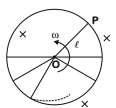
0 likesView Solution
70
PhysicsEasyMCQNEET · 2020
Out of the following,which one is a forward biased diode?
A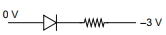
B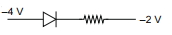
C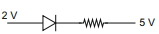
D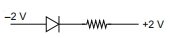
Solution
(A) $PN$ junction diode is forward biased when the potential at the $P$-side $(V_P)$ is greater than the potential at the $N$-side $(V_N)$,i.e.,$V_P > V_N$.
For option $(A)$: $V_P = 0 \text{ V}$,$V_N = -3 \text{ V}$. Since $0 > -3$,$V_P > V_N$. This is forward biased.
For option $(B)$: $V_P = -4 \text{ V}$,$V_N = -2 \text{ V}$. Since $-4 < -2$,$V_P < V_N$. This is reverse biased.
For option $(C)$: $V_P = 2 \text{ V}$,$V_N = 5 \text{ V}$. Since $2 < 5$,$V_P < V_N$. This is reverse biased.
For option $(D)$: $V_P = -2 \text{ V}$,$V_N = 2 \text{ V}$. Since $-2 < 2$,$V_P < V_N$. This is reverse biased.
Therefore,option $(A)$ is the correct answer.
For option $(A)$: $V_P = 0 \text{ V}$,$V_N = -3 \text{ V}$. Since $0 > -3$,$V_P > V_N$. This is forward biased.
For option $(B)$: $V_P = -4 \text{ V}$,$V_N = -2 \text{ V}$. Since $-4 < -2$,$V_P < V_N$. This is reverse biased.
For option $(C)$: $V_P = 2 \text{ V}$,$V_N = 5 \text{ V}$. Since $2 < 5$,$V_P < V_N$. This is reverse biased.
For option $(D)$: $V_P = -2 \text{ V}$,$V_N = 2 \text{ V}$. Since $-2 < 2$,$V_P < V_N$. This is reverse biased.
Therefore,option $(A)$ is the correct answer.
0 likesView Solution
71
PhysicsEasyMCQNEET · 2020
$A$ $N-P-N$ transistor is connected in common emitter configuration (see figure) in which the collector voltage drop across the load resistance $(800 \; \Omega)$ connected to the collector circuit is $0.8 \; V$. The collector current is .............. $mA$.
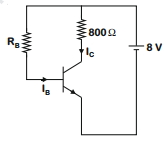
A
$0.2$
B
$2$
C
$0.1$
D
$1$
Solution
(D) The voltage drop across the load resistance $R_C$ is given by Ohm's law as:
$V_L = I_C \times R_C$
Given that the voltage drop $V_L = 0.8 \; V$ and the load resistance $R_C = 800 \; \Omega$.
Substituting these values into the equation:
$0.8 \; V = I_C \times 800 \; \Omega$
$I_C = \frac{0.8}{800} \; A$
$I_C = 0.001 \; A$
Since $1 \; A = 1000 \; mA$,we have:
$I_C = 0.001 \times 1000 \; mA = 1 \; mA$.
Therefore,the collector current is $1 \; mA$.
$V_L = I_C \times R_C$
Given that the voltage drop $V_L = 0.8 \; V$ and the load resistance $R_C = 800 \; \Omega$.
Substituting these values into the equation:
$0.8 \; V = I_C \times 800 \; \Omega$
$I_C = \frac{0.8}{800} \; A$
$I_C = 0.001 \; A$
Since $1 \; A = 1000 \; mA$,we have:
$I_C = 0.001 \times 1000 \; mA = 1 \; mA$.
Therefore,the collector current is $1 \; mA$.
0 likesView Solution
72
PhysicsEasyMCQNEET · 2020
Two solid conductors are made of the same material,have the same length,and have the same resistance. One of them has a circular cross-section of area $A_{1}$ and the other has a square cross-section of area $A_{2}$. The ratio $\frac{A_{1}}{A_{2}}$ is
A
$2$
B
$1.5$
C
$1$
D
$0.8$
Solution
(C) The resistance $R$ of a conductor is given by the formula:
$R = \rho \frac{l}{A}$
where $\rho$ is the resistivity,$l$ is the length,and $A$ is the cross-sectional area.
Given that both conductors are made of the same material,their resistivities are equal: $\rho_{1} = \rho_{2} = \rho$.
Given that they have the same length: $l_{1} = l_{2} = l$.
Given that they have the same resistance: $R_{1} = R_{2} = R$.
From the formula,we can express the area as $A = \frac{\rho l}{R}$.
Since $\rho$,$l$,and $R$ are identical for both conductors,the cross-sectional areas must also be equal:
$A_{1} = \frac{\rho l}{R}$ and $A_{2} = \frac{\rho l}{R}$
Therefore,$\frac{A_{1}}{A_{2}} = 1$.
$R = \rho \frac{l}{A}$
where $\rho$ is the resistivity,$l$ is the length,and $A$ is the cross-sectional area.
Given that both conductors are made of the same material,their resistivities are equal: $\rho_{1} = \rho_{2} = \rho$.
Given that they have the same length: $l_{1} = l_{2} = l$.
Given that they have the same resistance: $R_{1} = R_{2} = R$.
From the formula,we can express the area as $A = \frac{\rho l}{R}$.
Since $\rho$,$l$,and $R$ are identical for both conductors,the cross-sectional areas must also be equal:
$A_{1} = \frac{\rho l}{R}$ and $A_{2} = \frac{\rho l}{R}$
Therefore,$\frac{A_{1}}{A_{2}} = 1$.
0 likesView Solution
73
PhysicsEasyMCQNEET · 2020
Two coherent sources of light interfere and produce a fringe pattern on a screen. For the central maximum,the phase difference between the two waves will be,
A
$\frac{\pi}{2}$
B
$0$
C
$\pi$
D
$\frac{3\pi}{2}$
Solution
(B) In an interference pattern,the condition for constructive interference is that the path difference $\Delta x$ must be an integral multiple of the wavelength $\lambda$,i.e.,$\Delta x = n\lambda$ where $n = 0, 1, 2, \dots$.
The central maximum occurs at the point where the path difference between the two waves is zero $(\Delta x = 0)$.
The relationship between phase difference $\phi$ and path difference $\Delta x$ is given by $\phi = \frac{2\pi}{\lambda} \Delta x$.
Substituting $\Delta x = 0$ into the equation,we get $\phi = \frac{2\pi}{\lambda} \times 0 = 0$.
Therefore,for the central maximum,the phase difference is $0$.
The central maximum occurs at the point where the path difference between the two waves is zero $(\Delta x = 0)$.
The relationship between phase difference $\phi$ and path difference $\Delta x$ is given by $\phi = \frac{2\pi}{\lambda} \Delta x$.
Substituting $\Delta x = 0$ into the equation,we get $\phi = \frac{2\pi}{\lambda} \times 0 = 0$.
Therefore,for the central maximum,the phase difference is $0$.
0 likesView Solution
74
PhysicsMediumMCQNEET · 2020
For the circuit given below,the Kirchhoff's loop rule for the loop $BCDEB$ is given by the equation:
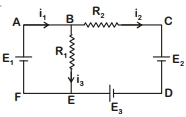
A
$-i_2 R_2 + E_2 + E_3 + i_3 R_1 = 0$
B
$-i_2 R_2 + E_2 - E_3 + i_3 R_1 = 0$
C
$i_2 R_2 + E_2 - E_3 - i_3 R_1 = 0$
D
$i_2 R_2 + E_2 + E_3 + i_3 R_1 = 0$
Solution
(C) To apply Kirchhoff's Voltage Law $(KVL)$ to the loop $BCDEB$,we traverse the loop starting from point $B$ in the clockwise direction.
$1$. Moving from $B$ to $C$ through resistor $R_2$ in the direction of current $i_2$,the potential drop is $-i_2 R_2$.
$2$. Moving from $C$ to $D$ through battery $E_2$,we go from the positive terminal to the negative terminal,so the potential change is $-E_2$.
$3$. Moving from $D$ to $E$ through battery $E_3$,we go from the negative terminal to the positive terminal,so the potential change is $+E_3$.
$4$. Moving from $E$ to $B$ through resistor $R_1$ against the direction of current $i_3$,the potential change is $+i_3 R_1$.
Summing these changes to zero:
$-i_2 R_2 - E_2 + E_3 + i_3 R_1 = 0$
Multiplying by $-1$ gives:
$i_2 R_2 + E_2 - E_3 - i_3 R_1 = 0$
$1$. Moving from $B$ to $C$ through resistor $R_2$ in the direction of current $i_2$,the potential drop is $-i_2 R_2$.
$2$. Moving from $C$ to $D$ through battery $E_2$,we go from the positive terminal to the negative terminal,so the potential change is $-E_2$.
$3$. Moving from $D$ to $E$ through battery $E_3$,we go from the negative terminal to the positive terminal,so the potential change is $+E_3$.
$4$. Moving from $E$ to $B$ through resistor $R_1$ against the direction of current $i_3$,the potential change is $+i_3 R_1$.
Summing these changes to zero:
$-i_2 R_2 - E_2 + E_3 + i_3 R_1 = 0$
Multiplying by $-1$ gives:
$i_2 R_2 + E_2 - E_3 - i_3 R_1 = 0$
0 likesView Solution
75
PhysicsMediumMCQNEET · 2020
The magnetic flux linked with a coil (in $Wb$) is given by the equation $\phi = 5t^2 + 3t + 16$. The magnitude of induced emf in the coil at the fourth second will be (in $V$):
A
$10$
B
$33$
C
$43$
D
$108$
Solution
(C) The magnitude of the induced emf $(\varepsilon)$ is given by Faraday's law of induction: $|\varepsilon| = |\frac{d\phi}{dt}|$.
Given the magnetic flux $\phi = 5t^2 + 3t + 16$.
Differentiating $\phi$ with respect to time $t$:
$\frac{d\phi}{dt} = \frac{d}{dt}(5t^2 + 3t + 16) = 10t + 3$.
To find the magnitude of the induced emf at the fourth second $(t = 4 \, s)$:
$|\varepsilon| = 10(4) + 3 = 40 + 3 = 43 \, V$.
Given the magnetic flux $\phi = 5t^2 + 3t + 16$.
Differentiating $\phi$ with respect to time $t$:
$\frac{d\phi}{dt} = \frac{d}{dt}(5t^2 + 3t + 16) = 10t + 3$.
To find the magnitude of the induced emf at the fourth second $(t = 4 \, s)$:
$|\varepsilon| = 10(4) + 3 = 40 + 3 = 43 \, V$.
0 likesView Solution
76
PhysicsMediumMCQNEET · 2020
The magnetic field in a plane electromagnetic wave is given by, $B_{y} = 2 \times 10^{-7} \sin (\pi \times 10^{3} x + 3 \pi \times 10^{11} t) \; T$. Calculate the wavelength.
A
$2 \times 10^{-3} \; m$
B
$2 \times 10^{3} \; m$
C
$\pi \times 10^{-3} \; m$
D
$\pi \times 10^{3} \; m$
Solution
(A) The general equation for a plane electromagnetic wave is given by $B = B_{0} \sin (kx + \omega t)$.
Comparing this with the given equation $B_{y} = 2 \times 10^{-7} \sin (\pi \times 10^{3} x + 3 \pi \times 10^{11} t) \; T$, we identify the wave number $k$ as:
$k = \pi \times 10^{3} \; \text{rad/m}$.
The relationship between the wave number $k$ and the wavelength $\lambda$ is given by $k = \frac{2\pi}{\lambda}$.
Substituting the value of $k$:
$\pi \times 10^{3} = \frac{2\pi}{\lambda}$.
Solving for $\lambda$:
$\lambda = \frac{2\pi}{\pi \times 10^{3}} = 2 \times 10^{-3} \; m$.
Comparing this with the given equation $B_{y} = 2 \times 10^{-7} \sin (\pi \times 10^{3} x + 3 \pi \times 10^{11} t) \; T$, we identify the wave number $k$ as:
$k = \pi \times 10^{3} \; \text{rad/m}$.
The relationship between the wave number $k$ and the wavelength $\lambda$ is given by $k = \frac{2\pi}{\lambda}$.
Substituting the value of $k$:
$\pi \times 10^{3} = \frac{2\pi}{\lambda}$.
Solving for $\lambda$:
$\lambda = \frac{2\pi}{\pi \times 10^{3}} = 2 \times 10^{-3} \; m$.
0 likesView Solution
77
PhysicsMediumMCQNEET · 2020
The electric field at a point on the equatorial plane at a distance $r$ from the centre of a dipole having dipole moment $\overrightarrow{p}$ is given by,($r >>$ separation of two charges forming the dipole,$\varepsilon_{0}$ - permittivity of free space)
A
$\overrightarrow{E}=-\frac{\overrightarrow{p}}{4 \pi \epsilon_{0} r^{3}}$
B
$\overrightarrow{E}=\frac{\overrightarrow{p}}{4 \pi \epsilon_{0} r^{3}}$
C
$\overrightarrow{E}=\frac{2 \overrightarrow{p}}{4 \pi \epsilon_{0} r^{3}}$
D
$\overrightarrow{E}=-\frac{\overrightarrow{p}}{4 \pi \epsilon_{0} r^{2}}$
Solution
(A) For an electric dipole with dipole moment $\overrightarrow{p}$,the electric field at a point on the equatorial plane at a large distance $r$ ($r >> a$,where $2a$ is the separation between charges) is given by the formula:
$\overrightarrow{E} = -\frac{1}{4 \pi \epsilon_{0}} \frac{\overrightarrow{p}}{r^{3}}$
The negative sign indicates that the direction of the electric field at the equatorial point is opposite to the direction of the dipole moment vector $\overrightarrow{p}$ (which is from $-q$ to $+q$).
$\overrightarrow{E} = -\frac{1}{4 \pi \epsilon_{0}} \frac{\overrightarrow{p}}{r^{3}}$
The negative sign indicates that the direction of the electric field at the equatorial point is opposite to the direction of the dipole moment vector $\overrightarrow{p}$ (which is from $-q$ to $+q$).
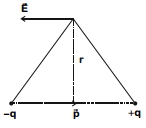
0 likesView Solution
78
PhysicsMediumMCQNEET · 2020
$A$ light bulb and an inductor coil are connected to an $AC$ source through a key as shown in the figure below. The key is closed and after some time an iron rod is inserted into the interior of the inductor. The glow of the light bulb
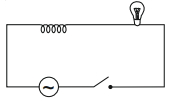
A
increases
B
decreases
C
remains unchanged
D
will fluctuate
Solution
(B) When an iron rod is inserted into the inductor,its self-inductance $L$ increases because the permeability of the core increases.
The inductive reactance is given by $X_L = \omega L$. As $L$ increases,$X_L$ also increases.
The impedance of the circuit is $Z = \sqrt{R^2 + X_L^2}$. Since $X_L$ increases,the total impedance $Z$ of the circuit increases.
The current in the circuit is given by $I = \frac{V}{Z}$. As $Z$ increases,the current $I$ flowing through the circuit decreases.
The power dissipated in the bulb is given by $P = I^2 R$. Since the current $I$ decreases,the power dissipated in the bulb decreases,and therefore,the glow of the light bulb decreases.
The inductive reactance is given by $X_L = \omega L$. As $L$ increases,$X_L$ also increases.
The impedance of the circuit is $Z = \sqrt{R^2 + X_L^2}$. Since $X_L$ increases,the total impedance $Z$ of the circuit increases.
The current in the circuit is given by $I = \frac{V}{Z}$. As $Z$ increases,the current $I$ flowing through the circuit decreases.
The power dissipated in the bulb is given by $P = I^2 R$. Since the current $I$ decreases,the power dissipated in the bulb decreases,and therefore,the glow of the light bulb decreases.
0 likesView Solution
79
PhysicsMediumMCQNEET · 2020
The de Broglie wavelength of an electron moving with kinetic energy of $144 \;eV$ is nearly
A
$102 \times 10^{-2} \;nm$
B
$102 \times 10^{-3} \;nm$
C
$102 \times 10^{-4} \;nm$
D
$102 \times 10^{-5} \;nm$
Solution
(B) The de Broglie wavelength $\lambda$ of an electron is given by the formula:
$\lambda = \frac{12.27}{\sqrt{K}} \; \mathring{A}$,where $K$ is the kinetic energy in $eV$.
Given $K = 144 \; eV$.
Substituting the value of $K$ in the formula:
$\lambda = \frac{12.27}{\sqrt{144}} \; \mathring{A}$
$\lambda = \frac{12.27}{12} \; \mathring{A} = 1.0225 \; \mathring{A}$.
Since $1 \; \mathring{A} = 0.1 \; nm$,we have:
$\lambda = 1.0225 \times 0.1 \; nm = 0.10225 \; nm$.
Converting this to the form $102 \times 10^{-x} \; nm$:
$0.10225 \; nm = 102.25 \times 10^{-3} \; nm$.
Rounding to the nearest value,we get $102 \times 10^{-3} \; nm$.
$\lambda = \frac{12.27}{\sqrt{K}} \; \mathring{A}$,where $K$ is the kinetic energy in $eV$.
Given $K = 144 \; eV$.
Substituting the value of $K$ in the formula:
$\lambda = \frac{12.27}{\sqrt{144}} \; \mathring{A}$
$\lambda = \frac{12.27}{12} \; \mathring{A} = 1.0225 \; \mathring{A}$.
Since $1 \; \mathring{A} = 0.1 \; nm$,we have:
$\lambda = 1.0225 \times 0.1 \; nm = 0.10225 \; nm$.
Converting this to the form $102 \times 10^{-x} \; nm$:
$0.10225 \; nm = 102.25 \times 10^{-3} \; nm$.
Rounding to the nearest value,we get $102 \times 10^{-3} \; nm$.
0 likesView Solution
80
PhysicsEasyMCQNEET · 2020
The total energy of an electron in the $n^{th}$ stationary orbit of the hydrogen atom can be obtained by
A
$E_{n} = -13.6 \times n^{2} \; eV$
B
$E_{n} = \frac{13.6}{n^{2}} \; eV$
C
$E_{n} = -\frac{13.6}{n^{2}} \; eV$
D
$E_{n} = 13.6 \times n^{2} \; eV$
Solution
(C) According to the Bohr model of the hydrogen atom,the total energy of an electron in the $n^{th}$ stationary orbit is given by the formula:
$E_{n} = -\frac{13.6}{n^{2}} \; eV$
where $n$ is the principal quantum number representing the orbit number $(n = 1, 2, 3, \dots)$.
$E_{n} = -\frac{13.6}{n^{2}} \; eV$
where $n$ is the principal quantum number representing the orbit number $(n = 1, 2, 3, \dots)$.
0 likesView Solution
81
PhysicsMediumMCQNEET · 2020
$A$ wire of length $L$ metre carrying a current of $I$ ampere is bent in the form of a circle. Its magnetic moment is:
A
$\frac{I L^{2}}{4 \pi} \; A \cdot m^{2}$
B
$\frac{I L^{2}}{4} \; A \cdot m^{2}$
C
$\frac{I \pi L^{2}}{4} \; A \cdot m^{2}$
D
$\frac{2 I L^{2}}{\pi} \; A \cdot m^{2}$
Solution
(A) The length of the wire is $L$,which forms the circumference of the circular loop.
Therefore,$L = 2 \pi R$,where $R$ is the radius of the circle.
From this,the radius is $R = \frac{L}{2 \pi}$.
The area $A$ of the circular loop is given by $A = \pi R^{2}$.
Substituting the value of $R$,we get $A = \pi \left( \frac{L}{2 \pi} \right)^{2} = \pi \left( \frac{L^{2}}{4 \pi^{2}} \right) = \frac{L^{2}}{4 \pi}$.
The magnetic moment $M$ of a current-carrying loop is given by $M = I A$.
Substituting the value of $A$,we get $M = I \left( \frac{L^{2}}{4 \pi} \right) = \frac{I L^{2}}{4 \pi} \; A \cdot m^{2}$.
Therefore,$L = 2 \pi R$,where $R$ is the radius of the circle.
From this,the radius is $R = \frac{L}{2 \pi}$.
The area $A$ of the circular loop is given by $A = \pi R^{2}$.
Substituting the value of $R$,we get $A = \pi \left( \frac{L}{2 \pi} \right)^{2} = \pi \left( \frac{L^{2}}{4 \pi^{2}} \right) = \frac{L^{2}}{4 \pi}$.
The magnetic moment $M$ of a current-carrying loop is given by $M = I A$.
Substituting the value of $A$,we get $M = I \left( \frac{L^{2}}{4 \pi} \right) = \frac{I L^{2}}{4 \pi} \; A \cdot m^{2}$.
0 likesView Solution
82
PhysicsMediumMCQNEET · 2020
An object is placed on the principal axis of a concave mirror at a distance of $1.5 f$ ($f$ is the focal length). The image will be at ....... $f$.
A
$3$
B
$-3$
C
$1.5$
D
$-1.5$
Solution
(B) Using the mirror formula: $\frac{1}{v} + \frac{1}{u} = \frac{1}{f}$.
For a concave mirror,the focal length $f$ is taken as negative,so $f_{mirror} = -f$.
The object distance $u$ is also negative,so $u = -1.5 f = -\frac{3 f}{2}$.
Substituting these values into the mirror formula:
$\frac{1}{v} + \frac{1}{-1.5 f} = \frac{1}{-f}$
$\frac{1}{v} - \frac{2}{3 f} = -\frac{1}{f}$
$\frac{1}{v} = -\frac{1}{f} + \frac{2}{3 f}$
$\frac{1}{v} = \frac{-3 + 2}{3 f}$
$\frac{1}{v} = -\frac{1}{3 f}$
Therefore,$v = -3 f$. The image is formed at a distance of $3 f$ in front of the mirror.
For a concave mirror,the focal length $f$ is taken as negative,so $f_{mirror} = -f$.
The object distance $u$ is also negative,so $u = -1.5 f = -\frac{3 f}{2}$.
Substituting these values into the mirror formula:
$\frac{1}{v} + \frac{1}{-1.5 f} = \frac{1}{-f}$
$\frac{1}{v} - \frac{2}{3 f} = -\frac{1}{f}$
$\frac{1}{v} = -\frac{1}{f} + \frac{2}{3 f}$
$\frac{1}{v} = \frac{-3 + 2}{3 f}$
$\frac{1}{v} = -\frac{1}{3 f}$
Therefore,$v = -3 f$. The image is formed at a distance of $3 f$ in front of the mirror.
0 likesView Solution
83
PhysicsMediumMCQNEET · 2020
The acceleration of an electron due to the mutual attraction between the electron and a proton when they are $1.6 \; \mathring{A}$ apart is,$(m_{e} \simeq 9 \times 10^{-31} \; kg, e = 1.6 \times 10^{-19} \; C)$. (Take $\frac{1}{4 \pi \varepsilon_{0}} = 9 \times 10^{9} \; Nm^{2} C^{-2}$)
A
$10^{25} \; m/s^{2}$
B
$10^{24} \; m/s^{2}$
C
$10^{23} \; m/s^{2}$
D
$10^{22} \; m/s^{2}$
Solution
(D) The electrostatic force between an electron and a proton is given by Coulomb's Law: $F = \frac{1}{4 \pi \varepsilon_{0}} \frac{e^{2}}{r^{2}}$.
According to Newton's second law,the acceleration of the electron is $a_{e} = \frac{F}{m_{e}}$.
Substituting the expression for force: $a_{e} = \frac{1}{4 \pi \varepsilon_{0}} \frac{e^{2}}{m_{e} r^{2}}$.
Given $r = 1.6 \; \mathring{A} = 1.6 \times 10^{-10} \; m$,$e = 1.6 \times 10^{-19} \; C$,$m_{e} = 9 \times 10^{-31} \; kg$,and $\frac{1}{4 \pi \varepsilon_{0}} = 9 \times 10^{9} \; Nm^{2} C^{-2}$.
$a_{e} = \frac{9 \times 10^{9} \times (1.6 \times 10^{-19})^{2}}{9 \times 10^{-31} \times (1.6 \times 10^{-10})^{2}}$.
$a_{e} = \frac{9 \times 10^{9} \times 2.56 \times 10^{-38}}{9 \times 10^{-31} \times 2.56 \times 10^{-20}}$.
$a_{e} = \frac{10^{9} \times 10^{-38}}{10^{-31} \times 10^{-20}} = \frac{10^{-29}}{10^{-51}} = 10^{22} \; m/s^{2}$.
According to Newton's second law,the acceleration of the electron is $a_{e} = \frac{F}{m_{e}}$.
Substituting the expression for force: $a_{e} = \frac{1}{4 \pi \varepsilon_{0}} \frac{e^{2}}{m_{e} r^{2}}$.
Given $r = 1.6 \; \mathring{A} = 1.6 \times 10^{-10} \; m$,$e = 1.6 \times 10^{-19} \; C$,$m_{e} = 9 \times 10^{-31} \; kg$,and $\frac{1}{4 \pi \varepsilon_{0}} = 9 \times 10^{9} \; Nm^{2} C^{-2}$.
$a_{e} = \frac{9 \times 10^{9} \times (1.6 \times 10^{-19})^{2}}{9 \times 10^{-31} \times (1.6 \times 10^{-10})^{2}}$.
$a_{e} = \frac{9 \times 10^{9} \times 2.56 \times 10^{-38}}{9 \times 10^{-31} \times 2.56 \times 10^{-20}}$.
$a_{e} = \frac{10^{9} \times 10^{-38}}{10^{-31} \times 10^{-20}} = \frac{10^{-29}}{10^{-51}} = 10^{22} \; m/s^{2}$.
0 likesView Solution
84
PhysicsEasyMCQNEET · 2020
What happens to the mass number and atomic number of an element when it emits $\gamma$-radiation?
A
Mass number increases by four and atomic number increases by two.
B
Mass number decreases by four and atomic number decreases by two.
C
Mass number and atomic number remain unchanged.
D
Mass number remains unchanged while atomic number decreases by one.
Solution
(C) When an excited nucleus emits $\gamma$-radiation,it transitions from a higher energy state to a lower energy state.
The process is represented as: $_{Z}X^{A} \xrightarrow{\gamma \text{ decay}} _{Z}X^{A} + \gamma$.
Since $\gamma$-rays are high-energy electromagnetic photons and carry no charge or mass,the emission of $\gamma$-radiation does not change the number of protons or neutrons in the nucleus.
Therefore,both the mass number $(A)$ and the atomic number $(Z)$ remain unchanged.
The process is represented as: $_{Z}X^{A} \xrightarrow{\gamma \text{ decay}} _{Z}X^{A} + \gamma$.
Since $\gamma$-rays are high-energy electromagnetic photons and carry no charge or mass,the emission of $\gamma$-radiation does not change the number of protons or neutrons in the nucleus.
Therefore,both the mass number $(A)$ and the atomic number $(Z)$ remain unchanged.
0 likesView Solution
85
PhysicsMediumMCQNEET · 2020
If the critical angle for total internal reflection from a medium to vacuum is $45^{\circ}$,then the velocity of light in the medium is,
A
$3 \times 10^{8} \; m/s$
B
$1.5 \times 10^{8} \; m/s$
C
$\frac{3}{\sqrt{2}} \times 10^{8} \; m/s$
D
$\sqrt{2} \times 10^{8} \; m/s$
Solution
(C) The relationship between the critical angle $C$ and the refractive index $\mu$ is given by $\sin C = \frac{1}{\mu}$.
Given $C = 45^{\circ}$,we have $\sin 45^{\circ} = \frac{1}{\mu}$.
Since $\sin 45^{\circ} = \frac{1}{\sqrt{2}}$,it follows that $\frac{1}{\sqrt{2}} = \frac{1}{\mu}$,which implies $\mu = \sqrt{2}$.
The velocity of light in a medium $v$ is related to the speed of light in vacuum $c$ by $v = \frac{c}{\mu}$.
Substituting the values,$v = \frac{3 \times 10^{8}}{\sqrt{2}} \; m/s$.
Given $C = 45^{\circ}$,we have $\sin 45^{\circ} = \frac{1}{\mu}$.
Since $\sin 45^{\circ} = \frac{1}{\sqrt{2}}$,it follows that $\frac{1}{\sqrt{2}} = \frac{1}{\mu}$,which implies $\mu = \sqrt{2}$.
The velocity of light in a medium $v$ is related to the speed of light in vacuum $c$ by $v = \frac{c}{\mu}$.
Substituting the values,$v = \frac{3 \times 10^{8}}{\sqrt{2}} \; m/s$.
0 likesView Solution
86
PhysicsMediumMCQNEET · 2020
$A$ parallel plate capacitor having cross-sectional area $A$ and separation $d$ has air in between the plates. Now,an insulating slab of same area but thickness $t = d/2$ is inserted between the plates as shown in the figure,having dielectric constant $K = 4$. The ratio of the new capacitance to its original capacitance will be:
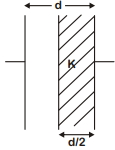
A
$4:1$
B
$2:1$
C
$8:5$
D
$6:5$
Solution
(C) The original capacitance of the parallel plate capacitor with air is given by $C_{0} = \frac{\varepsilon_{0} A}{d}$.
When a dielectric slab of thickness $t$ and dielectric constant $K$ is inserted between the plates,the new capacitance $C$ is given by the formula:
$C = \frac{\varepsilon_{0} A}{d - t + \frac{t}{K}}$
Given $t = \frac{d}{2}$ and $K = 4$,we substitute these values into the formula:
$C = \frac{\varepsilon_{0} A}{d - \frac{d}{2} + \frac{d/2}{4}}$
$C = \frac{\varepsilon_{0} A}{\frac{d}{2} + \frac{d}{8}}$
$C = \frac{\varepsilon_{0} A}{\frac{4d + d}{8}} = \frac{\varepsilon_{0} A}{\frac{5d}{8}}$
$C = \frac{8}{5} \frac{\varepsilon_{0} A}{d} = \frac{8}{5} C_{0}$
Therefore,the ratio of the new capacitance to the original capacitance is $\frac{C}{C_{0}} = \frac{8}{5}$.
When a dielectric slab of thickness $t$ and dielectric constant $K$ is inserted between the plates,the new capacitance $C$ is given by the formula:
$C = \frac{\varepsilon_{0} A}{d - t + \frac{t}{K}}$
Given $t = \frac{d}{2}$ and $K = 4$,we substitute these values into the formula:
$C = \frac{\varepsilon_{0} A}{d - \frac{d}{2} + \frac{d/2}{4}}$
$C = \frac{\varepsilon_{0} A}{\frac{d}{2} + \frac{d}{8}}$
$C = \frac{\varepsilon_{0} A}{\frac{4d + d}{8}} = \frac{\varepsilon_{0} A}{\frac{5d}{8}}$
$C = \frac{8}{5} \frac{\varepsilon_{0} A}{d} = \frac{8}{5} C_{0}$
Therefore,the ratio of the new capacitance to the original capacitance is $\frac{C}{C_{0}} = \frac{8}{5}$.
0 likesView Solution
Vedclass Products
For Students
Vedclass Test Series
Mock tests in real NEET style covering Physics with performance analysis. 5-day free trial.
Start Free TrialFor Teachers
Exam Paper Generator
Generate Set A/B/C/D Physics papers from 7.5L+ questions in 2 minutes. 3 chapters free.
Try FreeFor Institutes
Online Exam Module
Run live NEET mock exams with unlimited students, 360° analytics & white-label branding.
See DemoFrequently Asked Questions
How many Physics questions are in NEET 2020?
There are 90 Physics questions from the NEET 2020 paper on Vedclass, each with a detailed step-by-step solution in English.
Are NEET 2020 Physics solutions available in English?
Yes. All solutions on this page are in English. You can also switch to English or Hindi using the language buttons above the questions.
Can I practice NEET 2020 Physics as a timed test?
Yes. Use the Vedclass Test Series to attempt a full NEET mock test covering Physics with time limits and instant score analysis.
Can teachers create Physics papers from NEET previous year questions?
Yes. The Vedclass Exam Paper Generator lets teachers mix NEET Physics questions and generate Set A/B/C/D papers in minutes.
For Teachers & Institutes
Build a Custom Physics Paper
Pick NEET 2020 Physics questions, set difficulty, and generate Set A/B/C/D in 2 minutes.