
PhysicsQ1–45 of 45 questions
Page 1 of 1 · English
1
PhysicsMediumMCQNEET · 2018
$A$ student measured the diameter of a small steel ball using a screw gauge of least count $0.001 \, cm$. The main scale reading is $5 \, mm$ and the circular scale division coinciding with the reference level is $25$. If the screw gauge has a zero error of $-0.004 \, cm$,the correct diameter of the ball is: (in $, cm$)
A
$0.521$
B
$0.525$
C
$0.529$
D
$0.053$
Solution
(C) The diameter of the ball is calculated using the formula: $\text{Diameter} = \text{MSR} + (\text{CSR} \times \text{LC}) - \text{Zero Error}$.
Given: $\text{MSR} = 5 \, mm = 0.5 \, cm$,$\text{CSR} = 25$,$\text{LC} = 0.001 \, cm$,and $\text{Zero Error} = -0.004 \, cm$.
Substituting the values:
$\text{Diameter} = 0.5 \, cm + (25 \times 0.001 \, cm) - (-0.004 \, cm)$.
$\text{Diameter} = 0.5 \, cm + 0.025 \, cm + 0.004 \, cm$.
$\text{Diameter} = 0.529 \, cm$.
Given: $\text{MSR} = 5 \, mm = 0.5 \, cm$,$\text{CSR} = 25$,$\text{LC} = 0.001 \, cm$,and $\text{Zero Error} = -0.004 \, cm$.
Substituting the values:
$\text{Diameter} = 0.5 \, cm + (25 \times 0.001 \, cm) - (-0.004 \, cm)$.
$\text{Diameter} = 0.5 \, cm + 0.025 \, cm + 0.004 \, cm$.
$\text{Diameter} = 0.529 \, cm$.
0 likesView Solution
2
PhysicsMediumMCQNEET · 2018
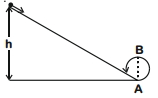
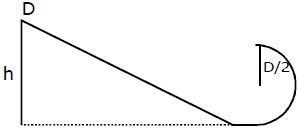
$A$ body initially at rest and sliding along a frictionless track from a height $h$ (as shown in the figure) just completes a vertical circle of diameter $AB = D$. The height $h$ is equal to
A
$\frac{3}{2}D$
B
$D$
C
$\frac{5}{4}D$
D
$\frac{7}{5}D$
Solution
(C) To complete a vertical circle of radius $R$,the minimum speed at the lowest point $A$ must be $v_A = \sqrt{5gR}$.
Given that the diameter of the circle is $D$,the radius is $R = \frac{D}{2}$.
Substituting $R$ into the velocity equation,we get $v_A = \sqrt{5g \left(\frac{D}{2}\right)} = \sqrt{\frac{5gD}{2}}$.
Using the principle of conservation of mechanical energy,the potential energy at height $h$ is converted into kinetic energy at point $A$:
$mgh = \frac{1}{2}mv_A^2$
$gh = \frac{1}{2}v_A^2$
Substituting the value of $v_A^2 = \frac{5gD}{2}$:
$gh = \frac{1}{2} \left(\frac{5gD}{2}\right)$
$h = \frac{5D}{4}$
Given that the diameter of the circle is $D$,the radius is $R = \frac{D}{2}$.
Substituting $R$ into the velocity equation,we get $v_A = \sqrt{5g \left(\frac{D}{2}\right)} = \sqrt{\frac{5gD}{2}}$.
Using the principle of conservation of mechanical energy,the potential energy at height $h$ is converted into kinetic energy at point $A$:
$mgh = \frac{1}{2}mv_A^2$
$gh = \frac{1}{2}v_A^2$
Substituting the value of $v_A^2 = \frac{5gD}{2}$:
$gh = \frac{1}{2} \left(\frac{5gD}{2}\right)$
$h = \frac{5D}{4}$
0 likesView Solution
3
PhysicsMediumMCQNEET · 2018
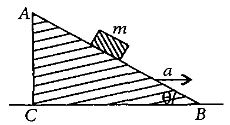
$A$ block of mass $m$ is placed on a smooth inclined wedge $ABC$ of inclination $\theta$ as shown in the figure. The wedge is given an acceleration $a$ towards the right. The relation between $a$ and $\theta$ for the block to remain stationary on the wedge is
A
$a = g \csc \theta$
B
$a = g \sin \theta$
C
$a = g \tan \theta$
D
$a = g \cos \theta$
Solution
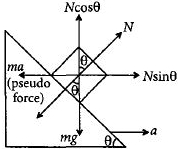
(C) To keep the block stationary on the wedge,we analyze the forces in the non-inertial frame of the wedge.
$1$. The forces acting on the block are: gravitational force $mg$ (downwards),normal reaction $N$ (perpendicular to the surface),and pseudo force $ma$ (towards the left).
$2$. Resolving the forces into components parallel and perpendicular to the inclined surface:
- Perpendicular to the surface: $N = mg \cos \theta + ma \sin \theta$. However,for the block to be stationary relative to the wedge,the net force along the incline must be zero.
- Parallel to the incline: $ma \cos \theta = mg \sin \theta$.
$3$. From the parallel component equation:
$ma \cos \theta = mg \sin \theta$
$a \cos \theta = g \sin \theta$
$a = g \frac{\sin \theta}{\cos \theta}$
$a = g \tan \theta$
$1$. The forces acting on the block are: gravitational force $mg$ (downwards),normal reaction $N$ (perpendicular to the surface),and pseudo force $ma$ (towards the left).
$2$. Resolving the forces into components parallel and perpendicular to the inclined surface:
- Perpendicular to the surface: $N = mg \cos \theta + ma \sin \theta$. However,for the block to be stationary relative to the wedge,the net force along the incline must be zero.
- Parallel to the incline: $ma \cos \theta = mg \sin \theta$.
$3$. From the parallel component equation:
$ma \cos \theta = mg \sin \theta$
$a \cos \theta = g \sin \theta$
$a = g \frac{\sin \theta}{\cos \theta}$
$a = g \tan \theta$
0 likesView Solution
4
PhysicsEasyMCQNEET · 2018
Which one of the following statements is incorrect?
A
Rolling friction is smaller than sliding friction.
B
Limiting value of static friction is directly proportional to normal reaction.
C
Coefficient of sliding friction has dimensions of length.
D
Frictional force opposes the relative motion.
Solution
(C) The coefficient of friction $(\mu)$ is defined by the relation $f = \mu N$,where $f$ is the frictional force and $N$ is the normal reaction force.
Rearranging the formula,we get $\mu = \frac{f}{N}$.
Since both $f$ and $N$ are forces,their units are Newtons $(N)$. Therefore,the coefficient of friction is a ratio of two forces,making it a dimensionless quantity.
Thus,the statement that the coefficient of sliding friction has dimensions of length is incorrect.
Rearranging the formula,we get $\mu = \frac{f}{N}$.
Since both $f$ and $N$ are forces,their units are Newtons $(N)$. Therefore,the coefficient of friction is a ratio of two forces,making it a dimensionless quantity.
Thus,the statement that the coefficient of sliding friction has dimensions of length is incorrect.
0 likesView Solution
5
PhysicsMediumMCQNEET · 2018
The power radiated by a black body is $P$ and it radiates maximum energy at wavelength $\lambda_0$. If the temperature of the black body is now changed so that it radiates maximum energy at wavelength $\frac{3}{4}\lambda_0$,the power radiated by it becomes $nP$. The value of $n$ is
A
$\frac{3}{4}$
B
$\frac{4}{3}$
C
$\frac{81}{256}$
D
$\frac{256}{81}$
Solution
(D) According to $Wien's$ displacement law,$\lambda_{\max} T = \text{constant}$.
Let the initial temperature be $T$ and the final temperature be $T'$.
Given $\lambda_{\max, 1} = \lambda_0$ and $\lambda_{\max, 2} = \frac{3}{4}\lambda_0$.
Using the law: $\lambda_0 T = \left(\frac{3}{4}\lambda_0\right) T' \Rightarrow T' = \frac{4}{3}T$.
According to the $Stefan-Boltzmann$ law,the power radiated by a black body is $P = A \sigma T^4$,which implies $P \propto T^4$.
Therefore,$\frac{P_2}{P_1} = \left(\frac{T'}{T}\right)^4$.
Substituting the values: $n = \left(\frac{4/3 T}{T}\right)^4 = \left(\frac{4}{3}\right)^4 = \frac{256}{81}$.
Let the initial temperature be $T$ and the final temperature be $T'$.
Given $\lambda_{\max, 1} = \lambda_0$ and $\lambda_{\max, 2} = \frac{3}{4}\lambda_0$.
Using the law: $\lambda_0 T = \left(\frac{3}{4}\lambda_0\right) T' \Rightarrow T' = \frac{4}{3}T$.
According to the $Stefan-Boltzmann$ law,the power radiated by a black body is $P = A \sigma T^4$,which implies $P \propto T^4$.
Therefore,$\frac{P_2}{P_1} = \left(\frac{T'}{T}\right)^4$.
Substituting the values: $n = \left(\frac{4/3 T}{T}\right)^4 = \left(\frac{4}{3}\right)^4 = \frac{256}{81}$.
0 likesView Solution
6
PhysicsMediumMCQNEET · 2018
At what temperature will the $rms$ speed of oxygen molecules become just sufficient for escaping from the Earth's atmosphere $?$ (Given: Mass of oxygen molecule $(m) = 2.76 \times 10^{-26} \, kg$,Boltzmann's constant $k_B = 1.38 \times 10^{-23} \, JK^{-1}$)
A
$2.508 \times 10^4 \, K$
B
$8.360 \times 10^4 \, K$
C
$1.254 \times 10^4 \, K$
D
$5.016 \times 10^4 \, K$
Solution
(B) The escape velocity from the Earth's surface is $v_{\text{escape}} = 11200 \, m/s$.
For the oxygen molecules to escape,their $rms$ speed must be equal to the escape velocity:
$v_{\text{rms}} = \sqrt{\frac{3 k_B T}{m}} = v_{\text{escape}}$
Substituting the given values:
$11200 = \sqrt{\frac{3 \times 1.38 \times 10^{-23} \times T}{2.76 \times 10^{-26}}}$
Squaring both sides:
$(11200)^2 = \frac{3 \times 1.38 \times 10^{-23} \times T}{2.76 \times 10^{-26}}$
$1.2544 \times 10^8 = \frac{4.14 \times 10^{-23} \times T}{2.76 \times 10^{-26}}$
$1.2544 \times 10^8 = 1.5 \times 10^3 \times T$
Solving for $T$:
$T = \frac{1.2544 \times 10^8}{1.5 \times 10^3} \approx 8.360 \times 10^4 \, K$.
For the oxygen molecules to escape,their $rms$ speed must be equal to the escape velocity:
$v_{\text{rms}} = \sqrt{\frac{3 k_B T}{m}} = v_{\text{escape}}$
Substituting the given values:
$11200 = \sqrt{\frac{3 \times 1.38 \times 10^{-23} \times T}{2.76 \times 10^{-26}}}$
Squaring both sides:
$(11200)^2 = \frac{3 \times 1.38 \times 10^{-23} \times T}{2.76 \times 10^{-26}}$
$1.2544 \times 10^8 = \frac{4.14 \times 10^{-23} \times T}{2.76 \times 10^{-26}}$
$1.2544 \times 10^8 = 1.5 \times 10^3 \times T$
Solving for $T$:
$T = \frac{1.2544 \times 10^8}{1.5 \times 10^3} \approx 8.360 \times 10^4 \, K$.
0 likesView Solution
7
PhysicsMediumMCQNEET · 2018
$A$ solid sphere is in rolling motion. In rolling motion,a body possesses translational kinetic energy $(K_t)$ as well as rotational kinetic energy $(K_r)$ simultaneously. The ratio $K_t : (K_t + K_r)$ for the sphere is
A
$7:10$
B
$5:7$
C
$2:5$
D
$10:7$
Solution
(B) Translational kinetic energy is given by $K_t = \frac{1}{2}mv^2$.
Rotational kinetic energy is given by $K_r = \frac{1}{2}I\omega^2$.
For a solid sphere,the moment of inertia is $I = \frac{2}{5}mr^2$ and the relation between linear and angular velocity is $v = r\omega$,so $\omega = \frac{v}{r}$.
Substituting these into the rotational kinetic energy formula:
$K_r = \frac{1}{2} \left( \frac{2}{5}mr^2 \right) \left( \frac{v}{r} \right)^2 = \frac{1}{5}mv^2$.
The total kinetic energy is $K_{total} = K_t + K_r = \frac{1}{2}mv^2 + \frac{1}{5}mv^2 = \left( \frac{5+2}{10} \right)mv^2 = \frac{7}{10}mv^2$.
The ratio $K_t : (K_t + K_r)$ is $\frac{\frac{1}{2}mv^2}{\frac{7}{10}mv^2} = \frac{1}{2} \times \frac{10}{7} = \frac{5}{7}$.
Rotational kinetic energy is given by $K_r = \frac{1}{2}I\omega^2$.
For a solid sphere,the moment of inertia is $I = \frac{2}{5}mr^2$ and the relation between linear and angular velocity is $v = r\omega$,so $\omega = \frac{v}{r}$.
Substituting these into the rotational kinetic energy formula:
$K_r = \frac{1}{2} \left( \frac{2}{5}mr^2 \right) \left( \frac{v}{r} \right)^2 = \frac{1}{5}mv^2$.
The total kinetic energy is $K_{total} = K_t + K_r = \frac{1}{2}mv^2 + \frac{1}{5}mv^2 = \left( \frac{5+2}{10} \right)mv^2 = \frac{7}{10}mv^2$.
The ratio $K_t : (K_t + K_r)$ is $\frac{\frac{1}{2}mv^2}{\frac{7}{10}mv^2} = \frac{1}{2} \times \frac{10}{7} = \frac{5}{7}$.
1 likesView Solution
8
PhysicsMediumMCQNEET · 2018
The moment of the force,$\overrightarrow{F} = 4\hat{i} + 5\hat{j} - 6\hat{k}$ at point $(2, 0, -3)$,about the point $(2, -2, -2)$,is given by
A
$-8\hat{i} - 4\hat{j} - 7\hat{k}$
B
$-4\hat{i} - \hat{j} - 8\hat{k}$
C
$-7\hat{i} - 4\hat{j} - 8\hat{k}$
D
$-7\hat{i} - 8\hat{j} - 4\hat{k}$
Solution
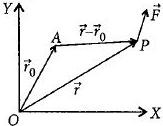
(C) The moment of force (torque) is given by the cross product of the position vector relative to the point of rotation and the force vector:
$\overrightarrow{\tau} = (\overrightarrow{r} - \overrightarrow{r_0}) \times \overrightarrow{F}$
Here,the point of rotation is $\overrightarrow{r_0} = 2\hat{i} - 2\hat{j} - 2\hat{k}$ and the point of application of force is $\overrightarrow{r} = 2\hat{i} + 0\hat{j} - 3\hat{k}$.
First,calculate the relative position vector:
$\overrightarrow{r} - \overrightarrow{r_0} = (2\hat{i} + 0\hat{j} - 3\hat{k}) - (2\hat{i} - 2\hat{j} - 2\hat{k}) = 0\hat{i} + 2\hat{j} - 1\hat{k}$.
Now,calculate the cross product $\overrightarrow{\tau} = (0\hat{i} + 2\hat{j} - 1\hat{k}) \times (4\hat{i} + 5\hat{j} - 6\hat{k})$:
$\overrightarrow{\tau} = \begin{vmatrix} \hat{i} & \hat{j} & \hat{k} \\ 0 & 2 & -1 \\ 4 & 5 & -6 \end{vmatrix}$
$\overrightarrow{\tau} = \hat{i}(2(-6) - (-1)(5)) - \hat{j}(0(-6) - (-1)(4)) + \hat{k}(0(5) - 2(4))$
$\overrightarrow{\tau} = \hat{i}(-12 + 5) - \hat{j}(0 + 4) + \hat{k}(0 - 8)$
$\overrightarrow{\tau} = -7\hat{i} - 4\hat{j} - 8\hat{k}$.
$\overrightarrow{\tau} = (\overrightarrow{r} - \overrightarrow{r_0}) \times \overrightarrow{F}$
Here,the point of rotation is $\overrightarrow{r_0} = 2\hat{i} - 2\hat{j} - 2\hat{k}$ and the point of application of force is $\overrightarrow{r} = 2\hat{i} + 0\hat{j} - 3\hat{k}$.
First,calculate the relative position vector:
$\overrightarrow{r} - \overrightarrow{r_0} = (2\hat{i} + 0\hat{j} - 3\hat{k}) - (2\hat{i} - 2\hat{j} - 2\hat{k}) = 0\hat{i} + 2\hat{j} - 1\hat{k}$.
Now,calculate the cross product $\overrightarrow{\tau} = (0\hat{i} + 2\hat{j} - 1\hat{k}) \times (4\hat{i} + 5\hat{j} - 6\hat{k})$:
$\overrightarrow{\tau} = \begin{vmatrix} \hat{i} & \hat{j} & \hat{k} \\ 0 & 2 & -1 \\ 4 & 5 & -6 \end{vmatrix}$
$\overrightarrow{\tau} = \hat{i}(2(-6) - (-1)(5)) - \hat{j}(0(-6) - (-1)(4)) + \hat{k}(0(5) - 2(4))$
$\overrightarrow{\tau} = \hat{i}(-12 + 5) - \hat{j}(0 + 4) + \hat{k}(0 - 8)$
$\overrightarrow{\tau} = -7\hat{i} - 4\hat{j} - 8\hat{k}$.
0 likesView Solution
9
PhysicsMediumMCQNEET · 2018
Three objects,$A$ (a solid sphere),$B$ (a thin circular disk),and $C$ (a circular ring),each have the same mass $M$ and radius $R$. They all spin with the same angular speed $\omega$ about their own symmetry axes. The amounts of work $(W)$ required to bring them to rest would satisfy the relation:
A
$W_C > W_B > W_A$
B
$W_A > W_B > W_C$
C
$W_A > W_C > W_B$
D
$W_B > W_A > W_C$
Solution
(A) The work done required to bring an object to rest is equal to its rotational kinetic energy: $W = \Delta KE = \frac{1}{2} I \omega^2$.
Since all objects have the same angular speed $\omega$,the work done is directly proportional to the moment of inertia: $W \propto I$.
The moments of inertia for the given objects about their symmetry axes are:
$1$. Solid sphere $(A)$: $I_A = \frac{2}{5} MR^2 = 0.4 MR^2$
$2$. Thin circular disk $(B)$: $I_B = \frac{1}{2} MR^2 = 0.5 MR^2$
$3$. Circular ring $(C)$: $I_C = MR^2 = 1.0 MR^2$
Comparing these values,we get $I_C > I_B > I_A$.
Therefore,the work required satisfies the relation $W_C > W_B > W_A$.
Since all objects have the same angular speed $\omega$,the work done is directly proportional to the moment of inertia: $W \propto I$.
The moments of inertia for the given objects about their symmetry axes are:
$1$. Solid sphere $(A)$: $I_A = \frac{2}{5} MR^2 = 0.4 MR^2$
$2$. Thin circular disk $(B)$: $I_B = \frac{1}{2} MR^2 = 0.5 MR^2$
$3$. Circular ring $(C)$: $I_C = MR^2 = 1.0 MR^2$
Comparing these values,we get $I_C > I_B > I_A$.
Therefore,the work required satisfies the relation $W_C > W_B > W_A$.
0 likesView Solution
10
PhysicsEasyMCQNEET · 2018
$A$ solid sphere is rotating freely about its symmetry axis in free space. The radius of the sphere is increased keeping its mass same. Which of the following physical quantities would remain constant for the sphere $?$
A
Angular velocity
B
Moment of inertia
C
Angular momentum
D
Rotational kinetic energy
Solution
(C) According to the principle of conservation of angular momentum,if the net external torque acting on a system is zero,the total angular momentum of the system remains constant.
In this case,the sphere is rotating freely in free space,meaning there is no external torque acting on it $({\tau_{ext}} = 0)$.
Since ${\tau_{ext}} = \frac{dL}{dt} = 0$,the angular momentum $(L)$ must remain constant.
When the radius of the sphere increases,its moment of inertia $(I = \frac{2}{5}MR^2)$ increases. Since $L = I\omega$ is constant,the angular velocity $(\omega)$ will decrease,and the rotational kinetic energy $(K = \frac{L^2}{2I})$ will also change. Therefore,only the angular momentum remains constant.
In this case,the sphere is rotating freely in free space,meaning there is no external torque acting on it $({\tau_{ext}} = 0)$.
Since ${\tau_{ext}} = \frac{dL}{dt} = 0$,the angular momentum $(L)$ must remain constant.
When the radius of the sphere increases,its moment of inertia $(I = \frac{2}{5}MR^2)$ increases. Since $L = I\omega$ is constant,the angular velocity $(\omega)$ will decrease,and the rotational kinetic energy $(K = \frac{L^2}{2I})$ will also change. Therefore,only the angular momentum remains constant.
1 likesView Solution
11
PhysicsEasyMCQNEET · 2018
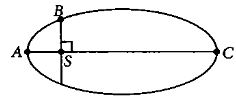
The kinetic energies of a planet in an elliptical orbit about the Sun,at positions $A, B$ and $C$ are $K_A, K_B$ and $K_C$,respectively. $AC$ is the major axis and $SB$ is perpendicular to $AC$ at the position of the Sun $S$ as shown in the figure. Then
A
$K_A < K_B < K_C$
B
$K_A > K_B > K_C$
C
$K_B > K_A > K_C$
D
$K_B < K_A < K_C$
Solution
(B) According to Kepler's second law of planetary motion,the areal velocity of a planet is constant. This implies that the planet moves faster when it is closer to the Sun and slower when it is farther away.
Point $A$ is the perihelion (closest to the Sun),and point $C$ is the aphelion (farthest from the Sun). Point $B$ is at an intermediate distance.
Therefore,the orbital speeds at these positions follow the relation: $v_A > v_B > v_C$.
Since the kinetic energy $K$ is given by $K = \frac{1}{2}mv^2$,it is directly proportional to the square of the speed $(K \propto v^2)$.
Thus,the kinetic energies at these positions follow the relation: $K_A > K_B > K_C$.
Point $A$ is the perihelion (closest to the Sun),and point $C$ is the aphelion (farthest from the Sun). Point $B$ is at an intermediate distance.
Therefore,the orbital speeds at these positions follow the relation: $v_A > v_B > v_C$.
Since the kinetic energy $K$ is given by $K = \frac{1}{2}mv^2$,it is directly proportional to the square of the speed $(K \propto v^2)$.
Thus,the kinetic energies at these positions follow the relation: $K_A > K_B > K_C$.
0 likesView Solution
12
PhysicsEasyMCQNEET · 2018
If the mass of the Sun were ten times smaller and the universal gravitational constant were ten times larger in magnitude,which of the following is not correct?
A
Raindrops will fall faster.
B
Walking on the ground would become more difficult.
C
$g$ on the Earth will not change.
D
Time period of a simple pendulum on the Earth would decrease.
Solution
(C) The acceleration due to gravity on the surface of the Earth is given by $g = \frac{GM}{R^2}$,where $M$ is the mass of the Earth and $R$ is the radius of the Earth.
Note that the mass of the Sun does not affect the value of $g$ on the Earth's surface.
If the universal gravitational constant $G$ becomes $10G$,then the new acceleration due to gravity $g'$ becomes $g' = \frac{(10G)M}{R^2} = 10g$.
Since $g' = 10g$,the acceleration due to gravity increases significantly.
$1$. Raindrops will fall faster because the acceleration due to gravity is higher.
$2$. Walking on the ground becomes more difficult because the effective weight of a person increases.
$3$. The time period of a simple pendulum is $T = 2\pi \sqrt{\frac{l}{g}}$. Since $g$ increases,$T$ will decrease.
$4$. The statement '$g$ on the Earth will not change' is incorrect because $g$ increases by a factor of $10$.
Note that the mass of the Sun does not affect the value of $g$ on the Earth's surface.
If the universal gravitational constant $G$ becomes $10G$,then the new acceleration due to gravity $g'$ becomes $g' = \frac{(10G)M}{R^2} = 10g$.
Since $g' = 10g$,the acceleration due to gravity increases significantly.
$1$. Raindrops will fall faster because the acceleration due to gravity is higher.
$2$. Walking on the ground becomes more difficult because the effective weight of a person increases.
$3$. The time period of a simple pendulum is $T = 2\pi \sqrt{\frac{l}{g}}$. Since $g$ increases,$T$ will decrease.
$4$. The statement '$g$ on the Earth will not change' is incorrect because $g$ increases by a factor of $10$.
0 likesView Solution
13
PhysicsMediumMCQNEET · 2018
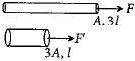
Two wires are made of the same material and have the same volume. The first wire has cross-sectional area $A$ and the second wire has cross-sectional area $3A$. If the length of the first wire is increased by $\Delta l$ on applying a force $F$,how much force is needed to stretch the second wire by the same amount?
A
$9F$
B
$6F$
C
$F$
D
$4F$
Solution
(A) Young's modulus is given by $Y = \frac{Fl}{A\Delta l}$.
Since the volume $V = A \times L$ is the same for both wires,and the cross-sectional areas are $A_1 = A$ and $A_2 = 3A$,their lengths must be $L_1 = 3l$ and $L_2 = l$ respectively.
For the first wire:
$\Delta l = \frac{F \cdot (3l)}{A \cdot Y} = \frac{3Fl}{AY} \quad ...(i)$
For the second wire,let the required force be $F'$. The extension is the same $\Delta l$:
$\Delta l = \frac{F' \cdot l}{(3A) \cdot Y} = \frac{F'l}{3AY} \quad ...(ii)$
Equating $(i)$ and $(ii)$:
$\frac{3Fl}{AY} = \frac{F'l}{3AY}$
$3F = \frac{F'}{3}$
$F' = 9F$
Since the volume $V = A \times L$ is the same for both wires,and the cross-sectional areas are $A_1 = A$ and $A_2 = 3A$,their lengths must be $L_1 = 3l$ and $L_2 = l$ respectively.
For the first wire:
$\Delta l = \frac{F \cdot (3l)}{A \cdot Y} = \frac{3Fl}{AY} \quad ...(i)$
For the second wire,let the required force be $F'$. The extension is the same $\Delta l$:
$\Delta l = \frac{F' \cdot l}{(3A) \cdot Y} = \frac{F'l}{3AY} \quad ...(ii)$
Equating $(i)$ and $(ii)$:
$\frac{3Fl}{AY} = \frac{F'l}{3AY}$
$3F = \frac{F'}{3}$
$F' = 9F$
0 likesView Solution
14
PhysicsDifficultMCQNEET · 2018
$A$ small sphere of radius $r$ falls from rest in a viscous liquid. As a result,heat is produced due to viscous force. The rate of production of heat when the sphere attains its terminal velocity,is proportional to
A
$r^3$
B
$r^2$
C
$r^4$
D
$r^5$
Solution
(D) The viscous drag force is given by Stokes' Law: $F = 6\pi \eta rv$,where $v$ is the terminal velocity.
The rate of production of heat is equal to the power dissipated by the viscous force:
$P = F \cdot v = (6\pi \eta rv) \cdot v = 6\pi \eta r v^2$.
The terminal velocity $v$ of a sphere falling in a viscous liquid is given by:
$v = \frac{2r^2(\rho - \sigma)g}{9\eta}$,which implies $v \propto r^2$.
Substituting $v \propto r^2$ into the power equation:
$P \propto r \cdot (r^2)^2 = r \cdot r^4 = r^5$.
Therefore,the rate of production of heat is proportional to $r^5$.
The rate of production of heat is equal to the power dissipated by the viscous force:
$P = F \cdot v = (6\pi \eta rv) \cdot v = 6\pi \eta r v^2$.
The terminal velocity $v$ of a sphere falling in a viscous liquid is given by:
$v = \frac{2r^2(\rho - \sigma)g}{9\eta}$,which implies $v \propto r^2$.
Substituting $v \propto r^2$ into the power equation:
$P \propto r \cdot (r^2)^2 = r \cdot r^4 = r^5$.
Therefore,the rate of production of heat is proportional to $r^5$.
0 likesView Solution
15
PhysicsMediumMCQNEET · 2018
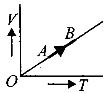
The volume $(V)$ of a monatomic gas varies with its temperature $(T)$,as shown in the graph. The ratio of work done by the gas to the heat absorbed by it,when it undergoes a change from state $A$ to state $B$,is
A
$\frac{2}{5}$
B
$\frac{2}{3}$
C
$\frac{2}{7}$
D
$\frac{1}{3}$
Solution
(A) From the graph,$V \propto T$,which implies the process is isobaric (constant pressure).
For an isobaric process,the heat absorbed is given by $dQ = nC_p dT$,where $C_p$ is the molar heat capacity at constant pressure.
For a monatomic gas,the degrees of freedom $f = 3$. Thus,$C_p = \frac{f+2}{2}R = \frac{3+2}{2}R = \frac{5}{2}R$.
Therefore,$dQ = n \left( \frac{5}{2}R \right) dT$.
The work done by the gas is $dW = PdV$. Since $PV = nRT$,for a constant pressure process,$PdV = nRdT$.
The required ratio is $\frac{dW}{dQ} = \frac{nRdT}{n(\frac{5}{2}R)dT} = \frac{1}{5/2} = \frac{2}{5}$.
For an isobaric process,the heat absorbed is given by $dQ = nC_p dT$,where $C_p$ is the molar heat capacity at constant pressure.
For a monatomic gas,the degrees of freedom $f = 3$. Thus,$C_p = \frac{f+2}{2}R = \frac{3+2}{2}R = \frac{5}{2}R$.
Therefore,$dQ = n \left( \frac{5}{2}R \right) dT$.
The work done by the gas is $dW = PdV$. Since $PV = nRT$,for a constant pressure process,$PdV = nRdT$.
The required ratio is $\frac{dW}{dQ} = \frac{nRdT}{n(\frac{5}{2}R)dT} = \frac{1}{5/2} = \frac{2}{5}$.
0 likesView Solution
16
PhysicsMediumMCQNEET · 2018
The efficiency of an ideal heat engine working between the freezing point and boiling point of water is ........ $\%$
A
$26.8$
B
$20$
C
$12.5$
D
$6.25$
Solution
(A) The efficiency of an ideal (Carnot) heat engine is given by the formula: $\eta = 1 - \frac{T_2}{T_1}$.
Here,$T_1$ is the temperature of the source (boiling point of water) and $T_2$ is the temperature of the sink (freezing point of water).
Freezing point of water,$T_2 = 0^{\circ}C = 273\,K$.
Boiling point of water,$T_1 = 100^{\circ}C = (100 + 273)\,K = 373\,K$.
Substituting these values into the efficiency formula:
$\eta = 1 - \frac{273}{373} = \frac{373 - 273}{373} = \frac{100}{373}$.
To express this as a percentage:
$\% \eta = \left( \frac{100}{373} \right) \times 100 \approx 26.8\%$.
Here,$T_1$ is the temperature of the source (boiling point of water) and $T_2$ is the temperature of the sink (freezing point of water).
Freezing point of water,$T_2 = 0^{\circ}C = 273\,K$.
Boiling point of water,$T_1 = 100^{\circ}C = (100 + 273)\,K = 373\,K$.
Substituting these values into the efficiency formula:
$\eta = 1 - \frac{273}{373} = \frac{373 - 273}{373} = \frac{100}{373}$.
To express this as a percentage:
$\% \eta = \left( \frac{100}{373} \right) \times 100 \approx 26.8\%$.
0 likesView Solution
17
PhysicsMediumMCQNEET · 2018
$A$ sample of $0.1 \, g$ of water at $100^{\circ} C$ and normal pressure $(1.013 \times 10^5 \, N m^{-2})$ requires $54 \, cal$ of heat energy to convert to steam at $100^{\circ} C$. If the volume of the steam produced is $167.1 \, cc$,the change in internal energy of the sample is ....... $J$.
A
$104.3$
B
$208.7$
C
$84.5$
D
$42.2$
Solution
(B) According to the first law of thermodynamics,$\Delta Q = \Delta U + \Delta W$.
First,convert the heat energy from calories to Joules: $\Delta Q = 54 \, cal \times 4.18 \, J/cal = 225.72 \, J$.
Next,calculate the work done during expansion: $\Delta W = P \Delta V$.
Given $P = 1.013 \times 10^5 \, N/m^2$ and $\Delta V = 167.1 \, cc = 167.1 \times 10^{-6} \, m^3$.
$\Delta W = 1.013 \times 10^5 \times 167.1 \times 10^{-6} \approx 16.93 \, J$.
Now,calculate the change in internal energy: $\Delta U = \Delta Q - \Delta W$.
$\Delta U = 225.72 \, J - 16.93 \, J = 208.79 \, J$.
Rounding to the nearest option,$\Delta U \approx 208.7 \, J$.
First,convert the heat energy from calories to Joules: $\Delta Q = 54 \, cal \times 4.18 \, J/cal = 225.72 \, J$.
Next,calculate the work done during expansion: $\Delta W = P \Delta V$.
Given $P = 1.013 \times 10^5 \, N/m^2$ and $\Delta V = 167.1 \, cc = 167.1 \times 10^{-6} \, m^3$.
$\Delta W = 1.013 \times 10^5 \times 167.1 \times 10^{-6} \approx 16.93 \, J$.
Now,calculate the change in internal energy: $\Delta U = \Delta Q - \Delta W$.
$\Delta U = 225.72 \, J - 16.93 \, J = 208.79 \, J$.
Rounding to the nearest option,$\Delta U \approx 208.7 \, J$.
0 likesView Solution
18
PhysicsMediumMCQNEET · 2018
$A$ pendulum is hung from the roof of a sufficiently high building and is moving freely to and fro like a simple harmonic oscillator. The acceleration of the bob of the pendulum is $20 \; m/s^2$ at a distance of $5 \; m$ from the mean position. The time period of oscillation is
A
$2\pi \; s$
B
$\pi \; s$
C
$1 \; s$
D
$2 \; s$
Solution
(B) The magnitude of acceleration $a$ of a particle performing $SHM$ is given by $|a| = \omega^2 y$,where $\omega$ is the angular frequency and $y$ is the displacement from the mean position.
Given: $|a| = 20 \; m/s^2$ and $y = 5 \; m$.
Substituting these values into the formula: $20 = \omega^2 (5)$.
$\omega^2 = 4 \Rightarrow \omega = 2 \; rad/s$.
The time period $T$ is given by $T = \frac{2\pi}{\omega}$.
$T = \frac{2\pi}{2} = \pi \; s$.
Given: $|a| = 20 \; m/s^2$ and $y = 5 \; m$.
Substituting these values into the formula: $20 = \omega^2 (5)$.
$\omega^2 = 4 \Rightarrow \omega = 2 \; rad/s$.
The time period $T$ is given by $T = \frac{2\pi}{\omega}$.
$T = \frac{2\pi}{2} = \pi \; s$.
0 likesView Solution
19
PhysicsMediumMCQNEET · 2018
The fundamental frequency in an open organ pipe is equal to the third harmonic of a closed organ pipe. If the length of the closed organ pipe is $20 \ cm$,the length of the open organ pipe is .... $cm$.
A
$13.33$
B
$8$
C
$16$
D
$12.5$
Solution
(A) The fundamental frequency of an open organ pipe of length $l'$ is given by $f_{open} = \frac{v}{2l'}$.
The frequencies of a closed organ pipe of length $l$ are given by $f_n = \frac{nv}{4l}$,where $n = 1, 3, 5, \dots$ (odd harmonics).
The third harmonic of a closed organ pipe corresponds to $n = 3$,so $f_{closed, 3} = \frac{3v}{4l}$.
According to the problem,$f_{open} = f_{closed, 3}$.
Therefore,$\frac{v}{2l'} = \frac{3v}{4l}$.
Simplifying for $l'$,we get $l' = \frac{4l}{6} = \frac{2l}{3}$.
Given $l = 20 \ cm$,we have $l' = \frac{2 \times 20}{3} = \frac{40}{3} \approx 13.33 \ cm$.
The frequencies of a closed organ pipe of length $l$ are given by $f_n = \frac{nv}{4l}$,where $n = 1, 3, 5, \dots$ (odd harmonics).
The third harmonic of a closed organ pipe corresponds to $n = 3$,so $f_{closed, 3} = \frac{3v}{4l}$.
According to the problem,$f_{open} = f_{closed, 3}$.
Therefore,$\frac{v}{2l'} = \frac{3v}{4l}$.
Simplifying for $l'$,we get $l' = \frac{4l}{6} = \frac{2l}{3}$.
Given $l = 20 \ cm$,we have $l' = \frac{2 \times 20}{3} = \frac{40}{3} \approx 13.33 \ cm$.
0 likesView Solution
20
PhysicsMediumMCQNEET · 2018
$A$ tuning fork is used to produce resonance in a glass tube. The length of the air column in this tube can be adjusted by a variable piston. At room temperature of $27\,^{\circ}C$,two successive resonances are produced at $20\,cm$ and $73\,cm$ of column length. If the frequency of the tuning fork is $320\,Hz$,the velocity of sound in air at $27\,^{\circ}C$ is .... $m/s$.
A
$330$
B
$339$
C
$300$
D
$350$
Solution
(B) In a resonance tube experiment,the distance between two successive resonance positions is equal to half the wavelength of the sound wave,i.e.,$\frac{\lambda}{2} = L_2 - L_1$.
Given,$L_1 = 20\,cm = 0.20\,m$ and $L_2 = 73\,cm = 0.73\,m$.
Therefore,$\frac{\lambda}{2} = 0.73\,m - 0.20\,m = 0.53\,m$.
This implies $\lambda = 2 \times 0.53\,m = 1.06\,m$.
The velocity of sound $v$ is given by the formula $v = f \lambda$,where $f$ is the frequency of the tuning fork.
Given $f = 320\,Hz$.
$v = 320 \times 1.06 = 339.2\,m/s$.
Rounding to the nearest integer,the velocity of sound is $339\,m/s$.
Given,$L_1 = 20\,cm = 0.20\,m$ and $L_2 = 73\,cm = 0.73\,m$.
Therefore,$\frac{\lambda}{2} = 0.73\,m - 0.20\,m = 0.53\,m$.
This implies $\lambda = 2 \times 0.53\,m = 1.06\,m$.
The velocity of sound $v$ is given by the formula $v = f \lambda$,where $f$ is the frequency of the tuning fork.
Given $f = 320\,Hz$.
$v = 320 \times 1.06 = 339.2\,m/s$.
Rounding to the nearest integer,the velocity of sound is $339\,m/s$.
0 likesView Solution
21
PhysicsMediumMCQNEET · 2018
$A$ moving block having mass $m$ collides with another stationary block having mass $4m$. The lighter block comes to rest after the collision. If the initial velocity of the lighter block is $v$,then the value of the coefficient of restitution $(e)$ will be:
A
$0.5$
B
$0.25$
C
$0.4$
D
$0.8$
Solution
(B) Let the final velocity of the block of mass $4m$ be $v'$.
Initial velocity of the block of mass $m = v$.
Initial velocity of the block of mass $4m = 0$.
Final velocity of the block of mass $m = 0$.
According to the law of conservation of linear momentum:
$mv + 4m(0) = m(0) + 4mv'$
$mv = 4mv'$
$v' = v/4$
Coefficient of restitution $(e)$ is defined as the ratio of relative velocity of separation to the relative velocity of approach:
$e = \frac{\text{Relative velocity of separation}}{\text{Relative velocity of approach}}$
$e = \frac{v' - 0}{v - 0} = \frac{v/4}{v} = 0.25$
Initial velocity of the block of mass $m = v$.
Initial velocity of the block of mass $4m = 0$.
Final velocity of the block of mass $m = 0$.
According to the law of conservation of linear momentum:
$mv + 4m(0) = m(0) + 4mv'$
$mv = 4mv'$
$v' = v/4$
Coefficient of restitution $(e)$ is defined as the ratio of relative velocity of separation to the relative velocity of approach:
$e = \frac{\text{Relative velocity of separation}}{\text{Relative velocity of approach}}$
$e = \frac{v' - 0}{v - 0} = \frac{v/4}{v} = 0.25$
0 likesView Solution
22
PhysicsEasyMCQNEET · 2018
The electrostatic force between the metal plates of an isolated parallel plate capacitor $C$ having a charge $Q$ and area $A$ is
A
Independent of the distance between the plates
B
Linearly proportional to the distance between the plates
C
Inversely proportional to the distance between the plates
D
Proportional to the square root of the distance between the plates
Solution
(A) For an isolated parallel plate capacitor,the charge $Q$ on the plates remains constant.
The electric field $E$ produced by one plate at the location of the other plate is given by $E = \frac{\sigma}{2\varepsilon_0}$,where $\sigma = \frac{Q}{A}$ is the surface charge density.
The electrostatic force $F$ experienced by one plate due to the electric field of the other is $F = Q \times E$.
Substituting the expression for $E$,we get $F = Q \times \frac{Q}{2A\varepsilon_0} = \frac{Q^2}{2A\varepsilon_0}$.
Since $Q$,$A$,and $\varepsilon_0$ are constants,the force $F$ is independent of the distance $d$ between the plates.
The electric field $E$ produced by one plate at the location of the other plate is given by $E = \frac{\sigma}{2\varepsilon_0}$,where $\sigma = \frac{Q}{A}$ is the surface charge density.
The electrostatic force $F$ experienced by one plate due to the electric field of the other is $F = Q \times E$.
Substituting the expression for $E$,we get $F = Q \times \frac{Q}{2A\varepsilon_0} = \frac{Q^2}{2A\varepsilon_0}$.
Since $Q$,$A$,and $\varepsilon_0$ are constants,the force $F$ is independent of the distance $d$ between the plates.
0 likesView Solution
23
PhysicsMediumMCQNEET · 2018
An electron falls from rest through a vertical distance $h$ in a uniform and vertically upward directed electric field $E$. The direction of the electric field is now reversed,keeping its magnitude the same. $A$ proton is allowed to fall from rest in it through the same vertical distance $h$. The time of fall of the electron,in comparison to the time of fall of the proton,is:
A
smaller
B
$5$ times greater
C
equal
D
$10$ times greater
Solution
(A) The equation of motion for a particle starting from rest under a constant electric force is given by $h = \frac{1}{2} a t^2$,where $a = \frac{qE}{m}$.
Substituting $a$,we get $h = \frac{1}{2} \left( \frac{eE}{m} \right) t^2$.
Therefore,the time of fall is $t = \sqrt{\frac{2hm}{eE}}$.
Since $h$,$e$,and $E$ are constant for both particles,we have $t \propto \sqrt{m}$.
Because the mass of an electron $(m_e \approx 9.1 \times 10^{-31} \text{ kg})$ is much smaller than the mass of a proton $(m_p \approx 1.67 \times 10^{-27} \text{ kg})$,the time taken by the electron will be smaller than the time taken by the proton.
Substituting $a$,we get $h = \frac{1}{2} \left( \frac{eE}{m} \right) t^2$.
Therefore,the time of fall is $t = \sqrt{\frac{2hm}{eE}}$.
Since $h$,$e$,and $E$ are constant for both particles,we have $t \propto \sqrt{m}$.
Because the mass of an electron $(m_e \approx 9.1 \times 10^{-31} \text{ kg})$ is much smaller than the mass of a proton $(m_p \approx 1.67 \times 10^{-27} \text{ kg})$,the time taken by the electron will be smaller than the time taken by the proton.
0 likesView Solution
24
PhysicsDifficultMCQNEET · 2018
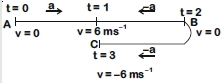
$A$ toy car with charge $q$ moves on a frictionless horizontal plane surface under the influence of a uniform electric field $\vec E$. Due to the force $q\vec E$,its velocity increases from $0$ to $6\, m s^{-1}$ in one second. At that instant,the direction of the field is reversed. The car continues to move for two more seconds under the influence of this field. The average velocity and the average speed of the toy car between $0$ to $3$ seconds are respectively:
A
$2\, m/s, 4\, m/s$
B
$1\, m/s, 3\, m/s$
C
$1.5\, m/s, 3\, m/s$
D
$1\, m/s, 3.5\, m/s$
Solution
(B) The acceleration $a$ is given by $a = \frac{v - u}{t} = \frac{6 - 0}{1} = 6\, m s^{-2}$.
For the interval $t = 0$ to $t = 1\, s$:
The displacement $S_1 = u t + \frac{1}{2} a t^2 = 0 + \frac{1}{2} \times 6 \times (1)^2 = 3\, m$.
At $t = 1\, s$,the field is reversed,so the new acceleration is $a' = -6\, m s^{-2}$.
For the interval $t = 1\, s$ to $t = 2\, s$:
The displacement $S_2 = v_1 t + \frac{1}{2} a' t^2 = 6 \times 1 + \frac{1}{2} \times (-6) \times (1)^2 = 6 - 3 = 3\, m$.
For the interval $t = 2\, s$ to $t = 3\, s$:
The velocity at $t = 2\, s$ is $v_2 = v_1 + a' t = 6 + (-6) \times 1 = 0\, m s^{-1}$.
The displacement $S_3 = v_2 t + \frac{1}{2} a' t^2 = 0 \times 1 + \frac{1}{2} \times (-6) \times (1)^2 = -3\, m$.
Total displacement $S = S_1 + S_2 + S_3 = 3 + 3 - 3 = 3\, m$.
Average velocity = $\frac{\text{Total displacement}}{\text{Total time}} = \frac{3}{3} = 1\, m s^{-1}$.
Total distance = $|S_1| + |S_2| + |S_3| = 3 + 3 + 3 = 9\, m$.
Average speed = $\frac{\text{Total distance}}{\text{Total time}} = \frac{9}{3} = 3\, m s^{-1}$.
For the interval $t = 0$ to $t = 1\, s$:
The displacement $S_1 = u t + \frac{1}{2} a t^2 = 0 + \frac{1}{2} \times 6 \times (1)^2 = 3\, m$.
At $t = 1\, s$,the field is reversed,so the new acceleration is $a' = -6\, m s^{-2}$.
For the interval $t = 1\, s$ to $t = 2\, s$:
The displacement $S_2 = v_1 t + \frac{1}{2} a' t^2 = 6 \times 1 + \frac{1}{2} \times (-6) \times (1)^2 = 6 - 3 = 3\, m$.
For the interval $t = 2\, s$ to $t = 3\, s$:
The velocity at $t = 2\, s$ is $v_2 = v_1 + a' t = 6 + (-6) \times 1 = 0\, m s^{-1}$.
The displacement $S_3 = v_2 t + \frac{1}{2} a' t^2 = 0 \times 1 + \frac{1}{2} \times (-6) \times (1)^2 = -3\, m$.
Total displacement $S = S_1 + S_2 + S_3 = 3 + 3 - 3 = 3\, m$.
Average velocity = $\frac{\text{Total displacement}}{\text{Total time}} = \frac{3}{3} = 1\, m s^{-1}$.
Total distance = $|S_1| + |S_2| + |S_3| = 3 + 3 + 3 = 9\, m$.
Average speed = $\frac{\text{Total distance}}{\text{Total time}} = \frac{9}{3} = 3\, m s^{-1}$.
0 likesView Solution
25
PhysicsMediumMCQNEET · 2018
$A$ set of $n$ equal resistors,each of value $R$,are connected in series to a battery of emf $E$ and internal resistance $R$. The current drawn is $I$. Now,the $n$ resistors are connected in parallel to the same battery. The current drawn from the battery becomes $10I$. The value of $n$ is:
A
$10$
B
$11$
C
$9$
D
$20$
Solution
(A) When $n$ resistors of resistance $R$ are connected in series,the equivalent resistance is $n R$. The total resistance of the circuit including the internal resistance $R$ is $(n R + R)$.
Thus,the current $I$ is given by $I = \frac{E}{n R + R} = \frac{E}{R(n + 1)}$ .....$(i)$
When $n$ resistors are connected in parallel,the equivalent resistance is $R/n$. The total resistance of the circuit is $(R/n + R)$.
Thus,the new current $10I$ is given by $10I = \frac{E}{R/n + R} = \frac{E}{R(\frac{1+n}{n})} = \frac{nE}{R(n+1)}$ .....$(ii)$
Dividing equation $(ii)$ by equation $(i)$:
$\frac{10I}{I} = \frac{nE / R(n+1)}{E / R(n+1)}$
$10 = n$
Therefore,the value of $n$ is $10$.
Thus,the current $I$ is given by $I = \frac{E}{n R + R} = \frac{E}{R(n + 1)}$ .....$(i)$
When $n$ resistors are connected in parallel,the equivalent resistance is $R/n$. The total resistance of the circuit is $(R/n + R)$.
Thus,the new current $10I$ is given by $10I = \frac{E}{R/n + R} = \frac{E}{R(\frac{1+n}{n})} = \frac{nE}{R(n+1)}$ .....$(ii)$
Dividing equation $(ii)$ by equation $(i)$:
$\frac{10I}{I} = \frac{nE / R(n+1)}{E / R(n+1)}$
$10 = n$
Therefore,the value of $n$ is $10$.
0 likesView Solution
26
PhysicsMediumMCQNEET · 2018
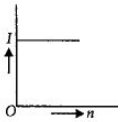
$A$ battery consists of a variable number $n$ of identical cells (each having electromotive force $\varepsilon$ and internal resistance $r$) which are connected in series. The terminals of the battery are short-circuited and the current $I$ is measured. Which of the graphs shows the correct relationship between $I$ and $n\,?$
A
B
C
D
Solution
(A) When $n$ identical cells,each with electromotive force $\varepsilon$ and internal resistance $r$,are connected in series,the total electromotive force of the battery is $n\varepsilon$ and the total internal resistance is $nr$.
When the terminals are short-circuited,the current $I$ flowing through the circuit is given by Ohm's law:
$I = \frac{\text{Total EMF}}{\text{Total Resistance}} = \frac{n\varepsilon}{nr} = \frac{\varepsilon}{r}$
Since $\varepsilon$ and $r$ are constants for the given cells,the current $I$ is independent of the number of cells $n$. Thus,the graph of $I$ versus $n$ is a horizontal straight line,which corresponds to Graph $A$.
When the terminals are short-circuited,the current $I$ flowing through the circuit is given by Ohm's law:
$I = \frac{\text{Total EMF}}{\text{Total Resistance}} = \frac{n\varepsilon}{nr} = \frac{\varepsilon}{r}$
Since $\varepsilon$ and $r$ are constants for the given cells,the current $I$ is independent of the number of cells $n$. Thus,the graph of $I$ versus $n$ is a horizontal straight line,which corresponds to Graph $A$.
0 likesView Solution
27
PhysicsMediumMCQNEET · 2018
Current sensitivity of a moving coil galvanometer is $5\,div/mA$ and its voltage sensitivity (angular deflection per unit voltage applied) is $20\,div/V$. The resistance of the galvanometer is ................. $\Omega$.
A
$40$
B
$25$
C
$500$
D
$250$
Solution
(D) Current sensitivity $(I_s)$ is defined as the deflection per unit current: $I_s = \frac{\theta}{I}$.
Voltage sensitivity $(V_s)$ is defined as the deflection per unit voltage: $V_s = \frac{\theta}{V}$.
Since $V = IR$,where $R$ is the resistance of the galvanometer $(R_G)$,we have $V_s = \frac{\theta}{I R_G} = \frac{I_s}{R_G}$.
Therefore,the resistance of the galvanometer is $R_G = \frac{I_s}{V_s}$.
Given: $I_s = 5\,div/mA = 5\,div/(10^{-3}\,A) = 5000\,div/A$.
Given: $V_s = 20\,div/V$.
Substituting the values: $R_G = \frac{5000}{20} = 250\,\Omega$.
Voltage sensitivity $(V_s)$ is defined as the deflection per unit voltage: $V_s = \frac{\theta}{V}$.
Since $V = IR$,where $R$ is the resistance of the galvanometer $(R_G)$,we have $V_s = \frac{\theta}{I R_G} = \frac{I_s}{R_G}$.
Therefore,the resistance of the galvanometer is $R_G = \frac{I_s}{V_s}$.
Given: $I_s = 5\,div/mA = 5\,div/(10^{-3}\,A) = 5000\,div/A$.
Given: $V_s = 20\,div/V$.
Substituting the values: $R_G = \frac{5000}{20} = 250\,\Omega$.
0 likesView Solution
28
PhysicsEasyMCQNEET · 2018
$A$ thin diamagnetic rod is placed vertically between the poles of an electromagnet. When the current in the electromagnet is switched on,the diamagnetic rod is pushed up,out of the horizontal magnetic field. Hence,the rod gains gravitational potential energy. The work required to do this comes from:
A
The current source
B
The magnetic field
C
The induced electric field due to the changing magnetic field
D
The lattice structure of the material of the rod
Solution
(A) When the current in the electromagnet is switched on,it creates a non-uniform magnetic field. Diamagnetic materials are weakly repelled by magnetic fields and tend to move from regions of stronger magnetic field to regions of weaker magnetic field. As the rod is pushed upward against gravity,it gains gravitational potential energy. This energy is supplied by the external current source that maintains the magnetic field in the electromagnet.
0 likesView Solution
29
PhysicsMediumMCQNEET · 2018
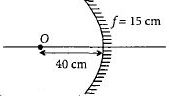
An object is placed at a distance of $40 \, cm$ from a concave mirror of focal length $15 \, cm$. If the object is displaced through a distance of $20 \, cm$ towards the mirror,the displacement of the image will be:
A
$30 \, cm$ away from the mirror
B
$36 \, cm$ away from the mirror
C
$36 \, cm$ towards the mirror
D
$30 \, cm$ towards the mirror
Solution
(B) Using the mirror formula,$\frac{1}{f} = \frac{1}{v} + \frac{1}{u}$.
For a concave mirror,$f = -15 \, cm$.
Initially,the object distance $u_1 = -40 \, cm$.
$\frac{1}{-15} = \frac{1}{v_1} + \frac{1}{-40} \Rightarrow \frac{1}{v_1} = \frac{1}{40} - \frac{1}{15} = \frac{3 - 8}{120} = \frac{-5}{120} = -\frac{1}{24}$.
So,$v_1 = -24 \, cm$ (image is $24 \, cm$ in front of the mirror).
When the object is displaced by $20 \, cm$ towards the mirror,the new object distance $u_2 = -(40 - 20) = -20 \, cm$.
$\frac{1}{-15} = \frac{1}{v_2} + \frac{1}{-20} \Rightarrow \frac{1}{v_2} = \frac{1}{20} - \frac{1}{15} = \frac{3 - 4}{60} = -\frac{1}{60}$.
So,$v_2 = -60 \, cm$ (image is $60 \, cm$ in front of the mirror).
The displacement of the image is $|v_2 - v_1| = |-60 - (-24)| = |-36| = 36 \, cm$.
Since the magnitude of the image distance increased,the image shifts $36 \, cm$ away from the mirror.
For a concave mirror,$f = -15 \, cm$.
Initially,the object distance $u_1 = -40 \, cm$.
$\frac{1}{-15} = \frac{1}{v_1} + \frac{1}{-40} \Rightarrow \frac{1}{v_1} = \frac{1}{40} - \frac{1}{15} = \frac{3 - 8}{120} = \frac{-5}{120} = -\frac{1}{24}$.
So,$v_1 = -24 \, cm$ (image is $24 \, cm$ in front of the mirror).
When the object is displaced by $20 \, cm$ towards the mirror,the new object distance $u_2 = -(40 - 20) = -20 \, cm$.
$\frac{1}{-15} = \frac{1}{v_2} + \frac{1}{-20} \Rightarrow \frac{1}{v_2} = \frac{1}{20} - \frac{1}{15} = \frac{3 - 4}{60} = -\frac{1}{60}$.
So,$v_2 = -60 \, cm$ (image is $60 \, cm$ in front of the mirror).
The displacement of the image is $|v_2 - v_1| = |-60 - (-24)| = |-36| = 36 \, cm$.
Since the magnitude of the image distance increased,the image shifts $36 \, cm$ away from the mirror.
0 likesView Solution
30
PhysicsMediumMCQNEET · 2018
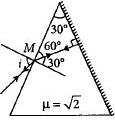
The refractive index of the material of a prism is $\sqrt{2}$ and the angle of the prism is $30^{\circ}$. One of the two refracting surfaces of the prism is made a mirror inwards,by silver coating. $A$ beam of monochromatic light entering the prism from the other face will retrace its path (after reflection from the silvered surface) if its angle of incidence on the prism is (in $^{\circ}$)
A
$60$
B
$45$
C
$0$
D
$30$
Solution
(B) For the light ray to retrace its path,it must strike the silvered surface normally (at an angle of $90^{\circ}$ to the surface).
Let the angle of incidence at the first surface be $i$ and the angle of refraction be $r_1$. The angle of the prism is $A = 30^{\circ}$.
Since the ray strikes the second surface normally,the angle of refraction at the second surface is $r_2 = 0^{\circ}$.
From the prism formula,$A = r_1 + r_2$,we have $30^{\circ} = r_1 + 0^{\circ}$,so $r_1 = 30^{\circ}$.
Applying Snell's law at the first surface:
$\mu = \frac{\sin i}{\sin r_1}$
$\sqrt{2} = \frac{\sin i}{\sin 30^{\circ}}$
$\sin i = \sqrt{2} \times \sin 30^{\circ} = \sqrt{2} \times \frac{1}{2} = \frac{1}{\sqrt{2}}$
Therefore,$i = 45^{\circ}$.
Let the angle of incidence at the first surface be $i$ and the angle of refraction be $r_1$. The angle of the prism is $A = 30^{\circ}$.
Since the ray strikes the second surface normally,the angle of refraction at the second surface is $r_2 = 0^{\circ}$.
From the prism formula,$A = r_1 + r_2$,we have $30^{\circ} = r_1 + 0^{\circ}$,so $r_1 = 30^{\circ}$.
Applying Snell's law at the first surface:
$\mu = \frac{\sin i}{\sin r_1}$
$\sqrt{2} = \frac{\sin i}{\sin 30^{\circ}}$
$\sin i = \sqrt{2} \times \sin 30^{\circ} = \sqrt{2} \times \frac{1}{2} = \frac{1}{\sqrt{2}}$
Therefore,$i = 45^{\circ}$.
0 likesView Solution
31
PhysicsEasyMCQNEET · 2018
An astronomical refracting telescope will have large angular magnification and high angular resolution when it has an objective lens of
A
small focal length and large diameter
B
large focal length and small diameter
C
small focal length and small diameter
D
large focal length and large diameter
Solution
(D) For an astronomical telescope,the angular magnification $M$ is given by $M = \frac{f_o}{f_e}$,where $f_o$ is the focal length of the objective lens and $f_e$ is the focal length of the eyepiece.
To achieve a large angular magnification,the objective lens must have a large focal length $f_o$.
The angular resolution of a telescope is given by $\theta = \frac{1.22 \lambda}{D}$,where $D$ is the diameter of the objective lens and $\lambda$ is the wavelength of light.
To achieve high angular resolution,the value of $\theta$ must be small,which implies that the diameter $D$ of the objective lens must be large.
Therefore,an astronomical refracting telescope requires an objective lens with a large focal length and a large diameter.
To achieve a large angular magnification,the objective lens must have a large focal length $f_o$.
The angular resolution of a telescope is given by $\theta = \frac{1.22 \lambda}{D}$,where $D$ is the diameter of the objective lens and $\lambda$ is the wavelength of light.
To achieve high angular resolution,the value of $\theta$ must be small,which implies that the diameter $D$ of the objective lens must be large.
Therefore,an astronomical refracting telescope requires an objective lens with a large focal length and a large diameter.
0 likesView Solution
32
PhysicsDifficultMCQNEET · 2018
An electron of mass $m$ with an initial velocity $\vec{V} = V_0 \hat{i} \,(V_0 > 0)$ enters an electric field $\vec{E} = -E_0 \hat{i} \,(E_0 = \text{constant} > 0)$ at $t = 0$. If $\lambda_0$ is its de-Broglie wavelength initially,then its de-Broglie wavelength at time $t$ is:
A
$\frac{\lambda_0}{\left(1 + \frac{eE_0}{mV_0}t\right)}$
B
$\lambda_0 \left(1 + \frac{eE_0}{mV_0}t\right)$
C
$\lambda_0$
D
$\lambda_0 t$
Solution
(A) The force acting on the electron due to the electric field is $\vec{F} = q\vec{E} = (-e)(-E_0 \hat{i}) = eE_0 \hat{i}$.
The acceleration produced in the electron is $\vec{a} = \frac{\vec{F}}{m} = \frac{eE_0}{m} \hat{i}$.
The velocity of the electron at time $t$ is given by $\vec{v}_t = \vec{v} + \vec{a}t = \left(V_0 + \frac{eE_0}{m}t\right) \hat{i}$.
The magnitude of the velocity is $v_t = V_0 + \frac{eE_0}{m}t = V_0 \left(1 + \frac{eE_0}{mV_0}t\right)$.
The de-Broglie wavelength at time $t$ is $\lambda_t = \frac{h}{mv_t}$.
Substituting $v_t$,we get $\lambda_t = \frac{h}{m V_0 \left(1 + \frac{eE_0}{mV_0}t\right)}$.
Since the initial de-Broglie wavelength is $\lambda_0 = \frac{h}{mV_0}$,we have $\lambda_t = \frac{\lambda_0}{\left(1 + \frac{eE_0}{mV_0}t\right)}$.
The acceleration produced in the electron is $\vec{a} = \frac{\vec{F}}{m} = \frac{eE_0}{m} \hat{i}$.
The velocity of the electron at time $t$ is given by $\vec{v}_t = \vec{v} + \vec{a}t = \left(V_0 + \frac{eE_0}{m}t\right) \hat{i}$.
The magnitude of the velocity is $v_t = V_0 + \frac{eE_0}{m}t = V_0 \left(1 + \frac{eE_0}{mV_0}t\right)$.
The de-Broglie wavelength at time $t$ is $\lambda_t = \frac{h}{mv_t}$.
Substituting $v_t$,we get $\lambda_t = \frac{h}{m V_0 \left(1 + \frac{eE_0}{mV_0}t\right)}$.
Since the initial de-Broglie wavelength is $\lambda_0 = \frac{h}{mV_0}$,we have $\lambda_t = \frac{\lambda_0}{\left(1 + \frac{eE_0}{mV_0}t\right)}$.
0 likesView Solution
33
PhysicsMediumMCQNEET · 2018
When the light of frequency $2v_0$ (where $v_0$ is threshold frequency) is incident on a metal plate,the maximum velocity of electrons emitted is $v_1$. When the frequency of the incident radiation is increased to $5v_0$,the maximum velocity of electrons emitted from the same plate is $v_2$. The ratio of $v_1$ to $v_2$ is
A
$1:2$
B
$1:4$
C
$2:1$
D
$4:1$
Solution
(A) According to Einstein's photoelectric equation,$K_{max} = h\nu - W_0 = \frac{1}{2}mv^2$,where $W_0 = h\nu_0$.
For frequency $2\nu_0$:
$h(2\nu_0) = h\nu_0 + \frac{1}{2}mv_1^2$
$h\nu_0 = \frac{1}{2}mv_1^2$ ..... $(i)$
For frequency $5\nu_0$:
$h(5\nu_0) = h\nu_0 + \frac{1}{2}mv_2^2$
$4h\nu_0 = \frac{1}{2}mv_2^2$ ..... $(ii)$
Dividing equation $(i)$ by $(ii)$:
$\frac{h\nu_0}{4h\nu_0} = \frac{\frac{1}{2}mv_1^2}{\frac{1}{2}mv_2^2}$
$\frac{1}{4} = \frac{v_1^2}{v_2^2}$
Taking the square root on both sides:
$\frac{v_1}{v_2} = \frac{1}{2}$
Thus,the ratio is $1:2$.
For frequency $2\nu_0$:
$h(2\nu_0) = h\nu_0 + \frac{1}{2}mv_1^2$
$h\nu_0 = \frac{1}{2}mv_1^2$ ..... $(i)$
For frequency $5\nu_0$:
$h(5\nu_0) = h\nu_0 + \frac{1}{2}mv_2^2$
$4h\nu_0 = \frac{1}{2}mv_2^2$ ..... $(ii)$
Dividing equation $(i)$ by $(ii)$:
$\frac{h\nu_0}{4h\nu_0} = \frac{\frac{1}{2}mv_1^2}{\frac{1}{2}mv_2^2}$
$\frac{1}{4} = \frac{v_1^2}{v_2^2}$
Taking the square root on both sides:
$\frac{v_1}{v_2} = \frac{1}{2}$
Thus,the ratio is $1:2$.
0 likesView Solution
34
PhysicsMediumMCQNEET · 2018
The magnetic potential energy stored in a certain inductor is $25\, mJ,$ when the current in the inductor is $60\, mA.$ This inductor is of inductance ......$H$.
A
$0.138$
B
$138.88$
C
$13.89$
D
$1.389$
Solution
(C) The magnetic potential energy $U$ stored in an inductor of inductance $L$ carrying current $I$ is given by the formula:
$U = \frac{1}{2} L I^{2}$
Given:
$U = 25\, mJ = 25 \times 10^{-3}\, J$
$I = 60\, mA = 60 \times 10^{-3}\, A = 6 \times 10^{-2}\, A$
Substituting the values into the formula:
$25 \times 10^{-3} = \frac{1}{2} \times L \times (6 \times 10^{-2})^{2}$
$25 \times 10^{-3} = \frac{1}{2} \times L \times 36 \times 10^{-4}$
$25 \times 10^{-3} = L \times 18 \times 10^{-4}$
$L = \frac{25 \times 10^{-3}}{18 \times 10^{-4}}$
$L = \frac{250}{18} = 13.888...\, H \approx 13.89\, H$.
$U = \frac{1}{2} L I^{2}$
Given:
$U = 25\, mJ = 25 \times 10^{-3}\, J$
$I = 60\, mA = 60 \times 10^{-3}\, A = 6 \times 10^{-2}\, A$
Substituting the values into the formula:
$25 \times 10^{-3} = \frac{1}{2} \times L \times (6 \times 10^{-2})^{2}$
$25 \times 10^{-3} = \frac{1}{2} \times L \times 36 \times 10^{-4}$
$25 \times 10^{-3} = L \times 18 \times 10^{-4}$
$L = \frac{25 \times 10^{-3}}{18 \times 10^{-4}}$
$L = \frac{250}{18} = 13.888...\, H \approx 13.89\, H$.
0 likesView Solution
35
PhysicsMediumMCQNEET · 2018
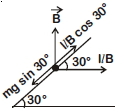
$A$ metallic rod of mass per unit length $0.5\; kg\; m^{-1}$ is lying horizontally on a smooth inclined plane which makes an angle of $30^{\circ}$ with the horizontal. The rod is prevented from sliding down by passing a current through it,while a magnetic field of induction $0.25\; T$ acts on it in the vertical direction. The current flowing in the rod to keep it stationary is: (in $; A$)
A
$7.14$
B
$5.98$
C
$11.32$
D
$14.76$
Solution
(C) The force due to gravity acting down the incline is $F_g = mg \sin 30^{\circ}$.
The magnetic force acting on the rod is $F_m = IlB$,which acts horizontally. The component of this magnetic force acting up the incline is $F_{m, \text{up}} = IlB \cos 30^{\circ}$.
For the rod to remain stationary,the forces along the incline must balance:
$mg \sin 30^{\circ} = IlB \cos 30^{\circ}$
Rearranging for current $I$:
$I = \frac{mg}{lB} \tan 30^{\circ}$
Given mass per unit length $\frac{m}{l} = 0.5\; kg\; m^{-1}$,$B = 0.25\; T$,and $g = 9.8\; m/s^2$:
$I = \frac{0.5 \times 9.8}{0.25} \times \tan 30^{\circ}$
$I = 2 \times 9.8 \times \frac{1}{\sqrt{3}}$
$I = \frac{19.6}{1.732} \approx 11.32\; A$
The magnetic force acting on the rod is $F_m = IlB$,which acts horizontally. The component of this magnetic force acting up the incline is $F_{m, \text{up}} = IlB \cos 30^{\circ}$.
For the rod to remain stationary,the forces along the incline must balance:
$mg \sin 30^{\circ} = IlB \cos 30^{\circ}$
Rearranging for current $I$:
$I = \frac{mg}{lB} \tan 30^{\circ}$
Given mass per unit length $\frac{m}{l} = 0.5\; kg\; m^{-1}$,$B = 0.25\; T$,and $g = 9.8\; m/s^2$:
$I = \frac{0.5 \times 9.8}{0.25} \times \tan 30^{\circ}$
$I = 2 \times 9.8 \times \frac{1}{\sqrt{3}}$
$I = \frac{19.6}{1.732} \approx 11.32\; A$
2 likesView Solution
36
PhysicsDifficultMCQNEET · 2018
An inductor $20 \, mH$,a capacitor $100 \, \mu F$ and a resistor $50 \, \Omega$ are connected in series across a source of emf,$V = 10 \sin(314 \, t)$. The power loss in the circuit is ...... $W$.
A
$0.79$
B
$0.43$
C
$1.13$
D
$2.74$
Solution
(A) The given values are $L = 20 \, mH = 20 \times 10^{-3} \, H$,$C = 100 \, \mu F = 100 \times 10^{-6} \, F$,$R = 50 \, \Omega$,and $V = 10 \sin(314 \, t)$.
Comparing with $V = V_0 \sin(\omega t)$,we get $V_0 = 10 \, V$ and $\omega = 314 \, rad/s$.
The inductive reactance is $X_L = \omega L = 314 \times 20 \times 10^{-3} = 6.28 \, \Omega$.
The capacitive reactance is $X_C = \frac{1}{\omega C} = \frac{1}{314 \times 100 \times 10^{-6}} = \frac{1}{0.0314} \approx 31.85 \, \Omega$.
The impedance $Z$ is given by $Z = \sqrt{R^2 + (X_C - X_L)^2} = \sqrt{50^2 + (31.85 - 6.28)^2} = \sqrt{2500 + (25.57)^2} = \sqrt{2500 + 653.8} = \sqrt{3153.8} \approx 56.16 \, \Omega$.
The $RMS$ voltage is $V_{rms} = \frac{V_0}{\sqrt{2}} = \frac{10}{\sqrt{2}} \, V$.
The power loss $P_{av}$ is given by $P_{av} = I_{rms}^2 R = \left(\frac{V_{rms}}{Z}\right)^2 R = \left(\frac{10}{\sqrt{2} \times 56.16}\right)^2 \times 50$.
$P_{av} = \left(\frac{10}{79.42}\right)^2 \times 50 = (0.1259)^2 \times 50 = 0.01585 \times 50 \approx 0.79 \, W$.
Comparing with $V = V_0 \sin(\omega t)$,we get $V_0 = 10 \, V$ and $\omega = 314 \, rad/s$.
The inductive reactance is $X_L = \omega L = 314 \times 20 \times 10^{-3} = 6.28 \, \Omega$.
The capacitive reactance is $X_C = \frac{1}{\omega C} = \frac{1}{314 \times 100 \times 10^{-6}} = \frac{1}{0.0314} \approx 31.85 \, \Omega$.
The impedance $Z$ is given by $Z = \sqrt{R^2 + (X_C - X_L)^2} = \sqrt{50^2 + (31.85 - 6.28)^2} = \sqrt{2500 + (25.57)^2} = \sqrt{2500 + 653.8} = \sqrt{3153.8} \approx 56.16 \, \Omega$.
The $RMS$ voltage is $V_{rms} = \frac{V_0}{\sqrt{2}} = \frac{10}{\sqrt{2}} \, V$.
The power loss $P_{av}$ is given by $P_{av} = I_{rms}^2 R = \left(\frac{V_{rms}}{Z}\right)^2 R = \left(\frac{10}{\sqrt{2} \times 56.16}\right)^2 \times 50$.
$P_{av} = \left(\frac{10}{79.42}\right)^2 \times 50 = (0.1259)^2 \times 50 = 0.01585 \times 50 \approx 0.79 \, W$.
0 likesView Solution
37
PhysicsEasyMCQNEET · 2018
An electromagnetic $(EM)$ wave is propagating in a medium with a velocity $\vec{v} = v\hat{i}$. The instantaneous oscillating electric field of this $EM$ wave is along the $+y$ axis. Then the direction of the oscillating magnetic field of the $EM$ wave will be along:
A
$-z$ direction
B
$+z$ direction
C
$-x$ direction
D
$-y$ direction
Solution
(B) The direction of propagation of an electromagnetic wave is given by the direction of the Poynting vector,which is $\vec{S} \propto \vec{E} \times \vec{B}$.
Given that the velocity $\vec{v}$ is along the $+x$ axis $(\hat{i})$ and the electric field $\vec{E}$ is along the $+y$ axis $(\hat{j})$.
We know that $\vec{v} \parallel (\vec{E} \times \vec{B})$.
Substituting the known directions: $\hat{i} = \hat{j} \times \vec{B}_{dir}$.
Using the properties of unit vectors in a Cartesian coordinate system,we know that $\hat{j} \times \hat{k} = \hat{i}$.
Therefore,the direction of the magnetic field $\vec{B}$ must be along the $+z$ axis $(\hat{k})$.
Thus,the oscillating magnetic field is along the $+z$ direction.
Given that the velocity $\vec{v}$ is along the $+x$ axis $(\hat{i})$ and the electric field $\vec{E}$ is along the $+y$ axis $(\hat{j})$.
We know that $\vec{v} \parallel (\vec{E} \times \vec{B})$.
Substituting the known directions: $\hat{i} = \hat{j} \times \vec{B}_{dir}$.
Using the properties of unit vectors in a Cartesian coordinate system,we know that $\hat{j} \times \hat{k} = \hat{i}$.
Therefore,the direction of the magnetic field $\vec{B}$ must be along the $+z$ axis $(\hat{k})$.
Thus,the oscillating magnetic field is along the $+z$ direction.
0 likesView Solution
38
PhysicsMediumMCQNEET · 2018
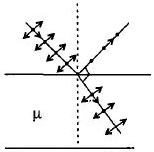
Unpolarised light is incident from air on a plane surface of a material of refractive index $\mu$. At a particular angle of incidence $i$,it is found that the reflected and refracted rays are perpendicular to each other. Which of the following options is correct for this situation?
A
Reflected light is polarised with its electric vector parallel to the plane of incidence
B
Reflected light is polarised with its electric vector perpendicular to the plane of incidence
C
$i = \tan^{-1}(1/\mu)$
D
$i = \sin^{-1}(1/\mu)$
Solution
(B) When the reflected and refracted rays are perpendicular to each other,the angle of incidence $i$ is known as the Brewster angle $(i_B)$.
According to Brewster's law,the refractive index $\mu$ is given by $\mu = \tan(i_B)$.
In this condition,the reflected light is completely plane-polarised,and its electric field vector is perpendicular to the plane of incidence.
According to Brewster's law,the refractive index $\mu$ is given by $\mu = \tan(i_B)$.
In this condition,the reflected light is completely plane-polarised,and its electric field vector is perpendicular to the plane of incidence.
0 likesView Solution
39
PhysicsMediumMCQNEET · 2018
In Young's double slit experiment,the separation $d$ between the slits is $2 \ mm$,the wavelength $\lambda$ of the light used is $5896 \ \mathring{A}$,and the distance $D$ between the screen and slits is $100 \ cm$. It is found that the angular width of the fringes is $0.20^\circ$. To increase the fringe angular width to $0.21^\circ$ (with the same $\lambda$ and $D$),the separation between the slits needs to be changed to ...... $mm$.
A
$1.8$
B
$1.9$
C
$1.7$
D
$2.1$
Solution
(B) The angular width $\theta$ of the fringes in Young's double slit experiment is given by the formula: $\theta = \frac{\lambda}{d}$.
Given the initial conditions: $\theta_1 = 0.20^\circ$ and $d_1 = 2 \ mm$.
So,$0.20^\circ = \frac{\lambda}{2 \ mm}$ .... $(i)$.
For the new condition: $\theta_2 = 0.21^\circ$ and $d_2 = d$.
So,$0.21^\circ = \frac{\lambda}{d}$ .... $(ii)$.
Dividing equation $(i)$ by equation $(ii)$,we get:
$\frac{0.20}{0.21} = \frac{d}{2 \ mm}$.
Solving for $d$:
$d = \frac{0.20 \times 2}{0.21} \ mm = \frac{0.40}{0.21} \ mm \approx 1.9047 \ mm$.
Rounding to the nearest provided option,$d = 1.9 \ mm$.
Given the initial conditions: $\theta_1 = 0.20^\circ$ and $d_1 = 2 \ mm$.
So,$0.20^\circ = \frac{\lambda}{2 \ mm}$ .... $(i)$.
For the new condition: $\theta_2 = 0.21^\circ$ and $d_2 = d$.
So,$0.21^\circ = \frac{\lambda}{d}$ .... $(ii)$.
Dividing equation $(i)$ by equation $(ii)$,we get:
$\frac{0.20}{0.21} = \frac{d}{2 \ mm}$.
Solving for $d$:
$d = \frac{0.20 \times 2}{0.21} \ mm = \frac{0.40}{0.21} \ mm \approx 1.9047 \ mm$.
Rounding to the nearest provided option,$d = 1.9 \ mm$.
0 likesView Solution
40
PhysicsMediumMCQNEET · 2018
The ratio of kinetic energy to the total energy of an electron in a Bohr orbit of the hydrogen atom is
A
$1:1$
B
$1:-1$
C
$1:-2$
D
$2:-1$
Solution
(B) In a Bohr orbit of the hydrogen atom,the total energy $E$ is given by $E = -K$,where $K$ is the kinetic energy.
This relationship arises because the total energy is the sum of kinetic energy and potential energy,$E = K + U$,and for a Bohr orbit,$U = -2K$.
Therefore,$E = K + (-2K) = -K$.
Thus,the ratio of kinetic energy to total energy is $K/E = K/(-K) = 1:-1$.
This relationship arises because the total energy is the sum of kinetic energy and potential energy,$E = K + U$,and for a Bohr orbit,$U = -2K$.
Therefore,$E = K + (-2K) = -K$.
Thus,the ratio of kinetic energy to total energy is $K/E = K/(-K) = 1:-1$.
0 likesView Solution
41
PhysicsMediumMCQNEET · 2018
For a radioactive material,the half-life is $10$ minutes. If initially there are $600$ nuclei,the time taken (in minutes) for the disintegration of $450$ nuclei is:
A
$20$
B
$10$
C
$15$
D
$30$
Solution
(A) The number of nuclei remaining after disintegration is given by $N = N_{0} - N_{\text{disintegrated}}$.
Given $N_{0} = 600$ and $N_{\text{disintegrated}} = 450$,the remaining nuclei $N = 600 - 450 = 150$.
According to the law of radioactive decay,$\frac{N}{N_{0}} = \left(\frac{1}{2}\right)^{\frac{t}{T_{1/2}}}$,where $T_{1/2} = 10$ minutes.
Substituting the values: $\frac{150}{600} = \left(\frac{1}{2}\right)^{\frac{t}{10}}$.
This simplifies to $\frac{1}{4} = \left(\frac{1}{2}\right)^{\frac{t}{10}}$.
Since $\frac{1}{4} = \left(\frac{1}{2}\right)^{2}$,we have $\left(\frac{1}{2}\right)^{2} = \left(\frac{1}{2}\right)^{\frac{t}{10}}$.
Equating the exponents: $2 = \frac{t}{10}$,which gives $t = 20$ minutes.
Given $N_{0} = 600$ and $N_{\text{disintegrated}} = 450$,the remaining nuclei $N = 600 - 450 = 150$.
According to the law of radioactive decay,$\frac{N}{N_{0}} = \left(\frac{1}{2}\right)^{\frac{t}{T_{1/2}}}$,where $T_{1/2} = 10$ minutes.
Substituting the values: $\frac{150}{600} = \left(\frac{1}{2}\right)^{\frac{t}{10}}$.
This simplifies to $\frac{1}{4} = \left(\frac{1}{2}\right)^{\frac{t}{10}}$.
Since $\frac{1}{4} = \left(\frac{1}{2}\right)^{2}$,we have $\left(\frac{1}{2}\right)^{2} = \left(\frac{1}{2}\right)^{\frac{t}{10}}$.
Equating the exponents: $2 = \frac{t}{10}$,which gives $t = 20$ minutes.
0 likesView Solution
42
PhysicsDifficultMCQNEET · 2018
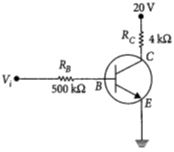
In the circuit shown in the figure,the input voltage $V_i$ is $20\, V$,$V_{BE} = 0$,and $V_{CE} = 0$. The values of $I_B$,$I_C$,and $\beta$ are given by:
A
$I_B=40\,\mu A$,$I_C=10\,mA$,$\beta=250$
B
$I_B=25\,\mu A$,$I_C=5\,mA$,$\beta=200$
C
$I_B=40\,\mu A$,$I_C=5\,mA$,$\beta=125$
D
$I_B=20\,\mu A$,$I_C=5\,mA$,$\beta=250$
Solution
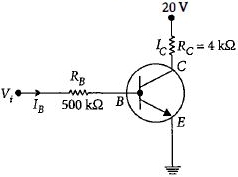
(C) Given: $V_{BE} = 0$,$V_{CE} = 0$,$V_i = 20\, V$,$R_B = 500\, k\Omega$,$R_C = 4\, k\Omega$.
For the output circuit (collector-emitter loop):
$V_{CC} = I_C R_C + V_{CE}$
Since $V_{CE} = 0$,we have:
$20\, V = I_C \times (4 \times 10^3\,\Omega) + 0$
$I_C = \frac{20}{4 \times 10^3} = 5 \times 10^{-3}\, A = 5\, mA$.
For the input circuit (base-emitter loop):
$V_i = I_B R_B + V_{BE}$
Since $V_{BE} = 0$,we have:
$20\, V = I_B \times (500 \times 10^3\,\Omega) + 0$
$I_B = \frac{20}{500 \times 10^3} = 40 \times 10^{-6}\, A = 40\,\mu A$.
The current gain $\beta$ is given by:
$\beta = \frac{I_C}{I_B} = \frac{5 \times 10^{-3}\, A}{40 \times 10^{-6}\, A} = \frac{5000}{40} = 125$.
For the output circuit (collector-emitter loop):
$V_{CC} = I_C R_C + V_{CE}$
Since $V_{CE} = 0$,we have:
$20\, V = I_C \times (4 \times 10^3\,\Omega) + 0$
$I_C = \frac{20}{4 \times 10^3} = 5 \times 10^{-3}\, A = 5\, mA$.
For the input circuit (base-emitter loop):
$V_i = I_B R_B + V_{BE}$
Since $V_{BE} = 0$,we have:
$20\, V = I_B \times (500 \times 10^3\,\Omega) + 0$
$I_B = \frac{20}{500 \times 10^3} = 40 \times 10^{-6}\, A = 40\,\mu A$.
The current gain $\beta$ is given by:
$\beta = \frac{I_C}{I_B} = \frac{5 \times 10^{-3}\, A}{40 \times 10^{-6}\, A} = \frac{5000}{40} = 125$.
0 likesView Solution
43
PhysicsEasyMCQNEET · 2018
In a $p-n$ junction diode,change in temperature due to heating
A
affects only reverse resistance
B
affects only forward resistance
C
affects the overall $V-I$ characteristics of $p-n$ junction
D
does not affect resistance of $p-n$ junction
Solution
(C) When the temperature of a $p-n$ junction diode increases,the thermal energy causes more covalent bonds to break,resulting in an increase in the number of electron-hole pairs.
This increase in charge carriers leads to a decrease in the resistance of the semiconductor material.
Consequently,both the forward current and the reverse saturation current are significantly affected.
Therefore,the overall $V-I$ characteristics of the $p-n$ junction diode are altered by the change in temperature.
This increase in charge carriers leads to a decrease in the resistance of the semiconductor material.
Consequently,both the forward current and the reverse saturation current are significantly affected.
Therefore,the overall $V-I$ characteristics of the $p-n$ junction diode are altered by the change in temperature.
0 likesView Solution
44
PhysicsDifficultMCQNEET · 2018
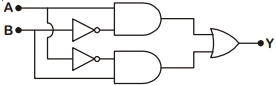
In the combination of the following gates,the output $Y$ can be written in terms of inputs $A$ and $B$ as
A
$\overline {A\cdot B} $
B
$A\cdot \overline {B} + \overline {A} \cdot B$
C
$\overline {A + B}$
D
$\overline {A\cdot B} + A\cdot B$
Solution
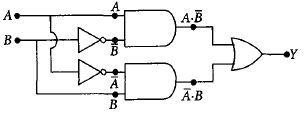
(B) The given circuit consists of two $AND$ gates,two $NOT$ gates,and one $OR$ gate.
$1$. The upper $AND$ gate receives inputs $A$ and $\overline{B}$ (since $B$ passes through a $NOT$ gate). Its output is $A \cdot \overline{B}$.
$2$. The lower $AND$ gate receives inputs $\overline{A}$ (since $A$ passes through a $NOT$ gate) and $B$. Its output is $\overline{A} \cdot B$.
$3$. These two outputs are fed into an $OR$ gate. Therefore,the final output $Y$ is the sum of these two expressions: $Y = A \cdot \overline{B} + \overline{A} \cdot B$.
This is the Boolean expression for an $XOR$ (Exclusive-$OR$) gate.
$1$. The upper $AND$ gate receives inputs $A$ and $\overline{B}$ (since $B$ passes through a $NOT$ gate). Its output is $A \cdot \overline{B}$.
$2$. The lower $AND$ gate receives inputs $\overline{A}$ (since $A$ passes through a $NOT$ gate) and $B$. Its output is $\overline{A} \cdot B$.
$3$. These two outputs are fed into an $OR$ gate. Therefore,the final output $Y$ is the sum of these two expressions: $Y = A \cdot \overline{B} + \overline{A} \cdot B$.
This is the Boolean expression for an $XOR$ (Exclusive-$OR$) gate.
0 likesView Solution
45
PhysicsEasyMCQNEET · 2018
$A$ carbon resistor of $(47 \pm 4.7) \; k\Omega$ is to be marked with rings of different colours for its identification. The colour code sequence will be:
A
Violet - Yellow - Orange - Silver
B
Green - Orange - Violet - Gold
C
Yellow - Violet - Orange - Silver
D
Yellow - Green - Violet - Gold
Solution
(C) The given resistance is $(47 \pm 4.7) \; k\Omega = 47 \times 10^3 \; \Omega \pm 10 \%$.
According to the carbon resistor color code:
$1$. The first digit is $4$, which corresponds to the color Yellow.
$2$. The second digit is $7$, which corresponds to the color Violet.
$3$. The multiplier is $10^3$, which corresponds to the color Orange.
$4$. The tolerance is $10 \%$, which corresponds to the color Silver.
Therefore, the color code sequence is Yellow - Violet - Orange - Silver.
According to the carbon resistor color code:
$1$. The first digit is $4$, which corresponds to the color Yellow.
$2$. The second digit is $7$, which corresponds to the color Violet.
$3$. The multiplier is $10^3$, which corresponds to the color Orange.
$4$. The tolerance is $10 \%$, which corresponds to the color Silver.
Therefore, the color code sequence is Yellow - Violet - Orange - Silver.
0 likesView Solution
Vedclass Products
For Students
Vedclass Test Series
Mock tests in real NEET style covering Physics with performance analysis. 5-day free trial.
Start Free TrialFor Teachers
Exam Paper Generator
Generate Set A/B/C/D Physics papers from 7.5L+ questions in 2 minutes. 3 chapters free.
Try FreeFor Institutes
Online Exam Module
Run live NEET mock exams with unlimited students, 360° analytics & white-label branding.
See DemoFrequently Asked Questions
How many Physics questions are in NEET 2018?
There are 45 Physics questions from the NEET 2018 paper on Vedclass, each with a detailed step-by-step solution in English.
Are NEET 2018 Physics solutions available in English?
Yes. All solutions on this page are in English. You can also switch to English or Hindi using the language buttons above the questions.
Can I practice NEET 2018 Physics as a timed test?
Yes. Use the Vedclass Test Series to attempt a full NEET mock test covering Physics with time limits and instant score analysis.
Can teachers create Physics papers from NEET previous year questions?
Yes. The Vedclass Exam Paper Generator lets teachers mix NEET Physics questions and generate Set A/B/C/D papers in minutes.
For Teachers & Institutes
Build a Custom Physics Paper
Pick NEET 2018 Physics questions, set difficulty, and generate Set A/B/C/D in 2 minutes.