
The graph which shows the variation of $\left(\frac{1}{\lambda^2}\right)$ and its kinetic energy,$E$ is (where $\lambda$ is de Broglie wavelength of a free particle):
- A
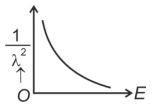
- B
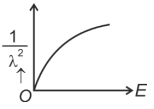
- C
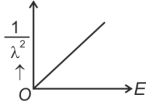
- D
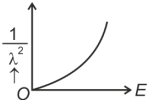
Explore More
Similar Questions
After absorbing a slowly moving neutron of mass $m_N$ (momentum $\approx 0$),a nucleus of mass $M$ breaks into two nuclei of masses $m_1$ and $3m_1$ $(4m_1 = M + m_N)$,respectively. If the de Broglie wavelength of the nucleus with mass $m_1$ is $\lambda$,then the de Broglie wavelength of the other nucleus will be:
Medium
View SolutionIf an electron and a photon propagate in the form of waves having the same wavelength,it implies that they have the same
The de-Broglie wavelength of an electron having $80 eV$ energy is nearly ($1 eV = 1.6 \times 10^{-19} J$,Mass of the electron $= 9 \times 10^{-31} kg$,Planck's constant $= 6.6 \times 10^{-34} J-s$). (in $Å$)
DifficultAP EAMCET 2001
View SolutionThe wavelength of a very fast-moving electron $(v \approx c)$ is:
Medium
View SolutionIf the kinetic energy of a free electron doubles,its de-Broglie wavelength $\lambda$ changes by a factor of:
Vedclass Products
For Students
Vedclass Test Series
Mock tests in real JEE/NEET style with performance analysis. 5-day free trial.
Start Free TrialFor Teachers
Exam Paper Generator
Generate Set A/B/C/D exam papers from 7.5L+ questions in 2 minutes. 3 chapters free.
Try FreeFor Institutes
Online Exam Module
Live online exams with unlimited students, 360° analytics & white-label branding.
See Demo