
ChemistryQ1–54 of 54 questions
Page 1 of 1 · English
1
ChemistryMediumMCQNEET · 2024
Match List-$I$ with List-$II$.
Choose the correct answer from the options given below:
| List-$I$ (Process) | List-$II$ (Conditions) |
| $A$. Isothermal process | $I$. No heat exchange |
| $B$. Isochoric process | $II$. Carried out at constant temperature |
| $C$. Isobaric process | $III$. Carried out at constant volume |
| $D$. Adiabatic process | $IV$. Carried out at constant pressure |
Choose the correct answer from the options given below:
A
$A-IV, B-II, C-III, D-I$
B
$A-I, B-II, C-III, D-IV$
C
$A-II, B-III, C-IV, D-I$
D
$A-IV, B-III, C-II, D-I$
Solution
(C) Isothermal process $\Rightarrow$ Temperature is constant throughout the process.
$(B)$ Isochoric process $\Rightarrow$ Volume is constant throughout the process.
$(C)$ Isobaric process $\Rightarrow$ Pressure is constant throughout the process.
$(D)$ Adiabatic process $\Rightarrow$ No exchange of heat $(q)$ between the system and surroundings.
Therefore,the correct matching is: $A-II, B-III, C-IV, D-I$.
$(B)$ Isochoric process $\Rightarrow$ Volume is constant throughout the process.
$(C)$ Isobaric process $\Rightarrow$ Pressure is constant throughout the process.
$(D)$ Adiabatic process $\Rightarrow$ No exchange of heat $(q)$ between the system and surroundings.
Therefore,the correct matching is: $A-II, B-III, C-IV, D-I$.
1 likesView Solution
2
ChemistryMediumMCQNEET · 2024
Arrange the following elements in increasing order of first ionization enthalpy:
$Li, Be, B, C, N$
Choose the correct answer from the options given below:
$Li, Be, B, C, N$
Choose the correct answer from the options given below:
A
$Li < B < Be < C < N$
B
$Li < Be < C < B < N$
C
$Li < Be < N < B < C$
D
$Li < Be < B < C < N$
Solution
(A) The first ionization enthalpy generally increases across a period from left to right due to an increase in effective nuclear charge.
However,there are exceptions due to electronic configuration stability:
$1$. $Be$ $(1s^2 2s^2)$ has a fully filled $2s$ orbital,making it more stable than $B$ $(1s^2 2s^2 2p^1)$,so $Be > B$.
$2$. $N$ $(1s^2 2s^2 2p^3)$ has a half-filled $2p$ subshell,which is more stable than $C$ $(1s^2 2s^2 2p^2)$,so $N > C$.
The correct increasing order is $Li < B < Be < C < N$.
However,there are exceptions due to electronic configuration stability:
$1$. $Be$ $(1s^2 2s^2)$ has a fully filled $2s$ orbital,making it more stable than $B$ $(1s^2 2s^2 2p^1)$,so $Be > B$.
$2$. $N$ $(1s^2 2s^2 2p^3)$ has a half-filled $2p$ subshell,which is more stable than $C$ $(1s^2 2s^2 2p^2)$,so $N > C$.
The correct increasing order is $Li < B < Be < C < N$.
| Element | First ionization enthalpy $(\Delta_i H / kJ \ mol^{-1})$ |
| $Li$ | $520$ |
| $Be$ | $899$ |
| $B$ | $801$ |
| $C$ | $1086$ |
| $N$ | $1402$ |
0 likesView Solution
3
ChemistryMediumMCQNEET · 2024
Match List-$I$ with List-$II$.
Choose the correct answer from the options given below:
| List-$I$ (Molecule) | List-$II$ (Number and types of bond/s between two carbon atoms) |
| $A.$ Ethane | $I.$ One $\sigma$-bond and two $\pi$-bonds |
| $B.$ Ethene | $II.$ Two $\pi$-bonds |
| $C.$ Carbon molecule,$C_2$ | $III.$ One $\sigma$-bond |
| $D.$ Ethyne | $IV.$ One $\sigma$-bond and one $\pi$-bond |
Choose the correct answer from the options given below:
A
$A-IV, B-III, C-II, D-I$
B
$A-III, B-IV, C-II, D-I$
C
$A-III, B-IV, C-I, D-II$
D
$A-I, B-IV, C-II, D-III$
Solution
(B) Ethane $(CH_3-CH_3)$ contains a single bond between two carbon atoms which is one $\sigma$-bond. Thus,$A-III$.
Ethene $(CH_2=CH_2)$ contains a double bond between two carbon atoms which consists of one $\sigma$-bond and one $\pi$-bond. Thus,$B-IV$.
Carbon molecule $(C_2)$ in its ground state,according to molecular orbital theory,has two $\pi$-bonds and no $\sigma$-bond between the two carbon atoms. Thus,$C-II$.
Ethyne $(HC \equiv CH)$ contains a triple bond between two carbon atoms which consists of one $\sigma$-bond and two $\pi$-bonds. Thus,$D-I$.
The correct matching is $A-III, B-IV, C-II, D-I$.
Ethene $(CH_2=CH_2)$ contains a double bond between two carbon atoms which consists of one $\sigma$-bond and one $\pi$-bond. Thus,$B-IV$.
Carbon molecule $(C_2)$ in its ground state,according to molecular orbital theory,has two $\pi$-bonds and no $\sigma$-bond between the two carbon atoms. Thus,$C-II$.
Ethyne $(HC \equiv CH)$ contains a triple bond between two carbon atoms which consists of one $\sigma$-bond and two $\pi$-bonds. Thus,$D-I$.
The correct matching is $A-III, B-IV, C-II, D-I$.
0 likesView Solution
4
ChemistryMediumMCQNEET · 2024
Arrange the following elements in increasing order of electronegativity:
$N, O, F, C, Si$
Choose the correct answer from the options given below:
$N, O, F, C, Si$
Choose the correct answer from the options given below:
A
$Si < C < O < N < F$
B
$O < F < N < C < Si$
C
$F < O < N < C < Si$
D
$Si < C < N < O < F$
Solution
(D) Electronegativity generally increases across a period from left to right and decreases down a group.
$Si$ is in period $3$,group $14$.
$C$ is in period $2$,group $14$.
$N, O, F$ are in period $2$,groups $15, 16, 17$ respectively.
Comparing $Si$ and $C$: $Si$ is below $C$,so $Si < C$.
Comparing elements in period $2$: Electronegativity increases as $C < N < O < F$.
Combining these,the order of increasing electronegativity is $Si < C < N < O < F$.
The correct option is $D$.
$Si$ is in period $3$,group $14$.
$C$ is in period $2$,group $14$.
$N, O, F$ are in period $2$,groups $15, 16, 17$ respectively.
Comparing $Si$ and $C$: $Si$ is below $C$,so $Si < C$.
Comparing elements in period $2$: Electronegativity increases as $C < N < O < F$.
Combining these,the order of increasing electronegativity is $Si < C < N < O < F$.
The correct option is $D$.
1 likesView Solution
5
ChemistryMediumMCQNEET · 2024
In which of the following processes does entropy increase?
$A$. $A$ liquid evaporates to vapour.
$B$. Temperature of a crystalline solid is lowered from $130 \ K$ to $0 \ K$.
$C$. $2 NaHCO_{3(s)} \rightarrow Na_2CO_{3(s)} + CO_{2(g)} + H_2O_{(g)}$
$D$. $Cl_{2(g)} \rightarrow 2 Cl_{(g)}$
Choose the correct answer from the options given below:
$A$. $A$ liquid evaporates to vapour.
$B$. Temperature of a crystalline solid is lowered from $130 \ K$ to $0 \ K$.
$C$. $2 NaHCO_{3(s)} \rightarrow Na_2CO_{3(s)} + CO_{2(g)} + H_2O_{(g)}$
$D$. $Cl_{2(g)} \rightarrow 2 Cl_{(g)}$
Choose the correct answer from the options given below:
A
$A, B$ and $D$
B
$A, C$ and $D$
C
$C$ and $D$
D
$A$ and $C$
Solution
(B) Entropy $(S)$ is a measure of the randomness or disorder of a system.
$A$. Evaporation of a liquid to vapour increases disorder,so entropy increases.
$B$. Lowering the temperature of a crystalline solid towards $0 \ K$ decreases the molecular motion and disorder,so entropy decreases.
$C$. $2 NaHCO_{3(s)} \rightarrow Na_2CO_{3(s)} + CO_{2(g)} + H_2O_{(g)}$. Here,solid reactants produce gaseous products,leading to an increase in the number of moles of gas and thus an increase in entropy.
$D$. $Cl_{2(g)} \rightarrow 2 Cl_{(g)}$. One mole of gaseous $Cl_2$ produces two moles of gaseous $Cl$ atoms,increasing the number of particles and disorder,so entropy increases.
Therefore,processes $A, C,$ and $D$ result in an increase in entropy.
$A$. Evaporation of a liquid to vapour increases disorder,so entropy increases.
$B$. Lowering the temperature of a crystalline solid towards $0 \ K$ decreases the molecular motion and disorder,so entropy decreases.
$C$. $2 NaHCO_{3(s)} \rightarrow Na_2CO_{3(s)} + CO_{2(g)} + H_2O_{(g)}$. Here,solid reactants produce gaseous products,leading to an increase in the number of moles of gas and thus an increase in entropy.
$D$. $Cl_{2(g)} \rightarrow 2 Cl_{(g)}$. One mole of gaseous $Cl_2$ produces two moles of gaseous $Cl$ atoms,increasing the number of particles and disorder,so entropy increases.
Therefore,processes $A, C,$ and $D$ result in an increase in entropy.
0 likesView Solution
6
ChemistryMediumMCQNEET · 2024
Given below are two statements:
Statement $I$ : The boiling point of three isomeric pentanes follows the order
$n$-pentane $>$ isopentane $>$ neopentane
Statement $II$ : When branching increases,the molecule attains a shape of sphere. This results in smaller surface area for contact,due to which the intermolecular forces between the spherical molecules are weak,thereby lowering the boiling point.
In the light of the above statements,choose the most appropriate answer from the options given below:
Statement $I$ : The boiling point of three isomeric pentanes follows the order
$n$-pentane $>$ isopentane $>$ neopentane
Statement $II$ : When branching increases,the molecule attains a shape of sphere. This results in smaller surface area for contact,due to which the intermolecular forces between the spherical molecules are weak,thereby lowering the boiling point.
In the light of the above statements,choose the most appropriate answer from the options given below:
A
Both Statement $I$ and Statement $II$ are incorrect
B
Statement $I$ is correct but Statement $II$ is incorrect
C
Statement $I$ is incorrect but Statement $II$ is correct
D
Both Statement $I$ and Statement $II$ are correct
Solution
(D) Both statement $I$ and statement $II$ are correct.
The boiling point of $n$-pentane is $309 \ K$.
The boiling point of isopentane is $301 \ K$.
The boiling point of neopentane is $282.5 \ K$.
As branching increases,molecules attain the shape of a sphere,resulting in a smaller surface area of contact.
Thus,weaker intermolecular forces (van der Waals forces) exist between spherical molecules,which are overcome at a relatively lower temperature,leading to a decrease in the boiling point.
The boiling point of $n$-pentane is $309 \ K$.
The boiling point of isopentane is $301 \ K$.
The boiling point of neopentane is $282.5 \ K$.
As branching increases,molecules attain the shape of a sphere,resulting in a smaller surface area of contact.
Thus,weaker intermolecular forces (van der Waals forces) exist between spherical molecules,which are overcome at a relatively lower temperature,leading to a decrease in the boiling point.
0 likesView Solution
7
ChemistryMediumMCQNEET · 2024
$1 \ g$ of sodium hydroxide was treated with $25 \ mL$ of $0.75 \ M \ HCl$ solution. The mass of sodium hydroxide left unreacted is equal to:
A
$250 \ mg$
B
Zero $mg$
C
$200 \ mg$
D
$750 \ mg$
Solution
(A) The chemical reaction is: $NaOH + HCl \longrightarrow NaCl + H_2O$
First,calculate the mass of $HCl$ in $25 \ mL$ of $0.75 \ M$ solution:
$Moles \ of \ HCl = Molarity \times Volume(L) = 0.75 \times 0.025 = 0.01875 \ mol$
Mass of $HCl = Moles \times Molar \ Mass = 0.01875 \times 36.5 \approx 0.684375 \ g$
According to the stoichiometry,$1 \ mol$ of $HCl$ reacts with $1 \ mol$ of $NaOH$ $(40 \ g)$:
$0.01875 \ mol \ HCl \ reacts \ with \ 0.01875 \ mol \ NaOH$
Mass of $NaOH$ reacted $= 0.01875 \times 40 = 0.75 \ g$
Mass of $NaOH$ left unreacted $= 1 \ g - 0.75 \ g = 0.25 \ g$
Since $1 \ g = 1000 \ mg$,the mass left is $0.25 \times 1000 = 250 \ mg$.
First,calculate the mass of $HCl$ in $25 \ mL$ of $0.75 \ M$ solution:
$Moles \ of \ HCl = Molarity \times Volume(L) = 0.75 \times 0.025 = 0.01875 \ mol$
Mass of $HCl = Moles \times Molar \ Mass = 0.01875 \times 36.5 \approx 0.684375 \ g$
According to the stoichiometry,$1 \ mol$ of $HCl$ reacts with $1 \ mol$ of $NaOH$ $(40 \ g)$:
$0.01875 \ mol \ HCl \ reacts \ with \ 0.01875 \ mol \ NaOH$
Mass of $NaOH$ reacted $= 0.01875 \times 40 = 0.75 \ g$
Mass of $NaOH$ left unreacted $= 1 \ g - 0.75 \ g = 0.25 \ g$
Since $1 \ g = 1000 \ mg$,the mass left is $0.25 \times 1000 = 250 \ mg$.
0 likesView Solution
8
ChemistryMediumMCQNEET · 2024
Intramolecular hydrogen bonding is present in
A
$p$-nitrophenol
B
$m$-nitrophenol
C
$HF$
D
$o$-nitrophenol
Solution
(D) Intramolecular hydrogen bonding occurs within a single molecule when a hydrogen atom is bonded to a highly electronegative atom (like $O$,$N$,or $F$) and is simultaneously attracted to another electronegative atom within the same molecule.
In $o$-nitrophenol,the hydroxyl group $(-OH)$ and the nitro group $(-NO_2)$ are at adjacent positions (ortho position). This allows the hydrogen atom of the $-OH$ group to form a hydrogen bond with one of the oxygen atoms of the $-NO_2$ group,resulting in a stable six-membered ring structure.
Therefore,intramolecular hydrogen bonding is present in $o$-nitrophenol.
In $o$-nitrophenol,the hydroxyl group $(-OH)$ and the nitro group $(-NO_2)$ are at adjacent positions (ortho position). This allows the hydrogen atom of the $-OH$ group to form a hydrogen bond with one of the oxygen atoms of the $-NO_2$ group,resulting in a stable six-membered ring structure.
Therefore,intramolecular hydrogen bonding is present in $o$-nitrophenol.
0 likesView Solution
9
ChemistryMediumMCQNEET · 2024
Match List-$I$ with List-$II$.
Choose the correct answer from the options given below:
| List-$I$ (Compound) | List-$II$ (Shape/geometry) |
| $A$. $NH_3$ | $I$. Trigonal Pyramidal |
| $B$. $BrF_5$ | $IV$. Square Pyramidal |
| $C$. $XeF_4$ | $II$. Square Planar |
| $D$. $SF_6$ | $III$. Octahedral |
Choose the correct answer from the options given below:
A
$A-II, B-IV, C-III, D-I$
B
$A-III, B-IV, C-I, D-II$
C
$A-II, B-III, C-IV, D-I$
D
$A-I, B-IV, C-II, D-III$
Solution
(D) $NH_3$: $sp^3$ hybridized with $1$ lone pair. The geometry is Trigonal Pyramidal $(A-I)$.
$BrF_5$: $sp^3d^2$ hybridized with $1$ lone pair. The geometry is Square Pyramidal $(B-IV)$.
$XeF_4$: $sp^3d^2$ hybridized with $2$ lone pairs. The geometry is Square Planar $(C-II)$.
$SF_6$: $sp^3d^2$ hybridized with $0$ lone pairs. The geometry is Octahedral $(D-III)$.
Therefore,the correct matching is $A-I, B-IV, C-II, D-III$.
$BrF_5$: $sp^3d^2$ hybridized with $1$ lone pair. The geometry is Square Pyramidal $(B-IV)$.
$XeF_4$: $sp^3d^2$ hybridized with $2$ lone pairs. The geometry is Square Planar $(C-II)$.
$SF_6$: $sp^3d^2$ hybridized with $0$ lone pairs. The geometry is Octahedral $(D-III)$.
Therefore,the correct matching is $A-I, B-IV, C-II, D-III$.
0 likesView Solution
10
ChemistryMediumMCQNEET · 2024
The most stable carbocation among the following is:
A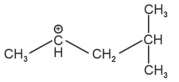
B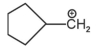
C
D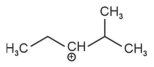
Solution
(C) The stability of a carbocation is determined by the number of $\alpha$-hydrogens,which relates to the extent of hyperconjugation. More $\alpha$-hydrogens lead to greater stability.
$1$. The first structure has $5 \ \alpha$-hydrogens.
$2$. The second structure (cyclopentylmethyl carbocation) has $1 \ \alpha$-hydrogen.
$3$. The third structure ($1$-methylcyclohexyl carbocation) is a tertiary carbocation and has $7 \ \alpha$-hydrogens.
$4$. The fourth structure has $3 \ \alpha$-hydrogens.
Comparing the number of $\alpha$-hydrogens: $7 > 5 > 3 > 1$. Therefore,the tertiary carbocation with $7 \ \alpha$-hydrogens is the most stable.
$1$. The first structure has $5 \ \alpha$-hydrogens.
$2$. The second structure (cyclopentylmethyl carbocation) has $1 \ \alpha$-hydrogen.
$3$. The third structure ($1$-methylcyclohexyl carbocation) is a tertiary carbocation and has $7 \ \alpha$-hydrogens.
$4$. The fourth structure has $3 \ \alpha$-hydrogens.
Comparing the number of $\alpha$-hydrogens: $7 > 5 > 3 > 1$. Therefore,the tertiary carbocation with $7 \ \alpha$-hydrogens is the most stable.
0 likesView Solution
11
ChemistryMediumMCQNEET · 2024
In which of the following equilibria,$K_p$ and $K_c$ are $NOT$ equal?
A
$H_{2(g)} + I_{2(g)} \rightleftharpoons 2 HI_{(g)}$
B
$CO_{(g)} + H_2O_{(g)} \rightleftharpoons CO_{2(g)} + H_{2(g)}$
C
$2 BrCl_{(g)} \rightleftharpoons Br_{2(g)} + Cl_{2(g)}$
D
$PCl_{5(g)} \rightleftharpoons PCl_{3(g)} + Cl_{2(g)}$
Solution
(D) The relationship between $K_p$ and $K_c$ is given by the equation: $K_p = K_c(RT)^{\Delta n_g}$.
For $K_p$ to be $NOT$ equal to $K_c$,the value of $\Delta n_g$ must be non-zero $(\Delta n_g \neq 0)$.
$\Delta n_g$ is defined as the difference between the sum of stoichiometric coefficients of gaseous products and gaseous reactants: $\Delta n_g = \sum n_p - \sum n_r$.
Evaluating each option:
$A$. $\Delta n_g = 2 - (1 + 1) = 0$. Thus,$K_p = K_c$.
$B$. $\Delta n_g = (1 + 1) - (1 + 1) = 0$. Thus,$K_p = K_c$.
$C$. $\Delta n_g = (1 + 1) - 2 = 0$. Thus,$K_p = K_c$.
$D$. $\Delta n_g = (1 + 1) - 1 = 1$. Since $\Delta n_g \neq 0$,$K_p \neq K_c$.
For $K_p$ to be $NOT$ equal to $K_c$,the value of $\Delta n_g$ must be non-zero $(\Delta n_g \neq 0)$.
$\Delta n_g$ is defined as the difference between the sum of stoichiometric coefficients of gaseous products and gaseous reactants: $\Delta n_g = \sum n_p - \sum n_r$.
Evaluating each option:
$A$. $\Delta n_g = 2 - (1 + 1) = 0$. Thus,$K_p = K_c$.
$B$. $\Delta n_g = (1 + 1) - (1 + 1) = 0$. Thus,$K_p = K_c$.
$C$. $\Delta n_g = (1 + 1) - 2 = 0$. Thus,$K_p = K_c$.
$D$. $\Delta n_g = (1 + 1) - 1 = 1$. Since $\Delta n_g \neq 0$,$K_p \neq K_c$.
0 likesView Solution
12
ChemistryMediumMCQNEET · 2024
$A$ compound with a molecular formula of $C_6H_{14}$ has two tertiary carbons. Its $IUPAC$ name is:
A
$2-$methylpentane
B
$2,3-$dimethylbutane
C
$2,2-$dimethylbutane
D
$n-$hexane
Solution
(B) $n-$hexane $(CH_3-CH_2-CH_2-CH_2-CH_2-CH_3)$ has no tertiary carbon.
$2-$methylpentane $(H_3C-CH_2-CH_2-CH(CH_3)-CH_3)$ has only one tertiary carbon.
$2,3-$dimethylbutane $(H_3C-CH(CH_3)-CH(CH_3)-CH_3)$ has two tertiary carbons.
$2,2-$dimethylbutane $(H_3C-C(CH_3)_2-CH_2-CH_3)$ has no tertiary carbon.
Therefore,the compound with two tertiary carbons is $2,3-$dimethylbutane.
$2-$methylpentane $(H_3C-CH_2-CH_2-CH(CH_3)-CH_3)$ has only one tertiary carbon.
$2,3-$dimethylbutane $(H_3C-CH(CH_3)-CH(CH_3)-CH_3)$ has two tertiary carbons.
$2,2-$dimethylbutane $(H_3C-C(CH_3)_2-CH_2-CH_3)$ has no tertiary carbon.
Therefore,the compound with two tertiary carbons is $2,3-$dimethylbutane.
0 likesView Solution
13
ChemistryMediumMCQNEET · 2024
On heating,some solid substances change from solid to vapour state without passing through liquid state. The technique used for the purification of such solid substances based on the above principle is known as
A
Sublimation
B
Distillation
C
Chromatography
D
Crystallization
Solution
(A) $(1)$ Sublimation: It is the purification technique based on the principle that on heating,some solid substances change from solid to vapour state without passing through the liquid state.
$(2)$ Distillation: It is used to separate volatile liquids from non-volatile impurities or liquids having a sufficient difference in their boiling points.
$(3)$ Chromatography: It is based on the separation of components using stationary and mobile phases.
$(4)$ Crystallization: It is based on the difference in the solubilities of the compound and its impurities in a suitable solvent.
$(2)$ Distillation: It is used to separate volatile liquids from non-volatile impurities or liquids having a sufficient difference in their boiling points.
$(3)$ Chromatography: It is based on the separation of components using stationary and mobile phases.
$(4)$ Crystallization: It is based on the difference in the solubilities of the compound and its impurities in a suitable solvent.
0 likesView Solution
14
ChemistryMediumMCQNEET · 2024
The energy of an electron in the ground state $(n=1)$ for $He^{+}$ ion is $-x \ J$. What is the energy for an electron in the $n=2$ state for $Be^{3+}$ ion in $J$?
A
$-\frac{x}{9}$
B
$-4 x$
C
$-\frac{4}{9} x$
D
$-x$
Solution
(D) The energy of an electron in a hydrogen-like species is given by the formula: $E_n = -R_H \left( \frac{Z^2}{n^2} \right) \ J$.
For $He^{+}$ ion,$Z=2$ and $n=1$: $E_1 = -R_H \left( \frac{2^2}{1^2} \right) = -4 R_H$.
Given $E_1 = -x \ J$,we have $-4 R_H = -x$,which implies $R_H = \frac{x}{4}$.
For $Be^{3+}$ ion,$Z=4$ and $n=2$: $E_2 = -R_H \left( \frac{4^2}{2^2} \right) = -R_H \left( \frac{16}{4} \right) = -4 R_H$.
Substituting $R_H = \frac{x}{4}$ into the expression for $E_2$: $E_2 = -4 \left( \frac{x}{4} \right) = -x \ J$.
For $He^{+}$ ion,$Z=2$ and $n=1$: $E_1 = -R_H \left( \frac{2^2}{1^2} \right) = -4 R_H$.
Given $E_1 = -x \ J$,we have $-4 R_H = -x$,which implies $R_H = \frac{x}{4}$.
For $Be^{3+}$ ion,$Z=4$ and $n=2$: $E_2 = -R_H \left( \frac{4^2}{2^2} \right) = -R_H \left( \frac{16}{4} \right) = -4 R_H$.
Substituting $R_H = \frac{x}{4}$ into the expression for $E_2$: $E_2 = -4 \left( \frac{x}{4} \right) = -x \ J$.
1 likesView Solution
15
ChemistryMediumMCQNEET · 2024
Which reaction is $NOT$ a redox reaction?
A
$2 KClO_3 + I_2 \rightarrow 2 KIO_3 + Cl_2$
B
$H_2 + Cl_2 \rightarrow 2 HCl$
C
$BaCl_2 + Na_2SO_4 \rightarrow BaSO_4 + 2 NaCl$
D
$Zn + CuSO_4 \rightarrow ZnSO_4 + Cu$
Solution
(C) redox reaction is one in which there is a change in the oxidation state of the participating elements.
In the reaction $BaCl_2 + Na_2SO_4 \rightarrow BaSO_4 + 2 NaCl$:
The oxidation states are:
$Ba: +2, Cl: -1, Na: +1, S: +6, O: -2$ in reactants.
$Ba: +2, S: +6, O: -2, Na: +1, Cl: -1$ in products.
Since there is no change in the oxidation state of any element,this is a double displacement reaction,not a redox reaction.
In the reaction $BaCl_2 + Na_2SO_4 \rightarrow BaSO_4 + 2 NaCl$:
The oxidation states are:
$Ba: +2, Cl: -1, Na: +1, S: +6, O: -2$ in reactants.
$Ba: +2, S: +6, O: -2, Na: +1, Cl: -1$ in products.
Since there is no change in the oxidation state of any element,this is a double displacement reaction,not a redox reaction.
0 likesView Solution
16
ChemistryMediumMCQNEET · 2024
Match List-$I$ with List-$II$.
Choose the correct answer from the options given below:
| List-$I$ (Quantum Number) | List-$II$ (Information provided) |
|---|---|
| $A$. $m_l$ | $I$. Shape of orbital |
| $B$. $m_s$ | $II$. Size of orbital |
| $C$. $l$ | $III$. Orientation of orbital |
| $D$. $n$ | $IV$. Orientation of spin of electron |
Choose the correct answer from the options given below:
A
$A-III, B-IV, C-I, D-II$
B
$A-III, B-IV, C-II, D-I$
C
$A-II, B-I, C-IV, D-III$
D
$A-I, B-III, C-II, D-IV$
Solution
(A) - Magnetic quantum number $m_l$ provides information about the orientation of the orbital.
- Spin quantum number $m_s$ provides information about the orientation of the spin of the electron.
- Azimuthal quantum number $l$ provides information about the shape of the orbital.
- Principal quantum number $n$ provides information about the size of the orbital.
Therefore,the correct matching is $A-III, B-IV, C-I, D-II$.
- Spin quantum number $m_s$ provides information about the orientation of the spin of the electron.
- Azimuthal quantum number $l$ provides information about the shape of the orbital.
- Principal quantum number $n$ provides information about the size of the orbital.
Therefore,the correct matching is $A-III, B-IV, C-I, D-II$.
0 likesView Solution
17
ChemistryMediumMCQNEET · 2024
For the reaction $2\,A \rightleftharpoons B + C$, $K_c = 4 \times 10^{-3}$. At a given time, the composition of the reaction mixture is: $[A] = [B] = [C] = 2 \times 10^{-3} \ M$. Then, which of the following is correct?
A
Reaction has a tendency to go in forward direction.
B
Reaction has a tendency to go in backward direction.
C
Reaction has gone to completion in forward direction.
D
Reaction is at equilibrium.
Solution
(B) The reaction is $2\,A \rightleftharpoons B + C$ with $K_c = 4 \times 10^{-3}$.
At a given time $t$, the reaction quotient $Q_c$ is calculated as:
$Q_c = \frac{[B][C]}{[A]^2} = \frac{(2 \times 10^{-3})(2 \times 10^{-3})}{(2 \times 10^{-3})^2} = 1$.
Comparing $Q_c$ with $K_c$:
$Q_c = 1$ and $K_c = 4 \times 10^{-3}$.
Since $Q_c > K_c$, the reaction will proceed in the backward direction to reach equilibrium.
At a given time $t$, the reaction quotient $Q_c$ is calculated as:
$Q_c = \frac{[B][C]}{[A]^2} = \frac{(2 \times 10^{-3})(2 \times 10^{-3})}{(2 \times 10^{-3})^2} = 1$.
Comparing $Q_c$ with $K_c$:
$Q_c = 1$ and $K_c = 4 \times 10^{-3}$.
Since $Q_c > K_c$, the reaction will proceed in the backward direction to reach equilibrium.
0 likesView Solution
18
ChemistryMediumMCQNEET · 2024
The highest number of helium atoms is in
A
$4 \ u$ of helium
B
$4 \ g$ of helium
C
$2.271098 \ L$ of helium at $STP$
D
$4 \ mol$ of helium
Solution
(D) $(1)$ $4 \ u$ of $He = \frac{4 \ u}{4 \ u} = 1 \ He$ atom
$(2)$ $4 \ g$ of helium $= \frac{4 \ g}{4 \ g \ mol^{-1}} = 1 \ mole = N_A \ He$ atoms
$(3)$ $2.271098 \ L$ of $He$ at $STP = \frac{2.271098}{22.71098} \ mol = 0.1 \ mol = 0.1 \ N_A \ He$ atoms
$(4)$ $4 \ mol$ of $He = 4 \ N_A \ He$ atoms
Comparing the values,$4 \ mol$ contains the highest number of atoms.
$(2)$ $4 \ g$ of helium $= \frac{4 \ g}{4 \ g \ mol^{-1}} = 1 \ mole = N_A \ He$ atoms
$(3)$ $2.271098 \ L$ of $He$ at $STP = \frac{2.271098}{22.71098} \ mol = 0.1 \ mol = 0.1 \ N_A \ He$ atoms
$(4)$ $4 \ mol$ of $He = 4 \ N_A \ He$ atoms
Comparing the values,$4 \ mol$ contains the highest number of atoms.
0 likesView Solution
19
ChemistryMediumMCQNEET · 2024
The work done during reversible isothermal expansion of one mole of hydrogen gas at $25^{\circ}C$ from a pressure of $20 \ atm$ to $10 \ atm$ is
(Given $R = 2.0 \ cal \ K^{-1} \ mol^{-1}$)
(Given $R = 2.0 \ cal \ K^{-1} \ mol^{-1}$)
A
$-413.14 \ calories$
B
$413.14 \ calories$
C
$100 \ calories$
D
$0 \ calorie$
Solution
(A) For a reversible isothermal expansion,the work done is given by the formula:
$W = -2.303 \ nRT \log \frac{P_i}{P_f}$
Given:
$n = 1 \ mol$
$R = 2.0 \ cal \ K^{-1} \ mol^{-1}$
$T = 25^{\circ}C = 298 \ K$
$P_i = 20 \ atm$
$P_f = 10 \ atm$
Substituting the values:
$W = -2.303 \times 1 \times 2.0 \times 298 \times \log \frac{20}{10}$
$W = -2.303 \times 2.0 \times 298 \times \log 2$
$W = -2.303 \times 596 \times 0.3010$
$W \approx -413.14 \ calories$
$W = -2.303 \ nRT \log \frac{P_i}{P_f}$
Given:
$n = 1 \ mol$
$R = 2.0 \ cal \ K^{-1} \ mol^{-1}$
$T = 25^{\circ}C = 298 \ K$
$P_i = 20 \ atm$
$P_f = 10 \ atm$
Substituting the values:
$W = -2.303 \times 1 \times 2.0 \times 298 \times \log \frac{20}{10}$
$W = -2.303 \times 2.0 \times 298 \times \log 2$
$W = -2.303 \times 596 \times 0.3010$
$W \approx -413.14 \ calories$
1 likesView Solution
20
ChemistryMediumMCQNEET · 2024
Identify the correct statement.
A
$BF_3$ has a non-zero dipole moment.
B
The dipole moment of $NF_3$ is greater than that of $NH_3$.
C
Three canonical forms can be drawn for the $CO_3^{2-}$ ion.
D
Three resonance structures can be drawn for ozone.
Solution
(C) $1$. $BF_3$ is a trigonal planar molecule with a symmetric structure,so its net dipole moment is $0$. Thus,option $A$ is incorrect.
$2$. In $NH_3$,the dipole moments of $N-H$ bonds and the lone pair are in the same direction,leading to a higher dipole moment. In $NF_3$,the dipole moments of $N-F$ bonds are in the opposite direction to the lone pair,resulting in a lower net dipole moment. Thus,$NH_3 > NF_3$. Option $B$ is incorrect.
$3$. The carbonate ion $(CO_3^{2-})$ has three equivalent resonance structures (canonical forms) where the double bond is delocalized among the three oxygen atoms. Thus,option $C$ is correct.
$4$. Ozone $(O_3)$ has two equivalent resonance structures. Thus,option $D$ is incorrect.
$2$. In $NH_3$,the dipole moments of $N-H$ bonds and the lone pair are in the same direction,leading to a higher dipole moment. In $NF_3$,the dipole moments of $N-F$ bonds are in the opposite direction to the lone pair,resulting in a lower net dipole moment. Thus,$NH_3 > NF_3$. Option $B$ is incorrect.
$3$. The carbonate ion $(CO_3^{2-})$ has three equivalent resonance structures (canonical forms) where the double bond is delocalized among the three oxygen atoms. Thus,option $C$ is correct.
$4$. Ozone $(O_3)$ has two equivalent resonance structures. Thus,option $D$ is incorrect.
0 likesView Solution
21
ChemistryMediumMCQNEET · 2024
For the given reaction:
(Cyclohexyl)-$CH$=$CH$-(Cyclohexyl) $\xrightarrow{KMnO_4/H^+}$ '$P$' (major product)
'$P$' is:
(Cyclohexyl)-$CH$=$CH$-(Cyclohexyl) $\xrightarrow{KMnO_4/H^+}$ '$P$' (major product)
'$P$' is:
A
Cyclohexanecarboxylic acid
B
$1,2-$dicyclohexylethane$-1,2-$diol
C
Dicyclohexyl diketone
D
Cyclohexanecarbaldehyde
Solution
(A) The reaction of an alkene with hot acidic $KMnO_4$ (oxidative cleavage) results in the cleavage of the $C=C$ double bond.
For the given reactant,$1,2$-dicyclohexylethane,the oxidative cleavage of the double bond yields two molecules of cyclohexanecarboxylic acid as the major product.
The reaction is:
$(C_6H_{11})CH=CH(C_6H_{11}) \xrightarrow{KMnO_4/H^+} 2 C_6H_{11}COOH$
Thus,the major product '$P$' is cyclohexanecarboxylic acid.
For the given reactant,$1,2$-dicyclohexylethane,the oxidative cleavage of the double bond yields two molecules of cyclohexanecarboxylic acid as the major product.
The reaction is:
$(C_6H_{11})CH=CH(C_6H_{11}) \xrightarrow{KMnO_4/H^+} 2 C_6H_{11}COOH$
Thus,the major product '$P$' is cyclohexanecarboxylic acid.
0 likesView Solution
22
ChemistryMediumMCQNEET · 2024
Consider the following reaction in a sealed vessel at equilibrium with concentrations of $N_2 = 3.0 \times 10^{-3} \ M$,$O_2 = 4.2 \times 10^{-3} \ M$,and $NO = 2.8 \times 10^{-3} \ M$.
$2 \ NO_{(g)} \rightleftharpoons N_{2_{(g)}} + O_{2_{(g)}}$
If $0.1 \ mol \ L^{-1}$ of $NO_{(g)}$ is taken in a closed vessel,what will be the degree of dissociation $(\alpha)$ of $NO_{(g)}$ at equilibrium?
$2 \ NO_{(g)} \rightleftharpoons N_{2_{(g)}} + O_{2_{(g)}}$
If $0.1 \ mol \ L^{-1}$ of $NO_{(g)}$ is taken in a closed vessel,what will be the degree of dissociation $(\alpha)$ of $NO_{(g)}$ at equilibrium?
A
$0.0889$
B
$0.8889$
C
$0.717$
D
$0.00889$
Solution
(C) The equilibrium constant $K_c$ for the reaction $2 \ NO_{(g)} \rightleftharpoons N_{2_{(g)}} + O_{2_{(g)}}$ is given by:
$K_c = \frac{[N_2][O_2]}{[NO]^2} = \frac{(3.0 \times 10^{-3})(4.2 \times 10^{-3})}{(2.8 \times 10^{-3})^2} = \frac{12.6 \times 10^{-6}}{7.84 \times 10^{-6}} \approx 1.607$
For the reaction starting with $0.1 \ M$ of $NO_{(g)}$:
$2 \ NO_{(g)} \rightleftharpoons N_{2_{(g)}} + O_{2_{(g)}}$
Initial: $0.1 \quad 0 \quad 0$
At equilibrium: $0.1(1 - \alpha) \quad 0.05 \alpha \quad 0.05 \alpha$
$K_c = \frac{(0.05 \alpha)(0.05 \alpha)}{(0.1(1 - \alpha))^2} = \frac{0.0025 \alpha^2}{0.01(1 - \alpha)^2} = 0.25 \left( \frac{\alpha}{1 - \alpha} \right)^2$
$1.607 = 0.25 \left( \frac{\alpha}{1 - \alpha} \right)^2$
$\left( \frac{\alpha}{1 - \alpha} \right)^2 = \frac{1.607}{0.25} = 6.428$
$\frac{\alpha}{1 - \alpha} = \sqrt{6.428} \approx 2.535$
$\alpha = 2.535 - 2.535 \alpha$
$3.535 \alpha = 2.535$
$\alpha = \frac{2.535}{3.535} \approx 0.717$
$K_c = \frac{[N_2][O_2]}{[NO]^2} = \frac{(3.0 \times 10^{-3})(4.2 \times 10^{-3})}{(2.8 \times 10^{-3})^2} = \frac{12.6 \times 10^{-6}}{7.84 \times 10^{-6}} \approx 1.607$
For the reaction starting with $0.1 \ M$ of $NO_{(g)}$:
$2 \ NO_{(g)} \rightleftharpoons N_{2_{(g)}} + O_{2_{(g)}}$
Initial: $0.1 \quad 0 \quad 0$
At equilibrium: $0.1(1 - \alpha) \quad 0.05 \alpha \quad 0.05 \alpha$
$K_c = \frac{(0.05 \alpha)(0.05 \alpha)}{(0.1(1 - \alpha))^2} = \frac{0.0025 \alpha^2}{0.01(1 - \alpha)^2} = 0.25 \left( \frac{\alpha}{1 - \alpha} \right)^2$
$1.607 = 0.25 \left( \frac{\alpha}{1 - \alpha} \right)^2$
$\left( \frac{\alpha}{1 - \alpha} \right)^2 = \frac{1.607}{0.25} = 6.428$
$\frac{\alpha}{1 - \alpha} = \sqrt{6.428} \approx 2.535$
$\alpha = 2.535 - 2.535 \alpha$
$3.535 \alpha = 2.535$
$\alpha = \frac{2.535}{3.535} \approx 0.717$
0 likesView Solution
23
ChemistryMediumMCQNEET · 2024
$A$ compound $X$ contains $32 \%$ of $A$,$20 \%$ of $B$,and the remaining percentage of $C$. Then,the empirical formula of $X$ is:
(Given atomic masses of $A = 64$,$B = 40$,$C = 32 \ u$)
(Given atomic masses of $A = 64$,$B = 40$,$C = 32 \ u$)
A
$ABC_3$
B
$AB_2C_2$
C
$ABC_4$
D
$A_2BC_2$
Solution
(A) $1$. Calculate the percentage of $C$: $100 \% - (32 \% + 20 \%) = 48 \%$.
$2$. Determine the number of moles for each element by dividing the percentage by its atomic mass:
- For $A$: $32 / 64 = 0.5$
- For $B$: $20 / 40 = 0.5$
- For $C$: $48 / 32 = 1.5$
$3$. Divide by the smallest number of moles $(0.5)$ to get the simplest ratio:
- $A$: $0.5 / 0.5 = 1$
- $B$: $0.5 / 0.5 = 1$
- $C$: $1.5 / 0.5 = 3$
$4$. The simplest whole number ratio of $A:B:C$ is $1:1:3$.
Therefore,the empirical formula of compound $X$ is $ABC_3$.
$2$. Determine the number of moles for each element by dividing the percentage by its atomic mass:
- For $A$: $32 / 64 = 0.5$
- For $B$: $20 / 40 = 0.5$
- For $C$: $48 / 32 = 1.5$
$3$. Divide by the smallest number of moles $(0.5)$ to get the simplest ratio:
- $A$: $0.5 / 0.5 = 1$
- $B$: $0.5 / 0.5 = 1$
- $C$: $1.5 / 0.5 = 3$
$4$. The simplest whole number ratio of $A:B:C$ is $1:1:3$.
Therefore,the empirical formula of compound $X$ is $ABC_3$.
1 likesView Solution
24
ChemistryMCQNEET · 2024
These are regarded as major causes of biodiversity loss :
$A.$ Over-exploitation
$B.$ Co-extinction
$C.$ Mutation
$D.$ Habitat loss and fragmentation
$E.$ Migration
Choose the correct option :
$A.$ Over-exploitation
$B.$ Co-extinction
$C.$ Mutation
$D.$ Habitat loss and fragmentation
$E.$ Migration
Choose the correct option :
A
$A, C$ and $D$ only
B
$A, B, C$ and $D$ only
C
$A, B$ and $E$ only
D
$A, B$ and $D$ only
Solution
(D) The major causes of biodiversity loss are collectively known as the 'Evil Quartet'.
These four causes are:
$1$. Habitat loss and fragmentation $(D)$: This is the most important cause driving animals and plants to extinction.
$2$. Over-exploitation $(A)$: Humans have over-exploited many species (e.g.,Steller's sea cow,passenger pigeon) leading to their extinction.
$3$. Alien species invasions: Introduction of non-native species often causes the decline or extinction of indigenous species.
$4$. Co-extinction $(B)$: When a species becomes extinct,the plant and animal species associated with it in an obligatory way also become extinct.
Mutation $(C)$ and Migration $(E)$ are not considered major causes of biodiversity loss in this context.
Therefore,the correct options are $A, B,$ and $D$.
These four causes are:
$1$. Habitat loss and fragmentation $(D)$: This is the most important cause driving animals and plants to extinction.
$2$. Over-exploitation $(A)$: Humans have over-exploited many species (e.g.,Steller's sea cow,passenger pigeon) leading to their extinction.
$3$. Alien species invasions: Introduction of non-native species often causes the decline or extinction of indigenous species.
$4$. Co-extinction $(B)$: When a species becomes extinct,the plant and animal species associated with it in an obligatory way also become extinct.
Mutation $(C)$ and Migration $(E)$ are not considered major causes of biodiversity loss in this context.
Therefore,the correct options are $A, B,$ and $D$.
0 likesView Solution
25
ChemistryMCQNEET · 2024
Which of the following are fused in somatic hybridization involving two varieties of plants?
A
Callus
B
Somatic embryos
C
Protoplasts
D
Pollens
Solution
(C) Somatic hybridization is a technique in plant tissue culture where protoplasts from two different plant varieties are fused to create a hybrid cell.
$1$. The cell walls of the plant cells are removed using enzymes like cellulase and pectinase to obtain protoplasts.
$2$. These isolated protoplasts are then fused using chemical agents like polyethylene glycol $(PEG)$ or electrofusion.
$3$. The resulting hybrid protoplast is then cultured to regenerate a whole plant.
Therefore,the correct answer is $C$ (Protoplasts).
$1$. The cell walls of the plant cells are removed using enzymes like cellulase and pectinase to obtain protoplasts.
$2$. These isolated protoplasts are then fused using chemical agents like polyethylene glycol $(PEG)$ or electrofusion.
$3$. The resulting hybrid protoplast is then cultured to regenerate a whole plant.
Therefore,the correct answer is $C$ (Protoplasts).
0 likesView Solution
26
ChemistryMCQNEET · 2024
$A$ pink flowered Snapdragon plant was crossed with a red flowered Snapdragon plant. What type of phenotype/s is/are expected in the progeny?
A
Only red flowered plants
B
Red flowered as well as pink flowered plants
C
Only pink flowered plants
D
Red, Pink as well as white flowered plants
Solution
(B) In Snapdragon $(Antirrhinum \, majus)$, flower color exhibits incomplete dominance.
Let $R$ represent the allele for red color and $r$ represent the allele for white color.
The genotype for red flowers is $RR$, for pink flowers is $Rr$, and for white flowers is $rr$.
When a pink flowered plant $(Rr)$ is crossed with a red flowered plant $(RR)$:
$P$ generation: $Rr \times RR$
Gametes: $(R, r) \times (R)$
$F_1$ progeny: $RR$ (Red) and $Rr$ (Pink).
Therefore, the progeny will consist of both red and pink flowered plants in a $1:1$ ratio.
Let $R$ represent the allele for red color and $r$ represent the allele for white color.
The genotype for red flowers is $RR$, for pink flowers is $Rr$, and for white flowers is $rr$.
When a pink flowered plant $(Rr)$ is crossed with a red flowered plant $(RR)$:
$P$ generation: $Rr \times RR$
Gametes: $(R, r) \times (R)$
$F_1$ progeny: $RR$ (Red) and $Rr$ (Pink).
Therefore, the progeny will consist of both red and pink flowered plants in a $1:1$ ratio.
0 likesView Solution
27
ChemistryMCQNEET · 2024
Which of the following factors are favourable for the formation of oxyhaemoglobin in alveoli?
A
High $pO_2$ and High $pCO_2$
B
High $pO_2$ and Lesser $H^+$ concentration
C
Low $pCO_2$ and High $H^+$ concentration
D
Low $pCO_2$ and High temperature
Solution
(B) In the alveoli,the conditions are favourable for the formation of oxyhaemoglobin because of high $pO_2$,low $pCO_2$,lesser $H^+$ concentration,and lower temperature.
These conditions promote the binding of oxygen with haemoglobin to form oxyhaemoglobin.
Conversely,in the tissues,low $pO_2$,high $pCO_2$,high $H^+$ concentration,and higher temperature favour the dissociation of oxygen from oxyhaemoglobin.
These conditions promote the binding of oxygen with haemoglobin to form oxyhaemoglobin.
Conversely,in the tissues,low $pO_2$,high $pCO_2$,high $H^+$ concentration,and higher temperature favour the dissociation of oxygen from oxyhaemoglobin.
0 likesView Solution
28
ChemistryMediumMCQNEET · 2024
The Henry's law constant $(K_H)$ values of three gases $(A, B, C)$ in water are $145$,$2 \times 10^{-5}$,and $35$ kbar,respectively. The solubility of these gases in water follow the order:
A
$B > C > A$
B
$A > C > B$
C
$A > B > C$
D
$B > A > C$
Solution
(A) According to Henry's law,the solubility of a gas is inversely proportional to the Henry's law constant $(K_H)$ at a given pressure.
Mathematically,$\text{Solubility} \propto \frac{1}{K_H}$.
Given $K_H$ values are:
$A = 145 \text{ kbar}$
$B = 2 \times 10^{-5} \text{ kbar}$
$C = 35 \text{ kbar}$
Comparing the $K_H$ values: $A (145) > C (35) > B (2 \times 10^{-5})$.
Since solubility is inversely proportional to $K_H$,the order of solubility will be the reverse of the order of $K_H$ values.
Therefore,the order of solubility is $B > C > A$.
Mathematically,$\text{Solubility} \propto \frac{1}{K_H}$.
Given $K_H$ values are:
$A = 145 \text{ kbar}$
$B = 2 \times 10^{-5} \text{ kbar}$
$C = 35 \text{ kbar}$
Comparing the $K_H$ values: $A (145) > C (35) > B (2 \times 10^{-5})$.
Since solubility is inversely proportional to $K_H$,the order of solubility will be the reverse of the order of $K_H$ values.
Therefore,the order of solubility is $B > C > A$.
0 likesView Solution
29
ChemistryMediumMCQNEET · 2024
The compound that will undergo $S_N 1$ reaction with the fastest rate is
A
Bromocyclohexane
B
Bromobenzene
C
$1-$Phenylethyl bromide
D
(Cyclohexylmethyl) bromide
Solution
(C) The rate of $S_N 1$ reaction depends on the stability of the carbocation intermediate formed in the rate-determining step.
$1$. $1$-Phenylethyl bromide forms a secondary benzylic carbocation,which is highly stabilized by resonance with the benzene ring.
$2$. Bromocyclohexane forms a secondary alkyl carbocation.
$3$. (Cyclohexylmethyl) bromide forms a primary alkyl carbocation.
$4$. Bromobenzene does not undergo $S_N 1$ reaction easily as the $C-Br$ bond has partial double bond character due to resonance.
Since the secondary benzylic carbocation is the most stable among the options,$1$-phenylethyl bromide reacts the fastest.
$1$. $1$-Phenylethyl bromide forms a secondary benzylic carbocation,which is highly stabilized by resonance with the benzene ring.
$2$. Bromocyclohexane forms a secondary alkyl carbocation.
$3$. (Cyclohexylmethyl) bromide forms a primary alkyl carbocation.
$4$. Bromobenzene does not undergo $S_N 1$ reaction easily as the $C-Br$ bond has partial double bond character due to resonance.
Since the secondary benzylic carbocation is the most stable among the options,$1$-phenylethyl bromide reacts the fastest.
0 likesView Solution
30
ChemistryMediumMCQNEET · 2024
Given below are two statements:
Statement $I$: Aniline does not undergo Friedel-Crafts alkylation reaction.
Statement $II$: Aniline cannot be prepared through Gabriel synthesis.
In the light of the above statements,choose the correct answer from the options given below:
Statement $I$: Aniline does not undergo Friedel-Crafts alkylation reaction.
Statement $II$: Aniline cannot be prepared through Gabriel synthesis.
In the light of the above statements,choose the correct answer from the options given below:
A
Both Statement $I$ and Statement $II$ are false
B
Statement $I$ is correct but Statement $II$ is false
C
Statement $I$ is incorrect but Statement $II$ is true
D
Both Statement $I$ and Statement $II$ are true
Solution
(D) Statement $I$ is true: Aniline is a Lewis base. It reacts with the Lewis acid catalyst $(AlCl_3)$ used in Friedel-Crafts reactions to form an anilinium ion-aluminium chloride salt. This deactivates the ring and prevents the reaction.
Statement $II$ is true: Gabriel phthalimide synthesis involves the nucleophilic substitution of an alkyl halide by the phthalimide anion. Aryl halides do not undergo nucleophilic substitution with the phthalimide anion under these conditions,so aniline cannot be prepared by this method.
Statement $II$ is true: Gabriel phthalimide synthesis involves the nucleophilic substitution of an alkyl halide by the phthalimide anion. Aryl halides do not undergo nucleophilic substitution with the phthalimide anion under these conditions,so aniline cannot be prepared by this method.
1 likesView Solution
31
ChemistryMediumMCQNEET · 2024
Match List-$I$ with List-$II$.
Choose the correct answer from the options given below:
| List-$I$ (Conversion) | List-$II$ (Number of Faraday required) |
| $A$. $1 \ mol$ of $H_2O$ to $O_2$ | $I$. $3 \ F$ |
| $B$. $1 \ mol$ of $MnO_4^{-}$ to $Mn^{2+}$ | $II$. $2 \ F$ |
| $C$. $1.5 \ mol$ of $Ca$ from molten $CaCl_2$ | $III$. $1 \ F$ |
| $D$. $1 \ mol$ of $FeO$ to $Fe_2O_3$ | $IV$. $5 \ F$ |
Choose the correct answer from the options given below:
A
$A-II, B-IV, C-I, D-III$
B
$A-II, B-III, C-I, D-IV$
C
$A-III, B-IV, C-II, D-I$
D
$A-II, B-IV, C-I, D-III$
Solution
(A) The number of Faradays $(F)$ required is equal to the change in oxidation state (number of electrons transferred) per mole of substance.
$A$. $2H_2O \rightarrow O_2 + 4H^{+} + 4e^{-}$. For $2 \ mol$ of $H_2O$,$4 \ F$ is required. So,for $1 \ mol$ of $H_2O$,$2 \ F$ is required. $(A-II)$
$B$. $MnO_4^{-} (Mn^{+7}) \rightarrow Mn^{2+} (Mn^{+2})$. Change in oxidation state is $7 - 2 = 5$. So,$5 \ F$ is required. $(B-IV)$
$C$. $Ca^{2+} + 2e^{-} \rightarrow Ca$. For $1 \ mol$ of $Ca$,$2 \ F$ is required. For $1.5 \ mol$ of $Ca$,$1.5 \times 2 = 3 \ F$ is required. $(C-I)$
$D$. $FeO (Fe^{+2}) \rightarrow Fe_2O_3 (Fe^{+3})$. Change in oxidation state is $3 - 2 = 1$. So,$1 \ F$ is required. $(D-III)$
Therefore,the correct matching is $A-II, B-IV, C-I, D-III$.
$A$. $2H_2O \rightarrow O_2 + 4H^{+} + 4e^{-}$. For $2 \ mol$ of $H_2O$,$4 \ F$ is required. So,for $1 \ mol$ of $H_2O$,$2 \ F$ is required. $(A-II)$
$B$. $MnO_4^{-} (Mn^{+7}) \rightarrow Mn^{2+} (Mn^{+2})$. Change in oxidation state is $7 - 2 = 5$. So,$5 \ F$ is required. $(B-IV)$
$C$. $Ca^{2+} + 2e^{-} \rightarrow Ca$. For $1 \ mol$ of $Ca$,$2 \ F$ is required. For $1.5 \ mol$ of $Ca$,$1.5 \times 2 = 3 \ F$ is required. $(C-I)$
$D$. $FeO (Fe^{+2}) \rightarrow Fe_2O_3 (Fe^{+3})$. Change in oxidation state is $3 - 2 = 1$. So,$1 \ F$ is required. $(D-III)$
Therefore,the correct matching is $A-II, B-IV, C-I, D-III$.
0 likesView Solution
32
ChemistryMediumMCQNEET · 2024
Which plot of $\ln k$ vs $\frac{1}{T}$ is consistent with the Arrhenius equation?
A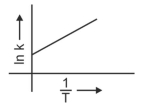
B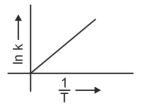
C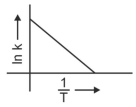
D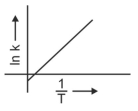
Solution
(C) The Arrhenius equation is given by:
$k = A e^{-\frac{E_a}{R T}}$
Taking the natural logarithm on both sides:
$\ln k = \ln A - \frac{E_a}{R T}$
This equation is in the form of a straight line $y = mx + c$,where:
$y = \ln k$
$x = \frac{1}{T}$
$m = -\frac{E_a}{R}$ (slope,which is negative)
$c = \ln A$ (y-intercept,which is positive)
Therefore,the plot of $\ln k$ vs $\frac{1}{T}$ is a straight line with a negative slope and a positive intercept,which corresponds to option $C$.
$k = A e^{-\frac{E_a}{R T}}$
Taking the natural logarithm on both sides:
$\ln k = \ln A - \frac{E_a}{R T}$
This equation is in the form of a straight line $y = mx + c$,where:
$y = \ln k$
$x = \frac{1}{T}$
$m = -\frac{E_a}{R}$ (slope,which is negative)
$c = \ln A$ (y-intercept,which is positive)
Therefore,the plot of $\ln k$ vs $\frac{1}{T}$ is a straight line with a negative slope and a positive intercept,which corresponds to option $C$.
0 likesView Solution
33
ChemistryMediumMCQNEET · 2024
Match List-$I$ with List-$II$.
Choose the correct answer from the options given below:
| List-$I$ (Complex) | List-$II$ (Type of isomerism) |
| $A$. $[Co(NH_3)_5(NO_2)]Cl_2$ | $I$. Solvate isomerism |
| $B$. $[Co(NH_3)_5(SO_4)]Br$ | $II$. Linkage isomerism |
| $C$. $[Co(NH_3)_6][Cr(CN)_6]$ | $III$. Ionization isomerism |
| $D$. $[Co(H_2O)_6]Cl_3$ | $IV$. Coordination isomerism |
Choose the correct answer from the options given below:
A
$A-I, B-III, C-IV, D-II$
B
$A-I, B-IV, C-III, D-II$
C
$A-II, B-IV, C-III, D-I$
D
$A-II, B-III, C-IV, D-I$
Solution
(D) The correct matches are:
$A$. $[Co(NH_3)_5(NO_2)]Cl_2$ exhibits $II$. Linkage isomerism because the $NO_2^-$ ligand is an ambidentate ligand that can coordinate through $N$ or $O$.
$B$. $[Co(NH_3)_5(SO_4)]Br$ exhibits $III$. Ionization isomerism as the $SO_4^{2-}$ and $Br^-$ ions can exchange positions between the coordination sphere and the counter ion.
$C$. $[Co(NH_3)_6][Cr(CN)_6]$ exhibits $IV$. Coordination isomerism because the ligands are distributed between two metal centers.
$D$. $[Co(H_2O)_6]Cl_3$ exhibits $I$. Solvate (hydrate) isomerism because water molecules can act as ligands or be present as solvent molecules of crystallization.
Therefore,the correct sequence is $A-II, B-III, C-IV, D-I$.
$A$. $[Co(NH_3)_5(NO_2)]Cl_2$ exhibits $II$. Linkage isomerism because the $NO_2^-$ ligand is an ambidentate ligand that can coordinate through $N$ or $O$.
$B$. $[Co(NH_3)_5(SO_4)]Br$ exhibits $III$. Ionization isomerism as the $SO_4^{2-}$ and $Br^-$ ions can exchange positions between the coordination sphere and the counter ion.
$C$. $[Co(NH_3)_6][Cr(CN)_6]$ exhibits $IV$. Coordination isomerism because the ligands are distributed between two metal centers.
$D$. $[Co(H_2O)_6]Cl_3$ exhibits $I$. Solvate (hydrate) isomerism because water molecules can act as ligands or be present as solvent molecules of crystallization.
Therefore,the correct sequence is $A-II, B-III, C-IV, D-I$.
0 likesView Solution
34
ChemistryMediumMCQNEET · 2024
Which one of the following alcohols reacts instantaneously with Lucas reagent?
A
$CH_3-CH_2-CH(OH)-CH_3$
B
$CH_3-CH(CH_3)-CH_2OH$
C
$(CH_3)_3C-OH$
D
$CH_3-CH_2-CH_2-CH_2OH$
Solution
(C) The Lucas reagent is a mixture of concentrated $HCl$ and anhydrous $ZnCl_2$.
Alcohols react with the Lucas reagent to form alkyl chlorides,which appear as turbidity in the solution.
The reactivity order of alcohols towards the Lucas reagent is: $3^\circ > 2^\circ > 1^\circ$.
Tertiary $(3^\circ)$ alcohols react instantaneously with the Lucas reagent to produce immediate turbidity because they form stable carbocations.
Among the given options,$(CH_3)_3C-OH$ is a tertiary alcohol,hence it reacts instantaneously.
Alcohols react with the Lucas reagent to form alkyl chlorides,which appear as turbidity in the solution.
The reactivity order of alcohols towards the Lucas reagent is: $3^\circ > 2^\circ > 1^\circ$.
Tertiary $(3^\circ)$ alcohols react instantaneously with the Lucas reagent to produce immediate turbidity because they form stable carbocations.
Among the given options,$(CH_3)_3C-OH$ is a tertiary alcohol,hence it reacts instantaneously.
0 likesView Solution
35
ChemistryMediumMCQNEET · 2024
The $E^{\circ}$ value for the $Mn^{3+} / Mn^{2+}$ couple is more positive than that of $Cr^{3+} / Cr^{2+}$ or $Fe^{3+} / Fe^{2+}$ due to change of
A
$d^5$ to $d^2$ configuration
B
$d^4$ to $d^5$ configuration
C
$d^3$ to $d^5$ configuration
D
$d^5$ to $d^4$ configuration
Solution
(B) The standard electrode potential $E^{\circ}$ for the $Mn^{3+} / Mn^{2+}$ couple is significantly higher because the reduction of $Mn^{3+}$ to $Mn^{2+}$ involves a transition from a $3d^4$ configuration to a more stable $3d^5$ configuration.
$Mn^{3+} ([Ar] 3d^4) + e^- \rightarrow Mn^{2+} ([Ar] 3d^5)$
The $3d^5$ configuration is particularly stable due to the half-filled $d$-orbital subshell,which provides extra stability through exchange energy.
In contrast,the reduction of $Cr^{3+} (3d^3)$ to $Cr^{2+} (3d^4)$ or $Fe^{3+} (3d^5)$ to $Fe^{2+} (3d^6)$ does not result in such a significant gain in stability.
$Mn^{3+} ([Ar] 3d^4) + e^- \rightarrow Mn^{2+} ([Ar] 3d^5)$
The $3d^5$ configuration is particularly stable due to the half-filled $d$-orbital subshell,which provides extra stability through exchange energy.
In contrast,the reduction of $Cr^{3+} (3d^3)$ to $Cr^{2+} (3d^4)$ or $Fe^{3+} (3d^5)$ to $Fe^{2+} (3d^6)$ does not result in such a significant gain in stability.
0 likesView Solution
36
ChemistryMediumMCQNEET · 2024
Among Group $16$ elements,which one does $NOT$ show $-2$ oxidation state?
A
$Se$
B
$Te$
C
$Po$
D
$O$
Solution
(C) The elements of Group $16$ (chalcogens) generally show $-2$ oxidation state due to their electronic configuration $ns^2 np^4$.
$Oxygen$ $(O)$ shows $-2$ (in most oxides),$-1$ (in peroxides),$+1$ and $+2$ (in $OF_2$) oxidation states.
$Selenium$ $(Se)$ and $Tellurium$ $(Te)$ show $-2, +2, +4$ and $+6$ oxidation states.
$Polonium$ $(Po)$ is a metal and primarily shows $+2$ and $+4$ oxidation states; it does not exhibit the $-2$ oxidation state.
Therefore,the correct answer is $Po$.
$Oxygen$ $(O)$ shows $-2$ (in most oxides),$-1$ (in peroxides),$+1$ and $+2$ (in $OF_2$) oxidation states.
$Selenium$ $(Se)$ and $Tellurium$ $(Te)$ show $-2, +2, +4$ and $+6$ oxidation states.
$Polonium$ $(Po)$ is a metal and primarily shows $+2$ and $+4$ oxidation states; it does not exhibit the $-2$ oxidation state.
Therefore,the correct answer is $Po$.
0 likesView Solution
37
ChemistryMediumMCQNEET · 2024
Given below are two statements:
Statement $I$: The boiling point of hydrides of Group $16$ elements follows the order
$H_2O > H_2Te > H_2Se > H_2S$.
Statement $II$: On the basis of molecular mass,$H_2O$ is expected to have a lower boiling point than the other members of the group,but due to the presence of extensive $H$-bonding in $H_2O$,it has a higher boiling point.
In the light of the above statements,choose the correct answer from the options given below:
Statement $I$: The boiling point of hydrides of Group $16$ elements follows the order
$H_2O > H_2Te > H_2Se > H_2S$.
Statement $II$: On the basis of molecular mass,$H_2O$ is expected to have a lower boiling point than the other members of the group,but due to the presence of extensive $H$-bonding in $H_2O$,it has a higher boiling point.
In the light of the above statements,choose the correct answer from the options given below:
A
Both Statement $I$ and Statement $II$ are false
B
Statement $I$ is true but Statement $II$ is false
C
Statement $I$ is false but Statement $II$ is true
D
Both Statement $I$ and Statement $II$ are true
Solution
(D) Statement $I$ is correct. The boiling point of group $16$ hydrides follows the order $H_2O > H_2Te > H_2Se > H_2S$.
Statement $II$ is also correct. While $H_2O$ has the lowest molecular mass among these hydrides,it exhibits the highest boiling point due to the presence of extensive intermolecular $H$-bonding.
The trend from $H_2Te$ to $H_2S$ is primarily determined by the decrease in molecular mass,which reduces the magnitude of van der Waals forces.
Statement $II$ is also correct. While $H_2O$ has the lowest molecular mass among these hydrides,it exhibits the highest boiling point due to the presence of extensive intermolecular $H$-bonding.
The trend from $H_2Te$ to $H_2S$ is primarily determined by the decrease in molecular mass,which reduces the magnitude of van der Waals forces.
0 likesView Solution
38
ChemistryMediumMCQNEET · 2024
'Spin only' magnetic moment is same for which of the following ions?
$A$. $Ti^{3+}$ $B$. $Cr^{2+}$ $C$. $Mn^{2+}$ $D$. $Fe^{2+}$ $E$. $Sc^{3+}$
Choose the most appropriate answer from the options given below.
$A$. $Ti^{3+}$ $B$. $Cr^{2+}$ $C$. $Mn^{2+}$ $D$. $Fe^{2+}$ $E$. $Sc^{3+}$
Choose the most appropriate answer from the options given below.
A
$A$ and $E$ only
B
$B$ and $C$ only
C
$A$ and $D$ only
D
$B$ and $D$ only
Solution
(D) The 'spin only' magnetic moment $(\mu)$ is calculated using the formula $\mu = \sqrt{n(n+2)} \ BM$,where $n$ is the number of unpaired electrons.
Since $Cr^{2+}$ and $Fe^{2+}$ both have $n = 4$ unpaired electrons,they have the same 'spin only' magnetic moment.
| Ion and Configuration | No. of unpaired electrons $(n)$ |
| $Ti^{3+}: 3d^{1}$ | $1$ |
| $Cr^{2+}: 3d^{4}$ | $4$ |
| $Mn^{2+}: 3d^{5}$ | $5$ |
| $Fe^{2+}: 3d^{6}$ | $4$ |
| $Sc^{3+}: 3d^{0}$ | $0$ |
Since $Cr^{2+}$ and $Fe^{2+}$ both have $n = 4$ unpaired electrons,they have the same 'spin only' magnetic moment.
0 likesView Solution
39
ChemistryMediumMCQNEET · 2024
The reagents with which glucose does not react to give the corresponding tests/products are
$A$. Tollen's reagent
$B$. Schiff's reagent
$C$. $HCN$
$D$. $NH_2OH$
$E$. $NaHSO_3$
Choose the correct options from the given below:
$A$. Tollen's reagent
$B$. Schiff's reagent
$C$. $HCN$
$D$. $NH_2OH$
$E$. $NaHSO_3$
Choose the correct options from the given below:
A
$A$ and $D$
B
$B$ and $E$
C
$E$ and $D$
D
$B$ and $C$
Solution
(B) Glucose contains an aldehyde group $(-CHO)$,but it exists primarily in a cyclic hemiacetal form in equilibrium with a small amount of the open-chain form.
Due to this cyclic structure and the low concentration of the free aldehyde group,glucose does not undergo certain reactions typical of aldehydes.
Specifically,glucose does not give Schiff's test $(B)$ and it does not form the hydrogen sulphite addition product with sodium bisulphite ($NaHSO_3$,$E$).
Therefore,the correct reagents are $B$ and $E$.
Due to this cyclic structure and the low concentration of the free aldehyde group,glucose does not undergo certain reactions typical of aldehydes.
Specifically,glucose does not give Schiff's test $(B)$ and it does not form the hydrogen sulphite addition product with sodium bisulphite ($NaHSO_3$,$E$).
Therefore,the correct reagents are $B$ and $E$.
0 likesView Solution
40
ChemistryMediumMCQNEET · 2024
Given below are two statements:
Statement $I$: Both $[Co(NH_3)_6]^{3+}$ and $[CoF_6]^{3-}$ complexes are octahedral but differ in their magnetic behaviour.
Statement $II$: $[Co(NH_3)_6]^{3+}$ is diamagnetic whereas $[CoF_6]^{3-}$ is paramagnetic.
In the light of the above statements,choose the correct answer from the options given below:
Statement $I$: Both $[Co(NH_3)_6]^{3+}$ and $[CoF_6]^{3-}$ complexes are octahedral but differ in their magnetic behaviour.
Statement $II$: $[Co(NH_3)_6]^{3+}$ is diamagnetic whereas $[CoF_6]^{3-}$ is paramagnetic.
In the light of the above statements,choose the correct answer from the options given below:
A
Both Statement $I$ and Statement $II$ are false
B
Statement $I$ is true but Statement $II$ is false
C
Statement $I$ is false but Statement $II$ is true
D
Both Statement $I$ and Statement $II$ are true
Solution
(D) In $[Co(NH_3)_6]^{3+}$,$Co^{3+}$ ion has a $3d^6$ configuration.
In the presence of the strong field ligand $NH_3$,pairing of electrons occurs,resulting in a diamagnetic complex ion with $d^2sp^3$ hybridization.
In the case of $[CoF_6]^{3-}$,$Co^{3+}$ is in a $3d^6$ configuration. In the presence of the weak field ligand $F^-$,pairing does not occur,resulting in an $sp^3d^2$ hybridized paramagnetic complex with four unpaired electrons.
Therefore,both Statement $I$ and Statement $II$ are true.
In the presence of the strong field ligand $NH_3$,pairing of electrons occurs,resulting in a diamagnetic complex ion with $d^2sp^3$ hybridization.
In the case of $[CoF_6]^{3-}$,$Co^{3+}$ is in a $3d^6$ configuration. In the presence of the weak field ligand $F^-$,pairing does not occur,resulting in an $sp^3d^2$ hybridized paramagnetic complex with four unpaired electrons.
Therefore,both Statement $I$ and Statement $II$ are true.
0 likesView Solution
41
ChemistryMediumMCQNEET · 2024
Fehling's solution '$A$' is
A
alkaline copper sulphate
B
alkaline solution of sodium potassium tartrate (Rochelle's salt)
C
aqueous sodium citrate
D
aqueous copper sulphate
Solution
(D) Fehling's solution '$A$' consists of aqueous copper sulphate $(CuSO_4 \cdot 5H_2O)$.
Fehling's solution '$B$' consists of an alkaline solution of sodium potassium tartrate,also known as Rochelle's salt.
Fehling's solution '$B$' consists of an alkaline solution of sodium potassium tartrate,also known as Rochelle's salt.
0 likesView Solution
42
ChemistryMediumMCQNEET · 2024
Match List-$I$ with List-$II$.
List-$I$ (Reaction):
$A$. Bicyclohexylidene $\rightarrow$ $2$ Cyclohexanone
$B$. Benzene $\rightarrow$ Benzophenone
$C$. Cyclohexanol $\rightarrow$ Cyclohexanone
$D$. Ethylbenzene $\rightarrow$ Potassium benzoate
List-$II$ (Reagents/Condition):
$I$. Benzoyl chloride / Anhydrous $AlCl_3$
$II$. $CrO_3$
$III$. $KMnO_4 / KOH, \Delta$
$IV$. $(i) O_3, (ii) Zn-H_2O$
Choose the correct answer from the options given below:
List-$I$ (Reaction):
$A$. Bicyclohexylidene $\rightarrow$ $2$ Cyclohexanone
$B$. Benzene $\rightarrow$ Benzophenone
$C$. Cyclohexanol $\rightarrow$ Cyclohexanone
$D$. Ethylbenzene $\rightarrow$ Potassium benzoate
List-$II$ (Reagents/Condition):
$I$. Benzoyl chloride / Anhydrous $AlCl_3$
$II$. $CrO_3$
$III$. $KMnO_4 / KOH, \Delta$
$IV$. $(i) O_3, (ii) Zn-H_2O$
Choose the correct answer from the options given below:
A
$A-III, B-I, C-II, D-IV$
B
$A-IV, B-I, C-II, D-III$
C
$A-I, B-IV, C-II, D-III$
D
$A-IV, B-I, C-III, D-II$
Solution
(B) The correct matches are as follows:
$A$. The reaction is the reductive ozonolysis of an alkene,which breaks the double bond to form two carbonyl compounds. Thus,$A-IV$.
$B$. The reaction of benzene with benzoyl chloride in the presence of anhydrous $AlCl_3$ is a Friedel-Crafts acylation reaction. Thus,$B-I$.
$C$. The oxidation of secondary alcohols to ketones is typically performed using $CrO_3$. Thus,$C-II$.
$D$. The oxidation of alkylbenzenes with $KMnO_4 / KOH, \Delta$ results in the formation of potassium benzoate. Thus,$D-III$.
Therefore,the correct matching is $A-IV, B-I, C-II, D-III$.
$A$. The reaction is the reductive ozonolysis of an alkene,which breaks the double bond to form two carbonyl compounds. Thus,$A-IV$.
$B$. The reaction of benzene with benzoyl chloride in the presence of anhydrous $AlCl_3$ is a Friedel-Crafts acylation reaction. Thus,$B-I$.
$C$. The oxidation of secondary alcohols to ketones is typically performed using $CrO_3$. Thus,$C-II$.
$D$. The oxidation of alkylbenzenes with $KMnO_4 / KOH, \Delta$ results in the formation of potassium benzoate. Thus,$D-III$.
Therefore,the correct matching is $A-IV, B-I, C-II, D-III$.
0 likesView Solution
43
ChemistryMediumMCQNEET · 2024
Activation energy of any chemical reaction can be calculated if one knows the value of
A
probability of collision
B
orientation of reactant molecules during collision
C
rate constant at two different temperatures
D
rate constant at standard temperature
Solution
(C) The activation energy $(E_a)$ can be calculated using the Arrhenius equation.
The equation is given by:
$\log \left( \frac{k_2}{k_1} \right) = \frac{E_a}{2.303 R} \left( \frac{1}{T_1} - \frac{1}{T_2} \right)$
From this equation,it is clear that $E_a$ can be determined if the rate constants ($k_1$ and $k_2$) are known at two different temperatures ($T_1$ and $T_2$).
The equation is given by:
$\log \left( \frac{k_2}{k_1} \right) = \frac{E_a}{2.303 R} \left( \frac{1}{T_1} - \frac{1}{T_2} \right)$
From this equation,it is clear that $E_a$ can be determined if the rate constants ($k_1$ and $k_2$) are known at two different temperatures ($T_1$ and $T_2$).
0 likesView Solution
44
ChemistryMediumMCQNEET · 2024
Identify the correct reagents that would bring about the following transformation: $Cyclohexyl-CH_2-CH=CH_2 \rightarrow Cyclohexyl-CH_2-CH_2-CH_2-CHO$
A
$(i) BH_3, (ii) H_2O_2 / \stackrel{\ominus}{O}H, (iii) PCC$
B
$(i) BH_3, (ii) H_2O_2 / \stackrel{\ominus}{O}H, (iii) \text{alk. } KMnO_4, (iv) H_3O^{\oplus}$
C
$(i) H_2O / H^{+}, (ii) PCC$
D
$(i) H_2O / H^{+}, (ii) CrO_3$
Solution
(A) The transformation involves the anti-Markovnikov hydration of an alkene followed by the oxidation of the resulting primary alcohol to an aldehyde.
$1$. Hydroboration-oxidation: The reaction of $Cyclohexyl-CH_2-CH=CH_2$ with $(i) BH_3$ followed by $(ii) H_2O_2 / \stackrel{\ominus}{O}H$ yields the primary alcohol,$Cyclohexyl-CH_2-CH_2-CH_2OH$.
$2$. Oxidation: The primary alcohol is then oxidized to an aldehyde using a mild oxidizing agent like $PCC$ (Pyridinium chlorochromate),which stops the oxidation at the aldehyde stage.
Therefore,the correct sequence of reagents is $(i) BH_3, (ii) H_2O_2 / \stackrel{\ominus}{O}H, (iii) PCC$.
$1$. Hydroboration-oxidation: The reaction of $Cyclohexyl-CH_2-CH=CH_2$ with $(i) BH_3$ followed by $(ii) H_2O_2 / \stackrel{\ominus}{O}H$ yields the primary alcohol,$Cyclohexyl-CH_2-CH_2-CH_2OH$.
$2$. Oxidation: The primary alcohol is then oxidized to an aldehyde using a mild oxidizing agent like $PCC$ (Pyridinium chlorochromate),which stops the oxidation at the aldehyde stage.
Therefore,the correct sequence of reagents is $(i) BH_3, (ii) H_2O_2 / \stackrel{\ominus}{O}H, (iii) PCC$.
0 likesView Solution
45
ChemistryMediumMCQNEET · 2024
The pair of lanthanoid ions which are diamagnetic is
A
$Ce^{3+}$ and $Eu^{2+}$
B
$Gd^{3+}$ and $Eu^{3+}$
C
$Pm^{3+}$ and $Sm^{3+}$
D
$Ce^{4+}$ and $Yb^{2+}$
Solution
(D) substance is diamagnetic if it has no unpaired electrons $(n = 0)$.
Electronic configurations of the given ions:
$Ce^{4+} \Rightarrow [Xe] 4f^0$ (No unpaired electrons,diamagnetic)
$Yb^{2+} \Rightarrow [Xe] 4f^{14}$ (All electrons paired,diamagnetic)
$Ce^{3+} \Rightarrow [Xe] 4f^1$ (One unpaired electron,paramagnetic)
$Eu^{2+} \Rightarrow [Xe] 4f^7$ (Seven unpaired electrons,paramagnetic)
$Gd^{3+} \Rightarrow [Xe] 4f^7$ (Seven unpaired electrons,paramagnetic)
$Eu^{3+} \Rightarrow [Xe] 4f^6$ (Six unpaired electrons,paramagnetic)
$Pm^{3+} \Rightarrow [Xe] 4f^4$ (Four unpaired electrons,paramagnetic)
$Sm^{3+} \Rightarrow [Xe] 4f^5$ (Five unpaired electrons,paramagnetic)
Thus,the pair $Ce^{4+}$ and $Yb^{2+}$ is diamagnetic.
Electronic configurations of the given ions:
$Ce^{4+} \Rightarrow [Xe] 4f^0$ (No unpaired electrons,diamagnetic)
$Yb^{2+} \Rightarrow [Xe] 4f^{14}$ (All electrons paired,diamagnetic)
$Ce^{3+} \Rightarrow [Xe] 4f^1$ (One unpaired electron,paramagnetic)
$Eu^{2+} \Rightarrow [Xe] 4f^7$ (Seven unpaired electrons,paramagnetic)
$Gd^{3+} \Rightarrow [Xe] 4f^7$ (Seven unpaired electrons,paramagnetic)
$Eu^{3+} \Rightarrow [Xe] 4f^6$ (Six unpaired electrons,paramagnetic)
$Pm^{3+} \Rightarrow [Xe] 4f^4$ (Four unpaired electrons,paramagnetic)
$Sm^{3+} \Rightarrow [Xe] 4f^5$ (Five unpaired electrons,paramagnetic)
Thus,the pair $Ce^{4+}$ and $Yb^{2+}$ is diamagnetic.
0 likesView Solution
46
ChemistryMediumMCQNEET · 2024
The products $A$ and $B$ obtained in the following reactions,respectively,are
$3 ROH + PCl_3 \rightarrow 3 RCl + A$
$ROH + PCl_5 \rightarrow RCl + HCl + B$
$3 ROH + PCl_3 \rightarrow 3 RCl + A$
$ROH + PCl_5 \rightarrow RCl + HCl + B$
A
$POCl_3$ and $H_3 PO_4$
B
$H_3 PO_4$ and $POCl_3$
C
$H_3 PO_3$ and $POCl_3$
D
$POCl_3$ and $H_3 PO_3$
Solution
(C) The given reactions represent the preparation of haloalkanes from alcohols using phosphorus halides.
$1$. The reaction of alcohol with phosphorus trichloride is:
$3 ROH + PCl_3 \rightarrow 3 RCl + H_3 PO_3$ $(A)$
$2$. The reaction of alcohol with phosphorus pentachloride is:
$ROH + PCl_5 \rightarrow RCl + HCl + POCl_3$ $(B)$
Thus,$A$ is $H_3 PO_3$ and $B$ is $POCl_3$.
$1$. The reaction of alcohol with phosphorus trichloride is:
$3 ROH + PCl_3 \rightarrow 3 RCl + H_3 PO_3$ $(A)$
$2$. The reaction of alcohol with phosphorus pentachloride is:
$ROH + PCl_5 \rightarrow RCl + HCl + POCl_3$ $(B)$
Thus,$A$ is $H_3 PO_3$ and $B$ is $POCl_3$.
0 likesView Solution
47
ChemistryMediumMCQNEET · 2024
Given below are two statements :
Statement $I$ : $[Co(NH_3)_6]^{3+}$ is a homoleptic complex whereas $[Co(NH_3)_4 Cl_2]^{+}$ is a heteroleptic complex.
Statement $II$ : Complex $[Co(NH_3)_6]^{3+}$ has only one kind of ligands but $[Co(NH_3)_4 Cl_2]^{+}$ has more than one kind of ligands.
In the light of the above statements,choose the correct answer from the options given below.
Statement $I$ : $[Co(NH_3)_6]^{3+}$ is a homoleptic complex whereas $[Co(NH_3)_4 Cl_2]^{+}$ is a heteroleptic complex.
Statement $II$ : Complex $[Co(NH_3)_6]^{3+}$ has only one kind of ligands but $[Co(NH_3)_4 Cl_2]^{+}$ has more than one kind of ligands.
In the light of the above statements,choose the correct answer from the options given below.
A
Both Statement $I$ and Statement $II$ are false
B
Statement $I$ is true but Statement $II$ is false
C
Statement $I$ is false but Statement $II$ is true
D
Both Statement $I$ and Statement $II$ are true
Solution
(D) homoleptic complex is one in which a metal is bound to only one kind of donor groups.
$[Co(NH_3)_6]^{3+}$ contains only $NH_3$ ligands,so it is homoleptic.
Statement $I$ is true.
$A$ heteroleptic complex is one in which a metal is bound to more than one kind of donor groups.
$[Co(NH_3)_4 Cl_2]^{+}$ contains both $NH_3$ and $Cl^{-}$ ligands,so it is heteroleptic.
Statement $II$ correctly explains the definitions of homoleptic and heteroleptic complexes.
Therefore,both Statement $I$ and Statement $II$ are true.
$[Co(NH_3)_6]^{3+}$ contains only $NH_3$ ligands,so it is homoleptic.
Statement $I$ is true.
$A$ heteroleptic complex is one in which a metal is bound to more than one kind of donor groups.
$[Co(NH_3)_4 Cl_2]^{+}$ contains both $NH_3$ and $Cl^{-}$ ligands,so it is heteroleptic.
Statement $II$ correctly explains the definitions of homoleptic and heteroleptic complexes.
Therefore,both Statement $I$ and Statement $II$ are true.
0 likesView Solution
48
ChemistryMediumMCQNEET · 2024
Identify the major product $C$ formed in the following reaction sequence:
$CH_3-CH_2-CH_2-I$ $\xrightarrow{NaCN} A$ $\xrightarrow[\text{Partial hydrolysis}]{OH^-} B$ $\xrightarrow{NaOH/Br_2} C \text{ (major)}$
$CH_3-CH_2-CH_2-I$ $\xrightarrow{NaCN} A$ $\xrightarrow[\text{Partial hydrolysis}]{OH^-} B$ $\xrightarrow{NaOH/Br_2} C \text{ (major)}$
A
butylamine
B
butanamide
C
$\alpha$-bromobutanoic acid
D
propylamine
Solution
(D) The reaction sequence is as follows:
$1$. $CH_3CH_2CH_2-I + NaCN \rightarrow CH_3CH_2CH_2-CN (A) + NaI$ (Nucleophilic substitution reaction).
$2$. $CH_3CH_2CH_2-CN + H_2O \xrightarrow{OH^-} CH_3CH_2CH_2-CONH_2 (B)$ (Partial hydrolysis of nitrile to amide).
$3$. $CH_3CH_2CH_2-CONH_2 + Br_2 + 4NaOH \rightarrow CH_3CH_2CH_2-NH_2 (C) + Na_2CO_3 + 2NaBr + 2H_2O$ (Hoffmann bromamide degradation reaction).
The final product $C$ is $CH_3CH_2CH_2-NH_2$,which is propylamine.
$1$. $CH_3CH_2CH_2-I + NaCN \rightarrow CH_3CH_2CH_2-CN (A) + NaI$ (Nucleophilic substitution reaction).
$2$. $CH_3CH_2CH_2-CN + H_2O \xrightarrow{OH^-} CH_3CH_2CH_2-CONH_2 (B)$ (Partial hydrolysis of nitrile to amide).
$3$. $CH_3CH_2CH_2-CONH_2 + Br_2 + 4NaOH \rightarrow CH_3CH_2CH_2-NH_2 (C) + Na_2CO_3 + 2NaBr + 2H_2O$ (Hoffmann bromamide degradation reaction).
The final product $C$ is $CH_3CH_2CH_2-NH_2$,which is propylamine.
0 likesView Solution
49
ChemistryMediumMCQNEET · 2024
During the preparation of Mohr's salt solution (Ferrous ammonium sulphate),which of the following acid is added to prevent hydrolysis of $Fe^{2+}$ ion?
A
concentrated sulphuric acid
B
dilute nitric acid
C
dilute sulphuric acid
D
dilute hydrochloric acid
Solution
(C) During the preparation of Mohr's salt,dilute sulphuric acid is added to prevent the hydrolysis of $Fe^{2+}$ ion.
This is because $Fe^{2+}$ ions are prone to hydrolysis in water,forming basic salts,and the addition of dilute sulphuric acid provides an acidic medium that suppresses this hydrolysis.
This is because $Fe^{2+}$ ions are prone to hydrolysis in water,forming basic salts,and the addition of dilute sulphuric acid provides an acidic medium that suppresses this hydrolysis.
0 likesView Solution
50
ChemistryMediumMCQNEET · 2024
Given below are certain cations. Using inorganic qualitative analysis,arrange them in increasing group number from $0$ to $VI$.
$A$. $Al^{3+}$ $B$. $Cu^{2+}$ $C$. $Ba^{2+}$ $D$. $Co^{2+}$ $E$. $Mg^{2+}$
Choose the correct answer from the options given below.
$A$. $Al^{3+}$ $B$. $Cu^{2+}$ $C$. $Ba^{2+}$ $D$. $Co^{2+}$ $E$. $Mg^{2+}$
Choose the correct answer from the options given below.
A
$B, C, A, D, E$
B
$E, C, D, B, A$
C
$E, A, B, C, D$
D
$B, A, D, C, E$
Solution
(D)
The correct order of group number of ions is $\underset{(B)}{Cu^{2+}} < \underset{(A)}{Al^{3+}} < \underset{(D)}{Co^{2+}} < \underset{(C)}{Ba^{2+}} < \underset{(E)}{Mg^{2+}}$.
Therefore,the correct order is $B, A, D, C, E$.
| Group | Cations |
| Group $-II$ | $Cu^{2+}$ |
| Group $-III$ | $Al^{3+}$ |
| Group $-IV$ | $Co^{2+}$ |
| Group $-V$ | $Ba^{2+}$ |
| Group $-VI$ | $Mg^{2+}$ |
The correct order of group number of ions is $\underset{(B)}{Cu^{2+}} < \underset{(A)}{Al^{3+}} < \underset{(D)}{Co^{2+}} < \underset{(C)}{Ba^{2+}} < \underset{(E)}{Mg^{2+}}$.
Therefore,the correct order is $B, A, D, C, E$.
0 likesView Solution
51
ChemistryMediumMCQNEET · 2024
Mass in grams of copper deposited by passing $9.6487 \ A$ current through a voltmeter containing copper sulphate solution for $100 \ s$ is (Given : Molar mass of $Cu: 63 \ g \ mol^{-1}, 1 \ F=96487 \ C$ ) (in $g$)
A
$0.315$
B
$31.5$
C
$0.0315$
D
$3.15$
Solution
(A) The reduction reaction for copper is: $Cu^{2+}_{(aq)} + 2e^{-} \rightarrow Cu_{(s)}$
According to Faraday's law of electrolysis,the mass of metal deposited $(w)$ is given by the formula:
$w = \frac{M \times I \times t}{n \times F}$
Where:
$M = 63 \ g \ mol^{-1}$ (Molar mass of $Cu$)
$I = 9.6487 \ A$ (Current)
$t = 100 \ s$ (Time)
$n = 2$ (Number of electrons involved in the reduction of $Cu^{2+}$)
$F = 96487 \ C \ mol^{-1}$ (Faraday's constant)
Substituting the values:
$w = \frac{63 \times 9.6487 \times 100}{2 \times 96487}$
$w = \frac{63 \times 964.87}{192974}$
$w = \frac{60786.81}{192974} = 0.315 \ g$
According to Faraday's law of electrolysis,the mass of metal deposited $(w)$ is given by the formula:
$w = \frac{M \times I \times t}{n \times F}$
Where:
$M = 63 \ g \ mol^{-1}$ (Molar mass of $Cu$)
$I = 9.6487 \ A$ (Current)
$t = 100 \ s$ (Time)
$n = 2$ (Number of electrons involved in the reduction of $Cu^{2+}$)
$F = 96487 \ C \ mol^{-1}$ (Faraday's constant)
Substituting the values:
$w = \frac{63 \times 9.6487 \times 100}{2 \times 96487}$
$w = \frac{63 \times 964.87}{192974}$
$w = \frac{60786.81}{192974} = 0.315 \ g$
1 likesView Solution
52
ChemistryMediumMCQNEET · 2024
The plot of osmotic pressure $(\Pi)$ vs concentration $\left(mol \ L^{-1}\right)$ for a solution gives a straight line with slope $25.73 \ L \ bar \ mol^{-1}$. The temperature at which the osmotic pressure measurement is done is
(Use $R=0.083 \ L \ bar \ mol^{-1} \ K^{-1}$) (in $^{\circ} C$)
(Use $R=0.083 \ L \ bar \ mol^{-1} \ K^{-1}$) (in $^{\circ} C$)
A
$310$
B
$25.73$
C
$12.05$
D
$37$
Solution
(D) The osmotic pressure equation is given by $\Pi = C R T$.
Comparing this with the equation of a straight line $y = mx$,where $y = \Pi$,$x = C$,and the slope $m = R T$.
Given slope $= 25.73 \ L \ bar \ mol^{-1}$ and $R = 0.083 \ L \ bar \ mol^{-1} \ K^{-1}$.
$25.73 = 0.083 \times T$
$T = \frac{25.73}{0.083} \approx 310 \ K$.
To convert the temperature to Celsius: $T(^{\circ}C) = T(K) - 273 = 310 - 273 = 37^{\circ} C$.
Comparing this with the equation of a straight line $y = mx$,where $y = \Pi$,$x = C$,and the slope $m = R T$.
Given slope $= 25.73 \ L \ bar \ mol^{-1}$ and $R = 0.083 \ L \ bar \ mol^{-1} \ K^{-1}$.
$25.73 = 0.083 \times T$
$T = \frac{25.73}{0.083} \approx 310 \ K$.
To convert the temperature to Celsius: $T(^{\circ}C) = T(K) - 273 = 310 - 273 = 37^{\circ} C$.
1 likesView Solution
53
ChemistryMediumMCQNEET · 2024
Major products $A$ and $B$ formed in the following reaction sequence are:
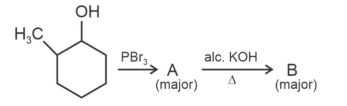
A
$A = \text{1-bromo-2-methylcyclohexane}; B = \text{3-methylcyclohexene}$
B
$A = \text{1-bromo-2-methylcyclohexane}; B = \text{1-methylcyclohexene}$
C
$A = \text{2-bromocyclohexanol}; B = \text{3-methylcyclohexene}$
D
$A = \text{2-bromocyclohexanol}; B = \text{1-methylcyclohexene}$
Solution
(B) Step $1$: Reaction of $2$-methylcyclohexanol with $PBr_3$ leads to the formation of $1$-bromo-$2$-methylcyclohexane $(A)$ via an $S_N2$ mechanism.
Step $2$: Treatment of $1$-bromo-$2$-methylcyclohexane $(A)$ with alcoholic $KOH$ (a strong base) results in dehydrohalogenation via an $E2$ mechanism.
Step $3$: According to Zaitsev's rule,the more substituted alkene is the major product. The base abstracts a proton from the $C_2$ position,leading to the formation of $1$-methylcyclohexene $(B)$ as the major product.
Step $2$: Treatment of $1$-bromo-$2$-methylcyclohexane $(A)$ with alcoholic $KOH$ (a strong base) results in dehydrohalogenation via an $E2$ mechanism.
Step $3$: According to Zaitsev's rule,the more substituted alkene is the major product. The base abstracts a proton from the $C_2$ position,leading to the formation of $1$-methylcyclohexene $(B)$ as the major product.
1 likesView Solution
54
ChemistryMediumMCQNEET · 2024
The rate of a reaction quadruples when temperature changes from $27^{\circ} C$ to $57^{\circ} C$. Calculate the energy of activation.
Given $R=8.314 \ J \ K^{-1} \ mol^{-1}, \log 4=0.6021$
Given $R=8.314 \ J \ K^{-1} \ mol^{-1}, \log 4=0.6021$
A
$380.4 \ kJ \ mol^{-1}$
B
$3.80 \ kJ \ mol^{-1}$
C
$3804 \ kJ \ mol^{-1}$
D
$38.04 \ kJ \ mol^{-1}$
Solution
(D) The Arrhenius equation is given by: $\log \left(\frac{k_2}{k_1}\right) = \frac{E_a}{2.303 R} \left(\frac{1}{T_1} - \frac{1}{T_2}\right)$
Given: $k_2 = 4k_1$,$T_1 = 27 + 273 = 300 \ K$,$T_2 = 57 + 273 = 330 \ K$,$R = 8.314 \ J \ K^{-1} \ mol^{-1}$,$\log 4 = 0.6021$
Substituting the values:
$\log 4 = \frac{E_a}{2.303 \times 8.314} \left(\frac{1}{300} - \frac{1}{330}\right)$
$0.6021 = \frac{E_a}{19.147} \left(\frac{330 - 300}{300 \times 330}\right)$
$0.6021 = \frac{E_a}{19.147} \left(\frac{30}{99000}\right)$
$E_a = \frac{0.6021 \times 19.147 \times 99000}{30} \approx 38040 \ J \ mol^{-1}$
$E_a = 38.04 \ kJ \ mol^{-1}$
Given: $k_2 = 4k_1$,$T_1 = 27 + 273 = 300 \ K$,$T_2 = 57 + 273 = 330 \ K$,$R = 8.314 \ J \ K^{-1} \ mol^{-1}$,$\log 4 = 0.6021$
Substituting the values:
$\log 4 = \frac{E_a}{2.303 \times 8.314} \left(\frac{1}{300} - \frac{1}{330}\right)$
$0.6021 = \frac{E_a}{19.147} \left(\frac{330 - 300}{300 \times 330}\right)$
$0.6021 = \frac{E_a}{19.147} \left(\frac{30}{99000}\right)$
$E_a = \frac{0.6021 \times 19.147 \times 99000}{30} \approx 38040 \ J \ mol^{-1}$
$E_a = 38.04 \ kJ \ mol^{-1}$
1 likesView Solution
Vedclass Products
For Students
Vedclass Test Series
Mock tests in real NEET style covering Chemistry with performance analysis. 5-day free trial.
Start Free TrialFor Teachers
Exam Paper Generator
Generate Set A/B/C/D Chemistry papers from 7.5L+ questions in 2 minutes. 3 chapters free.
Try FreeFor Institutes
Online Exam Module
Run live NEET mock exams with unlimited students, 360° analytics & white-label branding.
See DemoFrequently Asked Questions
How many Chemistry questions are in NEET 2024?
There are 54 Chemistry questions from the NEET 2024 paper on Vedclass, each with a detailed step-by-step solution in English.
Are NEET 2024 Chemistry solutions available in English?
Yes. All solutions on this page are in English. You can also switch to English or Hindi using the language buttons above the questions.
Can I practice NEET 2024 Chemistry as a timed test?
Yes. Use the Vedclass Test Series to attempt a full NEET mock test covering Chemistry with time limits and instant score analysis.
Can teachers create Chemistry papers from NEET previous year questions?
Yes. The Vedclass Exam Paper Generator lets teachers mix NEET Chemistry questions and generate Set A/B/C/D papers in minutes.
For Teachers & Institutes
Build a Custom Chemistry Paper
Pick NEET 2024 Chemistry questions, set difficulty, and generate Set A/B/C/D in 2 minutes.