
PhysicsQ1–90 of 90 questions
Page 1 of 1 · English
1
PhysicsMediumMCQNEET · 2019
$A$ car moves from $X$ to $Y$ with a uniform speed $v_1$ and returns from $Y$ to $X$ with a uniform speed $v_2$. The average speed for this round trip is
A
$\bar v = \frac{v_1 + v_2}{2}$
B
$\bar v = \sqrt{v_1 v_2}$
C
$\frac{2}{\bar v} = \frac{1}{v_1} + \frac{1}{v_2}$
D
$\frac{1}{\bar v} = \frac{1}{v_1} + \frac{1}{v_2}$
Solution
(C) Average speed is defined as the ratio of total distance traveled to the total time taken.
Let the distance between $X$ and $Y$ be $d$.
Time taken to travel from $X$ to $Y$ is $t_1 = \frac{d}{v_1}$.
Time taken to travel from $Y$ to $X$ is $t_2 = \frac{d}{v_2}$.
Total distance $= d + d = 2d$.
Total time $= t_1 + t_2 = \frac{d}{v_1} + \frac{d}{v_2}$.
Average speed $\bar v = \frac{\text{Total distance}}{\text{Total time}} = \frac{2d}{\frac{d}{v_1} + \frac{d}{v_2}}$.
Canceling $d$ from the numerator and denominator,we get $\bar v = \frac{2}{\frac{1}{v_1} + \frac{1}{v_2}}$.
Rearranging this gives $\frac{2}{\bar v} = \frac{1}{v_1} + \frac{1}{v_2}$.
Let the distance between $X$ and $Y$ be $d$.
Time taken to travel from $X$ to $Y$ is $t_1 = \frac{d}{v_1}$.
Time taken to travel from $Y$ to $X$ is $t_2 = \frac{d}{v_2}$.
Total distance $= d + d = 2d$.
Total time $= t_1 + t_2 = \frac{d}{v_1} + \frac{d}{v_2}$.
Average speed $\bar v = \frac{\text{Total distance}}{\text{Total time}} = \frac{2d}{\frac{d}{v_1} + \frac{d}{v_2}}$.
Canceling $d$ from the numerator and denominator,we get $\bar v = \frac{2}{\frac{1}{v_1} + \frac{1}{v_2}}$.
Rearranging this gives $\frac{2}{\bar v} = \frac{1}{v_1} + \frac{1}{v_2}$.
1 likesView Solution
2
PhysicsMediumMCQNEET · 2019
Given that $1\,g$ of water in liquid phase has volume $1\,cm^3$ and in vapour phase $1671\,cm^3$ at atmospheric pressure and the latent heat of vaporization of water is $2256\,J/g$,the change in the internal energy in joules for $1\,g$ of water at $373\,K$ when it changes from liquid phase to vapour phase at the same temperature is ....... $J$.
A
$2256$
B
$167$
C
$2089$
D
$1$
Solution
(C) The work done during the phase change at constant pressure is given by $W = P \Delta V$.
Given $P = 1.013 \times 10^5\,Pa$ (atmospheric pressure),$V_{liquid} = 1\,cm^3 = 10^{-6}\,m^3$,and $V_{vapour} = 1671\,cm^3 = 1671 \times 10^{-6}\,m^3$.
$W = 1.013 \times 10^5 \times (1671 - 1) \times 10^{-6} \approx 169\,J$. Using the standard approximation $P = 10^5\,Pa$ as implied by the options: $W = 10^5 \times 1670 \times 10^{-6} = 167\,J$.
The heat supplied is $Q = mL = 1\,g \times 2256\,J/g = 2256\,J$.
From the first law of thermodynamics,$Q = \Delta U + W$,so $\Delta U = Q - W$.
$\Delta U = 2256\,J - 167\,J = 2089\,J$.
Given $P = 1.013 \times 10^5\,Pa$ (atmospheric pressure),$V_{liquid} = 1\,cm^3 = 10^{-6}\,m^3$,and $V_{vapour} = 1671\,cm^3 = 1671 \times 10^{-6}\,m^3$.
$W = 1.013 \times 10^5 \times (1671 - 1) \times 10^{-6} \approx 169\,J$. Using the standard approximation $P = 10^5\,Pa$ as implied by the options: $W = 10^5 \times 1670 \times 10^{-6} = 167\,J$.
The heat supplied is $Q = mL = 1\,g \times 2256\,J/g = 2256\,J$.
From the first law of thermodynamics,$Q = \Delta U + W$,so $\Delta U = Q - W$.
$\Delta U = 2256\,J - 167\,J = 2089\,J$.
0 likesView Solution
3
PhysicsEasyMCQNEET · 2019
In which of the following processes,heat is neither absorbed nor released by a system?
A
isothermal
B
adiabatic
C
isobaric
D
isochoric
Solution
(B) In an adiabatic process,the system is thermally insulated from its surroundings.
Therefore,there is no exchange of heat between the system and the surroundings.
This means that the heat absorbed or released by the system is zero.
Mathematically,this is represented as $\Delta Q = 0$.
Therefore,there is no exchange of heat between the system and the surroundings.
This means that the heat absorbed or released by the system is zero.
Mathematically,this is represented as $\Delta Q = 0$.
0 likesView Solution
4
PhysicsEasyMCQNEET · 2019
Increase in temperature of a gas filled in a container would lead to
A
increase in its mass
B
increase in its kinetic energy
C
decrease in its pressure
D
decrease in intermolecular distance
Solution
(B) According to the kinetic theory of gases,the average kinetic energy $(KE)$ of gas molecules is directly proportional to the absolute temperature $(T)$ of the gas.
The relation is given by: $KE = \frac{3}{2} k_B T$,where $k_B$ is the Boltzmann constant.
Therefore,as the temperature of the gas increases,the average kinetic energy of the gas molecules also increases.
The relation is given by: $KE = \frac{3}{2} k_B T$,where $k_B$ is the Boltzmann constant.
Therefore,as the temperature of the gas increases,the average kinetic energy of the gas molecules also increases.
0 likesView Solution
5
PhysicsMediumMCQNEET · 2019
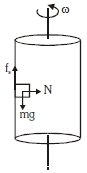
$A$ block of mass $10\; kg$ is in contact with the inner wall of a hollow cylindrical drum of radius $1\; m$. The coefficient of friction between the block and the inner wall of the cylinder is $0.1$. The minimum angular velocity needed for the cylinder to keep the block stationary when the cylinder is vertical and rotating about its axis will be: ......$rad/s$ $(g = 10\; m/s^2)$
A
$\sqrt{10}$
B
$\frac{10}{2\pi}$
C
$10$
D
$10\pi$
Solution
(C) For the block to remain stationary,the upward frictional force must balance the downward gravitational force.
$f_s = mg$
The normal force $N$ provided by the wall acts as the centripetal force for the block's circular motion:
$N = mr\omega^2$
The maximum static frictional force is given by:
$f_{L} = \mu N = \mu mr\omega^2$
For the block to stay in equilibrium,the frictional force must be at least equal to the weight:
$f_{L} \geq mg$
$\mu mr\omega^2 \geq mg$
Solving for $\omega$:
$\omega^2 \geq \frac{g}{\mu r}$
$\omega \geq \sqrt{\frac{g}{\mu r}}$
Substituting the given values ($g = 10\; m/s^2$,$\mu = 0.1$,$r = 1\; m$):
$\omega_{\min} = \sqrt{\frac{10}{0.1 \times 1}} = \sqrt{\frac{10}{0.1}} = \sqrt{100} = 10\; rad/s$
$f_s = mg$
The normal force $N$ provided by the wall acts as the centripetal force for the block's circular motion:
$N = mr\omega^2$
The maximum static frictional force is given by:
$f_{L} = \mu N = \mu mr\omega^2$
For the block to stay in equilibrium,the frictional force must be at least equal to the weight:
$f_{L} \geq mg$
$\mu mr\omega^2 \geq mg$
Solving for $\omega$:
$\omega^2 \geq \frac{g}{\mu r}$
$\omega \geq \sqrt{\frac{g}{\mu r}}$
Substituting the given values ($g = 10\; m/s^2$,$\mu = 0.1$,$r = 1\; m$):
$\omega_{\min} = \sqrt{\frac{10}{0.1 \times 1}} = \sqrt{\frac{10}{0.1}} = \sqrt{100} = 10\; rad/s$
0 likesView Solution
6
PhysicsDifficultMCQNEET · 2019
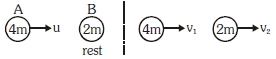
$A$ body $A$ of mass $4m$ moving with speed $u$ collides with another body $B$ of mass $2m$,which is at rest. The collision is head-on and elastic in nature. After the collision,the fraction of energy lost by the colliding body $A$ is
A
$\frac{1}{9}$
B
$\frac{8}{9}$
C
$\frac{4}{9}$
D
$\frac{5}{9}$
Solution
(B) For a one-dimensional elastic collision where body $B$ is initially at rest,the final velocity $v_1$ of body $A$ is given by:
$v_1 = \left( \frac{m_1 - m_2}{m_1 + m_2} \right) u$
Substituting $m_1 = 4m$ and $m_2 = 2m$:
$v_1 = \left( \frac{4m - 2m}{4m + 2m} \right) u = \left( \frac{2m}{6m} \right) u = \frac{u}{3}$
Initial kinetic energy of body $A$ is $K_i = \frac{1}{2}(4m)u^2 = 2mu^2$.
Final kinetic energy of body $A$ is $K_f = \frac{1}{2}(4m)v_1^2 = \frac{1}{2}(4m)\left(\frac{u}{3}\right)^2 = \frac{2mu^2}{9}$.
The energy lost by body $A$ is $\Delta K = K_i - K_f = 2mu^2 - \frac{2mu^2}{9} = \frac{16mu^2}{9}$.
The fraction of energy lost is $\frac{\Delta K}{K_i} = \frac{16mu^2 / 9}{2mu^2} = \frac{16}{18} = \frac{8}{9}$.
$v_1 = \left( \frac{m_1 - m_2}{m_1 + m_2} \right) u$
Substituting $m_1 = 4m$ and $m_2 = 2m$:
$v_1 = \left( \frac{4m - 2m}{4m + 2m} \right) u = \left( \frac{2m}{6m} \right) u = \frac{u}{3}$
Initial kinetic energy of body $A$ is $K_i = \frac{1}{2}(4m)u^2 = 2mu^2$.
Final kinetic energy of body $A$ is $K_f = \frac{1}{2}(4m)v_1^2 = \frac{1}{2}(4m)\left(\frac{u}{3}\right)^2 = \frac{2mu^2}{9}$.
The energy lost by body $A$ is $\Delta K = K_i - K_f = 2mu^2 - \frac{2mu^2}{9} = \frac{16mu^2}{9}$.
The fraction of energy lost is $\frac{\Delta K}{K_i} = \frac{16mu^2 / 9}{2mu^2} = \frac{16}{18} = \frac{8}{9}$.
0 likesView Solution
7
PhysicsMediumMCQNEET · 2019
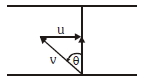
The speed of a swimmer in still water is $20 \; m/s$. The speed of river water is $10 \; m/s$ and is flowing due east. If he is standing on the south bank and wishes to cross the river along the shortest path,the angle at which he should make his strokes with respect to north is given by ......$^o$ west.
A
$30$
B
$0$
C
$60$
D
$45$
Solution
(A) Let the speed of the swimmer in still water be $v = 20 \; m/s$ and the speed of the river be $u = 10 \; m/s$.
To cross the river along the shortest path (perpendicular to the river flow),the swimmer must swim at an angle $\theta$ with respect to the north (perpendicular to the bank) such that the horizontal component of his velocity cancels the river's velocity.
From the geometry of the velocity vector triangle,we have:
$\sin \theta = \frac{u}{v}$
Substituting the given values:
$\sin \theta = \frac{10}{20} = \frac{1}{2}$
Therefore,$\theta = \arcsin(1/2) = 30^{\circ}$.
Thus,the swimmer should make his strokes at an angle of $30^{\circ}$ west of north.
To cross the river along the shortest path (perpendicular to the river flow),the swimmer must swim at an angle $\theta$ with respect to the north (perpendicular to the bank) such that the horizontal component of his velocity cancels the river's velocity.
From the geometry of the velocity vector triangle,we have:
$\sin \theta = \frac{u}{v}$
Substituting the given values:
$\sin \theta = \frac{10}{20} = \frac{1}{2}$
Therefore,$\theta = \arcsin(1/2) = 30^{\circ}$.
Thus,the swimmer should make his strokes at an angle of $30^{\circ}$ west of north.
1 likesView Solution
8
PhysicsMediumMCQNEET · 2019
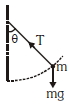
$A$ mass $m$ is attached to a thin wire and whirled in a vertical circle. The wire is most likely to break when
A
the mass is at the highest point
B
the wire is horizontal
C
the mass is at the lowest point
D
inclined at an angle of $60^{\circ}$ from vertical
Solution
(C) For a mass $m$ moving in a vertical circle of radius $R$,the tension $T$ in the wire at any angular position $\theta$ from the lowest point is given by the equation:
$T - mg \cos \theta = \frac{mv^2}{R}$
$T = mg \cos \theta + \frac{mv^2}{R}$
At the lowest point,$\theta = 0^{\circ}$,so $\cos 0^{\circ} = 1$. Also,the velocity $v$ is maximum at the lowest point due to the conservation of energy.
Since both $\cos \theta$ and $v$ are at their maximum values at the lowest point,the tension $T$ is maximum at this position.
Therefore,the wire is most likely to break when the mass is at the lowest point.
$T - mg \cos \theta = \frac{mv^2}{R}$
$T = mg \cos \theta + \frac{mv^2}{R}$
At the lowest point,$\theta = 0^{\circ}$,so $\cos 0^{\circ} = 1$. Also,the velocity $v$ is maximum at the lowest point due to the conservation of energy.
Since both $\cos \theta$ and $v$ are at their maximum values at the lowest point,the tension $T$ is maximum at this position.
Therefore,the wire is most likely to break when the mass is at the lowest point.
0 likesView Solution
9
PhysicsMediumMCQNEET · 2019
The displacement of a particle executing simple harmonic motion is given by
$y = A_{0} + A \sin \omega t + B \cos \omega t$
Then the amplitude of its oscillation is given by
$y = A_{0} + A \sin \omega t + B \cos \omega t$
Then the amplitude of its oscillation is given by
A
$A_{0} + \sqrt{A^{2} + B^{2}}$
B
$\sqrt{A^{2} + B^{2}}$
C
$\sqrt{A_{0}^{2} + (A + B)^{2}}$
D
$A + B$
Solution
(B) The given equation is $y = A_{0} + A \sin \omega t + B \cos \omega t$.
To find the amplitude,we express the time-dependent part in the form $R \sin(\omega t + \phi)$.
Let $A = R \cos \phi$ and $B = R \sin \phi$.
Then $A^{2} + B^{2} = R^{2} (\cos^{2} \phi + \sin^{2} \phi) = R^{2}$.
Thus,$R = \sqrt{A^{2} + B^{2}}$.
The equation becomes $y = A_{0} + \sqrt{A^{2} + B^{2}} \sin(\omega t + \phi)$.
Here,$A_{0}$ represents the shift in the mean position,and the coefficient of the trigonometric term,$\sqrt{A^{2} + B^{2}}$,represents the amplitude of the oscillation.
To find the amplitude,we express the time-dependent part in the form $R \sin(\omega t + \phi)$.
Let $A = R \cos \phi$ and $B = R \sin \phi$.
Then $A^{2} + B^{2} = R^{2} (\cos^{2} \phi + \sin^{2} \phi) = R^{2}$.
Thus,$R = \sqrt{A^{2} + B^{2}}$.
The equation becomes $y = A_{0} + \sqrt{A^{2} + B^{2}} \sin(\omega t + \phi)$.
Here,$A_{0}$ represents the shift in the mean position,and the coefficient of the trigonometric term,$\sqrt{A^{2} + B^{2}}$,represents the amplitude of the oscillation.
0 likesView Solution
10
PhysicsEasyMCQNEET · 2019
Average velocity of a particle executing $SHM$ in one complete vibration is
A
$\frac{A \omega}{2}$
B
$A \omega$
C
$\frac{A \omega^{2}}{2}$
D
$0$
Solution
(D) In one complete vibration,the particle starts from a position,moves to the extreme,returns to the starting position,moves to the other extreme,and finally returns to the starting position.
Therefore,the net displacement of the particle in one complete oscillation is $0$.
Since average velocity is defined as the ratio of total displacement to the total time taken,we have:
$\text{Average velocity} = \frac{\text{Total Displacement}}{\text{Total Time}} = \frac{0}{T} = 0$.
Therefore,the net displacement of the particle in one complete oscillation is $0$.
Since average velocity is defined as the ratio of total displacement to the total time taken,we have:
$\text{Average velocity} = \frac{\text{Total Displacement}}{\text{Total Time}} = \frac{0}{T} = 0$.
0 likesView Solution
11
PhysicsDifficultMCQNEET · 2019
$A$ soap bubble,having a radius of $1\; mm$,is blown from a detergent solution having a surface tension of $2.5 \times 10^{-2}\; N/m$. The pressure inside the bubble is equal to the pressure at a point $Z_{0}$ below the free surface of water in a container. Taking $g=10\; m/s^{2}$ and the density of water $\rho = 10^{3}\; kg/m^{3}$,the value of $Z_{0}$ is......$cm$.
A
$100$
B
$10$
C
$1$
D
$0.5$
Solution
(C) The pressure inside a soap bubble is given by $P = P_{0} + \frac{4T}{R}$,where $P_{0}$ is the atmospheric pressure,$T$ is the surface tension,and $R$ is the radius of the bubble.
The pressure at a depth $Z_{0}$ below the free surface of water is given by $P = P_{0} + \rho g Z_{0}$.
Equating the two pressures: $P_{0} + \rho g Z_{0} = P_{0} + \frac{4T}{R}$.
Simplifying,we get $\rho g Z_{0} = \frac{4T}{R}$.
Solving for $Z_{0}$: $Z_{0} = \frac{4T}{\rho g R}$.
Substituting the given values: $T = 2.5 \times 10^{-2}\; N/m$,$R = 1\; mm = 10^{-3}\; m$,$\rho = 10^{3}\; kg/m^{3}$,and $g = 10\; m/s^{2}$.
$Z_{0} = \frac{4 \times 2.5 \times 10^{-2}}{10^{3} \times 10 \times 10^{-3}} = \frac{10^{-1}}{10} = 10^{-2}\; m$.
Converting to centimeters: $Z_{0} = 10^{-2} \times 100\; cm = 1\; cm$.
The pressure at a depth $Z_{0}$ below the free surface of water is given by $P = P_{0} + \rho g Z_{0}$.
Equating the two pressures: $P_{0} + \rho g Z_{0} = P_{0} + \frac{4T}{R}$.
Simplifying,we get $\rho g Z_{0} = \frac{4T}{R}$.
Solving for $Z_{0}$: $Z_{0} = \frac{4T}{\rho g R}$.
Substituting the given values: $T = 2.5 \times 10^{-2}\; N/m$,$R = 1\; mm = 10^{-3}\; m$,$\rho = 10^{3}\; kg/m^{3}$,and $g = 10\; m/s^{2}$.
$Z_{0} = \frac{4 \times 2.5 \times 10^{-2}}{10^{3} \times 10 \times 10^{-3}} = \frac{10^{-1}}{10} = 10^{-2}\; m$.
Converting to centimeters: $Z_{0} = 10^{-2} \times 100\; cm = 1\; cm$.
0 likesView Solution
12
PhysicsMediumMCQNEET · 2019
$A$ copper rod of $88\; cm$ and an aluminum rod of unknown length have their increase in length independent of increase in temperature. The length of the aluminum rod is....$cm$.
$(\alpha_{Cu} = 1.7 \times 10^{-5}\; K^{-1}$ and $\alpha_{Al} = 2.2 \times 10^{-5}\; K^{-1})$
$(\alpha_{Cu} = 1.7 \times 10^{-5}\; K^{-1}$ and $\alpha_{Al} = 2.2 \times 10^{-5}\; K^{-1})$
A
$6.8$
B
$113.9$
C
$88$
D
$68$
Solution
(D) The problem states that the increase in length for both rods is independent of the increase in temperature,which implies that the change in length $(\Delta \ell)$ for both rods must be equal for any given change in temperature $(\Delta T)$.
Given:
$\ell_{Cu} = 88\; cm$
$\alpha_{Cu} = 1.7 \times 10^{-5}\; K^{-1}$
$\alpha_{Al} = 2.2 \times 10^{-5}\; K^{-1}$
The formula for thermal expansion is $\Delta \ell = \ell \alpha \Delta T$.
Since $(\Delta \ell)_{Cu} = (\Delta \ell)_{Al}$,we have:
$\ell_{Cu} \alpha_{Cu} \Delta T = \ell_{Al} \alpha_{Al} \Delta T$
Canceling $\Delta T$ from both sides:
$\ell_{Cu} \alpha_{Cu} = \ell_{Al} \alpha_{Al}$
Substituting the values:
$88 \times 1.7 \times 10^{-5} = \ell_{Al} \times 2.2 \times 10^{-5}$
Solving for $\ell_{Al}$:
$\ell_{Al} = \frac{88 \times 1.7}{2.2}$
$\ell_{Al} = 40 \times 1.7 = 68\; cm$.
Given:
$\ell_{Cu} = 88\; cm$
$\alpha_{Cu} = 1.7 \times 10^{-5}\; K^{-1}$
$\alpha_{Al} = 2.2 \times 10^{-5}\; K^{-1}$
The formula for thermal expansion is $\Delta \ell = \ell \alpha \Delta T$.
Since $(\Delta \ell)_{Cu} = (\Delta \ell)_{Al}$,we have:
$\ell_{Cu} \alpha_{Cu} \Delta T = \ell_{Al} \alpha_{Al} \Delta T$
Canceling $\Delta T$ from both sides:
$\ell_{Cu} \alpha_{Cu} = \ell_{Al} \alpha_{Al}$
Substituting the values:
$88 \times 1.7 \times 10^{-5} = \ell_{Al} \times 2.2 \times 10^{-5}$
Solving for $\ell_{Al}$:
$\ell_{Al} = \frac{88 \times 1.7}{2.2}$
$\ell_{Al} = 40 \times 1.7 = 68\; cm$.
0 likesView Solution
13
PhysicsEasyMCQNEET · 2019
The unit of thermal conductivity is
A
$J m K^{-1}$
B
$J m^{-1} K^{-1}$
C
$W m K^{-1}$
D
$W m^{-1} K^{-1}$
Solution
(D) The rate of heat flow is given by the formula: $\frac{dQ}{dt} = -K A \frac{dT}{dx}$.
Here,$\frac{dQ}{dt}$ is the heat flow rate in Watts ($W$ or $J/s$),$A$ is the area in $m^2$,and $\frac{dT}{dx}$ is the temperature gradient in $K/m$.
Rearranging for thermal conductivity $(K)$:
$K = \frac{(dQ/dt)}{A \cdot (dT/dx)}$
Substituting the units:
$K = \frac{W}{m^2 \cdot (K/m)} = \frac{W}{m \cdot K} = W m^{-1} K^{-1}$.
Therefore,the unit of thermal conductivity is $W m^{-1} K^{-1}$.
Here,$\frac{dQ}{dt}$ is the heat flow rate in Watts ($W$ or $J/s$),$A$ is the area in $m^2$,and $\frac{dT}{dx}$ is the temperature gradient in $K/m$.
Rearranging for thermal conductivity $(K)$:
$K = \frac{(dQ/dt)}{A \cdot (dT/dx)}$
Substituting the units:
$K = \frac{W}{m^2 \cdot (K/m)} = \frac{W}{m \cdot K} = W m^{-1} K^{-1}$.
Therefore,the unit of thermal conductivity is $W m^{-1} K^{-1}$.
0 likesView Solution
14
PhysicsEasyMCQNEET · 2019
When a block of mass $M$ is suspended by a long wire of length $L$,the length of the wire becomes $(L+l)$. The elastic potential energy stored in the extended wire is:
A
$Mgl$
B
$MgL$
C
$\frac{1}{2} Mgl$
D
$\frac{1}{2} MgL$
Solution
(C) The elastic potential energy $U$ stored in a stretched wire is given by the formula $U = \frac{1}{2} \times \text{force} \times \text{elongation}$.
Here,the force applied is the weight of the block,which is $F = Mg$.
The elongation produced in the wire is $l$.
Substituting these values into the formula:
$U = \frac{1}{2} (Mg) (l) = \frac{1}{2} Mgl$.
Thus,the elastic potential energy stored in the wire is $\frac{1}{2} Mgl$.
Here,the force applied is the weight of the block,which is $F = Mg$.
The elongation produced in the wire is $l$.
Substituting these values into the formula:
$U = \frac{1}{2} (Mg) (l) = \frac{1}{2} Mgl$.
Thus,the elastic potential energy stored in the wire is $\frac{1}{2} Mgl$.
0 likesView Solution
15
PhysicsMediumMCQNEET · 2019
$A$ disc of radius $2\; m$ and mass $100\; kg$ rolls on a horizontal floor. Its centre of mass has a speed of $20\; cm/s$. How much work is needed to stop it?
A
$3\; J$
B
$30\; kJ$
C
$2\; J$
D
$1\; J$
Solution
(A) The work required to stop the disc is equal to the change in its total kinetic energy.
Total kinetic energy of a rolling disc is given by $KE = KE_{translational} + KE_{rotational} = \frac{1}{2}mv^2 + \frac{1}{2}I\omega^2$.
For a disc,the moment of inertia $I = \frac{1}{2}mR^2$ and for pure rolling,$\omega = \frac{v}{R}$.
Substituting these,$KE = \frac{1}{2}mv^2 + \frac{1}{2}(\frac{1}{2}mR^2)(\frac{v}{R})^2 = \frac{1}{2}mv^2 + \frac{1}{4}mv^2 = \frac{3}{4}mv^2$.
Given: $m = 100\; kg$,$v = 20\; cm/s = 0.2\; m/s$.
$KE = \frac{3}{4} \times 100 \times (0.2)^2 = 75 \times 0.04 = 3\; J$.
Since the work done to stop the object is $W = \Delta KE = 0 - KE_{initial} = -3\; J$,the magnitude of work needed is $3\; J$.
Total kinetic energy of a rolling disc is given by $KE = KE_{translational} + KE_{rotational} = \frac{1}{2}mv^2 + \frac{1}{2}I\omega^2$.
For a disc,the moment of inertia $I = \frac{1}{2}mR^2$ and for pure rolling,$\omega = \frac{v}{R}$.
Substituting these,$KE = \frac{1}{2}mv^2 + \frac{1}{2}(\frac{1}{2}mR^2)(\frac{v}{R})^2 = \frac{1}{2}mv^2 + \frac{1}{4}mv^2 = \frac{3}{4}mv^2$.
Given: $m = 100\; kg$,$v = 20\; cm/s = 0.2\; m/s$.
$KE = \frac{3}{4} \times 100 \times (0.2)^2 = 75 \times 0.04 = 3\; J$.
Since the work done to stop the object is $W = \Delta KE = 0 - KE_{initial} = -3\; J$,the magnitude of work needed is $3\; J$.
0 likesView Solution
16
PhysicsMediumMCQNEET · 2019
In an experiment,the percentage errors in the measurement of physical quantities $A, B, C,$ and $D$ are $1\%, 2\%, 3\%,$ and $4\%$ respectively. The maximum percentage error in the measurement of $X,$ where $X = \frac{A^2 B^{1/2}}{C^{1/3} D^3},$ will be:
A
$\left(\frac{3}{13}\right) \%$
B
$16 \%$
C
$-10 \%$
D
$10 \%$
Solution
(B) Given the expression for $X$ is $X = \frac{A^2 B^{1/2}}{C^{1/3} D^3}$.
The relative error in $X$ is given by the formula: $\frac{\Delta X}{X} = 2 \frac{\Delta A}{A} + \frac{1}{2} \frac{\Delta B}{B} + \frac{1}{3} \frac{\Delta C}{C} + 3 \frac{\Delta D}{D}$.
To find the maximum percentage error,we multiply by $100$:
$\frac{\Delta X}{X} \times 100 = 2 \left( \frac{\Delta A}{A} \times 100 \right) + \frac{1}{2} \left( \frac{\Delta B}{B} \times 100 \right) + \frac{1}{3} \left( \frac{\Delta C}{C} \times 100 \right) + 3 \left( \frac{\Delta D}{D} \times 100 \right)$.
Substituting the given percentage errors $(1\%, 2\%, 3\%, 4\%)$:
$\frac{\Delta X}{X} \times 100 = 2(1\%) + \frac{1}{2}(2\%) + \frac{1}{3}(3\%) + 3(4\%)$.
Calculating the values:
$= 2\% + 1\% + 1\% + 12\% = 16\%$.
Thus,the maximum percentage error in $X$ is $16\%$.
The relative error in $X$ is given by the formula: $\frac{\Delta X}{X} = 2 \frac{\Delta A}{A} + \frac{1}{2} \frac{\Delta B}{B} + \frac{1}{3} \frac{\Delta C}{C} + 3 \frac{\Delta D}{D}$.
To find the maximum percentage error,we multiply by $100$:
$\frac{\Delta X}{X} \times 100 = 2 \left( \frac{\Delta A}{A} \times 100 \right) + \frac{1}{2} \left( \frac{\Delta B}{B} \times 100 \right) + \frac{1}{3} \left( \frac{\Delta C}{C} \times 100 \right) + 3 \left( \frac{\Delta D}{D} \times 100 \right)$.
Substituting the given percentage errors $(1\%, 2\%, 3\%, 4\%)$:
$\frac{\Delta X}{X} \times 100 = 2(1\%) + \frac{1}{2}(2\%) + \frac{1}{3}(3\%) + 3(4\%)$.
Calculating the values:
$= 2\% + 1\% + 1\% + 12\% = 16\%$.
Thus,the maximum percentage error in $X$ is $16\%$.
0 likesView Solution
17
PhysicsMediumMCQNEET · 2019
$A$ body weighs $200 \; N$ on the surface of the earth. How much will it weigh halfway down to the centre of the earth (in $; N$)?
A
$150$
B
$200$
C
$250$
D
$100$
Solution
(D) The acceleration due to gravity at a depth $d$ below the surface of the earth is given by the formula: $g' = g(1 - d/R)$,where $g$ is the acceleration due to gravity at the surface and $R$ is the radius of the earth.
Given that the body is halfway down to the center,the depth $d = R/2$.
Substituting this value into the formula:
$g' = g(1 - (R/2)/R) = g(1 - 1/2) = g/2$.
Since weight $W = mg$,the new weight $W'$ at depth $d$ is $W' = mg' = m(g/2) = W/2$.
Given the weight at the surface $W = 200 \; N$,the weight at depth $d = R/2$ is $W' = 200/2 = 100 \; N$.
Given that the body is halfway down to the center,the depth $d = R/2$.
Substituting this value into the formula:
$g' = g(1 - (R/2)/R) = g(1 - 1/2) = g/2$.
Since weight $W = mg$,the new weight $W'$ at depth $d$ is $W' = mg' = m(g/2) = W/2$.
Given the weight at the surface $W = 200 \; N$,the weight at depth $d = R/2$ is $W' = 200/2 = 100 \; N$.
0 likesView Solution
18
PhysicsDifficultMCQNEET · 2019
$A$ solid cylinder of mass $2\; kg$ and radius $4\; cm$ is rotating about its axis at the rate of $3\; rpm$. The torque required to stop after $2\pi$ revolutions is
A
$2 \times 10^{-6}\; Nm$
B
$2 \times 10^{-3}\; Nm$
C
$12 \times 10^{-4}\; Nm$
D
$2 \times 10^{6}\; Nm$
Solution
(A) Given: Mass $m = 2\; kg$,Radius $R = 4\; cm = 0.04\; m$,Initial angular velocity $\omega_0 = 3\; rpm = \frac{3 \times 2\pi}{60} = \frac{\pi}{10}\; rad/s$.
Total angular displacement $\theta = 2\pi \text{ revolutions} = 2\pi \times 2\pi = 4\pi^2\; rad$.
Final angular velocity $\omega = 0$.
Using the kinematic equation $\omega^2 = \omega_0^2 - 2\alpha\theta$:
$0 = (\frac{\pi}{10})^2 - 2\alpha(4\pi^2)$
$8\alpha\pi^2 = \frac{\pi^2}{100} \Rightarrow \alpha = \frac{1}{800}\; rad/s^2$.
The moment of inertia of a solid cylinder is $I = \frac{1}{2}mR^2 = \frac{1}{2} \times 2 \times (0.04)^2 = 0.0016\; kg\cdot m^2$.
The torque required is $\tau = I\alpha = 0.0016 \times \frac{1}{800} = 16 \times 10^{-4} \times \frac{1}{8} \times 10^{-2} = 2 \times 10^{-6}\; Nm$.
Total angular displacement $\theta = 2\pi \text{ revolutions} = 2\pi \times 2\pi = 4\pi^2\; rad$.
Final angular velocity $\omega = 0$.
Using the kinematic equation $\omega^2 = \omega_0^2 - 2\alpha\theta$:
$0 = (\frac{\pi}{10})^2 - 2\alpha(4\pi^2)$
$8\alpha\pi^2 = \frac{\pi^2}{100} \Rightarrow \alpha = \frac{1}{800}\; rad/s^2$.
The moment of inertia of a solid cylinder is $I = \frac{1}{2}mR^2 = \frac{1}{2} \times 2 \times (0.04)^2 = 0.0016\; kg\cdot m^2$.
The torque required is $\tau = I\alpha = 0.0016 \times \frac{1}{800} = 16 \times 10^{-4} \times \frac{1}{8} \times 10^{-2} = 2 \times 10^{-6}\; Nm$.
0 likesView Solution
19
PhysicsMediumMCQNEET · 2019
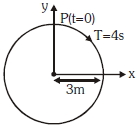
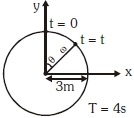
The radius of the circle,the period of revolution,the initial position,and the sense of revolution are indicated in the figure. The $y$-projection of the radius vector of the rotating particle $P$ is:
A
$y(t)=-3 \cos 2 \pi t,$ where $y$ is in $m$
B
$y(t)=4 \sin \left(\frac{\pi t}{2}\right),$ where $y$ is in $m$
C
$y(t)=3 \cos \left(\frac{3 \pi t}{2}\right),$ where $y$ is in $m$
D
$y(t)=3 \cos \left(\frac{\pi t}{2}\right),$ where $y$ is in $m$
Solution
(D) From the figure,the radius of the circle is $A = 3 \ m$ and the time period is $T = 4 \ s$.
The angular velocity is given by $\omega = \frac{2 \pi}{T} = \frac{2 \pi}{4} = \frac{\pi}{2} \ rad/s$.
At $t = 0$,the particle $P$ is at the positive $y$-axis,which means its position vector makes an angle $\phi = \frac{\pi}{2}$ with the positive $x$-axis.
The $y$-coordinate of the particle at any time $t$ is given by $y(t) = A \sin(\omega t + \phi)$.
Substituting the values,$y(t) = 3 \sin\left(\frac{\pi t}{2} + \frac{\pi}{2}\right)$.
Using the trigonometric identity $\sin(\theta + \frac{\pi}{2}) = \cos \theta$,we get $y(t) = 3 \cos\left(\frac{\pi t}{2}\right)$.
The angular velocity is given by $\omega = \frac{2 \pi}{T} = \frac{2 \pi}{4} = \frac{\pi}{2} \ rad/s$.
At $t = 0$,the particle $P$ is at the positive $y$-axis,which means its position vector makes an angle $\phi = \frac{\pi}{2}$ with the positive $x$-axis.
The $y$-coordinate of the particle at any time $t$ is given by $y(t) = A \sin(\omega t + \phi)$.
Substituting the values,$y(t) = 3 \sin\left(\frac{\pi t}{2} + \frac{\pi}{2}\right)$.
Using the trigonometric identity $\sin(\theta + \frac{\pi}{2}) = \cos \theta$,we get $y(t) = 3 \cos\left(\frac{\pi t}{2}\right)$.
0 likesView Solution
20
PhysicsMediumMCQNEET · 2019
$A$ force $F = 20 + 10y$ acts on a particle in the $y$ direction,where $F$ is in newton $(N)$ and $y$ is in meter $(m)$. The work done by this force to move the particle from $y = 0$ to $y = 1 \; m$ is ...... $J$.
A
$30$
B
$5$
C
$25$
D
$20$
Solution
(C) The work done by a variable force $F$ acting along the $y$-axis is given by the integral: $W = \int_{y_1}^{y_2} F \, dy$.
Given $F = 20 + 10y$,$y_1 = 0 \; m$,and $y_2 = 1 \; m$,we substitute these into the formula:
$W = \int_{0}^{1} (20 + 10y) \, dy$.
Integrating term by term:
$W = [20y + 10 \cdot \frac{y^2}{2}]_{0}^{1}$.
Simplifying the expression:
$W = [20y + 5y^2]_{0}^{1}$.
Applying the limits:
$W = (20(1) + 5(1)^2) - (20(0) + 5(0)^2)$.
$W = 20 + 5 = 25 \; J$.
Given $F = 20 + 10y$,$y_1 = 0 \; m$,and $y_2 = 1 \; m$,we substitute these into the formula:
$W = \int_{0}^{1} (20 + 10y) \, dy$.
Integrating term by term:
$W = [20y + 10 \cdot \frac{y^2}{2}]_{0}^{1}$.
Simplifying the expression:
$W = [20y + 5y^2]_{0}^{1}$.
Applying the limits:
$W = (20(1) + 5(1)^2) - (20(0) + 5(0)^2)$.
$W = 20 + 5 = 25 \; J$.
1 likesView Solution
21
PhysicsMediumMCQNEET · 2019
Two particles $A$ and $B$ are moving in uniform circular motion in concentric circles of radii $r_{A}$ and $r_{B}$ with speeds $v_A$ and $v_B$ respectively. The time period of rotation is the same. The ratio of angular speed of $A$ to that of $B$ will be
A
$r_{A}: r_{B}$
B
$v_{A}: v_{B}$
C
$r_{B}: r_{A}$
D
$1: 1$
Solution
(D) The angular speed $\omega$ of a particle in uniform circular motion is related to its time period $T$ by the formula $\omega = \frac{2\pi}{T}$.
Given that the time periods of particles $A$ and $B$ are the same,i.e.,$T_A = T_B = T$.
Therefore,the angular speed of particle $A$ is $\omega_A = \frac{2\pi}{T_A} = \frac{2\pi}{T}$.
Similarly,the angular speed of particle $B$ is $\omega_B = \frac{2\pi}{T_B} = \frac{2\pi}{T}$.
Taking the ratio of the angular speeds,we get $\frac{\omega_A}{\omega_B} = \frac{2\pi/T}{2\pi/T} = 1$.
Thus,the ratio of the angular speed of $A$ to that of $B$ is $1: 1$.
Given that the time periods of particles $A$ and $B$ are the same,i.e.,$T_A = T_B = T$.
Therefore,the angular speed of particle $A$ is $\omega_A = \frac{2\pi}{T_A} = \frac{2\pi}{T}$.
Similarly,the angular speed of particle $B$ is $\omega_B = \frac{2\pi}{T_B} = \frac{2\pi}{T}$.
Taking the ratio of the angular speeds,we get $\frac{\omega_A}{\omega_B} = \frac{2\pi/T}{2\pi/T} = 1$.
Thus,the ratio of the angular speed of $A$ to that of $B$ is $1: 1$.
0 likesView Solution
22
PhysicsMediumMCQNEET · 2019
When an object is shot from the bottom of a long smooth inclined plane kept at an angle $60^{\circ}$ with the horizontal,it can travel a distance $x_{1}$ along the plane. But when the inclination is decreased to $30^{\circ}$ and the same object is shot with the same velocity,it can travel $x_{2}$ distance. Then $x_{1}: x_{2}$ will be
A
$1: \sqrt{2}$
B
$\sqrt{2}: 1$
C
$1: \sqrt{3}$
D
$1: 2 \sqrt{3}$
Solution
(C) Using the third equation of motion,$v^{2} = u^{2} - 2as$. At the highest point,the final velocity $v = 0$.
Therefore,$0 = u^{2} - 2as$,which gives $s = \frac{u^{2}}{2a}$.
For an object on a smooth inclined plane,the acceleration $a = g \sin \theta$.
Thus,the distance traveled is $s = \frac{u^{2}}{2g \sin \theta}$.
Since $u$ and $g$ are constant,$s \propto \frac{1}{\sin \theta}$.
Therefore,$\frac{x_{1}}{x_{2}} = \frac{\sin \theta_{2}}{\sin \theta_{1}} = \frac{\sin 30^{\circ}}{\sin 60^{\circ}}$.
Substituting the values,$\frac{x_{1}}{x_{2}} = \frac{1/2}{\sqrt{3}/2} = \frac{1}{\sqrt{3}}$.
Hence,the ratio $x_{1}: x_{2}$ is $1: \sqrt{3}$.
Therefore,$0 = u^{2} - 2as$,which gives $s = \frac{u^{2}}{2a}$.
For an object on a smooth inclined plane,the acceleration $a = g \sin \theta$.
Thus,the distance traveled is $s = \frac{u^{2}}{2g \sin \theta}$.
Since $u$ and $g$ are constant,$s \propto \frac{1}{\sin \theta}$.
Therefore,$\frac{x_{1}}{x_{2}} = \frac{\sin \theta_{2}}{\sin \theta_{1}} = \frac{\sin 30^{\circ}}{\sin 60^{\circ}}$.
Substituting the values,$\frac{x_{1}}{x_{2}} = \frac{1/2}{\sqrt{3}/2} = \frac{1}{\sqrt{3}}$.
Hence,the ratio $x_{1}: x_{2}$ is $1: \sqrt{3}$.
0 likesView Solution
23
PhysicsMediumMCQNEET · 2019
$A$ small hole of area of cross-section $2 \; mm^{2}$ is present near the bottom of a fully filled open tank of height $2 \; m$. Taking $g = 10 \; m/s^{2}$,the rate of flow of water through the open hole would be nearly ......... $\times 10^{-6} \; m^{3}/s$.
A
$12.6$
B
$8.9$
C
$2.23$
D
$6.4$
Solution
(A) The velocity of efflux $v$ is given by Torricelli's law: $v = \sqrt{2gh}$.
The volume flow rate $Q$ is given by $Q = A \times v = A \sqrt{2gh}$.
Given: Area $A = 2 \; mm^{2} = 2 \times 10^{-6} \; m^{2}$,height $h = 2 \; m$,and $g = 10 \; m/s^{2}$.
Substituting the values:
$Q = (2 \times 10^{-6}) \sqrt{2 \times 10 \times 2}$
$Q = (2 \times 10^{-6}) \sqrt{40}$
$Q = (2 \times 10^{-6}) \times 2\sqrt{10}$
$Q = 4 \sqrt{10} \times 10^{-6} \; m^{3}/s$.
Since $\sqrt{10} \approx 3.162$,
$Q \approx 4 \times 3.162 \times 10^{-6} \; m^{3}/s = 12.648 \times 10^{-6} \; m^{3}/s$.
Thus,the rate of flow is nearly $12.6 \times 10^{-6} \; m^{3}/s$.
The volume flow rate $Q$ is given by $Q = A \times v = A \sqrt{2gh}$.
Given: Area $A = 2 \; mm^{2} = 2 \times 10^{-6} \; m^{2}$,height $h = 2 \; m$,and $g = 10 \; m/s^{2}$.
Substituting the values:
$Q = (2 \times 10^{-6}) \sqrt{2 \times 10 \times 2}$
$Q = (2 \times 10^{-6}) \sqrt{40}$
$Q = (2 \times 10^{-6}) \times 2\sqrt{10}$
$Q = 4 \sqrt{10} \times 10^{-6} \; m^{3}/s$.
Since $\sqrt{10} \approx 3.162$,
$Q \approx 4 \times 3.162 \times 10^{-6} \; m^{3}/s = 12.648 \times 10^{-6} \; m^{3}/s$.
Thus,the rate of flow is nearly $12.6 \times 10^{-6} \; m^{3}/s$.
1 likesView Solution
24
PhysicsMediumMCQNEET · 2019
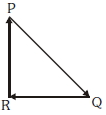
$A$ particle moving with velocity $\overrightarrow{V}$ is acted upon by three forces represented by the vector triangle $PQR$. The velocity of the particle will
A
increase
B
decrease
C
remain constant
D
change according to the smallest force $\overrightarrow{QR}$
Solution
(C) According to the triangle law of vector addition,if three forces are represented by the sides of a triangle taken in the same order,their resultant is zero.
In the given triangle $PQR$,the forces are $\overrightarrow{PQ}$,$\overrightarrow{QR}$,and $\overrightarrow{RP}$.
Since they are in the same order,the net force $\overrightarrow{F}_{net} = \overrightarrow{PQ} + \overrightarrow{QR} + \overrightarrow{RP} = \overrightarrow{0}$.
According to Newton's second law,$\overrightarrow{F}_{net} = m\overrightarrow{a}$.
Since $\overrightarrow{F}_{net} = \overrightarrow{0}$,the acceleration $\overrightarrow{a} = \overrightarrow{0}$.
Therefore,the velocity $\overrightarrow{V}$ of the particle remains constant.
In the given triangle $PQR$,the forces are $\overrightarrow{PQ}$,$\overrightarrow{QR}$,and $\overrightarrow{RP}$.
Since they are in the same order,the net force $\overrightarrow{F}_{net} = \overrightarrow{PQ} + \overrightarrow{QR} + \overrightarrow{RP} = \overrightarrow{0}$.
According to Newton's second law,$\overrightarrow{F}_{net} = m\overrightarrow{a}$.
Since $\overrightarrow{F}_{net} = \overrightarrow{0}$,the acceleration $\overrightarrow{a} = \overrightarrow{0}$.
Therefore,the velocity $\overrightarrow{V}$ of the particle remains constant.
0 likesView Solution
25
PhysicsMediumMCQNEET · 2019
The work done to raise a mass $m$ from the surface of the earth to a height $h$,which is equal to the radius of the earth,is
A
$mgR$
B
$2mgR$
C
$\frac{1}{2}mgR$
D
$\frac{3}{2}mgR$
Solution
(C) The gravitational potential energy at the surface of the earth is $U_i = -\frac{GMm}{R}$.
The gravitational potential energy at height $h$ is $U_f = -\frac{GMm}{R+h}$.
The work done $W$ is the change in potential energy: $W = U_f - U_i = GMm \left( \frac{1}{R} - \frac{1}{R+h} \right)$.
Given $h = R$,we substitute this into the equation:
$W = GMm \left( \frac{1}{R} - \frac{1}{R+R} \right) = GMm \left( \frac{1}{R} - \frac{1}{2R} \right) = GMm \left( \frac{1}{2R} \right) = \frac{GMm}{2R}$.
Since $g = \frac{GM}{R^2}$,we have $GM = gR^2$.
Substituting $GM = gR^2$ into the expression for $W$:
$W = \frac{(gR^2)m}{2R} = \frac{1}{2}mgR$.
The gravitational potential energy at height $h$ is $U_f = -\frac{GMm}{R+h}$.
The work done $W$ is the change in potential energy: $W = U_f - U_i = GMm \left( \frac{1}{R} - \frac{1}{R+h} \right)$.
Given $h = R$,we substitute this into the equation:
$W = GMm \left( \frac{1}{R} - \frac{1}{R+R} \right) = GMm \left( \frac{1}{R} - \frac{1}{2R} \right) = GMm \left( \frac{1}{2R} \right) = \frac{GMm}{2R}$.
Since $g = \frac{GM}{R^2}$,we have $GM = gR^2$.
Substituting $GM = gR^2$ into the expression for $W$:
$W = \frac{(gR^2)m}{2R} = \frac{1}{2}mgR$.
0 likesView Solution
26
PhysicsEasyMCQNEET · 2019
The distance covered by a particle undergoing $SHM$ in one time period is (amplitude $= A$).
A
$0$
B
$A$
C
$2A$
D
$4A$
Solution
(D) In $SHM$,a particle oscillates between the extreme positions $+A$ and $-A$.
Starting from the mean position $(x=0)$,the particle moves to $+A$ (distance $= A$).
Then it moves from $+A$ to $-A$ (distance $= 2A$).
Finally,it moves from $-A$ back to the mean position $(x=0)$ (distance $= A$).
Total distance covered in one complete oscillation (one time period) $= A + 2A + A = 4A$.
Starting from the mean position $(x=0)$,the particle moves to $+A$ (distance $= A$).
Then it moves from $+A$ to $-A$ (distance $= 2A$).
Finally,it moves from $-A$ back to the mean position $(x=0)$ (distance $= A$).
Total distance covered in one complete oscillation (one time period) $= A + 2A + A = 4A$.
0 likesView Solution
27
PhysicsMediumMCQNEET · 2019
$A$ mass falls from a height $h$ and its time of fall $t$ is recorded in terms of time period $T$ of a simple pendulum. On the surface of the Earth,it is found that $t = 2T$. The entire setup is taken to the surface of another planet whose mass is half that of the Earth and radius is the same. The same experiment is repeated and corresponding times are noted as $t'$ and $T'$.
A
$t' = \sqrt{2} T'$
B
$t' > 2 T'$
C
$t' < 2 T'$
D
$t' = 2 T'$
Solution
(D) The time of fall $t$ for an object falling from height $h$ is given by $t = \sqrt{\frac{2h}{g}}$. Thus,$t \propto \frac{1}{\sqrt{g}}$.
The time period $T$ of a simple pendulum is given by $T = 2\pi \sqrt{\frac{l}{g}}$. Thus,$T \propto \frac{1}{\sqrt{g}}$.
Taking the ratio,we get $\frac{t}{T} = \frac{k_1 / \sqrt{g}}{k_2 / \sqrt{g}} = \text{constant}$.
Since the ratio $\frac{t}{T}$ is independent of the acceleration due to gravity $g$,the relationship remains the same on any planet.
Given that on Earth $t = 2T$,it follows that on the other planet $t' = 2T'$.
The time period $T$ of a simple pendulum is given by $T = 2\pi \sqrt{\frac{l}{g}}$. Thus,$T \propto \frac{1}{\sqrt{g}}$.
Taking the ratio,we get $\frac{t}{T} = \frac{k_1 / \sqrt{g}}{k_2 / \sqrt{g}} = \text{constant}$.
Since the ratio $\frac{t}{T}$ is independent of the acceleration due to gravity $g$,the relationship remains the same on any planet.
Given that on Earth $t = 2T$,it follows that on the other planet $t' = 2T'$.
0 likesView Solution
28
PhysicsMediumMCQNEET · 2019
$A$ tuning fork with frequency $800 \; Hz$ produces resonance in a resonance column tube with the upper end open and the lower end closed by a water surface. Successive resonances are observed at lengths $9.75 \; cm$,$31.25 \; cm$,and $52.75 \; cm$. The speed of sound in air is ...... $m/s$.
A
$500$
B
$156$
C
$344$
D
$172$
Solution
(C) For a resonance column tube closed at one end,the resonance lengths $l_1, l_2, l_3, \dots$ are given by $l_n = (2n-1) \frac{\lambda}{4}$.
The difference between two successive resonance lengths is $\Delta l = l_{n+1} - l_n = \frac{\lambda}{2}$.
Given $l_1 = 9.75 \; cm$ and $l_2 = 31.25 \; cm$,the difference is $\Delta l = 31.25 \; cm - 9.75 \; cm = 21.50 \; cm = 0.215 \; m$.
Thus,$\frac{\lambda}{2} = 0.215 \; m$,which implies $\lambda = 0.43 \; m$.
The speed of sound $v$ is given by $v = f \lambda$.
Substituting the values $f = 800 \; Hz$ and $\lambda = 0.43 \; m$,we get $v = 800 \times 0.43 = 344 \; m/s$.
The difference between two successive resonance lengths is $\Delta l = l_{n+1} - l_n = \frac{\lambda}{2}$.
Given $l_1 = 9.75 \; cm$ and $l_2 = 31.25 \; cm$,the difference is $\Delta l = 31.25 \; cm - 9.75 \; cm = 21.50 \; cm = 0.215 \; m$.
Thus,$\frac{\lambda}{2} = 0.215 \; m$,which implies $\lambda = 0.43 \; m$.
The speed of sound $v$ is given by $v = f \lambda$.
Substituting the values $f = 800 \; Hz$ and $\lambda = 0.43 \; m$,we get $v = 800 \times 0.43 = 344 \; m/s$.
0 likesView Solution
29
PhysicsMediumMCQNEET · 2019
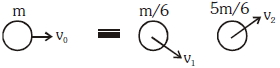
An object flying in air with velocity $(20 \hat{i}+25 \hat{j}-12 \hat{k})$ suddenly breaks into two pieces whose masses are in the ratio $1:5$. The smaller mass flies off with a velocity $(100 \hat{i}+35 \hat{j}+8 \hat{k})$. The velocity of the larger piece will be:
A
$4 \hat{i}+23 \hat{j}-16 \hat{k}$
B
$-100 \hat{i}-35 \hat{j}-8 \hat{k}$
C
$20 \hat{i}+15 \hat{j}-80 \hat{k}$
D
$-20 \hat{i}-15 \hat{j}-80 \hat{k}$
Solution
(A) According to the law of conservation of linear momentum,the total momentum before the break is equal to the total momentum after the break.
Let the total mass be $M = m_1 + m_2$. Given the ratio $m_1 : m_2 = 1 : 5$,we have $m_1 = \frac{M}{6}$ and $m_2 = \frac{5M}{6}$.
Initial momentum: $P_i = M \vec{v}_0 = M(20 \hat{i} + 25 \hat{j} - 12 \hat{k})$.
Final momentum: $P_f = m_1 \vec{v}_1 + m_2 \vec{v}_2 = \frac{M}{6}(100 \hat{i} + 35 \hat{j} + 8 \hat{k}) + \frac{5M}{6} \vec{v}_2$.
Equating $P_i = P_f$:
$M(20 \hat{i} + 25 \hat{j} - 12 \hat{k}) = \frac{M}{6}(100 \hat{i} + 35 \hat{j} + 8 \hat{k}) + \frac{5M}{6} \vec{v}_2$
Dividing by $M$ and multiplying by $6$:
$6(20 \hat{i} + 25 \hat{j} - 12 \hat{k}) = (100 \hat{i} + 35 \hat{j} + 8 \hat{k}) + 5 \vec{v}_2$
$120 \hat{i} + 150 \hat{j} - 72 \hat{k} = 100 \hat{i} + 35 \hat{j} + 8 \hat{k} + 5 \vec{v}_2$
$5 \vec{v}_2 = (120 - 100) \hat{i} + (150 - 35) \hat{j} + (-72 - 8) \hat{k}$
$5 \vec{v}_2 = 20 \hat{i} + 115 \hat{j} - 80 \hat{k}$
$\vec{v}_2 = 4 \hat{i} + 23 \hat{j} - 16 \hat{k}$.
Let the total mass be $M = m_1 + m_2$. Given the ratio $m_1 : m_2 = 1 : 5$,we have $m_1 = \frac{M}{6}$ and $m_2 = \frac{5M}{6}$.
Initial momentum: $P_i = M \vec{v}_0 = M(20 \hat{i} + 25 \hat{j} - 12 \hat{k})$.
Final momentum: $P_f = m_1 \vec{v}_1 + m_2 \vec{v}_2 = \frac{M}{6}(100 \hat{i} + 35 \hat{j} + 8 \hat{k}) + \frac{5M}{6} \vec{v}_2$.
Equating $P_i = P_f$:
$M(20 \hat{i} + 25 \hat{j} - 12 \hat{k}) = \frac{M}{6}(100 \hat{i} + 35 \hat{j} + 8 \hat{k}) + \frac{5M}{6} \vec{v}_2$
Dividing by $M$ and multiplying by $6$:
$6(20 \hat{i} + 25 \hat{j} - 12 \hat{k}) = (100 \hat{i} + 35 \hat{j} + 8 \hat{k}) + 5 \vec{v}_2$
$120 \hat{i} + 150 \hat{j} - 72 \hat{k} = 100 \hat{i} + 35 \hat{j} + 8 \hat{k} + 5 \vec{v}_2$
$5 \vec{v}_2 = (120 - 100) \hat{i} + (150 - 35) \hat{j} + (-72 - 8) \hat{k}$
$5 \vec{v}_2 = 20 \hat{i} + 115 \hat{j} - 80 \hat{k}$
$\vec{v}_2 = 4 \hat{i} + 23 \hat{j} - 16 \hat{k}$.
0 likesView Solution
30
PhysicsMediumMCQNEET · 2019
An object kept in a large room having air temperature of $25^{\circ}C$ takes $12 \text{ minutes}$ to cool from $80^{\circ}C$ to $70^{\circ}C$. The time taken to cool for the same object from $70^{\circ}C$ to $60^{\circ}C$ would be nearly.....$min$
A
$10$
B
$12$
C
$20$
D
$15$
Solution
(D) According to Newton's Law of Cooling: $\frac{T_1 - T_2}{t} = K \left( \frac{T_1 + T_2}{2} - T_s \right)$
For the first interval ($80^{\circ}C$ to $70^{\circ}C$):
$\frac{80 - 70}{12} = K \left( \frac{80 + 70}{2} - 25 \right)$
$\frac{10}{12} = K (75 - 25) = 50K \implies K = \frac{10}{12 \times 50} = \frac{1}{60} \ldots(1)$
For the second interval ($70^{\circ}C$ to $60^{\circ}C$):
$\frac{70 - 60}{t} = K \left( \frac{70 + 60}{2} - 25 \right)$
$\frac{10}{t} = K (65 - 25) = 40K \ldots(2)$
Substituting $K = \frac{1}{60}$ into equation $(2)$:
$\frac{10}{t} = 40 \times \frac{1}{60} = \frac{2}{3}$
$t = \frac{10 \times 3}{2} = 15 \text{ minutes}$.
For the first interval ($80^{\circ}C$ to $70^{\circ}C$):
$\frac{80 - 70}{12} = K \left( \frac{80 + 70}{2} - 25 \right)$
$\frac{10}{12} = K (75 - 25) = 50K \implies K = \frac{10}{12 \times 50} = \frac{1}{60} \ldots(1)$
For the second interval ($70^{\circ}C$ to $60^{\circ}C$):
$\frac{70 - 60}{t} = K \left( \frac{70 + 60}{2} - 25 \right)$
$\frac{10}{t} = K (65 - 25) = 40K \ldots(2)$
Substituting $K = \frac{1}{60}$ into equation $(2)$:
$\frac{10}{t} = 40 \times \frac{1}{60} = \frac{2}{3}$
$t = \frac{10 \times 3}{2} = 15 \text{ minutes}$.
0 likesView Solution
31
PhysicsMediumMCQNEET · 2019
Two small spherical metal balls,having equal masses,are made from materials of densities $\rho_{1}$ and $\rho_{2}$ (where $\rho_{1} = 8 \rho_{2}$) and have radii of $1 \; mm$ and $2 \; mm$,respectively. They are made to fall vertically (from rest) in a viscous medium whose coefficient of viscosity equals $\eta$ and whose density is $0.1 \rho_{2}$. The ratio of their terminal velocities would be:
A
$\frac{79}{72}$
B
$\frac{19}{36}$
C
$\frac{39}{72}$
D
$\frac{79}{36}$
Solution
(D) The terminal velocity $v_{T}$ of a spherical ball of radius $r$ and density $\sigma$ falling in a medium of density $\rho$ and viscosity $\eta$ is given by $v_{T} = \frac{2 r^{2}(\sigma - \rho) g}{9 \eta}$.
Given that the masses of the two balls are equal,$m_{1} = m_{2}$.
Since $m = \text{volume} \times \text{density} = \frac{4}{3} \pi r^{3} \sigma$,we have $\frac{4}{3} \pi r_{1}^{3} \rho_{1} = \frac{4}{3} \pi r_{2}^{3} \rho_{2}$.
Given $r_{1} = 1 \; mm$,$r_{2} = 2 \; mm$,and $\rho_{1} = 8 \rho_{2}$,we check the mass condition: $1^{3} \times 8 \rho_{2} = 8 \rho_{2}$ and $2^{3} \times \rho_{2} = 8 \rho_{2}$. The condition holds.
The ratio of terminal velocities is $\frac{v_{1}}{v_{2}} = \left(\frac{r_{1}}{r_{2}}\right)^{2} \frac{(\rho_{1} - \rho_{medium})}{(\rho_{2} - \rho_{medium})}$.
Here,$\rho_{medium} = 0.1 \rho_{2}$.
Substituting the values: $\frac{v_{1}}{v_{2}} = \left(\frac{1}{2}\right)^{2} \frac{(8 \rho_{2} - 0.1 \rho_{2})}{(\rho_{2} - 0.1 \rho_{2})} = \frac{1}{4} \times \frac{7.9 \rho_{2}}{0.9 \rho_{2}} = \frac{1}{4} \times \frac{79}{9} = \frac{79}{36}$.
Given that the masses of the two balls are equal,$m_{1} = m_{2}$.
Since $m = \text{volume} \times \text{density} = \frac{4}{3} \pi r^{3} \sigma$,we have $\frac{4}{3} \pi r_{1}^{3} \rho_{1} = \frac{4}{3} \pi r_{2}^{3} \rho_{2}$.
Given $r_{1} = 1 \; mm$,$r_{2} = 2 \; mm$,and $\rho_{1} = 8 \rho_{2}$,we check the mass condition: $1^{3} \times 8 \rho_{2} = 8 \rho_{2}$ and $2^{3} \times \rho_{2} = 8 \rho_{2}$. The condition holds.
The ratio of terminal velocities is $\frac{v_{1}}{v_{2}} = \left(\frac{r_{1}}{r_{2}}\right)^{2} \frac{(\rho_{1} - \rho_{medium})}{(\rho_{2} - \rho_{medium})}$.
Here,$\rho_{medium} = 0.1 \rho_{2}$.
Substituting the values: $\frac{v_{1}}{v_{2}} = \left(\frac{1}{2}\right)^{2} \frac{(8 \rho_{2} - 0.1 \rho_{2})}{(\rho_{2} - 0.1 \rho_{2})} = \frac{1}{4} \times \frac{7.9 \rho_{2}}{0.9 \rho_{2}} = \frac{1}{4} \times \frac{79}{9} = \frac{79}{36}$.
0 likesView Solution
32
PhysicsMediumMCQNEET · 2019
$A$ particle starting from rest moves in a circle of radius $r$. It attains a velocity of $V_{0} \; m/s$ in the $n^{\text{th}}$ round. Its angular acceleration will be
A
$\frac{V_{0}}{n} \; rad/s^{2}$
B
$\frac{V_{0}^{2}}{2 \pi n r^{2}} \; rad/s^{2}$
C
$\frac{V_{0}^{2}}{4 \pi n r^{2}} \; rad/s^{2}$
D
$\frac{V_{0}^{2}}{4 \pi n r} \; rad/s^{2}$
Solution
(C) The particle starts from rest,so initial angular velocity $\omega_{0} = 0$.
After $n$ rounds,the total angular displacement is $\theta = 2 \pi n$.
The final linear velocity is $V_{0}$,so the final angular velocity is $\omega = \frac{V_{0}}{r}$.
Using the kinematic equation $\omega^{2} = \omega_{0}^{2} + 2 \alpha \theta$,we get:
$\alpha = \frac{\omega^{2} - \omega_{0}^{2}}{2 \theta} = \frac{(V_{0}/r)^{2} - 0}{2(2 \pi n)} = \frac{V_{0}^{2}/r^{2}}{4 \pi n} = \frac{V_{0}^{2}}{4 \pi n r^{2}} \; rad/s^{2}$.
After $n$ rounds,the total angular displacement is $\theta = 2 \pi n$.
The final linear velocity is $V_{0}$,so the final angular velocity is $\omega = \frac{V_{0}}{r}$.
Using the kinematic equation $\omega^{2} = \omega_{0}^{2} + 2 \alpha \theta$,we get:
$\alpha = \frac{\omega^{2} - \omega_{0}^{2}}{2 \theta} = \frac{(V_{0}/r)^{2} - 0}{2(2 \pi n)} = \frac{V_{0}^{2}/r^{2}}{4 \pi n} = \frac{V_{0}^{2}}{4 \pi n r^{2}} \; rad/s^{2}$.
0 likesView Solution
33
PhysicsEasyMCQNEET · 2019
$A$ person standing on the floor of an elevator drops a coin. The coin reaches the floor in time $t_{1}$ if the elevator is at rest and in time $t_{2}$ if the elevator is moving uniformly. Then
A
$t_{1} < t_{2}$ or $t_{1} > t_{2}$ depending upon whether the lift is going up or down
B
$t_{1} < t_{2}$
C
$t_{1} > t_{2}$
D
$t_{1} = t_{2}$
Solution
(D) The time taken for an object to fall a distance $h$ under constant acceleration $a$ is given by $t = \sqrt{\frac{2h}{a}}$.
When the elevator is at rest,its acceleration is $0$,so the effective acceleration of the coin relative to the floor is $g$.
When the elevator is moving uniformly (constant velocity),its acceleration is also $0$. Therefore,the effective acceleration of the coin relative to the floor remains $g$.
Since the effective acceleration is the same in both cases $(a_{real} = g)$,the time taken for the coin to reach the floor is the same.
Thus,$t_{1} = t_{2}$.
When the elevator is at rest,its acceleration is $0$,so the effective acceleration of the coin relative to the floor is $g$.
When the elevator is moving uniformly (constant velocity),its acceleration is also $0$. Therefore,the effective acceleration of the coin relative to the floor remains $g$.
Since the effective acceleration is the same in both cases $(a_{real} = g)$,the time taken for the coin to reach the floor is the same.
Thus,$t_{1} = t_{2}$.
0 likesView Solution
34
PhysicsMediumMCQNEET · 2019
$A$ truck is stationary and has a bob suspended by a light string in a frame attached to the truck. The truck suddenly moves to the right with an acceleration of $a$. The pendulum will tilt:
A
to the left and the angle of inclination of the pendulum with the vertical is $\sin^{-1}\left(\frac{g}{a}\right)$
B
to the left and the angle of inclination of the pendulum with the vertical is $\tan^{-1}\left(\frac{a}{g}\right)$
C
to the left and the angle of inclination of the pendulum with the vertical is $\sin^{-1}\left(\frac{a}{g}\right)$
D
to the left and the angle of inclination of the pendulum with the vertical is $\tan^{-1}\left(\frac{g}{a}\right)$
Solution
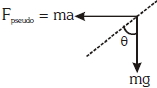
(B) When the truck accelerates to the right with acceleration $a$,a pseudo force $F_{\text{pseudo}} = ma$ acts on the bob in the opposite direction (i.e.,to the left) in the frame of the truck.
Let $\theta$ be the angle the string makes with the vertical.
In the equilibrium position of the bob in the truck's frame,the forces acting on the bob are the tension $T$,the gravitational force $mg$ acting downwards,and the pseudo force $ma$ acting to the left.
Resolving the forces,we get:
$T \sin \theta = ma$
$T \cos \theta = mg$
Dividing the two equations,we get:
$\tan \theta = \frac{ma}{mg} = \frac{a}{g}$
Therefore,$\theta = \tan^{-1}\left(\frac{a}{g}\right)$.
Since the pseudo force acts to the left,the pendulum tilts to the left.
Let $\theta$ be the angle the string makes with the vertical.
In the equilibrium position of the bob in the truck's frame,the forces acting on the bob are the tension $T$,the gravitational force $mg$ acting downwards,and the pseudo force $ma$ acting to the left.
Resolving the forces,we get:
$T \sin \theta = ma$
$T \cos \theta = mg$
Dividing the two equations,we get:
$\tan \theta = \frac{ma}{mg} = \frac{a}{g}$
Therefore,$\theta = \tan^{-1}\left(\frac{a}{g}\right)$.
Since the pseudo force acts to the left,the pendulum tilts to the left.
0 likesView Solution
35
PhysicsMediumMCQNEET · 2019
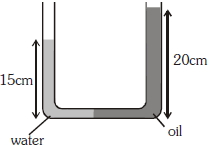
In a $U$-tube as shown in the figure,water and oil are in the left and right sides of the tube,respectively. The heights from the bottom for the water and oil columns are $15 \; cm$ and $20 \; cm$,respectively. The density of the oil is ...... $kg/m^3$. [Take $\rho_{\text{water}} = 1000 \; kg/m^3$]
A
$1200$
B
$750$
C
$1000$
D
$1333$
Solution
(B) At the same horizontal level in a continuous static fluid,the pressure is the same.
Let the pressure at the bottom of the $U$-tube be $P$.
The pressure exerted by the water column on the left side is $P_{\text{left}} = P_0 + \rho_{\text{water}} g h_{\text{water}}$,where $P_0$ is atmospheric pressure.
The pressure exerted by the oil column on the right side is $P_{\text{right}} = P_0 + \rho_{\text{oil}} g h_{\text{oil}}$.
Since the pressures at the bottom are equal,we have:
$\rho_{\text{water}} g h_{\text{water}} = \rho_{\text{oil}} g h_{\text{oil}}$
$\rho_{\text{oil}} = \frac{\rho_{\text{water}} h_{\text{water}}}{h_{\text{oil}}}$
Given $\rho_{\text{water}} = 1000 \; kg/m^3$,$h_{\text{water}} = 15 \; cm$,and $h_{\text{oil}} = 20 \; cm$:
$\rho_{\text{oil}} = \frac{1000 \times 15}{20} = 750 \; kg/m^3$.
Let the pressure at the bottom of the $U$-tube be $P$.
The pressure exerted by the water column on the left side is $P_{\text{left}} = P_0 + \rho_{\text{water}} g h_{\text{water}}$,where $P_0$ is atmospheric pressure.
The pressure exerted by the oil column on the right side is $P_{\text{right}} = P_0 + \rho_{\text{oil}} g h_{\text{oil}}$.
Since the pressures at the bottom are equal,we have:
$\rho_{\text{water}} g h_{\text{water}} = \rho_{\text{oil}} g h_{\text{oil}}$
$\rho_{\text{oil}} = \frac{\rho_{\text{water}} h_{\text{water}}}{h_{\text{oil}}}$
Given $\rho_{\text{water}} = 1000 \; kg/m^3$,$h_{\text{water}} = 15 \; cm$,and $h_{\text{oil}} = 20 \; cm$:
$\rho_{\text{oil}} = \frac{1000 \times 15}{20} = 750 \; kg/m^3$.
0 likesView Solution
36
PhysicsMediumMCQNEET · 2019
$A$ deep rectangular pond of surface area $A$,containing water (density $=\rho$,specific heat capacity $=s$),is located in a region where the outside air temperature is at a steady value of $-26^{\circ}C$. The thickness of the frozen ice layer in this pond at a certain instant is $x$. Taking the thermal conductivity of ice as $K$ and its specific latent heat of fusion as $L$,the rate of increase of the thickness of the ice layer at this instant would be given by:
A
$26 K / (\rho x L)$
B
$26 K / (\rho x^2 L)$
C
$26 K / (\rho L)$
D
$13 K / (\rho x L)$
Solution
(A) The heat conducted through the ice layer of thickness $x$ in time $dt$ is given by $dQ = \frac{KA(T_2 - T_1)}{x} dt$.
Here,$T_2 = 0^{\circ}C$ (temperature at the water-ice interface) and $T_1 = -26^{\circ}C$ (outside air temperature).
So,$dQ = \frac{KA(0 - (-26))}{x} dt = \frac{26KA}{x} dt$.
This heat causes an additional thickness $dx$ of water to freeze. The mass of this new ice layer is $dm = A \cdot dx \cdot \rho$.
The heat released during this phase change is $dQ = dm \cdot L = A \cdot dx \cdot \rho \cdot L$.
Equating the two expressions for $dQ$:
$\frac{26KA}{x} dt = A \cdot dx \cdot \rho \cdot L$.
Rearranging to find the rate of increase of thickness $\frac{dx}{dt}$:
$\frac{dx}{dt} = \frac{26K}{\rho x L}$.
Here,$T_2 = 0^{\circ}C$ (temperature at the water-ice interface) and $T_1 = -26^{\circ}C$ (outside air temperature).
So,$dQ = \frac{KA(0 - (-26))}{x} dt = \frac{26KA}{x} dt$.
This heat causes an additional thickness $dx$ of water to freeze. The mass of this new ice layer is $dm = A \cdot dx \cdot \rho$.
The heat released during this phase change is $dQ = dm \cdot L = A \cdot dx \cdot \rho \cdot L$.
Equating the two expressions for $dQ$:
$\frac{26KA}{x} dt = A \cdot dx \cdot \rho \cdot L$.
Rearranging to find the rate of increase of thickness $\frac{dx}{dt}$:
$\frac{dx}{dt} = \frac{26K}{\rho x L}$.
0 likesView Solution
37
PhysicsMediumMCQNEET · 2019
The value of $\gamma \left( = \frac{C_{p}}{C_{v}} \right)$ for hydrogen,helium,and another ideal diatomic gas $X$ (whose molecules are not rigid but have an additional vibrational mode) are respectively equal to:
A
$\frac{7}{5}, \frac{5}{3}, \frac{9}{7}$
B
$\frac{5}{3}, \frac{7}{5}, \frac{9}{7}$
C
$\frac{5}{3}, \frac{7}{5}, \frac{7}{5}$
D
$\frac{7}{5}, \frac{5}{3}, \frac{7}{5}$
Solution
(A) The adiabatic index is given by $\gamma = 1 + \frac{2}{f}$,where $f$ is the number of degrees of freedom.
$1$. Hydrogen $(H_2)$ is a diatomic gas at room temperature. Its degrees of freedom $f = 5$ ($3$ translational + $2$ rotational). Thus,$\gamma = 1 + \frac{2}{5} = \frac{7}{5}$.
$2$. Helium $(He)$ is a monoatomic gas. Its degrees of freedom $f = 3$ ($3$ translational). Thus,$\gamma = 1 + \frac{2}{3} = \frac{5}{3}$.
$3$. Gas $X$ is a diatomic gas with an additional vibrational mode. $A$ vibrational mode contributes $2$ degrees of freedom ($1$ kinetic + $1$ potential). So,$f = 5 + 2 = 7$. Thus,$\gamma = 1 + \frac{2}{7} = \frac{9}{7}$.
Therefore,the values are $\frac{7}{5}, \frac{5}{3}, \text{and } \frac{9}{7}$.
$1$. Hydrogen $(H_2)$ is a diatomic gas at room temperature. Its degrees of freedom $f = 5$ ($3$ translational + $2$ rotational). Thus,$\gamma = 1 + \frac{2}{5} = \frac{7}{5}$.
$2$. Helium $(He)$ is a monoatomic gas. Its degrees of freedom $f = 3$ ($3$ translational). Thus,$\gamma = 1 + \frac{2}{3} = \frac{5}{3}$.
$3$. Gas $X$ is a diatomic gas with an additional vibrational mode. $A$ vibrational mode contributes $2$ degrees of freedom ($1$ kinetic + $1$ potential). So,$f = 5 + 2 = 7$. Thus,$\gamma = 1 + \frac{2}{7} = \frac{9}{7}$.
Therefore,the values are $\frac{7}{5}, \frac{5}{3}, \text{and } \frac{9}{7}$.
0 likesView Solution
38
PhysicsMediumMCQNEET · 2019
Two bullets are fired horizontally and simultaneously towards each other from the rooftops of two buildings $100 \; m$ apart and of the same height of $200 \; m$ with the same velocity of $25 \; m/s$. When and where will the two bullets collide? $(g = 10 \; m/s^2)$
A
after $2 \; s$ at a height of $180 \; m$
B
after $2 \; s$ at a height of $20 \; m$
C
after $4 \; s$ at a height of $120 \; m$
D
they will not collide
Solution
(A) The horizontal distance between the two buildings is $d = 100 \; m$. The bullets are fired towards each other with a horizontal velocity $v = 25 \; m/s$ each.
The relative horizontal velocity is $v_{rel} = v_1 + v_2 = 25 + 25 = 50 \; m/s$.
The time taken for the bullets to collide is $t = \frac{d}{v_{rel}} = \frac{100}{50} = 2 \; s$.
In this time,both bullets fall vertically due to gravity. The vertical displacement $s_y$ is given by $s_y = -\frac{1}{2} gt^2$.
Substituting the values: $s_y = -\frac{1}{2} \times 10 \times (2)^2 = -5 \times 4 = -20 \; m$.
The height of the collision from the ground is $H_{collision} = H_{initial} + s_y = 200 - 20 = 180 \; m$.
Thus,the bullets collide after $2 \; s$ at a height of $180 \; m$.
The relative horizontal velocity is $v_{rel} = v_1 + v_2 = 25 + 25 = 50 \; m/s$.
The time taken for the bullets to collide is $t = \frac{d}{v_{rel}} = \frac{100}{50} = 2 \; s$.
In this time,both bullets fall vertically due to gravity. The vertical displacement $s_y$ is given by $s_y = -\frac{1}{2} gt^2$.
Substituting the values: $s_y = -\frac{1}{2} \times 10 \times (2)^2 = -5 \times 4 = -20 \; m$.
The height of the collision from the ground is $H_{collision} = H_{initial} + s_y = 200 - 20 = 180 \; m$.
Thus,the bullets collide after $2 \; s$ at a height of $180 \; m$.
3 likesView Solution
39
PhysicsEasyMCQNEET · 2019
The stress-strain curves are drawn for two different materials $X$ and $Y$. It is observed that the ultimate strength point and the fracture point are close to each other for material $X$ but are far apart for material $Y$. We can say that materials $X$ and $Y$ are likely to be (respectively)
A
brittle and ductile
B
ductile and brittle
C
brittle and plastic
D
plastic and ductile
Solution
(A) In a stress-strain curve,the ultimate strength point represents the maximum stress a material can withstand. The fracture point is the point where the material breaks.
For a brittle material,the material breaks soon after the elastic limit or ultimate strength point,meaning the fracture point is very close to the ultimate strength point.
For a ductile material,the material undergoes significant plastic deformation after the ultimate strength point before it finally fractures,meaning the fracture point is far from the ultimate strength point.
Since material $X$ has these points close together,it is brittle.
Since material $Y$ has these points far apart,it is ductile.
Therefore,$X$ and $Y$ are brittle and ductile,respectively.
For a brittle material,the material breaks soon after the elastic limit or ultimate strength point,meaning the fracture point is very close to the ultimate strength point.
For a ductile material,the material undergoes significant plastic deformation after the ultimate strength point before it finally fractures,meaning the fracture point is far from the ultimate strength point.
Since material $X$ has these points close together,it is brittle.
Since material $Y$ has these points far apart,it is ductile.
Therefore,$X$ and $Y$ are brittle and ductile,respectively.
0 likesView Solution
40
PhysicsMediumMCQNEET · 2019
$A$ body of mass $m$ is kept on a rough horizontal surface (coefficient of friction $= \mu$). $A$ horizontal force is applied on the body,but it does not move. The resultant of the normal reaction and the frictional force acting on the object is given by $F$,where $F$ is:
A
$|\overrightarrow{F}| = mg + \mu mg$
B
$|\overrightarrow{F}| = \mu mg$
C
$|\overrightarrow{F}| \leq mg \sqrt{1 + \mu^{2}}$
D
$|\overrightarrow{F}| = mg$
Solution
(C) The normal reaction $N$ acting on the body is $N = mg$.
The frictional force $f$ acting on the body is a static frictional force,which balances the applied horizontal force. Since the body does not move,$f \leq \mu N = \mu mg$.
The resultant force $F$ of the normal reaction $N$ and the frictional force $f$ is given by the vector sum $\overrightarrow{F} = \overrightarrow{N} + \overrightarrow{f}$.
Since $N$ and $f$ are perpendicular to each other,the magnitude of the resultant is $|\overrightarrow{F}| = \sqrt{N^{2} + f^{2}}$.
Substituting $N = mg$ and $f \leq \mu mg$,we get $|\overrightarrow{F}| = \sqrt{(mg)^{2} + f^{2}}$.
Since $f^{2} \leq (\mu mg)^{2}$,it follows that $|\overrightarrow{F}| \leq \sqrt{(mg)^{2} + (\mu mg)^{2}} = mg \sqrt{1 + \mu^{2}}$.
The frictional force $f$ acting on the body is a static frictional force,which balances the applied horizontal force. Since the body does not move,$f \leq \mu N = \mu mg$.
The resultant force $F$ of the normal reaction $N$ and the frictional force $f$ is given by the vector sum $\overrightarrow{F} = \overrightarrow{N} + \overrightarrow{f}$.
Since $N$ and $f$ are perpendicular to each other,the magnitude of the resultant is $|\overrightarrow{F}| = \sqrt{N^{2} + f^{2}}$.
Substituting $N = mg$ and $f \leq \mu mg$,we get $|\overrightarrow{F}| = \sqrt{(mg)^{2} + f^{2}}$.
Since $f^{2} \leq (\mu mg)^{2}$,it follows that $|\overrightarrow{F}| \leq \sqrt{(mg)^{2} + (\mu mg)^{2}} = mg \sqrt{1 + \mu^{2}}$.
0 likesView Solution
41
PhysicsMediumMCQNEET · 2019
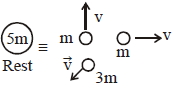
$A$ particle of mass $5m$ at rest suddenly breaks on its own into three fragments. Two fragments of mass $m$ each move along mutually perpendicular directions with speed $v$ each. The energy released during the process is
A
$\frac{3}{5} mv^{2}$
B
$\frac{5}{3} mv^{2}$
C
$\frac{3}{2} mv^{2}$
D
$\frac{4}{3} mv^{2}$
Solution
(D) Let the velocity of the third fragment of mass $3m$ be $\vec{v}'$. According to the law of conservation of linear momentum,the initial momentum is zero,so the final momentum must also be zero.
$3m \vec{v}' + m v \hat{i} + m v \hat{j} = 0$
$3m \vec{v}' = -mv \hat{i} - mv \hat{j}$
$\vec{v}' = -\frac{v}{3} \hat{i} - \frac{v}{3} \hat{j}$
The magnitude of the velocity of the third fragment is $|\vec{v}'| = \sqrt{(-\frac{v}{3})^2 + (-\frac{v}{3})^2} = \sqrt{\frac{2v^2}{9}} = \frac{\sqrt{2}}{3} v$.
The energy released is equal to the total kinetic energy of the fragments:
$K = \frac{1}{2} m v^2 + \frac{1}{2} m v^2 + \frac{1}{2} (3m) |\vec{v}'|^2$
$K = m v^2 + \frac{3}{2} m (\frac{2v^2}{9}) = m v^2 + \frac{1}{3} m v^2 = \frac{4}{3} m v^2$.
$3m \vec{v}' + m v \hat{i} + m v \hat{j} = 0$
$3m \vec{v}' = -mv \hat{i} - mv \hat{j}$
$\vec{v}' = -\frac{v}{3} \hat{i} - \frac{v}{3} \hat{j}$
The magnitude of the velocity of the third fragment is $|\vec{v}'| = \sqrt{(-\frac{v}{3})^2 + (-\frac{v}{3})^2} = \sqrt{\frac{2v^2}{9}} = \frac{\sqrt{2}}{3} v$.
The energy released is equal to the total kinetic energy of the fragments:
$K = \frac{1}{2} m v^2 + \frac{1}{2} m v^2 + \frac{1}{2} (3m) |\vec{v}'|^2$
$K = m v^2 + \frac{3}{2} m (\frac{2v^2}{9}) = m v^2 + \frac{1}{3} m v^2 = \frac{4}{3} m v^2$.
0 likesView Solution
42
PhysicsMediumMCQNEET · 2019
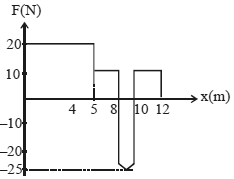
An object of mass $500 \; g$, initially at rest, is acted upon by a variable force whose $X$-component varies with $X$ as shown in the graph. The velocities of the object at $X = 8 \; m$ and $X = 12 \; m$ are, respectively:
A
$18 \; m/s$ and $24.4 \; m/s$
B
$23 \; m/s$ and $24.4 \; m/s$
C
$23 \; m/s$ and $20.6 \; m/s$
D
$18 \; m/s$ and $20.6 \; m/s$
Solution
(C) The work done by the force is equal to the change in kinetic energy: $W = \Delta KE = \frac{1}{2} m v^2$. The mass $m = 500 \; g = 0.5 \; kg$.
$1$. Work done up to $X = 8 \; m$:
$W_8 = (20 \; N \times 5 \; m) + (10 \; N \times 3 \; m) = 100 + 30 = 130 \; J$.
Using $W = \frac{1}{2} m v^2$: $130 = \frac{1}{2} (0.5) v_8^2 \Rightarrow v_8^2 = 520 \Rightarrow v_8 = \sqrt{520} \approx 22.8 \; m/s \approx 23 \; m/s$.
$2$. Work done up to $X = 12 \; m$:
$W_{12} = W_8 + (\text{Area from } 8 \; m \text{ to } 10 \; m) + (\text{Area from } 10 \; m \text{ to } 12 \; m)$.
Area from $8 \; m$ to $10 \; m = (2 \; m) \times (-25 \; N) = -50 \; J$.
Area from $10 \; m$ to $12 \; m = (2 \; m) \times (10 \; N) = 20 \; J$.
$W_{12} = 130 - 50 + 20 = 100 \; J$.
Using $W = \frac{1}{2} m v^2$: $100 = \frac{1}{2} (0.5) v_{12}^2 \Rightarrow v_{12}^2 = 400 \Rightarrow v_{12} = 20 \; m/s \approx 20.6 \; m/s$ (closest option).
Thus, the velocities are approximately $23 \; m/s$ and $20.6 \; m/s$.
$1$. Work done up to $X = 8 \; m$:
$W_8 = (20 \; N \times 5 \; m) + (10 \; N \times 3 \; m) = 100 + 30 = 130 \; J$.
Using $W = \frac{1}{2} m v^2$: $130 = \frac{1}{2} (0.5) v_8^2 \Rightarrow v_8^2 = 520 \Rightarrow v_8 = \sqrt{520} \approx 22.8 \; m/s \approx 23 \; m/s$.
$2$. Work done up to $X = 12 \; m$:
$W_{12} = W_8 + (\text{Area from } 8 \; m \text{ to } 10 \; m) + (\text{Area from } 10 \; m \text{ to } 12 \; m)$.
Area from $8 \; m$ to $10 \; m = (2 \; m) \times (-25 \; N) = -50 \; J$.
Area from $10 \; m$ to $12 \; m = (2 \; m) \times (10 \; N) = 20 \; J$.
$W_{12} = 130 - 50 + 20 = 100 \; J$.
Using $W = \frac{1}{2} m v^2$: $100 = \frac{1}{2} (0.5) v_{12}^2 \Rightarrow v_{12}^2 = 400 \Rightarrow v_{12} = 20 \; m/s \approx 20.6 \; m/s$ (closest option).
Thus, the velocities are approximately $23 \; m/s$ and $20.6 \; m/s$.
0 likesView Solution
43
PhysicsMediumMCQNEET · 2019
$A$ solid cylinder of mass $2 \; kg$ and radius $50 \; cm$ rolls up an inclined plane of angle of inclination $30^{\circ}$. The centre of mass of the cylinder has a speed of $4 \; m/s$. The distance travelled by the cylinder on the inclined surface will be ...... $m$.
A
$2.2$
B
$1.6$
C
$1.2$
D
$2.4$
Solution
(D) The total kinetic energy of a rolling body is $K = \frac{1}{2}mv^2(1 + \frac{K^2}{R^2})$.
For a solid cylinder,the radius of gyration $K$ satisfies $K^2 = \frac{1}{2}R^2$,so $\frac{K^2}{R^2} = \frac{1}{2}$.
By the law of conservation of energy,the initial kinetic energy equals the final potential energy at the maximum height $h$:
$\frac{1}{2}mv^2(1 + \frac{1}{2}) = mgh$
$\frac{1}{2}v^2(\frac{3}{2}) = gh$
Given $v = 4 \; m/s$ and taking $g = 10 \; m/s^2$:
$\frac{1}{2} \times 16 \times \frac{3}{2} = 10h$
$12 = 10h \Rightarrow h = 1.2 \; m$.
The distance travelled along the incline $\ell$ is related to height $h$ by $h = \ell \sin 30^{\circ}$.
$\ell = \frac{h}{\sin 30^{\circ}} = \frac{1.2}{0.5} = 2.4 \; m$.
For a solid cylinder,the radius of gyration $K$ satisfies $K^2 = \frac{1}{2}R^2$,so $\frac{K^2}{R^2} = \frac{1}{2}$.
By the law of conservation of energy,the initial kinetic energy equals the final potential energy at the maximum height $h$:
$\frac{1}{2}mv^2(1 + \frac{1}{2}) = mgh$
$\frac{1}{2}v^2(\frac{3}{2}) = gh$
Given $v = 4 \; m/s$ and taking $g = 10 \; m/s^2$:
$\frac{1}{2} \times 16 \times \frac{3}{2} = 10h$
$12 = 10h \Rightarrow h = 1.2 \; m$.
The distance travelled along the incline $\ell$ is related to height $h$ by $h = \ell \sin 30^{\circ}$.
$\ell = \frac{h}{\sin 30^{\circ}} = \frac{1.2}{0.5} = 2.4 \; m$.
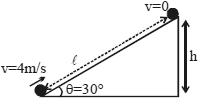
0 likesView Solution
44
PhysicsMediumMCQNEET · 2019
The time period of a geostationary satellite is $24 \; h$,at a height $6 R_{E}$ ($R_{E}$ is the radius of the Earth) from the surface of the Earth. The time period of another satellite whose height is $2.5 R_{E}$ from the surface will be:
A
$6 \sqrt{2} \; h$
B
$12 \sqrt{2} \; h$
C
$\frac{24}{2.5} \; h$
D
$\frac{12}{25} \; h$
Solution
(A) According to Kepler's Third Law of planetary motion,the square of the time period $(T)$ is proportional to the cube of the orbital radius $(r)$: $T^2 \propto r^3$ or $T \propto r^{3/2}$.
The orbital radius $r$ is the distance from the center of the Earth,given by $r = R_{E} + h$,where $h$ is the height above the surface.
For the first satellite: $r_1 = R_{E} + 6 R_{E} = 7 R_{E}$ and $T_1 = 24 \; h$.
For the second satellite: $r_2 = R_{E} + 2.5 R_{E} = 3.5 R_{E}$.
Using the ratio: $\frac{T_2}{T_1} = \left( \frac{r_2}{r_1} \right)^{3/2} = \left( \frac{3.5 R_{E}}{7 R_{E}} \right)^{3/2} = \left( \frac{1}{2} \right)^{3/2} = \frac{1}{2 \sqrt{2}}$.
Therefore,$T_2 = T_1 \times \frac{1}{2 \sqrt{2}} = \frac{24}{2 \sqrt{2}} = \frac{12}{\sqrt{2}} = 6 \sqrt{2} \; h$.
The orbital radius $r$ is the distance from the center of the Earth,given by $r = R_{E} + h$,where $h$ is the height above the surface.
For the first satellite: $r_1 = R_{E} + 6 R_{E} = 7 R_{E}$ and $T_1 = 24 \; h$.
For the second satellite: $r_2 = R_{E} + 2.5 R_{E} = 3.5 R_{E}$.
Using the ratio: $\frac{T_2}{T_1} = \left( \frac{r_2}{r_1} \right)^{3/2} = \left( \frac{3.5 R_{E}}{7 R_{E}} \right)^{3/2} = \left( \frac{1}{2} \right)^{3/2} = \frac{1}{2 \sqrt{2}}$.
Therefore,$T_2 = T_1 \times \frac{1}{2 \sqrt{2}} = \frac{24}{2 \sqrt{2}} = \frac{12}{\sqrt{2}} = 6 \sqrt{2} \; h$.
0 likesView Solution
45
PhysicsDifficultMCQNEET · 2019
The main scale of a vernier calliper has $n$ divisions per $cm$. $n$ divisions of the vernier scale coincide with $(n-1)$ divisions of the main scale. The least count of the vernier calliper is,
A
$\frac{1}{(n+1)(n-1)} \text{ cm}$
B
$\frac{1}{n} \text{ cm}$
C
$\frac{1}{n^2} \text{ cm}$
D
$\frac{1}{n(n+1)} \text{ cm}$
Solution
(C) Given that the main scale has $n$ divisions per $cm$,the value of $1 \text{ MSD}$ (Main Scale Division) is $\frac{1}{n} \text{ cm}$.
According to the problem,$n \text{ VSD}$ (Vernier Scale Divisions) coincide with $(n-1) \text{ MSD}$.
Therefore,$1 \text{ VSD} = \frac{n-1}{n} \text{ MSD}$.
The least count of a vernier calliper is defined as $1 \text{ MSD} - 1 \text{ VSD}$.
Least Count $= 1 \text{ MSD} - \left( \frac{n-1}{n} \right) \text{ MSD} = \left( 1 - \frac{n-1}{n} \right) \text{ MSD} = \frac{1}{n} \text{ MSD}$.
Substituting the value of $1 \text{ MSD} = \frac{1}{n} \text{ cm}$,we get:
Least Count $= \frac{1}{n} \times \frac{1}{n} \text{ cm} = \frac{1}{n^2} \text{ cm}$.
According to the problem,$n \text{ VSD}$ (Vernier Scale Divisions) coincide with $(n-1) \text{ MSD}$.
Therefore,$1 \text{ VSD} = \frac{n-1}{n} \text{ MSD}$.
The least count of a vernier calliper is defined as $1 \text{ MSD} - 1 \text{ VSD}$.
Least Count $= 1 \text{ MSD} - \left( \frac{n-1}{n} \right) \text{ MSD} = \left( 1 - \frac{n-1}{n} \right) \text{ MSD} = \frac{1}{n} \text{ MSD}$.
Substituting the value of $1 \text{ MSD} = \frac{1}{n} \text{ cm}$,we get:
Least Count $= \frac{1}{n} \times \frac{1}{n} \text{ cm} = \frac{1}{n^2} \text{ cm}$.
0 likesView Solution
46
PhysicsMediumMCQNEET · 2019
Assuming that the gravitational potential energy of an object at infinity is zero,the change in potential energy (final - initial) of an object of mass $m$,when moved to a height $h$ from the surface of the Earth (of radius $R$),is given by:
A
$-\frac{GMm}{R+h}$
B
$\frac{GMmh}{R(R+h)}$
C
$mgh$
D
$\frac{GMm}{R+h}$
Solution
(B) The gravitational potential energy $U$ at a distance $r$ from the center of the Earth is given by $U = -\frac{GMm}{r}$.
Initial distance from the center is $r_i = R$.
Final distance from the center is $r_f = R + h$.
The change in potential energy is $\Delta U = U_f - U_i$.
$\Delta U = \left( -\frac{GMm}{R+h} \right) - \left( -\frac{GMm}{R} \right)$.
$\Delta U = GMm \left( \frac{1}{R} - \frac{1}{R+h} \right)$.
$\Delta U = GMm \left( \frac{R+h-R}{R(R+h)} \right)$.
$\Delta U = \frac{GMmh}{R(R+h)}$.
Initial distance from the center is $r_i = R$.
Final distance from the center is $r_f = R + h$.
The change in potential energy is $\Delta U = U_f - U_i$.
$\Delta U = \left( -\frac{GMm}{R+h} \right) - \left( -\frac{GMm}{R} \right)$.
$\Delta U = GMm \left( \frac{1}{R} - \frac{1}{R+h} \right)$.
$\Delta U = GMm \left( \frac{R+h-R}{R(R+h)} \right)$.
$\Delta U = \frac{GMmh}{R(R+h)}$.
0 likesView Solution
47
PhysicsEasyMCQNEET · 2019
The work function of a substance is $4.0 \,eV$. The longest wavelength of light that can cause photoelectron emission from this substance is approximately ......... $nm$.
A
$540$
B
$400$
C
$310$
D
$220$
Solution
(C) The work function $W_0$ is given as $4.0 \,eV$.
The threshold wavelength $\lambda_0$ is the longest wavelength capable of causing photoelectric emission.
It is calculated using the formula: $\lambda_0 = \frac{hc}{W_0}$.
Using the approximation $hc \approx 12400 \,eV \cdot \mathring{A}$:
$\lambda_0 = \frac{12400 \,eV \cdot \mathring{A}}{4.0 \,eV} = 3100 \,\mathring{A}$.
Since $1 \,nm = 10 \,\mathring{A}$,we have $\lambda_0 = 310 \,nm$.
The threshold wavelength $\lambda_0$ is the longest wavelength capable of causing photoelectric emission.
It is calculated using the formula: $\lambda_0 = \frac{hc}{W_0}$.
Using the approximation $hc \approx 12400 \,eV \cdot \mathring{A}$:
$\lambda_0 = \frac{12400 \,eV \cdot \mathring{A}}{4.0 \,eV} = 3100 \,\mathring{A}$.
Since $1 \,nm = 10 \,\mathring{A}$,we have $\lambda_0 = 310 \,nm$.
0 likesView Solution
48
PhysicsMediumMCQNEET · 2019
The rate of radioactive disintegration at an instant for a radioactive sample of half-life $2.2 \times 10^9 \; s$ is $10^{10} \; s^{-1}$. The number of radioactive atoms in that sample at that instant is,
A
$3.17 \times 10^{20}$
B
$3.17 \times 10^{19}$
C
$3.17 \times 10^{17}$
D
$3.17 \times 10^{18}$
Solution
(B) The relationship between half-life $T_{1/2}$ and decay constant $\lambda$ is given by $T_{1/2} = \frac{\ln 2}{\lambda} \approx \frac{0.693}{\lambda}$.
Given $T_{1/2} = 2.2 \times 10^9 \; s$,we find $\lambda = \frac{0.693}{2.2 \times 10^9} \approx 3.15 \times 10^{-10} \; s^{-1}$.
The rate of disintegration $R$ is related to the number of radioactive atoms $N$ by the formula $R = \lambda N$.
Given $R = 10^{10} \; s^{-1}$,we calculate $N = \frac{R}{\lambda} = \frac{10^{10}}{3.15 \times 10^{-10}} \approx 3.17 \times 10^{19}$ atoms.
Given $T_{1/2} = 2.2 \times 10^9 \; s$,we find $\lambda = \frac{0.693}{2.2 \times 10^9} \approx 3.15 \times 10^{-10} \; s^{-1}$.
The rate of disintegration $R$ is related to the number of radioactive atoms $N$ by the formula $R = \lambda N$.
Given $R = 10^{10} \; s^{-1}$,we calculate $N = \frac{R}{\lambda} = \frac{10^{10}}{3.15 \times 10^{-10}} \approx 3.17 \times 10^{19}$ atoms.
0 likesView Solution
49
PhysicsMediumMCQNEET · 2019
The total energy of an electron in an atom in an orbit is $-3.4 \; eV$. Its kinetic and potential energies are,respectively:
A
$-3.4 \; eV, -3.4 \; eV$
B
$-3.4 \; eV, -6.8 \; eV$
C
$3.4 \; eV, -6.8 \; eV$
D
$3.4 \; eV, 3.4 \; eV$
Solution
(C) The total energy $(TE)$ of an electron in an orbit is given as $-3.4 \; eV$.
For an electron in a hydrogen-like atom,the relationship between total energy $(TE)$,kinetic energy $(KE)$,and potential energy $(PE)$ is:
$KE = -TE$
$PE = 2 \times TE$
Substituting the given value of $TE = -3.4 \; eV$:
$KE = -(-3.4 \; eV) = +3.4 \; eV$
$PE = 2 \times (-3.4 \; eV) = -6.8 \; eV$
Therefore,the kinetic energy is $3.4 \; eV$ and the potential energy is $-6.8 \; eV$.
For an electron in a hydrogen-like atom,the relationship between total energy $(TE)$,kinetic energy $(KE)$,and potential energy $(PE)$ is:
$KE = -TE$
$PE = 2 \times TE$
Substituting the given value of $TE = -3.4 \; eV$:
$KE = -(-3.4 \; eV) = +3.4 \; eV$
$PE = 2 \times (-3.4 \; eV) = -6.8 \; eV$
Therefore,the kinetic energy is $3.4 \; eV$ and the potential energy is $-6.8 \; eV$.
0 likesView Solution
50
PhysicsMediumMCQNEET · 2019
The correct Boolean operation represented by the circuit diagram shown is:
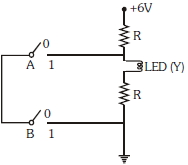
A
$AND$
B
$OR$
C
$NAND$
D
$NOR$
Solution
(C) In the given circuit,the switches $A$ and $B$ are connected in parallel with the ground. When a switch is at position $0$,it is open,and when it is at position $1$,it is closed (connected to ground).
$1$. If both $A=0$ and $B=0$,both switches are open. The current flows through the $LED$ $(Y)$,so $Y=1$.
$2$. If $A=0$ and $B=1$,switch $B$ is closed (grounded). The current flows through the $LED$ $(Y)$,so $Y=1$.
$3$. If $A=1$ and $B=0$,switch $A$ is closed (grounded). The current flows through the $LED$ $(Y)$,so $Y=1$.
$4$. If $A=1$ and $B=1$,both switches are closed (grounded). The current bypasses the $LED$ through the switches to the ground,so $Y=0$.
The truth table is:
This truth table corresponds to the $NAND$ gate operation.
$1$. If both $A=0$ and $B=0$,both switches are open. The current flows through the $LED$ $(Y)$,so $Y=1$.
$2$. If $A=0$ and $B=1$,switch $B$ is closed (grounded). The current flows through the $LED$ $(Y)$,so $Y=1$.
$3$. If $A=1$ and $B=0$,switch $A$ is closed (grounded). The current flows through the $LED$ $(Y)$,so $Y=1$.
$4$. If $A=1$ and $B=1$,both switches are closed (grounded). The current bypasses the $LED$ through the switches to the ground,so $Y=0$.
The truth table is:
| $A$ | $B$ | $Y$ |
|---|---|---|
| $0$ | $0$ | $1$ |
| $0$ | $1$ | $1$ |
| $1$ | $0$ | $1$ |
| $1$ | $1$ | $0$ |
This truth table corresponds to the $NAND$ gate operation.
0 likesView Solution
51
PhysicsMediumMCQNEET · 2019
$A$ $800$ turn coil of effective area $0.05\; m^{2}$ is kept perpendicular to a magnetic field $5 \times 10^{-5}\; T$. When the plane of the coil is rotated by $90^{\circ}$ around any of its coplanar axes in $0.1\; s$,the $emf$ induced in the coil will be.....$V$
A
$2$
B
$0.2$
C
$2 \times 10^{-3}$
D
$0.02$
Solution
(D) Given: Number of turns $N = 800$,Area $A = 0.05\; m^{2}$,Magnetic field $B = 5 \times 10^{-5}\; T$,Time interval $\Delta t = 0.1\; s$.
Initial magnetic flux $\phi_{1} = N B A \cos(0^{\circ}) = N B A$.
Final magnetic flux $\phi_{2} = N B A \cos(90^{\circ}) = 0$.
Induced $emf$ $e = -\frac{\Delta \phi}{\Delta t} = -\frac{\phi_{2} - \phi_{1}}{\Delta t} = \frac{N B A}{\Delta t}$.
Substituting the values: $e = \frac{800 \times 5 \times 10^{-5} \times 0.05}{0.1}$.
$e = \frac{800 \times 5 \times 10^{-5} \times 5 \times 10^{-2}}{10^{-1}} = 800 \times 5 \times 5 \times 10^{-7} \times 10^{1} = 20000 \times 10^{-6} = 0.02\; V$.
Initial magnetic flux $\phi_{1} = N B A \cos(0^{\circ}) = N B A$.
Final magnetic flux $\phi_{2} = N B A \cos(90^{\circ}) = 0$.
Induced $emf$ $e = -\frac{\Delta \phi}{\Delta t} = -\frac{\phi_{2} - \phi_{1}}{\Delta t} = \frac{N B A}{\Delta t}$.
Substituting the values: $e = \frac{800 \times 5 \times 10^{-5} \times 0.05}{0.1}$.
$e = \frac{800 \times 5 \times 10^{-5} \times 5 \times 10^{-2}}{10^{-1}} = 800 \times 5 \times 5 \times 10^{-7} \times 10^{1} = 20000 \times 10^{-6} = 0.02\; V$.
0 likesView Solution
52
PhysicsEasyMCQNEET · 2019
Which colour of the light has the longest wavelength?
A
red
B
blue
C
green
D
violet
Solution
(A) The visible spectrum consists of colours ranging from violet to red.
According to the electromagnetic spectrum, the wavelength $(\lambda)$ increases as we move from violet to red.
Therefore, red light has the longest wavelength, approximately $700 \ nm$, while violet light has the shortest wavelength, approximately $400 \ nm$.
Thus, the correct option is $A$.
According to the electromagnetic spectrum, the wavelength $(\lambda)$ increases as we move from violet to red.
Therefore, red light has the longest wavelength, approximately $700 \ nm$, while violet light has the shortest wavelength, approximately $400 \ nm$.
Thus, the correct option is $A$.
0 likesView Solution
53
PhysicsMediumMCQNEET · 2019
$A$ hollow metal sphere of radius $R$ is uniformly charged. The electric field due to the sphere at a distance $r$ from the centre is:
A
increases as $r$ increases for $r < R$ and for $r > R$
B
zero as $r$ increases for $r < R$,decreases as $r$ increases for $r > R$
C
zero as $r$ increases for $r < R$,increases as $r$ increases for $r > R$
D
decreases as $r$ increases for $r < R$ and for $r > R$
Solution
(B) For a hollow metal sphere,the charge resides only on the outer surface.
According to Gauss's Law,for any point inside the sphere $(r < R)$,the enclosed charge is $q_{enc} = 0$,therefore the electric field $E = 0$.
For any point outside the sphere $(r > R)$,the sphere acts as a point charge located at the centre. The electric field is given by $E = \frac{1}{4\pi\epsilon_0} \frac{q}{r^2}$,which means $E \propto \frac{1}{r^2}$.
As $r$ increases for $r > R$,the value of $E$ decreases.
Thus,the electric field is zero for $r < R$ and decreases as $r$ increases for $r > R$.
According to Gauss's Law,for any point inside the sphere $(r < R)$,the enclosed charge is $q_{enc} = 0$,therefore the electric field $E = 0$.
For any point outside the sphere $(r > R)$,the sphere acts as a point charge located at the centre. The electric field is given by $E = \frac{1}{4\pi\epsilon_0} \frac{q}{r^2}$,which means $E \propto \frac{1}{r^2}$.
As $r$ increases for $r > R$,the value of $E$ decreases.
Thus,the electric field is zero for $r < R$ and decreases as $r$ increases for $r > R$.
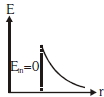
0 likesView Solution
54
PhysicsEasyMCQNEET · 2019
In which of the following devices,the eddy current effect is not used?
A
induction furnace
B
magnetic braking in train
C
electromagnet
D
electric heater
Solution
(D) Eddy currents are loops of electrical current induced within conductors by a changing magnetic field. They are utilized in induction furnaces for heating,magnetic braking systems in trains,and speedometers. An electric heater,however,operates on the principle of the Joule heating effect $(H = I^2Rt)$,where heat is produced by the resistance of a conductor to the flow of electric current,not by eddy currents.
0 likesView Solution
55
PhysicsDifficultMCQNEET · 2019
Six similar bulbs are connected as shown in the figure with a $DC$ source of $emf\; E$,and zero internal resistance. The ratio of power consumption by the bulbs when $(i)$ all are glowing and $(ii)$ in the situation when two from section $A$ and one from section $B$ are glowing,will be
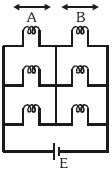
A
$4:9$
B
$9:4$
C
$1:2$
D
$2:1$
Solution
(B) Let the resistance of each bulb be $R$.
Case $(i)$: All six bulbs are glowing. Section $A$ has $3$ bulbs in parallel,and section $B$ has $3$ bulbs in parallel. These two sections are in series. The equivalent resistance is $R_{eq_1} = (R/3) + (R/3) = 2R/3$. The power consumed is $P_1 = E^2 / R_{eq_1} = 3E^2 / 2R$.
Case $(ii)$: Two bulbs from section $A$ are in parallel (resistance $R/2$) and one bulb from section $B$ is in series with this combination. The equivalent resistance is $R_{eq_2} = R/2 + R = 3R/2$. The power consumed is $P_2 = E^2 / R_{eq_2} = 2E^2 / 3R$.
The ratio of power consumption is $P_1 : P_2 = (3E^2 / 2R) : (2E^2 / 3R) = 9 : 4$.
Case $(i)$: All six bulbs are glowing. Section $A$ has $3$ bulbs in parallel,and section $B$ has $3$ bulbs in parallel. These two sections are in series. The equivalent resistance is $R_{eq_1} = (R/3) + (R/3) = 2R/3$. The power consumed is $P_1 = E^2 / R_{eq_1} = 3E^2 / 2R$.
Case $(ii)$: Two bulbs from section $A$ are in parallel (resistance $R/2$) and one bulb from section $B$ is in series with this combination. The equivalent resistance is $R_{eq_2} = R/2 + R = 3R/2$. The power consumed is $P_2 = E^2 / R_{eq_2} = 2E^2 / 3R$.
The ratio of power consumption is $P_1 : P_2 = (3E^2 / 2R) : (2E^2 / 3R) = 9 : 4$.
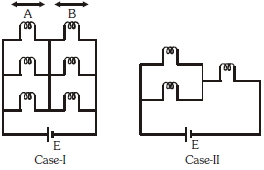
0 likesView Solution
56
PhysicsEasyMCQNEET · 2019
At a point $A$ on the earth's surface, the angle of dip is $\delta = +25^{\circ}$. At a point $B$ on the earth's surface, the angle of dip is $\delta = -25^{\circ}$. We can interpret that:
A
$A$ and $B$ are both located in the northern hemisphere.
B
$A$ is located in the southern hemisphere and $B$ is located in the northern hemisphere.
C
$A$ is located in the northern hemisphere and $B$ is located in the southern hemisphere.
D
$A$ and $B$ are both located in the southern hemisphere.
Solution
(C) The angle of dip (or magnetic inclination) is defined as the angle that the total magnetic field of the earth makes with the surface of the earth.
By convention, the angle of dip is taken as positive $(+ve)$ in the northern hemisphere, where the north pole of a magnetic needle points downwards.
Conversely, the angle of dip is taken as negative $(-ve)$ in the southern hemisphere, where the north pole of a magnetic needle points upwards.
Since point $A$ has a positive dip $(\delta = +25^{\circ})$, it is located in the northern hemisphere.
Since point $B$ has a negative dip $(\delta = -25^{\circ})$, it is located in the southern hemisphere.
By convention, the angle of dip is taken as positive $(+ve)$ in the northern hemisphere, where the north pole of a magnetic needle points downwards.
Conversely, the angle of dip is taken as negative $(-ve)$ in the southern hemisphere, where the north pole of a magnetic needle points upwards.
Since point $A$ has a positive dip $(\delta = +25^{\circ})$, it is located in the northern hemisphere.
Since point $B$ has a negative dip $(\delta = -25^{\circ})$, it is located in the southern hemisphere.
0 likesView Solution
57
PhysicsEasyMCQNEET · 2019
Pick the wrong answer in the context of a rainbow.
A
When the light rays undergo two internal reflections in a water drop,a secondary rainbow is formed.
B
The order of colours is reversed in the secondary rainbow.
C
An observer can see a rainbow when his front is towards the sun.
D
Rainbow is a combined effect of dispersion,refraction,and reflection of sunlight.
Solution
(C) The correct condition to observe a rainbow is that the observer must have their back towards the sun. Therefore,the statement that an observer can see a rainbow when their front is towards the sun is incorrect. Thus,option $C$ is the wrong answer.
0 likesView Solution
58
PhysicsMediumMCQNEET · 2019
$A$ cylindrical conductor of radius $R$ is carrying a constant current. The plot of the magnitude of the magnetic field,$B$ with the distance $d$,from the centre of the conductor,is correctly represented by the figure:
A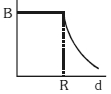
B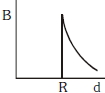
C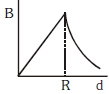
D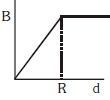
Solution
(C) According to Ampere's circuital law,the magnetic field $B$ at a distance $d$ from the axis of a long cylindrical conductor of radius $R$ carrying a current $I$ is given by:
For $d \leq R$ (inside the conductor),$B = \frac{\mu_{0}Id}{2 \pi R^{2}}$,which shows that $B \propto d$ (a linear relationship).
For $d > R$ (outside the conductor),$B = \frac{\mu_{0} I}{2 \pi d}$,which shows that $B \propto \frac{1}{d}$ (a hyperbolic relationship).
At the surface $(d = R)$,the magnetic field is maximum,$B_{max} = \frac{\mu_{0} I}{2 \pi R}$.
Comparing this with the given options,the graph that shows a linear increase up to $d = R$ and a hyperbolic decrease for $d > R$ is represented by Figure $C$.
For $d \leq R$ (inside the conductor),$B = \frac{\mu_{0}Id}{2 \pi R^{2}}$,which shows that $B \propto d$ (a linear relationship).
For $d > R$ (outside the conductor),$B = \frac{\mu_{0} I}{2 \pi d}$,which shows that $B \propto \frac{1}{d}$ (a hyperbolic relationship).
At the surface $(d = R)$,the magnetic field is maximum,$B_{max} = \frac{\mu_{0} I}{2 \pi R}$.
Comparing this with the given options,the graph that shows a linear increase up to $d = R$ and a hyperbolic decrease for $d > R$ is represented by Figure $C$.
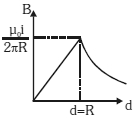
0 likesView Solution
59
PhysicsMediumMCQNEET · 2019
Two similar thin equi-convex lenses,each of focal length $f$,are kept coaxially in contact with each other such that the focal length of the combination is $F_{1}$. When the space between the two lenses is filled with glycerin (which has the same refractive index $\mu = 1.5$ as that of glass),the equivalent focal length is $F_{2}$. The ratio $F_{1} : F_{2}$ will be
A
$2:1$
B
$1:2$
C
$2:3$
D
$3:4$
Solution
(B) For two thin lenses in contact,the equivalent focal length $F_{1}$ is given by $\frac{1}{F_{1}} = \frac{1}{f} + \frac{1}{f} = \frac{2}{f}$,which implies $F_{1} = \frac{f}{2}$.
When the space between the lenses is filled with a liquid of the same refractive index as the glass,the combination acts as a single block of glass. Since the outer surfaces are convex and the inner space is filled,the system effectively becomes a single convex lens with the same radii of curvature as the original lenses. However,the refractive index of the liquid is $\mu = 1.5$,which is equal to the glass. Thus,the entire system behaves as a single lens with focal length $F_{2} = f$.
Therefore,the ratio $\frac{F_{1}}{F_{2}} = \frac{f/2}{f} = \frac{1}{2}$.
When the space between the lenses is filled with a liquid of the same refractive index as the glass,the combination acts as a single block of glass. Since the outer surfaces are convex and the inner space is filled,the system effectively becomes a single convex lens with the same radii of curvature as the original lenses. However,the refractive index of the liquid is $\mu = 1.5$,which is equal to the glass. Thus,the entire system behaves as a single lens with focal length $F_{2} = f$.
Therefore,the ratio $\frac{F_{1}}{F_{2}} = \frac{f/2}{f} = \frac{1}{2}$.
0 likesView Solution
60
PhysicsEasyMCQNEET · 2019
In total internal reflection,when the angle of incidence is equal to the critical angle for the pair of media in contact,what will be the angle of refraction in degrees?
A
$180$
B
$0$
C
equal to angle of incidence
D
$90$
Solution
(D) The critical angle $(i_c)$ is defined as the angle of incidence in the denser medium for which the angle of refraction in the rarer medium is $90^o$.
When the light ray travels from a denser medium to a rarer medium at an angle of incidence equal to the critical angle,the refracted ray grazes the interface between the two media.
Therefore,the angle of refraction is $90^o$.
When the light ray travels from a denser medium to a rarer medium at an angle of incidence equal to the critical angle,the refracted ray grazes the interface between the two media.
Therefore,the angle of refraction is $90^o$.
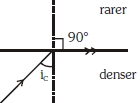
0 likesView Solution
61
PhysicsMediumMCQNEET · 2019
Two parallel infinite line charges with linear charge densities $+\lambda\; C/m$ and $-\lambda\; C/m$ are placed at a distance of $2R$ in free space. What is the electric field mid-way between the two line charges?
A
$0\; N/C$
B
$\frac{2\lambda}{\pi\epsilon_0 R}\; N/C$
C
$\frac{\lambda}{\pi\epsilon_0 R}\; N/C$
D
$\frac{\lambda}{2\pi\epsilon_0 R}\; N/C$
Solution
(C) The electric field due to an infinite line charge at a distance $r$ is given by $E = \frac{\lambda}{2\pi\epsilon_0 r}$.
Let the two line charges be $1$ and $2$,separated by a distance $2R$. The mid-point $P$ is at a distance $R$ from both lines.
The electric field $\overrightarrow{E}_1$ due to the positive line charge at $P$ points away from it (towards the negative line charge),so $E_1 = \frac{\lambda}{2\pi\epsilon_0 R}$.
The electric field $\overrightarrow{E}_2$ due to the negative line charge at $P$ points towards it (in the same direction as $\overrightarrow{E}_1$),so $E_2 = \frac{|-\lambda|}{2\pi\epsilon_0 R} = \frac{\lambda}{2\pi\epsilon_0 R}$.
Since both fields are in the same direction,the net electric field is $E = E_1 + E_2 = \frac{\lambda}{2\pi\epsilon_0 R} + \frac{\lambda}{2\pi\epsilon_0 R} = \frac{2\lambda}{2\pi\epsilon_0 R} = \frac{\lambda}{\pi\epsilon_0 R}\; N/C$.
Let the two line charges be $1$ and $2$,separated by a distance $2R$. The mid-point $P$ is at a distance $R$ from both lines.
The electric field $\overrightarrow{E}_1$ due to the positive line charge at $P$ points away from it (towards the negative line charge),so $E_1 = \frac{\lambda}{2\pi\epsilon_0 R}$.
The electric field $\overrightarrow{E}_2$ due to the negative line charge at $P$ points towards it (in the same direction as $\overrightarrow{E}_1$),so $E_2 = \frac{|-\lambda|}{2\pi\epsilon_0 R} = \frac{\lambda}{2\pi\epsilon_0 R}$.
Since both fields are in the same direction,the net electric field is $E = E_1 + E_2 = \frac{\lambda}{2\pi\epsilon_0 R} + \frac{\lambda}{2\pi\epsilon_0 R} = \frac{2\lambda}{2\pi\epsilon_0 R} = \frac{\lambda}{\pi\epsilon_0 R}\; N/C$.
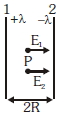
0 likesView Solution
62
PhysicsMediumMCQNEET · 2019
For a $p-$type semiconductor,which of the following statements is true?
A
Electrons are the majority carriers and trivalent atoms are the dopants.
B
Holes are the majority carriers and trivalent atoms are the dopants.
C
Holes are the majority carriers and pentavalent atoms are the dopants.
D
Electrons are the majority carriers and pentavalent atoms are the dopants.
Solution
(B) In a $p-$type semiconductor,the intrinsic semiconductor (like $Si$ or $Ge$) is doped with trivalent impurity atoms (such as $Boron$,$Aluminum$,or $Indium$).
These trivalent atoms create vacancies in the crystal lattice,which are known as holes.
Since these holes are present in a much higher concentration than the thermally generated electrons,holes act as the majority charge carriers in $p-$type semiconductors.
These trivalent atoms create vacancies in the crystal lattice,which are known as holes.
Since these holes are present in a much higher concentration than the thermally generated electrons,holes act as the majority charge carriers in $p-$type semiconductors.
0 likesView Solution
63
PhysicsEasyMCQNEET · 2019
Which of the following acts as a circuit protection device?
A
conductor
B
inductor
C
switch
D
fuse
Solution
(D) fuse is a safety device used in electrical circuits to protect against overcurrent or short-circuit conditions. When the current exceeds a safe limit,the fuse wire melts due to the heating effect of the electric current,thereby breaking the circuit and preventing damage to appliances.
0 likesView Solution
64
PhysicsMediumMCQNEET · 2019
$A$ parallel plate capacitor of capacitance $20 \; \mu F$ is being charged by a voltage source whose potential is changing at the rate of $3 \; V/s$. The conduction current through the connecting wires, and the displacement current through the plates of the capacitor, would be, respectively:
A
$0 \; \mu A, 60 \; \mu A$
B
$60 \; \mu A, 60 \; \mu A$
C
$60 \; \mu A, 0 \; \mu A$
D
$0 \; \mu A, 0 \; \mu A$
Solution
(B) The charge $Q$ on a capacitor is given by $Q = CV$, where $C$ is the capacitance and $V$ is the potential difference.
The conduction current $i_c$ in the connecting wires is the rate of change of charge: $i_c = \frac{dQ}{dt} = C \frac{dV}{dt}$.
Given $C = 20 \; \mu F$ and $\frac{dV}{dt} = 3 \; V/s$, we have $i_c = 20 \; \mu F \times 3 \; V/s = 60 \; \mu A$.
According to Maxwell's modification of Ampere's law, the displacement current $i_d$ between the plates of a capacitor is equal to the conduction current in the connecting wires.
Therefore, $i_d = i_c = 60 \; \mu A$.
Thus, the conduction current is $60 \; \mu A$ and the displacement current is $60 \; \mu A$.
The conduction current $i_c$ in the connecting wires is the rate of change of charge: $i_c = \frac{dQ}{dt} = C \frac{dV}{dt}$.
Given $C = 20 \; \mu F$ and $\frac{dV}{dt} = 3 \; V/s$, we have $i_c = 20 \; \mu F \times 3 \; V/s = 60 \; \mu A$.
According to Maxwell's modification of Ampere's law, the displacement current $i_d$ between the plates of a capacitor is equal to the conduction current in the connecting wires.
Therefore, $i_d = i_c = 60 \; \mu A$.
Thus, the conduction current is $60 \; \mu A$ and the displacement current is $60 \; \mu A$.
0 likesView Solution
65
PhysicsMediumMCQNEET · 2019
In the circuits shown below, the readings of the voltmeters and the ammeters will be:
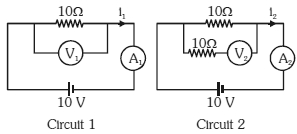
A
$V_{2} > V_{1}$ and $I_{1} = I_{2}$
B
$V_{1} = V_{2}$ and $I_{1} > I_{2}$
C
$V_{1} = V_{2}$ and $I_{1} = I_{2}$
D
$V_{2} > V_{1}$ and $I_{1} > I_{2}$
Solution
(C) In Circuit $1$, the voltmeter $V_{1}$ is connected in parallel with the $10 \; \Omega$ resistor. Since an ideal voltmeter has infinite resistance, it draws no current. Thus, the voltage across the $10 \; \Omega$ resistor is $10 \; V$, so $V_{1} = 10 \; V$. The current $I_{1}$ is given by $I_{1} = \frac{10 \; V}{10 \; \Omega} = 1 \; A$.
In Circuit $2$, the voltmeter $V_{2}$ is connected in series with a $10 \; \Omega$ resistor, and this combination is in parallel with the main $10 \; \Omega$ resistor. An ideal voltmeter has infinite resistance, so the branch containing the voltmeter and the $10 \; \Omega$ resistor draws no current. The voltage across this branch is still $10 \; V$. Since the voltmeter is ideal, the entire potential drop of $10 \; V$ appears across the voltmeter itself, so $V_{2} = 10 \; V$. The current $I_{2}$ flows only through the main $10 \; \Omega$ resistor, so $I_{2} = \frac{10 \; V}{10 \; \Omega} = 1 \; A$.
Therefore, $V_{1} = V_{2} = 10 \; V$ and $I_{1} = I_{2} = 1 \; A$.
In Circuit $2$, the voltmeter $V_{2}$ is connected in series with a $10 \; \Omega$ resistor, and this combination is in parallel with the main $10 \; \Omega$ resistor. An ideal voltmeter has infinite resistance, so the branch containing the voltmeter and the $10 \; \Omega$ resistor draws no current. The voltage across this branch is still $10 \; V$. Since the voltmeter is ideal, the entire potential drop of $10 \; V$ appears across the voltmeter itself, so $V_{2} = 10 \; V$. The current $I_{2}$ flows only through the main $10 \; \Omega$ resistor, so $I_{2} = \frac{10 \; V}{10 \; \Omega} = 1 \; A$.
Therefore, $V_{1} = V_{2} = 10 \; V$ and $I_{1} = I_{2} = 1 \; A$.
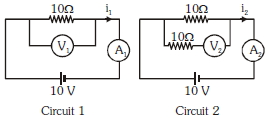
0 likesView Solution
66
PhysicsEasyMCQNEET · 2019
An $\alpha$-particle consists of:
A
$2$ protons and $2$ neutrons only
B
$2$ electrons,$2$ protons and $2$ neutrons
C
$2$ electrons and $4$ protons only
D
$2$ protons only
Solution
(A) An $\alpha$-particle is a helium nucleus,denoted as $\alpha = {}_2^4 \text{He}^{2+}$.
It consists of $2$ protons and $2$ neutrons,having a total mass number of $4$ and an atomic number of $2$.
It consists of $2$ protons and $2$ neutrons,having a total mass number of $4$ and an atomic number of $2$.
0 likesView Solution
67
PhysicsMediumMCQNEET · 2019
An electron is accelerated through a potential difference of $10,000 \; V$. Its de Broglie wavelength is,(nearly):
$(m_{e}=9 \times 10^{-31} \; kg)$
$(m_{e}=9 \times 10^{-31} \; kg)$
A
$12.2 \times 10^{-13} \; m$
B
$12.2 \times 10^{-12} \; m$
C
$12.2 \times 10^{-14} \; m$
D
$12.2 \; nm$
Solution
(B) The de Broglie wavelength $\lambda$ for an electron accelerated through a potential difference $V$ is given by the formula: $\lambda = \frac{12.27}{\sqrt{V}} \; \mathring{A}$.
Given $V = 10,000 \; V = 10^4 \; V$.
Substituting the value of $V$ in the formula:
$\lambda = \frac{12.27}{\sqrt{10^4}} \; \mathring{A} = \frac{12.27}{100} \; \mathring{A} = 0.1227 \; \mathring{A}$.
Since $1 \; \mathring{A} = 10^{-10} \; m$,we have $\lambda = 0.1227 \times 10^{-10} \; m = 12.27 \times 10^{-12} \; m$.
Rounding to the nearest option,the value is approximately $12.2 \times 10^{-12} \; m$.
Given $V = 10,000 \; V = 10^4 \; V$.
Substituting the value of $V$ in the formula:
$\lambda = \frac{12.27}{\sqrt{10^4}} \; \mathring{A} = \frac{12.27}{100} \; \mathring{A} = 0.1227 \; \mathring{A}$.
Since $1 \; \mathring{A} = 10^{-10} \; m$,we have $\lambda = 0.1227 \times 10^{-10} \; m = 12.27 \times 10^{-12} \; m$.
Rounding to the nearest option,the value is approximately $12.2 \times 10^{-12} \; m$.
0 likesView Solution
68
PhysicsMediumMCQNEET · 2019
Two point charges $A$ and $B$,having charges $+Q$ and $-Q$ respectively,are placed at a certain distance apart and the force acting between them is $F$. If $25 \%$ of the charge of $A$ is transferred to $B$,then the force between the charges becomes
A
$F$
B
$\frac{9 F}{16}$
C
$\frac{16 F}{9}$
D
$\frac{4 F}{3}$
Solution
(B) Initially,the charges are $q_A = Q$ and $q_B = -Q$. The force between them at a distance $r$ is given by Coulomb's Law:
$F = \frac{k Q (-Q)}{r^2} = -\frac{k Q^2}{r^2}$
When $25 \%$ of the charge from $A$ is transferred to $B$,the amount transferred is $\Delta q = 0.25 Q = \frac{Q}{4}$.
The new charges are:
$q_A' = Q - \frac{Q}{4} = \frac{3Q}{4}$
$q_B' = -Q + \frac{Q}{4} = -\frac{3Q}{4}$
The new force $F'$ between the charges is:
$F' = \frac{k q_A' q_B'}{r^2} = \frac{k (\frac{3Q}{4})(-\frac{3Q}{4})}{r^2}$
$F' = -\frac{9}{16} \frac{k Q^2}{r^2}$
Since $F = -\frac{k Q^2}{r^2}$,we substitute this into the expression for $F'$:
$F' = \frac{9}{16} F$
$F = \frac{k Q (-Q)}{r^2} = -\frac{k Q^2}{r^2}$
When $25 \%$ of the charge from $A$ is transferred to $B$,the amount transferred is $\Delta q = 0.25 Q = \frac{Q}{4}$.
The new charges are:
$q_A' = Q - \frac{Q}{4} = \frac{3Q}{4}$
$q_B' = -Q + \frac{Q}{4} = -\frac{3Q}{4}$
The new force $F'$ between the charges is:
$F' = \frac{k q_A' q_B'}{r^2} = \frac{k (\frac{3Q}{4})(-\frac{3Q}{4})}{r^2}$
$F' = -\frac{9}{16} \frac{k Q^2}{r^2}$
Since $F = -\frac{k Q^2}{r^2}$,we substitute this into the expression for $F'$:
$F' = \frac{9}{16} F$
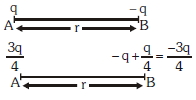
0 likesView Solution
69
PhysicsMediumMCQNEET · 2019
Ionized hydrogen atoms and $\alpha$-particles with same momenta enter perpendicular to a constant magnetic field $B$. The ratio of the radii of their paths $r_{H}: r_{\alpha}$ will be
A
$2:1$
B
$1:2$
C
$4:1$
D
$1:4$
Solution
(A) The radius of a charged particle moving in a magnetic field is given by $r = \frac{mv}{qB} = \frac{p}{qB}$,where $p$ is the momentum,$q$ is the charge,and $B$ is the magnetic field.
Given that the momenta $p$ and the magnetic field $B$ are the same for both particles,the radius is inversely proportional to the charge: $r \propto \frac{1}{q}$.
For an ionized hydrogen atom (proton),the charge is $q_{H} = +e$.
For an $\alpha$-particle (helium nucleus),the charge is $q_{\alpha} = +2e$.
Therefore,the ratio of the radii is $\frac{r_{H}}{r_{\alpha}} = \frac{q_{\alpha}}{q_{H}} = \frac{2e}{e} = \frac{2}{1}$.
Thus,the ratio $r_{H}: r_{\alpha}$ is $2:1$.
Given that the momenta $p$ and the magnetic field $B$ are the same for both particles,the radius is inversely proportional to the charge: $r \propto \frac{1}{q}$.
For an ionized hydrogen atom (proton),the charge is $q_{H} = +e$.
For an $\alpha$-particle (helium nucleus),the charge is $q_{\alpha} = +2e$.
Therefore,the ratio of the radii is $\frac{r_{H}}{r_{\alpha}} = \frac{q_{\alpha}}{q_{H}} = \frac{2e}{e} = \frac{2}{1}$.
Thus,the ratio $r_{H}: r_{\alpha}$ is $2:1$.
0 likesView Solution
70
PhysicsMediumMCQNEET · 2019
In a double slit experiment,when light of wavelength $400 \; nm$ was used,the angular width of the first minima formed on a screen placed $1 \; m$ away was found to be $0.2^{\circ}$. What will be the angular width of the first minima if the entire experimental apparatus is immersed in water (in $^{\circ}$)? $(\mu_{water} = 4/3)$
A
$0.266$
B
$0.15$
C
$0.05$
D
$0.1$
Solution
(B) The angular width of the fringes in a Young's double slit experiment is given by $\theta = \frac{\lambda}{d}$.
When the apparatus is immersed in a medium of refractive index $\mu$,the wavelength of light changes to $\lambda^{\prime} = \frac{\lambda}{\mu}$.
Consequently,the new angular width $\theta^{\prime}$ becomes $\theta^{\prime} = \frac{\lambda^{\prime}}{d} = \frac{\lambda}{\mu d} = \frac{\theta}{\mu}$.
Given $\theta = 0.2^{\circ}$ and $\mu = 4/3$,we have $\theta^{\prime} = \frac{0.2^{\circ}}{4/3} = 0.2^{\circ} \times \frac{3}{4} = 0.15^{\circ}$.
When the apparatus is immersed in a medium of refractive index $\mu$,the wavelength of light changes to $\lambda^{\prime} = \frac{\lambda}{\mu}$.
Consequently,the new angular width $\theta^{\prime}$ becomes $\theta^{\prime} = \frac{\lambda^{\prime}}{d} = \frac{\lambda}{\mu d} = \frac{\theta}{\mu}$.
Given $\theta = 0.2^{\circ}$ and $\mu = 4/3$,we have $\theta^{\prime} = \frac{0.2^{\circ}}{4/3} = 0.2^{\circ} \times \frac{3}{4} = 0.15^{\circ}$.
0 likesView Solution
71
PhysicsMediumMCQNEET · 2019
Two metal spheres,one of radius $R$ and the other of radius $2R$,respectively,have the same surface charge density $\sigma$. They are brought in contact and separated. What will be the new surface charge densities on them?
A
$\sigma_{1}=\frac{5}{6} \sigma, \sigma_{2}=\frac{5}{2} \sigma$
B
$\sigma_{1}=\frac{5}{2} \sigma, \sigma_{2}=\frac{5}{6} \sigma$
C
$\sigma_{1}=\frac{5}{2} \sigma, \sigma_{2}=\frac{5}{3} \sigma$
D
$\sigma_{1}=\frac{5}{3} \sigma, \sigma_{2}=\frac{5}{6} \sigma$
Solution
(D) Initial charges on the spheres are $Q_1 = \sigma (4 \pi R^2)$ and $Q_2 = \sigma (4 \pi (2R)^2) = 16 \pi R^2 \sigma$.
Total charge $Q_{total} = Q_1 + Q_2 = 4 \pi R^2 \sigma + 16 \pi R^2 \sigma = 20 \pi R^2 \sigma$.
When the spheres are brought into contact,the total charge is redistributed such that they reach the same potential $V = \frac{k Q_1'}{R} = \frac{k Q_2'}{2R}$.
This implies $Q_2' = 2 Q_1'$.
Since $Q_1' + Q_2' = 20 \pi R^2 \sigma$,we have $Q_1' + 2 Q_1' = 20 \pi R^2 \sigma$,which gives $3 Q_1' = 20 \pi R^2 \sigma$,so $Q_1' = \frac{20}{3} \pi R^2 \sigma$.
Then $Q_2' = 2 \times \frac{20}{3} \pi R^2 \sigma = \frac{40}{3} \pi R^2 \sigma$.
The new surface charge densities are $\sigma_1' = \frac{Q_1'}{4 \pi R^2} = \frac{20/3 \pi R^2 \sigma}{4 \pi R^2} = \frac{5}{3} \sigma$.
And $\sigma_2' = \frac{Q_2'}{4 \pi (2R)^2} = \frac{40/3 \pi R^2 \sigma}{16 \pi R^2} = \frac{40}{48} \sigma = \frac{5}{6} \sigma$.
Total charge $Q_{total} = Q_1 + Q_2 = 4 \pi R^2 \sigma + 16 \pi R^2 \sigma = 20 \pi R^2 \sigma$.
When the spheres are brought into contact,the total charge is redistributed such that they reach the same potential $V = \frac{k Q_1'}{R} = \frac{k Q_2'}{2R}$.
This implies $Q_2' = 2 Q_1'$.
Since $Q_1' + Q_2' = 20 \pi R^2 \sigma$,we have $Q_1' + 2 Q_1' = 20 \pi R^2 \sigma$,which gives $3 Q_1' = 20 \pi R^2 \sigma$,so $Q_1' = \frac{20}{3} \pi R^2 \sigma$.
Then $Q_2' = 2 \times \frac{20}{3} \pi R^2 \sigma = \frac{40}{3} \pi R^2 \sigma$.
The new surface charge densities are $\sigma_1' = \frac{Q_1'}{4 \pi R^2} = \frac{20/3 \pi R^2 \sigma}{4 \pi R^2} = \frac{5}{3} \sigma$.
And $\sigma_2' = \frac{Q_2'}{4 \pi (2R)^2} = \frac{40/3 \pi R^2 \sigma}{16 \pi R^2} = \frac{40}{48} \sigma = \frac{5}{6} \sigma$.
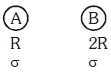
0 likesView Solution
72
PhysicsEasyMCQNEET · 2019
An $LED$ is constructed from a $p-n$ junction diode using $GaAsP$. The energy gap is $1.9\; eV$. The wavelength of the light emitted will be equal to
A
$10.4 \times 10^{-26}\; m$
B
$654 \;nm$
C
$654 \;\mathring A$
D
$654 \times 10^{-11} \;m$
Solution
(B) The energy of the emitted photon is given by $E = \frac{hc}{\lambda}$.
Given the energy gap $E_g = 1.9\; eV$.
The wavelength $\lambda$ is calculated using the formula $\lambda = \frac{hc}{E_g}$.
Using the approximation $hc \approx 1240\; eV \cdot nm$,we get:
$\lambda = \frac{1240\; eV \cdot nm}{1.9\; eV} \approx 652.6\; nm$.
Rounding to the nearest provided option,we get $\lambda \approx 654\; nm$.
Given the energy gap $E_g = 1.9\; eV$.
The wavelength $\lambda$ is calculated using the formula $\lambda = \frac{hc}{E_g}$.
Using the approximation $hc \approx 1240\; eV \cdot nm$,we get:
$\lambda = \frac{1240\; eV \cdot nm}{1.9\; eV} \approx 652.6\; nm$.
Rounding to the nearest provided option,we get $\lambda \approx 654\; nm$.
0 likesView Solution
73
PhysicsMediumMCQNEET · 2019
The circuit diagram shown here corresponds to which logic gate?
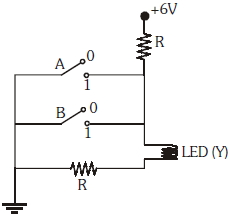
A
$NOR$
B
$AND$
C
$OR$
D
$NAND$
Solution
(A) In the given circuit,switches $A$ and $B$ are connected in parallel. The output $Y$ is the state of the $LED$.
When both switches $A$ and $B$ are at position $0$ (connected to ground),the $LED$ is connected across the $+6V$ supply through resistor $R$,so the $LED$ glows $(Y=1)$.
If either switch $A$ or $B$ is moved to position $1$,the circuit is shorted to ground,and the potential difference across the $LED$ becomes zero,so the $LED$ does not glow $(Y=0)$.
The truth table is:
This truth table corresponds to the $NOR$ gate.
When both switches $A$ and $B$ are at position $0$ (connected to ground),the $LED$ is connected across the $+6V$ supply through resistor $R$,so the $LED$ glows $(Y=1)$.
If either switch $A$ or $B$ is moved to position $1$,the circuit is shorted to ground,and the potential difference across the $LED$ becomes zero,so the $LED$ does not glow $(Y=0)$.
The truth table is:
| $A$ | $B$ | $Y$ |
| $0$ | $0$ | $1$ |
| $0$ | $1$ | $0$ |
| $1$ | $0$ | $0$ |
| $1$ | $1$ | $0$ |
This truth table corresponds to the $NOR$ gate.
0 likesView Solution
74
PhysicsEasyMCQNEET · 2019
An equiconvex lens has power $P$. It is cut into two symmetrical halves by a plane containing the principal axis. The power of one part will be
A
$0$
B
$\frac{P}{2}$
C
$\frac{P}{4}$
D
$P$
Solution
(D) The power of a lens is given by the lens maker's formula: $P = (\mu - 1) \left( \frac{1}{R_1} - \frac{1}{R_2} \right)$.
When a lens is cut by a plane containing the principal axis,the radii of curvature $R_1$ and $R_2$ of the lens surfaces remain unchanged.
Since the refractive index $\mu$ and the radii of curvature $R_1$ and $R_2$ remain the same for the cut part,the focal length $f$ remains unchanged.
As power $P = \frac{1}{f}$,the power of each part remains $P$.
When a lens is cut by a plane containing the principal axis,the radii of curvature $R_1$ and $R_2$ of the lens surfaces remain unchanged.
Since the refractive index $\mu$ and the radii of curvature $R_1$ and $R_2$ remain the same for the cut part,the focal length $f$ remains unchanged.
As power $P = \frac{1}{f}$,the power of each part remains $P$.
0 likesView Solution
75
PhysicsEasyMCQNEET · 2019
In a Young's double slit experiment,if there is no initial phase difference between the light from the two slits,what is the path difference at a point on the screen corresponding to the fifth minimum?
A
$5 \frac{\lambda}{2}$
B
$10 \frac{\lambda}{2}$
C
$9 \frac{\lambda}{2}$
D
$11 \frac{\lambda}{2}$
Solution
(C) The condition for destructive interference (minima) in a Young's double slit experiment is given by the path difference $\Delta x = (2n - 1) \frac{\lambda}{2}$,where $n = 1, 2, 3, \dots$ represents the order of the minimum.
For the fifth minimum,we substitute $n = 5$ into the formula:
$\Delta x = (2(5) - 1) \frac{\lambda}{2}$
$\Delta x = (10 - 1) \frac{\lambda}{2}$
$\Delta x = 9 \frac{\lambda}{2}$.
For the fifth minimum,we substitute $n = 5$ into the formula:
$\Delta x = (2(5) - 1) \frac{\lambda}{2}$
$\Delta x = (10 - 1) \frac{\lambda}{2}$
$\Delta x = 9 \frac{\lambda}{2}$.
0 likesView Solution
76
PhysicsMediumMCQNEET · 2019
$A$ double convex lens has a focal length of $25\; cm$. The radius of curvature of one of the surfaces is double the other. Find the radii if the refractive index of the material of the lens is $1.5$.
A
$100\; cm, 50\; cm$
B
$25\; cm, 50\; cm$
C
$18.75\; cm, 37.5\; cm$
D
$50\; cm, 100\; cm$
Solution
(C) Using the Lens Maker's Formula: $\frac{1}{f} = (\mu - 1) \left( \frac{1}{R_1} - \frac{1}{R_2} \right)$.
Given: $f = 25\; cm$,$\mu = 1.5$. For a double convex lens,$R_1 = R$ and $R_2 = -2R$.
Substituting the values: $\frac{1}{25} = (1.5 - 1) \left( \frac{1}{R} - \frac{1}{-2R} \right)$.
$\frac{1}{25} = 0.5 \left( \frac{1}{R} + \frac{1}{2R} \right) = 0.5 \left( \frac{3}{2R} \right) = \frac{1.5}{2R} = \frac{3}{4R}$.
$4R = 25 \times 3 = 75$.
$R = \frac{75}{4} = 18.75\; cm$.
Therefore,the radii are $R_1 = 18.75\; cm$ and $R_2 = 2R = 37.5\; cm$.
Given: $f = 25\; cm$,$\mu = 1.5$. For a double convex lens,$R_1 = R$ and $R_2 = -2R$.
Substituting the values: $\frac{1}{25} = (1.5 - 1) \left( \frac{1}{R} - \frac{1}{-2R} \right)$.
$\frac{1}{25} = 0.5 \left( \frac{1}{R} + \frac{1}{2R} \right) = 0.5 \left( \frac{3}{2R} \right) = \frac{1.5}{2R} = \frac{3}{4R}$.
$4R = 25 \times 3 = 75$.
$R = \frac{75}{4} = 18.75\; cm$.
Therefore,the radii are $R_1 = 18.75\; cm$ and $R_2 = 2R = 37.5\; cm$.
0 likesView Solution
77
PhysicsMediumMCQNEET · 2019
Two toroids $1$ and $2$ have total number of turns $200$ and $100$ respectively with average radii $40 \; cm$ and $20 \; cm$ respectively. If they carry the same current $i$,the ratio of the magnetic fields along the two loops is
A
$1:1$
B
$4:1$
C
$2:1$
D
$1:2$
Solution
(A) The magnetic field $B$ inside a toroid is given by the formula $B = \frac{\mu_0 N i}{2 \pi r}$,where $N$ is the total number of turns,$i$ is the current,and $r$ is the average radius.
Given for toroid $1$: $N_1 = 200$,$r_1 = 40 \; cm$.
Given for toroid $2$: $N_2 = 100$,$r_2 = 20 \; cm$.
Since the current $i$ is the same for both,the ratio of the magnetic fields is:
$\frac{B_1}{B_2} = \frac{\frac{\mu_0 N_1 i}{2 \pi r_1}}{\frac{\mu_0 N_2 i}{2 \pi r_2}} = \frac{N_1}{N_2} \times \frac{r_2}{r_1}$
Substituting the values:
$\frac{B_1}{B_2} = \left( \frac{200}{100} \right) \times \left( \frac{20}{40} \right) = 2 \times \frac{1}{2} = 1$
Therefore,the ratio is $1:1$.
Given for toroid $1$: $N_1 = 200$,$r_1 = 40 \; cm$.
Given for toroid $2$: $N_2 = 100$,$r_2 = 20 \; cm$.
Since the current $i$ is the same for both,the ratio of the magnetic fields is:
$\frac{B_1}{B_2} = \frac{\frac{\mu_0 N_1 i}{2 \pi r_1}}{\frac{\mu_0 N_2 i}{2 \pi r_2}} = \frac{N_1}{N_2} \times \frac{r_2}{r_1}$
Substituting the values:
$\frac{B_1}{B_2} = \left( \frac{200}{100} \right) \times \left( \frac{20}{40} \right) = 2 \times \frac{1}{2} = 1$
Therefore,the ratio is $1:1$.
0 likesView Solution
78
PhysicsMediumMCQNEET · 2019
$A$ straight conductor carrying current $i$ splits into two parts as shown in the figure. The radius of the circular loop is $R$. The total magnetic field at the centre $P$ of the loop is
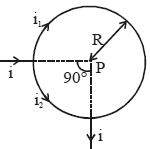
A
$0$
B
$\frac {3 \mu_{0} i} {32 R}$,outward
C
$\frac {3 \mu_{0} i} {32 R}$,inward
D
$\frac{\mu_{0} i}{2 R}$,inward
Solution
(A) The current $i$ splits into $i_1$ and $i_2$ at the junction. Since the two arcs are in parallel,the potential difference across them is the same. Thus,$i_1 R_1 = i_2 R_2$,where $R_1$ and $R_2$ are the resistances of the arcs. Since $R \propto \text{length} \propto \theta$,we have $i_1 \theta_1 = i_2 \theta_2$. Given $\theta_1 = 90^\circ = \pi/2$ and $\theta_2 = 270^\circ = 3\pi/2$,we get $i_1(\pi/2) = i_2(3\pi/2)$,which implies $i_2 = 3i_1$. Since $i_1 + i_2 = i$,we have $i_1 + 3i_1 = i$,so $i_1 = i/4$ and $i_2 = 3i/4$.
The magnetic field at the center due to an arc of angle $\theta$ is $B = \frac{\mu_0 i \theta}{4 \pi R}$.
For the upper arc (angle $270^\circ = 3\pi/2$): $B_1 = \frac{\mu_0 i_1 (3\pi/2)}{4 \pi R} = \frac{3 \mu_0 i_1}{8 R} = \frac{3 \mu_0 (i/4)}{8 R} = \frac{3 \mu_0 i}{32 R}$ (inward).
For the lower arc (angle $90^\circ = \pi/2$): $B_2 = \frac{\mu_0 i_2 (\pi/2)}{4 \pi R} = \frac{\mu_0 i_2}{8 R} = \frac{\mu_0 (3i/4)}{8 R} = \frac{3 \mu_0 i}{32 R}$ (outward).
Since $B_1$ and $B_2$ are equal in magnitude and opposite in direction,the net magnetic field at the center $P$ is $B_{net} = B_1 - B_2 = 0$.
The magnetic field at the center due to an arc of angle $\theta$ is $B = \frac{\mu_0 i \theta}{4 \pi R}$.
For the upper arc (angle $270^\circ = 3\pi/2$): $B_1 = \frac{\mu_0 i_1 (3\pi/2)}{4 \pi R} = \frac{3 \mu_0 i_1}{8 R} = \frac{3 \mu_0 (i/4)}{8 R} = \frac{3 \mu_0 i}{32 R}$ (inward).
For the lower arc (angle $90^\circ = \pi/2$): $B_2 = \frac{\mu_0 i_2 (\pi/2)}{4 \pi R} = \frac{\mu_0 i_2}{8 R} = \frac{\mu_0 (3i/4)}{8 R} = \frac{3 \mu_0 i}{32 R}$ (outward).
Since $B_1$ and $B_2$ are equal in magnitude and opposite in direction,the net magnetic field at the center $P$ is $B_{net} = B_1 - B_2 = 0$.
0 likesView Solution
79
PhysicsMediumMCQNEET · 2019
The variation of $EMF$ with time for four types of generators is shown in the figures. Which amongst them can be called $AC$?
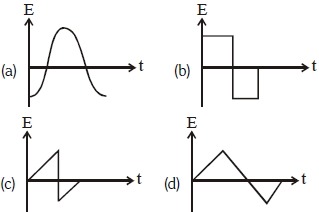
A
$(a)$ and $(d)$
B
$(a), (b), (c)$ and $(d)$
C
$(a)$ and $(b)$
D
Only $(a)$
Solution
(B) An alternating current $(AC)$ is defined as a current that periodically reverses its direction and changes its magnitude with time.
In the given graphs,the $EMF$ (and consequently the current) in all four cases $(a), (b), (c),$ and $(d)$ crosses the time axis,meaning the $EMF$ changes its polarity (sign) periodically.
Since the polarity of the $EMF$ changes in all four graphs,all of them represent alternating $EMF$ or $AC$ waveforms.
Therefore,the correct option is $(b)$.
In the given graphs,the $EMF$ (and consequently the current) in all four cases $(a), (b), (c),$ and $(d)$ crosses the time axis,meaning the $EMF$ changes its polarity (sign) periodically.
Since the polarity of the $EMF$ changes in all four graphs,all of them represent alternating $EMF$ or $AC$ waveforms.
Therefore,the correct option is $(b)$.
0 likesView Solution
80
PhysicsDifficultMCQNEET · 2019
The radius of the first permitted Bohr orbit for the electron in a hydrogen atom equals $0.53 \mathring{A}$ and its ground state energy equals $-13.6 \; eV$. If the electron in the hydrogen atom is replaced by a muon $(\mu^{-})$ [charge same as electron and mass $207 m_{e}$], the first Bohr radius and ground state energy will be:
A
$0.53 \times 10^{-13} \; m, -3.6 \; eV$
B
$25.6 \times 10^{-13} \; m, -2.8 \; eV$
C
$2.56 \times 10^{-13} \; m, -2.8 \; keV$
D
$2.56 \times 10^{-13} \; m, -13.6 \; eV$
Solution
(C) The Bohr radius is given by $r = \frac{n^2 h^2 \epsilon_0}{\pi m e^2}$, which implies $r \propto \frac{1}{m}$.
Given $m_{\mu} = 207 m_e$, the new radius $r_{\mu} = \frac{r_e}{207} = \frac{0.53 \times 10^{-10} \; m}{207} \approx 2.56 \times 10^{-13} \; m$.
The ground state energy is given by $E = -\frac{m e^4}{8 \epsilon_0^2 n^2 h^2}$, which implies $E \propto m$.
Given $m_{\mu} = 207 m_e$, the new energy $E_{\mu} = E_e \times 207 = -13.6 \; eV \times 207 = -2815.2 \; eV \approx -2.8 \; keV$.
Given $m_{\mu} = 207 m_e$, the new radius $r_{\mu} = \frac{r_e}{207} = \frac{0.53 \times 10^{-10} \; m}{207} \approx 2.56 \times 10^{-13} \; m$.
The ground state energy is given by $E = -\frac{m e^4}{8 \epsilon_0^2 n^2 h^2}$, which implies $E \propto m$.
Given $m_{\mu} = 207 m_e$, the new energy $E_{\mu} = E_e \times 207 = -13.6 \; eV \times 207 = -2815.2 \; eV \approx -2.8 \; keV$.
0 likesView Solution
81
PhysicsMediumMCQNEET · 2019
The reading of an ideal voltmeter in the circuit shown is.....$V$.
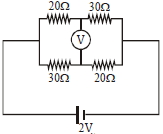
A
$0.6$
B
$0$
C
$0.5$
D
$0.4$
Solution
(D) The circuit consists of two parallel branches connected to a $2 \text{ V}$ battery.
In the upper branch,the resistors $20 \ \Omega$ and $30 \ \Omega$ are in series. The potential at the junction $V_1$ is given by the voltage divider rule: $V_1 = 2 \text{ V} \times \frac{30 \ \Omega}{20 \ \Omega + 30 \ \Omega} = 2 \times \frac{30}{50} = 1.2 \text{ V}$.
In the lower branch,the resistors $30 \ \Omega$ and $20 \ \Omega$ are in series. The potential at the junction $V_2$ is given by: $V_2 = 2 \text{ V} \times \frac{20 \ \Omega}{30 \ \Omega + 20 \ \Omega} = 2 \times \frac{20}{50} = 0.8 \text{ V}$.
The reading of the ideal voltmeter is the potential difference between the two junctions: $V = |V_1 - V_2| = |1.2 \text{ V} - 0.8 \text{ V}| = 0.4 \text{ V}$.
In the upper branch,the resistors $20 \ \Omega$ and $30 \ \Omega$ are in series. The potential at the junction $V_1$ is given by the voltage divider rule: $V_1 = 2 \text{ V} \times \frac{30 \ \Omega}{20 \ \Omega + 30 \ \Omega} = 2 \times \frac{30}{50} = 1.2 \text{ V}$.
In the lower branch,the resistors $30 \ \Omega$ and $20 \ \Omega$ are in series. The potential at the junction $V_2$ is given by: $V_2 = 2 \text{ V} \times \frac{20 \ \Omega}{30 \ \Omega + 20 \ \Omega} = 2 \times \frac{20}{50} = 0.8 \text{ V}$.
The reading of the ideal voltmeter is the potential difference between the two junctions: $V = |V_1 - V_2| = |1.2 \text{ V} - 0.8 \text{ V}| = 0.4 \text{ V}$.
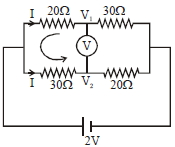
0 likesView Solution
82
PhysicsMediumMCQNEET · 2019
The meter bridge shown is in a balanced position with $\frac{P}{Q} = \frac{l_{1}}{l_{2}}$. If we now interchange the positions of the galvanometer and the cell,will the bridge work? If yes,what will be the balance condition?
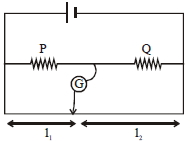
A
yes,$\frac{P}{Q} = \frac{l_{2}-l_{1}}{l_{2}+l_{1}}$
B
no,no null point
C
yes,$\frac{P}{Q} = \frac{l_{2}}{l_{1}}$
D
yes,$\frac{P}{Q} = \frac{l_{1}}{l_{2}}$
Solution
(D) According to the principle of the Wheatstone bridge,the condition for balance is independent of the positions of the cell and the galvanometer. This is known as the reciprocity theorem in electrical networks. If the galvanometer and the cell are interchanged,the bridge will still work,and the balance condition will remain the same,i.e.,$\frac{P}{Q} = \frac{l_{1}}{l_{2}}$.
0 likesView Solution
83
PhysicsEasyMCQNEET · 2019
The relations among the three elements of Earth's magnetic field,namely horizontal component $H$,vertical component $V$,and angle of dip $\delta$ are,($B_{E} =$ total magnetic field):
A
$V=B_{E} \tan \delta, H=B_{E}$
B
$V=B_{E} \sin \delta, H=B_{E} \cos \delta$
C
$V=B_{E} \cos \delta, H=B_{E} \sin \delta$
D
$V=B_{E}, H=B_{E} \tan \delta$
Solution
(B) The Earth's total magnetic field $B_{E}$ can be resolved into two rectangular components:
$1$. The horizontal component $H$,which acts along the horizontal direction,is given by $H = B_{E} \cos \delta$.
$2$. The vertical component $V$,which acts along the vertical direction,is given by $V = B_{E} \sin \delta$.
Here,$\delta$ is the angle of dip (or magnetic inclination).
$1$. The horizontal component $H$,which acts along the horizontal direction,is given by $H = B_{E} \cos \delta$.
$2$. The vertical component $V$,which acts along the vertical direction,is given by $V = B_{E} \sin \delta$.
Here,$\delta$ is the angle of dip (or magnetic inclination).
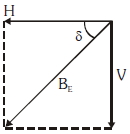
0 likesView Solution
84
PhysicsMediumMCQNEET · 2019
$A$ circuit when connected to an $A.C.$ source of $12 \; V$ gives a current of $0.2 \; A$. The same circuit when connected to a $D.C.$ source of $12 \; V$,gives a current of $0.4 \; A$. The circuit is
A
series $LR$
B
series $RC$
C
series $LC$
D
series $LCR$
Solution
(A) For the $A.C.$ source,the impedance $Z = \frac{V}{I_{AC}} = \frac{12 \; V}{0.2 \; A} = 60 \; \Omega$.
For the $D.C.$ source,the resistance $R = \frac{V}{I_{DC}} = \frac{12 \; V}{0.4 \; A} = 30 \; \Omega$.
Since $Z > R$,the circuit must contain an inductor $(L)$ in addition to the resistor $(R)$.
In a $D.C.$ circuit,an ideal capacitor acts as an open circuit (infinite resistance),but since current flows in the $D.C.$ case,the circuit cannot contain a capacitor in series. Therefore,the circuit is a series $LR$ circuit.
For the $D.C.$ source,the resistance $R = \frac{V}{I_{DC}} = \frac{12 \; V}{0.4 \; A} = 30 \; \Omega$.
Since $Z > R$,the circuit must contain an inductor $(L)$ in addition to the resistor $(R)$.
In a $D.C.$ circuit,an ideal capacitor acts as an open circuit (infinite resistance),but since current flows in the $D.C.$ case,the circuit cannot contain a capacitor in series. Therefore,the circuit is a series $LR$ circuit.
0 likesView Solution
85
PhysicsMediumMCQNEET · 2019
$A$ cycle wheel of radius $0.5 \; m$ is rotated with a constant angular velocity of $10 \; rad/s$ in a region of magnetic field of $0.1 \; T$ which is perpendicular to the plane of the wheel. The $EMF$ generated between its centre and the rim is.....$V$
A
$0.25$
B
$0.125$
C
$0.5$
D
$0$
Solution
(B) The motional $EMF$ induced in a rotating rod (or spoke of a wheel) of length $R$ in a uniform magnetic field $B$ rotating with angular velocity $\omega$ is given by the formula:
$E = \frac{1}{2} B \omega R^2$
Given values:
$B = 0.1 \; T$
$\omega = 10 \; rad/s$
$R = 0.5 \; m$
Substituting these values into the formula:
$E = \frac{1}{2} \times 0.1 \times 10 \times (0.5)^2$
$E = 0.5 \times 0.25$
$E = 0.125 \; V$
Therefore,the $EMF$ generated between the centre and the rim is $0.125 \; V$.
$E = \frac{1}{2} B \omega R^2$
Given values:
$B = 0.1 \; T$
$\omega = 10 \; rad/s$
$R = 0.5 \; m$
Substituting these values into the formula:
$E = \frac{1}{2} \times 0.1 \times 10 \times (0.5)^2$
$E = 0.5 \times 0.25$
$E = 0.125 \; V$
Therefore,the $EMF$ generated between the centre and the rim is $0.125 \; V$.
0 likesView Solution
86
PhysicsMediumMCQNEET · 2019
For a transparent medium,the relative permeability $\mu_{r}$ and relative permittivity $\epsilon_{r}$ are $1.0$ and $1.44$ respectively. The velocity of light in this medium would be,
A
$2.5 \times 10^{8} \;m/s$
B
$3 \times 10^{8} \;m/s$
C
$2.08 \times 10^{8} \;m/s$
D
$4.32 \times 10^{8} \;m/s$
Solution
(A) The velocity of light in a medium is given by the formula $v = \frac{1}{\sqrt{\mu \epsilon}}$.
Substituting $\mu = \mu_{r} \mu_{0}$ and $\epsilon = \epsilon_{r} \epsilon_{0}$,we get $v = \frac{1}{\sqrt{\mu_{r} \epsilon_{r} \mu_{0} \epsilon_{0}}}$.
Since the speed of light in vacuum is $c = \frac{1}{\sqrt{\mu_{0} \epsilon_{0}}} = 3 \times 10^{8} \;m/s$,the formula becomes $v = \frac{c}{\sqrt{\mu_{r} \epsilon_{r}}}$.
Given $\mu_{r} = 1.0$ and $\epsilon_{r} = 1.44$,we have $v = \frac{3 \times 10^{8}}{\sqrt{1.0 \times 1.44}}$.
$v = \frac{3 \times 10^{8}}{\sqrt{1.44}} = \frac{3 \times 10^{8}}{1.2}$.
$v = 2.5 \times 10^{8} \;m/s$.
Substituting $\mu = \mu_{r} \mu_{0}$ and $\epsilon = \epsilon_{r} \epsilon_{0}$,we get $v = \frac{1}{\sqrt{\mu_{r} \epsilon_{r} \mu_{0} \epsilon_{0}}}$.
Since the speed of light in vacuum is $c = \frac{1}{\sqrt{\mu_{0} \epsilon_{0}}} = 3 \times 10^{8} \;m/s$,the formula becomes $v = \frac{c}{\sqrt{\mu_{r} \epsilon_{r}}}$.
Given $\mu_{r} = 1.0$ and $\epsilon_{r} = 1.44$,we have $v = \frac{3 \times 10^{8}}{\sqrt{1.0 \times 1.44}}$.
$v = \frac{3 \times 10^{8}}{\sqrt{1.44}} = \frac{3 \times 10^{8}}{1.2}$.
$v = 2.5 \times 10^{8} \;m/s$.
0 likesView Solution
87
PhysicsEasyMCQNEET · 2019
$A$ sphere encloses an electric dipole with charges $\pm 3 \times 10^{-6} \; C$. What is the total electric flux across the sphere in $\text{N m}^2 / \text{C}$?
A
$-3 \times 10^{-6}$
B
$0$
C
$3 \times 10^{-6}$
D
$6 \times 10^{-6}$
Solution
(B) According to Gauss's Law, the total electric flux $\phi$ through a closed surface is given by $\phi = \frac{q_{\text{enclosed}}}{\epsilon_0}$.
An electric dipole consists of two equal and opposite charges, $+q$ and $-q$.
Here, the charges are $+3 \times 10^{-6} \; C$ and $-3 \times 10^{-6} \; C$.
The total charge enclosed by the sphere is $q_{\text{enclosed}} = (+3 \times 10^{-6}) + (-3 \times 10^{-6}) = 0 \; C$.
Therefore, the total electric flux $\phi = \frac{0}{\epsilon_0} = 0 \; \text{N m}^2 / \text{C}$.
An electric dipole consists of two equal and opposite charges, $+q$ and $-q$.
Here, the charges are $+3 \times 10^{-6} \; C$ and $-3 \times 10^{-6} \; C$.
The total charge enclosed by the sphere is $q_{\text{enclosed}} = (+3 \times 10^{-6}) + (-3 \times 10^{-6}) = 0 \; C$.
Therefore, the total electric flux $\phi = \frac{0}{\epsilon_0} = 0 \; \text{N m}^2 / \text{C}$.
0 likesView Solution
88
PhysicsDifficultMCQNEET · 2019
Two identical capacitors $C_{1}$ and $C_{2}$ of equal capacitance are connected as shown in the circuit. Terminals $a$ and $b$ of the key $k$ are connected to charge capacitor $C_{1}$ using a battery of $emf$ $V$ volt. Now,disconnecting $a$ and $b$,the terminals $b$ and $c$ are connected. Due to this,what will be the percentage loss of energy?
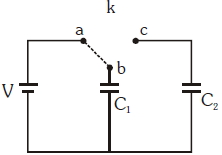
A
$75$
B
$0$
C
$50$
D
$25$
Solution
(C) Initially,capacitor $C_{1}$ is charged to a potential $V$ by the battery. The initial energy stored in $C_{1}$ is $U_{i} = \frac{1}{2} C V^{2}$.
When the battery is disconnected and $C_{1}$ is connected in parallel with an uncharged capacitor $C_{2}$ (where $C_{1} = C_{2} = C$),charge is redistributed.
The common potential $V'$ after connection is given by $V' = \frac{C_{1}V + C_{2}(0)}{C_{1} + C_{2}} = \frac{CV}{2C} = \frac{V}{2}$.
The final energy stored in the system is $U_{f} = \frac{1}{2} (C_{1} + C_{2}) (V')^{2} = \frac{1}{2} (2C) (\frac{V}{2})^{2} = C \cdot \frac{V^{2}}{4} = \frac{1}{4} C V^{2}$.
The loss in energy is $\Delta U = U_{i} - U_{f} = \frac{1}{2} C V^{2} - \frac{1}{4} C V^{2} = \frac{1}{4} C V^{2}$.
The percentage loss of energy is $\frac{\Delta U}{U_{i}} \times 100 = \frac{\frac{1}{4} C V^{2}}{\frac{1}{2} C V^{2}} \times 100 = 50 \%$.
When the battery is disconnected and $C_{1}$ is connected in parallel with an uncharged capacitor $C_{2}$ (where $C_{1} = C_{2} = C$),charge is redistributed.
The common potential $V'$ after connection is given by $V' = \frac{C_{1}V + C_{2}(0)}{C_{1} + C_{2}} = \frac{CV}{2C} = \frac{V}{2}$.
The final energy stored in the system is $U_{f} = \frac{1}{2} (C_{1} + C_{2}) (V')^{2} = \frac{1}{2} (2C) (\frac{V}{2})^{2} = C \cdot \frac{V^{2}}{4} = \frac{1}{4} C V^{2}$.
The loss in energy is $\Delta U = U_{i} - U_{f} = \frac{1}{2} C V^{2} - \frac{1}{4} C V^{2} = \frac{1}{4} C V^{2}$.
The percentage loss of energy is $\frac{\Delta U}{U_{i}} \times 100 = \frac{\frac{1}{4} C V^{2}}{\frac{1}{2} C V^{2}} \times 100 = 50 \%$.
0 likesView Solution
89
PhysicsMediumMCQNEET · 2019
The angular width of the central maxima in Fraunhofer diffraction for $\lambda = 6000 \; \mathring{A}$ is $\theta_{0}$. When the same slit is illuminated by another monochromatic light,the angular width decreases by $30 \%$. The wavelength of this light is ....... $\mathring{A}$.
A
$1800$
B
$4200$
C
$6000$
D
$420$
Solution
(B) The angular width of the central maxima in Fraunhofer diffraction is given by $\theta = \frac{2\lambda}{d}$,where $\lambda$ is the wavelength and $d$ is the slit width.
Since $\theta \propto \lambda$,we have the ratio $\frac{\theta_2}{\theta_1} = \frac{\lambda_2}{\lambda_1}$.
Given that the angular width decreases by $30 \%$,the new angular width $\theta_2 = \theta_0 - 0.30\theta_0 = 0.70\theta_0$.
Substituting the values: $\frac{0.70\theta_0}{\theta_0} = \frac{\lambda_2}{6000 \; \mathring{A}}$.
$0.70 = \frac{\lambda_2}{6000 \; \mathring{A}}$.
$\lambda_2 = 0.70 \times 6000 \; \mathring{A} = 4200 \; \mathring{A}$.
Since $\theta \propto \lambda$,we have the ratio $\frac{\theta_2}{\theta_1} = \frac{\lambda_2}{\lambda_1}$.
Given that the angular width decreases by $30 \%$,the new angular width $\theta_2 = \theta_0 - 0.30\theta_0 = 0.70\theta_0$.
Substituting the values: $\frac{0.70\theta_0}{\theta_0} = \frac{\lambda_2}{6000 \; \mathring{A}}$.
$0.70 = \frac{\lambda_2}{6000 \; \mathring{A}}$.
$\lambda_2 = 0.70 \times 6000 \; \mathring{A} = 4200 \; \mathring{A}$.
0 likesView Solution
90
PhysicsMediumMCQNEET · 2019
$A$ proton and an $\alpha$-particle are accelerated from rest to the same kinetic energy. The ratio of their de Broglie wavelengths $\lambda_{p} : \lambda_{\alpha}$ is:
A
$2:1$
B
$1:1$
C
$\sqrt{2}: 1$
D
$4:1$
Solution
(A) The de Broglie wavelength $\lambda$ is given by the formula $\lambda = \frac{h}{\sqrt{2mE_k}}$,where $h$ is Planck's constant,$m$ is the mass of the particle,and $E_k$ is the kinetic energy.
Since both particles have the same kinetic energy $E_k$,we have $\lambda \propto \frac{1}{\sqrt{m}}$.
Therefore,$\frac{\lambda_p}{\lambda_{\alpha}} = \sqrt{\frac{m_{\alpha}}{m_p}}$.
We know that the mass of an $\alpha$-particle is approximately $4$ times the mass of a proton,i.e.,$m_{\alpha} = 4m_p$.
Substituting this value,we get $\frac{\lambda_p}{\lambda_{\alpha}} = \sqrt{\frac{4m_p}{m_p}} = \sqrt{4} = 2$.
Thus,the ratio $\lambda_p : \lambda_{\alpha}$ is $2:1$.
Since both particles have the same kinetic energy $E_k$,we have $\lambda \propto \frac{1}{\sqrt{m}}$.
Therefore,$\frac{\lambda_p}{\lambda_{\alpha}} = \sqrt{\frac{m_{\alpha}}{m_p}}$.
We know that the mass of an $\alpha$-particle is approximately $4$ times the mass of a proton,i.e.,$m_{\alpha} = 4m_p$.
Substituting this value,we get $\frac{\lambda_p}{\lambda_{\alpha}} = \sqrt{\frac{4m_p}{m_p}} = \sqrt{4} = 2$.
Thus,the ratio $\lambda_p : \lambda_{\alpha}$ is $2:1$.
0 likesView Solution
Vedclass Products
For Students
Vedclass Test Series
Mock tests in real NEET style covering Physics with performance analysis. 5-day free trial.
Start Free TrialFor Teachers
Exam Paper Generator
Generate Set A/B/C/D Physics papers from 7.5L+ questions in 2 minutes. 3 chapters free.
Try FreeFor Institutes
Online Exam Module
Run live NEET mock exams with unlimited students, 360° analytics & white-label branding.
See DemoFrequently Asked Questions
How many Physics questions are in NEET 2019?
There are 90 Physics questions from the NEET 2019 paper on Vedclass, each with a detailed step-by-step solution in English.
Are NEET 2019 Physics solutions available in English?
Yes. All solutions on this page are in English. You can also switch to English or Hindi using the language buttons above the questions.
Can I practice NEET 2019 Physics as a timed test?
Yes. Use the Vedclass Test Series to attempt a full NEET mock test covering Physics with time limits and instant score analysis.
Can teachers create Physics papers from NEET previous year questions?
Yes. The Vedclass Exam Paper Generator lets teachers mix NEET Physics questions and generate Set A/B/C/D papers in minutes.
For Teachers & Institutes
Build a Custom Physics Paper
Pick NEET 2019 Physics questions, set difficulty, and generate Set A/B/C/D in 2 minutes.