
BiologyQ1–98 of 100 questions
Page 1 of 2 · English
1
BiologyMediumMCQNEET · 2024
Lecithin,a small molecular weight organic compound found in living tissues,is an example of:
A
Phospholipids
B
Glycerides
C
Carbohydrates
D
Amino acids
Solution
(A) The correct answer is option $A$.
Lecithin is a type of phospholipid. Phospholipids are lipids that contain a phosphate group and a phosphorylated organic compound in their structure.
They are essential components of the cell membrane,contributing to its fluid mosaic structure.
Option $B$ is incorrect because glycerides are a different group of lipids consisting of glycerol and fatty acids.
Options $C$ and $D$ are incorrect because carbohydrates and amino acids are distinct classes of biomolecules.
Lecithin is a type of phospholipid. Phospholipids are lipids that contain a phosphate group and a phosphorylated organic compound in their structure.
They are essential components of the cell membrane,contributing to its fluid mosaic structure.
Option $B$ is incorrect because glycerides are a different group of lipids consisting of glycerol and fatty acids.
Options $C$ and $D$ are incorrect because carbohydrates and amino acids are distinct classes of biomolecules.
0 likesView Solution
2
BiologyMediumMCQNEET · 2024
Which of the following are required for the dark reaction of photosynthesis?
$A$. Light $B$. Chlorophyll $C$. $CO_2$ $D$. $ATP$ $E$. $NADPH$
Choose the correct answer from the options given below:
$A$. Light $B$. Chlorophyll $C$. $CO_2$ $D$. $ATP$ $E$. $NADPH$
Choose the correct answer from the options given below:
A
$B, C$ and $D$ only
B
$C, D$ and $E$ only
C
$D$ and $E$ only
D
$A, B$ and $C$ only
Solution
(B) The dark reaction of photosynthesis,also known as the Calvin cycle or light-independent reaction,takes place in the stroma of the chloroplast.
It does not directly require light,chlorophyll,or the light-harvesting apparatus.
Instead,it utilizes the products of the light-dependent reactions to fix carbon dioxide into glucose.
The essential requirements for the dark reaction are:
$1$. $CO_2$: Acts as the carbon source for the synthesis of sugars.
$2$. $ATP$: Provides the necessary energy for the reduction process.
$3$. $NADPH$: Acts as a reducing agent to convert $3-PGA$ to $G3P$.
Therefore,$C, D,$ and $E$ are the correct requirements.
It does not directly require light,chlorophyll,or the light-harvesting apparatus.
Instead,it utilizes the products of the light-dependent reactions to fix carbon dioxide into glucose.
The essential requirements for the dark reaction are:
$1$. $CO_2$: Acts as the carbon source for the synthesis of sugars.
$2$. $ATP$: Provides the necessary energy for the reduction process.
$3$. $NADPH$: Acts as a reducing agent to convert $3-PGA$ to $G3P$.
Therefore,$C, D,$ and $E$ are the correct requirements.
2 likesView Solution
3
BiologyMediumMCQNEET · 2024
Given below are two statements:
Statement $I$: Chromosomes become gradually visible under light microscope during leptotene stage.
Statement $II$: The beginning of diplotene stage is recognized by dissolution of synaptonemal complex.
In the light of the above statements,choose the correct answer from the options given below:
Statement $I$: Chromosomes become gradually visible under light microscope during leptotene stage.
Statement $II$: The beginning of diplotene stage is recognized by dissolution of synaptonemal complex.
In the light of the above statements,choose the correct answer from the options given below:
A
Both Statement $I$ and Statement $II$ are false
B
Statement $I$ is true but Statement $II$ is false
C
Statement $I$ is false but Statement $II$ is true
D
Both Statement $I$ and Statement $II$ are true
Solution
(D) - During the leptotene stage,the chromosomes become gradually visible under the light microscope as they begin to condense.
- The beginning of the diplotene stage is recognized by the dissolution of the synaptonemal complex and the tendency of the recombined homologous chromosomes of the bivalents to separate from each other,except at the sites of crossovers (chiasmata).
- Therefore,both Statement $I$ and Statement $II$ are true.
- The beginning of the diplotene stage is recognized by the dissolution of the synaptonemal complex and the tendency of the recombined homologous chromosomes of the bivalents to separate from each other,except at the sites of crossovers (chiasmata).
- Therefore,both Statement $I$ and Statement $II$ are true.
0 likesView Solution
4
BiologyMediumMCQNEET · 2024
Bulliform cells are responsible for
A
Protecting the plant from salt stress.
B
Increased photosynthesis in monocots.
C
Providing large spaces for storage of sugars.
D
Inward curling of leaves in monocots.
Solution
(D) In grasses,certain adaxial epidermal cells along the veins modify themselves into large,empty,colourless cells. These are called bulliform cells.
When the bulliform cells in the leaves have absorbed water and are turgid,the leaf surface is exposed.
When they are flaccid due to water stress,they make the leaves curl inwards to minimise water loss.
When the bulliform cells in the leaves have absorbed water and are turgid,the leaf surface is exposed.
When they are flaccid due to water stress,they make the leaves curl inwards to minimise water loss.
0 likesView Solution
5
BiologyMediumMCQNEET · 2024
Auxin is used by gardeners to prepare weed-free lawns. But no damage is caused to grass as auxin
A
promotes abscission of mature leaves only.
B
does not affect mature monocotyledonous plants.
C
can help in cell division in grasses,to produce growth.
D
promotes apical dominance.
Solution
(B) Sol. Auxin,specifically synthetic auxins like $2,4-D$ ($2$,$4$-Dichlorophenoxyacetic acid),is used as a selective herbicide. It does not affect mature monocotyledonous plants like grasses. This is because monocots possess a different vascular structure and show limited translocation of the applied auxin,leading to its rapid degradation,thereby sparing the grass while killing broad-leaved weeds.
0 likesView Solution
6
BiologyMediumMCQNEET · 2024
Identify the part of the seed from the given figure which is destined to form the root when the seed germinates.
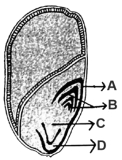
A
$B$
B
$C$
C
$D$
D
$A$
Solution
(B) In a seed,the radicle is the embryonic part that is destined to develop into the root system upon germination.
Looking at the provided diagram of a maize grain (monocot seed):
- $A$ represents the coleoptile.
- $B$ represents the plumule.
- $C$ represents the radicle.
- $D$ represents the coleorhiza.
Therefore,the part labeled '$C$' is the radicle,which forms the root.
Looking at the provided diagram of a maize grain (monocot seed):
- $A$ represents the coleoptile.
- $B$ represents the plumule.
- $C$ represents the radicle.
- $D$ represents the coleorhiza.
Therefore,the part labeled '$C$' is the radicle,which forms the root.
0 likesView Solution
7
BiologyMediumMCQNEET · 2024
Spindle fibers attach to kinetochores of chromosomes during
A
Metaphase
B
Anaphase
C
Telophase
D
Prophase
Solution
(A) During the process of cell division,the spindle fibers attach to the kinetochores of the chromosomes specifically during the $Metaphase$ stage. This attachment is crucial for the alignment of chromosomes at the equatorial plate (metaphase plate) before they are pulled apart in the subsequent $Anaphase$ stage.
0 likesView Solution
8
BiologyMediumMCQNEET · 2024
Which of the following is an example of an actinomorphic flower?
A
Cassia
B
Pisum
C
Sesbania
D
Datura
Solution
(D) An actinomorphic flower is one that can be divided into two equal radial halves in any radial plane passing through the center.
$Datura$ is a classic example of an actinomorphic flower.
In contrast,$Cassia$,$Pisum$,and $Sesbania$ exhibit zygomorphic flowers,which can be divided into two similar halves only in one particular vertical plane.
$Datura$ is a classic example of an actinomorphic flower.
In contrast,$Cassia$,$Pisum$,and $Sesbania$ exhibit zygomorphic flowers,which can be divided into two similar halves only in one particular vertical plane.
0 likesView Solution
9
BiologyMediumMCQNEET · 2024
In the given figure,which component has thin outer walls and highly thickened inner walls?
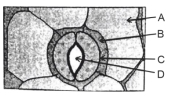
A
$D$
B
$A$
C
$B$
D
$C$
Solution
(C) In the provided diagram of a stoma,the components are labeled as follows:
$A$ represents the epidermal cell.
$B$ represents the guard cell.
$C$ represents the inner wall of the guard cell.
$D$ represents the stomatal pore.
Guard cells are specialized cells that regulate the opening and closing of the stomatal pore. $A$ characteristic feature of guard cells is that they possess thin outer walls (away from the pore) and highly thickened inner walls (towards the pore). Therefore,the component $B$ represents the guard cells.
$A$ represents the epidermal cell.
$B$ represents the guard cell.
$C$ represents the inner wall of the guard cell.
$D$ represents the stomatal pore.
Guard cells are specialized cells that regulate the opening and closing of the stomatal pore. $A$ characteristic feature of guard cells is that they possess thin outer walls (away from the pore) and highly thickened inner walls (towards the pore). Therefore,the component $B$ represents the guard cells.
0 likesView Solution
10
BiologyMediumMCQNEET · 2024
Formation of interfascicular cambium from fully developed parenchyma cells is an example for
A
Redifferentiation
B
Dedifferentiation
C
Maturation
D
Differentiation
Solution
(B) The phenomenon where fully differentiated parenchyma cells regain the capacity to divide and form interfascicular cambium is known as dedifferentiation.
This process allows mature cells to return to a meristematic state to facilitate secondary growth.
This process allows mature cells to return to a meristematic state to facilitate secondary growth.
2 likesView Solution
11
BiologyMediumMCQNEET · 2024
Match List $I$ with List $II$:
Choose the correct answer from the options given below:
| List $I$ | List $II$ |
|---|---|
| $A$. Rhizopus | $I$. Mushroom |
| $B$. Ustilago | $II$. Smut fungus |
| $C$. Puccinia | $III$. Bread mould |
| $D$. Agaricus | $IV$. Rust fungus |
Choose the correct answer from the options given below:
A
$A-I, B-III, C-II, D-IV$
B
$A-III, B-II, C-I, D-IV$
C
$A-IV, B-III, C-II, D-I$
D
$A-III, B-II, C-IV, D-I$
Solution
(D) $Rhizopus$ is commonly known as bread mould.
$Ustilago$ is a parasitic fungus that causes smut disease in plants,hence called smut fungus.
$Puccinia$ is a parasitic fungus that causes rust disease in plants,hence called rust fungus.
$Agaricus$ is a basidiomycete commonly known as mushroom.
Therefore,the correct matching is $A-III, B-II, C-IV, D-I$.
$Ustilago$ is a parasitic fungus that causes smut disease in plants,hence called smut fungus.
$Puccinia$ is a parasitic fungus that causes rust disease in plants,hence called rust fungus.
$Agaricus$ is a basidiomycete commonly known as mushroom.
Therefore,the correct matching is $A-III, B-II, C-IV, D-I$.
0 likesView Solution
12
BiologyMediumMCQNEET · 2024
Identify the type of flowers based on the position of calyx,corolla and androecium with respect to the ovary from the given figures $(a)$ and $(b)$.
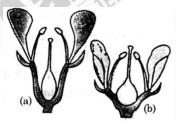
A
$(a)$ Hypogynous; $(b)$ Epigynous
B
$(a)$ Perigynous; $(b)$ Epigynous
C
$(a)$ Perigynous; $(b)$ Perigynous
D
$(a)$ Epigynous; $(b)$ Hypogynous
Solution
(C) In perigynous flowers,the gynoecium is situated in the centre and other parts of the flower are located on the rim of the thalamus almost at the same level.
In figure $(a)$,the ovary is situated in the centre,and other floral parts are arranged on the rim of the thalamus,representing a perigynous condition.
In figure $(b)$,the ovary is also situated in the centre with other floral parts on the rim of the thalamus,which also represents a perigynous condition.
Therefore,both figures $(a)$ and $(b)$ represent the perigynous condition.
In figure $(a)$,the ovary is situated in the centre,and other floral parts are arranged on the rim of the thalamus,representing a perigynous condition.
In figure $(b)$,the ovary is also situated in the centre with other floral parts on the rim of the thalamus,which also represents a perigynous condition.
Therefore,both figures $(a)$ and $(b)$ represent the perigynous condition.
0 likesView Solution
13
BiologyMediumMCQNEET · 2024
Which one of the following is not a criterion for classification of fungi?
A
Mode of nutrition
B
Mode of spore formation
C
Fruiting body
D
Morphology of mycelium
Solution
(A) The classification of the kingdom $Fungi$ into various classes is primarily based on the morphology of the mycelium,the mode of spore formation,and the structure of the fruiting bodies. While all fungi are heterotrophic,the mode of nutrition is not used as a primary criterion for distinguishing between the different classes of fungi.
1 likesView Solution
14
BiologyMediumMCQNEET · 2024
Match List $I$ with List $II$:
Choose the correct answer from the options given below:
| List $I$ | List $II$ |
| $A$. Nucleolus | $I$. Site of formation of glycolipid |
| $B$. Centriole | $II$. Organization like the cartwheel |
| $C$. Golgi apparatus | $III$. Site for active ribosomal $RNA$ synthesis |
| $D$. Leucoplast | $IV$. For storing nutrients |
Choose the correct answer from the options given below:
A
$A-III, B-II, C-I, D-IV$
B
$A-III, B-IV, C-II, D-I$
C
$A-I, B-II, C-III, D-IV$
D
$A-III, B-II, C-IV, D-I$
Solution
(A) The correct matching is as follows:
- Nucleolus $(A)$: It is the site for active ribosomal $RNA$ $(rRNA)$ synthesis $(III)$.
- Centriole $(B)$: Centrioles are organelles that possess an organization like the cartwheel $(II)$.
- Golgi apparatus $(C)$: It is the primary site for the formation of glycoproteins and glycolipids $(I)$.
- Leucoplast $(D)$: These are colourless plastids that are primarily responsible for storing nutrients such as starch,oil,or proteins $(IV)$.
Therefore,the correct sequence is $A-III, B-II, C-I, D-IV$.
- Nucleolus $(A)$: It is the site for active ribosomal $RNA$ $(rRNA)$ synthesis $(III)$.
- Centriole $(B)$: Centrioles are organelles that possess an organization like the cartwheel $(II)$.
- Golgi apparatus $(C)$: It is the primary site for the formation of glycoproteins and glycolipids $(I)$.
- Leucoplast $(D)$: These are colourless plastids that are primarily responsible for storing nutrients such as starch,oil,or proteins $(IV)$.
Therefore,the correct sequence is $A-III, B-II, C-I, D-IV$.
0 likesView Solution
15
BiologyMediumMCQNEET · 2024
Inhibition of Succinic dehydrogenase enzyme by malonate is a classical example of.
A
Feedback inhibition
B
Competitive inhibition
C
Enzyme activation
D
Cofactor inhibition
Solution
(B) The correct answer is option $B$ because malonate shows close structural similarity with the substrate (succinate) and it competes with the substrate for the active site of the enzyme succinic dehydrogenase.
This type of inhibition,where the inhibitor resembles the substrate in molecular structure and binds to the active site,is known as competitive inhibition.
Options $A$,$C$,and $D$ are incorrect because they do not describe the mechanism where an inhibitor competes with the substrate due to structural similarity.
This type of inhibition,where the inhibitor resembles the substrate in molecular structure and binds to the active site,is known as competitive inhibition.
Options $A$,$C$,and $D$ are incorrect because they do not describe the mechanism where an inhibitor competes with the substrate due to structural similarity.
0 likesView Solution
16
BiologyMediumMCQNEET · 2024
Given below are two statements:
Statement $I$: Parenchyma is living but collenchyma is dead tissue.
Statement $II$: Gymnosperms lack xylem vessels but presence of xylem vessels is the characteristic of angiosperms.
In the light of the above statements,choose the correct answer from the options given below:
Statement $I$: Parenchyma is living but collenchyma is dead tissue.
Statement $II$: Gymnosperms lack xylem vessels but presence of xylem vessels is the characteristic of angiosperms.
In the light of the above statements,choose the correct answer from the options given below:
A
Both Statement $I$ and Statement $II$ are false
B
Statement $I$ is true but Statement $II$ is false
C
Statement $I$ is false but Statement $II$ is true
D
Both Statement $I$ and Statement $II$ are true
Solution
(C) Statement $I$ is false because both parenchyma and collenchyma are living tissues. Collenchyma cells are living and possess protoplasm.
Statement $II$ is true because gymnosperms typically lack xylem vessels (tracheids are the main water-conducting elements),whereas the presence of xylem vessels is a defining characteristic of angiosperms.
Statement $II$ is true because gymnosperms typically lack xylem vessels (tracheids are the main water-conducting elements),whereas the presence of xylem vessels is a defining characteristic of angiosperms.
0 likesView Solution
17
BiologyMediumMCQNEET · 2024
How many molecules of $ATP$ and $NADPH$ are required for every molecule of $CO_2$ fixed in the Calvin cycle?
A
$2$ molecules of $ATP$ and $2$ molecules of $NADPH$
B
$3$ molecules of $ATP$ and $3$ molecules of $NADPH$
C
$3$ molecules of $ATP$ and $2$ molecules of $NADPH$
D
$2$ molecules of $ATP$ and $3$ molecules of $NADPH$
Solution
(C) In the Calvin cycle,the fixation of $1$ molecule of $CO_2$ involves three stages: carboxylation,reduction,and regeneration.
During the reduction phase,$2$ molecules of $ATP$ and $2$ molecules of $NADPH$ are used for the reduction of $1$ molecule of $3-PGA$ to $G3P$.
Additionally,$1$ molecule of $ATP$ is required during the regeneration phase to convert $RuMP$ back into $RuBP$.
Therefore,for the fixation of $1$ molecule of $CO_2$,a total of $3$ molecules of $ATP$ and $2$ molecules of $NADPH$ are consumed.
During the reduction phase,$2$ molecules of $ATP$ and $2$ molecules of $NADPH$ are used for the reduction of $1$ molecule of $3-PGA$ to $G3P$.
Additionally,$1$ molecule of $ATP$ is required during the regeneration phase to convert $RuMP$ back into $RuBP$.
Therefore,for the fixation of $1$ molecule of $CO_2$,a total of $3$ molecules of $ATP$ and $2$ molecules of $NADPH$ are consumed.
0 likesView Solution
18
BiologyMediumMCQNEET · 2024
The cofactor of the enzyme carboxypeptidase is:
A
Niacin
B
Flavin
C
Haem
D
Zinc
Solution
(D) The correct answer is option $D$ because the cofactor of the enzyme carboxypeptidase is $Zinc$ $(Zn^{2+})$.
$Niacin$ is a vitamin that acts as a precursor for coenzymes like $NAD$ and $NADP$.
$Flavin$ is a component of coenzymes like $FAD$ and $FMN$.
$Haem$ is the prosthetic group found in enzymes such as peroxidase and catalase.
Therefore, $Zinc$ is the essential metal ion cofactor required for the catalytic activity of carboxypeptidase.
$Niacin$ is a vitamin that acts as a precursor for coenzymes like $NAD$ and $NADP$.
$Flavin$ is a component of coenzymes like $FAD$ and $FMN$.
$Haem$ is the prosthetic group found in enzymes such as peroxidase and catalase.
Therefore, $Zinc$ is the essential metal ion cofactor required for the catalytic activity of carboxypeptidase.
0 likesView Solution
19
BiologyMediumMCQNEET · 2024
Read the following statements and choose the set of correct statements: In the members of Phaeophyceae,
$A$. Asexual reproduction occurs usually by biflagellate zoospores.
$B$. Sexual reproduction is by oogamous method only.
$C$. Stored food is in the form of carbohydrates which is either mannitol or laminarin.
$D$. The major pigments found are chlorophyll $a$,$c$ and carotenoids and xanthophyll.
$E$. Vegetative cells have a cellulosic wall,usually covered on the outside by gelatinous coating of algin.
Choose the correct answer from the options given below:
$A$. Asexual reproduction occurs usually by biflagellate zoospores.
$B$. Sexual reproduction is by oogamous method only.
$C$. Stored food is in the form of carbohydrates which is either mannitol or laminarin.
$D$. The major pigments found are chlorophyll $a$,$c$ and carotenoids and xanthophyll.
$E$. Vegetative cells have a cellulosic wall,usually covered on the outside by gelatinous coating of algin.
Choose the correct answer from the options given below:
A
$B, C, D$ and $E$ only
B
$A, C, D$ and $E$ only
C
$A, B, C$ and $E$ only
D
$A, B, C$ and $D$ only
Solution
(B) In members of Phaeophyceae (brown algae),asexual reproduction occurs by biflagellate zoospores that are pear-shaped and have two laterally attached flagella.
Sexual reproduction in Phaeophyceae can be isogamous,anisogamous,or oogamous. Therefore,statement $B$ is incorrect as it claims it is oogamous only.
Stored food is in the form of complex carbohydrates,usually mannitol or laminarin. Thus,statement $C$ is correct.
The major pigments present are chlorophyll $a$,$c$,carotenoids,and xanthophylls (like fucoxanthin). Thus,statement $D$ is correct.
Vegetative cells have a cellulosic wall,which is usually covered on the outside by a gelatinous coating of algin. Thus,statement $E$ is correct.
Therefore,the correct set of statements is $A, C, D$ and $E$.
Sexual reproduction in Phaeophyceae can be isogamous,anisogamous,or oogamous. Therefore,statement $B$ is incorrect as it claims it is oogamous only.
Stored food is in the form of complex carbohydrates,usually mannitol or laminarin. Thus,statement $C$ is correct.
The major pigments present are chlorophyll $a$,$c$,carotenoids,and xanthophylls (like fucoxanthin). Thus,statement $D$ is correct.
Vegetative cells have a cellulosic wall,which is usually covered on the outside by a gelatinous coating of algin. Thus,statement $E$ is correct.
Therefore,the correct set of statements is $A, C, D$ and $E$.
0 likesView Solution
20
BiologyMediumMCQNEET · 2024
The $DNA$ present in chloroplast is:
A
Circular,double stranded
B
Linear,single stranded
C
Circular,single stranded
D
Linear,double stranded
Solution
(A) The $DNA$ present in chloroplast is circular and double-stranded. This is similar to the $DNA$ found in prokaryotes and mitochondria,which supports the endosymbiotic theory of the origin of these organelles.
0 likesView Solution
21
BiologyMediumMCQNEET · 2024
Given below are two statements:
Statement $I$: In $C_3$ plants,some $O_2$ binds to $RuBisCO$,hence $CO_2$ fixation is decreased.
Statement $II$: In $C_4$ plants,mesophyll cells show very little photorespiration while bundle sheath cells do not show photorespiration.
In the light of the above statements,choose the correct answer from the options given below:
Statement $I$: In $C_3$ plants,some $O_2$ binds to $RuBisCO$,hence $CO_2$ fixation is decreased.
Statement $II$: In $C_4$ plants,mesophyll cells show very little photorespiration while bundle sheath cells do not show photorespiration.
In the light of the above statements,choose the correct answer from the options given below:
A
Both Statement $I$ and Statement $II$ are false
B
Statement $I$ is true but Statement $II$ is false
C
Statement $I$ is false but Statement $II$ is true
D
Both Statement $I$ and Statement $II$ are true
Solution
(B) Statement $I$ is true: In $C_3$ plants,the enzyme $RuBisCO$ has an affinity for both $CO_2$ and $O_2$. When $O_2$ concentration is high,$RuBisCO$ binds with $O_2$ instead of $CO_2$,leading to photorespiration,which reduces the efficiency of $CO_2$ fixation.
Statement $II$ is false: $C_4$ plants have evolved a mechanism to avoid photorespiration. They lack $RuBisCO$ in mesophyll cells,and bundle sheath cells maintain a high concentration of $CO_2$ around $RuBisCO$,effectively eliminating photorespiration in both cell types.
Statement $II$ is false: $C_4$ plants have evolved a mechanism to avoid photorespiration. They lack $RuBisCO$ in mesophyll cells,and bundle sheath cells maintain a high concentration of $CO_2$ around $RuBisCO$,effectively eliminating photorespiration in both cell types.
1 likesView Solution
22
BiologyMediumMCQNEET · 2024
Match List $I$ with List $II$:
Choose the correct answer from the options given below:
| List $I$ | List $II$ |
| $A$. Rose | $I$. Twisted aestivation |
| $B$. Pea | $II$. Perigynous flower |
| $C$. Cotton | $III$. Drupe |
| $D$. Mango | $IV$. Marginal placentation |
Choose the correct answer from the options given below:
A
$A-II, B-IV, C-I, D-III$
B
$A-IV, B-III, C-II, D-I$
C
$A-II, B-III, C-IV, D-I$
D
$A-II, B-IV, C-II, D-III$
Solution
$(A)$ The correct matching is as follows:
$A$. Rose: It is a perigynous flower where the ovary is half-inferior $(A-II)$.
$B$. Pea: It exhibits marginal placentation, where the placenta forms a ridge along the ventral suture of the ovary $(B-IV)$.
$C$. Cotton: It shows twisted aestivation, where one margin of the petal overlaps that of the next one $(C-I)$.
$D$. Mango: It develops into a drupe fruit, which develops from a monocarpellary superior ovary and is one-seeded $(D-III)$.
Therefore, the correct sequence is $A-II, B-IV, C-I, D-III$.
$A$. Rose: It is a perigynous flower where the ovary is half-inferior $(A-II)$.
$B$. Pea: It exhibits marginal placentation, where the placenta forms a ridge along the ventral suture of the ovary $(B-IV)$.
$C$. Cotton: It shows twisted aestivation, where one margin of the petal overlaps that of the next one $(C-I)$.
$D$. Mango: It develops into a drupe fruit, which develops from a monocarpellary superior ovary and is one-seeded $(D-III)$.
Therefore, the correct sequence is $A-II, B-IV, C-I, D-III$.
0 likesView Solution
23
BiologyMediumMCQNEET · 2024
Identify the step in the tricarboxylic acid cycle,which does not involve oxidation of the substrate.
A
Succinic acid $\rightarrow$ Malic acid
B
Succinyl-$CoA$ $\rightarrow$ Succinic acid
C
Isocitrate $\rightarrow \alpha$-ketoglutaric acid
D
Malic acid $\rightarrow$ Oxaloacetic acid
Solution
(B) Oxidation involves the loss of electrons or hydrogen atoms from a substrate,which is typically coupled with the reduction of an electron carrier like $NAD^+$ or $FAD$.
In the tricarboxylic acid cycle ($TCA$ cycle):
$1$. Isocitrate $\rightarrow \alpha$-ketoglutaric acid involves the reduction of $NAD^+$ to $NADH + H^+$.
$2$. Succinic acid $\rightarrow$ Malic acid involves the reduction of $FAD$ to $FADH_2$.
$3$. Malic acid $\rightarrow$ Oxaloacetic acid involves the reduction of $NAD^+$ to $NADH + H^+$.
$4$. The conversion of Succinyl-$CoA$ to Succinic acid is a substrate-level phosphorylation step where $GDP$ (or $ADP$) is phosphorylated to $GTP$ (or $ATP$). This step does not involve the removal of electrons or hydrogen atoms from the substrate,hence it is not an oxidation reaction.
In the tricarboxylic acid cycle ($TCA$ cycle):
$1$. Isocitrate $\rightarrow \alpha$-ketoglutaric acid involves the reduction of $NAD^+$ to $NADH + H^+$.
$2$. Succinic acid $\rightarrow$ Malic acid involves the reduction of $FAD$ to $FADH_2$.
$3$. Malic acid $\rightarrow$ Oxaloacetic acid involves the reduction of $NAD^+$ to $NADH + H^+$.
$4$. The conversion of Succinyl-$CoA$ to Succinic acid is a substrate-level phosphorylation step where $GDP$ (or $ADP$) is phosphorylated to $GTP$ (or $ATP$). This step does not involve the removal of electrons or hydrogen atoms from the substrate,hence it is not an oxidation reaction.
0 likesView Solution
24
BiologyMediumMCQNEET · 2024
Match List-$I$ with List-$II$.
Choose the correct answer from the options given below.
| List-$I$ | List-$II$ |
| $A$. $GLUT$-$4$ | $I$. Hormone |
| $B$. Insulin | $II$. Enzyme |
| $C$. Trypsin | $III$. Intercellular ground substance |
| $D$. Collagen | $IV$. Enables glucose transport into cells |
Choose the correct answer from the options given below.
A
$A-I, B-II, C-III, D-IV$
B
$A-II, B-III, C-IV, D-I$
C
$A-III, B-IV, C-I, D-II$
D
$A-IV, B-I, C-II, D-III$
Solution
(D) The correct matching is as follows:
$A$. $GLUT$-$4$ is a transport protein that enables glucose transport into cells $(IV)$.
$B$. Insulin is a peptide hormone $(I)$.
$C$. Trypsin is a proteolytic enzyme $(II)$.
$D$. Collagen is the most abundant protein in the animal world and acts as an intercellular ground substance $(III)$.
Therefore, the correct sequence is $A-IV, B-I, C-II, D-III$.
$A$. $GLUT$-$4$ is a transport protein that enables glucose transport into cells $(IV)$.
$B$. Insulin is a peptide hormone $(I)$.
$C$. Trypsin is a proteolytic enzyme $(II)$.
$D$. Collagen is the most abundant protein in the animal world and acts as an intercellular ground substance $(III)$.
Therefore, the correct sequence is $A-IV, B-I, C-II, D-III$.
0 likesView Solution
25
BiologyMediumMCQNEET · 2024
Match List $I$ with List $II$:
Choose the correct answer from the options given below:
| List $I$ | List $II$ |
|---|---|
| $A$. Citric acid cycle | $I$. Cytoplasm |
| $B$. Glycolysis | $II$. Mitochondrial matrix |
| $C$. Electron transport system | $III$. Intermembrane space of mitochondria |
| $D$. Proton gradient | $IV$. Inner mitochondrial membrane |
Choose the correct answer from the options given below:
A
$A-II, B-I, C-IV, D-III$
B
$A-III, B-IV, C-I, D-II$
C
$A-IV, B-III, C-II, D-I$
D
$A-I, B-II, C-III, D-IV$
Solution
(A) The Citric acid cycle (Krebs cycle) takes place in the mitochondrial matrix.
Glycolysis occurs in the cytoplasm (cytosol) of the cell.
The Electron transport system $(ETS)$ is located on the inner mitochondrial membrane.
$A$ proton gradient is established across the inner mitochondrial membrane,accumulating protons in the intermembrane space of the mitochondria.
Therefore,the correct matching is $A-II, B-I, C-IV, D-III$.
Glycolysis occurs in the cytoplasm (cytosol) of the cell.
The Electron transport system $(ETS)$ is located on the inner mitochondrial membrane.
$A$ proton gradient is established across the inner mitochondrial membrane,accumulating protons in the intermembrane space of the mitochondria.
Therefore,the correct matching is $A-II, B-I, C-IV, D-III$.
0 likesView Solution
26
BiologyMediumMCQNEET · 2024
Spraying sugarcane crop with which of the following plant growth regulators increases the length of the stem,thus increasing the yield?
A
Gibberellin
B
Cytokinin
C
Abscisic acid
D
Auxin
Solution
(A) Sugarcanes store carbohydrates as sugar in their stems. Spraying sugarcane crops with gibberellins increases the length of the stem,which leads to an increase in the yield by as much as $20$ tonnes per acre.
0 likesView Solution
27
BiologyMediumMCQNEET · 2024
Given below are two statements: one is labelled as Assertion $A$ and the other is labelled as Reason $R$:
Assertion $A$: $FSH$ acts upon ovarian follicles in female and Leydig cells in male.
Reason $R$: Growing ovarian follicles secrete estrogen in female while interstitial cells secrete androgen in male human being.
In the light of the above statements,choose the correct answer from the options given below:
Assertion $A$: $FSH$ acts upon ovarian follicles in female and Leydig cells in male.
Reason $R$: Growing ovarian follicles secrete estrogen in female while interstitial cells secrete androgen in male human being.
In the light of the above statements,choose the correct answer from the options given below:
A
Both $A$ and $R$ are true but $R$ is $NOT$ the correct explanation of $A$.
B
$A$ is true but $R$ is false.
C
$A$ is false but $R$ is true.
D
Both $A$ and $R$ are true and $R$ is the correct explanation of $A$.
Solution
(C) The correct answer is option $C$ ($A$ is false but $R$ is true).
$FSH$ (Follicle Stimulating Hormone) acts on the ovarian follicles in females to stimulate their growth and development.
In males,$FSH$ acts on the Sertoli cells to stimulate spermatogenesis,whereas $LH$ (Luteinizing Hormone) acts on the Leydig cells (interstitial cells) to stimulate the secretion of androgens.
Therefore,the statement in Assertion $A$ is false because $FSH$ does not act on Leydig cells.
Reason $R$ is true because growing ovarian follicles do secrete estrogen in females,and interstitial cells (Leydig cells) do secrete androgens in males.
$FSH$ (Follicle Stimulating Hormone) acts on the ovarian follicles in females to stimulate their growth and development.
In males,$FSH$ acts on the Sertoli cells to stimulate spermatogenesis,whereas $LH$ (Luteinizing Hormone) acts on the Leydig cells (interstitial cells) to stimulate the secretion of androgens.
Therefore,the statement in Assertion $A$ is false because $FSH$ does not act on Leydig cells.
Reason $R$ is true because growing ovarian follicles do secrete estrogen in females,and interstitial cells (Leydig cells) do secrete androgens in males.
0 likesView Solution
28
BiologyMediumMCQNEET · 2024
Match List $I$ with List $II$ :
Choose the correct answer from the options given below :
| List $I$ | List $II$ |
| $A.$ Lipase | $I.$ Peptide bond |
| $B.$ Nuclease | $II.$ Ester bond |
| $C.$ Protease | $III.$ Glycosidic bond |
| $D.$ Amylase | $IV.$ Phosphodiester bond |
Choose the correct answer from the options given below :
A
$A-III, B-II, C-I, D-IV$
B
$A-II, B-IV, C-I, D-III$
C
$A-IV, B-I, C-III, D-II$
D
$A-IV, B-II, C-III, D-I$
Solution
(B) The correct matching is as follows:
Therefore,the correct sequence is $A-II, B-IV, C-I, D-III$,which corresponds to option $B$.
| $A.$ Lipase | $II.$ Ester bond (Digests lipids) |
| $B.$ Nuclease | $IV.$ Phosphodiester bond (Digests nucleic acids) |
| $C.$ Protease | $I.$ Peptide bond (Digests proteins) |
| $D.$ Amylase | $III.$ Glycosidic bond (Digests carbohydrates/starch) |
Therefore,the correct sequence is $A-II, B-IV, C-I, D-III$,which corresponds to option $B$.
0 likesView Solution
29
BiologyMediumMCQNEET · 2024
Following are the stages of the pathway for the conduction of an action potential through the heart:
$A.$ $AV$ bundle
$B.$ Purkinje fibres
$C.$ $AV$ node
$D.$ Bundle branches
$E.$ $SA$ node
Choose the correct sequence of the pathway from the options given below:
$A.$ $AV$ bundle
$B.$ Purkinje fibres
$C.$ $AV$ node
$D.$ Bundle branches
$E.$ $SA$ node
Choose the correct sequence of the pathway from the options given below:
A
$A-E-C-B-D$
B
$B-D-E-C-A$
C
$E-A-D-B-C$
D
$E-C-A-D-B$
Solution
(D) The correct answer is option $D$ $(E-C-A-D-B)$.
The conduction system of the heart follows a specific pathway to ensure coordinated contraction:
$1$. The action potential originates at the $SA$ node $(E)$.
$2$. It travels to the $AV$ node $(C)$.
$3$. From the $AV$ node,it passes to the $AV$ bundle $(A)$.
$4$. The $AV$ bundle divides into right and left bundle branches $(D)$.
$5$. Finally,the impulse spreads through the Purkinje fibres $(B)$ to the ventricular myocardium.
The conduction system of the heart follows a specific pathway to ensure coordinated contraction:
$1$. The action potential originates at the $SA$ node $(E)$.
$2$. It travels to the $AV$ node $(C)$.
$3$. From the $AV$ node,it passes to the $AV$ bundle $(A)$.
$4$. The $AV$ bundle divides into right and left bundle branches $(D)$.
$5$. Finally,the impulse spreads through the Purkinje fibres $(B)$ to the ventricular myocardium.
0 likesView Solution
30
BiologyMediumMCQNEET · 2024
Match List-$I$ with List-$II$:
Choose the correct answer from the options given below:
| List-$I$ | List-$II$ |
| $A.$ Pons | $I.$ Provides additional space for neurons,regulates posture and balance. |
| $B.$ Hypothalamus | $II.$ Controls respiration and gastric secretions. |
| $C.$ Medulla | $III.$ Connects different regions of the brain. |
| $D.$ Cerebellum | $IV.$ Neurosecretory cells. |
Choose the correct answer from the options given below:
A
$A-III, B-IV, C-II, D-I$
B
$A-I, B-III, C-II, D-IV$
C
$A-II, B-I, C-III, D-IV$
D
$A-II, B-III, C-I, D-IV$
Solution
(A) The correct matching is as follows:
$A.$ Pons: Connects different regions of the brain $(III)$.
$B.$ Hypothalamus: Contains neurosecretory cells that secrete hormones $(IV)$.
$C.$ Medulla: Controls respiration and gastric secretions $(II)$.
$D.$ Cerebellum: Provides additional space for neurons and regulates posture and balance $(I)$.
Thus,the correct sequence is $A-III, B-IV, C-II, D-I$.
$A.$ Pons: Connects different regions of the brain $(III)$.
$B.$ Hypothalamus: Contains neurosecretory cells that secrete hormones $(IV)$.
$C.$ Medulla: Controls respiration and gastric secretions $(II)$.
$D.$ Cerebellum: Provides additional space for neurons and regulates posture and balance $(I)$.
Thus,the correct sequence is $A-III, B-IV, C-II, D-I$.
0 likesView Solution
31
BiologyMediumMCQNEET · 2024
In both sexes of cockroach,a pair of jointed filamentous structures called anal cerci are present on
A
$10^{\text{th}}$ segment
B
$8^{\text{th}}$ and $9^{\text{th}}$ segment
C
$11^{\text{th}}$ segment
D
$5^{\text{th}}$ segment
Solution
(A) The correct answer is option $(A)$.
In both male and female cockroaches,the $10^{\text{th}}$ abdominal segment bears a pair of jointed filamentous structures known as anal cerci.
These structures are sensory in nature and help the cockroach in detecting vibrations in the environment.
Options $(B)$,$(C)$,and $(D)$ are incorrect because the $5^{\text{th}}$,$8^{\text{th}}$,and $9^{\text{th}}$ segments do not possess anal cerci,and the $11^{\text{th}}$ abdominal segment is absent in adult cockroaches.
In both male and female cockroaches,the $10^{\text{th}}$ abdominal segment bears a pair of jointed filamentous structures known as anal cerci.
These structures are sensory in nature and help the cockroach in detecting vibrations in the environment.
Options $(B)$,$(C)$,and $(D)$ are incorrect because the $5^{\text{th}}$,$8^{\text{th}}$,and $9^{\text{th}}$ segments do not possess anal cerci,and the $11^{\text{th}}$ abdominal segment is absent in adult cockroaches.
0 likesView Solution
32
BiologyMediumMCQNEET · 2024
Match List $I$ with List $II$ :
Choose the correct answer from the options given below :
| List $I$ | List $II$ |
| $A.$ Expiratory capacity | $I.$ Expiratory reserve volume $+$ Tidal volume $+$ Inspiratory reserve volume |
| $B.$ Functional residual capacity | $II.$ Tidal volume $+$ Expiratory reserve volume |
| $C.$ Vital capacity | $III.$ Tidal volume $+$ Inspiratory reserve volume |
| $D.$ Inspiratory capacity | $IV.$ Expiratory reserve volume $+$ Residual volume |
Choose the correct answer from the options given below :
A
$A-II, B-IV, C-I, D-III$
B
$A-III, B-II, C-IV, D-I$
C
$A-I, B-III, C-II, D-IV$
D
$A-II, B-I, C-IV, D-III$
Solution
$(A)$ The correct matches are as follows:
$A.$ Expiratory capacity $(EC)$ $=$ Tidal volume $(TV)$ $+$ Expiratory reserve volume $(ERV)$. This matches $II$.
$B.$ Functional residual capacity $(FRC)$ $=$ Expiratory reserve volume $(ERV)$ $+$ Residual volume $(RV)$. This matches $IV$.
$C.$ Vital capacity $(VC)$ $=$ Expiratory reserve volume $(ERV)$ $+$ Tidal volume $(TV)$ $+$ Inspiratory reserve volume $(IRV)$. This matches $I$.
$D.$ Inspiratory capacity $(IC)$ $=$ Tidal volume $(TV)$ $+$ Inspiratory reserve volume $(IRV)$. This matches $III$.
Therefore, the correct sequence is $A-II, B-IV, C-I, D-III$.
$A.$ Expiratory capacity $(EC)$ $=$ Tidal volume $(TV)$ $+$ Expiratory reserve volume $(ERV)$. This matches $II$.
$B.$ Functional residual capacity $(FRC)$ $=$ Expiratory reserve volume $(ERV)$ $+$ Residual volume $(RV)$. This matches $IV$.
$C.$ Vital capacity $(VC)$ $=$ Expiratory reserve volume $(ERV)$ $+$ Tidal volume $(TV)$ $+$ Inspiratory reserve volume $(IRV)$. This matches $I$.
$D.$ Inspiratory capacity $(IC)$ $=$ Tidal volume $(TV)$ $+$ Inspiratory reserve volume $(IRV)$. This matches $III$.
Therefore, the correct sequence is $A-II, B-IV, C-I, D-III$.
0 likesView Solution
33
BiologyMediumMCQNEET · 2024
Following are the stages of cell division :
$A$. Gap $2$ phase $B$. Cytokinesis
$C$. Synthesis phase $D$. Karyokinesis
$E$. Gap $1$ phase
Choose the correct sequence of stages from the options given below :
$A$. Gap $2$ phase $B$. Cytokinesis
$C$. Synthesis phase $D$. Karyokinesis
$E$. Gap $1$ phase
Choose the correct sequence of stages from the options given below :
A
$E-B-D-A-C$
B
$B-D-E-A-C$
C
$E-C-A-D-B$
D
$C-E-D-A-B$
Solution
(C) The cell cycle consists of two main phases: Interphase and $M$-phase (Mitotic phase).
$1$. Interphase includes three sub-stages: Gap $1$ phase $(E)$,Synthesis phase $(C)$,and Gap $2$ phase $(A)$.
$2$. $M$-phase includes Karyokinesis (division of the nucleus,$D$) followed by Cytokinesis (division of the cytoplasm,$B$).
Therefore,the correct sequence is $E \rightarrow C \rightarrow A \rightarrow D \rightarrow B$.
$1$. Interphase includes three sub-stages: Gap $1$ phase $(E)$,Synthesis phase $(C)$,and Gap $2$ phase $(A)$.
$2$. $M$-phase includes Karyokinesis (division of the nucleus,$D$) followed by Cytokinesis (division of the cytoplasm,$B$).
Therefore,the correct sequence is $E \rightarrow C \rightarrow A \rightarrow D \rightarrow B$.
0 likesView Solution
34
BiologyMediumMCQNEET · 2024
Match List $I$ with List $II$:
Choose the correct answer from the options given below:
| List $I$ | List $II$ |
|---|---|
| $A$. Axoneme | $I$. Centriole |
| $B$. Cartwheel pattern | $II$. Cilia and flagella |
| $C$. Crista | $III$. Chromosome |
| $D$. Satellite | $IV$. Mitochondria |
Choose the correct answer from the options given below:
A
$A-IV, B-II, C-III, D-I$
B
$A-II, B-IV, C-I, D-III$
C
$A-II, B-I, C-IV, D-III$
D
$A-IV, B-III, C-II, D-I$
Solution
(C) - Axoneme is the core structure found in cilia and flagella $(A-II)$.
- Centriole exhibits a characteristic cartwheel pattern in its cross-section $(B-I)$.
- Crista refers to the infoldings of the inner mitochondrial membrane $(C-IV)$.
- Satellite is a small fragment of chromosome separated from the main body by a secondary constriction $(D-III)$.
- Therefore,the correct matching is $A-II, B-I, C-IV, D-III$.
- Centriole exhibits a characteristic cartwheel pattern in its cross-section $(B-I)$.
- Crista refers to the infoldings of the inner mitochondrial membrane $(C-IV)$.
- Satellite is a small fragment of chromosome separated from the main body by a secondary constriction $(D-III)$.
- Therefore,the correct matching is $A-II, B-I, C-IV, D-III$.
0 likesView Solution
35
BiologyMediumMCQNEET · 2024
Match List-$I$ with List-$II$ :
Choose the correct answer from the options given below:
| List-$I$ (Sub Phases of Prophase-$I$) | List-$II$ |
| $A$. Diakinesis | $I$. Synaptonemal complex formation |
| $B$. Pachytene | $II$. Completion of terminalisation of chiasmata |
| $C$. Zygotene | $III$. Chromosomes look like thin threads |
| $D$. Leptotene | $IV$. Appearance of recombination nodules |
Choose the correct answer from the options given below:
A
$A-I, B-II, C-IV, D-III$
B
$A-II, B-IV, C-I, D-III$
C
$A-IV, B-III, C-II, D-I$
D
$A-IV, B-II, C-III, D-I$
Solution
$(B)$ The correct matching is as follows:
$(A)$ Diakinesis: This is the final stage of meiotic prophase-$I$, characterized by the completion of terminalisation of chiasmata.
$(B)$ Pachytene: This stage is characterized by the appearance of recombination nodules, which are the sites at which crossing over occurs between non-sister chromatids of homologous chromosomes.
$(C)$ Zygotene: During this stage, homologous chromosomes pair up, a process called synapsis, which is accompanied by the formation of a complex structure called the synaptonemal complex.
$(D)$ Leptotene: During this stage, the chromosomes become gradually visible under the light microscope and look like thin threads.
Therefore, the correct sequence is $A-II, B-IV, C-I, D-III$.
$(A)$ Diakinesis: This is the final stage of meiotic prophase-$I$, characterized by the completion of terminalisation of chiasmata.
$(B)$ Pachytene: This stage is characterized by the appearance of recombination nodules, which are the sites at which crossing over occurs between non-sister chromatids of homologous chromosomes.
$(C)$ Zygotene: During this stage, homologous chromosomes pair up, a process called synapsis, which is accompanied by the formation of a complex structure called the synaptonemal complex.
$(D)$ Leptotene: During this stage, the chromosomes become gradually visible under the light microscope and look like thin threads.
Therefore, the correct sequence is $A-II, B-IV, C-I, D-III$.
0 likesView Solution
36
BiologyMediumMCQNEET · 2024
Match List $I$ with List $II$ :
Choose the correct answer from the options given below:
| List $I$ | List $II$ |
| $A$. Fibrous joints | $I$. Adjacent vertebrae, limited movement |
| $B$. Cartilaginous joints | $II$. Humerus and Pectoral girdle, rotational movement |
| $C$. Hinge joints | $III$. Skull, don't allow any movement |
| $D$. Ball and socket joints | $IV$. Knee, help in locomotion |
Choose the correct answer from the options given below:
A
$A-I, B-III, C-II, D-IV$
B
$A-II, B-III, C-I, D-IV$
C
$A-III, B-I, C-IV, D-II$
D
$A-IV, B-II, C-III, D-I$
Solution
(C) The correct matching is:
- $A$. Fibrous joints: These joints do not allow any movement. They are found in the flat skull bones, which fuse end-to-end with the help of dense fibrous connective tissues in the form of sutures $(A-III)$.
- $B$. Cartilaginous joints: These joints are present between the adjacent vertebrae in the vertebral column and permit limited movements $(B-I)$.
- $C$. Hinge joints: This is a type of synovial joint present in the knee, which helps in locomotion $(C-IV)$.
- $D$. Ball and socket joints: This is a type of synovial joint present between the humerus and the pectoral girdle, allowing rotational movement $(D-II)$.
Therefore, the correct sequence is $A-III, B-I, C-IV, D-II$.
- $A$. Fibrous joints: These joints do not allow any movement. They are found in the flat skull bones, which fuse end-to-end with the help of dense fibrous connective tissues in the form of sutures $(A-III)$.
- $B$. Cartilaginous joints: These joints are present between the adjacent vertebrae in the vertebral column and permit limited movements $(B-I)$.
- $C$. Hinge joints: This is a type of synovial joint present in the knee, which helps in locomotion $(C-IV)$.
- $D$. Ball and socket joints: This is a type of synovial joint present between the humerus and the pectoral girdle, allowing rotational movement $(D-II)$.
Therefore, the correct sequence is $A-III, B-I, C-IV, D-II$.
0 likesView Solution
37
BiologyMediumMCQNEET · 2024
Which of the following factors are favourable for the formation of oxyhaemoglobin in alveoli?
A
High $pO_2$ and lesser $H^{+}$ concentration
B
Low $pCO_2$ and high $H^{+}$ concentration
C
Low $pCO_2$ and high temperature
D
High $pO_2$ and high $pCO_2$
Solution
(A) The formation of oxyhaemoglobin in the alveoli is primarily determined by the partial pressure of oxygen $(pO_2)$.
In the alveoli,the conditions are high $pO_2$,low $pCO_2$,low $H^{+}$ concentration,and lower temperature.
These conditions shift the oxygen-haemoglobin dissociation curve to the left,promoting the binding of oxygen to haemoglobin.
Therefore,high $pO_2$ and lesser $H^{+}$ concentration are the favourable factors for the formation of oxyhaemoglobin.
In the alveoli,the conditions are high $pO_2$,low $pCO_2$,low $H^{+}$ concentration,and lower temperature.
These conditions shift the oxygen-haemoglobin dissociation curve to the left,promoting the binding of oxygen to haemoglobin.
Therefore,high $pO_2$ and lesser $H^{+}$ concentration are the favourable factors for the formation of oxyhaemoglobin.
0 likesView Solution
38
BiologyMediumMCQNEET · 2024
Which of the following is not a steroid hormone?
A
Testosterone
B
Progesterone
C
Glucagon
D
Cortisol
Solution
(C) The correct answer is option $C$ because glucagon is a peptide (proteinaceous) hormone secreted by the alpha cells of the pancreas.
Steroid hormones are derived from cholesterol. Testosterone,progesterone,and cortisol are all steroid hormones.
Therefore,glucagon is the only hormone listed that is not a steroid hormone.
Steroid hormones are derived from cholesterol. Testosterone,progesterone,and cortisol are all steroid hormones.
Therefore,glucagon is the only hormone listed that is not a steroid hormone.
0 likesView Solution
39
BiologyMediumMCQNEET · 2024
Given below are two statements:
Statement $I$: In the nephron,the descending limb of the loop of Henle is impermeable to water and permeable to electrolytes.
Statement $II$: The proximal convoluted tubule is lined by simple columnar brush border epithelium and increases the surface area for reabsorption.
In the light of the above statements,choose the correct answer from the options given below:
Statement $I$: In the nephron,the descending limb of the loop of Henle is impermeable to water and permeable to electrolytes.
Statement $II$: The proximal convoluted tubule is lined by simple columnar brush border epithelium and increases the surface area for reabsorption.
In the light of the above statements,choose the correct answer from the options given below:
A
Both Statement $I$ and Statement $II$ are false.
B
Statement $I$ is true but Statement $II$ is false.
C
Statement $I$ is false but Statement $II$ is true.
D
Both Statement $I$ and Statement $II$ are true.
Solution
(A) The correct answer is option $(A)$ because:
Statement $I$ is false because the descending limb of the loop of Henle is permeable to water and almost impermeable to electrolytes.
Statement $II$ is false because the proximal convoluted tubule $(PCT)$ is lined by simple cuboidal brush border epithelium,not simple columnar epithelium. This specialized epithelium increases the surface area for reabsorption.
Statement $I$ is false because the descending limb of the loop of Henle is permeable to water and almost impermeable to electrolytes.
Statement $II$ is false because the proximal convoluted tubule $(PCT)$ is lined by simple cuboidal brush border epithelium,not simple columnar epithelium. This specialized epithelium increases the surface area for reabsorption.
1 likesView Solution
40
BiologyMediumMCQNEET · 2024
Three types of muscles are given as $a, b$ and $c$. Identify the correct matching pair along with their location in the human body:
$a$: Skeletal muscle
$b$: Smooth muscle
$c$: Cardiac muscle
$a$: Skeletal muscle
$b$: Smooth muscle
$c$: Cardiac muscle
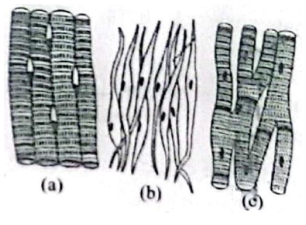
A
$(a)$ Skeletal - Triceps
$(b)$ Smooth - Stomach
$(c)$ Cardiac - Heart
$(b)$ Smooth - Stomach
$(c)$ Cardiac - Heart
B
$(a)$ Skeletal - Biceps
$(b)$ Involuntary - Intestine
$(c)$ Smooth - Heart
$(b)$ Involuntary - Intestine
$(c)$ Smooth - Heart
C
$(a)$ Involuntary - Nose tip
$(b)$ Skeletal - Bone
$(c)$ Cardiac - Heart
$(b)$ Skeletal - Bone
$(c)$ Cardiac - Heart
D
$(a)$ Smooth - Toes
$(b)$ Skeletal - Legs
$(c)$ Cardiac - Heart
$(b)$ Skeletal - Legs
$(c)$ Cardiac - Heart
Solution
(A) The correct answer is option $(A)$.
Figure $(a)$ represents skeletal muscle fibres,which are striated and closely attached to skeletal bones. In a typical muscle such as the triceps,these fibres are bundled together in a parallel fashion.
Figure $(b)$ represents smooth muscle fibres,which are fusiform (spindle-shaped) and present in the walls of internal organs such as the stomach and intestine.
Figure $(c)$ represents cardiac muscle fibres,which are branched and exclusively present in the heart.
Figure $(a)$ represents skeletal muscle fibres,which are striated and closely attached to skeletal bones. In a typical muscle such as the triceps,these fibres are bundled together in a parallel fashion.
Figure $(b)$ represents smooth muscle fibres,which are fusiform (spindle-shaped) and present in the walls of internal organs such as the stomach and intestine.
Figure $(c)$ represents cardiac muscle fibres,which are branched and exclusively present in the heart.
0 likesView Solution
41
BiologyMediumMCQNEET · 2024
Match List $I$ with List $II$ :
Choose the correct answer from the options given below :
| List $I$ | List $II$ |
| $A$. Pleurobrachia | $I$. Mollusca |
| $B$. Radula | $II$. Ctenophora |
| $C$. Stomochord | $III$. Osteichthyes |
| $D$. Air bladder | $IV$. Hemichordata |
Choose the correct answer from the options given below :
A
$A-II, B-I, C-IV, D-III$
B
$A-II, B-IV, C-I, D-III$
C
$A-IV, B-III, C-II, D-I$
D
$A-IV, B-II, C-III, D-I$
Solution
(A) The correct matching is as follows:
$A$. Pleurobrachia: It belongs to the phylum $Ctenophora$.
$B$. Radula: It is a file-like rasping organ for feeding found in the phylum $Mollusca$.
$C$. Stomochord: It is a rudimentary structure similar to the notochord found in the collar region of the phylum $Hemichordata$.
$D$. Air bladder: It is a gas-filled sac found in $Osteichthyes$ (bony fishes) that helps in regulating buoyancy.
Therefore, the correct sequence is $A-II, B-I, C-IV, D-III$.
$A$. Pleurobrachia: It belongs to the phylum $Ctenophora$.
$B$. Radula: It is a file-like rasping organ for feeding found in the phylum $Mollusca$.
$C$. Stomochord: It is a rudimentary structure similar to the notochord found in the collar region of the phylum $Hemichordata$.
$D$. Air bladder: It is a gas-filled sac found in $Osteichthyes$ (bony fishes) that helps in regulating buoyancy.
Therefore, the correct sequence is $A-II, B-I, C-IV, D-III$.
0 likesView Solution
42
BiologyMediumMCQNEET · 2024
Match List $I$ with List $II$ :
Choose the correct answer from the options given below :
| List $I$ | List $II$ |
| $A$. Pterophyllum | $I$. Hag fish |
| $B$. Myxine | $II$. Saw fish |
| $C$. Pristis | $III$. Angel fish |
| $D$. Exocoetus | $IV$. Flying fish |
Choose the correct answer from the options given below :
A
$A-III, B-I, C-II, D-IV$
B
$A-IV, B-I, C-II, D-III$
C
$A-III, B-II, C-I, D-IV$
D
$A-II, B-I, C-III, D-IV$
Solution
(A) The correct matching is as follows:
$A$. Pterophyllum is commonly known as Angel fish $(A-III)$.
$B$. Myxine is commonly known as Hag fish $(B-I)$.
$C$. Pristis is commonly known as Saw fish $(C-II)$.
$D$. Exocoetus is commonly known as Flying fish $(D-IV)$.
Therefore, the correct sequence is $A-III, B-I, C-II, D-IV$.
$A$. Pterophyllum is commonly known as Angel fish $(A-III)$.
$B$. Myxine is commonly known as Hag fish $(B-I)$.
$C$. Pristis is commonly known as Saw fish $(C-II)$.
$D$. Exocoetus is commonly known as Flying fish $(D-IV)$.
Therefore, the correct sequence is $A-III, B-I, C-II, D-IV$.
0 likesView Solution
43
BiologyMediumMCQNEET · 2024
Consider the following statements:
$A$. Annelids are true coelomates
$B$. Poriferans are pseudocoelomates
$C$. Aschelminthes are acoelomates
$D$. Platyhelminthes are pseudocoelomates
Choose the correct answer from the options given below:
$A$. Annelids are true coelomates
$B$. Poriferans are pseudocoelomates
$C$. Aschelminthes are acoelomates
$D$. Platyhelminthes are pseudocoelomates
Choose the correct answer from the options given below:
A
$A$ only
B
$B$ only
C
$C$ only
D
$D$ only
Solution
(A) The correct answer is $A$ only.
$1$. Annelids possess a true coelom (body cavity lined by mesoderm),making them true coelomates.
$2$. Poriferans lack a body cavity and are acoelomates.
$3$. Aschelminthes possess a body cavity that is not lined by mesoderm,making them pseudocoelomates.
$4$. Platyhelminthes lack a body cavity and are acoelomates.
Therefore,only statement $A$ is correct.
$1$. Annelids possess a true coelom (body cavity lined by mesoderm),making them true coelomates.
$2$. Poriferans lack a body cavity and are acoelomates.
$3$. Aschelminthes possess a body cavity that is not lined by mesoderm,making them pseudocoelomates.
$4$. Platyhelminthes lack a body cavity and are acoelomates.
Therefore,only statement $A$ is correct.
0 likesView Solution
44
BiologyMediumMCQNEET · 2024
Choose the correct statement given below regarding juxta medullary nephron.
A
Renal corpuscle of juxta medullary nephron lies in the outer portion of the renal medulla.
B
Loop of Henle of juxta medullary nephron runs deep into medulla.
C
Juxta medullary nephrons outnumber the cortical nephrons.
D
Juxta medullary nephrons are located in the columns of Bertini.
Solution
(B) The correct answer is option $B$ because the loop of Henle of the juxta medullary nephron is significantly longer than that of the cortical nephron and extends deep into the renal medulla.
Option $A$ is incorrect because the renal corpuscle of the juxta medullary nephron is located in the inner cortical region,near the corticomedullary junction,not in the renal medulla.
Option $C$ is incorrect because juxta medullary nephrons are fewer in number compared to cortical nephrons,which constitute the majority of nephrons in the kidney.
Option $D$ is incorrect because the columns of Bertini are extensions of the renal cortex into the renal medulla,and nephrons are not specifically located within them.
Option $A$ is incorrect because the renal corpuscle of the juxta medullary nephron is located in the inner cortical region,near the corticomedullary junction,not in the renal medulla.
Option $C$ is incorrect because juxta medullary nephrons are fewer in number compared to cortical nephrons,which constitute the majority of nephrons in the kidney.
Option $D$ is incorrect because the columns of Bertini are extensions of the renal cortex into the renal medulla,and nephrons are not specifically located within them.
0 likesView Solution
45
BiologyMediumMCQNEET · 2024
Match List-$I$ with List-$II$ related to the digestive system of a cockroach.
Choose the correct answer from the options given below:
| List-$I$ | List-$II$ |
| $A$. The structures used for storing of food | $I$. Gizzard |
| $B$. Ring of $6-8$ blind tubules at junction of foregut and midgut. | $II$. Gastric Caeca |
| $C$. Ring of $100-150$ yellow coloured thin filaments at junction of midgut and hindgut. | $III$. Malpighian tubules |
| $D$. The structures used for grinding the food. | $IV$. Crop |
Choose the correct answer from the options given below:
A
$A-I, B-II, C-III, D-IV$
B
$A-IV, B-III, C-II, D-I$
C
$A-III, B-II, C-IV, D-I$
D
$A-IV, B-II, C-III, D-I$
Solution
(D) The correct matching is as follows:
Therefore, the correct sequence is $A-IV, B-II, C-III, D-I$, which corresponds to option $(D)$.
| $A$. Structure used for storing food | $IV$. Crop |
| $B$. Ring of $6-8$ blind tubules at junction of foregut and midgut (secretion of digestive juices) | $II$. Gastric Caeca |
| $C$. Ring of $100-150$ yellow coloured thin filaments at junction of midgut and hindgut (excretion) | $III$. Malpighian tubules |
| $D$. Structure used for grinding food particles | $I$. Gizzard |
Therefore, the correct sequence is $A-IV, B-II, C-III, D-I$, which corresponds to option $(D)$.
0 likesView Solution
46
BiologyMediumMCQNEET · 2024
Match List $I$ with List $II$ :
Choose the correct answer from the options given below:
| List $I$ | List $II$ |
| $A$. $P$ wave | $I$. Heart muscles are electrically silent. |
| $B$. $QRS$ complex | $II$. Depolarisation of ventricles. |
| $C$. $T$ wave | $III$. Depolarisation of atria. |
| $D$. $T-P$ gap | $IV$. Repolarisation of ventricles. |
Choose the correct answer from the options given below:
A
$A-III, B-II, C-IV, D-I$
B
$A-II, B-III, C-I, D-IV$
C
$A-IV, B-II, C-I, D-III$
D
$A-I, B-III, C-IV, D-II$
Solution
$(A)$ The correct matching is as follows:
$A$. $P$ wave represents the electrical excitation (or depolarisation) of the atria, which leads to the contraction of both the atria. Thus, $A-III$.
$B$. $QRS$ complex represents the depolarisation of the ventricles, which initiates the ventricular contraction. Thus, $B-II$.
$C$. $T$ wave represents the return of the ventricles from an excited to a normal state (repolarisation). The end of the $T$ wave marks the end of systole. Thus, $C-IV$.
$D$. $T-P$ gap represents the period when the heart muscles are electrically silent, occurring between the end of the $T$ wave and the beginning of the next $P$ wave. Thus, $D-I$.
Therefore, the correct sequence is $A-III, B-II, C-IV, D-I$.
$A$. $P$ wave represents the electrical excitation (or depolarisation) of the atria, which leads to the contraction of both the atria. Thus, $A-III$.
$B$. $QRS$ complex represents the depolarisation of the ventricles, which initiates the ventricular contraction. Thus, $B-II$.
$C$. $T$ wave represents the return of the ventricles from an excited to a normal state (repolarisation). The end of the $T$ wave marks the end of systole. Thus, $C-IV$.
$D$. $T-P$ gap represents the period when the heart muscles are electrically silent, occurring between the end of the $T$ wave and the beginning of the next $P$ wave. Thus, $D-I$.
Therefore, the correct sequence is $A-III, B-II, C-IV, D-I$.
0 likesView Solution
47
BiologyMediumMCQNEET · 2024
Given below are two statements:
Statement $I$: Mitochondria and chloroplasts are both double-membrane-bound organelles.
Statement $II$: The inner membrane of mitochondria is relatively more permeable compared to the inner membrane of chloroplasts.
In the light of the above statements,choose the most appropriate answer from the options given below:
Statement $I$: Mitochondria and chloroplasts are both double-membrane-bound organelles.
Statement $II$: The inner membrane of mitochondria is relatively more permeable compared to the inner membrane of chloroplasts.
In the light of the above statements,choose the most appropriate answer from the options given below:
A
Both Statement $I$ and Statement $II$ are incorrect.
B
Statement $I$ is correct but Statement $II$ is incorrect.
C
Statement $I$ is incorrect but Statement $II$ is correct.
D
Both Statement $I$ and Statement $II$ are correct.
Solution
(D) Statement $I$ is correct: Both mitochondria and chloroplasts are semi-autonomous cell organelles bounded by a double-membrane system.
Statement $II$ is correct: The inner membrane of mitochondria contains specific transport proteins that allow the movement of various ions and metabolites,making it relatively more permeable. In contrast,the inner membrane of chloroplasts is highly selective and relatively impermeable to most ions and metabolites,requiring specific transporters for their movement.
Therefore,both statements are correct.
Statement $II$ is correct: The inner membrane of mitochondria contains specific transport proteins that allow the movement of various ions and metabolites,making it relatively more permeable. In contrast,the inner membrane of chloroplasts is highly selective and relatively impermeable to most ions and metabolites,requiring specific transporters for their movement.
Therefore,both statements are correct.
0 likesView Solution
48
BiologyMediumMCQNEET · 2024
The following are the statements about non-chordates:
$A$. Pharynx is perforated by gill slits.
$B$. Notochord is absent.
$C$. Central nervous system is dorsal.
$D$. Heart is dorsal if present.
$E$. Post anal tail is absent.
Choose the most appropriate answer from the options given below:
$A$. Pharynx is perforated by gill slits.
$B$. Notochord is absent.
$C$. Central nervous system is dorsal.
$D$. Heart is dorsal if present.
$E$. Post anal tail is absent.
Choose the most appropriate answer from the options given below:
A
$A, B, D$ only
B
$B, D, E$ only
C
$B, C, D$ only
D
$A, C$ only
Solution
(B) The characteristics of non-chordates are as follows:
$1$. Notochord is absent (Statement $B$).
$2$. Central nervous system is ventral,solid,and double (Statement $C$ is incorrect for non-chordates as it is dorsal in chordates).
$3$. Heart is dorsal if present (Statement $D$).
$4$. Post-anal tail is absent (Statement $E$).
$5$. Pharynx is not perforated by gill slits (Statement $A$ is a characteristic of chordates).
Therefore,statements $B, D,$ and $E$ are the correct features of non-chordates.
Thus,the correct option is $B$ ($B, D, E$ only).
$1$. Notochord is absent (Statement $B$).
$2$. Central nervous system is ventral,solid,and double (Statement $C$ is incorrect for non-chordates as it is dorsal in chordates).
$3$. Heart is dorsal if present (Statement $D$).
$4$. Post-anal tail is absent (Statement $E$).
$5$. Pharynx is not perforated by gill slits (Statement $A$ is a characteristic of chordates).
Therefore,statements $B, D,$ and $E$ are the correct features of non-chordates.
Thus,the correct option is $B$ ($B, D, E$ only).
0 likesView Solution
49
BiologyMediumMCQNEET · 2024
Regarding the catalytic cycle of an enzyme action,select the correct sequential steps:
$A$. Substrate-enzyme complex formation.
$B$. Free enzyme ready to bind with another substrate.
$C$. Release of products.
$D$. Chemical bonds of the substrate broken.
$E$. Substrate binding to active site.
Choose the correct answer from the options given below:
$A$. Substrate-enzyme complex formation.
$B$. Free enzyme ready to bind with another substrate.
$C$. Release of products.
$D$. Chemical bonds of the substrate broken.
$E$. Substrate binding to active site.
Choose the correct answer from the options given below:
A
$A, E, B, D, C$
B
$B, A, C, D, E$
C
$E, D, C, B, A$
D
$E, A, D, C, B$
Solution
(D) The correct sequence of the catalytic cycle of an enzyme is as follows:
$(1)$ First,the substrate binds to the active site of the enzyme $(E)$.
$(2)$ This leads to the formation of the enzyme-substrate complex $(A)$.
$(3)$ The active site of the enzyme,now in close proximity to the substrate,breaks the chemical bonds of the substrate,forming the enzyme-product complex $(D)$.
$(4)$ The enzyme then releases the products of the reaction $(C)$.
$(5)$ Finally,the free enzyme is ready to bind to another molecule of the substrate to repeat the catalytic cycle $(B)$.
Thus,the correct order is $E, A, D, C, B$.
$(1)$ First,the substrate binds to the active site of the enzyme $(E)$.
$(2)$ This leads to the formation of the enzyme-substrate complex $(A)$.
$(3)$ The active site of the enzyme,now in close proximity to the substrate,breaks the chemical bonds of the substrate,forming the enzyme-product complex $(D)$.
$(4)$ The enzyme then releases the products of the reaction $(C)$.
$(5)$ Finally,the free enzyme is ready to bind to another molecule of the substrate to repeat the catalytic cycle $(B)$.
Thus,the correct order is $E, A, D, C, B$.
0 likesView Solution
50
BiologyMediumMCQNEET · 2024
Given below are two statements:
Statement $I$: The cerebral hemispheres are connected by a nerve tract known as the corpus callosum.
Statement $II$: The brain stem consists of the medulla oblongata,pons,and cerebrum.
In the light of the above statements,choose the most appropriate answer from the options given below:
Statement $I$: The cerebral hemispheres are connected by a nerve tract known as the corpus callosum.
Statement $II$: The brain stem consists of the medulla oblongata,pons,and cerebrum.
In the light of the above statements,choose the most appropriate answer from the options given below:
A
Both Statement $I$ and Statement $II$ are incorrect.
B
Statement $I$ is correct but Statement $II$ is incorrect.
C
Statement $I$ is incorrect but Statement $II$ is correct.
D
Both Statement $I$ and Statement $II$ are correct.
Solution
(B) The correct answer is option $B$ because Statement $I$ is correct but Statement $II$ is incorrect.
In the human brain,a deep cleft divides the cerebrum longitudinally into two halves,which are termed as the left and right cerebral hemispheres. The cerebral hemispheres are connected by a tract of nerve fibres called the corpus callosum.
Three major regions make up the brain stem,i.e.,the midbrain,pons,and medulla oblongata.
The cerebrum is a part of the forebrain and does not form the brain stem.
Therefore,Statement $I$ is true,and Statement $II$ is false.
In the human brain,a deep cleft divides the cerebrum longitudinally into two halves,which are termed as the left and right cerebral hemispheres. The cerebral hemispheres are connected by a tract of nerve fibres called the corpus callosum.
Three major regions make up the brain stem,i.e.,the midbrain,pons,and medulla oblongata.
The cerebrum is a part of the forebrain and does not form the brain stem.
Therefore,Statement $I$ is true,and Statement $II$ is false.
1 likesView Solution
51
BiologyMediumMCQNEET · 2024
The list of endangered species is released by:
A
$WWF$
B
$FOAM$
C
$IUCN$
D
$GEAC$
Solution
(C) The list of endangered species,known as the Red Data Book,is published and maintained by the $IUCN$ (International Union for Conservation of Nature). This organization tracks the conservation status of various species globally to help in biodiversity conservation efforts.
0 likesView Solution
52
BiologyMediumMCQNEET · 2024
$DNA$ transcription unit is defined primarily by three regions in $DNA$ with respect to upstream and downstream ends:
A
Structural gene,Transposons,Operator gene
B
Inducer,Repressor,Structural gene
C
Promoter,Structural gene,Terminator
D
Repressor,Operator gene,Structural gene
Solution
(C) transcription unit of $DNA$ is defined primarily by three regions in the $DNA$:
$(i)$ $A$ promoter
$(ii)$ The structural gene
$(iii)$ $A$ terminator
The promoter is located towards the $5'$-end (upstream) of the structural gene (the reference is made with respect to the polarity of the coding strand).
The terminator is located towards the $3'$-end (downstream) of the coding strand.
$(i)$ $A$ promoter
$(ii)$ The structural gene
$(iii)$ $A$ terminator
The promoter is located towards the $5'$-end (upstream) of the structural gene (the reference is made with respect to the polarity of the coding strand).
The terminator is located towards the $3'$-end (downstream) of the coding strand.
0 likesView Solution
53
BiologyMediumMCQNEET · 2024
$A$ pink flowered Snapdragon plant was crossed with a red flowered Snapdragon plant. What type of phenotype/s is/are expected in the progeny?
A
Red flowered as well as pink flowered plants
B
Only pink flowered plants
C
Red,Pink as well as white flowered plants
D
Only red flowered plants
Solution
(A) In Snapdragon $(Antirrhinum \text{ } majus)$, flower color exhibits incomplete dominance. The genotype for red flowers is $RR$, white flowers is $rr$, and pink flowers is $Rr$.
The resulting progeny genotypes are $50\% \text{ } RR$ (Red) and $50\% \text{ } Rr$ (Pink).
Therefore, the expected phenotypes in the progeny are red flowered and pink flowered plants.
| Gametes | $R$ | $r$ |
| $R$ | $RR$ (Red) | $Rr$ (Pink) |
| $R$ | $RR$ (Red) | $Rr$ (Pink) |
The resulting progeny genotypes are $50\% \text{ } RR$ (Red) and $50\% \text{ } Rr$ (Pink).
Therefore, the expected phenotypes in the progeny are red flowered and pink flowered plants.
0 likesView Solution
54
BiologyMediumMCQNEET · 2024
Identify the set of correct statements:
$A$. The flowers of Vallisneria are colourful and produce nectar.
$B$. The flowers of water lily are not pollinated by water.
$C$. In most of water-pollinated species,the pollen grains are protected from wetting.
$D$. Pollen grains of some hydrophytes are long and ribbon like.
$E$. In some hydrophytes,the pollen grains are carried passively inside water.
Choose the correct answer from the options given below.
$A$. The flowers of Vallisneria are colourful and produce nectar.
$B$. The flowers of water lily are not pollinated by water.
$C$. In most of water-pollinated species,the pollen grains are protected from wetting.
$D$. Pollen grains of some hydrophytes are long and ribbon like.
$E$. In some hydrophytes,the pollen grains are carried passively inside water.
Choose the correct answer from the options given below.
A
$A, B, C$ and $D$ only
B
$A, C, D$ and $E$ only
C
$B, C, D$ and $E$ only
D
$C, D$ and $E$ only
Solution
(C) Statement $A$ is incorrect because the flowers of $Vallisneria$ are small,inconspicuous,and do not produce nectar.
Statement $B$ is correct because $Water$ $lily$ (Nymphaea) is pollinated by insects or wind,not by water.
Statement $C$ is correct because in most water-pollinated species,pollen grains are protected from wetting by a mucilaginous covering.
Statement $D$ is correct because in some hydrophytes like $Zostera$,pollen grains are long and ribbon-like.
Statement $E$ is correct because in many hydrophytes,pollen grains are carried passively by water currents.
Therefore,statements $B, C, D,$ and $E$ are correct.
Statement $B$ is correct because $Water$ $lily$ (Nymphaea) is pollinated by insects or wind,not by water.
Statement $C$ is correct because in most water-pollinated species,pollen grains are protected from wetting by a mucilaginous covering.
Statement $D$ is correct because in some hydrophytes like $Zostera$,pollen grains are long and ribbon-like.
Statement $E$ is correct because in many hydrophytes,pollen grains are carried passively by water currents.
Therefore,statements $B, C, D,$ and $E$ are correct.
1 likesView Solution
55
BiologyMediumMCQNEET · 2024
What is the fate of a piece of $DNA$ carrying only the gene of interest which is transferred into an alien organism?
$A$. The piece of $DNA$ would be able to multiply itself independently in the progeny cells of the organism.
$B$. It may get integrated into the genome of the recipient.
$C$. It may multiply and be inherited along with the host $DNA$.
$D$. The alien piece of $DNA$ is not an integral part of the chromosome.
$E$. It shows the ability to replicate.
Choose the correct answer from the options given below:
$A$. The piece of $DNA$ would be able to multiply itself independently in the progeny cells of the organism.
$B$. It may get integrated into the genome of the recipient.
$C$. It may multiply and be inherited along with the host $DNA$.
$D$. The alien piece of $DNA$ is not an integral part of the chromosome.
$E$. It shows the ability to replicate.
Choose the correct answer from the options given below:
A
$D$ and $E$ only
B
$B$ and $C$ only
C
$A$ and $E$ only
D
$A$ and $B$ only
Solution
(B) The correct answer is option $(B)$ ($B$ and $C$ only).
When a piece of $DNA$ carrying only the gene of interest is transferred into an alien organism,it lacks the origin of replication $(ori)$ required for independent replication.
Therefore,the following outcomes are possible:
$(B)$ It may get integrated into the genome of the recipient organism.
$(C)$ Once integrated,it may multiply and be inherited along with the host $DNA$ during cell division.
It cannot multiply independently (as stated in $A$ and $E$) because it lacks the necessary sequences for autonomous replication.
When a piece of $DNA$ carrying only the gene of interest is transferred into an alien organism,it lacks the origin of replication $(ori)$ required for independent replication.
Therefore,the following outcomes are possible:
$(B)$ It may get integrated into the genome of the recipient organism.
$(C)$ Once integrated,it may multiply and be inherited along with the host $DNA$ during cell division.
It cannot multiply independently (as stated in $A$ and $E$) because it lacks the necessary sequences for autonomous replication.
0 likesView Solution
56
BiologyEasyMCQNEET · 2024
Hind $II$ always cuts $DNA$ molecules at a particular point called a recognition sequence,which consists of: (in $bp$)
A
$6$
B
$4$
C
$10$
D
$8$
Solution
(A) The correct answer is option $A$.
The first restriction endonuclease,Hind $II$,was isolated based on its ability to recognize a specific $DNA$ nucleotide sequence.
It was discovered that Hind $II$ always cuts $DNA$ molecules at a particular point by recognizing a specific sequence of $6$ base pairs $(bp)$.
Options $B$,$C$,and $D$ are incorrect because they represent lengths other than $6 \ bp$.
The first restriction endonuclease,Hind $II$,was isolated based on its ability to recognize a specific $DNA$ nucleotide sequence.
It was discovered that Hind $II$ always cuts $DNA$ molecules at a particular point by recognizing a specific sequence of $6$ base pairs $(bp)$.
Options $B$,$C$,and $D$ are incorrect because they represent lengths other than $6 \ bp$.
0 likesView Solution
57
BiologyMediumMCQNEET · 2024
The type of conservation in which the threatened species are taken out from their natural habitat and placed in a special setting where they can be protected and given special care is called:
A
Biodiversity conservation
B
Semi-conservative method
C
Sustainable development
D
In-situ conservation
Solution
(A) The type of conservation in which threatened species are taken out from their natural habitat and placed in a special setting where they can be protected and given special care is called $Ex-situ$ conservation.
$Ex-situ$ conservation is a strategy for biodiversity conservation where organisms are maintained outside their natural habitats,such as in zoological parks,botanical gardens,and wildlife safari parks.
$Ex-situ$ conservation is a strategy for biodiversity conservation where organisms are maintained outside their natural habitats,such as in zoological parks,botanical gardens,and wildlife safari parks.
0 likesView Solution
58
BiologyMediumMCQNEET · 2024
Given below are two statements:
Statement $I$: $Bt$ toxins are insect group specific and coded by a gene $cry$ $IAc$.
Statement $II$: $Bt$ toxin exists as inactive protoxin in $B. \text{ thuringiensis}$. However, after ingestion by the insect, the inactive protoxin gets converted into active form due to alkaline $pH$ of the insect gut.
In the light of the above statements, choose the correct answer from the options given below:
Statement $I$: $Bt$ toxins are insect group specific and coded by a gene $cry$ $IAc$.
Statement $II$: $Bt$ toxin exists as inactive protoxin in $B. \text{ thuringiensis}$. However, after ingestion by the insect, the inactive protoxin gets converted into active form due to alkaline $pH$ of the insect gut.
In the light of the above statements, choose the correct answer from the options given below:
A
Both Statement $I$ and Statement $II$ are false.
B
Statement $I$ is true but Statement $II$ is false.
C
Statement $I$ is false but Statement $II$ is true.
D
Both Statement $I$ and Statement $II$ are true.
Solution
(B) Statement $I$ is true: $Bt$ toxins are indeed insect-group specific and are encoded by specific $cry$ genes, such as $cry$ $IAc$.
Statement $II$ is false: While $Bt$ toxin exists as an inactive protoxin in $B. \text{ thuringiensis}$, its conversion into an active toxin in the insect gut is triggered by the alkaline $pH$ of the gut, not the acidic $pH$. The alkaline $pH$ solubilizes the crystals, allowing the protoxin to be activated by gut proteases.
Therefore, Statement $I$ is true and Statement $II$ is false.
Statement $II$ is false: While $Bt$ toxin exists as an inactive protoxin in $B. \text{ thuringiensis}$, its conversion into an active toxin in the insect gut is triggered by the alkaline $pH$ of the gut, not the acidic $pH$. The alkaline $pH$ solubilizes the crystals, allowing the protoxin to be activated by gut proteases.
Therefore, Statement $I$ is true and Statement $II$ is false.
0 likesView Solution
59
BiologyMediumMCQNEET · 2024
Match List $I$ with List $II$:
Choose the correct answer from the options given below:
| List $I$ | List $II$ |
|---|---|
| $A$. Two or more alternative forms of a gene | $I$. Backcross |
| $B$. Cross of $F_1$ progeny with homozygous recessive parents | $II$. Ploidy |
| $C$. Cross of $F_1$ progeny with any of the parents | $III$. Allele |
| $D$. Number of chromosome sets in plant | $IV$. Test cross |
Choose the correct answer from the options given below:
A
$A-II, B-I, C-III, D-IV$
B
$A-III, B-IV, C-I, D-II$
C
$A-IV, B-III, C-II, D-I$
D
$A-I, B-II, C-III, D-IV$
Solution
(B) . Two or more alternative forms of a gene are called alleles $(III)$.
$B$. $A$ cross of $F_1$ progeny with homozygous recessive parents is known as a test cross $(IV)$.
$C$. $A$ cross of $F_1$ progeny with any of the parents is known as a backcross $(I)$.
$D$. The number of chromosome sets in a plant is referred to as ploidy $(II)$.
Therefore,the correct matching is $A-III, B-IV, C-I, D-II$.
$B$. $A$ cross of $F_1$ progeny with homozygous recessive parents is known as a test cross $(IV)$.
$C$. $A$ cross of $F_1$ progeny with any of the parents is known as a backcross $(I)$.
$D$. The number of chromosome sets in a plant is referred to as ploidy $(II)$.
Therefore,the correct matching is $A-III, B-IV, C-I, D-II$.
0 likesView Solution
60
BiologyMediumMCQNEET · 2024
These are regarded as major causes of biodiversity loss:
$A$. Over-exploitation $B$. Co-extinction $C$. Mutation $D$. Habitat loss and fragmentation $E$. Migration
Choose the correct option:
$A$. Over-exploitation $B$. Co-extinction $C$. Mutation $D$. Habitat loss and fragmentation $E$. Migration
Choose the correct option:
A
$A, B, C$ and $D$ only
B
$A, B$ and $E$ only
C
$A, B$ and $D$ only
D
$A, C$ and $D$ only
Solution
(C) The major causes of biodiversity loss,often referred to as the 'Evil Quartet',are:
$(1)$ Habitat loss and fragmentation: This is the most important cause driving animals and plants to extinction.
$(2)$ Over-exploitation: Humans have over-exploited many species (e.g.,Steller's sea cow,passenger pigeon).
$(3)$ Alien species invasions: When alien species are introduced unintentionally or deliberately,some of them turn invasive and cause the decline or extinction of indigenous species.
$(4)$ Co-extinctions: When a species becomes extinct,the plant and animal species associated with it in an obligatory way also become extinct.
Comparing these with the given options,$A$ (Over-exploitation),$B$ (Co-extinction),and $D$ (Habitat loss and fragmentation) are recognized as major causes. Therefore,the correct option is $A, B$ and $D$ only.
$(1)$ Habitat loss and fragmentation: This is the most important cause driving animals and plants to extinction.
$(2)$ Over-exploitation: Humans have over-exploited many species (e.g.,Steller's sea cow,passenger pigeon).
$(3)$ Alien species invasions: When alien species are introduced unintentionally or deliberately,some of them turn invasive and cause the decline or extinction of indigenous species.
$(4)$ Co-extinctions: When a species becomes extinct,the plant and animal species associated with it in an obligatory way also become extinct.
Comparing these with the given options,$A$ (Over-exploitation),$B$ (Co-extinction),and $D$ (Habitat loss and fragmentation) are recognized as major causes. Therefore,the correct option is $A, B$ and $D$ only.
0 likesView Solution
61
BiologyMediumMCQNEET · 2024
Match List-$I$ with List-$II$:
Choose the correct answer from the options given below:
| List-$I$ | List-$II$ |
| $A$. Clostridium butylicum | $1$. Ethanol |
| $B$. Saccharomyces cerevisiae | $II$. Streptokinase |
| $C$. Trichoderma polysporum | $III$. Butyric acid |
| $D$. Streptococcus sp. | $IV$. Cyclosporin-$A$ |
Choose the correct answer from the options given below:
A
$A-II, B-IV, C-III, D-I$
B
$A-III, B-I, C-IV, D-II$
C
$A-IV, B-I, C-III, D-II$
D
$A-III, B-I, C-II, D-IV$
Solution
(B) . Clostridium butylicum produces Butyric acid $(III)$.
$B$. Saccharomyces cerevisiae is used for the production of Ethanol $(I)$.
$C$. Trichoderma polysporum is the source of Cyclosporin-$A$ $(IV)$.
$D$. Streptococcus sp. produces Streptokinase $(II)$.
Therefore,the correct matching is $A-III, B-I, C-IV, D-II$.
$B$. Saccharomyces cerevisiae is used for the production of Ethanol $(I)$.
$C$. Trichoderma polysporum is the source of Cyclosporin-$A$ $(IV)$.
$D$. Streptococcus sp. produces Streptokinase $(II)$.
Therefore,the correct matching is $A-III, B-I, C-IV, D-II$.
0 likesView Solution
62
BiologyMediumMCQNEET · 2024
In a plant,black seed color $(BB / Bb)$ is dominant over white seed color $(bb)$. In order to find out the genotype of the black seed plant,with which of the following genotype will you cross it?
A
$bb$
B
$Bb$
C
$BB / Bb$
D
$BB$
Solution
(A) To determine the unknown genotype of a dominant phenotype (black seed),a test cross is performed.
$A$ test cross involves crossing the individual with the dominant phenotype with a homozygous recessive individual.
Since white seed color $(bb)$ is recessive,crossing the black seed plant with a plant having the $bb$ genotype will reveal whether the black seed plant is homozygous $(BB)$ or heterozygous $(Bb)$.
$A$ test cross involves crossing the individual with the dominant phenotype with a homozygous recessive individual.
Since white seed color $(bb)$ is recessive,crossing the black seed plant with a plant having the $bb$ genotype will reveal whether the black seed plant is homozygous $(BB)$ or heterozygous $(Bb)$.
0 likesView Solution
63
BiologyMediumMCQNEET · 2024
Which one of the following can be explained on the basis of Mendel's Law of Dominance?
$A$. Out of one pair of factors one is dominant and the other is recessive.
$B$. Alleles do not show any expression and both the characters appear as such in $F_2$ generation.
$C$. Factors occur in pairs in normal diploid plants.
$D$. The discrete unit controlling a particular character is called factor.
$E$. The expression of only one of the parental characters is found in a monohybrid cross.
Choose the correct answer from the options given below:
$A$. Out of one pair of factors one is dominant and the other is recessive.
$B$. Alleles do not show any expression and both the characters appear as such in $F_2$ generation.
$C$. Factors occur in pairs in normal diploid plants.
$D$. The discrete unit controlling a particular character is called factor.
$E$. The expression of only one of the parental characters is found in a monohybrid cross.
Choose the correct answer from the options given below:
A
$A, C, D$ and $E$ only
B
$B, C$ and $D$ only
C
$A, B, C, D$ and $E$
D
$A, B$ and $C$ only
Solution
(A) According to Mendel's Law of Dominance:
$(1)$ Characters are controlled by discrete units called factors $(D)$.
$(2)$ Factors occur in pairs $(C)$.
$(3)$ In a dissimilar pair of factors,one member of the pair dominates (dominant) the other (recessive) $(A)$.
$(4)$ The Law of Dominance explains why only one of the parental characters is expressed in a $F_1$ generation monohybrid cross $(E)$.
Statement $(B)$ describes the Law of Segregation,which states that alleles do not show any blending and both characters are recovered as such in the $F_2$ generation.
Therefore,statements $A, C, D,$ and $E$ are explained by the Law of Dominance.
$(1)$ Characters are controlled by discrete units called factors $(D)$.
$(2)$ Factors occur in pairs $(C)$.
$(3)$ In a dissimilar pair of factors,one member of the pair dominates (dominant) the other (recessive) $(A)$.
$(4)$ The Law of Dominance explains why only one of the parental characters is expressed in a $F_1$ generation monohybrid cross $(E)$.
Statement $(B)$ describes the Law of Segregation,which states that alleles do not show any blending and both characters are recovered as such in the $F_2$ generation.
Therefore,statements $A, C, D,$ and $E$ are explained by the Law of Dominance.
0 likesView Solution
64
BiologyMediumMCQNEET · 2024
The equation of Verhulst-Pearl logistic growth is $\frac{dN}{dt}=rN\left[\frac{K-N}{K}\right]$. From this equation,$K$ indicates:
A
Biotic potential
B
Carrying capacity
C
Population density
D
Intrinsic rate of natural increase
Solution
(B) In the Verhulst-Pearl logistic growth equation,$\frac{dN}{dt} = rN \left( \frac{K-N}{K} \right)$:
- $\frac{dN}{dt}$ represents the rate of change in population size over time.
- $N$ represents the population density at time $t$.
- $r$ represents the intrinsic rate of natural increase.
- $K$ represents the carrying capacity,which is the maximum population size that an environment can sustain given the available resources.
- $\frac{dN}{dt}$ represents the rate of change in population size over time.
- $N$ represents the population density at time $t$.
- $r$ represents the intrinsic rate of natural increase.
- $K$ represents the carrying capacity,which is the maximum population size that an environment can sustain given the available resources.
0 likesView Solution
65
BiologyMediumMCQNEET · 2024
Tropical regions show the greatest level of species richness because:
$A$. Tropical latitudes have remained relatively undisturbed for millions of years,hence more time was available for species diversification.
$B$. Tropical environments are more seasonal.
$C$. More solar energy is available in the tropics.
$D$. Constant environments promote niche specialization.
$E$. Tropical environments are constant and predictable.
Choose the correct answer from the options given below.
$A$. Tropical latitudes have remained relatively undisturbed for millions of years,hence more time was available for species diversification.
$B$. Tropical environments are more seasonal.
$C$. More solar energy is available in the tropics.
$D$. Constant environments promote niche specialization.
$E$. Tropical environments are constant and predictable.
Choose the correct answer from the options given below.
A
$A$ and $B$ only
B
$A, B$ and $E$ only
C
$A, B$ and $D$ only
D
$A, C, D$ and $E$ only
Solution
(D) Statement $A$ is correct because tropical latitudes have remained relatively undisturbed for millions of years,allowing more time for evolutionary diversification.
Statement $B$ is incorrect because tropical environments are less seasonal compared to temperate regions.
Statement $C$ is correct as higher solar energy input in the tropics promotes higher primary productivity.
Statement $D$ is correct because constant environments allow species to evolve specialized niches.
Statement $E$ is correct because tropical environments are relatively constant and predictable,which supports higher biodiversity.
Therefore,statements $A, C, D,$ and $E$ are correct.
Statement $B$ is incorrect because tropical environments are less seasonal compared to temperate regions.
Statement $C$ is correct as higher solar energy input in the tropics promotes higher primary productivity.
Statement $D$ is correct because constant environments allow species to evolve specialized niches.
Statement $E$ is correct because tropical environments are relatively constant and predictable,which supports higher biodiversity.
Therefore,statements $A, C, D,$ and $E$ are correct.
0 likesView Solution
66
BiologyMediumMCQNEET · 2024
The lactose present in the growth medium of bacteria is transported to the cell by the action of
A
Acetylase
B
Permease
C
Polymerase
D
Beta-galactosidase
Solution
(B) The $y$ gene of the $lac$ operon codes for the enzyme permease.
Permease increases the permeability of the bacterial cell membrane to $\beta$-galactosides,including lactose.
Therefore,the lactose present in the growth medium is transported into the cell by the action of permease.
Permease increases the permeability of the bacterial cell membrane to $\beta$-galactosides,including lactose.
Therefore,the lactose present in the growth medium is transported into the cell by the action of permease.
0 likesView Solution
67
BiologyMediumMCQNEET · 2024
The capacity to generate a whole plant from any cell of the plant is called:
A
Micropropagation
B
Differentiation
C
Somatic hybridization
D
Totipotency
Solution
(D) Totipotency is defined as the inherent capacity of a plant cell to divide,differentiate,and regenerate into a complete,mature plant under suitable laboratory conditions. This biological principle forms the basis of plant tissue culture.
0 likesView Solution
68
BiologyMediumMCQNEET · 2024
Match List $I$ with List $II$:
Choose the correct answer from the options given below:
| List $I$ | List $II$ |
|---|---|
| $A$. Robert May | $I$. Species-Area relationship |
| $B$. Alexander von Humboldt | $II$. Long term ecosystem experiment using outdoor plots |
| $C$. Paul Ehrlich | $III$. Global species diversity at about $7$ million |
| $D$. David Tilman | $IV$. Rivet popper hypothesis |
Choose the correct answer from the options given below:
A
$A-III, B-I, C-IV, D-II$
B
$A-I, B-III, C-II, D-IV$
C
$A-III, B-IV, C-II, D-I$
D
$A-II, B-III, C-I, D-IV$
Solution
(A) Robert May estimated the global species diversity to be about $7$ million.
Alexander von Humboldt proposed the species-area relationship.
Paul Ehrlich used the 'Rivet popper hypothesis' analogy to explain the importance of species diversity in an ecosystem.
David Tilman conducted long-term ecosystem experiments using outdoor plots to demonstrate the relationship between species richness and ecosystem stability.
Alexander von Humboldt proposed the species-area relationship.
Paul Ehrlich used the 'Rivet popper hypothesis' analogy to explain the importance of species diversity in an ecosystem.
David Tilman conducted long-term ecosystem experiments using outdoor plots to demonstrate the relationship between species richness and ecosystem stability.
0 likesView Solution
69
BiologyMediumMCQNEET · 2024
Match List-$I$ with List-$II$:
Choose the correct answer from the options given below:
| List-$I$ (Types of Stamens) | List-$II$ (Example) |
| $A$. Monoadelphous | $I$. Citrus |
| $B$. Diadelphous | $II$. Pea |
| $C$. Polyadelphous | $III$. Lily |
| $D$. Epiphyllous | $IV$. China-rose |
Choose the correct answer from the options given below:
A
$A-IV, B-II, C-I, D-III$
B
$A-I, B-II, C-IV, D-III$
C
$A-III, B-I, C-IV, D-II$
D
$A-IV, B-II, C-III, D-I$
Solution
(A) $1$. Monoadelphous: Stamens are united into a single bundle, as seen in China-rose $(A-IV)$.
$2$. Diadelphous: Stamens are united into two bundles, as seen in Pea $(B-II)$.
$3$. Polyadelphous: Stamens are united into more than two bundles, as seen in Citrus $(C-I)$.
$4$. Epiphyllous: Stamens are attached to the perianth (tepals), as seen in Lily $(D-III)$.
Therefore, the correct matching is $A-IV, B-II, C-I, D-III$.
$2$. Diadelphous: Stamens are united into two bundles, as seen in Pea $(B-II)$.
$3$. Polyadelphous: Stamens are united into more than two bundles, as seen in Citrus $(C-I)$.
$4$. Epiphyllous: Stamens are attached to the perianth (tepals), as seen in Lily $(D-III)$.
Therefore, the correct matching is $A-IV, B-II, C-I, D-III$.
0 likesView Solution
70
BiologyMediumMCQNEET · 2024
Match List $I$ with List $II$.
Choose the correct answer from the options given below:
| List $I$ | List $II$ |
| $A$. Frederick Griffith | $I$. Genetic code |
| $B$. Francois Jacob and Jacques Monod | $II$. Semi-conservative mode of $DNA$ replication |
| $C$. Har Gobind Khorana | $III$. Transformation |
| $D$. Meselson and Stahl | $IV$. $Lac$ operon |
Choose the correct answer from the options given below:
A
$A-III, B-IV, C-I, D-II$
B
$A-II, B-III, C-IV, D-I$
C
$A-IV, B-I, C-II, D-III$
D
$A-III, B-II, C-I, D-IV$
Solution
(A) $1$. Frederick Griffith performed experiments on $Streptococcus$ $pneumoniae$ and discovered the phenomenon of bacterial transformation.
$2$. Francois Jacob and Jacques Monod proposed the $Lac$ operon model to explain gene regulation in prokaryotes.
$3$. Har Gobind Khorana developed chemical methods to synthesize $RNA$ molecules with defined combinations of bases, which helped in deciphering the genetic code.
$4$. Meselson and Stahl provided experimental evidence for the semi-conservative mode of $DNA$ replication using $E. coli$ and $^{15}N$ isotopes.
Therefore, the correct matching is $A-III, B-IV, C-I, D-II$.
$2$. Francois Jacob and Jacques Monod proposed the $Lac$ operon model to explain gene regulation in prokaryotes.
$3$. Har Gobind Khorana developed chemical methods to synthesize $RNA$ molecules with defined combinations of bases, which helped in deciphering the genetic code.
$4$. Meselson and Stahl provided experimental evidence for the semi-conservative mode of $DNA$ replication using $E. coli$ and $^{15}N$ isotopes.
Therefore, the correct matching is $A-III, B-IV, C-I, D-II$.
0 likesView Solution
71
BiologyMediumMCQNEET · 2024
Which of the following statements is correct regarding the process of replication in $E. coli$?
A
The $DNA$ dependent $RNA$ polymerase catalyses polymerization in one direction,that is $5^{\prime} \rightarrow 3^{\prime}$.
B
The $DNA$ dependent $DNA$ polymerase catalyses polymerization in $5^{\prime} \rightarrow 3^{\prime}$ as well as $3^{\prime} \rightarrow 5^{\prime}$ direction.
C
The $DNA$ dependent $DNA$ polymerase catalyses polymerization in $5^{\prime} \rightarrow 3^{\prime}$ direction.
D
The $DNA$ dependent $DNA$ polymerase catalyses polymerization in one direction,that is $3^{\prime} \rightarrow 5^{\prime}$.
Solution
(C) In prokaryotes like $E. coli$,the process of $DNA$ replication is mediated by $DNA$-dependent $DNA$ polymerase enzymes.
These enzymes are highly specific and can only catalyze the polymerization of nucleotides in the $5^{\prime} \rightarrow 3^{\prime}$ direction.
This unidirectional synthesis is a fundamental characteristic of $DNA$ replication,ensuring the accurate addition of nucleotides to the growing strand.
These enzymes are highly specific and can only catalyze the polymerization of nucleotides in the $5^{\prime} \rightarrow 3^{\prime}$ direction.
This unidirectional synthesis is a fundamental characteristic of $DNA$ replication,ensuring the accurate addition of nucleotides to the growing strand.
0 likesView Solution
72
BiologyMediumMCQNEET · 2024
Identify the correct description about the given figure:
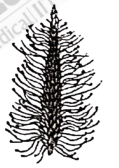
A
Water pollinated flowers showing stamens with mucilaginous covering.
B
Cleistogamous flowers showing autogamy.
C
Compact inflorescence showing complete autogamy.
D
Wind pollinated plant inflorescence showing flowers with well exposed stamens.
Solution
(D) The given diagram represents a wind-pollinated plant inflorescence.
Wind-pollinated flowers typically possess well-exposed stamens to allow pollen grains to be easily dispersed by wind currents.
They often have a compact inflorescence to increase the efficiency of pollen release.
Since the stamens are well-exposed,they are adapted for cross-pollination rather than complete autogamy.
Wind-pollinated flowers typically possess well-exposed stamens to allow pollen grains to be easily dispersed by wind currents.
They often have a compact inflorescence to increase the efficiency of pollen release.
Since the stamens are well-exposed,they are adapted for cross-pollination rather than complete autogamy.
0 likesView Solution
73
BiologyMediumMCQNEET · 2024
Which of the following are fused in somatic hybridization involving two varieties of plants?
A
Somatic embryos
B
Protoplasts
C
Pollens
D
Callus
Solution
(B) Somatic hybridization is a technique in plant tissue culture where the cell walls of two different plant varieties are removed to obtain protoplasts. These protoplasts are then fused together using chemical agents like $PEG$ (polyethylene glycol) or electrofusion to create a somatic hybrid cell,which can then be regenerated into a new plant.
0 likesView Solution
74
BiologyMediumMCQNEET · 2024
In an ecosystem,if the Net Primary Productivity $(NPP)$ of the first trophic level is $100x \text{ kcal } m^{-2} yr^{-1}$,what would be the Gross Primary Productivity $(GPP)$ of the third trophic level of the same ecosystem?
A
$x \text{ kcal } m^{-2} yr^{-1}$
B
$10x \text{ kcal } m^{-2} yr^{-1}$
C
$\frac{100x}{3} \text{ kcal } m^{-2} yr^{-1}$
D
$\frac{x}{10} \text{ kcal } m^{-2} yr^{-1}$
Solution
(B) According to Lindeman's $10 \%$ law,only $10 \%$ of the energy is transferred from one trophic level to the next.
The $NPP$ of the first trophic level acts as the $GPP$ for the second trophic level.
Therefore,the $GPP$ of the second trophic level is $100x \text{ kcal } m^{-2} yr^{-1}$.
Assuming the energy transfer efficiency is $10 \%$,the $NPP$ of the second trophic level is $100x \times 10 \% = 10x \text{ kcal } m^{-2} yr^{-1}$.
This $NPP$ of the second trophic level acts as the $GPP$ for the third trophic level.
Thus,the $GPP$ of the third trophic level is $10x \text{ kcal } m^{-2} yr^{-1}$.
The $NPP$ of the first trophic level acts as the $GPP$ for the second trophic level.
Therefore,the $GPP$ of the second trophic level is $100x \text{ kcal } m^{-2} yr^{-1}$.
Assuming the energy transfer efficiency is $10 \%$,the $NPP$ of the second trophic level is $100x \times 10 \% = 10x \text{ kcal } m^{-2} yr^{-1}$.
This $NPP$ of the second trophic level acts as the $GPP$ for the third trophic level.
Thus,the $GPP$ of the third trophic level is $10x \text{ kcal } m^{-2} yr^{-1}$.
0 likesView Solution
75
BiologyMediumMCQNEET · 2024
Which one of the following factors will not affect the Hardy-Weinberg equilibrium?
A
Genetic drift
B
Gene migration
C
Constant gene pool
D
Genetic recombination
Solution
(C) The Hardy-Weinberg principle states that allele frequencies in a population are stable and remain constant from generation to generation in the absence of evolutionary forces.
Factors that disturb this equilibrium include genetic drift,gene migration (gene flow),mutation,genetic recombination,and natural selection.
$A$ constant gene pool implies that there are no changes in allele frequencies,which is a condition for maintaining the equilibrium rather than a factor that disturbs it.
Therefore,a constant gene pool will not affect the Hardy-Weinberg equilibrium.
Factors that disturb this equilibrium include genetic drift,gene migration (gene flow),mutation,genetic recombination,and natural selection.
$A$ constant gene pool implies that there are no changes in allele frequencies,which is a condition for maintaining the equilibrium rather than a factor that disturbs it.
Therefore,a constant gene pool will not affect the Hardy-Weinberg equilibrium.
0 likesView Solution
76
BiologyMediumMCQNEET · 2024
The flippers of the Penguins and Dolphins are an example of:
A
Natural selection
B
Convergent evolution
C
Divergent evolution
D
Adaptive radiation
Solution
(B) The correct answer is option $(B)$,because the flippers of the Penguins and Dolphins perform similar functions (swimming) but they are not anatomically similar structures. This is an example of analogous structures.
- Option $(A)$ is incorrect as natural selection is a mechanism of evolution,not a pattern of structural similarity.
- Option $(C)$ is incorrect as divergent evolution results in the formation of homologous structures,where organs share a common origin but perform different functions.
- Option $(D)$ is incorrect as adaptive radiation is the process of evolution of different species in a given geographical area starting from a single point and radiating to other areas.
- Option $(A)$ is incorrect as natural selection is a mechanism of evolution,not a pattern of structural similarity.
- Option $(C)$ is incorrect as divergent evolution results in the formation of homologous structures,where organs share a common origin but perform different functions.
- Option $(D)$ is incorrect as adaptive radiation is the process of evolution of different species in a given geographical area starting from a single point and radiating to other areas.
0 likesView Solution
77
BiologyMediumMCQNEET · 2024
Match List-$I$ with List-$II$:
Choose the correct answer from the options given below:
| List-$I$ | List-$II$ |
| $A. \alpha-1$ antitrypsin | $I. \text{Cotton bollworm}$ |
| $B. \text{Cry } IAb$ | $II. ADA \text{ deficiency}$ |
| $C. \text{Cry } IAc$ | $III. \text{Emphysema}$ |
| $D. \text{Enzyme replacement therapy}$ | $IV. \text{Corn borer}$ |
Choose the correct answer from the options given below:
A
$A-III, B-I, C-II, D-IV$
B
$A-III, B-IV, C-I, D-II$
C
$A-II, B-IV, C-I, D-III$
D
$A-II, B-I, C-IV, D-III$
Solution
(B) The correct matches are as follows:
$A. \alpha-1$ antitrypsin is a protein used to treat $III. \text{Emphysema}$.
$B. \text{Cry } IAb$ is a gene used to control $IV. \text{Corn borer}$.
$C. \text{Cry } IAc$ is a gene used to control $I. \text{Cotton bollworm}$.
$D. \text{Enzyme replacement therapy}$ is a treatment method used for $II. ADA \text{ deficiency}$.
Therefore, the correct sequence is $A-III, B-IV, C-I, D-II$.
$A. \alpha-1$ antitrypsin is a protein used to treat $III. \text{Emphysema}$.
$B. \text{Cry } IAb$ is a gene used to control $IV. \text{Corn borer}$.
$C. \text{Cry } IAc$ is a gene used to control $I. \text{Cotton bollworm}$.
$D. \text{Enzyme replacement therapy}$ is a treatment method used for $II. ADA \text{ deficiency}$.
Therefore, the correct sequence is $A-III, B-IV, C-I, D-II$.
0 likesView Solution
78
BiologyMediumMCQNEET · 2024
Match List-$I$ with List-$II$ : Choose the correct answer from the options given below :
| List-$I$ | List-$II$ |
| $A.$ Down's syndrome | $I.$ $11^{th}$ chromosome |
| $B.$ $\alpha$-Thalassemia | $II.$ $X$ chromosome |
| $C.$ $\beta$-Thalassemia | $III.$ $21^{st}$ chromosome |
| $D.$ Klinefelter's syndrome | $IV.$ $16^{th}$ chromosome |
A
$A-II, B-III, C-IV, D-I$
B
$A-III, B-IV, C-I, D-II$
C
$A-IV, B-I, C-II, D-III$
D
$A-I, B-II, C-III, D-IV$
Solution
(B) Down's syndrome is caused by the presence of an additional copy of chromosome number $21$ (trisomy $21$).
Klinefelter's syndrome is caused by the presence of an additional copy of the $X$-chromosome (genotype $XXY$).
$\alpha$-Thalassemia is controlled by two closely linked genes, $HBA1$ and $HBA2$, located on chromosome $16$ of each parent.
$\beta$-Thalassemia is controlled by a single gene, $HBB$, located on chromosome $11$ of each parent.
Therefore, the correct matching is $A-III, B-IV, C-I, D-II$.
Klinefelter's syndrome is caused by the presence of an additional copy of the $X$-chromosome (genotype $XXY$).
$\alpha$-Thalassemia is controlled by two closely linked genes, $HBA1$ and $HBA2$, located on chromosome $16$ of each parent.
$\beta$-Thalassemia is controlled by a single gene, $HBB$, located on chromosome $11$ of each parent.
Therefore, the correct matching is $A-III, B-IV, C-I, D-II$.
0 likesView Solution
79
BiologyMediumMCQNEET · 2024
Given below are two statements:
Statement $I$: The presence or absence of hymen is not a reliable indicator of virginity.
Statement $II$: The hymen is torn during the first coitus only.
In the light of the above statements,choose the correct answer from the options given below:
Statement $I$: The presence or absence of hymen is not a reliable indicator of virginity.
Statement $II$: The hymen is torn during the first coitus only.
In the light of the above statements,choose the correct answer from the options given below:
A
Both Statement $I$ and Statement $II$ are false
B
Statement $I$ is true but Statement $II$ is false
C
Statement $I$ is false but Statement $II$ is true
D
Both Statement $I$ and Statement $II$ are true
Solution
(B) Statement $I$ is true because the presence or absence of the hymen is not a reliable indicator of virginity or sexual experience. The hymen is a thin mucous membrane that can be stretched or torn due to various reasons.
Statement $II$ is false because the hymen can be torn not only during the first coitus but also due to sudden falls or jolts,insertion of a vaginal tampon,active participation in sports like horse riding or cycling,and in some women,it may persist even after coitus.
Therefore,Statement $I$ is true and Statement $II$ is false.
Statement $II$ is false because the hymen can be torn not only during the first coitus but also due to sudden falls or jolts,insertion of a vaginal tampon,active participation in sports like horse riding or cycling,and in some women,it may persist even after coitus.
Therefore,Statement $I$ is true and Statement $II$ is false.
0 likesView Solution
80
BiologyMediumMCQNEET · 2024
Match List $I$ with List $II$:
Choose the correct answer from the options given below:
| List $I$ | List $II$ |
| $A.$ Common cold | $I.$ Plasmodium |
| $B.$ Haemozoin | $II.$ Typhoid |
| $C.$ Widal test | $III.$ Rhinoviruses |
| $D.$ Allergy | $IV.$ Dust mites |
Choose the correct answer from the options given below:
A
$A-I, B-III, C-II, D-IV$
B
$A-III, B-I, C-II, D-IV$
C
$A-IV, B-II, C-III, D-I$
D
$A-II, B-IV, C-III, D-I$
Solution
(B) - Common cold is caused by Rhinoviruses $(A-III)$.
- Haemozoin is a toxic substance released into the blood due to the rupture of RBCs after Plasmodium infection $(B-I)$.
- Widal test is a diagnostic test used to confirm typhoid fever $(C-II)$.
- Allergy is an exaggerated immune response, often triggered by allergens like dust mites $(D-IV)$.
- Therefore, the correct matching is $A-III, B-I, C-II, D-IV$.
- Haemozoin is a toxic substance released into the blood due to the rupture of RBCs after Plasmodium infection $(B-I)$.
- Widal test is a diagnostic test used to confirm typhoid fever $(C-II)$.
- Allergy is an exaggerated immune response, often triggered by allergens like dust mites $(D-IV)$.
- Therefore, the correct matching is $A-III, B-I, C-II, D-IV$.
0 likesView Solution
81
BiologyMediumMCQNEET · 2024
Which of the following is not a component of the Fallopian tube?
A
Isthmus
B
Infundibulum
C
Ampulla
D
Uterine fundus
Solution
(D) The correct answer is option $(D)$ because the uterine fundus is the upper,dome-shaped part of the uterus,located above the opening of the Fallopian tubes.
- Option $(A)$ is incorrect because the isthmus is the last and narrow part of the oviduct that connects to the uterus.
- Option $(B)$ is incorrect because the infundibulum is the funnel-shaped part of the oviduct closest to the ovary.
- Option $(C)$ is incorrect because the ampulla is the wider,middle part of the oviduct where fertilization typically occurs.
- Option $(A)$ is incorrect because the isthmus is the last and narrow part of the oviduct that connects to the uterus.
- Option $(B)$ is incorrect because the infundibulum is the funnel-shaped part of the oviduct closest to the ovary.
- Option $(C)$ is incorrect because the ampulla is the wider,middle part of the oviduct where fertilization typically occurs.
0 likesView Solution
82
BiologyMediumMCQNEET · 2024
Given below are two statements: One is labelled as Assertion $A$ and the other is labelled as Reason $R$ :
Assertion $A$ : Breast-feeding during the initial period of infant growth is recommended by doctors for bringing up a healthy baby.
Reason $R$ : Colostrum contains several antibodies absolutely essential to develop resistance in the newborn baby.
In the light of the above statements,choose the most appropriate answer from the options given below:
Assertion $A$ : Breast-feeding during the initial period of infant growth is recommended by doctors for bringing up a healthy baby.
Reason $R$ : Colostrum contains several antibodies absolutely essential to develop resistance in the newborn baby.
In the light of the above statements,choose the most appropriate answer from the options given below:
A
Both $A$ and $R$ are correct but $R$ is $NOT$ the correct explanation of $A$.
B
$A$ is correct but $R$ is not correct.
C
$A$ is not correct but $R$ is correct.
D
Both $A$ and $R$ are correct and $R$ is the correct explanation of $A$.
Solution
(D) The milk produced during the initial few days of lactation is called colostrum.
It contains several antibodies (especially $IgA$) that are absolutely essential to develop resistance for the newborn baby.
Therefore,doctors recommend breast-feeding during the initial period of infant growth to ensure the baby remains healthy and develops immunity.
Thus,both Assertion $A$ and Reason $R$ are correct,and $R$ is the correct explanation of $A$.
It contains several antibodies (especially $IgA$) that are absolutely essential to develop resistance for the newborn baby.
Therefore,doctors recommend breast-feeding during the initial period of infant growth to ensure the baby remains healthy and develops immunity.
Thus,both Assertion $A$ and Reason $R$ are correct,and $R$ is the correct explanation of $A$.
0 likesView Solution
83
BiologyMediumMCQNEET · 2024
Which of the following is not a natural/traditional contraceptive method?
A
Periodic abstinence
B
Lactational amenorrhea
C
Vaults
D
Coitus interruptus
Solution
(C) The correct answer is option $C$ because:
$1$. Vaults are barrier methods of contraception made of rubber,which are inserted into the female reproductive tract to cover the cervix during coitus.
$2$. Periodic abstinence is a natural method of contraception in which couples avoid coitus during the fertile period.
$3$. Lactational amenorrhea is a natural method of contraception based on the fact that ovulation and the menstrual cycle do not occur during the period of intense lactation following parturition.
$4$. Coitus interruptus is a natural method of contraception in which the male partner withdraws his penis from the vagina just before ejaculation to avoid insemination.
$1$. Vaults are barrier methods of contraception made of rubber,which are inserted into the female reproductive tract to cover the cervix during coitus.
$2$. Periodic abstinence is a natural method of contraception in which couples avoid coitus during the fertile period.
$3$. Lactational amenorrhea is a natural method of contraception based on the fact that ovulation and the menstrual cycle do not occur during the period of intense lactation following parturition.
$4$. Coitus interruptus is a natural method of contraception in which the male partner withdraws his penis from the vagina just before ejaculation to avoid insemination.
0 likesView Solution
84
BiologyMediumMCQNEET · 2024
Which of the following are autoimmune disorders?
$A$. Myasthenia gravis
$B$. Rheumatoid arthritis
$C$. Gout
$D$. Muscular dystrophy
$E$. Systemic Lupus Erythematosus $(SLE)$
Choose the most appropriate answer from the options given below:
$A$. Myasthenia gravis
$B$. Rheumatoid arthritis
$C$. Gout
$D$. Muscular dystrophy
$E$. Systemic Lupus Erythematosus $(SLE)$
Choose the most appropriate answer from the options given below:
A
$A, B$ and $E$ only
B
$B, C$ and $E$ only
C
$C, D$ and $E$ only
D
$A, B$ and $D$ only
Solution
(A) Autoimmune disorders occur when the immune system mistakenly attacks the body's own healthy cells.
$1$. Myasthenia gravis is an autoimmune neuromuscular disorder.
$2$. Rheumatoid arthritis is an autoimmune condition causing chronic joint inflammation.
$3$. Systemic Lupus Erythematosus $(SLE)$ is a systemic autoimmune disease.
Muscular dystrophy is a genetic disorder characterized by progressive weakness and degeneration of skeletal muscles.
Gout is a metabolic disorder caused by the accumulation of uric acid crystals in the joints.
Therefore,$A, B$,and $E$ are autoimmune disorders. The correct option is $A$.
$1$. Myasthenia gravis is an autoimmune neuromuscular disorder.
$2$. Rheumatoid arthritis is an autoimmune condition causing chronic joint inflammation.
$3$. Systemic Lupus Erythematosus $(SLE)$ is a systemic autoimmune disease.
Muscular dystrophy is a genetic disorder characterized by progressive weakness and degeneration of skeletal muscles.
Gout is a metabolic disorder caused by the accumulation of uric acid crystals in the joints.
Therefore,$A, B$,and $E$ are autoimmune disorders. The correct option is $A$.
0 likesView Solution
85
BiologyMediumMCQNEET · 2024
The $Ti$ plasmid of $Agrobacterium$ $tumefaciens$ stands for
A
Tumor independent plasmid
B
Tumor inducing plasmid
C
Temperature independent plasmid
D
Tumour inhibiting plasmid
Solution
(B) The correct answer is option $B$ because the $Ti$ plasmid of $Agrobacterium$ $tumefaciens$ stands for Tumor inducing plasmid.
This plasmid contains $T-DNA$ (Transfer $DNA$),which is integrated into the host plant genome upon infection.
This process leads to the formation of tumors (crown galls) in several dicot plants.
Options $A$,$C$,and $D$ are incorrect as they do not represent the biological function of the $Ti$ plasmid.
This plasmid contains $T-DNA$ (Transfer $DNA$),which is integrated into the host plant genome upon infection.
This process leads to the formation of tumors (crown galls) in several dicot plants.
Options $A$,$C$,and $D$ are incorrect as they do not represent the biological function of the $Ti$ plasmid.
0 likesView Solution
86
BiologyMediumMCQNEET · 2024
Which one is the correct product of $DNA$ dependent $RNA$ polymerase for the given template strand?
$3'TACATGGCAAATATCCATTCA5'$
$3'TACATGGCAAATATCCATTCA5'$
A
$5'AUGUAAAGUUUAUAGGUAAGU3'$
B
$5'AUGUACCGUUUAUAGGGAAGU3'$
C
$5'ATGTACCGTTTATAGGTAAGT3'$
D
$5'AUGUACCGUUUAUAGGUAAGU3'$
Solution
(D) The process of transcription involves the synthesis of $RNA$ from a $DNA$ template strand.
The $DNA$ template strand is given as: $3'TACATGGCAAATATCCATTCA5'$.
According to the base-pairing rules for $RNA$ synthesis:
$A$ (Adenine) in $DNA$ pairs with $U$ (Uracil) in $RNA$.
$T$ (Thymine) in $DNA$ pairs with $A$ (Adenine) in $RNA$.
$C$ (Cytosine) in $DNA$ pairs with $G$ (Guanine) in $RNA$.
$G$ (Guanine) in $DNA$ pairs with $C$ (Cytosine) in $RNA$.
Applying these rules to the template $3'TACATGGCAAATATCCATTCA5'$:
$T \rightarrow A$
$A \rightarrow U$
$C \rightarrow G$
$A \rightarrow U$
$T \rightarrow A$
$G \rightarrow C$
$G \rightarrow C$
$C \rightarrow G$
$A \rightarrow U$
$A \rightarrow U$
$A \rightarrow U$
$T \rightarrow A$
$A \rightarrow U$
$T \rightarrow A$
$C \rightarrow G$
$C \rightarrow G$
$A \rightarrow U$
$T \rightarrow A$
$T \rightarrow A$
$C \rightarrow G$
$A \rightarrow U$
Thus,the resulting $mRNA$ sequence in the $5' \rightarrow 3'$ direction is: $5'AUGUACCGUUUAUAGGUAAGU3'$.
The $DNA$ template strand is given as: $3'TACATGGCAAATATCCATTCA5'$.
According to the base-pairing rules for $RNA$ synthesis:
$A$ (Adenine) in $DNA$ pairs with $U$ (Uracil) in $RNA$.
$T$ (Thymine) in $DNA$ pairs with $A$ (Adenine) in $RNA$.
$C$ (Cytosine) in $DNA$ pairs with $G$ (Guanine) in $RNA$.
$G$ (Guanine) in $DNA$ pairs with $C$ (Cytosine) in $RNA$.
Applying these rules to the template $3'TACATGGCAAATATCCATTCA5'$:
$T \rightarrow A$
$A \rightarrow U$
$C \rightarrow G$
$A \rightarrow U$
$T \rightarrow A$
$G \rightarrow C$
$G \rightarrow C$
$C \rightarrow G$
$A \rightarrow U$
$A \rightarrow U$
$A \rightarrow U$
$T \rightarrow A$
$A \rightarrow U$
$T \rightarrow A$
$C \rightarrow G$
$C \rightarrow G$
$A \rightarrow U$
$T \rightarrow A$
$T \rightarrow A$
$C \rightarrow G$
$A \rightarrow U$
Thus,the resulting $mRNA$ sequence in the $5' \rightarrow 3'$ direction is: $5'AUGUACCGUUUAUAGGUAAGU3'$.
0 likesView Solution
87
BiologyMediumMCQNEET · 2024
Which of the following statements is incorrect?
A
Most commonly used bio-reactors are of stirring type
B
Bio-reactors are used to produce small scale bacterial cultures
C
Bio-reactors have an agitator system,an oxygen delivery system and foam control system
D
$A$ bio-reactor provides optimal growth conditions for achieving the desired product
Solution
(B) The correct answer is option $(B)$.
Statement $(B)$ is incorrect because bio-reactors are designed to process large volumes ($100-1000$ liters) of culture.
Small-scale cultures cannot yield significant quantities of products. To produce products in large quantities,the development of large-scale bio-reactors is essential.
Statement $(B)$ is incorrect because bio-reactors are designed to process large volumes ($100-1000$ liters) of culture.
Small-scale cultures cannot yield significant quantities of products. To produce products in large quantities,the development of large-scale bio-reactors is essential.
0 likesView Solution
88
BiologyMediumMCQNEET · 2024
Match List $I$ with List $II$ :
Choose the correct answer from the options given below:
| List $I$ | List $II$ |
| $A.$ Cocaine | $I.$ Effective sedative in surgery |
| $B.$ Heroin | $II.$ Cannabis sativa |
| $C.$ Morphine | $III.$ Erythroxylum |
| $D.$ Marijuana | $IV.$ Papaver somniferum |
Choose the correct answer from the options given below:
A
$A-I, B-III, C-II, D-IV$
B
$A-II, B-I, C-III, D-IV$
C
$A-III, B-IV, C-I, D-II$
D
$A-IV, B-III, C-I, D-II$
Solution
(C) The correct answer is $A-III, B-IV, C-I, D-II$.
$A$. Cocaine is obtained from the plant $Erythroxylum$ $coca$ and acts as a stimulant on the $CNS$.
$B$. Heroin is formed by the acetylation of morphine, which is obtained from the plant $Papaver$ $somniferum$.
$C$. Morphine is obtained from $Papaver$ $somniferum$ and is an effective sedative and painkiller used in surgery.
$D$. Marijuana is obtained from $Cannabis$ $sativa$ and produces hallucinogenic effects, affecting the cardiovascular system of the body.
$A$. Cocaine is obtained from the plant $Erythroxylum$ $coca$ and acts as a stimulant on the $CNS$.
$B$. Heroin is formed by the acetylation of morphine, which is obtained from the plant $Papaver$ $somniferum$.
$C$. Morphine is obtained from $Papaver$ $somniferum$ and is an effective sedative and painkiller used in surgery.
$D$. Marijuana is obtained from $Cannabis$ $sativa$ and produces hallucinogenic effects, affecting the cardiovascular system of the body.
0 likesView Solution
89
BiologyMediumMCQNEET · 2024
Match List $I$ with List $II$.
Choose the correct answer from the options given below:
| List $I$ | List $II$ |
|---|---|
| $A.$ Non-medicated $IUD$ | $I.$ Multiload $375$ |
| $B.$ Copper releasing $IUD$ | $II.$ Progestogens |
| $C.$ Hormone releasing $IUD$ | $III.$ Lippes loop |
| $D.$ Implants | $IV.$ $LNG-20$ |
Choose the correct answer from the options given below:
A
$A-I, B-III, C-IV, D-II$
B
$A-IV, B-I, C-II, D-III$
C
$A-III, B-I, C-IV, D-II$
D
$A-III, B-I, C-II, D-IV$
Solution
(C) The correct answer is option $C$ because:
- Lippes loop is a non-medicated $IUD$ $(A-III)$.
- Multiload $375$ is a copper-releasing $IUD$ $(B-I)$.
- $LNG-20$ is a hormone-releasing $IUD$ $(C-IV)$.
- Progestogens are used as implants $(D-II)$.
- Lippes loop is a non-medicated $IUD$ $(A-III)$.
- Multiload $375$ is a copper-releasing $IUD$ $(B-I)$.
- $LNG-20$ is a hormone-releasing $IUD$ $(C-IV)$.
- Progestogens are used as implants $(D-II)$.
0 likesView Solution
90
BiologyMediumMCQNEET · 2024
Given below are some stages of human evolution. Arrange them in correct sequence (Past to Recent):
$A$. Homo habilis
$B$. Homo sapiens
$C$. Homo neanderthalensis
$D$. Homo erectus
Choose the correct sequence of human evolution from the options given below:
$A$. Homo habilis
$B$. Homo sapiens
$C$. Homo neanderthalensis
$D$. Homo erectus
Choose the correct sequence of human evolution from the options given below:
A
$B-A-D-C$
B
$C-B-D-A$
C
$A-D-C-B$
D
$D-A-C-B$
Solution
(C) The correct sequence of human evolution from the past to the recent is as follows:
$1$. $Homo$ $\text{habilis}$ (approx. $2.0 - 1.5$ million years ago)
$2$. $Homo$ $\text{erectus}$ (approx. $1.5$ million years ago)
$3$. $Homo$ $\text{neanderthalensis}$ (approx. $100,000 - 40,000$ years ago)
$4$. $Homo$ $\text{sapiens}$ (modern humans)
Therefore, the correct chronological order is $A \rightarrow D \rightarrow C \rightarrow B$. Thus, the correct option is $C$.
$1$. $Homo$ $\text{habilis}$ (approx. $2.0 - 1.5$ million years ago)
$2$. $Homo$ $\text{erectus}$ (approx. $1.5$ million years ago)
$3$. $Homo$ $\text{neanderthalensis}$ (approx. $100,000 - 40,000$ years ago)
$4$. $Homo$ $\text{sapiens}$ (modern humans)
Therefore, the correct chronological order is $A \rightarrow D \rightarrow C \rightarrow B$. Thus, the correct option is $C$.
0 likesView Solution
91
BiologyMediumMCQNEET · 2024
Match List-$I$ with List-$II$:
Choose the correct answer from the options given below:
| List-$I$ | List-$II$ |
| $A$. Typhoid | $I$. Fungus |
| $B$. Leishmaniasis | $II$. Nematode |
| $C$. Ringworm | $III$. Protozoa |
| $D$. Filariasis | $IV$. Bacteria |
Choose the correct answer from the options given below:
A
$A-IV, B-III, C-I, D-II$
B
$A-III, B-I, C-IV, D-II$
C
$A-II, B-IV, C-III, D-I$
D
$A-I, B-III, C-II, D-IV$
Solution
(A) The correct matching is as follows:
$A$. Typhoid: Caused by the bacterium Salmonella typhi. (Matches with $IV$)
$B$. Leishmaniasis: Caused by the protozoan Leishmania donovani. (Matches with $III$)
$C$. Ringworm: Caused by fungi belonging to the genera Microsporum,Trichophyton,and Epidermophyton. (Matches with $I$)
$D$. Filariasis: Caused by the nematode Wuchereria bancrofti or Wuchereria malayi. (Matches with $II$)
Therefore,the correct sequence is $A-IV, B-III, C-I, D-II$.
$A$. Typhoid: Caused by the bacterium Salmonella typhi. (Matches with $IV$)
$B$. Leishmaniasis: Caused by the protozoan Leishmania donovani. (Matches with $III$)
$C$. Ringworm: Caused by fungi belonging to the genera Microsporum,Trichophyton,and Epidermophyton. (Matches with $I$)
$D$. Filariasis: Caused by the nematode Wuchereria bancrofti or Wuchereria malayi. (Matches with $II$)
Therefore,the correct sequence is $A-IV, B-III, C-I, D-II$.
0 likesView Solution
92
BiologyMediumMCQNEET · 2024
The following diagram shows restriction sites in the $E. coli$ cloning vector $pBR322$. Identify the role of '$X$' and '$Y$' genes:
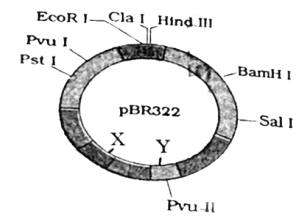
A
The gene '$X$' is responsible for controlling the copy number of the linked $DNA$ and '$Y$' for the protein involved in the replication of the plasmid.
B
The gene '$X$' is for the protein involved in the replication of the plasmid and '$Y$' is for resistance to antibiotics.
C
Gene '$X$' is responsible for recognition sites and '$Y$' is responsible for antibiotic resistance.
D
The gene '$X$' is responsible for resistance to antibiotics and '$Y$' for the protein involved in the replication of the plasmid.
Solution
(A) The correct answer is option $A$,because:
In the given diagram of the $pBR322$ vector,'$X$' represents the $ori$ (origin of replication) site,while '$Y$' represents the $rop$ gene.
'$X$' $(ori)$ is the sequence where replication starts and is responsible for controlling the copy number of the linked $DNA$.
'$Y$' $(rop)$ codes for proteins involved in the replication of the plasmid.
Therefore,option $A$ correctly identifies the functions of '$X$' and '$Y$'.
In the given diagram of the $pBR322$ vector,'$X$' represents the $ori$ (origin of replication) site,while '$Y$' represents the $rop$ gene.
'$X$' $(ori)$ is the sequence where replication starts and is responsible for controlling the copy number of the linked $DNA$.
'$Y$' $(rop)$ codes for proteins involved in the replication of the plasmid.
Therefore,option $A$ correctly identifies the functions of '$X$' and '$Y$'.
0 likesView Solution
93
BiologyMediumMCQNEET · 2024
Given below are two statements:
Statement $I$: Bone marrow is the main lymphoid organ where all blood cells including lymphocytes are produced.
Statement $II$: Both bone marrow and thymus provide micro-environments for the development and maturation of $T$-lymphocytes.
In the light of the above statements,choose the most appropriate answer from the options given below:
Statement $I$: Bone marrow is the main lymphoid organ where all blood cells including lymphocytes are produced.
Statement $II$: Both bone marrow and thymus provide micro-environments for the development and maturation of $T$-lymphocytes.
In the light of the above statements,choose the most appropriate answer from the options given below:
A
Both Statement $I$ and Statement $II$ are incorrect.
B
Statement $I$ is correct but Statement $II$ is incorrect.
C
Statement $I$ is incorrect but Statement $II$ is correct.
D
Both Statement $I$ and Statement $II$ are correct.
Solution
(D) Statement $I$ is correct: Bone marrow is the primary lymphoid organ where all blood cells,including lymphocytes,are produced through hematopoiesis.
Statement $II$ is correct: Bone marrow and thymus are primary lymphoid organs that provide the necessary micro-environments for the development and maturation of $T$-lymphocytes. Specifically,$T$-lymphocytes migrate to the thymus for maturation.
Therefore,both statements are correct.
Statement $II$ is correct: Bone marrow and thymus are primary lymphoid organs that provide the necessary micro-environments for the development and maturation of $T$-lymphocytes. Specifically,$T$-lymphocytes migrate to the thymus for maturation.
Therefore,both statements are correct.
0 likesView Solution
94
BiologyMediumMCQNEET · 2024
As per the $ABO$ blood grouping system,the blood group of the father is $B^{+}$,the mother is $A^{+}$,and the child is $O^{+}$. Their respective genotypes can be:
Choose the most appropriate answer from the options given below:
$A. I^Bi / I^Ai / ii$
$B. I^BI^B / I^AI^A / ii$
$C. I^AI^B / iI^A / I^Bi$
$D. I^Ai / I^Bi / I^Ai$
$E. iI^B / iI^A / I^AI^B$
Choose the most appropriate answer from the options given below:
$A. I^Bi / I^Ai / ii$
$B. I^BI^B / I^AI^A / ii$
$C. I^AI^B / iI^A / I^Bi$
$D. I^Ai / I^Bi / I^Ai$
$E. iI^B / iI^A / I^AI^B$
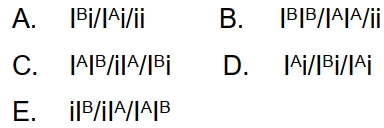
A
$B$ only
B
$C, B$ only
C
$D, E$ only
D
$A$ only
Solution
(D) In the $ABO$ blood grouping system,the alleles are $I^A, I^B,$ and $i$.
For a child to have blood group $O$ (genotype $ii$),they must inherit one $i$ allele from each parent.
Therefore,the father (blood group $B$) must have the genotype $I^Bi$ and the mother (blood group $A$) must have the genotype $I^Ai$.
Looking at the provided options:
$A$ represents $I^Bi$ (Father),$I^Ai$ (Mother),and $ii$ (Child),which is consistent with the blood groups given.
Thus,only option $A$ is correct.
For a child to have blood group $O$ (genotype $ii$),they must inherit one $i$ allele from each parent.
Therefore,the father (blood group $B$) must have the genotype $I^Bi$ and the mother (blood group $A$) must have the genotype $I^Ai$.
Looking at the provided options:
$A$ represents $I^Bi$ (Father),$I^Ai$ (Mother),and $ii$ (Child),which is consistent with the blood groups given.
Thus,only option $A$ is correct.
0 likesView Solution
95
BiologyMediumMCQNEET · 2024
Match List $I$ with List $II$:
Choose the correct answer from the options given below:
| List $I$ | List $II$ |
|---|---|
| $A$. $RNA$ polymerase $III$ | $I$. snRNPs |
| $B$. Termination of transcription | $II$. Promoter |
| $C$. Splicing of exons | $III$. Rho factor |
| $D$. $TATA$ box | $IV$. snRNAs,tRNA |
Choose the correct answer from the options given below:
A
$A-III, B-II, C-IV, D-I$
B
$A-III, B-IV, C-I, D-II$
C
$A-IV, B-III, C-I, D-II$
D
$A-II, B-IV, C-I, D-III$
Solution
(C) The correct matching is as follows:
- $A$. $RNA$ polymerase $III$ is responsible for the transcription of $snRNAs$,$tRNA$,and $5s$ $rRNA$. Thus,$A-IV$.
- $B$. The termination of transcription in prokaryotes is facilitated by the Rho factor. Thus,$B-III$.
- $C$. Splicing of exons involves the removal of introns and joining of exons,a process performed by $snRNPs$ (small nuclear ribonucleoproteins). Thus,$C-I$.
- $D$. The $TATA$ box is a specific $DNA$ sequence found in the promoter region of the transcription unit. Thus,$D-II$.
Therefore,the correct sequence is $A-IV, B-III, C-I, D-II$.
- $A$. $RNA$ polymerase $III$ is responsible for the transcription of $snRNAs$,$tRNA$,and $5s$ $rRNA$. Thus,$A-IV$.
- $B$. The termination of transcription in prokaryotes is facilitated by the Rho factor. Thus,$B-III$.
- $C$. Splicing of exons involves the removal of introns and joining of exons,a process performed by $snRNPs$ (small nuclear ribonucleoproteins). Thus,$C-I$.
- $D$. The $TATA$ box is a specific $DNA$ sequence found in the promoter region of the transcription unit. Thus,$D-II$.
Therefore,the correct sequence is $A-IV, B-III, C-I, D-II$.
0 likesView Solution
96
BiologyMediumMCQNEET · 2024
Identify the correct option $(A)$,$(B)$,$(C)$,$(D)$ with respect to spermatogenesis.
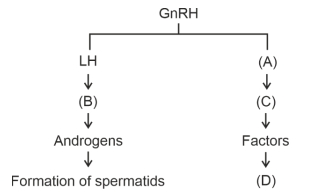
A
$ICSH$,Interstitial cells,Leydig cells,spermiogenesis.
B
$FSH$,Sertoli cells,Leydig cells,spermatogenesis.
C
$ICSH$,Leydig cells,Sertoli cells,spermatogenesis.
D
$FSH$,Leydig cells,Sertoli cells,spermiogenesis.
Solution
(D) The correct answer is option $(D)$.
According to the hormonal control of spermatogenesis:
$(A)$ represents $FSH$ (Follicle Stimulating Hormone),which acts on Sertoli cells.
$(B)$ represents Leydig cells,which are stimulated by $LH$ to secrete androgens.
$(C)$ represents Sertoli cells,which are stimulated by $FSH$ to secrete factors that help in the process of spermiogenesis.
$(D)$ represents Spermiogenesis,which is the process of transformation of spermatids into spermatozoa.
According to the hormonal control of spermatogenesis:
$(A)$ represents $FSH$ (Follicle Stimulating Hormone),which acts on Sertoli cells.
$(B)$ represents Leydig cells,which are stimulated by $LH$ to secrete androgens.
$(C)$ represents Sertoli cells,which are stimulated by $FSH$ to secrete factors that help in the process of spermiogenesis.
$(D)$ represents Spermiogenesis,which is the process of transformation of spermatids into spermatozoa.
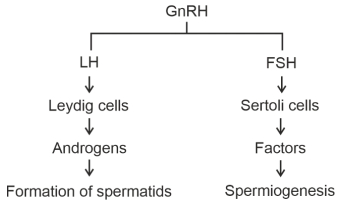
0 likesView Solution
97
BiologyMediumMCQNEET · 2024
Given below are two statements:
Statement $I$: Gause's competitive exclusion principle states that two closely related species competing for different resources cannot exist indefinitely.
Statement $II$: According to Gause's principle,during competition,the inferior will be eliminated. This may be true if resources are limiting.
In the light of the above statements,choose the correct answer from the options given below :
Statement $I$: Gause's competitive exclusion principle states that two closely related species competing for different resources cannot exist indefinitely.
Statement $II$: According to Gause's principle,during competition,the inferior will be eliminated. This may be true if resources are limiting.
In the light of the above statements,choose the correct answer from the options given below :
A
Both Statement $I$ and Statement $II$ are false.
B
Statement $I$ is true but Statement $II$ is false.
C
Statement $I$ is false but Statement $II$ is true.
D
Both Statement $I$ and Statement $II$ are true.
Solution
(C) Gause's competitive exclusion principle states that two closely related species competing for the same resources cannot exist indefinitely and the competitively inferior one will be eliminated eventually.
Statement $I$ is false because the principle specifically refers to species competing for the same resources,not different resources.
Statement $II$ is true as it correctly describes the outcome of competition when resources are limiting,leading to the elimination of the inferior species.
Statement $I$ is false because the principle specifically refers to species competing for the same resources,not different resources.
Statement $II$ is true as it correctly describes the outcome of competition when resources are limiting,leading to the elimination of the inferior species.
0 likesView Solution
98
BiologyMediumMCQNEET · 2024
Match List $I$ with List $II$:
Choose the correct answer from the options given below:
| List $I$ | List $II$ |
| $A$. Mesozoic Era | $I$. Lower invertebrates |
| $B$. Proterozoic Era | $II$. Fish and Amphibia |
| $C$. Cenozoic Era | $III$. Birds and Reptiles |
| $D$. Paleozoic Era | $IV$. Mammals |
Choose the correct answer from the options given below:
A
$A-III, B-I, C-II, D-IV$
B
$A-I, B-II, C-IV, D-III$
C
$A-III, B-I, C-IV, D-II$
D
$A-II, B-I, C-III, D-IV$
Solution
(C) The correct answer is option $C$.
$A$. Mesozoic Era is known as the age of reptiles and birds, corresponding to $III$.
$B$. Proterozoic Era is associated with the early life forms, including lower invertebrates, corresponding to $I$.
$C$. Cenozoic Era is known as the age of mammals, corresponding to $IV$.
$D$. Paleozoic Era is characterized by the dominance of fish and the emergence of amphibians, corresponding to $II$.
Therefore, the correct matching is $A-III, B-I, C-IV, D-II$.
$A$. Mesozoic Era is known as the age of reptiles and birds, corresponding to $III$.
$B$. Proterozoic Era is associated with the early life forms, including lower invertebrates, corresponding to $I$.
$C$. Cenozoic Era is known as the age of mammals, corresponding to $IV$.
$D$. Paleozoic Era is characterized by the dominance of fish and the emergence of amphibians, corresponding to $II$.
Therefore, the correct matching is $A-III, B-I, C-IV, D-II$.
0 likesView Solution
Vedclass Products
For Students
Vedclass Test Series
Mock tests in real NEET style covering Biology with performance analysis. 5-day free trial.
Start Free TrialFor Teachers
Exam Paper Generator
Generate Set A/B/C/D Biology papers from 7.5L+ questions in 2 minutes. 3 chapters free.
Try FreeFor Institutes
Online Exam Module
Run live NEET mock exams with unlimited students, 360° analytics & white-label branding.
See DemoFrequently Asked Questions
How many Biology questions are in NEET 2024?
There are 100 Biology questions from the NEET 2024 paper on Vedclass, each with a detailed step-by-step solution in English.
Are NEET 2024 Biology solutions available in English?
Yes. All solutions on this page are in English. You can also switch to English or Hindi using the language buttons above the questions.
Can I practice NEET 2024 Biology as a timed test?
Yes. Use the Vedclass Test Series to attempt a full NEET mock test covering Biology with time limits and instant score analysis.
Can teachers create Biology papers from NEET previous year questions?
Yes. The Vedclass Exam Paper Generator lets teachers mix NEET Biology questions and generate Set A/B/C/D papers in minutes.
For Teachers & Institutes
Build a Custom Biology Paper
Pick NEET 2024 Biology questions, set difficulty, and generate Set A/B/C/D in 2 minutes.