
PhysicsQ1–89 of 100 questions
Page 1 of 2 · English
1
PhysicsEasyMCQNEET · 2022
The angular speed of a flywheel moving with uniform angular acceleration changes from $1200\,rpm$ to $3120\,rpm$ in $16\,s$. The angular acceleration in $rad/s^{2}$ is: (in $\pi$)
A
$4$
B
$12$
C
$104$
D
$2$
Solution
(A) The formula for angular velocity under uniform angular acceleration is $\omega = \omega_{0} + \alpha t$.
Here, the initial angular speed $\omega_{0} = 1200\,rpm$ and the final angular speed $\omega = 3120\,rpm$.
The time interval is $t = 16\,s$.
First, convert the angular speeds from $rpm$ to $rad/s$ using the relation $1\,rpm = \frac{2\pi}{60}\,rad/s$.
The change in angular speed is $\Delta\omega = 3120 - 1200 = 1920\,rpm$.
Converting this to $rad/s$: $\Delta\omega = 1920 \times \frac{2\pi}{60} = 32 \times 2\pi = 64\pi\,rad/s$.
The angular acceleration $\alpha$ is given by $\alpha = \frac{\Delta\omega}{t} = \frac{64\pi}{16} = 4\pi\,rad/s^{2}$.
Here, the initial angular speed $\omega_{0} = 1200\,rpm$ and the final angular speed $\omega = 3120\,rpm$.
The time interval is $t = 16\,s$.
First, convert the angular speeds from $rpm$ to $rad/s$ using the relation $1\,rpm = \frac{2\pi}{60}\,rad/s$.
The change in angular speed is $\Delta\omega = 3120 - 1200 = 1920\,rpm$.
Converting this to $rad/s$: $\Delta\omega = 1920 \times \frac{2\pi}{60} = 32 \times 2\pi = 64\pi\,rad/s$.
The angular acceleration $\alpha$ is given by $\alpha = \frac{\Delta\omega}{t} = \frac{64\pi}{16} = 4\pi\,rad/s^{2}$.
0 likesView Solution
2
PhysicsMediumMCQNEET · 2022
The ratio of the radius of gyration of a thin uniform disc about an axis passing through its centre and normal to its plane to the radius of gyration of the disc about its diameter is
A
$\sqrt{2}: 1$
B
$4: 1$
C
$1: \sqrt{2}$
D
$2: 1$
Solution
(A) The radius of gyration $k$ is given by the formula $k = \sqrt{\frac{I}{m}}$,where $I$ is the moment of inertia and $m$ is the mass.
For a thin uniform disc of mass $m$ and radius $R$:
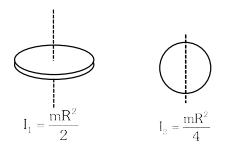
$1$. The moment of inertia about an axis passing through its centre and normal to its plane is $I_1 = \frac{mR^2}{2}$.
$2$. The moment of inertia about its diameter is $I_2 = \frac{mR^2}{4}$.
Let $k_1$ and $k_2$ be the radii of gyration corresponding to $I_1$ and $I_2$ respectively.
Then,$\frac{k_1}{k_2} = \sqrt{\frac{I_1}{I_2}} = \sqrt{\frac{mR^2 / 2}{mR^2 / 4}} = \sqrt{\frac{4}{2}} = \sqrt{2} = \sqrt{2}: 1$.
For a thin uniform disc of mass $m$ and radius $R$:
$1$. The moment of inertia about an axis passing through its centre and normal to its plane is $I_1 = \frac{mR^2}{2}$.
$2$. The moment of inertia about its diameter is $I_2 = \frac{mR^2}{4}$.
Let $k_1$ and $k_2$ be the radii of gyration corresponding to $I_1$ and $I_2$ respectively.
Then,$\frac{k_1}{k_2} = \sqrt{\frac{I_1}{I_2}} = \sqrt{\frac{mR^2 / 2}{mR^2 / 4}} = \sqrt{\frac{4}{2}} = \sqrt{2} = \sqrt{2}: 1$.
0 likesView Solution
3
PhysicsMediumMCQNEET · 2022
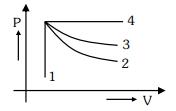
An ideal gas undergoes four different processes from the same initial state as shown in the figure below. Those processes are adiabatic,isothermal,isobaric and isochoric. The curve which represents the adiabatic process among $1, 2, 3$ and $4$ is
A
$2$
B
$3$
C
$4$
D
$1$
Solution
(A) In a $P-V$ diagram,the slope of an adiabatic process is given by $\frac{dP}{dV} = -\gamma \frac{P}{V}$,while the slope of an isothermal process is given by $\frac{dP}{dV} = -\frac{P}{V}$.
Since the adiabatic index $\gamma > 1$ for all gases,the magnitude of the slope of the adiabatic curve is greater than that of the isothermal curve.
Therefore,the adiabatic curve is steeper than the isothermal curve.
Looking at the graph:
$1$ represents an isochoric process (constant volume).
$4$ represents an isobaric process (constant pressure).
Between $2$ and $3$,curve $2$ is steeper than curve $3$.
Thus,curve $2$ represents the adiabatic process and curve $3$ represents the isothermal process.
Since the adiabatic index $\gamma > 1$ for all gases,the magnitude of the slope of the adiabatic curve is greater than that of the isothermal curve.
Therefore,the adiabatic curve is steeper than the isothermal curve.
Looking at the graph:
$1$ represents an isochoric process (constant volume).
$4$ represents an isobaric process (constant pressure).
Between $2$ and $3$,curve $2$ is steeper than curve $3$.
Thus,curve $2$ represents the adiabatic process and curve $3$ represents the isothermal process.
0 likesView Solution
4
PhysicsMediumMCQNEET · 2022
An electric lift with a maximum load of $2000\,kg$ (lift + passengers) is moving up with a constant speed of $1.5\,m/s$. The frictional force opposing the motion is $3000\,N$. The minimum power delivered by the motor to the lift in watts is: $(g=10\,m/s^2)$
A
$20000$
B
$34500$
C
$23500$
D
$23000$
Solution
(B) Since the lift is moving with a constant velocity,the net acceleration $a = 0$.
According to Newton's second law,the tension $T$ in the cable must balance both the gravitational force and the frictional force.
$T = mg + f$
Given $m = 2000\,kg$,$g = 10\,m/s^2$,and $f = 3000\,N$:
$T = (2000 \times 10) + 3000 = 20000 + 3000 = 23000\,N$.
The power delivered by the motor is given by $P = T \times v$.
Given $v = 1.5\,m/s$:
$P = 23000 \times 1.5 = 34500\,W$.
According to Newton's second law,the tension $T$ in the cable must balance both the gravitational force and the frictional force.
$T = mg + f$
Given $m = 2000\,kg$,$g = 10\,m/s^2$,and $f = 3000\,N$:
$T = (2000 \times 10) + 3000 = 20000 + 3000 = 23000\,N$.
The power delivered by the motor is given by $P = T \times v$.
Given $v = 1.5\,m/s$:
$P = 23000 \times 1.5 = 34500\,W$.
0 likesView Solution
5
PhysicsEasyMCQNEET · 2022
Plane angle and solid angle have :
A
Dimensions but no units
B
No units and no dimensions
C
Both units and dimensions
D
Units but no dimensions
Solution
(D) Plane angle is defined as the ratio of arc length to radius $(d\theta = ds/r)$. Since both arc length and radius have the dimension of length $(L)$,the dimension of plane angle is $[L^1/L^1] = [M^0 L^0 T^0]$,which is dimensionless. However,it has a unit,which is radian $(rad)$.
Similarly,solid angle is defined as the ratio of the area of the spherical surface to the square of the radius $(d\Omega = dA/r^2)$. Since both area and the square of the radius have the dimension of length squared $(L^2)$,the dimension of solid angle is $[L^2/L^2] = [M^0 L^0 T^0]$,which is also dimensionless. However,it has a unit,which is steradian $(sr)$.
Therefore,plane angle and solid angle have units but no dimensions.
Similarly,solid angle is defined as the ratio of the area of the spherical surface to the square of the radius $(d\Omega = dA/r^2)$. Since both area and the square of the radius have the dimension of length squared $(L^2)$,the dimension of solid angle is $[L^2/L^2] = [M^0 L^0 T^0]$,which is also dimensionless. However,it has a unit,which is steradian $(sr)$.
Therefore,plane angle and solid angle have units but no dimensions.
1 likesView Solution
6
PhysicsEasyMCQNEET · 2022
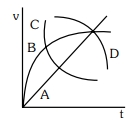
$A$ spherical ball is dropped in a long column of a highly viscous liquid. The curve in the graph shown, which represents the speed of the ball $(v)$ as a function of time $(t)$ is
A
$A$
B
$B$
C
$C$
D
$D$
Solution
(B) When a spherical ball is dropped in a highly viscous liquid, it experiences three forces: gravitational force acting downwards, and buoyant force and viscous drag force acting upwards.
The net force on the ball is $F_{net} = mg - F_B - F_v$, where $F_v = 6\pi\eta rv$ is the viscous drag force.
Initially, the speed $(v)$ is zero, so the viscous drag is zero, and the ball accelerates downwards. As the speed increases, the viscous drag force increases.
According to Newton's second law, $ma = mg - F_B - 6\pi\eta rv$. As $v$ increases, the acceleration $a$ decreases.
Eventually, the ball reaches a constant terminal velocity when the net force becomes zero $(a = 0)$.
This behavior is represented by a curve that starts from the origin, has a decreasing slope (decreasing acceleration), and becomes horizontal (constant velocity) as time increases. Curve $B$ matches this description.
The net force on the ball is $F_{net} = mg - F_B - F_v$, where $F_v = 6\pi\eta rv$ is the viscous drag force.
Initially, the speed $(v)$ is zero, so the viscous drag is zero, and the ball accelerates downwards. As the speed increases, the viscous drag force increases.
According to Newton's second law, $ma = mg - F_B - 6\pi\eta rv$. As $v$ increases, the acceleration $a$ decreases.
Eventually, the ball reaches a constant terminal velocity when the net force becomes zero $(a = 0)$.
This behavior is represented by a curve that starts from the origin, has a decreasing slope (decreasing acceleration), and becomes horizontal (constant velocity) as time increases. Curve $B$ matches this description.
0 likesView Solution
7
PhysicsMediumMCQNEET · 2022
The ratio of the distances travelled by a freely falling body in the $1^{\text{st}}$,$2^{\text{nd}}$,$3^{\text{rd}}$,and $4^{\text{th}}$ second is:
A
$1: 4: 9: 16$
B
$1: 3: 5: 7$
C
$1: 1: 1: 1$
D
$1: 2: 3: 4$
Solution
(B) The distance travelled by a body in the $n^{\text{th}}$ second is given by the formula: $S_{n} = u + \frac{a}{2}(2n - 1)$.
Since the body is freely falling,the initial velocity $u = 0$ and acceleration $a = g$.
Thus,$S_{n} = \frac{g}{2}(2n - 1)$.
This implies that $S_{n} \propto (2n - 1)$.
For the $1^{\text{st}}, 2^{\text{nd}}, 3^{\text{rd}}$,and $4^{\text{th}}$ seconds,the ratio is:
$S_{1} : S_{2} : S_{3} : S_{4} = (2(1) - 1) : (2(2) - 1) : (2(3) - 1) : (2(4) - 1)$.
$S_{1} : S_{2} : S_{3} : S_{4} = 1 : 3 : 5 : 7$.
Since the body is freely falling,the initial velocity $u = 0$ and acceleration $a = g$.
Thus,$S_{n} = \frac{g}{2}(2n - 1)$.
This implies that $S_{n} \propto (2n - 1)$.
For the $1^{\text{st}}, 2^{\text{nd}}, 3^{\text{rd}}$,and $4^{\text{th}}$ seconds,the ratio is:
$S_{1} : S_{2} : S_{3} : S_{4} = (2(1) - 1) : (2(2) - 1) : (2(3) - 1) : (2(4) - 1)$.
$S_{1} : S_{2} : S_{3} : S_{4} = 1 : 3 : 5 : 7$.
1 likesView Solution
8
PhysicsEasyMCQNEET · 2022
If a soap bubble expands, the pressure inside the bubble:
A
increases
B
remains the same
C
is equal to the atmospheric pressure
D
decreases
Solution
(D) The excess pressure inside a soap bubble is given by the formula $P_{in} = P_{0} + \frac{4T}{R}$, where $P_{0}$ is the atmospheric pressure, $T$ is the surface tension, and $R$ is the radius of the bubble.
As the soap bubble expands, its radius $R$ increases.
Since the term $\frac{4T}{R}$ is inversely proportional to $R$, as $R$ increases, the value of $\frac{4T}{R}$ decreases.
Therefore, the total pressure inside the bubble $P_{in}$ decreases.
As the soap bubble expands, its radius $R$ increases.
Since the term $\frac{4T}{R}$ is inversely proportional to $R$, as $R$ increases, the value of $\frac{4T}{R}$ decreases.
Therefore, the total pressure inside the bubble $P_{in}$ decreases.
0 likesView Solution
9
PhysicsEasyMCQNEET · 2022
$A$ body of mass $60 \, g$ experiences a gravitational force of $3.0 \, N$,when placed at a particular point. The magnitude of the gravitational field intensity at that point is ..... $N/kg$.
A
$50$
B
$20$
C
$180$
D
$0.05$
Solution
(A) The gravitational field intensity $I_g$ at a point is defined as the gravitational force $F$ per unit mass $m$ placed at that point.
$I_g = \frac{F}{m}$
Given:
Mass $m = 60 \, g = 60 \times 10^{-3} \, kg = 0.06 \, kg$
Force $F = 3.0 \, N$
Substituting the values:
$I_g = \frac{3.0 \, N}{0.06 \, kg} = 50 \, N/kg$
Therefore,the magnitude of the gravitational field intensity is $50 \, N/kg$.
$I_g = \frac{F}{m}$
Given:
Mass $m = 60 \, g = 60 \times 10^{-3} \, kg = 0.06 \, kg$
Force $F = 3.0 \, N$
Substituting the values:
$I_g = \frac{3.0 \, N}{0.06 \, kg} = 50 \, N/kg$
Therefore,the magnitude of the gravitational field intensity is $50 \, N/kg$.
0 likesView Solution
10
PhysicsEasyMCQNEET · 2022
If the initial tension on a stretched string is doubled,then the ratio of the initial and final speeds of a transverse wave along the string is:
A
$ \sqrt{2} : 1 $
B
$ 1 : \sqrt{2} $
C
$ 1 : 2 $
D
$ 1 : 1 $
Solution
(B) The speed of a transverse wave on a stretched string is given by the formula $v = \sqrt{\frac{T}{\mu}}$,where $T$ is the tension and $\mu$ is the linear mass density.
Since $\mu$ remains constant,the speed is directly proportional to the square root of the tension: $v \propto \sqrt{T}$.
Let the initial tension be $T_i = T$ and the final tension be $T_f = 2T$.
The ratio of the initial speed $v_i$ to the final speed $v_f$ is given by:
$\frac{v_i}{v_f} = \sqrt{\frac{T_i}{T_f}}$
Substituting the values,we get:
$\frac{v_i}{v_f} = \sqrt{\frac{T}{2T}} = \sqrt{\frac{1}{2}} = \frac{1}{\sqrt{2}}$
Thus,the ratio is $1 : \sqrt{2}$.
Since $\mu$ remains constant,the speed is directly proportional to the square root of the tension: $v \propto \sqrt{T}$.
Let the initial tension be $T_i = T$ and the final tension be $T_f = 2T$.
The ratio of the initial speed $v_i$ to the final speed $v_f$ is given by:
$\frac{v_i}{v_f} = \sqrt{\frac{T_i}{T_f}}$
Substituting the values,we get:
$\frac{v_i}{v_f} = \sqrt{\frac{T}{2T}} = \sqrt{\frac{1}{2}} = \frac{1}{\sqrt{2}}$
Thus,the ratio is $1 : \sqrt{2}$.
0 likesView Solution
11
PhysicsMediumMCQNEET · 2022
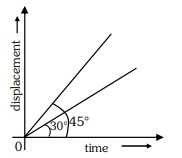
The displacement-time graphs of two moving particles make angles of $30^{\circ}$ and $45^{\circ}$ with the time-axis as shown in the figure. The ratio of their respective velocities is:
A
$1: 1$
B
$1: 2$
C
$1: \sqrt{3}$
D
$\sqrt{3}: 1$
Solution
(C) The velocity of a particle is given by the slope of the displacement-time graph.
$V = \frac{dx}{dt} = \tan \theta$
Given the angles $\theta_1 = 30^{\circ}$ and $\theta_2 = 45^{\circ}$,the ratio of their velocities is:
$\frac{V_1}{V_2} = \frac{\tan 30^{\circ}}{\tan 45^{\circ}}$
Since $\tan 30^{\circ} = \frac{1}{\sqrt{3}}$ and $\tan 45^{\circ} = 1$,we have:
$\frac{V_1}{V_2} = \frac{1/\sqrt{3}}{1} = \frac{1}{\sqrt{3}}$
Thus,the ratio is $1: \sqrt{3}$.
$V = \frac{dx}{dt} = \tan \theta$
Given the angles $\theta_1 = 30^{\circ}$ and $\theta_2 = 45^{\circ}$,the ratio of their velocities is:
$\frac{V_1}{V_2} = \frac{\tan 30^{\circ}}{\tan 45^{\circ}}$
Since $\tan 30^{\circ} = \frac{1}{\sqrt{3}}$ and $\tan 45^{\circ} = 1$,we have:
$\frac{V_1}{V_2} = \frac{1/\sqrt{3}}{1} = \frac{1}{\sqrt{3}}$
Thus,the ratio is $1: \sqrt{3}$.
1 likesView Solution
12
PhysicsMediumMCQNEET · 2022
Two objects of mass $10\,kg$ and $20\,kg$ respectively are connected to the two ends of a rigid rod of length $10\,m$ with negligible mass. The distance of the center of mass of the system from the $10\,kg$ mass is:
A
$\frac{20}{3}\,m$
B
$10\,m$
C
$5\,m$
D
$\frac{10}{3}\,m$
Solution
(A) Let the $10\,kg$ mass be at the origin $(x_1 = 0)$ and the $20\,kg$ mass be at $x_2 = 10\,m$.
The formula for the center of mass $X_{CM}$ is given by:
$X_{CM} = \frac{m_1x_1 + m_2x_2}{m_1 + m_2}$
Substituting the given values:
$X_{CM} = \frac{10 \times 0 + 20 \times 10}{10 + 20}$
$X_{CM} = \frac{200}{30} = \frac{20}{3}\,m$.
Thus,the distance of the center of mass from the $10\,kg$ mass is $\frac{20}{3}\,m$.
The formula for the center of mass $X_{CM}$ is given by:
$X_{CM} = \frac{m_1x_1 + m_2x_2}{m_1 + m_2}$
Substituting the given values:
$X_{CM} = \frac{10 \times 0 + 20 \times 10}{10 + 20}$
$X_{CM} = \frac{200}{30} = \frac{20}{3}\,m$.
Thus,the distance of the center of mass from the $10\,kg$ mass is $\frac{20}{3}\,m$.
0 likesView Solution
13
PhysicsDifficultMCQNEET · 2022
$A$ shell of mass $m$ is at rest initially. It explodes into three fragments having mass in the ratio $2:2:1$. If the fragments having equal mass fly off along mutually perpendicular directions with speed $v$,the speed of the third (lighter) fragment is:
A
$\sqrt{2} v$
B
$2 \sqrt{2} v$
C
$3 \sqrt{2} v$
D
$v$
Solution
(B) Initially,the shell is at rest,so the initial momentum is $0$.
Let the masses of the three fragments be $m_1 = \frac{2m}{5}$,$m_2 = \frac{2m}{5}$,and $m_3 = \frac{m}{5}$.
The two fragments of mass $\frac{2m}{5}$ move with speed $v$ in mutually perpendicular directions. Let their velocity vectors be $\vec{v}_1 = -v \hat{i}$ and $\vec{v}_2 = -v \hat{j}$.
By the law of conservation of linear momentum:
$\vec{P}_{initial} = \vec{P}_{final}$
$0 = m_1 \vec{v}_1 + m_2 \vec{v}_2 + m_3 \vec{v}_3$
$0 = \frac{2m}{5}(-v \hat{i}) + \frac{2m}{5}(-v \hat{j}) + \frac{m}{5} \vec{v}_3$
$\frac{m}{5} \vec{v}_3 = \frac{2m}{5} v \hat{i} + \frac{2m}{5} v \hat{j}$
$\vec{v}_3 = 2v \hat{i} + 2v \hat{j}$
The speed of the third fragment is the magnitude of $\vec{v}_3$:
$v_3 = |\vec{v}_3| = \sqrt{(2v)^2 + (2v)^2} = \sqrt{4v^2 + 4v^2} = \sqrt{8v^2} = 2\sqrt{2} v$.
Let the masses of the three fragments be $m_1 = \frac{2m}{5}$,$m_2 = \frac{2m}{5}$,and $m_3 = \frac{m}{5}$.
The two fragments of mass $\frac{2m}{5}$ move with speed $v$ in mutually perpendicular directions. Let their velocity vectors be $\vec{v}_1 = -v \hat{i}$ and $\vec{v}_2 = -v \hat{j}$.
By the law of conservation of linear momentum:
$\vec{P}_{initial} = \vec{P}_{final}$
$0 = m_1 \vec{v}_1 + m_2 \vec{v}_2 + m_3 \vec{v}_3$
$0 = \frac{2m}{5}(-v \hat{i}) + \frac{2m}{5}(-v \hat{j}) + \frac{m}{5} \vec{v}_3$
$\frac{m}{5} \vec{v}_3 = \frac{2m}{5} v \hat{i} + \frac{2m}{5} v \hat{j}$
$\vec{v}_3 = 2v \hat{i} + 2v \hat{j}$
The speed of the third fragment is the magnitude of $\vec{v}_3$:
$v_3 = |\vec{v}_3| = \sqrt{(2v)^2 + (2v)^2} = \sqrt{4v^2 + 4v^2} = \sqrt{8v^2} = 2\sqrt{2} v$.
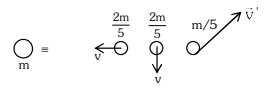
0 likesView Solution
14
PhysicsMediumMCQNEET · 2022
Two pendulums of length $121 \ cm$ and $100 \ cm$ start vibrating in phase. At some instant,the two are at their mean position in the same phase. The minimum number of vibrations of the shorter pendulum after which the two are again in phase at the mean position is:
A
$9$
B
$10$
C
$8$
D
$11$
Solution
(D) The time period of a simple pendulum is given by $T = 2 \pi \sqrt{\frac{L}{g}}$.
Let $L_1 = 121 \ cm = 1.21 \ m$ and $L_2 = 100 \ cm = 1.0 \ m$.
Let $n_1$ be the number of oscillations of the longer pendulum and $n_2$ be the number of oscillations of the shorter pendulum.
For them to be in phase at the mean position again,the total time must be equal: $n_1 T_1 = n_2 T_2$.
$n_1 (2 \pi \sqrt{\frac{1.21}{g}}) = n_2 (2 \pi \sqrt{\frac{1.0}{g}})$.
$n_1 (1.1) = n_2 (1.0)$.
$1.1 n_1 = n_2$,which implies $\frac{n_2}{n_1} = \frac{1.1}{1} = \frac{11}{10}$.
Since $n_2$ and $n_1$ must be integers,the minimum number of vibrations for the shorter pendulum $(n_2)$ is $11$ and for the longer pendulum $(n_1)$ is $10$.
Let $L_1 = 121 \ cm = 1.21 \ m$ and $L_2 = 100 \ cm = 1.0 \ m$.
Let $n_1$ be the number of oscillations of the longer pendulum and $n_2$ be the number of oscillations of the shorter pendulum.
For them to be in phase at the mean position again,the total time must be equal: $n_1 T_1 = n_2 T_2$.
$n_1 (2 \pi \sqrt{\frac{1.21}{g}}) = n_2 (2 \pi \sqrt{\frac{1.0}{g}})$.
$n_1 (1.1) = n_2 (1.0)$.
$1.1 n_1 = n_2$,which implies $\frac{n_2}{n_1} = \frac{1.1}{1} = \frac{11}{10}$.
Since $n_2$ and $n_1$ must be integers,the minimum number of vibrations for the shorter pendulum $(n_2)$ is $11$ and for the longer pendulum $(n_1)$ is $10$.
0 likesView Solution
15
PhysicsEasyMCQNEET · 2022
The area of a rectangular field (in $m^{2}$) of length $55.3 \ m$ and breadth $25 \ m$ after rounding off the value for correct significant digits is
A
$1382$
B
$1382.5$
C
$14 \times 10^{2}$
D
$138 \times 10^{1}$
Solution
(C) The area of a rectangle is given by the formula: $Area = \text{Length} \times \text{Breadth}$.
Given,Length $= 55.3 \ m$ (which has $3$ significant figures) and Breadth $= 25 \ m$ (which has $2$ significant figures).
Calculating the product: $55.3 \times 25 = 1382.5 \ m^{2}$.
According to the rules of significant figures,the result of multiplication should have the same number of significant figures as the measurement with the least number of significant figures.
Here,the least number of significant figures is $2$ (from $25 \ m$).
Rounding $1382.5$ to $2$ significant figures,we get $1400 \ m^{2}$,which can be written as $14 \times 10^{2} \ m^{2}$.
Given,Length $= 55.3 \ m$ (which has $3$ significant figures) and Breadth $= 25 \ m$ (which has $2$ significant figures).
Calculating the product: $55.3 \times 25 = 1382.5 \ m^{2}$.
According to the rules of significant figures,the result of multiplication should have the same number of significant figures as the measurement with the least number of significant figures.
Here,the least number of significant figures is $2$ (from $25 \ m$).
Rounding $1382.5$ to $2$ significant figures,we get $1400 \ m^{2}$,which can be written as $14 \times 10^{2} \ m^{2}$.
0 likesView Solution
16
PhysicsMediumMCQNEET · 2022
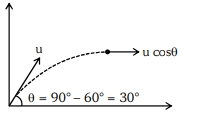
$A$ ball is projected with a velocity of $10 \ ms^{-1}$ at an angle of $60^{\circ}$ with the vertical direction. Its speed at the highest point of its trajectory will be $............... \ ms^{-1}$.
A
$5 \sqrt{3}$
B
$5$
C
$10$
D
Zero
Solution
(A) The angle of projection with the horizontal is $\theta = 90^{\circ} - 60^{\circ} = 30^{\circ}$.
At the highest point of the trajectory,the vertical component of velocity becomes zero,and only the horizontal component of velocity remains.
The horizontal component of velocity is given by $v_x = u \cos \theta$.
Given $u = 10 \ ms^{-1}$ and $\theta = 30^{\circ}$,we have:
$v_x = 10 \cos 30^{\circ} = 10 \times \frac{\sqrt{3}}{2} = 5 \sqrt{3} \ ms^{-1}$.
Thus,the speed at the highest point is $5 \sqrt{3} \ ms^{-1}$.
At the highest point of the trajectory,the vertical component of velocity becomes zero,and only the horizontal component of velocity remains.
The horizontal component of velocity is given by $v_x = u \cos \theta$.
Given $u = 10 \ ms^{-1}$ and $\theta = 30^{\circ}$,we have:
$v_x = 10 \cos 30^{\circ} = 10 \times \frac{\sqrt{3}}{2} = 5 \sqrt{3} \ ms^{-1}$.
Thus,the speed at the highest point is $5 \sqrt{3} \ ms^{-1}$.
0 likesView Solution
17
PhysicsMediumMCQNEET · 2022
Match List-$I$ with List-$II$:
Choose the correct answer from the options given below:
| $(a)$ Gravitational constant $(G)$ | $(i)$ $[L^{2}T^{-2}]$ |
| $(b)$ Gravitational potential energy | $(ii)$ $[M^{-1}L^{3}T^{-2}]$ |
| $(c)$ Gravitational potential | $(iii)$ $[LT^{-2}]$ |
| $(d)$ Gravitational intensity | $(iv)$ $[ML^{2}T^{-2}]$ |
Choose the correct answer from the options given below:
A
$(a)-(ii), (b)-(iv), (c)-(i), (d)-(iii)$
B
$(a)-(ii), (b)-(iv), (c)-(iii), (d)-(i)$
C
$(a)-(iv), (b)-(ii), (c)-(i), (d)-(iii)$
D
$(a)-(ii), (b)-(i), (c)-(iv), (d)-(iii)$
Solution
(A) $1$. Gravitational constant $(G)$: From $F = G \frac{m_1 m_2}{r^2}$,we have $G = \frac{F r^2}{m_1 m_2}$. Dimensional formula is $[MLT^{-2}][L^2] / [M^2] = [M^{-1}L^3T^{-2}]$. Thus,$(a)-(ii)$.
$2$. Gravitational potential energy $(U)$: $U = -\frac{G M m}{r}$. Dimensional formula is $[MLT^{-2}][L] = [ML^2T^{-2}]$. Thus,$(b)-(iv)$.
$3$. Gravitational potential $(V)$: $V = \frac{U}{m}$. Dimensional formula is $[ML^2T^{-2}] / [M] = [L^2T^{-2}]$. Thus,$(c)-(i)$.
$4$. Gravitational intensity $(E)$: $E = \frac{F}{m}$. Dimensional formula is $[MLT^{-2}] / [M] = [LT^{-2}]$. Thus,$(d)-(iii)$.
Therefore,the correct match is $(a)-(ii), (b)-(iv), (c)-(i), (d)-(iii)$.
$2$. Gravitational potential energy $(U)$: $U = -\frac{G M m}{r}$. Dimensional formula is $[MLT^{-2}][L] = [ML^2T^{-2}]$. Thus,$(b)-(iv)$.
$3$. Gravitational potential $(V)$: $V = \frac{U}{m}$. Dimensional formula is $[ML^2T^{-2}] / [M] = [L^2T^{-2}]$. Thus,$(c)-(i)$.
$4$. Gravitational intensity $(E)$: $E = \frac{F}{m}$. Dimensional formula is $[MLT^{-2}] / [M] = [LT^{-2}]$. Thus,$(d)-(iii)$.
Therefore,the correct match is $(a)-(ii), (b)-(iv), (c)-(i), (d)-(iii)$.
0 likesView Solution
18
PhysicsMediumMCQNEET · 2022
Given below are two statements: One is labelled as Assertion $(A)$ and the other is labelled as Reason $(R)$.
Assertion $(A)$: The stretching of a spring is determined by the shear modulus of the material of the spring.
Reason $(R)$: $A$ coil spring of copper has more tensile strength than a steel spring of same dimensions.
In the light of the above statements,choose the most appropriate answer from the options given below:
Assertion $(A)$: The stretching of a spring is determined by the shear modulus of the material of the spring.
Reason $(R)$: $A$ coil spring of copper has more tensile strength than a steel spring of same dimensions.
In the light of the above statements,choose the most appropriate answer from the options given below:
A
Both $(A)$ and $(R)$ are true and $(R)$ is not the correct explanation of $(A)$
B
$(A)$ is true but $(R)$ is false
C
$(A)$ is false but $(R)$ is true
D
Both $(A)$ and $(R)$ are true and $(R)$ is the correct explanation of $(A)$
Solution
(B) When a spring is stretched,the wire of the spring undergoes a change in shape (twisting/shearing) rather than just a change in length. Therefore,the stiffness of the spring is determined by the shear modulus $(G)$ of the material.
Assertion $(A)$ is true.
Regarding Reason $(R)$,steel has a much higher Young's modulus and tensile strength compared to copper. Therefore,a steel spring is stronger and more resistant to deformation than a copper spring of the same dimensions. Thus,the statement that a copper spring has more tensile strength than a steel spring is false.
Reason $(R)$ is false.
Therefore,the correct option is $(B)$.
Assertion $(A)$ is true.
Regarding Reason $(R)$,steel has a much higher Young's modulus and tensile strength compared to copper. Therefore,a steel spring is stronger and more resistant to deformation than a copper spring of the same dimensions. Thus,the statement that a copper spring has more tensile strength than a steel spring is false.
Reason $(R)$ is false.
Therefore,the correct option is $(B)$.
0 likesView Solution
19
PhysicsEasyMCQNEET · 2022
The volume occupied by the molecules contained in $4.5 \, kg$ of water at $STP$,if the intermolecular forces vanish away,is ........ $m^{3}$.
A
$5.6 \times 10^{3}$
B
$5.6 \times 10^{-3}$
C
$5.6$
D
$5.6 \times 10^{6}$
Solution
(C) The number of moles $n$ is given by the mass divided by the molar mass of water $(H_{2}O)$.
Given mass $= 4.5 \, kg = 4.5 \times 10^{3} \, g$.
Molar mass of water $= 18 \, g/mol$.
$n = \frac{4.5 \times 10^{3}}{18} = 0.25 \times 10^{3} = 250 \, mol$.
At $STP$,the volume of $1 \, mole$ of an ideal gas is $22.4 \, L = 22.4 \times 10^{-3} \, m^{3}$.
Therefore,the total volume $V = n \times 22.4 \times 10^{-3} \, m^{3}$.
$V = 250 \times 22.4 \times 10^{-3} \, m^{3} = 5.6 \, m^{3}$.
Given mass $= 4.5 \, kg = 4.5 \times 10^{3} \, g$.
Molar mass of water $= 18 \, g/mol$.
$n = \frac{4.5 \times 10^{3}}{18} = 0.25 \times 10^{3} = 250 \, mol$.
At $STP$,the volume of $1 \, mole$ of an ideal gas is $22.4 \, L = 22.4 \times 10^{-3} \, m^{3}$.
Therefore,the total volume $V = n \times 22.4 \times 10^{-3} \, m^{3}$.
$V = 250 \times 22.4 \times 10^{-3} \, m^{3} = 5.6 \, m^{3}$.
0 likesView Solution
20
PhysicsEasyMCQNEET · 2022
Identify the function which represents a non-periodic motion.
A
$e^{-\omega t}$
B
$\sin \omega t$
C
$\sin \omega t + \cos \omega t$
D
$\sin (\omega t + \pi / 4)$
Solution
(A) periodic function is one that repeats its values at regular intervals of time.
Functions like $\sin \omega t$,$\cos \omega t$,and their linear combinations are periodic because they repeat their values after a time period $T = 2\pi / \omega$.
The function $f(t) = e^{-\omega t}$ is an exponential decay function.
As $t$ increases,$e^{-\omega t}$ decreases monotonically and approaches zero as $t \to \infty$.
Since it never repeats its values,it represents a non-periodic motion.
Functions like $\sin \omega t$,$\cos \omega t$,and their linear combinations are periodic because they repeat their values after a time period $T = 2\pi / \omega$.
The function $f(t) = e^{-\omega t}$ is an exponential decay function.
As $t$ increases,$e^{-\omega t}$ decreases monotonically and approaches zero as $t \to \infty$.
Since it never repeats its values,it represents a non-periodic motion.
0 likesView Solution
21
PhysicsEasyMCQNEET · 2022
$A$ cricket ball is thrown by a player at a speed of $20\,m/s$ in a direction $30^{\circ}$ above the horizontal. The maximum height attained by the ball during its motion is $........\,m$ $\left( g = 10\,m/s^2 \right)$
A
$5$
B
$10$
C
$20$
D
$25$
Solution
(A) The formula for the maximum height $H$ attained by a projectile is given by $H = \frac{u^2 \sin^2 \theta}{2g}$.
Given values are initial velocity $u = 20\,m/s$,angle of projection $\theta = 30^{\circ}$,and acceleration due to gravity $g = 10\,m/s^2$.
Substituting these values into the formula:
$H = \frac{(20)^2 \sin^2(30^{\circ})}{2 \times 10}$
$H = \frac{400 \times (1/2)^2}{20}$
$H = \frac{400 \times 1/4}{20}$
$H = \frac{100}{20} = 5\,m$.
Thus,the maximum height attained by the ball is $5\,m$.
Given values are initial velocity $u = 20\,m/s$,angle of projection $\theta = 30^{\circ}$,and acceleration due to gravity $g = 10\,m/s^2$.
Substituting these values into the formula:
$H = \frac{(20)^2 \sin^2(30^{\circ})}{2 \times 10}$
$H = \frac{400 \times (1/2)^2}{20}$
$H = \frac{400 \times 1/4}{20}$
$H = \frac{100}{20} = 5\,m$.
Thus,the maximum height attained by the ball is $5\,m$.
0 likesView Solution
22
PhysicsMediumMCQNEET · 2022
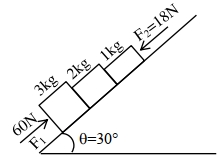
In the diagram shown,the normal reaction force between the $2\,kg$ and $1\,kg$ blocks is (Consider the surface to be smooth) $.........N$ (Given $g = 10\,ms^{-2}$)
A
$25$
B
$39$
C
$6$
D
$10$
Solution
(A) First,calculate the acceleration of the system. The total mass is $M = 3 + 2 + 1 = 6\,kg$.
The forces acting along the incline are $F_1 = 60\,N$ (upwards) and $F_2 = 18\,N$ (downwards).
The component of gravity acting downwards for all blocks is $Mg \sin 30^{\circ} = 6 \times 10 \times 0.5 = 30\,N$.
The net force is $F_{\text{net}} = 60 - 18 - 30 = 12\,N$.
The acceleration is $a = \frac{F_{\text{net}}}{M} = \frac{12}{6} = 2\,ms^{-2}$ (upwards).
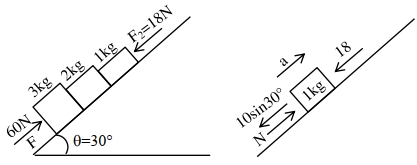
Now,consider the $1\,kg$ block. Let $N$ be the normal reaction force between the $2\,kg$ and $1\,kg$ blocks.
The forces on the $1\,kg$ block are $N$ (upwards),$F_2 = 18\,N$ (downwards),and $mg \sin 30^{\circ} = 1 \times 10 \times 0.5 = 5\,N$ (downwards).
Applying Newton's second law: $N - 18 - 5 = m \times a \implies N - 23 = 1 \times 2 \implies N = 25\,N$.
The forces acting along the incline are $F_1 = 60\,N$ (upwards) and $F_2 = 18\,N$ (downwards).
The component of gravity acting downwards for all blocks is $Mg \sin 30^{\circ} = 6 \times 10 \times 0.5 = 30\,N$.
The net force is $F_{\text{net}} = 60 - 18 - 30 = 12\,N$.
The acceleration is $a = \frac{F_{\text{net}}}{M} = \frac{12}{6} = 2\,ms^{-2}$ (upwards).
Now,consider the $1\,kg$ block. Let $N$ be the normal reaction force between the $2\,kg$ and $1\,kg$ blocks.
The forces on the $1\,kg$ block are $N$ (upwards),$F_2 = 18\,N$ (downwards),and $mg \sin 30^{\circ} = 1 \times 10 \times 0.5 = 5\,N$ (downwards).
Applying Newton's second law: $N - 18 - 5 = m \times a \implies N - 23 = 1 \times 2 \implies N = 25\,N$.
0 likesView Solution
23
PhysicsEasyMCQNEET · 2022
Two copper vessels $A$ and $B$ have the same base area but different shapes. Vessel $A$ requires twice the volume of water as vessel $B$ to fill up to a particular common height. Which of the following statements is correct?
A
Pressure on the base area of vessels $A$ and $B$ is the same.
B
Pressure on the base area of vessels $A$ and $B$ is not the same.
C
Both vessels $A$ and $B$ weigh the same.
D
Vessel $B$ weighs twice that of $A$.
Solution
(A) The pressure exerted by a liquid column at the base of a vessel is given by the formula $P = h \rho g$,where $h$ is the height of the liquid column,$\rho$ is the density of the liquid,and $g$ is the acceleration due to gravity.
Since both vessels $A$ and $B$ are filled to the same height $h$ with the same liquid (water),the pressure at the base depends only on the height $h$,the density $\rho$,and the constant $g$.
Because $h$,$\rho$,and $g$ are identical for both vessels,the pressure at the base of vessel $A$ must be equal to the pressure at the base of vessel $B$.
Since both vessels $A$ and $B$ are filled to the same height $h$ with the same liquid (water),the pressure at the base depends only on the height $h$,the density $\rho$,and the constant $g$.
Because $h$,$\rho$,and $g$ are identical for both vessels,the pressure at the base of vessel $A$ must be equal to the pressure at the base of vessel $B$.
0 likesView Solution
24
PhysicsEasyMCQNEET · 2022
The terminal velocity of a copper ball of radius $5\,mm$ falling through a tank of oil at room temperature is $10\,cm\,s^{-1}$. If the viscosity of oil at room temperature is $0.9\,kg\,m^{-1}s^{-1}$,the viscous drag force is:
A
$8.48 \times 10^{-3}\,N$
B
$8.48 \times 10^{-5}\,N$
C
$4.23 \times 10^{-3}\,N$
D
$4.23 \times 10^{-6}\,N$
Solution
(A) According to Stokes' Law,the viscous drag force $F$ acting on a spherical object of radius $r$ moving with terminal velocity $v$ in a fluid of viscosity $\eta$ is given by:
$F = 6 \pi \eta r v$
Given values:
Radius $r = 5\,mm = 5 \times 10^{-3}\,m$
Velocity $v = 10\,cm\,s^{-1} = 10 \times 10^{-2}\,m\,s^{-1} = 0.1\,m\,s^{-1}$
Viscosity $\eta = 0.9\,kg\,m^{-1}s^{-1}$
Substituting the values into the formula:
$F = 6 \times 3.14 \times 0.9 \times (5 \times 10^{-3}) \times (0.1)$
$F = 6 \times 3.14 \times 0.9 \times 5 \times 10^{-4}$
$F = 84.78 \times 10^{-4}\,N$
$F = 8.478 \times 10^{-3}\,N \approx 8.48 \times 10^{-3}\,N$
$F = 6 \pi \eta r v$
Given values:
Radius $r = 5\,mm = 5 \times 10^{-3}\,m$
Velocity $v = 10\,cm\,s^{-1} = 10 \times 10^{-2}\,m\,s^{-1} = 0.1\,m\,s^{-1}$
Viscosity $\eta = 0.9\,kg\,m^{-1}s^{-1}$
Substituting the values into the formula:
$F = 6 \times 3.14 \times 0.9 \times (5 \times 10^{-3}) \times (0.1)$
$F = 6 \times 3.14 \times 0.9 \times 5 \times 10^{-4}$
$F = 84.78 \times 10^{-4}\,N$
$F = 8.478 \times 10^{-3}\,N \approx 8.48 \times 10^{-3}\,N$
2 likesView Solution
25
PhysicsMediumMCQNEET · 2022
If $\overrightarrow{ F }=2 \hat{ i }+\hat{ j }-\hat{ k }$ and $\overrightarrow{ r }=3 \hat{ i }+2 \hat{ j }-2 \hat{ k }$,then the scalar and vector products of $\overrightarrow{ F }$ and $\overrightarrow{ r }$ have the magnitudes respectively as
A
$5, \sqrt{3}$
B
$4, \sqrt{5}$
C
$10, \sqrt{2}$
D
$10, 2$
Solution
(C) Given: $\overrightarrow{ F }=2 \hat{ i }+\hat{ j }-\hat{ k }$ and $\overrightarrow{ r }=3 \hat{ i }+2 \hat{ j }-2 \hat{ k }$.
$1$. Scalar Product (Dot Product):
$\overrightarrow{ F } \cdot \overrightarrow{ r } = (2)(3) + (1)(2) + (-1)(-2) = 6 + 2 + 2 = 10$.
$2$. Vector Product (Cross Product):
$\overrightarrow{ F } \times \overrightarrow{ r } = \begin{vmatrix} \hat{ i } & \hat{ j } & \hat{ k } \\ 2 & 1 & -1 \\ 3 & 2 & -2 \end{vmatrix}$
$= \hat{ i }((1)(-2) - (-1)(2)) - \hat{ j }((2)(-2) - (-1)(3)) + \hat{ k }((2)(2) - (1)(3))$
$= \hat{ i }(-2 + 2) - \hat{ j }(-4 + 3) + \hat{ k }(4 - 3)$
$= 0 \hat{ i } + 1 \hat{ j } + 1 \hat{ k } = \hat{ j } + \hat{ k }$.
$3$. Magnitude of Vector Product:
$|\overrightarrow{ F } \times \overrightarrow{ r }| = \sqrt{0^2 + 1^2 + 1^2} = \sqrt{2}$.
Thus,the magnitudes are $10$ and $\sqrt{2}$.
$1$. Scalar Product (Dot Product):
$\overrightarrow{ F } \cdot \overrightarrow{ r } = (2)(3) + (1)(2) + (-1)(-2) = 6 + 2 + 2 = 10$.
$2$. Vector Product (Cross Product):
$\overrightarrow{ F } \times \overrightarrow{ r } = \begin{vmatrix} \hat{ i } & \hat{ j } & \hat{ k } \\ 2 & 1 & -1 \\ 3 & 2 & -2 \end{vmatrix}$
$= \hat{ i }((1)(-2) - (-1)(2)) - \hat{ j }((2)(-2) - (-1)(3)) + \hat{ k }((2)(2) - (1)(3))$
$= \hat{ i }(-2 + 2) - \hat{ j }(-4 + 3) + \hat{ k }(4 - 3)$
$= 0 \hat{ i } + 1 \hat{ j } + 1 \hat{ k } = \hat{ j } + \hat{ k }$.
$3$. Magnitude of Vector Product:
$|\overrightarrow{ F } \times \overrightarrow{ r }| = \sqrt{0^2 + 1^2 + 1^2} = \sqrt{2}$.
Thus,the magnitudes are $10$ and $\sqrt{2}$.
0 likesView Solution
26
PhysicsEasyMCQNEET · 2022
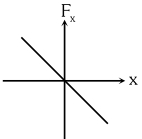
The restoring force of a spring with a block attached to the free end of the spring is represented by
A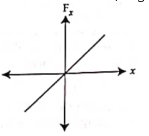
B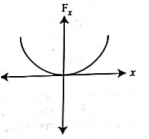
C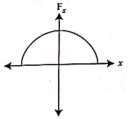
D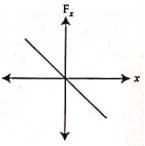
Solution
(D) According to Hooke's law,the restoring force $F$ of a spring is directly proportional to the displacement $x$ from the equilibrium position and acts in the opposite direction.
This is expressed by the equation $F = -kx$,where $k$ is the spring constant.
Since the relationship is $F = -kx$,the graph of $F$ versus $x$ is a straight line passing through the origin with a negative slope $(-k)$.
Therefore,the correct representation is a straight line with a negative slope,which corresponds to the graph shown in option $D$.
This is expressed by the equation $F = -kx$,where $k$ is the spring constant.
Since the relationship is $F = -kx$,the graph of $F$ versus $x$ is a straight line passing through the origin with a negative slope $(-k)$.
Therefore,the correct representation is a straight line with a negative slope,which corresponds to the graph shown in option $D$.
2 likesView Solution
27
PhysicsMediumMCQNEET · 2022
The distance covered by a body of mass $5\,g$ having linear momentum $0.3\,kg\,m/s$ in $5\,s$ is $..........\,m$.
A
$300$
B
$30$
C
$3$
D
$0.3$
Solution
(A) Given: Mass $m = 5\,g = 0.005\,kg$,Linear momentum $p = 0.3\,kg\,m/s$,Time $t = 5\,s$.
We know that linear momentum $p = mv$,where $v$ is the velocity.
Substituting the values: $0.005 \times v = 0.3$.
Solving for velocity: $v = \frac{0.3}{0.005} = \frac{300}{5} = 60\,m/s$.
Assuming the body moves with constant velocity,the distance covered $d = v \times t$.
$d = 60\,m/s \times 5\,s = 300\,m$.
We know that linear momentum $p = mv$,where $v$ is the velocity.
Substituting the values: $0.005 \times v = 0.3$.
Solving for velocity: $v = \frac{0.3}{0.005} = \frac{300}{5} = 60\,m/s$.
Assuming the body moves with constant velocity,the distance covered $d = v \times t$.
$d = 60\,m/s \times 5\,s = 300\,m$.
0 likesView Solution
28
PhysicsEasyMCQNEET · 2022
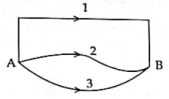
$A$ gravitational field is present in a region and a mass is shifted from $A$ to $B$ through different paths as shown. If $W_1, W_2$ and $W_3$ represent the work done by the gravitational force along the respective paths,then
A
$W_1 = W_2 = W_3$
B
$W_1 > W_2 > W_3$
C
$W_1 > W_3 > W_2$
D
$W_1 < W_2 < W_3$
Solution
(A) The gravitational force is a conservative force.
By definition,the work done by a conservative force in moving an object between two points is independent of the path taken.
It depends only on the initial and final positions of the object.
Since all three paths start at point $A$ and end at point $B$,the work done by the gravitational force along each path must be equal.
Therefore,$W_1 = W_2 = W_3$.
By definition,the work done by a conservative force in moving an object between two points is independent of the path taken.
It depends only on the initial and final positions of the object.
Since all three paths start at point $A$ and end at point $B$,the work done by the gravitational force along each path must be equal.
Therefore,$W_1 = W_2 = W_3$.
0 likesView Solution
29
PhysicsMediumMCQNEET · 2022
Given below are two statements: one is labelled as Assertion $(A)$ and the other is labelled as Reason $(R)$.
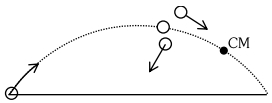
Assertion $(A)$: When a firecracker (rocket) explodes in mid-air,its fragments fly in such a way that the centre of mass of the fragments continues to move along the same parabolic path that the firecracker would have followed had it not exploded.
Reason $(R)$: The explosion of a firecracker (rocket) occurs due to internal forces only,and no external force acts to cause this explosion.
Assertion $(A)$: When a firecracker (rocket) explodes in mid-air,its fragments fly in such a way that the centre of mass of the fragments continues to move along the same parabolic path that the firecracker would have followed had it not exploded.
Reason $(R)$: The explosion of a firecracker (rocket) occurs due to internal forces only,and no external force acts to cause this explosion.
A
Both $(A)$ and $(R)$ are correct and $(R)$ is the correct explanation of $(A)$.
B
Both $(A)$ and $(R)$ are correct but $(R)$ is not the correct explanation of $(A)$.
C
$(A)$ is correct but $(R)$ is not correct.
D
$(A)$ is not correct but $(R)$ is correct.
Solution
(D) Assertion $(A)$ is incorrect because it states that the fragments themselves follow the original path. In reality,only the centre of mass $(C.O.M.)$ of the fragments continues to follow the original parabolic trajectory.
Reason $(R)$ is correct because the explosion is caused by internal chemical forces,and the external force (gravity) remains unchanged during the explosion.
Since the assertion statement is factually incorrect in its phrasing,the correct choice is that $(A)$ is not correct but $(R)$ is correct.
Reason $(R)$ is correct because the explosion is caused by internal chemical forces,and the external force (gravity) remains unchanged during the explosion.
Since the assertion statement is factually incorrect in its phrasing,the correct choice is that $(A)$ is not correct but $(R)$ is correct.
0 likesView Solution
30
PhysicsMediumMCQNEET · 2022
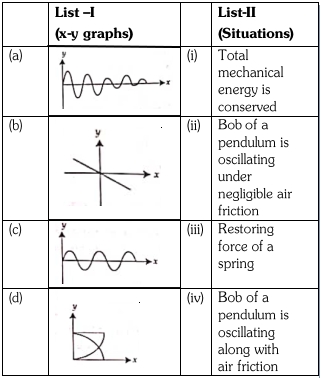
Match $List-I$ with $List-II$:
| | $List-I$ ($x-y$ graphs) | | $List-II$ (Situations) |
|---|---|---|---|
| $(a)$ | Damped oscillation graph | $(i)$ | Total mechanical energy is conserved |
| $(b)$ | Linear graph $y = -kx$ | $(ii)$ | Bob of a pendulum is oscillating under negligible air friction |
| $(c)$ | Simple harmonic motion graph | $(iii)$ | Restoring force of a spring |
| $(d)$ | Energy conservation graph ($K$.$E$. and $P$.$E$. curves) | $(iv)$ | Bob of a pendulum is oscillating along with air friction |
Choose the correct answer from the options given below:
| | $List-I$ ($x-y$ graphs) | | $List-II$ (Situations) |
|---|---|---|---|
| $(a)$ | Damped oscillation graph | $(i)$ | Total mechanical energy is conserved |
| $(b)$ | Linear graph $y = -kx$ | $(ii)$ | Bob of a pendulum is oscillating under negligible air friction |
| $(c)$ | Simple harmonic motion graph | $(iii)$ | Restoring force of a spring |
| $(d)$ | Energy conservation graph ($K$.$E$. and $P$.$E$. curves) | $(iv)$ | Bob of a pendulum is oscillating along with air friction |
Choose the correct answer from the options given below:
A
$(a)-(iv), (b)-(iii), (c)-(ii), (d)-(i)$
B
$(a)-(iv), (b)-(iii), (c)-(i), (d)-(ii)$
C
$(a)-(i), (b)-(iv), (c)-(iii), (d)-(ii)$
D
$(a)-(iii), (b)-(ii), (c)-(i), (d)-(iv)$
Solution
(A) The matching is as follows:
$(a) \rightarrow (iv)$: The graph shows damped oscillations where the amplitude decreases over time due to air friction.
$(b) \rightarrow (iii)$: The graph represents a linear relationship $y = -kx$,which corresponds to the restoring force of a spring $(F = -kx)$.
$(c) \rightarrow (ii)$: The graph shows simple harmonic motion with constant amplitude,which corresponds to an ideal pendulum oscillating with negligible air friction.
$(d) \rightarrow (i)$: The graph shows the variation of Kinetic Energy and Potential Energy,where their sum (Total Mechanical Energy) remains constant.
Therefore,the correct matching is $(a)-(iv), (b)-(iii), (c)-(ii), (d)-(i)$.
$(a) \rightarrow (iv)$: The graph shows damped oscillations where the amplitude decreases over time due to air friction.
$(b) \rightarrow (iii)$: The graph represents a linear relationship $y = -kx$,which corresponds to the restoring force of a spring $(F = -kx)$.
$(c) \rightarrow (ii)$: The graph shows simple harmonic motion with constant amplitude,which corresponds to an ideal pendulum oscillating with negligible air friction.
$(d) \rightarrow (i)$: The graph shows the variation of Kinetic Energy and Potential Energy,where their sum (Total Mechanical Energy) remains constant.
Therefore,the correct matching is $(a)-(iv), (b)-(iii), (c)-(ii), (d)-(i)$.
0 likesView Solution
31
PhysicsMediumMCQNEET · 2022
An ideal gas follows a process described by the equation $PV^2 = C$ from the initial $(P_1, V_1, T_1)$ to final $(P_2, V_2, T_2)$ thermodynamic states,where $C$ is a constant. Then:
A
If $P_1 > P_2$ then $T_1 < T_2$
B
If $V_2 > V_1$ then $T_2 > T_1$
C
If $V_2 > V_1$ then $T_2 < T_1$
D
If $P_1 > P_2$ then $V_1 > V_2$
Solution
(C) The given process equation is $PV^2 = C$.
Using the ideal gas law $PV = nRT$,we can write $P = \frac{nRT}{V}$.
Substituting this into the process equation: $(\frac{nRT}{V})V^2 = C$.
This simplifies to $nRTV = C$,or $TV = \text{constant}$ (since $nR$ and $C$ are constants).
Therefore,$T_1 V_1 = T_2 V_2$,which implies $\frac{T_1}{T_2} = \frac{V_2}{V_1}$.
If $V_2 > V_1$,then $\frac{V_2}{V_1} > 1$,which means $\frac{T_1}{T_2} > 1$,so $T_1 > T_2$ or $T_2 < T_1$.
Thus,option $C$ is correct.
Using the ideal gas law $PV = nRT$,we can write $P = \frac{nRT}{V}$.
Substituting this into the process equation: $(\frac{nRT}{V})V^2 = C$.
This simplifies to $nRTV = C$,or $TV = \text{constant}$ (since $nR$ and $C$ are constants).
Therefore,$T_1 V_1 = T_2 V_2$,which implies $\frac{T_1}{T_2} = \frac{V_2}{V_1}$.
If $V_2 > V_1$,then $\frac{V_2}{V_1} > 1$,which means $\frac{T_1}{T_2} > 1$,so $T_1 > T_2$ or $T_2 < T_1$.
Thus,option $C$ is correct.
1 likesView Solution
32
PhysicsEasyMCQNEET · 2022
The physical quantity that has the same dimensional formula as pressure is:
A
Force
B
Momentum
C
Young's modulus of elasticity
D
Coefficient of viscosity
Solution
(C) Pressure is defined as force per unit area,so its dimensional formula is $[M L^{-1} T^{-2}]$.
Young's modulus of elasticity $(Y)$ is defined as the ratio of stress to strain.
Since strain is a dimensionless quantity,the dimensional formula of $Y$ is the same as that of stress.
Stress is also defined as force per unit area,so its dimensional formula is $[M L^{-1} T^{-2}]$.
Therefore,the dimensional formula of Young's modulus of elasticity is the same as that of pressure.
Young's modulus of elasticity $(Y)$ is defined as the ratio of stress to strain.
Since strain is a dimensionless quantity,the dimensional formula of $Y$ is the same as that of stress.
Stress is also defined as force per unit area,so its dimensional formula is $[M L^{-1} T^{-2}]$.
Therefore,the dimensional formula of Young's modulus of elasticity is the same as that of pressure.
0 likesView Solution
33
PhysicsEasyMCQNEET · 2022
An energy of $484\,J$ is spent in increasing the speed of a flywheel from $60\,rpm$ to $360\,rpm$. The moment of inertia of the flywheel is $.............\,kg\cdot m^2$.
A
$0.7$
B
$3.22$
C
$30.8$
D
$0.07$
Solution
(A) The initial angular velocity is $\omega_i = 60\,rpm = 60 \times \frac{2\pi}{60} = 2\pi\,rad/s$.
The final angular velocity is $\omega_f = 360\,rpm = 360 \times \frac{2\pi}{60} = 12\pi\,rad/s$.
The change in rotational kinetic energy is given by $\Delta K.E. = \frac{1}{2} I (\omega_f^2 - \omega_i^2) = 484\,J$.
Substituting the values: $\frac{1}{2} I ((12\pi)^2 - (2\pi)^2) = 484$.
$\frac{1}{2} I (144\pi^2 - 4\pi^2) = 484$.
$\frac{1}{2} I (140\pi^2) = 484$.
$70\pi^2 I = 484$.
Using $\pi^2 \approx 9.86$,we get $70 \times 9.86 \times I = 484$.
$690.2 I = 484$.
$I = \frac{484}{690.2} \approx 0.701\,kg\cdot m^2$.
The final angular velocity is $\omega_f = 360\,rpm = 360 \times \frac{2\pi}{60} = 12\pi\,rad/s$.
The change in rotational kinetic energy is given by $\Delta K.E. = \frac{1}{2} I (\omega_f^2 - \omega_i^2) = 484\,J$.
Substituting the values: $\frac{1}{2} I ((12\pi)^2 - (2\pi)^2) = 484$.
$\frac{1}{2} I (144\pi^2 - 4\pi^2) = 484$.
$\frac{1}{2} I (140\pi^2) = 484$.
$70\pi^2 I = 484$.
Using $\pi^2 \approx 9.86$,we get $70 \times 9.86 \times I = 484$.
$690.2 I = 484$.
$I = \frac{484}{690.2} \approx 0.701\,kg\cdot m^2$.
0 likesView Solution
34
PhysicsMediumMCQNEET · 2022
An organ pipe filled with a gas at $27^{\circ}C$ resonates at $400\,Hz$ in its fundamental mode. If it is filled with the same gas at $90^{\circ}C$,the resonance frequency at the same mode will be $...........\,Hz$.
A
$420$
B
$440$
C
$484$
D
$512$
Solution
(B) The fundamental frequency of an organ pipe is given by $n = \frac{v}{4\ell}$ (for a closed pipe) or $n = \frac{v}{2\ell}$ (for an open pipe). In both cases,$n \propto v$.
Since the speed of sound in a gas is given by $v = \sqrt{\frac{\gamma RT}{M}}$,we have $v \propto \sqrt{T}$.
Therefore,the frequency $n$ is directly proportional to the square root of the absolute temperature $T$,i.e.,$n \propto \sqrt{T}$.
Given $T_1 = 27^{\circ}C = 300\,K$ and $T_2 = 90^{\circ}C = 363\,K$.
Using the ratio: $\frac{n_2}{n_1} = \sqrt{\frac{T_2}{T_1}}$.
$\frac{n_2}{400} = \sqrt{\frac{363}{300}} = \sqrt{1.21} = 1.1$.
$n_2 = 400 \times 1.1 = 440\,Hz$.
Since the speed of sound in a gas is given by $v = \sqrt{\frac{\gamma RT}{M}}$,we have $v \propto \sqrt{T}$.
Therefore,the frequency $n$ is directly proportional to the square root of the absolute temperature $T$,i.e.,$n \propto \sqrt{T}$.
Given $T_1 = 27^{\circ}C = 300\,K$ and $T_2 = 90^{\circ}C = 363\,K$.
Using the ratio: $\frac{n_2}{n_1} = \sqrt{\frac{T_2}{T_1}}$.
$\frac{n_2}{400} = \sqrt{\frac{363}{300}} = \sqrt{1.21} = 1.1$.
$n_2 = 400 \times 1.1 = 440\,Hz$.
0 likesView Solution
35
PhysicsEasyMCQNEET · 2022
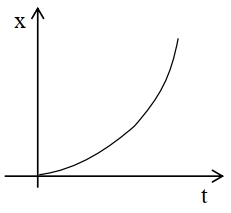
The position-time $(x-t)$ graph for positive acceleration is
A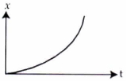
B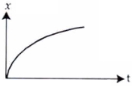
C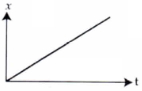
D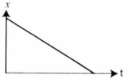
Solution
(A) For an object moving with constant positive acceleration $(a > 0)$,the position-time equation is given by the kinematic equation: $x(t) = x_0 + v_0 t + \frac{1}{2} a t^2$.
If we assume the initial position $x_0 = 0$ and initial velocity $v_0 = 0$,the equation simplifies to $x = \frac{1}{2} a t^2$.
This equation represents a parabola opening upwards in the $x-t$ plane.
As $t$ increases,the slope of the tangent to the curve (which represents velocity $v = \frac{dx}{dt} = at$) also increases,indicating that the velocity is increasing over time,which is the definition of positive acceleration.
Therefore,the graph shown in option $A$ represents motion with positive acceleration.
If we assume the initial position $x_0 = 0$ and initial velocity $v_0 = 0$,the equation simplifies to $x = \frac{1}{2} a t^2$.
This equation represents a parabola opening upwards in the $x-t$ plane.
As $t$ increases,the slope of the tangent to the curve (which represents velocity $v = \frac{dx}{dt} = at$) also increases,indicating that the velocity is increasing over time,which is the definition of positive acceleration.
Therefore,the graph shown in option $A$ represents motion with positive acceleration.
0 likesView Solution
36
PhysicsEasyMCQNEET · 2022
Three vessels of equal capacity have gases at the same temperature and pressure. The first vessel contains helium (monoatomic),the second contains fluorine (diatomic) and the third contains sulfur hexafluoride (polyatomic). The correct statement among the following is:
A
All vessels contain unequal number of respective molecules.
B
The root mean square speed of molecules is same in all three cases.
C
The root mean square speed of helium is the largest.
D
The root mean square speed of sulfur hexafluoride is the largest.
Solution
(C) According to the ideal gas law $PV = nRT$,since $P$,$V$,and $T$ are the same for all vessels,the number of moles $n$ is the same. By Avogadro's law,the number of molecules is the same in all vessels.
The root mean square speed $(V_{rms})$ of gas molecules is given by the formula:
$V_{rms} = \sqrt{\frac{3RT}{M}}$
where $R$ is the universal gas constant,$T$ is the absolute temperature,and $M$ is the molar mass of the gas.
Since $R$ and $T$ are constant,$V_{rms} \propto \frac{1}{\sqrt{M}}$.
The molar masses are:
$M_{He} = 4 \text{ g/mol}$
$M_{F_2} = 38 \text{ g/mol}$
$M_{SF_6} = 146 \text{ g/mol}$
Since helium has the smallest molar mass,it will have the largest root mean square speed.
The root mean square speed $(V_{rms})$ of gas molecules is given by the formula:
$V_{rms} = \sqrt{\frac{3RT}{M}}$
where $R$ is the universal gas constant,$T$ is the absolute temperature,and $M$ is the molar mass of the gas.
Since $R$ and $T$ are constant,$V_{rms} \propto \frac{1}{\sqrt{M}}$.
The molar masses are:
$M_{He} = 4 \text{ g/mol}$
$M_{F_2} = 38 \text{ g/mol}$
$M_{SF_6} = 146 \text{ g/mol}$
Since helium has the smallest molar mass,it will have the largest root mean square speed.
0 likesView Solution
37
PhysicsMediumMCQNEET · 2022
In a gravitational field,the gravitational potential is given by $V = -\frac{K}{x} \ (J/kg)$. The gravitational field intensity at point $(2, 0, 3) \ m$ is
A
$+\frac{K}{2}$
B
$-\frac{K}{2}$
C
$-\frac{K}{4}$
D
$+\frac{K}{4}$
Solution
(C) The gravitational field intensity $\vec{E}$ is related to the gravitational potential $V$ by the relation $\vec{E} = -\nabla V$.
Given $V = -\frac{K}{x}$,the field intensity component along the $x$-axis is $E_x = -\frac{dV}{dx}$.
$E_x = -\frac{d}{dx} \left( -\frac{K}{x} \right) = K \frac{d}{dx} (x^{-1}) = K (-1) x^{-2} = -\frac{K}{x^2}$.
Since the potential depends only on $x$,the components $E_y$ and $E_z$ are zero.
At the point $(2, 0, 3) \ m$,the $x$-coordinate is $2$.
Substituting $x = 2$ into the expression for $E_x$:
$E_x = -\frac{K}{2^2} = -\frac{K}{4}$.
Given $V = -\frac{K}{x}$,the field intensity component along the $x$-axis is $E_x = -\frac{dV}{dx}$.
$E_x = -\frac{d}{dx} \left( -\frac{K}{x} \right) = K \frac{d}{dx} (x^{-1}) = K (-1) x^{-2} = -\frac{K}{x^2}$.
Since the potential depends only on $x$,the components $E_y$ and $E_z$ are zero.
At the point $(2, 0, 3) \ m$,the $x$-coordinate is $2$.
Substituting $x = 2$ into the expression for $E_x$:
$E_x = -\frac{K}{2^2} = -\frac{K}{4}$.
0 likesView Solution
38
PhysicsMediumMCQNEET · 2022
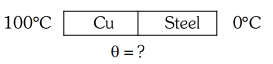
Two rods,one made of copper and the other made of steel,of the same length and same cross-sectional area,are joined together. The thermal conductivities of copper and steel are $385 \, W \, m^{-1} \, K^{-1}$ and $50 \, W \, m^{-1} \, K^{-1}$ respectively. The free ends of copper and steel are held at $100^{\circ} \, C$ and $0^{\circ} \, C$ respectively. The temperature at the junction is nearly $.......^{\circ} \, C$.
A
$12$
B
$50$
C
$73$
D
$88.5$
Solution
(D) In a steady state,the rate of heat flow through both rods must be equal.
Let $\theta$ be the temperature at the junction.
The rate of heat flow is given by $H = \frac{KA(T_1 - T_2)}{\ell}$.
Since the rods are in series,the heat current $H$ is the same for both.
$H_{Cu} = H_{Steel}$
$\frac{K_{Cu} A (100 - \theta)}{\ell} = \frac{K_{Steel} A (\theta - 0)}{\ell}$
Given $K_{Cu} = 385 \, W \, m^{-1} \, K^{-1}$ and $K_{Steel} = 50 \, W \, m^{-1} \, K^{-1}$.
$385(100 - \theta) = 50(\theta - 0)$
Divide by $5$:
$77(100 - \theta) = 10\theta$
$7700 - 77\theta = 10\theta$
$87\theta = 7700$
$\theta = \frac{7700}{87} \approx 88.5^{\circ} \, C$.
Let $\theta$ be the temperature at the junction.
The rate of heat flow is given by $H = \frac{KA(T_1 - T_2)}{\ell}$.
Since the rods are in series,the heat current $H$ is the same for both.
$H_{Cu} = H_{Steel}$
$\frac{K_{Cu} A (100 - \theta)}{\ell} = \frac{K_{Steel} A (\theta - 0)}{\ell}$
Given $K_{Cu} = 385 \, W \, m^{-1} \, K^{-1}$ and $K_{Steel} = 50 \, W \, m^{-1} \, K^{-1}$.
$385(100 - \theta) = 50(\theta - 0)$
Divide by $5$:
$77(100 - \theta) = 10\theta$
$7700 - 77\theta = 10\theta$
$87\theta = 7700$
$\theta = \frac{7700}{87} \approx 88.5^{\circ} \, C$.
1 likesView Solution
39
PhysicsEasyMCQNEET · 2022
The percentage error in the measurement of $g$ is $.....\%$ (Given that $g = \frac{4 \pi^2 L}{T^2}$,$L = (10 \pm 0.1) \, cm$,$T = (100 \pm 1) \, s$)
A
$2$
B
$5$
C
$3$
D
$7$
Solution
(C) The formula for acceleration due to gravity is $g = \frac{4 \pi^2 L}{T^2}$.
The relative error in $g$ is given by $\frac{\Delta g}{g} = \frac{\Delta L}{L} + 2 \frac{\Delta T}{T}$.
Substituting the given values: $L = 10 \, cm$,$\Delta L = 0.1 \, cm$,$T = 100 \, s$,and $\Delta T = 1 \, s$.
The percentage error in $g$ is $\left( \frac{\Delta g}{g} \times 100 \right) = \left( \frac{\Delta L}{L} \times 100 \right) + 2 \left( \frac{\Delta T}{T} \times 100 \right)$.
Percentage error $= \left( \frac{0.1}{10} \times 100 \right) + 2 \left( \frac{1}{100} \times 100 \right)$.
Percentage error $= 1\% + 2\% = 3\%$.
Therefore,the percentage error in the measurement of $g$ is $3\%$.
The relative error in $g$ is given by $\frac{\Delta g}{g} = \frac{\Delta L}{L} + 2 \frac{\Delta T}{T}$.
Substituting the given values: $L = 10 \, cm$,$\Delta L = 0.1 \, cm$,$T = 100 \, s$,and $\Delta T = 1 \, s$.
The percentage error in $g$ is $\left( \frac{\Delta g}{g} \times 100 \right) = \left( \frac{\Delta L}{L} \times 100 \right) + 2 \left( \frac{\Delta T}{T} \times 100 \right)$.
Percentage error $= \left( \frac{0.1}{10} \times 100 \right) + 2 \left( \frac{1}{100} \times 100 \right)$.
Percentage error $= 1\% + 2\% = 3\%$.
Therefore,the percentage error in the measurement of $g$ is $3\%$.
0 likesView Solution
40
PhysicsMediumMCQNEET · 2022
At any instant,two elements $X_1$ and $X_2$ have the same number of radioactive atoms. If the decay constants of $X_1$ and $X_2$ are $10\lambda$ and $\lambda$ respectively,then the time when the ratio of their atoms becomes $\frac{1}{e}$ will be:
A
$\frac{1}{5\lambda}$
B
$\frac{1}{11\lambda}$
C
$\frac{1}{6\lambda}$
D
$\frac{1}{9\lambda}$
Solution
(D) Let $N_0$ be the initial number of radioactive atoms for both elements at $t = 0$.
According to the law of radioactive decay,the number of atoms remaining at time $t$ is given by $N(t) = N_0 e^{-\lambda t}$.
For element $X_1$ with decay constant $\lambda_1 = 10\lambda$,the number of atoms is $N_1 = N_0 e^{-10\lambda t}$.
For element $X_2$ with decay constant $\lambda_2 = \lambda$,the number of atoms is $N_2 = N_0 e^{-\lambda t}$.
We are given that the ratio $\frac{N_1}{N_2} = \frac{1}{e} = e^{-1}$.
Substituting the expressions for $N_1$ and $N_2$:
$\frac{N_0 e^{-10\lambda t}}{N_0 e^{-\lambda t}} = e^{-1}$
$e^{-10\lambda t + \lambda t} = e^{-1}$
$e^{-9\lambda t} = e^{-1}$
Comparing the exponents:
$-9\lambda t = -1$
$t = \frac{1}{9\lambda}$.
According to the law of radioactive decay,the number of atoms remaining at time $t$ is given by $N(t) = N_0 e^{-\lambda t}$.
For element $X_1$ with decay constant $\lambda_1 = 10\lambda$,the number of atoms is $N_1 = N_0 e^{-10\lambda t}$.
For element $X_2$ with decay constant $\lambda_2 = \lambda$,the number of atoms is $N_2 = N_0 e^{-\lambda t}$.
We are given that the ratio $\frac{N_1}{N_2} = \frac{1}{e} = e^{-1}$.
Substituting the expressions for $N_1$ and $N_2$:
$\frac{N_0 e^{-10\lambda t}}{N_0 e^{-\lambda t}} = e^{-1}$
$e^{-10\lambda t + \lambda t} = e^{-1}$
$e^{-9\lambda t} = e^{-1}$
Comparing the exponents:
$-9\lambda t = -1$
$t = \frac{1}{9\lambda}$.
0 likesView Solution
41
PhysicsMediumMCQNEET · 2022
Given below are two statements:
Statement $I:$ Biot-Savart's law gives us the expression for the magnetic field strength of an infinitesimal current element $(Id\vec{l})$ of a current-carrying conductor only.
Statement $II:$ Biot-Savart's law is analogous to Coulomb's inverse square law of charge $q$,with the former being related to the field produced by a vector source,$Id\vec{l}$,while the latter is produced by a scalar source,$q$. In light of the above statements,choose the most appropriate answer from the options given below:
Statement $I:$ Biot-Savart's law gives us the expression for the magnetic field strength of an infinitesimal current element $(Id\vec{l})$ of a current-carrying conductor only.
Statement $II:$ Biot-Savart's law is analogous to Coulomb's inverse square law of charge $q$,with the former being related to the field produced by a vector source,$Id\vec{l}$,while the latter is produced by a scalar source,$q$. In light of the above statements,choose the most appropriate answer from the options given below:
A
Both Statement $I$ and Statement $II$ are incorrect.
B
Statement $I$ is correct and Statement $II$ is incorrect.
C
Statement $I$ is incorrect and Statement $II$ is correct.
D
Both Statement $I$ and Statement $II$ are correct.
Solution
(B) The Biot-Savart law is given by the expression: $d\vec{B} = \frac{\mu_0}{4\pi} \frac{I d\vec{l} \times \hat{r}}{r^2} = \frac{\mu_0}{4\pi} \frac{I d\vec{l} \times \vec{r}}{r^3}$.
Statement $I$ is correct because the law specifically defines the magnetic field contribution from an infinitesimal current element $Id\vec{l}$.
Statement $II$ is incorrect because it swaps the nature of the sources. Biot-Savart's law involves a vector source $(Id\vec{l})$,whereas Coulomb's law involves a scalar source (charge $q$). The statement claims the opposite,making it false.
Therefore,Statement $I$ is correct and Statement $II$ is incorrect.
Statement $I$ is correct because the law specifically defines the magnetic field contribution from an infinitesimal current element $Id\vec{l}$.
Statement $II$ is incorrect because it swaps the nature of the sources. Biot-Savart's law involves a vector source $(Id\vec{l})$,whereas Coulomb's law involves a scalar source (charge $q$). The statement claims the opposite,making it false.
Therefore,Statement $I$ is correct and Statement $II$ is incorrect.
0 likesView Solution
42
PhysicsMediumMCQNEET · 2022
$A$ biconvex lens has radii of curvature,$20 \ cm$ each. If the refractive index of the material of the lens is $1.5$,the power of the lens is .... $D$
A
$+20$
B
$+5$
C
infinity
D
$+2$
Solution
(B) Given: Radii of curvature $R_{1} = +20 \ cm = +0.2 \ m$ and $R_{2} = -20 \ cm = -0.2 \ m$ (by sign convention for a biconvex lens).
Refractive index $\mu = 1.5 = \frac{3}{2}$.
The lens maker's formula is given by $P = \frac{1}{f} = (\mu - 1) \left( \frac{1}{R_{1}} - \frac{1}{R_{2}} \right)$.
Substituting the values: $P = (1.5 - 1) \left( \frac{1}{0.2} - \frac{1}{-0.2} \right)$.
$P = (0.5) \left( \frac{1}{0.2} + \frac{1}{0.2} \right) = (0.5) \left( \frac{2}{0.2} \right)$.
$P = (0.5) \times 10 = +5 \ D$.
Refractive index $\mu = 1.5 = \frac{3}{2}$.
The lens maker's formula is given by $P = \frac{1}{f} = (\mu - 1) \left( \frac{1}{R_{1}} - \frac{1}{R_{2}} \right)$.
Substituting the values: $P = (1.5 - 1) \left( \frac{1}{0.2} - \frac{1}{-0.2} \right)$.
$P = (0.5) \left( \frac{1}{0.2} + \frac{1}{0.2} \right) = (0.5) \left( \frac{2}{0.2} \right)$.
$P = (0.5) \times 10 = +5 \ D$.
0 likesView Solution
43
PhysicsEasyMCQNEET · 2022
Two hollow conducting spheres of radii $R_{1}$ and $R_{2}$ $(R_{1} >> R_{2})$ have equal charges. The potential would be:
A
more on smaller sphere
B
equal on both the spheres
C
dependent on the material property of the sphere
D
more on bigger sphere
Solution
(A) The electric potential $V$ at the surface of a hollow conducting sphere of radius $R$ carrying charge $Q$ is given by the formula: $V = \frac{1}{4 \pi \epsilon_{0}} \cdot \frac{Q}{R}$.
Here,$\frac{1}{4 \pi \epsilon_{0}}$ is a constant.
It is given that both spheres have the same charge $Q$.
Therefore,the potential $V$ is inversely proportional to the radius $R$,i.e.,$V \propto \frac{1}{R}$.
Since $R_{1} >> R_{2}$,the radius of the smaller sphere is $R_{2}$.
Because $R_{2} < R_{1}$,it follows that $V_{2} > V_{1}$.
Thus,the potential is higher on the smaller sphere.
Here,$\frac{1}{4 \pi \epsilon_{0}}$ is a constant.
It is given that both spheres have the same charge $Q$.
Therefore,the potential $V$ is inversely proportional to the radius $R$,i.e.,$V \propto \frac{1}{R}$.
Since $R_{1} >> R_{2}$,the radius of the smaller sphere is $R_{2}$.
Because $R_{2} < R_{1}$,it follows that $V_{2} > V_{1}$.
Thus,the potential is higher on the smaller sphere.
0 likesView Solution
44
PhysicsEasyMCQNEET · 2022
As the temperature increases,the electrical resistance:
A
decreases for both conductors and semiconductors
B
increases for conductors but decreases for semiconductors
C
decreases for conductors but increases for semiconductors
D
increases for both conductors and semiconductors
Solution
(B) For conductors,the temperature coefficient of resistance $\alpha$ is positive,meaning resistance increases with temperature.
For semiconductors,the temperature coefficient of resistance $\alpha$ is negative,meaning resistance decreases as temperature increases due to the increase in the number of charge carriers.
For semiconductors,the temperature coefficient of resistance $\alpha$ is negative,meaning resistance decreases as temperature increases due to the increase in the number of charge carriers.
0 likesView Solution
45
PhysicsMediumMCQNEET · 2022
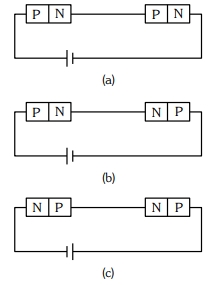
In the given circuits $(a)$,$(b)$,and $(c)$,the potential drop across the two p-n junctions are equal in:
A
Circuit $(b)$ only
B
Circuit $(c)$ only
C
Both circuits $(a)$ and $(c)$
D
Circuit $(a)$ only
Solution
(C) In circuit $(a)$,both p-n junctions are connected in the same forward-biased orientation. Since they are identical and in series,the potential drop across each junction is equal.
In circuit $(b)$,one junction is forward-biased while the other is reverse-biased. The reverse-biased junction offers a much higher resistance,so the potential drop across it will be significantly higher than the forward-biased junction.
In circuit $(c)$,both p-n junctions are connected in the same reverse-biased orientation. Since they are identical and in series,the potential drop across each junction is equal.
Therefore,the potential drop across the two p-n junctions is equal in both circuits $(a)$ and $(c)$.
In circuit $(b)$,one junction is forward-biased while the other is reverse-biased. The reverse-biased junction offers a much higher resistance,so the potential drop across it will be significantly higher than the forward-biased junction.
In circuit $(c)$,both p-n junctions are connected in the same reverse-biased orientation. Since they are identical and in series,the potential drop across each junction is equal.
Therefore,the potential drop across the two p-n junctions is equal in both circuits $(a)$ and $(c)$.
0 likesView Solution
46
PhysicsMediumMCQNEET · 2022
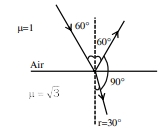
$A$ light ray falls on a glass surface of refractive index $\sqrt{3}$,at an angle of $60^{\circ}$. The angle between the refracted and reflected rays would be ....... $^o$.
A
$60$
B
$90$
C
$120$
D
$30$
Solution
(B) Method $(i)$:
Using Snell's law,$n_1 \sin i = n_2 \sin r$.
Given $n_1 = 1$ (air),$n_2 = \sqrt{3}$ (glass),and $i = 60^{\circ}$.
$1 \cdot \sin 60^{\circ} = \sqrt{3} \cdot \sin r$
$\frac{\sqrt{3}}{2} = \sqrt{3} \sin r$
$\sin r = \frac{1}{2} \implies r = 30^{\circ}$.
The angle between the reflected ray and the normal is $i = 60^{\circ}$.
The angle between the refracted ray and the normal is $r = 30^{\circ}$.
The angle between the reflected ray and the refracted ray is $180^{\circ} - (i + r) = 180^{\circ} - (60^{\circ} + 30^{\circ}) = 180^{\circ} - 90^{\circ} = 90^{\circ}$.
Method $(ii)$:
Since the angle of incidence $i = 60^{\circ}$ satisfies the condition for Brewster's angle,where $\tan i_p = \mu = \sqrt{3}$,it implies $i_p = 60^{\circ}$.
At Brewster's angle,the reflected and refracted rays are perpendicular to each other,so the angle between them is $90^{\circ}$.
Using Snell's law,$n_1 \sin i = n_2 \sin r$.
Given $n_1 = 1$ (air),$n_2 = \sqrt{3}$ (glass),and $i = 60^{\circ}$.
$1 \cdot \sin 60^{\circ} = \sqrt{3} \cdot \sin r$
$\frac{\sqrt{3}}{2} = \sqrt{3} \sin r$
$\sin r = \frac{1}{2} \implies r = 30^{\circ}$.
The angle between the reflected ray and the normal is $i = 60^{\circ}$.
The angle between the refracted ray and the normal is $r = 30^{\circ}$.
The angle between the reflected ray and the refracted ray is $180^{\circ} - (i + r) = 180^{\circ} - (60^{\circ} + 30^{\circ}) = 180^{\circ} - 90^{\circ} = 90^{\circ}$.
Method $(ii)$:
Since the angle of incidence $i = 60^{\circ}$ satisfies the condition for Brewster's angle,where $\tan i_p = \mu = \sqrt{3}$,it implies $i_p = 60^{\circ}$.
At Brewster's angle,the reflected and refracted rays are perpendicular to each other,so the angle between them is $90^{\circ}$.
0 likesView Solution
47
PhysicsEasyMCQNEET · 2022
The energy that will be ideally radiated by a $100\,kW$ transmitter in $1$ hour is:
A
$36 \times 10^{4}\,J$
B
$36 \times 10^{5}\,J$
C
$1 \times 10^{5}\,J$
D
$36 \times 10^{7}\,J$
Solution
(D) The power $P$ of the transmitter is $100\,kW = 100 \times 10^{3}\,W = 10^{5}\,W$.
The time $t$ is $1\,hour = 3600\,s$.
The energy $E$ radiated is given by the formula $E = P \times t$.
Substituting the values, we get $E = 10^{5}\,W \times 3600\,s$.
$E = 3600 \times 10^{5}\,J = 36 \times 10^{7}\,J$.
The time $t$ is $1\,hour = 3600\,s$.
The energy $E$ radiated is given by the formula $E = P \times t$.
Substituting the values, we get $E = 10^{5}\,W \times 3600\,s$.
$E = 3600 \times 10^{5}\,J = 36 \times 10^{7}\,J$.
0 likesView Solution
48
PhysicsMediumMCQNEET · 2022
The dimensions $[MLT^{-2}A^{-2}]$ belong to:
A
self inductance
B
magnetic permeability
C
electric permittivity
D
magnetic flux
Solution
(B) The magnetic force on a current-carrying conductor is given by $F = BIl \sin \theta$. Thus,the magnetic field $B = F / (Il)$.
The dimensions of force $F$ are $[MLT^{-2}]$.
The dimensions of current $I$ are $[A]$.
The dimensions of length $l$ are $[L]$.
Therefore,the dimensions of $B$ are $[MLT^{-2}] / ([A][L]) = [MT^{-2}A^{-1}]$.
The magnetic permeability $\mu$ is related to $B$ and $H$ by $B = \mu H$,where $H$ has dimensions $[IL^{-1}] = [AL^{-1}]$.
Thus,$\mu = B / H = [MT^{-2}A^{-1}] / [AL^{-1}] = [MLT^{-2}A^{-2}]$.
Hence,the dimensions $[MLT^{-2}A^{-2}]$ correspond to magnetic permeability.
The dimensions of force $F$ are $[MLT^{-2}]$.
The dimensions of current $I$ are $[A]$.
The dimensions of length $l$ are $[L]$.
Therefore,the dimensions of $B$ are $[MLT^{-2}] / ([A][L]) = [MT^{-2}A^{-1}]$.
The magnetic permeability $\mu$ is related to $B$ and $H$ by $B = \mu H$,where $H$ has dimensions $[IL^{-1}] = [AL^{-1}]$.
Thus,$\mu = B / H = [MT^{-2}A^{-1}] / [AL^{-1}] = [MLT^{-2}A^{-2}]$.
Hence,the dimensions $[MLT^{-2}A^{-2}]$ correspond to magnetic permeability.
0 likesView Solution
49
PhysicsEasyMCQNEET · 2022
The peak voltage of the $ac$ source is equal to:
A
the $rms$ value of the $ac$ source
B
$\sqrt{2}$ times the $rms$ value of the $ac$ source
C
$\frac{1}{\sqrt{2}}$ times the $rms$ value of the $ac$ source
D
the value of voltage supplied to the circuit
Solution
(B) For an alternating current $(ac)$ source,the relationship between the peak voltage $(V_0)$ and the root mean square $(rms)$ voltage $(V_{rms})$ is given by the formula: $V_{rms} = \frac{V_0}{\sqrt{2}}$.
Rearranging this formula to solve for the peak voltage,we get: $V_0 = \sqrt{2} \times V_{rms}$.
Therefore,the peak voltage is $\sqrt{2}$ times the $rms$ value of the $ac$ source.
Rearranging this formula to solve for the peak voltage,we get: $V_0 = \sqrt{2} \times V_{rms}$.
Therefore,the peak voltage is $\sqrt{2}$ times the $rms$ value of the $ac$ source.
0 likesView Solution
50
PhysicsEasyMCQNEET · 2022
$A$ long solenoid of radius $1\,mm$ has $100$ turns per $mm$. If $1\,A$ current flows in the solenoid,the magnetic field strength at the centre of the solenoid is:
A
$12.56 \times 10^{-2}\,T$
B
$12.56 \times 10^{-4}\,T$
C
$6.28 \times 10^{-4}\,T$
D
$6.28 \times 10^{-2}\,T$
Solution
(A) The magnetic field $B$ at the centre of a long solenoid is given by the formula $B = \mu_0 n i$,where $n$ is the number of turns per unit length and $i$ is the current.
Given:
Number of turns per unit length $n = 100 \text{ turns/mm} = 100 \times 10^3 \text{ turns/m} = 10^5 \text{ turns/m}$.
Current $i = 1\,A$.
Permeability of free space $\mu_0 = 4\pi \times 10^{-7} \text{ T}\,\text{m/A}$.
Substituting the values:
$B = (4\pi \times 10^{-7}) \times (10^5) \times (1)$
$B = 4\pi \times 10^{-2} \text{ T}$
$B \approx 4 \times 3.14 \times 10^{-2} \text{ T} = 12.56 \times 10^{-2} \text{ T}$.
Given:
Number of turns per unit length $n = 100 \text{ turns/mm} = 100 \times 10^3 \text{ turns/m} = 10^5 \text{ turns/m}$.
Current $i = 1\,A$.
Permeability of free space $\mu_0 = 4\pi \times 10^{-7} \text{ T}\,\text{m/A}$.
Substituting the values:
$B = (4\pi \times 10^{-7}) \times (10^5) \times (1)$
$B = 4\pi \times 10^{-2} \text{ T}$
$B \approx 4 \times 3.14 \times 10^{-2} \text{ T} = 12.56 \times 10^{-2} \text{ T}$.
0 likesView Solution
51
PhysicsEasyMCQNEET · 2022
Match List-$I$ with List-$II$:
Choose the correct answer from the options given below:
| List-$I$ (Electromagnetic waves) | List-$II$ (Wavelength) |
| $(a)$ $AM$ radio waves | $(i)$ $10^{-10} \, m$ |
| $(b)$ Microwaves | $(ii)$ $10^{2} \, m$ |
| $(c)$ Infrared radiations | $(iii)$ $10^{-2} \, m$ |
| $(d)$ $X$-rays | $(iv)$ $10^{-4} \, m$ |
Choose the correct answer from the options given below:
A
$(a) - (iii), (b) - (ii), (c) - (i), (d) - (iv)$
B
$(a) - (iii), (b) - (iv), (c) - (ii), (d) - (i)$
C
$(a) - (ii), (b) - (iii), (c) - (iv), (d) - (i)$
D
$(a) - (iv), (b) - (iii), (c) - (ii), (d) - (i)$
Solution
(C) The electromagnetic spectrum classifies waves based on their wavelength range:
$(a)$ $AM$ radio waves have long wavelengths, typically around $10^{2} \, m$ (Matches with $ii$).
$(b)$ Microwaves have wavelengths in the range of $10^{-2} \, m$ (Matches with $iii$).
$(c)$ Infrared radiations have wavelengths around $10^{-4} \, m$ (Matches with $iv$).
$(d)$ $X$-rays have very short wavelengths, typically around $10^{-10} \, m$ (Matches with $i$).
Therefore, the correct matching is $(a) - (ii), (b) - (iii), (c) - (iv), (d) - (i)$.
$(a)$ $AM$ radio waves have long wavelengths, typically around $10^{2} \, m$ (Matches with $ii$).
$(b)$ Microwaves have wavelengths in the range of $10^{-2} \, m$ (Matches with $iii$).
$(c)$ Infrared radiations have wavelengths around $10^{-4} \, m$ (Matches with $iv$).
$(d)$ $X$-rays have very short wavelengths, typically around $10^{-10} \, m$ (Matches with $i$).
Therefore, the correct matching is $(a) - (ii), (b) - (iii), (c) - (iv), (d) - (i)$.
0 likesView Solution
52
PhysicsMediumMCQNEET · 2022
Two resistors of resistance $100\,\Omega$ and $200\,\Omega$ are connected in parallel in an electrical circuit. The ratio of the thermal energy developed in $100\,\Omega$ to that in $200\,\Omega$ in a given time is:
A
$2: 1$
B
$1: 4$
C
$4: 1$
D
$1: 2$
Solution
(A) Since both resistors are connected in parallel,the potential difference $(V)$ across both resistors is the same.
Thermal energy $(H)$ developed in a resistor is given by $H = \frac{V^2}{R} \times t$.
For a given time $(t)$ and constant potential difference $(V)$,the thermal energy is inversely proportional to the resistance: $H \propto \frac{1}{R}$.
Therefore,the ratio of thermal energy in $100\,\Omega$ $(H_1)$ to that in $200\,\Omega$ $(H_2)$ is:
$\frac{H_1}{H_2} = \frac{R_2}{R_1} = \frac{200\,\Omega}{100\,\Omega} = \frac{2}{1}$.
Thus,the ratio is $2: 1$.
Thermal energy $(H)$ developed in a resistor is given by $H = \frac{V^2}{R} \times t$.
For a given time $(t)$ and constant potential difference $(V)$,the thermal energy is inversely proportional to the resistance: $H \propto \frac{1}{R}$.
Therefore,the ratio of thermal energy in $100\,\Omega$ $(H_1)$ to that in $200\,\Omega$ $(H_2)$ is:
$\frac{H_1}{H_2} = \frac{R_2}{R_1} = \frac{200\,\Omega}{100\,\Omega} = \frac{2}{1}$.
Thus,the ratio is $2: 1$.
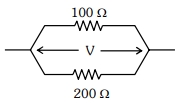
0 likesView Solution
53
PhysicsEasyMCQNEET · 2022
In half wave rectification,if the input frequency is $60\,Hz$,then the output frequency would be $\dots\dots\dots\,Hz$.
A
$30$
B
$60$
C
$120$
D
Zero
Solution
(B) In a half-wave rectifier,the diode conducts only during the positive half-cycle of the input $AC$ signal.
Therefore,the output signal consists of one pulse for every complete cycle of the input signal.
As a result,the frequency of the output signal is equal to the frequency of the input signal.
Given that the input frequency $f_{\text{in}} = 60\,Hz$,the output frequency $f_{\text{out}}$ will also be $60\,Hz$.
Therefore,the output signal consists of one pulse for every complete cycle of the input signal.
As a result,the frequency of the output signal is equal to the frequency of the input signal.
Given that the input frequency $f_{\text{in}} = 60\,Hz$,the output frequency $f_{\text{out}}$ will also be $60\,Hz$.
0 likesView Solution
54
PhysicsEasyMCQNEET · 2022
The angle between the electric lines of force and the equipotential surface is (in $^{\circ}$)
A
$45$
B
$90$
C
$180$
D
$0$
Solution
(B) The work done in moving a charge $q$ along an equipotential surface is zero because the potential difference between any two points on the surface is zero.
Work done $W = \int \vec{F} \cdot d\vec{l} = q \int \vec{E} \cdot d\vec{l} = 0$.
Since $q \neq 0$ and $d\vec{l} \neq 0$,it implies that $\vec{E} \cdot d\vec{l} = 0$.
This means the electric field vector $\vec{E}$ must be perpendicular to the displacement vector $d\vec{l}$ on the equipotential surface.
Therefore,the angle between the electric lines of force and the equipotential surface is $90^{\circ}$.
Work done $W = \int \vec{F} \cdot d\vec{l} = q \int \vec{E} \cdot d\vec{l} = 0$.
Since $q \neq 0$ and $d\vec{l} \neq 0$,it implies that $\vec{E} \cdot d\vec{l} = 0$.
This means the electric field vector $\vec{E}$ must be perpendicular to the displacement vector $d\vec{l}$ on the equipotential surface.
Therefore,the angle between the electric lines of force and the equipotential surface is $90^{\circ}$.
0 likesView Solution
55
PhysicsMediumMCQNEET · 2022
When two monochromatic lights of frequency $v$ and $\frac{v}{2}$ are incident on a photoelectric metal,their stopping potentials are $\frac{V_{s}}{2}$ and $V_{s}$ respectively. The threshold frequency for this metal is:
A
$3v$
B
$\frac{2}{3}v$
C
$\frac{3}{2}v$
D
$2v$
Solution
(C) According to Einstein's photoelectric equation,the stopping potential $V_s$ is given by $eV_s = h\nu - h\nu_0$,where $\nu_0$ is the threshold frequency.
For frequency $\nu$,the stopping potential is $\frac{V_s}{2}$. Thus,$e(\frac{V_s}{2}) = h\nu - h\nu_0$ --- $(1)$
For frequency $\frac{\nu}{2}$,the stopping potential is $V_s$. Thus,$eV_s = h(\frac{\nu}{2}) - h\nu_0$ --- $(2)$
From equation $(2)$,we have $eV_s = \frac{h\nu}{2} - h\nu_0$. Substituting this into equation $(1)$:
$\frac{1}{2}(\frac{h\nu}{2} - h\nu_0) = h\nu - h\nu_0$
$\frac{h\nu}{4} - \frac{h\nu_0}{2} = h\nu - h\nu_0$
$h\nu_0 - \frac{h\nu_0}{2} = h\nu - \frac{h\nu}{4}$
$\frac{h\nu_0}{2} = \frac{3h\nu}{4}$
$\nu_0 = \frac{3}{2}\nu$.
For frequency $\nu$,the stopping potential is $\frac{V_s}{2}$. Thus,$e(\frac{V_s}{2}) = h\nu - h\nu_0$ --- $(1)$
For frequency $\frac{\nu}{2}$,the stopping potential is $V_s$. Thus,$eV_s = h(\frac{\nu}{2}) - h\nu_0$ --- $(2)$
From equation $(2)$,we have $eV_s = \frac{h\nu}{2} - h\nu_0$. Substituting this into equation $(1)$:
$\frac{1}{2}(\frac{h\nu}{2} - h\nu_0) = h\nu - h\nu_0$
$\frac{h\nu}{4} - \frac{h\nu_0}{2} = h\nu - h\nu_0$
$h\nu_0 - \frac{h\nu_0}{2} = h\nu - \frac{h\nu}{4}$
$\frac{h\nu_0}{2} = \frac{3h\nu}{4}$
$\nu_0 = \frac{3}{2}\nu$.
0 likesView Solution
56
PhysicsMediumMCQNEET · 2022
$A$ square loop of side $1\,m$ and resistance $1\,\Omega$ is placed in a magnetic field of $0.5\,T$. If the plane of the loop is perpendicular to the direction of the magnetic field,the magnetic flux through the loop is $\dots\dots$ weber.
A
$0.5$
B
$1$
C
zero
D
$2$
Solution
(A) Given:
Side length of the square loop,$l = 1\,m$.
Area of the loop,$A = l^2 = (1\,m)^2 = 1\,m^2$.
Magnetic field,$B = 0.5\,T$.
The plane of the loop is perpendicular to the magnetic field,which means the area vector $\overrightarrow{A}$ is parallel to the magnetic field vector $\overrightarrow{B}$.
Therefore,the angle $\theta$ between $\overrightarrow{B}$ and $\overrightarrow{A}$ is $0^\circ$.
The magnetic flux $\phi$ is given by the formula:
$\phi = B A \cos\theta$
Substituting the values:
$\phi = 0.5 \times 1 \times \cos(0^\circ)$
Since $\cos(0^\circ) = 1$,
$\phi = 0.5 \times 1 \times 1 = 0.5\,Wb$.
Side length of the square loop,$l = 1\,m$.
Area of the loop,$A = l^2 = (1\,m)^2 = 1\,m^2$.
Magnetic field,$B = 0.5\,T$.
The plane of the loop is perpendicular to the magnetic field,which means the area vector $\overrightarrow{A}$ is parallel to the magnetic field vector $\overrightarrow{B}$.
Therefore,the angle $\theta$ between $\overrightarrow{B}$ and $\overrightarrow{A}$ is $0^\circ$.
The magnetic flux $\phi$ is given by the formula:
$\phi = B A \cos\theta$
Substituting the values:
$\phi = 0.5 \times 1 \times \cos(0^\circ)$
Since $\cos(0^\circ) = 1$,
$\phi = 0.5 \times 1 \times 1 = 0.5\,Wb$.
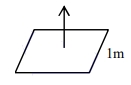
0 likesView Solution
57
PhysicsEasyMCQNEET · 2022
Let $T_{1}$ and $T_{2}$ be the energy of an electron in the first and second excited states of a hydrogen atom,respectively. According to the Bohr's model of an atom,the ratio $T_{1}: T_{2}$ is
A
$4: 1$
B
$4: 9$
C
$9: 4$
D
$1: 4$
Solution
(C) The energy of an electron in the $n^{th}$ orbit of a hydrogen atom is given by $E_n = -\frac{13.6}{n^2} \text{ eV}$.
The first excited state corresponds to $n = 2$.
Therefore,$T_1 = -\frac{13.6}{2^2} = -\frac{13.6}{4} \text{ eV}$.
The second excited state corresponds to $n = 3$.
Therefore,$T_2 = -\frac{13.6}{3^2} = -\frac{13.6}{9} \text{ eV}$.
The ratio $T_1 : T_2$ is calculated as:
$\frac{T_1}{T_2} = \frac{-13.6/4}{-13.6/9} = \frac{9}{4}$.
Thus,the ratio is $9:4$.
The first excited state corresponds to $n = 2$.
Therefore,$T_1 = -\frac{13.6}{2^2} = -\frac{13.6}{4} \text{ eV}$.
The second excited state corresponds to $n = 3$.
Therefore,$T_2 = -\frac{13.6}{3^2} = -\frac{13.6}{9} \text{ eV}$.
The ratio $T_1 : T_2$ is calculated as:
$\frac{T_1}{T_2} = \frac{-13.6/4}{-13.6/9} = \frac{9}{4}$.
Thus,the ratio is $9:4$.
1 likesView Solution
58
PhysicsEasyMCQNEET · 2022
The graph which shows the variation of the de Broglie wavelength $(\lambda)$ of a particle and its associated momentum $(p)$ is
A
B
C
D
Solution
(C) According to the de Broglie hypothesis,the wavelength $(\lambda)$ associated with a particle of momentum $(p)$ is given by the relation: $\lambda = \frac{h}{p}$,where $h$ is Planck's constant.
This equation shows that $\lambda$ is inversely proportional to $p$ (i.e.,$\lambda \propto \frac{1}{p}$).
As the momentum $(p)$ increases,the de Broglie wavelength $(\lambda)$ decreases.
This relationship represents a rectangular hyperbola,which is correctly depicted in option $C$.
This equation shows that $\lambda$ is inversely proportional to $p$ (i.e.,$\lambda \propto \frac{1}{p}$).
As the momentum $(p)$ increases,the de Broglie wavelength $(\lambda)$ decreases.
This relationship represents a rectangular hyperbola,which is correctly depicted in option $C$.

0 likesView Solution
59
PhysicsMediumMCQNEET · 2022
In a Young's double slit experiment,a student observes $8$ fringes in a certain segment of the screen when a monochromatic light of $600 \ nm$ wavelength is used. If the wavelength of light is changed to $400 \ nm$,then the number of fringes he would observe in the same region of the screen is:
A
$8$
B
$9$
C
$12$
D
$6$
Solution
(C) The width of the segment on the screen is given by $y = n \beta$,where $\beta = \frac{\lambda D}{d}$ is the fringe width.
Thus,$y = n \lambda \left(\frac{D}{d}\right)$.
Since the segment length $y$ and the experimental setup parameters $D$ and $d$ remain constant,we have $n_1 \lambda_1 = n_2 \lambda_2$.
Given $n_1 = 8$,$\lambda_1 = 600 \ nm$,and $\lambda_2 = 400 \ nm$.
Substituting the values: $8 \times 600 = n_2 \times 400$.
$n_2 = \frac{8 \times 600}{400} = \frac{4800}{400} = 12$.
Therefore,the student will observe $12$ fringes.
Thus,$y = n \lambda \left(\frac{D}{d}\right)$.
Since the segment length $y$ and the experimental setup parameters $D$ and $d$ remain constant,we have $n_1 \lambda_1 = n_2 \lambda_2$.
Given $n_1 = 8$,$\lambda_1 = 600 \ nm$,and $\lambda_2 = 400 \ nm$.
Substituting the values: $8 \times 600 = n_2 \times 400$.
$n_2 = \frac{8 \times 600}{400} = \frac{4800}{400} = 12$.
Therefore,the student will observe $12$ fringes.
0 likesView Solution
60
PhysicsEasyMCQNEET · 2022
In the given nuclear reaction,the element $X$ is:
${ }_{11}^{22} Na \rightarrow X + e ^{+} + \nu$
${ }_{11}^{22} Na \rightarrow X + e ^{+} + \nu$
A
${ }_{10}^{23} Ne$
B
${ }_{10}^{22} Ne$
C
${ }_{12}^{22} Mg$
D
${ }_{11}^{23} Na$
Solution
(B) The given reaction is ${ }_{11}^{22} Na \rightarrow X + e ^{+} + \nu$.
This represents a $\beta^{+}$ decay (positron emission).
In $\beta^{+}$ decay,the atomic number $Z$ decreases by $1$ while the mass number $A$ remains constant.
For the parent nucleus ${ }_{11}^{22} Na$,the atomic number $Z = 11$ and the mass number $A = 22$.
After emitting a positron $(e^{+})$,the new atomic number $Z' = 11 - 1 = 10$.
The mass number remains $A' = 22$.
The element with atomic number $10$ is Neon $(Ne)$.
Therefore,the reaction is ${ }_{11}^{22} Na \rightarrow { }_{10}^{22} Ne + e ^{+} + \nu$.
Thus,$X$ is ${ }_{10}^{22} Ne$.
This represents a $\beta^{+}$ decay (positron emission).
In $\beta^{+}$ decay,the atomic number $Z$ decreases by $1$ while the mass number $A$ remains constant.
For the parent nucleus ${ }_{11}^{22} Na$,the atomic number $Z = 11$ and the mass number $A = 22$.
After emitting a positron $(e^{+})$,the new atomic number $Z' = 11 - 1 = 10$.
The mass number remains $A' = 22$.
The element with atomic number $10$ is Neon $(Ne)$.
Therefore,the reaction is ${ }_{11}^{22} Na \rightarrow { }_{10}^{22} Ne + e ^{+} + \nu$.
Thus,$X$ is ${ }_{10}^{22} Ne$.
0 likesView Solution
61
PhysicsMediumMCQNEET · 2022
$A$ copper wire of length $10 \, m$ and radius $(10^{-2} / \sqrt{\pi}) \, m$ has an electrical resistance of $10 \, \Omega$. The current density in the wire for an electric field strength of $10 \, V/m$ is:
A
$10^{6} \, A/m^{2}$
B
$10^{-5} \, A/m^{2}$
C
$10^{5} \, A/m^{2}$
D
$10^{4} \, A/m^{2}$
Solution
(C) Given: Length $L = 10 \, m$,Radius $r = \frac{10^{-2}}{\sqrt{\pi}} \, m$,Resistance $R = 10 \, \Omega$,Electric field $E = 10 \, V/m$.
First,calculate the cross-sectional area $A$:
$A = \pi r^{2} = \pi \left( \frac{10^{-2}}{\sqrt{\pi}} \right)^{2} = \pi \cdot \frac{10^{-4}}{\pi} = 10^{-4} \, m^{2}$.
We know that current density $J = \sigma E$,where $\sigma$ is conductivity.
Since $\sigma = \frac{1}{\rho}$ and $R = \rho \frac{L}{A}$,we have $\rho = \frac{RA}{L}$.
Thus,$\sigma = \frac{L}{RA}$.
Substituting this into the expression for $J$:
$J = \left( \frac{L}{RA} \right) E = \frac{E \cdot L}{R \cdot A}$.
Plugging in the values:
$J = \frac{10 \times 10}{10 \times 10^{-4}} = \frac{100}{10^{-3}} = 10^{5} \, A/m^{2}$.
First,calculate the cross-sectional area $A$:
$A = \pi r^{2} = \pi \left( \frac{10^{-2}}{\sqrt{\pi}} \right)^{2} = \pi \cdot \frac{10^{-4}}{\pi} = 10^{-4} \, m^{2}$.
We know that current density $J = \sigma E$,where $\sigma$ is conductivity.
Since $\sigma = \frac{1}{\rho}$ and $R = \rho \frac{L}{A}$,we have $\rho = \frac{RA}{L}$.
Thus,$\sigma = \frac{L}{RA}$.
Substituting this into the expression for $J$:
$J = \left( \frac{L}{RA} \right) E = \frac{E \cdot L}{R \cdot A}$.
Plugging in the values:
$J = \frac{10 \times 10}{10 \times 10^{-4}} = \frac{100}{10^{-3}} = 10^{5} \, A/m^{2}$.
0 likesView Solution
62
PhysicsMediumMCQNEET · 2022
When light propagates through a material medium of relative permittivity $\varepsilon_{r}$ and relative permeability $\mu_{r}$,the velocity of light,$v$,is given by: ($c$ = velocity of light in vacuum)
A
$v=\sqrt{\frac{\mu_{r}}{\varepsilon_{r}}}$
B
$v=\sqrt{\frac{\varepsilon_{r}}{\mu_{r}}}$
C
$v=\frac{c}{\sqrt{\varepsilon_{r}\mu_{r}}}$
D
$v=c$
Solution
(C) The refractive index $n$ of a medium is related to its relative permittivity $\varepsilon_{r}$ and relative permeability $\mu_{r}$ by the formula: $n = \sqrt{\varepsilon_{r}\mu_{r}}$.
Since the refractive index is defined as the ratio of the speed of light in vacuum $c$ to the speed of light in the medium $v$,we have $n = \frac{c}{v}$.
Rearranging this for $v$,we get $v = \frac{c}{n}$.
Substituting the expression for $n$,we obtain the velocity of light in the medium as $v = \frac{c}{\sqrt{\varepsilon_{r}\mu_{r}}}$.
Since the refractive index is defined as the ratio of the speed of light in vacuum $c$ to the speed of light in the medium $v$,we have $n = \frac{c}{v}$.
Rearranging this for $v$,we get $v = \frac{c}{n}$.
Substituting the expression for $n$,we obtain the velocity of light in the medium as $v = \frac{c}{\sqrt{\varepsilon_{r}\mu_{r}}}$.
0 likesView Solution
63
PhysicsMediumMCQNEET · 2022
From Ampere's circuital law for a long straight wire of circular cross-section carrying a steady current,the variation of magnetic field in the inside and outside region of the wire is :
A
a linearly increasing function of distance up to the boundary of the wire and then linearly decreasing for the outside region.
B
a linearly increasing function of distance $r$ up to the boundary of the wire and then decreasing one with $1/r$ dependence for the outside region.
C
a linearly decreasing function of distance up to the boundary of the wire and then a linearly increasing one for the outside region.
D
uniform and remains constant for both the regions.
Solution
(B) According to Ampere's circuital law,for a long straight wire of radius $R$ carrying a steady current $I$:
$1$. Inside the wire $(r < R)$: The magnetic field $B$ is given by $B = \frac{\mu_0 I r}{2 \pi R^2}$. Thus,$B \propto r$,which means the magnetic field increases linearly with distance $r$ from the center.
$2$. Outside the wire $(r > R)$: The magnetic field $B$ is given by $B = \frac{\mu_0 I}{2 \pi r}$. Thus,$B \propto 1/r$,which means the magnetic field decreases as $1/r$ with distance $r$ from the center.
Therefore,the magnetic field increases linearly up to the boundary $(r = R)$ and then decreases as $1/r$ for the outside region.
$1$. Inside the wire $(r < R)$: The magnetic field $B$ is given by $B = \frac{\mu_0 I r}{2 \pi R^2}$. Thus,$B \propto r$,which means the magnetic field increases linearly with distance $r$ from the center.
$2$. Outside the wire $(r > R)$: The magnetic field $B$ is given by $B = \frac{\mu_0 I}{2 \pi r}$. Thus,$B \propto 1/r$,which means the magnetic field decreases as $1/r$ with distance $r$ from the center.
Therefore,the magnetic field increases linearly up to the boundary $(r = R)$ and then decreases as $1/r$ for the outside region.
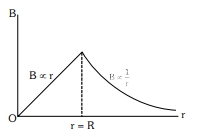
0 likesView Solution
64
PhysicsMediumMCQNEET · 2022
$A$ series $LCR$ circuit with inductance $L = 10\,H$,capacitance $C = 10\,\mu F$,and resistance $R = 50\,\Omega$ is connected to an $AC$ source of voltage $V = 200 \sin(100t)\,V$. If the resonant frequency of the $LCR$ circuit is $\nu_{0}$ and the frequency of the $AC$ source is $\nu$,then:
A
$\nu_{0} = \nu = \frac{50}{\pi}\,Hz$
B
$\nu_{0} = \frac{50}{\pi}\,Hz, \nu = 50\,Hz$
C
$\nu = 100\,Hz; \nu_{0} = \frac{100}{\pi}\,Hz$
D
$\nu_{0} = \nu = 50\,Hz$
Solution
(A) Given: $L = 10\,H$,$C = 10 \times 10^{-6}\,F$,$R = 50\,\Omega$,and $V = 200 \sin(100t)$.
Comparing with $V = V_{m} \sin(\omega t)$,we get angular frequency $\omega = 100\,rad/s$.
The frequency of the $AC$ source is $\nu = \frac{\omega}{2\pi} = \frac{100}{2\pi} = \frac{50}{\pi}\,Hz$.
The resonant frequency $\nu_{0}$ of the $LCR$ circuit is given by $\nu_{0} = \frac{1}{2\pi\sqrt{LC}}$.
Substituting the values: $\nu_{0} = \frac{1}{2\pi\sqrt{10 \times 10 \times 10^{-6}}} = \frac{1}{2\pi\sqrt{10^{-4}}} = \frac{1}{2\pi \times 10^{-2}} = \frac{100}{2\pi} = \frac{50}{\pi}\,Hz$.
Thus,$\nu_{0} = \nu = \frac{50}{\pi}\,Hz$.
Comparing with $V = V_{m} \sin(\omega t)$,we get angular frequency $\omega = 100\,rad/s$.
The frequency of the $AC$ source is $\nu = \frac{\omega}{2\pi} = \frac{100}{2\pi} = \frac{50}{\pi}\,Hz$.
The resonant frequency $\nu_{0}$ of the $LCR$ circuit is given by $\nu_{0} = \frac{1}{2\pi\sqrt{LC}}$.
Substituting the values: $\nu_{0} = \frac{1}{2\pi\sqrt{10 \times 10 \times 10^{-6}}} = \frac{1}{2\pi\sqrt{10^{-4}}} = \frac{1}{2\pi \times 10^{-2}} = \frac{100}{2\pi} = \frac{50}{\pi}\,Hz$.
Thus,$\nu_{0} = \nu = \frac{50}{\pi}\,Hz$.
0 likesView Solution
65
PhysicsMediumMCQNEET · 2022
The truth table for the given logic circuit is:
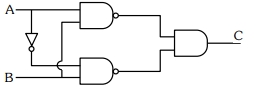
A
| $A$ | $B$ | $C$ |
| $0$ | $0$ | $0$ |
| $0$ | $1$ | $0$ |
| $1$ | $0$ | $0$ |
| $1$ | $1$ | $1$ |
B
| $A$ | $B$ | $C$ |
| $0$ | $0$ | $1$ |
| $0$ | $1$ | $0$ |
| $1$ | $0$ | $1$ |
| $1$ | $1$ | $0$ |
C
| $A$ | $B$ | $C$ |
| $0$ | $0$ | $0$ |
| $0$ | $1$ | $0$ |
| $1$ | $0$ | $0$ |
| $1$ | $1$ | $1$ |
D
| $A$ | $B$ | $C$ |
| $0$ | $0$ | $0$ |
| $0$ | $1$ | $1$ |
| $1$ | $0$ | $1$ |
| $1$ | $1$ | $0$ |
Solution
(B) The circuit consists of two $NAND$ gates whose outputs are fed into an $AND$ gate. Let the inputs be $A$ and $B$. The upper $NAND$ gate receives inputs $A$ and $B$,so its output is $\overline{A \cdot B}$. The lower $NAND$ gate receives inputs $\bar{A}$ (from the $NOT$ gate) and $B$,so its output is $\overline{\bar{A} \cdot B}$. The final output $C$ is the $AND$ operation of these two outputs: $C = (\overline{A \cdot B}) \cdot (\overline{\bar{A} \cdot B})$.
Using De Morgan's theorem,$\overline{A \cdot B} = \bar{A} + \bar{B}$ and $\overline{\bar{A} \cdot B} = A + \bar{B}$.
Thus,$C = (\bar{A} + \bar{B}) \cdot (A + \bar{B})$.
Using the distributive law,$C = \bar{A}A + \bar{A}\bar{B} + \bar{B}A + \bar{B}\bar{B}$.
Since $\bar{A}A = 0$ and $\bar{B}\bar{B} = \bar{B}$,we get $C = 0 + \bar{B}(\bar{A} + A) + \bar{B} = \bar{B}(1) + \bar{B} = \bar{B} + \bar{B} = \bar{B}$.
Therefore,the output $C$ is the $NOT$ of $B$ $(\bar{B})$.
| $A$ | $B$ | $C$ |
|---|---|---|
| $0$ | $0$ | $1$ |
| $0$ | $1$ | $0$ |
| $1$ | $0$ | $1$ |
| $1$ | $1$ | $0$ |
Using De Morgan's theorem,$\overline{A \cdot B} = \bar{A} + \bar{B}$ and $\overline{\bar{A} \cdot B} = A + \bar{B}$.
Thus,$C = (\bar{A} + \bar{B}) \cdot (A + \bar{B})$.
Using the distributive law,$C = \bar{A}A + \bar{A}\bar{B} + \bar{B}A + \bar{B}\bar{B}$.
Since $\bar{A}A = 0$ and $\bar{B}\bar{B} = \bar{B}$,we get $C = 0 + \bar{B}(\bar{A} + A) + \bar{B} = \bar{B}(1) + \bar{B} = \bar{B} + \bar{B} = \bar{B}$.
Therefore,the output $C$ is the $NOT$ of $B$ $(\bar{B})$.
| $A$ | $B$ | $C$ |
|---|---|---|
| $0$ | $0$ | $1$ |
| $0$ | $1$ | $0$ |
| $1$ | $0$ | $1$ |
| $1$ | $1$ | $0$ |
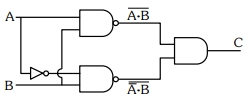
0 likesView Solution
66
PhysicsMediumMCQNEET · 2022
$A$ nucleus of mass number $189$ splits into two nuclei having mass numbers $125$ and $64$. The ratio of the radii of the two daughter nuclei is:
A
$4: 5$
B
$5: 4$
C
$25: 16$
D
$1: 1$
Solution
(B) The radius $R$ of a nucleus with mass number $A$ is given by the formula: $R = R_{0} A^{1/3}$, where $R_{0}$ is a constant.
For the two daughter nuclei with mass numbers $A_{1} = 125$ and $A_{2} = 64$, their radii $R_{1}$ and $R_{2}$ are:
$R_{1} = R_{0} (125)^{1/3} = R_{0} \times 5$
$R_{2} = R_{0} (64)^{1/3} = R_{0} \times 4$
The ratio of the radii is:
$\frac{R_{1}}{R_{2}} = \frac{R_{0} (125)^{1/3}}{R_{0} (64)^{1/3}} = \frac{5}{4}$
Thus, the ratio is $5: 4$.
For the two daughter nuclei with mass numbers $A_{1} = 125$ and $A_{2} = 64$, their radii $R_{1}$ and $R_{2}$ are:
$R_{1} = R_{0} (125)^{1/3} = R_{0} \times 5$
$R_{2} = R_{0} (64)^{1/3} = R_{0} \times 4$
The ratio of the radii is:
$\frac{R_{1}}{R_{2}} = \frac{R_{0} (125)^{1/3}}{R_{0} (64)^{1/3}} = \frac{5}{4}$
Thus, the ratio is $5: 4$.
0 likesView Solution
67
PhysicsMediumMCQNEET · 2022
$A$ Wheatstone bridge is used to determine the value of an unknown resistance $X$ by adjusting the variable resistance $Y$ as shown in the figure. For the most precise measurement of $X$,the resistances $P$ and $Q$:
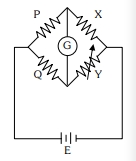
A
should be approximately equal and are small
B
should be very large and unequal
C
do not play any significant role
D
should be approximately equal to $2X$
Solution
(A) In a Wheatstone bridge,the condition for balance is given by $\frac{P}{Q} = \frac{X}{Y}$.
To achieve the most precise measurement of the unknown resistance $X$,the sensitivity of the bridge must be maximized.
The sensitivity of a Wheatstone bridge is maximum when all four resistances are of the same order of magnitude.
Specifically,if $P$ and $Q$ are approximately equal and small,the relative error in the measurement of $X$ is minimized,leading to the most precise result.
To achieve the most precise measurement of the unknown resistance $X$,the sensitivity of the bridge must be maximized.
The sensitivity of a Wheatstone bridge is maximum when all four resistances are of the same order of magnitude.
Specifically,if $P$ and $Q$ are approximately equal and small,the relative error in the measurement of $X$ is minimized,leading to the most precise result.
0 likesView Solution
68
PhysicsMediumMCQNEET · 2022
$A$ capacitor of capacitance $C = 900 \, pF$ is charged fully by a $100 \, V$ battery as shown in figure $(a)$. Then it is disconnected from the battery and connected to another uncharged capacitor of capacitance $C = 900 \, pF$ as shown in figure $(b)$. The electrostatic energy stored by the system in figure $(b)$ is $\dots \times 10^{-6} \, J$.
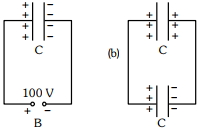
A
$3.25$
B
$2.25$
C
$1.5$
D
$4.5$
Solution
(B) $1$. Initial charge on the first capacitor: $Q = C V = 900 \times 10^{-12} \, F \times 100 \, V = 9 \times 10^{-8} \, C$.
$2$. When connected to an uncharged capacitor of the same capacitance $C$,the charge $Q$ is shared equally between the two capacitors because they are in parallel.
$3$. The common potential $V'$ is given by: $V' = \frac{Q_{total}}{C_{total}} = \frac{Q}{C + C} = \frac{9 \times 10^{-8} \, C}{1800 \times 10^{-12} \, F} = 50 \, V$.
$4$. The total electrostatic energy stored in the system is: $U = \frac{1}{2} (C + C) (V')^2 = \frac{1}{2} (1800 \times 10^{-12} \, F) (50 \, V)^2$.
$5$. $U = 900 \times 10^{-12} \times 2500 = 225 \times 10^{-8} \, J = 2.25 \times 10^{-6} \, J$.
$2$. When connected to an uncharged capacitor of the same capacitance $C$,the charge $Q$ is shared equally between the two capacitors because they are in parallel.
$3$. The common potential $V'$ is given by: $V' = \frac{Q_{total}}{C_{total}} = \frac{Q}{C + C} = \frac{9 \times 10^{-8} \, C}{1800 \times 10^{-12} \, F} = 50 \, V$.
$4$. The total electrostatic energy stored in the system is: $U = \frac{1}{2} (C + C) (V')^2 = \frac{1}{2} (1800 \times 10^{-12} \, F) (50 \, V)^2$.
$5$. $U = 900 \times 10^{-12} \times 2500 = 225 \times 10^{-8} \, J = 2.25 \times 10^{-6} \, J$.
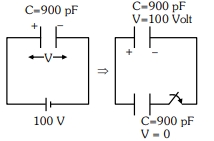
0 likesView Solution
69
PhysicsMediumMCQNEET · 2022
Two transparent media $A$ and $B$ are separated by a plane boundary. The speed of light in those media are $1.5 \times 10^{8} \ m/s$ and $2.0 \times 10^{8} \ m/s$,respectively. The critical angle for a ray of light for these two media is:
A
$\sin^{-1}(0.750)$
B
$\tan^{-1}(0.500)$
C
$\tan^{-1}(0.750)$
D
$\sin^{-1}(0.500)$
Solution
(A) The refractive index $\mu$ is inversely proportional to the speed of light $v$ in a medium,given by $\mu = \frac{c}{v}$,where $c$ is the speed of light in vacuum.
The critical angle $i_c$ for light traveling from a denser medium to a rarer medium is given by the formula $\sin i_c = \frac{\mu_R}{\mu_D}$,where $\mu_R$ is the refractive index of the rarer medium and $\mu_D$ is the refractive index of the denser medium.
Since $\mu \propto \frac{1}{v}$,we have $\frac{\mu_R}{\mu_D} = \frac{v_D}{v_R}$.
Given $v_A = 1.5 \times 10^8 \ m/s$ and $v_B = 2.0 \times 10^8 \ m/s$,medium $A$ is the denser medium $(D)$ and medium $B$ is the rarer medium $(R)$.
Therefore,$\sin i_c = \frac{v_A}{v_B} = \frac{1.5 \times 10^8}{2.0 \times 10^8} = \frac{1.5}{2.0} = \frac{3}{4} = 0.750$.
Thus,$i_c = \sin^{-1}(0.750)$.
The critical angle $i_c$ for light traveling from a denser medium to a rarer medium is given by the formula $\sin i_c = \frac{\mu_R}{\mu_D}$,where $\mu_R$ is the refractive index of the rarer medium and $\mu_D$ is the refractive index of the denser medium.
Since $\mu \propto \frac{1}{v}$,we have $\frac{\mu_R}{\mu_D} = \frac{v_D}{v_R}$.
Given $v_A = 1.5 \times 10^8 \ m/s$ and $v_B = 2.0 \times 10^8 \ m/s$,medium $A$ is the denser medium $(D)$ and medium $B$ is the rarer medium $(R)$.
Therefore,$\sin i_c = \frac{v_A}{v_B} = \frac{1.5 \times 10^8}{2.0 \times 10^8} = \frac{1.5}{2.0} = \frac{3}{4} = 0.750$.
Thus,$i_c = \sin^{-1}(0.750)$.
0 likesView Solution
70
PhysicsMediumMCQNEET · 2022
Two point charges $-q$ and $+q$ are placed at a distance of $L$,as shown in the figure. The magnitude of electric field intensity at a distance $R$ $(R \gg L)$ varies as:
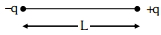
A
$1/R^3$
B
$1/R^4$
C
$1/R^6$
D
$1/R^2$
Solution
(A) The given system consists of two equal and opposite point charges separated by a small distance $L$,which forms an electric dipole.
For an electric dipole,the electric field intensity $E$ at a large distance $R$ $(R \gg L)$ from the center of the dipole is given by the general formula:
$E = \frac{1}{4\pi\epsilon_0} \frac{p}{R^3} \sqrt{1 + 3 \cos^2 \theta}$
where $p$ is the dipole moment and $\theta$ is the angle between the position vector and the dipole axis.
Since $p = qL$ is constant,we can observe that $E \propto \frac{1}{R^3}$.
Therefore,the magnitude of the electric field intensity varies as $1/R^3$.
For an electric dipole,the electric field intensity $E$ at a large distance $R$ $(R \gg L)$ from the center of the dipole is given by the general formula:
$E = \frac{1}{4\pi\epsilon_0} \frac{p}{R^3} \sqrt{1 + 3 \cos^2 \theta}$
where $p$ is the dipole moment and $\theta$ is the angle between the position vector and the dipole axis.
Since $p = qL$ is constant,we can observe that $E \propto \frac{1}{R^3}$.
Therefore,the magnitude of the electric field intensity varies as $1/R^3$.
0 likesView Solution
71
PhysicsMediumMCQNEET · 2022
$A$ big circular coil of $1000$ turns and average radius $10 \, m$ is rotating about its horizontal diameter at $2 \, rad \cdot s^{-1}$. If the vertical component of Earth's magnetic field at that place is $2 \times 10^{-5} \, T$ and the electrical resistance of the coil is $12.56 \, \Omega$,then the maximum induced current (in $A$) in the coil will be:
A
$1.5$
B
$1$
C
$2$
D
$0.25$
Solution
(B) The magnetic flux $\phi$ through the coil rotating in a magnetic field is given by $\phi = NBA \cos(\omega t)$.
The induced electromotive force $(EMF)$ is $E = -\frac{d\phi}{dt} = NBA\omega \sin(\omega t)$.
The maximum $EMF$ is $E_{\max} = NBA\omega$.
The maximum induced current is $i_{\max} = \frac{E_{\max}}{R} = \frac{NBA\omega}{R}$.
Given: $N = 1000$,$B = 2 \times 10^{-5} \, T$,$r = 10 \, m$,$\omega = 2 \, rad \cdot s^{-1}$,$R = 12.56 \, \Omega$.
Area $A = \pi r^2 = \pi (10)^2 = 100\pi \, m^2$.
Substituting the values:
$i_{\max} = \frac{1000 \times (2 \times 10^{-5}) \times (100\pi) \times 2}{12.56}$.
Since $100\pi \approx 314$,$i_{\max} = \frac{1000 \times 2 \times 10^{-5} \times 314 \times 2}{12.56} = \frac{12.56}{12.56} = 1 \, A$.
The induced electromotive force $(EMF)$ is $E = -\frac{d\phi}{dt} = NBA\omega \sin(\omega t)$.
The maximum $EMF$ is $E_{\max} = NBA\omega$.
The maximum induced current is $i_{\max} = \frac{E_{\max}}{R} = \frac{NBA\omega}{R}$.
Given: $N = 1000$,$B = 2 \times 10^{-5} \, T$,$r = 10 \, m$,$\omega = 2 \, rad \cdot s^{-1}$,$R = 12.56 \, \Omega$.
Area $A = \pi r^2 = \pi (10)^2 = 100\pi \, m^2$.
Substituting the values:
$i_{\max} = \frac{1000 \times (2 \times 10^{-5}) \times (100\pi) \times 2}{12.56}$.
Since $100\pi \approx 314$,$i_{\max} = \frac{1000 \times 2 \times 10^{-5} \times 314 \times 2}{12.56} = \frac{12.56}{12.56} = 1 \, A$.
0 likesView Solution
72
PhysicsMediumMCQNEET · 2022
The magnetic field of a plane electromagnetic wave is given by $\overrightarrow{B} = 3 \times 10^{-8} \cos (1.6 \times 10^3 x + 48 \times 10^{10} t) \hat{j} \text{ T}$. The associated electric field is:
A
$3 \times 10^{-8} \cos (1.6 \times 10^3 x + 48 \times 10^{10} t) \hat{i} \text{ V/m}$
B
$3 \times 10^{-8} \sin (1.6 \times 10^3 x + 48 \times 10^{10} t) \hat{i} \text{ V/m}$
C
$9 \sin (1.6 \times 10^3 x - 48 \times 10^{10} t) \hat{k} \text{ V/m}$
D
$9 \cos (1.6 \times 10^3 x + 48 \times 10^{10} t) \hat{k} \text{ V/m}$
Solution
(D) Given the magnetic field $\overrightarrow{B} = B_0 \cos(kx + \omega t) \hat{j}$,where $B_0 = 3 \times 10^{-8} \text{ T}$.
The relationship between the amplitude of the electric field $(E_0)$ and the magnetic field $(B_0)$ is $E_0 = c B_0$,where $c = 3 \times 10^8 \text{ m/s}$.
$E_0 = (3 \times 10^8 \text{ m/s}) \times (3 \times 10^{-8} \text{ T}) = 9 \text{ V/m}$.
The wave propagates in the negative $x$-direction (since the argument is $kx + \omega t$).
The direction of propagation is given by the direction of $\overrightarrow{E} \times \overrightarrow{B}$.
Since $\overrightarrow{B}$ is along $\hat{j}$ and the wave travels along $-\hat{i}$,we have $\hat{k} \times \hat{j} = -\hat{i}$.
Thus,the electric field must be along the $\hat{k}$ direction.
Therefore,$\overrightarrow{E} = 9 \cos (1.6 \times 10^3 x + 48 \times 10^{10} t) \hat{k} \text{ V/m}$.
The relationship between the amplitude of the electric field $(E_0)$ and the magnetic field $(B_0)$ is $E_0 = c B_0$,where $c = 3 \times 10^8 \text{ m/s}$.
$E_0 = (3 \times 10^8 \text{ m/s}) \times (3 \times 10^{-8} \text{ T}) = 9 \text{ V/m}$.
The wave propagates in the negative $x$-direction (since the argument is $kx + \omega t$).
The direction of propagation is given by the direction of $\overrightarrow{E} \times \overrightarrow{B}$.
Since $\overrightarrow{B}$ is along $\hat{j}$ and the wave travels along $-\hat{i}$,we have $\hat{k} \times \hat{j} = -\hat{i}$.
Thus,the electric field must be along the $\hat{k}$ direction.
Therefore,$\overrightarrow{E} = 9 \cos (1.6 \times 10^3 x + 48 \times 10^{10} t) \hat{k} \text{ V/m}$.
0 likesView Solution
73
PhysicsMediumMCQNEET · 2022
The incorrect statement about the property of a Zener diode is
A
Zener voltage remains constant at breakdown
B
It is designed to operate under reverse bias
C
Depletion region formed is very wide
D
$p$ and $n$ regions of Zener diode are heavily doped
Solution
(C) Zener diode is a special type of diode designed to operate reliably in the reverse breakdown region.
$1$. Doping: Zener diodes are heavily doped,which results in a very thin depletion region.
$2$. Depletion Region: Due to heavy doping,the depletion region is extremely thin (typically $10^{-6} \ m$),which allows for a high electric field even at low reverse voltages.
$3$. Operation: It is specifically designed to operate in the reverse bias region.
$4$. Voltage: Once the breakdown voltage is reached,the Zener voltage $(V_z)$ remains constant despite changes in the current.
Therefore,the statement that the depletion region is very wide is incorrect.
$1$. Doping: Zener diodes are heavily doped,which results in a very thin depletion region.
$2$. Depletion Region: Due to heavy doping,the depletion region is extremely thin (typically $10^{-6} \ m$),which allows for a high electric field even at low reverse voltages.
$3$. Operation: It is specifically designed to operate in the reverse bias region.
$4$. Voltage: Once the breakdown voltage is reached,the Zener voltage $(V_z)$ remains constant despite changes in the current.
Therefore,the statement that the depletion region is very wide is incorrect.
0 likesView Solution
74
PhysicsEasyMCQNEET · 2022
$A$ cell of $emf\;4\,V$ and internal resistance $0.5\,\Omega$ is connected to a $7.5\,\Omega$ external resistance. The terminal potential difference of the cell is $.....\,V$.
A
$3.75$
B
$4.25$
C
$4$
D
$0.375$
Solution
(A) Given:
$emf (E) = 4\,V$
Internal resistance $(r) = 0.5\,\Omega$
External resistance $(R) = 7.5\,\Omega$
First,calculate the current $(I)$ flowing through the circuit using Ohm's law:
$I = \frac{E}{R + r} = \frac{4}{7.5 + 0.5} = \frac{4}{8} = 0.5\,A$
The terminal potential difference $(V)$ is given by the formula:
$V = E - Ir$
$V = 4 - (0.5 \times 0.5)$
$V = 4 - 0.25$
$V = 3.75\,V$
Alternatively,$V = IR = 0.5 \times 7.5 = 3.75\,V$.
$emf (E) = 4\,V$
Internal resistance $(r) = 0.5\,\Omega$
External resistance $(R) = 7.5\,\Omega$
First,calculate the current $(I)$ flowing through the circuit using Ohm's law:
$I = \frac{E}{R + r} = \frac{4}{7.5 + 0.5} = \frac{4}{8} = 0.5\,A$
The terminal potential difference $(V)$ is given by the formula:
$V = E - Ir$
$V = 4 - (0.5 \times 0.5)$
$V = 4 - 0.25$
$V = 3.75\,V$
Alternatively,$V = IR = 0.5 \times 7.5 = 3.75\,V$.
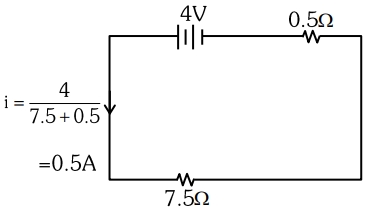
0 likesView Solution
75
PhysicsEasyMCQNEET · 2022
Given below are two statements:
Statement-$I$: In an $AC$ circuit,the current through a capacitor leads the voltage across it.
Statement-$II$: In $AC$ circuits containing pure capacitance only,the phase difference between the current and the voltage is $\pi$.
In the light of the above statements,choose the most appropriate answer from the options given below:
Statement-$I$: In an $AC$ circuit,the current through a capacitor leads the voltage across it.
Statement-$II$: In $AC$ circuits containing pure capacitance only,the phase difference between the current and the voltage is $\pi$.
In the light of the above statements,choose the most appropriate answer from the options given below:
A
Both statement-$I$ and statement-$II$ are correct.
B
Both statement-$I$ and statement-$II$ are incorrect.
C
Statement-$I$ is correct but statement-$II$ is incorrect.
D
Statement-$I$ is incorrect but statement-$II$ is correct.
Solution
(C) Statement-$I$: In a purely capacitive $AC$ circuit,the current leads the voltage by a phase angle of $\pi/2$ radians $(90^{\circ})$. Thus,statement-$I$ is correct.
Statement-$II$: In a purely capacitive $AC$ circuit,the phase difference between the current and the voltage is $\pi/2$,not $\pi$. Thus,statement-$II$ is incorrect.
Therefore,statement-$I$ is correct but statement-$II$ is incorrect.
Statement-$II$: In a purely capacitive $AC$ circuit,the phase difference between the current and the voltage is $\pi/2$,not $\pi$. Thus,statement-$II$ is incorrect.
Therefore,statement-$I$ is correct but statement-$II$ is incorrect.
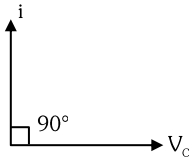
0 likesView Solution
76
PhysicsMediumMCQNEET · 2022
The equivalent resistance of the infinite network given below is:
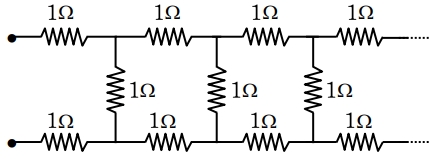
A
$2\,\Omega$
B
$(1+\sqrt{2})\,\Omega$
C
$(1+\sqrt{3})\,\Omega$
D
$(1+\sqrt{5})\,\Omega$
Solution
(C) Let the equivalent resistance of the infinite network be $x$.
Since the network is infinite,adding one more section to the front does not change the total resistance. Thus,the network can be represented as two $1\,\Omega$ resistors in series with the parallel combination of a $1\,\Omega$ resistor and the equivalent resistance $x$.
The equivalent resistance $x$ is given by:
$x = 1 + \left( \frac{1 \times x}{1 + x} \right) + 1$
$x = 2 + \frac{x}{1 + x}$
$x - 2 = \frac{x}{1 + x}$
$(x - 2)(x + 1) = x$
$x^2 + x - 2x - 2 = x$
$x^2 - 2x - 2 = 0$
Using the quadratic formula $x = \frac{-b \pm \sqrt{b^2 - 4ac}}{2a}$:
$x = \frac{2 \pm \sqrt{(-2)^2 - 4(1)(-2)}}{2(1)}$
$x = \frac{2 \pm \sqrt{4 + 8}}{2} = \frac{2 \pm \sqrt{12}}{2} = \frac{2 \pm 2\sqrt{3}}{2} = 1 \pm \sqrt{3}$
Since resistance cannot be negative,we take the positive value:
$x = (1 + \sqrt{3})\,\Omega$
Since the network is infinite,adding one more section to the front does not change the total resistance. Thus,the network can be represented as two $1\,\Omega$ resistors in series with the parallel combination of a $1\,\Omega$ resistor and the equivalent resistance $x$.
The equivalent resistance $x$ is given by:
$x = 1 + \left( \frac{1 \times x}{1 + x} \right) + 1$
$x = 2 + \frac{x}{1 + x}$
$x - 2 = \frac{x}{1 + x}$
$(x - 2)(x + 1) = x$
$x^2 + x - 2x - 2 = x$
$x^2 - 2x - 2 = 0$
Using the quadratic formula $x = \frac{-b \pm \sqrt{b^2 - 4ac}}{2a}$:
$x = \frac{2 \pm \sqrt{(-2)^2 - 4(1)(-2)}}{2(1)}$
$x = \frac{2 \pm \sqrt{4 + 8}}{2} = \frac{2 \pm \sqrt{12}}{2} = \frac{2 \pm 2\sqrt{3}}{2} = 1 \pm \sqrt{3}$
Since resistance cannot be negative,we take the positive value:
$x = (1 + \sqrt{3})\,\Omega$
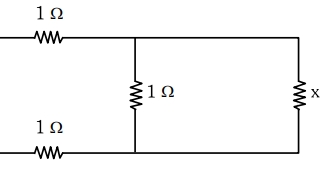
0 likesView Solution
77
PhysicsEasyMCQNEET · 2022
$A$ closely packed coil having $1000$ turns has an average radius of $62.8\,cm$. If the current carried by the wire of the coil is $1\,A$,the value of the magnetic field produced at the centre of the coil will be (permeability of free space $\mu_0 = 4\pi \times 10^{-7}\,T\cdot m/A$) nearly:
A
$10^{-1}\,T$
B
$10^{-2}\,T$
C
$10^{2}\,T$
D
$10^{-3}\,T$
Solution
(D) The magnetic field $B$ at the centre of a circular coil with $N$ turns,radius $R$,and current $I$ is given by the formula:
$B = \frac{\mu_0 NI}{2R}$
Given values:
$N = 1000$
$I = 1\,A$
$R = 62.8\,cm = 0.628\,m = 62.8 \times 10^{-2}\,m$
$\mu_0 = 4\pi \times 10^{-7}\,T\cdot m/A$
Substituting the values into the formula:
$B = \frac{4 \times 3.14 \times 10^{-7} \times 1000 \times 1}{2 \times 62.8 \times 10^{-2}}$
$B = \frac{12.56 \times 10^{-4}}{125.6 \times 10^{-2}}$
$B = \frac{12.56 \times 10^{-4}}{1.256}$
$B = 10 \times 10^{-4} = 10^{-3}\,T$
Thus,the magnetic field produced at the centre of the coil is $10^{-3}\,T$.
$B = \frac{\mu_0 NI}{2R}$
Given values:
$N = 1000$
$I = 1\,A$
$R = 62.8\,cm = 0.628\,m = 62.8 \times 10^{-2}\,m$
$\mu_0 = 4\pi \times 10^{-7}\,T\cdot m/A$
Substituting the values into the formula:
$B = \frac{4 \times 3.14 \times 10^{-7} \times 1000 \times 1}{2 \times 62.8 \times 10^{-2}}$
$B = \frac{12.56 \times 10^{-4}}{125.6 \times 10^{-2}}$
$B = \frac{12.56 \times 10^{-4}}{1.256}$
$B = 10 \times 10^{-4} = 10^{-3}\,T$
Thus,the magnetic field produced at the centre of the coil is $10^{-3}\,T$.
0 likesView Solution
78
PhysicsMediumMCQNEET · 2022
An inductor of inductance $2 \, mH$ is connected to a $220 \, V, 50 \, Hz$ $AC$ source. Let the inductive reactance in the circuit be $X_1$. If a $220 \, V$ $DC$ source replaces the $AC$ source in the circuit,then the inductive reactance in the circuit is $X_2$. $X_1$ and $X_2$ respectively are:
A
$6.28 \, \Omega$,zero
B
$6.28 \, \Omega$,infinity
C
$0.628 \, \Omega$,zero
D
$0.628 \, \Omega$,infinity
Solution
(C) For an $AC$ source,the inductive reactance is given by $X_L = \omega L = 2 \pi f L$.
Given $L = 2 \, mH = 2 \times 10^{-3} \, H$ and $f = 50 \, Hz$.
$X_1 = 2 \times \pi \times 50 \times 2 \times 10^{-3} = 100 \pi \times 2 \times 10^{-3} = 0.2 \pi \, \Omega$.
Using $\pi \approx 3.14$,we get $X_1 = 0.2 \times 3.14 = 0.628 \, \Omega$.
For a $DC$ source,the frequency $f = 0$,so the angular frequency $\omega = 2 \pi f = 0$.
The inductive reactance $X_2 = \omega L = 0 \times L = 0 \, \Omega$.
Thus,$X_1 = 0.628 \, \Omega$ and $X_2 = 0$.
Given $L = 2 \, mH = 2 \times 10^{-3} \, H$ and $f = 50 \, Hz$.
$X_1 = 2 \times \pi \times 50 \times 2 \times 10^{-3} = 100 \pi \times 2 \times 10^{-3} = 0.2 \pi \, \Omega$.
Using $\pi \approx 3.14$,we get $X_1 = 0.2 \times 3.14 = 0.628 \, \Omega$.
For a $DC$ source,the frequency $f = 0$,so the angular frequency $\omega = 2 \pi f = 0$.
The inductive reactance $X_2 = \omega L = 0 \times L = 0 \, \Omega$.
Thus,$X_1 = 0.628 \, \Omega$ and $X_2 = 0$.
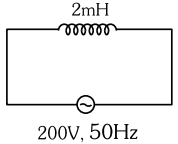
0 likesView Solution
79
PhysicsEasyMCQNEET · 2022
During a cloudy day,a primary and a secondary rainbow may be created,then the:
A
primary rainbow is due to double internal reflection and is formed above the secondary one.
B
primary rainbow is due to double internal reflection and is formed below the secondary one.
C
secondary rainbow is due to double internal reflection and is formed above the primary one.
D
secondary rainbow is due to single internal reflection and is formed above the primary one.
Solution
(C) primary rainbow is formed by a single internal reflection of sunlight within the raindrops,and it appears at an angular range of $40^{\circ}$ to $42^{\circ}$.
$A$ secondary rainbow is formed by two internal reflections of sunlight within the raindrops,and it appears at an angular range of $51^{\circ}$ to $54^{\circ}$.
Because the secondary rainbow has a larger angular radius,it is always formed above the primary rainbow.
$A$ secondary rainbow is formed by two internal reflections of sunlight within the raindrops,and it appears at an angular range of $51^{\circ}$ to $54^{\circ}$.
Because the secondary rainbow has a larger angular radius,it is always formed above the primary rainbow.
0 likesView Solution
80
PhysicsEasyMCQNEET · 2022
The light rays having photons of energy $4.2\,eV$ are falling on a metal surface having a work function of $2.2\,eV$. The stopping potential of the surface is $.........\,V$.
A
$20$
B
$2$
C
$1.1$
D
$6.4$
Solution
(B) According to Einstein's photoelectric equation,the maximum kinetic energy $(KE_{max})$ of the emitted photoelectrons is given by:
$KE_{max} = h\nu - \phi$
Where $h\nu$ is the energy of the incident photon and $\phi$ is the work function of the metal.
Given:
Energy of incident photon $(h\nu)$ = $4.2\,eV$
Work function $(\phi)$ = $2.2\,eV$
We know that the maximum kinetic energy is related to the stopping potential $(V_0)$ by the equation:
$KE_{max} = eV_0$
Substituting the values:
$eV_0 = 4.2\,eV - 2.2\,eV$
$eV_0 = 2.0\,eV$
Therefore,the stopping potential $V_0 = 2\,V$.
$KE_{max} = h\nu - \phi$
Where $h\nu$ is the energy of the incident photon and $\phi$ is the work function of the metal.
Given:
Energy of incident photon $(h\nu)$ = $4.2\,eV$
Work function $(\phi)$ = $2.2\,eV$
We know that the maximum kinetic energy is related to the stopping potential $(V_0)$ by the equation:
$KE_{max} = eV_0$
Substituting the values:
$eV_0 = 4.2\,eV - 2.2\,eV$
$eV_0 = 2.0\,eV$
Therefore,the stopping potential $V_0 = 2\,V$.
2 likesView Solution
81
PhysicsMediumMCQNEET · 2022
Identify the equivalent logic gate represented by the given circuit.
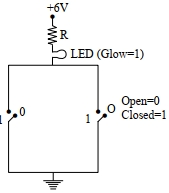
A
$OR$
B
$NOR$
C
$AND$
D
$NAND$
Solution
(A) In the given circuit,two switches are connected in parallel with the $LED$. The $LED$ glows when current flows through it,which happens when at least one of the switches is closed $(1)$. If both switches are open $(0)$,the circuit is incomplete and the $LED$ does not glow $(0)$.
This truth table corresponds to the $OR$ gate.
| $A$ | $B$ | $LED$ |
| $0$ | $0$ | $0$ |
| $0$ | $1$ | $1$ |
| $1$ | $0$ | $1$ |
| $1$ | $1$ | $1$ |
This truth table corresponds to the $OR$ gate.
0 likesView Solution
82
PhysicsEasyMCQNEET · 2022
The distance between the two plates of a parallel plate capacitor is doubled and the area of each plate is halved. If $C$ is its initial capacitance,its final capacitance is equal to
A
$2 C$
B
$C / 2$
C
$4 C$
D
$C / 4$
Solution
(D) The initial capacitance of a parallel plate capacitor is given by the formula $C = \frac{\varepsilon_0 A}{d}$,where $A$ is the area of the plates and $d$ is the distance between them.
According to the problem,the new distance $d' = 2d$ and the new area $A' = A / 2$.
The final capacitance $C'$ is given by $C' = \frac{\varepsilon_0 A'}{d'}$.
Substituting the new values,we get $C' = \frac{\varepsilon_0 (A / 2)}{2d} = \frac{\varepsilon_0 A}{4d}$.
Since $C = \frac{\varepsilon_0 A}{d}$,we can write $C' = \frac{C}{4}$.
According to the problem,the new distance $d' = 2d$ and the new area $A' = A / 2$.
The final capacitance $C'$ is given by $C' = \frac{\varepsilon_0 A'}{d'}$.
Substituting the new values,we get $C' = \frac{\varepsilon_0 (A / 2)}{2d} = \frac{\varepsilon_0 A}{4d}$.
Since $C = \frac{\varepsilon_0 A}{d}$,we can write $C' = \frac{C}{4}$.
0 likesView Solution
83
PhysicsEasyMCQNEET · 2022
After passing through a polariser,a linearly polarised light of intensity $I$ is incident on an analyser making an angle of $30^{\circ}$ with that of the polariser. The intensity of light emitted from the analyser will be
A
$\frac{I}{2}$
B
$\frac{I}{3}$
C
$\frac{3I}{4}$
D
$\frac{2I}{3}$
Solution
(C) According to Malus's law,the intensity of light transmitted through an analyser is given by $I_2 = I_1 \cos^2 \theta$.
Here,$I_1 = I$ is the intensity of the incident linearly polarised light.
The angle between the transmission axes of the polariser and the analyser is $\theta = 30^{\circ}$.
Substituting these values into the formula:
$I_2 = I \cos^2(30^{\circ})$
Since $\cos(30^{\circ}) = \frac{\sqrt{3}}{2}$,we have:
$I_2 = I \left( \frac{\sqrt{3}}{2} \right)^2 = I \left( \frac{3}{4} \right) = \frac{3I}{4}$.
Here,$I_1 = I$ is the intensity of the incident linearly polarised light.
The angle between the transmission axes of the polariser and the analyser is $\theta = 30^{\circ}$.
Substituting these values into the formula:
$I_2 = I \cos^2(30^{\circ})$
Since $\cos(30^{\circ}) = \frac{\sqrt{3}}{2}$,we have:
$I_2 = I \left( \frac{\sqrt{3}}{2} \right)^2 = I \left( \frac{3}{4} \right) = \frac{3I}{4}$.
0 likesView Solution
84
PhysicsEasyMCQNEET · 2022
If the screen is moved away from the plane of the slits in a Young's double slit experiment,then the
A
angular separation of the fringes increases
B
angular separation of the fringes decreases
C
linear separation of the fringes increases
D
linear separation of the fringes decreases
Solution
(C) The linear fringe width $\beta$ in a Young's double slit experiment is given by the formula $\beta = \frac{\lambda D}{d}$,where $\lambda$ is the wavelength of light,$D$ is the distance between the slits and the screen,and $d$ is the distance between the two slits.
When the screen is moved away from the plane of the slits,the distance $D$ increases.
Since $\beta \propto D$,an increase in $D$ leads to an increase in the linear fringe width $\beta$.
Therefore,the linear separation of the fringes increases.
When the screen is moved away from the plane of the slits,the distance $D$ increases.
Since $\beta \propto D$,an increase in $D$ leads to an increase in the linear fringe width $\beta$.
Therefore,the linear separation of the fringes increases.
0 likesView Solution
85
PhysicsMediumMCQNEET · 2022
The effective capacitances of two capacitors are $3\,\mu F$ and $16\,\mu F$,when they are connected in series and parallel respectively. The capacitances of the two capacitors are:
A
$10\,\mu F, 6\,\mu F$
B
$8\,\mu F, 8\,\mu F$
C
$12\,\mu F, 4\,\mu F$
D
$1.2\,\mu F, 1.8\,\mu F$
Solution
(C) Let the capacitances of the two capacitors be $C_1$ and $C_2$.
When connected in series,the effective capacitance is given by $\frac{C_1 C_2}{C_1 + C_2} = 3\,\mu F$. (Equation $1$)
When connected in parallel,the effective capacitance is given by $C_1 + C_2 = 16\,\mu F$. (Equation $2$)
Substituting Equation $2$ into Equation $1$:
$C_1 C_2 = 3 \times 16 = 48$.
We have the sum $C_1 + C_2 = 16$ and the product $C_1 C_2 = 48$. These are the roots of the quadratic equation $x^2 - 16x + 48 = 0$.
Solving the quadratic equation:
$(x - 12)(x - 4) = 0$.
Thus,$x = 12$ or $x = 4$.
Therefore,the capacitances are $12\,\mu F$ and $4\,\mu F$.
When connected in series,the effective capacitance is given by $\frac{C_1 C_2}{C_1 + C_2} = 3\,\mu F$. (Equation $1$)
When connected in parallel,the effective capacitance is given by $C_1 + C_2 = 16\,\mu F$. (Equation $2$)
Substituting Equation $2$ into Equation $1$:
$C_1 C_2 = 3 \times 16 = 48$.
We have the sum $C_1 + C_2 = 16$ and the product $C_1 C_2 = 48$. These are the roots of the quadratic equation $x^2 - 16x + 48 = 0$.
Solving the quadratic equation:
$(x - 12)(x - 4) = 0$.
Thus,$x = 12$ or $x = 4$.
Therefore,the capacitances are $12\,\mu F$ and $4\,\mu F$.
0 likesView Solution
86
PhysicsEasyMCQNEET · 2022
The reciprocal of resistance is
A
reactance
B
mobility
C
conductivity
D
conductance
Solution
(D) The reciprocal of resistance is defined as conductance.
Mathematically, $\text{Conductance} = \frac{1}{\text{Resistance}}$.
The $SI$ unit of conductance is Siemens $(S)$ or $\Omega^{-1}$.
Mathematically, $\text{Conductance} = \frac{1}{\text{Resistance}}$.
The $SI$ unit of conductance is Siemens $(S)$ or $\Omega^{-1}$.
0 likesView Solution
87
PhysicsEasyMCQNEET · 2022
The threshold frequency of a photoelectric metal is $\nu_0$. If light of frequency $4\nu_0$ is incident on this metal,then the maximum kinetic energy of emitted electrons will be $.......h\nu_0$.
A
$1$
B
$2$
C
$3$
D
$4$
Solution
(C) According to Einstein's photoelectric equation,the maximum kinetic energy $(KE)_{\max}$ of emitted electrons is given by:
$(KE)_{\max} = h\nu - \phi_0$
where $\nu$ is the frequency of incident light and $\phi_0$ is the work function of the metal.
Given that the threshold frequency is $\nu_0$,the work function is $\phi_0 = h\nu_0$.
The frequency of incident light is $\nu = 4\nu_0$.
Substituting these values into the equation:
$(KE)_{\max} = h(4\nu_0) - h\nu_0$
$(KE)_{\max} = 4h\nu_0 - h\nu_0$
$(KE)_{\max} = 3h\nu_0$.
Thus,the maximum kinetic energy is $3h\nu_0$.
$(KE)_{\max} = h\nu - \phi_0$
where $\nu$ is the frequency of incident light and $\phi_0$ is the work function of the metal.
Given that the threshold frequency is $\nu_0$,the work function is $\phi_0 = h\nu_0$.
The frequency of incident light is $\nu = 4\nu_0$.
Substituting these values into the equation:
$(KE)_{\max} = h(4\nu_0) - h\nu_0$
$(KE)_{\max} = 4h\nu_0 - h\nu_0$
$(KE)_{\max} = 3h\nu_0$.
Thus,the maximum kinetic energy is $3h\nu_0$.
0 likesView Solution
88
PhysicsEasyMCQNEET · 2022
The ratio of the magnitude of the magnetic field $(B_0)$ and electric field intensity $(E_0)$ of a plane electromagnetic wave in free space with permeability $\mu_0$ and permittivity $\varepsilon_0$ is (Given that $c$ is the velocity of light in free space):
A
$c$
B
$\frac{1}{c}$
C
$\frac{c}{\sqrt{\mu_0 \varepsilon_0}}$
D
$\frac{\sqrt{\mu_0 \varepsilon_0}}{c}$
Solution
(B) For a plane electromagnetic wave in free space,the relationship between the magnitude of the electric field $(E_0)$ and the magnetic field $(B_0)$ is given by $E_0 = c B_0$,where $c$ is the speed of light in free space.
Therefore,the ratio of the magnitude of the magnetic field to the electric field intensity is $\frac{B_0}{E_0} = \frac{1}{c}$.
Since the speed of light in free space is defined as $c = \frac{1}{\sqrt{\mu_0 \varepsilon_0}}$,we can also express this ratio as $\frac{B_0}{E_0} = \sqrt{\mu_0 \varepsilon_0}$.
However,in terms of the given options,the correct ratio is $\frac{1}{c}$.
Therefore,the ratio of the magnitude of the magnetic field to the electric field intensity is $\frac{B_0}{E_0} = \frac{1}{c}$.
Since the speed of light in free space is defined as $c = \frac{1}{\sqrt{\mu_0 \varepsilon_0}}$,we can also express this ratio as $\frac{B_0}{E_0} = \sqrt{\mu_0 \varepsilon_0}$.
However,in terms of the given options,the correct ratio is $\frac{1}{c}$.
0 likesView Solution
89
PhysicsEasyMCQNEET · 2022
The shape of the magnetic field lines due to an infinitely long,straight current-carrying conductor is:
A
a straight line
B
circular
C
elliptical
D
a plane
Solution
(B) According to the Right-Hand Thumb Rule,when a current flows through an infinitely long,straight conductor,it generates a magnetic field around it. The magnetic field lines are concentric circles centered on the wire,with the plane of these circles being perpendicular to the length of the conductor.
0 likesView Solution
Vedclass Products
For Students
Vedclass Test Series
Mock tests in real NEET style covering Physics with performance analysis. 5-day free trial.
Start Free TrialFor Teachers
Exam Paper Generator
Generate Set A/B/C/D Physics papers from 7.5L+ questions in 2 minutes. 3 chapters free.
Try FreeFor Institutes
Online Exam Module
Run live NEET mock exams with unlimited students, 360° analytics & white-label branding.
See DemoFrequently Asked Questions
How many Physics questions are in NEET 2022?
There are 100 Physics questions from the NEET 2022 paper on Vedclass, each with a detailed step-by-step solution in English.
Are NEET 2022 Physics solutions available in English?
Yes. All solutions on this page are in English. You can also switch to English or Hindi using the language buttons above the questions.
Can I practice NEET 2022 Physics as a timed test?
Yes. Use the Vedclass Test Series to attempt a full NEET mock test covering Physics with time limits and instant score analysis.
Can teachers create Physics papers from NEET previous year questions?
Yes. The Vedclass Exam Paper Generator lets teachers mix NEET Physics questions and generate Set A/B/C/D papers in minutes.
For Teachers & Institutes
Build a Custom Physics Paper
Pick NEET 2022 Physics questions, set difficulty, and generate Set A/B/C/D in 2 minutes.