
PhysicsQ1–50 of 50 questions
Page 1 of 1 · English
1
PhysicsMediumMCQNEET · 2021
The escape velocity from the Earth's surface is $v$. The escape velocity from the surface of another planet having a radius four times that of Earth and the same mass density is:
A
$v$
B
$2 v$
C
$3 v$
D
$4 v$
Solution
(D) The formula for escape velocity is $v_{e} = \sqrt{\frac{2GM}{R}}$.
Since mass $M = \text{Volume} \times \text{Density} = \frac{4}{3} \pi R^{3} \rho$,we substitute this into the formula:
$v_{e} = \sqrt{\frac{2G}{R} \times \frac{4}{3} \pi R^{3} \rho} = \sqrt{\frac{8 \pi G \rho}{3} R^{2}} = R \sqrt{\frac{8 \pi G \rho}{3}}$.
This shows that $v_{e} \propto R$ when the density $\rho$ is constant.
Given the radius of the new planet is $R' = 4R$,the new escape velocity $v'$ will be:
$v' = 4 \times v_{e} = 4v$.
Since mass $M = \text{Volume} \times \text{Density} = \frac{4}{3} \pi R^{3} \rho$,we substitute this into the formula:
$v_{e} = \sqrt{\frac{2G}{R} \times \frac{4}{3} \pi R^{3} \rho} = \sqrt{\frac{8 \pi G \rho}{3} R^{2}} = R \sqrt{\frac{8 \pi G \rho}{3}}$.
This shows that $v_{e} \propto R$ when the density $\rho$ is constant.
Given the radius of the new planet is $R' = 4R$,the new escape velocity $v'$ will be:
$v' = 4 \times v_{e} = 4v$.
1 likesView Solution
2
PhysicsMediumMCQNEET · 2021
The velocity of a small ball of mass $M$ and density $d$,when dropped in a container filled with glycerine,becomes constant after some time. If the density of glycerine is $\frac{d}{2}$,then the viscous force acting on the ball will be:
A
$\frac{Mg}{2}$
B
$Mg$
C
$\frac{3}{2} Mg$
D
$2 Mg$
Solution
(A) When the ball moves with a constant terminal velocity,the net force acting on it is zero.
The forces acting on the ball are:
$1$. Weight of the ball $(W = Mg)$ acting downwards.
$2$. Buoyant force $(F_B)$ acting upwards.
$3$. Viscous force $(F_v)$ acting upwards.
The buoyant force is given by $F_B = V \rho_{liquid} g$,where $V$ is the volume of the ball.
Since the density of the ball is $d$,its volume is $V = \frac{M}{d}$.
Given the density of glycerine is $\frac{d}{2}$,the buoyant force is $F_B = V \left(\frac{d}{2}\right) g = \left(\frac{M}{d}\right) \left(\frac{d}{2}\right) g = \frac{Mg}{2}$.
For constant velocity,the forces must balance:
$F_v + F_B = W$
$F_v + \frac{Mg}{2} = Mg$
$F_v = Mg - \frac{Mg}{2} = \frac{Mg}{2}$.
The forces acting on the ball are:
$1$. Weight of the ball $(W = Mg)$ acting downwards.
$2$. Buoyant force $(F_B)$ acting upwards.
$3$. Viscous force $(F_v)$ acting upwards.
The buoyant force is given by $F_B = V \rho_{liquid} g$,where $V$ is the volume of the ball.
Since the density of the ball is $d$,its volume is $V = \frac{M}{d}$.
Given the density of glycerine is $\frac{d}{2}$,the buoyant force is $F_B = V \left(\frac{d}{2}\right) g = \left(\frac{M}{d}\right) \left(\frac{d}{2}\right) g = \frac{Mg}{2}$.
For constant velocity,the forces must balance:
$F_v + F_B = W$
$F_v + \frac{Mg}{2} = Mg$
$F_v = Mg - \frac{Mg}{2} = \frac{Mg}{2}$.
0 likesView Solution
3
PhysicsMediumMCQNEET · 2021
$A$ body is executing simple harmonic motion with frequency $n$,the frequency of its potential energy is:
A
$n$
B
$3n$
C
$2n$
D
$4n$
Solution
(C) The displacement equation for a simple harmonic motion $(SHM)$ with frequency $n$ is given by:
$x = A \sin(\omega t) = A \sin(2 \pi n t)$
The potential energy $(U)$ of the body is given by:
$U = \frac{1}{2} k x^2 = \frac{1}{2} k A^2 \sin^2(2 \pi n t)$
Using the trigonometric identity $\sin^2 \theta = \frac{1 - \cos(2 \theta)}{2}$,we get:
$U = \frac{1}{2} k A^2 \left[ \frac{1 - \cos(2 \cdot 2 \pi n t)}{2} \right] = \frac{1}{4} k A^2 [1 - \cos(4 \pi n t)]$
The frequency of the potential energy is the coefficient of $2 \pi t$ in the cosine term,which is $2n$.
$x = A \sin(\omega t) = A \sin(2 \pi n t)$
The potential energy $(U)$ of the body is given by:
$U = \frac{1}{2} k x^2 = \frac{1}{2} k A^2 \sin^2(2 \pi n t)$
Using the trigonometric identity $\sin^2 \theta = \frac{1 - \cos(2 \theta)}{2}$,we get:
$U = \frac{1}{2} k A^2 \left[ \frac{1 - \cos(2 \cdot 2 \pi n t)}{2} \right] = \frac{1}{4} k A^2 [1 - \cos(4 \pi n t)]$
The frequency of the potential energy is the coefficient of $2 \pi t$ in the cosine term,which is $2n$.
0 likesView Solution
4
PhysicsMediumMCQNEET · 2021
Water falls from a height of $60 \, m$ at the rate of $15 \, kg/s$ to operate a turbine. The losses due to frictional force are $10 \%$ of the input energy. How much power is generated by the turbine? $(g=10 \, m/s^2)$ (In $kW$)
A
$10.2$
B
$8.1$
C
$12.3$
D
$7.0$
Solution
(B) The input power $P_{\text{input}}$ is given by the rate of change of potential energy: $P_{\text{input}} = \frac{mgh}{t} = \left(\frac{m}{t}\right)gh$.
Given $\frac{m}{t} = 15 \, kg/s$,$g = 10 \, m/s^2$,and $h = 60 \, m$.
$P_{\text{input}} = 15 \times 10 \times 60 = 9000 \, W = 9 \, kW$.
The power loss due to friction is $10 \%$ of the input power.
$\text{Loss} = 10 \% \text{ of } 9 \, kW = 0.1 \times 9 \, kW = 0.9 \, kW$.
The power generated by the turbine is the output power: $P_{\text{output}} = P_{\text{input}} - \text{Loss} = 9 \, kW - 0.9 \, kW = 8.1 \, kW$.
Given $\frac{m}{t} = 15 \, kg/s$,$g = 10 \, m/s^2$,and $h = 60 \, m$.
$P_{\text{input}} = 15 \times 10 \times 60 = 9000 \, W = 9 \, kW$.
The power loss due to friction is $10 \%$ of the input power.
$\text{Loss} = 10 \% \text{ of } 9 \, kW = 0.1 \times 9 \, kW = 0.9 \, kW$.
The power generated by the turbine is the output power: $P_{\text{output}} = P_{\text{input}} - \text{Loss} = 9 \, kW - 0.9 \, kW = 8.1 \, kW$.
0 likesView Solution
5
PhysicsMediumMCQNEET · 2021
Match Column $- I$ and Column $- II$ and choose the correct match from the given choices.
| Column $- I$ | Column $- II$ |
| $(A)$ Root mean square speed of gas molecules | $(P)$ $\frac{1}{3} n m \bar{v}^{2}$ |
| $(B)$ Pressure exerted by ideal gas | $(Q)$ $\sqrt{\frac{3 RT}{M}}$ |
| $(C)$ Average kinetic energy of a molecule | $(R)$ $\frac{5}{2} RT$ |
| $(D)$ Total internal energy of $1$ mole of a diatomic gas | $(S)$ $\frac{3}{2} k_{B} T$ |
A
$(A) - (R), (B) - (P), (C) - (S), (D) - (Q)$
B
$(A) - (Q), (B) - (R), (C) - (S), (D) - (P)$
C
$(A) - (Q), (B) - (P), (C) - (S), (D) - (R)$
D
$(A) - (R), (B) - (Q), (C) - (P), (D) - (S)$
Solution
(C) The root mean square speed of gas molecules is given by $V_{rms} = \sqrt{\frac{3RT}{M}}$. Thus, $(A) - (Q)$.
$(B)$ The pressure exerted by an ideal gas is given by $P = \frac{1}{3} n m \bar{v}^{2}$, where $n$ is the number density, $m$ is the mass of a molecule, and $\bar{v}^{2}$ is the mean square speed. Thus, $(B) - (P)$.
$(C)$ The average kinetic energy of a molecule of an ideal gas is given by $E = \frac{3}{2} k_{B} T$. Thus, $(C) - (S)$.
$(D)$ The total internal energy of $1$ mole of a diatomic gas is $U = \frac{f}{2} RT$. For a diatomic gas, the degrees of freedom $f = 5$. Therefore, $U = \frac{5}{2} RT$. Thus, $(D) - (R)$.
$(B)$ The pressure exerted by an ideal gas is given by $P = \frac{1}{3} n m \bar{v}^{2}$, where $n$ is the number density, $m$ is the mass of a molecule, and $\bar{v}^{2}$ is the mean square speed. Thus, $(B) - (P)$.
$(C)$ The average kinetic energy of a molecule of an ideal gas is given by $E = \frac{3}{2} k_{B} T$. Thus, $(C) - (S)$.
$(D)$ The total internal energy of $1$ mole of a diatomic gas is $U = \frac{f}{2} RT$. For a diatomic gas, the degrees of freedom $f = 5$. Therefore, $U = \frac{5}{2} RT$. Thus, $(D) - (R)$.
0 likesView Solution
6
PhysicsMediumMCQNEET · 2021
$A$ small block slides down on a smooth inclined plane,starting from rest at time $t=0$. Let $S_{n}$ be the distance travelled by the block in the interval $t=n-1$ to $t=n$. Then,the ratio $\frac{S_{n}}{S_{n+1}}$ is
A
$\frac{2n-1}{2n}$
B
$\frac{2n-1}{2n+1}$
C
$\frac{2n+1}{2n-1}$
D
$\frac{2n}{2n-1}$
Solution
(B) The distance travelled by an object in the $n^{th}$ second starting from rest is given by the formula $S_n = u + \frac{a}{2}(2n-1)$.
Since the block starts from rest,the initial velocity $u = 0$.
Therefore,the distance travelled in the $n^{th}$ interval is $S_n = \frac{a}{2}(2n-1)$.
Similarly,the distance travelled in the $(n+1)^{th}$ interval is $S_{n+1} = \frac{a}{2}(2(n+1)-1) = \frac{a}{2}(2n+2-1) = \frac{a}{2}(2n+1)$.
Now,calculating the ratio $\frac{S_n}{S_{n+1}}$:
$\frac{S_n}{S_{n+1}} = \frac{\frac{a}{2}(2n-1)}{\frac{a}{2}(2n+1)} = \frac{2n-1}{2n+1}$.
Since the block starts from rest,the initial velocity $u = 0$.
Therefore,the distance travelled in the $n^{th}$ interval is $S_n = \frac{a}{2}(2n-1)$.
Similarly,the distance travelled in the $(n+1)^{th}$ interval is $S_{n+1} = \frac{a}{2}(2(n+1)-1) = \frac{a}{2}(2n+2-1) = \frac{a}{2}(2n+1)$.
Now,calculating the ratio $\frac{S_n}{S_{n+1}}$:
$\frac{S_n}{S_{n+1}} = \frac{\frac{a}{2}(2n-1)}{\frac{a}{2}(2n+1)} = \frac{2n-1}{2n+1}$.
0 likesView Solution
7
PhysicsMediumMCQNEET · 2021
$A$ screw gauge gives the following readings when used to measure the diameter of a wire:
Main scale reading: $0 \, mm$
Circular scale reading: $52$ divisions
Given that $1 \, mm$ on the main scale corresponds to $100$ divisions on the circular scale. The diameter of the wire from the above data is ...... $cm$.
Main scale reading: $0 \, mm$
Circular scale reading: $52$ divisions
Given that $1 \, mm$ on the main scale corresponds to $100$ divisions on the circular scale. The diameter of the wire from the above data is ...... $cm$.
A
$0.52$
B
$0.026$
C
$0.26$
D
$0.052$
Solution
(D) The Least Count $(L.C.)$ of the screw gauge is calculated as:
$L.C. = \frac{\text{Pitch}}{\text{Total circular scale divisions}} = \frac{1 \, mm}{100} = 0.01 \, mm$.
Since $1 \, mm = 0.1 \, cm$,the $L.C.$ in $cm$ is:
$L.C. = 0.01 \, mm = 0.001 \, cm$.
The diameter $(D)$ is given by the formula:
$D = \text{Main scale reading} + (\text{Circular scale reading} \times L.C.)$
Substituting the given values:
$D = 0 \, mm + (52 \times 0.01 \, mm) = 0.52 \, mm$.
Converting the diameter into $cm$:
$D = \frac{0.52}{10} \, cm = 0.052 \, cm$.
$L.C. = \frac{\text{Pitch}}{\text{Total circular scale divisions}} = \frac{1 \, mm}{100} = 0.01 \, mm$.
Since $1 \, mm = 0.1 \, cm$,the $L.C.$ in $cm$ is:
$L.C. = 0.01 \, mm = 0.001 \, cm$.
The diameter $(D)$ is given by the formula:
$D = \text{Main scale reading} + (\text{Circular scale reading} \times L.C.)$
Substituting the given values:
$D = 0 \, mm + (52 \times 0.01 \, mm) = 0.52 \, mm$.
Converting the diameter into $cm$:
$D = \frac{0.52}{10} \, cm = 0.052 \, cm$.
0 likesView Solution
8
PhysicsMediumMCQNEET · 2021
If force $[F]$,acceleration $[A]$,and time $[T]$ are chosen as the fundamental physical quantities,find the dimensions of energy.
A
$[F][A][T]$
B
$[F][A][T^{2}]$
C
$[F][A][T^{-1}]$
D
$[F][A^{-1}][T]$
Solution
(B) Let the energy $E$ be expressed as $E = k F^{a} A^{b} T^{c}$,where $k$ is a dimensionless constant.
The dimensional formula for energy is $[M^{1} L^{2} T^{-2}]$.
The dimensional formula for force is $[M^{1} L^{1} T^{-2}]$.
The dimensional formula for acceleration is $[L^{1} T^{-2}]$.
The dimensional formula for time is $[T^{1}]$.
Substituting these into the equation:
$[M^{1} L^{2} T^{-2}] = [M^{1} L^{1} T^{-2}]^{a} [L^{1} T^{-2}]^{b} [T^{1}]^{c}$
$[M^{1} L^{2} T^{-2}] = [M^{a} L^{a+b} T^{-2a-2b+c}]$
Comparing the powers of $M, L,$ and $T$ on both sides:
For $M$: $a = 1$
For $L$: $a + b = 2 \Rightarrow 1 + b = 2 \Rightarrow b = 1$
For $T$: $-2a - 2b + c = -2 \Rightarrow -2(1) - 2(1) + c = -2 \Rightarrow -4 + c = -2 \Rightarrow c = 2$
Thus,the dimensions of energy in terms of $F, A,$ and $T$ are $[F^{1} A^{1} T^{2}]$ or $[F][A][T^{2}]$.
The dimensional formula for energy is $[M^{1} L^{2} T^{-2}]$.
The dimensional formula for force is $[M^{1} L^{1} T^{-2}]$.
The dimensional formula for acceleration is $[L^{1} T^{-2}]$.
The dimensional formula for time is $[T^{1}]$.
Substituting these into the equation:
$[M^{1} L^{2} T^{-2}] = [M^{1} L^{1} T^{-2}]^{a} [L^{1} T^{-2}]^{b} [T^{1}]^{c}$
$[M^{1} L^{2} T^{-2}] = [M^{a} L^{a+b} T^{-2a-2b+c}]$
Comparing the powers of $M, L,$ and $T$ on both sides:
For $M$: $a = 1$
For $L$: $a + b = 2 \Rightarrow 1 + b = 2 \Rightarrow b = 1$
For $T$: $-2a - 2b + c = -2 \Rightarrow -2(1) - 2(1) + c = -2 \Rightarrow -4 + c = -2 \Rightarrow c = 2$
Thus,the dimensions of energy in terms of $F, A,$ and $T$ are $[F^{1} A^{1} T^{2}]$ or $[F][A][T^{2}]$.
0 likesView Solution
9
PhysicsMediumMCQNEET · 2021
If $E$ and $G$ respectively denote energy and gravitational constant,then $\frac{E}{G}$ has the dimensions of :
A
$[M][L^{-1}][T^{-1}]$
B
$[M^{2}][L^{-1}][T^{0}]$
C
$[M][L^{0}][T^{0}]$
D
$[M^{2}][L^{-2}][T^{-1}]$
Solution
(B) The dimensional formula for energy $E$ is $[M L^{2} T^{-2}]$.
The dimensional formula for the gravitational constant $G$ is $[M^{-1} L^{3} T^{-2}]$.
Therefore,the dimensions of $\frac{E}{G}$ are given by:
$\frac{[E]}{[G]} = \frac{[M L^{2} T^{-2}]}{[M^{-1} L^{3} T^{-2}]}$
$= [M^{1 - (-1)}] [L^{2 - 3}] [T^{-2 - (-2)}]$
$= [M^{2}] [L^{-1}] [T^{0}]$
The dimensional formula for the gravitational constant $G$ is $[M^{-1} L^{3} T^{-2}]$.
Therefore,the dimensions of $\frac{E}{G}$ are given by:
$\frac{[E]}{[G]} = \frac{[M L^{2} T^{-2}]}{[M^{-1} L^{3} T^{-2}]}$
$= [M^{1 - (-1)}] [L^{2 - 3}] [T^{-2 - (-2)}]$
$= [M^{2}] [L^{-1}] [T^{0}]$
0 likesView Solution
10
PhysicsMediumMCQNEET · 2021
$A$ spring is stretched by $5 \,\,cm$ by a force of $10 \,\,N$. The time period of the oscillations when a mass of $2 \,\,kg$ is suspended by it is: (in $s$)
A
$0.0628$
B
$6.28$
C
$3.14$
D
$0.628$
Solution
(D) According to Hooke's Law, $F = Kx$, where $F$ is the force, $K$ is the spring constant, and $x$ is the displacement.
Given $F = 10 \,\,N$ and $x = 5 \,\,cm = 0.05 \,\,m$.
$10 = K \times 0.05 \implies K = \frac{10}{0.05} = 200 \,\,N/m$.
The time period $T$ of a spring-mass system is given by $T = 2 \pi \sqrt{\frac{m}{K}}$.
Substituting $m = 2 \,\,kg$ and $K = 200 \,\,N/m$:
$T = 2 \pi \sqrt{\frac{2}{200}} = 2 \pi \sqrt{\frac{1}{100}} = 2 \pi \times \frac{1}{10} = \frac{2 \times 3.14}{10} = 0.628 \,\,s$.
Given $F = 10 \,\,N$ and $x = 5 \,\,cm = 0.05 \,\,m$.
$10 = K \times 0.05 \implies K = \frac{10}{0.05} = 200 \,\,N/m$.
The time period $T$ of a spring-mass system is given by $T = 2 \pi \sqrt{\frac{m}{K}}$.
Substituting $m = 2 \,\,kg$ and $K = 200 \,\,N/m$:
$T = 2 \pi \sqrt{\frac{2}{200}} = 2 \pi \sqrt{\frac{1}{100}} = 2 \pi \times \frac{1}{10} = \frac{2 \times 3.14}{10} = 0.628 \,\,s$.
0 likesView Solution
11
PhysicsMediumMCQNEET · 2021
$A$ ball of mass $0.15 \, kg$ is dropped from a height $10 \, m$,strikes the ground,and rebounds to the same height. The magnitude of the impulse imparted to the ball is $(g = 10 \, m/s^2)$ nearly: (in $kg \cdot m/s$)
A
$0$
B
$4.2$
C
$2.1$
D
$1.4$
Solution
(B) The velocity of the ball just before hitting the ground is given by $v = \sqrt{2gh}$.
Substituting the values: $v = \sqrt{2 \times 10 \times 10} = \sqrt{200} = 10\sqrt{2} \, m/s$.
Since the ball rebounds to the same height,the velocity just after the impact is $v' = -v = -10\sqrt{2} \, m/s$ (taking upward as positive).
The impulse $J$ imparted to the ball is equal to the change in momentum: $J = \Delta p = m(v_{final} - v_{initial})$.
Here,$v_{initial} = -10\sqrt{2} \, m/s$ and $v_{final} = +10\sqrt{2} \, m/s$.
$J = 0.15 \times (10\sqrt{2} - (-10\sqrt{2})) = 0.15 \times 20\sqrt{2} = 3\sqrt{2}$.
Using $\sqrt{2} \approx 1.414$,we get $J = 3 \times 1.414 = 4.242 \, kg \cdot m/s$.
Rounding to the nearest value,the magnitude of the impulse is $4.2 \, kg \cdot m/s$.
Substituting the values: $v = \sqrt{2 \times 10 \times 10} = \sqrt{200} = 10\sqrt{2} \, m/s$.
Since the ball rebounds to the same height,the velocity just after the impact is $v' = -v = -10\sqrt{2} \, m/s$ (taking upward as positive).
The impulse $J$ imparted to the ball is equal to the change in momentum: $J = \Delta p = m(v_{final} - v_{initial})$.
Here,$v_{initial} = -10\sqrt{2} \, m/s$ and $v_{final} = +10\sqrt{2} \, m/s$.
$J = 0.15 \times (10\sqrt{2} - (-10\sqrt{2})) = 0.15 \times 20\sqrt{2} = 3\sqrt{2}$.
Using $\sqrt{2} \approx 1.414$,we get $J = 3 \times 1.414 = 4.242 \, kg \cdot m/s$.
Rounding to the nearest value,the magnitude of the impulse is $4.2 \, kg \cdot m/s$.
0 likesView Solution
12
PhysicsMediumMCQNEET · 2021
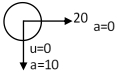
$A$ car starts from rest and accelerates at $5 \, m/s^{2}$. At $t=4 \, s$,a ball is dropped out of a window by a person sitting in the car. What is the velocity and acceleration of the ball at $t=6 \, s$? (Take $g = 10 \, m/s^{2}$)
A
$20 \, m/s, 5 \, m/s^{2}$
B
$20 \, m/s, 0$
C
$20 \sqrt{2} \, m/s, 0$
D
$20 \sqrt{2} \, m/s, 10 \, m/s^{2}$
Solution
(D) At $t=4 \, s$,the velocity of the car (and thus the ball) in the horizontal direction is $v_x = u + at = 0 + 5 \times 4 = 20 \, m/s$.
After the ball is dropped,it is only under the influence of gravity.
At $t=6 \, s$,the time elapsed since the ball was dropped is $\Delta t = 6 - 4 = 2 \, s$.
The horizontal velocity remains constant: $v_x = 20 \, m/s$.
The vertical velocity at $\Delta t = 2 \, s$ is $v_y = u_y + g \Delta t = 0 + 10 \times 2 = 20 \, m/s$.
The resultant velocity is $v = \sqrt{v_x^2 + v_y^2} = \sqrt{20^2 + 20^2} = 20 \sqrt{2} \, m/s$.
Since the ball is in free fall,its acceleration is equal to the acceleration due to gravity,$a = g = 10 \, m/s^{2}$ downwards.
After the ball is dropped,it is only under the influence of gravity.
At $t=6 \, s$,the time elapsed since the ball was dropped is $\Delta t = 6 - 4 = 2 \, s$.
The horizontal velocity remains constant: $v_x = 20 \, m/s$.
The vertical velocity at $\Delta t = 2 \, s$ is $v_y = u_y + g \Delta t = 0 + 10 \times 2 = 20 \, m/s$.
The resultant velocity is $v = \sqrt{v_x^2 + v_y^2} = \sqrt{20^2 + 20^2} = 20 \sqrt{2} \, m/s$.
Since the ball is in free fall,its acceleration is equal to the acceleration due to gravity,$a = g = 10 \, m/s^{2}$ downwards.
0 likesView Solution
13
PhysicsDifficultMCQNEET · 2021
$A$ particle of mass $m$ is projected with a velocity $v = k V_{e}$ $(k < 1)$ from the surface of the earth. $(V_{e} = \text{escape velocity})$. The maximum height above the surface reached by the particle is:
A
$R \left( \frac{k^2}{1-k^2} \right)$
B
$R \left( \frac{k}{1+k} \right)^2$
C
$\frac{R^2 k}{1+k}$
D
$\frac{R k^2}{1-k^2}$
Solution
(D) By the law of conservation of energy, the total energy at the surface equals the total energy at the maximum height $r$ where velocity is zero.
$-\frac{GMm}{R} + \frac{1}{2} m v^2 = -\frac{GMm}{r}$
Given $v = k V_{e}$ and $V_{e} = \sqrt{\frac{2GM}{R}}$, we have $v^2 = k^2 \frac{2GM}{R}$.
Substituting this into the energy equation:
$-\frac{GMm}{R} + \frac{1}{2} m \left( k^2 \frac{2GM}{R} \right) = -\frac{GMm}{r}$
Dividing by $GMm$:
$-\frac{1}{R} + \frac{k^2}{R} = -\frac{1}{r}$
$\frac{1}{r} = \frac{1}{R} - \frac{k^2}{R} = \frac{1-k^2}{R}$
$r = \frac{R}{1-k^2}$
Since $r = R + h$, the maximum height $h$ is:
$h = r - R = \frac{R}{1-k^2} - R = R \left( \frac{1 - (1-k^2)}{1-k^2} \right) = \frac{R k^2}{1-k^2}$.
$-\frac{GMm}{R} + \frac{1}{2} m v^2 = -\frac{GMm}{r}$
Given $v = k V_{e}$ and $V_{e} = \sqrt{\frac{2GM}{R}}$, we have $v^2 = k^2 \frac{2GM}{R}$.
Substituting this into the energy equation:
$-\frac{GMm}{R} + \frac{1}{2} m \left( k^2 \frac{2GM}{R} \right) = -\frac{GMm}{r}$
Dividing by $GMm$:
$-\frac{1}{R} + \frac{k^2}{R} = -\frac{1}{r}$
$\frac{1}{r} = \frac{1}{R} - \frac{k^2}{R} = \frac{1-k^2}{R}$
$r = \frac{R}{1-k^2}$
Since $r = R + h$, the maximum height $h$ is:
$h = r - R = \frac{R}{1-k^2} - R = R \left( \frac{1 - (1-k^2)}{1-k^2} \right) = \frac{R k^2}{1-k^2}$.
0 likesView Solution
14
PhysicsMediumMCQNEET · 2021
$A$ particle moving in a circle of radius $R$ with a uniform speed takes a time $T$ to complete one revolution. If this particle were projected with the same speed at an angle $\theta$ to the horizontal,the maximum height attained by it equals $4R$. The angle of projection,$\theta$,is then given by
A
$\theta=\cos ^{-1}\left(\frac{g T^{2}}{\pi^{2} R}\right)^{1 / 2}$
B
$\theta=\cos ^{-1}\left(\frac{\pi^{2} R}{g T^{2}}\right)^{1 / 2}$
C
$\theta=\sin ^{-1}\left(\frac{\pi^{2} R}{g T^{2}}\right)^{1 / 2}$
D
$\theta=\sin ^{-1}\left(\frac{2 g T^{2}}{\pi^{2} R}\right)^{1 / 2}$
Solution
(D) The speed of the particle in circular motion is $V = \frac{2 \pi R}{T}$.
The maximum height $H$ attained by a projectile is given by $H = \frac{V^2 \sin^2 \theta}{2g}$.
Given $H = 4R$,we substitute $V$ and $H$ into the formula:
$4R = \frac{(\frac{2 \pi R}{T})^2 \sin^2 \theta}{2g}$
$4R = \frac{4 \pi^2 R^2 \sin^2 \theta}{2g T^2}$
$4R = \frac{2 \pi^2 R^2 \sin^2 \theta}{g T^2}$
Solving for $\sin^2 \theta$:
$\sin^2 \theta = \frac{4R \cdot g T^2}{2 \pi^2 R^2} = \frac{2 g T^2}{\pi^2 R}$
Therefore,$\theta = \sin^{-1} \left( \frac{2 g T^2}{\pi^2 R} \right)^{1/2}$.
The maximum height $H$ attained by a projectile is given by $H = \frac{V^2 \sin^2 \theta}{2g}$.
Given $H = 4R$,we substitute $V$ and $H$ into the formula:
$4R = \frac{(\frac{2 \pi R}{T})^2 \sin^2 \theta}{2g}$
$4R = \frac{4 \pi^2 R^2 \sin^2 \theta}{2g T^2}$
$4R = \frac{2 \pi^2 R^2 \sin^2 \theta}{g T^2}$
Solving for $\sin^2 \theta$:
$\sin^2 \theta = \frac{4R \cdot g T^2}{2 \pi^2 R^2} = \frac{2 g T^2}{\pi^2 R}$
Therefore,$\theta = \sin^{-1} \left( \frac{2 g T^2}{\pi^2 R} \right)^{1/2}$.
0 likesView Solution
15
PhysicsEasyMCQNEET · 2021
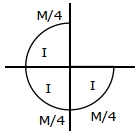
From a circular ring of mass $M$ and radius $R$,an arc corresponding to a $90^{\circ}$ sector is removed. The moment of inertia of the remaining part of the ring about an axis passing through the centre of the ring and perpendicular to the plane of the ring is $K$ times $MR^{2}$. Then the value of $K$ is
A
$\frac{3}{4}$
B
$\frac{7}{8}$
C
$\frac{1}{4}$
D
$\frac{1}{8}$
Solution
(A) The moment of inertia of a complete circular ring of mass $M$ and radius $R$ about an axis passing through its centre and perpendicular to its plane is $I = MR^{2}$.
Since the mass is uniformly distributed along the circumference,the mass of the remaining part of the ring after removing a $90^{\circ}$ sector (which is $1/4$ of the total circumference) is $M' = M - \frac{1}{4}M = \frac{3}{4}M$.
The moment of inertia of a point mass $m$ at a distance $R$ from the axis is $I = mR^{2}$. Since every point on the ring is at the same distance $R$ from the central axis,the moment of inertia of any part of the ring with mass $M'$ is simply $I' = M'R^{2}$.
Substituting $M' = \frac{3}{4}M$,we get $I' = \frac{3}{4}MR^{2}$.
Comparing this with $I' = KMR^{2}$,we find $K = \frac{3}{4}$.
Since the mass is uniformly distributed along the circumference,the mass of the remaining part of the ring after removing a $90^{\circ}$ sector (which is $1/4$ of the total circumference) is $M' = M - \frac{1}{4}M = \frac{3}{4}M$.
The moment of inertia of a point mass $m$ at a distance $R$ from the axis is $I = mR^{2}$. Since every point on the ring is at the same distance $R$ from the central axis,the moment of inertia of any part of the ring with mass $M'$ is simply $I' = M'R^{2}$.
Substituting $M' = \frac{3}{4}M$,we get $I' = \frac{3}{4}MR^{2}$.
Comparing this with $I' = KMR^{2}$,we find $K = \frac{3}{4}$.
0 likesView Solution
16
PhysicsMediumMCQNEET · 2021
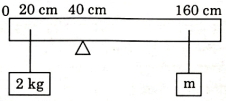
$A$ uniform rod of length $200 \, cm$ and mass $500 \, g$ is balanced on a wedge placed at $40 \, cm$ mark. $A$ mass of $2 \, kg$ is suspended from the rod at $20 \, cm$ and another unknown mass $'m'$ is suspended from the rod at $160 \, cm$ mark as shown in the figure. Find the value of $'m'$ such that the rod is in equilibrium. $(g = 10 \, m/s^2)$
A
$\frac{1}{2} \, kg$
B
$\frac{1}{3} \, kg$
C
$\frac{1}{6} \, kg$
D
$\frac{1}{12} \, kg$
Solution
(D) The rod is uniform,so its center of mass acts at the midpoint,i.e.,at $100 \, cm$ mark. The mass of the rod is $0.5 \, kg$.
The wedge is at $40 \, cm$. We take the torque about the pivot point (wedge) at $40 \, cm$.
Clockwise torque due to the rod's weight $(0.5 \, kg)$ acting at $100 \, cm$:
$\tau_{cw} = (0.5 \, kg \times g) \times (100 \, cm - 40 \, cm) = 0.5 \times g \times 60 \, cm$.
Clockwise torque due to mass $'m'$ acting at $160 \, cm$:
$\tau_{cw}' = (m \times g) \times (160 \, cm - 40 \, cm) = m \times g \times 120 \, cm$.
Counter-clockwise torque due to $2 \, kg$ mass acting at $20 \, cm$:
$\tau_{ccw} = (2 \, kg \times g) \times (40 \, cm - 20 \, cm) = 2 \times g \times 20 \, cm$.
For equilibrium,$\tau_{ccw} = \tau_{cw} + \tau_{cw}'$:
$2 \times g \times 20 = 0.5 \times g \times 60 + m \times g \times 120$.
Dividing by $g$:
$40 = 30 + 120m$.
$10 = 120m$.
$m = \frac{10}{120} \, kg = \frac{1}{12} \, kg$.
The wedge is at $40 \, cm$. We take the torque about the pivot point (wedge) at $40 \, cm$.
Clockwise torque due to the rod's weight $(0.5 \, kg)$ acting at $100 \, cm$:
$\tau_{cw} = (0.5 \, kg \times g) \times (100 \, cm - 40 \, cm) = 0.5 \times g \times 60 \, cm$.
Clockwise torque due to mass $'m'$ acting at $160 \, cm$:
$\tau_{cw}' = (m \times g) \times (160 \, cm - 40 \, cm) = m \times g \times 120 \, cm$.
Counter-clockwise torque due to $2 \, kg$ mass acting at $20 \, cm$:
$\tau_{ccw} = (2 \, kg \times g) \times (40 \, cm - 20 \, cm) = 2 \times g \times 20 \, cm$.
For equilibrium,$\tau_{ccw} = \tau_{cw} + \tau_{cw}'$:
$2 \times g \times 20 = 0.5 \times g \times 60 + m \times g \times 120$.
Dividing by $g$:
$40 = 30 + 120m$.
$10 = 120m$.
$m = \frac{10}{120} \, kg = \frac{1}{12} \, kg$.
0 likesView Solution
17
PhysicsMediumMCQNEET · 2021
$A$ cup of coffee cools from $90^{\circ} C$ to $80^{\circ} C$ in $t$ minutes when the room temperature is $20^{\circ} C$. The time taken by the similar cup of coffee to cool from $80^{\circ} C$ to $60^{\circ} C$ at the same room temperature is $:$
A
$\frac{13}{5} t$
B
$\frac{10}{13} t$
C
$\frac{13}{10} t$
D
$\frac{5}{13} t$
Solution
(A) Using the average form of Newton's law of cooling: $\frac{dT}{dt} = k(T_{avg} - T_{room})$.
For the first interval ($90^{\circ} C$ to $80^{\circ} C$):
$\frac{90-80}{t} = k\left(\frac{90+80}{2} - 20\right) \implies \frac{10}{t} = k(85 - 20) = 65k \dots (i)$
For the second interval ($80^{\circ} C$ to $60^{\circ} C$):
$\frac{80-60}{t'} = k\left(\frac{80+60}{2} - 20\right) \implies \frac{20}{t'} = k(70 - 20) = 50k \dots (ii)$
Dividing equation $(i)$ by $(ii)$:
$\frac{10/t}{20/t'} = \frac{65k}{50k}$
$\frac{10}{t} \times \frac{t'}{20} = \frac{65}{50}$
$\frac{t'}{2t} = \frac{13}{10}$
$t' = \frac{13}{10} \times 2t = \frac{13}{5} t$.
For the first interval ($90^{\circ} C$ to $80^{\circ} C$):
$\frac{90-80}{t} = k\left(\frac{90+80}{2} - 20\right) \implies \frac{10}{t} = k(85 - 20) = 65k \dots (i)$
For the second interval ($80^{\circ} C$ to $60^{\circ} C$):
$\frac{80-60}{t'} = k\left(\frac{80+60}{2} - 20\right) \implies \frac{20}{t'} = k(70 - 20) = 50k \dots (ii)$
Dividing equation $(i)$ by $(ii)$:
$\frac{10/t}{20/t'} = \frac{65k}{50k}$
$\frac{10}{t} \times \frac{t'}{20} = \frac{65}{50}$
$\frac{t'}{2t} = \frac{13}{10}$
$t' = \frac{13}{10} \times 2t = \frac{13}{5} t$.
0 likesView Solution
18
PhysicsMediumMCQNEET · 2021
$A$ particle is released from height $S$ above the surface of the earth. At a certain height,its kinetic energy is three times its potential energy. The height from the surface of the earth and the speed of the particle at that instant are respectively:
A
$\frac{S}{2}, \sqrt{\frac{3gS}{2}}$
B
$\frac{S}{2}, \frac{3gS}{2}$
C
$\frac{S}{4}, \frac{3gS}{2}$
D
$\frac{S}{4}, \sqrt{\frac{3gS}{2}}$
Solution
(D) Let the height from the surface be $x$. The distance fallen by the particle is $(S - x)$.
Using the equation of motion $v^2 = u^2 + 2as$,where $u = 0$ and $a = g$,we get $v^2 = 2g(S - x)$.
The potential energy at height $x$ is $PE = mgx$.
The kinetic energy at that instant is $KE = \frac{1}{2}mv^2 = \frac{1}{2}m(2g(S - x)) = mg(S - x)$.
According to the problem,$KE = 3 \times PE$.
Substituting the expressions: $mg(S - x) = 3(mgx)$.
Dividing both sides by $mg$: $S - x = 3x$.
$S = 4x \Rightarrow x = \frac{S}{4}$.
Now,substitute $x$ into the velocity equation: $v^2 = 2g(S - \frac{S}{4}) = 2g(\frac{3S}{4}) = \frac{3gS}{2}$.
Therefore,$v = \sqrt{\frac{3gS}{2}}$.
The height is $\frac{S}{4}$ and the speed is $\sqrt{\frac{3gS}{2}}$.
Using the equation of motion $v^2 = u^2 + 2as$,where $u = 0$ and $a = g$,we get $v^2 = 2g(S - x)$.
The potential energy at height $x$ is $PE = mgx$.
The kinetic energy at that instant is $KE = \frac{1}{2}mv^2 = \frac{1}{2}m(2g(S - x)) = mg(S - x)$.
According to the problem,$KE = 3 \times PE$.
Substituting the expressions: $mg(S - x) = 3(mgx)$.
Dividing both sides by $mg$: $S - x = 3x$.
$S = 4x \Rightarrow x = \frac{S}{4}$.
Now,substitute $x$ into the velocity equation: $v^2 = 2g(S - \frac{S}{4}) = 2g(\frac{3S}{4}) = \frac{3gS}{2}$.
Therefore,$v = \sqrt{\frac{3gS}{2}}$.
The height is $\frac{S}{4}$ and the speed is $\sqrt{\frac{3gS}{2}}$.
0 likesView Solution
19
PhysicsMediumMCQNEET · 2021
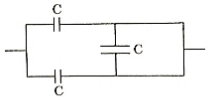
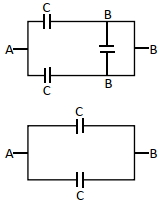
The equivalent capacitance of the combination shown in the figure is:
A
$3 C$
B
$2 C$
C
$C / 2$
D
$3 C / 2$
Solution
(D) In the given circuit,let the input terminal be $A$ and the output terminal be $B$.
The two capacitors of capacitance $C$ in the upper and lower branches are connected in series with each other,but they are also connected to a third capacitor $C$ in parallel.
However,looking closely at the circuit,the two capacitors in the top and bottom branches are in series with each other,and this combination is in parallel with the middle capacitor.
Wait,let's re-evaluate: The two capacitors in the top and bottom branches are connected in series,and their combination is in parallel with the middle capacitor.
Actually,the circuit shows two capacitors in series (top and bottom) which are then in parallel with the middle capacitor.
Let the series combination of the two capacitors be $C_s$. Then $1 / C_s = 1 / C + 1 / C = 2 / C$,so $C_s = C / 2$.
Now,this $C_s$ is in parallel with the middle capacitor $C$.
Therefore,the equivalent capacitance $C_{eq} = C_s + C = C / 2 + C = 3 C / 2$.
The two capacitors of capacitance $C$ in the upper and lower branches are connected in series with each other,but they are also connected to a third capacitor $C$ in parallel.
However,looking closely at the circuit,the two capacitors in the top and bottom branches are in series with each other,and this combination is in parallel with the middle capacitor.
Wait,let's re-evaluate: The two capacitors in the top and bottom branches are connected in series,and their combination is in parallel with the middle capacitor.
Actually,the circuit shows two capacitors in series (top and bottom) which are then in parallel with the middle capacitor.
Let the series combination of the two capacitors be $C_s$. Then $1 / C_s = 1 / C + 1 / C = 2 / C$,so $C_s = C / 2$.
Now,this $C_s$ is in parallel with the middle capacitor $C$.
Therefore,the equivalent capacitance $C_{eq} = C_s + C = C / 2 + C = 3 C / 2$.
0 likesView Solution
20
PhysicsEasyMCQNEET · 2021
Polar molecules are the molecules:
A
having zero dipole moment.
B
acquire a dipole moment only in the presence of electric field due to displacement of charges.
C
acquire a dipole moment only when magnetic field is absent.
D
having a permanent electric dipole moment.
Solution
(D) Polar molecules are those in which the centres of positive and negative charges do not coincide,even in the absence of an external electric field.
Because these centres are separated by a small distance,these molecules possess a permanent electric dipole moment.
Because these centres are separated by a small distance,these molecules possess a permanent electric dipole moment.
0 likesView Solution
21
PhysicsMediumMCQNEET · 2021
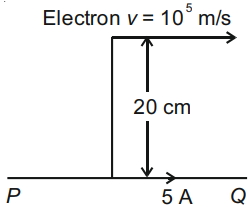
An infinitely long straight conductor carries a current of $5 \, A$ as shown. An electron is moving with a speed of $10^{5} \, m/s$ parallel to the conductor. The perpendicular distance between the electron and the conductor is $20 \, cm$ at an instant. Calculate the magnitude of the force experienced by the electron at that instant in $\times 10^{-20} \, N$.
A
$4$
B
$8 \pi$
C
$4 \pi$
D
$8$
Solution
(D) The magnetic field $B$ produced by an infinitely long straight conductor at a distance $R$ is given by:
$B = \frac{\mu_{0} I}{2 \pi R}$
Given: $I = 5 \, A$,$R = 20 \, cm = 0.2 \, m$,$v = 10^{5} \, m/s$,$q = e = 1.6 \times 10^{-19} \, C$.
Substituting the values:
$B = \frac{4 \pi \times 10^{-7} \times 5}{2 \pi \times 0.2} = \frac{2 \times 10^{-7} \times 5}{0.2} = 5 \times 10^{-6} \, T$.
The magnetic force $F$ on a moving charge is given by $F = qvB \sin \theta$. Since the electron moves parallel to the conductor,the angle $\theta$ between the velocity vector and the magnetic field (which is perpendicular to the plane of the conductor and the electron's path) is $90^{\circ}$.
$F = qvB \sin 90^{\circ} = qvB$
$F = (1.6 \times 10^{-19} \, C) \times (10^{5} \, m/s) \times (5 \times 10^{-6} \, T)$
$F = 8 \times 10^{-20} \, N$.
Thus,the magnitude of the force is $8 \times 10^{-20} \, N$.
$B = \frac{\mu_{0} I}{2 \pi R}$
Given: $I = 5 \, A$,$R = 20 \, cm = 0.2 \, m$,$v = 10^{5} \, m/s$,$q = e = 1.6 \times 10^{-19} \, C$.
Substituting the values:
$B = \frac{4 \pi \times 10^{-7} \times 5}{2 \pi \times 0.2} = \frac{2 \times 10^{-7} \times 5}{0.2} = 5 \times 10^{-6} \, T$.
The magnetic force $F$ on a moving charge is given by $F = qvB \sin \theta$. Since the electron moves parallel to the conductor,the angle $\theta$ between the velocity vector and the magnetic field (which is perpendicular to the plane of the conductor and the electron's path) is $90^{\circ}$.
$F = qvB \sin 90^{\circ} = qvB$
$F = (1.6 \times 10^{-19} \, C) \times (10^{5} \, m/s) \times (5 \times 10^{-6} \, T)$
$F = 8 \times 10^{-20} \, N$.
Thus,the magnitude of the force is $8 \times 10^{-20} \, N$.
0 likesView Solution
22
PhysicsMediumMCQNEET · 2021
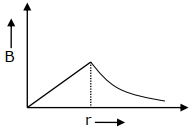
$A$ thick current-carrying cable of radius $R$ carries current $I$ uniformly distributed across its cross-section. The variation of magnetic field $B(r)$ due to the cable with the distance $r$ from the axis of the cable is represented by:
A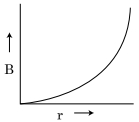
B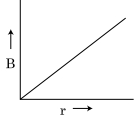
C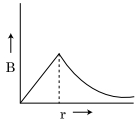
D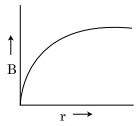
Solution
(C) For a thick cylindrical cable of radius $R$ carrying a uniformly distributed current $I$:
$1$. Inside the cable $(r < R)$: Using Ampere's circuital law,the magnetic field is given by $B_{\text{in}} = \frac{\mu_0 I r}{2 \pi R^2}$. This shows that $B \propto r$,which is a linear relationship.
$2$. Outside the cable $(r > R)$: The magnetic field is given by $B_{\text{out}} = \frac{\mu_0 I}{2 \pi r}$. This shows that $B \propto 1/r$,which is a hyperbolic relationship.
$3$. At the surface $(r = R)$: The magnetic field is maximum,$B_0 = \frac{\mu_0 I}{2 \pi R}$.
Therefore,the graph increases linearly from the center to the surface and then decreases hyperbolically as the distance increases beyond the surface.
$1$. Inside the cable $(r < R)$: Using Ampere's circuital law,the magnetic field is given by $B_{\text{in}} = \frac{\mu_0 I r}{2 \pi R^2}$. This shows that $B \propto r$,which is a linear relationship.
$2$. Outside the cable $(r > R)$: The magnetic field is given by $B_{\text{out}} = \frac{\mu_0 I}{2 \pi r}$. This shows that $B \propto 1/r$,which is a hyperbolic relationship.
$3$. At the surface $(r = R)$: The magnetic field is maximum,$B_0 = \frac{\mu_0 I}{2 \pi R}$.
Therefore,the graph increases linearly from the center to the surface and then decreases hyperbolically as the distance increases beyond the surface.
0 likesView Solution
23
PhysicsMediumMCQNEET · 2021
In a potentiometer circuit, a cell of $EMF$ $1.5\, V$ gives a balance point at $36\, cm$ length of wire. If another cell of $EMF$ $2.5\, V$ replaces the first cell, then at what length of the wire will the balance point occur? (in $cm$)
A
$60$
B
$21.6$
C
$64$
D
$62$
Solution
(A) In a potentiometer, the potential drop per unit length $(\phi)$ is constant.
The balance length $(l)$ is directly proportional to the $EMF$ $(E)$ of the cell, i.e., $E = \phi l$.
Therefore, the ratio is given by: $\frac{E_1}{E_2} = \frac{l_1}{l_2}$.
Given: $E_1 = 1.5\, V$, $l_1 = 36\, cm$, $E_2 = 2.5\, V$.
Substituting the values: $\frac{1.5}{2.5} = \frac{36}{l_2}$.
Simplifying the ratio: $\frac{3}{5} = \frac{36}{l_2}$.
Solving for $l_2$: $l_2 = \frac{36 \times 5}{3} = 12 \times 5 = 60\, cm$.
The balance length $(l)$ is directly proportional to the $EMF$ $(E)$ of the cell, i.e., $E = \phi l$.
Therefore, the ratio is given by: $\frac{E_1}{E_2} = \frac{l_1}{l_2}$.
Given: $E_1 = 1.5\, V$, $l_1 = 36\, cm$, $E_2 = 2.5\, V$.
Substituting the values: $\frac{1.5}{2.5} = \frac{36}{l_2}$.
Simplifying the ratio: $\frac{3}{5} = \frac{36}{l_2}$.
Solving for $l_2$: $l_2 = \frac{36 \times 5}{3} = 12 \times 5 = 60\, cm$.
0 likesView Solution
24
PhysicsMediumMCQNEET · 2021
For a plane electromagnetic wave propagating in the $x$-direction,which one of the following combinations gives the correct possible directions for the electric field $(E)$ and magnetic field $(B)$ respectively?
A
$\hat{j}+\hat{k}, \hat{j}+\hat{k}$
B
$-\hat{j}+\hat{k}, -\hat{j}-\hat{k}$
C
$\hat{j}+\hat{k}, -\hat{j}-\hat{k}$
D
$-\hat{j}+\hat{k}, -\hat{j}+\hat{k}$
Solution
(B) The direction of propagation of an electromagnetic wave is given by the direction of the Poynting vector,which is $\vec{E} \times \vec{B}$.
Given the wave propagates in the $x$-direction,we must have $\vec{E} \times \vec{B} = \hat{i}$.
Let us check option $B$: $\vec{E} = -\hat{j} + \hat{k}$ and $\vec{B} = -\hat{j} - \hat{k}$.
Calculating the cross product: $(-\hat{j} + \hat{k}) \times (-\hat{j} - \hat{k}) = (-\hat{j} \times -\hat{j}) - (\hat{j} \times -\hat{k}) + (\hat{k} \times -\hat{j}) - (\hat{k} \times -\hat{k})$.
$= 0 + (\hat{j} \times \hat{k}) - (\hat{k} \times \hat{j}) - 0 = \hat{i} - (-\hat{i}) = 2\hat{i}$.
Since the resulting vector is in the $x$-direction,option $B$ is correct.
Given the wave propagates in the $x$-direction,we must have $\vec{E} \times \vec{B} = \hat{i}$.
Let us check option $B$: $\vec{E} = -\hat{j} + \hat{k}$ and $\vec{B} = -\hat{j} - \hat{k}$.
Calculating the cross product: $(-\hat{j} + \hat{k}) \times (-\hat{j} - \hat{k}) = (-\hat{j} \times -\hat{j}) - (\hat{j} \times -\hat{k}) + (\hat{k} \times -\hat{j}) - (\hat{k} \times -\hat{k})$.
$= 0 + (\hat{j} \times \hat{k}) - (\hat{k} \times \hat{j}) - 0 = \hat{i} - (-\hat{i}) = 2\hat{i}$.
Since the resulting vector is in the $x$-direction,option $B$ is correct.
0 likesView Solution
25
PhysicsDifficultMCQNEET · 2021
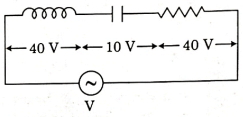
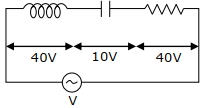
An inductor of inductance $L$,a capacitor of capacitance $C$,and a resistor of resistance $R$ are connected in series to an $AC$ source of potential difference $V$ volts as shown in the figure. The potential difference across $L$,$C$,and $R$ is $40 \, V$,$10 \, V$,and $40 \, V$,respectively. The amplitude of the current flowing through the $LCR$ series circuit is $10 \sqrt{2} \, A$. The impedance of the circuit is .......... $\Omega$.
A
$4 \sqrt{2}$
B
$5 / \sqrt{2}$
C
$4$
D
$5$
Solution
(D) Given:
Amplitude of current,$I_{0} = 10 \sqrt{2} \, A$.
Potential difference across inductor,$V_{L} = 40 \, V$.
Potential difference across capacitor,$V_{C} = 10 \, V$.
Potential difference across resistor,$V_{R} = 40 \, V$.
Step $1$: Calculate the $RMS$ current $(I_{RMS})$.
$I_{RMS} = \frac{I_{0}}{\sqrt{2}} = \frac{10 \sqrt{2}}{\sqrt{2}} = 10 \, A$.
Step $2$: Calculate the $RMS$ voltage of the source $(V_{RMS})$.
In an $LCR$ series circuit,the total voltage is given by:
$V_{RMS} = \sqrt{V_{R}^{2} + (V_{L} - V_{C})^{2}}$
$V_{RMS} = \sqrt{(40)^{2} + (40 - 10)^{2}}$
$V_{RMS} = \sqrt{40^{2} + 30^{2}} = \sqrt{1600 + 900} = \sqrt{2500} = 50 \, V$.
Step $3$: Calculate the impedance $(Z)$ of the circuit.
$Z = \frac{V_{RMS}}{I_{RMS}} = \frac{50 \, V}{10 \, A} = 5 \, \Omega$.
Therefore,the impedance of the circuit is $5 \, \Omega$.
Amplitude of current,$I_{0} = 10 \sqrt{2} \, A$.
Potential difference across inductor,$V_{L} = 40 \, V$.
Potential difference across capacitor,$V_{C} = 10 \, V$.
Potential difference across resistor,$V_{R} = 40 \, V$.
Step $1$: Calculate the $RMS$ current $(I_{RMS})$.
$I_{RMS} = \frac{I_{0}}{\sqrt{2}} = \frac{10 \sqrt{2}}{\sqrt{2}} = 10 \, A$.
Step $2$: Calculate the $RMS$ voltage of the source $(V_{RMS})$.
In an $LCR$ series circuit,the total voltage is given by:
$V_{RMS} = \sqrt{V_{R}^{2} + (V_{L} - V_{C})^{2}}$
$V_{RMS} = \sqrt{(40)^{2} + (40 - 10)^{2}}$
$V_{RMS} = \sqrt{40^{2} + 30^{2}} = \sqrt{1600 + 900} = \sqrt{2500} = 50 \, V$.
Step $3$: Calculate the impedance $(Z)$ of the circuit.
$Z = \frac{V_{RMS}}{I_{RMS}} = \frac{50 \, V}{10 \, A} = 5 \, \Omega$.
Therefore,the impedance of the circuit is $5 \, \Omega$.
0 likesView Solution
26
PhysicsMediumMCQNEET · 2021
The number of photons per second on an average emitted by a source of monochromatic light of wavelength $600 \, nm$,when it delivers a power of $3.3 \times 10^{-3} \, W$,is: $(h = 6.6 \times 10^{-34} \, Js)$
A
$10^{18}$
B
$10^{17}$
C
$10^{16}$
D
$10^{15}$
Solution
(C) The power $P$ emitted by a source is given by the product of the number of photons per second $n$ and the energy of a single photon $E = \frac{hc}{\lambda}$.
$P = n \frac{hc}{\lambda} \Rightarrow n = \frac{P \lambda}{hc}$
Given: $P = 3.3 \times 10^{-3} \, W$,$\lambda = 600 \times 10^{-9} \, m$,$h = 6.6 \times 10^{-34} \, Js$,and $c = 3 \times 10^8 \, m/s$.
Substituting the values:
$n = \frac{3.3 \times 10^{-3} \times 600 \times 10^{-9}}{6.6 \times 10^{-34} \times 3 \times 10^8}$
$n = \frac{3.3 \times 600 \times 10^{-12}}{19.8 \times 10^{-26}}$
$n = \frac{1980 \times 10^{-12}}{19.8 \times 10^{-26}} = 100 \times 10^{14} = 10^{16}$
Thus,the number of photons emitted per second is $10^{16}$.
$P = n \frac{hc}{\lambda} \Rightarrow n = \frac{P \lambda}{hc}$
Given: $P = 3.3 \times 10^{-3} \, W$,$\lambda = 600 \times 10^{-9} \, m$,$h = 6.6 \times 10^{-34} \, Js$,and $c = 3 \times 10^8 \, m/s$.
Substituting the values:
$n = \frac{3.3 \times 10^{-3} \times 600 \times 10^{-9}}{6.6 \times 10^{-34} \times 3 \times 10^8}$
$n = \frac{3.3 \times 600 \times 10^{-12}}{19.8 \times 10^{-26}}$
$n = \frac{1980 \times 10^{-12}}{19.8 \times 10^{-26}} = 100 \times 10^{14} = 10^{16}$
Thus,the number of photons emitted per second is $10^{16}$.
0 likesView Solution
27
PhysicsMediumMCQNEET · 2021
An electromagnetic wave of wavelength $\lambda$ is incident on a photosensitive surface of negligible work function. If the photoelectron emitted from the surface has mass $m$ and de-Broglie wavelength $\lambda_{d}$,then
A
$\lambda=\left(\frac{2 m}{hc}\right) \lambda_{d}^{2}$
B
$\lambda_{d}=\left(\frac{2 mc}{h}\right) \lambda^{2}$
C
$\lambda=\left(\frac{2 mc}{h}\right) \lambda_{d}^{2}$
D
$\lambda=\left(\frac{2 h}{mc}\right) \lambda_{d}^{2}$
Solution
(C) According to Einstein's photoelectric equation: $\frac{hc}{\lambda} = K_{\max} + \phi$.
Given that the work function $\phi$ is negligible,we have $\frac{hc}{\lambda} = K_{\max}$.
The de-Broglie wavelength of the emitted photoelectron is given by $\lambda_{d} = \frac{h}{\sqrt{2mK_{\max}}}$.
Squaring both sides,we get $\lambda_{d}^{2} = \frac{h^{2}}{2mK_{\max}}$,which implies $K_{\max} = \frac{h^{2}}{2m\lambda_{d}^{2}}$.
Substituting the expression for $K_{\max}$ into the photoelectric equation: $\frac{hc}{\lambda} = \frac{h^{2}}{2m\lambda_{d}^{2}}$.
Solving for $\lambda$,we get $\lambda = \frac{hc \cdot 2m\lambda_{d}^{2}}{h^{2}} = \left(\frac{2mc}{h}\right) \lambda_{d}^{2}$.
Given that the work function $\phi$ is negligible,we have $\frac{hc}{\lambda} = K_{\max}$.
The de-Broglie wavelength of the emitted photoelectron is given by $\lambda_{d} = \frac{h}{\sqrt{2mK_{\max}}}$.
Squaring both sides,we get $\lambda_{d}^{2} = \frac{h^{2}}{2mK_{\max}}$,which implies $K_{\max} = \frac{h^{2}}{2m\lambda_{d}^{2}}$.
Substituting the expression for $K_{\max}$ into the photoelectric equation: $\frac{hc}{\lambda} = \frac{h^{2}}{2m\lambda_{d}^{2}}$.
Solving for $\lambda$,we get $\lambda = \frac{hc \cdot 2m\lambda_{d}^{2}}{h^{2}} = \left(\frac{2mc}{h}\right) \lambda_{d}^{2}$.
0 likesView Solution
28
PhysicsMediumMCQNEET · 2021
Column $- I$ gives certain physical terms associated with the flow of current through a metallic conductor. Column $- II$ gives some mathematical relations involving electrical quantities. Match Column $- I$ and Column $- II$ with appropriate relations.
| Column $- I$ | Column $- II$ |
| $(A)$ Drift Velocity | $(P)$ $\frac{m}{n e^{2} \rho}$ |
| $(B)$ Electrical Resistivity | $(Q)$ $n e v_{d}$ |
| $(C)$ Relaxation Period | $(R)$ $\frac{e E}{m} \tau$ |
| $(D)$ Current Density | $(S)$ $\frac{E}{J}$ |
A
$(A)-(R), (B)-(S), (C)-(P), (D)-(Q)$
B
$(A)-(R), (B)-(S), (C)-(Q), (D)-(P)$
C
$(A)-(R), (B)-(P), (C)-(S), (D)-(Q)$
D
$(A)-(R), (B)-(Q), (C)-(S), (D)-(P)$
Solution
(A) The drift velocity is given by $v_{d} = \frac{e E}{m} \tau$. Thus, $(A) \rightarrow (R)$.
The electrical resistivity $\rho$ is defined as the ratio of electric field to current density, $\rho = \frac{E}{J}$. Thus, $(B) \rightarrow (S)$.
The relaxation period $\tau$ is related to resistivity by $\rho = \frac{m}{n e^{2} \tau}$, which implies $\tau = \frac{m}{n e^{2} \rho}$. Thus, $(C) \rightarrow (P)$.
The current density $J$ is given by $J = n e v_{d}$. Thus, $(D) \rightarrow (Q)$.
Therefore, the correct matching is $(A)-(R), (B)-(S), (C)-(P), (D)-(Q)$.
The electrical resistivity $\rho$ is defined as the ratio of electric field to current density, $\rho = \frac{E}{J}$. Thus, $(B) \rightarrow (S)$.
The relaxation period $\tau$ is related to resistivity by $\rho = \frac{m}{n e^{2} \tau}$, which implies $\tau = \frac{m}{n e^{2} \rho}$. Thus, $(C) \rightarrow (P)$.
The current density $J$ is given by $J = n e v_{d}$. Thus, $(D) \rightarrow (Q)$.
Therefore, the correct matching is $(A)-(R), (B)-(S), (C)-(P), (D)-(Q)$.
0 likesView Solution
29
PhysicsMediumMCQNEET · 2021
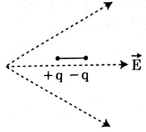
$A$ dipole is placed in an electric field as shown. In which direction will it move?
A
towards the left as its potential energy will increase.
B
towards the right as its potential energy will decrease.
C
towards the left as its potential energy will decrease.
D
towards the right as its potential energy will increase.
Solution
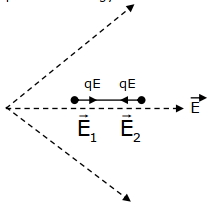
(B) The electric field lines are closer together near the $+q$ charge,which means the magnitude of the electric field is stronger at the position of the $+q$ charge than at the position of the $-q$ charge. Let $E_1$ be the field at $+q$ and $E_2$ be the field at $-q$. Thus,$|E_1| > |E_2|$.
The force on the positive charge is $F_+ = qE_1$ (towards the right) and the force on the negative charge is $F_- = qE_2$ (towards the left).
Since $|E_1| > |E_2|$,the net force $F_{net} = q(E_1 - E_2)$ acts towards the right.
$A$ physical system naturally moves in a direction that decreases its potential energy. Therefore,the dipole will move towards the right as its potential energy decreases.
The force on the positive charge is $F_+ = qE_1$ (towards the right) and the force on the negative charge is $F_- = qE_2$ (towards the left).
Since $|E_1| > |E_2|$,the net force $F_{net} = q(E_1 - E_2)$ acts towards the right.
$A$ physical system naturally moves in a direction that decreases its potential energy. Therefore,the dipole will move towards the right as its potential energy decreases.
0 likesView Solution
30
PhysicsMediumMCQNEET · 2021
$A$ capacitor of capacitance $C$ is connected across an $AC$ source of voltage $V$,given by $V = V_{0} \sin \omega t$. The displacement current between the plates of the capacitor would then be given by:
A
$I_{d} = V_{0} \omega C \cos \omega t$
B
$I_{d} = \frac{V_{0}}{\omega C} \cos \omega t$
C
$I_{d} = \frac{V_{0}}{\omega C} \sin \omega t$
D
$I_{d} = V_{0} \omega C \sin \omega t$
Solution
(A) The charge on the capacitor is given by $q = CV$.
Substituting the given voltage $V = V_{0} \sin \omega t$,we get $q = C V_{0} \sin \omega t$.
The displacement current $I_{d}$ is equal to the rate of change of charge on the capacitor plates,which is $I_{d} = \frac{dq}{dt}$.
$I_{d} = \frac{d}{dt} (C V_{0} \sin \omega t)$.
Since $C$ and $V_{0}$ are constants,$I_{d} = C V_{0} \frac{d}{dt} (\sin \omega t)$.
Using the derivative of $\sin \omega t$,which is $\omega \cos \omega t$,we get $I_{d} = C V_{0} \omega \cos \omega t$.
Therefore,$I_{d} = V_{0} \omega C \cos \omega t$.
Substituting the given voltage $V = V_{0} \sin \omega t$,we get $q = C V_{0} \sin \omega t$.
The displacement current $I_{d}$ is equal to the rate of change of charge on the capacitor plates,which is $I_{d} = \frac{dq}{dt}$.
$I_{d} = \frac{d}{dt} (C V_{0} \sin \omega t)$.
Since $C$ and $V_{0}$ are constants,$I_{d} = C V_{0} \frac{d}{dt} (\sin \omega t)$.
Using the derivative of $\sin \omega t$,which is $\omega \cos \omega t$,we get $I_{d} = C V_{0} \omega \cos \omega t$.
Therefore,$I_{d} = V_{0} \omega C \cos \omega t$.
0 likesView Solution
31
PhysicsEasyMCQNEET · 2021
The effective resistance of a parallel connection that consists of four wires of equal length,equal area of cross-section,and same material is $0.25\, \Omega$. What will be the effective resistance if they are connected in series? (In $\Omega$)
A
$0.25$
B
$0.5$
C
$1$
D
$4$
Solution
(D) Let the resistance of each wire be $R$. Since all four wires have equal length,equal area of cross-section,and are made of the same material,their resistances are identical.
When $n$ identical resistors are connected in parallel,the equivalent resistance $R_p$ is given by $R_p = \frac{R}{n}$.
Given $n = 4$ and $R_p = 0.25\, \Omega$,we have $0.25 = \frac{R}{4}$,which implies $R = 0.25 \times 4 = 1\, \Omega$.
When these four resistors are connected in series,the equivalent resistance $R_s$ is given by $R_s = n \times R$.
Therefore,$R_s = 4 \times 1 = 4\, \Omega$.
When $n$ identical resistors are connected in parallel,the equivalent resistance $R_p$ is given by $R_p = \frac{R}{n}$.
Given $n = 4$ and $R_p = 0.25\, \Omega$,we have $0.25 = \frac{R}{4}$,which implies $R = 0.25 \times 4 = 1\, \Omega$.
When these four resistors are connected in series,the equivalent resistance $R_s$ is given by $R_s = n \times R$.
Therefore,$R_s = 4 \times 1 = 4\, \Omega$.
0 likesView Solution
32
PhysicsMediumMCQNEET · 2021
$A$ radioactive nucleus ${}_{Z}^{A}X$ undergoes spontaneous decay in the sequence ${}_{Z}^{A}X \rightarrow {}_{Z-1}B \rightarrow {}_{Z-3}C \rightarrow {}_{Z-2}D$,where $Z$ is the atomic number of element $X$. The possible decay particles in the sequence are:
A
$\alpha, \beta^{-}, \beta^{+}$
B
$\alpha, \beta^{+}, \beta^{-}$
C
$\beta^{+}, \alpha, \beta^{-}$
D
$\beta^{-}, \alpha, \beta^{+}$
Solution
(C) $1$. In the first step,${}_{Z}^{A}X \rightarrow {}_{Z-1}B$,the atomic number decreases by $1$. This corresponds to $\beta^{+}$ decay (positron emission).
$2$. In the second step,${}_{Z-1}B \rightarrow {}_{Z-3}C$,the atomic number decreases by $2$. This corresponds to $\alpha$ decay.
$3$. In the third step,${}_{Z-3}C \rightarrow {}_{Z-2}D$,the atomic number increases by $1$. This corresponds to $\beta^{-}$ decay (electron emission).
$4$. Therefore,the sequence of decay particles is $\beta^{+}, \alpha, \beta^{-}$.
$2$. In the second step,${}_{Z-1}B \rightarrow {}_{Z-3}C$,the atomic number decreases by $2$. This corresponds to $\alpha$ decay.
$3$. In the third step,${}_{Z-3}C \rightarrow {}_{Z-2}D$,the atomic number increases by $1$. This corresponds to $\beta^{-}$ decay (electron emission).
$4$. Therefore,the sequence of decay particles is $\beta^{+}, \alpha, \beta^{-}$.
0 likesView Solution
33
PhysicsMediumMCQNEET · 2021
$A$ parallel plate capacitor has a uniform electric field $\overrightarrow{E}$ in the space between the plates. If the distance between the plates is $d$ and the area of each plate is $A$,the energy stored in the capacitor is: ($\varepsilon_{0} =$ permittivity of free space)
A
$\frac{1}{2} \varepsilon_{0} E^{2}$
B
$\varepsilon_{0} EAd$
C
$\frac{1}{2} \varepsilon_{0} E^{2} Ad$
D
$\frac{E^{2} Ad}{\varepsilon_{0}}$
Solution
(C) The energy density $u$ (energy per unit volume) in a parallel plate capacitor is given by the formula: $u = \frac{1}{2} \varepsilon_{0} E^{2}$.
The volume $V$ of the space between the plates is the product of the area $A$ and the distance $d$,so $V = Ad$.
The total energy $U$ stored in the capacitor is the product of the energy density and the volume:
$U = u \times V$
$U = (\frac{1}{2} \varepsilon_{0} E^{2}) \times (Ad)$
$U = \frac{1}{2} \varepsilon_{0} E^{2} Ad$.
The volume $V$ of the space between the plates is the product of the area $A$ and the distance $d$,so $V = Ad$.
The total energy $U$ stored in the capacitor is the product of the energy density and the volume:
$U = u \times V$
$U = (\frac{1}{2} \varepsilon_{0} E^{2}) \times (Ad)$
$U = \frac{1}{2} \varepsilon_{0} E^{2} Ad$.
0 likesView Solution
34
PhysicsMediumMCQNEET · 2021
The electron concentration in an $n$-type semiconductor is the same as the hole concentration in a $p$-type semiconductor. An external electric field is applied across each of them. Compare the currents in them.
A
Current in $n$-type $=$ Current in $p$-type.
B
Current in $p$-type $ > $ Current in $n$-type.
C
Current in $n$-type $ > $ Current in $p$-type.
D
No current will flow in $p$-type,current will only flow in $n$-type.
Solution
(C) The current $I$ in a semiconductor is given by the formula $I = n e A v_d$,where $v_d = \mu E$.
Thus,$I = n e A \mu E$.
In an $n$-type semiconductor,the majority charge carriers are electrons,and in a $p$-type semiconductor,the majority charge carriers are holes.
Given that the carrier concentrations are the same $(n_e = n_h)$,the current depends on the mobility $(\mu)$ of the charge carriers.
Since the mobility of electrons $(\mu_e)$ is greater than the mobility of holes $(\mu_h)$ in a semiconductor,it follows that $I_n > I_p$.
Therefore,the current in the $n$-type semiconductor is greater than the current in the $p$-type semiconductor.
Thus,$I = n e A \mu E$.
In an $n$-type semiconductor,the majority charge carriers are electrons,and in a $p$-type semiconductor,the majority charge carriers are holes.
Given that the carrier concentrations are the same $(n_e = n_h)$,the current depends on the mobility $(\mu)$ of the charge carriers.
Since the mobility of electrons $(\mu_e)$ is greater than the mobility of holes $(\mu_h)$ in a semiconductor,it follows that $I_n > I_p$.
Therefore,the current in the $n$-type semiconductor is greater than the current in the $p$-type semiconductor.
0 likesView Solution
35
PhysicsMediumMCQNEET · 2021
$A$ convex lens $A$ of focal length $20 \, cm$ and a concave lens $B$ of focal length $5 \, cm$ are kept along the same axis with a distance $d$ between them. If a parallel beam of light falling on $A$ leaves $B$ as a parallel beam,then the distance $d$ in $cm$ will be:
A
$25$
B
$15$
C
$50$
D
$30$
Solution
(B) For a parallel beam of light to remain parallel after passing through a combination of two lenses,the second focal point of the first lens must coincide with the first focal point of the second lens.
Let $f_1 = 20 \, cm$ (convex lens) and $f_2 = -5 \, cm$ (concave lens).
The distance $d$ between the lenses is given by the formula $d = f_1 + f_2$.
Substituting the values,we get $d = 20 \, cm + (-5 \, cm) = 15 \, cm$.
Thus,the distance $d$ is $15 \, cm$.
Let $f_1 = 20 \, cm$ (convex lens) and $f_2 = -5 \, cm$ (concave lens).
The distance $d$ between the lenses is given by the formula $d = f_1 + f_2$.
Substituting the values,we get $d = 20 \, cm + (-5 \, cm) = 15 \, cm$.
Thus,the distance $d$ is $15 \, cm$.
0 likesView Solution
36
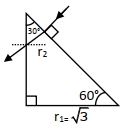
PhysicsMediumMCQNEET · 2021
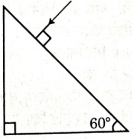
Find the value of the angle of emergence from the prism. The refractive index of the glass is $\sqrt{3}$. (in $^{\circ}$)
A
$60$
B
$30$
C
$45$
D
$90$
Solution
(A) From the geometry of the prism,the light ray enters the prism normally to the hypotenuse face. Thus,the angle of incidence at the first surface is $i_1 = 0^{\circ}$,which implies the angle of refraction $r_1 = 0^{\circ}$.
Given the prism angle $A = 30^{\circ}$,we use the relation $r_1 + r_2 = A$. Substituting $r_1 = 0^{\circ}$,we get $r_2 = 30^{\circ}$.
Applying Snell's law at the second surface (the vertical face): $\mu \sin r_2 = 1 \times \sin e$,where $\mu = \sqrt{3}$ and $e$ is the angle of emergence.
$\sqrt{3} \sin 30^{\circ} = \sin e$
$\sqrt{3} \times \frac{1}{2} = \sin e$
$\sin e = \frac{\sqrt{3}}{2}$
Therefore,$e = 60^{\circ}$.
Given the prism angle $A = 30^{\circ}$,we use the relation $r_1 + r_2 = A$. Substituting $r_1 = 0^{\circ}$,we get $r_2 = 30^{\circ}$.
Applying Snell's law at the second surface (the vertical face): $\mu \sin r_2 = 1 \times \sin e$,where $\mu = \sqrt{3}$ and $e$ is the angle of emergence.
$\sqrt{3} \sin 30^{\circ} = \sin e$
$\sqrt{3} \times \frac{1}{2} = \sin e$
$\sin e = \frac{\sqrt{3}}{2}$
Therefore,$e = 60^{\circ}$.
0 likesView Solution
37
PhysicsMediumMCQNEET · 2021
Consider the following statements $(A)$ and $(B)$ and identify the correct answer.
$(A)$ $A$ Zener diode is connected in reverse bias when used as a voltage regulator.
$(B)$ The potential barrier of a $p-n$ junction typically lies between $0.1 \, V$ to $0.3 \, V$.
$(A)$ $A$ Zener diode is connected in reverse bias when used as a voltage regulator.
$(B)$ The potential barrier of a $p-n$ junction typically lies between $0.1 \, V$ to $0.3 \, V$.
A
$(A)$ and $(B)$ both are correct.
B
$(A)$ and $(B)$ both are incorrect.
C
$(A)$ is correct and $(B)$ is incorrect.
D
$(A)$ is incorrect but $(B)$ is correct.
Solution
(C) Statement $(A)$ is correct: $A$ Zener diode is specifically designed to operate in the reverse breakdown region,making it an effective voltage regulator.
Statement $(B)$ is incorrect: The potential barrier for a Germanium $(Ge)$ $p-n$ junction is approximately $0.3 \, V$,while for a Silicon $(Si)$ $p-n$ junction,it is approximately $0.7 \, V$. Therefore,the range $0.1 \, V$ to $0.3 \, V$ is not representative of all common $p-n$ junctions,as it excludes the widely used Silicon diodes.
Statement $(B)$ is incorrect: The potential barrier for a Germanium $(Ge)$ $p-n$ junction is approximately $0.3 \, V$,while for a Silicon $(Si)$ $p-n$ junction,it is approximately $0.7 \, V$. Therefore,the range $0.1 \, V$ to $0.3 \, V$ is not representative of all common $p-n$ junctions,as it excludes the widely used Silicon diodes.
0 likesView Solution
38
PhysicsMediumMCQNEET · 2021
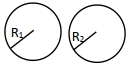
Two charged spherical conductors of radius $R_{1}$ and $R_{2}$ are connected by a wire. Then the ratio of surface charge densities of the spheres $(\sigma_{1} / \sigma_{2})$ is:
A
$\frac{R_{1}}{R_{2}}$
B
$\frac{R_{2}}{R_{1}}$
C
$\sqrt{\frac{R_{1}}{R_{2}}}$
D
$\frac{R_{1}^{2}}{R_{2}^{2}}$
Solution
(B) When two conductors are connected by a wire,charge flows until their potentials become equal.
Let $V_{1}$ and $V_{2}$ be the potentials of the spheres. Since they are connected,$V_{1} = V_{2}$.
The potential of a charged spherical conductor is given by $V = \frac{kQ}{R}$.
Thus,$\frac{kQ_{1}}{R_{1}} = \frac{kQ_{2}}{R_{2}}$,which implies $\frac{Q_{1}}{Q_{2}} = \frac{R_{1}}{R_{2}}$.
The surface charge density $\sigma$ is defined as $\sigma = \frac{Q}{A} = \frac{Q}{4\pi R^{2}}$.
Therefore,the ratio of surface charge densities is:
$\frac{\sigma_{1}}{\sigma_{2}} = \frac{Q_{1} / (4\pi R_{1}^{2})}{Q_{2} / (4\pi R_{2}^{2})} = \frac{Q_{1}}{Q_{2}} \times \frac{R_{2}^{2}}{R_{1}^{2}}$.
Substituting $\frac{Q_{1}}{Q_{2}} = \frac{R_{1}}{R_{2}}$,we get:
$\frac{\sigma_{1}}{\sigma_{2}} = \frac{R_{1}}{R_{2}} \times \frac{R_{2}^{2}}{R_{1}^{2}} = \frac{R_{2}}{R_{1}}$.
Let $V_{1}$ and $V_{2}$ be the potentials of the spheres. Since they are connected,$V_{1} = V_{2}$.
The potential of a charged spherical conductor is given by $V = \frac{kQ}{R}$.
Thus,$\frac{kQ_{1}}{R_{1}} = \frac{kQ_{2}}{R_{2}}$,which implies $\frac{Q_{1}}{Q_{2}} = \frac{R_{1}}{R_{2}}$.
The surface charge density $\sigma$ is defined as $\sigma = \frac{Q}{A} = \frac{Q}{4\pi R^{2}}$.
Therefore,the ratio of surface charge densities is:
$\frac{\sigma_{1}}{\sigma_{2}} = \frac{Q_{1} / (4\pi R_{1}^{2})}{Q_{2} / (4\pi R_{2}^{2})} = \frac{Q_{1}}{Q_{2}} \times \frac{R_{2}^{2}}{R_{1}^{2}}$.
Substituting $\frac{Q_{1}}{Q_{2}} = \frac{R_{1}}{R_{2}}$,we get:
$\frac{\sigma_{1}}{\sigma_{2}} = \frac{R_{1}}{R_{2}} \times \frac{R_{2}^{2}}{R_{1}^{2}} = \frac{R_{2}}{R_{1}}$.
0 likesView Solution
39
PhysicsMediumMCQNEET · 2021
$A$ lens of large focal length and large aperture is best suited as an objective of an astronomical telescope since :
A
a large aperture contributes to the quality and visibility of the images.
B
a large area of the objective ensures better light gathering power.
C
a large aperture provides a better resolution.
D
all of the above.
Solution
(D) The magnifying power of an astronomical telescope is given by $MP = \frac{f_o}{f_e}$, where $f_o$ is the focal length of the objective and $f_e$ is the focal length of the eyepiece.
The resolving power $(R.P.)$ of a telescope is given by $R.P. = \frac{a}{1.22 \lambda}$, where $a$ is the aperture of the objective lens and $\lambda$ is the wavelength of light.
$1$. $A$ large aperture $(a)$ increases the resolving power, allowing the telescope to distinguish between two closely spaced objects.
$2$. $A$ large aperture increases the light-gathering power of the objective, which is proportional to the area of the lens $(\pi r^2)$. This ensures that faint objects are visible and the image quality is improved.
Since all these factors contribute to the performance of an astronomical telescope, the correct answer is $D$.
The resolving power $(R.P.)$ of a telescope is given by $R.P. = \frac{a}{1.22 \lambda}$, where $a$ is the aperture of the objective lens and $\lambda$ is the wavelength of light.
$1$. $A$ large aperture $(a)$ increases the resolving power, allowing the telescope to distinguish between two closely spaced objects.
$2$. $A$ large aperture increases the light-gathering power of the objective, which is proportional to the area of the lens $(\pi r^2)$. This ensures that faint objects are visible and the image quality is improved.
Since all these factors contribute to the performance of an astronomical telescope, the correct answer is $D$.
0 likesView Solution
40
PhysicsMediumMCQNEET · 2021
$A$ nucleus with mass number $240$ breaks into two fragments each of mass number $120$. The binding energy per nucleon of the unfragmented nucleus is $7.6 \, MeV$,while that of the fragments is $8.5 \, MeV$. The total gain in the binding energy in the process is (in $MeV$):
A
$0.9$
B
$9.4$
C
$804$
D
$216$
Solution
(D) The initial nucleus has a mass number $A = 240$ and binding energy per nucleon $BE_{initial} = 7.6 \, MeV$.
The total binding energy of the initial nucleus is $240 \times 7.6 = 1824 \, MeV$.
After the process,the nucleus breaks into two fragments,each with mass number $A = 120$ and binding energy per nucleon $BE_{final} = 8.5 \, MeV$.
The total binding energy of the two fragments is $2 \times (120 \times 8.5) = 240 \times 8.5 = 2040 \, MeV$.
The gain in binding energy is the difference between the total binding energy of the products and the reactants:
$Q = BE_{products} - BE_{reactants} = 2040 \, MeV - 1824 \, MeV = 216 \, MeV$.
The total binding energy of the initial nucleus is $240 \times 7.6 = 1824 \, MeV$.
After the process,the nucleus breaks into two fragments,each with mass number $A = 120$ and binding energy per nucleon $BE_{final} = 8.5 \, MeV$.
The total binding energy of the two fragments is $2 \times (120 \times 8.5) = 240 \times 8.5 = 2040 \, MeV$.
The gain in binding energy is the difference between the total binding energy of the products and the reactants:
$Q = BE_{products} - BE_{reactants} = 2040 \, MeV - 1824 \, MeV = 216 \, MeV$.
0 likesView Solution
41
PhysicsMediumMCQNEET · 2021
The half-life of a radioactive nuclide is $100 \, hours$. The fraction of original activity that will remain after $150 \, hours$ would be:
A
$\frac{1}{2}$
B
$\frac{1}{2 \sqrt{2}}$
C
$\frac{2}{3}$
D
$\frac{2}{3 \sqrt{2}}$
Solution
(B) The activity $A$ of a radioactive sample at time $t$ is given by the formula $A = A_{0} \left(\frac{1}{2}\right)^{t/T_{H}}$,where $A_{0}$ is the initial activity and $T_{H}$ is the half-life.
Given $T_{H} = 100 \, hours$ and $t = 150 \, hours$.
The fraction of activity remaining is $\frac{A}{A_{0}} = \left(\frac{1}{2}\right)^{150/100}$.
This simplifies to $\left(\frac{1}{2}\right)^{1.5} = \left(\frac{1}{2}\right)^{3/2} = \frac{1}{2^{3/2}} = \frac{1}{2 \sqrt{2}}$.
Given $T_{H} = 100 \, hours$ and $t = 150 \, hours$.
The fraction of activity remaining is $\frac{A}{A_{0}} = \left(\frac{1}{2}\right)^{150/100}$.
This simplifies to $\left(\frac{1}{2}\right)^{1.5} = \left(\frac{1}{2}\right)^{3/2} = \frac{1}{2^{3/2}} = \frac{1}{2 \sqrt{2}}$.
0 likesView Solution
42
PhysicsDifficultMCQNEET · 2021
$A$ series $LCR$ circuit containing $5.0 \, H$ inductor,$80 \, \mu F$ capacitor,and $40 \, \Omega$ resistor is connected to a $230 \, V$ variable frequency $AC$ source. The angular frequencies of the source at which the power transferred to the circuit is half the power at the resonant angular frequency are likely to be:
A
$25 \, rad/s$ and $75 \, rad/s$
B
$50 \, rad/s$ and $25 \, rad/s$
C
$46 \, rad/s$ and $54 \, rad/s$
D
$42 \, rad/s$ and $58 \, rad/s$
Solution
(C) Given: $L = 5.0 \, H$,$C = 80 \, \mu F = 80 \times 10^{-6} \, F$,$R = 40 \, \Omega$.
First,calculate the resonant angular frequency $\omega_0$:
$\omega_0 = \frac{1}{\sqrt{LC}} = \frac{1}{\sqrt{5.0 \times 80 \times 10^{-6}}} = \frac{1}{\sqrt{400 \times 10^{-6}}} = \frac{1}{0.02} = 50 \, rad/s$.
Next,calculate the bandwidth $\Delta \omega$:
$\Delta \omega = \frac{R}{L} = \frac{40}{5.0} = 8 \, rad/s$.
The frequencies at which the power is half the maximum power (half-power frequencies) are given by $\omega = \omega_0 \pm \frac{\Delta \omega}{2}$.
$\omega_1 = \omega_0 - \frac{\Delta \omega}{2} = 50 - \frac{8}{2} = 50 - 4 = 46 \, rad/s$.
$\omega_2 = \omega_0 + \frac{\Delta \omega}{2} = 50 + \frac{8}{2} = 50 + 4 = 54 \, rad/s$.
Thus,the angular frequencies are $46 \, rad/s$ and $54 \, rad/s$.
First,calculate the resonant angular frequency $\omega_0$:
$\omega_0 = \frac{1}{\sqrt{LC}} = \frac{1}{\sqrt{5.0 \times 80 \times 10^{-6}}} = \frac{1}{\sqrt{400 \times 10^{-6}}} = \frac{1}{0.02} = 50 \, rad/s$.
Next,calculate the bandwidth $\Delta \omega$:
$\Delta \omega = \frac{R}{L} = \frac{40}{5.0} = 8 \, rad/s$.
The frequencies at which the power is half the maximum power (half-power frequencies) are given by $\omega = \omega_0 \pm \frac{\Delta \omega}{2}$.
$\omega_1 = \omega_0 - \frac{\Delta \omega}{2} = 50 - \frac{8}{2} = 50 - 4 = 46 \, rad/s$.
$\omega_2 = \omega_0 + \frac{\Delta \omega}{2} = 50 + \frac{8}{2} = 50 + 4 = 54 \, rad/s$.
Thus,the angular frequencies are $46 \, rad/s$ and $54 \, rad/s$.
0 likesView Solution
43
PhysicsMediumMCQNEET · 2021
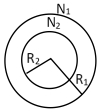
Two conducting circular loops of radii $R_{1}$ and $R_{2}$ are placed in the same plane with their centres coinciding. If $R_{1} >> R_{2}$,the mutual inductance $M$ between them will be directly proportional to:
A
$\frac{R_{1}}{R_{2}}$
B
$\frac{R_{2}}{R_{1}}$
C
$\frac{R_{1}^{2}}{R_{2}}$
D
$\frac{R_{2}^{2}}{R_{1}}$
Solution
(D) The magnetic field $B_{1}$ at the center of a circular loop of radius $R_{1}$ carrying current $I_{1}$ is given by $B_{1} = \frac{\mu_{0} I_{1}}{2 R_{1}}$.
The magnetic flux $\phi_{2}$ linked with the smaller loop of radius $R_{2}$ is $\phi_{2} = B_{1} A_{2}$,where $A_{2} = \pi R_{2}^{2}$ is the area of the smaller loop.
Since $R_{1} >> R_{2}$,we can assume the magnetic field $B_{1}$ is uniform over the area of the smaller loop.
The mutual inductance $M$ is defined as $M = \frac{\phi_{2}}{I_{1}}$.
Substituting the expressions,we get $M = \frac{B_{1} A_{2}}{I_{1}} = \frac{(\frac{\mu_{0} I_{1}}{2 R_{1}}) (\pi R_{2}^{2})}{I_{1}} = \frac{\mu_{0} \pi R_{2}^{2}}{2 R_{1}}$.
Thus,$M \propto \frac{R_{2}^{2}}{R_{1}}$.
The magnetic flux $\phi_{2}$ linked with the smaller loop of radius $R_{2}$ is $\phi_{2} = B_{1} A_{2}$,where $A_{2} = \pi R_{2}^{2}$ is the area of the smaller loop.
Since $R_{1} >> R_{2}$,we can assume the magnetic field $B_{1}$ is uniform over the area of the smaller loop.
The mutual inductance $M$ is defined as $M = \frac{\phi_{2}}{I_{1}}$.
Substituting the expressions,we get $M = \frac{B_{1} A_{2}}{I_{1}} = \frac{(\frac{\mu_{0} I_{1}}{2 R_{1}}) (\pi R_{2}^{2})}{I_{1}} = \frac{\mu_{0} \pi R_{2}^{2}}{2 R_{1}}$.
Thus,$M \propto \frac{R_{2}^{2}}{R_{1}}$.
0 likesView Solution
44
PhysicsDifficultMCQNEET · 2021
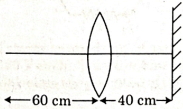
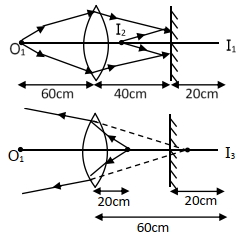
$A$ point object is placed at a distance of $60\, cm$ from a convex lens of focal length $30\, cm$. If a plane mirror is placed perpendicular to the principal axis of the lens at a distance of $40\, cm$ from it,the final image is formed at a distance of:
A
$20\, cm$ from the lens,it is a real image.
B
$30\, cm$ from the lens,it is a real image.
C
$30\, cm$ from the plane mirror,it is a virtual image.
D
$20\, cm$ from the plane mirror,it is a virtual image.
Solution
(D) $1$. First,consider the image formation by the lens:
Given $u = -60\, cm$ and $f = +30\, cm$.
Using the lens formula $\frac{1}{v} - \frac{1}{u} = \frac{1}{f}$:
$\frac{1}{v} = \frac{1}{f} + \frac{1}{u} = \frac{1}{30} - \frac{1}{60} = \frac{2-1}{60} = \frac{1}{60}$
So,$v = +60\, cm$ from the lens.
$2$. This real image acts as an object for the plane mirror. The mirror is at $40\, cm$ from the lens. Since the image is at $60\, cm$ from the lens,it is $60 - 40 = 20\, cm$ behind the mirror.
$3$. The plane mirror forms a virtual image at the same distance behind it as the object is in front of it. Here,the object is $20\, cm$ behind the mirror,so the mirror forms a real image $20\, cm$ in front of it.
$4$. This image acts as a virtual object for the second refraction through the lens. The distance of this object from the lens is $40 - 20 = 20\, cm$. Thus,$u' = -20\, cm$ (as it is on the same side as the light source).
$5$. Using the lens formula again:
$\frac{1}{v'} = \frac{1}{f} + \frac{1}{u'} = \frac{1}{30} - \frac{1}{20} = \frac{2-3}{60} = -\frac{1}{60}$
So,$v' = -60\, cm$.
The negative sign indicates that the final image is virtual and formed $60\, cm$ in front of the lens,which is $20\, cm$ behind the plane mirror.
Given $u = -60\, cm$ and $f = +30\, cm$.
Using the lens formula $\frac{1}{v} - \frac{1}{u} = \frac{1}{f}$:
$\frac{1}{v} = \frac{1}{f} + \frac{1}{u} = \frac{1}{30} - \frac{1}{60} = \frac{2-1}{60} = \frac{1}{60}$
So,$v = +60\, cm$ from the lens.
$2$. This real image acts as an object for the plane mirror. The mirror is at $40\, cm$ from the lens. Since the image is at $60\, cm$ from the lens,it is $60 - 40 = 20\, cm$ behind the mirror.
$3$. The plane mirror forms a virtual image at the same distance behind it as the object is in front of it. Here,the object is $20\, cm$ behind the mirror,so the mirror forms a real image $20\, cm$ in front of it.
$4$. This image acts as a virtual object for the second refraction through the lens. The distance of this object from the lens is $40 - 20 = 20\, cm$. Thus,$u' = -20\, cm$ (as it is on the same side as the light source).
$5$. Using the lens formula again:
$\frac{1}{v'} = \frac{1}{f} + \frac{1}{u'} = \frac{1}{30} - \frac{1}{20} = \frac{2-3}{60} = -\frac{1}{60}$
So,$v' = -60\, cm$.
The negative sign indicates that the final image is virtual and formed $60\, cm$ in front of the lens,which is $20\, cm$ behind the plane mirror.
0 likesView Solution
45
PhysicsMediumMCQNEET · 2021
$A$ uniform conducting wire of length $12 a$ and resistance $R$ is wound up as a current-carrying coil in the shape of,
$(i)$ an equilateral triangle of side $a$.
$(ii)$ a square of side $a$.
The magnetic dipole moments of the coil in each case respectively are:
$(i)$ an equilateral triangle of side $a$.
$(ii)$ a square of side $a$.
The magnetic dipole moments of the coil in each case respectively are:
A
$\sqrt{3} Ia^{2}$ and $3 Ia^{2}$
B
$3 Ia^{2}$ and $Ia^{2}$
C
$3 Ia^{2}$ and $4 Ia^{2}$
D
$4 Ia^{2}$ and $3 Ia^{2}$
Solution
(A) Total length of wire $L = 12 a$.
Case $(i)$: Equilateral triangle of side $a$.
Perimeter of one turn $= 3 a$.
Number of turns $N_{1} = \frac{12 a}{3 a} = 4$.
Area of one triangle $A_{1} = \frac{\sqrt{3}}{4} a^{2}$.
Magnetic dipole moment $\mu_{1} = N_{1} I A_{1} = 4 \times I \times \frac{\sqrt{3}}{4} a^{2} = \sqrt{3} I a^{2}$.
Case $(ii)$: Square of side $a$.
Perimeter of one turn $= 4 a$.
Number of turns $N_{2} = \frac{12 a}{4 a} = 3$.
Area of one square $A_{2} = a^{2}$.
Magnetic dipole moment $\mu_{2} = N_{2} I A_{2} = 3 \times I \times a^{2} = 3 I a^{2}$.
Thus,the magnetic dipole moments are $\sqrt{3} I a^{2}$ and $3 I a^{2}$.
Case $(i)$: Equilateral triangle of side $a$.
Perimeter of one turn $= 3 a$.
Number of turns $N_{1} = \frac{12 a}{3 a} = 4$.
Area of one triangle $A_{1} = \frac{\sqrt{3}}{4} a^{2}$.
Magnetic dipole moment $\mu_{1} = N_{1} I A_{1} = 4 \times I \times \frac{\sqrt{3}}{4} a^{2} = \sqrt{3} I a^{2}$.
Case $(ii)$: Square of side $a$.
Perimeter of one turn $= 4 a$.
Number of turns $N_{2} = \frac{12 a}{4 a} = 3$.
Area of one square $A_{2} = a^{2}$.
Magnetic dipole moment $\mu_{2} = N_{2} I A_{2} = 3 \times I \times a^{2} = 3 I a^{2}$.
Thus,the magnetic dipole moments are $\sqrt{3} I a^{2}$ and $3 I a^{2}$.
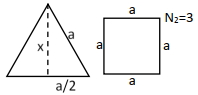
0 likesView Solution
46
PhysicsEasyMCQNEET · 2021
Three resistors having resistances $r_{1}, r_{2}$ and $r_{3}$ are connected as shown in the given circuit. The ratio $\frac{i_{3}}{i_{1}}$ of currents in terms of resistances used in the circuit is :
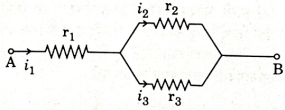
A
$\frac{r_{1}}{r_{2}+r_{3}}$
B
$\frac{r_{2}}{r_{2}+r_{3}}$
C
$\frac{r_{1}}{r_{1}+r_{2}}$
D
$\frac{r_{2}}{r_{1}+r_{3}}$
Solution
(B) In the given circuit,the current $i_{1}$ splits into two parallel branches containing resistors $r_{2}$ and $r_{3}$.
According to the current divider rule,the current $i_{3}$ flowing through resistor $r_{3}$ is given by:
$i_{3} = i_{1} \left( \frac{r_{2}}{r_{2} + r_{3}} \right)$
Dividing both sides by $i_{1}$,we get the ratio:
$\frac{i_{3}}{i_{1}} = \frac{r_{2}}{r_{2} + r_{3}}$
According to the current divider rule,the current $i_{3}$ flowing through resistor $r_{3}$ is given by:
$i_{3} = i_{1} \left( \frac{r_{2}}{r_{2} + r_{3}} \right)$
Dividing both sides by $i_{1}$,we get the ratio:
$\frac{i_{3}}{i_{1}} = \frac{r_{2}}{r_{2} + r_{3}}$
0 likesView Solution
47
PhysicsMediumMCQNEET · 2021
$A$ step-down transformer connected to an $AC$ mains supply of $220 \, V$ is made to operate a $11 \, V, 44 \, W$ lamp. Ignoring power losses in the transformer,what is the current in the primary circuit? (In $A$)
A
$0.2$
B
$0.4$
C
$2$
D
$4$
Solution
(A) Given that the transformer is ideal (ignoring power losses),the input power is equal to the output power.
$P_{\text{in}} = P_{\text{out}}$
Since $P_{\text{out}} = 44 \, W$ and $V_p = 220 \, V$,we use the relation $P_{\text{in}} = V_p \times I_p$.
$220 \times I_p = 44$
$I_p = \frac{44}{220} \, A$
$I_p = \frac{1}{5} \, A = 0.2 \, A$
Therefore,the current in the primary circuit is $0.2 \, A$.
$P_{\text{in}} = P_{\text{out}}$
Since $P_{\text{out}} = 44 \, W$ and $V_p = 220 \, V$,we use the relation $P_{\text{in}} = V_p \times I_p$.
$220 \times I_p = 44$
$I_p = \frac{44}{220} \, A$
$I_p = \frac{1}{5} \, A = 0.2 \, A$
Therefore,the current in the primary circuit is $0.2 \, A$.
0 likesView Solution
48
PhysicsMediumMCQNEET · 2021
Twenty-seven drops of the same size are charged at $220 \, V$ each. They combine to form a bigger drop. Calculate the potential of the bigger drop (in $V$).
A
$1980$
B
$1320$
C
$1520$
D
$660$
Solution
(A) Let $r$ be the radius of each small drop and $q$ be the charge on each small drop.
The potential of each small drop is $V_S = \frac{kq}{r} = 220 \, V$.
When $N = 27$ drops combine to form a bigger drop of radius $R$ and charge $Q$,the volume remains constant.
$\frac{4}{3} \pi R^3 = N \times \frac{4}{3} \pi r^3 \implies R = N^{1/3} r = (27)^{1/3} r = 3r$.
The total charge on the bigger drop is $Q = Nq = 27q$.
The potential of the bigger drop is $V_B = \frac{kQ}{R} = \frac{k(Nq)}{N^{1/3}r} = N^{2/3} \frac{kq}{r} = N^{2/3} V_S$.
Substituting the values: $V_B = (27)^{2/3} \times 220 = (3^3)^{2/3} \times 220 = 3^2 \times 220 = 9 \times 220 = 1980 \, V$.
The potential of each small drop is $V_S = \frac{kq}{r} = 220 \, V$.
When $N = 27$ drops combine to form a bigger drop of radius $R$ and charge $Q$,the volume remains constant.
$\frac{4}{3} \pi R^3 = N \times \frac{4}{3} \pi r^3 \implies R = N^{1/3} r = (27)^{1/3} r = 3r$.
The total charge on the bigger drop is $Q = Nq = 27q$.
The potential of the bigger drop is $V_B = \frac{kQ}{R} = \frac{k(Nq)}{N^{1/3}r} = N^{2/3} \frac{kq}{r} = N^{2/3} V_S$.
Substituting the values: $V_B = (27)^{2/3} \times 220 = (3^3)^{2/3} \times 220 = 3^2 \times 220 = 9 \times 220 = 1980 \, V$.
0 likesView Solution
49
PhysicsMediumMCQNEET · 2021
For the given circuit,the input digital signals are applied at the terminals $A, B$ and $C$. What would be the output at the terminal $y$?
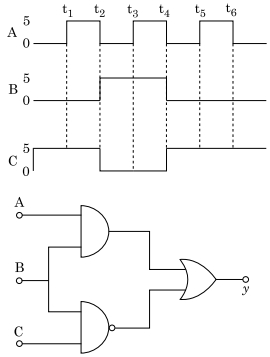
A
B
C
D
Solution
(D) The circuit consists of an $AND$ gate and a $NAND$ gate whose outputs are fed into an $OR$ gate. Let the inputs be $A, B, C$. The output of the $AND$ gate is $A \cdot B$. The output of the $NAND$ gate is $\overline{B \cdot C}$. The final output $Y$ of the $OR$ gate is $Y = (A \cdot B) + \overline{(B \cdot C)}$.
Analyzing the truth table for the intervals:
- Interval $0-t_1$: $A=0, B=0, C=1$. $Y = (0 \cdot 0) + \overline{(0 \cdot 1)} = 0 + 1 = 1$.
- Interval $t_1-t_2$: $A=1, B=0, C=1$. $Y = (1 \cdot 0) + \overline{(0 \cdot 1)} = 0 + 1 = 1$.
- Interval $t_2-t_3$: $A=0, B=1, C=0$. $Y = (0 \cdot 1) + \overline{(1 \cdot 0)} = 0 + 1 = 1$.
- Interval $t_3-t_4$: $A=1, B=1, C=0$. $Y = (1 \cdot 1) + \overline{(1 \cdot 0)} = 1 + 1 = 1$.
- Interval $t_4-t_5$: $A=0, B=0, C=1$. $Y = (0 \cdot 0) + \overline{(0 \cdot 1)} = 0 + 1 = 1$.
- Interval $t_5-t_6$: $A=1, B=0, C=1$. $Y = (1 \cdot 0) + \overline{(0 \cdot 1)} = 0 + 1 = 1$.
Since the output is $1$ $(5 \text{ V})$ for all intervals,the correct representation is a constant $5 \text{ V}$ signal.
Analyzing the truth table for the intervals:
- Interval $0-t_1$: $A=0, B=0, C=1$. $Y = (0 \cdot 0) + \overline{(0 \cdot 1)} = 0 + 1 = 1$.
- Interval $t_1-t_2$: $A=1, B=0, C=1$. $Y = (1 \cdot 0) + \overline{(0 \cdot 1)} = 0 + 1 = 1$.
- Interval $t_2-t_3$: $A=0, B=1, C=0$. $Y = (0 \cdot 1) + \overline{(1 \cdot 0)} = 0 + 1 = 1$.
- Interval $t_3-t_4$: $A=1, B=1, C=0$. $Y = (1 \cdot 1) + \overline{(1 \cdot 0)} = 1 + 1 = 1$.
- Interval $t_4-t_5$: $A=0, B=0, C=1$. $Y = (0 \cdot 0) + \overline{(0 \cdot 1)} = 0 + 1 = 1$.
- Interval $t_5-t_6$: $A=1, B=0, C=1$. $Y = (1 \cdot 0) + \overline{(0 \cdot 1)} = 0 + 1 = 1$.
Since the output is $1$ $(5 \text{ V})$ for all intervals,the correct representation is a constant $5 \text{ V}$ signal.
0 likesView Solution
50
PhysicsMediumMCQNEET · 2021
In the product $\overrightarrow{F} = q(\vec{v} \times \overrightarrow{B})$ where $\overrightarrow{B} = B \hat{i} + B \hat{j} + B_{0} \hat{k}$. Given $q = 1$,$\vec{v} = 2 \hat{i} + 4 \hat{j} + 6 \hat{k}$,and $\overrightarrow{F} = 4 \hat{i} - 20 \hat{j} + 12 \hat{k}$,what is the complete expression for $\overrightarrow{B}$?
A
$-8 \hat{i} - 8 \hat{j} - 6 \hat{k}$
B
$-6 \hat{i} - 6 \hat{j} - 8 \hat{k}$
C
$8 \hat{i} + 8 \hat{j} - 6 \hat{k}$
D
$6 \hat{i} + 6 \hat{j} - 8 \hat{k}$
Solution
(B) Given the Lorentz force equation: $\overrightarrow{F} = q(\vec{v} \times \overrightarrow{B})$.
Since $q = 1$,we have $\overrightarrow{F} = \vec{v} \times \overrightarrow{B}$.
Let $\overrightarrow{B} = B \hat{i} + B \hat{j} + B_0 \hat{k}$.
The cross product is given by the determinant:
$\vec{v} \times \overrightarrow{B} = \begin{vmatrix} \hat{i} & \hat{j} & \hat{k} \\ 2 & 4 & 6 \\ B & B & B_0 \end{vmatrix} = \hat{i}(4B_0 - 6B) - \hat{j}(2B_0 - 6B) + \hat{k}(2B - 4B) = 4 \hat{i} - 20 \hat{j} + 12 \hat{k}$.
Comparing the components:
$1$) $4B_0 - 6B = 4$
$2$) $-(2B_0 - 6B) = -20 \implies 2B_0 - 6B = 20$
$3$) $2B - 4B = 12 \implies -2B = 12 \implies B = -6$.
Substitute $B = -6$ into equation $(2)$:
$2B_0 - 6(-6) = 20 \implies 2B_0 + 36 = 20 \implies 2B_0 = -16 \implies B_0 = -8$.
Thus,$\overrightarrow{B} = -6 \hat{i} - 6 \hat{j} - 8 \hat{k}$.
Since $q = 1$,we have $\overrightarrow{F} = \vec{v} \times \overrightarrow{B}$.
Let $\overrightarrow{B} = B \hat{i} + B \hat{j} + B_0 \hat{k}$.
The cross product is given by the determinant:
$\vec{v} \times \overrightarrow{B} = \begin{vmatrix} \hat{i} & \hat{j} & \hat{k} \\ 2 & 4 & 6 \\ B & B & B_0 \end{vmatrix} = \hat{i}(4B_0 - 6B) - \hat{j}(2B_0 - 6B) + \hat{k}(2B - 4B) = 4 \hat{i} - 20 \hat{j} + 12 \hat{k}$.
Comparing the components:
$1$) $4B_0 - 6B = 4$
$2$) $-(2B_0 - 6B) = -20 \implies 2B_0 - 6B = 20$
$3$) $2B - 4B = 12 \implies -2B = 12 \implies B = -6$.
Substitute $B = -6$ into equation $(2)$:
$2B_0 - 6(-6) = 20 \implies 2B_0 + 36 = 20 \implies 2B_0 = -16 \implies B_0 = -8$.
Thus,$\overrightarrow{B} = -6 \hat{i} - 6 \hat{j} - 8 \hat{k}$.
0 likesView Solution
Vedclass Products
For Students
Vedclass Test Series
Mock tests in real NEET style covering Physics with performance analysis. 5-day free trial.
Start Free TrialFor Teachers
Exam Paper Generator
Generate Set A/B/C/D Physics papers from 7.5L+ questions in 2 minutes. 3 chapters free.
Try FreeFor Institutes
Online Exam Module
Run live NEET mock exams with unlimited students, 360° analytics & white-label branding.
See DemoFrequently Asked Questions
How many Physics questions are in NEET 2021?
There are 50 Physics questions from the NEET 2021 paper on Vedclass, each with a detailed step-by-step solution in English.
Are NEET 2021 Physics solutions available in English?
Yes. All solutions on this page are in English. You can also switch to English or Hindi using the language buttons above the questions.
Can I practice NEET 2021 Physics as a timed test?
Yes. Use the Vedclass Test Series to attempt a full NEET mock test covering Physics with time limits and instant score analysis.
Can teachers create Physics papers from NEET previous year questions?
Yes. The Vedclass Exam Paper Generator lets teachers mix NEET Physics questions and generate Set A/B/C/D papers in minutes.
For Teachers & Institutes
Build a Custom Physics Paper
Pick NEET 2021 Physics questions, set difficulty, and generate Set A/B/C/D in 2 minutes.