
ChemistryQ1–100 of 105 questions
Page 1 of 2 · English
1
ChemistryMCQNEET · 2022
Which of the following is the most stable carbocation?
A
$CH_3CH_2^+$
B
$CH_3^+$
C
$(CH_3)_3C^+$
D
$(CH_3)_2CH^+$
Solution
(C) The stability of carbocations is determined by the inductive effect and hyperconjugation.
$(CH_3)_3C^+$ is a tertiary $(3^\circ)$ carbocation.
It has $9 \, \alpha \text{-hydrogen}$ atoms,which provide maximum hyperconjugation,making it the most stable among the given options.
$(CH_3)_3C^+$ is a tertiary $(3^\circ)$ carbocation.
It has $9 \, \alpha \text{-hydrogen}$ atoms,which provide maximum hyperconjugation,making it the most stable among the given options.
0 likesView Solution
2
ChemistryMediumMCQNEET · 2022
The $pH$ of the solution containing $50 \ mL$ each of $0.10 \ M$ sodium acetate and $0.01 \ M$ acetic acid is $.......$
[Given $pK_{a}$ of $CH_{3}COOH = 4.57$] (in $.57$)
[Given $pK_{a}$ of $CH_{3}COOH = 4.57$] (in $.57$)
A
$3$
B
$4$
C
$2$
D
$5$
Solution
(D) The mixture of a weak acid $(CH_{3}COOH)$ and its salt with a strong base $(CH_{3}COONa)$ forms an acidic buffer solution.
The concentration of salt $[Salt] = 0.10 \ M$.
The concentration of acid $[Acid] = 0.01 \ M$.
The $pH$ of an acidic buffer is calculated using the Henderson-Hasselbalch equation:
$pH = pK_{a} + \log \left( \frac{[Salt]}{[Acid]} \right)$
Substituting the given values:
$pH = 4.57 + \log \left( \frac{0.10}{0.01} \right)$
$pH = 4.57 + \log(10)$
Since $\log(10) = 1$,we get:
$pH = 4.57 + 1 = 5.57$
The concentration of salt $[Salt] = 0.10 \ M$.
The concentration of acid $[Acid] = 0.01 \ M$.
The $pH$ of an acidic buffer is calculated using the Henderson-Hasselbalch equation:
$pH = pK_{a} + \log \left( \frac{[Salt]}{[Acid]} \right)$
Substituting the given values:
$pH = 4.57 + \log \left( \frac{0.10}{0.01} \right)$
$pH = 4.57 + \log(10)$
Since $\log(10) = 1$,we get:
$pH = 4.57 + 1 = 5.57$
0 likesView Solution
3
ChemistryMediumMCQNEET · 2022
Match List-$I$ with List-$II$.
Choose the correct answer from the options given below:
| List-$I$ | List-$II$ |
| $(a)$ $Li$ | $(i)$ Absorbent for carbon dioxide |
| $(b)$ $Na$ | $(ii)$ Electrochemical cells |
| $(c)$ $KOH$ | $(iii)$ Coolant in fast breeder reactors |
| $(d)$ $Cs$ | $(iv)$ Photoelectric cell |
Choose the correct answer from the options given below:
A
$(a)-(iii), (b)-(iv), (c)-(ii), (d)-(i)$
B
$(a)-(i), (b)-(iii), (c)-(iv), (d)-(ii)$
C
$(a)-(ii), (b)-(iii), (c)-(i), (d)-(iv)$
D
$(a)-(iv), (b)-(i), (c)-(iii), (d)-(ii)$
Solution
(C) $Li$ is used in electrochemical cells.
$Na$ is used as a coolant in fast breeder reactors.
$KOH$ is used as an absorbent for $CO_2$.
$Cs$ is used in photoelectric cells.
Therefore,the correct matching is $(a)-(ii), (b)-(iii), (c)-(i), (d)-(iv)$.
$Na$ is used as a coolant in fast breeder reactors.
$KOH$ is used as an absorbent for $CO_2$.
$Cs$ is used in photoelectric cells.
Therefore,the correct matching is $(a)-(ii), (b)-(iii), (c)-(i), (d)-(iv)$.
0 likesView Solution
4
ChemistryEasyMCQNEET · 2022
Choose the correct statement:
A
Diamond is covalent and graphite is ionic.
B
Diamond is $sp^{3}$ hybridised and graphite is $sp^{2}$ hybridized.
C
Both diamond and graphite are used as dry lubricants.
D
Diamond and graphite have two dimensional network.
Solution
(B) In diamond,each carbon atom is bonded to four other carbon atoms,resulting in a $sp^{3}$ hybridisation.
In graphite,each carbon atom is bonded to three other carbon atoms,resulting in a $sp^{2}$ hybridisation.
In graphite,each carbon atom is bonded to three other carbon atoms,resulting in a $sp^{2}$ hybridisation.
0 likesView Solution
5
ChemistryEasyMCQNEET · 2022
Which of the following $p-V$ curves represents the maximum work done?
A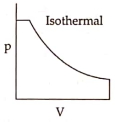
B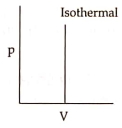
C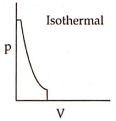
D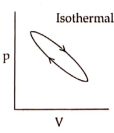
Solution
(A) In a $p-V$ graph,the area under the curve represents the magnitude of the work done.
Comparing the given graphs,the area enclosed under the curve in option $A$ is the largest among the choices provided.
Therefore,the curve in option $A$ represents the maximum work done.
Comparing the given graphs,the area enclosed under the curve in option $A$ is the largest among the choices provided.
Therefore,the curve in option $A$ represents the maximum work done.
0 likesView Solution
6
ChemistryEasyMCQNEET · 2022
Which compound amongst the following is not an aromatic compound?
A
Cycloheptatrienyl cation
B
Cyclopropenyl cation
C
Cyclooctatetraene
D
Cyclopentadienyl anion
Solution
(C) To determine if a compound is aromatic,it must follow $H$ückel's rule:
$1$. The molecule must be cyclic.
$2$. The molecule must be planar.
$3$. The molecule must be fully conjugated.
$4$. The molecule must have $(4n + 2) \pi$ electrons,where $n = 0, 1, 2, ...$
Let's analyze each option:
- $A$: Cycloheptatrienyl cation has $6 \pi$ electrons $(n=1)$,is cyclic,planar,and conjugated. It is aromatic.
- $B$: Cyclopropenyl cation has $2 \pi$ electrons $(n=0)$,is cyclic,planar,and conjugated. It is aromatic.
- $C$: Cyclooctatetraene has $8 \pi$ electrons. It is not planar (it adopts a tub shape) and does not follow the $(4n + 2) \pi$ rule. It is non-aromatic.
- $D$: Cyclopentadienyl anion has $6 \pi$ electrons $(n=1)$,is cyclic,planar,and conjugated. It is aromatic.
Therefore,the compound that is not aromatic is cyclooctatetraene.
$1$. The molecule must be cyclic.
$2$. The molecule must be planar.
$3$. The molecule must be fully conjugated.
$4$. The molecule must have $(4n + 2) \pi$ electrons,where $n = 0, 1, 2, ...$
Let's analyze each option:
- $A$: Cycloheptatrienyl cation has $6 \pi$ electrons $(n=1)$,is cyclic,planar,and conjugated. It is aromatic.
- $B$: Cyclopropenyl cation has $2 \pi$ electrons $(n=0)$,is cyclic,planar,and conjugated. It is aromatic.
- $C$: Cyclooctatetraene has $8 \pi$ electrons. It is not planar (it adopts a tub shape) and does not follow the $(4n + 2) \pi$ rule. It is non-aromatic.
- $D$: Cyclopentadienyl anion has $6 \pi$ electrons $(n=1)$,is cyclic,planar,and conjugated. It is aromatic.
Therefore,the compound that is not aromatic is cyclooctatetraene.
0 likesView Solution
7
ChemistryMediumMCQNEET · 2022
Which one is not a correct mathematical equation for Dalton's Law of partial pressure? Here $p =$ total pressure of the gaseous mixture.
A
$p = n_{1} \frac{RT}{V} + n_{2} \frac{RT}{V} + n_{3} \frac{RT}{V}$
B
$p_{i} = \chi_{i} p$,where $p_{i} =$ partial pressure of $i^{\text{th}}$ gas and $\chi_{i} =$ mole fraction of $i^{\text{th}}$ gas in the gaseous mixture.
C
$p_{i} = \chi_{i} p_{i}^{0}$,where $\chi_{i} =$ mole fraction of $i^{\text{th}}$ gas in the gaseous mixture and $p_{i}^{0} =$ pressure of $i^{\text{th}}$ gas in the pure state.
D
$p = p_{1} + p_{2} + p_{3}$
Solution
(C) Dalton's law of partial pressure states that the total pressure exerted by a mixture of non-reacting gases is equal to the sum of the partial pressures of the individual gases: $p = p_{1} + p_{2} + p_{3}$.
The partial pressure of a gas $i$ is given by $p_{i} = \chi_{i} p$,where $\chi_{i}$ is the mole fraction of the gas in the mixture.
Option $A$ is correct because $p = \sum n_{i} \frac{RT}{V} = (\sum n_{i}) \frac{RT}{V} = n_{total} \frac{RT}{V}$,which is the ideal gas law for the mixture.
Option $C$ represents Raoult's Law for solutions,not Dalton's Law for gaseous mixtures. Therefore,it is the incorrect equation.
The partial pressure of a gas $i$ is given by $p_{i} = \chi_{i} p$,where $\chi_{i}$ is the mole fraction of the gas in the mixture.
Option $A$ is correct because $p = \sum n_{i} \frac{RT}{V} = (\sum n_{i}) \frac{RT}{V} = n_{total} \frac{RT}{V}$,which is the ideal gas law for the mixture.
Option $C$ represents Raoult's Law for solutions,not Dalton's Law for gaseous mixtures. Therefore,it is the incorrect equation.
0 likesView Solution
8
ChemistryMediumMCQNEET · 2022
Match List-$I$ with List-$II$.
Choose the correct answer from the options given below:
| List-$I$ (Hydrides) | List-$II$ (Nature) |
| $a. MgH_2$ | $i. \text{Electron precise}$ |
| $b. GeH_4$ | $ii. \text{Electron deficient}$ |
| $c. B_2H_6$ | $iii. \text{Electron rich}$ |
| $d. HF$ | $iv. \text{Ionic}$ |
Choose the correct answer from the options given below:
A
$a-iii, b-i, c-ii, d-iv$
B
$a-i, b-ii, c-iv, d-iii$
C
$a-ii, b-iii, c-iv, d-i$
D
$a-iv, b-i, c-ii, d-iii$
Solution
(D) $1$. $MgH_2$ is an ionic hydride.
$2$. $GeH_4$ is an electron-precise hydride (has $8$ electrons in the valence shell,no lone pairs).
$3$. $B_2H_6$ is an electron-deficient hydride (has less than $8$ electrons in the valence shell).
$4$. $HF$ is an electron-rich hydride (has $8$ electrons in the valence shell with lone pairs).
Therefore,the correct matching is: $a-iv, b-i, c-ii, d-iii$.
$2$. $GeH_4$ is an electron-precise hydride (has $8$ electrons in the valence shell,no lone pairs).
$3$. $B_2H_6$ is an electron-deficient hydride (has less than $8$ electrons in the valence shell).
$4$. $HF$ is an electron-rich hydride (has $8$ electrons in the valence shell with lone pairs).
Therefore,the correct matching is: $a-iv, b-i, c-ii, d-iii$.
0 likesView Solution
9
ChemistryEasyMCQNEET · 2022
Identify the incorrect statement from the following.
A
The oxidation number of $K$ in $KO_{2}$ is $+4$.
B
Ionisation enthalpy of alkali metals decreases from top to bottom in the group.
C
Lithium is the strongest reducing agent among the alkali metals.
D
Alkali metals react with water to form their hydroxides.
Solution
(A) In $KO_{2}$,potassium $(K)$ is an alkali metal and always exhibits an oxidation state of $+1$.
The superoxide ion is $O_{2}^{-}$,where the oxidation state of oxygen is $-1/2$.
Therefore,the statement that the oxidation number of $K$ in $KO_{2}$ is $+4$ is incorrect.
The correct oxidation number of $K$ is $+1$.
The superoxide ion is $O_{2}^{-}$,where the oxidation state of oxygen is $-1/2$.
Therefore,the statement that the oxidation number of $K$ in $KO_{2}$ is $+4$ is incorrect.
The correct oxidation number of $K$ is $+1$.
0 likesView Solution
10
ChemistryMediumMCQNEET · 2022
Which amongst the following is an incorrect statement?
A
$C_{2}$ molecule has four electrons in its two degenerate $\pi$ molecular orbitals.
B
$H_{2}^{+}$ ion has one electron.
C
$O_{2}^{+}$ ion is diamagnetic.
D
The bond orders of $O_{2}^{+}, O_{2}, O_{2}^{-}$ and $O_{2}^{2-}$ are $2.5, 2, 1.5$ and $1,$ respectively.
Solution
(C) The electronic configuration of $O_{2}^{+}$ is $\sigma 1s^{2}, \sigma^{*} 1s^{2}, \sigma 2s^{2}, \sigma^{*} 2s^{2}, \sigma 2p_{z}^{2}, \pi 2p_{x}^{2} = \pi 2p_{y}^{2}, \pi^{*} 2p_{x}^{1}$.
Since $O_{2}^{+}$ ion has $15$ electrons,it contains one unpaired electron in the $\pi^{*}$ orbital.
Therefore,it is paramagnetic in nature,making the statement in option $C$ incorrect.
Since $O_{2}^{+}$ ion has $15$ electrons,it contains one unpaired electron in the $\pi^{*}$ orbital.
Therefore,it is paramagnetic in nature,making the statement in option $C$ incorrect.
0 likesView Solution
11
ChemistryDifficultMCQNEET · 2022
What mass of $95 \%$ pure $CaCO_3$ will be required to neutralise $50 \ mL$ of $0.5 \ M \ HCl$ solution according to the following reaction? (In $g$)
$CaCO_{3(s)} + 2HCl_{(aq)} \rightarrow CaCl_{2(aq)} + CO_{2(g)} + H_2O_{(l)}$
[Calculate up to the second decimal place]
$CaCO_{3(s)} + 2HCl_{(aq)} \rightarrow CaCl_{2(aq)} + CO_{2(g)} + H_2O_{(l)}$
[Calculate up to the second decimal place]
A
$1.32$
B
$3.65$
C
$9.50$
D
$1.25$
Solution
(A) The balanced chemical equation is:
$CaCO_{3(s)} + 2HCl_{(aq)} \rightarrow CaCl_{2(aq)} + CO_{2(g)} + H_2O_{(l)}$
Number of moles of $HCl = \text{Molarity} \times \text{Volume (in L)} = 0.5 \times 0.050 = 0.025 \ \text{mol}$.
From the stoichiometry of the reaction,$1 \ \text{mole}$ of $CaCO_3$ reacts with $2 \ \text{moles}$ of $HCl$.
Therefore,moles of pure $CaCO_3$ required $= \frac{1}{2} \times 0.025 = 0.0125 \ \text{mol}$.
Mass of pure $CaCO_3 = \text{moles} \times \text{molar mass} = 0.0125 \times 100 \ \text{g/mol} = 1.25 \ \text{g}$.
Given that the sample is $95 \%$ pure,the mass of the impure sample is calculated as:
$\text{Mass of impure sample} = \frac{\text{Mass of pure } CaCO_3}{\text{Purity percentage}} \times 100 = \frac{1.25}{95} \times 100 \approx 1.3157 \ \text{g}$.
Rounding to the second decimal place,we get $1.32 \ \text{g}$.
$CaCO_{3(s)} + 2HCl_{(aq)} \rightarrow CaCl_{2(aq)} + CO_{2(g)} + H_2O_{(l)}$
Number of moles of $HCl = \text{Molarity} \times \text{Volume (in L)} = 0.5 \times 0.050 = 0.025 \ \text{mol}$.
From the stoichiometry of the reaction,$1 \ \text{mole}$ of $CaCO_3$ reacts with $2 \ \text{moles}$ of $HCl$.
Therefore,moles of pure $CaCO_3$ required $= \frac{1}{2} \times 0.025 = 0.0125 \ \text{mol}$.
Mass of pure $CaCO_3 = \text{moles} \times \text{molar mass} = 0.0125 \times 100 \ \text{g/mol} = 1.25 \ \text{g}$.
Given that the sample is $95 \%$ pure,the mass of the impure sample is calculated as:
$\text{Mass of impure sample} = \frac{\text{Mass of pure } CaCO_3}{\text{Purity percentage}} \times 100 = \frac{1.25}{95} \times 100 \approx 1.3157 \ \text{g}$.
Rounding to the second decimal place,we get $1.32 \ \text{g}$.
0 likesView Solution
12
ChemistryEasyMCQNEET · 2022
The Kjeldahl's method for the estimation of nitrogen can be used to estimate the amount of nitrogen in which one of the following compounds?
A
B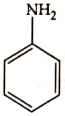
C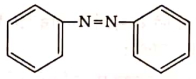
D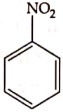
Solution
(B) The Kjeldahl's method is not applicable to compounds containing nitrogen in nitro $(-NO_2)$ or azo $(-N=N-)$ groups,or nitrogen present in a ring (like pyridine),because the nitrogen in these compounds is not quantitatively converted to ammonium sulphate under the conditions of the Kjeldahl's method.
Among the given options:
$A$. Nitrobenzene contains a nitro group.
$B$. Aniline $(C_6H_5NH_2)$ contains an amino group,which is easily converted to ammonium sulphate.
$C$. Azobenzene contains an azo group.
$D$. Pyridine contains nitrogen in the ring.
Therefore,the Kjeldahl's method can be used for Aniline.
Among the given options:
$A$. Nitrobenzene contains a nitro group.
$B$. Aniline $(C_6H_5NH_2)$ contains an amino group,which is easily converted to ammonium sulphate.
$C$. Azobenzene contains an azo group.
$D$. Pyridine contains nitrogen in the ring.
Therefore,the Kjeldahl's method can be used for Aniline.
0 likesView Solution
13
ChemistryEasyMCQNEET · 2022
Identify the incorrect statement from the following.
A
All the five $4d$ orbitals have shapes similar to the respective $3d$ orbitals.
B
In an atom,all the five $3d$ orbitals are equal in energy in free state.
C
The shapes of $d_{xy}$,$d_{yz}$,and $d_{zx}$ orbitals are similar to each other; and $d_{x^{2}-y^{2}}$ and $d_{z^{2}}$ are similar to each other.
D
All the five $5d$ orbitals are different in size when compared to the respective $4d$ orbitals.
Solution
(C) The shapes of $d$-orbitals are determined by the angular part of the wave function,which depends on the azimuthal quantum number $l$. For all $d$-orbitals,$l = 2$. Therefore,$3d$,$4d$,and $5d$ orbitals have the same shapes.
Option $A$ is correct because $4d$ and $3d$ orbitals have identical shapes.
Option $B$ is correct because in a free atom,all five $d$-orbitals are degenerate (equal in energy).
Option $C$ is incorrect because $d_{x^{2}-y^{2}}$ and $d_{z^{2}}$ do not have similar shapes. $d_{x^{2}-y^{2}}$ has four lobes along the $x$ and $y$ axes,while $d_{z^{2}}$ has two lobes along the $z$-axis and a ring of electron density in the $xy$-plane.
Option $D$ is correct because as the principal quantum number $n$ increases,the size of the orbital increases. Thus,$5d$ orbitals are larger than $4d$ orbitals.
Option $A$ is correct because $4d$ and $3d$ orbitals have identical shapes.
Option $B$ is correct because in a free atom,all five $d$-orbitals are degenerate (equal in energy).
Option $C$ is incorrect because $d_{x^{2}-y^{2}}$ and $d_{z^{2}}$ do not have similar shapes. $d_{x^{2}-y^{2}}$ has four lobes along the $x$ and $y$ axes,while $d_{z^{2}}$ has two lobes along the $z$-axis and a ring of electron density in the $xy$-plane.
Option $D$ is correct because as the principal quantum number $n$ increases,the size of the orbital increases. Thus,$5d$ orbitals are larger than $4d$ orbitals.
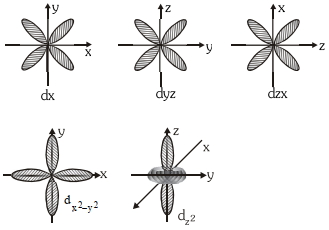
1 likesView Solution
14
ChemistryEasyMCQNEET · 2022
Amongst the following,which one will have maximum 'lone pair - lone pair' electron repulsions?
A
$IF_{5}$
B
$SF_{4}$
C
$XeF_{2}$
D
$ClF_{3}$
Solution
(C) To determine the maximum 'lone pair - lone pair' (lp-lp) repulsions,we analyze the number of lone pairs on the central atom for each molecule:
$1$. $IF_{5}$: Iodine has $7$ valence electrons. It forms $5$ bonds with $F$ atoms,leaving $1$ lone pair. Number of lp-lp repulsions = $0$.
$2$. $SF_{4}$: Sulfur has $6$ valence electrons. It forms $4$ bonds with $F$ atoms,leaving $1$ lone pair. Number of lp-lp repulsions = $0$.
$3$. $XeF_{2}$: Xenon has $8$ valence electrons. It forms $2$ bonds with $F$ atoms,leaving $3$ lone pairs. These $3$ lone pairs occupy the equatorial positions of the trigonal bipyramidal geometry,resulting in $3$ lp-lp repulsions at $90^\circ$ angles.
$4$. $ClF_{3}$: Chlorine has $7$ valence electrons. It forms $3$ bonds with $F$ atoms,leaving $2$ lone pairs. Number of lp-lp repulsions = $1$.
Comparing these,$XeF_{2}$ has the maximum number of lone pair - lone pair repulsions.
$1$. $IF_{5}$: Iodine has $7$ valence electrons. It forms $5$ bonds with $F$ atoms,leaving $1$ lone pair. Number of lp-lp repulsions = $0$.
$2$. $SF_{4}$: Sulfur has $6$ valence electrons. It forms $4$ bonds with $F$ atoms,leaving $1$ lone pair. Number of lp-lp repulsions = $0$.
$3$. $XeF_{2}$: Xenon has $8$ valence electrons. It forms $2$ bonds with $F$ atoms,leaving $3$ lone pairs. These $3$ lone pairs occupy the equatorial positions of the trigonal bipyramidal geometry,resulting in $3$ lp-lp repulsions at $90^\circ$ angles.
$4$. $ClF_{3}$: Chlorine has $7$ valence electrons. It forms $3$ bonds with $F$ atoms,leaving $2$ lone pairs. Number of lp-lp repulsions = $1$.
Comparing these,$XeF_{2}$ has the maximum number of lone pair - lone pair repulsions.
0 likesView Solution
15
ChemistryEasyMCQNEET · 2022
The $IUPAC$ name of an element with atomic number $119$ is $.........$
A
unnilennium
B
unununnium
C
ununoctium
D
ununennium
Solution
(D) $IUPAC$ nomenclature for elements with atomic number $Z > 100$ is based on the digits of the atomic number.
For $119$:
$1$ = un
$1$ = un
$9$ = enn
Suffix = -ium
Therefore,the name is $Ununennium$ $(Uue)$.
For $119$:
$1$ = un
$1$ = un
$9$ = enn
Suffix = -ium
Therefore,the name is $Ununennium$ $(Uue)$.
0 likesView Solution
16
ChemistryMediumMCQNEET · 2022
Which of the following statements is not correct about diborane $(B_2H_6)$?
A
The four terminal $B-H$ bonds are two-centre-two-electron bonds.
B
The four terminal hydrogen atoms and the two boron atoms lie in one plane.
C
Both the boron atoms are $sp^2$ hybridized.
D
There are two $3$-centre-$2$-electron bonds.
Solution
(C) In diborane $(B_2H_6)$,each boron atom undergoes $sp^3$ hybridization,not $sp^2$.
Diborane has a non-planar structure where the two bridging hydrogen atoms lie in a plane perpendicular to the plane containing the four terminal hydrogen atoms and the two boron atoms.
Therefore,the statement that both boron atoms are $sp^2$ hybridized is incorrect.
Diborane has a non-planar structure where the two bridging hydrogen atoms lie in a plane perpendicular to the plane containing the four terminal hydrogen atoms and the two boron atoms.
Therefore,the statement that both boron atoms are $sp^2$ hybridized is incorrect.
0 likesView Solution
17
ChemistryMediumMCQNEET · 2022
If the radius of the second Bohr orbit of the $He^{+}$ ion is $105.8 \, pm$, what is the radius of the third Bohr orbit of the $Li^{2+}$ ion?
A
$15.87 \, pm$
B
$1.587 \, pm$
C
$158.7 \, \mathring{A}$
D
$158.7 \, pm$
Solution
(D) According to Bohr's atomic model, the radius $r$ is given by $r \propto \frac{n^2}{Z}$.
For the $3^{rd}$ orbit of $Li^{2+}$, $n_1 = 3$ and $Z_1 = 3$.
For the $2^{nd}$ orbit of $He^{+}$, $n_2 = 2$ and $Z_2 = 2$.
Using the ratio formula: $\frac{(r_3)_{Li^{2+}}}{(r_2)_{He^{+}}} = \frac{n_1^2}{n_2^2} \times \frac{Z_2}{Z_1}$.
Substituting the values: $\frac{(r_3)_{Li^{2+}}}{105.8 \, pm} = \frac{3^2}{2^2} \times \frac{2}{3} = \frac{9}{4} \times \frac{2}{3} = \frac{3}{2} = 1.5$.
Therefore, $(r_3)_{Li^{2+}} = 105.8 \, pm \times 1.5 = 158.7 \, pm$.
For the $3^{rd}$ orbit of $Li^{2+}$, $n_1 = 3$ and $Z_1 = 3$.
For the $2^{nd}$ orbit of $He^{+}$, $n_2 = 2$ and $Z_2 = 2$.
Using the ratio formula: $\frac{(r_3)_{Li^{2+}}}{(r_2)_{He^{+}}} = \frac{n_1^2}{n_2^2} \times \frac{Z_2}{Z_1}$.
Substituting the values: $\frac{(r_3)_{Li^{2+}}}{105.8 \, pm} = \frac{3^2}{2^2} \times \frac{2}{3} = \frac{9}{4} \times \frac{2}{3} = \frac{3}{2} = 1.5$.
Therefore, $(r_3)_{Li^{2+}} = 105.8 \, pm \times 1.5 = 158.7 \, pm$.
0 likesView Solution
18
ChemistryEasyMCQNEET · 2022
$A$ $10.0 \, L$ flask contains $64 \, g$ of oxygen at $27^{\circ} C$. (Assume $O_2$ gas is behaving ideally). The pressure inside the flask in bar is $.....$
(Given $R = 0.0831 \, L \, bar \, K^{-1} \, mol^{-1}$)
(Given $R = 0.0831 \, L \, bar \, K^{-1} \, mol^{-1}$)
A
$498.6$
B
$49.8$
C
$4.9$
D
$2.5$
Solution
(C) Given:
Volume $V = 10.0 \, L$
Mass of $O_2$ $(W)$ = $64 \, g$
Molar mass of $O_2$ $(M)$ = $32 \, g \, mol^{-1}$
Temperature $T = 27^{\circ} C = 27 + 273 = 300 \, K$
Gas constant $R = 0.0831 \, L \, bar \, K^{-1} \, mol^{-1}$
Step $1$: Calculate the number of moles $(n)$:
$n = \frac{W}{M} = \frac{64 \, g}{32 \, g \, mol^{-1}} = 2 \, mol$
Step $2$: Use the ideal gas equation $PV = nRT$ to find pressure $(P)$:
$P = \frac{nRT}{V}$
$P = \frac{2 \, mol \times 0.0831 \, L \, bar \, K^{-1} \, mol^{-1} \times 300 \, K}{10.0 \, L}$
$P = \frac{49.86}{10} \, bar = 4.986 \, bar \approx 4.9 \, bar$
Volume $V = 10.0 \, L$
Mass of $O_2$ $(W)$ = $64 \, g$
Molar mass of $O_2$ $(M)$ = $32 \, g \, mol^{-1}$
Temperature $T = 27^{\circ} C = 27 + 273 = 300 \, K$
Gas constant $R = 0.0831 \, L \, bar \, K^{-1} \, mol^{-1}$
Step $1$: Calculate the number of moles $(n)$:
$n = \frac{W}{M} = \frac{64 \, g}{32 \, g \, mol^{-1}} = 2 \, mol$
Step $2$: Use the ideal gas equation $PV = nRT$ to find pressure $(P)$:
$P = \frac{nRT}{V}$
$P = \frac{2 \, mol \times 0.0831 \, L \, bar \, K^{-1} \, mol^{-1} \times 300 \, K}{10.0 \, L}$
$P = \frac{49.86}{10} \, bar = 4.986 \, bar \approx 4.9 \, bar$
0 likesView Solution
19
ChemistryEasyMCQNEET · 2022
Compound $X$ on reaction with $O_{3}$ followed by $Zn/H_{2}O$ gives formaldehyde and $2-$methylpropanal as products. The compound $X$ is :
A
$2-$Methylbut$-1-$ene
B
$2-$Methylbut$-2-$ene
C
Pent$-2-$ene
D
$3-$Methylbut$-1-$ene
Solution
(D) Ozonolysis of an alkene involves the cleavage of the $C=C$ double bond and the addition of oxygen atoms to each carbon atom of the double bond.
Formaldehyde is $HCHO$ and $2-$methylpropanal is $(CH_{3})_{2}CHCHO$.
By joining the carbonyl carbons of these products by a double bond,we get the structure of the original alkene $X$:
$CH_{3}-CH(CH_{3})-CH=O + O=CH_{2} \xrightarrow{Zn/H_{2}O} CH_{3}-CH(CH_{3})-CH=CH_{2} + H_{2}O$
The structure $CH_{3}-CH(CH_{3})-CH=CH_{2}$ corresponds to $3-$methylbut$-1-$ene.
Therefore,the correct option is $D$.
Formaldehyde is $HCHO$ and $2-$methylpropanal is $(CH_{3})_{2}CHCHO$.
By joining the carbonyl carbons of these products by a double bond,we get the structure of the original alkene $X$:
$CH_{3}-CH(CH_{3})-CH=O + O=CH_{2} \xrightarrow{Zn/H_{2}O} CH_{3}-CH(CH_{3})-CH=CH_{2} + H_{2}O$
The structure $CH_{3}-CH(CH_{3})-CH=CH_{2}$ corresponds to $3-$methylbut$-1-$ene.
Therefore,the correct option is $D$.
0 likesView Solution
20
ChemistryMediumMCQNEET · 2022
In the neutral or faintly alkaline medium,$KMnO_4$ oxidises iodide into iodate. The change in oxidation state of manganese in this reaction is from?
A
$+6$ to $+4$
B
$+7$ to $+3$
C
$+6$ to $+5$
D
$+7$ to $+4$
Solution
(D) In neutral or faintly alkaline medium,the reaction is:
$2KMnO_4 + H_2O + KI \rightarrow 2MnO_2 + 2KOH + KIO_3$
In $KMnO_4$,the oxidation state of $Mn$ is $+7$.
In $MnO_2$,the oxidation state of $Mn$ is $+4$.
Therefore,the change in oxidation state of manganese is from $+7$ to $+4$.
$2KMnO_4 + H_2O + KI \rightarrow 2MnO_2 + 2KOH + KIO_3$
In $KMnO_4$,the oxidation state of $Mn$ is $+7$.
In $MnO_2$,the oxidation state of $Mn$ is $+4$.
Therefore,the change in oxidation state of manganese is from $+7$ to $+4$.
0 likesView Solution
21
ChemistryEasyMCQNEET · 2022
The correct $IUPAC$ name of the following compound is .... .
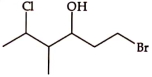
A
$6-$bromo$-2-$chloro$-4-$methylhexan$-4-$ol
B
$1-$bromo$-4-$methyl$-5-$chlorohexan$-3-$ol
C
$6-$bromo$-4-$methyl$-2-$chlorohexan$-4-$ol
D
$1-$bromo$-5-$chloro$-4-$methylhexan$-3-$ol
Solution
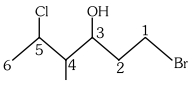
(D) $1$. Identify the longest carbon chain containing the principal functional group ($-OH$ group). The chain has $6$ carbons,so the parent alkane is hexane.
$2$. Number the chain from the end that gives the lowest locant to the principal functional group $(-OH)$. Numbering from right to left gives the $-OH$ group at position $3$.
$3$. Identify the substituents: $Br$ at position $1$,$CH_3$ at position $4$,and $Cl$ at position $5$.
$4$. Arrange the substituents in alphabetical order: $1-$bromo,$5-$chloro,$4-$methyl.
$5$. Combining these,the correct $IUPAC$ name is $1-$bromo$-5-$chloro$-4-$methylhexan$-3-$ol.
$2$. Number the chain from the end that gives the lowest locant to the principal functional group $(-OH)$. Numbering from right to left gives the $-OH$ group at position $3$.
$3$. Identify the substituents: $Br$ at position $1$,$CH_3$ at position $4$,and $Cl$ at position $5$.
$4$. Arrange the substituents in alphabetical order: $1-$bromo,$5-$chloro,$4-$methyl.
$5$. Combining these,the correct $IUPAC$ name is $1-$bromo$-5-$chloro$-4-$methylhexan$-3-$ol.
0 likesView Solution
22
ChemistryMediumMCQNEET · 2022
$3 O_{2(g)} \rightleftharpoons 2 O_{3(g)}$
For the above reaction at $298 \ K$,$K_c$ is found to be $3.0 \times 10^{-59}$. If the concentration of $O_2$ at equilibrium is $0.040 \ M$,then the concentration of $O_3$ in $M$ is ...... .
For the above reaction at $298 \ K$,$K_c$ is found to be $3.0 \times 10^{-59}$. If the concentration of $O_2$ at equilibrium is $0.040 \ M$,then the concentration of $O_3$ in $M$ is ...... .
A
$1.9 \times 10^{-63}$
B
$2.4 \times 10^{31}$
C
$1.2 \times 10^{21}$
D
$4.38 \times 10^{-32}$
Solution
(D) The equilibrium constant expression for the reaction $3 O_{2(g)} \rightleftharpoons 2 O_{3(g)}$ is given by $K_c = \frac{[O_3]^2}{[O_2]^3}$.
Given $K_c = 3.0 \times 10^{-59}$ and $[O_2] = 0.040 \ M = 4 \times 10^{-2} \ M$.
Substituting the values into the expression:
$3.0 \times 10^{-59} = \frac{[O_3]^2}{(4 \times 10^{-2})^3}$
$[O_3]^2 = 3.0 \times 10^{-59} \times (64 \times 10^{-6})$
$[O_3]^2 = 192 \times 10^{-65} = 1.92 \times 10^{-63}$
$[O_3] = \sqrt{1.92 \times 10^{-63}} = \sqrt{19.2 \times 10^{-64}} \approx 4.38 \times 10^{-32} \ M$.
Given $K_c = 3.0 \times 10^{-59}$ and $[O_2] = 0.040 \ M = 4 \times 10^{-2} \ M$.
Substituting the values into the expression:
$3.0 \times 10^{-59} = \frac{[O_3]^2}{(4 \times 10^{-2})^3}$
$[O_3]^2 = 3.0 \times 10^{-59} \times (64 \times 10^{-6})$
$[O_3]^2 = 192 \times 10^{-65} = 1.92 \times 10^{-63}$
$[O_3] = \sqrt{1.92 \times 10^{-63}} = \sqrt{19.2 \times 10^{-64}} \approx 4.38 \times 10^{-32} \ M$.
1 likesView Solution
23
ChemistryMediumMCQNEET · 2022
The pollution due to oxides of sulphur gets enhanced due to the presence of:
$(a)$ particulate matter
$(b)$ ozone
$(c)$ hydrocarbons
$(d)$ hydrogen peroxide
Choose the most appropriate answer from the options given below:
$(a)$ particulate matter
$(b)$ ozone
$(c)$ hydrocarbons
$(d)$ hydrogen peroxide
Choose the most appropriate answer from the options given below:
A
$(a)$,$(b)$,$(d)$ only
B
$(b)$,$(c)$,$(d)$ only
C
$(a)$,$(c)$,$(d)$ only
D
$(a)$,$(d)$ only
Solution
(A) The presence of particulate matter in polluted air catalyses the oxidation of sulphur dioxide to sulphur trioxide: $2SO_{2(g)} + O_{2(g)} \rightarrow 2SO_{3(g)}$.
This reaction is also promoted by ozone $(O_3)$ and hydrogen peroxide $(H_2O_2)$:
$SO_{2(g)} + O_{3(g)} \rightarrow SO_{3(g)} + O_{2(g)}$
$SO_{2(g)} + H_2O_{2(l)} \rightarrow H_2SO_{4(aq)}$
Thus,particulate matter,ozone,and hydrogen peroxide all enhance the pollution caused by oxides of sulphur.
This reaction is also promoted by ozone $(O_3)$ and hydrogen peroxide $(H_2O_2)$:
$SO_{2(g)} + O_{3(g)} \rightarrow SO_{3(g)} + O_{2(g)}$
$SO_{2(g)} + H_2O_{2(l)} \rightarrow H_2SO_{4(aq)}$
Thus,particulate matter,ozone,and hydrogen peroxide all enhance the pollution caused by oxides of sulphur.
0 likesView Solution
24
ChemistryMediumMCQNEET · 2022
The correct order of bond angles in the following compounds/species is:
A
$H_2O < NH_3 < NH_4^{+} < CO_2$
B
$H_2O < NH_4^{+} < NH_3 < CO_2$
C
$H_2O < NH_4^{+} = NH_3 < CO_2$
D
$CO_2 < NH_3 < H_2O < NH_4^{+}$
Solution
(A) $1$. Determine the hybridization and geometry of each species:
- $CO_2$: $sp$ hybridization,linear,bond angle = $180^{\circ}$.
- $NH_4^{+}$: $sp^3$ hybridization,tetrahedral,bond angle = $109.5^{\circ}$.
- $NH_3$: $sp^3$ hybridization,trigonal pyramidal,one lone pair,bond angle = $107^{\circ}$.
- $H_2O$: $sp^3$ hybridization,bent,two lone pairs,bond angle = $104.5^{\circ}$.
$2$. Comparing the bond angles: $104.5^{\circ} (H_2O) < 107^{\circ} (NH_3) < 109.5^{\circ} (NH_4^{+}) < 180^{\circ} (CO_2)$.
$3$. The correct order is $H_2O < NH_3 < NH_4^{+} < CO_2$.
- $CO_2$: $sp$ hybridization,linear,bond angle = $180^{\circ}$.
- $NH_4^{+}$: $sp^3$ hybridization,tetrahedral,bond angle = $109.5^{\circ}$.
- $NH_3$: $sp^3$ hybridization,trigonal pyramidal,one lone pair,bond angle = $107^{\circ}$.
- $H_2O$: $sp^3$ hybridization,bent,two lone pairs,bond angle = $104.5^{\circ}$.
$2$. Comparing the bond angles: $104.5^{\circ} (H_2O) < 107^{\circ} (NH_3) < 109.5^{\circ} (NH_4^{+}) < 180^{\circ} (CO_2)$.
$3$. The correct order is $H_2O < NH_3 < NH_4^{+} < CO_2$.
0 likesView Solution
25
ChemistryMCQNEET · 2022
$CaCl_2$ and $Ca(OCl)_2$ are components of:
A
gypsum
B
Portland cement
C
bleaching powder
D
lime water
Solution
(C) Bleaching powder is represented by the formula $Ca(OH)_2 \cdot CaCl_2 \cdot Ca(OCl)_2 \cdot 2H_2O$.
It is a mixture of calcium chloride $(CaCl_2)$,calcium hypochlorite $(Ca(OCl)_2)$,and calcium hydroxide $(Ca(OH)_2)$.
It is a mixture of calcium chloride $(CaCl_2)$,calcium hypochlorite $(Ca(OCl)_2)$,and calcium hydroxide $(Ca(OH)_2)$.
0 likesView Solution
26
ChemistryMCQNEET · 2022
Match List-$I$ with List-$II$:
Choose the correct answer from the options given below:
| List-$I$ | List-$II$ |
|---|---|
| $a$. Sodium laurylsulphate | $i$. Toilet soap |
| $b$. Cetyltrimethyl ammonium chloride | $ii$. Non-ionic detergent |
| $c$. Sodium stearate | $iii$. Anionic detergent |
| $d$. Polyethyleneglycyl stearate | $iv$. Cationic detergent |
Choose the correct answer from the options given below:
A
$(a)-(iv), (b)-(iii), (c)-(i), (d)-(ii)$
B
$(a)-(i), (b)-(iv), (c)-(ii), (d)-(iii)$
C
$(a)-(iii), (b)-(iv), (c)-(i), (d)-(ii)$
D
$(a)-(iii), (b)-(i), (c)-(ii), (d)-(iv)$
Solution
(C) . Sodium laurylsulphate is an anionic detergent.
$b$. Cetyltrimethyl ammonium chloride is a cationic detergent.
$c$. Sodium stearate is a toilet soap.
$d$. Polyethyleneglycyl stearate is a non-ionic detergent.
Therefore,the correct matching is $(a)-(iii), (b)-(iv), (c)-(i), (d)-(ii)$.
$b$. Cetyltrimethyl ammonium chloride is a cationic detergent.
$c$. Sodium stearate is a toilet soap.
$d$. Polyethyleneglycyl stearate is a non-ionic detergent.
Therefore,the correct matching is $(a)-(iii), (b)-(iv), (c)-(i), (d)-(ii)$.
0 likesView Solution
27
ChemistryMediumMCQNEET · 2022
Which of the following reactions is a decomposition redox reaction?
A
$2Pb(NO_3)_{2(s)} \longrightarrow 2PbO_{(s)} + 4NO_{2(g)} + O_{2(g)}$
B
$N_{2(g)} + O_{2(g)} \longrightarrow 2NO_{(g)}$
C
$Cl_{2(g)} + 2OH^{-}_{(aq)} \longrightarrow ClO^{-}_{(aq)} + Cl^{-}_{(aq)} + H_2O(\ell)$
D
$P_{4(s)} + 3OH^{-}_{(aq)} + 3H_2O(\ell) \longrightarrow PH_{3(g)} + 3H_2PO_2^-(aq)$
Solution
(A) decomposition redox reaction involves the breakdown of a single compound into two or more products where the oxidation states of the elements change.
In the reaction $2Pb(NO_3)_{2(s)} \longrightarrow 2PbO_{(s)} + 4NO_{2(g)} + O_{2(g)}$,the oxidation state of $N$ changes from $+5$ to $+4$ and $O$ changes from $-2$ to $0$. Since a single reactant breaks down into multiple products with a change in oxidation states,it is a decomposition redox reaction.
Option $A$ is the correct answer.
In the reaction $2Pb(NO_3)_{2(s)} \longrightarrow 2PbO_{(s)} + 4NO_{2(g)} + O_{2(g)}$,the oxidation state of $N$ changes from $+5$ to $+4$ and $O$ changes from $-2$ to $0$. Since a single reactant breaks down into multiple products with a change in oxidation states,it is a decomposition redox reaction.
Option $A$ is the correct answer.
0 likesView Solution
28
ChemistryDifficultMCQNEET · 2022
If first ionization enthalpies of element $X$ and $Y$ are $419 \ kJ \ mol^{-1}$ and $590 \ kJ \ mol^{-1}$,respectively and second ionization enthalpies of $X$ and $Y$ are $3069 \ kJ \ mol^{-1}$ and $1145 \ kJ \ mol^{-1}$,respectively. Then the correct statement is :-
A
$X$ is an alkali metal and $Y$ is an alkaline earth metal.
B
$X$ is an alkaline earth metal and $Y$ is an alkali metal.
C
Both $X$ and $Y$ are alkali metals.
D
Both $X$ and $Y$ are alkaline earth metals.
Solution
(A) For element $X$: The difference between the $2^{nd}$ and $1^{st}$ ionization enthalpy is $3069 - 419 = 2650 \ kJ \ mol^{-1}$,which is very large. This indicates that the removal of the second electron requires breaking a stable noble gas configuration,characteristic of an alkali metal.
For element $Y$: The difference between the $2^{nd}$ and $1^{st}$ ionization enthalpy is $1145 - 590 = 555 \ kJ \ mol^{-1}$,which is relatively small. This indicates that the second electron is removed from the same valence shell,characteristic of an alkaline earth metal.
Therefore,$X$ is an alkali metal and $Y$ is an alkaline earth metal.
For element $Y$: The difference between the $2^{nd}$ and $1^{st}$ ionization enthalpy is $1145 - 590 = 555 \ kJ \ mol^{-1}$,which is relatively small. This indicates that the second electron is removed from the same valence shell,characteristic of an alkaline earth metal.
Therefore,$X$ is an alkali metal and $Y$ is an alkaline earth metal.
0 likesView Solution
29
ChemistryMediumMCQNEET · 2022
Match List-$I$ with List-$II$ :
Choose the correct answer from the options given below :
| List-$I$ | List-$II$ |
|---|---|
| $a. NH_3$ | $i$. Square pyramidal |
| $b. ClF_3$ | $ii$. Trigonal bipyramidal |
| $c. PCl_5$ | $iii$. Trigonal pyramidal |
| $d. BrF_5$ | $iv$. $T$-shape |
Choose the correct answer from the options given below :
A
$a-ii, b-iii, c-iv, d-i$
B
$a-iii, b-iv, c-ii, d-i$
C
$a-iv, b-iii, c-i, d-ii$
D
$a-iii, b-iv, c-i, d-ii$
Solution
(B) $NH_3$: $sp^3$ hybridization with $1$ lone pair $(LP)$ results in a Trigonal pyramidal geometry $(a-iii)$.
$ClF_3$: $sp^3d$ hybridization with $2$ lone pairs $(LP)$ results in a $T$-shape geometry $(b-iv)$.
$PCl_5$: $sp^3d$ hybridization with $0$ lone pairs $(LP)$ results in a Trigonal bipyramidal geometry $(c-ii)$.
$BrF_5$: $sp^3d^2$ hybridization with $1$ lone pair $(LP)$ results in a Square pyramidal geometry $(d-i)$.
Therefore,the correct matching is $a-iii, b-iv, c-ii, d-i$.
$ClF_3$: $sp^3d$ hybridization with $2$ lone pairs $(LP)$ results in a $T$-shape geometry $(b-iv)$.
$PCl_5$: $sp^3d$ hybridization with $0$ lone pairs $(LP)$ results in a Trigonal bipyramidal geometry $(c-ii)$.
$BrF_5$: $sp^3d^2$ hybridization with $1$ lone pair $(LP)$ results in a Square pyramidal geometry $(d-i)$.
Therefore,the correct matching is $a-iii, b-iv, c-ii, d-i$.
0 likesView Solution
30
ChemistryMediumMCQNEET · 2022
Match List-$I$ with List-$II$:
Choose the correct answer from the options given below:
| List-$I$ | List-$II$ |
| $a$. Borax | $i$. $NaBO_2$ |
| $b$. Kernite | $ii$. $Na_2B_4O_7 \cdot 4H_2O$ |
| $c$. Orthoboric acid | $iii$. $H_3BO_3$ |
| $d$. Borax bead | $iv$. $Na_2B_4O_7 \cdot 10H_2O$ |
Choose the correct answer from the options given below:
A
$a-iv, b-ii, c-iii, d-i$
B
$a-ii, b-iv, c-iii, d-i$
C
$a-iii, b-i, c-iv, d-ii$
D
$a-i, b-iii, c-iv, d-ii$
Solution
(A) The chemical formulas for the given compounds are as follows:
$a$. Borax: $Na_2B_4O_7 \cdot 10H_2O$
$b$. Kernite: $Na_2B_4O_7 \cdot 4H_2O$
$c$. Orthoboric acid: $H_3BO_3$
$d$. Borax bead: $NaBO_2$
Therefore,the correct matching is $a-iv, b-ii, c-iii, d-i$.
$a$. Borax: $Na_2B_4O_7 \cdot 10H_2O$
$b$. Kernite: $Na_2B_4O_7 \cdot 4H_2O$
$c$. Orthoboric acid: $H_3BO_3$
$d$. Borax bead: $NaBO_2$
Therefore,the correct matching is $a-iv, b-ii, c-iii, d-i$.
0 likesView Solution
31
ChemistryMediumMCQNEET · 2022
The element used for welding metals with high melting points is:
A
$Cl_2$
B
$H_2$
C
$Ne$
D
$He$
Solution
(B) Atomic hydrogen welding is a process that uses an electric arc between two tungsten electrodes in an atmosphere of hydrogen gas. The hydrogen molecules dissociate into atoms in the arc,absorbing a large amount of heat. When these atoms recombine on the surface of the metal,they release this energy,producing temperatures up to $4000 \ K$,which is sufficient to weld metals with high melting points.
0 likesView Solution
32
ChemistryMediumMCQNEET · 2022
$Na_2B_4O_7 \stackrel{\text{heat}}{\longrightarrow} X + NaBO_2$
In the above reaction,the product $X$ is:
In the above reaction,the product $X$ is:
A
$H_3BO_3$
B
$B_2O_3$
C
$Na_2B_2O_5$
D
$NaB_3O_5$
Solution
(B) When borax $(Na_2B_4O_7 \cdot 10H_2O)$ is heated,it first loses its water of crystallization and then melts to form a transparent liquid which solidifies into a glass-like mass consisting of sodium metaborate $(NaBO_2)$ and boric anhydride $(B_2O_3)$.
The balanced chemical equation is:
$Na_2B_4O_7 \stackrel{\Delta}{\longrightarrow} 2NaBO_2 + B_2O_3$
Thus,the product $X$ is $B_2O_3$.
The balanced chemical equation is:
$Na_2B_4O_7 \stackrel{\Delta}{\longrightarrow} 2NaBO_2 + B_2O_3$
Thus,the product $X$ is $B_2O_3$.
0 likesView Solution
33
ChemistryMediumMCQNEET · 2022
The correct order of first ionization enthalpy for the given four elements is:
A
$C < N < F < O$
B
$C < N < O < F$
C
$C < O < N < F$
D
$C < F < N < O$
Solution
(C) The electronic configurations of the elements are as follows:
$C (Z=6): 1s^2 2s^2 2p^2$
$N (Z=7): 1s^2 2s^2 2p^3$
$O (Z=8): 1s^2 2s^2 2p^4$
$F (Z=9): 1s^2 2s^2 2p^5$
Across a period,ionization enthalpy generally increases due to increasing effective nuclear charge.
However,nitrogen $(N)$ has a stable half-filled $2p^3$ configuration,which makes its ionization enthalpy higher than that of oxygen $(O)$.
Therefore,the correct order is $C < O < N < F$.
$C (Z=6): 1s^2 2s^2 2p^2$
$N (Z=7): 1s^2 2s^2 2p^3$
$O (Z=8): 1s^2 2s^2 2p^4$
$F (Z=9): 1s^2 2s^2 2p^5$
Across a period,ionization enthalpy generally increases due to increasing effective nuclear charge.
However,nitrogen $(N)$ has a stable half-filled $2p^3$ configuration,which makes its ionization enthalpy higher than that of oxygen $(O)$.
Therefore,the correct order is $C < O < N < F$.
0 likesView Solution
34
ChemistryMediumMCQNEET · 2022
$0.01 \, M$ acetic acid solution is $1 \%$ ionised,then $pH$ of this acetic acid solution is :
A
$3$
B
$2$
C
$4$
D
$1$
Solution
(C) For $CH_3COOH$ :
$[H^{+}] = C \cdot \alpha$
Given concentration $C = 0.01 \, M = 10^{-2} \, M$ and degree of ionisation $\alpha = 1 \% = 0.01 = 10^{-2}$.
$[H^{+}] = 10^{-2} \times 10^{-2} = 10^{-4} \, M$
$pH = -\log [H^{+}]$
$pH = -\log(10^{-4}) = 4$
$[H^{+}] = C \cdot \alpha$
Given concentration $C = 0.01 \, M = 10^{-2} \, M$ and degree of ionisation $\alpha = 1 \% = 0.01 = 10^{-2}$.
$[H^{+}] = 10^{-2} \times 10^{-2} = 10^{-4} \, M$
$pH = -\log [H^{+}]$
$pH = -\log(10^{-4}) = 4$
0 likesView Solution
35
ChemistryMediumMCQNEET · 2022
One mole of an ideal gas at $300 \ K$ is expanded isothermally from $1 \ L$ to $10 \ L$ volume. $\Delta U$ for this process is $....... \ J$ (Use $R = 8.314 \ J \ K^{-1} \ mol^{-1}$)
A
$1260$
B
$2520$
C
$5040$
D
$0$
Solution
(D) For an ideal gas,the internal energy $U$ is a function of temperature only,i.e.,$U = f(T)$.
Since the process is isothermal,the temperature remains constant $(T_2 = T_1 = 300 \ K)$.
Therefore,the change in internal energy $\Delta U = nC_v(T_2 - T_1) = 0$.
Since the process is isothermal,the temperature remains constant $(T_2 = T_1 = 300 \ K)$.
Therefore,the change in internal energy $\Delta U = nC_v(T_2 - T_1) = 0$.
0 likesView Solution
36
ChemistryMediumMCQNEET · 2022
What is the hybridization shown by $C_1$ and $C_2$ carbons,respectively in the given compound? $OHC-CH=CH-CH_2-COOCH_3$
A
$sp^2$ and $sp^3$
B
$sp^2$ and $sp^2$
C
$sp^3$ and $sp^2$
D
$sp^3$ and $sp^3$
Solution
(A) The structure of the compound is $OHC-CH=CH-CH_2-COOCH_3$.
Numbering the carbons as indicated in the structure:
$C_1$ is the carbonyl carbon of the ester group $(-COOCH_3)$,which is bonded to one oxygen by a double bond and two other groups by single bonds. It has $3$ sigma bonds and $0$ lone pairs,so it is $sp^2$ hybridized.
$C_2$ is the methylene carbon $(-CH_2-)$ bonded to four atoms by single bonds. It has $4$ sigma bonds and $0$ lone pairs,so it is $sp^3$ hybridized.
Therefore,$C_1$ is $sp^2$ and $C_2$ is $sp^3$ hybridized.
Numbering the carbons as indicated in the structure:
$C_1$ is the carbonyl carbon of the ester group $(-COOCH_3)$,which is bonded to one oxygen by a double bond and two other groups by single bonds. It has $3$ sigma bonds and $0$ lone pairs,so it is $sp^2$ hybridized.
$C_2$ is the methylene carbon $(-CH_2-)$ bonded to four atoms by single bonds. It has $4$ sigma bonds and $0$ lone pairs,so it is $sp^3$ hybridized.
Therefore,$C_1$ is $sp^2$ and $C_2$ is $sp^3$ hybridized.
0 likesView Solution
37
ChemistryMediumMCQNEET · 2022
The density of the solution is $2.15 \ g \ mL^{-1}$,then the mass of $2.5 \ mL$ solution in correct significant figures is $........ \ g$.
A
$5.375$
B
$5.4$
C
$5.38$
D
$53.75$
Solution
(B) The formula for mass is: $Mass = Density \times Volume$.
Given: $Density = 2.15 \ g \ mL^{-1}$ and $Volume = 2.5 \ mL$.
$Mass = 2.15 \ g \ mL^{-1} \times 2.5 \ mL = 5.375 \ g$.
According to the rules of significant figures,the result of multiplication should have the same number of significant figures as the measurement with the fewest significant figures.
Here,$2.5$ has $2$ significant figures,so the result must be rounded to $2$ significant figures.
Therefore,$5.375 \ g$ rounded to $2$ significant figures is $5.4 \ g$.
Given: $Density = 2.15 \ g \ mL^{-1}$ and $Volume = 2.5 \ mL$.
$Mass = 2.15 \ g \ mL^{-1} \times 2.5 \ mL = 5.375 \ g$.
According to the rules of significant figures,the result of multiplication should have the same number of significant figures as the measurement with the fewest significant figures.
Here,$2.5$ has $2$ significant figures,so the result must be rounded to $2$ significant figures.
Therefore,$5.375 \ g$ rounded to $2$ significant figures is $5.4 \ g$.
0 likesView Solution
38
ChemistryMCQNEET · 2022
Match List-$I$ with List-$II$ :
Choose the correct answer from the options given below :
| List-$I$ (Defects) | List-$II$ (Shown by) |
| $a$. Frenkel defect | $i$. Non-ionic solids and density of the solid decreases |
| $b$. Schottky defect | $ii$. Non-ionic solids and density of the solid increases |
| $c$. Vacancy defect | $iii$. Ionic solids and density of the solid decreases |
| $d$. Interstitial defect | $iv$. Ionic solids and density of the solid remains constant |
Choose the correct answer from the options given below :
A
$(a)-(i), (b)-(ii), (c)-(iii), (d)-(iv)$
B
$(a)-(i), (b)-(iii), (c)-(ii), (d)-(iv)$
C
$(a)-(iv), (b)-(iii), (c)-(ii), (d)-(i)$
D
$(a)-(iv), (b)-(iii), (c)-(i), (d)-(ii)$
Solution
(D) The correct matches are as follows :
$a$. Frenkel defect is shown by ionic solids where density remains constant $(iv)$.
$b$. Schottky defect is shown by ionic solids where density decreases $(iii)$.
$c$. Vacancy defect is shown by non-ionic solids where density decreases $(i)$.
$d$. Interstitial defect is shown by non-ionic solids where density increases $(ii)$.
Therefore,the correct sequence is $(a)-(iv), (b)-(iii), (c)-(i), (d)-(ii)$.
$a$. Frenkel defect is shown by ionic solids where density remains constant $(iv)$.
$b$. Schottky defect is shown by ionic solids where density decreases $(iii)$.
$c$. Vacancy defect is shown by non-ionic solids where density decreases $(i)$.
$d$. Interstitial defect is shown by non-ionic solids where density increases $(ii)$.
Therefore,the correct sequence is $(a)-(iv), (b)-(iii), (c)-(i), (d)-(ii)$.
0 likesView Solution
39
ChemistryMediumMCQNEET · 2022
Four gas cylinders containing $He$,$N_2$,$CO_2$ and $NH_3$ gases separately are gradually cooled from a temperature of $500 \ K$. Which gas will liquefy first?
(Given $T_C$ in $K - He: 5.3, N_2: 126, CO_2: 304.1$ and $NH_3: 405.5$)
(Given $T_C$ in $K - He: 5.3, N_2: 126, CO_2: 304.1$ and $NH_3: 405.5$)
A
$He$
B
$N_2$
C
$CO_2$
D
$NH_3$
Solution
(D) The ease of liquefaction of a gas is directly proportional to its critical temperature $(T_C)$.
As the temperature is lowered from $500 \ K$,the gas with the highest critical temperature will reach its liquefaction point first.
Comparing the given critical temperatures: $NH_3$ $(405.5 \ K)$ > $CO_2$ $(304.1 \ K)$ > $N_2$ $(126 \ K)$ > $He$ $(5.3 \ K)$.
Since $NH_3$ has the highest critical temperature,it will liquefy first.
As the temperature is lowered from $500 \ K$,the gas with the highest critical temperature will reach its liquefaction point first.
Comparing the given critical temperatures: $NH_3$ $(405.5 \ K)$ > $CO_2$ $(304.1 \ K)$ > $N_2$ $(126 \ K)$ > $He$ $(5.3 \ K)$.
Since $NH_3$ has the highest critical temperature,it will liquefy first.
0 likesView Solution
40
ChemistryMediumMCQNEET · 2022
The decreasing order of boiling points of the following alkanes is:
$(a)$ Heptane
$(b)$ Butane
$(c)$ $2-$methylbutane
$(d)$ $2-$methylpropane
$(e)$ Hexane
Choose the correct answer from the options given below:
$(a)$ Heptane
$(b)$ Butane
$(c)$ $2-$methylbutane
$(d)$ $2-$methylpropane
$(e)$ Hexane
Choose the correct answer from the options given below:
A
$(a) > (e) > (c) > (b) > (d)$
B
$(a) > (e) > (b) > (c) > (d)$
C
$(c) > (d) > (a) > (e) > (b)$
D
$(a) > (c) > (e) > (d) > (b)$
Solution
(A) The boiling point of alkanes depends on the molecular mass and the extent of branching.
As the molecular mass increases,the boiling point increases.
For isomers,the boiling point decreases with an increase in branching due to a decrease in surface area.
Heptane $(C_7H_{16})$: $371.4 \ K$
Hexane $(C_6H_{14})$: $341.9 \ K$
$2-$Methylbutane $(C_5H_{12})$: $300.9 \ K$
Butane $(C_4H_{10})$: $272.4 \ K$
$2-$Methylpropane $(C_4H_{10})$: $261 \ K$
Comparing these values,the decreasing order is: $(a) > (e) > (c) > (b) > (d)$.
As the molecular mass increases,the boiling point increases.
For isomers,the boiling point decreases with an increase in branching due to a decrease in surface area.
Heptane $(C_7H_{16})$: $371.4 \ K$
Hexane $(C_6H_{14})$: $341.9 \ K$
$2-$Methylbutane $(C_5H_{12})$: $300.9 \ K$
Butane $(C_4H_{10})$: $272.4 \ K$
$2-$Methylpropane $(C_4H_{10})$: $261 \ K$
Comparing these values,the decreasing order is: $(a) > (e) > (c) > (b) > (d)$.
0 likesView Solution
41
ChemistryMediumMCQNEET · 2022
Match List-$I$ with List-$II$ :
Choose the correct answer from the options given below :
| List-$I$ (Quantum number) | List-$II$ (Orbital) |
| $a. n=2, \ell=1$ | $i. 2s$ |
| $b. n=3, \ell=2$ | $ii. 3s$ |
| $c. n=3, \ell=0$ | $iii. 2p$ |
| $d. n=2, \ell=0$ | $iv. 3d$ |
Choose the correct answer from the options given below :
A
$(a)-(iii), (b)-(iv), (c)-(i), (d)-(ii)$
B
$(a)-(iv), (b)-(iii), (c)-(i), (d)-(ii)$
C
$(a)-(iv), (b)-(iii), (c)-(ii), (d)-(i)$
D
$(a)-(iii), (b)-(iv), (c)-(ii), (d)-(i)$
Solution
(D) The orbital is represented by $n\ell$,where $n$ is the principal quantum number and $\ell$ is the azimuthal quantum number.
For $\ell=0$,the orbital is $s$.
For $\ell=1$,the orbital is $p$.
For $\ell=2$,the orbital is $d$.
Matching the values:
$a. n=2, \ell=1 \rightarrow 2p$ $(iii)$
$b. n=3, \ell=2 \rightarrow 3d$ $(iv)$
$c. n=3, \ell=0 \rightarrow 3s$ $(ii)$
$d. n=2, \ell=0 \rightarrow 2s$ $(i)$
Therefore,the correct match is $(a)-(iii), (b)-(iv), (c)-(ii), (d)-(i)$.
For $\ell=0$,the orbital is $s$.
For $\ell=1$,the orbital is $p$.
For $\ell=2$,the orbital is $d$.
Matching the values:
$a. n=2, \ell=1 \rightarrow 2p$ $(iii)$
$b. n=3, \ell=2 \rightarrow 3d$ $(iv)$
$c. n=3, \ell=0 \rightarrow 3s$ $(ii)$
$d. n=2, \ell=0 \rightarrow 2s$ $(i)$
Therefore,the correct match is $(a)-(iii), (b)-(iv), (c)-(ii), (d)-(i)$.
0 likesView Solution
42
ChemistryMCQNEET · 2022
Which one of the following is not a calcination reaction?
A
$ZnCO_3 \xrightarrow{\Delta} ZnO + CO_2$
B
$Fe_2O_3 \cdot xH_2O \xrightarrow{\Delta} Fe_2O_3 + xH_2O$
C
$CaCO_3 \cdot MgCO_3 \xrightarrow{\Delta} CaO + MgO + 2CO_2$
D
$CaCO_3 + 2HCl \xrightarrow{\Delta} CaCl_2 + H_2O + CO_2$
Solution
(D) Calcination is a process of heating an ore in a limited supply or absence of air to remove volatile impurities or moisture.
$A$,$B$,and $C$ represent thermal decomposition reactions typical of calcination.
Option $D$ is a chemical reaction between a carbonate and an acid (displacement/double decomposition),not a calcination process.
$A$,$B$,and $C$ represent thermal decomposition reactions typical of calcination.
Option $D$ is a chemical reaction between a carbonate and an acid (displacement/double decomposition),not a calcination process.
0 likesView Solution
43
ChemistryMediumMCQNEET · 2022
When electromagnetic radiation of wavelength $300 \, nm$ falls on the surface of a metal,electrons are emitted with the kinetic energy of $1.68 \times 10^5 \, J \, mol^{-1}$. What is the minimum energy needed to remove an electron from the metal? $(h = 6.626 \times 10^{-34} \, J \, s, c = 3 \times 10^8 \, m \, s^{-1}, N_A = 6.022 \times 10^{23} \, mol^{-1})$
A
$2.31 \times 10^6 \, J \, mol^{-1}$
B
$3.84 \times 10^4 \, J \, mol^{-1}$
C
$3.84 \times 10^{-19} \, J \, mol^{-1}$
D
$2.31 \times 10^5 \, J \, mol^{-1}$
Solution
(D) The energy of a single photon is given by $E = \frac{hc}{\lambda}$.
For one mole of photons,the energy is $E_{mol} = \frac{hcN_A}{\lambda}$.
$E_{mol} = \frac{6.626 \times 10^{-34} \, J \, s \times 3 \times 10^8 \, m \, s^{-1} \times 6.022 \times 10^{23} \, mol^{-1}}{300 \times 10^{-9} \, m} = 3.99 \times 10^5 \, J \, mol^{-1}$.
According to the photoelectric effect equation,$E_{photon} = \Phi + KE$,where $\Phi$ is the work function (minimum energy to remove an electron).
$\Phi = E_{mol} - KE = (3.99 \times 10^5 - 1.68 \times 10^5) \, J \, mol^{-1} = 2.31 \times 10^5 \, J \, mol^{-1}$.
For one mole of photons,the energy is $E_{mol} = \frac{hcN_A}{\lambda}$.
$E_{mol} = \frac{6.626 \times 10^{-34} \, J \, s \times 3 \times 10^8 \, m \, s^{-1} \times 6.022 \times 10^{23} \, mol^{-1}}{300 \times 10^{-9} \, m} = 3.99 \times 10^5 \, J \, mol^{-1}$.
According to the photoelectric effect equation,$E_{photon} = \Phi + KE$,where $\Phi$ is the work function (minimum energy to remove an electron).
$\Phi = E_{mol} - KE = (3.99 \times 10^5 - 1.68 \times 10^5) \, J \, mol^{-1} = 2.31 \times 10^5 \, J \, mol^{-1}$.
0 likesView Solution
44
ChemistryMediumMCQNEET · 2022
The incorrect method for the synthesis of alkenes is:
A
treatment of alkynes with $Na$ in liquid $NH_3$
B
heating alkyl halides with alcoholic $KOH$
C
treating alkyl halides in aqueous $KOH$ solution
D
treating vicinal dihalides with $Zn$ metal
Solution
(C) The synthesis of alkenes involves elimination reactions.
$(A)$ Treatment of alkynes with $Na$ in liquid $NH_3$ (Birch reduction) produces trans-alkenes.
$(B)$ Heating alkyl halides with alcoholic $KOH$ undergoes dehydrohalogenation to form alkenes.
$(C)$ Treating alkyl halides with aqueous $KOH$ results in nucleophilic substitution,producing alcohols $(R-X + KOH_{(aq)} \rightarrow R-OH + KX)$,not alkenes.
$(D)$ Treating vicinal dihalides with $Zn$ metal undergoes debromination/dehalogenation to form alkenes.
Therefore,option $C$ is the incorrect method for alkene synthesis.
$(A)$ Treatment of alkynes with $Na$ in liquid $NH_3$ (Birch reduction) produces trans-alkenes.
$(B)$ Heating alkyl halides with alcoholic $KOH$ undergoes dehydrohalogenation to form alkenes.
$(C)$ Treating alkyl halides with aqueous $KOH$ results in nucleophilic substitution,producing alcohols $(R-X + KOH_{(aq)} \rightarrow R-OH + KX)$,not alkenes.
$(D)$ Treating vicinal dihalides with $Zn$ metal undergoes debromination/dehalogenation to form alkenes.
Therefore,option $C$ is the incorrect method for alkene synthesis.
0 likesView Solution
45
ChemistryDifficultMCQNEET · 2022
What fraction of $Fe$ exists as $Fe(III)$ in $Fe_{0.96}O$?
(Consider $Fe_{0.96}$ to be made up of $Fe(II)$ and $Fe(III)$ only)
(Consider $Fe_{0.96}$ to be made up of $Fe(II)$ and $Fe(III)$ only)
A
$\frac{1}{12}$
B
$0.08$
C
$\frac{1}{16}$
D
$\frac{1}{20}$
Solution
(A) In the compound $Fe_{0.96}O$,the total charge must be zero.
Let the number of $Fe^{2+}$ ions be $x$.
Then the number of $Fe^{3+}$ ions is $(0.96 - x)$.
The charge balance equation is: $(x)(+2) + (0.96 - x)(+3) + 1(-2) = 0$.
$2x + 2.88 - 3x - 2 = 0$.
$-x + 0.88 = 0$,so $x = 0.88$.
The number of $Fe^{3+}$ ions is $0.96 - 0.88 = 0.08$.
The fraction of $Fe$ existing as $Fe(III)$ is $\frac{0.08}{0.96} = \frac{1}{12}$.
Let the number of $Fe^{2+}$ ions be $x$.
Then the number of $Fe^{3+}$ ions is $(0.96 - x)$.
The charge balance equation is: $(x)(+2) + (0.96 - x)(+3) + 1(-2) = 0$.
$2x + 2.88 - 3x - 2 = 0$.
$-x + 0.88 = 0$,so $x = 0.88$.
The number of $Fe^{3+}$ ions is $0.96 - 0.88 = 0.08$.
The fraction of $Fe$ existing as $Fe(III)$ is $\frac{0.08}{0.96} = \frac{1}{12}$.
0 likesView Solution
46
ChemistryMediumMCQNEET · 2022
$A$ vessel contains $3.2 \ g$ of dioxygen gas at $STP$ ($273.15 \ K$ and $1 \ atm$ pressure). The gas is now transferred to another vessel at constant temperature,where pressure becomes one third of the original pressure. The volume of the new vessel in $L$ is $........$ (Given: molar volume at $STP$ is $22.4 \ L$)
A
$6.72$
B
$2.24$
C
$22.4$
D
$67.2$
Solution
(A) Moles of dioxygen gas $(O_2)$ $= \frac{3.2 \ g}{32 \ g \ mol^{-1}} = 0.1 \ mol$.
Volume of dioxygen gas at $STP$ $(V_1)$ $= 0.1 \ mol \times 22.4 \ L \ mol^{-1} = 2.24 \ L$.
According to Boyle's Law,at constant temperature,$P_1V_1 = P_2V_2$.
Given $P_2 = \frac{1}{3}P_1$,so $P_1 \times 2.24 = (\frac{1}{3}P_1) \times V_2$.
$V_2 = 2.24 \times 3 = 6.72 \ L$.
Volume of dioxygen gas at $STP$ $(V_1)$ $= 0.1 \ mol \times 22.4 \ L \ mol^{-1} = 2.24 \ L$.
According to Boyle's Law,at constant temperature,$P_1V_1 = P_2V_2$.
Given $P_2 = \frac{1}{3}P_1$,so $P_1 \times 2.24 = (\frac{1}{3}P_1) \times V_2$.
$V_2 = 2.24 \times 3 = 6.72 \ L$.
0 likesView Solution
47
ChemistryMediumMCQNEET · 2022
Match List-$I$ with List-$II$ :
Choose the correct answer from the options given below:
| List-$I$ | List-$II$ |
|---|---|
| $a$. Biochemical oxygen demand | $i$. Oxidising mixture |
| $b$. Photochemical smog | $ii$. Stratospheric cloud |
| $c$. Classical smog | $iii$. Organic matter in water |
| $d$. Ozone layer depletion | $iv$. Reducing mixture |
Choose the correct answer from the options given below:
A
$a-i, b-iv, c-ii, d-iii$
B
$a-iii, b-iv, c-i, d-ii$
C
$a-iii, b-i, c-iv, d-ii$
D
$a-iv, b-iii, c-ii, d-i$
Solution
(C) . Biochemical oxygen demand $(BOD)$ is a measure of the amount of dissolved oxygen required by bacteria to decompose organic matter in water. Thus,$a-iii$.
$b$. Photochemical smog is formed by the action of sunlight on nitrogen oxides and hydrocarbons,creating an oxidising atmosphere. Thus,$b-i$.
$c$. Classical smog occurs in cool,humid climates and is a mixture of smoke,fog,and sulfur dioxide,which acts as a reducing mixture. Thus,$c-iv$.
$d$. Ozone layer depletion is primarily caused by chlorofluorocarbons $(CFCs)$ which lead to the formation of polar stratospheric clouds that facilitate ozone destruction. Thus,$d-ii$.
Therefore,the correct matching is $a-iii, b-i, c-iv, d-ii$.
$b$. Photochemical smog is formed by the action of sunlight on nitrogen oxides and hydrocarbons,creating an oxidising atmosphere. Thus,$b-i$.
$c$. Classical smog occurs in cool,humid climates and is a mixture of smoke,fog,and sulfur dioxide,which acts as a reducing mixture. Thus,$c-iv$.
$d$. Ozone layer depletion is primarily caused by chlorofluorocarbons $(CFCs)$ which lead to the formation of polar stratospheric clouds that facilitate ozone destruction. Thus,$d-ii$.
Therefore,the correct matching is $a-iii, b-i, c-iv, d-ii$.
0 likesView Solution
48
ChemistryMediumMCQNEET · 2022
$K_p$ for the following reaction is $3.0$ at $1000 \ K$.
$CO_{2(g)} + C_{(s)} \rightleftharpoons 2CO_{(g)}$
What will be the value of $K_c$ for the reaction at the same temperature?
(Given: $R = 0.083 \ L \ bar \ K^{-1} \ mol^{-1}$)
$CO_{2(g)} + C_{(s)} \rightleftharpoons 2CO_{(g)}$
What will be the value of $K_c$ for the reaction at the same temperature?
(Given: $R = 0.083 \ L \ bar \ K^{-1} \ mol^{-1}$)
A
$0.36$
B
$3.6 \times 10^{-2}$
C
$3.6 \times 10^{-3}$
D
$3.6$
Solution
(B) The relationship between $K_p$ and $K_c$ is given by the equation: $K_p = K_c(RT)^{\Delta n_g}$
For the reaction $CO_{2(g)} + C_{(s)} \rightleftharpoons 2CO_{(g)}$,the change in the number of moles of gaseous species is $\Delta n_g = 2 - 1 = 1$.
Given $K_p = 3.0$,$T = 1000 \ K$,and $R = 0.083 \ L \ bar \ K^{-1} \ mol^{-1}$.
Substituting these values into the equation: $3.0 = K_c(0.083 \times 1000)^1$
$3.0 = K_c(83)$
$K_c = \frac{3.0}{83} \approx 3.6 \times 10^{-2}$
For the reaction $CO_{2(g)} + C_{(s)} \rightleftharpoons 2CO_{(g)}$,the change in the number of moles of gaseous species is $\Delta n_g = 2 - 1 = 1$.
Given $K_p = 3.0$,$T = 1000 \ K$,and $R = 0.083 \ L \ bar \ K^{-1} \ mol^{-1}$.
Substituting these values into the equation: $3.0 = K_c(0.083 \times 1000)^1$
$3.0 = K_c(83)$
$K_c = \frac{3.0}{83} \approx 3.6 \times 10^{-2}$
0 likesView Solution
49
ChemistryMediumMCQNEET · 2022
Which of the following is the most stable carbocation?
A
$CH_3^+$
B
$CH_3CH_2^+$
C
$(CH_3)_2CH^+$
D
$(CH_3)_3C^+$
Solution
(D) The stability of carbocations is determined by the inductive effect and hyperconjugation.
$1$. $CH_3^+$ is a methyl carbocation (zero alkyl groups).
$2$. $CH_3CH_2^+$ is a primary $(1^{\circ})$ carbocation.
$3$. $(CH_3)_2CH^+$ is a secondary $(2^{\circ})$ carbocation.
$4$. $(CH_3)_3C^+$ is a tertiary $(3^{\circ})$ carbocation.
As the number of alkyl groups attached to the positively charged carbon increases,the stability increases due to the electron-donating inductive effect ($+I$ effect) and hyperconjugation.
Therefore,the tertiary carbocation $(CH_3)_3C^+$ is the most stable.
$1$. $CH_3^+$ is a methyl carbocation (zero alkyl groups).
$2$. $CH_3CH_2^+$ is a primary $(1^{\circ})$ carbocation.
$3$. $(CH_3)_2CH^+$ is a secondary $(2^{\circ})$ carbocation.
$4$. $(CH_3)_3C^+$ is a tertiary $(3^{\circ})$ carbocation.
As the number of alkyl groups attached to the positively charged carbon increases,the stability increases due to the electron-donating inductive effect ($+I$ effect) and hyperconjugation.
Therefore,the tertiary carbocation $(CH_3)_3C^+$ is the most stable.
0 likesView Solution
50
ChemistryMCQNEET · 2022
The ascent of xylem sap in plants is mainly accomplished by the:
A
size of the stomatal aperture
B
distribution of stomata on the upper and lower epidermis
C
cohesion and adhesion between water molecules
D
root pressure
Solution
(C) The ascent of xylem sap in plants is primarily driven by the $Transpiration$ $Pull$ mechanism,which is explained by the $Cohesion-Tension$ theory.
$1$. $Cohesion$: The mutual attraction between water molecules due to hydrogen bonding.
$2$. $Adhesion$: The attraction of water molecules to the polar surfaces of the xylem vessel walls.
$3$. $Surface$ $Tension$: Water molecules are more attracted to each other in the liquid phase than to water in the gas phase.
These forces create a continuous water column that is pulled upward by the negative pressure generated by transpiration at the leaf surface. While root pressure contributes to the movement of water,it is not sufficient to push water to the heights of tall trees,making cohesion and adhesion the primary factors.
$1$. $Cohesion$: The mutual attraction between water molecules due to hydrogen bonding.
$2$. $Adhesion$: The attraction of water molecules to the polar surfaces of the xylem vessel walls.
$3$. $Surface$ $Tension$: Water molecules are more attracted to each other in the liquid phase than to water in the gas phase.
These forces create a continuous water column that is pulled upward by the negative pressure generated by transpiration at the leaf surface. While root pressure contributes to the movement of water,it is not sufficient to push water to the heights of tall trees,making cohesion and adhesion the primary factors.
0 likesView Solution
51
ChemistryMediumMCQNEET · 2022
Given below are two statements:
Statement $I$: The boiling points of the following hydrides of group $16$ elements increase in the order: $H_2O < H_2S < H_2Se < H_2Te$.
Statement $II$: The boiling points of these hydrides increase with an increase in molar mass.
In the light of the above statements,choose the most appropriate answer from the options given below:
Statement $I$: The boiling points of the following hydrides of group $16$ elements increase in the order: $H_2O < H_2S < H_2Se < H_2Te$.
Statement $II$: The boiling points of these hydrides increase with an increase in molar mass.
In the light of the above statements,choose the most appropriate answer from the options given below:
A
Both Statement $I$ and Statement $II$ are incorrect.
B
Statement $I$ is correct but Statement $II$ is incorrect.
C
Statement $I$ is incorrect but Statement $II$ is correct.
D
Both Statement $I$ and Statement $II$ are correct.
Solution
(A) The boiling points of group $16$ hydrides are influenced by both molecular mass and intermolecular hydrogen bonding.
For $H_2S$,$H_2Se$,and $H_2Te$,the boiling point increases with increasing molar mass due to stronger van der Waals forces.
However,$H_2O$ exhibits strong intermolecular hydrogen bonding,which results in a significantly higher boiling point than the other hydrides in the group.
The correct order of boiling points is $H_2S < H_2Se < H_2Te < H_2O$.
Statement $I$ is incorrect because it places $H_2O$ at the beginning of the sequence.
Statement $II$ is incorrect because it suggests a simple trend based on molar mass,ignoring the dominant effect of hydrogen bonding in $H_2O$.
For $H_2S$,$H_2Se$,and $H_2Te$,the boiling point increases with increasing molar mass due to stronger van der Waals forces.
However,$H_2O$ exhibits strong intermolecular hydrogen bonding,which results in a significantly higher boiling point than the other hydrides in the group.
The correct order of boiling points is $H_2S < H_2Se < H_2Te < H_2O$.
Statement $I$ is incorrect because it places $H_2O$ at the beginning of the sequence.
Statement $II$ is incorrect because it suggests a simple trend based on molar mass,ignoring the dominant effect of hydrogen bonding in $H_2O$.
0 likesView Solution
52
ChemistryDifficultMCQNEET · 2022
Given below are two statements: one is labelled as Assertion $(A)$ and the other is labelled as Reason $(R).$
Assertion $(A):$ $ICl$ is more reactive than $I_{2}.$
Reason $(R):$ $I-Cl$ bond is weaker than $I-I$ bond.
In the light of the above statements,choose the most appropriate answer from the options given below:
Assertion $(A):$ $ICl$ is more reactive than $I_{2}.$
Reason $(R):$ $I-Cl$ bond is weaker than $I-I$ bond.
In the light of the above statements,choose the most appropriate answer from the options given below:
A
Both $(A)$ and $(R)$ are correct but $(R)$ is not the correct explanation of $(A).$
B
$(A)$ is correct but $(R)$ is not correct.
C
$(A)$ is not correct but $(R)$ is correct.
D
Both $(A)$ and $(R)$ are correct and $(R)$ is the correct explanation of $(A).$
Solution
(D) Interhalogen compounds are generally more reactive than halogens because the bond between two different halogens $(X-X')$ is weaker than the bond between two similar halogens $(X-X)$,except for $F_{2}$.
Since the $I-Cl$ bond is weaker than the $I-I$ bond,$ICl$ is more reactive than $I_{2}$.
Therefore,both Assertion $(A)$ and Reason $(R)$ are correct,and $(R)$ is the correct explanation of $(A)$.
Since the $I-Cl$ bond is weaker than the $I-I$ bond,$ICl$ is more reactive than $I_{2}$.
Therefore,both Assertion $(A)$ and Reason $(R)$ are correct,and $(R)$ is the correct explanation of $(A)$.
0 likesView Solution
53
ChemistryEasyMCQNEET · 2022
Which statement regarding polymers is not correct?
A
Fibers possess high tensile strength.
B
Thermoplastic polymers are capable of repeatedly softening and hardening on heating and cooling respectively.
C
Thermosetting polymers are reusable.
D
Elastomers have polymer chains held together by weak intermolecular forces.
Solution
(C) Thermosetting polymers are cross-linked polymers that undergo extensive cross-linking during molding,making them hard and infusible. Therefore,they cannot be reshaped or reused upon heating.
0 likesView Solution
54
ChemistryEasyMCQNEET · 2022
The incorrect statement regarding chirality is :
A
The product obtained by $S_{N}2$ reaction of haloalkane having chirality at the reactive site shows inversion of configuration.
B
Enantiomers are superimposable mirror images on each other.
C
$A$ racemic mixture shows zero optical rotation.
D
$S_{N}1$ reaction yields $1:1$ mixture of both enantiomers.
Solution
(B) Enantiomers are defined as non-superimposable mirror images of each other. Therefore,the statement that they are superimposable is incorrect.
0 likesView Solution
55
ChemistryEasyMCQNEET · 2022
The $IUPAC$ name of the complex $\left[ Ag(H_{2}O)_{2} \right] \left[ Ag(CN)_{2} \right]$ is :
A
diaquasilver$(I)$ dicyanidoargentate$(I)$
B
dicyanidosilver$(I)$ diaquaargentate$(I)$
C
diaquasilver$(I)$ dicyanidoargentate$(I)$
D
dicyanidosilver$(II)$ diaquaargentate$(II)$
Solution
(A) The given complex is $\left[ Ag(H_{2}O)_{2} \right] \left[ Ag(CN)_{2} \right]$.
In this complex,the cation is $\left[ Ag(H_{2}O)_{2} \right]^+$ and the anion is $\left[ Ag(CN)_{2} \right]^-$.
For the cation $\left[ Ag(H_{2}O)_{2} \right]^+$,the oxidation state of $Ag$ is $x + 2(0) = +1$,so $x = +1$.
The name is diaquasilver$(I)$.
For the anion $\left[ Ag(CN)_{2} \right]^-$,the oxidation state of $Ag$ is $x + 2(-1) = -1$,so $x = +1$.
The name is dicyanidoargentate$(I)$.
Combining these,the $IUPAC$ name is diaquasilver$(I)$ dicyanidoargentate$(I)$.
In this complex,the cation is $\left[ Ag(H_{2}O)_{2} \right]^+$ and the anion is $\left[ Ag(CN)_{2} \right]^-$.
For the cation $\left[ Ag(H_{2}O)_{2} \right]^+$,the oxidation state of $Ag$ is $x + 2(0) = +1$,so $x = +1$.
The name is diaquasilver$(I)$.
For the anion $\left[ Ag(CN)_{2} \right]^-$,the oxidation state of $Ag$ is $x + 2(-1) = -1$,so $x = +1$.
The name is dicyanidoargentate$(I)$.
Combining these,the $IUPAC$ name is diaquasilver$(I)$ dicyanidoargentate$(I)$.
0 likesView Solution
56
ChemistryEasyMCQNEET · 2022
Given below are two statements:
Statement $I:$ In the coagulation of a negative sol,the flocculating power of the three given ions is in the order - $Al^{3+} > Ba^{2+} > Na^{+}$
Statement $II:$ In the coagulation of a positive sol,the flocculating power of the three given salts is in the order - $NaCl > Na_{2}SO_{4} > Na_{3}PO_{4}$
In the light of the above statements,choose the most appropriate answer from the options given below:
Statement $I:$ In the coagulation of a negative sol,the flocculating power of the three given ions is in the order - $Al^{3+} > Ba^{2+} > Na^{+}$
Statement $II:$ In the coagulation of a positive sol,the flocculating power of the three given salts is in the order - $NaCl > Na_{2}SO_{4} > Na_{3}PO_{4}$
In the light of the above statements,choose the most appropriate answer from the options given below:
A
Both Statement $I$ and Statement $II$ are incorrect.
B
Statement $I$ is correct but Statement $II$ is incorrect.
C
Statement $I$ is incorrect but Statement $II$ is correct.
D
Both Statement $I$ and Statement $II$ are correct.
Solution
(B) According to the Hardy-Schulze rule,the coagulating power of an ion depends on its valency. The greater the valency of the flocculating ion,the greater is its power to cause precipitation.
Statement $I$ is correct: For a negative sol,the coagulating power of cations follows the order $Al^{3+} > Ba^{2+} > Na^{+}$ because the valency of the cation is directly proportional to the coagulating power.
Statement $II$ is incorrect: For a positive sol,the coagulating power depends on the valency of the anion. The order should be based on the valency of the anions $(Cl^- < SO_{4}^{2-} < PO_{4}^{3-})$. Therefore,the correct order of flocculating power for the salts should be $NaCl < Na_{2}SO_{4} < Na_{3}PO_{4}$.
Statement $I$ is correct: For a negative sol,the coagulating power of cations follows the order $Al^{3+} > Ba^{2+} > Na^{+}$ because the valency of the cation is directly proportional to the coagulating power.
Statement $II$ is incorrect: For a positive sol,the coagulating power depends on the valency of the anion. The order should be based on the valency of the anions $(Cl^- < SO_{4}^{2-} < PO_{4}^{3-})$. Therefore,the correct order of flocculating power for the salts should be $NaCl < Na_{2}SO_{4} < Na_{3}PO_{4}$.
0 likesView Solution
57
ChemistryMediumMCQNEET · 2022
Match List $-I$ with List $-II.$
Choose the correct answer from the options given below:
| List $-I$ (Products formed) | List $-II$ (Reaction of carbonyl compound with) |
| $(a).$ Cyanohydrin | $(i).$ $NH_2OH$ |
| $(b).$ Acetal | $(ii).$ $RNH_2$ |
| $(c).$ Schiff's base | $(iii).$ Alcohol |
| $(d).$ Oxime | $(iv).$ $HCN$ |
Choose the correct answer from the options given below:
A
$(a)-(ii), (b)-(iii), (c)-(iv), (d)-(i)$
B
$(a)-(i), (b)-(iii), (c)-(ii), (d)-(iv)$
C
$(a)-(iv), (b)-(iii), (c)-(ii), (d)-(i)$
D
$(a)-(iii), (b)-(iv), (c)-(ii), (d)-(i)$
Solution
(C) The reactions of carbonyl compounds are as follows:
$(a).$ Cyanohydrin is formed by the reaction of carbonyl compounds with $HCN$ $(iv)$.
$(b).$ Acetal is formed by the reaction of aldehydes with alcohol in the presence of dry $HCl$ $(iii)$.
$(c).$ Schiff's base is formed by the reaction of carbonyl compounds with primary amines $(RNH_2)$ $(ii)$.
$(d).$ Oxime is formed by the reaction of carbonyl compounds with hydroxylamine $(NH_2OH)$ $(i)$.
Therefore,the correct matching is $(a)-(iv), (b)-(iii), (c)-(ii), (d)-(i)$.
$(a).$ Cyanohydrin is formed by the reaction of carbonyl compounds with $HCN$ $(iv)$.
$(b).$ Acetal is formed by the reaction of aldehydes with alcohol in the presence of dry $HCl$ $(iii)$.
$(c).$ Schiff's base is formed by the reaction of carbonyl compounds with primary amines $(RNH_2)$ $(ii)$.
$(d).$ Oxime is formed by the reaction of carbonyl compounds with hydroxylamine $(NH_2OH)$ $(i)$.
Therefore,the correct matching is $(a)-(iv), (b)-(iii), (c)-(ii), (d)-(i)$.
0 likesView Solution
58
ChemistryMediumMCQNEET · 2022
At $298 \ K$,the standard electrode potentials of $Cu^{2+}/Cu$,$Zn^{2+}/Zn$,$Fe^{2+}/Fe$ and $Ag^{+}/Ag$ are $0.34 \ V$,$-0.76 \ V$,$-0.44 \ V$ and $0.80 \ V$,respectively. On the basis of standard electrode potential,predict which of the following reactions cannot occur?
A
$CuSO_{4(aq)} + Fe_{(s)} \rightarrow FeSO_{4(aq)} + Cu_{(s)}$
B
$FeSO_{4(aq)} + Zn_{(s)} \rightarrow ZnSO_{4(aq)} + Fe_{(s)}$
C
$2CuSO_{4(aq)} + 2Ag_{(s)} \rightarrow 2Cu_{(s)} + Ag_2SO_{4(aq)}$
D
$CuSO_{4(aq)} + Zn_{(s)} \rightarrow ZnSO_{4(aq)} + Cu_{(s)}$
Solution
(C) The standard reduction potentials $(SRP)$ are given as: $E^{\circ}_{Zn^{2+}/Zn} = -0.76 \ V$,$E^{\circ}_{Fe^{2+}/Fe} = -0.44 \ V$,$E^{\circ}_{Cu^{2+}/Cu} = 0.34 \ V$,and $E^{\circ}_{Ag^{+}/Ag} = 0.80 \ V$.
$A$ metal with a lower $SRP$ value can displace a metal with a higher $SRP$ value from its salt solution.
Comparing the values,the reactivity order is $Zn > Fe > Cu > Ag$.
In option $C$,$Ag$ is less reactive than $Cu$ $(E^{\circ}_{Ag^{+}/Ag} > E^{\circ}_{Cu^{2+}/Cu})$,therefore $Ag$ cannot displace $Cu$ from $CuSO_4$ solution.
Thus,the reaction $2CuSO_{4(aq)} + 2Ag_{(s)} \rightarrow 2Cu_{(s)} + Ag_2SO_{4(aq)}$ is not spontaneous and cannot occur.
$A$ metal with a lower $SRP$ value can displace a metal with a higher $SRP$ value from its salt solution.
Comparing the values,the reactivity order is $Zn > Fe > Cu > Ag$.
In option $C$,$Ag$ is less reactive than $Cu$ $(E^{\circ}_{Ag^{+}/Ag} > E^{\circ}_{Cu^{2+}/Cu})$,therefore $Ag$ cannot displace $Cu$ from $CuSO_4$ solution.
Thus,the reaction $2CuSO_{4(aq)} + 2Ag_{(s)} \rightarrow 2Cu_{(s)} + Ag_2SO_{4(aq)}$ is not spontaneous and cannot occur.
0 likesView Solution
59
ChemistryMediumMCQNEET · 2022
The incorrect statement regarding enzymes is:
A
Like chemical catalysts,enzymes reduce the activation energy of bio-processes.
B
Enzymes are polysaccharides.
C
Enzymes are very specific for a particular reaction and substrate.
D
Enzymes are biocatalysts.
Solution
(B) The correct answer is $B$.
$1$. Like chemical catalysts,enzymes reduce the activation energy of bio-processes. This is a correct statement.
$2$. Enzymes are polysaccharides. This is an incorrect statement because enzymes are proteinaceous in nature (they are globular proteins).
$3$. Enzymes are very specific for a particular reaction and substrate. This is a correct statement.
$4$. Enzymes are biocatalysts. This is a correct statement.
$1$. Like chemical catalysts,enzymes reduce the activation energy of bio-processes. This is a correct statement.
$2$. Enzymes are polysaccharides. This is an incorrect statement because enzymes are proteinaceous in nature (they are globular proteins).
$3$. Enzymes are very specific for a particular reaction and substrate. This is a correct statement.
$4$. Enzymes are biocatalysts. This is a correct statement.
1 likesView Solution
60
ChemistryMediumMCQNEET · 2022
Given below are two statements:
Statement $I$: Primary aliphatic amines react with $HNO_2$ to give unstable diazonium salts.
Statement $II$: Primary aromatic amines react with $HNO_2$ to form diazonium salts which are stable even above $300 \ K$.
In the light of the above statements,choose the most appropriate answer from the options given below:
Statement $I$: Primary aliphatic amines react with $HNO_2$ to give unstable diazonium salts.
Statement $II$: Primary aromatic amines react with $HNO_2$ to form diazonium salts which are stable even above $300 \ K$.
In the light of the above statements,choose the most appropriate answer from the options given below:
A
Both Statement $I$ and Statement $II$ are incorrect.
B
Statement $I$ is correct but Statement $II$ is incorrect.
C
Statement $I$ is incorrect but Statement $II$ is correct.
D
Both Statement $I$ and Statement $II$ are correct.
Solution
(B) Statement $I$ is correct: Primary aliphatic amines react with nitrous acid $(HNO_2)$ to form highly unstable aliphatic diazonium salts,which decompose immediately to evolve $N_2$ gas and form alcohols.
Statement $II$ is incorrect: Primary aromatic amines react with $HNO_2$ to form benzene diazonium salts,which are stable only at low temperatures $(273-278 \ K)$. Above $278 \ K$ (or $5 \ ^\circ C$),these salts decompose; they are certainly not stable above $300 \ K$.
Statement $II$ is incorrect: Primary aromatic amines react with $HNO_2$ to form benzene diazonium salts,which are stable only at low temperatures $(273-278 \ K)$. Above $278 \ K$ (or $5 \ ^\circ C$),these salts decompose; they are certainly not stable above $300 \ K$.
0 likesView Solution
61
ChemistryMediumMCQNEET · 2022
Given below are two statements:
Statement $I:$ The boiling points of aldehydes and ketones are higher than hydrocarbons of comparable molecular masses because of weak molecular association in aldehydes and ketones due to dipole-dipole interactions.
Statement $II:$ The boiling points of aldehydes and ketones are lower than the alcohols of similar molecular masses due to the absence of $H$-bonding.
In the light of the above statements,choose the most appropriate answer from the options given below:
Statement $I:$ The boiling points of aldehydes and ketones are higher than hydrocarbons of comparable molecular masses because of weak molecular association in aldehydes and ketones due to dipole-dipole interactions.
Statement $II:$ The boiling points of aldehydes and ketones are lower than the alcohols of similar molecular masses due to the absence of $H$-bonding.
In the light of the above statements,choose the most appropriate answer from the options given below:
A
Both Statement $I$ and Statement $II$ are incorrect.
B
Statement $I$ is correct but Statement $II$ is incorrect.
C
Statement $I$ is incorrect but Statement $II$ is correct.
D
Both Statement $I$ and Statement $II$ are correct.
Solution
(D) The boiling point order for compounds of comparable molecular masses is: Alcohols > Aldehydes/Ketones > Hydrocarbons.
Statement $I$ is correct: Aldehydes and ketones possess a polar carbonyl group,leading to dipole-dipole interactions,which are stronger than the weak London dispersion forces found in non-polar hydrocarbons.
Statement $II$ is correct: Alcohols exhibit intermolecular $H$-bonding,which is significantly stronger than the dipole-dipole interactions present in aldehydes and ketones,resulting in higher boiling points for alcohols.
Therefore,both statements are correct.
Statement $I$ is correct: Aldehydes and ketones possess a polar carbonyl group,leading to dipole-dipole interactions,which are stronger than the weak London dispersion forces found in non-polar hydrocarbons.
Statement $II$ is correct: Alcohols exhibit intermolecular $H$-bonding,which is significantly stronger than the dipole-dipole interactions present in aldehydes and ketones,resulting in higher boiling points for alcohols.
Therefore,both statements are correct.
0 likesView Solution
62
ChemistryMediumMCQNEET · 2022
The given graph is a representation of kinetics of a reaction. The $y$ and $x$ axes for zero and first order reactions,respectively are
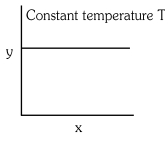
A
zero order ($y=$ concentration and $x=$ time),first order ($y=$ rate constant and $x=$ concentration)
B
zero order ($y=$ rate and $x=$ concentration),first order ($y=t_{1/2}$ and $x=$ concentration)
C
zero order ($y=$ rate and $x=$ concentration),first order ($y=$ rate and $x=t_{1/2}$)
D
zero order ($y=$ concentration and $x=$ time),first order ($y=t_{1/2}$ and $x=$ concentration)
Solution
(B) For a zero order reaction,the rate is independent of the concentration of the reactant. Thus,a graph of $y=$ rate versus $x=$ concentration is a horizontal line.
For a first order reaction,the half-life $(t_{1/2})$ is independent of the initial concentration of the reactant. Thus,a graph of $y=t_{1/2}$ versus $x=$ concentration is a horizontal line.
Therefore,the correct option is $B$.
For a first order reaction,the half-life $(t_{1/2})$ is independent of the initial concentration of the reactant. Thus,a graph of $y=t_{1/2}$ versus $x=$ concentration is a horizontal line.
Therefore,the correct option is $B$.
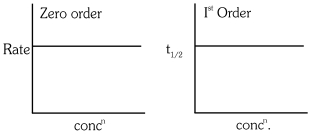
0 likesView Solution
63
ChemistryMediumMCQNEET · 2022
In one molal solution that contains $0.5 \ mol$ of a solute,there is
A
$500 \ g$ of solvent
B
$100 \ mL$ of solvent
C
$1000 \ g$ of solvent
D
$500 \ mL$ of solvent
Solution
(A) Molality $(m)$ is defined as the number of moles of solute per kilogram of solvent.
$m = \frac{\text{Moles of solute}}{\text{Mass of solvent in } kg}$
Given $m = 1 \ mol/kg$ and $\text{moles of solute} = 0.5 \ mol$.
$1 = \frac{0.5}{\text{Mass of solvent in } kg}$
$\text{Mass of solvent in } kg = 0.5 \ kg = 500 \ g$.
$m = \frac{\text{Moles of solute}}{\text{Mass of solvent in } kg}$
Given $m = 1 \ mol/kg$ and $\text{moles of solute} = 0.5 \ mol$.
$1 = \frac{0.5}{\text{Mass of solvent in } kg}$
$\text{Mass of solvent in } kg = 0.5 \ kg = 500 \ g$.
0 likesView Solution
64
ChemistryEasyMCQNEET · 2022
$RMgX + CO_2$ $\xrightarrow[\text{dry}]{ \text{ether} } Y$ $\xrightarrow{ H_3O^{+} } RCOOH$
What is $Y$ in the above reaction?
What is $Y$ in the above reaction?
A
$R_3CO^{-}Mg^{+}X$
B
$RCOO^{-}X^{+}$
C
$(RCOO)_2Mg$
D
$RCOO^{-}Mg^{+}X$
Solution
(D) The reaction of a Grignard reagent $(RMgX)$ with carbon dioxide $(CO_2)$ is a nucleophilic addition reaction.
The nucleophilic alkyl group $(R^-)$ of the Grignard reagent attacks the electrophilic carbon atom of $CO_2$.
This results in the formation of an intermediate carboxylate salt,which is $RCOO^{-}Mg^{+}X$ (often written as $RCOOMgX$).
Subsequent acid hydrolysis $(H_3O^{+})$ of this intermediate yields the corresponding carboxylic acid $(RCOOH)$.
The nucleophilic alkyl group $(R^-)$ of the Grignard reagent attacks the electrophilic carbon atom of $CO_2$.
This results in the formation of an intermediate carboxylate salt,which is $RCOO^{-}Mg^{+}X$ (often written as $RCOOMgX$).
Subsequent acid hydrolysis $(H_3O^{+})$ of this intermediate yields the corresponding carboxylic acid $(RCOOH)$.
0 likesView Solution
65
ChemistryMediumMCQNEET · 2022
Given below are half-cell reactions:
$MnO_{4}^{-} + 8H^{+} + 5e^{-} \rightarrow Mn^{2+} + 4H_{2}O$,
$E^{o}_{MnO_{4}^{-} / Mn^{2+}} = +1.510 \, V$
$\frac{1}{2} O_{2} + 2H^{+} + 2e^{-} \rightarrow H_{2}O$,
$E^{o}_{O_{2} / H_{2}O} = +1.223 \, V$
Will the permanganate ion,$MnO_{4}^{-}$,liberate $O_{2}$ from water in the presence of an acid?
$MnO_{4}^{-} + 8H^{+} + 5e^{-} \rightarrow Mn^{2+} + 4H_{2}O$,
$E^{o}_{MnO_{4}^{-} / Mn^{2+}} = +1.510 \, V$
$\frac{1}{2} O_{2} + 2H^{+} + 2e^{-} \rightarrow H_{2}O$,
$E^{o}_{O_{2} / H_{2}O} = +1.223 \, V$
Will the permanganate ion,$MnO_{4}^{-}$,liberate $O_{2}$ from water in the presence of an acid?
A
No,because $E_{cell}^{o} = -0.287 \, V$
B
Yes,because $E_{cell}^{o} = +2.733 \, V$
C
No,because $E_{cell}^{o} = -2.733 \, V$
D
Yes,because $E_{cell}^{o} = +0.287 \, V$
Solution
(D) For the reaction to be spontaneous,the cell potential $E_{cell}^{o}$ must be positive.
Reduction (Cathode): $2MnO_{4}^{-} + 16H^{+} + 10e^{-} \rightarrow 2Mn^{2+} + 8H_{2}O$ $(E^{o} = +1.510 \, V)$
Oxidation (Anode): $5H_{2}O \rightarrow \frac{5}{2} O_{2} + 10H^{+} + 10e^{-}$ $(E^{o} = +1.223 \, V)$
Overall reaction: $2MnO_{4}^{-} + 6H^{+} \rightarrow 2Mn^{2+} + \frac{5}{2} O_{2} + 3H_{2}O$
$E_{cell}^{o} = E_{cathode}^{o} - E_{anode}^{o}$
$E_{cell}^{o} = 1.510 \, V - 1.223 \, V = +0.287 \, V$
Since $E_{cell}^{o} > 0$,the reaction is spontaneous,and $MnO_{4}^{-}$ will liberate $O_{2}$ from water in the presence of an acid.
Reduction (Cathode): $2MnO_{4}^{-} + 16H^{+} + 10e^{-} \rightarrow 2Mn^{2+} + 8H_{2}O$ $(E^{o} = +1.510 \, V)$
Oxidation (Anode): $5H_{2}O \rightarrow \frac{5}{2} O_{2} + 10H^{+} + 10e^{-}$ $(E^{o} = +1.223 \, V)$
Overall reaction: $2MnO_{4}^{-} + 6H^{+} \rightarrow 2Mn^{2+} + \frac{5}{2} O_{2} + 3H_{2}O$
$E_{cell}^{o} = E_{cathode}^{o} - E_{anode}^{o}$
$E_{cell}^{o} = 1.510 \, V - 1.223 \, V = +0.287 \, V$
Since $E_{cell}^{o} > 0$,the reaction is spontaneous,and $MnO_{4}^{-}$ will liberate $O_{2}$ from water in the presence of an acid.
0 likesView Solution
66
ChemistryMediumMCQNEET · 2022
Given below are two statements:
Statement $I$: The acidic strength of monosubstituted nitrophenol is higher than phenol because of the electron-withdrawing nitro group.
Statement $II$: $o$-nitrophenol,$m$-nitrophenol,and $p$-nitrophenol will have the same acidic strength as they have one nitro group attached to the phenolic ring.
In the light of the above statements,choose the most appropriate answer from the options given below:
Statement $I$: The acidic strength of monosubstituted nitrophenol is higher than phenol because of the electron-withdrawing nitro group.
Statement $II$: $o$-nitrophenol,$m$-nitrophenol,and $p$-nitrophenol will have the same acidic strength as they have one nitro group attached to the phenolic ring.
In the light of the above statements,choose the most appropriate answer from the options given below:
A
Both Statement $I$ and Statement $II$ are incorrect.
B
Statement $I$ is correct but Statement $II$ is incorrect.
C
Statement $I$ is incorrect but Statement $II$ is correct.
D
Both Statement $I$ and Statement $II$ are correct.
Solution
(B) Statement $I$ is correct: The $-NO_2$ group is a strong electron-withdrawing group $(EWG)$ due to both $-I$ and $-M$ effects. It stabilizes the phenoxide ion,thereby increasing the acidic strength of nitrophenols compared to phenol.
Statement $II$ is incorrect: The acidic strength of nitrophenols depends on the position of the $-NO_2$ group. The $-M$ effect is operative at ortho and para positions,while only the $-I$ effect is operative at the meta position. Therefore,their acidic strengths are different. The order of acidic strength is $p$-nitrophenol > $o$-nitrophenol > $m$-nitrophenol > phenol.
Statement $II$ is incorrect: The acidic strength of nitrophenols depends on the position of the $-NO_2$ group. The $-M$ effect is operative at ortho and para positions,while only the $-I$ effect is operative at the meta position. Therefore,their acidic strengths are different. The order of acidic strength is $p$-nitrophenol > $o$-nitrophenol > $m$-nitrophenol > phenol.
0 likesView Solution
67
ChemistryMediumMCQNEET · 2022
Given below are two statements: one is labelled as Assertion $(A)$ and the other is labelled as Reason $(R).$
Assertion $(A):$ In a particular point defect,an ionic solid is electrically neutral,even if few of its cations are missing from its unit cells.
Reason $(R):$ In an ionic solid,Frenkel defect arises due to dislocation of cation from its lattice site to interstitial site,maintaining overall electrical neutrality.
In the light of the above statements,choose the most appropriate answer from the options given below:
Assertion $(A):$ In a particular point defect,an ionic solid is electrically neutral,even if few of its cations are missing from its unit cells.
Reason $(R):$ In an ionic solid,Frenkel defect arises due to dislocation of cation from its lattice site to interstitial site,maintaining overall electrical neutrality.
In the light of the above statements,choose the most appropriate answer from the options given below:
A
Both $(A)$ and $(R)$ are correct but $(R)$ is not the correct explanation of $(A)$
B
$(A)$ is correct but $(R)$ is not correct
C
$(A)$ is not correct but $(R)$ is correct
D
Both $(A)$ and $(R)$ are correct and $(R)$ is the correct explanation of $(A)$
Solution
(A) $(i)$ Assertion $(A)$ is correct because in point defects like Schottky or metal deficiency defects,the ionic solid maintains electrical neutrality despite the absence of ions.
$(ii)$ Reason $(R)$ is correct because Frenkel defect occurs when a cation leaves its lattice site and occupies an interstitial site,which preserves the overall electrical neutrality of the crystal.
$(iii)$ However,the Reason $(R)$ describes the Frenkel defect,whereas the Assertion $(A)$ refers to a general property of point defects (specifically vacancy-type defects). Therefore,$(R)$ is not the correct explanation for $(A)$.
$(ii)$ Reason $(R)$ is correct because Frenkel defect occurs when a cation leaves its lattice site and occupies an interstitial site,which preserves the overall electrical neutrality of the crystal.
$(iii)$ However,the Reason $(R)$ describes the Frenkel defect,whereas the Assertion $(A)$ refers to a general property of point defects (specifically vacancy-type defects). Therefore,$(R)$ is not the correct explanation for $(A)$.
0 likesView Solution
68
ChemistryMediumMCQNEET · 2022
Match List-$I$ with List-$II$.
Choose the correct answer from the options given below:
| List-$I$ (Drug class) | List-$II$ (Drug molecule) |
| $(a)$ Antacids | $(i)$ Salvarsan |
| $(b)$ Antihistamines | $(ii)$ Morphine |
| $(c)$ Analgesics | $(iii)$ Cimetidine |
| $(d)$ Antimicrobials | $(iv)$ Seldane |
Choose the correct answer from the options given below:
A
$(a)-(iii), (b)-(iv), (c)-(ii), (d)-(i)$
B
$(a)-(i), (b)-(iv), (c)-(ii), (d)-(iii)$
C
$(a)-(iv), (b)-(iii), (c)-(i), (d)-(ii)$
D
$(a)-(iii), (b)-(ii), (c)-(iv), (d)-(i)$
Solution
(A) The correct matches are as follows:
$(a)$ Antacids: Cimetidine $(iii)$
$(b)$ Antihistamines: Seldane $(iv)$
$(c)$ Analgesics: Morphine $(ii)$
$(d)$ Antimicrobials: Salvarsan $(i)$
Therefore,the correct sequence is $(a)-(iii), (b)-(iv), (c)-(ii), (d)-(i)$.
$(a)$ Antacids: Cimetidine $(iii)$
$(b)$ Antihistamines: Seldane $(iv)$
$(c)$ Analgesics: Morphine $(ii)$
$(d)$ Antimicrobials: Salvarsan $(i)$
Therefore,the correct sequence is $(a)-(iii), (b)-(iv), (c)-(ii), (d)-(i)$.
0 likesView Solution
69
ChemistryMediumMCQNEET · 2022
Which of the following is suitable to synthesize chlorobenzene?
A
Phenol,$NaNO_{2}, HCl, CuCl$
B
Aniline,$NaNO_{2}, HCl, CuCl$
C
Aniline,$HCl$,Heating
D
Benzene,$Cl_{2}$,anhydrous $FeCl_{3}$
Solution
(D) Chlorobenzene can be synthesized by the electrophilic aromatic substitution of benzene with chlorine in the presence of a Lewis acid catalyst like anhydrous $FeCl_{3}$.
The reaction is:
$C_{6}H_{6} + Cl_{2} \xrightarrow{\text{anhydrous } FeCl_{3}} C_{6}H_{5}Cl + HCl$
Alternatively,it can also be prepared from aniline via the Sandmeyer reaction (using $NaNO_{2}, HCl$ followed by $CuCl$),but option $D$ is a direct and standard method for the synthesis of chlorobenzene from benzene.
The reaction is:
$C_{6}H_{6} + Cl_{2} \xrightarrow{\text{anhydrous } FeCl_{3}} C_{6}H_{5}Cl + HCl$
Alternatively,it can also be prepared from aniline via the Sandmeyer reaction (using $NaNO_{2}, HCl$ followed by $CuCl$),but option $D$ is a direct and standard method for the synthesis of chlorobenzene from benzene.
0 likesView Solution
70
ChemistryMediumMCQNEET · 2022
Gadolinium has a low value of third ionisation enthalpy because of $......$
A
high exchange enthalpy
B
high electronegativity
C
high basic character
D
small size
Solution
(A) The electronic configuration of $Gd$ $(Z=64)$ is $[Xe] 4f^7 5d^1 6s^2$.
Upon formation of $Gd^{2+}$,the configuration becomes $[Xe] 4f^7 5d^1$.
The third ionisation enthalpy involves the removal of the $5d^1$ electron.
After the removal of this electron,the remaining $4f^7$ configuration is half-filled,which is highly stable due to high exchange energy.
Therefore,the energy required for the third ionisation is relatively low.
Upon formation of $Gd^{2+}$,the configuration becomes $[Xe] 4f^7 5d^1$.
The third ionisation enthalpy involves the removal of the $5d^1$ electron.
After the removal of this electron,the remaining $4f^7$ configuration is half-filled,which is highly stable due to high exchange energy.
Therefore,the energy required for the third ionisation is relatively low.
0 likesView Solution
71
ChemistryMediumMCQNEET · 2022
Which one of the following is not formed when acetone reacts with $2-$pentanone in the presence of dilute $NaOH$ followed by heating?
A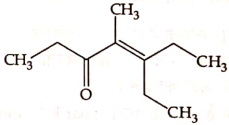
B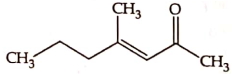
C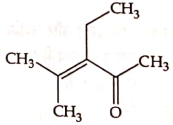
D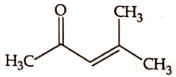
Solution
(A) The reaction between acetone $(CH_3COCH_3)$ and $2-$pentanone $(CH_3COCH_2CH_2CH_3)$ in the presence of dilute $NaOH$ and heating is a cross-aldol condensation reaction.
Acetone has two equivalent $\alpha-$hydrogens,while $2-$pentanone has two types of $\alpha-$hydrogens (at $C-1$ and $C-3$).
Self-aldol products of acetone and $2-$pentanone can also form.
The product shown in option $A$ requires a structure that cannot be derived from the condensation of these two specific ketones under the given conditions,as it would require a different carbon skeleton or starting materials.
Therefore,the structure in option $A$ is not formed.
Acetone has two equivalent $\alpha-$hydrogens,while $2-$pentanone has two types of $\alpha-$hydrogens (at $C-1$ and $C-3$).
Self-aldol products of acetone and $2-$pentanone can also form.
The product shown in option $A$ requires a structure that cannot be derived from the condensation of these two specific ketones under the given conditions,as it would require a different carbon skeleton or starting materials.
Therefore,the structure in option $A$ is not formed.
0 likesView Solution
72
ChemistryMediumMCQNEET · 2022
Copper crystallises in $fcc$ unit cell with cell edge length of $3.608 \times 10^{-8} \, cm$. The density of copper is $8.92 \, g \, cm^{-3}$. Calculate the atomic mass of copper. (In $u$)
A
$31.55$
B
$60$
C
$65$
D
$63.1$
Solution
(D) The formula for density is $d = \frac{Z \times M}{N_A \times a^3}$.
For an $fcc$ unit cell,the number of atoms per unit cell $Z = 4$.
The edge length $a = 3.608 \times 10^{-8} \, cm$.
Avogadro's number $N_A = 6.022 \times 10^{23} \, mol^{-1}$.
Substituting the values: $8.92 = \frac{4 \times M}{6.022 \times 10^{23} \times (3.608 \times 10^{-8})^3}$.
$8.92 = \frac{4 \times M}{6.022 \times 10^{23} \times 46.96 \times 10^{-24}}$.
$M = \frac{8.92 \times 6.022 \times 10^{23} \times 46.96 \times 10^{-24}}{4}$.
$M = 63.1 \, g \, mol^{-1}$.
Thus,the atomic mass of copper is $63.1 \, u$.
For an $fcc$ unit cell,the number of atoms per unit cell $Z = 4$.
The edge length $a = 3.608 \times 10^{-8} \, cm$.
Avogadro's number $N_A = 6.022 \times 10^{23} \, mol^{-1}$.
Substituting the values: $8.92 = \frac{4 \times M}{6.022 \times 10^{23} \times (3.608 \times 10^{-8})^3}$.
$8.92 = \frac{4 \times M}{6.022 \times 10^{23} \times 46.96 \times 10^{-24}}$.
$M = \frac{8.92 \times 6.022 \times 10^{23} \times 46.96 \times 10^{-24}}{4}$.
$M = 63.1 \, g \, mol^{-1}$.
Thus,the atomic mass of copper is $63.1 \, u$.
0 likesView Solution
73
ChemistryMediumMCQNEET · 2022
Given below are two statements :
Statement $I$ :
In Lucas test,primary,secondary and tertiary alcohols are distinguished on the basis of their reactivity with conc. $HCl + ZnCl_{2}$,known as Lucas Reagent.
Statement $II$ :
Primary alcohols are most reactive and immediately produce turbidity at room temperature on reaction with Lucas Reagent.
In the light of the above statements,choose the most appropriate answer from the options given below :
Statement $I$ :
In Lucas test,primary,secondary and tertiary alcohols are distinguished on the basis of their reactivity with conc. $HCl + ZnCl_{2}$,known as Lucas Reagent.
Statement $II$ :
Primary alcohols are most reactive and immediately produce turbidity at room temperature on reaction with Lucas Reagent.
In the light of the above statements,choose the most appropriate answer from the options given below :
A
Both Statement $I$ and Statement $II$ are incorrect.
B
Statement $I$ is correct but Statement $II$ is incorrect.
C
Statement $I$ is incorrect but Statement $II$ is correct.
D
Both Statement $I$ and Statement $II$ are correct.
Solution
(B) Statement $I$ is correct because the Lucas test uses a mixture of conc. $HCl$ and anhydrous $ZnCl_{2}$ (Lucas Reagent) to distinguish between $1^{\circ}$,$2^{\circ}$,and $3^{\circ}$ alcohols based on their reactivity.
Statement $II$ is incorrect because $3^{\circ}$ alcohols are the most reactive and produce turbidity immediately at room temperature,whereas $1^{\circ}$ alcohols are the least reactive and do not produce turbidity at room temperature.
The reactivity order towards Lucas reagent is $3^{\circ} > 2^{\circ} > 1^{\circ}$ alcohol.
Statement $II$ is incorrect because $3^{\circ}$ alcohols are the most reactive and produce turbidity immediately at room temperature,whereas $1^{\circ}$ alcohols are the least reactive and do not produce turbidity at room temperature.
The reactivity order towards Lucas reagent is $3^{\circ} > 2^{\circ} > 1^{\circ}$ alcohol.
0 likesView Solution
74
ChemistryMediumMCQNEET · 2022
For a first order reaction $A \rightarrow \text{Products}$,initial concentration of $A$ is $0.1 \, M$,which becomes $0.001 \, M$ after $5 \, \min$. Rate constant for the reaction in $\min^{-1}$ is .... .
A
$0.9212$
B
$0.4606$
C
$0.2303$
D
$1.3818$
Solution
(A) For a first order reaction,the rate constant $K$ is given by the formula:
$K = \frac{2.303}{t} \log \left(\frac{[A]_0}{[A]_t}\right)$
Given:
Initial concentration $[A]_0 = 0.1 \, M$
Concentration after time $t$,$[A]_t = 0.001 \, M$
Time $t = 5 \, \min$
Substituting the values:
$K = \frac{2.303}{5} \log \left(\frac{0.1}{0.001}\right)$
$K = \frac{2.303}{5} \log(100)$
Since $\log(100) = 2$:
$K = \frac{2.303 \times 2}{5} = \frac{4.606}{5} = 0.9212 \, \min^{-1}$
$K = \frac{2.303}{t} \log \left(\frac{[A]_0}{[A]_t}\right)$
Given:
Initial concentration $[A]_0 = 0.1 \, M$
Concentration after time $t$,$[A]_t = 0.001 \, M$
Time $t = 5 \, \min$
Substituting the values:
$K = \frac{2.303}{5} \log \left(\frac{0.1}{0.001}\right)$
$K = \frac{2.303}{5} \log(100)$
Since $\log(100) = 2$:
$K = \frac{2.303 \times 2}{5} = \frac{4.606}{5} = 0.9212 \, \min^{-1}$
0 likesView Solution
75
ChemistryMediumMCQNEET · 2022
Find the $emf$ of the cell in which the following reaction takes place at $298 \ K$ (in $V$):
$Ni_{(s)} + 2Ag^{+}(0.001 \ M) \rightarrow Ni^{2+}(0.001 \ M) + 2Ag_{(s)}$
(Given that $E_{cell}^{\circ} = 10.5 \ V$,$\frac{2.303 RT}{F} = 0.059$ at $298 \ K$)
$Ni_{(s)} + 2Ag^{+}(0.001 \ M) \rightarrow Ni^{2+}(0.001 \ M) + 2Ag_{(s)}$
(Given that $E_{cell}^{\circ} = 10.5 \ V$,$\frac{2.303 RT}{F} = 0.059$ at $298 \ K$)
A
$1.385$
B
$10.4115$
C
$1.05$
D
$1.0385$
Solution
(B) The cell reaction is: $Ni_{(s)} + 2Ag^{+}(0.001 \ M) \rightarrow Ni^{2+}(0.001 \ M) + 2Ag_{(s)}$
Using the Nernst equation: $E_{cell} = E_{cell}^{\circ} - \frac{0.059}{n} \log \frac{[Ni^{2+}]}{[Ag^{+}]^2}$
Here,$n = 2$,$[Ni^{2+}] = 10^{-3} \ M$,and $[Ag^{+}] = 10^{-3} \ M$.
$E_{cell} = 10.5 - \frac{0.059}{2} \log \frac{10^{-3}}{(10^{-3})^2}$
$E_{cell} = 10.5 - \frac{0.059}{2} \log \frac{10^{-3}}{10^{-6}}$
$E_{cell} = 10.5 - \frac{0.059}{2} \log 10^3$
$E_{cell} = 10.5 - \frac{0.059}{2} \times 3$
$E_{cell} = 10.5 - 0.0885 = 10.4115 \ V$
Using the Nernst equation: $E_{cell} = E_{cell}^{\circ} - \frac{0.059}{n} \log \frac{[Ni^{2+}]}{[Ag^{+}]^2}$
Here,$n = 2$,$[Ni^{2+}] = 10^{-3} \ M$,and $[Ag^{+}] = 10^{-3} \ M$.
$E_{cell} = 10.5 - \frac{0.059}{2} \log \frac{10^{-3}}{(10^{-3})^2}$
$E_{cell} = 10.5 - \frac{0.059}{2} \log \frac{10^{-3}}{10^{-6}}$
$E_{cell} = 10.5 - \frac{0.059}{2} \log 10^3$
$E_{cell} = 10.5 - \frac{0.059}{2} \times 3$
$E_{cell} = 10.5 - 0.0885 = 10.4115 \ V$
0 likesView Solution
76
ChemistryMediumMCQNEET · 2022
The product formed from the following reaction sequence is?
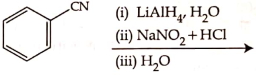
A
Benzyl diazonium chloride
B
Benzyl chloride
C
Benzyl alcohol
D
Benzamide
Solution
(C) The reaction sequence is as follows:
$1$. Reduction of benzonitrile $(C_6H_5CN)$ with $LiAlH_4$ followed by $H_2O$ gives benzylamine $(C_6H_5CH_2NH_2)$.
$2$. Treatment of benzylamine with $NaNO_2 + HCl$ at low temperature $(0-5 \ ^\circ C)$ forms unstable benzyl diazonium chloride $(C_6H_5CH_2N_2^+Cl^-)$.
$3$. Benzyl diazonium chloride rapidly decomposes to form a benzyl carbocation $(C_6H_5CH_2^+)$,which reacts with water $(H_2O)$ to yield benzyl alcohol $(C_6H_5CH_2OH)$.
$1$. Reduction of benzonitrile $(C_6H_5CN)$ with $LiAlH_4$ followed by $H_2O$ gives benzylamine $(C_6H_5CH_2NH_2)$.
$2$. Treatment of benzylamine with $NaNO_2 + HCl$ at low temperature $(0-5 \ ^\circ C)$ forms unstable benzyl diazonium chloride $(C_6H_5CH_2N_2^+Cl^-)$.
$3$. Benzyl diazonium chloride rapidly decomposes to form a benzyl carbocation $(C_6H_5CH_2^+)$,which reacts with water $(H_2O)$ to yield benzyl alcohol $(C_6H_5CH_2OH)$.
0 likesView Solution
77
ChemistryMediumMCQNEET · 2022
Match List-$I$ with List-$II$.
Choose the correct answer from the options given below:
| List-$I$ (Ores) | List-$II$ (Composition) |
| $a$. Haematite | $i$. $Fe_{3}O_{4}$ |
| $b$. Magnetite | $ii$. $ZnCO_{3}$ |
| $c$. Calamine | $iii$. $Fe_{2}O_{3}$ |
| $d$. Kaolinite | $iv$. $[Al_{2}(OH)_{4}Si_{2}O_{5}]$ |
Choose the correct answer from the options given below:
A
$a-iii, b-i, c-ii, d-iv$
B
$a-iii, b-i, c-iv, d-ii$
C
$a-i, b-iii, c-ii, d-iv$
D
$a-i, b-ii, c-iii, d-iv$
Solution
(A) The correct matches are:
$a$. Haematite is $Fe_{2}O_{3}$ $(iii)$.
$b$. Magnetite is $Fe_{3}O_{4}$ $(i)$.
$c$. Calamine is $ZnCO_{3}$ $(ii)$.
$d$. Kaolinite is $[Al_{2}(OH)_{4}Si_{2}O_{5}]$ $(iv)$.
Therefore,the correct sequence is $a-iii, b-i, c-ii, d-iv$.
$a$. Haematite is $Fe_{2}O_{3}$ $(iii)$.
$b$. Magnetite is $Fe_{3}O_{4}$ $(i)$.
$c$. Calamine is $ZnCO_{3}$ $(ii)$.
$d$. Kaolinite is $[Al_{2}(OH)_{4}Si_{2}O_{5}]$ $(iv)$.
Therefore,the correct sequence is $a-iii, b-i, c-ii, d-iv$.
0 likesView Solution
78
ChemistryMediumMCQNEET · 2022
The order of energy absorbed,which is responsible for the color of the following complexes,is:
A
$C > B > A$
B
$C > A > B$
C
$B > A > C$
D
$A > B > C$
Solution
(B) The complexes are:
$A: [Ni(H_{2}O)_{2}(en)_{2}]^{2+}$
$B: [Ni(H_{2}O)_{4}(en)]^{2+}$
$C: [Ni(en)_{3}]^{2+}$
$en$ (ethylenediamine) is a stronger field ligand $(SFL)$ compared to $H_{2}O$.
According to the spectrochemical series,the crystal field splitting energy $(\Delta_{0})$ increases as the number of strong field ligands increases.
In complex $C$,there are $3$ $en$ ligands.
In complex $A$,there are $2$ $en$ ligands.
In complex $B$,there is $1$ $en$ ligand.
Therefore,the order of crystal field splitting energy $(\Delta_{0})$ is $C > A > B$.
Since the energy absorbed $(E = h\nu = \Delta_{0})$ is directly proportional to the splitting energy,the order of energy absorbed is $C > A > B$.
$A: [Ni(H_{2}O)_{2}(en)_{2}]^{2+}$
$B: [Ni(H_{2}O)_{4}(en)]^{2+}$
$C: [Ni(en)_{3}]^{2+}$
$en$ (ethylenediamine) is a stronger field ligand $(SFL)$ compared to $H_{2}O$.
According to the spectrochemical series,the crystal field splitting energy $(\Delta_{0})$ increases as the number of strong field ligands increases.
In complex $C$,there are $3$ $en$ ligands.
In complex $A$,there are $2$ $en$ ligands.
In complex $B$,there is $1$ $en$ ligand.
Therefore,the order of crystal field splitting energy $(\Delta_{0})$ is $C > A > B$.
Since the energy absorbed $(E = h\nu = \Delta_{0})$ is directly proportional to the splitting energy,the order of energy absorbed is $C > A > B$.
0 likesView Solution
79
ChemistryMCQNEET · 2022
The $K_{H}$ values for some gases at the same temperature '$T$' are given below:
where $K_{H}$ is Henry's Law constant in water. The order of their solubility in water is:
| Gas | $K_{H} / \text{kbar}$ |
|---|---|
| $Ar$ | $40.3$ |
| $CO_{2}$ | $1.67$ |
| $HCHO$ | $1.83 \times 10^{-5}$ |
| $CH_{4}$ | $0.413$ |
where $K_{H}$ is Henry's Law constant in water. The order of their solubility in water is:
A
$Ar < CO_{2} < CH_{4} < HCHO$
B
$Ar < CH_{4} < CO_{2} < HCHO$
C
$HCHO < CO_{2} < CH_{4} < Ar$
D
$HCHO < CH_{4} < CO_{2} < Ar$
Solution
(A) According to Henry's Law, the solubility of a gas in a liquid is inversely proportional to the Henry's Law constant $(K_{H})$.
Mathematically, $S \propto 1 / K_{H}$.
Therefore, a higher value of $K_{H}$ indicates lower solubility, and a lower value of $K_{H}$ indicates higher solubility.
Comparing the given $K_{H}$ values:
$Ar (40.3) > CO_{2} (1.67) > CH_{4} (0.413) > HCHO (1.83 \times 10^{-5})$.
Thus, the order of solubility in water is:
$Ar < CO_{2} < CH_{4} < HCHO$.
Mathematically, $S \propto 1 / K_{H}$.
Therefore, a higher value of $K_{H}$ indicates lower solubility, and a lower value of $K_{H}$ indicates higher solubility.
Comparing the given $K_{H}$ values:
$Ar (40.3) > CO_{2} (1.67) > CH_{4} (0.413) > HCHO (1.83 \times 10^{-5})$.
Thus, the order of solubility in water is:
$Ar < CO_{2} < CH_{4} < HCHO$.
0 likesView Solution
80
ChemistryMediumMCQNEET · 2022
Which of the following reactions is a part of the large-scale industrial preparation of nitric acid?
A
$NaNO_3 + H_2SO_4 \xrightarrow{500 \ K, 9 \ bar} NaHSO_4 + HNO_3$
B
$4NH_3(g) + 5O_2(g) \xrightarrow[Pt/Rh \ \text{catalyst}]{500 \ K, 9 \ bar} 4NO(g) + 6H_2O(g)$
C
$4HPO_3 + 2N_2O_5 \xrightarrow{500 \ K, 9 \ bar} 4HNO_3 + P_4O_{10}$
D
$Cu(NO_3)_2 + 2NO_2 + 2H_2O \xrightarrow{500 \ K, 9 \ bar} 4HNO_3 + Cu$
Solution
(B) The large-scale industrial preparation of nitric acid is carried out by the $Ostwald$ process.
In this process,ammonia is catalytically oxidized by atmospheric oxygen to form nitric oxide $(NO)$.
The reaction is: $4NH_3(g) + 5O_2(g) \xrightarrow[Pt/Rh \ \text{catalyst}]{500 \ K, 9 \ bar} 4NO(g) + 6H_2O(g)$.
In this process,ammonia is catalytically oxidized by atmospheric oxygen to form nitric oxide $(NO)$.
The reaction is: $4NH_3(g) + 5O_2(g) \xrightarrow[Pt/Rh \ \text{catalyst}]{500 \ K, 9 \ bar} 4NO(g) + 6H_2O(g)$.
0 likesView Solution
81
ChemistryMediumMCQNEET · 2022
The product formed from the following reaction sequence is :
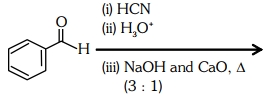
A
Phenylacetic acid
B
Benzyl alcohol
C
Benzoic acid
D
Benzamide
Solution
(B) The reaction sequence is as follows:
$1$. Benzaldehyde reacts with $HCN$ to form benzaldehyde cyanohydrin: $C_6H_5CHO + HCN \rightarrow C_6H_5CH(OH)CN$.
$2$. Acidic hydrolysis of the cyanohydrin yields mandelic acid: $C_6H_5CH(OH)CN + H_3O^+ \rightarrow C_6H_5CH(OH)COOH$.
$3$. Heating mandelic acid with $NaOH$ and $CaO$ (sodalime) leads to decarboxylation. However,the provided reaction sequence and options suggest a reduction pathway. Given the options,the final product is $C_6H_5CH_2OH$ (Benzyl alcohol).
$1$. Benzaldehyde reacts with $HCN$ to form benzaldehyde cyanohydrin: $C_6H_5CHO + HCN \rightarrow C_6H_5CH(OH)CN$.
$2$. Acidic hydrolysis of the cyanohydrin yields mandelic acid: $C_6H_5CH(OH)CN + H_3O^+ \rightarrow C_6H_5CH(OH)COOH$.
$3$. Heating mandelic acid with $NaOH$ and $CaO$ (sodalime) leads to decarboxylation. However,the provided reaction sequence and options suggest a reduction pathway. Given the options,the final product is $C_6H_5CH_2OH$ (Benzyl alcohol).
0 likesView Solution
82
ChemistryMediumMCQNEET · 2022
Match List-$I$ with List-$II$ :
Choose the correct answer from the options given below :
| List-$I$ | List-$II$ |
| $a$. Gabriel synthesis | $i$. Benzaldehyde |
| $b$. Kolbe synthesis | $ii$. Ethers |
| $c$. Williamson synthesis | $iii$. Primary amines |
| $d$. Etard reaction | $iv$. Salicylic acid |
Choose the correct answer from the options given below :
A
$a-iii, b-i, c-ii, d-iv$
B
$a-ii, b-iii, c-i, d-iv$
C
$a-iv, b-iii, c-i, d-ii$
D
$a-iii, b-iv, c-ii, d-i$
Solution
(D) The correct matches are:
$a$. Gabriel synthesis is used for the preparation of $1^{\circ}$ amines $(iii)$.
$b$. Kolbe synthesis (Kolbe-Schmitt reaction) is used for the preparation of salicylic acid $(iv)$.
$c$. Williamson synthesis is used for the preparation of ethers $(ii)$.
$d$. Etard reaction is used for the oxidation of toluene to benzaldehyde $(i)$.
Therefore,the correct matching is $a-iii, b-iv, c-ii, d-i$.
$a$. Gabriel synthesis is used for the preparation of $1^{\circ}$ amines $(iii)$.
$b$. Kolbe synthesis (Kolbe-Schmitt reaction) is used for the preparation of salicylic acid $(iv)$.
$c$. Williamson synthesis is used for the preparation of ethers $(ii)$.
$d$. Etard reaction is used for the oxidation of toluene to benzaldehyde $(i)$.
Therefore,the correct matching is $a-iii, b-iv, c-ii, d-i$.
0 likesView Solution
83
ChemistryMediumMCQNEET · 2022
Predict the order of reactivity of the following four isomers towards $S_{N}2$ reaction.
$(I)$ $CH_{3}CH_{2}CH_{2}CH_{2}Cl$
$(II)$ $CH_{3}CH_{2}CH(Cl)CH_{3}$
$(III)$ $(CH_{3})_{2}CHCH_{2}Cl$
$(IV)$ $(CH_{3})_{3}CCl$
$(I)$ $CH_{3}CH_{2}CH_{2}CH_{2}Cl$
$(II)$ $CH_{3}CH_{2}CH(Cl)CH_{3}$
$(III)$ $(CH_{3})_{2}CHCH_{2}Cl$
$(IV)$ $(CH_{3})_{3}CCl$
A
$IV > III > II > I$
B
$I > II > III > IV$
C
$I > III > II > IV$
D
$IV > II > III > I$
Solution
(C) The reactivity of alkyl halides towards $S_{N}2$ reactions is primarily governed by steric hindrance. The order of reactivity is $Primary > Secondary > Tertiary$.
$(I)$ $CH_{3}CH_{2}CH_{2}CH_{2}Cl$ is a primary alkyl halide with minimal steric hindrance.
$(III)$ $(CH_{3})_{2}CHCH_{2}Cl$ is a primary alkyl halide but has more steric hindrance than $(I)$ due to the branching at the $\beta$-carbon.
$(II)$ $CH_{3}CH_{2}CH(Cl)CH_{3}$ is a secondary alkyl halide.
$(IV)$ $(CH_{3})_{3}CCl$ is a tertiary alkyl halide,which is the least reactive towards $S_{N}2$ due to maximum steric hindrance.
Therefore,the correct order is $I > III > II > IV$.
$(I)$ $CH_{3}CH_{2}CH_{2}CH_{2}Cl$ is a primary alkyl halide with minimal steric hindrance.
$(III)$ $(CH_{3})_{2}CHCH_{2}Cl$ is a primary alkyl halide but has more steric hindrance than $(I)$ due to the branching at the $\beta$-carbon.
$(II)$ $CH_{3}CH_{2}CH(Cl)CH_{3}$ is a secondary alkyl halide.
$(IV)$ $(CH_{3})_{3}CCl$ is a tertiary alkyl halide,which is the least reactive towards $S_{N}2$ due to maximum steric hindrance.
Therefore,the correct order is $I > III > II > IV$.
0 likesView Solution
84
ChemistryMediumMCQNEET · 2022
Which among the following is a thermoplastic polymer?
A
Bakelite
B
Polythene
C
Urea-formaldehyde resin
D
Melamine polymer
Solution
(B) Thermoplastic polymers are those that soften on heating and harden on cooling,and can be reshaped.
$Polythene$ is a classic example of a thermoplastic polymer.
$Bakelite$,$Urea-formaldehyde$ resin,and $Melamine$ polymer are thermosetting polymers,which undergo permanent chemical change upon heating and cannot be reshaped.
$Polythene$ is a classic example of a thermoplastic polymer.
$Bakelite$,$Urea-formaldehyde$ resin,and $Melamine$ polymer are thermosetting polymers,which undergo permanent chemical change upon heating and cannot be reshaped.
0 likesView Solution
85
ChemistryMediumMCQNEET · 2022
Two half-cell reactions are given below:
$Co^{3+} + e^- \rightarrow Co^{2+}, E^{\circ}_{Co^{3+}/Co^{2+}} = 1.81 \, V$
$Al^{3+} + 3e^- \rightarrow Al(s), E^{\circ}_{Al^{3+}/Al} = -1.66 \, V$
The standard $EMF$ of a cell with a feasible redox reaction will be:
$Co^{3+} + e^- \rightarrow Co^{2+}, E^{\circ}_{Co^{3+}/Co^{2+}} = 1.81 \, V$
$Al^{3+} + 3e^- \rightarrow Al(s), E^{\circ}_{Al^{3+}/Al} = -1.66 \, V$
The standard $EMF$ of a cell with a feasible redox reaction will be:
A
$+7.09 \, V$
B
$+0.15 \, V$
C
$+3.47 \, V$
D
$-3.47 \, V$
Solution
(C) For a cell to be feasible,$E^{\circ}_{cell}$ must be positive.
$E^{\circ}_{cell} = E^{\circ}_{cathode} - E^{\circ}_{anode}$
Here,$Co^{3+}$ is reduced $(cathode)$ and $Al$ is oxidized $(anode)$.
$E^{\circ}_{cathode} = E^{\circ}_{Co^{3+}/Co^{2+}} = 1.81 \, V$
$E^{\circ}_{anode} = E^{\circ}_{Al^{3+}/Al} = -1.66 \, V$
$E^{\circ}_{cell} = 1.81 \, V - (-1.66 \, V) = 1.81 + 1.66 = 3.47 \, V$.
$E^{\circ}_{cell} = E^{\circ}_{cathode} - E^{\circ}_{anode}$
Here,$Co^{3+}$ is reduced $(cathode)$ and $Al$ is oxidized $(anode)$.
$E^{\circ}_{cathode} = E^{\circ}_{Co^{3+}/Co^{2+}} = 1.81 \, V$
$E^{\circ}_{anode} = E^{\circ}_{Al^{3+}/Al} = -1.66 \, V$
$E^{\circ}_{cell} = 1.81 \, V - (-1.66 \, V) = 1.81 + 1.66 = 3.47 \, V$.
0 likesView Solution
86
ChemistryDifficultMCQNEET · 2022
Shown below are adsorption isotherms for a gas '$X$' at temperatures $T_1$,$T_2$,and $T_3$. Here,$p$ and $\frac{x}{m}$ represent pressure and the extent of adsorption,respectively. The correct order of temperatures for the given adsorption is:
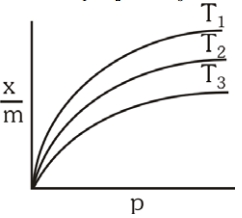
A
$T_1 > T_2 > T_3$
B
$T_3 > T_2 > T_1$
C
$T_1 = T_2 = T_3$
D
$T_1 = T_2 > T_3$
Solution
(B) Physical adsorption is an exothermic process. According to Le Chatelier's principle,an increase in temperature decreases the extent of adsorption $(\frac{x}{m})$ at a constant pressure.
From the given graph,at any constant pressure $p$,the extent of adsorption follows the order: $(x/m)_{T_1} > (x/m)_{T_2} > (x/m)_{T_3}$.
Since adsorption decreases with an increase in temperature,the corresponding temperatures must follow the inverse order: $T_1 < T_2 < T_3$,or $T_3 > T_2 > T_1$.
From the given graph,at any constant pressure $p$,the extent of adsorption follows the order: $(x/m)_{T_1} > (x/m)_{T_2} > (x/m)_{T_3}$.
Since adsorption decreases with an increase in temperature,the corresponding temperatures must follow the inverse order: $T_1 < T_2 < T_3$,or $T_3 > T_2 > T_1$.
0 likesView Solution
87
ChemistryDifficultMCQNEET · 2022
The half-life of a first-order reaction is $2000$ years. If the concentration after $8000$ years is $0.02 \, M$,then the initial concentration was $........... \, M$.
A
$0.16$
B
$0.32$
C
$0.08$
D
$0.04$
Solution
(B) For a first-order reaction,the number of half-lives $(n)$ is calculated as $n = \frac{t}{t_{1/2}} = \frac{8000}{2000} = 4$.
After $n$ half-lives,the remaining concentration $[A]_t$ is given by $[A]_t = \frac{[A]_0}{2^n}$.
Substituting the values: $0.02 = \frac{[A]_0}{2^4}$.
$0.02 = \frac{[A]_0}{16}$.
$[A]_0 = 0.02 \times 16 = 0.32 \, M$.
After $n$ half-lives,the remaining concentration $[A]_t$ is given by $[A]_t = \frac{[A]_0}{2^n}$.
Substituting the values: $0.02 = \frac{[A]_0}{2^4}$.
$0.02 = \frac{[A]_0}{16}$.
$[A]_0 = 0.02 \times 16 = 0.32 \, M$.
0 likesView Solution
88
ChemistryDifficultMCQNEET · 2022
Fluorine is a stronger oxidising agent than chlorine because :
$(a)$ $F-F$ bond has a low enthalpy of dissociation.
$(b)$ Fluoride ion $(F^{-})$ has high hydration enthalpy.
$(c)$ Electron gain enthalpy of fluorine is less negative than chlorine.
$(d)$ Fluorine has a very small size.
Choose the most appropriate answer from the options given :
$(a)$ $F-F$ bond has a low enthalpy of dissociation.
$(b)$ Fluoride ion $(F^{-})$ has high hydration enthalpy.
$(c)$ Electron gain enthalpy of fluorine is less negative than chlorine.
$(d)$ Fluorine has a very small size.
Choose the most appropriate answer from the options given :
A
$(a)$ and $(b)$ only
B
$(a)$ and $(c)$ only
C
$(a)$ and $(d)$ only
D
$(b)$ and $(c)$ only
Solution
(A) The standard electrode potential $(E^{\circ})$ of a species is determined by the overall energy change involved in the process: $\frac{1}{2} F_2(g) + e^- \rightarrow F^-(aq)$.
This process involves three steps: $(1)$ Atomization (bond dissociation),$(2)$ Electron gain,and $(3)$ Hydration.
Fluorine has a very low bond dissociation enthalpy due to inter-electronic repulsions between lone pairs in the small $F_2$ molecule.
Additionally,the small size of the $F^-$ ion results in a very high hydration enthalpy,which makes the overall process highly exothermic.
Therefore,both the low bond dissociation enthalpy and the high hydration enthalpy contribute to the strong oxidizing power of fluorine.
This process involves three steps: $(1)$ Atomization (bond dissociation),$(2)$ Electron gain,and $(3)$ Hydration.
Fluorine has a very low bond dissociation enthalpy due to inter-electronic repulsions between lone pairs in the small $F_2$ molecule.
Additionally,the small size of the $F^-$ ion results in a very high hydration enthalpy,which makes the overall process highly exothermic.
Therefore,both the low bond dissociation enthalpy and the high hydration enthalpy contribute to the strong oxidizing power of fluorine.
0 likesView Solution
89
ChemistryMediumMCQNEET · 2022
Match List-$I$ with List-$II$ :
Choose the correct answer from the options given below :
| List-$I$ (Complexes) | List-$II$ (Types) |
| $a$. $[Co(NH_3)_5NO_2]Cl_2$ and $[Co(NH_3)_5ONO]Cl_2$ | $i$. Linkage isomerism |
| $b$. $[Cr(NH_3)_6][Co(CN)_6]$ and $[Cr(CN)_6][Co(NH_3)_6]$ | $ii$. Coordination isomerism |
| $c$. $[Co(NH_3)_5(SO_4)]Br$ and $[Co(NH_3)_5Br]SO_4$ | $iii$. Ionisation isomerism |
| $d$. $[Cr(H_2O)_6]Cl_3$ and $[Cr(H_2O)_5Cl]Cl_2 \cdot H_2O$ | $iv$. Solvate isomerism |
Choose the correct answer from the options given below :
A
$a-i, b-ii, c-iii, d-iv$
B
$a-ii, b-iii, c-iv, d-i$
C
$a-iii, b-ii, c-i, d-iv$
D
$a-iv, b-iii, c-ii, d-i$
Solution
(A) $[Co(NH_3)_5NO_2]Cl_2$ and $[Co(NH_3)_5ONO]Cl_2$ exhibit linkage isomerism due to the ambidentate ligand $NO_2^-$. Thus,$a-i$.
$(b)$ $[Cr(NH_3)_6][Co(CN)_6]$ and $[Cr(CN)_6][Co(NH_3)_6]$ exhibit coordination isomerism due to the exchange of ligands between cationic and anionic entities. Thus,$b-ii$.
$(c)$ $[Co(NH_3)_5(SO_4)]Br$ and $[Co(NH_3)_5Br]SO_4$ exhibit ionisation isomerism as they produce different ions in solution. Thus,$c-iii$.
$(d)$ $[Cr(H_2O)_6]Cl_3$ and $[Cr(H_2O)_5Cl]Cl_2 \cdot H_2O$ exhibit solvate (hydrate) isomerism. Thus,$d-iv$.
Therefore,the correct match is $a-i, b-ii, c-iii, d-iv$.
$(b)$ $[Cr(NH_3)_6][Co(CN)_6]$ and $[Cr(CN)_6][Co(NH_3)_6]$ exhibit coordination isomerism due to the exchange of ligands between cationic and anionic entities. Thus,$b-ii$.
$(c)$ $[Co(NH_3)_5(SO_4)]Br$ and $[Co(NH_3)_5Br]SO_4$ exhibit ionisation isomerism as they produce different ions in solution. Thus,$c-iii$.
$(d)$ $[Cr(H_2O)_6]Cl_3$ and $[Cr(H_2O)_5Cl]Cl_2 \cdot H_2O$ exhibit solvate (hydrate) isomerism. Thus,$d-iv$.
Therefore,the correct match is $a-i, b-ii, c-iii, d-iv$.
0 likesView Solution
90
ChemistryMediumMCQNEET · 2022
The incorrect statement about denaturation of proteins is
A
It results due to change of temperature and/or $pH$.
B
It results in loss of biological activity of proteins.
C
$A$ protein is formed from amino acids linked by peptide bonds.
D
Uncoiling of the helical structure takes place.
Solution
(C) Denaturation is a process that causes the loss of the secondary and tertiary structures of proteins,leading to the loss of their biological activity.
$1$. It is caused by changes in physical conditions such as temperature or chemical conditions like $pH$.
$2$. During this process,the helical structure of the protein uncoils.
$3$. Option $C$ describes the primary structure of a protein (formation from amino acids linked by peptide bonds),which remains intact during denaturation.
Therefore,the statement in option $C$ is incorrect regarding the process of denaturation.
$1$. It is caused by changes in physical conditions such as temperature or chemical conditions like $pH$.
$2$. During this process,the helical structure of the protein uncoils.
$3$. Option $C$ describes the primary structure of a protein (formation from amino acids linked by peptide bonds),which remains intact during denaturation.
Therefore,the statement in option $C$ is incorrect regarding the process of denaturation.
0 likesView Solution
91
ChemistryDifficultMCQNEET · 2022
The product formed from the following reaction sequence is:
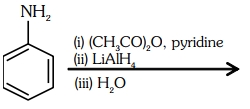
A
$N$-ethylaniline
B
$2-(1$-hydroxyethyl)aniline
C
$4-(1$-hydroxyethyl)aniline
D
$2,4$-bis($1$-hydroxyethyl)aniline
Solution
(A) Step $1$: Aniline reacts with acetic anhydride $(CH_3CO)_2O$ in the presence of pyridine to form acetanilide $(C_6H_5NHCOCH_3)$.
Step $2$: Acetanilide is then reduced by $LiAlH_4$ (a strong reducing agent) which reduces the amide group $(-NHCOCH_3)$ to an amine group $(-NHCH_2CH_3)$.
Step $3$: Hydrolysis $(H_2O)$ yields the final product,$N$-ethylaniline $(C_6H_5NHCH_2CH_3)$.
Step $2$: Acetanilide is then reduced by $LiAlH_4$ (a strong reducing agent) which reduces the amide group $(-NHCOCH_3)$ to an amine group $(-NHCH_2CH_3)$.
Step $3$: Hydrolysis $(H_2O)$ yields the final product,$N$-ethylaniline $(C_6H_5NHCH_2CH_3)$.
0 likesView Solution
92
ChemistryMediumMCQNEET · 2022
Given below are two statements: one is labelled as Assertion $(A)$ and the other is labelled as Reason $(R)$.
Assertion $(A)$ : Chlorine is an electron withdrawing group but it is ortho,para directing in electrophilic aromatic substitution.
Reason $(R)$ : Inductive effect of chlorine destabilises the intermediate carbocation formed during the electrophilic substitution,however due to the more pronounced resonance effect,the halogen stabilises the carbocation at ortho and para positions.
In the light of the above statements,choose the most appropriate answer from the options given below :
Assertion $(A)$ : Chlorine is an electron withdrawing group but it is ortho,para directing in electrophilic aromatic substitution.
Reason $(R)$ : Inductive effect of chlorine destabilises the intermediate carbocation formed during the electrophilic substitution,however due to the more pronounced resonance effect,the halogen stabilises the carbocation at ortho and para positions.
In the light of the above statements,choose the most appropriate answer from the options given below :
A
Both $(A)$ and $(R)$ are correct and $(R)$ is the correct explanation of $(A)$
B
Both $(A)$ and $(R)$ are correct but $(R)$ is not the correct explanation of $(A)$
C
$(A)$ is correct but $(R)$ is not correct
D
$(A)$ is not correct but $(R)$ is correct.
Solution
(A) Chlorine is an electron-withdrawing group due to its high electronegativity ($-I$ effect),which deactivates the benzene ring.
However,it has lone pairs of electrons that participate in resonance ($+R$ effect).
During electrophilic aromatic substitution,the resonance effect stabilizes the carbocation intermediate specifically at the ortho and para positions.
Since both statements are scientifically accurate and the reason correctly explains the dual nature of the chlorine substituent,the correct option is $(A)$.
However,it has lone pairs of electrons that participate in resonance ($+R$ effect).
During electrophilic aromatic substitution,the resonance effect stabilizes the carbocation intermediate specifically at the ortho and para positions.
Since both statements are scientifically accurate and the reason correctly explains the dual nature of the chlorine substituent,the correct option is $(A)$.
0 likesView Solution
93
ChemistryDifficultMCQNEET · 2022
Which of the following reactions is not an example of a nucleophilic addition-elimination reaction?
A
The reaction of $CH_3CHO$ with $NaHSO_3$
B
$CH_3CHO + NH_2OH \rightleftharpoons CH_3CH=NOH + H_2O$
C
$CH_3CHO + C_6H_5NHNH_2 \rightleftharpoons CH_3CH=NNHC_6H_5 + H_2O$
D
$CH_3CHO + NH_3 \rightleftharpoons CH_3CH=NH + H_2O$
Solution
(A) Nucleophilic addition-elimination reactions involve the addition of a nucleophile to the carbonyl carbon followed by the elimination of a water molecule.
In the reaction of $CH_3CHO$ with $NaHSO_3$,the bisulfite ion acts as a nucleophile and adds to the carbonyl carbon to form a bisulfite addition product.
This is a pure nucleophilic addition reaction,not an addition-elimination reaction,as no water molecule is eliminated.
Options $B$,$C$,and $D$ represent the formation of oximes,hydrazones,and imines respectively,which are classic examples of nucleophilic addition-elimination reactions.
In the reaction of $CH_3CHO$ with $NaHSO_3$,the bisulfite ion acts as a nucleophile and adds to the carbonyl carbon to form a bisulfite addition product.
This is a pure nucleophilic addition reaction,not an addition-elimination reaction,as no water molecule is eliminated.
Options $B$,$C$,and $D$ represent the formation of oximes,hydrazones,and imines respectively,which are classic examples of nucleophilic addition-elimination reactions.
0 likesView Solution
94
ChemistryMediumMCQNEET · 2022
Decrease in size from left to right in actinoid series is greater and more gradual than that in lanthanoid series due to:
A
$4f$ orbitals are penultimate
B
$4f$ orbitals have greater shielding effect
C
$5f$ orbitals have poor shielding effect
D
$5f$ orbitals have greater shielding effect
Solution
(C) The decrease in atomic size across the actinoid series is more pronounced than in the lanthanoid series.
This is because the $5f$ orbitals have a poorer shielding effect compared to the $4f$ orbitals.
Due to the poor shielding by $5f$ electrons,the effective nuclear charge $(Z_{eff})$ increases more significantly across the actinoid series.
Since atomic size is inversely proportional to $Z_{eff}$ $(Size \propto \frac{1}{Z_{eff}})$,the size decreases more rapidly.
This is because the $5f$ orbitals have a poorer shielding effect compared to the $4f$ orbitals.
Due to the poor shielding by $5f$ electrons,the effective nuclear charge $(Z_{eff})$ increases more significantly across the actinoid series.
Since atomic size is inversely proportional to $Z_{eff}$ $(Size \propto \frac{1}{Z_{eff}})$,the size decreases more rapidly.
0 likesView Solution
95
ChemistryMediumMCQNEET · 2022
Match the reagents in List-$I$ with the product in List-$II$ obtained from phenol.
Choose the correct answer from the options given below:
| List-$I$ | List-$II$ |
|---|---|
| $a$. $(i)$ $NaOH$,$(ii)$ $CO_2$,$(iii)$ $H^{+}$ | $i$. Benzoquinone |
| $b$. $(i)$ Aqueous $NaOH + CHCl_3$,$(ii)$ $H^{+}$ | $ii$. Benzene |
| $c$. $Zn$ dust,$\Delta$ | $iii$. Salicylaldehyde |
| $d$. $Na_2Cr_2O_7, H_2SO_4$ | $iv$. Salicylic acid |
Choose the correct answer from the options given below:
A
$a-iii, b-iv, c-i, d-ii$
B
$a-ii, b-i, c-iv, d-iii$
C
$a-iv, b-iii, c-ii, d-i$
D
$a-iv, b-ii, c-i, d-iii$
Solution
(C) The reactions of phenol are as follows:
$a$. Phenol reacts with $(i)$ $NaOH$,$(ii)$ $CO_2$,$(iii)$ $H^{+}$ to form Salicylic acid (Kolbe's reaction). Thus,$a-iv$.
$b$. Phenol reacts with $(i)$ Aqueous $NaOH + CHCl_3$,$(ii)$ $H^{+}$ to form Salicylaldehyde (Reimer-Tiemann reaction). Thus,$b-iii$.
$c$. Phenol reacts with $Zn$ dust upon heating to form Benzene. Thus,$c-ii$.
$d$. Phenol reacts with $Na_2Cr_2O_7$ and $H_2SO_4$ (chromic acid) to form Benzoquinone. Thus,$d-i$.
Therefore,the correct matching is $a-iv, b-iii, c-ii, d-i$.
$a$. Phenol reacts with $(i)$ $NaOH$,$(ii)$ $CO_2$,$(iii)$ $H^{+}$ to form Salicylic acid (Kolbe's reaction). Thus,$a-iv$.
$b$. Phenol reacts with $(i)$ Aqueous $NaOH + CHCl_3$,$(ii)$ $H^{+}$ to form Salicylaldehyde (Reimer-Tiemann reaction). Thus,$b-iii$.
$c$. Phenol reacts with $Zn$ dust upon heating to form Benzene. Thus,$c-ii$.
$d$. Phenol reacts with $Na_2Cr_2O_7$ and $H_2SO_4$ (chromic acid) to form Benzoquinone. Thus,$d-i$.
Therefore,the correct matching is $a-iv, b-iii, c-ii, d-i$.
0 likesView Solution
96
ChemistryMediumMCQNEET · 2022
For a chemical reaction $4 A + 3 B \rightarrow 6 C + 9 D$,the rate of formation of $C$ is $6 \times 10^{-2} \ mol \ L^{-1} \ s^{-1}$ and the rate of disappearance of $A$ is $4 \times 10^{-2} \ mol \ L^{-1} \ s^{-1}$. The rate of reaction and the amount of $B$ consumed in an interval of $10 \ s$,respectively,will be:
A
$1 \times 10^{-2} \ mol \ L^{-1} \ s^{-1}$ and $30 \times 10^{-2} \ mol \ L^{-1}$
B
$10 \times 10^{-2} \ mol \ L^{-1} \ s^{-1}$ and $10 \times 10^{-2} \ mol \ L^{-1}$
C
$1 \times 10^{-2} \ mol \ L^{-1} \ s^{-1}$ and $10 \times 10^{-2} \ mol \ L^{-1}$
D
$10 \times 10^{-2} \ mol \ L^{-1} \ s^{-1}$ and $30 \times 10^{-2} \ mol \ L^{-1}$
Solution
(A) The rate of reaction is given by the expression: $\text{Rate} = -\frac{1}{4} \frac{d[A]}{dt} = -\frac{1}{3} \frac{d[B]}{dt} = \frac{1}{6} \frac{d[C]}{dt} = \frac{1}{9} \frac{d[D]}{dt}$.
Given,rate of disappearance of $A$ $(-\frac{d[A]}{dt})$ $= 4 \times 10^{-2} \ mol \ L^{-1} \ s^{-1}$.
Therefore,$\text{Rate of reaction} = \frac{1}{4} \times (4 \times 10^{-2}) = 1 \times 10^{-2} \ mol \ L^{-1} \ s^{-1}$.
Now,$\text{Rate of disappearance of } B = 3 \times \text{Rate of reaction} = 3 \times 1 \times 10^{-2} = 3 \times 10^{-2} \ mol \ L^{-1} \ s^{-1}$.
Amount of $B$ consumed in $10 \ s = \text{Rate of disappearance of } B \times \text{Time} = (3 \times 10^{-2} \ mol \ L^{-1} \ s^{-1}) \times 10 \ s = 30 \times 10^{-2} \ mol \ L^{-1}$.
Given,rate of disappearance of $A$ $(-\frac{d[A]}{dt})$ $= 4 \times 10^{-2} \ mol \ L^{-1} \ s^{-1}$.
Therefore,$\text{Rate of reaction} = \frac{1}{4} \times (4 \times 10^{-2}) = 1 \times 10^{-2} \ mol \ L^{-1} \ s^{-1}$.
Now,$\text{Rate of disappearance of } B = 3 \times \text{Rate of reaction} = 3 \times 1 \times 10^{-2} = 3 \times 10^{-2} \ mol \ L^{-1} \ s^{-1}$.
Amount of $B$ consumed in $10 \ s = \text{Rate of disappearance of } B \times \text{Time} = (3 \times 10^{-2} \ mol \ L^{-1} \ s^{-1}) \times 10 \ s = 30 \times 10^{-2} \ mol \ L^{-1}$.
0 likesView Solution
97
ChemistryMediumMCQNEET · 2022
Which of the following is an incorrect method for the synthesis of benzaldehyde?
A
$A$. Oxidation of toluene by $CrO_2Cl_2$ followed by hydrolysis
B
$B$. Reduction of benzoyl chloride with $H_2$ in the presence of $Pd-BaSO_4$
C
$C$. Oxidation of toluene by $CrO_3$ in the presence of acetic anhydride
D
$D$. Reaction of benzonitrile with $CH_3MgBr$ followed by hydrolysis
Solution
(D) Let us analyze each reaction pathway for the synthesis of benzaldehyde:
$A$. Etard reaction: Toluene is oxidized by $CrO_2Cl_2$ in $CS_2$ followed by hydrolysis to give benzaldehyde. This is a correct method.
$B$. Rosenmund reduction: Benzoyl chloride is reduced by $H_2$ in the presence of $Pd-BaSO_4$ (Lindlar catalyst) to give benzaldehyde. This is a correct method.
$C$. Toluene is oxidized by $CrO_3$ in the presence of acetic anhydride to form a gem-diacetate intermediate,which upon hydrolysis yields benzaldehyde. This is a correct method.
$D$. Reaction of benzonitrile $(C_6H_5CN)$ with $CH_3MgBr$ (a Grignard reagent) followed by hydrolysis yields acetophenone $(C_6H_5COCH_3)$,not benzaldehyde. Therefore,this is an incorrect method for the synthesis of benzaldehyde.
$A$. Etard reaction: Toluene is oxidized by $CrO_2Cl_2$ in $CS_2$ followed by hydrolysis to give benzaldehyde. This is a correct method.
$B$. Rosenmund reduction: Benzoyl chloride is reduced by $H_2$ in the presence of $Pd-BaSO_4$ (Lindlar catalyst) to give benzaldehyde. This is a correct method.
$C$. Toluene is oxidized by $CrO_3$ in the presence of acetic anhydride to form a gem-diacetate intermediate,which upon hydrolysis yields benzaldehyde. This is a correct method.
$D$. Reaction of benzonitrile $(C_6H_5CN)$ with $CH_3MgBr$ (a Grignard reagent) followed by hydrolysis yields acetophenone $(C_6H_5COCH_3)$,not benzaldehyde. Therefore,this is an incorrect method for the synthesis of benzaldehyde.
0 likesView Solution
98
ChemistryMediumMCQNEET · 2022
Given below are two statements: one is labelled as Assertion $(A)$ and the other is labelled as Reason $(R)$.
Assertion $(A)$: The metal-carbon bond in metal carbonyls possesses both $\sigma$ and $\pi$ character.
Reason $(R)$: The ligand-to-metal bond is a $\sigma$ bond and metal-to-ligand bond is a $\pi$ bond.
In the light of the above statements,choose the most appropriate answer from the options given below :
Assertion $(A)$: The metal-carbon bond in metal carbonyls possesses both $\sigma$ and $\pi$ character.
Reason $(R)$: The ligand-to-metal bond is a $\sigma$ bond and metal-to-ligand bond is a $\pi$ bond.
In the light of the above statements,choose the most appropriate answer from the options given below :
A
Both $(A)$ and $(R)$ are correct and $(R)$ is the correct explanation of $(A)$
B
Both $(A)$ and $(R)$ are correct but $(R)$ is not the correct explanation of $(A)$
C
$(A)$ is correct but $(R)$ is not correct.
D
$(A)$ is not correct but $(R)$ is correct.
Solution
(A) In metal carbonyls,the metal-carbon bond is formed by a synergic bonding mechanism.
$1$. The ligand $(CO)$ donates a lone pair of electrons from its carbon atom into an empty orbital of the metal,forming a $\sigma$ bond.
$2$. The metal then donates a pair of electrons from its filled $d$-orbital into the empty antibonding $\pi^*$ orbital of the $CO$ ligand,forming a $\pi$ bond.
$3$. This back-donation strengthens the metal-carbon bond and weakens the carbon-oxygen bond.
$4$. Thus,both Assertion $(A)$ and Reason $(R)$ are correct,and $(R)$ correctly explains $(A)$.
$1$. The ligand $(CO)$ donates a lone pair of electrons from its carbon atom into an empty orbital of the metal,forming a $\sigma$ bond.
$2$. The metal then donates a pair of electrons from its filled $d$-orbital into the empty antibonding $\pi^*$ orbital of the $CO$ ligand,forming a $\pi$ bond.
$3$. This back-donation strengthens the metal-carbon bond and weakens the carbon-oxygen bond.
$4$. Thus,both Assertion $(A)$ and Reason $(R)$ are correct,and $(R)$ correctly explains $(A)$.
0 likesView Solution
99
ChemistryMediumMCQNEET · 2022
Which one of the following reaction sequences is an incorrect method to prepare phenol?
A
Aniline,$NaNO_2 + HCl$,$H_2O$,heating
B
Cumene,$O_2, H_3O^+$
C
Chlorobenzene,$NaOH$,$STP$ condition
D
Benzene,oleum,$NaOH$,$H_3O^+$
Solution
(C) The preparation of phenol from chlorobenzene requires harsh conditions (high temperature and high pressure,e.g.,$623 \ K$ and $300 \ atm$) because the $C-Cl$ bond in chlorobenzene has partial double bond character due to resonance.
Under $STP$ conditions,chlorobenzene does not react with $NaOH$ to form phenol.
Therefore,the reaction sequence involving chlorobenzene and $NaOH$ under $STP$ conditions is incorrect for the preparation of phenol.
Under $STP$ conditions,chlorobenzene does not react with $NaOH$ to form phenol.
Therefore,the reaction sequence involving chlorobenzene and $NaOH$ under $STP$ conditions is incorrect for the preparation of phenol.
0 likesView Solution
100
ChemistryDifficultMCQNEET · 2022
The products $A$ and $B$ in the following reaction sequence are:
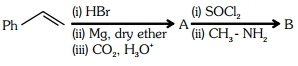
A
$A$ = $3-$phenylpropanoic acid; $B$ = $N$-methyl$-3-$phenylpropanamide
B
$A$ = $2-$phenylpropanoic acid; $B$ = $N$-methyl$-2-$phenylpropanamide
C
$A$ = $2-$phenylethanol; $B$ = $N$-methyl$-2-$phenylethanamine
D
$A$ = $1-$phenylethanol; $B$ = $N$-methyl$-1-$phenylethanamine
Solution
(B) The reaction sequence is as follows:
$1$. Styrene $(Ph-CH=CH_2)$ reacts with $HBr$ to form $1-$bromo$-1-$phenylethane $(Ph-CH(Br)-CH_3)$ via Markovnikov addition.
$2$. This alkyl bromide reacts with $Mg$ in dry ether to form the Grignard reagent $(Ph-CH(MgBr)-CH_3)$.
$3$. The Grignard reagent reacts with $CO_2$ followed by acidic workup $(H_3O^+)$ to form $2-$phenylpropanoic acid $(Ph-CH(CH_3)-COOH)$,which is product $A$.
$4$. $2-$phenylpropanoic acid $(A)$ reacts with $SOCl_2$ to form the corresponding acid chloride $(Ph-CH(CH_3)-COCl)$.
$5$. This acid chloride then reacts with methylamine $(CH_3NH_2)$ to form the amide,$N$-methyl$-2-$phenylpropanamide $(Ph-CH(CH_3)-CONHCH_3)$,which is product $B$.
$1$. Styrene $(Ph-CH=CH_2)$ reacts with $HBr$ to form $1-$bromo$-1-$phenylethane $(Ph-CH(Br)-CH_3)$ via Markovnikov addition.
$2$. This alkyl bromide reacts with $Mg$ in dry ether to form the Grignard reagent $(Ph-CH(MgBr)-CH_3)$.
$3$. The Grignard reagent reacts with $CO_2$ followed by acidic workup $(H_3O^+)$ to form $2-$phenylpropanoic acid $(Ph-CH(CH_3)-COOH)$,which is product $A$.
$4$. $2-$phenylpropanoic acid $(A)$ reacts with $SOCl_2$ to form the corresponding acid chloride $(Ph-CH(CH_3)-COCl)$.
$5$. This acid chloride then reacts with methylamine $(CH_3NH_2)$ to form the amide,$N$-methyl$-2-$phenylpropanamide $(Ph-CH(CH_3)-CONHCH_3)$,which is product $B$.
0 likesView Solution
Vedclass Products
For Students
Vedclass Test Series
Mock tests in real NEET style covering Chemistry with performance analysis. 5-day free trial.
Start Free TrialFor Teachers
Exam Paper Generator
Generate Set A/B/C/D Chemistry papers from 7.5L+ questions in 2 minutes. 3 chapters free.
Try FreeFor Institutes
Online Exam Module
Run live NEET mock exams with unlimited students, 360° analytics & white-label branding.
See DemoFrequently Asked Questions
How many Chemistry questions are in NEET 2022?
There are 105 Chemistry questions from the NEET 2022 paper on Vedclass, each with a detailed step-by-step solution in English.
Are NEET 2022 Chemistry solutions available in English?
Yes. All solutions on this page are in English. You can also switch to English or Hindi using the language buttons above the questions.
Can I practice NEET 2022 Chemistry as a timed test?
Yes. Use the Vedclass Test Series to attempt a full NEET mock test covering Chemistry with time limits and instant score analysis.
Can teachers create Chemistry papers from NEET previous year questions?
Yes. The Vedclass Exam Paper Generator lets teachers mix NEET Chemistry questions and generate Set A/B/C/D papers in minutes.
For Teachers & Institutes
Build a Custom Chemistry Paper
Pick NEET 2022 Chemistry questions, set difficulty, and generate Set A/B/C/D in 2 minutes.