
BiologyQ1–100 of 198 questions
Page 1 of 3 · English
1
BiologyMediumMCQNEET · 2022
Which one of the following plants shows vexillary aestivation and diadelphous stamens?
A
Pisum sativum
B
Allium cepa
C
Solanum nigrum
D
Colchicum autumnale
Solution
(A) Vexillary aestivation and diadelphous stamens are characteristic features of the family $Fabaceae$.
$Pisum sativum$ (pea) belongs to the family $Fabaceae$.
In $Pisum sativum$,the corolla consists of five petals: one large posterior petal (standard),two lateral petals (wings),and two small anterior petals (keel) which are fused,showing vexillary aestivation.
The stamens are diadelphous,meaning they are arranged in two bundles ($9+1$ arrangement).
$Allium cepa$ belongs to $Liliaceae$,$Solanum nigrum$ belongs to $Solanaceae$,and $Colchicum autumnale$ belongs to $Liliaceae$.
$Pisum sativum$ (pea) belongs to the family $Fabaceae$.
In $Pisum sativum$,the corolla consists of five petals: one large posterior petal (standard),two lateral petals (wings),and two small anterior petals (keel) which are fused,showing vexillary aestivation.
The stamens are diadelphous,meaning they are arranged in two bundles ($9+1$ arrangement).
$Allium cepa$ belongs to $Liliaceae$,$Solanum nigrum$ belongs to $Solanaceae$,and $Colchicum autumnale$ belongs to $Liliaceae$.
0 likesView Solution
2
BiologyMediumMCQNEET · 2022
Which one of the following is not true regarding the release of energy during $ATP$ synthesis through chemiosmosis? It involves:
A
Breakdown of electron gradient
B
Movement of protons across the membrane to the stroma
C
Reduction of $NADP^+$ to $NADPH$ on the stroma side of the membrane
D
Breakdown of proton gradient
Solution
(A) Chemiosmosis in photosynthesis involves the creation and subsequent breakdown of a proton gradient across the thylakoid membrane.
$1$. The accumulation of protons $(H^+)$ in the thylakoid lumen creates a proton gradient.
$2$. The movement of these protons back to the stroma through the $CF_0-CF_1$ $ATP$ synthase complex releases energy,which is used to synthesize $ATP$.
$3$. The reduction of $NADP^+$ to $NADPH$ occurs on the stroma side,which contributes to the proton gradient by removing $H^+$ from the stroma.
$4$. The breakdown of the proton gradient is essential for $ATP$ synthesis,but there is no such thing as the 'breakdown of an electron gradient' involved in this process. Electrons are transferred through the electron transport chain,not broken down.
$1$. The accumulation of protons $(H^+)$ in the thylakoid lumen creates a proton gradient.
$2$. The movement of these protons back to the stroma through the $CF_0-CF_1$ $ATP$ synthase complex releases energy,which is used to synthesize $ATP$.
$3$. The reduction of $NADP^+$ to $NADPH$ occurs on the stroma side,which contributes to the proton gradient by removing $H^+$ from the stroma.
$4$. The breakdown of the proton gradient is essential for $ATP$ synthesis,but there is no such thing as the 'breakdown of an electron gradient' involved in this process. Electrons are transferred through the electron transport chain,not broken down.
0 likesView Solution
3
BiologyMediumMCQNEET · 2022
"Girdling Experiment" was performed by plant physiologists to identify the plant tissue through which:
A
food is transported
B
both water and food are transported
C
osmosis is observed
D
water is transported
Solution
(A) The "Girdling Experiment" involves removing a ring of bark (including the phloem) from the stem of a tree while leaving the xylem intact.
After some time, it is observed that the portion of the stem above the ring swells due to the accumulation of food material, while the portion below the ring eventually dies.
This experiment demonstrates that the phloem is the tissue responsible for the translocation of food (organic solutes) from the leaves to other parts of the plant.
Since the xylem remains intact, water transport continues, proving that water is transported through the xylem and food through the phloem.
After some time, it is observed that the portion of the stem above the ring swells due to the accumulation of food material, while the portion below the ring eventually dies.
This experiment demonstrates that the phloem is the tissue responsible for the translocation of food (organic solutes) from the leaves to other parts of the plant.
Since the xylem remains intact, water transport continues, proving that water is transported through the xylem and food through the phloem.
0 likesView Solution
4
BiologyEasyMCQNEET · 2022
Which one of the following produces nitrogen-fixing nodules on the roots of $Alnus$?
A
$Frankia$
B
$Rhodospirillum$
C
$Beijerinckia$
D
$Rhizobium$
Solution
(A) The microbe $Frankia$ is a filamentous bacterium that forms symbiotic nitrogen-fixing root nodules in non-leguminous plants such as $Alnus$ (alder).
$Rhizobium$ typically forms nodules in leguminous plants.
$Rhodospirillum$ is a photosynthetic nitrogen-fixing bacterium.
$Beijerinckia$ is a free-living nitrogen-fixing bacterium.
$Rhizobium$ typically forms nodules in leguminous plants.
$Rhodospirillum$ is a photosynthetic nitrogen-fixing bacterium.
$Beijerinckia$ is a free-living nitrogen-fixing bacterium.
0 likesView Solution
5
BiologyMediumMCQNEET · 2022
Exoskeleton of arthropods is composed of:
A
Cellulose
B
Chitin
C
Glucosamine
D
Cutin
Solution
(B) The exoskeleton of arthropods is primarily composed of $Chitin$.
$Chitin$ is a long-chain polymer of $N$-acetylglucosamine,a derivative of glucose.
It provides structural support and protection to the arthropod body.
$Cellulose$ is found in plant cell walls,$Cutin$ is a waxy layer on plant surfaces,and $Glucosamine$ is a monomeric unit,not the structural polymer itself.
$Chitin$ is a long-chain polymer of $N$-acetylglucosamine,a derivative of glucose.
It provides structural support and protection to the arthropod body.
$Cellulose$ is found in plant cell walls,$Cutin$ is a waxy layer on plant surfaces,and $Glucosamine$ is a monomeric unit,not the structural polymer itself.
0 likesView Solution
6
BiologyMediumMCQNEET · 2022
What amount of energy is released from glucose during lactic acid fermentation?
A
More than $18\%$
B
About $10\%$
C
Less than $7\%$
D
Approximately $15\%$
Solution
(C) In lactic acid fermentation,glucose is incompletely oxidized into lactic acid.
This process is anaerobic and yields only $2$ molecules of $ATP$ per molecule of glucose.
Since the total energy available in one molecule of glucose is much higher (equivalent to $36-38$ $ATP$ in aerobic respiration),the energy released during fermentation is very low.
Specifically,less than $7\%$ of the energy present in glucose is released as $ATP$ during this process.
This process is anaerobic and yields only $2$ molecules of $ATP$ per molecule of glucose.
Since the total energy available in one molecule of glucose is much higher (equivalent to $36-38$ $ATP$ in aerobic respiration),the energy released during fermentation is very low.
Specifically,less than $7\%$ of the energy present in glucose is released as $ATP$ during this process.
0 likesView Solution
7
BiologyMediumMCQNEET · 2022
Which of the following is not observed during the apoplastic pathway?
A
The movement does not involve crossing of cell membrane.
B
The movement is aided by cytoplasmic streaming.
C
Apoplast is continuous and does not provide any barrier to water movement.
D
Movement of water occurs through intercellular spaces and wall of the cells.
Solution
(B) The apoplastic pathway involves the movement of water through the cell walls and intercellular spaces. In this pathway,water does not cross the cell membrane or cytoplasm. Cytoplasmic streaming is a characteristic feature of the symplastic pathway,where water moves through the cytoplasm and plasmodesmata. Therefore,the statement that the movement is aided by cytoplasmic streaming is not observed during the apoplastic pathway.
0 likesView Solution
8
BiologyMediumMCQNEET · 2022
Match List-$I$ with List-$II$.
| List-$I$ | List-$II$ |
|---|---|
| $(a)$ Manganese | $(i)$ Activates the enzyme catalase |
| $(b)$ Magnesium | $(ii)$ Required for pollen germination |
| $(c)$ Boron | $(iii)$ Activates enzymes of respiration |
| $(d)$ Iron | $(iv)$ Functions in splitting of water during photosynthesis |
A
$(a) - (iv), (b) - (iii), (c) - (ii), (d) - (i)$
B
$(a) - (iv), (b) - (i), (c) - (ii), (d) - (iii)$
C
$(a) - (iii), (b) - (i), (c) - (ii), (d) - (iv)$
D
$(a) - (iii), (b) - (iv), (c) - (i), (d) - (ii)$
Solution
(A) The correct matches are as follows:
$(a)$ Manganese: Functions in the splitting of water during photosynthesis (photolysis of water) - $(iv)$.
$(b)$ Magnesium: Activates enzymes of respiration and photosynthesis,and is a constituent of chlorophyll - $(iii)$.
$(c)$ Boron: Required for pollen germination,cell elongation,and carbohydrate translocation - $(ii)$.
$(d)$ Iron: Activates the enzyme catalase and is essential for the formation of chlorophyll - $(i)$.
Therefore,the correct matching is $(a)-(iv), (b)-(iii), (c)-(ii), (d)-(i)$.
$(a)$ Manganese: Functions in the splitting of water during photosynthesis (photolysis of water) - $(iv)$.
$(b)$ Magnesium: Activates enzymes of respiration and photosynthesis,and is a constituent of chlorophyll - $(iii)$.
$(c)$ Boron: Required for pollen germination,cell elongation,and carbohydrate translocation - $(ii)$.
$(d)$ Iron: Activates the enzyme catalase and is essential for the formation of chlorophyll - $(i)$.
Therefore,the correct matching is $(a)-(iv), (b)-(iii), (c)-(ii), (d)-(i)$.
0 likesView Solution
9
BiologyDifficultMCQNEET · 2022
Hydrocolloid carrageen is obtained from:
A
Phaeophyceae and Rhodophyceae
B
Rhodophyceae only
C
Phaeophyceae only
D
Chlorophyceae and Phaeophyceae
Solution
(B) Hydrocolloids are water-holding substances.
Carrageen is a specific type of hydrocolloid obtained from the cell wall of red algae,which belong to the class $Rhodophyceae$.
Brown algae $(Phaeophyceae)$ produce algin,while red algae $(Rhodophyceae)$ produce carrageen.
Therefore,the correct option is $B$.
Carrageen is a specific type of hydrocolloid obtained from the cell wall of red algae,which belong to the class $Rhodophyceae$.
Brown algae $(Phaeophyceae)$ produce algin,while red algae $(Rhodophyceae)$ produce carrageen.
Therefore,the correct option is $B$.
0 likesView Solution
10
BiologyDifficultMCQNEET · 2022
The process of extraction of separated $DNA$ strands from gel is called elution.
$(a)$ In roots,xylem and phloem in a vascular bundle are arranged in an alternate manner along the different radii.
$(b)$ Conjoint closed vascular bundles do not possess cambium.
$(c)$ In open vascular bundles,cambium is present in between xylem and phloem.
$(d)$ The vascular bundles of dicotyledonous stem possess endarch protoxylem.
$(e)$ In monocotyledonous root,usually there are more than six xylem bundles present.
Choose the correct answer from the options given below:
$(a)$ In roots,xylem and phloem in a vascular bundle are arranged in an alternate manner along the different radii.
$(b)$ Conjoint closed vascular bundles do not possess cambium.
$(c)$ In open vascular bundles,cambium is present in between xylem and phloem.
$(d)$ The vascular bundles of dicotyledonous stem possess endarch protoxylem.
$(e)$ In monocotyledonous root,usually there are more than six xylem bundles present.
Choose the correct answer from the options given below:
A
$(b), (c), (d)$ and $(e)$ Only
B
$(a), (b), (c)$ and $(d)$ Only
C
$(a), (c), (d)$ and $(e)$ Only
D
$(a), (b)$ and $(d)$ Only
Solution
(A) The statement regarding $DNA$ elution is a general fact in biotechnology,but the question asks to evaluate the statements $(a)$ through $(e)$ related to plant anatomy:
$(a)$ In roots,xylem and phloem are arranged in an alternate manner on different radii (radial vascular bundles). This is correct.
$(b)$ Conjoint closed vascular bundles lack cambium,which is correct.
$(c)$ In open vascular bundles,cambium is present between xylem and phloem,which is correct.
$(d)$ Dicotyledonous stems have vascular bundles with endarch protoxylem,which is correct.
$(e)$ Monocotyledonous roots are polyarch,meaning they typically have more than six xylem bundles,which is correct.
Since all statements $(a), (b), (c), (d),$ and $(e)$ are correct,and no option includes all five,we re-evaluate the provided options. Given the standard structure of such questions,if the question implies selecting the set of correct statements,and all are correct,the provided options might be incomplete. However,based on the provided choices,$(a), (b), (c), (d),$ and $(e)$ are all anatomically accurate. If we must choose the most comprehensive set,there is an error in the options provided by the source. Assuming the question intended to test all,all are correct.
$(a)$ In roots,xylem and phloem are arranged in an alternate manner on different radii (radial vascular bundles). This is correct.
$(b)$ Conjoint closed vascular bundles lack cambium,which is correct.
$(c)$ In open vascular bundles,cambium is present between xylem and phloem,which is correct.
$(d)$ Dicotyledonous stems have vascular bundles with endarch protoxylem,which is correct.
$(e)$ Monocotyledonous roots are polyarch,meaning they typically have more than six xylem bundles,which is correct.
Since all statements $(a), (b), (c), (d),$ and $(e)$ are correct,and no option includes all five,we re-evaluate the provided options. Given the standard structure of such questions,if the question implies selecting the set of correct statements,and all are correct,the provided options might be incomplete. However,based on the provided choices,$(a), (b), (c), (d),$ and $(e)$ are all anatomically accurate. If we must choose the most comprehensive set,there is an error in the options provided by the source. Assuming the question intended to test all,all are correct.
0 likesView Solution
11
BiologyMediumMCQNEET · 2022
The gaseous plant growth regulator is used in plants to :
A
promote root growth and root hair formation to increase the absorption surface
B
help overcome apical dominance
C
kill dicotyledonous weeds in the fields
D
speed up the malting process
Solution
(A) The gaseous plant growth regulator is $Ethylene$.
$Ethylene$ is known for its role in promoting root growth and root hair formation,which helps in increasing the absorption surface area of the roots.
Option $A$ is correct because $Ethylene$ specifically stimulates root growth and root hair development.
Option $B$ is a function of $Cytokinins$.
Option $C$ is a function of $Auxins$ (e.g.,$2,4-D$).
Option $D$ is a function of $Gibberellins$.
$Ethylene$ is known for its role in promoting root growth and root hair formation,which helps in increasing the absorption surface area of the roots.
Option $A$ is correct because $Ethylene$ specifically stimulates root growth and root hair development.
Option $B$ is a function of $Cytokinins$.
Option $C$ is a function of $Auxins$ (e.g.,$2,4-D$).
Option $D$ is a function of $Gibberellins$.
0 likesView Solution
12
BiologyMediumMCQNEET · 2022
The flowers are Zygomorphic in:
$(a)$ Mustard $(b)$ Gulmohar $(c)$ Cassia $(d)$ Datura $(e)$ Chilly
Choose the correct answer from the options given below:
$(a)$ Mustard $(b)$ Gulmohar $(c)$ Cassia $(d)$ Datura $(e)$ Chilly
Choose the correct answer from the options given below:
A
$(b), (c)$ Only
B
$(d), (e)$ Only
C
$(c), (d), (e)$ Only
D
$(a), (b), (c)$ Only
Solution
(A) flower is said to be Zygomorphic (bilateral symmetry) if it can be divided into two similar halves only in one particular vertical plane.
$1$. Mustard,Datura,and Chilly are Actinomorphic (radial symmetry),meaning they can be divided into two equal radial halves in any radial plane passing through the center.
$2$. Gulmohar and Cassia are Zygomorphic. In these flowers,the floral parts are arranged such that they exhibit bilateral symmetry.
Therefore,the correct answer is $(b)$ and $(c)$ only.
$1$. Mustard,Datura,and Chilly are Actinomorphic (radial symmetry),meaning they can be divided into two equal radial halves in any radial plane passing through the center.
$2$. Gulmohar and Cassia are Zygomorphic. In these flowers,the floral parts are arranged such that they exhibit bilateral symmetry.
Therefore,the correct answer is $(b)$ and $(c)$ only.
0 likesView Solution
13
BiologyMediumMCQNEET · 2022
Production of cucumber has increased manifold in recent years. Application of which of the following phytohormones has resulted in this increased yield as the hormone is known to produce female flowers in the plants?
A
Gibberellin
B
Ethylene
C
Cytokinin
D
$ABA$
Solution
(B) Ethylene is a gaseous plant hormone that plays a crucial role in various physiological processes. One of its most significant agricultural applications is its ability to promote the formation of female flowers in monoecious plants like cucumber. By increasing the number of female flowers,the fruit set and overall yield of the crop are significantly enhanced. Therefore,the application of ethylene is widely used in commercial cucumber cultivation to increase production.
0 likesView Solution
14
BiologyMediumMCQNEET · 2022
What is the net gain of $ATP$ when each molecule of glucose is converted to two molecules of pyruvic acid?
A
Six
B
Two
C
Eight
D
Four
Solution
(B) The process of converting one molecule of glucose into two molecules of pyruvic acid is known as glycolysis.
During glycolysis,$2$ molecules of $ATP$ are consumed in the preparatory phase.
In the payoff phase,$4$ molecules of $ATP$ are produced via substrate-level phosphorylation.
Therefore,the net gain of $ATP$ is $4 - 2 = 2$ molecules of $ATP$ per molecule of glucose.
During glycolysis,$2$ molecules of $ATP$ are consumed in the preparatory phase.
In the payoff phase,$4$ molecules of $ATP$ are produced via substrate-level phosphorylation.
Therefore,the net gain of $ATP$ is $4 - 2 = 2$ molecules of $ATP$ per molecule of glucose.
0 likesView Solution
15
BiologyMediumMCQNEET · 2022
Given below are two statements:
Statement $I$: The primary $CO_{2}$ acceptor in $C_{4}$ plants is phosphoenolpyruvate $(PEP)$ and is found in the mesophyll cells.
Statement $II$: Mesophyll cells of $C_{4}$ plants lack $RuBisCo$ enzyme.
In the light of the above statements,choose the correct answer from the options given below:
Statement $I$: The primary $CO_{2}$ acceptor in $C_{4}$ plants is phosphoenolpyruvate $(PEP)$ and is found in the mesophyll cells.
Statement $II$: Mesophyll cells of $C_{4}$ plants lack $RuBisCo$ enzyme.
In the light of the above statements,choose the correct answer from the options given below:
A
Both Statement $I$ and Statement $II$ are incorrect.
B
Statement $I$ is correct but Statement $II$ is incorrect.
C
Statement $I$ is incorrect but Statement $II$ is correct.
D
Both Statement $I$ and Statement $II$ are correct.
Solution
(D) Statement $I$ is correct: In $C_{4}$ plants,the primary $CO_{2}$ acceptor is a $3$-carbon molecule called phosphoenolpyruvate $(PEP)$,which is present in the mesophyll cells.
Statement $II$ is correct: The mesophyll cells of $C_{4}$ plants lack the enzyme $RuBisCo$. The $RuBisCo$ enzyme is exclusively present in the bundle sheath cells of $C_{4}$ plants,where the Calvin cycle occurs.
Therefore,both statements are correct.
Statement $II$ is correct: The mesophyll cells of $C_{4}$ plants lack the enzyme $RuBisCo$. The $RuBisCo$ enzyme is exclusively present in the bundle sheath cells of $C_{4}$ plants,where the Calvin cycle occurs.
Therefore,both statements are correct.
0 likesView Solution
16
BiologyMediumMCQNEET · 2022
Identify the correct set of statements :
$(a)$ The leaflets are modified into pointed hard thorns in Citrus and Bougainvillea
$(b)$ Axillary buds form slender and spirally coiled tendrils in cucumber and pumpkin
$(c)$ Stem is flattened and fleshy in Opuntia and modified to perform the function of leaves
$(d)$ Rhizophora shows vertically upward growing roots that help to get oxygen for respiration
$(e)$ Subaerially growing stems in grasses and strawberry help in vegetative propagation
Choose the correct answer from the options given below:
$(a)$ The leaflets are modified into pointed hard thorns in Citrus and Bougainvillea
$(b)$ Axillary buds form slender and spirally coiled tendrils in cucumber and pumpkin
$(c)$ Stem is flattened and fleshy in Opuntia and modified to perform the function of leaves
$(d)$ Rhizophora shows vertically upward growing roots that help to get oxygen for respiration
$(e)$ Subaerially growing stems in grasses and strawberry help in vegetative propagation
Choose the correct answer from the options given below:
A
$(a)$ and $(d)$ Only
B
$(b), (c), (d)$ and $(e)$ Only
C
$(a), (b), (d)$ and $(e)$ Only
D
$(b)$ and $(c)$ Only
Solution
(B) Let us analyze each statement:
$(a)$ Incorrect: In Citrus and Bougainvillea,the axillary buds are modified into thorns,not leaflets.
$(b)$ Correct: In plants like cucumber and pumpkin,axillary buds develop into slender and spirally coiled structures called tendrils,which help in climbing.
$(c)$ Correct: In Opuntia,the stem becomes flattened and fleshy to perform photosynthesis,acting as a leaf substitute.
$(d)$ Correct: Rhizophora grows in swampy areas and possesses pneumatophores (vertically upward growing roots) to obtain oxygen for respiration.
$(e)$ Correct: Subaerially growing stems (runners,stolons,etc.) in grasses and strawberry facilitate vegetative propagation.
Therefore,statements $(b), (c), (d),$ and $(e)$ are correct.
$(a)$ Incorrect: In Citrus and Bougainvillea,the axillary buds are modified into thorns,not leaflets.
$(b)$ Correct: In plants like cucumber and pumpkin,axillary buds develop into slender and spirally coiled structures called tendrils,which help in climbing.
$(c)$ Correct: In Opuntia,the stem becomes flattened and fleshy to perform photosynthesis,acting as a leaf substitute.
$(d)$ Correct: Rhizophora grows in swampy areas and possesses pneumatophores (vertically upward growing roots) to obtain oxygen for respiration.
$(e)$ Correct: Subaerially growing stems (runners,stolons,etc.) in grasses and strawberry facilitate vegetative propagation.
Therefore,statements $(b), (c), (d),$ and $(e)$ are correct.
0 likesView Solution
17
BiologyMediumMCQNEET · 2022
The appearance of recombination nodules on homologous chromosomes during meiosis characterizes:
A
Bivalent
B
Sites at which crossing over occurs
C
Terminalization
D
Synaptonemal complex
Solution
(B) During the $pachytene$ stage of $prophase-I$ in meiosis,the phenomenon of crossing over takes place.
Recombination nodules are protein complexes that appear on the synaptonemal complex at the sites where crossing over occurs.
These nodules facilitate the exchange of genetic material between non-sister chromatids of homologous chromosomes.
Therefore,the appearance of recombination nodules characterizes the sites at which crossing over occurs.
Recombination nodules are protein complexes that appear on the synaptonemal complex at the sites where crossing over occurs.
These nodules facilitate the exchange of genetic material between non-sister chromatids of homologous chromosomes.
Therefore,the appearance of recombination nodules characterizes the sites at which crossing over occurs.
0 likesView Solution
18
BiologyMediumMCQNEET · 2022
Which of the following is incorrectly matched?
A
Ullothrix - Mannitol
B
Porphyra - Floridean Starch
C
Volvox - Starch
D
Ectocarpus - Fucoxanthin
Solution
(A) $Ullothrix$ is a green alga (Chlorophyceae),and its stored food is starch,not mannitol. Mannitol is the stored food in brown algae (Phaeophyceae).
$Porphyra$ is a red alga (Rhodophyceae),and its stored food is Floridean starch,which is correctly matched.
$Volvox$ is a green alga (Chlorophyceae),and its stored food is starch,which is correctly matched.
$Ectocarpus$ is a brown alga (Phaeophyceae),and it contains the pigment Fucoxanthin,which is correctly matched.
Therefore,the incorrect match is $Ullothrix - Mannitol$.
$Porphyra$ is a red alga (Rhodophyceae),and its stored food is Floridean starch,which is correctly matched.
$Volvox$ is a green alga (Chlorophyceae),and its stored food is starch,which is correctly matched.
$Ectocarpus$ is a brown alga (Phaeophyceae),and it contains the pigment Fucoxanthin,which is correctly matched.
Therefore,the incorrect match is $Ullothrix - Mannitol$.
0 likesView Solution
19
BiologyMediumMCQNEET · 2022
Which one of the following plants does not show plasticity?
A
Coriander
B
Buttercup
C
Maize
D
Cotton
Solution
(C) Plasticity is the ability of plants to follow different pathways in response to the environment or phases of life to form different kinds of structures. This ability is known as plasticity.
Plants like $Coriander$,$Buttercup$,and $Cotton$ exhibit heterophylly,which is a form of plasticity where leaves of different shapes are produced in response to different environmental conditions (e.g.,terrestrial vs. aquatic habitats).
$Maize$ does not exhibit this type of plasticity in its leaf structure. Therefore,the correct answer is $Maize$.
Plants like $Coriander$,$Buttercup$,and $Cotton$ exhibit heterophylly,which is a form of plasticity where leaves of different shapes are produced in response to different environmental conditions (e.g.,terrestrial vs. aquatic habitats).
$Maize$ does not exhibit this type of plasticity in its leaf structure. Therefore,the correct answer is $Maize$.
0 likesView Solution
20
BiologyMediumMCQNEET · 2022
Which one of the following never occurs during mitotic cell division?
A
Movement of centrioles towards opposite poles
B
Pairing of homologous chromosomes
C
Coiling and condensation of the chromatids
D
Spindle fibres attach to kinetochores of chromosomes
Solution
(B) Mitosis is a type of cell division that results in two daughter cells each having the same number and kind of chromosomes as the parent nucleus.
Pairing of homologous chromosomes,also known as synapsis,is a characteristic feature of Prophase-$I$ of meiosis,not mitosis.
During mitosis,chromosomes behave independently and do not pair up.
Movement of centrioles,coiling/condensation of chromatids,and attachment of spindle fibres to kinetochores are all standard events occurring during the various phases of mitosis (Prophase,Metaphase,etc.).
Therefore,the correct answer is $B$.
Pairing of homologous chromosomes,also known as synapsis,is a characteristic feature of Prophase-$I$ of meiosis,not mitosis.
During mitosis,chromosomes behave independently and do not pair up.
Movement of centrioles,coiling/condensation of chromatids,and attachment of spindle fibres to kinetochores are all standard events occurring during the various phases of mitosis (Prophase,Metaphase,etc.).
Therefore,the correct answer is $B$.
0 likesView Solution
21
BiologyDifficultMCQNEET · 2022
In old trees,the greater part of secondary xylem is dark brown and resistant to insect attack due to:
$(a)$ secretion of secondary metabolites and their deposition in the lumen of vessels.
$(b)$ deposition of organic compounds like tannins and resins in the central layers of stem.
$(c)$ deposition of suberin and aromatic substances in the outer layer of stem.
$(d)$ deposition of tannins,gum,resin and aromatic substances in the peripheral layers of stem.
$(e)$ presence of parenchyma cells,functionally active xylem elements and essential oils.
Choose the correct answer from the options given below:
$(a)$ secretion of secondary metabolites and their deposition in the lumen of vessels.
$(b)$ deposition of organic compounds like tannins and resins in the central layers of stem.
$(c)$ deposition of suberin and aromatic substances in the outer layer of stem.
$(d)$ deposition of tannins,gum,resin and aromatic substances in the peripheral layers of stem.
$(e)$ presence of parenchyma cells,functionally active xylem elements and essential oils.
Choose the correct answer from the options given below:
A
$(c)$ and $(d)$ Only
B
$(d)$ and $(e)$ Only
C
$(b)$ and $(d)$ Only
D
$(a)$ and $(b)$ Only
Solution
(D) In old trees,the central or innermost layers of the stem consist of dead elements with highly lignified walls,known as heartwood.
$1$. The heartwood is dark brown due to the deposition of organic compounds such as tannins,resins,oils,gums,aromatic substances,and essential oils in the central layers of the stem.
$2$. These substances make the heartwood hard,durable,and resistant to the attack of microorganisms and insects.
$3$. Statement $(a)$ is correct as secondary metabolites are deposited in the lumen of vessels,blocking them.
$4$. Statement $(b)$ is correct as these organic compounds are deposited in the central layers (heartwood).
$5$. Statements $(c)$ and $(d)$ are incorrect because these depositions occur in the central layers,not the outer or peripheral layers.
$6$. Statement $(e)$ is incorrect because heartwood consists of dead elements,not functionally active xylem elements.
Therefore,statements $(a)$ and $(b)$ are correct.
$1$. The heartwood is dark brown due to the deposition of organic compounds such as tannins,resins,oils,gums,aromatic substances,and essential oils in the central layers of the stem.
$2$. These substances make the heartwood hard,durable,and resistant to the attack of microorganisms and insects.
$3$. Statement $(a)$ is correct as secondary metabolites are deposited in the lumen of vessels,blocking them.
$4$. Statement $(b)$ is correct as these organic compounds are deposited in the central layers (heartwood).
$5$. Statements $(c)$ and $(d)$ are incorrect because these depositions occur in the central layers,not the outer or peripheral layers.
$6$. Statement $(e)$ is incorrect because heartwood consists of dead elements,not functionally active xylem elements.
Therefore,statements $(a)$ and $(b)$ are correct.
0 likesView Solution
22
BiologyMediumMCQNEET · 2022
Match List-$I$ with List-$II$:
Choose the correct answer from the options given below:
| List-$I$ | List-$II$ |
|---|---|
| $(a)$ Metacentric chromosome | $(I)$ Centromere situated close to the end forming one extremely short and one very long arm |
| $(b)$ Acrocentric chromosome | $(II)$ Centromere at the terminal end |
| $(c)$ Sub-metacentric | $(III)$ Centromere in the middle forming two equal arms of chromosomes |
| $(d)$ Telocentric chromosome | $(IV)$ Centromere slightly away from the middle forming one shorter arm and one longer arm |
Choose the correct answer from the options given below:
A
$(a) - (i), (b) - (iii), (c) - (ii), (d) - (iv)$
B
$(a) - (ii), (b) - (iii), (c) - (iv), (d) - (i)$
C
$(a) - (i), (b) - (ii), (c) - (iii), (d) - (iv)$
D
$(a) - (iii), (b) - (i), (c) - (iv), (d) - (ii)$
Solution
(D) The classification of chromosomes is based on the position of the centromere:
$1$. Metacentric chromosome: The centromere is in the middle,resulting in two equal arms. This matches $(III)$.
$2$. Acrocentric chromosome: The centromere is situated close to the end,forming one extremely short and one very long arm. This matches $(I)$.
$3$. Sub-metacentric chromosome: The centromere is slightly away from the middle,forming one shorter arm and one longer arm. This matches $(IV)$.
$4$. Telocentric chromosome: The centromere is at the terminal end. This matches $(II)$.
Therefore,the correct matching is $(a)-(iii), (b)-(i), (c)-(iv), (d)-(ii)$.
$1$. Metacentric chromosome: The centromere is in the middle,resulting in two equal arms. This matches $(III)$.
$2$. Acrocentric chromosome: The centromere is situated close to the end,forming one extremely short and one very long arm. This matches $(I)$.
$3$. Sub-metacentric chromosome: The centromere is slightly away from the middle,forming one shorter arm and one longer arm. This matches $(IV)$.
$4$. Telocentric chromosome: The centromere is at the terminal end. This matches $(II)$.
Therefore,the correct matching is $(a)-(iii), (b)-(i), (c)-(iv), (d)-(ii)$.
0 likesView Solution
23
BiologyMediumMCQNEET · 2022
The anatomy of springwood shows some peculiar features. Identify the correct set of statements about springwood.
$(a)$ It is also called as the earlywood
$(b)$ In spring season cambium produces xylem elements with narrow vessels
$(c)$ It is lighter in colour
$(d)$ The springwood along with autumnwood shows alternate concentric rings forming annual rings
$(e)$ It has lower density
Choose the correct answer from the options given below:
$(a)$ It is also called as the earlywood
$(b)$ In spring season cambium produces xylem elements with narrow vessels
$(c)$ It is lighter in colour
$(d)$ The springwood along with autumnwood shows alternate concentric rings forming annual rings
$(e)$ It has lower density
Choose the correct answer from the options given below:
A
$(a), (c), (d)$ and $(e)$ Only
B
$(a), (b)$ and $(d)$ Only
C
$(c), (d)$ and $(e)$ Only
D
$(a), (b), (d)$ and $(e)$ Only
Solution
(A) Springwood,also known as earlywood,is formed during the spring season when cambium is very active.
$(a)$ Correct: It is indeed called earlywood.
$(b)$ Incorrect: In the spring season,the cambium is very active and produces a large number of xylary elements having vessels with wider cavities.
$(c)$ Correct: Springwood is lighter in colour.
$(d)$ Correct: The springwood and autumnwood together form annual rings in a tree.
$(e)$ Correct: Due to the presence of wider vessels,it has a lower density compared to autumnwood.
Therefore,the correct statements are $(a), (c), (d),$ and $(e)$.
$(a)$ Correct: It is indeed called earlywood.
$(b)$ Incorrect: In the spring season,the cambium is very active and produces a large number of xylary elements having vessels with wider cavities.
$(c)$ Correct: Springwood is lighter in colour.
$(d)$ Correct: The springwood and autumnwood together form annual rings in a tree.
$(e)$ Correct: Due to the presence of wider vessels,it has a lower density compared to autumnwood.
Therefore,the correct statements are $(a), (c), (d),$ and $(e)$.
0 likesView Solution
24
BiologyMediumMCQNEET · 2022
What is the role of large bundle sheath cells found around the vascular bundles in $C_{4}$ plants?
A
To increase the number of chloroplasts for the operation of the Calvin cycle
B
To enable the plant to tolerate high temperatures
C
To protect the vascular tissue from high light intensity
D
To provide the site for the photorespiratory pathway
Solution
(A) In $C_{4}$ plants,the leaves exhibit a special anatomy called Kranz anatomy.
Large bundle sheath cells are present around the vascular bundles.
These cells contain a large number of chloroplasts,which are essential for the operation of the Calvin cycle.
By concentrating $CO_{2}$ in these cells,the plant minimizes photorespiration and ensures efficient carbon fixation,allowing the plant to thrive in high-temperature and high-light environments.
Large bundle sheath cells are present around the vascular bundles.
These cells contain a large number of chloroplasts,which are essential for the operation of the Calvin cycle.
By concentrating $CO_{2}$ in these cells,the plant minimizes photorespiration and ensures efficient carbon fixation,allowing the plant to thrive in high-temperature and high-light environments.
0 likesView Solution
25
BiologyMediumMCQNEET · 2022
Read the following statements on lipids and find out the correct set of statements:
$(a)$ Lecithin found in the plasma membrane is a glycolipid.
$(b)$ Saturated fatty acids possess one or more $C=C$ bonds.
$(c)$ Gingely oil has a lower melting point,hence remains as oil in winter.
$(d)$ Lipids are generally insoluble in water but soluble in some organic solvents.
$(e)$ When fatty acid is esterified with glycerol,monoglycerides are formed.
Choose the correct answer from the options given below:
$(a)$ Lecithin found in the plasma membrane is a glycolipid.
$(b)$ Saturated fatty acids possess one or more $C=C$ bonds.
$(c)$ Gingely oil has a lower melting point,hence remains as oil in winter.
$(d)$ Lipids are generally insoluble in water but soluble in some organic solvents.
$(e)$ When fatty acid is esterified with glycerol,monoglycerides are formed.
Choose the correct answer from the options given below:
A
$(a), (d)$ and $(e)$ only
B
$(c), (d)$ and $(e)$ only
C
$(a), (b)$ and $(d)$ only
D
$(a), (b)$ and $(c)$ only
Solution
(B) Let us analyze each statement:
$(a)$ Incorrect: Lecithin is a phospholipid,not a glycolipid.
$(b)$ Incorrect: Saturated fatty acids do not possess any $C=C$ bonds; they have only single bonds.
$(c)$ Correct: Gingely oil contains unsaturated fatty acids,which have lower melting points,allowing them to remain liquid at lower temperatures.
$(d)$ Correct: Lipids are hydrophobic (insoluble in water) and lipophilic (soluble in organic solvents like ether,chloroform,etc.).
$(e)$ Correct: When one fatty acid molecule is esterified with one glycerol molecule,a monoglyceride is formed.
Therefore,the correct statements are $(c), (d),$ and $(e)$.
$(a)$ Incorrect: Lecithin is a phospholipid,not a glycolipid.
$(b)$ Incorrect: Saturated fatty acids do not possess any $C=C$ bonds; they have only single bonds.
$(c)$ Correct: Gingely oil contains unsaturated fatty acids,which have lower melting points,allowing them to remain liquid at lower temperatures.
$(d)$ Correct: Lipids are hydrophobic (insoluble in water) and lipophilic (soluble in organic solvents like ether,chloroform,etc.).
$(e)$ Correct: When one fatty acid molecule is esterified with one glycerol molecule,a monoglyceride is formed.
Therefore,the correct statements are $(c), (d),$ and $(e)$.
0 likesView Solution
26
BiologyMediumMCQNEET · 2022
Addition of more solutes in a given solution will:
A
lower its water potential
B
make its water potential zero
C
not affect the water potential at all
D
raise its water potential
Solution
(A) Water potential $(\Psi_w)$ is a measure of the potential energy of water in a system compared to pure water.
Pure water has the highest water potential, which is defined as $0$.
When solutes are added to water, the water molecules become associated with the solute particles, which reduces the free energy of the water.
As the concentration of solutes increases, the solute potential $(\Psi_s)$ becomes more negative.
Since $\Psi_w = \Psi_s + \Psi_p$ (where $\Psi_p$ is pressure potential), an increase in solute concentration decreases the solute potential, thereby lowering the overall water potential of the solution.
Pure water has the highest water potential, which is defined as $0$.
When solutes are added to water, the water molecules become associated with the solute particles, which reduces the free energy of the water.
As the concentration of solutes increases, the solute potential $(\Psi_s)$ becomes more negative.
Since $\Psi_w = \Psi_s + \Psi_p$ (where $\Psi_p$ is pressure potential), an increase in solute concentration decreases the solute potential, thereby lowering the overall water potential of the solution.
0 likesView Solution
27
BiologyMediumMCQNEET · 2022
Match the plant with the kind of life cycle it exhibits:
Choose the correct answer from the options given below:
| List-$I$ | List-$II$ |
| $(a)$ Spirogyra | $(i)$ Dominant diploid sporophyte vascular plant,with highly reduced male or female gametophyte |
| $(b)$ Fern | $(ii)$ Dominant haploid free-living gametophyte |
| $(c)$ Funaria | $(iii)$ Dominant diploid sporophyte alternating with reduced gametophyte called prothallus |
| $(d)$ Cycas | $(iv)$ Dominant haploid leafy gametophyte alternating with partially dependent sporophyte |
Choose the correct answer from the options given below:
A
$(a) - (ii), (b) - (iii), (c) - (iv), (d) - (i)$
B
$(a) - (iii), (b) - (iv), (c) - (i), (d) - (ii)$
C
$(a) - (ii), (b) - (iv), (c) - (i), (d) - (iii)$
D
$(a) - (iv), (b) - (i), (c) - (ii), (d) - (iii)$
Solution
$(A)$ Spirogyra is an alga that exhibits a haplontic life cycle,where the dominant phase is the haploid gametophyte $(ii)$.
$(b)$ Ferns are pteridophytes that exhibit a diplohaplontic life cycle with a dominant diploid sporophyte and a reduced gametophyte known as prothallus $(iii)$.
$(c)$ Funaria is a bryophyte (moss) that exhibits a haplodiplontic life cycle with a dominant haploid leafy gametophyte and a partially dependent sporophyte $(iv)$.
$(d)$ Cycas is a gymnosperm that exhibits a diplontic life cycle with a dominant diploid sporophyte and highly reduced gametophytes $(i)$.
Therefore,the correct matching is $(a)-(ii), (b)-(iii), (c)-(iv), (d)-(i)$.
$(b)$ Ferns are pteridophytes that exhibit a diplohaplontic life cycle with a dominant diploid sporophyte and a reduced gametophyte known as prothallus $(iii)$.
$(c)$ Funaria is a bryophyte (moss) that exhibits a haplodiplontic life cycle with a dominant haploid leafy gametophyte and a partially dependent sporophyte $(iv)$.
$(d)$ Cycas is a gymnosperm that exhibits a diplontic life cycle with a dominant diploid sporophyte and highly reduced gametophytes $(i)$.
Therefore,the correct matching is $(a)-(ii), (b)-(iii), (c)-(iv), (d)-(i)$.
0 likesView Solution
28
BiologyMediumMCQNEET · 2022
Given below are two statements:
Statement $I:$ Fatty acids and glycerols cannot be absorbed into the blood.
Statement $II:$ Specialized lymphatic capillaries called lacteals carry chylomicrons into lymphatic vessels and ultimately into the blood.
In the light of the above statements,choose the most appropriate answer from the options given below:
Statement $I:$ Fatty acids and glycerols cannot be absorbed into the blood.
Statement $II:$ Specialized lymphatic capillaries called lacteals carry chylomicrons into lymphatic vessels and ultimately into the blood.
In the light of the above statements,choose the most appropriate answer from the options given below:
A
Both Statement $I$ and Statement $II$ are incorrect
B
Statement $I$ is correct but Statement $II$ is incorrect
C
Statement $I$ is incorrect but Statement $II$ is correct
D
Both Statement $I$ and Statement $II$ are correct
Solution
(D) Statement $I$ is correct because fatty acids and glycerol are insoluble in water and cannot be absorbed directly into the blood capillaries. They are first incorporated into small droplets called micelles,which move into the intestinal mucosa. Here,they are re-synthesized into fats and coated with proteins to form chylomicrons.
Statement $II$ is correct because these chylomicrons are transported into the lacteals (specialized lymphatic capillaries) present in the villi. The lymph vessels ultimately release these absorbed substances into the bloodstream.
Statement $II$ is correct because these chylomicrons are transported into the lacteals (specialized lymphatic capillaries) present in the villi. The lymph vessels ultimately release these absorbed substances into the bloodstream.
0 likesView Solution
29
BiologyEasyMCQNEET · 2022
Select the incorrect statement with reference to mitosis:
A
Spindle fibres attach to the centromere of chromosomes.
B
Chromosomes decondense at telophase.
C
Splitting of centromere occurs at anaphase.
D
All the chromosomes lie at the equator at metaphase.
Solution
(A) In mitosis,spindle fibres do not attach directly to the centromere. Instead,they attach to the $kinetochore$,which is a disc-shaped structure present on the surface of the centromere. Therefore,the statement that spindle fibres attach to the centromere is technically incorrect in a precise biological context,although often used loosely. However,looking at the options provided,all other statements $(B, C, D)$ are standard descriptions of mitotic phases. Thus,option $A$ is the most appropriate choice for the incorrect statement.
0 likesView Solution
30
BiologyEasyMCQNEET · 2022
Given below are two statements: one is labelled as Assertion $(A)$ and the other is labelled as Reason $(R)$.
Assertion $(A)$:
Osteoporosis is characterised by decreased bone mass and increased chances of fractures.
Reason $(R)$:
Common cause of osteoporosis is increased levels of estrogen.
In the light of the above statements,choose the most appropriate answer from the options given below:
Assertion $(A)$:
Osteoporosis is characterised by decreased bone mass and increased chances of fractures.
Reason $(R)$:
Common cause of osteoporosis is increased levels of estrogen.
In the light of the above statements,choose the most appropriate answer from the options given below:
A
Both $(A)$ and $(R)$ are correct but $(R)$ is not the correct explanation of $(A)$
B
$(A)$ is correct but $(R)$ is not correct
C
$(A)$ is not correct but $(R)$ is correct
D
Both $(A)$ and $(R)$ are correct and $(R)$ is the correct explanation of $(A)$
Solution
(B) Osteoporosis is an age-related disorder of the skeletal system characterized by decreased bone mass and increased chances of fractures.
It is commonly caused by decreased levels of estrogen,particularly in women after menopause,rather than increased levels.
Therefore,Assertion $(A)$ is correct,but Reason $(R)$ is incorrect.
It is commonly caused by decreased levels of estrogen,particularly in women after menopause,rather than increased levels.
Therefore,Assertion $(A)$ is correct,but Reason $(R)$ is incorrect.
0 likesView Solution
31
BiologyEasyMCQNEET · 2022
In the taxonomic categories, which hierarchical arrangement in ascending order is correct in the case of animals?
A
Kingdom, Class, Phylum, Family, Order, Genus, Species
B
Kingdom, Order, Class, Phylum, Family, Genus, Species
C
Kingdom, Order, Phylum, Class, Family, Genus, Species
D
Species, Genus, Family, Order, Class, Phylum, Kingdom
Solution
(D) The taxonomic hierarchy is a sequence of categories in a decreasing or increasing order from Kingdom to Species and vice versa.
In ascending order (from the smallest unit to the largest unit), the arrangement is: $Species < Genus < Family < Order < Class < Phylum < Kingdom$.
Option D in the original list was provided as a descending order (Kingdom to Species). Since the question asks for ascending order, the correct sequence is $Species, Genus, Family, Order, Class, Phylum, Kingdom$.
In ascending order (from the smallest unit to the largest unit), the arrangement is: $Species < Genus < Family < Order < Class < Phylum < Kingdom$.
Option D in the original list was provided as a descending order (Kingdom to Species). Since the question asks for ascending order, the correct sequence is $Species, Genus, Family, Order, Class, Phylum, Kingdom$.
0 likesView Solution
32
BiologyEasyMCQNEET · 2022
Under normal physiological conditions in human beings,every $100 \ ml$ of oxygenated blood can deliver how much $O_2$ to the tissues (in $ml$)?
A
$5$
B
$4$
C
$10$
D
$2$
Solution
(A) In human beings,oxygenated blood leaves the lungs with an oxygen saturation of approximately $97\%$ to $98\%$.
Every $100 \ ml$ of oxygenated blood contains about $20 \ ml$ of $O_2$.
Under normal physiological conditions,when this blood reaches the systemic tissues,it releases approximately $5 \ ml$ of $O_2$ to the tissues for every $100 \ ml$ of blood.
Therefore,the correct answer is $5 \ ml$.
Every $100 \ ml$ of oxygenated blood contains about $20 \ ml$ of $O_2$.
Under normal physiological conditions,when this blood reaches the systemic tissues,it releases approximately $5 \ ml$ of $O_2$ to the tissues for every $100 \ ml$ of blood.
Therefore,the correct answer is $5 \ ml$.
0 likesView Solution
33
BiologyEasyMCQNEET · 2022
Which of the following statements with respect to Endoplasmic Reticulum is incorrect?
A
$SER$ is devoid of ribosomes
B
In prokaryotes only $RER$ are present
C
$SER$ are the sites for lipid synthesis
D
$RER$ has ribosomes attached to $ER$
Solution
(B) The Endoplasmic Reticulum $(ER)$ is a network of membranous tubules present in the cytoplasm of eukaryotic cells.
$1$. $SER$ (Smooth Endoplasmic Reticulum) lacks ribosomes on its surface,which is why it appears smooth.
$2$. $RER$ (Rough Endoplasmic Reticulum) has ribosomes attached to its surface,which are involved in protein synthesis.
$3$. $SER$ is primarily responsible for the synthesis of lipids and steroid hormones.
$4$. Prokaryotic cells lack membrane-bound organelles,including the Endoplasmic Reticulum. Therefore,the statement that $RER$ is present in prokaryotes is incorrect.
$1$. $SER$ (Smooth Endoplasmic Reticulum) lacks ribosomes on its surface,which is why it appears smooth.
$2$. $RER$ (Rough Endoplasmic Reticulum) has ribosomes attached to its surface,which are involved in protein synthesis.
$3$. $SER$ is primarily responsible for the synthesis of lipids and steroid hormones.
$4$. Prokaryotic cells lack membrane-bound organelles,including the Endoplasmic Reticulum. Therefore,the statement that $RER$ is present in prokaryotes is incorrect.
0 likesView Solution
34
BiologyEasyMCQNEET · 2022
Which of the following is not a connective tissue?
A
Adipose tissue
B
Cartilage
C
Neuroglia
D
Blood
Solution
(C) Connective tissues are the most abundant and widely distributed tissues in the body of complex animals. They are named connective tissues because of their special function of linking and supporting other tissues/organs of the body.
$1$. Adipose tissue is a type of loose connective tissue that stores fat.
$2$. Cartilage is a type of specialized connective tissue.
$3$. Blood is a fluid connective tissue.
$4$. Neuroglia are the supporting cells of the nervous system,which make up more than one-half the volume of neural tissue in our body. They are not connective tissues.
Therefore,the correct answer is $C$.
$1$. Adipose tissue is a type of loose connective tissue that stores fat.
$2$. Cartilage is a type of specialized connective tissue.
$3$. Blood is a fluid connective tissue.
$4$. Neuroglia are the supporting cells of the nervous system,which make up more than one-half the volume of neural tissue in our body. They are not connective tissues.
Therefore,the correct answer is $C$.
0 likesView Solution
35
BiologyMediumMCQNEET · 2022
Which of the following functions is not performed by secretions from salivary glands?
A
Digestion of complex carbohydrates
B
Lubrication of oral cavity
C
Digestion of disaccharides
D
Control bacterial population in mouth
Solution
(C) Salivary glands secrete saliva,which contains salivary amylase (ptyalin),mucus,and lysozyme.
$1$. Salivary amylase helps in the digestion of complex carbohydrates (starch) into maltose.
$2$. Mucus helps in the lubrication of the oral cavity and the formation of the food bolus.
$3$. Lysozyme acts as an antibacterial agent to control the bacterial population in the mouth.
$4$. Salivary glands do not secrete enzymes for the digestion of disaccharides (like maltase,sucrase,or lactase). Disaccharide digestion occurs in the small intestine.
$1$. Salivary amylase helps in the digestion of complex carbohydrates (starch) into maltose.
$2$. Mucus helps in the lubrication of the oral cavity and the formation of the food bolus.
$3$. Lysozyme acts as an antibacterial agent to control the bacterial population in the mouth.
$4$. Salivary glands do not secrete enzymes for the digestion of disaccharides (like maltase,sucrase,or lactase). Disaccharide digestion occurs in the small intestine.
0 likesView Solution
36
BiologyMediumMCQNEET · 2022
Given below are two statements:
Statement $I$: Mycoplasma can pass through less than $1 \ \mu m$ filter size.
Statement $II$: Mycoplasma are bacteria with cell wall.
In the light of the above statements,choose the most appropriate answer from the options given below:
Statement $I$: Mycoplasma can pass through less than $1 \ \mu m$ filter size.
Statement $II$: Mycoplasma are bacteria with cell wall.
In the light of the above statements,choose the most appropriate answer from the options given below:
A
Both Statement $I$ and Statement $II$ are incorrect.
B
Statement $I$ is correct but Statement $II$ is incorrect.
C
Statement $I$ is incorrect but Statement $II$ is correct.
D
Both Statement $I$ and Statement $II$ are correct.
Solution
(B) Statement $I$ is correct: Mycoplasma are the smallest known living cells,typically ranging from $0.1 \ \mu m$ to $0.3 \ \mu m$ in size. Due to their extremely small size,they can easily pass through bacterial-proof filters (which usually have a pore size of $1 \ \mu m$ or less).
Statement $II$ is incorrect: Mycoplasma are unique among bacteria because they completely lack a cell wall. This absence of a cell wall makes them naturally resistant to antibiotics like penicillin that target cell wall synthesis.
Therefore,Statement $I$ is correct and Statement $II$ is incorrect.
Statement $II$ is incorrect: Mycoplasma are unique among bacteria because they completely lack a cell wall. This absence of a cell wall makes them naturally resistant to antibiotics like penicillin that target cell wall synthesis.
Therefore,Statement $I$ is correct and Statement $II$ is incorrect.
0 likesView Solution
37
BiologyMediumMCQNEET · 2022
Given below are two statements:
Statement $I$:
The coagulum is formed of a network of threads called thrombins.
Statement $II$:
Spleen is the graveyard of erythrocytes.
In the light of the above statements,choose the most appropriate answer from the options given below:
Statement $I$:
The coagulum is formed of a network of threads called thrombins.
Statement $II$:
Spleen is the graveyard of erythrocytes.
In the light of the above statements,choose the most appropriate answer from the options given below:
A
Both Statement $I$ and Statement $II$ are incorrect.
B
Statement $I$ is correct but Statement $II$ is incorrect.
C
Statement $I$ is incorrect but Statement $II$ is correct.
D
Both Statement $I$ and Statement $II$ are correct.
Solution
(C) Statement $I$ is incorrect because the network of threads formed during blood coagulation is called fibrin,not thrombin. Thrombin is an enzyme that converts soluble fibrinogen into insoluble fibrin.
Statement $II$ is correct because the spleen acts as the graveyard of erythrocytes (red blood cells),where old and damaged red blood cells are destroyed and recycled.
Statement $II$ is correct because the spleen acts as the graveyard of erythrocytes (red blood cells),where old and damaged red blood cells are destroyed and recycled.
0 likesView Solution
38
BiologyMediumMCQNEET · 2022
Tegmina in cockroach,arises from :
A
Mesothorax
B
Metathorax
C
Prothorax and Mesothorax
D
Prothorax
Solution
(A) In cockroaches,the thorax consists of three segments: $Prothorax$,$Mesothorax$,and $Metathorax$.
Each thoracic segment bears a pair of walking legs.
The cockroach has two pairs of wings.
The first pair of wings,known as $Tegmina$ or forewings,arises from the $Mesothorax$.
The second pair of wings,known as hindwings,arises from the $Metathorax$.
Therefore,the correct option is $A$.
Each thoracic segment bears a pair of walking legs.
The cockroach has two pairs of wings.
The first pair of wings,known as $Tegmina$ or forewings,arises from the $Mesothorax$.
The second pair of wings,known as hindwings,arises from the $Metathorax$.
Therefore,the correct option is $A$.
0 likesView Solution
39
BiologyMediumMCQNEET · 2022
In which of the following animals,the digestive tract has additional chambers like crop and gizzard?
A
Bufo,Balaenoptera,Bangarus
B
Catla,Columba,Crocodilus
C
Pavo,Psittacula,Corvus
D
Corvus,Columba,Chameleon
Solution
(C) The presence of additional chambers in the digestive tract,specifically the $crop$ (for storage) and $gizzard$ (for grinding),is a characteristic feature of birds (Class $Aves$).
$Pavo$ (Peacock),$Psittacula$ (Parrot),and $Corvus$ (Crow) are all members of the class $Aves$.
$Bufo$ is an amphibian,$Balaenoptera$ is a mammal,$Bangarus$ is a reptile,$Catla$ is a fish,$Crocodilus$ is a reptile,and $Chameleon$ is a reptile. None of these possess a $crop$ or $gizzard$ in their digestive system.
$Pavo$ (Peacock),$Psittacula$ (Parrot),and $Corvus$ (Crow) are all members of the class $Aves$.
$Bufo$ is an amphibian,$Balaenoptera$ is a mammal,$Bangarus$ is a reptile,$Catla$ is a fish,$Crocodilus$ is a reptile,and $Chameleon$ is a reptile. None of these possess a $crop$ or $gizzard$ in their digestive system.
0 likesView Solution
40
BiologyMediumMCQNEET · 2022
Which of the following is present between the adjacent bones of the vertebral column?
A
Cartilage
B
Areolar tissue
C
Smooth muscle
D
Intercalated discs
Solution
(A) The vertebral column consists of several vertebrae that are connected by cartilaginous joints.
Specifically,the intervertebral discs,which are composed of fibrocartilage,are located between the adjacent vertebrae.
These discs act as shock absorbers and allow for limited movement of the vertebral column.
Therefore,cartilage is the tissue present between the adjacent bones of the vertebral column.
Specifically,the intervertebral discs,which are composed of fibrocartilage,are located between the adjacent vertebrae.
These discs act as shock absorbers and allow for limited movement of the vertebral column.
Therefore,cartilage is the tissue present between the adjacent bones of the vertebral column.
0 likesView Solution
41
BiologyMediumMCQNEET · 2022
Which of the following is a correct match for disease and its symptoms?
A
Tetany - high $Ca^{2+}$ level causing rapid spasms.
B
Myasthenia gravis - Genetic disorder resulting in weakening and paralysis of skeletal muscle.
C
Muscular dystrophy - An auto immune disorder causing progressive degeneration of skeletal muscle.
D
Arthritis - Inflamed joints.
Solution
(D) $1$. $Tetany$: This condition is caused by low $Ca^{2+}$ levels in body fluid, leading to wild contractions or spasms in muscles.
$2$. $Myasthenia$ $gravis$: This is an autoimmune disorder affecting the neuromuscular junction, leading to fatigue, weakening, and paralysis of skeletal muscle. It is not a genetic disorder.
$3$. $Muscular$ $dystrophy$: This is a genetic disorder resulting in the progressive degeneration of skeletal muscle. It is not an autoimmune disorder.
$4$. $Arthritis$: This condition refers to the inflammation of joints. Therefore, this is the correct match.
$2$. $Myasthenia$ $gravis$: This is an autoimmune disorder affecting the neuromuscular junction, leading to fatigue, weakening, and paralysis of skeletal muscle. It is not a genetic disorder.
$3$. $Muscular$ $dystrophy$: This is a genetic disorder resulting in the progressive degeneration of skeletal muscle. It is not an autoimmune disorder.
$4$. $Arthritis$: This condition refers to the inflammation of joints. Therefore, this is the correct match.
0 likesView Solution
42
BiologyMediumMCQNEET · 2022
Given below are two statements: one is labelled as Assertion $(A)$ and the other is labelled as Reason $(R)$.
Assertion $(A)$: All vertebrates are chordates but all chordates are not vertebrates.
Reason $(R)$: Notochord is replaced by vertebral column in the adult vertebrates.
In the light of the above statements,choose the most appropriate answer from the options given below:
Assertion $(A)$: All vertebrates are chordates but all chordates are not vertebrates.
Reason $(R)$: Notochord is replaced by vertebral column in the adult vertebrates.
In the light of the above statements,choose the most appropriate answer from the options given below:
A
Both $(A)$ and $(R)$ are correct and $(R)$ is the correct explanation of $(A)$
B
$(A)$ is correct but $(R)$ is not correct
C
$(A)$ is not correct but $(R)$ is correct
D
Both $(A)$ and $(R)$ are correct but $(R)$ is not the correct explanation of $(A)$
Solution
(A) The phylum Chordata is characterized by the presence of a notochord,a dorsal hollow nerve cord,and paired pharyngeal gill slits.
Vertebrates are a subphylum of Chordata where the notochord is present during the embryonic period and is replaced by a cartilaginous or bony vertebral column in the adult stage.
Since all vertebrates possess a notochord at some stage of their life,they are chordates. However,not all chordates (like Urochordates and Cephalochordates) possess a vertebral column; therefore,they are not vertebrates.
Thus,Assertion $(A)$ is correct,and Reason $(R)$ correctly explains why all vertebrates are chordates but not all chordates are vertebrates.
Vertebrates are a subphylum of Chordata where the notochord is present during the embryonic period and is replaced by a cartilaginous or bony vertebral column in the adult stage.
Since all vertebrates possess a notochord at some stage of their life,they are chordates. However,not all chordates (like Urochordates and Cephalochordates) possess a vertebral column; therefore,they are not vertebrates.
Thus,Assertion $(A)$ is correct,and Reason $(R)$ correctly explains why all vertebrates are chordates but not all chordates are vertebrates.
0 likesView Solution
43
BiologyMediumMCQNEET · 2022
Which of the following is not the function of the conducting part of the respiratory system?
A
Inhaled air is humidified
B
Temperature of inhaled air is brought to body temperature
C
Provides surface for diffusion of $O_2$ and $CO_2$
D
It clears inhaled air from foreign particles
Solution
(C) The respiratory system is divided into two parts: the conducting part and the respiratory or exchange part.
$1$. The conducting part includes the external nostrils,nasal passage,pharynx,larynx,trachea,bronchi,and bronchioles.
$2$. The functions of the conducting part are to transport atmospheric air to the alveoli,clear it from foreign particles,humidify it,and bring it to body temperature.
$3$. The exchange part consists of the alveoli and their ducts,where the actual diffusion of $O_2$ and $CO_2$ between blood and atmospheric air takes place.
$4$. Therefore,providing a surface for the diffusion of $O_2$ and $CO_2$ is the function of the respiratory exchange part,not the conducting part.
$1$. The conducting part includes the external nostrils,nasal passage,pharynx,larynx,trachea,bronchi,and bronchioles.
$2$. The functions of the conducting part are to transport atmospheric air to the alveoli,clear it from foreign particles,humidify it,and bring it to body temperature.
$3$. The exchange part consists of the alveoli and their ducts,where the actual diffusion of $O_2$ and $CO_2$ between blood and atmospheric air takes place.
$4$. Therefore,providing a surface for the diffusion of $O_2$ and $CO_2$ is the function of the respiratory exchange part,not the conducting part.
0 likesView Solution
44
BiologyMediumMCQNEET · 2022
$A$ dehydration reaction links two glucose molecules to produce maltose. If the formula for glucose is $C_{6}H_{12}O_{6}$,then what is the formula for maltose?
A
$C_{12}H_{21}O_{12}$
B
$C_{12}H_{22}O_{11}$
C
$C_{12}H_{24}O_{11}$
D
$C_{12}H_{20}O_{10}$
Solution
(B) dehydration reaction (also known as a condensation reaction) involves the removal of a water molecule $(H_{2}O)$ when two monosaccharides join to form a disaccharide.
When two glucose molecules $(C_{6}H_{12}O_{6})$ combine,the reaction is:
$C_{6}H_{12}O_{6} + C_{6}H_{12}O_{6} \rightarrow C_{12}H_{24}O_{12} - H_{2}O$
Subtracting the atoms of water ($2$ Hydrogen and $1$ Oxygen) from the sum of the two glucose molecules $(C_{12}H_{24}O_{12})$:
$C_{12}H_{24-2}O_{12-1} = C_{12}H_{22}O_{11}$
Therefore,the formula for maltose is $C_{12}H_{22}O_{11}$.
When two glucose molecules $(C_{6}H_{12}O_{6})$ combine,the reaction is:
$C_{6}H_{12}O_{6} + C_{6}H_{12}O_{6} \rightarrow C_{12}H_{24}O_{12} - H_{2}O$
Subtracting the atoms of water ($2$ Hydrogen and $1$ Oxygen) from the sum of the two glucose molecules $(C_{12}H_{24}O_{12})$:
$C_{12}H_{24-2}O_{12-1} = C_{12}H_{22}O_{11}$
Therefore,the formula for maltose is $C_{12}H_{22}O_{11}$.
0 likesView Solution
45
BiologyMediumMCQNEET · 2022
Regarding Meiosis,which of the statements is incorrect?
A
$DNA$ replication occurs in $S$ phase of Meiosis-$II$
B
Pairing of homologous chromosomes and recombination occurs in Meiosis-$I$
C
Four haploid cells are formed at the end of Meiosis-$II$
D
There are two stages in Meiosis,Meiosis-$I$ and $II$
Solution
(A) Meiosis is a reductional division that occurs in two sequential stages: Meiosis-$I$ and Meiosis-$II$.
$DNA$ replication occurs during the $S$ phase of Interphase,which precedes Meiosis-$I$. There is no $S$ phase or $DNA$ replication in Meiosis-$II$.
Pairing of homologous chromosomes (synapsis) and recombination (crossing over) are characteristic features of Prophase-$I$ of Meiosis-$I$.
At the end of Meiosis-$II$,four haploid daughter cells are produced from a single diploid parent cell.
Therefore,the statement that $DNA$ replication occurs in the $S$ phase of Meiosis-$II$ is incorrect.
$DNA$ replication occurs during the $S$ phase of Interphase,which precedes Meiosis-$I$. There is no $S$ phase or $DNA$ replication in Meiosis-$II$.
Pairing of homologous chromosomes (synapsis) and recombination (crossing over) are characteristic features of Prophase-$I$ of Meiosis-$I$.
At the end of Meiosis-$II$,four haploid daughter cells are produced from a single diploid parent cell.
Therefore,the statement that $DNA$ replication occurs in the $S$ phase of Meiosis-$II$ is incorrect.
0 likesView Solution
46
BiologyMediumMCQNEET · 2022
Nitrogenous waste is excreted in the form of a pellet or paste by:
A
Salamandra
B
Hippocampus
C
Pavo
D
Ornithorhynchus
Solution
(C) The excretion of nitrogenous waste in the form of a pellet or paste is known as uricotelism.
Animals that excrete nitrogenous waste as uric acid (in the form of a pellet or paste) to conserve water are called uricotelic animals.
$Pavo$ (peacock) is a bird. Birds are uricotelic to minimize water loss,which is an adaptation for flight.
$Salamandra$ (salamander) is an amphibian and is generally ammonotelic or ureotelic.
$Hippocampus$ (seahorse) is a fish and is ammonotelic.
$Ornithorhynchus$ (platypus) is a mammal and is ureotelic.
Therefore,the correct option is $C$.
Animals that excrete nitrogenous waste as uric acid (in the form of a pellet or paste) to conserve water are called uricotelic animals.
$Pavo$ (peacock) is a bird. Birds are uricotelic to minimize water loss,which is an adaptation for flight.
$Salamandra$ (salamander) is an amphibian and is generally ammonotelic or ureotelic.
$Hippocampus$ (seahorse) is a fish and is ammonotelic.
$Ornithorhynchus$ (platypus) is a mammal and is ureotelic.
Therefore,the correct option is $C$.
0 likesView Solution
47
BiologyMediumMCQNEET · 2022
Match List $-I$ with List $-II$.
Choose the correct answer from the options given below:
| List $-I$ (Biological Molecules) | List $-II$ (Biological functions) |
| $(a)$ Glycogen | $(i)$ Hormone |
| $(b)$ Globulin | $(ii)$ Biocatalyst |
| $(c)$ Steroids | $(iii)$ Antibody |
| $(d)$ Thrombin | $(iv)$ Storage product |
Choose the correct answer from the options given below:
A
$(a) - (iv), (b) - (iii), (c) - (i), (d) - (ii)$
B
$(a) - (ii), (b) - (iv), (c) - (iii), (d) - (i)$
C
$(a) - (iv), (b) - (ii), (c) - (i), (d) - (iii)$
D
$(a) - (iii), (b) - (ii), (c) - (iv), (d) - (i)$
Solution
(A) The correct matching is as follows:
$(a)$ Glycogen is a polysaccharide that serves as a storage product in animals.
$(b)$ Globulin is a type of protein that includes antibodies (immunoglobulins) involved in immune defense.
$(c)$ Steroids are a class of lipids that function as hormones (e.g., sex hormones).
$(d)$ Thrombin is a protein enzyme (biocatalyst) involved in the blood clotting process.
Therefore, the correct sequence is $(a)-(iv), (b)-(iii), (c)-(i), (d)-(ii)$.
$(a)$ Glycogen is a polysaccharide that serves as a storage product in animals.
$(b)$ Globulin is a type of protein that includes antibodies (immunoglobulins) involved in immune defense.
$(c)$ Steroids are a class of lipids that function as hormones (e.g., sex hormones).
$(d)$ Thrombin is a protein enzyme (biocatalyst) involved in the blood clotting process.
Therefore, the correct sequence is $(a)-(iv), (b)-(iii), (c)-(i), (d)-(ii)$.
0 likesView Solution
48
BiologyMediumMCQNEET · 2022
Which one of the following statements is correct?
A
The tricuspid and the bicuspid valves open due to the pressure exerted by the simultaneous contraction of the atria.
B
Blood moves freely from atrium to the ventricle during joint diastole.
C
Increased ventricular pressure causes closing of the semilunar valves.
D
The atrio-ventricular node $(AVN)$ generates an action potential to stimulate atrial contraction.
Solution
(B) During joint diastole,all four chambers of the heart are in a relaxed state. In this phase,the tricuspid and bicuspid valves are open,allowing blood to flow freely from the atria into the ventricles.
Option $A$ is incorrect because the valves open due to the pressure gradient created by atrial relaxation and ventricular filling,not just contraction.
Option $C$ is incorrect because increased ventricular pressure causes the closing of the atrioventricular valves,while the semilunar valves open.
Option $D$ is incorrect because the $SA$ node,not the $AVN$,is the pacemaker that initiates the action potential for atrial contraction.
Option $A$ is incorrect because the valves open due to the pressure gradient created by atrial relaxation and ventricular filling,not just contraction.
Option $C$ is incorrect because increased ventricular pressure causes the closing of the atrioventricular valves,while the semilunar valves open.
Option $D$ is incorrect because the $SA$ node,not the $AVN$,is the pacemaker that initiates the action potential for atrial contraction.
0 likesView Solution
49
BiologyMediumMCQNEET · 2022
Which of the following are not the effects of Parathyroid hormone $(PTH)$?
$(a)$ Stimulates the process of bone resorption
$(b)$ Decreases $Ca^{2+}$ level in blood
$(c)$ Reabsorption of $Ca^{2+}$ by renal tubules
$(d)$ Decreases the absorption of $Ca^{2+}$ from digested food
$(e)$ Increases metabolism of carbohydrates
Choose the most appropriate answer from the options given below:
$(a)$ Stimulates the process of bone resorption
$(b)$ Decreases $Ca^{2+}$ level in blood
$(c)$ Reabsorption of $Ca^{2+}$ by renal tubules
$(d)$ Decreases the absorption of $Ca^{2+}$ from digested food
$(e)$ Increases metabolism of carbohydrates
Choose the most appropriate answer from the options given below:
A
$(b), (d)$ and $(e)$ only
B
$(a)$ and $(e)$ only
C
$(b)$ and $(c)$ only
D
$(a)$ and $(c)$ only
Solution
(A) Parathyroid hormone $(PTH)$ is a peptide hormone secreted by the parathyroid gland that plays a crucial role in calcium homeostasis.
$1$. It stimulates the process of bone resorption (demineralization),which releases calcium into the blood. Thus,statement $(a)$ is an effect of $PTH$.
$2$. It increases $Ca^{2+}$ levels in the blood (hypercalcemic hormone). Thus,statement $(b)$ is $NOT$ an effect of $PTH$.
$3$. It stimulates the reabsorption of $Ca^{2+}$ by the renal tubules. Thus,statement $(c)$ is an effect of $PTH$.
$4$. It increases the absorption of $Ca^{2+}$ from digested food by stimulating the synthesis of active Vitamin $D$. Thus,statement $(d)$ is $NOT$ an effect of $PTH$.
$5$. $PTH$ does not directly increase the metabolism of carbohydrates. Thus,statement $(e)$ is $NOT$ an effect of $PTH$.
Therefore,the statements that are $NOT$ the effects of $PTH$ are $(b), (d)$,and $(e)$.
$1$. It stimulates the process of bone resorption (demineralization),which releases calcium into the blood. Thus,statement $(a)$ is an effect of $PTH$.
$2$. It increases $Ca^{2+}$ levels in the blood (hypercalcemic hormone). Thus,statement $(b)$ is $NOT$ an effect of $PTH$.
$3$. It stimulates the reabsorption of $Ca^{2+}$ by the renal tubules. Thus,statement $(c)$ is an effect of $PTH$.
$4$. It increases the absorption of $Ca^{2+}$ from digested food by stimulating the synthesis of active Vitamin $D$. Thus,statement $(d)$ is $NOT$ an effect of $PTH$.
$5$. $PTH$ does not directly increase the metabolism of carbohydrates. Thus,statement $(e)$ is $NOT$ an effect of $PTH$.
Therefore,the statements that are $NOT$ the effects of $PTH$ are $(b), (d)$,and $(e)$.
0 likesView Solution
50
BiologyMediumMCQNEET · 2022
Match List-$I$ with List-$II$:
Choose the correct answer from the options given below:
| List-$I$ | List-$II$ |
|---|---|
| $(a)$ Bronchioles | $(i)$ Dense Regular Connective Tissue |
| $(b)$ Goblet cell | $(ii)$ Loose Connective Tissue |
| $(c)$ Tendons | $(iii)$ Glandular Tissue |
| $(d)$ Adipose Tissue | $(iv)$ Ciliated Epithelium |
Choose the correct answer from the options given below:
A
$(a) - (i), (b) - (ii), (c) - (iii), (d) - (iv)$
B
$(a) - (ii), (b) - (i), (c) - (iv), (d) - (iii)$
C
$(a) - (iii), (b) - (iv), (c) - (ii), (d) - (i)$
D
$(a) - (iv), (b) - (iii), (c) - (i), (d) - (ii)$
Solution
(D) The correct matching is as follows:
$1$. $(a)$ Bronchioles: These are lined with ciliated epithelium to help move mucus and trapped particles out of the lungs. Thus,$(a) - (iv)$.
$2$. $(b)$ Goblet cell: These are specialized unicellular glandular cells that secrete mucus. Thus,$(b) - (iii)$.
$3$. $(c)$ Tendons: These are structures that attach skeletal muscles to bones and are composed of dense regular connective tissue. Thus,$(c) - (i)$.
$4$. $(d)$ Adipose Tissue: This is a type of loose connective tissue located mainly beneath the skin,specialized for fat storage. Thus,$(d) - (ii)$.
Therefore,the correct sequence is $(a) - (iv), (b) - (iii), (c) - (i), (d) - (ii)$.
$1$. $(a)$ Bronchioles: These are lined with ciliated epithelium to help move mucus and trapped particles out of the lungs. Thus,$(a) - (iv)$.
$2$. $(b)$ Goblet cell: These are specialized unicellular glandular cells that secrete mucus. Thus,$(b) - (iii)$.
$3$. $(c)$ Tendons: These are structures that attach skeletal muscles to bones and are composed of dense regular connective tissue. Thus,$(c) - (i)$.
$4$. $(d)$ Adipose Tissue: This is a type of loose connective tissue located mainly beneath the skin,specialized for fat storage. Thus,$(d) - (ii)$.
Therefore,the correct sequence is $(a) - (iv), (b) - (iii), (c) - (i), (d) - (ii)$.
0 likesView Solution
51
BiologyMediumMCQNEET · 2022
Which one of the following statements cannot be connected to Predation?
A
It might lead to extinction of a species
B
Both the interacting species are negatively impacted
C
It is necessitated by nature to maintain the ecological balance
D
It helps in maintaining species diversity in a community
Solution
(B) In predation,one species (the predator) benefits while the other species (the prey) is harmed. This is represented as a $(+,-)$ interaction.
Option $A$ is correct because if a predator is too efficient,it can overexploit its prey,leading to the extinction of the prey species.
Option $B$ is incorrect because in predation,one species benefits $(+)$ and the other is harmed $(-)$. The interaction where both species are negatively impacted is known as Competition $(-,-)$.
Option $C$ is correct because predators act as conduits for energy transfer across trophic levels and keep prey populations under control.
Option $D$ is correct because predators prevent any one prey species from becoming dominant,thereby maintaining species diversity in a community.
Option $A$ is correct because if a predator is too efficient,it can overexploit its prey,leading to the extinction of the prey species.
Option $B$ is incorrect because in predation,one species benefits $(+)$ and the other is harmed $(-)$. The interaction where both species are negatively impacted is known as Competition $(-,-)$.
Option $C$ is correct because predators act as conduits for energy transfer across trophic levels and keep prey populations under control.
Option $D$ is correct because predators prevent any one prey species from becoming dominant,thereby maintaining species diversity in a community.
0 likesView Solution
52
BiologyEasyMCQNEET · 2022
The device which can remove particulate matter present in the exhaust from a thermal power plant is:
A
Incinerator
B
Electrostatic Precipitator
C
Catalytic Convertor
D
$STP$
Solution
(B) An $Electrostatic$ $Precipitator$ is the most widely used device to remove particulate matter from the exhaust of thermal power plants.
It works by charging the dust particles electrically and then collecting them on grounded plates.
It can remove over $99\%$ of the particulate matter present in the exhaust.
It works by charging the dust particles electrically and then collecting them on grounded plates.
It can remove over $99\%$ of the particulate matter present in the exhaust.
0 likesView Solution
53
BiologyDifficultMCQNEET · 2022
Identify the incorrect statement related to Pollination:
A
Pollination by wind is more common amongst abiotic pollination
B
Flowers produce foul odours to attract flies and beetles to get pollinated
C
Moths and butterflies are the most dominant pollinating agents among insects
D
Pollination by water is quite rare in flowering plants
Solution
(C) The correct answer is $C$.
Among the insects,bees are the most dominant pollinating agents,not moths and butterflies.
Statement $A$ is correct because wind pollination is the most common form of abiotic pollination.
Statement $B$ is correct as many flowers produce foul odors to attract specific pollinators like flies and beetles.
Statement $D$ is correct because pollination by water is limited to about $30$ genera,mostly monocotyledons,making it quite rare in flowering plants.
Among the insects,bees are the most dominant pollinating agents,not moths and butterflies.
Statement $A$ is correct because wind pollination is the most common form of abiotic pollination.
Statement $B$ is correct as many flowers produce foul odors to attract specific pollinators like flies and beetles.
Statement $D$ is correct because pollination by water is limited to about $30$ genera,mostly monocotyledons,making it quite rare in flowering plants.
0 likesView Solution
54
BiologyDifficultMCQNEET · 2022
Given below are two statements:
Statement $I$: Cleistogamous flowers are invariably autogamous.
Statement $II$: Cleistogamy is disadvantageous as there is no chance for cross-pollination.
In the light of the above statements,choose the correct answer from the options given below:
Statement $I$: Cleistogamous flowers are invariably autogamous.
Statement $II$: Cleistogamy is disadvantageous as there is no chance for cross-pollination.
In the light of the above statements,choose the correct answer from the options given below:
A
Both Statement $I$ and Statement $II$ are incorrect.
B
Statement $I$ is correct but Statement $II$ is incorrect.
C
Statement $I$ is incorrect but Statement $II$ is correct.
D
Both Statement $I$ and Statement $II$ are correct.
Solution
(D) Statement $I$ is correct: Cleistogamous flowers do not open at all. Therefore,the anthers and stigma lie close to each other,and when anthers dehisce in the flower buds,pollen grains come in contact with the stigma to effect pollination. Thus,they are invariably autogamous.
Statement $II$ is correct: Cleistogamy ensures seed set even in the absence of pollinators. However,it is considered disadvantageous because it prevents cross-pollination,which limits genetic variation and the potential for evolutionary adaptation.
Statement $II$ is correct: Cleistogamy ensures seed set even in the absence of pollinators. However,it is considered disadvantageous because it prevents cross-pollination,which limits genetic variation and the potential for evolutionary adaptation.
0 likesView Solution
55
BiologyMediumMCQNEET · 2022
Given below are two statements: one is labelled as Assertion $(A)$ and the other is labelled as Reason $(R)$.
Assertion $(A):$
Polymerase chain reaction is used in $DNA$ amplification.
Reason $(R):$
The ampicillin resistant gene is used as a selectable marker to check transformation.
In the light of the above statements,choose the correct answer from the options given below:
Assertion $(A):$
Polymerase chain reaction is used in $DNA$ amplification.
Reason $(R):$
The ampicillin resistant gene is used as a selectable marker to check transformation.
In the light of the above statements,choose the correct answer from the options given below:
A
Both $(A)$ and $(R)$ are correct but $(R)$ is not the correct explanation of $(A)$.
B
$(A)$ is correct but $(R)$ is not correct.
C
$(A)$ is not correct but $(R)$ is correct.
D
Both $(A)$ and $(R)$ are correct and $(R)$ is the correct explanation of $(A)$.
Solution
(A) Assertion $(A)$ is correct because the Polymerase Chain Reaction $(PCR)$ is a technique used to amplify a specific segment of $DNA$ in vitro.
Reason $(R)$ is also correct because the ampicillin resistance gene is a well-known selectable marker used in cloning vectors to identify transformed cells from non-transformed ones.
However,the reason $(R)$ does not explain why $PCR$ is used for $DNA$ amplification. Both statements are scientifically accurate,but they describe two different aspects of biotechnology.
Therefore,both $(A)$ and $(R)$ are correct,but $(R)$ is not the correct explanation of $(A)$.
Reason $(R)$ is also correct because the ampicillin resistance gene is a well-known selectable marker used in cloning vectors to identify transformed cells from non-transformed ones.
However,the reason $(R)$ does not explain why $PCR$ is used for $DNA$ amplification. Both statements are scientifically accurate,but they describe two different aspects of biotechnology.
Therefore,both $(A)$ and $(R)$ are correct,but $(R)$ is not the correct explanation of $(A)$.
0 likesView Solution
56
BiologyEasyMCQNEET · 2022
$XO$ type of sex determination can be found in:
A
Birds
B
Grasshoppers
C
Monkeys
D
Drosophila
Solution
(B) In the $XO$ type of sex determination,the male has only one $X$ chromosome,while the female has two $X$ chromosomes $(XX)$.
This mechanism is observed in many insects,including grasshoppers.
In grasshoppers,males produce two types of gametes: $50\%$ with an $X$ chromosome and $50\%$ without an $X$ chromosome.
Birds exhibit $ZW-ZZ$ type sex determination,while $Drosophila$ and humans exhibit $XY$ type sex determination.
This mechanism is observed in many insects,including grasshoppers.
In grasshoppers,males produce two types of gametes: $50\%$ with an $X$ chromosome and $50\%$ without an $X$ chromosome.
Birds exhibit $ZW-ZZ$ type sex determination,while $Drosophila$ and humans exhibit $XY$ type sex determination.
0 likesView Solution
57
BiologyMediumMCQNEET · 2022
Read the following statements and choose the set of correct statements:
$(a)$ Euchromatin is loosely packed chromatin
$(b)$ Heterochromatin is transcriptionally active
$(c)$ Histone octamer is wrapped by negatively charged $DNA$ in nucleosome
$(d)$ Histones are rich in lysine and arginine
$(e)$ $A$ typical nucleosome contains $400 \ bp$ of $DNA$ helix
Choose the correct answer from the options given below:
$(a)$ Euchromatin is loosely packed chromatin
$(b)$ Heterochromatin is transcriptionally active
$(c)$ Histone octamer is wrapped by negatively charged $DNA$ in nucleosome
$(d)$ Histones are rich in lysine and arginine
$(e)$ $A$ typical nucleosome contains $400 \ bp$ of $DNA$ helix
Choose the correct answer from the options given below:
A
$(a), (c), (d)$ Only
B
$(b), (e)$ Only
C
$(a), (c), (e)$ Only
D
$(b), (d), (e)$ Only
Solution
(A) Statement $(a)$ is correct: Euchromatin is loosely packed and stains lightly.
Statement $(b)$ is incorrect: Heterochromatin is densely packed and transcriptionally inactive,whereas euchromatin is transcriptionally active.
Statement $(c)$ is correct: The negatively charged $DNA$ is wrapped around the positively charged histone octamer to form a nucleosome.
Statement $(d)$ is correct: Histone proteins are basic proteins rich in the basic amino acids lysine and arginine.
Statement $(e)$ is incorrect: $A$ typical nucleosome contains $200 \ bp$ of $DNA$ helix,not $400 \ bp$.
Therefore,the correct statements are $(a), (c),$ and $(d)$.
Statement $(b)$ is incorrect: Heterochromatin is densely packed and transcriptionally inactive,whereas euchromatin is transcriptionally active.
Statement $(c)$ is correct: The negatively charged $DNA$ is wrapped around the positively charged histone octamer to form a nucleosome.
Statement $(d)$ is correct: Histone proteins are basic proteins rich in the basic amino acids lysine and arginine.
Statement $(e)$ is incorrect: $A$ typical nucleosome contains $200 \ bp$ of $DNA$ helix,not $400 \ bp$.
Therefore,the correct statements are $(a), (c),$ and $(d)$.
0 likesView Solution
58
BiologyMediumMCQNEET · 2022
Which one of the following statements is not true regarding the gel electrophoresis technique?
A
The separated $DNA$ fragments are stained by using ethidium bromide.
B
The presence of chromogenic substrate gives blue-coloured $DNA$ bands on the gel.
C
Bright orange-coloured bands of $DNA$ can be observed in the gel when exposed to $UV$ light.
D
The process of extraction of separated $DNA$ strands from the gel is called elution.
Solution
(B) In gel electrophoresis,$DNA$ fragments are separated based on their size through a sieving effect provided by the agarose gel.
To visualize the $DNA$,the gel is stained with ethidium bromide $(EtBr)$.
When the stained gel is exposed to $UV$ radiation,the $DNA$ fragments appear as bright orange-coloured bands.
Option $B$ is incorrect because chromogenic substrates are typically used in blue-white screening for recombinant colonies,not for visualizing $DNA$ bands in gel electrophoresis.
The extraction of $DNA$ bands from the agarose gel is indeed known as elution.
To visualize the $DNA$,the gel is stained with ethidium bromide $(EtBr)$.
When the stained gel is exposed to $UV$ radiation,the $DNA$ fragments appear as bright orange-coloured bands.
Option $B$ is incorrect because chromogenic substrates are typically used in blue-white screening for recombinant colonies,not for visualizing $DNA$ bands in gel electrophoresis.
The extraction of $DNA$ bands from the agarose gel is indeed known as elution.
0 likesView Solution
59
BiologyDifficultMCQNEET · 2022
Given below are two statements:
Statement $I:$
Decomposition is a process in which the detritus is degraded into simpler substances by microbes.
Statement $II:$
Decomposition is faster if the detritus is rich in lignin and chitin.
In the light of the above statements,choose the correct answer from the options given below:
Statement $I:$
Decomposition is a process in which the detritus is degraded into simpler substances by microbes.
Statement $II:$
Decomposition is faster if the detritus is rich in lignin and chitin.
In the light of the above statements,choose the correct answer from the options given below:
A
Both Statement $I$ and Statement $II$ are incorrect
B
Statement $I$ is correct but Statement $II$ is incorrect
C
Statement $I$ is incorrect but Statement $II$ is correct
D
Both Statement $I$ and Statement $II$ are correct
Solution
(B) Statement $I$ is correct because decomposition is the process of breakdown of complex organic matter (detritus) into simpler inorganic substances by decomposers like bacteria and fungi.
Statement $II$ is incorrect because decomposition is slower if the detritus is rich in lignin and chitin. These substances are complex and resistant to microbial degradation,thus inhibiting the rate of decomposition. Conversely,decomposition is faster when detritus is rich in nitrogen and water-soluble substances like sugars.
Statement $II$ is incorrect because decomposition is slower if the detritus is rich in lignin and chitin. These substances are complex and resistant to microbial degradation,thus inhibiting the rate of decomposition. Conversely,decomposition is faster when detritus is rich in nitrogen and water-soluble substances like sugars.
0 likesView Solution
60
BiologyMediumMCQNEET · 2022
Habitat loss and fragmentation, over-exploitation, alien species invasion, and co-extinction are causes for:
A
Competition
B
Biodiversity loss
C
Natality
D
Population explosion
Solution
(B) The four major causes of biodiversity loss are collectively known as the '$Evil \text{ } Quartet$'.
$1$. Habitat loss and fragmentation: This is the most important cause driving animals and plants to extinction.
$2$. Over-exploitation: Humans have over-exploited many species (e.g., Steller's sea cow, passenger pigeon) for food or commercial needs.
$3$. Alien species invasion: When alien species are introduced unintentionally or deliberately, some of them turn invasive and cause the decline or extinction of indigenous species.
$4$. Co-extinction: When a species becomes extinct, the plant and animal species associated with it in an obligatory way also become extinct.
Therefore, these factors are the primary causes of biodiversity loss.
$1$. Habitat loss and fragmentation: This is the most important cause driving animals and plants to extinction.
$2$. Over-exploitation: Humans have over-exploited many species (e.g., Steller's sea cow, passenger pigeon) for food or commercial needs.
$3$. Alien species invasion: When alien species are introduced unintentionally or deliberately, some of them turn invasive and cause the decline or extinction of indigenous species.
$4$. Co-extinction: When a species becomes extinct, the plant and animal species associated with it in an obligatory way also become extinct.
Therefore, these factors are the primary causes of biodiversity loss.
0 likesView Solution
61
BiologyMediumMCQNEET · 2022
Which of the following is not a method of ex situ conservation?
A
National Parks
B
Micropropagation
C
Cryopreservation
D
In vitro fertilization
Solution
(A) Ex situ conservation involves the conservation of organisms outside their natural habitats.
$A$. National Parks are a form of in situ conservation, where organisms are protected within their natural habitats.
$B$. Micropropagation is an ex situ method involving the rapid multiplication of plants in a laboratory setting.
$C$. Cryopreservation is an ex situ method where gametes or tissues are stored at extremely low temperatures ($-196^{\circ}C$ in liquid nitrogen).
$D$. In vitro fertilization is an ex situ technique used to assist reproduction outside the living organism.
Therefore, National Parks is the correct answer as it is an in situ conservation method.
$A$. National Parks are a form of in situ conservation, where organisms are protected within their natural habitats.
$B$. Micropropagation is an ex situ method involving the rapid multiplication of plants in a laboratory setting.
$C$. Cryopreservation is an ex situ method where gametes or tissues are stored at extremely low temperatures ($-196^{\circ}C$ in liquid nitrogen).
$D$. In vitro fertilization is an ex situ technique used to assist reproduction outside the living organism.
Therefore, National Parks is the correct answer as it is an in situ conservation method.
0 likesView Solution
62
BiologyMediumMCQNEET · 2022
The process of translation of mRNA to proteins begins as soon as :
A
The larger subunit of ribosome encounters mRNA
B
Both the subunits join together to bind with mRNA
C
The tRNA is activated and the larger subunit of ribosome encounters mRNA
D
The small subunit of ribosome encounters mRNA
Solution
(D) The process of translation involves the synthesis of a polypeptide chain from an $mRNA$ template.
Translation begins when the small subunit of the ribosome binds to the $mRNA$ at the start codon $(AUG)$.
Once the small subunit is attached to the $mRNA$,the initiator $tRNA$ (carrying methionine) binds to the start codon.
Following this,the large subunit of the ribosome joins the complex to form the functional $70S$ (in prokaryotes) or $80S$ (in eukaryotes) ribosome,allowing the elongation process to commence.
Therefore,the initiation of translation is triggered by the small subunit encountering the $mRNA$.
Translation begins when the small subunit of the ribosome binds to the $mRNA$ at the start codon $(AUG)$.
Once the small subunit is attached to the $mRNA$,the initiator $tRNA$ (carrying methionine) binds to the start codon.
Following this,the large subunit of the ribosome joins the complex to form the functional $70S$ (in prokaryotes) or $80S$ (in eukaryotes) ribosome,allowing the elongation process to commence.
Therefore,the initiation of translation is triggered by the small subunit encountering the $mRNA$.
0 likesView Solution
63
BiologyMediumMCQNEET · 2022
$DNA$ polymorphism forms the basis of:
A
$DNA$ fingerprinting
B
Both genetic mapping and $DNA$ fingerprinting
C
Translation
D
Genetic mapping
Solution
(B) $DNA$ polymorphism refers to the variation at the genetic level where multiple alleles exist at a specific locus in a population.
$1$. In $DNA$ fingerprinting,these variations (specifically Variable Number Tandem Repeats or $VNTRs$) are used to identify individuals because the pattern of these repeats is unique to every person.
$2$. In genetic mapping,polymorphism is used to identify the location of genes on chromosomes and to study the inheritance of traits.
Therefore,$DNA$ polymorphism is fundamental to both $DNA$ fingerprinting and genetic mapping.
$1$. In $DNA$ fingerprinting,these variations (specifically Variable Number Tandem Repeats or $VNTRs$) are used to identify individuals because the pattern of these repeats is unique to every person.
$2$. In genetic mapping,polymorphism is used to identify the location of genes on chromosomes and to study the inheritance of traits.
Therefore,$DNA$ polymorphism is fundamental to both $DNA$ fingerprinting and genetic mapping.
0 likesView Solution
64
BiologyMediumMCQNEET · 2022
Given below are two statements:
Statement $I$:
Mendel studied seven pairs of contrasting traits in pea plants and proposed the Laws of Inheritance.
Statement $II$:
Seven characters examined by Mendel in his experiment on pea plants were seed shape and colour,flower colour,pod shape and colour,flower position and stem height.
In the light of the above statements,choose the correct answer from the options given below:
Statement $I$:
Mendel studied seven pairs of contrasting traits in pea plants and proposed the Laws of Inheritance.
Statement $II$:
Seven characters examined by Mendel in his experiment on pea plants were seed shape and colour,flower colour,pod shape and colour,flower position and stem height.
In the light of the above statements,choose the correct answer from the options given below:
A
Both Statement $I$ and Statement $II$ are incorrect.
B
Statement $I$ is correct but Statement $II$ is incorrect.
C
Statement $I$ is incorrect but Statement $II$ is correct.
D
Both Statement $I$ and Statement $II$ are correct.
Solution
(D) Statement $I$ is correct: Gregor Mendel conducted hybridization experiments on garden peas ($Pisum$ $sativum$) for seven years and selected seven pairs of contrasting traits to propose the Laws of Inheritance.
Statement $II$ is correct: The seven characters studied by Mendel were:
$1$. Seed shape (round/wrinkled)
$2$. Seed colour (yellow/green)
$3$. Flower colour (violet/white)
$4$. Pod shape (inflated/constricted)
$5$. Pod colour (green/yellow)
$6$. Flower position (axial/terminal)
$7$. Stem height (tall/dwarf)
Since both statements are factually accurate,the correct option is $D$.
Statement $II$ is correct: The seven characters studied by Mendel were:
$1$. Seed shape (round/wrinkled)
$2$. Seed colour (yellow/green)
$3$. Flower colour (violet/white)
$4$. Pod shape (inflated/constricted)
$5$. Pod colour (green/yellow)
$6$. Flower position (axial/terminal)
$7$. Stem height (tall/dwarf)
Since both statements are factually accurate,the correct option is $D$.
0 likesView Solution
65
BiologyMediumMCQNEET · 2022
In the following palindromic base sequences of $DNA$,which one can be cut easily by a particular restriction enzyme?
A
$5'-GAATTC-3'; 3'-CTTAAG-5'$
B
$5'-CTCAGT-3'; 3'-GAGTCA-5'$
C
$5'-GTATTC-3'; 3'-CATAAG-5'$
D
$5'-GATACT-3'; 3'-CTATGA-5'$
Solution
(A) Restriction enzymes recognize specific palindromic nucleotide sequences in $DNA$ to perform cleavage.
$A$ palindromic sequence in $DNA$ is a sequence of base pairs that reads the same on the two strands when the orientation of reading is kept the same (e.g.,$5' \rightarrow 3'$).
Option $A$ $(5'-GAATTC-3'; 3'-CTTAAG-5')$ represents the recognition site for the restriction enzyme $EcoRI$.
This sequence is a perfect palindrome because the sequence $GAATTC$ read from $5' \rightarrow 3'$ on one strand is identical to the sequence $GAATTC$ read from $5' \rightarrow 3'$ on the complementary strand.
Options $B$,$C$,and $D$ do not represent standard palindromic sequences recognized by common restriction enzymes.
$A$ palindromic sequence in $DNA$ is a sequence of base pairs that reads the same on the two strands when the orientation of reading is kept the same (e.g.,$5' \rightarrow 3'$).
Option $A$ $(5'-GAATTC-3'; 3'-CTTAAG-5')$ represents the recognition site for the restriction enzyme $EcoRI$.
This sequence is a perfect palindrome because the sequence $GAATTC$ read from $5' \rightarrow 3'$ on one strand is identical to the sequence $GAATTC$ read from $5' \rightarrow 3'$ on the complementary strand.
Options $B$,$C$,and $D$ do not represent standard palindromic sequences recognized by common restriction enzymes.
0 likesView Solution
66
BiologyMediumMCQNEET · 2022
Which part of the fruit,labelled in the given figure,makes it a false fruit?
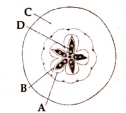
A
$B \rightarrow$ Endocarp
B
$C \rightarrow$ Thalamus
C
$D \rightarrow$ Seed
D
$A \rightarrow$ Mesocarp
Solution
(B) false fruit is a fruit in which some part of the plant other than the ovary contributes to the formation of the fruit.
In the given figure,which represents an apple,the edible part is the fleshy thalamus.
Label $C$ points to the thalamus,which develops into the fleshy part of the fruit,making it a false fruit.
Therefore,the correct option is $B$.
In the given figure,which represents an apple,the edible part is the fleshy thalamus.
Label $C$ points to the thalamus,which develops into the fleshy part of the fruit,making it a false fruit.
Therefore,the correct option is $B$.
0 likesView Solution
67
BiologyDifficultMCQNEET · 2022
Transposons can be used during which one of the following?
A
Gene silencing
B
Autoradiography
C
Gene sequencing
D
Polymerase Chain Reaction
Solution
(A) Transposons,also known as 'jumping genes',are $DNA$ sequences that can change their position within a genome.
They are widely used in molecular biology for 'transposon tagging' or 'transposon-mediated mutagenesis'.
In the context of gene function analysis,transposons are used to disrupt specific genes to study their effects,which is a fundamental technique in gene silencing (specifically,insertional mutagenesis leading to loss-of-function).
Therefore,they are effectively used in gene silencing studies to determine the function of unknown genes.
They are widely used in molecular biology for 'transposon tagging' or 'transposon-mediated mutagenesis'.
In the context of gene function analysis,transposons are used to disrupt specific genes to study their effects,which is a fundamental technique in gene silencing (specifically,insertional mutagenesis leading to loss-of-function).
Therefore,they are effectively used in gene silencing studies to determine the function of unknown genes.
0 likesView Solution
68
BiologyMediumMCQNEET · 2022
Which of the following occurs due to the presence of an autosome-linked dominant trait?
A
Myotonic dystrophy
B
Haemophilia
C
Thalassemia
D
Sickle cell anaemia
Solution
(A) $1$. Myotonic dystrophy is an example of an autosome-linked dominant trait.
$2$. Haemophilia is an $X$-linked recessive disorder.
$3$. Thalassemia is an autosome-linked recessive blood disorder.
$4$. Sickle cell anaemia is an autosome-linked recessive disorder.
Therefore,the correct option is $A$.
$2$. Haemophilia is an $X$-linked recessive disorder.
$3$. Thalassemia is an autosome-linked recessive blood disorder.
$4$. Sickle cell anaemia is an autosome-linked recessive disorder.
Therefore,the correct option is $A$.
0 likesView Solution
69
BiologyMediumMCQNEET · 2022
Which one of the following will accelerate the phosphorus cycle?
A
Volcanic activity
B
Weathering of rocks
C
Rainfall and storms
D
Burning of fossil fuels
Solution
(B) The phosphorus cycle is a sedimentary cycle,meaning its primary reservoir is the Earth's crust.
Weathering of rocks is the natural process that releases phosphorus from phosphate minerals into the soil and water,making it available for uptake by plants.
This process is the primary driver that introduces phosphorus into the biological cycle,thereby accelerating the movement of phosphorus through the ecosystem.
Volcanic activity,rainfall,and burning of fossil fuels have a negligible or indirect effect on the phosphorus cycle compared to the weathering of rocks.
Weathering of rocks is the natural process that releases phosphorus from phosphate minerals into the soil and water,making it available for uptake by plants.
This process is the primary driver that introduces phosphorus into the biological cycle,thereby accelerating the movement of phosphorus through the ecosystem.
Volcanic activity,rainfall,and burning of fossil fuels have a negligible or indirect effect on the phosphorus cycle compared to the weathering of rocks.
0 likesView Solution
70
BiologyMediumMCQNEET · 2022
If a geneticist uses the blind approach for sequencing the whole genome of an organism,followed by assignment of function to different segments,the methodology adopted by him is called as :
A
Gene mapping
B
Expressed sequence tags
C
Bioinformatics
D
Sequence annotation
Solution
(D) The methodology described is known as $Sequence \ annotation$.
In this approach,the entire genome of an organism is sequenced without prior knowledge of the gene locations (blind approach).
After obtaining the complete sequence,the geneticist identifies and assigns functions to different segments,such as genes,regulatory sequences,and non-coding regions.
This process is a critical step in the $Human \ Genome \ Project$ $(HGP)$ to understand the biological significance of the decoded $DNA$ sequence.
In this approach,the entire genome of an organism is sequenced without prior knowledge of the gene locations (blind approach).
After obtaining the complete sequence,the geneticist identifies and assigns functions to different segments,such as genes,regulatory sequences,and non-coding regions.
This process is a critical step in the $Human \ Genome \ Project$ $(HGP)$ to understand the biological significance of the decoded $DNA$ sequence.
0 likesView Solution
71
BiologyMediumMCQNEET · 2022
While explaining interspecific interaction of population,$(+)$ sign is assigned for beneficial interaction,$(-)$ sign is assigned for detrimental interaction and $(0)$ for neutral interaction. Which of the following interactions can be assigned $(+)$ for one species and $(-)$ for another species involved in the interaction?
A
Amensalism
B
Commensalism
C
Competition
D
Predation
Solution
(D) In population ecology,interspecific interactions are categorized based on their effect on the species involved:
$1$. Mutualism $(+, +)$: Both species benefit.
$2$. Competition $(-, -)$: Both species are harmed.
$3$. Predation $(+, -)$: One species (predator) benefits,while the other (prey) is harmed.
$4$. Parasitism $(+, -)$: One species (parasite) benefits,while the other (host) is harmed.
$5$. Commensalism $(+, 0)$: One species benefits,while the other is unaffected.
$6$. Amensalism $(-, 0)$: One species is harmed,while the other is unaffected.
Since the question asks for an interaction where one species benefits $(+)$ and the other is harmed $(-)$,both Predation and Parasitism fit this description. Among the given options,Predation is the correct choice.
$1$. Mutualism $(+, +)$: Both species benefit.
$2$. Competition $(-, -)$: Both species are harmed.
$3$. Predation $(+, -)$: One species (predator) benefits,while the other (prey) is harmed.
$4$. Parasitism $(+, -)$: One species (parasite) benefits,while the other (host) is harmed.
$5$. Commensalism $(+, 0)$: One species benefits,while the other is unaffected.
$6$. Amensalism $(-, 0)$: One species is harmed,while the other is unaffected.
Since the question asks for an interaction where one species benefits $(+)$ and the other is harmed $(-)$,both Predation and Parasitism fit this description. Among the given options,Predation is the correct choice.
0 likesView Solution
72
BiologyMediumMCQNEET · 2022
Given below are two statements: one is labelled as Assertion $(A)$ and the other is labelled as Reason $(R)$.
Assertion $(A)$:
Mendel's law of independent assortment does not hold good for the genes that are located closely on the same chromosome.
Reason $(R)$:
Closely located genes assort independently.
In the light of the above statements,choose the correct answer from the options given below:
Assertion $(A)$:
Mendel's law of independent assortment does not hold good for the genes that are located closely on the same chromosome.
Reason $(R)$:
Closely located genes assort independently.
In the light of the above statements,choose the correct answer from the options given below:
A
Both $(A)$ and $(R)$ are correct but $(R)$ is not the correct explanation of $(A)$
B
$(A)$ is correct but $(R)$ is not correct
C
$(A)$ is not correct but $(R)$ is correct
D
Both $(A)$ and $(R)$ are correct and $(R)$ is the correct explanation of $(A)$
Solution
(B) Mendel's law of independent assortment states that the alleles of two (or more) different genes get sorted into gametes independently of one another.
However,this law is only applicable to genes that are located on different chromosomes or are very far apart on the same chromosome.
When genes are located closely on the same chromosome,they exhibit the phenomenon of linkage.
Linked genes tend to be inherited together and do not assort independently,thus violating Mendel's law of independent assortment.
Therefore,Assertion $(A)$ is correct.
Reason $(R)$ states that closely located genes assort independently,which is incorrect because closely located genes show linkage and do not assort independently.
Thus,$(A)$ is correct but $(R)$ is incorrect.
However,this law is only applicable to genes that are located on different chromosomes or are very far apart on the same chromosome.
When genes are located closely on the same chromosome,they exhibit the phenomenon of linkage.
Linked genes tend to be inherited together and do not assort independently,thus violating Mendel's law of independent assortment.
Therefore,Assertion $(A)$ is correct.
Reason $(R)$ states that closely located genes assort independently,which is incorrect because closely located genes show linkage and do not assort independently.
Thus,$(A)$ is correct but $(R)$ is incorrect.
0 likesView Solution
73
BiologyMediumMCQNEET · 2022
The entire fleet of buses in Delhi was converted to $CNG$ from diesel. In reference to this,which one of the following statements is false?
A
The same diesel engine is used in $CNG$ buses making the cost of conversion low.
B
It is cheaper than diesel.
C
It cannot be adulterated like diesel.
D
$CNG$ burns more efficiently than diesel.
Solution
(A) The conversion of Delhi's bus fleet to $CNG$ (Compressed Natural Gas) was a major step to reduce air pollution.
$CNG$ is a cleaner fuel compared to diesel.
Statement $A$ is false because $CNG$ requires a different engine design compared to diesel engines; they cannot be used interchangeably without significant modifications.
Statement $B$ is true as $CNG$ is generally cheaper than diesel.
Statement $C$ is true because $CNG$ is a gaseous fuel and cannot be easily adulterated like liquid diesel.
Statement $D$ is true because $CNG$ burns more efficiently and leaves very little unburnt fuel,leading to less pollution.
$CNG$ is a cleaner fuel compared to diesel.
Statement $A$ is false because $CNG$ requires a different engine design compared to diesel engines; they cannot be used interchangeably without significant modifications.
Statement $B$ is true as $CNG$ is generally cheaper than diesel.
Statement $C$ is true because $CNG$ is a gaseous fuel and cannot be easily adulterated like liquid diesel.
Statement $D$ is true because $CNG$ burns more efficiently and leaves very little unburnt fuel,leading to less pollution.
0 likesView Solution
74
BiologyMediumMCQNEET · 2022
Detritivores breakdown detritus into smaller particles. This process is called:
A
Fragmentation
B
Humification
C
Decomposition
D
Catabolism
Solution
(A) The process of decomposition involves several steps: fragmentation,leaching,catabolism,humification,and mineralization.
$1$. Fragmentation: Detritivores (e.g.,earthworms) break down detritus into smaller particles.
$2$. Leaching: Water-soluble inorganic nutrients go down into the soil horizon and get precipitated as unavailable salts.
$3$. Catabolism: Bacterial and fungal enzymes degrade detritus into simpler inorganic substances.
$4$. Humification: Leads to the accumulation of a dark-colored amorphous substance called humus.
$5$. Mineralization: Further degradation of humus by some microbes releases inorganic nutrients.
Therefore,the breakdown of detritus into smaller particles by detritivores is known as fragmentation.
$1$. Fragmentation: Detritivores (e.g.,earthworms) break down detritus into smaller particles.
$2$. Leaching: Water-soluble inorganic nutrients go down into the soil horizon and get precipitated as unavailable salts.
$3$. Catabolism: Bacterial and fungal enzymes degrade detritus into simpler inorganic substances.
$4$. Humification: Leads to the accumulation of a dark-colored amorphous substance called humus.
$5$. Mineralization: Further degradation of humus by some microbes releases inorganic nutrients.
Therefore,the breakdown of detritus into smaller particles by detritivores is known as fragmentation.
0 likesView Solution
75
BiologyMediumMCQNEET · 2022
If $8$ Drosophila in a laboratory population of $80$ died during a week, the death rate in the population is
A
$10$
B
$1.0$
C
zero
D
$0.1$
Solution
(D) The death rate is calculated as the number of deaths per individual per unit time.
Formula: $\text{Death Rate} = \frac{\text{Number of deaths}}{\text{Initial population size}}$
Given:
Number of deaths = $8$
Initial population size = $80$
$\text{Death Rate} = \frac{8}{80} = 0.1 \text{ individuals per Drosophila per week}$.
Therefore, the correct option is $D$.
Formula: $\text{Death Rate} = \frac{\text{Number of deaths}}{\text{Initial population size}}$
Given:
Number of deaths = $8$
Initial population size = $80$
$\text{Death Rate} = \frac{8}{80} = 0.1 \text{ individuals per Drosophila per week}$.
Therefore, the correct option is $D$.
0 likesView Solution
76
BiologyMediumMCQNEET · 2022
Given below are two statements:
Statement $I$:
The release of sperms into the seminiferous tubules is called spermiation.
Statement $II$:
Spermiogenesis is the process of formation of sperms from spermatogonia.
In the light of the above statements,choose the most appropriate answer from the options given below:
Statement $I$:
The release of sperms into the seminiferous tubules is called spermiation.
Statement $II$:
Spermiogenesis is the process of formation of sperms from spermatogonia.
In the light of the above statements,choose the most appropriate answer from the options given below:
A
Both Statement $I$ and Statement $II$ are incorrect.
B
Statement $I$ is correct but Statement $II$ is incorrect.
C
Statement $I$ is incorrect but Statement $II$ is correct.
D
Both Statement $I$ and Statement $II$ are correct.
Solution
(B) Statement $I$ is correct: The process of release of sperms from the seminiferous tubules is known as spermiation.
Statement $II$ is incorrect: The process of transformation of spermatids into mature spermatozoa (sperms) is called spermiogenesis. The formation of sperms from spermatogonia is known as spermatogenesis,which includes spermatocytogenesis,meiosis,and spermiogenesis.
Statement $II$ is incorrect: The process of transformation of spermatids into mature spermatozoa (sperms) is called spermiogenesis. The formation of sperms from spermatogonia is known as spermatogenesis,which includes spermatocytogenesis,meiosis,and spermiogenesis.
0 likesView Solution
77
BiologyMediumMCQNEET · 2022
Given below are two statements:
Statement $I:$
Restriction endonucleases recognise specific sequences to cut $DNA$,known as palindromic nucleotide sequences.
Statement $II:$
Restriction endonucleases cut the $DNA$ strand a little away from the centre of the palindromic site.
In the light of the above statements,choose the most appropriate answer from the options given below:
Statement $I:$
Restriction endonucleases recognise specific sequences to cut $DNA$,known as palindromic nucleotide sequences.
Statement $II:$
Restriction endonucleases cut the $DNA$ strand a little away from the centre of the palindromic site.
In the light of the above statements,choose the most appropriate answer from the options given below:
A
Both Statement $I$ and Statement $II$ are incorrect
B
Statement $I$ is correct but Statement $II$ is incorrect
C
Statement $I$ is incorrect but Statement $II$ is correct
D
Both Statement $I$ and Statement $II$ are correct
Solution
(D) Statement $I$ is correct: Restriction endonucleases scan the $DNA$ molecule for specific recognition sequences,which are palindromic nucleotide sequences (sequences that read the same forward and backward on the two strands).
Statement $II$ is correct: Most restriction enzymes do not cut exactly in the middle of the palindromic site; instead,they cut the $DNA$ strands a little away from the centre,often between the same two bases on opposite strands,leaving single-stranded portions at the ends known as sticky ends.
Statement $II$ is correct: Most restriction enzymes do not cut exactly in the middle of the palindromic site; instead,they cut the $DNA$ strands a little away from the centre,often between the same two bases on opposite strands,leaving single-stranded portions at the ends known as sticky ends.
0 likesView Solution
78
BiologyDifficultMCQNEET · 2022
In an $E. coli$ strain,the $i$ gene gets mutated such that its product cannot bind the inducer molecule. If the growth medium is provided with lactose,what will be the outcome?
A
$z, y, a$ genes will be transcribed
B
$z, y, a$ genes will not be translated
C
$RNA$ polymerase will bind the promoter region
D
Only $z$ gene will get transcribed
Solution
(B) In the $lac$ operon,the $i$ gene codes for a repressor protein.
Normally,the repressor protein binds to the operator region and prevents $RNA$ polymerase from transcribing the structural genes $(z, y, a)$.
When lactose (the inducer) is present,it binds to the repressor protein,causing a conformational change that prevents the repressor from binding to the operator.
In this specific case,the mutated $i$ gene produces a repressor that cannot bind the inducer (lactose).
Therefore,the repressor remains bound to the operator regardless of the presence of lactose.
As a result,the $RNA$ polymerase is blocked from transcribing the structural genes $(z, y, a)$.
Since transcription does not occur,the genes will not be translated into proteins.
Normally,the repressor protein binds to the operator region and prevents $RNA$ polymerase from transcribing the structural genes $(z, y, a)$.
When lactose (the inducer) is present,it binds to the repressor protein,causing a conformational change that prevents the repressor from binding to the operator.
In this specific case,the mutated $i$ gene produces a repressor that cannot bind the inducer (lactose).
Therefore,the repressor remains bound to the operator regardless of the presence of lactose.
As a result,the $RNA$ polymerase is blocked from transcribing the structural genes $(z, y, a)$.
Since transcription does not occur,the genes will not be translated into proteins.
0 likesView Solution
79
BiologyMediumMCQNEET · 2022
In gene therapy of Adenosine Deaminase $(ADA)$ deficiency,the patient requires periodic infusion of genetically engineered lymphocytes because
A
Gene isolated from marrow cells producing $ADA$ is introduced into cells at embryonic stages.
B
Lymphocytes from patient's blood are grown in culture,outside the body.
C
Genetically engineered lymphocytes are not immortal cells.
D
Retroviral vector is introduced into these lymphocytes.
Solution
(C) In gene therapy for $ADA$ deficiency,functional $ADA$ genes are introduced into the patient's lymphocytes.
These lymphocytes are cultured outside the body and then re-infused into the patient.
However,these genetically engineered lymphocytes are not immortal; they have a finite lifespan and eventually die.
Therefore,the patient requires periodic infusions of these cells to maintain the production of the $ADA$ enzyme.
These lymphocytes are cultured outside the body and then re-infused into the patient.
However,these genetically engineered lymphocytes are not immortal; they have a finite lifespan and eventually die.
Therefore,the patient requires periodic infusions of these cells to maintain the production of the $ADA$ enzyme.
0 likesView Solution
80
BiologyDifficultMCQNEET · 2022
Which of the following statements are true for spermatogenesis but do not hold true for Oogenesis?
$(a)$ It results in the formation of haploid gametes
$(b)$ Differentiation of gamete occurs after the completion of meiosis
$(c)$ Meiosis occurs continuously in a mitotically dividing stem cell population
$(d)$ It is controlled by the Luteinising hormone $(LH)$ and Follicle-Stimulating Hormone $(FSH)$ secreted by the anterior pituitary
$(e)$ It is initiated at puberty
Choose the most appropriate answer from the options given below:
$(a)$ It results in the formation of haploid gametes
$(b)$ Differentiation of gamete occurs after the completion of meiosis
$(c)$ Meiosis occurs continuously in a mitotically dividing stem cell population
$(d)$ It is controlled by the Luteinising hormone $(LH)$ and Follicle-Stimulating Hormone $(FSH)$ secreted by the anterior pituitary
$(e)$ It is initiated at puberty
Choose the most appropriate answer from the options given below:
A
$(b)$ and $(c)$ only
B
$(b)$,$(d)$ and $(e)$ only
C
$(b)$,$(c)$ and $(e)$ only
D
$(c)$ and $(e)$ only
Solution
(A) Let us analyze each statement:
$(a)$ Both spermatogenesis and oogenesis result in the formation of haploid gametes. This is true for both.
$(b)$ In spermatogenesis,the spermatids (formed after meiosis) undergo spermiogenesis (differentiation) to become spermatozoa. In oogenesis,the ovum is formed directly after the completion of meiosis without a distinct differentiation phase like spermiogenesis. This is true for spermatogenesis but not oogenesis.
$(c)$ Spermatogenesis occurs continuously in the testes from puberty throughout life in a mitotically dividing stem cell population (spermatogonia). Oogenesis is a discontinuous process; the primary oocytes are formed during embryonic development and meiosis is arrested until puberty. This is true for spermatogenesis but not oogenesis.
$(d)$ Both processes are regulated by $LH$ and $FSH$ from the anterior pituitary. This is true for both.
$(e)$ Spermatogenesis is initiated at puberty. Oogenesis is initiated during embryonic development,though it resumes at puberty. Thus,this statement is not exclusively true for spermatogenesis.
Therefore,statements $(b)$ and $(c)$ are the ones that apply specifically to spermatogenesis and not to oogenesis.
$(a)$ Both spermatogenesis and oogenesis result in the formation of haploid gametes. This is true for both.
$(b)$ In spermatogenesis,the spermatids (formed after meiosis) undergo spermiogenesis (differentiation) to become spermatozoa. In oogenesis,the ovum is formed directly after the completion of meiosis without a distinct differentiation phase like spermiogenesis. This is true for spermatogenesis but not oogenesis.
$(c)$ Spermatogenesis occurs continuously in the testes from puberty throughout life in a mitotically dividing stem cell population (spermatogonia). Oogenesis is a discontinuous process; the primary oocytes are formed during embryonic development and meiosis is arrested until puberty. This is true for spermatogenesis but not oogenesis.
$(d)$ Both processes are regulated by $LH$ and $FSH$ from the anterior pituitary. This is true for both.
$(e)$ Spermatogenesis is initiated at puberty. Oogenesis is initiated during embryonic development,though it resumes at puberty. Thus,this statement is not exclusively true for spermatogenesis.
Therefore,statements $(b)$ and $(c)$ are the ones that apply specifically to spermatogenesis and not to oogenesis.
0 likesView Solution
81
BiologyMediumMCQNEET · 2022
In-situ conservation refers to:
A
Conserve only high risk species
B
Conserve only endangered species
C
Conserve only extinct species
D
Protect and conserve the whole ecosystem
Solution
(D) In-situ conservation,also known as 'on-site' conservation,is the process of protecting an endangered plant or animal species in its natural habitat.
This approach involves protecting and conserving the entire ecosystem,including the species' natural environment,to ensure their survival and evolutionary processes.
Examples include National Parks,Wildlife Sanctuaries,and Biosphere Reserves.
This approach involves protecting and conserving the entire ecosystem,including the species' natural environment,to ensure their survival and evolutionary processes.
Examples include National Parks,Wildlife Sanctuaries,and Biosphere Reserves.
0 likesView Solution
82
BiologyMediumMCQNEET · 2022
If the length of a $DNA$ molecule is $1.1$ metres,what will be the approximate number of base pairs?
A
$6.6 \times 10^{9} \text{ bp}$
B
$3.3 \times 10^{6} \text{ bp}$
C
$6.6 \times 10^{6} \text{ bp}$
D
$3.3 \times 10^{9} \text{ bp}$
Solution
(D) The distance between two consecutive base pairs in a $DNA$ molecule is $0.34 \text{ nm}$ or $0.34 \times 10^{-9} \text{ m}$.
Given the total length of the $DNA$ molecule is $1.1 \text{ m}$.
The number of base pairs is calculated by dividing the total length by the distance between two consecutive base pairs:
$\text{Number of base pairs} = \frac{\text{Total length}}{\text{Distance between two base pairs}}$
$\text{Number of base pairs} = \frac{1.1 \text{ m}}{0.34 \times 10^{-9} \text{ m}}$
$\text{Number of base pairs} \approx 3.235 \times 10^{9} \text{ bp}$.
Rounding this to the nearest option,we get $3.3 \times 10^{9} \text{ bp}$.
Given the total length of the $DNA$ molecule is $1.1 \text{ m}$.
The number of base pairs is calculated by dividing the total length by the distance between two consecutive base pairs:
$\text{Number of base pairs} = \frac{\text{Total length}}{\text{Distance between two base pairs}}$
$\text{Number of base pairs} = \frac{1.1 \text{ m}}{0.34 \times 10^{-9} \text{ m}}$
$\text{Number of base pairs} \approx 3.235 \times 10^{9} \text{ bp}$.
Rounding this to the nearest option,we get $3.3 \times 10^{9} \text{ bp}$.
0 likesView Solution
83
BiologyMediumMCQNEET · 2022
Natural selection where more individuals acquire specific character value other than the mean character value,leads to:
A
Directional change
B
Disruptive change
C
Random change
D
Stabilising change
Solution
(A) In natural selection,when more individuals acquire a value other than the mean character value,the population shifts towards one extreme. This is known as Directional selection or Directional change.
$1$. Stabilising selection: Individuals with mean character values are favoured.
$2$. Directional selection: Individuals at one extreme of the character range are favoured,causing the mean to shift.
$3$. Disruptive selection: Individuals at both extremes of the character range are favoured,leading to two peaks in the distribution.
$1$. Stabilising selection: Individuals with mean character values are favoured.
$2$. Directional selection: Individuals at one extreme of the character range are favoured,causing the mean to shift.
$3$. Disruptive selection: Individuals at both extremes of the character range are favoured,leading to two peaks in the distribution.
0 likesView Solution
84
BiologyEasyMCQNEET · 2022
Identify the asexual reproductive structure associated with $Penicillium$:
A
Conidia
B
Gemmules
C
Buds
D
Zoospores
Solution
(A) $Penicillium$ is a type of fungus that reproduces asexually through specialized structures called conidia.
Conidia are non-motile spores produced exogenously at the tips of specialized hyphae known as conidiophores.
Gemmules are internal buds found in sponges.
Buds are seen in organisms like $Hydra$ and yeast.
Zoospores are motile,flagellated spores found in algae like $Chlamydomonas$.
Conidia are non-motile spores produced exogenously at the tips of specialized hyphae known as conidiophores.
Gemmules are internal buds found in sponges.
Buds are seen in organisms like $Hydra$ and yeast.
Zoospores are motile,flagellated spores found in algae like $Chlamydomonas$.
0 likesView Solution
85
BiologyDifficultMCQNEET · 2022
Given below are two statements:
Statement $I:$ Autoimmune disorder is a condition where the body's defense mechanism recognizes its own cells as foreign bodies.
Statement $II:$ Rheumatoid arthritis is a condition where the body does not attack self-cells.
In the light of the above statements,choose the most appropriate answer from the options given below:
Statement $I:$ Autoimmune disorder is a condition where the body's defense mechanism recognizes its own cells as foreign bodies.
Statement $II:$ Rheumatoid arthritis is a condition where the body does not attack self-cells.
In the light of the above statements,choose the most appropriate answer from the options given below:
A
Both Statement $I$ and Statement $II$ are incorrect.
B
Statement $I$ is correct but Statement $II$ is incorrect.
C
Statement $I$ is incorrect but Statement $II$ is correct.
D
Both Statement $I$ and Statement $II$ are correct.
Solution
(B) Statement $I$ is correct because autoimmune disorders occur when the immune system loses the ability to distinguish between 'self' and 'non-self' cells,leading it to attack the body's own healthy tissues.
Statement $II$ is incorrect because Rheumatoid arthritis is a classic example of an autoimmune disease where the body's immune system attacks its own cells,specifically the synovial membrane in the joints.
Therefore,Statement $I$ is correct and Statement $II$ is incorrect.
Statement $II$ is incorrect because Rheumatoid arthritis is a classic example of an autoimmune disease where the body's immune system attacks its own cells,specifically the synovial membrane in the joints.
Therefore,Statement $I$ is correct and Statement $II$ is incorrect.
0 likesView Solution
86
BiologyEasyMCQNEET · 2022
Breeding crops with higher levels of vitamins and minerals or higher proteins and healthier fats is called:
A
Bio-remediation
B
Bio-fortification
C
Bio-accumulation
D
Bio-magnification
Solution
(B) Bio-fortification is the process of breeding crops to increase their nutritional value. This can be achieved through selective breeding or genetic engineering to enhance the levels of vitamins,minerals,proteins,and healthier fats in crops. This strategy is essential for addressing hidden hunger and malnutrition in populations.
0 likesView Solution
87
BiologyEasyMCQNEET · 2022
At which stage of life is the oogenesis process initiated?
A
Embryonic development stage
B
Birth
C
Adult
D
Puberty
Solution
(A) Oogenesis is the process of formation of a mature female gamete.
Unlike spermatogenesis,which initiates at puberty,oogenesis is initiated during the embryonic development stage.
During fetal development,a couple of million gamete mother cells $(oogonia)$ are formed within each fetal ovary.
No more oogonia are formed or added after birth.
These cells start division and enter into $Prophase-I$ of the meiotic division and get temporarily arrested at that stage,called primary oocytes.
Unlike spermatogenesis,which initiates at puberty,oogenesis is initiated during the embryonic development stage.
During fetal development,a couple of million gamete mother cells $(oogonia)$ are formed within each fetal ovary.
No more oogonia are formed or added after birth.
These cells start division and enter into $Prophase-I$ of the meiotic division and get temporarily arrested at that stage,called primary oocytes.
0 likesView Solution
88
BiologyEasyMCQNEET · 2022
Lippe's loop is a type of contraceptive used as:
A
Vault barrier
B
Non-medicated IUDs
C
Copper releasing $IUD$
D
Cervical barrier
Solution
(B) Lippe's loop is a type of $IUD$ (Intrauterine Device).
Specifically,it is classified as a non-medicated $IUD$ because it does not release any hormones or metal ions.
It works by increasing phagocytosis of sperms within the uterus.
Therefore,the correct option is $B$.
Specifically,it is classified as a non-medicated $IUD$ because it does not release any hormones or metal ions.
It works by increasing phagocytosis of sperms within the uterus.
Therefore,the correct option is $B$.
0 likesView Solution
89
BiologyEasyMCQNEET · 2022
Identify the microorganism which is responsible for the production of an immunosuppressive molecule cyclosporin $A$ :
A
Clostridium butylicum
B
Aspergillus niger
C
Saccharomyces cerevisiae
D
Trichoderma polysporum
Solution
(D) The immunosuppressive agent cyclosporin $A$ is produced by the fungus $Trichoderma$ $polysporum$.
It is widely used as an immunosuppressive agent in organ transplant patients to prevent organ rejection by the immune system.
$Clostridium$ $butylicum$ is used for the production of butyric acid.
$Aspergillus$ $niger$ is used for the production of citric acid.
$Saccharomyces$ $cerevisiae$ is used for the production of ethanol (brewer's yeast).
Therefore, the correct option is $D$.
It is widely used as an immunosuppressive agent in organ transplant patients to prevent organ rejection by the immune system.
$Clostridium$ $butylicum$ is used for the production of butyric acid.
$Aspergillus$ $niger$ is used for the production of citric acid.
$Saccharomyces$ $cerevisiae$ is used for the production of ethanol (brewer's yeast).
Therefore, the correct option is $D$.
0 likesView Solution
90
BiologyMediumMCQNEET · 2022
Ten $E. coli$ cells with $^{15}N$-dsDNA are incubated in a medium containing $^{14}N$ nucleotides. After $60$ minutes, how many $E. coli$ cells will have $DNA$ totally free from $^{15}N$ (in $cells$)?
A
$40$
B
$60$
C
$80$
D
$20$
Solution
(B) $E. coli$ replicates every $20$ minutes. In $60$ minutes, the cells will undergo $3$ rounds of replication $(60/20 = 3)$.
Starting with $10$ cells, the total number of cells after $3$ generations is $10 \times 2^3 = 80$ cells.
In $DNA$ replication, each strand acts as a template. After $3$ generations, the number of $DNA$ molecules containing the original $^{15}N$ strand is $20$ (since only $2$ strands of the original $10$ cells' $DNA$ are conserved in the hybrid form across generations).
Total $DNA$ molecules = $80 \times 2 = 160$.
$DNA$ molecules with $^{15}N$ = $20$ (as $10$ cells $\times$ $2$ strands = $20$ original strands).
$DNA$ molecules totally free from $^{15}N$ = $160 - 20 = 140$.
Since each cell contains $2$ $DNA$ strands, the number of cells with $DNA$ totally free from $^{15}N$ is $140 / 2 = 70$. However, looking at the standard calculation for this specific problem type: After $n$ generations, the number of cells with only $^{14}N$ $DNA$ is $N(2^n - 2)$.
For $N=10$ and $n=3$: $10 \times (2^3 - 2) = 10 \times (8 - 2) = 10 \times 6 = 60$ cells.
Starting with $10$ cells, the total number of cells after $3$ generations is $10 \times 2^3 = 80$ cells.
In $DNA$ replication, each strand acts as a template. After $3$ generations, the number of $DNA$ molecules containing the original $^{15}N$ strand is $20$ (since only $2$ strands of the original $10$ cells' $DNA$ are conserved in the hybrid form across generations).
Total $DNA$ molecules = $80 \times 2 = 160$.
$DNA$ molecules with $^{15}N$ = $20$ (as $10$ cells $\times$ $2$ strands = $20$ original strands).
$DNA$ molecules totally free from $^{15}N$ = $160 - 20 = 140$.
Since each cell contains $2$ $DNA$ strands, the number of cells with $DNA$ totally free from $^{15}N$ is $140 / 2 = 70$. However, looking at the standard calculation for this specific problem type: After $n$ generations, the number of cells with only $^{14}N$ $DNA$ is $N(2^n - 2)$.
For $N=10$ and $n=3$: $10 \times (2^3 - 2) = 10 \times (8 - 2) = 10 \times 6 = 60$ cells.
0 likesView Solution
91
BiologyMediumMCQNEET · 2022
If a colour blind female marries a man whose mother was also colour blind,what are the chances of her progeny having colour blindness (in $\%$)?
A
$50$
B
$75$
C
$100$
D
$25$
Solution
(C) Colour blindness is an $X$-linked recessive disorder.
Let $X^c$ represent the allele for colour blindness and $X$ represent the normal allele.
$A$ colour blind female has the genotype $X^c X^c$.
$A$ man whose mother was colour blind must have inherited the $X^c$ allele from her,so his genotype is $X^c Y$.
When they marry $(X^c X^c \times X^c Y)$:
- Offspring genotypes: $X^c X^c$ (colour blind daughter),$X^c Y$ (colour blind son),$X^c X^c$ (colour blind daughter),$X^c Y$ (colour blind son).
All offspring $(100 \%)$ will be colour blind.
Let $X^c$ represent the allele for colour blindness and $X$ represent the normal allele.
$A$ colour blind female has the genotype $X^c X^c$.
$A$ man whose mother was colour blind must have inherited the $X^c$ allele from her,so his genotype is $X^c Y$.
When they marry $(X^c X^c \times X^c Y)$:
- Offspring genotypes: $X^c X^c$ (colour blind daughter),$X^c Y$ (colour blind son),$X^c X^c$ (colour blind daughter),$X^c Y$ (colour blind son).
All offspring $(100 \%)$ will be colour blind.
0 likesView Solution
92
BiologyMediumMCQNEET · 2022
Given below are two statements:
Statement $I:$ In a scrubber,the exhaust from the thermal plant is passed through a spray of water or lime to remove gases like $SO_2$.
Statement $II:$ Particulate matter $(PM\,2.5)$ cannot be removed by a scrubber but can be removed by an electrostatic precipitator.
In the light of the above statements,choose the most appropriate answer from the options given below:
Statement $I:$ In a scrubber,the exhaust from the thermal plant is passed through a spray of water or lime to remove gases like $SO_2$.
Statement $II:$ Particulate matter $(PM\,2.5)$ cannot be removed by a scrubber but can be removed by an electrostatic precipitator.
In the light of the above statements,choose the most appropriate answer from the options given below:
A
Both Statement $I$ and Statement $II$ are incorrect.
B
Statement $I$ is correct but Statement $II$ is incorrect.
C
Statement $I$ is incorrect but Statement $II$ is correct.
D
Both Statement $I$ and Statement $II$ are correct.
Solution
(C) Statement $I$ is incorrect because a scrubber is used to remove gases like $SO_2$ from industrial exhaust by passing it through a spray of water or lime. The process of passing exhaust through electric wires to charge dust particles is the working principle of an electrostatic precipitator,not a scrubber.
Statement $II$ is correct because scrubbers are primarily designed to remove gaseous pollutants. Particulate matter,especially fine particles like $PM\,2.5$,are too small to be efficiently removed by scrubbers and are best removed by electrostatic precipitators,which use high-voltage electrodes to charge and collect these particles.
Statement $II$ is correct because scrubbers are primarily designed to remove gaseous pollutants. Particulate matter,especially fine particles like $PM\,2.5$,are too small to be efficiently removed by scrubbers and are best removed by electrostatic precipitators,which use high-voltage electrodes to charge and collect these particles.
0 likesView Solution
93
BiologyMediumMCQNEET · 2022
Which of the following is not a desirable feature of a cloning vector?
A
Presence of a marker gene
B
Presence of single restriction enzyme site
C
Presence of two or more recognition sites
D
Presence of origin of replication
Solution
(C) cloning vector must have an origin of replication $(ori)$ to allow autonomous replication.
It should contain a selectable marker gene to identify transformants.
It must have a single recognition site for a specific restriction enzyme to allow the insertion of the foreign $DNA$.
Having two or more recognition sites for the same restriction enzyme would result in the fragmentation of the vector,which is undesirable as it complicates the cloning process.
It should contain a selectable marker gene to identify transformants.
It must have a single recognition site for a specific restriction enzyme to allow the insertion of the foreign $DNA$.
Having two or more recognition sites for the same restriction enzyme would result in the fragmentation of the vector,which is undesirable as it complicates the cloning process.
0 likesView Solution
94
BiologyMediumMCQNEET · 2022
Which of the following statements is not true?
A
Sweet potato and potato are an example of analogy.
B
Homology indicates common ancestry.
C
Flippers of penguins and dolphins are a pair of homologous organs.
D
Analogous structures are a result of convergent evolution.
Solution
(C) $1$. Homologous organs are those that have the same structural origin and developmental pattern but may perform different functions. They indicate common ancestry.
$2$. Analogous organs are those that perform similar functions but have different structural origins. They are a result of convergent evolution.
$3$. Sweet potato (root modification) and potato (stem modification) perform the same function of food storage but have different origins,making them analogous.
$4$. Flippers of penguins (birds) and dolphins (mammals) are analogous structures because they perform the same function (swimming) but have different anatomical structures. Therefore,the statement that they are homologous is incorrect.
$2$. Analogous organs are those that perform similar functions but have different structural origins. They are a result of convergent evolution.
$3$. Sweet potato (root modification) and potato (stem modification) perform the same function of food storage but have different origins,making them analogous.
$4$. Flippers of penguins (birds) and dolphins (mammals) are analogous structures because they perform the same function (swimming) but have different anatomical structures. Therefore,the statement that they are homologous is incorrect.
0 likesView Solution
95
BiologyMediumMCQNEET · 2022
Select the incorrect statement with respect to acquired immunity.
A
Anamnestic response is elicited on subsequent encounters with the same pathogen.
B
Anamnestic response is due to memory of first encounter.
C
Acquired immunity is non-specific type of defense present at the time of birth.
D
Primary response is produced when our body encounters a pathogen for the first time.
Solution
(C) Acquired immunity is pathogen-specific and is characterized by memory. It is not present at birth but develops during an individual's lifetime after exposure to pathogens or vaccines.
In contrast,innate immunity is non-specific and is present at the time of birth.
Therefore,the statement 'Acquired immunity is non-specific type of defense present at the time of birth' is incorrect.
In contrast,innate immunity is non-specific and is present at the time of birth.
Therefore,the statement 'Acquired immunity is non-specific type of defense present at the time of birth' is incorrect.
0 likesView Solution
96
BiologyMediumMCQNEET · 2022
The recombination frequency between the genes $a$ and $c$ is $5\%$,$b$ and $c$ is $15\%$,$b$ and $d$ is $9\%$,$a$ and $b$ is $20\%$,$c$ and $d$ is $24\%$,and $a$ and $d$ is $29\%$. What will be the sequence of these genes on a linear chromosome?
A
$d, b, a, c$
B
$a, b, c, d$
C
$a, c, b, d$
D
$a, d, b, c$
Solution
(C) Recombination frequency is directly proportional to the distance between genes on a chromosome. Therefore,$1\% \text{ recombination frequency} = 1 \text{ map unit (cM)}$.
Given distances:
$a-c = 5 \text{ cM}$
$b-c = 15 \text{ cM}$
$b-d = 9 \text{ cM}$
$a-b = 20 \text{ cM}$
$c-d = 24 \text{ cM}$
$a-d = 29 \text{ cM}$
Step $1$: Place $a$ and $c$ at a distance of $5 \text{ cM}$.
Step $2$: Since $a-b = 20 \text{ cM}$ and $c-b = 15 \text{ cM}$,$b$ must be placed such that $c$ is between $a$ and $b$ $(a-c-b = 5 + 15 = 20 \text{ cM})$.
Step $3$: Check $d$. We have $b-d = 9 \text{ cM}$ and $c-d = 24 \text{ cM}$. Since $c-b = 15 \text{ cM}$ and $b-d = 9 \text{ cM}$,$d$ must be placed on the other side of $b$ such that $c-b-d = 15 + 9 = 24 \text{ cM}$.
Step $4$: Verify with $a-d = 29 \text{ cM}$. The sequence is $a-c-b-d$. The distance $a-d = a-c + c-b + b-d = 5 + 15 + 9 = 29 \text{ cM}$.
This matches the given data. Thus,the sequence is $a, c, b, d$.
Given distances:
$a-c = 5 \text{ cM}$
$b-c = 15 \text{ cM}$
$b-d = 9 \text{ cM}$
$a-b = 20 \text{ cM}$
$c-d = 24 \text{ cM}$
$a-d = 29 \text{ cM}$
Step $1$: Place $a$ and $c$ at a distance of $5 \text{ cM}$.
Step $2$: Since $a-b = 20 \text{ cM}$ and $c-b = 15 \text{ cM}$,$b$ must be placed such that $c$ is between $a$ and $b$ $(a-c-b = 5 + 15 = 20 \text{ cM})$.
Step $3$: Check $d$. We have $b-d = 9 \text{ cM}$ and $c-d = 24 \text{ cM}$. Since $c-b = 15 \text{ cM}$ and $b-d = 9 \text{ cM}$,$d$ must be placed on the other side of $b$ such that $c-b-d = 15 + 9 = 24 \text{ cM}$.
Step $4$: Verify with $a-d = 29 \text{ cM}$. The sequence is $a-c-b-d$. The distance $a-d = a-c + c-b + b-d = 5 + 15 + 9 = 29 \text{ cM}$.
This matches the given data. Thus,the sequence is $a, c, b, d$.
0 likesView Solution
97
BiologyMediumMCQNEET · 2022
Statements related to human insulin are given below. Which statement$(s)$ is/are correct about genetically engineered insulin?
$(a)$ Pro-hormone insulin contains an extra stretch of $C$-peptide.
$(b)$ $A$-peptide and $B$-peptide chains of insulin were produced separately in $E. coli$,extracted,and combined by creating disulfide bonds between them.
$(c)$ Insulin used for treating diabetes was extracted from cattle and pigs.
$(d)$ Pro-hormone insulin needs to be processed for converting into a mature and functional hormone.
$(e)$ Some patients develop allergic reactions to the foreign insulin.
Choose the most appropriate answer from the options given below:
$(a)$ Pro-hormone insulin contains an extra stretch of $C$-peptide.
$(b)$ $A$-peptide and $B$-peptide chains of insulin were produced separately in $E. coli$,extracted,and combined by creating disulfide bonds between them.
$(c)$ Insulin used for treating diabetes was extracted from cattle and pigs.
$(d)$ Pro-hormone insulin needs to be processed for converting into a mature and functional hormone.
$(e)$ Some patients develop allergic reactions to the foreign insulin.
Choose the most appropriate answer from the options given below:
A
$(b)$ only
B
$(c)$ and $(d)$ only
C
$(c), (d)$ and $(e)$ only
D
$(a), (b)$ and $(d)$ only
Solution
(D) The correct answer is $(d)$.
$(a)$ Pro-insulin consists of $A$ and $B$ chains linked by a $C$-peptide. This is correct.
$(b)$ In genetically engineered insulin (Humulin),$A$ and $B$ chains are produced separately in $E. coli$ and linked by disulfide bonds. This is correct.
$(c)$ This statement describes the historical source of insulin,not the nature of genetically engineered insulin. While true as a historical fact,it is not a characteristic of the engineered product itself.
$(d)$ Pro-insulin must undergo processing (removal of $C$-peptide) to become mature insulin. This is correct.
$(e)$ This refers to the side effects of animal-derived insulin,not the nature of genetically engineered insulin.
Therefore,statements $(a), (b),$ and $(d)$ are the correct descriptions regarding the production and nature of genetically engineered insulin.
$(a)$ Pro-insulin consists of $A$ and $B$ chains linked by a $C$-peptide. This is correct.
$(b)$ In genetically engineered insulin (Humulin),$A$ and $B$ chains are produced separately in $E. coli$ and linked by disulfide bonds. This is correct.
$(c)$ This statement describes the historical source of insulin,not the nature of genetically engineered insulin. While true as a historical fact,it is not a characteristic of the engineered product itself.
$(d)$ Pro-insulin must undergo processing (removal of $C$-peptide) to become mature insulin. This is correct.
$(e)$ This refers to the side effects of animal-derived insulin,not the nature of genetically engineered insulin.
Therefore,statements $(a), (b),$ and $(d)$ are the correct descriptions regarding the production and nature of genetically engineered insulin.
0 likesView Solution
98
BiologyMediumMCQNEET · 2022
Match List-$I$ with List-$II$ with respect to methods of contraception and their respective actions.
Choose the correct answer from the options given below:
| List-$I$ | List-$II$ |
| $(a)$ Diaphragms | $(i)$ Inhibit ovulation and implantation |
| $(b)$ Contraceptive pills | $(ii)$ Increase phagocytosis of sperm within uterus |
| $(c)$ Intra Uterine Device | $(iii)$ Absence of menstrual cycle and ovulation following parturition |
| $(d)$ Lactational amenorrhea | $(iv)$ They cover the cervix blocking the entry of sperms |
Choose the correct answer from the options given below:
A
$(a)-(iv), (b)-(i), (c)-(ii), (d)-(iii)$
B
$(a)-(ii), (b)-(iv), (c)-(i), (d)-(iii)$
C
$(a)-(iii), (b)-(ii), (c)-(i), (d)-(iv)$
D
$(a)-(iv), (b)-(i), (c)-(iii), (d)-(ii)$
Solution
(A) The correct matching is as follows:
$(a)$ Diaphragms are barrier methods that cover the cervix,thereby blocking the entry of sperms into the uterus. Thus,$(a)-(iv)$.
$(b)$ Contraceptive pills contain hormones (progestogens or progestogen-estrogen combinations) that inhibit ovulation and implantation,and also alter the quality of cervical mucus to prevent sperm entry. Thus,$(b)-(i)$.
$(c)$ Intra Uterine Devices (IUDs) like Copper-$T$ increase the phagocytosis of sperms within the uterus,which reduces sperm count and motility. Thus,$(c)-(ii)$.
$(d)$ Lactational amenorrhea is a natural method based on the fact that ovulation and the menstrual cycle do not occur during the period of intense lactation following parturition. Thus,$(d)-(iii)$.
Therefore,the correct sequence is $(a)-(iv), (b)-(i), (c)-(ii), (d)-(iii)$.
$(a)$ Diaphragms are barrier methods that cover the cervix,thereby blocking the entry of sperms into the uterus. Thus,$(a)-(iv)$.
$(b)$ Contraceptive pills contain hormones (progestogens or progestogen-estrogen combinations) that inhibit ovulation and implantation,and also alter the quality of cervical mucus to prevent sperm entry. Thus,$(b)-(i)$.
$(c)$ Intra Uterine Devices (IUDs) like Copper-$T$ increase the phagocytosis of sperms within the uterus,which reduces sperm count and motility. Thus,$(c)-(ii)$.
$(d)$ Lactational amenorrhea is a natural method based on the fact that ovulation and the menstrual cycle do not occur during the period of intense lactation following parturition. Thus,$(d)-(iii)$.
Therefore,the correct sequence is $(a)-(iv), (b)-(i), (c)-(ii), (d)-(iii)$.
0 likesView Solution
99
BiologyMediumMCQNEET · 2022
In $lac$ operon,$z$ gene codes for:
A
$\beta$-galactosidase
B
Permease
C
Repressor
D
Transacetylase
Solution
(A) In the $lac$ operon,the structural genes are $z$,$y$,and $a$.
$1$. The $z$ gene codes for $\beta$-galactosidase,which is responsible for the hydrolysis of lactose into galactose and glucose.
$2$. The $y$ gene codes for permease,which increases the permeability of the cell to $\beta$-galactosides.
$3$. The $a$ gene codes for transacetylase.
Therefore,the $z$ gene codes for $\beta$-galactosidase.
$1$. The $z$ gene codes for $\beta$-galactosidase,which is responsible for the hydrolysis of lactose into galactose and glucose.
$2$. The $y$ gene codes for permease,which increases the permeability of the cell to $\beta$-galactosides.
$3$. The $a$ gene codes for transacetylase.
Therefore,the $z$ gene codes for $\beta$-galactosidase.
0 likesView Solution
100
BiologyMediumMCQNEET · 2022
Match List-$I$ with List-$II$:
Choose the correct answer from the options given below:
| List-$I$ | List-$II$ |
| $a$. In lac operon $i$ gene codes for | $i$. Transacetylase |
| $b$. In lac operon $z$ gene codes for | $ii$. Permease |
| $c$. In lac operon $y$ gene codes for | $iii$. $\beta$-galactosidase |
| $d$. In lac operon $a$ gene codes for | $iv$. Repressor |
Choose the correct answer from the options given below:
A
$(a)-(iii), (b)-(ii), (c)-(i), (d)-(iv)$
B
$(a)-(iv), (b)-(iii), (c)-(ii), (d)-(i)$
C
$(a)-(iv), (b)-(i), (c)-(iii), (d)-(ii)$
D
$(a)-(iii), (b)-(i), (c)-(iv), (d)-(ii)$
Solution
(B) In the $lac$ operon model, the genes have specific functions:
$1$. The $i$ gene codes for the repressor protein, which regulates the operon.
$2$. The $z$ gene codes for $\beta$-galactosidase, which is responsible for the hydrolysis of lactose into galactose and glucose.
$3$. The $y$ gene codes for permease, which increases the permeability of the cell to $\beta$-galactosides.
$4$. The $a$ gene codes for transacetylase, which transfers an acetyl group to $\beta$-galactosides.
Therefore, the correct matching is: $a-iv, b-iii, c-ii, d-i$.
$1$. The $i$ gene codes for the repressor protein, which regulates the operon.
$2$. The $z$ gene codes for $\beta$-galactosidase, which is responsible for the hydrolysis of lactose into galactose and glucose.
$3$. The $y$ gene codes for permease, which increases the permeability of the cell to $\beta$-galactosides.
$4$. The $a$ gene codes for transacetylase, which transfers an acetyl group to $\beta$-galactosides.
Therefore, the correct matching is: $a-iv, b-iii, c-ii, d-i$.
0 likesView Solution
Vedclass Products
For Students
Vedclass Test Series
Mock tests in real NEET style covering Biology with performance analysis. 5-day free trial.
Start Free TrialFor Teachers
Exam Paper Generator
Generate Set A/B/C/D Biology papers from 7.5L+ questions in 2 minutes. 3 chapters free.
Try FreeFor Institutes
Online Exam Module
Run live NEET mock exams with unlimited students, 360° analytics & white-label branding.
See DemoFrequently Asked Questions
How many Biology questions are in NEET 2022?
There are 198 Biology questions from the NEET 2022 paper on Vedclass, each with a detailed step-by-step solution in English.
Are NEET 2022 Biology solutions available in English?
Yes. All solutions on this page are in English. You can also switch to English or Hindi using the language buttons above the questions.
Can I practice NEET 2022 Biology as a timed test?
Yes. Use the Vedclass Test Series to attempt a full NEET mock test covering Biology with time limits and instant score analysis.
Can teachers create Biology papers from NEET previous year questions?
Yes. The Vedclass Exam Paper Generator lets teachers mix NEET Biology questions and generate Set A/B/C/D papers in minutes.
For Teachers & Institutes
Build a Custom Biology Paper
Pick NEET 2022 Biology questions, set difficulty, and generate Set A/B/C/D in 2 minutes.