
ChemistryQ1–51 of 51 questions
Page 1 of 1 · English
1
ChemistryMCQNEET · 2018
Which of the following is a secondary pollutant?
A
$SO_2$
B
$CO$
C
$O_3$
D
$NO_2$
Solution
(C) Secondary pollutants are not emitted directly into the atmosphere but are formed through chemical reactions between primary pollutants and other atmospheric components.
Ozone $(O_3)$ is a classic example of a secondary pollutant,formed in the troposphere by the photochemical reaction of nitrogen oxides $(NO_x)$ and volatile organic compounds $(VOCs)$ in the presence of sunlight.
$SO_2$,$CO$,and $NO_2$ are primary pollutants as they are emitted directly from sources like combustion processes.
Ozone $(O_3)$ is a classic example of a secondary pollutant,formed in the troposphere by the photochemical reaction of nitrogen oxides $(NO_x)$ and volatile organic compounds $(VOCs)$ in the presence of sunlight.
$SO_2$,$CO$,and $NO_2$ are primary pollutants as they are emitted directly from sources like combustion processes.
0 likesView Solution
2
ChemistryMCQNEET · 2018
Which of the following is a secondary pollutant?
A
$PAN$
B
$CO$
C
$NO_2$
D
$SO_2$
Solution
(A) primary pollutant is an air pollutant emitted directly from a source,such as $CO$,$NO_2$,and $SO_2$.
Secondary pollutants are not emitted directly; they form in the atmosphere when primary pollutants react or interact.
$PAN$ (Peroxyacetyl nitrate) is a classic example of a secondary pollutant formed by the photochemical reaction of nitrogen oxides and volatile organic compounds in the presence of sunlight.
Therefore,the correct option is $A$.
Secondary pollutants are not emitted directly; they form in the atmosphere when primary pollutants react or interact.
$PAN$ (Peroxyacetyl nitrate) is a classic example of a secondary pollutant formed by the photochemical reaction of nitrogen oxides and volatile organic compounds in the presence of sunlight.
Therefore,the correct option is $A$.
0 likesView Solution
3
ChemistryMCQNEET · 2018
Two wires are made of the same material and have the same volume. Wire $1$ has cross-sectional area $A$ and wire $2$ has cross-sectional area $3A$. If the length of wire $1$ increases by $\Delta x$ on applying force $F$,how much force is needed to stretch wire $2$ by the same amount $\Delta x$?
A
$F$
B
$4F$
C
$6F$
D
$9F$
Solution
(D) Let $V$ be the volume of the wires. Since $V = A \times L$,and both wires have the same volume and material,we have $A_1 L_1 = A_2 L_2$.
Given $A_1 = A$ and $A_2 = 3A$,we get $A L_1 = 3A L_2$,which implies $L_1 = 3 L_2$.
The Young's modulus $Y$ is given by $Y = \frac{F L}{A \Delta x}$.
For wire $1$: $Y = \frac{F L_1}{A \Delta x} \implies F = \frac{Y A \Delta x}{L_1}$.
For wire $2$: $Y = \frac{F' L_2}{3A \Delta x} \implies F' = \frac{Y (3A) \Delta x}{L_2}$.
Substitute $L_2 = \frac{L_1}{3}$ into the equation for $F'$:
$F' = \frac{Y (3A) \Delta x}{L_1 / 3} = 9 \left( \frac{Y A \Delta x}{L_1} \right)$.
Since $F = \frac{Y A \Delta x}{L_1}$,we get $F' = 9F$.
Given $A_1 = A$ and $A_2 = 3A$,we get $A L_1 = 3A L_2$,which implies $L_1 = 3 L_2$.
The Young's modulus $Y$ is given by $Y = \frac{F L}{A \Delta x}$.
For wire $1$: $Y = \frac{F L_1}{A \Delta x} \implies F = \frac{Y A \Delta x}{L_1}$.
For wire $2$: $Y = \frac{F' L_2}{3A \Delta x} \implies F' = \frac{Y (3A) \Delta x}{L_2}$.
Substitute $L_2 = \frac{L_1}{3}$ into the equation for $F'$:
$F' = \frac{Y (3A) \Delta x}{L_1 / 3} = 9 \left( \frac{Y A \Delta x}{L_1} \right)$.
Since $F = \frac{Y A \Delta x}{L_1}$,we get $F' = 9F$.
0 likesView Solution
4
ChemistryMCQNEET · 2018
Two wires are made of the same material and have the same volume. However,wire $1$ has cross-sectional area $A$ and wire $2$ has cross-sectional area $3A$. If the length of wire $1$ increases by $\Delta x$ on applying force $F$,how much force is needed to stretch wire $2$ by the same amount?
A
$F$
B
$4F$
C
$6F$
D
$9F$
Solution
(D) The Young's modulus $Y$ is given by $Y = \frac{F L}{A \Delta x}$,where $L$ is the length,$A$ is the area,and $\Delta x$ is the extension.
Since the volume $V = A L$ is constant,we can write $L = \frac{V}{A}$.
Substituting $L$ into the formula,we get $F = \frac{Y A \Delta x}{L} = \frac{Y A \Delta x}{(V/A)} = \frac{Y A^2 \Delta x}{V}$.
Since $Y, V,$ and $\Delta x$ are the same for both wires,we have $F \propto A^2$.
Therefore,$\frac{F_2}{F_1} = \left(\frac{A_2}{A_1}\right)^2 = \left(\frac{3A}{A}\right)^2 = 3^2 = 9$.
Thus,$F_2 = 9 F_1 = 9F$.
Since the volume $V = A L$ is constant,we can write $L = \frac{V}{A}$.
Substituting $L$ into the formula,we get $F = \frac{Y A \Delta x}{L} = \frac{Y A \Delta x}{(V/A)} = \frac{Y A^2 \Delta x}{V}$.
Since $Y, V,$ and $\Delta x$ are the same for both wires,we have $F \propto A^2$.
Therefore,$\frac{F_2}{F_1} = \left(\frac{A_2}{A_1}\right)^2 = \left(\frac{3A}{A}\right)^2 = 3^2 = 9$.
Thus,$F_2 = 9 F_1 = 9F$.
0 likesView Solution
5
ChemistryAdvancedMCQNEET · 2018
$A$ mixture of $2.3 \ g$ formic acid and $4.5 \ g$ oxalic acid is treated with conc. $H_2SO_4$. The evolved gaseous mixture is passed through $KOH$ pellets. Weight of the remaining product at $STP$ is .......... $g$.
A
$1.4$
B
$3$
C
$2.8$
D
$4.4$
Solution
(C) Formic acid $(HCOOH)$ reacts with conc. $H_2SO_4$ to produce $CO$ and $H_2O$: $HCOOH \xrightarrow{conc. H_2SO_4} CO + H_2O$.
Oxalic acid $(H_2C_2O_4)$ reacts with conc. $H_2SO_4$ to produce $CO$,$CO_2$,and $H_2O$: $H_2C_2O_4 \xrightarrow{conc. H_2SO_4} CO + CO_2 + H_2O$.
$KOH$ pellets absorb the acidic gas $CO_2$,leaving $CO$ as the remaining gaseous product.
Moles of $HCOOH = \frac{2.3 \ g}{46 \ g/mol} = 0.05 \ mol$. This produces $0.05 \ mol$ of $CO$.
Moles of $H_2C_2O_4 = \frac{4.5 \ g}{90 \ g/mol} = 0.05 \ mol$. This produces $0.05 \ mol$ of $CO$ and $0.05 \ mol$ of $CO_2$.
Total moles of $CO$ remaining = $0.05 \ mol + 0.05 \ mol = 0.1 \ mol$.
Mass of $CO = 0.1 \ mol \times 28 \ g/mol = 2.8 \ g$.
Oxalic acid $(H_2C_2O_4)$ reacts with conc. $H_2SO_4$ to produce $CO$,$CO_2$,and $H_2O$: $H_2C_2O_4 \xrightarrow{conc. H_2SO_4} CO + CO_2 + H_2O$.
$KOH$ pellets absorb the acidic gas $CO_2$,leaving $CO$ as the remaining gaseous product.
Moles of $HCOOH = \frac{2.3 \ g}{46 \ g/mol} = 0.05 \ mol$. This produces $0.05 \ mol$ of $CO$.
Moles of $H_2C_2O_4 = \frac{4.5 \ g}{90 \ g/mol} = 0.05 \ mol$. This produces $0.05 \ mol$ of $CO$ and $0.05 \ mol$ of $CO_2$.
Total moles of $CO$ remaining = $0.05 \ mol + 0.05 \ mol = 0.1 \ mol$.
Mass of $CO = 0.1 \ mol \times 28 \ g/mol = 2.8 \ g$.
0 likesView Solution
6
ChemistryEasyMCQNEET · 2018
Which of the following oxides is most acidic in nature?
A
$MgO$
B
$BeO$
C
$BaO$
D
$CaO$
Solution
(B) In the alkaline earth metals group,as we move down the group,the metallic character increases,which leads to an increase in the basic nature of the oxides. $BeO$ is amphoteric in nature,while $MgO$,$CaO$,and $BaO$ are basic. Among the given options,$BeO$ is the most acidic (or least basic) because it has the smallest size and highest polarizing power.
0 likesView Solution
7
ChemistryMediumMCQNEET · 2018
Among $CaH_2$,$BeH_2$,and $BaH_2$,the order of ionic character is:
A
$BeH_2 < CaH_2 < BaH_2$
B
$CaH_2 < BeH_2 < BaH_2$
C
$BeH_2 < BaH_2 < CaH_2$
D
$BaH_2 < BeH_2 < CaH_2$
Solution
(A) The ionic character of metal hydrides depends on the electronegativity difference between the metal and hydrogen,or alternatively,on the polarizing power of the cation.
According to Fajan's rule,smaller cations have higher polarizing power,which increases the covalent character of the bond.
As we move down the group $2$ ($Be$ to $Ba$),the size of the cation increases,and its polarizing power decreases.
Therefore,the covalent character decreases and the ionic character increases down the group.
The order of ionic character is $BeH_2 < CaH_2 < BaH_2$.
According to Fajan's rule,smaller cations have higher polarizing power,which increases the covalent character of the bond.
As we move down the group $2$ ($Be$ to $Ba$),the size of the cation increases,and its polarizing power decreases.
Therefore,the covalent character decreases and the ionic character increases down the group.
The order of ionic character is $BeH_2 < CaH_2 < BaH_2$.
0 likesView Solution
8
ChemistryAdvancedMCQNEET · 2018
In which case is the number of molecules of water maximum?
A
$18 \; mL$ of water
B
$0.18 \; g$ of water
C
$0.00224 \; L$ of water vapours at $1 \; atm$ and $273 \; K$
D
$10^{-3} \; mol$ of water
Solution
(A) To find the number of molecules,we calculate the number of moles $(n)$ in each case,as $Number \; of \; molecules = n \times N_A$.
$A$) $18 \; mL$ of water: Since density $d = 1 \; g/mL$,mass $W = 18 \; g$. Moles $n = \frac{18}{18} = 1 \; mol$. Molecules $= 1 \times N_A$.
$B$) $0.18 \; g$ of water: Moles $n = \frac{0.18}{18} = 0.01 \; mol$. Molecules $= 0.01 \times N_A$.
$C$) $0.00224 \; L$ of water vapour at $STP$: Moles $n = \frac{0.00224}{22.4} = 0.0001 \; mol$. Molecules $= 0.0001 \times N_A$.
$D$) $10^{-3} \; mol$ of water: Moles $n = 0.001 \; mol$. Molecules $= 0.001 \times N_A$.
Comparing the values,$1 \times N_A$ is the maximum. Thus,the correct option is $A$.
$A$) $18 \; mL$ of water: Since density $d = 1 \; g/mL$,mass $W = 18 \; g$. Moles $n = \frac{18}{18} = 1 \; mol$. Molecules $= 1 \times N_A$.
$B$) $0.18 \; g$ of water: Moles $n = \frac{0.18}{18} = 0.01 \; mol$. Molecules $= 0.01 \times N_A$.
$C$) $0.00224 \; L$ of water vapour at $STP$: Moles $n = \frac{0.00224}{22.4} = 0.0001 \; mol$. Molecules $= 0.0001 \times N_A$.
$D$) $10^{-3} \; mol$ of water: Moles $n = 0.001 \; mol$. Molecules $= 0.001 \times N_A$.
Comparing the values,$1 \times N_A$ is the maximum. Thus,the correct option is $A$.
0 likesView Solution
9
ChemistryAdvancedMCQNEET · 2018
Magnesium reacts with an element $(X)$ to form an ionic compound. If the ground state electronic configuration of $(X)$ is $1s^{2} 2s^{2} 2p^{3},$ the simplest formula for this compound is
A
$Mg_{2}X_{3}$
B
$MgX_{2}$
C
$Mg_{2}X$
D
$Mg_{3}X_{2}$
Solution
(D) The electronic configuration of element $(X)$ is $1s^{2} 2s^{2} 2p^{3}$.
This corresponds to Nitrogen $(N)$,which has $5$ valence electrons and needs $3$ electrons to complete its octet,forming an ion with a charge of $-3$ $(N^{3-})$.
Magnesium $(Mg)$ is an alkaline earth metal with $2$ valence electrons,forming an ion with a charge of $+2$ $(Mg^{2+})$.
To form a neutral ionic compound,the charges must balance: $3 \times (+2) + 2 \times (-3) = 0$.
Therefore,the simplest formula for the compound is $Mg_{3}X_{2}$.
This corresponds to Nitrogen $(N)$,which has $5$ valence electrons and needs $3$ electrons to complete its octet,forming an ion with a charge of $-3$ $(N^{3-})$.
Magnesium $(Mg)$ is an alkaline earth metal with $2$ valence electrons,forming an ion with a charge of $+2$ $(Mg^{2+})$.
To form a neutral ionic compound,the charges must balance: $3 \times (+2) + 2 \times (-3) = 0$.
Therefore,the simplest formula for the compound is $Mg_{3}X_{2}$.
0 likesView Solution
10
ChemistryAdvancedMCQNEET · 2018
Which one is a wrong statement?
A
Total orbital angular momentum of electron in '$s$' orbital is equal to zero
B
An orbital is designated by three quantum numbers while an electron in an atom is designated by four quantum numbers
C
The electronic configuration of $N$ atom is as shown in the image
D
The value of $m$ for $d_{z^2}$ is zero
Solution
(C) The electronic configuration of $N$ $(Z=7)$ is $1s^2 2s^2 2p_x^1 2p_y^1 2p_z^1$. According to Hund's rule of maximum multiplicity,electrons in degenerate orbitals (like $2p_x, 2p_y, 2p_z$) should be filled singly first with parallel spins. The provided image for option $C$ shows the last electron with an opposite spin,which violates Hund's rule. Thus,option $C$ is the wrong statement.
0 likesView Solution
11
ChemistryAdvancedMCQNEET · 2018
Consider the following species: $CN^{+}$,$CN^{-}$,$NO$,and $CN$. Which one of these will have the highest bond order?
A
$NO$
B
$CN^{-}$
C
$CN^{+}$
D
$CN$
Solution
(B) The bond order of a diatomic species can be calculated using the formula: $\text{Bond Order} = \frac{N_b - N_a}{2}$,where $N_b$ is the number of bonding electrons and $N_a$ is the number of antibonding electrons.
For species with total electrons up to $14$,the configuration is $\sigma 1s^2, \sigma^* 1s^2, \sigma 2s^2, \sigma^* 2s^2, \pi 2p_x^2 = \pi 2p_y^2, \sigma 2p_z^2$.
$1$. $CN^{+}$ ($12$ electrons): $\text{Bond Order} = \frac{8-4}{2} = 2.0$
$2$. $CN$ ($13$ electrons): $\text{Bond Order} = \frac{9-4}{2} = 2.5$
$3$. $CN^{-}$ ($14$ electrons): $\text{Bond Order} = \frac{10-4}{2} = 3.0$
$4$. $NO$ ($15$ electrons): $\text{Bond Order} = \frac{10-5}{2} = 2.5$
Comparing the values,$CN^{-}$ has the highest bond order of $3.0$.
For species with total electrons up to $14$,the configuration is $\sigma 1s^2, \sigma^* 1s^2, \sigma 2s^2, \sigma^* 2s^2, \pi 2p_x^2 = \pi 2p_y^2, \sigma 2p_z^2$.
$1$. $CN^{+}$ ($12$ electrons): $\text{Bond Order} = \frac{8-4}{2} = 2.0$
$2$. $CN$ ($13$ electrons): $\text{Bond Order} = \frac{9-4}{2} = 2.5$
$3$. $CN^{-}$ ($14$ electrons): $\text{Bond Order} = \frac{10-4}{2} = 3.0$
$4$. $NO$ ($15$ electrons): $\text{Bond Order} = \frac{10-5}{2} = 2.5$
Comparing the values,$CN^{-}$ has the highest bond order of $3.0$.
0 likesView Solution
12
ChemistryMediumMCQNEET · 2018
Which one of the following elements is unable to form $MF_{6}^{3-}$ ion?
A
$Ga$
B
$Al$
C
$B$
D
$In$
Solution
(C) The general formula for the complex ion is $MF_{6}^{3-}$.
Boron $(B)$ belongs to the $2^{nd}$ period and has a maximum covalency of $4$ because it lacks vacant $d$-orbitals in its valence shell.
Therefore,it cannot expand its octet to form the $BF_{6}^{3-}$ ion.
Other elements like $Al$,$Ga$,and $In$ have vacant $d$-orbitals and can form such complex ions.
Boron $(B)$ belongs to the $2^{nd}$ period and has a maximum covalency of $4$ because it lacks vacant $d$-orbitals in its valence shell.
Therefore,it cannot expand its octet to form the $BF_{6}^{3-}$ ion.
Other elements like $Al$,$Ga$,and $In$ have vacant $d$-orbitals and can form such complex ions.
0 likesView Solution
13
ChemistryMediumMCQNEET · 2018
In the structure of $ClF_3$,the number of lone pairs of electrons on the central atom $Cl$ is
A
$1$
B
$2$
C
$4$
D
$3$
Solution
(B) The central atom $Cl$ has $7$ valence electrons.
In $ClF_3$,$Cl$ forms $3$ single bonds with $3$ $F$ atoms.
This leaves $7 - 3 = 4$ electrons,which form $2$ lone pairs.
According to $VSEPR$ theory,these $2$ lone pairs occupy the equatorial positions in the trigonal bipyramidal geometry to minimize repulsion,resulting in a $T$-shaped molecular geometry.
In $ClF_3$,$Cl$ forms $3$ single bonds with $3$ $F$ atoms.
This leaves $7 - 3 = 4$ electrons,which form $2$ lone pairs.
According to $VSEPR$ theory,these $2$ lone pairs occupy the equatorial positions in the trigonal bipyramidal geometry to minimize repulsion,resulting in a $T$-shaped molecular geometry.
0 likesView Solution
14
ChemistryEasyMCQNEET · 2018
The correct order of atomic radii in group $13$ elements is
A
$B < Al < In < Ga < Tl$
B
$B < Al < Ga < In < Tl$
C
$B < Ga < Al < Tl < In$
D
$B < Ga < Al < In < Tl$
Solution
(D) In group $13$,the atomic radii increase down the group from $B$ to $Al$.
However,due to the poor shielding effect of $d$-electrons in $Ga$ (transition contraction),the atomic radius of $Ga$ is slightly smaller than that of $Al$.
Thus,the correct order is $B < Ga < Al < In < Tl$.
However,due to the poor shielding effect of $d$-electrons in $Ga$ (transition contraction),the atomic radius of $Ga$ is slightly smaller than that of $Al$.
Thus,the correct order is $B < Ga < Al < In < Tl$.
0 likesView Solution
15
ChemistryMediumMCQNEET · 2018
The correct order of $N$ compounds in their decreasing order of oxidation states is:
A
$HNO_{3}, NO, N_{2}, NH_{4}Cl$
B
$HNO_{3}, NO, NH_{4}Cl, N_{2}$
C
$HNO_{3}, NH_{4}Cl, NO, N_{2}$
D
$NH_{4}Cl, N_{2}, NO, HNO_{3}$
Solution
(A) To find the decreasing order of oxidation states,we calculate the oxidation state of nitrogen $(N)$ in each compound:
$1$. In $HNO_{3}$: $1 + x + 3(-2) = 0 \implies x = +5$
$2$. In $NO$: $x + (-2) = 0 \implies x = +2$
$3$. In $N_{2}$: The oxidation state of an element in its free state is $0$.
$4$. In $NH_{4}Cl$: $x + 4(1) + (-1) = 0 \implies x + 3 = 0 \implies x = -3$
Comparing the values: $+5 > +2 > 0 > -3$.
Therefore,the correct order is $HNO_{3} > NO > N_{2} > NH_{4}Cl$.
$1$. In $HNO_{3}$: $1 + x + 3(-2) = 0 \implies x = +5$
$2$. In $NO$: $x + (-2) = 0 \implies x = +2$
$3$. In $N_{2}$: The oxidation state of an element in its free state is $0$.
$4$. In $NH_{4}Cl$: $x + 4(1) + (-1) = 0 \implies x + 3 = 0 \implies x = -3$
Comparing the values: $+5 > +2 > 0 > -3$.
Therefore,the correct order is $HNO_{3} > NO > N_{2} > NH_{4}Cl$.
0 likesView Solution
16
ChemistryDifficultMCQNEET · 2018
Following solutions were prepared by mixing different volumes of $NaOH$ and $HCl$ of different concentrations:
$a. \; 60 \; mL \; \frac{M}{10} \; HCl + 40 \; mL \; \frac{M}{10} \; NaOH$
$b. \; 55 \; mL \; \frac{M}{10} \; HCl + 45 \; mL \; \frac{M}{10} \; NaOH$
$c. \; 75 \; mL \; \frac{M}{5} \; HCl + 25 \; mL \; \frac{M}{5} \; NaOH$
$d. \; 100 \; mL \; \frac{M}{10} \; HCl + 100 \; mL \; \frac{M}{10} \; NaOH$
$pH$ of which one of them will be equal to $1$?
$a. \; 60 \; mL \; \frac{M}{10} \; HCl + 40 \; mL \; \frac{M}{10} \; NaOH$
$b. \; 55 \; mL \; \frac{M}{10} \; HCl + 45 \; mL \; \frac{M}{10} \; NaOH$
$c. \; 75 \; mL \; \frac{M}{5} \; HCl + 25 \; mL \; \frac{M}{5} \; NaOH$
$d. \; 100 \; mL \; \frac{M}{10} \; HCl + 100 \; mL \; \frac{M}{10} \; NaOH$
$pH$ of which one of them will be equal to $1$?
A
$b$
B
$a$
C
$d$
D
$c$
Solution
(D) For a solution to have $pH = 1$,the concentration of $[H^+]$ must be $10^{-1} \; M = 0.1 \; M$.
Let us calculate the final $[H^+]$ for each case:
$a. \; [H^+] = \frac{(60 \times 0.1) - (40 \times 0.1)}{60 + 40} = \frac{6 - 4}{100} = 0.02 \; M \; (pH \approx 1.7)$
$b. \; [H^+] = \frac{(55 \times 0.1) - (45 \times 0.1)}{55 + 45} = \frac{5.5 - 4.5}{100} = 0.01 \; M \; (pH = 2)$
$c. \; [H^+] = \frac{(75 \times 0.2) - (25 \times 0.2)}{75 + 25} = \frac{15 - 5}{100} = \frac{10}{100} = 0.1 \; M \; (pH = 1)$
$d. \; [H^+] = 0 \; M \; (pH = 7, \text{neutral solution})$
Thus,the solution $c$ has $pH = 1$.
Let us calculate the final $[H^+]$ for each case:
$a. \; [H^+] = \frac{(60 \times 0.1) - (40 \times 0.1)}{60 + 40} = \frac{6 - 4}{100} = 0.02 \; M \; (pH \approx 1.7)$
$b. \; [H^+] = \frac{(55 \times 0.1) - (45 \times 0.1)}{55 + 45} = \frac{5.5 - 4.5}{100} = 0.01 \; M \; (pH = 2)$
$c. \; [H^+] = \frac{(75 \times 0.2) - (25 \times 0.2)}{75 + 25} = \frac{15 - 5}{100} = \frac{10}{100} = 0.1 \; M \; (pH = 1)$
$d. \; [H^+] = 0 \; M \; (pH = 7, \text{neutral solution})$
Thus,the solution $c$ has $pH = 1$.
0 likesView Solution
17
ChemistryMediumMCQNEET · 2018
The solubility of $BaSO_{4}$ in water is $2.42 \times 10^{-3} \ g \ L^{-1}$ at $298 \ K$. The value of solubility product $(K_{sp})$ will be (Given molar mass of $BaSO_{4} = 233 \ g \ mol^{-1}$)
A
$1.08 \times 10^{-10} \ mol^{2} \ L^{-2}$
B
$1.08 \times 10^{-12} \ mol^{2} \ L^{-2}$
C
$1.08 \times 10^{-14} \ mol^{2} \ L^{-2}$
D
$1.08 \times 10^{-8} \ mol^{2} \ L^{-2}$
Solution
(A) The solubility $(s)$ in $mol \ L^{-1}$ is calculated by dividing the solubility in $g \ L^{-1}$ by the molar mass of $BaSO_{4}$.
$s = \frac{2.42 \times 10^{-3} \ g \ L^{-1}}{233 \ g \ mol^{-1}} \approx 1.0386 \times 10^{-5} \ mol \ L^{-1}$.
For a salt like $BaSO_{4}$,the dissociation is $BaSO_{4}(s) \rightleftharpoons Ba^{2+}(aq) + SO_{4}^{2-}(aq)$.
The solubility product $K_{sp} = [Ba^{2+}][SO_{4}^{2-}] = s \times s = s^{2}$.
$K_{sp} = (1.0386 \times 10^{-5})^{2} \approx 1.078 \times 10^{-10} \ mol^{2} \ L^{-2}$.
Rounding to two decimal places,we get $1.08 \times 10^{-10} \ mol^{2} \ L^{-2}$.
$s = \frac{2.42 \times 10^{-3} \ g \ L^{-1}}{233 \ g \ mol^{-1}} \approx 1.0386 \times 10^{-5} \ mol \ L^{-1}$.
For a salt like $BaSO_{4}$,the dissociation is $BaSO_{4}(s) \rightleftharpoons Ba^{2+}(aq) + SO_{4}^{2-}(aq)$.
The solubility product $K_{sp} = [Ba^{2+}][SO_{4}^{2-}] = s \times s = s^{2}$.
$K_{sp} = (1.0386 \times 10^{-5})^{2} \approx 1.078 \times 10^{-10} \ mol^{2} \ L^{-2}$.
Rounding to two decimal places,we get $1.08 \times 10^{-10} \ mol^{2} \ L^{-2}$.
0 likesView Solution
18
ChemistryAdvancedMCQNEET · 2018
Given van der Waals constant $a$ for $NH_{3}$,$H_{2}$,$O_{2}$ and $CO_{2}$ are respectively $4.17$,$0.244$,$1.36$ and $3.59$,which one of the following gases is most easily liquefied?
A
$NH_{3}$
B
$H_{2}$
C
$O_{2}$
D
$CO_{2}$
Solution
(A) The ease of liquefaction of a gas is directly proportional to the magnitude of the van der Waals constant $a$,which represents the intermolecular forces of attraction.
Greater value of $a$ implies stronger intermolecular forces,leading to a higher critical temperature $(T_{C})$.
Comparing the given values: $a(NH_{3}) = 4.17$,$a(H_{2}) = 0.244$,$a(O_{2}) = 1.36$,and $a(CO_{2}) = 3.59$.
Since $NH_{3}$ has the highest value of $a$ $(4.17)$,it has the strongest intermolecular forces and is the most easily liquefied gas among the given options.
Greater value of $a$ implies stronger intermolecular forces,leading to a higher critical temperature $(T_{C})$.
Comparing the given values: $a(NH_{3}) = 4.17$,$a(H_{2}) = 0.244$,$a(O_{2}) = 1.36$,and $a(CO_{2}) = 3.59$.
Since $NH_{3}$ has the highest value of $a$ $(4.17)$,it has the strongest intermolecular forces and is the most easily liquefied gas among the given options.
0 likesView Solution
19
ChemistryMediumMCQNEET · 2018
Hydrocarbon $(A)$ reacts with bromine by substitution to form an alkyl bromide,which by Wurtz reaction is converted to a gaseous hydrocarbon containing less than four carbon atoms. $(A)$ is
A
$CH \equiv CH$
B
$CH_2 = CH_2$
C
$CH_3-CH_3$
D
$CH_4$
Solution
(D) The hydrocarbon $(A)$ is methane $(CH_4)$.
$CH_4$ reacts with $Br_2$ in the presence of light $(hv)$ via free radical substitution to form methyl bromide $(CH_3Br)$.
$CH_4 + Br_2 \xrightarrow{hv} CH_3Br + HBr$
Methyl bromide $(CH_3Br)$ undergoes the Wurtz reaction in the presence of sodium $(Na)$ and dry ether to form ethane $(CH_3-CH_3)$.
$2CH_3Br + 2Na \xrightarrow{\text{dry ether}} CH_3-CH_3 + 2NaBr$
Ethane $(CH_3-CH_3)$ is a gaseous hydrocarbon containing two carbon atoms,which is less than four carbon atoms.
$CH_4$ reacts with $Br_2$ in the presence of light $(hv)$ via free radical substitution to form methyl bromide $(CH_3Br)$.
$CH_4 + Br_2 \xrightarrow{hv} CH_3Br + HBr$
Methyl bromide $(CH_3Br)$ undergoes the Wurtz reaction in the presence of sodium $(Na)$ and dry ether to form ethane $(CH_3-CH_3)$.
$2CH_3Br + 2Na \xrightarrow{\text{dry ether}} CH_3-CH_3 + 2NaBr$
Ethane $(CH_3-CH_3)$ is a gaseous hydrocarbon containing two carbon atoms,which is less than four carbon atoms.
0 likesView Solution
20
ChemistryEasyMCQNEET · 2018
Which oxide of nitrogen is not a common pollutant introduced into the atmosphere both due to natural and human activity?
A
$N_2O_5$
B
$NO_2$
C
$N_2O$
D
$NO$
Solution
(A) Nitrogen oxides like $NO$ and $NO_2$ are common pollutants produced by both natural processes (e.g.,lightning,forest fires) and human activities (e.g.,combustion in automobile engines). $N_2O$ is primarily produced by natural biological processes in soil and oceans. $N_2O_5$ is not a common pollutant introduced into the atmosphere by these activities.
0 likesView Solution
21
ChemistryDifficultMCQNEET · 2018
For the redox reaction
$MnO_{4}^{-} + C_{2}O_{4}^{2-} + H^{+} \longrightarrow Mn^{2+} + CO_{2} + H_{2}O$
the correct coefficients of the reactants for the balanced equation are
$MnO_{4}^{-} \quad C_{2}O_{4}^{2-} \quad H^{+}$
$MnO_{4}^{-} + C_{2}O_{4}^{2-} + H^{+} \longrightarrow Mn^{2+} + CO_{2} + H_{2}O$
the correct coefficients of the reactants for the balanced equation are
$MnO_{4}^{-} \quad C_{2}O_{4}^{2-} \quad H^{+}$
A
$16 \quad 5 \quad 2$
B
$2 \quad 5 \quad 16$
C
$2 \quad 16 \quad 5$
D
$5 \quad 16 \quad 2$
Solution
(B) The reduction half-reaction is: $MnO_{4}^{-} + 8H^{+} + 5e^{-} \longrightarrow Mn^{2+} + 4H_{2}O$ ... $(I)$
The oxidation half-reaction is: $C_{2}O_{4}^{2-} \longrightarrow 2CO_{2} + 2e^{-}$ ... $(II)$
To balance the electrons,multiply $(I)$ by $2$ and $(II)$ by $5$:
$2MnO_{4}^{-} + 16H^{+} + 10e^{-} \longrightarrow 2Mn^{2+} + 8H_{2}O$
$5C_{2}O_{4}^{2-} \longrightarrow 10CO_{2} + 10e^{-}$
Adding these two equations gives the balanced redox reaction:
$2MnO_{4}^{-} + 5C_{2}O_{4}^{2-} + 16H^{+} \longrightarrow 2Mn^{2+} + 10CO_{2} + 8H_{2}O$
Thus,the coefficients for $MnO_{4}^{-}$,$C_{2}O_{4}^{2-}$,and $H^{+}$ are $2$,$5$,and $16$ respectively.
The oxidation half-reaction is: $C_{2}O_{4}^{2-} \longrightarrow 2CO_{2} + 2e^{-}$ ... $(II)$
To balance the electrons,multiply $(I)$ by $2$ and $(II)$ by $5$:
$2MnO_{4}^{-} + 16H^{+} + 10e^{-} \longrightarrow 2Mn^{2+} + 8H_{2}O$
$5C_{2}O_{4}^{2-} \longrightarrow 10CO_{2} + 10e^{-}$
Adding these two equations gives the balanced redox reaction:
$2MnO_{4}^{-} + 5C_{2}O_{4}^{2-} + 16H^{+} \longrightarrow 2Mn^{2+} + 10CO_{2} + 8H_{2}O$
Thus,the coefficients for $MnO_{4}^{-}$,$C_{2}O_{4}^{2-}$,and $H^{+}$ are $2$,$5$,and $16$ respectively.
0 likesView Solution
22
ChemistryMediumMCQNEET · 2018
Which one of the following conditions will favour maximum formation of the product in the reaction
$A_{2(g)} + B_{2(g)} \rightleftharpoons X_{2(g)}; \Delta_{r} H = -X \ kJ$
$A_{2(g)} + B_{2(g)} \rightleftharpoons X_{2(g)}; \Delta_{r} H = -X \ kJ$
A
Low temperature and high pressure
B
Low temperature and low pressure
C
High temperature and high pressure
D
High temperature and low pressure
Solution
(A) The given reaction is $A_{2(g)} + B_{2(g)} \rightleftharpoons X_{2(g)}$.
$1$. The enthalpy change $\Delta_{r} H = -X \ kJ$ indicates that the reaction is exothermic $(\Delta H < 0)$. According to Le Chatelier's principle,for an exothermic reaction,a low temperature favours the formation of the product.
$2$. The change in the number of gaseous moles is $\Delta n_{g} = n_{p} - n_{r} = 1 - (1 + 1) = -1$. Since $\Delta n_{g} < 0$,an increase in pressure will shift the equilibrium towards the side with fewer moles,which is the product side.
Therefore,low temperature and high pressure favour the maximum formation of the product.
$1$. The enthalpy change $\Delta_{r} H = -X \ kJ$ indicates that the reaction is exothermic $(\Delta H < 0)$. According to Le Chatelier's principle,for an exothermic reaction,a low temperature favours the formation of the product.
$2$. The change in the number of gaseous moles is $\Delta n_{g} = n_{p} - n_{r} = 1 - (1 + 1) = -1$. Since $\Delta n_{g} < 0$,an increase in pressure will shift the equilibrium towards the side with fewer moles,which is the product side.
Therefore,low temperature and high pressure favour the maximum formation of the product.
0 likesView Solution
23
ChemistryEasyMCQNEET · 2018
The correction factor '$a$' in the van der Waals equation for real gases corresponds to:
A
density of the gas molecules
B
volume of the gas molecules
C
electric field present between the gas molecules
D
forces of attraction between the gas molecules
Solution
(D) The van der Waals equation for real gases is given by $(P + \frac{an^2}{V^2})(V - nb) = nRT$.
In this equation,the term $\frac{an^2}{V^2}$ represents the pressure correction.
The constant '$a$' is a measure of the magnitude of the intermolecular forces of attraction between the gas molecules.
In this equation,the term $\frac{an^2}{V^2}$ represents the pressure correction.
The constant '$a$' is a measure of the magnitude of the intermolecular forces of attraction between the gas molecules.
0 likesView Solution
24
ChemistryAdvancedMCQNEET · 2018
The bond dissociation energies of $X_2$,$Y_2$ and $XY$ are in the ratio of $1 : 0.5 : 1$. $\Delta H$ for the formation of $XY$ is $-200 \ kJ \ mol^{-1}$. The bond dissociation energy of $X_2$ will be $...... \ kJ \ mol^{-1}$.
A
$200$
B
$100$
C
$800$
D
$400$
Solution
(C) Let the bond dissociation energies ($B$.$E$.) of $X_2$,$Y_2$,and $XY$ be $x \ kJ \ mol^{-1}$,$0.5x \ kJ \ mol^{-1}$,and $x \ kJ \ mol^{-1}$ respectively.
The chemical equation for the formation of $XY$ is: $\frac{1}{2}X_2(g) + \frac{1}{2}Y_2(g) \rightarrow XY(g)$.
The enthalpy of reaction is given by: $\Delta H = \Sigma(B.E.)_{\text{reactants}} - \Sigma(B.E.)_{\text{products}}$.
Substituting the values: $-200 = [\frac{1}{2} \times (x) + \frac{1}{2} \times (0.5x)] - [1 \times (x)]$.
$-200 = [0.5x + 0.25x] - x$.
$-200 = 0.75x - x$.
$-200 = -0.25x$.
$x = \frac{200}{0.25} = 800 \ kJ \ mol^{-1}$.
Therefore,the bond dissociation energy of $X_2$ is $800 \ kJ \ mol^{-1}$.
The chemical equation for the formation of $XY$ is: $\frac{1}{2}X_2(g) + \frac{1}{2}Y_2(g) \rightarrow XY(g)$.
The enthalpy of reaction is given by: $\Delta H = \Sigma(B.E.)_{\text{reactants}} - \Sigma(B.E.)_{\text{products}}$.
Substituting the values: $-200 = [\frac{1}{2} \times (x) + \frac{1}{2} \times (0.5x)] - [1 \times (x)]$.
$-200 = [0.5x + 0.25x] - x$.
$-200 = 0.75x - x$.
$-200 = -0.25x$.
$x = \frac{200}{0.25} = 800 \ kJ \ mol^{-1}$.
Therefore,the bond dissociation energy of $X_2$ is $800 \ kJ \ mol^{-1}$.
0 likesView Solution
25
ChemistryMCQNEET · 2018
Which of the following compounds can form a zwitterion?
A
Aniline
B
Acetanilide
C
Benzoic acid
D
Glycine
Solution
(D) zwitterion is a molecule that contains both a positive and a negative charge,making it electrically neutral overall.
Amino acids,such as glycine $(NH_{2}CH_{2}COOH)$,contain both an acidic carboxyl group $(-COOH)$ and a basic amino group $(-NH_{2})$.
In an aqueous solution,the proton from the carboxyl group is transferred to the amino group,resulting in the formation of a zwitterion:
$HOOC-CH_{2}-NH_{2} \rightleftharpoons ^{-}OOC-CH_{2}-NH_{3}^{+}$
Amino acids,such as glycine $(NH_{2}CH_{2}COOH)$,contain both an acidic carboxyl group $(-COOH)$ and a basic amino group $(-NH_{2})$.
In an aqueous solution,the proton from the carboxyl group is transferred to the amino group,resulting in the formation of a zwitterion:
$HOOC-CH_{2}-NH_{2} \rightleftharpoons ^{-}OOC-CH_{2}-NH_{3}^{+}$
0 likesView Solution
26
ChemistryMediumMCQNEET · 2018
Which of the following is correct with respect to $-I$ effect of the substituents? ($R =$ alkyl)
A
$-NH_2 < -OR < -F$
B
$-NR_2 < -OR < -F$
C
$-NH_2 > -OR > -F$
D
$-NR_2 > -OR > -F$
Solution
(A) The inductive effect ($-I$ effect) is directly proportional to the electronegativity of the atom attached to the carbon chain.
Electronegativity order of the atoms is: $N < O < F$.
Therefore,the $-I$ effect order for the given substituents is: $-NH_2 < -OR < -F$ and $-NR_2 < -OR < -F$.
Both options $A$ and $B$ represent the correct order of the $-I$ effect.
Electronegativity order of the atoms is: $N < O < F$.
Therefore,the $-I$ effect order for the given substituents is: $-NH_2 < -OR < -F$ and $-NR_2 < -OR < -F$.
Both options $A$ and $B$ represent the correct order of the $-I$ effect.
0 likesView Solution
27
ChemistryDifficultMCQNEET · 2018
Which of the following carbocations is expected to be most stable?
A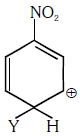
B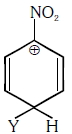
C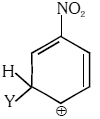
D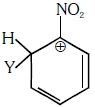
Solution
(C) The $-NO_2$ group is a strong electron-withdrawing group ($-I$ and $-M$ effects).
In electrophilic aromatic substitution,the stability of the intermediate carbocation (arenium ion) determines the orientation.
When the positive charge is at the ortho or para positions,it comes into direct conjugation with the $-NO_2$ group,leading to significant destabilization due to the electron-withdrawing effect.
When the positive charge is at the meta position,it is not in direct conjugation with the $-NO_2$ group,making it relatively more stable than the ortho and para intermediates.
Therefore,the meta-substituted carbocation is the most stable among the options.
In electrophilic aromatic substitution,the stability of the intermediate carbocation (arenium ion) determines the orientation.
When the positive charge is at the ortho or para positions,it comes into direct conjugation with the $-NO_2$ group,leading to significant destabilization due to the electron-withdrawing effect.
When the positive charge is at the meta position,it is not in direct conjugation with the $-NO_2$ group,making it relatively more stable than the ortho and para intermediates.
Therefore,the meta-substituted carbocation is the most stable among the options.
0 likesView Solution
28
ChemistryEasyMCQNEET · 2018
Which of the following molecules represents the order of hybridisation $sp^2, sp^2, sp, sp$ from left to right for the carbon atoms?
A
$HC \equiv C-C \equiv CH$
B
$CH_{2}=CH-C \equiv CH$
C
$CH_{2}=CH-CH=CH_{2}$
D
$CH_{3}-CH=CH-CH_{3}$
Solution
(B) The correct molecule is $CH_{2}=CH-C \equiv CH$.
$1$. The first carbon $(CH_{2}=)$ is bonded to two hydrogens and one carbon via a double bond,so it has $3$ sigma bonds and $0$ lone pairs,resulting in $sp^2$ hybridisation.
$2$. The second carbon $(-CH-)$ is bonded to one hydrogen,one carbon via a double bond,and one carbon via a single bond,resulting in $sp^2$ hybridisation.
$3$. The third carbon $(-C \equiv)$ is bonded to one carbon via a single bond and one carbon via a triple bond,resulting in $sp$ hybridisation.
$4$. The fourth carbon $(\equiv CH)$ is bonded to one carbon via a triple bond and one hydrogen,resulting in $sp$ hybridisation.
Thus,the order is $sp^2, sp^2, sp, sp$.
$1$. The first carbon $(CH_{2}=)$ is bonded to two hydrogens and one carbon via a double bond,so it has $3$ sigma bonds and $0$ lone pairs,resulting in $sp^2$ hybridisation.
$2$. The second carbon $(-CH-)$ is bonded to one hydrogen,one carbon via a double bond,and one carbon via a single bond,resulting in $sp^2$ hybridisation.
$3$. The third carbon $(-C \equiv)$ is bonded to one carbon via a single bond and one carbon via a triple bond,resulting in $sp$ hybridisation.
$4$. The fourth carbon $(\equiv CH)$ is bonded to one carbon via a triple bond and one hydrogen,resulting in $sp$ hybridisation.
Thus,the order is $sp^2, sp^2, sp, sp$.
0 likesView Solution
29
ChemistryMCQNEET · 2018
Which of the following characteristics represent 'Inheritance of blood groups' in humans?
$a.$ Dominance
$b.$ Co-dominance
$c.$ Multiple allele
$d.$ Incomplete dominance
$e.$ Polygenic inheritance
$a.$ Dominance
$b.$ Co-dominance
$c.$ Multiple allele
$d.$ Incomplete dominance
$e.$ Polygenic inheritance
A
$b, c$ and $e$
B
$a, b$ and $c$
C
$b, d$ and $e$
D
$a, c$ and $e$
Solution
(B) The inheritance of $ABO$ blood groups in humans is governed by the gene $I$.
$1$. Dominance: The alleles $I^A$ and $I^B$ are dominant over $i$,as $I^A$ and $I^B$ produce sugars,while $i$ does not produce any sugar.
$2$. Co-dominance: When both $I^A$ and $I^B$ are present together,they both express their own types of sugars,resulting in blood group $AB$. This is an example of co-dominance.
$3$. Multiple Alleles: Since there are three alleles $(I^A, I^B, i)$ for a single gene locus,this is an example of multiple allelism.
Therefore,$a, b,$ and $c$ are the correct characteristics.
$1$. Dominance: The alleles $I^A$ and $I^B$ are dominant over $i$,as $I^A$ and $I^B$ produce sugars,while $i$ does not produce any sugar.
$2$. Co-dominance: When both $I^A$ and $I^B$ are present together,they both express their own types of sugars,resulting in blood group $AB$. This is an example of co-dominance.
$3$. Multiple Alleles: Since there are three alleles $(I^A, I^B, i)$ for a single gene locus,this is an example of multiple allelism.
Therefore,$a, b,$ and $c$ are the correct characteristics.
0 likesView Solution
30
ChemistryMCQNEET · 2018
Which of the following structures or regions is incorrectly paired with its function?
A
Medulla oblongata $\rightarrow$ Controls respiration and cardiovascular reflexes.
B
Limbic system $\rightarrow$ Consists of fibre tracts that interconnect different regions of brain; controls movement.
C
Hypothalamus $\rightarrow$ Production of releasing hormones and regulation of temperature,hunger and thirst.
D
Corpus callosum $\rightarrow$ Band of fibers connecting left and right cerebral hemispheres.
Solution
(B) The $Limbic$ $system$ (or $Limbic$ $lobe$) along with the $Hypothalamus$ is involved in the regulation of sexual behavior,expression of emotional reactions (e.g.,excitement,pleasure,rage,and fear),and motivation. It does not control voluntary movement; that function is primarily associated with the $Cerebellum$ and the $Motor$ $cortex$ of the $Cerebrum$. Therefore,the pairing in option $B$ is incorrect. The $Medulla$ $oblongata$ contains centers that control respiration,cardiovascular reflexes,and gastric secretions. The $Hypothalamus$ contains a number of centers which control body temperature,urge for eating and drinking,and produces releasing hormones. The $Corpus$ $callosum$ is a tract of nerve fibers that connects the left and right cerebral hemispheres.
0 likesView Solution
31
ChemistryAdvancedMCQNEET · 2018
Nitration of aniline in a strong acidic medium also gives $m$-nitroaniline because
A
In spite of substituents,the nitro group always goes to only the $m$-position.
B
In electrophilic substitution reactions,the amino group is meta-directive.
C
In the absence of substituents,the nitro group always goes to the $m$-position.
D
In an acidic (strong) medium,aniline is present as an anilinium ion.
Solution
(D) In a strong acidic medium,the lone pair of electrons on the nitrogen atom of aniline is protonated by the acid to form the anilinium ion $(C_6H_5NH_3^+)$.
The $-NH_3^+$ group is strongly electron-withdrawing due to its positive charge and exerts a strong $-I$ effect.
This deactivates the benzene ring and makes it meta-directing for electrophilic substitution reactions.
Therefore,the nitration of aniline in a strong acidic medium yields a significant amount of $m$-nitroaniline.
The $-NH_3^+$ group is strongly electron-withdrawing due to its positive charge and exerts a strong $-I$ effect.
This deactivates the benzene ring and makes it meta-directing for electrophilic substitution reactions.
Therefore,the nitration of aniline in a strong acidic medium yields a significant amount of $m$-nitroaniline.
0 likesView Solution
32
ChemistryDifficultMCQNEET · 2018
The difference between amylose and amylopectin is
A
Amylopectin has $1 \rightarrow 4$ $\alpha$-linkage and $1 \rightarrow 6$ $\alpha$-linkage
B
Amylose has $1 \rightarrow 4$ $\alpha$-linkage and $1 \rightarrow 6$ $\beta$-linkage
C
Amylopectin has $1 \rightarrow 4$ $\alpha$-linkage and $1 \rightarrow 6$ $\beta$-linkage
D
Amylose is made up of glucose and galactose
Solution
(A) Amylose is a long unbranched chain of $\alpha-D$-glucose units held by $C_1-C_4$ glycosidic linkages.
Amylopectin is a branched-chain polymer of $\alpha-D$-glucose units in which the main chain is formed by $C_1-C_4$ glycosidic linkages,while branching occurs by $C_1-C_6$ glycosidic linkages.
Therefore,the correct statement is that amylopectin has both $1 \rightarrow 4$ $\alpha$-linkage and $1 \rightarrow 6$ $\alpha$-linkage.
Amylopectin is a branched-chain polymer of $\alpha-D$-glucose units in which the main chain is formed by $C_1-C_4$ glycosidic linkages,while branching occurs by $C_1-C_6$ glycosidic linkages.
Therefore,the correct statement is that amylopectin has both $1 \rightarrow 4$ $\alpha$-linkage and $1 \rightarrow 6$ $\alpha$-linkage.
0 likesView Solution
33
ChemistryMediumMCQNEET · 2018
Regarding cross-linked or network polymers,which of the following statements is incorrect?
A
They contain covalent bonds between various linear polymer chains.
B
They are formed from bi- and tri-functional monomers.
C
Examples are bakelite and melamine.
D
They contain strong covalent bonds in their polymer chains.
Solution
(D) Cross-linked or network polymers are formed from bi-functional and tri-functional monomers.
They contain strong covalent bonds between various linear polymer chains.
Examples include $Bakelite$ and $Melamine$.
Since all statements $A$,$B$,$C$,and $D$ are technically correct descriptions of cross-linked polymers,there is no incorrect statement provided in the options. However,in the context of standard chemistry curriculum,all these statements are considered true properties of network polymers.
They contain strong covalent bonds between various linear polymer chains.
Examples include $Bakelite$ and $Melamine$.
Since all statements $A$,$B$,$C$,and $D$ are technically correct descriptions of cross-linked polymers,there is no incorrect statement provided in the options. However,in the context of standard chemistry curriculum,all these statements are considered true properties of network polymers.
0 likesView Solution
34
ChemistryAdvancedMCQNEET · 2018
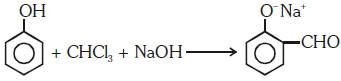
In the reaction shown,the electrophile involved is:
A
dichloromethyl cation $(\stackrel{\oplus}{C}HCl_2)$
B
formyl cation $(\stackrel{\oplus}{C}HO)$
C
dichloromethyl anion $(\stackrel{\ominus}{C}HCl_2)$
D
dichlorocarbene $(:CCl_2)$
Solution
(D) The given reaction is the Reimer-Tiemann reaction,where phenol reacts with chloroform $(CHCl_3)$ in the presence of aqueous sodium hydroxide $(NaOH)$ to form salicylaldehyde.
In this reaction,the electrophile is generated from chloroform.
First,$CHCl_3$ reacts with $OH^-$ to form the trichloromethyl anion $(\stackrel{\ominus}{C}Cl_3)$.
This anion then undergoes $\alpha$-elimination by losing a chloride ion $(Cl^-)$ to form dichlorocarbene $(:CCl_2)$.
Dichlorocarbene is an electron-deficient species with a sextet of electrons,making it a strong electrophile.
In this reaction,the electrophile is generated from chloroform.
First,$CHCl_3$ reacts with $OH^-$ to form the trichloromethyl anion $(\stackrel{\ominus}{C}Cl_3)$.
This anion then undergoes $\alpha$-elimination by losing a chloride ion $(Cl^-)$ to form dichlorocarbene $(:CCl_2)$.
Dichlorocarbene is an electron-deficient species with a sextet of electrons,making it a strong electrophile.
0 likesView Solution
35
ChemistryMediumMCQNEET · 2018
Carboxylic acids have higher boiling points than aldehydes,ketones,and even alcohols of comparable molecular mass. This is due to their:
A
formation of intramolecular $H$-bonding
B
formation of carboxylate ion
C
more extensive association of carboxylic acid via van der Waals forces of attraction
D
formation of intermolecular $H$-bonding
Solution
(D) Carboxylic acids have higher boiling points than aldehydes,ketones,and even alcohols of comparable molecular mass.
This is due to the more extensive association of carboxylic acid molecules through intermolecular $H$-bonding,which often results in the formation of stable dimers in the vapor phase or non-polar solvents.
This is due to the more extensive association of carboxylic acid molecules through intermolecular $H$-bonding,which often results in the formation of stable dimers in the vapor phase or non-polar solvents.
0 likesView Solution
36
ChemistryAdvancedMCQNEET · 2018
Compound $A, C_{8}H_{10}O,$ is found to react with $NaOI$ (produced by reacting $Y$ with $NaOH$) and yields a yellow precipitate with a characteristic smell. $A$ and $Y$ are respectively:
A
$p-Methylbenzyl alcohol$ and $I_2$
B
$Phenylethanol$ and $I_2$
C
$1-Phenylethanol$ and $I_2$
D
$2,4-Dimethylphenol$ and $I_2$
Solution
(C) The haloform reaction is given by compounds containing the $CH_3-CO-$ group or the $CH_3-CH(OH)-$ group.
Compound $A$ with molecular formula $C_8H_{10}O$ that contains the $CH_3-CH(OH)-$ group is $1-phenylethanol$ $(C_6H_5-CH(OH)-CH_3)$.
$NaOI$ is prepared by the reaction of $I_2$ with $NaOH$.
Therefore,$A$ is $1-phenylethanol$ and $Y$ is $I_2$.
Compound $A$ with molecular formula $C_8H_{10}O$ that contains the $CH_3-CH(OH)-$ group is $1-phenylethanol$ $(C_6H_5-CH(OH)-CH_3)$.
$NaOI$ is prepared by the reaction of $I_2$ with $NaOH$.
Therefore,$A$ is $1-phenylethanol$ and $Y$ is $I_2$.
0 likesView Solution
37
ChemistryAdvancedMCQNEET · 2018
The correct difference between $1^{st}$-order and $2^{nd}$-order reaction is that:
A
the rate of a $1^{st}$-order reaction does not depend on reactant concentration; the rate of a $2^{nd}$-order reaction does depend on reactant concentrations
B
the half-life of a $1^{st}$-order reaction does not depend on $[A]_0$; the half-life of a $2^{nd}$-order reaction does depend on $[A]_0$
C
$1^{st}$-order reaction can be catalyzed; a $2^{nd}$-order reaction cannot be catalyzed.
D
the rate of a $1^{st}$-order reaction does depend on reactant concentrations; the rate of a $2^{nd}$-order reaction does not depend on reactant concentrations
Solution
(B) For a $1^{st}$-order reaction,the half-life is given by $t_{1/2} = \frac{0.693}{k}$,which is independent of the initial concentration $[A]_0$.
For a $2^{nd}$-order reaction,the half-life is given by $t_{1/2} = \frac{1}{k[A]_0}$,which is inversely proportional to the initial concentration $[A]_0$.
For a $2^{nd}$-order reaction,the half-life is given by $t_{1/2} = \frac{1}{k[A]_0}$,which is inversely proportional to the initial concentration $[A]_0$.
0 likesView Solution
38
ChemistryAdvancedMCQNEET · 2018
Consider the change in oxidation state of Bromine corresponding to different $emf$ values as shown in the diagram below:
$BrO_4^{-}$ $\xrightarrow{1.82 \ V} BrO_3^{-}$ $\xrightarrow{1.5 \ V} HBrO$ $\xrightarrow{1.0652 \ V} Br_2$ $\xrightarrow{1.595 \ V} Br^{-}$
Then the species undergoing disproportionation is:
$BrO_4^{-}$ $\xrightarrow{1.82 \ V} BrO_3^{-}$ $\xrightarrow{1.5 \ V} HBrO$ $\xrightarrow{1.0652 \ V} Br_2$ $\xrightarrow{1.595 \ V} Br^{-}$
Then the species undergoing disproportionation is:
A
$BrO_3^{-}$
B
$BrO_4^{-}$
C
$Br_2$
D
$HBrO$
Solution
(D) species undergoes disproportionation if its standard reduction potential $(SRP)$ to a lower oxidation state is greater than its $SRP$ to a higher oxidation state.
For $HBrO$:
$HBrO + H^{+} + e^{-} \rightarrow \frac{1}{2} Br_2 + H_2O$ $(E^{\circ} = 1.595 \ V)$
$HBrO + 2H_2O \rightarrow BrO_3^{-} + 5H^{+} + 4e^{-}$ $(E^{\circ} = -1.5 \ V)$
Adding these,the overall reaction is:
$2HBrO \rightarrow Br_2 + BrO_3^{-} + H_2O$
$E^{\circ}_{cell} = E^{\circ}_{cathode} - E^{\circ}_{anode} = 1.595 \ V - 1.5 \ V = 0.095 \ V$
Since $E^{\circ}_{cell} > 0$,the reaction is spontaneous,and $HBrO$ undergoes disproportionation.
For $HBrO$:
$HBrO + H^{+} + e^{-} \rightarrow \frac{1}{2} Br_2 + H_2O$ $(E^{\circ} = 1.595 \ V)$
$HBrO + 2H_2O \rightarrow BrO_3^{-} + 5H^{+} + 4e^{-}$ $(E^{\circ} = -1.5 \ V)$
Adding these,the overall reaction is:
$2HBrO \rightarrow Br_2 + BrO_3^{-} + H_2O$
$E^{\circ}_{cell} = E^{\circ}_{cathode} - E^{\circ}_{anode} = 1.595 \ V - 1.5 \ V = 0.095 \ V$
Since $E^{\circ}_{cell} > 0$,the reaction is spontaneous,and $HBrO$ undergoes disproportionation.
0 likesView Solution
39
ChemistryDifficultMCQNEET · 2018
Iron exhibits $bcc$ structure at room temperature. Above $900^{\circ}C$,it transforms to $fcc$ structure. The ratio of density of iron at room temperature to that at $900^{\circ}C$ (assuming molar mass and atomic radii of iron remains constant with temperature) is
A
$\frac{\sqrt{3}}{\sqrt{2}}$
B
$\frac{4 \sqrt{3}}{3 \sqrt{2}}$
C
$\frac{3 \sqrt{3}}{4 \sqrt{2}}$
D
$\frac{1}{2}$
Solution
(C) For $bcc$ structure,the number of atoms per unit cell $Z_{bcc} = 2$ and the relation between edge length $a$ and atomic radius $r$ is $4r = \sqrt{3}a$,so $a_{bcc} = \frac{4r}{\sqrt{3}}$.
For $fcc$ structure,the number of atoms per unit cell $Z_{fcc} = 4$ and the relation between edge length $a$ and atomic radius $r$ is $4r = \sqrt{2}a$,so $a_{fcc} = \frac{4r}{\sqrt{2}}$.
The density $d$ is given by $d = \frac{Z \times M}{N_A \times a^3}$.
Taking the ratio: $\frac{d_{bcc}}{d_{fcc}} = \frac{Z_{bcc}}{Z_{fcc}} \times (\frac{a_{fcc}}{a_{bcc}})^3$.
Substituting the values: $\frac{d_{bcc}}{d_{fcc}} = \frac{2}{4} \times (\frac{4r/\sqrt{2}}{4r/\sqrt{3}})^3 = \frac{1}{2} \times (\frac{\sqrt{3}}{\sqrt{2}})^3 = \frac{1}{2} \times \frac{3\sqrt{3}}{2\sqrt{2}} = \frac{3\sqrt{3}}{4\sqrt{2}}$.
For $fcc$ structure,the number of atoms per unit cell $Z_{fcc} = 4$ and the relation between edge length $a$ and atomic radius $r$ is $4r = \sqrt{2}a$,so $a_{fcc} = \frac{4r}{\sqrt{2}}$.
The density $d$ is given by $d = \frac{Z \times M}{N_A \times a^3}$.
Taking the ratio: $\frac{d_{bcc}}{d_{fcc}} = \frac{Z_{bcc}}{Z_{fcc}} \times (\frac{a_{fcc}}{a_{bcc}})^3$.
Substituting the values: $\frac{d_{bcc}}{d_{fcc}} = \frac{2}{4} \times (\frac{4r/\sqrt{2}}{4r/\sqrt{3}})^3 = \frac{1}{2} \times (\frac{\sqrt{3}}{\sqrt{2}})^3 = \frac{1}{2} \times \frac{3\sqrt{3}}{2\sqrt{2}} = \frac{3\sqrt{3}}{4\sqrt{2}}$.
0 likesView Solution
40
ChemistryEasyMCQNEET · 2018
Which of the following statements is not true for halogens?
A
All form monobasic oxyacids.
B
All are oxidizing agents.
C
$Chlorine$ has the highest electron-gain enthalpy.
D
All but $fluorine$ show positive oxidation states.
Solution
(A) The statement '$All$ form monobasic oxyacids' is incorrect because $fluorine$ does not form a series of oxyacids like other halogens due to its high electronegativity and small size. It only forms $HOF$ ($Fluoric(I)$ acid).
All halogens act as oxidizing agents.
$Chlorine$ has the highest electron-gain enthalpy among all halogens.
Except for $fluorine$,all halogens show positive oxidation states $(+1, +3, +5, +7)$ in their oxyacids.
All halogens act as oxidizing agents.
$Chlorine$ has the highest electron-gain enthalpy among all halogens.
Except for $fluorine$,all halogens show positive oxidation states $(+1, +3, +5, +7)$ in their oxyacids.
0 likesView Solution
41
ChemistryMediumMCQNEET · 2018
Considering the Ellingham diagram,which of the following metals can be used to reduce alumina $(Al_2O_3)$?
A
$Fe$
B
$Zn$
C
$Mg$
D
$Cu$
Solution
(C) According to the Ellingham diagram,a metal can reduce the oxide of another metal if its own oxide formation curve lies below the curve of the metal oxide being reduced.
This is because the metal with the curve lower in the diagram has a more negative Gibbs free energy of formation $(-\Delta G)$ for its oxide.
Magnesium $(Mg)$ forms $MgO$,and its formation curve lies below the formation curve of alumina $(Al_2O_3)$ at temperatures below $1623 \ K$.
Therefore,$Mg$ can reduce $Al_2O_3$ to $Al$.
This is because the metal with the curve lower in the diagram has a more negative Gibbs free energy of formation $(-\Delta G)$ for its oxide.
Magnesium $(Mg)$ forms $MgO$,and its formation curve lies below the formation curve of alumina $(Al_2O_3)$ at temperatures below $1623 \ K$.
Therefore,$Mg$ can reduce $Al_2O_3$ to $Al$.
0 likesView Solution
42
ChemistryMediumMCQNEET · 2018
On which of the following properties does coagulating power of an ion depend?
A
The magnitude of the charge on the ion alone
B
Size of the ion alone
C
Both magnitude and sign of the charge on the ion
D
The sign of charge on the ion alone
Solution
(C) According to the $Hardy-Schulze$ rule,the coagulating power of an ion depends on both the magnitude and the sign of the charge on the ion.
Greater the magnitude of the charge on the ion,the higher is its coagulating power for a given colloidal solution.
Greater the magnitude of the charge on the ion,the higher is its coagulating power for a given colloidal solution.
0 likesView Solution
43
ChemistryMediumMCQNEET · 2018
The compound $A$ on treatment with $Na$ gives $B$,and with $PCl_{5}$ gives $C$. $B$ and $C$ react together to give diethyl ether. $A, B$ and $C$ are in the order
A
$C_{2}H_{5}OH, C_{2}H_{6}, C_{2}H_{5}Cl$
B
$C_{2}H_{5}OH, C_{2}H_{5}Cl, C_{2}H_{5}ONa$
C
$C_{2}H_{5}Cl, C_{2}H_{6}, C_{2}H_{5}OH$
D
$C_{2}H_{5}OH, C_{2}H_{5}ONa, C_{2}H_{5}Cl$
Solution
(D) The reaction sequence is as follows:
$1$. Compound $A$ is ethanol $(C_{2}H_{5}OH)$.
$2$. When $A$ $(C_{2}H_{5}OH)$ reacts with $Na$,it forms sodium ethoxide $(B = C_{2}H_{5}ONa)$.
$3$. When $A$ $(C_{2}H_{5}OH)$ reacts with $PCl_{5}$,it forms ethyl chloride $(C = C_{2}H_{5}Cl)$.
$4$. $B$ $(C_{2}H_{5}ONa)$ and $C$ $(C_{2}H_{5}Cl)$ react via Williamson's synthesis to produce diethyl ether $(C_{2}H_{5}-O-C_{2}H_{5})$.
Therefore,the correct order is $A = C_{2}H_{5}OH, B = C_{2}H_{5}ONa, C = C_{2}H_{5}Cl$.
$1$. Compound $A$ is ethanol $(C_{2}H_{5}OH)$.
$2$. When $A$ $(C_{2}H_{5}OH)$ reacts with $Na$,it forms sodium ethoxide $(B = C_{2}H_{5}ONa)$.
$3$. When $A$ $(C_{2}H_{5}OH)$ reacts with $PCl_{5}$,it forms ethyl chloride $(C = C_{2}H_{5}Cl)$.
$4$. $B$ $(C_{2}H_{5}ONa)$ and $C$ $(C_{2}H_{5}Cl)$ react via Williamson's synthesis to produce diethyl ether $(C_{2}H_{5}-O-C_{2}H_{5})$.
Therefore,the correct order is $A = C_{2}H_{5}OH, B = C_{2}H_{5}ONa, C = C_{2}H_{5}Cl$.
0 likesView Solution
44
ChemistryAdvancedMCQNEET · 2018
The compound $C_{7}H_{8}$ undergoes the following reactions:
$C_{7}H_{8}$ $\xrightarrow{3Cl_{2} / \Delta} A$ $\xrightarrow{Br_{2} / Fe} B$ $\xrightarrow{Zn / HCl} C$
The product '$C$' is
$C_{7}H_{8}$ $\xrightarrow{3Cl_{2} / \Delta} A$ $\xrightarrow{Br_{2} / Fe} B$ $\xrightarrow{Zn / HCl} C$
The product '$C$' is
A
$m-$bromotoluene
B
$o-$bromotoluene
C
$3-$bromo$-2,4,6-$trichlorotoluene
D
$p-$bromotoluene
Solution
(A) Step $1$: Toluene $(C_{7}H_{8})$ reacts with $3Cl_{2}$ in the presence of heat to undergo side-chain chlorination,forming benzotrichloride $(C_{6}H_{5}CCl_{3})$ as product '$A$'.
Step $2$: The $-CCl_{3}$ group is strongly electron-withdrawing and meta-directing. Therefore,electrophilic substitution with $Br_{2}/Fe$ occurs at the meta position,forming $m-$bromobenzotrichloride as product '$B$'.
Step $3$: Reduction of the $-CCl_{3}$ group with $Zn/HCl$ converts it back into a methyl group $(-CH_{3})$,yielding $m-$bromotoluene as the final product '$C$'.
Thus,the correct option is $A$.
Step $2$: The $-CCl_{3}$ group is strongly electron-withdrawing and meta-directing. Therefore,electrophilic substitution with $Br_{2}/Fe$ occurs at the meta position,forming $m-$bromobenzotrichloride as product '$B$'.
Step $3$: Reduction of the $-CCl_{3}$ group with $Zn/HCl$ converts it back into a methyl group $(-CH_{3})$,yielding $m-$bromotoluene as the final product '$C$'.
Thus,the correct option is $A$.
0 likesView Solution
45
ChemistryDifficultMCQNEET · 2018
When the initial concentration of the reactant is doubled,the half-life period of a zero order reaction:
A
is halved
B
is doubled
C
is tripled
D
remains unchanged
Solution
(B) For a zero order reaction,the half-life period $(t_{1/2})$ is given by the formula: $t_{1/2} = \frac{[A]_0}{2k}$.
Here,$[A]_0$ is the initial concentration of the reactant and $k$ is the rate constant.
Since $t_{1/2} \propto [A]_0$,if the initial concentration $[A]_0$ is doubled,the half-life period $t_{1/2}$ will also be doubled.
Here,$[A]_0$ is the initial concentration of the reactant and $k$ is the rate constant.
Since $t_{1/2} \propto [A]_0$,if the initial concentration $[A]_0$ is doubled,the half-life period $t_{1/2}$ will also be doubled.
0 likesView Solution
46
ChemistryDifficultMCQNEET · 2018
Identify the major products $P$,$Q$,and $R$ in the following sequence of reaction:
$\text{Benzene} + CH_3CH_2CH_2Cl$ $\xrightarrow{\text{Anhydrous } AlCl_3} P$ $\xrightarrow[(ii) H_3O^+/\Delta]{(i) O_2} Q + R$
$\text{Benzene} + CH_3CH_2CH_2Cl$ $\xrightarrow{\text{Anhydrous } AlCl_3} P$ $\xrightarrow[(ii) H_3O^+/\Delta]{(i) O_2} Q + R$
A
$\text{Propylbenzene, Benzaldehyde, Ethanol}$
B
$\text{Propylbenzene, Benzaldehyde, Benzoic acid}$
C
$\text{Cumene, Phenol, Propan-2-ol}$
D
$\text{Cumene, Phenol, Acetone}$
Solution
(D) $1$. The reaction of benzene with $n$-propyl chloride in the presence of anhydrous $AlCl_3$ is a Friedel-Crafts alkylation. The primary carbocation formed $(CH_3CH_2CH_2^+)$ undergoes a $1,2$-hydride shift to form a more stable secondary carbocation $(CH_3CH^+CH_3)$.
$2$. This secondary carbocation attacks the benzene ring to form isopropylbenzene,also known as cumene $(P)$.
$3$. Cumene $(P)$ undergoes oxidation with $O_2$ to form cumene hydroperoxide,which upon treatment with dilute acid $(H_3O^+/\Delta)$ undergoes rearrangement to yield phenol $(Q)$ and acetone $(R)$.
$2$. This secondary carbocation attacks the benzene ring to form isopropylbenzene,also known as cumene $(P)$.
$3$. Cumene $(P)$ undergoes oxidation with $O_2$ to form cumene hydroperoxide,which upon treatment with dilute acid $(H_3O^+/\Delta)$ undergoes rearrangement to yield phenol $(Q)$ and acetone $(R)$.
0 likesView Solution
47
ChemistryMediumMCQNEET · 2018
The type of isomerism shown by the complex $[CoCl_2(en)_2]$ is
A
Geometrical isomerism
B
Coordination isomerism
C
Ionization isomerism
D
Linkage isomerism
Solution
(A) The complex $[CoCl_2(en)_2]$ contains two identical ligands $(Cl^-)$ and two bidentate ligands $(en)$.
It exists in two forms: $cis$ and $trans$.
In the $trans$ form,the two $Cl$ atoms are at $180^{\circ}$ to each other.
In the $cis$ form,the two $Cl$ atoms are at $90^{\circ}$ to each other.
Since the arrangement of ligands around the central metal atom differs,this is an example of geometrical isomerism.
It exists in two forms: $cis$ and $trans$.
In the $trans$ form,the two $Cl$ atoms are at $180^{\circ}$ to each other.
In the $cis$ form,the two $Cl$ atoms are at $90^{\circ}$ to each other.
Since the arrangement of ligands around the central metal atom differs,this is an example of geometrical isomerism.
0 likesView Solution
48
ChemistryAdvancedMCQNEET · 2018
Which one of the following ions exhibits $d-d$ transition and paramagnetism as well?
A
$CrO_4^{2-}$
B
$Cr_2O_7^{2-}$
C
$MnO_4^{-}$
D
$MnO_4^{2-}$
Solution
(D) To exhibit $d-d$ transition and paramagnetism,the ion must have at least one unpaired electron in its $d$-orbitals.
$A$. $CrO_4^{2-}$: $Cr$ is in $+6$ oxidation state $(3d^0)$. It is diamagnetic and shows no $d-d$ transition.
$B$. $Cr_2O_7^{2-}$: $Cr$ is in $+6$ oxidation state $(3d^0)$. It is diamagnetic and shows no $d-d$ transition.
$C$. $MnO_4^{-}$: $Mn$ is in $+7$ oxidation state $(3d^0)$. It is diamagnetic and shows no $d-d$ transition.
$D$. $MnO_4^{2-}$: $Mn$ is in $+6$ oxidation state $(3d^1)$. It has one unpaired electron,making it paramagnetic,and it exhibits $d-d$ transition.
$A$. $CrO_4^{2-}$: $Cr$ is in $+6$ oxidation state $(3d^0)$. It is diamagnetic and shows no $d-d$ transition.
$B$. $Cr_2O_7^{2-}$: $Cr$ is in $+6$ oxidation state $(3d^0)$. It is diamagnetic and shows no $d-d$ transition.
$C$. $MnO_4^{-}$: $Mn$ is in $+7$ oxidation state $(3d^0)$. It is diamagnetic and shows no $d-d$ transition.
$D$. $MnO_4^{2-}$: $Mn$ is in $+6$ oxidation state $(3d^1)$. It has one unpaired electron,making it paramagnetic,and it exhibits $d-d$ transition.
0 likesView Solution
49
ChemistryMediumMCQNEET · 2018
The geometry and magnetic behaviour of the complex $[Ni(CO)_4]$ are
A
square planar geometry and diamagnetic
B
tetrahedral geometry and diamagnetic
C
square planar geometry and paramagnetic
D
tetrahedral geometry and paramagnetic
Solution
(B) The atomic number of $Ni$ is $28$. The electronic configuration of $Ni$ is $[Ar] 3d^8 4s^2$.
In the complex $[Ni(CO)_4]$,the oxidation state of $Ni$ is $0$.
$CO$ is a strong field ligand $(SFL)$,which causes the pairing of electrons in the $3d$ orbital.
The $4s$ electrons are promoted to the $3d$ orbital,and the $4s$ and $4p$ orbitals undergo $sp^3$ hybridisation.
Since all electrons are paired,the complex is diamagnetic.
The $sp^3$ hybridisation results in a tetrahedral geometry.
In the complex $[Ni(CO)_4]$,the oxidation state of $Ni$ is $0$.
$CO$ is a strong field ligand $(SFL)$,which causes the pairing of electrons in the $3d$ orbital.
The $4s$ electrons are promoted to the $3d$ orbital,and the $4s$ and $4p$ orbitals undergo $sp^3$ hybridisation.
Since all electrons are paired,the complex is diamagnetic.
The $sp^3$ hybridisation results in a tetrahedral geometry.
0 likesView Solution
50
ChemistryMediumMCQNEET · 2018
Iron carbonyl,$Fe(CO)_5$ is
A
tetranuclear
B
mononuclear
C
trinuclear
D
dinuclear
Solution
(B) The chemical formula of iron carbonyl is $Fe(CO)_5$.
In this complex,there is only one central metal atom $(Fe)$ present.
$A$ complex containing only one central metal atom is classified as mononuclear.
Therefore,$Fe(CO)_5$ is mononuclear.
In this complex,there is only one central metal atom $(Fe)$ present.
$A$ complex containing only one central metal atom is classified as mononuclear.
Therefore,$Fe(CO)_5$ is mononuclear.
0 likesView Solution
51
ChemistryMediumMCQNEET · 2018
Match the metal ions given in Column-$I$ with the spin magnetic moments of the ions given in Column-$II$ and assign the correct code.
$(a) \quad (b) \quad (c) \quad (d)$
| Column-$I$ | Column-$II$ |
| $(a) \ Co^{3+}$ | $(i) \ \sqrt{8} \ B.M.$ |
| $(b) \ Cr^{3+}$ | $(ii) \ \sqrt{35} \ B.M.$ |
| $(c) \ Fe^{3+}$ | $(iii) \ \sqrt{3} \ B.M.$ |
| $(d) \ Ni^{2+}$ | $(iv) \ \sqrt{24} \ B.M.$ |
| $(v) \ \sqrt{15} \ B.M.$ |
$(a) \quad (b) \quad (c) \quad (d)$
A
$(iv) \quad (v) \quad (ii) \quad (i)$
B
$(i) \quad (ii) \quad (iii) \quad (iv)$
C
$(iv) \quad (i) \quad (ii) \quad (iii)$
D
$(iii) \quad (v) \quad (i) \quad (ii)$
Solution
(A) The spin-only magnetic moment $(\mu)$ is calculated using the formula $\mu = \sqrt{n(n+2)} \ B.M.$,where $n$ is the number of unpaired electrons.
$1. \ Co^{3+} (3d^6)$: $n = 4$,so $\mu = \sqrt{4(4+2)} = \sqrt{24} \ B.M.$ (Matches $iv$)
$2. \ Cr^{3+} (3d^3)$: $n = 3$,so $\mu = \sqrt{3(3+2)} = \sqrt{15} \ B.M.$ (Matches $v$)
$3. \ Fe^{3+} (3d^5)$: $n = 5$,so $\mu = \sqrt{5(5+2)} = \sqrt{35} \ B.M.$ (Matches $ii$)
$4. \ Ni^{2+} (3d^8)$: $n = 2$,so $\mu = \sqrt{2(2+2)} = \sqrt{8} \ B.M.$ (Matches $i$)
Therefore,the correct sequence is $(a)-(iv), (b)-(v), (c)-(ii), (d)-(i)$.
$1. \ Co^{3+} (3d^6)$: $n = 4$,so $\mu = \sqrt{4(4+2)} = \sqrt{24} \ B.M.$ (Matches $iv$)
$2. \ Cr^{3+} (3d^3)$: $n = 3$,so $\mu = \sqrt{3(3+2)} = \sqrt{15} \ B.M.$ (Matches $v$)
$3. \ Fe^{3+} (3d^5)$: $n = 5$,so $\mu = \sqrt{5(5+2)} = \sqrt{35} \ B.M.$ (Matches $ii$)
$4. \ Ni^{2+} (3d^8)$: $n = 2$,so $\mu = \sqrt{2(2+2)} = \sqrt{8} \ B.M.$ (Matches $i$)
Therefore,the correct sequence is $(a)-(iv), (b)-(v), (c)-(ii), (d)-(i)$.
0 likesView Solution
Vedclass Products
For Students
Vedclass Test Series
Mock tests in real NEET style covering Chemistry with performance analysis. 5-day free trial.
Start Free TrialFor Teachers
Exam Paper Generator
Generate Set A/B/C/D Chemistry papers from 7.5L+ questions in 2 minutes. 3 chapters free.
Try FreeFor Institutes
Online Exam Module
Run live NEET mock exams with unlimited students, 360° analytics & white-label branding.
See DemoFrequently Asked Questions
How many Chemistry questions are in NEET 2018?
There are 51 Chemistry questions from the NEET 2018 paper on Vedclass, each with a detailed step-by-step solution in English.
Are NEET 2018 Chemistry solutions available in English?
Yes. All solutions on this page are in English. You can also switch to English or Hindi using the language buttons above the questions.
Can I practice NEET 2018 Chemistry as a timed test?
Yes. Use the Vedclass Test Series to attempt a full NEET mock test covering Chemistry with time limits and instant score analysis.
Can teachers create Chemistry papers from NEET previous year questions?
Yes. The Vedclass Exam Paper Generator lets teachers mix NEET Chemistry questions and generate Set A/B/C/D papers in minutes.
For Teachers & Institutes
Build a Custom Chemistry Paper
Pick NEET 2018 Chemistry questions, set difficulty, and generate Set A/B/C/D in 2 minutes.