
ChemistryQ1–51 of 51 questions
Page 1 of 1 · English
1
ChemistryMediumMCQNEET · 2023
In Lassaigne's extract of an organic compound,both nitrogen and sulphur are present,which gives blood red colour with $Fe^{3+}$ due to the formation of-
A
$[Fe(SCN)]^{2+}$
B
$Fe_4[Fe(CN)_6]_3 \cdot xH_2O$
C
$NaSCN$
D
$[Fe(CN)_5NOS]^{4-}$
Solution
(A) When both nitrogen and sulphur are present in an organic compound,sodium thiocyanate $(NaSCN)$ is formed during the preparation of Lassaigne's extract.
$Na + C + N + S \rightarrow NaSCN$
This $NaSCN$ reacts with $Fe^{3+}$ ions to form a blood-red coloured complex,$[Fe(SCN)]^{2+}$.
$Fe^{3+} + SCN^{-} \rightarrow [Fe(SCN)]^{2+}$
Since all nitrogen is consumed in the formation of $SCN^-$,no free cyanide ions $(CN^-)$ are available to form the prussian blue precipitate.
$Na + C + N + S \rightarrow NaSCN$
This $NaSCN$ reacts with $Fe^{3+}$ ions to form a blood-red coloured complex,$[Fe(SCN)]^{2+}$.
$Fe^{3+} + SCN^{-} \rightarrow [Fe(SCN)]^{2+}$
Since all nitrogen is consumed in the formation of $SCN^-$,no free cyanide ions $(CN^-)$ are available to form the prussian blue precipitate.
0 likesView Solution
2
ChemistryMediumMCQNEET · 2023
The right option for the mass of $CO_2$ produced by heating $20 \ g$ of $20 \%$ pure limestone is $........ \ g$ (Atomic mass of $Ca = 40$) $[CaCO_3 \stackrel{1200 \ K}{\longrightarrow} CaO + CO_2]$
A
$1.32$
B
$1.12$
C
$1.76$
D
$2.64$
Solution
(C) The weight of impure limestone is $20 \ g$.
Since the limestone is $20 \%$ pure,the weight of pure $CaCO_3$ is $\frac{20}{100} \times 20 \ g = 4 \ g$.
The molar mass of $CaCO_3$ is $40 + 12 + (3 \times 16) = 100 \ g/mol$.
The number of moles of $CaCO_3$ is $n = \frac{4 \ g}{100 \ g/mol} = 0.04 \ mol$.
According to the reaction $CaCO_3 \rightarrow CaO + CO_2$,$1 \ mol$ of $CaCO_3$ produces $1 \ mol$ of $CO_2$.
Therefore,$0.04 \ mol$ of $CaCO_3$ produces $0.04 \ mol$ of $CO_2$.
The molar mass of $CO_2$ is $12 + (2 \times 16) = 44 \ g/mol$.
The mass of $CO_2$ produced is $0.04 \ mol \times 44 \ g/mol = 1.76 \ g$.
Since the limestone is $20 \%$ pure,the weight of pure $CaCO_3$ is $\frac{20}{100} \times 20 \ g = 4 \ g$.
The molar mass of $CaCO_3$ is $40 + 12 + (3 \times 16) = 100 \ g/mol$.
The number of moles of $CaCO_3$ is $n = \frac{4 \ g}{100 \ g/mol} = 0.04 \ mol$.
According to the reaction $CaCO_3 \rightarrow CaO + CO_2$,$1 \ mol$ of $CaCO_3$ produces $1 \ mol$ of $CO_2$.
Therefore,$0.04 \ mol$ of $CaCO_3$ produces $0.04 \ mol$ of $CO_2$.
The molar mass of $CO_2$ is $12 + (2 \times 16) = 44 \ g/mol$.
The mass of $CO_2$ produced is $0.04 \ mol \times 44 \ g/mol = 1.76 \ g$.
4 likesView Solution
3
ChemistryMediumMCQNEET · 2023
Match List-$I$ with List-$II$.
Choose the correct answer from the options given below:
| List-$I$ | List-$II$ |
| $A$. Coke | $I$. Carbon atoms are $sp^3$ hybridised |
| $B$. Diamond | $II$. Used as a dry lubricant |
| $C$. Fullerene | $III$. Used as a reducing agent |
| $D$. Graphite | $IV$. Cage like molecules |
Choose the correct answer from the options given below:
A
$A-III, B-IV, C-I, D-II$
B
$A-II, B-IV, C-I, D-III$
C
$A-IV, B-I, C-II, D-III$
D
$A-III, B-I, C-IV, D-II$
Solution
(D) Coke is largely used as a reducing agent in metallurgy.
In diamond,each carbon atom undergoes $sp^3$ hybridisation and is linked to four other carbon atoms by using hybridised orbitals in a tetrahedral fashion.
Buckminsterfullerene contains six-membered and five-membered rings and hence is a cage-like molecule.
Graphite is very soft and slippery. Hence,it is used as a dry lubricant in machines running at high temperature.
In diamond,each carbon atom undergoes $sp^3$ hybridisation and is linked to four other carbon atoms by using hybridised orbitals in a tetrahedral fashion.
Buckminsterfullerene contains six-membered and five-membered rings and hence is a cage-like molecule.
Graphite is very soft and slippery. Hence,it is used as a dry lubricant in machines running at high temperature.
0 likesView Solution
4
ChemistryDifficultMCQNEET · 2023
Which of the following statements are $NOT$ correct?
$A$. Hydrogen is used to reduce heavy metal oxides to metals.
$B$. Heavy water is used to study reaction mechanism.
$C$. Hydrogen is used to make saturated fats from oils.
$D$. The $H-H$ bond dissociation enthalpy is lowest as compared to a single bond between two atoms of any elements.
$E$. Hydrogen reduces oxides of metals that are more active than iron.
Choose the most appropriate answer from the options given below:
$A$. Hydrogen is used to reduce heavy metal oxides to metals.
$B$. Heavy water is used to study reaction mechanism.
$C$. Hydrogen is used to make saturated fats from oils.
$D$. The $H-H$ bond dissociation enthalpy is lowest as compared to a single bond between two atoms of any elements.
$E$. Hydrogen reduces oxides of metals that are more active than iron.
Choose the most appropriate answer from the options given below:
A
$A, B, C$ only
B
$B, C, D, E$ only
C
$B, D$ only
D
$D, E$ only
Solution
(D) Statement $A$ is correct: Hydrogen acts as a reducing agent for heavy metal oxides.
Statement $B$ is correct: Heavy water $(D_2O)$ is used as a tracer to study reaction mechanisms.
Statement $C$ is correct: Hydrogenation of oils produces saturated fats (vanaspati ghee).
Statement $D$ is incorrect: The $H-H$ bond dissociation enthalpy $(435.88 \ kJ \ mol^{-1})$ is actually the highest for a single bond between two atoms of any element.
Statement $E$ is incorrect: Hydrogen can only reduce oxides of metals that are less active than iron (e.g.,$Cu, Pb, Ag$). It cannot reduce oxides of highly active metals like $Na, K, Ca$.
Therefore,statements $D$ and $E$ are incorrect.
Statement $B$ is correct: Heavy water $(D_2O)$ is used as a tracer to study reaction mechanisms.
Statement $C$ is correct: Hydrogenation of oils produces saturated fats (vanaspati ghee).
Statement $D$ is incorrect: The $H-H$ bond dissociation enthalpy $(435.88 \ kJ \ mol^{-1})$ is actually the highest for a single bond between two atoms of any element.
Statement $E$ is incorrect: Hydrogen can only reduce oxides of metals that are less active than iron (e.g.,$Cu, Pb, Ag$). It cannot reduce oxides of highly active metals like $Na, K, Ca$.
Therefore,statements $D$ and $E$ are incorrect.
0 likesView Solution
5
ChemistryDifficultMCQNEET · 2023
Which one of the following statements is correct?
A
$Mg$ plays roles in neuromuscular function and interneuronal transmission
B
The daily requirement of $Mg$ and $Ca$ in the human body is estimated to be $0.2-0.3 \ g$
C
All enzymes that utilise $ATP$ in phosphate transfer require $Ca$ as the cofactor
D
The bone in human body is an inert and unchanging substance
Solution
(B) $1$. All enzymes that utilize $ATP$ in phosphate transfer require $Mg$ as the cofactor.
$2$. Bone in the human body is not an inert and unchanging substance; it is continuously being solubilized and redeposited.
$3$. $Ca$ plays an important role in neuromuscular function,interneuronal transmission,cell membrane integrity,and blood coagulation.
$4$. The daily requirement of $Mg$ and $Ca$ in the human body is estimated to be $200-300 \ mg$ $(0.2-0.3 \ g)$.
Therefore,statement $B$ is correct.
$2$. Bone in the human body is not an inert and unchanging substance; it is continuously being solubilized and redeposited.
$3$. $Ca$ plays an important role in neuromuscular function,interneuronal transmission,cell membrane integrity,and blood coagulation.
$4$. The daily requirement of $Mg$ and $Ca$ in the human body is estimated to be $200-300 \ mg$ $(0.2-0.3 \ g)$.
Therefore,statement $B$ is correct.
0 likesView Solution
6
ChemistryDifficultMCQNEET · 2023
Weight $(g)$ of two moles of the organic compound,which is obtained by heating sodium ethanoate with sodium hydroxide in the presence of calcium oxide is:
A
$18$
B
$16$
C
$32$
D
$30$
Solution
(C) The reaction of sodium ethanoate $(CH_3COONa)$ with soda lime $(NaOH + CaO)$ is known as decarboxylation.
The chemical reaction is: $CH_3COONa + NaOH \xrightarrow{CaO} CH_4(g) + Na_2CO_3(s)$.
The organic compound obtained is methane $(CH_4)$.
The molar mass of $CH_4 = 12 + (4 \times 1) = 16 \, g/mol$.
The weight of $2$ moles of $CH_4 = 2 \, mol \times 16 \, g/mol = 32 \, g$.
The chemical reaction is: $CH_3COONa + NaOH \xrightarrow{CaO} CH_4(g) + Na_2CO_3(s)$.
The organic compound obtained is methane $(CH_4)$.
The molar mass of $CH_4 = 12 + (4 \times 1) = 16 \, g/mol$.
The weight of $2$ moles of $CH_4 = 2 \, mol \times 16 \, g/mol = 32 \, g$.
0 likesView Solution
7
ChemistryMediumMCQNEET · 2023
The element expected to form the largest ion to achieve the nearest noble gas configuration is
A
$Na$
B
$O$
C
$F$
D
$N$
Solution
(D) To achieve the nearest noble gas configuration,these elements form the following ions: $Na^+$,$O^{2-}$,$F^-$,and $N^{3-}$.
These ions are isoelectronic,meaning they all have the same number of electrons ($10$ electrons).
For isoelectronic species,the ionic size increases as the negative charge on the anion increases because the effective nuclear charge decreases.
Comparing the charges: $N^{3-}$ has the highest negative charge,therefore it has the largest ionic size.
These ions are isoelectronic,meaning they all have the same number of electrons ($10$ electrons).
For isoelectronic species,the ionic size increases as the negative charge on the anion increases because the effective nuclear charge decreases.
Comparing the charges: $N^{3-}$ has the highest negative charge,therefore it has the largest ionic size.
0 likesView Solution
8
ChemistryEasyMCQNEET · 2023
The correct order of energies of molecular orbitals of $N_2$ molecule is
A
$\sigma 1s < \sigma^* 1s < \sigma 2s < \sigma^* 2s < (\pi 2p_x = \pi 2p_y) < (\pi^* 2p_x = \pi^* 2p_y) < \sigma 2p_z < \sigma^* 2p_z$
B
$\sigma 1s < \sigma^* 1s < \sigma 2s < \sigma^* 2s < (\pi 2p_x = \pi 2p_y) < \sigma 2p_z < (\pi^* 2p_x = \pi^* 2p_y) < \sigma^* 2p_z$
C
$\sigma 1s < \sigma^* 1s < \sigma 2s < \sigma^* 2s < \sigma 2p_z < (\pi 2p_x = \pi 2p_y) < (\pi^* 2p_x = \pi^* 2p_y) < \sigma^* 2p_z$
D
$\sigma 1s < \sigma^* 1s < \sigma 2s < \sigma^* 2s < \sigma 2p_z < \sigma^* 2p_z < (\pi 2p_x = \pi 2p_y) < (\pi^* 2p_x = \pi^* 2p_y)$
Solution
(B) According to Molecular Orbital Theory,for homonuclear diatomic molecules like $B_2, C_2,$ and $N_2$,the $2s-2p$ mixing causes the $\sigma 2p_z$ orbital to have higher energy than the $\pi 2p_x$ and $\pi 2p_y$ orbitals.
Therefore,the correct increasing order of energy for $N_2$ is $\sigma 1s < \sigma^* 1s < \sigma 2s < \sigma^* 2s < (\pi 2p_x = \pi 2p_y) < \sigma 2p_z < (\pi^* 2p_x = \pi^* 2p_y) < \sigma^* 2p_z$.
Therefore,the correct increasing order of energy for $N_2$ is $\sigma 1s < \sigma^* 1s < \sigma 2s < \sigma^* 2s < (\pi 2p_x = \pi 2p_y) < \sigma 2p_z < (\pi^* 2p_x = \pi^* 2p_y) < \sigma^* 2p_z$.
0 likesView Solution
9
ChemistryDifficultMCQNEET · 2023
Intermolecular forces are forces of attraction and repulsion between interacting particles that will include :
$A$. dipole-dipole forces $B$. dipole-induced dipole forces $C$. hydrogen bonding $D$. covalent bonding $E$. dispersion forces
Choose the most appropriate answer from the options given below :
$A$. dipole-dipole forces $B$. dipole-induced dipole forces $C$. hydrogen bonding $D$. covalent bonding $E$. dispersion forces
Choose the most appropriate answer from the options given below :
A
$A, C, D, E$ are correct
B
$B, C, D, E$ are correct
C
$A, B, C, D$ are correct
D
$A, B, C, E$ are correct
Solution
(D) Intermolecular forces are the forces of attraction and repulsion between interacting molecules.
$A$. Dipole-dipole forces,$B$. Dipole-induced dipole forces,$C$. Hydrogen bonding,and $E$. Dispersion forces (London forces) are types of intermolecular forces.
$D$. Covalent bonding is an intramolecular force that holds atoms together within a molecule,not between molecules.
Therefore,$A, B, C,$ and $E$ are correct.
$A$. Dipole-dipole forces,$B$. Dipole-induced dipole forces,$C$. Hydrogen bonding,and $E$. Dispersion forces (London forces) are types of intermolecular forces.
$D$. Covalent bonding is an intramolecular force that holds atoms together within a molecule,not between molecules.
Therefore,$A, B, C,$ and $E$ are correct.
0 likesView Solution
10
ChemistryMediumMCQNEET · 2023
The number of $\sigma$ bonds,$\pi$ bonds and lone pair of electrons in pyridine,respectively are:
A
$12, 2, 1$
B
$11, 2, 0$
C
$12, 3, 0$
D
$11, 3, 1$
Solution
(D) Pyridine $(C_5H_5N)$ has a hexagonal ring structure similar to benzene where one $CH$ group is replaced by a nitrogen atom.
$1$. $\sigma$ bonds: There are $5$ $C-H$ bonds,$5$ $C-C/C-N$ single bonds,and $1$ $C-N$ double bond (which contains $1$ $\sigma$ bond). Total $\sigma$ bonds $= 5 + 5 + 1 = 11$.
$2$. $\pi$ bonds: There are $3$ double bonds in the ring,each containing $1$ $\pi$ bond. Total $\pi$ bonds $= 3$.
$3$. Lone pair of electrons: The nitrogen atom in pyridine has $1$ lone pair of electrons.
Thus,the number of $\sigma$ bonds,$\pi$ bonds,and lone pairs are $11, 3, 1$ respectively.
$1$. $\sigma$ bonds: There are $5$ $C-H$ bonds,$5$ $C-C/C-N$ single bonds,and $1$ $C-N$ double bond (which contains $1$ $\sigma$ bond). Total $\sigma$ bonds $= 5 + 5 + 1 = 11$.
$2$. $\pi$ bonds: There are $3$ double bonds in the ring,each containing $1$ $\pi$ bond. Total $\pi$ bonds $= 3$.
$3$. Lone pair of electrons: The nitrogen atom in pyridine has $1$ lone pair of electrons.
Thus,the number of $\sigma$ bonds,$\pi$ bonds,and lone pairs are $11, 3, 1$ respectively.
0 likesView Solution
11
ChemistryDifficultMCQNEET · 2023
Select the correct statements from the following:
$A$. Atoms of all elements are composed of two fundamental particles.
$B$. The mass of the electron is $9.10939 \times 10^{-31} \ kg$.
$C$. All the isotopes of a given element show same chemical properties.
$D$. Protons and electrons are collectively known as nucleons.
$E$. Dalton's atomic theory regarded the atom as an ultimate particle of matter.
Choose the correct answer from the options given below:
$A$. Atoms of all elements are composed of two fundamental particles.
$B$. The mass of the electron is $9.10939 \times 10^{-31} \ kg$.
$C$. All the isotopes of a given element show same chemical properties.
$D$. Protons and electrons are collectively known as nucleons.
$E$. Dalton's atomic theory regarded the atom as an ultimate particle of matter.
Choose the correct answer from the options given below:
A
$B, C$ and $E$ only
B
$A, B$ and $C$ only
C
$C, D$ and $E$ only
D
$A$ and $E$ only
Solution
(A) - Atoms consist of three fundamental particles: electrons,protons,and neutrons. Statement $A$ is incorrect.
- The mass of the electron is $9.10939 \times 10^{-31} \ kg$. Statement $B$ is correct.
- All isotopes of a given element have the same number of electrons and protons,thus they show the same chemical properties. Statement $C$ is correct.
- Protons and neutrons present in the nucleus are collectively called nucleons. Statement $D$ is incorrect.
- Dalton's atomic theory regarded the atom as the ultimate particle of matter. Statement $E$ is correct.
Therefore,the correct statements are $B, C,$ and $E$.
- The mass of the electron is $9.10939 \times 10^{-31} \ kg$. Statement $B$ is correct.
- All isotopes of a given element have the same number of electrons and protons,thus they show the same chemical properties. Statement $C$ is correct.
- Protons and neutrons present in the nucleus are collectively called nucleons. Statement $D$ is incorrect.
- Dalton's atomic theory regarded the atom as the ultimate particle of matter. Statement $E$ is correct.
Therefore,the correct statements are $B, C,$ and $E$.
1 likesView Solution
12
ChemistryMediumMCQNEET · 2023
Which amongst the following options is the correct graphical representation of Boyle's law?
A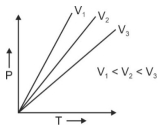
B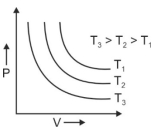
C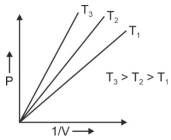
D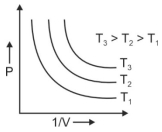
Solution
(C) According to Boyle's law,for a fixed amount of gas at a constant temperature,the pressure is inversely proportional to the volume $(P \propto \frac{1}{V})$.
Using the ideal gas equation,$PV = nRT$,we can rearrange it as:
$P = (nRT) \times (\frac{1}{V})$
This equation is in the form of $y = mx$,where $y = P$,$x = \frac{1}{V}$,and the slope $m = nRT$.
Since the slope $(nRT)$ is directly proportional to the temperature $(T)$,a graph of $P$ versus $\frac{1}{V}$ will yield a straight line passing through the origin for each temperature. As the temperature increases,the slope $(nRT)$ also increases. Therefore,for $T_3 > T_2 > T_1$,the slope of the line for $T_3$ will be the steepest,followed by $T_2$ and then $T_1$.
Using the ideal gas equation,$PV = nRT$,we can rearrange it as:
$P = (nRT) \times (\frac{1}{V})$
This equation is in the form of $y = mx$,where $y = P$,$x = \frac{1}{V}$,and the slope $m = nRT$.
Since the slope $(nRT)$ is directly proportional to the temperature $(T)$,a graph of $P$ versus $\frac{1}{V}$ will yield a straight line passing through the origin for each temperature. As the temperature increases,the slope $(nRT)$ also increases. Therefore,for $T_3 > T_2 > T_1$,the slope of the line for $T_3$ will be the steepest,followed by $T_2$ and then $T_1$.
0 likesView Solution
13
ChemistryMediumMCQNEET · 2023
The relation between $n_m$ (the number of permissible values of magnetic quantum number $m$) for a given value of azimuthal quantum number $l$ is:
A
$n_m = l + 2$
B
$l = \frac{n_m - 1}{2}$
C
$l = 2n_m + 1$
D
$n_m = 2l + 1$
Solution
(B) For a given azimuthal quantum number $l$,the magnetic quantum number $m$ can take values from $-l$ to $+l$,including zero.
The total number of permissible values of $m$,denoted as $n_m$,is given by the formula:
$n_m = 2l + 1$
Rearranging this formula to solve for $l$:
$n_m - 1 = 2l$
$l = \frac{n_m - 1}{2}$
Comparing this with the given options,option $B$ represents the correct relationship.
The total number of permissible values of $m$,denoted as $n_m$,is given by the formula:
$n_m = 2l + 1$
Rearranging this formula to solve for $l$:
$n_m - 1 = 2l$
$l = \frac{n_m - 1}{2}$
Comparing this with the given options,option $B$ represents the correct relationship.
0 likesView Solution
14
ChemistryMediumMCQNEET · 2023
Amongst the following,the total number of species $NOT$ having $8$ electrons around the central atom in its outermost shell is $NH_3$,$AlCl_3$,$BeCl_2$,$CCl_4$,$PCl_5$:
A
$1$
B
$3$
C
$2$
D
$4$
Solution
(B) To determine the number of species that do not follow the octet rule (i.e.,do not have $8$ electrons around the central atom),we analyze the valence electrons of each molecule:
$1$. $NH_3$: Nitrogen has $5$ valence electrons and forms $3$ bonds with Hydrogen,plus $1$ lone pair. Total electrons = $3 \times 2 + 2 = 8$ electrons.
$2$. $AlCl_3$: Aluminum has $3$ valence electrons and forms $3$ bonds with Chlorine. Total electrons = $3 \times 2 = 6$ electrons (Incomplete octet).
$3$. $BeCl_2$: Beryllium has $2$ valence electrons and forms $2$ bonds with Chlorine. Total electrons = $2 \times 2 = 4$ electrons (Incomplete octet).
$4$. $CCl_4$: Carbon has $4$ valence electrons and forms $4$ bonds with Chlorine. Total electrons = $4 \times 2 = 8$ electrons.
$5$. $PCl_5$: Phosphorus has $5$ valence electrons and forms $5$ bonds with Chlorine. Total electrons = $5 \times 2 = 10$ electrons (Expanded octet).
Species with $NOT$ $8$ electrons are $AlCl_3$,$BeCl_2$,and $PCl_5$.
Therefore,the total number of such species is $3$.
$1$. $NH_3$: Nitrogen has $5$ valence electrons and forms $3$ bonds with Hydrogen,plus $1$ lone pair. Total electrons = $3 \times 2 + 2 = 8$ electrons.
$2$. $AlCl_3$: Aluminum has $3$ valence electrons and forms $3$ bonds with Chlorine. Total electrons = $3 \times 2 = 6$ electrons (Incomplete octet).
$3$. $BeCl_2$: Beryllium has $2$ valence electrons and forms $2$ bonds with Chlorine. Total electrons = $2 \times 2 = 4$ electrons (Incomplete octet).
$4$. $CCl_4$: Carbon has $4$ valence electrons and forms $4$ bonds with Chlorine. Total electrons = $4 \times 2 = 8$ electrons.
$5$. $PCl_5$: Phosphorus has $5$ valence electrons and forms $5$ bonds with Chlorine. Total electrons = $5 \times 2 = 10$ electrons (Expanded octet).
Species with $NOT$ $8$ electrons are $AlCl_3$,$BeCl_2$,and $PCl_5$.
Therefore,the total number of such species is $3$.
1 likesView Solution
15
ChemistryMediumMCQNEET · 2023
Amongst the given options,which of the following molecules/ions acts as a Lewis acid?
A
$OH^{-}$
B
$NH_{3}$
C
$H_{2}O$
D
$BF_{3}$
Solution
(D) Lewis acids are species that accept a lone pair of electrons due to the presence of a vacant orbital in their outermost shell.
$H_{2}\ddot{O}:$ acts as a Lewis base because it has lone pairs on the oxygen atom.
$BF_{3}$ acts as a Lewis acid because the boron atom has an incomplete octet (only $6$ electrons in its valence shell) and can accept a lone pair.
$OH^{-}$ acts as a Lewis base due to the presence of lone pairs on the oxygen atom.
$\ddot{N}H_{3}$ acts as a Lewis base because the nitrogen atom has a lone pair of electrons available for donation.
$H_{2}\ddot{O}:$ acts as a Lewis base because it has lone pairs on the oxygen atom.
$BF_{3}$ acts as a Lewis acid because the boron atom has an incomplete octet (only $6$ electrons in its valence shell) and can accept a lone pair.
$OH^{-}$ acts as a Lewis base due to the presence of lone pairs on the oxygen atom.
$\ddot{N}H_{3}$ acts as a Lewis base because the nitrogen atom has a lone pair of electrons available for donation.
0 likesView Solution
16
ChemistryDifficultMCQNEET · 2023
Given below are two statements: one is labelled as Assertion $A$ and the other is labelled as Reason $R:$
Assertion $A:$ Metallic sodium dissolves in liquid ammonia giving a deep blue solution,which is paramagnetic.
Reason $R:$ The deep blue solution is due to the formation of amide.
In the light of the above statements,choose the correct answer from the options given below:
Assertion $A:$ Metallic sodium dissolves in liquid ammonia giving a deep blue solution,which is paramagnetic.
Reason $R:$ The deep blue solution is due to the formation of amide.
In the light of the above statements,choose the correct answer from the options given below:
A
$A$ is false but $R$ is true
B
Both $A$ and $R$ are true and $R$ is the correct explanation of $A$
C
Both $A$ and $R$ are true but $R$ is $NOT$ the correct explanation of $A$
D
$A$ is true but $R$ is false
Solution
(D) When an alkali metal like sodium dissolves in liquid ammonia,it forms a deep blue solution due to the presence of ammoniated electrons,$[e(NH_3)_y]^-$.
These ammoniated electrons absorb energy in the visible region of light,which imparts the blue color.
Because of the presence of unpaired electrons,the solution is paramagnetic.
The chemical reaction is: $M + (x+y) NH_3 \rightarrow [M(NH_3)_x]^+ + [e(NH_3)_y]^-$.
Therefore,the Assertion $A$ is true,but the Reason $R$ is false because the blue color is not due to the formation of amide.
These ammoniated electrons absorb energy in the visible region of light,which imparts the blue color.
Because of the presence of unpaired electrons,the solution is paramagnetic.
The chemical reaction is: $M + (x+y) NH_3 \rightarrow [M(NH_3)_x]^+ + [e(NH_3)_y]^-$.
Therefore,the Assertion $A$ is true,but the Reason $R$ is false because the blue color is not due to the formation of amide.
0 likesView Solution
17
ChemistryMediumMCQNEET · 2023
Which amongst the following options is the correct relation between change in enthalpy and change in internal energy?
A
$\Delta H + \Delta U = \Delta n R$
B
$\Delta H = \Delta U - \Delta n_{g} R T$
C
$\Delta H = \Delta U + \Delta n_{g} R T$
D
$\Delta H - \Delta U = - \Delta n R T$
Solution
(C) The enthalpy change $(\Delta H)$ is defined as the change in internal energy $(\Delta U)$ plus the work done due to volume change at constant pressure.
For a chemical reaction involving gases,the relation is given by:
$\Delta H = \Delta U + \Delta n_{g} R T$
Where:
$\Delta H$ = Change in enthalpy
$\Delta U$ = Change in internal energy
$\Delta n_{g}$ = Change in the number of moles of gaseous products and reactants
$R$ = Universal gas constant
$T$ = Temperature in Kelvin
For a chemical reaction involving gases,the relation is given by:
$\Delta H = \Delta U + \Delta n_{g} R T$
Where:
$\Delta H$ = Change in enthalpy
$\Delta U$ = Change in internal energy
$\Delta n_{g}$ = Change in the number of moles of gaseous products and reactants
$R$ = Universal gas constant
$T$ = Temperature in Kelvin
0 likesView Solution
18
ChemistryEasyMCQNEET · 2023
Given below are two statements :
Statement $I:$ The nutrient deficient water bodies lead to eutrophication.
Statement $II:$ Eutrophication leads to decrease in the level of oxygen in the water bodies.
In the light of the above statements,choose the correct answer from the options given below:
Statement $I:$ The nutrient deficient water bodies lead to eutrophication.
Statement $II:$ Eutrophication leads to decrease in the level of oxygen in the water bodies.
In the light of the above statements,choose the correct answer from the options given below:
A
Statement $I$ is incorrect but Statement $II$ is true.
B
Both Statement $I$ and Statement $II$ are true.
C
Both Statement $I$ and Statement $II$ are false.
D
Statement $I$ is correct but Statement $II$ is false.
Solution
(A) Statement $I$ is false because eutrophication is caused by nutrient-enriched water bodies,not nutrient-deficient ones.
Statement $II$ is true because the excessive growth of plants and algae in eutrophic water bodies consumes dissolved oxygen during decomposition,leading to a decrease in oxygen levels and the death of aquatic life.
Therefore,Statement $I$ is incorrect but Statement $II$ is true.
Statement $II$ is true because the excessive growth of plants and algae in eutrophic water bodies consumes dissolved oxygen during decomposition,leading to a decrease in oxygen levels and the death of aquatic life.
Therefore,Statement $I$ is incorrect but Statement $II$ is true.
0 likesView Solution
19
ChemistryDifficultMCQNEET · 2023
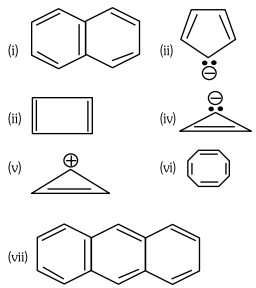
Consider the following compounds/species:
The number of compounds/species which obey $H$ückel's rule is $..........$
The number of compounds/species which obey $H$ückel's rule is $..........$
A
$6$
B
$4$
C
$5$
D
$2$
Solution
(B) $H$ückel's rule states that a planar,cyclic,fully conjugated system is aromatic if it contains $(4n + 2) \pi$ electrons,where $n = 0, 1, 2, \dots$
Let's analyze each species:
$(i)$ Naphthalene: $10 \pi$ electrons $(n=2)$,aromatic.
$(ii)$ Cyclopentadienyl anion: $6 \pi$ electrons $(n=1)$,aromatic.
$(iii)$ Cyclobutadiene: $4 \pi$ electrons ($n=1$ for anti-aromatic),not $H$ückel's rule.
$(iv)$ Cyclopropenyl anion: $4 \pi$ electrons,anti-aromatic.
$(v)$ Cyclopropenyl cation: $2 \pi$ electrons $(n=0)$,aromatic.
$(vi)$ Cyclooctatetraene: $8 \pi$ electrons,non-planar,non-aromatic.
$(vii)$ Anthracene: $14 \pi$ electrons $(n=3)$,aromatic.
The species that obey $H$ückel's rule are $(i), (ii), (v),$ and $(vii)$.
Thus,the total number is $4$.
Let's analyze each species:
$(i)$ Naphthalene: $10 \pi$ electrons $(n=2)$,aromatic.
$(ii)$ Cyclopentadienyl anion: $6 \pi$ electrons $(n=1)$,aromatic.
$(iii)$ Cyclobutadiene: $4 \pi$ electrons ($n=1$ for anti-aromatic),not $H$ückel's rule.
$(iv)$ Cyclopropenyl anion: $4 \pi$ electrons,anti-aromatic.
$(v)$ Cyclopropenyl cation: $2 \pi$ electrons $(n=0)$,aromatic.
$(vi)$ Cyclooctatetraene: $8 \pi$ electrons,non-planar,non-aromatic.
$(vii)$ Anthracene: $14 \pi$ electrons $(n=3)$,aromatic.
The species that obey $H$ückel's rule are $(i), (ii), (v),$ and $(vii)$.
Thus,the total number is $4$.
0 likesView Solution
20
ChemistryDifficultMCQNEET · 2023
The equilibrium concentrations of the species in the reaction $A + B \rightleftharpoons C + D$ are $2, 3, 10$ and $6 \, mol \, L^{-1}$,respectively at $300 \, K$. $\Delta G^{\circ}$ for the reaction is $(R = 2 \, cal \, mol^{-1} \, K^{-1})$ (in $, cal$)
A
$-13.73$
B
$1372.60$
C
$-137.26$
D
$-1381.80$
Solution
(D) The reaction is $A + B \rightleftharpoons C + D$.
At equilibrium,the concentrations are $[A] = 2 \, mol \, L^{-1}$,$[B] = 3 \, mol \, L^{-1}$,$[C] = 10 \, mol \, L^{-1}$,and $[D] = 6 \, mol \, L^{-1}$.
The equilibrium constant $K_{eq}$ is calculated as:
$K_{eq} = \frac{[C][D]}{[A][B]} = \frac{10 \times 6}{2 \times 3} = \frac{60}{6} = 10$.
The standard Gibbs free energy change $\Delta G^{\circ}$ is given by the formula:
$\Delta G^{\circ} = -RT \ln K_{eq} = -2.303 \, RT \log K_{eq}$.
Substituting the values $R = 2 \, cal \, mol^{-1} \, K^{-1}$,$T = 300 \, K$,and $K_{eq} = 10$:
$\Delta G^{\circ} = -2.303 \times 2 \times 300 \times \log(10)$.
Since $\log(10) = 1$:
$\Delta G^{\circ} = -2.303 \times 600 = -1381.8 \, cal \, mol^{-1}$.
At equilibrium,the concentrations are $[A] = 2 \, mol \, L^{-1}$,$[B] = 3 \, mol \, L^{-1}$,$[C] = 10 \, mol \, L^{-1}$,and $[D] = 6 \, mol \, L^{-1}$.
The equilibrium constant $K_{eq}$ is calculated as:
$K_{eq} = \frac{[C][D]}{[A][B]} = \frac{10 \times 6}{2 \times 3} = \frac{60}{6} = 10$.
The standard Gibbs free energy change $\Delta G^{\circ}$ is given by the formula:
$\Delta G^{\circ} = -RT \ln K_{eq} = -2.303 \, RT \log K_{eq}$.
Substituting the values $R = 2 \, cal \, mol^{-1} \, K^{-1}$,$T = 300 \, K$,and $K_{eq} = 10$:
$\Delta G^{\circ} = -2.303 \times 2 \times 300 \times \log(10)$.
Since $\log(10) = 1$:
$\Delta G^{\circ} = -2.303 \times 600 = -1381.8 \, cal \, mol^{-1}$.
0 likesView Solution
21
ChemistryMediumMCQNEET · 2023
On balancing the given redox reaction,$aCr_2O_7^{2-} + bSO_3^{2-}{(aq)} + cH^{+}{(aq)}$ $\rightarrow 2aCr^{3+}{(aq)} + bSO_4^{2-}{(aq)} + \frac{c}{2}H_2O_{(l)}$,the coefficients $a$,$b$,and $c$ are found to be,respectively-
A
$1, 3, 8$
B
$1, 3, 4$
C
$3, 8, 1$
D
$1, 8, 3$
Solution
(A) Using the ion-electron method:
Reduction half-reaction: $Cr_2O_7^{2-} + 14H^{+} + 6e^- \rightarrow 2Cr^{3+} + 7H_2O$
Oxidation half-reaction: $(SO_3^{2-} + H_2O \rightarrow SO_4^{2-} + 2H^{+} + 2e^-) \times 3$
Adding both half-reactions:
$Cr_2O_7^{2-} + 14H^{+} + 6e^- + 3SO_3^{2-} + 3H_2O \rightarrow 2Cr^{3+} + 7H_2O + 3SO_4^{2-} + 6H^{+} + 6e^-$
Simplifying the equation:
$Cr_2O_7^{2-} + 3SO_3^{2-} + 8H^{+} \rightarrow 2Cr^{3+} + 3SO_4^{2-} + 4H_2O$
Comparing this with the given equation $aCr_2O_7^{2-} + bSO_3^{2-} + cH^{+} \rightarrow 2aCr^{3+} + bSO_4^{2-} + \frac{c}{2}H_2O$:
$a = 1, b = 3, c = 8$.
Reduction half-reaction: $Cr_2O_7^{2-} + 14H^{+} + 6e^- \rightarrow 2Cr^{3+} + 7H_2O$
Oxidation half-reaction: $(SO_3^{2-} + H_2O \rightarrow SO_4^{2-} + 2H^{+} + 2e^-) \times 3$
Adding both half-reactions:
$Cr_2O_7^{2-} + 14H^{+} + 6e^- + 3SO_3^{2-} + 3H_2O \rightarrow 2Cr^{3+} + 7H_2O + 3SO_4^{2-} + 6H^{+} + 6e^-$
Simplifying the equation:
$Cr_2O_7^{2-} + 3SO_3^{2-} + 8H^{+} \rightarrow 2Cr^{3+} + 3SO_4^{2-} + 4H_2O$
Comparing this with the given equation $aCr_2O_7^{2-} + bSO_3^{2-} + cH^{+} \rightarrow 2aCr^{3+} + bSO_4^{2-} + \frac{c}{2}H_2O$:
$a = 1, b = 3, c = 8$.
1 likesView Solution
22
ChemistryMCQNEET · 2023
In tissue culture experiments,leaf mesophyll cells are put in a culture medium to form callus. This phenomenon may be called as:
A
Dedifferentiation
B
Development
C
Senescence
D
Differentiation
Solution
(A) The process by which differentiated plant cells (like leaf mesophyll cells) regain the capacity to divide and form an undifferentiated mass of cells called callus is known as $Dedifferentiation$.
This is a characteristic feature of living plant cells under specific laboratory conditions in a culture medium containing growth regulators like auxins and cytokinins.
This is a characteristic feature of living plant cells under specific laboratory conditions in a culture medium containing growth regulators like auxins and cytokinins.
0 likesView Solution
23
ChemistryDifficultMCQNEET · 2023
Taking stability as the factor,which one of the following represents the correct relationship?
A
$TlI > TlI_3$
B
$TlCl_3 > TlCl$
C
$InI_3 > InI$
D
$AlCl > AlCl_3$
Solution
(A) In group $13$ elements,the stability of the $+1$ oxidation state increases down the group due to the inert pair effect.
For Thallium $(Tl)$,the $+1$ oxidation state is more stable than the $+3$ oxidation state.
Therefore,$TlI$ (where $Tl$ is $+1$) is more stable than $TlI_3$ (where $Tl$ is $+3$).
For Thallium $(Tl)$,the $+1$ oxidation state is more stable than the $+3$ oxidation state.
Therefore,$TlI$ (where $Tl$ is $+1$) is more stable than $TlI_3$ (where $Tl$ is $+3$).
0 likesView Solution
24
ChemistryMediumMCQNEET · 2023
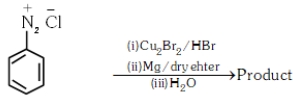
Identify the product in the following reaction:
A
$4-$Bromophenol
B
Phenol
C
Benzene
D
Phenylmagnesium bromide
Solution
(C) The reaction proceeds in three steps:
$1$. Benzenediazonium chloride reacts with $Cu_2Br_2/HBr$ (Sandmeyer reaction) to form bromobenzene.
$2$. Bromobenzene reacts with $Mg$ in the presence of dry ether to form phenylmagnesium bromide (a Grignard reagent).
$3$. Phenylmagnesium bromide undergoes hydrolysis with $H_2O$ to yield benzene as the final product.
$1$. Benzenediazonium chloride reacts with $Cu_2Br_2/HBr$ (Sandmeyer reaction) to form bromobenzene.
$2$. Bromobenzene reacts with $Mg$ in the presence of dry ether to form phenylmagnesium bromide (a Grignard reagent).
$3$. Phenylmagnesium bromide undergoes hydrolysis with $H_2O$ to yield benzene as the final product.
0 likesView Solution
25
ChemistryMediumMCQNEET · 2023
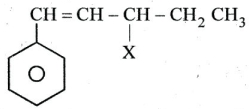
The given compound is an example of $..........$
A
vinylic halide
B
benzylic halide
C
aryl halide
D
allylic halide
Solution
(D) The given structure is $C_6H_5-CH=CH-CH(X)-CH_2-CH_3$.
In this compound,the halogen atom $(X)$ is attached to an $sp^3$ hybridized carbon atom,which is adjacent to a carbon-carbon double bond $(C=C)$.
Such compounds,where the halogen is attached to an $sp^3$ hybridized carbon next to a double bond,are classified as allylic halides.
Therefore,the correct option is $D$.
In this compound,the halogen atom $(X)$ is attached to an $sp^3$ hybridized carbon atom,which is adjacent to a carbon-carbon double bond $(C=C)$.
Such compounds,where the halogen is attached to an $sp^3$ hybridized carbon next to a double bond,are classified as allylic halides.
Therefore,the correct option is $D$.
0 likesView Solution
26
ChemistryDifficultMCQNEET · 2023
Given below are two statements: one is labelled as Assertion $A$ and the other is labelled as Reason $R$.
Assertion $A$: $A$ reaction can have zero activation energy.
Reason $R$: The minimum extra amount of energy absorbed by reactant molecules so that their energy becomes equal to threshold value,is called activation energy.
In the light of the above statements,choose the correct answer from the options given below:
Assertion $A$: $A$ reaction can have zero activation energy.
Reason $R$: The minimum extra amount of energy absorbed by reactant molecules so that their energy becomes equal to threshold value,is called activation energy.
In the light of the above statements,choose the correct answer from the options given below:
A
$A$ is false but $R$ is true
B
Both $A$ and $R$ are true and $R$ is the correct explanation of $A$.
C
Both $A$ and $R$ are true but $R$ is $NOT$ the correct explanation of $A$.
D
$A$ is true but $R$ is false
Solution
(A) Assertion $A$ is false because a chemical reaction cannot have zero activation energy $(E_{a} > 0)$.
Reason $R$ is true because it correctly defines activation energy as the minimum extra energy required by reactant molecules to reach the threshold energy level.
Reason $R$ is true because it correctly defines activation energy as the minimum extra energy required by reactant molecules to reach the threshold energy level.
0 likesView Solution
27
ChemistryMediumMCQNEET · 2023
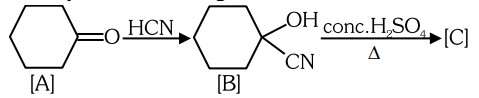
Complete the following reaction:
$[C]$ is $........$
$[C]$ is $........$
A
Cyclohex$-1-$ene$-1-$carboxylic acid
B
Cyclohexanol
C
Cyclohexanecarboxylic acid
D
Cyclohex$-1-$ene$-1-$carbaldehyde
Solution
(A) The reaction sequence is as follows:
$1$. Cyclohexanone $[A]$ reacts with $HCN$ to form a cyanohydrin,which is $1$-hydroxycyclohexanecarbonitrile $[B]$.
$2$. The treatment of $[B]$ with $conc. H_2SO_4$ and heat $(\Delta)$ leads to two simultaneous processes: dehydration of the tertiary alcohol group to form a double bond and hydrolysis of the nitrile group $(-CN)$ to a carboxylic acid group $(-COOH)$.
$3$. The final product $[C]$ is cyclohex-$1$-ene-$1$-carboxylic acid.
$1$. Cyclohexanone $[A]$ reacts with $HCN$ to form a cyanohydrin,which is $1$-hydroxycyclohexanecarbonitrile $[B]$.
$2$. The treatment of $[B]$ with $conc. H_2SO_4$ and heat $(\Delta)$ leads to two simultaneous processes: dehydration of the tertiary alcohol group to form a double bond and hydrolysis of the nitrile group $(-CN)$ to a carboxylic acid group $(-COOH)$.
$3$. The final product $[C]$ is cyclohex-$1$-ene-$1$-carboxylic acid.
0 likesView Solution
28
ChemistryMediumMCQNEET · 2023
Given below are two statements:
Statement $I$: $A$ unit formed by the attachment of a base to $1'-$position of sugar is known as nucleoside.
Statement $II$: When nucleoside is linked to phosphorous acid at $5'-$position of sugar moiety,we get nucleotide.
In the light of the above statements,choose the correct answer from the options given below:
Statement $I$: $A$ unit formed by the attachment of a base to $1'-$position of sugar is known as nucleoside.
Statement $II$: When nucleoside is linked to phosphorous acid at $5'-$position of sugar moiety,we get nucleotide.
In the light of the above statements,choose the correct answer from the options given below:
A
Statement $I$ is false but Statement $II$ is true
B
Both Statement $I$ and Statement $II$ are true
C
Both Statement $I$ and Statement $II$ are false
D
Statement $I$ is true but Statement $II$ is false
Solution
(D) Statement $I$ is correct because a nucleoside is formed by the attachment of a nitrogenous base to the $1'-$position of a pentose sugar.
Statement $II$ is incorrect because a nucleotide is formed when a nucleoside is linked to phosphoric acid $(H_3PO_4)$,not phosphorous acid $(H_3PO_3)$,at the $5'-$position of the sugar moiety.
Therefore,Statement $I$ is true but Statement $II$ is false.
Statement $II$ is incorrect because a nucleotide is formed when a nucleoside is linked to phosphoric acid $(H_3PO_4)$,not phosphorous acid $(H_3PO_3)$,at the $5'-$position of the sugar moiety.
Therefore,Statement $I$ is true but Statement $II$ is false.
0 likesView Solution
29
ChemistryMediumMCQNEET · 2023
$A$ compound is formed by two elements $A$ and $B$. The element $B$ forms a cubic close-packed $(CCP)$ structure and atoms of $A$ occupy $\frac{1}{3}$ of the tetrahedral voids. If the formula of the compound is $A_x B_y$,then the value of $x+y$ is:
A
$4$
B
$5$
C
$2$
D
$3$
Solution
(B) In a $CCP$ structure,let the number of atoms of $B$ be $n$.
The number of tetrahedral voids is $2n$.
Atoms of $A$ occupy $\frac{1}{3}$ of the tetrahedral voids,so the number of atoms of $A = \frac{1}{3} \times 2n = \frac{2n}{3}$.
The ratio of $A:B = \frac{2n}{3} : n = 2:3$.
Therefore,the formula is $A_2 B_3$.
Comparing with $A_x B_y$,we get $x = 2$ and $y = 3$.
Thus,$x + y = 2 + 3 = 5$.
The number of tetrahedral voids is $2n$.
Atoms of $A$ occupy $\frac{1}{3}$ of the tetrahedral voids,so the number of atoms of $A = \frac{1}{3} \times 2n = \frac{2n}{3}$.
The ratio of $A:B = \frac{2n}{3} : n = 2:3$.
Therefore,the formula is $A_2 B_3$.
Comparing with $A_x B_y$,we get $x = 2$ and $y = 3$.
Thus,$x + y = 2 + 3 = 5$.
0 likesView Solution
30
ChemistryMediumMCQNEET · 2023
The stability of $Cu^{2+}$ is more than $Cu^{+}$ salts in aqueous solution due to -
A
second ionisation enthalpy.
B
first ionisation enthalpy.
C
enthalpy of atomization.
D
hydration energy.
Solution
(D) The stability of $Cu^{2+}_{(aq)}$ is more than $Cu^{+}_{(aq)}$ is due to the much more negative $\Delta_{hyd}H^{\circ}$ of $Cu^{2+}_{(aq)}$ than $Cu^{+}_{(aq)}$,which more than compensates for the second ionisation enthalpy of $Cu$.
$\Delta_{hyd}H^{\circ}$ of $Cu^{2+}_{(aq)} = -2121 \ kJ \ mol^{-1}$
$\Delta_{i}H_{1}^{\circ}$ of $Cu = +745 \ kJ \ mol^{-1}$
$\Delta_{i}H_{2}^{\circ}$ of $Cu = +1960 \ kJ \ mol^{-1}$
$\Delta_{hyd}H^{\circ}$ of $Cu^{2+}_{(aq)} = -2121 \ kJ \ mol^{-1}$
$\Delta_{i}H_{1}^{\circ}$ of $Cu = +745 \ kJ \ mol^{-1}$
$\Delta_{i}H_{2}^{\circ}$ of $Cu = +1960 \ kJ \ mol^{-1}$
0 likesView Solution
31
ChemistryDifficultMCQNEET · 2023
Given below are two statements: one is labelled as Assertion $A$ and the other is labelled as Reason $R$.
Assertion $A$: Helium is used to dilute oxygen in diving apparatus.
Reason $R$: Helium has high solubility in $O_2$.
In the light of the above statements,choose the correct answer from the options given below:
Assertion $A$: Helium is used to dilute oxygen in diving apparatus.
Reason $R$: Helium has high solubility in $O_2$.
In the light of the above statements,choose the correct answer from the options given below:
A
$A$ is false but $R$ is true.
B
Both $A$ and $R$ are true and $R$ is the correct explanation of $A$.
C
Both $A$ and $R$ are true and $R$ is $NOT$ the correct explanation of $A$.
D
$A$ is true but $R$ is false.
Solution
(D) Assertion $A$ is true because helium is used as a diluent for oxygen in diving apparatus to avoid the toxic effects of nitrogen at high pressures.
Reason $R$ is false because helium has very low solubility in blood,which is the actual reason it is preferred,not its solubility in $O_2$.
Therefore,$A$ is true but $R$ is false.
Reason $R$ is false because helium has very low solubility in blood,which is the actual reason it is preferred,not its solubility in $O_2$.
Therefore,$A$ is true but $R$ is false.
0 likesView Solution
32
ChemistryMediumMCQNEET · 2023
Some tranquilizers are listed below. Which one from the following belongs to barbiturates?
A
Veronal
B
Chlordiazepoxide
C
Meprobamate
D
Valium
Solution
(A) Veronal is a derivative of barbituric acid and is classified as a barbiturate.
$Meprobamate$,$valium$,and $chlordiazepoxide$ are other types of tranquilizers used for stress and mild to severe mental diseases.
$Meprobamate$,$valium$,and $chlordiazepoxide$ are other types of tranquilizers used for stress and mild to severe mental diseases.
0 likesView Solution
33
ChemistryMediumMCQNEET · 2023
For a certain reaction,the rate $= k[A]^2[B]$. When the initial concentration of $A$ is tripled keeping the concentration of $B$ constant,the initial rate would:
A
Increase by a factor of $3$
B
Decrease by a factor of $9$
C
Increase by a factor of $6$
D
Increase by a factor of $9$
Solution
(D) The initial rate is given by $r = k[A]^2[B]$.
When the concentration of $A$ is tripled,the new concentration $[A'] = 3[A]$.
The new rate $r'$ is calculated as:
$r' = k[A']^2[B] = k(3[A])^2[B] = k(9[A]^2)[B] = 9k[A]^2[B]$.
Comparing the new rate with the initial rate,$r' = 9r$.
Therefore,the rate increases by a factor of $9$.
When the concentration of $A$ is tripled,the new concentration $[A'] = 3[A]$.
The new rate $r'$ is calculated as:
$r' = k[A']^2[B] = k(3[A])^2[B] = k(9[A]^2)[B] = 9k[A]^2[B]$.
Comparing the new rate with the initial rate,$r' = 9r$.
Therefore,the rate increases by a factor of $9$.
0 likesView Solution
34
ChemistryDifficultMCQNEET · 2023
Which one is an example of heterogeneous catalysis?
A
Combination between dinitrogen and dihydrogen to form ammonia in the presence of finely divided iron
B
Oxidation of sulphur dioxide into sulphur trioxide in the presence of oxides of nitrogen
C
Hydrolysis of sugar catalysed by $H^{+}$ ions
D
Decomposition of ozone in presence of nitrogen monoxide
Solution
(A) The combination of $N_2$ and $H_2$ to form $NH_3$ in the presence of finely divided $Fe$ is an example of heterogeneous catalysis because the catalyst $(Fe_{(s)})$ is in a different physical state than the reactants ($N_2(g)$ and $H_2(g)$).
$N_{2(g)} + 3H_{2(g)} \xrightarrow{Fe_{(s)}} 2NH_{3(g)}$
All other options are examples of homogeneous catalysis where the catalyst and reactants are in the same phase:
$C_{12}H_{22}O_{11(aq)} + H_2O_{(l)} \xrightarrow{H^+_{(aq)}} \text{Glucose}_{(aq)} + \text{Fructose}_{(aq)}$
$2SO_{2(g)} + O_{2(g)} \xrightarrow{NO_{(g)}} 2SO_{3(g)}$
$N_{2(g)} + 3H_{2(g)} \xrightarrow{Fe_{(s)}} 2NH_{3(g)}$
All other options are examples of homogeneous catalysis where the catalyst and reactants are in the same phase:
$C_{12}H_{22}O_{11(aq)} + H_2O_{(l)} \xrightarrow{H^+_{(aq)}} \text{Glucose}_{(aq)} + \text{Fructose}_{(aq)}$
$2SO_{2(g)} + O_{2(g)} \xrightarrow{NO_{(g)}} 2SO_{3(g)}$
0 likesView Solution
35
ChemistryDifficultMCQNEET · 2023
Which of the following is a homoleptic complex?
A
Triamminetriaquachromium $(III)$ chloride
B
Potassium trioxalatoaluminate $(III)$
C
Diamminechloridonitrito-$N$-platinum $(II)$
D
Pentaamminecarbonatocobalt $(III)$ chloride
Solution
(B) homoleptic complex is a coordination compound in which the central metal atom or ion is bound to only one type of donor atom or ligand.
- Triamminetriaquachromium $(III)$ chloride: $[Cr(NH_3)_3(H_2O)_3]Cl_3$ (Heteroleptic)
- Potassium trioxalatoaluminate $(III)$: $K_3[Al(C_2O_4)_3]$ (Homoleptic,as all ligands are oxalate ions)
- Diamminechloridonitrito-$N$-platinum $(II)$: $[Pt(NH_3)_2Cl(NO_2)]$ (Heteroleptic)
- Pentaamminecarbonatocobalt $(III)$ chloride: $[Co(NH_3)_5(CO_3)]Cl$ (Heteroleptic)
Therefore,the correct option is $B$.
- Triamminetriaquachromium $(III)$ chloride: $[Cr(NH_3)_3(H_2O)_3]Cl_3$ (Heteroleptic)
- Potassium trioxalatoaluminate $(III)$: $K_3[Al(C_2O_4)_3]$ (Homoleptic,as all ligands are oxalate ions)
- Diamminechloridonitrito-$N$-platinum $(II)$: $[Pt(NH_3)_2Cl(NO_2)]$ (Heteroleptic)
- Pentaamminecarbonatocobalt $(III)$ chloride: $[Co(NH_3)_5(CO_3)]Cl$ (Heteroleptic)
Therefore,the correct option is $B$.
0 likesView Solution
36
ChemistryMediumMCQNEET · 2023
Identify product $(A)$ in the following reaction:
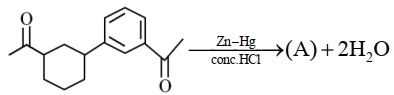
A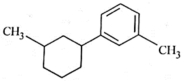
B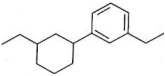
C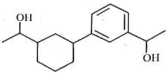
D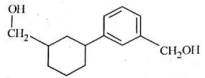
Solution
(B) The given reaction uses $Zn-Hg$ and $conc. HCl$,which are the reagents for the Clemmensen reduction.
Clemmensen reduction converts carbonyl groups $(>C=O)$ into methylene groups $(-CH_2-)$.
In the given reactant,there are two ketone groups: one attached to the cyclohexane ring and one attached to the benzene ring.
Both ketone groups are reduced to methylene groups.
Specifically,the acetyl group $(-COCH_3)$ is reduced to an ethyl group $(-CH_2CH_3)$.
Therefore,the product $(A)$ will have two ethyl groups attached to the respective rings.
Clemmensen reduction converts carbonyl groups $(>C=O)$ into methylene groups $(-CH_2-)$.
In the given reactant,there are two ketone groups: one attached to the cyclohexane ring and one attached to the benzene ring.
Both ketone groups are reduced to methylene groups.
Specifically,the acetyl group $(-COCH_3)$ is reduced to an ethyl group $(-CH_2CH_3)$.
Therefore,the product $(A)$ will have two ethyl groups attached to the respective rings.
0 likesView Solution
37
ChemistryMediumMCQNEET · 2023
Given below are two statements: one is labelled as Assertion $A$ and the other is labelled as Reason $R$.
Assertion $A$: In equation $\Delta_r G = -nFE_{\text{cell}}$,the value of $\Delta_r G$ depends on $n$.
Reason $R$: $E_{\text{cell}}$ is an intensive property and $\Delta_r G$ is an extensive property.
In the light of the above statements,choose the correct answer from the options given below:
Assertion $A$: In equation $\Delta_r G = -nFE_{\text{cell}}$,the value of $\Delta_r G$ depends on $n$.
Reason $R$: $E_{\text{cell}}$ is an intensive property and $\Delta_r G$ is an extensive property.
In the light of the above statements,choose the correct answer from the options given below:
A
$A$ is false but $R$ is true.
B
Both $A$ and $R$ are true and $R$ is the correct explanation of $A$.
C
Both $A$ and $R$ are true and $R$ is $NOT$ the correct explanation of $A$.
D
$A$ is true but $R$ is false.
Solution
(C) The equation $\Delta_r G = -nFE_{\text{cell}}$ relates the Gibbs energy change to the number of moles of electrons $(n)$ transferred,the Faraday constant $(F)$,and the cell potential $(E_{\text{cell}})$.
Since $\Delta_r G$ is directly proportional to $n$,the value of $\Delta_r G$ depends on $n$. Thus,Assertion $A$ is true.
$E_{\text{cell}}$ is an intensive property because it does not depend on the amount of matter,whereas $\Delta_r G$ is an extensive property because it depends on the amount of matter (number of moles $n$). Thus,Reason $R$ is true.
However,the fact that $E_{\text{cell}}$ is intensive and $\Delta_r G$ is extensive explains why $\Delta_r G$ is extensive,but it is not the direct reason why $\Delta_r G$ depends on $n$ in the equation. The dependence on $n$ is a mathematical consequence of the stoichiometry of the cell reaction. Therefore,$R$ is not the correct explanation of $A$.
Since $\Delta_r G$ is directly proportional to $n$,the value of $\Delta_r G$ depends on $n$. Thus,Assertion $A$ is true.
$E_{\text{cell}}$ is an intensive property because it does not depend on the amount of matter,whereas $\Delta_r G$ is an extensive property because it depends on the amount of matter (number of moles $n$). Thus,Reason $R$ is true.
However,the fact that $E_{\text{cell}}$ is intensive and $\Delta_r G$ is extensive explains why $\Delta_r G$ is extensive,but it is not the direct reason why $\Delta_r G$ depends on $n$ in the equation. The dependence on $n$ is a mathematical consequence of the stoichiometry of the cell reaction. Therefore,$R$ is not the correct explanation of $A$.
0 likesView Solution
38
ChemistryDifficultMCQNEET · 2023
The conductivity of a centimolar solution of $KCl$ at $25^{\circ} C$ is $0.0210 \, \Omega^{-1} cm^{-1}$ and the resistance of the cell containing the solution at $25^{\circ} C$ is $60 \, \Omega$. The value of the cell constant is $......... \, cm^{-1}$.
A
$3.34$
B
$1.34$
C
$3.28$
D
$1.26$
Solution
(D) The relationship between conductivity $(k)$,conductance $(G)$,and cell constant $(G^*)$ is given by:
$k = G \times G^*$
Since conductance $G = \frac{1}{R}$,where $R$ is the resistance:
$k = \frac{1}{R} \times G^*$
Rearranging to solve for the cell constant $(G^*)$:
$G^* = k \times R$
Given:
$k = 0.0210 \, \Omega^{-1} cm^{-1}$
$R = 60 \, \Omega$
Calculation:
$G^* = 0.0210 \, \Omega^{-1} cm^{-1} \times 60 \, \Omega = 1.26 \, cm^{-1}$
$k = G \times G^*$
Since conductance $G = \frac{1}{R}$,where $R$ is the resistance:
$k = \frac{1}{R} \times G^*$
Rearranging to solve for the cell constant $(G^*)$:
$G^* = k \times R$
Given:
$k = 0.0210 \, \Omega^{-1} cm^{-1}$
$R = 60 \, \Omega$
Calculation:
$G^* = 0.0210 \, \Omega^{-1} cm^{-1} \times 60 \, \Omega = 1.26 \, cm^{-1}$
0 likesView Solution
39
ChemistryMediumMCQNEET · 2023
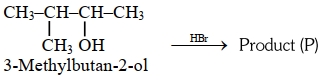
Consider the following reaction and identify the product $(P)$.
A
$CH_{3}-C(CH_{3})_{2}-CH_{2}Br$
B
$CH_{3}-C(Br)(CH_{3})-CH_{2}-CH_{3}$
C
$CH_{3}-CH(CH_{3})-CH(Br)-CH_{3}$
D
$CH_{3}-CH_{2}-CH(Br)-CH_{2}-CH_{3}$
Solution
(B) The reaction of $3\text{-methylbutan-2-ol}$ with $HBr$ proceeds via an $S_N1$ mechanism.
$1$. Protonation of the alcohol group followed by the loss of a water molecule generates a secondary carbocation: $CH_{3}-CH(CH_{3})-CH^+-CH_{3}$.
$2$. This secondary carbocation undergoes a $1,2\text{-hydride shift}$ to form a more stable tertiary carbocation: $CH_{3}-C^+(CH_{3})-CH_{2}-CH_{3}$.
$3$. Finally,the bromide ion $(Br^-)$ attacks the tertiary carbocation to form the major product: $2\text{-bromo-2-methylbutane}$,which is $CH_{3}-C(Br)(CH_{3})-CH_{2}-CH_{3}$.
$1$. Protonation of the alcohol group followed by the loss of a water molecule generates a secondary carbocation: $CH_{3}-CH(CH_{3})-CH^+-CH_{3}$.
$2$. This secondary carbocation undergoes a $1,2\text{-hydride shift}$ to form a more stable tertiary carbocation: $CH_{3}-C^+(CH_{3})-CH_{2}-CH_{3}$.
$3$. Finally,the bromide ion $(Br^-)$ attacks the tertiary carbocation to form the major product: $2\text{-bromo-2-methylbutane}$,which is $CH_{3}-C(Br)(CH_{3})-CH_{2}-CH_{3}$.
0 likesView Solution
40
ChemistryMediumMCQNEET · 2023
Which amongst the following molecules on polymerization produces neoprene?
A
$H_2C=C(Cl)-CH=CH_2$
B
$H_2C=CH-CH=CH_2$
C
$H_3C-CH=CH-CH_3$
D
$H_2C=CH-C\equiv CH$
Solution
(A) Neoprene is a synthetic rubber formed by the free radical polymerization of chloroprene $(2\text{-chloro-}1,3\text{-butadiene})$. The chemical reaction is as follows:
$nCH_2=C(Cl)-CH=CH_2 \xrightarrow{\text{Polymerization}} [CH_2-C(Cl)=CH-CH_2]_n$
Thus,the monomer required for the production of neoprene is chloroprene,which corresponds to option $A$.
$nCH_2=C(Cl)-CH=CH_2 \xrightarrow{\text{Polymerization}} [CH_2-C(Cl)=CH-CH_2]_n$
Thus,the monomer required for the production of neoprene is chloroprene,which corresponds to option $A$.
0 likesView Solution
41
ChemistryMediumMCQNEET · 2023
Which of the following reactions will $NOT$ give a primary amine as the product?
A
$CH_3CN \xrightarrow[(ii) H_3O^{\oplus}]{(i) LiAlH_4} \text{product}$
B
$CH_3CONH_2 \xrightarrow{Br_2/KOH} \text{product}$
C
$CH_3CONH_2 \xrightarrow[(ii) H_3O^{\oplus}]{(i) LiAlH_4} \text{product}$
D
$CH_3NC \xrightarrow[(ii) H_3O^{\oplus}]{(i) LiAlH_4} \text{product}$
Solution
(D) Let us analyze each reaction:
$(A)$ $CH_3CN + (i) LiAlH_4 / (ii) H_3O^{\oplus} \rightarrow CH_3CH_2NH_2$ (Ethylamine,a primary amine).
$(B)$ $CH_3CONH_2 + Br_2/KOH \rightarrow CH_3NH_2$ (Methylamine,a primary amine) via the Hoffmann bromamide degradation reaction.
$(C)$ $CH_3CONH_2 + (i) LiAlH_4 / (ii) H_3O^{\oplus} \rightarrow CH_3CH_2NH_2$ (Ethylamine,a primary amine).
$(D)$ $CH_3NC + (i) LiAlH_4 / (ii) H_3O^{\oplus} \rightarrow CH_3NHCH_3$ (Dimethylamine,a secondary amine).
Thus,reaction $(D)$ does not yield a primary amine.
$(A)$ $CH_3CN + (i) LiAlH_4 / (ii) H_3O^{\oplus} \rightarrow CH_3CH_2NH_2$ (Ethylamine,a primary amine).
$(B)$ $CH_3CONH_2 + Br_2/KOH \rightarrow CH_3NH_2$ (Methylamine,a primary amine) via the Hoffmann bromamide degradation reaction.
$(C)$ $CH_3CONH_2 + (i) LiAlH_4 / (ii) H_3O^{\oplus} \rightarrow CH_3CH_2NH_2$ (Ethylamine,a primary amine).
$(D)$ $CH_3NC + (i) LiAlH_4 / (ii) H_3O^{\oplus} \rightarrow CH_3NHCH_3$ (Dimethylamine,a secondary amine).
Thus,reaction $(D)$ does not yield a primary amine.
0 likesView Solution
42
ChemistryDifficultMCQNEET · 2023
Which of the following statements are $INCORRECT$?
$A$. All the transition metals except scandium form $MO$ oxides which are ionic.
$B$. The highest oxidation number corresponding to the group number in transition metal oxides is attained in $Sc_2O_3$ to $Mn_2O_7$.
$C$. Basic character increases from $V_2O_3$ to $V_2O_4$ to $V_2O_5$.
$D$. $V_2O_4$ dissolves in acids to give $VO_4^{3-}$ salts.
$E$. $CrO$ is basic but $Cr_2O_3$ is amphoteric.
Choose the correct answer from the options given below:
$A$. All the transition metals except scandium form $MO$ oxides which are ionic.
$B$. The highest oxidation number corresponding to the group number in transition metal oxides is attained in $Sc_2O_3$ to $Mn_2O_7$.
$C$. Basic character increases from $V_2O_3$ to $V_2O_4$ to $V_2O_5$.
$D$. $V_2O_4$ dissolves in acids to give $VO_4^{3-}$ salts.
$E$. $CrO$ is basic but $Cr_2O_3$ is amphoteric.
Choose the correct answer from the options given below:
A
$B$ and $C$ only
B
$A$ and $E$ only
C
$B$ and $D$ only
D
$C$ and $D$ only
Solution
(D) Statement $A$ is correct as transition metals form ionic $MO$ oxides.
Statement $B$ is correct as the highest oxidation state equals the group number from $Sc$ $(Group \ 3)$ to $Mn$ $(Group \ 7)$.
Statement $C$ is incorrect because the acidic character increases as the oxidation state of the metal increases $(V_2O_3 < V_2O_4 < V_2O_5)$. Therefore,the basic character decreases.
Statement $D$ is incorrect because $V_2O_4$ dissolves in acids to form $VO^{2+}$ ions,not $VO_4^{3-}$ salts.
Statement $E$ is correct as $CrO$ is basic and $Cr_2O_3$ is amphoteric.
Thus,statements $C$ and $D$ are incorrect.
Statement $B$ is correct as the highest oxidation state equals the group number from $Sc$ $(Group \ 3)$ to $Mn$ $(Group \ 7)$.
Statement $C$ is incorrect because the acidic character increases as the oxidation state of the metal increases $(V_2O_3 < V_2O_4 < V_2O_5)$. Therefore,the basic character decreases.
Statement $D$ is incorrect because $V_2O_4$ dissolves in acids to form $VO^{2+}$ ions,not $VO_4^{3-}$ salts.
Statement $E$ is correct as $CrO$ is basic and $Cr_2O_3$ is amphoteric.
Thus,statements $C$ and $D$ are incorrect.
0 likesView Solution
43
ChemistryDifficultMCQNEET · 2023
Consider the following reaction. Identify products $A$ and $B$ :-

A
$A = C_6H_5CH_3$ and $B = C_6H_5I$
B
$A = C_6H_5CH_3$ and $B = C_6H_5OH$
C
$A = C_6H_5CH_2OH$ and $B = C_6H_5I$
D
$A = C_6H_5CH_2I$ and $B = C_6H_5OH$
Solution
(D) The reaction of benzyl phenyl ether with $HI$ involves the protonation of the ether oxygen atom.
Following protonation,the $C-O$ bond between the benzyl carbon and the oxygen atom breaks to form a stable benzyl carbocation $(C_6H_5CH_2^+)$ and phenol $(C_6H_5OH)$.
The benzyl carbocation is stabilized by resonance with the phenyl ring.
Finally,the iodide ion $(I^-)$ attacks the benzyl carbocation to form benzyl iodide $(C_6H_5CH_2I)$.
Thus,the products are $A = C_6H_5CH_2I$ and $B = C_6H_5OH$.
Following protonation,the $C-O$ bond between the benzyl carbon and the oxygen atom breaks to form a stable benzyl carbocation $(C_6H_5CH_2^+)$ and phenol $(C_6H_5OH)$.
The benzyl carbocation is stabilized by resonance with the phenyl ring.
Finally,the iodide ion $(I^-)$ attacks the benzyl carbocation to form benzyl iodide $(C_6H_5CH_2I)$.
Thus,the products are $A = C_6H_5CH_2I$ and $B = C_6H_5OH$.
0 likesView Solution
44
ChemistryMediumMCQNEET · 2023
What fraction of one edge-centred octahedral void lies in one unit cell of $fcc$?
A
$\frac{1}{12}$
B
$\frac{1}{2}$
C
$\frac{1}{3}$
D
$\frac{1}{4}$
Solution
(D) In an $fcc$ unit cell,octahedral voids are located at the body centre and at the centre of each edge.
There are $12$ edges in a cube,and each edge is shared by $4$ adjacent unit cells.
Therefore,the contribution of an octahedral void located at the edge centre to a single unit cell is $\frac{1}{4}$.
There are $12$ edges in a cube,and each edge is shared by $4$ adjacent unit cells.
Therefore,the contribution of an octahedral void located at the edge centre to a single unit cell is $\frac{1}{4}$.
0 likesView Solution
45
ChemistryDifficultMCQNEET · 2023
Which amongst the following will be most readily dehydrated under acidic conditions?
A
$5-$nitrohexan$-2-$ol
B
$4-$nitrohexan$-2-$ol
C
pentane$-2,4-$diol
D
$3-$nitro$-2-$methylbutane$-1,2-$diol
Solution
(A) The dehydration of alcohols under acidic conditions proceeds via the formation of a carbocation intermediate. The rate of dehydration depends on the stability of the carbocation formed. Among the given options,the molecule that can form the most stable carbocation or has a structural feature facilitating elimination will dehydrate most readily. However,looking at the provided options and standard chemical behavior,$\beta$-hydroxy carbonyl compounds (aldols) are known to undergo dehydration very easily due to the formation of a conjugated $\alpha,\beta$-unsaturated system. If we re-examine the structures,the question likely intends to identify the compound that forms a stable conjugated system upon dehydration. Given the options provided,the most stable product is formed by the dehydration of $\beta$-hydroxy compounds. Based on standard competitive chemistry problems of this type,the correct answer is $A$.
0 likesView Solution
46
ChemistryMediumMCQNEET · 2023
Match List-$I$ with List-$II$ :
Choose the correct answer from the options given below.
| List-$I$ (Oxoacids of Sulphur) | List-$II$ (Bonds) |
| $A$. Peroxodisulphuric acid | $I$. Two $S-OH$,Four $S=O$,One $S-O-S$ |
| $B$. Sulphuric acid | $II$. Two $S-OH$,One $S=O$ |
| $C$. Pyrosulphuric acid | $III$. Two $S-OH$,Four $S=O$,One $S-O-O-S$ |
| $D$. Sulphurous acid | $IV$. Two $S-OH$,Two $S=O$ |
Choose the correct answer from the options given below.
A
$A-III, B-IV, C-II, D-I$
B
$A-I, B-III, C-II, D-IV$
C
$A-III, B-IV, C-I, D-II$
D
$A-I, B-III, C-IV, D-II$
Solution
(C) The structures of the given oxoacids of sulphur are as follows:
$A$. Peroxodisulphuric acid $(H_2S_2O_8)$: Contains two $S-OH$ groups,four $S=O$ bonds,and one peroxide linkage $(S-O-O-S)$. This matches $III$.
$B$. Sulphuric acid $(H_2SO_4)$: Contains two $S-OH$ groups and two $S=O$ bonds. This matches $IV$.
$C$. Pyrosulphuric acid $(H_2S_2O_7)$: Contains two $S-OH$ groups,four $S=O$ bonds,and one $S-O-S$ linkage. This matches $I$.
$D$. Sulphurous acid $(H_2SO_3)$: Contains two $S-OH$ groups and one $S=O$ bond. This matches $II$.
Therefore,the correct matching is $A-III, B-IV, C-I, D-II$.
$A$. Peroxodisulphuric acid $(H_2S_2O_8)$: Contains two $S-OH$ groups,four $S=O$ bonds,and one peroxide linkage $(S-O-O-S)$. This matches $III$.
$B$. Sulphuric acid $(H_2SO_4)$: Contains two $S-OH$ groups and two $S=O$ bonds. This matches $IV$.
$C$. Pyrosulphuric acid $(H_2S_2O_7)$: Contains two $S-OH$ groups,four $S=O$ bonds,and one $S-O-S$ linkage. This matches $I$.
$D$. Sulphurous acid $(H_2SO_3)$: Contains two $S-OH$ groups and one $S=O$ bond. This matches $II$.
Therefore,the correct matching is $A-III, B-IV, C-I, D-II$.
0 likesView Solution
47
ChemistryMediumMCQNEET · 2023
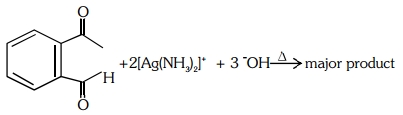
Identify the major product obtained in the following reaction:
A
$2-$acetylbenzoate ion
B
$2-$($1$-hydroxyethyl)benzyl alcohol
C
$2-$acetylbenzyl alcohol
D
$2-$acetylbenzoate ion (same as $A$)
Solution
(A) The given reaction involves the oxidation of an aldehyde group using Tollen's reagent $([Ag(NH_3)_2]^+)$ in a basic medium $(OH^-)$.
Aldehydes are oxidized to carboxylate ions $(COO^-)$ by Tollen's reagent,while ketones remain unaffected under these conditions.
In the given reactant,$2$-acetylbenzaldehyde,the aldehyde group $(-CHO)$ is oxidized to a carboxylate group $(-COO^-)$,while the acetyl group $(-COCH_3)$ remains unchanged.
Thus,the major product is the $2-$acetylbenzoate ion.
Aldehydes are oxidized to carboxylate ions $(COO^-)$ by Tollen's reagent,while ketones remain unaffected under these conditions.
In the given reactant,$2$-acetylbenzaldehyde,the aldehyde group $(-CHO)$ is oxidized to a carboxylate group $(-COO^-)$,while the acetyl group $(-COCH_3)$ remains unchanged.
Thus,the major product is the $2-$acetylbenzoate ion.
0 likesView Solution
48
ChemistryDifficultMCQNEET · 2023
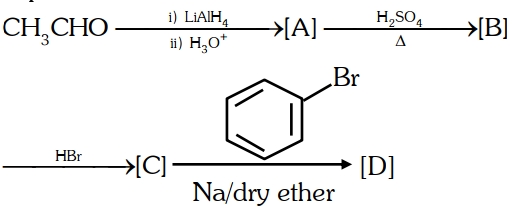
Identify the final product $[D]$ obtained in the following sequence of reactions.
A
$HC \equiv C^{\ominus} Na^{+}$
B
Ethylbenzene
C
Biphenyl
D
$C_4H_{10}$
Solution
(B) The reaction sequence is as follows:
$1$. Reduction of acetaldehyde $(CH_3CHO)$ with $LiAlH_4$ followed by $H_3O^+$ gives ethanol $(CH_3CH_2OH)$ as $[A]$.
$2$. Dehydration of ethanol with $H_2SO_4$ at high temperature gives ethene $(CH_2=CH_2)$ as $[B]$.
$3$. Addition of $HBr$ to ethene gives bromoethane $(CH_3CH_2Br)$ as $[C]$.
$4$. The reaction of bromoethane with bromobenzene in the presence of $Na$ and dry ether is a Wurtz-Fittig reaction,which yields ethylbenzene as the final product $[D]$.
$1$. Reduction of acetaldehyde $(CH_3CHO)$ with $LiAlH_4$ followed by $H_3O^+$ gives ethanol $(CH_3CH_2OH)$ as $[A]$.
$2$. Dehydration of ethanol with $H_2SO_4$ at high temperature gives ethene $(CH_2=CH_2)$ as $[B]$.
$3$. Addition of $HBr$ to ethene gives bromoethane $(CH_3CH_2Br)$ as $[C]$.
$4$. The reaction of bromoethane with bromobenzene in the presence of $Na$ and dry ether is a Wurtz-Fittig reaction,which yields ethylbenzene as the final product $[D]$.
1 likesView Solution
49
ChemistryMediumMCQNEET · 2023
The reaction that does $NOT$ take place in a blast furnace between $900 \ K$ to $1500 \ K$ temperature range during the extraction of iron is:
A
$CaO + SiO_2 \rightarrow CaSiO_3$
B
$Fe_2O_3 + CO \rightarrow 2FeO + CO_2$
C
$FeO + CO \rightarrow Fe + CO_2$
D
$C + CO_2 \rightarrow 2CO$
Solution
(B) In the blast furnace,the temperature range of $900 \ K$ to $1500 \ K$ is the lower part of the furnace.
The reactions occurring in this range are:
$1. C + CO_2 \rightarrow 2CO$
$2. FeO + CO \rightarrow Fe + CO_2$
$3. CaO + SiO_2 \rightarrow CaSiO_3$ (Slag formation)
The reaction $Fe_2O_3 + CO \rightarrow 2FeO + CO_2$ occurs at a lower temperature range of $500 \ K$ to $800 \ K$.
Therefore,the reaction that does not take place in the $900 \ K$ to $1500 \ K$ range is $Fe_2O_3 + CO \rightarrow 2FeO + CO_2$.
The reactions occurring in this range are:
$1. C + CO_2 \rightarrow 2CO$
$2. FeO + CO \rightarrow Fe + CO_2$
$3. CaO + SiO_2 \rightarrow CaSiO_3$ (Slag formation)
The reaction $Fe_2O_3 + CO \rightarrow 2FeO + CO_2$ occurs at a lower temperature range of $500 \ K$ to $800 \ K$.
Therefore,the reaction that does not take place in the $900 \ K$ to $1500 \ K$ range is $Fe_2O_3 + CO \rightarrow 2FeO + CO_2$.
0 likesView Solution
50
ChemistryMediumMCQNEET · 2023
Pumice stone is an example of
A
Foam
B
Sol
C
Gel
D
Solid sol
Solution
(D) Pumice stone is a type of colloid known as a solid sol.
In this system,the dispersed phase is $Gas$ and the dispersion medium is $Solid$.
In this system,the dispersed phase is $Gas$ and the dispersion medium is $Solid$.
0 likesView Solution
51
ChemistryMediumMCQNEET · 2023
Which complex compound is most stable?
A
$[Co(NH_3)_6]_2(SO_4)_3$
B
$[Co(NH_3)_4(H_2O)Br](NO_3)_2$
C
$[Co(NH_3)_3(NO_3)_3]$
D
$[CoCl_2(en)_2]NO_3$
Solution
(D) The stability of coordination complexes is significantly enhanced by the chelate effect,which occurs when polydentate ligands (chelating agents) form ring structures with the central metal ion.
In the given options,the complex $[CoCl_2(en)_2]NO_3$ contains ethylenediamine $(en)$,which is a bidentate ligand.
Bidentate ligands form more stable complexes compared to monodentate ligands like $NH_3$,$H_2O$,$Br^-$,or $NO_3^-$.
Therefore,the complex containing the chelating ligand $(en)$ is the most stable.
In the given options,the complex $[CoCl_2(en)_2]NO_3$ contains ethylenediamine $(en)$,which is a bidentate ligand.
Bidentate ligands form more stable complexes compared to monodentate ligands like $NH_3$,$H_2O$,$Br^-$,or $NO_3^-$.
Therefore,the complex containing the chelating ligand $(en)$ is the most stable.
0 likesView Solution
Vedclass Products
For Students
Vedclass Test Series
Mock tests in real NEET style covering Chemistry with performance analysis. 5-day free trial.
Start Free TrialFor Teachers
Exam Paper Generator
Generate Set A/B/C/D Chemistry papers from 7.5L+ questions in 2 minutes. 3 chapters free.
Try FreeFor Institutes
Online Exam Module
Run live NEET mock exams with unlimited students, 360° analytics & white-label branding.
See DemoFrequently Asked Questions
How many Chemistry questions are in NEET 2023?
There are 51 Chemistry questions from the NEET 2023 paper on Vedclass, each with a detailed step-by-step solution in English.
Are NEET 2023 Chemistry solutions available in English?
Yes. All solutions on this page are in English. You can also switch to English or Hindi using the language buttons above the questions.
Can I practice NEET 2023 Chemistry as a timed test?
Yes. Use the Vedclass Test Series to attempt a full NEET mock test covering Chemistry with time limits and instant score analysis.
Can teachers create Chemistry papers from NEET previous year questions?
Yes. The Vedclass Exam Paper Generator lets teachers mix NEET Chemistry questions and generate Set A/B/C/D papers in minutes.
For Teachers & Institutes
Build a Custom Chemistry Paper
Pick NEET 2023 Chemistry questions, set difficulty, and generate Set A/B/C/D in 2 minutes.