
ChemistryQ1–95 of 96 questions
Page 1 of 2 · English
1
ChemistryMediumMCQNEET · 2019
Which of the following is an amphoteric hydroxide?
A
$Be(OH)_2$
B
$Ca(OH)_2$
C
$Mg(OH)_2$
D
$Sr(OH)_2$
Solution
(A) An amphoteric substance is one that can react with both acids and bases.
$Be(OH)_2$ is amphoteric in nature because it reacts with both acids and bases to form salts and water.
For example:
$Be(OH)_2 + 2HCl \rightarrow BeCl_2 + 2H_2O$ (acts as a base)
$Be(OH)_2 + 2NaOH \rightarrow Na_2[Be(OH)_4]$ (acts as an acid)
Other hydroxides like $Mg(OH)_2$,$Ca(OH)_2$,and $Sr(OH)_2$ are basic in nature.
$Be(OH)_2$ is amphoteric in nature because it reacts with both acids and bases to form salts and water.
For example:
$Be(OH)_2 + 2HCl \rightarrow BeCl_2 + 2H_2O$ (acts as a base)
$Be(OH)_2 + 2NaOH \rightarrow Na_2[Be(OH)_4]$ (acts as an acid)
Other hydroxides like $Mg(OH)_2$,$Ca(OH)_2$,and $Sr(OH)_2$ are basic in nature.
0 likesView Solution
2
ChemistryDifficultMCQNEET · 2019
Under isothermal condition,a gas at $300 \; K$ expands from $0.1 \; L$ to $0.25 \; L$ against a constant external pressure of $2 \; bar$. The work done by the gas is .... [Given that $1 \; L \; bar = 100 \; J$]
A
$-30 \; J$
B
$5 \; kJ$
C
$25 \; J$
D
$30 \; J$
Solution
(A) The work done during expansion against a constant external pressure is given by the formula:
$W = -P_{ext} \times \Delta V$
Given:
$P_{ext} = 2 \; bar$
$V_{1} = 0.1 \; L$
$V_{2} = 0.25 \; L$
Change in volume:
$\Delta V = V_{2} - V_{1} = 0.25 \; L - 0.1 \; L = 0.15 \; L$
Calculating work done:
$W = -2 \; bar \times 0.15 \; L = -0.30 \; bar \cdot L$
Since $1 \; L \cdot bar = 100 \; J$:
$W = -0.30 \times 100 \; J = -30 \; J$
The work done by the gas is $-30 \; J$.
$W = -P_{ext} \times \Delta V$
Given:
$P_{ext} = 2 \; bar$
$V_{1} = 0.1 \; L$
$V_{2} = 0.25 \; L$
Change in volume:
$\Delta V = V_{2} - V_{1} = 0.25 \; L - 0.1 \; L = 0.15 \; L$
Calculating work done:
$W = -2 \; bar \times 0.15 \; L = -0.30 \; bar \cdot L$
Since $1 \; L \cdot bar = 100 \; J$:
$W = -0.30 \times 100 \; J = -30 \; J$
The work done by the gas is $-30 \; J$.
0 likesView Solution
3
ChemistryMediumMCQNEET · 2019
The $pH$ of a saturated solution of $Ca(OH)_{2}$ is $9$. The solubility product $(K_{sp})$ of $Ca(OH)_{2}$ is:
A
$0.5 \times 10^{-15}$
B
$0.25 \times 10^{-10}$
C
$0.125 \times 10^{-15}$
D
$0.5 \times 10^{-10}$
Solution
(A) The dissociation of $Ca(OH)_{2}$ is given by: $Ca(OH)_{2(s)} \rightleftharpoons Ca^{2+}_{(aq)} + 2OH^{-}_{(aq)}$
Given $pH = 9$,we know $pOH = 14 - pH = 14 - 9 = 5$.
Therefore,$[OH^{-}] = 10^{-pOH} = 10^{-5} \ M$.
From the stoichiometry,$[OH^{-}] = 2S$,where $S$ is the solubility of $Ca(OH)_{2}$.
So,$2S = 10^{-5} \implies S = 0.5 \times 10^{-5} \ M$.
The solubility product expression is $K_{sp} = [Ca^{2+}][OH^{-}]^{2} = (S)(2S)^{2} = 4S^{3}$.
Substituting the value of $S$: $K_{sp} = 4 \times (0.5 \times 10^{-5})^{3} = 4 \times 0.125 \times 10^{-15} = 0.5 \times 10^{-15}$.
Given $pH = 9$,we know $pOH = 14 - pH = 14 - 9 = 5$.
Therefore,$[OH^{-}] = 10^{-pOH} = 10^{-5} \ M$.
From the stoichiometry,$[OH^{-}] = 2S$,where $S$ is the solubility of $Ca(OH)_{2}$.
So,$2S = 10^{-5} \implies S = 0.5 \times 10^{-5} \ M$.
The solubility product expression is $K_{sp} = [Ca^{2+}][OH^{-}]^{2} = (S)(2S)^{2} = 4S^{3}$.
Substituting the value of $S$: $K_{sp} = 4 \times (0.5 \times 10^{-5})^{3} = 4 \times 0.125 \times 10^{-15} = 0.5 \times 10^{-15}$.
0 likesView Solution
4
ChemistryDifficultMCQNEET · 2019
The number of moles of hydrogen molecules required to produce $20$ moles of ammonia through Haber's process is
A
$10$
B
$20$
C
$30$
D
$40$
Solution
(C) The balanced chemical equation for Haber's process is:
$N_{2(g)} + 3H_{2(g)} \rightarrow 2NH_{3(g)}$
From the stoichiometry of the reaction,$2 \ \text{moles}$ of $NH_{3(g)}$ are produced from $3 \ \text{moles}$ of $H_{2(g)}$.
Therefore,to produce $20 \ \text{moles}$ of $NH_{3(g)}$,the required moles of $H_{2(g)}$ are:
$= \frac{3 \ \text{mol } H_2}{2 \ \text{mol } NH_3} \times 20 \ \text{mol } NH_3 = 30 \ \text{moles of } H_{2(g)}$.
$N_{2(g)} + 3H_{2(g)} \rightarrow 2NH_{3(g)}$
From the stoichiometry of the reaction,$2 \ \text{moles}$ of $NH_{3(g)}$ are produced from $3 \ \text{moles}$ of $H_{2(g)}$.
Therefore,to produce $20 \ \text{moles}$ of $NH_{3(g)}$,the required moles of $H_{2(g)}$ are:
$= \frac{3 \ \text{mol } H_2}{2 \ \text{mol } NH_3} \times 20 \ \text{mol } NH_3 = 30 \ \text{moles of } H_{2(g)}$.
0 likesView Solution
5
ChemistryEasyMCQNEET · 2019
Among the following,the one that is not a greenhouse gas is
A
nitrous oxide
B
methane
C
ozone
D
sulphur dioxide
Solution
(D) Greenhouse gases are gases that trap heat in the atmosphere. The primary greenhouse gases include carbon dioxide $(CO_2)$,methane $(CH_4)$,nitrous oxide $(N_2O)$,water vapour,chlorofluorocarbons $(CFCs)$,and ozone $(O_3)$.
Sulphur dioxide $(SO_2)$ is primarily responsible for acid rain and is not considered a greenhouse gas.
Sulphur dioxide $(SO_2)$ is primarily responsible for acid rain and is not considered a greenhouse gas.
0 likesView Solution
6
ChemistryMediumMCQNEET · 2019
The number of sigma $(σ)$ and pi $(π)$ bonds in pent$-2-$en$-4-$yne is
A
$10\sigma$ bonds and $3\pi$ bonds
B
$8\sigma$ bonds and $5\pi$ bonds
C
$11\sigma$ bonds and $2\pi$ bonds
D
$13\sigma$ bonds and $1\pi$ bond
Solution
(A) The structural formula of pent$-2-$en$-4-$yne is $CH_3-CH=CH-C \equiv CH$.
Number of $\sigma$ bonds:
$C-H$ bonds = $6$
$C-C$ bonds = $4$
Total $\sigma$ bonds = $6 + 4 = 10$.
Number of $\pi$ bonds:
$1$ (from $C=C$) + $2$ (from $C \equiv C$) = $3$.
Number of $\sigma$ bonds:
$C-H$ bonds = $6$
$C-C$ bonds = $4$
Total $\sigma$ bonds = $6 + 4 = 10$.
Number of $\pi$ bonds:
$1$ (from $C=C$) + $2$ (from $C \equiv C$) = $3$.
0 likesView Solution
7
ChemistryMediumMCQNEET · 2019
Which of the following diatomic molecular species has only $\pi$ bonds according to Molecular Orbital Theory?
A
$O_2$
B
$N_2$
C
$C_2$
D
$Be_2$
Solution
(C) According to $M.O.T.$,the electronic configuration of the $C_2$ molecule is:
$\sigma 1s^2 < \sigma^* 1s^2 < \sigma 2s^2 < \sigma^* 2s^2 < \pi 2p_x^2 = \pi 2p_y^2$
In the $C_2$ molecule,the bond order is $2$,and both bonds are $\pi$ bonds due to the presence of electrons only in the $\pi 2p$ orbitals.
$\sigma 1s^2 < \sigma^* 1s^2 < \sigma 2s^2 < \sigma^* 2s^2 < \pi 2p_x^2 = \pi 2p_y^2$
In the $C_2$ molecule,the bond order is $2$,and both bonds are $\pi$ bonds due to the presence of electrons only in the $\pi 2p$ orbitals.
1 likesView Solution
8
ChemistryMediumMCQNEET · 2019
Which of the following reactions are disproportionation reactions?
$(a)$ $2 Cu^{+} \rightarrow Cu^{2+} + Cu^{0}$
$(b)$ $3 MnO_{4}^{2-} + 4 H^{+} \rightarrow 2 MnO_{4}^{-} + MnO_{2} + 2 H_{2}O$
$(c)$ $2 KMnO_{4} \xrightarrow{\Delta} K_{2}MnO_{4} + MnO_{2} + O_{2}$
$(d)$ $2 MnO_{4}^{-} + 3 Mn^{2+} + 2 H_{2}O \rightarrow 5 MnO_{2} + 4 H^{+}$
Select the correct option from the following:
$(a)$ $2 Cu^{+} \rightarrow Cu^{2+} + Cu^{0}$
$(b)$ $3 MnO_{4}^{2-} + 4 H^{+} \rightarrow 2 MnO_{4}^{-} + MnO_{2} + 2 H_{2}O$
$(c)$ $2 KMnO_{4} \xrightarrow{\Delta} K_{2}MnO_{4} + MnO_{2} + O_{2}$
$(d)$ $2 MnO_{4}^{-} + 3 Mn^{2+} + 2 H_{2}O \rightarrow 5 MnO_{2} + 4 H^{+}$
Select the correct option from the following:
A
$(a)$ and $(b)$ only
B
$(a), (b)$ and $(c)$
C
$(a), (c)$ and $(d)$
D
$(a)$ and $(d)$ only
Solution
(A) disproportionation reaction is a redox reaction in which the same element is simultaneously oxidized and reduced.
$(a)$ $2 Cu^{+} \rightarrow Cu^{2+} + Cu^{0}$
Here,$Cu^{+}$ (oxidation state $+1$) is oxidized to $Cu^{2+}$ $(+2)$ and reduced to $Cu^{0}$ $(0)$. This is a disproportionation reaction.
$(b)$ $3 MnO_{4}^{2-} + 4 H^{+} \rightarrow 2 MnO_{4}^{-} + MnO_{2} + 2 H_{2}O$
Here,$Mn$ in $MnO_{4}^{2-}$ (oxidation state $+6$) is oxidized to $MnO_{4}^{-}$ $(+7)$ and reduced to $MnO_{2}$ $(+4)$. This is a disproportionation reaction.
$(c)$ $2 KMnO_{4} \xrightarrow{\Delta} K_{2}MnO_{4} + MnO_{2} + O_{2}$
This is a decomposition reaction,not a disproportionation reaction.
$(d)$ $2 MnO_{4}^{-} + 3 Mn^{2+} + 2 H_{2}O \rightarrow 5 MnO_{2} + 4 H^{+}$
This is a comproportionation reaction where $Mn(+7)$ and $Mn(+2)$ combine to form $Mn(+4)$.
Therefore,only $(a)$ and $(b)$ are disproportionation reactions.
$(a)$ $2 Cu^{+} \rightarrow Cu^{2+} + Cu^{0}$
Here,$Cu^{+}$ (oxidation state $+1$) is oxidized to $Cu^{2+}$ $(+2)$ and reduced to $Cu^{0}$ $(0)$. This is a disproportionation reaction.
$(b)$ $3 MnO_{4}^{2-} + 4 H^{+} \rightarrow 2 MnO_{4}^{-} + MnO_{2} + 2 H_{2}O$
Here,$Mn$ in $MnO_{4}^{2-}$ (oxidation state $+6$) is oxidized to $MnO_{4}^{-}$ $(+7)$ and reduced to $MnO_{2}$ $(+4)$. This is a disproportionation reaction.
$(c)$ $2 KMnO_{4} \xrightarrow{\Delta} K_{2}MnO_{4} + MnO_{2} + O_{2}$
This is a decomposition reaction,not a disproportionation reaction.
$(d)$ $2 MnO_{4}^{-} + 3 Mn^{2+} + 2 H_{2}O \rightarrow 5 MnO_{2} + 4 H^{+}$
This is a comproportionation reaction where $Mn(+7)$ and $Mn(+2)$ combine to form $Mn(+4)$.
Therefore,only $(a)$ and $(b)$ are disproportionation reactions.
0 likesView Solution
9
ChemistryMediumMCQNEET · 2019
Conjugate base for Bronsted acids $H_{2}O$ and $HF$ are
A
$OH^{-}$ and $H_{2}F^{+}$ respectively
B
$H_{3}O^{+}$ and $F^{-}$ respectively
C
$OH^{-}$ and $F^{-}$ respectively
D
$H_{3}O^{+}$ and $H_{2}F^{+}$ respectively
Solution
(C) The conjugate base of a Bronsted acid is formed by the removal of a proton $(H^{+})$ from the acid.
For $H_{2}O$: $H_{2}O - H^{+} \rightarrow OH^{-}$.
For $HF$: $HF - H^{+} \rightarrow F^{-}$.
Therefore,the conjugate bases are $OH^{-}$ and $F^{-}$ respectively.
For $H_{2}O$: $H_{2}O - H^{+} \rightarrow OH^{-}$.
For $HF$: $HF - H^{+} \rightarrow F^{-}$.
Therefore,the conjugate bases are $OH^{-}$ and $F^{-}$ respectively.
0 likesView Solution
10
ChemistryDifficultMCQNEET · 2019
Which of the following combinations will form a basic buffer solution?
A
$50 \ mL$ of $0.1 \ M \ NaOH + 25 \ mL$ of $0.1 \ M \ CH_{3}COOH$
B
$100 \ mL$ of $0.1 \ M \ CH_{3}COOH + 100 \ mL$ of $0.1 \ M \ NaOH$
C
$100 \ mL$ of $0.1 \ M \ HCl + 200 \ mL$ of $0.1 \ M \ NH_{4}OH$
D
$100 \ mL$ of $0.1 \ M \ HCl + 100 \ mL$ of $0.1 \ M \ NaOH$
Solution
(C) basic buffer is formed by a mixture of a weak base and its salt with a strong acid.
In option $C$,we have $NH_{4}OH$ (weak base) and $HCl$ (strong acid).
Initial milli-moles of $HCl = 100 \times 0.1 = 10 \ mmol$.
Initial milli-moles of $NH_{4}OH = 200 \times 0.1 = 20 \ mmol$.
The reaction is: $HCl + NH_{4}OH \rightarrow NH_{4}Cl + H_{2}O$.
After the reaction,$10 \ mmol$ of $NH_{4}OH$ remains,and $10 \ mmol$ of $NH_{4}Cl$ (salt) is formed.
Since the mixture contains a weak base and its salt,it forms a basic buffer.
In option $C$,we have $NH_{4}OH$ (weak base) and $HCl$ (strong acid).
Initial milli-moles of $HCl = 100 \times 0.1 = 10 \ mmol$.
Initial milli-moles of $NH_{4}OH = 200 \times 0.1 = 20 \ mmol$.
The reaction is: $HCl + NH_{4}OH \rightarrow NH_{4}Cl + H_{2}O$.
After the reaction,$10 \ mmol$ of $NH_{4}OH$ remains,and $10 \ mmol$ of $NH_{4}Cl$ (salt) is formed.
Since the mixture contains a weak base and its salt,it forms a basic buffer.
0 likesView Solution
11
ChemistryMediumMCQNEET · 2019
The most suitable reagent for the following conversion is:
$H_3C-C \equiv C-CH_3 \rightarrow \text{cis-2-butene}$
$H_3C-C \equiv C-CH_3 \rightarrow \text{cis-2-butene}$
A
$Na / \text{liquid } NH_3$
B
$H_2, Pd / C, \text{quinoline}$
C
$Zn / HCl$
D
$Hg^{2+} / H^{+}, H_2O$
Solution
(B) The conversion of an internal alkyne (but$-2-$yne) to a $cis$-alkene (cis$-2-$butene) requires a partial reduction that involves $syn$-addition of hydrogen.
This is achieved using Lindlar's catalyst,which is $Pd$ supported on $CaCO_3$ or $BaSO_4$ poisoned with quinoline or lead acetate $(H_2, Pd / C, \text{quinoline})$.
$Na / \text{liquid } NH_3$ (Birch reduction) would result in the $trans$-alkene.
Therefore,the correct reagent is $H_2, Pd / C, \text{quinoline}$.
This is achieved using Lindlar's catalyst,which is $Pd$ supported on $CaCO_3$ or $BaSO_4$ poisoned with quinoline or lead acetate $(H_2, Pd / C, \text{quinoline})$.
$Na / \text{liquid } NH_3$ (Birch reduction) would result in the $trans$-alkene.
Therefore,the correct reagent is $H_2, Pd / C, \text{quinoline}$.
0 likesView Solution
12
ChemistryAdvancedMCQNEET · 2019
Which of the following species is not stable?
A
$[SiF_{6}]^{2-}$
B
$[GeCl_{6}]^{2-}$
C
$[Sn(OH)_{6}]^{2-}$
D
$[SiCl_{6}]^{2-}$
Solution
(D) $[SiCl_{6}]^{2-}$ does not exist because:
$(I)$ The size of the $Cl^{-}$ ion is large,so it cannot be accommodated around the small $Si^{4+}$ ion due to steric hindrance.
$(II)$ The interaction between the lone pair of the chloride ion and the $Si^{4+}$ ion is not strong enough to stabilize the complex.
$(I)$ The size of the $Cl^{-}$ ion is large,so it cannot be accommodated around the small $Si^{4+}$ ion due to steric hindrance.
$(II)$ The interaction between the lone pair of the chloride ion and the $Si^{4+}$ ion is not strong enough to stabilize the complex.
0 likesView Solution
13
ChemistryMCQNEET · 2019
Which of the following is an amphoteric hydroxide?
A
$Sr(OH)_{2}$
B
$Ca(OH)_{2}$
C
$Mg(OH)_{2}$
D
$Be(OH)_{2}$
Solution
(D) $Be(OH)_{2}$ is an amphoteric hydroxide because it reacts with both acids and bases.
All other hydroxides listed,i.e.,$Mg(OH)_{2}$,$Ca(OH)_{2}$,and $Sr(OH)_{2}$,are basic in nature.
All other hydroxides listed,i.e.,$Mg(OH)_{2}$,$Ca(OH)_{2}$,and $Sr(OH)_{2}$,are basic in nature.
0 likesView Solution
14
ChemistryMediumMCQNEET · 2019
For the second period elements,the correct increasing order of first ionisation enthalpy is:
A
$Li < Be < B < C < N < O < F < Ne$
B
$Li < B < Be < C < O < N < F < Ne$
C
$Li < B < Be < C < N < O < F < Ne$
D
$Li < Be < B < C < O < N < F < Ne$
Solution
(B) The first ionisation enthalpy generally increases across a period due to an increase in effective nuclear charge.
However,there are deviations due to stable electronic configurations.
The electronic configurations for second period elements are:
$Li (2s^1)$,$Be (2s^2)$,$B (2s^2 2p^1)$,$C (2s^2 2p^2)$,$N (2s^2 2p^3)$,$O (2s^2 2p^4)$,$F (2s^2 2p^5)$,$Ne (2s^2 2p^6)$.
$Be$ has a fully filled $2s$ orbital,making its ionisation energy higher than $B$.
$N$ has a half-filled $2p$ subshell,making its ionisation energy higher than $O$.
The correct order is: $Li < B < Be < C < O < N < F < Ne$.
However,there are deviations due to stable electronic configurations.
The electronic configurations for second period elements are:
$Li (2s^1)$,$Be (2s^2)$,$B (2s^2 2p^1)$,$C (2s^2 2p^2)$,$N (2s^2 2p^3)$,$O (2s^2 2p^4)$,$F (2s^2 2p^5)$,$Ne (2s^2 2p^6)$.
$Be$ has a fully filled $2s$ orbital,making its ionisation energy higher than $B$.
$N$ has a half-filled $2p$ subshell,making its ionisation energy higher than $O$.
The correct order is: $Li < B < Be < C < O < N < F < Ne$.
1 likesView Solution
15
ChemistryAdvancedMCQNEET · 2019
Identify the incorrect statement related to $PCl_{5}$ from the following:
A
Three equatorial $P-Cl$ bonds make an angle of $120^{\circ}$ with each other.
B
Two axial $P-Cl$ bonds make an angle of $180^{\circ}$ with each other.
C
Axial $P-Cl$ bonds are longer than equatorial bonds.
D
$PCl_{5}$ molecule is non-reactive.
Solution
(D) The $PCl_{5}$ molecule has a trigonal bipyramidal geometry.
In this structure,the three equatorial $P-Cl$ bonds are at $120^{\circ}$ to each other.
The two axial $P-Cl$ bonds are at $180^{\circ}$ to each other.
Due to greater repulsion from equatorial bond pairs,the axial $P-Cl$ bonds are longer than the equatorial bonds.
$PCl_{5}$ is a highly reactive molecule because it easily undergoes hydrolysis and acts as a chlorinating agent. Therefore,the statement that it is non-reactive is incorrect.
In this structure,the three equatorial $P-Cl$ bonds are at $120^{\circ}$ to each other.
The two axial $P-Cl$ bonds are at $180^{\circ}$ to each other.
Due to greater repulsion from equatorial bond pairs,the axial $P-Cl$ bonds are longer than the equatorial bonds.
$PCl_{5}$ is a highly reactive molecule because it easily undergoes hydrolysis and acts as a chlorinating agent. Therefore,the statement that it is non-reactive is incorrect.
0 likesView Solution
16
ChemistryEasyMCQNEET · 2019
$4d, 5p, 5f$ and $6p$ orbitals are arranged in the order of decreasing energy. The correct option is
A
$5f > 6p > 5p > 4d$
B
$6p > 5f > 5p > 4d$
C
$6p > 5f > 4d > 5p$
D
$5f > 6p > 4d > 5p$
Solution
(A) To determine the energy order,we use the $(n+l)$ rule:
For $4d$: $n=4, l=2$,so $(n+l) = 4+2 = 6$.
For $5p$: $n=5, l=1$,so $(n+l) = 5+1 = 6$.
For $5f$: $n=5, l=3$,so $(n+l) = 5+3 = 8$.
For $6p$: $n=6, l=1$,so $(n+l) = 6+1 = 7$.
Comparing the $(n+l)$ values: $8 (5f) > 7 (6p) > 6 (4d, 5p)$.
For orbitals with the same $(n+l)$ value,the one with the higher $n$ value has higher energy. Thus,$5p (n=5) > 4d (n=4)$.
The final decreasing order of energy is $5f > 6p > 5p > 4d$.
For $4d$: $n=4, l=2$,so $(n+l) = 4+2 = 6$.
For $5p$: $n=5, l=1$,so $(n+l) = 5+1 = 6$.
For $5f$: $n=5, l=3$,so $(n+l) = 5+3 = 8$.
For $6p$: $n=6, l=1$,so $(n+l) = 6+1 = 7$.
Comparing the $(n+l)$ values: $8 (5f) > 7 (6p) > 6 (4d, 5p)$.
For orbitals with the same $(n+l)$ value,the one with the higher $n$ value has higher energy. Thus,$5p (n=5) > 4d (n=4)$.
The final decreasing order of energy is $5f > 6p > 5p > 4d$.
0 likesView Solution
17
ChemistryAdvancedMCQNEET · 2019
An alkene $A$ on reaction with $O_{3}$ and $Zn-H_{2}O$ gives propanone and ethanal in equimolar ratio. Addition of $HCl$ to alkene $A$ gives $B$ as the major product. The structure of product $B$ is:
A
$Cl-CH_{2}-CH_{2}-C(CH_{3})_{2}-CH_{3}$
B
$CH_{3}-CH_{2}-CH(CH_{2}Cl)-CH_{3}$
C
$CH_{3}-CH_{2}-C(Cl)(CH_{3})_{2}$
D
$CH_{3}-CH(Cl)-CH(CH_{3})_{2}$
Solution
(C) $1$. Ozonolysis of alkene $A$ yields propanone $(CH_{3}COCH_{3})$ and ethanal $(CH_{3}CHO)$.
$2$. By reversing the ozonolysis reaction,we join the carbonyl carbons with a double bond: $(CH_{3})_{2}C=CH-CH_{3}$. This is $2-methylbut-2-ene$.
$3$. Addition of $HCl$ to $2-methylbut-2-ene$ follows Markovnikov's rule,which proceeds via the formation of the most stable carbocation.
$4$. Protonation of the double bond at the $C-3$ position leads to a tertiary carbocation: $(CH_{3})_{2}C^{+}-CH_{2}-CH_{3}$.
$5$. Subsequent attack by the chloride ion $(Cl^{-})$ on the tertiary carbocation yields $2-chloro-2-methylbutane$,which is $CH_{3}-CH_{2}-C(Cl)(CH_{3})_{2}$.
$2$. By reversing the ozonolysis reaction,we join the carbonyl carbons with a double bond: $(CH_{3})_{2}C=CH-CH_{3}$. This is $2-methylbut-2-ene$.
$3$. Addition of $HCl$ to $2-methylbut-2-ene$ follows Markovnikov's rule,which proceeds via the formation of the most stable carbocation.
$4$. Protonation of the double bond at the $C-3$ position leads to a tertiary carbocation: $(CH_{3})_{2}C^{+}-CH_{2}-CH_{3}$.
$5$. Subsequent attack by the chloride ion $(Cl^{-})$ on the tertiary carbocation yields $2-chloro-2-methylbutane$,which is $CH_{3}-CH_{2}-C(Cl)(CH_{3})_{2}$.
0 likesView Solution
18
ChemistryEasyMCQNEET · 2019
Enzymes that utilize $ATP$ in phosphate transfer require an alkaline earth metal $(M)$ as the cofactor. $M$ is
A
$Be$
B
$Mg$
C
$Ca$
D
$Sr$
Solution
(B) All enzymes that utilize $ATP$ in phosphate transfer require magnesium $(Mg^{2+})$ as the cofactor.
Magnesium ions play a crucial role in stabilizing the negative charges on the phosphate groups of $ATP$,facilitating the transfer of the phosphate group.
Magnesium ions play a crucial role in stabilizing the negative charges on the phosphate groups of $ATP$,facilitating the transfer of the phosphate group.
0 likesView Solution
19
ChemistryEasyMCQNEET · 2019
Which of the following series of transitions in the spectrum of hydrogen atom falls in the visible region?
A
Lyman series
B
Balmer series
C
Paschen series
D
Brackett series
Solution
(B) In the spectrum of the hydrogen atom,the spectral lines of the $Balmer$ series lie in the visible region.
The $Lyman$ series lies in the ultraviolet region,while the $Paschen$,$Brackett$,and $Pfund$ series lie in the infrared region.
The $Lyman$ series lies in the ultraviolet region,while the $Paschen$,$Brackett$,and $Pfund$ series lie in the infrared region.
0 likesView Solution
20
ChemistryEasyMCQNEET · 2019
In which case is the change in entropy negative?
A
Evaporation of water
B
Expansion of a gas at constant temperature
C
Sublimation of solid to gas
D
$2H_{(g)} \rightarrow H_{2(g)}$
Solution
(D) For the reaction $2H_{(g)} \rightarrow H_{2(g)}$,two moles of gaseous atoms combine to form one mole of a gaseous molecule.
Since the number of moles of gas decreases,the randomness or disorder of the system decreases.
Therefore,the change in entropy $(\Delta S)$ is negative.
Since the number of moles of gas decreases,the randomness or disorder of the system decreases.
Therefore,the change in entropy $(\Delta S)$ is negative.
0 likesView Solution
21
ChemistryEasyMCQNEET · 2019
Which of the following is an incorrect statement?
A
$PbF_4$ is covalent in nature
B
$SiCl_4$ is easily hydrolysed
C
$GeX_4$ $(X = F, Cl, Br, I)$ is more stable than $GeX_2$
D
$SnF_4$ is ionic in nature
Solution
(A) The statement '$PbF_4$ is covalent in nature' is incorrect.
$PbF_4$ is an ionic compound because the large size of the $Pb^{4+}$ cation and the small size of the $F^-$ anion favor ionic bonding.
$SiCl_4$ undergoes easy hydrolysis due to the presence of vacant $d$-orbitals.
$GeX_4$ is more stable than $GeX_2$ due to the inert pair effect being less pronounced in $Ge$ compared to $Pb$.
$SnF_4$ is ionic in nature.
$PbF_4$ is an ionic compound because the large size of the $Pb^{4+}$ cation and the small size of the $F^-$ anion favor ionic bonding.
$SiCl_4$ undergoes easy hydrolysis due to the presence of vacant $d$-orbitals.
$GeX_4$ is more stable than $GeX_2$ due to the inert pair effect being less pronounced in $Ge$ compared to $Pb$.
$SnF_4$ is ionic in nature.
0 likesView Solution
22
ChemistryMediumMCQNEET · 2019
$A$ gas at $350 \; K$ and $15 \; bar$ has a molar volume $20$ percent smaller than that for an ideal gas under the same conditions. The correct option about the gas and its compressibility factor $(Z)$ is
A
$Z > 1$ and attractive forces are dominant
B
$Z > 1$ and repulsive forces are dominant
C
$Z < 1$ and attractive forces are dominant
D
$Z < 1$ and repulsive forces are dominant
Solution
(C) The compressibility factor $Z$ is defined as the ratio of the molar volume of a real gas $(V_{m})_{real}$ to the molar volume of an ideal gas $(V_{m})_{ideal}$ at the same temperature and pressure: $Z = \frac{(V_{m})_{real}}{(V_{m})_{ideal}}$.
Given that $(V_{m})_{real}$ is $20$ percent smaller than $(V_{m})_{ideal}$,we have $(V_{m})_{real} = 0.8 \times (V_{m})_{ideal}$.
Therefore,$Z = \frac{0.8 \times (V_{m})_{ideal}}{(V_{m})_{ideal}} = 0.8$.
Since $Z < 1$,the gas shows negative deviation from ideal behavior,which indicates that attractive intermolecular forces are dominant.
Given that $(V_{m})_{real}$ is $20$ percent smaller than $(V_{m})_{ideal}$,we have $(V_{m})_{real} = 0.8 \times (V_{m})_{ideal}$.
Therefore,$Z = \frac{0.8 \times (V_{m})_{ideal}}{(V_{m})_{ideal}} = 0.8$.
Since $Z < 1$,the gas shows negative deviation from ideal behavior,which indicates that attractive intermolecular forces are dominant.
0 likesView Solution
23
ChemistryEasyMCQNEET · 2019
The method used to remove temporary hardness of water is
A
Calgon's method
B
Clark's method
C
Ion-exchange method
D
Synthetic resins method
Solution
(B) Clark's method is used to remove temporary hardness of water by adding lime $(Ca(OH)_2)$.
The chemical reaction is:
$Ca(HCO_3)_2 + Ca(OH)_2 \rightarrow 2 CaCO_3 \downarrow + 2 H_2O$
The chemical reaction is:
$Ca(HCO_3)_2 + Ca(OH)_2 \rightarrow 2 CaCO_3 \downarrow + 2 H_2O$
0 likesView Solution
24
ChemistryMCQNEET · 2019
Removal of shoot tips is a very useful technique to boost the production of tea-leaves. This is because
A
Gibberellins prevent bolting and are inactivated
B
Auxins prevent leaf drop at early stages
C
Effect of auxins is removed and growth of lateral buds is enhanced
D
Gibberellins delay senescence of leaves.
Solution
(C) The shoot tips of plants contain high concentrations of $Auxins$,which are responsible for apical dominance. $Apical$ $dominance$ inhibits the growth of lateral buds. By removing the shoot tips,the source of $Auxins$ is eliminated. This removes the inhibitory effect on the lateral buds,allowing them to grow and produce more branches,which in turn increases the production of tea-leaves.
0 likesView Solution
25
ChemistryMediumMCQNEET · 2019
The liquified gas that is used in dry cleaning along with a suitable detergent is
A
Water gas
B
$CO$
C
$NO_2$
D
$CO_2$
Solution
(D) Liquid $CO_2$ is used as a solvent in dry cleaning because it is environmentally friendly and effective at dissolving grease and stains when combined with a suitable detergent. This process is known as supercritical fluid extraction or liquid $CO_2$ cleaning.
0 likesView Solution
26
ChemistryMediumMCQNEET · 2019
Match the oxide given in column $A$ with its property given in column $B$.
Which of the following options has all correct pairs?
| Column $A$ | Column $B$ |
| $(i) \; Na_{2}O$ | $(a) \; Neutral$ |
| $(ii) \; Al_{2}O_{3}$ | $(b) \; Basic$ |
| $(iii) \; N_{2}O$ | $(c) \; Acidic$ |
| $(iv) \; Cl_{2}O_{7}$ | $(d) \; Amphoteric$ |
Which of the following options has all correct pairs?
A
$(i)-(b), (ii)-(a), (iii)-(d), (iv)-(c)$
B
$(i)-(c), (ii)-(b), (iii)-(a), (iv)-(d)$
C
$(i)-(a), (ii)-(d), (iii)-(b), (iv)-(c)$
D
$(i)-(b), (ii)-(d), (iii)-(a), (iv)-(c)$
Solution
(D) $Na_{2}O$ is a metallic oxide,hence it is $Basic$.
$Al_{2}O_{3}$ is an $Amphoteric$ oxide as it reacts with both acids and bases.
$N_{2}O$ is a $Neutral$ oxide.
$Cl_{2}O_{7}$ is a non-metallic oxide,hence it is $Acidic$.
Therefore,the correct matching is $(i)-(b), (ii)-(d), (iii)-(a), (iv)-(c)$.
$Al_{2}O_{3}$ is an $Amphoteric$ oxide as it reacts with both acids and bases.
$N_{2}O$ is a $Neutral$ oxide.
$Cl_{2}O_{7}$ is a non-metallic oxide,hence it is $Acidic$.
Therefore,the correct matching is $(i)-(b), (ii)-(d), (iii)-(a), (iv)-(c)$.
0 likesView Solution
27
ChemistryDifficultMCQNEET · 2019
The most stable carbocation among the following is:
A
$(CH_{3})_{3}C^{+}$
B
$CH_{3}CH_{2}CH^{+}CH_{2}CH_{3}$
C
$CH_{3}CH^{+}CH_{2}CH_{2}CH_{3}$
D
$CH_{3}CH_{2}CH_{2}^{+}$
Solution
(A) The stability of carbocations is determined by the inductive effect $(+I)$ and hyperconjugation (number of $\alpha-H$ atoms).
$1$. $(CH_{3})_{3}C^{+}$ is a tertiary $(3^{\circ})$ carbocation with $9$ $\alpha-H$ atoms.
$2$. $CH_{3}CH_{2}CH^{+}CH_{2}CH_{3}$ is a secondary $(2^{\circ})$ carbocation with $4$ $\alpha-H$ atoms.
$3$. $CH_{3}CH^{+}CH_{2}CH_{2}CH_{3}$ is a secondary $(2^{\circ})$ carbocation with $3$ $\alpha-H$ atoms.
$4$. $CH_{3}CH_{2}CH_{2}^{+}$ is a primary $(1^{\circ})$ carbocation with $2$ $\alpha-H$ atoms.
Since the stability order is $3^{\circ} > 2^{\circ} > 1^{\circ}$, the tertiary carbocation $(CH_{3})_{3}C^{+}$ is the most stable.
$1$. $(CH_{3})_{3}C^{+}$ is a tertiary $(3^{\circ})$ carbocation with $9$ $\alpha-H$ atoms.
$2$. $CH_{3}CH_{2}CH^{+}CH_{2}CH_{3}$ is a secondary $(2^{\circ})$ carbocation with $4$ $\alpha-H$ atoms.
$3$. $CH_{3}CH^{+}CH_{2}CH_{2}CH_{3}$ is a secondary $(2^{\circ})$ carbocation with $3$ $\alpha-H$ atoms.
$4$. $CH_{3}CH_{2}CH_{2}^{+}$ is a primary $(1^{\circ})$ carbocation with $2$ $\alpha-H$ atoms.
Since the stability order is $3^{\circ} > 2^{\circ} > 1^{\circ}$, the tertiary carbocation $(CH_{3})_{3}C^{+}$ is the most stable.
0 likesView Solution
28
ChemistryMediumMCQNEET · 2019
The alkane that gives only one mono-chloro product on chlorination with $Cl_2$ in the presence of diffused sunlight is:
A
$2,2-$dimethylbutane
B
neopentane
C
$n-$pentane
D
Isopentane
Solution
(B) For an alkane to produce only one mono-chloro product,all hydrogen atoms in the molecule must be equivalent.
Neopentane ($2,2-$dimethylpropane) has the structure $C(CH_3)_4$.
In neopentane,all $12$ hydrogen atoms are attached to equivalent primary carbon atoms.
Therefore,substitution of any of these $12$ hydrogen atoms by a chlorine atom results in the same product,$1-$chloro$-2,2-$dimethylpropane.
Other options like $n-$pentane,isopentane,and $2,2-$dimethylbutane contain non-equivalent hydrogen atoms,leading to a mixture of isomeric mono-chloro products.
Neopentane ($2,2-$dimethylpropane) has the structure $C(CH_3)_4$.
In neopentane,all $12$ hydrogen atoms are attached to equivalent primary carbon atoms.
Therefore,substitution of any of these $12$ hydrogen atoms by a chlorine atom results in the same product,$1-$chloro$-2,2-$dimethylpropane.
Other options like $n-$pentane,isopentane,and $2,2-$dimethylbutane contain non-equivalent hydrogen atoms,leading to a mixture of isomeric mono-chloro products.
0 likesView Solution
29
ChemistryMediumMCQNEET · 2019
In the following reaction,
$CH_3-C \equiv CH \xrightarrow[873 \ K]{\text{red hot iron tube}} A$
the number of sigma$(\sigma)$ bonds present in the product $A$ is
$CH_3-C \equiv CH \xrightarrow[873 \ K]{\text{red hot iron tube}} A$
the number of sigma$(\sigma)$ bonds present in the product $A$ is
A
$21$
B
$9$
C
$24$
D
$18$
Solution
(A) The reaction of propyne $(CH_3-C \equiv CH)$ with a red hot iron tube at $873 \ K$ is a cyclic polymerization reaction.
Three molecules of propyne undergo cyclization to form $1,3,5$-trimethylbenzene (mesitylene) as the product $A$.
The structure of $1,3,5$-trimethylbenzene is a benzene ring with three methyl groups at positions $1, 3,$ and $5$.
To calculate the number of $\sigma$ bonds in $1,3,5$-trimethylbenzene $(C_9H_{12})$:
- There are $6$ $\sigma$ bonds in the benzene ring ($C$-$C$ bonds).
- There are $3$ $\sigma$ bonds between the ring carbons and the methyl carbons.
- Each of the $3$ methyl groups has $3$ $C$-$H$ $\sigma$ bonds,totaling $3 \times 3 = 9$ $\sigma$ bonds.
- There are $3$ $\sigma$ bonds between the ring carbons and the remaining $3$ hydrogens,totaling $3$ $\sigma$ bonds.
Total $\sigma$ bonds = $6 \text{ (ring C-C)} + 3 \text{ (ring-methyl C-C)} + 9 \text{ (methyl C-H)} + 3 \text{ (ring C-H)} = 21$.
Thus,the product $A$ contains $21$ $\sigma$ bonds.
Three molecules of propyne undergo cyclization to form $1,3,5$-trimethylbenzene (mesitylene) as the product $A$.
The structure of $1,3,5$-trimethylbenzene is a benzene ring with three methyl groups at positions $1, 3,$ and $5$.
To calculate the number of $\sigma$ bonds in $1,3,5$-trimethylbenzene $(C_9H_{12})$:
- There are $6$ $\sigma$ bonds in the benzene ring ($C$-$C$ bonds).
- There are $3$ $\sigma$ bonds between the ring carbons and the methyl carbons.
- Each of the $3$ methyl groups has $3$ $C$-$H$ $\sigma$ bonds,totaling $3 \times 3 = 9$ $\sigma$ bonds.
- There are $3$ $\sigma$ bonds between the ring carbons and the remaining $3$ hydrogens,totaling $3$ $\sigma$ bonds.
Total $\sigma$ bonds = $6 \text{ (ring C-C)} + 3 \text{ (ring-methyl C-C)} + 9 \text{ (methyl C-H)} + 3 \text{ (ring C-H)} = 21$.
Thus,the product $A$ contains $21$ $\sigma$ bonds.
0 likesView Solution
30
ChemistryEasyMCQNEET · 2019
Which of the following compounds is used in cosmetic surgery?
A
Silica
B
Silicates
C
Silicones
D
Zeolites
Solution
(C) Silicones are synthetic polymers containing $Si-O-Si$ linkages. They are used as sealants,greases,electrical insulators,and for waterproofing fabrics. Due to their biocompatibility,they are also widely used in surgical and cosmetic implants.
0 likesView Solution
31
ChemistryMCQNEET · 2019
$A$ compound $X$ upon reaction with $H_{2}O$ produces a colorless gas $Y$ with a rotten fish smell. Gas $Y$ is absorbed in a solution of $CuSO_{4}$ to give $Cu_{3}P_{2}$ as one of the products. Predict the compound $X$.
A
$Ca_{3}P_{2}$
B
$NH_{4}Cl$
C
$As_{2}O_{3}$
D
$Ca_{3}(PO_{4})_{2}$
Solution
(A) The reaction of calcium phosphide $(Ca_{3}P_{2})$ with water produces phosphine gas $(PH_{3})$,which has a characteristic rotten fish smell.
$Ca_{3}P_{2} + 6H_{2}O \rightarrow 3Ca(OH)_{2} + 2PH_{3} (Y)$
Phosphine gas $(PH_{3})$ reacts with copper sulfate $(CuSO_{4})$ to form copper phosphide $(Cu_{3}P_{2})$.
$3CuSO_{4} + 2PH_{3} \rightarrow Cu_{3}P_{2} + 3H_{2}SO_{4}$
Therefore,the compound $X$ is $Ca_{3}P_{2}$.
$Ca_{3}P_{2} + 6H_{2}O \rightarrow 3Ca(OH)_{2} + 2PH_{3} (Y)$
Phosphine gas $(PH_{3})$ reacts with copper sulfate $(CuSO_{4})$ to form copper phosphide $(Cu_{3}P_{2})$.
$3CuSO_{4} + 2PH_{3} \rightarrow Cu_{3}P_{2} + 3H_{2}SO_{4}$
Therefore,the compound $X$ is $Ca_{3}P_{2}$.
0 likesView Solution
32
ChemistryAdvancedMCQNEET · 2019
When neutral or faintly alkaline $KMnO_4$ is treated with potassium iodide,iodide ion is converted into '$X$'. '$X$' is
A
$I_2$
B
$IO_4^-$
C
$IO_3^-$
D
$IO^-$
Solution
(C) In neutral or faintly alkaline medium,$KMnO_4$ acts as an oxidizing agent and reduces to $MnO_2$.
The balanced chemical equation for the reaction between $KMnO_4$ and potassium iodide $(KI)$ is:
$2KMnO_4 + KI + H_2O \longrightarrow 2MnO_2 + KIO_3 + 2KOH$.
Here,the iodide ion $(I^-)$ is oxidized to the iodate ion $(IO_3^-)$.
Therefore,'$X$' is $IO_3^-$.
The balanced chemical equation for the reaction between $KMnO_4$ and potassium iodide $(KI)$ is:
$2KMnO_4 + KI + H_2O \longrightarrow 2MnO_2 + KIO_3 + 2KOH$.
Here,the iodide ion $(I^-)$ is oxidized to the iodate ion $(IO_3^-)$.
Therefore,'$X$' is $IO_3^-$.
0 likesView Solution
33
ChemistryMediumMCQNEET · 2019
Which of the following is paramagnetic?
A
$N_2$
B
$H_2$
C
$Li_2$
D
$O_2$
Solution
(D) According to Molecular Orbital Theory $(MOT)$,the electronic configuration of $O_2$ ($16$ electrons) is: $\sigma 1s^2, \sigma^* 1s^2, \sigma 2s^2, \sigma^* 2s^2, \sigma 2p_z^2, \pi 2p_x^2 = \pi 2p_y^2, \pi^* 2p_x^1 = \pi^* 2p_y^1$.
Since $O_2$ contains two unpaired electrons in the $\pi^*$ antibonding orbitals,it exhibits paramagnetic behavior.
In contrast,$N_2$ ($14$ electrons),$H_2$ ($2$ electrons),and $Li_2$ ($6$ electrons) have all paired electrons,making them diamagnetic.
Since $O_2$ contains two unpaired electrons in the $\pi^*$ antibonding orbitals,it exhibits paramagnetic behavior.
In contrast,$N_2$ ($14$ electrons),$H_2$ ($2$ electrons),and $Li_2$ ($6$ electrons) have all paired electrons,making them diamagnetic.
0 likesView Solution
34
ChemistryDifficultMCQNEET · 2019
Which of the following is the correct order of dipole moment?
A
$BF_{3} < NF_{3} < NH_{3} < H_{2}O$
B
$BF_{3} < NF_{3} < H_{2}O < NH_{3}$
C
$BF_{3} < NF_{3} < NH_{3} < H_{2}O$
D
$H_{2}O < NF_{3} < NH_{3} < BF_{3}$
Solution
(A) The dipole moment $(\mu)$ depends on the polarity of bonds and the geometry of the molecule.
$1$. $BF_{3}$ is a planar molecule with a symmetric structure,so its net dipole moment is $\mu = 0$.
$2$. $NF_{3}$ has a pyramidal structure with a lone pair. The bond dipoles of $N-F$ bonds are in the opposite direction to the lone pair dipole,resulting in a small net dipole moment $(\mu \approx 0.24 \ D)$.
$3$. $NH_{3}$ has a pyramidal structure where the bond dipoles of $N-H$ bonds and the lone pair dipole are in the same direction,resulting in a higher net dipole moment $(\mu \approx 1.47 \ D)$.
$4$. $H_{2}O$ has a bent structure with two $O-H$ bonds and two lone pairs,resulting in a high net dipole moment $(\mu \approx 1.85 \ D)$.
Therefore,the correct order is $BF_{3} < NF_{3} < NH_{3} < H_{2}O$.
$1$. $BF_{3}$ is a planar molecule with a symmetric structure,so its net dipole moment is $\mu = 0$.
$2$. $NF_{3}$ has a pyramidal structure with a lone pair. The bond dipoles of $N-F$ bonds are in the opposite direction to the lone pair dipole,resulting in a small net dipole moment $(\mu \approx 0.24 \ D)$.
$3$. $NH_{3}$ has a pyramidal structure where the bond dipoles of $N-H$ bonds and the lone pair dipole are in the same direction,resulting in a higher net dipole moment $(\mu \approx 1.47 \ D)$.
$4$. $H_{2}O$ has a bent structure with two $O-H$ bonds and two lone pairs,resulting in a high net dipole moment $(\mu \approx 1.85 \ D)$.
Therefore,the correct order is $BF_{3} < NF_{3} < NH_{3} < H_{2}O$.
0 likesView Solution
35
ChemistryMediumMCQNEET · 2019
Crude sodium chloride obtained by crystallisation of brine solution does not contain
A
$MgSO_4$
B
$Na_2SO_4$
C
$MgCl_2$
D
$CaSO_4$
Solution
(A) Crude $NaCl$ obtained by crystallisation of brine solution typically contains impurities like $Na_2SO_4$,$CaCl_2$,$MgCl_2$,and $CaSO_4$.
$MgSO_4$ is not typically present as an impurity in this process.
$MgSO_4$ is not typically present as an impurity in this process.
0 likesView Solution
36
ChemistryMediumMCQNEET · 2019
Which of the alkali metal chloride $(MCl)$ forms its dihydrate salt $(MCl.2H_2O)$ easily?
A
$LiCl$
B
$CsCl$
C
$RbCl$
D
$KCl$
Solution
(A) Among alkali metal ions,$Li^{+}$ has the smallest ionic size and the highest charge density.
Due to this,$Li^{+}$ has the maximum hydration enthalpy and the strongest tendency to form hydrated salts.
Therefore,$LiCl$ readily forms its dihydrate salt,$LiCl \cdot 2H_2O$.
Due to this,$Li^{+}$ has the maximum hydration enthalpy and the strongest tendency to form hydrated salts.
Therefore,$LiCl$ readily forms its dihydrate salt,$LiCl \cdot 2H_2O$.
0 likesView Solution
37
ChemistryMediumMCQNEET · 2019
The $pH$ of $0.01 \ M \ NaOH_{(aq)}$ solution will be
A
$7.01$
B
$2$
C
$12$
D
$9$
Solution
(C) $NaOH_{(aq)}$ is a strong base solution.
Since $NaOH$ dissociates completely,$[OH^-] = 0.01 \ M = 10^{-2} \ M$.
$pOH = -\log[OH^-] = -\log(10^{-2}) = 2$.
We know that $pH + pOH = 14$ at $25^{\circ}C$.
Therefore,$pH = 14 - pOH = 14 - 2 = 12$.
Since $NaOH$ dissociates completely,$[OH^-] = 0.01 \ M = 10^{-2} \ M$.
$pOH = -\log[OH^-] = -\log(10^{-2}) = 2$.
We know that $pH + pOH = 14$ at $25^{\circ}C$.
Therefore,$pH = 14 - pOH = 14 - 2 = 12$.
0 likesView Solution
38
ChemistryEasyMCQNEET · 2019
Which of the following cannot act both as Bronsted acid and as Bronsted base?
A
$HCO_3^-$
B
$NH_3$
C
$HCl$
D
$HSO_4^-$
Solution
(C) Bronsted acid is a proton donor,and a Bronsted base is a proton acceptor.
Species that can act as both are called amphoteric.
$HCO_3^-$,$NH_3$,and $HSO_4^-$ possess both a proton to donate and a lone pair/negative charge to accept a proton.
$HCl$ can only donate a proton $(HCl \rightarrow H^+ + Cl^-)$ but cannot accept a proton to form $H_2Cl^+$,thus it cannot act as a Bronsted base.
Species that can act as both are called amphoteric.
$HCO_3^-$,$NH_3$,and $HSO_4^-$ possess both a proton to donate and a lone pair/negative charge to accept a proton.
$HCl$ can only donate a proton $(HCl \rightarrow H^+ + Cl^-)$ but cannot accept a proton to form $H_2Cl^+$,thus it cannot act as a Bronsted base.
0 likesView Solution
39
ChemistryAdvancedMCQNEET · 2019
The molar solubility of $CaF_2$ $(K_{sp} = 5.3 \times 10^{-11})$ in $0.1 \ M$ solution of $NaF$ will be:
A
$5.3 \times 10^{-11} \ mol \ L^{-1}$
B
$5.3 \times 10^{-8} \ mol \ L^{-1}$
C
$5.3 \times 10^{-9} \ mol \ L^{-1}$
D
$5.3 \times 10^{-10} \ mol \ L^{-1}$
Solution
(C) $CaF_2$ dissociates as: $CaF_{2(s)} \rightleftharpoons Ca^{2+}_{(aq)} + 2F^{-}_{(aq)}$
$NaF$ is a strong electrolyte: $NaF_{(aq)} \rightarrow Na^{+}_{(aq)} + F^{-}_{(aq)}$
Given $[NaF] = 0.1 \ M$,so $[F^-] = 0.1 \ M$ from $NaF$.
Let $s$ be the molar solubility of $CaF_2$. Then $[Ca^{2+}] = s$ and total $[F^-] = (2s + 0.1) \approx 0.1 \ M$ (since $s$ is very small).
$K_{sp} = [Ca^{2+}][F^-]^2$
$5.3 \times 10^{-11} = s \times (0.1)^2$
$s = \frac{5.3 \times 10^{-11}}{0.01} = 5.3 \times 10^{-9} \ mol \ L^{-1}$
$NaF$ is a strong electrolyte: $NaF_{(aq)} \rightarrow Na^{+}_{(aq)} + F^{-}_{(aq)}$
Given $[NaF] = 0.1 \ M$,so $[F^-] = 0.1 \ M$ from $NaF$.
Let $s$ be the molar solubility of $CaF_2$. Then $[Ca^{2+}] = s$ and total $[F^-] = (2s + 0.1) \approx 0.1 \ M$ (since $s$ is very small).
$K_{sp} = [Ca^{2+}][F^-]^2$
$5.3 \times 10^{-11} = s \times (0.1)^2$
$s = \frac{5.3 \times 10^{-11}}{0.01} = 5.3 \times 10^{-9} \ mol \ L^{-1}$
0 likesView Solution
40
ChemistryEasyMCQNEET · 2019
The oxidation state of $Cr$ in $CrO_6$ is
A
$-6$
B
$+12$
C
$+6$
D
$+4$
Solution
(C) The compound $CrO_6$ is a peroxide derivative of chromium.
In this structure,$Cr$ is bonded to four oxygen atoms via two peroxide linkages $(-O-O-)$ and one double-bonded oxygen atom,or more accurately,it is a butterfly structure where $Cr$ is in the $+6$ oxidation state.
Since the maximum oxidation state of $Cr$ is $+6$,it maintains this state in $CrO_6$.
In this structure,$Cr$ is bonded to four oxygen atoms via two peroxide linkages $(-O-O-)$ and one double-bonded oxygen atom,or more accurately,it is a butterfly structure where $Cr$ is in the $+6$ oxidation state.
Since the maximum oxidation state of $Cr$ is $+6$,it maintains this state in $CrO_6$.
0 likesView Solution
41
ChemistryEasyMCQNEET · 2019
The number of hydrogen bonded water molecule$(s)$ associated with $CuSO_4 \cdot 5H_2O$ is
A
$3$
B
$1$
C
$2$
D
$5$
Solution
(B) In $CuSO_4 \cdot 5H_2O$,the structure consists of four water molecules coordinated directly to the $Cu^{2+}$ ion.
The fifth water molecule is held by hydrogen bonds between the $SO_4^{2-}$ ion and the coordinated water molecules.
Therefore,only $1$ water molecule is involved in hydrogen bonding.
The fifth water molecule is held by hydrogen bonds between the $SO_4^{2-}$ ion and the coordinated water molecules.
Therefore,only $1$ water molecule is involved in hydrogen bonding.
0 likesView Solution
42
ChemistryMediumMCQNEET · 2019
In water saturated air,the mole fraction of water vapour is $0.02$. If the total pressure of the saturated air is $1.2 \; atm$,the partial pressure of dry air is .....$atm$.
A
$1.21$
B
$1.76$
C
$1.176$
D
$0.98$
Solution
(C) The total pressure of the saturated air is the sum of the partial pressure of dry air and the partial pressure of water vapour.
Given,the mole fraction of water vapour,$X_{H_{2}O} = 0.02$.
The mole fraction of dry air,$X_{dry\;air} = 1 - X_{H_{2}O} = 1 - 0.02 = 0.98$.
The partial pressure of a component is given by $P_{i} = X_{i} \times P_{total}$.
Therefore,the partial pressure of dry air $= X_{dry\;air} \times P_{total} = 0.98 \times 1.2 \; atm = 1.176 \; atm$.
Given,the mole fraction of water vapour,$X_{H_{2}O} = 0.02$.
The mole fraction of dry air,$X_{dry\;air} = 1 - X_{H_{2}O} = 1 - 0.02 = 0.98$.
The partial pressure of a component is given by $P_{i} = X_{i} \times P_{total}$.
Therefore,the partial pressure of dry air $= X_{dry\;air} \times P_{total} = 0.98 \times 1.2 \; atm = 1.176 \; atm$.
0 likesView Solution
43
ChemistryMediumMCQNEET · 2019
The density of $2 \ M$ aqueous solution of $NaOH$ is $1.28 \ g \ cm^{-3}.$ The molality of the solution is $... \ m$ [Given that molecular mass of $NaOH = 40 \ g \ mol^{-1}$]
A
$1.20$
B
$1.56$
C
$1.67$
D
$1.32$
Solution
(C) $2 \ M$ solution of $NaOH$ means $2 \ mol$ of $NaOH$ is present in $1 \ L$ of solution.
Density of solution $= 1.28 \ g \ mL^{-1}$.
Mass of solution $=$ Volume $\times$ Density $= 1000 \ mL \times 1.28 \ g \ mL^{-1} = 1280 \ g$.
Mass of solute $(NaOH)$ $= 2 \ mol \times 40 \ g \ mol^{-1} = 80 \ g$.
Mass of solvent (water) $=$ Mass of solution $-$ Mass of solute $= 1280 \ g - 80 \ g = 1200 \ g = 1.2 \ kg$.
Molality $(m) = \frac{\text{moles of solute}}{\text{mass of solvent in kg}} = \frac{2 \ mol}{1.2 \ kg} = 1.67 \ m$.
Density of solution $= 1.28 \ g \ mL^{-1}$.
Mass of solution $=$ Volume $\times$ Density $= 1000 \ mL \times 1.28 \ g \ mL^{-1} = 1280 \ g$.
Mass of solute $(NaOH)$ $= 2 \ mol \times 40 \ g \ mol^{-1} = 80 \ g$.
Mass of solvent (water) $=$ Mass of solution $-$ Mass of solute $= 1280 \ g - 80 \ g = 1200 \ g = 1.2 \ kg$.
Molality $(m) = \frac{\text{moles of solute}}{\text{mass of solvent in kg}} = \frac{2 \ mol}{1.2 \ kg} = 1.67 \ m$.
0 likesView Solution
44
ChemistryEasyMCQNEET · 2019
The orbital having $3$ angular nodes and $3$ total nodes is:
A
$5p$
B
$3d$
C
$4f$
D
$6d$
Solution
(C) The number of angular nodes is given by the azimuthal quantum number $\ell$. Given $\ell = 3$.
The total number of nodes is given by the formula $n - 1$,where $n$ is the principal quantum number.
Given total nodes $= 3$,we have $n - 1 = 3$,which implies $n = 4$.
Since $n = 4$ and $\ell = 3$,the orbital corresponds to the $4f$ subshell.
The total number of nodes is given by the formula $n - 1$,where $n$ is the principal quantum number.
Given total nodes $= 3$,we have $n - 1 = 3$,which implies $n = 4$.
Since $n = 4$ and $\ell = 3$,the orbital corresponds to the $4f$ subshell.
0 likesView Solution
45
ChemistryAdvancedMCQNEET · 2019
In a hydrogen atom,the de Broglie wavelength of an electron in the second Bohr orbit is: [Given that Bohr radius,$a_0 = 52.9 \; pm$]
A
$211.6 \; pm$
B
$211.6 \pi \; pm$
C
$52.9 \pi \; pm$
D
$105.8 \; pm$
Solution
(B) According to Bohr's postulate,the circumference of the orbit is an integral multiple of the de Broglie wavelength: $n \lambda = 2 \pi r_n$.
For a hydrogen atom,the radius of the $n^{th}$ orbit is given by $r_n = a_0 \times n^2$,where $a_0 = 52.9 \; pm$ and $Z = 1$.
Substituting $n = 2$ for the second orbit: $r_2 = a_0 \times (2)^2 = 4 a_0$.
Now,substituting this into the wavelength formula: $2 \lambda = 2 \pi (4 a_0)$.
Therefore,$\lambda = 4 \pi a_0$.
Calculating the value: $\lambda = 4 \times \pi \times 52.9 \; pm = 211.6 \pi \; pm$.
For a hydrogen atom,the radius of the $n^{th}$ orbit is given by $r_n = a_0 \times n^2$,where $a_0 = 52.9 \; pm$ and $Z = 1$.
Substituting $n = 2$ for the second orbit: $r_2 = a_0 \times (2)^2 = 4 a_0$.
Now,substituting this into the wavelength formula: $2 \lambda = 2 \pi (4 a_0)$.
Therefore,$\lambda = 4 \pi a_0$.
Calculating the value: $\lambda = 4 \times \pi \times 52.9 \; pm = 211.6 \pi \; pm$.
0 likesView Solution
46
ChemistryMediumMCQNEET · 2019
The volume occupied by $1.8 \; g$ of water vapour at $374^{\circ} C$ and $1 \; bar$ pressure will be $....... \; L$ : [Use $R=0.083 \; bar \; L \; K^{-1} \; mol^{-1}$]
A
$96.66$
B
$55.87$
C
$3.10$
D
$5.37$
Solution
(D) Using the ideal gas equation: $PV = nRT$
First,calculate the number of moles $(n)$ of water vapour:
$n = \frac{\text{mass}}{\text{molar mass}} = \frac{1.8 \; g}{18 \; g \; mol^{-1}} = 0.1 \; mol$
Convert the temperature $(T)$ from Celsius to Kelvin:
$T = 374 + 273 = 647 \; K$
Given pressure $(P)$ is $1 \; bar$ and gas constant $(R)$ is $0.083 \; bar \; L \; K^{-1} \; mol^{-1}$.
Now,calculate the volume $(V)$:
$V = \frac{nRT}{P} = \frac{0.1 \; mol \times 0.083 \; bar \; L \; K^{-1} \; mol^{-1} \times 647 \; K}{1 \; bar} = 5.37 \; L$
First,calculate the number of moles $(n)$ of water vapour:
$n = \frac{\text{mass}}{\text{molar mass}} = \frac{1.8 \; g}{18 \; g \; mol^{-1}} = 0.1 \; mol$
Convert the temperature $(T)$ from Celsius to Kelvin:
$T = 374 + 273 = 647 \; K$
Given pressure $(P)$ is $1 \; bar$ and gas constant $(R)$ is $0.083 \; bar \; L \; K^{-1} \; mol^{-1}$.
Now,calculate the volume $(V)$:
$V = \frac{nRT}{P} = \frac{0.1 \; mol \times 0.083 \; bar \; L \; K^{-1} \; mol^{-1} \times 647 \; K}{1 \; bar} = 5.37 \; L$
0 likesView Solution
47
ChemistryMediumMCQNEET · 2019
An ideal gas expands isothermally from $10^{-3} \; m^{3}$ to $10^{-2} \; m^{3}$ at $300 \; K$ against a constant external pressure of $10^{5} \; Nm^{-2}$. The work done on the gas is:
A
$270 \; J$
B
$-900 \; J$
C
$+900 \; J$
D
$-900 \; kJ$
Solution
(B) The work done on the gas during an expansion against a constant external pressure is given by the formula:
$W = -P_{ext} \times \Delta V$
Given:
$P_{ext} = 10^{5} \; Nm^{-2}$
$V_i = 10^{-3} \; m^{3}$
$V_f = 10^{-2} \; m^{3}$
Change in volume $\Delta V = V_f - V_i = 10^{-2} - 10^{-3} = 10^{-2} - 0.1 \times 10^{-2} = 0.9 \times 10^{-2} \; m^{3}$
Substituting the values:
$W = -10^{5} \; Nm^{-2} \times (0.9 \times 10^{-2} \; m^{3})$
$W = -0.9 \times 10^{3} \; J$
$W = -900 \; J$
Since the work done is negative,it indicates that work is done by the gas on the surroundings.
$W = -P_{ext} \times \Delta V$
Given:
$P_{ext} = 10^{5} \; Nm^{-2}$
$V_i = 10^{-3} \; m^{3}$
$V_f = 10^{-2} \; m^{3}$
Change in volume $\Delta V = V_f - V_i = 10^{-2} - 10^{-3} = 10^{-2} - 0.1 \times 10^{-2} = 0.9 \times 10^{-2} \; m^{3}$
Substituting the values:
$W = -10^{5} \; Nm^{-2} \times (0.9 \times 10^{-2} \; m^{3})$
$W = -0.9 \times 10^{3} \; J$
$W = -900 \; J$
Since the work done is negative,it indicates that work is done by the gas on the surroundings.
0 likesView Solution
48
ChemistryDifficultMCQNEET · 2019
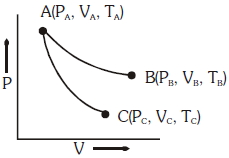
Reversible expansion of an ideal gas under isothermal and adiabatic conditions are as shown in the figure.
$AB \to$ Isothermal expansion
$AC \to$ Adiabatic expansion
Which of the following options is not correct?
$AB \to$ Isothermal expansion
$AC \to$ Adiabatic expansion
Which of the following options is not correct?
A
$\Delta S_{\text{isothermal}} > \Delta S_{\text{adiabatic}}$
B
$T_{A} = T_{B}$
C
$W_{\text{isothermal}} > W_{\text{adiabatic}}$
D
$T_{C} > T_{A}$
Solution
(D) In an adiabatic expansion,the system does work at the expense of its internal energy,leading to a decrease in temperature. Thus,$T_C < T_A$.
For an adiabatic process:
$q = 0$,$\Delta U = W$
Since it is an expansion,$W < 0$,therefore $\Delta U < 0$.
Since $\Delta U = nC_{vm} \Delta T$,we have $nC_{vm} \Delta T < 0$,which implies $\Delta T < 0$.
Therefore,$T_C - T_A < 0$,or $T_C < T_A$.
Option $D$ states $T_C > T_A$,which is incorrect.
For an adiabatic process:
$q = 0$,$\Delta U = W$
Since it is an expansion,$W < 0$,therefore $\Delta U < 0$.
Since $\Delta U = nC_{vm} \Delta T$,we have $nC_{vm} \Delta T < 0$,which implies $\Delta T < 0$.
Therefore,$T_C - T_A < 0$,or $T_C < T_A$.
Option $D$ states $T_C > T_A$,which is incorrect.
0 likesView Solution
49
ChemistryMCQNEET · 2019
Select the incorrect statement.
A
In male grasshoppers,$50 \%$ of sperms have no sex-chromosome.
B
In domesticated fowls,sex of progeny depends on the type of sperm rather than egg.
C
Human males have one of their sex-chromosomes much shorter than the other.
D
Male fruitfly is heterogametic.
Solution
(B) In $XO$ type of sex determination (e.g.,grasshoppers),males produce two types of gametes: $50 \%$ with an $X$ chromosome and $50 \%$ without any sex chromosome. Thus,statement $A$ is correct.
In birds (including domesticated fowls),sex determination is of $ZW-ZZ$ type. Here,females are heterogametic $(ZW)$ and males are homogametic $(ZZ)$. Therefore,the sex of the progeny depends on the type of egg,not the sperm. Thus,statement $B$ is incorrect.
In humans,males are $XY$. The $Y$ chromosome is significantly shorter than the $X$ chromosome. Thus,statement $C$ is correct.
In fruit flies $(Drosophila)$,males are $XY$ (heterogametic) and females are $XX$ (homogametic). Thus,statement $D$ is correct.
In birds (including domesticated fowls),sex determination is of $ZW-ZZ$ type. Here,females are heterogametic $(ZW)$ and males are homogametic $(ZZ)$. Therefore,the sex of the progeny depends on the type of egg,not the sperm. Thus,statement $B$ is incorrect.
In humans,males are $XY$. The $Y$ chromosome is significantly shorter than the $X$ chromosome. Thus,statement $C$ is correct.
In fruit flies $(Drosophila)$,males are $XY$ (heterogametic) and females are $XX$ (homogametic). Thus,statement $D$ is correct.
0 likesView Solution
50
ChemistryMCQNEET · 2019
Which of the following features of genetic codes allow bacteria to produce human insulin by recombinant $\text{DNA}$ technology?
A
Genetic code is not ambiguous
B
Genetic code is redundant
C
Genetic code is nearly universal
D
Genetic code is specific
Solution
(C) The genetic code is nearly universal,meaning that the same codons specify the same amino acids in almost all organisms,from bacteria to humans.
Because of this universality,a human gene inserted into a bacterial cell can be correctly transcribed and translated by the bacterial machinery to produce the same human protein (insulin).
Therefore,the ability of bacteria to produce human insulin is a direct consequence of the genetic code being nearly universal.
Because of this universality,a human gene inserted into a bacterial cell can be correctly transcribed and translated by the bacterial machinery to produce the same human protein (insulin).
Therefore,the ability of bacteria to produce human insulin is a direct consequence of the genetic code being nearly universal.
0 likesView Solution
51
ChemistryAdvancedMCQNEET · 2019
$A$ compound is formed by cation $C$ and anion $A$. The anions form hexagonal close packed $(hcp)$ lattice and the cations occupy $75 \%$ of octahedral voids. The formula of the compound is
A
$C_{2}A_{3}$
B
$C_{3}A_{2}$
C
$C_{3}A_{4}$
D
$C_{4}A_{3}$
Solution
(C) In a hexagonal close packed $(hcp)$ lattice,the number of anions $(A)$ per unit cell is $6$.
The number of octahedral voids in an $hcp$ lattice is equal to the number of atoms,which is $6$.
The cations $(C)$ occupy $75 \%$ of these octahedral voids.
Number of cations $(C) = 6 \times \frac{75}{100} = 6 \times \frac{3}{4} = \frac{18}{4} = 4.5$ or $\frac{9}{2}$.
The ratio of cations $(C)$ to anions $(A)$ is $\frac{9}{2} : 6$.
Multiplying both sides by $2$,we get $9 : 12$.
Simplifying the ratio by dividing by $3$,we get $3 : 4$.
Therefore,the formula of the compound is $C_{3}A_{4}$.
The number of octahedral voids in an $hcp$ lattice is equal to the number of atoms,which is $6$.
The cations $(C)$ occupy $75 \%$ of these octahedral voids.
Number of cations $(C) = 6 \times \frac{75}{100} = 6 \times \frac{3}{4} = \frac{18}{4} = 4.5$ or $\frac{9}{2}$.
The ratio of cations $(C)$ to anions $(A)$ is $\frac{9}{2} : 6$.
Multiplying both sides by $2$,we get $9 : 12$.
Simplifying the ratio by dividing by $3$,we get $3 : 4$.
Therefore,the formula of the compound is $C_{3}A_{4}$.
0 likesView Solution
52
ChemistryMediumMCQNEET · 2019
For an ideal solution,the correct option is
A
$\Delta_{mix} S = 0$ at constant $T$ and $P$
B
$\Delta_{mix} V \neq 0$ at constant $T$ and $P$
C
$\Delta_{mix} H = 0$ at constant $T$ and $P$
D
$\Delta_{mix} G = 0$ at constant $T$ and $P$
Solution
(C) An ideal solution is defined as a solution that obeys Raoult's law over the entire range of concentration.
For an ideal solution,the enthalpy of mixing is zero,i.e.,$\Delta_{mix} H = 0$.
Also,the volume of mixing is zero,i.e.,$\Delta_{mix} V = 0$.
However,the entropy of mixing $(\Delta_{mix} S)$ is always greater than zero for any mixing process,and the Gibbs free energy of mixing $(\Delta_{mix} G)$ is always less than zero for a spontaneous process.
For an ideal solution,the enthalpy of mixing is zero,i.e.,$\Delta_{mix} H = 0$.
Also,the volume of mixing is zero,i.e.,$\Delta_{mix} V = 0$.
However,the entropy of mixing $(\Delta_{mix} S)$ is always greater than zero for any mixing process,and the Gibbs free energy of mixing $(\Delta_{mix} G)$ is always less than zero for a spontaneous process.
0 likesView Solution
53
ChemistryDifficultMCQNEET · 2019
For a cell involving one electron $E_{cell}^{\ominus} = 0.59 \; V$ at $298 \; K$,the equilibrium constant for the cell reaction is.
Given that $\frac{2.303 \; RT}{F} = 0.059 \; V$ at $T = 298 \; K$.
Given that $\frac{2.303 \; RT}{F} = 0.059 \; V$ at $T = 298 \; K$.
A
$1.0 \times 10^{2}$
B
$1.0 \times 10^{5}$
C
$1.0 \times 10^{10}$
D
$1.0 \times 10^{30}$
Solution
(C) The relationship between the standard cell potential and the equilibrium constant is given by the Nernst equation at equilibrium:
$E_{cell}^{\ominus} = \frac{2.303 \; RT}{nF} \log_{10} K_{eq}$
Given:
$E_{cell}^{\ominus} = 0.59 \; V$
$n = 1$
$\frac{2.303 \; RT}{F} = 0.059 \; V$
Substituting the values into the equation:
$0.59 = \frac{0.059}{1} \log_{10} K_{eq}$
$\log_{10} K_{eq} = \frac{0.59}{0.059} = 10$
$K_{eq} = 10^{10}$
$E_{cell}^{\ominus} = \frac{2.303 \; RT}{nF} \log_{10} K_{eq}$
Given:
$E_{cell}^{\ominus} = 0.59 \; V$
$n = 1$
$\frac{2.303 \; RT}{F} = 0.059 \; V$
Substituting the values into the equation:
$0.59 = \frac{0.059}{1} \log_{10} K_{eq}$
$\log_{10} K_{eq} = \frac{0.59}{0.059} = 10$
$K_{eq} = 10^{10}$
0 likesView Solution
54
ChemistryEasyMCQNEET · 2019
Among the following,the narrow spectrum antibiotic is
A
penicillin $G$
B
ampicillin
C
amoxycillin
D
chloramphenicol
Solution
(A) Antibiotics that are effective mainly against either Gram-positive or Gram-negative bacteria are classified as narrow spectrum antibiotics.
Penicillin $G$ is a classic example of a narrow spectrum antibiotic.
In contrast,ampicillin,amoxycillin,and chloramphenicol are broad spectrum antibiotics,meaning they are effective against a wide range of Gram-positive and Gram-negative bacteria.
Penicillin $G$ is a classic example of a narrow spectrum antibiotic.
In contrast,ampicillin,amoxycillin,and chloramphenicol are broad spectrum antibiotics,meaning they are effective against a wide range of Gram-positive and Gram-negative bacteria.
0 likesView Solution
55
ChemistryMediumMCQNEET · 2019
The correct order of the basic strength of methyl substituted amines in aqueous solution is
A
$(CH_{3})_{2}NH > CH_{3}NH_{2} > (CH_{3})_{3}N$
B
$(CH_{3})_{3}N > CH_{3}NH_{2} > (CH_{3})_{2}NH$
C
$(CH_{3})_{3}N > (CH_{3})_{2}NH > CH_{3}NH_{2}$
D
$CH_{3}NH_{2} > (CH_{3})_{2}NH > (CH_{3})_{3}N$
Solution
(A) In aqueous solution,the basic strength of amines depends on three factors: inductive effect,solvation effect (solvation of protonated amine),and steric hindrance.
For methyl substituted amines,the order is determined by the combined effect of these factors:
$(CH_{3})_{2}NH > CH_{3}NH_{2} > (CH_{3})_{3}N$
Here,$(CH_{3})_{2}NH$ is the most basic due to the optimal balance of the $+I$ effect and solvation,while $(CH_{3})_{3}N$ is the least basic among these due to steric hindrance preventing effective solvation of the protonated cation.
For methyl substituted amines,the order is determined by the combined effect of these factors:
$(CH_{3})_{2}NH > CH_{3}NH_{2} > (CH_{3})_{3}N$
Here,$(CH_{3})_{2}NH$ is the most basic due to the optimal balance of the $+I$ effect and solvation,while $(CH_{3})_{3}N$ is the least basic among these due to steric hindrance preventing effective solvation of the protonated cation.
0 likesView Solution
56
ChemistryDifficultMCQNEET · 2019
Which mixture of the solutions will lead to the formation of a negatively charged colloidal $[AgI]I^{-}$ sol?
A
$50 \ mL$ of $1 \ M AgNO_3 + 50 \ mL$ of $1.5 \ M KI$
B
$50 \ mL$ of $2 \ M AgNO_3 + 50 \ mL$ of $2 \ M KI$
C
$50 \ mL$ of $2 \ M AgNO_3 + 50 \ mL$ of $1.5 \ M KI$
D
$50 \ mL$ of $0.1 \ M AgNO_3 + 50 \ mL$ of $0.1 \ M KI$
Solution
(A) The formation of a negatively charged $[AgI]I^{-}$ sol occurs when iodide ions $(I^-)$ are preferentially adsorbed on the surface of $AgI$ particles.
This happens when $KI$ is present in excess relative to $AgNO_3$ in the reaction: $AgNO_3 + KI \rightarrow AgI + KNO_3$.
In option $A$,the moles of $KI$ are $50 \ mL \times 1.5 \ M = 75 \ mmol$,while the moles of $AgNO_3$ are $50 \ mL \times 1 \ M = 50 \ mmol$.
Since $KI$ is in excess,$I^-$ ions are adsorbed on the $AgI$ precipitate,resulting in a negatively charged $[AgI]I^-$ sol.
This happens when $KI$ is present in excess relative to $AgNO_3$ in the reaction: $AgNO_3 + KI \rightarrow AgI + KNO_3$.
In option $A$,the moles of $KI$ are $50 \ mL \times 1.5 \ M = 75 \ mmol$,while the moles of $AgNO_3$ are $50 \ mL \times 1 \ M = 50 \ mmol$.
Since $KI$ is in excess,$I^-$ ions are adsorbed on the $AgI$ precipitate,resulting in a negatively charged $[AgI]I^-$ sol.
0 likesView Solution
57
ChemistryMediumMCQNEET · 2019
The compound that is most difficult to protonate is
A
$H_2O$
B
$CH_3OH$
C
$CH_3OCH_3$
D
$PhOH$
Solution
(D) Protonation involves the donation of a lone pair of electrons from the oxygen atom to a proton $(H^+)$.
Compounds with higher electron density on the oxygen atom are more basic and easier to protonate.
In $PhOH$ (phenol),the lone pair of electrons on the oxygen atom is delocalized into the benzene ring due to resonance.
This delocalization reduces the electron density on the oxygen atom,making it the least basic and therefore the most difficult to protonate among the given options.
Compounds with higher electron density on the oxygen atom are more basic and easier to protonate.
In $PhOH$ (phenol),the lone pair of electrons on the oxygen atom is delocalized into the benzene ring due to resonance.
This delocalization reduces the electron density on the oxygen atom,making it the least basic and therefore the most difficult to protonate among the given options.
0 likesView Solution
58
ChemistryDifficultMCQNEET · 2019
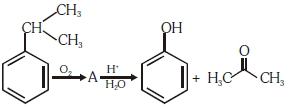
The structure of intermediate $A$ in the following reaction is
A
Isopropyl phenyl ether
B
Cumene hydroperoxide
C
Phenyl isopropyl peroxide
D
$2-$phenylpropan$-1-$yl hydroperoxide
Solution
(B) The reaction shown is the industrial preparation of phenol from cumene (isopropylbenzene).
In the first step,cumene is oxidized by atmospheric oxygen $(O_2)$ to form cumene hydroperoxide as the intermediate $A$.
In the second step,cumene hydroperoxide is treated with dilute acid $(H^+/H_2O)$ to yield phenol and acetone $(CH_3COCH_3)$ as products.
In the first step,cumene is oxidized by atmospheric oxygen $(O_2)$ to form cumene hydroperoxide as the intermediate $A$.
In the second step,cumene hydroperoxide is treated with dilute acid $(H^+/H_2O)$ to yield phenol and acetone $(CH_3COCH_3)$ as products.
0 likesView Solution
59
ChemistryMediumMCQNEET · 2019
The manganate and permanganate ions are tetrahedral,due to
A
The $\pi-$bonding involves overlap of $p-$orbitals of oxygen with $d-$orbitals of manganese
B
There is no $\pi-$bonding
C
The $\pi-$bonding involves overlap of $p-$orbitals of oxygen with $p-$orbitals of manganese
D
The $\pi-$bonding involves overlap of $d-$orbitals of oxygen with $d-$orbitals of manganese
Solution
(A) $MnO_{4}^{2-}$ (manganate ion) and $MnO_{4}^{-}$ (permanganate ion) both have a tetrahedral geometry.
In these ions,the manganese atom is in a high oxidation state and uses its $d-$orbitals to form $p\pi-d\pi$ bonds with the oxygen atoms.
Specifically,the $\pi-$bonding involves the overlap of filled $2p-$orbitals of oxygen with empty $3d-$orbitals of manganese.
In these ions,the manganese atom is in a high oxidation state and uses its $d-$orbitals to form $p\pi-d\pi$ bonds with the oxygen atoms.
Specifically,the $\pi-$bonding involves the overlap of filled $2p-$orbitals of oxygen with empty $3d-$orbitals of manganese.
0 likesView Solution
60
ChemistryMediumMCQNEET · 2019
If the rate constant for a first order reaction is $k$,the time $(t)$ required for the completion of $99\%$ of the reaction is given by:
A
$t = 0.693 / k$
B
$t = 6.909 / k$
C
$t = 4.606 / k$
D
$t = 2.303 / k$
Solution
(C) For a first order reaction,the integrated rate equation is $t = \frac{2.303}{k} \log\left(\frac{[A]_0}{[A]_t}\right)$.
For $99\%$ completion,let $[A]_0 = 100$,then $[A]_t = 100 - 99 = 1$.
Substituting the values into the equation:
$t = \frac{2.303}{k} \log\left(\frac{100}{1}\right)$
$t = \frac{2.303}{k} \log(10^2)$
$t = \frac{2.303 \times 2}{k} \log(10)$
Since $\log(10) = 1$,we get $t = \frac{4.606}{k}$.
For $99\%$ completion,let $[A]_0 = 100$,then $[A]_t = 100 - 99 = 1$.
Substituting the values into the equation:
$t = \frac{2.303}{k} \log\left(\frac{100}{1}\right)$
$t = \frac{2.303}{k} \log(10^2)$
$t = \frac{2.303 \times 2}{k} \log(10)$
Since $\log(10) = 1$,we get $t = \frac{4.606}{k}$.
0 likesView Solution
61
ChemistryEasyMCQNEET · 2019
The biodegradable polymer is
A
nylon-$6,6$
B
Nylon $2$-nylon $6$
C
nylon-$6$
D
Buna-$S$
Solution
(B) Nylon $2$-nylon $6$ is the correct answer.
It is an alternating polyamide copolymer of glycine $(H_{2}N-CH_{2}-COOH)$ and aminocaproic acid $[H_{2}N(CH_{2})_{5}COOH]$.
This polymer is biodegradable.
It is an alternating polyamide copolymer of glycine $(H_{2}N-CH_{2}-COOH)$ and aminocaproic acid $[H_{2}N(CH_{2})_{5}COOH]$.
This polymer is biodegradable.
0 likesView Solution
62
ChemistryDifficultMCQNEET · 2019
Match the Xenon compounds in Column-$I$ with their structures in Column-$II$ and assign the correct code.
Code: $(a) \quad (b) \quad (c) \quad (d)$
| Column-$I$ | Column-$II$ |
|---|---|
| $(a) XeF_{4}$ | $(i) \text{Pyramidal}$ |
| $(b) XeF_{6}$ | $(ii) \text{Square planar}$ |
| $(c) XeOF_{4}$ | $(iii) \text{Distorted octahedral}$ |
| $(d) XeO_{3}$ | $(iv) \text{Square pyramidal}$ |
Code: $(a) \quad (b) \quad (c) \quad (d)$
A
$(i) \quad (ii) \quad (iii) \quad (iv)$
B
$(ii) \quad (iii) \quad (iv) \quad (i)$
C
$(ii) \quad (iii) \quad (i) \quad (iv)$
D
$(iii) \quad (iv) \quad (i) \quad (ii)$
Solution
(B) $XeF_{4}$ has $sp^{3}d^{2}$ hybridization and a square planar structure.
$XeF_{6}$ has $sp^{3}d^{3}$ hybridization and a distorted octahedral structure.
$XeOF_{4}$ has $sp^{3}d^{2}$ hybridization and a square pyramidal structure.
$XeO_{3}$ has $sp^{3}$ hybridization and a pyramidal structure.
Therefore,the correct matching is: $(a)-(ii), (b)-(iii), (c)-(iv), (d)-(i)$.
$XeF_{6}$ has $sp^{3}d^{3}$ hybridization and a distorted octahedral structure.
$XeOF_{4}$ has $sp^{3}d^{2}$ hybridization and a square pyramidal structure.
$XeO_{3}$ has $sp^{3}$ hybridization and a pyramidal structure.
Therefore,the correct matching is: $(a)-(ii), (b)-(iii), (c)-(iv), (d)-(i)$.
0 likesView Solution
63
ChemistryMediumMCQNEET · 2019
Which is the correct thermal stability order for $H_2 E$ $(E = O, S, Se, Te, Po)$?
A
$H_2 S < H_2 O < H_2 Se < H_2 Te < H_2 Po$
B
$H_2 O < H_2 S < H_2 Se < H_2 Te < H_2 Po$
C
$H_2 Po < H_2 Te < H_2 Se < H_2 S < H_2 O$
D
$H_2 Se < H_2 Te < H_2 Po < H_2 O < H_2 S$
Solution
(C) The thermal stability of hydrides of group $16$ elements depends on the bond dissociation enthalpy of the $E-H$ bond.
As the size of the central atom $E$ increases down the group $(O < S < Se < Te < Po)$,the bond length increases and the bond dissociation enthalpy decreases.
Therefore,the thermal stability decreases down the group.
The correct order is: $H_2 O > H_2 S > H_2 Se > H_2 Te > H_2 Po$.
As the size of the central atom $E$ increases down the group $(O < S < Se < Te < Po)$,the bond length increases and the bond dissociation enthalpy decreases.
Therefore,the thermal stability decreases down the group.
The correct order is: $H_2 O > H_2 S > H_2 Se > H_2 Te > H_2 Po$.
0 likesView Solution
64
ChemistryAdvancedMCQNEET · 2019
The correct structure of tribromooctaoxide is
A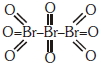
B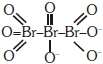
C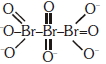
D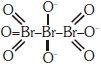
Solution
(A) Tribromooctaoxide has the chemical formula $Br_3O_8$.
In this structure,the central bromine atom is bonded to two other bromine atoms.
Each of the terminal bromine atoms is bonded to three oxygen atoms via double bonds and to the central bromine atom.
The central bromine atom is bonded to two oxygen atoms via double bonds.
This results in a neutral molecule where all bromine atoms achieve a stable oxidation state.
The other options represent anionic species,which do not correspond to the neutral $Br_3O_8$ molecule.
In this structure,the central bromine atom is bonded to two other bromine atoms.
Each of the terminal bromine atoms is bonded to three oxygen atoms via double bonds and to the central bromine atom.
The central bromine atom is bonded to two oxygen atoms via double bonds.
This results in a neutral molecule where all bromine atoms achieve a stable oxidation state.
The other options represent anionic species,which do not correspond to the neutral $Br_3O_8$ molecule.
0 likesView Solution
65
ChemistryEasyMCQNEET · 2019
Which one is malachite from the following?
A
$CuFeS_2$
B
$Cu(OH)_2$
C
$Fe_3O_4$
D
$CuCO_3 \cdot Cu(OH)_2$
Solution
(D) Malachite is a green copper carbonate hydroxide mineral with the chemical formula $CuCO_3 \cdot Cu(OH)_2$.
0 likesView Solution
66
ChemistryEasyMCQNEET · 2019
The mixture that forms a maximum boiling azeotrope is
A
Water + Nitric acid
B
Ethanol + Water
C
Acetone + Carbon disulphide
D
Heptane + Octane
Solution
(A) Maximum boiling azeotropes are formed by solutions that show large negative deviation from Raoult's law.
In these solutions,the solute-solvent interactions are stronger than the solute-solute and solvent-solvent interactions.
Water + Nitric acid $(H_2O + HNO_3)$ shows a large negative deviation from ideal behavior,resulting in a maximum boiling azeotrope.
In these solutions,the solute-solvent interactions are stronger than the solute-solute and solvent-solvent interactions.
Water + Nitric acid $(H_2O + HNO_3)$ shows a large negative deviation from ideal behavior,resulting in a maximum boiling azeotrope.
0 likesView Solution
67
ChemistryDifficultMCQNEET · 2019
For the cell reaction:
$2 Fe^{3+}_{(aq)} + 2 I^{-}_{(aq)} \rightarrow 2 Fe^{2+}_{(aq)} + I_{2(aq)}$
$E^{\ominus}_{cell} = 0.24 \ V$ at $298 \ K$. The standard Gibbs energy $(\Delta_r G^{\ominus})$ of the cell reaction in $kJ \ mol^{-1}$ is:
[Faraday constant $F = 96500 \ C \ mol^{-1}$]
$2 Fe^{3+}_{(aq)} + 2 I^{-}_{(aq)} \rightarrow 2 Fe^{2+}_{(aq)} + I_{2(aq)}$
$E^{\ominus}_{cell} = 0.24 \ V$ at $298 \ K$. The standard Gibbs energy $(\Delta_r G^{\ominus})$ of the cell reaction in $kJ \ mol^{-1}$ is:
[Faraday constant $F = 96500 \ C \ mol^{-1}$]
A
$-46.32$
B
$-23.16$
C
$46.32$
D
$23.16$
Solution
(A) The given cell reaction is: $2 Fe^{3+}_{(aq)} + 2 I^{-}_{(aq)} \rightarrow 2 Fe^{2+}_{(aq)} + I_{2(aq)}$
Here,the number of electrons involved in the reaction is $n = 2$.
The formula for standard Gibbs energy is: $\Delta_r G^{\ominus} = -n F E^{\ominus}_{cell}$
Substituting the values: $\Delta_r G^{\ominus} = -2 \times 96500 \ C \ mol^{-1} \times 0.24 \ V$
$\Delta_r G^{\ominus} = -46320 \ J \ mol^{-1}$
Converting to $kJ \ mol^{-1}$: $\Delta_r G^{\ominus} = -46.32 \ kJ \ mol^{-1}$
Here,the number of electrons involved in the reaction is $n = 2$.
The formula for standard Gibbs energy is: $\Delta_r G^{\ominus} = -n F E^{\ominus}_{cell}$
Substituting the values: $\Delta_r G^{\ominus} = -2 \times 96500 \ C \ mol^{-1} \times 0.24 \ V$
$\Delta_r G^{\ominus} = -46320 \ J \ mol^{-1}$
Converting to $kJ \ mol^{-1}$: $\Delta_r G^{\ominus} = -46.32 \ kJ \ mol^{-1}$
0 likesView Solution
68
ChemistryDifficultMCQNEET · 2019
Match the following:
Which of the following is the correct option?
| $a$. Pure nitrogen | $i$. Chlorine |
| $b$. Haber process | $ii$. Sulphuric acid |
| $c$. Contact process | $iii$. Ammonia |
| $d$. Deacon's process | $iv$. Sodium azide or Barium azide |
Which of the following is the correct option?
A
$i, ii, iii, iv$
B
$ii, iv, i, iii$
C
$iii, iv, ii, i$
D
$iv, iii, ii, i$
Solution
(D) Pure nitrogen is obtained by the thermal decomposition of sodium azide or barium azide: $2NaN_3 \xrightarrow{\Delta} 2Na + 3N_2$ and $Ba(N_3)_2 \xrightarrow{\Delta} Ba + 3N_2$. $(a-iv)$
Haber process is used for the industrial manufacture of ammonia: $N_2 + 3H_2 \rightleftharpoons 2NH_3$. $(b-iii)$
Contact process is used for the manufacture of sulphuric acid $(H_2SO_4)$. $(c-ii)$
Deacon's process is used for the formation of chlorine gas: $4HCl + O_2 \xrightarrow{CuCl_2} 2H_2O + 2Cl_2$. $(d-i)$
Therefore,the correct matching is $a-iv, b-iii, c-ii, d-i$.
Haber process is used for the industrial manufacture of ammonia: $N_2 + 3H_2 \rightleftharpoons 2NH_3$. $(b-iii)$
Contact process is used for the manufacture of sulphuric acid $(H_2SO_4)$. $(c-ii)$
Deacon's process is used for the formation of chlorine gas: $4HCl + O_2 \xrightarrow{CuCl_2} 2H_2O + 2Cl_2$. $(d-i)$
Therefore,the correct matching is $a-iv, b-iii, c-ii, d-i$.
0 likesView Solution
69
ChemistryMediumMCQNEET · 2019
The non-essential amino acid among the following is
A
valine
B
leucine
C
alanine
D
lysine
Solution
(C) Non-essential amino acids are those that can be synthesized by the human body.
Among the given options,$alanine$ is a non-essential amino acid.
$Valine$,$leucine$,and $lysine$ are essential amino acids that must be obtained through the diet.
Among the given options,$alanine$ is a non-essential amino acid.
$Valine$,$leucine$,and $lysine$ are essential amino acids that must be obtained through the diet.
0 likesView Solution
70
ChemistryDifficultMCQNEET · 2019
Among the following,the reaction that proceeds through an electrophilic substitution is
A
$C_6H_5N_2^+Cl^- \xrightarrow{Cu_2Cl_2} C_6H_5Cl + N_2$
B
$C_6H_6 + Cl_2 \xrightarrow{AlCl_3} C_6H_5Cl + HCl$
C
$C_6H_6 + 3Cl_2 \xrightarrow{UV \text{ light}} C_6H_6Cl_6$
D
$C_6H_5CH_2OH + HCl \xrightarrow{\text{heat}} C_6H_5CH_2Cl + H_2O$
Solution
(B) Electrophilic substitution reaction involves the replacement of a hydrogen atom on an aromatic ring by an electrophile.
In the reaction of benzene with chlorine in the presence of a Lewis acid like anhydrous $AlCl_3$,the electrophile $Cl^+$ is generated,which attacks the benzene ring to form chlorobenzene.
This is a classic example of electrophilic aromatic substitution.
Reaction: $C_6H_6 + Cl_2 \xrightarrow{Anhyd. AlCl_3} C_6H_5Cl + HCl$.
In the reaction of benzene with chlorine in the presence of a Lewis acid like anhydrous $AlCl_3$,the electrophile $Cl^+$ is generated,which attacks the benzene ring to form chlorobenzene.
This is a classic example of electrophilic aromatic substitution.
Reaction: $C_6H_6 + Cl_2 \xrightarrow{Anhyd. AlCl_3} C_6H_5Cl + HCl$.
0 likesView Solution
71
ChemistryDifficultMCQNEET · 2019
The major product of the following reaction is:
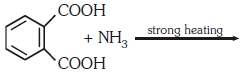
A
Phthalamic acid
B
Phthalimide
C
Phthalamide
D
Anthranilic acid
Solution
(B) When phthalic acid reacts with ammonia $(NH_3)$,it first forms ammonium phthalate.
Upon heating,ammonium phthalate loses two molecules of water to form phthalamide.
On further strong heating,phthalamide loses a molecule of ammonia $(NH_3)$ to form the cyclic imide known as phthalimide.
Upon heating,ammonium phthalate loses two molecules of water to form phthalamide.
On further strong heating,phthalamide loses a molecule of ammonia $(NH_3)$ to form the cyclic imide known as phthalimide.
0 likesView Solution
72
ChemistryDifficultMCQNEET · 2019
For the chemical reaction $N_{2(g)} + 3 H_{2(g)} \rightleftharpoons 2 NH_{3(g)}$,the correct option is
A
$-\frac{1}{3} \frac{d[H_{2}]}{dt} = -\frac{1}{2} \frac{d[NH_{3}]}{dt}$
B
$-\frac{d[N_{2}]}{dt} = 2 \frac{d[NH_{3}]}{dt}$
C
$-\frac{d[N_{2}]}{dt} = \frac{1}{2} \frac{d[NH_{3}]}{dt}$
D
$3 \frac{d[H_{2}]}{dt} = 2 \frac{d[NH_{3}]}{dt}$
Solution
(C) For the reaction $N_{2(g)} + 3 H_{2(g)} \rightleftharpoons 2 NH_{3(g)}$,the rate of reaction is expressed as:
$-\frac{d[N_{2}]}{dt} = -\frac{1}{3} \frac{d[H_{2}]}{dt} = +\frac{1}{2} \frac{d[NH_{3}]}{dt}$.
Comparing this with the given options,we see that $-\frac{d[N_{2}]}{dt} = \frac{1}{2} \frac{d[NH_{3}]}{dt}$ is the correct relationship.
$-\frac{d[N_{2}]}{dt} = -\frac{1}{3} \frac{d[H_{2}]}{dt} = +\frac{1}{2} \frac{d[NH_{3}]}{dt}$.
Comparing this with the given options,we see that $-\frac{d[N_{2}]}{dt} = \frac{1}{2} \frac{d[NH_{3}]}{dt}$ is the correct relationship.
0 likesView Solution
73
ChemistryMediumMCQNEET · 2019
What is the correct electronic configuration of the central atom in $K_{4}[Fe(CN)_{6}]$ based on crystal field theory?
A
$t_{2g}^{4} e_{g}^{2}$
B
$t_{2g}^{6} e_{g}^{0}$
C
$e^{3} t_{2}^{3}$
D
$e^{4} t_{2}^{2}$
Solution
(B) In the complex $K_{4}[Fe(CN)_{6}]$,the oxidation state of $Fe$ is $+2$.
The electronic configuration of $Fe$ $(Z=26)$ is $[Ar] 3d^{6} 4s^{2}$.
For $Fe^{2+}$,the configuration is $3d^{6}$.
$CN^{-}$ is a strong field ligand $(SFL)$,which causes pairing of electrons in the $d$-orbitals.
According to crystal field theory for an octahedral complex,the $d$-orbitals split into $t_{2g}$ and $e_{g}$ sets.
Due to the strong field,all $6$ electrons pair up in the lower energy $t_{2g}$ orbitals,resulting in the configuration $t_{2g}^{6} e_{g}^{0}$.
The electronic configuration of $Fe$ $(Z=26)$ is $[Ar] 3d^{6} 4s^{2}$.
For $Fe^{2+}$,the configuration is $3d^{6}$.
$CN^{-}$ is a strong field ligand $(SFL)$,which causes pairing of electrons in the $d$-orbitals.
According to crystal field theory for an octahedral complex,the $d$-orbitals split into $t_{2g}$ and $e_{g}$ sets.
Due to the strong field,all $6$ electrons pair up in the lower energy $t_{2g}$ orbitals,resulting in the configuration $t_{2g}^{6} e_{g}^{0}$.
0 likesView Solution
74
ChemistryDifficultMCQNEET · 2019
The rate of radioactive disintegration at an instant for a radioactive sample of half-life $2.2 \times 10^{9} \ s$ is $10^{10} \ s^{-1}$. The number of radioactive atoms in that sample at that instant is:
A
$3.17 \times 10^{20}$
B
$3.17 \times 10^{17}$
C
$3.17 \times 10^{18}$
D
$3.17 \times 10^{19}$
Solution
(D) The rate of disintegration is given by $R = N \lambda$,where $\lambda$ is the decay constant.
The decay constant $\lambda$ is related to the half-life $T_{1/2}$ by the formula $\lambda = \frac{0.693}{T_{1/2}}$.
Substituting $\lambda$ into the rate equation: $R = N \times \frac{0.693}{T_{1/2}}$.
Rearranging to solve for the number of atoms $N$: $N = \frac{R \times T_{1/2}}{0.693}$.
Given $R = 10^{10} \ s^{-1}$ and $T_{1/2} = 2.2 \times 10^{9} \ s$:
$N = \frac{10^{10} \times 2.2 \times 10^{9}}{0.693} = \frac{2.2 \times 10^{19}}{0.693} \approx 3.17 \times 10^{19} \ atoms$.
The decay constant $\lambda$ is related to the half-life $T_{1/2}$ by the formula $\lambda = \frac{0.693}{T_{1/2}}$.
Substituting $\lambda$ into the rate equation: $R = N \times \frac{0.693}{T_{1/2}}$.
Rearranging to solve for the number of atoms $N$: $N = \frac{R \times T_{1/2}}{0.693}$.
Given $R = 10^{10} \ s^{-1}$ and $T_{1/2} = 2.2 \times 10^{9} \ s$:
$N = \frac{10^{10} \times 2.2 \times 10^{9}}{0.693} = \frac{2.2 \times 10^{19}}{0.693} \approx 3.17 \times 10^{19} \ atoms$.
0 likesView Solution
75
ChemistryDifficultMCQNEET · 2019
The reaction that does not give benzoic acid as the major product is
A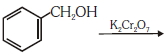
B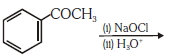
C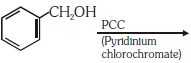
D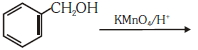
Solution
(C) The oxidation of primary alcohols with strong oxidizing agents like $K_2Cr_2O_7$ or $KMnO_4/H^+$ yields carboxylic acids. Thus,phenylmethanol $(C_6H_5CH_2OH)$ gives benzoic acid $(C_6H_5COOH)$ in options $A$ and $D$.
The haloform reaction of acetophenone $(C_6H_5COCH_3)$ with $NaOCl$ followed by acid workup $(H_3O^+)$ is a standard method to produce benzoic acid,as shown in option $B$.
$PCC$ (Pyridinium chlorochromate) is a mild oxidizing agent that oxidizes primary alcohols only up to the aldehyde stage. Therefore,the reaction of phenylmethanol with $PCC$ yields benzaldehyde $(C_6H_5CHO)$ as the major product,not benzoic acid. Hence,option $C$ is the correct answer.
The haloform reaction of acetophenone $(C_6H_5COCH_3)$ with $NaOCl$ followed by acid workup $(H_3O^+)$ is a standard method to produce benzoic acid,as shown in option $B$.
$PCC$ (Pyridinium chlorochromate) is a mild oxidizing agent that oxidizes primary alcohols only up to the aldehyde stage. Therefore,the reaction of phenylmethanol with $PCC$ yields benzaldehyde $(C_6H_5CHO)$ as the major product,not benzoic acid. Hence,option $C$ is the correct answer.
0 likesView Solution
76
ChemistryDifficultMCQNEET · 2019
The amine that reacts with Hinsberg's reagent to give an alkali-insoluble product is:
A
$(CH_3)_2CH-NH-CH(CH_3)_2$
B
$(CH_3CH_2)_3N$
C
$CH_3-C(CH_3)(NH_2)-CH_2-CH_2-CH_3$
D
$CH_3-C(CH_3)_2-CH(CH_3)-NH_2$
Solution
(A) Hinsberg's reagent (benzene sulfonyl chloride,$C_6H_5SO_2Cl$) is used to distinguish between primary,secondary,and tertiary amines.
$1$. Primary $(1^\circ)$ amines react to form $N$-alkylbenzene sulfonamides,which contain an acidic hydrogen on the nitrogen atom and are therefore soluble in alkali.
$2$. Secondary $(2^\circ)$ amines react to form $N,N$-dialkylbenzene sulfonamides,which lack an acidic hydrogen on the nitrogen atom and are insoluble in alkali.
$3$. Tertiary $(3^\circ)$ amines do not react with Hinsberg's reagent.
In the given options,$(CH_3)_2CH-NH-CH(CH_3)_2$ is a secondary amine. It reacts with Hinsberg's reagent to form an $N,N$-disubstituted sulfonamide that has no acidic hydrogen,making it insoluble in alkali.
$1$. Primary $(1^\circ)$ amines react to form $N$-alkylbenzene sulfonamides,which contain an acidic hydrogen on the nitrogen atom and are therefore soluble in alkali.
$2$. Secondary $(2^\circ)$ amines react to form $N,N$-dialkylbenzene sulfonamides,which lack an acidic hydrogen on the nitrogen atom and are insoluble in alkali.
$3$. Tertiary $(3^\circ)$ amines do not react with Hinsberg's reagent.
In the given options,$(CH_3)_2CH-NH-CH(CH_3)_2$ is a secondary amine. It reacts with Hinsberg's reagent to form an $N,N$-disubstituted sulfonamide that has no acidic hydrogen,making it insoluble in alkali.
0 likesView Solution
77
ChemistryMediumMCQNEET · 2019
Which structure$(s)$ of proteins remain$(s)$ intact during the denaturation process?
A
Both secondary and tertiary structures
B
Primary structure only
C
Secondary structure only
D
Tertiary structure only
Solution
(B) During the process of denaturation,the hydrogen bonds and other interactions that stabilize the $2^o$ and $3^o$ structures are disrupted,leading to their loss.
However,the peptide bonds that hold the amino acids together in the $1^o$ structure remain intact.
However,the peptide bonds that hold the amino acids together in the $1^o$ structure remain intact.
0 likesView Solution
78
ChemistryEasyMCQNEET · 2019
The polymer that is used as a substitute for wool in making commercial fibres is
A
Melamine
B
nylon-$6, 6$
C
polyacrylonitrile
D
Buna-$N$
Solution
(C) Polyacrylonitrile is used as a substitute for wool in making commercial fibres,such as Orlon or Acrilan.
0 likesView Solution
79
ChemistryEasyMCQNEET · 2019
The artificial sweetener stable at cooking temperature and does not provide calories is
A
Saccharin
B
Aspartame
C
Sucralose
D
Alitame
Solution
(C) Sucralose is a trichloro derivative of sucrose. It is stable at cooking temperature and does not provide calories to the body.
0 likesView Solution
80
ChemistryDifficultMCQNEET · 2019
Among the following,the hydrolysis reaction that takes place at the slowest rate is:
A
$C_{6}H_{5}Cl \xrightarrow{aq. NaOH} C_{6}H_{5}OH$
B
$CH_{3}CH_{2}Cl \xrightarrow{aq. NaOH} CH_{3}CH_{2}OH$
C
$CH_{2}=CH-CH_{2}Cl \xrightarrow{aq. NaOH} CH_{2}=CH-CH_{2}OH$
D
$C_{6}H_{5}CH_{2}Cl \xrightarrow{aq. NaOH} C_{6}H_{5}CH_{2}OH$
Solution
(A) The rate of nucleophilic substitution reaction $(NSR)$ depends on the stability of the transition state or the nature of the $C-X$ bond.
$A$. $C_{6}H_{5}Cl$ is an aryl halide. In aryl halides,the $C-Cl$ bond acquires partial double bond character due to resonance,making it very strong and difficult to break. Thus,it undergoes hydrolysis at the slowest rate.
$B$. $CH_{3}CH_{2}Cl$ is a primary alkyl halide,which undergoes $S_{N}2$ reaction.
$C$. $CH_{2}=CH-CH_{2}Cl$ is an allylic halide,which is highly reactive towards $S_{N}1$ or $S_{N}2$ due to resonance stabilization of the carbocation or transition state.
$D$. $C_{6}H_{5}CH_{2}Cl$ is a benzyl chloride,which is highly reactive due to resonance stabilization of the benzyl carbocation.
Therefore,the correct option is $A$.
$A$. $C_{6}H_{5}Cl$ is an aryl halide. In aryl halides,the $C-Cl$ bond acquires partial double bond character due to resonance,making it very strong and difficult to break. Thus,it undergoes hydrolysis at the slowest rate.
$B$. $CH_{3}CH_{2}Cl$ is a primary alkyl halide,which undergoes $S_{N}2$ reaction.
$C$. $CH_{2}=CH-CH_{2}Cl$ is an allylic halide,which is highly reactive towards $S_{N}1$ or $S_{N}2$ due to resonance stabilization of the carbocation or transition state.
$D$. $C_{6}H_{5}CH_{2}Cl$ is a benzyl chloride,which is highly reactive due to resonance stabilization of the benzyl carbocation.
Therefore,the correct option is $A$.
0 likesView Solution
81
ChemistryMediumMCQNEET · 2019
When vapours of a secondary alcohol are passed over heated copper at $573 \; K$,the product formed is:
A
a carboxylic acid
B
an aldehyde
C
a ketone
D
an alkene
Solution
(C) When vapours of a secondary alcohol are passed over heated copper at $573 \; K$,dehydrogenation occurs to form a ketone.
Reaction: $CH_3-CH(OH)-CH_3 \xrightarrow{Cu / 573 \; K} CH_3-CO-CH_3 + H_2$
Thus,a $2^o$ alcohol yields a ketone.
Reaction: $CH_3-CH(OH)-CH_3 \xrightarrow{Cu / 573 \; K} CH_3-CO-CH_3 + H_2$
Thus,a $2^o$ alcohol yields a ketone.
0 likesView Solution
82
ChemistryDifficultMCQNEET · 2019
The major products $C$ and $D$ formed in the following reaction are:
$CH_{3}CH_{2}CH_{2}OC(CH_{3})_{3} \xrightarrow[\Delta]{\text{excess } HI} C + D$
$CH_{3}CH_{2}CH_{2}OC(CH_{3})_{3} \xrightarrow[\Delta]{\text{excess } HI} C + D$
A
$CH_{3}CH_{2}CH_{2}I$ and $(CH_{3})_{3}CI$
B
$CH_{3}CH_{2}CH_{2}OH$ and $(CH_{3})_{3}CI$
C
$CH_{3}CH_{2}CH_{2}I$ and $(CH_{3})_{3}COH$
D
$CH_{3}CH_{2}CH_{2}OH$ and $(CH_{3})_{3}COH$
Solution
(A) The reaction of an ether with excess $HI$ involves the protonation of the ether oxygen followed by nucleophilic attack by $I^-$.
$CH_{3}CH_{2}CH_{2}OC(CH_{3})_{3} + HI \rightarrow CH_{3}CH_{2}CH_{2}OH + (CH_{3})_{3}CI$.
Since $HI$ is in excess,the alcohol formed $(CH_{3}CH_{2}CH_{2}OH)$ further reacts with $HI$ to form an alkyl iodide.
$CH_{3}CH_{2}CH_{2}OH + HI \rightarrow CH_{3}CH_{2}CH_{2}I + H_{2}O$.
The tertiary carbocation formed from the cleavage of the $C-O$ bond in the tert-butyl group is highly stable,leading to the formation of $(CH_{3})_{3}CI$.
Thus,the final products are $CH_{3}CH_{2}CH_{2}I$ and $(CH_{3})_{3}CI$.
$CH_{3}CH_{2}CH_{2}OC(CH_{3})_{3} + HI \rightarrow CH_{3}CH_{2}CH_{2}OH + (CH_{3})_{3}CI$.
Since $HI$ is in excess,the alcohol formed $(CH_{3}CH_{2}CH_{2}OH)$ further reacts with $HI$ to form an alkyl iodide.
$CH_{3}CH_{2}CH_{2}OH + HI \rightarrow CH_{3}CH_{2}CH_{2}I + H_{2}O$.
The tertiary carbocation formed from the cleavage of the $C-O$ bond in the tert-butyl group is highly stable,leading to the formation of $(CH_{3})_{3}CI$.
Thus,the final products are $CH_{3}CH_{2}CH_{2}I$ and $(CH_{3})_{3}CI$.
0 likesView Solution
83
ChemistryDifficultMCQNEET · 2019
Match the catalyst with the process:
Which of the following is the correct option?
| Catalyst | Process |
|---|---|
| $i. Na_{2}O$ | $a. \text{Oxidation of } SO_{2} \text{ in the manufacture of } H_{2}SO_{4}$ |
| $ii. TiCl_{4} + Al(CH_{3})_{3}$ | $b. \text{Polymerisation of ethylene}$ |
| $iii. PdCl_{2}$ | $c. \text{The oxidation of ethyne to ethanal}$ |
| $iv. \text{Nickel complexes}$ | $d. \text{Polymerisation of alkynes}$ |
Which of the following is the correct option?
A
$i-c, ii-d, iii-a, iv-b$
B
$i-a, ii-b, iii-c, iv-d$
C
$i-a, ii-c, iii-b, iv-d$
D
$i-c, ii-a, iii-d, iv-b$
Solution
(A) $i. Na_{2}O$ is used in the oxidation of $SO_{2}$ to $SO_{3}$ in the contact process for the manufacture of $H_{2}SO_{4}$ $(i-c)$.
$ii. TiCl_{4} + Al(CH_{3})_{3}$ is the Ziegler-Natta catalyst used for the polymerisation of ethylene $(ii-d)$.
$iii. PdCl_{2}$ is used in the Wacker process for the oxidation of ethyne to ethanal $(iii-a)$.
$iv. \text{Nickel complexes}$ are used for the polymerisation of alkynes $(iv-b)$.
Thus,the correct matching is $i-c, ii-d, iii-a, iv-b$.
$ii. TiCl_{4} + Al(CH_{3})_{3}$ is the Ziegler-Natta catalyst used for the polymerisation of ethylene $(ii-d)$.
$iii. PdCl_{2}$ is used in the Wacker process for the oxidation of ethyne to ethanal $(iii-a)$.
$iv. \text{Nickel complexes}$ are used for the polymerisation of alkynes $(iv-b)$.
Thus,the correct matching is $i-c, ii-d, iii-a, iv-b$.
0 likesView Solution
84
ChemistryAdvancedMCQNEET · 2019
Aluminium chloride in acidified aqueous solution forms a complex $A$,in which hybridisation of $Al$ is $B$. What are $A$ and $B$,respectively?
A
$[Al(H_{2}O)_{6}]^{3+}, sp^{3}d^{2}$
B
$[Al(H_{2}O)_{4}]^{3+}, sp^{3}$
C
$[Al(H_{2}O)_{4}]^{3+}, dsp^{2}$
D
$[Al(H_{2}O)_{6}]^{3+}, d^{2}sp^{3}$
Solution
(A) $AlCl_{3}$ in an acidified aqueous solution undergoes hydration to form the octahedral complex $[Al(H_{2}O)_{6}]^{3+}$.
The electronic configuration of $Al^{3+}$ is $[Ne] \ 3s^{0} \ 3p^{0} \ 3d^{0}$.
To accommodate six water ligands,the $Al^{3+}$ ion utilizes one $3s$,three $3p$,and two $3d$ orbitals,resulting in $sp^{3}d^{2}$ hybridisation.
Therefore,$A = [Al(H_{2}O)_{6}]^{3+}$ and $B = sp^{3}d^{2}$.
The electronic configuration of $Al^{3+}$ is $[Ne] \ 3s^{0} \ 3p^{0} \ 3d^{0}$.
To accommodate six water ligands,the $Al^{3+}$ ion utilizes one $3s$,three $3p$,and two $3d$ orbitals,resulting in $sp^{3}d^{2}$ hybridisation.
Therefore,$A = [Al(H_{2}O)_{6}]^{3+}$ and $B = sp^{3}d^{2}$.
0 likesView Solution
85
ChemistryMediumMCQNEET · 2019
Identify the incorrect statement.
A
The scientific and technological process used for isolation of the metal from its ore is known as metallurgy.
B
Minerals are naturally occurring chemical substances in the earth's crust.
C
Ores are minerals that may contain a metal.
D
Gangue is an ore contaminated with undesired materials.
Solution
(D) The correct definition of $Gangue$ is the earthy or undesired materials (such as sand,clay,or rocks) associated with the ore. Option $D$ is incorrect because $Gangue$ is not the ore itself,but the impurities present in the ore.
0 likesView Solution
86
ChemistryEasyMCQNEET · 2019
Which of the following oxoacids of phosphorus has the strongest reducing property?
A
$H_4P_2O_7$
B
$H_3PO_3$
C
$H_3PO_2$
D
$H_3PO_4$
Solution
(C) The reducing property of phosphorus oxoacids is directly proportional to the number of $P-H$ bonds present in the molecule.
$H_3PO_2$ (hypophosphorous acid) contains two $P-H$ bonds.
$H_3PO_3$ (phosphorous acid) contains one $P-H$ bond.
$H_3PO_4$ (phosphoric acid) contains zero $P-H$ bonds.
$H_4P_2O_7$ (pyrophosphoric acid) contains zero $P-H$ bonds.
Since $H_3PO_2$ has the maximum number of $P-H$ bonds,it acts as the strongest reducing agent among the given options.
$H_3PO_2$ (hypophosphorous acid) contains two $P-H$ bonds.
$H_3PO_3$ (phosphorous acid) contains one $P-H$ bond.
$H_3PO_4$ (phosphoric acid) contains zero $P-H$ bonds.
$H_4P_2O_7$ (pyrophosphoric acid) contains zero $P-H$ bonds.
Since $H_3PO_2$ has the maximum number of $P-H$ bonds,it acts as the strongest reducing agent among the given options.
0 likesView Solution
87
ChemistryEasyMCQNEET · 2019
Identify the correct formula of oleum from the following.
A
$H_2S_2O_7$
B
$H_2SO_3$
C
$H_2SO_4$
D
$H_2S_2O_8$
Solution
(A) Oleum is also known as pyrosulphuric acid.
Its chemical formula is $H_2S_2O_7$.
Its chemical formula is $H_2S_2O_7$.
0 likesView Solution
88
ChemistryAdvancedMCQNEET · 2019
The Crystal Field Stabilisation Energy $(CFSE)$ for $[CoCl_{6}]^{4-}$ is $18000 \; cm^{-1}$. The $CFSE$ for $[CoCl_{4}]^{2-}$ will be $...... \ cm^{-1}$.
A
$6000$
B
$16000$
C
$18000$
D
$8000$
Solution
(D) The relationship between the crystal field splitting energy of tetrahedral complexes $(\Delta_{t})$ and octahedral complexes $(\Delta_{o})$ is given by the formula: $\Delta_{t} = \frac{4}{9} \times \Delta_{o}$.
Given that $\Delta_{o}$ for $[CoCl_{6}]^{4-}$ is $18000 \; cm^{-1}$.
Therefore,$\Delta_{t}$ for $[CoCl_{4}]^{2-}$ is calculated as: $\Delta_{t} = \frac{4}{9} \times 18000 \; cm^{-1} = 8000 \; cm^{-1}$.
Given that $\Delta_{o}$ for $[CoCl_{6}]^{4-}$ is $18000 \; cm^{-1}$.
Therefore,$\Delta_{t}$ for $[CoCl_{4}]^{2-}$ is calculated as: $\Delta_{t} = \frac{4}{9} \times 18000 \; cm^{-1} = 8000 \; cm^{-1}$.
0 likesView Solution
89
ChemistryAdvancedMCQNEET · 2019
The following limiting molar conductivities are given as:
$\lambda_{m(H_{2}SO_{4})}^{0} = x \ S \ cm^{2} mol^{-1}$
$\lambda_{m(K_{2}SO_{4})}^{0} = y \ S \ cm^{2} mol^{-1}$
$\lambda_{m(CH_{3}COOK)}^{0} = z \ S \ cm^{2} mol^{-1}$
The $\lambda_{m}^{0} \ (\text{in } S \ cm^{2} mol^{-1})$ for $CH_{3}COOH$ will be:
$\lambda_{m(H_{2}SO_{4})}^{0} = x \ S \ cm^{2} mol^{-1}$
$\lambda_{m(K_{2}SO_{4})}^{0} = y \ S \ cm^{2} mol^{-1}$
$\lambda_{m(CH_{3}COOK)}^{0} = z \ S \ cm^{2} mol^{-1}$
The $\lambda_{m}^{0} \ (\text{in } S \ cm^{2} mol^{-1})$ for $CH_{3}COOH$ will be:
A
$x + y + 2z$
B
$x + y - z$
C
$x + y + z$
D
$\frac{x-y}{2} + z$
Solution
(D) According to Kohlrausch's law,the limiting molar conductivity of an electrolyte is the sum of the limiting molar conductivities of its constituent ions.
$1. \lambda_{m(H_{2}SO_{4})}^{0} = 2\lambda_{H^{+}}^{0} + \lambda_{SO_{4}^{2-}}^{0} = x$
$2. \lambda_{m(K_{2}SO_{4})}^{0} = 2\lambda_{K^{+}}^{0} + \lambda_{SO_{4}^{2-}}^{0} = y$
$3. \lambda_{m(CH_{3}COOK)}^{0} = \lambda_{CH_{3}COO^{-}}^{0} + \lambda_{K^{+}}^{0} = z$
We need to find $\lambda_{m(CH_{3}COOH)}^{0} = \lambda_{CH_{3}COO^{-}}^{0} + \lambda_{H^{+}}^{0}$.
From the given equations:
$\lambda_{m(CH_{3}COOH)}^{0} = \lambda_{m(CH_{3}COOK)}^{0} + \frac{1}{2}\lambda_{m(H_{2}SO_{4})}^{0} - \frac{1}{2}\lambda_{m(K_{2}SO_{4})}^{0}$
Substituting the values:
$\lambda_{m(CH_{3}COOH)}^{0} = z + \frac{x}{2} - \frac{y}{2} = \frac{x-y}{2} + z \ S \ cm^{2} mol^{-1}$.
$1. \lambda_{m(H_{2}SO_{4})}^{0} = 2\lambda_{H^{+}}^{0} + \lambda_{SO_{4}^{2-}}^{0} = x$
$2. \lambda_{m(K_{2}SO_{4})}^{0} = 2\lambda_{K^{+}}^{0} + \lambda_{SO_{4}^{2-}}^{0} = y$
$3. \lambda_{m(CH_{3}COOK)}^{0} = \lambda_{CH_{3}COO^{-}}^{0} + \lambda_{K^{+}}^{0} = z$
We need to find $\lambda_{m(CH_{3}COOH)}^{0} = \lambda_{CH_{3}COO^{-}}^{0} + \lambda_{H^{+}}^{0}$.
From the given equations:
$\lambda_{m(CH_{3}COOH)}^{0} = \lambda_{m(CH_{3}COOK)}^{0} + \frac{1}{2}\lambda_{m(H_{2}SO_{4})}^{0} - \frac{1}{2}\lambda_{m(K_{2}SO_{4})}^{0}$
Substituting the values:
$\lambda_{m(CH_{3}COOH)}^{0} = z + \frac{x}{2} - \frac{y}{2} = \frac{x-y}{2} + z \ S \ cm^{2} mol^{-1}$.
0 likesView Solution
90
ChemistryMediumMCQNEET · 2019
$A$ first order reaction has a rate constant of $2.303 \times 10^{-3} \; s^{-1}$. The time required for $40 \; g$ of this reactant to reduce to $10 \; g$ will be.....$s$
[Given that $\log_{10} 2 = 0.3010$]
[Given that $\log_{10} 2 = 0.3010$]
A
$230.3$
B
$301$
C
$2000$
D
$602$
Solution
(D) For a first order reaction,the integrated rate equation is: $t = \frac{2.303}{k} \log \frac{[A]_0}{[A]_t}$
Given: $k = 2.303 \times 10^{-3} \; s^{-1}$,$[A]_0 = 40 \; g$,$[A]_t = 10 \; g$
Substituting the values: $t = \frac{2.303}{2.303 \times 10^{-3}} \log \frac{40}{10}$
$t = \frac{1}{10^{-3}} \log 4$
$t = 1000 \times \log(2^2) = 1000 \times 2 \times \log 2$
$t = 2000 \times 0.3010 = 602 \; s$
Given: $k = 2.303 \times 10^{-3} \; s^{-1}$,$[A]_0 = 40 \; g$,$[A]_t = 10 \; g$
Substituting the values: $t = \frac{2.303}{2.303 \times 10^{-3}} \log \frac{40}{10}$
$t = \frac{1}{10^{-3}} \log 4$
$t = 1000 \times \log(2^2) = 1000 \times 2 \times \log 2$
$t = 2000 \times 0.3010 = 602 \; s$
0 likesView Solution
91
ChemistryDifficultMCQNEET · 2019
For a reaction,the activation energy $E_{a} = 0$ and the rate constant at $200 \ K$ is $1.6 \times 10^{6} \ s^{-1}$. The rate constant at $400 \ K$ will be (given $R = 8.314 \ J \ K^{-1} \ mol^{-1}$):
A
$3.2 \times 10^{4} \ s^{-1}$
B
$1.6 \times 10^{6} \ s^{-1}$
C
$1.6 \times 10^{3} \ s^{-1}$
D
$3.2 \times 10^{6} \ s^{-1}$
Solution
(B) According to the Arrhenius equation: $\log \left( \frac{K_{2}}{K_{1}} \right) = \frac{E_{a}}{2.303 \ R} \left( \frac{1}{T_{1}} - \frac{1}{T_{2}} \right)$.
Given that the activation energy $E_{a} = 0$.
Substituting $E_{a} = 0$ into the equation,we get: $\log \left( \frac{K_{2}}{K_{1}} \right) = \frac{0}{2.303 \ R} \left( \frac{1}{T_{1}} - \frac{1}{T_{2}} \right) = 0$.
This implies $\frac{K_{2}}{K_{1}} = 10^{0} = 1$,which means $K_{2} = K_{1}$.
Therefore,the rate constant at $400 \ K$ remains the same as at $200 \ K$,which is $1.6 \times 10^{6} \ s^{-1}$.
Given that the activation energy $E_{a} = 0$.
Substituting $E_{a} = 0$ into the equation,we get: $\log \left( \frac{K_{2}}{K_{1}} \right) = \frac{0}{2.303 \ R} \left( \frac{1}{T_{1}} - \frac{1}{T_{2}} \right) = 0$.
This implies $\frac{K_{2}}{K_{1}} = 10^{0} = 1$,which means $K_{2} = K_{1}$.
Therefore,the rate constant at $400 \ K$ remains the same as at $200 \ K$,which is $1.6 \times 10^{6} \ s^{-1}$.
0 likesView Solution
92
ChemistryMediumMCQNEET · 2019
The correct option representing a Freundlich adsorption isotherm is
A
$x/m = k p^{0.3}$
B
$x/m = k p^{2.5}$
C
$x/m = k p^{-0.5}$
D
$x/m = k p^{-1}$
Solution
(A) The Freundlich adsorption isotherm is given by the equation $x/m = K(P)^{1/n}$.
In this equation,the exponent $1/n$ represents the fraction of the surface covered by the adsorbate,and its value typically lies between $0$ and $1$ (i.e.,$0 < 1/n < 1$).
Comparing the given options with the condition $0 < 1/n < 1$,the value $0.3$ satisfies this range.
Therefore,the correct option is $x/m = k p^{0.3}$.
In this equation,the exponent $1/n$ represents the fraction of the surface covered by the adsorbate,and its value typically lies between $0$ and $1$ (i.e.,$0 < 1/n < 1$).
Comparing the given options with the condition $0 < 1/n < 1$,the value $0.3$ satisfies this range.
Therefore,the correct option is $x/m = k p^{0.3}$.
0 likesView Solution
93
ChemistryDifficultMCQNEET · 2019
The formula of nickel oxide with metal deficiency defect in its crystal is $Ni_{0.98}O$. The crystal contains $Ni^{2+}$ and $Ni^{3+}$ ions. The fraction of nickel existing as $Ni^{2+}$ ions in the crystal is
A
$0.96$
B
$0.04$
C
$0.50$
D
$0.31$
Solution
(A) Let the amount of $Ni^{2+}$ ions in the crystal $Ni_{0.98}O$ be $x$.
Then,the amount of $Ni^{3+}$ ions in the crystal will be $(0.98 - x)$.
Since the crystal is electrically neutral,the total positive charge must equal the total negative charge (from $O^{2-}$).
$2(x) + 3(0.98 - x) = 2$
$2x + 2.94 - 3x = 2$
$-x = 2 - 2.94$
$-x = -0.94$
$x = 0.94$
Therefore,the fraction of nickel existing as $Ni^{2+}$ ions is $\frac{0.94}{0.98} \approx 0.96$.
Then,the amount of $Ni^{3+}$ ions in the crystal will be $(0.98 - x)$.
Since the crystal is electrically neutral,the total positive charge must equal the total negative charge (from $O^{2-}$).
$2(x) + 3(0.98 - x) = 2$
$2x + 2.94 - 3x = 2$
$-x = 2 - 2.94$
$-x = -0.94$
$x = 0.94$
Therefore,the fraction of nickel existing as $Ni^{2+}$ ions is $\frac{0.94}{0.98} \approx 0.96$.
0 likesView Solution
94
ChemistryMediumMCQNEET · 2019
Which of the following statements is correct regarding a solution of two compounds $A$ and $B$ exhibiting positive deviation from ideal behaviour?
A
Intermolecular attractive forces between $A-A$ and $B-B$ are stronger than those between $A-B$.
B
$\Delta_{mix} H > 0$ at constant $T$ and $P$.
C
$\Delta_{mix} V > 0$ at constant $T$ and $P$.
D
Intermolecular attractive forces between $A-A$ and $B-B$ are equal to those between $A-B$.
Solution
(A) For a solution to exhibit positive deviation from Raoult's law:
$1$. The intermolecular attractive forces between $A-A$ and $B-B$ are stronger than those between $A-B$.
$2$. The enthalpy of mixing is positive,i.e.,$\Delta_{mix} H > 0$.
$3$. The volume of mixing is positive,i.e.,$\Delta_{mix} V > 0$.
Since options $A$,$B$,and $C$ are all correct descriptions of positive deviation,this question is a multiple-correct type. However,in standard single-choice contexts,the primary cause is the intermolecular force interaction.
$1$. The intermolecular attractive forces between $A-A$ and $B-B$ are stronger than those between $A-B$.
$2$. The enthalpy of mixing is positive,i.e.,$\Delta_{mix} H > 0$.
$3$. The volume of mixing is positive,i.e.,$\Delta_{mix} V > 0$.
Since options $A$,$B$,and $C$ are all correct descriptions of positive deviation,this question is a multiple-correct type. However,in standard single-choice contexts,the primary cause is the intermolecular force interaction.
0 likesView Solution
95
ChemistryMediumMCQNEET · 2019
The standard electrode potential $(E^{\circ})$ values of $Al^{3+}/Al, Ag^{+}/Ag, K^{+}/K$ and $Cr^{3+}/Cr$ are $-1.66 \ V, 0.80 \ V, -2.93 \ V$ and $-0.74 \ V,$ respectively. The correct decreasing order of reducing power of the metal is:
A
$Ag > Cr > Al > K$
B
$K > Al > Cr > Ag$
C
$K > Al > Ag > Cr$
D
$Al > K > Ag > Cr$
Solution
(B) The reducing power of a metal is inversely proportional to its Standard Reduction Potential $(SRP)$ value.
Given $SRP$ values are:
$E^{\circ}_{K^{+}/K} = -2.93 \ V$
$E^{\circ}_{Al^{3+}/Al} = -1.66 \ V$
$E^{\circ}_{Cr^{3+}/Cr} = -0.74 \ V$
$E^{\circ}_{Ag^{+}/Ag} = 0.80 \ V$
Since the reducing power follows the order of decreasing $SRP$ values (more negative $SRP$ means stronger reducing agent),the order is:
$K > Al > Cr > Ag$.
Given $SRP$ values are:
$E^{\circ}_{K^{+}/K} = -2.93 \ V$
$E^{\circ}_{Al^{3+}/Al} = -1.66 \ V$
$E^{\circ}_{Cr^{3+}/Cr} = -0.74 \ V$
$E^{\circ}_{Ag^{+}/Ag} = 0.80 \ V$
Since the reducing power follows the order of decreasing $SRP$ values (more negative $SRP$ means stronger reducing agent),the order is:
$K > Al > Cr > Ag$.
0 likesView Solution
Vedclass Products
For Students
Vedclass Test Series
Mock tests in real NEET style covering Chemistry with performance analysis. 5-day free trial.
Start Free TrialFor Teachers
Exam Paper Generator
Generate Set A/B/C/D Chemistry papers from 7.5L+ questions in 2 minutes. 3 chapters free.
Try FreeFor Institutes
Online Exam Module
Run live NEET mock exams with unlimited students, 360° analytics & white-label branding.
See DemoFrequently Asked Questions
How many Chemistry questions are in NEET 2019?
There are 96 Chemistry questions from the NEET 2019 paper on Vedclass, each with a detailed step-by-step solution in English.
Are NEET 2019 Chemistry solutions available in English?
Yes. All solutions on this page are in English. You can also switch to English or Hindi using the language buttons above the questions.
Can I practice NEET 2019 Chemistry as a timed test?
Yes. Use the Vedclass Test Series to attempt a full NEET mock test covering Chemistry with time limits and instant score analysis.
Can teachers create Chemistry papers from NEET previous year questions?
Yes. The Vedclass Exam Paper Generator lets teachers mix NEET Chemistry questions and generate Set A/B/C/D papers in minutes.
For Teachers & Institutes
Build a Custom Chemistry Paper
Pick NEET 2019 Chemistry questions, set difficulty, and generate Set A/B/C/D in 2 minutes.