
ChemistryQ1–99 of 104 questions
Page 1 of 2 · English
1
ChemistryMCQNEET · 2020
Which of the following is a cationic detergent?
A
Sodium lauryl sulphate
B
Glyceryl oleate
C
Cetyltrimethyl ammonium bromide
D
Sodium stearate
Solution
(C) Cationic detergents are quaternary ammonium salts of amines with acetates,chlorides,or bromides as anions.
They are called cationic detergents because the cationic part of these molecules contains a long hydrocarbon chain and a positive charge on the $N$ atom.
For example,$CH_3(CH_2)_{15}N^+(CH_3)_3Br^-$ (cetyltrimethylammonium bromide) is a cationic detergent.
They are called cationic detergents because the cationic part of these molecules contains a long hydrocarbon chain and a positive charge on the $N$ atom.
For example,$CH_3(CH_2)_{15}N^+(CH_3)_3Br^-$ (cetyltrimethylammonium bromide) is a cationic detergent.
0 likesView Solution
2
ChemistryMediumMCQNEET · 2020
Match the following and identify the correct option.
| $a. CO_{(g)} + H_{2(g)}$ | $i. Mg(HCO_3)_2 + Ca(HCO_3)_2$ |
| $b. \text{Temporary hardness of water}$ | $ii. \text{An electron deficient hydride}$ |
| $c. B_2H_6$ | $iii. \text{Synthesis gas}$ |
| $d. H_2O_2$ | $iv. \text{Non-planar structure}$ |
A
$i, iii, ii, iv$
B
$iii, i, ii, iv$
C
$iii, ii, i, iv$
D
$iii, iv, ii, i$
Solution
(B) The correct matches are:
$a. CO_{(g)} + H_{2(g)} \rightarrow iii. \text{Synthesis gas}$
$b. \text{Temporary hardness of water} \rightarrow i. Mg(HCO_3)_2 + Ca(HCO_3)_2$
$c. B_2H_6 \rightarrow ii. \text{An electron deficient hydride}$
$d. H_2O_2 \rightarrow iv. \text{Non-planar structure}$
Thus, the correct sequence is $a-iii, b-i, c-ii, d-iv$.
$a. CO_{(g)} + H_{2(g)} \rightarrow iii. \text{Synthesis gas}$
$b. \text{Temporary hardness of water} \rightarrow i. Mg(HCO_3)_2 + Ca(HCO_3)_2$
$c. B_2H_6 \rightarrow ii. \text{An electron deficient hydride}$
$d. H_2O_2 \rightarrow iv. \text{Non-planar structure}$
Thus, the correct sequence is $a-iii, b-i, c-ii, d-iv$.
0 likesView Solution
3
ChemistryMediumMCQNEET · 2020
$A$ tertiary butyl carbocation is more stable than a secondary butyl carbocation because of which of the following?
A
Hyperconjugation
B
$ -I $ effect of $ -CH_3 $ groups
C
$ +R $ effect of $ -CH_3 $ groups
D
$ -R $ effect of $ -CH_3 $ groups
Solution
(A) The tertiary butyl carbocation $( (CH_3)_3C^+ )$ has $9$ $\alpha$-hydrogens,whereas the secondary butyl carbocation $( CH_3CH^+CH_2CH_3 )$ has $5$ $\alpha$-hydrogens.
Stability of carbocations is directly proportional to the number of hyperconjugative structures,which in turn is determined by the number of $\alpha$-hydrogens.
Since the tertiary butyl carbocation has more $\alpha$-hydrogens,it is more stable due to hyperconjugation.
Stability of carbocations is directly proportional to the number of hyperconjugative structures,which in turn is determined by the number of $\alpha$-hydrogens.
Since the tertiary butyl carbocation has more $\alpha$-hydrogens,it is more stable due to hyperconjugation.
0 likesView Solution
4
ChemistryEasyMCQNEET · 2020
What is the change in oxidation number of carbon in the following reaction?
$CH_{4(g)} + 4Cl_{2(g)} \rightarrow CCl_{4(l)} + 4HCl_{(g)}$
$CH_{4(g)} + 4Cl_{2(g)} \rightarrow CCl_{4(l)} + 4HCl_{(g)}$
A
$0$ to $-4$
B
$+4$ to $+4$
C
$0$ to $+4$
D
$-4$ to $+4$
Solution
(D) In $CH_4$,the oxidation number of $H$ is $+1$. Let the oxidation number of $C$ be $x$. So,$x + 4(+1) = 0$,which gives $x = -4$.
In $CCl_4$,the oxidation number of $Cl$ is $-1$. Let the oxidation number of $C$ be $y$. So,$y + 4(-1) = 0$,which gives $y = +4$.
Therefore,the oxidation number of carbon changes from $-4$ to $+4$.
In $CCl_4$,the oxidation number of $Cl$ is $-1$. Let the oxidation number of $C$ be $y$. So,$y + 4(-1) = 0$,which gives $y = +4$.
Therefore,the oxidation number of carbon changes from $-4$ to $+4$.
0 likesView Solution
5
ChemistryMediumMCQNEET · 2020
Identify a molecule which does not exist.
A
$O_{2}$
B
$He_{2}$
C
$Li_{2}$
D
$C_{2}$
Solution
(B) For $He_{2}$,the total number of electrons is $4$.
The molecular orbital configuration is $\sigma_{1s}^{2} \sigma_{1s}^{*2}$.
Bond Order $(B.O.) = \frac{1}{2} [N_{b} - N_{a}] = \frac{1}{2} [2 - 2] = 0$.
Since the bond order is $0$,the molecule $He_{2}$ does not exist.
The molecular orbital configuration is $\sigma_{1s}^{2} \sigma_{1s}^{*2}$.
Bond Order $(B.O.) = \frac{1}{2} [N_{b} - N_{a}] = \frac{1}{2} [2 - 2] = 0$.
Since the bond order is $0$,the molecule $He_{2}$ does not exist.
0 likesView Solution
6
ChemistryMediumMCQNEET · 2020
Which of the following alkanes cannot be made in good yield by the Wurtz reaction?
A
$n-$Butane
B
$n-$Hexane
C
$2,3-$Dimethylbutane
D
$n-$Heptane
Solution
(D) The Wurtz reaction is primarily used for the preparation of symmetrical alkanes containing an even number of carbon atoms.
$n-$Butane $(C_4H_{10})$ is symmetrical and can be prepared from ethyl bromide $(C_2H_5Br)$.
$n-$Hexane $(C_6H_{14})$ is symmetrical and can be prepared from propyl bromide $(C_3H_7Br)$.
$2,3-$Dimethylbutane is symmetrical and can be prepared from isopropyl bromide $(CH_3CH(Br)CH_3)$.
$n-$Heptane $(C_7H_{16})$ is an unsymmetrical alkane with an odd number of carbon atoms. Attempting to synthesize it via the Wurtz reaction would result in a mixture of products (e.g.,$n-$hexane,$n-$heptane,and $n-$octane) due to the coupling of different alkyl halides,leading to a poor yield.
$n-$Butane $(C_4H_{10})$ is symmetrical and can be prepared from ethyl bromide $(C_2H_5Br)$.
$n-$Hexane $(C_6H_{14})$ is symmetrical and can be prepared from propyl bromide $(C_3H_7Br)$.
$2,3-$Dimethylbutane is symmetrical and can be prepared from isopropyl bromide $(CH_3CH(Br)CH_3)$.
$n-$Heptane $(C_7H_{16})$ is an unsymmetrical alkane with an odd number of carbon atoms. Attempting to synthesize it via the Wurtz reaction would result in a mixture of products (e.g.,$n-$hexane,$n-$heptane,and $n-$octane) due to the coupling of different alkyl halides,leading to a poor yield.
0 likesView Solution
7
ChemistryEasyMCQNEET · 2020
The number of protons,neutrons and electrons in ${ }_{71}^{175} Lu$,respectively,are:
A
$175, 104$ and $71$
B
$71, 104$ and $71$
C
$104, 71$ and $71$
D
$71, 71$ and $104$
Solution
(B) For the neutral atom ${ }_{71}^{175} Lu$:
The atomic number $(Z)$ is $71$,which represents the number of protons $(p^+)$.
Since the atom is neutral,the number of electrons $(e^-)$ is equal to the number of protons,so $e^- = 71$.
The mass number $(A)$ is $175$. The number of neutrons $(n^0)$ is calculated as $A - Z = 175 - 71 = 104$.
Therefore,the number of protons,neutrons,and electrons are $71, 104$,and $71$ respectively.
The atomic number $(Z)$ is $71$,which represents the number of protons $(p^+)$.
Since the atom is neutral,the number of electrons $(e^-)$ is equal to the number of protons,so $e^- = 71$.
The mass number $(A)$ is $175$. The number of neutrons $(n^0)$ is calculated as $A - Z = 175 - 71 = 104$.
Therefore,the number of protons,neutrons,and electrons are $71, 104$,and $71$ respectively.
0 likesView Solution
8
ChemistryMediumMCQNEET · 2020
Which of the following sets of molecules will have a zero dipole moment?
A
Boron trifluoride,beryllium difluoride,carbon dioxide,$1,4-$dichlorobenzene
B
Ammonia,beryllium difluoride,water,$1,4-$dichlorobenzene
C
Boron trifluoride,hydrogen fluoride,carbon dioxide,$1,3-$dichlorobenzene
D
Nitrogen trifluoride,beryllium difluoride,water,$1,3-$dichlorobenzene
Solution
(A) molecule has a zero dipole moment if it is symmetrical and the bond dipoles cancel each other out.
$BF_3$ (trigonal planar) has a net dipole moment of $0$.
$BeF_2$ (linear) has a net dipole moment of $0$.
$CO_2$ (linear) has a net dipole moment of $0$.
$1,4-$dichlorobenzene (para-substituted) has a net dipole moment of $0$ due to symmetry.
Therefore,the set containing $BF_3, BeF_2, CO_2,$ and $1,4-$dichlorobenzene has a zero dipole moment.
$BF_3$ (trigonal planar) has a net dipole moment of $0$.
$BeF_2$ (linear) has a net dipole moment of $0$.
$CO_2$ (linear) has a net dipole moment of $0$.
$1,4-$dichlorobenzene (para-substituted) has a net dipole moment of $0$ due to symmetry.
Therefore,the set containing $BF_3, BeF_2, CO_2,$ and $1,4-$dichlorobenzene has a zero dipole moment.
0 likesView Solution
9
ChemistryEasyMCQNEET · 2020
Paper chromatography is an example of
A
Column chromatography
B
Adsorption chromatography
C
Partition chromatography
D
Thin layer chromatography
Solution
(C) Paper chromatography is based on the principle of partition chromatography.
In this technique,the substances are distributed or partitioned between two liquid phases.
The stationary phase is the water molecules held in the pores of the filter paper,while the mobile phase is a solvent or mixture of solvents that moves over the paper.
In this technique,the substances are distributed or partitioned between two liquid phases.
The stationary phase is the water molecules held in the pores of the filter paper,while the mobile phase is a solvent or mixture of solvents that moves over the paper.
0 likesView Solution
10
ChemistryEasyMCQNEET · 2020
Identify the incorrect match :
| Temporary Systematic Name | $IUPAC$ Official Name |
|---|---|
| $a$. Unnilunium $(101)$ | $i$. Mendelevium $(Md)$ |
| $b$. Unniltrium $(103)$ | $ii$. Lawrencium $(Lr)$ |
| $c$. Unnilhexium $(106)$ | $iii$. Seaborgium $(Sg)$ |
| $d$. Ununnilium $(110)$ | $iv$. Darmstadtium $(Ds)$ |
A
$a, i$
B
$b, ii$
C
$c, iii$
D
$d, iv$
Solution
(A-D) Let us verify the $IUPAC$ names for elements with $Z > 100$:
$1$. Unnilunium $(101)$ is Mendelevium $(Md)$. This is correct.
$2$. Unniltrium $(103)$ is Lawrencium $(Lr)$. This is correct.
$3$. Unnilhexium $(106)$ is Seaborgium $(Sg)$. This is correct.
$4$. Ununnilium $(110)$ is Darmstadtium $(Ds)$. This is correct.
Wait,re-evaluating the systematic nomenclature:
Unnilunium $(101)$ = $Unu$ (Mendelevium).
Unniltrium $(103)$ = $Unt$ (Lawrencium).
Unnilhexium $(106)$ = $Unh$ (Seaborgium).
Ununnilium $(110)$ = $Uun$ (Darmstadtium).
All given matches are actually correct. However,if the question implies an error in the provided options,let us re-check the systematic names.
Actually,all matches provided in the table are correct according to $IUPAC$ nomenclature. Since the question asks to identify the incorrect match and all are correct,there might be a typo in the question source. Given the standard curriculum,all these are correct matches.
$1$. Unnilunium $(101)$ is Mendelevium $(Md)$. This is correct.
$2$. Unniltrium $(103)$ is Lawrencium $(Lr)$. This is correct.
$3$. Unnilhexium $(106)$ is Seaborgium $(Sg)$. This is correct.
$4$. Ununnilium $(110)$ is Darmstadtium $(Ds)$. This is correct.
Wait,re-evaluating the systematic nomenclature:
Unnilunium $(101)$ = $Unu$ (Mendelevium).
Unniltrium $(103)$ = $Unt$ (Lawrencium).
Unnilhexium $(106)$ = $Unh$ (Seaborgium).
Ununnilium $(110)$ = $Uun$ (Darmstadtium).
All given matches are actually correct. However,if the question implies an error in the provided options,let us re-check the systematic names.
Actually,all matches provided in the table are correct according to $IUPAC$ nomenclature. Since the question asks to identify the incorrect match and all are correct,there might be a typo in the question source. Given the standard curriculum,all these are correct matches.
0 likesView Solution
11
ChemistryMediumMCQNEET · 2020
Find out the solubility of $Ni(OH)_2$ in $0.1 \ M \ NaOH$.
Given that the solubility product constant $(K_{sp})$ of $Ni(OH)_2$ is $2 \times 10^{-15}$.
Given that the solubility product constant $(K_{sp})$ of $Ni(OH)_2$ is $2 \times 10^{-15}$.
A
$1 \times 10^{-8} \ M$
B
$2 \times 10^{-13} \ M$
C
$2 \times 10^{-8} \ M$
D
$1 \times 10^{-13} \ M$
Solution
(B) $NaOH$ is a strong electrolyte,so it dissociates completely:
$NaOH_{(aq)} \to Na^+_{(aq)} + OH^-_{(aq)}$
$[OH^-] = 0.1 \ M$
For $Ni(OH)_2$:
$Ni(OH)_{2(s)} \rightleftharpoons Ni^{2+}_{(aq)} + 2OH^-_{(aq)}$
Let the solubility of $Ni(OH)_2$ in the presence of $0.1 \ M \ NaOH$ be $S' \ M$.
Then,$[Ni^{2+}] = S'$ and $[OH^-] = (0.1 + 2S') \ M$.
Since $S'$ is very small,we can approximate $(0.1 + 2S') \approx 0.1$.
$K_{sp} = [Ni^{2+}][OH^-]^2$
$2 \times 10^{-15} = (S')(0.1)^2$
$2 \times 10^{-15} = S' \times 0.01$
$S' = \frac{2 \times 10^{-15}}{10^{-2}} = 2 \times 10^{-13} \ M$.
$NaOH_{(aq)} \to Na^+_{(aq)} + OH^-_{(aq)}$
$[OH^-] = 0.1 \ M$
For $Ni(OH)_2$:
$Ni(OH)_{2(s)} \rightleftharpoons Ni^{2+}_{(aq)} + 2OH^-_{(aq)}$
Let the solubility of $Ni(OH)_2$ in the presence of $0.1 \ M \ NaOH$ be $S' \ M$.
Then,$[Ni^{2+}] = S'$ and $[OH^-] = (0.1 + 2S') \ M$.
Since $S'$ is very small,we can approximate $(0.1 + 2S') \approx 0.1$.
$K_{sp} = [Ni^{2+}][OH^-]^2$
$2 \times 10^{-15} = (S')(0.1)^2$
$2 \times 10^{-15} = S' \times 0.01$
$S' = \frac{2 \times 10^{-15}}{10^{-2}} = 2 \times 10^{-13} \ M$.
0 likesView Solution
12
ChemistryMediumMCQNEET · 2020
$HCl$ gas was passed through a solution containing $CaCl_{2}$,$MgCl_{2}$,and $NaCl$. Which of the following compound$(s)$ crystallise$(s)$?
A
$NaCl$,$MgCl_{2}$,and $CaCl_{2}$
B
Both $MgCl_{2}$ and $CaCl_{2}$
C
Only $NaCl$
D
Only $MgCl_{2}$
Solution
(C) When $HCl$ gas is passed through the solution,the concentration of $Cl^{-}$ ions increases significantly due to the dissociation of $HCl$.
According to the common ion effect,the ionic product of $NaCl$ $([Na^{+}][Cl^{-}])$ exceeds its solubility product $(K_{sp})$.
Since $NaCl$ has a lower solubility compared to $MgCl_{2}$ and $CaCl_{2}$ in the presence of high $Cl^{-}$ concentration,$NaCl$ crystallizes out of the solution.
$MgCl_{2}$ and $CaCl_{2}$ remain in the solution as they are more soluble.
According to the common ion effect,the ionic product of $NaCl$ $([Na^{+}][Cl^{-}])$ exceeds its solubility product $(K_{sp})$.
Since $NaCl$ has a lower solubility compared to $MgCl_{2}$ and $CaCl_{2}$ in the presence of high $Cl^{-}$ concentration,$NaCl$ crystallizes out of the solution.
$MgCl_{2}$ and $CaCl_{2}$ remain in the solution as they are more soluble.
0 likesView Solution
13
ChemistryMediumMCQNEET · 2020
The correct option for free expansion of an ideal gas under adiabatic condition is
A
$q > 0, \Delta T > 0$ and $w > 0$
B
$q = 0, \Delta T = 0$ and $w = 0$
C
$q = 0, \Delta T < 0$ and $w > 0$
D
$q < 0, \Delta T = 0$ and $w = 0$
Solution
(B) For free expansion of an ideal gas,the external pressure $P_{ext} = 0$.
Since $w = -P_{ext} \Delta V$,it follows that $w = 0$.
For an adiabatic process,the heat exchange $q = 0$.
According to the first law of thermodynamics,$\Delta U = q + w$.
Substituting the values,$\Delta U = 0 + 0 = 0$.
For an ideal gas,internal energy change $\Delta U = n C_{v,m} \Delta T$.
Since $\Delta U = 0$,it implies $\Delta T = 0$.
Therefore,the correct conditions are $q = 0, \Delta T = 0, w = 0$.
Since $w = -P_{ext} \Delta V$,it follows that $w = 0$.
For an adiabatic process,the heat exchange $q = 0$.
According to the first law of thermodynamics,$\Delta U = q + w$.
Substituting the values,$\Delta U = 0 + 0 = 0$.
For an ideal gas,internal energy change $\Delta U = n C_{v,m} \Delta T$.
Since $\Delta U = 0$,it implies $\Delta T = 0$.
Therefore,the correct conditions are $q = 0, \Delta T = 0, w = 0$.
0 likesView Solution
14
ChemistryMediumMCQNEET · 2020
Identify the correct statements from the following:
$(a)$ $CO_{2(s)}$ (dry ice) is used as a refrigerant for ice-cream and frozen food.
$(b)$ The structure of $C_{60}$ contains $20$ six-membered rings and $12$ five-membered rings.
$(c)$ $ZSM-5$,a type of zeolite,is used to convert alcohols into gasoline.
$(d)$ $CO$ is a colorless and odorless gas.
$(a)$ $CO_{2(s)}$ (dry ice) is used as a refrigerant for ice-cream and frozen food.
$(b)$ The structure of $C_{60}$ contains $20$ six-membered rings and $12$ five-membered rings.
$(c)$ $ZSM-5$,a type of zeolite,is used to convert alcohols into gasoline.
$(d)$ $CO$ is a colorless and odorless gas.
A
$(c)$ and $(d)$ only
B
$(a)$ and $(b)$ and $(c)$ only
C
$(a)$ and $(c)$ only
D
$(b)$ and $(c)$ only
Solution
(A) Let us analyze each statement:
$(a)$ Incorrect: Solid $CO_{2(s)}$ (dry ice) is used as a refrigerant,not gaseous $CO_{2(g)}$.
$(b)$ Incorrect: The structure of $C_{60}$ (Buckminsterfullerene) contains $20$ six-membered rings and $12$ five-membered rings,not $12$ six-membered and $20$ five-membered.
$(c)$ Correct: $ZSM-5$ is a shape-selective catalyst used in the petrochemical industry to convert alcohols directly into gasoline.
$(d)$ Correct: Carbon monoxide $(CO)$ is a colorless,odorless,and neutral gas.
Therefore,statements $(c)$ and $(d)$ are correct.
$(a)$ Incorrect: Solid $CO_{2(s)}$ (dry ice) is used as a refrigerant,not gaseous $CO_{2(g)}$.
$(b)$ Incorrect: The structure of $C_{60}$ (Buckminsterfullerene) contains $20$ six-membered rings and $12$ five-membered rings,not $12$ six-membered and $20$ five-membered.
$(c)$ Correct: $ZSM-5$ is a shape-selective catalyst used in the petrochemical industry to convert alcohols directly into gasoline.
$(d)$ Correct: Carbon monoxide $(CO)$ is a colorless,odorless,and neutral gas.
Therefore,statements $(c)$ and $(d)$ are correct.
0 likesView Solution
15
ChemistryMediumMCQNEET · 2020
Hydrolysis of sucrose is given by the following reaction:
$\text{Sucrose} + H_{2}O \rightleftharpoons \text{Glucose} + \text{Fructose}$
If the equilibrium constant $(K_{c})$ is $2 \times 10^{13}$ at $300 \ K$,the value of $\Delta_{r}G^{\Theta}$ at the same temperature will be:
$\text{Sucrose} + H_{2}O \rightleftharpoons \text{Glucose} + \text{Fructose}$
If the equilibrium constant $(K_{c})$ is $2 \times 10^{13}$ at $300 \ K$,the value of $\Delta_{r}G^{\Theta}$ at the same temperature will be:
A
$-8.314 \ J \ mol^{-1} \ K^{-1} \times 300 \ K \times \ln(4 \times 10^{13})$
B
$-8.314 \ J \ mol^{-1} \ K^{-1} \times 300 \ K \times \ln(2 \times 10^{13})$
C
$8.314 \ J \ mol^{-1} \ K^{-1} \times 300 \ K \times \ln(2 \times 10^{13})$
D
$8.314 \ J \ mol^{-1} \ K^{-1} \times 300 \ K \times \ln(3 \times 10^{13})$
Solution
(B) The relationship between standard Gibbs free energy change and the equilibrium constant is given by the formula:
$\Delta_{r}G^{\Theta} = -RT \ln K_{c}$
Given values:
$R = 8.314 \ J \ mol^{-1} \ K^{-1}$
$T = 300 \ K$
$K_{c} = 2 \times 10^{13}$
Substituting these values into the equation:
$\Delta_{r}G^{\Theta} = -8.314 \ J \ mol^{-1} \ K^{-1} \times 300 \ K \times \ln(2 \times 10^{13})$
$\Delta_{r}G^{\Theta} = -RT \ln K_{c}$
Given values:
$R = 8.314 \ J \ mol^{-1} \ K^{-1}$
$T = 300 \ K$
$K_{c} = 2 \times 10^{13}$
Substituting these values into the equation:
$\Delta_{r}G^{\Theta} = -8.314 \ J \ mol^{-1} \ K^{-1} \times 300 \ K \times \ln(2 \times 10^{13})$
0 likesView Solution
16
ChemistryMediumMCQNEET · 2020
An alkene on ozonolysis gives methanal as one of the products. Its structure is
A
B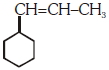
C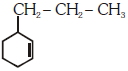
D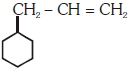
Solution
(D) The formation of methanal $(HCHO)$ during ozonolysis indicates the presence of a terminal double bond $(=CH_2)$ in the alkene.
Among the given options,the structure in option $D$ (allylcyclohexane,which is $cyclohexyl-CH_2-CH=CH_2$) contains a terminal double bond.
Upon ozonolysis,it undergoes cleavage at the double bond to produce methanal $(HCHO)$ and cyclohexylacetaldehyde $(C_6H_{11}-CH_2-CHO)$.
Among the given options,the structure in option $D$ (allylcyclohexane,which is $cyclohexyl-CH_2-CH=CH_2$) contains a terminal double bond.
Upon ozonolysis,it undergoes cleavage at the double bond to produce methanal $(HCHO)$ and cyclohexylacetaldehyde $(C_6H_{11}-CH_2-CHO)$.
0 likesView Solution
17
ChemistryEasyMCQNEET · 2020
The following metal ion activates many enzymes,participates in the oxidation of glucose to produce $ATP$,and with $Na^+$,is responsible for the transmission of nerve signals.
A
Potassium
B
Iron
C
Copper
D
Calcium
Solution
(A) The metal ion described is $K^+$.
$K^+$ ions are essential for activating many enzymes,participating in the oxidation of glucose to produce $ATP$,and along with $Na^+$ ions,they play a crucial role in the transmission of nerve signals.
$K^+$ ions are essential for activating many enzymes,participating in the oxidation of glucose to produce $ATP$,and along with $Na^+$ ions,they play a crucial role in the transmission of nerve signals.
0 likesView Solution
18
ChemistryMediumMCQNEET · 2020
For the reaction $2 Cl ( g ) \rightarrow Cl _{2}( g )$,the correct option is
A
$\Delta_{ r } H < 0$ and $\Delta_{ r } S < 0$
B
$\Delta_{ r } H > 0$ and $\Delta_{ r } S > 0$
C
$\Delta_{ r } H > 0$ and $\Delta_{ r } S < 0$
D
$\Delta_{ r } H < 0$ and $\Delta_{ r } S > 0$
Solution
(A) In the reaction $2 Cl ( g ) \rightarrow Cl _{2}( g )$,two gaseous atoms combine to form one molecule of chlorine gas.
$1$. Enthalpy change $(\Delta_{ r } H)$: Bond formation is an exothermic process,therefore energy is released,making $\Delta_{ r } H < 0$.
$2$. Entropy change $(\Delta_{ r } S)$: The number of moles of gas decreases from $2$ to $1$ $(2 Cl ( g ) \rightarrow 1 Cl _{2}( g ))$. Since the randomness or disorder of the system decreases,$\Delta_{ r } S < 0$.
Thus,both $\Delta_{ r } H < 0$ and $\Delta_{ r } S < 0$.
$1$. Enthalpy change $(\Delta_{ r } H)$: Bond formation is an exothermic process,therefore energy is released,making $\Delta_{ r } H < 0$.
$2$. Entropy change $(\Delta_{ r } S)$: The number of moles of gas decreases from $2$ to $1$ $(2 Cl ( g ) \rightarrow 1 Cl _{2}( g ))$. Since the randomness or disorder of the system decreases,$\Delta_{ r } S < 0$.
Thus,both $\Delta_{ r } H < 0$ and $\Delta_{ r } S < 0$.
0 likesView Solution
19
ChemistryMediumMCQNEET · 2020
Match the following:
Which of the following is the correct option?
| Oxide | Nature |
|---|---|
| $a$. $CO$ | $i$. Basic |
| $b$. $BaO$ | $ii$. Neutral |
| $c$. $Al_2O_3$ | $iii$. Acidic |
| $d$. $Cl_2O_7$ | $iv$. Amphoteric |
Which of the following is the correct option?
A
$a-iv, b-iii, c-ii, d-i$
B
$a-i, b-ii, c-iii, d-iv$
C
$a-ii, b-i, c-iv, d-iii$
D
$a-iii, b-iv, c-i, d-ii$
Solution
(C) . $CO$ is a neutral oxide $(ii)$.
$b$. $BaO$ is a basic oxide $(i)$.
$c$. $Al_2O_3$ is an amphoteric oxide $(iv)$.
$d$. $Cl_2O_7$ is an acidic oxide $(iii)$.
Therefore,the correct match is $a-ii, b-i, c-iv, d-iii$.
$b$. $BaO$ is a basic oxide $(i)$.
$c$. $Al_2O_3$ is an amphoteric oxide $(iv)$.
$d$. $Cl_2O_7$ is an acidic oxide $(iii)$.
Therefore,the correct match is $a-ii, b-i, c-iv, d-iii$.
0 likesView Solution
20
ChemistryMediumMCQNEET · 2020
$A$ mixture of $N_2$ and $Ar$ gases in a cylinder contains $7 \ g$ of $N_2$ and $8 \ g$ of $Ar$. If the total pressure of the mixture of gases in the cylinder is $27 \ bar$,the partial pressure of $N_2$ is $......... \ bar$.
[Use atomic masses (in $g \ mol^{-1}$) : $N=14, Ar=40$]
[Use atomic masses (in $g \ mol^{-1}$) : $N=14, Ar=40$]
A
$18$
B
$9$
C
$12$
D
$15$
Solution
(D) Step $1$: Calculate the number of moles of each gas.
$n_{N_2} = \frac{7 \ g}{28 \ g \ mol^{-1}} = 0.25 \ mol = \frac{1}{4} \ mol$
$n_{Ar} = \frac{8 \ g}{40 \ g \ mol^{-1}} = 0.2 \ mol = \frac{1}{5} \ mol$
Step $2$: Calculate the mole fraction of $N_2$ $(x_{N_2})$.
$x_{N_2} = \frac{n_{N_2}}{n_{N_2} + n_{Ar}} = \frac{1/4}{1/4 + 1/5} = \frac{0.25}{0.25 + 0.20} = \frac{0.25}{0.45} = \frac{5}{9}$
Step $3$: Calculate the partial pressure of $N_2$ $(p_{N_2})$.
$p_{N_2} = x_{N_2} \times P_{total} = \frac{5}{9} \times 27 \ bar = 5 \times 3 \ bar = 15 \ bar$.
$n_{N_2} = \frac{7 \ g}{28 \ g \ mol^{-1}} = 0.25 \ mol = \frac{1}{4} \ mol$
$n_{Ar} = \frac{8 \ g}{40 \ g \ mol^{-1}} = 0.2 \ mol = \frac{1}{5} \ mol$
Step $2$: Calculate the mole fraction of $N_2$ $(x_{N_2})$.
$x_{N_2} = \frac{n_{N_2}}{n_{N_2} + n_{Ar}} = \frac{1/4}{1/4 + 1/5} = \frac{0.25}{0.25 + 0.20} = \frac{0.25}{0.45} = \frac{5}{9}$
Step $3$: Calculate the partial pressure of $N_2$ $(p_{N_2})$.
$p_{N_2} = x_{N_2} \times P_{total} = \frac{5}{9} \times 27 \ bar = 5 \times 3 \ bar = 15 \ bar$.
0 likesView Solution
21
ChemistryMediumMCQNEET · 2020
Which of the following is not correct about carbon monoxide $(CO)$?
A
It is produced due to incomplete combustion.
B
It forms carboxyhaemoglobin.
C
It reduces the oxygen-carrying ability of blood.
D
The carboxyhaemoglobin (haemoglobin bound to $CO$) is less stable than oxyhaemoglobin.
Solution
(D) The correct statement is that carboxyhaemoglobin (haemoglobin bound to $CO$) is about $300$ times more stable than oxyhaemoglobin.
Therefore,the statement that it is less stable is incorrect.
Therefore,the statement that it is less stable is incorrect.
0 likesView Solution
22
ChemistryMediumMCQNEET · 2020
Which one of the following has the maximum number of atoms?
A
$1 \ g$ of $Li(s)$ [Atomic mass of $Li = 7$]
B
$1 \ g$ of $Ag(s)$ [Atomic mass of $Ag = 108$]
C
$1 \ g$ of $Mg(s)$ [Atomic mass of $Mg = 24$]
D
$1 \ g$ of $O_2(g)$ [Atomic mass of $O = 16$]
Solution
(A) The number of atoms is calculated using the formula: $\text{Number of atoms} = \frac{\text{mass}}{\text{molar mass}} \times N_A \times \text{atomicity}$.
$(A)$ For $1 \ g$ of $Li$: $\frac{1}{7} \times N_A \times 1 \approx 0.143 \times N_A$.
$(B)$ For $1 \ g$ of $Ag$: $\frac{1}{108} \times N_A \times 1 \approx 0.009 \times N_A$.
$(C)$ For $1 \ g$ of $Mg$: $\frac{1}{24} \times N_A \times 1 \approx 0.042 \times N_A$.
$(D)$ For $1 \ g$ of $O_2$: $\frac{1}{32} \times N_A \times 2 = \frac{1}{16} \times N_A \approx 0.0625 \times N_A$.
Comparing the values,$1 \ g$ of $Li$ has the maximum number of atoms.
$(A)$ For $1 \ g$ of $Li$: $\frac{1}{7} \times N_A \times 1 \approx 0.143 \times N_A$.
$(B)$ For $1 \ g$ of $Ag$: $\frac{1}{108} \times N_A \times 1 \approx 0.009 \times N_A$.
$(C)$ For $1 \ g$ of $Mg$: $\frac{1}{24} \times N_A \times 1 \approx 0.042 \times N_A$.
$(D)$ For $1 \ g$ of $O_2$: $\frac{1}{32} \times N_A \times 2 = \frac{1}{16} \times N_A \approx 0.0625 \times N_A$.
Comparing the values,$1 \ g$ of $Li$ has the maximum number of atoms.
0 likesView Solution
23
ChemistryMCQNEET · 2020
Match the organism with its use in biotechnology.
Select the correct option from the following:
| $(a)$ Bacillus thuringiensis | $(i)$ Cloning vector |
| $(b)$ Thermus aquaticus | $(ii)$ Construction of first $rDNA$ molecule |
| $(c)$ Agrobacterium tumefaciens | $(iii)$ $DNA$ polymerase |
| $(d)$ Salmonella typhimurium | $(iv)$ Cry proteins |
Select the correct option from the following:
A
$(iii), (iv), (i), (ii)$
B
$(ii), (iv), (iii), (i)$
C
$(iv), (iii), (i), (ii)$
D
$(iii), (ii), (iv), (i)$
Solution
(C) The correct matches are as follows:
$(a)$ $Bacillus$ $thuringiensis$ produces $Cry$ proteins, which are used as bio-insecticides.
$(b)$ $Thermus$ $aquaticus$ is the source of $Taq$ $DNA$ polymerase, which is heat-stable and used in $PCR$.
$(c)$ $Agrobacterium$ $tumefaciens$ is a natural genetic engineer used as a cloning vector to transfer genes into plants.
$(d)$ $Salmonella$ $typhimurium$ was used by Cohen and Boyer for the construction of the first $rDNA$ molecule.
Therefore, the correct sequence is $(a)-(iv), (b)-(iii), (c)-(i), (d)-(ii)$.
$(a)$ $Bacillus$ $thuringiensis$ produces $Cry$ proteins, which are used as bio-insecticides.
$(b)$ $Thermus$ $aquaticus$ is the source of $Taq$ $DNA$ polymerase, which is heat-stable and used in $PCR$.
$(c)$ $Agrobacterium$ $tumefaciens$ is a natural genetic engineer used as a cloning vector to transfer genes into plants.
$(d)$ $Salmonella$ $typhimurium$ was used by Cohen and Boyer for the construction of the first $rDNA$ molecule.
Therefore, the correct sequence is $(a)-(iv), (b)-(iii), (c)-(i), (d)-(ii)$.
0 likesView Solution
24
ChemistryMCQNEET · 2020
The body of the ovule is fused with the funicle at:
A
Chalaza
B
Hilum
C
Micropyle
D
Nucellus
Solution
(B) The $Hilum$ is the point of attachment where the body of the ovule fuses with the funicle. It represents the junction between the ovule and the stalk (funicle).
0 likesView Solution
25
ChemistryMCQNEET · 2020
Which of the following hormone levels causes the release of an ovum from the Graafian follicle (ovulation)?
A
High concentration of estrogen
B
High concentration of progesterone
C
Low concentration of $LH$
D
Low concentration of $FSH$
Solution
(A) The menstrual cycle is regulated by various hormones.
During the follicular phase,estrogen levels rise,which triggers a surge in the secretion of Luteinizing Hormone $(LH)$ from the anterior pituitary gland.
This phenomenon is known as the $LH$ surge.
This peak level of $LH$ induces the rupture of the mature Graafian follicle,leading to the release of the secondary oocyte,a process called ovulation.
Therefore,a high concentration of $LH$ (not low) is required for ovulation,and high estrogen levels are the primary trigger for this $LH$ surge.
During the follicular phase,estrogen levels rise,which triggers a surge in the secretion of Luteinizing Hormone $(LH)$ from the anterior pituitary gland.
This phenomenon is known as the $LH$ surge.
This peak level of $LH$ induces the rupture of the mature Graafian follicle,leading to the release of the secondary oocyte,a process called ovulation.
Therefore,a high concentration of $LH$ (not low) is required for ovulation,and high estrogen levels are the primary trigger for this $LH$ surge.
0 likesView Solution
26
ChemistryMCQNEET · 2020
Which of the following statements is correct?
A
Adenine pairs with thymine through two $H$-bonds.
B
Adenine pairs with thymine through one $H$-bond.
C
Adenine pairs with thymine through three $H$-bonds.
D
Adenine does not pair with thymine.
Solution
(A) In the $DNA$ double helix structure, nitrogenous bases are paired according to Chargaff's rules.
Adenine $(A)$ always pairs with thymine $(T)$ via two hydrogen bonds $(A=T)$.
Conversely, guanine $(G)$ pairs with cytosine $(C)$ via three hydrogen bonds $(G \equiv C)$.
Therefore, the statement that adenine pairs with thymine through two $H$-bonds is correct.
Adenine $(A)$ always pairs with thymine $(T)$ via two hydrogen bonds $(A=T)$.
Conversely, guanine $(G)$ pairs with cytosine $(C)$ via three hydrogen bonds $(G \equiv C)$.
Therefore, the statement that adenine pairs with thymine through two $H$-bonds is correct.
0 likesView Solution
27
ChemistryMCQNEET · 2020
Match the following columns and select the correct option:
$(a)\quad(b)\quad(c)\quad(d)$
| Column-$I$ | Column-$II$ |
|---|---|
| $(a)$ Floating ribs | $(i)$ Located between $2^{nd}$ and $7^{th}$ ribs |
| $(b)$ Acromion process | $(ii)$ Head of humerus |
| $(c)$ Scapula | $(iii)$ Clavicle articulation |
| $(d)$ Glenoid cavity | $(iv)$ Do not connect with the sternum |
$(a)\quad(b)\quad(c)\quad(d)$
A
$(ii)\quad(iv)\quad(i)\quad(iii)$
B
$(i)\quad(iii)\quad(ii)\quad(iv)$
C
$(iii)\quad(ii)\quad(iv)\quad(i)$
D
$(iv)\quad(iii)\quad(i)\quad(ii)$
Solution
(D) The correct matches are as follows:
$(a)$ Floating ribs: These are the $11^{th}$ and $12^{th}$ pairs of ribs that do not connect with the sternum,hence they are called floating ribs. So,$(a) - (iv)$.
$(b)$ Acromion process: This is a flattened,expanded process of the scapula that articulates with the clavicle. So,$(b) - (iii)$.
$(c)$ Scapula: The scapula is a large triangular flat bone situated in the dorsal part of the thorax between the $2^{nd}$ and $7^{th}$ ribs. So,$(c) - (i)$.
$(d)$ Glenoid cavity: This is a depression in the scapula that articulates with the head of the humerus to form the shoulder joint. So,$(d) - (ii)$.
Therefore,the correct sequence is $(a)-(iv), (b)-(iii), (c)-(i), (d)-(ii)$.
$(a)$ Floating ribs: These are the $11^{th}$ and $12^{th}$ pairs of ribs that do not connect with the sternum,hence they are called floating ribs. So,$(a) - (iv)$.
$(b)$ Acromion process: This is a flattened,expanded process of the scapula that articulates with the clavicle. So,$(b) - (iii)$.
$(c)$ Scapula: The scapula is a large triangular flat bone situated in the dorsal part of the thorax between the $2^{nd}$ and $7^{th}$ ribs. So,$(c) - (i)$.
$(d)$ Glenoid cavity: This is a depression in the scapula that articulates with the head of the humerus to form the shoulder joint. So,$(d) - (ii)$.
Therefore,the correct sequence is $(a)-(iv), (b)-(iii), (c)-(i), (d)-(ii)$.
0 likesView Solution
28
ChemistryMCQNEET · 2020
Name the plant growth regulator which,when sprayed on sugarcane crops,increases the length of the stem and thus increases the yield of sugarcane.
A
Cytokinin
B
Gibberellin
C
Ethylene
D
Abscisic acid
Solution
(B) Gibberellins are plant growth regulators that are known to increase the length of the stem in sugarcane plants.
Sugarcane stores sugar as carbohydrates in their stems.
By spraying gibberellins on the sugarcane crop,the internodal length increases,which leads to an increase in the overall length of the stem.
This increase in stem length results in an increase in the total yield of the sugarcane crop by as much as $20$ tonnes per acre.
Sugarcane stores sugar as carbohydrates in their stems.
By spraying gibberellins on the sugarcane crop,the internodal length increases,which leads to an increase in the overall length of the stem.
This increase in stem length results in an increase in the total yield of the sugarcane crop by as much as $20$ tonnes per acre.
0 likesView Solution
29
ChemistryMCQNEET · 2020
Identify the basic amino acid from the following.
A
Tyrosine
B
Glutamic acid
C
Lysine
D
Valine
Solution
(C) Amino acids are classified based on the nature of their $R$-group.
Basic amino acids contain an extra amino group in their side chain,making them basic in nature.
Examples of basic amino acids include Lysine,Arginine,and Histidine.
Tyrosine is an aromatic amino acid.
Glutamic acid is an acidic amino acid.
Valine is a neutral,non-polar,aliphatic amino acid.
Therefore,Lysine is the correct answer.
Basic amino acids contain an extra amino group in their side chain,making them basic in nature.
Examples of basic amino acids include Lysine,Arginine,and Histidine.
Tyrosine is an aromatic amino acid.
Glutamic acid is an acidic amino acid.
Valine is a neutral,non-polar,aliphatic amino acid.
Therefore,Lysine is the correct answer.
0 likesView Solution
30
ChemistryMCQNEET · 2020
Select the correct statement:
A
Glucocorticoids stimulate gluconeogenesis.
B
Glucagon is associated with hypoglycemia.
C
Insulin acts on pancreatic cells and adipocytes.
D
Insulin is associated with hyperglycemia.
Solution
(A) ग्लूकोकोर्टिकोइड्स (जैसे कोर्टिसोल) यकृत में ग्लूकोनियोजेनेसिस (गैर-कार्बोहाइड्रेट स्रोतों से ग्लूकोज का निर्माण) को उत्तेजित करते हैं,जिससे रक्त में ग्लूकोज का स्तर बढ़ जाता है। इसलिए,विकल्प $A$ सही है। ग्लूकागन एक हाइपरग्लाइसेमिक हार्मोन है,हाइपोग्लाइसेमिक नहीं। इंसुलिन एक हाइपोग्लाइसेमिक हार्मोन है,हाइपरग्लाइसेमिक नहीं।
0 likesView Solution
31
ChemistryMCQNEET · 2020
The roots that originate from the base of the stem are called:
A
Fibrous roots
B
Primary roots
C
Prop roots
D
Lateral roots
Solution
(A) In monocotyledonous plants,the primary root is short-lived and is replaced by a large number of roots. These roots originate from the base of the stem and constitute the fibrous root system. Therefore,the correct answer is $A$.
0 likesView Solution
32
ChemistryMCQNEET · 2020
Match the following columns and select the correct option:
$(a)\quad (b)\quad (c)\quad (d)$
| $(a)$ Clostridium butylicum | $(i)$ Cyclosporin-$A$ |
| $(b)$ Trichoderma polysporum | $(ii)$ Butyric acid |
| $(c)$ Monascus purpureus | $(iii)$ Citric acid |
| $(d)$ Aspergillus niger | $(iv)$ Blood cholesterol lowering agent |
$(a)\quad (b)\quad (c)\quad (d)$
A
$(iii)\quad (iv)\quad (ii)\quad (i)$
B
$(ii)\quad (i)\quad (iv)\quad (iii)$
C
$(i)\quad (ii)\quad (iv)\quad (iii)$
D
$(iv)\quad (iii)\quad (ii)\quad (i)$
Solution
(B) The correct matches are as follows:
$1$. $Clostridium \ butylicum$ produces $Butyric \ acid$ $(a-ii)$.
$2$. $Trichoderma \ polysporum$ produces $Cyclosporin-A$,which is an immunosuppressive agent $(b-i)$.
$3$. $Monascus \ purpureus$ produces $Statins$,which act as blood cholesterol-lowering agents $(c-iv)$.
$4$. $Aspergillus \ niger$ is used for the commercial production of $Citric \ acid$ $(d-iii)$.
Therefore,the correct sequence is $(a-ii, b-i, c-iv, d-iii)$.
$1$. $Clostridium \ butylicum$ produces $Butyric \ acid$ $(a-ii)$.
$2$. $Trichoderma \ polysporum$ produces $Cyclosporin-A$,which is an immunosuppressive agent $(b-i)$.
$3$. $Monascus \ purpureus$ produces $Statins$,which act as blood cholesterol-lowering agents $(c-iv)$.
$4$. $Aspergillus \ niger$ is used for the commercial production of $Citric \ acid$ $(d-iii)$.
Therefore,the correct sequence is $(a-ii, b-i, c-iv, d-iii)$.
0 likesView Solution
33
ChemistryMCQNEET · 2020
Match the following columns and select the correct option:
$(a)\quad (b)\quad (c)\quad (d)$
| $(a)$ Placenta | $(i)$ Androgens |
| $(b)$ Zona pellucida | $(ii)$ Human Chorionic Gonadotropin $(hCG)$ |
| $(c)$ Bulbourethral glands | $(iii)$ Layer of the ovum |
| $(d)$ Leydig cells | $(iv)$ Lubrication of the penis |
$(a)\quad (b)\quad (c)\quad (d)$
A
$(iv)\quad (iii)\quad (i)\quad (ii)$
B
$(i)\quad (iv)\quad (ii)\quad (iii)$
C
$(iii)\quad (ii)\quad (iv)\quad (i)$
D
$(ii)\quad (iii)\quad (iv)\quad (i)$
Solution
(D) The correct matches are as follows:
$(a)$ Placenta produces hormones like Human Chorionic Gonadotropin $(hCG)$, thus $(a)-(ii)$.
$(b)$ Zona pellucida is the non-cellular layer surrounding the ovum, thus $(b)-(iii)$.
$(c)$ Bulbourethral glands secrete a fluid that helps in the lubrication of the penis, thus $(c)-(iv)$.
$(d)$ Leydig cells (interstitial cells) are responsible for the synthesis and secretion of testicular hormones called androgens, thus $(d)-(i)$.
Therefore, the correct sequence is $(a)-(ii), (b)-(iii), (c)-(iv), (d)-(i)$.
$(a)$ Placenta produces hormones like Human Chorionic Gonadotropin $(hCG)$, thus $(a)-(ii)$.
$(b)$ Zona pellucida is the non-cellular layer surrounding the ovum, thus $(b)-(iii)$.
$(c)$ Bulbourethral glands secrete a fluid that helps in the lubrication of the penis, thus $(c)-(iv)$.
$(d)$ Leydig cells (interstitial cells) are responsible for the synthesis and secretion of testicular hormones called androgens, thus $(d)-(i)$.
Therefore, the correct sequence is $(a)-(ii), (b)-(iii), (c)-(iv), (d)-(i)$.
0 likesView Solution
34
ChemistryMCQNEET · 2020
Match the following columns and select the correct option:
$(a)\quad (b)\quad (c)\quad (d)$
| $(a)$ Eosinophils | $(i)$ Immune response |
| $(b)$ Basophils | $(ii)$ Phagocytosis |
| $(c)$ Neutrophils | $(iii)$ Release histaminase enzyme |
| $(d)$ Lymphocytes | $(iv)$ Release granules containing histamine |
$(a)\quad (b)\quad (c)\quad (d)$
A
$(i)\quad (ii)\quad (iv)\quad (iii)$
B
$(iv)\quad (i)\quad (ii)\quad (iii)$
C
$(iii)\quad (iv)\quad (ii)\quad (i)$
D
$(ii)\quad (i)\quad (iii)\quad (iv)$
Solution
(C) The correct matching is as follows:
$(a)$ Eosinophils: These cells release histaminase enzyme which helps in controlling allergic reactions. Thus,$(a)-(iii)$.
$(b)$ Basophils: These cells release granules containing histamine,serotonin,and heparin,which are involved in inflammatory reactions. Thus,$(b)-(iv)$.
$(c)$ Neutrophils: These are the most abundant phagocytic cells in the blood that destroy foreign organisms. Thus,$(c)-(ii)$.
$(d)$ Lymphocytes: These cells are responsible for the immune response of the body. Thus,$(d)-(i)$.
Therefore,the correct sequence is $(a)-(iii), (b)-(iv), (c)-(ii), (d)-(i)$.
$(a)$ Eosinophils: These cells release histaminase enzyme which helps in controlling allergic reactions. Thus,$(a)-(iii)$.
$(b)$ Basophils: These cells release granules containing histamine,serotonin,and heparin,which are involved in inflammatory reactions. Thus,$(b)-(iv)$.
$(c)$ Neutrophils: These are the most abundant phagocytic cells in the blood that destroy foreign organisms. Thus,$(c)-(ii)$.
$(d)$ Lymphocytes: These cells are responsible for the immune response of the body. Thus,$(d)-(i)$.
Therefore,the correct sequence is $(a)-(iii), (b)-(iv), (c)-(ii), (d)-(i)$.
0 likesView Solution
35
ChemistryMCQNEET · 2020
According to Robert May,the global species diversity is about ...................
A
$7$ million
B
$20$ million
C
$50$ million
D
$1.5$ million
Solution
(A) Robert May,a renowned ecologist,placed the global species diversity estimate at about $7$ million. While more than $1.5$ million species have been recorded to date,many species remain to be discovered and described,particularly in the tropics.
0 likesView Solution
36
ChemistryMediumMCQNEET · 2020
Which among the following salt solutions is basic in nature?
A
Sodium acetate
B
Ammonium chloride
C
Ammonium sulphate
D
Ammonium nitrate
Solution
(A) $CH_3COONa$ is a salt of a strong base $(NaOH)$ and a weak acid $(CH_3COOH)$.
Therefore,its aqueous solution undergoes anionic hydrolysis to produce $OH^-$ ions,making the solution basic in nature.
Therefore,its aqueous solution undergoes anionic hydrolysis to produce $OH^-$ ions,making the solution basic in nature.
0 likesView Solution
37
ChemistryMediumMCQNEET · 2020
At standard conditions,if the change in the enthalpy for the following reaction is $-109 \; kJ \ mol^{-1}$:
$H_{2(g)} + Br_{2(g)} \rightarrow 2HBr_{(g)}$
Given that bond energy of $H_2$ and $Br_2$ is $435 \; kJ \ mol^{-1}$ and $192 \; kJ \ mol^{-1}$,respectively,what is the bond energy (in $kJ \ mol^{-1}$) of $HBr$?
$H_{2(g)} + Br_{2(g)} \rightarrow 2HBr_{(g)}$
Given that bond energy of $H_2$ and $Br_2$ is $435 \; kJ \ mol^{-1}$ and $192 \; kJ \ mol^{-1}$,respectively,what is the bond energy (in $kJ \ mol^{-1}$) of $HBr$?
A
$259$
B
$368$
C
$736$
D
$518$
Solution
(B) The enthalpy change of a reaction is given by the difference between the sum of bond energies of reactants and the sum of bond energies of products:
$\Delta H = \sum(BE)_{reactants} - \sum(BE)_{products}$
For the reaction $H_{2(g)} + Br_{2(g)} \rightarrow 2HBr_{(g)}$,the equation is:
$\Delta H = [BE(H-H) + BE(Br-Br)] - [2 \times BE(H-Br)]$
Substituting the given values:
$-109 = [435 + 192] - 2 \times BE(H-Br)$
$-109 = 627 - 2 \times BE(H-Br)$
$2 \times BE(H-Br) = 627 + 109$
$2 \times BE(H-Br) = 736$
$BE(H-Br) = 368 \; kJ \ mol^{-1}$
$\Delta H = \sum(BE)_{reactants} - \sum(BE)_{products}$
For the reaction $H_{2(g)} + Br_{2(g)} \rightarrow 2HBr_{(g)}$,the equation is:
$\Delta H = [BE(H-H) + BE(Br-Br)] - [2 \times BE(H-Br)]$
Substituting the given values:
$-109 = [435 + 192] - 2 \times BE(H-Br)$
$-109 = 627 - 2 \times BE(H-Br)$
$2 \times BE(H-Br) = 627 + 109$
$2 \times BE(H-Br) = 736$
$BE(H-Br) = 368 \; kJ \ mol^{-1}$
0 likesView Solution
38
ChemistryMediumMCQNEET · 2020
The solubility product for a salt of the type $AB$ is $4 \times 10^{-8}$. What is the molarity of its saturated solution?
A
$4 \times 10^{-4} \ mol/L$
B
$2 \times 10^{-4} \ mol/L$
C
$16 \times 10^{-16} \ mol/L$
D
$2 \times 10^{-16} \ mol/L$
Solution
(B) For a salt of the type $AB$,the dissociation is represented as: $AB(s) \rightleftharpoons A^+(aq) + B^-(aq)$.
The solubility product expression is $K_{sp} = [A^+][B^-] = s \times s = s^2$,where $s$ is the molar solubility.
Given $K_{sp} = 4 \times 10^{-8}$.
Therefore,$s^2 = 4 \times 10^{-8}$.
Taking the square root on both sides: $s = \sqrt{4 \times 10^{-8}} = 2 \times 10^{-4} \ mol/L$.
The solubility product expression is $K_{sp} = [A^+][B^-] = s \times s = s^2$,where $s$ is the molar solubility.
Given $K_{sp} = 4 \times 10^{-8}$.
Therefore,$s^2 = 4 \times 10^{-8}$.
Taking the square root on both sides: $s = \sqrt{4 \times 10^{-8}} = 2 \times 10^{-4} \ mol/L$.
0 likesView Solution
39
ChemistryMediumMCQNEET · 2020
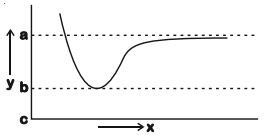
The potential energy $(y)$ curve for $H_2$ formation as a function of internuclear distance $(x)$ of the $H$ atoms is shown below.
The bond energy of $H_2$ is
The bond energy of $H_2$ is
A
$(c-a)$
B
$(a-b)$
C
$\frac{(c-a)}{2}$
D
$\frac{(b-a)}{2}$
Solution
(B) The potential energy of two $H$ atoms at an infinite distance is represented by $a$.
The potential energy of the $H_2$ molecule at the equilibrium bond length is represented by $b$.
The bond energy is defined as the energy required to break the bond,which is the difference between the energy of the separated atoms and the energy of the bonded molecule.
Therefore,the bond energy is $(a-b)$.
The potential energy of the $H_2$ molecule at the equilibrium bond length is represented by $b$.
The bond energy is defined as the energy required to break the bond,which is the difference between the energy of the separated atoms and the energy of the bonded molecule.
Therefore,the bond energy is $(a-b)$.
0 likesView Solution
40
ChemistryMediumMCQNEET · 2020
$A$ liquid compound $(x)$ can be purified by steam distillation only if it is
A
Not steam volatile,immiscible with water
B
Steam volatile,immiscible with water
C
Not steam volatile,miscible with water
D
Steam volatile,miscible with water
Solution
(B) Steam distillation is a separation technique used for substances that are steam volatile and immiscible with water.
In this process,the compound vaporizes at a temperature lower than its boiling point,allowing for purification without decomposition.
In this process,the compound vaporizes at a temperature lower than its boiling point,allowing for purification without decomposition.
0 likesView Solution
41
ChemistryMediumMCQNEET · 2020
What is the role of gypsum,$CaSO_{4} \cdot 2H_{2}O$,in the setting of cement? Identify the correct option from the following:
A
to slow down the setting process
B
to fasten the setting process
C
to provide water molecules for hydration process
D
to help to remove water molecules
Solution
(A) The purpose of adding gypsum $(CaSO_{4} \cdot 2H_{2}O)$ to cement is to retard or slow down the initial setting process of the cement.
This allows the cement to remain in a plastic state for a longer duration,ensuring it can be properly placed and hardened without forming cracks.
This allows the cement to remain in a plastic state for a longer duration,ensuring it can be properly placed and hardened without forming cracks.
0 likesView Solution
42
ChemistryMediumMCQNEET · 2020
Which one of the following reactions does not come under hydrolysis type reaction?
A
$P_{4}O_{10(s)} + 6H_{2}O_{(l)} \rightarrow 4H_{3}PO_{4(aq)}$
B
$SiCl_{4(l)} + 2H_{2}O_{(l)} \rightarrow SiO_{2(s)} + 4HCl_{(aq)}$
C
$Li_{3}N_{(s)} + 3H_{2}O_{(l)} \rightarrow NH_{3(g)} + 3LiOH_{(aq)}$
D
$2F_{2(g)} + 2H_{2}O_{(l)} \rightarrow 4HF_{(aq)} + O_{2(g)}$
Solution
(D) Hydrolysis is a reaction where water molecules break down a compound without changing the oxidation states of the elements involved.
In the reaction $2F_{2(g)} + 2H_{2}O_{(l)} \rightarrow 4HF_{(aq)} + O_{2(g)}$,fluorine $(F_2)$ acts as a strong oxidizing agent.
It oxidizes oxygen in water from $-2$ to $0$ (in $O_2$) and itself gets reduced from $0$ to $-1$ (in $HF$).
Since this is a redox reaction and not a simple hydrolysis,option $D$ is the correct answer.
In the reaction $2F_{2(g)} + 2H_{2}O_{(l)} \rightarrow 4HF_{(aq)} + O_{2(g)}$,fluorine $(F_2)$ acts as a strong oxidizing agent.
It oxidizes oxygen in water from $-2$ to $0$ (in $O_2$) and itself gets reduced from $0$ to $-1$ (in $HF$).
Since this is a redox reaction and not a simple hydrolysis,option $D$ is the correct answer.
0 likesView Solution
43
ChemistryMediumMCQNEET · 2020
The oxidation number of the underlined atom in the following species is given. Identify the incorrect option.
A
$HAuCl_4$ is $+3$
B
$Cu_2\underline{O}$ is $-1$
C
$\underline{Cl}O_3^{-}$ is $+5$
D
$K_2\underline{Cr_2O_7}$ is $+6$
Solution
(B) $(1) \ HAuCl_4 \Rightarrow (+1) + x + 4(-1) = 0, x = +3$
$(2) \ Cu_2\underline{O} \Rightarrow 2(+1) + x = 0, x = -2$
$(3) \ \underline{Cl}O_3^{-} \Rightarrow x + 3(-2) = -1, x = +5$
$(4) \ K_2\underline{Cr_2O_7} \Rightarrow 2(+1) + 2x + 7(-2) = 0, x = +6$
The oxidation number of oxygen in $Cu_2O$ is $-2$,not $-1$. Therefore,option $B$ is incorrect.
$(2) \ Cu_2\underline{O} \Rightarrow 2(+1) + x = 0, x = -2$
$(3) \ \underline{Cl}O_3^{-} \Rightarrow x + 3(-2) = -1, x = +5$
$(4) \ K_2\underline{Cr_2O_7} \Rightarrow 2(+1) + 2x + 7(-2) = 0, x = +6$
The oxidation number of oxygen in $Cu_2O$ is $-2$,not $-1$. Therefore,option $B$ is incorrect.
0 likesView Solution
44
ChemistryMediumMCQNEET · 2020
The minimum pressure required to compress $600 \; dm^{3}$ of a gas at $1 \; bar$ to $150 \; dm^{3}$ at $40^{\circ} C$ is ......... $bar$.
A
$2.5$
B
$4$
C
$0.2$
D
$1$
Solution
(B) According to Boyle's Law,for a fixed amount of gas at a constant temperature,the product of pressure and volume is constant: $P_{1}V_{1} = P_{2}V_{2}$.
Given:
$P_{1} = 1 \; bar$
$V_{1} = 600 \; dm^{3}$
$V_{2} = 150 \; dm^{3}$
Substituting the values into the equation:
$(1 \; bar) \times (600 \; dm^{3}) = P_{2} \times (150 \; dm^{3})$
$P_{2} = \frac{600 \; bar \cdot dm^{3}}{150 \; dm^{3}}$
$P_{2} = 4 \; bar$.
Given:
$P_{1} = 1 \; bar$
$V_{1} = 600 \; dm^{3}$
$V_{2} = 150 \; dm^{3}$
Substituting the values into the equation:
$(1 \; bar) \times (600 \; dm^{3}) = P_{2} \times (150 \; dm^{3})$
$P_{2} = \frac{600 \; bar \cdot dm^{3}}{150 \; dm^{3}}$
$P_{2} = 4 \; bar$.
0 likesView Solution
45
ChemistryEasyMCQNEET · 2020
The number of angular nodes and radial nodes in $3s$ orbital are
A
$0$ and $1,$ respectively
B
$0$ and $2,$ respectively
C
$1$ and $0,$ respectively
D
$3$ and $0,$ respectively
Solution
(B) For any orbital,the number of angular nodes is given by the azimuthal quantum number $l$.
For an $s$-orbital,$l = 0$,so the number of angular nodes is $0$.
The number of radial nodes is given by the formula $n - l - 1$.
For the $3s$ orbital,the principal quantum number $n = 3$ and $l = 0$.
Therefore,the number of radial nodes $= 3 - 0 - 1 = 2$.
Thus,the $3s$ orbital has $0$ angular nodes and $2$ radial nodes.
For an $s$-orbital,$l = 0$,so the number of angular nodes is $0$.
The number of radial nodes is given by the formula $n - l - 1$.
For the $3s$ orbital,the principal quantum number $n = 3$ and $l = 0$.
Therefore,the number of radial nodes $= 3 - 0 - 1 = 2$.
Thus,the $3s$ orbital has $0$ angular nodes and $2$ radial nodes.
0 likesView Solution
46
ChemistryMediumMCQNEET · 2020
Among the compounds shown below,which one reveals a linear structure?
A
$N_2O$
B
$NO_2$
C
$HOCl$
D
$O_3$
Solution
(A) To determine the geometry of the molecules,we look at their hybridization and the number of lone pairs on the central atom:
$1$. $N_2O$ (Nitrous oxide): The structure is $N \equiv N-O$ or $N=N=O$. The central nitrogen atom is $sp$ hybridized and has no lone pairs,resulting in a linear geometry.
$2$. $NO_2$ (Nitrogen dioxide): The nitrogen atom has one unpaired electron and is $sp^2$ hybridized,leading to a bent (angular) geometry.
$3$. $HOCl$ (Hypochlorous acid): The oxygen atom is $sp^3$ hybridized with two lone pairs,resulting in a bent geometry.
$4$. $O_3$ (Ozone): The central oxygen atom is $sp^2$ hybridized with one lone pair,resulting in a bent geometry.
Therefore,$N_2O$ is the only linear molecule among the given options.
$1$. $N_2O$ (Nitrous oxide): The structure is $N \equiv N-O$ or $N=N=O$. The central nitrogen atom is $sp$ hybridized and has no lone pairs,resulting in a linear geometry.
$2$. $NO_2$ (Nitrogen dioxide): The nitrogen atom has one unpaired electron and is $sp^2$ hybridized,leading to a bent (angular) geometry.
$3$. $HOCl$ (Hypochlorous acid): The oxygen atom is $sp^3$ hybridized with two lone pairs,resulting in a bent geometry.
$4$. $O_3$ (Ozone): The central oxygen atom is $sp^2$ hybridized with one lone pair,resulting in a bent geometry.
Therefore,$N_2O$ is the only linear molecule among the given options.
0 likesView Solution
47
ChemistryMediumMCQNEET · 2020
Identify the wrongly matched pair.
Molecule $\quad$ $\quad$ Shape or geometry of molecule
Molecule $\quad$ $\quad$ Shape or geometry of molecule
A
$NH_3$ $\quad$ $\quad$ Trigonal pyramidal
B
$PCl_5$ $\quad$ $\quad$ Trigonal planar
C
$SF_6$ $\quad$ $\quad$ Octahedral
D
$BeCl_2$ $\quad$ $\quad$ Linear
Solution
(B) $1$. $NH_3$: The central atom $N$ has $3$ bond pairs and $1$ lone pair,resulting in a trigonal pyramidal shape.
$2$. $PCl_5$: The central atom $P$ has $5$ bond pairs and $0$ lone pairs,resulting in a trigonal bipyramidal geometry.
$3$. $SF_6$: The central atom $S$ has $6$ bond pairs and $0$ lone pairs,resulting in an octahedral geometry.
$4$. $BeCl_2$: The central atom $Be$ has $2$ bond pairs and $0$ lone pairs,resulting in a linear geometry.
Therefore,the pair $PCl_5$ - Trigonal planar is incorrectly matched,as it should be trigonal bipyramidal.
$2$. $PCl_5$: The central atom $P$ has $5$ bond pairs and $0$ lone pairs,resulting in a trigonal bipyramidal geometry.
$3$. $SF_6$: The central atom $S$ has $6$ bond pairs and $0$ lone pairs,resulting in an octahedral geometry.
$4$. $BeCl_2$: The central atom $Be$ has $2$ bond pairs and $0$ lone pairs,resulting in a linear geometry.
Therefore,the pair $PCl_5$ - Trigonal planar is incorrectly matched,as it should be trigonal bipyramidal.
0 likesView Solution
48
ChemistryEasyMCQNEET · 2020
Which of the following statements is $NOT$ true about acid rain?
A
Its $pH$ is less than $5.6$
B
It is due to the reaction of $SO_{2}$,$NO_{2}$,and $CO_{2}$ with rainwater
C
Causes no damage to monuments like Taj Mahal
D
It is harmful for plants
Solution
(C) Acid rain reacts with the marble $(CaCO_{3})$ of the Taj Mahal,causing damage to it.
As a result,the monument is being slowly disfigured,and the marble is becoming discoloured and lustreless.
Therefore,the statement that it causes no damage to monuments is false.
As a result,the monument is being slowly disfigured,and the marble is becoming discoloured and lustreless.
Therefore,the statement that it causes no damage to monuments is false.
0 likesView Solution
49
ChemistryMediumMCQNEET · 2020
Which of the following is a free radical substitution reaction?
A
Propene with $HBr / (C_6H_5COO)_2$
B
Benzene with $Br_2 / AlCl_3$
C
Acetylene with $HBr$
D
Methane with $Br_2 / hv$
Solution
(D) The reaction of methane with $Br_2$ in the presence of light $(hv)$ proceeds via a free radical mechanism,which is a type of substitution reaction.
Step $1$: Initiation: $Br-Br \xrightarrow{hv} 2Br^{\bullet}$
Step $2$: Propagation: $CH_3-H \xrightarrow{hv} CH_3^{\bullet} + H^{\bullet}$ and $CH_3^{\bullet} + Br^{\bullet} \rightarrow CH_3-Br$.
Therefore,option $D$ is the correct answer.
Step $1$: Initiation: $Br-Br \xrightarrow{hv} 2Br^{\bullet}$
Step $2$: Propagation: $CH_3-H \xrightarrow{hv} CH_3^{\bullet} + H^{\bullet}$ and $CH_3^{\bullet} + Br^{\bullet} \rightarrow CH_3-Br$.
Therefore,option $D$ is the correct answer.
0 likesView Solution
50
ChemistryMediumMCQNEET · 2020
If for a certain reaction $\Delta_{r} H$ is $30 \; kJ \; mol^{-1}$ at $450 \; K$,the value of $\Delta_{r} S$ (in $J \; K^{-1} \; mol^{-1}$) for which the same reaction will be spontaneous at the same temperature is
A
$< 66.67$
B
$> 66.67$
C
$< 33.33$
D
$> 33.33$
Solution
(B) For a reaction to be spontaneous,the change in Gibbs free energy,$\Delta_{r} G$,must be negative $(\Delta_{r} G < 0)$.
The relationship is given by the equation: $\Delta_{r} G = \Delta_{r} H - T \Delta_{r} S$.
Substituting the condition for spontaneity: $\Delta_{r} H - T \Delta_{r} S < 0$.
Rearranging the inequality: $\Delta_{r} H < T \Delta_{r} S$ or $\Delta_{r} S > \frac{\Delta_{r} H}{T}$.
Given $\Delta_{r} H = 30 \; kJ \; mol^{-1} = 30,000 \; J \; mol^{-1}$ and $T = 450 \; K$.
$\Delta_{r} S > \frac{30,000 \; J \; mol^{-1}}{450 \; K} = 66.67 \; J \; K^{-1} \; mol^{-1}$.
Therefore,the reaction will be spontaneous if $\Delta_{r} S > 66.67 \; J \; K^{-1} \; mol^{-1}$.
The relationship is given by the equation: $\Delta_{r} G = \Delta_{r} H - T \Delta_{r} S$.
Substituting the condition for spontaneity: $\Delta_{r} H - T \Delta_{r} S < 0$.
Rearranging the inequality: $\Delta_{r} H < T \Delta_{r} S$ or $\Delta_{r} S > \frac{\Delta_{r} H}{T}$.
Given $\Delta_{r} H = 30 \; kJ \; mol^{-1} = 30,000 \; J \; mol^{-1}$ and $T = 450 \; K$.
$\Delta_{r} S > \frac{30,000 \; J \; mol^{-1}}{450 \; K} = 66.67 \; J \; K^{-1} \; mol^{-1}$.
Therefore,the reaction will be spontaneous if $\Delta_{r} S > 66.67 \; J \; K^{-1} \; mol^{-1}$.
0 likesView Solution
51
ChemistryEasyMCQNEET · 2020
Sucrose on hydrolysis gives:
A
$\alpha-D$-Fructose $+ \beta-D$-Fructose
B
$\beta-D$-Glucose $+ \alpha-D$-Fructose
C
$\alpha-D$-Glucose $+ \beta-D$-Glucose
D
$\alpha-D$-Glucose $+ \beta-D$-Fructose
Solution
(D) Sucrose is a disaccharide composed of $\alpha-D$-glucose and $\beta-D$-fructose units linked by a glycosidic linkage.
Upon hydrolysis in the presence of an acid or the enzyme invertase,sucrose breaks down into its constituent monosaccharides:
$\text{Sucrose} + H_2O \xrightarrow{H^+} \alpha-D\text{-Glucose} + \beta-D\text{-Fructose}$.
Upon hydrolysis in the presence of an acid or the enzyme invertase,sucrose breaks down into its constituent monosaccharides:
$\text{Sucrose} + H_2O \xrightarrow{H^+} \alpha-D\text{-Glucose} + \beta-D\text{-Fructose}$.
0 likesView Solution
52
ChemistryEasyMCQNEET · 2020
The calculated spin-only magnetic moment of $Cr^{2+}$ ion is......$B.M.$
A
$2.84$
B
$3.87$
C
$4.90$
D
$5.92$
Solution
(C) The electronic configuration of $Cr$ is $[Ar] 3d^5 4s^1$.
For $Cr^{2+}$ ion,two electrons are removed,resulting in the configuration $[Ar] 3d^4$.
This means there are $n = 4$ unpaired electrons.
The spin-only magnetic moment is calculated using the formula $\mu = \sqrt{n(n+2)} \ B.M.$
Substituting $n = 4$:
$\mu = \sqrt{4(4+2)} \ B.M. = \sqrt{4 \times 6} \ B.M. = \sqrt{24} \ B.M. \approx 4.90 \ B.M.$
For $Cr^{2+}$ ion,two electrons are removed,resulting in the configuration $[Ar] 3d^4$.
This means there are $n = 4$ unpaired electrons.
The spin-only magnetic moment is calculated using the formula $\mu = \sqrt{n(n+2)} \ B.M.$
Substituting $n = 4$:
$\mu = \sqrt{4(4+2)} \ B.M. = \sqrt{4 \times 6} \ B.M. = \sqrt{24} \ B.M. \approx 4.90 \ B.M.$
0 likesView Solution
53
ChemistryMediumMCQNEET · 2020
Which of the following oxoacids of sulphur has an $-O-O-$ linkage?
A
$H_{2}S_{2}O_{7}$,pyrosulphuric acid
B
$H_{2}SO_{3}$,sulphurous acid
C
$H_{2}SO_{4}$,sulphuric acid
D
$H_{2}S_{2}O_{8}$,peroxodisulphuric acid
Solution
(D) The $-O-O-$ linkage is known as a peroxy linkage.
Among the given options,$H_{2}S_{2}O_{8}$ (peroxodisulphuric acid) contains a peroxy linkage.
The structure of $H_{2}S_{2}O_{8}$ is $HO-SO_{2}-O-O-SO_{2}-OH$,which clearly shows the presence of the $-O-O-$ bond.
Therefore,the correct option is $D$.
Among the given options,$H_{2}S_{2}O_{8}$ (peroxodisulphuric acid) contains a peroxy linkage.
The structure of $H_{2}S_{2}O_{8}$ is $HO-SO_{2}-O-O-SO_{2}-OH$,which clearly shows the presence of the $-O-O-$ bond.
Therefore,the correct option is $D$.
0 likesView Solution
54
ChemistryMediumMCQNEET · 2020
Which of the following is the correct order of increasing field strength of ligands to form coordination compounds?
A
$SCN^{-} < F^{-} < C_{2}O_{4}^{2-} < CN^{-}$
B
$F^{-} < SCN^{-} < CN^{-} < C_{2}O_{4}^{2-}$
C
$SCN^{-} < F^{-} < CN^{-} < C_{2}O_{4}^{2-}$
D
$F^{-} < SCN^{-} < C_{2}O_{4}^{2-} < CN^{-}$
Solution
(A) According to the spectrochemical series,the order of increasing field strength of the given ligands is $SCN^{-} < F^{-} < C_{2}O_{4}^{2-} < CN^{-}$.
This series is based on the experimental data of the crystal field splitting energy $(\Delta_o)$ produced by different ligands.
This series is based on the experimental data of the crystal field splitting energy $(\Delta_o)$ produced by different ligands.
0 likesView Solution
55
ChemistryEasyMCQNEET · 2020
The number of Faradays $F$ required to produce $20 \ g$ of calcium from molten $CaCl_2$ (Atomic mass of $Ca = 40 \ g \ mol^{-1}$) is
A
$4$
B
$1$
C
$2$
D
$3$
Solution
(B) The reduction reaction for calcium is: $Ca^{2+} + 2e^{-} \rightarrow Ca_{(s)}$
The valence factor ($n$-factor) for $Ca^{2+}$ is $2$.
According to Faraday's $1^{st}$ law of electrolysis,the number of Faradays required is equal to the number of gram equivalents of the product formed.
Number of moles of $Ca = \frac{\text{mass}}{\text{molar mass}} = \frac{20 \ g}{40 \ g \ mol^{-1}} = 0.5 \ mol$.
Number of gram equivalents = $\text{moles} \times n\text{-factor} = 0.5 \times 2 = 1 \ F$.
The valence factor ($n$-factor) for $Ca^{2+}$ is $2$.
According to Faraday's $1^{st}$ law of electrolysis,the number of Faradays required is equal to the number of gram equivalents of the product formed.
Number of moles of $Ca = \frac{\text{mass}}{\text{molar mass}} = \frac{20 \ g}{40 \ g \ mol^{-1}} = 0.5 \ mol$.
Number of gram equivalents = $\text{moles} \times n\text{-factor} = 0.5 \times 2 = 1 \ F$.
0 likesView Solution
56
ChemistryMediumMCQNEET · 2020
Reaction between acetone and methylmagnesium chloride followed by hydrolysis will give :
A
Isobutyl alcohol
B
Isopropyl alcohol
C
Sec. butyl alcohol
D
Tert. butyl alcohol
Solution
(D) The reaction of acetone $(CH_3COCH_3)$ with methylmagnesium chloride $(CH_3MgCl)$,which is a Grignard reagent,involves the nucleophilic attack of the methyl group on the carbonyl carbon of acetone.
This forms an intermediate magnesium alkoxide: $(CH_3)_3C-OMgCl$.
Subsequent hydrolysis of this intermediate with water $(H_2O)$ yields $2$-methylpropan-$2$-ol,commonly known as tert-butyl alcohol $((CH_3)_3COH)$.
This forms an intermediate magnesium alkoxide: $(CH_3)_3C-OMgCl$.
Subsequent hydrolysis of this intermediate with water $(H_2O)$ yields $2$-methylpropan-$2$-ol,commonly known as tert-butyl alcohol $((CH_3)_3COH)$.
0 likesView Solution
57
ChemistryEasyMCQNEET · 2020
Which of the following is a cationic detergent?
A
Sodium dodecylbenzene sulphonate
B
Sodium lauryl sulphate
C
Sodium stearate
D
Cetyltrimethyl ammonium bromide
Solution
(D) Cationic detergents are quaternary ammonium salts of amines with acetates,chlorides,or bromides as anions.
$Cetyltrimethyl \ ammonium \ bromide$ is a well-known cationic detergent,represented as $[CH_3(CH_2)_{15}N(CH_3)_3]^+ Br^-$.
It is used in hair conditioners.
Therefore,the correct option is $D$.
$Cetyltrimethyl \ ammonium \ bromide$ is a well-known cationic detergent,represented as $[CH_3(CH_2)_{15}N(CH_3)_3]^+ Br^-$.
It is used in hair conditioners.
Therefore,the correct option is $D$.
0 likesView Solution
58
ChemistryMediumMCQNEET · 2020
Identify the incorrect statement.
A
The oxidation states of chromium in $CrO_{4}^{2-}$ and $Cr_{2}O_{7}^{2-}$ are not the same.
B
$Cr^{2+}(d^{4})$ is a stronger reducing agent than $Fe^{2+}(d^{6})$ in water.
C
The transition metals and their compounds are known for their catalytic activity due to their ability to adopt multiple oxidation states and to form complexes.
D
Interstitial compounds are those that are formed when small atoms like $H, C$ or $N$ are trapped inside the crystal lattices of metals.
Solution
(A) In $CrO_{4}^{2-}$,the oxidation state of $Cr$ is $x + 4(-2) = -2$,so $x = +6$.
In $Cr_{2}O_{7}^{2-}$,the oxidation state of $Cr$ is $2x + 7(-2) = -2$,so $2x = +12$,$x = +6$.
Since the oxidation states of chromium in both ions are $+6$,the statement in option $A$ is incorrect.
In $Cr_{2}O_{7}^{2-}$,the oxidation state of $Cr$ is $2x + 7(-2) = -2$,so $2x = +12$,$x = +6$.
Since the oxidation states of chromium in both ions are $+6$,the statement in option $A$ is incorrect.
0 likesView Solution
59
ChemistryMediumMCQNEET · 2020
Urea reacts with water to form $A$ which will decompose to form $B$. $B$ when passed through $Cu^{2+}_{(aq)}$,a deep blue coloured solution $C$ is formed. What is the formula of $C$ from the following?
A
$CuCO_3 \cdot Cu(OH)_2$
B
$CuSO_4$
C
$[Cu(NH_3)_4]^{2+}$
D
$Cu(OH)_2$
Solution
(C) Urea $(NH_2CONH_2)$ reacts with water to form ammonium carbonate $(A)$: $NH_2CONH_2 + 2H_2O \rightarrow (NH_4)_2CO_3$ $(A)$.
Ammonium carbonate decomposes to form ammonia $(B)$: $(NH_4)_2CO_3 \rightarrow 2NH_3 + H_2O + CO_2$ $(B = NH_3)$.
When ammonia is passed through $Cu^{2+}_{(aq)}$ solution,it forms a deep blue complex,tetraamminocopper$(II)$ ion: $Cu^{2+}_{(aq)} + 4NH_3(aq) \rightarrow [Cu(NH_3)_4]^{2+}(aq)$ $(C)$.
Ammonium carbonate decomposes to form ammonia $(B)$: $(NH_4)_2CO_3 \rightarrow 2NH_3 + H_2O + CO_2$ $(B = NH_3)$.
When ammonia is passed through $Cu^{2+}_{(aq)}$ solution,it forms a deep blue complex,tetraamminocopper$(II)$ ion: $Cu^{2+}_{(aq)} + 4NH_3(aq) \rightarrow [Cu(NH_3)_4]^{2+}(aq)$ $(C)$.
0 likesView Solution
60
ChemistryMediumMCQNEET · 2020
The freezing point depression constant $(K_{f})$ of benzene is $5.12 \ K \ kg \ mol^{-1}$. The freezing point depression for the solution of molality $0.078 \ m$ containing a non-electrolyte solute in benzene is..........$K$ (rounded off up to two decimal places).
A
$0.60$
B
$0.20$
C
$0.80$
D
$0.40$
Solution
(D) The formula for freezing point depression is $\Delta T_{f} = K_{f} \times m$.
Given: $K_{f} = 5.12 \ K \ kg \ mol^{-1}$ and $m = 0.078 \ m$.
Substituting the values: $\Delta T_{f} = 5.12 \times 0.078$.
$\Delta T_{f} = 0.39936 \ K$.
Rounding off to two decimal places,we get $\Delta T_{f} = 0.40 \ K$.
Given: $K_{f} = 5.12 \ K \ kg \ mol^{-1}$ and $m = 0.078 \ m$.
Substituting the values: $\Delta T_{f} = 5.12 \times 0.078$.
$\Delta T_{f} = 0.39936 \ K$.
Rounding off to two decimal places,we get $\Delta T_{f} = 0.40 \ K$.
0 likesView Solution
61
ChemistryMediumMCQNEET · 2020
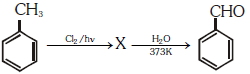
Identify compound $X$ in the following sequence of reactions:
A
Benzotrichloride $(C_6H_5CCl_3)$
B
Chlorobenzene $(C_6H_5Cl)$
C
Benzyl chloride $(C_6H_5CH_2Cl)$
D
Benzal chloride $(C_6H_5CHCl_2)$
Solution
(D) The reaction sequence is the industrial preparation of benzaldehyde from toluene.
$1$. Toluene reacts with chlorine in the presence of light $(Cl_2/h\nu)$ to undergo side-chain chlorination.
$2$. The reaction proceeds through the formation of benzyl chloride,then benzal chloride $(C_6H_5CHCl_2)$,and finally benzotrichloride.
$3$. To obtain benzaldehyde,the reaction is controlled to produce benzal chloride $(C_6H_5CHCl_2)$ as the intermediate $X$.
$4$. Benzal chloride $(C_6H_5CHCl_2)$ on hydrolysis with water at $373 \ K$ yields benzaldehyde $(C_6H_5CHO)$.
Therefore,compound $X$ is benzal chloride $(C_6H_5CHCl_2)$.
$1$. Toluene reacts with chlorine in the presence of light $(Cl_2/h\nu)$ to undergo side-chain chlorination.
$2$. The reaction proceeds through the formation of benzyl chloride,then benzal chloride $(C_6H_5CHCl_2)$,and finally benzotrichloride.
$3$. To obtain benzaldehyde,the reaction is controlled to produce benzal chloride $(C_6H_5CHCl_2)$ as the intermediate $X$.
$4$. Benzal chloride $(C_6H_5CHCl_2)$ on hydrolysis with water at $373 \ K$ yields benzaldehyde $(C_6H_5CHO)$.
Therefore,compound $X$ is benzal chloride $(C_6H_5CHCl_2)$.
0 likesView Solution
62
ChemistryMediumMCQNEET · 2020
Identify the correct statement from the following:
A
Pig iron can be moulded into a variety of shapes.
B
Wrought iron is impure iron with $4 \%$ carbon.
C
Blister copper has blistered appearance due to evolution of $CO_2$.
D
Vapour phase refining is carried out for Nickel by Van Arkel method.
Solution
(A) is the correct statement. Pig iron contains impurities like $C, S, Si, P$ etc. and is relatively brittle,but it can be cast into a variety of shapes.
$B$ is incorrect because wrought iron is the purest form of iron with very low carbon content $(< 0.5 \%)$.
$C$ is incorrect because the blistered appearance of copper is due to the evolution of $SO_2$ gas,not $CO_2$.
$D$ is incorrect because Nickel is refined by the Mond process,whereas the Van Arkel method is used for Zirconium $(Zr)$ and Titanium $(Ti)$.
$B$ is incorrect because wrought iron is the purest form of iron with very low carbon content $(< 0.5 \%)$.
$C$ is incorrect because the blistered appearance of copper is due to the evolution of $SO_2$ gas,not $CO_2$.
$D$ is incorrect because Nickel is refined by the Mond process,whereas the Van Arkel method is used for Zirconium $(Zr)$ and Titanium $(Ti)$.
0 likesView Solution
63
ChemistryEasyMCQNEET · 2020
Which of the following is a natural polymer?
A
poly (Butadiene-acrylonitrile)
B
cis$-1,4-$polyisoprene
C
poly (Butadiene-styrene)
D
polybutadiene
Solution
(B) Natural rubber is a natural polymer known as $cis-1,4-polyisoprene$.
It is obtained from the latex of rubber trees.
The other options,such as poly(Butadiene-acrylonitrile) (Buna-$N$),poly(Butadiene-styrene) (Buna-$S$),and polybutadiene,are synthetic polymers.
It is obtained from the latex of rubber trees.
The other options,such as poly(Butadiene-acrylonitrile) (Buna-$N$),poly(Butadiene-styrene) (Buna-$S$),and polybutadiene,are synthetic polymers.
0 likesView Solution
64
ChemistryMediumMCQNEET · 2020
The reaction between benzaldehyde and acetophenone in the presence of dilute $NaOH$ is known as:
A
Cross Aldol condensation
B
Aldol condensation
C
Cannizzaro's reaction
D
Cross Cannizzaro's reaction
Solution
(A) The reaction between two different carbonyl compounds (benzaldehyde and acetophenone),where at least one of them has an $\alpha$-hydrogen atom (acetophenone has three $\alpha$-hydrogens),in the presence of a dilute base like $NaOH$ is called $Cross$ $Aldol$ $condensation$.
Benzaldehyde $(C_6H_5CHO)$ does not have an $\alpha$-hydrogen,while acetophenone $(C_6H_5COCH_3)$ has $\alpha$-hydrogens.
This specific reaction leads to the formation of a $\beta$-hydroxy ketone,which upon dehydration gives an $\alpha,\beta$-unsaturated ketone.
Benzaldehyde $(C_6H_5CHO)$ does not have an $\alpha$-hydrogen,while acetophenone $(C_6H_5COCH_3)$ has $\alpha$-hydrogens.
This specific reaction leads to the formation of a $\beta$-hydroxy ketone,which upon dehydration gives an $\alpha,\beta$-unsaturated ketone.
0 likesView Solution
65
ChemistryMediumMCQNEET · 2020
The mixture which shows positive deviation from Raoult's law is
A
$Chloroethane + Bromoethane$
B
$Ethanol + Acetone$
C
$Benzene + Toluene$
D
$Acetone + Chloroform$
Solution
(B) positive deviation from Raoult's law occurs when the solute-solvent intermolecular interactions are weaker than the solute-solute and solvent-solvent interactions.
In the mixture of $Ethanol + Acetone$,the hydrogen bonding between ethanol molecules is disrupted by the addition of acetone,leading to weaker intermolecular forces in the solution compared to pure ethanol.
Therefore,this mixture exhibits a positive deviation from Raoult's law.
In the mixture of $Ethanol + Acetone$,the hydrogen bonding between ethanol molecules is disrupted by the addition of acetone,leading to weaker intermolecular forces in the solution compared to pure ethanol.
Therefore,this mixture exhibits a positive deviation from Raoult's law.
0 likesView Solution
66
ChemistryMediumMCQNEET · 2020
The rate constant for a first order reaction is $4.606 \times 10^{-3} \ s^{-1}$. The time required to reduce $2.0 \ g$ of the reactant to $0.2 \ g$ is......... $s$
A
$1000$
B
$100$
C
$200$
D
$500$
Solution
(D) For a first order reaction,the rate equation is given by: $k = \frac{2.303}{t} \log_{10} \frac{[A]_0}{[A]_t}$
Given: $k = 4.606 \times 10^{-3} \ s^{-1}$,$[A]_0 = 2.0 \ g$,$[A]_t = 0.2 \ g$
Substituting the values: $4.606 \times 10^{-3} = \frac{2.303}{t} \log_{10} \frac{2.0}{0.2}$
$4.606 \times 10^{-3} = \frac{2.303}{t} \log_{10} (10)$
Since $\log_{10} (10) = 1$,we have: $4.606 \times 10^{-3} = \frac{2.303}{t}$
$t = \frac{2.303}{4.606 \times 10^{-3}} = \frac{1}{2} \times 10^3 = 500 \ s$
Given: $k = 4.606 \times 10^{-3} \ s^{-1}$,$[A]_0 = 2.0 \ g$,$[A]_t = 0.2 \ g$
Substituting the values: $4.606 \times 10^{-3} = \frac{2.303}{t} \log_{10} \frac{2.0}{0.2}$
$4.606 \times 10^{-3} = \frac{2.303}{t} \log_{10} (10)$
Since $\log_{10} (10) = 1$,we have: $4.606 \times 10^{-3} = \frac{2.303}{t}$
$t = \frac{2.303}{4.606 \times 10^{-3}} = \frac{1}{2} \times 10^3 = 500 \ s$
0 likesView Solution
67
ChemistryMediumMCQNEET · 2020
Which of the following amines will give the carbylamine test?
A
Secondary amine ($N$-ethylaniline)
B
Primary amine (Aniline)
C
Secondary amine ($N$-methylaniline)
D
Tertiary amine ($N,N$-dimethylaniline)
Solution
(B) The carbylamine test is a characteristic reaction for primary amines (both aliphatic and aromatic).
When a primary amine is heated with chloroform $(CHCl_3)$ and alcoholic potassium hydroxide $(KOH)$,it forms an isocyanide (carbylamine),which has a foul,offensive smell.
Secondary and tertiary amines do not contain the necessary $-NH_2$ group to form an isocyanide and therefore do not give this test.
Among the given options,aniline $(C_6H_5NH_2)$ is a primary amine and will give the carbylamine test.
When a primary amine is heated with chloroform $(CHCl_3)$ and alcoholic potassium hydroxide $(KOH)$,it forms an isocyanide (carbylamine),which has a foul,offensive smell.
Secondary and tertiary amines do not contain the necessary $-NH_2$ group to form an isocyanide and therefore do not give this test.
Among the given options,aniline $(C_6H_5NH_2)$ is a primary amine and will give the carbylamine test.
0 likesView Solution
68
ChemistryMediumMCQNEET · 2020
Anisole on cleavage with $HI$ gives:
A
$Phenol$ and $Methyl \ iodide$
B
$Iodobenzene$ and $Methyl \ alcohol$
C
$Phenol$ and $Methane$
D
$Benzene$ and $Methyl \ alcohol$
Solution
(A) Anisole $(C_6H_5OCH_3)$ on heating with $HI$ undergoes cleavage of the $C-O$ bond between the methyl group and the oxygen atom to form $Phenol$ $(C_6H_5OH)$ and $Methyl \ iodide$ $(CH_3I)$.
This reaction proceeds via an $S_N2$ mechanism where the iodide ion attacks the less sterically hindered methyl carbon.
This reaction proceeds via an $S_N2$ mechanism where the iodide ion attacks the less sterically hindered methyl carbon.
0 likesView Solution
69
ChemistryMediumMCQNEET · 2020
The elimination reaction of $2-$bromopentane to form pent$-2-$ene involves:
$a$. $\beta-$Elimination reaction
$b$. Following Zaitsev rule
$c$. Dehydrohalogenation reaction
$d$. Dehydration reaction
$a$. $\beta-$Elimination reaction
$b$. Following Zaitsev rule
$c$. Dehydrohalogenation reaction
$d$. Dehydration reaction
A
$a, b, d$
B
$a, b, c$
C
$a, c, d$
D
$b, c, d$
Solution
(B) The reaction of $2-$bromopentane with a base (like $NaOEt$) to form pent$-2-$ene is a $\beta-$elimination reaction.
In this process,a hydrogen atom is removed from the $\beta-$carbon and a halogen atom is removed from the $\alpha-$carbon,which is known as dehydrohalogenation.
Since the major product formed is the more substituted alkene (pent$-2-$ene),the reaction follows Zaitsev rule.
Dehydration refers to the removal of water,which is not the case here.
Therefore,statements $a$,$b$,and $c$ are correct.
In this process,a hydrogen atom is removed from the $\beta-$carbon and a halogen atom is removed from the $\alpha-$carbon,which is known as dehydrohalogenation.
Since the major product formed is the more substituted alkene (pent$-2-$ene),the reaction follows Zaitsev rule.
Dehydration refers to the removal of water,which is not the case here.
Therefore,statements $a$,$b$,and $c$ are correct.
0 likesView Solution
70
ChemistryMediumMCQNEET · 2020
An increase in the concentration of the reactants of a reaction leads to a change in:
A
collision frequency
B
activation energy
C
heat of reaction
D
threshold energy
Solution
(A) According to collision theory,the collision frequency $(Z)$ is directly proportional to the number of reactant molecules per unit volume.
Therefore,increasing the concentration of reactants increases the number of collisions per unit time,which is known as the collision frequency.
Activation energy,heat of reaction,and threshold energy are characteristic properties of a reaction and do not change with concentration.
Therefore,increasing the concentration of reactants increases the number of collisions per unit time,which is known as the collision frequency.
Activation energy,heat of reaction,and threshold energy are characteristic properties of a reaction and do not change with concentration.
0 likesView Solution
71
ChemistryMediumMCQNEET · 2020
Which of the following is a basic amino acid?
A
Lysine
B
Serine
C
Alanine
D
Tyrosine
Solution
(A) An amino acid is classified as basic if it contains more number of $-NH_2$ groups than $-COOH$ groups.
Lysine has the structure $H_2N-(CH_2)_4-CH(NH_2)-COOH$.
It contains two $-NH_2$ groups and one $-COOH$ group.
Therefore,it is a basic amino acid.
Lysine has the structure $H_2N-(CH_2)_4-CH(NH_2)-COOH$.
It contains two $-NH_2$ groups and one $-COOH$ group.
Therefore,it is a basic amino acid.
0 likesView Solution
72
ChemistryMediumMCQNEET · 2020
Measuring Zeta potential is useful in determining which property of colloidal solution?
A
Size of the colloidal particles
B
Viscosity
C
Solubility
D
Stability of the colloidal particles
Solution
(D) The Zeta potential is the potential difference between the fixed layer and the diffused layer of ions surrounding a colloidal particle.
Greater the magnitude of the Zeta potential,the more stable the colloidal system will be,as it indicates stronger electrostatic repulsion between particles.
Greater the magnitude of the Zeta potential,the more stable the colloidal system will be,as it indicates stronger electrostatic repulsion between particles.
0 likesView Solution
73
ChemistryEasyMCQNEET · 2020
An element has a body-centered cubic $(bcc)$ structure with a cell edge of $288 \ pm$. The atomic radius is $...... \ pm$.
A
$\frac{4}{\sqrt{2}} \times 288$
B
$\frac{\sqrt{3}}{4} \times 288$
C
$\frac{\sqrt{2}}{4} \times 288$
D
$\frac{4}{\sqrt{3}} \times 288$
Solution
(B) For a body-centered cubic $(bcc)$ structure, the relationship between the atomic radius $(r)$ and the edge length $(a)$ is given by the formula: $\sqrt{3} a = 4 r$.
Given that the edge length $a = 288 \ pm$, we can calculate the radius $r$ as follows:
$r = \frac{\sqrt{3}}{4} \times a$
$r = \frac{\sqrt{3}}{4} \times 288 \ pm$.
Given that the edge length $a = 288 \ pm$, we can calculate the radius $r$ as follows:
$r = \frac{\sqrt{3}}{4} \times a$
$r = \frac{\sqrt{3}}{4} \times 288 \ pm$.
0 likesView Solution
74
ChemistryMediumMCQNEET · 2020
On electrolysis of dilute sulphuric acid using Platinum $(Pt)$ electrodes,the product obtained at the anode will be:
A
$SO_2$ gas
B
Hydrogen gas
C
Oxygen gas
D
$H_2S$ gas
Solution
(C) During the electrolysis of dilute $H_2SO_4$,the following reactions occur:
At the cathode: $2H^+_{(aq)} + 2e^- \rightarrow H_{2(g)}$
At the anode: $2H_2O_{(l)} \rightarrow O_{2(g)} + 4H^+_{(aq)} + 4e^-$
Since the oxidation potential of water is higher than that of the sulphate ion $(SO_4^{2-})$,water is oxidized at the anode to release oxygen gas.
At the cathode: $2H^+_{(aq)} + 2e^- \rightarrow H_{2(g)}$
At the anode: $2H_2O_{(l)} \rightarrow O_{2(g)} + 4H^+_{(aq)} + 4e^-$
Since the oxidation potential of water is higher than that of the sulphate ion $(SO_4^{2-})$,water is oxidized at the anode to release oxygen gas.
0 likesView Solution
75
ChemistryMediumMCQNEET · 2020
If $8 \; g$ of a non-electrolyte solute is dissolved in $114 \; g$ of $n$-octane to reduce its vapour pressure to $80 \%$,the molar mass (in $g \; mol^{-1}$) of the solute is.
Given that the molar mass of $n$-octane is $114 \; g \; mol^{-1}$.
Given that the molar mass of $n$-octane is $114 \; g \; mol^{-1}$.
A
$20$
B
$40$
C
$60$
D
$80$
Solution
(B) According to Raoult's law for non-volatile solutes,the relative lowering of vapour pressure is given by:
$\frac{P_{A}^{0} - P_{s}}{P_{A}^{0}} = \frac{n_{B}}{n_{A} + n_{B}} \approx \frac{n_{B}}{n_{A}}$ (for dilute solutions).
Given:
$w_{B} = 8 \; g$,$W_{A} = 114 \; g$,$M_{A} = 114 \; g \; mol^{-1}$.
Since the vapour pressure is reduced to $80 \%$,$P_{s} = 0.8 P_{A}^{0}$.
Therefore,$\frac{P_{A}^{0} - 0.8 P_{A}^{0}}{P_{A}^{0}} = \frac{0.2 P_{A}^{0}}{P_{A}^{0}} = 0.2$.
Using the formula $\frac{\Delta P}{P_{A}^{0}} = \frac{w_{B} \times M_{A}}{m_{B} \times W_{A}}$:
$0.2 = \frac{8 \times 114}{m_{B} \times 114}$.
$0.2 = \frac{8}{m_{B}}$.
$m_{B} = \frac{8}{0.2} = 40 \; g \; mol^{-1}$.
$\frac{P_{A}^{0} - P_{s}}{P_{A}^{0}} = \frac{n_{B}}{n_{A} + n_{B}} \approx \frac{n_{B}}{n_{A}}$ (for dilute solutions).
Given:
$w_{B} = 8 \; g$,$W_{A} = 114 \; g$,$M_{A} = 114 \; g \; mol^{-1}$.
Since the vapour pressure is reduced to $80 \%$,$P_{s} = 0.8 P_{A}^{0}$.
Therefore,$\frac{P_{A}^{0} - 0.8 P_{A}^{0}}{P_{A}^{0}} = \frac{0.2 P_{A}^{0}}{P_{A}^{0}} = 0.2$.
Using the formula $\frac{\Delta P}{P_{A}^{0}} = \frac{w_{B} \times M_{A}}{m_{B} \times W_{A}}$:
$0.2 = \frac{8 \times 114}{m_{B} \times 114}$.
$0.2 = \frac{8}{m_{B}}$.
$m_{B} = \frac{8}{0.2} = 40 \; g \; mol^{-1}$.
1 likesView Solution
76
ChemistryMediumMCQNEET · 2020
Identify compound $(A)$ in the following reaction:
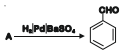
A
Benzoic acid
B
Benzoyl chloride
C
Toluene
D
Acetophenone
Solution
(B) The given reaction is the Rosenmund reduction.
In this reaction,an acid chloride $(RCOCl)$ is hydrogenated to an aldehyde $(RCHO)$ using $H_2$ gas in the presence of a palladium catalyst supported on barium sulfate $(Pd/BaSO_4)$.
The reaction is:
$C_6H_5COCl + H_2 \xrightarrow{Pd/BaSO_4} C_6H_5CHO + HCl$
Here,compound $(A)$ is benzoyl chloride $(C_6H_5COCl)$.
In this reaction,an acid chloride $(RCOCl)$ is hydrogenated to an aldehyde $(RCHO)$ using $H_2$ gas in the presence of a palladium catalyst supported on barium sulfate $(Pd/BaSO_4)$.
The reaction is:
$C_6H_5COCl + H_2 \xrightarrow{Pd/BaSO_4} C_6H_5CHO + HCl$
Here,compound $(A)$ is benzoyl chloride $(C_6H_5COCl)$.
0 likesView Solution
77
ChemistryMediumMCQNEET · 2020
Identify the incorrect statement from the following:
A
The overall decrease in atomic and ionic radii from lanthanum to lutetium is called lanthanoid contraction.
B
Zirconium and Hafnium have identical radii of $160 \; pm$ and $159 \; pm$, respectively, as a consequence of lanthanoid contraction.
C
Lanthanoids reveal only $+3$ oxidation state.
D
The lanthanoid ions other than the $f^{0}$ type and the $f^{14}$ type are all paramagnetic.
Solution
(C) Lanthanoids exhibit a primary oxidation state of $+3$. However, they can also show $+2$ or $+4$ oxidation states in certain solutions or solid compounds.
Therefore, the statement that they reveal only $+3$ oxidation state is incorrect.
Therefore, the statement that they reveal only $+3$ oxidation state is incorrect.
0 likesView Solution
78
ChemistryMediumMCQNEET · 2020
The half-life for a zero order reaction having $0.02 \; M$ initial concentration of reactant is $100 \; s$. The rate constant (in $mol \; L^{-1} s^{-1}$) for the reaction is
A
$1.0 \times 10^{-2}$
B
$1.0 \times 10^{-4}$
C
$2.0 \times 10^{-4}$
D
$2.0 \times 10^{-3}$
Solution
(B) For a zero order reaction,the half-life $(t_{1/2})$ is given by the formula:
$t_{1/2} = \frac{[A]_0}{2k}$
Where $[A]_0$ is the initial concentration and $k$ is the rate constant.
Rearranging for $k$:
$k = \frac{[A]_0}{2 \times t_{1/2}}$
Given $[A]_0 = 0.02 \; M$ and $t_{1/2} = 100 \; s$:
$k = \frac{0.02}{2 \times 100} = \frac{0.02}{200} = 1.0 \times 10^{-4} \; mol \; L^{-1} s^{-1}$
$t_{1/2} = \frac{[A]_0}{2k}$
Where $[A]_0$ is the initial concentration and $k$ is the rate constant.
Rearranging for $k$:
$k = \frac{[A]_0}{2 \times t_{1/2}}$
Given $[A]_0 = 0.02 \; M$ and $t_{1/2} = 100 \; s$:
$k = \frac{0.02}{2 \times 100} = \frac{0.02}{200} = 1.0 \times 10^{-4} \; mol \; L^{-1} s^{-1}$
0 likesView Solution
79
ChemistryMediumMCQNEET · 2020
Match the coordination number and type of hybridisation with the distribution of hybrid orbitals in space based on Valence Bond Theory.
Select the correct option.
| Coordination number and type of hybridisation | Distribution of hybrid orbitals in space |
|---|---|
| $a. 4, sp^3$ | $i. \text{trigonal bipyramidal}$ |
| $b. 4, dsp^2$ | $ii. \text{octahedral}$ |
| $c. 5, sp^3d$ | $iii. \text{tetrahedral}$ |
| $d. 6, d^2sp^3$ | $iv. \text{square planar}$ |
Select the correct option.
A
$a-iii, b-i, c-iv, d-ii$
B
$a-ii, b-iii, c-iv, d-i$
C
$a-iii, b-iv, c-i, d-ii$
D
$a-iv, b-i, c-ii, d-iii$
Solution
(C) According to Valence Bond Theory:
$1. 4, sp^3$ hybridisation results in a $tetrahedral$ geometry $(a-iii)$.
$2. 4, dsp^2$ hybridisation results in a $square planar$ geometry $(b-iv)$.
$3. 5, sp^3d$ hybridisation results in a $trigonal bipyramidal$ geometry $(c-i)$.
$4. 6, d^2sp^3$ hybridisation results in an $octahedral$ geometry $(d-ii)$.
Therefore,the correct matching is $a-iii, b-iv, c-i, d-ii$.
$1. 4, sp^3$ hybridisation results in a $tetrahedral$ geometry $(a-iii)$.
$2. 4, dsp^2$ hybridisation results in a $square planar$ geometry $(b-iv)$.
$3. 5, sp^3d$ hybridisation results in a $trigonal bipyramidal$ geometry $(c-i)$.
$4. 6, d^2sp^3$ hybridisation results in an $octahedral$ geometry $(d-ii)$.
Therefore,the correct matching is $a-iii, b-iv, c-i, d-ii$.
0 likesView Solution
80
ChemistryEasyMCQNEET · 2020
Match the element in column $I$ with that in column $II$.
Identify the correct match:
| Column - $I$ | Column - $II$ |
| $(a)$ Copper | $(i)$ Non-metal |
| $(b)$ Fluorine | $(ii)$ Transition Metal |
| $(c)$ Silicon | $(iii)$ Lanthanoid |
| $(d)$ Cerium | $(iv)$ Metalloid |
Identify the correct match:
A
$a-i, b-ii, c-iii, d-iv$
B
$a-ii, b-iv, c-i, d-iii$
C
$a-ii, b-i, c-iv, d-iii$
D
$a-iv, b-iii, c-i, d-ii$
Solution
(C) Copper is a transition metal $(a-ii)$.
Fluorine is a non-metal $(b-i)$.
Silicon is a metalloid $(c-iv)$.
Cerium is a lanthanoid $(d-iii)$.
Therefore,the correct match is $a-ii, b-i, c-iv, d-iii$.
Fluorine is a non-metal $(b-i)$.
Silicon is a metalloid $(c-iv)$.
Cerium is a lanthanoid $(d-iii)$.
Therefore,the correct match is $a-ii, b-i, c-iv, d-iii$.
0 likesView Solution
81
ChemistryMediumMCQNEET · 2020
In collision theory of chemical reaction,$Z_{AB}$ represents
A
the fraction of molecules with energies equal to $E_{a}$
B
the fraction of molecules with energies greater than $E_{a}$
C
the collision frequency of reactants,$A$ and $B$
D
steric factor
Solution
(C) In the collision theory of chemical kinetics,the number of collisions per unit volume per unit time between reactant molecules $A$ and $B$ is defined as the collision frequency,denoted by $Z_{AB}$.
0 likesView Solution
82
ChemistryMediumMCQNEET · 2020
Match the elements in Column-$I$ with methods of purification in Column-$II$.
| Column-$I$ | Column-$II$ |
| $(a)$ Boron | $(i)$ Van Arkel method |
| $(b)$ Tin | $(ii)$ Mond's process |
| $(c)$ Zirconium | $(iii)$ Liquation |
| $(d)$ Nickel | $(iv)$ Zone refining |
A
$(a)-(iii), (b)-(iv), (c)-(i), (d)-(ii)$
B
$(a)-(iv), (b)-(iii), (c)-(i), (d)-(ii)$
C
$(a)-(iv), (b)-(iii), (c)-(ii), (d)-(i)$
D
$(a)-(ii), (b)-(i), (c)-(iv), (d)-(iii)$
Solution
(B) Boron is purified by Zone refining $(iv)$.
$(b)$ Tin $(Sn)$ is purified by Liquation $(iii)$.
$(c)$ Zirconium $(Zr)$ is purified by Van Arkel method $(i)$.
$(d)$ Nickel $(Ni)$ is purified by Mond's process $(ii)$.
Therefore,the correct match is $(a)-(iv), (b)-(iii), (c)-(i), (d)-(ii)$.
$(b)$ Tin $(Sn)$ is purified by Liquation $(iii)$.
$(c)$ Zirconium $(Zr)$ is purified by Van Arkel method $(i)$.
$(d)$ Nickel $(Ni)$ is purified by Mond's process $(ii)$.
Therefore,the correct match is $(a)-(iv), (b)-(iii), (c)-(i), (d)-(ii)$.
0 likesView Solution
83
ChemistryMediumMCQNEET · 2020
Which of the following substituted phenols is the strongest acid?
A
$p$-methylphenol
B
$p$-nitrophenol
C
$p$-methoxyphenol
D
$p$-ethylphenol
Solution
(B) The acidity of substituted phenols depends on the electronic effects of the substituent groups attached to the benzene ring.
Electron-withdrawing groups $(EWG)$ increase acidity by stabilizing the phenoxide ion through $-I$ and $-R$ effects.
Electron-donating groups $(EDG)$ decrease acidity by destabilizing the phenoxide ion through $+I$ and $+R$ effects.
In the given options:
$(A)$ $-CH_3$ is an $EDG$ ($+I$ and hyperconjugation).
$(B)$ $-NO_2$ is a strong $EWG$ ($-I$ and $-R$ effects).
$(C)$ $-OCH_3$ is an $EDG$ ($+R$ effect dominates over $-I$).
$(D)$ $-C_2H_5$ is an $EDG$ ($+I$ effect).
Since $-NO_2$ is the only strong electron-withdrawing group among the choices,$p$-nitrophenol is the strongest acid.
Electron-withdrawing groups $(EWG)$ increase acidity by stabilizing the phenoxide ion through $-I$ and $-R$ effects.
Electron-donating groups $(EDG)$ decrease acidity by destabilizing the phenoxide ion through $+I$ and $+R$ effects.
In the given options:
$(A)$ $-CH_3$ is an $EDG$ ($+I$ and hyperconjugation).
$(B)$ $-NO_2$ is a strong $EWG$ ($-I$ and $-R$ effects).
$(C)$ $-OCH_3$ is an $EDG$ ($+R$ effect dominates over $-I$).
$(D)$ $-C_2H_5$ is an $EDG$ ($+I$ effect).
Since $-NO_2$ is the only strong electron-withdrawing group among the choices,$p$-nitrophenol is the strongest acid.
0 likesView Solution
84
ChemistryEasyMCQNEET · 2020
Deficiency of which vitamin causes osteomalacia?
A
Vitamin $E$
B
Vitamin $A$
C
Vitamin $D$
D
Vitamin $K$
Solution
(C) Osteomalacia is a disease caused by the deficiency of Vitamin $D$.
In this condition,the bone density decreases,and the bones become soft and weak.
In this condition,the bone density decreases,and the bones become soft and weak.
0 likesView Solution
85
ChemistryMediumMCQNEET · 2020
Which one of the following compounds shows both,Frenkel as well as Schottky defects?
A
$ZnS$
B
$AgBr$
C
$AgI$
D
$NaCl$
Solution
(B) $AgBr$ is a unique compound that exhibits both Frenkel and Schottky defects.
In $AgBr$,the $Ag^+$ ion is small enough to occupy interstitial sites (Frenkel defect),while the crystal lattice also allows for the formation of vacancy pairs (Schottky defect) due to the ionic nature of the compound.
In $AgBr$,the $Ag^+$ ion is small enough to occupy interstitial sites (Frenkel defect),while the crystal lattice also allows for the formation of vacancy pairs (Schottky defect) due to the ionic nature of the compound.
0 likesView Solution
86
ChemistryMediumMCQNEET · 2020
Which of the following is not true about chloramphenicol?
A
It is bacteriostatic.
B
It inhibits the growth of only gram-positive bacteria.
C
It is a broad-spectrum antibiotic.
D
It is not bactericidal.
Solution
(B) Chloramphenicol is a well-known antibiotic.
It is classified as a bacteriostatic antibiotic,meaning it inhibits the growth of bacteria rather than killing them directly.
It is a broad-spectrum antibiotic,which means it is effective against a wide range of microorganisms,including both gram-positive and gram-negative bacteria.
Therefore,the statement that it inhibits the growth of only gram-positive bacteria is incorrect.
It is classified as a bacteriostatic antibiotic,meaning it inhibits the growth of bacteria rather than killing them directly.
It is a broad-spectrum antibiotic,which means it is effective against a wide range of microorganisms,including both gram-positive and gram-negative bacteria.
Therefore,the statement that it inhibits the growth of only gram-positive bacteria is incorrect.
0 likesView Solution
87
ChemistryMediumMCQNEET · 2020
Which of the following will $NOT$ undergo $S_{N}1$ reaction with $\text{OH}^-$?
A
$C_6H_5CH_2Cl$
B
$CH_2=CHCH_2Cl$
C
$(CH_3)_3CCl$
D
$C_6H_5CH_2CH_2Cl$
Solution
(D) The $S_{N}1$ reaction mechanism proceeds via the formation of a carbocation intermediate. The stability of the carbocation determines the reactivity towards $S_{N}1$.
$(A)$ $C_6H_5CH_2Cl$ forms a resonance-stabilized benzyl carbocation $(C_6H_5CH_2^+)$.
$(B)$ $CH_2=CHCH_2Cl$ forms a resonance-stabilized allyl carbocation $(CH_2=CHCH_2^+)$.
$(C)$ $(CH_3)_3CCl$ forms a stable tertiary carbocation $((CH_3)_3C^+)$.
$(D)$ $C_6H_5CH_2CH_2Cl$ is a primary alkyl halide. The formation of a primary carbocation $(C_6H_5CH_2CH_2^+)$ is highly unfavorable due to its low stability. Therefore,it does not undergo $S_{N}1$ reaction.
$(A)$ $C_6H_5CH_2Cl$ forms a resonance-stabilized benzyl carbocation $(C_6H_5CH_2^+)$.
$(B)$ $CH_2=CHCH_2Cl$ forms a resonance-stabilized allyl carbocation $(CH_2=CHCH_2^+)$.
$(C)$ $(CH_3)_3CCl$ forms a stable tertiary carbocation $((CH_3)_3C^+)$.
$(D)$ $C_6H_5CH_2CH_2Cl$ is a primary alkyl halide. The formation of a primary carbocation $(C_6H_5CH_2CH_2^+)$ is highly unfavorable due to its low stability. Therefore,it does not undergo $S_{N}1$ reaction.
1 likesView Solution
88
ChemistryMediumMCQNEET · 2020
Reaction of propanamide with ethanolic sodium hydroxide and bromine will give
A
Aniline
B
Ethylamine
C
Methylamine
D
Propylamine
Solution
(B) The reaction of an amide with bromine $(Br_2)$ in the presence of an aqueous or ethanolic solution of a strong base like sodium hydroxide $(NaOH)$ is known as the Hofmann bromamide degradation reaction.
In this reaction,the amide is converted into a primary amine containing one carbon atom less than the original amide.
The reaction for propanamide $(CH_3CH_2CONH_2)$ is:
$CH_3CH_2CONH_2 + Br_2 + 4NaOH \rightarrow CH_3CH_2NH_2 + Na_2CO_3 + 2NaBr + 2H_2O$
As shown in the reaction,propanamide ($3$ carbons) yields ethylamine ($2$ carbons).
In this reaction,the amide is converted into a primary amine containing one carbon atom less than the original amide.
The reaction for propanamide $(CH_3CH_2CONH_2)$ is:
$CH_3CH_2CONH_2 + Br_2 + 4NaOH \rightarrow CH_3CH_2NH_2 + Na_2CO_3 + 2NaBr + 2H_2O$
As shown in the reaction,propanamide ($3$ carbons) yields ethylamine ($2$ carbons).
0 likesView Solution
89
ChemistryMediumMCQNEET · 2020
In which of the following sols are the colloidal particles negatively charged?
A
Hydrated $Al_{2}O_{3}$
B
$TiO_{2}$
C
Haemoglobin
D
Starch
Solution
(D) The charge on colloidal particles is determined by the nature of the dispersed phase and the dispersion medium. Based on standard chemical classifications:
$1$. Hydrated $Al_{2}O_{3}$ is a positively charged sol.
$2$. $TiO_{2}$ is a positively charged sol.
$3$. Haemoglobin is a positively charged sol.
$4$. Starch is a negatively charged sol.
Therefore,the correct option is $D$.
$1$. Hydrated $Al_{2}O_{3}$ is a positively charged sol.
$2$. $TiO_{2}$ is a positively charged sol.
$3$. Haemoglobin is a positively charged sol.
$4$. Starch is a negatively charged sol.
Therefore,the correct option is $D$.
0 likesView Solution
90
ChemistryMediumMCQNEET · 2020
Which of the following statements is correct about Bakelite?
A
It is a linear polymer
B
It is a cross-linked polymer
C
It is an addition polymer
D
It is a branched chain polymer
Solution
(B) Bakelite is a thermosetting polymer formed by the condensation reaction of phenol and formaldehyde. It possesses a highly cross-linked structure,which makes it hard and infusible.
0 likesView Solution
91
ChemistryMediumMCQNEET · 2020
The reaction of concentrated sulphuric acid with carbohydrates $(C_{12}H_{22}O_{11})$ is an example of
A
Sulphonation
B
Dehydration
C
Oxidation
D
Reduction
Solution
(B) Concentrated sulphuric acid $(H_2SO_4)$ acts as a strong dehydrating agent.
It removes water molecules from carbohydrates,such as sucrose $(C_{12}H_{22}O_{11})$,leaving behind carbon as a black residue.
The reaction is: $C_{12}H_{22}O_{11} \xrightarrow{H_2SO_4} 12C + 11H_2O$.
Therefore,this process is known as dehydration.
It removes water molecules from carbohydrates,such as sucrose $(C_{12}H_{22}O_{11})$,leaving behind carbon as a black residue.
The reaction is: $C_{12}H_{22}O_{11} \xrightarrow{H_2SO_4} 12C + 11H_2O$.
Therefore,this process is known as dehydration.
0 likesView Solution
92
ChemistryMediumMCQNEET · 2020
Which of the following compounds is most reactive in electrophilic aromatic substitution?
A
Phenol
B
Chlorobenzene
C
Nitrobenzene
D
Benzene
Solution
(A) The reactivity of aromatic compounds towards electrophilic aromatic substitution depends on the electron density of the benzene ring.
Groups that donate electrons to the ring (via resonance or induction) increase electron density and thus increase reactivity.
Groups that withdraw electrons from the ring decrease electron density and thus decrease reactivity.
$1$. $-OH$ group: Shows a strong $+R$ (resonance) effect,which significantly increases the electron density of the benzene ring,making it highly reactive.
$2$. Benzene: Has no substituent,serving as the reference.
$3$. $-Cl$ group: Shows a $-I$ (inductive) effect,which withdraws electron density,making it less reactive than benzene.
$4$. $-NO_2$ group: Shows a strong $-R$ (resonance) effect,which strongly withdraws electron density,making it the least reactive.
Therefore,the order of reactivity is: $\text{Phenol} > \text{Benzene} > \text{Chlorobenzene} > \text{Nitrobenzene}$.
Thus,phenol is the most reactive.
Groups that donate electrons to the ring (via resonance or induction) increase electron density and thus increase reactivity.
Groups that withdraw electrons from the ring decrease electron density and thus decrease reactivity.
$1$. $-OH$ group: Shows a strong $+R$ (resonance) effect,which significantly increases the electron density of the benzene ring,making it highly reactive.
$2$. Benzene: Has no substituent,serving as the reference.
$3$. $-Cl$ group: Shows a $-I$ (inductive) effect,which withdraws electron density,making it less reactive than benzene.
$4$. $-NO_2$ group: Shows a strong $-R$ (resonance) effect,which strongly withdraws electron density,making it the least reactive.
Therefore,the order of reactivity is: $\text{Phenol} > \text{Benzene} > \text{Chlorobenzene} > \text{Nitrobenzene}$.
Thus,phenol is the most reactive.
0 likesView Solution
93
ChemistryEasyMCQNEET · 2020
In a typical fuel cell,the reactant $(R)$ and product $(P)$ are
A
$R=H_{2(g)}, N_{2(g)}; P=NH_{3(aq)}$
B
$R=H_{2(g)}, O_{2(g)}; P=H_{2}O_{2(l)}$
C
$R=H_{2(g)}, O_{2(g)}; P=H_{2}O_{(l)}$
D
$R=H_{2(g)}, O_{2(g)}, Cl_{2(g)}; P=HClO_{4(aq)}$
Solution
(C) The most common type of fuel cell is the hydrogen-oxygen fuel cell.
In this cell,hydrogen gas $(H_{2(g)})$ and oxygen gas $(O_{2(g)})$ are the reactants $(R)$.
The overall cell reaction is:
$2H_{2(g)} + O_{2(g)} \longrightarrow 2H_{2}O_{(l)}$
Thus,the product $(P)$ is water $(H_{2}O_{(l)})$.
In this cell,hydrogen gas $(H_{2(g)})$ and oxygen gas $(O_{2(g)})$ are the reactants $(R)$.
The overall cell reaction is:
$2H_{2(g)} + O_{2(g)} \longrightarrow 2H_{2}O_{(l)}$
Thus,the product $(P)$ is water $(H_{2}O_{(l)})$.
1 likesView Solution
94
ChemistryMediumMCQNEET · 2020
Match the compounds of $Xe$ in Column-$I$ with the molecular structure in Column-$II$.
| Column-$I$ | Column-$II$ |
|---|---|
| $(a)$ $XeF_2$ | $(i)$ Square planar |
| $(b)$ $XeF_4$ | $(ii)$ Linear |
| $(c)$ $XeO_3$ | $(iii)$ Square pyramidal |
| $(d)$ $XeOF_4$ | $(iv)$ Pyramidal |
A
$(a)-(ii), (b)-(i), (c)-(iv), (d)-(iii)$
B
$(a)-(ii), (b)-(i), (c)-(iii), (d)-(iv)$
C
$(a)-(ii), (b)-(iv), (c)-(iii), (d)-(i)$
D
$(a)-(ii), (b)-(iii), (c)-(i), (d)-(iv)$
Solution
(A) The molecular structures of the given $Xe$ compounds are determined by $VSEPR$ theory:
$1$. $XeF_2$: $Xe$ has $2$ bond pairs and $3$ lone pairs,resulting in a linear geometry.
$2$. $XeF_4$: $Xe$ has $4$ bond pairs and $2$ lone pairs,resulting in a square planar geometry.
$3$. $XeO_3$: $Xe$ has $3$ bond pairs and $1$ lone pair,resulting in a pyramidal geometry.
$4$. $XeOF_4$: $Xe$ has $5$ bond pairs and $1$ lone pair,resulting in a square pyramidal geometry.
Matching these with the columns:
$(a)-(ii), (b)-(i), (c)-(iv), (d)-(iii)$.
$1$. $XeF_2$: $Xe$ has $2$ bond pairs and $3$ lone pairs,resulting in a linear geometry.
$2$. $XeF_4$: $Xe$ has $4$ bond pairs and $2$ lone pairs,resulting in a square planar geometry.
$3$. $XeO_3$: $Xe$ has $3$ bond pairs and $1$ lone pair,resulting in a pyramidal geometry.
$4$. $XeOF_4$: $Xe$ has $5$ bond pairs and $1$ lone pair,resulting in a square pyramidal geometry.
Matching these with the columns:
$(a)-(ii), (b)-(i), (c)-(iv), (d)-(iii)$.
0 likesView Solution
95
ChemistryMediumMCQNEET · 2020
Which of the following statements is not true about glucose?
A
It is an aldopentose.
B
It is an aldohexose.
C
It contains five hydroxyl groups.
D
It is a reducing sugar.
Solution
(A) The molecular formula of glucose is $C_6H_{12}O_6$.
It contains an aldehyde group $(-CHO)$ and six carbon atoms,making it an aldohexose.
It has five hydroxyl $(-OH)$ groups attached to different carbon atoms.
Due to the presence of the free aldehyde group,it acts as a reducing sugar.
Therefore,the statement that it is an aldopentose is incorrect.
It contains an aldehyde group $(-CHO)$ and six carbon atoms,making it an aldohexose.
It has five hydroxyl $(-OH)$ groups attached to different carbon atoms.
Due to the presence of the free aldehyde group,it acts as a reducing sugar.
Therefore,the statement that it is an aldopentose is incorrect.
0 likesView Solution
96
ChemistryMediumMCQNEET · 2020
Identify the reaction from the following that occupies the top position in the $EMF$ series (standard reduction potential) at $298 \; K$.
A
$K^{+} + 1e^{-} \rightarrow K_{(s)}$
B
$Mg^{2+} + 2e^{-} \rightarrow Mg_{(s)}$
C
$Fe^{2+} + 2e^{-} \rightarrow Fe_{(s)}$
D
$Au^{3+} + 3e^{-} \rightarrow Au_{(s)}$
Solution
(D) The standard reduction potentials $(E^{0})$ at $298 \; K$ are as follows:
$Au^{3+} + 3e^{-} \rightarrow Au_{(s)}, E^{0} = +1.40 \; V$
$Fe^{2+} + 2e^{-} \rightarrow Fe_{(s)}, E^{0} = -0.44 \; V$
$Mg^{2+} + 2e^{-} \rightarrow Mg_{(s)}, E^{0} = -2.36 \; V$
$K^{+} + 1e^{-} \rightarrow K_{(s)}, E^{0} = -2.93 \; V$
According to the electrochemical series,the species with the highest positive standard reduction potential occupies the top position. Therefore,$Au^{3+} + 3e^{-} \rightarrow Au_{(s)}$ is at the top.
$Au^{3+} + 3e^{-} \rightarrow Au_{(s)}, E^{0} = +1.40 \; V$
$Fe^{2+} + 2e^{-} \rightarrow Fe_{(s)}, E^{0} = -0.44 \; V$
$Mg^{2+} + 2e^{-} \rightarrow Mg_{(s)}, E^{0} = -2.36 \; V$
$K^{+} + 1e^{-} \rightarrow K_{(s)}, E^{0} = -2.93 \; V$
According to the electrochemical series,the species with the highest positive standard reduction potential occupies the top position. Therefore,$Au^{3+} + 3e^{-} \rightarrow Au_{(s)}$ is at the top.
0 likesView Solution
97
ChemistryMediumMCQNEET · 2020
Which of the following acids will form an $(a)$ anhydride on heating and $(b)$ an acid imide on strong heating with ammonia?
A
$Phthalic \ acid$
B
$Succinic \ acid$
C
$Maleic \ acid$
D
$Adipic \ acid$
Solution
(A) Phthalic acid $(C_6H_4(COOH)_2)$ on heating loses a water molecule to form phthalic anhydride. When heated strongly with ammonia,it forms phthalimide,which is an acid imide. Succinic acid also behaves similarly,but phthalic acid is the standard example for this reaction in the context of aromatic dicarboxylic acids.
0 likesView Solution
98
ChemistryMediumMCQNEET · 2020
Match the following aspects with the respective metal.
Select the correct option.
| Aspects | Metal |
| $a$. The metal which reveals a maximum number of oxidation states | $i$. Scandium |
| $b$. The metal although placed in $3d$ block is considered not as a transition element | $ii$. Copper |
| $c$. The metal which does not exhibit variable oxidation states | $iii$. Manganese |
| $d$. The metal which in $+1$ oxidation state in aqueous solution undergoes disproportionation | $iv$. Zinc |
Select the correct option.
A
$a-ii, b-iv, c-i, d-iii$
B
$a-i, b-iv, c-ii, d-iii$
C
$a-iii, b-iv, c-i, d-ii$
D
$a-iii, b-i, c-iv, d-ii$
Solution
(C) In the $3d$-series,$Manganese$ $(Mn)$ exhibits the maximum number of oxidation states,ranging from $+2$ to $+7$.
$Zinc$ $(Zn)$ has a completely filled $d$-orbital $(3d^{10})$ in its ground state and its common oxidation state $(+2)$,therefore it is not considered a transition element.
$Scandium$ $(Sc)$ exhibits only one oxidation state,which is $+3$.
$Copper$ $(Cu^{+})$ undergoes a disproportionation reaction in an aqueous solution: $2Cu^{+}_{(aq)} \longrightarrow Cu^{2+}_{(aq)} + Cu_{(s)}$.
Thus,the correct matching is: $a-iii, b-iv, c-i, d-ii$.
$Zinc$ $(Zn)$ has a completely filled $d$-orbital $(3d^{10})$ in its ground state and its common oxidation state $(+2)$,therefore it is not considered a transition element.
$Scandium$ $(Sc)$ exhibits only one oxidation state,which is $+3$.
$Copper$ $(Cu^{+})$ undergoes a disproportionation reaction in an aqueous solution: $2Cu^{+}_{(aq)} \longrightarrow Cu^{2+}_{(aq)} + Cu_{(s)}$.
Thus,the correct matching is: $a-iii, b-iv, c-i, d-ii$.
0 likesView Solution
99
ChemistryMediumMCQNEET · 2020
Isotonic solutions have the same
A
Boiling temperature
B
Vapour pressure
C
Freezing temperature
D
Osmotic pressure
Solution
(D) Solutions that exhibit the same osmotic pressure at a given temperature are defined as isotonic solutions.
0 likesView Solution
Vedclass Products
For Students
Vedclass Test Series
Mock tests in real NEET style covering Chemistry with performance analysis. 5-day free trial.
Start Free TrialFor Teachers
Exam Paper Generator
Generate Set A/B/C/D Chemistry papers from 7.5L+ questions in 2 minutes. 3 chapters free.
Try FreeFor Institutes
Online Exam Module
Run live NEET mock exams with unlimited students, 360° analytics & white-label branding.
See DemoFrequently Asked Questions
How many Chemistry questions are in NEET 2020?
There are 104 Chemistry questions from the NEET 2020 paper on Vedclass, each with a detailed step-by-step solution in English.
Are NEET 2020 Chemistry solutions available in English?
Yes. All solutions on this page are in English. You can also switch to English or Hindi using the language buttons above the questions.
Can I practice NEET 2020 Chemistry as a timed test?
Yes. Use the Vedclass Test Series to attempt a full NEET mock test covering Chemistry with time limits and instant score analysis.
Can teachers create Chemistry papers from NEET previous year questions?
Yes. The Vedclass Exam Paper Generator lets teachers mix NEET Chemistry questions and generate Set A/B/C/D papers in minutes.
For Teachers & Institutes
Build a Custom Chemistry Paper
Pick NEET 2020 Chemistry questions, set difficulty, and generate Set A/B/C/D in 2 minutes.