
ChemistryQ1–53 of 53 questions
Page 1 of 1 · English
1
ChemistryMCQNEET · 2021
$A$ cup of coffee cools from $90^{\circ} C$ to $80^{\circ} C$ in $t$ minutes,when the room temperature is $20^{\circ} C$. The time taken by a similar cup of coffee to cool from $80^{\circ} C$ to $60^{\circ} C$ at a room temperature same at $20^{\circ} C$ is :
A
$\frac{13}{10} t$
B
$\frac{13}{5} t$
C
$\frac{10}{13} t$
D
$\frac{5}{13} t$
Solution
(B) According to Newton's Law of Cooling,the rate of cooling is given by $\frac{dT}{dt} = K(T_{avg} - T_0)$,where $T_{avg}$ is the average temperature of the body and $T_0$ is the surrounding temperature.
For the first case,cooling from $90^{\circ} C$ to $80^{\circ} C$ in time $t$:
$\frac{90 - 80}{t} = K \left( \frac{90 + 80}{2} - 20 \right)$
$\frac{10}{t} = K(85 - 20) = 65K$ --- $(1)$
For the second case,cooling from $80^{\circ} C$ to $60^{\circ} C$ in time $t'$:
$\frac{80 - 60}{t'} = K \left( \frac{80 + 60}{2} - 20 \right)$
$\frac{20}{t'} = K(70 - 20) = 50K$ --- $(2)$
Dividing equation $(1)$ by $(2)$:
$\frac{10/t}{20/t'} = \frac{65K}{50K}$
$\frac{10}{t} \times \frac{t'}{20} = \frac{13}{10}$
$\frac{t'}{2t} = \frac{13}{10}$
$t' = \frac{13}{5} t$
For the first case,cooling from $90^{\circ} C$ to $80^{\circ} C$ in time $t$:
$\frac{90 - 80}{t} = K \left( \frac{90 + 80}{2} - 20 \right)$
$\frac{10}{t} = K(85 - 20) = 65K$ --- $(1)$
For the second case,cooling from $80^{\circ} C$ to $60^{\circ} C$ in time $t'$:
$\frac{80 - 60}{t'} = K \left( \frac{80 + 60}{2} - 20 \right)$
$\frac{20}{t'} = K(70 - 20) = 50K$ --- $(2)$
Dividing equation $(1)$ by $(2)$:
$\frac{10/t}{20/t'} = \frac{65K}{50K}$
$\frac{10}{t} \times \frac{t'}{20} = \frac{13}{10}$
$\frac{t'}{2t} = \frac{13}{10}$
$t' = \frac{13}{5} t$
0 likesView Solution
2
ChemistryMCQNEET · 2021
$A$ particle is released from height $S$ from the surface of the Earth. At a certain height its kinetic energy is three times its potential energy. The height from the surface of the Earth and the speed of the particle at that instant are respectively:
A
$\frac{S}{4}, \sqrt{\frac{3 gS}{2}}$
B
$\frac{S}{4}, \frac{\sqrt{3 gS}}{2}$
C
$\frac{S}{2}, \frac{\sqrt{3 gS}}{2}$
D
$\frac{S}{4}, \sqrt{\frac{3 gS}{2}}$
Solution
(A) Let the particle be at height $h$ from the surface of the Earth.
By the law of conservation of mechanical energy, the total energy at height $S$ is equal to the total energy at height $h$.
Total energy $E = mgS$.
At height $h$, the potential energy is $PE = mgh$ and kinetic energy is $KE = mg(S-h)$.
Given that $KE = 3 PE$, we have $mg(S-h) = 3 mgh$.
Dividing by $mg$, we get $S-h = 3h$, which implies $S = 4h$ or $h = S/4$.
Now, to find the speed $V$ at this height, we use $KE = \frac{1}{2} mV^2$.
Since $KE = 3 PE = 3 mgh = 3 mg(S/4) = \frac{3 mgS}{4}$.
Equating the two expressions for $KE$: $\frac{1}{2} mV^2 = \frac{3 mgS}{4}$.
Solving for $V$, we get $V^2 = \frac{3 gS}{2}$, so $V = \sqrt{\frac{3 gS}{2}}$.
Thus, the height is $S/4$ and the speed is $\sqrt{\frac{3 gS}{2}}$.
By the law of conservation of mechanical energy, the total energy at height $S$ is equal to the total energy at height $h$.
Total energy $E = mgS$.
At height $h$, the potential energy is $PE = mgh$ and kinetic energy is $KE = mg(S-h)$.
Given that $KE = 3 PE$, we have $mg(S-h) = 3 mgh$.
Dividing by $mg$, we get $S-h = 3h$, which implies $S = 4h$ or $h = S/4$.
Now, to find the speed $V$ at this height, we use $KE = \frac{1}{2} mV^2$.
Since $KE = 3 PE = 3 mgh = 3 mg(S/4) = \frac{3 mgS}{4}$.
Equating the two expressions for $KE$: $\frac{1}{2} mV^2 = \frac{3 mgS}{4}$.
Solving for $V$, we get $V^2 = \frac{3 gS}{2}$, so $V = \sqrt{\frac{3 gS}{2}}$.
Thus, the height is $S/4$ and the speed is $\sqrt{\frac{3 gS}{2}}$.
0 likesView Solution
3
ChemistryEasyMCQNEET · 2021
Among the following alkaline earth metal halides,the one which is covalent and soluble in organic solvents is:
A
Calcium chloride
B
Strontium chloride
C
Magnesium chloride
D
Beryllium chloride
Solution
(D) According to Fajan's rule,covalent character is directly proportional to the polarising power of the cation.
Polarising power is inversely proportional to the size of the cation $(Polarising \ power \propto \frac{1}{\text{size of cation}})$.
Among the given alkaline earth metal ions,the size order is $Be^{2+} < Mg^{2+} < Ca^{2+} < Sr^{2+}$.
Since $Be^{2+}$ has the smallest size,it has the highest polarising power,making $BeCl_2$ the most covalent compound.
Due to its covalent nature,$BeCl_2$ is soluble in organic solvents.
Polarising power is inversely proportional to the size of the cation $(Polarising \ power \propto \frac{1}{\text{size of cation}})$.
Among the given alkaline earth metal ions,the size order is $Be^{2+} < Mg^{2+} < Ca^{2+} < Sr^{2+}$.
Since $Be^{2+}$ has the smallest size,it has the highest polarising power,making $BeCl_2$ the most covalent compound.
Due to its covalent nature,$BeCl_2$ is soluble in organic solvents.
0 likesView Solution
4
ChemistryEasyMCQNEET · 2021
Statement $I :$ Acid strength increases in the order given as $HF < HCl < HBr < HI$.
Statement $II :$ As the size of the elements $F, Cl, Br, I$ increases down the group,the bond strength of $HF, HCl, HBr$ and $HI$ decreases and so the acid strength increases.
In the light of the above statements,choose the correct answer from the options given below.
Statement $II :$ As the size of the elements $F, Cl, Br, I$ increases down the group,the bond strength of $HF, HCl, HBr$ and $HI$ decreases and so the acid strength increases.
In the light of the above statements,choose the correct answer from the options given below.
A
Both Statement $I$ and Statement $II$ are true.
B
Both Statement $I$ and Statement $II$ are false.
C
Statement $I$ is correct but Statement $II$ is false.
D
Statement $I$ is incorrect but Statement $II$ is true.
Solution
(A) The acidic strength of hydrohalic acids $(HX)$ depends on the bond dissociation enthalpy of the $H-X$ bond.
As we move down the group from $F$ to $I$,the atomic size increases,which leads to an increase in the bond length and a decrease in the bond dissociation enthalpy.
Consequently,the $H-X$ bond becomes weaker,making it easier to release $H^+$ ions.
Therefore,the acidic strength increases in the order $HF < HCl < HBr < HI$.
Both Statement $I$ and Statement $II$ are true.
As we move down the group from $F$ to $I$,the atomic size increases,which leads to an increase in the bond length and a decrease in the bond dissociation enthalpy.
Consequently,the $H-X$ bond becomes weaker,making it easier to release $H^+$ ions.
Therefore,the acidic strength increases in the order $HF < HCl < HBr < HI$.
Both Statement $I$ and Statement $II$ are true.
0 likesView Solution
5
ChemistryMediumMCQNEET · 2021
The major product of the following chemical reaction is: $CH_3-CH(CH_3)-CH=CH_2 + HBr \xrightarrow{(C_6H_5CO)_2O_2} ?$
A
$CH_3-CH(CH_3)-CH_2-CH_2-Br$
B
$CH_3-CH(CH_3)-CH_2-CH_2-O-COC_6H_5$
C
$CH_3-CH(CH_3)-CH_2-CH(Br)_2$
D
$CH_3-CH(CH_3)-CH_2-CH(Br)-CH_3$
Solution
(A) In the presence of peroxides like benzoyl peroxide $((C_6H_5CO)_2O_2)$,the addition of $HBr$ to unsymmetrical alkenes follows the Anti-Markovnikov rule (also known as the peroxide effect or Kharasch effect).
In this mechanism,the bromine radical attacks the less substituted carbon atom of the double bond to form a more stable radical intermediate.
Reaction: $CH_3-CH(CH_3)-CH=CH_2 + HBr \xrightarrow{\text{Peroxide}} CH_3-CH(CH_3)-CH_2-CH_2-Br$ ($1$-bromo$-3-$methylbutane).
In this mechanism,the bromine radical attacks the less substituted carbon atom of the double bond to form a more stable radical intermediate.
Reaction: $CH_3-CH(CH_3)-CH=CH_2 + HBr \xrightarrow{\text{Peroxide}} CH_3-CH(CH_3)-CH_2-CH_2-Br$ ($1$-bromo$-3-$methylbutane).
0 likesView Solution
6
ChemistryEasyMCQNEET · 2021
The structures of beryllium chloride in solid state and vapour phase,are:
A
Chain and dimer,respectively
B
Linear in both
C
Dimer and linear,respectively
D
Chain in both
Solution
(A) In the solid state,$BeCl_2$ exists as a polymeric chain structure where each $Be$ atom is $sp^3$ hybridized and bonded to four $Cl$ atoms.
In the vapour phase,at high temperatures $(1200 \ K)$,$BeCl_2$ exists as a monomeric linear molecule,while at lower temperatures $(1000 \ K)$,it exists as a dimeric structure $(Be_2Cl_4)$.
In the vapour phase,at high temperatures $(1200 \ K)$,$BeCl_2$ exists as a monomeric linear molecule,while at lower temperatures $(1000 \ K)$,it exists as a dimeric structure $(Be_2Cl_4)$.
0 likesView Solution
7
ChemistryMediumMCQNEET · 2021
An organic compound contains $78\%$ (by $wt.$) carbon and the remaining percentage of hydrogen. The correct option for the empirical formula of this compound is: [Atomic $wt.$ of $C$ is $12$,$H$ is $1$]
A
$CH$
B
$CH_{2}$
C
$CH_{3}$
D
$CH_{4}$
Solution
(C) $1$. Calculate the percentage of hydrogen: $100\% - 78\% = 22\%$.
$2$. Determine the mole ratio of elements:
For $C$: $\frac{78}{12} = 6.5$.
For $H$: $\frac{22}{1} = 22$.
$3$. Divide by the smallest value $(6.5)$:
For $C$: $\frac{6.5}{6.5} = 1$.
For $H$: $\frac{22}{6.5} \approx 3.38 \approx 3$.
$4$. The empirical formula is $CH_{3}$.
$2$. Determine the mole ratio of elements:
For $C$: $\frac{78}{12} = 6.5$.
For $H$: $\frac{22}{1} = 22$.
$3$. Divide by the smallest value $(6.5)$:
For $C$: $\frac{6.5}{6.5} = 1$.
For $H$: $\frac{22}{6.5} \approx 3.38 \approx 3$.
$4$. The empirical formula is $CH_{3}$.
0 likesView Solution
8
ChemistryMediumMCQNEET · 2021
The correct structure of $2,6-$Dimethyldec$-4-$ene is:
A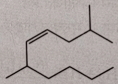
B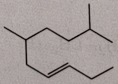
C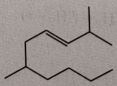
D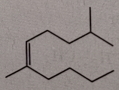
Solution
(C) To determine the structure of $2,6-$Dimethyldec$-4-$ene,follow these steps:
$1$. The parent chain is $decene$,which contains $10$ carbon atoms.
$2$. The double bond is located at the $4^{th}$ position (between $C4$ and $C5$).
$3$. There are methyl groups at the $2^{nd}$ and $6^{th}$ positions.
$4$. Analyzing the options,we look for a $10$-carbon chain where the double bond starts at $C4$ and methyl substituents are at $C2$ and $C6$.
$5$. Structure $C$ represents a $10$-carbon chain with a double bond at the $4^{th}$ position and methyl groups at the $2^{nd}$ and $6^{th}$ positions,which matches the $IUPAC$ name $2,6-$Dimethyldec$-4-$ene.
$1$. The parent chain is $decene$,which contains $10$ carbon atoms.
$2$. The double bond is located at the $4^{th}$ position (between $C4$ and $C5$).
$3$. There are methyl groups at the $2^{nd}$ and $6^{th}$ positions.
$4$. Analyzing the options,we look for a $10$-carbon chain where the double bond starts at $C4$ and methyl substituents are at $C2$ and $C6$.
$5$. Structure $C$ represents a $10$-carbon chain with a double bond at the $4^{th}$ position and methyl groups at the $2^{nd}$ and $6^{th}$ positions,which matches the $IUPAC$ name $2,6-$Dimethyldec$-4-$ene.
0 likesView Solution
9
ChemistryMediumMCQNEET · 2021
Which of the following reactions is a metal displacement reaction? Choose the right option.
A
$2 KClO_{3} \stackrel{\Delta}{\longrightarrow} 2 KCl + 3 O_{2}$
B
$Cr_{2}O_{3} + 2 Al \stackrel{\Delta}{\longrightarrow} Al_{2}O_{3} + 2 Cr$
C
$Fe + 2 HCl \rightarrow FeCl_{2} + H_{2} \uparrow$
D
$2 Pb(NO_{3})_{2} \rightarrow 2 PbO + 4 NO_{2} + O_{2} \uparrow$
Solution
(B) metal displacement reaction involves a metal in a compound being displaced by another metal in the uncombined state.
In the reaction $Cr_{2}O_{3} + 2 Al \stackrel{\Delta}{\longrightarrow} Al_{2}O_{3} + 2 Cr$,the metal $Al$ displaces the metal $Cr$ from its oxide $Cr_{2}O_{3}$.
Therefore,this is a metal displacement reaction.
In the reaction $Cr_{2}O_{3} + 2 Al \stackrel{\Delta}{\longrightarrow} Al_{2}O_{3} + 2 Cr$,the metal $Al$ displaces the metal $Cr$ from its oxide $Cr_{2}O_{3}$.
Therefore,this is a metal displacement reaction.
0 likesView Solution
10
ChemistryMediumMCQNEET · 2021
The compound which shows metamerism is:
A
$C_5H_{12}$
B
$C_3H_8O$
C
$C_3H_6O$
D
$C_4H_{10}O$
Solution
(D) Metamerism is shown by compounds having a polyvalent functional group (like ether,thioether,or amine) where the alkyl groups attached to the functional group differ.
$C_4H_{10}O$ can represent diethyl ether $(CH_3CH_2-O-CH_2CH_3)$ and methyl propyl ether $(CH_3-O-CH_2CH_2CH_3)$.
Since the alkyl groups attached to the oxygen atom are different in these two isomers,they are metamers.
Therefore,the correct option is $D$.
$C_4H_{10}O$ can represent diethyl ether $(CH_3CH_2-O-CH_2CH_3)$ and methyl propyl ether $(CH_3-O-CH_2CH_2CH_3)$.
Since the alkyl groups attached to the oxygen atom are different in these two isomers,they are metamers.
Therefore,the correct option is $D$.
0 likesView Solution
11
ChemistryMediumMCQNEET · 2021
The dihedral angle of the least stable conformer of ethane is $....\,^{\circ}$.
A
$0$
B
$180$
C
$60$
D
$120$
Solution
(A) The least stable conformer of ethane is the eclipsed form.
In the eclipsed conformation,the hydrogen atoms on the front carbon are directly aligned with the hydrogen atoms on the back carbon,resulting in maximum torsional strain.
This corresponds to a dihedral angle of $0^{\circ}$.
In the eclipsed conformation,the hydrogen atoms on the front carbon are directly aligned with the hydrogen atoms on the back carbon,resulting in maximum torsional strain.
This corresponds to a dihedral angle of $0^{\circ}$.
0 likesView Solution
12
ChemistryEasyMCQNEET · 2021
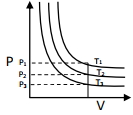
Choose the correct option for the graphical representation of Boyle's law,which shows a graph of pressure vs. volume of a gas at different temperatures:
A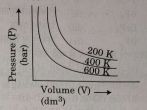
B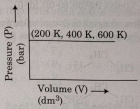
C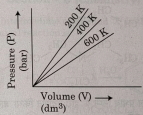
D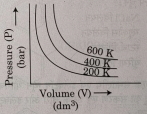
Solution
(D) According to the ideal gas equation,$PV = nRT$.
For a fixed amount of gas,$P = \frac{nRT}{V}$.
At a constant volume $V$,$P \propto T$.
This means that for a given volume,the pressure is higher at a higher temperature.
Therefore,if $T_1 > T_2 > T_3$,then the corresponding pressures at a constant volume will be $P_1 > P_2 > P_3$.
Looking at the graphs,the curve for the highest temperature $(600 \ K)$ must be the uppermost curve,followed by $400 \ K$ and then $200 \ K$ at the bottom.
This matches the representation where the curve for $600 \ K$ is above the curve for $400 \ K$,which is above the curve for $200 \ K$.
For a fixed amount of gas,$P = \frac{nRT}{V}$.
At a constant volume $V$,$P \propto T$.
This means that for a given volume,the pressure is higher at a higher temperature.
Therefore,if $T_1 > T_2 > T_3$,then the corresponding pressures at a constant volume will be $P_1 > P_2 > P_3$.
Looking at the graphs,the curve for the highest temperature $(600 \ K)$ must be the uppermost curve,followed by $400 \ K$ and then $200 \ K$ at the bottom.
This matches the representation where the curve for $600 \ K$ is above the curve for $400 \ K$,which is above the curve for $200 \ K$.
0 likesView Solution
13
ChemistryMediumMCQNEET · 2021
The $pK_{b}$ of dimethylamine and $pK_{a}$ of acetic acid are $3.27$ and $4.77$ respectively at $T(K)$. The correct option for the $pH$ of dimethylammonium acetate solution is :
A
$8.50$
B
$5.50$
C
$7.75$
D
$6.25$
Solution
(C) Dimethylammonium acetate is a salt of a weak acid (acetic acid) and a weak base (dimethylamine).
The formula for the $pH$ of a salt of a weak acid and a weak base is given by:
$pH = 7 + \frac{1}{2} pK_{a} - \frac{1}{2} pK_{b}$
Given:
$pK_{a} = 4.77$
$pK_{b} = 3.27$
Substituting the values into the formula:
$pH = 7 + \frac{1}{2} (4.77) - \frac{1}{2} (3.27)$
$pH = 7 + \frac{1}{2} (4.77 - 3.27)$
$pH = 7 + \frac{1}{2} (1.50)$
$pH = 7 + 0.75$
$pH = 7.75$
The formula for the $pH$ of a salt of a weak acid and a weak base is given by:
$pH = 7 + \frac{1}{2} pK_{a} - \frac{1}{2} pK_{b}$
Given:
$pK_{a} = 4.77$
$pK_{b} = 3.27$
Substituting the values into the formula:
$pH = 7 + \frac{1}{2} (4.77) - \frac{1}{2} (3.27)$
$pH = 7 + \frac{1}{2} (4.77 - 3.27)$
$pH = 7 + \frac{1}{2} (1.50)$
$pH = 7 + 0.75$
$pH = 7.75$
0 likesView Solution
14
ChemistryEasyMCQNEET · 2021
Match List-$I$ with List-$II$.
Choose the correct answer from the options given below.
| List-$I$ | List-$II$ |
| $(a)$ $PCl_{5}$ | $(i)$ Square pyramidal |
| $(b)$ $SF_{6}$ | $(ii)$ Trigonal planar |
| $(c)$ $BrF_{5}$ | $(iii)$ Octahedral |
| $(d)$ $BF_{3}$ | $(iv)$ Trigonal bipyramidal |
Choose the correct answer from the options given below.
A
$(a)-(iv), (b)-(iii), (c)-(i), (d)-(ii)$
B
$(a)-(ii), (b)-(iii), (c)-(iv), (d)-(i)$
C
$(a)-(iii), (b)-(i), (c)-(iv), (d)-(ii)$
D
$(a)-(iv), (b)-(iii), (c)-(ii), (d)-(i)$
Solution
(A) To determine the geometry,we calculate the Steric Number $(SN)$ using the formula: $SN = \text{Number of } \sigma \text{ bonds} + \text{Number of lone pairs}$.
$1$. $PCl_{5}$: $SN = 5 + 0 = 5$. Geometry: Trigonal bipyramidal $(iv)$.
$2$. $SF_{6}$: $SN = 6 + 0 = 6$. Geometry: Octahedral $(iii)$.
$3$. $BrF_{5}$: $SN = 5 + 1 = 6$. Geometry: Square pyramidal $(i)$.
$4$. $BF_{3}$: $SN = 3 + 0 = 3$. Geometry: Trigonal planar $(ii)$.
Thus,the correct matching is $(a)-(iv), (b)-(iii), (c)-(i), (d)-(ii)$.
$1$. $PCl_{5}$: $SN = 5 + 0 = 5$. Geometry: Trigonal bipyramidal $(iv)$.
$2$. $SF_{6}$: $SN = 6 + 0 = 6$. Geometry: Octahedral $(iii)$.
$3$. $BrF_{5}$: $SN = 5 + 1 = 6$. Geometry: Square pyramidal $(i)$.
$4$. $BF_{3}$: $SN = 3 + 0 = 3$. Geometry: Trigonal planar $(ii)$.
Thus,the correct matching is $(a)-(iv), (b)-(iii), (c)-(i), (d)-(ii)$.
0 likesView Solution
15
ChemistryMediumMCQNEET · 2021
$BF_3$ is a planar and electron-deficient compound. The hybridization and the number of electrons around the central atom,respectively,are:
A
$sp^3$ and $4$
B
$sp^3$ and $6$
C
$sp^2$ and $6$
D
$sp^2$ and $8$
Solution
(C) In $BF_3$,the central atom is Boron $(B)$.
Boron has $3$ valence electrons and forms $3$ $\sigma$-bonds with $3$ Fluorine atoms.
Number of lone pairs $(lp)$ on central atom = $0$.
Steric number = (Number of $\sigma$-bonds) + (Number of lone pairs) = $3 + 0 = 3$.
$A$ steric number of $3$ corresponds to $sp^2$ hybridization.
The total number of electrons around the central Boron atom is $3 \times 2 = 6$ electrons (due to $3$ covalent bonds).
Thus,the hybridization is $sp^2$ and the number of electrons is $6$.
Boron has $3$ valence electrons and forms $3$ $\sigma$-bonds with $3$ Fluorine atoms.
Number of lone pairs $(lp)$ on central atom = $0$.
Steric number = (Number of $\sigma$-bonds) + (Number of lone pairs) = $3 + 0 = 3$.
$A$ steric number of $3$ corresponds to $sp^2$ hybridization.
The total number of electrons around the central Boron atom is $3 \times 2 = 6$ electrons (due to $3$ covalent bonds).
Thus,the hybridization is $sp^2$ and the number of electrons is $6$.
0 likesView Solution
16
ChemistryEasyMCQNEET · 2021
$A$ particular station of All India Radio,New Delhi,broadcasts on a frequency of $1,368 \, kHz$. The wavelength of the electromagnetic radiation emitted by the transmitter is : [speed of light $c = 3.0 \times 10^{8} \, m \, s^{-1}$]
A
$219.3 \, m$
B
$219.2 \, m$
C
$2192 \, m$
D
$21.92 \, cm$
Solution
(A) The relationship between frequency $(\nu)$,wavelength $(\lambda)$,and speed of light $(c)$ is given by the formula: $\nu = \frac{c}{\lambda}$.
Rearranging the formula to solve for wavelength: $\lambda = \frac{c}{\nu}$.
Given: $c = 3.0 \times 10^{8} \, m \, s^{-1}$ and $\nu = 1,368 \, kHz = 1,368 \times 10^{3} \, Hz$.
Substituting the values: $\lambda = \frac{3.0 \times 10^{8} \, m \, s^{-1}}{1,368 \times 10^{3} \, s^{-1}}$.
$\lambda = \frac{300,000,000}{1,368,000} \, m \approx 219.29 \, m$.
Rounding to one decimal place,we get $\lambda \approx 219.3 \, m$.
Rearranging the formula to solve for wavelength: $\lambda = \frac{c}{\nu}$.
Given: $c = 3.0 \times 10^{8} \, m \, s^{-1}$ and $\nu = 1,368 \, kHz = 1,368 \times 10^{3} \, Hz$.
Substituting the values: $\lambda = \frac{3.0 \times 10^{8} \, m \, s^{-1}}{1,368 \times 10^{3} \, s^{-1}}$.
$\lambda = \frac{300,000,000}{1,368,000} \, m \approx 219.29 \, m$.
Rounding to one decimal place,we get $\lambda \approx 219.3 \, m$.
0 likesView Solution
17
ChemistryEasyMCQNEET · 2021
Which one among the following is the correct option for the relationship between $C_{P}$ and $C_{V}$ for one mole of an ideal gas?
A
$C_{P} + C_{V} = R$
B
$C_{P} - C_{V} = R$
C
$C_{P} = R C_{V}$
D
$C_{V} = R C_{P}$
Solution
(B) For one mole of an ideal gas,the relationship between molar heat capacity at constant pressure $(C_{P})$ and molar heat capacity at constant volume $(C_{V})$ is given by Mayer's relation:
$C_{P} - C_{V} = R$
where $R$ is the universal gas constant.
$C_{P} - C_{V} = R$
where $R$ is the universal gas constant.
0 likesView Solution
18
ChemistryMediumMCQNEET · 2021
For irreversible expansion of an ideal gas under isothermal condition,the correct option is :
A
$ \Delta U = 0, \Delta S_{total} = 0 $
B
$ \Delta U \neq 0, \Delta S_{total} \neq 0 $
C
$ \Delta U = 0, \Delta S_{total} \neq 0 $
D
$ \Delta U \neq 0, \Delta S_{total} = 0 $
Solution
(C) For an ideal gas,the internal energy $ \Delta U $ depends only on temperature. Since the process is isothermal $( \Delta T = 0 )$,$ \Delta U = 0 $.
For any irreversible process,the total entropy change of the universe is always positive,i.e.,$ \Delta S_{total} > 0 $.
Therefore,$ \Delta S_{total} \neq 0 $.
Thus,the correct condition is $ \Delta U = 0 $ and $ \Delta S_{total} \neq 0 $.
For any irreversible process,the total entropy change of the universe is always positive,i.e.,$ \Delta S_{total} > 0 $.
Therefore,$ \Delta S_{total} \neq 0 $.
Thus,the correct condition is $ \Delta U = 0 $ and $ \Delta S_{total} \neq 0 $.
0 likesView Solution
19
ChemistryMediumMCQNEET · 2021
Choose the correct option for the total pressure (in $atm$) in a mixture of $4 \ g$ $O_2$ and $2 \ g$ $H_2$ confined in a total volume of $1 \ L$ at $0^{\circ} C$ is :
$\left[ \text{Given } R = 0.082 \ L \ atm \ mol^{-1} \ K^{-1}, T = 273 \ K \right]$
$\left[ \text{Given } R = 0.082 \ L \ atm \ mol^{-1} \ K^{-1}, T = 273 \ K \right]$
A
$2.518$
B
$2.602$
C
$25.18$
D
$26.02$
Solution
(C) The total pressure is calculated using the ideal gas equation: $PV = n_{total}RT$.
First,calculate the number of moles of each gas:
$n_{O_2} = \frac{4 \ g}{32 \ g/mol} = 0.125 \ mol$
$n_{H_2} = \frac{2 \ g}{2 \ g/mol} = 1.0 \ mol$
Total moles $n_{total} = 0.125 + 1.0 = 1.125 \ mol$.
Using $PV = nRT$ with $V = 1 \ L$,$R = 0.082 \ L \ atm \ mol^{-1} \ K^{-1}$,and $T = 273 \ K$:
$P \times 1 = 1.125 \times 0.082 \times 273$
$P = 25.18 \ atm$.
First,calculate the number of moles of each gas:
$n_{O_2} = \frac{4 \ g}{32 \ g/mol} = 0.125 \ mol$
$n_{H_2} = \frac{2 \ g}{2 \ g/mol} = 1.0 \ mol$
Total moles $n_{total} = 0.125 + 1.0 = 1.125 \ mol$.
Using $PV = nRT$ with $V = 1 \ L$,$R = 0.082 \ L \ atm \ mol^{-1} \ K^{-1}$,and $T = 273 \ K$:
$P \times 1 = 1.125 \times 0.082 \times 273$
$P = 25.18 \ atm$.
0 likesView Solution
20
ChemistryEasyMCQNEET · 2021
Which of the following molecules is non-polar in nature?
A
$POCl_3$
B
$CH_2O$
C
$SbCl_5$
D
$NO_2$
Solution
(C) molecule is non-polar if its net dipole moment is zero.
$SbCl_5$ has a trigonal bipyramidal geometry where the three equatorial $Sb-Cl$ bonds cancel each other out,and the two axial $Sb-Cl$ bonds also cancel each other out,resulting in a net dipole moment of zero.
$POCl_3$,$CH_2O$,and $NO_2$ are polar molecules due to their asymmetric structures and the presence of different atoms or lone pairs leading to a non-zero net dipole moment.
$SbCl_5$ has a trigonal bipyramidal geometry where the three equatorial $Sb-Cl$ bonds cancel each other out,and the two axial $Sb-Cl$ bonds also cancel each other out,resulting in a net dipole moment of zero.
$POCl_3$,$CH_2O$,and $NO_2$ are polar molecules due to their asymmetric structures and the presence of different atoms or lone pairs leading to a non-zero net dipole moment.
0 likesView Solution
21
ChemistryEasyMCQNEET · 2021
From the following pairs of ions,which one is not an iso-electronic pair?
A
$O^{2-}, F^{-}$
B
$Na^{+}, Mg^{2+}$
C
$Mn^{2+}, Fe^{3+}$
D
$Fe^{2+}, Mn^{2+}$
Solution
(D) Iso-electronic species are those that have the same number of electrons.
$O^{2-}$ has $8 + 2 = 10$ electrons; $F^{-}$ has $9 + 1 = 10$ electrons. (Iso-electronic)
$Na^{+}$ has $11 - 1 = 10$ electrons; $Mg^{2+}$ has $12 - 2 = 10$ electrons. (Iso-electronic)
$Mn^{2+}$ has $25 - 2 = 23$ electrons; $Fe^{3+}$ has $26 - 3 = 23$ electrons. (Iso-electronic)
$Fe^{2+}$ has $26 - 2 = 24$ electrons; $Mn^{2+}$ has $25 - 2 = 23$ electrons. (Not iso-electronic)
Therefore,the pair $Fe^{2+}, Mn^{2+}$ is not iso-electronic.
$O^{2-}$ has $8 + 2 = 10$ electrons; $F^{-}$ has $9 + 1 = 10$ electrons. (Iso-electronic)
$Na^{+}$ has $11 - 1 = 10$ electrons; $Mg^{2+}$ has $12 - 2 = 10$ electrons. (Iso-electronic)
$Mn^{2+}$ has $25 - 2 = 23$ electrons; $Fe^{3+}$ has $26 - 3 = 23$ electrons. (Iso-electronic)
$Fe^{2+}$ has $26 - 2 = 24$ electrons; $Mn^{2+}$ has $25 - 2 = 23$ electrons. (Not iso-electronic)
Therefore,the pair $Fe^{2+}, Mn^{2+}$ is not iso-electronic.
0 likesView Solution
22
ChemistryEasyMCQNEET · 2021
Match List-$I$ with List-$II$.
Choose the correct answer from the options given below.
| List-$I$ | List-$II$ |
|---|---|
| $(a)$ $2 SO_{2(g)} + O_{2(g)} \rightarrow 2 SO_{3(g)}$ | $(i)$ Acid rain |
| $(b)$ $HOCl_{(g)} \stackrel{h \nu}{\longrightarrow} \dot{O}H + \dot{Cl}$ | $(ii)$ Smog |
| $(c)$ $CaCO_{3} + H_{2}SO_{4} \rightarrow CaSO_{4} + H_{2}O + CO_{2}$ | $(iii)$ Ozone depletion |
| $(d)$ $NO_{2(g)} \stackrel{h \nu}{\longrightarrow} NO_{(g)} + O_{(g)}$ | $(iv)$ Tropospheric pollution |
Choose the correct answer from the options given below.
A
$(a)-(i), (b)-(ii), (c)-(iii), (d)-(iv)$
B
$(a)-(ii), (b)-(iii), (c)-(iv), (d)-(i)$
C
$(a)-(iv), (b)-(iii), (c)-(i), (d)-(ii)$
D
$(a)-(iii), (b)-(ii), (c)-(iv), (d)-(i)$
Solution
(C) The correct matching is as follows:
$(a)$ $2 SO_{2(g)} + O_{2(g)} \rightarrow 2 SO_{3(g)}$ represents the formation of $SO_3$ which leads to acid rain,so $(a)-(iv)$ (as it is a part of tropospheric pollution).
$(b)$ $HOCl_{(g)} \stackrel{h \nu}{\longrightarrow} \dot{O}H + \dot{Cl}$ is a reaction involved in the depletion of the ozone layer,so $(b)-(iii)$.
$(c)$ $CaCO_{3} + H_{2}SO_{4} \rightarrow CaSO_{4} + H_{2}O + CO_{2}$ is the reaction of acid rain with marble/limestone,so $(c)-(i)$.
$(d)$ $NO_{2(g)} \stackrel{h \nu}{\longrightarrow} NO_{(g)} + O_{(g)}$ is a key step in the formation of photochemical smog,so $(d)-(ii)$.
Thus,the correct sequence is $(a)-(iv), (b)-(iii), (c)-(i), (d)-(ii)$.
$(a)$ $2 SO_{2(g)} + O_{2(g)} \rightarrow 2 SO_{3(g)}$ represents the formation of $SO_3$ which leads to acid rain,so $(a)-(iv)$ (as it is a part of tropospheric pollution).
$(b)$ $HOCl_{(g)} \stackrel{h \nu}{\longrightarrow} \dot{O}H + \dot{Cl}$ is a reaction involved in the depletion of the ozone layer,so $(b)-(iii)$.
$(c)$ $CaCO_{3} + H_{2}SO_{4} \rightarrow CaSO_{4} + H_{2}O + CO_{2}$ is the reaction of acid rain with marble/limestone,so $(c)-(i)$.
$(d)$ $NO_{2(g)} \stackrel{h \nu}{\longrightarrow} NO_{(g)} + O_{(g)}$ is a key step in the formation of photochemical smog,so $(d)-(ii)$.
Thus,the correct sequence is $(a)-(iv), (b)-(iii), (c)-(i), (d)-(ii)$.
0 likesView Solution
23
ChemistryEasyMCQNEET · 2021
$CH_3-CH_2-COO^{-} Na^{+} \xrightarrow[\Delta]{NaOH + ?} CH_3-CH_3 + Na_2CO_3$. Consider the above reaction and identify the missing reagent/chemical.
A
$B_2H_6$
B
Red Phosphorus
C
$CaO$
D
$DIBAL-H$
Solution
(C) The given reaction is the decarboxylation of sodium propionate to form ethane.
This reaction occurs in the presence of sodalime,which is a mixture of $NaOH$ and $CaO$.
Therefore,the missing reagent is $CaO$.
This reaction occurs in the presence of sodalime,which is a mixture of $NaOH$ and $CaO$.
Therefore,the missing reagent is $CaO$.
0 likesView Solution
24
ChemistryMCQNEET · 2021
In which of the following arrangements,the order is $NOT$ according to the property indicated against it?
A
$HF < HCl < HBr < HI$ : Increasing order of acidic strength
B
$H_{2}O < H_{2}S < H_{2}Se < H_{2}Te$ : Increasing order of $pK_{a}$ values
C
$NH_{3} < PH_{3} < AsH_{3} < SbH_{3}$ : Increasing order of acidic character
D
$CO_{2} < SiO_{2} < SnO_{2} < PbO_{2}$ : Increasing order of oxidising power
Solution
(B) For option $A$: The acidic strength of hydrohalic acids increases down the group due to the decrease in bond dissociation enthalpy. Thus,$HF < HCl < HBr < HI$ is correct.
For option $B$: The acidic strength of hydrides of group $16$ increases down the group $(H_{2}O < H_{2}S < H_{2}Se < H_{2}Te)$. Since $pK_{a} = -\log(K_{a})$,higher acidic strength implies a lower $K_{a}$ value,which means a lower $pK_{a}$ value. Therefore,the correct order of $pK_{a}$ values should be $H_{2}O > H_{2}S > H_{2}Se > H_{2}Te$. Thus,the given order is incorrect.
For option $C$: The acidic character of hydrides of group $15$ increases down the group due to the increase in bond length and decrease in bond dissociation energy. Thus,$NH_{3} < PH_{3} < AsH_{3} < SbH_{3}$ is correct.
For option $D$: The oxidising power of group $14$ oxides increases down the group due to the inert pair effect,making the $+2$ oxidation state more stable than the $+4$ state for heavier elements. Thus,$CO_{2} < SiO_{2} < SnO_{2} < PbO_{2}$ is correct.
For option $B$: The acidic strength of hydrides of group $16$ increases down the group $(H_{2}O < H_{2}S < H_{2}Se < H_{2}Te)$. Since $pK_{a} = -\log(K_{a})$,higher acidic strength implies a lower $K_{a}$ value,which means a lower $pK_{a}$ value. Therefore,the correct order of $pK_{a}$ values should be $H_{2}O > H_{2}S > H_{2}Se > H_{2}Te$. Thus,the given order is incorrect.
For option $C$: The acidic character of hydrides of group $15$ increases down the group due to the increase in bond length and decrease in bond dissociation energy. Thus,$NH_{3} < PH_{3} < AsH_{3} < SbH_{3}$ is correct.
For option $D$: The oxidising power of group $14$ oxides increases down the group due to the inert pair effect,making the $+2$ oxidation state more stable than the $+4$ state for heavier elements. Thus,$CO_{2} < SiO_{2} < SnO_{2} < PbO_{2}$ is correct.
0 likesView Solution
25
ChemistryMCQNEET · 2021
For a plane electromagnetic wave propagating in the $x$-direction,which one of the following combinations gives the correct possible directions for the electric field $(\vec{E})$ and magnetic field $(\vec{B})$ respectively?
A
$\hat{j} + \hat{k}, \hat{j} + \hat{k}$
B
$-\hat{j} + \hat{k}, -\hat{j} - \hat{k}$
C
$\hat{j} + \hat{k}, -\hat{j} - \hat{k}$
D
$-\hat{j} + \hat{k}, -\hat{j} + \hat{k}$
Solution
(B) The direction of propagation of an electromagnetic wave is given by the direction of the Poynting vector,which is $\vec{E} \times \vec{B}$.
Given the wave propagates in the $x$-direction,we must have $\vec{E} \times \vec{B} \parallel \hat{i}$.
For option $B$: $\vec{E} = -\hat{j} + \hat{k}$ and $\vec{B} = -\hat{j} - \hat{k}$.
Calculating the cross product: $\vec{E} \times \vec{B} = (-\hat{j} + \hat{k}) \times (-\hat{j} - \hat{k}) = (-\hat{j} \times -\hat{j}) + (-\hat{j} \times -\hat{k}) + (\hat{k} \times -\hat{j}) + (\hat{k} \times -\hat{k}) = 0 + \hat{i} + \hat{i} + 0 = 2\hat{i}$.
Since $2\hat{i}$ is in the $x$-direction,option $B$ is correct.
Given the wave propagates in the $x$-direction,we must have $\vec{E} \times \vec{B} \parallel \hat{i}$.
For option $B$: $\vec{E} = -\hat{j} + \hat{k}$ and $\vec{B} = -\hat{j} - \hat{k}$.
Calculating the cross product: $\vec{E} \times \vec{B} = (-\hat{j} + \hat{k}) \times (-\hat{j} - \hat{k}) = (-\hat{j} \times -\hat{j}) + (-\hat{j} \times -\hat{k}) + (\hat{k} \times -\hat{j}) + (\hat{k} \times -\hat{k}) = 0 + \hat{i} + \hat{i} + 0 = 2\hat{i}$.
Since $2\hat{i}$ is in the $x$-direction,option $B$ is correct.
0 likesView Solution
26
ChemistryEasyMCQNEET · 2021
The correct sequence of bond enthalpy of $C-X$ bond is:
A
$CH_{3}-F < CH_{3}-Cl < CH_{3}-Br < CH_{3}-I$
B
$CH_{3}-F > CH_{3}-Cl > CH_{3}-Br > CH_{3}-I$
C
$CH_{3}-F < CH_{3}-Cl > CH_{3}-Br > CH_{3}-I$
D
$CH_{3}-Cl > CH_{3}-F > CH_{3}-Br > CH_{3}-I$
Solution
(B) The bond enthalpy of the $C-X$ bond depends on the bond length.
As we move down the group in the periodic table,the atomic size of the halogen $(X)$ increases.
This leads to an increase in the $C-X$ bond length.
As the bond length increases,the bond strength (and thus bond enthalpy) decreases.
Therefore,the correct order of bond enthalpy is $CH_{3}-F > CH_{3}-Cl > CH_{3}-Br > CH_{3}-I$.
As we move down the group in the periodic table,the atomic size of the halogen $(X)$ increases.
This leads to an increase in the $C-X$ bond length.
As the bond length increases,the bond strength (and thus bond enthalpy) decreases.
Therefore,the correct order of bond enthalpy is $CH_{3}-F > CH_{3}-Cl > CH_{3}-Br > CH_{3}-I$.
0 likesView Solution
27
ChemistryEasyMCQNEET · 2021
Which one of the following methods can be used to obtain highly pure metal which is liquid at room temperature?
A
Electrolysis
B
Chromatography
C
Distillation
D
Zone refining
Solution
(C) Metals that are liquid at room temperature,such as $Hg$ (mercury),are purified by the process of distillation.
In distillation,the impure metal is heated to its boiling point,and the vapors are condensed to obtain the pure metal.
Since the boiling point of the metal is significantly different from the boiling points of the impurities,this method is highly effective for volatile metals.
In distillation,the impure metal is heated to its boiling point,and the vapors are condensed to obtain the pure metal.
Since the boiling point of the metal is significantly different from the boiling points of the impurities,this method is highly effective for volatile metals.
0 likesView Solution
28
ChemistryMediumMCQNEET · 2021
The correct option for the number of body-centred unit cells in all $14$ types of Bravais lattice unit cells is:
A
$7$
B
$5$
C
$2$
D
$3$
Solution
(D) In the $14$ Bravais lattices,the body-centred $(BCC)$ unit cells are found in the following crystal systems:
$1$. Cubic system: $1$ $(BCC)$
$2$. Tetragonal system: $1$ $(BCC)$
$3$. Orthorhombic system: $1$ $(BCC)$
Therefore,the total number of body-centred unit cells is $1 + 1 + 1 = 3$.
$1$. Cubic system: $1$ $(BCC)$
$2$. Tetragonal system: $1$ $(BCC)$
$3$. Orthorhombic system: $1$ $(BCC)$
Therefore,the total number of body-centred unit cells is $1 + 1 + 1 = 3$.
0 likesView Solution
29
ChemistryEasyMCQNEET · 2021
$Zr$ $(Z=40)$ and $Hf$ $(Z=72)$ have similar atomic and ionic radii because of :
A
belonging to same group
B
diagonal relationship
C
lanthanoid contraction
D
having similar chemical properties
Solution
(C) The atomic and ionic radii of $Zr$ $(Z=40)$ and $Hf$ $(Z=72)$ are very similar.
This phenomenon is known as the lanthanoid contraction.
As we move from $4d$ series to $5d$ series elements in the same group,the filling of $4f$ orbitals occurs.
The poor shielding effect of $4f$ electrons leads to a decrease in atomic size,which almost perfectly compensates for the expected increase in size due to the addition of a new shell.
This phenomenon is known as the lanthanoid contraction.
As we move from $4d$ series to $5d$ series elements in the same group,the filling of $4f$ orbitals occurs.
The poor shielding effect of $4f$ electrons leads to a decrease in atomic size,which almost perfectly compensates for the expected increase in size due to the addition of a new shell.
0 likesView Solution
30
ChemistryMediumMCQNEET · 2021
The maximum temperature that can be achieved in a blast furnace is:
A
upto $1200 \ K$
B
upto $2200 \ K$
C
upto $1900 \ K$
D
upto $5000 \ K$
Solution
(B) In a blast furnace,the temperature varies at different zones.
The combustion zone,where coke burns to produce heat,reaches the maximum temperature of approximately $2200 \ K$.
The combustion zone,where coke burns to produce heat,reaches the maximum temperature of approximately $2200 \ K$.
0 likesView Solution
31
ChemistryMediumMCQNEET · 2021
What is the $IUPAC$ name of the organic compound formed in the following chemical reaction?
Acetone $\xrightarrow[(ii) H_2O, H^{+}]{(i) C_2H_5MgBr, \text{dry Ether}}$ Product
Acetone $\xrightarrow[(ii) H_2O, H^{+}]{(i) C_2H_5MgBr, \text{dry Ether}}$ Product
A
$2-$methyl propan$-2-$ol
B
pentan$-2-$ol
C
pentan$-3-$ol
D
$2-$methyl butan$-2-$ol
Solution
(D) The reaction of acetone $(CH_3COCH_3)$ with ethylmagnesium bromide $(C_2H_5MgBr)$ in the presence of dry ether is a nucleophilic addition reaction.
The nucleophilic ethyl group $(C_2H_5^-)$ attacks the electrophilic carbonyl carbon of acetone to form an intermediate magnesium alkoxide.
Subsequent hydrolysis with $H_3O^+$ yields the final alcohol product.
The reaction sequence is:
$CH_3COCH_3 + C_2H_5MgBr \rightarrow CH_3-C(OMgBr)(CH_3)-C_2H_5$
$CH_3-C(OMgBr)(CH_3)-C_2H_5 + H_2O/H^+ \rightarrow CH_3-C(OH)(CH_3)-CH_2CH_3 + Mg(OH)Br$
The structure of the product is $CH_3-C(OH)(CH_3)-CH_2-CH_3$.
Selecting the longest carbon chain containing the $-OH$ group gives a butane chain. Numbering from the end closest to the $-OH$ group,the $-OH$ is at position $2$ and a methyl group is also at position $2$.
Thus,the $IUPAC$ name is $2-$methylbutan$-2-$ol.
The nucleophilic ethyl group $(C_2H_5^-)$ attacks the electrophilic carbonyl carbon of acetone to form an intermediate magnesium alkoxide.
Subsequent hydrolysis with $H_3O^+$ yields the final alcohol product.
The reaction sequence is:
$CH_3COCH_3 + C_2H_5MgBr \rightarrow CH_3-C(OMgBr)(CH_3)-C_2H_5$
$CH_3-C(OMgBr)(CH_3)-C_2H_5 + H_2O/H^+ \rightarrow CH_3-C(OH)(CH_3)-CH_2CH_3 + Mg(OH)Br$
The structure of the product is $CH_3-C(OH)(CH_3)-CH_2-CH_3$.
Selecting the longest carbon chain containing the $-OH$ group gives a butane chain. Numbering from the end closest to the $-OH$ group,the $-OH$ is at position $2$ and a methyl group is also at position $2$.
Thus,the $IUPAC$ name is $2-$methylbutan$-2-$ol.
0 likesView Solution
32
ChemistryMediumMCQNEET · 2021
Which one of the following polymers is prepared by addition polymerisation?
A
Teflon
B
Nylon-$6,6$
C
Novolac
D
Dacron
Solution
(A) Teflon is an addition polymer formed by the addition polymerisation of tetrafluoroethene $(CF_2=CF_2)$.
The reaction is as follows:
$n \ CF_2=CF_2 \xrightarrow{\text{Polymerisation}} [-CF_2-CF_2-]_n$
Nylon-$6,6$,Novolac,and Dacron are condensation polymers.
The reaction is as follows:
$n \ CF_2=CF_2 \xrightarrow{\text{Polymerisation}} [-CF_2-CF_2-]_n$
Nylon-$6,6$,Novolac,and Dacron are condensation polymers.
0 likesView Solution
33
ChemistryMediumMCQNEET · 2021
The correct option for the number of tetrahedral and octahedral voids in a hexagonal primitive unit cell is:
A
$8, 4$
B
$6, 12$
C
$2, 1$
D
$12, 6$
Solution
(D) In a hexagonal close-packed $(HCP)$ unit cell,the number of atoms per unit cell $(Z)$ is $6$.
The number of octahedral voids $(OHV)$ is equal to the number of atoms per unit cell,so $OHV = Z = 6$.
The number of tetrahedral voids $(THV)$ is equal to twice the number of atoms per unit cell,so $THV = 2 \times Z = 2 \times 6 = 12$.
Therefore,the number of tetrahedral and octahedral voids are $12$ and $6$ respectively.
The number of octahedral voids $(OHV)$ is equal to the number of atoms per unit cell,so $OHV = Z = 6$.
The number of tetrahedral voids $(THV)$ is equal to twice the number of atoms per unit cell,so $THV = 2 \times Z = 2 \times 6 = 12$.
Therefore,the number of tetrahedral and octahedral voids are $12$ and $6$ respectively.
0 likesView Solution
34
ChemistryMediumMCQNEET · 2021
The incorrect statement among the following is:
A
Actinoid contraction is greater for element to element than Lanthanoid contraction.
B
Most of the trivalent Lanthanoid ions are colorless in the solid state.
C
Lanthanoids are good conductors of heat and electricity.
D
Actinoids are highly reactive metals,especially when finely divided.
Solution
(B) The correct answer is $B$.
Most trivalent Lanthanoid ions $(Ln^{3+})$ are colored in both solid and aqueous states due to $f-f$ transitions.
Actinoid contraction is indeed greater than Lanthanoid contraction because the $5f$ electrons provide poorer shielding than $4f$ electrons.
Lanthanoids are typical metallic elements and are good conductors of heat and electricity.
Actinoids are highly reactive metals,especially when finely divided,as they form a protective oxide layer slowly.
Most trivalent Lanthanoid ions $(Ln^{3+})$ are colored in both solid and aqueous states due to $f-f$ transitions.
Actinoid contraction is indeed greater than Lanthanoid contraction because the $5f$ electrons provide poorer shielding than $4f$ electrons.
Lanthanoids are typical metallic elements and are good conductors of heat and electricity.
Actinoids are highly reactive metals,especially when finely divided,as they form a protective oxide layer slowly.
0 likesView Solution
35
ChemistryMediumMCQNEET · 2021
Given below are two statements:
Statement $I:$ Aspirin and Paracetamol belong to the class of narcotic analgesics.
Statement $II:$ Morphine and Heroin are non-narcotic analgesics.
In the light of the above statements,choose the correct answer from the options given below.
Statement $I:$ Aspirin and Paracetamol belong to the class of narcotic analgesics.
Statement $II:$ Morphine and Heroin are non-narcotic analgesics.
In the light of the above statements,choose the correct answer from the options given below.
A
Both Statement $I$ and Statement $II$ are true.
B
Both Statement $I$ and Statement $II$ are false.
C
Statement $I$ is correct but Statement $II$ is false.
D
Statement $I$ is incorrect but Statement $II$ is true.
Solution
(B) Statement $I$ is incorrect because Aspirin and Paracetamol are non-narcotic analgesics.
Statement $II$ is incorrect because Morphine and Heroin are narcotic analgesics.
Therefore,both statements are false.
Statement $II$ is incorrect because Morphine and Heroin are narcotic analgesics.
Therefore,both statements are false.
0 likesView Solution
36
ChemistryMediumMCQNEET · 2021
The major product formed in the dehydrohalogenation reaction of $2-Bromopentane$ is $Pent-2-ene$. This product formation is based on?
A
$Saytzeff's \ Rule$
B
$Hund's \ Rule$
C
$Hofmann \ Rule$
D
$Huckel's \ Rule$
Solution
(A) The correct answer is $(A)$.
According to $Saytzeff's \ Rule$,in dehydrohalogenation reactions,the major product is the more highly substituted alkene,which is the one with more alkyl groups attached to the double-bonded carbons.
For $2-Bromopentane$,the elimination of $HBr$ can yield either $Pent-1-ene$ or $Pent-2-ene$.
$Pent-2-ene$ is a disubstituted alkene,whereas $Pent-1-ene$ is a monosubstituted alkene.
Therefore,$Pent-2-ene$ is the more stable and major product.
According to $Saytzeff's \ Rule$,in dehydrohalogenation reactions,the major product is the more highly substituted alkene,which is the one with more alkyl groups attached to the double-bonded carbons.
For $2-Bromopentane$,the elimination of $HBr$ can yield either $Pent-1-ene$ or $Pent-2-ene$.
$Pent-2-ene$ is a disubstituted alkene,whereas $Pent-1-ene$ is a monosubstituted alkene.
Therefore,$Pent-2-ene$ is the more stable and major product.
0 likesView Solution
37
ChemistryMediumMCQNEET · 2021
For a reaction $A \rightarrow B$,the enthalpy of reaction is $-4.2 \ kJ \ mol^{-1}$ and the enthalpy of activation is $9.6 \ kJ \ mol^{-1}$. The correct potential energy profile for the reaction is shown in which option?
A
B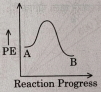
C
D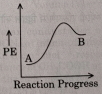
Solution
(B) The enthalpy of reaction $\Delta H$ is given by the difference between the activation energy of the forward reaction $(E_a)_f$ and the activation energy of the backward reaction $(E_a)_b$:
$\Delta H = (E_a)_f - (E_a)_b$
Given $\Delta H = -4.2 \ kJ \ mol^{-1}$ and $(E_a)_f = 9.6 \ kJ \ mol^{-1}$:
$-4.2 = 9.6 - (E_a)_b$
$(E_a)_b = 9.6 + 4.2 = 13.8 \ kJ \ mol^{-1}$
Since $\Delta H$ is negative,the reaction is exothermic,meaning the potential energy of the product $B$ must be lower than the potential energy of the reactant $A$. Among the given options,the graph where the product $B$ is at a lower energy level than reactant $A$ is represented by option $B$.
$\Delta H = (E_a)_f - (E_a)_b$
Given $\Delta H = -4.2 \ kJ \ mol^{-1}$ and $(E_a)_f = 9.6 \ kJ \ mol^{-1}$:
$-4.2 = 9.6 - (E_a)_b$
$(E_a)_b = 9.6 + 4.2 = 13.8 \ kJ \ mol^{-1}$
Since $\Delta H$ is negative,the reaction is exothermic,meaning the potential energy of the product $B$ must be lower than the potential energy of the reactant $A$. Among the given options,the graph where the product $B$ is at a lower energy level than reactant $A$ is represented by option $B$.
0 likesView Solution
38
ChemistryEasyMCQNEET · 2021
Ethylene diaminetetraacetate $(EDTA^{4-})$ ion is:
A
Hexadentate ligand with four $O$ and two $N$ donor atoms
B
Unidentate ligand
C
Bidentate ligand with two $N$ donor atoms
D
Tridentate ligand with three $N$ donor atoms
Solution
(A) The structure of the ethylene diaminetetraacetate $(EDTA^{4-})$ ion consists of two nitrogen atoms and four oxygen atoms (from the four carboxylate groups) that can act as donor sites.
Since it has six donor atoms capable of binding to a central metal ion,it is classified as a hexadentate ligand.
Therefore,the correct option is $A$.
Since it has six donor atoms capable of binding to a central metal ion,it is classified as a hexadentate ligand.
Therefore,the correct option is $A$.
0 likesView Solution
39
ChemistryDifficultMCQNEET · 2021
Noble gases are named because of their inertness towards reactivity. Identify an incorrect statement about them.
A
Noble gases are sparingly soluble in water.
B
Noble gases have very high melting and boiling points.
C
Noble gases have weak dispersion forces.
D
Noble gases have large positive values of electron gain enthalpy.
Solution
(B) Noble gases have stable electronic configurations ($ns^2 np^6$,except $He$ which is $1s^2$).
Due to their stable configuration,they have very weak dispersion forces between their atoms,which leads to very low melting and boiling points.
Therefore,the statement that they have very high melting and boiling points is incorrect.
Due to their stable configuration,they have very weak dispersion forces between their atoms,which leads to very low melting and boiling points.
Therefore,the statement that they have very high melting and boiling points is incorrect.
0 likesView Solution
40
ChemistryEasyMCQNEET · 2021
The $RBC$ deficiency is a deficiency disease of:
A
Vitamin $B_{12}$
B
Vitamin $B_{6}$
C
Vitamin $B_{1}$
D
Vitamin $B_{2}$
Solution
(A) The deficiency of Vitamin $B_{12}$ (cyanocobalamin) leads to pernicious anemia,which is characterized by a decrease in the number of red blood cells ($RBC$s) and the production of abnormally large,immature $RBC$s.
0 likesView Solution
41
ChemistryEasyMCQNEET · 2021
Tritium,a radioactive isotope of hydrogen,emits which of the following particles?
A
$Beta (\beta^{-})$
B
$Alpha (\alpha)$
C
$Gamma (\gamma)$
D
$Neutron (n)$
Solution
(A) Tritium $(^{3}_{1}H)$ is a radioactive isotope of hydrogen. It undergoes radioactive decay by emitting a beta particle $(\beta^{-})$ to form Helium-$3$ $(^{3}_{2}He)$. The nuclear reaction is: $^{3}_{1}H \rightarrow ^{3}_{2}He + ^{0}_{-1}e + \bar{\nu}_{e}$.
0 likesView Solution
42
ChemistryEasyMCQNEET · 2021
The molar conductance of $NaCl$,$HCl$,and $CH_{3}COONa$ at infinite dilution are $126.45$,$426.16$,and $91.0 \ S \ cm^{2} \ mol^{-1}$ respectively. The molar conductance of $CH_{3}COOH$ at infinite dilution is. Choose the right option for your answer. (In $S \ cm^{2} \ mol^{-1}$)
A
$201.28$
B
$390.71$
C
$698.28$
D
$540.28$
Solution
(B) According to Kohlrausch's law of independent migration of ions,the molar conductivity at infinite dilution for $CH_{3}COOH$ is given by:
$\Lambda^{\circ}_{m}(CH_{3}COOH) = \Lambda^{\circ}_{m}(CH_{3}COONa) + \Lambda^{\circ}_{m}(HCl) - \Lambda^{\circ}_{m}(NaCl)$
Substituting the given values:
$\Lambda^{\circ}_{m}(CH_{3}COOH) = 91.0 + 426.16 - 126.45$
$\Lambda^{\circ}_{m}(CH_{3}COOH) = 517.16 - 126.45$
$\Lambda^{\circ}_{m}(CH_{3}COOH) = 390.71 \ S \ cm^{2} \ mol^{-1}$
$\Lambda^{\circ}_{m}(CH_{3}COOH) = \Lambda^{\circ}_{m}(CH_{3}COONa) + \Lambda^{\circ}_{m}(HCl) - \Lambda^{\circ}_{m}(NaCl)$
Substituting the given values:
$\Lambda^{\circ}_{m}(CH_{3}COOH) = 91.0 + 426.16 - 126.45$
$\Lambda^{\circ}_{m}(CH_{3}COOH) = 517.16 - 126.45$
$\Lambda^{\circ}_{m}(CH_{3}COOH) = 390.71 \ S \ cm^{2} \ mol^{-1}$
0 likesView Solution
43
ChemistryMediumMCQNEET · 2021
Identify the compound that will react with Hinsberg's reagent to give a solid which dissolves in alkali.
A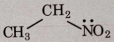
B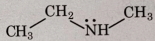
C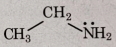
D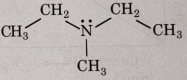
Solution
(C) Hinsberg's reagent is benzenesulfonyl chloride $(C_6H_5SO_2Cl)$.
$1^{\circ}$ amines $(R-NH_2)$ react with Hinsberg's reagent to form $N$-alkylbenzenesulfonamide,which contains an acidic hydrogen atom attached to the nitrogen. This makes the product soluble in alkali (e.g.,$KOH$ or $NaOH$).
$2^{\circ}$ amines form $N,N$-dialkylbenzenesulfonamides,which do not have an acidic hydrogen and are insoluble in alkali.
$3^{\circ}$ amines do not react with Hinsberg's reagent.
Among the given options,$CH_3-CH_2-NH_2$ is a $1^{\circ}$ amine,so it will react to form a product that is soluble in alkali.
$1^{\circ}$ amines $(R-NH_2)$ react with Hinsberg's reagent to form $N$-alkylbenzenesulfonamide,which contains an acidic hydrogen atom attached to the nitrogen. This makes the product soluble in alkali (e.g.,$KOH$ or $NaOH$).
$2^{\circ}$ amines form $N,N$-dialkylbenzenesulfonamides,which do not have an acidic hydrogen and are insoluble in alkali.
$3^{\circ}$ amines do not react with Hinsberg's reagent.
Among the given options,$CH_3-CH_2-NH_2$ is a $1^{\circ}$ amine,so it will react to form a product that is soluble in alkali.
0 likesView Solution
44
ChemistryMediumMCQNEET · 2021
The right option for the statement "Tyndall effect is exhibited by",is :
A
$NaCl$ solution
B
Glucose solution
C
Starch solution
D
Urea solution
Solution
(C) The Tyndall effect is the scattering of light by particles in a colloid or a very fine suspension.
Among the given options,$NaCl$,glucose,and urea form true solutions,which do not exhibit the Tyndall effect.
Starch forms a colloidal solution,which scatters light and therefore exhibits the Tyndall effect.
Among the given options,$NaCl$,glucose,and urea form true solutions,which do not exhibit the Tyndall effect.
Starch forms a colloidal solution,which scatters light and therefore exhibits the Tyndall effect.
0 likesView Solution
45
ChemistryMediumMCQNEET · 2021
The following solutions were prepared by dissolving $10 \ g$ of glucose $(C_{6}H_{12}O_{6})$ in $250 \ mL$ of water $(P_{1})$,$10 \ g$ of urea $(CH_{4}N_{2}O)$ in $250 \ mL$ of water $(P_{2})$,and $10 \ g$ of sucrose $(C_{12}H_{22}O_{11})$ in $250 \ mL$ of water $(P_{3})$. The right option for the decreasing order of osmotic pressure of these solutions is:
A
$P_{2} > P_{1} > P_{3}$
B
$P_{1} > P_{2} > P_{3}$
C
$P_{2} > P_{3} > P_{1}$
D
$P_{3} > P_{1} > P_{2}$
Solution
(A) The osmotic pressure $\Pi$ is given by the formula $\Pi = CRT$,where $C$ is the molar concentration,$R$ is the gas constant,and $T$ is the temperature.
Since the mass of solute $(10 \ g)$ and the volume of solvent $(250 \ mL)$ are the same for all solutions,the molar concentration $C = \frac{n}{V} = \frac{mass}{M_{w} \times V}$ is inversely proportional to the molar mass $(M_{w})$ of the solute.
Therefore,$\Pi \propto \frac{1}{M_{w}}$.
Calculating molar masses:
Glucose $(C_{6}H_{12}O_{6})$: $M_{w1} = 180 \ g/mol$
Urea $(CH_{4}N_{2}O)$: $M_{w2} = 60 \ g/mol$
Sucrose $(C_{12}H_{22}O_{11})$: $M_{w3} = 342 \ g/mol$
Since $M_{w2} < M_{w1} < M_{w3}$,the osmotic pressure follows the order $P_{2} > P_{1} > P_{3}$.
Since the mass of solute $(10 \ g)$ and the volume of solvent $(250 \ mL)$ are the same for all solutions,the molar concentration $C = \frac{n}{V} = \frac{mass}{M_{w} \times V}$ is inversely proportional to the molar mass $(M_{w})$ of the solute.
Therefore,$\Pi \propto \frac{1}{M_{w}}$.
Calculating molar masses:
Glucose $(C_{6}H_{12}O_{6})$: $M_{w1} = 180 \ g/mol$
Urea $(CH_{4}N_{2}O)$: $M_{w2} = 60 \ g/mol$
Sucrose $(C_{12}H_{22}O_{11})$: $M_{w3} = 342 \ g/mol$
Since $M_{w2} < M_{w1} < M_{w3}$,the osmotic pressure follows the order $P_{2} > P_{1} > P_{3}$.
0 likesView Solution
46
ChemistryEasyMCQNEET · 2021
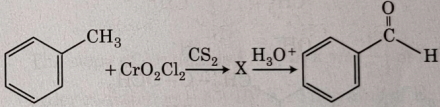
The intermediate compound $X$ in the following chemical reaction is :
A
$C_6H_5CH(OCrOHCl_2)_2$
B
$C_6H_5CH(OCOCH_3)_2$
C
$C_6H_5CHCl_2$
D
$C_6H_5CHCl$
Solution
(A) The given reaction is the $Etard$ reaction,which is used for the oxidation of toluene to benzaldehyde using chromyl chloride $(CrO_2Cl_2)$ in the presence of a non-polar solvent like carbon disulfide $(CS_2)$.
In this reaction,the methyl group of toluene is oxidized to a chromium complex intermediate,which is $C_6H_5CH(OCrOHCl_2)_2$.
This intermediate is then hydrolyzed with water $(H_3O^+)$ to yield benzaldehyde.
In this reaction,the methyl group of toluene is oxidized to a chromium complex intermediate,which is $C_6H_5CH(OCrOHCl_2)_2$.
This intermediate is then hydrolyzed with water $(H_3O^+)$ to yield benzaldehyde.
0 likesView Solution
47
ChemistryMediumMCQNEET · 2021
The correct option for the value of vapour pressure of a solution at $45^{\circ} C$ with benzene to octane in molar ratio $3 : 2$ is ...... $mm$ of $Hg$. [At $45^{\circ} C$,vapour pressure of benzene is $280 \ mm \ Hg$ and that of octane is $420 \ mm \ Hg$. Assume ideal solution.]
A
$160$
B
$168$
C
$336$
D
$350$
Solution
(C) According to Raoult's law for an ideal solution,the total vapour pressure $P_s$ is given by:
$P_s = P_A^0 x_A + P_B^0 x_B$
Given:
$P_A^0$ (benzene) $= 280 \ mm \ Hg$
$P_B^0$ (octane) $= 420 \ mm \ Hg$
Molar ratio $= 3 : 2$,so mole fractions are:
$x_A = \frac{3}{3+2} = \frac{3}{5} = 0.6$
$x_B = \frac{2}{3+2} = \frac{2}{5} = 0.4$
Substituting the values:
$P_s = (280 \times 0.6) + (420 \times 0.4)$
$P_s = 168 + 168$
$P_s = 336 \ mm \ Hg$
$P_s = P_A^0 x_A + P_B^0 x_B$
Given:
$P_A^0$ (benzene) $= 280 \ mm \ Hg$
$P_B^0$ (octane) $= 420 \ mm \ Hg$
Molar ratio $= 3 : 2$,so mole fractions are:
$x_A = \frac{3}{3+2} = \frac{3}{5} = 0.6$
$x_B = \frac{2}{3+2} = \frac{2}{5} = 0.4$
Substituting the values:
$P_s = (280 \times 0.6) + (420 \times 0.4)$
$P_s = 168 + 168$
$P_s = 336 \ mm \ Hg$
1 likesView Solution
48
ChemistryMediumMCQNEET · 2021
The product formed in the following chemical reaction is :
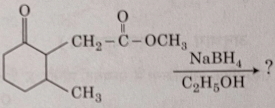
A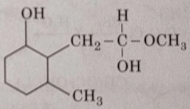
B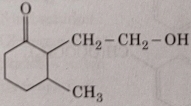
C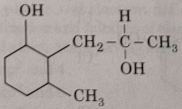
D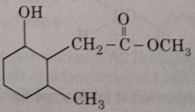
Solution
(D) $NaBH_4$ (Sodium borohydride) is a selective reducing agent that reduces aldehydes and ketones to their corresponding alcohols but does not reduce esters,carboxylic acids,or amides under normal conditions. In the given substrate,there is a ketone group and an ester group $(-COOCH_3)$. Therefore,$NaBH_4$ will selectively reduce the ketone group to a secondary alcohol $(-CHOH)$ while leaving the ester group unaffected. The final product is a cyclohexane ring with an $-OH$ group,a $-CH_2-COOCH_3$ group,and a $-CH_3$ group.
0 likesView Solution
49
ChemistryMediumMCQNEET · 2021
The molar conductivity of $0.007 \ M$ acetic acid is $20 \ S \ cm^{2} \ mol^{-1}$. What is the dissociation constant of acetic acid? (In $\times 10^{-5} \ mol \ L^{-1}$)
$[\Lambda_{H^{+}}^{\circ}=350 \ S \ cm^{2} \ mol^{-1}, \Lambda_{CH_{3}COO^{-}}^{\circ}=50 \ S \ cm^{2} \ mol^{-1}]$
$[\Lambda_{H^{+}}^{\circ}=350 \ S \ cm^{2} \ mol^{-1}, \Lambda_{CH_{3}COO^{-}}^{\circ}=50 \ S \ cm^{2} \ mol^{-1}]$
A
$175$
B
$2.50$
C
$1.75$
D
$250$
Solution
(C) First,calculate the limiting molar conductivity of acetic acid:
$\Lambda_{m}^{\circ}(CH_{3}COOH) = \Lambda_{H^{+}}^{\circ} + \Lambda_{CH_{3}COO^{-}}^{\circ} = 350 + 50 = 400 \ S \ cm^{2} \ mol^{-1}$
Next,calculate the degree of dissociation $(\alpha)$:
$\alpha = \frac{\Lambda_{m}}{\Lambda_{m}^{\circ}} = \frac{20}{400} = 0.05$
Finally,calculate the dissociation constant $(K_{a})$ using the formula $K_{a} = C \alpha^{2} / (1 - \alpha)$. Since $\alpha$ is very small,we use $K_{a} \approx C \alpha^{2}$:
$K_{a} = 0.007 \times (0.05)^{2}$
$K_{a} = 7 \times 10^{-3} \times 25 \times 10^{-4}$
$K_{a} = 175 \times 10^{-7} = 1.75 \times 10^{-5} \ mol \ L^{-1}$
Thus,the value is $1.75$.
$\Lambda_{m}^{\circ}(CH_{3}COOH) = \Lambda_{H^{+}}^{\circ} + \Lambda_{CH_{3}COO^{-}}^{\circ} = 350 + 50 = 400 \ S \ cm^{2} \ mol^{-1}$
Next,calculate the degree of dissociation $(\alpha)$:
$\alpha = \frac{\Lambda_{m}}{\Lambda_{m}^{\circ}} = \frac{20}{400} = 0.05$
Finally,calculate the dissociation constant $(K_{a})$ using the formula $K_{a} = C \alpha^{2} / (1 - \alpha)$. Since $\alpha$ is very small,we use $K_{a} \approx C \alpha^{2}$:
$K_{a} = 0.007 \times (0.05)^{2}$
$K_{a} = 7 \times 10^{-3} \times 25 \times 10^{-4}$
$K_{a} = 175 \times 10^{-7} = 1.75 \times 10^{-5} \ mol \ L^{-1}$
Thus,the value is $1.75$.
0 likesView Solution
50
ChemistryMediumMCQNEET · 2021
The slope of the Arrhenius plot $(\ln k \, vs \, \frac{1}{T})$ of a first-order reaction is $-5 \times 10^{3} \, K$. The value of $E_{a}$ of the reaction is: (in $kJ \, mol^{-1}$)
$[\text{Given } R = 8.314 \, J \, K^{-1} \, mol^{-1}]$
$[\text{Given } R = 8.314 \, J \, K^{-1} \, mol^{-1}]$
A
$41.5$
B
$83.0$
C
$166$
D
$-83$
Solution
(A) The Arrhenius equation is given by $\ln k = \ln A - \frac{E_{a}}{RT}$.
Comparing this with the equation of a straight line $y = mx + c$,where $y = \ln k$ and $x = \frac{1}{T}$,the slope $m = -\frac{E_{a}}{R}$.
Given that the slope is $-5 \times 10^{3} \, K$,we have $-\frac{E_{a}}{R} = -5 \times 10^{3} \, K$.
Therefore,$E_{a} = 5 \times 10^{3} \times 8.314 \, J \, mol^{-1} = 41570 \, J \, mol^{-1}$.
Converting to $kJ \, mol^{-1}$,we get $E_{a} = 41.57 \, kJ \, mol^{-1} \approx 41.5 \, kJ \, mol^{-1}$.
Comparing this with the equation of a straight line $y = mx + c$,where $y = \ln k$ and $x = \frac{1}{T}$,the slope $m = -\frac{E_{a}}{R}$.
Given that the slope is $-5 \times 10^{3} \, K$,we have $-\frac{E_{a}}{R} = -5 \times 10^{3} \, K$.
Therefore,$E_{a} = 5 \times 10^{3} \times 8.314 \, J \, mol^{-1} = 41570 \, J \, mol^{-1}$.
Converting to $kJ \, mol^{-1}$,we get $E_{a} = 41.57 \, kJ \, mol^{-1} \approx 41.5 \, kJ \, mol^{-1}$.
0 likesView Solution
51
ChemistryMediumMCQNEET · 2021
The reagent '$R$' in the given sequence of chemical reaction is:
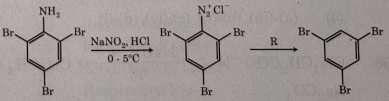
A
$H_{2}O$
B
$CH_{3}CH_{2}OH$
C
$HI$
D
$CuCN / KCN$
Solution
(B) The given reaction sequence involves the conversion of $2,4,6$-tribromoaniline to $2,4,6$-tribromobenzenediazonium chloride using $NaNO_{2} / HCl$ at $0-5^{\circ}C$.
To replace the diazonium group $(-N_{2}^{+}Cl^{-})$ with a hydrogen atom,a reducing agent is required.
Ethanol $(CH_{3}CH_{2}OH)$ acts as a mild reducing agent that reduces the diazonium salt to the corresponding aromatic hydrocarbon (in this case,$1,3,5$-tribromobenzene) while being oxidized to acetaldehyde.
Therefore,the reagent '$R$' is $CH_{3}CH_{2}OH$.
To replace the diazonium group $(-N_{2}^{+}Cl^{-})$ with a hydrogen atom,a reducing agent is required.
Ethanol $(CH_{3}CH_{2}OH)$ acts as a mild reducing agent that reduces the diazonium salt to the corresponding aromatic hydrocarbon (in this case,$1,3,5$-tribromobenzene) while being oxidized to acetaldehyde.
Therefore,the reagent '$R$' is $CH_{3}CH_{2}OH$.
0 likesView Solution
52
ChemistryEasyMCQNEET · 2021
Match List-$I$ with List-$II$.
List-$I$:
$(a)$ $\text{Benzene} \xrightarrow[\text{CuCl}]{\text{CO, HCl, Anhyd. AlCl}_3} \text{Benzaldehyde}$
$(b)$ $R-CO-CH_3 + NaOX \rightarrow$
$(c)$ $R-CH_2-OH + R'COOH \xrightarrow{\text{Conc. H}_2\text{SO}_4}$
$(d)$ $R-CH_2COOH \xrightarrow[(ii) H_2O]{(i) X_2/\text{Red P}} R-CH(X)COOH$
List-$II$:
$(i)$ $\text{Hell-Volhard-Zelinsky reaction}$
(ii) $\text{Gattermann-Koch reaction}$
(iii) $\text{Haloform reaction}$
(iv) $\text{Esterification}$
Choose the correct answer from the options given below.
List-$I$:
$(a)$ $\text{Benzene} \xrightarrow[\text{CuCl}]{\text{CO, HCl, Anhyd. AlCl}_3} \text{Benzaldehyde}$
$(b)$ $R-CO-CH_3 + NaOX \rightarrow$
$(c)$ $R-CH_2-OH + R'COOH \xrightarrow{\text{Conc. H}_2\text{SO}_4}$
$(d)$ $R-CH_2COOH \xrightarrow[(ii) H_2O]{(i) X_2/\text{Red P}} R-CH(X)COOH$
List-$II$:
$(i)$ $\text{Hell-Volhard-Zelinsky reaction}$
(ii) $\text{Gattermann-Koch reaction}$
(iii) $\text{Haloform reaction}$
(iv) $\text{Esterification}$
Choose the correct answer from the options given below.
A
$(a)-(iv), (b)-(i), (c)-(ii), (d)-(iii)$
B
$(a)-(iii), (b)-(ii), (c)-(i), (d)-(iv)$
C
$(a)-(i), (b)-(iv), (c)-(iii), (d)-(ii)$
D
$(a)-(ii), (b)-(iii), (c)-(iv), (d)-(i)$
Solution
(D) The correct matches are:
$(a)$ The reaction of benzene with $CO$ and $HCl$ in the presence of anhydrous $AlCl_3/CuCl$ is the $\text{Gattermann-Koch reaction}$. Thus,$(a)-(ii)$.
$(b)$ The reaction of a methyl ketone with $NaOX$ $(X = Cl, Br, I)$ is the $\text{Haloform reaction}$. Thus,$(b)-(iii)$.
$(c)$ The reaction of an alcohol with a carboxylic acid in the presence of concentrated $H_2SO_4$ is $\text{Esterification}$. Thus,$(c)-(iv)$.
$(d)$ The reaction of a carboxylic acid containing $\alpha$-hydrogen with $X_2/\text{Red P}$ followed by water is the $\text{Hell-Volhard-Zelinsky (HVZ) reaction}$. Thus,$(d)-(i)$.
Therefore,the correct sequence is $(a)-(ii), (b)-(iii), (c)-(iv), (d)-(i)$.
$(a)$ The reaction of benzene with $CO$ and $HCl$ in the presence of anhydrous $AlCl_3/CuCl$ is the $\text{Gattermann-Koch reaction}$. Thus,$(a)-(ii)$.
$(b)$ The reaction of a methyl ketone with $NaOX$ $(X = Cl, Br, I)$ is the $\text{Haloform reaction}$. Thus,$(b)-(iii)$.
$(c)$ The reaction of an alcohol with a carboxylic acid in the presence of concentrated $H_2SO_4$ is $\text{Esterification}$. Thus,$(c)-(iv)$.
$(d)$ The reaction of a carboxylic acid containing $\alpha$-hydrogen with $X_2/\text{Red P}$ followed by water is the $\text{Hell-Volhard-Zelinsky (HVZ) reaction}$. Thus,$(d)-(i)$.
Therefore,the correct sequence is $(a)-(ii), (b)-(iii), (c)-(iv), (d)-(i)$.
0 likesView Solution
53
ChemistryMediumMCQNEET · 2021
Match List-$I$ with List-$II$.
Choose the correct answer from the options given below.
| List-$I$ | List-$II$ |
|---|---|
| $a. [Fe(CN)_{6}]^{3-}$ | $i. 5.92 \ BM$ |
| $b. [Fe(H_{2}O)_{6}]^{3+}$ | $ii. 0 \ BM$ |
| $c. [Fe(CN)_{6}]^{4-}$ | $iii. 4.90 \ BM$ |
| $d. [Fe(H_{2}O)_{6}]^{2+}$ | $iv. 1.73 \ BM$ |
Choose the correct answer from the options given below.
A
$a-iv, b-ii, c-i, d-iii$
B
$a-ii, b-iv, c-iii, d-i$
C
$a-i, b-iii, c-iv, d-ii$
D
$a-iv, b-i, c-ii, d-iii$
Solution
(D) To find the magnetic moment,we calculate the number of unpaired electrons $(n)$ in each complex:
$a. [Fe(CN)_{6}]^{3-}$: $Fe^{3+}$ is $3d^{5}$. $CN^-$ is a strong field ligand,causing pairing. $n=1$,$\mu = \sqrt{1(1+2)} = 1.73 \ BM$.
$b. [Fe(H_{2}O)_{6}]^{3+}$: $Fe^{3+}$ is $3d^{5}$. $H_2O$ is a weak field ligand,no pairing. $n=5$,$\mu = \sqrt{5(5+2)} = 5.92 \ BM$.
$c. [Fe(CN)_{6}]^{4-}$: $Fe^{2+}$ is $3d^{6}$. $CN^-$ is a strong field ligand,causing pairing. $n=0$,$\mu = 0 \ BM$.
$d. [Fe(H_{2}O)_{6}]^{2+}$: $Fe^{2+}$ is $3d^{6}$. $H_2O$ is a weak field ligand,no pairing. $n=4$,$\mu = \sqrt{4(4+2)} = 4.90 \ BM$.
Matching these values: $a-iv, b-i, c-ii, d-iii$.
$a. [Fe(CN)_{6}]^{3-}$: $Fe^{3+}$ is $3d^{5}$. $CN^-$ is a strong field ligand,causing pairing. $n=1$,$\mu = \sqrt{1(1+2)} = 1.73 \ BM$.
$b. [Fe(H_{2}O)_{6}]^{3+}$: $Fe^{3+}$ is $3d^{5}$. $H_2O$ is a weak field ligand,no pairing. $n=5$,$\mu = \sqrt{5(5+2)} = 5.92 \ BM$.
$c. [Fe(CN)_{6}]^{4-}$: $Fe^{2+}$ is $3d^{6}$. $CN^-$ is a strong field ligand,causing pairing. $n=0$,$\mu = 0 \ BM$.
$d. [Fe(H_{2}O)_{6}]^{2+}$: $Fe^{2+}$ is $3d^{6}$. $H_2O$ is a weak field ligand,no pairing. $n=4$,$\mu = \sqrt{4(4+2)} = 4.90 \ BM$.
Matching these values: $a-iv, b-i, c-ii, d-iii$.
0 likesView Solution
Vedclass Products
For Students
Vedclass Test Series
Mock tests in real NEET style covering Chemistry with performance analysis. 5-day free trial.
Start Free TrialFor Teachers
Exam Paper Generator
Generate Set A/B/C/D Chemistry papers from 7.5L+ questions in 2 minutes. 3 chapters free.
Try FreeFor Institutes
Online Exam Module
Run live NEET mock exams with unlimited students, 360° analytics & white-label branding.
See DemoFrequently Asked Questions
How many Chemistry questions are in NEET 2021?
There are 53 Chemistry questions from the NEET 2021 paper on Vedclass, each with a detailed step-by-step solution in English.
Are NEET 2021 Chemistry solutions available in English?
Yes. All solutions on this page are in English. You can also switch to English or Hindi using the language buttons above the questions.
Can I practice NEET 2021 Chemistry as a timed test?
Yes. Use the Vedclass Test Series to attempt a full NEET mock test covering Chemistry with time limits and instant score analysis.
Can teachers create Chemistry papers from NEET previous year questions?
Yes. The Vedclass Exam Paper Generator lets teachers mix NEET Chemistry questions and generate Set A/B/C/D papers in minutes.
For Teachers & Institutes
Build a Custom Chemistry Paper
Pick NEET 2021 Chemistry questions, set difficulty, and generate Set A/B/C/D in 2 minutes.