
ChemistryQ401–450 of 843 questions
Page 9 of 11 · English
401
ChemistryEasyMCQMHT CET · 2025
Which of the following polymers is used to obtain surgical sutures?
A
$Nylon-6$
B
$Nylon-6,6$
C
Terylene
D
Neoprene
Solution
(A) Surgical sutures are typically made from biodegradable polymers or specific synthetic fibers that are biocompatible. $Nylon-6$ is widely used in the medical field for the production of surgical sutures due to its high tensile strength and durability. Therefore,the correct option is $A$.
0 likesView Solution
402
ChemistryEasyMCQMHT CET · 2025
Identify the monomers used in the preparation of $Dacron$.
A
$C_6H_5OH$ and $CH_2O$
B
$H_2C=CH-CH=CH_2$ and $H_2C=CH-CN$
C
$HO-CH_2-CH_2-OH$ and $HOOC-C_6H_4-COOH$ (Ethylene glycol and terephthalic acid)
D
$H_2C=CH-CN$ and $C_6H_5OH$
Solution
(C) $Dacron$ (also known as $Terylene$) is a polyester fiber. It is prepared by the condensation polymerization of ethylene glycol $(HO-CH_2-CH_2-OH)$ and terephthalic acid ($benzene-1,4-dicarboxylic \ acid$,$HOOC-C_6H_4-COOH$). The reaction involves the elimination of water molecules to form an ester linkage.
0 likesView Solution
403
ChemistryEasyMCQMHT CET · 2025
Which of the following polymers is used as a surgical suture?
A
$HDP$
B
Polyacrylonitrile
C
Nylon $6,6$
D
Nylon $6$
Solution
(C) Surgical sutures are typically made from biocompatible and biodegradable or non-biodegradable synthetic polymers. Nylon $6,6$ is a polyamide that is widely used in the medical field for surgical sutures due to its high tensile strength and durability. Therefore,the correct option is $C$.
0 likesView Solution
404
ChemistryEasyMCQMHT CET · 2025
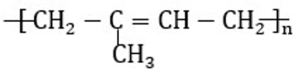
What is the name of the monomer used in the formation of the polymer shown in the image?
A
Isoprene
B
Tetrafluoroethylene
C
Acrylonitrile
D
Caprolactum
Solution
(A) The given polymer structure is $[-CH_2-C(CH_3)=CH-CH_2-]_n$,which is natural rubber (cis-$1,4$-polyisoprene).
The monomer unit of natural rubber is $2-methyl-1,3-butadiene$,commonly known as Isoprene.
Therefore,the correct option is $A$.
The monomer unit of natural rubber is $2-methyl-1,3-butadiene$,commonly known as Isoprene.
Therefore,the correct option is $A$.
0 likesView Solution
405
ChemistryEasyMCQMHT CET · 2025
Which of the following solids is isotropic?
A
Glass
B
Ceramics
C
Graphite
D
Ice
Solution
(A) Amorphous solids are isotropic in nature,meaning their physical properties (such as refractive index,electrical conductivity,etc.) are the same in all directions.
Glass is an amorphous solid,whereas ceramics,graphite,and ice are crystalline solids,which are anisotropic.
Glass is an amorphous solid,whereas ceramics,graphite,and ice are crystalline solids,which are anisotropic.
0 likesView Solution
406
ChemistryEasyMCQMHT CET · 2025
What is the total number of different types of unit cells in a tetragonal crystal system?
A
$1$
B
$2$
C
$3$
D
$4$
Solution
(B) The tetragonal crystal system consists of two types of unit cells: $1$. Primitive (simple) and $2$. Body-centered. Therefore,the total number of different types of unit cells is $2$.
0 likesView Solution
407
ChemistryMediumMCQMHT CET · 2025
Calculate the number of atoms present in $1.58 \ g$ of a metal that forms a $bcc$ structure,given that $\varrho \times a^3 = 1.58 \times 10^{-22} \ g$.
A
$1.0 \times 10^{22}$
B
$2.0 \times 10^{22}$
C
$3.0 \times 10^{22}$
D
$4.0 \times 10^{22}$
Solution
(B) For a $bcc$ unit cell,the number of atoms per unit cell $(Z)$ is $2$.
The mass of one unit cell is given by the product of density $(\varrho)$ and volume $(a^3)$,which is $\varrho \times a^3 = 1.58 \times 10^{-22} \ g$.
The number of unit cells in $1.58 \ g$ of the metal is calculated as:
$\text{Number of unit cells} = \frac{\text{Total mass}}{\text{Mass of one unit cell}} = \frac{1.58 \ g}{1.58 \times 10^{-22} \ g} = 10^{22}$.
Since each $bcc$ unit cell contains $2$ atoms,the total number of atoms is:
$\text{Total atoms} = 2 \times 10^{22}$.
The mass of one unit cell is given by the product of density $(\varrho)$ and volume $(a^3)$,which is $\varrho \times a^3 = 1.58 \times 10^{-22} \ g$.
The number of unit cells in $1.58 \ g$ of the metal is calculated as:
$\text{Number of unit cells} = \frac{\text{Total mass}}{\text{Mass of one unit cell}} = \frac{1.58 \ g}{1.58 \times 10^{-22} \ g} = 10^{22}$.
Since each $bcc$ unit cell contains $2$ atoms,the total number of atoms is:
$\text{Total atoms} = 2 \times 10^{22}$.
0 likesView Solution
408
ChemistryMediumMCQMHT CET · 2025
Calculate the volume of a unit cell having an atomic radius of $141.4 \ pm$ forming an $fcc$ unit cell.
A
$9.3 \times 10^{-23} \ cm^3$
B
$8.1 \times 10^{-23} \ cm^3$
C
$6.4 \times 10^{-23} \ cm^3$
D
$4.7 \times 10^{-23} \ cm^3$
Solution
(C) For an $fcc$ unit cell, the relation between edge length $(a)$ and atomic radius $(r)$ is $a = 2\sqrt{2}r$.
Given $r = 141.4 \ pm = 1.414 \times 10^{-8} \ cm$.
Substituting the value of $r$: $a = 2 \times 1.414 \times 1.414 \times 10^{-8} \ cm = 4.0 \times 10^{-8} \ cm$.
The volume of the unit cell is $V = a^3 = (4.0 \times 10^{-8} \ cm)^3 = 64 \times 10^{-24} \ cm^3 = 6.4 \times 10^{-23} \ cm^3$.
Given $r = 141.4 \ pm = 1.414 \times 10^{-8} \ cm$.
Substituting the value of $r$: $a = 2 \times 1.414 \times 1.414 \times 10^{-8} \ cm = 4.0 \times 10^{-8} \ cm$.
The volume of the unit cell is $V = a^3 = (4.0 \times 10^{-8} \ cm)^3 = 64 \times 10^{-24} \ cm^3 = 6.4 \times 10^{-23} \ cm^3$.
0 likesView Solution
409
ChemistryMediumMCQMHT CET · 2025
Which of the following statements is $NOT$ correct regarding voids in lattice structure?
A
Four spheres are involved in the formation of a tetrahedral void.
B
The octahedral void is surrounded by six spheres.
C
There are two tetrahedral voids associated with each atom.
D
There is one octahedral void associated with two atoms.
Solution
(D) In a close-packed structure with $N$ atoms:
$1$. The number of tetrahedral voids is $2N$. Thus,there are two tetrahedral voids per atom.
$2$. The number of octahedral voids is $N$. Thus,there is one octahedral void per atom.
$3$. $A$ tetrahedral void is formed by $4$ spheres,and an octahedral void is formed by $6$ spheres.
Comparing these with the options:
- Option $A$ is correct ($4$ spheres).
- Option $B$ is correct ($6$ spheres).
- Option $C$ is correct ($2$ voids per atom).
- Option $D$ is incorrect because there is one octahedral void per atom,not one for every two atoms.
$1$. The number of tetrahedral voids is $2N$. Thus,there are two tetrahedral voids per atom.
$2$. The number of octahedral voids is $N$. Thus,there is one octahedral void per atom.
$3$. $A$ tetrahedral void is formed by $4$ spheres,and an octahedral void is formed by $6$ spheres.
Comparing these with the options:
- Option $A$ is correct ($4$ spheres).
- Option $B$ is correct ($6$ spheres).
- Option $C$ is correct ($2$ voids per atom).
- Option $D$ is incorrect because there is one octahedral void per atom,not one for every two atoms.
0 likesView Solution
410
ChemistryMediumMCQMHT CET · 2025
In an ionic solid,anions $(B)$ are arranged in a $ccp$ array and cations $(A)$ occupy $1/3$ of the tetrahedral voids. What is the formula of the ionic compound?
A
$AB_3$
B
$A_3B_2$
C
$A_2B_3$
D
$AB_4$
Solution
(C) Let the number of anions $(B)$ in the $ccp$ array be $N$.
Since the number of tetrahedral voids is equal to $2N$,and cations $(A)$ occupy $1/3$ of these voids,the number of cations is $A = \frac{1}{3} \times 2N = \frac{2N}{3}$.
The ratio of cations to anions is $A:B = \frac{2N}{3} : N = \frac{2}{3} : 1 = 2 : 3$.
Therefore,the formula of the ionic compound is $A_2B_3$.
Since the number of tetrahedral voids is equal to $2N$,and cations $(A)$ occupy $1/3$ of these voids,the number of cations is $A = \frac{1}{3} \times 2N = \frac{2N}{3}$.
The ratio of cations to anions is $A:B = \frac{2N}{3} : N = \frac{2}{3} : 1 = 2 : 3$.
Therefore,the formula of the ionic compound is $A_2B_3$.
0 likesView Solution
411
ChemistryEasyMCQMHT CET · 2025
The volume of a simple cubic unit cell is $x \times 10^{-23} \ cm^3$. Calculate the value of $x$ if the volume occupied by a particle in it is $2.1 \times 10^{-23} \ cm^3$.
A
$3.0$
B
$3.5$
C
$4.0$
D
$4.5$
Solution
(C) In a simple cubic unit cell,the number of particles per unit cell $(Z)$ is $1$.
The volume of the unit cell $(V_{cell})$ is related to the volume occupied by a particle $(V_{particle})$ by the relation: $V_{cell} = Z \times V_{particle}$.
Given $Z = 1$ and $V_{particle} = 2.1 \times 10^{-23} \ cm^3$.
Therefore,$V_{cell} = 1 \times 2.1 \times 10^{-23} \ cm^3 = 2.1 \times 10^{-23} \ cm^3$.
Comparing this with $x \times 10^{-23} \ cm^3$,we get $x = 2.1$.
Note: The provided options do not contain the correct value $2.1$. Based on the standard definition of a simple cubic unit cell where the edge length $a = 2r$,the volume is $a^3 = (2r)^3 = 8r^3$. If the volume occupied by a particle (sphere) is $\frac{4}{3}\pi r^3 = 2.1 \times 10^{-23} \ cm^3$,then $r^3 = \frac{2.1 \times 10^{-23} \times 3}{4 \times 3.14} \approx 0.5016 \times 10^{-23} \ cm^3$.
Thus,$V_{cell} = 8 \times 0.5016 \times 10^{-23} \approx 4.01 \times 10^{-23} \ cm^3$.
Therefore,$x \approx 4.0$.
The volume of the unit cell $(V_{cell})$ is related to the volume occupied by a particle $(V_{particle})$ by the relation: $V_{cell} = Z \times V_{particle}$.
Given $Z = 1$ and $V_{particle} = 2.1 \times 10^{-23} \ cm^3$.
Therefore,$V_{cell} = 1 \times 2.1 \times 10^{-23} \ cm^3 = 2.1 \times 10^{-23} \ cm^3$.
Comparing this with $x \times 10^{-23} \ cm^3$,we get $x = 2.1$.
Note: The provided options do not contain the correct value $2.1$. Based on the standard definition of a simple cubic unit cell where the edge length $a = 2r$,the volume is $a^3 = (2r)^3 = 8r^3$. If the volume occupied by a particle (sphere) is $\frac{4}{3}\pi r^3 = 2.1 \times 10^{-23} \ cm^3$,then $r^3 = \frac{2.1 \times 10^{-23} \times 3}{4 \times 3.14} \approx 0.5016 \times 10^{-23} \ cm^3$.
Thus,$V_{cell} = 8 \times 0.5016 \times 10^{-23} \approx 4.01 \times 10^{-23} \ cm^3$.
Therefore,$x \approx 4.0$.
0 likesView Solution
412
ChemistryDifficultMCQMHT CET · 2025
Calculate the molar mass of an element if it forms $fcc$ unit cell structure. [Mass of unit cell $= 1.8 \times 10^{-22} \ g$,$N_A = 6.022 \times 10^{23} \ mol^{-1}$]
A
$27.0 \ g \ mol^{-1}$
B
$24.4 \ g \ mol^{-1}$
C
$21.0 \ g \ mol^{-1}$
D
$30.2 \ g \ mol^{-1}$
Solution
(A) For an $fcc$ unit cell,the number of atoms per unit cell $(Z)$ is $4$.
The mass of a unit cell is given by the formula: $\text{Mass of unit cell} = \frac{Z \times M}{N_A}$,where $M$ is the molar mass.
Rearranging the formula to solve for $M$: $M = \frac{\text{Mass of unit cell} \times N_A}{Z}$.
Substituting the given values: $M = \frac{1.8 \times 10^{-22} \ g \times 6.022 \times 10^{23} \ mol^{-1}}{4}$.
$M = \frac{108.396}{4} \ g \ mol^{-1} = 27.099 \ g \ mol^{-1} \approx 27.0 \ g \ mol^{-1}$.
The mass of a unit cell is given by the formula: $\text{Mass of unit cell} = \frac{Z \times M}{N_A}$,where $M$ is the molar mass.
Rearranging the formula to solve for $M$: $M = \frac{\text{Mass of unit cell} \times N_A}{Z}$.
Substituting the given values: $M = \frac{1.8 \times 10^{-22} \ g \times 6.022 \times 10^{23} \ mol^{-1}}{4}$.
$M = \frac{108.396}{4} \ g \ mol^{-1} = 27.099 \ g \ mol^{-1} \approx 27.0 \ g \ mol^{-1}$.
0 likesView Solution
413
ChemistryMediumMCQMHT CET · 2025
Calculate the total number of tetrahedral and octahedral voids formed in $0.6 \ mol$ of a compound if it forms $hcp$ structure.
A
$3.613 \times 10^{24}$
B
$7.226 \times 10^{24}$
C
$1.084 \times 10^{24}$
D
$2.913 \times 10^{24}$
Solution
(C) In an $hcp$ structure,the number of atoms is $N = 0.6 \times 6.022 \times 10^{23} = 3.6132 \times 10^{23}$.
Number of octahedral voids = $N = 3.6132 \times 10^{23}$.
Number of tetrahedral voids = $2N = 2 \times 3.6132 \times 10^{23} = 7.2264 \times 10^{23}$.
Total number of voids = $N + 2N = 3N = 3 \times 3.6132 \times 10^{23} = 1.08396 \times 10^{24} \approx 1.084 \times 10^{24}$.
Number of octahedral voids = $N = 3.6132 \times 10^{23}$.
Number of tetrahedral voids = $2N = 2 \times 3.6132 \times 10^{23} = 7.2264 \times 10^{23}$.
Total number of voids = $N + 2N = 3N = 3 \times 3.6132 \times 10^{23} = 1.08396 \times 10^{24} \approx 1.084 \times 10^{24}$.
0 likesView Solution
414
ChemistryEasyMCQMHT CET · 2025
Calculate the number of unit cells in $1 \ cm^3$ volume of an element if unit cell edge length is $4.0 \times 10^{-8} \ cm$.
A
$1.56 \times 10^{22}$
B
$2.63 \times 10^{22}$
C
$3.34 \times 10^{22}$
D
$4.50 \times 10^{22}$
Solution
(A) The volume of one unit cell is given by $V_{cell} = a^3$,where $a$ is the edge length of the unit cell.
Given $a = 4.0 \times 10^{-8} \ cm$,so $V_{cell} = (4.0 \times 10^{-8} \ cm)^3 = 64 \times 10^{-24} \ cm^3 = 6.4 \times 10^{-23} \ cm^3$.
The number of unit cells in $1 \ cm^3$ volume is calculated as:
$\text{Number of unit cells} = \frac{\text{Total Volume}}{\text{Volume of one unit cell}} = \frac{1 \ cm^3}{6.4 \times 10^{-23} \ cm^3} = 0.15625 \times 10^{23} = 1.5625 \times 10^{22}$.
Thus,the correct option is $A$.
Given $a = 4.0 \times 10^{-8} \ cm$,so $V_{cell} = (4.0 \times 10^{-8} \ cm)^3 = 64 \times 10^{-24} \ cm^3 = 6.4 \times 10^{-23} \ cm^3$.
The number of unit cells in $1 \ cm^3$ volume is calculated as:
$\text{Number of unit cells} = \frac{\text{Total Volume}}{\text{Volume of one unit cell}} = \frac{1 \ cm^3}{6.4 \times 10^{-23} \ cm^3} = 0.15625 \times 10^{23} = 1.5625 \times 10^{22}$.
Thus,the correct option is $A$.
0 likesView Solution
415
ChemistryEasyMCQMHT CET · 2025
Calculate the volume occupied by a particle in $bcc$ unit cell if the volume of unit cell is $8.2 \times 10^{-23} \ cm^3$.
A
$5.576 \times 10^{-23} \ cm^3$
B
$1.517 \times 10^{-23} \ cm^3$
C
$2.788 \times 10^{-23} \ cm^3$
D
$3.936 \times 10^{-23} \ cm^3$
Solution
(C) In a $bcc$ (body-centered cubic) unit cell,the total number of particles $(Z)$ is $2$.
The packing efficiency of a $bcc$ unit cell is $68\%$,which means $68\%$ of the total volume of the unit cell is occupied by the particles.
Total volume of unit cell = $8.2 \times 10^{-23} \ cm^3$.
Volume occupied by particles = $0.68 \times 8.2 \times 10^{-23} \ cm^3 = 5.576 \times 10^{-23} \ cm^3$.
Since there are $2$ particles in the $bcc$ unit cell,the volume occupied by a single particle is $\frac{5.576 \times 10^{-23}}{2} \ cm^3 = 2.788 \times 10^{-23} \ cm^3$.
The packing efficiency of a $bcc$ unit cell is $68\%$,which means $68\%$ of the total volume of the unit cell is occupied by the particles.
Total volume of unit cell = $8.2 \times 10^{-23} \ cm^3$.
Volume occupied by particles = $0.68 \times 8.2 \times 10^{-23} \ cm^3 = 5.576 \times 10^{-23} \ cm^3$.
Since there are $2$ particles in the $bcc$ unit cell,the volume occupied by a single particle is $\frac{5.576 \times 10^{-23}}{2} \ cm^3 = 2.788 \times 10^{-23} \ cm^3$.
0 likesView Solution
416
ChemistryMediumMCQMHT CET · 2025
Calculate the total number of tetrahedral and octahedral voids in $0.4 \ mol$ of a compound having such voids in it.
A
$2.4088 \times 10^{23}$
B
$7.2264 \times 10^{23}$
C
$4.8176 \times 10^{23}$
D
$9.6352 \times 10^{23}$
Solution
(B) Let the number of atoms in the close-packed structure be $N = 0.4 \ mol = 0.4 \times 6.022 \times 10^{23} = 2.4088 \times 10^{23}$ atoms.
Number of octahedral voids = $N = 2.4088 \times 10^{23}$.
Number of tetrahedral voids = $2N = 2 \times 2.4088 \times 10^{23} = 4.8176 \times 10^{23}$.
Total number of voids = $N + 2N = 3N = 3 \times 2.4088 \times 10^{23} = 7.2264 \times 10^{23}$.
Number of octahedral voids = $N = 2.4088 \times 10^{23}$.
Number of tetrahedral voids = $2N = 2 \times 2.4088 \times 10^{23} = 4.8176 \times 10^{23}$.
Total number of voids = $N + 2N = 3N = 3 \times 2.4088 \times 10^{23} = 7.2264 \times 10^{23}$.
0 likesView Solution
417
ChemistryMediumMCQMHT CET · 2025
The mass of an atom present in a unit cell is $4.4 \times 10^{-23} \ g$ and the product of density and volume of the unit cell is $1.792 \times 10^{-22} \ g$. What is the type of cubic unit cell?
A
Body centred unit cell
B
Face centred unit cell
C
Base centred unit cell
D
Simple cubic unit cell
Solution
(B) The density of a unit cell is given by $\rho = \frac{Z \times M}{N_A \times a^3}$,where $Z$ is the number of atoms per unit cell,$M$ is the molar mass,$N_A$ is Avogadro's number,and $a^3$ is the volume of the unit cell $(V)$.
Rearranging the formula,we get $\rho \times V = \frac{Z \times M}{N_A}$.
We know that the mass of one atom is $m = \frac{M}{N_A} = 4.4 \times 10^{-23} \ g$.
Given $\rho \times V = 1.792 \times 10^{-22} \ g$.
Substituting the values: $1.792 \times 10^{-22} = Z \times (4.4 \times 10^{-23})$.
$Z = \frac{1.792 \times 10^{-22}}{4.4 \times 10^{-23}} = \frac{17.92}{4.4} \approx 4.07$.
Since $Z \approx 4$,the unit cell is a Face centred unit cell $(FCC)$.
Rearranging the formula,we get $\rho \times V = \frac{Z \times M}{N_A}$.
We know that the mass of one atom is $m = \frac{M}{N_A} = 4.4 \times 10^{-23} \ g$.
Given $\rho \times V = 1.792 \times 10^{-22} \ g$.
Substituting the values: $1.792 \times 10^{-22} = Z \times (4.4 \times 10^{-23})$.
$Z = \frac{1.792 \times 10^{-22}}{4.4 \times 10^{-23}} = \frac{17.92}{4.4} \approx 4.07$.
Since $Z \approx 4$,the unit cell is a Face centred unit cell $(FCC)$.
0 likesView Solution
418
ChemistryMediumMCQMHT CET · 2025
Calculate the number of atoms present per unit cell if the product of density and volume of the unit cell is $1.8 \times 10^{-22} \ g$. [Mass of an atom $= 4.5 \times 10^{-23} \ g$]
A
$1$
B
$2$
C
$4$
D
$6$
Solution
(C) The density of a unit cell is given by the formula: $\rho = \frac{Z \times M}{N_A \times V}$,where $Z$ is the number of atoms per unit cell,$M$ is the molar mass,$N_A$ is Avogadro's number,and $V$ is the volume of the unit cell.
Given that the product of density $(\rho)$ and volume $(V)$ is $1.8 \times 10^{-22} \ g$,we have $\rho \times V = 1.8 \times 10^{-22} \ g$.
We know that the mass of a unit cell is equal to $\rho \times V$.
Also,the mass of a unit cell is equal to the number of atoms $(Z)$ multiplied by the mass of a single atom $(m_{atom})$.
Therefore,$Z \times m_{atom} = \rho \times V$.
Substituting the given values: $Z \times (4.5 \times 10^{-23} \ g) = 1.8 \times 10^{-22} \ g$.
$Z = \frac{1.8 \times 10^{-22}}{4.5 \times 10^{-23}} = \frac{18 \times 10^{-23}}{4.5 \times 10^{-23}} = 4$.
Thus,the number of atoms per unit cell is $4$.
Given that the product of density $(\rho)$ and volume $(V)$ is $1.8 \times 10^{-22} \ g$,we have $\rho \times V = 1.8 \times 10^{-22} \ g$.
We know that the mass of a unit cell is equal to $\rho \times V$.
Also,the mass of a unit cell is equal to the number of atoms $(Z)$ multiplied by the mass of a single atom $(m_{atom})$.
Therefore,$Z \times m_{atom} = \rho \times V$.
Substituting the given values: $Z \times (4.5 \times 10^{-23} \ g) = 1.8 \times 10^{-22} \ g$.
$Z = \frac{1.8 \times 10^{-22}}{4.5 \times 10^{-23}} = \frac{18 \times 10^{-23}}{4.5 \times 10^{-23}} = 4$.
Thus,the number of atoms per unit cell is $4$.
0 likesView Solution
419
ChemistryMediumMCQMHT CET · 2025
Calculate the volume of $fcc$ unit cell in $cm^3$ if void volume of it is $4.16 \times 10^{-24} \ cm^3$.
A
$1.3 \times 10^{-23}$
B
$1.6 \times 10^{-23}$
C
$4.1 \times 10^{-23}$
D
$5.8 \times 10^{-23}$
Solution
(B) For an $fcc$ unit cell,the packing efficiency is $74\%$.
This means the volume occupied by atoms is $0.74 \times V_{cell}$.
The void volume is the remaining volume,which is $100\% - 74\% = 26\%$.
Therefore,the void volume is $0.26 \times V_{cell}$.
Given that the void volume is $4.16 \times 10^{-24} \ cm^3$,we have:
$0.26 \times V_{cell} = 4.16 \times 10^{-24} \ cm^3$.
$V_{cell} = \frac{4.16 \times 10^{-24}}{0.26} \ cm^3$.
$V_{cell} = 16 \times 10^{-24} \ cm^3 = 1.6 \times 10^{-23} \ cm^3$.
Thus,the correct option is $B$.
This means the volume occupied by atoms is $0.74 \times V_{cell}$.
The void volume is the remaining volume,which is $100\% - 74\% = 26\%$.
Therefore,the void volume is $0.26 \times V_{cell}$.
Given that the void volume is $4.16 \times 10^{-24} \ cm^3$,we have:
$0.26 \times V_{cell} = 4.16 \times 10^{-24} \ cm^3$.
$V_{cell} = \frac{4.16 \times 10^{-24}}{0.26} \ cm^3$.
$V_{cell} = 16 \times 10^{-24} \ cm^3 = 1.6 \times 10^{-23} \ cm^3$.
Thus,the correct option is $B$.
0 likesView Solution
420
ChemistryEasyMCQMHT CET · 2025
Calculate the number of unit cells in $1 \ cm^3$ volume of metal if the volume of one unit cell is $3.448 \times 10^{-23} \ cm^3$.
A
$2.5 \times 10^{22}$
B
$3.2 \times 10^{22}$
C
$2.9 \times 10^{22}$
D
$3.7 \times 10^{22}$
Solution
(C) The number of unit cells is calculated by dividing the total volume by the volume of a single unit cell.
Number of unit cells = $\frac{\text{Total Volume}}{\text{Volume of one unit cell}}$
Number of unit cells = $\frac{1 \ cm^3}{3.448 \times 10^{-23} \ cm^3}$
Number of unit cells = $0.29002 \times 10^{23} = 2.9 \times 10^{22}$
Therefore,the correct option is $C$.
Number of unit cells = $\frac{\text{Total Volume}}{\text{Volume of one unit cell}}$
Number of unit cells = $\frac{1 \ cm^3}{3.448 \times 10^{-23} \ cm^3}$
Number of unit cells = $0.29002 \times 10^{23} = 2.9 \times 10^{22}$
Therefore,the correct option is $C$.
0 likesView Solution
421
ChemistryMediumMCQMHT CET · 2025
Calculate the volume occupied by all particles in an $fcc$ unit cell if the volume of the unit cell is $1.6 \times 10^{-23} \ cm^3$.
A
$1.184 \times 10^{-23} \ cm^3$
B
$0.74 \times 10^{-23} \ cm^3$
C
$1.6 \times 10^{-23} \ cm^3$
D
$0.8 \times 10^{-23} \ cm^3$
Solution
(A) The packing efficiency of an $fcc$ unit cell is $74\%$.
This means that $74\%$ of the total volume of the unit cell is occupied by the particles (atoms).
Volume occupied by particles = $0.74 \times \text{Volume of unit cell}$.
Given,Volume of unit cell = $1.6 \times 10^{-23} \ cm^3$.
Volume occupied = $0.74 \times 1.6 \times 10^{-23} \ cm^3 = 1.184 \times 10^{-23} \ cm^3$.
This means that $74\%$ of the total volume of the unit cell is occupied by the particles (atoms).
Volume occupied by particles = $0.74 \times \text{Volume of unit cell}$.
Given,Volume of unit cell = $1.6 \times 10^{-23} \ cm^3$.
Volume occupied = $0.74 \times 1.6 \times 10^{-23} \ cm^3 = 1.184 \times 10^{-23} \ cm^3$.
0 likesView Solution
422
ChemistryMediumMCQMHT CET · 2025
Calculate the number of atoms present in $1 \ g$ of an element if it forms an $fcc$ unit cell structure. [ $\varrho \times a^3 = 6.8 \times 10^{-22} \ g$ ]
A
$7.125 \times 10^{21}$
B
$4.548 \times 10^{21}$
C
$6.815 \times 10^{21}$
D
$5.882 \times 10^{21}$
Solution
(D) For an $fcc$ unit cell,the number of atoms per unit cell $(Z)$ is $4$.
The mass of one unit cell is given by the product of density $(\varrho)$ and volume $(a^3)$,which is $\varrho \times a^3 = \frac{Z \times M}{N_A}$.
Given $\varrho \times a^3 = 6.8 \times 10^{-22} \ g$,this represents the mass of one unit cell.
The number of unit cells in $1 \ g$ of the element is $\frac{1 \ g}{6.8 \times 10^{-22} \ g/\text{unit cell}} \approx 1.4706 \times 10^{21} \ \text{unit cells}$.
Since each $fcc$ unit cell contains $4$ atoms,the total number of atoms in $1 \ g$ is $4 \times 1.4706 \times 10^{21} = 5.8824 \times 10^{21}$ atoms.
Thus,the correct option is $D$.
The mass of one unit cell is given by the product of density $(\varrho)$ and volume $(a^3)$,which is $\varrho \times a^3 = \frac{Z \times M}{N_A}$.
Given $\varrho \times a^3 = 6.8 \times 10^{-22} \ g$,this represents the mass of one unit cell.
The number of unit cells in $1 \ g$ of the element is $\frac{1 \ g}{6.8 \times 10^{-22} \ g/\text{unit cell}} \approx 1.4706 \times 10^{21} \ \text{unit cells}$.
Since each $fcc$ unit cell contains $4$ atoms,the total number of atoms in $1 \ g$ is $4 \times 1.4706 \times 10^{21} = 5.8824 \times 10^{21}$ atoms.
Thus,the correct option is $D$.
0 likesView Solution
423
ChemistryMediumMCQMHT CET · 2025
Calculate the volume occupied by a particle in $fcc$ unit cell if the volume of the unit cell is $1.6 \times 10^{-23} \ cm^3$.
A
$5.44 \times 10^{-24} \ cm^3$
B
$2.96 \times 10^{-24} \ cm^3$
C
$8.37 \times 10^{-24} \ cm^3$
D
$6.15 \times 10^{-24} \ cm^3$
Solution
(B) In an $fcc$ (face-centered cubic) unit cell,the number of particles per unit cell $(Z)$ is $4$.
The packing efficiency of an $fcc$ unit cell is $74\%$.
The volume occupied by all particles in the unit cell is $0.74 \times \text{Volume of unit cell} = 0.74 \times 1.6 \times 10^{-23} \ cm^3 = 1.184 \times 10^{-23} \ cm^3$.
The volume occupied by a single particle is $\frac{1.184 \times 10^{-23} \ cm^3}{4} = 2.96 \times 10^{-24} \ cm^3$.
The packing efficiency of an $fcc$ unit cell is $74\%$.
The volume occupied by all particles in the unit cell is $0.74 \times \text{Volume of unit cell} = 0.74 \times 1.6 \times 10^{-23} \ cm^3 = 1.184 \times 10^{-23} \ cm^3$.
The volume occupied by a single particle is $\frac{1.184 \times 10^{-23} \ cm^3}{4} = 2.96 \times 10^{-24} \ cm^3$.
0 likesView Solution
424
ChemistryMediumMCQMHT CET · 2025
Calculate the volume occupied by all particles in a $bcc$ unit cell if the volume of the unit cell is $8.0 \times 10^{-23} \ cm^3$.
A
$3.19 \times 10^{-23} \ cm^3$
B
$2.72 \times 10^{-23} \ cm^3$
C
$5.44 \times 10^{-23} \ cm^3$
D
$1.48 \times 10^{-23} \ cm^3$
Solution
(C) In a $bcc$ (body-centered cubic) unit cell,the number of particles $(Z)$ is $2$.
The packing efficiency of a $bcc$ unit cell is $68\%$.
The volume occupied by the particles is given by: $\text{Volume} = \text{Packing Efficiency} \times \text{Volume of unit cell}$.
$\text{Volume} = 0.68 \times 8.0 \times 10^{-23} \ cm^3$.
$\text{Volume} = 5.44 \times 10^{-23} \ cm^3$.
The packing efficiency of a $bcc$ unit cell is $68\%$.
The volume occupied by the particles is given by: $\text{Volume} = \text{Packing Efficiency} \times \text{Volume of unit cell}$.
$\text{Volume} = 0.68 \times 8.0 \times 10^{-23} \ cm^3$.
$\text{Volume} = 5.44 \times 10^{-23} \ cm^3$.
0 likesView Solution
425
ChemistryMediumMCQMHT CET · 2025
Calculate the number of atoms in $1 \ g$ of a metal if it forms an $fcc$ crystal structure,given that $\varrho \times a^3 = 1.728 \times 10^{-22} \ g$.
A
$2.315 \times 10^{22}$
B
$3.156 \times 10^{22}$
C
$4.108 \times 10^{22}$
D
$1.452 \times 10^{22}$
Solution
(A) For an $fcc$ crystal structure,the number of atoms per unit cell $(Z)$ is $4$.
The density formula is $\varrho = \frac{Z \times M}{N_A \times a^3}$,where $M$ is the molar mass and $N_A$ is Avogadro's number $(6.022 \times 10^{23} \ mol^{-1})$.
Rearranging the formula,we get $M = \frac{\varrho \times a^3 \times N_A}{Z}$.
Substituting the given values: $M = \frac{1.728 \times 10^{-22} \times 6.022 \times 10^{23}}{4} = \frac{104.06}{4} = 26.015 \ g/mol$.
The number of atoms in $1 \ g$ of the metal is calculated as: $\text{Number of atoms} = \frac{\text{mass}}{M} \times N_A = \frac{1}{26.015} \times 6.022 \times 10^{23} \approx 2.315 \times 10^{22}$ atoms.
The density formula is $\varrho = \frac{Z \times M}{N_A \times a^3}$,where $M$ is the molar mass and $N_A$ is Avogadro's number $(6.022 \times 10^{23} \ mol^{-1})$.
Rearranging the formula,we get $M = \frac{\varrho \times a^3 \times N_A}{Z}$.
Substituting the given values: $M = \frac{1.728 \times 10^{-22} \times 6.022 \times 10^{23}}{4} = \frac{104.06}{4} = 26.015 \ g/mol$.
The number of atoms in $1 \ g$ of the metal is calculated as: $\text{Number of atoms} = \frac{\text{mass}}{M} \times N_A = \frac{1}{26.015} \times 6.022 \times 10^{23} \approx 2.315 \times 10^{22}$ atoms.
0 likesView Solution
426
ChemistryMediumMCQMHT CET · 2025
Calculate the number of unit cells in $0.79 \ g$ of a metal if the product of the density and the volume of the unit cell is $1.58 \times 10^{-22} \ g$.
A
$3.96 \times 10^{21}$
B
$1.72 \times 10^{21}$
C
$4.46 \times 10^{21}$
D
$5.0 \times 10^{21}$
Solution
(D) The mass of a single unit cell is given by the product of its density $(\rho)$ and its volume $(V)$.
Given: $\rho \times V = 1.58 \times 10^{-22} \ g$.
Total mass of the metal = $0.79 \ g$.
The number of unit cells = $\frac{\text{Total mass}}{\text{Mass of one unit cell}}$.
Number of unit cells = $\frac{0.79 \ g}{1.58 \times 10^{-22} \ g} = 0.5 \times 10^{22} = 5.0 \times 10^{21}$.
Given: $\rho \times V = 1.58 \times 10^{-22} \ g$.
Total mass of the metal = $0.79 \ g$.
The number of unit cells = $\frac{\text{Total mass}}{\text{Mass of one unit cell}}$.
Number of unit cells = $\frac{0.79 \ g}{1.58 \times 10^{-22} \ g} = 0.5 \times 10^{22} = 5.0 \times 10^{21}$.
0 likesView Solution
427
ChemistryMediumMCQMHT CET · 2025
Calculate the volume of a $bcc$ unit cell if the radius of an atom present in it is $1.86 \times 10^{-8} \ cm$.
A
$5.391 \times 10^{-23} \ cm^3$
B
$8.995 \times 10^{-23} \ cm^3$
C
$7.951 \times 10^{-23} \ cm^3$
D
$6.453 \times 10^{-23} \ cm^3$
Solution
(C) For a $bcc$ (body-centered cubic) unit cell,the relationship between the edge length $(a)$ and the atomic radius $(r)$ is given by: $4r = \sqrt{3}a$.
Therefore,$a = \frac{4r}{\sqrt{3}}$.
Given $r = 1.86 \times 10^{-8} \ cm$.
$a = \frac{4 \times 1.86 \times 10^{-8}}{\sqrt{3}} \approx \frac{7.44 \times 10^{-8}}{1.732} \approx 4.2956 \times 10^{-8} \ cm$.
The volume of the unit cell $(V)$ is $a^3$.
$V = (4.2956 \times 10^{-8} \ cm)^3 \approx 79.28 \times 10^{-24} \ cm^3 = 7.928 \times 10^{-23} \ cm^3$.
Rounding to the nearest option,the correct answer is $7.951 \times 10^{-23} \ cm^3$.
Therefore,$a = \frac{4r}{\sqrt{3}}$.
Given $r = 1.86 \times 10^{-8} \ cm$.
$a = \frac{4 \times 1.86 \times 10^{-8}}{\sqrt{3}} \approx \frac{7.44 \times 10^{-8}}{1.732} \approx 4.2956 \times 10^{-8} \ cm$.
The volume of the unit cell $(V)$ is $a^3$.
$V = (4.2956 \times 10^{-8} \ cm)^3 \approx 79.28 \times 10^{-24} \ cm^3 = 7.928 \times 10^{-23} \ cm^3$.
Rounding to the nearest option,the correct answer is $7.951 \times 10^{-23} \ cm^3$.
0 likesView Solution
428
ChemistryEasyMCQMHT CET · 2025
Calculate the edge length of a unit cell for a metal with an atomic radius of $128 \ pm$ that forms an $fcc$ unit cell structure.
A
$3.62 \times 10^{-8} \ cm$
B
$2.56 \times 10^{-8} \ cm$
C
$2.96 \times 10^{-8} \ cm$
D
$3.12 \times 10^{-8} \ cm$
Solution
$(A)$ For an $fcc$ (face-centered cubic) unit cell, the relationship between the edge length $(a)$ and the atomic radius $(r)$ is given by: $a = 2\sqrt{2}r$.
Given $r = 128 \ pm$.
$a = 2 \times 1.414 \times 128 \ pm = 361.98 \ pm \approx 362 \ pm$.
To convert $pm$ to $cm$: $362 \ pm = 362 \times 10^{-10} \ cm = 3.62 \times 10^{-8} \ cm$.
Therefore, the correct option is $A$.
Given $r = 128 \ pm$.
$a = 2 \times 1.414 \times 128 \ pm = 361.98 \ pm \approx 362 \ pm$.
To convert $pm$ to $cm$: $362 \ pm = 362 \times 10^{-10} \ cm = 3.62 \times 10^{-8} \ cm$.
Therefore, the correct option is $A$.
0 likesView Solution
429
ChemistryMediumMCQMHT CET · 2025
Calculate the number of particles present per unit cell if the mass of a particle is $8.0 \times 10^{-23} \ g$ and the product of density and volume of the unit cell $(\varrho \times a^3)$ is $3.2 \times 10^{-22} \ g$.
A
$1$
B
$2$
C
$4$
D
$6$
Solution
(C) The density of a unit cell is given by the formula: $\varrho = \frac{Z \times m}{a^3}$,where $Z$ is the number of particles per unit cell,$m$ is the mass of one particle,and $a^3$ is the volume of the unit cell.
Rearranging the formula to solve for $Z$: $Z = \frac{\varrho \times a^3}{m}$.
Given values: $\varrho \times a^3 = 3.2 \times 10^{-22} \ g$ and $m = 8.0 \times 10^{-23} \ g$.
Substituting the values: $Z = \frac{3.2 \times 10^{-22}}{8.0 \times 10^{-23}} = \frac{32 \times 10^{-23}}{8.0 \times 10^{-23}} = 4$.
Therefore,the number of particles per unit cell is $4$.
Rearranging the formula to solve for $Z$: $Z = \frac{\varrho \times a^3}{m}$.
Given values: $\varrho \times a^3 = 3.2 \times 10^{-22} \ g$ and $m = 8.0 \times 10^{-23} \ g$.
Substituting the values: $Z = \frac{3.2 \times 10^{-22}}{8.0 \times 10^{-23}} = \frac{32 \times 10^{-23}}{8.0 \times 10^{-23}} = 4$.
Therefore,the number of particles per unit cell is $4$.
0 likesView Solution
430
ChemistryEasyMCQMHT CET · 2025
What is the total number of unit cells shared by each corner particle of a $bcc$ unit cell?
A
$4$
B
$2$
C
$8$
D
$1$
Solution
(C) In a crystal lattice,a $bcc$ (body-centered cubic) unit cell is a type of cubic system.
In any cubic unit cell,each corner particle is shared by $8$ adjacent unit cells.
This is because each corner is a point where $8$ cubes meet in a three-dimensional space.
In any cubic unit cell,each corner particle is shared by $8$ adjacent unit cells.
This is because each corner is a point where $8$ cubes meet in a three-dimensional space.
0 likesView Solution
431
ChemistryMediumMCQMHT CET · 2025
Calculate the total volume occupied by all particles in an $fcc$ unit cell if the volume of the unit cell is $6.4 \times 10^{-23} \ cm^3$.
A
$3.321 \times 10^{-23} \ cm^3$
B
$4.350 \times 10^{-23} \ cm^3$
C
$5.126 \times 10^{-23} \ cm^3$
D
$4.736 \times 10^{-23} \ cm^3$
Solution
(D) In an $fcc$ (face-centered cubic) unit cell,the number of atoms per unit cell $(Z)$ is $4$.
The packing efficiency of an $fcc$ unit cell is $74\%$.
Total volume occupied by particles = $\text{Packing Efficiency} \times \text{Volume of unit cell}$.
Total volume = $0.74 \times 6.4 \times 10^{-23} \ cm^3$.
Total volume = $4.736 \times 10^{-23} \ cm^3$.
The packing efficiency of an $fcc$ unit cell is $74\%$.
Total volume occupied by particles = $\text{Packing Efficiency} \times \text{Volume of unit cell}$.
Total volume = $0.74 \times 6.4 \times 10^{-23} \ cm^3$.
Total volume = $4.736 \times 10^{-23} \ cm^3$.
0 likesView Solution
432
ChemistryEasyMCQMHT CET · 2025
Calculate the number of unit cells in $1 \ cm^3$ volume of metal if the unit cell edge length is $1.25 \times 10^{-8} \ cm$.
A
$1.40 \times 10^{23}$
B
$3.35 \times 10^{23}$
C
$5.12 \times 10^{23}$
D
$2.25 \times 10^{23}$
Solution
(C) The volume of one unit cell is given by $V_{cell} = a^3$,where $a$ is the edge length of the unit cell.
Given $a = 1.25 \times 10^{-8} \ cm$.
$V_{cell} = (1.25 \times 10^{-8} \ cm)^3 = 1.953125 \times 10^{-24} \ cm^3$.
The number of unit cells in a total volume $V_{total} = 1 \ cm^3$ is calculated as:
$\text{Number of unit cells} = \frac{V_{total}}{V_{cell}} = \frac{1 \ cm^3}{1.953125 \times 10^{-24} \ cm^3} \approx 5.12 \times 10^{23}$.
Given $a = 1.25 \times 10^{-8} \ cm$.
$V_{cell} = (1.25 \times 10^{-8} \ cm)^3 = 1.953125 \times 10^{-24} \ cm^3$.
The number of unit cells in a total volume $V_{total} = 1 \ cm^3$ is calculated as:
$\text{Number of unit cells} = \frac{V_{total}}{V_{cell}} = \frac{1 \ cm^3}{1.953125 \times 10^{-24} \ cm^3} \approx 5.12 \times 10^{23}$.
0 likesView Solution
433
ChemistryEasyMCQMHT CET · 2025
Calculate the edge length of $bcc$ unit cell if the radius of a particle present in it is $186 \ pm$.
A
$4.296 \times 10^{-8} \ cm$
B
$7.301 \times 10^{-8} \ cm$
C
$3.715 \times 10^{-8} \ cm$
D
$5.419 \times 10^{-8} \ cm$
Solution
(A) For a $bcc$ (body-centered cubic) unit cell, the relationship between the edge length $(a)$ and the radius of the particle $(r)$ is given by: $4r = \sqrt{3}a$ or $a = \frac{4r}{\sqrt{3}}$.
Given $r = 186 \ pm$.
$a = \frac{4 \times 186 \ pm}{\sqrt{3}} = \frac{744}{1.732} \ pm \approx 429.56 \ pm$.
To convert $pm$ to $cm$: $1 \ pm = 10^{-10} \ cm$.
$a = 429.56 \times 10^{-10} \ cm = 4.2956 \times 10^{-8} \ cm \approx 4.296 \times 10^{-8} \ cm$.
Given $r = 186 \ pm$.
$a = \frac{4 \times 186 \ pm}{\sqrt{3}} = \frac{744}{1.732} \ pm \approx 429.56 \ pm$.
To convert $pm$ to $cm$: $1 \ pm = 10^{-10} \ cm$.
$a = 429.56 \times 10^{-10} \ cm = 4.2956 \times 10^{-8} \ cm \approx 4.296 \times 10^{-8} \ cm$.
0 likesView Solution
434
ChemistryMediumMCQMHT CET · 2025
The compound forming $ccp$ structure contains $9.6 \times 10^{23}$ atoms. Find the number of tetrahedral voids formed in it.
A
$1.00 \times 10^{24}$
B
$1.68 \times 10^{24}$
C
$1.92 \times 10^{24}$
D
$1.56 \times 10^{24}$
Solution
(C) In a $ccp$ (cubic close-packed) structure,the number of tetrahedral voids is equal to twice the number of atoms present in the lattice.
Let $N$ be the number of atoms in the $ccp$ structure.
Given,$N = 9.6 \times 10^{23}$.
The number of tetrahedral voids $= 2 \times N$.
Number of tetrahedral voids $= 2 \times (9.6 \times 10^{23}) = 19.2 \times 10^{23} = 1.92 \times 10^{24}$.
Let $N$ be the number of atoms in the $ccp$ structure.
Given,$N = 9.6 \times 10^{23}$.
The number of tetrahedral voids $= 2 \times N$.
Number of tetrahedral voids $= 2 \times (9.6 \times 10^{23}) = 19.2 \times 10^{23} = 1.92 \times 10^{24}$.
0 likesView Solution
435
ChemistryEasyMCQMHT CET · 2025
What is the coordination number of a particle in a simple cubic close-packed structure?
A
$12$
B
$4$
C
$6$
D
$8$
Solution
(C) In a simple cubic $(SC)$ unit cell,each particle is at the corner of the cube.
Each particle is in contact with $6$ nearest neighbors (one along each axis: $x, -x, y, -y, z, -z$).
Therefore,the coordination number of a particle in a simple cubic structure is $6$.
Each particle is in contact with $6$ nearest neighbors (one along each axis: $x, -x, y, -y, z, -z$).
Therefore,the coordination number of a particle in a simple cubic structure is $6$.
0 likesView Solution
436
ChemistryMediumMCQMHT CET · 2025
Calculate the radius of an atom of an element in $pm$ if it forms $bcc$ unit cell structure having edge length $4.3 \times 10^{-8} \ cm$.
A
$186.2$
B
$215$
C
$152.3$
D
$282.8$
Solution
(A) For a $bcc$ unit cell, the relationship between the edge length $(a)$ and the atomic radius $(r)$ is given by: $r = \frac{\sqrt{3}}{4} a$.
Given edge length $a = 4.3 \times 10^{-8} \ cm$.
Convert $a$ to $pm$: $a = 4.3 \times 10^{-8} \ cm = 4.3 \times 10^{-8} \times 10^{10} \ pm = 430 \ pm$.
Now, substitute the value of $a$ in the formula: $r = \frac{\sqrt{3}}{4} \times 430 \ pm$.
$r = 0.433 \times 430 \ pm = 186.19 \ pm \approx 186.2 \ pm$.
Given edge length $a = 4.3 \times 10^{-8} \ cm$.
Convert $a$ to $pm$: $a = 4.3 \times 10^{-8} \ cm = 4.3 \times 10^{-8} \times 10^{10} \ pm = 430 \ pm$.
Now, substitute the value of $a$ in the formula: $r = \frac{\sqrt{3}}{4} \times 430 \ pm$.
$r = 0.433 \times 430 \ pm = 186.19 \ pm \approx 186.2 \ pm$.
0 likesView Solution
437
ChemistryEasyMCQMHT CET · 2025
Calculate the number of unit cells in $1 \ cm^3$ of an element if the unit cell edge length is $2.0 \times 10^{-8} \ cm$.
A
$3.78 \times 10^{23}$
B
$2.61 \times 10^{23}$
C
$1.25 \times 10^{23}$
D
$4.61 \times 10^{23}$
Solution
(C) The volume of one unit cell is given by $V_{cell} = a^3$,where $a$ is the edge length.
Given $a = 2.0 \times 10^{-8} \ cm$.
$V_{cell} = (2.0 \times 10^{-8} \ cm)^3 = 8.0 \times 10^{-24} \ cm^3$.
The number of unit cells in $1 \ cm^3$ is calculated as:
$\text{Number of unit cells} = \frac{\text{Total Volume}}{\text{Volume of one unit cell}} = \frac{1 \ cm^3}{8.0 \times 10^{-24} \ cm^3} = 0.125 \times 10^{24} = 1.25 \times 10^{23}$.
Given $a = 2.0 \times 10^{-8} \ cm$.
$V_{cell} = (2.0 \times 10^{-8} \ cm)^3 = 8.0 \times 10^{-24} \ cm^3$.
The number of unit cells in $1 \ cm^3$ is calculated as:
$\text{Number of unit cells} = \frac{\text{Total Volume}}{\text{Volume of one unit cell}} = \frac{1 \ cm^3}{8.0 \times 10^{-24} \ cm^3} = 0.125 \times 10^{24} = 1.25 \times 10^{23}$.
0 likesView Solution
438
ChemistryMediumMCQMHT CET · 2025
Calculate the total volume occupied by all particles in a $fcc$ unit cell if the volume of unit cell is $5.2 \times 10^{-23} \ cm^3$.
A
$3.848 \times 10^{-23} \ cm^3$
B
$2.630 \times 10^{-23} \ cm^3$
C
$3.041 \times 10^{-23} \ cm^3$
D
$5.786 \times 10^{-23} \ cm^3$
Solution
(A) In a face-centered cubic $(fcc)$ unit cell,the number of atoms per unit cell $(Z)$ is $4$.
The packing efficiency of an $fcc$ unit cell is $74\%$.
The total volume occupied by the particles is equal to the packing efficiency multiplied by the volume of the unit cell.
$\text{Volume occupied} = 0.74 \times \text{Volume of unit cell}$.
$\text{Volume occupied} = 0.74 \times 5.2 \times 10^{-23} \ cm^3 = 3.848 \times 10^{-23} \ cm^3$.
The packing efficiency of an $fcc$ unit cell is $74\%$.
The total volume occupied by the particles is equal to the packing efficiency multiplied by the volume of the unit cell.
$\text{Volume occupied} = 0.74 \times \text{Volume of unit cell}$.
$\text{Volume occupied} = 0.74 \times 5.2 \times 10^{-23} \ cm^3 = 3.848 \times 10^{-23} \ cm^3$.
0 likesView Solution
439
ChemistryMediumMCQMHT CET · 2025
Calculate the number of atoms in $5.4 \ g$ of a metal forming an $fcc$ structure,given that the unit cell volume $\left(a^3\right)$ multiplied by density $\left(\varrho\right)$ is $7.2 \times 10^{-22} \ g$.
A
$3.0 \times 10^{22}$
B
$1.5 \times 10^{22}$
C
$4.5 \times 10^{22}$
D
$6.0 \times 10^{22}$
Solution
(A) For an $fcc$ structure,the number of atoms per unit cell $(Z)$ is $4$.
The density formula is $\varrho = \frac{Z \times M}{N_A \times a^3}$,which can be rearranged as $M = \frac{\varrho \times a^3 \times N_A}{Z}$.
Given $\varrho \times a^3 = 7.2 \times 10^{-22} \ g$,$Z = 4$,and $N_A = 6.022 \times 10^{23} \ mol^{-1}$.
The molar mass $M = \frac{7.2 \times 10^{-22} \times 6.022 \times 10^{23}}{4} \approx 108.4 \ g/mol$.
The number of moles $n = \frac{\text{mass}}{M} = \frac{5.4}{108.4} \approx 0.0498 \ mol$.
The number of atoms $= n \times N_A = 0.0498 \times 6.022 \times 10^{23} \approx 3.0 \times 10^{22}$ atoms.
The density formula is $\varrho = \frac{Z \times M}{N_A \times a^3}$,which can be rearranged as $M = \frac{\varrho \times a^3 \times N_A}{Z}$.
Given $\varrho \times a^3 = 7.2 \times 10^{-22} \ g$,$Z = 4$,and $N_A = 6.022 \times 10^{23} \ mol^{-1}$.
The molar mass $M = \frac{7.2 \times 10^{-22} \times 6.022 \times 10^{23}}{4} \approx 108.4 \ g/mol$.
The number of moles $n = \frac{\text{mass}}{M} = \frac{5.4}{108.4} \approx 0.0498 \ mol$.
The number of atoms $= n \times N_A = 0.0498 \times 6.022 \times 10^{23} \approx 3.0 \times 10^{22}$ atoms.
0 likesView Solution
440
ChemistryMediumMCQMHT CET · 2025
In an ionic solid,anions $(B)$ are arranged in an $hcp$ array and cations $(A)$ occupy $\frac{2}{3}$ of the octahedral voids. What is the formula of the ionic compound?
A
$A_2B_3$
B
$A_3B_2$
C
$A_2B$
D
$AB_3$
Solution
(A) Let the number of anions $(B)$ in the $hcp$ array be $n$.
Since the number of octahedral voids is equal to the number of atoms in the $hcp$ arrangement,the number of octahedral voids is $n$.
Given that cations $(A)$ occupy $\frac{2}{3}$ of the octahedral voids,the number of cations $(A)$ is $\frac{2}{3}n$.
The ratio of cations $(A)$ to anions $(B)$ is $\frac{2}{3}n : n$,which simplifies to $2:3$.
Therefore,the formula of the ionic compound is $A_2B_3$.
Since the number of octahedral voids is equal to the number of atoms in the $hcp$ arrangement,the number of octahedral voids is $n$.
Given that cations $(A)$ occupy $\frac{2}{3}$ of the octahedral voids,the number of cations $(A)$ is $\frac{2}{3}n$.
The ratio of cations $(A)$ to anions $(B)$ is $\frac{2}{3}n : n$,which simplifies to $2:3$.
Therefore,the formula of the ionic compound is $A_2B_3$.
0 likesView Solution
441
ChemistryEasyMCQMHT CET · 2025
Calculate the edge length of a unit cell if a metal having an atomic radius of $170 \ pm$ forms a simple cubic unit cell.
A
$3.40 \times 10^{-8} \ cm$
B
$3.40 \times 10^{-8} \ cm$
C
$5.12 \times 10^{-8} \ cm$
D
$6.81 \times 10^{-8} \ cm$
Solution
$(A)$ For a simple cubic unit cell, the relationship between the edge length $(a)$ and the atomic radius $(r)$ is given by the formula: $a = 2r$.
Given, $r = 170 \ pm$.
Therefore, $a = 2 \times 170 \ pm = 340 \ pm$.
To convert the edge length from $pm$ to $cm$:
$1 \ pm = 10^{-10} \ cm$.
$a = 340 \times 10^{-10} \ cm = 3.40 \times 10^{-8} \ cm$.
Given, $r = 170 \ pm$.
Therefore, $a = 2 \times 170 \ pm = 340 \ pm$.
To convert the edge length from $pm$ to $cm$:
$1 \ pm = 10^{-10} \ cm$.
$a = 340 \times 10^{-10} \ cm = 3.40 \times 10^{-8} \ cm$.
0 likesView Solution
442
ChemistryEasyMCQMHT CET · 2025
Identify the type of defect from the following in stainless steel.
A
Substitutional impurity defect
B
Interstitial impurity defect
C
Metal excess defect
D
Frenkel defect
Solution
(A) Stainless steel is an alloy of iron $(Fe)$ with other elements like chromium $(Cr)$,nickel $(Ni)$,and carbon $(C)$.
In the crystal lattice of iron,some iron atoms are replaced by atoms of other metals like chromium or nickel.
This type of defect,where foreign atoms replace the host atoms in the lattice,is known as a $Substitutional \ impurity \ defect$.
In the crystal lattice of iron,some iron atoms are replaced by atoms of other metals like chromium or nickel.
This type of defect,where foreign atoms replace the host atoms in the lattice,is known as a $Substitutional \ impurity \ defect$.
0 likesView Solution
443
ChemistryEasyMCQMHT CET · 2025
Identify the defect developed when an ion of an ionic compound is missing from its regular site and occupies an interstitial position between lattice points.
A
Schottky defect
B
Frenkel defect
C
Substitutional impurity defect
D
Interstitial impurity defect
Solution
(B) In a $Frenkel$ defect,an ion (usually the smaller cation) is displaced from its normal lattice site and occupies an interstitial site.
This defect does not change the stoichiometry of the crystal because the number of ions remains the same.
It is commonly observed in ionic compounds where there is a large difference in the size of ions,such as $AgCl$ or $ZnS$.
This defect does not change the stoichiometry of the crystal because the number of ions remains the same.
It is commonly observed in ionic compounds where there is a large difference in the size of ions,such as $AgCl$ or $ZnS$.
0 likesView Solution
444
ChemistryEasyMCQMHT CET · 2025
Which of the following dopants is used in germanium to form $n-$type semiconductor?
A
$As$
B
$B$
C
$In$
D
$Ga$
Solution
(A) To form an $n-$type semiconductor,a pentavalent impurity (Group $15$ element) is added to a tetravalent semiconductor like germanium $(Ge)$.
Among the given options,$As$ (Arsenic) is a Group $15$ element,while $B$ (Boron),$In$ (Indium),and $Ga$ (Gallium) are Group $13$ elements.
Adding a Group $15$ element provides an extra electron,which is responsible for $n-$type conductivity.
Therefore,$As$ is the correct dopant.
Among the given options,$As$ (Arsenic) is a Group $15$ element,while $B$ (Boron),$In$ (Indium),and $Ga$ (Gallium) are Group $13$ elements.
Adding a Group $15$ element provides an extra electron,which is responsible for $n-$type conductivity.
Therefore,$As$ is the correct dopant.
0 likesView Solution
445
ChemistryEasyMCQMHT CET · 2025
Which from the following dopants is used in germanium to produce $p-$type semiconductor?
A
$B$
B
$P$
C
$As$
D
$Sb$
Solution
(A) To produce a $p-$type semiconductor,a group $13$ element (trivalent impurity) is added to a group $14$ element like germanium.
$B$ (Boron) belongs to group $13$,while $P$ (Phosphorus),$As$ (Arsenic),and $Sb$ (Antimony) belong to group $15$ (pentavalent impurities).
Adding a group $13$ element creates an electron hole,which is responsible for $p-$type conductivity.
Therefore,$B$ is the correct dopant.
$B$ (Boron) belongs to group $13$,while $P$ (Phosphorus),$As$ (Arsenic),and $Sb$ (Antimony) belong to group $15$ (pentavalent impurities).
Adding a group $13$ element creates an electron hole,which is responsible for $p-$type conductivity.
Therefore,$B$ is the correct dopant.
0 likesView Solution
446
ChemistryEasyMCQMHT CET · 2025
Which of the following dopant is used in silicon to produce $p$-type semiconductor?
A
$Ga$
B
$Sb$
C
$As$
D
$P$
Solution
(A) To produce a $p$-type semiconductor, silicon (a group $14$ element) is doped with a group $13$ element.
Group $13$ elements have $3$ valence electrons, which create an electron deficiency or 'hole' in the crystal lattice.
Among the given options, $Ga$ (Gallium) belongs to group $13$, while $Sb$ (Antimony), $As$ (Arsenic), and $P$ (Phosphorus) belong to group $15$.
Group $15$ elements are used to produce $n$-type semiconductors.
Therefore, $Ga$ is the correct dopant.
Group $13$ elements have $3$ valence electrons, which create an electron deficiency or 'hole' in the crystal lattice.
Among the given options, $Ga$ (Gallium) belongs to group $13$, while $Sb$ (Antimony), $As$ (Arsenic), and $P$ (Phosphorus) belong to group $15$.
Group $15$ elements are used to produce $n$-type semiconductors.
Therefore, $Ga$ is the correct dopant.
0 likesView Solution
447
ChemistryEasyMCQMHT CET · 2025
Which of the following dopants is added to silicon to obtain an $n$-type semiconductor?
A
$As$
B
$B$
C
$Ga$
D
$In$
Solution
(A) To obtain an $n$-type semiconductor, a group-$15$ element (pentavalent) is added as a dopant to a group-$14$ element like silicon $(Si)$.
Among the given options, $As$ (Arsenic) belongs to group-$15$, while $B$ (Boron), $Ga$ (Gallium), and $In$ (Indium) belong to group-$13$.
Therefore, adding $As$ to $Si$ creates an $n$-type semiconductor due to the presence of an extra electron.
Among the given options, $As$ (Arsenic) belongs to group-$15$, while $B$ (Boron), $Ga$ (Gallium), and $In$ (Indium) belong to group-$13$.
Therefore, adding $As$ to $Si$ creates an $n$-type semiconductor due to the presence of an extra electron.
0 likesView Solution
448
ChemistryEasyMCQMHT CET · 2025
Identify the defect that develops when the ratio of number of cations to anions becomes different from that indicated by its chemical formula.
A
Schottky defect
B
Interstitial defect
C
Substitutional impurity defect
D
Non-stoichiometric defect
Solution
(D) defect is called non-stoichiometric if the ratio of the number of cations to anions in the crystal becomes different from that indicated by its chemical formula.
This occurs due to the presence of metal excess or metal deficiency in the crystal lattice.
This occurs due to the presence of metal excess or metal deficiency in the crystal lattice.
0 likesView Solution
449
ChemistryMediumMCQMHT CET · 2025
Identify the type of defect in brass alloy.
A
Interstitial impurity defect
B
Schottky defect
C
Substitutional impurity defect
D
Metal deficiency defect
Solution
(C) Brass is an alloy of $Cu$ and $Zn$. In brass,$Zn$ atoms replace some of the $Cu$ atoms in the crystal lattice of copper. Since the host atoms are replaced by foreign atoms of similar size,this is classified as a substitutional impurity defect.
0 likesView Solution
450
ChemistryEasyMCQMHT CET · 2025
Calculate the mole fraction of solute in the solution if the solution is prepared by dissolving $394 \ g$ of a nonvolatile solute in $622 \ g$ of water at $30^{\circ}C$ (Molar mass of solute $= 342 \ g \ mol^{-1}$).
A
$0.032$
B
$0.022$
C
$0.967$
D
$0.044$
Solution
(A) Step $1$: Calculate the moles of solute $(n_{solute})$.
$n_{solute} = \frac{\text{mass}}{\text{molar mass}} = \frac{394 \ g}{342 \ g \ mol^{-1}} \approx 1.152 \ mol$.
Step $2$: Calculate the moles of solvent $(n_{solvent})$.
$n_{solvent} = \frac{622 \ g}{18 \ g \ mol^{-1}} \approx 34.556 \ mol$.
Step $3$: Calculate the mole fraction of solute $(X_{solute})$.
$X_{solute} = \frac{n_{solute}}{n_{solute} + n_{solvent}} = \frac{1.152}{1.152 + 34.556} = \frac{1.152}{35.708} \approx 0.032$.
$n_{solute} = \frac{\text{mass}}{\text{molar mass}} = \frac{394 \ g}{342 \ g \ mol^{-1}} \approx 1.152 \ mol$.
Step $2$: Calculate the moles of solvent $(n_{solvent})$.
$n_{solvent} = \frac{622 \ g}{18 \ g \ mol^{-1}} \approx 34.556 \ mol$.
Step $3$: Calculate the mole fraction of solute $(X_{solute})$.
$X_{solute} = \frac{n_{solute}}{n_{solute} + n_{solvent}} = \frac{1.152}{1.152 + 34.556} = \frac{1.152}{35.708} \approx 0.032$.
0 likesView Solution
Vedclass Products
For Students
Vedclass Test Series
Mock tests in real MHT CET style covering Chemistry with performance analysis. 5-day free trial.
Start Free TrialFor Teachers
Exam Paper Generator
Generate Set A/B/C/D Chemistry papers from 7.5L+ questions in 2 minutes. 3 chapters free.
Try FreeFor Institutes
Online Exam Module
Run live MHT CET mock exams with unlimited students, 360° analytics & white-label branding.
See DemoFrequently Asked Questions
How many Chemistry questions are in MHT CET 2025?
There are 843 Chemistry questions from the MHT CET 2025 paper on Vedclass, each with a detailed step-by-step solution in English.
Are MHT CET 2025 Chemistry solutions available in English?
Yes. All solutions on this page are in English. You can also switch to English or Hindi using the language buttons above the questions.
Can I practice MHT CET 2025 Chemistry as a timed test?
Yes. Use the Vedclass Test Series to attempt a full MHT CET mock test covering Chemistry with time limits and instant score analysis.
Can teachers create Chemistry papers from MHT CET previous year questions?
Yes. The Vedclass Exam Paper Generator lets teachers mix MHT CET Chemistry questions and generate Set A/B/C/D papers in minutes.
For Teachers & Institutes
Build a Custom Chemistry Paper
Pick MHT CET 2025 Chemistry questions, set difficulty, and generate Set A/B/C/D in 2 minutes.