
ChemistryQ451–500 of 843 questions
Page 10 of 11 · English
451
ChemistryEasyMCQMHT CET · 2025
What type of solution is the $H_2$ gas in palladium?
A
Gas as solute and solid as solvent
B
Gas as solute and liquid as solvent
C
Gas as solvent and solid as solute
D
Liquid as solute and gas as solvent
Solution
(A) solution of $H_2$ gas in palladium is an example of a solid solution where a gas is the solute and a solid is the solvent.
In this system,the $H_2$ molecules are adsorbed onto the surface of the palladium metal and then diffuse into the metal lattice.
Therefore,the correct classification is gas as solute and solid as solvent.
In this system,the $H_2$ molecules are adsorbed onto the surface of the palladium metal and then diffuse into the metal lattice.
Therefore,the correct classification is gas as solute and solid as solvent.
0 likesView Solution
452
ChemistryEasyMCQMHT CET · 2025
Which of the following mixtures obeys Raoult's law?
A
Chloroform + acetone
B
Carbon disulfide + acetone
C
Benzene + toluene
D
Ethanol + acetone
Solution
(C) An ideal solution is one that obeys Raoult's law over the entire range of concentration.
Mixtures of liquids that have similar molecular structures and polarities form ideal solutions.
Benzene $(C_6H_6)$ and toluene $(C_6H_5CH_3)$ have similar structures and intermolecular forces,thus they form an ideal solution and obey Raoult's law.
Chloroform + acetone,carbon disulfide + acetone,and ethanol + acetone are examples of non-ideal solutions showing deviations from Raoult's law.
Mixtures of liquids that have similar molecular structures and polarities form ideal solutions.
Benzene $(C_6H_6)$ and toluene $(C_6H_5CH_3)$ have similar structures and intermolecular forces,thus they form an ideal solution and obey Raoult's law.
Chloroform + acetone,carbon disulfide + acetone,and ethanol + acetone are examples of non-ideal solutions showing deviations from Raoult's law.
0 likesView Solution
453
ChemistryMediumMCQMHT CET · 2025
Calculate the vapour pressure of pure volatile liquid $B$ $(P_B^o)$ at a given temperature if the mole fraction of liquid $B$ $(x_B)$ is $0.4$ and the vapour pressure of pure volatile liquid $A$ $(P_A^o)$ is $400 \ mm \ Hg$. The total vapour pressure of the solution is $P_{total} = 600 \ mm \ Hg$. (in $mm \ Hg$)
A
$750$
B
$800$
C
$850$
D
$900$
Solution
(D) According to Raoult's Law for a solution of two volatile liquids,$P_{total} = P_A^o x_A + P_B^o x_B$.
Given: $x_B = 0.4$,so $x_A = 1 - 0.4 = 0.6$.
Given: $P_A^o = 400 \ mm \ Hg$ and $P_{total} = 600 \ mm \ Hg$.
Substituting the values: $600 = (400 \times 0.6) + (P_B^o \times 0.4)$.
$600 = 240 + 0.4 P_B^o$.
$0.4 P_B^o = 600 - 240 = 360$.
$P_B^o = \frac{360}{0.4} = 900 \ mm \ Hg$.
Therefore,the correct option is $D$.
Given: $x_B = 0.4$,so $x_A = 1 - 0.4 = 0.6$.
Given: $P_A^o = 400 \ mm \ Hg$ and $P_{total} = 600 \ mm \ Hg$.
Substituting the values: $600 = (400 \times 0.6) + (P_B^o \times 0.4)$.
$600 = 240 + 0.4 P_B^o$.
$0.4 P_B^o = 600 - 240 = 360$.
$P_B^o = \frac{360}{0.4} = 900 \ mm \ Hg$.
Therefore,the correct option is $D$.
0 likesView Solution
454
ChemistryMediumMCQMHT CET · 2025
Which of the following mixtures exhibits positive deviation from Raoult's law?
A
Ethanol and acetone
B
Benzene and toluene
C
Chloroform and acetone
D
Phenol and aniline
Solution
(A) mixture exhibits positive deviation from Raoult's law when the intermolecular forces between the components are weaker than the forces in the pure components.
In the mixture of $Ethanol$ and $Acetone$,the hydrogen bonding between $Ethanol$ molecules is disrupted by the addition of $Acetone$,leading to weaker interactions.
Therefore,the total vapor pressure of the solution is higher than that predicted by Raoult's law.
$Benzene$ and $Toluene$ form an ideal solution.
$Chloroform$ and $Acetone$ exhibit negative deviation due to strong hydrogen bonding between them.
$Phenol$ and $Aniline$ also exhibit negative deviation.
In the mixture of $Ethanol$ and $Acetone$,the hydrogen bonding between $Ethanol$ molecules is disrupted by the addition of $Acetone$,leading to weaker interactions.
Therefore,the total vapor pressure of the solution is higher than that predicted by Raoult's law.
$Benzene$ and $Toluene$ form an ideal solution.
$Chloroform$ and $Acetone$ exhibit negative deviation due to strong hydrogen bonding between them.
$Phenol$ and $Aniline$ also exhibit negative deviation.
0 likesView Solution
455
ChemistryMediumMCQMHT CET · 2025
Which of the following mixtures obeys Raoult's law?
A
Phenol and aniline
B
Chloroform and acetone
C
Ethanol and acetone
D
Benzene and toluene
Solution
(D) An ideal solution is one that obeys Raoult's law over the entire range of concentration.
Mixtures of liquids that are structurally similar and have similar intermolecular forces form ideal solutions.
$Benzene$ and $toluene$ have similar structures and similar intermolecular forces,so they form an ideal solution and obey Raoult's law.
$Phenol$ and $aniline$ show negative deviation due to hydrogen bonding.
$Chloroform$ and $acetone$ show negative deviation due to hydrogen bonding.
$Ethanol$ and $acetone$ show positive deviation due to the disruption of hydrogen bonding.
Mixtures of liquids that are structurally similar and have similar intermolecular forces form ideal solutions.
$Benzene$ and $toluene$ have similar structures and similar intermolecular forces,so they form an ideal solution and obey Raoult's law.
$Phenol$ and $aniline$ show negative deviation due to hydrogen bonding.
$Chloroform$ and $acetone$ show negative deviation due to hydrogen bonding.
$Ethanol$ and $acetone$ show positive deviation due to the disruption of hydrogen bonding.
0 likesView Solution
456
ChemistryMediumMCQMHT CET · 2025
Calculate the vapour pressure of pure volatile liquid $A$ at a given temperature if the mole fraction and vapour pressure of pure volatile liquid $B$ are $0.4$ and $900 \ mm \ Hg$ respectively,given that the total vapour pressure of the solution is $600 \ mm \ Hg$. (in $mm \ Hg$)
A
$450$
B
$560$
C
$500$
D
$400$
Solution
(D) According to Raoult's Law for a binary solution of two volatile liquids $A$ and $B$:
$P_{total} = P_A + P_B = P_A^0 \chi_A + P_B^0 \chi_B$
Given:
$P_B^0 = 900 \ mm \ Hg$
$\chi_B = 0.4$
$P_{total} = 600 \ mm \ Hg$
Since $\chi_A + \chi_B = 1$,we have $\chi_A = 1 - 0.4 = 0.6$.
Substituting the values into the equation:
$600 = P_A^0(0.6) + (900)(0.4)$
$600 = P_A^0(0.6) + 360$
$P_A^0(0.6) = 600 - 360 = 240$
$P_A^0 = \frac{240}{0.6} = 400 \ mm \ Hg$
Thus,the vapour pressure of pure liquid $A$ is $400 \ mm \ Hg$.
$P_{total} = P_A + P_B = P_A^0 \chi_A + P_B^0 \chi_B$
Given:
$P_B^0 = 900 \ mm \ Hg$
$\chi_B = 0.4$
$P_{total} = 600 \ mm \ Hg$
Since $\chi_A + \chi_B = 1$,we have $\chi_A = 1 - 0.4 = 0.6$.
Substituting the values into the equation:
$600 = P_A^0(0.6) + (900)(0.4)$
$600 = P_A^0(0.6) + 360$
$P_A^0(0.6) = 600 - 360 = 240$
$P_A^0 = \frac{240}{0.6} = 400 \ mm \ Hg$
Thus,the vapour pressure of pure liquid $A$ is $400 \ mm \ Hg$.
0 likesView Solution
457
ChemistryMediumMCQMHT CET · 2025
Calculate the mole fraction of pure liquid $B$ in solution if total vapour pressure of solution,vapour pressure of pure liquid $A$ and vapour pressure of pure liquid $B$ are $500 \ mmHg$,$400 \ mmHg$ and $575 \ mmHg$ respectively at given temperature.
A
$0.43$
B
$0.57$
C
$0.62$
D
$0.38$
Solution
(B) According to Raoult's Law,the total vapour pressure of a solution is given by $P_{total} = P_A^0 x_A + P_B^0 x_B$.
Given: $P_{total} = 500 \ mmHg$,$P_A^0 = 400 \ mmHg$,$P_B^0 = 575 \ mmHg$.
Since $x_A + x_B = 1$,we can write $x_A = 1 - x_B$.
Substituting these values into the equation: $500 = 400(1 - x_B) + 575x_B$.
$500 = 400 - 400x_B + 575x_B$.
$500 - 400 = 175x_B$.
$100 = 175x_B$.
$x_B = \frac{100}{175} = \frac{4}{7} \approx 0.57$.
Given: $P_{total} = 500 \ mmHg$,$P_A^0 = 400 \ mmHg$,$P_B^0 = 575 \ mmHg$.
Since $x_A + x_B = 1$,we can write $x_A = 1 - x_B$.
Substituting these values into the equation: $500 = 400(1 - x_B) + 575x_B$.
$500 = 400 - 400x_B + 575x_B$.
$500 - 400 = 175x_B$.
$100 = 175x_B$.
$x_B = \frac{100}{175} = \frac{4}{7} \approx 0.57$.
0 likesView Solution
458
ChemistryEasyMCQMHT CET · 2025
Which from the following liquid mixtures behaves nearly as an ideal solution?
A
Benzene + toluene
B
Phenol + aniline
C
Chloroform + acetone
D
Ethanol + acetone
Solution
(A) An ideal solution is one that obeys Raoult's law over the entire range of concentration and shows no change in enthalpy $(\Delta H_{mix} = 0)$ or volume $(\Delta V_{mix} = 0)$ upon mixing.
Benzene and toluene have similar molecular structures and polarities,resulting in similar intermolecular forces between the components.
Therefore,the mixture of benzene and toluene behaves nearly as an ideal solution.
Other options like phenol + aniline,chloroform + acetone,and ethanol + acetone show significant deviations from Raoult's law due to strong hydrogen bonding or dipole-dipole interactions.
Benzene and toluene have similar molecular structures and polarities,resulting in similar intermolecular forces between the components.
Therefore,the mixture of benzene and toluene behaves nearly as an ideal solution.
Other options like phenol + aniline,chloroform + acetone,and ethanol + acetone show significant deviations from Raoult's law due to strong hydrogen bonding or dipole-dipole interactions.
0 likesView Solution
459
ChemistryEasyMCQMHT CET · 2025
Calculate the concentration of dissolved gas in water at $25^{\circ} C$ if the partial pressure of the gas at the same temperature is $0.15 \ atm$. $\left[K_H = 0.15 \ mol \ dm^{-3} \ atm^{-1}\right]$ (in $M$)
A
$0.0225$
B
$0.0182$
C
$0.0293$
D
$0.0261$
Solution
(A) According to Henry's Law,the concentration of a dissolved gas $(C)$ is directly proportional to its partial pressure $(P)$ above the liquid surface.
The formula is given by: $C = K_H \times P$
Given:
$K_H = 0.15 \ mol \ dm^{-3} \ atm^{-1}$
$P = 0.15 \ atm$
Substituting the values:
$C = 0.15 \ mol \ dm^{-3} \ atm^{-1} \times 0.15 \ atm$
$C = 0.0225 \ mol \ dm^{-3}$
Since $1 \ mol \ dm^{-3} = 1 \ M$,the concentration is $0.0225 \ M$.
The formula is given by: $C = K_H \times P$
Given:
$K_H = 0.15 \ mol \ dm^{-3} \ atm^{-1}$
$P = 0.15 \ atm$
Substituting the values:
$C = 0.15 \ mol \ dm^{-3} \ atm^{-1} \times 0.15 \ atm$
$C = 0.0225 \ mol \ dm^{-3}$
Since $1 \ mol \ dm^{-3} = 1 \ M$,the concentration is $0.0225 \ M$.
0 likesView Solution
460
ChemistryEasyMCQMHT CET · 2025
Calculate the solubility of a gas in a solvent at $25^{\circ} C$ and $0.8 \ atm$ if Henry's law constant for the solvent is $6.8 \times 10^{-4} \ mol \ dm^{-3} \ atm^{-1}$.
A
$5.88 \times 10^{-4} \ M$
B
$6.12 \times 10^{-4} \ M$
C
$5.44 \times 10^{-4} \ M$
D
$6.48 \times 10^{-4} \ M$
Solution
(C) According to Henry's law,the solubility $(S)$ of a gas in a liquid is given by the formula: $S = K_H \times P$
Where:
$K_H = 6.8 \times 10^{-4} \ mol \ dm^{-3} \ atm^{-1}$
$P = 0.8 \ atm$
Substituting the values:
$S = (6.8 \times 10^{-4} \ mol \ dm^{-3} \ atm^{-1}) \times (0.8 \ atm)$
$S = 5.44 \times 10^{-4} \ mol \ dm^{-3}$
Since $1 \ mol \ dm^{-3} = 1 \ M$,the solubility is $5.44 \times 10^{-4} \ M$.
Where:
$K_H = 6.8 \times 10^{-4} \ mol \ dm^{-3} \ atm^{-1}$
$P = 0.8 \ atm$
Substituting the values:
$S = (6.8 \times 10^{-4} \ mol \ dm^{-3} \ atm^{-1}) \times (0.8 \ atm)$
$S = 5.44 \times 10^{-4} \ mol \ dm^{-3}$
Since $1 \ mol \ dm^{-3} = 1 \ M$,the solubility is $5.44 \times 10^{-4} \ M$.
0 likesView Solution
461
ChemistryMediumMCQMHT CET · 2025
Find the molar mass of a nonvolatile solute when $20 \ g$ of it is dissolved in $200 \ g$ of water at $300 \ K$. [Relative lowering of vapour pressure $= 0.02$]
A
$120 \ g \ mol^{-1}$
B
$110 \ g \ mol^{-1}$
C
$90 \ g \ mol^{-1}$
D
$100 \ g \ mol^{-1}$
Solution
(C) The relative lowering of vapour pressure is given by the formula: $\frac{P^o - P}{P^o} = \frac{n_2}{n_1 + n_2} \approx \frac{n_2}{n_1}$ (for dilute solutions).
Here,$n_2 = \frac{w_2}{M_2}$ and $n_1 = \frac{w_1}{M_1}$.
Given: $w_2 = 20 \ g$,$w_1 = 200 \ g$,$M_1 = 18 \ g \ mol^{-1}$ (for water),and $\frac{P^o - P}{P^o} = 0.02$.
Substituting the values: $0.02 = \frac{20 / M_2}{200 / 18}$.
$0.02 = \frac{20}{M_2} \times \frac{18}{200}$.
$0.02 = \frac{18}{10 M_2} = \frac{1.8}{M_2}$.
$M_2 = \frac{1.8}{0.02} = 90 \ g \ mol^{-1}$.
Thus,the correct option is $C$.
Here,$n_2 = \frac{w_2}{M_2}$ and $n_1 = \frac{w_1}{M_1}$.
Given: $w_2 = 20 \ g$,$w_1 = 200 \ g$,$M_1 = 18 \ g \ mol^{-1}$ (for water),and $\frac{P^o - P}{P^o} = 0.02$.
Substituting the values: $0.02 = \frac{20 / M_2}{200 / 18}$.
$0.02 = \frac{20}{M_2} \times \frac{18}{200}$.
$0.02 = \frac{18}{10 M_2} = \frac{1.8}{M_2}$.
$M_2 = \frac{1.8}{0.02} = 90 \ g \ mol^{-1}$.
Thus,the correct option is $C$.
0 likesView Solution
462
ChemistryMediumMCQMHT CET · 2025
Calculate the percent dissociation of $0.02 \ m$ solution if its freezing point depression is $0.046 \ K$. $\left[K_{f} \text{ for water } = 1.86 \ K \ kg \ mol^{-1} ; n=2\right]$ (in $\%$)
A
$12.3$
B
$23.6$
C
$35.00$
D
$48.1$
Solution
(B) The formula for freezing point depression is $\Delta T_f = i \times K_f \times m$.
Given: $\Delta T_f = 0.046 \ K$,$K_f = 1.86 \ K \ kg \ mol^{-1}$,$m = 0.02 \ m$.
First,calculate the van't Hoff factor $(i)$:
$i = \frac{\Delta T_f}{K_f \times m} = \frac{0.046}{1.86 \times 0.02} = \frac{0.046}{0.0372} \approx 1.2366$.
For dissociation,the degree of dissociation $(\alpha)$ is given by $\alpha = \frac{i - 1}{n - 1}$.
Given $n = 2$,$\alpha = \frac{1.2366 - 1}{2 - 1} = 0.2366$.
Percent dissociation = $\alpha \times 100 = 0.2366 \times 100 = 23.66 \% \approx 23.6 \%$.
Therefore,the correct option is $B$.
Given: $\Delta T_f = 0.046 \ K$,$K_f = 1.86 \ K \ kg \ mol^{-1}$,$m = 0.02 \ m$.
First,calculate the van't Hoff factor $(i)$:
$i = \frac{\Delta T_f}{K_f \times m} = \frac{0.046}{1.86 \times 0.02} = \frac{0.046}{0.0372} \approx 1.2366$.
For dissociation,the degree of dissociation $(\alpha)$ is given by $\alpha = \frac{i - 1}{n - 1}$.
Given $n = 2$,$\alpha = \frac{1.2366 - 1}{2 - 1} = 0.2366$.
Percent dissociation = $\alpha \times 100 = 0.2366 \times 100 = 23.66 \% \approx 23.6 \%$.
Therefore,the correct option is $B$.
0 likesView Solution
463
ChemistryEasyMCQMHT CET · 2025
Calculate the concentration of an aqueous solution of a non-electrolyte at $300 \ K$ if its osmotic pressure is $12 \ atm$. $\left[R = 0.0821 \ atm \ dm^3 \ K^{-1} \ mol^{-1}\right]$ (in $M$)
A
$0.371$
B
$0.487$
C
$0.615$
D
$0.726$
Solution
(B) The osmotic pressure $(\pi)$ of a solution is given by the formula: $\pi = CRT$,where $C$ is the molar concentration,$R$ is the gas constant,and $T$ is the temperature in Kelvin.
Given: $\pi = 12 \ atm$,$T = 300 \ K$,$R = 0.0821 \ atm \ dm^3 \ K^{-1} \ mol^{-1}$.
Rearranging the formula for concentration: $C = \frac{\pi}{RT}$.
Substituting the values: $C = \frac{12}{0.0821 \times 300}$.
$C = \frac{12}{24.63} \approx 0.487 \ M$.
Therefore,the correct option is $B$.
Given: $\pi = 12 \ atm$,$T = 300 \ K$,$R = 0.0821 \ atm \ dm^3 \ K^{-1} \ mol^{-1}$.
Rearranging the formula for concentration: $C = \frac{\pi}{RT}$.
Substituting the values: $C = \frac{12}{0.0821 \times 300}$.
$C = \frac{12}{24.63} \approx 0.487 \ M$.
Therefore,the correct option is $B$.
0 likesView Solution
464
ChemistryEasyMCQMHT CET · 2025
Calculate the molal elevation constant $(K_b)$ of a solvent if the boiling point of a $0.12 \ m$ solution is $319.8 \ K$ (Boiling point of pure solvent = $319.5 \ K$).
A
$2.0 \ K \ kg \ mol^{-1}$
B
$3.0 \ K \ kg \ mol^{-1}$
C
$2.5 \ K \ kg \ mol^{-1}$
D
$3.5 \ K \ kg \ mol^{-1}$
Solution
(C) The elevation in boiling point is given by the formula: $\Delta T_b = T_b - T_b^\circ$
Given,$T_b = 319.8 \ K$ and $T_b^\circ = 319.5 \ K$.
So,$\Delta T_b = 319.8 \ K - 319.5 \ K = 0.3 \ K$.
The formula for elevation in boiling point is $\Delta T_b = K_b \times m$,where $m$ is the molality.
Given $m = 0.12 \ m$.
Therefore,$K_b = \frac{\Delta T_b}{m} = \frac{0.3 \ K}{0.12 \ mol \ kg^{-1}} = 2.5 \ K \ kg \ mol^{-1}$.
Thus,the correct option is $C$.
Given,$T_b = 319.8 \ K$ and $T_b^\circ = 319.5 \ K$.
So,$\Delta T_b = 319.8 \ K - 319.5 \ K = 0.3 \ K$.
The formula for elevation in boiling point is $\Delta T_b = K_b \times m$,where $m$ is the molality.
Given $m = 0.12 \ m$.
Therefore,$K_b = \frac{\Delta T_b}{m} = \frac{0.3 \ K}{0.12 \ mol \ kg^{-1}} = 2.5 \ K \ kg \ mol^{-1}$.
Thus,the correct option is $C$.
0 likesView Solution
465
ChemistryEasyMCQMHT CET · 2025
Calculate the osmotic pressure of $0.03 \ mol$ of non-electrolyte solute dissolved in $0.1 \ dm^3$ of water at $300 \ K \ [R=0.0821 \ dm^3 \ atm \ mol^{-1} \ K^{-1}]$ (in $atm$)
A
$7.4$
B
$6.4$
C
$8.0$
D
$5.6$
Solution
(A) The formula for osmotic pressure $(\pi)$ is given by $\pi = CRT$,where $C$ is the molar concentration,$R$ is the gas constant,and $T$ is the temperature in Kelvin.
First,calculate the molar concentration $(C)$:
$C = \frac{n}{V} = \frac{0.03 \ mol}{0.1 \ dm^3} = 0.3 \ mol \ dm^{-3}$.
Now,substitute the values into the formula:
$\pi = 0.3 \ mol \ dm^{-3} \times 0.0821 \ dm^3 \ atm \ mol^{-1} \ K^{-1} \times 300 \ K$.
$\pi = 0.3 \times 0.0821 \times 300 \ atm$.
$\pi = 7.389 \ atm \approx 7.4 \ atm$.
First,calculate the molar concentration $(C)$:
$C = \frac{n}{V} = \frac{0.03 \ mol}{0.1 \ dm^3} = 0.3 \ mol \ dm^{-3}$.
Now,substitute the values into the formula:
$\pi = 0.3 \ mol \ dm^{-3} \times 0.0821 \ dm^3 \ atm \ mol^{-1} \ K^{-1} \times 300 \ K$.
$\pi = 0.3 \times 0.0821 \times 300 \ atm$.
$\pi = 7.389 \ atm \approx 7.4 \ atm$.
0 likesView Solution
466
ChemistryMediumMCQMHT CET · 2025
Which of the following solutions exhibits the highest freezing point depression?
A
$0.1 \ m \ NaCl$
B
$0.05 \ m \ MgSO_4$
C
$1 \ m \ AlPO_4$
D
$0.05 \ m \ Al_2(SO_4)_3$
Solution
(C) The freezing point depression is given by the formula $\Delta T_f = i \times K_f \times m$,where $i$ is the van't Hoff factor and $m$ is the molality.
For $0.1 \ m \ NaCl$,$i = 2$,so $\Delta T_f = 2 \times 0.1 = 0.2$.
For $0.05 \ m \ MgSO_4$,$i = 2$,so $\Delta T_f = 2 \times 0.05 = 0.1$.
For $1 \ m \ AlPO_4$,$i = 2$,so $\Delta T_f = 2 \times 1 = 2.0$.
For $0.05 \ m \ Al_2(SO_4)_3$,$i = 5$,so $\Delta T_f = 5 \times 0.05 = 0.25$.
Comparing the values,$1 \ m \ AlPO_4$ has the highest value of $i \times m$,therefore it exhibits the highest freezing point depression.
For $0.1 \ m \ NaCl$,$i = 2$,so $\Delta T_f = 2 \times 0.1 = 0.2$.
For $0.05 \ m \ MgSO_4$,$i = 2$,so $\Delta T_f = 2 \times 0.05 = 0.1$.
For $1 \ m \ AlPO_4$,$i = 2$,so $\Delta T_f = 2 \times 1 = 2.0$.
For $0.05 \ m \ Al_2(SO_4)_3$,$i = 5$,so $\Delta T_f = 5 \times 0.05 = 0.25$.
Comparing the values,$1 \ m \ AlPO_4$ has the highest value of $i \times m$,therefore it exhibits the highest freezing point depression.
0 likesView Solution
467
ChemistryEasyMCQMHT CET · 2025
Calculate the molality of a nonvolatile solution if the solution freezes at $-0.95^{\circ}C$ $[K_f \text{ for water} = 1.86 \ K \ kg \ mol^{-1}, \text{ freezing point of water} = 0^{\circ}C]$.
A
$0.51 \ mol \ kg^{-1}$
B
$0.41 \ mol \ kg^{-1}$
C
$0.51 \ mol \ kg^{-1}$
D
$0.65 \ mol \ kg^{-1}$
Solution
(A) The depression in freezing point is given by the formula: $\Delta T_f = K_f \times m$.
Given: $\Delta T_f = T_f^{\circ} - T_f = 0^{\circ}C - (-0.95^{\circ}C) = 0.95 \ K$.
$K_f = 1.86 \ K \ kg \ mol^{-1}$.
Substituting the values: $0.95 = 1.86 \times m$.
$m = \frac{0.95}{1.86} \approx 0.51 \ mol \ kg^{-1}$.
Given: $\Delta T_f = T_f^{\circ} - T_f = 0^{\circ}C - (-0.95^{\circ}C) = 0.95 \ K$.
$K_f = 1.86 \ K \ kg \ mol^{-1}$.
Substituting the values: $0.95 = 1.86 \times m$.
$m = \frac{0.95}{1.86} \approx 0.51 \ mol \ kg^{-1}$.
0 likesView Solution
468
ChemistryMediumMCQMHT CET · 2025
Find the expected value of $\Delta T_{b}$ for $1 \ m \ AlCl_3$ solution in water if a solution of a nonelectrolyte of the same concentration has a $\Delta T_{b}$ value of '$x$' $K$.
A
$x \ K$
B
$2 x \ K$
C
$3 x \ K$
D
$4 x \ K$
Solution
(D) The elevation in boiling point is given by the formula $\Delta T_{b} = i \times K_{b} \times m$.
For a nonelectrolyte,the van't Hoff factor $i = 1$. Thus,for the nonelectrolyte solution,$\Delta T_{b} = 1 \times K_{b} \times m = x \ K$.
For $AlCl_3$,the dissociation is $AlCl_3 \rightarrow Al^{3+} + 3Cl^-$.
The van't Hoff factor $i$ for $AlCl_3$ is $1 + 3 = 4$.
Therefore,for $1 \ m \ AlCl_3$ solution,$\Delta T_{b} = 4 \times K_{b} \times m = 4 \times (K_{b} \times m) = 4x \ K$.
For a nonelectrolyte,the van't Hoff factor $i = 1$. Thus,for the nonelectrolyte solution,$\Delta T_{b} = 1 \times K_{b} \times m = x \ K$.
For $AlCl_3$,the dissociation is $AlCl_3 \rightarrow Al^{3+} + 3Cl^-$.
The van't Hoff factor $i$ for $AlCl_3$ is $1 + 3 = 4$.
Therefore,for $1 \ m \ AlCl_3$ solution,$\Delta T_{b} = 4 \times K_{b} \times m = 4 \times (K_{b} \times m) = 4x \ K$.
0 likesView Solution
469
ChemistryEasyMCQMHT CET · 2025
Calculate the molality of a solution containing a non-volatile solute if the boiling point elevation of the solution is $0.2 \ K$ $[K_{b} = 0.52 \ K \ kg \ mol^{-1}]$.
A
$0.162 \ mol \ kg^{-1}$
B
$0.281 \ mol \ kg^{-1}$
C
$0.385 \ mol \ kg^{-1}$
D
$0.501 \ mol \ kg^{-1}$
Solution
(C) The formula for boiling point elevation is $\Delta T_{b} = K_{b} \times m$,where $\Delta T_{b}$ is the elevation in boiling point,$K_{b}$ is the ebullioscopic constant,and $m$ is the molality of the solution.
Given: $\Delta T_{b} = 0.2 \ K$ and $K_{b} = 0.52 \ K \ kg \ mol^{-1}$.
Rearranging the formula to solve for molality $(m)$: $m = \frac{\Delta T_{b}}{K_{b}}$.
Substituting the values: $m = \frac{0.2}{0.52} \approx 0.3846 \ mol \ kg^{-1}$.
Rounding to three decimal places,we get $m \approx 0.385 \ mol \ kg^{-1}$.
Therefore,the correct option is $C$.
Given: $\Delta T_{b} = 0.2 \ K$ and $K_{b} = 0.52 \ K \ kg \ mol^{-1}$.
Rearranging the formula to solve for molality $(m)$: $m = \frac{\Delta T_{b}}{K_{b}}$.
Substituting the values: $m = \frac{0.2}{0.52} \approx 0.3846 \ mol \ kg^{-1}$.
Rounding to three decimal places,we get $m \approx 0.385 \ mol \ kg^{-1}$.
Therefore,the correct option is $C$.
0 likesView Solution
470
ChemistryEasyMCQMHT CET · 2025
Calculate the temperature of $0.05 \ M$ sucrose solution in Kelvin if the osmotic pressure of the solution is $1.5 \ atm$. $[R = 0.0821 \ dm^3 \ atm \ K^{-1} \ mol^{-1}]$
A
$370.2$
B
$375.4$
C
$380.6$
D
$365.4$
Solution
(D) The formula for osmotic pressure $(\pi)$ is given by $\pi = CRT$,where $C$ is the molar concentration,$R$ is the gas constant,and $T$ is the temperature in Kelvin.
Given values: $\pi = 1.5 \ atm$,$C = 0.05 \ M$,$R = 0.0821 \ dm^3 \ atm \ K^{-1} \ mol^{-1}$.
Rearranging the formula to solve for $T$: $T = \frac{\pi}{CR}$.
Substituting the values: $T = \frac{1.5}{0.05 \times 0.0821} = \frac{1.5}{0.004105} \approx 365.4 \ K$.
Therefore,the correct option is $D$.
Given values: $\pi = 1.5 \ atm$,$C = 0.05 \ M$,$R = 0.0821 \ dm^3 \ atm \ K^{-1} \ mol^{-1}$.
Rearranging the formula to solve for $T$: $T = \frac{\pi}{CR}$.
Substituting the values: $T = \frac{1.5}{0.05 \times 0.0821} = \frac{1.5}{0.004105} \approx 365.4 \ K$.
Therefore,the correct option is $D$.
0 likesView Solution
471
ChemistryMediumMCQMHT CET · 2025
Which of the following aqueous solutions exhibits the lowest freezing point depression, assuming complete dissociation?
A
$0.1 \, m \, NaClO_4$
B
$0.05 \, m \, MgSO_4$
C
$0.08 \, m \, AlPO_4$
D
$0.06 \, m \, Al_2(SO_4)_3$
Solution
(B) The freezing point depression is given by the formula $\Delta T_f = i \times K_f \times m$, where $i$ is the van't Hoff factor and $m$ is the molality. Assuming complete dissociation, $i$ equals the number of ions produced per formula unit.
For $A$: $0.1 \, m \, NaClO_4 \rightarrow i = 2$, so $\Delta T_f \propto 0.1 \times 2 = 0.2$.
For $B$: $0.05 \, m \, MgSO_4 \rightarrow i = 2$, so $\Delta T_f \propto 0.05 \times 2 = 0.1$.
For $C$: $0.08 \, m \, AlPO_4 \rightarrow i = 2$, so $\Delta T_f \propto 0.08 \times 2 = 0.16$.
For $D$: $0.06 \, m \, Al_2(SO_4)_3 \rightarrow i = 5$, so $\Delta T_f \propto 0.06 \times 5 = 0.3$.
Comparing the values, $0.1$ is the lowest, which corresponds to option $B$.
For $A$: $0.1 \, m \, NaClO_4 \rightarrow i = 2$, so $\Delta T_f \propto 0.1 \times 2 = 0.2$.
For $B$: $0.05 \, m \, MgSO_4 \rightarrow i = 2$, so $\Delta T_f \propto 0.05 \times 2 = 0.1$.
For $C$: $0.08 \, m \, AlPO_4 \rightarrow i = 2$, so $\Delta T_f \propto 0.08 \times 2 = 0.16$.
For $D$: $0.06 \, m \, Al_2(SO_4)_3 \rightarrow i = 5$, so $\Delta T_f \propto 0.06 \times 5 = 0.3$.
Comparing the values, $0.1$ is the lowest, which corresponds to option $B$.
0 likesView Solution
472
ChemistryMediumMCQMHT CET · 2025
Calculate the relative lowering of vapour pressure of a solution containing $0.56 \ g$ of a non-volatile solute in $100 \ g$ of water [molar mass of solute $= 60 \ g \ mol^{-1}$].
A
$0.0024$
B
$0.0017$
C
$0.0120$
D
$0.0221$
Solution
(B) The relative lowering of vapour pressure is given by Raoult's Law as: $\frac{P^o - P_s}{P^o} = \chi_{solute} = \frac{n_2}{n_1 + n_2}$.
Given: Mass of solute $(w_2)$ $= 0.56 \ g$,Molar mass of solute $(M_2)$ $= 60 \ g \ mol^{-1}$,Mass of solvent $(w_1)$ $= 100 \ g$,Molar mass of water $(M_1)$ $= 18 \ g \ mol^{-1}$.
Moles of solute $(n_2)$ $= \frac{0.56}{60} \approx 0.00933 \ mol$.
Moles of solvent $(n_1)$ $= \frac{100}{18} \approx 5.556 \ mol$.
Since $n_2$ is very small compared to $n_1$,we can approximate $\frac{n_2}{n_1 + n_2} \approx \frac{n_2}{n_1}$.
Relative lowering of vapour pressure $= \frac{0.00933}{5.556} \approx 0.00168 \approx 0.0017$.
Given: Mass of solute $(w_2)$ $= 0.56 \ g$,Molar mass of solute $(M_2)$ $= 60 \ g \ mol^{-1}$,Mass of solvent $(w_1)$ $= 100 \ g$,Molar mass of water $(M_1)$ $= 18 \ g \ mol^{-1}$.
Moles of solute $(n_2)$ $= \frac{0.56}{60} \approx 0.00933 \ mol$.
Moles of solvent $(n_1)$ $= \frac{100}{18} \approx 5.556 \ mol$.
Since $n_2$ is very small compared to $n_1$,we can approximate $\frac{n_2}{n_1 + n_2} \approx \frac{n_2}{n_1}$.
Relative lowering of vapour pressure $= \frac{0.00933}{5.556} \approx 0.00168 \approx 0.0017$.
0 likesView Solution
473
ChemistryMediumMCQMHT CET · 2025
Arrange the following solutions according to decreasing order of osmotic pressure under similar conditions of temperature,assuming complete dissociation:
$A. 0.2 \ m \ KCl$
$B. 0.3 \ m \ MgSO_4$
$C. 0.1 \ m \ BaCl_2$
$D. 0.5 \ m \ Al_2(SO_4)_3$
$A. 0.2 \ m \ KCl$
$B. 0.3 \ m \ MgSO_4$
$C. 0.1 \ m \ BaCl_2$
$D. 0.5 \ m \ Al_2(SO_4)_3$
A
$D > B > A > C$
B
$C > D > A > B$
C
$A > C > D > B$
D
$B > C > A > D$
Solution
(A) Osmotic pressure $(\pi)$ is given by the formula $\pi = iCRT$,where $i$ is the van't Hoff factor,$C$ is the molar concentration,$R$ is the gas constant,and $T$ is the temperature.
Since $R$ and $T$ are constant,$\pi \propto i \times C$.
For complete dissociation:
$A. 0.2 \ m \ KCl: i = 2, C = 0.2, \pi \propto 2 \times 0.2 = 0.4$
$B. 0.3 \ m \ MgSO_4: i = 2, C = 0.3, \pi \propto 2 \times 0.3 = 0.6$
$C. 0.1 \ m \ BaCl_2: i = 3, C = 0.1, \pi \propto 3 \times 0.1 = 0.3$
$D. 0.5 \ m \ Al_2(SO_4)_3: i = 5, C = 0.5, \pi \propto 5 \times 0.5 = 2.5$
Comparing the values: $2.5 (D) > 0.6 (B) > 0.4 (A) > 0.3 (C)$.
Thus,the decreasing order is $D > B > A > C$.
Since $R$ and $T$ are constant,$\pi \propto i \times C$.
For complete dissociation:
$A. 0.2 \ m \ KCl: i = 2, C = 0.2, \pi \propto 2 \times 0.2 = 0.4$
$B. 0.3 \ m \ MgSO_4: i = 2, C = 0.3, \pi \propto 2 \times 0.3 = 0.6$
$C. 0.1 \ m \ BaCl_2: i = 3, C = 0.1, \pi \propto 3 \times 0.1 = 0.3$
$D. 0.5 \ m \ Al_2(SO_4)_3: i = 5, C = 0.5, \pi \propto 5 \times 0.5 = 2.5$
Comparing the values: $2.5 (D) > 0.6 (B) > 0.4 (A) > 0.3 (C)$.
Thus,the decreasing order is $D > B > A > C$.
0 likesView Solution
474
ChemistryEasyMCQMHT CET · 2025
Calculate the boiling point elevation of a solution if $15 \ g$ of urea is dissolved in $1000 \ g$ of water. $\left[K_{b} \text{ for water} = 0.52 \ K \ kg \ mol^{-1}; \text{ molar mass of urea} = 60 \ g \ mol^{-1}\right]$ (in $K$)
A
$0.13$
B
$0.24$
C
$0.38$
D
$0.54$
Solution
(A) The formula for boiling point elevation is $\Delta T_{b} = K_{b} \times m$,where $m$ is the molality of the solution.
Molality $(m)$ = $\frac{\text{moles of solute}}{\text{mass of solvent in kg}}$.
Moles of urea = $\frac{\text{given mass}}{\text{molar mass}} = \frac{15 \ g}{60 \ g \ mol^{-1}} = 0.25 \ mol$.
Mass of solvent (water) = $1000 \ g = 1 \ kg$.
Therefore,$m = \frac{0.25 \ mol}{1 \ kg} = 0.25 \ mol \ kg^{-1}$.
Now,$\Delta T_{b} = 0.52 \ K \ kg \ mol^{-1} \times 0.25 \ mol \ kg^{-1} = 0.13 \ K$.
Molality $(m)$ = $\frac{\text{moles of solute}}{\text{mass of solvent in kg}}$.
Moles of urea = $\frac{\text{given mass}}{\text{molar mass}} = \frac{15 \ g}{60 \ g \ mol^{-1}} = 0.25 \ mol$.
Mass of solvent (water) = $1000 \ g = 1 \ kg$.
Therefore,$m = \frac{0.25 \ mol}{1 \ kg} = 0.25 \ mol \ kg^{-1}$.
Now,$\Delta T_{b} = 0.52 \ K \ kg \ mol^{-1} \times 0.25 \ mol \ kg^{-1} = 0.13 \ K$.
0 likesView Solution
475
ChemistryEasyMCQMHT CET · 2025
Calculate the number of moles of nonvolatile solute dissolved in $0.3 \ kg$ solvent if $\Delta T_{b}=0.3 \ K$ and $K_{b}$ for solvent is $1.8 \ K \ kg \ mol^{-1}$.
A
$0.051$
B
$0.044$
C
$0.062$
D
$0.073$
Solution
(A) The elevation in boiling point is given by the formula: $\Delta T_{b} = K_{b} \times m$,where $m$ is the molality of the solution.
Molality $m = \frac{n_{solute}}{W_{solvent} \text{ (in kg)}}$.
Substituting the values: $0.3 \ K = 1.8 \ K \ kg \ mol^{-1} \times \frac{n_{solute}}{0.3 \ kg}$.
$n_{solute} = \frac{0.3 \times 0.3}{1.8} \ mol$.
$n_{solute} = \frac{0.09}{1.8} \ mol = 0.05 \ mol$.
Rounding to the nearest option,the correct value is $0.051 \ mol$.
Molality $m = \frac{n_{solute}}{W_{solvent} \text{ (in kg)}}$.
Substituting the values: $0.3 \ K = 1.8 \ K \ kg \ mol^{-1} \times \frac{n_{solute}}{0.3 \ kg}$.
$n_{solute} = \frac{0.3 \times 0.3}{1.8} \ mol$.
$n_{solute} = \frac{0.09}{1.8} \ mol = 0.05 \ mol$.
Rounding to the nearest option,the correct value is $0.051 \ mol$.
0 likesView Solution
476
ChemistryEasyMCQMHT CET · 2025
Calculate the osmotic pressure of $0.5 \ M$ aqueous solution of a non-volatile solute at $300 \ K$ $\left[R = 0.0821 \ atm \ dm^3 \ K^{-1} \ mol^{-1}\right]$. (in $atm$)
A
$9.51$
B
$12.32$
C
$15.60$
D
$6.75$
Solution
(B) The formula for osmotic pressure $(\pi)$ is given by $\pi = iCRT$.
Since the solute is non-volatile and non-electrolyte,the van't Hoff factor $(i)$ is $1$.
Given:
Concentration $(C)$ = $0.5 \ M$
Temperature $(T)$ = $300 \ K$
Gas constant $(R)$ = $0.0821 \ atm \ dm^3 \ K^{-1} \ mol^{-1}$
Substituting the values:
$\pi = 1 \times 0.5 \ mol \ dm^{-3} \times 0.0821 \ atm \ dm^3 \ K^{-1} \ mol^{-1} \times 300 \ K$
$\pi = 0.5 \times 0.0821 \times 300 \ atm$
$\pi = 12.315 \ atm \approx 12.32 \ atm$.
Therefore,the correct option is $B$.
Since the solute is non-volatile and non-electrolyte,the van't Hoff factor $(i)$ is $1$.
Given:
Concentration $(C)$ = $0.5 \ M$
Temperature $(T)$ = $300 \ K$
Gas constant $(R)$ = $0.0821 \ atm \ dm^3 \ K^{-1} \ mol^{-1}$
Substituting the values:
$\pi = 1 \times 0.5 \ mol \ dm^{-3} \times 0.0821 \ atm \ dm^3 \ K^{-1} \ mol^{-1} \times 300 \ K$
$\pi = 0.5 \times 0.0821 \times 300 \ atm$
$\pi = 12.315 \ atm \approx 12.32 \ atm$.
Therefore,the correct option is $B$.
0 likesView Solution
477
ChemistryMediumMCQMHT CET · 2025
When $0.01 \ mol$ of nonvolatile solute is dissolved in a certain solvent,calculate the mass of the solvent in $kg$ if $\Delta T_{b} = 0.6 \ K$ and $K_{b}$ for the solvent $= 2 \ K \ kg \ mol^{-1}$. (in $kg$)
A
$0.014$
B
$0.028$
C
$0.033$
D
$0.045$
Solution
(C) The formula for elevation in boiling point is $\Delta T_{b} = K_{b} \times m$,where $m$ is the molality of the solution.
Molality $m = \frac{\text{moles of solute}}{\text{mass of solvent in } kg}$.
Given: $\Delta T_{b} = 0.6 \ K$,$K_{b} = 2 \ K \ kg \ mol^{-1}$,and moles of solute $= 0.01 \ mol$.
Substituting the values: $0.6 = 2 \times \frac{0.01}{W_{solvent}}$.
$W_{solvent} = \frac{2 \times 0.01}{0.6} = \frac{0.02}{0.6} = \frac{1}{30} \ kg$.
$W_{solvent} \approx 0.0333 \ kg$.
Thus,the correct option is $C$.
Molality $m = \frac{\text{moles of solute}}{\text{mass of solvent in } kg}$.
Given: $\Delta T_{b} = 0.6 \ K$,$K_{b} = 2 \ K \ kg \ mol^{-1}$,and moles of solute $= 0.01 \ mol$.
Substituting the values: $0.6 = 2 \times \frac{0.01}{W_{solvent}}$.
$W_{solvent} = \frac{2 \times 0.01}{0.6} = \frac{0.02}{0.6} = \frac{1}{30} \ kg$.
$W_{solvent} \approx 0.0333 \ kg$.
Thus,the correct option is $C$.
0 likesView Solution
478
ChemistryMediumMCQMHT CET · 2025
Which of the following solutions exhibits the minimum boiling point elevation under identical conditions? (Assume complete dissociation)
A
$0.2 \ m \ KCl$
B
$0.1 \ m \ NaCl$
C
$1 \ m \ AlCl_3$
D
$0.05 \ m \ MgCl_2$
Solution
(D) The boiling point elevation is given by the formula $\Delta T_b = i \times K_b \times m$,where $i$ is the van't Hoff factor and $m$ is the molality. Since $K_b$ is constant,$\Delta T_b$ is proportional to $i \times m$.
For complete dissociation,$i$ equals the number of ions produced per formula unit.
$A$: $KCl \rightarrow K^+ + Cl^-$,$i = 2$. $\Delta T_b \propto 2 \times 0.2 = 0.4$.
$B$: $NaCl \rightarrow Na^+ + Cl^-$,$i = 2$. $\Delta T_b \propto 2 \times 0.1 = 0.2$.
$C$: $AlCl_3 \rightarrow Al^{3+} + 3Cl^-$,$i = 4$. $\Delta T_b \propto 4 \times 1 = 4.0$.
$D$: $MgCl_2 \rightarrow Mg^{2+} + 2Cl^-$,$i = 3$. $\Delta T_b \propto 3 \times 0.05 = 0.15$.
Comparing the values,$0.15 < 0.2 < 0.4 < 4.0$. Thus,$0.05 \ m \ MgCl_2$ exhibits the minimum boiling point elevation.
For complete dissociation,$i$ equals the number of ions produced per formula unit.
$A$: $KCl \rightarrow K^+ + Cl^-$,$i = 2$. $\Delta T_b \propto 2 \times 0.2 = 0.4$.
$B$: $NaCl \rightarrow Na^+ + Cl^-$,$i = 2$. $\Delta T_b \propto 2 \times 0.1 = 0.2$.
$C$: $AlCl_3 \rightarrow Al^{3+} + 3Cl^-$,$i = 4$. $\Delta T_b \propto 4 \times 1 = 4.0$.
$D$: $MgCl_2 \rightarrow Mg^{2+} + 2Cl^-$,$i = 3$. $\Delta T_b \propto 3 \times 0.05 = 0.15$.
Comparing the values,$0.15 < 0.2 < 0.4 < 4.0$. Thus,$0.05 \ m \ MgCl_2$ exhibits the minimum boiling point elevation.
0 likesView Solution
479
ChemistryEasyMCQMHT CET · 2025
Calculate the relative lowering of vapour pressure of a solution containing $3 \ g$ urea in $50 \ g$ water. [ Molar mass of urea $= 60 \ g \ mol^{-1} ]$
A
$0.018$
B
$0.025$
C
$0.013$
D
$0.028$
Solution
(A) The relative lowering of vapour pressure is given by the mole fraction of the solute,which is $\frac{n_2}{n_1 + n_2}$.
Given:
Mass of urea $(w_2)$ $= 3 \ g$
Molar mass of urea $(M_2)$ $= 60 \ g \ mol^{-1}$
Moles of urea $(n_2)$ $= \frac{3}{60} = 0.05 \ mol$
Mass of water $(w_1)$ $= 50 \ g$
Molar mass of water $(M_1)$ $= 18 \ g \ mol^{-1}$
Moles of water $(n_1)$ $= \frac{50}{18} \approx 2.778 \ mol$
Relative lowering of vapour pressure $= \frac{n_2}{n_1 + n_2} = \frac{0.05}{2.778 + 0.05} = \frac{0.05}{2.828} \approx 0.01768 \approx 0.018$.
Given:
Mass of urea $(w_2)$ $= 3 \ g$
Molar mass of urea $(M_2)$ $= 60 \ g \ mol^{-1}$
Moles of urea $(n_2)$ $= \frac{3}{60} = 0.05 \ mol$
Mass of water $(w_1)$ $= 50 \ g$
Molar mass of water $(M_1)$ $= 18 \ g \ mol^{-1}$
Moles of water $(n_1)$ $= \frac{50}{18} \approx 2.778 \ mol$
Relative lowering of vapour pressure $= \frac{n_2}{n_1 + n_2} = \frac{0.05}{2.778 + 0.05} = \frac{0.05}{2.828} \approx 0.01768 \approx 0.018$.
0 likesView Solution
480
ChemistryEasyMCQMHT CET · 2025
Calculate the molality of a solution of a non-volatile solute if the boiling point elevation is $1.75 \ K$ and the $K_b$ for the solvent is $3 \ K \ kg \ mol^{-1}$. (in $m$)
A
$0.480$
B
$0.33$
C
$0.58$
D
$0.63$
Solution
(C) The formula for boiling point elevation is given by $\Delta T_b = K_b \times m$,where $\Delta T_b$ is the boiling point elevation,$K_b$ is the molal boiling point elevation constant,and $m$ is the molality of the solution.
Given: $\Delta T_b = 1.75 \ K$ and $K_b = 3 \ K \ kg \ mol^{-1}$.
Substituting the values into the formula: $1.75 = 3 \times m$.
Solving for $m$: $m = \frac{1.75}{3} \approx 0.5833 \ m$.
Rounding to two decimal places,we get $0.58 \ m$.
Given: $\Delta T_b = 1.75 \ K$ and $K_b = 3 \ K \ kg \ mol^{-1}$.
Substituting the values into the formula: $1.75 = 3 \times m$.
Solving for $m$: $m = \frac{1.75}{3} \approx 0.5833 \ m$.
Rounding to two decimal places,we get $0.58 \ m$.
0 likesView Solution
481
ChemistryMediumMCQMHT CET · 2025
Calculate the van't Hoff factor $(i)$ of an aqueous solution of $0.18 \ m$ electrolyte that freezes at $-0.54^{\circ} C$. $(K_{f} \text{ for water} = 1.86 \ K \ kg \ mol^{-1})$
A
$1.126$
B
$2.449$
C
$1.612$
D
$2.150$
Solution
(C) The formula for freezing point depression is $\Delta T_{f} = i \times K_{f} \times m$.
Given: $\Delta T_{f} = 0 - (-0.54) = 0.54 \ K$,$K_{f} = 1.86 \ K \ kg \ mol^{-1}$,and $m = 0.18 \ m$.
Substituting the values: $0.54 = i \times 1.86 \times 0.18$.
Calculating $i$: $i = \frac{0.54}{1.86 \times 0.18} = \frac{0.54}{0.3348} \approx 1.612$.
Given: $\Delta T_{f} = 0 - (-0.54) = 0.54 \ K$,$K_{f} = 1.86 \ K \ kg \ mol^{-1}$,and $m = 0.18 \ m$.
Substituting the values: $0.54 = i \times 1.86 \times 0.18$.
Calculating $i$: $i = \frac{0.54}{1.86 \times 0.18} = \frac{0.54}{0.3348} \approx 1.612$.
0 likesView Solution
482
ChemistryMediumMCQMHT CET · 2025
Determine the expected value of $\Delta T_{f}$ for $1 \ m$ $CaCl_{2}$ solution if $1 \ m$ urea solution has $\Delta T_{f}$ value '$x$' $K$.
A
$x \ K$
B
$2x \ K$
C
$3x \ K$
D
$\frac{x}{2} \ K$
Solution
(C) The depression in freezing point is given by the formula $\Delta T_{f} = i \times K_{f} \times m$.
For a $1 \ m$ urea solution,urea is a non-electrolyte,so the van't Hoff factor $i = 1$. Thus,$\Delta T_{f} = 1 \times K_{f} \times 1 = K_{f} = x \ K$.
For a $1 \ m$ $CaCl_{2}$ solution,$CaCl_{2}$ dissociates as $CaCl_{2} \rightarrow Ca^{2+} + 2Cl^{-}$,so the van't Hoff factor $i = 3$.
Thus,$\Delta T_{f} = 3 \times K_{f} \times 1 = 3 \times x \ K = 3x \ K$.
For a $1 \ m$ urea solution,urea is a non-electrolyte,so the van't Hoff factor $i = 1$. Thus,$\Delta T_{f} = 1 \times K_{f} \times 1 = K_{f} = x \ K$.
For a $1 \ m$ $CaCl_{2}$ solution,$CaCl_{2}$ dissociates as $CaCl_{2} \rightarrow Ca^{2+} + 2Cl^{-}$,so the van't Hoff factor $i = 3$.
Thus,$\Delta T_{f} = 3 \times K_{f} \times 1 = 3 \times x \ K = 3x \ K$.
0 likesView Solution
483
ChemistryMediumMCQMHT CET · 2025
Calculate the osmotic pressure of a $0.2 \ M$ aqueous solution of an electrolyte at $300 \ K$. If the van't Hoff factor is $1.6$,find the osmotic pressure. $\left[R=0.0821 \ atm \ dm^3 \ K^{-1} \ mol^{-1}\right]$ (in $atm$)
A
$7.21$
B
$7.88$
C
$8.81$
D
$8.32$
Solution
(B) The formula for osmotic pressure $(\pi)$ is given by: $\pi = i \times C \times R \times T$
Where:
$i$ (van't Hoff factor) = $1.6$
$C$ (molarity) = $0.2 \ M$
$R$ (gas constant) = $0.0821 \ atm \ dm^3 \ K^{-1} \ mol^{-1}$
$T$ (temperature) = $300 \ K$
Substituting the values:
$\pi = 1.6 \times 0.2 \times 0.0821 \times 300$
$\pi = 0.32 \times 24.63$
$\pi = 7.8816 \ atm$
Therefore,the osmotic pressure is approximately $7.88 \ atm$.
Where:
$i$ (van't Hoff factor) = $1.6$
$C$ (molarity) = $0.2 \ M$
$R$ (gas constant) = $0.0821 \ atm \ dm^3 \ K^{-1} \ mol^{-1}$
$T$ (temperature) = $300 \ K$
Substituting the values:
$\pi = 1.6 \times 0.2 \times 0.0821 \times 300$
$\pi = 0.32 \times 24.63$
$\pi = 7.8816 \ atm$
Therefore,the osmotic pressure is approximately $7.88 \ atm$.
0 likesView Solution
484
ChemistryEasyMCQMHT CET · 2025
Calculate the cryoscopic constant $(K_f)$ of a solvent if the depression in freezing point of a $0.4 \ m$ solution of a non-volatile solute is $1.8 \ K$.
A
$4.0 \ K \ kg \ mol^{-1}$
B
$4.5 \ K \ kg \ mol^{-1}$
C
$5.1 \ K \ kg \ mol^{-1}$
D
$5.7 \ K \ kg \ mol^{-1}$
Solution
(B) . The depression in freezing point $(\Delta T_f)$ is given by the formula: $\Delta T_f = K_f \times m$,where $K_f$ is the cryoscopic constant and $m$ is the molality of the solution.
Given: $\Delta T_f = 1.8 \ K$ and $m = 0.4 \ m$.
Rearranging the formula to solve for $K_f$: $K_f = \frac{\Delta T_f}{m}$.
Substituting the values: $K_f = \frac{1.8 \ K}{0.4 \ mol \ kg^{-1}} = 4.5 \ K \ kg \ mol^{-1}$.
Therefore,the correct option is $B$.
Given: $\Delta T_f = 1.8 \ K$ and $m = 0.4 \ m$.
Rearranging the formula to solve for $K_f$: $K_f = \frac{\Delta T_f}{m}$.
Substituting the values: $K_f = \frac{1.8 \ K}{0.4 \ mol \ kg^{-1}} = 4.5 \ K \ kg \ mol^{-1}$.
Therefore,the correct option is $B$.
0 likesView Solution
485
ChemistryEasyMCQMHT CET · 2025
Calculate the molality of the solution containing a nonvolatile solute if the boiling point elevation of the solution is $0.39 \ K$.
[$K_{b}$ of water $= 0.52 \ K \ kg \ mol^{-1}$]
[$K_{b}$ of water $= 0.52 \ K \ kg \ mol^{-1}$]
A
$0.52 \ mol \ kg^{-1}$
B
$0.65 \ mol \ kg^{-1}$
C
$0.75 \ mol \ kg^{-1}$
D
$0.86 \ mol \ kg^{-1}$
Solution
(C) The formula for boiling point elevation is given by: $\Delta T_{b} = K_{b} \times m$.
Here,$\Delta T_{b} = 0.39 \ K$ and $K_{b} = 0.52 \ K \ kg \ mol^{-1}$.
Rearranging the formula to solve for molality $(m)$: $m = \frac{\Delta T_{b}}{K_{b}}$.
Substituting the values: $m = \frac{0.39}{0.52} = 0.75 \ mol \ kg^{-1}$.
Therefore,the correct option is $C$.
Here,$\Delta T_{b} = 0.39 \ K$ and $K_{b} = 0.52 \ K \ kg \ mol^{-1}$.
Rearranging the formula to solve for molality $(m)$: $m = \frac{\Delta T_{b}}{K_{b}}$.
Substituting the values: $m = \frac{0.39}{0.52} = 0.75 \ mol \ kg^{-1}$.
Therefore,the correct option is $C$.
0 likesView Solution
486
ChemistryMediumMCQMHT CET · 2025
$A$ solution of $5 \ g$ nonvolatile solute in $50 \ g$ water decreases its freezing point by $0.2 \ K$. Calculate the molar mass of solute if $K_{f}$ of water is $1.86 \ K \ kg \ mol^{-1}$.
A
$840 \ g \ mol^{-1}$
B
$930 \ g \ mol^{-1}$
C
$960 \ g \ mol^{-1}$
D
$870 \ g \ mol^{-1}$
Solution
(B) The formula for depression in freezing point is $\Delta T_{f} = K_{f} \times m$,where $m$ is the molality of the solution.
Molality $m = \frac{W_{solute} \times 1000}{M_{solute} \times W_{solvent(g)}}$.
Given: $\Delta T_{f} = 0.2 \ K$,$W_{solute} = 5 \ g$,$W_{solvent} = 50 \ g$,$K_{f} = 1.86 \ K \ kg \ mol^{-1}$.
Substituting the values: $0.2 = 1.86 \times \frac{5 \times 1000}{M_{solute} \times 50}$.
$0.2 = 1.86 \times \frac{100}{M_{solute}}$.
$M_{solute} = \frac{1.86 \times 100}{0.2} = \frac{186}{0.2} = 930 \ g \ mol^{-1}$.
Molality $m = \frac{W_{solute} \times 1000}{M_{solute} \times W_{solvent(g)}}$.
Given: $\Delta T_{f} = 0.2 \ K$,$W_{solute} = 5 \ g$,$W_{solvent} = 50 \ g$,$K_{f} = 1.86 \ K \ kg \ mol^{-1}$.
Substituting the values: $0.2 = 1.86 \times \frac{5 \times 1000}{M_{solute} \times 50}$.
$0.2 = 1.86 \times \frac{100}{M_{solute}}$.
$M_{solute} = \frac{1.86 \times 100}{0.2} = \frac{186}{0.2} = 930 \ g \ mol^{-1}$.
0 likesView Solution
487
ChemistryMediumMCQMHT CET · 2025
Which of the following pairs of aqueous solutions exhibits the same osmotic pressure at the same temperature? $\left[ \text{Molar mass of urea} = 60 \ g \ mol^{-1}, \text{sucrose} = 342 \ g \ mol^{-1} \right]$
A
$3 \ g \ L^{-1}$ urea and $17.1 \ g \ L^{-1}$ sucrose
B
$6 \ g \ L^{-1}$ urea and $17.1 \ g \ L^{-1}$ sucrose
C
$3 \ g \ L^{-1}$ urea and $34.2 \ g \ L^{-1}$ sucrose
D
$6 \ g \ L^{-1}$ urea and $8.6 \ g \ L^{-1}$ sucrose
Solution
(A) Osmotic pressure $(\pi)$ is given by the formula $\pi = CRT = \frac{n}{V}RT = \frac{w}{M \times V}RT$.
For the same temperature and volume,$\pi$ is proportional to $\frac{w}{M}$.
For urea $(M = 60 \ g \ mol^{-1})$:
$A: \frac{3}{60} = 0.05 \ mol \ L^{-1}$
$B: \frac{6}{60} = 0.1 \ mol \ L^{-1}$
For sucrose $(M = 342 \ g \ mol^{-1})$:
$17.1 \ g \ L^{-1}: \frac{17.1}{342} = 0.05 \ mol \ L^{-1}$
$34.2 \ g \ L^{-1}: \frac{34.2}{342} = 0.1 \ mol \ L^{-1}$
Comparing the values,$3 \ g \ L^{-1}$ urea $(0.05 \ mol \ L^{-1})$ and $17.1 \ g \ L^{-1}$ sucrose $(0.05 \ mol \ L^{-1})$ have the same molar concentration,hence the same osmotic pressure.
Thus,the correct option is $A$.
For the same temperature and volume,$\pi$ is proportional to $\frac{w}{M}$.
For urea $(M = 60 \ g \ mol^{-1})$:
$A: \frac{3}{60} = 0.05 \ mol \ L^{-1}$
$B: \frac{6}{60} = 0.1 \ mol \ L^{-1}$
For sucrose $(M = 342 \ g \ mol^{-1})$:
$17.1 \ g \ L^{-1}: \frac{17.1}{342} = 0.05 \ mol \ L^{-1}$
$34.2 \ g \ L^{-1}: \frac{34.2}{342} = 0.1 \ mol \ L^{-1}$
Comparing the values,$3 \ g \ L^{-1}$ urea $(0.05 \ mol \ L^{-1})$ and $17.1 \ g \ L^{-1}$ sucrose $(0.05 \ mol \ L^{-1})$ have the same molar concentration,hence the same osmotic pressure.
Thus,the correct option is $A$.
0 likesView Solution
488
ChemistryMediumMCQMHT CET · 2025
Arrange the following equimolar solutions according to increasing order of osmotic pressure [Assume complete ionisation]:
$A$. $KCl$
$B$. $BaCl_2$
$C$. $AlCl_3$
$D$. $Al_2(SO_4)_3$
$A$. $KCl$
$B$. $BaCl_2$
$C$. $AlCl_3$
$D$. $Al_2(SO_4)_3$
A
$BaCl_2 < Al_2(SO_4)_3 < KCl < AlCl_3$
B
$Al_2(SO_4)_3 < KCl < BaCl_2 < AlCl_3$
C
$KCl < BaCl_2 < AlCl_3 < Al_2(SO_4)_3$
D
$AlCl_3 < BaCl_2 < Al_2(SO_4)_3 < KCl$
Solution
(C) Osmotic pressure $(\pi)$ is a colligative property given by the formula $\pi = iCRT$,where $i$ is the van't Hoff factor,$C$ is the molar concentration,$R$ is the gas constant,and $T$ is the temperature.
Since the solutions are equimolar ($C$ is constant) and at the same temperature,$\pi$ is directly proportional to the van't Hoff factor $(i)$.
For complete ionization,$i$ equals the number of ions produced per formula unit:
$A$. $KCl \rightarrow K^+ + Cl^-$ $(i = 2)$
$B$. $BaCl_2 \rightarrow Ba^{2+} + 2Cl^-$ $(i = 3)$
$C$. $AlCl_3 \rightarrow Al^{3+} + 3Cl^-$ $(i = 4)$
$D$. $Al_2(SO_4)_3 \rightarrow 2Al^{3+} + 3SO_4^{2-}$ $(i = 5)$
Comparing the $i$ values: $2 < 3 < 4 < 5$.
Therefore,the increasing order of osmotic pressure is $KCl < BaCl_2 < AlCl_3 < Al_2(SO_4)_3$.
Since the solutions are equimolar ($C$ is constant) and at the same temperature,$\pi$ is directly proportional to the van't Hoff factor $(i)$.
For complete ionization,$i$ equals the number of ions produced per formula unit:
$A$. $KCl \rightarrow K^+ + Cl^-$ $(i = 2)$
$B$. $BaCl_2 \rightarrow Ba^{2+} + 2Cl^-$ $(i = 3)$
$C$. $AlCl_3 \rightarrow Al^{3+} + 3Cl^-$ $(i = 4)$
$D$. $Al_2(SO_4)_3 \rightarrow 2Al^{3+} + 3SO_4^{2-}$ $(i = 5)$
Comparing the $i$ values: $2 < 3 < 4 < 5$.
Therefore,the increasing order of osmotic pressure is $KCl < BaCl_2 < AlCl_3 < Al_2(SO_4)_3$.
0 likesView Solution
489
ChemistryEasyMCQMHT CET · 2025
Calculate the number of moles of nonvolatile solute dissolved in $0.5 \ kg$ solvent if molal elevation constant for solvent is $2 \ K \ kg \ mol^{-1}$ and the elevation in boiling point is $\Delta T_{b} = 0.8 \ K$.
A
$0.1$
B
$0.2$
C
$0.3$
D
$0.4$
Solution
(B) The formula for elevation in boiling point is given by: $\Delta T_{b} = K_{b} \times m$,where $m$ is the molality of the solution.
Molality $(m)$ is defined as the number of moles of solute $(n_{solute})$ divided by the mass of the solvent in kilograms $(W_{solvent(kg)})$.
So,$\Delta T_{b} = K_{b} \times \frac{n_{solute}}{W_{solvent(kg)}}$.
Given: $\Delta T_{b} = 0.8 \ K$,$K_{b} = 2 \ K \ kg \ mol^{-1}$,and $W_{solvent(kg)} = 0.5 \ kg$.
Substituting the values: $0.8 = 2 \times \frac{n_{solute}}{0.5}$.
$0.8 = 4 \times n_{solute}$.
$n_{solute} = \frac{0.8}{4} = 0.2 \ mol$.
Molality $(m)$ is defined as the number of moles of solute $(n_{solute})$ divided by the mass of the solvent in kilograms $(W_{solvent(kg)})$.
So,$\Delta T_{b} = K_{b} \times \frac{n_{solute}}{W_{solvent(kg)}}$.
Given: $\Delta T_{b} = 0.8 \ K$,$K_{b} = 2 \ K \ kg \ mol^{-1}$,and $W_{solvent(kg)} = 0.5 \ kg$.
Substituting the values: $0.8 = 2 \times \frac{n_{solute}}{0.5}$.
$0.8 = 4 \times n_{solute}$.
$n_{solute} = \frac{0.8}{4} = 0.2 \ mol$.
0 likesView Solution
490
ChemistryEasyMCQMHT CET · 2025
Calculate the vapour pressure of the solution if the relative lowering of vapour pressure and the vapour pressure of the pure solvent are $0.018$ and $18 \ mm \ Hg$ respectively at $300 \ K$. (in $mm \ Hg$)
A
$18.32$
B
$17.08$
C
$17.68$
D
$18.60$
Solution
(C) The relative lowering of vapour pressure is given by the formula: $\frac{P^\circ - P_s}{P^\circ} = 0.018$.
Given: $P^\circ = 18 \ mm \ Hg$.
Substituting the values: $\frac{18 - P_s}{18} = 0.018$.
$18 - P_s = 0.018 \times 18$.
$18 - P_s = 0.324$.
$P_s = 18 - 0.324 = 17.676 \ mm \ Hg$.
Rounding to two decimal places,we get $P_s \approx 17.68 \ mm \ Hg$.
Given: $P^\circ = 18 \ mm \ Hg$.
Substituting the values: $\frac{18 - P_s}{18} = 0.018$.
$18 - P_s = 0.018 \times 18$.
$18 - P_s = 0.324$.
$P_s = 18 - 0.324 = 17.676 \ mm \ Hg$.
Rounding to two decimal places,we get $P_s \approx 17.68 \ mm \ Hg$.
0 likesView Solution
491
ChemistryEasyMCQMHT CET · 2025
Calculate the molality of the solution of a nonvolatile solute if it freezes at $-0.36 \ ^{\circ}C$. [Given: $K_{f}$ for solvent $= 1.86 \ K \ kg \ mol^{-1}$]
A
$0.218 \ mol \ kg^{-1}$
B
$0.193 \ mol \ kg^{-1}$
C
$0.401 \ mol \ kg^{-1}$
D
$0.520 \ mol \ kg^{-1}$
Solution
(B) The depression in freezing point is given by the formula: $\Delta T_{f} = K_{f} \times m$.
Here,$\Delta T_{f} = T_{f}^{\circ} - T_{f} = 0 \ ^{\circ}C - (-0.36 \ ^{\circ}C) = 0.36 \ K$.
Given $K_{f} = 1.86 \ K \ kg \ mol^{-1}$.
Substituting the values: $0.36 = 1.86 \times m$.
Therefore,$m = \frac{0.36}{1.86} \approx 0.1935 \ mol \ kg^{-1}$.
Rounding to three decimal places,the molality is $0.193 \ mol \ kg^{-1}$.
Here,$\Delta T_{f} = T_{f}^{\circ} - T_{f} = 0 \ ^{\circ}C - (-0.36 \ ^{\circ}C) = 0.36 \ K$.
Given $K_{f} = 1.86 \ K \ kg \ mol^{-1}$.
Substituting the values: $0.36 = 1.86 \times m$.
Therefore,$m = \frac{0.36}{1.86} \approx 0.1935 \ mol \ kg^{-1}$.
Rounding to three decimal places,the molality is $0.193 \ mol \ kg^{-1}$.
0 likesView Solution
492
ChemistryEasyMCQMHT CET · 2025
What is the numerical value of osmotic pressure of $1 \ M$ urea solution if the numerical value of osmotic pressure of $0.5 \ M$ urea solution is $x$?
A
$x$
B
$\frac{x}{2}$
C
$2x$
D
$3x$
Solution
(C) The formula for osmotic pressure $(\Pi)$ is given by $\Pi = CRT$,where $C$ is the molar concentration,$R$ is the gas constant,and $T$ is the temperature.
Since $R$ and $T$ are constant,$\Pi \propto C$.
For $0.5 \ M$ urea solution,$\Pi_1 = 0.5RT = x$.
For $1 \ M$ urea solution,$\Pi_2 = 1RT$.
Dividing the two equations: $\frac{\Pi_2}{x} = \frac{1RT}{0.5RT} = 2$.
Therefore,$\Pi_2 = 2x$.
Since $R$ and $T$ are constant,$\Pi \propto C$.
For $0.5 \ M$ urea solution,$\Pi_1 = 0.5RT = x$.
For $1 \ M$ urea solution,$\Pi_2 = 1RT$.
Dividing the two equations: $\frac{\Pi_2}{x} = \frac{1RT}{0.5RT} = 2$.
Therefore,$\Pi_2 = 2x$.
0 likesView Solution
493
ChemistryMediumMCQMHT CET · 2025
Which of the following aqueous solutions having same molality exhibits maximum boiling point elevation? (Assume complete dissociation)
A
$KCl$
B
$NaCl$
C
$AlCl_3$
D
$BaCl_2$
Solution
(C) The elevation in boiling point is given by the formula $\Delta T_b = i \times K_b \times m$. Since the molality $(m)$ and the ebullioscopic constant $(K_b)$ are the same for all solutions,the elevation in boiling point depends directly on the van't Hoff factor $(i)$.
For complete dissociation:
$KCl \rightarrow K^+ + Cl^-$ $(i = 2)$
$NaCl \rightarrow Na^+ + Cl^-$ $(i = 2)$
$AlCl_3 \rightarrow Al^{3+} + 3Cl^-$ $(i = 4)$
$BaCl_2 \rightarrow Ba^{2+} + 2Cl^-$ $(i = 3)$
Since $AlCl_3$ has the highest van't Hoff factor $(i = 4)$,it will exhibit the maximum boiling point elevation.
For complete dissociation:
$KCl \rightarrow K^+ + Cl^-$ $(i = 2)$
$NaCl \rightarrow Na^+ + Cl^-$ $(i = 2)$
$AlCl_3 \rightarrow Al^{3+} + 3Cl^-$ $(i = 4)$
$BaCl_2 \rightarrow Ba^{2+} + 2Cl^-$ $(i = 3)$
Since $AlCl_3$ has the highest van't Hoff factor $(i = 4)$,it will exhibit the maximum boiling point elevation.
0 likesView Solution
494
ChemistryEasyMCQMHT CET · 2025
Calculate the cryoscopic constant $(K_f)$ of a solvent if the depression in freezing point of a $0.18 \ m$ solution of a non-volatile solute is $0.2 \ K$.
A
$1.73 \ K \ kg \ mol^{-1}$
B
$1.50 \ K \ kg \ mol^{-1}$
C
$1.11 \ K \ kg \ mol^{-1}$
D
$1.92 \ K \ kg \ mol^{-1}$
Solution
(C) The formula for depression in freezing point is given by: $\Delta T_f = K_f \times m$
Where:
$\Delta T_f$ is the depression in freezing point $(0.2 \ K)$
$K_f$ is the cryoscopic constant
$m$ is the molality of the solution $(0.18 \ m)$
Rearranging the formula to solve for $K_f$:
$K_f = \frac{\Delta T_f}{m} = \frac{0.2 \ K}{0.18 \ mol \ kg^{-1}} \approx 1.11 \ K \ kg \ mol^{-1}$
Therefore,the correct option is $C$.
Where:
$\Delta T_f$ is the depression in freezing point $(0.2 \ K)$
$K_f$ is the cryoscopic constant
$m$ is the molality of the solution $(0.18 \ m)$
Rearranging the formula to solve for $K_f$:
$K_f = \frac{\Delta T_f}{m} = \frac{0.2 \ K}{0.18 \ mol \ kg^{-1}} \approx 1.11 \ K \ kg \ mol^{-1}$
Therefore,the correct option is $C$.
0 likesView Solution
495
ChemistryEasyMCQMHT CET · 2025
Calculate $\Delta T_f$ of $0.15 \ m$ solution of nonvolatile solute $\left[K_f = 1.5 \ K \ kg \ mol^{-1}\right]$ (in $K$)
A
$0.182$
B
$0.150$
C
$0.225$
D
$0.260$
Solution
(C) The formula for the depression in freezing point is $\Delta T_f = K_f \times m$.
Given:
Molality $(m)$ = $0.15 \ m$
Cryoscopic constant $(K_f)$ = $1.5 \ K \ kg \ mol^{-1}$
Calculation:
$\Delta T_f = 1.5 \ K \ kg \ mol^{-1} \times 0.15 \ mol \ kg^{-1} = 0.225 \ K$.
Therefore,the correct option is $C$.
Given:
Molality $(m)$ = $0.15 \ m$
Cryoscopic constant $(K_f)$ = $1.5 \ K \ kg \ mol^{-1}$
Calculation:
$\Delta T_f = 1.5 \ K \ kg \ mol^{-1} \times 0.15 \ mol \ kg^{-1} = 0.225 \ K$.
Therefore,the correct option is $C$.
0 likesView Solution
496
ChemistryMediumMCQMHT CET · 2025
Calculate the osmotic pressure of a $0.1 \ M$ aqueous solution of an electrolyte at $300 \ K$ if the van't Hoff factor is $1.125$. $[R = 0.0821 \ atm \ dm^3 \ K^{-1} \ mol^{-1}]$ (in $atm$)
A
$2.15$
B
$2.41$
C
$2.77$
D
$3.25$
Solution
(C) The formula for osmotic pressure $(\pi)$ is given by: $\pi = i \times C \times R \times T$
Where:
$i = 1.125$ (van't Hoff factor)
$C = 0.1 \ M$ (molar concentration)
$R = 0.0821 \ atm \ dm^3 \ K^{-1} \ mol^{-1}$ (gas constant)
$T = 300 \ K$ (temperature)
Substituting the values:
$\pi = 1.125 \times 0.1 \times 0.0821 \times 300$
$\pi = 1.125 \times 0.1 \times 24.63$
$\pi = 1.125 \times 2.463$
$\pi = 2.770875 \ atm$
Rounding to two decimal places,we get $\pi \approx 2.77 \ atm$.
Where:
$i = 1.125$ (van't Hoff factor)
$C = 0.1 \ M$ (molar concentration)
$R = 0.0821 \ atm \ dm^3 \ K^{-1} \ mol^{-1}$ (gas constant)
$T = 300 \ K$ (temperature)
Substituting the values:
$\pi = 1.125 \times 0.1 \times 0.0821 \times 300$
$\pi = 1.125 \times 0.1 \times 24.63$
$\pi = 1.125 \times 2.463$
$\pi = 2.770875 \ atm$
Rounding to two decimal places,we get $\pi \approx 2.77 \ atm$.
0 likesView Solution
497
ChemistryEasyMCQMHT CET · 2025
Identify the example of sorption from the following.
A
Charcoal is added to methylene blue solution.
B
Chalk is dipped in ink.
C
Hydrogen gas is passed over platinum.
D
Oxygen gas is passed over finely divided nickel.
Solution
(A) Sorption is a phenomenon where both adsorption and absorption occur simultaneously.
$1$. When charcoal is added to a methylene blue solution,the dye molecules are adsorbed on the surface of the charcoal,while the solvent molecules are absorbed into the bulk of the charcoal. This is a classic example of sorption.
$2$. Dipping chalk in ink involves both adsorption on the surface and absorption into the porous structure of the chalk,which is also an example of sorption.
$3$. Hydrogen gas on platinum and oxygen on nickel are primarily examples of adsorption.
Since both $A$ and $B$ represent sorption,in the context of standard chemistry textbooks,the addition of charcoal to methylene blue is the most frequently cited example.
$1$. When charcoal is added to a methylene blue solution,the dye molecules are adsorbed on the surface of the charcoal,while the solvent molecules are absorbed into the bulk of the charcoal. This is a classic example of sorption.
$2$. Dipping chalk in ink involves both adsorption on the surface and absorption into the porous structure of the chalk,which is also an example of sorption.
$3$. Hydrogen gas on platinum and oxygen on nickel are primarily examples of adsorption.
Since both $A$ and $B$ represent sorption,in the context of standard chemistry textbooks,the addition of charcoal to methylene blue is the most frequently cited example.
0 likesView Solution
498
ChemistryEasyMCQMHT CET · 2025
Which of the following is effectively used to remove $E. coli$ bacteria from water?
A
Silver nanoparticles
B
Carbon black nanoparticles
C
$TiO_2$ nanoparticles
D
Silicon nanoparticles
Solution
(A) Silver nanoparticles $(AgNPs)$ are well-known for their potent antimicrobial properties. They effectively disrupt the cell membrane and metabolic processes of bacteria like $E. coli$,making them highly efficient for water purification and disinfection.
0 likesView Solution
499
ChemistryEasyMCQMHT CET · 2025
Which of the following gases is adsorbed to a greater extent if the adsorbent remains the same under similar conditions of temperature and pressure?
A
$O_2$
B
$SO_2$
C
$N_2$
D
$H_2$
Solution
(B) The extent of adsorption of a gas on a solid adsorbent depends on the ease of liquefaction of the gas.
Easily liquefiable gases have higher critical temperatures $(T_c)$ and stronger van der Waals forces of attraction,leading to greater adsorption.
The critical temperatures $(T_c)$ of the given gases are:
$SO_2$ $(430 \ K)$ > $O_2$ $(154 \ K)$ > $N_2$ $(126 \ K)$ > $H_2$ $(33 \ K)$.
Since $SO_2$ has the highest critical temperature,it is the most easily liquefiable and thus adsorbed to the greatest extent.
Easily liquefiable gases have higher critical temperatures $(T_c)$ and stronger van der Waals forces of attraction,leading to greater adsorption.
The critical temperatures $(T_c)$ of the given gases are:
$SO_2$ $(430 \ K)$ > $O_2$ $(154 \ K)$ > $N_2$ $(126 \ K)$ > $H_2$ $(33 \ K)$.
Since $SO_2$ has the highest critical temperature,it is the most easily liquefiable and thus adsorbed to the greatest extent.
0 likesView Solution
500
ChemistryEasyMCQMHT CET · 2025
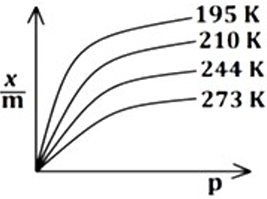
Find the temperature from the following graph at which the highest amount of a gas is adsorbed. (in $K$)
A
$195$
B
$210$
C
$244$
D
$273$
Solution
(A) The graph shows the variation of the extent of adsorption $(x/m)$ with pressure $(p)$ at different temperatures.
Physical adsorption is an exothermic process.
According to Le Chatelier's principle,for an exothermic process,the extent of adsorption decreases with an increase in temperature.
Therefore,the highest amount of gas is adsorbed at the lowest temperature.
From the given graph,the lowest temperature is $195 \ K$.
Physical adsorption is an exothermic process.
According to Le Chatelier's principle,for an exothermic process,the extent of adsorption decreases with an increase in temperature.
Therefore,the highest amount of gas is adsorbed at the lowest temperature.
From the given graph,the lowest temperature is $195 \ K$.
0 likesView Solution
Vedclass Products
For Students
Vedclass Test Series
Mock tests in real MHT CET style covering Chemistry with performance analysis. 5-day free trial.
Start Free TrialFor Teachers
Exam Paper Generator
Generate Set A/B/C/D Chemistry papers from 7.5L+ questions in 2 minutes. 3 chapters free.
Try FreeFor Institutes
Online Exam Module
Run live MHT CET mock exams with unlimited students, 360° analytics & white-label branding.
See DemoFrequently Asked Questions
How many Chemistry questions are in MHT CET 2025?
There are 843 Chemistry questions from the MHT CET 2025 paper on Vedclass, each with a detailed step-by-step solution in English.
Are MHT CET 2025 Chemistry solutions available in English?
Yes. All solutions on this page are in English. You can also switch to English or Hindi using the language buttons above the questions.
Can I practice MHT CET 2025 Chemistry as a timed test?
Yes. Use the Vedclass Test Series to attempt a full MHT CET mock test covering Chemistry with time limits and instant score analysis.
Can teachers create Chemistry papers from MHT CET previous year questions?
Yes. The Vedclass Exam Paper Generator lets teachers mix MHT CET Chemistry questions and generate Set A/B/C/D papers in minutes.
For Teachers & Institutes
Build a Custom Chemistry Paper
Pick MHT CET 2025 Chemistry questions, set difficulty, and generate Set A/B/C/D in 2 minutes.