
BiologyQ1–48 of 48 questions
Page 1 of 1 · English
1
BiologyEasyMCQKCET · 2020
Identify the event in meiosis mediated by the enzyme recombinase.
A
Interkinesis
B
Synaptic pairing
C
Terminalisation
D
Crossing over
Solution
(D) The correct answer is $D$.
Crossing over is the process of exchange of genetic material between non-sister chromatids of homologous chromosomes.
This process occurs during the pachytene stage of prophase-$I$ of meiosis.
It is an enzyme-mediated process,and the enzyme involved in this process is known as recombinase.
Crossing over is the process of exchange of genetic material between non-sister chromatids of homologous chromosomes.
This process occurs during the pachytene stage of prophase-$I$ of meiosis.
It is an enzyme-mediated process,and the enzyme involved in this process is known as recombinase.
0 likesView Solution
2
BiologyEasyMCQKCET · 2020
In $C_4$ plants,the $C_3$ cycle takes place in:
A
bundle sheath cells
B
mesophyll cells
C
bulliform cells
D
companion cells
Solution
(A) The correct answer is $A$.
In $C_3$ plants,the Calvin cycle ($C_3$ cycle) occurs exclusively in the mesophyll cells.
However,in $C_4$ plants,the process is compartmentalized: the initial $CO_2$ fixation occurs in the mesophyll cells to form a $4$-carbon compound,which is then transported to the bundle sheath cells.
Therefore,the $C_3$ cycle (Calvin cycle) takes place specifically in the bundle sheath cells of $C_4$ plants.
In $C_3$ plants,the Calvin cycle ($C_3$ cycle) occurs exclusively in the mesophyll cells.
However,in $C_4$ plants,the process is compartmentalized: the initial $CO_2$ fixation occurs in the mesophyll cells to form a $4$-carbon compound,which is then transported to the bundle sheath cells.
Therefore,the $C_3$ cycle (Calvin cycle) takes place specifically in the bundle sheath cells of $C_4$ plants.
0 likesView Solution
3
BiologyEasyMCQKCET · 2020
Consider the following statements regarding photosynthesis and respiration in plants and select the correct option.
$I$. RuBisCO has high affinity to oxygen in low $CO_2$ concentration.
$II$. The Calvin pathway occurs in the chloroplast of bundle sheath cells of $C_4$ plants.
$III$. Yeast poison themselves when the concentration of alcohol reaches $7\%$.
$IV$. Oxygen is a final hydrogen acceptor during aerobic respiration.
$I$. RuBisCO has high affinity to oxygen in low $CO_2$ concentration.
$II$. The Calvin pathway occurs in the chloroplast of bundle sheath cells of $C_4$ plants.
$III$. Yeast poison themselves when the concentration of alcohol reaches $7\%$.
$IV$. Oxygen is a final hydrogen acceptor during aerobic respiration.
A
Statements $I$ and $IV$ are correct,$III$ is wrong.
B
Statements $II$ and $IV$ are correct,$I$ is wrong.
C
Statements $I$ and $II$ are correct,$IV$ is wrong.
D
Statements $I$ and $II$ are correct,$III$ is wrong.
Solution
(A) The correct option is $A$.
Statement $I$ is correct: RuBisCO has a high affinity for $CO_2$,but it can also bind to $O_2$ when $CO_2$ concentration is low,leading to photorespiration.
Statement $II$ is incorrect: In $C_4$ plants,the Calvin cycle occurs in the chloroplasts of bundle sheath cells,but the statement implies a general rule or is often contrasted with $C_3$ plants where it occurs in mesophyll cells. However,statement $III$ is factually incorrect as per $NCERT$.
Statement $III$ is incorrect: Yeast poisons itself to death when the concentration of alcohol reaches about $13\%$,not $7\%$.
Statement $IV$ is correct: During aerobic respiration,oxygen acts as the final hydrogen acceptor at the end of the electron transport chain to form water.
Statement $I$ is correct: RuBisCO has a high affinity for $CO_2$,but it can also bind to $O_2$ when $CO_2$ concentration is low,leading to photorespiration.
Statement $II$ is incorrect: In $C_4$ plants,the Calvin cycle occurs in the chloroplasts of bundle sheath cells,but the statement implies a general rule or is often contrasted with $C_3$ plants where it occurs in mesophyll cells. However,statement $III$ is factually incorrect as per $NCERT$.
Statement $III$ is incorrect: Yeast poisons itself to death when the concentration of alcohol reaches about $13\%$,not $7\%$.
Statement $IV$ is correct: During aerobic respiration,oxygen acts as the final hydrogen acceptor at the end of the electron transport chain to form water.
0 likesView Solution
4
BiologyEasyMCQKCET · 2020
During the citric acid cycle,various organic acids undergo decarboxylation. Which of the following organic acids of the cycle have $4C$,$5C$,and $6C$ respectively?
A
Pyruvic acid,$\alpha$-Ketoglutaric acid and Citric acid
B
Oxaloacetic acid,Citric acid and Succinic acid
C
Succinic acid,$\alpha$-Ketoglutaric acid and Citric acid
D
Pyruvic acid,Malic acid and $\alpha$-Ketoglutaric acid
Solution
(C) The correct answer is $C$.
In the citric acid cycle (Krebs cycle),the organic acids have different numbers of carbon atoms.
$1$. Succinic acid is a $4C$ organic acid.
$2$. $\alpha$-Ketoglutaric acid is a $5C$ organic acid.
$3$. Citric acid is a $6C$ organic acid.
Therefore,the sequence $4C, 5C, 6C$ corresponds to Succinic acid,$\alpha$-Ketoglutaric acid,and Citric acid respectively.
In the citric acid cycle (Krebs cycle),the organic acids have different numbers of carbon atoms.
$1$. Succinic acid is a $4C$ organic acid.
$2$. $\alpha$-Ketoglutaric acid is a $5C$ organic acid.
$3$. Citric acid is a $6C$ organic acid.
Therefore,the sequence $4C, 5C, 6C$ corresponds to Succinic acid,$\alpha$-Ketoglutaric acid,and Citric acid respectively.
0 likesView Solution
5
BiologyEasyMCQKCET · 2020
Match the different types of leucocytes (Column-$I$) with their percentage of occurrence (Column-$II$) in a healthy adult and choose the correct answer.
| Column-$I$ | Column-$II$ |
|---|---|
| $A$. Neutrophils | $(i)$ $6-8\%$ |
| $B$. Lymphocytes | $(ii)$ $60-65\%$ |
| $C$. Monocytes | $(iii)$ $0.5-1\%$ |
| $D$. Basophils | $(iv)$ $2-3\%$ |
| $E$. Eosinophils | $(v)$ $20-25\%$ |
A
$(A)-(ii); (B)-(v); (C)-(i); (D)-(iii); (E)-(iv)$
B
$(A)-(ii); (B)-(iii); (C)-(iv); (D)-(v); (E)-(i)$
C
$(A)-(iii); (B)-(iv); (C)-(v); (D)-(i); (E)-(ii)$
D
$(A)-(ii); (B)-(v); (C)-(iii); (D)-(iv); (E)-(i)$
Solution
(A) The percentage distribution of different types of leucocytes (WBCs) in the blood of a healthy adult is as follows:
$1$. Neutrophils: $60-65\%$
$2$. Lymphocytes: $20-25\%$
$3$. Monocytes: $6-8\%$
$4$. Eosinophils: $2-3\%$
$5$. Basophils: $0.5-1\%$
Matching these with the given columns:
$A$. Neutrophils $\rightarrow (ii) 60-65\%$
$B$. Lymphocytes $\rightarrow (v) 20-25\%$
$C$. Monocytes $\rightarrow (i) 6-8\%$
$D$. Basophils $\rightarrow (iii) 0.5-1\%$
$E$. Eosinophils $\rightarrow (iv) 2-3\%$
Therefore, the correct matching is $(A)-(ii); (B)-(v); (C)-(i); (D)-(iii); (E)-(iv)$.
$1$. Neutrophils: $60-65\%$
$2$. Lymphocytes: $20-25\%$
$3$. Monocytes: $6-8\%$
$4$. Eosinophils: $2-3\%$
$5$. Basophils: $0.5-1\%$
Matching these with the given columns:
$A$. Neutrophils $\rightarrow (ii) 60-65\%$
$B$. Lymphocytes $\rightarrow (v) 20-25\%$
$C$. Monocytes $\rightarrow (i) 6-8\%$
$D$. Basophils $\rightarrow (iii) 0.5-1\%$
$E$. Eosinophils $\rightarrow (iv) 2-3\%$
Therefore, the correct matching is $(A)-(ii); (B)-(v); (C)-(i); (D)-(iii); (E)-(iv)$.
0 likesView Solution
6
BiologyEasyMCQKCET · 2020
In which part of the human brain is the corpora quadrigemina located?
A
Cerebral hemisphere
B
Forebrain
C
Hindbrain
D
Midbrain
Solution
(D) The correct answer is $D$.
The human brain is divided into three main parts: forebrain,midbrain,and hindbrain.
The midbrain is situated between the thalamus/hypothalamus of the forebrain and the pons of the hindbrain.
The dorsal portion of the midbrain consists mainly of four round swellings (lobes) called corpora quadrigemina.
The human brain is divided into three main parts: forebrain,midbrain,and hindbrain.
The midbrain is situated between the thalamus/hypothalamus of the forebrain and the pons of the hindbrain.
The dorsal portion of the midbrain consists mainly of four round swellings (lobes) called corpora quadrigemina.
0 likesView Solution
7
BiologyEasyMCQKCET · 2020
$A$ girl after attaining sexual maturity shows development of growing ovarian follicles,development of mammary glands,and high pitch of voice. These changes are attributed to . . . . . . hormones.
A
androgens
B
melatonin
C
estrogens
D
progesterone
Solution
(C) estrogens.
Estrogens produce wide-ranging actions such as stimulation of growth and activities of female secondary sex organs,development of growing ovarian follicles,appearance of female secondary sex characters (e.g.,high pitch of voice,etc.),and mammary gland development.
Estrogens also regulate female sexual behavior.
Estrogens produce wide-ranging actions such as stimulation of growth and activities of female secondary sex organs,development of growing ovarian follicles,appearance of female secondary sex characters (e.g.,high pitch of voice,etc.),and mammary gland development.
Estrogens also regulate female sexual behavior.
0 likesView Solution
8
BiologyEasyMCQKCET · 2020
Match the following classes of Fungi (Column $I$) with the examples (Column $II$).
Choose the correct option.
| Column $I$ | Column $II$ |
|---|---|
| $A$. Phycomycetes | $iii$. Albugo |
| $B$. Ascomycetes | $i$. Penicillium |
| $C$. Basidiomycetes | $iv$. Puccinia |
| $D$. Deuteromycetes | $ii$. Alternaria |
Choose the correct option.
A
$(A)-(iii); (B)-(i); (C)-(iv); (D)-(ii)$
B
$(A)-(i); (B)-(iv); (C)-(iii); (D)-(ii)$
C
$(A)-(ii); (B)-(i); (C)-(iv); (D)-(iii)$
D
$(A)-(iii); (B)-(i); (C)-(ii); (D)-(iv)$
Solution
(A) The correct matching is as follows:
$A$. Phycomycetes: $iii$. Albugo (Parasitic fungi on mustard).
$B$. Ascomycetes: $i$. Penicillium (Source of penicillin).
$C$. Basidiomycetes: $iv$. Puccinia (Rust fungus).
$D$. Deuteromycetes: $ii$. Alternaria (Imperfect fungi).
Therefore,the correct sequence is $(A)-(iii); (B)-(i); (C)-(iv); (D)-(ii)$.
$A$. Phycomycetes: $iii$. Albugo (Parasitic fungi on mustard).
$B$. Ascomycetes: $i$. Penicillium (Source of penicillin).
$C$. Basidiomycetes: $iv$. Puccinia (Rust fungus).
$D$. Deuteromycetes: $ii$. Alternaria (Imperfect fungi).
Therefore,the correct sequence is $(A)-(iii); (B)-(i); (C)-(iv); (D)-(ii)$.
0 likesView Solution
9
BiologyEasyMCQKCET · 2020
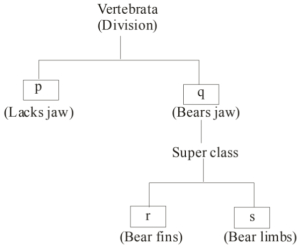
Observe the following simplified scheme of the division $Vertebrata$ and choose the correct option that matches with the letters given in the boxes.
$Vertebrata$ (Division)
- $p$ (Lacks jaw)
- $q$ (Bears jaw)
- Super class
- $r$ (Bear fins)
- $s$ (Bear limbs)
$Vertebrata$ (Division)
- $p$ (Lacks jaw)
- $q$ (Bears jaw)
- Super class
- $r$ (Bear fins)
- $s$ (Bear limbs)
A
$p$-Agnatha,$q$-Gnathostomata,$r$-Tetrapoda,$s$-Pisces.
B
$p$-Agnatha,$q$-Gnathostomata,$r$-Pisces,$s$-Tetrapoda.
C
$p$-Gnathostomata,$q$-Agnatha,$r$-Tetrapoda,$s$-Pisces.
D
$p$-Tetrapoda,$q$-Pisces,$r$-Gnathostomata,$s$-Agnatha.
Solution
(B) The division $Vertebrata$ is classified based on the presence or absence of jaws into two groups:
$1$. $Agnatha$: These are jawless vertebrates. Thus,$p$ corresponds to $Agnatha$.
$2$. $Gnathostomata$: These are jawed vertebrates. Thus,$q$ corresponds to $Gnathostomata$.
$Gnathostomata$ is further divided into two superclasses based on the presence of fins or limbs:
$1$. $Pisces$: These are aquatic vertebrates that bear fins for locomotion. Thus,$r$ corresponds to $Pisces$.
$2$. $Tetrapoda$: These are terrestrial vertebrates that bear limbs for locomotion. Thus,$s$ corresponds to $Tetrapoda$.
Therefore,the correct matching is $p$-Agnatha,$q$-Gnathostomata,$r$-Pisces,$s$-Tetrapoda.
$1$. $Agnatha$: These are jawless vertebrates. Thus,$p$ corresponds to $Agnatha$.
$2$. $Gnathostomata$: These are jawed vertebrates. Thus,$q$ corresponds to $Gnathostomata$.
$Gnathostomata$ is further divided into two superclasses based on the presence of fins or limbs:
$1$. $Pisces$: These are aquatic vertebrates that bear fins for locomotion. Thus,$r$ corresponds to $Pisces$.
$2$. $Tetrapoda$: These are terrestrial vertebrates that bear limbs for locomotion. Thus,$s$ corresponds to $Tetrapoda$.
Therefore,the correct matching is $p$-Agnatha,$q$-Gnathostomata,$r$-Pisces,$s$-Tetrapoda.
0 likesView Solution
10
BiologyEasyMCQKCET · 2020
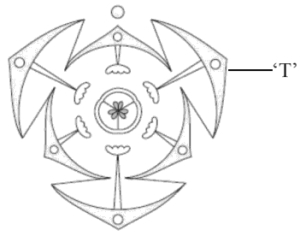
Identify the floral unit '$T$' in the given floral diagram.
A
Perianth
B
Sepal
C
Petal
D
Tepal
Solution
(D) The correct answer is $(D)$ Tepal.
The provided floral diagram represents the family Liliaceae,specifically the genus $Allium$ ($Allium$ $cepa$).
In this family,the calyx and corolla are not distinct,and the floral unit is collectively known as the perianth.
Each individual member of the perianth is referred to as a tepal.
Therefore,'$T$' points to a tepal.
The provided floral diagram represents the family Liliaceae,specifically the genus $Allium$ ($Allium$ $cepa$).
In this family,the calyx and corolla are not distinct,and the floral unit is collectively known as the perianth.
Each individual member of the perianth is referred to as a tepal.
Therefore,'$T$' points to a tepal.
0 likesView Solution
11
BiologyEasyMCQKCET · 2020
$A$ student observed grass and $Hibiscus$ plants in his garden during noon. To his surprise,only the leaves of grass were found rolled inwards. The reason could be
A
due to higher rate of transpiration
B
presence of more number of stomata on the grass leaves
C
undifferentiated mesophyll in grass leaves
D
presence of bulliform cells in the grass leaves
Solution
(D) - presence of bulliform cells in the grass leaves.
In grasses,certain adaxial epidermal cells along the veins modify themselves into large,empty,colourless cells. These are called bulliform cells.
When the bulliform cells in the leaves have absorbed water and are turgid,the leaf surface is exposed.
When they are flaccid due to water stress,they make the leaves curl inwards to minimise water loss.
In grasses,certain adaxial epidermal cells along the veins modify themselves into large,empty,colourless cells. These are called bulliform cells.
When the bulliform cells in the leaves have absorbed water and are turgid,the leaf surface is exposed.
When they are flaccid due to water stress,they make the leaves curl inwards to minimise water loss.
0 likesView Solution
12
BiologyEasyMCQKCET · 2020
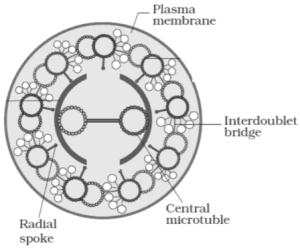
In the diagram below,identify the part which connects the peripheral microtubules to the central sheath.
A
Radial spoke
B
Plasma membrane
C
Interdoublet bridge
D
Central microtubule
Solution
(A) The correct answer is $(A)$ Radial spoke.
In the structure of cilia and flagella,the axoneme consists of a $9+2$ arrangement of microtubules.
The peripheral microtubule doublets are connected to the central sheath,which surrounds the two central microtubules,by structures known as radial spokes.
There are $9$ radial spokes in total,one extending from each peripheral doublet to the central sheath.
In the structure of cilia and flagella,the axoneme consists of a $9+2$ arrangement of microtubules.
The peripheral microtubule doublets are connected to the central sheath,which surrounds the two central microtubules,by structures known as radial spokes.
There are $9$ radial spokes in total,one extending from each peripheral doublet to the central sheath.
0 likesView Solution
13
BiologyEasyMCQKCET · 2020
The element whose percentage weight is highest in both earth's crust and human body is
A
calcium
B
hydrogen
C
carbon
D
oxygen
Solution
(D) The correct answer is $D$ (oxygen).
Oxygen is the most abundant element by weight in the Earth's crust,accounting for approximately $46.6\%$ of its total mass.
Similarly,in the human body,oxygen is the most abundant element,making up about $65\%$ of the total body mass.
Oxygen is the most abundant element by weight in the Earth's crust,accounting for approximately $46.6\%$ of its total mass.
Similarly,in the human body,oxygen is the most abundant element,making up about $65\%$ of the total body mass.
0 likesView Solution
14
BiologyMediumMCQKCET · 2020
Which one of the following is not included under in situ conservation?
A
National park
B
Sanctuary
C
Botanical garden
D
Biosphere reserve
Solution
(C) In situ conservation refers to the conservation of species within their natural habitats.
This approach involves the protection and management of important components of biological diversity through a network of protected areas,such as National Parks,Wildlife Sanctuaries,and Biosphere Reserves.
Botanical gardens,on the other hand,are examples of ex situ conservation,where species are maintained outside their natural habitats.
This approach involves the protection and management of important components of biological diversity through a network of protected areas,such as National Parks,Wildlife Sanctuaries,and Biosphere Reserves.
Botanical gardens,on the other hand,are examples of ex situ conservation,where species are maintained outside their natural habitats.
0 likesView Solution
15
BiologyEasyMCQKCET · 2020
Identify the mismatch.
A
$PEN$ - Triploid
B
Antipodals - Haploid
C
Zygote - Diploid
D
Synergids - Diploid
Solution
(D) is the mismatch because synergids are haploid,not diploid.
$1$. The female gametophyte (embryo sac) consists of cells that are haploid $(n)$,including the egg cell,synergids,and antipodal cells.
$2$. The Zygote is formed by the fusion of a male gamete $(n)$ and an egg cell $(n)$,making it diploid $(2n)$.
$3$. The Primary Endosperm Nucleus $(PEN)$ is formed by the fusion of two polar nuclei $(n+n)$ and one male gamete $(n)$,resulting in a triploid $(3n)$ structure.
$1$. The female gametophyte (embryo sac) consists of cells that are haploid $(n)$,including the egg cell,synergids,and antipodal cells.
$2$. The Zygote is formed by the fusion of a male gamete $(n)$ and an egg cell $(n)$,making it diploid $(2n)$.
$3$. The Primary Endosperm Nucleus $(PEN)$ is formed by the fusion of two polar nuclei $(n+n)$ and one male gamete $(n)$,resulting in a triploid $(3n)$ structure.
0 likesView Solution
16
BiologyEasyMCQKCET · 2020
In apple,the chromosome number of gametes is $17$. What is the chromosome number in its Primary Endosperm Nucleus $(PEN)$?
A
$51$
B
$34$
C
$68$
D
$17$
Solution
(A) The correct answer is $A-51$.
In flowering plants,the gametes are haploid $(n)$. Given that the chromosome number of gametes in apple is $n = 17$.
The Primary Endosperm Nucleus $(PEN)$ is formed by the fusion of two polar nuclei $(n + n)$ and one male gamete $(n)$,making it triploid $(3n)$.
Therefore,the chromosome number in the $PEN$ is $3 \times 17 = 51$.
In flowering plants,the gametes are haploid $(n)$. Given that the chromosome number of gametes in apple is $n = 17$.
The Primary Endosperm Nucleus $(PEN)$ is formed by the fusion of two polar nuclei $(n + n)$ and one male gamete $(n)$,making it triploid $(3n)$.
Therefore,the chromosome number in the $PEN$ is $3 \times 17 = 51$.
0 likesView Solution
17
BiologyEasyMCQKCET · 2020
During an excavation of soil,pollen fossils were retrieved from the deepest layer of soil. The pollen grains remained as fossils because
A
pollen grains are asexual reproductive structures
B
the intine of pollen grains is made up of pectin
C
exine has spiny ornamentation
D
the exine of pollen grains is highly resistant to enzyme action
Solution
(D) The exine of pollen grains is highly resistant to enzyme action.
Pollen grains possess a prominent two-layered wall. The hard outer layer,known as the exine,is composed of sporopollenin,which is one of the most resistant organic materials known to science.
It can withstand high temperatures,strong acids,and strong alkalis.
To date,no enzyme has been discovered that can degrade sporopollenin. This unique chemical property allows pollen grains to be well-preserved as fossils over long periods.
Pollen grains possess a prominent two-layered wall. The hard outer layer,known as the exine,is composed of sporopollenin,which is one of the most resistant organic materials known to science.
It can withstand high temperatures,strong acids,and strong alkalis.
To date,no enzyme has been discovered that can degrade sporopollenin. This unique chemical property allows pollen grains to be well-preserved as fossils over long periods.
0 likesView Solution
18
BiologyEasyMCQKCET · 2020
In $RNA$ interference,the $dsRNA$ molecule prevents . . . . . . .
A
aminoacylation
B
transcription of $mRNA$
C
transport of $RNA$ from nucleus to cytoplasm
D
translation of $mRNA$
Solution
(D) $RNA$ interference $(RNAi)$ is a method of cellular defense in eukaryotes.
In this process,a double-stranded $RNA$ $(dsRNA)$ molecule is introduced,which is complementary to the target $mRNA$.
This $dsRNA$ binds to the specific $mRNA$ and silences it by preventing its translation into protein.
Therefore,the correct answer is $D$.
In this process,a double-stranded $RNA$ $(dsRNA)$ molecule is introduced,which is complementary to the target $mRNA$.
This $dsRNA$ binds to the specific $mRNA$ and silences it by preventing its translation into protein.
Therefore,the correct answer is $D$.
0 likesView Solution
19
BiologyEasyMCQKCET · 2020
Nowadays,the early diagnosis of bacterial or viral infections in humans is possible using:
A
$CT$ Scan
B
Serum analyser
C
$DNA$ sequencer
D
$PCR$
Solution
(D) $PCR$.
Polymerase Chain Reaction $(PCR)$ is a molecular biology technique that allows for the amplification and detection of very small amounts of $DNA$.
Because $PCR$ can amplify specific sequences of pathogen $DNA$ or $RNA$ (via reverse transcription),it enables the detection of disease-causing bacteria or viruses long before the symptoms of the disease appear in the patient.
This capability makes $PCR$ a powerful tool for early diagnosis and timely treatment.
Currently,$PCR$ is widely used to detect gene mutations in patients suspected of having cancer and to identify $HIV$ in patients suspected of having $AIDS$.
Polymerase Chain Reaction $(PCR)$ is a molecular biology technique that allows for the amplification and detection of very small amounts of $DNA$.
Because $PCR$ can amplify specific sequences of pathogen $DNA$ or $RNA$ (via reverse transcription),it enables the detection of disease-causing bacteria or viruses long before the symptoms of the disease appear in the patient.
This capability makes $PCR$ a powerful tool for early diagnosis and timely treatment.
Currently,$PCR$ is widely used to detect gene mutations in patients suspected of having cancer and to identify $HIV$ in patients suspected of having $AIDS$.
0 likesView Solution
20
BiologyEasyMCQKCET · 2020
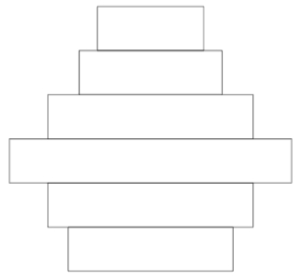
The shape of the pyramids reflects the growth status of the population. Identify the type of age pyramid represented below for human population.
A
Declining
B
Expanding
C
Ascending
D
Stable
Solution
(A) The correct answer is $A$ (Declining).
The age pyramid shown in the image represents a declining population.
In this type of pyramid,the proportion of pre-reproductive individuals (at the base) is smaller than the proportion of reproductive and post-reproductive individuals.
This indicates that the birth rate is low and the population is shrinking over time.
The age pyramid shown in the image represents a declining population.
In this type of pyramid,the proportion of pre-reproductive individuals (at the base) is smaller than the proportion of reproductive and post-reproductive individuals.
This indicates that the birth rate is low and the population is shrinking over time.
0 likesView Solution
21
BiologyEasyMCQKCET · 2020
In the following equation of Verhulst-Pearl logistic growth,the letter '$r$' denotes . . . . . .
$\frac{ dN }{ dt }= rN \left[\frac{ K - N }{ K }\right]$
$\frac{ dN }{ dt }= rN \left[\frac{ K - N }{ K }\right]$
A
Population density
B
Extrinsic rate of natural increase
C
Intrinsic rate of natural increase
D
Carrying capacity
Solution
(C) The correct option is $C$.
In the Verhulst-Pearl logistic growth equation,$\frac{ dN }{ dt }= rN \left[\frac{ K - N }{ K }\right]$,the variables are defined as follows:
$N$ represents the population density at time $t$.
$r$ represents the intrinsic rate of natural increase.
$K$ represents the carrying capacity of the environment.
Therefore,the letter '$r$' denotes the intrinsic rate of natural increase.
In the Verhulst-Pearl logistic growth equation,$\frac{ dN }{ dt }= rN \left[\frac{ K - N }{ K }\right]$,the variables are defined as follows:
$N$ represents the population density at time $t$.
$r$ represents the intrinsic rate of natural increase.
$K$ represents the carrying capacity of the environment.
Therefore,the letter '$r$' denotes the intrinsic rate of natural increase.
0 likesView Solution
22
BiologyEasyMCQKCET · 2020
Identify the possible link '$M$' in the following food chain.
Plant $\rightarrow$ Insect $\rightarrow$ $M$ $\rightarrow$ Snake $\rightarrow$ Eagle
Plant $\rightarrow$ Insect $\rightarrow$ $M$ $\rightarrow$ Snake $\rightarrow$ Eagle
A
Ichthyophis
B
Rabbit
C
Wolf
D
Frog
Solution
(D) The correct answer is $D$ (Frog).
In the given food chain,the plant acts as the primary producer.
The insect acts as the primary consumer (herbivore) that feeds on the plant.
The link '$M$' represents the secondary consumer,which feeds on the insect.
$A$ frog is a common secondary consumer that feeds on insects and is subsequently preyed upon by snakes (tertiary consumers).
Therefore,the frog fits perfectly as the link '$M$' in this food chain.
In the given food chain,the plant acts as the primary producer.
The insect acts as the primary consumer (herbivore) that feeds on the plant.
The link '$M$' represents the secondary consumer,which feeds on the insect.
$A$ frog is a common secondary consumer that feeds on insects and is subsequently preyed upon by snakes (tertiary consumers).
Therefore,the frog fits perfectly as the link '$M$' in this food chain.
0 likesView Solution
23
BiologyEasyMCQKCET · 2020
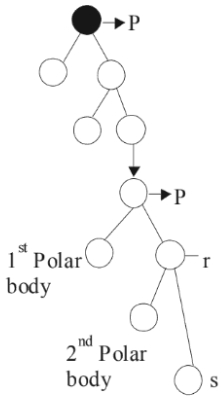
Identify the cells represented as $p$,$q$,$r$,and $s$ in the schematic representation of Oogenesis shown below and choose the correct option.
A
$p$ - Oogonia,$q$ - Primary oocyte,$r$ - Secondary oocyte,$s$ - Ovum
B
$p$ - Ovum,$q$ - Oogonia,$r$ - Primary oocyte,$s$ - Secondary oocyte
C
$p$ - Secondary oocyte,$q$ - Primary oocyte,$r$ - Ovum,$s$ - Oogonia
D
$p$ - Ovum,$q$ - Secondary oocyte,$r$ - Primary oocyte,$s$ - Ovum
Solution
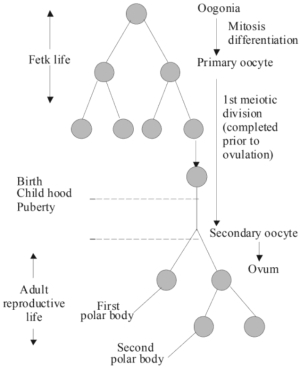
(A) The process of Oogenesis begins with the multiplication of Oogonia $(p)$ in the fetal ovary.
These Oogonia undergo differentiation to form Primary oocytes $(q)$.
The Primary oocyte completes the first meiotic division to form a large Secondary oocyte $(r)$ and a small first polar body.
The Secondary oocyte then undergoes the second meiotic division to form a large Ovum $(s)$ and a second polar body.
Therefore,the correct sequence is $p$ - Oogonia,$q$ - Primary oocyte,$r$ - Secondary oocyte,$s$ - Ovum.
These Oogonia undergo differentiation to form Primary oocytes $(q)$.
The Primary oocyte completes the first meiotic division to form a large Secondary oocyte $(r)$ and a small first polar body.
The Secondary oocyte then undergoes the second meiotic division to form a large Ovum $(s)$ and a second polar body.
Therefore,the correct sequence is $p$ - Oogonia,$q$ - Primary oocyte,$r$ - Secondary oocyte,$s$ - Ovum.
0 likesView Solution
24
BiologyEasyMCQKCET · 2020
Match the months listed in Column $I$ with the organogenesis of the foetus in Column $II$.
| Column $I$ | Column $II$ |
| $(A)$ First month | $(i)$ Separation of eyelids |
| $(B)$ Second month | $(ii)$ Hairs on head |
| $(C)$ Fifth month | $(iii)$ Heart |
| $(D)$ Sixth month | $(iv)$ Limbs and digits |
A
$A-iii, B-iv, C-ii, D-i$
B
$A-iii, B-iv, C-i, D-ii$
C
$A-ii, B-iii, C-iv, D-i$
D
$A-iv, B-ii, C-iii, D-i$
Solution
(A) The correct matching is as follows:
$(A)$ First month: The first sign of growing foetus is usually noticed by listening to the heart sound carefully through the stethoscope. Thus,$(A-iii)$.
$(B)$ Second month: By the end of the second month of pregnancy,the foetus develops limbs and digits. Thus,$(B-iv)$.
$(C)$ Fifth month: The first movements of the foetus and appearance of hair on the head are usually observed during the fifth month. Thus,$(C-ii)$.
$(D)$ Sixth month: By the end of $24$ weeks (second trimester),the body is covered with fine hair,eye-lids separate,and eyelashes are formed. Thus,$(D-i)$.
Therefore,the correct sequence is $A-iii, B-iv, C-ii, D-i$.
$(A)$ First month: The first sign of growing foetus is usually noticed by listening to the heart sound carefully through the stethoscope. Thus,$(A-iii)$.
$(B)$ Second month: By the end of the second month of pregnancy,the foetus develops limbs and digits. Thus,$(B-iv)$.
$(C)$ Fifth month: The first movements of the foetus and appearance of hair on the head are usually observed during the fifth month. Thus,$(C-ii)$.
$(D)$ Sixth month: By the end of $24$ weeks (second trimester),the body is covered with fine hair,eye-lids separate,and eyelashes are formed. Thus,$(D-i)$.
Therefore,the correct sequence is $A-iii, B-iv, C-ii, D-i$.
0 likesView Solution
25
BiologyEasyMCQKCET · 2020
When the fallopian tube is blocked at the ampullary region,the ovum fails to move from:
A
infundibulum to isthmus
B
isthmus to infundibulum
C
ovary to ampulla
D
isthmus to uterus
Solution
(A) The correct answer is $A$.
After ovulation,the ovum is captured by the fimbriae of the infundibulum.
From the infundibulum,the ovum moves towards the ampulla,which is the site of fertilization.
From the ampulla,it proceeds towards the isthmus.
If the fallopian tube is blocked at the ampullary region,the ovum cannot pass from the infundibulum to the isthmus.
After ovulation,the ovum is captured by the fimbriae of the infundibulum.
From the infundibulum,the ovum moves towards the ampulla,which is the site of fertilization.
From the ampulla,it proceeds towards the isthmus.
If the fallopian tube is blocked at the ampullary region,the ovum cannot pass from the infundibulum to the isthmus.
0 likesView Solution
26
BiologyEasyMCQKCET · 2020
Which of the following contraceptives could be effective in avoiding pregnancy if used within $72$ hours after casual unprotected intercourse?
A
Progestogen - Estrogen combination
B
Androgen - $FSH$ combination
C
Testosterone - Relaxin combination
D
Relaxin - Oxytocin combination
Solution
(A) The correct answer is $A$.
Administration of progestogens or progestogen-estrogen combinations within $72$ hours of coitus has been found to be very effective as emergency contraceptives.
These are used to avoid possible pregnancy resulting from rape or casual unprotected intercourse.
Administration of progestogens or progestogen-estrogen combinations within $72$ hours of coitus has been found to be very effective as emergency contraceptives.
These are used to avoid possible pregnancy resulting from rape or casual unprotected intercourse.
0 likesView Solution
27
BiologyEasyMCQKCET · 2020
Choose the correct statements regarding the $GIFT$ ($Gamete$ $Intrafallopian$ $Transfer$) procedure.
A
Ova are collected from a female donor and are transferred to the uterus of recipient.
B
Ova collected from a female donor are transferred to the fallopian tube to facilitate zygote formation in the recipient.
C
Zygote is collected from female donor and transferred to the fallopian tube to facilitate zygote formation in the recipient.
D
Zygote is collected from a female donor and transferred to the uterus of recipient.
Solution
(B) $GIFT$ ($Gamete$ $Intrafallopian$ $Transfer$) is a technique used for females who cannot produce or release viable ova but possess a healthy environment for fertilization and embryonic development.
In this procedure,ova are collected from a donor female and transferred into the fallopian tube of the recipient.
This allows fertilization to occur naturally within the body ($in$ $vivo$) of the recipient.
Therefore,option $B$ is the correct statement.
In this procedure,ova are collected from a donor female and transferred into the fallopian tube of the recipient.
This allows fertilization to occur naturally within the body ($in$ $vivo$) of the recipient.
Therefore,option $B$ is the correct statement.
0 likesView Solution
28
BiologyEasyMCQKCET · 2020
$A$ man with blood group $A$ marries a woman having blood group $B$. The maximum possible blood groups among their progenies are
A
$A, B, AB, O$
B
$AB$ only
C
$A, B, AB$
D
$A, B$
Solution
(A) The inheritance of $ABO$ blood groups is controlled by the gene $I$. The gene $I$ has three alleles: $I^A, I^B,$ and $i$.
If the man is heterozygous $(I^Ai)$ and the woman is heterozygous $(I^Bi)$,the cross is $I^Ai \times I^Bi$.
The possible genotypes of the offspring are $I^AI^B$ (blood group $AB$),$I^Ai$ (blood group $A$),$I^Bi$ (blood group $B$),and $ii$ (blood group $O$).
Therefore,the maximum possible blood groups among their children are $A, B, AB,$ and $O$.
If the man is heterozygous $(I^Ai)$ and the woman is heterozygous $(I^Bi)$,the cross is $I^Ai \times I^Bi$.
The possible genotypes of the offspring are $I^AI^B$ (blood group $AB$),$I^Ai$ (blood group $A$),$I^Bi$ (blood group $B$),and $ii$ (blood group $O$).
Therefore,the maximum possible blood groups among their children are $A, B, AB,$ and $O$.
0 likesView Solution
29
BiologyEasyMCQKCET · 2020
$A$ pure breeding pea plant with round yellow seeds was crossed with a pea plant having wrinkled green seeds. On selfing of the $F_1$ hybrid of this cross,$64$ progenies were obtained in the $F_2$ generation. Find out the number of $F_2$ progenies showing non-parental characters.
A
$24$
B
$36$
C
$4$
D
$12$
Solution
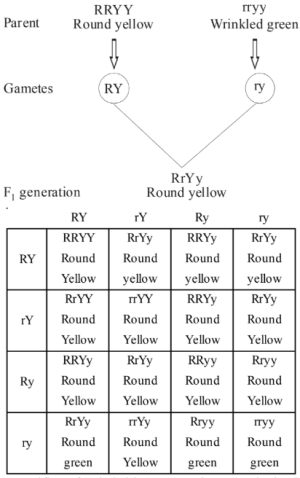
(A) In a dihybrid cross,the phenotypic ratio in the $F_2$ generation is $9:3:3:1$.
The parental combinations are Round-Yellow $(9/16)$ and Wrinkled-Green $(1/16)$.
The non-parental (recombinant) combinations are Round-Green $(3/16)$ and Wrinkled-Yellow $(3/16)$.
Total proportion of non-parental characters = $3/16 + 3/16 = 6/16 = 3/8$.
Given that the total number of $F_2$ progenies is $64$.
Number of non-parental progenies = $(3/8) \times 64 = 3 \times 8 = 24$.
The parental combinations are Round-Yellow $(9/16)$ and Wrinkled-Green $(1/16)$.
The non-parental (recombinant) combinations are Round-Green $(3/16)$ and Wrinkled-Yellow $(3/16)$.
Total proportion of non-parental characters = $3/16 + 3/16 = 6/16 = 3/8$.
Given that the total number of $F_2$ progenies is $64$.
Number of non-parental progenies = $(3/8) \times 64 = 3 \times 8 = 24$.
0 likesView Solution
30
BiologyEasyMCQKCET · 2020
Which of the following characters was not studied by Mendel in his pea plant experiments?
A
Leaf shape
B
Stem height
C
Pod shape
D
Seed shape
Solution
(A) . Leaf shape
Mendel studied $7$ pairs of contrasting characters in pea plants. Leaf shape was not one of them. The characters studied by Mendel are summarized below:
Mendel studied $7$ pairs of contrasting characters in pea plants. Leaf shape was not one of them. The characters studied by Mendel are summarized below:
| $S. No.$ | Character | Dominant Trait | Recessive Trait |
| $1.$ | Plant height | Tall | Dwarf |
| $2.$ | Flower colour | Purple | White |
| $3.$ | Flower position | Axial | Terminal |
| $4.$ | Pod shape | Inflated | Constricted |
| $5.$ | Pod colour | Green | Yellow |
| $6.$ | Seed shape | Round | Wrinkled |
| $7.$ | Seed colour | Yellow | Green |
0 likesView Solution
31
BiologyEasyMCQKCET · 2020
In an organism,mutation in a single gene exhibits multiple phenotypic expressions. Identify the underlying genetic mechanism in the above instance.
A
Multiple allelism
B
Pleiotropy
C
Incomplete dominance
D
Polygenic inheritance
Solution
(B) Pleiotropy.
When a single gene influences multiple phenotypic traits that are often unrelated,it is known as pleiotropy.
For instance,in pea plants,the gene that controls seed coat color also influences the color of flowers and the presence of pigmentation on the leaves.
Therefore,a single gene mutation results in multiple phenotypic expressions.
When a single gene influences multiple phenotypic traits that are often unrelated,it is known as pleiotropy.
For instance,in pea plants,the gene that controls seed coat color also influences the color of flowers and the presence of pigmentation on the leaves.
Therefore,a single gene mutation results in multiple phenotypic expressions.
0 likesView Solution
32
BiologyEasyMCQKCET · 2020
When $Escherichia$ $coli$ cells are cultured in a medium where $Lactose$ is absent,the $i$ gene of $Lac$ $Operon$ continues to produce repressor $mRNA$,because it is:
A
a structural gene
B
a non-coding gene
C
an operator gene
D
a constitutive gene
Solution
(D) is the correct answer.
In the $Lac$ $Operon$,the $i$ gene is a constitutive gene.
Constitutive genes are expressed continuously at a constant rate in a cell,regardless of the environmental conditions or the presence of substrates like $Lactose$.
The $i$ gene produces the repressor protein,which regulates the expression of the structural genes $(z, y, a)$ by binding to the operator region.
Since it is constitutive,it does not require an inducer to be transcribed,ensuring that the repressor protein is always available to keep the operon switched off in the absence of $Lactose$.
In the $Lac$ $Operon$,the $i$ gene is a constitutive gene.
Constitutive genes are expressed continuously at a constant rate in a cell,regardless of the environmental conditions or the presence of substrates like $Lactose$.
The $i$ gene produces the repressor protein,which regulates the expression of the structural genes $(z, y, a)$ by binding to the operator region.
Since it is constitutive,it does not require an inducer to be transcribed,ensuring that the repressor protein is always available to keep the operon switched off in the absence of $Lactose$.
0 likesView Solution
33
BiologyEasyMCQKCET · 2020
The length of $DNA$ helix in a typical nucleosome is
A
$6.6 \times 10^9$ bp
B
$200$ bp
C
$1000$ bp
D
$3.2 \times 10^6$ bp
Solution
(B) The correct answer is $B$.
In a typical nucleosome,the $DNA$ helix is wrapped around a histone octamer.
This structure consists of approximately $200$ base pairs $(bp)$ of $DNA$.
In a typical nucleosome,the $DNA$ helix is wrapped around a histone octamer.
This structure consists of approximately $200$ base pairs $(bp)$ of $DNA$.
0 likesView Solution
34
BiologyEasyMCQKCET · 2020
For the given sequence of $DNA$,identify the complementary sequence of bases on its $mRNA$ from the options given below.
$DNA$ $3'-ATGCATGCATGC-5'$
$DNA$ $3'-ATGCATGCATGC-5'$
A
$5'-GCATGCATGCAT-3'$
B
$5'-UACGUACGUACG-3'$
C
$5'-TACGTACGTACG-3'$
D
$3'-UACGUACGUACG-5'$
Solution
(B) The process of transcription involves the synthesis of $mRNA$ from a $DNA$ template strand.
During this process,the base pairing rules are: $A$ (Adenine) pairs with $U$ (Uracil),$T$ (Thymine) pairs with $A$ (Adenine),$G$ (Guanine) pairs with $C$ (Cytosine),and $C$ (Cytosine) pairs with $G$ (Guanine).
Given $DNA$ template: $3'-ATGCATGCATGC-5'$.
Applying the base pairing rules:
$A \rightarrow U$
$T \rightarrow A$
$G \rightarrow C$
$C \rightarrow G$
Thus,the complementary $mRNA$ sequence is $5'-UACGUACGUACG-3'$.
Therefore,the correct option is $(B)$.
During this process,the base pairing rules are: $A$ (Adenine) pairs with $U$ (Uracil),$T$ (Thymine) pairs with $A$ (Adenine),$G$ (Guanine) pairs with $C$ (Cytosine),and $C$ (Cytosine) pairs with $G$ (Guanine).
Given $DNA$ template: $3'-ATGCATGCATGC-5'$.
Applying the base pairing rules:
$A \rightarrow U$
$T \rightarrow A$
$G \rightarrow C$
$C \rightarrow G$
Thus,the complementary $mRNA$ sequence is $5'-UACGUACGUACG-3'$.
Therefore,the correct option is $(B)$.
0 likesView Solution
35
BiologyEasyMCQKCET · 2020
In eukaryotes,the entire base sequence of a gene does not appear in mature $RNA$ because
A
some gene sequences are removed by exonuclease
B
transcription in eukaryotes consumes more energy.
C
coding sequences are removed during process.
D
introns are removed during processing.
Solution
(D) The correct answer is $D$.
In eukaryotic cells,the primary transcript (pre-mRNA) contains both coding sequences called exons and non-coding sequences called introns.
During the process of $RNA$ processing or post-transcriptional modification,the non-coding introns are removed,and the exons are joined together in a specific order.
This process is known as splicing,which results in the formation of mature,functional mRNA.
In eukaryotic cells,the primary transcript (pre-mRNA) contains both coding sequences called exons and non-coding sequences called introns.
During the process of $RNA$ processing or post-transcriptional modification,the non-coding introns are removed,and the exons are joined together in a specific order.
This process is known as splicing,which results in the formation of mature,functional mRNA.
0 likesView Solution
36
BiologyEasyMCQKCET · 2020
Which of the following types of $RNA$ carries amino acids towards the ribosome during translation?
A
mRNA
B
rRNA
C
dsRNA
D
tRNA
Solution
(D) $tRNA$.
Transfer $RNA$ $(tRNA)$ acts as an adapter molecule.
It has an anticodon loop that base pairs with the codon on $mRNA$ and a $3'$ acceptor end that carries a specific amino acid to the ribosome for protein synthesis.
Transfer $RNA$ $(tRNA)$ acts as an adapter molecule.
It has an anticodon loop that base pairs with the codon on $mRNA$ and a $3'$ acceptor end that carries a specific amino acid to the ribosome for protein synthesis.
0 likesView Solution
37
BiologyEasyMCQKCET · 2020
Which among the following was the biggest land dinosaur?
A
Triceratops
B
Stegosaurus
C
Tyrannosaurus rex
D
Brachiosaurus
Solution
(D) is the correct answer.
$Brachiosaurus$ was one of the largest and tallest land dinosaurs, reaching heights of up to $12-16 \, m$ and weighing significantly more than $Tyrannosaurus \, rex$.
$Tyrannosaurus \, rex$ was a large carnivorous dinosaur, but in terms of overall size and mass among land dinosaurs, $Brachiosaurus$ (a sauropod) is considered much larger.
$Tyrannosaurus \, rex$ stood about $6 \, m$ $(20 \, feet)$ tall and possessed massive, dagger-like teeth.
Dinosaurs disappeared from the earth approximately $65 \, \text{million years ago (mya)}$.
$Brachiosaurus$ was one of the largest and tallest land dinosaurs, reaching heights of up to $12-16 \, m$ and weighing significantly more than $Tyrannosaurus \, rex$.
$Tyrannosaurus \, rex$ was a large carnivorous dinosaur, but in terms of overall size and mass among land dinosaurs, $Brachiosaurus$ (a sauropod) is considered much larger.
$Tyrannosaurus \, rex$ stood about $6 \, m$ $(20 \, feet)$ tall and possessed massive, dagger-like teeth.
Dinosaurs disappeared from the earth approximately $65 \, \text{million years ago (mya)}$.
0 likesView Solution
38
BiologyEasyMCQKCET · 2020
In a population of plants,some were extremely tall,and the remaining were extremely dwarf. No plants of the population showed intermediate height. The type of operation of natural selection in the above case is
A
disruptive
B
balancing
C
directional
D
stabilising
Solution
(A) The correct answer is $A$ (disruptive).
Natural selection can lead to three main outcomes:
$1$. Stabilising selection: In this,more individuals acquire the mean character value,reducing variation.
$2$. Directional selection: In this,more individuals acquire values other than the mean character value,shifting the population towards one extreme.
$3$. Disruptive selection: In this,more individuals acquire peripheral character values at both ends of the distribution curve,while the intermediate (mean) individuals are selected against. Since the population shows only extreme tall and extreme dwarf plants with no intermediate forms,it is a clear case of disruptive selection.
Natural selection can lead to three main outcomes:
$1$. Stabilising selection: In this,more individuals acquire the mean character value,reducing variation.
$2$. Directional selection: In this,more individuals acquire values other than the mean character value,shifting the population towards one extreme.
$3$. Disruptive selection: In this,more individuals acquire peripheral character values at both ends of the distribution curve,while the intermediate (mean) individuals are selected against. Since the population shows only extreme tall and extreme dwarf plants with no intermediate forms,it is a clear case of disruptive selection.
0 likesView Solution
39
BiologyEasyMCQKCET · 2020
Certain tumours are called malignant,because
A
they are not neoplastic
B
they are confined to specific locations
C
they invade and damage surrounding tissues
D
they show contact inhibition
Solution
(C) Malignant tumours are a mass of proliferating cells called neoplastic or tumour cells.
These cells grow very rapidly,invading and damaging the surrounding normal tissues.
Unlike benign tumours,malignant tumours do not remain confined to their original site and can spread to other parts of the body through a process called metastasis.
These cells grow very rapidly,invading and damaging the surrounding normal tissues.
Unlike benign tumours,malignant tumours do not remain confined to their original site and can spread to other parts of the body through a process called metastasis.
0 likesView Solution
40
BiologyEasyMCQKCET · 2020
In the life cycle of $Plasmodium$,fertilization takes place in:
A
liver cells
B
salivary glands of mosquito
C
RBCs of humans
D
stomach of mosquito
Solution
(D) The correct answer is $D$.
In the life cycle of $Plasmodium$,the sexual stage involves the formation of gametocytes in the human host.
These gametocytes are ingested by the female $Anopheles$ mosquito during a blood meal.
Fertilization and the development of the zygote occur within the stomach (midgut) of the mosquito,leading to the formation of an ookinete,which then develops into oocysts.
In the life cycle of $Plasmodium$,the sexual stage involves the formation of gametocytes in the human host.
These gametocytes are ingested by the female $Anopheles$ mosquito during a blood meal.
Fertilization and the development of the zygote occur within the stomach (midgut) of the mosquito,leading to the formation of an ookinete,which then develops into oocysts.
0 likesView Solution
41
BiologyEasyMCQKCET · 2020
The transport of which neurotransmitter is interfered with by cocaine?
A
Dopamine
B
Acetylcholine
C
Serotonin
D
$GABA$
Solution
(A) The correct answer is $A$ (Dopamine).
Cocaine is a coca alkaloid obtained from the coca plant, $Erythroxylum$ $coca$, which is native to South America.
It interferes with the transport of the neurotransmitter dopamine by blocking its reuptake into the presynaptic neuron, leading to an accumulation of dopamine in the synaptic cleft and causing a sense of euphoria.
Cocaine is a coca alkaloid obtained from the coca plant, $Erythroxylum$ $coca$, which is native to South America.
It interferes with the transport of the neurotransmitter dopamine by blocking its reuptake into the presynaptic neuron, leading to an accumulation of dopamine in the synaptic cleft and causing a sense of euphoria.
0 likesView Solution
42
BiologyEasyMCQKCET · 2020
Injection of an antidote against snake-bite is an example of
A
auto immunity
B
innate immunity
C
active immunity
D
passive immunity
Solution
(D) The correct answer is $D$.
Passive immunity is a type of immunity that occurs when ready-made antibodies are introduced directly into the body to provide immediate protection against foreign pathogens or toxins.
In the case of a snake bite,the patient is injected with an antivenom,which contains preformed antibodies specifically designed to neutralize the snake venom.
Since the body's own immune system is not actively involved in producing these antibodies,this process is classified as passive immunization.
Passive immunity is a type of immunity that occurs when ready-made antibodies are introduced directly into the body to provide immediate protection against foreign pathogens or toxins.
In the case of a snake bite,the patient is injected with an antivenom,which contains preformed antibodies specifically designed to neutralize the snake venom.
Since the body's own immune system is not actively involved in producing these antibodies,this process is classified as passive immunization.
0 likesView Solution
43
BiologyEasyMCQKCET · 2020
Ruminant animals can digest cellulose in their food,whereas human beings are unable to do so. This is because
A
methanogens are absent in human gut
B
methanogens are present in human gut
C
cellulose is a complex sugar
D
cellulose reduces the bulk of food
Solution
(A) The correct answer is $A$.
Humans cannot digest cellulose because they lack the specific bacteria known as methanogens in their digestive tract.
These methanogens produce the enzyme cellulase,which is essential for the fermentation and breakdown of cellulose.
Methanogens are anaerobic bacteria that produce large amounts of methane,along with $CO_2$ and $H_2$,during the digestion process.
These bacteria are naturally present in the rumen of ruminant animals (like cattle),where they facilitate the breakdown of cellulose,thereby playing a crucial role in the nutrition of these animals.
Humans cannot digest cellulose because they lack the specific bacteria known as methanogens in their digestive tract.
These methanogens produce the enzyme cellulase,which is essential for the fermentation and breakdown of cellulose.
Methanogens are anaerobic bacteria that produce large amounts of methane,along with $CO_2$ and $H_2$,during the digestion process.
These bacteria are naturally present in the rumen of ruminant animals (like cattle),where they facilitate the breakdown of cellulose,thereby playing a crucial role in the nutrition of these animals.
0 likesView Solution
44
BiologyEasyMCQKCET · 2020
In sewage treatment,secondary treatment is considered highly significant,because
A
it increases the organic content of sewage
B
it helps to remove debris from the sewage
C
it reduces the $BOD$ level of sewage
D
it helps in the production of biogas
Solution
(C) is the correct answer. Secondary treatment is highly significant because it reduces the $BOD$ level of sewage.
Primary treatment involves the physical removal of large and small particles through filtration and sedimentation.
The effluent from primary treatment is then passed into large aeration tanks for secondary treatment (biological treatment).
In these tanks,aerobic microbes consume the major part of the organic matter present in the effluent.
This significant reduction in organic matter leads to a decrease in the Biochemical Oxygen Demand $(BOD)$ of the sewage,making it safer to discharge into water bodies.
Primary treatment involves the physical removal of large and small particles through filtration and sedimentation.
The effluent from primary treatment is then passed into large aeration tanks for secondary treatment (biological treatment).
In these tanks,aerobic microbes consume the major part of the organic matter present in the effluent.
This significant reduction in organic matter leads to a decrease in the Biochemical Oxygen Demand $(BOD)$ of the sewage,making it safer to discharge into water bodies.
0 likesView Solution
45
BiologyEasyMCQKCET · 2020
Suppose $DNA$ samples collected for $DNA$ fingerprinting analysis are less than the required quantity. Which of the following techniques is helpful to make the samples sufficient for above analysis?
A
$DNA$ probing
B
Electrophoresis
C
Chromatography
D
$PCR$
Solution
(D) $PCR$ stands for Polymerase Chain Reaction.
It is a molecular biology technique used to amplify a single copy or a few copies of a segment of $DNA$ across several orders of magnitude,generating thousands to millions of copies of a particular $DNA$ sequence.
In cases where the collected $DNA$ sample is insufficient for analysis like $DNA$ fingerprinting,$PCR$ is used to amplify the available $DNA$ to a sufficient quantity.
It is a molecular biology technique used to amplify a single copy or a few copies of a segment of $DNA$ across several orders of magnitude,generating thousands to millions of copies of a particular $DNA$ sequence.
In cases where the collected $DNA$ sample is insufficient for analysis like $DNA$ fingerprinting,$PCR$ is used to amplify the available $DNA$ to a sufficient quantity.
0 likesView Solution
46
BiologyEasyMCQKCET · 2020
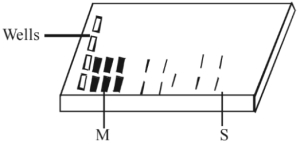
Identify the labels $M$ and $N$ in the following agarose gel electrophoresis representation.
A
$M$-Smallest $DNA$ bands,$N$-Largest $DNA$ bands
B
$M$-Digested $DNA$ bands,$N$-Undigested $DNA$ bands
C
$M$-Hybridised $DNA$ bands,$N$-Unhybridised $DNA$
D
$M$-Largest $DNA$ bands,$N$-Smallest $DNA$ bands
Solution
(D) The correct answer is $D$.
In agarose gel electrophoresis,$DNA$ fragments are separated based on their size.
Since $DNA$ molecules are negatively charged,they move towards the anode $(+)$ when an electric field is applied.
The agarose gel acts as a molecular sieve,allowing smaller fragments to move faster and further through the gel matrix compared to larger fragments.
In the provided diagram,the bands closer to the wells are larger because they move slowly,while the bands further away from the wells are smaller because they move faster.
Therefore,$M$ represents the largest $DNA$ bands (closest to the wells),and $N$ (labeled as $S$ in the diagram) represents the smallest $DNA$ bands (farthest from the wells).
In agarose gel electrophoresis,$DNA$ fragments are separated based on their size.
Since $DNA$ molecules are negatively charged,they move towards the anode $(+)$ when an electric field is applied.
The agarose gel acts as a molecular sieve,allowing smaller fragments to move faster and further through the gel matrix compared to larger fragments.
In the provided diagram,the bands closer to the wells are larger because they move slowly,while the bands further away from the wells are smaller because they move faster.
Therefore,$M$ represents the largest $DNA$ bands (closest to the wells),and $N$ (labeled as $S$ in the diagram) represents the smallest $DNA$ bands (farthest from the wells).
0 likesView Solution
47
BiologyEasyMCQKCET · 2020
Biolistics method is suitable for gene transfer into . . . . . .
A
plant cells
B
viruses
C
animal cells
D
bacteria
Solution
(A) The correct answer is $A$.
Biolistics,also known as the gene gun method,is specifically designed for the transformation of plant cells.
In this technique,microparticles of gold or tungsten coated with foreign $DNA$ are bombarded into the target cells at high velocity.
These particles penetrate the rigid cell walls and membranes of plant cells to deliver the genetic material directly into the cytoplasm or nucleus without causing significant damage to the cell.
Biolistics,also known as the gene gun method,is specifically designed for the transformation of plant cells.
In this technique,microparticles of gold or tungsten coated with foreign $DNA$ are bombarded into the target cells at high velocity.
These particles penetrate the rigid cell walls and membranes of plant cells to deliver the genetic material directly into the cytoplasm or nucleus without causing significant damage to the cell.
0 likesView Solution
48
BiologyEasyMCQKCET · 2020
From the given combination of steps in $PCR$,identify the enzyme-dependent step.
A
Extension only
B
Annealing and extension
C
Annealing and denaturation
D
Denaturation and extension
Solution
(A) The Polymerase Chain Reaction $(PCR)$ consists of three main steps: Denaturation,Annealing,and Extension.
$1$. Denaturation: The double-stranded $DNA$ is heated to high temperatures $(94-98^{\circ}C)$ to separate the strands. This is a physical process,not enzyme-dependent.
$2$. Annealing: Primers bind to the single-stranded $DNA$ template at lower temperatures $(50-65^{\circ}C)$. This is also not enzyme-dependent.
$3$. Extension: The enzyme $Taq$ $DNA$ polymerase adds nucleotides to the primer,extending the new $DNA$ strand. This step is strictly dependent on the activity of the $DNA$ polymerase enzyme.
Therefore,the correct answer is Extension only.
$1$. Denaturation: The double-stranded $DNA$ is heated to high temperatures $(94-98^{\circ}C)$ to separate the strands. This is a physical process,not enzyme-dependent.
$2$. Annealing: Primers bind to the single-stranded $DNA$ template at lower temperatures $(50-65^{\circ}C)$. This is also not enzyme-dependent.
$3$. Extension: The enzyme $Taq$ $DNA$ polymerase adds nucleotides to the primer,extending the new $DNA$ strand. This step is strictly dependent on the activity of the $DNA$ polymerase enzyme.
Therefore,the correct answer is Extension only.
0 likesView Solution
Vedclass Products
For Students
Vedclass Test Series
Mock tests in real KCET style covering Biology with performance analysis. 5-day free trial.
Start Free TrialFor Teachers
Exam Paper Generator
Generate Set A/B/C/D Biology papers from 7.5L+ questions in 2 minutes. 3 chapters free.
Try FreeFor Institutes
Online Exam Module
Run live KCET mock exams with unlimited students, 360° analytics & white-label branding.
See DemoFrequently Asked Questions
How many Biology questions are in KCET 2020?
There are 48 Biology questions from the KCET 2020 paper on Vedclass, each with a detailed step-by-step solution in English.
Are KCET 2020 Biology solutions available in English?
Yes. All solutions on this page are in English. You can also switch to English or Hindi using the language buttons above the questions.
Can I practice KCET 2020 Biology as a timed test?
Yes. Use the Vedclass Test Series to attempt a full KCET mock test covering Biology with time limits and instant score analysis.
Can teachers create Biology papers from KCET previous year questions?
Yes. The Vedclass Exam Paper Generator lets teachers mix KCET Biology questions and generate Set A/B/C/D papers in minutes.
For Teachers & Institutes
Build a Custom Biology Paper
Pick KCET 2020 Biology questions, set difficulty, and generate Set A/B/C/D in 2 minutes.