
Class 12PhysicsDual Nature of Radiation and matterEinstein's Photoelectric Equation and Energy Quantum of Radiation
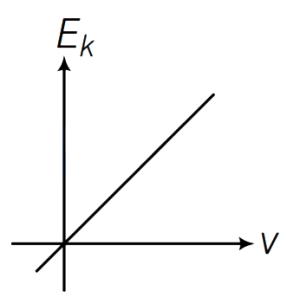
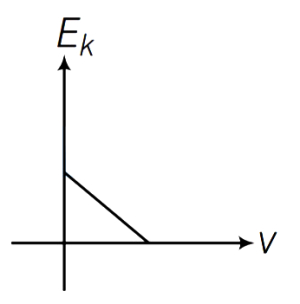
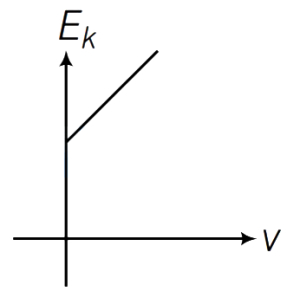
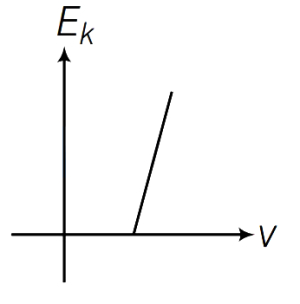
EasyWhich one of the following graphs correctly represents the variation of maximum kinetic energy $(E_{k})$ of the emitted electrons with frequency $(\nu)$ of incident light in the photoelectric effect?
- A
- B
- C
- D
Explore More
Similar Questions
Light source having wavelength $331 \text{ nm}$ is used to generate photo-electrons whose stopping potential is $0.2 \text{ V}$. The work function of the used metal in the experiment is $\alpha \times 10^{-19} \text{ J}$. The value of $\alpha$ is . . . . . . . ($h = 6.62 \times 10^{-34} \text{ J s}$,$e = 1.6 \times 10^{-19} \text{ C}$ and $c = 3 \times 10^8 \text{ m/s}$) (in $.68$)
DifficultJEE MAIN 2026
View SolutionThe maximum velocity of an electron emitted by light of wavelength $\lambda$ incident on the surface of a metal of work function $\phi$ is [$h=$ Planck's constant,$m=$ mass of electron and $c=$ speed of light]
The work function of a metal is $2.1 \text{ eV}$. Which of the following wavelengths will be able to emit photoelectrons from its surface?
Easy
View SolutionLight from a hydrogen discharge tube is incident on the cathode of a photoelectric cell. The work function of the cathode surface is $4.2 \ eV$. In order to reduce the photo-current to zero,the voltage of the anode relative to the cathode must be made ........... $V$.
Medium
View Solution$A$ point source of light is used in a photoelectric effect experiment. If the source is moved farther from the emitting metal, then the stopping potential will
Vedclass Products
For Students
Vedclass Test Series
Mock tests in real JEE/NEET style with performance analysis. 5-day free trial.
Start Free TrialFor Teachers
Exam Paper Generator
Generate Set A/B/C/D exam papers from 7.5L+ questions in 2 minutes. 3 chapters free.
Try FreeFor Institutes
Online Exam Module
Live online exams with unlimited students, 360° analytics & white-label branding.
See Demo