
ChemistryQ101–200 of 459 questions
Page 3 of 5 · English
101
ChemistryDifficultMCQJEE Main · 2026
$A + 2B \rightarrow AB_{2}$. $36.0 \ g$ of '$A$' (Molar mass: $60 \ g \ mol^{-1}$) and $56.0 \ g$ of '$B$' (Molar mass: $80 \ g \ mol^{-1}$) are allowed to react. Which of the following statements are correct?
$(A)$ '$A$' is the limiting reagent
$(B)$ $77.0 \ g$ of $AB_{2}$ is formed
$(C)$ Molar mass of $AB_{2}$ is $220 \ g \ mol^{-1}$
$(D)$ $15.0 \ g$ of '$A$' is left unreacted after the completion of reaction.
Choose the correct answer from the options given below:
$(A)$ '$A$' is the limiting reagent
$(B)$ $77.0 \ g$ of $AB_{2}$ is formed
$(C)$ Molar mass of $AB_{2}$ is $220 \ g \ mol^{-1}$
$(D)$ $15.0 \ g$ of '$A$' is left unreacted after the completion of reaction.
Choose the correct answer from the options given below:
A
$C$ and $D$ only
B
$A$ and $C$ only
C
$B$ and $D$ only
D
$A$ and $B$ only
Solution
(A) $1$. Calculate initial moles:
$n_A = \frac{36.0 \ g}{60 \ g \ mol^{-1}} = 0.6 \ mol$
$n_B = \frac{56.0 \ g}{80 \ g \ mol^{-1}} = 0.7 \ mol$
$2$. Determine limiting reagent:
According to the reaction $A + 2B \rightarrow AB_{2}$,$1 \ mol$ of $A$ requires $2 \ mol$ of $B$.
For $0.6 \ mol$ of $A$,required $B = 0.6 \times 2 = 1.2 \ mol$.
Since we have only $0.7 \ mol$ of $B$,'$B$' is the limiting reagent.
Statement $(A)$ is incorrect.
$3$. Calculate product formed:
$0.7 \ mol$ of $B$ will produce $\frac{0.7}{2} = 0.35 \ mol$ of $AB_{2}$.
Molar mass of $AB_{2} = 60 + (2 \times 80) = 220 \ g \ mol^{-1}$.
Mass of $AB_{2} = 0.35 \ mol \times 220 \ g \ mol^{-1} = 77.0 \ g$.
Statement $(B)$ and $(C)$ are correct.
$4$. Calculate unreacted '$A$':
$B$ is limiting,so $0.7 \ mol$ of $B$ reacts with $\frac{0.7}{2} = 0.35 \ mol$ of $A$.
Remaining moles of $A = 0.6 - 0.35 = 0.25 \ mol$.
Mass of remaining $A = 0.25 \ mol \times 60 \ g \ mol^{-1} = 15.0 \ g$.
Statement $(D)$ is correct.
Thus,statements $(B)$,$(C)$,and $(D)$ are correct. Based on the options provided,$(C)$ and $(D)$ are correct.
$n_A = \frac{36.0 \ g}{60 \ g \ mol^{-1}} = 0.6 \ mol$
$n_B = \frac{56.0 \ g}{80 \ g \ mol^{-1}} = 0.7 \ mol$
$2$. Determine limiting reagent:
According to the reaction $A + 2B \rightarrow AB_{2}$,$1 \ mol$ of $A$ requires $2 \ mol$ of $B$.
For $0.6 \ mol$ of $A$,required $B = 0.6 \times 2 = 1.2 \ mol$.
Since we have only $0.7 \ mol$ of $B$,'$B$' is the limiting reagent.
Statement $(A)$ is incorrect.
$3$. Calculate product formed:
$0.7 \ mol$ of $B$ will produce $\frac{0.7}{2} = 0.35 \ mol$ of $AB_{2}$.
Molar mass of $AB_{2} = 60 + (2 \times 80) = 220 \ g \ mol^{-1}$.
Mass of $AB_{2} = 0.35 \ mol \times 220 \ g \ mol^{-1} = 77.0 \ g$.
Statement $(B)$ and $(C)$ are correct.
$4$. Calculate unreacted '$A$':
$B$ is limiting,so $0.7 \ mol$ of $B$ reacts with $\frac{0.7}{2} = 0.35 \ mol$ of $A$.
Remaining moles of $A = 0.6 - 0.35 = 0.25 \ mol$.
Mass of remaining $A = 0.25 \ mol \times 60 \ g \ mol^{-1} = 15.0 \ g$.
Statement $(D)$ is correct.
Thus,statements $(B)$,$(C)$,and $(D)$ are correct. Based on the options provided,$(C)$ and $(D)$ are correct.
0 likesView Solution
102
ChemistryDifficultMCQJEE Main · 2026
Consider the following reaction sequence:
$CH_3CH_2CH_2CH(Br)CH_2Br + 2NaNH_2 \rightarrow X$
$X \xrightarrow[(ii) (CH_3)_2CHBr]{(i) NaNH_2} Y$
The product $Y$ formed is:
$CH_3CH_2CH_2CH(Br)CH_2Br + 2NaNH_2 \rightarrow X$
$X \xrightarrow[(ii) (CH_3)_2CHBr]{(i) NaNH_2} Y$
The product $Y$ formed is:
A
$2-$methylhex$-2-$yne
B
$5-$methylhex$-2-$yne
C
$2-$methylhex$-3-$yne
D
$5-$methylhex$-3-$yne
Solution
(B) Step $1$: Dehydrohalogenation of $1,2-$dibromopentane with $2NaNH_2$ gives pent$-1-$yne $(X = CH_3CH_2CH_2C \equiv CH)$.
Step $2$: Treatment of pent$-1-$yne with $NaNH_2$ forms the sodium acetylide salt $(CH_3CH_2CH_2C \equiv C^-Na^+)$.
Step $3$: The acetylide ion acts as a nucleophile and attacks isopropyl bromide $((CH_3)_2CHBr)$ via an $S_N2$ mechanism.
$CH_3CH_2CH_2C \equiv C^- + (CH_3)_2CHBr \rightarrow CH_3CH_2CH_2C \equiv C-CH(CH_3)_2$.
The resulting product is $5-$methylhex$-2-$yne.
Step $2$: Treatment of pent$-1-$yne with $NaNH_2$ forms the sodium acetylide salt $(CH_3CH_2CH_2C \equiv C^-Na^+)$.
Step $3$: The acetylide ion acts as a nucleophile and attacks isopropyl bromide $((CH_3)_2CHBr)$ via an $S_N2$ mechanism.
$CH_3CH_2CH_2C \equiv C^- + (CH_3)_2CHBr \rightarrow CH_3CH_2CH_2C \equiv C-CH(CH_3)_2$.
The resulting product is $5-$methylhex$-2-$yne.
0 likesView Solution
103
ChemistryDifficultMCQJEE Main · 2026
Dissociation of a gas $A_2$ takes place according to the following chemical reaction. At equilibrium,the total pressure is $1 \ bar$ at $300 \ K$.
$A_{2(g)} \rightleftharpoons 2A_{(g)}$
The standard Gibbs energy of formation of the involved substances has been provided below:
The degree of dissociation of $A_{2(g)}$ is given by $(x \times 10^{-2})^{1/2}$ where $x =$ . . . . . . . (Nearest integer).
[Given: $R = 8.3 \ J \ mol^{-1} \ K^{-1}$,$\ln 2 = 0.693$]
$A_{2(g)} \rightleftharpoons 2A_{(g)}$
The standard Gibbs energy of formation of the involved substances has been provided below:
| Substance | $\Delta G_f^{\circ} / kJ \ mol^{-1}$ |
| $A_2$ | $-100.00$ |
| $A$ | $-50.832$ |
The degree of dissociation of $A_{2(g)}$ is given by $(x \times 10^{-2})^{1/2}$ where $x =$ . . . . . . . (Nearest integer).
[Given: $R = 8.3 \ J \ mol^{-1} \ K^{-1}$,$\ln 2 = 0.693$]
A
$30$
B
$33$
C
$35$
D
$38$
Solution
(B) The reaction is $A_{2(g)} \rightleftharpoons 2A_{(g)}$.
First,calculate the standard Gibbs free energy change for the reaction: $\Delta_r G^{\circ} = 2 \times \Delta G_f^{\circ}(A) - \Delta G_f^{\circ}(A_2) = 2 \times (-50.832) - (-100.00) = -101.664 + 100.00 = -1.664 \ kJ \ mol^{-1} = -1664 \ J \ mol^{-1}$.
Using the relation $\Delta_r G^{\circ} = -RT \ln K_p$:
$-1664 = -8.3 \times 300 \times \ln K_p$
$\ln K_p = \frac{1664}{2490} \approx 0.668 \approx 0.693$ (using the provided $\ln 2 = 0.693$ approximation).
Thus,$K_p = 2$.
For the dissociation $A_2 \rightleftharpoons 2A$,if $\alpha$ is the degree of dissociation,$K_p = \frac{4\alpha^2 P}{(1-\alpha^2)}$.
Given $P = 1 \ bar$,$2 = \frac{4\alpha^2}{1-\alpha^2} \implies 2 - 2\alpha^2 = 4\alpha^2 \implies 6\alpha^2 = 2 \implies \alpha^2 = \frac{1}{3} = 0.3333$.
$\alpha = (33.33 \times 10^{-2})^{1/2}$.
Comparing with $(x \times 10^{-2})^{1/2}$,we get $x = 33$.
First,calculate the standard Gibbs free energy change for the reaction: $\Delta_r G^{\circ} = 2 \times \Delta G_f^{\circ}(A) - \Delta G_f^{\circ}(A_2) = 2 \times (-50.832) - (-100.00) = -101.664 + 100.00 = -1.664 \ kJ \ mol^{-1} = -1664 \ J \ mol^{-1}$.
Using the relation $\Delta_r G^{\circ} = -RT \ln K_p$:
$-1664 = -8.3 \times 300 \times \ln K_p$
$\ln K_p = \frac{1664}{2490} \approx 0.668 \approx 0.693$ (using the provided $\ln 2 = 0.693$ approximation).
Thus,$K_p = 2$.
For the dissociation $A_2 \rightleftharpoons 2A$,if $\alpha$ is the degree of dissociation,$K_p = \frac{4\alpha^2 P}{(1-\alpha^2)}$.
Given $P = 1 \ bar$,$2 = \frac{4\alpha^2}{1-\alpha^2} \implies 2 - 2\alpha^2 = 4\alpha^2 \implies 6\alpha^2 = 2 \implies \alpha^2 = \frac{1}{3} = 0.3333$.
$\alpha = (33.33 \times 10^{-2})^{1/2}$.
Comparing with $(x \times 10^{-2})^{1/2}$,we get $x = 33$.
0 likesView Solution
104
ChemistryDifficultMCQJEE Main · 2026
Sodium fusion extract of an organic compound $(Y)$ with $CHCl_3$ and chlorine water gives a violet color to the $CHCl_3$ layer. $0.15 \ g$ of $(Y)$ gave $0.12 \ g$ of the silver halide precipitate in the Carius method. The percentage of halogen in the compound $(Y)$ is . . . . . . . (Nearest integer). (Given: molar mass $g \ mol^{-1} C : 12, H : 1, Cl : 35.5, Br : 80, I : 127$)
A
$40$
B
$43$
C
$45$
D
$48$
Solution
(B) The formation of a violet color in the $CHCl_3$ layer upon adding chlorine water indicates the presence of iodine $(I_2)$.
In the Carius method,the precipitate formed is silver iodide $(AgI)$.
The molar mass of $AgI = 107.87 + 126.9 = 234.77 \approx 235 \ g \ mol^{-1}$.
The percentage of iodine is calculated as:
$\% \text{ of } I = \frac{\text{Atomic weight of } I}{\text{Molecular weight of } AgI} \times \frac{\text{mass of precipitate}}{\text{mass of compound}} \times 100$
$\% \text{ of } I = \frac{127}{235} \times \frac{0.12}{0.15} \times 100$
$\% \text{ of } I = 0.5404 \times 0.8 \times 100 = 43.23 \%$.
The nearest integer is $43 \%$.
In the Carius method,the precipitate formed is silver iodide $(AgI)$.
The molar mass of $AgI = 107.87 + 126.9 = 234.77 \approx 235 \ g \ mol^{-1}$.
The percentage of iodine is calculated as:
$\% \text{ of } I = \frac{\text{Atomic weight of } I}{\text{Molecular weight of } AgI} \times \frac{\text{mass of precipitate}}{\text{mass of compound}} \times 100$
$\% \text{ of } I = \frac{127}{235} \times \frac{0.12}{0.15} \times 100$
$\% \text{ of } I = 0.5404 \times 0.8 \times 100 = 43.23 \%$.
The nearest integer is $43 \%$.
0 likesView Solution
105
ChemistryDifficultMCQJEE Main · 2026
The cycloalkane $(X)$ on bromination consumes one mole of bromine per mole of $(X)$ and gives product $(Y)$ in which $C:Br$ ratio is $3:1$. The percentage of bromine in the product $(Y)$ is $ . . . . . . \%$ (Nearest integer).
(Given: Molar mass in $g \ mol^{-1}$,$H:1, C:12, O:16, Br:80$)
(Given: Molar mass in $g \ mol^{-1}$,$H:1, C:12, O:16, Br:80$)
A
$60$
B
$66$
C
$70$
D
$75$
Solution
(B) The bromination of a cycloalkane $(X)$ consuming one mole of $Br_2$ implies an addition reaction across a double bond or ring opening,resulting in a dibromo derivative $(Y)$.
Let the formula of $(Y)$ be $C_n H_m Br_2$.
Given the $C:Br$ ratio is $3:1$,we have $\frac{n}{2} = \frac{3}{1}$,which gives $n = 6$.
The product $(Y)$ is $C_6 H_{10} Br_2$.
The molar mass of $C_6 H_{10} Br_2 = (6 \times 12) + (10 \times 1) + (2 \times 80) = 72 + 10 + 160 = 242 \ g \ mol^{-1}$.
The percentage of bromine in $(Y) = \frac{\text{Mass of } Br}{\text{Molar mass of } Y} \times 100 = \frac{160}{242} \times 100 \approx 66.11 \%$.
Rounding to the nearest integer,we get $66 \%$.
Let the formula of $(Y)$ be $C_n H_m Br_2$.
Given the $C:Br$ ratio is $3:1$,we have $\frac{n}{2} = \frac{3}{1}$,which gives $n = 6$.
The product $(Y)$ is $C_6 H_{10} Br_2$.
The molar mass of $C_6 H_{10} Br_2 = (6 \times 12) + (10 \times 1) + (2 \times 80) = 72 + 10 + 160 = 242 \ g \ mol^{-1}$.
The percentage of bromine in $(Y) = \frac{\text{Mass of } Br}{\text{Molar mass of } Y} \times 100 = \frac{160}{242} \times 100 \approx 66.11 \%$.
Rounding to the nearest integer,we get $66 \%$.
0 likesView Solution
106
ChemistryDifficultMCQJEE Main · 2026
Two $p$-block elements $X$ and $Y$ form fluorides of the type $EF_3$. The fluoride compound $XF_3$ is a Lewis acid and $YF_3$ is a Lewis base. The hybridization of the central atoms of $XF_3$ and $YF_3$ respectively are
A
Both $sp^3$
B
$sp^2$ and $sp^3$
C
$sp^3$ and $sp^2$
D
Both $sp^2$
Solution
(B) Lewis acid is an electron-deficient species. $BF_3$ is a $p$-block fluoride where Boron has an incomplete octet ($6$ electrons),making it a Lewis acid. Its hybridization is $sp^2$ due to $3$ bond pairs and $0$ lone pairs.
$YF_3$ acts as a Lewis base because the central atom has a lone pair of electrons available for donation. $NF_3$ is a $p$-block fluoride where Nitrogen has $3$ bond pairs and $1$ lone pair,making it a Lewis base. Its hybridization is $sp^3$ due to $4$ electron domains ($3$ bond pairs + $1$ lone pair).
Therefore,the hybridization of $XF_3$ $(BF_3)$ is $sp^2$ and $YF_3$ $(NF_3)$ is $sp^3$.
$YF_3$ acts as a Lewis base because the central atom has a lone pair of electrons available for donation. $NF_3$ is a $p$-block fluoride where Nitrogen has $3$ bond pairs and $1$ lone pair,making it a Lewis base. Its hybridization is $sp^3$ due to $4$ electron domains ($3$ bond pairs + $1$ lone pair).
Therefore,the hybridization of $XF_3$ $(BF_3)$ is $sp^2$ and $YF_3$ $(NF_3)$ is $sp^3$.
0 likesView Solution
107
ChemistryDifficultMCQJEE Main · 2026
Match the List-$I$ with List-$II$
Choose the correct answer from the option given below:
| List-$I$ Thermodynamic Process | List-$II$ Magnitude in $kJ$ |
| $A$. Work done in reversible,isothermal expansion of $2 \ mol$ of ideal gas from $2 \ dm^3$ to $20 \ dm^3$ at $300 \ K$. | $I$. $4$ |
| $B$. Work done in irreversible isothermal expansion of $1 \ mol$ ideal gas from $1 \ m^3$ to $3 \ m^3$ at $300 \ K$ against a constant pressure of $3 \ kPa$. | $II$. $11.5$ |
| $C$. Change in internal energy for adiabatic expansion of a $1 \ mol$ ideal gas with change of temperature $= 320 \ K$ and $\overline{C}_V = \frac{3}{2} R$. | $III$. $6$ |
| $D$. Change in enthalpy at constant pressure of $1 \ mole$ ideal gas with change of temperature $= 337 \ K$ and $\overline{C}_P = \frac{5}{2} R$. | $IV$. $7$ |
Choose the correct answer from the option given below:
A
$A-II, B-III, C-I, D-IV$
B
$A-II, B-III, C-IV, D-I$
C
$A-I, B-II, C-III, D-IV$
D
$A-III, B-II, C-I, D-IV$
Solution
(A) . Work done in reversible isothermal expansion: $W = -nRT \ln(\frac{V_2}{V_1}) = -2 \times 8.314 \times 300 \times \ln(10) \approx -11488 \ J = -11.5 \ kJ$. Magnitude is $11.5 \ kJ$ $(II)$.
$B$. Work done in irreversible isothermal expansion: $W = -P_{ext}(V_2 - V_1) = -3 \times 10^3 \ Pa \times (3 - 1) \ m^3 = -6000 \ J = -6 \ kJ$. Magnitude is $6 \ kJ$ $(III)$.
$C$. Change in internal energy: $\Delta U = nC_V \Delta T = 1 \times \frac{3}{2} \times 8.314 \times 320 \approx 3990 \ J \approx 4 \ kJ$. Magnitude is $4 \ kJ$ $(I)$.
$D$. Change in enthalpy: $\Delta H = nC_P \Delta T = 1 \times \frac{5}{2} \times 8.314 \times 337 \approx 7004 \ J \approx 7 \ kJ$. Magnitude is $7 \ kJ$ $(IV)$.
Thus,the correct match is $A-II, B-III, C-I, D-IV$.
$B$. Work done in irreversible isothermal expansion: $W = -P_{ext}(V_2 - V_1) = -3 \times 10^3 \ Pa \times (3 - 1) \ m^3 = -6000 \ J = -6 \ kJ$. Magnitude is $6 \ kJ$ $(III)$.
$C$. Change in internal energy: $\Delta U = nC_V \Delta T = 1 \times \frac{3}{2} \times 8.314 \times 320 \approx 3990 \ J \approx 4 \ kJ$. Magnitude is $4 \ kJ$ $(I)$.
$D$. Change in enthalpy: $\Delta H = nC_P \Delta T = 1 \times \frac{5}{2} \times 8.314 \times 337 \approx 7004 \ J \approx 7 \ kJ$. Magnitude is $7 \ kJ$ $(IV)$.
Thus,the correct match is $A-II, B-III, C-I, D-IV$.
0 likesView Solution
108
ChemistryDifficultMCQJEE Main · 2026
In the reaction,$2Al_{(s)} + 6HCl_{(aq)} \rightarrow 2Al^{3+}_{(aq)} + 6Cl^{-}_{(aq)} + 3H_{2(g)}$,which of the following statements is correct?
A
$11.2 \ L \ H_{2(g)}$ at $STP$ is produced for every mole of $HCl$ consumed.
B
$33.6 \ L \ H_{2(g)}$ at $STP$ is produced for every mole of $Al$ that reacts.
C
$6 \ L \ HCl_{(aq)}$ is consumed for every $3 \ L \ H_{2(g)}$ produced.
D
$22.4 \ L \ H_{2(g)}$ is produced for every mole of $Al$ that reacts.
Solution
(B) The balanced chemical equation is: $2Al_{(s)} + 6HCl_{(aq)} \rightarrow 2Al^{3+}_{(aq)} + 6Cl^{-}_{(aq)} + 3H_{2(g)}$.
From the stoichiometry,$2 \ \text{moles of } Al$ produce $3 \ \text{moles of } H_{2(g)}$.
Therefore,$1 \ \text{mole of } Al$ produces $\frac{3}{2} = 1.5 \ \text{moles of } H_{2(g)}$.
At $STP$,$1 \ \text{mole of any gas occupies } 22.4 \ L$.
So,$1.5 \ \text{moles of } H_{2(g)} = 1.5 \times 22.4 \ L = 33.6 \ L \ H_{2(g)}$.
Thus,$33.6 \ L \ H_{2(g)}$ at $STP$ is produced for every mole of $Al$ that reacts.
From the stoichiometry,$2 \ \text{moles of } Al$ produce $3 \ \text{moles of } H_{2(g)}$.
Therefore,$1 \ \text{mole of } Al$ produces $\frac{3}{2} = 1.5 \ \text{moles of } H_{2(g)}$.
At $STP$,$1 \ \text{mole of any gas occupies } 22.4 \ L$.
So,$1.5 \ \text{moles of } H_{2(g)} = 1.5 \times 22.4 \ L = 33.6 \ L \ H_{2(g)}$.
Thus,$33.6 \ L \ H_{2(g)}$ at $STP$ is produced for every mole of $Al$ that reacts.
0 likesView Solution
109
ChemistryDifficultMCQJEE Main · 2026
The energy required by electrons,present in the first Bohr orbit of hydrogen atom to be excited to the second Bohr orbit is . . . . . . $J \ mol^{-1}$.
Given: $R_{H} = 2.18 \times 10^{-11} \ ergs$
Given: $R_{H} = 2.18 \times 10^{-11} \ ergs$
A
$1.635 \times 10^{-18}$
B
$9.835 \times 10^{5}$
C
$9.835 \times 10^{12}$
D
$1.635 \times 10^{-11}$
Solution
(B) The energy of an electron in the $n^{th}$ orbit is given by $E_{n} = -R_{H} \times \frac{Z^{2}}{n^{2}}$.
The energy difference between the first $(n=1)$ and second $(n=2)$ orbit for a hydrogen atom $(Z=1)$ is $\Delta E = E_{2} - E_{1} = R_{H} \times \left[ \frac{1}{1^{2}} - \frac{1}{2^{2}} \right]$.
Given $R_{H} = 2.18 \times 10^{-11} \ ergs = 2.18 \times 10^{-18} \ J$.
$\Delta E = 2.18 \times 10^{-18} \times \left[ 1 - \frac{1}{4} \right] = 2.18 \times 10^{-18} \times 0.75 = 1.635 \times 10^{-18} \ J \ atom^{-1}$.
To convert to $J \ mol^{-1}$,multiply by Avogadro's number $(N_{A} = 6.022 \times 10^{23} \ mol^{-1})$:
$\Delta E = 1.635 \times 10^{-18} \times 6.022 \times 10^{23} \approx 9.846 \times 10^{5} \ J \ mol^{-1}$.
Rounding to the provided option,the correct answer is $9.835 \times 10^{5} \ J \ mol^{-1}$.
The energy difference between the first $(n=1)$ and second $(n=2)$ orbit for a hydrogen atom $(Z=1)$ is $\Delta E = E_{2} - E_{1} = R_{H} \times \left[ \frac{1}{1^{2}} - \frac{1}{2^{2}} \right]$.
Given $R_{H} = 2.18 \times 10^{-11} \ ergs = 2.18 \times 10^{-18} \ J$.
$\Delta E = 2.18 \times 10^{-18} \times \left[ 1 - \frac{1}{4} \right] = 2.18 \times 10^{-18} \times 0.75 = 1.635 \times 10^{-18} \ J \ atom^{-1}$.
To convert to $J \ mol^{-1}$,multiply by Avogadro's number $(N_{A} = 6.022 \times 10^{23} \ mol^{-1})$:
$\Delta E = 1.635 \times 10^{-18} \times 6.022 \times 10^{23} \approx 9.846 \times 10^{5} \ J \ mol^{-1}$.
Rounding to the provided option,the correct answer is $9.835 \times 10^{5} \ J \ mol^{-1}$.
0 likesView Solution
110
ChemistryDifficultMCQJEE Main · 2026
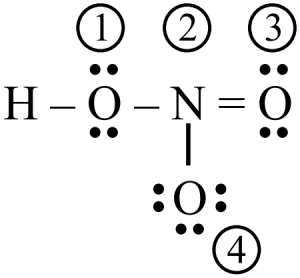
The formal charges on the atoms marked as $(1)$ to $(4)$ in the Lewis representation of $HNO_3$ molecule respectively are
A
$+1, 0, 0, -1$
B
$0, -1, 0, +1$
C
$0, +1, 0, -1$
D
$0, 0, -1, +1$
Solution
(C) The formula for formal charge is: $\text{Formal charge} = \text{Valence electrons} - \text{Non-bonding electrons} - \frac{1}{2}(\text{Bonding electrons})$.
For atom $(1)$ (Oxygen): Valence $e^- = 6$,Non-bonding $e^- = 4$,Bonding $e^- = 4$. $\text{FC} = 6 - 4 - \frac{4}{2} = 0$.
For atom $(2)$ (Nitrogen): Valence $e^- = 5$,Non-bonding $e^- = 0$,Bonding $e^- = 8$. $\text{FC} = 5 - 0 - \frac{8}{2} = +1$.
For atom $(3)$ (Oxygen): Valence $e^- = 6$,Non-bonding $e^- = 4$,Bonding $e^- = 4$. $\text{FC} = 6 - 4 - \frac{4}{2} = 0$.
For atom $(4)$ (Oxygen): Valence $e^- = 6$,Non-bonding $e^- = 6$,Bonding $e^- = 2$. $\text{FC} = 6 - 6 - \frac{2}{2} = -1$.
Thus,the formal charges are $0, +1, 0, -1$.
For atom $(1)$ (Oxygen): Valence $e^- = 6$,Non-bonding $e^- = 4$,Bonding $e^- = 4$. $\text{FC} = 6 - 4 - \frac{4}{2} = 0$.
For atom $(2)$ (Nitrogen): Valence $e^- = 5$,Non-bonding $e^- = 0$,Bonding $e^- = 8$. $\text{FC} = 5 - 0 - \frac{8}{2} = +1$.
For atom $(3)$ (Oxygen): Valence $e^- = 6$,Non-bonding $e^- = 4$,Bonding $e^- = 4$. $\text{FC} = 6 - 4 - \frac{4}{2} = 0$.
For atom $(4)$ (Oxygen): Valence $e^- = 6$,Non-bonding $e^- = 6$,Bonding $e^- = 2$. $\text{FC} = 6 - 6 - \frac{2}{2} = -1$.
Thus,the formal charges are $0, +1, 0, -1$.
0 likesView Solution
111
ChemistryMediumMCQJEE Main · 2026
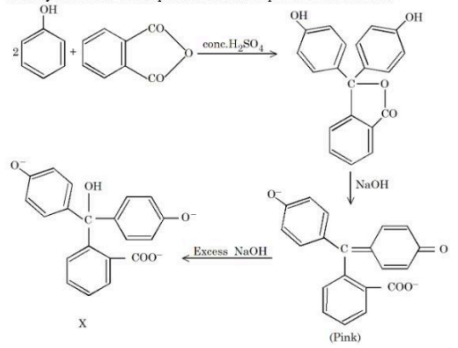
Identify the colour of compound '$X$' in the sequence of the reaction.
A
Violet
B
Green
C
Red
D
Colourless
Solution
(D) The reaction sequence illustrates the synthesis of phenolphthalein.
Phenolphthalein exists in different structural forms depending on the pH of the solution.
In a basic medium,the molecule exists in a quinonoid form,which is pink in colour.
When treated with excess $NaOH$,the molecule undergoes further deprotonation to form the trianion structure (compound '$X$').
This trianion form lacks the extended conjugated system required for visible light absorption in the visible region,making it colourless.
Phenolphthalein exists in different structural forms depending on the pH of the solution.
In a basic medium,the molecule exists in a quinonoid form,which is pink in colour.
When treated with excess $NaOH$,the molecule undergoes further deprotonation to form the trianion structure (compound '$X$').
This trianion form lacks the extended conjugated system required for visible light absorption in the visible region,making it colourless.
0 likesView Solution
112
ChemistryDifficultMCQJEE Main · 2026
Consider compounds $A$,$B$ and $C$ with following structural formulae: $A = CH_{3} - CH_{2} - CH_{2} - CH_{2} - CH_{2} - OH$,$B = CH_{2} = CH - CH_{2} - CH_{2} - CH_{3}$,$C = HO - CH_{2} - CH_{2} - CH(OH) - CH_{3}$. For the conversion of $B$ from $A$,reagent $(D)$ required is . . . . . . and structural formula of product $(E)$ obtained when $C$ undergoes same reaction using excess reagent $(D)$ is . . . . . . .
A
Conc. $H_{2}SO_{4}$,$CH_{2} = CH - CH(OH)CH_{3}$
B
$D$: Conc. $H_{2}SO_{4}$,$E$: $HO - CH_{2} - CH_{2} - CH = CH_{2}$
C
$D$: $PCC$,$E$: $CH_{2} = CH - CH = CH_{2}$
D
$D$: Conc. $H_{2}SO_{4}$ or $H_{3}PO_{4}$,$E$: $CH_{2} = CH - CH = CH_{2}$
Solution
(D) The conversion of alcohol $(A)$ to alkene $(B)$ is an acid-catalyzed dehydration reaction,which requires a strong acid like $Conc. H_{2}SO_{4}$ or $H_{3}PO_{4}$ as reagent $D$.
Compound $C$ is $HO - CH_{2} - CH_{2} - CH(OH) - CH_{3}$,which is a diol.
When $C$ undergoes dehydration with excess reagent $D$,both hydroxyl $(-OH)$ groups are eliminated to form a conjugated diene.
The product $E$ formed is $CH_{2} = CH - CH = CH_{2}$ (buta$-1,3-$diene).
Compound $C$ is $HO - CH_{2} - CH_{2} - CH(OH) - CH_{3}$,which is a diol.
When $C$ undergoes dehydration with excess reagent $D$,both hydroxyl $(-OH)$ groups are eliminated to form a conjugated diene.
The product $E$ formed is $CH_{2} = CH - CH = CH_{2}$ (buta$-1,3-$diene).
0 likesView Solution
113
ChemistryDifficultMCQJEE Main · 2026
Consider the following sequence of reactions. The major product $P$ is:
A
B
C
D
Solution
(A) The reaction sequence typically involves the oxidation of an alkyl side chain on a benzene ring. When an alkyl group (like an ethyl or propyl group) is attached to a benzene ring,treatment with strong oxidizing agents such as alkaline $KMnO_4$ followed by acidification results in the oxidation of the benzylic carbon to a carboxylic acid group $(-COOH)$. The remaining part of the side chain is cleaved. Therefore,the major product $P$ is a benzoic acid derivative.
0 likesView Solution
114
ChemistryDifficultMCQJEE Main · 2026
$n$-Butane on monochlorination under photochemical conditions gives an optically active compound "$P$". "$P$" on further chlorination gives dichloro compounds. The number of dichloro compounds obtained (ignore stereoisomers) is:
A
$3$
B
$4$
C
$5$
D
$6$
Solution
(C) $n$-Butane is $CH_{3}CH_{2}CH_{2}CH_{3}$.
Monochlorination of $n$-butane yields $2$-chlorobutane $(CH_{3}CHClCH_{2}CH_{3})$,which contains a chiral center and is thus optically active ('$P$').
Further chlorination of $2$-chlorobutane can occur at different carbon positions to form dichloro derivatives.
The possible structural isomers for the dichloro products are:
$1,1$-dichlorobutane
$1,2$-dichlorobutane
$1,3$-dichlorobutane
$2,2$-dichlorobutane
$2,3$-dichlorobutane
Ignoring stereoisomers,there are $5$ distinct structural isomers.
Monochlorination of $n$-butane yields $2$-chlorobutane $(CH_{3}CHClCH_{2}CH_{3})$,which contains a chiral center and is thus optically active ('$P$').
Further chlorination of $2$-chlorobutane can occur at different carbon positions to form dichloro derivatives.
The possible structural isomers for the dichloro products are:
$1,1$-dichlorobutane
$1,2$-dichlorobutane
$1,3$-dichlorobutane
$2,2$-dichlorobutane
$2,3$-dichlorobutane
Ignoring stereoisomers,there are $5$ distinct structural isomers.
0 likesView Solution
115
ChemistryDifficultMCQJEE Main · 2026
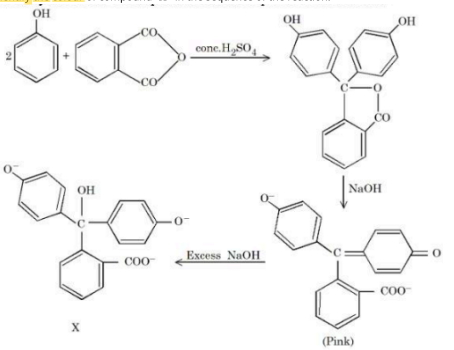
Identify the colour of compound '$X$' in the sequence of the reaction.
A
Violet
B
Green
C
Red
D
Colourless
Solution
(D) The reaction sequence illustrates the synthesis and structural changes of phenolphthalein in different pH conditions.
Phenolphthalein acts as an acid-base indicator.
In a basic medium,the molecule exists in a quinonoid form,which imparts a pink/red colour.
When excess $NaOH$ is added,the structure undergoes further deprotonation to form the trianion species labeled as '$X$'.
This trianion form of phenolphthalein is colourless because the extended conjugation of the quinonoid system is disrupted.
Therefore,the compound '$X$' is colourless.
Phenolphthalein acts as an acid-base indicator.
In a basic medium,the molecule exists in a quinonoid form,which imparts a pink/red colour.
When excess $NaOH$ is added,the structure undergoes further deprotonation to form the trianion species labeled as '$X$'.
This trianion form of phenolphthalein is colourless because the extended conjugation of the quinonoid system is disrupted.
Therefore,the compound '$X$' is colourless.
0 likesView Solution
116
ChemistryDifficultMCQJEE Main · 2026
Consider compounds $A$,$B$,and $C$ with the following structural formulae:
$A = CH_3 - CH_2 - CH_2 - CH_2 - CH_2 - OH$
$B = CH_2 = CH - CH_2 - CH_2 - CH_3$
$C = HO - CH_2 - CH_2 - CH(OH) - CH_3$
For the conversion of $B$ from $A$,the reagent $(D)$ required is . . . . . . and the structural formula of the product $(E)$ obtained when $C$ undergoes the same reaction using excess reagent $(D)$ is . . . . . . .
$A = CH_3 - CH_2 - CH_2 - CH_2 - CH_2 - OH$
$B = CH_2 = CH - CH_2 - CH_2 - CH_3$
$C = HO - CH_2 - CH_2 - CH(OH) - CH_3$
For the conversion of $B$ from $A$,the reagent $(D)$ required is . . . . . . and the structural formula of the product $(E)$ obtained when $C$ undergoes the same reaction using excess reagent $(D)$ is . . . . . . .
A
Conc. $H_2SO_4$,$CH_2=CH-CH(OH)CH_3$
B
$D$: $PCC$,$E$: $HO-CH_2-CH_2-CH=CH_2$
C
$D$: $PCC$,$E$: $CH_2=CH-CH=CH_2$
D
$D$: conc. $H_2SO_4$ or $H_3PO_4$,$E$: $CH_2 = CH - CH = CH_2$
Solution
(D) The conversion of alcohol $A$ $(pentan-1-ol)$ to alkene $B$ $(pent-1-ene)$ is a dehydration reaction.
Dehydration of alcohols is typically carried out using a strong acid catalyst like concentrated $H_2SO_4$ or $H_3PO_4$ at high temperatures.
Compound $C$ is $butane-1,3-diol$ $(HO-CH_2-CH_2-CH(OH)-CH_3)$.
When $C$ reacts with an excess of a dehydrating agent like concentrated $H_2SO_4$,both hydroxyl $(-OH)$ groups are removed to form two double bonds,resulting in the formation of a diene.
The product $E$ is $buta-1,3-diene$ $(CH_2=CH-CH=CH_2)$.
Dehydration of alcohols is typically carried out using a strong acid catalyst like concentrated $H_2SO_4$ or $H_3PO_4$ at high temperatures.
Compound $C$ is $butane-1,3-diol$ $(HO-CH_2-CH_2-CH(OH)-CH_3)$.
When $C$ reacts with an excess of a dehydrating agent like concentrated $H_2SO_4$,both hydroxyl $(-OH)$ groups are removed to form two double bonds,resulting in the formation of a diene.
The product $E$ is $buta-1,3-diene$ $(CH_2=CH-CH=CH_2)$.
0 likesView Solution
117
ChemistryDifficultMCQJEE Main · 2026
$n$-Butane on monochlorination under photochemical conditions gives an optically active compound "$P$". "$P$" on further chlorination gives dichloro compounds. The number of dichloro compounds obtained (ignore stereoisomers) is:
A
$3$
B
$4$
C
$5$
D
$6$
Solution
(C) $n$-Butane $(CH_3-CH_2-CH_2-CH_3)$ on monochlorination gives $2$-chlorobutane $(CH_3-CHCl-CH_2-CH_3)$,which is the optically active compound "$P$".
Further chlorination of $2$-chlorobutane involves the substitution of a hydrogen atom by a chlorine atom at different positions.
The possible dichloro products are:
$1,1$-dichlorobutane $(CH_3-CH_2-CH_2-CHCl_2)$
$1,2$-dichlorobutane $(CH_3-CH_2-CHCl-CH_2Cl)$
$1,3$-dichlorobutane $(CH_3-CHCl-CH_2-CH_2Cl)$
$2,2$-dichlorobutane $(CH_3-CCl_2-CH_2-CH_3)$
$2,3$-dichlorobutane $(CH_3-CHCl-CHCl-CH_3)$
Ignoring stereoisomers,there are $5$ distinct constitutional isomers.
Further chlorination of $2$-chlorobutane involves the substitution of a hydrogen atom by a chlorine atom at different positions.
The possible dichloro products are:
$1,1$-dichlorobutane $(CH_3-CH_2-CH_2-CHCl_2)$
$1,2$-dichlorobutane $(CH_3-CH_2-CHCl-CH_2Cl)$
$1,3$-dichlorobutane $(CH_3-CHCl-CH_2-CH_2Cl)$
$2,2$-dichlorobutane $(CH_3-CCl_2-CH_2-CH_3)$
$2,3$-dichlorobutane $(CH_3-CHCl-CHCl-CH_3)$
Ignoring stereoisomers,there are $5$ distinct constitutional isomers.
0 likesView Solution
118
ChemistryMediumMCQJEE Main · 2026
Which of the following sets includes all the species that will change the orange colour of $K_2Cr_2O_7$ in acidic medium?
A
$Fe^{2+}, Sn^{2+}, I^-, S^{2-}$
B
$S^{2-}, Fe^{3+}, I^-, C_2O_4^{2-}$
C
$Fe^{2+}, NO_2^-, SO_2, Sn^{4+}$
D
$Fe^{3+}, SO_4^{2-}, S^{2-}, Sn^{4+}$
Solution
(A) $K_2Cr_2O_7$ acts as a strong oxidizing agent in an acidic medium.
It reacts with reducing agents by oxidizing them,while the dichromate ion $(Cr_2O_7^{2-})$ is reduced to the green-colored chromium$(III)$ ion $(Cr^{3+})$.
Among the given species,$Fe^{2+}$,$Sn^{2+}$,$I^-$,and $S^{2-}$ are all reducing agents.
Therefore,they will reduce $K_2Cr_2O_7$ and change its orange color to green.
Thus,the correct set is $Fe^{2+}, Sn^{2+}, I^-, S^{2-}$.
It reacts with reducing agents by oxidizing them,while the dichromate ion $(Cr_2O_7^{2-})$ is reduced to the green-colored chromium$(III)$ ion $(Cr^{3+})$.
Among the given species,$Fe^{2+}$,$Sn^{2+}$,$I^-$,and $S^{2-}$ are all reducing agents.
Therefore,they will reduce $K_2Cr_2O_7$ and change its orange color to green.
Thus,the correct set is $Fe^{2+}, Sn^{2+}, I^-, S^{2-}$.
0 likesView Solution
119
ChemistryDifficultMCQJEE Main · 2026
In order to oxidize a mixture of $1 \text{ mole}$ each of $FeC_2O_4$,$Fe_2(C_2O_4)_3$,$FeSO_4$,and $Fe_2(SO_4)_3$ in an acidic medium,the number of moles of $KMnO_4$ required is:
A
$3$
B
$2$
C
$5$
D
$7$
Solution
(B) In an acidic medium,$MnO_4^-$ acts as an oxidizing agent and is reduced to $Mn^{2+}$,gaining $5$ electrons per mole $(MnO_4^- + 8H^+ + 5e^- \rightarrow Mn^{2+} + 4H_2O)$.
We calculate the moles of electrons lost by each component:
$1$) $FeC_2O_4 \rightarrow Fe^{3+} + 2CO_2 + 3e^-$ ($1 \text{ mole}$ loses $3 \text{ moles of } e^-$).
$2$) $Fe_2(C_2O_4)_3 \rightarrow 2Fe^{3+} + 6CO_2 + 6e^-$ ($1 \text{ mole}$ loses $6 \text{ moles of } e^-$).
$3$) $FeSO_4 \rightarrow Fe^{3+} + SO_4^{2-} + 1e^-$ ($1 \text{ mole}$ loses $1 \text{ mole of } e^-$).
$4$) $Fe_2(SO_4)_3$: Iron is already in the $+3$ oxidation state and sulfate is in its highest oxidation state,so no further oxidation occurs $(0 \text{ moles of } e^-)$.
Total moles of electrons lost = $3 + 6 + 1 + 0 = 10 \text{ moles}$.
Since $1 \text{ mole}$ of $KMnO_4$ accepts $5 \text{ moles}$ of electrons,the moles of $KMnO_4$ required = $\frac{10}{5} = 2 \text{ moles}$.
We calculate the moles of electrons lost by each component:
$1$) $FeC_2O_4 \rightarrow Fe^{3+} + 2CO_2 + 3e^-$ ($1 \text{ mole}$ loses $3 \text{ moles of } e^-$).
$2$) $Fe_2(C_2O_4)_3 \rightarrow 2Fe^{3+} + 6CO_2 + 6e^-$ ($1 \text{ mole}$ loses $6 \text{ moles of } e^-$).
$3$) $FeSO_4 \rightarrow Fe^{3+} + SO_4^{2-} + 1e^-$ ($1 \text{ mole}$ loses $1 \text{ mole of } e^-$).
$4$) $Fe_2(SO_4)_3$: Iron is already in the $+3$ oxidation state and sulfate is in its highest oxidation state,so no further oxidation occurs $(0 \text{ moles of } e^-)$.
Total moles of electrons lost = $3 + 6 + 1 + 0 = 10 \text{ moles}$.
Since $1 \text{ mole}$ of $KMnO_4$ accepts $5 \text{ moles}$ of electrons,the moles of $KMnO_4$ required = $\frac{10}{5} = 2 \text{ moles}$.
0 likesView Solution
120
ChemistryMediumMCQJEE Main · 2026
The correct set that contains all kinds (basic,acidic,amphoteric,and neutral) of oxides is:
A
$Na_2O, K_2O, Al_2O_3$ and $As_2O_3$
B
$Al_2O_3, As_2O_3, CO$ and $NO$
C
$K_2O, Cl_2O_7, As_2O_3$ and $NO$
D
$Na_2O, N_2O, Al_2O_3$ and $CO$
Solution
(C) Basic oxides are typically oxides of metals,such as $Na_2O$ and $K_2O$.
Acidic oxides are typically oxides of non-metals,such as $Cl_2O_7$.
Amphoteric oxides exhibit both acidic and basic properties,such as $Al_2O_3$ and $As_2O_3$.
Neutral oxides do not react with either acids or bases,such as $NO, N_2O$,and $CO$.
Option $C$ contains: $K_2O$ (Basic),$Cl_2O_7$ (Acidic),$As_2O_3$ (Amphoteric),and $NO$ (Neutral). Thus,it is the correct set.
Acidic oxides are typically oxides of non-metals,such as $Cl_2O_7$.
Amphoteric oxides exhibit both acidic and basic properties,such as $Al_2O_3$ and $As_2O_3$.
Neutral oxides do not react with either acids or bases,such as $NO, N_2O$,and $CO$.
Option $C$ contains: $K_2O$ (Basic),$Cl_2O_7$ (Acidic),$As_2O_3$ (Amphoteric),and $NO$ (Neutral). Thus,it is the correct set.
0 likesView Solution
121
ChemistryDifficultMCQJEE Main · 2026
Given below are two statements:
Statement $I$: Aluminium upon reaction with $NaOH$ forms $[Al(OH)_6]^{3-}$ ion.
Statement $II$: The geometry of $ICl_4^-$,$ClO_3^-$,and $IBr_2^-$ is square planar,pyramidal,and linear respectively.
In the light of the above statements,choose the correct answer from the options given below:
Statement $I$: Aluminium upon reaction with $NaOH$ forms $[Al(OH)_6]^{3-}$ ion.
Statement $II$: The geometry of $ICl_4^-$,$ClO_3^-$,and $IBr_2^-$ is square planar,pyramidal,and linear respectively.
In the light of the above statements,choose the correct answer from the options given below:
A
Both Statement $I$ and Statement $II$ are true
B
Both Statement $I$ and Statement $II$ are false
C
Statement $I$ is true but Statement $II$ is false
D
Statement $I$ is false but Statement $II$ is true
Solution
(A) Statement $I$ is true: Aluminium reacts with $NaOH$ to form sodium aluminate,which is represented as $[Al(OH)_4]^-$ or in its hydrated form as $[Al(OH)_6]^{3-}$.
Statement $II$ is true:
$ICl_4^-$: The central iodine atom has $sp^3d^2$ hybridization with $2$ lone pairs,resulting in a square planar geometry.
$ClO_3^-$: The central chlorine atom has $sp^3$ hybridization with $1$ lone pair,resulting in a trigonal pyramidal geometry.
$IBr_2^-$: The central iodine atom has $sp^3d$ hybridization with $3$ lone pairs,resulting in a linear geometry.
Therefore,both statements are correct.
Statement $II$ is true:
$ICl_4^-$: The central iodine atom has $sp^3d^2$ hybridization with $2$ lone pairs,resulting in a square planar geometry.
$ClO_3^-$: The central chlorine atom has $sp^3$ hybridization with $1$ lone pair,resulting in a trigonal pyramidal geometry.
$IBr_2^-$: The central iodine atom has $sp^3d$ hybridization with $3$ lone pairs,resulting in a linear geometry.
Therefore,both statements are correct.
0 likesView Solution
122
ChemistryMediumMCQJEE Main · 2026
Identify the correct $IUPAC$ name of the hydrocarbon $(x)$ containing three primary carbon atoms and with a molar mass of $72 \text{ g mol}^{-1}$.
A
$1,1-$Dimethylcyclopropane
B
$2,2-$Dimethylpropane
C
$2-$Methylbutane
D
n-pentane
Solution
(C) The molar mass of $72 \text{ g mol}^{-1}$ corresponds to the molecular formula $C_5H_{12}$ (pentane isomers).
Let us analyze the number of primary carbon atoms in the isomers of $C_5H_{12}$:
$1$. $n$-pentane $(CH_3-CH_2-CH_2-CH_2-CH_3)$: It has two primary carbon atoms.
$2$. $2$-Methylbutane $(CH_3-CH(CH_3)-CH_2-CH_3)$: It has three primary carbon atoms.
$3$. $2,2$-Dimethylpropane $(C(CH_3)_4)$: It has four primary carbon atoms.
Therefore,the hydrocarbon $(x)$ with three primary carbon atoms is $2$-Methylbutane.
Let us analyze the number of primary carbon atoms in the isomers of $C_5H_{12}$:
$1$. $n$-pentane $(CH_3-CH_2-CH_2-CH_2-CH_3)$: It has two primary carbon atoms.
$2$. $2$-Methylbutane $(CH_3-CH(CH_3)-CH_2-CH_3)$: It has three primary carbon atoms.
$3$. $2,2$-Dimethylpropane $(C(CH_3)_4)$: It has four primary carbon atoms.
Therefore,the hydrocarbon $(x)$ with three primary carbon atoms is $2$-Methylbutane.
0 likesView Solution
123
ChemistryMediumMCQJEE Main · 2026
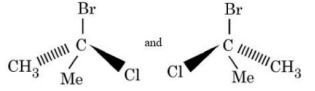
The following structures are:
A
enantiomers.
B
identical molecules.
C
diastereomers.
D
meso compounds.
Solution
(A) The structures shown are mirror images of each other and are non-superimposable.
They represent the $(R)$ and $(S)$ configurations of the chiral center.
Since they are non-superimposable mirror images,they are enantiomers.
They represent the $(R)$ and $(S)$ configurations of the chiral center.
Since they are non-superimposable mirror images,they are enantiomers.
0 likesView Solution
124
ChemistryDifficultMCQJEE Main · 2026
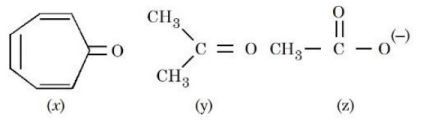
Consider the following molecules/species: tropone $(x)$,acetone $(y)$,acetate ion $(z)$. The correct order of carbon-oxygen bond length is:
A
$x > y > z$
B
$y > z > x$
C
$z > x > y$
D
$x > z > y$
Solution
(C) The bond length is inversely proportional to the bond order.
In acetone $(y)$,the $C=O$ bond has a bond order of $2$.
In tropone $(x)$,the $C=O$ bond is conjugated within a $7$-membered aromatic ring,which gives it a partial single bond character,resulting in a bond order between $1$ and $2$ (lower than $2$,thus higher length than $y$).
In the acetate ion $(z)$,resonance leads to two equivalent $C-O$ bonds,each with a bond order of $1.5$.
Comparing the bond orders: $y$ $(2)$ > $x$ $(1 < \text{bond order} < 2)$ > $z$ $(1.5)$.
Since bond length is inversely proportional to bond order,the order of bond length is $z > x > y$.
In acetone $(y)$,the $C=O$ bond has a bond order of $2$.
In tropone $(x)$,the $C=O$ bond is conjugated within a $7$-membered aromatic ring,which gives it a partial single bond character,resulting in a bond order between $1$ and $2$ (lower than $2$,thus higher length than $y$).
In the acetate ion $(z)$,resonance leads to two equivalent $C-O$ bonds,each with a bond order of $1.5$.
Comparing the bond orders: $y$ $(2)$ > $x$ $(1 < \text{bond order} < 2)$ > $z$ $(1.5)$.
Since bond length is inversely proportional to bond order,the order of bond length is $z > x > y$.
0 likesView Solution
125
ChemistryMediumMCQJEE Main · 2026
The increasing order of the electron-withdrawing power of the following functional groups is:
a. $-CN$
b. $-COOH$
c. $-NO_2$
d. $-I$
a. $-CN$
b. $-COOH$
c. $-NO_2$
d. $-I$
A
$c < b < d < a$
B
$c < a < b < d$
C
$d < b < a < c$
D
$a < b < c < d$
Solution
(C) The electron-withdrawing power of functional groups is determined by their inductive effect ($-I$ effect) and electronegativity.
Comparing the given groups:
$1$. The $-I$ group has the weakest electron-withdrawing effect among the options provided.
$2$. The $-COOH$ group is more electron-withdrawing than $-I$.
$3$. The $-CN$ group is more electron-withdrawing than $-COOH$ due to the higher electronegativity of the nitrogen atom and the $sp$ hybridized carbon.
$4$. The $-NO_2$ group is the strongest electron-withdrawing group among these due to the presence of two highly electronegative oxygen atoms attached to a positively charged nitrogen atom.
Therefore,the increasing order is: $d < b < a < c$.
Comparing the given groups:
$1$. The $-I$ group has the weakest electron-withdrawing effect among the options provided.
$2$. The $-COOH$ group is more electron-withdrawing than $-I$.
$3$. The $-CN$ group is more electron-withdrawing than $-COOH$ due to the higher electronegativity of the nitrogen atom and the $sp$ hybridized carbon.
$4$. The $-NO_2$ group is the strongest electron-withdrawing group among these due to the presence of two highly electronegative oxygen atoms attached to a positively charged nitrogen atom.
Therefore,the increasing order is: $d < b < a < c$.
0 likesView Solution
126
ChemistryMediumMCQJEE Main · 2026
Given below are two statements:
Statement $I$: In $O_2N-C_6H_4-CH^+-C_6H_4-OCH_3$,the carbocation is stabilised by $+R$ effect of $-OCH_3$ group.
Statement $II$: In $O_2N-C_6H_4-CH^--C_6H_4-OCH_3$,the carbanion is stabilised by $-R$ effect of $-NO_2$ group.
In the light of the above statements,choose the correct answer from the options given below:
Statement $I$: In $O_2N-C_6H_4-CH^+-C_6H_4-OCH_3$,the carbocation is stabilised by $+R$ effect of $-OCH_3$ group.
Statement $II$: In $O_2N-C_6H_4-CH^--C_6H_4-OCH_3$,the carbanion is stabilised by $-R$ effect of $-NO_2$ group.
In the light of the above statements,choose the correct answer from the options given below:
A
Both Statement $I$ and Statement $II$ are true
B
Both Statement $I$ and Statement $II$ are false
C
Statement $I$ is true but Statement $II$ is false
D
Statement $I$ is false but Statement $II$ is true
Solution
(A) Statement $I$ is true: The carbocation is electron-deficient. The $-OCH_3$ group exerts a $+R$ (resonance) effect,which donates electron density into the ring and stabilizes the adjacent positive charge.
Statement $II$ is true: The carbanion is electron-rich. The $-NO_2$ group exerts a $-R$ (resonance) effect,which withdraws electron density from the ring and stabilizes the adjacent negative charge.
Statement $II$ is true: The carbanion is electron-rich. The $-NO_2$ group exerts a $-R$ (resonance) effect,which withdraws electron density from the ring and stabilizes the adjacent negative charge.
0 likesView Solution
127
ChemistryDifficultMCQJEE Main · 2026
Complete combustion of $X$ g of an organic compound gave $0.25$ g of $CO_2$ and $0.12$ g of $H_2O$. If the percentage of carbon is $25\%$ and of hydrogen is $4.89\%$,then $X = \_\_\_\_ \times 10^{-3}$ g. (Nearest integer) (Molar mass of $C$,$H$ and $O$ are $12, 1$ and $16$ g mol$^{-1}$ respectively.)
A
$273$
B
$27$
C
$2730$
D
$227$
Solution
(A) Mass of $CO_2 = 0.25$ g. Moles of $CO_2 = \frac{0.25}{44} \approx 0.00568$ mol.
Mass of $C = \text{Moles of } CO_2 \times 12 = 0.00568 \times 12 = 0.06818$ g.
Given percentage of $C = 25\%$.
So,$0.06818 = 0.25 \times X \implies X = \frac{0.06818}{0.25} = 0.2727$ g.
Similarly for $H$,Mass of $H_2O = 0.12$ g.
Moles of $H_2O = \frac{0.12}{18} \approx 0.00666$ mol.
Mass of $H = 0.00666 \times 2 = 0.01333$ g.
Given percentage of $H = 4.89\%$.
So,$0.01333 = 0.0489 \times X \implies X = \frac{0.01333}{0.0489} = 0.2726$ g.
Thus,$X \approx 0.273$ g.
Expressing as $273 \times 10^{-3}$ g.
Mass of $C = \text{Moles of } CO_2 \times 12 = 0.00568 \times 12 = 0.06818$ g.
Given percentage of $C = 25\%$.
So,$0.06818 = 0.25 \times X \implies X = \frac{0.06818}{0.25} = 0.2727$ g.
Similarly for $H$,Mass of $H_2O = 0.12$ g.
Moles of $H_2O = \frac{0.12}{18} \approx 0.00666$ mol.
Mass of $H = 0.00666 \times 2 = 0.01333$ g.
Given percentage of $H = 4.89\%$.
So,$0.01333 = 0.0489 \times X \implies X = \frac{0.01333}{0.0489} = 0.2726$ g.
Thus,$X \approx 0.273$ g.
Expressing as $273 \times 10^{-3}$ g.
0 likesView Solution
128
ChemistryMediumMCQJEE Main · 2026
Given below are two statements:
Statement $I$: Methane can be prepared by decarboxylation of sodium ethanoate,Kolbe's electrolysis of sodium acetate and reaction of $CH_3MgBr$ with water.
Statement $II$: Methane cannot be prepared from unsaturated hydrocarbons and by Wurtz reaction.
In the light of the above statements,choose the correct answer from the options given below.
Statement $I$: Methane can be prepared by decarboxylation of sodium ethanoate,Kolbe's electrolysis of sodium acetate and reaction of $CH_3MgBr$ with water.
Statement $II$: Methane cannot be prepared from unsaturated hydrocarbons and by Wurtz reaction.
In the light of the above statements,choose the correct answer from the options given below.
A
Both Statement $I$ and Statement $II$ are true
B
Both Statement $I$ and Statement $II$ are false
C
Statement $I$ is true but Statement $II$ is false
D
Statement $I$ is false but Statement $II$ is true
Solution
(D) Statement $I$ is false because while decarboxylation of sodium ethanoate $(CH_3COONa + NaOH xrightarrow{CaO} CH_4 + Na_2CO_3)$ and the reaction of $CH_3MgBr$ with water $(CH_3MgBr + H_2O
ightarrow CH_4 + Mg(OH)Br)$ produce methane,Kolbe's electrolysis of sodium acetate produces ethane $(2CH_3COONa + 2H_2O
ightarrow CH_3-CH_3 + 2CO_2 + H_2 + 2NaOH)$.
Statement $II$ is true because methane $(CH_4)$ contains only one carbon atom,whereas the Wurtz reaction $(2R-X + 2Na ightarrow R-R + 2NaX)$ is used to prepare alkanes with an even number of carbon atoms (at least two carbons) by coupling two alkyl groups.
Statement $II$ is true because methane $(CH_4)$ contains only one carbon atom,whereas the Wurtz reaction $(2R-X + 2Na ightarrow R-R + 2NaX)$ is used to prepare alkanes with an even number of carbon atoms (at least two carbons) by coupling two alkyl groups.
0 likesView Solution
129
ChemistryDifficultMCQJEE Main · 2026
$R_f$ value for $2$-methylpropene in a solvent system (Ethyl acetate + ether) is $0.42$. $2$-methylpropene is treated with dilute $H_2SO_4$ to give major organic product $(X)$. $R_f$ value for $(X)$ in the same solvent system under identical condition will be:
A
$0.42$
B
$0.82$
C
$0.62$
D
$0.12$
Solution
(D) The reaction of $2$-methylpropene with dilute $H_2SO_4$ is an acid-catalyzed hydration reaction which follows Markovnikov's rule to yield $2$-methylpropan-$2$-ol (tert-butyl alcohol) as the major product $(X)$.
In thin-layer chromatography $(TLC)$,the $R_f$ value is inversely related to the polarity of the compound when using a polar stationary phase like silica gel.
$2$-methylpropene is a non-polar hydrocarbon,whereas $2$-methylpropan-$2$-ol is a polar alcohol capable of forming hydrogen bonds with the stationary phase.
Due to stronger interactions with the polar stationary phase,the polar product $(X)$ will travel a shorter distance compared to the non-polar reactant.
Therefore,the $R_f$ value of $(X)$ must be significantly lower than $0.42$.
Among the given options,$0.12$ is the only value lower than $0.42$.
In thin-layer chromatography $(TLC)$,the $R_f$ value is inversely related to the polarity of the compound when using a polar stationary phase like silica gel.
$2$-methylpropene is a non-polar hydrocarbon,whereas $2$-methylpropan-$2$-ol is a polar alcohol capable of forming hydrogen bonds with the stationary phase.
Due to stronger interactions with the polar stationary phase,the polar product $(X)$ will travel a shorter distance compared to the non-polar reactant.
Therefore,the $R_f$ value of $(X)$ must be significantly lower than $0.42$.
Among the given options,$0.12$ is the only value lower than $0.42$.
0 likesView Solution
130
ChemistryDifficultMCQJEE Main · 2026
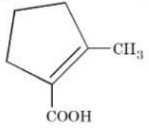
"$P$" is a hydrocarbon with the molecular formula $C_8H_{14}$. On ozonolysis,"$P$" forms "$Q$". "$Q$" on treatment with alkali under reflux conditions produces "$R$",which on treatment with $I_2/NaOH$ gives a yellow precipitate. Acidification of the solution gives "$S$". The structure of "$S$" is given below:
(Structure $S$: $1-$methyl$-2-$oxocyclopentanecarboxylic acid derivative or similar cyclic structure as per common reaction pathways).
The correct structure of "$P$" is:
(Structure $S$: $1-$methyl$-2-$oxocyclopentanecarboxylic acid derivative or similar cyclic structure as per common reaction pathways).
The correct structure of "$P$" is:
A
B
C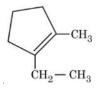
D
Solution
(A) $1$. The formation of a yellow precipitate with $I_2/NaOH$ (iodoform test) indicates the presence of a methyl ketone group $(CH_3CO-)$ or a secondary alcohol that can be oxidized to a methyl ketone.
$2$. "$P$" $(C_8H_{14})$ undergoes ozonolysis to form "$Q$".
$3$. "$Q$" undergoes an intramolecular aldol condensation (alkali under reflux) to form "$R$",which contains a methyl ketone moiety.
$4$. The structure "$S$" is a cyclic carboxylic acid derivative formed after the haloform reaction and acidification.
$5$. Analyzing the degree of unsaturation ($C_8H_{14}$ has $8 - 14/2 + 1 = 2$ degrees of unsaturation),and the reaction sequence,$1$,$2$-dimethylcyclohexene (option $A$) is the most suitable precursor that fits the molecular formula and the described chemical transformations.
$2$. "$P$" $(C_8H_{14})$ undergoes ozonolysis to form "$Q$".
$3$. "$Q$" undergoes an intramolecular aldol condensation (alkali under reflux) to form "$R$",which contains a methyl ketone moiety.
$4$. The structure "$S$" is a cyclic carboxylic acid derivative formed after the haloform reaction and acidification.
$5$. Analyzing the degree of unsaturation ($C_8H_{14}$ has $8 - 14/2 + 1 = 2$ degrees of unsaturation),and the reaction sequence,$1$,$2$-dimethylcyclohexene (option $A$) is the most suitable precursor that fits the molecular formula and the described chemical transformations.
0 likesView Solution
131
ChemistryDifficultMCQJEE Main · 2026
An alkene $(X)$ on ozonolysis followed by reduction gives the following products: $H-CHO$ ($2$ moles),$H-CO-CHO$,and $CH_3-CO-CO-CH_3$. The alkene $(X)$ is:
A
B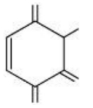
C
D
Solution
(A) Ozonolysis cleaves $C=C$ bonds to form carbonyl compounds.
Given products are $2$ moles of $HCHO$ (formaldehyde),$HCOCHO$ (glyoxal),and $CH_3COCOCH_3$ (butane$-2,3-$dione).
By analyzing the fragments,we can reconstruct the original cyclic alkene structure.
$HCHO$ comes from terminal $=CH_2$ groups.
$HCOCHO$ and $CH_3COCOCH_3$ represent the internal segments of the ring.
By connecting these fragments,we find that the structure corresponds to $1,2,4,5$-tetramethylenecyclohexane or a similar derivative based on the provided options. Based on the standard chemical analysis of such ozonolysis products,the structure is identified as option $A$.
Given products are $2$ moles of $HCHO$ (formaldehyde),$HCOCHO$ (glyoxal),and $CH_3COCOCH_3$ (butane$-2,3-$dione).
By analyzing the fragments,we can reconstruct the original cyclic alkene structure.
$HCHO$ comes from terminal $=CH_2$ groups.
$HCOCHO$ and $CH_3COCOCH_3$ represent the internal segments of the ring.
By connecting these fragments,we find that the structure corresponds to $1,2,4,5$-tetramethylenecyclohexane or a similar derivative based on the provided options. Based on the standard chemical analysis of such ozonolysis products,the structure is identified as option $A$.
0 likesView Solution
132
ChemistryMediumMCQJEE Main · 2026
The compound $(X)$ on $(i)$ heating in the presence of anhydrous $AlCl_3$ and $HCl$ gas gives $2,4$-dimethylpentane,$(ii)$ aromatization gives toluene,and $(iii)$ cyclisation gives methylcyclohexane. The correct name of compound $(X)$ is:
A
Hept$-2-$ene
B
Hept$-1,3,5-$triene
C
Heptane
D
Hept$-2,4,6-$triene
Solution
(C) Heptane $(C_7H_{16})$ undergoes isomerisation in the presence of $AlCl_3/HCl$ to give branched isomers like $2,4$-dimethylpentane.
Aromatisation (dehydrocyclization) of $C_7$ alkanes leads to the formation of toluene $(C_6H_5CH_3)$.
Cyclisation of heptane specifically yields methylcyclohexane.
Since all these chemical properties are characteristic of the straight-chain alkane heptane,the compound $(X)$ is heptane.
Aromatisation (dehydrocyclization) of $C_7$ alkanes leads to the formation of toluene $(C_6H_5CH_3)$.
Cyclisation of heptane specifically yields methylcyclohexane.
Since all these chemical properties are characteristic of the straight-chain alkane heptane,the compound $(X)$ is heptane.
0 likesView Solution
133
ChemistryMediumMCQJEE Main · 2026
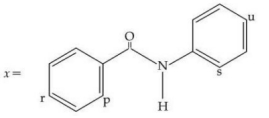
For the given molecule,$x$,the preferred site for the attack of the electrophile is:
A
Predominantly at $r$
B
$r$ and $u$
C
$p$ and $s$
D
Predominantly at $u$
Solution
(C) The molecule $x$ is $N$-phenylbenzamide. It contains two phenyl rings attached to an amide group $(-CONH-)$.
In the ring attached to the nitrogen atom,the lone pair on the nitrogen atom is in conjugation with the benzene ring,making it an activating group. This group is ortho/para directing.
In the ring attached to the carbonyl carbon,the carbonyl group $(-C=O)$ is a deactivating group and is meta-directing.
Therefore,the electrophilic aromatic substitution will occur on the ring attached to the nitrogen atom. The ortho and para positions relative to the nitrogen atom are the most electron-rich sites.
In the given structure,$u$ represents the para position and $s$ represents the ortho position relative to the nitrogen atom. Thus,the electrophile will preferentially attack at these positions.
In the ring attached to the nitrogen atom,the lone pair on the nitrogen atom is in conjugation with the benzene ring,making it an activating group. This group is ortho/para directing.
In the ring attached to the carbonyl carbon,the carbonyl group $(-C=O)$ is a deactivating group and is meta-directing.
Therefore,the electrophilic aromatic substitution will occur on the ring attached to the nitrogen atom. The ortho and para positions relative to the nitrogen atom are the most electron-rich sites.
In the given structure,$u$ represents the para position and $s$ represents the ortho position relative to the nitrogen atom. Thus,the electrophile will preferentially attack at these positions.
0 likesView Solution
134
ChemistryDifficultMCQJEE Main · 2026
Which of the following contain the same number of atoms?
$A$. $2 \text{ g}$ of $O_2$ gas
$B$. $4 \text{ g}$ of $SO_2$ gas
$C$. $1400 \text{ mL}$ of $O_2$ at $STP$
$D$. $0.05 \text{ L}$ of $He$ at $STP$
$E$. $0.0625 \text{ mol}$ of $H_2$ gas
Choose the correct answer from the options given below:
$A$. $2 \text{ g}$ of $O_2$ gas
$B$. $4 \text{ g}$ of $SO_2$ gas
$C$. $1400 \text{ mL}$ of $O_2$ at $STP$
$D$. $0.05 \text{ L}$ of $He$ at $STP$
$E$. $0.0625 \text{ mol}$ of $H_2$ gas
Choose the correct answer from the options given below:
A
$A$ and $B$ only
B
$B$ and $C$ only
C
$C$ and $D$ only
D
$A, C$ and $E$ only
Solution
(D) To find the number of atoms,we calculate the moles of molecules and multiply by the atomicity and Avogadro's number $(N_A)$:
$A$. $2 \text{ g}$ of $O_2 = 2/32 = 0.0625 \text{ mol}$. Atoms = $0.0625 \times 2 \times N_A = 0.125 N_A$.
$B$. $4 \text{ g}$ of $SO_2 = 4/64 = 0.0625 \text{ mol}$. Atoms = $0.0625 \times 3 \times N_A = 0.1875 N_A$.
$C$. $1400 \text{ mL}$ of $O_2 = 1.4 \text{ L} / 22.4 \text{ L/mol} = 0.0625 \text{ mol}$. Atoms = $0.0625 \times 2 \times N_A = 0.125 N_A$.
$D$. $0.05 \text{ L}$ of $He = 0.05 / 22.4 \approx 0.00223 \text{ mol}$. Atoms = $0.00223 N_A$.
$E$. $0.0625 \text{ mol}$ of $H_2$. Atoms = $0.0625 \times 2 \times N_A = 0.125 N_A$.
Comparing the results,options $A, C$,and $E$ have the same number of atoms $(0.125 N_A)$.
$A$. $2 \text{ g}$ of $O_2 = 2/32 = 0.0625 \text{ mol}$. Atoms = $0.0625 \times 2 \times N_A = 0.125 N_A$.
$B$. $4 \text{ g}$ of $SO_2 = 4/64 = 0.0625 \text{ mol}$. Atoms = $0.0625 \times 3 \times N_A = 0.1875 N_A$.
$C$. $1400 \text{ mL}$ of $O_2 = 1.4 \text{ L} / 22.4 \text{ L/mol} = 0.0625 \text{ mol}$. Atoms = $0.0625 \times 2 \times N_A = 0.125 N_A$.
$D$. $0.05 \text{ L}$ of $He = 0.05 / 22.4 \approx 0.00223 \text{ mol}$. Atoms = $0.00223 N_A$.
$E$. $0.0625 \text{ mol}$ of $H_2$. Atoms = $0.0625 \times 2 \times N_A = 0.125 N_A$.
Comparing the results,options $A, C$,and $E$ have the same number of atoms $(0.125 N_A)$.
0 likesView Solution
135
ChemistryDifficultMCQJEE Main · 2026
The solubility product constants of $Ag_2CrO_4$ and $AgBr$ are $32x$ and $4y$ respectively at $298 \text{ K}$. The value of $(\frac{\text{molarity of } Ag_2CrO_4}{\text{molarity of } AgBr})$ can be expressed as :
A
$\frac{2\sqrt[3]{x}}{y}$
B
$2\sqrt{\frac{x}{y}}$
C
$\sqrt{\frac{x}{y}}$
D
$\frac{\sqrt[3]{x}}{\sqrt{y}}$
Solution
(D) For $Ag_2CrO_4$ (sparingly soluble salt of type $A_2B$): $K_{sp} = (2s_1)^2(s_1) = 4s_1^3 = 32x$.
Thus,$s_1^3 = 8x$,which gives $s_1 = 2\sqrt[3]{x}$.
For $AgBr$ (sparingly soluble salt of type $AB$): $K_{sp} = s_2^2 = 4y$.
Thus,$s_2 = \sqrt{4y} = 2\sqrt{y}$.
The ratio of molarities is $\frac{s_1}{s_2} = \frac{2\sqrt[3]{x}}{2\sqrt{y}} = \frac{\sqrt[3]{x}}{\sqrt{y}}$.
Thus,$s_1^3 = 8x$,which gives $s_1 = 2\sqrt[3]{x}$.
For $AgBr$ (sparingly soluble salt of type $AB$): $K_{sp} = s_2^2 = 4y$.
Thus,$s_2 = \sqrt{4y} = 2\sqrt{y}$.
The ratio of molarities is $\frac{s_1}{s_2} = \frac{2\sqrt[3]{x}}{2\sqrt{y}} = \frac{\sqrt[3]{x}}{\sqrt{y}}$.
0 likesView Solution
136
ChemistryDifficultMCQJEE Main · 2026
At $25^{\circ}C$,$20.0 \ mL$ of $0.2 \ M$ weak monoprotic acid $HX$ is titrated against $0.2 \ M$ $NaOH$. The $pH$ of the solution $(a)$ at the start of the titration (when $NaOH$ has not been added) and $(b)$ when $10 \ mL$ of $NaOH$ is added respectively,are:
Given: $K_a = 5 \times 10^{-4}, pK_a = 3.3, \alpha << 1$
Given: $K_a = 5 \times 10^{-4}, pK_a = 3.3, \alpha << 1$
A
$0.7$,$2.0$
B
$2.0$,$3.3$
C
$1.1$,$2.2$
D
$3.0$,$2.2$
Solution
(B) At the start,the solution contains only the weak acid $HX$. The concentration $C = 0.2 \ M$. The $pH$ of a weak acid is given by $pH = 0.5(pK_a - \log C)$. Substituting the values: $pH = 0.5(3.3 - \log 0.2) = 0.5(3.3 - (-0.699)) \approx 0.5(4.0) = 2.0$.
$(b)$ When $10 \ mL$ of $0.2 \ M$ $NaOH$ is added to $20 \ mL$ of $0.2 \ M$ $HX$,we reach the half-equivalence point because the moles of $NaOH$ added $(10 \ mL \times 0.2 \ M = 2 \ mmol)$ are exactly half the initial moles of $HX$ $(20 \ mL \times 0.2 \ M = 4 \ mmol)$. At the half-equivalence point,the concentration of the acid $[HX]$ equals the concentration of its conjugate base $[X^-]$. According to the Henderson-Hasselbalch equation,$pH = pK_a + \log([X^-]/[HX])$. Since $[X^-] = [HX]$,$pH = pK_a = 3.3$.
$(b)$ When $10 \ mL$ of $0.2 \ M$ $NaOH$ is added to $20 \ mL$ of $0.2 \ M$ $HX$,we reach the half-equivalence point because the moles of $NaOH$ added $(10 \ mL \times 0.2 \ M = 2 \ mmol)$ are exactly half the initial moles of $HX$ $(20 \ mL \times 0.2 \ M = 4 \ mmol)$. At the half-equivalence point,the concentration of the acid $[HX]$ equals the concentration of its conjugate base $[X^-]$. According to the Henderson-Hasselbalch equation,$pH = pK_a + \log([X^-]/[HX])$. Since $[X^-] = [HX]$,$pH = pK_a = 3.3$.
0 likesView Solution
137
ChemistryDifficultMCQJEE Main · 2026
$20$ mL of a solution of acetic acid required $28.4$ mL of $0.1$ $M$ NaOH for its neutralization. $A$ solution $(X)$ was prepared by mixing $20$ mL of the above acetic acid and $14.2$ mL of $0.1$ $M$ NaOH solution. What is the pH of the solution $(X)$? ($pK_a$ value of acetic acid is $4.75$).
A
$7$
B
$4.75$
C
$3.5$
D
$4.82$
Solution
(B) $1$. Calculate the initial moles of acetic acid $(CH_3COOH)$: Since $20 \text{ mL}$ of acetic acid is neutralized by $28.4 \text{ mL}$ of $0.1 \text{ M } NaOH$,the moles of acid = moles of base = $0.1 \text{ M} \times 28.4 \text{ mL} = 2.84 \text{ mmol}$.
$2$. Calculate the composition of solution $(X)$: Solution $(X)$ is formed by mixing $2.84 \text{ mmol}$ of $CH_3COOH$ and $1.42 \text{ mmol}$ of $NaOH$ $(0.1 \text{ M} \times 14.2 \text{ mL} = 1.42 \text{ mmol})$.
$3$. Reaction: $CH_3COOH + NaOH \rightarrow CH_3COONa + H_2O$.
$4$. After reaction: Remaining $CH_3COOH = 2.84 - 1.42 = 1.42 \text{ mmol}$. Formed $CH_3COONa$ (salt) = $1.42 \text{ mmol}$.
$5$. Apply Henderson-Hasselbalch equation: $pH = pK_a + \log \left( \frac{[Salt]}{[Acid]} \right)$.
$6$. Since $[Salt] = [Acid] = 1.42 \text{ mmol}$,the ratio is $1$. Thus,$pH = 4.75 + \log(1) = 4.75 + 0 = 4.75$.
$2$. Calculate the composition of solution $(X)$: Solution $(X)$ is formed by mixing $2.84 \text{ mmol}$ of $CH_3COOH$ and $1.42 \text{ mmol}$ of $NaOH$ $(0.1 \text{ M} \times 14.2 \text{ mL} = 1.42 \text{ mmol})$.
$3$. Reaction: $CH_3COOH + NaOH \rightarrow CH_3COONa + H_2O$.
$4$. After reaction: Remaining $CH_3COOH = 2.84 - 1.42 = 1.42 \text{ mmol}$. Formed $CH_3COONa$ (salt) = $1.42 \text{ mmol}$.
$5$. Apply Henderson-Hasselbalch equation: $pH = pK_a + \log \left( \frac{[Salt]}{[Acid]} \right)$.
$6$. Since $[Salt] = [Acid] = 1.42 \text{ mmol}$,the ratio is $1$. Thus,$pH = 4.75 + \log(1) = 4.75 + 0 = 4.75$.
0 likesView Solution
138
ChemistryDifficultMCQJEE Main · 2026
Arrange the following resultant mixtures in increasing order of their pH values:
$A$. $10 \text{ mL } 0.2 \text{ M } Ca(OH)_2 + 25 \text{ mL } 0.1 \text{ M } HCl$
$B$. $10 \text{ mL } 0.01 \text{ M } H_2SO_4 + 10 \text{ mL } 0.01 \text{ M } Ca(OH)_2$
$C$. $10 \text{ mL } 0.1 \text{ M } H_2SO_4 + 10 \text{ mL } 0.1 \text{ M } KOH$
Choose the correct answer from the options given below:
$A$. $10 \text{ mL } 0.2 \text{ M } Ca(OH)_2 + 25 \text{ mL } 0.1 \text{ M } HCl$
$B$. $10 \text{ mL } 0.01 \text{ M } H_2SO_4 + 10 \text{ mL } 0.01 \text{ M } Ca(OH)_2$
$C$. $10 \text{ mL } 0.1 \text{ M } H_2SO_4 + 10 \text{ mL } 0.1 \text{ M } KOH$
Choose the correct answer from the options given below:
A
$B < C < A$
B
$C < A < B$
C
$C < B < A$
D
$A < C < B$
Solution
(C) To determine the pH order,we calculate the millimoles (mmol) of $H^+$ and $OH^-$ ions in each mixture:
$A$. $Ca(OH)_2$ is a strong base. $OH^-$ mmol $= 10 \times 0.2 \times 2 = 4$. $HCl$ is a strong acid. $H^+$ mmol $= 25 \times 0.1 = 2.5$. Excess $OH^- = 4 - 2.5 = 1.5 \text{ mmol}$. The solution is basic,so pH $> 7$.
$B$. $H_2SO_4$ is a strong acid. $H^+$ mmol $= 10 \times 0.01 \times 2 = 0.2$. $Ca(OH)_2$ is a strong base. $OH^-$ mmol $= 10 \times 0.01 \times 2 = 0.2$. Since $H^+$ mmol $= OH^-$ mmol,the solution is neutral,so pH $= 7$.
$C$. $H_2SO_4$ is a strong acid. $H^+$ mmol $= 10 \times 0.1 \times 2 = 2$. $KOH$ is a strong base. $OH^-$ mmol $= 10 \times 0.1 = 1$. Excess $H^+ = 2 - 1 = 1 \text{ mmol}$. The solution is acidic,so pH $< 7$.
Comparing the pH values: $C$ (acidic) $< B$ (neutral) $< A$ (basic). Therefore,the increasing order is $C < B < A$.
$A$. $Ca(OH)_2$ is a strong base. $OH^-$ mmol $= 10 \times 0.2 \times 2 = 4$. $HCl$ is a strong acid. $H^+$ mmol $= 25 \times 0.1 = 2.5$. Excess $OH^- = 4 - 2.5 = 1.5 \text{ mmol}$. The solution is basic,so pH $> 7$.
$B$. $H_2SO_4$ is a strong acid. $H^+$ mmol $= 10 \times 0.01 \times 2 = 0.2$. $Ca(OH)_2$ is a strong base. $OH^-$ mmol $= 10 \times 0.01 \times 2 = 0.2$. Since $H^+$ mmol $= OH^-$ mmol,the solution is neutral,so pH $= 7$.
$C$. $H_2SO_4$ is a strong acid. $H^+$ mmol $= 10 \times 0.1 \times 2 = 2$. $KOH$ is a strong base. $OH^-$ mmol $= 10 \times 0.1 = 1$. Excess $H^+ = 2 - 1 = 1 \text{ mmol}$. The solution is acidic,so pH $< 7$.
Comparing the pH values: $C$ (acidic) $< B$ (neutral) $< A$ (basic). Therefore,the increasing order is $C < B < A$.
0 likesView Solution
139
ChemistryDifficultMCQJEE Main · 2026
Consider the following reactions in which all the reactants and products are present in gaseous state:
$2xy \rightleftharpoons x_2 + y_2$ $K_1 = 2.5 \times 10^5$
$xy + \frac{1}{2}z_2 \rightleftharpoons xyz$ $K_2 = 5 \times 10^{-3}$
The value of $K_3$ for the equilibrium $\frac{1}{2}x_2 + \frac{1}{2}y_2 + \frac{1}{2}z_2 \rightleftharpoons xyz$ is:
$2xy \rightleftharpoons x_2 + y_2$ $K_1 = 2.5 \times 10^5$
$xy + \frac{1}{2}z_2 \rightleftharpoons xyz$ $K_2 = 5 \times 10^{-3}$
The value of $K_3$ for the equilibrium $\frac{1}{2}x_2 + \frac{1}{2}y_2 + \frac{1}{2}z_2 \rightleftharpoons xyz$ is:
A
$2.5 \times 10^{-3}$
B
$2.5 \times 10^3$
C
$1.0 \times 10^{-5}$
D
$5 \times 10^{-3}$
Solution
(C) The target reaction is: $\frac{1}{2}x_2 + \frac{1}{2}y_2 + \frac{1}{2}z_2 \rightleftharpoons xyz$.
We are given:
$(1)$ $2xy \rightleftharpoons x_2 + y_2$ with $K_1 = 2.5 \times 10^5$
$(2)$ $xy + \frac{1}{2}z_2 \rightleftharpoons xyz$ with $K_2 = 5 \times 10^{-3}$
To obtain the target reaction,we perform: (Reaction $2$) - $\frac{1}{2} \times$ (Reaction $1$).
This corresponds to: $(xy + \frac{1}{2}z_2) - \frac{1}{2}(2xy) \rightleftharpoons xyz - \frac{1}{2}(x_2 + y_2)$.
Rearranging gives: $\frac{1}{2}x_2 + \frac{1}{2}y_2 + \frac{1}{2}z_2 \rightleftharpoons xyz$.
The equilibrium constant $K_3$ is given by $K_3 = \frac{K_2}{(K_1)^{1/2}}$.
$K_3 = \frac{5 \times 10^{-3}}{\sqrt{2.5 \times 10^5}} = \frac{5 \times 10^{-3}}{\sqrt{25 \times 10^4}} = \frac{5 \times 10^{-3}}{500} = \frac{5 \times 10^{-3}}{5 \times 10^2} = 1.0 \times 10^{-5}$.
We are given:
$(1)$ $2xy \rightleftharpoons x_2 + y_2$ with $K_1 = 2.5 \times 10^5$
$(2)$ $xy + \frac{1}{2}z_2 \rightleftharpoons xyz$ with $K_2 = 5 \times 10^{-3}$
To obtain the target reaction,we perform: (Reaction $2$) - $\frac{1}{2} \times$ (Reaction $1$).
This corresponds to: $(xy + \frac{1}{2}z_2) - \frac{1}{2}(2xy) \rightleftharpoons xyz - \frac{1}{2}(x_2 + y_2)$.
Rearranging gives: $\frac{1}{2}x_2 + \frac{1}{2}y_2 + \frac{1}{2}z_2 \rightleftharpoons xyz$.
The equilibrium constant $K_3$ is given by $K_3 = \frac{K_2}{(K_1)^{1/2}}$.
$K_3 = \frac{5 \times 10^{-3}}{\sqrt{2.5 \times 10^5}} = \frac{5 \times 10^{-3}}{\sqrt{25 \times 10^4}} = \frac{5 \times 10^{-3}}{500} = \frac{5 \times 10^{-3}}{5 \times 10^2} = 1.0 \times 10^{-5}$.
0 likesView Solution
140
ChemistryDifficultMCQJEE Main · 2026
Consider the following data:
$(i)$ $2Al(s) + 6HCl(aq) \to Al_2Cl_6(aq) + 3H_2(g) + 1200 \text{ kJ/mol}$
(ii) $H_2(g) + Cl_2(g) \to 2HCl(g) + 164 \text{ kJ/mol}$
(iii) $HCl(g) + aq \to HCl(aq) + 83 \text{ kJ/mol}$
(iv) $Al_2Cl_6(s) + aq \to Al_2Cl_6(aq) + 663 \text{ kJ/mol}$
The enthalpy of formation of anhydrous solid $Al_2Cl_6$ is:
$(i)$ $2Al(s) + 6HCl(aq) \to Al_2Cl_6(aq) + 3H_2(g) + 1200 \text{ kJ/mol}$
(ii) $H_2(g) + Cl_2(g) \to 2HCl(g) + 164 \text{ kJ/mol}$
(iii) $HCl(g) + aq \to HCl(aq) + 83 \text{ kJ/mol}$
(iv) $Al_2Cl_6(s) + aq \to Al_2Cl_6(aq) + 663 \text{ kJ/mol}$
The enthalpy of formation of anhydrous solid $Al_2Cl_6$ is:
A
$-648 \text{ kJ mol}^{-1}$
B
$-1350 \text{ kJ mol}^{-1}$
C
$-2002 \text{ kJ mol}^{-1}$
D
$-1527 \text{ kJ mol}^{-1}$
Solution
(D) We need to find the enthalpy of formation for the reaction: $2Al(s) + 3Cl_2(g) \to Al_2Cl_6(s)$.
Given equations:
$(i)$ $2Al(s) + 6HCl(aq) \to Al_2Cl_6(aq) + 3H_2(g)$,$\Delta H_1 = -1200 \text{ kJ/mol}$
(ii) $H_2(g) + Cl_2(g) \to 2HCl(g)$,$\Delta H_2 = -164 \text{ kJ/mol}$
(iii) $HCl(g) + aq \to HCl(aq)$,$\Delta H_3 = -83 \text{ kJ/mol}$
(iv) $Al_2Cl_6(s) + aq \to Al_2Cl_6(aq)$,$\Delta H_4 = -663 \text{ kJ/mol}$
To get the target reaction,we perform the following operation:
Target = $(i)$ + $3$ $\times$ (ii) + $6$ $\times$ (iii) - (iv)
$\Delta H_f = (-1200) + 3(-164) + 6(-83) - (-663)$
$\Delta H_f = -1200 - 492 - 498 + 663$
$\Delta H_f = -2190 + 663 = -1527 \text{ kJ/mol}$.
Given equations:
$(i)$ $2Al(s) + 6HCl(aq) \to Al_2Cl_6(aq) + 3H_2(g)$,$\Delta H_1 = -1200 \text{ kJ/mol}$
(ii) $H_2(g) + Cl_2(g) \to 2HCl(g)$,$\Delta H_2 = -164 \text{ kJ/mol}$
(iii) $HCl(g) + aq \to HCl(aq)$,$\Delta H_3 = -83 \text{ kJ/mol}$
(iv) $Al_2Cl_6(s) + aq \to Al_2Cl_6(aq)$,$\Delta H_4 = -663 \text{ kJ/mol}$
To get the target reaction,we perform the following operation:
Target = $(i)$ + $3$ $\times$ (ii) + $6$ $\times$ (iii) - (iv)
$\Delta H_f = (-1200) + 3(-164) + 6(-83) - (-663)$
$\Delta H_f = -1200 - 492 - 498 + 663$
$\Delta H_f = -2190 + 663 = -1527 \text{ kJ/mol}$.
0 likesView Solution
141
ChemistryDifficultMCQJEE Main · 2026
Consider the following data for the reaction $X_2(g) + Y_2(g) \rightleftharpoons 2XY(g)$ at $600 \ K$. The $\Delta_r G^\circ$ (in $kJ \ mol^{-1}$) for the reaction is:
| Compound | $\Delta_f H^\circ$ $(kJ \ mol^{-1})$ | $S^\circ$ $(J \ mol^{-1} \ K^{-1})$ |
|---|---|---|
| $XY(g)$ | $42$ | $200$ |
| $X_2(g)$ | $8$ | $140$ |
| $Y_2(g)$ | $80$ | $250$ |
A
$-21000$
B
$-10$
C
$-1000$
D
$-9.012$
Solution
(B) The standard enthalpy change of the reaction is calculated as:
$\Delta H^\circ = \Sigma \Delta_f H^\circ(\text{products}) - \Sigma \Delta_f H^\circ(\text{reactants})$
$\Delta H^\circ = 2 \times \Delta_f H^\circ(XY) - [\Delta_f H^\circ(X_2) + \Delta_f H^\circ(Y_2)]$
$\Delta H^\circ = 2(42) - (8 + 80) = 84 - 88 = -4 \ kJ \ mol^{-1} = -4000 \ J \ mol^{-1}$.
The standard entropy change of the reaction is:
$\Delta S^\circ = \Sigma S^\circ(\text{products}) - \Sigma S^\circ(\text{reactants})$
$\Delta S^\circ = 2 \times S^\circ(XY) - [S^\circ(X_2) + S^\circ(Y_2)]$
$\Delta S^\circ = 2(200) - (140 + 250) = 400 - 390 = 10 \ J \ K^{-1} \ mol^{-1}$.
Using the Gibbs-Helmholtz equation:
$\Delta G^\circ = \Delta H^\circ - T\Delta S^\circ$
$\Delta G^\circ = -4000 \ J \ mol^{-1} - (600 \ K \times 10 \ J \ K^{-1} \ mol^{-1})$
$\Delta G^\circ = -4000 - 6000 = -10000 \ J \ mol^{-1} = -10 \ kJ \ mol^{-1}$.
$\Delta H^\circ = \Sigma \Delta_f H^\circ(\text{products}) - \Sigma \Delta_f H^\circ(\text{reactants})$
$\Delta H^\circ = 2 \times \Delta_f H^\circ(XY) - [\Delta_f H^\circ(X_2) + \Delta_f H^\circ(Y_2)]$
$\Delta H^\circ = 2(42) - (8 + 80) = 84 - 88 = -4 \ kJ \ mol^{-1} = -4000 \ J \ mol^{-1}$.
The standard entropy change of the reaction is:
$\Delta S^\circ = \Sigma S^\circ(\text{products}) - \Sigma S^\circ(\text{reactants})$
$\Delta S^\circ = 2 \times S^\circ(XY) - [S^\circ(X_2) + S^\circ(Y_2)]$
$\Delta S^\circ = 2(200) - (140 + 250) = 400 - 390 = 10 \ J \ K^{-1} \ mol^{-1}$.
Using the Gibbs-Helmholtz equation:
$\Delta G^\circ = \Delta H^\circ - T\Delta S^\circ$
$\Delta G^\circ = -4000 \ J \ mol^{-1} - (600 \ K \times 10 \ J \ K^{-1} \ mol^{-1})$
$\Delta G^\circ = -4000 - 6000 = -10000 \ J \ mol^{-1} = -10 \ kJ \ mol^{-1}$.
0 likesView Solution
142
ChemistryMediumMCQJEE Main · 2026
The correct order of molar heat capacities measured at $298 \ K$ and $1 \ bar$ is:
A
Copper$(s)$ > Bromine$(l)$ > Helium$(g)$
B
Bromine$(l)$ > Copper$(s)$ > Helium$(g)$
C
Helium$(g)$ > Bromine$(l)$ > Copper$(s)$
D
Helium$(g)$ > Bromine$(l)$ = Copper$(s)$
Solution
(C) The molar heat capacity $(C_p)$ at constant pressure for gases is generally higher than for liquids and solids because a portion of the heat supplied is used to perform work against the external pressure during expansion.
For monatomic gases like Helium $(He)$,$C_p = \frac{5}{2}R \approx 20.8 \ J \cdot K^{-1} \cdot mol^{-1}$.
For liquids like Bromine $(Br_2)$,the molar heat capacity is approximately $75.7 \ J \cdot K^{-1} \cdot mol^{-1}$ (Note: While $C_p$ for liquids can be high,in the context of standard chemistry problems comparing states of matter,gases are often considered to have higher degrees of freedom or specific heat characteristics relative to solids).
However,based on standard thermodynamic data,the molar heat capacity of liquids like $Br_2$ is often higher than that of monatomic gases. Re-evaluating the standard trend: $C_p$ (liquid) > $C_p$ (gas) > $C_p$ (solid).
Given the specific options provided in competitive chemistry contexts,the intended order is $Helium(g) > Bromine(l) > Copper(s)$ based on the degrees of freedom and expansion work.
For monatomic gases like Helium $(He)$,$C_p = \frac{5}{2}R \approx 20.8 \ J \cdot K^{-1} \cdot mol^{-1}$.
For liquids like Bromine $(Br_2)$,the molar heat capacity is approximately $75.7 \ J \cdot K^{-1} \cdot mol^{-1}$ (Note: While $C_p$ for liquids can be high,in the context of standard chemistry problems comparing states of matter,gases are often considered to have higher degrees of freedom or specific heat characteristics relative to solids).
However,based on standard thermodynamic data,the molar heat capacity of liquids like $Br_2$ is often higher than that of monatomic gases. Re-evaluating the standard trend: $C_p$ (liquid) > $C_p$ (gas) > $C_p$ (solid).
Given the specific options provided in competitive chemistry contexts,the intended order is $Helium(g) > Bromine(l) > Copper(s)$ based on the degrees of freedom and expansion work.
0 likesView Solution
143
ChemistryDifficultMCQJEE Main · 2026
Arrange the following isothermal processes in order of the magnitude of the work $(w)$ involved between states $1$ and $2$.
$A$. Expansion in single stage $(w_A)$
$B$. Expansion in multi stages $(w_B)$
$C$. Compression in single stage $(w_C)$
$D$. Compression in multi stages $(w_D)$
$A$. Expansion in single stage $(w_A)$
$B$. Expansion in multi stages $(w_B)$
$C$. Compression in single stage $(w_C)$
$D$. Compression in multi stages $(w_D)$
A
$|w_B| > |w_A| > |w_C| > |w_D|$
B
$|w_C| > |w_D| > |w_A| > |w_B|$
C
$|w_C| > |w_D| > |w_B| > |w_A|$
D
$|w_B| > |w_A| > |w_D| > |w_C|$
Solution
(C) For an isothermal process,the magnitude of work done during compression is greater than the magnitude of work done during expansion between the same initial and final states.
In the case of expansion,the work done in multi-stage expansion $(w_B)$ is greater than in single-stage expansion $(w_A)$,so $|w_B| > |w_A|$.
In the case of compression,the work done in single-stage compression $(w_C)$ is greater than in multi-stage compression $(w_D)$,so $|w_C| > |w_D|$.
Comparing the two,the magnitude of work required for compression is always greater than the magnitude of work obtained during expansion between the same two states.
Therefore,the correct order of magnitude is $|w_C| > |w_D| > |w_B| > |w_A|$.
In the case of expansion,the work done in multi-stage expansion $(w_B)$ is greater than in single-stage expansion $(w_A)$,so $|w_B| > |w_A|$.
In the case of compression,the work done in single-stage compression $(w_C)$ is greater than in multi-stage compression $(w_D)$,so $|w_C| > |w_D|$.
Comparing the two,the magnitude of work required for compression is always greater than the magnitude of work obtained during expansion between the same two states.
Therefore,the correct order of magnitude is $|w_C| > |w_D| > |w_B| > |w_A|$.
0 likesView Solution
144
ChemistryDifficultMCQJEE Main · 2026
$SF_4$ is isostructural with:
A
$C$ Only
B
$C$ and $E$ Only
C
$A$ and $D$ Only
D
$B$ and $E$ Only
Solution
(B) $SF_4$ has a see-saw structure (steric number $5$,$4$ bond pairs,$1$ lone pair).
$1$. $BrF_4^{\ominus}$: Steric number = $\frac{1}{2}(7+4+1) = 6$ (Square planar).
$2$. $CH_4$: Steric number = $4$ (Tetrahedral).
$3$. $IF_4^{\oplus}$: Steric number = $\frac{1}{2}(7+4-1) = 5$ ($4$ bond pairs,$1$ lone pair,see-saw).
$4$. $XeF_4$: Steric number = $\frac{1}{2}(8+4) = 6$ (Square planar).
$5$. $XeO_2F_2$: Steric number = $\frac{1}{2}(8+2+2) = 5$ ($4$ bond pairs,$1$ lone pair,see-saw).
Both $IF_4^{\oplus}$ and $XeO_2F_2$ are isostructural with $SF_4$.
$1$. $BrF_4^{\ominus}$: Steric number = $\frac{1}{2}(7+4+1) = 6$ (Square planar).
$2$. $CH_4$: Steric number = $4$ (Tetrahedral).
$3$. $IF_4^{\oplus}$: Steric number = $\frac{1}{2}(7+4-1) = 5$ ($4$ bond pairs,$1$ lone pair,see-saw).
$4$. $XeF_4$: Steric number = $\frac{1}{2}(8+4) = 6$ (Square planar).
$5$. $XeO_2F_2$: Steric number = $\frac{1}{2}(8+2+2) = 5$ ($4$ bond pairs,$1$ lone pair,see-saw).
Both $IF_4^{\oplus}$ and $XeO_2F_2$ are isostructural with $SF_4$.
0 likesView Solution
145
ChemistryMediumMCQJEE Main · 2026
Which of the following pictorial diagrams most correctly represents the $\pi^*$ ($\pi$-antibonding) molecular orbital between two atoms if the internuclear axis is taken to be in the $z$-direction?
A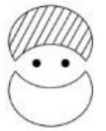
B
C
D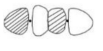
Solution
(C) $\pi^*$ antibonding molecular orbital is formed by the out-of-phase overlap of two atomic orbitals (e.g.,$p_x$ or $p_y$ orbitals).
This results in the presence of a nodal plane between the two nuclei where the electron probability density is zero,in addition to the nodal plane containing the internuclear axis.
In the $\pi^*$ orbital,the lobes of the atomic orbitals have opposite signs (represented by shading) facing each other,leading to destructive interference.
Diagram $C$ correctly depicts this out-of-phase combination,showing the nodal plane between the nuclei.
This results in the presence of a nodal plane between the two nuclei where the electron probability density is zero,in addition to the nodal plane containing the internuclear axis.
In the $\pi^*$ orbital,the lobes of the atomic orbitals have opposite signs (represented by shading) facing each other,leading to destructive interference.
Diagram $C$ correctly depicts this out-of-phase combination,showing the nodal plane between the nuclei.
0 likesView Solution
146
ChemistryDifficultMCQJEE Main · 2026
Given below are two statements:
Statement $I$: The number of compounds among $SO_2$,$SO_3$,$SF_4$,$SF_6$ and $H_2S$ in which sulphur does not obey the Octet rule is $3$.
Statement $II$: Among $[H_2O, ClF_3, SF_4]$,$[NH_3, BrF_5, SF_4]$,$[BrF_5, ClF_3, XeF_4]$ and $[XeF_4, ClF_3, H_2O]$,the number of sets in which all the molecules have one lone pair of electrons on the central atom is $1$.
Statement $I$: The number of compounds among $SO_2$,$SO_3$,$SF_4$,$SF_6$ and $H_2S$ in which sulphur does not obey the Octet rule is $3$.
Statement $II$: Among $[H_2O, ClF_3, SF_4]$,$[NH_3, BrF_5, SF_4]$,$[BrF_5, ClF_3, XeF_4]$ and $[XeF_4, ClF_3, H_2O]$,the number of sets in which all the molecules have one lone pair of electrons on the central atom is $1$.
A
Both Statement $I$ and Statement $II$ are true
B
Both Statement $I$ and Statement $II$ are false
C
Statement $I$ is true but Statement $II$ is false
D
Statement $I$ is false but Statement $II$ is true
Solution
(D) Statement $I$: In $SO_2$ (valence electrons around $S = 10$),$SO_3$ (valence electrons around $S = 12$),$SF_4$ (valence electrons around $S = 10$),and $SF_6$ (valence electrons around $S = 12$),the octet rule is not obeyed (expanded octet).
In $H_2S$,sulphur has $8$ electrons in its valence shell,thus it follows the octet rule.
Therefore,there are $4$ compounds that do not obey the octet rule. Statement $I$ is false.
Statement $II$: Let us count the lone pairs $(LP)$ on the central atom:
$1$. $[H_2O(2 LP), ClF_3(2 LP), SF_4(1 LP)]$
$2$. $[NH_3(1 LP), BrF_5(1 LP), SF_4(1 LP)]$
$3$. $[BrF_5(1 LP), ClF_3(2 LP), XeF_4(2 LP)]$
$4$. $[XeF_4(2 LP), ClF_3(2 LP), H_2O(2 LP)]$
Only the second set contains molecules where all have exactly $1$ lone pair on the central atom.
Thus,there is only $1$ such set. Statement $II$ is true.
In $H_2S$,sulphur has $8$ electrons in its valence shell,thus it follows the octet rule.
Therefore,there are $4$ compounds that do not obey the octet rule. Statement $I$ is false.
Statement $II$: Let us count the lone pairs $(LP)$ on the central atom:
$1$. $[H_2O(2 LP), ClF_3(2 LP), SF_4(1 LP)]$
$2$. $[NH_3(1 LP), BrF_5(1 LP), SF_4(1 LP)]$
$3$. $[BrF_5(1 LP), ClF_3(2 LP), XeF_4(2 LP)]$
$4$. $[XeF_4(2 LP), ClF_3(2 LP), H_2O(2 LP)]$
Only the second set contains molecules where all have exactly $1$ lone pair on the central atom.
Thus,there is only $1$ such set. Statement $II$ is true.
0 likesView Solution
147
ChemistryMediumMCQJEE Main · 2026
Given below are two statements:
Statement $(I)$: The first ionisation enthalpy of the elements $Na$,$Mg$,$Cl$ and $Ar$ follows the order $Na > Mg > Cl > Ar$.
Statement $(II)$: Among $Ca$,$Al$,$Fe$ and $B$,the third ionisation enthalpy is very high for $Ca$.
Statement $(I)$: The first ionisation enthalpy of the elements $Na$,$Mg$,$Cl$ and $Ar$ follows the order $Na > Mg > Cl > Ar$.
Statement $(II)$: Among $Ca$,$Al$,$Fe$ and $B$,the third ionisation enthalpy is very high for $Ca$.
A
Both Statement $I$ and Statement $II$ are true
B
Both Statement $I$ and Statement $II$ are false
C
Statement $I$ is true but Statement $II$ is false
D
Statement $I$ is false but Statement $II$ is true
Solution
(D) Statement $(I)$: The first ionisation enthalpy generally increases across a period from left to right. The correct order for these elements is $Ar > Cl > Mg > Na$. Therefore,the given order $Na > Mg > Cl > Ar$ is incorrect. Thus,Statement $(I)$ is false.
Statement $(II)$: The electronic configuration of $Ca$ $(Z=20)$ is $[Ar] 4s^2$. The first two electrons are removed from the $4s$ orbital. The third electron must be removed from the $3p^6$ orbital,which is a stable noble gas configuration (Argon core). Removing an electron from a stable,fully-filled shell requires a very high amount of energy. Thus,Statement $(II)$ is true.
Statement $(II)$: The electronic configuration of $Ca$ $(Z=20)$ is $[Ar] 4s^2$. The first two electrons are removed from the $4s$ orbital. The third electron must be removed from the $3p^6$ orbital,which is a stable noble gas configuration (Argon core). Removing an electron from a stable,fully-filled shell requires a very high amount of energy. Thus,Statement $(II)$ is true.
0 likesView Solution
148
ChemistryMediumMCQJEE Main · 2026
The $1^{st}$ ionization enthalpy for $Mg$ is $+737 \text{ kJ/mol}$. The most probable estimated value of the $2^{nd}$ ionization enthalpy of $Mg$ is . . . . . . .
A
-$906$ kJ/mol
B
-$856$ kJ/mol
C
+$1450$ kJ/mol
D
+$590$ kJ/mol
Solution
(C) The electronic configuration of $Mg$ is $[Ne]3s^2$.
Removing the first electron requires $737 \text{ kJ/mol}$ to form the $Mg^+$ ion with configuration $[Ne]3s^1$.
The second ionization enthalpy involves removing the second electron from the $Mg^+$ ion.
Since the electron is being removed from a positively charged species,the electrostatic attraction is stronger,requiring significantly more energy than the first ionization.
Therefore,the $2^{nd}$ ionization enthalpy must be greater than the $1^{st}$ ionization enthalpy $(737 \text{ kJ/mol})$ and must be positive.
Among the given options,$+1450 \text{ kJ/mol}$ is the only value that is greater than $737 \text{ kJ/mol}$ and positive,making it the most probable experimental value.
Removing the first electron requires $737 \text{ kJ/mol}$ to form the $Mg^+$ ion with configuration $[Ne]3s^1$.
The second ionization enthalpy involves removing the second electron from the $Mg^+$ ion.
Since the electron is being removed from a positively charged species,the electrostatic attraction is stronger,requiring significantly more energy than the first ionization.
Therefore,the $2^{nd}$ ionization enthalpy must be greater than the $1^{st}$ ionization enthalpy $(737 \text{ kJ/mol})$ and must be positive.
Among the given options,$+1450 \text{ kJ/mol}$ is the only value that is greater than $737 \text{ kJ/mol}$ and positive,making it the most probable experimental value.
0 likesView Solution
149
ChemistryDifficultMCQJEE Main · 2026
Given below are two statements:
Statement $I$: The number of pairs among $[Al_2O_3, Cr_2O_3]$,$[Cl_2O_7, Mn_2O_7]$,$[Na_2O, V_2O_3]$ and $[CO, N_2O]$ that contain oxides of same nature (acidic,basic,neutral or amphoteric) is $4$.
Statement $II$: Among $Na_2O, Al_2O_3, CO$ and $Cl_2O_7$,the most basic and acidic oxides are $Na_2O$ and $Cl_2O_7$,respectively.
Statement $I$: The number of pairs among $[Al_2O_3, Cr_2O_3]$,$[Cl_2O_7, Mn_2O_7]$,$[Na_2O, V_2O_3]$ and $[CO, N_2O]$ that contain oxides of same nature (acidic,basic,neutral or amphoteric) is $4$.
Statement $II$: Among $Na_2O, Al_2O_3, CO$ and $Cl_2O_7$,the most basic and acidic oxides are $Na_2O$ and $Cl_2O_7$,respectively.
A
Both Statement $I$ and Statement $II$ are true
B
Both Statement $I$ and Statement $II$ are false
C
Statement $I$ is true but Statement $II$ is false
D
Statement $I$ is false but Statement $II$ is true
Solution
(D) Statement $I$: $[Al_2O_3, Cr_2O_3]$ are both amphoteric. $[Cl_2O_7, Mn_2O_7]$ are both acidic. $[Na_2O]$ is basic,while $[V_2O_3]$ is amphoteric. $[CO, N_2O]$ are both neutral. Thus,only $3$ pairs have the same nature. Therefore,Statement $I$ is false.
Statement $II$: $Na_2O$ is a highly basic metallic oxide and $Cl_2O_7$ is a strongly acidic non-metallic oxide. Therefore,Statement $II$ is true.
Statement $II$: $Na_2O$ is a highly basic metallic oxide and $Cl_2O_7$ is a strongly acidic non-metallic oxide. Therefore,Statement $II$ is true.
0 likesView Solution
150
ChemistryMediumMCQJEE Main · 2026
Given below are two statements:
Statement $I$: Aluminium is more electropositive than thallium as the standard electrode potential value of $E^\circ_{Al^{3+}/Al}$ is negative and $E^\circ_{Tl^{3+}/Tl}$ is positive.
Statement $II$: The sum of first three ionization enthalpies of boron is very high when compared to that of aluminium. Due to this reason,boron forms covalent compounds only and aluminium forms $Al^{3+}$ ion.
Statement $I$: Aluminium is more electropositive than thallium as the standard electrode potential value of $E^\circ_{Al^{3+}/Al}$ is negative and $E^\circ_{Tl^{3+}/Tl}$ is positive.
Statement $II$: The sum of first three ionization enthalpies of boron is very high when compared to that of aluminium. Due to this reason,boron forms covalent compounds only and aluminium forms $Al^{3+}$ ion.
A
Both Statement $I$ and Statement $II$ are true
B
Both Statement $I$ and Statement $II$ are false
C
Statement $I$ is true but Statement $II$ is false
D
Statement $I$ is false but Statement $II$ is true
Solution
(A) Statement $I$: The standard electrode potential $E^\circ_{Al^{3+}/Al}$ is approximately $-1.66 \ V$,while $E^\circ_{Tl^{3+}/Tl}$ is approximately $+1.26 \ V$. $A$ more negative electrode potential indicates a stronger reducing agent and a more electropositive nature. Therefore,Statement $I$ is true.
Statement $II$: The sum of the first three ionization enthalpies of Boron is extremely high,which prevents the formation of $B^{3+}$ ions,leading it to form only covalent compounds. In contrast,Aluminium has a significantly lower sum of ionization enthalpies,which allows it to form $Al^{3+}$ ions under specific conditions. Therefore,Statement $II$ is true.
Statement $II$: The sum of the first three ionization enthalpies of Boron is extremely high,which prevents the formation of $B^{3+}$ ions,leading it to form only covalent compounds. In contrast,Aluminium has a significantly lower sum of ionization enthalpies,which allows it to form $Al^{3+}$ ions under specific conditions. Therefore,Statement $II$ is true.
0 likesView Solution
151
ChemistryDifficultMCQJEE Main · 2026
Identify the correct statements:
$A$. Hydrated salts can be used as primary standard.
$B$. Primary standard should not undergo any reaction with air.
$C$. Reactions of primary standard with another substance should be instantaneous and stoichiometric.
$D$. Primary standard should not be soluble in water.
$E$. Primary standard should have low relative molar mass.
Choose the correct answer from the options given below :
$A$. Hydrated salts can be used as primary standard.
$B$. Primary standard should not undergo any reaction with air.
$C$. Reactions of primary standard with another substance should be instantaneous and stoichiometric.
$D$. Primary standard should not be soluble in water.
$E$. Primary standard should have low relative molar mass.
Choose the correct answer from the options given below :
A
$A, B, C$ and $E$ only
B
$A, B$,and $C$ only
C
$A, B$ and $E$ only
D
$D$ and $E$ only
Solution
(B) primary standard is a reagent that is pure,stable,and has a high molar mass.
Statement $A$ is incorrect because hydrated salts often lose or gain water of crystallization,making them unstable.
Statement $B$ is correct; a primary standard must be stable and not react with air (e.g.,not hygroscopic or efflorescent).
Statement $C$ is correct; the reaction must be rapid and follow a definite stoichiometry.
Statement $D$ is incorrect; a primary standard must be readily soluble in water to prepare a standard solution.
Statement $E$ is incorrect; a primary standard should have a high relative molar mass to minimize weighing errors.
Therefore,only statement $B$ and $C$ are correct,but based on standard criteria,$B$ and $C$ are the most accurate. Given the options,$B$ is the best fit.
Statement $A$ is incorrect because hydrated salts often lose or gain water of crystallization,making them unstable.
Statement $B$ is correct; a primary standard must be stable and not react with air (e.g.,not hygroscopic or efflorescent).
Statement $C$ is correct; the reaction must be rapid and follow a definite stoichiometry.
Statement $D$ is incorrect; a primary standard must be readily soluble in water to prepare a standard solution.
Statement $E$ is incorrect; a primary standard should have a high relative molar mass to minimize weighing errors.
Therefore,only statement $B$ and $C$ are correct,but based on standard criteria,$B$ and $C$ are the most accurate. Given the options,$B$ is the best fit.
0 likesView Solution
152
ChemistryDifficultMCQJEE Main · 2026
Match List-$I$ with List-$II$:
Choose the correct answer from the options given below:
| List-$I$ (Reaction of glucose with) | List-$II$ (Product formed) |
|---|---|
| $A$. Hydroxylamine | $I$. Gluconic acid |
| $B$. $Br_2$ water | $II$. Glucose pentaacetate |
| $C$. Excess acetic anhydride | $III$. Saccharic acid |
| $D$. Concentrated $HNO_3$ | $IV$. Glucoxime |
Choose the correct answer from the options given below:
A
$A-I, B-III, C-IV, D-II$
B
$A-IV, B-I, C-II, D-III$
C
$A-III, B-I, C-IV, D-II$
D
$A-IV, B-III, C-II, D-I$
Solution
(B) The reactions of glucose are as follows:
$1$. Glucose reacts with hydroxylamine $(NH_2OH)$ to form an oxime,known as Glucoxime $(A-IV)$.
$2$. Glucose reacts with bromine water ($Br_2$ water) to undergo mild oxidation of the aldehyde group to a carboxylic acid,forming Gluconic acid $(B-I)$.
$3$. Glucose reacts with excess acetic anhydride to form Glucose pentaacetate,indicating the presence of five hydroxyl groups $(C-II)$.
$4$. Glucose reacts with concentrated nitric acid $(HNO_3)$ to undergo strong oxidation of both the aldehyde and the primary alcohol group,forming Saccharic acid $(D-III)$.
Thus,the correct matching is $A-IV, B-I, C-II, D-III$.
$1$. Glucose reacts with hydroxylamine $(NH_2OH)$ to form an oxime,known as Glucoxime $(A-IV)$.
$2$. Glucose reacts with bromine water ($Br_2$ water) to undergo mild oxidation of the aldehyde group to a carboxylic acid,forming Gluconic acid $(B-I)$.
$3$. Glucose reacts with excess acetic anhydride to form Glucose pentaacetate,indicating the presence of five hydroxyl groups $(C-II)$.
$4$. Glucose reacts with concentrated nitric acid $(HNO_3)$ to undergo strong oxidation of both the aldehyde and the primary alcohol group,forming Saccharic acid $(D-III)$.
Thus,the correct matching is $A-IV, B-I, C-II, D-III$.
0 likesView Solution
153
ChemistryDifficultMCQJEE Main · 2026
Given below are two statements:
Statement-$I$: Element '$X$' and '$Y$' are the most and least electronegative elements,respectively,among $N, As, Sb$ and $P$. The nature of the oxides $X_{2}O_{3}$ and $Y_{2}O_{3}$ is acidic and amphoteric,respectively.
Statement-$II$: $BCl_{3}$ is covalent in nature and gets hydrolysed in water. It produces $[B(OH)_{4}]^{-}$ and $HCl$ in aqueous medium.
Statement-$I$: Element '$X$' and '$Y$' are the most and least electronegative elements,respectively,among $N, As, Sb$ and $P$. The nature of the oxides $X_{2}O_{3}$ and $Y_{2}O_{3}$ is acidic and amphoteric,respectively.
Statement-$II$: $BCl_{3}$ is covalent in nature and gets hydrolysed in water. It produces $[B(OH)_{4}]^{-}$ and $HCl$ in aqueous medium.
A
Both Statement-$I$ and Statement-$II$ are true.
B
Statement-$I$ is true but Statement-$II$ is false.
C
Both Statement-$I$ and Statement-$II$ are false.
D
Statement-$I$ is false but Statement-$II$ is true.
Solution
(B) Statement-$I$: The electronegativity order for the given elements is $N > P > As > Sb$. Thus,$X = N$ (most electronegative) and $Y = Sb$ (least electronegative). The oxide $N_{2}O_{3}$ is acidic,and $Sb_{2}O_{3}$ is amphoteric. Therefore,Statement-$I$ is true.
Statement-$II$: $BCl_{3}$ is covalent and undergoes hydrolysis in water to form boric acid,$B(OH)_{3}$ (or $H_{3}BO_{3}$),and $HCl$. The reaction is $BCl_{3} + 3H_{2}O \rightarrow B(OH)_{3} + 3HCl$. The statement claims it produces $[B(OH)_{4}]^{-}$ and $[B(H_{2}O)_{6}]^{3+}$,which is incorrect. Therefore,Statement-$II$ is false.
Statement-$II$: $BCl_{3}$ is covalent and undergoes hydrolysis in water to form boric acid,$B(OH)_{3}$ (or $H_{3}BO_{3}$),and $HCl$. The reaction is $BCl_{3} + 3H_{2}O \rightarrow B(OH)_{3} + 3HCl$. The statement claims it produces $[B(OH)_{4}]^{-}$ and $[B(H_{2}O)_{6}]^{3+}$,which is incorrect. Therefore,Statement-$II$ is false.
0 likesView Solution
154
ChemistryDifficultMCQJEE Main · 2026
Correct statements regarding Arrhenius equation among the following are:
$(A)$ Factor $e^{-Ea/RT}$ corresponds to fraction of molecules having kinetic energy less than $Ea$.
$(B)$ At a given temperature,lower the $Ea$,faster is the reaction.
$(C)$ Increase in temperature by about $10^{\circ}C$ doubles the rate of reaction.
$(D)$ Plot of $\log k$ vs $\frac{1}{T}$ gives a straight line with $slope = -\frac{Ea}{2.303R}$.
Choose the correct answer from the options given below:
$(A)$ Factor $e^{-Ea/RT}$ corresponds to fraction of molecules having kinetic energy less than $Ea$.
$(B)$ At a given temperature,lower the $Ea$,faster is the reaction.
$(C)$ Increase in temperature by about $10^{\circ}C$ doubles the rate of reaction.
$(D)$ Plot of $\log k$ vs $\frac{1}{T}$ gives a straight line with $slope = -\frac{Ea}{2.303R}$.
Choose the correct answer from the options given below:
A
$B$ and $D$ only
B
$A$ and $B$ only
C
$A$ and $C$ only
D
$B$ and $C$ only
Solution
(D) Statement $(A)$ is incorrect because the factor $e^{-Ea/RT}$ represents the fraction of molecules having kinetic energy equal to or greater than the activation energy $(Ea)$.
Statement $(B)$ is correct because a lower activation energy $(Ea)$ means a larger fraction of molecules can cross the energy barrier,leading to a faster reaction rate.
Statement $(C)$ is correct as a general rule of thumb for many reactions,an increase in temperature by $10^{\circ}C$ approximately doubles the rate constant.
Statement $(D)$ is incorrect because the plot of $\log k$ vs $\frac{1}{T}$ gives a straight line with a slope of $-\frac{Ea}{2.303R}$,not $-\frac{Ea}{R}$.
Therefore,statements $(B)$ and $(C)$ are correct.
Statement $(B)$ is correct because a lower activation energy $(Ea)$ means a larger fraction of molecules can cross the energy barrier,leading to a faster reaction rate.
Statement $(C)$ is correct as a general rule of thumb for many reactions,an increase in temperature by $10^{\circ}C$ approximately doubles the rate constant.
Statement $(D)$ is incorrect because the plot of $\log k$ vs $\frac{1}{T}$ gives a straight line with a slope of $-\frac{Ea}{2.303R}$,not $-\frac{Ea}{R}$.
Therefore,statements $(B)$ and $(C)$ are correct.
0 likesView Solution
155
ChemistryDifficultMCQJEE Main · 2026
The final product $[B]$ is :

A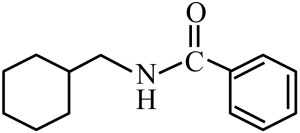
B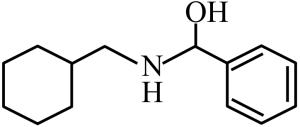
C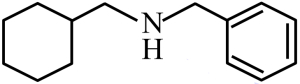
D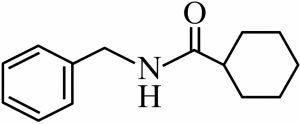
Solution
(C) The reaction proceeds in two steps:
$1$. Cyclohexylmethanamine reacts with benzoyl chloride $(C_6H_5COCl)$ in the presence of a base $(NaOH)$ to form an amide,$N$-(cyclohexylmethyl)benzamide,which is product $[A]$.
$2$. The amide $[A]$ is then reduced using lithium aluminium hydride $(LiAlH_4)$ followed by hydrolysis $(H_2O)$ to yield the corresponding amine,$N$-benzylcyclohexylmethanamine,which is the final product $[B]$.
$1$. Cyclohexylmethanamine reacts with benzoyl chloride $(C_6H_5COCl)$ in the presence of a base $(NaOH)$ to form an amide,$N$-(cyclohexylmethyl)benzamide,which is product $[A]$.
$2$. The amide $[A]$ is then reduced using lithium aluminium hydride $(LiAlH_4)$ followed by hydrolysis $(H_2O)$ to yield the corresponding amine,$N$-benzylcyclohexylmethanamine,which is the final product $[B]$.
0 likesView Solution
156
ChemistryDifficultMCQJEE Main · 2026
Given below are two statements:
Statement-$I$: The first ionization enthalpy of $Cr$ is lower than that of $Mn$.
Statement-$II$: The second and third ionization enthalpies of $Cr$ are higher than those of $Mn$.
In the light of the above statements,choose the correct answer from the options given below:
Statement-$I$: The first ionization enthalpy of $Cr$ is lower than that of $Mn$.
Statement-$II$: The second and third ionization enthalpies of $Cr$ are higher than those of $Mn$.
In the light of the above statements,choose the correct answer from the options given below:
A
Both Statement-$I$ and Statement-$II$ are false.
B
Statement-$I$ is true but Statement-$II$ is false.
C
Both Statement-$I$ and Statement-$II$ are true.
D
Statement-$I$ is false but Statement-$II$ is true.
Solution
(B) The electronic configurations are:
$Cr = [Ar] 3d^{5} 4s^{1}$
$Mn = [Ar] 3d^{5} 4s^{2}$
Statement-$I$: The first ionization enthalpy $(IE_{1})$ of $Cr$ is lower than that of $Mn$ because $Mn$ has a stable half-filled $d$-subshell and a full $s$-subshell,making it harder to remove an electron. Thus,Statement-$I$ is true.
Statement-$II$: For $IE_{2}$,$Cr$ loses its $4s^{1}$ electron to reach a stable $3d^{5}$ configuration,while $Mn$ loses its $4s^{1}$ electron from a $3d^{5} 4s^{2}$ configuration. However,$IE_{2}$ of $Cr$ is higher than $Mn$ because removing the second electron from $Cr$ disrupts the stable $d^{5}$ configuration. For $IE_{3}$,$Mn$ has a higher value because it involves removing an electron from the stable $d^{5}$ configuration of $Mn^{2+}$. Therefore,Statement-$II$ is false.
$Cr = [Ar] 3d^{5} 4s^{1}$
$Mn = [Ar] 3d^{5} 4s^{2}$
Statement-$I$: The first ionization enthalpy $(IE_{1})$ of $Cr$ is lower than that of $Mn$ because $Mn$ has a stable half-filled $d$-subshell and a full $s$-subshell,making it harder to remove an electron. Thus,Statement-$I$ is true.
Statement-$II$: For $IE_{2}$,$Cr$ loses its $4s^{1}$ electron to reach a stable $3d^{5}$ configuration,while $Mn$ loses its $4s^{1}$ electron from a $3d^{5} 4s^{2}$ configuration. However,$IE_{2}$ of $Cr$ is higher than $Mn$ because removing the second electron from $Cr$ disrupts the stable $d^{5}$ configuration. For $IE_{3}$,$Mn$ has a higher value because it involves removing an electron from the stable $d^{5}$ configuration of $Mn^{2+}$. Therefore,Statement-$II$ is false.
0 likesView Solution
157
ChemistryDifficultMCQJEE Main · 2026
At $T \ (K)$,$100 \ g$ of $98\%$ $H_2SO_4$ $(w/w)$ aqueous solution is mixed with $100 \ g$ of $49\%$ $H_2SO_4$ $(w/w)$ aqueous solution. What is the mole fraction of $H_2SO_4$ in the resultant solution?
(Given: Atomic mass $H = 1 \ u; S = 32 \ u; O = 16 \ u$)
(Assume that temperature after mixing remains constant)
(Given: Atomic mass $H = 1 \ u; S = 32 \ u; O = 16 \ u$)
(Assume that temperature after mixing remains constant)
A
$0.9$
B
$0.1$
C
$0.337$
D
$0.663$
Solution
(C) Total mass of $H_2SO_4 = (100 \times 0.98) + (100 \times 0.49) = 98 + 49 = 147 \ g$.
Total mass of solution $= 100 + 100 = 200 \ g$.
Total mass of $H_2O = 200 - 147 = 53 \ g$.
Moles of $H_2SO_4 = \frac{147}{98} = 1.5 \ mol$.
Moles of $H_2O = \frac{53}{18} \approx 2.944 \ mol$.
Mole fraction of $H_2SO_4 = \frac{n_{H_2SO_4}}{n_{H_2SO_4} + n_{H_2O}} = \frac{1.5}{1.5 + 2.944} = \frac{1.5}{4.444} \approx 0.337$.
Total mass of solution $= 100 + 100 = 200 \ g$.
Total mass of $H_2O = 200 - 147 = 53 \ g$.
Moles of $H_2SO_4 = \frac{147}{98} = 1.5 \ mol$.
Moles of $H_2O = \frac{53}{18} \approx 2.944 \ mol$.
Mole fraction of $H_2SO_4 = \frac{n_{H_2SO_4}}{n_{H_2SO_4} + n_{H_2O}} = \frac{1.5}{1.5 + 2.944} = \frac{1.5}{4.444} \approx 0.337$.
0 likesView Solution
158
ChemistryDifficultMCQJEE Main · 2026
The temperature at which the rate constants of the two gaseous reactions given below become equal is . . . . . . $K$. (Nearest integer).
$X \longrightarrow Y \quad k_1 = 10^6 e^{\frac{-30000}{T}}$
$P \longrightarrow Q \quad k_2 = 10^4 e^{\frac{-24000}{T}}$
Given: $\ln 10 = 2.303$
$X \longrightarrow Y \quad k_1 = 10^6 e^{\frac{-30000}{T}}$
$P \longrightarrow Q \quad k_2 = 10^4 e^{\frac{-24000}{T}}$
Given: $\ln 10 = 2.303$
A
$1100$
B
$1200$
C
$1303$
D
$1405$
Solution
(C) Equating the two rate constants: $k_1 = k_2$
$10^6 e^{\frac{-30000}{T}} = 10^4 e^{\frac{-24000}{T}}$
Divide both sides by $10^4 e^{\frac{-30000}{T}}$:
$10^2 = e^{\frac{-24000}{T} - (\frac{-30000}{T})}$
$100 = e^{\frac{6000}{T}}$
Taking natural logarithm on both sides:
$\ln(100) = \frac{6000}{T}$
$2 \ln(10) = \frac{6000}{T}$
$2 \times 2.303 = \frac{6000}{T}$
$T = \frac{6000}{4.606} \approx 1302.64 \ K$
Rounding to the nearest integer,we get $T = 1303 \ K$.
$10^6 e^{\frac{-30000}{T}} = 10^4 e^{\frac{-24000}{T}}$
Divide both sides by $10^4 e^{\frac{-30000}{T}}$:
$10^2 = e^{\frac{-24000}{T} - (\frac{-30000}{T})}$
$100 = e^{\frac{6000}{T}}$
Taking natural logarithm on both sides:
$\ln(100) = \frac{6000}{T}$
$2 \ln(10) = \frac{6000}{T}$
$2 \times 2.303 = \frac{6000}{T}$
$T = \frac{6000}{4.606} \approx 1302.64 \ K$
Rounding to the nearest integer,we get $T = 1303 \ K$.
0 likesView Solution
159
ChemistryDifficultMCQJEE Main · 2026
Consider the following electrochemical cell at $298 \ K$:
$Pt | HSnO_2^-(aq) | Sn(OH)_6^{2-}(aq) || Bi_2O_3(s) | Bi(s)$.
If the reaction quotient at a given time is $10^6$,then the cell $EMF$ $(E_{\text{cell}})$ is . . . . . . $\times 10^{-1} \ V$ (Nearest integer).
Given the standard half-cell reduction potential as
$E^0_{Bi_2O_3/Bi, OH^-} = -0.44 \ V$ and
$E^0_{Sn(OH)_6^{2-}/HSnO_2^-, OH^-} = -0.90 \ V$.
$Pt | HSnO_2^-(aq) | Sn(OH)_6^{2-}(aq) || Bi_2O_3(s) | Bi(s)$.
If the reaction quotient at a given time is $10^6$,then the cell $EMF$ $(E_{\text{cell}})$ is . . . . . . $\times 10^{-1} \ V$ (Nearest integer).
Given the standard half-cell reduction potential as
$E^0_{Bi_2O_3/Bi, OH^-} = -0.44 \ V$ and
$E^0_{Sn(OH)_6^{2-}/HSnO_2^-, OH^-} = -0.90 \ V$.
A
$2$
B
$3$
C
$4$
D
$5$
Solution
(C) The cell reaction is: $3HSnO_2^- + Bi_2O_3 + 3H_2O + 6OH^- \rightarrow 3Sn(OH)_6^{2-} + 2Bi$.
The number of electrons involved in the balanced equation is $n = 6$.
The standard cell potential is $E^0_{\text{cell}} = E^0_{\text{cathode}} - E^0_{\text{anode}} = -0.44 - (-0.90) = +0.46 \ V$.
Applying the Nernst equation at $298 \ K$: $E_{\text{cell}} = E^0_{\text{cell}} - \frac{0.0591}{n} \log Q$.
Using $0.06$ as an approximation for $\frac{0.0591}{1}$: $E_{\text{cell}} = 0.46 - \frac{0.06}{6} \log(10^6)$.
$E_{\text{cell}} = 0.46 - 0.01 \times 6 = 0.46 - 0.06 = 0.40 \ V$.
Thus,$E_{\text{cell}} = 4 \times 10^{-1} \ V$.
The value is $4$.
The number of electrons involved in the balanced equation is $n = 6$.
The standard cell potential is $E^0_{\text{cell}} = E^0_{\text{cathode}} - E^0_{\text{anode}} = -0.44 - (-0.90) = +0.46 \ V$.
Applying the Nernst equation at $298 \ K$: $E_{\text{cell}} = E^0_{\text{cell}} - \frac{0.0591}{n} \log Q$.
Using $0.06$ as an approximation for $\frac{0.0591}{1}$: $E_{\text{cell}} = 0.46 - \frac{0.06}{6} \log(10^6)$.
$E_{\text{cell}} = 0.46 - 0.01 \times 6 = 0.46 - 0.06 = 0.40 \ V$.
Thus,$E_{\text{cell}} = 4 \times 10^{-1} \ V$.
The value is $4$.
0 likesView Solution
160
ChemistryDifficultMCQJEE Main · 2026
Given below are two statements:
Statement $I$: The Henry's law constant $K_{H}$ is constant with respect to variations in solution's concentration over the range for which the solution is ideally dilute.
Statement $II$: $K_{H}$ does not differ for the same solute in different solvents.
In the light of the above statements,choose the correct answer from the options.
Statement $I$: The Henry's law constant $K_{H}$ is constant with respect to variations in solution's concentration over the range for which the solution is ideally dilute.
Statement $II$: $K_{H}$ does not differ for the same solute in different solvents.
In the light of the above statements,choose the correct answer from the options.
A
Statement $I$ is false but Statement $II$ is true.
B
Statement $I$ is true but Statement $II$ is false.
C
Both Statement $I$ and Statement $II$ are true.
D
Both Statement $I$ and Statement $II$ are false.
Solution
(B) Statement $I$ is true because Henry's law states that $p = K_{H}x$,where $K_{H}$ is a constant for a given gas-solvent system at a constant temperature,especially in the range where the solution behaves as an ideally dilute solution.
Statement $II$ is false because $K_{H}$ depends on the nature of the gas and the nature of the solvent. Therefore,$K_{H}$ will differ for the same solute in different solvents.
Statement $II$ is false because $K_{H}$ depends on the nature of the gas and the nature of the solvent. Therefore,$K_{H}$ will differ for the same solute in different solvents.
0 likesView Solution
161
ChemistryDifficultMCQJEE Main · 2026
As compared with chlorocyclohexane,which of the following statements correctly apply to chlorobenzene?
$A$. The magnitude of negative charge is more on chlorine atoms.
$B$. The $C-Cl$ bond has partial double bond character.
$C$. $C-Cl$ bond is less polar.
$D$. $C-Cl$ bond is longer due to repulsion between delocalised electrons of the aromatic ring and lone pairs of electrons of chlorine.
$E$. The $C-Cl$ bond is formed using $sp^2$ hybridised orbital of carbon.
Choose the correct answer from the options given below:
$A$. The magnitude of negative charge is more on chlorine atoms.
$B$. The $C-Cl$ bond has partial double bond character.
$C$. $C-Cl$ bond is less polar.
$D$. $C-Cl$ bond is longer due to repulsion between delocalised electrons of the aromatic ring and lone pairs of electrons of chlorine.
$E$. The $C-Cl$ bond is formed using $sp^2$ hybridised orbital of carbon.
Choose the correct answer from the options given below:
A
$A$,$C$ and $E$ only
B
$B$,$C$ and $D$ only
C
$A$,$D$ and $E$ only
D
$B$,$C$ and $E$ only
Solution
(D) In chlorocyclohexane,the carbon atom attached to chlorine is $sp^3$ hybridized,while in chlorobenzene,it is $sp^2$ hybridized.
Due to the resonance effect ($+M$ effect) in chlorobenzene,the $C-Cl$ bond acquires partial double bond character ($B$ is correct).
This resonance also reduces the polarity of the $C-Cl$ bond compared to chlorocyclohexane ($C$ is correct).
The $C-Cl$ bond in chlorobenzene is formed using an $sp^2$ hybridized orbital of carbon,which is shorter and stronger than the $sp^3$ bond in chlorocyclohexane ($E$ is correct).
Statement $A$ is incorrect because the resonance effect decreases the negative charge on chlorine. Statement $D$ is incorrect because the $C-Cl$ bond is actually shorter in chlorobenzene due to the partial double bond character.
Due to the resonance effect ($+M$ effect) in chlorobenzene,the $C-Cl$ bond acquires partial double bond character ($B$ is correct).
This resonance also reduces the polarity of the $C-Cl$ bond compared to chlorocyclohexane ($C$ is correct).
The $C-Cl$ bond in chlorobenzene is formed using an $sp^2$ hybridized orbital of carbon,which is shorter and stronger than the $sp^3$ bond in chlorocyclohexane ($E$ is correct).
Statement $A$ is incorrect because the resonance effect decreases the negative charge on chlorine. Statement $D$ is incorrect because the $C-Cl$ bond is actually shorter in chlorobenzene due to the partial double bond character.
0 likesView Solution
162
ChemistryDifficultMCQJEE Main · 2026
The correct order of the rate of reaction of the following reactants with a nucleophile by $S_{N}1$ mechanism is:
(Given: Structure $I$ and $II$ are rigid)
(Given: Structure $I$ and $II$ are rigid)
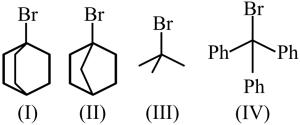
A
$IV < III < II < I$
B
$III < I < II < IV$
C
$II < I < III < IV$
D
$I < II < III < IV$
Solution
(C) The rate of $S_{N}1$ reaction is directly proportional to the stability of the carbocation $(C^{\oplus})$ formed.
$I$ is $1-$bromobicyclo[$2.2$.$1$]heptane and $II$ is $1-$bromobicyclo[$2.2$.$2$]octane. Both are bridgehead halides and are extremely unreactive in $S_{N}1$ reactions due to Bredt's rule,which prevents the formation of a planar carbocation at the bridgehead position.
Between $I$ and $II$,$II$ is slightly more reactive than $I$ because the bridgehead carbocation in $II$ is less strained than in $I$.
$III$ is a tert-butyl carbocation,which is more stable than the bridgehead carbocations.
$IV$ is a triphenylmethyl carbocation,which is the most stable due to extensive resonance stabilization by three phenyl rings.
Thus,the correct order of reactivity is $II < I < III < IV$.
$I$ is $1-$bromobicyclo[$2.2$.$1$]heptane and $II$ is $1-$bromobicyclo[$2.2$.$2$]octane. Both are bridgehead halides and are extremely unreactive in $S_{N}1$ reactions due to Bredt's rule,which prevents the formation of a planar carbocation at the bridgehead position.
Between $I$ and $II$,$II$ is slightly more reactive than $I$ because the bridgehead carbocation in $II$ is less strained than in $I$.
$III$ is a tert-butyl carbocation,which is more stable than the bridgehead carbocations.
$IV$ is a triphenylmethyl carbocation,which is the most stable due to extensive resonance stabilization by three phenyl rings.
Thus,the correct order of reactivity is $II < I < III < IV$.
0 likesView Solution
163
ChemistryDifficultMCQJEE Main · 2026
$A$ is a neutral organic compound $(M.F.: C_8H_9ON)$. On treatment with aqueous $Br_2 / HO^{(-)}$,$A$ forms a compound $B$ which is soluble in dilute acid. $B$ on treatment with aqueous $NaNO_2 / HCl$ $(0-5^{\circ}C)$ produces a compound $C$ which on treatment with $CuCN / NaCN$ produces $D$. Hydrolysis of $D$ produces $E$ which is also obtainable from the hydrolysis of $A$. $E$ on treatment with acidified $KMnO_4$ produces $F$. $F$ contains two different types of hydrogen atoms. The structure of $A$ is
A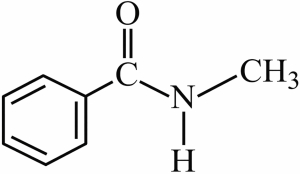
B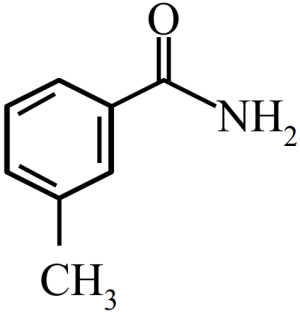
C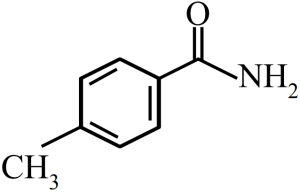
D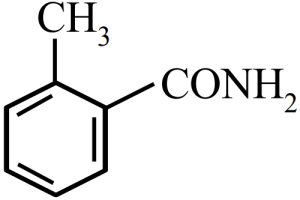
Solution
(C) $1$. The molecular formula $C_8H_9ON$ and the reaction with $Br_2 / HO^{(-)}$ (Hofmann bromamide degradation) suggest that $A$ is an amide.
$2$. The product $B$ is an amine,which is soluble in dilute acid.
$3$. The reaction sequence $B$ $\xrightarrow{NaNO_2/HCl} C$ $\xrightarrow{CuCN} D$ $\xrightarrow{H_3O^+} E$ is the standard conversion of an amine to a carboxylic acid via a diazonium salt and nitrile.
$4$. $E$ is also obtained from the hydrolysis of $A$,confirming $A$ is an amide.
$5$. $E$ on oxidation with $KMnO_4$ gives $F$. If $E$ is $p$-toluic acid,oxidation gives terephthalic acid $(F)$,which has two types of hydrogen atoms (aromatic and carboxylic).
$6$. Based on the reaction path,$A$ must be $p$-methylbenzamide.
$2$. The product $B$ is an amine,which is soluble in dilute acid.
$3$. The reaction sequence $B$ $\xrightarrow{NaNO_2/HCl} C$ $\xrightarrow{CuCN} D$ $\xrightarrow{H_3O^+} E$ is the standard conversion of an amine to a carboxylic acid via a diazonium salt and nitrile.
$4$. $E$ is also obtained from the hydrolysis of $A$,confirming $A$ is an amide.
$5$. $E$ on oxidation with $KMnO_4$ gives $F$. If $E$ is $p$-toluic acid,oxidation gives terephthalic acid $(F)$,which has two types of hydrogen atoms (aromatic and carboxylic).
$6$. Based on the reaction path,$A$ must be $p$-methylbenzamide.
0 likesView Solution
164
ChemistryDifficultMCQJEE Main · 2026
Given below are two statements:
Statement $I$: Sucrose is dextrorotatory. However,sucrose upon hydrolysis gives a solution having a mixture of products. This solution shows laevorotation.
Statement $II$: Hydrolysis of sucrose gives glucose and fructose. Since the laevorotation of glucose is more than the dextrorotation of fructose,the resulting solution becomes laevorotatory.
In the light of the above statements,choose the correct answer from the options given below.
Statement $I$: Sucrose is dextrorotatory. However,sucrose upon hydrolysis gives a solution having a mixture of products. This solution shows laevorotation.
Statement $II$: Hydrolysis of sucrose gives glucose and fructose. Since the laevorotation of glucose is more than the dextrorotation of fructose,the resulting solution becomes laevorotatory.
In the light of the above statements,choose the correct answer from the options given below.
A
Statement $I$ is false but Statement $II$ is true.
B
Both Statement $I$ and Statement $II$ are false.
C
Both Statement $I$ and Statement $II$ are true.
D
Statement $I$ is true but Statement $II$ is false.
Solution
(D) Sucrose is dextrorotatory $(+66.5^\circ)$.
Upon hydrolysis,it yields an equimolar mixture of $D-(+)$-glucose $(+52.5^\circ)$ and $D-(-)$-fructose $(-92.4^\circ)$.
Since the magnitude of the laevorotation of fructose $(-92.4^\circ)$ is greater than the dextrorotation of glucose $(+52.5^\circ)$,the resulting mixture is laevorotatory.
This process is known as the inversion of sugar.
Statement $I$ is correct.
Statement $II$ is incorrect because it incorrectly states that glucose is laevorotatory and fructose is dextrorotatory,whereas the opposite is true.
Upon hydrolysis,it yields an equimolar mixture of $D-(+)$-glucose $(+52.5^\circ)$ and $D-(-)$-fructose $(-92.4^\circ)$.
Since the magnitude of the laevorotation of fructose $(-92.4^\circ)$ is greater than the dextrorotation of glucose $(+52.5^\circ)$,the resulting mixture is laevorotatory.
This process is known as the inversion of sugar.
Statement $I$ is correct.
Statement $II$ is incorrect because it incorrectly states that glucose is laevorotatory and fructose is dextrorotatory,whereas the opposite is true.
0 likesView Solution
165
ChemistryDifficultMCQJEE Main · 2026
Given below are two statements:
Statement $I$: The halogen that makes the longest bond with hydrogen in $HX$ has the smallest covalent radius in its group.
Statement $II$: $A$ group $15$ element's hydride $EH_3$ has the lowest boiling point among corresponding hydrides of other group $15$ elements. The maximum covalency of that element $E$ is $4$.
In the light of the above statements,choose the correct answer from the options given below.
Statement $I$: The halogen that makes the longest bond with hydrogen in $HX$ has the smallest covalent radius in its group.
Statement $II$: $A$ group $15$ element's hydride $EH_3$ has the lowest boiling point among corresponding hydrides of other group $15$ elements. The maximum covalency of that element $E$ is $4$.
In the light of the above statements,choose the correct answer from the options given below.
A
Both Statement $I$ and Statement $II$ are true.
B
Statement $I$ is false but Statement $II$ is true.
C
Both Statement $I$ and Statement $II$ are false.
D
Statement $I$ is true but Statement $II$ is false.
Solution
(C) Statement $I$: The bond length in $HX$ increases as the size of the halogen increases $(HF < HCl < HBr < HI)$. The halogen with the longest bond is $I$,which has the largest covalent radius,not the smallest. Thus,Statement $I$ is false.
Statement $II$: The boiling point order for group $15$ hydrides is $PH_3 < AsH_3 < NH_3 < SbH_3 < BiH_3$. The hydride with the lowest boiling point is $PH_3$. The element $E$ is $P$ (phosphorus). The maximum covalency of phosphorus is $6$ (e.g.,in $[PF_6]^-$),not $4$. Thus,Statement $II$ is false.
Statement $II$: The boiling point order for group $15$ hydrides is $PH_3 < AsH_3 < NH_3 < SbH_3 < BiH_3$. The hydride with the lowest boiling point is $PH_3$. The element $E$ is $P$ (phosphorus). The maximum covalency of phosphorus is $6$ (e.g.,in $[PF_6]^-$),not $4$. Thus,Statement $II$ is false.
0 likesView Solution
166
ChemistryDifficultMCQJEE Main · 2026
Match the List-$I$ with List-$II$.
Choose the correct answer from the options given below:
| List-$I$ (Reagents) | List-$II$ (Reaction Name) |
|---|---|
| $A$. $NH_2-NH_2, KOH$ | $I$. Tollen's Test |
| $B$. $[Ag(NH_3)_2]OH$ | $II$. Clemmensen Reduction |
| $C$. Aq. $CuSO_4$,Sodium Potassium tartarate,$KOH$ | $III$. Wolff-Kishner Reduction |
| $D$. $Zn-Hg, HCl$ | $IV$. Fehling's Test |
Choose the correct answer from the options given below:
A
$A-III, B-I, C-IV, D-II$
B
$A-II, B-I, C-IV, D-III$
C
$A-IV, B-III, C-II, D-I$
D
$A-III, B-IV, C-I, D-II$
Solution
(A) The correct matches are as follows:
$A$. $NH_2-NH_2, KOH$ is used in the Wolff-Kishner reduction $(III)$.
$B$. $[Ag(NH_3)_2]OH$ is the reagent for Tollen's test $(I)$.
$C$. Aqueous $CuSO_4$,Sodium Potassium tartarate,and $KOH$ constitute the Fehling's solution used in Fehling's test $(IV)$.
$D$. $Zn-Hg, HCl$ is used in the Clemmensen reduction $(II)$.
Thus,the correct sequence is $A-III, B-I, C-IV, D-II$.
$A$. $NH_2-NH_2, KOH$ is used in the Wolff-Kishner reduction $(III)$.
$B$. $[Ag(NH_3)_2]OH$ is the reagent for Tollen's test $(I)$.
$C$. Aqueous $CuSO_4$,Sodium Potassium tartarate,and $KOH$ constitute the Fehling's solution used in Fehling's test $(IV)$.
$D$. $Zn-Hg, HCl$ is used in the Clemmensen reduction $(II)$.
Thus,the correct sequence is $A-III, B-I, C-IV, D-II$.
0 likesView Solution
167
ChemistryDifficultMCQJEE Main · 2026
$A \rightarrow$ products ($1^{st}$ order reaction). Three sets of experiment were performed for a reaction under similar experimental conditions. Run $1 \Rightarrow 100 \ mL$ of $10 \ M$ solution of reactant $A$. Run $2 \Rightarrow 200 \ mL$ of $10 \ M$ solution of reactant $A$. Run $3 \Rightarrow 100 \ mL$ of $10 \ M$ solution of reactant $A + 100 \ mL$ of $H_2O$ added. The correct variation of rate of reaction is:
A
Run $1 = $ Run $2 = $ Run $3$
B
Run $3 < $ Run $1 = $ Run $2$
C
Run $3 < $ Run $1 < $ Run $2$
D
Run $1 < $ Run $2 < $ Run $3$
Solution
(B) For a $1^{st}$ order reaction,the rate is given by $Rate = k[A]$.
In Run $1$,the concentration of $A$ is $10 \ M$.
In Run $2$,the volume is doubled,but the concentration of $A$ remains $10 \ M$,so the rate is the same as Run $1$.
In Run $3$,$100 \ mL$ of $H_2O$ is added to $100 \ mL$ of $10 \ M$ solution of $A$,which dilutes the solution to $5 \ M$.
Since the rate depends on the concentration of $A$,the rate in Run $3$ will be lower than in Run $1$ and Run $2$.
Therefore,the correct order is $Run \ 3 < Run \ 1 = Run \ 2$.
In Run $1$,the concentration of $A$ is $10 \ M$.
In Run $2$,the volume is doubled,but the concentration of $A$ remains $10 \ M$,so the rate is the same as Run $1$.
In Run $3$,$100 \ mL$ of $H_2O$ is added to $100 \ mL$ of $10 \ M$ solution of $A$,which dilutes the solution to $5 \ M$.
Since the rate depends on the concentration of $A$,the rate in Run $3$ will be lower than in Run $1$ and Run $2$.
Therefore,the correct order is $Run \ 3 < Run \ 1 = Run \ 2$.
0 likesView Solution
168
ChemistryDifficultMCQJEE Main · 2026
Given below are two statements:
Statement $I$: Benzene is nitrated to give nitrobenzene,which on further treatment with $CH_{3}COCl / AlCl_{3}$ will give the product shown in the image.
Statement $II$: $NO_{2}$ group is a $m$-directing and deactivating group.
In the light of the above statements,choose the most appropriate answer:
Statement $I$: Benzene is nitrated to give nitrobenzene,which on further treatment with $CH_{3}COCl / AlCl_{3}$ will give the product shown in the image.
Statement $II$: $NO_{2}$ group is a $m$-directing and deactivating group.
In the light of the above statements,choose the most appropriate answer:
A
Statement $I$ is correct but Statement $II$ is incorrect.
B
Both Statement $I$ and Statement $II$ are correct.
C
Statement $I$ is incorrect but Statement $II$ is correct.
D
Both Statement $I$ and Statement $II$ are incorrect.
Solution
(C) Statement $I$ is incorrect. Nitrobenzene is a highly deactivated ring due to the strong electron-withdrawing $-NO_{2}$ group. Therefore,it does not undergo Friedel-Crafts acylation reaction with $CH_{3}COCl / AlCl_{3}$.
Statement $II$ is correct. The $-NO_{2}$ group is indeed a meta-directing and deactivating group because it withdraws electron density from the benzene ring via both inductive and resonance effects.
Statement $II$ is correct. The $-NO_{2}$ group is indeed a meta-directing and deactivating group because it withdraws electron density from the benzene ring via both inductive and resonance effects.
0 likesView Solution
169
ChemistryDifficultMCQJEE Main · 2026
The correct order of reactivity of $CH_3Br$ in methanol with the following nucleophiles is:
$F^{-}, I^{-}, C_2H_5O^{-}$ and $C_6H_5O^{-}$
$F^{-}, I^{-}, C_2H_5O^{-}$ and $C_6H_5O^{-}$
A
$I^{-} > C_6H_5O^{-} > F^{-} > C_2H_5O^{-}$
B
$I^{-} > C_2H_5O^{-} > C_6H_5O^{-} > F^{-}$
C
$I^{-} > C_2H_5O^{-} > F^{-} > C_6H_5O^{-}$
D
$I^{-} > F^{-} > C_6H_5O^{-} > C_2H_5O^{-}$
Solution
(B) In a polar protic solvent like methanol,nucleophilicity is determined by the ability of the nucleophile to donate an electron pair.
The order of nucleophilicity is governed by basicity and polarizability.
$C_2H_5O^{-}$ is a strong base and a good nucleophile.
$C_6H_5O^{-}$ (phenoxide) is less basic than $C_2H_5O^{-}$ due to resonance stabilization of the negative charge on the oxygen atom.
$I^{-}$ is a very good nucleophile in polar protic solvents due to its high polarizability,despite being a weak base.
$F^{-}$ is a small,highly solvated ion in methanol,making it a poor nucleophile.
Thus,the correct order is $I^{-} > C_2H_5O^{-} > C_6H_5O^{-} > F^{-}$.
The order of nucleophilicity is governed by basicity and polarizability.
$C_2H_5O^{-}$ is a strong base and a good nucleophile.
$C_6H_5O^{-}$ (phenoxide) is less basic than $C_2H_5O^{-}$ due to resonance stabilization of the negative charge on the oxygen atom.
$I^{-}$ is a very good nucleophile in polar protic solvents due to its high polarizability,despite being a weak base.
$F^{-}$ is a small,highly solvated ion in methanol,making it a poor nucleophile.
Thus,the correct order is $I^{-} > C_2H_5O^{-} > C_6H_5O^{-} > F^{-}$.
0 likesView Solution
170
ChemistryDifficultMCQJEE Main · 2026
$A$ first row transition metal $(M)$ does not liberate $H_{2}$ gas from dilute $HCl$. $1 \ mol$ of aqueous solution of $MSO_{4}$ is treated with excess of aqueous $KCN$ and then $H_{2}S_{(g)}$ is passed through the solution. The amount of $MS$ (metal sulphide) formed from the above reaction is . . . . . . $mol$.
A
$2$
B
$1$
C
$3$
D
$0$
Solution
(D) The metal $M$ that does not liberate $H_{2}$ gas from dilute $HCl$ is $Cu$ (Copper),as it has a positive standard reduction potential $(E^{\circ}_{Cu^{2+}/Cu} = +0.34 \ V)$.
When $CuSO_{4}$ is treated with excess $KCN$,it forms a very stable complex $[Cu(CN)_{4}]^{3-}$.
The reaction is: $2CuSO_{4} + 10KCN \rightarrow 2K_{3}[Cu(CN)_{4}] + (CN)_{2} + 2K_{2}SO_{4}$.
Because the complex $[Cu(CN)_{4}]^{3-}$ is extremely stable (a 'perfect' complex),the concentration of free $Cu^{2+}$ ions in the solution is negligible.
Therefore,when $H_{2}S_{(g)}$ is passed through this solution,the ionic product does not exceed the solubility product $(K_{sp})$ of $CuS$,and no precipitate of $CuS$ is formed.
Thus,the amount of $MS$ formed is $0 \ mol$.
When $CuSO_{4}$ is treated with excess $KCN$,it forms a very stable complex $[Cu(CN)_{4}]^{3-}$.
The reaction is: $2CuSO_{4} + 10KCN \rightarrow 2K_{3}[Cu(CN)_{4}] + (CN)_{2} + 2K_{2}SO_{4}$.
Because the complex $[Cu(CN)_{4}]^{3-}$ is extremely stable (a 'perfect' complex),the concentration of free $Cu^{2+}$ ions in the solution is negligible.
Therefore,when $H_{2}S_{(g)}$ is passed through this solution,the ionic product does not exceed the solubility product $(K_{sp})$ of $CuS$,and no precipitate of $CuS$ is formed.
Thus,the amount of $MS$ formed is $0 \ mol$.
0 likesView Solution
171
ChemistryDifficultMCQJEE Main · 2026
Consider a solution of $CO_{2(g)}$ dissolved in water in a closed container. Which one of the following plots correctly represents the variation of $log$ (partial pressure of $CO_2$ in vapour phase above water) [y-axis] with $log$ (mole fraction of $CO_2$ in water) [x-axis] at $25^{\circ}C$?
A
B
C
D
Solution
(C) According to Henry's law,the partial pressure of a gas $(P_g)$ is directly proportional to its mole fraction $(X_g)$ in the solution: $P_g = K_H \cdot X_g$.
Taking the logarithm on both sides: $log(P_g) = log(K_H \cdot X_g) = log(K_H) + log(X_g)$.
This equation is of the form $y = mx + c$,where $y = log(P_g)$,$x = log(X_g)$,the slope $m = 1$,and the intercept $c = log(K_H)$.
Since the slope is $1$ (positive) and there is a positive intercept $log(K_H)$,the plot is a straight line with a positive slope that does not pass through the origin. This corresponds to Plot $C$.
Taking the logarithm on both sides: $log(P_g) = log(K_H \cdot X_g) = log(K_H) + log(X_g)$.
This equation is of the form $y = mx + c$,where $y = log(P_g)$,$x = log(X_g)$,the slope $m = 1$,and the intercept $c = log(K_H)$.
Since the slope is $1$ (positive) and there is a positive intercept $log(K_H)$,the plot is a straight line with a positive slope that does not pass through the origin. This corresponds to Plot $C$.
0 likesView Solution
172
ChemistryDifficultMCQJEE Main · 2026
$A$ $p$-block element $(E)$ and hydrogen form a binary cation $(EH_{x}^{+})$,while $EH_{3}$ on treatment with $K_{2}HgI_{4}$ in alkaline medium gives a precipitate of basic mercury$(II)$amido-iodine. Given below are first ionisation enthalpy values $(kJ \ mol^{-1})$ for the first element of each group $13, 14, 15$,and $16$. Identify the correct first ionisation enthalpy value for element $E$.
A
$1312$
B
$1086$
C
$1402$
D
$801$
Solution
(C) The reaction of $EH_{3}$ with $K_{2}HgI_{4}$ (Nessler's reagent) in an alkaline medium to form a brown precipitate of basic mercury$(II)$amido-iodine is a characteristic test for ammonia $(NH_{3})$.
Therefore,the element $E$ is nitrogen $(N)$.
The first ionization enthalpy values for the first elements of groups $13, 14, 15$,and $16$ are $B$ $(801 \ kJ \ mol^{-1})$,$C$ $(1086 \ kJ \ mol^{-1})$,$N$ $(1402 \ kJ \ mol^{-1})$,and $O$ $(1314 \ kJ \ mol^{-1})$.
Since $E$ is $N$,its first ionization enthalpy is $1402 \ kJ \ mol^{-1}$.
Therefore,the element $E$ is nitrogen $(N)$.
The first ionization enthalpy values for the first elements of groups $13, 14, 15$,and $16$ are $B$ $(801 \ kJ \ mol^{-1})$,$C$ $(1086 \ kJ \ mol^{-1})$,$N$ $(1402 \ kJ \ mol^{-1})$,and $O$ $(1314 \ kJ \ mol^{-1})$.
Since $E$ is $N$,its first ionization enthalpy is $1402 \ kJ \ mol^{-1}$.
0 likesView Solution
173
ChemistryDifficultMCQJEE Main · 2026
Given below are two statements:
Statement $I$: Phenol on treatment with $CHCl_3 / aq. KOH$ under refluxing condition,followed by acidification produces $p$-hydroxybenzaldehyde as the major product and $o$-hydroxybenzaldehyde as the minor product.
Statement $II$: The mixture of $p$-hydroxybenzaldehyde and $o$-hydroxybenzaldehyde can be easily separated through steam distillation.
In the light of the above statements,choose the correct answer from the options given below:
Statement $I$: Phenol on treatment with $CHCl_3 / aq. KOH$ under refluxing condition,followed by acidification produces $p$-hydroxybenzaldehyde as the major product and $o$-hydroxybenzaldehyde as the minor product.
Statement $II$: The mixture of $p$-hydroxybenzaldehyde and $o$-hydroxybenzaldehyde can be easily separated through steam distillation.
In the light of the above statements,choose the correct answer from the options given below:
A
Both Statement $I$ and Statement $II$ are false
B
Statement $I$ is true but Statement $II$ is false
C
Both Statement $I$ and Statement $II$ are true
D
Statement $I$ is false but Statement $II$ is true
Solution
(D) The reaction of phenol with $CHCl_3$ and $aq. KOH$ is the Reimer-Tiemann reaction.
In this reaction,$o$-hydroxybenzaldehyde (salicylaldehyde) is the major product due to intramolecular hydrogen bonding,while $p$-hydroxybenzaldehyde is the minor product.
Therefore,Statement $I$ is false.
$o$-hydroxybenzaldehyde exhibits intramolecular hydrogen bonding,making it volatile with steam,whereas $p$-hydroxybenzaldehyde exhibits intermolecular hydrogen bonding,making it less volatile.
Thus,they can be separated by steam distillation.
Therefore,Statement $II$ is true.
In this reaction,$o$-hydroxybenzaldehyde (salicylaldehyde) is the major product due to intramolecular hydrogen bonding,while $p$-hydroxybenzaldehyde is the minor product.
Therefore,Statement $I$ is false.
$o$-hydroxybenzaldehyde exhibits intramolecular hydrogen bonding,making it volatile with steam,whereas $p$-hydroxybenzaldehyde exhibits intermolecular hydrogen bonding,making it less volatile.
Thus,they can be separated by steam distillation.
Therefore,Statement $II$ is true.
0 likesView Solution
174
ChemistryDifficultMCQJEE Main · 2026
Consider the transition metal ions $Mn^{3+}$,$Cr^{3+}$,$Fe^{3+}$,and $Co^{3+}$. All form low spin octahedral complexes. The correct decreasing order of unpaired electrons in their respective $d$-orbitals of the complexes is:
A
$Cr^{3+} > Mn^{3+} > Fe^{3+} > Co^{3+}$
B
$Mn^{3+} > Fe^{3+} > Co^{3+} > Cr^{3+}$
C
$Fe^{3+} > Mn^{3+} > Cr^{3+} > Co^{3+}$
D
$Co^{3+} > Fe^{3+} > Mn^{3+} > Cr^{3+}$
Solution
(A) For low spin octahedral complexes,electrons fill the $t_{2g}$ orbitals first.
$Co^{3+} (3d^6): t_{2g}^6 e_g^0$,unpaired electrons $= 0$.
$Fe^{3+} (3d^5): t_{2g}^5 e_g^0$,unpaired electrons $= 1$.
$Mn^{3+} (3d^4): t_{2g}^4 e_g^0$,unpaired electrons $= 2$.
$Cr^{3+} (3d^3): t_{2g}^3 e_g^0$,unpaired electrons $= 3$.
Thus,the decreasing order is $Cr^{3+} > Mn^{3+} > Fe^{3+} > Co^{3+}$.
$Co^{3+} (3d^6): t_{2g}^6 e_g^0$,unpaired electrons $= 0$.
$Fe^{3+} (3d^5): t_{2g}^5 e_g^0$,unpaired electrons $= 1$.
$Mn^{3+} (3d^4): t_{2g}^4 e_g^0$,unpaired electrons $= 2$.
$Cr^{3+} (3d^3): t_{2g}^3 e_g^0$,unpaired electrons $= 3$.
Thus,the decreasing order is $Cr^{3+} > Mn^{3+} > Fe^{3+} > Co^{3+}$.
0 likesView Solution
175
ChemistryDifficultMCQJEE Main · 2026
$A$ salt with a few drops of conc. $HCl$ gives an apple green colour in a flame test. The group precipitate of the salt is dissolved in acetic acid and treated with $K_{2}CrO_{4}$ to give a yellow precipitate. When the sodium carbonate extract of the salt solution is heated with conc. $HNO_{3}$ and ammonium molybdate,it results in a canary yellow precipitate. The cation and anion present in the salt are respectively,
A
$Ca^{2+}$ and $SO_{4}^{2-}$
B
$Ba^{2+}$ and $PO_{4}^{3-}$
C
$Mn^{2+}$ and $PO_{4}^{3-}$
D
$Ba^{2+}$ and $SO_{4}^{2-}$
Solution
(B) $1$. An apple green flame test is a characteristic feature of $Ba^{2+}$ ions.
$2$. $Ba^{2+}$ ions react with $K_{2}CrO_{4}$ in an acetic acid medium to form a yellow precipitate of barium chromate $(BaCrO_{4})$.
$3$. The formation of a canary yellow precipitate upon heating the sodium carbonate extract with conc. $HNO_{3}$ and ammonium molybdate is a confirmatory test for the presence of phosphate ions $(PO_{4}^{3-})$.
$4$. Therefore,the salt contains $Ba^{2+}$ as the cation and $PO_{4}^{3-}$ as the anion.
$2$. $Ba^{2+}$ ions react with $K_{2}CrO_{4}$ in an acetic acid medium to form a yellow precipitate of barium chromate $(BaCrO_{4})$.
$3$. The formation of a canary yellow precipitate upon heating the sodium carbonate extract with conc. $HNO_{3}$ and ammonium molybdate is a confirmatory test for the presence of phosphate ions $(PO_{4}^{3-})$.
$4$. Therefore,the salt contains $Ba^{2+}$ as the cation and $PO_{4}^{3-}$ as the anion.
0 likesView Solution
176
ChemistryMediumMCQJEE Main · 2026
Which statements are True? $A$. In Hoffmann bromamide degradation,$4$ moles of $NaOH$ and $1$ mole of $Br_{2}$ are consumed per mole of an amide. $B$. Hoffmann bromamide reaction is not given by alkyl amides. $C$. Primary amines can be synthesized by Hoffmann bromamide degradation. $D$. Secondary amide on reaction with $Br_{2}$ and $NaOH$ will give secondary amine. $E$. The by-products of Hoffmann degradation are $Na_{2}CO_{3}$,$NaBr$ and $H_{2}O$. Choose the correct answer from the options given below:
A
$A, C$ and $E$ only
B
$B, C$ and $D$ only
C
$C$ and $E$ only
D
$C, D$ and $E$ only
Solution
(A) The chemical equation for the Hoffmann bromamide degradation reaction is: $RCONH_{2} + Br_{2} + 4NaOH \rightarrow RNH_{2} + Na_{2}CO_{3} + 2NaBr + 2H_{2}O$.
$(A)$ is correct because the stoichiometry of the reaction requires $4$ moles of $NaOH$ and $1$ mole of $Br_{2}$ for every mole of primary amide.
$(B)$ is false because alkyl amides (primary amides) readily undergo this reaction.
$(C)$ is correct because this reaction is a standard laboratory method for the synthesis of primary amines.
$(D)$ is false because secondary amides $(RCONHR')$ lack the necessary $-NH_{2}$ group required for the rearrangement mechanism.
$(E)$ is correct because the by-products formed are indeed $Na_{2}CO_{3}$,$NaBr$,and $H_{2}O$.
$(A)$ is correct because the stoichiometry of the reaction requires $4$ moles of $NaOH$ and $1$ mole of $Br_{2}$ for every mole of primary amide.
$(B)$ is false because alkyl amides (primary amides) readily undergo this reaction.
$(C)$ is correct because this reaction is a standard laboratory method for the synthesis of primary amines.
$(D)$ is false because secondary amides $(RCONHR')$ lack the necessary $-NH_{2}$ group required for the rearrangement mechanism.
$(E)$ is correct because the by-products formed are indeed $Na_{2}CO_{3}$,$NaBr$,and $H_{2}O$.
0 likesView Solution
177
ChemistryDifficultMCQJEE Main · 2026
An organic compound $x$ where the molar ratio of $C$,$O$,and $H$ are equal,on treatment with $50\% \ KOH$ under reflux followed by acidification produced $y$. The most likely structure of $y$ is: [Molar mass of $x$ is $58 \ g \ mol^{-1}$]
A
$CH_{2} = CH - C(=O) - OH$
B
$CH_{3} - CH = CH - CH = O$
C
$HO - CH_{2} - COOH$
D
$CH_{3} - C(=O) - OH$
Solution
(C) Let the empirical formula be $(COH)_{n}$.
The molar mass is $12n + 16n + n = 29n = 58 \Rightarrow n = 2$.
Thus,the molecular formula is $C_{2}H_{2}O_{2}$,which corresponds to glyoxal $(CHO-CHO)$.
Glyoxal contains two aldehyde groups and lacks $\alpha$-hydrogen atoms,so it undergoes the Cannizzaro reaction in the presence of $50\% \ KOH$.
In this reaction,one aldehyde group is oxidized to a carboxylate group and the other is reduced to a primary alcohol group.
$CHO-CHO + KOH \rightarrow HO-CH_{2}-COOK$.
Upon acidification,the salt converts to glycolic acid: $HO-CH_{2}-COOH$.
Therefore,the correct structure of $y$ is $HO-CH_{2}-COOH$.
The molar mass is $12n + 16n + n = 29n = 58 \Rightarrow n = 2$.
Thus,the molecular formula is $C_{2}H_{2}O_{2}$,which corresponds to glyoxal $(CHO-CHO)$.
Glyoxal contains two aldehyde groups and lacks $\alpha$-hydrogen atoms,so it undergoes the Cannizzaro reaction in the presence of $50\% \ KOH$.
In this reaction,one aldehyde group is oxidized to a carboxylate group and the other is reduced to a primary alcohol group.
$CHO-CHO + KOH \rightarrow HO-CH_{2}-COOK$.
Upon acidification,the salt converts to glycolic acid: $HO-CH_{2}-COOH$.
Therefore,the correct structure of $y$ is $HO-CH_{2}-COOH$.
0 likesView Solution
178
ChemistryMediumMCQJEE Main · 2026
Given below are two statements: Statement $I$: The condensation reaction between $CH_{3} - CH = O$ and $H_{2}N - NH - C(=O) - NH_{2}$ under optimum pH will produce $CH_{3} - CH = N - N(H) - C(=O) - NH_{2}$. Statement $II$: The molecule,$Ph - CH(OH)(OCH_{3})$ will generate $Ph - CH = O$ in the presence of dilute acid. In the light of the above statements,choose the correct answer from the options given below:
A
Both Statement $I$ and Statement $II$ are true
B
Both Statement $I$ and Statement $II$ are false
C
Statement $I$ is true but Statement $II$ is false
D
Statement $I$ is false but Statement $II$ is true
Solution
(A) Statement $I$: Acetaldehyde $(CH_{3}CHO)$ reacts with semicarbazide $(H_{2}NNHCONH_{2})$ via a nucleophilic addition-elimination reaction to form a semicarbazone. The product $CH_{3} - CH = N - NH - C(=O) - NH_{2}$ is correctly represented.
Statement $II$: The molecule $Ph - CH(OH)(OCH_{3})$ is a hemiacetal. In the presence of dilute acid,hemiacetals undergo hydrolysis to regenerate the corresponding aldehyde $(Ph-CHO)$ and alcohol $(CH_{3}OH)$. Thus,both statements are correct.
Statement $II$: The molecule $Ph - CH(OH)(OCH_{3})$ is a hemiacetal. In the presence of dilute acid,hemiacetals undergo hydrolysis to regenerate the corresponding aldehyde $(Ph-CHO)$ and alcohol $(CH_{3}OH)$. Thus,both statements are correct.
0 likesView Solution
179
ChemistryDifficultMCQJEE Main · 2026
'x' is the product obtained by the hydrolysis of prop$-1-$yne in the presence of mercuric sulphate and dilute acidic medium at $333 \ K$. 'y' is the product obtained by the reaction of ethanenitrile with methylmagnesium bromide in dry ether followed by hydrolysis. The $IUPAC$ name of the product obtained from the reaction of 'x' and 'y' in the presence of barium hydroxide followed by heating is:
A
$2-$Methylpent$-4-$en$-3-$one
B
$4-$Methylpent$-3-$en$-2-$one
C
$4-$Methylpent$-1-$ene
D
$2-$Methylpent$-3-$one
Solution
(B) Step $1$: Formation of 'x'. Hydrolysis of prop$-1-$yne $(CH_{3}C \equiv CH)$ in the presence of $HgSO_{4}/H^{+}$ at $333 \ K$ follows Kucherov's reaction to yield acetone $(CH_{3}COCH_{3})$.
Step $2$: Formation of 'y'. Reaction of ethanenitrile $(CH_{3}CN)$ with methylmagnesium bromide $(CH_{3}MgBr)$ in dry ether followed by hydrolysis yields acetone $(CH_{3}COCH_{3})$.
Step $3$: Aldol condensation. Both 'x' and 'y' are acetone. The reaction of two molecules of acetone in the presence of $Ba(OH)_{2}$ undergoes self-aldol condensation to form $4-$hydroxy$-4-$methylpentan$-2-$one $(CH_{3}COCH_{2}C(OH)(CH_{3})_{2})$.
Step $4$: Dehydration. Heating the aldol product causes dehydration (loss of $H_{2}O$) to form the $\alpha,\beta$-unsaturated ketone,$4$-methylpent$-3-$en$-2-$one $(CH_{3}COCH=C(CH_{3})_{2})$.
Step $2$: Formation of 'y'. Reaction of ethanenitrile $(CH_{3}CN)$ with methylmagnesium bromide $(CH_{3}MgBr)$ in dry ether followed by hydrolysis yields acetone $(CH_{3}COCH_{3})$.
Step $3$: Aldol condensation. Both 'x' and 'y' are acetone. The reaction of two molecules of acetone in the presence of $Ba(OH)_{2}$ undergoes self-aldol condensation to form $4-$hydroxy$-4-$methylpentan$-2-$one $(CH_{3}COCH_{2}C(OH)(CH_{3})_{2})$.
Step $4$: Dehydration. Heating the aldol product causes dehydration (loss of $H_{2}O$) to form the $\alpha,\beta$-unsaturated ketone,$4$-methylpent$-3-$en$-2-$one $(CH_{3}COCH=C(CH_{3})_{2})$.
0 likesView Solution
180
ChemistryDifficultMCQJEE Main · 2026
Consider the following reaction. The major product $(P)$ formed is:
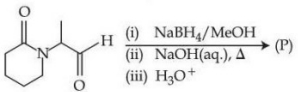
A
B
C
D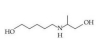
Solution
(A) Step $(i)$: $NaBH_{4}$ in $MeOH$ selectively reduces the aldehyde group $(-CHO)$ to a primary alcohol $(-CH_{2}OH)$. The cyclic amide (lactam) remains unaffected.
Step (ii): $NaOH(aq.), \Delta$ causes the alkaline hydrolysis of the cyclic amide (lactam). The ring opens to form the corresponding amino acid salt (carboxylate).
Step (iii): $H_{3}O^{+}$ protonates the carboxylate to form a carboxylic acid $(-COOH)$ and the amine to form an ammonium salt $(-NH_{2}^{+}-)$.
The final product is a linear amino acid derivative with a primary alcohol group: $HOOC-(CH_{2})_{4}-NH-CH(CH_{3})CH_{2}OH$.
Step (ii): $NaOH(aq.), \Delta$ causes the alkaline hydrolysis of the cyclic amide (lactam). The ring opens to form the corresponding amino acid salt (carboxylate).
Step (iii): $H_{3}O^{+}$ protonates the carboxylate to form a carboxylic acid $(-COOH)$ and the amine to form an ammonium salt $(-NH_{2}^{+}-)$.
The final product is a linear amino acid derivative with a primary alcohol group: $HOOC-(CH_{2})_{4}-NH-CH(CH_{3})CH_{2}OH$.
0 likesView Solution
181
ChemistryMediumMCQJEE Main · 2026
Consider the following reaction:
Statement $I$: In the above reaction,the product formed will be a mixture of benzyl alcohol and iodobenzene.
Statement $II$: In the above reaction,the $-O-CH_2-$ bond is cleaved to give the product.
In the light of the above statements,choose the correct answer from the options given below:
Statement $I$: In the above reaction,the product formed will be a mixture of benzyl alcohol and iodobenzene.
Statement $II$: In the above reaction,the $-O-CH_2-$ bond is cleaved to give the product.
In the light of the above statements,choose the correct answer from the options given below:

A
Both Statement $I$ and Statement $II$ are true
B
Both Statement $I$ and Statement $II$ are false
C
Statement $I$ is true but Statement $II$ is false
D
Statement $I$ is false but Statement $II$ is true
Solution
(D) The reaction involves the cleavage of an ether,benzyl phenyl ether $(C_6H_5-O-CH_2-C_6H_5)$,with hydrogen iodide $(HI)$.
In the reaction of an alkyl aryl ether with $HI$,the cleavage occurs such that the alkyl group forms an alkyl iodide and the aryl group forms a phenol.
This is because the $O-C_{aryl}$ bond has partial double bond character due to resonance and is stronger,while the $O-C_{alkyl}$ bond is weaker and undergoes nucleophilic substitution.
Here,the $O-CH_2C_6H_5$ bond breaks to form benzyl iodide $(C_6H_5CH_2I)$ and phenol $(C_6H_5OH)$.
Therefore,Statement $I$ is false because the products are benzyl iodide and phenol,not benzyl alcohol and iodobenzene.
Statement $II$ is true because the $O-CH_2$ bond is indeed the one that undergoes cleavage.
In the reaction of an alkyl aryl ether with $HI$,the cleavage occurs such that the alkyl group forms an alkyl iodide and the aryl group forms a phenol.
This is because the $O-C_{aryl}$ bond has partial double bond character due to resonance and is stronger,while the $O-C_{alkyl}$ bond is weaker and undergoes nucleophilic substitution.
Here,the $O-CH_2C_6H_5$ bond breaks to form benzyl iodide $(C_6H_5CH_2I)$ and phenol $(C_6H_5OH)$.
Therefore,Statement $I$ is false because the products are benzyl iodide and phenol,not benzyl alcohol and iodobenzene.
Statement $II$ is true because the $O-CH_2$ bond is indeed the one that undergoes cleavage.
0 likesView Solution
182
ChemistryDifficultMCQJEE Main · 2026
Consider the following sequence of reactions. The major product $P$ is:
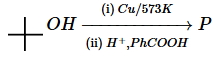
A
$4-$ethyl$-2-$bromobenzoic acid
B
$3-$bromo$-4-$ethylbenzoic acid
C
tert-butyl benzoate
D
isobutyl benzoate
Solution
(C) The starting material is $tert$-butyl alcohol (or $2$-methylpropan-$2$-ol).
$1$. Treatment with $Cu/573 \ K$ is a dehydrogenation reaction. However,$tert$-butyl alcohol does not undergo dehydrogenation to form an aldehyde or ketone because it lacks an $\alpha$-hydrogen. Instead,it undergoes dehydration to form isobutylene ($2$-methylpropene).
$2$. The second step involves the reaction of the alkene with benzoic acid $(PhCOOH)$ in the presence of an acid catalyst $(H^+)$. This is an electrophilic addition reaction where the alkene adds to the carboxylic acid to form an ester.
$3$. The reaction of isobutylene with benzoic acid yields $tert$-butyl benzoate as the major product.
Therefore,the correct option is $(C)$.
$1$. Treatment with $Cu/573 \ K$ is a dehydrogenation reaction. However,$tert$-butyl alcohol does not undergo dehydrogenation to form an aldehyde or ketone because it lacks an $\alpha$-hydrogen. Instead,it undergoes dehydration to form isobutylene ($2$-methylpropene).
$2$. The second step involves the reaction of the alkene with benzoic acid $(PhCOOH)$ in the presence of an acid catalyst $(H^+)$. This is an electrophilic addition reaction where the alkene adds to the carboxylic acid to form an ester.
$3$. The reaction of isobutylene with benzoic acid yields $tert$-butyl benzoate as the major product.
Therefore,the correct option is $(C)$.
0 likesView Solution
183
ChemistryMediumMCQJEE Main · 2026
Consider the following reaction.
$C_6H_5-O-CH_2-C_6H_5 + HI \rightarrow \text{Product}$
Statement $I$ : In the above reaction,the product formed will be a mixture of benzyl alcohol and iodobenzene.
Statement $II$ : In the above reaction,the $-O-CH_2-$ bond is cleaved to give the product.
In the light of the above statements,choose the correct answer from the options given below:
$C_6H_5-O-CH_2-C_6H_5 + HI \rightarrow \text{Product}$
Statement $I$ : In the above reaction,the product formed will be a mixture of benzyl alcohol and iodobenzene.
Statement $II$ : In the above reaction,the $-O-CH_2-$ bond is cleaved to give the product.
In the light of the above statements,choose the correct answer from the options given below:
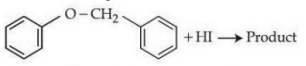
A
Both Statement $I$ and Statement $II$ are true
B
Both Statement $I$ and Statement $II$ are false
C
Statement $I$ is true but Statement $II$ is false
D
Statement $I$ is false but Statement $II$ is true
Solution
(D) The reaction of an ether with $HI$ involves the protonation of the ether oxygen atom,followed by a nucleophilic attack by the iodide ion $(I^-)$.
In the given ether,benzyl phenyl ether $(C_6H_5-O-CH_2-C_6H_5)$,the oxygen atom is attached to a phenyl group and a benzyl group.
The cleavage occurs such that the more stable carbocation is formed. The benzyl carbocation $(C_6H_5CH_2^+)$ is resonance-stabilized and more stable than the phenyl carbocation.
Therefore,the $C-O$ bond on the benzylic side is cleaved,leading to the formation of benzyl iodide $(C_6H_5CH_2I)$ and phenol $(C_6H_5OH)$.
Statement $I$ claims the products are benzyl alcohol and iodobenzene,which is incorrect.
Statement $II$ correctly states that the $-O-CH_2-$ bond is cleaved.
Thus,Statement $I$ is false and Statement $II$ is true.
In the given ether,benzyl phenyl ether $(C_6H_5-O-CH_2-C_6H_5)$,the oxygen atom is attached to a phenyl group and a benzyl group.
The cleavage occurs such that the more stable carbocation is formed. The benzyl carbocation $(C_6H_5CH_2^+)$ is resonance-stabilized and more stable than the phenyl carbocation.
Therefore,the $C-O$ bond on the benzylic side is cleaved,leading to the formation of benzyl iodide $(C_6H_5CH_2I)$ and phenol $(C_6H_5OH)$.
Statement $I$ claims the products are benzyl alcohol and iodobenzene,which is incorrect.
Statement $II$ correctly states that the $-O-CH_2-$ bond is cleaved.
Thus,Statement $I$ is false and Statement $II$ is true.
0 likesView Solution
184
ChemistryDifficultMCQJEE Main · 2026
Correct statements regarding alkyl halides ($R-X$) among the following are:
A. Alcohol being less polar solvent as compared to water, alcoholic $KOH$ favours elimination reaction with $R-X$.
B. Order of reactivity towards $S_N1$ mechanism is $C_6H_5-CH_2-Cl > C_6H_5-CHCl-C_6H_5$.
C. Non substituted aryl halides exhibit properties similar to alkyl halides.
D. Vinyl chloride is an example of haloalkene and allyl chloride is an example of haloalkyne.
E. $R-Cl$ can be prepared by reacting $R-OH$ with $SOCl_2$ but $Ar-Cl$ cannot be prepared by reacting $Ar-OH$ with $SOCl_2$.
Choose the correct answer from the options given below:
A
A, B and C Only
B
B and D Only
C
A and E Only
D
D and E Only
Solution
A is true: alcoholic $KOH$ is a stronger base and promotes elimination. E is true: $SOCl_2$ works well for alcohols, but phenols are not effectively converted to aryl chlorides this way. C is false: aryl halides are very different (less reactive). D is false: allyl chloride is a haloalkene, not a haloalkyne.
0 likesView Solution
185
ChemistryMediumMCQJEE Main · 2026
Match the List-$I$ with List-$II$:
Choose the correct answer from the options given below:
| List-$I$ | List-$II$ |
| $A$. Finkelstein reaction | $I$. $SbF_3$ |
| $B$. Swarts reaction | $II$. $Na$,dry ether |
| $C$. Sandmeyer's reaction | $III$. $NaI$ |
| $D$. Fittig reaction | $IV$. $Cu_2Cl_2$ |
Choose the correct answer from the options given below:
A
$A-I, B-IV, C-III, D-II$
B
$A-III, B-I, C-IV, D-II$
C
$A-IV, B-II, C-I, D-III$
D
$A-I, B-III, C-II, D-IV$
Solution
(B) . Finkelstein reaction involves the exchange of halogen atoms,typically using $NaI$ in acetone to prepare alkyl iodides.
$B$. Swarts reaction is used to prepare alkyl fluorides by treating alkyl chlorides or bromides with metallic fluorides like $SbF_3$ or $AgF$.
$C$. Sandmeyer's reaction involves the conversion of diazonium salts into aryl halides using copper$(I)$ salts like $Cu_2Cl_2$.
$D$. Fittig reaction involves the coupling of two aryl halide molecules in the presence of $Na$ metal and dry ether to form diaryls.
Therefore,the correct matching is $A-III, B-I, C-IV, D-II$.
$B$. Swarts reaction is used to prepare alkyl fluorides by treating alkyl chlorides or bromides with metallic fluorides like $SbF_3$ or $AgF$.
$C$. Sandmeyer's reaction involves the conversion of diazonium salts into aryl halides using copper$(I)$ salts like $Cu_2Cl_2$.
$D$. Fittig reaction involves the coupling of two aryl halide molecules in the presence of $Na$ metal and dry ether to form diaryls.
Therefore,the correct matching is $A-III, B-I, C-IV, D-II$.
0 likesView Solution
186
ChemistryMediumMCQJEE Main · 2026
Match the $LIST$-$I$ with $LIST$-$II$:
Choose the correct answer from the options given below:
| List-$I$ (Reaction) | List-$II$ (Mechanism) |
| $A$. Williamson Synthesis | $I$. Electrophilic addition |
| $B$. Friedel-Crafts Reaction | $II$. Free radical substitution |
| $C$. Bromination of vinyl benzene | $III$. Nucleophilic substitution |
| $D$. Chlorination of toluene in light | $IV$. Electrophilic substitution |
Choose the correct answer from the options given below:
A
$A-III, B-I, C-II, D-IV$
B
$A-III, B-IV, C-II, D-I$
C
$A-III, B-IV, C-I, D-II$
D
$A-I, B-III, C-IV, D-II$
Solution
(C) . Williamson synthesis involves the reaction of an alkoxide ion with an alkyl halide,which is a nucleophilic substitution $(III)$ reaction.
$B$. Friedel-Crafts reaction involves the substitution of an aromatic hydrogen by an alkyl or acyl group,which is an electrophilic aromatic substitution $(IV)$ reaction.
$C$. Bromination of vinyl benzene (an alkene) involves the addition of bromine across the double bond,which is an electrophilic addition $(I)$ reaction.
$D$. Chlorination of toluene in the presence of light involves the substitution of a hydrogen atom on the side chain via a free radical mechanism,which is a free radical substitution $(II)$ reaction.
Therefore,the correct matching is $A-III, B-IV, C-I, D-II$.
$B$. Friedel-Crafts reaction involves the substitution of an aromatic hydrogen by an alkyl or acyl group,which is an electrophilic aromatic substitution $(IV)$ reaction.
$C$. Bromination of vinyl benzene (an alkene) involves the addition of bromine across the double bond,which is an electrophilic addition $(I)$ reaction.
$D$. Chlorination of toluene in the presence of light involves the substitution of a hydrogen atom on the side chain via a free radical mechanism,which is a free radical substitution $(II)$ reaction.
Therefore,the correct matching is $A-III, B-IV, C-I, D-II$.
0 likesView Solution
187
ChemistryMediumMCQJEE Main · 2026
Benzyl isocyanide can be obtained from which of the following reactions? Choose the correct answer from the options given below:
$A$. Benzyl bromide + $AgCN$
$B$. Benzylamine + $CHCl_3$ + $Aq. NaOH$
$C$. Bromobenzene + $AgCN$
$D$. Aniline + $CHCl_3$ + $Aq. NaOH$
$E$. $2-$Phenylethyl bromide + $KCN$
$A$. Benzyl bromide + $AgCN$
$B$. Benzylamine + $CHCl_3$ + $Aq. NaOH$
$C$. Bromobenzene + $AgCN$
$D$. Aniline + $CHCl_3$ + $Aq. NaOH$
$E$. $2-$Phenylethyl bromide + $KCN$
A
$A$ and $B$ Only
B
$A$ and $C$ Only
C
$B$ and $D$ Only
D
$D$ and $E$ Only
Solution
(A) $1$. Reaction $A$: Benzyl bromide $(C_6H_5CH_2Br)$ reacts with $AgCN$ to form benzyl isocyanide $(C_6H_5CH_2NC)$. This is because $AgCN$ is a covalent compound,and the nucleophilic attack occurs through the nitrogen atom of the ambident $CN^-$ ion.
$2$. Reaction $B$: Benzylamine $(C_6H_5CH_2NH_2)$ undergoes the carbylamine reaction with $CHCl_3$ and $KOH$ (or $NaOH$) to form benzyl isocyanide $(C_6H_5CH_2NC)$.
$3$. Reaction $C$: Bromobenzene does not undergo nucleophilic substitution with $AgCN$ under normal conditions due to the partial double bond character of the $C-Br$ bond.
$4$. Reaction $D$: Aniline $(C_6H_5NH_2)$ undergoes the carbylamine reaction to form phenyl isocyanide $(C_6H_5NC)$,not benzyl isocyanide.
$5$. Reaction $E$: $2-$Phenylethyl bromide reacts with $KCN$ to form $3-$phenylpropanenitrile $(C_6H_5CH_2CH_2CN)$.
Therefore,benzyl isocyanide is obtained from reactions $A$ and $B$.
$2$. Reaction $B$: Benzylamine $(C_6H_5CH_2NH_2)$ undergoes the carbylamine reaction with $CHCl_3$ and $KOH$ (or $NaOH$) to form benzyl isocyanide $(C_6H_5CH_2NC)$.
$3$. Reaction $C$: Bromobenzene does not undergo nucleophilic substitution with $AgCN$ under normal conditions due to the partial double bond character of the $C-Br$ bond.
$4$. Reaction $D$: Aniline $(C_6H_5NH_2)$ undergoes the carbylamine reaction to form phenyl isocyanide $(C_6H_5NC)$,not benzyl isocyanide.
$5$. Reaction $E$: $2-$Phenylethyl bromide reacts with $KCN$ to form $3-$phenylpropanenitrile $(C_6H_5CH_2CH_2CN)$.
Therefore,benzyl isocyanide is obtained from reactions $A$ and $B$.
0 likesView Solution
188
ChemistryDifficultMCQJEE Main · 2026
Given below are two statements:
Statement $I$: Presence of a large number of unpaired electrons in transition metal atoms results in higher enthalpies of their atomisation.
Statement $II$: $d_{xy} = d_{xz} = d_{yz} < d_{x^2-y^2} = d_{z^2}$ and $d_{x^2-y^2} < d_{xy} = d_{xz} = d_{yz}$ are the $d$-orbital splittings in $[Fe(H_2O)_6]^{3+}$ and $[Ni(Cl)_4]^{2-}$ complex ions respectively.
In the light of the above statements,choose the correct answer from the options given below:
Statement $I$: Presence of a large number of unpaired electrons in transition metal atoms results in higher enthalpies of their atomisation.
Statement $II$: $d_{xy} = d_{xz} = d_{yz} < d_{x^2-y^2} = d_{z^2}$ and $d_{x^2-y^2} < d_{xy} = d_{xz} = d_{yz}$ are the $d$-orbital splittings in $[Fe(H_2O)_6]^{3+}$ and $[Ni(Cl)_4]^{2-}$ complex ions respectively.
In the light of the above statements,choose the correct answer from the options given below:
A
Both Statement $I$ and Statement $II$ are correct
B
Both Statement $I$ and Statement $II$ are incorrect
C
Statement $I$ is correct but Statement $II$ is incorrect
D
Statement $I$ is incorrect but Statement $II$ is correct
Solution
(A) Statement $I$ is correct: Transition metals have high enthalpies of atomisation due to strong interatomic metallic bonding,which is facilitated by the presence of a large number of unpaired electrons in their $(n-1)d$ orbitals.
Statement $II$ is correct: $[Fe(H_2O)_6]^{3+}$ is an octahedral complex where the $d$-orbitals split into $t_{2g}$ $(d_{xy}, d_{xz}, d_{yz})$ and $e_g$ $(d_{x^2-y^2}, d_{z^2})$ sets,with $t_{2g} < e_g$. $[Ni(Cl)_4]^{2-}$ is a tetrahedral complex where the $d$-orbitals split into $e$ $(d_{x^2-y^2}, d_{z^2})$ and $t_2$ $(d_{xy}, d_{xz}, d_{yz})$ sets,with $e < t_2$. Thus,the splitting patterns provided are correct.
Statement $II$ is correct: $[Fe(H_2O)_6]^{3+}$ is an octahedral complex where the $d$-orbitals split into $t_{2g}$ $(d_{xy}, d_{xz}, d_{yz})$ and $e_g$ $(d_{x^2-y^2}, d_{z^2})$ sets,with $t_{2g} < e_g$. $[Ni(Cl)_4]^{2-}$ is a tetrahedral complex where the $d$-orbitals split into $e$ $(d_{x^2-y^2}, d_{z^2})$ and $t_2$ $(d_{xy}, d_{xz}, d_{yz})$ sets,with $e < t_2$. Thus,the splitting patterns provided are correct.
0 likesView Solution
189
ChemistryMediumMCQJEE Main · 2026
Which of the following is $NOT$ a physical or chemical characteristic of interstitial compounds?
A
They have high melting points,higher than those of pure metals.
B
They are very soft and ionic in nature.
C
They retain metallic conductivity.
D
They are chemically inert and usually non-stoichiometric.
Solution
(B) Interstitial compounds are formed when small atoms like $H, C, N$ are trapped inside the crystal lattice of transition metals.
Their key characteristics include:
$1$. They have high melting points,higher than those of pure metals.
$2$. They are very hard (some approach diamond in hardness).
$3$. They retain metallic conductivity.
$4$. They are chemically inert and usually non-stoichiometric.
Since they are extremely hard and possess metallic properties,the statement that they are 'very soft and ionic' is incorrect. Therefore,option $B$ is the correct answer.
Their key characteristics include:
$1$. They have high melting points,higher than those of pure metals.
$2$. They are very hard (some approach diamond in hardness).
$3$. They retain metallic conductivity.
$4$. They are chemically inert and usually non-stoichiometric.
Since they are extremely hard and possess metallic properties,the statement that they are 'very soft and ionic' is incorrect. Therefore,option $B$ is the correct answer.
0 likesView Solution
190
ChemistryDifficultMCQJEE Main · 2026
Consider $|x|$ as the difference in oxidation states of Mn in the highest manganese fluoride and the highest manganese oxide. The ions with $|x|$ number of unpaired electrons from the following are: $A$. $Sc^{3+}$ $B$. $Zn^{2+}$ $C$. $V^{2+}$ $D$. $Fe^{2+}$ $E$. $Co^{2+}$ Choose the correct answer from the options given below:
A
$A$ and $B$ Only
B
$C, D$ and $E$ Only
C
$C$ and $E$ Only
D
$B$ and $E$ Only
Solution
(C) The highest manganese fluoride is $MnF_4$ (oxidation state of Mn is $+4$).
The highest manganese oxide is $Mn_2O_7$ (oxidation state of Mn is $+7$).
The difference $|x| = |7 - 4| = 3$.
We need to identify ions with $3$ unpaired electrons:
$Sc^{3+}$: $[Ar] 3d^0$,unpaired electrons = $0$.
$Zn^{2+}$: $[Ar] 3d^{10}$,unpaired electrons = $0$.
$V^{2+}$: $[Ar] 3d^3$,unpaired electrons = $3$.
$Fe^{2+}$: $[Ar] 3d^6$,unpaired electrons = $4$.
$Co^{2+}$: $[Ar] 3d^7$,unpaired electrons = $3$.
Thus,$V^{2+}$ and $Co^{2+}$ have $3$ unpaired electrons.
The highest manganese oxide is $Mn_2O_7$ (oxidation state of Mn is $+7$).
The difference $|x| = |7 - 4| = 3$.
We need to identify ions with $3$ unpaired electrons:
$Sc^{3+}$: $[Ar] 3d^0$,unpaired electrons = $0$.
$Zn^{2+}$: $[Ar] 3d^{10}$,unpaired electrons = $0$.
$V^{2+}$: $[Ar] 3d^3$,unpaired electrons = $3$.
$Fe^{2+}$: $[Ar] 3d^6$,unpaired electrons = $4$.
$Co^{2+}$: $[Ar] 3d^7$,unpaired electrons = $3$.
Thus,$V^{2+}$ and $Co^{2+}$ have $3$ unpaired electrons.
0 likesView Solution
191
ChemistryMediumMCQJEE Main · 2026
Pairs of elements with the same number of electrons in their respective $4f$ orbital are [Atomic number: $Eu-63, Gd-64, Dy-66, Ho-67, Tm-69, Yb-70, Lu-71, Hf-72$]. Choose the correct answer from the options given below:
A
$B$ and $C$ Only
B
$A$ and $B$ Only
C
$A$ and $D$ Only
D
$A$ and $C$ Only
Solution
(D) The electronic configurations of the given elements are:
$Eu (63): [Xe] 4f^7 6s^2$
$Gd (64): [Xe] 4f^7 5d^1 6s^2$
$Dy (66): [Xe] 4f^{10} 6s^2$
$Ho (67): [Xe] 4f^{11} 6s^2$
$Yb (70): [Xe] 4f^{14} 6s^2$
$Lu (71): [Xe] 4f^{14} 5d^1 6s^2$
$Tm (69): [Xe] 4f^{13} 6s^2$
$Hf (72): [Xe] 4f^{14} 5d^2 6s^2$
Comparing the number of electrons in the $4f$ orbital:
Pair $A$ ($Eu$ and $Gd$): Both have $7$ electrons in the $4f$ orbital. (Correct)
Pair $B$ ($Dy$ and $Ho$): $Dy$ has $10$ and $Ho$ has $11$ electrons. (Incorrect)
Pair $C$ ($Yb$ and $Hf$): Both have $14$ electrons in the $4f$ orbital. (Correct)
Pair $D$ ($Lu$ and $Tm$): $Lu$ has $14$ and $Tm$ has $13$ electrons. (Incorrect)
Therefore,pairs $A$ and $C$ are correct.
$Eu (63): [Xe] 4f^7 6s^2$
$Gd (64): [Xe] 4f^7 5d^1 6s^2$
$Dy (66): [Xe] 4f^{10} 6s^2$
$Ho (67): [Xe] 4f^{11} 6s^2$
$Yb (70): [Xe] 4f^{14} 6s^2$
$Lu (71): [Xe] 4f^{14} 5d^1 6s^2$
$Tm (69): [Xe] 4f^{13} 6s^2$
$Hf (72): [Xe] 4f^{14} 5d^2 6s^2$
Comparing the number of electrons in the $4f$ orbital:
Pair $A$ ($Eu$ and $Gd$): Both have $7$ electrons in the $4f$ orbital. (Correct)
Pair $B$ ($Dy$ and $Ho$): $Dy$ has $10$ and $Ho$ has $11$ electrons. (Incorrect)
Pair $C$ ($Yb$ and $Hf$): Both have $14$ electrons in the $4f$ orbital. (Correct)
Pair $D$ ($Lu$ and $Tm$): $Lu$ has $14$ and $Tm$ has $13$ electrons. (Incorrect)
Therefore,pairs $A$ and $C$ are correct.
0 likesView Solution
192
ChemistryDifficultMCQJEE Main · 2026
Which of the following sequences of hybridisation, geometry, and magnetic nature are correct for the given coordination compounds?
$A.$ $[NiCl_4]^{2-}$ – $sp^3$, tetrahedral, paramagnetic
$B.$ $[Ni(NH_3)_6]^{2+}$ – $sp^3d^2$, octahedral, paramagnetic
$C.$ $[Ni(CO)_4]$ – $sp^3$, tetrahedral, paramagnetic
$D.$ $[Ni(CN)_4]^{2-}$ – $dsp^2$, square planar, diamagnetic
Choose the correct answer from the options given below:
$A.$ $[NiCl_4]^{2-}$ – $sp^3$, tetrahedral, paramagnetic
$B.$ $[Ni(NH_3)_6]^{2+}$ – $sp^3d^2$, octahedral, paramagnetic
$C.$ $[Ni(CO)_4]$ – $sp^3$, tetrahedral, paramagnetic
$D.$ $[Ni(CN)_4]^{2-}$ – $dsp^2$, square planar, diamagnetic
Choose the correct answer from the options given below:
A
$A, B, C$ and $D$
B
$B, C$ and $D$ only
C
$A, C$ and $D$ only
D
$A, B$ and $D$ only
Solution
$(D)$ $A: [NiCl_4]^{2-}, Ni^{2+}(3d^8)$,weak field ligand,$sp^3$ hybridization,tetrahedral geometry,paramagnetic (two unpaired electrons). Correct.
$B: [Ni(NH_3)_6]^{2+}, Ni^{2+}(3d^8)$,weak field ligand,$sp^3d^2$ hybridization,octahedral geometry,paramagnetic (two unpaired electrons). Correct.
$C: [Ni(CO)_4], Ni^0(3d^8 4s^2)$,strong field ligand $(CO)$,$sp^3$ hybridization,tetrahedral geometry,diamagnetic (all electrons paired). Incorrect (given as paramagnetic).
$D: [Ni(CN)_4]^{2-}, Ni^{2+}(3d^8)$,strong field ligand $(CN^-)$,$dsp^2$ hybridization,square planar geometry,diamagnetic (all electrons paired). Correct.
Thus,the correct sequences are $A, B$,and $D$.
$B: [Ni(NH_3)_6]^{2+}, Ni^{2+}(3d^8)$,weak field ligand,$sp^3d^2$ hybridization,octahedral geometry,paramagnetic (two unpaired electrons). Correct.
$C: [Ni(CO)_4], Ni^0(3d^8 4s^2)$,strong field ligand $(CO)$,$sp^3$ hybridization,tetrahedral geometry,diamagnetic (all electrons paired). Incorrect (given as paramagnetic).
$D: [Ni(CN)_4]^{2-}, Ni^{2+}(3d^8)$,strong field ligand $(CN^-)$,$dsp^2$ hybridization,square planar geometry,diamagnetic (all electrons paired). Correct.
Thus,the correct sequences are $A, B$,and $D$.
0 likesView Solution
193
ChemistryMediumMCQJEE Main · 2026
Identify the correct statements from the following:
$A$. $[Fe(C_2O_4)_3]^{3-}$ is the most stable complex among $[Fe(OH)_6]^{3-}$,$[Fe(C_2O_4)_3]^{3-}$ and $[Fe(SCN)_6]^{3-}$.
$B$. The stability of $[Cu(NH_3)_4]^{2+}$ is greater than that of $[Cu(en)_2]^{2+}$.
$C$. The hybridization of $Fe$ in $K_4[Fe(CN)_6]$ is $d^2sp^3$.
$D$. $[Fe(NO_2)_3Cl_3]^{3-}$ exhibits linkage isomerism.
$E$. $NO_2^-$ and $SCN^-$ ligands are $NOT$ ambidentate ligands.
Choose the correct answer from the options given below:
$A$. $[Fe(C_2O_4)_3]^{3-}$ is the most stable complex among $[Fe(OH)_6]^{3-}$,$[Fe(C_2O_4)_3]^{3-}$ and $[Fe(SCN)_6]^{3-}$.
$B$. The stability of $[Cu(NH_3)_4]^{2+}$ is greater than that of $[Cu(en)_2]^{2+}$.
$C$. The hybridization of $Fe$ in $K_4[Fe(CN)_6]$ is $d^2sp^3$.
$D$. $[Fe(NO_2)_3Cl_3]^{3-}$ exhibits linkage isomerism.
$E$. $NO_2^-$ and $SCN^-$ ligands are $NOT$ ambidentate ligands.
Choose the correct answer from the options given below:
A
$A, B, C, D$ and $E$
B
$B, C$ and $D$ only
C
$A, C$ and $D$ only
D
$A, C$ and $E$ only
Solution
(C) is correct: The chelate effect makes $[Fe(C_2O_4)_3]^{3-}$ more stable than complexes with monodentate ligands like $OH^-$ or $SCN^-$.
$B$ is incorrect: $[Cu(en)_2]^{2+}$ is more stable than $[Cu(NH_3)_4]^{2+}$ because $en$ (ethylenediamine) is a bidentate ligand that forms stable $5-$membered chelate rings.
$C$ is correct: In $K_4[Fe(CN)_6]$,$Fe$ is in the $+2$ oxidation state ($d^6$ configuration). $CN^-$ is a strong field ligand,causing pairing of electrons,resulting in $d^2sp^3$ hybridization.
$D$ is correct: $NO_2^-$ is an ambidentate ligand,so $[Fe(NO_2)_3Cl_3]^{3-}$ can exhibit linkage isomerism.
$E$ is incorrect: $NO_2^-$ and $SCN^-$ are classic examples of ambidentate ligands.
Therefore,statements $A, C,$ and $D$ are correct.
$B$ is incorrect: $[Cu(en)_2]^{2+}$ is more stable than $[Cu(NH_3)_4]^{2+}$ because $en$ (ethylenediamine) is a bidentate ligand that forms stable $5-$membered chelate rings.
$C$ is correct: In $K_4[Fe(CN)_6]$,$Fe$ is in the $+2$ oxidation state ($d^6$ configuration). $CN^-$ is a strong field ligand,causing pairing of electrons,resulting in $d^2sp^3$ hybridization.
$D$ is correct: $NO_2^-$ is an ambidentate ligand,so $[Fe(NO_2)_3Cl_3]^{3-}$ can exhibit linkage isomerism.
$E$ is incorrect: $NO_2^-$ and $SCN^-$ are classic examples of ambidentate ligands.
Therefore,statements $A, C,$ and $D$ are correct.
0 likesView Solution
194
ChemistryMediumMCQJEE Main · 2026
Given below are two statements: Statement $I$: Each electron in $e_g$ orbitals destabilizes the orbitals by $+0.6\Delta_o$ and each electron in the $t_{2g}$ orbitals stabilizes the orbitals by $-0.4\Delta_o$ in an octahedral field on the basis of crystal field theory. Statement $II$: All the $d$-orbitals of the transition metals have the same energy in their free atomic state but when a complex is formed the ligands destroy the degeneracy of these orbitals on the basis of crystal field theory. In the light of the above statements,choose the correct answer from the options given below:
A
Both Statement $I$ and Statement $II$ are correct
B
Both Statement $I$ and Statement $II$ are incorrect
C
Statement $I$ is correct but Statement $II$ is incorrect
D
Statement $I$ is incorrect but Statement $II$ is correct
Solution
(A) According to Crystal Field Theory $(CFT)$,in an octahedral complex,the five $d$-orbitals split into two sets due to the approach of ligands.
$1$. The $t_{2g}$ set $(d_{xy}, d_{yz}, d_{zx})$ is lower in energy by $0.4\Delta_o$ relative to the barycenter,providing stabilization.
$2$. The $e_g$ set $(d_{x^2-y^2}, d_{z^2})$ is higher in energy by $0.6\Delta_o$ relative to the barycenter,causing destabilization.
$3$. In a free metal ion,all five $d$-orbitals are degenerate (same energy). The presence of ligands creates an asymmetric electrostatic field,which lifts this degeneracy.
Both statements are scientifically accurate.
$1$. The $t_{2g}$ set $(d_{xy}, d_{yz}, d_{zx})$ is lower in energy by $0.4\Delta_o$ relative to the barycenter,providing stabilization.
$2$. The $e_g$ set $(d_{x^2-y^2}, d_{z^2})$ is higher in energy by $0.6\Delta_o$ relative to the barycenter,causing destabilization.
$3$. In a free metal ion,all five $d$-orbitals are degenerate (same energy). The presence of ligands creates an asymmetric electrostatic field,which lifts this degeneracy.
Both statements are scientifically accurate.
0 likesView Solution
195
ChemistryDifficultMCQJEE Main · 2026
Match the List-$I$ with List-$II$:
Choose the correct answer from the options given below:
| List-$I$ (Complex ion) | List-$II$ (Calculated spin only magnetic moment $(BM)$) |
| $A$. $[Cr(H_2O)_6]^{2+}$ | $I$. $3.87$ |
| $B$. $[Co(H_2O)_6]^{2+}$ | $II$. $5.92$ |
| $C$. $[Cu(H_2O)_6]^{2+}$ | $III$. $4.90$ |
| $D$. $[Mn(H_2O)_6]^{2+}$ | $IV$. $1.73$ |
Choose the correct answer from the options given below:
A
$A-I, B-III, C-IV, D-II$
B
$A-II, B-I, C-III, D-IV$
C
$A-IV, B-II, C-I, D-III$
D
$A-III, B-I, C-IV, D-II$
Solution
(D) The spin-only magnetic moment $(mu)$ is calculated using the formula $\mu = \sqrt{n(n+2)} \text{ BM}$,where $n$ is the number of unpaired electrons.
$A$. $[Cr(H_2O)_6]^{2+}$: $Cr^{2+}$ has a $d^4$ configuration. Number of unpaired electrons $(n)$ = $4$. $\mu = \sqrt{4(4+2)} = \sqrt{24} \approx 4.90 \text{ BM}$ $(III)$.
$B$. $[Co(H_2O)_6]^{2+}$: $Co^{2+}$ has a $d^7$ configuration. Number of unpaired electrons $(n)$ = $3$. $\mu = \sqrt{3(3+2)} = \sqrt{15} \approx 3.87 \text{ BM}$ $(I)$.
$C$. $[Cu(H_2O)_6]^{2+}$: $Cu^{2+}$ has a $d^9$ configuration. Number of unpaired electrons $(n)$ = $1$. $\mu = \sqrt{1(1+2)} = \sqrt{3} \approx 1.73 \text{ BM}$ $(IV)$.
$D$. $[Mn(H_2O)_6]^{2+}$: $Mn^{2+}$ has a $d^5$ configuration. Number of unpaired electrons $(n)$ = $5$. $\mu = \sqrt{5(5+2)} = \sqrt{35} \approx 5.92 \text{ BM}$ $(II)$.
Therefore,the correct matching is $A-III, B-I, C-IV, D-II$.
$A$. $[Cr(H_2O)_6]^{2+}$: $Cr^{2+}$ has a $d^4$ configuration. Number of unpaired electrons $(n)$ = $4$. $\mu = \sqrt{4(4+2)} = \sqrt{24} \approx 4.90 \text{ BM}$ $(III)$.
$B$. $[Co(H_2O)_6]^{2+}$: $Co^{2+}$ has a $d^7$ configuration. Number of unpaired electrons $(n)$ = $3$. $\mu = \sqrt{3(3+2)} = \sqrt{15} \approx 3.87 \text{ BM}$ $(I)$.
$C$. $[Cu(H_2O)_6]^{2+}$: $Cu^{2+}$ has a $d^9$ configuration. Number of unpaired electrons $(n)$ = $1$. $\mu = \sqrt{1(1+2)} = \sqrt{3} \approx 1.73 \text{ BM}$ $(IV)$.
$D$. $[Mn(H_2O)_6]^{2+}$: $Mn^{2+}$ has a $d^5$ configuration. Number of unpaired electrons $(n)$ = $5$. $\mu = \sqrt{5(5+2)} = \sqrt{35} \approx 5.92 \text{ BM}$ $(II)$.
Therefore,the correct matching is $A-III, B-I, C-IV, D-II$.
0 likesView Solution
196
ChemistryDifficultMCQJEE Main · 2026
Match List-$I$ with List-$II$.
List-$I$ (Chromium $(III)$ Complexes) - List-$II$ ($\Delta_o$ $(cm^{-1})$)
$A$. $[Cr(CN)_6]^{3-}$ - $I$. $15,060$
$B$. $[CrF_6]^{3-}$ - $II$. $17,400$
$C$. $[Cr(H_2O)_6]^{3+}$ - $III$. $22,300$
$D$. $[Cr(en)_3]^{3+}$ - $IV$. $26,600$
Choose the correct answer from the options given below:
List-$I$ (Chromium $(III)$ Complexes) - List-$II$ ($\Delta_o$ $(cm^{-1})$)
$A$. $[Cr(CN)_6]^{3-}$ - $I$. $15,060$
$B$. $[CrF_6]^{3-}$ - $II$. $17,400$
$C$. $[Cr(H_2O)_6]^{3+}$ - $III$. $22,300$
$D$. $[Cr(en)_3]^{3+}$ - $IV$. $26,600$
Choose the correct answer from the options given below:
A
$A-I, B-II, C-III, D-IV$
B
$A-II, B-III, C-IV, D-I$
C
$A-III, B-IV, C-I, D-II$
D
$A-IV, B-I, C-II, D-III$
Solution
(D) The crystal field splitting energy ($\Delta_o$) depends on the strength of the ligand according to the spectrochemical series.
The spectrochemical series order for the given ligands is: $F^- < H_2O < en < CN^-$.
As the ligand field strength increases, the value of $\Delta_o$ increases.
Therefore, the order of $\Delta_o$ values is: $[CrF_6]^{3-} < [Cr(H_2O)_6]^{3+} < [Cr(en)_3]^{3+} < [Cr(CN)_6]^{3-}$.
Matching the values:
$A$. $[Cr(CN)_6]^{3-}$ corresponds to $IV$ ($26,600$ $cm^{-1}$).
$B$. $[CrF_6]^{3-}$ corresponds to $I$ ($15,060$ $cm^{-1}$).
$C$. $[Cr(H_2O)_6]^{3+}$ corresponds to $II$ ($17,400$ $cm^{-1}$).
$D$. $[Cr(en)_3]^{3+}$ corresponds to $III$ ($22,300$ $cm^{-1}$).
Thus, the correct match is $A-IV, B-I, C-II, D-III$.
The spectrochemical series order for the given ligands is: $F^- < H_2O < en < CN^-$.
As the ligand field strength increases, the value of $\Delta_o$ increases.
Therefore, the order of $\Delta_o$ values is: $[CrF_6]^{3-} < [Cr(H_2O)_6]^{3+} < [Cr(en)_3]^{3+} < [Cr(CN)_6]^{3-}$.
Matching the values:
$A$. $[Cr(CN)_6]^{3-}$ corresponds to $IV$ ($26,600$ $cm^{-1}$).
$B$. $[CrF_6]^{3-}$ corresponds to $I$ ($15,060$ $cm^{-1}$).
$C$. $[Cr(H_2O)_6]^{3+}$ corresponds to $II$ ($17,400$ $cm^{-1}$).
$D$. $[Cr(en)_3]^{3+}$ corresponds to $III$ ($22,300$ $cm^{-1}$).
Thus, the correct match is $A-IV, B-I, C-II, D-III$.
0 likesView Solution
197
ChemistryDifficultMCQJEE Main · 2026
$A$ $D$-aldotetrose on oxidation with concentrated $HNO_3$ resulted in an optically inactive dicarboxylic acid. The structure of the $D$-aldotetrose is:
A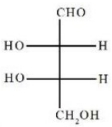
B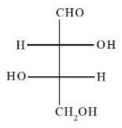
C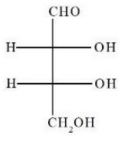
D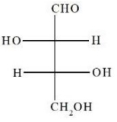
Solution
(C) -aldotetrose has the general structure $CHO-(CHOH)_2-CH_2OH$.
Upon oxidation with concentrated $HNO_3$,the terminal aldehyde $(-CHO)$ and primary alcohol $(-CH_2OH)$ groups are oxidized to carboxylic acid $(-COOH)$ groups,resulting in a tartaric acid derivative $(HOOC-(CHOH)_2-COOH)$.
For this dicarboxylic acid to be optically inactive,it must contain a plane of symmetry,making it a meso compound.
In the Fischer projection of the $D$-aldotetrose,the $D$-configuration implies that the hydroxyl group at the chiral carbon furthest from the aldehyde group (i.e.,$C-3$) is on the right side.
For the resulting dicarboxylic acid to be meso,the hydroxyl groups must be on the same side (erythro configuration) so that a plane of symmetry exists.
Therefore,the $D$-aldotetrose must have both hydroxyl groups on the right side,which corresponds to $D$-erythrose.
Upon oxidation with concentrated $HNO_3$,the terminal aldehyde $(-CHO)$ and primary alcohol $(-CH_2OH)$ groups are oxidized to carboxylic acid $(-COOH)$ groups,resulting in a tartaric acid derivative $(HOOC-(CHOH)_2-COOH)$.
For this dicarboxylic acid to be optically inactive,it must contain a plane of symmetry,making it a meso compound.
In the Fischer projection of the $D$-aldotetrose,the $D$-configuration implies that the hydroxyl group at the chiral carbon furthest from the aldehyde group (i.e.,$C-3$) is on the right side.
For the resulting dicarboxylic acid to be meso,the hydroxyl groups must be on the same side (erythro configuration) so that a plane of symmetry exists.
Therefore,the $D$-aldotetrose must have both hydroxyl groups on the right side,which corresponds to $D$-erythrose.
0 likesView Solution
198
ChemistryMediumMCQJEE Main · 2026
Identify the correct statements.
$A$. Glucose exists in two anomeric forms.
$B$. Anomers of glucose differ in configuration at $C-1$ in cyclic hemiacetal structure.
$C$. Melting point of $\alpha$-anomer of glucose is greater than $\beta$-anomer.
$D$. Specific rotation of $\alpha$-anomer is $+19^\circ$ while for $\beta$-anomer is $+112^\circ$.
$E$. $\alpha$ and $\beta$-anomers of glucose are prepared by crystallization of saturated glucose solution at $303 \text{ K}$ and $371 \text{ K}$ respectively.
$A$. Glucose exists in two anomeric forms.
$B$. Anomers of glucose differ in configuration at $C-1$ in cyclic hemiacetal structure.
$C$. Melting point of $\alpha$-anomer of glucose is greater than $\beta$-anomer.
$D$. Specific rotation of $\alpha$-anomer is $+19^\circ$ while for $\beta$-anomer is $+112^\circ$.
$E$. $\alpha$ and $\beta$-anomers of glucose are prepared by crystallization of saturated glucose solution at $303 \text{ K}$ and $371 \text{ K}$ respectively.
A
$A$ and $B$ Only
B
$B$ and $C$ Only
C
$A, B$ and $D$ Only
D
$A, B$ and $E$ Only
Solution
(D) . Glucose exists in $\alpha$ and $\beta$ anomeric forms. (Correct)
$B$. Anomers differ in configuration only at the hemiacetal carbon $(C_1)$. (Correct)
$C$. Melting points: $\alpha$-$D$-glucose is $419 \text{ K}$ and $\beta$-$D$-glucose is $423 \text{ K}$. Thus,the melting point of $\beta$-anomer is greater than $\alpha$-anomer. (Incorrect)
$D$. Specific rotation: $\alpha$-anomer is $+112^\circ$ and $\beta$-anomer is $+19^\circ$. The values are swapped in the statement. (Incorrect)
$E$. Crystallization of glucose from hot saturated aqueous solution at $371 \text{ K}$ yields $\alpha$-$D$-glucose,and below $303 \text{ K}$ yields $\beta$-$D$-glucose. (Correct)
Therefore,statements $A, B$,and $E$ are correct.
$B$. Anomers differ in configuration only at the hemiacetal carbon $(C_1)$. (Correct)
$C$. Melting points: $\alpha$-$D$-glucose is $419 \text{ K}$ and $\beta$-$D$-glucose is $423 \text{ K}$. Thus,the melting point of $\beta$-anomer is greater than $\alpha$-anomer. (Incorrect)
$D$. Specific rotation: $\alpha$-anomer is $+112^\circ$ and $\beta$-anomer is $+19^\circ$. The values are swapped in the statement. (Incorrect)
$E$. Crystallization of glucose from hot saturated aqueous solution at $371 \text{ K}$ yields $\alpha$-$D$-glucose,and below $303 \text{ K}$ yields $\beta$-$D$-glucose. (Correct)
Therefore,statements $A, B$,and $E$ are correct.
0 likesView Solution
199
ChemistryMediumMCQJEE Main · 2026
Match the $LIST$-$I$ with $LIST$-$II$:
| List-$I$ (Amino acid) | List-$II$ (Positive reaction/Test for functional group present in side chain of amino acid) |
| $A$. Glutamine | $I$. Hinsberg's test |
| $B$. Lysine | $II$. Neutral $FeCl_3$ test |
| $C$. Tyrosine | $III$. Ceric ammonium nitrate test |
| $D$. Serine | $IV$. Hoffman bromamide degradation |
A
$A-IV, B-I, C-II, D-III$
B
$A-IV, B-I, C-II, D-III$
C
$A-III, B-II, C-I, D-IV$
D
$A-IV, B-I, C-III, D-II$
Solution
(A) . Glutamine: Contains an amide group $(-CONH_2)$ in the side chain,which can undergo Hoffman bromamide degradation $(IV)$.
$B$. Lysine: Contains a primary amino group $(-NH_2)$ in the side chain,which reacts with benzenesulfonyl chloride in Hinsberg's test $(I)$.
$C$. Tyrosine: Contains a phenolic group ($-OH$ attached to a benzene ring),which gives a positive violet color with neutral $FeCl_3$ solution $(II)$.
$D$. Serine: Contains a primary alcohol group $(-CH_2OH)$ in the side chain,which gives a positive red color with Ceric ammonium nitrate test $(III)$.
Therefore,the correct matching is: $A-IV, B-I, C-II, D-III$.
$B$. Lysine: Contains a primary amino group $(-NH_2)$ in the side chain,which reacts with benzenesulfonyl chloride in Hinsberg's test $(I)$.
$C$. Tyrosine: Contains a phenolic group ($-OH$ attached to a benzene ring),which gives a positive violet color with neutral $FeCl_3$ solution $(II)$.
$D$. Serine: Contains a primary alcohol group $(-CH_2OH)$ in the side chain,which gives a positive red color with Ceric ammonium nitrate test $(III)$.
Therefore,the correct matching is: $A-IV, B-I, C-II, D-III$.
0 likesView Solution
200
ChemistryDifficultMCQJEE Main · 2026
Consider the following reactions. Total number of electrons in the $\pi$ bonds and lone pair of electrons in the product is:
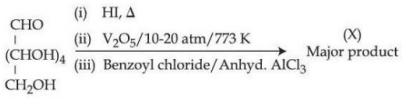
A
$12$
B
$16$
C
$14$
D
$18$
Solution
(D) The reaction sequence is as follows:
$1$. Glucose reacts with $HI/\Delta$ to form $n$-hexane.
$2$. $n$-hexane undergoes aromatization in the presence of $V_2O_5$ at $773 \ K$ and high pressure to form benzene.
$3$. Benzene reacts with benzoyl chloride in the presence of anhydrous $AlCl_3$ (Friedel-Crafts acylation) to form benzophenone $(Ph-CO-Ph)$.
In the product,benzophenone $(C_{13}H_{10}O)$:
- Each phenyl ring has $3$ $\pi$ bonds,so $2$ rings have $6$ $\pi$ bonds.
- The $C=O$ group has $1$ $\pi$ bond.
- Total $\pi$ bonds = $6 + 1 = 7$. Each $\pi$ bond contains $2$ electrons,so total $\pi$ electrons = $7 \times 2 = 14$.
- The oxygen atom in the $C=O$ group has $2$ lone pairs of electrons,which equals $2 \times 2 = 4$ electrons.
- Total number of electrons = $14 + 4 = 18$.
$1$. Glucose reacts with $HI/\Delta$ to form $n$-hexane.
$2$. $n$-hexane undergoes aromatization in the presence of $V_2O_5$ at $773 \ K$ and high pressure to form benzene.
$3$. Benzene reacts with benzoyl chloride in the presence of anhydrous $AlCl_3$ (Friedel-Crafts acylation) to form benzophenone $(Ph-CO-Ph)$.
In the product,benzophenone $(C_{13}H_{10}O)$:
- Each phenyl ring has $3$ $\pi$ bonds,so $2$ rings have $6$ $\pi$ bonds.
- The $C=O$ group has $1$ $\pi$ bond.
- Total $\pi$ bonds = $6 + 1 = 7$. Each $\pi$ bond contains $2$ electrons,so total $\pi$ electrons = $7 \times 2 = 14$.
- The oxygen atom in the $C=O$ group has $2$ lone pairs of electrons,which equals $2 \times 2 = 4$ electrons.
- Total number of electrons = $14 + 4 = 18$.
0 likesView Solution
Vedclass Products
For Students
Vedclass Test Series
Mock tests in real JEE Main style covering Chemistry with performance analysis. 5-day free trial.
Start Free TrialFor Teachers
Exam Paper Generator
Generate Set A/B/C/D Chemistry papers from 7.5L+ questions in 2 minutes. 3 chapters free.
Try FreeFor Institutes
Online Exam Module
Run live JEE Main mock exams with unlimited students, 360° analytics & white-label branding.
See DemoFrequently Asked Questions
How many Chemistry questions are in JEE Main 2026?
There are 459 Chemistry questions from the JEE Main 2026 paper on Vedclass, each with a detailed step-by-step solution in English.
Are JEE Main 2026 Chemistry solutions available in English?
Yes. All solutions on this page are in English. You can also switch to English or Hindi using the language buttons above the questions.
Can I practice JEE Main 2026 Chemistry as a timed test?
Yes. Use the Vedclass Test Series to attempt a full JEE Main mock test covering Chemistry with time limits and instant score analysis.
Can teachers create Chemistry papers from JEE Main previous year questions?
Yes. The Vedclass Exam Paper Generator lets teachers mix JEE Main Chemistry questions and generate Set A/B/C/D papers in minutes.
For Teachers & Institutes
Build a Custom Chemistry Paper
Pick JEE Main 2026 Chemistry questions, set difficulty, and generate Set A/B/C/D in 2 minutes.