
ChemistryQ51–150 of 459 questions
Page 2 of 5 · English
51
ChemistryDifficultMCQJEE Main · 2026
The wavelength of photon $A$ is $400 \ nm$. The frequency of photon $B$ is $10^{16} \ s^{-1}$. The wave number of photon $C$ is $10^{4} \ cm^{-1}$. The correct order of energy of these photons is:
A
$C > B > A$
B
$B > A > C$
C
$A > B > C$
D
$A > C > B$
Solution
(B) $(1)$. Wavelength of $A = 400 \ nm = 400 \times 10^{-9} \ m$.
$(2)$. Wavelength of $B$ $(\lambda) = \frac{c}{\nu} = \frac{3 \times 10^{8} \ m/s}{10^{16} \ s^{-1}} = 3 \times 10^{-8} \ m = 30 \ nm$.
$(3)$. Wavelength of $C$ $(\lambda) = \frac{1}{\bar{\nu}} = \frac{1}{10^{4} \ cm^{-1}} = 10^{-4} \ cm = 10^{-6} \ m = 1000 \ nm$.
Comparing wavelengths: $\lambda_{C} (1000 \ nm) > \lambda_{A} (400 \ nm) > \lambda_{B} (30 \ nm)$.
Since Energy $(E) = \frac{hc}{\lambda}$,$E \propto \frac{1}{\lambda}$.
Therefore,the order of energy is $E_{B} > E_{A} > E_{C}$.
$(2)$. Wavelength of $B$ $(\lambda) = \frac{c}{\nu} = \frac{3 \times 10^{8} \ m/s}{10^{16} \ s^{-1}} = 3 \times 10^{-8} \ m = 30 \ nm$.
$(3)$. Wavelength of $C$ $(\lambda) = \frac{1}{\bar{\nu}} = \frac{1}{10^{4} \ cm^{-1}} = 10^{-4} \ cm = 10^{-6} \ m = 1000 \ nm$.
Comparing wavelengths: $\lambda_{C} (1000 \ nm) > \lambda_{A} (400 \ nm) > \lambda_{B} (30 \ nm)$.
Since Energy $(E) = \frac{hc}{\lambda}$,$E \propto \frac{1}{\lambda}$.
Therefore,the order of energy is $E_{B} > E_{A} > E_{C}$.
0 likesView Solution
52
ChemistryMCQJEE Main · 2026
Consider the following statements about manganate and permanganate ions. Identify the correct statements:
$(A)$ The geometry of both manganate and permanganate ions is tetrahedral.
$(B)$ The oxidation states of $Mn$ in manganate and permanganate are $+7$ and $+6$,respectively.
$(C)$ Oxidation of $Mn(II)$ salt by peroxodisulphate gives manganate ion as the final product.
$(D)$ Manganate ion is paramagnetic and permanganate ion is diamagnetic.
$(E)$ Acidified permanganate ion reduces oxalate,nitrite and iodide ions.
Choose the correct answer from the options given below:
$(A)$ The geometry of both manganate and permanganate ions is tetrahedral.
$(B)$ The oxidation states of $Mn$ in manganate and permanganate are $+7$ and $+6$,respectively.
$(C)$ Oxidation of $Mn(II)$ salt by peroxodisulphate gives manganate ion as the final product.
$(D)$ Manganate ion is paramagnetic and permanganate ion is diamagnetic.
$(E)$ Acidified permanganate ion reduces oxalate,nitrite and iodide ions.
Choose the correct answer from the options given below:
A
$(A), (C)$ and $(D)$ Only
B
$(A), (B)$ and $(C)$ Only
C
$(A), (D)$ and $(E)$ Only
D
$(A)$ and $(D)$ Only
Solution
(D) Manganate ion: $MnO_4^{2-}$; Permanganate ion: $MnO_4^-$.
$(A)$ Both $MnO_4^{2-}$ and $MnO_4^-$ have tetrahedral geometry due to $d^3s$ hybridization of $Mn$. This statement is correct.
$(B)$ In $MnO_4^{2-}$,$Mn$ is in $+6$ oxidation state. In $MnO_4^-$,$Mn$ is in $+7$ oxidation state. The statement says $+7$ and $+6$ respectively,which is incorrect.
$(C)$ Oxidation of $Mn^{2+}$ by peroxodisulphate $(S_2O_8^{2-})$ yields permanganate $(MnO_4^-)$,not manganate. This statement is incorrect.
$(D)$ $MnO_4^{2-}$ ($d^1$ configuration) is paramagnetic. $MnO_4^-$ ($d^0$ configuration) is diamagnetic. This statement is correct.
$(E)$ Acidified permanganate acts as an oxidizing agent,not a reducing agent. It oxidizes oxalate,nitrite,and iodide ions. This statement is incorrect.
Therefore,only statements $(A)$ and $(D)$ are correct.
$(A)$ Both $MnO_4^{2-}$ and $MnO_4^-$ have tetrahedral geometry due to $d^3s$ hybridization of $Mn$. This statement is correct.
$(B)$ In $MnO_4^{2-}$,$Mn$ is in $+6$ oxidation state. In $MnO_4^-$,$Mn$ is in $+7$ oxidation state. The statement says $+7$ and $+6$ respectively,which is incorrect.
$(C)$ Oxidation of $Mn^{2+}$ by peroxodisulphate $(S_2O_8^{2-})$ yields permanganate $(MnO_4^-)$,not manganate. This statement is incorrect.
$(D)$ $MnO_4^{2-}$ ($d^1$ configuration) is paramagnetic. $MnO_4^-$ ($d^0$ configuration) is diamagnetic. This statement is correct.
$(E)$ Acidified permanganate acts as an oxidizing agent,not a reducing agent. It oxidizes oxalate,nitrite,and iodide ions. This statement is incorrect.
Therefore,only statements $(A)$ and $(D)$ are correct.
0 likesView Solution
53
ChemistryDifficultMCQJEE Main · 2026
The reactions which produce alcohol as the product are:
$A$. $CH_{4} + O_{2} \xrightarrow{Mo_{2}O_{3}}$
$B$. $2CH_{3}CH_{3} + 3O_{2} \xrightarrow[\Delta]{(CH_{3}COO)_{2}Mn}$
$C$. $(CH_{3})_{3}CH \xrightarrow{KMnO_{4}}$
$D$. $2CH_{4} + O_{2} \xrightarrow{Cu/523 \ K/100 \ atm.}$
$E$. $CH_{3}CH=CHCH_{3} \xrightarrow{KMnO_{4}/H^{+}}$
Choose the correct answer from the options given below:
$A$. $CH_{4} + O_{2} \xrightarrow{Mo_{2}O_{3}}$
$B$. $2CH_{3}CH_{3} + 3O_{2} \xrightarrow[\Delta]{(CH_{3}COO)_{2}Mn}$
$C$. $(CH_{3})_{3}CH \xrightarrow{KMnO_{4}}$
$D$. $2CH_{4} + O_{2} \xrightarrow{Cu/523 \ K/100 \ atm.}$
$E$. $CH_{3}CH=CHCH_{3} \xrightarrow{KMnO_{4}/H^{+}}$
Choose the correct answer from the options given below:
A
$A$ and $D$ Only
B
$A, C$ and $E$ Only
C
$C$ and $D$ Only
D
$B, D$ and $E$ Only
Solution
(C) Let us analyze each reaction:
$(A)$ $CH_{4} + O_{2} \xrightarrow{Mo_{2}O_{3}} HCHO$ (Formaldehyde is produced,not an alcohol).
$(B)$ $2CH_{3}CH_{3} + 3O_{2} \xrightarrow[\Delta]{(CH_{3}COO)_{2}Mn} 2CH_{3}COOH$ (Ethanoic acid is produced).
$(C)$ $(CH_{3})_{3}CH \xrightarrow{KMnO_{4}} (CH_{3})_{3}COH$ (tert-Butyl alcohol is produced).
$(D)$ $2CH_{4} + O_{2} \xrightarrow[523 \ K, 100 \ atm.]{Cu} 2CH_{3}OH$ (Methanol is produced).
$(E)$ $CH_{3}CH=CHCH_{3} \xrightarrow{KMnO_{4}/H^{+}} 2CH_{3}COOH$ (Ethanoic acid is produced).
Thus,reactions $(C)$ and $(D)$ produce alcohol as the product.
$(A)$ $CH_{4} + O_{2} \xrightarrow{Mo_{2}O_{3}} HCHO$ (Formaldehyde is produced,not an alcohol).
$(B)$ $2CH_{3}CH_{3} + 3O_{2} \xrightarrow[\Delta]{(CH_{3}COO)_{2}Mn} 2CH_{3}COOH$ (Ethanoic acid is produced).
$(C)$ $(CH_{3})_{3}CH \xrightarrow{KMnO_{4}} (CH_{3})_{3}COH$ (tert-Butyl alcohol is produced).
$(D)$ $2CH_{4} + O_{2} \xrightarrow[523 \ K, 100 \ atm.]{Cu} 2CH_{3}OH$ (Methanol is produced).
$(E)$ $CH_{3}CH=CHCH_{3} \xrightarrow{KMnO_{4}/H^{+}} 2CH_{3}COOH$ (Ethanoic acid is produced).
Thus,reactions $(C)$ and $(D)$ produce alcohol as the product.
0 likesView Solution
54
ChemistryDifficultMCQJEE Main · 2026
The plot of $log_{10} K$ vs $\frac{1}{T}$ gives a straight line. The intercept and slope respectively are (where $K$ is equilibrium constant).
A
$\frac{2.303R}{\Delta H^{\circ}}, \frac{2.303R}{\Delta S^{\circ}}$
B
$\frac{\Delta S^{\circ}}{2.303R}, -\frac{\Delta H^{\circ}}{2.303R}$
C
$-\frac{\Delta S^{\circ}R}{2.303}, \frac{\Delta H^{\circ}R}{2.303}$
D
$-\frac{\Delta H^{\circ}}{2.303R}, \frac{\Delta S^{\circ}}{2.303R}$
Solution
(B) The relationship between equilibrium constant $K$ and temperature $T$ is given by the van't Hoff equation: $\ln K = -\frac{\Delta H^{\circ}}{RT} + \frac{\Delta S^{\circ}}{R}$.
Converting to base $10$ logarithm: $log_{10} K = -\frac{\Delta H^{\circ}}{2.303RT} + \frac{\Delta S^{\circ}}{2.303R}$.
Comparing this with the linear equation $y = mx + c$,where $y = log_{10} K$ and $x = \frac{1}{T}$:
The slope $m = -\frac{\Delta H^{\circ}}{2.303R}$.
The $y$-intercept $c = \frac{\Delta S^{\circ}}{2.303R}$.
Thus,the intercept and slope are $\frac{\Delta S^{\circ}}{2.303R}$ and $-\frac{\Delta H^{\circ}}{2.303R}$ respectively.
Converting to base $10$ logarithm: $log_{10} K = -\frac{\Delta H^{\circ}}{2.303RT} + \frac{\Delta S^{\circ}}{2.303R}$.
Comparing this with the linear equation $y = mx + c$,where $y = log_{10} K$ and $x = \frac{1}{T}$:
The slope $m = -\frac{\Delta H^{\circ}}{2.303R}$.
The $y$-intercept $c = \frac{\Delta S^{\circ}}{2.303R}$.
Thus,the intercept and slope are $\frac{\Delta S^{\circ}}{2.303R}$ and $-\frac{\Delta H^{\circ}}{2.303R}$ respectively.
0 likesView Solution
55
ChemistryDifficultMCQJEE Main · 2026
Observe the following equilibrium in a $1 \text{ L}$ flask. $A_{(g)} \rightleftharpoons B_{(g)}$. At $T \text{ K}$,the equilibrium concentrations of $A$ and $B$ are $0.5 \text{ M}$ and $0.375 \text{ M}$ respectively. $0.1 \text{ moles}$ of $A$ is added into the flask and heated to $T \text{ K}$ to establish the equilibrium again. The new equilibrium concentrations (in $\text{M}$) of $A$ and $B$ are respectively.
A
$0.367, 0.275$
B
$0.53, 0.4$
C
$0.742, 0.557$
D
$0.557, 0.418$
Solution
(D) For the reaction $A_{(g)} \rightleftharpoons B_{(g)}$,the equilibrium constant $K_c = \frac{[B]}{[A]} = \frac{0.375}{0.5} = 0.75$.
Initial moles of $A$ in $1 \text{ L}$ flask $= 0.5 \text{ mol}$.
Initial moles of $B$ in $1 \text{ L}$ flask $= 0.375 \text{ mol}$.
After adding $0.1 \text{ mol}$ of $A$,total moles of $A = 0.5 + 0.1 = 0.6 \text{ mol}$.
Let $x$ be the amount of $A$ reacted to reach new equilibrium.
New $[A] = 0.6 - x$ and New $[B] = 0.375 + x$.
$K_c = \frac{0.375 + x}{0.6 - x} = 0.75$.
$0.375 + x = 0.45 - 0.75x$.
$1.75x = 0.075 \Rightarrow x = 0.0428$.
New $[A] = 0.6 - 0.0428 = 0.557 \text{ M}$ and New $[B] = 0.375 + 0.0428 = 0.418 \text{ M}$.
Initial moles of $A$ in $1 \text{ L}$ flask $= 0.5 \text{ mol}$.
Initial moles of $B$ in $1 \text{ L}$ flask $= 0.375 \text{ mol}$.
After adding $0.1 \text{ mol}$ of $A$,total moles of $A = 0.5 + 0.1 = 0.6 \text{ mol}$.
Let $x$ be the amount of $A$ reacted to reach new equilibrium.
New $[A] = 0.6 - x$ and New $[B] = 0.375 + x$.
$K_c = \frac{0.375 + x}{0.6 - x} = 0.75$.
$0.375 + x = 0.45 - 0.75x$.
$1.75x = 0.075 \Rightarrow x = 0.0428$.
New $[A] = 0.6 - 0.0428 = 0.557 \text{ M}$ and New $[B] = 0.375 + 0.0428 = 0.418 \text{ M}$.
0 likesView Solution
56
ChemistryDifficultMCQJEE Main · 2026
Consider the elements $N$,$P$,$O$,$S$,$Cl$ and $F$. The number of valence electrons present in the elements with most and least metallic character from the above list is respectively.
A
$7$ and $5$
B
$5$ and $6$
C
$5$ and $7$
D
$6$ and $7$
Solution
(C) Metallic character increases down a group and decreases across a period from left to right. Among the given elements ($N$,$P$,$O$,$S$,$Cl$,$F$),$P$ (Phosphorus) is the most metallic as it is the furthest to the left and down in the periodic table compared to the others. Its valence shell configuration is $3s^2 3p^3$,so it has $5$ valence electrons.
$F$ (Fluorine) is the most electronegative and least metallic element in the list. Its valence shell configuration is $2s^2 2p^5$,so it has $7$ valence electrons.
Therefore,the number of valence electrons for the most metallic $(P)$ and least metallic $(F)$ elements are $5$ and $7$ respectively.
$F$ (Fluorine) is the most electronegative and least metallic element in the list. Its valence shell configuration is $2s^2 2p^5$,so it has $7$ valence electrons.
Therefore,the number of valence electrons for the most metallic $(P)$ and least metallic $(F)$ elements are $5$ and $7$ respectively.
0 likesView Solution
57
ChemistryDifficultMCQJEE Main · 2026
Identify the correct statements:
The presence of $-NO_{2}$ group in a benzene ring:
The presence of $-NO_{2}$ group in a benzene ring:
A
$B$ and $D$ Only
B
$C$ and $A$ Only
C
$A$ and $D$ Only
D
$B$ and $C$ Only
Solution
(D) The $-NO_{2}$ group is a strong electron-withdrawing group due to its $-I$ and $-M$ effects.
$1$. It reduces the electron density of the benzene ring,thereby deactivating it towards electrophilic aromatic substitution (Statement $B$ is correct).
$2$. It increases the susceptibility of the ring towards nucleophilic attack by stabilizing the intermediate carbanion (Meisenheimer complex) through its $-M$ effect,thereby activating the ring towards nucleophilic aromatic substitution (Statement $C$ is correct).
Therefore,statements $B$ and $C$ are correct.
$1$. It reduces the electron density of the benzene ring,thereby deactivating it towards electrophilic aromatic substitution (Statement $B$ is correct).
$2$. It increases the susceptibility of the ring towards nucleophilic attack by stabilizing the intermediate carbanion (Meisenheimer complex) through its $-M$ effect,thereby activating the ring towards nucleophilic aromatic substitution (Statement $C$ is correct).
Therefore,statements $B$ and $C$ are correct.
0 likesView Solution
58
ChemistryDifficultMCQJEE Main · 2026
Consider the dissociation equilibrium of the following weak acid $HA \rightleftharpoons H^{+}_{(aq)} + A^{-}_{(aq)}$. If the $pK_{a}$ of the acid is $4$,then the $pH$ of $10 \ mM$ $HA$ solution is . . . . . . . (Nearest integer)
[Given : The degree of dissociation can be neglected with respect to unity]
[Given : The degree of dissociation can be neglected with respect to unity]
A
$1$
B
$2$
C
$3$
D
$4$
Solution
(C) The dissociation equilibrium is $HA \rightleftharpoons H^{+} + A^{-}$.
For a weak acid,the concentration of $H^{+}$ is given by $[H^{+}] = \sqrt{K_{a} \times c}$.
Taking negative logarithm on both sides,we get $pH = \frac{1}{2} (pK_{a} - \log c)$.
Given $pK_{a} = 4$ and concentration $c = 10 \ mM = 10 \times 10^{-3} \ M = 10^{-2} \ M$.
Substituting the values: $pH = \frac{1}{2} [4 - \log(10^{-2})]$.
$pH = \frac{1}{2} [4 - (-2)] = \frac{1}{2} [6] = 3$.
For a weak acid,the concentration of $H^{+}$ is given by $[H^{+}] = \sqrt{K_{a} \times c}$.
Taking negative logarithm on both sides,we get $pH = \frac{1}{2} (pK_{a} - \log c)$.
Given $pK_{a} = 4$ and concentration $c = 10 \ mM = 10 \times 10^{-3} \ M = 10^{-2} \ M$.
Substituting the values: $pH = \frac{1}{2} [4 - \log(10^{-2})]$.
$pH = \frac{1}{2} [4 - (-2)] = \frac{1}{2} [6] = 3$.
0 likesView Solution
59
ChemistryDifficultMCQJEE Main · 2026
$0.53 \ g$ of an organic compound $(x)$ when heated with excess of nitric acid (concentrated) and then with silver nitrate gave $0.75 \ g$ of silver bromide precipitate. $1.0 \ g$ of $(x)$ gave $1.32 \ g$ of $CO_2$ gas on combustion. The percentage of hydrogen in the compound $(x)$ is . . . . . . $\%$. [Nearest Integer]
[Given : Molar mass in $g \ mol^{-1} H : 1, C : 12, Br : 80, Ag : 108, O : 16$; Compound $(x) : C_xH_yBr_z$] (in $\%$)
[Given : Molar mass in $g \ mol^{-1} H : 1, C : 12, Br : 80, Ag : 108, O : 16$; Compound $(x) : C_xH_yBr_z$] (in $\%$)
A
$2$
B
$6$
C
$1$
D
$4$
Solution
(D) $1$. Calculate percentage of $C$:
Moles of $CO_2 = \frac{1.32 \ g}{44 \ g \ mol^{-1}} = 0.03 \ mol$.
Mass of $C = 0.03 \ mol \times 12 \ g \ mol^{-1} = 0.36 \ g$.
$\% C = \frac{0.36 \ g}{1.0 \ g} \times 100 = 36\%$.
$2$. Calculate percentage of $Br$:
Moles of $AgBr = \frac{0.75 \ g}{188 \ g \ mol^{-1}} \approx 0.00399 \ mol$.
Mass of $Br = 0.00399 \ mol \times 80 \ g \ mol^{-1} \approx 0.3192 \ g$.
$\% Br = \frac{0.3192 \ g}{0.53 \ g} \times 100 \approx 60.2\%$.
$3$. Calculate percentage of $H$:
$\% H = 100 - (\% C + \% Br) = 100 - (36 + 60.2) = 3.8\%$.
Rounding to the nearest integer,we get $4\%$.
Moles of $CO_2 = \frac{1.32 \ g}{44 \ g \ mol^{-1}} = 0.03 \ mol$.
Mass of $C = 0.03 \ mol \times 12 \ g \ mol^{-1} = 0.36 \ g$.
$\% C = \frac{0.36 \ g}{1.0 \ g} \times 100 = 36\%$.
$2$. Calculate percentage of $Br$:
Moles of $AgBr = \frac{0.75 \ g}{188 \ g \ mol^{-1}} \approx 0.00399 \ mol$.
Mass of $Br = 0.00399 \ mol \times 80 \ g \ mol^{-1} \approx 0.3192 \ g$.
$\% Br = \frac{0.3192 \ g}{0.53 \ g} \times 100 \approx 60.2\%$.
$3$. Calculate percentage of $H$:
$\% H = 100 - (\% C + \% Br) = 100 - (36 + 60.2) = 3.8\%$.
Rounding to the nearest integer,we get $4\%$.
0 likesView Solution
60
ChemistryDifficultMCQJEE Main · 2026
Consider the following redox reaction taking place in acidic medium: $BH_{4}^{-}(aq) + ClO_{3}^{-}(aq) \rightarrow H_{2}BO_{3}^{-}(aq) + Cl^{-}(aq)$. If the Nernst equation for the above balanced reaction is $E_{cell} = E_{cell}^{o} - \frac{RT}{nF} \ln Q$,then the value of $n$ is . . . . . . . (Nearest integer)
A
$6$
B
$12$
C
$24$
D
$8$
Solution
(C) First,balance the redox reaction in acidic medium:
Oxidation half-reaction: $BH_{4}^{-} + 3H_{2}O \rightarrow H_{2}BO_{3}^{-} + 8H^{+} + 8e^{-}$
Reduction half-reaction: $ClO_{3}^{-} + 6H^{+} + 6e^{-} \rightarrow Cl^{-} + 3H_{2}O$
To balance the electrons,multiply the oxidation half-reaction by $3$ and the reduction half-reaction by $4$:
$3BH_{4}^{-} + 9H_{2}O \rightarrow 3H_{2}BO_{3}^{-} + 24H^{+} + 24e^{-}$
$4ClO_{3}^{-} + 24H^{+} + 24e^{-} \rightarrow 4Cl^{-} + 12H_{2}O$
Adding these,we get the balanced equation: $3BH_{4}^{-} + 4ClO_{3}^{-} \rightarrow 3H_{2}BO_{3}^{-} + 4Cl^{-} + 3H_{2}O$
In the Nernst equation,$n$ represents the number of moles of electrons transferred in the balanced redox reaction.
From the balanced equation,$n = 24$.
Oxidation half-reaction: $BH_{4}^{-} + 3H_{2}O \rightarrow H_{2}BO_{3}^{-} + 8H^{+} + 8e^{-}$
Reduction half-reaction: $ClO_{3}^{-} + 6H^{+} + 6e^{-} \rightarrow Cl^{-} + 3H_{2}O$
To balance the electrons,multiply the oxidation half-reaction by $3$ and the reduction half-reaction by $4$:
$3BH_{4}^{-} + 9H_{2}O \rightarrow 3H_{2}BO_{3}^{-} + 24H^{+} + 24e^{-}$
$4ClO_{3}^{-} + 24H^{+} + 24e^{-} \rightarrow 4Cl^{-} + 12H_{2}O$
Adding these,we get the balanced equation: $3BH_{4}^{-} + 4ClO_{3}^{-} \rightarrow 3H_{2}BO_{3}^{-} + 4Cl^{-} + 3H_{2}O$
In the Nernst equation,$n$ represents the number of moles of electrons transferred in the balanced redox reaction.
From the balanced equation,$n = 24$.
0 likesView Solution
61
ChemistryDifficultMCQJEE Main · 2026
In period $4$ of the periodic table,the elements with the highest and lowest atomic radii are respectively:
A
$Na$ & $Cl$
B
$K$ & $Se$
C
$K$ & $Br$
D
$Rb$ & $Br$
Solution
(C) In a period,moving from left to right,the atomic radius decreases due to an increase in effective nuclear charge.
In period $4$,the elements range from $K$ (Group $1$) to $Kr$ (Group $18$).
Excluding noble gases (which have larger van der Waals radii),the element with the largest atomic radius is $K$ (Potassium) and the element with the smallest atomic radius is $Br$ (Bromine).
Therefore,the correct pair is $K$ & $Br$.
In period $4$,the elements range from $K$ (Group $1$) to $Kr$ (Group $18$).
Excluding noble gases (which have larger van der Waals radii),the element with the largest atomic radius is $K$ (Potassium) and the element with the smallest atomic radius is $Br$ (Bromine).
Therefore,the correct pair is $K$ & $Br$.
0 likesView Solution
62
ChemistryDifficultMCQJEE Main · 2026
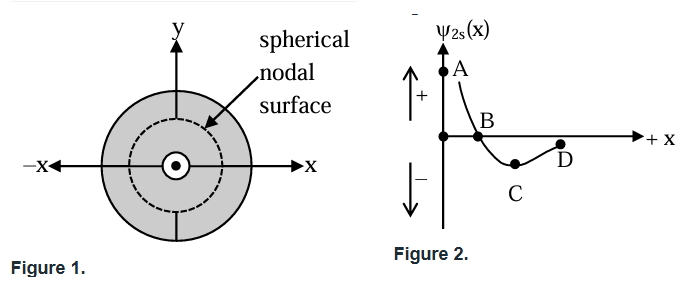
Figure $1$ shows the electron density distribution for a $2s$ orbital. Figure $2$ shows the radial wave function plot for a $2s$ orbital. Which of the following points $(A, B, C, D)$ in Figure $2$ most accurately represents the spherical nodal surface as shown in Figure $1$?
A
$B$
B
$D$
C
$C$
D
$A$
Solution
(C) node is a region where the probability of finding an electron is zero. For a radial wave function,this corresponds to the point where the wave function $\psi(r)$ crosses the x-axis,i.e.,$\psi(r) = 0$.
In the radial wave function plot for a $2s$ orbital,the curve crosses the x-axis at a specific distance from the nucleus. Based on standard representations of this graph,point $C$ typically marks the intersection where $\psi(r) = 0$,representing the spherical node.
In the radial wave function plot for a $2s$ orbital,the curve crosses the x-axis at a specific distance from the nucleus. Based on standard representations of this graph,point $C$ typically marks the intersection where $\psi(r) = 0$,representing the spherical node.
0 likesView Solution
63
ChemistryDifficultMCQJEE Main · 2026
The wave numbers of three spectral lines of $H$ atom are considered. Identify the set of spectral lines belonging to the Balmer series. ($R =$ Rydberg constant)
A
$ \frac{5R}{36}, \frac{3R}{16}, \frac{21R}{100} $
B
$ \frac{5R}{36}, \frac{8R}{9}, \frac{15R}{16} $
C
$ \frac{7R}{144}, \frac{3R}{16}, \frac{16R}{255} $
D
$ \frac{3R}{4}, \frac{3R}{16}, \frac{7R}{144} $
Solution
(A) For the Balmer series,the wave number $\bar{v}$ is given by the formula: $\bar{v} = R \left[ \frac{1}{2^2} - \frac{1}{n^2} \right]$,where $n = 3, 4, 5, \dots$
For $n = 3$: $\bar{v} = R \left[ \frac{1}{4} - \frac{1}{9} \right] = R \left[ \frac{9-4}{36} \right] = \frac{5R}{36}$
For $n = 4$: $\bar{v} = R \left[ \frac{1}{4} - \frac{1}{16} \right] = R \left[ \frac{4-1}{16} \right] = \frac{3R}{16}$
For $n = 5$: $\bar{v} = R \left[ \frac{1}{4} - \frac{1}{25} \right] = R \left[ \frac{25-4}{100} \right] = \frac{21R}{100}$
Thus,the set of spectral lines is $\frac{5R}{36}, \frac{3R}{16}, \frac{21R}{100}$.
For $n = 3$: $\bar{v} = R \left[ \frac{1}{4} - \frac{1}{9} \right] = R \left[ \frac{9-4}{36} \right] = \frac{5R}{36}$
For $n = 4$: $\bar{v} = R \left[ \frac{1}{4} - \frac{1}{16} \right] = R \left[ \frac{4-1}{16} \right] = \frac{3R}{16}$
For $n = 5$: $\bar{v} = R \left[ \frac{1}{4} - \frac{1}{25} \right] = R \left[ \frac{25-4}{100} \right] = \frac{21R}{100}$
Thus,the set of spectral lines is $\frac{5R}{36}, \frac{3R}{16}, \frac{21R}{100}$.
0 likesView Solution
64
ChemistryDifficultMCQJEE Main · 2026
$Ph-CH=CH_2 \xrightarrow[HBr]{(PhCOO)_2} \text{Product}$
Consider the above reaction:
$A$. The reaction proceeds through a more stable radical intermediate.
$B$. The role of peroxide is to generate $\dot{H}$ (Hydrogen radical).
$C$. During this reaction,benzene is formed as a byproduct.
$D$. $1-\text{Bromo}-2-\text{phenylethane}$ is formed as the minor product.
$E$. The same reaction in the absence of peroxide proceeds via a carbocation intermediate.
Identify the correct statements. Choose the correct answer from the options given below:
Consider the above reaction:
$A$. The reaction proceeds through a more stable radical intermediate.
$B$. The role of peroxide is to generate $\dot{H}$ (Hydrogen radical).
$C$. During this reaction,benzene is formed as a byproduct.
$D$. $1-\text{Bromo}-2-\text{phenylethane}$ is formed as the minor product.
$E$. The same reaction in the absence of peroxide proceeds via a carbocation intermediate.
Identify the correct statements. Choose the correct answer from the options given below:
A
$A$ & $E$ Only
B
$A, B$ & $D$ Only
C
$C, D$ & $E$ Only
D
$A, C$ & $E$ Only
Solution
(D) The reaction $Ph-CH=CH_2 + HBr \xrightarrow{(PhCOO)_2} Ph-CH_2-CH_2-Br$ is an Anti-Markovnikov addition.
$A$. Correct: The reaction proceeds via a free radical mechanism where the more stable benzylic radical intermediate is formed.
$B$. Incorrect: The role of peroxide is to generate the benzoyloxy radical,which then abstracts $H$ from $HBr$ to generate the bromine radical $(\dot{Br})$,not the hydrogen radical $(\dot{H})$.
$C$. Correct: As shown in the mechanism,the benzoyloxy radical decomposes to form $Ph\dot{}$ radical,which abstracts $H$ from $HBr$ to form benzene $(Ph-H)$ as a byproduct.
$D$. Incorrect: $1-\text{Bromo}-2-\text{phenylethane}$ is the major product in this Anti-Markovnikov addition.
$E$. Correct: In the absence of peroxide,the reaction follows the electrophilic addition mechanism,which proceeds via a carbocation intermediate (Markovnikov addition).
Therefore,statements $A, C,$ and $E$ are correct.
$A$. Correct: The reaction proceeds via a free radical mechanism where the more stable benzylic radical intermediate is formed.
$B$. Incorrect: The role of peroxide is to generate the benzoyloxy radical,which then abstracts $H$ from $HBr$ to generate the bromine radical $(\dot{Br})$,not the hydrogen radical $(\dot{H})$.
$C$. Correct: As shown in the mechanism,the benzoyloxy radical decomposes to form $Ph\dot{}$ radical,which abstracts $H$ from $HBr$ to form benzene $(Ph-H)$ as a byproduct.
$D$. Incorrect: $1-\text{Bromo}-2-\text{phenylethane}$ is the major product in this Anti-Markovnikov addition.
$E$. Correct: In the absence of peroxide,the reaction follows the electrophilic addition mechanism,which proceeds via a carbocation intermediate (Markovnikov addition).
Therefore,statements $A, C,$ and $E$ are correct.
0 likesView Solution
65
ChemistryMCQJEE Main · 2026
Given below are $2$ statements:
Statement $I$: The number of species among $BF_4^-$,$SiF_4$,$XeF_4$ and $SF_4$,that have unequal $E-F$ bond lengths is $2$. Here,$E$ is the central atom.
Statement $II$: Among $O_2^-$,$O_2^{2-}$,$F_2$ and $O_2^+$,$O_2^-$ has the highest bond order.
In the light of the above statements,choose the correct answer from the options given below
Statement $I$: The number of species among $BF_4^-$,$SiF_4$,$XeF_4$ and $SF_4$,that have unequal $E-F$ bond lengths is $2$. Here,$E$ is the central atom.
Statement $II$: Among $O_2^-$,$O_2^{2-}$,$F_2$ and $O_2^+$,$O_2^-$ has the highest bond order.
In the light of the above statements,choose the correct answer from the options given below
A
Both Statement $I$ and Statement $II$ are false
B
Both Statement $I$ and Statement $II$ are true
C
Statement $I$ is true but Statement $II$ is false
D
Statement $I$ is false but Statement $II$ is true
Solution
(A) Statement $I$: $BF_4^-$ ($sp^3$,tetrahedral),$SiF_4$ ($sp^3$,tetrahedral),and $XeF_4$ ($sp^3d^2$,square planar) have identical bond lengths due to symmetry. $SF_4$ ($sp^3d$,see-saw) has axial and equatorial bonds of different lengths. Thus,only $1$ species $(SF_4)$ has unequal bond lengths. Statement $I$ is false.
Statement $II$: Bond orders are: $O_2^+$ $(2.5)$,$O_2^-$ $(1.5)$,$O_2^{2-}$ $(1.0)$,$F_2$ $(1.0)$. $O_2^+$ has the highest bond order,not $O_2^-$. Statement $II$ is false.
Statement $II$: Bond orders are: $O_2^+$ $(2.5)$,$O_2^-$ $(1.5)$,$O_2^{2-}$ $(1.0)$,$F_2$ $(1.0)$. $O_2^+$ has the highest bond order,not $O_2^-$. Statement $II$ is false.
| Species | Bond Order |
| $O_2^+$ | $2.5$ |
| $O_2^-$ | $1.5$ |
| $O_2^{2-}$ | $1.0$ |
| $F_2$ | $1.0$ |
0 likesView Solution
66
ChemistryDifficultMCQJEE Main · 2026
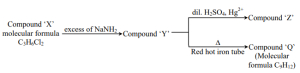
Given below are two statements for the following reaction sequence.
Statement $I$: Compound $'Z'$ will give yellow precipitate with $NaOI$.
Statement $II$: Compound $'Q'$ has two different types of $'H'$ atoms (aromatic : aliphatic) in the ratio $1 : 3$.
In the light of the above statements,choose the correct answer from the option given below:
Statement $I$: Compound $'Z'$ will give yellow precipitate with $NaOI$.
Statement $II$: Compound $'Q'$ has two different types of $'H'$ atoms (aromatic : aliphatic) in the ratio $1 : 3$.
In the light of the above statements,choose the correct answer from the option given below:
A
Statement $I$ is true but Statement $II$ is false
B
Both Statement $I$ and Statement $II$ are true
C
Statement $I$ is false but Statement $II$ is true
D
Both Statement $I$ and Statement $II$ are false
Solution
(B) $1$. Compound $'X'$ $(C_3H_6Cl_2)$ reacts with excess $NaNH_2$ to form propyne $(CH_3-C \equiv CH)$ as compound $'Y'$.
$2$. Hydration of propyne $(Y)$ with $dil. H_2SO_4/Hg^{2+}$ gives acetone $(CH_3-CO-CH_3)$ as compound $'Z'$. Acetone contains a methyl ketone group and gives a yellow precipitate of iodoform $(CHI_3)$ with $NaOI$. Thus,Statement $I$ is true.
$3$. Cyclic trimerization of propyne $(Y)$ using a red hot iron tube gives $1,3,5$-trimethylbenzene (mesitylene) as compound $'Q'$ $(C_9H_{12})$.
$4$. In $1,3,5$-trimethylbenzene,there are $3$ aromatic $H$ atoms (on the ring) and $9$ aliphatic $H$ atoms (in the three methyl groups). The ratio of aromatic to aliphatic $H$ atoms is $3:9 = 1:3$. Thus,Statement $II$ is true.
$2$. Hydration of propyne $(Y)$ with $dil. H_2SO_4/Hg^{2+}$ gives acetone $(CH_3-CO-CH_3)$ as compound $'Z'$. Acetone contains a methyl ketone group and gives a yellow precipitate of iodoform $(CHI_3)$ with $NaOI$. Thus,Statement $I$ is true.
$3$. Cyclic trimerization of propyne $(Y)$ using a red hot iron tube gives $1,3,5$-trimethylbenzene (mesitylene) as compound $'Q'$ $(C_9H_{12})$.
$4$. In $1,3,5$-trimethylbenzene,there are $3$ aromatic $H$ atoms (on the ring) and $9$ aliphatic $H$ atoms (in the three methyl groups). The ratio of aromatic to aliphatic $H$ atoms is $3:9 = 1:3$. Thus,Statement $II$ is true.
0 likesView Solution
67
ChemistryDifficultMCQJEE Main · 2026
Consider a weak base '$B$' of $pK_b = 5.699$. '$x$' $mL$ of $0.02 \ M$ $HCl$ and '$y$' $mL$ of $0.02 \ M$ weak base '$B$' are mixed to make $100 \ mL$ of a buffer of $pH$ $9$ at $25^{\circ}C$. The values of '$x$' and '$y$' respectively are: (Given: $\log 2=0.3010, \log 3=0.4771, \log 5=0.699$)
A
$x = 11.1, y = 88.9$
B
$x = 42.7, y = 57.3$
C
$x = 14.3, y = 85.7$
D
$x = 85.7, y = 14.3$
Solution
(C) For a buffer solution of a weak base and its salt,the Henderson-Hasselbalch equation is: $pOH = pK_b + \log \frac{[Salt]}{[Base]}$.
Given $pH = 9$,so $pOH = 14 - 9 = 5$.
Given $pK_b = 5.699$,so $5 = 5.699 + \log \frac{[Salt]}{[Base]}$.
$\log \frac{[Salt]}{[Base]} = 5 - 5.699 = -0.699$.
Since $\log 5 = 0.699$,then $\log \frac{[Salt]}{[Base]} = -\log 5 = \log \frac{1}{5}$.
Therefore,$\frac{[Salt]}{[Base]} = \frac{1}{5}$.
Reaction: $B + HCl \rightarrow BH^+ + Cl^-$.
Initial moles: $n_B = 0.02y$,$n_{HCl} = 0.02x$.
After reaction: $n_{BH^+} = 0.02x$,$n_{B, remaining} = 0.02y - 0.02x$.
Ratio: $\frac{0.02x}{0.02y - 0.02x} = \frac{1}{5}$ $\Rightarrow \frac{x}{y-x} = \frac{1}{5}$ $\Rightarrow 5x = y - x$ $\Rightarrow y = 6x$.
Total volume: $x + y = 100 \ mL$.
Substituting $y$: $x + 6x = 100$ $\Rightarrow 7x = 100$ $\Rightarrow x = 14.28 \approx 14.3 \ mL$.
$y = 100 - 14.3 = 85.7 \ mL$.
Given $pH = 9$,so $pOH = 14 - 9 = 5$.
Given $pK_b = 5.699$,so $5 = 5.699 + \log \frac{[Salt]}{[Base]}$.
$\log \frac{[Salt]}{[Base]} = 5 - 5.699 = -0.699$.
Since $\log 5 = 0.699$,then $\log \frac{[Salt]}{[Base]} = -\log 5 = \log \frac{1}{5}$.
Therefore,$\frac{[Salt]}{[Base]} = \frac{1}{5}$.
Reaction: $B + HCl \rightarrow BH^+ + Cl^-$.
Initial moles: $n_B = 0.02y$,$n_{HCl} = 0.02x$.
After reaction: $n_{BH^+} = 0.02x$,$n_{B, remaining} = 0.02y - 0.02x$.
Ratio: $\frac{0.02x}{0.02y - 0.02x} = \frac{1}{5}$ $\Rightarrow \frac{x}{y-x} = \frac{1}{5}$ $\Rightarrow 5x = y - x$ $\Rightarrow y = 6x$.
Total volume: $x + y = 100 \ mL$.
Substituting $y$: $x + 6x = 100$ $\Rightarrow 7x = 100$ $\Rightarrow x = 14.28 \approx 14.3 \ mL$.
$y = 100 - 14.3 = 85.7 \ mL$.
0 likesView Solution
68
ChemistryDifficultMCQJEE Main · 2026
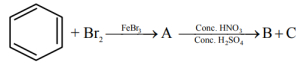
The method used for the separation of the mixture of products ($B$ and $C$) obtained in the following reaction is:
A
Simple distillation
B
Sublimation
C
Steam distillation
D
Fractional distillation
Solution
(D) The reaction of benzene with $Br_2$ in the presence of $FeBr_3$ gives bromobenzene $(A)$.
Nitration of bromobenzene with conc. $HNO_3$ and conc. $H_2SO_4$ yields a mixture of ortho-bromonitrobenzene $(B)$ and para-bromonitrobenzene $(C)$.
Since ortho- and para-isomers have different boiling points due to differences in their polarity and intermolecular forces,they are separated by fractional distillation.
Nitration of bromobenzene with conc. $HNO_3$ and conc. $H_2SO_4$ yields a mixture of ortho-bromonitrobenzene $(B)$ and para-bromonitrobenzene $(C)$.
Since ortho- and para-isomers have different boiling points due to differences in their polarity and intermolecular forces,they are separated by fractional distillation.
0 likesView Solution
69
ChemistryDifficultMCQJEE Main · 2026
The correct order of stability for the following carbanions is:
$CH_2=CH^{-}, CH_3-CH_2^{-}, CH\equiv C^{-}$
$CH_2=CH^{-}, CH_3-CH_2^{-}, CH\equiv C^{-}$
A
$CH_3-CH_2^{-} > CH_2=CH^{-} > CH\equiv C^{-}$
B
$CH_2=CH^{-} > CH\equiv C^{-} > CH_3-CH_2^{-}$
C
$CH\equiv C^{-} > CH_2=CH^{-} > CH_3-CH_2^{-}$
D
$CH\equiv C^{-} > CH_3-CH_2^{-} > CH_2=CH^{-}$
Solution
(C) The stability of a carbanion is directly proportional to the percentage of $s$-character in the hybrid orbital of the carbon atom bearing the negative charge.
$1$. In $CH\equiv C^{-}$,the carbon is $sp$ hybridized ($50\% \ s$-character).
$2$. In $CH_2=CH^{-}$,the carbon is $sp^2$ hybridized ($33.3\% \ s$-character).
$3$. In $CH_3-CH_2^{-}$,the carbon is $sp^3$ hybridized ($25\% \ s$-character).
Higher $s$-character means the electrons are held closer to the nucleus,increasing stability.
Therefore,the correct order of stability is: $CH\equiv C^{-} > CH_2=CH^{-} > CH_3-CH_2^{-}$.
$1$. In $CH\equiv C^{-}$,the carbon is $sp$ hybridized ($50\% \ s$-character).
$2$. In $CH_2=CH^{-}$,the carbon is $sp^2$ hybridized ($33.3\% \ s$-character).
$3$. In $CH_3-CH_2^{-}$,the carbon is $sp^3$ hybridized ($25\% \ s$-character).
Higher $s$-character means the electrons are held closer to the nucleus,increasing stability.
Therefore,the correct order of stability is: $CH\equiv C^{-} > CH_2=CH^{-} > CH_3-CH_2^{-}$.
0 likesView Solution
70
ChemistryDifficultMCQJEE Main · 2026
$20.0 \ dm^{3}$ of an ideal gas '$X$' at $600 \ K$ and $0.5 \ MPa$ undergoes isothermal reversible expansion until the pressure of the gas is $0.2 \ MPa$. Which of the following options is correct? (Given: $\log\,2=0.3010$ and $\log\,5=0.6989$)
A
$w=-9.1 \ kJ, \Delta U=0, \Delta H=0, q=9.1 \ kJ$
B
$w=9.1 \ J, \Delta U=9.1 \ J, \Delta H=0; q=0$
C
$w=+4.1 \ kJ, \Delta U=0, \Delta H=0; q=-4.1 \ kJ$
D
$w=-3.9 \ kJ, \Delta U=0, \Delta H=0; q=3.9 \ kJ$
Solution
(A) For an isothermal process involving an ideal gas, the internal energy change $\Delta U$ and enthalpy change $\Delta H$ are zero because they depend only on temperature, which remains constant.
For an isothermal reversible expansion, the work done $w$ is given by $w = -nRT \ln(V_2/V_1) = -P_1V_1 \ln(P_1/P_2)$.
Given $P_1 = 0.5 \ MPa = 0.5 \times 10^6 \ Pa$, $V_1 = 20.0 \ dm^3 = 20.0 \times 10^{-3} \ m^3$, and $P_2 = 0.2 \ MPa$.
$w = -(0.5 \times 10^6 \ Pa) \times (20.0 \times 10^{-3} \ m^3) \times \ln(0.5/0.2)$.
$w = -10000 \ J \times \ln(2.5) = -10000 \times 2.303 \times \log(2.5)$.
Since $\log(2.5) = \log(5/2) = \log(5) - \log(2) = 0.6989 - 0.3010 = 0.3979$.
$w = -10000 \times 2.303 \times 0.3979 \approx -9166 \ J \approx -9.1 \ kJ$.
Since $\Delta U = q + w = 0$, then $q = -w = 9.1 \ kJ$.
For an isothermal reversible expansion, the work done $w$ is given by $w = -nRT \ln(V_2/V_1) = -P_1V_1 \ln(P_1/P_2)$.
Given $P_1 = 0.5 \ MPa = 0.5 \times 10^6 \ Pa$, $V_1 = 20.0 \ dm^3 = 20.0 \times 10^{-3} \ m^3$, and $P_2 = 0.2 \ MPa$.
$w = -(0.5 \times 10^6 \ Pa) \times (20.0 \times 10^{-3} \ m^3) \times \ln(0.5/0.2)$.
$w = -10000 \ J \times \ln(2.5) = -10000 \times 2.303 \times \log(2.5)$.
Since $\log(2.5) = \log(5/2) = \log(5) - \log(2) = 0.6989 - 0.3010 = 0.3979$.
$w = -10000 \times 2.303 \times 0.3979 \approx -9166 \ J \approx -9.1 \ kJ$.
Since $\Delta U = q + w = 0$, then $q = -w = 9.1 \ kJ$.
0 likesView Solution
71
ChemistryDifficultMCQJEE Main · 2026
$X$ and $Y$ are the number of electrons involved,respectively,during the oxidation of $I^{-}$ to $I_{2}$ and $S^{2-}$ to $S$ by acidified $K_{2}Cr_{2}O_{7}$. The value of $X + Y$ is . . . . . . .
A
$6$
B
$10$
C
$12$
D
$8$
Solution
(C) The balanced chemical equation for the oxidation of $I^{-}$ to $I_{2}$ by acidified $K_{2}Cr_{2}O_{7}$ is: $Cr_{2}O_{7}^{2-} + 14H^{+} + 6I^{-} \rightarrow 2Cr^{3+} + 3I_{2} + 7H_{2}O$. Here,$6$ electrons are involved,so $X = 6$.
The balanced chemical equation for the oxidation of $S^{2-}$ to $S$ by acidified $K_{2}Cr_{2}O_{7}$ is: $Cr_{2}O_{7}^{2-} + 3S^{2-} + 14H^{+} \rightarrow 3S + 2Cr^{3+} + 7H_{2}O$. Here,$6$ electrons are involved,so $Y = 6$.
Therefore,the sum $X + Y = 6 + 6 = 12$.
The balanced chemical equation for the oxidation of $S^{2-}$ to $S$ by acidified $K_{2}Cr_{2}O_{7}$ is: $Cr_{2}O_{7}^{2-} + 3S^{2-} + 14H^{+} \rightarrow 3S + 2Cr^{3+} + 7H_{2}O$. Here,$6$ electrons are involved,so $Y = 6$.
Therefore,the sum $X + Y = 6 + 6 = 12$.
0 likesView Solution
72
ChemistryDifficultMCQJEE Main · 2026
In Dumas method for estimation of nitrogen,$0.50 \ g$ of an organic compound gave $70 \ mL$ of nitrogen collected at $300 \ K$ and $715 \ mm$ pressure. The percentage of nitrogen in the organic compound is . . . . . . $ \% $ (Aqueous tension at $300 \ K$ is $15 \ mm$).
A
$10$
B
$15$
C
$20$
D
$25$
Solution
(B) Step $1$: Calculate the pressure of dry $N_2$ gas. $P_{N_2} = P_{total} - P_{aqueous} = 715 \ mm - 15 \ mm = 700 \ mm = \frac{700}{760} \ atm$.
Step $2$: Use the ideal gas equation $PV = nRT$ to find the moles of $N_2$. $n_{N_2} = \frac{PV}{RT} = \frac{(700/760 \ atm) \times (0.070 \ L)}{0.0821 \ L \cdot atm \cdot K^{-1} \cdot mol^{-1} \times 300 \ K} \approx 0.00263 \ mol$.
Step $3$: Calculate the mass of $N_2$. $W_{N_2} = n_{N_2} \times 28 \ g/mol = 0.00263 \times 28 \approx 0.07364 \ g$.
Step $4$: Calculate the percentage of nitrogen. $\% \ N = \frac{W_{N_2}}{W_{compound}} \times 100 = \frac{0.07364 \ g}{0.50 \ g} \times 100 \approx 14.73 \%$.
Rounding to the nearest integer,the answer is $15 \% $.
Step $2$: Use the ideal gas equation $PV = nRT$ to find the moles of $N_2$. $n_{N_2} = \frac{PV}{RT} = \frac{(700/760 \ atm) \times (0.070 \ L)}{0.0821 \ L \cdot atm \cdot K^{-1} \cdot mol^{-1} \times 300 \ K} \approx 0.00263 \ mol$.
Step $3$: Calculate the mass of $N_2$. $W_{N_2} = n_{N_2} \times 28 \ g/mol = 0.00263 \times 28 \approx 0.07364 \ g$.
Step $4$: Calculate the percentage of nitrogen. $\% \ N = \frac{W_{N_2}}{W_{compound}} \times 100 = \frac{0.07364 \ g}{0.50 \ g} \times 100 \approx 14.73 \%$.
Rounding to the nearest integer,the answer is $15 \% $.
0 likesView Solution
73
ChemistryDifficultMCQJEE Main · 2026
The hydrogen spectrum consists of several spectral lines in the Lyman series ($L_1, L_2, L_3 \ldots$; $L_1$ has the lowest energy among the Lyman series). Similarly,it consists of several spectral lines in the Balmer series ($B_1, B_2, B_3 \ldots$; $B_1$ has the lowest energy among the Balmer lines). The energy of $L_1$ is $x$ times the energy of $B_1$. The value of $x$ is . . . . . . $\times 10^{-1}$ (Nearest integer).
A
$27$
B
$54$
C
$108$
D
$36$
Solution
(B) The energy of a spectral line is given by $\Delta E = 13.6 \times Z^2 (\frac{1}{n_1^2} - \frac{1}{n_2^2}) \text{ eV}$.
For the Lyman series,the lowest energy line $(L_1)$ corresponds to the transition from $n_2 = 2$ to $n_1 = 1$: $\Delta E(L_1) = 13.6 \times 1^2 (\frac{1}{1^2} - \frac{1}{2^2}) = 13.6 \times \frac{3}{4} \text{ eV}$.
For the Balmer series,the lowest energy line $(B_1)$ corresponds to the transition from $n_2 = 3$ to $n_1 = 2$: $\Delta E(B_1) = 13.6 \times 1^2 (\frac{1}{2^2} - \frac{1}{3^2}) = 13.6 \times (\frac{1}{4} - \frac{1}{9}) = 13.6 \times \frac{5}{36} \text{ eV}$.
Given $\Delta E(L_1) = x \times \Delta E(B_1)$,we have $x = \frac{\Delta E(L_1)}{\Delta E(B_1)} = \frac{3/4}{5/36} = \frac{3}{4} \times \frac{36}{5} = \frac{27}{5} = 5.4$.
To express $x$ as $x \times 10^{-1}$,we have $5.4 = 54 \times 10^{-1}$.
Therefore,the value is $54$.
For the Lyman series,the lowest energy line $(L_1)$ corresponds to the transition from $n_2 = 2$ to $n_1 = 1$: $\Delta E(L_1) = 13.6 \times 1^2 (\frac{1}{1^2} - \frac{1}{2^2}) = 13.6 \times \frac{3}{4} \text{ eV}$.
For the Balmer series,the lowest energy line $(B_1)$ corresponds to the transition from $n_2 = 3$ to $n_1 = 2$: $\Delta E(B_1) = 13.6 \times 1^2 (\frac{1}{2^2} - \frac{1}{3^2}) = 13.6 \times (\frac{1}{4} - \frac{1}{9}) = 13.6 \times \frac{5}{36} \text{ eV}$.
Given $\Delta E(L_1) = x \times \Delta E(B_1)$,we have $x = \frac{\Delta E(L_1)}{\Delta E(B_1)} = \frac{3/4}{5/36} = \frac{3}{4} \times \frac{36}{5} = \frac{27}{5} = 5.4$.
To express $x$ as $x \times 10^{-1}$,we have $5.4 = 54 \times 10^{-1}$.
Therefore,the value is $54$.
0 likesView Solution
74
ChemistryDifficultMCQJEE Main · 2026
Consider two Group $IV$ metal ions $X^{2+}$ and $Y^{2+}$. $A$ solution containing $0.01 \ M$ $X^{2+}$ and $0.01 \ M$ $Y^{2+}$ is saturated with $H_2S$. The pH at which the metal sulphide $YS$ will form as a precipitate is . . . . . . (Nearest integer). (Given: $K_{sp}(XS)=1 \times 10^{-22}$ at $25^{\circ} C$,$K_{sp}(YS)=4 \times 10^{-16}$ at $25^{\circ} C$,$[H_2S]=0.1 \ M$ in solution,$K_{a1} \times K_{a2}(H_2S)=1.0 \times 10^{-21}$,$\log 2=0.30, \log 3=0.48, \log 5=0.70$)
A
$2$
B
$3$
C
$6$
D
$4$
Solution
(D) For the precipitation of $YS_{(s)}$,the condition is $[Y^{2+}][S^{2-}] \geq K_{sp}(YS)$.
Given $[Y^{2+}] = 0.01 \ M$ and $K_{sp}(YS) = 4 \times 10^{-16}$,we have $[S^{2-}] \geq \frac{4 \times 10^{-16}}{0.01} = 4 \times 10^{-14} \ M$.
For the dissociation of $H_2S$,the equilibrium is $H_2S_{(aq)} \rightleftharpoons 2H^{+}_{(aq)} + S^{2-}_{(aq)}$.
The equilibrium constant expression is $\frac{[S^{2-}][H^{+}]^2}{[H_2S]} = K_{a1} \times K_{a2} = 1.0 \times 10^{-21}$.
Substituting the values: $\frac{(4 \times 10^{-14})[H^{+}]^2}{0.1} = 1.0 \times 10^{-21}$.
$[H^{+}]^2 = \frac{1.0 \times 10^{-22}}{4 \times 10^{-14}} = 0.25 \times 10^{-8} = 25 \times 10^{-10}$.
$[H^{+}] = 5 \times 10^{-5} \ M$.
$pH = -\log[H^{+}] = -\log(5 \times 10^{-5}) = 5 - \log 5 = 5 - 0.70 = 4.3$.
The nearest integer value for the pH is $4$.
Given $[Y^{2+}] = 0.01 \ M$ and $K_{sp}(YS) = 4 \times 10^{-16}$,we have $[S^{2-}] \geq \frac{4 \times 10^{-16}}{0.01} = 4 \times 10^{-14} \ M$.
For the dissociation of $H_2S$,the equilibrium is $H_2S_{(aq)} \rightleftharpoons 2H^{+}_{(aq)} + S^{2-}_{(aq)}$.
The equilibrium constant expression is $\frac{[S^{2-}][H^{+}]^2}{[H_2S]} = K_{a1} \times K_{a2} = 1.0 \times 10^{-21}$.
Substituting the values: $\frac{(4 \times 10^{-14})[H^{+}]^2}{0.1} = 1.0 \times 10^{-21}$.
$[H^{+}]^2 = \frac{1.0 \times 10^{-22}}{4 \times 10^{-14}} = 0.25 \times 10^{-8} = 25 \times 10^{-10}$.
$[H^{+}] = 5 \times 10^{-5} \ M$.
$pH = -\log[H^{+}] = -\log(5 \times 10^{-5}) = 5 - \log 5 = 5 - 0.70 = 4.3$.
The nearest integer value for the pH is $4$.
0 likesView Solution
75
ChemistryDifficultMCQJEE Main · 2026
Given below are two statements :
Statement $I$ : $K > Mg > Al > B$ is the correct order in terms of metallic character.
Statement $II$ : Atomic radius is always greater than the ionic radius for any element.
In the light of the above statements,choose the correct answer from the options given below
Statement $I$ : $K > Mg > Al > B$ is the correct order in terms of metallic character.
Statement $II$ : Atomic radius is always greater than the ionic radius for any element.
In the light of the above statements,choose the correct answer from the options given below
A
Both Statement $I$ and Statement $II$ are true
B
Both Statement $I$ and Statement $II$ are false
C
Statement $I$ is false but Statement $II$ is true
D
Statement $I$ is true but Statement $II$ is false
Solution
(D) Statement $I$ is true: Metallic character increases down a group and decreases across a period from left to right. $K$ ($Group$ $1$) is the most metallic,followed by $Mg$ ($Group$ $2$),$Al$ ($Group$ $13$),and $B$ ($Group$ $13$,metalloid). Thus,$K > Mg > Al > B$ is correct.
Statement $II$ is false: While atomic radius is greater than cationic radius,it is smaller than anionic radius. Therefore,it is not always greater than the ionic radius for any element.
Statement $II$ is false: While atomic radius is greater than cationic radius,it is smaller than anionic radius. Therefore,it is not always greater than the ionic radius for any element.
0 likesView Solution
76
ChemistryDifficultMCQJEE Main · 2026
Arrange the following carbanions in the decreasing order of stability:
$I. \ p-Br-C_6H_4-CH_2^-$
$II. \ C_6H_5-CH_2^-$
$III. \ p-CH_3O-C_6H_4-CH_2^-$
$IV. \ p-CHO-C_6H_4-CH_2^-$
$V. \ p-CH_3-C_6H_4-CH_2^-$
Choose the correct answer from the options given below:
$I. \ p-Br-C_6H_4-CH_2^-$
$II. \ C_6H_5-CH_2^-$
$III. \ p-CH_3O-C_6H_4-CH_2^-$
$IV. \ p-CHO-C_6H_4-CH_2^-$
$V. \ p-CH_3-C_6H_4-CH_2^-$
Choose the correct answer from the options given below:
A
$I > II > IV > V > III$
B
$I > IV > II > V > III$
C
$IV > I > II > V > III$
D
$IV > II > I > III > V$
Solution
(C) The stability of a carbanion is increased by electron-withdrawing groups $(EWG)$ and decreased by electron-donating groups $(EDG)$.
$IV$ $(p-CHO)$: $-CHO$ is a strong $EWG$ ($-M$ effect),providing maximum stability.
$I$ $(p-Br)$: $-Br$ is an $EWG$ ($-I$ effect),providing stability.
$II$ $(C_6H_5-CH_2^-)$: Reference structure.
$V$ $(p-CH_3)$: $-CH_3$ is an $EDG$ ($+I$ and hyperconjugation),decreasing stability.
$III$ $(p-CH_3O)$: $-OCH_3$ is a strong $EDG$ ($+M$ effect),providing minimum stability.
Thus,the decreasing order of stability is $IV > I > II > V > III$.
$IV$ $(p-CHO)$: $-CHO$ is a strong $EWG$ ($-M$ effect),providing maximum stability.
$I$ $(p-Br)$: $-Br$ is an $EWG$ ($-I$ effect),providing stability.
$II$ $(C_6H_5-CH_2^-)$: Reference structure.
$V$ $(p-CH_3)$: $-CH_3$ is an $EDG$ ($+I$ and hyperconjugation),decreasing stability.
$III$ $(p-CH_3O)$: $-OCH_3$ is a strong $EDG$ ($+M$ effect),providing minimum stability.
Thus,the decreasing order of stability is $IV > I > II > V > III$.
0 likesView Solution
77
ChemistryMCQJEE Main · 2026
Match the List-$I$ with List-$II$:
Choose the correct answer from the options given below:
| List-$I$ (Isothermal process for ideal gas system) | List-$II$ (Work done) |
|---|---|
| $(A)$ Reversible expansion | $(I)$ $w = 0$ |
| $(B)$ Free expansion | $(II)$ $w = -nRT \ln \frac{V_f}{V_i}$ |
| $(C)$ Irreversible expansion | $(III)$ $w = -p_{ex}(V_f - V_i)$ |
| $(D)$ Irreversible compression | $(IV)$ $w = -p_{ex}(V_i - V_f)$ |
Choose the correct answer from the options given below:
A
$(A)-(IV), (B)-(I), (C)-(III), (D)-(II)$
B
$(A)-(IV), (B)-(II), (C)-(III), (D)-(I)$
C
$(A)-(I), (B)-(III), (C)-(II), (D)-(IV)$
D
$(A)-(II), (B)-(I), (C)-(III), (D)-(IV)$
Solution
(D) For a reversible isothermal expansion,the work done is given by $w = -nRT \ln \frac{V_f}{V_i}$. Thus,$(A) \rightarrow (II)$.
$(B)$ For free expansion,the external pressure $p_{ex} = 0$,so $w = -p_{ex} \Delta V = 0$. Thus,$(B) \rightarrow (I)$.
$(C)$ For irreversible expansion,the work done is $w = -p_{ex}(V_f - V_i)$. Thus,$(C) \rightarrow (III)$.
$(D)$ For irreversible compression,the work done is $w = -p_{ex}(V_f - V_i) = -p_{ex}(-(V_i - V_f)) = -p_{ex}(V_i - V_f)$ is not standard,but based on the provided options,the work done is $w = -p_{ex}(V_f - V_i)$. However,looking at the options,$(D)$ corresponds to $(IV)$ as $w = -p_{ex}(V_i - V_f)$ is the expression for compression where $V_i > V_f$. Thus,$(D) \rightarrow (IV)$.
$(B)$ For free expansion,the external pressure $p_{ex} = 0$,so $w = -p_{ex} \Delta V = 0$. Thus,$(B) \rightarrow (I)$.
$(C)$ For irreversible expansion,the work done is $w = -p_{ex}(V_f - V_i)$. Thus,$(C) \rightarrow (III)$.
$(D)$ For irreversible compression,the work done is $w = -p_{ex}(V_f - V_i) = -p_{ex}(-(V_i - V_f)) = -p_{ex}(V_i - V_f)$ is not standard,but based on the provided options,the work done is $w = -p_{ex}(V_f - V_i)$. However,looking at the options,$(D)$ corresponds to $(IV)$ as $w = -p_{ex}(V_i - V_f)$ is the expression for compression where $V_i > V_f$. Thus,$(D) \rightarrow (IV)$.
0 likesView Solution
78
ChemistryDifficultMCQJEE Main · 2026
Consider three metal chlorides $x$,$y$ and $z$,where $x$ is water soluble at room temperature,$y$ is sparingly soluble in water at room temperature and $z$ is soluble in hot water. $x$,$y$ and $z$ are respectively:
A
$MgCl_{2}$,$AgCl$ and $AlCl_{3}$
B
$AgCl$,$Hg_{2}Cl_{2}$ and $PbCl_{2}$
C
$AlCl_{3}$,$PbCl_{2}$ and $BaCl_{2}$
D
$CuCl_{2}$,$AgCl$ and $PbCl_{2}$
Solution
(D) $CuCl_{2}$ is a metal chloride that is soluble in water at room temperature.
$AgCl$ is known to be sparingly soluble in water at room temperature.
$PbCl_{2}$ is a metal chloride that is insoluble in cold water but soluble in hot water.
Therefore,the correct sequence is $x = CuCl_{2}$,$y = AgCl$,and $z = PbCl_{2}$.
$AgCl$ is known to be sparingly soluble in water at room temperature.
$PbCl_{2}$ is a metal chloride that is insoluble in cold water but soluble in hot water.
Therefore,the correct sequence is $x = CuCl_{2}$,$y = AgCl$,and $z = PbCl_{2}$.
0 likesView Solution
79
ChemistryMCQJEE Main · 2026
Among the following,the $CORRECT$ combinations are :
$A.$ $IF_3$ $\rightarrow$ $T$-shaped $(sp^3d)$
$B.$ $IF_5$ $\rightarrow$ Square pyramidal $(sp^3d^2)$
$C.$ $IF_7$ $\rightarrow$ Pentagonal bipyramidal $(sp^3d^3)$
$D.$ $ClO_4^-$ $\rightarrow$ Square planar $(sp^3d)$
Choose the correct answer from the options given below :
$A.$ $IF_3$ $\rightarrow$ $T$-shaped $(sp^3d)$
$B.$ $IF_5$ $\rightarrow$ Square pyramidal $(sp^3d^2)$
$C.$ $IF_7$ $\rightarrow$ Pentagonal bipyramidal $(sp^3d^3)$
$D.$ $ClO_4^-$ $\rightarrow$ Square planar $(sp^3d)$
Choose the correct answer from the options given below :
A
$A$,$B$ and $C$ only
B
$A$ and $B$ only
C
$A$,$B$,$C$ and $D$
D
$B$,$C$ and $D$ only
Solution
(A) $1$. $IF_3$: Iodine has $7$ valence electrons. It forms $3$ bonds with $F$ atoms and has $2$ lone pairs. Steric number = $3 + 2 = 5$ ($sp^3d$ hybridization). Due to $2$ lone pairs,it is $T$-shaped. (Correct)
$2$. $IF_5$: Iodine has $7$ valence electrons. It forms $5$ bonds with $F$ atoms and has $1$ lone pair. Steric number = $5 + 1 = 6$ ($sp^3d^2$ hybridization). Due to $1$ lone pair,it is square pyramidal. (Correct)
$3$. $IF_7$: Iodine has $7$ valence electrons. It forms $7$ bonds with $F$ atoms and has $0$ lone pairs. Steric number = $7 + 0 = 7$ ($sp^3d^3$ hybridization). It is pentagonal bipyramidal. (Correct)
$4$. $ClO_4^-$: Chlorine has $7$ valence electrons. It forms $4$ bonds with $O$ atoms and has $0$ lone pairs. Steric number = $4 + 0 = 4$ ($sp^3$ hybridization). It is tetrahedral,not square planar. (Incorrect)
Thus,$A$,$B$,and $C$ are correct.
$2$. $IF_5$: Iodine has $7$ valence electrons. It forms $5$ bonds with $F$ atoms and has $1$ lone pair. Steric number = $5 + 1 = 6$ ($sp^3d^2$ hybridization). Due to $1$ lone pair,it is square pyramidal. (Correct)
$3$. $IF_7$: Iodine has $7$ valence electrons. It forms $7$ bonds with $F$ atoms and has $0$ lone pairs. Steric number = $7 + 0 = 7$ ($sp^3d^3$ hybridization). It is pentagonal bipyramidal. (Correct)
$4$. $ClO_4^-$: Chlorine has $7$ valence electrons. It forms $4$ bonds with $O$ atoms and has $0$ lone pairs. Steric number = $4 + 0 = 4$ ($sp^3$ hybridization). It is tetrahedral,not square planar. (Incorrect)
Thus,$A$,$B$,and $C$ are correct.
0 likesView Solution
80
ChemistryDifficultMCQJEE Main · 2026
Given below are statements about some molecules/ions. Identify the $CORRECT$ statements.
$A$. The dipole moment value of $NF_3$ is higher than that of $NH_3$.
$B$. The dipole moment value of $BeH_2$ is zero.
$C$. The bond order of $O_2^{2-}$ and $F_2$ is same.
$D$. The formal charge on the central oxygen atom of ozone is $-1$.
$E$. In $NO_2$,all the three atoms satisfy the octet rule,hence it is very stable.
Choose the correct answer from the options given below:
$A$. The dipole moment value of $NF_3$ is higher than that of $NH_3$.
$B$. The dipole moment value of $BeH_2$ is zero.
$C$. The bond order of $O_2^{2-}$ and $F_2$ is same.
$D$. The formal charge on the central oxygen atom of ozone is $-1$.
$E$. In $NO_2$,all the three atoms satisfy the octet rule,hence it is very stable.
Choose the correct answer from the options given below:
A
$A, B, C, D$ & $E$
B
$B$ & $C$ only
C
$B, C$ & $D$ only
D
$A, C$ & $D$ only
Solution
(B) Dipole moment: $NF_3 (0.24 \ D) < NH_3 (1.47 \ D)$. Statement $A$ is incorrect.
$(B)$ $BeH_2$ is $sp$ hybridized and linear,so its dipole moment is $0$. Statement $B$ is correct.
$(C)$ Bond order of $O_2^{2-}$ is $\frac{10-8}{2} = 1$. Bond order of $F_2$ is $\frac{8-6}{2} = 1$. Statement $C$ is correct.
$(D)$ In $O_3$,the central oxygen atom has a formal charge of $+1$. Statement $D$ is incorrect.
$(E)$ In $NO_2$,nitrogen has an odd number of electrons ($7$ valence electrons),so it does not follow the octet rule. Statement $E$ is incorrect.
Therefore,only $B$ and $C$ are correct.
$(B)$ $BeH_2$ is $sp$ hybridized and linear,so its dipole moment is $0$. Statement $B$ is correct.
$(C)$ Bond order of $O_2^{2-}$ is $\frac{10-8}{2} = 1$. Bond order of $F_2$ is $\frac{8-6}{2} = 1$. Statement $C$ is correct.
$(D)$ In $O_3$,the central oxygen atom has a formal charge of $+1$. Statement $D$ is incorrect.
$(E)$ In $NO_2$,nitrogen has an odd number of electrons ($7$ valence electrons),so it does not follow the octet rule. Statement $E$ is incorrect.
Therefore,only $B$ and $C$ are correct.
0 likesView Solution
81
ChemistryDifficultMCQJEE Main · 2026
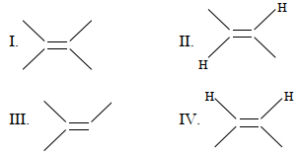
Arrange the following alkenes in decreasing order of stability. Choose the correct answer from the options given below:
A
$I > III > II > IV$
B
$III > II > I > IV$
C
$I > III > IV > II$
D
$II > I > III > IV$
Solution
(A) The stability of alkenes is determined by the number of hyperconjugative structures (alpha-hydrogens) and steric factors.
$I$: Tetrasubstituted alkene,$12 \ \alpha-H$,most stable.
$III$: Trisubstituted alkene,$9 \ \alpha-H$.
$II$: Disubstituted trans-alkene,$6 \ \alpha-H$,more stable than cis due to less steric hindrance.
$IV$: Disubstituted cis-alkene,$6 \ \alpha-H$,less stable than trans.
Thus,the decreasing order of stability is $I > III > II > IV$.
$I$: Tetrasubstituted alkene,$12 \ \alpha-H$,most stable.
$III$: Trisubstituted alkene,$9 \ \alpha-H$.
$II$: Disubstituted trans-alkene,$6 \ \alpha-H$,more stable than cis due to less steric hindrance.
$IV$: Disubstituted cis-alkene,$6 \ \alpha-H$,less stable than trans.
Thus,the decreasing order of stability is $I > III > II > IV$.
0 likesView Solution
82
ChemistryMCQJEE Main · 2026
$A \rightarrow D$ is an endothermic reaction occurring in $3$ steps (elementary).
$(i)$ $A \rightarrow B$ $\Delta H_{i} = +ve$
$(ii)$ $B \rightarrow C$ $\Delta H_{ii} = -ve$
$(iii)$ $C \rightarrow D$ $\Delta H_{iii} = -ve$
Which of the following graphs between potential energy ($y$-axis) vs reaction coordinate ($x$-axis) correctly represents the reaction profile of $A \rightarrow D$?
$(i)$ $A \rightarrow B$ $\Delta H_{i} = +ve$
$(ii)$ $B \rightarrow C$ $\Delta H_{ii} = -ve$
$(iii)$ $C \rightarrow D$ $\Delta H_{iii} = -ve$
Which of the following graphs between potential energy ($y$-axis) vs reaction coordinate ($x$-axis) correctly represents the reaction profile of $A \rightarrow D$?
A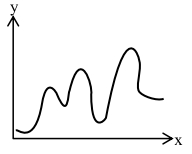
B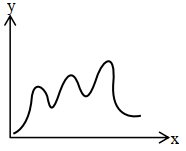
C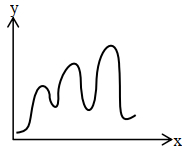
D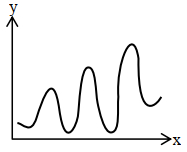
Solution
(A) Given:
$A \rightarrow D$; $\Delta_{t} H = (+ve) = E_{D} - E_{A} \therefore E_{D} > E_{A}$.
Mechanism:
Since the overall reaction is endothermic,the final energy level of $D$ must be higher than the initial energy level of $A$. However,the intermediate steps involve exothermic processes. Based on the energy relations $E_{B} > E_{A}$,$E_{C} < E_{B}$,and $E_{D} < E_{C}$,the potential energy profile must show $B$ as a local maximum relative to $A$ and $C$,and $C$ as a local minimum relative to $B$ and $D$. The correct graph shows the energy increasing from $A$ to $B$,decreasing from $B$ to $C$,and decreasing further from $C$ to $D$,while maintaining $E_{D} > E_{A}$ overall.
$A \rightarrow D$; $\Delta_{t} H = (+ve) = E_{D} - E_{A} \therefore E_{D} > E_{A}$.
Mechanism:
| $A \rightarrow B$; $\Delta_{r} H = (+ve) \Rightarrow E_{B} > E_{A}$ |
| $B \rightarrow C$; $\Delta_{r} H = (-ve) \Rightarrow E_{C} < E_{B}$ |
| $C \rightarrow D$; $\Delta_{r} H = (-ve) \Rightarrow E_{D} < E_{C}$ |
Since the overall reaction is endothermic,the final energy level of $D$ must be higher than the initial energy level of $A$. However,the intermediate steps involve exothermic processes. Based on the energy relations $E_{B} > E_{A}$,$E_{C} < E_{B}$,and $E_{D} < E_{C}$,the potential energy profile must show $B$ as a local maximum relative to $A$ and $C$,and $C$ as a local minimum relative to $B$ and $D$. The correct graph shows the energy increasing from $A$ to $B$,decreasing from $B$ to $C$,and decreasing further from $C$ to $D$,while maintaining $E_{D} > E_{A}$ overall.
0 likesView Solution
83
ChemistryDifficultMCQJEE Main · 2026
The first and second ionization constants of $H_2X$ are $2.5 \times 10^{-8}$ and $1.0 \times 10^{-13}$ respectively. The concentration of $X^{2-}$ in $0.1 \ M$ $H_2X$ solution is . . . . . . $\times 10^{-15} \ M$. The value of $Y$ is:
A
$100$
B
$10$
C
$1$
D
$0.1$
Solution
(A) For a diprotic acid $H_2X$,the ionization steps are:
$H_2X \rightleftharpoons H^{+} + HX^{-}$,$K_{a1} = 2.5 \times 10^{-8}$
$HX^{-} \rightleftharpoons H^{+} + X^{2-}$,$K_{a2} = 1.0 \times 10^{-13}$
Since $K_{a1} \gg K_{a2}$,the concentration of $H^{+}$ is primarily determined by the first dissociation.
For $0.1 \ M$ $H_2X$: $[H^{+}] \approx \sqrt{K_{a1} \times C} = \sqrt{2.5 \times 10^{-8} \times 0.1} = \sqrt{2.5 \times 10^{-9}} = 5 \times 10^{-5} \ M$.
The second dissociation constant is $K_{a2} = \frac{[H^{+}][X^{2-}]}{[HX^{-}]}$.
Since $[H^{+}] \approx [HX^{-}]$,we have $[X^{2-}] = K_{a2} = 1.0 \times 10^{-13} \ M$.
Expressing this in the form $Y \times 10^{-15} \ M$:
$1.0 \times 10^{-13} = 100 \times 10^{-15} \ M$.
Thus,$Y = 100$.
$H_2X \rightleftharpoons H^{+} + HX^{-}$,$K_{a1} = 2.5 \times 10^{-8}$
$HX^{-} \rightleftharpoons H^{+} + X^{2-}$,$K_{a2} = 1.0 \times 10^{-13}$
Since $K_{a1} \gg K_{a2}$,the concentration of $H^{+}$ is primarily determined by the first dissociation.
For $0.1 \ M$ $H_2X$: $[H^{+}] \approx \sqrt{K_{a1} \times C} = \sqrt{2.5 \times 10^{-8} \times 0.1} = \sqrt{2.5 \times 10^{-9}} = 5 \times 10^{-5} \ M$.
The second dissociation constant is $K_{a2} = \frac{[H^{+}][X^{2-}]}{[HX^{-}]}$.
Since $[H^{+}] \approx [HX^{-}]$,we have $[X^{2-}] = K_{a2} = 1.0 \times 10^{-13} \ M$.
Expressing this in the form $Y \times 10^{-15} \ M$:
$1.0 \times 10^{-13} = 100 \times 10^{-15} \ M$.
Thus,$Y = 100$.
0 likesView Solution
84
ChemistryDifficultMCQJEE Main · 2026
Given below are two statements:
Statement $I$: The correct order in terms of bond dissociation enthalpy is $Cl_{2} > Br_{2} > F_{2} > I_{2}$.
Statement $II$: The correct trend in the covalent character of the metal halides is $[SnCl_{4} > SnCl_{2}]$,$[PbCl_{4} > PbCl_{2}]$ and $[UF_{4} > UF_{6}]$.
In the light of the above statements,choose the correct answer from the options given below:
Statement $I$: The correct order in terms of bond dissociation enthalpy is $Cl_{2} > Br_{2} > F_{2} > I_{2}$.
Statement $II$: The correct trend in the covalent character of the metal halides is $[SnCl_{4} > SnCl_{2}]$,$[PbCl_{4} > PbCl_{2}]$ and $[UF_{4} > UF_{6}]$.
In the light of the above statements,choose the correct answer from the options given below:
A
Statement $I$ is true but Statement $II$ is false
B
Both Statement $I$ and Statement $II$ are true
C
Statement $I$ is false but Statement $II$ is true
D
Both Statement $I$ and Statement $II$ are false
Solution
(A) Statement $I$: The bond dissociation enthalpy of $F_{2}$ is lower than $Cl_{2}$ and $Br_{2}$ due to high inter-electronic repulsion between the lone pairs of small $F$ atoms. Thus,the correct order is $Cl_{2} > Br_{2} > F_{2} > I_{2}$. Statement $I$ is true.
Statement $II$: According to Fajan's rule,higher oxidation state of the metal cation leads to greater covalent character. Therefore,$SnCl_{4} > SnCl_{2}$ and $PbCl_{4} > PbCl_{2}$ are correct. However,for uranium halides,$UF_{6}$ has a higher oxidation state $(+6)$ than $UF_{4}$ $(+4)$,so $UF_{6} > UF_{4}$ is the correct order. The statement claims $UF_{4} > UF_{6}$,which is false. Thus,Statement $II$ is false.
Statement $II$: According to Fajan's rule,higher oxidation state of the metal cation leads to greater covalent character. Therefore,$SnCl_{4} > SnCl_{2}$ and $PbCl_{4} > PbCl_{2}$ are correct. However,for uranium halides,$UF_{6}$ has a higher oxidation state $(+6)$ than $UF_{4}$ $(+4)$,so $UF_{6} > UF_{4}$ is the correct order. The statement claims $UF_{4} > UF_{6}$,which is false. Thus,Statement $II$ is false.
0 likesView Solution
85
ChemistryDifficultMCQJEE Main · 2026
Given below are two statements:
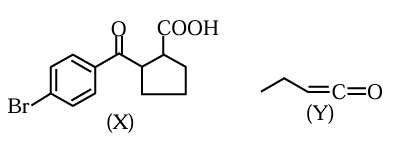
Statement-$I$ : Compound $(X)$,shown below,dissolves in $NaHCO_3$ solution and has two chiral carbon atoms.
Statement-$II$ : Compound $(Y)$,shown below,has two carbons with $sp^3$ hybridization,one carbon with $sp^2$ and one carbon with $sp$ hybridization.
In the light of the above statements,choose the correct answer from the options given below:
Statement-$I$ : Compound $(X)$,shown below,dissolves in $NaHCO_3$ solution and has two chiral carbon atoms.
Statement-$II$ : Compound $(Y)$,shown below,has two carbons with $sp^3$ hybridization,one carbon with $sp^2$ and one carbon with $sp$ hybridization.
In the light of the above statements,choose the correct answer from the options given below:
A
Statement $I$ is true but Statement $II$ is false
B
Statement $I$ is false but Statement $II$ is true
C
Both Statement $I$ and Statement $II$ are true
D
Both Statement $I$ and Statement $II$ are false
Solution
(A) Statement-$I$: Compound $(X)$ contains a carboxylic acid group $(-COOH)$,which is acidic enough to react with $NaHCO_3$ to evolve $CO_2$ gas,thus it dissolves. It also has two chiral centers (marked with $*$),so Statement-$I$ is true.
Statement-$II$: Compound $(Y)$ is $CH_3-CH=C=O$. The structure is $CH_3-CH=C=O$. The first carbon $(-CH_3)$ is $sp^3$,the second carbon $(-CH=)$ is $sp^2$,the third carbon $(=C=)$ is $sp$,and the fourth carbon $(=O)$ is not a carbon atom. Thus,it has one $sp^3$,one $sp^2$,and one $sp$ hybridized carbon. Therefore,Statement-$II$ is false.
Statement-$II$: Compound $(Y)$ is $CH_3-CH=C=O$. The structure is $CH_3-CH=C=O$. The first carbon $(-CH_3)$ is $sp^3$,the second carbon $(-CH=)$ is $sp^2$,the third carbon $(=C=)$ is $sp$,and the fourth carbon $(=O)$ is not a carbon atom. Thus,it has one $sp^3$,one $sp^2$,and one $sp$ hybridized carbon. Therefore,Statement-$II$ is false.
0 likesView Solution
86
ChemistryDifficultMCQJEE Main · 2026
The correct increasing order of $C-H(A)$, $C-O(B)$, $C=O(C)$ and $C\equiv N(D)$ bonds in terms of covalent bond length is:
A
$A < D < C < B$
B
$A < C < D < B$
C
$D < C < B < A$
D
$D < C < A < B$
Solution
(A) The bond lengths of the given bonds are approximately as follows:
$C-H(A) \approx 107 \ pm$
$C\equiv N(D) \approx 116 \ pm$
$C=O(C) \approx 121 \ pm$
$C-O(B) \approx 143 \ pm$
Comparing these values, the increasing order of bond length is $A < D < C < B$.
$C-H(A) \approx 107 \ pm$
$C\equiv N(D) \approx 116 \ pm$
$C=O(C) \approx 121 \ pm$
$C-O(B) \approx 143 \ pm$
Comparing these values, the increasing order of bond length is $A < D < C < B$.
0 likesView Solution
87
ChemistryDifficultMCQJEE Main · 2026
Given below are two statements:
Statement-$I$: The correct order in terms of atomic/ionic radii is $Al > Mg > Mg^{2+} > Al^{3+}$.
Statement-$II$: The correct order in terms of the magnitude of electron gain enthalpy is $Cl > Br > S > O$.
In the light of the above statements, choose the correct answer from the options given below:
Statement-$I$: The correct order in terms of atomic/ionic radii is $Al > Mg > Mg^{2+} > Al^{3+}$.
Statement-$II$: The correct order in terms of the magnitude of electron gain enthalpy is $Cl > Br > S > O$.
In the light of the above statements, choose the correct answer from the options given below:
A
Both Statement $I$ and Statement $II$ are false
B
Statement $I$ is false but Statement $II$ is true
C
Statement $I$ is true but Statement $II$ is false
D
Both Statement $I$ and Statement $II$ are true
Solution
(B) Statement-$I$: The atomic radius of $Mg$ $(160 \ pm)$ is greater than $Al$ $(143 \ pm)$. The ionic radius of $Mg^{2+}$ $(72 \ pm)$ is greater than $Al^{3+}$ $(54 \ pm)$. Thus, the correct order is $Mg > Al > Mg^{2+} > Al^{3+}$. Therefore, Statement-$I$ is false.
Statement-$II$: The magnitude of electron gain enthalpy generally increases across a period and decreases down a group. Due to small size and inter-electronic repulsion, oxygen $(O)$ has a lower electron gain enthalpy than sulfur $(S)$. The correct order of magnitude of electron gain enthalpy is $Cl > Br > S > O$. Therefore, Statement-$II$ is true.
Statement-$II$: The magnitude of electron gain enthalpy generally increases across a period and decreases down a group. Due to small size and inter-electronic repulsion, oxygen $(O)$ has a lower electron gain enthalpy than sulfur $(S)$. The correct order of magnitude of electron gain enthalpy is $Cl > Br > S > O$. Therefore, Statement-$II$ is true.
0 likesView Solution
88
ChemistryDifficultMCQJEE Main · 2026
Consider the following data:
$\Delta_{f}H^{\Theta}(CH_{4}, g) = -X \ kJ \ mol^{-1}$
Enthalpy of sublimation of graphite = $Y \ kJ \ mol^{-1}$
Dissociation enthalpy of $H_{2} = Z \ kJ \ mol^{-1}$
The bond enthalpy of $C-H$ bond is given by:
$\Delta_{f}H^{\Theta}(CH_{4}, g) = -X \ kJ \ mol^{-1}$
Enthalpy of sublimation of graphite = $Y \ kJ \ mol^{-1}$
Dissociation enthalpy of $H_{2} = Z \ kJ \ mol^{-1}$
The bond enthalpy of $C-H$ bond is given by:
A
$\frac{X+Y+2Z}{4}$
B
$\frac{X+Y+4Z}{2}$
C
$X+Y+Z$
D
$\frac{-X+Y+Z}{4}$
Solution
(A) The thermochemical equation for the formation of methane is: $C_{(s)} + 2H_{2(g)} \rightarrow CH_{4(g)}$
The enthalpy of formation is given by: $\Delta_{f}H^{\Theta} = \sum \text{Bond Enthalpies of Reactants} - \sum \text{Bond Enthalpies of Products}$
$-X = [\Delta H_{sub}(C) + 2 \times B.E.(H-H)] - [4 \times B.E.(C-H)]$
Substituting the given values: $-X = Y + 2Z - 4 \times B.E.(C-H)$
Rearranging for $B.E.(C-H)$: $4 \times B.E.(C-H) = X + Y + 2Z$
$B.E.(C-H) = \frac{X+Y+2Z}{4}$
The enthalpy of formation is given by: $\Delta_{f}H^{\Theta} = \sum \text{Bond Enthalpies of Reactants} - \sum \text{Bond Enthalpies of Products}$
$-X = [\Delta H_{sub}(C) + 2 \times B.E.(H-H)] - [4 \times B.E.(C-H)]$
Substituting the given values: $-X = Y + 2Z - 4 \times B.E.(C-H)$
Rearranging for $B.E.(C-H)$: $4 \times B.E.(C-H) = X + Y + 2Z$
$B.E.(C-H) = \frac{X+Y+2Z}{4}$
0 likesView Solution
89
ChemistryDifficultMCQJEE Main · 2026
By usual analysis,$1.00 \ g$ of compound $(X)$ gave $1.79 \ g$ of magnesium pyrophosphate. The percentage of phosphorus in compound $(X)$ is: (nearest integer)
(Given,molar mass in $g \ mol^{-1}$; $O=16, Mg=24, P=31$)
(Given,molar mass in $g \ mol^{-1}$; $O=16, Mg=24, P=31$)
A
$50$
B
$30$
C
$20$
D
$40$
Solution
(A) The molar mass of magnesium pyrophosphate $(Mg_2P_2O_7)$ is: $2 \times 24 + 2 \times 31 + 7 \times 16 = 48 + 62 + 112 = 222 \ g \ mol^{-1}$.
The moles of $Mg_2P_2O_7$ formed = $\frac{1.79 \ g}{222 \ g \ mol^{-1}} \approx 0.008063 \ mol$.
Since each mole of $Mg_2P_2O_7$ contains $2 \ mol$ of phosphorus atoms,the moles of $P$ = $2 \times 0.008063 = 0.016126 \ mol$.
Mass of phosphorus = $0.016126 \ mol \times 31 \ g \ mol^{-1} \approx 0.4999 \ g$.
Percentage of phosphorus = $\frac{\text{Mass of } P}{\text{Mass of compound } X} \times 100 = \frac{0.4999}{1.00} \times 100 = 49.99\%$.
Rounding to the nearest integer,we get $50\%$.
The moles of $Mg_2P_2O_7$ formed = $\frac{1.79 \ g}{222 \ g \ mol^{-1}} \approx 0.008063 \ mol$.
Since each mole of $Mg_2P_2O_7$ contains $2 \ mol$ of phosphorus atoms,the moles of $P$ = $2 \times 0.008063 = 0.016126 \ mol$.
Mass of phosphorus = $0.016126 \ mol \times 31 \ g \ mol^{-1} \approx 0.4999 \ g$.
Percentage of phosphorus = $\frac{\text{Mass of } P}{\text{Mass of compound } X} \times 100 = \frac{0.4999}{1.00} \times 100 = 49.99\%$.
Rounding to the nearest integer,we get $50\%$.
0 likesView Solution
90
ChemistryDifficultMCQJEE Main · 2026
Aqueous $HCl$ reacts with $MnO_{2(s)}$ to form $MnCl_{2(aq)}$,$Cl_{2(g)}$ and $H_{2}O_{(l)}$. What is the weight (in $g$) of $Cl_{2}$ liberated when $8.7 \ g$ of $MnO_{2(s)}$ is reacted with excess aqueous $HCl$ solution? (Given Molar mass in $g \ mol^{-1}$: $Mn=55$,$Cl=35.5$,$O=16$,$H=1$)
A
$7.1$
B
$71$
C
$21.3$
D
$14.2$
Solution
(A) The balanced chemical equation for the reaction is: $MnO_{2(s)} + 4HCl_{(aq)} \rightarrow MnCl_{2(aq)} + Cl_{2(g)} + 2H_{2}O_{(l)}$
Calculate the molar mass of $MnO_{2}$: $55 + (2 \times 16) = 87 \ g \ mol^{-1}$.
Calculate the number of moles of $MnO_{2}$ used: $n = \frac{\text{mass}}{\text{molar mass}} = \frac{8.7 \ g}{87 \ g \ mol^{-1}} = 0.1 \ mol$.
According to the stoichiometry of the reaction,$1 \ mol$ of $MnO_{2}$ produces $1 \ mol$ of $Cl_{2}$.
Therefore,$0.1 \ mol$ of $MnO_{2}$ will produce $0.1 \ mol$ of $Cl_{2}$.
Calculate the molar mass of $Cl_{2}$: $2 \times 35.5 = 71 \ g \ mol^{-1}$.
Calculate the weight of $Cl_{2}$ liberated: $0.1 \ mol \times 71 \ g \ mol^{-1} = 7.1 \ g$.
Calculate the molar mass of $MnO_{2}$: $55 + (2 \times 16) = 87 \ g \ mol^{-1}$.
Calculate the number of moles of $MnO_{2}$ used: $n = \frac{\text{mass}}{\text{molar mass}} = \frac{8.7 \ g}{87 \ g \ mol^{-1}} = 0.1 \ mol$.
According to the stoichiometry of the reaction,$1 \ mol$ of $MnO_{2}$ produces $1 \ mol$ of $Cl_{2}$.
Therefore,$0.1 \ mol$ of $MnO_{2}$ will produce $0.1 \ mol$ of $Cl_{2}$.
Calculate the molar mass of $Cl_{2}$: $2 \times 35.5 = 71 \ g \ mol^{-1}$.
Calculate the weight of $Cl_{2}$ liberated: $0.1 \ mol \times 71 \ g \ mol^{-1} = 7.1 \ g$.
0 likesView Solution
91
ChemistryDifficultMCQJEE Main · 2026
Match List-$I$ with List-$II$.
Choose the correct answer from the options given below:
| List-$I$ (Pair of Compounds) | List-$II$ (Type of Isomers) |
|---|---|
| $A$. $2-$Methylpropene and but$-1-$ene | $I$. Stereoisomers |
| $B$. $Cis-$but$-2-$ene and $trans-$but$-2-$ene | $II$. Position isomers |
| $C$. $2-$Butanol and diethyl ether | $III$. Chain isomers |
| $D$. But$-1-$ene and but$-2-$ene | $IV$. Functional group isomers |
Choose the correct answer from the options given below:
A
$A-III, B-I, C-IV, D-II$
B
$A-III, B-I, C-II, D-IV$
C
$A-I, B-IV, C-III, D-II$
D
$A-II, B-I, C-IV, D-III$
Solution
(A) . $2-$Methylpropene $(C_4H_8)$ and but$-1-$ene $(C_4H_8)$ differ in the carbon skeleton,so they are chain isomers $(III)$.
$B$. $Cis-$but$-2-$ene and $trans-$but$-2-$ene are geometric isomers,which are a type of stereoisomers $(I)$.
$C$. $2-$Butanol (alcohol) and diethyl ether (ether) have different functional groups,so they are functional group isomers $(IV)$.
$D$. But$-1-$ene and but$-2-$ene differ in the position of the double bond,so they are position isomers $(II)$.
Therefore,the correct matching is $A-III, B-I, C-IV, D-II$.
$B$. $Cis-$but$-2-$ene and $trans-$but$-2-$ene are geometric isomers,which are a type of stereoisomers $(I)$.
$C$. $2-$Butanol (alcohol) and diethyl ether (ether) have different functional groups,so they are functional group isomers $(IV)$.
$D$. But$-1-$ene and but$-2-$ene differ in the position of the double bond,so they are position isomers $(II)$.
Therefore,the correct matching is $A-III, B-I, C-IV, D-II$.
0 likesView Solution
92
ChemistryDifficultMCQJEE Main · 2026
Consider the following spectral lines for atomic hydrogen:
$A$. First line of Paschen series
$B$. Second line of Balmer series
$C$. Third line of Paschen series
$D$. Fourth line of Bracket series
The correct arrangement of the above lines in ascending order of energy is:
$A$. First line of Paschen series
$B$. Second line of Balmer series
$C$. Third line of Paschen series
$D$. Fourth line of Bracket series
The correct arrangement of the above lines in ascending order of energy is:
A
$D < C < A < B$
B
$A < B < C < D$
C
$C < D < B < A$
D
$D < A < C < B$
Solution
(D) The energy of a spectral line is given by $\Delta E = 13.6 \times Z^2 \times (\frac{1}{n_1^2} - \frac{1}{n_2^2}) \text{ eV}$. For hydrogen $(Z=1)$,$\Delta E \propto (\frac{1}{n_1^2} - \frac{1}{n_2^2})$.
Comparing the values: $0.0468 (D) < 0.0486 (A) < 0.0833 (C) < 0.1875 (B)$.
Therefore,the correct ascending order is $D < A < C < B$.
| $A$. Paschen ($1^{st}$ line) | $n_1=3, n_2=4 \rightarrow \Delta E \propto (\frac{1}{9} - \frac{1}{16}) = \frac{7}{144} \approx 0.0486$ |
| $B$. Balmer ($2^{nd}$ line) | $n_1=2, n_2=4 \rightarrow \Delta E \propto (\frac{1}{4} - \frac{1}{16}) = \frac{3}{16} = 0.1875$ |
| $C$. Paschen ($3^{rd}$ line) | $n_1=3, n_2=6 \rightarrow \Delta E \propto (\frac{1}{9} - \frac{1}{36}) = \frac{3}{36} = 0.0833$ |
| $D$. Bracket ($4^{th}$ line) | $n_1=4, n_2=8 \rightarrow \Delta E \propto (\frac{1}{16} - \frac{1}{64}) = \frac{3}{64} = 0.0468$ |
Comparing the values: $0.0468 (D) < 0.0486 (A) < 0.0833 (C) < 0.1875 (B)$.
Therefore,the correct ascending order is $D < A < C < B$.
0 likesView Solution
93
ChemistryDifficultMCQJEE Main · 2026
If the enthalpy of sublimation of $Li$ is $155 \ kJ \ mol^{-1}$,enthalpy of dissociation of $F_2$ is $150 \ kJ \ mol^{-1}$,ionization enthalpy of $Li$ is $520 \ kJ \ mol^{-1}$,electron gain enthalpy of $F$ is $-313 \ kJ \ mol^{-1}$,and standard enthalpy of formation of $LiF$ is $-594 \ kJ \ mol^{-1}$,then the magnitude of the lattice enthalpy of $LiF$ is . . . . . . $kJ \ mol^{-1}$ (nearest integer).
A
$1000$
B
$1031$
C
$1150$
D
$950$
Solution
(B) According to the Born-Haber cycle for the formation of $LiF(s)$:
$\Delta H_f^{\circ} = \Delta H_{sub}(Li) + \frac{1}{2} \Delta H_{diss}(F_2) + IE(Li) + EGE(F) + U$
Where $U$ is the lattice enthalpy.
Substituting the given values:
$-594 = 155 + \frac{150}{2} + 520 + (-313) + U$
$-594 = 155 + 75 + 520 - 313 + U$
$-594 = 437 + U$
$U = -594 - 437 = -1031 \ kJ \ mol^{-1}$
The magnitude of the lattice enthalpy is $|-1031| = 1031 \ kJ \ mol^{-1}$.
$\Delta H_f^{\circ} = \Delta H_{sub}(Li) + \frac{1}{2} \Delta H_{diss}(F_2) + IE(Li) + EGE(F) + U$
Where $U$ is the lattice enthalpy.
Substituting the given values:
$-594 = 155 + \frac{150}{2} + 520 + (-313) + U$
$-594 = 155 + 75 + 520 - 313 + U$
$-594 = 437 + U$
$U = -594 - 437 = -1031 \ kJ \ mol^{-1}$
The magnitude of the lattice enthalpy is $|-1031| = 1031 \ kJ \ mol^{-1}$.
0 likesView Solution
94
ChemistryDifficultMCQJEE Main · 2026
The dibromo compound $[P]$ (molecular formula : $C_{9}H_{10}Br_{2}$) when heated with excess sodamide followed by treatment with dilute $HCl$ gives $[Q]$. On warming $[Q]$ with mercuric sulphate and dilute sulphuric acid yields $[R]$ which gives positive Iodoform test but negative Tollen's test. The compound $[P]$ is:
A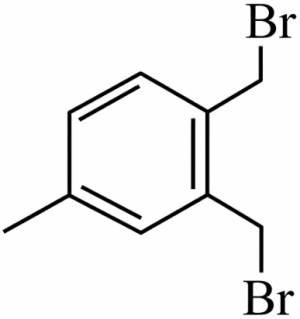
B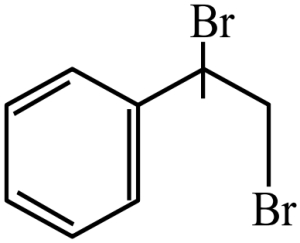
C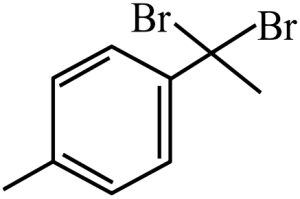
D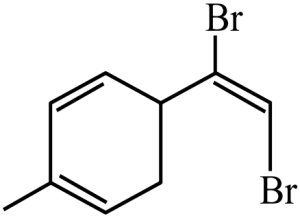
Solution
(C) The reaction sequence is as follows:
$1$. The compound $[P]$ is $1,1-dibromo-1-(4-methylphenyl)methane$ (also known as $4-methylbenzal$ bromide,but with the formula $C_9H_{10}Br_2$,it is $1-(1,1-dibromoethyl)-4-methylbenzene$ or similar gem-dibromide structure).
$2$. Treatment of $[P]$ with excess $NaNH_2$ followed by $HCl$ leads to dehydrohalogenation,forming the terminal alkyne $[Q]$,which is $1-ethynyl-4-methylbenzene$ $(p-methylphenylacetylene)$.
$3$. Hydration of the alkyne $[Q]$ with $HgSO_4$ and $dil. H_2SO_4$ (Kucherov reaction) yields the ketone $[R]$,which is $4-methylacetophenone$.
$4$. $4-methylacetophenone$ contains a $CH_3CO-$ group,thus it gives a positive Iodoform test. It is a ketone,so it gives a negative Tollen's test.
$5$. Therefore,$[P]$ is $1,1-dibromoethyl-4-methylbenzene$ (represented by option $C$).
$1$. The compound $[P]$ is $1,1-dibromo-1-(4-methylphenyl)methane$ (also known as $4-methylbenzal$ bromide,but with the formula $C_9H_{10}Br_2$,it is $1-(1,1-dibromoethyl)-4-methylbenzene$ or similar gem-dibromide structure).
$2$. Treatment of $[P]$ with excess $NaNH_2$ followed by $HCl$ leads to dehydrohalogenation,forming the terminal alkyne $[Q]$,which is $1-ethynyl-4-methylbenzene$ $(p-methylphenylacetylene)$.
$3$. Hydration of the alkyne $[Q]$ with $HgSO_4$ and $dil. H_2SO_4$ (Kucherov reaction) yields the ketone $[R]$,which is $4-methylacetophenone$.
$4$. $4-methylacetophenone$ contains a $CH_3CO-$ group,thus it gives a positive Iodoform test. It is a ketone,so it gives a negative Tollen's test.
$5$. Therefore,$[P]$ is $1,1-dibromoethyl-4-methylbenzene$ (represented by option $C$).
0 likesView Solution
95
ChemistryDifficultMCQJEE Main · 2026
The energy of the first (lowest) Balmer line of the $H$ atom is $x \ J$. The energy (in $J$) of the second Balmer line of the $H$ atom is:
A
$x^{2}$
B
$\frac{x}{1.35}$
C
$2x$
D
$1.35x$
Solution
(D) The energy of a transition in a hydrogen-like atom is given by $\Delta E = 13.6 \times Z^2 \left( \frac{1}{n_1^2} - \frac{1}{n_2^2} \right) \ eV$.
For the first Balmer line,the transition is from $n_2 = 3$ to $n_1 = 2$:
$x = 13.6 \times (1)^2 \left( \frac{1}{2^2} - \frac{1}{3^2} \right) = 13.6 \left( \frac{1}{4} - \frac{1}{9} \right) = 13.6 \left( \frac{5}{36} \right) \quad \dots(i)$
For the second Balmer line,the transition is from $n_2 = 4$ to $n_1 = 2$:
$\Delta E = 13.6 \times (1)^2 \left( \frac{1}{2^2} - \frac{1}{4^2} \right) = 13.6 \left( \frac{1}{4} - \frac{1}{16} \right) = 13.6 \left( \frac{3}{16} \right) \quad \dots(ii)$
Dividing equation $(ii)$ by equation $(i)$:
$\frac{\Delta E}{x} = \frac{13.6 \times (3/16)}{13.6 \times (5/36)} = \frac{3}{16} \times \frac{36}{5} = \frac{3 \times 9}{4 \times 5} = \frac{27}{20} = 1.35$
Therefore,$\Delta E = 1.35x$.
For the first Balmer line,the transition is from $n_2 = 3$ to $n_1 = 2$:
$x = 13.6 \times (1)^2 \left( \frac{1}{2^2} - \frac{1}{3^2} \right) = 13.6 \left( \frac{1}{4} - \frac{1}{9} \right) = 13.6 \left( \frac{5}{36} \right) \quad \dots(i)$
For the second Balmer line,the transition is from $n_2 = 4$ to $n_1 = 2$:
$\Delta E = 13.6 \times (1)^2 \left( \frac{1}{2^2} - \frac{1}{4^2} \right) = 13.6 \left( \frac{1}{4} - \frac{1}{16} \right) = 13.6 \left( \frac{3}{16} \right) \quad \dots(ii)$
Dividing equation $(ii)$ by equation $(i)$:
$\frac{\Delta E}{x} = \frac{13.6 \times (3/16)}{13.6 \times (5/36)} = \frac{3}{16} \times \frac{36}{5} = \frac{3 \times 9}{4 \times 5} = \frac{27}{20} = 1.35$
Therefore,$\Delta E = 1.35x$.
0 likesView Solution
96
ChemistryDifficultMCQJEE Main · 2026
Which of the following mixtures gives a buffer solution with $pH = 9.25$?
Given: $pK_{b} (NH_{4}OH) = 4.75$
Given: $pK_{b} (NH_{4}OH) = 4.75$
A
$0.2 \ M \ NH_{4}OH \ (0.4 \ L) + 0.1 \ M \ HCl \ (1 \ L)$
B
$0.2 \ M \ NH_{4}OH \ (0.5 \ L) + 0.1 \ M \ HCl \ (0.5 \ L)$
C
$0.5 \ M \ NH_{4}OH \ (0.2 \ L) + 0.2 \ M \ HCl \ (0.5 \ L)$
D
$0.4 \ M \ NH_{4}OH \ (1 \ L) + 0.1 \ M \ HCl \ (1 \ L)$
Solution
(B) For a basic buffer,$pOH = pK_{b} + \log \frac{[Salt]}{[Base]}$.
Given $pH = 9.25$,so $pOH = 14 - 9.25 = 4.75$.
Substituting values: $4.75 = 4.75 + \log \frac{[Salt]}{[Base]}$,which implies $\log \frac{[Salt]}{[Base]} = 0$,so $[Salt] = [Base]$.
This means the number of millimoles of $NH_{4}Cl$ (salt) formed must equal the remaining millimoles of $NH_{4}OH$ (base).
Checking Option $(B)$:
$NH_{4}OH + HCl \rightarrow NH_{4}Cl + H_{2}O$
Initial millimoles of $NH_{4}OH = 0.2 \ M \times 500 \ mL = 100 \ mmol$.
Initial millimoles of $HCl = 0.1 \ M \times 500 \ mL = 50 \ mmol$.
After reaction,$50 \ mmol$ of $NH_{4}Cl$ is formed and $50 \ mmol$ of $NH_{4}OH$ remains.
Since $[Salt] = [Base]$,the $pH$ will be $9.25$.
Given $pH = 9.25$,so $pOH = 14 - 9.25 = 4.75$.
Substituting values: $4.75 = 4.75 + \log \frac{[Salt]}{[Base]}$,which implies $\log \frac{[Salt]}{[Base]} = 0$,so $[Salt] = [Base]$.
This means the number of millimoles of $NH_{4}Cl$ (salt) formed must equal the remaining millimoles of $NH_{4}OH$ (base).
Checking Option $(B)$:
$NH_{4}OH + HCl \rightarrow NH_{4}Cl + H_{2}O$
Initial millimoles of $NH_{4}OH = 0.2 \ M \times 500 \ mL = 100 \ mmol$.
Initial millimoles of $HCl = 0.1 \ M \times 500 \ mL = 50 \ mmol$.
After reaction,$50 \ mmol$ of $NH_{4}Cl$ is formed and $50 \ mmol$ of $NH_{4}OH$ remains.
Since $[Salt] = [Base]$,the $pH$ will be $9.25$.
0 likesView Solution
97
ChemistryDifficultMCQJEE Main · 2026
Given below are two statements:
Statement-$I$: $C < O < N < F$ is the correct order in terms of first ionization enthalpy values.
Statement-$II$: $S > Se > Te > Po > O$ is the correct order in terms of the magnitude of electron gain enthalpy values.
In the light of the above statements,choose the correct answer from the options given below:
Statement-$I$: $C < O < N < F$ is the correct order in terms of first ionization enthalpy values.
Statement-$II$: $S > Se > Te > Po > O$ is the correct order in terms of the magnitude of electron gain enthalpy values.
In the light of the above statements,choose the correct answer from the options given below:
A
Statement-$I$ is false but Statement-$II$ is true.
B
Both Statement-$I$ and Statement-$II$ are true.
C
Both Statement-$I$ and Statement-$II$ are false.
D
Statement-$I$ is true but Statement-$II$ is false.
Solution
(B) Statement-$I$: The first ionization enthalpy $(IE_1)$ generally increases across a period due to increasing $Z_{eff}$. However,$N$ $(2p^3)$ has a stable half-filled configuration,making its $IE_1$ higher than $O$ $(2p^4)$. The correct order is $C < O < N < F$. Thus,Statement-$I$ is true.
Statement-$II$: The magnitude of electron gain enthalpy $(|\Delta_{eg}H|)$ generally decreases down a group. However,oxygen $(O)$ has a very small size,leading to strong inter-electronic repulsions,which makes its electron gain enthalpy value lower than the rest of the group members. The correct order is $S > Se > Te > Po > O$. Thus,Statement-$II$ is true.
Statement-$II$: The magnitude of electron gain enthalpy $(|\Delta_{eg}H|)$ generally decreases down a group. However,oxygen $(O)$ has a very small size,leading to strong inter-electronic repulsions,which makes its electron gain enthalpy value lower than the rest of the group members. The correct order is $S > Se > Te > Po > O$. Thus,Statement-$II$ is true.
0 likesView Solution
98
ChemistryDifficultMCQJEE Main · 2026
Among $H_2S$,$H_2O$,$NF_3$,$NH_3$ and $CHCl_3$,identify the molecule $(X)$ with the lowest dipole moment value. The number of lone pairs of electrons present on the central atom of the molecule $(X)$ is:
A
$2$
B
$0$
C
$1$
D
$3$
Solution
(C) The dipole moments of the given molecules are as follows:
$H_2S = 0.95 \ D$
$H_2O = 1.85 \ D$
$NF_3 = 0.23 \ D$
$NH_3 = 1.47 \ D$
$CHCl_3 = 1.04 \ D$
Comparing these values,$NF_3$ has the lowest dipole moment.
Therefore,the molecule $(X)$ is $NF_3$.
In $NF_3$,the central atom is Nitrogen $(N)$.
Nitrogen has $5$ valence electrons. It forms $3$ single bonds with $3$ Fluorine atoms,leaving $1$ lone pair on the Nitrogen atom.
Thus,the number of lone pairs on the central atom is $1$.
$H_2S = 0.95 \ D$
$H_2O = 1.85 \ D$
$NF_3 = 0.23 \ D$
$NH_3 = 1.47 \ D$
$CHCl_3 = 1.04 \ D$
Comparing these values,$NF_3$ has the lowest dipole moment.
Therefore,the molecule $(X)$ is $NF_3$.
In $NF_3$,the central atom is Nitrogen $(N)$.
Nitrogen has $5$ valence electrons. It forms $3$ single bonds with $3$ Fluorine atoms,leaving $1$ lone pair on the Nitrogen atom.
Thus,the number of lone pairs on the central atom is $1$.
0 likesView Solution
99
ChemistryDifficultMCQJEE Main · 2026
The $IUPAC$ name of the following compound is:
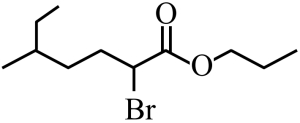
A
$n$-propyl-$2$-bromo-$5$-methylheptanoate
B
$2$-bromo-$5$-methylhexylpropanoate
C
$2$-bromo-$5$-methylpropanoate
D
$n$-propyl-$1$-bromo-$4$-methylhexanoate
Solution
(A) $1$. Identify the functional group: The compound is an ester,so the suffix is -oate. The alkyl group attached to the oxygen atom is a propyl group.
$2$. Number the main chain: The carbon atom of the ester group is $C-1$. The longest chain containing the ester group has $7$ carbons,making it a heptanoate derivative.
$3$. Identify substituents: There is a bromo group at position $2$ and a methyl group at position $5$.
$4$. Combine: The name is propyl $2$-bromo-$5$-methylheptanoate.
$2$. Number the main chain: The carbon atom of the ester group is $C-1$. The longest chain containing the ester group has $7$ carbons,making it a heptanoate derivative.
$3$. Identify substituents: There is a bromo group at position $2$ and a methyl group at position $5$.
$4$. Combine: The name is propyl $2$-bromo-$5$-methylheptanoate.
0 likesView Solution
100
ChemistryDifficultMCQJEE Main · 2026
When $1 \ g$ of compound $(X)$ is subjected to Kjeldahl's method for the estimation of nitrogen,$15 \ mL$ of $1 \ M$ $H_2SO_4$ was neutralized by the ammonia evolved. The percentage of nitrogen in compound $(X)$ is:
A
$21$
B
$0.42$
C
$42$
D
$0.21$
Solution
(C) The number of equivalents of $H_2SO_4$ used = $Molarity \times Volume \times n-factor = 1 \times 0.015 \times 2 = 0.03 \ eq$.
Since $1 \ eq$ of $H_2SO_4$ reacts with $1 \ eq$ of $NH_3$,the moles of $NH_3$ evolved = $0.03 \ mol$.
Since each mole of $NH_3$ contains $1 \ mole$ of nitrogen atoms,the moles of nitrogen = $0.03 \ mol$.
Mass of nitrogen = $0.03 \times 14 \ g = 0.42 \ g$.
Percentage of nitrogen = $\frac{\text{Mass of nitrogen}}{\text{Mass of compound}} \times 100 = \frac{0.42}{1} \times 100 = 42\%$.
Since $1 \ eq$ of $H_2SO_4$ reacts with $1 \ eq$ of $NH_3$,the moles of $NH_3$ evolved = $0.03 \ mol$.
Since each mole of $NH_3$ contains $1 \ mole$ of nitrogen atoms,the moles of nitrogen = $0.03 \ mol$.
Mass of nitrogen = $0.03 \times 14 \ g = 0.42 \ g$.
Percentage of nitrogen = $\frac{\text{Mass of nitrogen}}{\text{Mass of compound}} \times 100 = \frac{0.42}{1} \times 100 = 42\%$.
0 likesView Solution
101
ChemistryDifficultMCQJEE Main · 2026
Which of the following reactions is $NOT$ correctly represented?
A
$3-$methylcyclohexene + $Br_2, h\nu \rightarrow$ $3-$(bromomethyl)cyclohexene
B
Benzenediazonium chloride + $Cu_2Br_2/HBr \rightarrow$ Bromobenzene
C
Toluene + $Br_2, h\nu \rightarrow$ Benzyl bromide
D
Toluene + $Br_2, Fe, \text{dark} \rightarrow$ Ortho and para bromotoluene
Solution
(A) In reaction $(1)$,the starting material is $3$-methylcyclohexene. Under radical bromination conditions $(Br_2, h\nu)$,the reaction proceeds via the formation of a free radical. The most stable radical is the tertiary $(3^\circ)$ radical formed at the $C-3$ position. Therefore,the major product should be $3$-bromo-$3$-methylcyclohexene,not $3$-(bromomethyl)cyclohexene. Thus,reaction $(1)$ is incorrectly represented.
0 likesView Solution
102
ChemistryDifficultMCQJEE Main · 2026
Given below are two statements:
Statement $I$: The increasing order of boiling point of hydrogen halides is $HCl < HBr < HI < HF$
Statement $II$: The increasing order of melting point of hydrogen halides is $HCl < HBr < HF < HI$
In the light of the above statements, choose the correct answer from the options given below
Statement $I$: The increasing order of boiling point of hydrogen halides is $HCl < HBr < HI < HF$
Statement $II$: The increasing order of melting point of hydrogen halides is $HCl < HBr < HF < HI$
In the light of the above statements, choose the correct answer from the options given below
A
Both Statement $I$ and Statement $II$ are true
B
Statement $I$ is true but Statement $II$ is false
C
Both Statement $I$ and Statement $II$ are false
D
Statement $I$ is false but Statement $II$ is true
Solution
Correct order of
($i$) Boiling point: $HF > HI > HBr > HCl$
($ii$) Melting point: $HI > HF > HBr > HCl$
($i$) Boiling point: $HF > HI > HBr > HCl$
($ii$) Melting point: $HI > HF > HBr > HCl$
0 likesView Solution
103
ChemistryDifficultMCQJEE Main · 2026
$X$ is the number of geometrical isomers exhibited by $[Pt(NH_3)(H_2O)BrCl]$.
$Y$ is the number of optically inactive isomer$(s)$ exhibited by $[CrCl_2(ox)_2]^{3-}$.
$Z$ is the number of geometrical isomers exhibited by $[Co(NH_3)_3(NO_2)_3]$.
The value of $X+Y+Z$ is . . . . . . .
$Y$ is the number of optically inactive isomer$(s)$ exhibited by $[CrCl_2(ox)_2]^{3-}$.
$Z$ is the number of geometrical isomers exhibited by $[Co(NH_3)_3(NO_2)_3]$.
The value of $X+Y+Z$ is . . . . . . .
A
$4$
B
$5$
C
$6$
D
$7$
Solution
(C) $X$: For square planar complex $[M(abcd)]$,the number of geometrical isomers is $3$ (three pairs of trans ligands).
$Y$: For octahedral complex $[M(aa)_2b_2]$,the $cis$-isomer is optically active (chiral) and the $trans$-isomer is optically inactive (achiral). Thus,$Y = 1$.
$Z$: For octahedral complex $[Ma_3b_3]$,the geometrical isomers are $fac$ (facial) and $mer$ (meridional). Thus,$Z = 2$.
$X+Y+Z = 3+1+2 = 6$.
$Y$: For octahedral complex $[M(aa)_2b_2]$,the $cis$-isomer is optically active (chiral) and the $trans$-isomer is optically inactive (achiral). Thus,$Y = 1$.
$Z$: For octahedral complex $[Ma_3b_3]$,the geometrical isomers are $fac$ (facial) and $mer$ (meridional). Thus,$Z = 2$.
$X+Y+Z = 3+1+2 = 6$.
0 likesView Solution
104
ChemistryDifficultMCQJEE Main · 2026
$500 \ mL$ of $1.2 \ M$ $KI$ solution is mixed with $500 \ mL$ of $0.2 \ M$ $KMnO_4$ solution in basic medium. The liberated iodine was titrated with standard $0.1 \ M$ $Na_2S_2O_3$ solution in the presence of starch indicator till the blue color disappeared. The volume (in $L$) of $Na_2S_2O_3$ consumed is . . . . . . . (Nearest integer)
A
$1$
B
$2$
C
$3$
D
$4$
Solution
(C) In basic medium,the reaction between $KMnO_4$ and $KI$ is: $2MnO_4^{-} + I^{-} + H_2O \rightarrow 2MnO_2 + I_2 + 2OH^{-}$.
Here,$n$-factor for $KMnO_4$ is $3$ (change in oxidation state of $Mn$ from $+7$ to $+4$).
Equivalents of $KMnO_4 = 0.2 \times 0.5 \times 3 = 0.3 \ \text{eq}$.
Since $I_2$ is produced from $KMnO_4$,the equivalents of $I_2$ produced are equal to the equivalents of $KMnO_4$ reacted,which is $0.3 \ \text{eq}$.
The titration reaction is $I_2 + 2S_2O_3^{2-} \rightarrow 2I^{-} + S_4O_6^{2-}$.
Equivalents of $I_2 = \text{Equivalents of } Na_2S_2O_3$.
$0.3 = 0.1 \times V \times 1$.
$V = 3 \ L$.
Here,$n$-factor for $KMnO_4$ is $3$ (change in oxidation state of $Mn$ from $+7$ to $+4$).
Equivalents of $KMnO_4 = 0.2 \times 0.5 \times 3 = 0.3 \ \text{eq}$.
Since $I_2$ is produced from $KMnO_4$,the equivalents of $I_2$ produced are equal to the equivalents of $KMnO_4$ reacted,which is $0.3 \ \text{eq}$.
The titration reaction is $I_2 + 2S_2O_3^{2-} \rightarrow 2I^{-} + S_4O_6^{2-}$.
Equivalents of $I_2 = \text{Equivalents of } Na_2S_2O_3$.
$0.3 = 0.1 \times V \times 1$.
$V = 3 \ L$.
0 likesView Solution
105
ChemistryDifficultMCQJEE Main · 2026
The correct statement among the following is:
A
$[Ni(CN)_4]^{2-}$ and $[NiCl_4]^{2-}$ are diamagnetic and $Ni(CO)_4$ is paramagnetic.
B
$Ni(CO)_4$ and $[NiCl_4]^{2-}$ are diamagnetic and $[Ni(CN)_4]^{2-}$ is paramagnetic.
C
$Ni(CO)_4$ and $[Ni(CN)_4]^{2-}$ are diamagnetic and $[NiCl_4]^{2-}$ is paramagnetic.
D
$Ni(CO)_4$ is diamagnetic and $[NiCl_4]^{2-}$ and $[Ni(CN)_4]^{2-}$ are paramagnetic.
Solution
(C) $1$. For $[Ni(CN)_4]^{2-}$: $Ni^{2+}$ is $3d^8$. $CN^-$ is a strong field ligand,causing pairing of electrons. It forms $dsp^2$ hybridization,making it diamagnetic.
$2$. For $Ni(CO)_4$: $Ni$ is $3d^8 4s^2$ $(3d^{10})$. $CO$ is a strong field ligand. It forms $sp^3$ hybridization,making it diamagnetic.
$3$. For $[NiCl_4]^{2-}$: $Ni^{2+}$ is $3d^8$. $Cl^-$ is a weak field ligand,so electrons do not pair. It forms $sp^3$ hybridization with two unpaired electrons,making it paramagnetic.
Therefore,$Ni(CO)_4$ and $[Ni(CN)_4]^{2-}$ are diamagnetic,while $[NiCl_4]^{2-}$ is paramagnetic.
$2$. For $Ni(CO)_4$: $Ni$ is $3d^8 4s^2$ $(3d^{10})$. $CO$ is a strong field ligand. It forms $sp^3$ hybridization,making it diamagnetic.
$3$. For $[NiCl_4]^{2-}$: $Ni^{2+}$ is $3d^8$. $Cl^-$ is a weak field ligand,so electrons do not pair. It forms $sp^3$ hybridization with two unpaired electrons,making it paramagnetic.
Therefore,$Ni(CO)_4$ and $[Ni(CN)_4]^{2-}$ are diamagnetic,while $[NiCl_4]^{2-}$ is paramagnetic.
0 likesView Solution
106
ChemistryDifficultMCQJEE Main · 2026
Given below are two statements:
Statement $I$: The number of pairs,from the following,in which both the ions are coloured in aqueous solution is $3$: $[Sc^{3+}, Ti^{3+}], [Mn^{2+}, Cr^{2+}], [Cu^{2+}, Zn^{2+}]$ and $[Ni^{2+}, Ti^{4+}]$.
Statement $II$: $Th^{4+}$ is the strongest reducing agent among $Th^{4+}, Ce^{4+}, Gd^{3+}$ and $Eu^{2+}$.
In the light of the above statements,choose the correct answer from the options given below:
Statement $I$: The number of pairs,from the following,in which both the ions are coloured in aqueous solution is $3$: $[Sc^{3+}, Ti^{3+}], [Mn^{2+}, Cr^{2+}], [Cu^{2+}, Zn^{2+}]$ and $[Ni^{2+}, Ti^{4+}]$.
Statement $II$: $Th^{4+}$ is the strongest reducing agent among $Th^{4+}, Ce^{4+}, Gd^{3+}$ and $Eu^{2+}$.
In the light of the above statements,choose the correct answer from the options given below:
A
Statement $I$ is true but Statement $II$ is false
B
Statement $I$ is false but Statement $II$ is true
C
Both Statement $I$ and Statement $II$ are false
D
Both Statement $I$ and Statement $II$ are true
Solution
(C) Statement $I$: Ions with $d^0$ or $d^{10}$ configuration are colourless. $Sc^{3+}$ $(d^0)$,$Ti^{4+}$ $(d^0)$,and $Zn^{2+}$ $(d^{10})$ are colourless.
- $[Sc^{3+}, Ti^{3+}]$: $Sc^{3+}$ is colourless,$Ti^{3+}$ is coloured.
- $[Mn^{2+}, Cr^{2+}]$: Both are coloured ($Mn^{2+}$ is $d^5$,$Cr^{2+}$ is $d^4$).
- $[Cu^{2+}, Zn^{2+}]$: $Cu^{2+}$ is coloured $(d^9)$,$Zn^{2+}$ is colourless.
- $[Ni^{2+}, Ti^{4+}]$: $Ni^{2+}$ is coloured $(d^8)$,$Ti^{4+}$ is colourless.
Only $1$ pair $([Mn^{2+}, Cr^{2+}])$ has both ions coloured. Thus,Statement $I$ is false.
Statement $II$: $Th^{4+}$ is the most stable oxidation state of Thorium and cannot be oxidized further,so it cannot act as a reducing agent. $Eu^{2+}$ is a strong reducing agent as it tends to change to $Eu^{3+}$. Thus,Statement $II$ is false.
- $[Sc^{3+}, Ti^{3+}]$: $Sc^{3+}$ is colourless,$Ti^{3+}$ is coloured.
- $[Mn^{2+}, Cr^{2+}]$: Both are coloured ($Mn^{2+}$ is $d^5$,$Cr^{2+}$ is $d^4$).
- $[Cu^{2+}, Zn^{2+}]$: $Cu^{2+}$ is coloured $(d^9)$,$Zn^{2+}$ is colourless.
- $[Ni^{2+}, Ti^{4+}]$: $Ni^{2+}$ is coloured $(d^8)$,$Ti^{4+}$ is colourless.
Only $1$ pair $([Mn^{2+}, Cr^{2+}])$ has both ions coloured. Thus,Statement $I$ is false.
Statement $II$: $Th^{4+}$ is the most stable oxidation state of Thorium and cannot be oxidized further,so it cannot act as a reducing agent. $Eu^{2+}$ is a strong reducing agent as it tends to change to $Eu^{3+}$. Thus,Statement $II$ is false.
0 likesView Solution
107
ChemistryDifficultMCQJEE Main · 2026
In the given pentapeptide,find out an essential amino acid $(Y)$ and the sequence present in the pentapeptide: Choose the correct answer from the options given below:
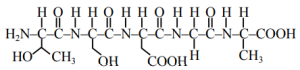
A
$(Y) = \text{Threonine}, (\text{Sequence}) = \text{Ser} - \text{Thr} - \text{Asp} - \text{Gly} - \text{Ala}$
B
$(Y) = \text{Serine}, (\text{Sequence}) = \text{Thr} - \text{Ser} - \text{Asp} - \text{Ala} - \text{Gly}$
C
$(Y) = \text{Threonine}, (\text{Sequence}) = \text{Thr} - \text{Ser} - \text{Asp} - \text{Gly} - \text{Ala}$
D
$(Y) = \text{Serine}, (\text{Sequence}) = \text{Ser} - \text{Asp} - \text{Thr} - \text{Ala} - \text{Gly}$
Solution
(C) By analyzing the structure of the pentapeptide,we can identify the individual amino acids by breaking the peptide bonds through hydrolysis. The amino acids present are:
$1$. $N$-terminal: $\text{Threonine} (\text{Thr})$
$2$. Second: $\text{Serine} (\text{Ser})$
$3$. Third: $\text{Aspartic acid} (\text{Asp})$
$4$. Fourth: $\text{Glycine} (\text{Gly})$
$5$. $C$-terminal: $\text{Alanine} (\text{Ala})$
Thus,the sequence is $\text{Thr} - \text{Ser} - \text{Asp} - \text{Gly} - \text{Ala}$.
Among these,$\text{Threonine}$ is an essential amino acid. Therefore,$(Y) = \text{Threonine}$ and the sequence is $\text{Thr} - \text{Ser} - \text{Asp} - \text{Gly} - \text{Ala}$.
$1$. $N$-terminal: $\text{Threonine} (\text{Thr})$
$2$. Second: $\text{Serine} (\text{Ser})$
$3$. Third: $\text{Aspartic acid} (\text{Asp})$
$4$. Fourth: $\text{Glycine} (\text{Gly})$
$5$. $C$-terminal: $\text{Alanine} (\text{Ala})$
Thus,the sequence is $\text{Thr} - \text{Ser} - \text{Asp} - \text{Gly} - \text{Ala}$.
Among these,$\text{Threonine}$ is an essential amino acid. Therefore,$(Y) = \text{Threonine}$ and the sequence is $\text{Thr} - \text{Ser} - \text{Asp} - \text{Gly} - \text{Ala}$.
0 likesView Solution
108
ChemistryDifficultMCQJEE Main · 2026
Consider the following reactions and identify the correct reaction.
A
B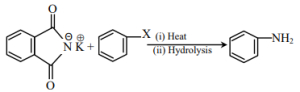
C
D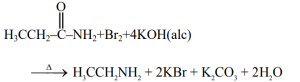
Solution
(D) $1$. In reaction $(A)$,nitration of benzanilide occurs primarily at the ortho and para positions of the aniline ring due to the activating effect of the $-NHCOPh$ group. The product shown in the image is incorrect.
$2$. In reaction $(B)$,aryl halides do not undergo nucleophilic substitution with potassium phthalimide under standard conditions,so no reaction occurs.
$3$. In reaction $(C)$,the carbylamine reaction produces an isocyanide,which upon reduction with $Sn/HCl$ yields a secondary amine ($N$-methylbenzylamine),not the primary amine shown.
$4$. In reaction $(D)$,the Hoffmann bromamide degradation of propanamide $(CH_3CH_2CONH_2)$ correctly yields ethylamine $(CH_3CH_2NH_2)$ along with the specified byproducts. This is a standard textbook reaction.
$2$. In reaction $(B)$,aryl halides do not undergo nucleophilic substitution with potassium phthalimide under standard conditions,so no reaction occurs.
$3$. In reaction $(C)$,the carbylamine reaction produces an isocyanide,which upon reduction with $Sn/HCl$ yields a secondary amine ($N$-methylbenzylamine),not the primary amine shown.
$4$. In reaction $(D)$,the Hoffmann bromamide degradation of propanamide $(CH_3CH_2CONH_2)$ correctly yields ethylamine $(CH_3CH_2NH_2)$ along with the specified byproducts. This is a standard textbook reaction.
0 likesView Solution
109
ChemistryDifficultMCQJEE Main · 2026
Given below are two statements:
Statement $I$: Griess-Ilosvay test is used for the detection of nitrite ion,which involves the use of sulphanilic acid and $\alpha$-naphthylamine reagent.
Statement $II$: In the above test,sulphanilic acid is diazotized by the acidified nitrite ion,which on further coupling with $\alpha$-naphthylamine forms an azo-dye.
In the light of the above statements,choose the correct answer from the options given below.
Statement $I$: Griess-Ilosvay test is used for the detection of nitrite ion,which involves the use of sulphanilic acid and $\alpha$-naphthylamine reagent.
Statement $II$: In the above test,sulphanilic acid is diazotized by the acidified nitrite ion,which on further coupling with $\alpha$-naphthylamine forms an azo-dye.
In the light of the above statements,choose the correct answer from the options given below.
A
Statement $I$ is false but Statement $II$ is true
B
Both Statement $I$ and Statement $II$ are true
C
Statement $I$ is true but Statement $II$ is false
D
Both Statement $I$ and Statement $II$ are false
Solution
(B) The Griess-Ilosvay test is a standard analytical method used for the detection of nitrite ions $(NO_2^-)$.
In this test,sulphanilic acid reacts with nitrous acid $(HNO_2)$,which is generated from the nitrite ion in an acidic medium,to form a diazonium salt.
This diazonium salt then undergoes a coupling reaction with $\alpha$-naphthylamine to produce a red-colored azo-dye.
Both statements accurately describe the chemical principles of this test.
Therefore,both Statement $I$ and Statement $II$ are true.
In this test,sulphanilic acid reacts with nitrous acid $(HNO_2)$,which is generated from the nitrite ion in an acidic medium,to form a diazonium salt.
This diazonium salt then undergoes a coupling reaction with $\alpha$-naphthylamine to produce a red-colored azo-dye.
Both statements accurately describe the chemical principles of this test.
Therefore,both Statement $I$ and Statement $II$ are true.
0 likesView Solution
110
ChemistryDifficultMCQJEE Main · 2026
Regarding the hydrides of group $15$ elements $EH_{3}$ $(E = N, P, As, Sb, Bi)$,select the correct statement from the following:
$A$. The stability of hydrides decreases down the group.
$B$. The basicity of hydrides decreases down the group.
$C$. The reducing character increases down the group.
$D$. The boiling point increases down the group.
Choose the correct answer from the options given below:
$A$. The stability of hydrides decreases down the group.
$B$. The basicity of hydrides decreases down the group.
$C$. The reducing character increases down the group.
$D$. The boiling point increases down the group.
Choose the correct answer from the options given below:
A
$A, B$ & $C$ only
B
$A$ & $D$ only
C
$A, B, C$ & $D$
D
$B$ & $C$ only
Solution
(A) Stability: The bond dissociation enthalpy decreases down the group as the size of the central atom increases,so stability decreases: $NH_{3} > PH_{3} > AsH_{3} > SbH_{3} > BiH_{3}$. Thus,statement $A$ is correct.
Basicity: The electron density on the central atom decreases as the size increases,so basicity decreases: $NH_{3} > PH_{3} > AsH_{3} > SbH_{3} > BiH_{3}$. Thus,statement $B$ is correct.
Reducing character: As stability decreases,the tendency to release $H_{2}$ increases,so reducing character increases: $NH_{3} < PH_{3} < AsH_{3} < SbH_{3} < BiH_{3}$. Thus,statement $C$ is correct.
Boiling point: $NH_{3}$ has a higher boiling point than $PH_{3}$ due to hydrogen bonding. The trend is $PH_{3} < AsH_{3} < NH_{3} < SbH_{3} < BiH_{3}$. Thus,statement $D$ is incorrect.
Basicity: The electron density on the central atom decreases as the size increases,so basicity decreases: $NH_{3} > PH_{3} > AsH_{3} > SbH_{3} > BiH_{3}$. Thus,statement $B$ is correct.
Reducing character: As stability decreases,the tendency to release $H_{2}$ increases,so reducing character increases: $NH_{3} < PH_{3} < AsH_{3} < SbH_{3} < BiH_{3}$. Thus,statement $C$ is correct.
Boiling point: $NH_{3}$ has a higher boiling point than $PH_{3}$ due to hydrogen bonding. The trend is $PH_{3} < AsH_{3} < NH_{3} < SbH_{3} < BiH_{3}$. Thus,statement $D$ is incorrect.
0 likesView Solution
111
ChemistryDifficultMCQJEE Main · 2026
Given below are the four isomeric compounds $(P, Q, R, S)$. Identify the correct statements from below.
$A$. $Q, R$ and $S$ will give a precipitate with $2,4-DNP$.
$B$. $P$ and $Q$ will give a positive Bayer's test.
$C$. $Q$ and $R$ will give a sooty flame.
$D$. $R$ and $S$ will give a yellow precipitate with $I_2/NaOH$.
$E$. $Q$ alone will deposit silver with Tollen's reagent.
Choose the correct option.
$A$. $Q, R$ and $S$ will give a precipitate with $2,4-DNP$.
$B$. $P$ and $Q$ will give a positive Bayer's test.
$C$. $Q$ and $R$ will give a sooty flame.
$D$. $R$ and $S$ will give a yellow precipitate with $I_2/NaOH$.
$E$. $Q$ alone will deposit silver with Tollen's reagent.
Choose the correct option.
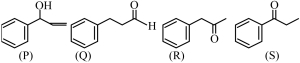
A
$A, C$ and $E$ only
B
$A$ and $E$ only
C
$C$ and $E$ only
D
$A, B, D$ and $E$ only
Solution
(A) The structures are: $P$ ($1$-phenylprop$-2-$en$-1-$ol),$Q$ ($3$-phenylpropanal),$R$ ($1$-phenylpropan$-2-$one),$S$ ($1$-phenylpropan$-1-$one).
$A$. $2,4-DNP$ reacts with aldehydes and ketones. $Q$ (aldehyde),$R$ (ketone),and $S$ (ketone) give the test. Statement $A$ is correct.
$B$. Bayer's test is for unsaturation. Only $P$ has a double bond. Statement $B$ is incorrect.
$C$. Aromatic compounds give a sooty flame. All four compounds contain a phenyl ring,so all give a sooty flame. Statement $C$ is technically correct,but we evaluate based on the options provided.
$D$. $I_2/NaOH$ (Iodoform test) requires a $CH_3CO-$ group or $CH_3CH(OH)-$ group. $R$ has $CH_3CO-$ and $S$ does not. Statement $D$ is incorrect.
$E$. Tollen's reagent is for aldehydes. Only $Q$ is an aldehyde. Statement $E$ is correct.
Combining the correct statements $A, C, E$,the correct option is $A$.
$A$. $2,4-DNP$ reacts with aldehydes and ketones. $Q$ (aldehyde),$R$ (ketone),and $S$ (ketone) give the test. Statement $A$ is correct.
$B$. Bayer's test is for unsaturation. Only $P$ has a double bond. Statement $B$ is incorrect.
$C$. Aromatic compounds give a sooty flame. All four compounds contain a phenyl ring,so all give a sooty flame. Statement $C$ is technically correct,but we evaluate based on the options provided.
$D$. $I_2/NaOH$ (Iodoform test) requires a $CH_3CO-$ group or $CH_3CH(OH)-$ group. $R$ has $CH_3CO-$ and $S$ does not. Statement $D$ is incorrect.
$E$. Tollen's reagent is for aldehydes. Only $Q$ is an aldehyde. Statement $E$ is correct.
Combining the correct statements $A, C, E$,the correct option is $A$.
0 likesView Solution
112
ChemistryDifficultMCQJEE Main · 2026
An organic compound undergoes first order decomposition. The time taken for decomposition to $\left(\frac{1}{8}\right)^{\text{th}}$ and $\left(\frac{1}{10}\right)^{\text{th}}$ of its initial concentration are $t_{1/8}$ and $t_{1/10}$ respectively. What is the value of $\frac{t_{1/8}}{t_{1/10}} \times 10$? (Given: $\log 2 = 0.3$)
A
$9$
B
$0.9$
C
$3$
D
$30$
Solution
(A) For a first-order reaction,the time $t$ taken for the concentration to reach $A_t$ from $A_0$ is given by $t = \frac{1}{k} \ln \frac{A_0}{A_t}$.
For $t_{1/8}$,the remaining concentration is $\frac{A_0}{8}$,so $t_{1/8} = \frac{1}{k} \ln \frac{A_0}{A_0/8} = \frac{1}{k} \ln 8$.
For $t_{1/10}$,the remaining concentration is $\frac{A_0}{10}$,so $t_{1/10} = \frac{1}{k} \ln \frac{A_0}{A_0/10} = \frac{1}{k} \ln 10$.
Taking the ratio: $\frac{t_{1/8}}{t_{1/10}} = \frac{\ln 8}{\ln 10} = \frac{\log 8}{\log 10} = \log 8$.
Since $\log 8 = \log 2^3 = 3 \log 2 = 3 \times 0.3 = 0.9$.
Therefore,$\frac{t_{1/8}}{t_{1/10}} \times 10 = 0.9 \times 10 = 9$.
For $t_{1/8}$,the remaining concentration is $\frac{A_0}{8}$,so $t_{1/8} = \frac{1}{k} \ln \frac{A_0}{A_0/8} = \frac{1}{k} \ln 8$.
For $t_{1/10}$,the remaining concentration is $\frac{A_0}{10}$,so $t_{1/10} = \frac{1}{k} \ln \frac{A_0}{A_0/10} = \frac{1}{k} \ln 10$.
Taking the ratio: $\frac{t_{1/8}}{t_{1/10}} = \frac{\ln 8}{\ln 10} = \frac{\log 8}{\log 10} = \log 8$.
Since $\log 8 = \log 2^3 = 3 \log 2 = 3 \times 0.3 = 0.9$.
Therefore,$\frac{t_{1/8}}{t_{1/10}} \times 10 = 0.9 \times 10 = 9$.
0 likesView Solution
113
ChemistryDifficultMCQJEE Main · 2026
Consider the following reaction sequence:
$\text{Compound } (x)$ $\xrightarrow[(ii) H_3O^{+}]{(i) CO_2, NaOH, 120^{\circ}C, \text{high pressure}} \text{Compound } (y) \text{ (Major Product)}$
$[76.6\% C, 6.38\% H, \text{vapour density } 47]$
Compound $(y)$ develops a characteristic color with neutral $FeCl_3$ solution.
Identify the $INCORRECT$ statement from the following for the above sequence.
$\text{Compound } (x)$ $\xrightarrow[(ii) H_3O^{+}]{(i) CO_2, NaOH, 120^{\circ}C, \text{high pressure}} \text{Compound } (y) \text{ (Major Product)}$
$[76.6\% C, 6.38\% H, \text{vapour density } 47]$
Compound $(y)$ develops a characteristic color with neutral $FeCl_3$ solution.
Identify the $INCORRECT$ statement from the following for the above sequence.
A
Both compounds $x$ and $y$ will dissolve in $NaOH$.
B
Compound $y$ will dissolve in $NaHCO_3$ and evolve a gas.
C
Compound $x$ is more acidic than compound $y$.
D
Both compounds $x$ and $y$ will burn with a sooty flame.
Solution
(C) The reaction is the Kolbe-Schmitt reaction. The molecular weight of compound $(y)$ is $2 \times \text{vapour density} = 2 \times 47 = 94$.
Given the percentages: $C = 76.6\%$,$H = 6.38\%$,$O = 100 - (76.6 + 6.38) = 17.02\%$.
Moles of $C = 76.6/12 = 6.38$,$H = 6.38/1 = 6.38$,$O = 17.02/16 = 1.06$.
Ratio $C:H:O = 6:6:1$. The empirical formula is $C_6H_6O$,which corresponds to phenol $(C_6H_5OH)$.
Thus,compound $(x)$ is phenol and compound $(y)$ is salicylic acid ($2$-hydroxybenzoic acid).
Phenol $(x)$ is acidic and dissolves in $NaOH$. Salicylic acid $(y)$ is more acidic than phenol due to the electron-withdrawing $-COOH$ group and intramolecular hydrogen bonding,so it also dissolves in $NaOH$.
Salicylic acid $(y)$ reacts with $NaHCO_3$ to evolve $CO_2$ gas.
Both are aromatic compounds and burn with a sooty flame.
Statement $(c)$ is incorrect because salicylic acid $(y)$ is more acidic than phenol $(x)$.
Given the percentages: $C = 76.6\%$,$H = 6.38\%$,$O = 100 - (76.6 + 6.38) = 17.02\%$.
Moles of $C = 76.6/12 = 6.38$,$H = 6.38/1 = 6.38$,$O = 17.02/16 = 1.06$.
Ratio $C:H:O = 6:6:1$. The empirical formula is $C_6H_6O$,which corresponds to phenol $(C_6H_5OH)$.
Thus,compound $(x)$ is phenol and compound $(y)$ is salicylic acid ($2$-hydroxybenzoic acid).
Phenol $(x)$ is acidic and dissolves in $NaOH$. Salicylic acid $(y)$ is more acidic than phenol due to the electron-withdrawing $-COOH$ group and intramolecular hydrogen bonding,so it also dissolves in $NaOH$.
Salicylic acid $(y)$ reacts with $NaHCO_3$ to evolve $CO_2$ gas.
Both are aromatic compounds and burn with a sooty flame.
Statement $(c)$ is incorrect because salicylic acid $(y)$ is more acidic than phenol $(x)$.
0 likesView Solution
114
ChemistryDifficultMCQJEE Main · 2026
At $T(K)$,$2$ moles of liquid $A$ and $3$ moles of liquid $B$ are mixed. The vapour pressure of the ideal solution formed is $320 \ mm \ Hg$. At this stage,one mole of $A$ and one mole of $B$ are added to the solution. The vapour pressure is now measured as $328.6 \ mm \ Hg$. The vapour pressures of pure $A$ and pure $B$ (in $mm \ Hg$) are respectively:
A
$300, 200$
B
$600, 400$
C
$400, 300$
D
$500, 200$
Solution
(D) According to Raoult's law for an ideal solution,$P_S = X_A P_A^{\circ} + X_B P_B^{\circ}$.
For the first mixture: $X_A = 2/5$,$X_B = 3/5$,and $P_S = 320 \ mm \ Hg$.
$320 = P_A^{\circ} (2/5) + P_B^{\circ} (3/5) \implies 2 P_A^{\circ} + 3 P_B^{\circ} = 1600$ ...$(I)$
After adding $1$ mole of $A$ and $1$ mole of $B$,the new moles are $3$ moles of $A$ and $4$ moles of $B$. Total moles = $7$.
$X_A' = 3/7$,$X_B' = 4/7$,and $P_S' = 328.6 \ mm \ Hg$.
$328.6 = P_A^{\circ} (3/7) + P_B^{\circ} (4/7) \implies 3 P_A^{\circ} + 4 P_B^{\circ} = 2300.2$ ...$(II)$
Solving the system of equations:
Multiply $(I)$ by $3$: $6 P_A^{\circ} + 9 P_B^{\circ} = 4800$ ...$(III)$
Multiply $(II)$ by $2$: $6 P_A^{\circ} + 8 P_B^{\circ} = 4600.4$ ...$(IV)$
Subtracting $(IV)$ from $(III)$: $P_B^{\circ} = 199.6 \ mm \ Hg \approx 200 \ mm \ Hg$.
Substituting $P_B^{\circ} = 200$ into $(I)$: $2 P_A^{\circ} + 3(200) = 1600 \implies 2 P_A^{\circ} = 1000 \implies P_A^{\circ} = 500 \ mm \ Hg$.
Thus,the vapour pressures are $500 \ mm \ Hg$ and $200 \ mm \ Hg$.
For the first mixture: $X_A = 2/5$,$X_B = 3/5$,and $P_S = 320 \ mm \ Hg$.
$320 = P_A^{\circ} (2/5) + P_B^{\circ} (3/5) \implies 2 P_A^{\circ} + 3 P_B^{\circ} = 1600$ ...$(I)$
After adding $1$ mole of $A$ and $1$ mole of $B$,the new moles are $3$ moles of $A$ and $4$ moles of $B$. Total moles = $7$.
$X_A' = 3/7$,$X_B' = 4/7$,and $P_S' = 328.6 \ mm \ Hg$.
$328.6 = P_A^{\circ} (3/7) + P_B^{\circ} (4/7) \implies 3 P_A^{\circ} + 4 P_B^{\circ} = 2300.2$ ...$(II)$
Solving the system of equations:
Multiply $(I)$ by $3$: $6 P_A^{\circ} + 9 P_B^{\circ} = 4800$ ...$(III)$
Multiply $(II)$ by $2$: $6 P_A^{\circ} + 8 P_B^{\circ} = 4600.4$ ...$(IV)$
Subtracting $(IV)$ from $(III)$: $P_B^{\circ} = 199.6 \ mm \ Hg \approx 200 \ mm \ Hg$.
Substituting $P_B^{\circ} = 200$ into $(I)$: $2 P_A^{\circ} + 3(200) = 1600 \implies 2 P_A^{\circ} = 1000 \implies P_A^{\circ} = 500 \ mm \ Hg$.
Thus,the vapour pressures are $500 \ mm \ Hg$ and $200 \ mm \ Hg$.
0 likesView Solution
115
ChemistryDifficultMCQJEE Main · 2026
Electricity is passed through an acidic solution of $Cu^{2+}$ until all the $Cu^{2+}$ is exhausted,leading to the deposition of $300 \ mg$ of $Cu$ metal. Subsequently,a current of $600 \ mA$ is passed through the same solution for another $28 \ minutes$ while keeping the total volume of the solution fixed at $200 \ mL$. The total volume of oxygen evolved at $STP$ during the entire process is . . . . . . $mL$. (Nearest integer) [Given: $Cu^{2+}_{(aq)} + 2e^{-} \rightarrow Cu_{(s)}$,$E_{red}^0 = +0.34 \ V$; $O_{2(g)} + 4H^{+} + 4e^{-} \rightarrow 2H_2O$,$E_{red}^0 = +1.23 \ V$; Molar mass of $Cu = 63.54 \ g \ mol^{-1}$; Faraday Constant $= 96500 \ C \ mol^{-1}$; Molar volume at $STP = 22.4 \ L$]
A
$55$
B
$222$
C
$111$
D
$148$
Solution
(C) Step $1$: Calculate $O_2$ evolved during $Cu$ deposition.
$Eq$ of $Cu = Eq$ of $O_2$
$\frac{300 \times 10^{-3}}{63.54 / 2} = n_{O_2(1)} \times 4$
$n_{O_2(1)} = \frac{0.3}{63.54 \times 2} = 2.36 \times 10^{-3} \ mol$.
Step $2$: Calculate $O_2$ evolved during the additional $28 \ minutes$.
$Q = I \times t = 0.6 \ A \times (28 \times 60) \ s = 1008 \ C$.
$n_{e^-} = \frac{1008}{96500} = 0.01044 \ mol$.
Since $4 \ mol \ e^-$ produce $1 \ mol \ O_2$,$n_{O_2(2)} = \frac{0.01044}{4} = 2.611 \times 10^{-3} \ mol$.
Step $3$: Total $O_2$ volume at $STP$.
$n_{total} = (2.36 + 2.611) \times 10^{-3} = 4.971 \times 10^{-3} \ mol$.
$V = n \times 22400 \ mL = 4.971 \times 10^{-3} \times 22400 \approx 111.35 \ mL$.
Rounding to the nearest integer,we get $111 \ mL$.
$Eq$ of $Cu = Eq$ of $O_2$
$\frac{300 \times 10^{-3}}{63.54 / 2} = n_{O_2(1)} \times 4$
$n_{O_2(1)} = \frac{0.3}{63.54 \times 2} = 2.36 \times 10^{-3} \ mol$.
Step $2$: Calculate $O_2$ evolved during the additional $28 \ minutes$.
$Q = I \times t = 0.6 \ A \times (28 \times 60) \ s = 1008 \ C$.
$n_{e^-} = \frac{1008}{96500} = 0.01044 \ mol$.
Since $4 \ mol \ e^-$ produce $1 \ mol \ O_2$,$n_{O_2(2)} = \frac{0.01044}{4} = 2.611 \times 10^{-3} \ mol$.
Step $3$: Total $O_2$ volume at $STP$.
$n_{total} = (2.36 + 2.611) \times 10^{-3} = 4.971 \times 10^{-3} \ mol$.
$V = n \times 22400 \ mL = 4.971 \times 10^{-3} \times 22400 \approx 111.35 \ mL$.
Rounding to the nearest integer,we get $111 \ mL$.
0 likesView Solution
116
ChemistryDifficultMCQJEE Main · 2026
Consider the following two reactions $A$ and $B$.
Numerical value of [molar mass of $x$ + molar mass of $y$] is . . . . . . .
Numerical value of [molar mass of $x$ + molar mass of $y$] is . . . . . . .
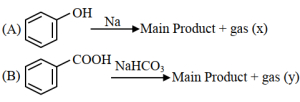
A
$4$
B
$88$
C
$46$
D
$160$
Solution
(C) In reaction $A$,phenol reacts with sodium $(Na)$ to release hydrogen gas $(x = H_2)$.
Molar mass of $H_2 = 2 \ g/mol$.
In reaction $B$,benzoic acid reacts with sodium bicarbonate $(NaHCO_3)$ to release carbon dioxide gas $(y = CO_2)$.
Molar mass of $CO_2 = 44 \ g/mol$.
Sum of molar masses = $2 + 44 = 46$.
Molar mass of $H_2 = 2 \ g/mol$.
In reaction $B$,benzoic acid reacts with sodium bicarbonate $(NaHCO_3)$ to release carbon dioxide gas $(y = CO_2)$.
Molar mass of $CO_2 = 44 \ g/mol$.
Sum of molar masses = $2 + 44 = 46$.
0 likesView Solution
117
ChemistryDifficultMCQJEE Main · 2026
Given below are two statements:
Statement $I$: $C-Cl$ bond is stronger in $CH_2=CH-Cl$ than $CH_3-CH_2-Cl$.
Statement $II$: The given optically active molecule on hydrolysis gives a solution that can rotate the plane polarized light.
In the light of the above statements,choose the correct answer from the options given below.
Statement $I$: $C-Cl$ bond is stronger in $CH_2=CH-Cl$ than $CH_3-CH_2-Cl$.
Statement $II$: The given optically active molecule on hydrolysis gives a solution that can rotate the plane polarized light.
In the light of the above statements,choose the correct answer from the options given below.
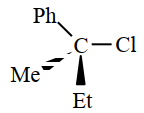
A
Statement $I$ is false but Statement $II$ is true
B
Both Statement $I$ and Statement $II$ are true
C
Both Statement $I$ and Statement $II$ are false
D
Statement $I$ is true but Statement $II$ is false
Solution
(D) Statement $I$: In $CH_2=CH-Cl$ (vinyl chloride),the lone pair on chlorine atom participates in resonance with the double bond,giving the $C-Cl$ bond a partial double bond character. This makes it shorter and stronger than the $C-Cl$ bond in $CH_3-CH_2-Cl$ (ethyl chloride),where only a single bond exists. Thus,Statement $I$ is true.
Statement $II$: The given molecule is a chiral alkyl halide. Hydrolysis of such a molecule typically proceeds via an $S_N1$ mechanism,which involves the formation of a planar carbocation intermediate. Nucleophilic attack on this carbocation occurs from both sides with equal probability,leading to the formation of a racemic mixture. $A$ racemic mixture is optically inactive and cannot rotate plane polarized light $(PPL)$. Thus,Statement $II$ is false.
Statement $II$: The given molecule is a chiral alkyl halide. Hydrolysis of such a molecule typically proceeds via an $S_N1$ mechanism,which involves the formation of a planar carbocation intermediate. Nucleophilic attack on this carbocation occurs from both sides with equal probability,leading to the formation of a racemic mixture. $A$ racemic mixture is optically inactive and cannot rotate plane polarized light $(PPL)$. Thus,Statement $II$ is false.
0 likesView Solution
118
ChemistryDifficultMCQJEE Main · 2026
At $27^{\circ}C$ in the presence of a catalyst,the activation energy of a reaction is lowered by $10 \ kJ \ mol^{-1}$. The logarithm ratio of $\frac{k(\text{catalysed})}{k(\text{uncatalysed})}$ is .... (Consider that the frequency factor for both the reactions is the same)
A
$17.41$
B
$1.741$
C
$3.482$
D
$0.1741$
Solution
(B) According to the Arrhenius equation,$k = A e^{-E_a / RT}$.
For the catalysed reaction,$k_c = A e^{-E_{ac} / RT}$ and for the uncatalysed reaction,$k_u = A e^{-E_{au} / RT}$.
Given that the frequency factor $A$ is the same,the ratio is $\frac{k_c}{k_u} = e^{(E_{au} - E_{ac}) / RT} = e^{\Delta E_a / RT}$.
Taking the logarithm on both sides: $\log_{10} \left( \frac{k_c}{k_u} \right) = \frac{\Delta E_a}{2.303 RT}$.
Given $\Delta E_a = 10 \ kJ \ mol^{-1} = 10000 \ J \ mol^{-1}$,$R = 8.314 \ J \ K^{-1} \ mol^{-1}$,and $T = 27 + 273 = 300 \ K$.
$\log_{10} \left( \frac{k_c}{k_u} \right) = \frac{10000}{2.303 \times 8.314 \times 300} = \frac{10000}{5744.14} \approx 1.741$.
For the catalysed reaction,$k_c = A e^{-E_{ac} / RT}$ and for the uncatalysed reaction,$k_u = A e^{-E_{au} / RT}$.
Given that the frequency factor $A$ is the same,the ratio is $\frac{k_c}{k_u} = e^{(E_{au} - E_{ac}) / RT} = e^{\Delta E_a / RT}$.
Taking the logarithm on both sides: $\log_{10} \left( \frac{k_c}{k_u} \right) = \frac{\Delta E_a}{2.303 RT}$.
Given $\Delta E_a = 10 \ kJ \ mol^{-1} = 10000 \ J \ mol^{-1}$,$R = 8.314 \ J \ K^{-1} \ mol^{-1}$,and $T = 27 + 273 = 300 \ K$.
$\log_{10} \left( \frac{k_c}{k_u} \right) = \frac{10000}{2.303 \times 8.314 \times 300} = \frac{10000}{5744.14} \approx 1.741$.
0 likesView Solution
119
ChemistryDifficultMCQJEE Main · 2026
$A$ hydroxy compound $(X)$ with molar mass $122 \ g \ mol^{-1}$ is acetylated with acetic anhydride,using a large excess of the reagent ensuring complete acetylation of all hydroxyl groups. The product obtained has a molar mass of $290 \ g \ mol^{-1}$. The number of hydroxyl groups present in compound $(X)$ is :
A
$3$
B
$5$
C
$2$
D
$4$
Solution
(D) During acetylation,each $-OH$ group is replaced by an $-OCOCH_3$ group.
This results in the replacement of one hydrogen atom (mass $1 \ u$) with an acetyl group ($-COCH_3$,mass $43 \ u$).
Therefore,the net increase in molar mass for each $-OH$ group is $43 - 1 = 42 \ g \ mol^{-1}$.
Let $n$ be the number of $-OH$ groups.
The increase in molar mass is $290 - 122 = 168 \ g \ mol^{-1}$.
Thus,$n \times 42 = 168$.
$n = \frac{168}{42} = 4$.
So,there are $4$ hydroxyl groups present in compound $(X)$.
This results in the replacement of one hydrogen atom (mass $1 \ u$) with an acetyl group ($-COCH_3$,mass $43 \ u$).
Therefore,the net increase in molar mass for each $-OH$ group is $43 - 1 = 42 \ g \ mol^{-1}$.
Let $n$ be the number of $-OH$ groups.
The increase in molar mass is $290 - 122 = 168 \ g \ mol^{-1}$.
Thus,$n \times 42 = 168$.
$n = \frac{168}{42} = 4$.
So,there are $4$ hydroxyl groups present in compound $(X)$.
0 likesView Solution
120
ChemistryDifficultMCQJEE Main · 2026
$A$ student is given one compound among the following compounds that gives a positive test with Tollen's reagent. The compound is:
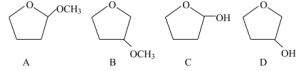
A
$A$
B
$B$
C
$C$
D
$D$
Solution
(C) Tollen's reagent is an oxidizing agent that reacts with aldehydes to form a silver mirror.
Compounds that exist in equilibrium with an open-chain aldehyde form will give a positive Tollen's test.
Hemiacetals are in equilibrium with their open-chain aldehyde form in the presence of a base (present in Tollen's reagent).
Compound $C$ is a cyclic hemiacetal,which can open to form an aldehyde,thus giving a positive Tollen's test.
Compounds $A$ and $B$ are acetals (ethers),which do not open to form aldehydes under these conditions.
Compound $D$ is a cyclic alcohol,which does not contain the hemiacetal functional group required to form an aldehyde.
Therefore,the correct compound is $C$.
Compounds that exist in equilibrium with an open-chain aldehyde form will give a positive Tollen's test.
Hemiacetals are in equilibrium with their open-chain aldehyde form in the presence of a base (present in Tollen's reagent).
Compound $C$ is a cyclic hemiacetal,which can open to form an aldehyde,thus giving a positive Tollen's test.
Compounds $A$ and $B$ are acetals (ethers),which do not open to form aldehydes under these conditions.
Compound $D$ is a cyclic alcohol,which does not contain the hemiacetal functional group required to form an aldehyde.
Therefore,the correct compound is $C$.
0 likesView Solution
121
ChemistryDifficultMCQJEE Main · 2026
$W \ g$ of a non-volatile electrolyte solid solute of molar mass $M \ g \ mol^{-1}$ when dissolved in $100 \ mL$ water,decreases vapor pressure of water from $640 \ mm \ Hg$ to $600 \ mm \ Hg$. If aqueous solution of the electrolyte boils at $375 \ K$ and $K_b$ for water is $0.52 \ K \ kg \ mol^{-1}$,then the mole fraction of the electrolyte solute $(X_2)$ in the solution can be expressed as (Given density of water $= 1 \ g/mL$ and boiling point of water $= 373 \ K$):
A
$\frac{1.3}{8} \times \frac{W}{M}$
B
$\frac{16}{2.6} \times \frac{W}{M}$
C
$\frac{2.6}{16} \times \frac{M}{W}$
D
$\frac{1.3}{8} \times \frac{M}{W}$
Solution
(A) Given:
$P^0 = 640 \ mm \ Hg$,$P_s = 600 \ mm \ Hg$.
Relative lowering of vapor pressure: $\frac{P^0 - P_s}{P^0} = i \cdot X_2$.
$\frac{640 - 600}{640} = i \cdot X_2 \implies i \cdot X_2 = \frac{40}{640} = \frac{1}{16}$ ... $(i)$.
Elevation in boiling point: $\Delta T_b = T_b - T_b^0 = 375 - 373 = 2 \ K$.
Formula: $\Delta T_b = i \cdot K_b \cdot m$.
$2 = i \cdot 0.52 \cdot \frac{W \times 1000}{M \times 100} \implies 2 = i \cdot 5.2 \cdot \frac{W}{M} \implies i = \frac{2 \cdot M}{5.2 \cdot W} = \frac{M}{2.6 \cdot W}$ ... $(ii)$.
Substituting $(ii)$ in $(i)$:
$\left(\frac{M}{2.6 \cdot W}\right) \cdot X_2 = \frac{1}{16}$.
$X_2 = \frac{2.6 \cdot W}{16 \cdot M} = \frac{1.3}{8} \cdot \frac{W}{M}$.
$P^0 = 640 \ mm \ Hg$,$P_s = 600 \ mm \ Hg$.
Relative lowering of vapor pressure: $\frac{P^0 - P_s}{P^0} = i \cdot X_2$.
$\frac{640 - 600}{640} = i \cdot X_2 \implies i \cdot X_2 = \frac{40}{640} = \frac{1}{16}$ ... $(i)$.
Elevation in boiling point: $\Delta T_b = T_b - T_b^0 = 375 - 373 = 2 \ K$.
Formula: $\Delta T_b = i \cdot K_b \cdot m$.
$2 = i \cdot 0.52 \cdot \frac{W \times 1000}{M \times 100} \implies 2 = i \cdot 5.2 \cdot \frac{W}{M} \implies i = \frac{2 \cdot M}{5.2 \cdot W} = \frac{M}{2.6 \cdot W}$ ... $(ii)$.
Substituting $(ii)$ in $(i)$:
$\left(\frac{M}{2.6 \cdot W}\right) \cdot X_2 = \frac{1}{16}$.
$X_2 = \frac{2.6 \cdot W}{16 \cdot M} = \frac{1.3}{8} \cdot \frac{W}{M}$.
0 likesView Solution
122
ChemistryDifficultMCQJEE Main · 2026
Match the List-$I$ with List-$II$
Choose the correct answer from the options given below:
| List-$I$ (Chloro derivative) | List-$II$ (Example) |
|---|---|
| $A$. Vinyl chloride | $I$. $CH_2=CH-CH_2Cl$ |
| $B$. Benzyl chloride | $II$. $CH_3-CH(Cl)CH_3$ |
| $C$. Alkyl chloride | $III$. $CH_2=CHCl$ |
| $D$. Allyl chloride | $IV$. $C_6H_5CH_2Cl$ |
A
$A-IV, B-I, C-III, D-II$
B
$A-III, B-IV, C-I, D-II$
C
$A-III, B-IV, C-II, D-I$
D
$A-I, B-II, C-IV, D-III$
Solution
(C) . Vinyl chloride is $CH_2=CHCl$ $(III)$.
$B$. Benzyl chloride is $C_6H_5CH_2Cl$ $(IV)$.
$C$. Alkyl chloride is $CH_3-CH(Cl)CH_3$ $(II)$.
$D$. Allyl chloride is $CH_2=CH-CH_2Cl$ $(I)$.
Therefore,the correct matching is $A-III, B-IV, C-II, D-I$.
$B$. Benzyl chloride is $C_6H_5CH_2Cl$ $(IV)$.
$C$. Alkyl chloride is $CH_3-CH(Cl)CH_3$ $(II)$.
$D$. Allyl chloride is $CH_2=CH-CH_2Cl$ $(I)$.
Therefore,the correct matching is $A-III, B-IV, C-II, D-I$.
0 likesView Solution
123
ChemistryDifficultMCQJEE Main · 2026
Given below are two statements:
Statement-$I$ : The number of paramagnetic species among $[CoF_6]^{3-}$,$[TiF_6]^{3-}$,$V_2O_5$ and $[Fe(CN)_6]^{3-}$ is $3$.
Statement-$II$ : $K_4[Fe(CN)_6] < K_3[Fe(CN)_6] < [Fe(H_2O)_6]SO_4 \cdot H_2O < [Fe(H_2O)_6]Cl_3$ is the correct order in terms of number of unpaired electron$(s)$ in the complexes.
In the light of the above statements,choose the correct answer from the options given below.
Statement-$I$ : The number of paramagnetic species among $[CoF_6]^{3-}$,$[TiF_6]^{3-}$,$V_2O_5$ and $[Fe(CN)_6]^{3-}$ is $3$.
Statement-$II$ : $K_4[Fe(CN)_6] < K_3[Fe(CN)_6] < [Fe(H_2O)_6]SO_4 \cdot H_2O < [Fe(H_2O)_6]Cl_3$ is the correct order in terms of number of unpaired electron$(s)$ in the complexes.
In the light of the above statements,choose the correct answer from the options given below.
A
Both statement-$I$ and statement-$II$ are true
B
Both statement-$I$ and statement-$II$ are false
C
Statement-$I$ is true but statement-$II$ is false
D
Statement-$I$ is false but statement-$II$ is true
Solution
(A) Statement-$I$:
$1$. $[CoF_6]^{3-}$: $Co^{3+}$ $(d^6)$,$F^-$ is a weak field ligand,configuration is $t_{2g}^4 e_g^2$,$4$ unpaired electrons (Paramagnetic).
$2$. $[TiF_6]^{3-}$: $Ti^{3+}$ $(d^1)$,$1$ unpaired electron (Paramagnetic).
$3$. $V_2O_5$: $V^{5+}$ $(d^0)$,$0$ unpaired electrons (Diamagnetic).
$4$. $[Fe(CN)_6]^{3-}$: $Fe^{3+}$ $(d^5)$,$CN^-$ is a strong field ligand,configuration is $t_{2g}^5 e_g^0$,$1$ unpaired electron (Paramagnetic).
Total paramagnetic species = $3$. Statement-$I$ is true.
Statement-$II$:
$1$. $K_4[Fe(CN)_6]$: $Fe^{2+}$ $(d^6)$,strong field,$0$ unpaired electrons.
$2$. $K_3[Fe(CN)_6]$: $Fe^{3+}$ $(d^5)$,strong field,$1$ unpaired electron.
$3$. $[Fe(H_2O)_6]SO_4 \cdot H_2O$: $Fe^{2+}$ $(d^6)$,weak field,$4$ unpaired electrons.
$4$. $[Fe(H_2O)_6]Cl_3$: $Fe^{3+}$ $(d^5)$,weak field,$5$ unpaired electrons.
Order: $0 < 1 < 4 < 5$. Statement-$II$ is true.
$1$. $[CoF_6]^{3-}$: $Co^{3+}$ $(d^6)$,$F^-$ is a weak field ligand,configuration is $t_{2g}^4 e_g^2$,$4$ unpaired electrons (Paramagnetic).
$2$. $[TiF_6]^{3-}$: $Ti^{3+}$ $(d^1)$,$1$ unpaired electron (Paramagnetic).
$3$. $V_2O_5$: $V^{5+}$ $(d^0)$,$0$ unpaired electrons (Diamagnetic).
$4$. $[Fe(CN)_6]^{3-}$: $Fe^{3+}$ $(d^5)$,$CN^-$ is a strong field ligand,configuration is $t_{2g}^5 e_g^0$,$1$ unpaired electron (Paramagnetic).
Total paramagnetic species = $3$. Statement-$I$ is true.
Statement-$II$:
$1$. $K_4[Fe(CN)_6]$: $Fe^{2+}$ $(d^6)$,strong field,$0$ unpaired electrons.
$2$. $K_3[Fe(CN)_6]$: $Fe^{3+}$ $(d^5)$,strong field,$1$ unpaired electron.
$3$. $[Fe(H_2O)_6]SO_4 \cdot H_2O$: $Fe^{2+}$ $(d^6)$,weak field,$4$ unpaired electrons.
$4$. $[Fe(H_2O)_6]Cl_3$: $Fe^{3+}$ $(d^5)$,weak field,$5$ unpaired electrons.
Order: $0 < 1 < 4 < 5$. Statement-$II$ is true.
0 likesView Solution
124
ChemistryDifficultMCQJEE Main · 2026
Consider a mixture '$X$' which is made by dissolving $0.4 \ mol$ of $[Co(NH_{3})_{5}SO_{4}]Br$ and $0.4 \ mol$ of $[Co(NH_{3})_{5}Br]SO_{4}$ in water to make $4 \ L$ of solution. When $2 \ L$ of mixture '$X$' is allowed to react with excess of $AgNO_{3}$,it forms precipitate '$Y$'. The rest $2 \ L$ of mixture '$X$' reacts with excess $BaCl_{2}$ to form precipitate '$Z$'. Which of the following statements is $CORRECT$?
A
$0.2 \ mol$ of '$Z$' is formed
B
'$Y$' is $BaSO_{4}$ and '$Z$' is $AgBr$
C
$0.4 \ mol$ of '$Z$' is formed
D
$0.1 \ mol$ of '$Y$' is formed
Solution
(A) The $4 \ L$ solution contains $0.4 \ mol$ of $[Co(NH_{3})_{5}SO_{4}]Br$ and $0.4 \ mol$ of $[Co(NH_{3})_{5}Br]SO_{4}$.
In $2 \ L$ of the mixture,there are $0.2 \ mol$ of each complex.
When $2 \ L$ of the mixture reacts with excess $AgNO_{3}$,only $[Co(NH_{3})_{5}SO_{4}]Br$ reacts to form $AgBr$ precipitate $(Y)$. Thus,$0.2 \ mol$ of $AgBr$ is formed.
When $2 \ L$ of the mixture reacts with excess $BaCl_{2}$,only $[Co(NH_{3})_{5}Br]SO_{4}$ reacts to form $BaSO_{4}$ precipitate $(Z)$. Thus,$0.2 \ mol$ of $BaSO_{4}$ is formed.
In $2 \ L$ of the mixture,there are $0.2 \ mol$ of each complex.
When $2 \ L$ of the mixture reacts with excess $AgNO_{3}$,only $[Co(NH_{3})_{5}SO_{4}]Br$ reacts to form $AgBr$ precipitate $(Y)$. Thus,$0.2 \ mol$ of $AgBr$ is formed.
When $2 \ L$ of the mixture reacts with excess $BaCl_{2}$,only $[Co(NH_{3})_{5}Br]SO_{4}$ reacts to form $BaSO_{4}$ precipitate $(Z)$. Thus,$0.2 \ mol$ of $BaSO_{4}$ is formed.
0 likesView Solution
125
ChemistryDifficultMCQJEE Main · 2026
The correct stability order of the following diazonium salts is:
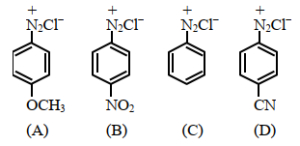
A
$A > C > D > B$
B
$C > D > B > A$
C
$A > B > C > D$
D
$C > A > D > B$
Solution
(A) The stability of benzene diazonium salts is influenced by the nature of the substituent attached to the benzene ring.
Electron-donating groups $(EDG)$ increase the stability of the diazonium cation by dispersing the positive charge,while electron-withdrawing groups $(EWG)$ decrease the stability by intensifying the positive charge.
In the given compounds:
$A$: $-OCH_3$ is a strong $EDG$ ($+M$ effect).
$C$: Benzene diazonium chloride (no substituent).
$D$: $-CN$ is an $EWG$ ($-M$ effect).
$B$: $-NO_2$ is a very strong $EWG$ ($-M$ effect).
Therefore,the stability order is $A > C > D > B$.
Electron-donating groups $(EDG)$ increase the stability of the diazonium cation by dispersing the positive charge,while electron-withdrawing groups $(EWG)$ decrease the stability by intensifying the positive charge.
In the given compounds:
$A$: $-OCH_3$ is a strong $EDG$ ($+M$ effect).
$C$: Benzene diazonium chloride (no substituent).
$D$: $-CN$ is an $EWG$ ($-M$ effect).
$B$: $-NO_2$ is a very strong $EWG$ ($-M$ effect).
Therefore,the stability order is $A > C > D > B$.
0 likesView Solution
126
ChemistryDifficultMCQJEE Main · 2026
$A$ solution is prepared by dissolving $0.3 \ g$ of a non-volatile non-electrolyte solute '$A$' of molar mass $60 \ g \ mol^{-1}$ and $0.9 \ g$ of a non-volatile non-electrolyte solute '$B$' of molar mass $180 \ g \ mol^{-1}$ in $100 \ mL$ $H_2O$ at $27^{\circ}C$. Osmotic pressure of the solution will be
[Given: $R=0.082 \ L \ atm \ K^{-1} \ mol^{-1}$] (in $atm$)
[Given: $R=0.082 \ L \ atm \ K^{-1} \ mol^{-1}$] (in $atm$)
A
$1.23$
B
$2.46$
C
$0.82$
D
$1.47$
Solution
(B) Moles of solute '$A$' = $\frac{0.3 \ g}{60 \ g \ mol^{-1}} = 0.005 \ mol$.
Moles of solute '$B$' = $\frac{0.9 \ g}{180 \ g \ mol^{-1}} = 0.005 \ mol$.
Total moles of solute = $0.005 + 0.005 = 0.01 \ mol$.
Volume of solution = $100 \ mL = 0.1 \ L$.
Molarity $(C)$ = $\frac{\text{Total moles}}{\text{Volume in } L} = \frac{0.01 \ mol}{0.1 \ L} = 0.1 \ M$.
Temperature $(T)$ = $27 + 273 = 300 \ K$.
Using the formula for osmotic pressure: $\pi = CRT$.
$\pi = 0.1 \ mol \ L^{-1} \times 0.082 \ L \ atm \ K^{-1} \ mol^{-1} \times 300 \ K$.
$\pi = 2.46 \ atm$.
Moles of solute '$B$' = $\frac{0.9 \ g}{180 \ g \ mol^{-1}} = 0.005 \ mol$.
Total moles of solute = $0.005 + 0.005 = 0.01 \ mol$.
Volume of solution = $100 \ mL = 0.1 \ L$.
Molarity $(C)$ = $\frac{\text{Total moles}}{\text{Volume in } L} = \frac{0.01 \ mol}{0.1 \ L} = 0.1 \ M$.
Temperature $(T)$ = $27 + 273 = 300 \ K$.
Using the formula for osmotic pressure: $\pi = CRT$.
$\pi = 0.1 \ mol \ L^{-1} \times 0.082 \ L \ atm \ K^{-1} \ mol^{-1} \times 300 \ K$.
$\pi = 2.46 \ atm$.
0 likesView Solution
127
ChemistryDifficultMCQJEE Main · 2026
Given below are two statements:
Statement-$I$: Hybridisation,shape,and spin-only magnetic moment of $K_{3}[Co(CO_{3})_{3}]$ are $sp^{3}d^{2}$,octahedral,and $4.9 \ BM$ respectively.
Statement-$II$: Geometry,hybridisation,and spin-only magnetic moment values $(BM)$ of the ions $[Ni(CN)_{4}]^{2-}$,$[MnBr_{4}]^{2-}$,and $[CoF_{6}]^{3-}$ respectively are square planar,tetrahedral,octahedral; $dsp^{2}$,$sp^{3}$,$sp^{3}d^{2}$ and $0, 5.9, 4.9$.
Statement-$I$: Hybridisation,shape,and spin-only magnetic moment of $K_{3}[Co(CO_{3})_{3}]$ are $sp^{3}d^{2}$,octahedral,and $4.9 \ BM$ respectively.
Statement-$II$: Geometry,hybridisation,and spin-only magnetic moment values $(BM)$ of the ions $[Ni(CN)_{4}]^{2-}$,$[MnBr_{4}]^{2-}$,and $[CoF_{6}]^{3-}$ respectively are square planar,tetrahedral,octahedral; $dsp^{2}$,$sp^{3}$,$sp^{3}d^{2}$ and $0, 5.9, 4.9$.
A
Both statement-$I$ and statement-$II$ are false
B
Statement-$I$ is false but statement-$II$ is true
C
Both statement-$I$ and statement-$II$ are true
D
Statement-$I$ is true but statement-$II$ is false
Solution
(C) In $K_{3}[Co(CO_{3})_{3}]$,$Co$ is in $+3$ oxidation state ($d^{6}$ configuration). $CO_{3}^{2-}$ is a weak field ligand,so it forms an outer orbital complex: $sp^{3}d^{2}$ hybridisation,octahedral geometry,and $4$ unpaired electrons. Magnetic moment $\mu = \sqrt{n(n+2)} = \sqrt{4(6)} = \sqrt{24} \approx 4.9 \ BM$. Statement-$I$ is true.
For $[Ni(CN)_{4}]^{2-}$,$Ni^{2+}$ is $d^{8}$. $CN^{-}$ is a strong field ligand,so $dsp^{2}$ hybridisation,square planar,$0$ unpaired electrons,$\mu = 0 \ BM$.
For $[MnBr_{4}]^{2-}$,$Mn^{2+}$ is $d^{5}$. $Br^{-}$ is a weak field ligand,so $sp^{3}$ hybridisation,tetrahedral,$5$ unpaired electrons,$\mu = \sqrt{5(7)} = \sqrt{35} \approx 5.9 \ BM$.
For $[CoF_{6}]^{3-}$,$Co^{3+}$ is $d^{6}$. $F^{-}$ is a weak field ligand,so $sp^{3}d^{2}$ hybridisation,octahedral,$4$ unpaired electrons,$\mu = 4.9 \ BM$.
All values in Statement-$II$ are correct. Thus,both statements are true.
For $[Ni(CN)_{4}]^{2-}$,$Ni^{2+}$ is $d^{8}$. $CN^{-}$ is a strong field ligand,so $dsp^{2}$ hybridisation,square planar,$0$ unpaired electrons,$\mu = 0 \ BM$.
For $[MnBr_{4}]^{2-}$,$Mn^{2+}$ is $d^{5}$. $Br^{-}$ is a weak field ligand,so $sp^{3}$ hybridisation,tetrahedral,$5$ unpaired electrons,$\mu = \sqrt{5(7)} = \sqrt{35} \approx 5.9 \ BM$.
For $[CoF_{6}]^{3-}$,$Co^{3+}$ is $d^{6}$. $F^{-}$ is a weak field ligand,so $sp^{3}d^{2}$ hybridisation,octahedral,$4$ unpaired electrons,$\mu = 4.9 \ BM$.
All values in Statement-$II$ are correct. Thus,both statements are true.
0 likesView Solution
128
ChemistryDifficultMCQJEE Main · 2026
$MX$ is a sparingly soluble salt that follows the given solubility equilibrium at $298 \ K$: $MX_{(s)} \rightleftharpoons M^{+}_{(aq)} + X^{-}_{(aq)}$; $K_{sp} = 10^{-10}$. If the standard reduction potential for $M^{+}_{(aq)} + e^- \rightarrow M_{(s)}$ is $(E^{\ominus}_{M^{+}/M}) = 0.79 \ V$,then the value of the standard reduction potential for the metal/metal insoluble salt electrode $E^{\ominus}_{X^{-}/MX_{(s)}/M}$ is . . . . . . $mV$. (nearest integer) [Given: $\frac{2.303 RT}{F} = 0.059 \ V$]
A
$200$
B
$790$
C
$590$
D
$1380$
Solution
(A) The electrode reaction for the metal/metal insoluble salt electrode is: $MX_{(s)} + e^- \rightarrow M_{(s)} + X^-_{(aq)}$.
This can be expressed as the sum of two half-reactions:
$M^+_{(aq)} + e^- \rightarrow M_{(s)}$ $(E^{\circ} = 0.79 \ V)$
$MX_{(s)} \rightleftharpoons M^+_{(aq)} + X^-_{(aq)}$ $(K_{sp} = 10^{-10})$
Using the relation $E^{\circ}_{cell} = E^{\circ}_{M^+/M} + \frac{0.059}{n} \log K_{sp}$:
$E^{\circ}_{X^-/MX_{(s)}/M} = 0.79 + 0.059 \log(10^{-10})$
$E^{\circ} = 0.79 + 0.059 \times (-10)$
$E^{\circ} = 0.79 - 0.59 = 0.20 \ V$
Converting to $mV$: $0.20 \ V = 200 \ mV$.
This can be expressed as the sum of two half-reactions:
$M^+_{(aq)} + e^- \rightarrow M_{(s)}$ $(E^{\circ} = 0.79 \ V)$
$MX_{(s)} \rightleftharpoons M^+_{(aq)} + X^-_{(aq)}$ $(K_{sp} = 10^{-10})$
Using the relation $E^{\circ}_{cell} = E^{\circ}_{M^+/M} + \frac{0.059}{n} \log K_{sp}$:
$E^{\circ}_{X^-/MX_{(s)}/M} = 0.79 + 0.059 \log(10^{-10})$
$E^{\circ} = 0.79 + 0.059 \times (-10)$
$E^{\circ} = 0.79 - 0.59 = 0.20 \ V$
Converting to $mV$: $0.20 \ V = 200 \ mV$.
0 likesView Solution
129
ChemistryDifficultMCQJEE Main · 2026
Identify the metal ions among $Co^{2+}, Ni^{2+}, Fe^{2+}, V^{3+}$ and $Ti^{2+}$ having a spin-only magnetic moment value more than $3.0 \ BM$. The sum of unpaired electrons present in the high spin octahedral complexes formed by those metal ions is . . . . . . .
A
$7$
B
$5$
C
$9$
D
$4$
Solution
(A) The spin-only magnetic moment is given by $\mu = \sqrt{n(n+2)} \ BM$,where $n$ is the number of unpaired electrons.
For $\mu > 3.0 \ BM$,we need $\sqrt{n(n+2)} > 3.0$,which implies $n(n+2) > 9$. This holds for $n \geq 3$.
Electronic configurations:
$V^{3+} (3d^2): n = 2, \mu = \sqrt{2(4)} = 2.83 \ BM$
$Ti^{2+} (3d^2): n = 2, \mu = \sqrt{2(4)} = 2.83 \ BM$
$Ni^{2+} (3d^8): n = 2, \mu = \sqrt{2(4)} = 2.83 \ BM$
$Fe^{2+} (3d^6): n = 4, \mu = \sqrt{4(6)} = 4.90 \ BM$
$Co^{2+} (3d^7): n = 3, \mu = \sqrt{3(5)} = 3.87 \ BM$
Thus,$Fe^{2+}$ and $Co^{2+}$ have $\mu > 3.0 \ BM$.
In high spin octahedral complexes:
$Fe^{2+} (3d^6)$ has $4$ unpaired electrons.
$Co^{2+} (3d^7)$ has $3$ unpaired electrons.
Sum of unpaired electrons = $4 + 3 = 7$.
For $\mu > 3.0 \ BM$,we need $\sqrt{n(n+2)} > 3.0$,which implies $n(n+2) > 9$. This holds for $n \geq 3$.
Electronic configurations:
$V^{3+} (3d^2): n = 2, \mu = \sqrt{2(4)} = 2.83 \ BM$
$Ti^{2+} (3d^2): n = 2, \mu = \sqrt{2(4)} = 2.83 \ BM$
$Ni^{2+} (3d^8): n = 2, \mu = \sqrt{2(4)} = 2.83 \ BM$
$Fe^{2+} (3d^6): n = 4, \mu = \sqrt{4(6)} = 4.90 \ BM$
$Co^{2+} (3d^7): n = 3, \mu = \sqrt{3(5)} = 3.87 \ BM$
Thus,$Fe^{2+}$ and $Co^{2+}$ have $\mu > 3.0 \ BM$.
In high spin octahedral complexes:
$Fe^{2+} (3d^6)$ has $4$ unpaired electrons.
$Co^{2+} (3d^7)$ has $3$ unpaired electrons.
Sum of unpaired electrons = $4 + 3 = 7$.
0 likesView Solution
130
ChemistryDifficultMCQJEE Main · 2026
$A$ substance '$X$' $(1.5 \ g)$ dissolved in $150 \ g$ of a solvent '$Y$' (molar mass $= 300 \ g \ mol^{-1}$) led to an elevation of the boiling point by $0.5 \ K$. The relative lowering in the vapour pressure of the solvent '$Y$' is . . . . . . $\times 10^{-2}$. (Nearest integer)
[Given : $K_{b}$ of the solvent $= 5.0 \ K \ kg \ mol^{-1}$]
Assume the solution to be dilute and no association or dissociation of $X$ takes place in solution.
[Given : $K_{b}$ of the solvent $= 5.0 \ K \ kg \ mol^{-1}$]
Assume the solution to be dilute and no association or dissociation of $X$ takes place in solution.
A
$3$
B
$1$
C
$5$
D
$2$
Solution
(A) The elevation in boiling point is given by $\Delta T_{b} = K_{b} \times m$,where $m$ is the molality.
$0.5 = 5.0 \times m \implies m = 0.1 \ mol \ kg^{-1}$.
Molality $m = \frac{n_{X}}{W_{Y} (\text{in } kg)} = \frac{n_{X}}{0.150 \ kg} = 0.1 \implies n_{X} = 0.015 \ mol$.
The relative lowering in vapour pressure is given by $\frac{P^{o} - P_{s}}{P^{o}} = X_{X} = \frac{n_{X}}{n_{X} + n_{Y}}$.
$n_{Y} = \frac{150 \ g}{300 \ g \ mol^{-1}} = 0.5 \ mol$.
Since the solution is dilute,$n_{X} + n_{Y} \approx n_{Y} = 0.5 \ mol$.
Relative lowering $= \frac{0.015}{0.5} = 0.03 = 3 \times 10^{-2}$.
Thus,the value is $3$.
$0.5 = 5.0 \times m \implies m = 0.1 \ mol \ kg^{-1}$.
Molality $m = \frac{n_{X}}{W_{Y} (\text{in } kg)} = \frac{n_{X}}{0.150 \ kg} = 0.1 \implies n_{X} = 0.015 \ mol$.
The relative lowering in vapour pressure is given by $\frac{P^{o} - P_{s}}{P^{o}} = X_{X} = \frac{n_{X}}{n_{X} + n_{Y}}$.
$n_{Y} = \frac{150 \ g}{300 \ g \ mol^{-1}} = 0.5 \ mol$.
Since the solution is dilute,$n_{X} + n_{Y} \approx n_{Y} = 0.5 \ mol$.
Relative lowering $= \frac{0.015}{0.5} = 0.03 = 3 \times 10^{-2}$.
Thus,the value is $3$.
0 likesView Solution
131
ChemistryDifficultMCQJEE Main · 2026
The osmotic pressure of a living cell is $12 \ atm$ at $300 \ K$. The strength of sodium chloride solution that is isotonic with the living cell at this temperature is $...... \ g \ L^{-1}$. (Nearest integer)
Given : $R = 0.08 \ L \ atm \ K^{-1} \ mol^{-1}$
Assume complete dissociation of $NaCl$
(Given : Molar mass of $Na$ and $Cl$ are $23$ and $35.5 \ g \ mol^{-1}$ respectively.)
Given : $R = 0.08 \ L \ atm \ K^{-1} \ mol^{-1}$
Assume complete dissociation of $NaCl$
(Given : Molar mass of $Na$ and $Cl$ are $23$ and $35.5 \ g \ mol^{-1}$ respectively.)
A
$15$
B
$30$
C
$7.5$
D
$58.5$
Solution
(A) For an isotonic solution,the osmotic pressure $(\pi)$ of the $NaCl$ solution must be equal to the osmotic pressure of the living cell.
$\pi = iCRT$
Given $\pi = 12 \ atm$,$T = 300 \ K$,$R = 0.08 \ L \ atm \ K^{-1} \ mol^{-1}$,and $i = 2$ (for $NaCl \rightarrow Na^{+} + Cl^{-}$).
$12 = 2 \times C \times 0.08 \times 300$
$12 = 48 \times C$
$C = \frac{12}{48} = 0.25 \ mol \ L^{-1}$
The molar mass of $NaCl = 23 + 35.5 = 58.5 \ g \ mol^{-1}$.
Strength of $NaCl$ solution = $C \times \text{Molar mass}$
$= 0.25 \times 58.5 = 14.625 \ g \ L^{-1}$.
Rounding to the nearest integer,we get $15 \ g \ L^{-1}$.
$\pi = iCRT$
Given $\pi = 12 \ atm$,$T = 300 \ K$,$R = 0.08 \ L \ atm \ K^{-1} \ mol^{-1}$,and $i = 2$ (for $NaCl \rightarrow Na^{+} + Cl^{-}$).
$12 = 2 \times C \times 0.08 \times 300$
$12 = 48 \times C$
$C = \frac{12}{48} = 0.25 \ mol \ L^{-1}$
The molar mass of $NaCl = 23 + 35.5 = 58.5 \ g \ mol^{-1}$.
Strength of $NaCl$ solution = $C \times \text{Molar mass}$
$= 0.25 \times 58.5 = 14.625 \ g \ L^{-1}$.
Rounding to the nearest integer,we get $15 \ g \ L^{-1}$.
0 likesView Solution
132
ChemistryDifficultMCQJEE Main · 2026
On heating a mixture of common salt and $K_{2}Cr_{2}O_{7}$ with concentrated $H_{2}SO_{4}$,a gas is evolved. The formula of the gas evolved and the oxidation state of the central metal atom in the gas,respectively,are:
A
$CrO_{2}Cl_{2}$ and $+5$
B
$CrO_{2}Cl_{2}$ and $+6$
C
$Cr_{2}O_{2}Cl_{2}$ and $+6$
D
$Cr_{2}O_{2}Cl_{2}$ and $+3$
Solution
(B) The reaction between common salt $(NaCl)$,potassium dichromate $(K_{2}Cr_{2}O_{7})$,and concentrated sulfuric acid $(H_{2}SO_{4})$ is as follows:
$4 \ NaCl + K_{2}Cr_{2}O_{7} + 6 \ H_{2}SO_{4}$ $\longrightarrow 2 \ KHSO_{4} + 2 \ CrO_{2}Cl_{2} + 4 \ NaHSO_{4} + 3 \ H_{2}O$
The gas evolved is chromyl chloride $(CrO_{2}Cl_{2})$.
In $CrO_{2}Cl_{2}$,let the oxidation state of $Cr$ be $x$.
$x + 2(-2) + 2(-1) = 0$
$x - 4 - 2 = 0$
$x = +6$
Thus,the formula is $CrO_{2}Cl_{2}$ and the oxidation state is $+6$.
$4 \ NaCl + K_{2}Cr_{2}O_{7} + 6 \ H_{2}SO_{4}$ $\longrightarrow 2 \ KHSO_{4} + 2 \ CrO_{2}Cl_{2} + 4 \ NaHSO_{4} + 3 \ H_{2}O$
The gas evolved is chromyl chloride $(CrO_{2}Cl_{2})$.
In $CrO_{2}Cl_{2}$,let the oxidation state of $Cr$ be $x$.
$x + 2(-2) + 2(-1) = 0$
$x - 4 - 2 = 0$
$x = +6$
Thus,the formula is $CrO_{2}Cl_{2}$ and the oxidation state is $+6$.
0 likesView Solution
133
ChemistryDifficultMCQJEE Main · 2026
For a closed circuit Daniell cell,which of the following plots is the accurate one at a given temperature?
A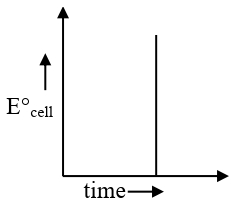
B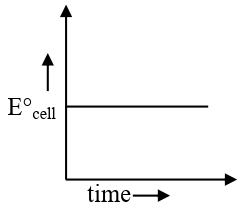
C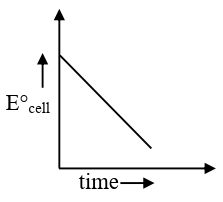
D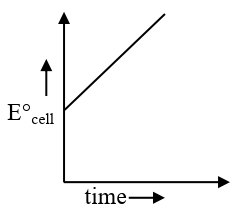
Solution
(B) The standard cell potential,denoted as $E_{cell}^0$,is a constant value for a given electrochemical cell at a specific temperature. It depends only on the standard reduction potentials of the half-cells involved and is independent of the concentrations of the reactants or the time the cell has been operating. Therefore,a plot of $E_{cell}^0$ versus time will be a horizontal line,indicating that the value remains constant over time.
0 likesView Solution
134
ChemistryDifficultMCQJEE Main · 2026
Given below are some statements about $Mn$ and $Mn_2O_7$. Identify the correct statements:
$A$. $Mn$ forms the oxide $Mn_2O_7$ in which $Mn$ is in its highest oxidation state.
$B$. Oxygen stabilizes the $Mn$ in higher oxidation states by forming multiple bonds with $Mn$.
$C$. $Mn_2O_7$ is an ionic oxide.
$D$. The structure of $Mn_2O_7$ consists of one bridged oxygen.
Choose the correct answer from the options given below:
$A$. $Mn$ forms the oxide $Mn_2O_7$ in which $Mn$ is in its highest oxidation state.
$B$. Oxygen stabilizes the $Mn$ in higher oxidation states by forming multiple bonds with $Mn$.
$C$. $Mn_2O_7$ is an ionic oxide.
$D$. The structure of $Mn_2O_7$ consists of one bridged oxygen.
Choose the correct answer from the options given below:
A
$A, B, C$ and $D$
B
$A, B$ and $D$ Only
C
$A, C$ and $D$ Only
D
$A, B$ and $C$ Only
Solution
(B) . $Mn$ in $Mn_2O_7$ has an oxidation state of $+7$,which is its highest oxidation state. This statement is correct.
$B$. Oxygen is a small,highly electronegative atom that can form multiple bonds ($p\pi-d\pi$ bonding) with transition metals,stabilizing them in higher oxidation states. This statement is correct.
$C$. $Mn_2O_7$ is a covalent oxide,not an ionic one. This statement is incorrect.
$D$. The structure of $Mn_2O_7$ consists of two $MnO_3$ tetrahedra sharing a common oxygen atom (bridged oxygen). This statement is correct.
Therefore,statements $A, B$ and $D$ are correct.
$B$. Oxygen is a small,highly electronegative atom that can form multiple bonds ($p\pi-d\pi$ bonding) with transition metals,stabilizing them in higher oxidation states. This statement is correct.
$C$. $Mn_2O_7$ is a covalent oxide,not an ionic one. This statement is incorrect.
$D$. The structure of $Mn_2O_7$ consists of two $MnO_3$ tetrahedra sharing a common oxygen atom (bridged oxygen). This statement is correct.
Therefore,statements $A, B$ and $D$ are correct.
0 likesView Solution
135
ChemistryDifficultMCQJEE Main · 2026
Given below are four compounds:
$(a)$ $n$-propyl chloride,
$(b)$ $iso$-propyl chloride,
$(c)$ $sec$-butyl chloride,
$(d)$ $neo$-pentyl chloride.
Percentage of carbon in the one which exhibits optical isomerism is:
$(a)$ $n$-propyl chloride,
$(b)$ $iso$-propyl chloride,
$(c)$ $sec$-butyl chloride,
$(d)$ $neo$-pentyl chloride.
Percentage of carbon in the one which exhibits optical isomerism is:
A
$52$
B
$56$
C
$46$
D
$40$
Solution
(A) $sec$-butyl chloride ($2$-chlorobutane) is the only compound among the given options that contains a chiral carbon atom and thus exhibits optical isomerism.
The molecular formula of $sec$-butyl chloride is $C_4H_9Cl$.
Molar mass of $C_4H_9Cl = (4 \times 12) + (9 \times 1) + 35.5 = 48 + 9 + 35.5 = 92.5 \ g/mol$.
Percentage of carbon $= \frac{\text{Mass of carbon}}{\text{Molar mass}} \times 100 = \frac{48}{92.5} \times 100 \approx 51.89 \%$.
Rounding to the nearest integer,we get $52 \%$.
The molecular formula of $sec$-butyl chloride is $C_4H_9Cl$.
Molar mass of $C_4H_9Cl = (4 \times 12) + (9 \times 1) + 35.5 = 48 + 9 + 35.5 = 92.5 \ g/mol$.
Percentage of carbon $= \frac{\text{Mass of carbon}}{\text{Molar mass}} \times 100 = \frac{48}{92.5} \times 100 \approx 51.89 \%$.
Rounding to the nearest integer,we get $52 \%$.
0 likesView Solution
136
ChemistryDifficultMCQJEE Main · 2026
Given below are two statements:
Statement $I$: Crystal Field Stabilization Energy $(CFSE)$ of $[Cr(H_2O)_6]^{2+}$ is greater than that of $[Mn(H_2O)_6]^{2+}$.
Statement $II$: Potassium ferricyanide has a greater spin-only magnetic moment than sodium ferrocyanide.
In the light of the above statements,choose the correct answer from the options given below:
Statement $I$: Crystal Field Stabilization Energy $(CFSE)$ of $[Cr(H_2O)_6]^{2+}$ is greater than that of $[Mn(H_2O)_6]^{2+}$.
Statement $II$: Potassium ferricyanide has a greater spin-only magnetic moment than sodium ferrocyanide.
In the light of the above statements,choose the correct answer from the options given below:
A
Both Statement $I$ and Statement $II$ are true
B
Both Statement $I$ and Statement $II$ are false
C
Statement $I$ is true but Statement $II$ is false
D
Statement $I$ is false but Statement $II$ is true
Solution
(A) For $[Mn(H_2O)_6]^{2+}$,the configuration is $d^5$ with a weak field ligand $(H_2O)$,resulting in $t_{2g}^3 e_g^2$. The $CFSE$ is $(3 \times -0.4 \Delta_o) + (2 \times 0.6 \Delta_o) = 0 \Delta_o$.
For $[Cr(H_2O)_6]^{2+}$,the configuration is $d^4$ with a weak field ligand $(H_2O)$,resulting in $t_{2g}^3 e_g^1$. The $CFSE$ is $(3 \times -0.4 \Delta_o) + (1 \times 0.6 \Delta_o) = -0.6 \Delta_o$. Since $|-0.6| > 0$,Statement $I$ is true.
For potassium ferricyanide,$K_3[Fe(CN)_6]$,the iron is in $+3$ oxidation state $(d^5)$. $CN^-$ is a strong field ligand,leading to $t_{2g}^5 e_g^0$ with $1$ unpaired electron. $\mu = \sqrt{1(1+2)} = \sqrt{3} \approx 1.73 \ B.M.$
For sodium ferrocyanide,$Na_4[Fe(CN)_6]$,the iron is in $+2$ oxidation state $(d^6)$. $CN^-$ is a strong field ligand,leading to $t_{2g}^6 e_g^0$ with $0$ unpaired electrons. $\mu = 0 \ B.M.$
Since $\sqrt{3} > 0$,Statement $II$ is true.
For $[Cr(H_2O)_6]^{2+}$,the configuration is $d^4$ with a weak field ligand $(H_2O)$,resulting in $t_{2g}^3 e_g^1$. The $CFSE$ is $(3 \times -0.4 \Delta_o) + (1 \times 0.6 \Delta_o) = -0.6 \Delta_o$. Since $|-0.6| > 0$,Statement $I$ is true.
For potassium ferricyanide,$K_3[Fe(CN)_6]$,the iron is in $+3$ oxidation state $(d^5)$. $CN^-$ is a strong field ligand,leading to $t_{2g}^5 e_g^0$ with $1$ unpaired electron. $\mu = \sqrt{1(1+2)} = \sqrt{3} \approx 1.73 \ B.M.$
For sodium ferrocyanide,$Na_4[Fe(CN)_6]$,the iron is in $+2$ oxidation state $(d^6)$. $CN^-$ is a strong field ligand,leading to $t_{2g}^6 e_g^0$ with $0$ unpaired electrons. $\mu = 0 \ B.M.$
Since $\sqrt{3} > 0$,Statement $II$ is true.
0 likesView Solution
137
ChemistryDifficultMCQJEE Main · 2026
The correct order of the rate of the reaction for the following reaction with respect to nucleophiles is: $CH_{3}Br + Nu^{\ominus} \longrightarrow CH_{3}Nu + Br^{\ominus}$
A
$PhO^{-} > {}^{-}OH > CH_{3}COO^{-} > ClO_{4}^{-}$
B
$ClO_{4}^{-} > CH_{3}COO^{-} > {}^{-}OH > PhO^{-}$
C
$CH_{3}COO^{-} > PhO^{-} > {}^{-}OH > ClO_{4}^{-}$
D
${}^{-}OH > PhO^{-} > CH_{3}COO^{-} > ClO_{4}^{-}$
Solution
(D) The rate of an $S_{N}2$ reaction depends on the nucleophilicity of the nucleophile. Nucleophilicity is generally inversely proportional to the stability of the anion (conjugate base).
The stability order of the given anions is: $ClO_{4}^{-} > CH_{3}COO^{-} > PhO^{-} > {}^{-}OH$.
Since nucleophilicity is the reverse of the stability of the anion,the order of nucleophilicity (and thus the rate of reaction) is: ${}^{-}OH > PhO^{-} > CH_{3}COO^{-} > ClO_{4}^{-}$.
The stability order of the given anions is: $ClO_{4}^{-} > CH_{3}COO^{-} > PhO^{-} > {}^{-}OH$.
Since nucleophilicity is the reverse of the stability of the anion,the order of nucleophilicity (and thus the rate of reaction) is: ${}^{-}OH > PhO^{-} > CH_{3}COO^{-} > ClO_{4}^{-}$.
0 likesView Solution
138
ChemistryDifficultMCQJEE Main · 2026
The correct statements are:
$A$. Activation energy for enzyme catalysed hydrolysis of sucrose is lower than that of acid catalysed hydrolysis.
$B$. During denaturation,secondary and tertiary structures of a protein are destroyed but primary structure remains intact.
$C$. Nucleotides are joined together by phosphodiester linkage between $C_{3}$ and $C_{5}$ carbons of the pentose sugar.
$D$. Quaternary structure of proteins represents the spatial arrangement of two or more polypeptide chains.
Choose the correct answer from the options given below:
$A$. Activation energy for enzyme catalysed hydrolysis of sucrose is lower than that of acid catalysed hydrolysis.
$B$. During denaturation,secondary and tertiary structures of a protein are destroyed but primary structure remains intact.
$C$. Nucleotides are joined together by phosphodiester linkage between $C_{3}$ and $C_{5}$ carbons of the pentose sugar.
$D$. Quaternary structure of proteins represents the spatial arrangement of two or more polypeptide chains.
Choose the correct answer from the options given below:
A
$A, C$ and $D$ Only
B
$A, B$ and $D$ Only
C
$A$ and $B$ Only
D
$B$ and $C$ Only
Solution
(C) . Enzymes lower the activation energy of a reaction,making the hydrolysis of sucrose faster compared to acid catalysis. This statement is correct.
$B$. Denaturation disrupts the hydrogen bonds and other interactions that maintain the secondary and tertiary structures of a protein,but the primary structure (amino acid sequence) remains intact. This statement is correct.
$C$. Nucleotides are joined by phosphodiester linkages between the $C_{3}$ and $C_{5}$ carbons of the pentose sugar,not glycosidic linkages. This statement is incorrect.
$D$. Quaternary structure refers to the arrangement of multiple polypeptide subunits in a protein complex,not just the folding of a single chain. This statement is incorrect.
Therefore,only statements $A$ and $B$ are correct.
$B$. Denaturation disrupts the hydrogen bonds and other interactions that maintain the secondary and tertiary structures of a protein,but the primary structure (amino acid sequence) remains intact. This statement is correct.
$C$. Nucleotides are joined by phosphodiester linkages between the $C_{3}$ and $C_{5}$ carbons of the pentose sugar,not glycosidic linkages. This statement is incorrect.
$D$. Quaternary structure refers to the arrangement of multiple polypeptide subunits in a protein complex,not just the folding of a single chain. This statement is incorrect.
Therefore,only statements $A$ and $B$ are correct.
0 likesView Solution
139
ChemistryDifficultMCQJEE Main · 2026
The correct order of reactivity of the following benzyl halides towards reaction with $KCN$ is:
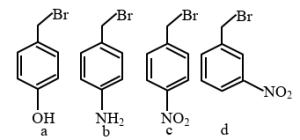
A
$a > b > c > d$
B
$b > a > d > c$
C
$b > a > c > d$
D
$a > b > d > c$
Solution
(B) The reaction of benzyl halides with $KCN$ typically proceeds via an $S_{N}1$ mechanism in polar protic solvents or $S_{N}2$ depending on conditions. However,for benzyl halides,the rate is governed by the stability of the intermediate carbocation in $S_{N}1$ or steric/electronic factors in $S_{N}2$. In both cases,electron-donating groups $(EDG)$ increase reactivity,while electron-withdrawing groups $(EWG)$ decrease it.
$a$ has $-OH$ (strong $EDG$ via resonance),$b$ has $-NH_2$ (strong $EDG$ via resonance),$c$ has $-NO_2$ (strong $EWG$ at para position),and $d$ has $-NO_2$ (strong $EWG$ at meta position).
Comparing $a$ and $b$: $-NH_2$ is a stronger $EDG$ than $-OH$ due to lower electronegativity of $N$ compared to $O$,making $b$ more reactive than $a$.
Comparing $c$ and $d$: $-NO_2$ at the para position $(c)$ exerts a stronger destabilizing effect on the carbocation than at the meta position $(d)$ due to direct resonance destabilization.
Thus,the order is $b > a > d > c$.
$a$ has $-OH$ (strong $EDG$ via resonance),$b$ has $-NH_2$ (strong $EDG$ via resonance),$c$ has $-NO_2$ (strong $EWG$ at para position),and $d$ has $-NO_2$ (strong $EWG$ at meta position).
Comparing $a$ and $b$: $-NH_2$ is a stronger $EDG$ than $-OH$ due to lower electronegativity of $N$ compared to $O$,making $b$ more reactive than $a$.
Comparing $c$ and $d$: $-NO_2$ at the para position $(c)$ exerts a stronger destabilizing effect on the carbocation than at the meta position $(d)$ due to direct resonance destabilization.
Thus,the order is $b > a > d > c$.
0 likesView Solution
140
ChemistryDifficultMCQJEE Main · 2026
Decomposition of $A$ is a first order reaction at $T \ K$ and is given by $A_{(g)} \rightarrow B_{(g)} + C_{(g)}$. In a closed $1 \ L$ vessel,$1 \ bar$ of $A_{(g)}$ is allowed to decompose at $T \ K$. After $100 \ minutes$,the total pressure was $1.5 \ bar$. What is the rate constant (in $min^{-1}$) of the reaction? (Given: $\log 2 = 0.3$)
A
$6.9 \times 10^{-1}$
B
$6.9 \times 10^{-3}$
C
$6.9 \times 10^{-2}$
D
$6.9 \times 10^{-4}$
Solution
(B) The reaction is $A_{(g)} \rightarrow B_{(g)} + C_{(g)}$.
Initially $(t=0)$: $P_A = 1 \ bar$,$P_B = 0$,$P_C = 0$. Total pressure $P_0 = 1 \ bar$.
At time $t = 100 \ min$: $P_A = 1 - x$,$P_B = x$,$P_C = x$.
Total pressure $P_t = (1 - x) + x + x = 1 + x$.
Given $P_t = 1.5 \ bar$,so $1 + x = 1.5 \implies x = 0.5 \ bar$.
Partial pressure of $A$ at $t = 100 \ min$ is $P_A = 1 - 0.5 = 0.5 \ bar$.
For a first-order reaction,$k = \frac{2.303}{t} \log \frac{P_0}{P_A}$.
$k = \frac{2.303}{100} \log \frac{1}{0.5} = \frac{2.303}{100} \log 2$.
Using $\log 2 = 0.3$,$k = \frac{2.303 \times 0.3}{100} = \frac{0.6909}{100} \approx 6.9 \times 10^{-3} \ min^{-1}$.
Initially $(t=0)$: $P_A = 1 \ bar$,$P_B = 0$,$P_C = 0$. Total pressure $P_0 = 1 \ bar$.
At time $t = 100 \ min$: $P_A = 1 - x$,$P_B = x$,$P_C = x$.
Total pressure $P_t = (1 - x) + x + x = 1 + x$.
Given $P_t = 1.5 \ bar$,so $1 + x = 1.5 \implies x = 0.5 \ bar$.
Partial pressure of $A$ at $t = 100 \ min$ is $P_A = 1 - 0.5 = 0.5 \ bar$.
For a first-order reaction,$k = \frac{2.303}{t} \log \frac{P_0}{P_A}$.
$k = \frac{2.303}{100} \log \frac{1}{0.5} = \frac{2.303}{100} \log 2$.
Using $\log 2 = 0.3$,$k = \frac{2.303 \times 0.3}{100} = \frac{0.6909}{100} \approx 6.9 \times 10^{-3} \ min^{-1}$.
0 likesView Solution
141
ChemistryDifficultMCQJEE Main · 2026
Match List-$I$ with List-$II$.
Choose the correct answer from the options given below:
| List-$I$ (Reagents) | List-$II$ (Reaction Name) |
|---|---|
| $A$. $H_2, Pd-BaSO_4$ | $I$. Etard Reaction |
| $B$. $SnCl_2, HCl$ | $II$. Rosenmund Reduction |
| $C$. $CrO_2Cl_2, CS_2$ | $III$. Gatterman-Koch Reaction |
| $D$. $CO, HCl, \text{Anhyd. } AlCl_3$ | $IV$. Stephen Reaction |
Choose the correct answer from the options given below:
A
$A-II, B-III, C-IV, D-I$
B
$A-IV, B-III, C-I, D-II$
C
$A-IV, B-I, C-II, D-III$
D
$A-II, B-IV, C-I, D-III$
Solution
(D) The correct matches are as follows:
$A$. $H_2, Pd-BaSO_4$ is used in the Rosenmund reduction to convert acid chlorides to aldehydes $(A-II)$.
$B$. $SnCl_2, HCl$ is used in the Stephen reaction to reduce nitriles to imines,which are then hydrolyzed to aldehydes $(B-IV)$.
$C$. $CrO_2Cl_2, CS_2$ is used in the Etard reaction to oxidize toluene to benzaldehyde $(C-I)$.
$D$. $CO, HCl, \text{Anhyd. } AlCl_3$ is used in the Gatterman-Koch reaction to form benzaldehyde from benzene $(D-III)$.
Therefore,the correct sequence is $A-II, B-IV, C-I, D-III$.
$A$. $H_2, Pd-BaSO_4$ is used in the Rosenmund reduction to convert acid chlorides to aldehydes $(A-II)$.
$B$. $SnCl_2, HCl$ is used in the Stephen reaction to reduce nitriles to imines,which are then hydrolyzed to aldehydes $(B-IV)$.
$C$. $CrO_2Cl_2, CS_2$ is used in the Etard reaction to oxidize toluene to benzaldehyde $(C-I)$.
$D$. $CO, HCl, \text{Anhyd. } AlCl_3$ is used in the Gatterman-Koch reaction to form benzaldehyde from benzene $(D-III)$.
Therefore,the correct sequence is $A-II, B-IV, C-I, D-III$.
0 likesView Solution
142
ChemistryDifficultMCQJEE Main · 2026
Consider the above sequence of reactions. The number of bromine atom$(s)$ in the final product $(P)$ will be:
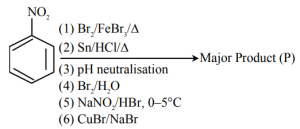
A
$1$
B
$6$
C
$5$
D
$3$
Solution
(C) Step $1$: $Nitrobenzene$ reacts with $Br_2/FeBr_3$ to give $m-bromonitrobenzene$.
Step $2$: Reduction with $Sn/HCl$ converts the $-NO_2$ group to $-NH_2$,yielding $m-bromoaniline$.
Step $3$: $pH$ neutralisation is performed.
Step $4$: $m-bromoaniline$ reacts with $Br_2/H_2O$ to give $2,4,6-tribromo-3-bromoaniline$ (which is $2,3,4,6-tetrabromoaniline$).
Step $5$: Diazotization with $NaNO_2/HBr$ at $0-5^{\circ}C$ converts $-NH_2$ to $-N_2^+Br^-$.
Step $6$: Sandmeyer reaction with $CuBr/NaBr$ replaces the diazonium group with a $Br$ atom.
The final product is $1,2,3,4,5-pentabromobenzene$ (or $1,2,3,4,6-pentabromobenzene$ depending on numbering,but it contains $5$ bromine atoms).
Thus,the number of $Br$ atoms in the final product $(P)$ is $5$.
Step $2$: Reduction with $Sn/HCl$ converts the $-NO_2$ group to $-NH_2$,yielding $m-bromoaniline$.
Step $3$: $pH$ neutralisation is performed.
Step $4$: $m-bromoaniline$ reacts with $Br_2/H_2O$ to give $2,4,6-tribromo-3-bromoaniline$ (which is $2,3,4,6-tetrabromoaniline$).
Step $5$: Diazotization with $NaNO_2/HBr$ at $0-5^{\circ}C$ converts $-NH_2$ to $-N_2^+Br^-$.
Step $6$: Sandmeyer reaction with $CuBr/NaBr$ replaces the diazonium group with a $Br$ atom.
The final product is $1,2,3,4,5-pentabromobenzene$ (or $1,2,3,4,6-pentabromobenzene$ depending on numbering,but it contains $5$ bromine atoms).
Thus,the number of $Br$ atoms in the final product $(P)$ is $5$.
0 likesView Solution
143
ChemistryDifficultMCQJEE Main · 2026
Consider $A \xrightarrow{k_1} B$ and $C \xrightarrow{k_2} D$ are two reactions. If the rate constant $(k_1)$ of the $A \rightarrow B$ reaction can be expressed by the following equation $\log_{10} k = 14.34 - \frac{1.5 \times 10^4}{T/K}$ and activation energy of $C \rightarrow D$ reaction $(Ea_2)$ is $\frac{1}{5}$th of the $A \rightarrow B$ reaction $(Ea_1)$,then the value of $(Ea_2)$ is . . . . . . $kJ \ mol^{-1}$. (Nearest Integer)
A
$287$
B
$57$
C
$114$
D
$43$
Solution
(B) The Arrhenius equation is given by $\log_{10} k = \log_{10} A - \frac{Ea_1}{2.303 RT}$.
Comparing this with the given equation $\log_{10} k = 14.34 - \frac{1.5 \times 10^4}{T}$,we get $\frac{Ea_1}{2.303 R} = 1.5 \times 10^4$.
$Ea_1 = 1.5 \times 10^4 \times 2.303 \times 8.314 \ J \ mol^{-1} = 287207 \ J \ mol^{-1} = 287.207 \ kJ \ mol^{-1}$.
Given that $Ea_2 = \frac{1}{5} Ea_1$,we have $Ea_2 = \frac{287.207}{5} = 57.44 \ kJ \ mol^{-1}$.
The nearest integer value is $57$.
Comparing this with the given equation $\log_{10} k = 14.34 - \frac{1.5 \times 10^4}{T}$,we get $\frac{Ea_1}{2.303 R} = 1.5 \times 10^4$.
$Ea_1 = 1.5 \times 10^4 \times 2.303 \times 8.314 \ J \ mol^{-1} = 287207 \ J \ mol^{-1} = 287.207 \ kJ \ mol^{-1}$.
Given that $Ea_2 = \frac{1}{5} Ea_1$,we have $Ea_2 = \frac{287.207}{5} = 57.44 \ kJ \ mol^{-1}$.
The nearest integer value is $57$.
0 likesView Solution
144
ChemistryDifficultMCQJEE Main · 2026
The mass of benzanilide obtained from the benzoylation reaction of $5.8 \ g$ of aniline,if the yield of product is $82\%$,is . . . . . . $g$ (nearest integer).
(Given molar mass in $g \ mol^{-1}$: $H: 1, C: 12, N: 14, O: 16$)
(Given molar mass in $g \ mol^{-1}$: $H: 1, C: 12, N: 14, O: 16$)
A
$8$
B
$10$
C
$12$
D
$15$
Solution
(B) The reaction is: $C_6H_5NH_2 + C_6H_5COCl \rightarrow C_6H_5NHCOC_6H_5 + HCl$
Molar mass of aniline $(C_6H_5NH_2)$ = $6 \times 12 + 7 \times 1 + 14 = 93 \ g \ mol^{-1}$.
Molar mass of benzanilide $(C_6H_5NHCOC_6H_5)$ = $13 \times 12 + 11 \times 1 + 14 + 16 = 197 \ g \ mol^{-1}$.
Moles of aniline = $\frac{5.8 \ g}{93 \ g \ mol^{-1}} \approx 0.06237 \ mol$.
Theoretical moles of benzanilide = $0.06237 \ mol$.
Actual moles of benzanilide = $0.06237 \times 0.82 \approx 0.05114 \ mol$.
Mass of benzanilide = $0.05114 \ mol \times 197 \ g \ mol^{-1} \approx 10.07 \ g$.
Rounding to the nearest integer,the mass is $10 \ g$.
Molar mass of aniline $(C_6H_5NH_2)$ = $6 \times 12 + 7 \times 1 + 14 = 93 \ g \ mol^{-1}$.
Molar mass of benzanilide $(C_6H_5NHCOC_6H_5)$ = $13 \times 12 + 11 \times 1 + 14 + 16 = 197 \ g \ mol^{-1}$.
Moles of aniline = $\frac{5.8 \ g}{93 \ g \ mol^{-1}} \approx 0.06237 \ mol$.
Theoretical moles of benzanilide = $0.06237 \ mol$.
Actual moles of benzanilide = $0.06237 \times 0.82 \approx 0.05114 \ mol$.
Mass of benzanilide = $0.05114 \ mol \times 197 \ g \ mol^{-1} \approx 10.07 \ g$.
Rounding to the nearest integer,the mass is $10 \ g$.
0 likesView Solution
145
ChemistryDifficultMCQJEE Main · 2026
Among the following oxides of $3d$ elements,the number of mixed oxides are . . . . . .
$Ti_{2}O_{3}, V_{2}O_{4}, Cr_{2}O_{3}, Mn_{3}O_{4}, Fe_{3}O_{4}, Fe_{2}O_{3}, Co_{3}O_{4}$
$Ti_{2}O_{3}, V_{2}O_{4}, Cr_{2}O_{3}, Mn_{3}O_{4}, Fe_{3}O_{4}, Fe_{2}O_{3}, Co_{3}O_{4}$
A
$1$
B
$2$
C
$3$
D
$4$
Solution
(C) Mixed oxides are those which are formed by the combination of two simple oxides of the same metal in different oxidation states.
Analyzing the given oxides:
$1. Mn_{3}O_{4} = MnO \cdot Mn_{2}O_{3}$ (Mixed oxide)
$2. Fe_{3}O_{4} = FeO \cdot Fe_{2}O_{3}$ (Mixed oxide)
$3. Co_{3}O_{4} = CoO \cdot Co_{2}O_{3}$ (Mixed oxide)
The other oxides like $Ti_{2}O_{3}, V_{2}O_{4}, Cr_{2}O_{3},$ and $Fe_{2}O_{3}$ are simple oxides.
Therefore,there are $3$ mixed oxides in the given list.
Analyzing the given oxides:
$1. Mn_{3}O_{4} = MnO \cdot Mn_{2}O_{3}$ (Mixed oxide)
$2. Fe_{3}O_{4} = FeO \cdot Fe_{2}O_{3}$ (Mixed oxide)
$3. Co_{3}O_{4} = CoO \cdot Co_{2}O_{3}$ (Mixed oxide)
The other oxides like $Ti_{2}O_{3}, V_{2}O_{4}, Cr_{2}O_{3},$ and $Fe_{2}O_{3}$ are simple oxides.
Therefore,there are $3$ mixed oxides in the given list.
0 likesView Solution
146
ChemistryDifficultMCQJEE Main · 2026
Consider the electrochemical cell: $Pt \ | \ O_{2(g)} \ (1 \ bar) \ | \ HCl \ (aq) \ || \ M^{2+} \ (aq, 1.0 \ M) \ | \ M_{(s)}$. The pH above which,oxygen gas would start to evolve at the anode is . . . . . . (nearest integer). $\left[ \text{Given :} \ E^{\circ}_{M^{2+}/M} = 0.994 \ V, \ E^{\circ}_{O_{2}/H_{2}O} = 1.23 \ V, \ \frac{RT}{F}(2.303) = 0.059 \ V \ \text{at the given condition} \right]$
A
$2$
B
$4$
C
$6$
D
$8$
Solution
(B) The cell reaction is $M^{2+} + H_2O \rightarrow M + \frac{1}{2}O_2 + 2H^+$.
For the reaction to be spontaneous,$E_{cell} > 0$.
At the limiting condition,$E_{cell} = 0$,so $E_{cathode} = E_{anode}$.
$E_{cathode} = E^{\circ}_{M^{2+}/M} - \frac{0.059}{2} \log \frac{1}{[M^{2+}]} = 0.994 - 0 = 0.994 \ V$.
$E_{anode} = E^{\circ}_{O_2/H_2O} - \frac{0.059}{4} \log \frac{1}{[H^+]^4 P_{O_2}^{1/2}} = 1.23 + \frac{0.059}{4} \log ([H^+]^4 \times 1) = 1.23 + 0.059 \log [H^+] = 1.23 - 0.059 \times pH$.
Equating $E_{cathode} = E_{anode}$:
$0.994 = 1.23 - 0.059 \times pH$.
$0.059 \times pH = 1.23 - 0.994 = 0.236$.
$pH = \frac{0.236}{0.059} = 4$.
Thus,the nearest integer is $4$.
For the reaction to be spontaneous,$E_{cell} > 0$.
At the limiting condition,$E_{cell} = 0$,so $E_{cathode} = E_{anode}$.
$E_{cathode} = E^{\circ}_{M^{2+}/M} - \frac{0.059}{2} \log \frac{1}{[M^{2+}]} = 0.994 - 0 = 0.994 \ V$.
$E_{anode} = E^{\circ}_{O_2/H_2O} - \frac{0.059}{4} \log \frac{1}{[H^+]^4 P_{O_2}^{1/2}} = 1.23 + \frac{0.059}{4} \log ([H^+]^4 \times 1) = 1.23 + 0.059 \log [H^+] = 1.23 - 0.059 \times pH$.
Equating $E_{cathode} = E_{anode}$:
$0.994 = 1.23 - 0.059 \times pH$.
$0.059 \times pH = 1.23 - 0.994 = 0.236$.
$pH = \frac{0.236}{0.059} = 4$.
Thus,the nearest integer is $4$.
0 likesView Solution
147
ChemistryDifficultMCQJEE Main · 2026
$3, 3-$Dimethyl$-2-$butanol cannot be prepared by:
Choose the correct answer from the options given below :
Choose the correct answer from the options given below :
A
$B$ only
B
$B$ and $E$ only
C
$B$ and $C$ only
D
$B, C$ and $E$ only
Solution
(B) The target molecule is $3, 3-$dimethyl$-2-$butanol,which has the structure $(CH_3)_3C-CH(OH)-CH_3$.
$A$. Reaction of $3, 3-$dimethylbutanal with $MeMgBr$ followed by $H_3O^+$ gives $3, 3-$dimethyl$-2-$butanol. This is a valid preparation.
$B$. Acid-catalyzed hydration of $3, 3-$dimethyl$-1-$butene involves a carbocation rearrangement (ethyl shift) to form a more stable carbocation,leading to $2, 3-$dimethyl$-2-$butanol,not the target alcohol. Thus,$B$ cannot prepare it.
$C$. Ozonolysis of $2, 3, 4, 4-$tetramethyl$-2-$pentene followed by reduction with $NaBH_4$ yields $3, 3-$dimethyl$-2-$butanol and acetone. This is a valid preparation.
$D$. Reduction of $3, 3-$dimethyl$-2-$butanone with $LiAlH_4$ gives $3, 3-$dimethyl$-2-$butanol. This is a valid preparation.
$E$. Hydration of $3, 3-$dimethyl$-1-$butyne with $Hg^{2+}/H^+$ gives $3, 3-$dimethyl$-2-$butanone,not the target alcohol. Thus,$E$ cannot prepare it.
Therefore,$B$ and $E$ cannot be used to prepare the target alcohol.
$A$. Reaction of $3, 3-$dimethylbutanal with $MeMgBr$ followed by $H_3O^+$ gives $3, 3-$dimethyl$-2-$butanol. This is a valid preparation.
$B$. Acid-catalyzed hydration of $3, 3-$dimethyl$-1-$butene involves a carbocation rearrangement (ethyl shift) to form a more stable carbocation,leading to $2, 3-$dimethyl$-2-$butanol,not the target alcohol. Thus,$B$ cannot prepare it.
$C$. Ozonolysis of $2, 3, 4, 4-$tetramethyl$-2-$pentene followed by reduction with $NaBH_4$ yields $3, 3-$dimethyl$-2-$butanol and acetone. This is a valid preparation.
$D$. Reduction of $3, 3-$dimethyl$-2-$butanone with $LiAlH_4$ gives $3, 3-$dimethyl$-2-$butanol. This is a valid preparation.
$E$. Hydration of $3, 3-$dimethyl$-1-$butyne with $Hg^{2+}/H^+$ gives $3, 3-$dimethyl$-2-$butanone,not the target alcohol. Thus,$E$ cannot prepare it.
Therefore,$B$ and $E$ cannot be used to prepare the target alcohol.
0 likesView Solution
148
ChemistryDifficultMCQJEE Main · 2026
The compound $A$,$C_{8}H_{8}O_{2}$,reacts with acetophenone to form a single product via cross-Aldol condensation. The compound $A$ on reaction with conc. $NaOH$ forms a substituted benzyl alcohol. Identify compound $A$.
A
$2-$hydroxy acetophenone
B
$4-$methoxy benzaldehyde
C
$4-$hydroxy benzaldehyde
D
$4-$methyl benzoic acid
Solution
(B) Compound $A$ $(C_{8}H_{8}O_{2})$ undergoes cross-Aldol condensation with acetophenone to form a single product. This implies $A$ is an aldehyde without $\alpha$-hydrogens,such as $4-$methoxybenzaldehyde $(p-CH_3OC_6H_4CHO)$.
When $4-$methoxybenzaldehyde reacts with conc. $NaOH$,it undergoes the Cannizzaro reaction because it lacks $\alpha$-hydrogens.
The reaction produces $4-$methoxybenzyl alcohol $(p-CH_3OC_6H_4CH_2OH)$ and $4-$methoxybenzoate ion $(p-CH_3OC_6H_4COO^-)$.
Therefore,compound $A$ is $4-$methoxybenzaldehyde.
When $4-$methoxybenzaldehyde reacts with conc. $NaOH$,it undergoes the Cannizzaro reaction because it lacks $\alpha$-hydrogens.
The reaction produces $4-$methoxybenzyl alcohol $(p-CH_3OC_6H_4CH_2OH)$ and $4-$methoxybenzoate ion $(p-CH_3OC_6H_4COO^-)$.
Therefore,compound $A$ is $4-$methoxybenzaldehyde.
0 likesView Solution
149
ChemistryDifficultMCQJEE Main · 2026
Consider the following reduction processes:
$Al^{3+} + 3e^{-} \rightarrow Al_{(s)}, E^{\circ} = -1.66 \ V$
$Fe^{3+} + e^{-} \rightarrow Fe^{2+}, E^{\circ} = +0.77 \ V$
$Co^{3+} + e^{-} \rightarrow Co^{2+}, E^{\circ} = +1.81 \ V$
$Cr^{3+} + 3e^{-} \rightarrow Cr_{(s)}, E^{\circ} = -0.74 \ V$
The tendency to act as a reducing agent decreases in the order:
$Al^{3+} + 3e^{-} \rightarrow Al_{(s)}, E^{\circ} = -1.66 \ V$
$Fe^{3+} + e^{-} \rightarrow Fe^{2+}, E^{\circ} = +0.77 \ V$
$Co^{3+} + e^{-} \rightarrow Co^{2+}, E^{\circ} = +1.81 \ V$
$Cr^{3+} + 3e^{-} \rightarrow Cr_{(s)}, E^{\circ} = -0.74 \ V$
The tendency to act as a reducing agent decreases in the order:
A
$Al > Cr > Fe^{2+} > Co^{2+}$
B
$Al > Fe^{2+} > Cr > Co^{2+}$
C
$Al > Cr > Co^{2+} > Fe^{2+}$
D
$Cr > Fe^{2+} > Al > Co^{2+}$
Solution
(A) The reducing power of a species is inversely proportional to its standard reduction potential $(E^{\circ})$.
Lower reduction potential indicates a stronger tendency to undergo oxidation,thus acting as a better reducing agent.
The reduction potentials are:
$Al^{3+}/Al = -1.66 \ V$
$Cr^{3+}/Cr = -0.74 \ V$
$Fe^{3+}/Fe^{2+} = +0.77 \ V$
$Co^{3+}/Co^{2+} = +1.81 \ V$
Arranging these in increasing order of reduction potential:
$Al < Cr < Fe^{2+} < Co^{2+}$
Therefore,the order of reducing power (decreasing) is:
$Al > Cr > Fe^{2+} > Co^{2+}$
Lower reduction potential indicates a stronger tendency to undergo oxidation,thus acting as a better reducing agent.
The reduction potentials are:
$Al^{3+}/Al = -1.66 \ V$
$Cr^{3+}/Cr = -0.74 \ V$
$Fe^{3+}/Fe^{2+} = +0.77 \ V$
$Co^{3+}/Co^{2+} = +1.81 \ V$
Arranging these in increasing order of reduction potential:
$Al < Cr < Fe^{2+} < Co^{2+}$
Therefore,the order of reducing power (decreasing) is:
$Al > Cr > Fe^{2+} > Co^{2+}$
0 likesView Solution
150
ChemistryDifficultMCQJEE Main · 2026
$[Ni(PPh_3)_2Cl_2]$ is a paramagnetic complex. Identify the $INCORRECT$ statements about this complex.
$A$. The complex exhibits geometrical isomerism.
$B$. The complex is white in colour.
$C$. The calculated spin-only magnetic moment of the complex is $2.84 \ BM$.
$D$. The calculated $CFSE$ (Crystal Field Stabilization Energy) of $Ni$ in this complex is $-0.8 \Delta_0$.
$E$. The geometrical arrangement of ligands in this complex is similar to that in $Ni(CO)_4$.
Choose the correct answer from the options given below:
$A$. The complex exhibits geometrical isomerism.
$B$. The complex is white in colour.
$C$. The calculated spin-only magnetic moment of the complex is $2.84 \ BM$.
$D$. The calculated $CFSE$ (Crystal Field Stabilization Energy) of $Ni$ in this complex is $-0.8 \Delta_0$.
$E$. The geometrical arrangement of ligands in this complex is similar to that in $Ni(CO)_4$.
Choose the correct answer from the options given below:
A
$A$ and $B$ only
B
$A, B$ and $D$ only
C
$C$ and $D$ only
D
$C, D$ and $E$ only
Solution
(B) $[Ni(PPh_3)_2Cl_2]$ is a $d^8$ complex. Since it is paramagnetic,it must have a tetrahedral geometry.
$(A)$ Tetrahedral complexes of the type $[MA_2B_2]$ do not show geometrical isomerism. Thus,statement $A$ is incorrect.
$(B)$ The complex is blue in colour,not white. Thus,statement $B$ is incorrect.
$(C)$ For $Ni^{2+}$ $(d^8)$ in a tetrahedral field,the configuration is $e^4 t_2^4$,which has $2$ unpaired electrons. The spin-only magnetic moment is $\mu = \sqrt{n(n+2)} = \sqrt{2(2+2)} = \sqrt{8} \approx 2.83 \ BM$. Thus,statement $C$ is correct.
$(D)$ The $CFSE$ for a tetrahedral complex is calculated as $CFSE = (-0.6 \times n_e + 0.4 \times n_{t_2}) \Delta_t$. For $d^8$,$CFSE = (-0.6 \times 4 + 0.4 \times 4) \Delta_t = -0.8 \Delta_t$. The statement mentions $-0.8 \Delta_0$,which is incorrect.
$(E)$ $Ni(CO)_4$ is tetrahedral,and $[Ni(PPh_3)_2Cl_2]$ is also tetrahedral. Thus,statement $E$ is correct.
The incorrect statements are $A, B,$ and $D$.
$(A)$ Tetrahedral complexes of the type $[MA_2B_2]$ do not show geometrical isomerism. Thus,statement $A$ is incorrect.
$(B)$ The complex is blue in colour,not white. Thus,statement $B$ is incorrect.
$(C)$ For $Ni^{2+}$ $(d^8)$ in a tetrahedral field,the configuration is $e^4 t_2^4$,which has $2$ unpaired electrons. The spin-only magnetic moment is $\mu = \sqrt{n(n+2)} = \sqrt{2(2+2)} = \sqrt{8} \approx 2.83 \ BM$. Thus,statement $C$ is correct.
$(D)$ The $CFSE$ for a tetrahedral complex is calculated as $CFSE = (-0.6 \times n_e + 0.4 \times n_{t_2}) \Delta_t$. For $d^8$,$CFSE = (-0.6 \times 4 + 0.4 \times 4) \Delta_t = -0.8 \Delta_t$. The statement mentions $-0.8 \Delta_0$,which is incorrect.
$(E)$ $Ni(CO)_4$ is tetrahedral,and $[Ni(PPh_3)_2Cl_2]$ is also tetrahedral. Thus,statement $E$ is correct.
The incorrect statements are $A, B,$ and $D$.
0 likesView Solution
Vedclass Products
For Students
Vedclass Test Series
Mock tests in real JEE Main style covering Chemistry with performance analysis. 5-day free trial.
Start Free TrialFor Teachers
Exam Paper Generator
Generate Set A/B/C/D Chemistry papers from 7.5L+ questions in 2 minutes. 3 chapters free.
Try FreeFor Institutes
Online Exam Module
Run live JEE Main mock exams with unlimited students, 360° analytics & white-label branding.
See DemoFrequently Asked Questions
How many Chemistry questions are in JEE Main 2026?
There are 459 Chemistry questions from the JEE Main 2026 paper on Vedclass, each with a detailed step-by-step solution in English.
Are JEE Main 2026 Chemistry solutions available in English?
Yes. All solutions on this page are in English. You can also switch to English or Hindi using the language buttons above the questions.
Can I practice JEE Main 2026 Chemistry as a timed test?
Yes. Use the Vedclass Test Series to attempt a full JEE Main mock test covering Chemistry with time limits and instant score analysis.
Can teachers create Chemistry papers from JEE Main previous year questions?
Yes. The Vedclass Exam Paper Generator lets teachers mix JEE Main Chemistry questions and generate Set A/B/C/D papers in minutes.
For Teachers & Institutes
Build a Custom Chemistry Paper
Pick JEE Main 2026 Chemistry questions, set difficulty, and generate Set A/B/C/D in 2 minutes.