
ChemistryQ401–442 of 798 questions
Page 9 of 9 · English
401
ChemistryDifficultMCQJEE Main · 2021
Match List-$I$ with List-$II$ (Both having metallurgical terms):
Choose the correct answer from the options given below:
| List-$I$ | List-$II$ |
|---|---|
| $A$. Concentration of $Ag$ ore | $I$. Reverberatory furnace |
| $B$. Blast furnace | $II$. Pig iron |
| $C$. Blister copper | $III$. Leaching with dilute $NaCN$ solution |
| $D$. Froth floatation method | $IV$. Sulfide ores |
Choose the correct answer from the options given below:
A
$A-IV, B-III, C-II, D-I$
B
$A-IV, B-I, C-III, D-II$
C
$A-III, B-II, C-I, D-IV$
D
$A-III, B-IV, C-I, D-II$
Solution
(C) . Concentration of $Ag$ ore is performed by leaching with dilute $NaCN$ solution $(A-III)$.
$B$. Pig iron is produced in a blast furnace $(B-II)$.
$C$. Blister copper is produced in a Bessemer converter,but in the context of the provided options,the reverberatory furnace is involved in the extraction process of $Cu$ $(C-I)$.
$D$. Froth floatation method is used for the concentration of sulfide ores $(D-IV)$.
Thus,the correct matching is $A-III, B-II, C-I, D-IV$.
$B$. Pig iron is produced in a blast furnace $(B-II)$.
$C$. Blister copper is produced in a Bessemer converter,but in the context of the provided options,the reverberatory furnace is involved in the extraction process of $Cu$ $(C-I)$.
$D$. Froth floatation method is used for the concentration of sulfide ores $(D-IV)$.
Thus,the correct matching is $A-III, B-II, C-I, D-IV$.
0 likesView Solution
402
ChemistryDifficultMCQJEE Main · 2021
The spin only magnetic moments (in $BM$) for free $Ti^{3+}, V^{2+}$ and $Sc^{3+}$ ions respectively are (At.No. $Sc: 21; Ti: 22; V: 23$)
A
$1.73, 3.87, 0$
B
$0, 3.87, 1.73$
C
$3.87, 1.73, 0$
D
$1.73, 0, 3.87$
Solution
(A) The spin only magnetic moment is calculated using the formula $\mu = \sqrt{n(n+2)} \ BM$,where $n$ is the number of unpaired electrons.
For $Ti^{3+}$ $(Z=22)$: Electronic configuration is $[Ar] 3d^{1}$. Here,$n = 1$. Thus,$\mu = \sqrt{1(1+2)} = \sqrt{3} \approx 1.73 \ BM$.
For $V^{2+}$ $(Z=23)$: Electronic configuration is $[Ar] 3d^{3}$. Here,$n = 3$. Thus,$\mu = \sqrt{3(3+2)} = \sqrt{15} \approx 3.87 \ BM$.
For $Sc^{3+}$ $(Z=21)$: Electronic configuration is $[Ar] 3d^{0}$. Here,$n = 0$. Thus,$\mu = 0 \ BM$.
Therefore,the magnetic moments are $1.73, 3.87, 0$ respectively.
For $Ti^{3+}$ $(Z=22)$: Electronic configuration is $[Ar] 3d^{1}$. Here,$n = 1$. Thus,$\mu = \sqrt{1(1+2)} = \sqrt{3} \approx 1.73 \ BM$.
For $V^{2+}$ $(Z=23)$: Electronic configuration is $[Ar] 3d^{3}$. Here,$n = 3$. Thus,$\mu = \sqrt{3(3+2)} = \sqrt{15} \approx 3.87 \ BM$.
For $Sc^{3+}$ $(Z=21)$: Electronic configuration is $[Ar] 3d^{0}$. Here,$n = 0$. Thus,$\mu = 0 \ BM$.
Therefore,the magnetic moments are $1.73, 3.87, 0$ respectively.
0 likesView Solution
403
ChemistryDifficultMCQJEE Main · 2021
What is the major product $P$ of the following reaction?

A
$1-$methylcycloheptylmethyl chloride
B
$1-$methylcycloheptylmethyl diazonium chloride
C
$1-$methylcycloheptylmethanol
D
$1,1-$diethylcyclohexane
Solution
(C) The reaction of a primary aliphatic amine with $NaNO_2$ and $HCl$ at $278 \ K$ leads to the formation of a highly unstable diazonium salt intermediate.
This intermediate rapidly loses nitrogen gas $(N_2)$ to form a carbocation.
In this specific case,the primary carbocation formed at the terminal carbon is unstable and undergoes rearrangement (if possible) or is directly attacked by the nucleophile $(H_2O)$ present in the medium.
Here,the primary amine $1-methylcycloheptylmethanamine$ reacts to form the corresponding alcohol,$1-methylcycloheptylmethanol$,as the major product $P$.
This intermediate rapidly loses nitrogen gas $(N_2)$ to form a carbocation.
In this specific case,the primary carbocation formed at the terminal carbon is unstable and undergoes rearrangement (if possible) or is directly attacked by the nucleophile $(H_2O)$ present in the medium.
Here,the primary amine $1-methylcycloheptylmethanamine$ reacts to form the corresponding alcohol,$1-methylcycloheptylmethanol$,as the major product $P$.
0 likesView Solution
404
ChemistryMediumMCQJEE Main · 2021
$A$ reaction of benzonitrile with one equivalent of $CH_{3}MgBr$ followed by hydrolysis produces a yellow liquid $P$. The compound $P$ will give a positive result for which of the following tests?
A
Tollen's test
B
Schiff's test
C
Ninhydrin's test
D
Iodoform test
Solution
(D) The reaction of benzonitrile $(C_{6}H_{5}CN)$ with one equivalent of methylmagnesium bromide $(CH_{3}MgBr)$ followed by acid hydrolysis $(H_{3}O^{+})$ proceeds as follows:
$1$. Nucleophilic attack of $CH_{3}^{-}$ on the carbon of the nitrile group forms an imine magnesium salt intermediate: $C_{6}H_{5}C(CH_{3})=NMgBr$.
$2$. Hydrolysis of this intermediate yields acetophenone $(C_{6}H_{5}COCH_{3})$ and ammonia $(NH_{3})$.
$3$. Acetophenone contains the acetyl group $(CH_{3}CO-)$ attached to a phenyl ring. Compounds containing the $CH_{3}CO-$ group attached to a hydrogen or carbon atom give a positive iodoform test with $I_{2}/NaOH$.
$1$. Nucleophilic attack of $CH_{3}^{-}$ on the carbon of the nitrile group forms an imine magnesium salt intermediate: $C_{6}H_{5}C(CH_{3})=NMgBr$.
$2$. Hydrolysis of this intermediate yields acetophenone $(C_{6}H_{5}COCH_{3})$ and ammonia $(NH_{3})$.
$3$. Acetophenone contains the acetyl group $(CH_{3}CO-)$ attached to a phenyl ring. Compounds containing the $CH_{3}CO-$ group attached to a hydrogen or carbon atom give a positive iodoform test with $I_{2}/NaOH$.
0 likesView Solution
405
ChemistryDifficultMCQJEE Main · 2021
Consider the reaction sequence shown below:
$Br-CH_2-CHO$ $\xrightarrow[\text{dry } HCl \text{ gas}]{\text{EtOH (excess)}} A$ $\xrightarrow{^tBuO^-K^+} B$
[Where $Et \Rightarrow -C_2H_5$,$^tBu \Rightarrow (CH_3)_3C^-$]
Identify the major products $A$ and $B$ formed respectively.
$Br-CH_2-CHO$ $\xrightarrow[\text{dry } HCl \text{ gas}]{\text{EtOH (excess)}} A$ $\xrightarrow{^tBuO^-K^+} B$
[Where $Et \Rightarrow -C_2H_5$,$^tBu \Rightarrow (CH_3)_3C^-$]
Identify the major products $A$ and $B$ formed respectively.
A
$Br-CH_2-CH(OEt)_2$ and $CH_2=C(OEt)_2$
B
$Br-CH_2-CH(OEt)_2$ and $^tBuO-CH_2-CH(OEt)_2$
C
$EtO-CH_2-CHO$ and $EtO-CH_2-CH(OH)(O^tBu)$
D
$EtO-CH_2-CH(OEt)_2$ and $CH_2=C(OEt)_2$
Solution
(A) Step $1$: Formation of $A$.
The reaction of $Br-CH_2-CHO$ with excess $EtOH$ in the presence of dry $HCl$ gas is an acetal formation reaction. The aldehyde group $(-CHO)$ is converted into an acetal group $(-CH(OEt)_2)$. Thus,$A$ is $Br-CH_2-CH(OEt)_2$.
Step $2$: Formation of $B$.
The product $A$ $(Br-CH_2-CH(OEt)_2)$ is treated with potassium tert-butoxide $(^tBuO^-K^+)$,which is a strong,bulky base. This promotes an $E2$ elimination reaction. The base abstracts a proton from the $\alpha$-carbon (the carbon attached to the bromine atom),leading to the elimination of $HBr$ and the formation of a double bond. The resulting product $B$ is $CH_2=C(OEt)_2$ (a ketene acetal).
Therefore,the major products are $A = Br-CH_2-CH(OEt)_2$ and $B = CH_2=C(OEt)_2$.
The reaction of $Br-CH_2-CHO$ with excess $EtOH$ in the presence of dry $HCl$ gas is an acetal formation reaction. The aldehyde group $(-CHO)$ is converted into an acetal group $(-CH(OEt)_2)$. Thus,$A$ is $Br-CH_2-CH(OEt)_2$.
Step $2$: Formation of $B$.
The product $A$ $(Br-CH_2-CH(OEt)_2)$ is treated with potassium tert-butoxide $(^tBuO^-K^+)$,which is a strong,bulky base. This promotes an $E2$ elimination reaction. The base abstracts a proton from the $\alpha$-carbon (the carbon attached to the bromine atom),leading to the elimination of $HBr$ and the formation of a double bond. The resulting product $B$ is $CH_2=C(OEt)_2$ (a ketene acetal).
Therefore,the major products are $A = Br-CH_2-CH(OEt)_2$ and $B = CH_2=C(OEt)_2$.
0 likesView Solution
406
ChemistryMediumMCQJEE Main · 2021
$A$ biodegradable polyamide can be made from:
A
Hexamethylene diamine and adipic acid
B
Styrene and caproic acid
C
Glycine and aminocaproic acid
D
Glycine and isoprene
Solution
(C) biodegradable polyamide,known as nylon-$2$-nylon-$6$,is a copolymer formed by the condensation polymerization of glycine $(NH_2CH_2COOH)$ and aminocaproic acid $(NH_2(CH_2)_5COOH)$.
0 likesView Solution
407
ChemistryDifficultMCQJEE Main · 2021
Which one of the following metal complexes is most stable?
A
$[Co(en)(NH_{3})_{4}]Cl_{2}$
B
$[Co(en)_{3}]Cl_{2}$
C
$[Co(NH_{3})_{6}]Cl_{2}$
D
$[Co(en)_{2}(NH_{3})_{2}]Cl_{2}$
Solution
(B) The stability of metal complexes increases with the number of chelate rings present due to the chelate effect.
$1$. $[Co(en)(NH_{3})_{4}]Cl_{2}$ contains $1$ chelate ring.
$2$. $[Co(en)_{3}]Cl_{2}$ contains $3$ chelate rings.
$3$. $[Co(en)_{2}(NH_{3})_{2}]Cl_{2}$ contains $2$ chelate rings.
$4$. $[Co(NH_{3})_{6}]Cl_{2}$ contains $0$ chelate rings.
Since $[Co(en)_{3}]Cl_{2}$ has the highest number of chelate rings,it is the most stable complex.
$1$. $[Co(en)(NH_{3})_{4}]Cl_{2}$ contains $1$ chelate ring.
$2$. $[Co(en)_{3}]Cl_{2}$ contains $3$ chelate rings.
$3$. $[Co(en)_{2}(NH_{3})_{2}]Cl_{2}$ contains $2$ chelate rings.
$4$. $[Co(NH_{3})_{6}]Cl_{2}$ contains $0$ chelate rings.
Since $[Co(en)_{3}]Cl_{2}$ has the highest number of chelate rings,it is the most stable complex.
0 likesView Solution
408
ChemistryEasyMCQJEE Main · 2021
Number of electrons present in $4f$ orbital of $Ho^{3+}$ ion is $.....$
(Given Atomic No. of $Ho=67$)
(Given Atomic No. of $Ho=67$)
A
$10$
B
$15$
C
$20$
D
$36$
Solution
(A) The atomic number of Holmium $(Ho)$ is $67$.
The electronic configuration of neutral $Ho$ is $[Xe] 4f^{11} 6s^{2}$.
When $Ho$ forms a $Ho^{3+}$ ion,it loses three electrons (two from the $6s$ orbital and one from the $4f$ orbital).
Therefore,the electronic configuration of $Ho^{3+}$ is $[Xe] 4f^{10}$.
Thus,the number of electrons present in the $4f$ orbital is $10$.
The electronic configuration of neutral $Ho$ is $[Xe] 4f^{11} 6s^{2}$.
When $Ho$ forms a $Ho^{3+}$ ion,it loses three electrons (two from the $6s$ orbital and one from the $4f$ orbital).
Therefore,the electronic configuration of $Ho^{3+}$ is $[Xe] 4f^{10}$.
Thus,the number of electrons present in the $4f$ orbital is $10$.
0 likesView Solution
409
ChemistryMediumMCQJEE Main · 2021
For a chemical reaction $A \rightarrow B$,it was found that the concentration of $B$ increases by $0.2 \, mol \, L^{-1}$ in $30 \, min$. The average rate of the reaction is $...... \times 10^{-1} \, mol \, L^{-1} \, h^{-1}$. (Nearest integer)
A
$1$
B
$2$
C
$3$
D
$4$
Solution
(D) The reaction is $A \rightarrow B$.
Given that the concentration of $B$ increases by $\Delta[B] = 0.2 \, mol \, L^{-1}$ in time $\Delta t = 30 \, min$.
Convert time to hours: $\Delta t = 30 \, min = 0.5 \, h$.
The average rate of reaction is given by $\text{Rate} = \frac{\Delta[B]}{\Delta t}$.
$\text{Rate} = \frac{0.2 \, mol \, L^{-1}}{0.5 \, h} = 0.4 \, mol \, L^{-1} \, h^{-1}$.
We need to express this as $...... \times 10^{-1} \, mol \, L^{-1} \, h^{-1}$.
$0.4 = 4 \times 10^{-1}$.
Thus,the value is $4$.
Given that the concentration of $B$ increases by $\Delta[B] = 0.2 \, mol \, L^{-1}$ in time $\Delta t = 30 \, min$.
Convert time to hours: $\Delta t = 30 \, min = 0.5 \, h$.
The average rate of reaction is given by $\text{Rate} = \frac{\Delta[B]}{\Delta t}$.
$\text{Rate} = \frac{0.2 \, mol \, L^{-1}}{0.5 \, h} = 0.4 \, mol \, L^{-1} \, h^{-1}$.
We need to express this as $...... \times 10^{-1} \, mol \, L^{-1} \, h^{-1}$.
$0.4 = 4 \times 10^{-1}$.
Thus,the value is $4$.
0 likesView Solution
410
ChemistryEasyMCQJEE Main · 2021
When $3.00 \, g$ of a substance $'X'$ is dissolved in $100 \, g$ of $CCl_4$,it raises the boiling point by $0.60 \, K$. The molar mass of the substance $'X'$ is $..... \, g \, mol^{-1}$. (Nearest integer).
$[$ Given $K_b$ for $CCl_4$ is $5.0 \, K \, kg \, mol^{-1} ]$
$[$ Given $K_b$ for $CCl_4$ is $5.0 \, K \, kg \, mol^{-1} ]$
A
$250$
B
$425$
C
$124$
D
$854$
Solution
(A) The formula for elevation in boiling point is $\Delta T_b = K_b \times m$,where $m$ is the molality of the solution.
Molality $m = \frac{\text{moles of solute}}{\text{mass of solvent in kg}} = \frac{3.00 / M}{100 / 1000} = \frac{30}{M} \, mol \, kg^{-1}$.
Given $\Delta T_b = 0.60 \, K$ and $K_b = 5.0 \, K \, kg \, mol^{-1}$.
Substituting the values: $0.60 = 5.0 \times \left( \frac{30}{M} \right)$.
$0.60 = \frac{150}{M}$.
$M = \frac{150}{0.60} = 250 \, g \, mol^{-1}$.
Molality $m = \frac{\text{moles of solute}}{\text{mass of solvent in kg}} = \frac{3.00 / M}{100 / 1000} = \frac{30}{M} \, mol \, kg^{-1}$.
Given $\Delta T_b = 0.60 \, K$ and $K_b = 5.0 \, K \, kg \, mol^{-1}$.
Substituting the values: $0.60 = 5.0 \times \left( \frac{30}{M} \right)$.
$0.60 = \frac{150}{M}$.
$M = \frac{150}{0.60} = 250 \, g \, mol^{-1}$.
0 likesView Solution
411
ChemistryDifficultMCQJEE Main · 2021
Consider the above reaction and identify the product $P :$

A
Cyclohexylmethanol
B
$1-$Methylcyclohexanol
C
$2-$Methylcyclohexanol
D
$2-$(Hydroxymethyl)cyclohexanol
Solution
(C) Step $1$: Dehydration of cyclohexylmethanol using $H_3PO_4$ at $120^{\circ}C$ proceeds via an $E1$ mechanism to form the more stable alkene,$1$-methylcyclohexene,as the major product $A$.
Step $2$: Hydroboration-oxidation $(HBO)$ of $1$-methylcyclohexene involves the anti-Markovnikov addition of water across the double bond.
The $OH$ group attaches to the less hindered carbon atom (the $CH$ group of the double bond),while the $H$ atom attaches to the more hindered carbon atom (the $C-CH_3$ group).
Therefore,the final major product $P$ is $2$-methylcyclohexanol.
Step $2$: Hydroboration-oxidation $(HBO)$ of $1$-methylcyclohexene involves the anti-Markovnikov addition of water across the double bond.
The $OH$ group attaches to the less hindered carbon atom (the $CH$ group of the double bond),while the $H$ atom attaches to the more hindered carbon atom (the $C-CH_3$ group).
Therefore,the final major product $P$ is $2$-methylcyclohexanol.
0 likesView Solution
412
ChemistryMediumMCQJEE Main · 2021
The statement that is $INCORRECT$ about Ellingham diagram is :
A
Provides idea about the reaction rate.
B
Provides idea about free energy change.
C
Provides idea about reduction of metal oxide.
D
Provides idea about changes in the phase during the reaction.
Solution
(A) The Ellingham diagram is a plot of the standard Gibbs free energy change $(\Delta G^{\circ})$ versus temperature $(T)$.
It helps in predicting the feasibility of thermal reduction of metal oxides.
It also indicates phase changes (like melting or boiling) by a change in the slope of the line.
However,it does not provide any information regarding the kinetics or the rate of the reaction.
It helps in predicting the feasibility of thermal reduction of metal oxides.
It also indicates phase changes (like melting or boiling) by a change in the slope of the line.
However,it does not provide any information regarding the kinetics or the rate of the reaction.
0 likesView Solution
413
ChemistryEasyMCQJEE Main · 2021
For a reaction of order $n$,the unit of the rate constant is :
A
$mol^{1-n} L^{1-n} s^{-1}$
B
$mol^{1-n} L^{n-1} s^{-1}$
C
$mol^{1-n} L^{1-n} s$
D
$mol^{1-n} L^{2n} s^{-1}$
Solution
(B) The rate law for a reaction of order $n$ is given by: $\text{Rate} = k[A]^n$.
The unit of rate is $\text{mol } L^{-1} s^{-1}$.
The unit of concentration $[A]$ is $\text{mol } L^{-1}$.
Substituting these into the rate law: $(\text{mol } L^{-1}) s^{-1} = k(\text{mol } L^{-1})^n$.
Solving for $k$: $k = \frac{(\text{mol } L^{-1}) s^{-1}}{(\text{mol } L^{-1})^n} = (\text{mol } L^{-1})^{1-n} s^{-1} = \text{mol}^{1-n} L^{n-1} s^{-1}$.
The unit of rate is $\text{mol } L^{-1} s^{-1}$.
The unit of concentration $[A]$ is $\text{mol } L^{-1}$.
Substituting these into the rate law: $(\text{mol } L^{-1}) s^{-1} = k(\text{mol } L^{-1})^n$.
Solving for $k$: $k = \frac{(\text{mol } L^{-1}) s^{-1}}{(\text{mol } L^{-1})^n} = (\text{mol } L^{-1})^{1-n} s^{-1} = \text{mol}^{1-n} L^{n-1} s^{-1}$.
0 likesView Solution
414
ChemistryMediumMCQJEE Main · 2021
The product obtained from the electrolytic oxidation of acidified sulphate solution is:
A
$H_{2}S_{2}O_{6}$
B
$H_{2}S_{2}O_{8}$
C
$HSO_{4}^{-}$
D
$H_{2}SO_{3}$
Solution
(B) During the electrolysis of a concentrated acidified sulphate solution,the oxidation of sulphate ions occurs at the anode.
The anode reaction is: $2S{O_{4}}^{2-}_{(aq)} \rightarrow S_{2}{O_{8}}^{2-}_{(aq)} + 2e^{-}$.
The cathode reaction is: $2H^{+}_{(aq)} + 2e^{-} \rightarrow H_{2(g)}$.
The resulting peroxodisulphuric acid $(H_{2}S_{2}O_{8})$ is formed by the combination of $S_{2}O_{8}^{2-}$ ions with $H^{+}$ ions in the solution.
The anode reaction is: $2S{O_{4}}^{2-}_{(aq)} \rightarrow S_{2}{O_{8}}^{2-}_{(aq)} + 2e^{-}$.
The cathode reaction is: $2H^{+}_{(aq)} + 2e^{-} \rightarrow H_{2(g)}$.
The resulting peroxodisulphuric acid $(H_{2}S_{2}O_{8})$ is formed by the combination of $S_{2}O_{8}^{2-}$ ions with $H^{+}$ ions in the solution.
0 likesView Solution
415
ChemistryDifficultMCQJEE Main · 2021
Given below are two statements:
Statement $I$: Aniline is less basic than acetamide.
Statement $II$: In aniline,the lone pair of electrons on nitrogen atom is delocalised over benzene ring due to resonance and hence less available to a proton.
Choose the most appropriate option:
Statement $I$: Aniline is less basic than acetamide.
Statement $II$: In aniline,the lone pair of electrons on nitrogen atom is delocalised over benzene ring due to resonance and hence less available to a proton.
Choose the most appropriate option:
A
Both statement $I$ and statement $II$ are true.
B
Both statement $I$ and statement $II$ are false.
C
Statement $I$ is true but statement $II$ is false.
D
Statement $I$ is false but statement $II$ is true.
Solution
(D) Explanation :- The basicity of an amine depends on the availability of the lone pair of electrons on the nitrogen atom.
In $CH_3CONH_2$ (acetamide),the lone pair on nitrogen is involved in resonance with the highly electronegative oxygen atom $(O)$,making it significantly less basic.
In $C_6H_5NH_2$ (aniline),the lone pair on nitrogen is involved in resonance with the benzene ring,which also reduces its basicity,but to a lesser extent than in acetamide.
Therefore,aniline is more basic than acetamide.
Statement $I$ is false.
Statement $II$ is true because the lone pair of electrons on the nitrogen atom in aniline is indeed delocalised over the benzene ring due to resonance,making it less available for protonation.
In $CH_3CONH_2$ (acetamide),the lone pair on nitrogen is involved in resonance with the highly electronegative oxygen atom $(O)$,making it significantly less basic.
In $C_6H_5NH_2$ (aniline),the lone pair on nitrogen is involved in resonance with the benzene ring,which also reduces its basicity,but to a lesser extent than in acetamide.
Therefore,aniline is more basic than acetamide.
Statement $I$ is false.
Statement $II$ is true because the lone pair of electrons on the nitrogen atom in aniline is indeed delocalised over the benzene ring due to resonance,making it less available for protonation.
0 likesView Solution
416
ChemistryDifficultMCQJEE Main · 2021
Which one of the following compounds will give an orange precipitate when treated with $2,4-$dinitrophenylhydrazine?
A
Ethyl benzoate
B
Salicylic acid
C
Ethyl salicylate
D
Acetophenone
Solution
(D) The $2,4-$dinitrophenylhydrazine $(2,4-DNP)$ test is a characteristic reaction used to identify carbonyl compounds,specifically aldehydes and ketones.
$2,4-DNP$ reacts with the carbonyl group $(>C=O)$ of aldehydes and ketones to form a crystalline orange or yellow precipitate of $2,4-$dinitrophenylhydrazone.
Among the given options:
$A$. Ethyl benzoate is an ester.
$B$. Salicylic acid is a carboxylic acid.
$C$. Ethyl salicylate is an ester.
$D$. Acetophenone is a ketone.
Since only acetophenone contains a carbonyl group,it will give a positive $2,4-DNP$ test.
$2,4-DNP$ reacts with the carbonyl group $(>C=O)$ of aldehydes and ketones to form a crystalline orange or yellow precipitate of $2,4-$dinitrophenylhydrazone.
Among the given options:
$A$. Ethyl benzoate is an ester.
$B$. Salicylic acid is a carboxylic acid.
$C$. Ethyl salicylate is an ester.
$D$. Acetophenone is a ketone.
Since only acetophenone contains a carbonyl group,it will give a positive $2,4-DNP$ test.
0 likesView Solution
417
ChemistryDifficultMCQJEE Main · 2021
The number of geometrical isomers found in the metal complexes $[PtCl_2(NH_3)_2]$,$[Ni(CO)_4]$,$[Ru(H_2O)_3Cl_3]$ and $[CoCl_2(NH_3)_4]^+$ respectively,are :
A
$1, 1, 1, 1$
B
$2, 1, 2, 2$
C
$2, 1, 2, 1$
D
$2, 0, 2, 2$
Solution
(D) $1$. $[PtCl_2(NH_3)_2]$ is a square planar complex of type $[MA_2B_2]$. It exhibits $2$ geometrical isomers (cis and trans).
$2$. $[Ni(CO)_4]$ is a tetrahedral complex. Tetrahedral complexes do not show geometrical isomerism because all positions are equivalent relative to each other. Thus,it has $0$ geometrical isomers.
$3$. $[Ru(H_2O)_3Cl_3]$ is an octahedral complex of type $[MA_3B_3]$. It exhibits $2$ geometrical isomers (facial and meridional).
$4$. $[CoCl_2(NH_3)_4]^+$ is an octahedral complex of type $[MA_4B_2]$. It exhibits $2$ geometrical isomers (cis and trans).
Therefore,the number of geometrical isomers are $2, 0, 2, 2$ respectively.
$2$. $[Ni(CO)_4]$ is a tetrahedral complex. Tetrahedral complexes do not show geometrical isomerism because all positions are equivalent relative to each other. Thus,it has $0$ geometrical isomers.
$3$. $[Ru(H_2O)_3Cl_3]$ is an octahedral complex of type $[MA_3B_3]$. It exhibits $2$ geometrical isomers (facial and meridional).
$4$. $[CoCl_2(NH_3)_4]^+$ is an octahedral complex of type $[MA_4B_2]$. It exhibits $2$ geometrical isomers (cis and trans).
Therefore,the number of geometrical isomers are $2, 0, 2, 2$ respectively.
0 likesView Solution
418
ChemistryMediumMCQJEE Main · 2021
The parameters of the unit cell of a substance are $a=2.5, b=3.0, c=4.0, \alpha=90^{\circ}, \beta=120^{\circ}, \gamma=90^{\circ}$. The crystal system of the substance is :
A
Orthorhombic
B
Triclinic
C
Hexagonal
D
Monoclinic
Solution
(D) The given parameters are $a \neq b \neq c$ and $\alpha = \gamma = 90^{\circ}, \beta \neq 90^{\circ}$.
These are the characteristic parameters of a monoclinic crystal system.
These are the characteristic parameters of a monoclinic crystal system.
0 likesView Solution
419
ChemistryMediumMCQJEE Main · 2021
The compound shown in the image is a base found in $DNA$. Identify its complementary base in $DNA$ strands.
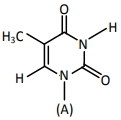
A
Adenine
B
Cytosine
C
Guanine
D
Uracil
Solution
(A) The structure provided in the image is $5$-methyluracil,which is commonly known as Thymine.
In $DNA$ double helix,Thymine $(T)$ forms complementary base pairing with Adenine $(A)$ via two hydrogen bonds.
In $DNA$ double helix,Thymine $(T)$ forms complementary base pairing with Adenine $(A)$ via two hydrogen bonds.
0 likesView Solution
420
ChemistryEasyMCQJEE Main · 2021
Which one among the following chemical tests is used to distinguish monosaccharide from disaccharide?
A
Barfoed test
B
Seliwanoff's test
C
Tollen's test
D
Iodine test
Solution
(A) The $Barfoed$ test is specifically used to distinguish between monosaccharides and disaccharides.
Monosaccharides react rapidly with $Barfoed$ reagent (a solution of copper$(II)$ acetate in dilute acetic acid) to form a red precipitate of $Cu_2O$,whereas disaccharides react much more slowly or not at all under the same conditions.
Monosaccharides react rapidly with $Barfoed$ reagent (a solution of copper$(II)$ acetate in dilute acetic acid) to form a red precipitate of $Cu_2O$,whereas disaccharides react much more slowly or not at all under the same conditions.
0 likesView Solution
421
ChemistryDifficultMCQJEE Main · 2021
Match List-$I$ with List-$II$ :
Choose the most appropriate match :
| List-$I$ (Drug) | List-$II$ (Class of Drug) |
| $a$. Furacin | $i$. Antibiotic |
| $b$. Arsphenamine | $ii$. Tranquilizers |
| $c$. Dimetone | $iii$. Antiseptic |
| $d$. Valium | $iv$. Synthetic antihistamines |
Choose the most appropriate match :
A
$a-iii, b-iv, c-ii, d-i$
B
$a-i, b-iii, c-iv, d-ii$
C
$a-ii, b-i, c-iii, d-iv$
D
$a-iii, b-i, c-iv, d-ii$
Solution
(D) The correct matches are as follows:
$1$. Furacin is an antiseptic.
$2$. Arsphenamine (also known as Salvarsan) is an antibiotic.
$3$. Dimetone is a synthetic antihistamine.
$4$. Valium is a tranquilizer.
Therefore,the correct matching is $a-iii, b-i, c-iv, d-ii$.
$1$. Furacin is an antiseptic.
$2$. Arsphenamine (also known as Salvarsan) is an antibiotic.
$3$. Dimetone is a synthetic antihistamine.
$4$. Valium is a tranquilizer.
Therefore,the correct matching is $a-iii, b-i, c-iv, d-ii$.
0 likesView Solution
422
ChemistryMediumMCQJEE Main · 2021
The type of hybridisation and magnetic property of the complex $[MnCl_6]^{3-}$,respectively,are :
A
$d^{2}sp^{3}$ and paramagnetic
B
$d^{2}sp^{3}$ and diamagnetic
C
$sp^{3}d^{2}$ and paramagnetic
D
$sp^{3}d^{2}$ and diamagnetic
Solution
(C) In the complex $[MnCl_6]^{3-}$,the oxidation state of $Mn$ is $+3$.
The electronic configuration of $Mn^{3+}$ is $[Ar] 3d^4$.
Since $Cl^-$ is a weak field ligand,it does not cause pairing of electrons.
Therefore,the $3d$ electrons remain unpaired,and the complex uses outer $4d$ orbitals for hybridisation.
The hybridisation is $sp^3d^2$,which corresponds to an outer orbital complex.
Due to the presence of $4$ unpaired electrons in the $3d$ orbitals,the complex is paramagnetic.
The electronic configuration of $Mn^{3+}$ is $[Ar] 3d^4$.
Since $Cl^-$ is a weak field ligand,it does not cause pairing of electrons.
Therefore,the $3d$ electrons remain unpaired,and the complex uses outer $4d$ orbitals for hybridisation.
The hybridisation is $sp^3d^2$,which corresponds to an outer orbital complex.
Due to the presence of $4$ unpaired electrons in the $3d$ orbitals,the complex is paramagnetic.
0 likesView Solution
423
ChemistryMediumMCQJEE Main · 2021
The density of $NaOH$ solution is $1.2 \, g \, cm^{-3}$. The molality of this solution is $.... \, m$ (Round off to the nearest integer). [Use: Atomic masses: $Na: 23.0 \, u, O: 16.0 \, u, H: 1.0 \, u$]
A
$6$
B
$5$
C
$4$
D
$1$
Solution
(B) Assume $1 \, L$ of the solution.
Mass of solution $= \text{density} \times \text{volume} = 1.2 \, g \, cm^{-3} \times 1000 \, cm^3 = 1200 \, g$.
Assuming the molarity is $M$ (if not given,we typically assume a $1 \, M$ solution for such problems,or if the question implies $1 \, M$ based on the calculation steps provided in the original prompt).
If we assume $1 \, M$ $NaOH$ solution:
Moles of $NaOH = 1 \, mol$.
Mass of $NaOH = 1 \, mol \times 40 \, g \, mol^{-1} = 40 \, g$.
Mass of solvent (water) $= 1200 \, g - 40 \, g = 1160 \, g = 1.16 \, kg$.
Molality $(m) = \frac{\text{moles of solute}}{\text{mass of solvent in kg}} = \frac{1 \, mol}{1.16 \, kg} \approx 0.86 \, m$.
However,based on the provided solution steps in the prompt which calculate $5 \, mol$ of $NaOH$ in $1 \, kg$ of water,the question implies a $5 \, M$ solution.
For a $5 \, M$ solution:
Moles of $NaOH = 5 \, mol$.
Mass of $NaOH = 5 \, mol \times 40 \, g \, mol^{-1} = 200 \, g$.
Mass of solution $= 1200 \, g$.
Mass of solvent $= 1200 \, g - 200 \, g = 1000 \, g = 1 \, kg$.
Molality $(m) = \frac{5 \, mol}{1 \, kg} = 5 \, m$.
Mass of solution $= \text{density} \times \text{volume} = 1.2 \, g \, cm^{-3} \times 1000 \, cm^3 = 1200 \, g$.
Assuming the molarity is $M$ (if not given,we typically assume a $1 \, M$ solution for such problems,or if the question implies $1 \, M$ based on the calculation steps provided in the original prompt).
If we assume $1 \, M$ $NaOH$ solution:
Moles of $NaOH = 1 \, mol$.
Mass of $NaOH = 1 \, mol \times 40 \, g \, mol^{-1} = 40 \, g$.
Mass of solvent (water) $= 1200 \, g - 40 \, g = 1160 \, g = 1.16 \, kg$.
Molality $(m) = \frac{\text{moles of solute}}{\text{mass of solvent in kg}} = \frac{1 \, mol}{1.16 \, kg} \approx 0.86 \, m$.
However,based on the provided solution steps in the prompt which calculate $5 \, mol$ of $NaOH$ in $1 \, kg$ of water,the question implies a $5 \, M$ solution.
For a $5 \, M$ solution:
Moles of $NaOH = 5 \, mol$.
Mass of $NaOH = 5 \, mol \times 40 \, g \, mol^{-1} = 200 \, g$.
Mass of solution $= 1200 \, g$.
Mass of solvent $= 1200 \, g - 200 \, g = 1000 \, g = 1 \, kg$.
Molality $(m) = \frac{5 \, mol}{1 \, kg} = 5 \, m$.
0 likesView Solution
424
ChemistryDifficultMCQJEE Main · 2021
$CO_{2}$ gas adsorbs on charcoal following Freundlich adsorption isotherm. For a given amount of charcoal,the mass of $CO_{2}$ adsorbed becomes $64$ times when the pressure of $CO_{2}$ is doubled. The value of $n$ in the Freundlich isotherm equation is $......\,\times 10^{-2}$. (Round off to the Nearest Integer)
A
$11$
B
$15$
C
$17$
D
$21$
Solution
(C) The Freundlich adsorption isotherm is given by the equation: $\frac{x}{m} = k \cdot p^{\frac{1}{n}}$.
Let the initial mass adsorbed be $y_1 = \frac{x}{m} = k \cdot p^{\frac{1}{n}}$.
When the pressure is doubled $(p' = 2p)$,the mass adsorbed becomes $y_2 = 64y_1 = k \cdot (2p)^{\frac{1}{n}}$.
Dividing the two equations: $\frac{64y_1}{y_1} = \frac{k \cdot (2p)^{\frac{1}{n}}}{k \cdot p^{\frac{1}{n}}}$.
$64 = (2)^{\frac{1}{n}}$.
Since $64 = 2^6$,we have $2^6 = 2^{\frac{1}{n}}$.
Therefore,$\frac{1}{n} = 6$,which implies $n = \frac{1}{6} \approx 0.1666$.
Expressing this as $n \times 10^{-2}$,we get $16.66 \times 10^{-2}$.
Rounding to the nearest integer,we get $17 \times 10^{-2}$.
Let the initial mass adsorbed be $y_1 = \frac{x}{m} = k \cdot p^{\frac{1}{n}}$.
When the pressure is doubled $(p' = 2p)$,the mass adsorbed becomes $y_2 = 64y_1 = k \cdot (2p)^{\frac{1}{n}}$.
Dividing the two equations: $\frac{64y_1}{y_1} = \frac{k \cdot (2p)^{\frac{1}{n}}}{k \cdot p^{\frac{1}{n}}}$.
$64 = (2)^{\frac{1}{n}}$.
Since $64 = 2^6$,we have $2^6 = 2^{\frac{1}{n}}$.
Therefore,$\frac{1}{n} = 6$,which implies $n = \frac{1}{6} \approx 0.1666$.
Expressing this as $n \times 10^{-2}$,we get $16.66 \times 10^{-2}$.
Rounding to the nearest integer,we get $17 \times 10^{-2}$.
0 likesView Solution
425
ChemistryDifficultMCQJEE Main · 2021
$1.46 \, g$ of a biopolymer dissolved in a $100 \, mL$ water at $300 \, K$ exerted an osmotic pressure of $2.42 \times 10^{-3} \, bar$.
The molar mass of the biopolymer is $..... \times 10^{4} \, g \, mol^{-1}$. (Round off to the Nearest Integer)
[Use : $R = 0.083 \, L \, bar \, mol^{-1} \, K^{-1}$ ]
The molar mass of the biopolymer is $..... \times 10^{4} \, g \, mol^{-1}$. (Round off to the Nearest Integer)
[Use : $R = 0.083 \, L \, bar \, mol^{-1} \, K^{-1}$ ]
A
$7$
B
$5$
C
$91$
D
$15$
Solution
(D) The formula for osmotic pressure is $\pi = CRT$,where $C$ is the molarity,$R$ is the gas constant,and $T$ is the temperature.
Given: $\pi = 2.42 \times 10^{-3} \, bar$,$V = 100 \, mL = 0.1 \, L$,$T = 300 \, K$,$R = 0.083 \, L \, bar \, mol^{-1} \, K^{-1}$,and mass $w = 1.46 \, g$.
$C = \frac{n}{V} = \frac{w}{M \times V} = \frac{1.46}{M \times 0.1} \, mol \, L^{-1}$.
Substituting these values into the equation: $2.42 \times 10^{-3} = \left(\frac{1.46}{M \times 0.1}\right) \times 0.083 \times 300$.
$M = \frac{1.46 \times 0.083 \times 300}{2.42 \times 10^{-3} \times 0.1} = \frac{36.354}{0.000242} \approx 150223 \, g \, mol^{-1}$.
$M \approx 15.02 \times 10^{4} \, g \, mol^{-1}$.
Rounding to the nearest integer,we get $15$.
Given: $\pi = 2.42 \times 10^{-3} \, bar$,$V = 100 \, mL = 0.1 \, L$,$T = 300 \, K$,$R = 0.083 \, L \, bar \, mol^{-1} \, K^{-1}$,and mass $w = 1.46 \, g$.
$C = \frac{n}{V} = \frac{w}{M \times V} = \frac{1.46}{M \times 0.1} \, mol \, L^{-1}$.
Substituting these values into the equation: $2.42 \times 10^{-3} = \left(\frac{1.46}{M \times 0.1}\right) \times 0.083 \times 300$.
$M = \frac{1.46 \times 0.083 \times 300}{2.42 \times 10^{-3} \times 0.1} = \frac{36.354}{0.000242} \approx 150223 \, g \, mol^{-1}$.
$M \approx 15.02 \times 10^{4} \, g \, mol^{-1}$.
Rounding to the nearest integer,we get $15$.
0 likesView Solution
426
ChemistryMediumMCQJEE Main · 2021
To an aqueous solution containing ions such as $Al^{3+}, Zn^{2+}, Ca^{2+}, Fe^{3+}, Ni^{2+}, Ba^{2+}$ and $Cu^{2+}$,concentrated $HCl$ was added,followed by $H_{2}S$. The total number of cations precipitated during this reaction is/are:
A
$4$
B
$1$
C
$3$
D
$2$
Solution
(B) In the presence of concentrated $HCl$,the medium is highly acidic.
$Al^{3+}$ and $Fe^{3+}$ do not form precipitates with $H_{2}S$ because their sulphides hydrolyze in water.
$Ni^{2+}$ and $Zn^{2+}$ require a basic medium to form precipitates with $H_{2}S$.
$Ca^{2+}$ and $Ba^{2+}$ form soluble sulphides.
Only $Cu^{2+}$ forms a precipitate $(CuS)$ in an acidic medium $(HCl + H_{2}S)$.
Therefore,the total number of cations precipitated is $1$.
$Al^{3+}$ and $Fe^{3+}$ do not form precipitates with $H_{2}S$ because their sulphides hydrolyze in water.
$Ni^{2+}$ and $Zn^{2+}$ require a basic medium to form precipitates with $H_{2}S$.
$Ca^{2+}$ and $Ba^{2+}$ form soluble sulphides.
Only $Cu^{2+}$ forms a precipitate $(CuS)$ in an acidic medium $(HCl + H_{2}S)$.
Therefore,the total number of cations precipitated is $1$.
0 likesView Solution
427
ChemistryDifficultMCQJEE Main · 2021
$R-CN \xrightarrow[(ii) H_2O]{(i) DIBAL-H} R-Y$
Consider the above reaction and identify $Y$.
Consider the above reaction and identify $Y$.
A
$-CHO$
B
$-CONH_2$
C
$-CH_2NH_2$
D
$-COOH$
Solution
(A) The reaction of nitriles $(R-CN)$ with $DIBAL-H$ (Diisobutylaluminium hydride) followed by hydrolysis is a standard method for the preparation of aldehydes.
The reaction proceeds as follows:
$R-C \equiv N \xrightarrow[(ii) H_2O]{(i) DIBAL-H} R-CHO$
Here,the nitrile group is reduced to an aldehyde group.
Therefore,$Y$ is $-CHO$ (Aldehyde).
The reaction proceeds as follows:
$R-C \equiv N \xrightarrow[(ii) H_2O]{(i) DIBAL-H} R-CHO$
Here,the nitrile group is reduced to an aldehyde group.
Therefore,$Y$ is $-CHO$ (Aldehyde).
0 likesView Solution
428
ChemistryDifficultMCQJEE Main · 2021
Given below are two statements:
Statement $I$: $[Mn(CN)_6]^{3-}$,$[Fe(CN)_6]^{3-}$ and $[Co(C_2O_4)_3]^{3-}$ are $d^2sp^3$ hybridized.
Statement $II$: $[MnCl_6]^{3-}$ and $[FeF_6]^{3-}$ are paramagnetic and have $4$ and $5$ unpaired electrons,respectively.
In the light of the above statements,choose the correct answer from the options given below:
Statement $I$: $[Mn(CN)_6]^{3-}$,$[Fe(CN)_6]^{3-}$ and $[Co(C_2O_4)_3]^{3-}$ are $d^2sp^3$ hybridized.
Statement $II$: $[MnCl_6]^{3-}$ and $[FeF_6]^{3-}$ are paramagnetic and have $4$ and $5$ unpaired electrons,respectively.
In the light of the above statements,choose the correct answer from the options given below:
A
Both statement $I$ and statement $II$ are false
B
Statement $I$ is incorrect but statement $II$ is true
C
Statement $I$ is correct but statement $II$ is false
D
Both statement $I$ and statement $II$ are true
Solution
(D) Statement $I$:
$1.$ $[Mn(CN)_6]^{3-}: Mn^{3+} = [Ar] 3d^4$. $CN^{-}$ is a strong field ligand. Configuration: $t_{2g}^4 e_g^0$. Hybridization: $d^2sp^3$.
$2.$ $[Fe(CN)_6]^{3-}: Fe^{3+} = [Ar] 3d^5$. $CN^{-}$ is a strong field ligand. Configuration: $t_{2g}^5 e_g^0$. Hybridization: $d^2sp^3$.
$3.$ $[Co(C_2O_4)_3]^{3-}: Co^{3+} = [Ar] 3d^6$. $C_2O_4^{2-}$ is a strong field ligand for $Co^{3+}$. Configuration: $t_{2g}^6 e_g^0$. Hybridization: $d^2sp^3$.
Statement $I$ is correct.
Statement $II$:
$1.$ $[MnCl_6]^{3-}: Mn^{3+} = [Ar] 3d^4$. $Cl^{-}$ is a weak field ligand. Configuration: $t_{2g}^3 e_g^1$. Unpaired electrons = $4$. Paramagnetic.
$2.$ $[FeF_6]^{3-}: Fe^{3+} = [Ar] 3d^5$. $F^{-}$ is a weak field ligand. Configuration: $t_{2g}^3 e_g^2$. Unpaired electrons = $5$. Paramagnetic.
Statement $II$ is correct.
$1.$ $[Mn(CN)_6]^{3-}: Mn^{3+} = [Ar] 3d^4$. $CN^{-}$ is a strong field ligand. Configuration: $t_{2g}^4 e_g^0$. Hybridization: $d^2sp^3$.
$2.$ $[Fe(CN)_6]^{3-}: Fe^{3+} = [Ar] 3d^5$. $CN^{-}$ is a strong field ligand. Configuration: $t_{2g}^5 e_g^0$. Hybridization: $d^2sp^3$.
$3.$ $[Co(C_2O_4)_3]^{3-}: Co^{3+} = [Ar] 3d^6$. $C_2O_4^{2-}$ is a strong field ligand for $Co^{3+}$. Configuration: $t_{2g}^6 e_g^0$. Hybridization: $d^2sp^3$.
Statement $I$ is correct.
Statement $II$:
$1.$ $[MnCl_6]^{3-}: Mn^{3+} = [Ar] 3d^4$. $Cl^{-}$ is a weak field ligand. Configuration: $t_{2g}^3 e_g^1$. Unpaired electrons = $4$. Paramagnetic.
$2.$ $[FeF_6]^{3-}: Fe^{3+} = [Ar] 3d^5$. $F^{-}$ is a weak field ligand. Configuration: $t_{2g}^3 e_g^2$. Unpaired electrons = $5$. Paramagnetic.
Statement $II$ is correct.
0 likesView Solution
429
ChemistryDifficultMCQJEE Main · 2021
The addition of silica during the extraction of copper from its sulphide ore:
A
converts iron oxide into iron silicate
B
converts copper sulphide into copper silicate
C
reduces copper sulphide into metallic copper
D
reduces the melting point of the reaction mixture
Solution
(A) During the extraction of copper from its sulphide ore,$FeO$ is present as an impurity.
Silica $(SiO_2)$ is added as a flux to remove this impurity.
The reaction is:
$FeO + SiO_2 \rightarrow FeSiO_3$
Here,$FeSiO_3$ is formed as a slag,which is easily removed from the molten copper matte.
Silica $(SiO_2)$ is added as a flux to remove this impurity.
The reaction is:
$FeO + SiO_2 \rightarrow FeSiO_3$
Here,$FeSiO_3$ is formed as a slag,which is easily removed from the molten copper matte.
0 likesView Solution
430
ChemistryDifficultMCQJEE Main · 2021
The correct sequence of reagents for the following transformation is:
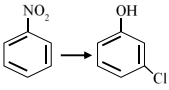
A
$i. Fe, HCl; ii. NaNO_{2}, HCl, 0^{\circ} C; iii. H_{2}O / H^{+}; iv. Cl_{2}, FeCl_{3}$
B
$i. Cl_{2}, FeCl_{3}; ii. NaNO_{2}, HCl, 0^{\circ} C; iii. Fe, HCl; iv. H_{2}O / H^{+}$
C
$i. Fe, HCl; ii. Cl_{2}, HCl; iii. NaNO_{2}, HCl, 0^{\circ} C; iv. H_{2}O / H^{+}$
D
$i. Cl_{2}, FeCl_{3}; ii. Fe, HCl; iii. NaNO_{2}, HCl, 0^{\circ} C; iv. H_{2}O / H^{+}$
Solution
(D) The transformation involves converting nitrobenzene to $3$-chlorophenol.
Step $1$: Chlorination of nitrobenzene using $Cl_{2} / FeCl_{3}$ gives $m$-chloronitrobenzene because the $-NO_{2}$ group is meta-directing.
Step $2$: Reduction of the nitro group using $Fe / HCl$ yields $m$-chloroaniline.
Step $3$: Diazotization of $m$-chloroaniline using $NaNO_{2} / HCl$ at $0^{\circ} C$ produces $m$-chlorobenzenediazonium chloride.
Step $4$: Hydrolysis of the diazonium salt using $H_{2}O / H^{+}$ results in the formation of $3$-chlorophenol.
Thus,the correct sequence is $i. Cl_{2}, FeCl_{3}; ii. Fe, HCl; iii. NaNO_{2}, HCl, 0^{\circ} C; iv. H_{2}O / H^{+}$.
Step $1$: Chlorination of nitrobenzene using $Cl_{2} / FeCl_{3}$ gives $m$-chloronitrobenzene because the $-NO_{2}$ group is meta-directing.
Step $2$: Reduction of the nitro group using $Fe / HCl$ yields $m$-chloroaniline.
Step $3$: Diazotization of $m$-chloroaniline using $NaNO_{2} / HCl$ at $0^{\circ} C$ produces $m$-chlorobenzenediazonium chloride.
Step $4$: Hydrolysis of the diazonium salt using $H_{2}O / H^{+}$ results in the formation of $3$-chlorophenol.
Thus,the correct sequence is $i. Cl_{2}, FeCl_{3}; ii. Fe, HCl; iii. NaNO_{2}, HCl, 0^{\circ} C; iv. H_{2}O / H^{+}$.
0 likesView Solution
431
ChemistryMediumMCQJEE Main · 2021
Compound $A$ gives $D$-Galactose and $D$-Glucose on hydrolysis. The compound $A$ is:
A
Lactose
B
Amylose
C
Sucrose
D
Maltose
Solution
(A) Lactose is a disaccharide composed of $\beta-D$-Galactose and $\beta-D$-Glucose units.
These units are linked by a $\beta-1,4$-glycosidic linkage between the $C_{1}$ of galactose and the $C_{4}$ of glucose.
Therefore,the hydrolysis of Lactose yields $D$-Galactose and $D$-Glucose.
These units are linked by a $\beta-1,4$-glycosidic linkage between the $C_{1}$ of galactose and the $C_{4}$ of glucose.
Therefore,the hydrolysis of Lactose yields $D$-Galactose and $D$-Glucose.
0 likesView Solution
432
ChemistryDifficultMCQJEE Main · 2021
Consider the below reaction,and choose the correct statement:
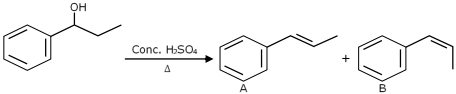
A
The reaction is not possible in acidic medium
B
Both compounds $A$ and $B$ are formed equally
C
Compound $B$ will be the major product
D
Compound $A$ will be the major product
Solution
(D) The reaction is an acid-catalyzed dehydration of an alcohol.
$1$. The hydroxyl group is protonated by $H_2SO_4$ to form a good leaving group $(-OH_2^+)$.
$2$. Water is eliminated to form a stable benzylic carbocation.
$3$. $A$ proton is removed from the adjacent carbon to form an alkene.
$4$. The resulting alkene can exist as two geometric isomers: $A$ (trans-isomer) and $B$ (cis-isomer).
$5$. The trans-isomer $(A)$ is more stable due to reduced steric hindrance compared to the cis-isomer $(B)$.
$6$. According to the thermodynamic control of the reaction,the more stable product is formed as the major product.
Therefore,compound $A$ is the major product.
$1$. The hydroxyl group is protonated by $H_2SO_4$ to form a good leaving group $(-OH_2^+)$.
$2$. Water is eliminated to form a stable benzylic carbocation.
$3$. $A$ proton is removed from the adjacent carbon to form an alkene.
$4$. The resulting alkene can exist as two geometric isomers: $A$ (trans-isomer) and $B$ (cis-isomer).
$5$. The trans-isomer $(A)$ is more stable due to reduced steric hindrance compared to the cis-isomer $(B)$.
$6$. According to the thermodynamic control of the reaction,the more stable product is formed as the major product.
Therefore,compound $A$ is the major product.
0 likesView Solution
433
ChemistryDifficultMCQJEE Main · 2021
What is $A$ in the following reaction?
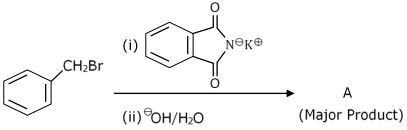
A
Phthalimide
B
Benzylamine
C
$N$-Benzylbenzamide
D
Benzyl alcohol
Solution
(B) The reaction shown is the $Gabriel \ phthalimide \ synthesis$.
In this reaction,potassium phthalimide reacts with benzyl bromide $(C_6H_5CH_2Br)$ to form $N$-benzylphthalimide.
Subsequent hydrolysis with $OH^-/H_2O$ yields benzylamine $(C_6H_5CH_2NH_2)$ and phthalic acid as the products.
Therefore,the major product $A$ is benzylamine.
In this reaction,potassium phthalimide reacts with benzyl bromide $(C_6H_5CH_2Br)$ to form $N$-benzylphthalimide.
Subsequent hydrolysis with $OH^-/H_2O$ yields benzylamine $(C_6H_5CH_2NH_2)$ and phthalic acid as the products.
Therefore,the major product $A$ is benzylamine.
0 likesView Solution
434
ChemistryDifficultMCQJEE Main · 2021
Select the correct statements.
$(A)$ Crystalline solids have long range order.
$(B)$ Crystalline solids are isotropic.
$(C)$ Amorphous solids are sometimes called pseudo solids.
$(D)$ Amorphous solids soften over a range of temperature.
$(E)$ Amorphous solids have a definite heat of fusion.
Choose the most appropriate answer from the options given below:
$(A)$ Crystalline solids have long range order.
$(B)$ Crystalline solids are isotropic.
$(C)$ Amorphous solids are sometimes called pseudo solids.
$(D)$ Amorphous solids soften over a range of temperature.
$(E)$ Amorphous solids have a definite heat of fusion.
Choose the most appropriate answer from the options given below:
A
$(C)$,$(D)$ only
B
$(A)$,$(C)$,$(D)$ only
C
$(B)$,$(D)$ only
D
$(A)$,$(B)$,$(E)$ only
Solution
(B) Crystalline solids have a regular,repeating arrangement of constituent particles and exhibit long-range order.
$(B)$ Crystalline solids are anisotropic,meaning their physical properties vary with direction.
$(C)$ Amorphous solids are often referred to as pseudo solids or supercooled liquids because they lack a long-range ordered structure.
$(D)$ Amorphous solids do not have a sharp melting point; they gradually soften over a range of temperatures.
$(E)$ Amorphous solids do not have a definite heat of fusion because they do not have a sharp melting point.
Therefore,statements $(A)$,$(C)$,and $(D)$ are correct.
$(B)$ Crystalline solids are anisotropic,meaning their physical properties vary with direction.
$(C)$ Amorphous solids are often referred to as pseudo solids or supercooled liquids because they lack a long-range ordered structure.
$(D)$ Amorphous solids do not have a sharp melting point; they gradually soften over a range of temperatures.
$(E)$ Amorphous solids do not have a definite heat of fusion because they do not have a sharp melting point.
Therefore,statements $(A)$,$(C)$,and $(D)$ are correct.
1 likesView Solution
435
ChemistryDifficultMCQJEE Main · 2021
Given below are two statements: one is labelled as Assertion $A$ and the other is labelled as Reason $R.$
Assertion $A:$ $SO_{2(g)}$ is adsorbed to a larger extent than $H_{2(g)}$ on activated charcoal.
Reason $R:$ $SO_{2(g)}$ has a higher critical temperature than $H_{2(g)}.$
In the light of the above statements,choose the most appropriate answer from the options given below.
Assertion $A:$ $SO_{2(g)}$ is adsorbed to a larger extent than $H_{2(g)}$ on activated charcoal.
Reason $R:$ $SO_{2(g)}$ has a higher critical temperature than $H_{2(g)}.$
In the light of the above statements,choose the most appropriate answer from the options given below.
A
Both $A$ and $R$ are correct and $R$ is the correct explanation of $A$.
B
$A$ is not correct but $R$ is correct.
C
$A$ is correct but $R$ is not correct.
D
Both $A$ and $R$ are correct but $R$ is not the correct explanation of $A$.
Solution
(A) The extent of adsorption of a gas on a solid adsorbent depends on the ease of liquefaction of the gas.
Easily liquefiable gases have higher critical temperatures $(T_c)$.
Since $SO_{2(g)}$ has a higher critical temperature $(430 \ K)$ compared to $H_{2(g)}$ $(33 \ K)$,it is more easily liquefied and thus adsorbed to a larger extent on activated charcoal.
Therefore,both Assertion $A$ and Reason $R$ are correct,and $R$ is the correct explanation of $A$.
Easily liquefiable gases have higher critical temperatures $(T_c)$.
Since $SO_{2(g)}$ has a higher critical temperature $(430 \ K)$ compared to $H_{2(g)}$ $(33 \ K)$,it is more easily liquefied and thus adsorbed to a larger extent on activated charcoal.
Therefore,both Assertion $A$ and Reason $R$ are correct,and $R$ is the correct explanation of $A$.
0 likesView Solution
436
ChemistryMediumMCQJEE Main · 2021
Number of $Cl=O$ bonds in chlorous acid,chloric acid and perchloric acid respectively are :
A
$3, 1$ and $1$
B
$4, 1$ and $0$
C
$1, 1$ and $3$
D
$1, 2$ and $3$
Solution
(D) The structures of the oxoacids of chlorine are as follows:
$1$. Chlorous acid $(HClO_2)$: The structure is $H-O-Cl=O$. It contains $1$ $Cl=O$ bond.
$2$. Chloric acid $(HClO_3)$: The structure is $H-O-Cl(=O)_2$. It contains $2$ $Cl=O$ bonds.
$3$. Perchloric acid $(HClO_4)$: The structure is $H-O-Cl(=O)_3$. It contains $3$ $Cl=O$ bonds.
Therefore,the number of $Cl=O$ bonds in chlorous acid,chloric acid,and perchloric acid are $1, 2$ and $3$ respectively.
$1$. Chlorous acid $(HClO_2)$: The structure is $H-O-Cl=O$. It contains $1$ $Cl=O$ bond.
$2$. Chloric acid $(HClO_3)$: The structure is $H-O-Cl(=O)_2$. It contains $2$ $Cl=O$ bonds.
$3$. Perchloric acid $(HClO_4)$: The structure is $H-O-Cl(=O)_3$. It contains $3$ $Cl=O$ bonds.
Therefore,the number of $Cl=O$ bonds in chlorous acid,chloric acid,and perchloric acid are $1, 2$ and $3$ respectively.
0 likesView Solution
437
ChemistryDifficultMCQJEE Main · 2021
Given below are two statements:
Statement $I$: Penicillin is a bacteriostatic type of antibiotic.
Statement $II$: The general structure of Penicillin is as shown below:
$R-CONH-CH-CH-S-C(CH_3)_2-CH-COOH$ (with a $\beta$-lactam ring fused to a thiazolidine ring).
Choose the correct option:
Statement $I$: Penicillin is a bacteriostatic type of antibiotic.
Statement $II$: The general structure of Penicillin is as shown below:
$R-CONH-CH-CH-S-C(CH_3)_2-CH-COOH$ (with a $\beta$-lactam ring fused to a thiazolidine ring).
Choose the correct option:
A
Statement $I$ is correct but statement $II$ is false
B
Statement $I$ is incorrect but statement $II$ is true
C
Both statement $I$ and statement $II$ are false
D
Both statement $I$ and statement $II$ are true
Solution
(B) Statement $I$ is incorrect because Penicillin is a bactericidal antibiotic,not bacteriostatic. Bactericidal antibiotics kill bacteria,while bacteriostatic antibiotics inhibit their growth.
Statement $II$ is correct. The general structure of Penicillin consists of a $\beta$-lactam ring fused to a thiazolidine ring,which matches the provided chemical structure.
Therefore,statement $I$ is false and statement $II$ is true.
Statement $II$ is correct. The general structure of Penicillin consists of a $\beta$-lactam ring fused to a thiazolidine ring,which matches the provided chemical structure.
Therefore,statement $I$ is false and statement $II$ is true.
0 likesView Solution
438
ChemistryDifficultMCQJEE Main · 2021
For the cell $Cu_{(s)}|Cu^{2+}_{(aq)}(0.1 \ M) || Ag^{+}_{(aq)}(0.01 \ M)| Ag_{(s)}$,the cell potential $E_{1} = 0.3095 \ V$. For the cell $Cu_{(s)}|Cu^{2+}_{(aq)}(0.01 \ M) || Ag^{+}_{(aq)}(0.001 \ M)| Ag_{(s)}$,the cell potential $= ..... \times 10^{-2} \ V$. (Round off to the Nearest Integer). [Use: $\frac{2.303 \ RT}{F} = 0.059$]
A
$4$
B
$14$
C
$28$
D
$36$
Solution
(C) The cell reaction is: $Cu_{(s)} + 2Ag^{+}_{(aq)} \rightarrow Cu^{2+}_{(aq)} + 2Ag_{(s)}$.
The Nernst equation is: $E_{\text{cell}} = E^{\circ}_{\text{cell}} - \frac{0.059}{2} \log \frac{[Cu^{2+}]}{[Ag^{+}]^2}$.
For the first cell: $0.3095 = E^{\circ}_{\text{cell}} - \frac{0.059}{2} \log \frac{0.1}{(0.01)^2} = E^{\circ}_{\text{cell}} - \frac{0.059}{2} \log(1000) = E^{\circ}_{\text{cell}} - \frac{0.059}{2} \times 3$.
$E^{\circ}_{\text{cell}} = 0.3095 + 0.0885 = 0.398 \ V$.
For the second cell: $E_{2} = 0.398 - \frac{0.059}{2} \log \frac{0.01}{(0.001)^2} = 0.398 - \frac{0.059}{2} \log(10000) = 0.398 - \frac{0.059}{2} \times 4 = 0.398 - 0.118 = 0.28 \ V$.
$0.28 \ V = 28 \times 10^{-2} \ V$.
The Nernst equation is: $E_{\text{cell}} = E^{\circ}_{\text{cell}} - \frac{0.059}{2} \log \frac{[Cu^{2+}]}{[Ag^{+}]^2}$.
For the first cell: $0.3095 = E^{\circ}_{\text{cell}} - \frac{0.059}{2} \log \frac{0.1}{(0.01)^2} = E^{\circ}_{\text{cell}} - \frac{0.059}{2} \log(1000) = E^{\circ}_{\text{cell}} - \frac{0.059}{2} \times 3$.
$E^{\circ}_{\text{cell}} = 0.3095 + 0.0885 = 0.398 \ V$.
For the second cell: $E_{2} = 0.398 - \frac{0.059}{2} \log \frac{0.01}{(0.001)^2} = 0.398 - \frac{0.059}{2} \log(10000) = 0.398 - \frac{0.059}{2} \times 4 = 0.398 - 0.118 = 0.28 \ V$.
$0.28 \ V = 28 \times 10^{-2} \ V$.
0 likesView Solution
439
ChemistryDifficultMCQJEE Main · 2021
For the first order reaction $A \rightarrow 2B$,$1 \ mole$ of reactant $A$ gives $0.2 \ moles$ of $B$ after $100 \ minutes$. The half-life of the reaction is $..... \ min$. [Use: $\ln 2 = 0.69, \ln 10 = 2.3$]
A
$450$
B
$200$
C
$100$
D
$300$
Solution
(NONE) For the reaction $A \rightarrow 2B$:
At $t=0$,$[A]_0 = 1 \ mol$ and $[B] = 0$.
At $t=100 \ min$,let the amount of $A$ reacted be $x$. Then $[A]_t = 1-x$ and $[B] = 2x$.
Given $2x = 0.2 \ mol$,so $x = 0.1 \ mol$.
Thus,$[A]_t = 1 - 0.1 = 0.9 \ mol$.
The rate constant $k$ is given by $k = \frac{1}{t} \ln \frac{[A]_0}{[A]_t} = \frac{1}{100} \ln \frac{1}{0.9} = \frac{1}{100} \ln(1.111)$.
Using $\ln(1.111) \approx 0.105$,$k \approx 0.00105 \ min^{-1}$.
The half-life $t_{1/2} = \frac{\ln 2}{k} = \frac{0.69}{0.00105} \approx 657 \ min$.
At $t=0$,$[A]_0 = 1 \ mol$ and $[B] = 0$.
At $t=100 \ min$,let the amount of $A$ reacted be $x$. Then $[A]_t = 1-x$ and $[B] = 2x$.
Given $2x = 0.2 \ mol$,so $x = 0.1 \ mol$.
Thus,$[A]_t = 1 - 0.1 = 0.9 \ mol$.
The rate constant $k$ is given by $k = \frac{1}{t} \ln \frac{[A]_0}{[A]_t} = \frac{1}{100} \ln \frac{1}{0.9} = \frac{1}{100} \ln(1.111)$.
Using $\ln(1.111) \approx 0.105$,$k \approx 0.00105 \ min^{-1}$.
The half-life $t_{1/2} = \frac{\ln 2}{k} = \frac{0.69}{0.00105} \approx 657 \ min$.
0 likesView Solution
440
ChemistryDifficultMCQJEE Main · 2021
In a solvent,$50\,\%$ of an acid $HA$ dimerizes and the rest dissociates. The van't Hoff factor of the acid is $.....\times 10^{-2}$. (Round off to the nearest integer)
A
$150$
B
$125$
C
$175$
D
$850$
Solution
(A) Let the initial moles of $HA$ be $a = 1 \text{ mole}$.
$50\,\%$ of $HA$ $(0.5 \text{ mole})$ dimerizes: $2HA \rightleftharpoons H_2A_2$.
Final moles for dimerization: $0.5 - 0.25 = 0.25 \text{ mole of } HA$ and $0.25 \text{ mole of } H_2A_2$.
$50\,\%$ of $HA$ $(0.5 \text{ mole})$ dissociates: $HA \rightleftharpoons H^+ + A^-$.
Final moles for dissociation: $0.5 \text{ mole of } H^+$ and $0.5 \text{ mole of } A^-$.
Total final moles $= 0.25 (HA) + 0.25 (H_2A_2) + 0.5 (H^+) + 0.5 (A^-) = 1.5 \text{ moles}$.
Van't Hoff factor $i = \frac{\text{Total final moles}}{\text{Initial moles}} = \frac{1.5}{1} = 1.5$.
$1.5 = 150 \times 10^{-2}$.
$50\,\%$ of $HA$ $(0.5 \text{ mole})$ dimerizes: $2HA \rightleftharpoons H_2A_2$.
Final moles for dimerization: $0.5 - 0.25 = 0.25 \text{ mole of } HA$ and $0.25 \text{ mole of } H_2A_2$.
$50\,\%$ of $HA$ $(0.5 \text{ mole})$ dissociates: $HA \rightleftharpoons H^+ + A^-$.
Final moles for dissociation: $0.5 \text{ mole of } H^+$ and $0.5 \text{ mole of } A^-$.
Total final moles $= 0.25 (HA) + 0.25 (H_2A_2) + 0.5 (H^+) + 0.5 (A^-) = 1.5 \text{ moles}$.
Van't Hoff factor $i = \frac{\text{Total final moles}}{\text{Initial moles}} = \frac{1.5}{1} = 1.5$.
$1.5 = 150 \times 10^{-2}$.
1 likesView Solution
441
ChemistryMediumMCQJEE Main · 2021
$10.0 \, mL$ of $0.05 \, M \, KMnO_4$ solution was consumed in a titration with $10.0 \, mL$ of given oxalic acid dihydrate solution. The strength of given oxalic acid solution is $..... \times 10^{-2} \, g / L$ (Round off to the nearest integer).
A
$1782$
B
$2152$
C
$1203$
D
$1575$
Solution
(D) The balanced chemical equation for the reaction is:
$2KMnO_4 + 5H_2C_2O_4 + 3H_2SO_4 \rightarrow K_2SO_4 + 2MnSO_4 + 10CO_2 + 8H_2O$
At equivalence point,the number of equivalents of $KMnO_4$ equals the number of equivalents of oxalic acid dihydrate $(H_2C_2O_4 \cdot 2H_2O)$:
$n_{eq} (KMnO_4) = n_{eq} (H_2C_2O_4 \cdot 2H_2O)$
Using the formula $n_{eq} = M \times V(L) \times n$-factor:
$n$-factor for $KMnO_4 = 5$ (reduction of $Mn^{+7}$ to $Mn^{+2}$)
$n$-factor for $H_2C_2O_4 \cdot 2H_2O = 2$ (oxidation of $C^{+3}$ to $C^{+4}$)
$0.05 \times 10 \times 5 = M_{oxalic} \times 10 \times 2$
$2.5 = 20 \times M_{oxalic}$
$M_{oxalic} = 0.125 \, M$
Molar mass of $H_2C_2O_4 \cdot 2H_2O = 126 \, g/mol$
Strength in $g/L = Molarity \times Molar \, mass = 0.125 \times 126 = 15.75 \, g/L$
Converting to the required form: $15.75 \, g/L = 1575 \times 10^{-2} \, g/L$.
$2KMnO_4 + 5H_2C_2O_4 + 3H_2SO_4 \rightarrow K_2SO_4 + 2MnSO_4 + 10CO_2 + 8H_2O$
At equivalence point,the number of equivalents of $KMnO_4$ equals the number of equivalents of oxalic acid dihydrate $(H_2C_2O_4 \cdot 2H_2O)$:
$n_{eq} (KMnO_4) = n_{eq} (H_2C_2O_4 \cdot 2H_2O)$
Using the formula $n_{eq} = M \times V(L) \times n$-factor:
$n$-factor for $KMnO_4 = 5$ (reduction of $Mn^{+7}$ to $Mn^{+2}$)
$n$-factor for $H_2C_2O_4 \cdot 2H_2O = 2$ (oxidation of $C^{+3}$ to $C^{+4}$)
$0.05 \times 10 \times 5 = M_{oxalic} \times 10 \times 2$
$2.5 = 20 \times M_{oxalic}$
$M_{oxalic} = 0.125 \, M$
Molar mass of $H_2C_2O_4 \cdot 2H_2O = 126 \, g/mol$
Strength in $g/L = Molarity \times Molar \, mass = 0.125 \times 126 = 15.75 \, g/L$
Converting to the required form: $15.75 \, g/L = 1575 \times 10^{-2} \, g/L$.
0 likesView Solution
442
ChemistryMediumMCQJEE Main · 2021
$3$ moles of a metal complex with the formula $Co(en)_2 Cl_3$ gives $3$ moles of silver chloride on treatment with an excess of silver nitrate. The secondary valency of $Co$ in the complex is $.....$ (Round off to the nearest integer).
A
$6$
B
$5$
C
$4$
D
$3$
Solution
(A) The complex $Co(en)_2 Cl_3$ reacts with $AgNO_3$ to precipitate $AgCl$. Since $3$ moles of $AgCl$ are produced from $3$ moles of the complex,each mole of the complex releases $1$ mole of $Cl^-$ ions.
This indicates the formula is $[Co(en)_2 Cl_2]Cl$.
The secondary valency corresponds to the coordination number $(C.N.)$.
In $[Co(en)_2 Cl_2]Cl$,the central metal $Co$ is bonded to two bidentate $en$ ligands ($2 \times 2 = 4$ coordination sites) and two monodentate $Cl^-$ ligands ($2 \times 1 = 2$ coordination sites).
Therefore,the coordination number $= 4 + 2 = 6$.
The secondary valency of $Co$ is $6$.
This indicates the formula is $[Co(en)_2 Cl_2]Cl$.
The secondary valency corresponds to the coordination number $(C.N.)$.
In $[Co(en)_2 Cl_2]Cl$,the central metal $Co$ is bonded to two bidentate $en$ ligands ($2 \times 2 = 4$ coordination sites) and two monodentate $Cl^-$ ligands ($2 \times 1 = 2$ coordination sites).
Therefore,the coordination number $= 4 + 2 = 6$.
The secondary valency of $Co$ is $6$.
0 likesView Solution
Vedclass Products
For Students
Vedclass Test Series
Mock tests in real JEE Main style covering Chemistry with performance analysis. 5-day free trial.
Start Free TrialFor Teachers
Exam Paper Generator
Generate Set A/B/C/D Chemistry papers from 7.5L+ questions in 2 minutes. 3 chapters free.
Try FreeFor Institutes
Online Exam Module
Run live JEE Main mock exams with unlimited students, 360° analytics & white-label branding.
See DemoFrequently Asked Questions
How many Chemistry questions are in JEE Main 2021?
There are 798 Chemistry questions from the JEE Main 2021 paper on Vedclass, each with a detailed step-by-step solution in English.
Are JEE Main 2021 Chemistry solutions available in English?
Yes. All solutions on this page are in English. You can also switch to English or Hindi using the language buttons above the questions.
Can I practice JEE Main 2021 Chemistry as a timed test?
Yes. Use the Vedclass Test Series to attempt a full JEE Main mock test covering Chemistry with time limits and instant score analysis.
Can teachers create Chemistry papers from JEE Main previous year questions?
Yes. The Vedclass Exam Paper Generator lets teachers mix JEE Main Chemistry questions and generate Set A/B/C/D papers in minutes.
For Teachers & Institutes
Build a Custom Chemistry Paper
Pick JEE Main 2021 Chemistry questions, set difficulty, and generate Set A/B/C/D in 2 minutes.