
ChemistryQ51–90 of 132 questions
Page 2 of 2 · English
51
ChemistryMCQAIEEE · 2004
If the temperature of the sun were to increase from $T$ to $2T$ and its radius from $R$ to $2R$,then the ratio of the radiant energy received on Earth to what it was previously will be
A
$4$
B
$16$
C
$32$
D
$64$
Solution
(D) The total power (radiant energy per unit time) emitted by the sun is given by the Stefan-Boltzmann law: $P = \sigma A T^4 = \sigma (4 \pi R^2) T^4$.
Since the distance between the Earth and the Sun remains constant,the radiant energy received on Earth is directly proportional to the power emitted by the Sun: $Q \propto R^2 T^4$.
Let the initial energy be $Q_1 = k R^2 T^4$.
After the changes,the new radius is $R' = 2R$ and the new temperature is $T' = 2T$.
The new radiant energy is $Q_2 = k (R')^2 (T')^4$.
Substituting the new values: $Q_2 = k (2R)^2 (2T)^4 = k (4R^2) (16T^4) = 64 (k R^2 T^4)$.
Therefore,the ratio is $Q_2 / Q_1 = 64$.
Since the distance between the Earth and the Sun remains constant,the radiant energy received on Earth is directly proportional to the power emitted by the Sun: $Q \propto R^2 T^4$.
Let the initial energy be $Q_1 = k R^2 T^4$.
After the changes,the new radius is $R' = 2R$ and the new temperature is $T' = 2T$.
The new radiant energy is $Q_2 = k (R')^2 (T')^4$.
Substituting the new values: $Q_2 = k (2R)^2 (2T)^4 = k (4R^2) (16T^4) = 64 (k R^2 T^4)$.
Therefore,the ratio is $Q_2 / Q_1 = 64$.
0 likesView Solution
52
ChemistryMCQAIEEE · 2004
The maximum number of possible interference maxima for slit-separation equal to twice the wavelength in Young's double-slit experiment is:
A
infinite
B
$5$
C
$3$
D
$0$
Solution
(B) The condition for interference maxima in Young's double-slit experiment is given by $\Delta x = d \sin \theta = n \lambda$,where $n$ is an integer.
Given that the slit separation $d = 2 \lambda$,we substitute this into the equation:
$2 \lambda \sin \theta = n \lambda$
$2 \sin \theta = n$
$\sin \theta = \frac{n}{2}$
Since the maximum value of $\sin \theta$ is $1$,we have $-1 \le \frac{n}{2} \le 1$,which implies $-2 \le n \le 2$.
The possible integer values for $n$ are $-2, -1, 0, 1, 2$.
Counting these values,we get a total of $5$ interference maxima.
Given that the slit separation $d = 2 \lambda$,we substitute this into the equation:
$2 \lambda \sin \theta = n \lambda$
$2 \sin \theta = n$
$\sin \theta = \frac{n}{2}$
Since the maximum value of $\sin \theta$ is $1$,we have $-1 \le \frac{n}{2} \le 1$,which implies $-2 \le n \le 2$.
The possible integer values for $n$ are $-2, -1, 0, 1, 2$.
Counting these values,we get a total of $5$ interference maxima.
0 likesView Solution
53
ChemistryMCQAIEEE · 2004
The standard e.m.f. of a cell,involving one electron change is found to be $0.591 \ V$ at $25 \ ^oC$. The equilibrium constant of the reaction is ($F = 96,500 \ C \ mol^{-1}$; $R = 8.314 \ JK^{-1} \ mol^{-1}$)
A
$1.0 \times 10^{10}$
B
$1.0 \times 10^{5}$
C
$1.0 \times 10^{1}$
D
$1.0 \times 10^{30}$
Solution
(A) The relationship between standard cell potential $(E_{cell}^{0})$ and equilibrium constant $(K)$ is given by the Nernst equation at $25 \ ^oC$ $(298 \ K)$:
$E_{cell}^{0} = \frac{0.0591}{n} \log K$
Given:
$E_{cell}^{0} = 0.591 \ V$
$n = 1$ (one electron change)
Substituting the values:
$0.591 = \frac{0.0591}{1} \log K$
$\log K = \frac{0.591}{0.0591} = 10$
$K = 10^{10}$
$E_{cell}^{0} = \frac{0.0591}{n} \log K$
Given:
$E_{cell}^{0} = 0.591 \ V$
$n = 1$ (one electron change)
Substituting the values:
$0.591 = \frac{0.0591}{1} \log K$
$\log K = \frac{0.591}{0.0591} = 10$
$K = 10^{10}$
0 likesView Solution
54
ChemistryMCQAIEEE · 2004
Which of the following sets of quantum numbers is correct for an electron in a $4f$ orbital?
A
$n = 4, l = 3, m = +1, s = +\frac{1}{2}$
B
$n = 4, l = 4, m = -4, s = -\frac{1}{2}$
C
$n = 4, l = 3, m = +4, s = +\frac{1}{2}$
D
$n = 3, l = 2, m = -2, s = +\frac{1}{2}$
Solution
(A) For a $4f$ orbital,the principal quantum number $n = 4$.
For an $f$ subshell,the azimuthal quantum number $l = 3$.
The magnetic quantum number $m$ can take values from $-l$ to $+l$,i.e.,$-3, -2, -1, 0, +1, +2, +3$.
The spin quantum number $s$ can be either $+\frac{1}{2}$ or $-\frac{1}{2}$.
Checking the options:
Option $A$: $n = 4, l = 3, m = +1, s = +\frac{1}{2}$ is valid because $m = +1$ lies within the range $[-3, +3]$.
Option $B$: $l = 4$ is not possible for $n = 4$ (since $l < n$).
Option $C$: $m = +4$ is not possible for $l = 3$ (since $|m| \leq l$).
Option $D$: $n = 3$ corresponds to the $3d$ orbital,not $4f$.
For an $f$ subshell,the azimuthal quantum number $l = 3$.
The magnetic quantum number $m$ can take values from $-l$ to $+l$,i.e.,$-3, -2, -1, 0, +1, +2, +3$.
The spin quantum number $s$ can be either $+\frac{1}{2}$ or $-\frac{1}{2}$.
Checking the options:
Option $A$: $n = 4, l = 3, m = +1, s = +\frac{1}{2}$ is valid because $m = +1$ lies within the range $[-3, +3]$.
Option $B$: $l = 4$ is not possible for $n = 4$ (since $l < n$).
Option $C$: $m = +4$ is not possible for $l = 3$ (since $|m| \leq l$).
Option $D$: $n = 3$ corresponds to the $3d$ orbital,not $4f$.
0 likesView Solution
55
ChemistryMCQAIEEE · 2004
Aluminium chloride exists as a dimer,$Al_2Cl_6$,in the solid state as well as in solutions of non-polar solvents such as $C_6H_6$. When dissolved in water,it gives:
A
$Al_2O_3 + 6HCl$
B
$[Al(H_2O)_6]^{3+} + 3Cl^{-}$
C
$[Al(OH)_6]^{3-} + 3HCl$
D
$Al^{3+} + 3Cl^{-}$
Solution
(B) Aluminium chloride $(Al_2Cl_6)$ is a covalent compound that acts as a Lewis acid.
When it dissolves in water,it undergoes hydration to form the octahedral hexaaquaaluminium$(III)$ ion.
The reaction is:
$Al_2Cl_6 + 12H_2O \rightarrow 2[Al(H_2O)_6]^{3+} + 6Cl^-$.
Thus,the species present in the aqueous solution are $[Al(H_2O)_6]^{3+}$ and $Cl^-$ ions.
When it dissolves in water,it undergoes hydration to form the octahedral hexaaquaaluminium$(III)$ ion.
The reaction is:
$Al_2Cl_6 + 12H_2O \rightarrow 2[Al(H_2O)_6]^{3+} + 6Cl^-$.
Thus,the species present in the aqueous solution are $[Al(H_2O)_6]^{3+}$ and $Cl^-$ ions.
0 likesView Solution
56
ChemistryMCQAIEEE · 2004
Aluminium chloride exists as a dimer,$Al_2Cl_6$,in the solid state as well as in solutions of non-polar solvents such as benzene. When dissolved in water,it gives:
A
$Al^{3+} + 3Cl^{-}$
B
$[Al(H_2O)_6]^{3+} + 3Cl^{-}$
C
$[Al(OH)_6]^{3-} + 3HCl$
D
$Al_2O_3 + 6HCl$
Solution
(B) $AlCl_3$ is covalent in nature,but when dissolved in water,it undergoes hydrolysis and forms an ionic complex due to the high hydration energy of the $Al^{3+}$ ion.
The reaction is as follows:
$AlCl_3 + 6H_2O \rightarrow [Al(H_2O)_6]^{3+} + 3Cl^{-}$
Therefore,the correct option is $B$.
The reaction is as follows:
$AlCl_3 + 6H_2O \rightarrow [Al(H_2O)_6]^{3+} + 3Cl^{-}$
Therefore,the correct option is $B$.
0 likesView Solution
57
ChemistryMCQAIEEE · 2004
In a series of $2n$ observations,half of them are equal to $a$ and the remaining half are equal to $-a$. If the standard deviation of the observations is $2$,then $|a|$ is equal to:
A
$2$
B
$\sqrt{2}$
C
$\frac{1}{n}$
D
$\frac{\sqrt{2}}{n}$
Solution
(A) The mean $\bar{x}$ is calculated as: $\bar{x} = \frac{n(a) + n(-a)}{2n} = \frac{0}{2n} = 0$.
The variance $\sigma^2$ is given by $\sigma^2 = \frac{1}{N} \sum x_i^2 - \bar{x}^2$.
Here,$N = 2n$,$\sum x_i^2 = n(a^2) + n(-a)^2 = 2na^2$,and $\bar{x} = 0$.
So,$\sigma^2 = \frac{2na^2}{2n} - 0^2 = a^2$.
Given the standard deviation $\sigma = 2$,we have $\sigma^2 = 4$.
Therefore,$a^2 = 4$,which implies $|a| = 2$.
The variance $\sigma^2$ is given by $\sigma^2 = \frac{1}{N} \sum x_i^2 - \bar{x}^2$.
Here,$N = 2n$,$\sum x_i^2 = n(a^2) + n(-a)^2 = 2na^2$,and $\bar{x} = 0$.
So,$\sigma^2 = \frac{2na^2}{2n} - 0^2 = a^2$.
Given the standard deviation $\sigma = 2$,we have $\sigma^2 = 4$.
Therefore,$a^2 = 4$,which implies $|a| = 2$.
0 likesView Solution
58
ChemistryMCQAIEEE · 2004
Which of the following statements is correct for any thermodynamic system?
A
The internal energy changes in all processes
B
Internal energy and entropy are state functions
C
The change in entropy can never be zero
D
The work done in an adiabatic process is always zero
Solution
(B) Internal energy is a state function that depends only on the state of the system,not on the path taken. Similarly,entropy is also a state function.
In an isothermal process,the internal energy of an ideal gas remains constant,so $\Delta U = 0$.
For a reversible adiabatic process,the change in entropy $\Delta S$ is zero.
Work done in an adiabatic process is given by $W = -\Delta U$,which is generally non-zero.
Therefore,the statement that internal energy and entropy are state functions is the only correct statement.
In an isothermal process,the internal energy of an ideal gas remains constant,so $\Delta U = 0$.
For a reversible adiabatic process,the change in entropy $\Delta S$ is zero.
Work done in an adiabatic process is given by $W = -\Delta U$,which is generally non-zero.
Therefore,the statement that internal energy and entropy are state functions is the only correct statement.
0 likesView Solution
59
ChemistryMCQAIEEE · 2004
$A$ machine gun fires a bullet of mass $40\, g$ with a velocity $1200\, m/s$. The man holding it can exert a maximum force of $144\, N$ on the gun. How many bullets can he fire per second at the most?
A
$1$
B
$4$
C
$2$
D
$3$
Solution
(D) Given: Mass of bullet $m = 40\, g = 0.04\, kg$,velocity $v = 1200\, m/s$,and maximum force $F = 144\, N$.
Let $n$ be the number of bullets fired per second.
The force exerted by the man must balance the rate of change of momentum of the bullets.
The force $F$ is given by $F = n \times (m \times v)$.
Substituting the values: $144 = n \times (0.04\, kg \times 1200\, m/s)$.
$144 = n \times 48$.
$n = \frac{144}{48} = 3$.
Therefore,the man can fire $3$ bullets per second at the most.
Let $n$ be the number of bullets fired per second.
The force exerted by the man must balance the rate of change of momentum of the bullets.
The force $F$ is given by $F = n \times (m \times v)$.
Substituting the values: $144 = n \times (0.04\, kg \times 1200\, m/s)$.
$144 = n \times 48$.
$n = \frac{144}{48} = 3$.
Therefore,the man can fire $3$ bullets per second at the most.
0 likesView Solution
60
ChemistryMCQAIEEE · 2004
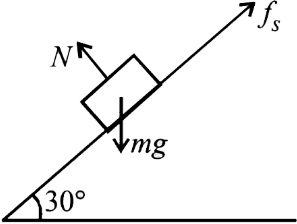
$A$ block rests on a rough inclined plane making an angle of $30^{\circ}$ with the horizontal. The coefficient of static friction between the block and the plane is $0.8$. If the frictional force on the block is $10 \, N$,the mass of the block (in $kg$) is: (take $g = 10 \, m/s^2$)
A
$2$
B
$4$
C
$1.6$
D
$2.5$
Solution
(A) For a block at rest on an inclined plane,the component of gravitational force acting down the plane is balanced by the static frictional force acting up the plane.
$f_s = mg \sin \theta$
Given:
$f_s = 10 \, N$
$\theta = 30^{\circ}$
$g = 10 \, m/s^2$
Substituting the values:
$10 = m \times 10 \times \sin 30^{\circ}$
$10 = m \times 10 \times 0.5$
$10 = 5m$
$m = \frac{10}{5} = 2 \, kg$
Thus,the mass of the block is $2 \, kg$.
$f_s = mg \sin \theta$
Given:
$f_s = 10 \, N$
$\theta = 30^{\circ}$
$g = 10 \, m/s^2$
Substituting the values:
$10 = m \times 10 \times \sin 30^{\circ}$
$10 = m \times 10 \times 0.5$
$10 = 5m$
$m = \frac{10}{5} = 2 \, kg$
Thus,the mass of the block is $2 \, kg$.
0 likesView Solution
61
ChemistryMCQAIEEE · 2004
Let $\alpha, \beta$ be such that $\pi < \alpha - \beta < 3\pi$. If $\sin \alpha + \sin \beta = -\frac{21}{65}$ and $\cos \alpha + \cos \beta = -\frac{27}{65}$,then the value of $\cos \frac{\alpha - \beta}{2}$ is
A
$\frac{6}{65}$
B
$\frac{3}{\sqrt{130}}$
C
$-\frac{3}{\sqrt{130}}$
D
$-\frac{6}{\sqrt{65}}$
Solution
(C) Given: $\cos \alpha + \cos \beta = -\frac{27}{65}$ and $\sin \alpha + \sin \beta = -\frac{21}{65}$.
Using sum-to-product formulas:
$2 \cos \frac{\alpha + \beta}{2} \cos \frac{\alpha - \beta}{2} = -\frac{27}{65}$ $(1)$
$2 \sin \frac{\alpha + \beta}{2} \cos \frac{\alpha - \beta}{2} = -\frac{21}{65}$ $(2)$
Squaring and adding $(1)$ and $(2)$:
$4 \cos^2 \frac{\alpha - \beta}{2} (\cos^2 \frac{\alpha + \beta}{2} + \sin^2 \frac{\alpha + \beta}{2}) = (-\frac{27}{65})^2 + (-\frac{21}{65})^2$
$4 \cos^2 \frac{\alpha - \beta}{2} = \frac{729 + 441}{4225} = \frac{1170}{4225} = \frac{18}{65}$
$\cos^2 \frac{\alpha - \beta}{2} = \frac{18}{4 \times 65} = \frac{9}{130}$
Since $\pi < \alpha - \beta < 3\pi$,we have $\frac{\pi}{2} < \frac{\alpha - \beta}{2} < \frac{3\pi}{2}$.
In this interval,$\cos \frac{\alpha - \beta}{2}$ is negative in the second quadrant $(\frac{\pi}{2}, \pi)$ and negative in the third quadrant $(\pi, \frac{3\pi}{2})$.
Thus,$\cos \frac{\alpha - \beta}{2} = -\sqrt{\frac{9}{130}} = -\frac{3}{\sqrt{130}}$.
Using sum-to-product formulas:
$2 \cos \frac{\alpha + \beta}{2} \cos \frac{\alpha - \beta}{2} = -\frac{27}{65}$ $(1)$
$2 \sin \frac{\alpha + \beta}{2} \cos \frac{\alpha - \beta}{2} = -\frac{21}{65}$ $(2)$
Squaring and adding $(1)$ and $(2)$:
$4 \cos^2 \frac{\alpha - \beta}{2} (\cos^2 \frac{\alpha + \beta}{2} + \sin^2 \frac{\alpha + \beta}{2}) = (-\frac{27}{65})^2 + (-\frac{21}{65})^2$
$4 \cos^2 \frac{\alpha - \beta}{2} = \frac{729 + 441}{4225} = \frac{1170}{4225} = \frac{18}{65}$
$\cos^2 \frac{\alpha - \beta}{2} = \frac{18}{4 \times 65} = \frac{9}{130}$
Since $\pi < \alpha - \beta < 3\pi$,we have $\frac{\pi}{2} < \frac{\alpha - \beta}{2} < \frac{3\pi}{2}$.
In this interval,$\cos \frac{\alpha - \beta}{2}$ is negative in the second quadrant $(\frac{\pi}{2}, \pi)$ and negative in the third quadrant $(\pi, \frac{3\pi}{2})$.
Thus,$\cos \frac{\alpha - \beta}{2} = -\sqrt{\frac{9}{130}} = -\frac{3}{\sqrt{130}}$.
0 likesView Solution
62
ChemistryMCQAIEEE · 2004
Four charges equal to $-Q$ are placed at the four corners of a square and a charge $q$ is at its centre. If the system is in equilibrium,the value of $q$ is
A
$-\frac{Q}{4} (1 + 2 \sqrt{2})$
B
$\frac{Q}{4} (1 + 2 \sqrt{2})$
C
$-\frac{Q}{2} (1 + 2 \sqrt{2})$
D
$\frac{Q}{2} (1 + 2 \sqrt{2})$
Solution
(B) For the system to be in equilibrium,the net force on every charge must be zero. Let the side of the square be $a$. The distance of the centre from each corner is $r = \frac{a}{\sqrt{2}}$.
Consider the force on a charge $-Q$ at one corner. The forces acting on it are:
$1$. Forces from the other three $-Q$ charges at the corners.
$2$. Force from the charge $q$ at the centre.
The resultant force due to the two adjacent corners is $F_{adj} = \sqrt{(\frac{kQ^2}{a^2})^2 + (\frac{kQ^2}{a^2})^2} = \frac{\sqrt{2}kQ^2}{a^2}$.
The force due to the diagonally opposite corner is $F_{diag} = \frac{kQ^2}{(a\sqrt{2})^2} = \frac{kQ^2}{2a^2}$.
The total force from the three corners is $F_{corners} = \frac{kQ^2}{a^2}(\sqrt{2} + \frac{1}{2})$.
For equilibrium,this must be balanced by the force from the central charge $q$: $F_{centre} = \frac{kQq}{(a/\sqrt{2})^2} = \frac{2kQq}{a^2}$.
Equating the magnitudes: $\frac{kQ^2}{a^2}(\sqrt{2} + \frac{1}{2}) = \frac{2kQq}{a^2}$.
Solving for $q$: $q = \frac{Q}{2}(\sqrt{2} + \frac{1}{2}) = \frac{Q}{4}(2\sqrt{2} + 1)$.
Since the corner charges are negative,the central charge $q$ must be positive to provide an attractive force.
Consider the force on a charge $-Q$ at one corner. The forces acting on it are:
$1$. Forces from the other three $-Q$ charges at the corners.
$2$. Force from the charge $q$ at the centre.
The resultant force due to the two adjacent corners is $F_{adj} = \sqrt{(\frac{kQ^2}{a^2})^2 + (\frac{kQ^2}{a^2})^2} = \frac{\sqrt{2}kQ^2}{a^2}$.
The force due to the diagonally opposite corner is $F_{diag} = \frac{kQ^2}{(a\sqrt{2})^2} = \frac{kQ^2}{2a^2}$.
The total force from the three corners is $F_{corners} = \frac{kQ^2}{a^2}(\sqrt{2} + \frac{1}{2})$.
For equilibrium,this must be balanced by the force from the central charge $q$: $F_{centre} = \frac{kQq}{(a/\sqrt{2})^2} = \frac{2kQq}{a^2}$.
Equating the magnitudes: $\frac{kQ^2}{a^2}(\sqrt{2} + \frac{1}{2}) = \frac{2kQq}{a^2}$.
Solving for $q$: $q = \frac{Q}{2}(\sqrt{2} + \frac{1}{2}) = \frac{Q}{4}(2\sqrt{2} + 1)$.
Since the corner charges are negative,the central charge $q$ must be positive to provide an attractive force.
0 likesView Solution
63
ChemistryMCQAIEEE · 2004
$A$ particle at the end of a spring executes simple harmonic motion with a period $t_1$,while the corresponding period for another spring is $t_2$. If the period of oscillation with the two springs in series is $T$,then
A
$T = t_1 + t_2$
B
$T^2 = t_1^2 + t_2^2$
C
$T^{-1} = t_1^{-1} + t_2^{-1}$
D
$T^{-2} = t_1^{-2} + t_2^{-2}$
Solution
(B) The period of a spring-mass system is given by $T = 2\pi \sqrt{\frac{m}{K}}$,which implies $T \propto \frac{1}{\sqrt{K}}$ or $T^2 \propto \frac{1}{K}$.
For two springs with spring constants $K_1$ and $K_2$ connected in series,the equivalent spring constant $K_s$ is given by $\frac{1}{K_s} = \frac{1}{K_1} + \frac{1}{K_2}$.
Since $T^2 = \frac{4\pi^2 m}{K}$,we have $\frac{1}{K} = \frac{T^2}{4\pi^2 m}$.
Substituting this into the series combination formula:
$\frac{T^2}{4\pi^2 m} = \frac{t_1^2}{4\pi^2 m} + \frac{t_2^2}{4\pi^2 m}$.
Multiplying by $4\pi^2 m$,we get $T^2 = t_1^2 + t_2^2$.
For two springs with spring constants $K_1$ and $K_2$ connected in series,the equivalent spring constant $K_s$ is given by $\frac{1}{K_s} = \frac{1}{K_1} + \frac{1}{K_2}$.
Since $T^2 = \frac{4\pi^2 m}{K}$,we have $\frac{1}{K} = \frac{T^2}{4\pi^2 m}$.
Substituting this into the series combination formula:
$\frac{T^2}{4\pi^2 m} = \frac{t_1^2}{4\pi^2 m} + \frac{t_2^2}{4\pi^2 m}$.
Multiplying by $4\pi^2 m$,we get $T^2 = t_1^2 + t_2^2$.
0 likesView Solution
64
ChemistryMCQAIEEE · 2004
The work function of a substance is $4.0 \, eV$. The longest wavelength of light that can cause photoelectron emission from this substance is approximately ............ $nm$.
A
$540$
B
$400$
C
$310$
D
$220$
Solution
(C) The work function $\phi_{0}$ is related to the threshold wavelength $\lambda_{max}$ by the equation: $\phi_{0} = \frac{hc}{\lambda_{max}}$.
Given that $\phi_{0} = 4.0 \, eV$ and the value of $hc \approx 1240 \, eV \cdot nm$,we can rearrange the formula to solve for $\lambda_{max}$:
$\lambda_{max} = \frac{hc}{\phi_{0}} = \frac{1240 \, eV \cdot nm}{4.0 \, eV} = 310 \, nm$.
Therefore,the longest wavelength of light that can cause photoelectron emission is $310 \, nm$.
Given that $\phi_{0} = 4.0 \, eV$ and the value of $hc \approx 1240 \, eV \cdot nm$,we can rearrange the formula to solve for $\lambda_{max}$:
$\lambda_{max} = \frac{hc}{\phi_{0}} = \frac{1240 \, eV \cdot nm}{4.0 \, eV} = 310 \, nm$.
Therefore,the longest wavelength of light that can cause photoelectron emission is $310 \, nm$.
0 likesView Solution
65
ChemistryMCQAIEEE · 2004
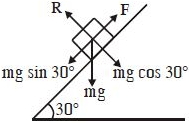
$A$ block rests on a rough inclined plane making an angle of $30^o$ with the horizontal. The coefficient of static friction between the block and the plane is $0.8$. If the frictional force on the block is $10 \, N$,the mass of the block (in $kg$) is (take $g = 10 \, m/s^2$)
A
$2$
B
$4$
C
$1.6$
D
$2.5$
Solution
(A) Let the mass of the block be $m$.
The block is at rest on the inclined plane.
The component of the gravitational force acting down the plane is $mg \sin 30^{\circ}$.
Since the block is in equilibrium,the static frictional force $F$ must balance this component:
$F = mg \sin 30^{\circ}$
Given $F = 10 \, N$,$g = 10 \, m/s^2$,and $\sin 30^{\circ} = 0.5$:
$10 = m \times 10 \times 0.5$
$10 = 5m$
$m = \frac{10}{5} = 2 \, kg$.
Note: We should check if this state is possible. The maximum static friction is $f_{max} = \mu_s N = \mu_s mg \cos 30^{\circ} = 0.8 \times 2 \times 10 \times \frac{\sqrt{3}}{2} \approx 13.86 \, N$. Since $F = 10 \, N < 13.86 \, N$,the block remains at rest.
The block is at rest on the inclined plane.
The component of the gravitational force acting down the plane is $mg \sin 30^{\circ}$.
Since the block is in equilibrium,the static frictional force $F$ must balance this component:
$F = mg \sin 30^{\circ}$
Given $F = 10 \, N$,$g = 10 \, m/s^2$,and $\sin 30^{\circ} = 0.5$:
$10 = m \times 10 \times 0.5$
$10 = 5m$
$m = \frac{10}{5} = 2 \, kg$.
Note: We should check if this state is possible. The maximum static friction is $f_{max} = \mu_s N = \mu_s mg \cos 30^{\circ} = 0.8 \times 2 \times 10 \times \frac{\sqrt{3}}{2} \approx 13.86 \, N$. Since $F = 10 \, N < 13.86 \, N$,the block remains at rest.
0 likesView Solution
66
ChemistryMCQAIEEE · 2004
Suppose the gravitational force varies inversely as the $n^{th}$ power of distance. Then the time period of a planet in circular orbit of radius $R$ around the sun will be proportional to
A
$R^{\left( \frac{n+1}{2} \right)}$
B
$R^{\left( \frac{n-1}{2} \right)}$
C
$R^n$
D
$R^{\left( \frac{n-2}{2} \right)}$
Solution
(A) The gravitational force is given by $F \propto \frac{1}{R^n} = R^{-n}$.
For a planet in a circular orbit,the centripetal force is provided by the gravitational force:
$M R \omega^2 = F \propto R^{-n}$.
Since $\omega = \frac{2\pi}{T}$,we have $\omega^2 \propto \frac{1}{T^2}$.
Substituting this into the force equation:
$R \cdot \frac{1}{T^2} \propto R^{-n}$.
$\frac{1}{T^2} \propto R^{-n-1} = R^{-(n+1)}$.
$T^2 \propto R^{n+1}$.
Taking the square root of both sides:
$T \propto R^{\frac{n+1}{2}}$.
For a planet in a circular orbit,the centripetal force is provided by the gravitational force:
$M R \omega^2 = F \propto R^{-n}$.
Since $\omega = \frac{2\pi}{T}$,we have $\omega^2 \propto \frac{1}{T^2}$.
Substituting this into the force equation:
$R \cdot \frac{1}{T^2} \propto R^{-n}$.
$\frac{1}{T^2} \propto R^{-n-1} = R^{-(n+1)}$.
$T^2 \propto R^{n+1}$.
Taking the square root of both sides:
$T \propto R^{\frac{n+1}{2}}$.
0 likesView Solution
67
ChemistryMCQAIEEE · 2004
$A$ particle moves in a straight line with retardation proportional to its displacement. Its loss of kinetic energy for any displacement $x$ is proportional to
A
$x^2$
B
$e^x$
C
$x$
D
$log_e x$
Solution
(A) The retardation $a$ is proportional to the displacement $x$,so $a = -kx$,where $k$ is a positive constant.
According to Newton's second law,the force $F = ma = -mkx$.
The work done by this force for a displacement $x$ is given by $W = \int_{0}^{x} F \cdot dx$.
$W = \int_{0}^{x} (-mkx) \cdot dx = -mk \int_{0}^{x} x \cdot dx = -mk \left[ \frac{x^2}{2} \right]_{0}^{x} = -\frac{1}{2} mkx^2$.
According to the work-energy theorem,the work done is equal to the change in kinetic energy,$W = \Delta KE = KE_f - KE_i$.
Since the force is a retardation,the kinetic energy decreases,so the loss of kinetic energy is $|W| = \frac{1}{2} mkx^2$.
Therefore,the loss of kinetic energy is proportional to $x^2$.
According to Newton's second law,the force $F = ma = -mkx$.
The work done by this force for a displacement $x$ is given by $W = \int_{0}^{x} F \cdot dx$.
$W = \int_{0}^{x} (-mkx) \cdot dx = -mk \int_{0}^{x} x \cdot dx = -mk \left[ \frac{x^2}{2} \right]_{0}^{x} = -\frac{1}{2} mkx^2$.
According to the work-energy theorem,the work done is equal to the change in kinetic energy,$W = \Delta KE = KE_f - KE_i$.
Since the force is a retardation,the kinetic energy decreases,so the loss of kinetic energy is $|W| = \frac{1}{2} mkx^2$.
Therefore,the loss of kinetic energy is proportional to $x^2$.
0 likesView Solution
68
ChemistryMCQAIEEE · 2004
The angle of incidence at which reflected light is totally polarized for reflection from air to glass (refractive index $n$) is
A
$\sin^{-1}(n)$
B
$\sin^{-1}(1/n)$
C
$\tan^{-1}(1/n)$
D
$\tan^{-1}(n)$
Solution
(D) According to Brewster's law,when light is incident at a specific angle called the polarizing angle $(i_p)$,the reflected light is completely plane-polarized.
The relationship is given by the formula: $\tan i_p = n$,where $n$ is the refractive index of the medium.
Therefore,the angle of incidence $i_p$ is given by: $i_p = \tan^{-1}(n)$.
The relationship is given by the formula: $\tan i_p = n$,where $n$ is the refractive index of the medium.
Therefore,the angle of incidence $i_p$ is given by: $i_p = \tan^{-1}(n)$.
0 likesView Solution
69
ChemistryMCQAIEEE · 2004
$A$ piece of copper and another of germanium are cooled from room temperature to $80\,K$. Which of the following is a correct statement?
A
Resistance of each increases
B
Resistance of each decreases
C
Resistance of copper increases while that of germanium decreases
D
Resistance of copper decreases while that of germanium increases
Solution
(D) Copper is a metal,and germanium is a semiconductor.
For metals,the resistance decreases as the temperature decreases.
For semiconductors,the resistance increases as the temperature decreases because the number of charge carriers decreases.
Since both are cooled from room temperature to $80\,K$,the resistance of copper decreases and the resistance of germanium increases.
Therefore,the correct statement is that the resistance of copper decreases while that of germanium increases.
For metals,the resistance decreases as the temperature decreases.
For semiconductors,the resistance increases as the temperature decreases because the number of charge carriers decreases.
Since both are cooled from room temperature to $80\,K$,the resistance of copper decreases and the resistance of germanium increases.
Therefore,the correct statement is that the resistance of copper decreases while that of germanium increases.
0 likesView Solution
70
ChemistryMCQAIEEE · 2004
One mole of an ideal monoatomic gas $(\gamma = 5/3)$ is mixed with one mole of a diatomic gas $(\gamma = 7/5)$. What is the value of $\gamma$ for the mixture? Here,$\gamma$ denotes the ratio of specific heat at constant pressure to that at constant volume.
A
$3/2$
B
$23/15$
C
$35/23$
D
$4/3$
Solution
(A) For a mixture of gases,the equivalent adiabatic exponent $\gamma_{\text{mix}}$ is given by the formula: $\frac{n_1 + n_2}{\gamma_{\text{mix}} - 1} = \frac{n_1}{\gamma_1 - 1} + \frac{n_2}{\gamma_2 - 1}$.
Given: $n_1 = 1$ mole,$\gamma_1 = 5/3$ (monoatomic); $n_2 = 1$ mole,$\gamma_2 = 7/5$ (diatomic).
Substituting the values:
$\frac{1 + 1}{\gamma_{\text{mix}} - 1} = \frac{1}{5/3 - 1} + \frac{1}{7/5 - 1}$
$\frac{2}{\gamma_{\text{mix}} - 1} = \frac{1}{2/3} + \frac{1}{2/5} = \frac{3}{2} + \frac{5}{2} = \frac{8}{2} = 4$.
$\frac{2}{\gamma_{\text{mix}} - 1} = 4 \implies \gamma_{\text{mix}} - 1 = 2/4 = 1/2$.
$\gamma_{\text{mix}} = 1 + 0.5 = 1.5 = 3/2$.
Given: $n_1 = 1$ mole,$\gamma_1 = 5/3$ (monoatomic); $n_2 = 1$ mole,$\gamma_2 = 7/5$ (diatomic).
Substituting the values:
$\frac{1 + 1}{\gamma_{\text{mix}} - 1} = \frac{1}{5/3 - 1} + \frac{1}{7/5 - 1}$
$\frac{2}{\gamma_{\text{mix}} - 1} = \frac{1}{2/3} + \frac{1}{2/5} = \frac{3}{2} + \frac{5}{2} = \frac{8}{2} = 4$.
$\frac{2}{\gamma_{\text{mix}} - 1} = 4 \implies \gamma_{\text{mix}} - 1 = 2/4 = 1/2$.
$\gamma_{\text{mix}} = 1 + 0.5 = 1.5 = 3/2$.
0 likesView Solution
71
ChemistryMCQAIEEE · 2004
$A$ current $i$ $A$ flows along an infinitely long straight thin-walled tube. The magnetic induction at any point inside the tube is:
A
$\infty$
B
zero
C
$\frac{\mu_0}{4\pi} \cdot \frac{2i}{r} \text{ T}$
D
$\frac{2i}{r} \text{ T}$
Solution
(B) According to Ampere's Circuital Law,the line integral of the magnetic field $\vec{B}$ around any closed path is equal to $\mu_0$ times the net current $I_{en}$ enclosed by the path: $\oint \vec{B} \cdot d\vec{l} = \mu_0 I_{en}$.
For any point inside an infinitely long thin-walled tube,we can consider a circular Amperian loop of radius $r$ centered on the axis of the tube.
Since the current $i$ flows only through the walls of the tube,the current enclosed by any loop inside the tube is $I_{en} = 0$.
Therefore,$\oint \vec{B} \cdot d\vec{l} = \mu_0(0) = 0$.
This implies that the magnetic induction $B$ at any point inside the tube is zero.
For any point inside an infinitely long thin-walled tube,we can consider a circular Amperian loop of radius $r$ centered on the axis of the tube.
Since the current $i$ flows only through the walls of the tube,the current enclosed by any loop inside the tube is $I_{en} = 0$.
Therefore,$\oint \vec{B} \cdot d\vec{l} = \mu_0(0) = 0$.
This implies that the magnetic induction $B$ at any point inside the tube is zero.
0 likesView Solution
72
ChemistryMCQAIEEE · 2004
$A$ piece of copper and another of germanium are cooled from room temperature to $80 \, K$. Which of the following is a correct statement?
A
Resistance of each increases
B
Resistance of each decreases
C
Resistance of copper increases while that of germanium decreases
D
Resistance of copper decreases while that of germanium increases
Solution
(D) Copper is a metal,and germanium is a semiconductor.
For metals,the resistance decreases as the temperature decreases.
For semiconductors,the resistance increases as the temperature decreases because the number of charge carriers (electrons and holes) decreases significantly at lower temperatures.
Since both materials are cooled from room temperature to $80 \, K$,the resistance of copper decreases,and the resistance of germanium increases.
Therefore,the correct statement is that the resistance of copper decreases while that of germanium increases.
For metals,the resistance decreases as the temperature decreases.
For semiconductors,the resistance increases as the temperature decreases because the number of charge carriers (electrons and holes) decreases significantly at lower temperatures.
Since both materials are cooled from room temperature to $80 \, K$,the resistance of copper decreases,and the resistance of germanium increases.
Therefore,the correct statement is that the resistance of copper decreases while that of germanium increases.
0 likesView Solution
73
ChemistryMCQAIEEE · 2004
$A$ block rests on a rough inclined plane making an angle of $30^o$ with the horizontal. The coefficient of static friction between the block and the plane is $0.8.$ If the frictional force on the block is $10\,N,$ the mass of the block (in $kg$) is (take $g = 10\,m/s^2$)
A
$2$
B
$4$
C
$1.6$
D
$2.5$
Solution
(A) For a block resting on an inclined plane,the component of gravitational force acting down the plane is $F_g = mg \sin(\theta)$.
Given $\theta = 30^o$,$g = 10\,m/s^2$,and the frictional force $f = 10\,N$.
Since the block is at rest,the static frictional force must balance the component of gravity acting down the plane.
Thus,$f = mg \sin(30^o)$.
Substituting the values: $10 = m \times 10 \times \sin(30^o)$.
Since $\sin(30^o) = 0.5$,we have $10 = m \times 10 \times 0.5$.
$10 = 5m$.
$m = 10 / 5 = 2\,kg$.
Note: The coefficient of static friction $\mu_s = 0.8$ is provided to check if the block can remain at rest. The maximum static friction is $f_{max} = \mu_s N = \mu_s mg \cos(30^o) = 0.8 \times 2 \times 10 \times 0.866 \approx 13.86\,N$. Since $10\,N < 13.86\,N$,the block remains at rest.
Given $\theta = 30^o$,$g = 10\,m/s^2$,and the frictional force $f = 10\,N$.
Since the block is at rest,the static frictional force must balance the component of gravity acting down the plane.
Thus,$f = mg \sin(30^o)$.
Substituting the values: $10 = m \times 10 \times \sin(30^o)$.
Since $\sin(30^o) = 0.5$,we have $10 = m \times 10 \times 0.5$.
$10 = 5m$.
$m = 10 / 5 = 2\,kg$.
Note: The coefficient of static friction $\mu_s = 0.8$ is provided to check if the block can remain at rest. The maximum static friction is $f_{max} = \mu_s N = \mu_s mg \cos(30^o) = 0.8 \times 2 \times 10 \times 0.866 \approx 13.86\,N$. Since $10\,N < 13.86\,N$,the block remains at rest.
0 likesView Solution
74
ChemistryMCQAIEEE · 2004
$A$ block rests on a rough inclined plane making an angle of $30^{\circ}$ with the horizontal. The coefficient of static friction between the block and the plane is $0.8$. If the frictional force on the block is $10 \, N$,the mass of the block (in $kg$) is (take $g = 10 \, m/s^2$)
A
$2$
B
$4$
C
$1.6$
D
$2.5$
Solution
(A) The angle of repose is given by $\alpha = \tan^{-1}(\mu) = \tan^{-1}(0.8) \approx 38.6^{\circ}$.
Since the angle of the inclined plane $\theta = 30^{\circ}$ is less than the angle of repose $\alpha$,the block remains at rest.
For a block at rest on an inclined plane,the static frictional force $f_s$ balances the component of the gravitational force acting down the plane.
Thus,$f_s = mg \sin(\theta)$.
Given $f_s = 10 \, N$,$g = 10 \, m/s^2$,and $\theta = 30^{\circ}$,we have:
$10 = m \times 10 \times \sin(30^{\circ})$
$10 = m \times 10 \times 0.5$
$10 = 5m$
$m = \frac{10}{5} = 2 \, kg$.
Since the angle of the inclined plane $\theta = 30^{\circ}$ is less than the angle of repose $\alpha$,the block remains at rest.
For a block at rest on an inclined plane,the static frictional force $f_s$ balances the component of the gravitational force acting down the plane.
Thus,$f_s = mg \sin(\theta)$.
Given $f_s = 10 \, N$,$g = 10 \, m/s^2$,and $\theta = 30^{\circ}$,we have:
$10 = m \times 10 \times \sin(30^{\circ})$
$10 = m \times 10 \times 0.5$
$10 = 5m$
$m = \frac{10}{5} = 2 \, kg$.
0 likesView Solution
75
ChemistryMCQAIEEE · 2004
$A$ particle at the end of a spring executes simple harmonic motion with a period $t_1$,while the corresponding period for another spring is $t_2$. If the period of oscillation with the two springs in series is $T$,then
A
$T = t_1 + t_2$
B
$T^2 = t_1^2 + t_2^2$
C
$T^{-1} = t_1^{-1} + t_2^{-1}$
D
$T^{-2} = t_1^{-2} + t_2^{-2}$
Solution
(B) The period of a mass $m$ attached to a spring of constant $k$ is given by $t = 2 \pi \sqrt{\frac{m}{k}}$.
Thus,$t_1 = 2 \pi \sqrt{\frac{m}{k_1}}$ and $t_2 = 2 \pi \sqrt{\frac{m}{k_2}}$.
Squaring these,we get $t_1^2 = 4 \pi^2 \frac{m}{k_1}$ and $t_2^2 = 4 \pi^2 \frac{m}{k_2}$,which implies $\frac{1}{k_1} = \frac{t_1^2}{4 \pi^2 m}$ and $\frac{1}{k_2} = \frac{t_2^2}{4 \pi^2 m}$.
When two springs are connected in series,the effective spring constant $k_{eff}$ is given by $\frac{1}{k_{eff}} = \frac{1}{k_1} + \frac{1}{k_2}$.
The period of the system in series is $T = 2 \pi \sqrt{\frac{m}{k_{eff}}}$,so $T^2 = 4 \pi^2 \frac{m}{k_{eff}}$.
Substituting the expressions for $\frac{1}{k_1}$ and $\frac{1}{k_2}$ into the series formula:
$\frac{T^2}{4 \pi^2 m} = \frac{t_1^2}{4 \pi^2 m} + \frac{t_2^2}{4 \pi^2 m}$.
Multiplying by $4 \pi^2 m$,we obtain $T^2 = t_1^2 + t_2^2$.
Thus,$t_1 = 2 \pi \sqrt{\frac{m}{k_1}}$ and $t_2 = 2 \pi \sqrt{\frac{m}{k_2}}$.
Squaring these,we get $t_1^2 = 4 \pi^2 \frac{m}{k_1}$ and $t_2^2 = 4 \pi^2 \frac{m}{k_2}$,which implies $\frac{1}{k_1} = \frac{t_1^2}{4 \pi^2 m}$ and $\frac{1}{k_2} = \frac{t_2^2}{4 \pi^2 m}$.
When two springs are connected in series,the effective spring constant $k_{eff}$ is given by $\frac{1}{k_{eff}} = \frac{1}{k_1} + \frac{1}{k_2}$.
The period of the system in series is $T = 2 \pi \sqrt{\frac{m}{k_{eff}}}$,so $T^2 = 4 \pi^2 \frac{m}{k_{eff}}$.
Substituting the expressions for $\frac{1}{k_1}$ and $\frac{1}{k_2}$ into the series formula:
$\frac{T^2}{4 \pi^2 m} = \frac{t_1^2}{4 \pi^2 m} + \frac{t_2^2}{4 \pi^2 m}$.
Multiplying by $4 \pi^2 m$,we obtain $T^2 = t_1^2 + t_2^2$.
0 likesView Solution
76
ChemistryMCQAIEEE · 2004
The total energy of a particle executing simple harmonic motion is
A
$\propto x$
B
$\propto x^2$
C
independent of $x$
D
$\propto x^{1/2}$
Solution
(C) The total energy $(E)$ of a particle executing simple harmonic motion is given by the sum of its kinetic energy $(K)$ and potential energy $(U)$.
$E = K + U = \frac{1}{2} m \omega^2 A^2$,where $m$ is the mass,$\omega$ is the angular frequency,and $A$ is the amplitude.
Since $m$,$\omega$,and $A$ are constants for a given simple harmonic motion,the total energy $E$ remains constant throughout the motion.
Therefore,the total energy is independent of the displacement $x$ from the equilibrium position.
Thus,option $(c)$ is correct.
$E = K + U = \frac{1}{2} m \omega^2 A^2$,where $m$ is the mass,$\omega$ is the angular frequency,and $A$ is the amplitude.
Since $m$,$\omega$,and $A$ are constants for a given simple harmonic motion,the total energy $E$ remains constant throughout the motion.
Therefore,the total energy is independent of the displacement $x$ from the equilibrium position.
Thus,option $(c)$ is correct.
0 likesView Solution
77
ChemistryMCQAIEEE · 2004
The compound formed on heating chlorobenzene with chloral in the presence of concentrated sulphuric acid is:
A
Freon
B
$DDT$
C
Gammexene
D
Hexachloroethane
Solution
(B) When $2$ moles of chlorobenzene react with $1$ mole of chloral $(CCl_3CHO)$ in the presence of concentrated $H_2SO_4$,the product formed is $1,1,1$-trichloro-$2,2$-bis($p$-chlorophenyl)ethane,commonly known as $DDT$.
The reaction is: $2C_6H_5Cl + CCl_3CHO \xrightarrow{conc. H_2SO_4} (ClC_6H_4)_2CHCCl_3 + H_2O$.
The reaction is: $2C_6H_5Cl + CCl_3CHO \xrightarrow{conc. H_2SO_4} (ClC_6H_4)_2CHCCl_3 + H_2O$.
0 likesView Solution
78
ChemistryMCQAIEEE · 2004
Which among the following factors is the most important in making fluorine the strongest oxidising halogen?
A
Bond dissociation energy
B
Ionisation enthalpy
C
Hydration enthalpy
D
Electron affinity
Solution
(C) The oxidizing power of a halogen is determined by the standard electrode potential $(E^{\circ})$,which depends on three factors: enthalpy of dissociation,enthalpy of electron gain,and enthalpy of hydration.
Fluorine is the strongest oxidizing agent because its low bond dissociation energy and very high negative hydration enthalpy significantly outweigh its relatively low electron gain enthalpy compared to chlorine.
Fluorine is the strongest oxidizing agent because its low bond dissociation energy and very high negative hydration enthalpy significantly outweigh its relatively low electron gain enthalpy compared to chlorine.
0 likesView Solution
79
ChemistryMCQAIEEE · 2004
Coordination compounds have great importance in biological systems. In this context,which of the following statements is incorrect?
A
Carboxypeptidase-$A$ is an enzyme and contains zinc.
B
Haemoglobin is the red pigment of blood and contains iron.
C
Cyanocobalamin is Vitamin $B_{12}$ and contains cobalt.
D
Chlorophylls are green pigments in plants and contain calcium.
Solution
(D) Chlorophylls are green pigments in plants and contain magnesium,not calcium.
They are essential for photosynthesis,where they capture light energy to convert carbon dioxide and water into glucose.
They are essential for photosynthesis,where they capture light energy to convert carbon dioxide and water into glucose.
0 likesView Solution
80
ChemistryMCQAIEEE · 2004
In an $LCR$ circuit,the capacitance is changed from $C$ to $2C$. For the resonant frequency to remain unchanged,the inductance should be changed from $L$ to:
A
$L/4$
B
$2L$
C
$L/2$
D
$4L$
Solution
(C) The resonant frequency $f_r$ of an $LCR$ circuit is given by the formula:
$f_r = \frac{1}{2 \pi \sqrt{LC}}$
For the resonant frequency to remain unchanged,the product $LC$ must remain constant:
$L_1 C_1 = L_2 C_2$
Given that $L_1 = L$,$C_1 = C$,and $C_2 = 2C$,we substitute these values into the equation:
$L \cdot C = L_2 \cdot (2C)$
Solving for $L_2$:
$L_2 = \frac{LC}{2C} = \frac{L}{2}$
Therefore,the inductance should be changed to $L/2$.
$f_r = \frac{1}{2 \pi \sqrt{LC}}$
For the resonant frequency to remain unchanged,the product $LC$ must remain constant:
$L_1 C_1 = L_2 C_2$
Given that $L_1 = L$,$C_1 = C$,and $C_2 = 2C$,we substitute these values into the equation:
$L \cdot C = L_2 \cdot (2C)$
Solving for $L_2$:
$L_2 = \frac{LC}{2C} = \frac{L}{2}$
Therefore,the inductance should be changed to $L/2$.
0 likesView Solution
81
ChemistryMCQAIEEE · 2004
Suppose the gravitational force varies inversely as the $n^{th}$ power of distance. Then the time period of a planet in a circular orbit of radius $R$ around the sun will be proportional to
A
$R^{\left( \frac{n+1}{2} \right)}$
B
$R^{\left( \frac{n-1}{2} \right)}$
C
$R^n$
D
$R^{\left( \frac{n-2}{2} \right)}$
Solution
(A) The necessary centripetal force required for a planet to move around the sun is provided by the gravitational force.
Let the gravitational force be $F = \frac{k}{R^n}$,where $k$ is a constant.
The centripetal force is given by $F_c = \frac{mv^2}{R}$.
Equating the two,we have $\frac{mv^2}{R} = \frac{k}{R^n}$.
This simplifies to $v^2 = \frac{k}{mR^{n-1}}$,so $v \propto R^{-\frac{n-1}{2}}$.
The time period $T$ is given by $T = \frac{2\pi R}{v}$.
Substituting the expression for $v$,we get $T \propto \frac{R}{R^{-\frac{n-1}{2}}}$.
Therefore,$T \propto R^{1 + \frac{n-1}{2}} = R^{\frac{2+n-1}{2}} = R^{\frac{n+1}{2}}$.
Let the gravitational force be $F = \frac{k}{R^n}$,where $k$ is a constant.
The centripetal force is given by $F_c = \frac{mv^2}{R}$.
Equating the two,we have $\frac{mv^2}{R} = \frac{k}{R^n}$.
This simplifies to $v^2 = \frac{k}{mR^{n-1}}$,so $v \propto R^{-\frac{n-1}{2}}$.
The time period $T$ is given by $T = \frac{2\pi R}{v}$.
Substituting the expression for $v$,we get $T \propto \frac{R}{R^{-\frac{n-1}{2}}}$.
Therefore,$T \propto R^{1 + \frac{n-1}{2}} = R^{\frac{2+n-1}{2}} = R^{\frac{n+1}{2}}$.
0 likesView Solution
82
ChemistryMCQAIEEE · 2004
$A$ particle moves in a straight line with retardation proportional to its displacement. Its loss of kinetic energy for any displacement $x$ is proportional to:
A
$x^2$
B
$e^x$
C
$x$
D
$log_e x$
Solution
(A) Given that retardation $a$ is proportional to displacement $x$,so $a = -kx$ (where $k$ is a positive constant).
Using the relation $a = v \frac{dv}{dx}$,we have $v \frac{dv}{dx} = -kx$.
Integrating both sides: $\int v dv = \int -kx dx$.
This gives $\frac{v^2}{2} = -\frac{kx^2}{2} + C$.
At $x = 0$,let the initial velocity be $u$,so $C = \frac{u^2}{2}$.
Thus,$\frac{v^2}{2} = \frac{u^2}{2} - \frac{kx^2}{2}$,which implies $u^2 - v^2 = kx^2$.
The loss in kinetic energy is $\Delta K = \frac{1}{2}m(u^2 - v^2) = \frac{1}{2}m(kx^2)$.
Since $m$ and $k$ are constants,the loss in kinetic energy is proportional to $x^2$.
Using the relation $a = v \frac{dv}{dx}$,we have $v \frac{dv}{dx} = -kx$.
Integrating both sides: $\int v dv = \int -kx dx$.
This gives $\frac{v^2}{2} = -\frac{kx^2}{2} + C$.
At $x = 0$,let the initial velocity be $u$,so $C = \frac{u^2}{2}$.
Thus,$\frac{v^2}{2} = \frac{u^2}{2} - \frac{kx^2}{2}$,which implies $u^2 - v^2 = kx^2$.
The loss in kinetic energy is $\Delta K = \frac{1}{2}m(u^2 - v^2) = \frac{1}{2}m(kx^2)$.
Since $m$ and $k$ are constants,the loss in kinetic energy is proportional to $x^2$.
0 likesView Solution
83
ChemistryMCQAIEEE · 2004
$A$ particle at the end of a spring executes simple harmonic motion with a period $t_1$,while the corresponding period for another spring is $t_2$. If the period of oscillation with the two springs in series is $T$,then
A
$T = t_1 + t_2$
B
$T^2 = t_1^2 + t_2^2$
C
$T^{-1} = t_1^{-1} + t_2^{-1}$
D
$T^{-2} = t_1^{-2} + t_2^{-2}$
Solution
(B) The period of a mass $m$ attached to a spring of constant $k$ is given by $t = 2\pi \sqrt{\frac{m}{k}}$.
Thus,$t_1 = 2\pi \sqrt{\frac{m}{k_1}}$ and $t_2 = 2\pi \sqrt{\frac{m}{k_2}}$.
Squaring these,we get $t_1^2 = 4\pi^2 \frac{m}{k_1}$ and $t_2^2 = 4\pi^2 \frac{m}{k_2}$.
When two springs are connected in series,the equivalent spring constant $k_{eq}$ is given by $\frac{1}{k_{eq}} = \frac{1}{k_1} + \frac{1}{k_2}$.
The period of oscillation for the series combination is $T = 2\pi \sqrt{\frac{m}{k_{eq}}}$.
Squaring this,$T^2 = 4\pi^2 \frac{m}{k_{eq}} = 4\pi^2 m \left( \frac{1}{k_1} + \frac{1}{k_2} \right)$.
Substituting the expressions for $t_1^2$ and $t_2^2$,we get $T^2 = 4\pi^2 \frac{m}{k_1} + 4\pi^2 \frac{m}{k_2} = t_1^2 + t_2^2$.
Thus,$t_1 = 2\pi \sqrt{\frac{m}{k_1}}$ and $t_2 = 2\pi \sqrt{\frac{m}{k_2}}$.
Squaring these,we get $t_1^2 = 4\pi^2 \frac{m}{k_1}$ and $t_2^2 = 4\pi^2 \frac{m}{k_2}$.
When two springs are connected in series,the equivalent spring constant $k_{eq}$ is given by $\frac{1}{k_{eq}} = \frac{1}{k_1} + \frac{1}{k_2}$.
The period of oscillation for the series combination is $T = 2\pi \sqrt{\frac{m}{k_{eq}}}$.
Squaring this,$T^2 = 4\pi^2 \frac{m}{k_{eq}} = 4\pi^2 m \left( \frac{1}{k_1} + \frac{1}{k_2} \right)$.
Substituting the expressions for $t_1^2$ and $t_2^2$,we get $T^2 = 4\pi^2 \frac{m}{k_1} + 4\pi^2 \frac{m}{k_2} = t_1^2 + t_2^2$.
0 likesView Solution
84
ChemistryMCQAIEEE · 2004
If $g$ is the acceleration due to gravity on the earth's surface,the gain in the potential energy of an object of mass $m$ raised from the surface of the earth to a height equal to the radius $R$ of the earth,is
A
$2\,mgR$
B
$\frac{1}{2}\,mgR$
C
$\frac{1}{4}\,mgR$
D
$mgR$
Solution
(B) The gravitational potential energy $U$ at a distance $r$ from the center of the Earth is given by $U = -\frac{GMm}{r}$.
At the surface of the Earth,$r = R$,so $U_i = -\frac{GMm}{R}$.
Since $g = \frac{GM}{R^2}$,we have $GM = gR^2$. Substituting this,$U_i = -mgR$.
At a height $h = R$ above the surface,the distance from the center is $r = R + h = 2R$.
So,$U_f = -\frac{GMm}{2R} = -\frac{gR^2m}{2R} = -\frac{1}{2}mgR$.
The gain in potential energy is $\Delta U = U_f - U_i = -\frac{1}{2}mgR - (-mgR) = \frac{1}{2}mgR$.
At the surface of the Earth,$r = R$,so $U_i = -\frac{GMm}{R}$.
Since $g = \frac{GM}{R^2}$,we have $GM = gR^2$. Substituting this,$U_i = -mgR$.
At a height $h = R$ above the surface,the distance from the center is $r = R + h = 2R$.
So,$U_f = -\frac{GMm}{2R} = -\frac{gR^2m}{2R} = -\frac{1}{2}mgR$.
The gain in potential energy is $\Delta U = U_f - U_i = -\frac{1}{2}mgR - (-mgR) = \frac{1}{2}mgR$.
0 likesView Solution
85
ChemistryMCQAIEEE · 2004
$A$ uniform chain of length $2\, m$ is kept on a table such that a length of $60\, cm$ hangs freely from the edge of the table. The total mass of the chain is $4\, kg$. What is the work done in pulling the entire chain on the table? ................ $J$
A
$7.2$
B
$3.6$
C
$120$
D
$1200$
Solution
(B) The total length of the chain is $L = 2\, m$ and its total mass is $M = 4\, kg$.
The length of the hanging part is $l = 60\, cm = 0.6\, m$.
The mass per unit length of the chain is $\lambda = \frac{M}{L} = \frac{4}{2} = 2\, kg/m$.
The mass of the hanging part is $m = \lambda \times l = 2 \times 0.6 = 1.2\, kg$.
The center of mass of the hanging part is at a distance $h = \frac{l}{2} = \frac{0.6}{2} = 0.3\, m$ below the edge of the table.
The work done to pull the chain onto the table is equal to the change in potential energy of the hanging part,which is $W = mgh$.
Substituting the values: $W = 1.2 \times 10 \times 0.3 = 3.6\, J$.
The length of the hanging part is $l = 60\, cm = 0.6\, m$.
The mass per unit length of the chain is $\lambda = \frac{M}{L} = \frac{4}{2} = 2\, kg/m$.
The mass of the hanging part is $m = \lambda \times l = 2 \times 0.6 = 1.2\, kg$.
The center of mass of the hanging part is at a distance $h = \frac{l}{2} = \frac{0.6}{2} = 0.3\, m$ below the edge of the table.
The work done to pull the chain onto the table is equal to the change in potential energy of the hanging part,which is $W = mgh$.
Substituting the values: $W = 1.2 \times 10 \times 0.3 = 3.6\, J$.
0 likesView Solution
86
ChemistryMCQAIEEE · 2004
One mole of an ideal monoatomic gas $(\gamma = 5/3)$ is mixed with one mole of a diatomic gas $(\gamma = 7/5)$. What is the $\gamma$ for the mixture? Here,$\gamma$ denotes the ratio of specific heat at constant pressure to that at constant volume.
A
$3/2$
B
$23/15$
C
$35/23$
D
$4/3$
Solution
(A) For a mixture of gases,the equivalent adiabatic exponent $\gamma_{mix}$ is given by the formula: $\frac{\mu_1 + \mu_2}{\gamma_{mix} - 1} = \frac{\mu_1}{\gamma_1 - 1} + \frac{\mu_2}{\gamma_2 - 1}$.
Given: $\mu_1 = 1$,$\gamma_1 = 5/3$ (monoatomic) and $\mu_2 = 1$,$\gamma_2 = 7/5$ (diatomic).
Substituting the values:
$\frac{1 + 1}{\gamma_{mix} - 1} = \frac{1}{5/3 - 1} + \frac{1}{7/5 - 1}$.
$\frac{2}{\gamma_{mix} - 1} = \frac{1}{2/3} + \frac{1}{2/5} = \frac{3}{2} + \frac{5}{2} = \frac{8}{2} = 4$.
$\frac{2}{\gamma_{mix} - 1} = 4 \implies \gamma_{mix} - 1 = 2/4 = 0.5$.
$\gamma_{mix} = 1 + 0.5 = 1.5 = 3/2$.
Given: $\mu_1 = 1$,$\gamma_1 = 5/3$ (monoatomic) and $\mu_2 = 1$,$\gamma_2 = 7/5$ (diatomic).
Substituting the values:
$\frac{1 + 1}{\gamma_{mix} - 1} = \frac{1}{5/3 - 1} + \frac{1}{7/5 - 1}$.
$\frac{2}{\gamma_{mix} - 1} = \frac{1}{2/3} + \frac{1}{2/5} = \frac{3}{2} + \frac{5}{2} = \frac{8}{2} = 4$.
$\frac{2}{\gamma_{mix} - 1} = 4 \implies \gamma_{mix} - 1 = 2/4 = 0.5$.
$\gamma_{mix} = 1 + 0.5 = 1.5 = 3/2$.
0 likesView Solution
87
ChemistryMCQAIEEE · 2004
$A$ wire fixed at the upper end stretches by length $l$ by applying a force $F$. The work done in stretching is
A
$\frac{F}{2l}$
B
$Fl$
C
$2Fl$
D
$\frac{Fl}{2}$
Solution
(D) The force applied to the wire increases linearly from $0$ to $F$ as it stretches from $0$ to $l$.
The average force applied during the stretching process is given by $F_{av} = \frac{0 + F}{2} = \frac{F}{2}$.
The work done $(W)$ in stretching the wire is equal to the product of the average force and the displacement (extension).
$W = F_{av} \times l = \left( \frac{F}{2} \right) \times l = \frac{Fl}{2}$.
Therefore,the work done is $\frac{Fl}{2}$.
The average force applied during the stretching process is given by $F_{av} = \frac{0 + F}{2} = \frac{F}{2}$.
The work done $(W)$ in stretching the wire is equal to the product of the average force and the displacement (extension).
$W = F_{av} \times l = \left( \frac{F}{2} \right) \times l = \frac{Fl}{2}$.
Therefore,the work done is $\frac{Fl}{2}$.
0 likesView Solution
88
ChemistryMCQAIEEE · 2004
Which of the following statements is correct for any thermodynamic system?
A
The internal energy changes in all processes.
B
Internal energy and entropy are state functions.
C
The change in entropy can never be zero.
D
The work done in an adiabatic process is always zero.
Solution
(B) Internal energy is a state function,meaning it depends only on the state of the system and not on the path taken. Similarly,entropy is also a state function.
In an isothermal process,the temperature remains constant,and for an ideal gas,the internal energy does not change $(\Delta U = 0)$.
In a reversible adiabatic process,the entropy change is zero $(\Delta S = 0)$.
Work done in an adiabatic process is given by $W = -\Delta U$,which is generally non-zero.
Therefore,the statement that internal energy and entropy are state functions is correct.
In an isothermal process,the temperature remains constant,and for an ideal gas,the internal energy does not change $(\Delta U = 0)$.
In a reversible adiabatic process,the entropy change is zero $(\Delta S = 0)$.
Work done in an adiabatic process is given by $W = -\Delta U$,which is generally non-zero.
Therefore,the statement that internal energy and entropy are state functions is correct.
0 likesView Solution
89
ChemistryMCQAIEEE · 2004
If the temperature of the sun were to increase from $T$ to $2T$ and its radius from $R$ to $2R$,then the ratio of the radiant energy received on earth to what it was previously will be
A
$32$
B
$16$
C
$4$
D
$64$
Solution
(D) The radiant power (luminosity) of the sun is given by the Stefan-Boltzmann law: $E = \sigma A T^4$.
Since the surface area $A = 4\pi R^2$,we have $A \propto R^2$.
Therefore,the radiant energy $E \propto R^2 T^4$.
Let $E_1$ be the initial energy and $E_2$ be the final energy.
Given $R_1 = R$,$T_1 = T$ and $R_2 = 2R$,$T_2 = 2T$.
The ratio is given by $\frac{E_2}{E_1} = \frac{R_2^2 T_2^4}{R_1^2 T_1^4}$.
Substituting the values: $\frac{E_2}{E_1} = \frac{(2R)^2 (2T)^4}{R^2 T^4} = \frac{4R^2 \cdot 16T^4}{R^2 T^4} = 4 \cdot 16 = 64$.
Since the surface area $A = 4\pi R^2$,we have $A \propto R^2$.
Therefore,the radiant energy $E \propto R^2 T^4$.
Let $E_1$ be the initial energy and $E_2$ be the final energy.
Given $R_1 = R$,$T_1 = T$ and $R_2 = 2R$,$T_2 = 2T$.
The ratio is given by $\frac{E_2}{E_1} = \frac{R_2^2 T_2^4}{R_1^2 T_1^4}$.
Substituting the values: $\frac{E_2}{E_1} = \frac{(2R)^2 (2T)^4}{R^2 T^4} = \frac{4R^2 \cdot 16T^4}{R^2 T^4} = 4 \cdot 16 = 64$.
0 likesView Solution
90
ChemistryMCQAIEEE · 2004
The equilibrium constant for the reaction $N_{2(g)} + O_{2(g)} \rightleftharpoons 2 NO_{(g)}$ at temperature $T$ is $4 \times 10^{-4}$. The value of $K_C$ for the reaction $NO_{(g)} \rightleftharpoons \frac{1}{2} N_{2(g)} + \frac{1}{2} O_{2(g)}$ at the same temperature is:
A
$4 \times 10^{-4}$
B
$50$
C
$2.5 \times 10^2$
D
$0.02$
Solution
(B) For the reaction $N_{2(g)} + O_{2(g)} \rightleftharpoons 2 NO_{(g)}$,the equilibrium constant is $K_C = 4 \times 10^{-4}$.
For the reaction $NO_{(g)} \rightleftharpoons \frac{1}{2} N_{2(g)} + \frac{1}{2} O_{2(g)}$,the reaction is the reverse of the original reaction and multiplied by a factor of $\frac{1}{2}$.
Therefore,the new equilibrium constant $K_C'$ is given by $K_C' = \frac{1}{\sqrt{K_C}}$.
$K_C' = \frac{1}{\sqrt{4 \times 10^{-4}}} = \frac{1}{2 \times 10^{-2}} = \frac{1}{0.02} = 50$.
For the reaction $NO_{(g)} \rightleftharpoons \frac{1}{2} N_{2(g)} + \frac{1}{2} O_{2(g)}$,the reaction is the reverse of the original reaction and multiplied by a factor of $\frac{1}{2}$.
Therefore,the new equilibrium constant $K_C'$ is given by $K_C' = \frac{1}{\sqrt{K_C}}$.
$K_C' = \frac{1}{\sqrt{4 \times 10^{-4}}} = \frac{1}{2 \times 10^{-2}} = \frac{1}{0.02} = 50$.
0 likesView Solution
Vedclass Products
For Students
Vedclass Test Series
Mock tests in real AIEEE style covering Chemistry with performance analysis. 5-day free trial.
Start Free TrialFor Teachers
Exam Paper Generator
Generate Set A/B/C/D Chemistry papers from 7.5L+ questions in 2 minutes. 3 chapters free.
Try FreeFor Institutes
Online Exam Module
Run live AIEEE mock exams with unlimited students, 360° analytics & white-label branding.
See DemoFrequently Asked Questions
How many Chemistry questions are in AIEEE 2004?
There are 132 Chemistry questions from the AIEEE 2004 paper on Vedclass, each with a detailed step-by-step solution in English.
Are AIEEE 2004 Chemistry solutions available in English?
Yes. All solutions on this page are in English. You can also switch to English or Hindi using the language buttons above the questions.
Can I practice AIEEE 2004 Chemistry as a timed test?
Yes. Use the Vedclass Test Series to attempt a full AIEEE mock test covering Chemistry with time limits and instant score analysis.
Can teachers create Chemistry papers from AIEEE previous year questions?
Yes. The Vedclass Exam Paper Generator lets teachers mix AIEEE Chemistry questions and generate Set A/B/C/D papers in minutes.
For Teachers & Institutes
Build a Custom Chemistry Paper
Pick AIEEE 2004 Chemistry questions, set difficulty, and generate Set A/B/C/D in 2 minutes.